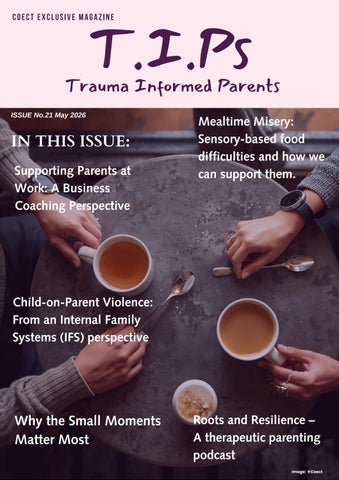
COECT EXCLUSIVE MAGAZINE
T.I.Ps
Trauma Informed Parents ISSUE No.21 May 2026
IN THIS ISSUE: Supporting Parents at Work: A Business Coaching Perspective
Mealtime Misery: Sensory-based food difficulties and how we can support them.
Child-on-Parent Violence: From an Internal Family Systems (IFS) perspective
Why the Small Moments Matter Most
Roots and Resilience – A therapeutic parenting podcast Image: ©Coect
Meet the Team! Executive Editor - Sarah Naish Sarah is a Therapeutic Parent, an Adopter of five siblings, Best selling international Author, Keynote Speaker and founder of three Independent Therapeutic Fostering Agencies. Sarah is also and cofounder and CEO at The Centre of Excellence in Child Trauma C.I.C.
Executive Editor - Sair Penna Sair (Sarah) is a Therapeutic Parent, Author, Parent Coach and Havening practitioner. Sair is also co-founder and Director of Training, Qualifications & Quality at The Centre of Excellence in Child Trauma C.I.C
Managing Editor - Kathryn Talbot Kathryn is co-founder and managing editor of the TIPs magazine, at The Centre of Excellence in Child Trauma C.I.C specialising in public relations.
Contributor - Jessica Spenceley Jessica is a therapeutic social worker with over 20 years of experience helping adoptive parents navigate their parenting journeys using the attachment-based, trauma-informed parenting approach of TBRI®.
Contributor - Russ Hartland-Shaw Russ set up Breathe Leadership & Business Coaching in 2020 as a result of adopting and becoming a parent to two boys in 2019. He was then inspired to specialise in Therapeutic Parenting to support families navigating the challenges of early childhood trauma.
Contributor - Sue Williams Sue Williams is an HCPC registered children’s dietitian with almost 15 years experience working with children with feeding difficulties, and a mum. She is a Therapeutic Parenting Coach, and has set up Growing Appetites to support families with eating challenges specifically those with neurodiversity or past trauma.
Contributor - Amanda Mauger-Jones Mandie is a therapeutic foster parent with expertise in empathic listening. She is a practitioner informed by Dyadic Developmental Psychotherapy (DDP), a Trauma-Informed Trainer and Coach for our Therapeutic Services, including our members Supportive Listening Service.
Contributor - Laura Taylor Laura Taylor is an independent Social Worker, Trauma Informed and Responsive Trainer, Practice Educator, Author and Key Note Speaker. You may have seen Laura in some of our training and webinars as she regularly supports COECT.
Contributor - Carolyn Baynes Carolyn is a qualified and licensed cognitive-behavioural hypnotherapist as well as a mindfulness meditation teacher. She works therapeutically with both adults and children in Farnham and online.
ISSUE 21
T.I.P'S MAGAZINE
1
TRAUMA-INFORMED PARENTS
CONTENTS 4 Supporting Parents at Work: A Business Coaching Perspective
14 Mealtime Misery: Sensory-based food difficulties and how we can support them.
16 Roots and Resilience – A therapeutic parenting podcast
3 Editor's Note 7 Child on Parent Violence 10 Why the Small Moments Matter Most: And Why You Can’t Take Advantage of Them 12-13 UPCOMING EVENTS CoECT Training, Workshops and Events Schedule 2026 19 Transform the Way You Support Children’s Life Story 21 Seen, Heard, Supported: Why MeetUps Matter for Parents & Carers
ISSUE 21
T.I.P'S MAGAZINE
2
From its beginnings as a Therapeutic Parenting Group on Facebook a decade ago, we have evolved into a Community Interest Company dedicated to supporting parents of children who have faced early life trauma and display neurodiverse characteristics. This edition focuses on the topic of support for parents and families.
Editor’s Note Welcome Everyone, It’s May, and we are already nearly halfway through the year, celebrating the first anniversary of The Centre of Excellence in Child Trauma C.I.C. Where has this year gone? This issue focuses on support, which can take many forms. One significant form of support that can create positive change for families is when parents and carers feel seen, heard, and supported. Families can grow stronger as a result. Parenting can be a mix of joy, overwhelm, isolation, and deep reward—sometimes all within the same day! For many families, especially those facing additional challenges, connection and understanding are not luxuries; they are essential lifelines. This is why community spaces, open conversations, and accessible support are so important. In this edition, we explore the importance of parent meetups and the way they create safe, welcoming spaces where experiences can be shared without judgment. We are delighted to feature our very own CoECT Associate Coaches, Laura Taylor and Mandie Mauger-Jones, who have written an article on their podcast series Roots and Resilience, which is a source of support for parents and carers. We are also joined by regular contributor Jessica Spenceley about why the small moments matter most with our children. This edition also tackles the everyday realities many families face, from sensory-based feeding difficulties explored by dietitian and therapeutic parent coach Sue Williams to the deeply challenging subject of child-on-parent violence and the importance of compassionate, trauma-informed parental support. Beyond the home, we consider how workplaces can better support parents and carers, with valuable perspectives on balancing compassion and business needs in modern employment settings and the difficulties that parents can face juggling work whilst caring for children with complex needs. I invite you to take a moment for yourself—put the kettle on, take a quick break (if that’s possible), and settle down to read this issue. Whether you’re reading while waiting for the school pick-up or finally sitting down after a long day, happy reading! We will be back with our
Sair Penna Executive Editor
next issue in July.
Kathryn Talbot Warmest wishes
Managing Editor
Sair, Sarah & The Team at The Centre of Excellence in Child Trauma C.I.C
TIPs Magazine ISSUE 21
T.I.P'S MAGAZINE
3
Image: ©CR Hartland-Shaw
Supporting Parents at Work: A Business Coaching Perspective Balancing Compassion and Business Needs in the Modern Workplace Written By Russ Hartland - Shaw I never set out to become selfemployed, but sometimes life nudges you in unexpected directions. My journey started when my husband and I made the decision to start a family. Adoption was always our preferred route and with that came the realisation that, as with any parent, life would change forever, but with adoption, parenting was very likely to feel different to others. Looking back, I scoffed at those adoption ‘prep groups but they did provide this insight for us. It became apparent quickly that our lifestyle at the time, needed to change, we couldn’t both be in roles that meant less time at home and more time on the road and be parents to vulnerable children who needed us to be present. Ask anyone who knows me well and they will tell you that I told them that I was the one taking the ‘hit’ on my career when I had children. Not in a resentful way, just what I believed my reality to be. They will also tell you that I have since retracted that statement because this couldn’t be further from the truth. My career and purpose changed, yes, but a ‘hit’ in the negative sense, it most certainly was not. When our boys came into our lives, so began my self-employed status, as an Executive Leadership Coach and Facilitator. My eldest son, even at a very early age started to show signs of the impact of early childhood trauma, not to mention, attachment difficulties.
ISSUE 21
Those early days were beyond unpredictable, we used to take things hour by hour and at times, minute by minute, celebrating the wins and navigating the lows. Rinse and repeat for what felt like forever at the time. It became apparent, very quickly, that life after my 12-month paternity leave was looking very unpredictable for me, not to mention my employer at the time. I spent that year pondering how this might work, working for an organisation and parenting a child with complex additional needs and a partner who was about to take the strain of being the main earner in the house. Working in HR and Learning & Development helped me, having been part of many conversations previously related to employee well-being and HR policies connected to Maternity, Paternity, Shared Parental Leave and flexible working. What I hadn’t appreciated was the reality of the situation versus those officialsounding, dry policies that existed on the internal intranet. I also remember worrying about what the future looked like for me. Always being used to giving 110% to my work and working out this was just not going to be the reality moving forward. I returned to work in Jan 2020, and then the world changed and we found ourselves in lockdown navigating life living through a global pandemic.
What this also gave me was breathing space and effectively allowed me to repeat my paternity leave before I had to make the decision as to whether I could realistically carry on with my employer or take the plunge and go self-employed. In the end, the decision was made for me. Due to the pandemic, my employer conducted a restructure which meant I took redundancy. I was thankful for this ‘arm twist’ to give the whole self-employment thing a go because, frankly, I have never looked back. I have since seen these issues of the flexibility required for parents in the workplace show up many times with my coaching clients. It is not just the tantrums or the sleepless nights; it is the constant unpredictability, the delicate balancing act between being present at home and showing up at work. The traditional nine-tofive just doesn’t fit some family’s reality. For me, I made the leap to self-employment but that isn’t for everyone. Flexibility became more than a perk—it was a lifeline for us as with many families out there. The question remains though, what if self-employment isn’t the answer and is there such a thing as an employer being asked to be too flexible? If you’re a parent navigating complex needs at home—whether it’s trauma, neurodivergence, or the unique challenges of adoption—you
T.I.P'S MAGAZINE
4
know that work can sometimes feel like another hurdle. Even as a self-employed coach, I’ve felt the guilt of letting clients and partners down, saying no to work that not only helps put food on the table but also work I would like to have done. And of course, the worry of asking for too much of others, putting them under pressure to pick up the slack and cover for you when you know it is unlikely you will ever be able to return the favour, certainly not for the foreseeable anyway. I also recognise that employers often struggle to make adjustments without putting their business at risk. It’s a tricky balance: how do organisations support parents without overwhelming managers or disrupting the flow of work, and productivity? What follows is my thinking, both as parent and as an employer and offers some practical advice and suggestions for both to consider when the question of flexible working as a parent, particularly one with additional needs, comes up. Understanding the Challenges Parents of children with developmental trauma or neurodivergent characteristics often carry invisible loads. The stress, unpredictability, and emotional toll can make it difficult to concentrate, meet deadlines, or stick to rigid schedules. It’s not just about time off; it’s about needing flexibility, understanding, and sometimes, creative solutions to fit work around everchanging family needs. On the flip side, business leaders and HR teams face their own pressures. There’s a need to keep operations running smoothly, deliver results, and maintain fairness for all emloyees. While reasonable adjustments are important, they must also be ISSUE 21
Image: ©COECT via Canva sustainable. Empathy goes a long way, but so does clear communication and a sense of boundaries. The goal isn’t to compromise the business, but to find a workable middle ground. It is important that communication and understanding flow both ways. Employer Perspective: Balancing Needs and Empathy It’s easy to assume managers should simply “fix it” for struggling parents, but it’s rarely that straightforward. Making reasonable adjustments—like flexible hours, remote work, or paid / unpaid leave —requires thoughtful planning. It’s about recognising each situation’s uniqueness and responding with compassion, but also clarity. Employers who listen, ask questions, and genuinely try to understand are far more likely to retain talented staff and foster loyalty.
Strategies for Support So, what can leaders and HR teams actually do? The first step is simple: start talking. Open conversations let parents voice their needs and help employers clarify what’s possible. Building strong relationships creates trust, which is essential when navigating tough moments. Policies matter, but so does day-to-day kindness—checking in, offering flexibility when possible, and respecting privacy.
For parents, don’t be afraid to ask for help. You’re not alone, and your needs are valid. Honesty about your situation helps your employer understand the real challenges you face. For managers, offering flexibility can mean a world of difference: flexitime, working from home, or staggered hours can be life changing. Consider providing access to coaching, mentoring, or mental health resources—these are practical ways to lighten the load without breaking the bank. Coaching-Oriented Guidance for Leaders and HR Ask, don’t assume: Every parent’s situation is different. Get curious, listen actively, and avoid jumping to conclusions. Set clear expectations: Flexibility works best when both sides know what’s expected. Outline boundaries and review them regularly. Encourage peer support: Sometimes, parents feel isolated. Build networks where staff can share strategies, tips, and encouragement. Champion wellbeing: Take a holistic view—support mental health, offer access to employee assistance programmes, and promote work-life balance. Review policies: Make sure leave, remote work, and flexible hours are fit for purpose and accessible to those who need them most.
T.I.P'S MAGAZINE
5
Employee Wellbeing and Retention: The Family-Friendly Link There’s a direct link between employee wellbeing and retention, especially for parents dealing with complex home lives. When companies offer family-friendly practices, they send a powerful message: You matter. Staff who feel supported are more likely to stick around, contribute creatively, and help drive the organisation forward. It’s not just a “nice to have”—it’s good business.
Conclusion: Keep Communication Open If there’s one lesson I’ve learnt, it’s the importance of keeping lines of communication open. Great workplace relationships are built on trust, empathy, and a willingness to listen. For parents, don’t hide your struggles—ask for support. For employers, be flexible, but also honest about what you can offer.
Image: ©COECT via Canva After all, we’re all human, just trying our best.
Recognise that give and take is essential, and that everyone benefits when we work together to create a supportive, inclusive environment.
You can find out more about the support Russ offers to parents via his website. www.breathebusinesscoaching.com
Russ is also an Associate Coach with The Centre of Excellence in Child Trauma. (CoECT)
Have you subscribed to TIPs yet? Find out more by visiting our website www.coect.co.uk
ISSUE 21
T.I.P'S MAGAZINE
6
Child-on-Parent Violence Written By Carolyn Baynes When our children fall into their “red zone,” it can look like shutdown or a violent outburst. In other words, their nervous system is trying to protect them—either by closing up shop, going silent and hiding away in their rooms, or by lashing out with words or physical aggression. This article addresses a subject not often explored: how to help a child who is violent towards the one person in their life who is trying so hard to support and protect them.
When Our Children Turn Their Pain on Us When our children unleash their anger, panic, and despair on us, we can become extremely triggered. Parts of us may try to problem-solve by blaming—ourselves, our child, the school, or our partner—or by trying to “fix” our child as though they are broken (they must need therapy, a diagnosis, a different school). I am not saying these parts of us are wrong. They often carry wise and helpful insights. For example, there may be real wisdom in removing a child from a school where they are experiencing bullying. However, when our child is threatening us: How do we protect ourselves in the moment while also coregulating our child? What can we do to keep both of us safe? How do we cope when our homes are being damaged, sometimes involving belongings of value?
ISSUE 21
Image: ©C Baynes The Two Core Questions I remember an “aha!” moment when I heard someone say that the two questions our children are always asking through their behaviour are: · Am I safe? · Am I loved? Understanding the “Fight” Response Violence is a reactive fight response from a part of the child experiencing intense fear. Their panic is a very loud alarm bell— one that often creates an equally loud sense of fear and alarm in you, the parent. Being our child’s safe human— someone who can answer those two all-important questions— means we need to un-blend from our own terrified parts long enough to become grounded in something our child can anchor to. Responding with Awareness Have you noticed that when our children are very young, it can feel easier to respond with compassion and curiosity to their rage and fear. But when our children grow older and can physically hurt us, it can be much harder to find that same response. If you are noticing you are a long way from being calm and compassionate, please know that it is completely understandable and normal. We can really help the situation if we also bring compassion to our own triggered parts.
It can be incredibly helpful to rehearse a calm, compassionate response when things are peaceful. You might try this: Take a breath. Notice the part of you that gets triggered when your child’s emotions explode. Where do you feel it in your body—your throat, heart, stomach? Just notice. Perhaps it feels like fear, anger, or something else. Then: Notice the parts that want that feeling to go away. Welcome those parts too— they are trying to protect you. Remember, your child likely has similar protective parts within them.
Connecting with Your Inner System
Gently invite these parts of you to turn toward you. They may be surprised to see that you are an adult with resources and skills. Let them absorb your care and connection. These parts are often young and may feel relieved to know they are no longer alone. You might ask: Would you be willing to let me handle things next time? What do you need to feel reassured that I can?
T.I.P'S MAGAZINE
7
The Role of Internal Family Systems (IFS)
You Are Their Anchor
Internal Family Systems (IFS) therapy works by helping us meet and connect with the different parts of ourselves—often young parts that feel overwhelmed—and bringing them into relationship with the Self. The Self is the grounded, unbreakable core of who we are, characterised by what Richard Schwartz calls the “8 Cs”: Clarity Curiosity Calm Courage Compassion Connection Confidence Creativity
You are your child’s oxygen—their whole solar system. How you are in these moments shapes how they move through this experience, and the next, and the next. For your child to feel the answer to: Am I safe? Am I loved? Your own inner system needs to feel the same. Are my parts safe? Are my parts loved?
When our frightened parts begin to relax, these qualities naturally flow into our parenting. Schwartz also describes the “5 Ps”: Persistence Patience Perspective Playfulness Presence
Arne Garborg wrote: “To love someone is to learn the song that is in their heart and to sing it to them when they have forgotten.” There may be times when you need to remind your child of the “song that is in their heart, and to sing it to them”.
Perhaps by playing with your child, hanging out with them and remembering that they have (as we all do) so many parts, some wise, some infuriating, some funny, and some serious, but underneath all their struggles is a desire to connect to you and know the answer to those two deep questions: that they are safe and they are loved. When to Seek Support Child-to-parent violence can feel isolating, but you don’t have to handle it alone. Support can help you: Feel safer in your home Understand your child’s behaviour with more clarity Develop practical strategies for difficult moments Strengthen your confidence as a parent If you need support on your parenting journey, please reach out.
Carolyn works therapeutically with adults and children in Farnham and online.
Imagine how connecting with these qualities might transform how you co-regulate your child.
If you would like to learn more about this therapy, you can contact Carolyn Baynes via email info@carolynbaynes.co.uk.
Free Resources! We’ve added a range of free resources to the website to support parents, including a helpful guide on Parental Compassion Fatigue and its impact on wellbeing and family life. These resources are available to everyone and are designed to offer practical support, reassurance, and understanding. For those with CoECT membership, there are many more in-depth resources, tools, and training materials available within the members’ area to help you feel informed, supported, and connected. You can find our free resources at www.coect.co.uk/resources
ISSUE 21
T.I.P'S MAGAZINE
8
TIPs Membership Monthly benefits
Peer Support Meet‑Ups
Discounts on selected services and qualifications
Parent Community Forum
Wellbeing Support for Parents
TIPs Membership Resource Library
Supportive Listening Call
TIPs Consults Monthly Problem‑Solving Calls
Membership starts from £9 per month www.coect.co.uk/join
Learning Hub
Why the Small Moments Matter Most: Image: ©J Spenceley
And Why You Can’t Take Advantage of Them Written By Jessica Spenceley Family life moves quickly. There’s always something that needs your time and attention. In the middle of busy days, connection with your child can begin to slip and feel like one more thing you need to fit in. It can start to feel like something extra — something you’ll get to later, when things calm down or when there’s more time. But connection doesn’t have to be separate from everything else — it can sit within the moments that are already happening. And when it’s built into the flow of your day, it becomes much more doable, even in the middle of everything else you’re managing.
Building Connection in Intentional Ways Across the day, you’re already with your child — getting them up in the morning, being together in the kitchen, responding when something feels off, and coming back together after time apart. These moments are part of the natural rhythm of family life. When you bring intention into these everyday interactions, they become opportunities for connection. It might be a quick moment before your child heads into school — a hand on their shoulder, a shared look, or something small that helps them feel connected to you as they walk in. It could be noticing a shift in your child’s mood and pausing to offer a drink, snack, or moment to reset before things escalate. ISSUE 21
Catching these moments early on changes how the rest of the interaction goes. Or bringing a bit of lightness into the day — a shared laugh, a playful moment, or letting your child take the lead for a few minutes. These moments don’t need to be planned or structured. Even when they happen in passing, they still count. And when things feel tense or don’t go to plan, connection is still there to come back to. Taking a moment to reconnect, settling back into closeness, and continuing on together helps your child experience that your relationship is steady, even when moments are difficult. It shows them that the relationship can absorb stress without breaking. Over time, these moments begin to change the overall feel of family life. The day still has its ups and downs, but there’s more ease in moving between them. It’s not about doing more, but about being more intentional with the time that’s already there. Meaningful connection isn’t about the big moments – it’s shaped through the small, everyday interactions that are already a part of your day. Small Moments, Lasting Impact Connection shapes how your child comes to understand relationships. For children who have experienced early disruption, the people they should have been able to rely on
weren’t always consistent or safe. Those early experiences continue to influence how your child approaches closeness, trust, and support. The way you respond in ordinary moments — how you greet them, how you handle stress, how you come back together after things go off track — becomes the reference point they carry forward. Over time, these experiences shape what your child expects from others, how they relate in close relationships, and how they see themselves within them. They begin to learn that they can come to you, that you will respond, and that the relationship will still be there when things feel hard. This is what makes those everyday moments matter so much. They’re where your child learns what it means to be with someone, rely on someone, and feel secure in that relationship. That learning doesn’t happen all at once. It builds gradually through the ordinary parts of daily life — the moments that can seem small, but carry far more impact than they appear to on the surface. At the same time, these are often the moments that are hardest to access. Family life doesn’t slow down. The pace, T.I.P'S MAGAZINE
10
the decisions, the constant need to stay one step ahead — it adds up. You’re holding a lot across the day, and there’s often very little space left. When you’re in that place, connection can feel out of reach because there’s nothing spare to give. That reality can be hard to face. This isn’t about adding more or expecting yourself to do something extra. It’s about seeing the moments that are already happening for what they are — opportunities for connection, even on the harder days. Over time, this is what supports your child to feel more secure, more settled, and more able to handle what comes their way.
98% That’s the percentage of SAfER foster families who stay together, year after year. In a system where children too often move between homes and lose vital relationships, stability is everything. At SAfER, we’re here to help families stay strong so that children can stay where they belong—in safe, loving homes that last. Stability is possible. We’ll help you get there. https://saferfostering.org.uk
Jessica Spenceley is a therapeutic social worker and the founder of Nurtured Belonging. Through her 1:1 work with adoptive parents, she helps them understand what’s taking up their mental and emotional bandwidth, what’s getting in the way of connection, and how to move towards a more settled and connected family life. Jessica is the founder of Nurtured Belonging, where she coaches adoptive parents to support their children in healing from early adversity and trauma. To learn more about TBRI or connect with Jessica, visit https://nurturedbelonging.com/
T.I.P.s ENJOYING TIPS MAGAZINE? Continue reading with a TIPs Magazine subscription You've reached the end of the free preview. If you've enjoyed this issue, you can get every issue of TIPs Magazine throughout the year.
DIGITAL — £15 per year 6 issues + full digital archive Read TIPs Magazine wherever you are, on your computer, tablet or phone. www.coect.co.uk/shop PRINT — £30 per year 6 printed issues delivered to your door Prefer a physical magazine? Subscribe to receive every issue throughout the year. www.coect.co.uk/shop
Looking for more support? TIPs Magazine is also included as part of TIPs Hub membership. Join the TIPs Hub for access to the magazine alongside our wider range of support, resources, learning and community. www.coect.co.uk/join
Keep reading. Keep connected. TIPs Magazine — £15 digital | £30 print TIPs Hub — magazine + support + resources + learning + community