COECT EXCLUSIVE MAGAZINE
T.I.Ps
Trauma Informed Parents ISSUE No.20 March 2026
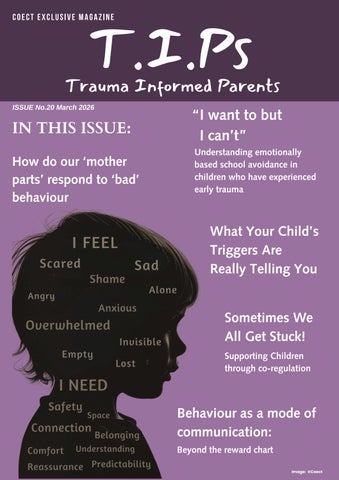
IN THIS ISSUE: How do our ‘mother parts’ respond to ‘bad’ behaviour
“I want to but I can’t” Understanding emotionally based school avoidance in children who have experienced early trauma
What Your Child’s Triggers Are Really Telling You
Sometimes We All Get Stuck! Supporting Children through co-regulation
Behaviour as a mode of communication: Beyond the reward chart Image: ©Coect
Meet the Team! Executive Editor - Sarah Naish
Executive Editor - Sair Penna
Managing Editor - Kathryn Talbot
Contributor - Jessica Spenceley
Kathryn is co-founder and managing editor of the TIPs magazine, at The Centre of Excellence in Child Trauma C.I.C specialising in public relations.
Jessica is a therapeutic social worker with over 20 years of experience helping adoptive parents navigate their parenting journeys using the attachment-based, trauma-informed parenting approach of TBRI®.
Contributor - Saskia Joss
Contributor - Rachel Naylor
Sarah is a Therapeutic Parent, an Adopter of five siblings, Best selling international Author, Keynote Speaker and founder of three Independent Therapeutic Fostering Agencies. Sarah is also and cofounder and CEO at The Centre of Excellence in Child Trauma C.I.C.
Saskia is a BACP-registered child and adolescent therapist, school emotional wellbeing consultant and Author based in London. She runs the Mill Hill Therapy Hub, a network of therapeutic spaces supporting adults, children, couples and families both online and in person across London. Contributor - Marlyn Bursey Marlyn is a foster parent and teacher. Alongside her identical twin sister Alana, she creates children’s stories to help support children going through transitions, in a trauma-informed way.
Contributor - Emma Edwards
Sair (Sarah) is a Therapeutic Parent, Author, Parent Coach and Havening practitioner. Sair is also co-founder and Director of Training, Qualifications & Quality at The Centre of Excellence in Child Trauma C.I.C
Rachel is the founder of The Family Wellbeing Hub CIC, where she supports parents and professionals in moving toward relational, neuro-affirming practices.
Contributor - Carolyn Baynes
Carolyn is a qualified and licensed cognitivebehavioural hypnotherapist as well as a mindfulness meditation teacher. She works therapeutically with both adults and children in Farnham and online.
Emma is a Therapeutic Parent, Adopter, Parent Coach. Emma is also cofounder and Director of Therapeutic Services and Ambassador for England at The Centre of Excellence in Child Trauma C.I.C.
ISSUE 20
T.I.P'S MAGAZINE
1
TRAUMA-INFORMED PARENTS
CONTENTS 6 How do our ‘mother parts’ respond to ‘bad’ behaviour
14 “I want to but I can’t”
Understanding emotionally based school avoidance in children who have experienced early trauma
19 Sometimes We All Get Stuck!
Supporting Children through co-regulation
3 Editor's Note
4 CoECT Conference “Trauma and Tech”
9 Behaviour as a Mode of Communication: Beyond the Reward Chart
11 What Your Child’s Triggers Are Really Telling You
12-13 UPCOMING EVENTS CoECT Training, Workshops and Events Schedule 2026
22 Ask the Experts with Emma Edwards
ISSUE 20
T.I.P'S MAGAZINE
2
From its beginnings as a Therapeutic Parenting Group on Facebook a decade ago, we have evolved into a Community Interest Company dedicated to supporting parents of children who have faced early life trauma and display neurodiverse characteristics. This edition focuses on the topic of Behaviour as a mode of communication.
Editor’s Note Welcome Everybody, In this edition, we explore how behaviour serves as a form of communication for both children and parents. Our contributors share a wealth of knowledge and experience, highlighting the various ways children express themselves through behaviour and how parents, along with supporting professionals, can offer the necessary support. We welcome our contributor, Carolyn Baynes, a licensed cognitive-behavioural hypnotherapist and mindfulness meditation teacher. In her article, she explores how parents respond to their children's difficult behaviour and explains how using the Internal Family Systems (IFS) therapy model can help parents understand their emotions with compassion. Rachel Naylor, a parent and teacher, has written an article exploring common behaviour management techniques that focus more on making children behave than on connecting with them, and emphasising the importance of understanding that a child’s unique needs and behaviour can indicate unmet needs rather than just a problem to control. We are joined by our regular contributor, Jessica Spenceley, a therapeutic social worker, who has written an article on how early experiences influence children's responses to stress and their feelings of safety. The article also includes strategies for recognising early signs of distress in children and how to respond. We also welcome Saskia Joss, a Child Therapist, who has written an article about Emotionally Based School Avoidance and how parents and carers can understand and support children who have experienced early trauma. Marlyn Bursey has contributed an article about feeling "stuck," a common experience for both children and adults during strong emotions or sudden change. She explores strategies which can support children through transitions.
Sair Penna Executive Editor
This edition is our 20th and features highlights from our National Conference “Trauma and Tech”, which took place in mid-March in Cardiff, and was attended by both parents and social work professionals.
Kathryn Talbot Managing Editor
We hope you enjoy this issue, and we will be back in May with our next issue. Warmest wishes Sair, Sarah & The Team at The Centre of Excellence in Child Trauma C.I.C
ISSUE 20
TIPs Magazine T.I.P'S MAGAZINE
3
CoECT National Conference
Image: ©CoECT th
On Thursday 12 March we held our Annual National Conference in Cardiff for foster parents and Supporting Professionals who support children in care. The theme of the conference was “Trauma and Tech”, a current topic in the UK that can be challenging for parents of children who have experienced early life trauma or who display neurodivergent characteristics to navigate. We began our day with an engaging presentation by Dr Jen Lee from Health Professionals for Safer Screens. She addressed smartphones and social media, focusing specifically on their impact on vulnerable children. Jen shared evidence and insights that highlighted the challenges and risks posed by these platforms to young users, sparking an important conversation about their safety and well-being.
Image: ©CoECT
Image: ©CoECT
Sarah Naish and Sarah Dillon explored the impact of tech on parent/child connection, emphasising the importance of rebuilding lost relationships and developing strong emotional attachments with children who have experienced early life trauma and linked attachment issues due to this. Their discussion also included practical approaches to nurturing those connections in today’s rapidly evolving digital landscape.
T.I.P'S MAGAZINE
4
After lunch, Gareth Thomas presented an informative talk focusing on practical strategies for managing technology use among children and young people. During his presentation, he shared insights and techniques that parents can use to effectively integrate technology into family life, emphasising the importance of setting clear boundaries regarding screen time and encouraging open communication about online activities.
Image: ©CoECT
We concluded the day with Sair Penna, who offered a unique perspective on how technology is managed for children with autism. She shared her personal experiences of navigating technology use with her autistic child and highlighted the benefits of using tech to engage the child's special interests, allowing others to see the world from their perspective.
The day was well-received, and it was great to see so many people in attendance. A recording of the conference has been made available.
Image: ©CoECT
An email will be sent out to CoECT subscribers in the coming weeks with details on ways to access the recorded version.
Image: ©CoECT
If you’re not yet subscribed to our emails, we encourage you to reach out to us at info@coect.co.uk.
Image: ©CoECT
ISSUE 20
By doing so, you’ll stay informed about the latest news and events at CoECT and won't miss any important updates.
T.I.P'S MAGAZINE
5
How do our ‘Mother Parts’ respond to ‘bad’ behaviour? Written By Carolyn Baynes Image: ©C Barnes
Unburdening Parenthood Have you ever noticed that one part of you adores your child, while another part feels exhausted or resentful? Or that part of you loves bedtime stories, while another part is quietly wishing they would just go to sleep so you can finally rest? If so, you’re not alone — and there is nothing wrong with you. We all have different ‘parts’ inside us, and each one has good intentions. In the therapy model Internal Family Systems (IFS), we learn how to get to know these parts with curiosity and compassion rather than judgment. When we become parents — whether through birth, fostering, or adoption — new parts of us come online. Suddenly, we’re responsible for another human being, and that can bring a whirlwind of emotions we never expected. Our anxious parts, our self-critical parts, our worrying parts — they are all trying to protect us and our children. But when we’re exhausted, overwhelmed, unsupported, or stretched too thin, those parts can become heavy and loud. So how do your parts react when your child’s behaviour is triggering? Do they rush to defend you with anger and a desire to punish? Do they collapse and want to hide or distract from the hurt? ISSUE 20
Try getting curious about the ways you are triggered by your child’s behaviour. Then try doing a “You Turn”. This is when we attend to our own triggered parts before we attempt to respond to our child’s triggered parts. It’s helpful to practice this on your own or with a friend first. Imagine your child’s behaviour. Then notice the part that leaps to your defence or tries to deal with or fix the behaviour. Bring it some curiosity. How did it learn to talk like that? How is it trying to help? How old is this part?
trust you a little more. Rather than leaping into its usual protective strategies, it may soften and relax. You might remember to pause, take a breath, and send it some compassion. Once you sense some relaxation, it becomes easier to respond to the situation from what IFS calls the Self. We know we are in Self energy because our responses tend to be characterised by the 8 Cs: Curiosity Calm Connection Compassion Courage Confidence Creativity Clarity
To our surprise, we might find that the part of us trying to control our child’s behaviour is not much older than the child itself, and hasn’t yet met the “you” that is not a part.
For example, I remember last January when the temperatures were below zero and my teen announced he was “just off camping”.
These parts are often very tired and overwhelmed. Bringing them your compassion and appreciation for the incredible work they are doing can be deeply soothing.
My initial reaction — which I registered in a millisecond — was a Molotov cocktail of panic and alarm. But once that reaction was acknowledged, I noticed I felt curious instead.
You might journal about how they are feeling and recognise that this isn’t all of you — this is a part of you.
“Ah, where are you planning on camping?” (He didn’t know yet.) “Do you have a sleeping bag?” (Yes, but it was a summer one.)
Next time your part is triggered by your child’s behaviour, it might
“Do you think you’ll get enough
T.I.P'S MAGAZINE
6
time in the morning to have breakfast before college?” (Err… no.) Gradually, the curiosity and connection — without trying to solve the problem — slowed the moment down enough for my son to rethink the plan himself. So often, we are lending our prefrontal cortex to our children, but in a way that gently models
how they can begin to access their own planning and thinking-ahead parts (as in my son’s example). We simply can’t do that when we are deep in the red zone of our own fight, flight, or freeze responses. Over time, the “You Turn” becomes a habit — a way of life that guides our guiding and supports our supporting.
Carolyn works therapeutically with adults and children in Farnham and online. If you would like to learn more about this therapy, you can contact Carolyn Baynes via email info@carolynbaynes.co.uk.
Have you subscribed to TIPs yet? Find out more by visiting our website www.coect.co.uk
Therapeutic Help and Support Introducing Our 20-Minute Nervous System Reset Modern life moves quickly. Between work, family responsibilities, and constant digital demands, many of us spend long periods operating in a heightened state of stress. Over time, this can leave the body and mind feeling overwhelmed, tense, and mentally fatigued. To help counter this, we’re introducing a new 20-Minute Nervous System Reset — a short but powerful session designed to help you pause, regulate, and restore balance. This guided session uses gentle therapeutic techniques and mindfulness practices, to support the body’s natural ability to calm the nervous system. ISSUE 20
When the nervous system is under constant strain, we may notice symptoms such as racing thoughts, tension in the body, difficulty concentrating, irritability, or fatigue. A short, focused reset can help interrupt this cycle by encouraging the body to move into a calmer, more regulated mode. During the session, participants are guided through simple mindfulness techniques that encourage awareness of the breath, body, and present moment. These practices help quiet the mind and create a sense of grounding.
The techniques are simple, easy to follow, and suitable for anyone looking for a brief pause in their day. To find out more click to visit our events page or scan the QR code provided.
No previous experience is needed.
T.I.P'S MAGAZINE
7
TRUE FOSTERING
www.truefostering.com
Image: ©R Naylor
Behaviour as a Mode of Communication: Beyond the Reward Chart Written By Rachel Naylor Reward charts, the ‘naughty step’, red/amber/green traffic lights, apps, the golden star, pocket money, certificates, child of the week, as a parent and educator of 20+ years I’ve seen and used them all. They all worked, to a degree. But ‘to a degree’ is the problem. The ‘carrot and stick’ behaviour approaches don’t actually change anything. They don’t address underlying issues or unmet needs, and they certainly don’t give our children a voice. These methods are designed to condition children into behaving ‘correctly,’ prioritising compliance over connection. But straight away, we hit a snag: Who defines what ‘correctly’ looks like? It is entirely subjective, and when we impose an arbitrary standard of "good," we leave our children feeling confused and unheard. For neurodivergent children or those with trauma histories, this goes beyond mere confusion; it can cause active harm. By demanding compliance above all else, we inadvertently teach them to mask; to hide their internal distress to fit an adult's convenience. We are teaching them that their internal safety and unique nervous system needs are less important than "fitting in." It was only when I was teaching in college recently that I realised we are still encouraging future teachers to use these very models. We are teaching them to condition children rather than
ISSUE 20
connect with them through relational approaches. I understand the need for an orderly classroom, but we must ask ourselves: at what cost? When we ‘condition’ a child to behave in ‘acceptable’ ways, we’re not teaching them; we are silencing them.
My Son: My Greatest Educator Fortunately for me, I gave birth to a son who refused to be silenced! My 14-year-old son has taught me more than any textbook or degree ever could. In the early years, I bought all the books; How to Raise Your Spirited Child, Raising Boys, and every manual in between. While those books contain nuggets of wisdom, they all share the same blind spot: no ‘method’ can ever allow for the fact that each child is a unique individual. My son consistently called me out and stopped me in my tracks, forcing me to take a look at my own behaviour and conditioned beliefs. As a teacher, it was a shock to the system to begin with, but then I started to listen more closely
Becoming the Translator I’m not ashamed to admit that I used to get swept away by my own child’s big emotions. His behaviour triggered reactions in me, but over time, I learnt to manage my own emotions in a
better way which meant that I could hold space for him and learn what was actually going on. I soon saw patterns of dysregulation and started to understand the triggers that would send his nervous system into a spiral. Learning all about neuroscience in the early years and how the brain develops was a turning point too. Once you understand the science, you stop looking for a "fix" and start looking for a "cause." For years, we’ve been fixated on the behavioural model; the idea that behaviour is something to be "managed." But the neuroscience tells us that behaviour is a physical manifestation of what is happening inside the brain and body. As practitioners and parents, our job is to be the translator. We need to know the child so deeply that we can understand what they are communicating, even when they don't yet have the tools to do it themselves. When a child "acts out," they are often using the only tools they have to signal an unmet need.
The Accountability Elephant: Co-Created Boundaries Whenever I talk about moving away from "management," the question of accountability always arises. People worry that a relational approach means "anything goes." It doesn't. In fact, it requires more intentionality. T.I.P'S MAGAZINE
9
Last year, I took this understanding back into the classroom and cocreated our framework with the children. We used a concentric circle model to establish our collective values. We didn't just set rules; we asked: What is our value? (e.g., Kindness or Safety) What needs to be done today? (The task at hand) What are the rewards for completion? (The natural joy of finishing or a shared activity) What are our boundaries? (e.g., No talking when others are writing) What are the consequences if these aren't met? By facilitating this rather than dictating it, the children took ownership. They weren't being "managed"; they were being mentored. It was a game-changer.
The Cost of Labels Nobody goes out to be "badly behaved." By labelling behaviours as "good" or "naughty," we are shaming children. They compare themselves to their peers and some give up completely, assuming the role of the "naughty one" because they feel they’ll never be good enough. They internalise a sense of being fundamentally "wrong" or "failing" instead of understanding how their own unique brain works. I have been on the end of teaching children who have already put themselves in these "boxes," and it is heart-breaking to see. It takes significantly more work to unpick those deep-seated beliefs than it would have to simply not wire them in the first place! When we take away "behaviour management," we do something radical: we empower children to learn self-regulation and selfreflection. The root causes of "disruptive" behaviour are usually universal: ISSUE 20
Image: ©COECT via Canva Overstimulation or sensory overwhelm.
A New Framework for Connection
This shift is at the heart of my work at The Family Wellbeing Hub CIC. Tiredness, hunger, or thirst. We guide adults back to their own needs and utilise our 3-Step Anxiety or a lack of "felt safety." K’nnekted™ Framework to support When we help children understand their children. It is a process co-created with the child, rooted in the own brains, research suggests that we science that all a human needs to improve their mental health and life chances (The Center on the Developing thrive is: Child at Harvard University). But this 1. Safety in their bodies. starts with us. The best way to support 2. Safety in their relationships. the children we care for, whether at 3. Safety in their spaces. home or in the classroom, is by rolemodelling our own regulation. Next time a child is shouting or pulling at your sleeve, take a breath. Remember: they’re not The Power of the "I’m Sorry" trying to annoy you; they are trying Saying "sorry" to a child after you’ve to tell you something. Once the snapped is one of the most powerful nervous system has settled, ask restorative acts you can perform. It the only question that matters: shows them that adults make mistakes and, crucially, that adults take "What was it you needed?". responsibility. Explaining that you were tired or hungry isn't an excuse; it's a This will have a far bigger impact lesson in biology. You are teaching than any sticker or reward chart. them that their internal state affects their external actions. As adults, many of us live with suppressed voices because we weren't taught how our brains work. When we start by meeting our own needs and role-modelling regulation, the rest falls into place. The aim is not to be perfect; children need to see us make mistakes and make it right!
You can find out more about Rachel’s work and the K’nnekted™ Framework at www.thefamilywellbeinghub.co.uk
T.I.P'S MAGAZINE
10
What Your Child’s Triggers Are Really Telling You Image: ©J Spenceley
Written By Jessica Spenceley Early life experiences shape how adopted children respond to stress. That’s why they may be quick to react or why the tiniest thing can lead to a huge reaction that seems to come out of nowhere! But instead of focusing your parenting around stopping or managing behaviour, a therapeutic parenting approach invites you to ask a better question:
to build your children’s sense of safety is noticing — noticing the early signs that your child is starting to feel overwhelmed or unsure. That might look like a shift in their body, a change in their tone, more silliness, or more rigidity. These are often the first clues that safety is slipping, even before a big reaction shows up.
How safe does my child feel right now?
When you catch those moments early, you have more room to respond proactively. Behaviour is Information You can slow things down, offer It can be tempting to go into reassurance, or increase problem-solving mode, but real connection before your child shifts start from understanding tips into protection mode. This is what’s making your kiddo feel where observation becomes unsafe. Seemingly random outbursts are often linked to subtle such a powerful tool. You’re not watching to catch triggers that can be easy to miss. misbehaviour — you’re Some of the common ones in the watching to understand. adoptive families I work with are tone of voice, transitions, certain facial expressions, sensory overload, and reminders of the Supporting Safety past. These triggers can be easy to overlook because they may not That might mean sitting close, seem so big on the surface. But to using a warm and steady your child, they signal danger. You may know your child is safe, but what drives their reaction is whether they feel safe. When your child’s sense of safety drops, they move straight into protection mode. Your child’s big reactions aren’t about being difficult or defiant; they’re about staying safe. A big part of helping ISSUE 20
voice, offering a snack or water, or simply staying nearby and letting your child know you’re there. Over time, these small moments add up and send a clear message: You’re safe. I’m with you. You don’t have to handle this alone. And that strengthens safety.
As your child’s sense of safety grows, you’ll notice that their reactions aren’t as intense. Triggers don’t hit as hard, and recovery happens more quickly. Your child starts to trust more that big feelings won’t threaten the relationship — that you’ll stay, help, and guide them through. The goal isn’t perfect behaviour. The goal is a child who feels safe enough to settle, safe enough to recover, and safe enough to stay connected even when things are hard. That’s where real change, and real healing, happens.
Jessica is the founder of Nurtured Belonging, where she coaches adoptive parents to support their children in healing from early adversity and trauma. To learn more about TBRI or connect with Jessica, visit https://nurturedbelonging.com/
T.I.P'S MAGAZINE
11
T.I.P.s ENJOYING TIPS MAGAZINE? Continue reading with a TIPs Magazine subscription You've reached the end of the free preview. If you've enjoyed this issue, you can get every issue of TIPs Magazine throughout the year.
DIGITAL — £15 per year 6 issues + full digital archive Read TIPs Magazine wherever you are, on your computer, tablet or phone. www.coect.co.uk/shop PRINT — £30 per year 6 printed issues delivered to your door Prefer a physical magazine? Subscribe to receive every issue throughout the year. www.coect.co.uk/shop
Looking for more support? TIPs Magazine is also included as part of TIPs Hub membership. Join the TIPs Hub for access to the magazine alongside our wider range of support, resources, learning and community. www.coect.co.uk/join
Keep reading. Keep connected. TIPs Magazine — £15 digital | £30 print TIPs Hub — magazine + support + resources + learning + community