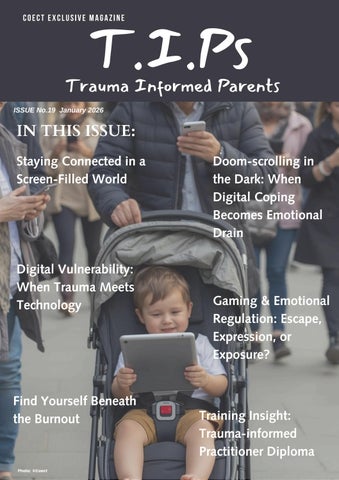
COECT EXCLUSIVE MAGAZINE
T.I.Ps
Trauma Informed Parents ISSUE No.19 January 2026
IN THIS ISSUE: Staying Connected in a Screen-Filled World
Digital Vulnerability: When Trauma Meets Technology
Find Yourself Beneath the Burnout
Photo: ©Coect
Doom-scrolling in the Dark: When Digital Coping Becomes Emotional Drain
Gaming & Emotional Regulation: Escape, Expression, or Exposure?
Training Insight: Trauma-informed Practitioner Diploma
Meet the Team! Executive Editor - Sarah Naish
Executive Editor - Sair Penna
Managing Editor - Kathryn Talbot
Contributor - Jessica Spenceley
Kathryn is co-founder and managing editor of the TIPs magazine, at The Centre of Excellence in Child Trauma C.I.C specialising in public relations.
Jessica is a therapeutic social worker with over 20 years of experience helping adoptive parents navigate their parenting journeys using the attachment-based, trauma-informed parenting approach of TBRI®.
Contributor - Gareth Griffiths
Contributor - Sarah Dillon
Sarah is a Therapeutic Parent, an Adopter of five siblings, Best selling international Author, Keynote Speaker and founder of three Independent Therapeutic Fostering Agencies. Sarah is also and cofounder and CEO at The Centre of Excellence in Child Trauma C.I.C.
Gareth Griffiths is an experienced social worker with 25 years in the field, including roles in local authorities and the private sector. For the last five years, he has worked with SAfER Fostering and TRUE Fostering and has recently become the training manager at both agencies, focusing on the development of foster care practices.
Contributor - Emma Edwards
Emma is a Therapeutic Parent, Adopter, Parent Coach. Emma is also co-founder and Director of Therapeutic Services and Ambassador for England at The Centre of Excellence in Child Trauma C.I.C.
ISSUE 19
Sair (Sarah) is a Therapeutic Parent, Author, Parent Coach and Havening practitioner. Sair is also co-founder and Director of Training, Qualifications & Quality at The Centre of Excellence in Child Trauma C.I.C
Sarah is a Therapeutic Parent, an Attachment Therapist, Keynote speaker, former child in care, Author (Therapeutic Parenting) Head of Therapeutic Services (Fostering).
Contributor - Sue Williams
Sue is a HCPC registered dietitian for children and a mum. As an approved adopter she focused on therapeutic parenting and coaching training and has now set up in business to support parents with issues around mealtimes and eating and parenting challenges within families.
T.I.P'S MAGAZINE
1
TRAUMA-INFORMED PARENTS
CONTENTS 4 Sarah speaks at the National Foster and Kinship Care Conference in Australia
7 Digital Vulnerability: When Trauma Meets Technology
9 Staying Connected in a Screen-Filled World
3 Editor's Note 11-12 UPCOMING EVENTS CoECT Training, Workshops and Events Schedule 2026 13 Gaming and Emotional Regulation: Escape, Expression, or Exposure? 15 Training Insight: Level 4 Trauma-Informed Practitioner Diploma 17 Doom-scrolling in the Dark: When Digital Coping Becomes Emotional Drain 19 Find yourself beneath the burnout 21 Ask the Experts with Sue Williams
ISSUE 19
T.I.P'S MAGAZINE
2
From its beginnings as a Therapeutic Parenting Group on Facebook a decade ago, we have evolved into a Community Interest Company dedicated to supporting parents of children who have faced early life trauma and display neurodiverse charachteristics. This edition focuses on the topic of navigating technology and screen time with children and young people.
Editor’s Note Dear Readers, Welcome to the first edition of TIPs for 2026! We hope you all had a peaceful Christmas and that it went smoothly. If it wasn’t so peaceful, we hope it's now a distant memory and that you can focus on the new year. Our January Issue of TIPS is packed with articles on an increasingly relevant topic: navigating technology and screen time in our lives and our children's. In this edition, you’ll find articles that explore the challenges and opportunities posed by technology. From TBRI strategies for managing screen time to insights on gaming and emotional regulation, our contributors share valuable perspectives to support your parenting journey. We also share a behind the scenes look at Sarah Naish’s trip to Australia where she spoke as a Keynote speaker at the National Foster and Kinship Care Conference organised by Adopt Change. We’re also excited to share details about our upcoming National Conference, “The Truth about Tech,” where we’ll further explore these themes with keynote speakers Sarah Naish, Sarah Dillon and Gareth Thomas. If you're a foster parent, be sure to check out the opportunity for funded places! As always, we invite your contributions and feedback. Our community grows stronger with every voice, and we would love to hear your thoughts or experiences on technology and parenting. If you would like to contribute to our TIPs Magazine, get in touch with us via tips@coect.co.uk. We hope you enjoy reading this edition, and we will be back in March with Issue 20!
Sair Penna Executive Editor
Happy Reading! Warmest wishes Sair, Sarah & The Team at The Centre of Excellence in Child Trauma C.I.C
Kathryn Talbot Managing Editor
TIPs Magazine ISSUE 19
T.I.P'S MAGAZINE
3
Written By
Image: ©COECT via Canva
Sarah speaks at the 2025 National Foster and Kinship Care Conference in Australia In November, the National Foster and Kinship Care Conference brought together foster parents, kinship carers, and sector professionals from across Australia. The event was organised by Adopt Change, an organisation dedicated to ensuring that all children have access to a safe, nurturing, and permanent family home while providing strong support for families. This event focused on supporting, educating, and empowering foster and kinship carers throughout Australia.
face but also the positive impact they have on the lives of children and young people. The conference, which hosted over 600 delegates, was a celebration of connection and community. Sarah emphasised the importance of knowledge sharing and collaboration among carers and professionals. "We are not alone in this journey,"
she asserted, encouraging both Foster Parents and Supporting Professionals to support one another toward a common goal: supporting the children they care for. Her talk was one of the highlights of the event, resonating deeply with many in attendance. Sarah's passion for empowering carers through shared experiences and tools was evident.
Image: ©COECT via Canva
Among the inspiring speakers was our very own Sarah Naish, CEO of the Centre of Excellence in Child Trauma. Sarah, known for her engaging storytelling and practical insights, captivated the audience with her unique perspective on foster care. Drawing on her extensive experience, she shared not only the challenges foster parents
ISSUE 19
T.I.P'S MAGAZINE
4
She thanked the audience for their dedication and commitment to foster and kinship care, highlighting the important role they play in shaping the future of child welfare in Australia. As the conference came to a close, participants left inspired and equipped with new strategies and ideas from the keynote speakers they had listened to. Sarah's message of hope and resilience remained with them, a testament to the powerful impact of such gatherings. With discussions, networking, and personal stories exchanged, the event demonstrated the collective commitment to enhancing the quality of care for vulnerable children, and the high level of support, motivation and camaraderie of Adopt Change’s National Foster and Kinship Care Conference. Image: ©COECT via Canva
Adopt Change Adopt Change is an Australian child welfare organisation focused on ensuring that every child can grow up in a safe, nurturing, and stable family environment. They understand the effects of childhood trauma and are committed to supporting both children and their caregivers through various services, education, and advocacy. Adopt Change collaborates with government entities, community organisations, and the child welfare sector to improve policies and practices. Through initiatives such as Carers for Kids NSW and additional support services, Adopt Change supplies practical guidance, connection, and ongoing support to ensure foster parents are wellequipped to help children heal and thrive in loving, permanent family settings.
Image: ©COECT via Canva
You can find more about what they do on their website www.adoptchange.org.au/
Sarah Naish will be joining us as a keynote speaker at “The Truth about Tech” Conference this March! Sarah will be speaking at the Centre of Excellence in Child Trauma C.I.C conference this spring. You can find more information about the lineup of keynote speakers and how to book a place on our website. To find out more about more about the conference go to our website www.coect.co.uk or scan the QR code.
ISSUE 19
T.I.P'S MAGAZINE
5
TIPS MEET-UPS
Peer Support Groups Our peer support groups, are hosted online, in cafés, community rooms and green spaces across the UK.
Our virtual support groups are organised on a monthly basis. Keep an eye out for a regional online group, where you can connect with others prior to attending an inperson event.
There are also opportunities to create your own local “village of support”.
For more information click on the QR code or go to https://www.coect.co.uk/live and search “Meet-Ups” ISSUE 19
T.I.P'S MAGAZINE
6
Digital Vulnerability: When Trauma Meets Technology Written By Sarah Dillon
When a child experiences early life trauma especially neglect or a lack of consistent, attuned caregiving, their nervous system develops without the foundation of safety that comes from a responsive adult. Babies depend on coregulation: an adult’s presence, voice, touch, and emotional steadiness help shape the brain’s ability to manage stress, form relationships, and feel secure. When these early needs are not met, a child grows up searching for something to calm their internal distress. In many cases, screens become the quickest substitute. Phones and tablets offer constant stimulation, predictable reactions, and fast rewards. For a child who has not experienced enough soothing, relational connection, the screen can feel easier and safer than relying on people. They begin using it to self-regulate, not because it is healthy, but because it is the only source of consistent feedback they can find. However, screen use is not a healthy replacement for human connection. It does not support the brain systems that develop through eye contact, shared attention, touch, and emotional presence. Screens provide dopamine-driven stimulation, not the oxytocin and relational cues that build secure attachment. Instead of strengthening the brain’s capacity for self-regulation, excessive
ISSUE 19
screen dependence can interfere with social development, emotional growth, and healthy stress responses. When the screen is taken away, the child’s distress may be intense. The meltdown often mirrors the early experience of being left without comfort, because the device has become their main source of emotional relief. Their reaction is not entitlement, it’s a sign of a nervous system that never learned to settle with human support. The essential message is this:
They are not a neutral tool for a child with early trauma; they actively get in the way of the connection, attunement, and relational safety the child desperately needs. What the child is truly longing for is an available adult, someone who can offer consistent presence, emotional co-regulation, and the kind of nurturing that builds the brain pathways screens can never replace. Human connection heals. Screens do not.
Screens CANNOT and should not fill the developmental role of a caregiver.
Sarah Dillon is set to be one of our keynote speakers at “The Truth about Tech” Conference this March! Sarah Dillon will be speaking at The Centre of Excellence in Child Trauma C.I.C conference in the spring and will be exploring this topic further where she will be talking about children using screens to substitute for parental interaction and engagement. To find out more about more about the conference go to our website www.coect.co.uk or scan the QR code.
T.I.P'S MAGAZINE
7
COECT National Conference 2026
The Truth About Tech Technology through a trauma lens What every parent and professional must know Thursday 12 March 2026 10:00 – 15:00 Village Hotel Cardiff 29 Pendwyallt Rd, Cardiff CF14 7EF
www.coect.co.uk
Photo: ©JSpenceley
Staying Connected in a Screen-Filled World Written By Jessica Spenceley
Screen time can quickly become one of the most stressful parts of family life. What starts as a simple request to turn something off can suddenly turn into a power struggle, a meltdown, or a tense stand-off that leaves everyone feeling disconnected. It’s easy to blame the device, but the real issue is usually what the screen is helping your child manage: comfort, control, escape, or just a break from a world that sometimes feels overwhelming. This is where Trust-Based Relational Intervention® (TBRI®) can make a real difference. TBRI is a trauma-informed parenting approach that helps you look beneath behaviour to understand your child’s needs, and uses connection — not control — as the foundation for change. When it comes to navigating screen use, the TBRI concept of shared power is especially helpful. Shared power isn’t about letting your child run the show, and it’s not permissive. It’s connection in action — your guidance coming through as partnership. It’s the steady message: You matter. Your voice counts. We’re figuring this out together. Why Shared Power Matters For many children who have experienced early adversity and trauma, control and safety are deeply linked. When a limit feels imposed, your child may interpret it as a threat rather than support ISSUE 19
— even when the limit is reasonable. A simple “Time to turn off the iPad” can spark panic or anger if your child experiences it as something happening to them, not with them. Shared power softens this dynamic. When you invite your child into the process, you communicate respect, attunement, and trust. You reduce the sense of threat. You help their body settle. And you transform what could become a battle into an opportunity for collaboration. Shared power doesn’t eliminate boundaries. It holds them. Family Meetings: Creating Agreements Together
invested in keeping it. It becomes our plan, not something that feels imposed upon them. You might ask questions to the whole family, like: What do you enjoy about screen time? What feels hard or overwhelming? What kind of screen-time would feel good for everyone? What should we do if sticking to the agreement becomes difficult? Shared power also means accountability — for everyone. If the agreement is “no devices at dinner,” and you hold yourself to it as well, your child receives a powerful message: everyone is responsible for keeping our agreements – including you.
One of the most effective ways to practise shared power around screen use is through a family meeting. A family meeting might feel unfamiliar at first, but it’s simply a moment to pause, connect, and think things through together.
Children learn more from what you model, more than any limit you set. Your follow-through strengthens the trust that makes shared power possible.
Children are great problem solvers, and when they feel safe and heard, they’re often surprisingly thoughtful. They know when screens pull them in too deeply or make transitions harder. They often suggest fair expectations and reasonable accountability. Most importantly, when children help shape the agreement, they are more
Shared power isn’t just something you use during a family meeting; it’s a way of moving through everyday life. Two simple practices can make shared power feel more natural at home: predictable routines and shared screen experiences.
Putting Shared Power into Everyday Practice
T.I.P'S MAGAZINE
9
Predictable routines nurture feltsafety. When you create rhythms together — screens after homework, devices away during meals, or choosing a calm activity after turning something off — your child knows what to expect. And when children participate in shaping those routines, they’re more willing to settle into them rather than fight against them. Screens don’t have to create distance; they can become a point of connection. Watching something together, asking curious questions about a game, or sharing a laugh at a silly video builds relational safety. These moments show your child: Your interests matter to me. I want to understand your world. Afterwards, a simple reflection — “That part seemed exciting,” or “I wonder what that character was thinking” — opens gentle conversation and strengthens connection. Shared power means not standing outside your child’s experience, but stepping into it with them. From Struggle to Connection When screen time becomes a shared responsibility instead of a tug-of-war, things shift. The urgency fades. The conflict reduces. And your relationship — not the device — takes centre stage.
Image: ©COECT via Canva
Screens aren’t the real challenge – disconnection is. And shared power helps you bridge that gap — with attunement, collaboration, and a steady commitment to doing this as a team.
Jessica is the founder of Nurtured Belonging, where she coaches adoptive parents to support their children in healing from early adversity and trauma. To learn more about TBRI or connect with Jessica, visit https://nurturedbelonging.com/
Have you subscribed to TIPs yet? Find out more by visiting our website www.coect.co.uk
ISSUE 19
T.I.P'S MAGAZINE
10
T.I.P.s ENJOYING TIPS MAGAZINE? Continue reading with a TIPs Magazine subscription You've reached the end of the free preview. If you've enjoyed this issue, you can get every issue of TIPs Magazine throughout the year.
DIGITAL — £15 per year 6 issues + full digital archive Read TIPs Magazine wherever you are, on your computer, tablet or phone. www.coect.co.uk/shop PRINT — £30 per year 6 printed issues delivered to your door Prefer a physical magazine? Subscribe to receive every issue throughout the year. www.coect.co.uk/shop
Looking for more support? TIPs Magazine is also included as part of TIPs Hub membership. Join the TIPs Hub for access to the magazine alongside our wider range of support, resources, learning and community. www.coect.co.uk/join
Keep reading. Keep connected. TIPs Magazine — £15 digital | £30 print TIPs Hub — magazine + support + resources + learning + community