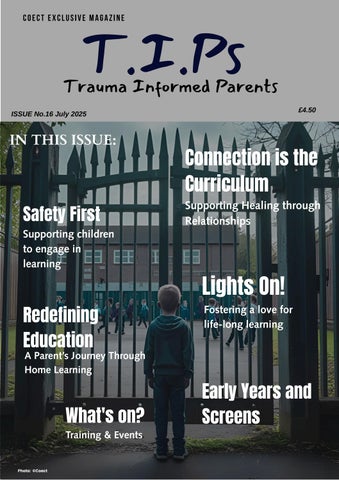
COECT EXCLUSIVE MAGAZINE
T.I.Ps
Trauma Informed Parents £4.50
ISSUE No.16 July 2025
IN THIS ISSUE:
Safety First
Connection is the Curriculum Supporting Healing through Relationships
Supporting children to engage in learning
Lights On! Redefining Education
Fostering a love for life-long learning
A Parent’s Journey Through Home Learning
What's on? Training & Events
Photo: ©Coect
Early Years and Screens
Meet the Team! Executive Editor - Sarah Naish
Executive Editor - Sair Penna
Managing Editor - Kathryn Talbot
Contributor - Jessica Spenceley
Kathryn is co-founder and Director of The Centre of Excellence in Child Trauma C.I.C specialising in communications and public relations.
Jessica is a therapeutic social worker with over 20 years of experience helping adoptive parents navigate their parenting journeys using the attachment-based, trauma-informed parenting approach of TBRI®.
Contributor - Russ Hartland-Shaw
Contributor - Julia Black
Contributor - Arabella Skinner
Contributor - Dr Zachary Du Toi
Contributor - Dr Libby Gaskell
Contributor - Neil Cunningham
Sarah is a Therapeutic Parent, an Adopter of five siblings, Best selling international Author, Keynote Speaker and founder of three Independent Therapeutic Fostering Agencies. Sarah is also and co-founder and CEO at The Centre of Excellence in Child Trauma C.I.C.
Russ set up Breathe Leadership & Business Coaching in 2020 as a result of adopting and becoming a parent to two boys in 2019. He was then inspired to specialise in Therapeutic Parenting to support families navigating the challenges of early childhood trauma.
Arabella is Policy Director at Health Professionals for Safer Screens. She has an MSc in Psychology and has experience campaign for children. She is a mother of teenage boys.
Libby is a chartered psychologist who has worked with children, young people, and their families for a number of years. Libby offers specialist therapeutic interventions and assessments for families who have been affected by trauma and attachment difficulty, and also offers consultation and training in these areas to various professional teams.
Sair (Sarah) is a Therapeutic Parent, Author, Parent Coach and Havening practitioner. Sair is also co-founder and Director of Training, Qualifications & Quality at The Centre of Excellence in Child Trauma C.I.C
Julia is the creator of Lights On®, a groundbreaking approach to learning and life that helps families move from survival to radiance. She's also the author of Lights On Learning—a transformative guide that empowers parents to ignite their child’s love of learning by reconnecting with their own inner spark.
Dr Zachary Du Toit is a GP Registrar with an interest in the wider determinants of health, in particular children and young people's mental health and intersection of technology and health.
Neil is a carer, musician, and breath instructor. He developed the 'Off Switch' breath program to promote self-care and well-being among foster children and carers, creating a supportive space for guided breathing practices. Through his work, Neil has partnered with Health Trusts and NHS professionals to enhance mental health and overall wellness in the community.
TRAUMA-INFORMED PARENTS
CONTENTS 10 Early Years and Screens Arabella Skinner & Dr Zachary du Toit
13 Fostering a love for life-long learning Julia Black
17 Safety First! Dr Libby Gaskell
3 Editor's Note
4 Redefining Education: A Parent’s Journey Through Home Learning Russ Hartland-Shaw
8 Connection is the Curriculum: Supporting Healing and Learning Through Relationships Jessica Spenceley
15 Finding Hope Through Understanding: The Level 2 Certificate in Therapeutic Parenting Helen Ayres & Joanne Wilson
19-20 What's On - Training, Events and Meet Ups
21 COECT Wellbeing: Finding the Off Switch! Neil Cunningham
From its beginnings as a Therapeutic Parenting Group on Facebook, a decade ago, we have evolved into a Community Interest Company dedicated to supporting parents of children who have faced early life trauma and display neurodiverse charachteristics. This edition focuses on The Centre of Excellence in Child Trauma C.I.C.
Editor’s Note Welcome to July’s edition of TIPS magazine! This issue’s theme is all about different ways of learning and what happens when school isn’t the right fit for the child. Whether that be home schooling, where the child is still on roll at school and accessing online learning at home, or home education, where the parents have decided to take responsibility for the child’s learning. Some of the articles in this issue focus on breaking down the information and options. If school doesn't work for your child, there are other ways to support their learning and achievements. In this issue, we are joined by Russ Hartland-Shaw, a parent coach and adoptive parent, who shares his story of homeschooling his child. Arabella Skinner and Dr. Zachary du Toit from Health Professionals for Safer Screens address the impact of screen time on young children, particularly those under two, and discuss the research, emphasising the importance of healthy modelling by parents. Julia Black has kindly written an article that highlights the importance of supporting children in developing a love for lifelong learning, starting with parents. She presents "Lights On®" as a way to integrate mental, emotional, physical, and spiritual aspects of learning. Libby Gaskell's article, "Safety First!", discusses the difficulties children with early trauma face in school and how supportive school environments can be safe havens, helping to counteract the effects of trauma by taking a trauma-informed approach. Also, our regular contributor Jessica emphasises the importance of connection in learning. Her article encourages parents to use everyday moments to instil a sense of worth, safety, and love in their children, which is essential for effective learning. She leads Nurtured Belonging, helping adoptive parents support their children's growth. We are delighted to welcome our resident Breathwork Instructor, Neil Cunningham, as he shares insights about “Off Switch,” a self-care breath program designed specifically for parents and carers. He provides 15-minute guided sessions focused on breathing techniques, allowing participants to relax without pressure or expectations. The goal is to enhance well-being and build a supportive community. If you haven’t joined one of his sessions, it is well worth giving it a try!
Sair Penna
Also, Jo and Helen from our COECT team have written an article about the Level 2 Award in Therapeutic Parenting, which supports parents facing challenges like care proceedings or supporting children with EHCPs. As always, we hope you enjoy reading, and if you would like to get in touch with us to contribute to future editions, you can contact us via tips@coect.co.uk. We wish you a peaceful summer (hopefully) and will be back in September with Issue 17!
ISSUE 16
Executive Editor
Kathryn Talbot Managing Editor
TIPs Magazine T.I.P'S MAGAZINE
3
Redefining Education: Photo: ©Russ Hartland-Shaw
A Parent’s Journey Through Home Learning Written By Russ Hartland-Shaw When I shut down my laptop at the end of July 2020, I remember feeling a huge sense of relief and personal achievement, having successfully navigated homeschooling with my then 5-year-old son. I also remember, vividly, thinking that teachers deserved danger money for choosing their vocation in life! I had a newfound respect for teachers and their ability to keep children engaged and motivated to learn, day in, day out. I also recall thinking this was an experience I never wanted to repeat. Aside from another
by no means an expert, but this is our account as a family and our experience of navigating learning at home as a solution to our son’s educational needs.
stint of homeschooling the following year and this time over the winter months, I vowed that homeschooling was not for me or my son. How wrong I was, and looking back, how misguided at the same time.
everything, from reduced timetables and coming home for lunch to reset, to one-to-one provision in a side room at school.
Homeschooling during the pandemic cannot be compared to longer-term home educating options. They are entirely different, so if there is a part of you, understandably, dismissing the idea based on your homeschooling experience in the pandemic being your
right for him. So, educating at home, certainly for the short to medium term for us, is where we have arrived. My son and I have been on a massive learning curve these past few
workplace and realise how out of touch our education system is. What employer would ever expect an employee who might present as a child struggling in school to turn up for work the next day as if nothing had happened and then be told to
only reference point, I would advise you to remain open and continue to
months, which in itself has been wonderful for connection and
carry on, doing the same thing over and over again with no consideration
explore your options. It is certainly not for everyone, and it comes with the acceptance that your life will change, but it is important to be aware of the facts before decisions are made. I am
attachment. There are many versions of education at home, ranging from deregistering your child from the national curriculum and school system entirely and
for the damage that is being done to their team members' mental health?
ISSUE 16
My son is dealing with the impact of early childhood trauma as a result of his early lived experiences. This has made navigating the classroom very challenging for him and, on and off, has seen him spend extended periods of time away from school and his friends. We have tried
Ultimately, the school environment in its traditional form is simply not
going it alone with the support of other home educators, known as home education; to home schooling which has more involvement from the Local Authority and can range from reduced timetables and flexi schooling that sees a child on a parttime timetable in school and working from home or accessing alternative provisions elsewhere. Enter into the world of a child who struggles in school; however they might present, and you will realise there is a crisis emerging of epidemic proportions. Our education system is failing thousands and thousands of children, up and down the country each year. It is woefully behind the times when it comes to well-being. You only have to take a look at the
When put like that, it is frankly ludicrous. This is food for thought T.I.P'S MAGAZINE
4
and the government needs to address this issue through significant and revolutionary reforms, as opposed to placing blame on the shoulders of teaching staff, children, and parents all the time; but this, perhaps, is a topic for another time.
be educated at home, too, which for me speaks volumes. For anyone to thrive, their environment needs to be right, and there are so many different versions of this that one size does not fit all. Education at home solves a fundamental issue for a child who struggles in school; it changes the learning environment, which has the potential to be a game changer. This is not to say by any means that this is a quick fix; more often, there needs to be a period of adjustment and healing from the school-based traumas that may have occurred for the child, not to mention the parents. The subject of educating a child at home is a contentious one; there are many judgements made and many different views on what defines it, but fundamentally, it should not be demonised and deemed a compromise. Often a child is dealing with a failed education system that is unable to meet their needs, whether they are academic, social, or emotional, and with this can come an overwhelming sense of failure on the child’s part. It is very easy to see the masses, in this case, your peers and friends, seemingly accessing the school environment with no issues, and think you are failing, rather than realising it is the environment and the system that are failing you and your child. ISSUE 16
Photo: ©COECT via Canva
There is an overwhelming number of neurodiversity diagnoses sitting within this population of children struggling in school and opting to
If left to fester, these feelings of inadequacy are damaging for the child and make learning even harder. Possibly more critically, the child’s mental health is significantly impacted to the extent that it changes the course of their lives forever. There is a common misconception that educating at home, whether that is home schooling or home education, means your child has to sit for 6 hours a day learning. This is because, for most of us at least, that was our own reality in school, not to mention what society dictates, and therefore our only reference points. To learn at home is to follow the passions and interests of the child; this is not to say subjects that are not as favourable should be ignored, but the appetite to tolerate them is far greater when your nervous system is not activated, which is the case for many children where home schooling works. It is important to note that each case is unique, though. So as a parent who is fairly new to this process compared to some, my top tips are as follows:
It depends to what extent educating at home is adopted as a methodology, but it is important to note that it is worth doing your research before embarking on it. Work with the agencies involved and foster the best relationships you can. Seek advice from other home educators both when it comes to handling agencies and how to home school. Do not be scared off just because the world around you is suggesting there is only one path to education. Trust your instincts and advocate for your child as best you can. Whether it is home education, home schooling, flexi schooling, or anything in between, do your research and reach out to others in a similar situation. Your allies might not be where you think they are either. T.I.P'S MAGAZINE
5
Mainly due to others' judgement and fear, the most wellintentioned people who have strong and deep-rooted opinions believe they know best and that following the norm can be the only course of action. This can make you doubt yourself and feel as though you might be making a mistake. Yes, there is an element of risk, but ensuring you are fully aware of the facts is a great place to begin to make some informed decisions. There are a great number of fantastic resources out there, as well as a whole community of people who offer support and guidance when needed. These groups are all full of people going through the same or a similar situation, and as a result, they are able to offer practical advice and an honest account of what to expect. I would encourage you to make contact with the groups listed as a first step to understanding if an
alternative route to education is right for your family.
He is, and we are, doing things differently. Once you get over the initial shock and judgement from
Not Fine in Schools – available on Facebook
others and become comfortable with your own anxieties, it is an
Home Education for All – available on Facebook Home Educators UK Empowering Parents in Home Education
empowering experience. I refuse to allow my son to feel like he has failed and is somehow settling for second best when it comes to his education, so we spend our days reminding him that there are many routes to learning, and it is not
As I reflect on our own home learning experience so far, I can tell you without a shadow of a doubt in my mind that it has saved my son from lasting damage to his wellbeing and mental health. He is thriving at home, where ultimately, he feels safe. He is engaged in learning, as much as any 10-yearold is; he has his moments, like anyone else, after all, but the point is that he is open to the process in a way that was not possible in a mainstream setting.
always about being in a building that makes him feel nervous and scared. For now, my son's classroom is our kitchen and the garden, and when you do things differently, it is amazing to see where those teachable moments are, and what is most rewarding is to see the difference this environment makes for your child.
You can find out more about the support Russ offers to parents via his website. https://www.breathebusinesscoaching.com Russ is also an Associate with The Haven, The Centre of Excellence in Child Trauma’s Parental Support Service.
TIPS Consult
Are you looking for a supportive space to explore real-life challenges in therapeutic parenting and trauma-informed care? Come along with your parenting-related questions and let us help you find a resolution to the difficulties you are experiencing.
Join us on 21st August 10 am - 11 am for our next session Book at www.coect.co.uk/events or scan the QR code below ISSUE 16
T.I.P'S MAGAZINE
6
Launching September 2025
Level 4 Diploma in Trauma-Informed Practice Become a certified Trauma-Informed Practitioner and deepen your ability to support healing and resilience.
✔️ Accredited Level 4 Qualification ✔️ Flexible Online Learning ✔️ Ideal for Social Workers, Family Support Workers, Therapists, & Educators, working with children who have experienced trauma. ✔️ Starts September 2025 Learn more and register for enrolment by following the link www.coect.co.uk/level-4-qualification or scanning the QR code:
Photo: ©Jessica Spenceley
Connection is the Curriculum: Supporting Healing and Learning Through Relationships Written By Jessica Spenceley It’s easy to think of learning as something that happens at school – reading books, sitting at desks, raising hands. But long before your child ever steps into a classroom, they’re already learning from you. As a parent, you shape not just what your child learns, but how they experience the world. And for adopted kiddos, that world can sometimes feel uncertain or overwhelming. Safety First, Always Learning starts with feeling safe. When your child feels secure and connected to you, their brain can relax and open up. They’re more able to explore, focus, and take in new information. Without that sense of safety, the brain often stays in survival mode, prioritising protection over curiosity. For children who’ve experienced trauma, loss, or disruption, building safety takes time. However, with your steady presence and empathy, you’re already offering your child one of the most important lessons they’ll ever learn: that the world can be a safe place. Connection is the best tool to help your child feel safe. When your ISSUE 16
child feel safe. When your child feels connected to you, their body releases calming hormones that help with regulation. And when a child is regulated, they’re more open to learning – not just academics, but also how to manage emotions, navigate relationships, and handle challenges. You might not even realise it, but your child is learning from you all the time. Every cuddle, every shared laugh, every moment of listening, every calm response to a meltdown – each one is teaching your child how to connect, how to repair, and how to trust. What TBRI Can Offer That’s where TBRI (Trust-Based Relational Intervention®) comes in. TBRI is a practical, compassionate approach that helps you stay connected, especially when things feel hard. It offers tools across three core areas: Connecting, Empowering, and
who’s still figuring out what trust feels like. Empowering Once a child feels connected, they’re more open to growth. Empowering strategies meet your child’s physical and sensory needs – things like movement breaks, snacks, and calming routines. These supports help regulate the nervous system and make it easier for your child to focus, cope, and learn. Correcting Correcting doesn’t mean punishment. It means offering gentle guidance. With TBRI, boundaries and structure come through connection, not fear. This helps your child learn how to problem-solve and manage behaviour in ways that feel safe, supported, and effective.
Correcting Connecting This is where teaching begins. Eye contact, play, cuddles, and attuned presence help your child feel seen and understood. Even small, simple moments like slowing down and really listening can speak volumes to a child
Teaching Through Everyday Moments You don’t need to create perfect lessons. You don’t need charts or elaborate activities. You just need to be present and connected. Whether you’re reading a bedtime story, helping your child get
T.I.P'S MAGAZINE
8
teacher, and there will be days that stretch your capacity. But in every hug, every deep breath before responding, every time you choose warmth over frustration, you’re offering something profoundly healing. You’re teaching your child that they matter. That they are safe. That they are loved. And that is the foundation for all real learning.
Photo: ©COECT via Canva
dressed, or riding out a big wave of emotions together, you are teaching. You’re modelling how to manage stress, how to ask for help, and how to keep showing up, again and again. And if you’re in a season where
nothing seems to be working; you’re not failing. It likely just means your child needs connection before anything else can click.
Jessica is the founder of Nurtured Belonging where she helps parents and adopted children overcome challenges, heal from the past, and build strong, connected relationships. To connect with Jessica, go to https://nurturedbelonging.com
A Gentle Reminder You may not always feel like a
Foster care isn’t a spreadsheet It’s being woken at 3am by a child who can’t sleep. It’s seeing the fear, and still showing up with love. It’s crying in the car after holding it together all day. And yet—so many decisions still come down to data, not people. At TRUE, we don’t just look at the numbers. We listen. We walk with families. We put relationships first. Because the forms don’t feel it. But foster families do. www.truefostering.com
EARLY YEARS AND SCREENS Written By Arabella Skinner & Dr Zachary du Toit
Photo: ©COECT via Canva
The potential harms caused by screen time in children and young people appear intuitive to parents and are increasingly well-elucidated by research. Growing cultural awareness of the harms of smartphones and social media, especially for teenagers, is welcome. However, there has been significantly less focus on the potential harms of the ubiquitous use of screens on the youngest children. This article highlights concerns and offers approaches to this modern parenting puzzle. The brains of babies and toddlers are susceptible to the external environment—they are designed to develop in response to the cues around them, and digital devices do not offer this. There is no evidence to support the introduction of technology at an early age, and the
ISSUE 16
increasingly extensive global research shows the immediate and long-term effects of frequent and prolonged screen exposure. From a parental perspective, to enable healthy development and attachment patterns, Health Professionals for Safer Screens (HPFSS) recommend children under two years old have no screen time apart from video calls with family. It is commonplace to see a baby with a smartphone attached to their pram or a toddler propped at a table with a screen and headphones—27% of 3-4 year olds have their own smartphones. When toddlers are used to high levels of sensory stimulation from screens, everything else appears dull or uninteresting in comparison. The child is, therefore, less motivated to explore their environment and seek interactions,
missing meaningful learning and development opportunities. HPFSS recommends that parents mindfully transition from screen time to nonscreen time at all ages. Give warning and let your child know that screen time is coming to an end soon. Transition actively, like playing a game such as eye-spy, peekaboo, or singing a song whilst changing activities; this smooths out the stimulation of turning the screen off. Furthermore, being prepared by planning a fun postscreen activity makes it easier for everyone. Lastly, stick with your decision—children need routine and structure, and by adhering to your decision and enforcing it, your child will know what to expect and will hopefully look forward to the post-screen activity too. Health Professionals for Safer Screens have evidence-based resources that parents can use to inform their parenting.
T.I.P'S MAGAZINE
10
When considering development, research shows that increased screen time negatively impacts young children. Children who watched more
pattern where meltdowns become associated with screen time, as using screens can diminish self-control and result in more frequent outbursts.
than 90 minutes of “daily direct screen time” were, at the ages of 4.5 years and eight, below average for vocabulary, communication, writing, numeracy, and letter fluency. They are more likely to play alone, be less liked by other children, be less considerate, and be less likely to share their toys. There are several approaches HPFSS advocates for in terms of overall reduction in screen time. Firstly, the development of a family digital plan, co-created with everyone’s input where appropriate. This plan should balance prohibition with positive screen time. Positive planning of screen time, in alignment with guidance as per HPFSS, can help regulate the child’s use. Secondly, and more importantly as the child gets older, is having a unified stance among yourselves as parents and with other parents about screen time. If you want to see what’s happening in your local area, Smartphonefreechildhood.co.uk is an organisation helping parents to come together to address smartphone usage as communities.
HPFSS recommends prioritising faceto-face interactions, which are so critical for development, particularly outside activities that hold many benefits. The term technoference refers to the negative role screens play in interpersonal relationships. Technoference clearly can impact children's attachment patterns; therefore, it is recommended that both parent and child use screens as little as possible. Childrenandscreens.org has an outstanding collection of resources, and we encourage you to visit their website.
A major theme in digital parenting guidance is to model healthy use oneself as a parent. Healthy modelling of screen use is a gift to one’s child in the long run because it models life without screens, which will translate into resilience and flourishing in the future. On the other hand, screens and tablets are often used to keep children calm as “digital dummies”, but this can hinder the development of children’s self-regulation skills in the long term. Studies have shown that the amount of screen time a child has at 3.5 years old can predict the increase in their anger and frustration at 4.5 years old. Furthermore, it may create a
ISSUE 16
The importance of sleep and rest cannot be overstated throughout the whole life course—childhood is no different. When considering why our children are misbehaving, a lack of sleep and rest may have a role to play. The increase in ADHD and ASD symptoms, as well as atypical sensory processing, has, in part, been shown to be linked to the rise in screen usage in young children. The evidence suggests that excessive screen time may significantly contribute to the development of ADHD in children. Longitudinal studies have shown strong evidence that increased screen time is linked to reduced language skills, and developmental
Speech and Language referrals have hit an all-time high, with 1.9 million children diagnosed with speech and language challenges in 2023, and 25% of speech and language posts are unfilled. A child with speech and language challenges is more at risk of emotional and behavioural disorders, mental health issues, and worse literacy and numeracy. At least 60% of young offenders have language challenges. Excessive screen use has serious consequences for children’s development. According to the Kindred Squared School Readiness survey, teachers report that a third of children are not school-ready. In an average Reception classroom: 45% of children cannot sit still 34% don’t respond to simple instructions 36% struggle to play or share with peers 25% are not toilet-trained
📌 📌 📌 📌
The use of screens has increased, and this trend appears to be continuing. Nearly half (49%) of teachers say school readiness has declined since last year. The report explores multiple causes, but screen time is a significant factor. Teachers and parents are deeply concerned:
T.I.P'S MAGAZINE
11
📱 54% of teachers say parents
spend more time on screens than engaging with their children.
📱 54% of teachers believe children
exceed the recommended two hours of screen time daily. 52% say parents aren’t reading enough to their children.
📚
Communicate the value of shared activities - for example, shared reading is proven to support language development. Remove screens from nurseries and early years.
This can feel overwhelming from a parenting perspective. However, as mentioned, many approaches can be taken, such as creating a digital family plan, prioritising face-to-face interactions by finding alternatives, and modelling healthy use yourself. We cannot overstate the importance of the bedtime story—indeed, any
There is enough evidence to act, and many of the actions we need to take for our youngest are free and easy
If the Government is serious about its stated mission to “break down barriers to opportunity with a
story—the evidence is overwhelming. Children who are read to perform better and avoid all screens before
for us to implement as a society.
milestone of giving children the best start in life”, then they have to recognise that it is unachievable unless it addresses the issue of screens. The harms that screen usage is doing to our youngest children, and the lack of guidance from the government in this area (or often encouragement to have more screens) have serious consequences for the individual child, impacting their ability to learn, build relationships and pay attention - all vital for child development. It also has enormous implications for society with the associated costs—speech and language therapy, increased EHCPs, increased diagnosis of ADHD, ASD, and atypical neurodevelopmental conditions, as well as the opportunity cost.
bedtime. Becoming aware is the first step. Our website has resources and approaches you can take at home to help your child develop a positive relationship with screens.
Create clear screen time guidance for Early Years. Health Professionals for Safer Screens recommends no screens before two and no more than 30 minutes a day for children between 2 and 5 years old. Make parents aware of the harms of screens by giving them clear guidance through a public health campaign Support parents and carers with opportunities for their children to play and help them understand the value of play as a developmental driver
For more details on the research mentioned above visit here
or to visit the website, scan here
Have you subscribed to TIPs yet?
Find out more by visiting our website www.coect.co.uk
ISSUE 16
T.I.P'S MAGAZINE
12
T.I.P.s ENJOYING TIPS MAGAZINE? Continue reading with a TIPs Magazine subscription You've reached the end of the free preview. If you've enjoyed this issue, you can get every issue of TIPs Magazine throughout the year.
DIGITAL — £15 per year 6 issues + full digital archive Read TIPs Magazine wherever you are, on your computer, tablet or phone. www.coect.co.uk/shop PRINT — £30 per year 6 printed issues delivered to your door Prefer a physical magazine? Subscribe to receive every issue throughout the year. www.coect.co.uk/shop
Looking for more support? TIPs Magazine is also included as part of TIPs Hub membership. Join the TIPs Hub for access to the magazine alongside our wider range of support, resources, learning and community. www.coect.co.uk/join
Keep reading. Keep connected. TIPs Magazine — £15 digital | £30 print TIPs Hub — magazine + support + resources + learning + community