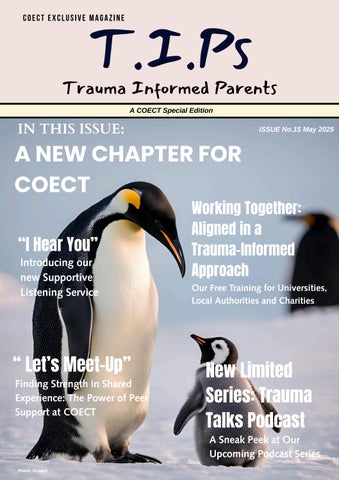
COECT EXCLUSIVE MAGAZINE
T.I.Ps
Trauma Informed Parents A COECT Special Edition
IN THIS ISSUE:
ISSUE No.15 May 2025
A NEW CHAPTER FOR COECT “I Hear You” Introducing our new Supportive Listening Service
“ Let’s Meet-Up” Finding Strength in Shared Experience: The Power of Peer Support at COECT
Working Together: Aligned in a Trauma-Informed Approach Our Free Training for Universities, Local Authorities and Charities
New Limited Series: Trauma Talks Podcast A Sneak Peek at Our Upcoming Podcast Series
Photo: ©Coect
Meet the Team! Executive Editor - Sarah Naish
Executive Editor - Sair Penna
Managing Editor - Kathryn Talbot
Contributor - Emma Edwards
Kathryn is co-founder and Director of The Centre of Excellence in Child Trauma C.I.C specialising in communications and public relations.
Emma is a Therapeutic Parent, Adopter, Parent Coach. Emma is also co-founder and Director of Therapeutic Services and Ambassador for England at The Centre of Excellence in Child Trauma C.I.C.
Contributor - Gareth Thomas
Contributor - Jessica Spenceley
Contributor - Joanne Wilson
Contributor - Danielle WhatlingGleadall
Sarah is a Therapeutic Parent, an Adopter of five siblings, Best selling international Author, Keynote Speaker and founder of three Independent Therapeutic Fostering Agencies. Sarah is also and cofounder and CEO at The Centre of Excellence in Child Trauma C.I.C.
Sair (Sarah) is a Therapeutic Parent, Author, Parent Coach and Havening practitioner. Sair is also co-founder and Director of Training, Qualifications & Quality at The Centre of Excellence in Child Trauma C.I.C
Gareth is a Kinship Carer to three children, and has volunteered with children for fifteen years. He hosts and produces the new CoECT Podcast series "Trauma Talks". Gareth is also a Senior Trainer and Ambassador for Wales at The Centre of Excellence in Child Trauma C.I.C.
Joanne is an experienced assessor who has been part of our qualifications team for several years. She has recently stepped into the role of Operations Manager at The Centre of Excellence in Child Trauma C.I.C., and she is based at our Head Office in Gloucestershire.
Jessica is a therapeutic social worker with over 20 years of experience helping adoptive parents navigate their parenting journeys using the attachment-based, trauma-informed parenting approach of TBRI®.
Danielle is an experienced member of the COECT team, having overseen the training division for several years. She now supports our Corporate Members, at our Head Office in Gloucestershire.
Contributor - Amanda Mauger-Jones
Mandie is a therapeutic foster parent with expertise in empathic listening. She is a practitioner informed by Dyadic Developmental Psychotherapy (DDP), a TraumaInformed Trainer and practitioner for our Therapeutic Services, including the newly launched Supportive Listening Service. ISSUE 15
T.I.P'S MAGAZINE
1
TRAUMA-INFORMED PARENTS
CONTENTS
9 Working Together: Aligned in a TraumaInformed Approach
13 “I Hear You” Introducing our new Supportive Listening Service
4 A NEW CHAPTER FOR COECT
15 “Let’s Meet-Up” Finding Strength in Shared Experience: The Power of Peer Support at COECT
3 Editor's Note
Written By Sarah Naish
5 Introducing TIPS Consults
6 When Meeting with Family Stirs Up Big Feelings: How to Support Your Child
8 Are Family Courts Meeting Their Purpose? Do They Understand Trauma?
Photo: ©COECT via Canva
17 Unveiling the New TIPs Hub Membership
ISSUE 15
18 New Limited Series: Trauma Talks – from The Therapeutic Parenting Podcast
20-22 UPCOMING EVENTS & TRAINING
T.I.P'S MAGAZINE
2
From its beginnings as a Therapeutic Parenting Group on Facebook a decade ago, we have evolved into a Community Interest Company dedicated to supporting parents of children who have faced early life trauma and display neurodiverse charachteristics. This edition focuses on The Centre of Excellence in Child Trauma C.I.C.
Editor’s Note Welcome to May's edition of TIPS magazine! This is a special issue that we have been eagerly awaiting to publish, as it shares some exciting news. For the past six months, we have been working tirelessly behind the scenes to merge the companies that provide Training, Peer support, and Therapeutic services. As of 1 May 2025, we proudly announce that we are now The Centre of Excellence in Child Trauma C.I.C! In this edition, we will showcase our new membership, which brings all services in one place. I will leave our CEO, Sarah Naish, to tell you more about this in the article she has written in this edition of TIPs. We also have contributions from Joanne Wilson, our new Operations Manager, and Danielle WhatlingGleadall, our Corporate Members Coordinator. They will discuss their roles in supporting our members, the benefits of membership, and how they can help you access these services. We join our Director of Therapeutic Services, Emma Edwards, who introduces our new peer support services, and Amanda Mauger-Jones has written an article on her new role in the Supportive Listening Call service, which all members can access as part of the new membership. Gareth Thomas, our Trainer and Ambassador for Wales, will also share details about our exciting new COeCT podcast series, "Trauma Talks," which he is hosting. We are also joined by our resident writer Jessica Spenceley who has written about family time/meeting with family members which some refer to as contact, and how parents and carers can support children in navigating their time with their birth families. As always, we would love to hear from you. Do get in contact with us by emailing tips@coect.co.uk.
Sair Penna Executive Editor
Kathryn Talbot Managing Editor
Warmest wishes Sair, Sarah & The Team at The Centre of Excellence in Child Trauma C.I.C
ISSUE 15
TIPs Magazine T.I.P'S MAGAZINE
3
A NEW CHAPTER FOR COECT
gs, win ve ha lys !” uin an f tead s c ng pe hey im in r t ou w se mean to s t rn cau be esn’ lea t s o m h “Ju it d p the ais l hN he ara t’s S e L
The Centre of Excellence in Child Trauma C.I.C
Written By Sarah Naish We are delighted to announce that all our companies have now merged into one not-for-profit company called The Centre of Excellence in Child Trauma. We made the decision to combine the National Association of Therapeutic Parents, Inspire Training Group, and The Haven Parenting and Wellbeing Centre Ltd to make things easier for our members and service users. Since forming Inspire Training Group in 2014, I have become more committed to making sure we can provide services for parents of neurodiverse children, whether through trauma or any other way, social workers and other supporting professionals. We felt it was only by combining all our services into one place that we could make it easy for everyone who needs access. As a trainer and author in the field, I have become aware that there are still
ISSUE 15
huge gaps in training and meaningful support for parents who are trying to get their head around therapeutic parenting. One of these shortfalls is in social work training, where social workers are still woefully unprepared to meet the challenges of behaviours our children demonstrate due to their past trauma. Now, The Centre of Excellence in Child Trauma will be able to roll out free training for social workers who are working for Local Authority teams or in charities. Our First Steps in Trauma Informed Practise will make relationships easier for social workers and the families they support. This month, I have delivered training in Universities and Local Authorities. Our training team go out every single day delivering this essential trauma-informed basis. We work with schools, we have our own
own education team and we continue to work away at changing the world for you. We can now be confident that parents who feel isolated, alone, and judged no longer need to stay in that lonely place. The support network which ran through The National Association of Therapeutic Parents will be able to access enhanced support through our TIPS Hub. We have also joined up with Kinship Carers UK to increase the number of support groups available, both online and face to face. Virtually everybody who works in our team, has firsthand experience of parenting neurodiverse children, or indeed are people who spent some of their childhood in care. It is this unique perspective that allows us to really identify the issues of the day and come up with practical
T.I.P'S MAGAZINE
4
strategies and solutions for them.
trauma and neurodiversity, and to meet all those unmet needs.
Along with my long-suffering business partner, Sair Penna, I believe we have managed to overcome so many of the obstacles and challenges placed in our path. Sair has now put together a whole raft of Trauma Informed qualifications. All are independently accredited and truly help parents and supporting professionals to upskill, see behaviours through the lens of
Our mindset is one of solving complex problems. Finding outdated models and methods of intervention and changing them! When my five adopted children were young, there was very little help for me. I was largely left to raise them and work it all out for myself as I went along. This is not right. It is not a good service for families who adopt or foster. It is
not a good service for kinship carers, and it definitely fails our children. By bringing all our services under one umbrella, on a notfor-profit basis, we can now address the root of the problems facing professionals and families.
Sarah Naish, CEO of The Centre of Excellence in Child Trauma C.I.C
Introducing
TIPS Consults
Are you looking for a supportive space to explore real-life challenges in therapeutic parenting and session is packed with insight,
is your chance to be part of a
empathy, and real-world
community that truly
The CoECT team invites you to
advice. These aren’t just
understands. Join us, share
our monthly Virtual Group
conversations—they’re
your story, and leave with tools
Meet-Up called TIPS Consult —
opportunities to develop
you can use to support your
a welcoming online support
insight, connect with others
family.
group designed to empower
and bring clarity to situations
you with practical, solution-
relating to parenting children
focused strategies.
who have experienced early
trauma-informed care?
life trauma, or those who Led by our expert-by-
display neurodiverse
experience team—including
charachteristcs,
Sarah Naish, Sarah Dillon, Sair Penna, Emma Edwards, Gareth
Whether you're a parent,
Thomas, Dave Edwards and
carer, or professional, this
our team of trainers - each
ISSUE 15
Membership Benefit Join us on Thursday 26th June 10:00 am - 11:00 am via Zoom To book go to https://www.coect.co.uk/ coect-training-events
T.I.P'S MAGAZINE
5
Photo: ©JSpenceley
When Meeting with Family Stirs Up Big Feelings: How to Support Your Child Written By Jessica Spenceley Spending time with past caregivers or relatives can stir up a mix of emotions and trigger past traumas. Trust-Based Relational Intervention (TBRI) offers you a range of strategies to help your child navigate these experiences. Through increasing containment, recognising feelings, and supporting felt-safety, you can help your child feel more secure and regulated as they process the complexities of these relationships. Increase Containment Whether family time involves seeing people in person, calls, or letters, creating a greater sense of containment around the experience will help your child to feel safer. It can be as simple as walking your child through what’s going to happen so they know what to expect: “We’re going to meet your brother and his parents at the park on Saturday morning. We’ll play for a bit, and then we’ll head to the café for lunch. When we’re all done with lunch, we’ll say our goodbyes and come home. And we’ll look forward to seeing your brother again during your next school break.” Having a clear sense of structure around contact will help your child manage the uncertainty ISSUE 15
they’ll likely be feeling. However, words alone aren’t enough. Adopted children often need visual cues to help them process information and understand what’s happening. Consider what your child might respond to: maybe it’s a calendar on the fridge with the date of the meeting clearly marked; maybe it’s pictures showing each part of your upcoming visit; or maybe you create drawings together. The idea is to connect your words and the visuals so that your child has a sense of structure around what will be happening. Role-playing or acting out parts of the experience ahead of time can also help. You might use stuffed animals to practice saying goodbye or act out different parts of the visit. Creating a safe way for your child to “try on” the experience before it happens can help ease uncertainty and provide reassurance. Recognise Feelings Meeting with family can trigger complicated feelings, and holding both the “positive” and “negative” emotions around it can be confusing and overwhelming for your child. However, a simple acknowledgment of what they’re feeling can help make things feel more manageable for your child:
"I wonder if getting the letter from your birth mum made you feel a bit happy and also a bit mad?" Meeting with birth family can be complex, and so are your child’s feelings about it. These sorts of responses help your child make sense of what’s happening for them on the inside and know that it’s ok to feel different emotions at the same time. Even if your child doesn’t give you a lot of feedback in the moment, they’ll be taking in the very big message that you understand them and that they aren’t alone. You might also notice that your child needs extra connection before or after contact. These shifts are signals that they need more support, and playfully engaging, doing sensory activities, and simply being present can help them regulate. Support Felt-Safety Family time/contact often stirs up the impact of the past. You might notice that difficulties suddenly resurface, behaviours become challenging, or your child just seems off. One of the ways you can help your child to feel more secure and in balance is through supporting their sense of felt-safety. T.I.P'S MAGAZINE
6
A primary way to do this is through increasing your connection in intentional ways. TBRI offers you a lot of strategies to do this, like offering your undivided attention, using reassuring touch, being mindful of your tone of voice, or
Photo: © COECT via canva
playing. Sometimes, your child’s nervous system will need extra support to return to balance. Simple, regulating activities like rocking, swinging, deep pressure, or even quiet time together can help. Pay attention to what helps your child feel calm and use those strategies when you notice dysregulation. Final Thoughts Supporting your child through meetings with family members is a journey. By increasing containment, recognising their feelings, and building felt-safety, you can help them navigate its complexities in a way that feels reassuring. Over time, your child will feel more equipped to manage the complexities that family time brings.
98%
Jessica is the founder of Nurtured Belonging where she helps parents and adopted children overcome challenges, heal from the past, and build strong, connected relationships. To connect with Jessica, go to https://nurturedbelonging.com/.
That’s the percentage of SAfER foster families who stay together, year after year. In a system where children too often move between homes and lose vital relationships, stability is everything. At SAfER, we’re here to help families stay strong so that children can stay where they belong—in safe, loving homes that last.
https://saferfostering.org.uk
ISSUE 15
Stability is possible. We’ll help you get there.
T.I.P'S MAGAZINE
7
Are Family Courts Meeting Their Purpose? Do They Understand Trauma?
Time after time, we see children who have been traumatised by birth parents being ordered to see them or returned to them inappropriately. The children are re-traumatised each time. We would love to hear your thoughts. Please can you take a few minutes to complete our survey?
https://tinyurl.com/yc39tb7a
ISSUE 15
T.I.P'S MAGAZINE
8
Working Together: Aligned in a Trauma-Informed Approach Written By Sair Penna The term "trauma-informed" can sometimes be perceived as a buzzword, which isn’t a bad thing; buzzwords can raise awareness about important concepts and encourage practitioners and the organisations they work for to adopt supportive practices. However, there is the risk, with anything, that a term can be used superficially, lacking a true understanding of its principles, and used as a “tick-box exercise,” which can lead to the approach not meeting the needs of the individuals it is there to support.
Recognising the impact of Trauma To be truly trauma-informed allows you to understand what it means for an individual to experience a traumatic event. There are many causes of trauma; physical, emotional and sexual abuse, neglect, bereavement, domestic abuse, war, illness, injury or witnessing a traumatic event can all impact a person in some way, shape or form. The way trauma affects a person can also be a uniquely individual experience and vary from person to
qualities and resources that enable
our brains are able to find patterns
us to cope with and recover from
in the things we see, hear, smell,
adversity effectively, then our
taste and do, mainly to perceive
landscape has resilience to
threat and danger and keep us safe,
experiences. How resilient a person’s
which has been a great tool in
landscape is depends on many
keeping us safe since we existed on
factors, including our life experiences
earth, especially as it kept people
and the impact that they have had
safe from fierce predatory animals,
on us, our relationships with others,
by triggering our fight & flight
and whether we have secure
response. Sometimes our brains
attachments to significant others
recognise patterns that are similar
who can give encouragement, care,
but not exactly the same.
and guidance. Epigenetics can
person. What might be traumatic for
impact how we have adapted
This can lead to problems when
one person may not impact another
through generations to manage
specific situations are associated
person similarly. Our ability to cope
traumatic events, which can then
with traumatic memories,
with experiences depends on our
impact our biological makeup. Also,
potentially triggering a child or
emotional and mental landscape and
having the resources like education
young person’s emotional response.
its resilience. In other words, if we
and information to adjust to
These triggers can include a whole
possess a robust set of personal
situations can affect whether
ISSUE 15
T.I.P'S MAGAZINE
9
range of stimuli, like people, buildings,
Parents will be able to work with
The best-selling A-Z books by
objects, places, smells, other actions and
professionals to share information
Sarah Naish and the COECT team
routines, to name a few. Parents and
about their child and this
have proven to be valuable
carers of children and young people who
partnership can greatly benefit the
resources for parents and
have experienced trauma often become
child in helping them thrive and
professionals alike, helping to
very attuned to these triggers,
meet their full potential with
bridge the knowledge gap
particularly if they are familiar with the
therapeutically aligned support.
regarding trauma-informed
child’s early life experiences and life story
When there is a gap in knowledge
practices through real-life
and the impact those experiences have
or skills between the family and
perspectives. Many parents and
had on the child's internal working
professionals, it can become a
carers have shared that they
model.
barrier to the family receiving the
purchased a copy for their child’s
necessary support for their child.
school or social work team to
Trauma-informed Families
support their understanding of
Caring for a child who has experienced
At COECT, the parents, families,
their child’s needs and get them
trauma adds a new dimension to the
social workers, teachers, and
on the same page, so it is easier
concept of a trauma-informed approach.
healthcare professionals we work
to come up with a plan to help
Families raising children with a history of
with share a common goal: to
the child.
early life trauma often find themselves
understand developmental trauma.
deeply affected by the after-effects of
They seek to comprehend why
Closing the gap
that trauma. They experience its impact
children display behaviours that
This is where we began to think
through both the subconscious and
can be considered challenging or
about how we could help
conscious behaviours of the child, and
socially unacceptable, and they
support parents and the
for some families this can be a daily
want to learn how they can support
professionals they work with
reality, which is often compassionately
these children in their growth,
further understand trauma,
accepted as part of the norm of their
learning, development, and healing.
including the impact which
family life.
More often than not they want to
parental compassion fatigue can
Parents and carers can be powerful
learn about trauma-informed
have on the parent and family,
advocates for their children, particularly
practices and therapeutic parenting
and how underestimating how
when they understand their child's
strategies because it enables them
much compassion fatigue does
triggers and how to provide support.
to support and advocate for the
impact the family can also be
This awareness can be incredibly
child or young person, they are
detrimental to family stability. In
beneficial for the professionals working
caring for in the best possible way
the therapeutic foster agencies,
with the child, whether in social care,
for their child’s needs to be met.
we work with in the COECT
healthcare, or educational settings.
community; we know that having supporting professionals who see the impact of trauma on families can prevent family breakdowns and the need for children to move homes. It also empowers those working in the social, health and education sector to use their underpinning knowledge and tools to support children and their families, with confidence. Having someone who understands that the behaviours children display is a way of communicating their experiences can be life changing.
ISSUE 15
T.I.P'S MAGAZINE
10
It is important to acknowledge the
supporting professionals as we can
families receive the support
support families need and recognise
seeking to access trauma informed
they need to change their
the resources a child may require to
training to support the children and
narrative. A child's past
adapt and learn. We know of
families they work with. Our Social
experiences do not have to
thousands of professionals who
Care Sector Hub was established as
dictate their future and by
have accessed our training and
a platform offering webinars on
supporting them in their
implemented trauma-informed
various aspects of a trauma-
healing journey with a
practices. We often hear about
informed approach. This resource is
trauma-informed approach,
dedicated professionals who
accessible to Local Authority social
can give them the
provide invaluable support to
care services and charities.
opportunity to choose how the next chapter of their life
families, making a significant difference in their lives through the
Additionally, we provide training
assistance they offer.
sessions for Universities within the
story unfolds.
Social Work and Care Sector. We As part of our mission at COECT we
believe that these initiatives will
want to support as many
ultimately help children, and their
The Social Care Sector Hub
To learn more about The Social Care Sector Hub, please visit our website. Currently, The Social Care Sector Hub is available to Local Authorities, Social Care and Fostering Teams, as well as Charities.
www.coect.co.uk/freetrainingforsocialcaresector
Scan the QR code provided
Have you subscribed to TIPs yet? Find out more by visiting our website www.coect.co.uk
ISSUE 15
T.I.P'S MAGAZINE
11
T.I.P.s ENJOYING TIPS MAGAZINE? Continue reading with a TIPs Magazine subscription You've reached the end of the free preview. If you've enjoyed this issue, you can get every issue of TIPs Magazine throughout the year.
DIGITAL — £15 per year 6 issues + full digital archive Read TIPs Magazine wherever you are, on your computer, tablet or phone. www.coect.co.uk/shop PRINT — £30 per year 6 printed issues delivered to your door Prefer a physical magazine? Subscribe to receive every issue throughout the year. www.coect.co.uk/shop
Looking for more support? TIPs Magazine is also included as part of TIPs Hub membership. Join the TIPs Hub for access to the magazine alongside our wider range of support, resources, learning and community. www.coect.co.uk/join
Keep reading. Keep connected. TIPs Magazine — £15 digital | £30 print TIPs Hub — magazine + support + resources + learning + community