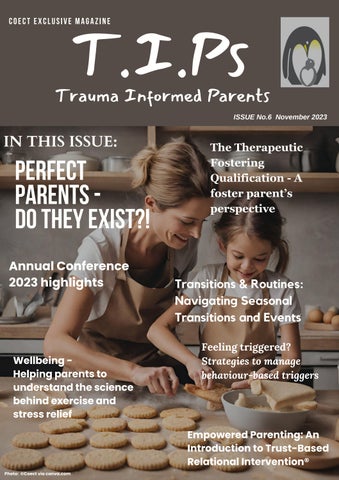
COECT EXCLUSIVE MAGAZINE
T.I.Ps
Trauma Informed Parents ISSUE No.6 November 2023
IN THIS ISSUE:
Perfect Parents Do they exist?! Annual Conference 2023 highlights
WHAT'S ON? Wellbeing Helping parents to understand the science behind exercise and stress relief
The Therapeutic Fostering Qualification - A foster parent’s perspective
Transitions & Routines: Navigating Seasonal Transitions and Events Feeling triggered? Strategies to manage behaviour-based triggers
Empowered Parenting: An Introduction to Trust-Based Relational Intervention® Photo: ©Coect via canva.com
In this issue CoECT News
Page 1
Editor's Note
Page 2
Meet the Team!
Page 3
Annual Conference 2023 highlights
Page 4
Perfect Parents - Do they Exist?!
Page 6
The Therapeutic Fostering Qualification - A foster parent’s perspective Navigating Seasonal Transitions and Events
Page 8 Page 9
Wellbeing -Helping parents to understand the science behind exercise and stress relief
Page 11
What's on Where? – Events and Connections
Page 13
Feeling triggered? Strategies to manage behaviour-based triggers
Page 15
Trauma-Informed Qualifications
Page 17
Empowered Parenting: An Introduction to Trust-Based Relational Intervention®
Page 18 Page 20
NATP Volunteer Viewpoint
Page 21
Ask The Experts - Seasonal Special
www.coect.co.uk To advertise with us contact: tips@coect.co.uk ISSUE 6
T.I.P'S MAGAZINE
COECT NEWS The agency is currently interviewing for a Social Work Assistant in the South Wales area. This innovative post has attracted aspiring Social Workers and those who want to within the field do not want to pursue a professional qualification. Supporting existing social workers, the role will involve engagement of foster parents and children, deputising at meetings and direct work with children. This is an exciting development and shortlisted candidates have a wealth of experience including working directly with looked after children in the community and in residential homes. Safer has found an exciting new venue for its monthly Photo: ©Coect coffee mornings. Previously held at the office, these will now be held at Dyffryn Gardens, a National Trust property where we are able to take advantage of the innovative ‘Wellbeing Pass’ a scheme, available to charities and not-for profit organisations. The venue has extensive grounds which families can explore, is dog friendly and has an on site café. There will also be an opportunity to hold children’s events there at key times of the year.
Having grown to establish a lovely group of new foster parents in East Anglia, the region has established its own regional Professional Therapeutic Development Group which will meet monthly led by our Attachment Therapist Sarah Dillon. TRUE is also currently interviewing for a Child Support Worker for the area as part of our commitment to support our new fostering hub.
The Haven Parenting and Wellbeing Centre has been a driving force in collaborating with organisations to prevent work-related stress and interrupt compassion fatigue. With online sessions that are both accessible and transformative, they empower individuals to take charge of their mental wellbeing and thrive in their personal and professional lives.
The Therapeutic Parenting Badge has been ordered for National Therapeutic Parenting Day launching in March next year. NATP are going to be organising the annual event which is set for 6 March (NATPs birthday) More information will be shared in due course!
ISSUE 6
New Trauma Informed Panel Training It’s essential that Fostering panels understand what therapeutic parenting and trauma informed practice looks like. With this in mind we have developed a programme to support Fostering Panels. This video based interesting course will get panel members on the same page. The programme has been written by Sarah Naish and Sair Penna, bestselling authors with lived in experience of social work, fostering and fostering panel members/Chair -Ofsted ‘Outstanding’. More information about this can be found at https://www.inspiretraininggroup.com/fosteri ng-professionals Conference Recording available Danielle, our Training Manager, has been busy uploading the Annual CoECT Conference 2023 to our learning platform, and it is now available to purchase if you missed it first time around. https://tinyurl.com/2sx4up47.
T.I.P'S MAGAZINE
1
Editor’s Note Welcome to Issue 6! Time seems to fly so fast, and it's hard to believe that we're already putting together Issue 6 after just releasing Issue 5 last September. We've been incredibly busy, and we're thrilled to share some of the highlights with you. Our National Conference in Coventry was a massive success, and we're grateful for the parents, teachers, social workers, and alternative education providers who came together to support neuro-diverse children in education. The atmosphere was electric, and we felt positive about the changes we could make. We have included some of the conference's highlights in a CoECT News Special on page 6. Additionally, we focus on a topic that most of us can relate to - the quest for being the perfect parent. With the rise of social media, the pressure to showcase a flawless family life can be overwhelming. But let's face it, how often is everything genuinely perfect? Join us as we explore the reality behind the picture-perfect moments on social media and delve deeper into the question of whether a perfect parent even exists. As the holiday season approaches, we may need to navigate through transitions. Christmas can be challenging for both children and adults, especially from a sensory processing perspective, with the flashing or twinkling lights and social events with relatives, which can be overwhelming. In this issue, we will explore how to manage seasonal transitions. Jessica, a therapeutic social worker and TBRI practitioner provides an introduction to Trust-Based Relational Intervention® and explains the process involved. Additionally, our wellbeing article delves into the topic of compassion fatigue and provides practical tips for preventing burnout. Mark, a parent, seasoned life coach and personal trainer, shares his insights on how exercise can serve as an effective stress reliever. We wish you a restful build-up to winter festivities and the impending school break, which is just around the corner. If you would like to contribute to our next issue in any way, please contact us via tips@coect.co.uk. Best wishes
Sair, Sarah and the team at The Centre of Excellence in Child Trauma ISSUE 6
T.I.P'S MAGAZINE
2
Meet the Team! The Centre of Excellence in Child Trauma is made up of a team of experts who have essential real-life experience. We are Adopters, Foster Parents and Bio parents of neuro diverse children, and also work as professionals in the field.
Executive Editor - Sarah Naish Sarah is a Therapeutic Parent, an Adopter of five siblings, former Foster Parent, retired Social Worker, Best selling international Author, Keynote Speaker and founder of three Independent Therapeutic Fostering Agencies.
Executive Editor - Sair Penna Sair (Sarah) is a Therapeutic Parent, Trainer, and Therapeutic Parenting Coach. Director of NATP, Wickselm House Learning Centre CIC and Independent Panel Chair for two Therapeutic Fostering Agencies.
Managing Editor - Kathryn Talbot Kathryn works across CoECT, specialising in communications and public relations.
Contributor - Emma Edwards Emma is a Therapeutic Parent, Adopter, Director of NATP and The Haven Parenting and Wellbeing Centre.
Contributor - Sarah Dillon Sarah is a Therapeutic Parent, an Attachment Therapist, Keynote speaker, former child in care, Author (Therapeutic Parenting) Head of Therapeutic Services (Fostering).
Contributor - Jane Mitchell Jane is a Therapeutic Parent, Adopter and Keynote Speaker, Author and Head of Family Stability in two Therapeutic Fostering Agencies .
Contributor - Mark Long Mark is a parent, and experienced fitness and lifestyle coach who specialises in working with parents and caregivers. He offers strategies to integrate exercise into a balanced lifestyle, making physical activity a sustainable and enjoyable part of their lives.
ISSUE 6
Contributor - Jessica Spenceley Jessica is a therapeutic social worker with over 20 years of experience helping adoptive parents navigate their parenting journeys using the attachmentbased, trauma-informed parenting approach of TBRI®.
T.I.P'S MAGAZINE
3
COECT News Update
T
he night before the conference was marked by wet and windy weather. However, the staff team from all six companies of COECT still managed to gather for a preconference team meal. It's not often that we get together, but when we do, there's a palpable buzz of enthusiasm in the air. On the day of the conference, we warmly welcomed our delegates who had braved the stormy weather to attend. The focus of this year's conference was the new COECT Schools Team’s book, "The A-Z of Trauma-Informed Teaching, Solutions, and Strategies," which was launched in August and has already become a bestseller. It was a pleasure to meet many like-minded individuals, including teachers,
Photo: ©Coect
ISSUE 6
©John Foxx from Photo Images via www.canva.com
Annual CoECT Conference 2023 - the highlights! Photo: ©Coect
SENDCos, teaching assistants, headteachers, social workers, and parents, who were embracing the much-needed change in the education system. They were creating small ripples in the education system to support our children in an ever-changing learning environment. The COECT Schools team, consisting of Sarah Naish, Daniel, Anne, Hannah, and Sair, were joined by best-selling author, psychotherapist and attachment therapist, Sarah Dillon. At the conference, Sarah and Sair began the day by sharing their experiences as parents navigating the education system. They spoke about the challenges they had faced, and how this led to the creation of
their book and also Wickselm House Learning Centre. This part of the conference highlighted the impact that the education system can have on neurodiverse children or those who have experienced adverse childhood experiences (ACEs). Sarah and Sarah Dillon then entertained us by role playing scenarios around school related issues, whilst explaining the importance of understanding the root cause of the child’s behaviour, depending on the circumstances which present themselves. They were joined by Sair and Daniel as supporting cast members through this part. Daniel and Anne provided insight into therapeutic teaching using a traumainformed approach, and their journey which The Wensum Trust has taken to
Photo: ©Coect
T.I.P'S MAGAZINE
4
get there. Their thought-provoking talk shared teaching strategies from the child’s perspective and how if they were used with the audience how they would make us feel. They also shared their strategies and solutions which have made their schools take a traumainformed approach, from supporting staff to implementing strategies in the classroom. After lunch, Hannah explained the setup and workings of Wickselm House, an alternative education provision for children who cannot attend school. She also shared the success of the program in bridging the gap for children, helping them develop social and emotional resilience, and preparing them for a smooth transition into school. The event concluded with a Q&A session with the panel of speakers, followed by an opportunity to have one-on-one conversations with the COECT staff while enjoying some light refreshments.
We would like to express our gratitude to Kathryn Talbot and Danielle WhatlingGleadall for their thorough planning skills, which made the day a great
Photo: ©Coect
success. Additionally, we would like to thank the COECT staff team for their assistance in ensuring that everything ran seamlessly both in preparation and on the day.
The conference was also recorded so if you did miss it, or would like to watch it again, then you can purchase it at https://tinyurl.com/2sx4up47.
The event was a huge success, not only as a day to share knowledge but also as an opportunity to meet new people and make connections with other like-minded organisations.
We are currently planning the Annual Conference for 2024 and will release additional details early next year. Keep an eye out for updates!
Photo: ©Coect
ISSUE 6
T.I.P'S MAGAZINE
5
Perfect Parents Do they exist?! Written by Sair Penna
W
Parenting is a tricky job and many parents feel the pressure to be perfect in their role. It's a common concern that many parents share. The influence of other parents can sometimes make us feel like we're not doing enough or that we're not good enough at parenting. But let's remember, we all start off at the same point, and we're all just trying to get to the finish line. Along the way, there will be hurdles and bumps, and some of us will have a tougher journey than others. But we'll all get there in the end, and how we cope with challenges along the way will shape our journey. It's important to remember that parenting is an ongoing journey that requires continuous learning and growth. It's full of ups and downs, and sometimes unexpected surprises, but we'll get through it. What's normal?! Every parent's experience of 'normal' varies greatly and is heavily influenced by the specific parenting challenges they face. What one parent might consider a typical day, another might consider a difficult one. Ultimately, the needs, abilities, and personality of each child play a significant role in shaping a parent's ISSUE 6
Photo: ©Coect via canva.com
hen it comes to mythological creatures, some popular examples that come to mind include unicorns, mermaids, and dragons. However, if you you have a child who has a keen interest in this subject, there may be a few more creatures that they are familiar with. Additionally, we often hear stories about the myth of perfect parents, who seem to have everything under control every day, always arriving early, with a child who excels at reading, and who never has a public outburst.
However, putting too much pressure on yourself and your child to excel in everything can lead to unrealistic You get to gauge what is your normal, expectations and unnecessary and sometimes that isn’t the same as stress. other people’s expectations, and its Not all children will read and write at great that you have inside knowledge the same time or learn to ride a bike. of your children and get to see things Parenting is a multifaceted and from a different perspective than the complex task that can be influenced onlookers when situations unravel. Like by various factors, including the when you catch yourself channelling child's characteristics and needs, your inner Star Wars/Darth Vadar parental resources and support, the monologue “The force is strong with quality of the relationship among this one” whilst your child is doing a parents, and the social and very good job of demonstrating a sit economic context of the family. -in on the school playground Some of these factors can make equipment long after everyone has parenting easier or more challenging issued “judgement stares” and had gone home. Although having a spirited for different individuals. Some may face more challenges due to high child can have its challenges, levels of stress or isolation, while especially when you are parenting others may have a more satisfying them, there is a good possibility that experience with supportive partners they may develop and hone their or extended family. It very much determination into strong leadership depends on your circumstances, and qualities. the needs of yourself, your child and the family’s needs. Parent Peer Pressure It's totally understandable for parents Children who are neurodiverse have to want the best for their children. unique strengths and challenges perception of what is normal for their parenting and family life in general.
T.I.P'S MAGAZINE
6
that can significantly impact their development, education, socialisation, and mental wellbeing. Neurodiverse children are those who have different brain functions, processes, behaviours, and learning styles from what is considered typical. They may require additional support or accommodations to thrive in their environment. Being a parent of a neurodiverse child can raise many questions and concerns about how to provide the best support for your child's needs and overall well-being. However, acceptance is the key to empowering parents of neurodiverse children to find their own way of parenting that works best for them. Once you find the strategies that work with your child, you will feel much more confident, and you won't care about what other people think or how other children are progressing. Parenting is a journey of learning, growing, and adapting to new roles and responsibilities, and there is no one "right" way to do it. The most important thing is to listen and respond to your child's needs. Parenting is a challenging and complex task that requires patience, empathy, and understanding. Despite this, many people believe in the myth of the perfect parent - the ideal mother and father who can raise happy, well-adjusted, problem-free children. However, it's important to acknowledge that making mistakes along the way is a natural part of the learning and growing process. And for those parents who seem like they have everything under control… The parent who arrives early… because their child has been awake since 5am and they need to get out of the house, The parent whose child is an excellent reader… but refuses to eat anything but yoghurt, or the parent whose child copes well in public …but struggles to emotionally regulate at home after the event. ISSUE 6
The truth is that parenting is not easy, and there is no manual to guide us through it. It's a steep learning curve for most parents, and it's a massive transition. One day, you're carefree and independent, and the next, you're a parent to children who for them you are their world. It's a significant responsibility that is unique to everyone, whether you're a parent, foster parent, grandparent, kinship, or connected person carer. Although we might have similarities in our parenting journey, nobody knows a child better than their significant carer. Being a parent involves being present for your child, providing them love, support, and guidance, and helping them develop into independent and responsible adults. So, let's embrace our individual journeys of parenting with acceptance and kindness.
Photo: ©Coect via canva.com
And the perfect parent? Well, the name is better suited to belong in a book of myths and mythological creatures.
Looking for a new book to read? 'But he looks so NORMAL!' A phrase guaranteed to catapult you into bad-tempered parenting. If you are a foster parent, adopter, kinship carer or other Therapeutic Parent looking after a child with additional needs, you may be tired of putting up with Patronising Professionals, dealing with Arguing Children whilst worrying that you have become a very badtempered parent. This irreverent look at untherapeutic moments, also combines strategies for efficiently dispatching 'BakingMother-with-Clipboard' and reward charts.
T.I.P'S MAGAZINE
7
The Therapeutic Fostering Qualification - A foster parent’s perspective Written by Lisa Slaney, Therapeutic Foster Parent So, lets talk about training and coursework, in particular the Level 2 Award in Therapeutic Fostering. Training is one of those things that’s a bit like Marmite, you either loathe it or love it. You walk away feeling like that’s a day of your life you’re never going to get back, or you feel inspired (excuse the pun). Well, I assure you, the Level 2 Award in Therapeutic Fostering will leave you feeling like the latter. The award consists of six units. Understanding developmental trauma, Building the foundations of a trusting relationship, understanding the importance of meeting the needs of the growing and developing child, understanding how to create a safe parenting environment, understand the role of the professional therapeutic foster parent, and finally taking care of ourselves. Yes, one whole unit about us, you and me, and self-care. That has to be a first and a very welcome one. You’ll find each unit is meaningful and purposeful, and relative to the children we care for. You’ll be allocated an assessor who will introduce themselves to you via email or telephone call. They are there to support you on your training journey, assess your work and feedback to you. They too are therapeutic practitioners. You’ll be encouraged to work through each unit at your own pace, it’s designed to fit around the busy lives of foster parents not become an additional pressure, then submit your work for assessing. Each unit uses a variety of learning styles, and you will be assessed in numerous ways too. There are videos for you to watch, activities for you to complete, multiple
ISSUE 6
Photo: ©arturmarciniecphotos via canva.com
choice questions to answer, time to reflect on practice at home and use examples of your therapeutic parenting, and finally you will complete a short workbook. You will receive feedback on each piece of work you submit before moving onto the next section of your unit. We found that really helpful, particularly when completing the first unit as you are assured that you’re including the correct information and content amount. Like anything new, as you progress through the units it's natural that you become more confident. Nothing scary so far! Many of you may already be Therapeutic Parents as we were, some of you relatively new or familiar with therapeutic parenting and tentatively taking small steps forwards, and others, totally new to the principles.
Regardless of where you are on your therapeutic journey there is always learning to be gained and the opportunity in everyday life to implement that learning. What works well today may not work at all tomorrow, we can all recognise and empathise with that. One of things we both acknowledged from completing the Level 2 award was that learning can and should be fun, it should be tailored to your own needs and experiences, and those of your children. And it certainly was all of that and more. Give it a go, I’m sure you’ll be pleasantly surprised!
You can find more information on the Therapeutic Fostering qualification and Therapeutic Fostering Assessment at https://issuu.com/coect/docs/inspires _qualification_brochure.
T.I.P'S MAGAZINE
8
Navigating Seasonal Transitions and Events Photo: ©marinesea via www.canva.com
Written By Emma Edwards
T
ransitions and seasonal events can be particularly challenging for children with neurodiversity. Christmas, in particular, can trigger unexpected behaviours.
Society has set a high standard for this season; these expectations are often unrealistic and can lead to disappointment when our personal experiences don't match up with those portrayed in movies. The holiday season is full of excitement and festivities, but it can also be overwhelming. From Christmas nativities and school plays to bright lights, decorations, and changes in daily routines, it's easy for us to feel sensory overload. And that's not all - family gatherings, Santa's grottos, pantomimes, parties, and gift-giving can add to the stress. It is important to remember that our children may also experience feelings of anxiety during this time often more so than us and can become triggered and overwhelmed. Here are some ideas to make your holiday season more enjoyable with less anxiety: Develop a schedule that everyone can use to minimise holiday stress. If your child finds it difficult to plan too far in advance, create a visual schedule that is updated daily. Determine when you will put up and decorate the Christmas tree. While some families put up their tree on December 1st, others find this too overwhelming. If that's the case, try putting up the tree closer to Christmas. Schedule your grocery shopping in advance and consider doing it online to avoid in-store meltdowns. Plan some relaxation time to help you escape from the holiday chaos. ISSUE 6
Consider activities like a movie night, a walk in the fresh air, exercise, or crafting. If you're invited out or have guests coming over, try to schedule it at a convenient time for you and your family. If a meal out is too much, meet during the afternoon for tea and cake. If visiting someone's home or having visitors to your house is too overwhelming, suggest meeting at a local park or another neutral location. Santa Claus can be a big worry for children. If your child is scared of a stranger coming into the house, it's perfectly acceptable to adjust the tradition. For example, you could arrange for the presents to be left in a safe space outside or in the shed, or you could say that you will meet Santa at the door to collect them. If your child is still worried, consider creating a new tradition, like looking for Santa's sleigh in the sky on Christmas Eve so they believe that Santa has already passed by. Gift-giving can be difficult, especially when children feel overwhelmed or undeserving of
presents. Don’t be afraid to do things differently to accommodate your family's needs. If wrapping presents is too much, consider using a big gift bag or laying out the gifts in a ready-to-play fashion. You could even spread out the gift-giving process throughout the day or save some for Boxing Day. It's also okay to deviate from traditional Christmas foods if your child is a picky eater. Preparing something they will eat, like fish fingers and chips or beans on toast, can save you time and stress in the kitchen. Don't worry if sitting at the dinner table is too much for your child – allowing them to sit under the table or have a picnic on the floor can make them feel more comfortable. If questioned by visiting relatives, simply explain that you are accommodating your child's needs. Stick to your regular routine as much as possible, including mealtimes and bedtimes, even if your child may not like it at first. It can truly make a difference.
T.I.P'S MAGAZINE
9
Remember, it's important to do what's best for you and your family. It's only a few days out of the year, so it's okay to deviate from tradition to ensure everyone is happy and able to enjoy the holiday to the fullest. The key is preparing in advance and managing expectations. Instead of striving for unrealistic goals, focus on what works best for your family and embrace it. Remember, it's okay to do things differently from others. This approach won't guarantee a hiccup-free holiday, but it can help make the holiday season more enjoyable and less overwhelming for you and your family.
Are you a Kinship Carer, Connected Person or Special Guardian?
Kinship Care Survey 2023 We want your views on your experience on what it is like. Click on the link below to complete our survey. https://forms.gle/fUnE71AKfNmBRzb87
CoECT Conference 2023 "Meeting the needs of neuro-diverse children in education"
Recorded version is now available to purchase from the link below https://tinyurl.com/2sx4up47 ISSUE 6
T.I.P'S MAGAZINE
10
T.I.P.s ENJOYING TIPS MAGAZINE? Continue reading with a TIPs Magazine subscription You've reached the end of the free preview. If you've enjoyed this issue, you can get every issue of TIPs Magazine throughout the year.
DIGITAL — £15 per year 6 issues + full digital archive Read TIPs Magazine wherever you are, on your computer, tablet or phone. www.coect.co.uk/shop PRINT — £30 per year 6 printed issues delivered to your door Prefer a physical magazine? Subscribe to receive every issue throughout the year. www.coect.co.uk/shop
Looking for more support? TIPs Magazine is also included as part of TIPs Hub membership. Join the TIPs Hub for access to the magazine alongside our wider range of support, resources, learning and community. www.coect.co.uk/join
Keep reading. Keep connected. TIPs Magazine — £15 digital | £30 print TIPs Hub — magazine + support + resources + learning + community