COECT EXCLUSIVE MAGAZINE
T.I.P.s
Trauma Informed Parents ISSUE No. 1 JANUARY 2023
IN THIS ISSUE
"I NEARLY GAVE UP"
A KINSHIP CARER SPEAKS OUT
ASK THE EXPERTS
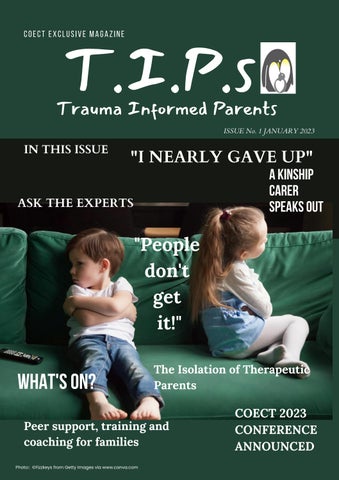
"People don't get it!"
WHAT'S ON?
The Isolation of Therapeutic Parents
Peer support, training and coaching for families Photo:: ©Fizzkeys from Getty Images via www.canva.com
COECT 2023 CONFERENCE ANNOUNCED
Editor’s Note Welcome! We are so excited to welcome you all to the very first edition of TIPs! Trauma-Informed Parents. I know many of you will think of yourselves as Therapeutic Parents (like we do), but it's all interchangeable, so don’t worry. So, whether you are an Adopter, Foster Parent, Kinship Carer/ Special Guardian, Step-parent, or Bio parent of a child who is neurodiverse, you will find a whole ton of useful articles and resources in this magazine.
😊
We can’t wait to share with you all the helpful tips we have acquired over the years (taught to us by our children!) …and don’t worry there aren’t going to be lots of ideas and theories without practical strategies and insight. We’d love to hear from you too, so email your thoughts or questions to TIPS@coect.co.uk Warmest Wishes, Sarah Naish, Sair Penna and the team at The Centre of Excellence in Child Trauma.
In this issue CoECT News
Page 2
Meet the Team!
Page 3
“People don’t get it”! The Isolation of a Therapeutic Parent
Page 4
What IS Trauma Informed Parenting? A Beginner’s Guide
Page 6
Ask the Experts
Page 8
“This System is Rubbish”! A Kinship Carer speaks Out
Page 9
What's on Where? – Events and Connections
Page 10-13
Trauma Informed Qualifications
Page 14
Contact Us
Page 15
ISSUE 1
T.I.P'S MAGAZINE
1
COECT News Update
Save the Date! COECT CONFERENCE 2023
"Make The Change - Trauma Informed Teaching" Thursday 19th October 2023 More details coming soon at www.inspiretraininggroup.com
Newsflash!!! Do you need support in planning your Training Schedule for the year? We are now running in-person training nationwide Managing Violent Behaviour Interrupting Trauma And many more... Contact us for a free consultation, to find out more about how we can support your training needs inspire@coect.co.uk
Are you looking for Training and Peer Support? If you are looking to develop your knowledge on Trauma informed practice and therapeutic parenting, as well as develop your social network through peer support, then the combined membership is for you. You can now purchase a combined membership for NATP and Trauma Revolution for £15 per month. For more details go to www.naotp.com/join
New Comedy Drama Series We are excited to announce that a new comedy drama series for Sky TV, directed by Peter Capaldi will be starting production this month. The series will be based on Sarah Naish's book "But he looks so normal" and Sarah will keep you posted as developments unfold.
ISSUE 1
T.I.P'S MAGAZINE
2
Meet the Team! The Centre of Excellence in Child Trauma is made up of a team of experts who have essential real-life experience. We are Adopters, Foster Parents and Bio parents of neuro diverse children, and also work as professionals in the field.
Sarah Naish is a Therapeutic Parent, an Adopter of five siblings, former Foster Parent, retired Social Worker, Best selling international Author, Keynote Speaker and founder of three Independent Therapeutic Fostering Agencies.
Sair Penna is a Therapeutic Parent, Trainer, and Therapeutic Parenting Coach. Director of NATP, and Independent Panel Chair for two Therapeutic Fostering Agencies.
Alison Douglas is a Therapeutic Parent, Adopter, Social Worker and Operations Manager in two Fostering Agencies. Alison is also Safeguarding Lead at NATP.
Sarah Dillon, is a Therapeutic Parent, an Attachment Therapist, Keynote speaker, former child in care, Author (Therapeutic Parenting) Head of Therapeutic Services (Fostering).
Emma Edwards is a Therapeutic Parent, Adopter, Director of NATP and The Haven Parenting and Wellbeing Centre.
Jane Mitchell is a Therapeutic Parent, Adopter and Keynote Speaker, Author and Head of Family Stability in two Therapeutic Fostering Agencies .
ISSUE 1
T.I.P'S MAGAZINE
3
"People Don't Get It" - The Isolation of a Therapeutic Parent By Sarah Naish
I
t is one thing to be struggling with a problem: It is quite another to feel not only utterly alone with that problem, but also
blamed and judged for how you are trying to handle the problem. I started feeling isolated about six months after my children came home to me. It took me a while to notice that this was indeed the case. Maybe because I was just so busy. But gradually I realised that other parents had slidey eyes when talking to me. They didn’t seem too keen on chatting at the school gates, they just weren’t comfortable. One parent even said to me once, ‘Don’t you feel bad taking other people’s children?’
The one who anticipated exciting new friendships with other parents, play dates and cosy coffees. More and more we were on the side-lines. More and more I found myself on the defensive. Explaining why my children behaved the way they did, how I was trying to help them. But then, finally, I stopped. I could not be bothered to keep justifying myself to everyone constantly. I no longer felt like explaining away my children’s behaviours to ignorant parents who only wanted to indulge in a bit of Top Trump parenting or blame and judgement. Even, to some extent, family fell away. They didn’t want the turmoil that went with the busy visits and full-on tantrums. I didn’t even blame them really.
But I did get lonely. I have never felt It's not only difficulties in making more alone than when I was and keeping friends, but also just desperately struggling and no one the day-to-day interactions. at all was there to even listen, let Nowadays, I am frequently walking alone help. Before I became antimy five dogs. We make quite a social, I did really want to be part of spectacle. Very often, people will the gang. But when the gang rejects stop and chat and smile. They will us, we reject them back. Before we pet the dogs and say things like know it, we are caught in a cycle of ‘You’ve got your hands full haven’t withdrawal, sadness and loneliness, you’? Not once did this happen ever determined not to take any risks with with my 5 children. Then, people new friendships. crossed the road to avoid us. Walking into a restaurant meant What Can I DO About It? people huffed and sighed, anticipating a horrible rowdy Have a good look at the people who bunch. (They weren’t. They were are around you. Who is supporting always great, as long as food kept you on your journey? Who is arriving). Now, when I look back, I indulging in a bit of patronising feel desperately sad for the old me. blame and judgement? Who is The one who thought that her quietly getting on with looking after friends would remain friends. their equally tricky children?
ISSUE 1
From ‘The Quick Guide to Therapeutic Parenting
Make time to welcome people into your life who ‘get it’. Yes, I know exactly what happens… you find a nice little group that looks they understand and then you chicken out at the last moment, or instead, choose to spend valuable time staring in to space to recover from the latest trauma. But here’s the thing. TIPs just like you are unlikely to just knock on your door one day and ask you to come out to play. We have to brave, and keep being brave until we have ‘our people’!
From ‘The Quick Guide to Therapeutic Parenting
Connect to people who get it. Yes! You can do this. We have made sure you can. Just go to www.coect.co.uk and be brave. Click on ‘Support’ or visit The National Association of Therapeutic Parents (NATP) www.naotp.com. Reach out. There are thousands of parents just like you, struggling to connect with others. You can also go to T.I.P'S MAGAZINE
4
the Therapeutic Parents Facebook group to see just how many parents are thinking the same thoughts and experiencing the same issues. At the NATP, parents tell us that the feeling of isolation is the most debilitating problem they face. This is why we started to hold Listening Circles and link parents up together. The only real antidote to isolation is to connect with people on the same page as you. Someone who does not need a two-day explanation about what a ‘bad day’ means. No parent of children with additional needs, needs to be isolated because of differences in parenting style, and the challenges we face.
Excerpt from ‘The A-Z of Survival Strategies for Therapeutic Parents- From Chaos to Cake’ Illustration by Kath Grimshaw from ‘The Quick Guide to Therapeutic Parenting Naish/ Dillon The A-Z of Survival Strategies for Therapeutic Parents | Jessica Kingsley Publishers - UK (jkp.com)
www.coect.co.uk To advertise with us contact: tips@coect.co.uk
Would YOU like to run a Listening Circle in your area? It's really straightforward and you get FREE membership to NATP! Contact listeningcircles@coect.co.uk to arrange an informal chat.
ISSUE 1
T.I.P'S MAGAZINE
5
Perhaps you are a Kinship Carer or Special Guardian who has stepped in to offer help to a family member. Then you may find yourself tangled up in a system which seems confusing and where the expectations are too high or feel unreasonable. On top of that, no one seems to be talking to you about the effects of trauma on the children they are caring for. Maybe you are a birth parent or biological parents of a child who may have experienced difficulties during pregnancy or shortly afterwards. As the child grows this parent becomes aware that their ISSUE 1
child sees the world differently. Perhaps there are sensory issues, or maybe there are diagnosis such as autism or ADHD. You might be a step-parent whose step-child has experienced lots of change and difficulties in their life, and as a result you are struggling to form positive relationships or overcome challenges which affect the whole family. Or maybe, just maybe, you are one of the new type of Therapeutic Parents, a parent of neurotypical children but realises this is a better way of parenting. More empathy, more stability, higher levels of reflection, and a more well-rounded child. It is almost always parents who never thought they would be in this position and very quickly need to get on board with a different style of parenting, which is more effective for their child. What is the difference between Trauma Informed Parenting and Therapeutic Parenting? Trauma Informed Parenting (TIP) or Therapeutic Parenting (TP) are the same style of parenting and are interchangeable terms which are commonly used for people who are looking after children who have suffered some kind of trauma, as a result of early life
neglect and/or abuse, or from other traumatic events. The only difference is where a parent has a neuro typical child who has not suffered any form of abuse. They would refer to their parenting style as Therapeutic Parenting rather than Trauma Informed Parenting. How does TIP work? TIP is a different way of life. Parents need to LIVE as TIPs with their children. It is not something we can choose to dip in and out of. The therapeutic parent will live a life which is well structured with strict routines and boundaries. Where a child has suffered trauma, there is no emotional room for surprises, spontaneous outings or uncertainty. Therapeutic Parenting is also very effective for securely attached children, so there does not need to be any conflict in parenting style, if a parent also has securely attached, or neuro typical children alongside children who have experienced trauma. The aim of Therapeutic Parenting is to enable a traumatised child to T.I.P'S MAGAZINE
6
anva.com
W
ho Might be a Trauma-Informed Parent? You may be an Adopter who thought their child had been removed early enough for there to be no problems and was then left reeling when all kinds of issues started happening, but no one seemed to know what to do. You may be a Foster Parent who has successfully raised birth children and wanted to give something back. Then you might have been blindsided by completely different behaviours and the way in which the child thinks and sees the world.
©Nadezhda1906 from Getty Images via www.c
WHAT IS ‘TRAUMAINFORMED PARENTING’? (THERAPEUTIC PARENTING)
recover from the trauma that they have experienced. With a neuro-diverse child, who may have sensory issues, or finds it difficult to self-regulate (calm themselves), the aim is to help the child to live in a world which can seem overwhelming and frightening. TIPs achieve this by developing new pathways in the child's brain to help them o link cause and effect, reduce their levels of fear and shame, and to support them to start to make sense of their world. Therapeutic parenting mainly differs from other parenting styles because it has an enhanced level of therapeutic responses and empathy within the parenting style. (See video link ‘What is Therapeutic Parenting’) We might be more familiar with standard ‘good parenting’ techniques, advocated by social work and health
From ‘’Teddy Tappy and the Tangley Memory Monster’ by Sarah Naish
professionals, but be assured that TIP is excellent parenting! Looking from the outside in, therapeutic parenting may sometimes appear ‘strict’ or ‘rigid’. The reason for this, is that our children really need more structure
than in standard parenting. The TIP will also allow the child to experience ‘natural consequences’ to help them to link cause and effect. Written By Sarah Naish
More about this and lots of other behaviour management strategies in the months to come!
ISSUE 1
T.I.P'S MAGAZINE
7
T.I.P.s ENJOYING TIPS MAGAZINE? Continue reading with a TIPs Magazine subscription You've reached the end of the free preview. If you've enjoyed this issue, you can get every issue of TIPs Magazine throughout the year.
DIGITAL — £15 per year 6 issues + full digital archive Read TIPs Magazine wherever you are, on your computer, tablet or phone. www.coect.co.uk/shop PRINT — £30 per year 6 printed issues delivered to your door Prefer a physical magazine? Subscribe to receive every issue throughout the year. www.coect.co.uk/shop
Looking for more support? TIPs Magazine is also included as part of TIPs Hub membership. Join the TIPs Hub for access to the magazine alongside our wider range of support, resources, learning and community. www.coect.co.uk/join
Keep reading. Keep connected. TIPs Magazine — £15 digital | £30 print TIPs Hub — magazine + support + resources + learning + community