2306 Bluff Creek Drive, #100, Columbia, MO 65201 Phone: 573-499-9162 • Fax: 573-499-9167
Andy Atzenweiler: Editor/Production/Ad Sales 816-210-7713 • E-mail: mobeef@sbcglobal.net
Missouri Cattlemen’s Association
MCA Website: www.mocattle.com
Mike Deering, Executive Vice President - Ext 230 Mike@mocattle.com
Sally Schmidt, Manager of Communications and Marketing – Ext 235 • Sally@mocattle.com
Miranda Zumbehl-Howard, Manager of Membership – Ext. 231 Miranda@mocattle.com
Lisa Stockhorst, Manager of Operations and Strategic Solutions – Ext 234 • Lisa@mocattle.com
Missouri’s CattleWomen
http://mocattle.com/missouricattlewomen.aspx
Missouri’s Cattlemen Foundation www.mocattlemenfoundation.org
2026 MCA Officers
Anita Vanderwert, President 573-808-3000 • 620 State Route P, Fayette, MO 65248
Deb Thummel, President-Elect 660-541-2606 • 12601 Hwy. 46, Sheridan, MO 64486
Alex Haun, Vice President 816-345-0005 • 1031 SW 600 Rd., Holden, MO 64040
Vance Keaton, Treasurer 417-825-4853 • 5863 W. State Hwy 76, Anderson, MO 64831
Chris Cloud, Secretary 417-358-8459 • 7825 CL 173, Carthage MO 64836
Jeff Reed, Past MCA President 903-279-8360 • P.O. Box 35, Williamsville, MO 63967
2026 MCA Regional Vice Presidents
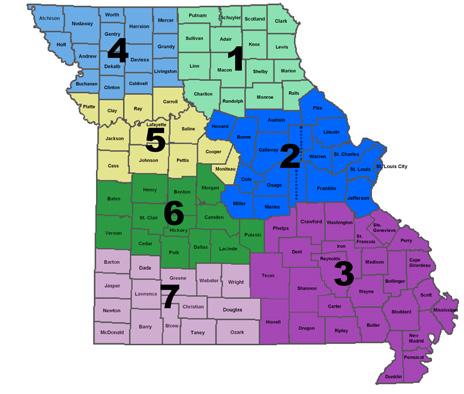
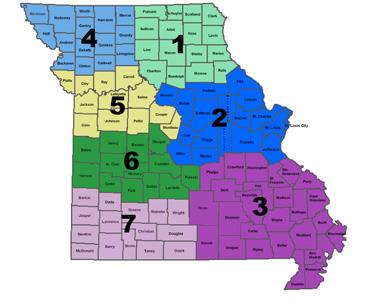
Region 1: Ethan McNeill, 325 McMurry St. Paris, MO 65275 636-544-9943
Region 2: Blake McDonald, 250 Clonts Rd. Sullivan, MO 63080 • 573-205-7914
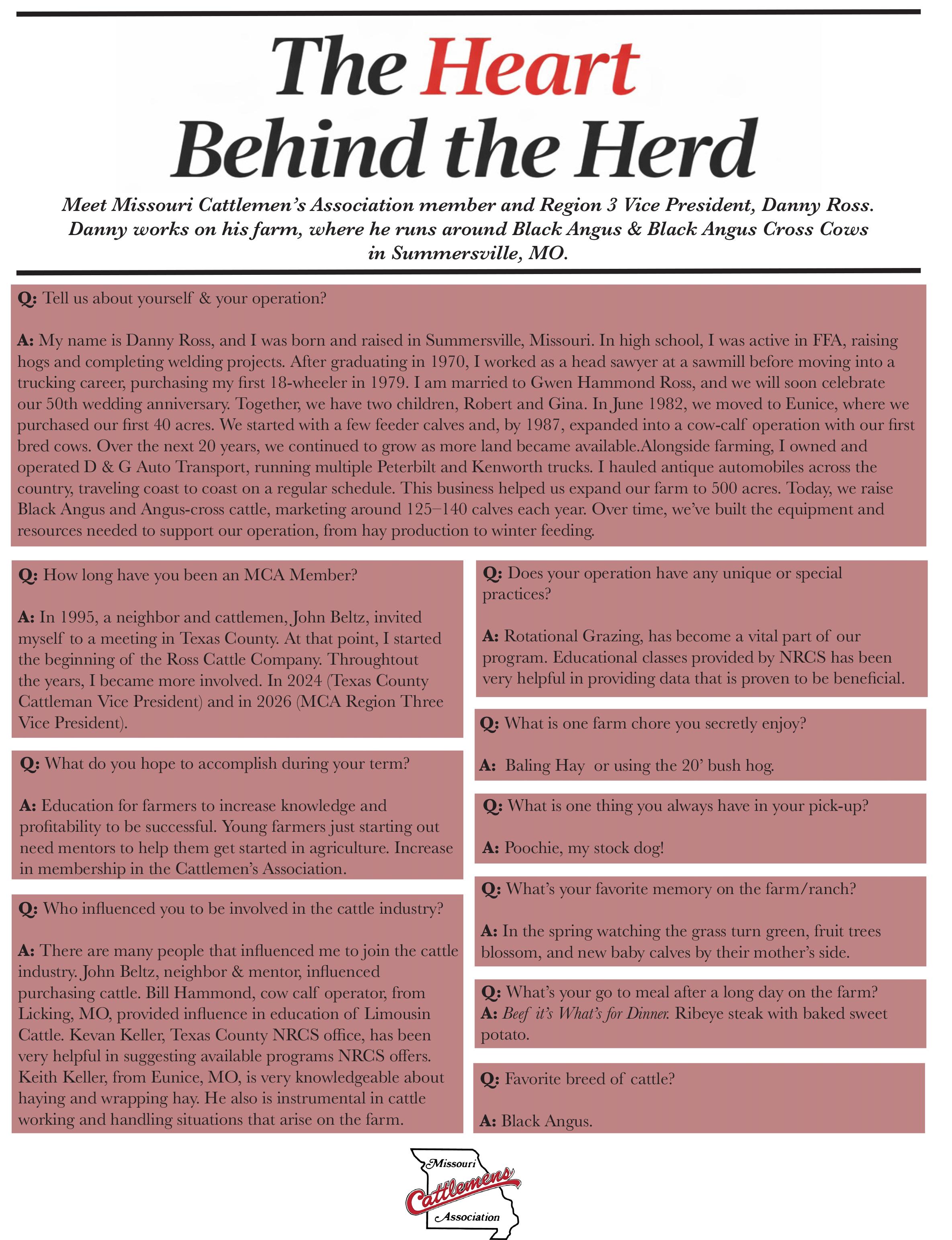
Region 3: Danny Ross, 5514 Gaston Rd Eunice, MO 65468 • 417-932-4964
Region 4: Dale Buhman, 3751 SW Taylor Rd. Clarksdale, MO 64430 • 816-244-9249
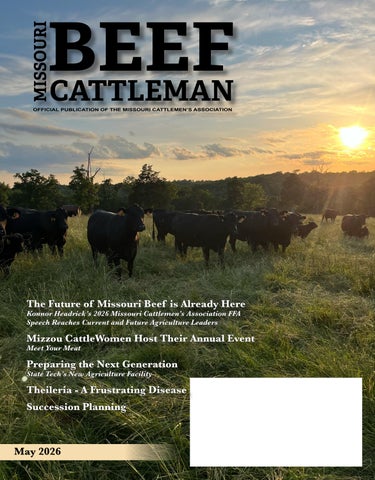
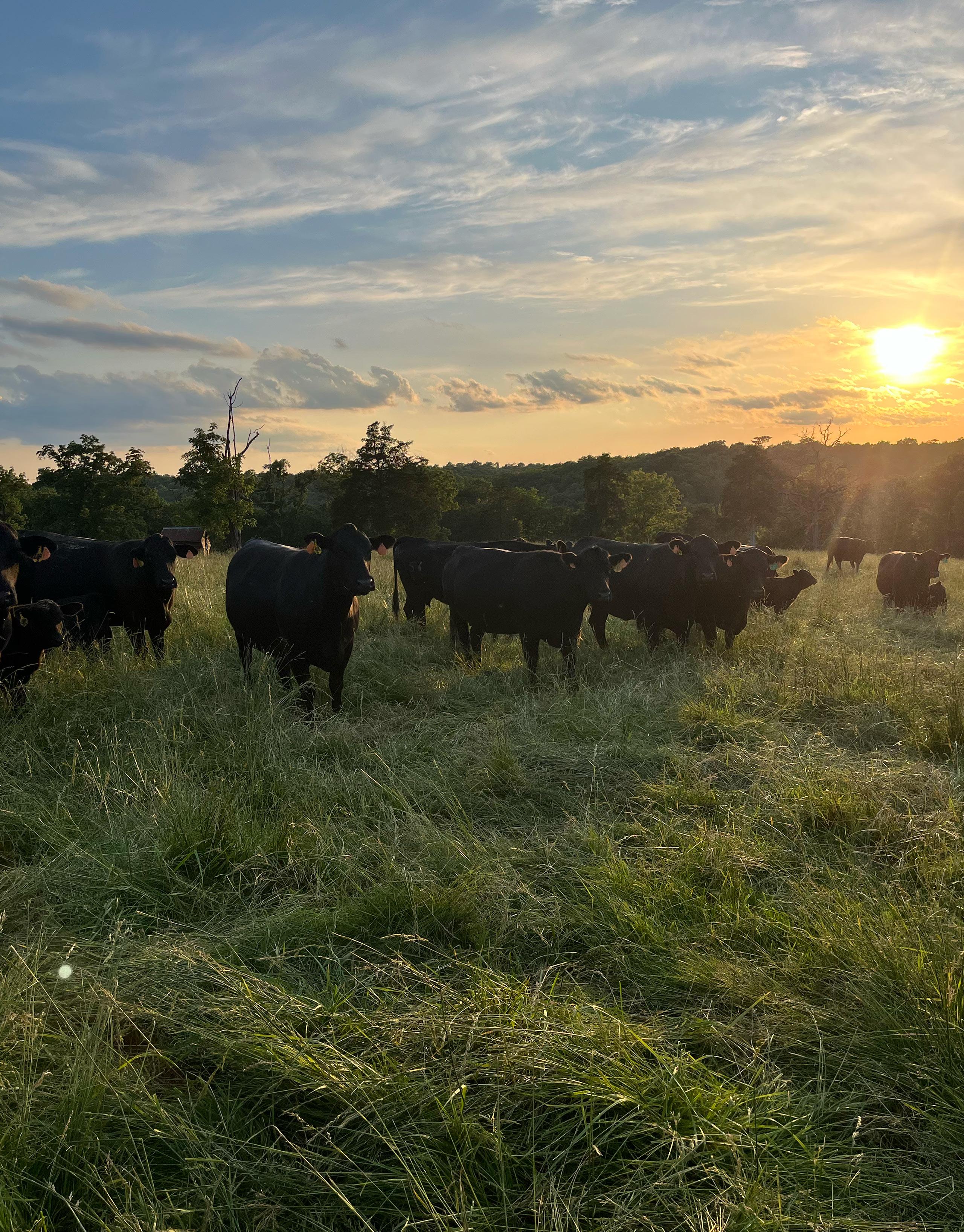
Cover Photo:
Region 5: David Wolfe, 7761 Mount Vernon Rd Pilot Grove, MO 65276 • 660-834-3232
Region 6: Warren Love, 8381 NE Hwy ZZ Osceola, MO 64776 • 417-830-1950
Region 7: Nathan Isakson, 20706 Lawerence 2022 Everton, MO 65646 • 573-578-2518
Director At-Large: Stephanie Gable, 5622 State Hwy E Oak Ridge, MO 63769 • 573-256-3279
MCA Regional Grazing Coordinators
Region 2 - Doug Mertens 573-489-5261 doug@mocattle.com
Region 3 - Kenneth Ball 417-818-6400 kenneth@mocattle.com
Region 4 - Micah Hans 636-201-6846 micah@mocattle.com
Cover photo by Addie Thessen
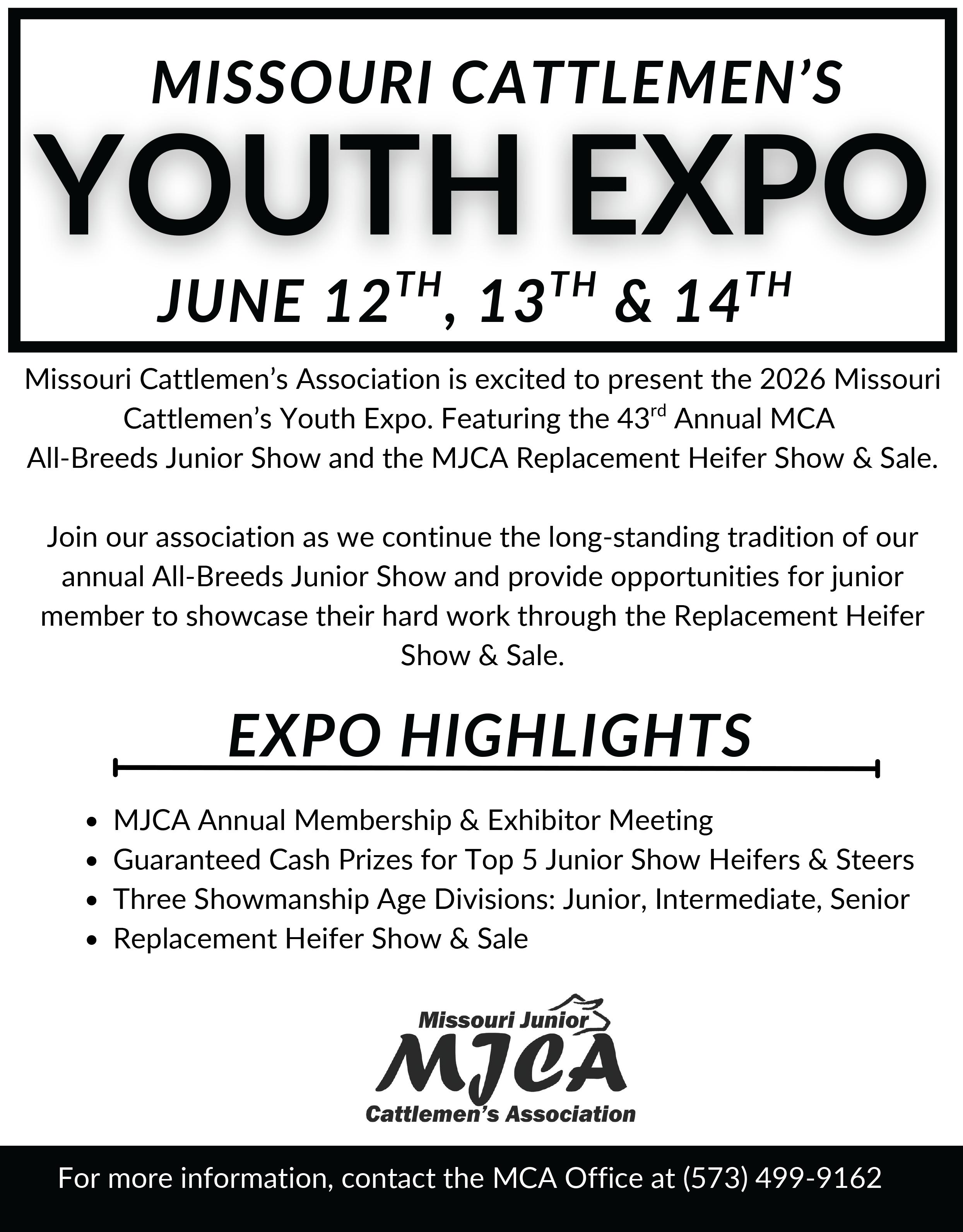
Missouri Cattlemen’s Youth Expo
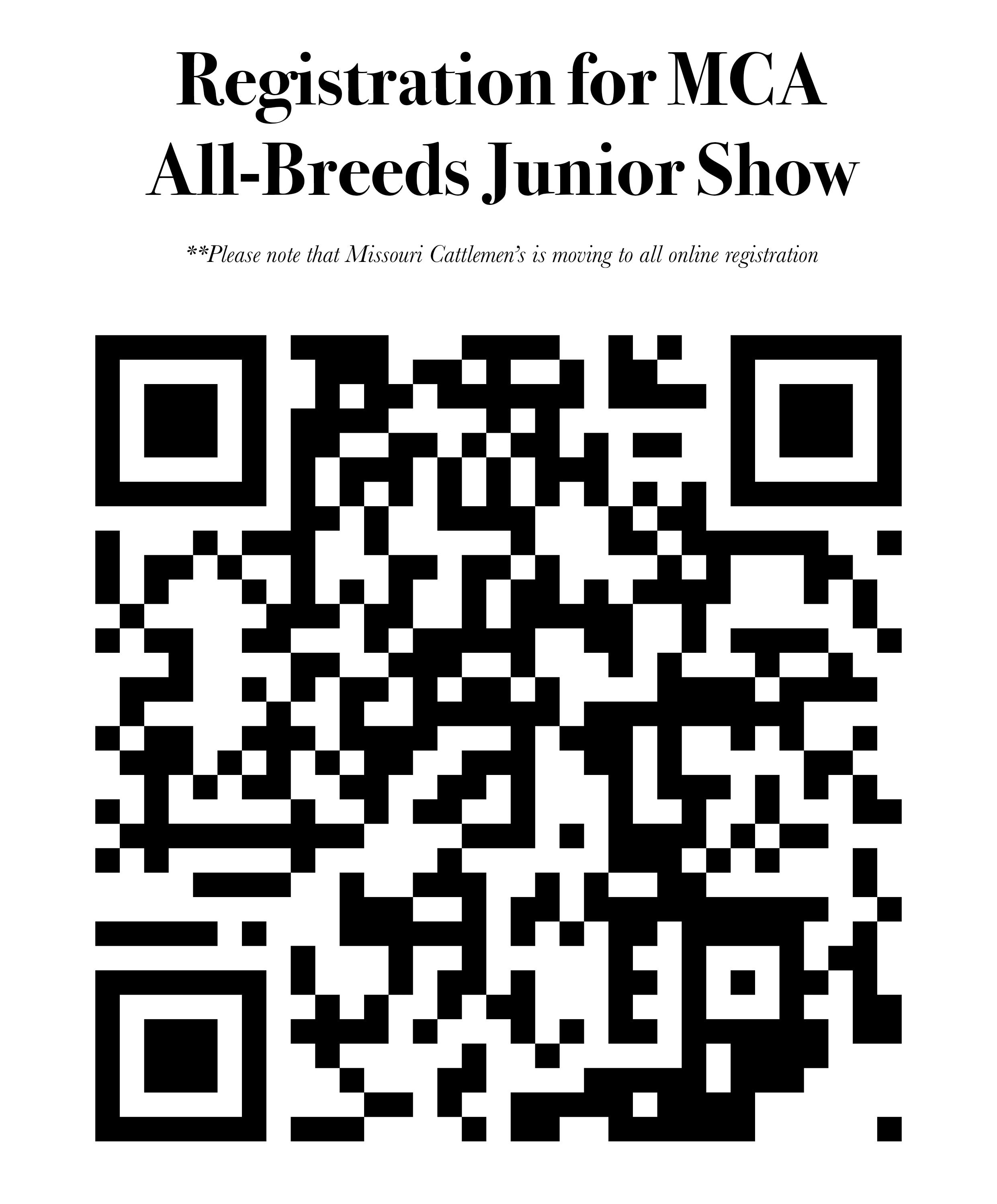
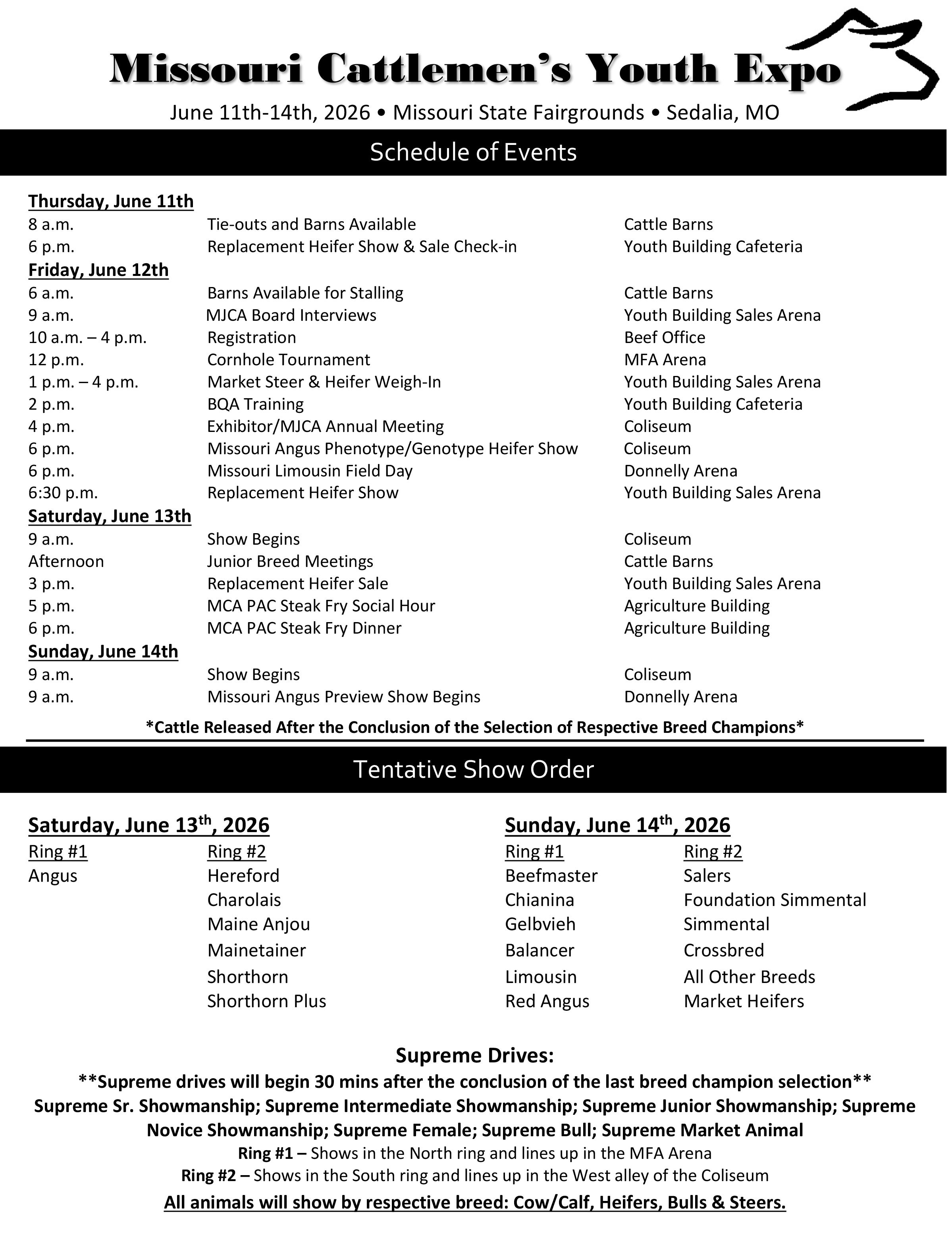
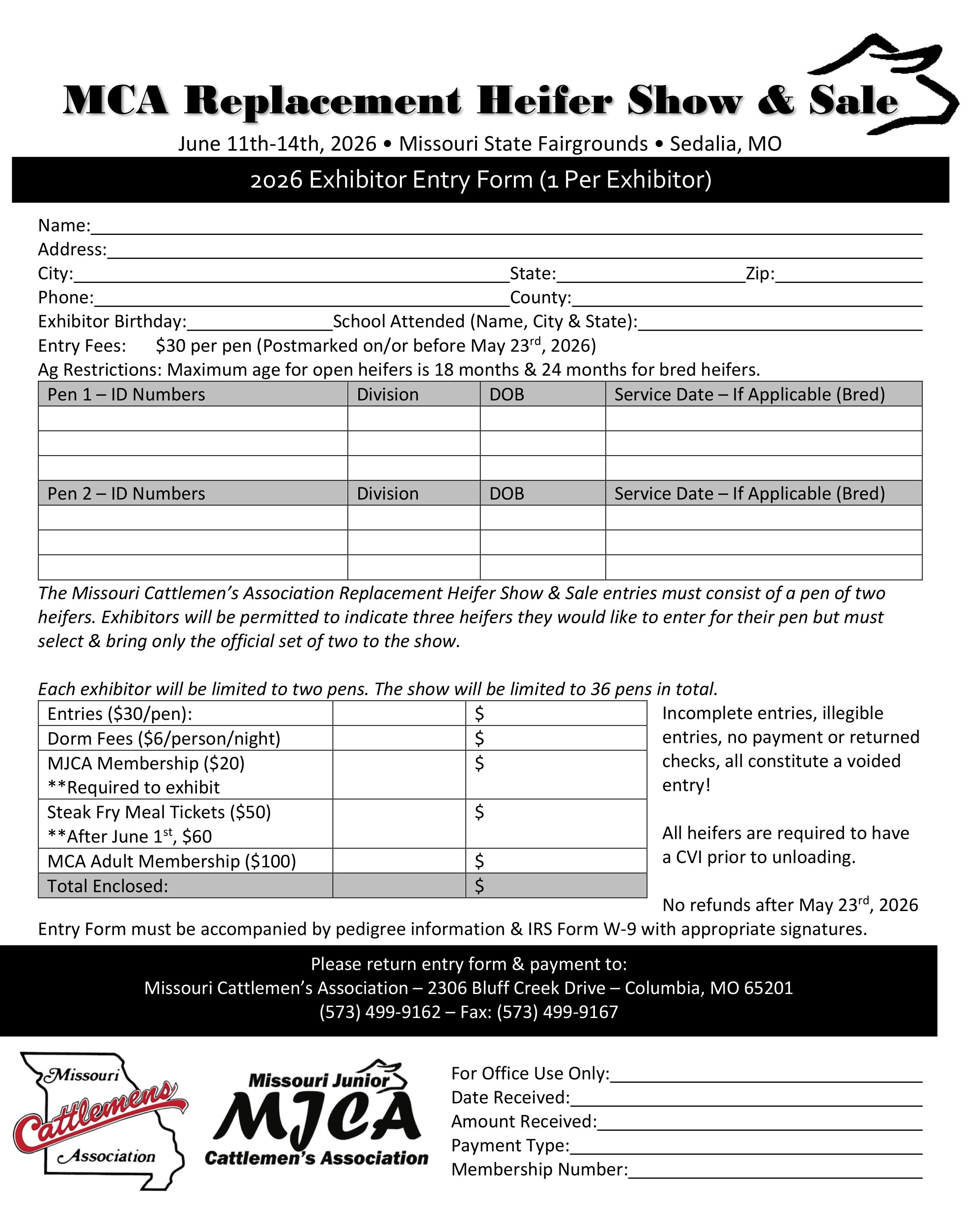
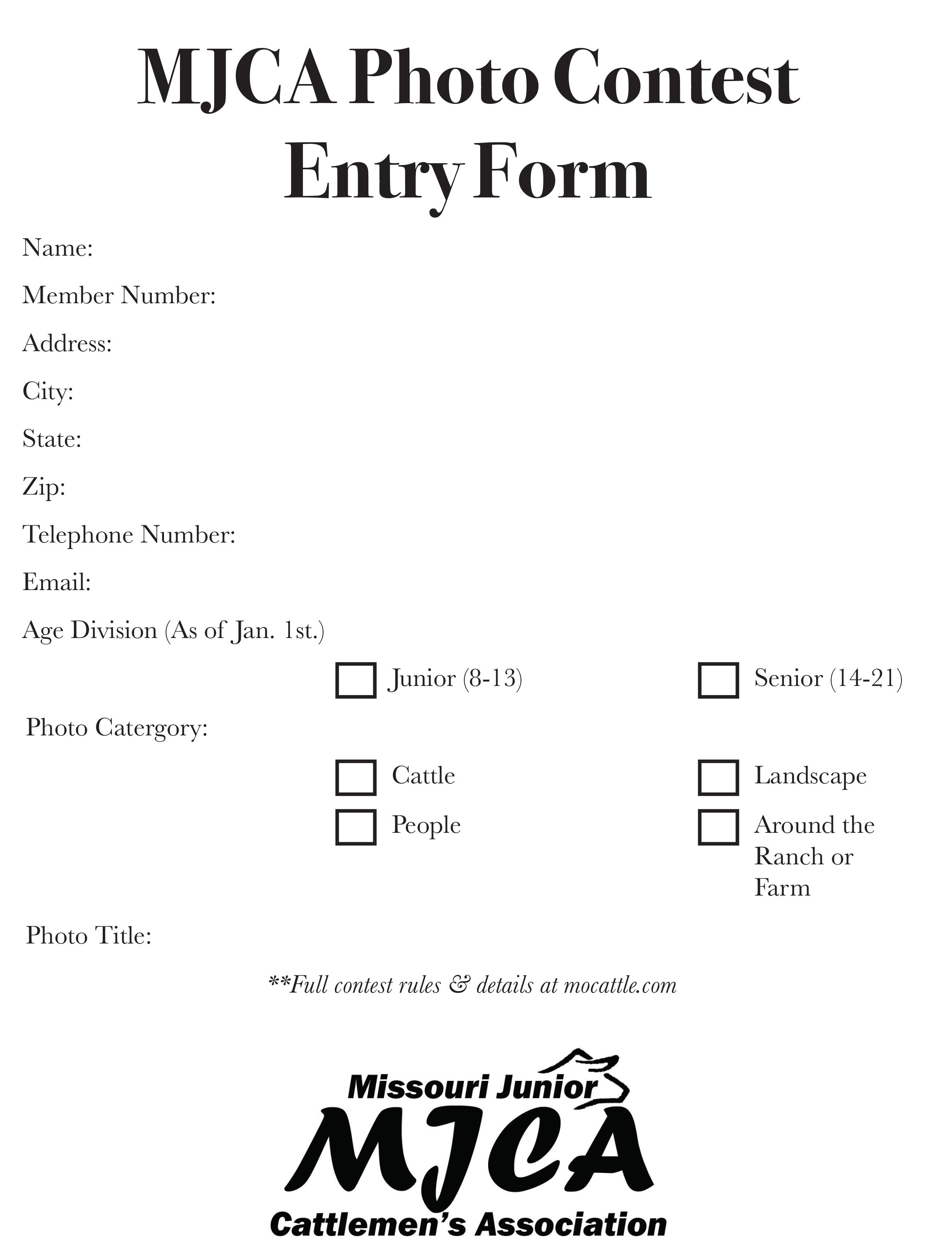
It is almost time for the “can’t miss” weekend of the summer. The weekend will include both the 43rd Annual MCA All-Breeds Junior Show and the 3rd Annual MJCA Replacement Heifer Show & Sale. The expo will feature long-held traditions such as the MJCA Photo Contest, MJCA board interviews & elections and the MJCA annual meeting while also bringing in new opportunities for junior members to feature their hard work at the state level. To learn more about both events, please turn to PAGES 31-37 or visit mocattle.com under junior programs.
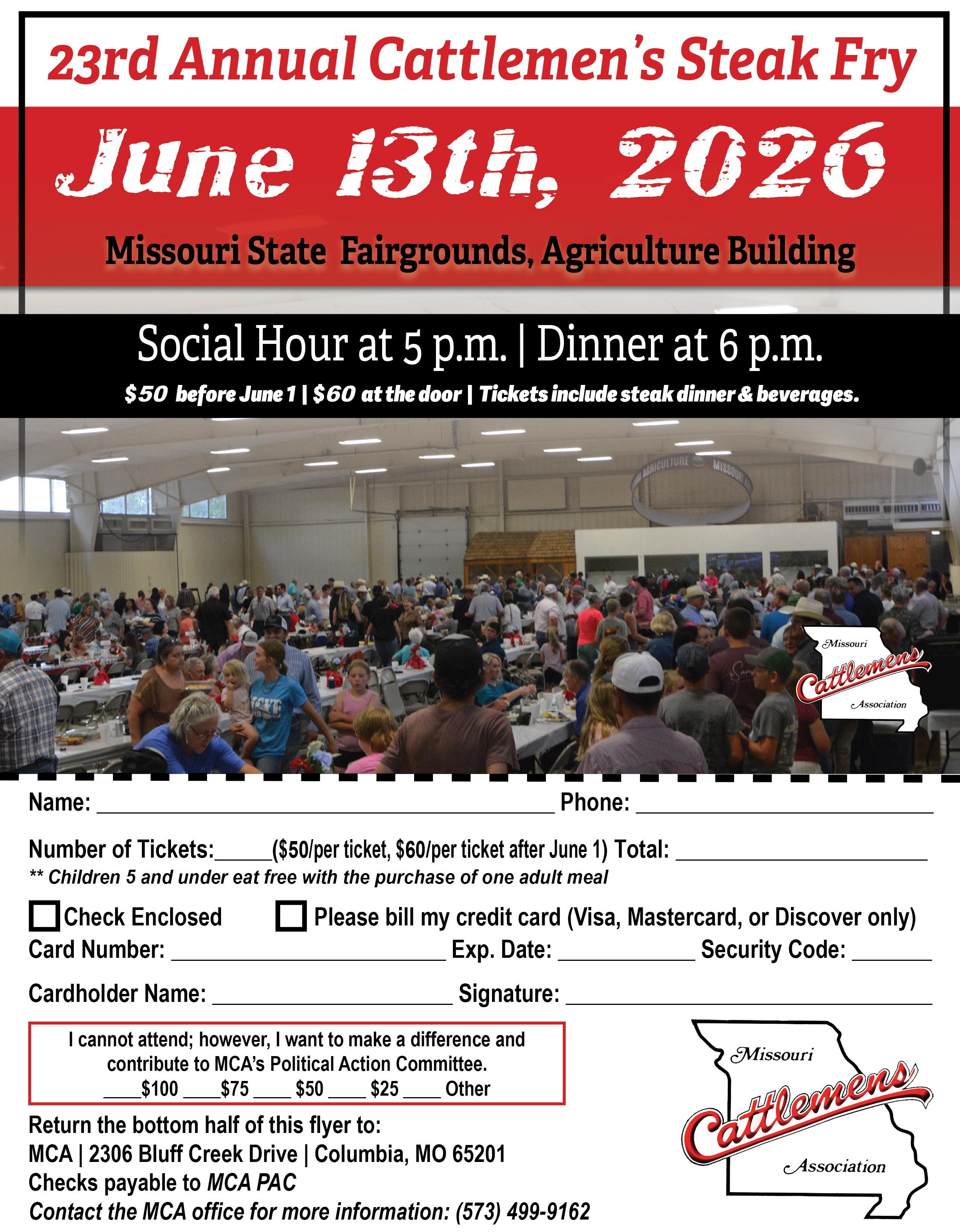
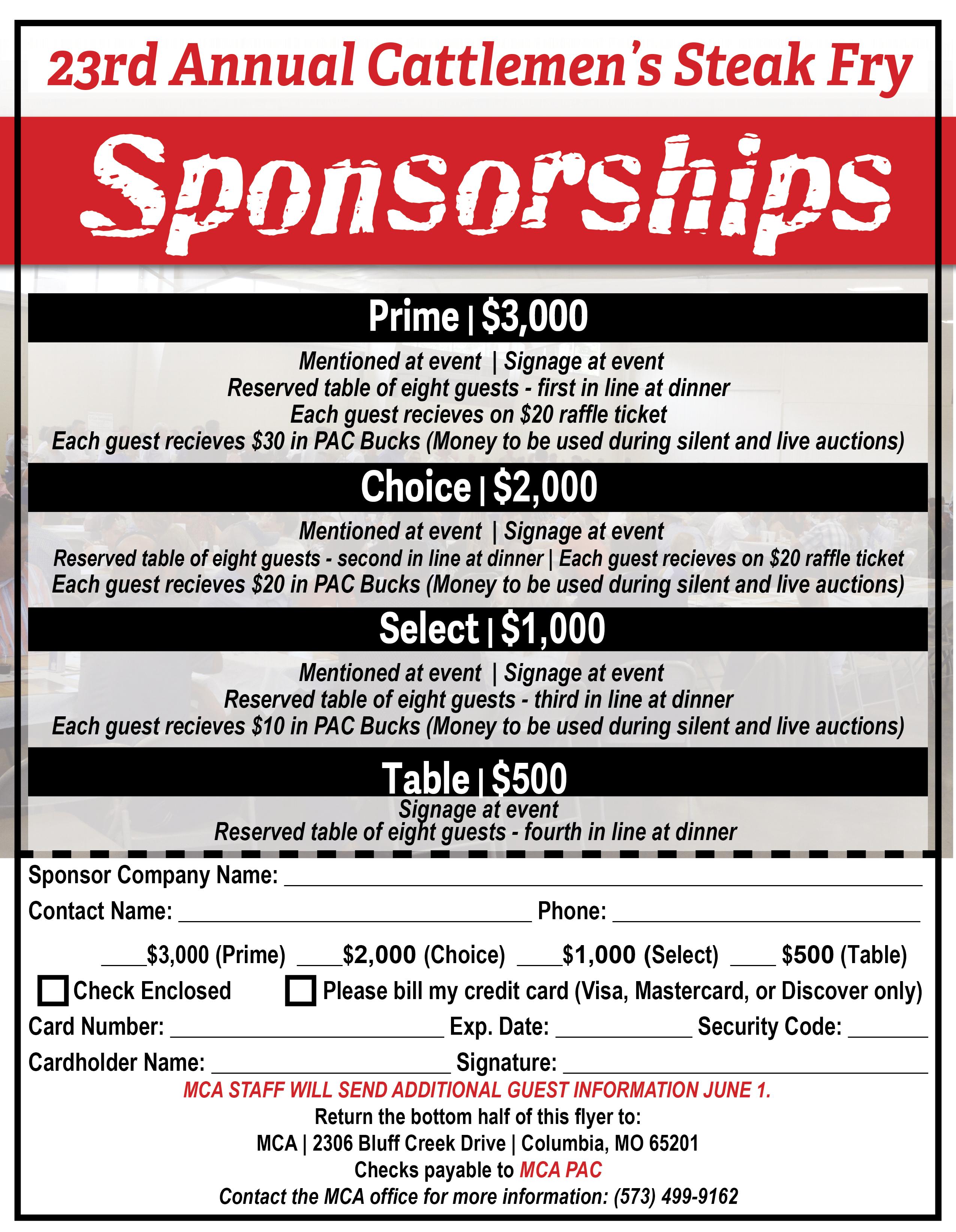
23rd Annual Cattlemen’s Steak Fry
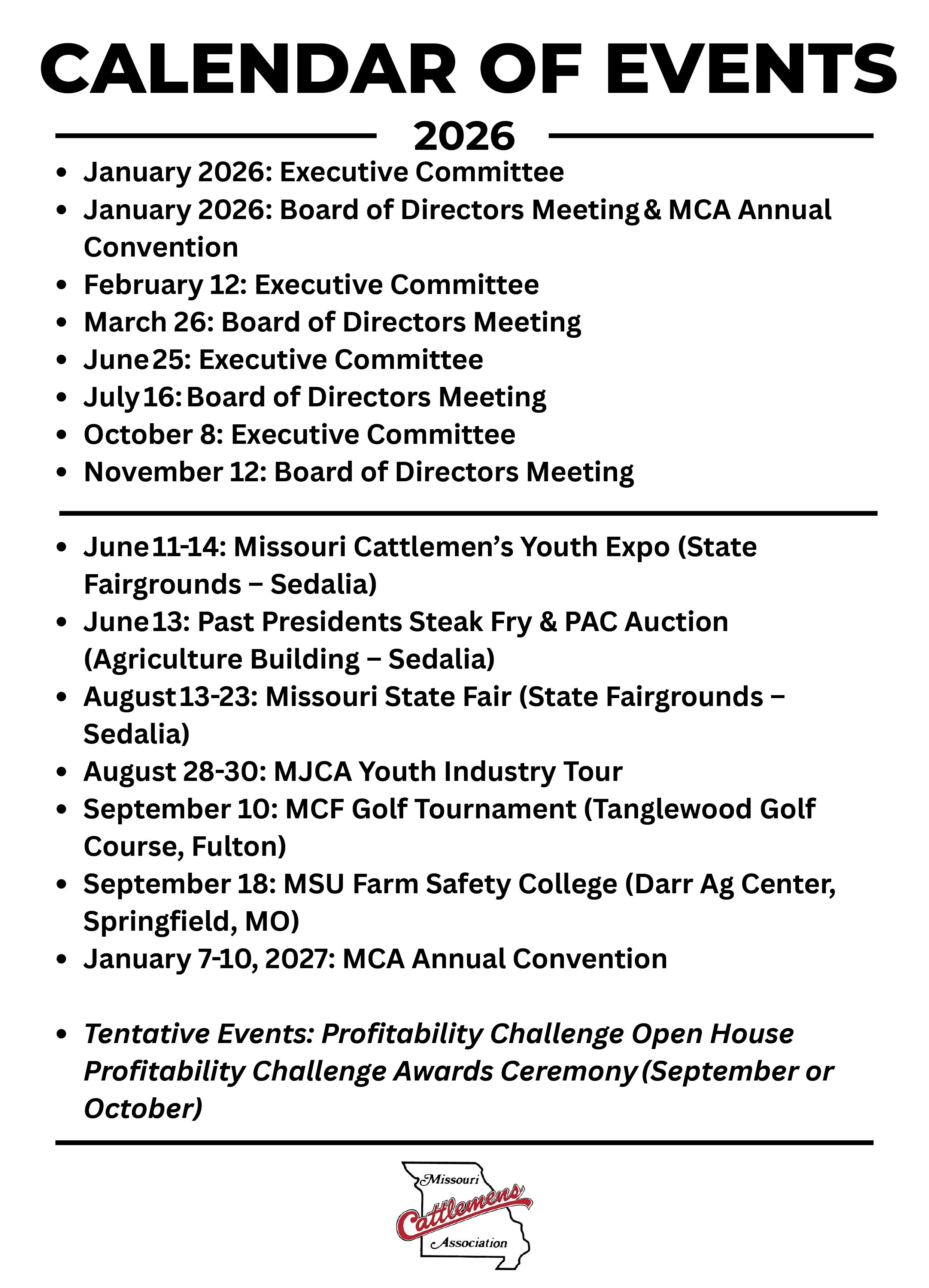
The Cattlemen’s Steak Fry will be held on Saturday, June 13th at the Missouri State Fair Agricultural Building. Join us for a great steak dinner, raffles, live & silent auctions and great conversation! You’ll find the details in this month’s magazine and on our website. This event is open to the public and we welcome anyone who wishes to celebrate Missouri’s beef industry. Funds raised will benefit the MCA Political Action Committee (PAC) to help elect leaders who understand and value agriculture to guide our state’s policy, now and in the future. For more information and registration instructions, see PAGE 38.
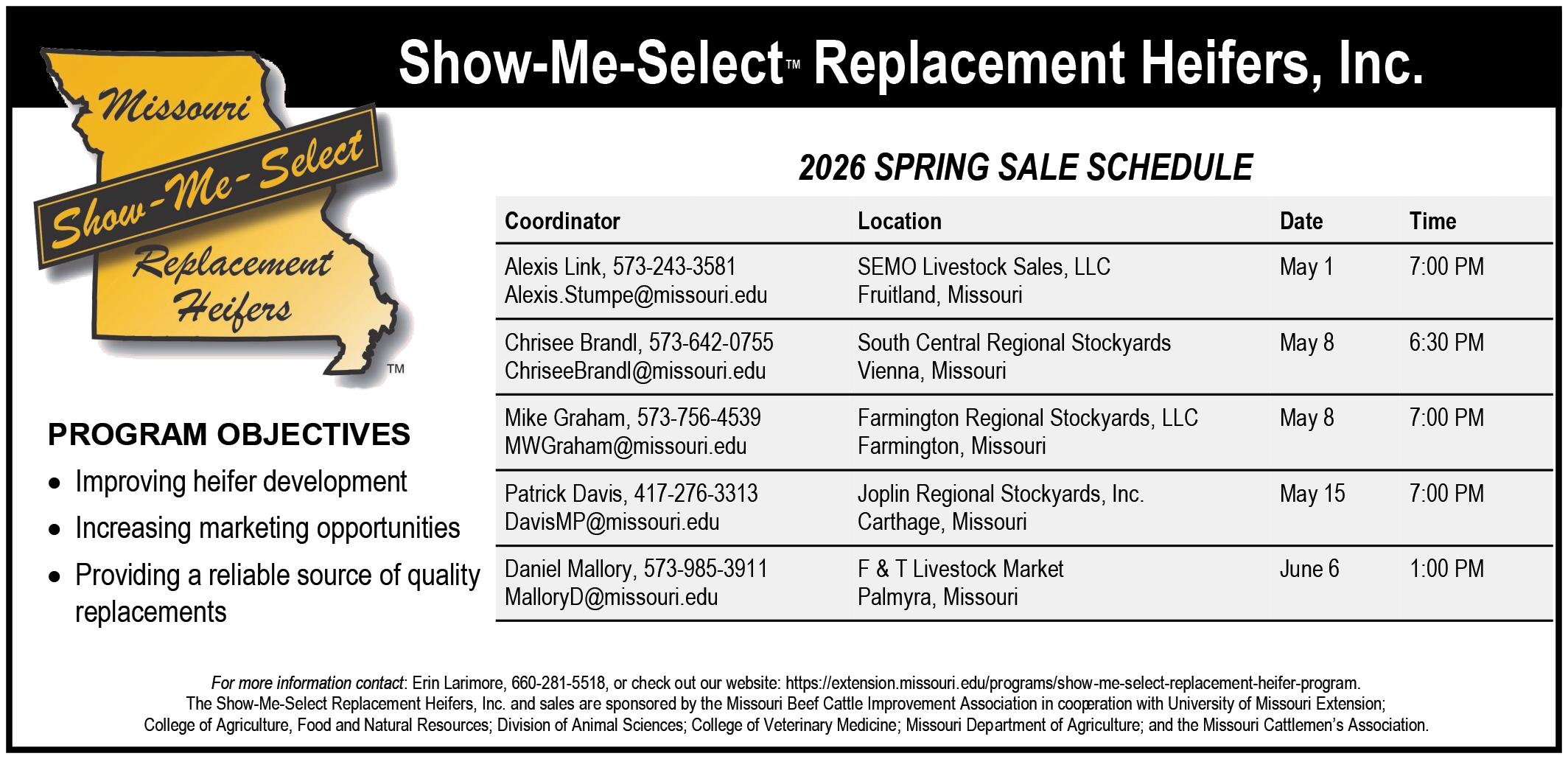
Show-Me-Select Heifer Replacement Program
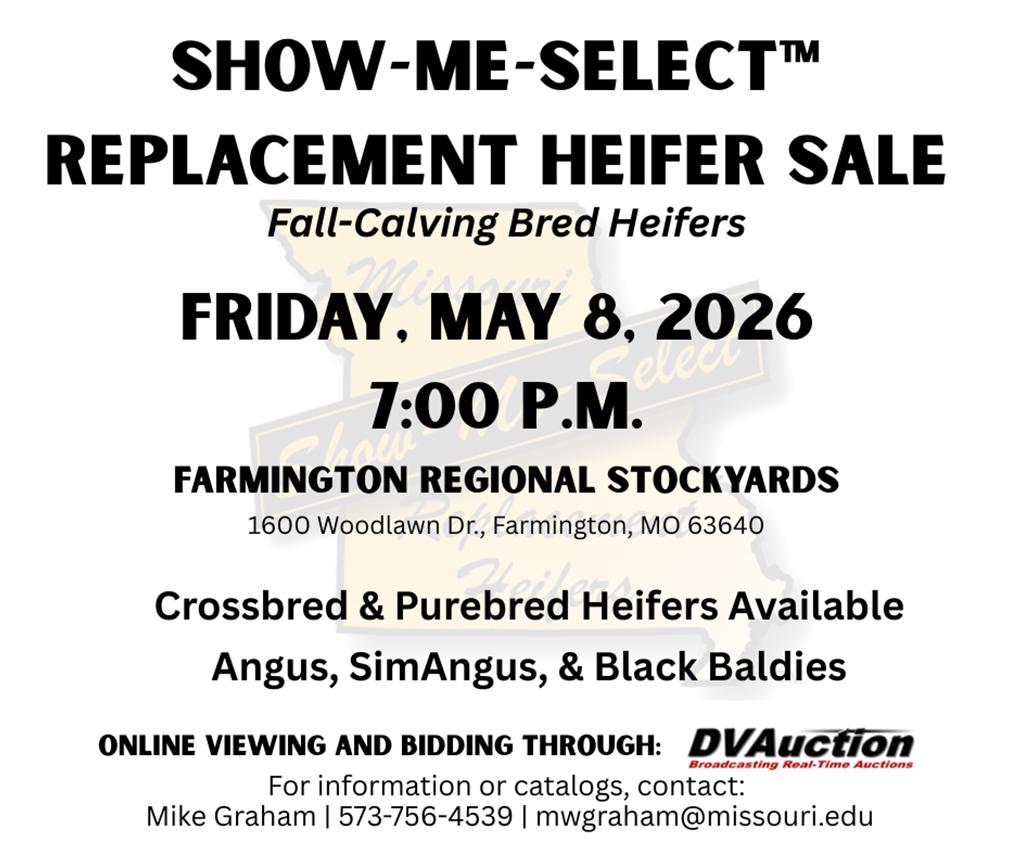
We are partnering with Show-Me-Select again this year for an exclusive new member promotion drawing. All new Missouri Cattlemen’s Association members will be entered into a drawing for a $2,000 credit to a Show-Me-Select Replacement Heifer sale. To be considered a new member, you must not have been an MCA member within the last 12 months. Credit must be redeemed in the same calendar year at any of the spring or fall sales. Learn more on PAGE 77
Cartridges for Cash
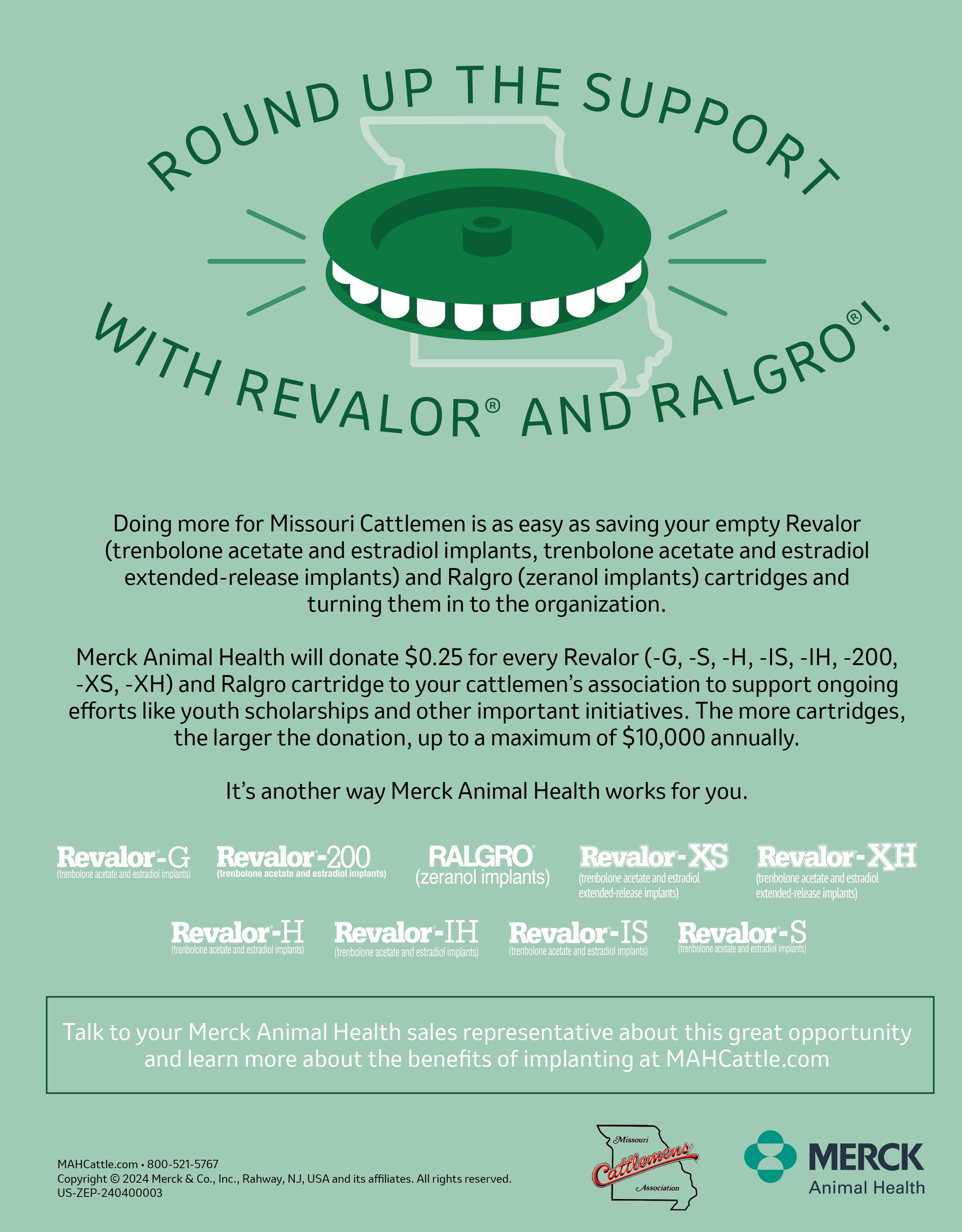
We are excited to be working with Merck Animal Health on the Cartridges for Cash program to raise funds for our association’s junior programs. We want to challenge our affiliates to a competition. The group that collects and turns in the most cartridges will win a $1,000 scholarship to award a junior member of their choice. Each county should collect the Ralgro wheel and Revalor cartridges used by their members and bring them to either one of the Board of Director’s meetings held each quarter or to the annual convention in January. We will keep a tally of the cartridges collected from each county throughout the year and the winner will be announced at the Missouri Cattle Industry Convention & Trade Show after all cartridges are counted. To learn more about the Cartridges for Cash program, see PAGE 61.
Ben Brodersen, Brodersen Family Farms, Edwards, MO
Jeremy Harris, Hale, MO
Dennis Heidlage, Heidlage Farms, Pierce City, MO
Rex & Marilyn Rhoades, Liberty, MO
Konrad Dierker, Blackburn, MO
Reynolds Glenn, Jefferson City, MO
Steve and Laura Hoskins, Hoskins Farms, Henley, MO
Eileen Meier, Jackson, MO
Dylan Hart, Houston, MO
Brad Hooper, Hidden Springs Farm, Cabool, MO
Amber Hooper, Cabool, MO
Jared Henggeler, Guilford, MO
David Nuelle, Davis Creek Stock Farm LLC, Higginsville, MO
David Hukill, Sly Fox Farms, Holden, MO
Kole Nothdurft, Advance, MO
David Scotten, Hardwood, MO
Case Huston, Anderson, MO
Larry Muck, Meadville, MO
Mark & Laurie Hopper, Chula, MO
James Brown, Dianna Rigney, Rigney Farms, Darlington, MO
Nate Lamberson, Nate Lamberson Farms, Kingdom City, MO
Sam Sullivan, Hardscrabble Farms, Silex, MO
Tami Thomas, Neosho, MO
Darrick & Rachel Barnes, Down Range Processing, Neosho, MO
Josh Redburn, Anderson, MO
Kash Scroggins, Anderson, MO
Caden Klumpp, Bronaugh, MO
Richard Sloan, Warsaw, MO
Richard McDaniel, Edwards, MO
Scott & Joanna Siercks, Lincoln, MO
Larry Siercks, Windsor, MO
Seth Roberts, Mooresville, MO
Luke Romine, Romine Beef Products, Centralia, MO
Brett Threlkeld, Threlkeld Cattle Co, Shelbyville, MO
David Dolan, Sikeston, MO
Rick Day, Fairview, MO
Clayton Loyd, Clayton Loyd Cattle LLC, Sheldon, MO
Patrick Schmidt, Monett, MO
Tim Schmidt, Monett, MO
Wendy Loges, BTC Bank, Sedalia, MO
CharliAnne Damouth, Rogersville, MO
Michael Hendren, Madison, MO
Mark & Nicole Riegel, Stewartsville, MO
Carson Bray, Cameron, MO
Malainey Bray, Cameron, MO
Mike & Kana Wake, Warsaw, MO
Tim & Emily Hines, Coon Foot Farm, Neosho, MO
Chris Daniel, Rockin’ D Farms LLC, Lockwood, MO
President’s Perspective with Anita Vanderwert Communicate.
Collaborate. Connect.
Connecting Rural and Urban Missouri
May is beef month! I have talked about the value in communicating, collaborating, and connecting over the past few months. One can easily see how these three words can regularly influence our life, association, and livelihood. The gap between those who produce food and those who consume it continues to grow, but we can help. In fact, bridging that gap may be one of the greatest opportunities we have as an industry.
May is a great month to celebrate our family farms and the great taste of beef. As grilling events are happening across our state, let’s not let the opportunity pass to talk to our friends and neighbors.
As we are well aware, most consumers today are several generations removed from the farm. That means their understanding of agriculture is often shaped by what they hear and not by what they experience. That’s why communication, collaboration and connection matters.
Whether it’s through community grilling events, partnerships, educational programs, or simple one-onone conversations, every effort to engage with non-ag audiences helps build trust. These connections don’t have to be complicated. They just have to be genuine.
When people understand where their food comes from and the people behind it they’re more confident in their choices and more supportive of our industry.
This same approach works in our capitol as well. As the legislative session is coming to an end, we have been able to see first-hand how our senators and representatives have invited us to the table. They welcomed us into
their offices and listened to us when we testified. This matters. Policy decisions made at the state and national level have real impacts on cattle producers here in Missouri. That’s why engagement in the policy process is so important. Effective advocacy doesn’t happen in isolation. It requires collaboration.
As an association, we work to represent the collective voice of our members. That voice becomes stronger when it is informed by real experiences and supported by active participation from producers across the state.
Building relationships with elected officials, working alongside other agricultural organizations, and staying engaged on key issues all contribute to better outcomes.
Good policy reflects the realities on the ground. And the best way to ensure that happens is for producers to be part of the conversation.
When we continue to collaborate in advocacy, we help shape decisions and not just react to them.
Connecting rural and urban Missouri isn’t just good for agriculture. It’s essential for our long-term success.
Next month we have the opportunity to continue to engage with our legislature. Don’t miss the annual MCA Steak Fry June 13th at the Missouri State Fairgrounds. Tickets are on sale now and can be purchased online at MOCattle.com. I hope to see you across Missouri grilling beef and helping promote May is Beef Month or at our annual Steak Fry June 13th. Come join us and tell your story!
MCA President
CattleWomen’s Corner with Jennifer Poor
May IS Beef Month!!
As a kid, I never imagined the importance agriculture (beef in particular) would play in my life. I also never realized that aside from the burgers and steaks, byproducts of beef are included in our everyday life. From the leather of our boots/belts to the pretty cow skin rug in some living rooms to the capsules of our medicine. These are just a few that come to mind, but are all derived from beef byproducts. As cattlemen and cattlewomen, it is important that we remind others the importance of cattle in their day to day lives. It is also important to understand how beef and beef byproducts are utilized and to be able to explain to others that nothing goes to waste.
Officers of the Missouri CattleWomen
President: Jennifer Poor
417-372-0227 • poorfarmscattle@gmail.com • Pomona
President Elect: Mandy Weigand 660-909-6781 • weigandranch@hotmail.com • Warrensburg
Vice President: Carolyn Dieckman
660-668-3605 • medieckman@yahoo.com • Cole Camp
Secretary: Terry Bettels
660-424-3444 • cbettels55@gmail.com • Butler
Treasurer: Mary Kay Lyle
816-387-1930 • marykaylyle@gmail.com • Savannah
Past President: Marsha Corbin
660-232-1836 • oldtrailsregion@gmail.com • Dover
CattleWomen President
After 30 years of being in the asphalt industry, Jason quit his job to farm full time. This year will be my last year at the school and I, too, will be going to the farm full time. With both of us being on the farm, it got me thinking. Who do we farm for? Of course, the first answer is our family. We love them and want to give the best beef out there. And let’s be honest, if you ask any producer, we ALL raise the best beef. Outside of that, who do you farm for?
• I farm for our children. Truth be told, Maddie and her fiancé, Martin, will probably never become farmers, and that’s OKAY! Our son, Cooper, on the other hand, may come back to the farm. Regardless of who ends up back at the farm, Jason and I want to leave a running and successful operation for our kids, when/if they come back to it.
• I farm for our future grandkids. If for some reason Maddie and Cooper don’t want this lifestyle, maybe one day one of their kids will. Even if the grandkids don’t want this, at least they can learn from Jason and I where their food comes from. That simple lesson is lost on so many kids nowadays. If God gives us the opportunity to fix that, then I’m all in!
• I farm for the future generations of girls who have a love for agriculture… and for the ones yet to find their love of agriculture. Today, there is a major shortage of young farmers. I hope that my involvement and advocacy for agriculture will inspire young women to be involved in our association and industry.
• I farm for the preservation of good, wholesome food for others. Everyone deserves to have good food to eat. By being involved with Missouri Cattlemen’s Association (MCA) and Missouri CattleWomen (MCW), we have the resources to help educate others on the importance of agriculture in all aspects of life.
During the month of May, whether you are out doing chores or driving through your fields and cows, I
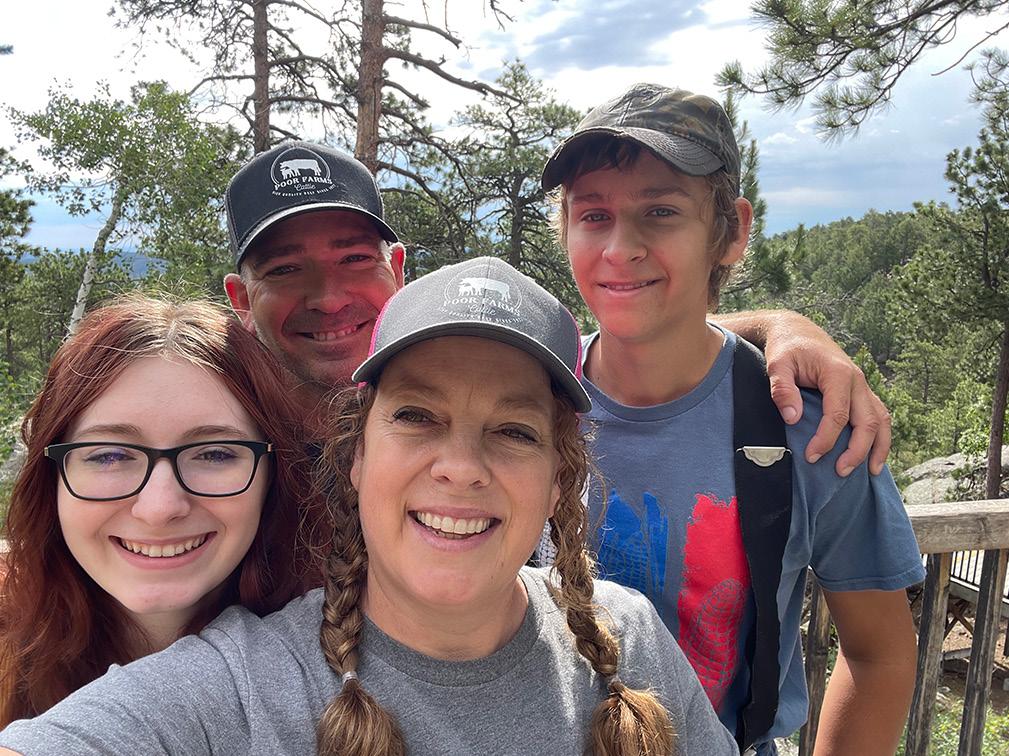
encourage you to think about who YOU farm for. I’ve included pictures of those that I farm for.
I think it’s safe to say that the majority of you know that a good steak is my favorite cut. This month’s recipe is a perfect way to celebrate Beef Month. For those of you wanting to change things up, omit the corn and roast some sliced okra then drizzle the chili butter that was originally for the corn over the okra. Enjoy!
Santa Fe Grilled Beef Steaks & Corn
A simple chile glaze is used as a spicy finishing touch for savory butter on grilled corn and steaks.
Peel corn, leaving husks attached at base; remove silk. Rewrap corn in husks; tie closed. Soak in cold water 30 minutes. Combine glaze ingredients; remove and reserve 1/4 cup.
Drain corn. Place on grill over medium, ash-covered coals. Grill, covered, 20 to 30 minutes, turning frequently.
After 5 or 10 minutes, place beef T-Bone Steaks on grill with corn. Grill, covered, 11 to 16 minutes (over medium heat on preheated gas grill, 15 to 19 minutes) for medium rare (145°F) to medium (160°F) doneness, turning occasionally and brushing with glaze during last 5 minutes.
Cook’s Tip:
Two Strip Steaks Boneless, cut 1 inch thick (about 1-1/4 pounds) may be substituted for T-Bone Steaks. For charcoal, grill, covered, 11 to 14 minutes (for gas, grill 11 to 15 minutes) for medium rare to medium doneness, turning occasionally
Combine reserved 1/4 cup glaze and butter in 1-cup glass measure. Microwave on HIGH 1-1/2 to 2 minutes, stirring once. Carefully peel corn; brush with chile butter. Serve with steaks and remaining chile butter.
Straight Talk
with Mike Deering
Time
Father time doesn’t leave anyone out. Our days are numbered and what we choose to do with those days is a decision each of us will have to live and die with. That decision is what creates joy or regrets that then creates good or bad memories. What does any of this have to do with the beef industry? Let’s go down that road.
As an industry, we continue to wrestle the topic of youth engagement until we are blue in the face. For decades, every agricultural organization on the planet has discussed ways to bring young people back to the farm or ranch and ways to enhance their involvement in their respective agricultural organizations. It’s exhausting because it is a revolving discussion year after year with definite attempts and even progress made along the way, but void of a golden nugget solution.
During a February education hearing, many commented that a strong education starts at home. I agree — but that’s only part of the story. They said homes make ladders and schools make climbers. Why aren’t we talking about this very thing during our discussions about young people coming back to the farm and becoming engaged in their industry? Is it not the same thing? We keep talking about what we (associations, government, higher education institutions, etc.) can do, but we aren’t talking much about what individual producers can do. Is the solution closer to home?
Back to that education hearing, I stumbled into in Jefferson City. If our kids have a bad experience at home, they are less likely to perform their best at school. The same is true in reverse. If they have a poor experience at school, they dread leaving home and going to that place of horror. The same is true for our
Executive Vice President
young people we would love to see take an interest in this thing called agriculture. Make the farm or ranch a place of family joy where our young people have positive learning experiences.
I was working cattle with my family on one of the coldest days in January. My ten-year-old didn’t close the gate and a mess ensued. I lost my cool and the next time I asked him to help he didn’t want to go. I made him come along anyway and worked hard to ensure we had a very positive experience. Instilling our love for this industry and our strong work ethic in the next generation requires each of us to make the most out of every day we have with them on the farm. It starts there or regrets will follow.
Anyone who even slightly knows me, knows I am not talking about creating thin-skinned weaklings or coddling kids. I am talking about creating positive experiences that translate into good memories. Memories that inspire these kids to develop a passion for agriculture and carry on the family farm, both today and when Father Time eventually catches up with us. The kind of memories that inspire our young people to take ownership of their industry by being involved in associations like this one. Our days are numbered and what we choose to do with those days is a decision each of us will have to live and die with.
Observations from the Field
with Micah Hans, Region Four Grazing Coordinator
Benefits of Soil Sampling
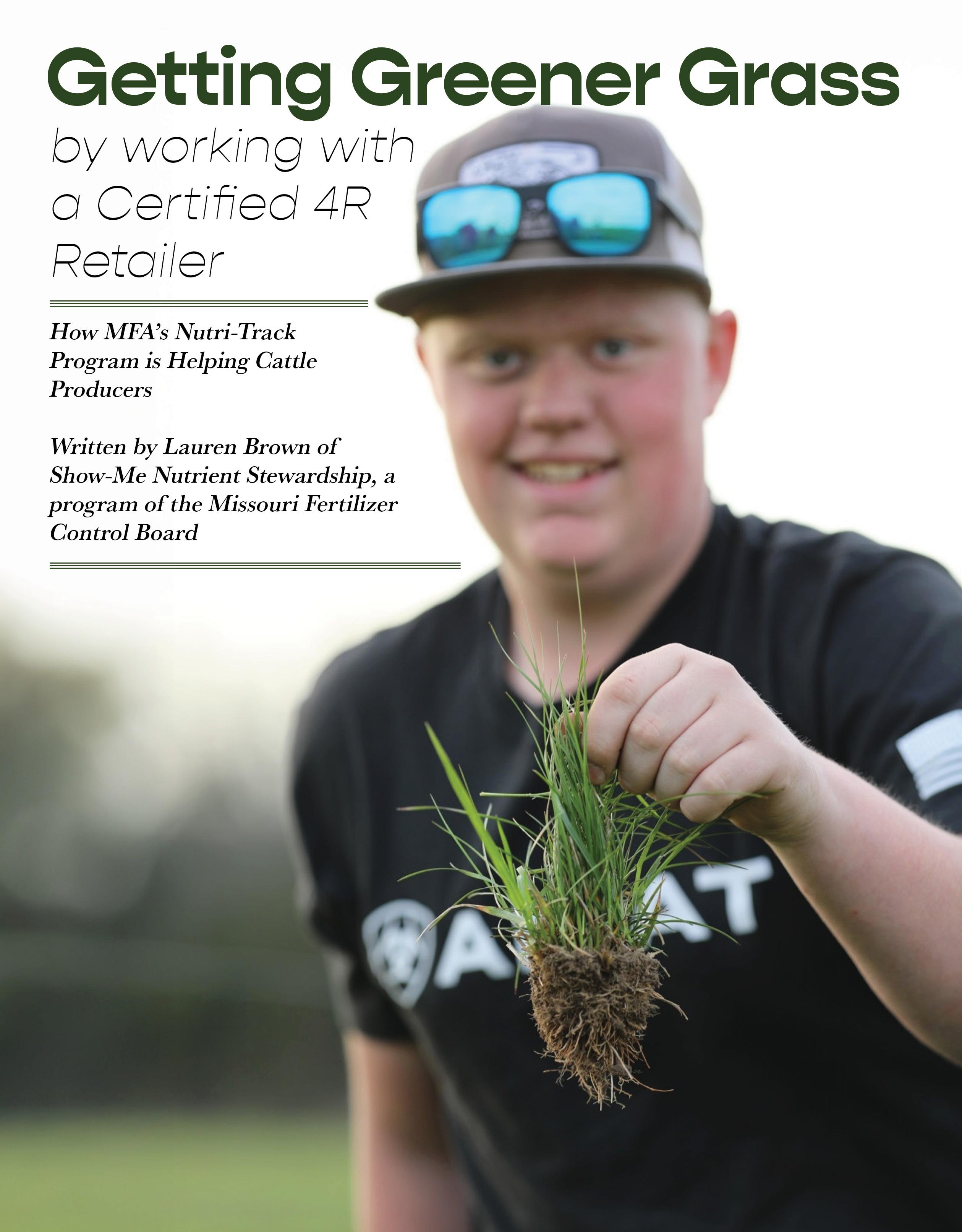
If you’ve ever wondered why one pasture seems to thrive while another struggles, even being right next to each other, the answer often comes down to what’s in the soil. In Missouri, where soils can vary quite a bit from one field to the next, taking soil samples on your pasture and hay ground is one of the most important steps you can take to improve production.
A lot of folks rely on habits or guesswork when it comes to fertilizer. Maybe you’ve always put down a certain blend every spring or maybe you just go with what a neighbor recommends, the problem with that approach is you’re basically flying blind. Without a soil test, you don’t really know what nutrients your ground already has or what it’s lacking. That can lead to over-applying some nutrients, wasting money and under-applying others that your forage actually needs.
In Missouri, soil types can change quickly, even within the same farm. You might have clay-heavy soils in one spot, loam in another and areas that have been grazed harder than others. Each of those spots can have very different nutrient levels and pH. That’s why soil sampling isn’t just something you do once and forget about; it’s something you should stay on top of every few years, especially if you’re actively managing better forage production.
One of the biggest factors soil tests help you manage is pH. A lot of Missouri soils tend to become acidic over time, especially with regular rainfall and fertilizer use. If your pH gets too low, your grass and legumes can’t take up nutrients efficiently, even if those nutrients are present in the soil. That means you could be spending money on fertilizer and not getting the full benefit. A soil test will tell you if you need lime and how much to apply. Getting your pH in the right range can make a bigger difference than almost anything else you do.
Another key benefit of soil sampling is dialing in your fertilizer program. Instead of applying a blanket rate across every field, you can target exactly what each area needs. For example, if your hay ground is low in phosphorus
and potassium, you can focus on building those levels to improve yield and stand health. On the flip side, if a pasture already has adequate levels, you can save money by not applying nutrients you don’t need.
For hay producers especially, soil testing is critical. Every time you cut and remove hay, you’re hauling nutrients off that field. Over time, that can really drain your soil if you’re not replacing what’s being removed. A soil test helps you keep that balance in check, so your yields don’t slowly decline year after year. It also helps maintain the quality of your hay, which matters whether you’re feeding your own livestock or selling it.
Timing and technique matter too. The best time to take soil samples is usually in the fall or early spring, before you apply lime or fertilizer. Try to sample at a consistent depth, typically around 4 inches for pastures and hay fields, and take multiple cores from across the field to get a good average. Avoid unusual spots like near gates, water tanks or feeding areas, since those can skew your results.
At the end of the day, soil sampling is one of the simplest ways to make smarter decisions on your farm. It doesn’t take a lot of time, and the information you get back can save you money while improving your forage production. In a state like Missouri, where conditions can vary so much, having that knowledge gives you a real advantage.
Instead of guessing, you’re working with facts, and when it comes to raising good grass & making quality hay, that can make all the difference.
For help with management of native grass, or for help identifying plants or weeds (feel free to text pictures) contact Missouri Cattleman’s Association Grazing Coordinators:
Region 2 • NE MO
Doug Mertens
Doug@mocattle.com
573-489-5261
Region 3 • SW MO
Kenneth Ball
Kenneth@mocattle.com
417-818-6400
Region 4 • SE MO
Micah Hans
Micah@mocattle.com
636-201-6846
Regional Range Report
Springtime in Region 3
On my way to a SEMO meeting in Jackson, MO, I was traveling down Hwy 17 and Hwy 60 through southern Missouri and couldn’t help but take in the countryside. It brought back a lot of memories from my years driving an 18-wheeler. I logged over 4.5 million miles in my career, and I still enjoy looking out over good farm ground and seeing folks hard at work.
This time of year, is one of my favorites. Farmers are in the fields planting and fertilizing, trying to beat the next rain. Everything is starting to green up, and you can just feel spring settling in. The martins are back making nests, turkeys are gobbling, and calves are out in the fields running and bucking, feeling spry enjoying the warmer days. It’s always good to see.
We were fortunate to have a pretty mild winter this year. A lot of us fed hay but still have some left over, and it won’t be long before we’re back to baling again.
Like always, there are some concerns out there. Fertilizer and fuel costs are still high, and that weighs on everybody. But farmers are resilient. We’ve been through tough times before, and we’ll get through this too. We trust the Lord will provide and help us keep raising the food and livestock this country depends on. We’re blessed to live where we do, and that’s something worth remembering.
There’s been a lot going on across Region 3 as well. The SEMO Cattlemen’s group had a strong turnout in February with around 300 folks at their fundraiser. In March, veterinarians out of Jackson spoke about the Asian Longhorned Tick and what to watch for. April’s meeting covered Livestock Risk Protection (LRP) and insurance options through Extension.
Region 1 VP - Ethan McNeill
Region 2 VP - Blake McDonald
Region 3 VP - Danny Ross
Region 4 VP - Dale Buhman
by Danny Ross, Region 3
The South Central Cattlemen’s Association has been staying active too, meeting monthly in West Plains. They also had a presentation on the Asian Longhorned Tick, along with a good program on livestock nutrition and mineral programs. Missouri State–West Plains is offering a new Vet Tech program, and they shared information about how folks can even sponsor students to help them get through the program.
Texas County Cattlemen have had a busy few months. In February, they offered BQA certification, and about 50 members were certified. March’s meeting focused on parasite control, and April brought a joint meeting with Wright and Douglas counties with a strong turnout. They also had a good presentation on LRP and insurance.
The May 7th meeting will be sponsored by Energy Curve and Midland Ag Equipment. The guest speaker will be Zack Leaser and his topic is how the drought monitor works.
There are several events coming up. The Licking Rodeo is set for May 30th & 31st, and the cattlemen will be helping with youth dummy roping. Prizes and awards are available. The Texas County Livestock Fair will be June 13th in Houston, MO, where they’ll support the beef show and cook steaks for the farmer appreciation meal.
They’re also selling raffle tickets for a registered Hereford heifer, with the drawing to be held October 10th at their annual picnic. If you would like to purchase some, contact President, Elishah Nickels (417) 527-0233.
As we get further into spring, it’s good to see the grass growing, calves on the ground, and producers staying involved. There’s a lot to be thankful for this time of year.
Region 5 VP - David Wolfe
Region 6 VP - Warren Love
Region 7 VP - Nathan Isakson
At-Large Rep. - Stephanie Gable
Your BEEF CHECKOFF NEWS
May
is Beef Month
Our favorite month is officially here, Beef Month. The Missouri Beef Industry Council (MBIC) has been hard at work preparing for a full lineup of month-long activations, in-person events, and statewide advocacy efforts designed to celebrate beef and connect consumers to the people and practices behind it. From classrooms to ballparks, this year’s Beef Month is shaping up to be one of the most engaging yet.
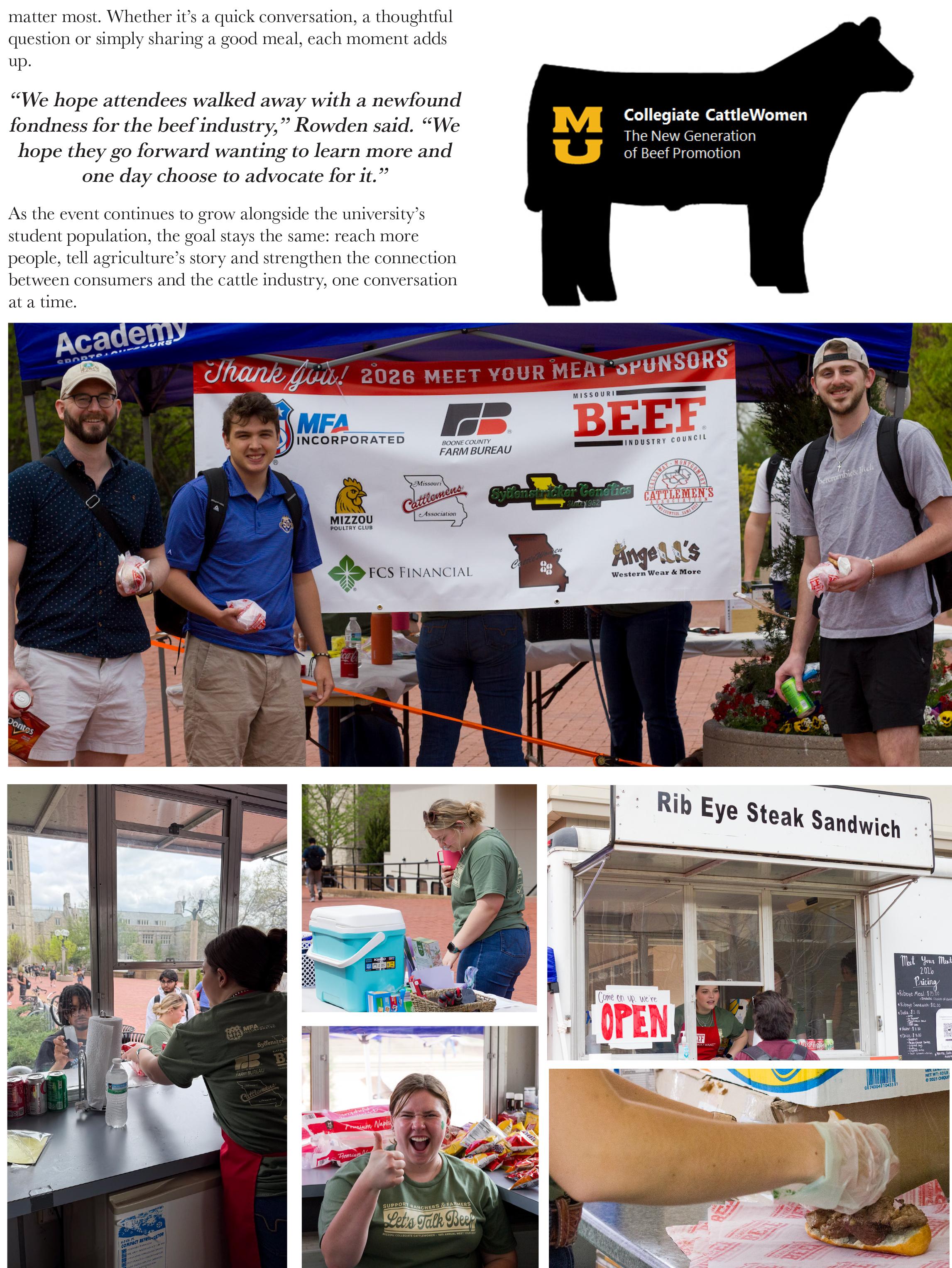
We kicked off the celebration a little early on April 23 at the American Royal Spring Field Trip. This event provides a unique opportunity to connect with innercity students and introduce them to the story of beef production. Through hands-on learning and direct interaction, students gained a better understanding of where their food comes from, how cattle are raised, and the role beef plays in a healthy diet. These early conversations are key to building lasting knowledge and trust with the next generation of consumers.
Momentum continued to build as, on Tuesday, April 28, Governor Kehoe officially recognized May as Beef Month through a signed proclamation. This annual tradition highlights the importance of the beef industry across the state, from farm families to processors to retailers, and reinforces beef’s role in Missouri’s economy and culture.
Local celebrations were also in full swing. Right here in Columbia, MO, Five Guys on Stadium Shoppes hosted
a special Beef VIP Day on May 1 to kick off the month. Guests enjoyed 50 percent off their entire purchase when it included beef, making it a great opportunity for the community to come together and celebrate. A huge thank you goes out to Lisa Stockhorst with the Missouri Cattlemen’s Association for helping make this event possible.
Rounding out a very busy first week, MBIC staff and supporters headed east to Busch Stadium, where they took over Ford Plaza through a partnership with Missouri Farmers Care and the St. Louis Cardinals. Connecting with the Cardinals fanbase, as well as visiting fans, allowed us to share beef’s story on a larger stage. Whether it is answering questions, sharing recipes, or simply starting conversations, this setting provided a strong platform to promote beef and spark a few light bulbs.
In addition to these in-person efforts, MBIC will be running targeted, beef-focused advertising campaigns throughout the month. With summer right around the corner, these campaigns will emphasize grilling season by highlighting recipe inspiration and nutritional benefits. By meeting consumers where they are, both online and in their daily routines, these efforts help keep beef top of mind as families plan meals and gatherings.
Community involvement remains a cornerstone of Beef Month. Through MBIC’s beef education and promotion grants, several organizations across the state will host their own celebrations. These grassroots efforts include beef sampling, education, and local advertising campaigns, extending Beef Month outreach into communities of all sizes. By empowering local partners, MBIC ensures that the message of beef is shared in meaningful and relevant ways.
While May serves as the centerpiece of the celebration, the momentum does not stop there. In early June, MBIC will host a Farm to Fork Camp for youth in partnership with the Presser Arts Center in Mexico,
MO. This immersive camp teaches participants about cattle production, nutrition, and basic cooking skills, giving them a hands-on look at how beef goes from pasture to plate.
Beef Month is more than a celebration. It is an opportunity to tell the story of beef in a way that resonates with today’s consumers. Each event, conversation, and partnership helps bridge the gap between producers and the public, building trust and understanding along the way. As we celebrate throughout May, we are reminded that the strength of the beef industry lies not only in the product itself, but in the people, passion, and purpose behind it.
Meet Lanie, Our Summer Intern
Lanie Milliken grew up in Lebanon, Missouri, on a commercial Angus cow-calf operation where agriculture became more than just a way of life, it became part of who she is. From an early age, she was involved in daily livestock responsibilities, developing a strong work ethic and a deep appreciation for the beef industry. These experiences shaped her passion for agriculture and inspired her to pursue a future within the industry.
Currently a senior at Missouri State University, she is pursuing a degree in Agricultural communications and animal science. Through her academic experiences, she has strengthened her knowledge of the industry while building skills in communication, leadership, and advocacy. She is especially interested in the role genetics play in beef production and its impacts on herd performance, sustainability, and profitability.
Lanie is passionate about becoming a strong voice for the beef industry through producer outreach and consumer education. She is dedicated to bridging the gap between those who raise food and those who consume it. As she pursues this passion, she is excited for the opportunity to intern with the Missouri Beef Industry Council this summer. She looks forward to expanding her skills in industry advocacy, gaining hands-on experience, and connecting with both producers and consumers while continuing to represent the beef industry with authenticity and purpose.
February Pork Exports Above Year-Ago; Another Big Month for Beef Variety Meat
Source: USMEF
February exports of U.S. pork were slightly higher year-over-year, according to data released by USDA and compiled by the U.S. Meat Export Federation (USMEF). While beef exports trended lower, due in large part to continued lack of access to China, shipments of beef variety meat posted another strong increase. February was a robust month for per-head export value, with pork exports equating to more than $67 per head slaughtered and beef exports reaching nearly $423 per head of fed slaughter. Exports of U.S. lamb muscle cuts trended higher, reaching the largest volume since May.
Gelbvieh and Balancer® Bulls & Females Specializing in Balancers® for the Modern Rancher Ertel Cattle Company • 660.234.2654 26694 Anchor Way • Greentop, MO 63546 www.ertelcattle.com • gertel@ertelcattle.com
Pork Exports Continue to Build Momentum in Latin America and Asia
February pork exports totaled 242,511 metric tons (mt), up 1% from a year ago, with export value also edging 1% higher to $678.8 million. While leading market Mexico posted another excellent performance in February, shipments to Japan increased significantly from last year’s low total and exports also trended higher year-over-year to South Korea, Central America, the Dominican Republic and Taiwan.
“It is gratifying to see demand for U.S. pork continue to expand in our Western Hemisphere markets,” said USMEF President and CEO Dan Halstrom. “But the rebound in Japan really stands out to me, given the strong economic headwinds and intense competition in this important market. To build on this recent momentum in Japan, it is critical that we continue to differentiate U.S. pork and demonstrate its advantages to Japanese importers and consumers.”
For January through February, U.S. pork exports were 2% above last year’s pace in both volume (493,372 mt) and value ($1.37 billion). Export value is slightly ahead of the record pace established in 2024.
Missouri Beef Industry Council Director Election Legal Notice
Notice is hereby given that the Director of Agriculture will be conducting an election to fill three positions on the Missouri Beef Industry Council Board of Directors. One regional council member is to be elected in each of Regions 2, 3 and 4. Terms of office are three years.
Any cattle producer within the specified regions of the State of Missouri who is producing cattle for market and the legal owner of one or more head of cattle becomes eligible to vote in the election by registering at his/her respective Farm Service Agency (FSA), or electronically at http://mda.mo.gov/councils/ prior to July 20, 2026. Cattle producers who have voted in any of the previous three (3) elections are not required to register unless their address has changed.
The Missouri Department of Agriculture will mail ballots to registered producers on August 12, 2026. Ballots must be postmarked no later than August 31, 2026 to be valid.
Any qualified producer may be nominated and have his/her name placed on the ballot provided the independent nomination is accompanied by petition of not fewer than 100 producers in the nominee’s region and written permission of the candidate. Petitions must be delivered to the Director of Agriculture on or before July 20, 2026. Petition forms are available from the Missouri Department of Agriculture by calling 573-751-5611.
Variety Meat Exports Remain a Bright Spot for U.S. Beef
February beef exports totaled 85,066 mt, down 13% year-over-year, while value fell 10% to $722.7 million. Much of this gap was due to China’s lockout of U.S. beef, though February shipments were also below last year to Korea, Japan and Canada. Exports increased year-over-year to Mexico, Taiwan, the Caribbean and South America, while demand was steady in the Middle East and Central America. Excluding China, February exports were 4% higher in value and just 1% below last year’s volume.
The February totals included 24,081 mt of beef variety meat, up 12% from a year ago, while the value of these shipments soared 40% to $106 million.
“Beef variety meat exports continue to trend higher, especially on the value side, and that makes such an important contribution to the value of every animal,” Halstrom said. “Where U.S. beef has access, muscle cut demand has held up well and provides a great complement to our robust domestic market. But for beef variety meats, export markets are really the whole ball game, so it’s great to see these products achieve broadbased growth.”
Through the first two months of 2026, beef and beef variety meat exports were 12% below last year’s pace in volume (177,624 mt) and 6% lower in value ($1.5 billion). Excluding China from these results, exports increased 2% to 175,915 mt, while value was 10% higher at $1.49 billion.
January-February exports of beef variety meat increased 9% from a year ago to 51,592 mt, while export value climbed 43% to $232 million.
Lamb Muscle Cut Exports Largest in Nine Months
February exports of U.S. lamb muscle cuts totaled 326 mt, up 52% from a year ago and the largest since May. Export value increased 31% to $1.47 million. Shipments increased year-over-year to the Caribbean and Central America, but trended lower to Mexico.
January-February lamb exports were 20% above last year in volume (564 mt) and 13% higher in value ($2.91 million). Growth was driven primarily by the Caribbean and Central America, but shipments also edged higher to Taiwan and Japan.
A detailed summary of the January-February export results for U.S. pork, beef and lamb, including marketspecific highlights, is available from the USMEF website.
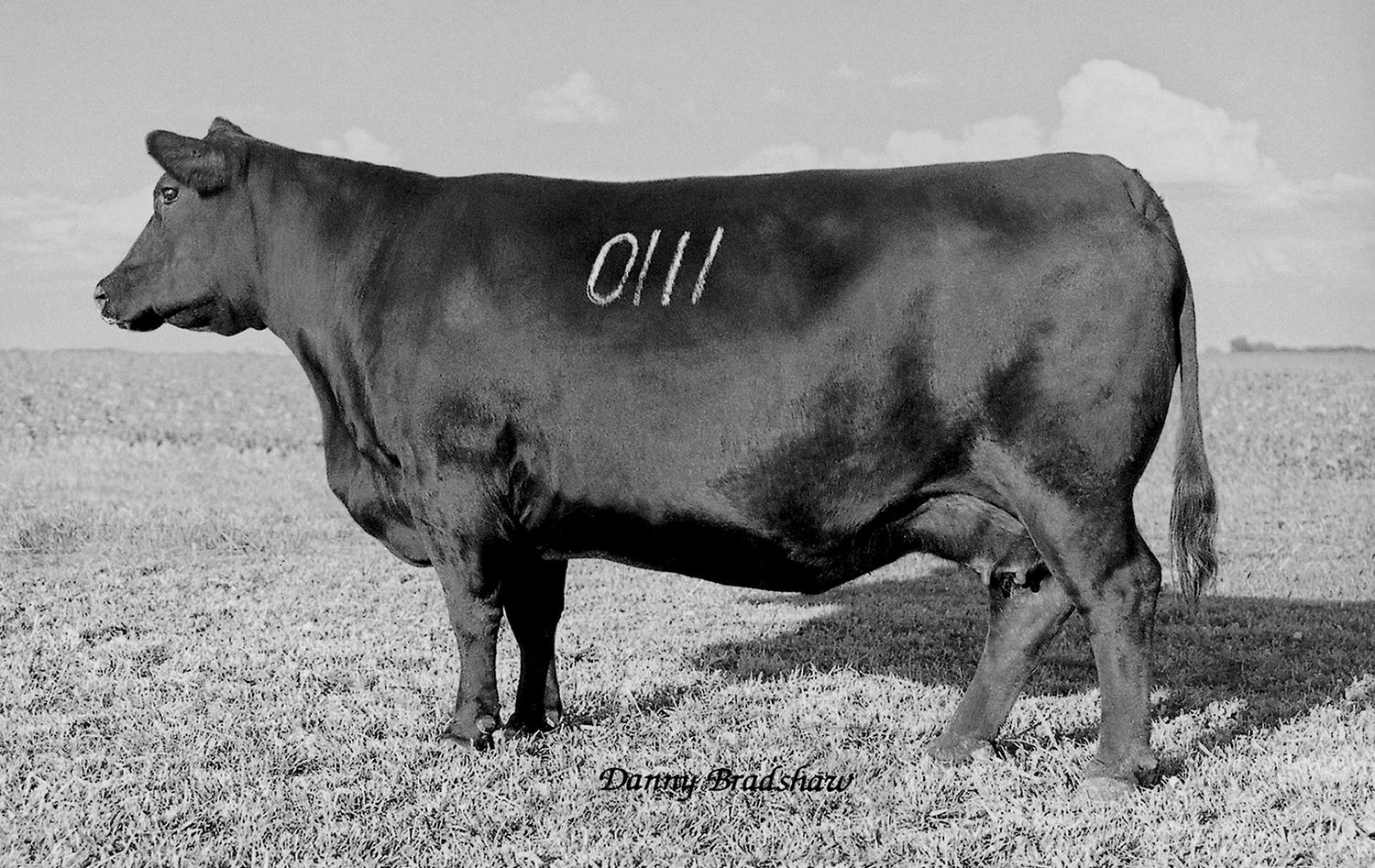
Complete Retirement Dispersal of Terry Little’s TL Ranch Angus Herd
COUNTY NEWS
See What’s Happening in Your County
Dallas County Cattlemen
Members of the Dallas County Cattlemen’s Association (DCCA) heard from Dallas County Health Department representatives at our April 9th meeting held at Prairie Grove School. As always, we appreciate the school opening its doors to host us so many times throughout the year. DCCA President James Henderson, welcomed everyone with DCCA member Jack Dill giving the blessing.
Shannon Jackson, environmental public health specialist, talked about all the services he provides to Dallas County residents. Some of his responsibilities include issuing food permits, water well testing, as well as restaurant, school and lodging inspections.
Community Health Nurse Sherry Hillhouse focused her presentation on vaccines and adult immunizations. She recommended adults 60 years and older receive the RSV, shingles, pneumonia and flu shots. The health department also provides lab services, blood pressure checks, as well as a host of other services for all ages.
Rachel Badgett, assistant administrator at the department, discussed eating healthy and recent changes to the USDA food pyramid, with an emphasis heavy on protein. This is certainly good news to beef producers! She commented, “The less packaged food you eat, the better off you are. Moderation is the key.”
Rachel mentioned that the big health issue being talked about alot is Alpha Gal--the newest tick-borne disease. It cannot be treated with an antibiotic. Most people’s symptoms will improve over time. Up until recently it
was not a reportable disease. However, thanks to the Missouri legislature passing a recent bill it now is.
We wish Polk County Cattlemen the best of luck again with their Missouri Beef Days. We commend them for their efforts on such a great event. Matt Henenberg, chairman of the event, was on hand at the meeting and urged everyone to attend.
Earlier in the evening members and guests enjoyed sloppy joe sandwiches prepared by Ruby Hostetler and Gloria Miller along with sides and ice cream.
DCCA will take a break from meetings until September. However, members will stay busy with “May is Beef Month” activities, cooking and promoting beef at the Dallas County Fair, as well as other events throughout the summer.
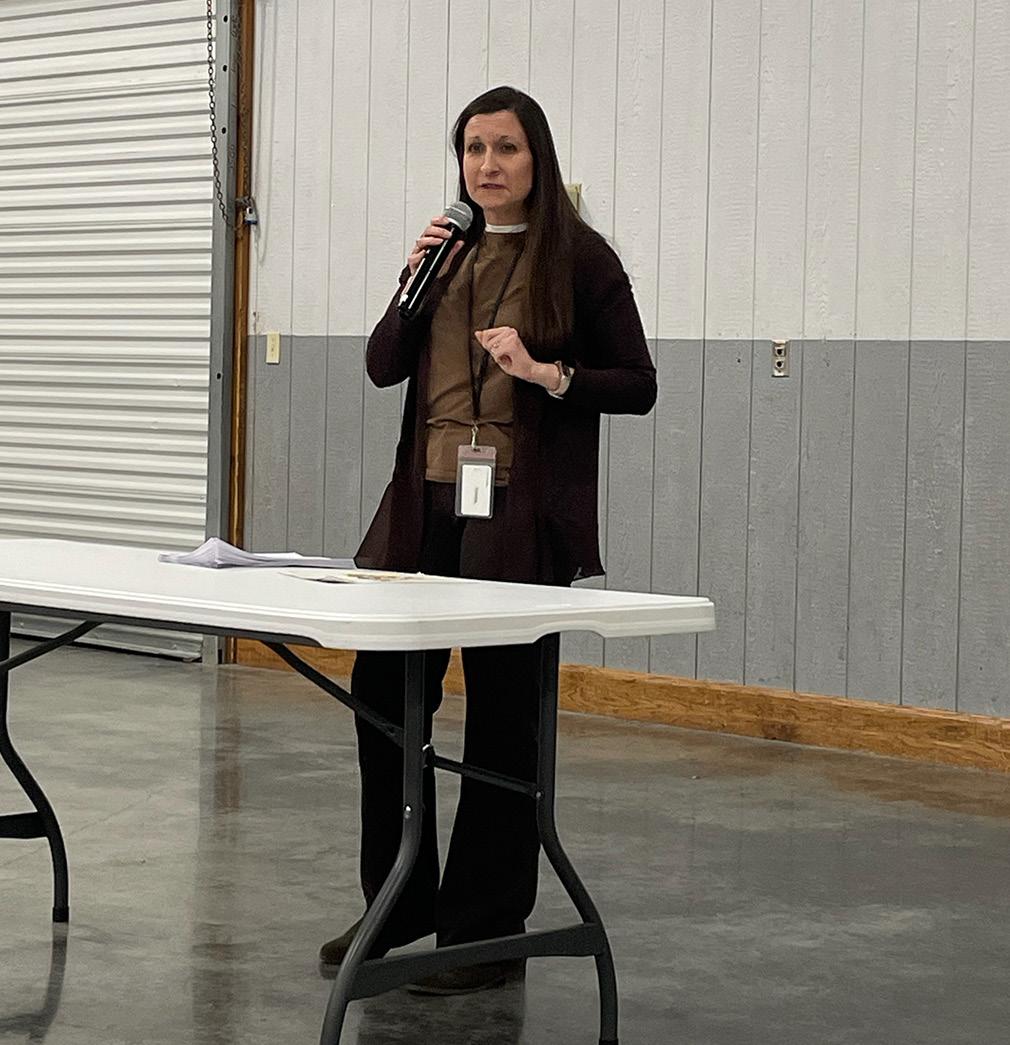
Rachel Badgett at Dallas County meeting.
Missouri Angus Breeders
573-302-7011
Fax: 573-348-8325
meadangus@yahoo.com
www.meadfarms.com
Newton and McDonald County Cattlemen
The March meeting of the Newton and McDonald County Cattlemen’s was held at 6:30 p.m. Thursday March 12th, 2026. The meeting was held at Crowder College, 601 Laclede Ave. Farber Bldg-Wrights Conference Room. The meeting was co-sponsored by Crown Power & Equipment – Monett, and Gateway Meat Co. Neosho. The meeting was called to order by President Lynn Moorehead with the Pledge of Allegiance. Then prayer was offered by Ronnie Tosh.
There were approximately 150 members and guests who enjoyed a meal of grilled Steaks, Loaded hashbrown casserole, Corn and hot rolls. Thank you to our cook team of Jenny Drake, Kelton Miller, Nick Neece, Randy Drake and Alan Drake. Thank you to Crowder Ag department for providing the sides and the students who served. And thank you to all the members who brought desserts and homemade ice cream.
Shawna Estep discussed the upcoming calf auction to be held April 1st, all proceeds go to help benefit the Crowder Ag program. The calf, donated by Dale Kunkel of Kunkel Farms, has been at Crowder with students providing all care since January. They have been bathing it and training it to lead. They also have other calves that they are breaking to lead for show season this spring and summer. Ashton, one of the students, talked about what a great learning experience this has been for her and her fellow students.
Lynn discussed the Annual Cattlemen’s convention where Ronnie Rogers won Top Hand. Our Affiliate also won Outstanding Affiliate for Policy Involvement and Runner-Up Overall Affiliate. Congratulations to all members who helped make this possible. It was also announced that the dues for next year would be increasing after March.
Chad Henry, co-owner of Gateway Meat Co talked about what they do. Gateway Meat Co. is the only USDA inspected meat processing plant in Newton County. He explained that in order to sell the meat we produce from our cattle across state lines it had to be processed in a USDA inspected plant. He explained that they source the meat they provide from local farms and they butcher not only beef but pork, bison, lamb, goat and deer. They strive to make sure their business is family friendly and provides high quality products. He also talked about wishing to see more meat being processed locally instead of being hauled to the stockyards.
Samuel Townsend was recognized for all he has done for the association. He received a thank you card and gift card. Samuel is our historian and runs the Facebook page for the association.
The Association won a fence charger at the convention and we auctioned it off. Chance Wallace was the auctioneer for the night. Ronnie Rogers had the winning bid. Proceeds will go to help with upcoming activities such as the summer watermelon feeds at the county fairs.
April 22nd will be the Cowboys at the Capital for our affiliate.
Whitley Nipp with Crown Power & Equipment Monett got up and talked about what they have available for summer hay season. He thanked us for allowing them to sponsor the meal and invited us to come check out the equipment they have in stock. They handle Case IH, Kubota, Vermeer, Land Pride, Sitrex, and Myers Farm Equipment. With a large new and used equipment inventory. They also have a large parts and service department available.
Jerry Davis announced that the Affiliate is holding a gun Raffle. We are raffling off two guns. One is a 22 Henry Golden Boy and the other is a Big Loop 357. All proceeds for the raffle will go to the Back Pak Snack Pak program for our local schools. The program feeds 1000 hungry kids in the Neosho, East Newton, Seneca, Westview and McDonald County School districts. There will be 250 tickets sold at a cost of $20.00 per ticket. The raffle is being sponsored by the Newton and McDonald County Cattlemen’s along with Eric Norris State Farm Insurance, and Clark Funeral Homes of Neosho and Granby. Thank you to Eric Norris and Dan and Blake Hierholzer for joining us at the meeting and sponsoring. There will be two drawings so two winners and the drawings will be held at the May meeting.
Door prizes were drawn at the end of the meeting for hats, a knife and assorted prizes. Members enjoyed checking their numbers to see if they won.
The Cattlemen joined the Crowder Aggies on March 22nd for Aggie days. We grilled the burgers and dogs for the students to enjoy. Manning the grill was Randy Drake, Darrell Epperson, Jenny Drake, Nick Neece, Alan Drake, Kent Hartman, Lynn Moorehead, Jerry Davis and Samuel Townsend.
Bates County Cattlemen
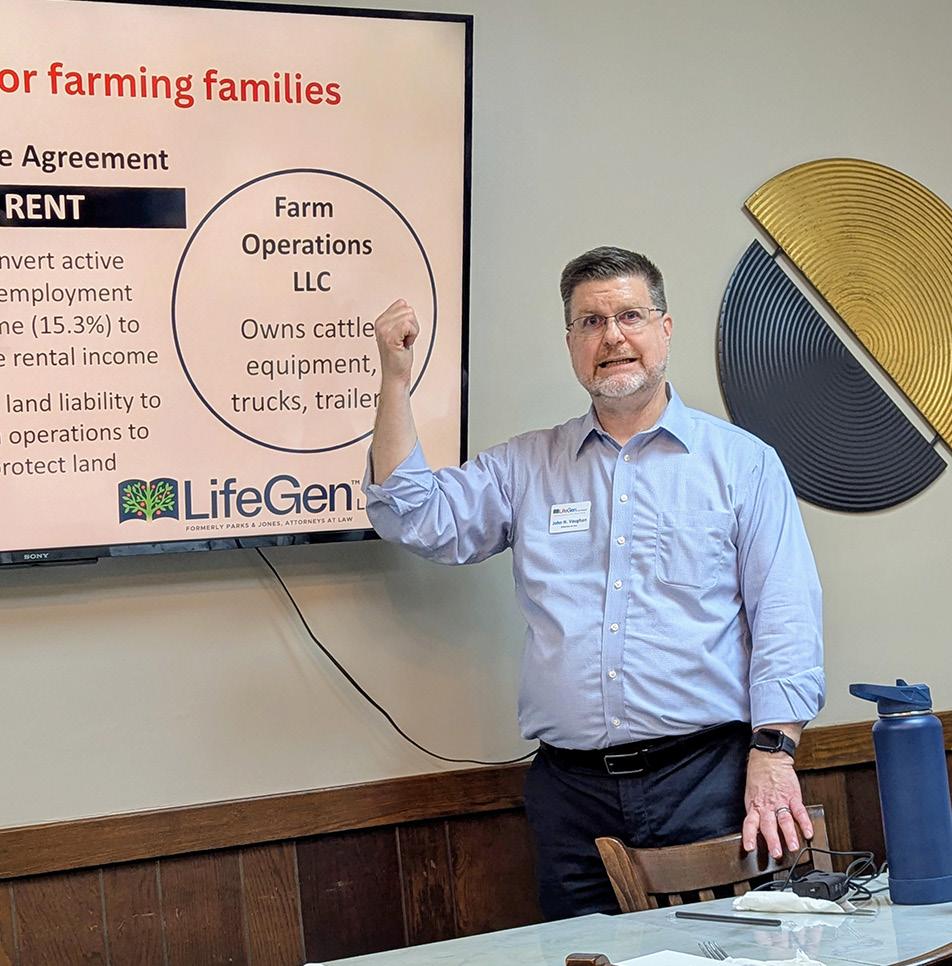
The Bates County Cattlemen met on April 14th at Steiner’s restaurant in Butler. The meal was sponsored by LifeGen Law Group. John Vaughan gave a presentation on Estate Planning, Business and LLCs, Charitable Planning, Trusts Wills and Tax Planning. It was a very informative presentation, thank you John!
We reviewed upcoming events and what activity would we do for Beef Month.
John Vaughan with LifeGen Law Group
Missouri Agricultural Hall of Fame Inducts Third Class of Members
Source: Missouri State Fair Foundation
(Jefferson City, Mo.) — Five agricultural leaders were celebrated April 14 during the third annual Missouri Agricultural Hall of Fame ceremony at the Capital Bluffs Event Center in Jefferson City.
Governor Mike Kehoe met with the honorees during a private reception at the Missouri Governor’s Mansion before addressing the 400 industry leaders gathered for the induction ceremony.
“These inductees represent the very best of Missouri agriculture—leaders who don’t just succeed in their own operations but have helped shape the future of this industry,” said Governor Kehoe. “Because of their work, agriculture in Missouri is stronger, more innovative, and better positioned for the next generation. And if we keep building on that foundation together, the best is yet to come.”
The 2026 inductees, recognized for their outstanding contributions to Missouri agriculture, are:
Anson Elliott – Longtime director and beloved professor at Missouri State University’s Darr College of Agriculture, who taught and mentored thousands of students during his lifetime. He has been an influential voice for Missouri agriculture on regional, state and national levels.
John Fletcher – General manager of Central Missouri AGRIService (CMAS), whose visionary growth of the company’s grain-handling and agronomic services has made a lasting impact on area farmers. He is also an active leader in his local community and in the agricultural industry.
Jackie Moore – Owner and operator of Joplin Regional Stockyards, the nation’s largest livestock auction with more than 600,000 head of cattle sold each year. Under Moore’s leadership, he and his family have taken the Stockyards to new heights of cattle feeding, marketing and outreach.
Jim Novinger – A 10th-generation farmer and industry leader who runs a diversified row-crop and cattle operation near Kirksville. His forward-looking family
has long recognized the value in feeding cattle and using conservation and precision practices to protect the land and resources.
Gary Porter – A competitive grower and vocal advocate for agriculture who has held local, state and national leadership roles, including service on boards of the National Corn Growers, U.S. Grains Council and Missouri Corn. He and his family run a generational grain farm in Mercer.
“As each of these gentlemen show, you don’t have to hold a title to be a leader,” said Chris Chinn, director of the Missouri Department of Agriculture. “The hours they spent volunteering, pouring into their businesses and working their family farms cannot be matched by anyone. The love they have for the agriculture industry is clearly evident.”
Established in 2023, the Missouri Agricultural Hall of Fame honors farmers, ranchers and agribusiness leaders for their exceptional impact on the state’s agricultural landscape. Inductees are selected by a committee and celebrated annually. Each recipient receives a custom sculpture by Missouri artist Clay Gant of “Cowboy Bronze” in Cross Timbers, featuring a beef bull, wheat,
and corn—symbolizing the power and diversity of Missouri agriculture.
MFA Incorporated and MFA Oil serve as presenting sponsors, with additional support from the Missouri State Fair Foundation’s 1901 Society—named for the first Missouri State Fair in 1901—and other key partners.
“The Missouri State Fair Foundation is proud to honor the third class of inductees into the Missouri Agricultural Hall of Fame,” said Karri Wilson, executive director of the Missouri State Fair Foundation. “The overwhelming support for this program proves its importance, and the tradition will continue to grow as we celebrate the remarkable individuals who have shaped Missouri’s agricultural legacy.”
Videos featuring each of the inductees can be viewed at bit.ly/2026MoAgHOF.
Photos from the event can be found on Gov. Kehoe’s Flickr site at governor.mo.gov/eventphotos.
For more information, visit the Missouri State Fair Foundation online at www.mostatefairfoundation.net.
Alpha-gal Syndrome Gives New Urgency to Tick Prevention
Source: University of Missouri Extension
COLUMBIA, MO. – As temperatures rise and people begin camping, fishing and farming, it’s more important than ever to be aware of the health dangers posed by ticks, says University of Missouri and Lincoln University Extension urban entomologist Emily Althoff.
Increasing reports of alpha-gal syndrome, Lyme disease, Rocky Mountain spotted fever and other tick-related illnesses highlight why preparation is essential before spending time outside in spring and summer, Althoff says.
Missouri’s tick populations are especially high from April through September. The lone star tick is the most common species in the state, followed by the American dog tick and the blacklegged (deer) tick. A newer arrival is the longhorned tick, an invasive species.
Ticks are the most important vectors of disease in domestic and wild animals throughout the world, and are second only to mosquitoes in transmitting disease in humans.
Ticks frequently attach to the lower legs of people and then crawl upward before embedding themselves in the skin to feed. They thrive in the humid, cool layer at the soil’s surface and often locate hosts using an ambush strategy known as “questing.”
Althoff recommends three “Ds” to protect yourself:
Dress to Defend
The right choice of clothing can help you prevent you from picking up ticks, says Althoff. First, choose lightcolored garments. Tuck the shirt into the pants, and tuck pants into the socks.
“This is where duct tape comes in handy,” she says. Duct tape the bottom of the pant legs closed to prevent ticks from getting to your skin.
Use DEET
Always apply DEET-based insect repellent when visiting wooded areas or working on farms, says MU Extension
health and safety specialist, Karen Funkenbusch. Apply only as directed to exposed skin or clothing. Avoiding eyes, mouth, injured skin and children’s hands. Be careful not to inhale the product, and do not use it around food. Wash treated skin and clothing thoroughly once you’re back indoors, says Funkenbusch.
Search and Destroy
After coming inside, perform a full-body tick check. Look inside and behind the ears, along the hairline, the back of the neck, armpits, groin, legs, behind the knees and even between toes. The Centers for Disease Control and Prevention recommends showering within two hours of being outdoors.
If you find a tick, remove it with sturdy tweezers. Grasp the tick at the front of its body, as close to the skin as possible, and pull straight out. Avoid squeezing the rear of the tick, as this can cause it to expel gut contents into your skin, increasing the risk of infection. Clean the bite area and your hands with rubbing alcohol, iodine or soap and water.
Publication: “Guide to Ticks and Tick-Borne Diseases” is available for free download at https:// extension.missouri.edu/publications/ipm1032.
Related story: “Livestock producers face health threats from ticks,” https://muext.us/110525ticks.
More about alpha-gal syndrome: https://muext.us/AGS.
Get Better Hay, Better Returns with Small Changes
Make first cutting in May in Missouri for best quality
Source: University of Missouri Extension
TUSCUMBIA, Mo. – Hay quality has a direct impact on livestock performance and feeding costs, yet many producers lose value long before hay reaches the feeder, says University of Missouri Extension field agronomist Rudra Baral.
The good news: Most quality losses are tied to management decisions that producers can control.
“Small changes in harvest timing, handling and storage can pay off in better animal performance and lower supplement costs,” says Baral.
Buffalo Livestock Market
1 mile west on Hwy 32 • Buffalo, MO 65622 Barn: 417-345-8122
Sale Every Saturday 12:00 Noon
• Selling 1200 to 1700 head Farm Fresh Cattle weekly
• Special Stock Cow and Bull Sale
3rd Tuesday night of each month at 6:30 p.m.
• Pre-Vac Feeder Calf Sales 2nd Saturday of every month in conjunction with Regular Sale (Pfizer Pre-Vac, BLM BPre-Vac, Bayer Program, Mo Quality Assurance. LMA-Vac and MFA Health Track)
Order Buying Service Available
Owners… Lyle Caselman Leon Caselman 417-345-7876 H 417-345-4514 H 417-533-2944 cell 417-588-6185 cell
Harvest timing still the biggest driver
The most important decision affecting hay quality is when you cut. As forage matures, fiber levels increase while digestibility and crude protein drop. “Delaying harvest may increase tonnage, but it almost always lowers feeding value per bale,” he says.
Best harvest windows
• Cool-season grasses: boot stage to early heading.
• Legumes: late bud to early bloom.
In Missouri, aiming for a first cutting by May generally supports higher-quality forage. But watch plant growth stages rather than the calendar, especially during warm springs when maturity advances quickly, says Baral.
Moisture management protects feed value
Baling hay at the right moisture prevents mold, heating and leaf loss.
Target moisture levels
• Small square bales: under 20%.
• Round bales: 15–18%.
• Large square bales: under 16%.
Hay that’s too wet can heat in storage, reducing nutrients and increasing fire risk. Hay that’s too dry becomes brittle, causing leaf loss, robbing hay of the most nutrient-dense part of the plant. Measure moisture with a meter and take multiple readings to avoid expensive mistakes.
Leaf retention makes or breaks protein levels
Leaves contain much more protein and digestible nutrients than stems, especially in legumes like alfalfa. Excessive handling when hay is too dry leads to leaf shatter and rapid quality loss.
Management tips
• Rake alfalfa when forage moisture is around 40% or higher.
• Adjust rake teeth to avoid soil contact.
• Limit the number of passes across the field.
Slowing down and handling hay carefully preserves nutrients that otherwise end up on the ground, Baral says.
Storage losses add up fast
How hay is stored can determine whether quality is maintained or wasted. Research shows round bales stored uncovered on bare ground can lose 25–30% of nutrients within six months. After two years, losses may exceed 70%.
Best practices
• Store hay off the ground.
• Cover bales or use net wrap.
• If storing outside, orient bales to improve drainage.
Good storage can reduce losses to less than 10%.
Test hay and match to livestock needs
Appearance alone doesn’t tell you what hay is worth. Forage testing is the only reliable way to match hay quality to livestock needs and avoid overspending on supplements, says Baral.
Recent Missouri hay testing shows many grass hays fall below the needs of growing cattle. Supplementing low-quality hay can cost producers thousands of dollars per feeding season, which often is more than the cost of producing better hay in the first place.
Action step: Feed the highest-quality hay to animals with the greatest nutrient demand, such as lactating cows, growing calves and replacement heifers. Lowerquality hay can work for dry, mid-gestation cows if body condition is monitored.
Bottom line
“Good hay doesn’t happen by accident,” says Baral. Timely cutting, correct moisture at baling, gentle handling, smart storage and routine forage testing work together to protect forage value—and your bottom line. The most cost-effective supplement for many Missouri operations is often better hay, not more feed.
Custom Cattle Feeding
Crowder Ag Division Calf Fundraiser Auction
Source: Crowder College
Carthage, MO – Crowder College Agriculture Division held its 13th Annual Calf Fundraiser Auction on Wednesday, April 1st, 2026, at the Joplin Regional Stockyard with the registered Red Angus heifer bringing $18,000. This year’s calf is donated by Dr. Dale and Diane Kunkel, Kunkel Farms, in Neosho, MO.
Each year, the Newton and McDonald County Cattlemen’s Association has a local farmer who donates a beef calf for the benefit of Crowder Aggies. These funds provide opportunities for students in our agriculture programs to attend workshops, conferences and contests throughout the year.
The fitted and halter broke heifer entered the ring and the audience bid multiple times for donations before she finally sold to Bo Johnson of Neosho.
“This year’s heifer marks a considerable increase in funds raised compared to prior years,” stated Shawna Estep, Agriculture Division Chair. “The efforts to get
the word out and the sponsorships really helped. I would like to thank all those who donated or sponsored this event. It allows us to help ease the burden of college expenses for students while providing opportunities to experience agriculture in travel seminars and competitions both locally and internationally.”
Sponsors for this year’s calf auction included: Missouri Cattlemen’s Association (Newton & McDonald Counties), Joplin Regional Stockyards, FarmTalk, B&M Tire, Hunke Spray Services, S & H Farm Supply, Eubanks Equipment, SmartLic Suppliements, DD Farm & Feed, B&M Tire – Yokohama, Goswick Ag Lime & Fertilizer, Superior Steel Sales, Frye Farm Trailers, 4-State Moto Complex, The 808 Ranch, Red Angus Association, and Cornerstone Bank.
Crowder College’s Agriculture Division offers transfer and workforce degrees in a variety of programs. For more information visit our website: https://www. crowder.edu/program/agriculture/
Capitol Update with Nancy Giddens & Shannon Cooper
Taxing Questions
Missouri’s agricultural community is closely watching a major tax proposal from Governor Mike Kehoe that could reshape the state’s fiscal structure for decades to come. The concept of eliminating the state income tax while increasing reliance on sales tax presents both opportunities and uncertainties for farmers and ranchers. With five weeks remaining in the legislative session, stakeholders are working to understand what this shift could mean in practical terms.
From a policy perspective, moving away from an income tax model would fundamentally change how Missouri generates revenue. For farm families, whose incomes can fluctuate significantly from year to year due to weather, markets, and input costs, the removal of income tax could provide relief in stronger years and reduce the administrative burden tied to income reporting. This may be particularly relevant for operations structured as pass through entities, where income is reported at the individual level.
At the same time, the proposal’s reliance on sales tax introduces a different set of considerations. Governor Kehoe has indicated that agriculture would be exempted from increased sales tax obligations. However, the
Nancy Giddens & Shannon Cooper
definition of “agriculture” remains unclear, and that lack of specificity is where much of the current discussion is focused. In policy terms, definitions matter. They determine who qualifies, what transactions are covered, and how consistently the law can be applied.
For example, would exemptions apply only to traditional production agriculture such as row crop and livestock operations, or would they extend to value added activities, custom work, and diversified farm enterprises? Many Missouri operations today include a mix of income streams, from direct-to-consumer sales to agritourism. Without clear language, some of these activities could fall outside an exemption, even if they are integral to the farm’s overall viability.
There are also questions surrounding inputs and equipment. Agriculture is a capital intensive industry, requiring significant and ongoing investment. If exemptions are narrowly defined, certain purchases
such as machinery, building materials, or technology upgrades could still be subject to higher sales taxes. Likewise, regularly purchased inputs like feed, fertilizer, and fuel could be treated differently depending on how the final policy is written.
Beyond the farm gate, the definition of agriculture could influence the broader rural economy. Equipment dealers, input suppliers, and service providers often operate in close connection with production agriculture but are not themselves classified as farms. If they are excluded from exemptions, increased costs could be passed along, indirectly affecting farmers even if direct purchases are protected.
This uncertainty comes at a time when long term planning is already complex. Agricultural producers make decisions that span multiple seasons and market cycles. Clarity in tax policy helps support those decisions, while ambiguity can delay investment or shift risk management strategies.
An opportunity for lawmakers to provide clearer definitions and address these concerns remains. If the resolution advances, it will ultimately go before Missouri voters, making public understanding just as important as
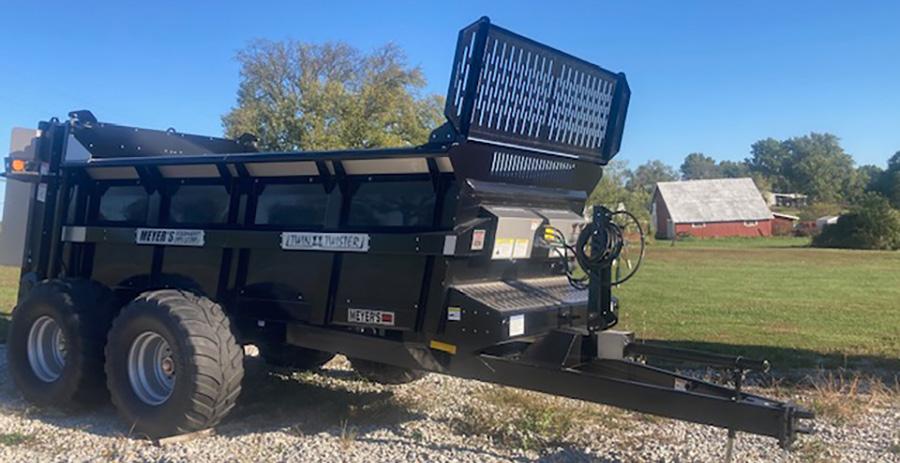
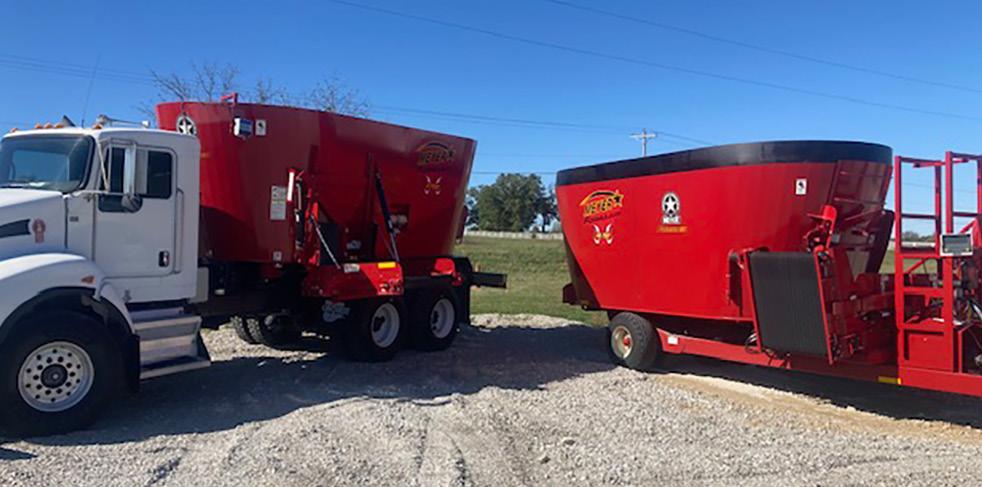
Meyers Truck Service
For Missouri agriculture, the conversation is not simply about whether reform occurs, but how it is structured. Ensuring that the definition of agriculture reflects the diversity and reality of modern farming will be key to understanding the true impact of any proposed changes.
Respectfully, but impatiently waiting on the language, Nancy and Cooper
Callaway Livestock Center, Inc.
Every Monday:
Slaughter Cattle 12:00 p.m. Selling All Classes of Cattle 12:30 p.m.
1st Thursday Nite of Each Month: 6:00 p.m. Bred Cows and Breeding Bull Sale
Jack Harrison 573-999-7197 (owner) John P Harrison 573-220-1482 Claude Niemeyer .............. 573-470-1017 Roger Temmen ................. 573-680-4538 Justin Oberling 217-440-7724 Glenn Stegman 573-619-8495
SALE REPORTS
Wild Indian Acres Spring Bull Sale
3.21.2026 • Carthage, MO
43 Fall Yearling Bulls Avg. $7,305
Total Sale Gross: $314,100
8 Story Farms 8th Annual Bull & Female Sale
3.28.2026 • Gallatin, MO
10 Fall Yearling Bulls ..................................... Avg. $6,800
6 Open Heifers ..............................................
34 Lots Avg. $4,326
Fink Beef Genetics 43rd Annual Spring Bull & Female Sale
4.11.2026 •Randolph, KS
Auctioneers: Kyle Elwood and Ethan Schuette
Sydenstricker
NextGen Cattle Company Spring Classic Bull Sale
East Central Missouri Angus Ass’n Sale
4.18.2026 • Cuba, MO
SALE CALENDAR
May 1 Best of Both Worlds Bull Sale, Wright County Livestock Auction, Mtn Grove, MO
May 1 Southeast Missouri SMS Sale, Fruitland, MO
May 4 Gardiner Angus Meating Demand Sale, Ashland, KS
May 1-9 Missouri Beef Days Celebration, Bolivar, MO
May 7
Midwest Prime Akushi Spring Time Spectacular Sale, Weatherby, MO
May 8 East Central Missouri SMS Sale, Farmington, MO
May 8
South Central Missouri SMS Sale, Vienna, MO
May 9 Mead Farms Spring Female & Bull Production Sale, Versailles, MO
May 9 7P Ranch Dispersal Sale, Winona, TX
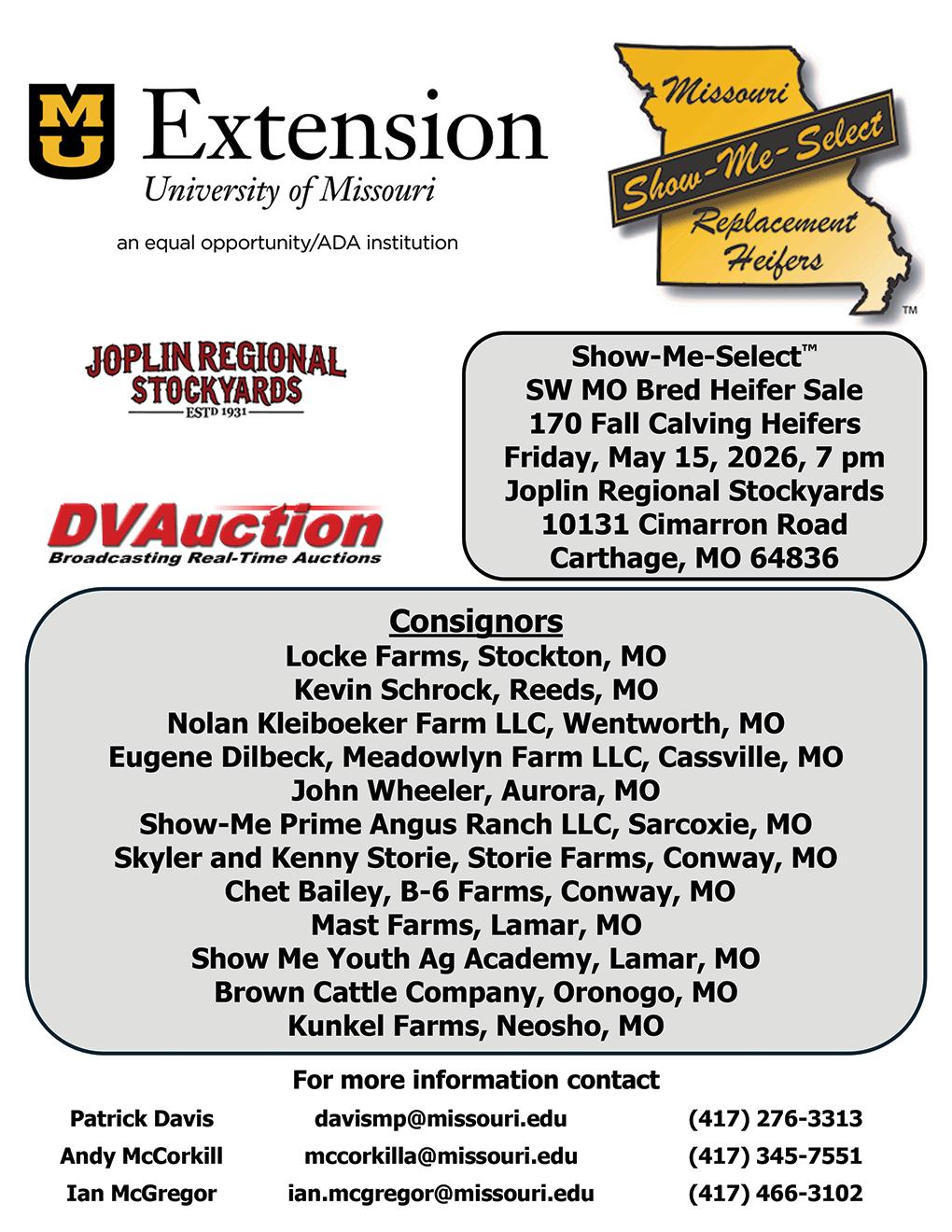
May 15 Southwest Missouri SMS Sale, Carthage, MO
May 16 Complete Dispersal of Terry Little’s TL Ranch Angus Herd, Macon, MO
May 22-24 MLBA Field Day, Springfield, MO
May 23 The Inagural GenePlus at Bar V Genetix Female Sale, Blountsville, AL
May 29 Wall Street Cattle Co. Moooving to Florida Sale, Lebanon, MO
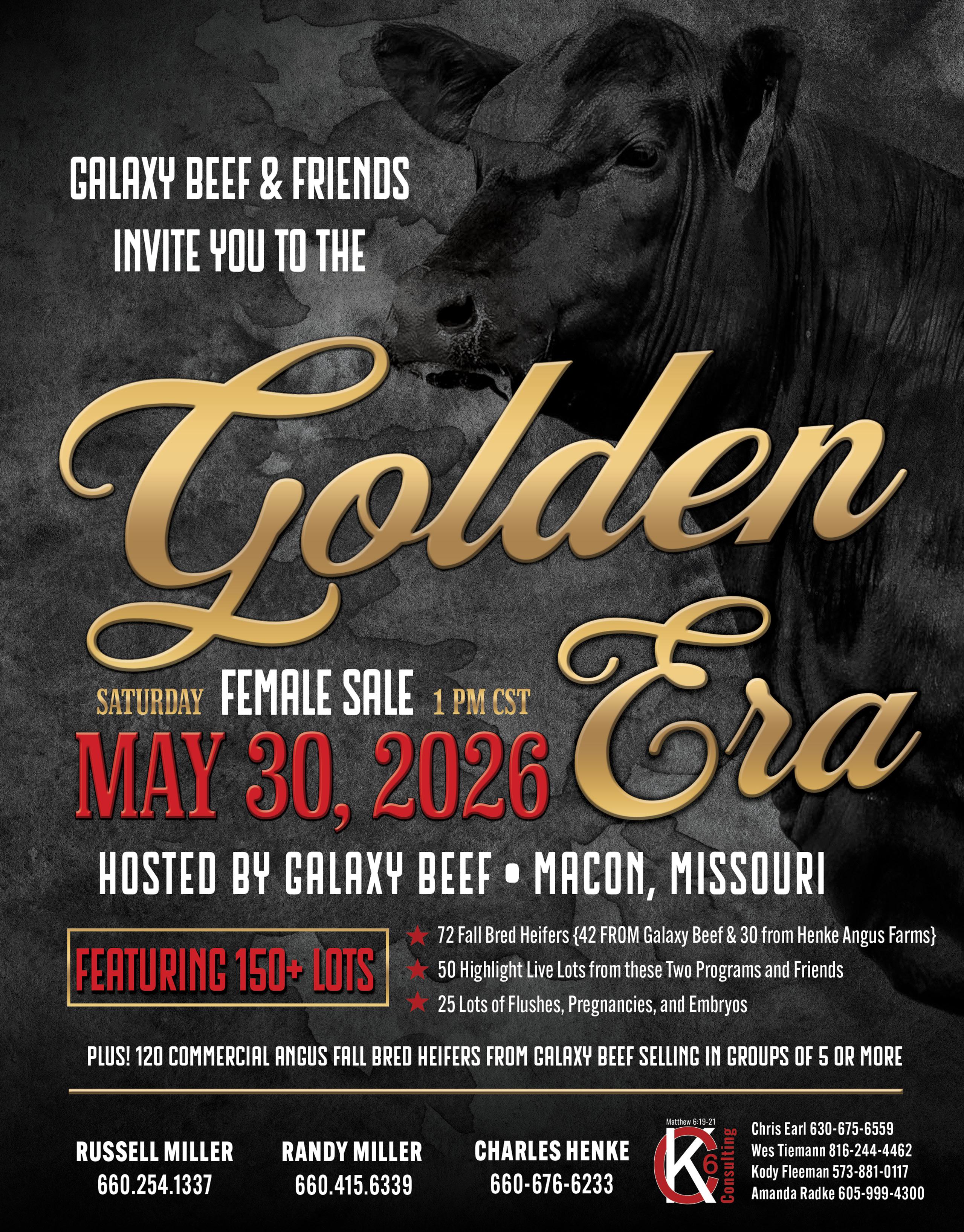
May 30 Galaxy Beef & Friends Golden Era Female Sale, Macon, MO
June 6
Eastern Missouri SMS Sale, Palmyra, MO
United States Cattle on Feed Down 1 Percent
Source: USDA
Cattle and calves on feed for the slaughter market in the United States for feedlots with capacity of 1,000 or more head totaled 11.6 million head on April 1, 2026. The inventory was 1 percent below April 1, 2025. The inventory included 7.26 million steers and steer calves, down slightly from the previous year. This group accounted for 63 percent of the total inventory. Heifers and heifer calves accounted for 4.32 million head, down 1 percent from 2025.
Placements in feedlots during March totaled 1.71 million head, 7 percent below 2025. Net placements were 1.66 million head. Placements were the second lowest for March since the series began in 1996. During March, placements of cattle and calves weighing less than 600 pounds were 320,000 head, 600-699 pounds were 250,000 head, 700-799 pounds were 435,000 head, 800-899 pounds were 474,000 head, 900-999 pounds were 170,000 head, and 1,000 pounds and greater were 60,000 head.
Marketings of fed cattle during March totaled 1.63 million head, 6 percent below 2025. Marketings were the second lowest for March since the series began in 1996.
Other disappearance totaled 50,000 head during March, 9 percent below 2025.
a.m.
MBC Classified
The MBC Classified column appears monthly. Classified advertising is only 50¢ per word. Send your check with your ad to Missouri Beef Cattleman, P.O. Box 480977, Kansas City, MO 64148. Deadline 15th of month before an issue.
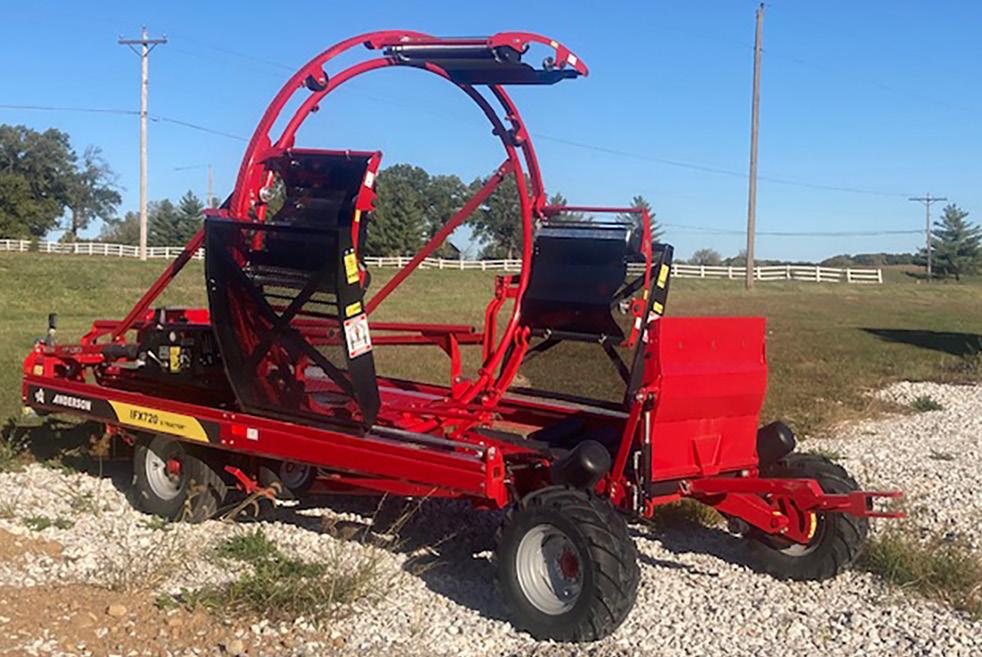
“REESE” DISC MOWERS, CADDY V-RAKES, “REESE” TUBE-LINE BALE WRAPPER, AITCHISON DRILLS, SELF-UNLOADING HAY TRAILERS, HEAVY DUTY BALE AND MINERAL FEEDERS, FEED BUNKS, BALE SPIKES, CONTINUOUS FENCING, COMPLETE CORRAL SYSTEMS, INSTALLATION AVAILABLE: Tigerco Distributing Co. 660-645-2212, 800-432-4020 or www.tigercoinc.com.
BLACK SIMMENTAL BULLS SINCE 1993: Calving Ease, Attractive, Athletic, Sound Footed and Docile. We Deliver. Mike Williams, Higginsville, 816-797-5450
SYCAMORE CREEK SIMANGUS BULLS & BRED HEIFERS FOR SALE. Great EPDs. Wayne and Anita Vanderwert -15 minutes from Columbia. 573-808-3000 or 303-506-3508
SIM-ANGUS BULLS - Top EPD’s for Calving Ease and Growth. Lynn Snow Call Matt McQuitty 660-924-8037.
For More Infor mation Call… David Patton Of fice
573-308-6655 573-422-3305 573-308-6657 573-308-6658 Visit our website: www.scrsvienna.com or E-mail us: scrsvienna@gmail.com “Make South Central your Livestock Market”