Andy Atzenweiler: Editor/Production/Ad Sales 816-210-7713 • E-mail: mobeef@sbcglobal.net
Missouri Cattlemen’s Association
MCA Website: www.mocattle.com
Mike Deering, Executive Vice President - Ext 230 Mike@mocattle.com
Sally Schmidt, Manager of Communications and Marketing – Ext 235 • Sally@mocattle.com
Miranda Zumbehl-Howard, Manager of Membership – Ext. 231 Miranda@mocattle.com
Lisa Stockhorst, Manager of Operations and Strategic Solutions – Ext 234 • Lisa@mocattle.com
Missouri’s CattleWomen
http://mocattle.com/missouricattlewomen.aspx
Missouri’s Cattlemen Foundation www.mocattlemenfoundation.org
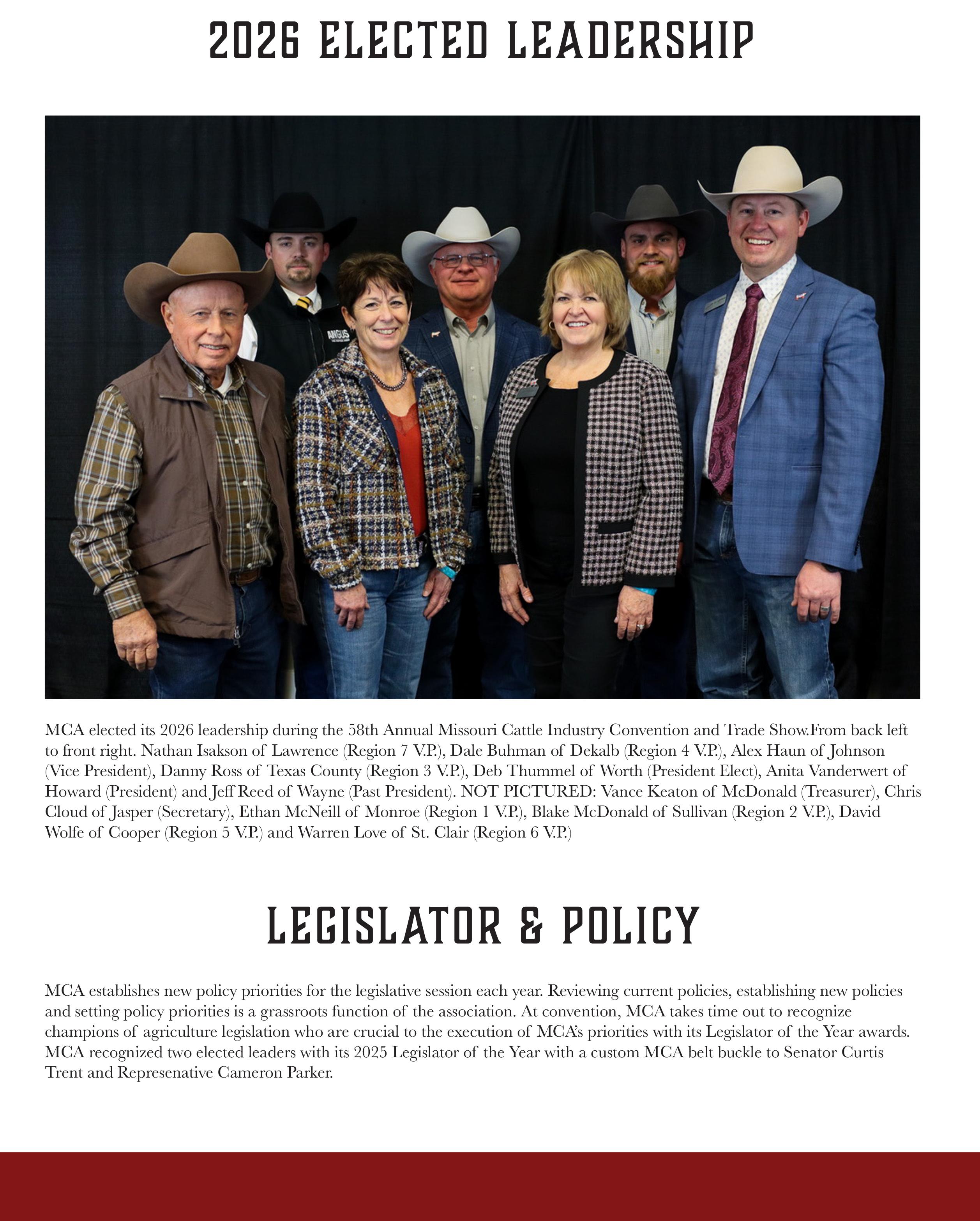
2026 MCA Officers
Anita Vanderwert, President 573-808-3000 • 620 State Route P, Fayette, MO 65248
Deb Thummel, President-Elect 660-541-2606 • 12601 Hwy. 46, Sheridan, MO 64486
Alex Haun, Vice President 816-345-0005 • 1031 SW 600 Rd., Holden, MO 64040
Vance Keaton, Treasurer 417-825-4853 • 5863 W. State Hwy 76, Anderson, MO 64831
Chris Cloud, Secretary 417-358-8459 • 7825 CL 173, Carthage MO 64836
Jeff Reed, Past MCA President 903-279-8360 • P.O. Box 35, Williamsville, MO 63967
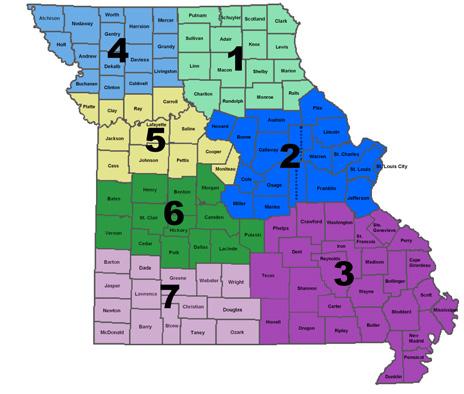
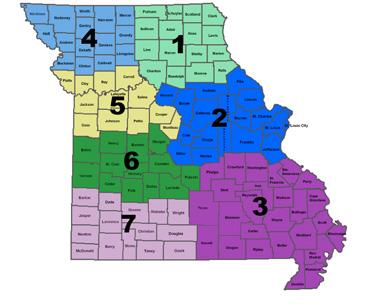
2026 MCA Regional Vice Presidents
Region 1: Ethan McNeill, 325 McMurry St. Paris, MO 65275 636-544-9943
Region 2: Blake McDonald, 250 Clonts Rd. Sullivan, MO 63080 • 573-205-7914
Region 3: Danny Ross, 5514 Gaston Rd Eunice, MO 65468 • 417-932-4964
Region 4: Dale Buhman, 3751 SW Taylor Rd. Clarksdale, MO 64430 • 816-244-9249
Region 5: David Wolfe, 7761 Mount Vernon Rd Pilot Grove, MO 65276 • 660-834-3232
Region 6: Warren Love, 8381 NE Hwy ZZ Osceola, MO 64776 • 417-830-1950
Region 7: Nathan Isakson, 20706 Lawerence 2022 Everton, MO 65646 • 573-578-2518
Director At-Large: Stephanie Gable, 5622 State Hwy E Oak Ridge, MO 63769 • 573-256-3279
MCA Regional Grazing Coordinators
Region 2 - Doug Mertens 573-489-5261 doug@mocattle.com
Region 3 - Kenneth Ball 417-818-6400 kenneth@mocattle.com
Region 4 - Micah Hans 636-201-6846 micah@mocattle.com
Missouri Cattlemen’s Youth Expo
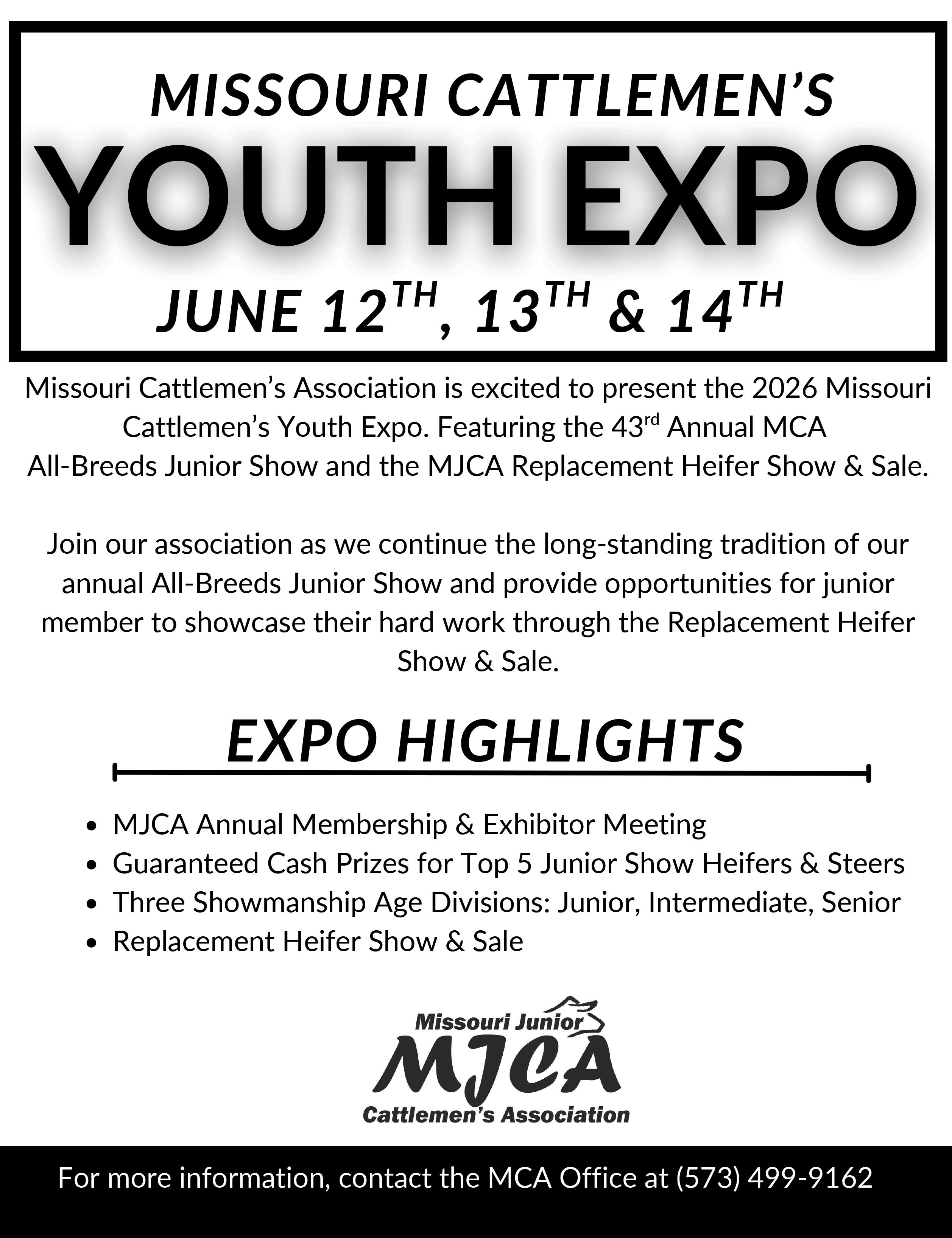
It is almost time for the “can’t miss” weekend of the summer. The weekend will include both the 43rd Annual MCA All-Breeds Junior Show. The expo will feature long-held traditions such as the MJCA Photo Contest, MJCA board interviews and elections, and the MJCA annual meeting while also bringing in new opportunities for junior members to feature their hard work at the state level. To learn more about this event, visit mocattle.com under junior programs or turn to PAGE 56.
23rd Annual Cattlemen’s Steak Fry
The Cattlemen’s Steak Fry will be held on Saturday, June 13th at the Missouri State Fair Agriculture Building. Join us for a great steak dinner, raffles, live and silent auctions and great conversation. You’ll find the details in this month’s magazine and on our website. This event is open to the public and we welcome anyone who wants to celebrate Missouri’s beef industry. Funds raised will benefit the MCA Political Action Committee to help elect leaders who understand and value agriculture to guide our state’s policy, now and in the future. For more information and registration instructions, visit mocattle.com.
Show-Me-Select Heifer Replacement Program
We are partnering with Show-Me-Select again this year for an exclusive new member promotion drawing. All new Missouri Cattlemen’s Association members will be entered into a drawing for a $2,000 credit to a Show-Me-Select Replacement Heifer sale. To be considered a new member, you must not have been an MCA member within the last 12 months. Credit must be redeemed in the same calendar year at any of the spring or fall sales. Learn more on PAGE 100.
Cartridges for Cash
We are excited to be working with Merck Animal Health on the Cartridges for Cash program to raise funds for our association’s junior programs. We want to challenge our affiliates to a competition. The group that collects and turns in the most cartridges will win a $1,000 scholarship to award to a junior member of their choice. Each county should collect the Ralgro wheel and Revalor cartridges used by their members and bring them to either one of the Board of Director’s meeting held each quarter or to the annual convention in January. We will keep a tally of the cartridges collected from each county throughout the year, and the winner will be announced at the Missouri Cattle Industry Convention & Trade Show after all cartridges are counted. To learn more about the Cartridges for Cash program, see PAGE 39.
Aaron Verseman, Aaron Verseman Farming, Frohna, MO
Addison Verseman, Frohna, MO
Ryder Hall, 6H Ranch, Rogersville, MO
Russel & Paula Wagner, Lonedell, MO
Brian Utecht, Galena, MO
Dana Still, Braymer, MO
Saydee Hardison, Elkland, MO
Mark & Sally Gnade, Elsberry, MO
Doug Mertens, Columbia, MO
Steve Eisenbath, Moscow Mills, MO
Adrian Eckhoff, Calhoun, MO
Blair Bergsieker, Higginsville, MO
Landon Keen, Lebanon, MO
Jacob Schwoeppe, Labadie, MO
Mike Keene, Columbia, MO
Alivia Haase, Hesse Farms, Cole Camp, MO
Cheri Boots-Sutton, Horizon Auction, Bowling Green, MO
Nick Sherlock, Burlington Jct., MO
Michael Eufinger, Cole Camp, MO
Dominic Pozzo, Camp Branch Cattle, Fenton, MO
Scott Ellebracht, KS Ellebracht Farm, Sedalia, MO
Phil & Lynn Bagley, Purdin, MO
Ralph Jackson, Lippitt Farms, LLC, Meadville, MO
Kenneth Polson, Brookfield, MO
Cody & Hailey Smith, Meadville, MO
President’s Perspective with Anita Vanderwert
Communicate. Collaborate. Connect.
When I stepped into the role of president of the Missouri Cattlemen’s Association, I opened with three simple but effective words: Communicate. Collaborate. Connect. They’re simple ideas, but when we live them out, they have the power to move our industry and our association forward.
These are more than a theme, they are the mission that will guide us this year.
Communicate
As an association, we must continually improve how we communicate, not only with our executive team and staff, but most importantly with you, our members.
Every member who invests in this organization deserves to know what’s happening within it. MCA has long taken pride in delivering a weekly e-newsletter, a monthly magazine, and member advisories on upcoming events to keep you informed. Those tools matter, and we will continue to strengthen them.
But communication cannot be one-sided. We need to hear from you. What information is most valuable to your operation? What issues deserve more attention? How can we make it easier for you to stay informed and engaged?
This year, we will also equip our regional grazing coordinators with more information about MCA so they can better serve you. They are your boots on the ground, working in your area every day. If you have questions and can’t immediately reach one of us, call them. Start the conversation.
Strong communication is a two-way street, and we are committed to listening.
Collaborate
I was once told that every strong organization understands this truth: its strength lies in each member, and each member’s strength comes from the association as a whole. I believe that wholeheartedly.
We will lead by collaborating, not dictating. In the coming months, we will conduct 360-degree reviews of several key programs, including the Profitability Challenge, County Leadership Conference, and Replacement Heifer Sale. These programs exist to serve you, and they should evolve as your needs evolve.
If you have ideas, concerns, or suggestions, we want to hear them. The best ideas rarely come from one person in a room. They come from producers who live this industry every single day.
Connect
People need people. Whether we consider ourselves introverts or extroverts, study after study confirms that human connection improves quality of life and overall satisfaction. That principle applies just as strongly in agriculture as anywhere else.
This business can feel isolating; long days, tough seasons, market uncertainty, and weather challenges. But when we come together at county meetings, conferences, field days, or over coffee at the sale barn, we are reminded that we are not alone.
We share a common goal: we want the cattle industry to thrive. Connection builds resilience. It builds perspective. And it builds momentum.
One of my favorite quotes from Henry Ford says it best: “Coming together is a beginning; keeping together is progress; working together is success.”
This year, let’s do more than simply belong to the same association. Let’s communicate openly. Let’s collaborate intentionally. Let’s connect meaningfully.
If we can do these three things, there isn’t a challenge too big and no opportunity out of reach. Let’s work together this year.
Anita Vanderwert - 573-808-3000 mobile
CattleWomen’s Corner with Jennifer Poor
March is a Busy Month for MCW
In life, you meet people who you have no idea what impact they will have on your life. About four years ago, I met a lady at the silent auction tables at the PAC Steak Fry. I was looking at a boot and glove warmer/ dryer, trying to figure out if I wanted to bid on it and how much to spend on it. This lady, whose name I never got, told me that I should bid on it and that it was a game changer in the winter. I thought ‘what the heck?’, wrote down a bid and went on not giving the item or the encounter a second thought. I have no clue who this lady was or where she is from. But I can tell you this, meeting her has had a huge impact on my life! Right after the 2026 MCA Convention, we got hit with a horrifically bitter cold and snowy week (yes, I’m being
a little dramatic). The kind of cold that required cutting pond ice twice a day. After each chore session, Jason and I would strip out of our wet gloves and boots and fire up the warmer/dryer. The Steak Fry lady was right! That thing has been a Godsend for us! If you ever see one of those things at a silent auction, I highly recommend bidding on it. You’ll thank me later.
Spring is starting to make its appearance and our cows are finishing up their calving. Next to come is spring herd work. It’s time to think about vaccinating all the cattle. Quite honestly, this is where I fail as a beef farmer. Jason always (and I mean always) takes care of this part of farming. I take care of setting the date that we work all of the cattle. Jason takes care of getting the vaccines and knowing which ones are needed and why. I couldn’t be a beef farmer without him, nor would I want to. Every producer has their own “menu” of vaccines that they give during their herd work. My thoughts are, to each their own. Some will give more vaccines and some will do the absolute bare minimum. I say do what works for you and we’ll do what works for us. Each spring we administer Lepto, give respiratory vaccines, pink eye, tick vaccines, horn fly vaccines and deworm everyone. It is also around this time that we change our mineral program for our herd. We are firm believers that mineral supplementation is a big part of our success as producers.
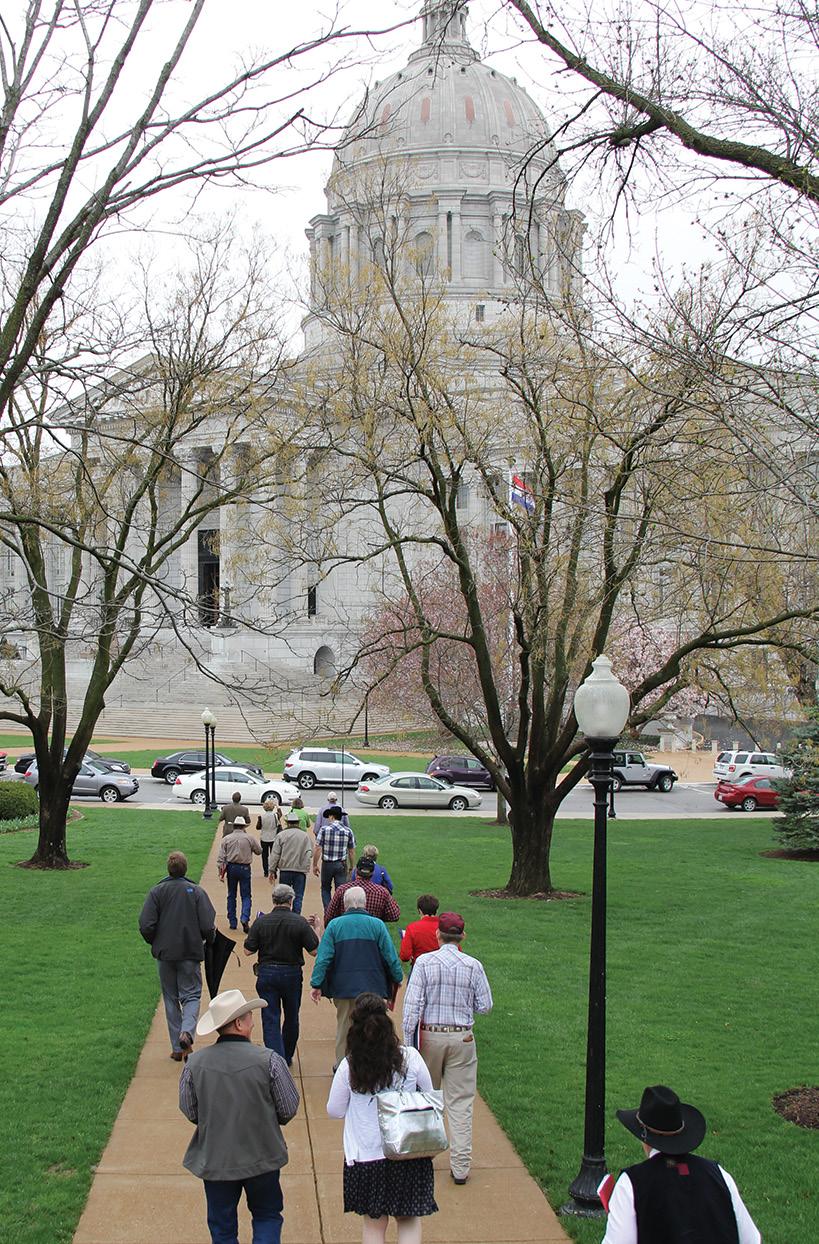
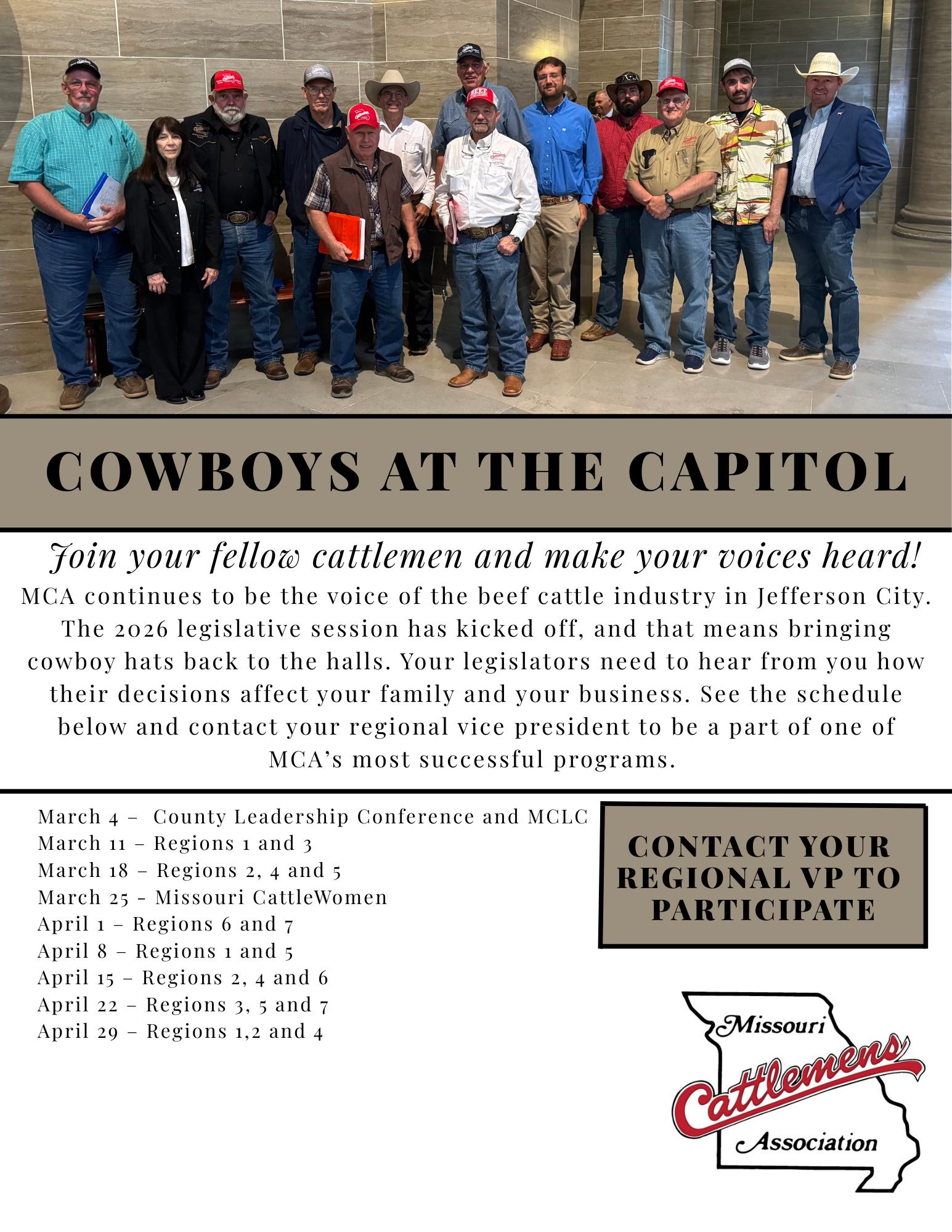
March is a busy month for the Cattlewomen. On Saturday, March 21st at 9 a.m., we have our Pasture to Plate event at the Historic Blackwater Depot in Blackwater, MO. Our keynote speaker is Tiffanie Weekley, RN of Morning Glory Farm. She will be discussing beef’s place in nutrition and wellness. MBIC will also give us an update on the work of the Missouri Beef Checkoff. Halter Technologies will discuss the benefits of virtual fencing. Lastly, back by popular demand, we will have our Direct Marketing panel. The cost of admission is $10 per person. We look forward to seeing you there. On Wednesday, March 25th, is our day for Cowboys at the Capitol in Jefferson City. We will meet at 9 a.m. on the 3rd floor of the rotunda. All
the Legislators look forward to Wednesdays when the cowboys are in the halls. If you have never been to a Cowboys at the Capitol, I promise you, you will enjoy it! Lastly, we have our board meeting on Thursday, March 26th at MCA headquarters at 2 p.m. All are welcomed.
In January, when the Executive Committee was at the Capitol, we met with Senator Mike Bernskoetter. For whatever reason, we got on the subject of our favorite recipes. Senator Bernskoetter mentioned his mom’s delicious “meatballs and gravy”. I told him that if he got me her recipe, I would use it in this month’s article. Having said that, listed below is Senator Bernskoetter’s mom’s Friccadillies recipe. Enjoy!
Friccadillies
Mrs. Bernskoetter via Senator Mike Bernskoetter
Ingredients
1 ½ lbs Ground Beef
2 eggs, beaten
2 slices bread (may use more)
1 cup milk
1 tsp. Salt
1 can mushroom soup ½ soup can water ¾ cup flour (approx.)
Dash of pepper
Tip: If you want more gravy use 2 cans of soup and a whole can of water
Directions
Combine ground beef, beaten eggs, bread, milk, and salt. Put flour in a small bowl. Shape meat into patties about the size of an egg and roll in flour. Put into a skillet that has been slightly greased. Brown patties on one side, turn, and brown remaining sides. Place meatballs into an 8x10 baking dish. When all patties are browned pour off excess grease left in the skillet and add mushroom soup, diluted with ½ can water, and stir to make a gravy. Add a dash of pepper if you desire. Pour gravy around and over the meatballs and bake in 350* oven for about 25 minutes.
Straight Talk
with Mike Deering
Stupid Tick
When you attend Cowboys at the Capitol on Wednesdays, you are handed policy priority handouts to distribute to legislators. This handout (found on page 24) highlights a few of our top priorities identified by the membership through the committee process and then at annual convention. We are laser focused on these issues, but that’s not all we are watching. There are hundreds of bills we monitor every single day of legislative session. One good one that we testified on in February is Rep. Matt Overcast’s HB 1855. It is about a stupid tick preventing consumers from eating a hamburger at a backyard barbecue or cutting into a delicious, nutritious steak at their favorite restaurant.
This legislation makes Alpha-Gal Syndrome reportable to the Missouri Department of Health and Senior Services (DHSS) to allow us to know its true prevalence across our state. As it stands today, it is truly a guess. Keep in mind that DHSS already has the authority to track diseases. This bill does not at all expand that authority. This bill simply adds Alpha-Gal Syndrome to the list of reportable, non-communicable conditions physicians already use. Any notion we are expanding government bureaucracy with this legislation is nonsensical.
If you asked me ten years ago how many people I know with Alpha-Gal, I would have responded with a confused look and then Googled Alpha-Gal. Today, I can name dozens of people. We even have several members who cannot eat the products they produce. Alpha-Gal is undoubtedly impacting our industry as victims of the disease cannot consume red meat. This
Executive Vice President
is common sense, but I have no clue as to the extent of that impact. We don’t know because we do not have the data. We are operating blindfolded and just making this up as we go. This is a bad position to be in no matter if you are a health professional, policymaker or cattle producer.
Good policy is only as good as the data used to create it. You cannot address any disease, including tick-borne illnesses, if you don’t measure it. We need reliable data to work with medical professionals and elected leaders to develop solutions and strategies. As it stands today, we do not know with certainty how many people are infected. We don’t know where the cases are concentrated and if the stupid tick is expanding geographically. I know it is sidelining current and future beef consumers forcing them to choose other protein sources, but I do not know the current or potential economic impact on our industry.
This issue may not appear on your handy list of priorities, but it is nonetheless important. I agree this is bigger than Missouri and we need data nationwide to start aggressively tackling this issue. Why not set the example for other states to follow just as we did with our fake meat legislation in 2018? There is no reason the stupid tick should get a pass. It is impacting beef consumption, and we have every reason to demand solutions. Solutions that start with good data.
Observations from the Field
with
Kenneth Ball, Region Three Grazing Coordinator
Patience Matters
Now that the big snow has melted, we are grateful for the warmer weather. Growing up, and even now, I hear “patience is a virtue.” I tended to brush it off, but when my children came into the world, it has shown me that patience often means stepping back and watching everything unfold.
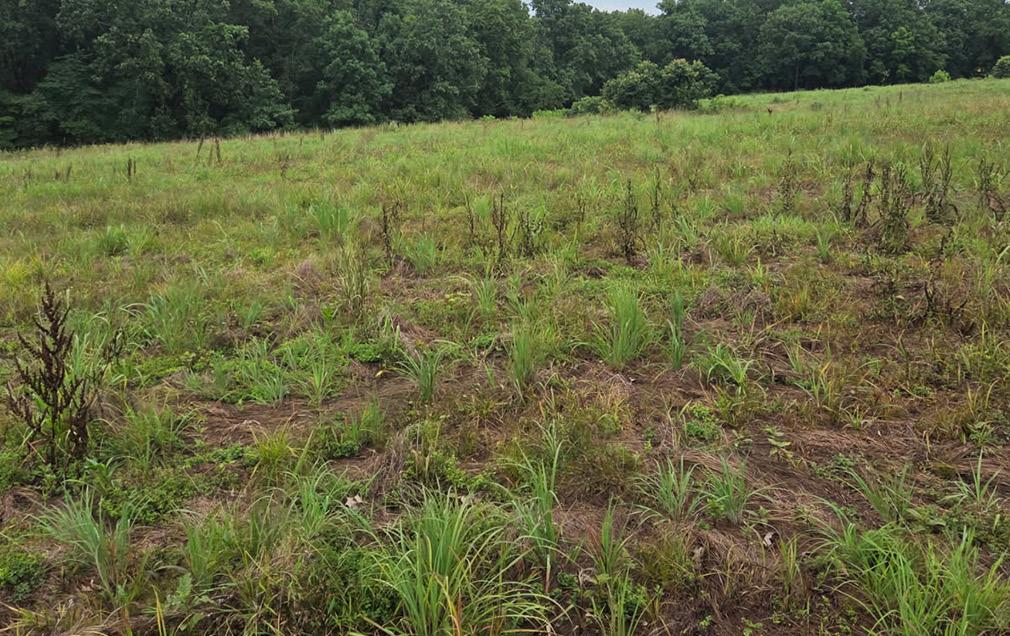
Agriculture, cattle and horse training have all taught me the same lesson – patience matters. From working with waspy horses to planting my first warm season grass field, I’ve learned that when patience runs out, judgement can follow. Judgement is what truly sets us back. Since I’ve been with the Missouri Cattlemen’s Association and the Missouri Native Grasslands Collaborative, I have been boots deep in helping Missouri farmers with issues with their plantings of native warm season grasses.
Most cases I have dealt with involve improper drill set up, setting depth too deep, not having proper seed boxes on the drills themselves and/or the lack of availability for trained staff to follow up after planting. There have been several visits I have made where plant identification was an issue to properly identify if a stand was present or if weeds were winning and how to defeat the weeds.
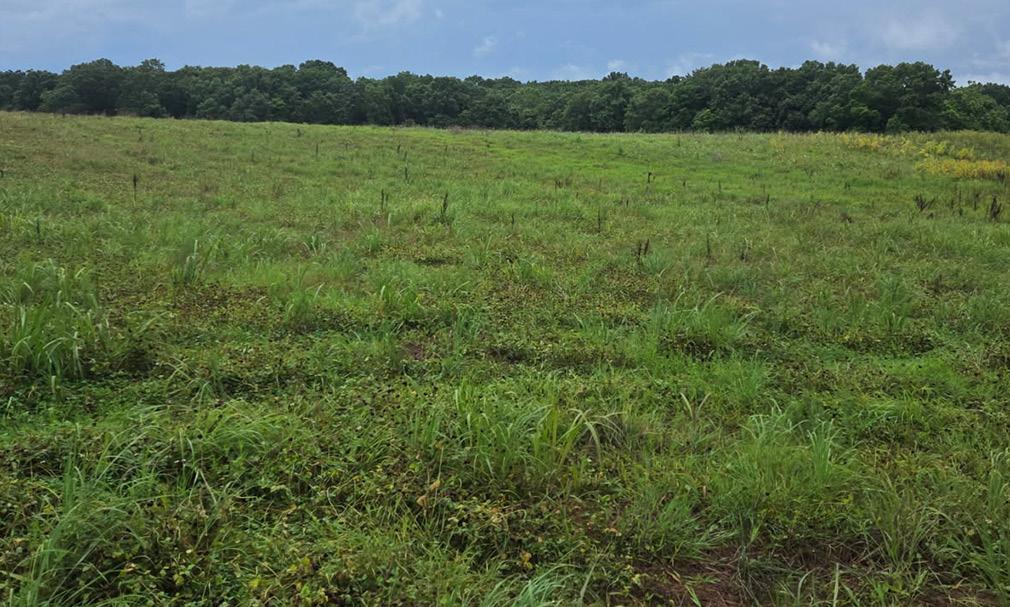
The latter of those cases seem to be at the forefront of last year, and I am sure that there will be even more coming up this year. As we all know, some agencies cannot give out chemical or spraying advice. They then rely on the retail vendor to give landowners proper advice. This is where I feel it is vital to seek the resources available to get good sound advice for the specific “obstacle” you are dealing with. The MoNGC has a website with a lot of available resources specifically on Native grasses, and you can contact a regional grazing coordinator like me through the Missouri Cattlemen’s Association for good sound advice. Before
After
Last year, one of these types of situations was brought to me through a Quail Forever partner in southeast Missouri. This field had more weeds appearing than natives. After a thorough site visit and a team approach, the landowners are thrilled instead of disappointed and excited to move forward utilizing warm season grasses. Remember this is an ongoing process, but as you look at the pictures of before and after, remember “patience is a virtue” and there are resources available to help overcome any obstacle you are dealing with.
Please feel free to contact your MCA regional grazing coordinator with any issues you are having on your operation.
For help with management of native grass, or for help identifying plants or weeds (feel free to text pictures) contact Missouri Cattleman’s Association Grazing Coordinators:
Region 2 • NE MO
Doug Mertens
Doug@mocattle.com
573-489-5261
Region 3 • SW MO
Kenneth Ball
Kenneth@mocattle.com
417-818-6400
Region 4 • SE MO
Micah Hans
Micah@mocattle.com
636-201-6846
Regional Range Report
by Warren Love, Region 6
Remembering a Friend
Whoa, I just had a change of plans of Region 6 happenings. My intent was to share concerns surrounding property rights: such as well water regulations, solar farm taxation and the importance of succession planning-so that the next generation can be prepared to step into the shoes of old codgers like me. But the passing of Burliegh Wheeler sent me in a new direction. I was on my way home from the MCA Executive Council meeting last Thursday when I heard the news. Fittingly, Thursdays have been Sale Day at Wheeler’s Auction for nearly 40 years.
Sunday afternoon was the family visitation, with a line of people waiting to pay their respects. This line stretched nearly two blocks, with a wait time of several hours. Then on Monday nearly 500 people attended the memorial service. Among all these people, were lots of boots and cowboy hats to be seen. I guarantee you that every person would have had a story to tell about their friendship and/or business dealings with Burliegh Wheeler. I personally have several and since I am writing this article, I’m going to tell a few.
My first memories of Burliegh go back to the early 1960’s, when I was riding and showing horses. I was still young enough to be in the 12-and-under classes, so I never competed against him. He was already riding and showing in the open division, and he was a tough competitor.
By the late 1960’s, he was furnishing some salty, rank Charolais cows to the Osceola Annual Showdeo for the wild cow riding event. About twenty of us wannabe riders, entered that contest. Those cows were plum ornery and bucked hard. Only two riders qualified: my Uncle Howard Hart and Johnny Ritchie from Monagaw Springs.
About that same time, my Uncle Howard and Burliegh coon hunted together. Burliegh always had good hunting hounds, and my uncles were not quite as good. They hunted hard, many times nearly all night. The arrangement was that Uncle Howard would stretch and clean all the coon hides for half the money. They caught coons into the hundreds and sold them for $1.05 each.
Region 1 VP - Ethan McNeill
Region 2 VP - Blake McDonald
Region 3 VP - Danny Ross
There was a black-and-white photo of coon hides covering the side of a barn displayed at his memorial service.
When I sold Moorman feed, Burliegh was one of my customers. He and Lionel Lear, from Humansville, partnered up and bought older cows, sending them to a rented place near Cole Camp. They fed free-choice small Mintrate blocks because they could put out a week’s supply at a time.
I was always a little anxious when I called on Burliegh to write an order because you never quite knew what kind of mood he might be in. So, I usually stopped by in the evening, because his wife, Doris, would always make you feel welcome with something to drink and maybe one of her famous cinnamon rolls.
When I campaigned for the State Legislature, Burliegh and Doris supported me. They always allowed me to post my campaign signs at the entrance of the auction barn on Highway 13 and on the fence in front of their home.
About five years ago, the Old George Ranch across the highway from their ranch sold at auction, and Burliegh purchased it. That same day, I bought a WD Allis-Chalmers tractor. The next week, I was loading the tractor onto a trailer when Burliegh pulled up in his pickup. We visited awhile, and he said he had a small AC Roto Hay Baler stored in a shed at his old home place. I got in his truck, and we drove over to look at it. It was a really nice baler, and I bought it.
On the way back, he drove a different route through the Vista backroads and gave me a tour. He pointed out places he had bought through the years. They had new fences and were well kept, but he was also quick to criticize — in not-so-kind words — other properties that were not well maintained. You could tell Burliegh was a good steward of what Divine Providence had blessed him with.
In closing, in cowboy lingo, you could say Burliegh swung a long rope with a big loop that touched the lives of thousands of people in the cattle and horse business. He was a man who rode for his brand. He will be missed but not soon forgotten.
NASHVILLE, Tenn. (Feb. 6, 2026) – Since 1850, Gene Copenhaver’s family has been rooted in the land raising crops and livestock. The Virginia cattleman now takes the helm as the new president of the National Cattlemen’s Beef Association (NCBA). Copenhaver’s new leadership role began at the end of CattleCon 2026, held this week in Nashville, Tennessee.
The 2026 NCBA officer team was approved by the NCBA Board of Directors and includes Kim Brackett of Idaho, president-elect, and Skye Krebs of Oregon, vice president. Kenny Rogers of Colorado was elected chair of the NCBA Policy Division and Scott Anderson of Oklahoma was elected policy vice chair. Travis Maddock of North Dakota and Dan Hanrahan of Iowa, were elected as chair and vice chair of the NCBA Federation Division, respectively. Brad Hastings of Texas will serve in the role of NCBA treasurer.
Copenhaver currently manages his family’s stocker operation in southwest Virginia with his son, Will, and was an agriculture loan officer for 38 years. He has been married to his wife, Jodi, for more than 35 years, and they have three grown children, Brad, Will and Jaymee, and three granddaughters.
Copenhaver’s father taught him early to “be at the table,” especially when policy decisions were being made. About 25 years ago, he helped launch a county cattlemen’s group, then worked his way through leadership roles at the state level, eventually serving
Buffalo Livestock Market
1 mile west on Hwy 32 • Buffalo, MO 65622 Barn: 417-345-8122
Sale Every Saturday 12:00 Noon
• Selling 1200 to 1700 head Farm Fresh Cattle weekly
• Special Stock Cow and Bull Sale 3rd Tuesday night of each month at 6:30 p.m.
• Pre-Vac Feeder Calf Sales 2nd Saturday of every month in conjunction with Regular Sale (Pfizer Pre-Vac, BLM BPre-Vac, Bayer Program, Mo Quality Assurance. LMA-Vac and MFA Health Track)
Order Buying Service Available Owners… Lyle Caselman Leon Caselman 417-345-7876 H 417-345-4514 H 417-533-2944 cell 417-588-6185 cell
as president of the Virginia Cattlemen’s Association. Nationally, he became involved with NCBA, serving on the Tax & Credit and International Trade committees, multiple task forces, and the officer team. If there is a single theme to his leadership philosophy, it is grassroots engagement.
“I’ll go to my grave saying our greatest strength is grassroots,” Copenhaver said.
The new president’s priorities are straightforward: continue what works, stay grounded in grassroots input, remain open-minded, and focus on profitability. Copenhaver wants every sector and every scale of operation to be viable. That means pushing back against regulatory barriers, supporting policies that allow reinvestment, and building on recent momentum around tax provisions.
“We can’t build the future if every good year gets taxed away before we can shore up our infrastructure,” he said.
Copenhaver remains optimistic about the future for two reasons. First is the demand the beef industry has built steadily in the last four decades. Second is the next generation — young producers who are smart, relationship-driven, and family-centered, and who want to build operations that last.
Success, for Copenhaver, is not complicated. “Build a good operation. Involve your family. Treat people right,” he said. For the industry, it means continuing to grow demand and profitability across all sectors without losing sight of its roots.
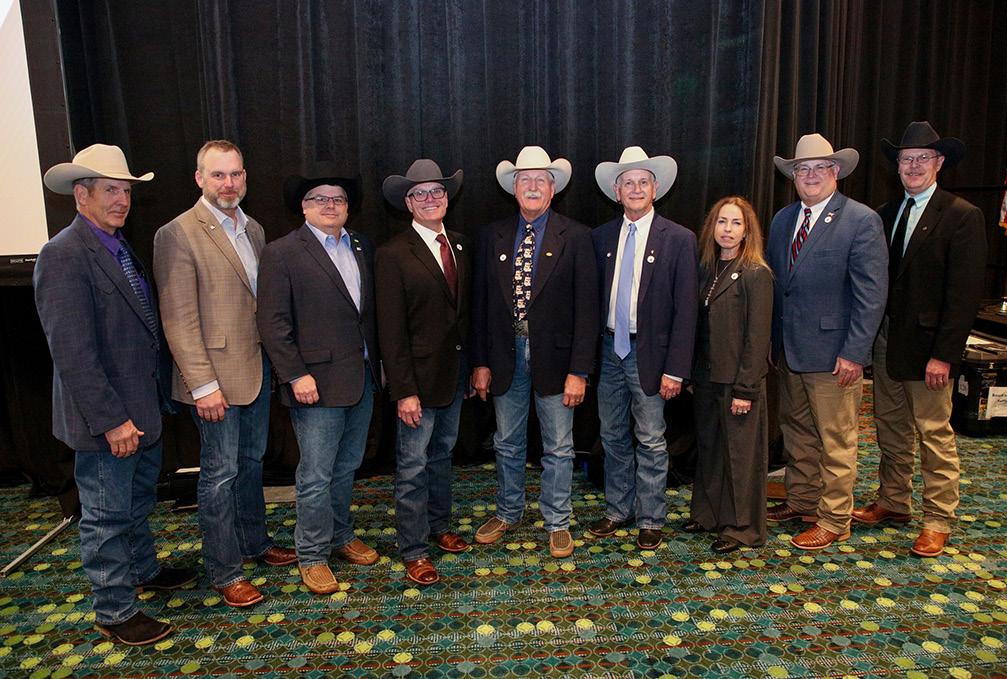
Skye Krebs, Dan Hanrahan, Travis Maddock, Brad Hastings, Kenny Rogers, Buck Wehrbein, Kim Brackett, Gene Copenhaver, Scott Anderson (left to right)
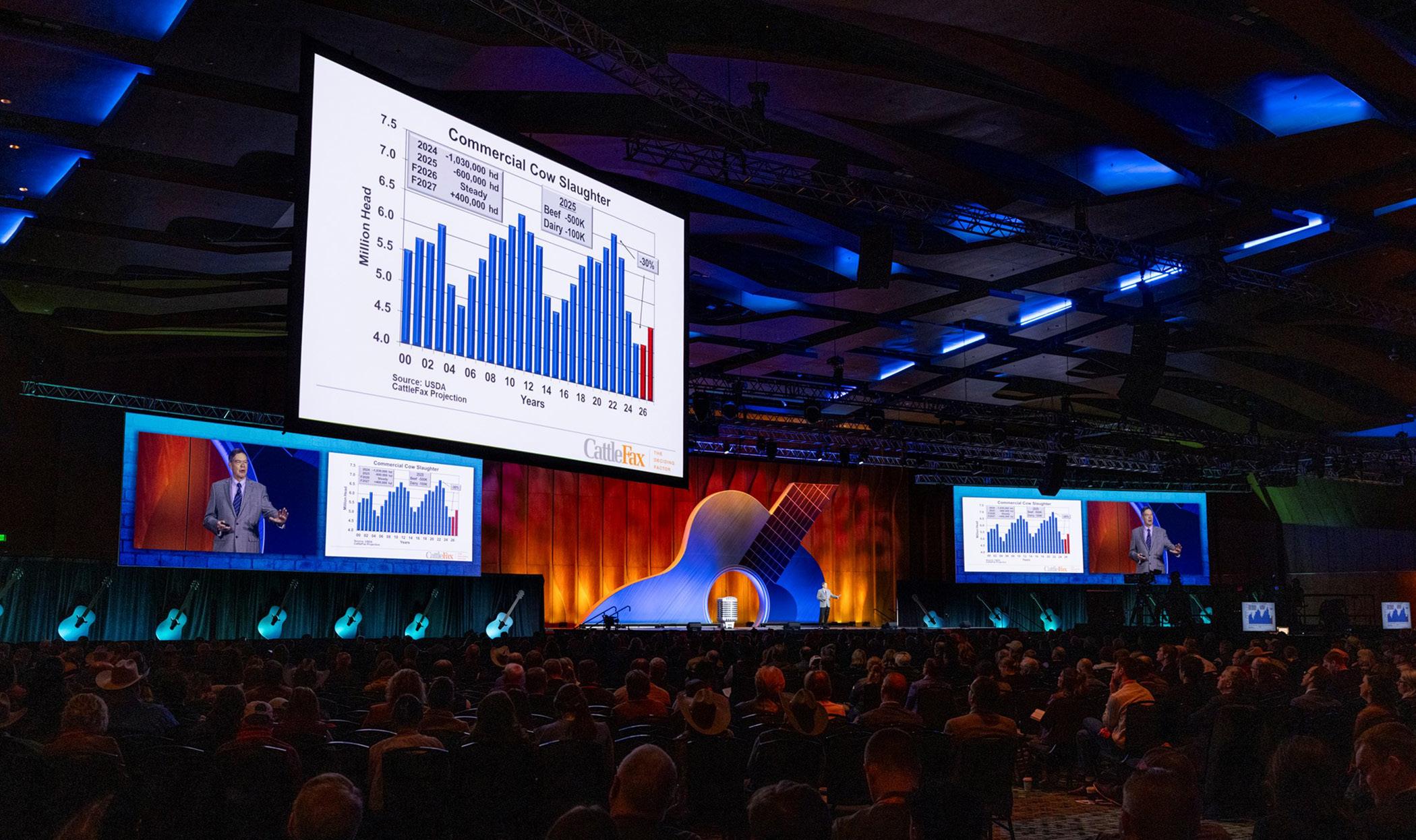
CattleFax Outlook Signals Cattle Cycle
Turning as Strong Demand Meets Tight Supplies in 2026
Source: NCBA
NASHVILLE, Tennessee (Feb. 5, 2026) — The popular CattleFax Outlook Seminar, held as part of CattleCon 2026 in Nashville, Tennessee, shared expert market and weather analysis today.
“The U.S. cattle and beef industry enters 2026 with strong but volatile market conditions, as historically tight cattle supplies, record-setting beef demand, and elevated policy and weather uncertainty continue to support prices, even as markets appear to near cyclical highs. Tight inventories and exceptional demand remain the dominant forces shaping the market; however, producer demographics, high input costs, and policy uncertainty point to a slow and measured expansion phase,” said Mike Murphy, CattleFax chief operating officer.
Weather Outlook: Transition Brings Risk
La Niña continues to weaken and is expected to dissipate by March, with a transitional phase most likely through spring and early summer. “We’re watching a classic transition year unfold,” said Matt Makens atmospheric scientist. “Even as the ocean changes, the atmosphere typically takes four to eight weeks to respond, so weather impacts will lag.”
In the near term, drought risks remain elevated across the Southern U.S. and Central Plains, with a 70% chance of intensification, especially south of I-70 and west of I-35.
Spring’s neutral setup may help moisture distribute more evenly, though lingering La Niña effects could still limit precipitation west of I-35. Summer outcomes hinge on how quickly a potential El Niño develops. A fast forming El Niño could deepen drought in corn growing regions while increasing precipitation in the West, whereas slower development may support more balanced moisture. By fall, El Niño becomes increasingly likely, though global climate factors could still alter its typical impacts. “El Niño isn’t a guarantee of rain for everyone,” Makens said. “Other global patterns can amplify or mute its influence, so close monitoring remains essential.”
Economic, Energy, and Feed Grain Outlook
Shifting the discussion to an outlook on the economy, energy and feed grains, Troy Bockelmann, CattleFax director of protein and grain analysis, noted that inflation continued to moderate in 2025, ending the year at 2.7% CPI growth and spending most of the year below 3%, the lowest since 2020-2021. With inflation relatively low, the U.S. Federal Reserve lowered interest
rates in 2025, finishing the year with the Prime Rate just below 7%, which is still relatively high relative to the 3% level seen from 2009 to 2021.
“After several years of navigating economic turbulence, the U.S. is finally entering 2026 with a macro-economic foundation that feels steady and more predictable,” said Troy Bockelmann. “Moderating inflation, improving monetary policy, and strong consumer spending are reinforcing the sense of stability across the industries we serve.”
U.S. corn production reached a record 186.5 bu/acre in 2025, driving total output to 17 billion bushels from 98.8 million planted acres. Competitive prices and ample supply are expected to boost exports in 2026. With a 13.6% stocks-to-use ratio, corn prices should stay in the $4–$5/bu range.
CattleFax shared that U.S. hay production increased slightly in 2025 to about 123 million tons. Hay prices are expected to average around $145/ton in 2026. On the energy front, Bockelmann said that energy supply should remain adequate, keeping prices low and rangebound for diesel, natural gas and oil. When taking a look at competing proteins, pork and poultry markets are expected to see modest growth in 2026.
Kevin Good, vice president of market analysis at CattleFax, reported the U.S. beef cow herd decreased 280,000, while dairy cow inventories increased by 190,000 head.
Cattle availability will remain constrained in the first half of 2026 due to limited feeder cattle supplies. Fed slaughter is projected to decline by 600,000 head, primarily early in the year, and non-fed slaughter is expected to remain historically tight at 5.6 million head. Total commercial beef production is projected to decline again in 2026, albeit at a slower pace than in 2025. With imports up 5% and exports down 5%, U.S. per-capita beef supplies are forecast 0.2 lbs. larger in 2026 to 59.2 lbs., the largest since 2010.
Retail beef demand remained historically strong in 2025, with record retail prices supported by steady consumption and exceptional product quality. Consumer preferences continue to favor high-protein, nutrient-dense foods, reinforcing demand even as higher prices move through the supply chain.
“With 84% of fed cattle grading Choice or higher and 12% grading Prime, the industry is well positioned to sustain premium pricing,” Good noted. “Beef demand continues to be anchored by exceptional quality and
strong consumer confidence in beef as a premium protein. Even as markets adjust and trade flows shift, the fundamentals supporting long-term beef demand remain solid.”
Price Outlook for 2026
Cattle and beef prices are forecast to average steady to higher in 2026, with risk increasing later in the year as markets anticipate larger supplies in 2027.
Cow-calf producers are expected to retain the strongest leverage as the cycle turns, supporting continued profitability for several more years. CattleFax forecast the average 2026 fed steer price at $224/cwt., steady from 2025. All cattle classes are expected to trade higher, with 800-lb. steer prices expected to average $335/cwt., and 550-lb. steer prices averaging $440/cwt. Utility cows are expected to average $155/cwt., with bred cows at an average of $4,000/cwt.
2025 USDA All-Fresh Retail Beef prices are expected to average $9.25/pound, however, the continued increase in retail prices has CattleFax predicting consumer resistance to further price increases, even as demand is supported by a strong economy, beef quality and dietary focus on protein.
“As we look ahead, several factors will shape the trajectory of the beef industry. The potential threat of New World Screwworm and the status of Mexican feeder cattle imports is something we’re watching closely,” Murphy said. “At the same time, shifts in packing capacity are rebalancing market leverage. Finally, the dairy industry will continue to be a growth industry supplying more cattle to the beef industry, following strong financial performance in 2025.”
Despite near-term volatility, the long-term outlook remains positive. Strong domestic demand, improving beef quality, and sufficient packing capacity are expected to continue supporting profitability for the cow-calf sector as the industry moves into the next phase of the cattle cycle.
and
Give me a call for your next trailer 800-897-9840 www.Jimsmotors.com
Welcome
Scott Cape, Owner of Jim’s Motors in Cuba, Missouri. All I have ever done is sell
trade trailers.
COUNTY NEWS
See What’s Happening in Your County
Dallas County Cattlemen
Beautiful weather greeted members of the Dallas County Cattlemen’s Association (DCCA) at our first meeting of 2026. The February 10th meeting was held at Prairie Grove School south of Buffalo. The 105 members and guests enjoyed chili and a variety of other soups prepared by DCCA officers and board members. Special thanks to the ladies of the community for the delicious homemade rolls and desserts.
The meeting saw a new record set for the annual pie auction which generated $3,110 this year. Since its inception in 2012, the auction has raised nearly $33,000 to help deserving students continue their higher education as well as benefit other youth activities and young cattlemen.
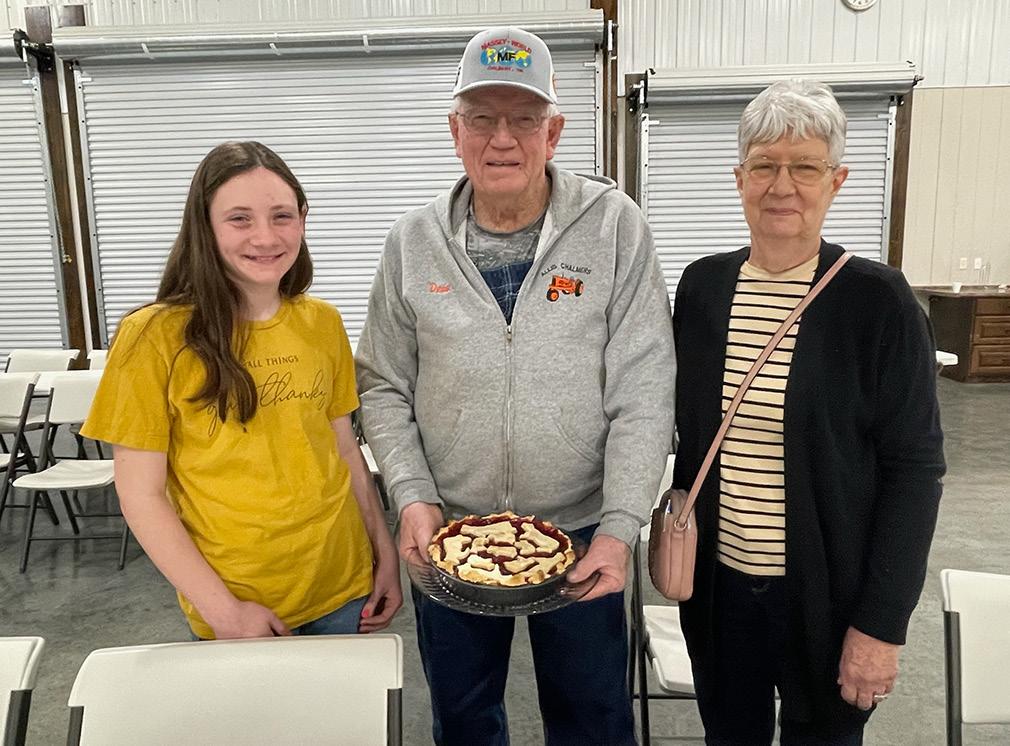
Once again Molly McCorkill baked the winning pie-a cherry pie selling to board member Jeff Voris for $425. Molly has racked up quite a string of consecutive high sellers. Jeff then donated the pie to his father, Dean Voris, for his birthday. DCCA would like to thank Ashtyn O’Malley for helping organize the pies for the auction as well as Buffalo FFA students for their help during the auction.
What would a pie auction be without Mike Deering??
We are so glad Mike was able to join us again this year. He spoke to the group about victories for cattlemen in the last legislative session as well as priorities for 2026. We were glad to hear there will be no changes to property tax rates. He said eminent domain is wrong and is being abused. MCA is working with Farm Bureau
to ensure landowners are treated fairly. Other priorities include solar development and addressing the shortage of veterinary students.
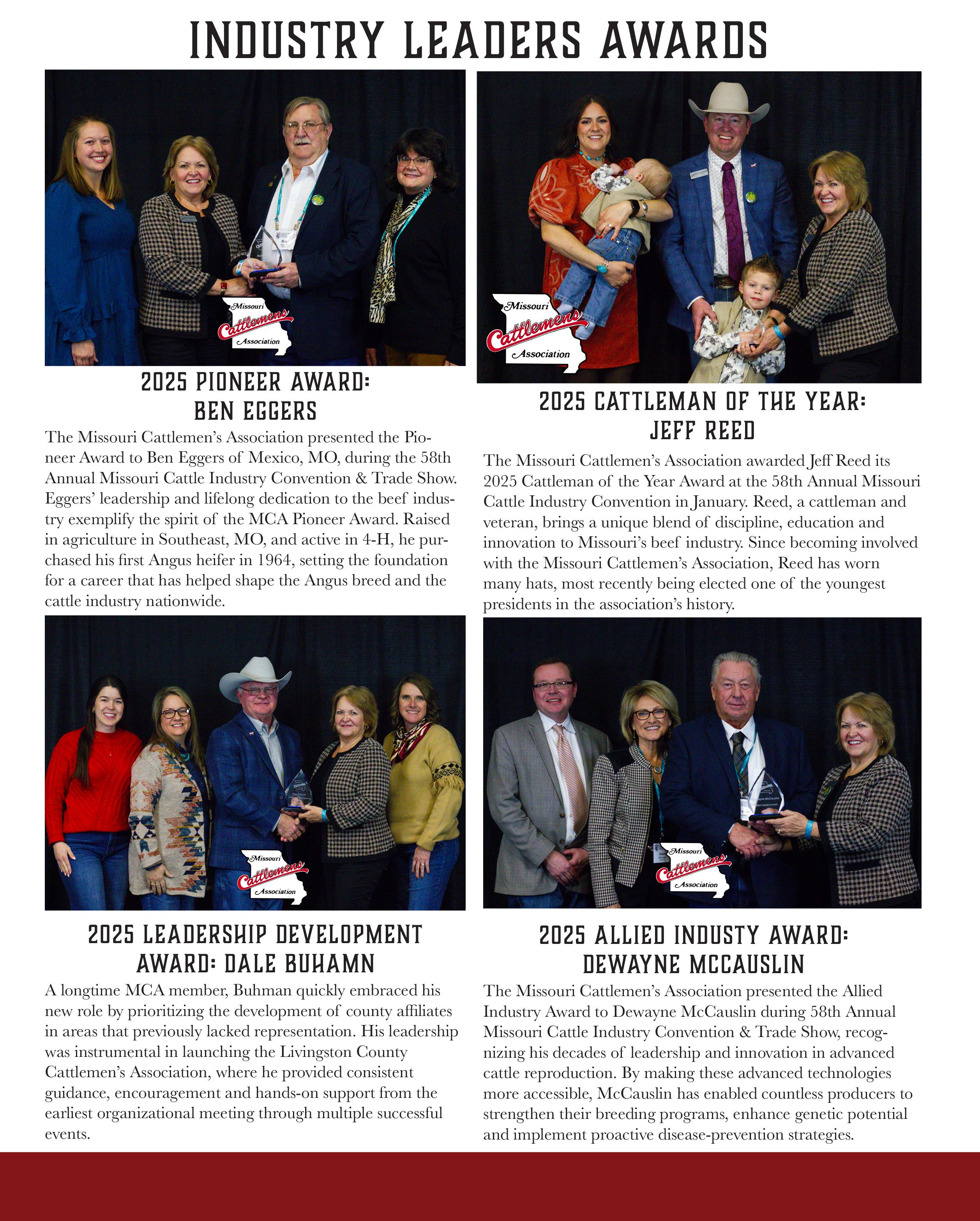
We also appreciate past president Jeff Reed attending. Jeff even took home a pie! Jeff explained the MCA dues increase which was voted upon by membership at the recent convention. He said it is necessary to put more dollars into getting priorities passed as well as hire and maintain staff.
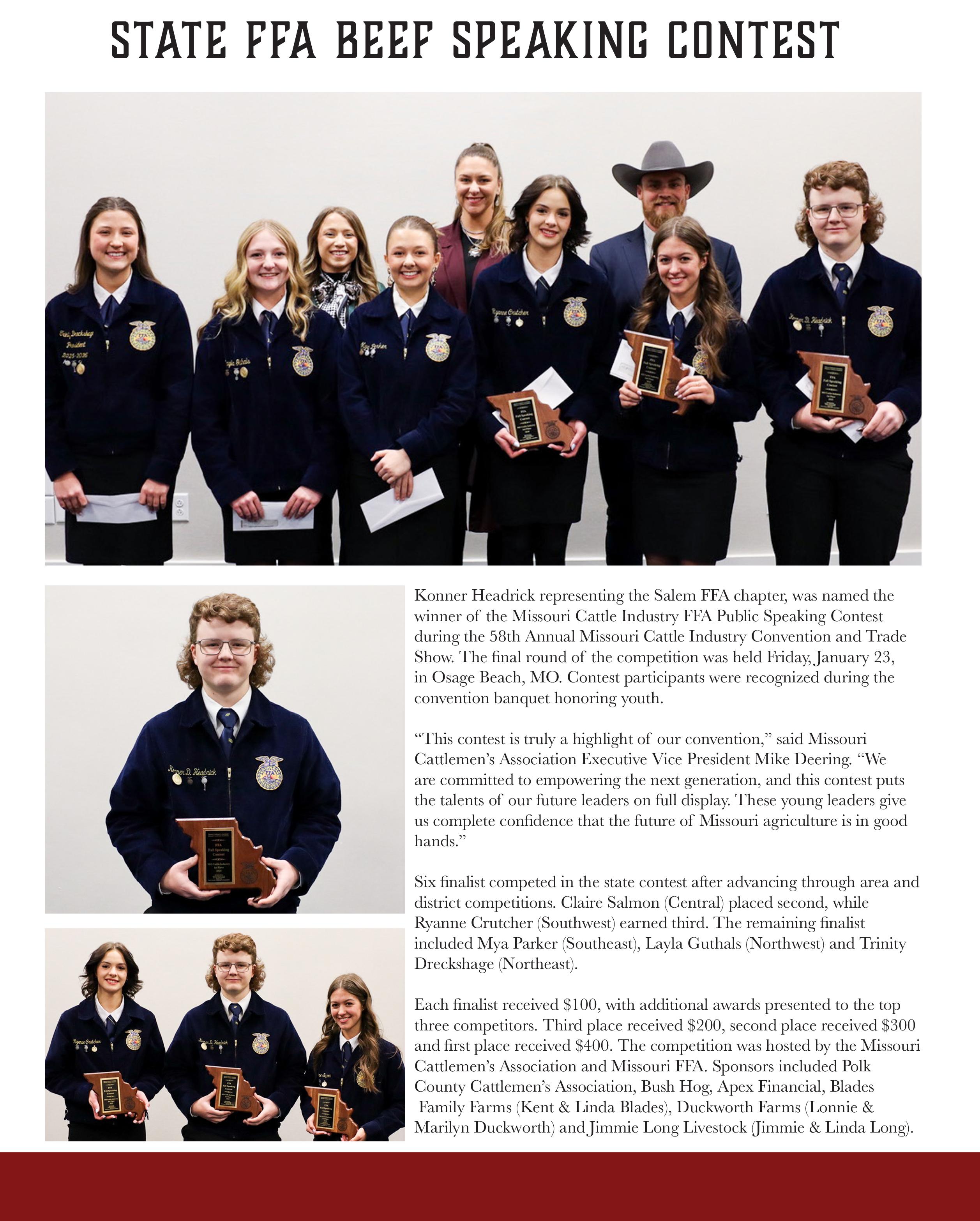
Buffalo FFA president, Jordan Tucker, and other chapter members talked about upcoming activities. She was pleased to report that four members will be receiving state degrees this year. We wish them the best of luck in upcoming contests.
Molly McCorkill, Dean Voris, and Mary Voris at DCCA mtg.
Bates County Cattlemen
The Bates County Cattlemen met on February 10 at Heritage Tractor in Adrian, Missouri. A meal of BBQ was catered by Ritchie Davis and was sponsored by the USDA.
The Bates County Cattlemen met on February 10th at Heritage Tractor in Adrian, MO. A meal of BBQ was catered by Ritchie Davis and was sponsored by the USDA.
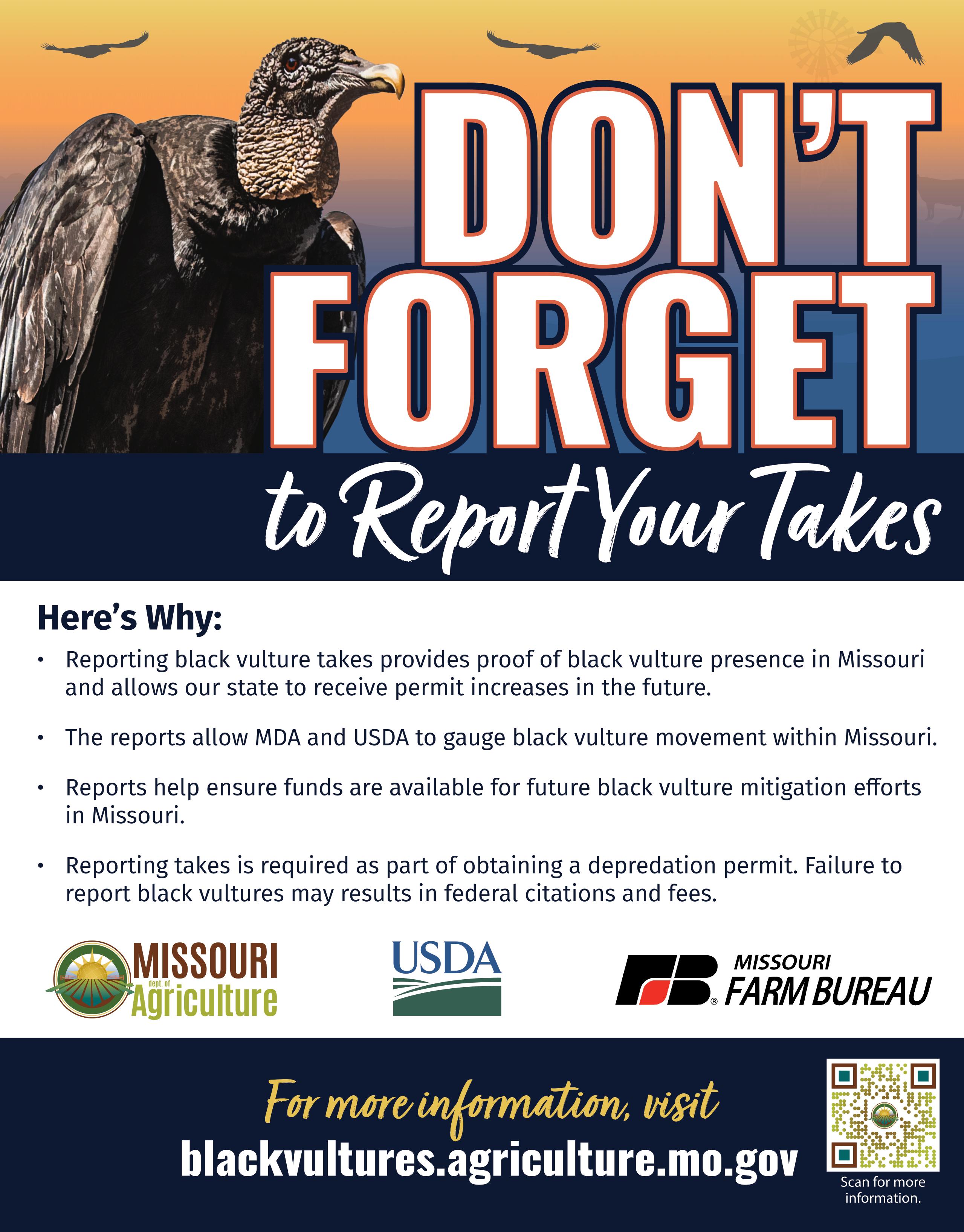
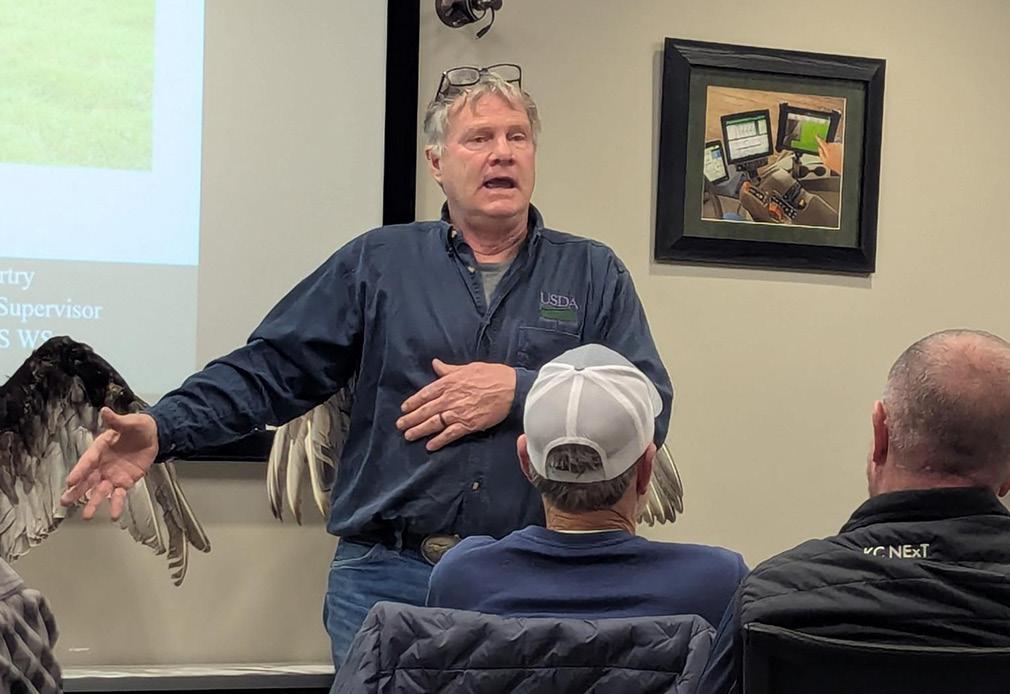
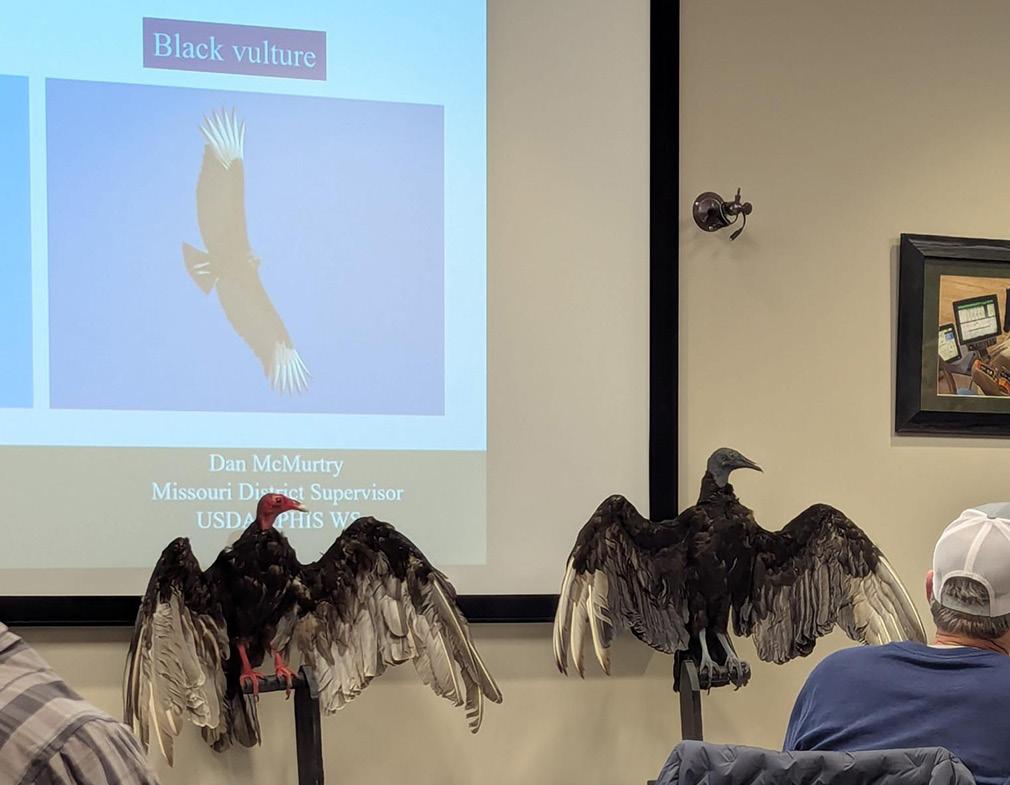
Dan McMurtry of the USDA gave a presentation on black vultures. He gave tips and tricks on how to
minimize the vulture population on your property and on improving calf mortality by doing so. He also discussed the licensing process to harass/kill black vultures. A license through the Farm Bureau limits you to five vultures (kills). Dan brought with him, both a turkey vulture and a black vulture and discussed the differences.
Tammy Bartholomew gave an update on MBIC and the 2026 Beef Check Off.
Vulture Display
Dan McMurtry - USDA
Southwest Missouri Cattlemen
Here we go again…spring is right around the corner! It’s time to pause long enough to see the new calves high-tailin’ it around green pastures like children in a playground. To witness tall grass become tall windrows, then seemingly overnight become perfectly round bales of hay, seemingly scattered yet perfectly in line across endless fields. While I miss the memory of buckin’ and stackin’ small squares, I’m grateful for the technology and equipment that allows us to move hay safely and efficiently—even on days when it’s painful to roll out of bed and outside it’s a bone chilling 12° with 15 mph winds out of the North.
Do you look forward to the upcoming production sales in Southwest Missouri? I sure do, in fact my spouse now takes credit for taking me, counting them as “Date Night”. It doesn’t matter if we’re buying, selling, testing our resolve not to buy, or just there to say “Howdy!” to friends we may only see a few times a year. I suppose “looking forward to” is an understatement. Around January 1st, I anticipate the spring sale catalogues rolling in, then start planning which ones to attend as if planning for vacation.
When selecting sales to attend we prioritize those with cattle owned by SMCA members. These are folks we see on a regular basis that also support the protection and rights of cattle ranchers. They spend their hard-earned dollars locally, handle cattle following BQA guidelines, and produce cattle that thrive on fescue in a similar environment.
One of those folks is Traves Merrick, with Gleonda Angus Farms. Traves was keynote speaker and meal sponsor for our February meeting. He presented an update on their bull selection philosophy and an overview of the bulls that will be offered in their upcoming 66th Anniversary Sale on April 11th at their farm (9.5 miles south of Lockwood on Hwy 97). They’re also home to The Farm Shop, offering Certified Angus Beef and other specialty beef products for sale.
The Show-Me-Select Replacement Heifer sale is one of my personal favorites to attend, both as buyer and seller. The SMCA regularly has heifers enrolled by our membership, including Eugene Dilbeck, Meadowlyn Farm LLC, Nolan Kleiboeker Farm LLC, and ShowMe Prime Angus Ranch (my entries), as well as those from surrounding Cattlemen’s Association chapter members. The Spring sale will be held 7 p.m., Friday
May 15th, at the Joplin Regional Stockyards. The program objectives include:
• Improved heifer development through a Total Quality Management strategy.
• Increased marketing opportunities for and added value for Missouri-raised heifers.
• Creation of reliable sources of quality replacement heifers based on management, reproductions and genetics.
Heifers must be owned by Missouri residents, meet vaccination requirements and rigorous pre-breeding evaluation, pass inspection by a certified USDA grader for a multitude of criteria, be free of blemishes and undesirable disposition and bred to a pre-approved calving ease sire, among others. If you have any questions about the program please reach out to your fellow chapter members, or Patrick Davis, the SW MO SMS Regional Coordinator and MU Extension Livestock Field Specialist, at davismp@missouri.edu, or (417) 276-3313.
There are a couple additional upcoming sales in Lawrence County. The SMBCIA All Breeds Performance Tested Bull sale is only open to Missouribased consignors in the SW Region. The bulls must be genomically tested and meet minimum growth and performance standards, and free from genetic defects. The spring sale will be held at 7 p.m., Monday March 30th at the Springfield Livestock Marketing Center. For more information contact sale manager Chase Hultgren at chahul04@gmail.com or (417) 880-4479.
The Four States Angus Association will hold its 96th Annual Finest Bull and Female Sale on Saturday April 4th, starting at 12:30 p.m., also at the Springfield Livestock Marketing Center. You can anticipate the opportunity to purchase elite bulls, pairs, bred heifers, and frozen genetics from standout breeders in Southwest Missouri. For more information contact sale manager Brett Naylor at (417) 880-6873.
Thank you for your ongoing support of cattle producermembers in the Missouri Cattlemen’s Association, and especially for those in the areas served by your Southwest Missouri Cattlemen’s Association.
Our next SMCA meeting will be Tuesday March 3rd at 7 p.m. in the Southwest Research Center. We hope to see you there!
Danise Cummings Secretary, Southwest Missouri Cattlemen’s Association Co-Owner, Show-Me
Prime Angus Ranch LLC
Texas County Cattlemen
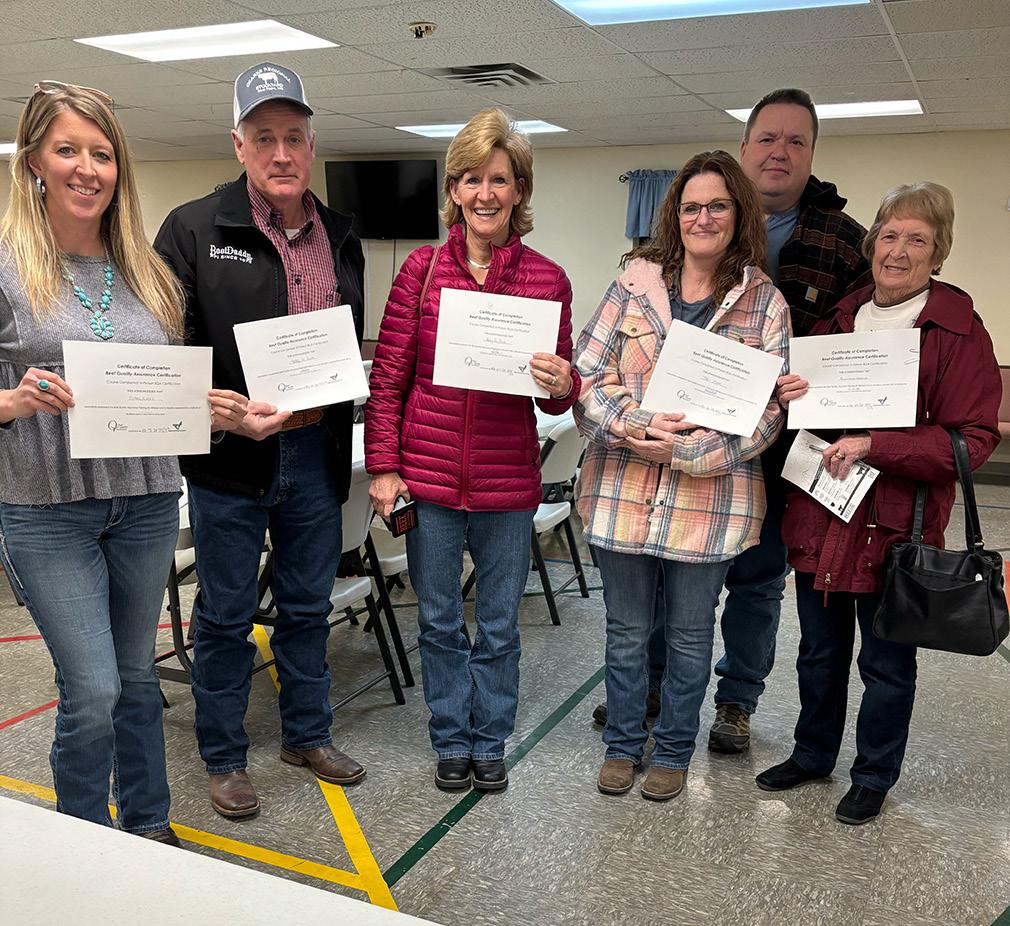
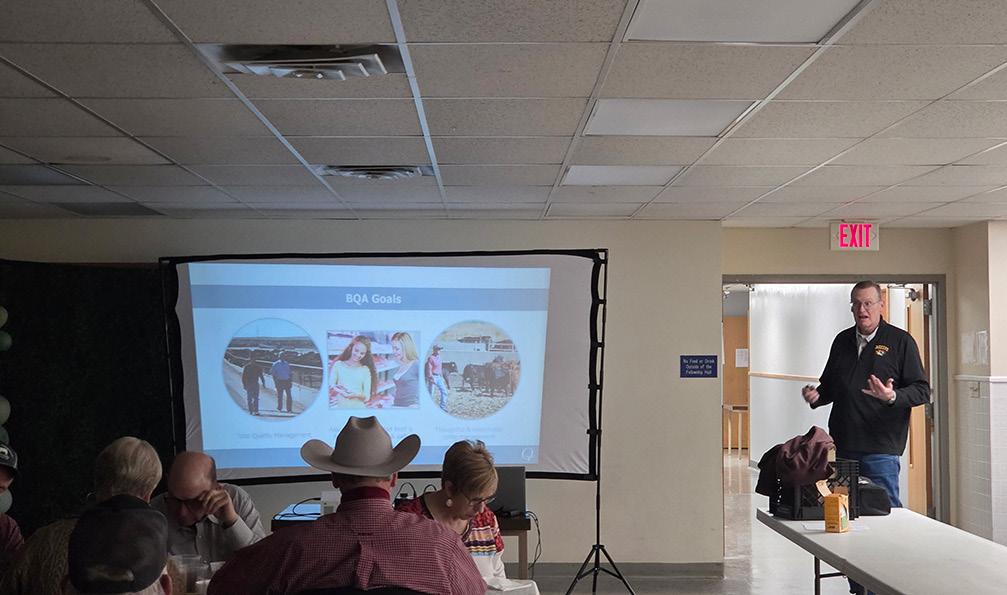
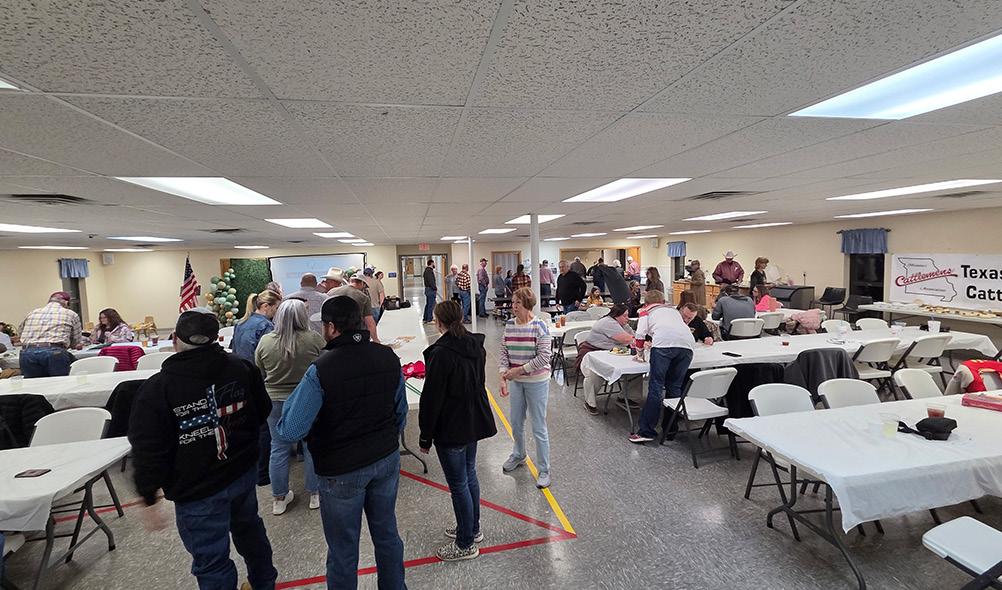
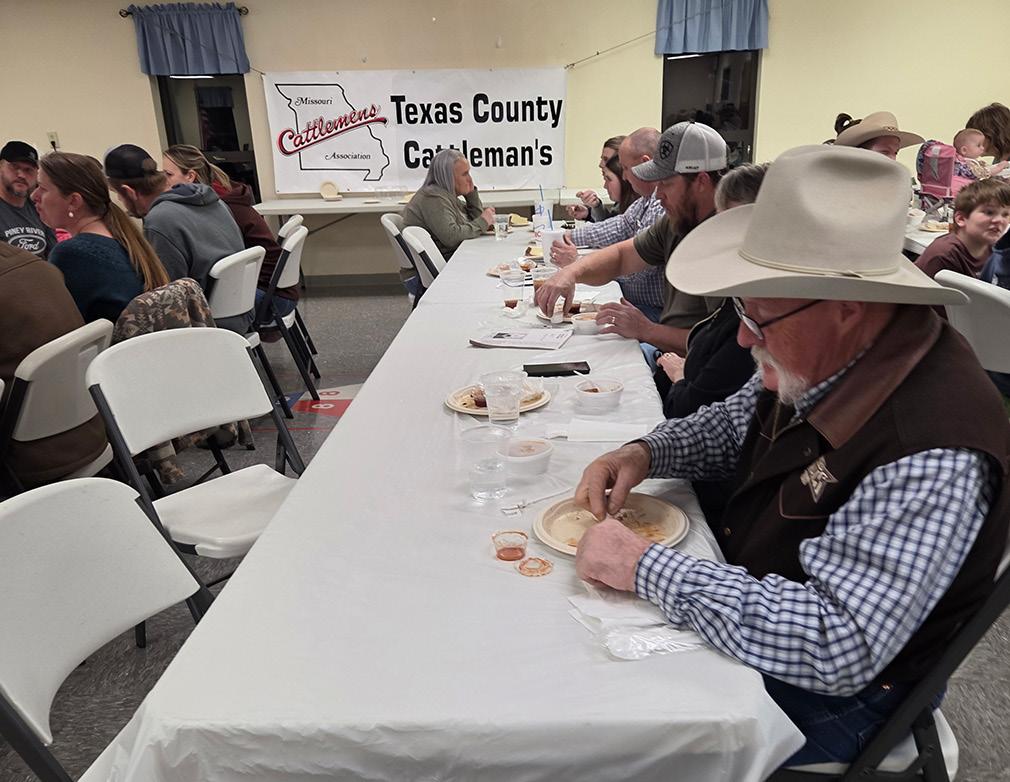
On February 5th, the Texas County Cattlemen’s Association met at the Houston First Baptist Church. The 63 members in attendance enjoyed a meal from Savors provided by Progressive Ozark Bank. During the meeting, business was discussed about attending Cowboys At The Capitol and Vice President, Danny Ross, was celebrated for being named as Vice President of District 3. They also discussed the upcoming raffle and seeking business sponsors for the food trailer. MU extension was the main speaker of the meeting and they walked members through the process of attaining their Beef Quality Assurance Certificate. They gave attendees facts and tips on cattle care, handling, and
environment. The meeting was wrapped up by covering the importance of record keeping. The next meeting will be held on March 5th at 6:30 p.m. at the Houston First Baptist Church. All are welcome to attend.
Polk County Cattlemen
The Polk County Cattlemen’s Association has kicked off the year with energy, fellowship and strong showing across several events that highlight the dedication and spirit of our members. Our members continue to show what it means to be a farmer with the strength, dedication and community spirit that defines our members.
Chili Cook-Off Success
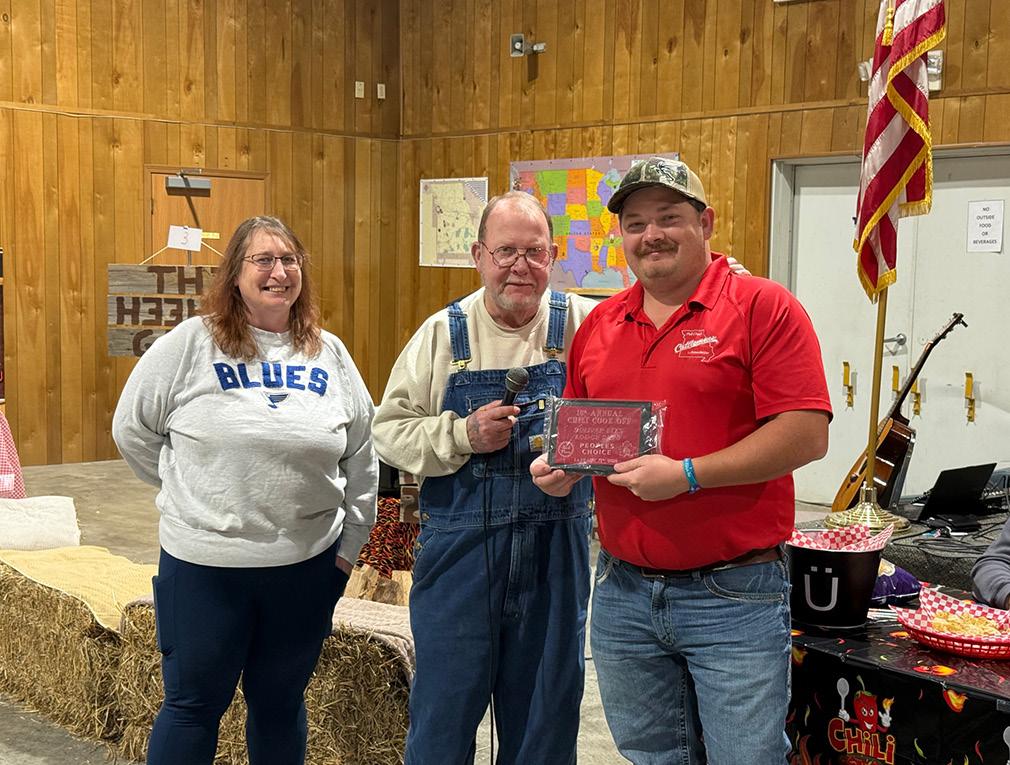
Our team brought the heat at this year’s Chili CookOff, earning 2nd Place in the People’s Choice category. This recognition reflects not only great chili but the camaraderie and pride our members bring to every event. Thank you to everyone who helped prepare, serve, and support the effort — your hard work truly paid off.
Polk County at Convention January 21st–23rd
Polk County was well represented at the annual convention held January 21st–23rd. Members attended educational sessions, networked with producers from across the state and brought back valuable insights to strengthen our local association. It was a powerful reminder of the importance of staying connected and engaged within the broader cattle industry.
Individual Top Hand Awards
We are proud to recognize several outstanding members who were honored with Top Hand Awards for their commitment, leadership, and service:
• Ed Vest
• Marla Moreland
• Matt Henenberg
• Mark Sconce
Their contributions continue to elevate our association and set a strong example for others to follow.
Scholarship Recipients
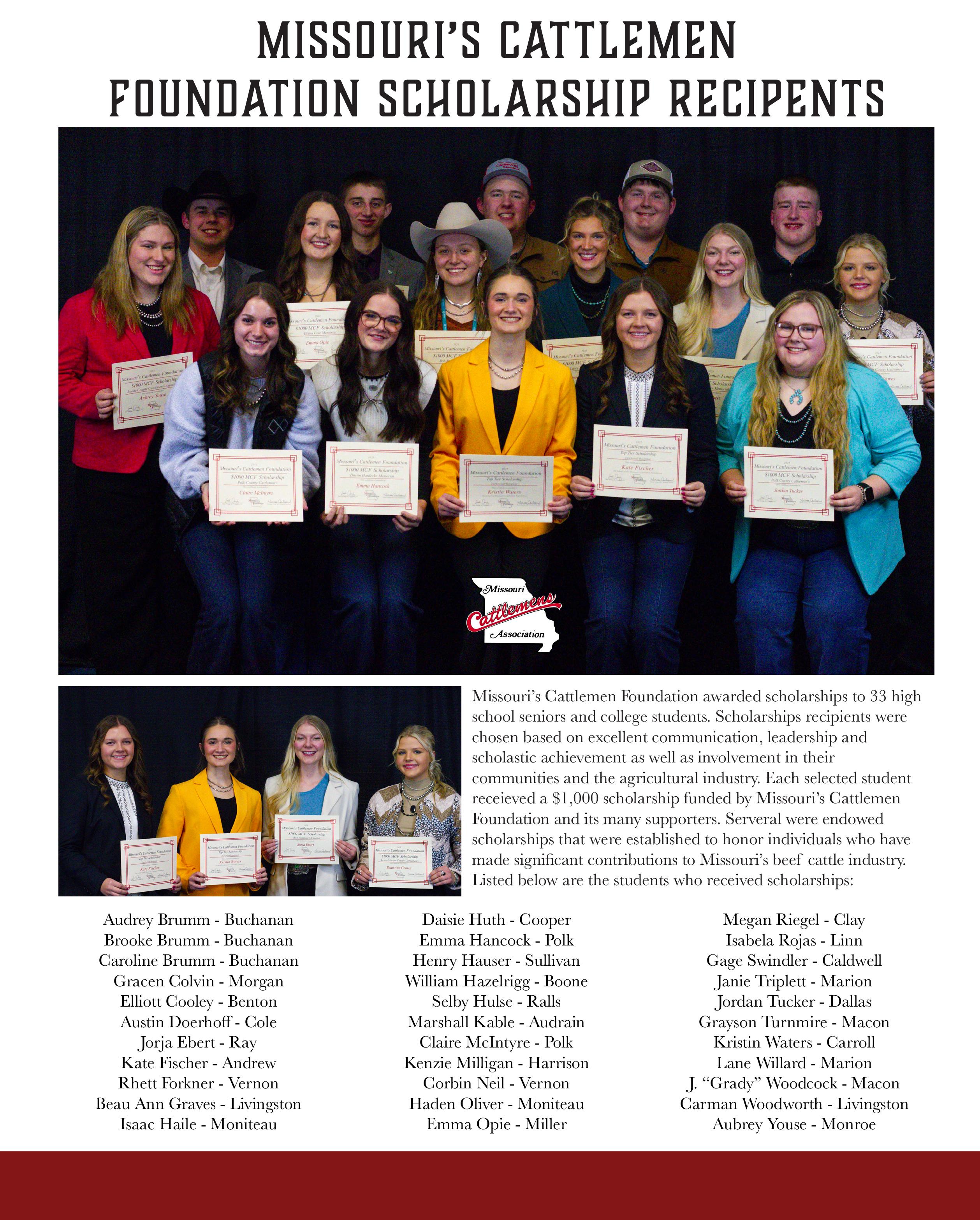
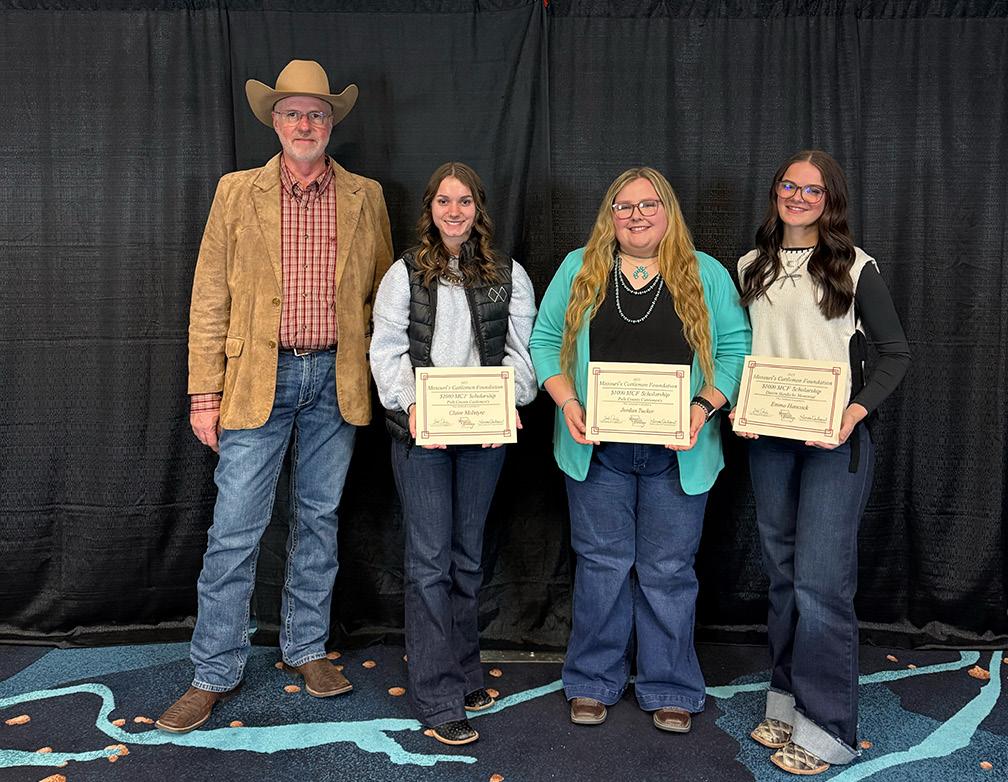
Polk County is also celebrating the achievements of two exceptional young leaders. Emma Hancock and Claire McIntyre were each awarded a state-level scholarship, recognizing their hard work, commitment, and bright futures in agriculture. We are proud to see Polk County represented so well at the state level.
As we celebrate these accomplishments and the strength of our Polk County community, we also pause to honor one of our own. Our association recently lost a valued member, Larry Lane, whose presence and dedication will be deeply missed. We extend our heartfelt condolences to the family of Larry Lane, a respected member of our association. We remember his contributions with gratitude.whose commitment and friendship enriched our organization. His legacy remains a part of who we are. His obituary follows, on page 53, as we reflect on his life, service, and the impact he had on all who knew him.
Scholars with Keith Stevens
Chili Cook-off
Burleigh Ray Wheeler
Burleigh Ray Wheeler was born on September 8, 1939, to John Wesley and Neva Lila (Burrow) Wheeler in Vista, MO. He passed away at Parkview Healthcare Facility in Bolivar, MO, after a brief illness, taking with him buyers cards, a pen, and a blank check to buy cattle. He was born and raised in the Osceola area, graduating from Osceola High School in 1957. At an early age, Burleigh was saved and baptized at Vista Baptist Church. On March 3, 1961, he was united in marriage to Doris Wisner. To this union, 5 children were born.
He grew up raising and showing Chester White hogs. He started hauling and trading cattle, and as he got older, he rented land and ran cattle across many counties before he opened a cattle buying station at his home in the early 80s. In 1989, he opened Wheeler and Sons Livestock Auction at the former Pasley Auction Company, and in 1994, he and Doris built what would become the area’s premiere livestock auction, located just off 13 Highway.
From hauling cattle to the Springfield and Kansas City Stockyards in a straight truck with his kids, friends, other farmers, or employees, Burleigh enjoyed being
with people and was happy to share his work ethic and agricultural knowledge with many young people he employed throughout his life.
When his children were young, he enjoyed spending weekends taking them and their horses to horse shows and rodeos. Burleigh had an eye for a good horse and always made sure his kids had the best horses. His kids never had the most expensive horses, but they were always well mounted to not only compete but also work. The horses were never just rodeo or show horses; they were working tools. Burleigh prided himself on being able to catch cattle that no one else could catch with horses and Catahoula dogs. He also loved coon hunting, coon dogs, and pheasant hunting and enjoyed sharing that with his children and grandkids.
After his children were grown and the sale barn was more established, Burleigh and Doris enjoyed traveling the country buying and selling cattle, where they made many lifelong friendships. He most enjoyed visiting sale barns in Dodge City, Kansas; Harrison, Arkansas; Faith and Phillip, South Dakota; and Ogallala, Nebraska, where he met many like-minded cattlemen that he maintained close contact with until his death. Burleigh was well known for establishing and maintaining the best stock cow sale in the Midwest, a legacy he prided himself on and carried into his retirement.
In his retirement, he enjoyed spending time at the sale barn on Thursdays and Saturdays and maintaining relationships with customers and friends. He also enjoyed seeing and spending time with all of his grandkids and great-grandkids and supporting them.
Burleigh is survived by his wife, Doris, and five children: Rhonda (Larry) Shelby, Karla (Tom) Waters, Donna (Brett) Shelby, Byron (Angela) Wheeler, and Steve (Kim) Wheeler; 14 grandkids, 23 great-grandkids, and many nieces, nephews, and friends.
He is preceded in death by his parents, John Wesley and Neva Lila Wheeler; sisters Zada Brown, Artalee Harris, Betty June Wheeler (in infancy), Bonny Gardner; and brother Tom Wheeler.
In lieu of flowers the family suggests contributions be made to Land-O-Lakes Youth Fair Grounds in care of Sheldon-Goodrich Funeral Home: P.O. Box 384 Osceola, Missouri 64776.
Larry Gene Lane
Larry Gene Lane (81) of Morrisville, Missouri passed away on January 29 as the result of a farm accident.
Larry was born in Missouri, the son of Clay Lane and Mary Loeta (Ryser) Lane.
Larry married Darlene Frazer on March 6, 1964, in Stockton, Missouri. They were married for 62 years. They have two sons: Jeff Lane and Greg Lane.
Larry will be remembered as a kind and caring man, a good husband, dad, and friend. He was a successful businessman having owned and run Missouri Livestock Supplements from 1984 until his retirement in 2018.
Larry raised cattle most of his adult life and continued as a cattle farmer after his retirement from business. He was one of the top Braunvieh breeders in the US, having the largest herd of full-blood Braunvieh in the nation. He was a life-time member of the Braunvieh Association of America, and a member of the Missouri Braunvieh Association where he served as president many years.
He was a member of the National Cattleman’s Beef Association, Missouri Cattleman’s Association, and member and past president of Polk County Cattleman’s Association.
Larry was an active member of Robberson Prairie Baptist Church where he was a deacon. He was always willing to do what was needed for the church and its members.
He is survived by his wife Darlene Lane, his sister Linda (Lane) Pierce and her husband David Pierce, his children: Jeffrey Lane & his wife Yvette (Ritter) Lane, and Gregory Lane and his wife Debbie (Green) Lane; grandchildren: Misty Lane, Nathan Lane, Nicole (Lane) Salas & her husband Miguel Salas and his greatgrandson Luca Salas.
Preceding Larry in death are his parents Clay and Loeta (Ryser) Lane and his infant son Timothy Lane.
Kunkel Farms Supports Crowder College with Calf Donation
Source: Cindy Brown, Director of Public Information, Crowder College
When asking Dr. Dale and Diane Kunkel, Kunkel Farms, about their calf donation to Crowder College’s Agriculture Division he graciously stated, “We considered it an honor to donate this year’s heifer for the annual Crowder calf auction. It takes a village, a community to make agriculture work as an industry and we are humbled to be a part of it.”
What began with 143 acres in March 2002, Kunkel Farms, owned by Dr. Dale and Diane Kunkel, purchased their first registered and commercial Red Angus in fall 2003. Those original three weanling heifers came from Kirby Lane, Neo Sho Farms in Southwest City. In addition, another 50 bred commercial red angus heifers were purchased from Pieper Red Angus in Hays Springs, Nebraska, where Kunkel Farms still buys cattle, quarter horses, and quality genetics today.
“Diane and I have been blessed with so very much. We are always looking for ways to give back and contribute to the betterment of our community,” stated Kunkel. “I grew up being exposed to agriculture through my mother’s family in south Texas. They were mainly row crop farmers and had a few beef cattle on the side.”
Kunkel Farms raises Registered and Commercial Red Angus Cattle as well as registered quarter horses. Throughout their twenty-plus years, Kunkel Farms has participated in the University of Missouri Extension steer feedout, and Missouri Cattlemen’s Top 100 Steer Feedout, placing first in 2021 and third in 2022’s contest. Proceeds from the contest were donated to the Missouri Cattlemen’s Scholarship Fund on behalf of Kunkel Farms, who have been longtime members of the Cattlemen’s Association.
The Kunkel’s first interaction started after Diane graduated from Neosho High School. She attended Crowder and played basketball for the Roughriders in her fist year of college. Circumstances took her away from Crowder, but she continued her education earning a Bachelor’s degree at Missouri Southern. She went on to earn two master’s degrees in psychology; Educational Psychology and Clinical Psychology.
“We view Crowder College as THE BEDROCK of higher education institution in several communities in Southwest Missouri. Many members of the communities we serve got their higher educational start at Crowder College, “stated the Kunkel’s.
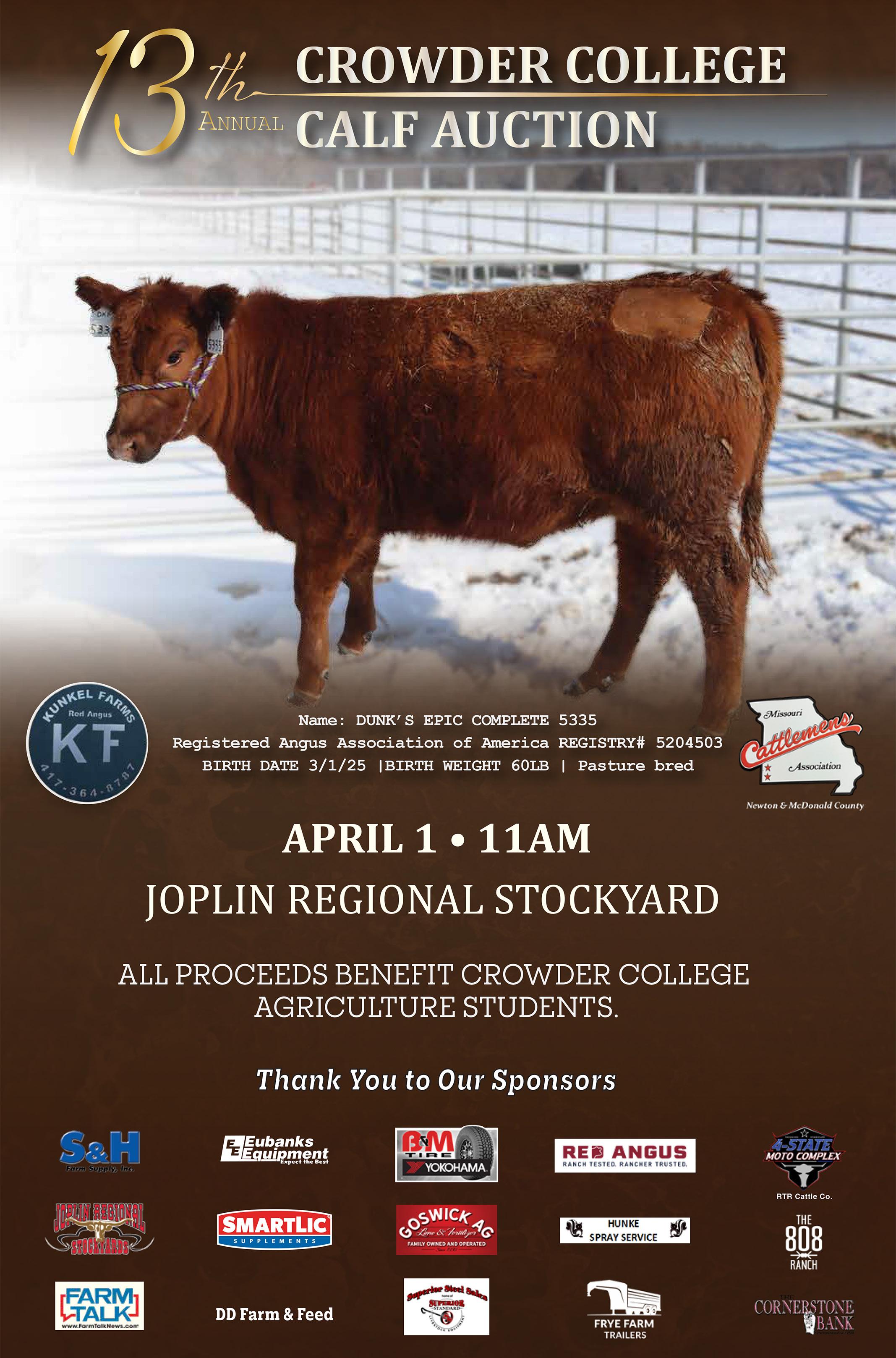
Kunkel Farms donation is their second in the 13 years of the Crowder College Calf Auction. The event is a fundraiser for Crowder Agriculture programs supporting student travel seminars and contests, and to opportunities for students to experience various agricultural industries. The auction will take place April 1, 11 AM, Joplin Regional Stockyards.
Crowder’s Animal Science students will halter break the heifer and have her ready for someone to take home to become a 4-H/ FFA project or a wonderful addition to a herd. The heifer will be sold multiple times with the winning bidder donating the heifer back in a ‘sell her again’ auction. Once all donors have contributed a final sale will be announced with the successful bidder taking her home.
“She is a pasture bred heifer from a great cow from the heart of our registered herd,” stated Kunkel.
Name: DUNK’S EPIC COMPLETE 5335
Registered Angus Association of America
REGISTRY# 5204503
BIRTH DATE 3/1/25
BIRTH WEIGHT 60LB | Pasture bred
“Generous donors have made this event a wonderful fundraiser providing opportunities for students,” graciously stated Shawna Estep, Ag Division Chair & Vet Tech Instructor. “We are grateful for all the efforts of our local cattlemen’s association and the businesses who continue to invest in our agriculture students”.
Crossbreeding is one of the most valuable tools for increasing productivity without increasing input costs.
Balancing Cow Weight with Industry Demand
Source: ASA - by Lilly Platts
The industry’s push for larger carcass weights continues to put pressure on commercial producers who must also maintain a productive, profitable cow herd. Dr. Jamie Courter, Assistant Professor and State Beef Extension Specialist at the University of Missouri, explored this dichotomy during Fall Focus 2025.
Optimizing efficiency and productivity are central goals for all cow-calf producers. The end product and the demands of the packer are also a consideration, and often go against what is best for long-term cow-calf profitability. Bigger cows can produce bigger calves, but at what cost? Courter shared that the push for bigger carcass weights will continue in the future, and because of this, focusing on cow herd efficiency and profitability is more important than ever. “Whether we’re talking about the end product, or selling a weaned calf, your motivation should still be the cow,” Courter shared.
Mature cow size has been steadily increasing over time, which is evident in data across breed associations. Courter evaluated Angus, Red Angus and Simmental trends, and saw a uniform trend throughout.
“Regardless of breed, we are increasing cow size,” she said.
The cow-calf phase of the production cycle accounts for 74% of the overall input required to produce one pound of carcass weight, and the bigger the cow, the higher this number is. “A 30% larger cow will consume 22–28% more dry forage matter,” Courter shared. “Mature cow weight matters.”
Courter encourages producers to think about their cow herd as a whole unit, as opposed to individual animals. Heavier calves may bring more on sale day, but if the female that raised that calf required more input, those extra dollars may cancel out. “Yes, heavier calves make more money, but if we think about fixed resources, smaller cow size and more moderate weaning weights aren’t always a bad thing,” she said.
Many beef cattle traits are optimized somewhere in the middle, like docility, and Courter believes the same is true for cow size. An 1,100 to 1,200-pound cow usually strikes the right balance between input and productivity, and Courter encourages producers to look at their output as pounds weaned per acre, as opposed to individual cow performance. “The key is to avoid cows that are over 1,400 pounds, and that are consuming more nutrients than they are providing you in profit,” she said. “The data shows that mature cow size is an intermediate-optimum trait.”
Birth weight is as frequently discussed as mature cow size, and is another important factor in optimizing productivity. There are several EPD associated with birth, including calving ease direct, calving ease maternal and birth weight. Calving ease direct predicts the probability of a first-calf heifer experiencing dystocia; calving ease maternal predicts the probability of first-calf daughters experiencing dystocia; and birth weight predicts the calf’s weight compared to the breed average.
Courter shared that producers often put emphasis on the wrong trait. “Time and time again, producers think that birth weight is equivalent to calving ease, especially on the commercial side,” she explained.
Using correlations, Courter explained that birth weight and calving ease are genetically related, but not the same trait. Conversely, the correlation between calving ease direct and the percentage of unassisted births is high. This means that producers who select primarily for birth weight may only be starting off with lighter, more issue-prone calves and not actually solving dystocia problems. “When we select for low birth weight, we are not solving the problem,” Courter shared. “Selection for birth weight does not ensure calving ease. It just creates light calves.”
Data shows that calves that start out lighter will also be lighter at weaning and yearling. Commercial producers often use birth weight over other calving EPD when selecting bulls, which may lead to long-term financial loss. If calving ease direct predicts that a first-calf heifer can have a 60-pound calf unassisted, then putting emphasis on birth weight and pushing that weight down to 50 pounds is only taking pounds away long-term. “We
need to be having these tough conversations with our commercial buyers,” Courter shared.
Crossbreeding is one of the most reliable methods for increasing productivity while maintaining input costs, and Courter emphasized this. “We know that crossbred cows raising crossbred calves wean over 23% more weaning weight per cow exposed,” Courter said. “Crossbreeding and mating systems will increase the resources we have while keeping cow size moderate.”
Courter encouraged producers to consider crossbreeding systems, as well as maternal and terminal herds. Increasing carcass weights while keeping cow size moderate is difficult, and while genetics and technology have produced bulls and cows that “do it all,” genetic potential can only go so far. Pushing the cow herd to meet end-product demands could have negative longterm effects. “If we want to avoid doing that to our cow herd, we need to start thinking about the story differently,” Courter explained. “We need to start thinking about creating maternal cows that will be the factory, while also creating terminal animals that are all pounds weaned,” Courter shared.
Specific crossbreeding systems have been considered labor- and resource-intensive in the past, but Courter countered this belief. Other industries, like dairy, have been successfully using sexed semen and technology to create maternal and terminal crosses. “With the advent of AI, sexed semen, and genomic testing, we are past that. We are past the argument of it being labor-, cost-, and resource-intensive,” she said.
Courter concluded that through crossbreeding and technology, producers can meet the demands of the industry while also maintaining profitability in the cow herd. “My challenge to you is this. How can we adopt technology to meet what the market is telling us, and at the same time, not detrimentally impact our cow herd?”
Dr. Jamie Courter shared about the implications of cow size, and potential strategies for balancing productivity with cost.
Cow size has a significant impact on input, and overall production cost.
Artificial Intelligence Can Aid Data Management in the Beef Industry
Source: Heather Smith Thomas
There is no single, simple definition of artificial intelligence because AI tools are capable of a wide range of tasks and outputs. In many industries, including agriculture, AI is a way to utilize data to improve our abilities to accomplish certain goals, increasing efficiency and production. Farming technology has benefited for a number of years and the beef industry is starting to utilize some of these methods.
Teaching AI To Students
Harvey James, PhD (Professor of Agricultural and Applied Economics and Director of the Division of Applied Social Sciences at the University of Missouri) utilizes AI in his work. “I teach an ethics class and students have to write about ethical-related questions and topics. I’ve been using AI ChatGPT Bing’s Copilot version,” he says.
ChatGPT is a popular generative AI chatbot developed by OpenAI and released in November 2022. It uses generative pre-trained transformers (GPTs) to generate text, speech, and images in response to user prompts. A chatbot is a software application or web interface that converses through text or speech-using generative AI systems that are capable of maintaining a conversation with a user.
“I like what it can do to help a person brainstorm and it can also clean up writing. It can synthesize a large amount of information and pull out relevant details. I also use it in my writing intensive course; in class I talk about advantages and disadvantages of using generative AI like ChatGPT technologies. I give students writing assignments in which they are required to use AI to generate ideas,” he says.
“I ask students to look at problems and evaluate them to determine if something is ethical, based on theories and frameworks we’ve talked about. I give them writing assignments where they use AI to identify ethical issues and stakeholders affected by them, but AI does a poor job in articulating ethical issues,” says James.
“The thing I stress in these assignments is to be critical of information provided by AI. I want students to carefully assess the information. One of the weaknesses of AI, which is well known, is that it can make up stuff.” People must use intuitive judgment and their own expertise to determine whether the information is correct.
“Outside of class I use AI to help me make something clearer or identify things I want to change. I’ve used AI when I have a large amount of data to synthesize; I can ask it to pull out things, then I go back into the data to make sure the summaries the AI has given me are based on what is in the original information,” he says. You have to double check.
AI technology can be beneficial in any industry, especially when dealing with a lot of data; it can save many hours. “You can paste large amounts of data into the chat fields, ask questions about it and have it pull out things that may be relevant. A farmer or rancher facing a new problem can use this to brainstorm on options to consider. Based on what it gives you, you still need to follow up to make sure it’s correct, but it is definitely applicable in many contexts,” he says.
AI can be personalized to your own situation. Just about anyone can utilize it in their business, including agriculture. “One of the things important to know about generative AI such as ChatGPT is how it is trained and developed—using publicly available or any kind of written source; a lot of it is available on the internet. It pulls up anything relevant, but these models can be changed by written material fed into the model. ChatGPT is only as good as the information that goes into it.”
If certain types of information are not fed into the model, it can’t just guess. “You have to do your own fact-checking,” he says. If a rancher has a lot of data on cattle, it might take hours to go through it and AI can provide instant access regarding what a person is trying to focus on.
Mauro Palmero PhD (Associate Teaching Professor, University of Missouri) has been an AI Fellow for the Center for Teaching and Learning and also teaches students about AI. “For people trying to wrap their heads around AI, I tell them that even though it’s complicated and a bit scary it will affect us all. My students will need to know how to deal with AI, and ranchers will eventually need to use it in order to compete with the ones who already use it, and in the international markets,” he says.
“The exact application will be sorted out, industry by industry, in how best to use it. AI can be useful to monitor what you do, and analyze data. It can use all the raw data and decipher it in language you can understand, to help you make decisions. AI can help you
keep the data manageable and generate the meaning of it and show which things you need to pay attention to,” says Palmero.
“It can help predict what will happen, based on the data generated. This can help you save money; as AI deciphers data for you, it can squeeze out places where your operation is losing money.” You can fine-tune these things when you know what you are dealing with.
“Farmers and ranchers can evolve data from weather, markets and many other things that affect their operation. You can also determine the things you need to be compliant with, and use it for risk management. It can help you anticipate things that make your operation more expensive,” he says.
“It is still evolving; we may need to start small and go step-by-step. It is changing so fast that we don’t know where it will be in another year. We need to get acquainted with the tools and systems like ChatGPT. Play with it and get used to the giant. The first time you see the giant it scares you, but as you continue to interact with it, the giant will become more user-friendly and not as scary-and you can make better decisions. There are some risks involved, and it may take us out of our comfort zone, but there are great things that can happen. This subject frustrates my students, and I can only imagine the uncertainty facing a person who has a major business!”
AI From The Viewpoint of a Ruminant Nutritionist
Derek Brake, PhD (Associate Professor, University of Missouri) is a ruminant nutritionist who utilizes AI in his work. “I try to figure out how cattle use nutrients and look at different physiological aspects. I try to develop a better understanding of how cattle can digest, metabolize and ultimately use different nutrients to support growth and lactation,” he says.
“I’m interested in high-performing cattle that are most responsive to nutrients such as a rapidly growing calf or high-producing dairy cow.” They are the most efficient in utilizing nutrients in their feed. This is where AI has come into play—to try to identify the individuals that are really efficient.
“There is a well-known concept that the amount of food an animal needs to stay alive (maintenance requirements) is directly related to the surface area of the animal’s body.” How big and how round they are (more total surface area) makes a difference.
People talk about flat-sided animals being poor doers compared to cattle that are round and “barrel-gutted”
with a good “bread basket” and wider spring of rib. The flat-sided animal is usually a poor keeper. “After we realized this surface law is closely related to the amount of feed an animal needs, to survive, people tried to come up with a way to estimate surface area instead of directly measuring it, which is nearly impossible. They came up with something that is now called metabolic body size. This involves weight, which is easy to measure, but then we try to estimate maintenance energy expenditures by using an exponent that ties into a predictor of surface area,” he says.
“Nutritionists trying to figure out the differences in efficiency between one group of calves and another group use a computer model to try to determine what the feed conversions will be, and what feed costs will be. You can work that math backward and try to figure out how much money you can pay for a calf and come out ahead.
“If you look at two feedlot steers, each eating 25 pounds of dry matter but one of them needs only four pounds of feed to stay alive and the other needs six pounds to stay alive, the one that only needs four has 21 pounds of feed it can use to support growth. The other one will be a couple pounds shorter, resulting in poorer feed conversion and higher feed cost for that growth,” he says.
“Where I’ve gotten involved with technology and artificial intelligence and its application in the cattle industry, I’m looking for a way to enhance some of the measures we are already getting through things like residual feed intake from the heritability side. We’re trying to get to the other side and look at differences in efficiency that we can recognize with phenotypes.”
Many people use body weight to predict this, but it would only work if cattle were perfect geometric shapes. “It also only works if the density of gain is the same as the increase in mass, which it isn’t. As cattle get heavier, they put on more fat and less muscle. Fat and muscle have different density,” Brake says.
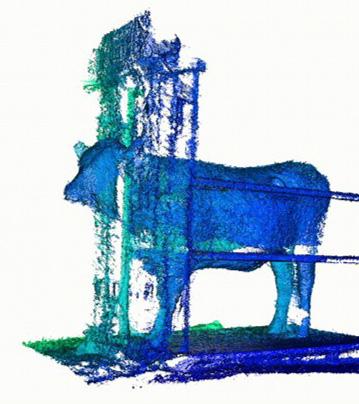
“Technology has advanced to the point that we can directly measure non-uniform objects. I first realized this when watching my oldest son play video games. Years ago there was a sensor that was sold on a video game console called an X-box Kinect. It was a camera you set in front of your TV. When you move, it moves the character around on the video game console; it moves with your body. I was setting this up for my son and looking at what it showed; it was completely wrapping around the surfaces of my body, so it could pick me out from the furniture and anything else in the room.
Continued on page 62
I realized that if you could pull that image off, and put it into a computer, it could quickly count the number of pixels or whatever that make up the entire surface of my body! I’d found a way to measure the surface area of something that’s hard to calculate,” says Brake.
Taking this idea, he worked with an engineer and a geneticist to try to come up with a way to scan cattle like this. “Then we could identify animals that have large feed bills and the ones that have smaller feed bills. On the genetic side, if we could identify the efficient animal, producers could make better breeding decisions and make the future calf crop better and more efficient,” he says.
A load of calves coming into the feedlot may all weigh about the same, have the same color hide, but it would be helpful to identify the ones that will make $500 and the ones that will lose $100 by the time they get through the feeding process. “Part of the reason some calves lose $100 by the time they finish on feed is that we don’t manage them appropriately. When they arrive, we give all of them the best implants, feed them the highest and most energy-dense feeds; we treat every calf like it has the best potential to grow. Some calves can’t utilize those inputs, so all the extra they can’t use is an additional cost.” Money is wasted on the ones that can’t benefit from all of this.
“It’s like fuel for a vehicle. You can use racing fuel— which is really expensive—in a brand new corvette and in a 1984 Yugo. It doesn’t matter what kind of fuel I put in that old car, it’s never going to go as fast as the corvette,” he says.
“We want to be able to identify different phenotypes of cattle and sort them into different management systems that can optimize the cost/investment, based on the potentials we can realize with the differences.” Then you are not wasting jet fuel on the putt-putt clunker.
“We can also feed that information back to geneticists who can help people make decisions on which cows and bulls to mate. We’ve developed a system that can scan a calf in less than two seconds and generate a 3-D model of that calf. We can use that to quickly calculate surface area and volume of the animal. We’ve looked at how well that relates, on computer-derived surface areas, to the maintenance energy requirements on different animals and ultimately the differences in feed efficiency,” says Brake.
With all this data, AI was a great breakthrough. “AI can give deeper insights into available data, and manage large data sets, but it also helped us with three-
dimensional scanning when we started these projects. There’s a tremendous amount of data points captured by these sensor that allow for 3-D reconstructions of the animal. Early on, this was very laborious. It required having technicians work on it, and if a fly went by when you were scanning a calf, it showed up as an error. You can fix it but it requires a human to sit there and look at it. Now we use a type of AI called a convoluted neural network, and in rapid order we can identify errors and inaccuracies and peel everything away and quickly do the reconstruction,” he says.
“We’re using AI to help develop and derive threedimensional models that give us surface area, and ultimately tie back onto the surface law for energy costs and feed efficiency. Once we have sensors and information that can be fed in, we can start developing large data sets; we can develop real-time and adjustable models to provide feedback to an operator to make more informed or more economically viable management decisions, and make better beef and more profitable beef—to help a lot of farmers and ranchers,” Brake says.
“We have a system now that works well in a research setting, but we think this kind of technology will eventually be easier to use than a chute for obtaining body weight. Any time cattle move through an alley, this would capture individual inputs for those animals. You could also make it work in a pasture system, next to water troughs where cattle come on their own,” says Brake.
This information can be fed back to a cellular network to be fed into the cloud. “It can use that data to feed into an AI and maybe used to develop algorithms or mathematical models that ultimately provide a recommendation. You’d get an alert on your phone that tells you a certain calf is ready to implant, or ready to be marketed for sale, etc.”
There are many promising applications for AI in the beef industry. “We’ve seen tremendous breakthroughs in the past 30 years in the ability to capture data. Now we are to the point we want to know how to look at all these inputs. How do I make decisions that match the timing of the beef production cycle and also move at the speed of business—and ultimately make a better living running cattle?” This is an exciting new opportunity to make it a little easier to put an extra dollar in the pocket of the people who are running cattle.
AI is a new frontier and will come with some bumps in the road, but most folks think it will continue to become more usable and helpful, allowing cattle producers to trust it more.
MBC Bull Buyers’ Guide
Welcome to our 38th Annual Bull Buyers’ Guide
This special advertising section is designed to give you easy access to breeders who have bulls for sale this spring. Most of the advertisers in this section are placed according to breed.
A big thank you to all of our advertisers who participated in this 38th Annual Bull Buyers’ Guide.
November Pork and Beef Exports Below Year-Ago Levels
Source: USMEF
Exports of U.S. pork remained relatively strong in November but were below the large total reported in November 2024, according to data released by USDA and compiled by the U.S. Meat Export Federation (USMEF). Beef exports were significantly lower yearover-year, due in large part to the ongoing lockout by China. Lamb exports were a bright spot, posting the largest volume since July and highest value since May.
Pork Exports to Mexico on Record Pace; Already Annual Record for Central America
Exports of U.S. pork totaled 254,085 metric tons (mt) in November, down 7% from a year ago but the third largest of 2025. Exports were valued at $720.8 million, down 8% year-over-year but also the third highest of 2025. November exports increased year-over-year to Mexico, South Korea and the Dominican Republic and were record-large to Guatemala, but these results were offset by lower shipments to China, Japan, Canada and Colombia.
For January through November, pork exports totaled 2.68 million mt, down 3% from the record pace of 2024, while value also fell 3% to $7.65 billion. With most of this decline being due to lower variety meat shipments to China, where U.S. pork faces retaliatory duties, January-November exports of pork muscle cuts were just 1% below 2024’s record pace in both volume (2.19 million mt) and value ($6.57 billion).
“The pork export numbers continue to be impressive, with broad-based growth mostly offsetting the obstacles in China,” said Dan Halstrom, USMEF president and CEO. “It was especially gratifying to see perhead export value topping $70 in November, which is excellent news for U.S. producers and for the entire pork supply chain.”
While down slightly from a year ago, November pork export value per head slaughtered was outstanding at $70.26. The January-November average was $65.54, down less than 1% from the record pace of 2024.
November Beef Exports Lower to Most Major Markets
Following an encouraging rebound the previous month, November beef exports took a step back, falling 19% from a year ago to 88,139 mt. Export value was down 16% to $736.7 million. The decline was driven primarily by China, where exports remain minimal due to China’s failure to renew registrations for U.S. beef plants and other market-closing factors, but beef exports also trended lower year-over-year to Korea, Mexico, Canada and Taiwan. November exports increased year-overyear to Indonesia, Chile, the United Arab Emirates, Singapore and Colombia, and were fairly steady to Japan.
For January through November, beef exports totaled 1.04 million mt, down 12% from the same period in 2024. Export value was $8.52 billion, down 11%. But when excluding China from these results, exports were down 3% year-over-year in volume and were just 1% lower in value.
“With each day U.S. beef is locked out of the world’s largest import market, our industry misses out on millions of dollars and our competitors reap the benefits,” Halstrom said. “It’s also frustrating that this impasse overshadows the fact that global demand for U.S. beef remains resilient, even in the face of tight supplies.”
Robust Month for U.S. Lamb Exports
November exports of U.S. lamb muscle cuts totaled 237 mt, up 87% from a year ago and the largest since July. Export value increased 65% to $1.45 million, the highest since May. Growth was driven by Mexico, the Netherlands Antilles and the Bahamas, as well as larger shipments to Central America and Japan.
For January through November, lamb muscle cut exports increased 44% year-over-year to 2,577 mt, while value climbed 31% to $14.1 million. With December results still to be added, exports have already posted the largest annual volume since 2014 and the highest value since 2017.
A detailed summary of the January-November export results for U.S. pork, beef and lamb, including marketspecific highlights, is available from the USMEF website.
Stretch Your Winter Feed Supply by Renting Acres for Stockpiled Fescue
Source: University of Missouri Extension
MOUNT VERNON, MO. – A well-stocked hay inventory is one of the best forms of insurance a livestock producer can have, says Caleb O’Neal, University of Missouri Extension field specialist in plant science.
“By renting additional acres dedicated to stockpiling forage, producers can improve their chances of maintaining a dependable supply of high-quality feed at a predictable cost throughout the year,” O’Neal says.
“Using rental acreage stockpiling can help ease rotational pressure on the home farm, provide protection during drought years and offer added flexibility during calving season. In many cases, renting pasture is a highly economical alternative to baling more hay or purchasing additional bales,” he says.
“The high cost of buying hay — even marginal-quality hay — can take a real toll on profitability,” O’Neal says. “Making hay comes with its own expenses, including equipment, fuel, fertilizer, labor, repairs, depreciation and lost opportunity. Those costs add up quickly, and most operations underestimate them. Buying hay doesn’t
avoid those costs; it simply means paying someone else to absorb them, with a margin added on top.”
Hay will always play a role in cattle operations, but it does not have to serve as the foundation of a winterfeeding program.
For many producers across Missouri, shifting toward grazing stockpiled fescue or cool-season annual cover crops can be a practical way to reduce feed costs, maintain or improve livestock condition during the most challenging months and make better use of available land. Having stockpile acreage available for grazing, supplemented by stored hay when necessary, can significantly reduce winter feeding costs and support strong herd health.
“Reducing feed costs is one of the most reliable ways to improve profitability in a livestock operation, and grazing stockpiled fescue remains one of the most costeffective tools available,” O’Neal says.
Continued on page 78
Selling Over 75 Bulls!
Angus – Simmental & Sim Angus 18-Month-Old Bulls
MF Growth Fund 4339 –Reg. 21439564 • DOB: 08/26/2024
An open heifer and major highlight. As good as we have ever sold!
Tall fescue is Missouri’s primary forage species, and much of the pasture ground available for rent is already established in tall fescue, he says. When livestock are removed from pastures in late summer, fescue can continue growing into the fall, producing dense, leafy regrowth that retains quality exceptionally well. University of Missouri research shows that stockpiled tall fescue consistently tests above 12% crude protein, with total digestible nutrients around 60% throughout the winter months. After frost, fescue maintains a high sugar content and remains green even though little growth occurs after mid-November.
“Simply put, it’s hard for the contents of a hay bale to compete with a living plant when it comes to forage quality,” O’Neal says.
A basic stockpiling program can provide months of dependable forage without starting a tractor. Infrastructure needs are minimal and typically include a reel or two of polywire, temporary step-in posts and
Kingsville Livestock Auction
a solar-powered electric fence charger. Strip grazing the stockpile, with frequent moves based on forage availability and livestock requirements, improves utilization and minimizes waste.
O’Neal offers a hypothetical scenario to illustrate the economics: Depending on management and growing conditions, a well-managed fescue pasture can provide 1,500 to 2,500 pounds of dry matter per acre in fall stockpile growth. Using a midpoint estimate of one ton of dry matter per acre and the latest MU Extension survey data showing average pasture rental rates in southern Missouri at about $45 per acre, the resulting cost is approximately $45 per ton of dry matter for fescue stockpile grown on rented ground.
By comparison, the latest USDA Missouri hay report shows average prices for fair- to good-quality hay in large round bales ranging from $75 to $125 per ton, with premium hay priced above $150 per ton.
“This example highlights how compelling it can be to rent a few additional acres for dedicated stockpiled grazing to complement hay feeding during the winter,” O’Neal says. “In reality, rented land often provides multiple benefits beyond stockpiling alone.”
When considering rental acreage, O’Neal offers these tips:
• Look for ground close to your existing operation.
• Choose pastures with strong fescue stands, adequate soil fertility and a reliable water source.
• Visit the property in late summer or early fall to best assess stand density and overall pasture condition.
For more information, contact your local MU Extension agronomy or livestock specialist.
MU Extension Releases New Guides to Help Missourians Manage Alpha-Gal Syndrome
Source: University of Missouri Extension
COLUMBIA, MO. – As cases of alpha-gal syndrome continue to surface across the Show-Me-State, University of Missouri Extension has released five new publications to help individuals and families understand, prevent and manage the condition.
Alpha-gal syndrome (AGS) is a potentially lifethreatening food allergy triggered by the bite of the lone star tick. The tick can transmit a carbohydrate known as alpha-gal (galactose-alpha-1,3-galactose), which is found in meat and products derived from mammals such as beef, pork and venison. Symptoms, which typically occur two to six hours after eating, range from hives and digestive distress to severe anaphylaxis.
Missouri has one of the higher reported rates of AGS, making public awareness especially important. MU Extension’s interdisciplinary alpha-gal syndrome team is led by Eden Stewart, MU Extension nutrition and health specialist. They are available in print and as free downloadable PDFs.
“Together, the guides are designed to provide practical, research-based information that helps reduce confusion and give people clear next steps,” Stewart said.
Alpha-Gal Syndrome Awareness (N1350)
“Alpha-Gal Syndrome Awareness” (https://extension. missouri.edu/publications/n1350), by MU Extension nutrition and health specialist Rachel O’Halloran, explains what AGS is, how it develops and how it is diagnosed. The guide details common symptoms, including hives, nausea, diarrhea, swelling, breathing difficulties and drops in blood pressure.
Because there is no cure, prevention is emphasized. The guide provides step-by-step tick-avoidance strategies, including protective clothing, use of EPA-approved repellents, permethrin-treated gear, post-outdoor tick checks and proper tick removal techniques.
Cooking With Alpha-Gal Syndrome (N1351)
“Cooking with Alpha-Gal Syndrome” (https://extension. missouri.edu/publications/n1351), by former MU
Continued on page 82
assistant extension professor Sarah Wood, outlines common trigger foods, including red meat, organ meats, certain dairy products, gelatin, broths and gravies made from mammalian sources.
It explains that sensitivity varies widely. Some individuals react only to red meat, while others must avoid dairy or even cross-contact from shared cooking surfaces. The publication describes areas where crosscontact may occur, such as grills, fry oil, meat slicers, cast iron pans and shared utensils.
The guide offers lists AGS-friendly options such as poultry, fish, eggs, legumes, nuts, seeds, soy products and plant-based dairy alternatives. A detailed chart helps readers understand how to meet daily protein needs without red meat.
The publication also encourages open communication when dining out and with family members, reinforcing that education and planning can reduce risk and stress.
Shopping for Alpha-Gal Syndrome (N1352)
For many people, the grocery store becomes one of the biggest challenges after diagnosis. “Shopping for Alpha-Gal Syndrome” (https://extension.missouri.edu/ publications/n1352), by MU Extension nutrition and
health specialist Eden Stewart, focuses on reading labels carefully and identifying hidden ingredients.
The guide explains how ingredients such as gelatin, collagen, glycerin, lard, suet, beef or pork broth and certain “natural flavors” may contain mammal-derived components. It provides examples of where these ingredients may be present unexpectedly, including poultry products, snack foods, baked goods, pantry staples and protein powders.
In addition to food, the publication addresses personal care items and medications. It advises individuals to inform physicians, dentists and pharmacists of their diagnosis, since some capsules, supplements, vaccines or ointments may have mammalian byproducts.
Alpha-Gal Syndrome Food Substitutions (N1353)
For those who enjoy cooking and baking, “Alpha-Gal Syndrome Food Substitutions” (https://extension. missouri.edu/publications/n1353), by former MU Extension community health specialist Shelby Yake, provides practical alternatives for commonly used mammalian ingredients.
It suggests poultry, fish, shellfish and plant-based proteins as substitutes for beef and pork. For baking and sautéing, it lists options such as olive oil, coconut oil, vegan butter and other plant-based fats. It provides alternatives for milk, buttermilk, cheese, cream cheese and meat broths, including plant-based milks, vegetable stocks and creative flavor enhancers like miso, nutritional yeast and vinegars.
The guide encourages readers to try substitutes in small amounts, research proper ratios and explore different grocery stores or ethnic markets for allergy-friendly products. It also reminds readers to check labels every time, since processing methods and ingredients can change.
Continued on page 84
Alpha-Gal Syndrome Nutrients of Concern (N1354)
When people eliminate red meat or dairy, nutritional gaps can occur. “Nutrients of Concern” (https:// extension.missouri.edu/publications/n1354), by MU Extension community health specialist Emily Poncher, explains which nutrients may be affected, including iron, vitamin B12, zinc, calcium, vitamin D and protein.
The guide describes why each nutrient matters and lists AGS-friendly sources. For example, iron can be found in beans, leafy greens and seafood; vitamin B12 in fortified cereals, eggs and fish; and calcium in fortified plant milks and certain vegetables. Practical tips are included to help incorporate these foods into everyday meals.
A practical path forward “While an AGS diagnosis can feel overwhelming, informed choices can significantly reduce risk and improve quality of life,” Stewart said. “By combining prevention strategies with practical guidance on shopping, cooking, substitution and nutrition, the new publications aim to give Missourians tools they can use immediately.”
All five guides are available through MU Extension as free downloadable PDFs and as print handouts.
Add Value, Manage Market Volatility By Selling Beef Directly To Consumers
Source: University of Missouri Extension
COLUMBIA, MO. – Despite cattle prices being near all-time highs, marketing beef direct-to-consumer still adds value to beef operations. Two updated University of Missouri Extension guides help producers understand the numbers and methods behind marketing your beef to consumers.
“Low cattle inventory has widened the gap between a finished animal’s live value and the total value of its retail cuts,” said Jake Hefley, MU Extension agriculture business specialist in Taney County. “Direct marketing gives producers an opportunity to capture part of that value rather than leaving it entirely to downstream segments of the supply chain.”
Producers can examine the revenue potential and additional costs of selling freezer beef with Evaluating Direct-to-Consumer Marketing Opportunities for Local Beef in Missouri and look at their cost of production to feed out their calves with On-Farm Beef Finishing Planning Budget.
“Using both publications together helps producers compare the retail value of a processed animal with the cost to bring that animal to finished weight,” said Drew Kientzy, MU Extension senior research analyst. “Grocery store beef prices are front of mind for many consumers. Knowing your breakeven cost and offering competitive pricing for a highquality product can earn longterm customers.” Producers are encouraged to use the accompanying spreadsheet tools to help estimate the cost and revenue potential of their own direct-to-consumer beef sales.
Direct Sales Can Provide Price Stability
Strong markets draw attention, but producers know conditions can change quickly. When prices are high, it can be tempting to market everything through the sale barn, yet freezer beef doesn’t have to be an all-or-nothing decision, said Jennifer Lutes, MU Extension agricultural business field specialist in McDonald County. Many farms
Continued on page 88
can operate in both markets by selling more calves into today’s strong auction market while finishing a smaller number for direct customers (or at minimum not expanding direct-market commitments). “The key is protecting your freezer-beef customer base now,” Lutes said. Those relationships take time to build and will be the stabilizing income stream you’ll want in place when prices eventually ease.
“Consumers value quality and relationships, making the prices they are willing to pay less volatile than prices received at the local sale barn,” she said. “An established freezer beef business can help customers manage costs during high grocery prices and support farm income when cattle prices drop.”
Both publications and spreadsheet tools are available for free download:
“Evaluating Direct-to-Consumer Marketing Opportunities for Local Beef in Missouri,” https://extension.missouri.edu/publications/g204
Missouri Red Angus Breeders
Ken & Brenda Keesaman
816-675-2503 • C: 816-390-4988
Kody Keesaman 816-724-1432
Kolten Keesaman 816-808-2846
3803 SW Rogers Rd. • Osborn, MO 64474
Ken@kkfarmsredangus.com www.kkfarmsredangus.com
Harris 417-389-2987 Jacob Dunn 417-434-0335
Womack Missouri Ag Outlook Conference
Source: University of Missouri Extension
COLUMBIA, MO. – University of Missouri’s Food and Agricultural Policy Research Institute (FAPRI-MU) will host the 2026 Abner W. Womack Missouri Agricultural Outlook Conference on Wednesday, April 8. The free event will be held at the Poehlmann Education Center at the MU Bradford Research Farm in Columbia.
Now in its 12th year, the Womack Conference delivers objective, data-driven insight on agricultural markets, policy and farm-level challenges that matter most to Missouri’s producers and agricultural stakeholders, conference organizers say.
Conference highlights
New FAPRI leadership and baseline
FAPRI director Seth Meyer will provide an overview of institute’s 2026 agricultural market baseline, including projections for commodity markets, farm income and key policy drivers influencing the year ahead.
Meyer, who previously served as the U.S. Department of Agriculture’s chief economist and as chairman of
the World Agricultural Outlook Board, brings a wealth of national and global market perspective to Missouri agriculture.
Policy and Market Analyses
The 2026 program features complementary presentations from national partners who work closely with FAPRI on economic and policy research:
The Center for Agricultural Policy and Trade Studies at North Dakota State University will provide perspective on evolving trade policies, shifts in global demand and implications for U.S. competitiveness.
Analysts from the Agricultural and Food Policy Center at Texas A&M University will share the latest indicators of farm-level financial health across production systems and regions.
The MU Rural & Farm Finance Policy Analysis Center will offer updated assessments of Missouri’s agricultural economy, highlighting current financial conditions,
Continued on page 94
vulnerabilities and emerging trends facing producers.
Keynote Address: USDA Undersecretary Richard Fordyce
USDA Undersecretary of Farm Programs and Conservation Richard Fordyce will deliver the keynote. He will discuss federal conservation strategy, farm program implementation and national priorities shaping agriculture in 2026 and beyond.
Breimyer policy panel:
Animal pests and disease risk
The Harold F. Breimyer Panel on Agricultural Policy will focus on the market impacts and producer-level implications of emerging and persistent animal pests and diseases, including:
• New world screwworm (NWS)
• High pathogenic avian influenza (HPAI)
• Porcine reproductive and respiratory syndrome (PRRS)
The discussion will be moderated by FAPRI’s Sera Chiuhiarelli. Panelists include Corinne Bromfield, MU veterinarian and assistant extension professor; and Jada Thompson, University of Arkansas. They will examine biological, economic and policy dimensions of animal health challenges that affect Missouri producers.
From the ground up: Missouri producer reflections
The conference will conclude with insights from a panel of Missouri producers representing three distinct regions and three different agricultural sectors. MU Extension specialist Ben Brown will moderate. Producers will react to the day’s presentations and offer practical, on-theground perspectives about current industry challenges and opportunities, Brown said.
The conference is free to attend, and lunch is provided by the Abner W. Womack Excellence in Agricultural Policy Endowment. Advance registration is appreciated. Visit https://mizzou.us/Womack2026 for an agenda and online registration.
For more information, contact Ben Brown at bpbrown@ missouri.edu or 573-882-6527.
MISSOURI Charolais Breeders
MO www.angellthomas.com
April 4 Peterson Bull Sale, Mtn Grove
April 11 Renaissance Sale, Strafford For more information on Charolais in Missouri visit: www.missouricharolais.com
www.facebook.com/8storyfarms
Capitol Update with Nancy Giddens & Shannon Cooper
Thoughtful Collaboration
For generations, Missouri’s cattle producers have worked with a shared goal: leave the herd better than we found it. From the rolling pastures of the Ozarks to the river bottoms along the Missouri, seedstock breeders and commercial ranchers alike have invested in better genetics, better data and better tools to strengthen the cow herd. In that effort, reproductive specialists have become indispensable partners.
Today, however, some of these highly trained professionals find themselves disallowed from practicing because of interpretations of veterinary scope-of-practice laws. As lobbyists who work closely with both producers and animal health professionals, we believe this is a moment for thoughtful collaboration – not division.
Callaway Livestock Center, Inc.
Every Monday:
Slaughter Cattle 12:00 p.m.
Selling All Classes of Cattle 12:30 p.m.
1st Thursday Nite of Each Month: 6:00 p.m. Bred Cows and Breeding Bull Sale
Jack Harrison 573-999-7197 (owner)
John P Harrison ............... 573-220-1482
Claude Niemeyer 573-470-1017
Roger Temmen 573-680-4538
Justin Oberling .................. 217-440-7724
Glenn Stegman 573-619-8495
Reproductive specialists in the cattle industry are not casual technicians. Many have years, even decades, of focused experience in artificial insemination, in-vitro fertilization, embryo transfer, synchronization protocols, ultrasound pregnancy diagnosis and herd reproductive consulting. Their work has helped Missouri producers accelerate genetic progress in ways that would have seemed unimaginable a generation ago.
Organizations like the Missouri Cattlemen’s Association have long championed science-based management practices. Seedstock breeders rely on advanced reproductive technologies to multiply elite genetics, respond to market signals and deliver bulls & females that improve commercial herds statewide. The ability to efficiently implant embryos or synchronize large groups of cows is not just a convenience; it is a competitive necessity.
When reproductive specialists are sidelined, the effects ripple outward. Seedstock operations may face delays in embryo work during tight breeding windows. Commercial producers seeking to tighten calving intervals or introduce superior sires may find fewer qualified providers available. In a business where timing is everything, lost opportunity can mean lost income.
None of this diminishes the essential role veterinarians play in cattle health. Veterinarians are critical partners in disease prevention, surgical procedures, regulatory compliance, and overall herd wellness. Producers
Nancy Giddens & Shannon Cooper
depend on their expertise to safeguard animal welfare and food safety. The veterinary profession has earned its trusted standing in our industry.
But it is equally true that veterinarians and cattlemen need one another – and they need flexibility. Scope-ofpractice laws were designed to protect animal health and the public, not to unintentionally restrict specialized services that have safely and effectively supported herd improvement for decades. Many reproductive specialists work in coordination with local veterinarians, referring health issues and operating within clearly defined parameters. That collaborative model has served producers well.
As genetic expectations rise, so does the need for accessible reproductive expertise. Missouri seedstock producers compete not only with neighboring states, but with programs across the country. Limiting the pool of qualified reproductive professionals could slow the genetic advancement that keeps our state’s cattle industry strong.
We would also like to extend sincere appreciation to Senator Rusty Black for championing the cause
Meyers Truck Service
understand the practical realities of modern breeding programs and advocate for workable solutions reflects a deep commitment to Missouri agriculture. Leadership like that makes constructive dialogue possible.
This is not about choosing sides. It is about recognizing that modern cattle production is a team effort. Veterinarians, reproductive specialists, seedstock breeders and commercial ranchers each bring distinct skills to the table. When policy evolves alongside industry innovation, everyone benefits – especially the cattle.
Moving forward, we have an opportunity to craft solutions that respect veterinary medicine while preserving access to specialized reproductive services. With open dialogue and a shared commitment to herd improvement, Missouri can continue leading in genetic progress and producer success.
After all, our common ground is clear: stronger herds, stronger ranches and a stronger cattle industry for the next generation.
In solidarity,
SALE CALENDAR
March 2 Buck Ridge Cattle Co. Sale, Seymour, MO
March 6 SIU Carbondale Bull Test Sale, Carbondale, MO
March 6 Express Ranches Spring Bull Sale, Yukon, OK
March 7 Mead Farms Spring Sale, Versailles, MO
March 7 Seedstock Plus Arkansas Bull Sale, Hope, AR
March 7 Missouri Select Genetics Sale, Keytesville, MO
March 7 Moriondo Bulls Sale, Mount Vernon, MO
March 7 Gibbs Farms Spring Sale, Ranburne, AL
March 8 Flickerwood Angus Sale, Jackson MO
March 10 Galaxy Beef Sale, Macon, MO
March 12 Henke Farms Sale, Salisbury, MO
March 12-13 Miller Cattle Co. Bull & Heifer Sale, Online
March 13 Wall Street Cattle Co. Bull & Female Sale, Lebanon, MO
March 14 Sampson Cattle Co. 10th Annual Bull Sale, Kirksville, MO
March 14 Wright Charolais Bull Sale, Kearney, MO
March 14 Seedstock Plus Red Reward Bull & Female Sale, Osceola, MO
March 14 Hilltop Farms Gelbvieh & Balancer Bull & Female Sale, Carthage, MO
March 15 April Valley Farms Sale, Leavenworth, KS
March 15 Briarwood Angus Farms Spring Sale, Butler, MO
March 16 Hinkle’s Prime Cut Angus Sale, Nevada, MO
March 19 Benoit Angus Bull Sale, Esbon, KS
March 20 Bradshaw Ranch Bull Sale, Palmyra, MO
March 20 Marshall & Fenner Angus Sale, Boonville, MO
March 20 Sunflower Genetics Production Sale, Maple Hill, KS
March 21 Falling Timber Farm Sale, Marthasville, MO
March 21 Brinkley Angus Ranch Sale, Milan, MO
March 21 Ertel Cattle Co. Annual Production Sale, Kirksville, MO
March 21 Mississippi Valley Angus Sale, Cuba, MO
March 21 Wild Indian Acres Annual Spring Bull Sale, Carthage, MO
March 21 Northeast Arkansas Angus Assn. Bull & Female Sale, Cord, Ark
March 22 Silver Genetics Production Sale XXII, Maryville, MO
March 23 Oleen Brothers Production Sale, Dwight, KS
March 23 Green Springs Performance Tested Bull & Female Sale, Nevada, MO
March 24 GenePlus Bull & Female Sale, Concord, AR
March 27 Birk Genetics Spring Production Sale, Jackson, MO
March 27 Barrett Cattle & Mill Brae Ranch Annual Bull Sale, Maple Hill, KS
March 28 Worthington Angus Sale, Dadeville, MO
March 28 8 Story Farms 4th Annual Production Sale, Gallatin, MO
March 28 Seedstock Plus South Missouri Bull & Female Sale, JRS - Carthage, MO
March 28 3C Cattle Co Sale, Carrollton, MO
March 28 Sandhill Farms Annual Production Sale, Haviland, KS
March 28 Rogers Cattle Co., Lile Farms Red Angus, Double V, and Windrush Farms - Bull & Female Sale, Strafford, MO
March 28 Bradley Cattle Co., Spring Bull Sale, Osceola, MO
April 1
Crowder College Calf Auction, JRS, Carthage, MO
April 2 T Bar S Females for the Future Sale, Online
April 2
Leachman Cattle I-70 Gateway Spring Bull & Female Sale, Kingdom City, MO
April 3 Meyer Cattle Co. Sale Bowling Green, MO
April 4 Andras Red Angus Bull Sale, Manchester, IL
April 4 Four State Angus Association Sale Springfield, MO
April 4 Gardiner Angus Ranch Spring Production Sale, Ashland, KS
April 4 Peterson Farms Bull Sale, Mountain Grove, MO
April 4 Gilbert Cattle Co Sale, Oldfield, MO
April 6
Brockmere Sale, New Cambria, MO
April 11 Fink Beef Genetics Sale, Randolph, KS
April 11 The Irreplaceable Showcase Production Sale, Old Three Wagyu, Brenham, TX
April 11 The Renaissance Sale, Strafford, MO
April 11 Lucas Cattle Co. Spring Bull & Female Sale, Cross Timbers, MO
April 14 Sydenstricker Influence Sale, New Cambria, MO
April 16-17 Next Gen Cattle Co., Flint Hills Spring Classic Sale, Paxico, KS
April 18 WMC Cattle Co. The Complete Dispersal Sale, Wasola, MO
April 25 Heart of the Ozarks Angus Sale, West Plains, MO
April 25 Cow Camp Ranch Turn Out Sale, Lost Springs, KS
April 25 Missouri Limousin Breeders - Great American Pie Sale, Bennet Spring, MO
May 1 Best of Both Worlds Bull Sale, Wright County Livestock Auction, Mtn Grove, MO
May 1-9 Missouri Beef Days Celebration, Bolivar, MO
May 22-24 MLBA Field Day, Springfield, MO
MBC Classified
The MBC Classified column appears monthly. Classified advertising is only 50¢ per word. Send your check with your ad to Missouri Beef Cattleman, P.O. Box 480977, Kansas City, MO 64148. Deadline 15th of month before an issue.
“REESE” DISC MOWERS, CADDY V-RAKES, “REESE” TUBE-LINE BALE WRAPPER, AITCHISON DRILLS, SELF-UNLOADING HAY TRAILERS, HEAVY DUTY BALE AND MINERAL FEEDERS, FEED BUNKS, BALE SPIKES, CONTINUOUS FENCING, COMPLETE CORRAL SYSTEMS, INSTALLATION AVAILABLE: Tigerco Distributing Co. 660-645-2212, 800-432-4020 or www.tigercoinc.com.
BLACK SIMMENTAL BULLS SINCE 1993: Calving Ease, Attractive, Athletic, Sound Footed and Docile. We Deliver. Mike Williams, Higginsville, 816-797-5450
SYCAMORE CREEK SIMANGUS BULLS & BRED HEIFERS FOR SALE. Great EPDs. Wayne and Anita Vanderwert -15 minutes from Columbia. 573-808-3000 or 303-506-3508
SIM-ANGUS BULLS - Top EPD’s for Calving Ease and Growth. Lynn Snow Call Matt McQuitty 660-924-8037.