Missouri’s Cattlemen Foundation www.mocattlemenfoundation.org
2026 MCA Officers
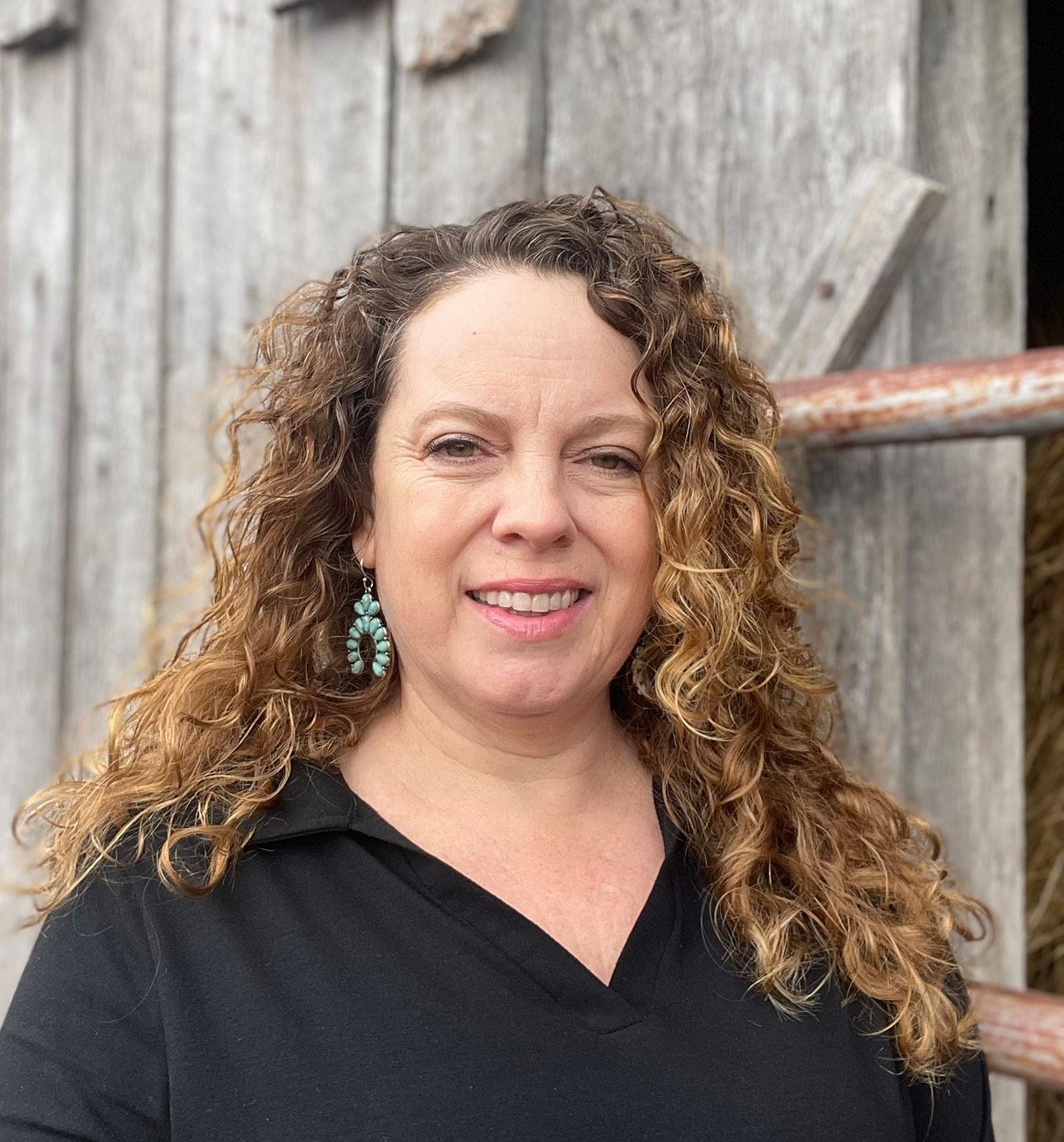
Anita Vanderwert, President
573-808-3000 • 620 State Route P, Fayette, MO 65248
Deb Thummel, President-Elect 660-541-2606 • 12601 Hwy. 46, Sheridan, MO 64486
Alex Haun, Vice President 816-345-0005 • 1031 SW 600 Rd., Holden, MO 64040
Vance Keaton, Treasurer
417-825-4853 • 5863 W. State Hwy 76, Anderson, MO 64831
Chris Cloud, Secretary 417-358-8459 • 7825 CL 173, Carthage MO 64836
Jeff Reed, Past MCA President 903-279-8360 • P.O. Box 35, Williamsville, MO 63967
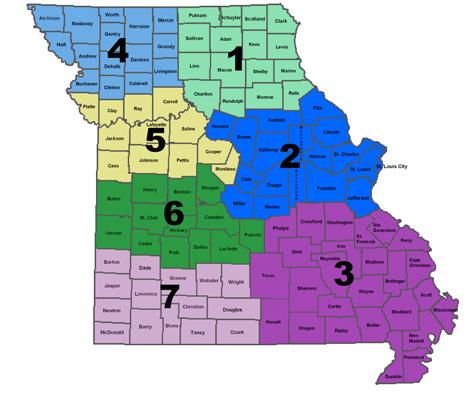
2026 MCA Regional Vice Presidents
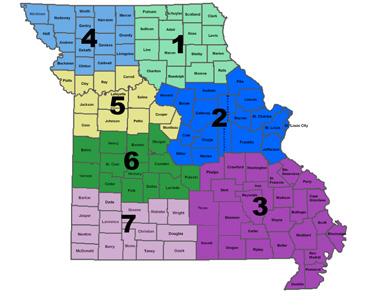
Region 1: Ethan McNeill, 325 McMurry St. Paris, MO 65275 636-544-9943
Region 2: Blake McDonald, 250 Clonts Rd. Sullivan, MO 63080 • 573-205-7914
Region 3: Danny Ross, 5514 Gaston Rd Eunice, MO 65468 • 417-932-4964
Region 4: Dale Buhman, 3751 SW Taylor Rd. Clarksdale, MO 64430 • 816-244-9249
Region 5: David Wolfe, 7761 Mount Vernon Rd Pilot Grove, MO 65276 • 660-834-3232
Region 6: Warren Love, 8381 NE Hwy ZZ Osceola, MO 64776 • 417-830-1950
Region 7: Nathan Isakson, 20706 Lawerence 2022 Everton, MO 65646 • 573-578-2518
Director At-Large: Stephanie Gable, 5622 State Hwy E Oak Ridge, MO 63769 • 573-256-3279
MCA Regional Grazing Coordinators
Region 1 - Kyle Viers 660-346-1084 kyle@mocattle.com
Region 2 - Doug Mertens 573-489-5261 doug@mocattle.com
Region 3 - Kenneth Ball 417-818-6400 kenneth@mocattle.com
Region 4 - Micah Hans 636-201-6846 micah@mocattle.com
Missouri Cattlemen’s Youth Expo
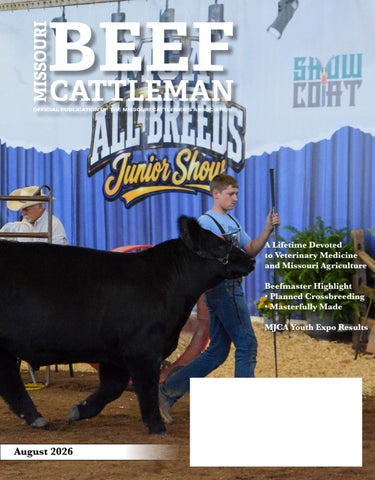
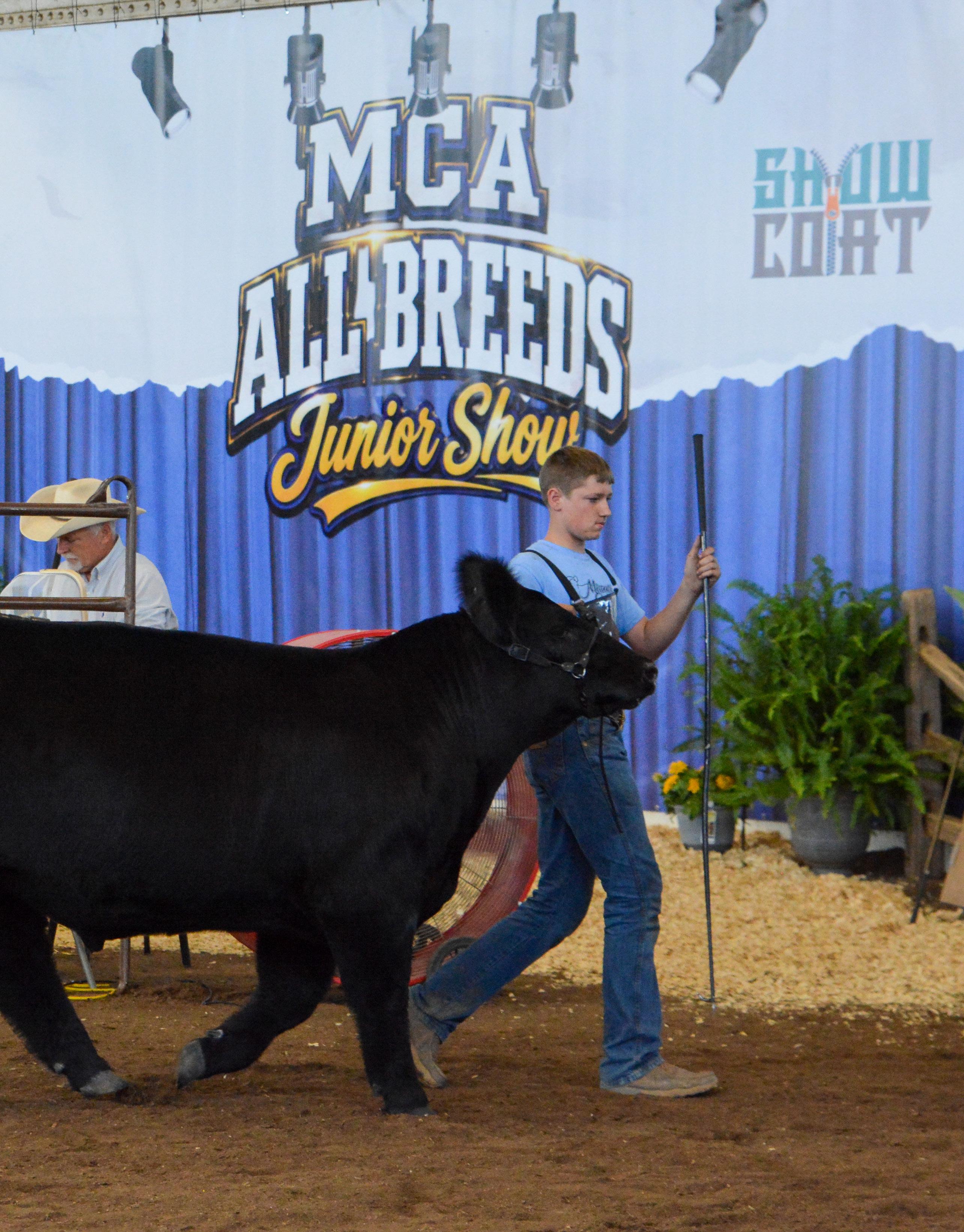
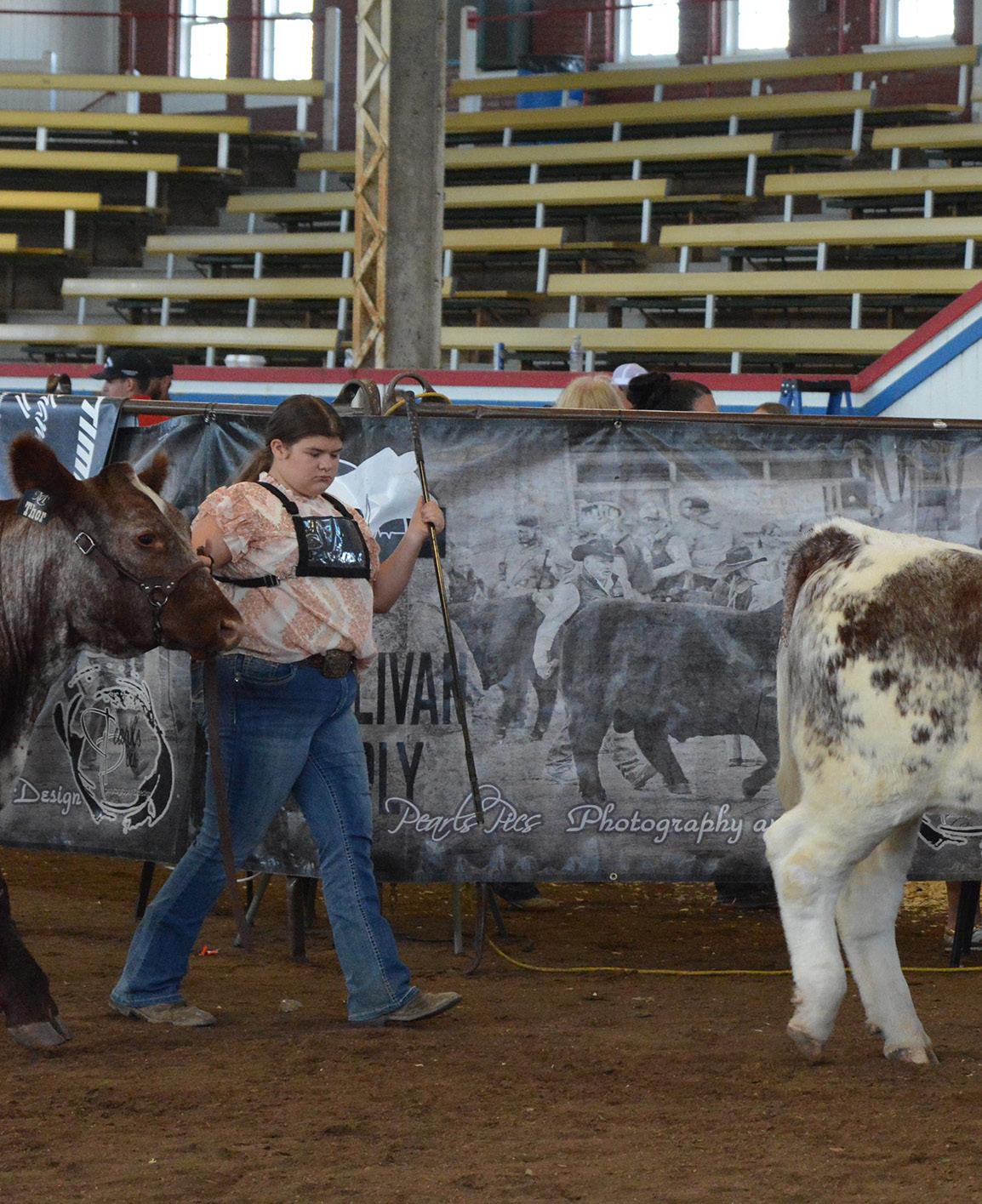
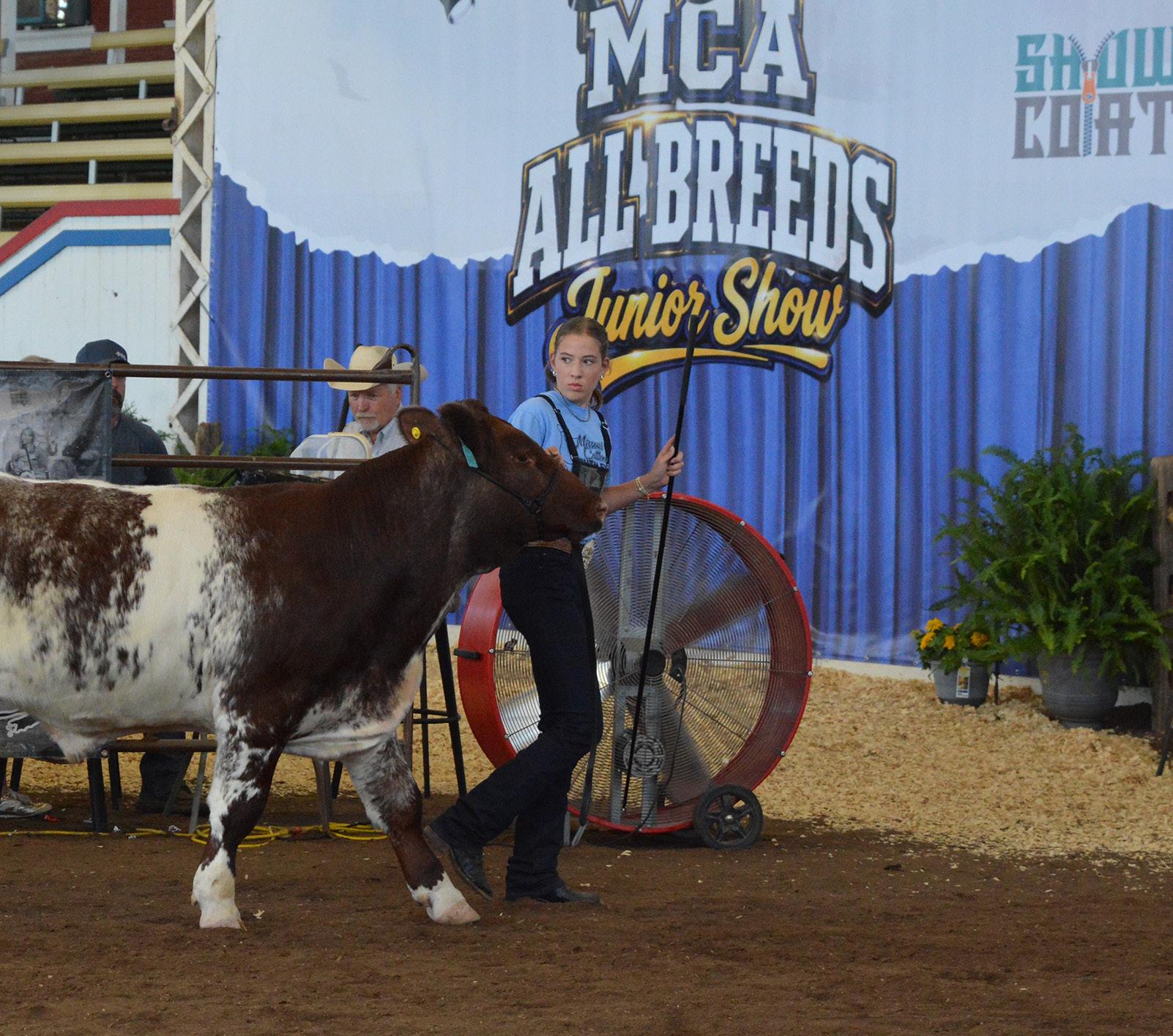
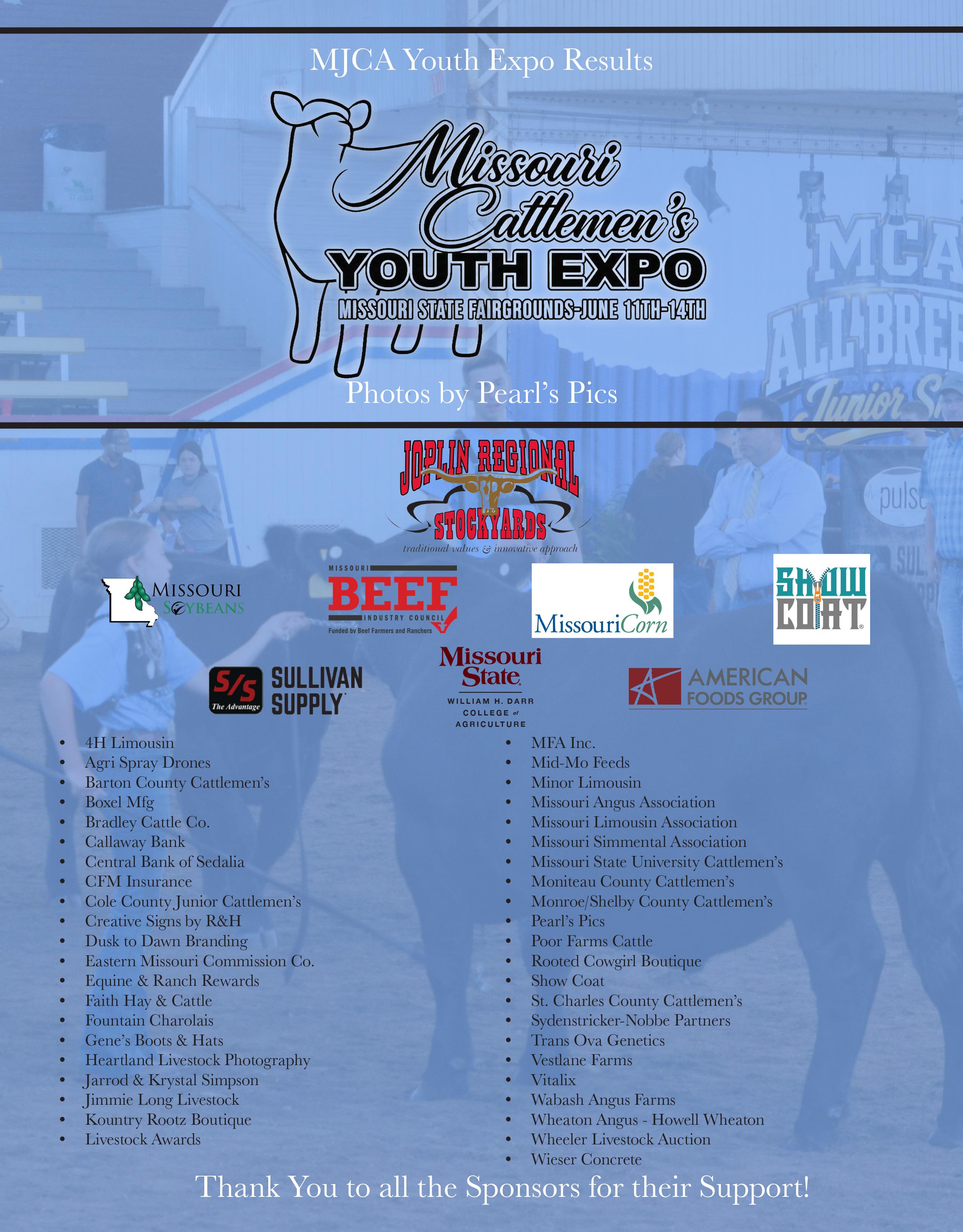
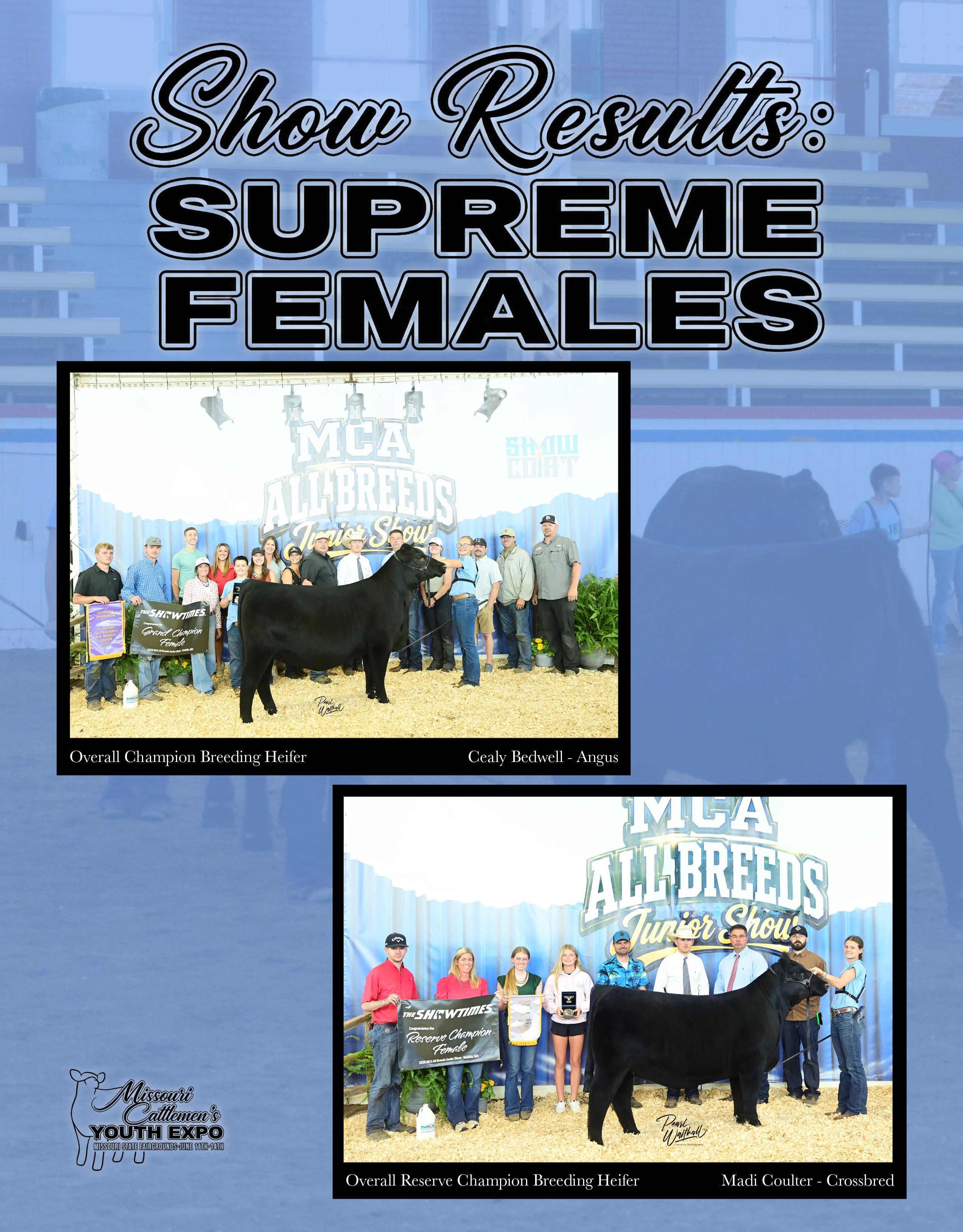
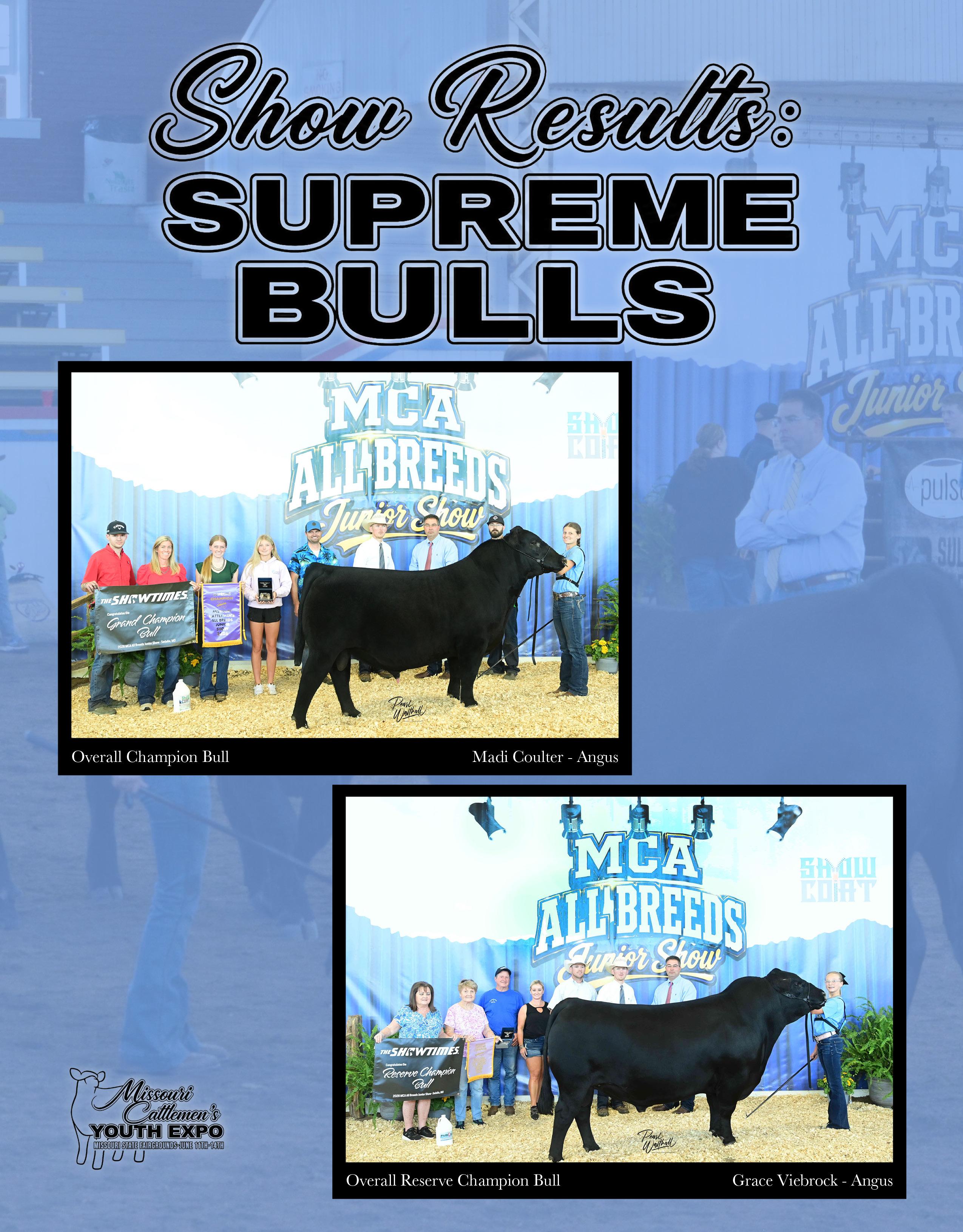
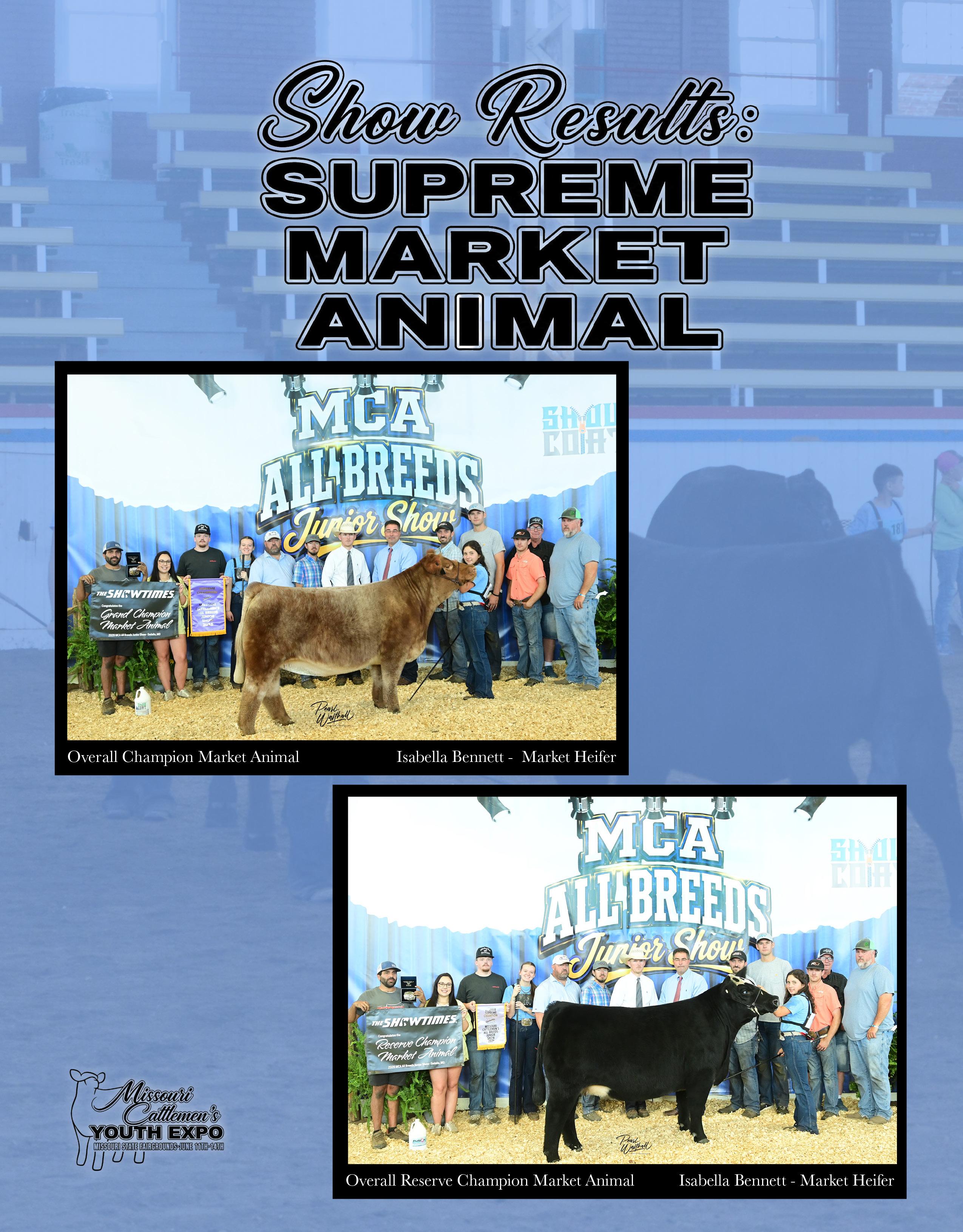
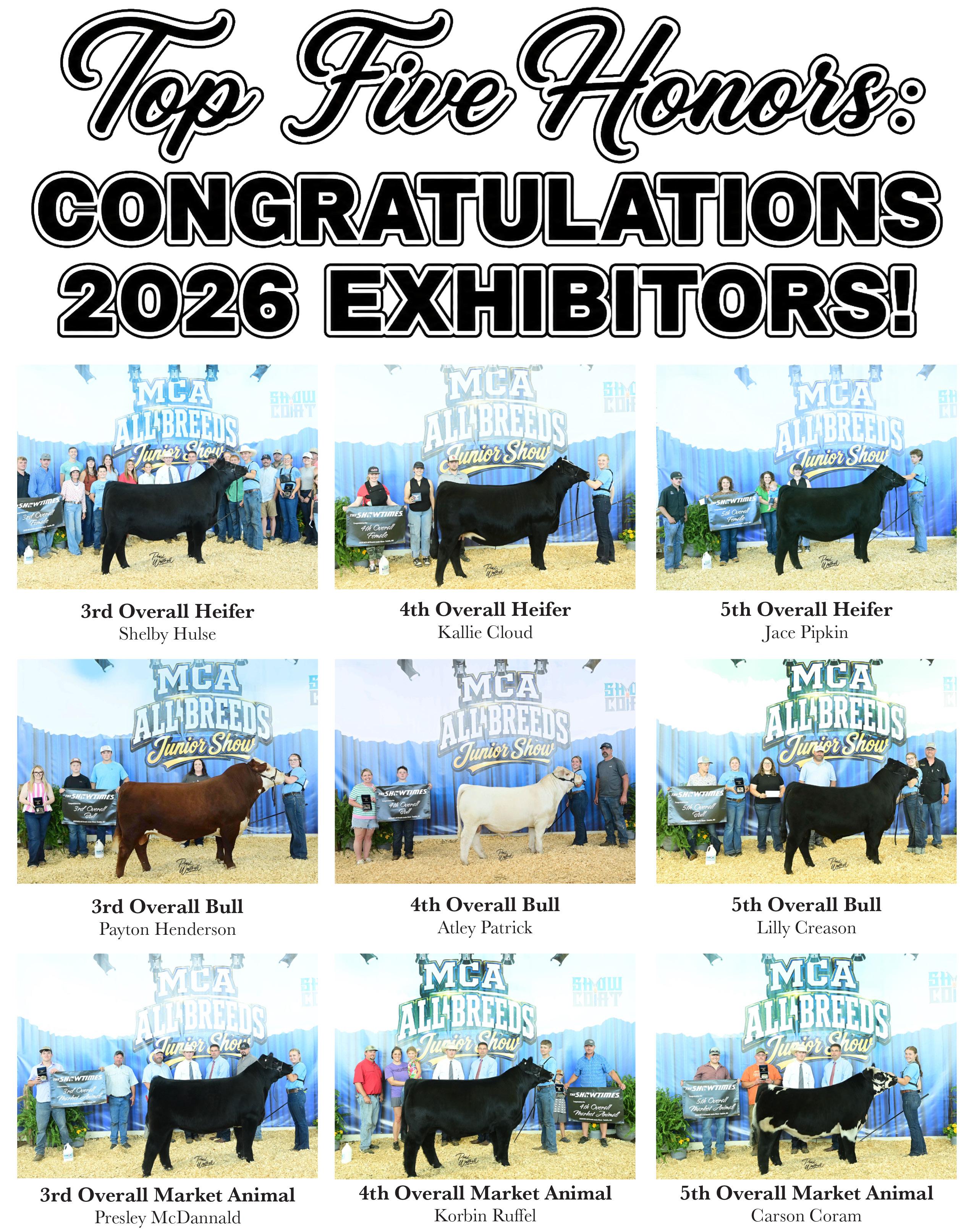
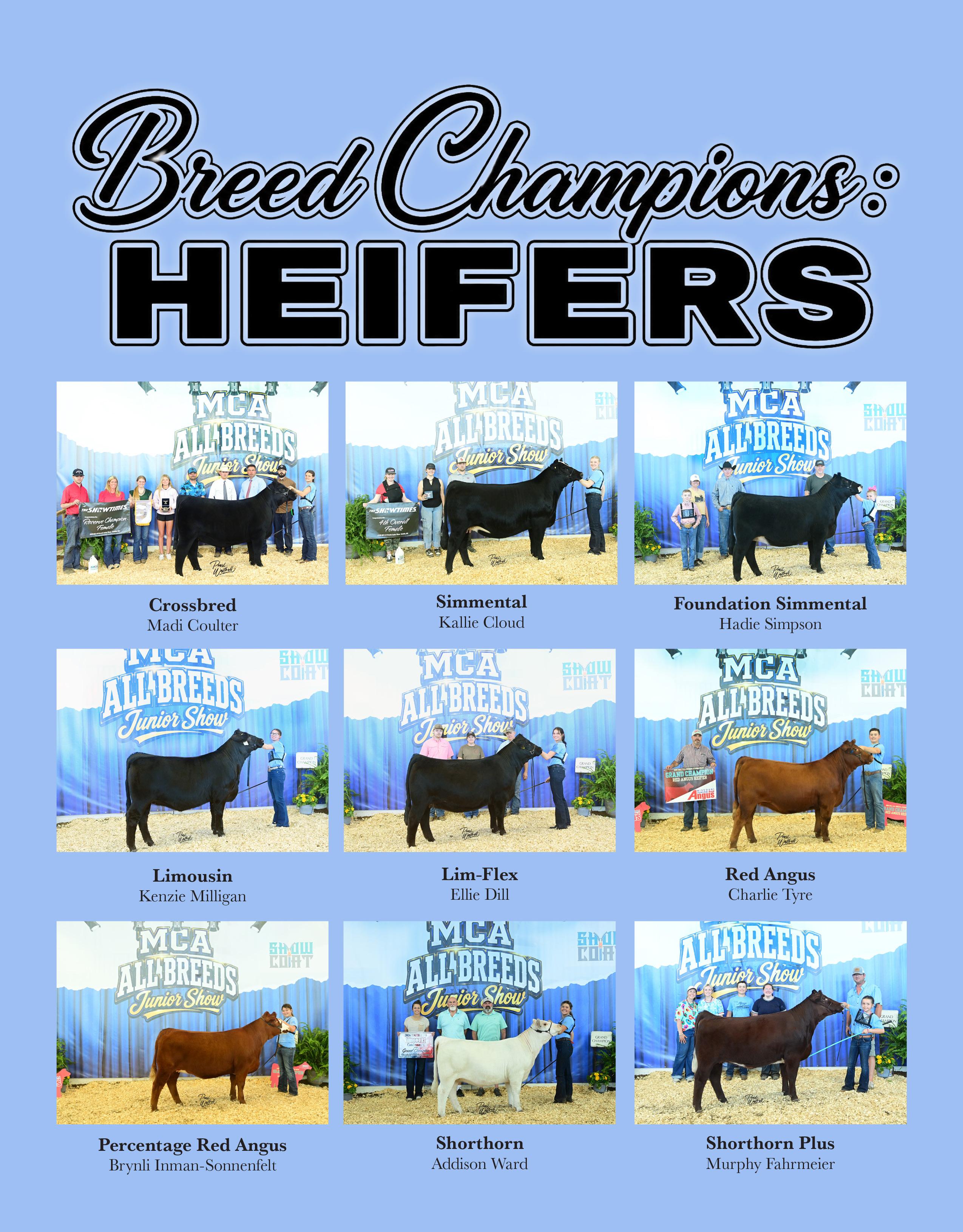
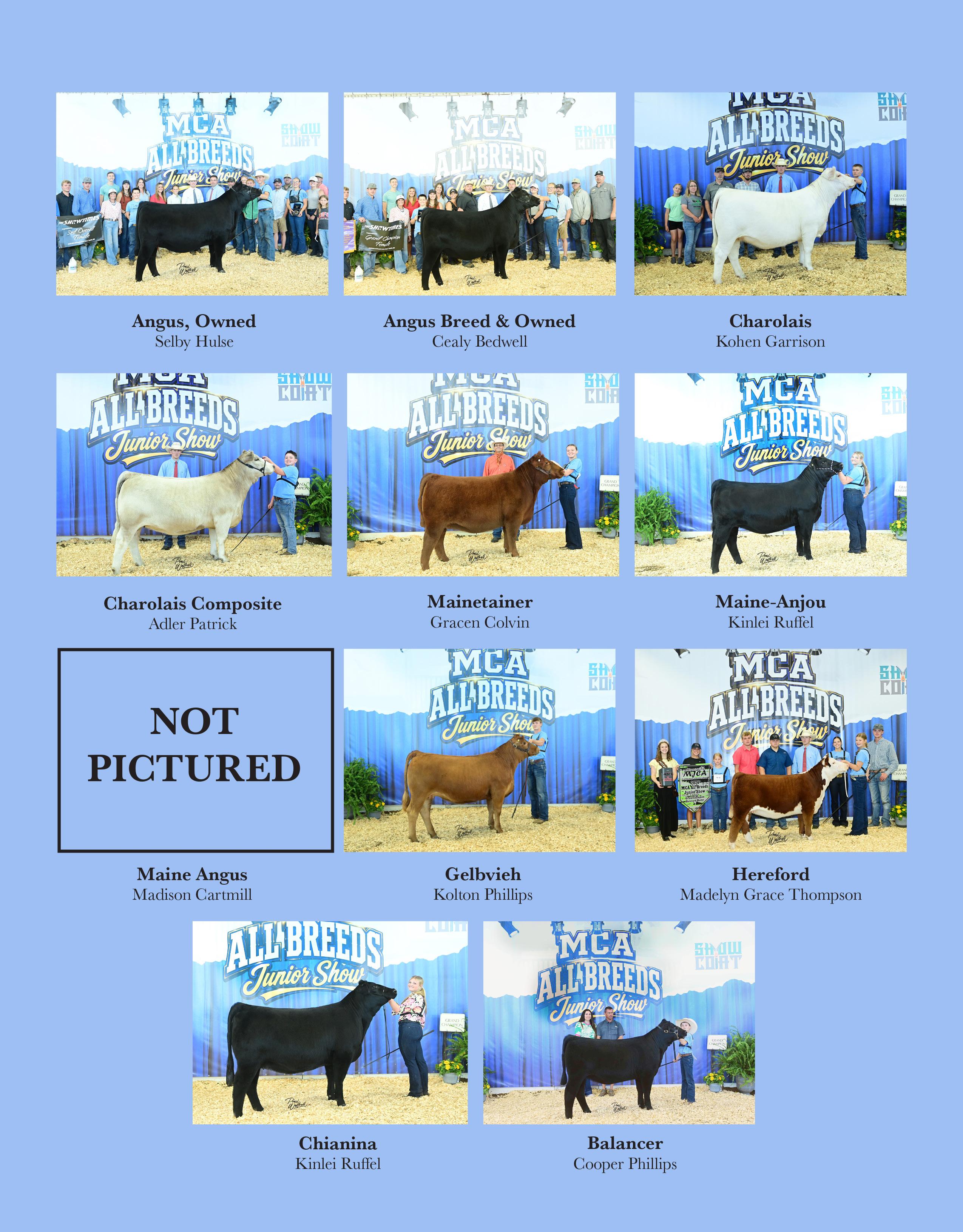
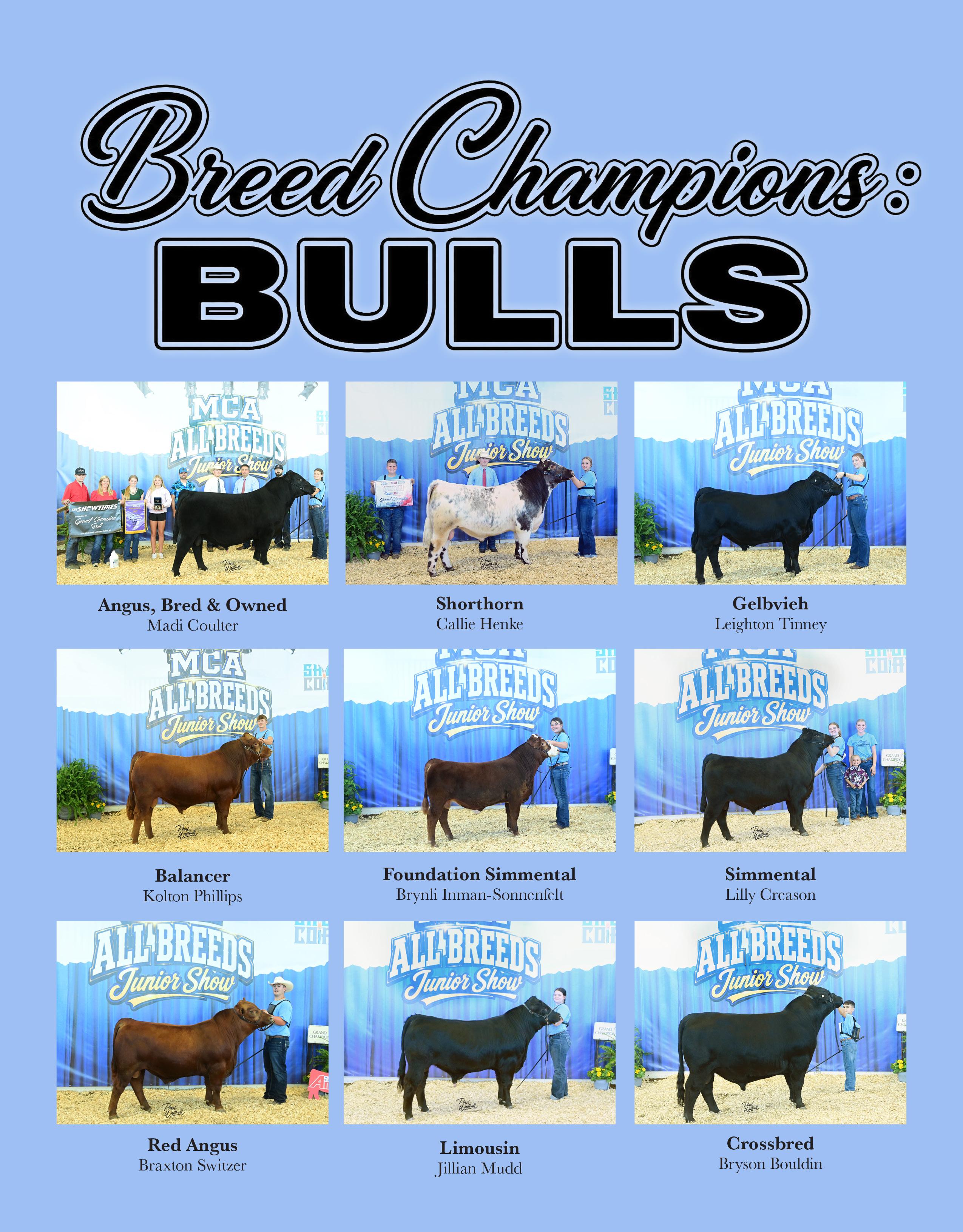
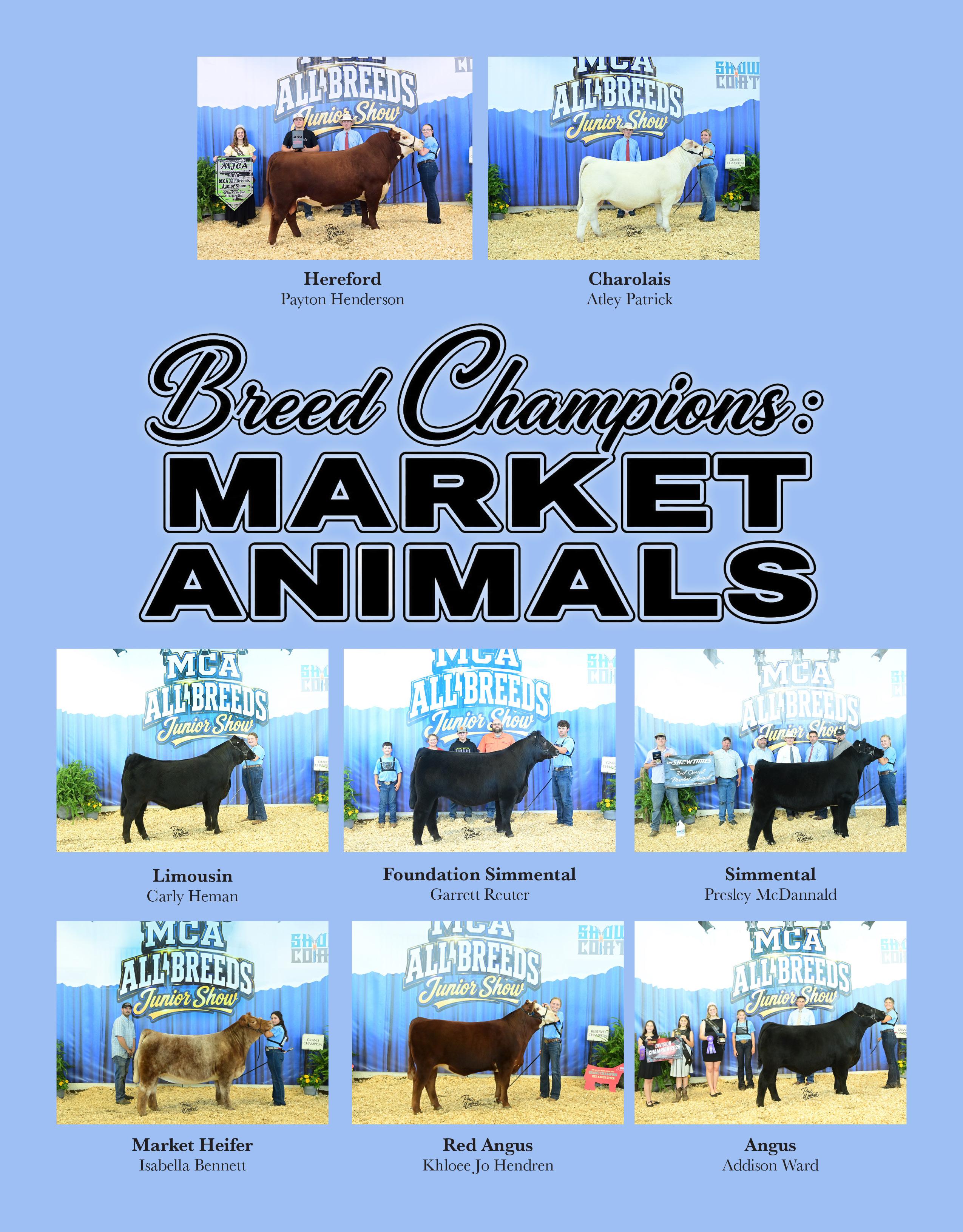
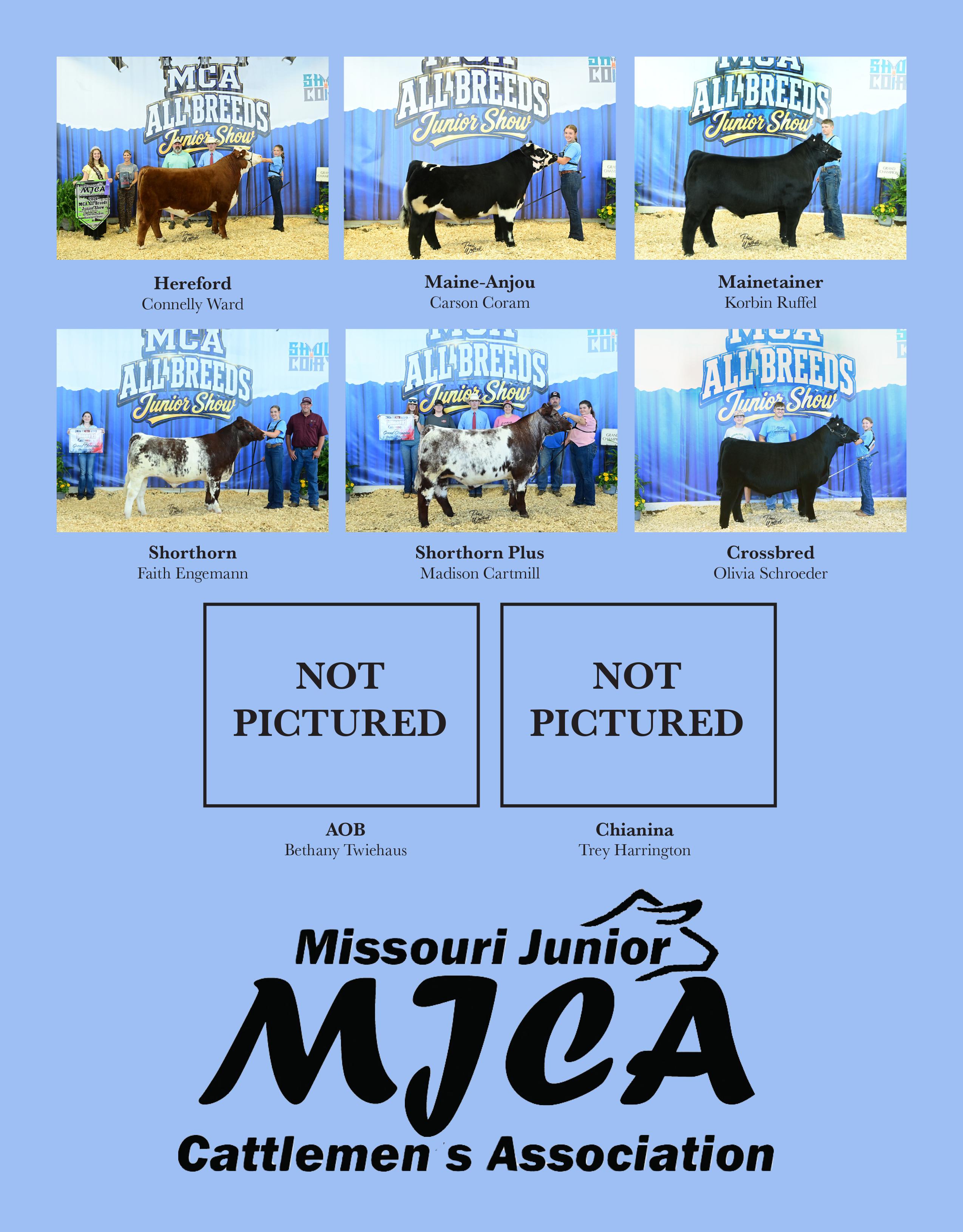
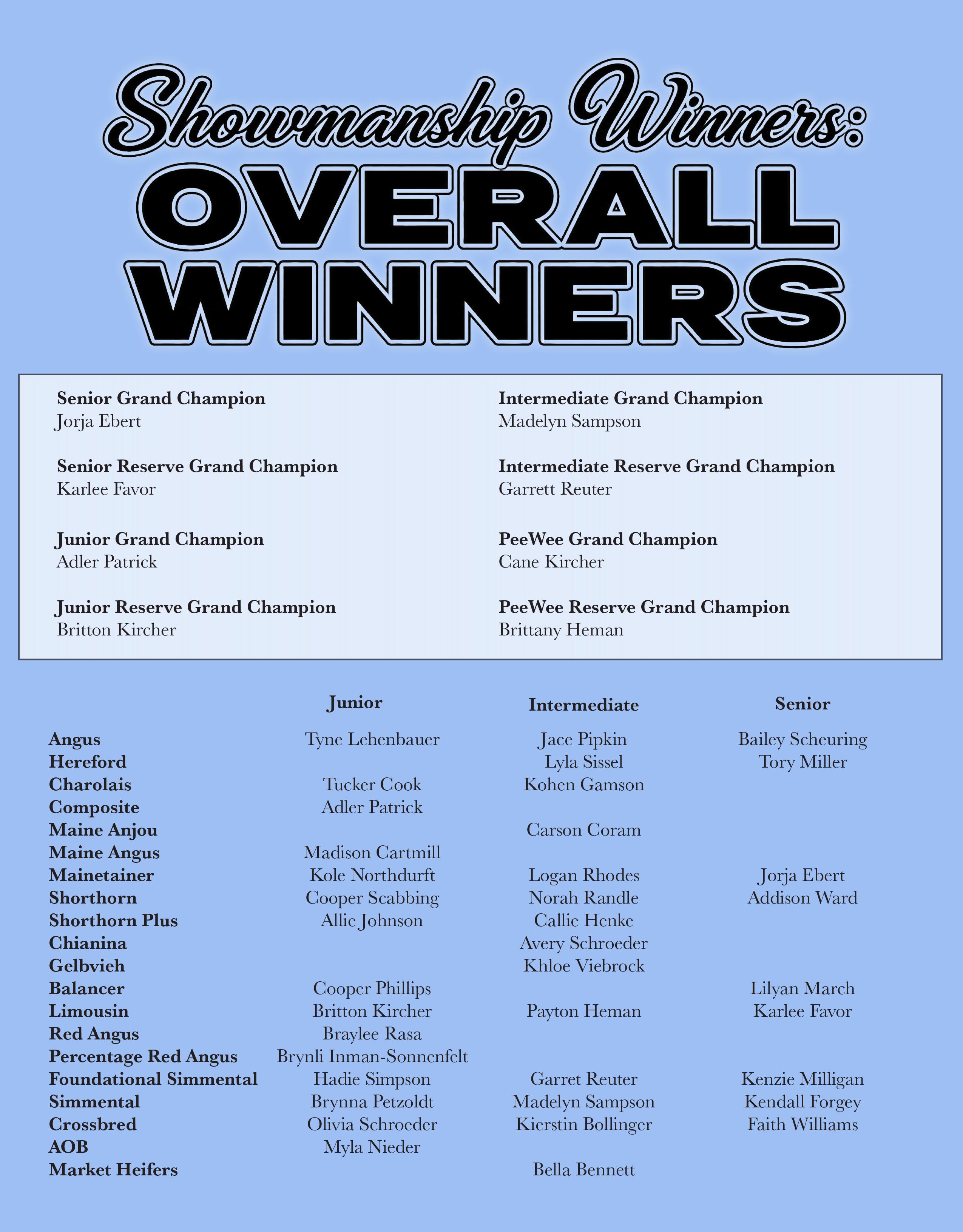
The Missouri Cattlemen’s Youth Expo was held the second weekend of June in Sedalia on the Missouri State Fairgrounds. This expo featured the Annual MCA All-Breeds Junior Show with 175 exhibitors and over 300 head of cattle. The 44th Annual MCA All-Breeds Junior Show will be held June 10th-13th, 2027, in Sedalia on the Missouri State Fairgrounds. Show results on PAGE 70.
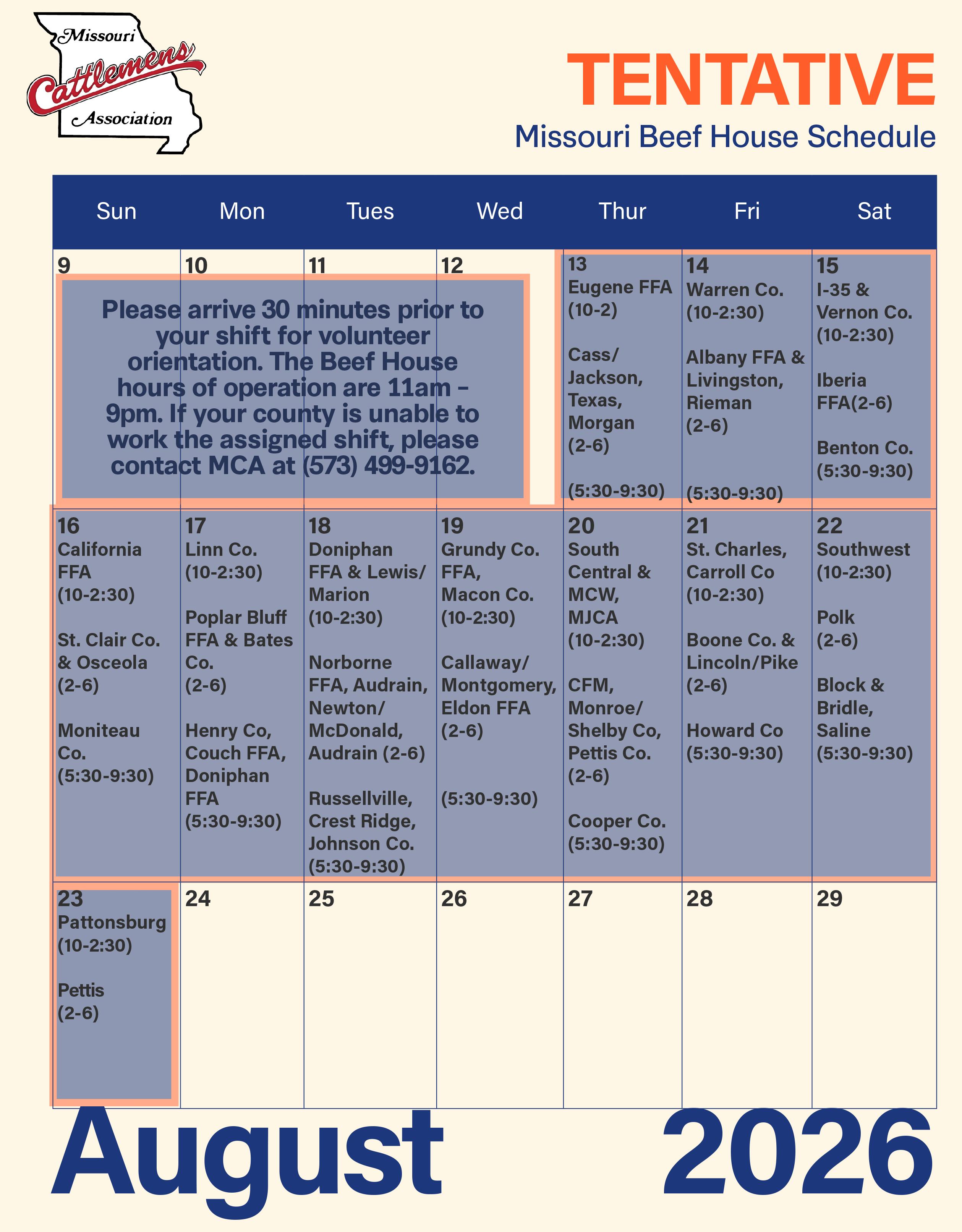
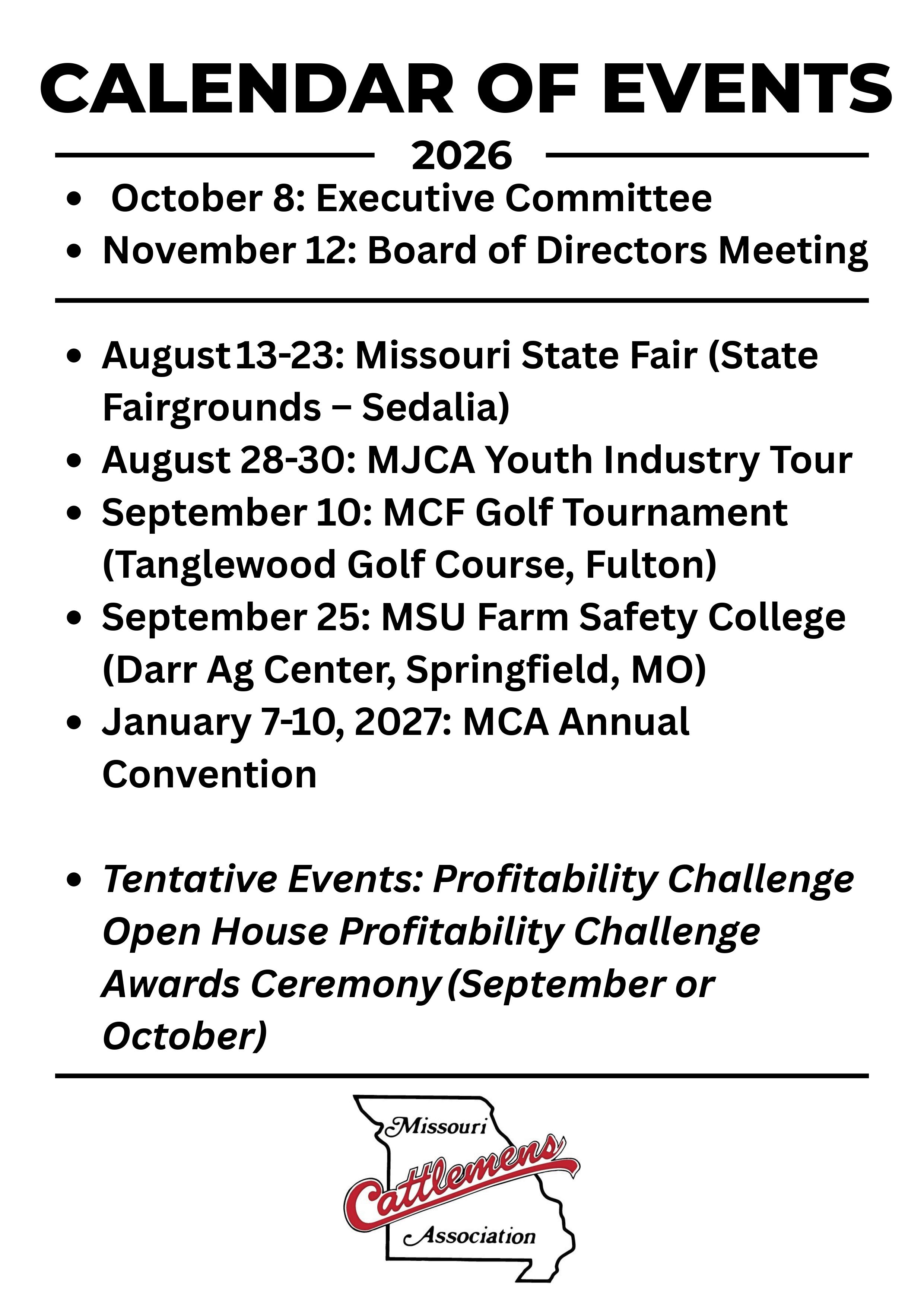
Missouri State Fair Beef House – August 13th-23rd
We are just a few short days away from the 2026 Missouri State Fair and another big year for the Beef House. Our volunteers help ensure the success year after year on the fairgrounds and we could not do it without you! Reminders will be sent out to all members with their respective county affiliate scheduled time to volunteer at the Beef House. To view the tentative Beef House schedule and for more information see PAGE 27.
MJCA Youth Industry Tour
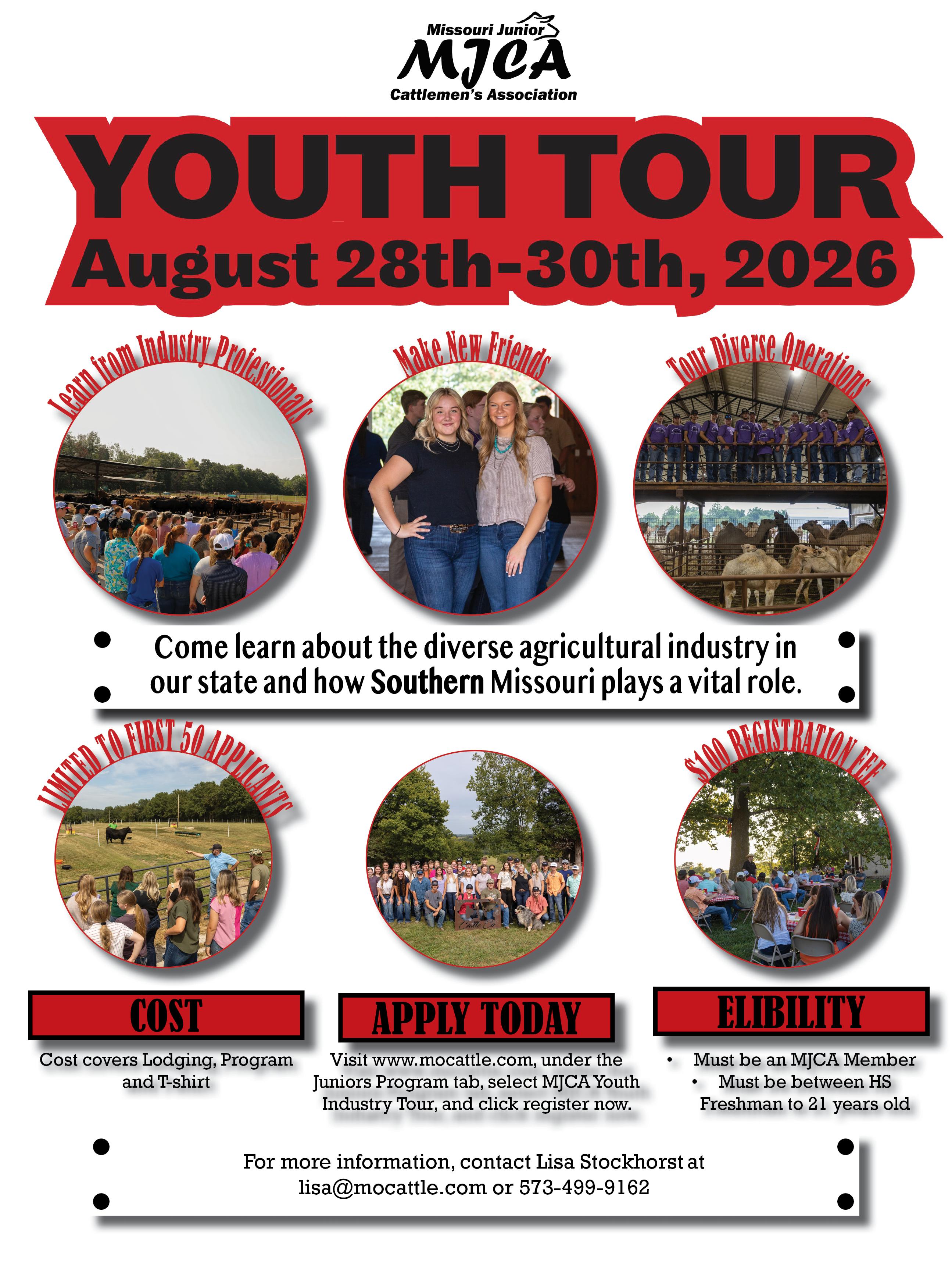
We are looking forward to the 2026 Youth Industry Tour. This year’s trip will take participants to Southeast Missouri. We have exciting tour stops planned at local businesses and cattle operations, featuring the unique agriculture industry opportunities in the area. Participants must be a freshman in high school to 21 years of age to attend. Space is limited to the first 50 applicants and spots are filling up fast. Registration is open online, at mocattle.com. More information can be found on PAGE 63.
MCF Cattlemen’s Classic Golf Tournament
Summer is here, and events are in full swing, but don’t forget to mark your calendars for events scheduled this fall! The 31st Annual Missouri’s Cattlemen Foundation Cattlemen’s Classic Golf Tournament will be held on Thursday, September 10th, in Fulton at the Tanglewood Golf Course. The tournament will be a four-person scramble with a shotgun start. Prizes will be awarded to the top teams in both the “Cattlemen” and “Open” classes. 2025 saw a fantastic turnout for MCF supporters and we look forward to the same success in 2026. To join in on the fun and help raise money for a good cause, look for the registration form in this month’s magazine or visit the MCA website. For more details, see PAGE 84.
Profitability Challenge & FFA Fantasy Feedout
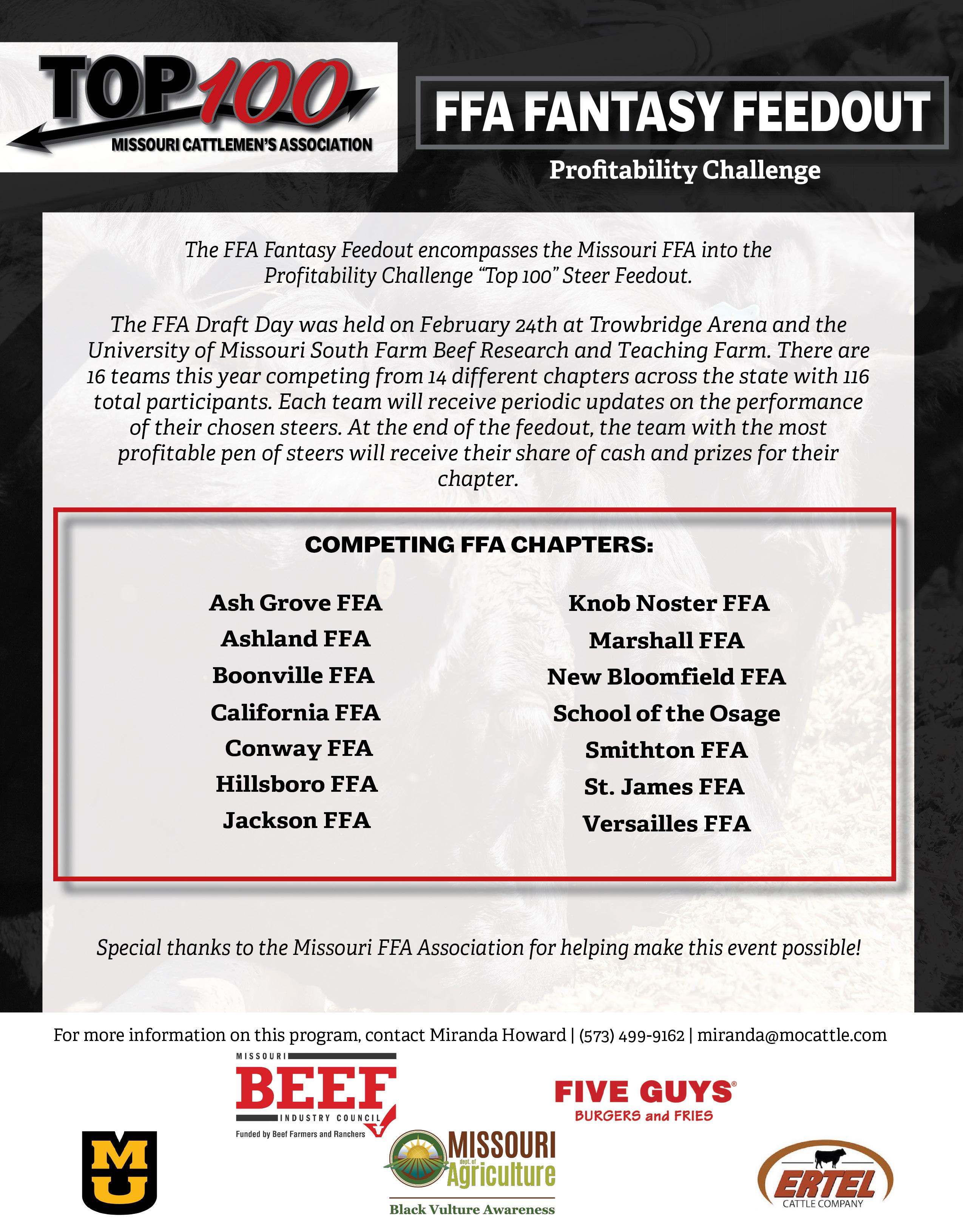
The 2025-2026 Profitability Challenge is wrapping up and we are gearing up for the 2026-2027 competition. The Profitability Challenge will kick off with steers being dropped off at MU South Farm on November 12th, 2026, from 8 a.m. to 4 p.m. Steer drop off will be held in conjunction with the MCA Board of Directors meeting on November 12th, 2026. Registration for the 2027 FFA Fantasy Feedout will open on November 1st, 2026. For more details, see PAGE 92.
MCA Executive Committee Council Chairs
AG AND FOOD COUNCIL
Jason McCann (417) 827-7499
Sclandandcattle@gmail.com
ANIMAL HEALTH
CARE/WELLNESS COUNCIL
Linda Hickam (573) 819-9469
Linda_hickam@yahoo.com
CATTLE MARKETING COUNCIL
Bruce Mershon (816) 289-3765
bruce@mershoncattle.com
TAX AND CREDIT COUNCIL
Brandon Bothwell (660) 654-7000
Bbothwell14@gmail.com
PROPERTY RIGHTS COUNCIL
Darrell Neuner (660) 864-1337
wabashangusfarms@yahoo.com
LIVESTOCK MARKETING COUNCIL
Grant Potadle (402) 870-1488
gpotadle@lmaweb.com
Barby Burton, Big Springs, TX
Trey Glenn, Horsefly Hill, Warsaw, MO
Steven Stokes, Warsaw, MO
Mary Luttrell, Windyville, MO
David Winkler, Lincoln, MO
Lydia Van Schyndel, Mexico, MO
Eli Rogers, Rogers Cattle Co & Lile Farms Red Angus, Strafford, MO
Dalton Reynolds, Circle R Cattle Co, Huntsville, MO
Garrett Greenlee, Circle G Livestock, Potosi, MO
Briar Williams, Williams Farms, Mineral Point, MO
Tanya Dinger, Villa Ridge, MO
Brian Dinger, Villa Ridge, MO
Dylan Burns, Midwest Organic Solutions, Jasper, MO
Royce Wilkinson, Montgomery City, MO
Meyers Truck Service
President’s Perspective with Anita Vanderwert
I Love August
In an election year, August means the primary election is finally behind us. Along with endless television ads, campaign mailers and social media posts. More importantly, it means the Missouri State Fair has arrived.
I’ve been attending the State Fair since before I was born, or at least that’s what my mom reminds me of every August. Some of my favorite memories were made on the fairgrounds and every year I’m reminded why it’s one of my favorite times of the year. There’s simply no better place to celebrate Missouri agriculture, reconnect with old friends, make new ones and showcase the people who make our industry so special.
The fair is also a reminder of just how important agriculture is to our state. While thousands of visitors come for the food, livestock shows, concerts or exhibits, they also get a firsthand look at an industry that fuels Missouri’s economy and feeds our nation.
As summer begins to wind down, I hope all of us take advantage of these last few weeks. Spend time with your family. Visit with neighbors. Put down the phone for a while and enjoy a conversation that doesn’t involve a screen.
That’s becoming harder to do.
Every day we’re flooded with news from every direction. Within seconds we know what’s happening in our hometown, across the country and around the world. As someone who studied agricultural journalism, I can’t imagine not paying attention to the news. Staying informed is part of who I am. But I also understand why so many people feel overwhelmed by the constant barrage of information. Sometimes it’s healthy to step away, gather with people you enjoy and remember there is still plenty of good happening around us.
By the time you read this, Missouri’s primary election will already be over. The Missouri Cattlemen’s Association once again spent time interviewing candidates and endorsing those we believe understand agriculture and will represent our industry well.
Those interviews reinforced something I’ve always believed: candidates need to hear directly from cattle producers. No one understands the challenges facing agriculture better than the people living them every day.
If you have the opportunity to attend a town hall, campaign event or community meeting this fall, I encourage you to go. Introduce yourself. Ask questions. Tell your story. We can’t expect elected officials to understand our concerns if they never hear from the people raising Missouri’s cattle.
And we have plenty to discuss. We need added dollars for more research through APHIS, we need novel treatments pushed through for testing, increased funding for livestock indemnity payments and a plan to incentivize producers to increase our cattle herd.
Theileria continues to threaten the profitability of many cattle operations through death loss, reduced fertility, abortions and unthrifty calves. The possibility of New World screwworm returning to the United States reminds us that animal health requires constant vigilance. Labor shortages continue to affect rural communities. Our nation’s cow herd remains at its lowest level in decades, while the average age of producers continues to climb. At the same time, the cost of getting started in the cattle business has made it nearly impossible for many young families to build a herd from scratch.
These aren’t tomorrow’s challenges. They’re today’s realities.
The encouraging news is that agriculture has always been resilient. Cattle producers have never been afraid of hard work, difficult conversations or finding solutions. But those solutions require engaged producers and elected officials who understand rural Missouri.
As you enjoy the Missouri State Fair, cheer on the next generation in the show ring and visit with friends from across the state, remember that every conversation matters. Whether it’s talking with a neighbor, mentoring a young producer or visiting with a candidate for public office, each of us has an opportunity to influence the future of Missouri agriculture.
The fair lasts only 11 days, but the work of protecting our industry continues every day of the year.
Let’s make sure we’re part of that effort!
MCA President
CattleWomen’s Corner with Jennifer Poor
How Much Information Is Too Much???
It’s August ya’ll!, where did the summer go?!?! The fair is getting ready to start; the MJCA Youth Industry Tour will be here before you know it and the kids are going back to school! Time just needs to slow down.
If you haven’t made plans to attend the Missouri State Fair, I encourage you to make the trip. Even if Sedalia is a bit of a drive, it’s well worth it. The fair offers something for everyone, from the rich history of the fairgrounds to the outstanding livestock exhibits and family-friendly activities.
Officers of the Missouri CattleWomen
President: Jennifer Poor 417-372-0227 • poorfarmscattle@gmail.com • Pomona
President Elect: Mandy Weigand 660-909-6781 • weigandranch@hotmail.com • Warrensburg
One of my favorite parts of the fair is walking through the livestock barns. I’m always amazed by the dedication, hard work and countless hours that young exhibitors (and often their parents) have invested in preparing their animals. Their commitment deserves to be celebrated.
While you’re there, be sure to stop by the Beef House for a great lunch or dinner. If you’re looking for new beef recipes, visit the Missouri CattleWomen Showcase and enjoy one of the cooking demonstrations. If you’d like to volunteer during the fair, we’d love to have your help. Whether it’s assisting at the Missouri CattleWomen Showcase or helping serve guests at the Beef House, your time and support are always appreciated.
This year’s MJCA Youth Industry Tour will be August 28th-30th and will be focusing on the southeast part of the state. Youths ages 14-21 will experience various agricultural opportunities available in this part of the state. If you know someone that would like to go, get them signed up ASAP! There are only 50 seats available. Let your local Ag/FFA teacher know about the trip and they can put the information in front of their students. This is an amazing opportunity for tomorrow’s beef producers!
This summer, Jason and I and some of the neighboring farms had the opportunity to have a Mizzou veterinary professor come to the farm to gather samples from our cows for a research project she was leading. She tested all the herds for Johnes, Theileria and Anaplasmosis to name a few. The information we all received was eye opening to say the least. Just looking at our herds, you would think they were pretty healthy and didn’t have any issues. However, the results were surprising considering there were no symptoms showing.
After having Mizzou at the farm, it got me thinking. How much information is too much? Our greatgrandfathers didn’t have the opportunity to participate in research like we did. They still raised their cattle the best way they knew how and it was done without knowing what illnesses their cattle may or may not be carrying. Nowadays we have access to our herd, all
with the click of a button. If you have any sort of cattle collars, you can pull up an app and see exactly where they are and move them to a different area of pasture all from the comfort of your couch. If you have game cameras in your pastures, you can see what your cattle are up to. If you have herd management programs, all it takes is a wave of an EID wand to see EVERYTHING about them. If you need to document something about a specific animal, it can be accomplished with one phrase that starts with “Hey Siri…”. By having all of this information so close at hand, does it make things easier for us, or does it complicate it? This is a question that I don’t have the answer to, because I’m on the fence about it. I love being able to enjoy my morning cup of coffee and moving our cattle all before I have changed out of my pajamas. However, knowing that your cattle carry a specific disease can be a little scary and make you wonder if I will have a major loss due to this illness? Sometimes ignorance is bliss. I encourage you to figure out what works best for your operation and for you to decide how much information is just enough.
Since the kids will be heading back to school this month, I had them in mind when picking up this month’s recipe. Quite honestly, this would be a great lunchbox staple for them. You can also use leftover taco or spaghetti meat for the filling if you don’t want to use store bought meatballs. Enjoy!
Cheesy Meatball Pockets
Use frozen meatballs to recreate a flavorful childhood favorite wrapped in fluffy biscuit dough and served with marinara.
1 cup diced tomatoes, drained 1-1/2 cups shredded Italian blend cheese, divided 1/2 teaspoon Italian seasoning Marinara or Alfredo sauce (optional)
Preheat oven to 400°F. On a lightly floured surface, roll each biscuit into a 6-inch disc (about 1/8-inch thick).
Divide meatball slices and place evenly in centers of discs. Top with 2 tablespoons each marinara, tomatoes and cheese. Fold dough over filling, pressing with fork to seal.
Cook’s Tip: Brush edge of dough with water to help with sealing.
Place pockets on greased, shallow-rimmed baking sheet. Cut slits in dough to vent. Sprinkle tops with remaining cheese and Italian seasoning. Bake 10 to 12 minutes or until golden brown and crispy. Serve with additional marinara or Alfredo sauce, as desired.
Alternate Cooking Method
Preheat pizza oven to 500°. Bake 3 to 5 minutes or until puffed and bottoms are firm and browned.
Straight Talk
Show Ring R-III
I went to school at Savannah R-III. My kids go to Montgomery County R-II. I believe some of the very best leaders in our communities are graduates of “Show Ring R-III.” There’s nothing in the world like a livestock show. I grew up showing livestock. I judged livestock in college. My kids show livestock. I’ve spent 14 years with the Missouri Cattlemen’s Association working alongside our Missouri Junior Cattlemen’s Association, empowering the next generation to engage and participate.
Executive Vice President with Mike Deering
If done right, showing livestock can be a very valuable experience for young people and their families. It teaches lessons that cannot be taught in the classroom. I often argue that the most important of those is learning how to win and how to lose.
Winning the right way starts long before stepping into the show ring. Youth who show livestock learn that success comes from hard work, preparation, responsibility and integrity. They learn to compete with respect and win with class. Learning to lose the right way may be one of the greatest lessons the show ring teaches. I can tell you I like to win but I have sure learned more from losing than I ever have from winning. Not every animal wins and not every day goes your way. You shake a hand, congratulate the winner, learn from the experience and keep working. True character isn’t revealed when you win. Character becomes crystal clear when you don’t.
I also believe as parents, we set the tone. We set an example. Winning is exciting, but a banner should never become more important than the lessons our
kids are there to learn. They are watching how we handle success, disappointment and competition. I’m certainly not saying we don’t push our kids. They need to play to win or you have to wonder if their heart is in it. With that said, as parents, our greatest responsibility isn’t raising champions. It’s raising good people with character and perspective who grow up to be assets in communities throughout Missouri and beyond.
The show ring may be the best classroom in Missouri. It teaches responsibility before sunrise, perseverance when things don’t go as planned, humility in victory and grace in defeat. It teaches young people that success is earned and you damn sure aren’t entitled to it. Parents, exhibitors, volunteers and supporters all help make those lessons possible.
Those lessons are on full display here at the Missouri State Fair, August 13-23. Come fill the barns, line the show rings and support these young people. The ribbons will eventually fade, but the character, friendships and life lessons built here will last a lifetime. When you are done sweating in the ring, come see us at the Missouri Cattlemen’s Beef House for some great food served by our county affiliates.
Observations from the Field
with Doug Mertens, Region Two Grazing Coordinator
Can Adding Plant Diversity Help Weatherproof Your Farm?
Weather can be very unpredictable as most of us have seen this spring and summer. Some of us have received more than enough rain while others have struggled to receive any. So how do you weatherproof your pastures to combat what mother nature throws at you? Can adding plant diversity help weatherproof your farm?
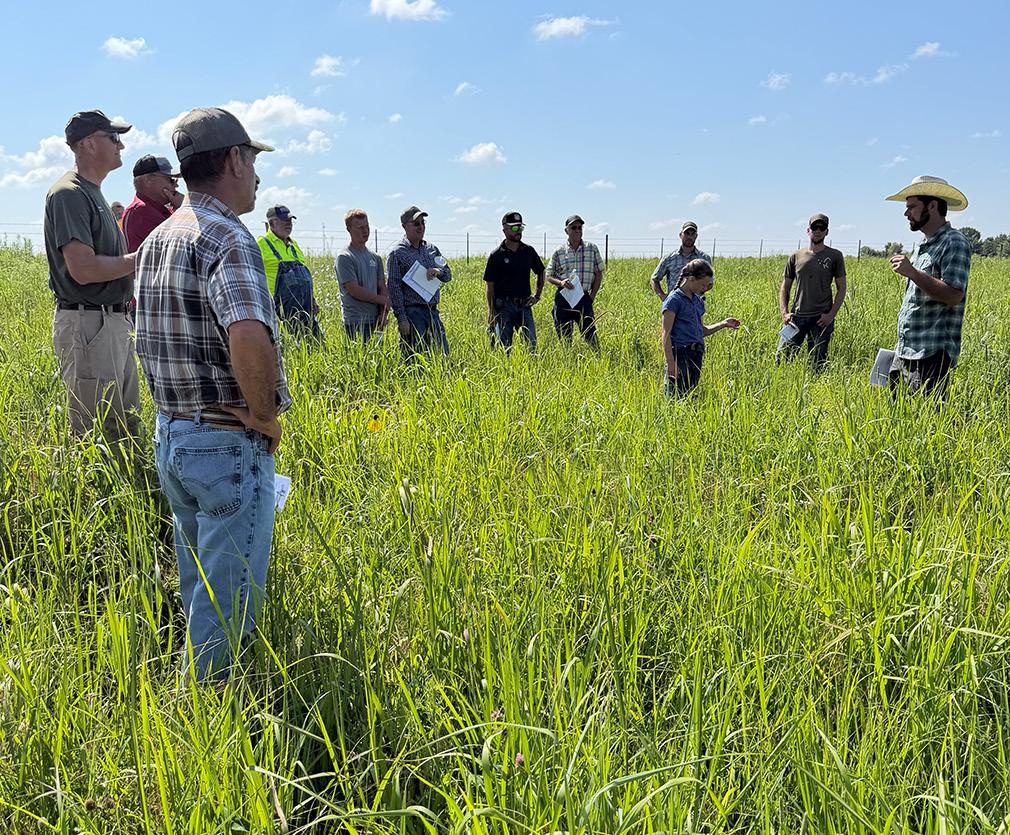
Last month, Kenneth shared how adding warm season grass extended grazing on his farm and how the warm season forages thrive when the cool season grasses like fescue go dormant as the temperatures rise. At a recent field day at the Cheha Ranch in Kirksville Missouri, I got to see firsthand the difference between the two. When you see them side by side, the difference is striking. When you stand in a field of warm season grass in July and it is waist high you begin to understand the benefit this would provide.
Another way that we can weatherproof our pastures is plant diversity. We have probably all noticed how the weather can impact which plants thrive in our pastures. Having a good mix of plants in our pastures ensures that, no matter what the weather, we have a mix that will provide forage for your livestock.
During my time managing a fertilizer plant, adding clover seed to the spring pasture fertilizer was standard practice. The addition of clover to fescue pasture was an effective way to improve the quality of the pasture and was relatively simple. While this did add diversity and improve quality, with only two plant species we may still be limiting our production.
The fields we toured at the Cheha Ranch offered a more diverse mix. We had the opportunity to see both cool season and warm season fields and talk about the seed mixes that they planted.
The cool season mix included Brome, Timothy, Orchard Grass, Red Clover, Bird’s Foot Trefoil and
Alfalfa. These were planted on fields being converted from row crops to pasture. The grasses were planted with a no-till drill in the fall with a wheat cover crop and the legumes were broadcast in the late winter or early spring.
The warm season fields were equally diverse. Again, these were fields being converted from row crops to pasture. The varieties no tilled in the fall after the soybeans were harvested were Virginian Wild Rye and Canadian Wild Rye with an oat cover crop. Late winter Big Bluestem, Indian Grass, Switchgrass, Side Oats Grama, Little Bluestem, Blue Grama and additional amounts of both Canadian and Virginian Wild Rye were no-tilled in.
These mixes may seem a bit overwhelming, but this level of diversity helps combat what mother nature gives us. The advantage is that they all have different weather preferences and maturities. This will allow you to have the best quality forage for your animals.
If you are interested in learning more about forage mixes, planting rates and the best establishment practices reach out to one of the Missouri Cattlemen’s Regional Grazing Coordinators. We are always available to assist you!
For help with management of native grass, or for help identifying plants or weeds (feel free to text pictures) contact Missouri Cattleman’s Association Grazing Coordinators:
Region 1 • NW MO Region 2 • NE MO Region 3 • SW MO Region 4 • SE MO
Kyle Viers
Doug Mertens
Kenneth Ball
Micah Hans kyle@mocattle.com
660-346-1084
doug@mocattle.com
573-489-5261
kenneth@mocattle.com
micah@mocattle.com
417-818-6400 636-201-6846
Regional Range Report
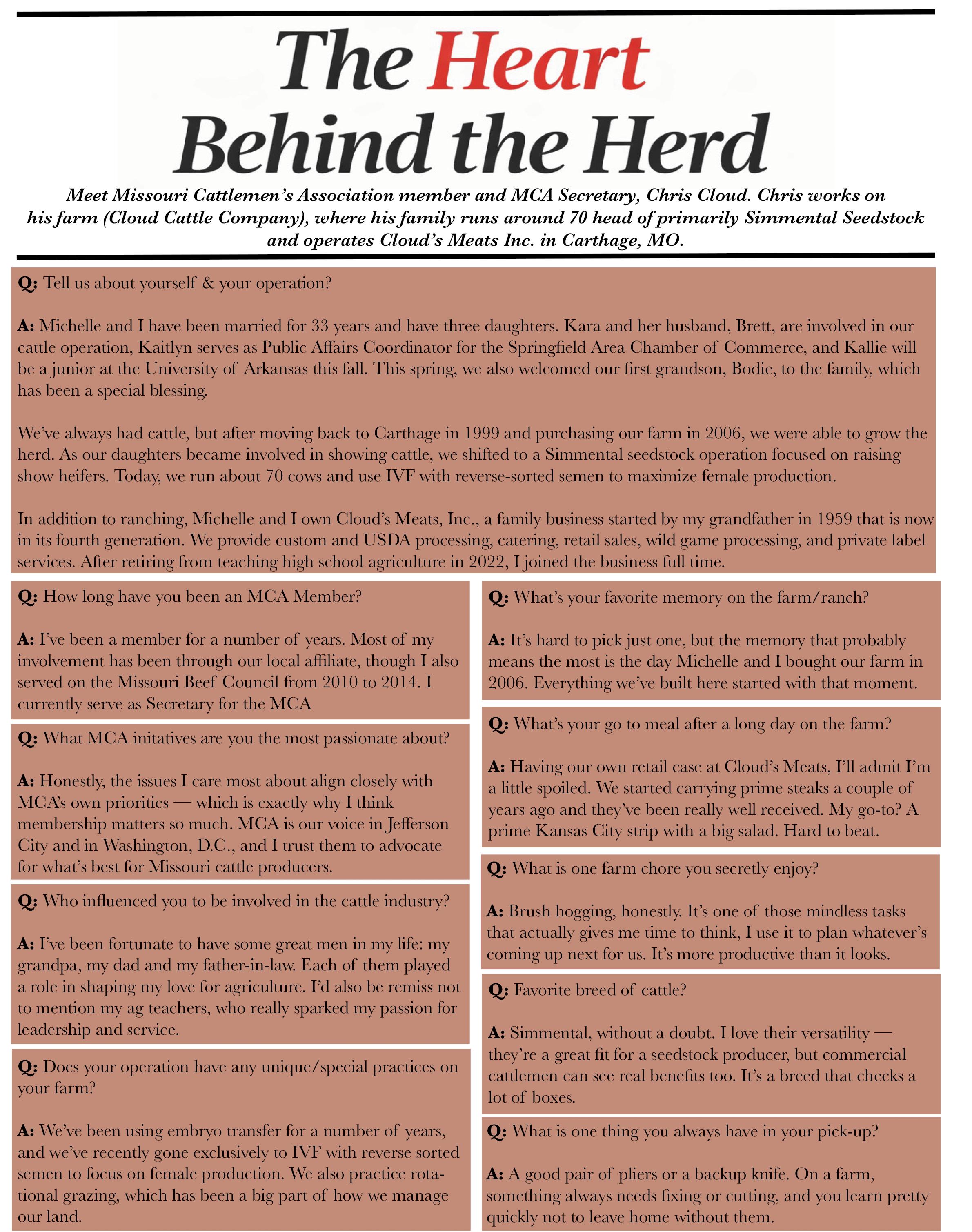
by Chris Cloud
From the Farm: Summer in the Show Ring and the State of the Beef Industry
“We didn’t just raise cattle. We raised three daughters alongside them — and I think the cattle taught them more than we did.”
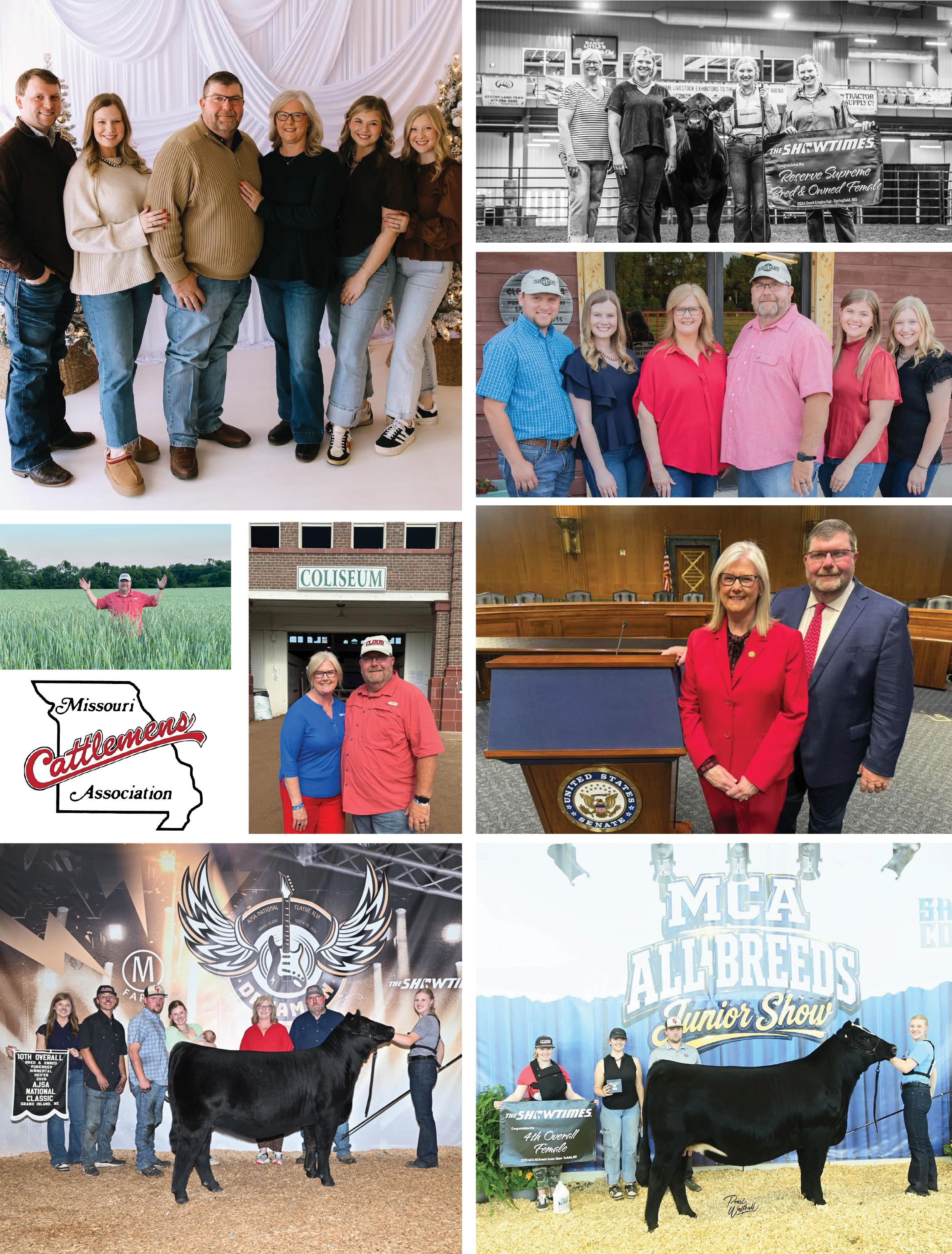
That quote sums up our summers better than anything else could. From June through August, our days are packed with cattle shows, processing fair animals and squeezing hay harvest in between everything else. It’s busy, it’s exhausting, and honestly, we wouldn’t trade a minute of it.
We made the trip to the MCA All Breeds Junior Show this year. I came away genuinely impressed with how well the staff & volunteers executed that event. It was a first-class operation and we’re already looking forward to heading back next year.
The first part of July brought our annual pilgrimage to Simmental Junior Nationals, held this year in Grand Island, Nebraska. As we pulled out of Carthage and headed north, I couldn’t help but notice how exceptional the crops looked, the corn in particular was something to see. Once we arrived, the scale of the event was equally striking: more than 500 contestants from 31 states, exhibiting 862 head of cattle. We’ve been making this trip for ten years now and it never gets old. There is something genuinely energizing about being surrounded by that many young people who are fired up about the beef industry and their future in it.
And there’s plenty to be fired up about. Cattle prices are at all-time highs and the consumer demand remains strong. The question I hear most often, usually from customers at our processing plant, is, “How long can this last?” It’s a fair question. My answer is that as long as we continue delivering a consistent product that both tastes great and looks great in the case, the consumer will keep coming back. They want our beef and right now they’re willing to pay for it. Our job is to make sure we keep earning that trust.
Region 1 VP - Ethan McNeill
Region 2 VP - Blake McDonald
Region 3 VP - Danny Ross
That said, the record prices have created some interesting dynamics on the processing side. We’ve seen a noticeable decline in the number of beef cattle being custom slaughtered. Talking with other processors around the region, they’re experiencing the same trend. The reason isn’t hard to figure out. Feeder calves are so valuable right now that many families who would normally feed out a few head for their own freezer are instead selling them. Why put beef in the freezer when you can sell that calf and buy steaks at your favorite retail store? It’s just math.
Where we are seeing growth, however, is in our private label customers. The farm-to-table movement continues to gain real momentum and consumers are genuinely excited about knowing where their meat comes from. They want to put a face with their food and that’s a tremendous opportunity for producers and processors who are willing to build those relationships directly with families.
Right now, we’re deep in fair season — not just showing animals ourselves but serving the families who count on us to help them source and process quality fair animals. It’s one of our favorite times of year, even when the calendar feels impossible. Before we know it, fair season gives way to deer season and the fall harvest rush and the cycle starts all over again.
On the weather front, the rains have slowed down a bit and we’re hoping to get caught up on hay over the next couple of weeks. My optimism is running high, I’d love nothing more than to head into fall and winter with full ponds and knee-deep grass. In this business, you learn to celebrate the good stretches and keep moving through the hard ones. The cattle have a way of keeping you honest like that.
And if you’re raising kids alongside them? Well, they’ll teach your children the same thing.
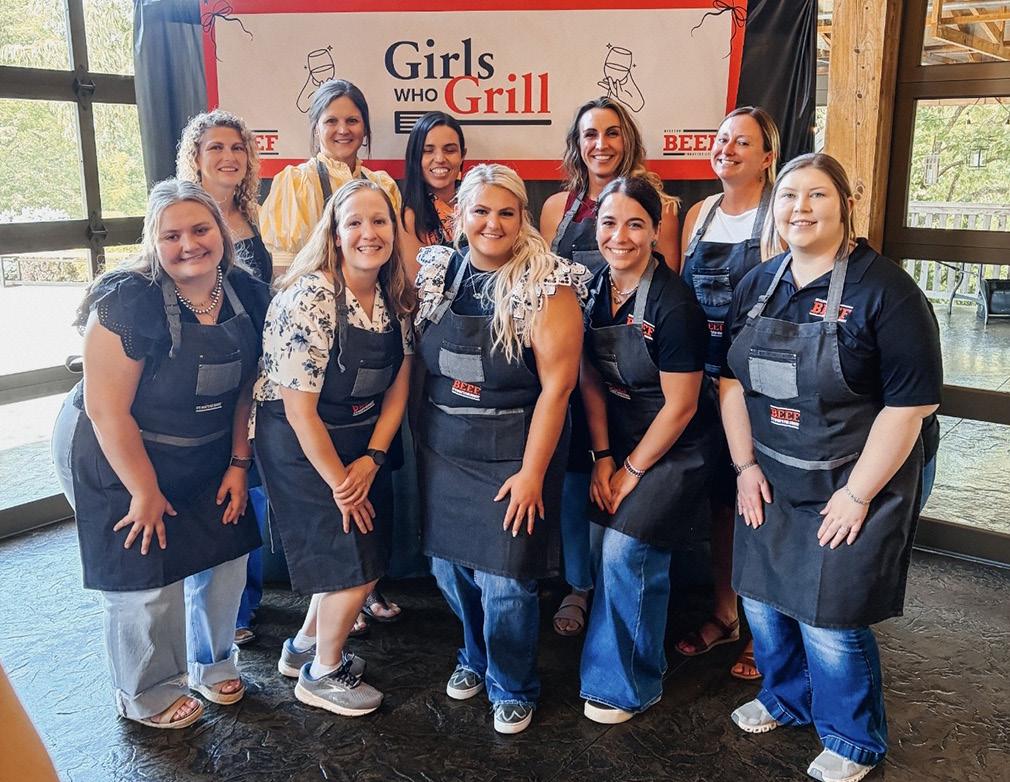
On June 30, Missouri Beef Industry Council (MBIC), in partnership with Illinois Beef Association (IBA), welcomed women from both states to Pacific, Missouri, for the national Girls Who Grill event. Designed to build confidence around grilling while sharing the story of beef from pasture to plate, the afternoon combined hands-on cooking instruction, beef education, networking and great food.
Hosted at the scenic Haue Valley event venue, the event offered participants an opportunity to sharpen their grilling skills while learning from industry leaders and connecting with others who share a passion for beef. Whether attendees were seasoned grill masters or lighting charcoal for the very first time, Girls Who Grill provided a welcoming environment where everyone could learn something new.
The afternoon began with a selection of beef-centered appetizers as guests mingled and networked with fellow attendees. The relaxed atmosphere encouraged conversation among women from a variety of backgrounds, creating new connections centered around a shared appreciation for beef and cooking.
Following the welcome, attendees heard from Jim Anderson with Missouri Wines. Anderson shared the rich history of Missouri’s wine industry, highlighted interesting facts about the state’s wineries and vineyards, and guided participants through a sampling of Missouri wines. He also discussed how different wines complement various cuts of beef, giving attendees practical pairing recommendations they can use when entertaining at home.
The educational program continued with MBIC Board Member Bill McLaren, who welcomed guests and shared the history of the Haue Valley property, his family’s farming operation and his passion for grilling. McLaren emphasized that great grilling begins long before food ever reaches the grill. From selecting quality beef to understanding proper cooking techniques, he encouraged participants to feel confident preparing beef for family and friends.
Under McLaren’s instruction, participants learned how to properly light charcoal using a fire starter, build a mound of coals and prepare their grills for cooking. For many, it was their first experience grilling with charcoal, making the interactive instruction especially valuable.
While the charcoal reached the ideal cooking temperature, participants learned more about the variety of beef cuts available to consumers. Discussions focused on the unique characteristics of each cut, how marbling contributes to tenderness, juiciness and flavor, and how selecting the right cut can enhance the overall eating experience. This educational component helped connect the science behind beef quality with the practical application participants would soon experience firsthand.
Once the grills were ready, attendees selected one of two recipes to prepare: Chimichurri Skirt Steak or Grilled Cowboy Ribeye Steak, both featured on Beef. It’s What’s For Dinner. With steaks in hand, participants spread the coals and placed their beef on the grill.
Throughout the cooking process, McLaren shared grilling tips and techniques, demonstrating how to achieve the perfect sear while avoiding common grilling mistakes. Participants also learned the importance
of monitoring internal temperature rather than relying solely on cooking time. Using instant-read thermometers, they checked their steaks for doneness, reinforcing one of the most reliable methods for consistently preparing flavorful, safe and perfectly cooked beef.
The lesson extended beyond steak alone. McLaren demonstrated the versatility of charcoal grilling by adding fresh vegetables to the grill, showing attendees how an entire meal can be prepared over charcoal. The demonstration reinforced that grilling offers endless opportunities to prepare balanced, flavorful meals while bringing family and friends together.
After the grilling concluded, participants moved back indoors to enjoy their perfectly cooked steaks. The beef-centered meal gave everyone the opportunity to enjoy the steaks they had personally prepared while continuing conversations with fellow attendees and presenters. The shared meal highlighted not only the exceptional flavor and versatility of beef but also the relationships built throughout the afternoon.
“I left Girls Who Grill with more confidence at the grill, new techniques I can share with my culinary students, and a greater appreciation for the people behind the
beef industry,” said Melissa Maness, culinary instructor at South Tech High School in St. Louis, Missouri. “The hands-on learning, knowledgeable instructors, and supportive atmosphere made it an enjoyable and valuable experience.”
As the event came to a close, each participant received a take-home goodie bag filled with grilling essentials to encourage them to continue building their skills at home. The bags included an apron, grilling spatula, recipe cards and an instant-read thermometer—tools that will help participants recreate what they learned long after the event ended.
Girls Who Grill reflects the Missouri Beef Industry Council’s ongoing commitment to educating consumers about beef while creating meaningful, memorable experiences that build confidence in preparing beef at home. By combining hands-on instruction with practical beef education, the event empowered participants with knowledge they can use every time they light a grill.
More importantly, Girls Who Grill demonstrated that grilling is for everyone. Through education, encouragement and a shared meal, attendees gained the confidence to continue grilling at home while building new friendships along the way.
Missouri Response to New World Screwworm Detection in U.S.
NWS does not affect the safety of the U.S. food supply.
The New World screwworm (NWS, Cochliomyia hominivorax) is a parasitic fly native to the Western Hemisphere. It lays eggs in the living tissue of fresh wounds in warm-blooded animals. The larvae (maggots) feed on the host’s flesh, causing severe wounds and often death if untreated.The pest was eradicated in the U.S. in the 1960s. Since then, it occasionally reemerges and has recently resurfaced in Central America and Mexico. As of May 2025, renewed attention to this parasite is crucial, as it may pose future risks to U.S. livestock and wildlife.
New World Screwworm is controlled through the release of sterile males, known as the sterile insect technique (SIT). This approach, along with regular active surveillance and livestock inspections, has proven highly successful.
What to Look For
The name screwworm refers to the maggots’ feeding behavior as they burrow (screw) into the wound, feeding as they go like a screw being driven into wood. Maggots cause extensive damage by tearing at the hosts’ tissue with sharp mouth hooks. The wound can become larger and deepen as more maggots hatch and feed on living tissue. As a result, NWS can cause serious, often deadly damage to the animal.
Adult screwworm flies are about the size of a common housefly (or slightly larger). They have orange eyes, a metallic blue or green body, and three dark stripes along their backs, see NWS Pest Card.
Report Mammals and Birds with the Following Signs:
• Bloody or light-colored drainage from a cut or wound.
• A cut or wound that rapidly enlarges for seemingly no reason.
• White or cream-colored runny substance (the eggs) in and around a wound.
• Presence of fly larvae (maggots) in wounds.
• Irritated behavior and signs of pain.
• Head shaking.
• Reduced appetite.
• Fever and other signs of secondary infection.
• Foul odor or smell of decay.
How to Prevent
This Disease
The best way to keep screwworm out of this country
is to prevent introductions. NWS can infest mammals, including people, and birds. Here are steps you can take to avoid infestation:
• Be alert for NWS symptoms in pets and livestock.
• Ensure that pets traveling internationally are inspected for screwworm.
• Check your vehicle for screwworm flies if you are in an NWS-infested area.
• If you think you have found a screwworm, report it immediately to your local veterinarian or the Missouri Department of Agriculture Animal Health Division at (573) 751-3377. This will allow agencies to respond quickly and remove the screwworms before a population becomes established.
How It Is Treated
Animals infested with NWS should be treated according to their veterinarian’s recommendations.
Restrictions
as of 6/26/26:
Any domestic animal originating from a state with a New World Screwworm-infested zone, but not within an infested zone or an adjacent surveillance zone, can enter Missouri with a Certificate of Veterinary inspection (CVI) completed within 14 days of entry that includes the statement “All animals were inspected and found free of evidence of NWS infestation and have not originated from or transited through a NWS infested zone.” Non-electronic CVIs require an entry permit from MDA.
Any domestic animal originating from within a New World Screwworm-adjacent surveillance zone can enter Missouri with a CVI completed within 5 days of entry that includes the statement “All animals were inspected and found free of evidence of NWS infestation and have not originated from or transited through a NWS infested zone.” This includes all domestic animals entering Missouri for any reason, including those moving to a Livestock Market or to slaughter. Non-electronic CVIs require an entry permit issued from MDA.
Any domestic animal originating from within a New World Screwworm-infested zone must meet the movement requirements for the state of origin and obtain an entry permit from the Missouri State Veterinarian’s office and a CVI that includes the statement “All animals were inspected and found free of evidence of NWS infestation.” Documentation authorizing movement outside of the infested zone must be provided prior to permitting.
Positive Outlook for Cattle Business as Summer Business Meeting Concludes
Source: NCBA
CENTENNIAL, Colo. (July 16, 2026) – With optimism for the cattle business remaining strong, nearly 700 cattle producers from across the country gathered in Aurora, Colorado, this week for the Cattle Industry Summer Business Meeting. This event helps shape the future of the industry through grassroots policy development and discussions that will guide research, education and promotion efforts.
“We conduct a lot of business during this meeting, but we also benefit by gathering together and learning from each other,” said NCBA President Gene Copenhaver. “I appreciate the time producers take away from their families to make our industry better for future generations and the commitment our state partners have to helping advance the business of the industry.”
Producers participated in NCBA policy meetings and Beef Checkoff committee discussions to evaluate emerging issues, advance initiatives launched at CattleCon and establish priorities for the upcoming fiscal year. Regional meetings offered attendees the opportunity to discuss local issues impacting their operations.
“This meeting showcases the strength of NCBA’s grassroots policy process,” Copenhaver said. “State cattlemen’s associations brought forward policy recommendations on a wide range of issues affecting producers, including the Conservation Reserve Program, Livestock Risk Protection, and Theileria orientalis Ikeda, the disease transmitted by Asian longhorned ticks. These discussions and resulting recommendations are where true grassroots policy development comes to fruition, ensuring NCBA’s policy priorities are driven by cattle producers and reflect the needs of our industry.”
The NCBA Board of Directors approved several policy recommendations that will be submitted to the membership for a mail ballot vote in September. The board meeting also highlighted the work of the Federation of State Beef Councils and its collaborative national efforts to promote beef, support research, expand education and strengthen consumer trust, helping drive beef demand.
Cattle producers and industry stakeholders will again gather for CattleCon 2027, which is returning to downtown Nashville, Tennessee, Feb. 2-4, 2027, with business meetings beginning Feb. 1.
ORYS 07 RED ANGUS
Service age bulls, bred cows, cow/calf pairs, show prospect heifers available. 417-652-3425 417-839-7205 www.oryscircle7.com
Glen Klippenstein Receives Beef Checkoff Visionary Award
Source: Cattlemen’s Beef Board
Glen Klippenstein of Maysville, Missouri was honored with the Cattlemen’s Beef Board’s sixth annual Beef Checkoff Visionary Award on Tuesday, July 14, during the Checkoff Highlights Session at the 2026 Cattle Industry Summer Business Meeting in Denver, Colorado. This award recognizes an individual in the beef industry who has demonstrated exemplary support of and commitment to the Checkoff’s goals and vision.
“Glen is one of the true Beef Checkoff pioneers,” said Cheryl DeVuyst, 2026 chair of the Cattlemen’s Beef Board. “He’s a lifelong cattleman, and he stepped up when he saw beef demand declining in the 1970s and 1980s. Glen’s ideas and achievements changed our industry for the better in so many ways, and he truly deserves this year’s Beef Checkoff Visionary Award.”
Born on a diversified crop and livestock farm in Saskatchewan, Canada, Klippenstein and his family moved to Pennsylvania in 1948. After graduating as the valedictorian of his high school class, Klippenstein studied at Penn State University under the mentorship of famous cattleman and professor Herman Purdy, a farm adviser to then-President Dwight D. Eisenhower. After graduating from Penn State, Klippenstein farmed in Pennsylvania for several years and started to build a herd of high-quality Hereford cattle. During this time, Klippenstein met his future wife, Linda.
In 1966, Klippenstein forged a partnership with his friend Kirk Pendleton. The new venture prompted the Klippensteins to move their family and farm from Pennsylvania to Maysville, Missouri, where Klippenstein and Pendleton launched Glenkirk Farms. Over the next 28 years, Klippenstein’s work in Hereford breeding made a tremendous impact. He sold approximately 7,000 bulls, 7,000 females and tens of thousands of units of semen to 22 countries. During that time, Klippenstein also imported some of the first fullblood Simmental cattle into the United States.
Throughout the 1970s and 1980s, Klippenstein saw beef demand declining and strongly believed the industry needed to take action. He and other producers began to push for a $1-per-head national Beef Checkoff. Klippenstein served as one of the original members of the Beef Board, which held its first meeting in the fall of 1986.
“We were losing producers like crazy,” Klippenstein recalled back in 1990-1991. “So, we took the bull by the horns. And we got Congress to help us, which they finally did through legislation. And a whole checkoff program was begun.”
As chair of the Cattlemen’s Beef Board in 1990-1991, Klippenstein helped establish the rigorous financial and auditing practices that continue to ensure Beef Checkoff funds are used appropriately. Those practices are still in use today, including rules that Checkoff contractors cannot make a profit from their work or use any funding for political purposes. Klippenstein’s innovative spirit also contributed to the development of Checkoff programs aimed at consistently providing consumers with high-quality beef.
In addition to his years spent on the Cattlemen’s Beef Board, including as the 1990-1991 chair, Klippenstein’s years of service in the cattle industry include a term as chair of the American Polled Hereford Association, six years as director of the National Cattlemen’s Beef Association and nine years as CEO of the American Chianina Association. His influence stretched beyond the cattle industry when he served as a Missouri State Senator from 1993 through 1994. He returned to the legislature as a Missouri State Representative from 2010 through 2012. During his years in office, Klippenstein consistently educated fellow lawmakers and constituents about the value of agriculture.
Today, Klippenstein and his wife Linda have four children and nine grandchildren. He and his son Brian continue to actively manage a small Hereford herd near Maysville, Missouri.
“Glen is a prime example of a true cattleman who saw an opportunity to step up for his industry,” said Greg Hanes, CEO of the Cattlemen’s Beef Board. “He’s been absolutely tireless over the years, between raising great cattle and sharing his love and respect for agriculture. All of us at the Cattlemen’s Beef Board congratulate Glen on yet another achievement as he receives the 2026 Beef Checkoff Visionary Award.”
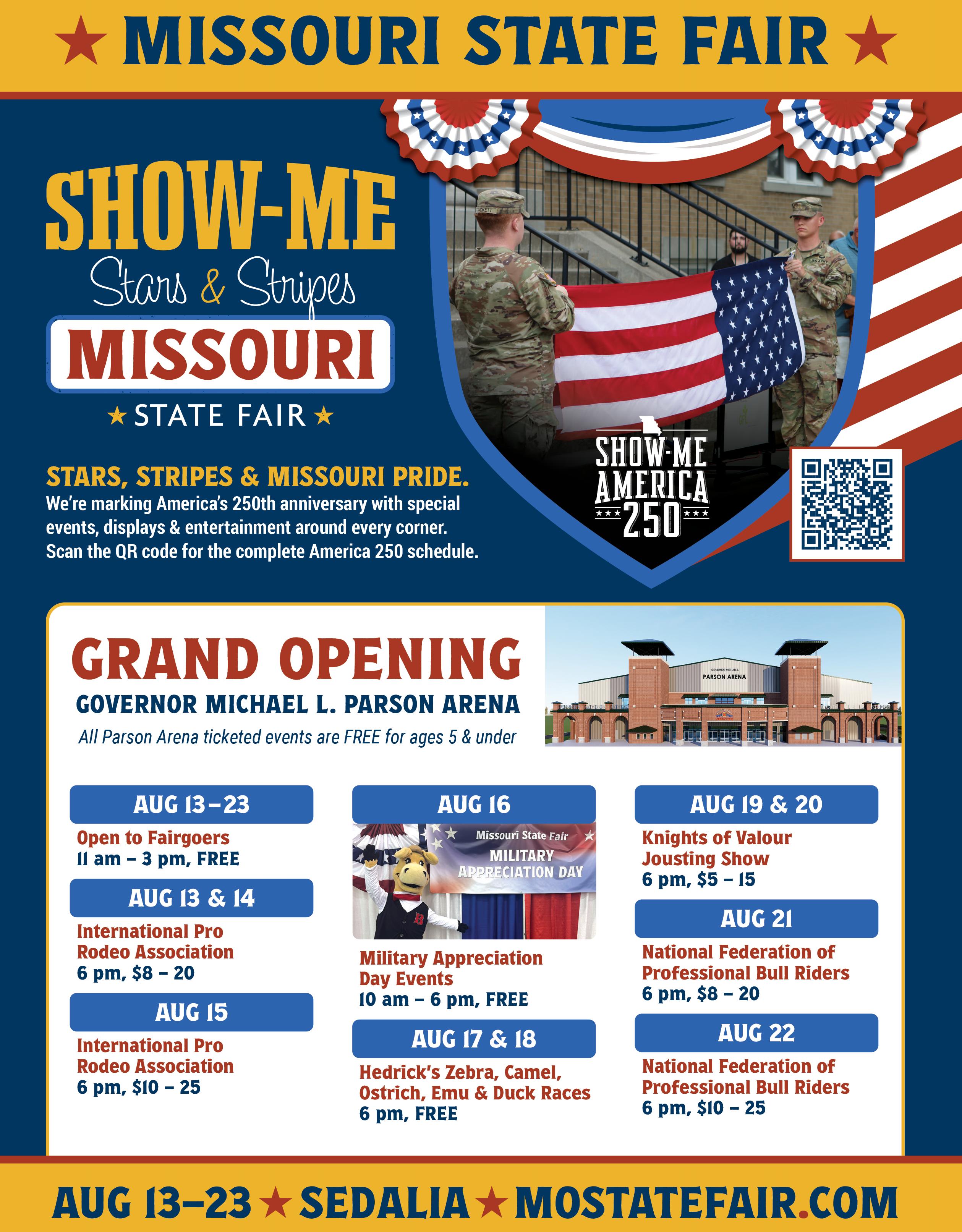
Showcasing Agriculture at the Missouri State Fair
The Missouri State Fair is proud of be the showcase for agriculture in the state of Missouri. There are countless interactive and fun exhibits, contests and shows, and agricultural education opportunities at every turn. If it’s not already, make plans to add agriculture to your list of Missouri State Fair traditions!
Here is just a sampling of how you can experience agriculture first-hand during your State Fair visit this August.
Gov. Michael L. Parson Arena
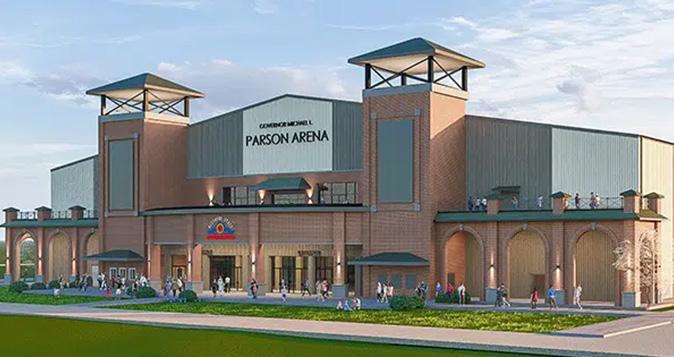
Construction on the new indoor Governor Michael L. Parson Arena is underway, with a completion date of July 2026, just in time for the 2026 Missouri State Fair. The state-of-the-art complex will provide a modern, versatile space for a wide range of events year-round and during the annual State Fair.
Patrons are encouraged to stay updated on the construction progress. Thanks to Nabholz Construction for providing this service. The Arena Cam link will update with a new high-resolution image every 10 minutes.
Join us in kicking off the 2026 Missouri State Fair at Opening Day Ceremony at the newly built Governor Michael L. Parson Arena. After the ceremony plan to meet for a special ribbon cutting for the Parson Arena and a special dedication for the new Hayden Plaza. Please check back soon for more details.
Thursday, August 13th | 11:00 a.m.
The Governor Michael L. Parson Arena will be open to the fairgoers from 11 a.m. to 3 p.m., Aug 13th-23rd. There is currently no event scheduled for the evening of Sunday, Aug 23rd.
Livestock Shows
Horses and Pigs and Cattle (and more)….OH, MY! The State Fair features livestock shows every day of the Fair (and a few even start before Opening Day!). You’ll find shows for equine, poultry, goats, sheep, swine, beef and dairy cattle, dogs and rabbits.
Donate to the Food Drive and Save Big!
Looking to save money when coming to the Missouri State Fair? Love giving back to those in need? Missouri Farmers Care Food Drive $2 Tuesday offers you a chance to do both! Bring in two non-perishable food items or give a $2 donation to Feeding Missouri on Tuesday, Aug. 18th, and pay just $2 gate admission. To add to the $2 fun, most carnival rides will be $2 this day and select concession and vendors will offer $2 specials.
In the spirit of service and giving back, Missouri FFA will host their annual Food Insecurity Day held in the Assembly Hall, with over 800 FFA members and agriculture leaders serving those in need. Their goal is to reduce childhood food insecurity in Missouri and package 175,000 child-friendly meals that will be distributed among food banks across our state.
Governor’s Ham Breakfast
The 2025 Governor’s Ham Breakfast is a traditional gathering of Missouri elected officials, leaders in agriculture and supporters of the Missouri State Fair. The Breakfast features Missouri country cured ham and other Missouri Grown products. Tickets are $50 per plate and includes Aug. 20th gate admission to the Fair.
Sale of Champions
The Sale of Champions will take place at 1:30 p.m. on Saturday, Aug. 22nd and is the highlight of Youth in Agriculture Day at the State Fair. Grand Champion and Reserve Grand Champion steers, barrows, lambs, meat goats, pens of chickens, pens of rabbits, hams and bacons from 4-H and FFA shows are sold.
Best of Missouri Awards and Sale
Mark your calendars for Saturday, August 22nd for the Best of Missouri Awards and Sale, sponsored by American Foods Group, America’s Heartland Packing! Get ready to celebrate the junior exhibitor winners of the various categories below starting at 11:15 a.m., and enjoy the sale including 19 total lots right after! See you there!
Beef Cattle Shows
Thursday, August 13th
8:00 a.m. Angus 4-H/FFA Show – Coliseum
8:00 a.m. Simmental 4-H/FFA Show –MFA Arena
3:00 p.m. Gelbvieh 4-H/FFA Show – MFA Arena
3:00 p.m. Salers 4-H/FFA Show – Donnelly
5:00 p.m. Youth Beef Cattle Judging – Coliseum
Friday, August 14th
8:00 a.m. Angus Open Show – Coliseum
8:00 a.m. Gelbvieh Open Show – MFA Arena
1:00 p.m. Salers Open Show – Donnelly
Saturday, August 15th
8:00 a.m. Simmental Open Show – Coliseum
8:00 a.m. Charolais 4-H/FFA Show – MFA Arena
1:00 p.m. Hereford 4-H/FFA Show – MFA Arena
Sunday, August 16th
8:00 a.m. Hereford Open Show – Coliseum
1:00 p.m. Maine-Anjou 4-H/FFA Show – Donnelly
2:00 p.m. Charolais Open Show – Coliseum
5:00 p.m. Crossbred & Other Heifer
4-H/FFA Show – MFA Arena
Monday, August 17th
8:00 a.m. Maine-Anjou Open Show – Coliseum
9:00 a.m. Live Evaluation of Carcass Steers –MFA Arena
1:00 p.m. Beef Showmanship – Coliseum
Tuesday, August 18th
8:00 a.m. 4-H/FFA Market Heifer Show –
Coliseum
Steer Show – Immediately Following Market Heifer Show – Coliseum
5:00 p.m.± Grand Champion Steer – Coliseum
Wednesday, August 19th
8:00 a.m. Red Angus 4-H/FFA Show – Coliseum
Thursday, August 20th
9:00 a.m. Red Angus Open Show – Coliseum
9:00 a.m. Miniature Hereford 4-H/FFA Show –MFA Arena
9:00 a.m. Miniature Hereford Open Show –MFA Arena
Friday, August 21st
8:00 a.m. Shorthorn 4-H/FFA Show – Donnelly
1:00 p.m. Limousin 4-H/FFA Show – Donnelly
2:00 p.m. Beefalo 4-H/FFA Show – MFA Arena
2:00 p.m. Beefalo Open Show – Coliseum
Saturday, August 22nd
8:00 a.m. Shorthorn Open Show – Coliseum
8:00 a.m. Black Hereford 4-H/FFA Show – Donnelly
8:00 a.m. Black Hereford Open Show – Donnelly
10:30 a.m. Carcass Awards – Lowell Mohler Hall
1:00 p.m. Limousin Open Show – Coliseum
1:30 p.m. Sale of Champions – Lowell Mohler Assembly Hall
The 2026 Missouri State Fair Beef Cattle Shows are being dedicated to the late Dr. Rex Ricketts and Family, they are active exhibitors and supporters of the Missouri State Fair in many ways. Please join us in honoring them at the open Charolais show at 2:00 p.m. on Sunday, August 16 in the Coliseum.
Open Beef Carcass Show
Superintendent - Greg Onstott, Iberia, MO (573) 522-1534
Asst. Superintendent - Greg Harrison, MDA
LIVE EVALUATION JUDGE: TBD
CARCASS JUDGE: Dr. Teagan Schnurbusch, University of Missouri, Columbia, MO
Amount offered in this section by State Fair $4,480.00.
THE MISSOURI STATE FAIR will award $900 to the Grand Champion Steer Carcass overall winner and $500 to the Reserve Grand Champion Steer Carcass overall winner.
NOTE: - The top junior exhibitor of the steer carcass show will participate in the Best of Missouri Sale on Saturday, August 22nd. The top junior exhibitor will be determined by overall results and judge’s discretion.
The MISSOURI CATTLEMEN’S ASSOCIATION will donate trophies for the Grand Champion and Reserve Grand Champion On-Foot and On-Rail steers.
The MISSOURI STATE FAIR will award plaques to the two highest placing junior exhibitors in the Steer Carcass Contest.
Purpose
1. To promote the beef industry.
2. To provide producers with information on the type of beef animals that are desirable for today’s consumer market.
3. Genetics utilization.
4. Uniform product production conception.
5. Source verification of products.
6. Create a positive economic balance.
7. Carcass merit.
8. Identify target(s) of market share
Specials Offered
1. MFA Feed Division will award $1,000 to the Grand Champion and $750 to the Reserve Grand Champion on-the-rail overall winners of the Open Steer Carcass Show. To qualify, animals must be enrolled in the MFA 4-H/FFA Livestock Premium Program, using one of the MFA recommended feeds. See your authorized MFA Feed supplier for details.
2. Briarwood Angus Farms, (Curtis Long) Butler, MO and the Missouri Angus Association will award $1,000 to the Grand Champion on-the-rail overall carcass winner if the steer is a registered, purebred
For Your Simmental Needs Contact
Angus and exhibited by a 4-H or FFA youth exhibitor. Also awarded will be $750 for the top placing, $550 for the second placing, and $250 for third placing on-therail carcass steers that are registered, purebred Angus and exhibited by a 4-H or FFA youth. There will also be $250 awarded to the highest gross dollar carcass steer that is registered, purebred Angus. $200 will be awarded if the Grand Champion on-foot winner is a registered, purebred Angus steer and exhibited by a 4-H or FFA exhibitor. $200 will be given to any 4-H or FFA exhibitor with a purebred Angus that enters in all three (3) classes: Angus steer, On-foot carcass steer and the Carcass contest. Must pre-register to be eligible for prize money by meeting MSF deadline and submitting a copy of registration papers and your complete entry form to Dr. Curtis Long, 2110 NW St. Rt. 52, Butler, MO 64730, by June 30, 2023. These awards will be presented at the Missouri Angus Association’s annual banquet and the exhibitors must be present for the awards to be given. Contact: Curtis Long, 2110 NW St. Rt. 52, Butler, MO 64730 (660-679-3459).
3. The Missouri Hereford Association, Andi Howard, 905 County Road 348, Dora, MO 65637, howardandi0@gmail.com will award $500 to the top 4-H and FFA bred, born and raised in Missouri Hereford steers and $250 to the second place bred, born and raised in Missouri Hereford steers. For steers to qualify, steers must be DNA tested for verification
of parentage and registered with the American Hereford Association prior to the Missouri State Fair. Each animal must have a legible tattoo that matches the registration paper from the American Hereford Association. All steers will be subject to an inspection by a breeder committee and required to meet minimum standards for type and confirmation. Blood may be drawn or tail hair pulled for DNA verification of parentage. Decisions made by the breeder committee will be final. The first and second place bred, born, and raised Missouri Hereford steers in the carcass show will receive $500 for the first place and $250 for the second place.
4. The Missouri Shorthorn Association will award $500 to the Grand Champion on-the-rail overall winner if the steer was a registered, Shorthorn steer. To qualify, proof of registration is required. Also awarded will be $250 to the Grand Champion on-the-rail overall winner if the steer was a registered Shorthorn plus which is at least 50% Shorthorn steer. To qualify, proof of registration is required. Contact: Jose’ Cruz 314-8031104 legacyranch@cruzcompany.com.
5. The Missouri Simmental Association will award $500 to the Grand Champion and $250 to the Reserve Grand Champion on-the-rail overall winners of the Open Steer Carcass Show if they are registered purebred Simmental. Contact: Andrea Milligan, 660-
425-5642, mosimmassc@ gmail.com.25233 E. State Hwy A Ridgeway, MO 64481
6. The Missouri Red Angus Association will award $500 to the over-all Grand Champion “On-the-Rail” if the steer is a registered Red Angus. To be eligible, the animals must be registered (50% or greater Red Angus) with a valid registration certificate from the Red Angus Association of America. Steers must be 85% Red in color, polled and display sufficient breed characteristics which match percent of registration (no black hided or black animals). A scurred animal is considered polled if you choose not to remove the scurs, if you surgically or mechanically remove the scurry you will be disqualified. Each animal must have a legible tattoo that matches the registration paper from the Red Angus Association of America. All steers may be subject to an inspection by a breeder committee and required to meet minimum standards for type and conformation. Blood may be drawn for verification of parentage. Decisions made by the breeder committee will be final.
7. Missouri Cattlemen’s Association will award $250 to the exhibitor that exhibits the steer with the highest marbling score, $250 to the exhibitor that exhibits the steer with the largest ribeye area and $250 to the “Chef’s Award Winner” determined by the National Beef Checkoff’s Culinary Center, based upon the carcass data submitted to them that would be the most ideal for
a high end restaurant. To be eligible for the awards, the exhibitor must be a member or Junior member of the Missouri Cattlemen’s Association. In case of a tie, the award will be divided equally. Must be a member prior to August 12, 2025.
8. Fountain Charolais and Tiger County Charolais will award $500 to the Grand Champion and $250 to the Reserve Champion on-the-rail overall winners of the Open Steer Carcass Show if they are a Charolais or Charolais cross steer. To be eligible, the animals must be 50% or greater Charolais, subject to verification and must be declared at entry. No black hided or black animals will be eligible.
9. The Missouri Charolais Breeders Association (MCBS) will award $500 to the Overall Grand Champion Carcass and $250 to the Overall Reserve Grand Champion Carcass if they are a Charolais or Charolais Cross Steer. The steer must be 50% or greater Charolais subject to verification and must be declared at entry. No black hided steers are eligible.
Live Evaluation Contest of Slaughter Steers/Heifers
Monday, August 17th
Live Evaluation begins: 9:30 a.m. Location: MFA Arena
MISSOURI Charolais Breeders
1,460
What is the Live Evaluation Contest? It is an opportunity for individuals to participate in an educational activity associated with selecting slaughter steers/heifers by live and carcass traits and criteria. Anyone wishing to participate can enter this contest in the Junior or Adult Division. Age divisions will be as follows: Junior Division – anyone under 18 years of age; Adult Division – anyone 18 years and older.
Ten steers/heifers will be selected from the Carcass show entries to be used for the Live Evaluation Contest. A sample demonstration will be given on how to yield grade and quality grade slaughter cattle prior to the beginning of the live evaluation contest. Junior and adult contestants compete by guessing the actual carcass data collected on the 10 slaughter steers/heifers that are selected for the contest.
Cash prizes will be awarded by the State Fair to the top 5 individuals in each division who are closest to the actual carcass placings on the slaughter cattle in this contest. The MISSOURI CATTLEMEN’S ASSOCIATION will present trophies to the top two junior and the top two adults. This is an excellent learning opportunity, not only for youth, but also for adults.
Beef Cattle Herdsman Award
The Missouri State Fair will award two $80 awards, plus attractive plaques, to the herdsmen in charge of the two most outstanding beef cattle exhibits. A committee will make inspections to determine the winners. The following points will be considered: 1) cleanliness, grooming, and appearance of the exhibits; 2) handling of feed, equipment, etc. and keeping same out of the alleys; and 3) cooperation, courtesy, and sportsmanship in the exhibit area and show ring.
The 2025 Beef Cattle Herdsman awards were presented to the Richardson Ranch of Lincoln, MO and Klise Shorthorns or New London, MO.
Best-Kept Beef Cattle Exhibit Barn
The Missouri State Fair will award a plaque, to be hung in the Beef Cattle Office, to the breed that has demonstrated and presented its entire exhibit barn and is considered by the committee to be the best-kept barn during the course of the Fair. The following points will be considered: 1) cleanliness, grooming, and appearance of the exhibits; 2) handling of feed, equipment, etc. and keeping same out of the alleys; and 3) cooperation, courtesy, and sportsmanship in the exhibit area and show ring.
The Best-Kept Beef Cattle Exhibit Barns in 2025 was Hereford and Shorthorn.
Beef Cattle
Superintendent - Jim Spencer, Jr. - Aurora, MO (417) 489-0247
Assistant Superintendents:
• Tammy Bartholomew
• Shelby Haag
Missouri Red Angus Breeders
Ken & Brenda Keesaman
816-675-2503 • C: 816-390-4988
Kody Keesaman 816-724-1432
Kolten Keesaman 816-808-2846
3803 SW Rogers Rd. • Osborn, MO 64474
Ken@kkfarmsredangus.com www.kkfarmsredangus.com
Harris 417-389-2987 Jacob Dunn 417-434-0335
COUNTY NEWS
See What’s Happening in Your County
Warren County Cattlemen
The Warren County Cattlemen’s Association has enjoyed a busy and successful year supporting local events while promoting Missouri beef throughout our community.
On March 28th, the association provided food for the East Central Livestock Show held at the Warren County Fairgrounds. The event drew an excellent crowd, and exhibitors, families, and visitors enjoyed our cheeseburgers and all-beef hot dogs.
On May 2nd, the Warren County Cattlemen’s Association participated in the Scenic Regional Library’s Pioneer Day celebration, where we promoted May is Beef Month while serving the community our signature beef products. Guests had the opportunity to purchase our “Warren County Famous” ribeye steak sandwiches, hamburgers, and all-beef hot dogs. The event drew an outstanding crowd, and we were pleased with the enthusiastic response to our menu. We also introduced our new “Beef Bacon” Cheeseburger, which received excellent reviews and is expected to become a regular menu item at future events.
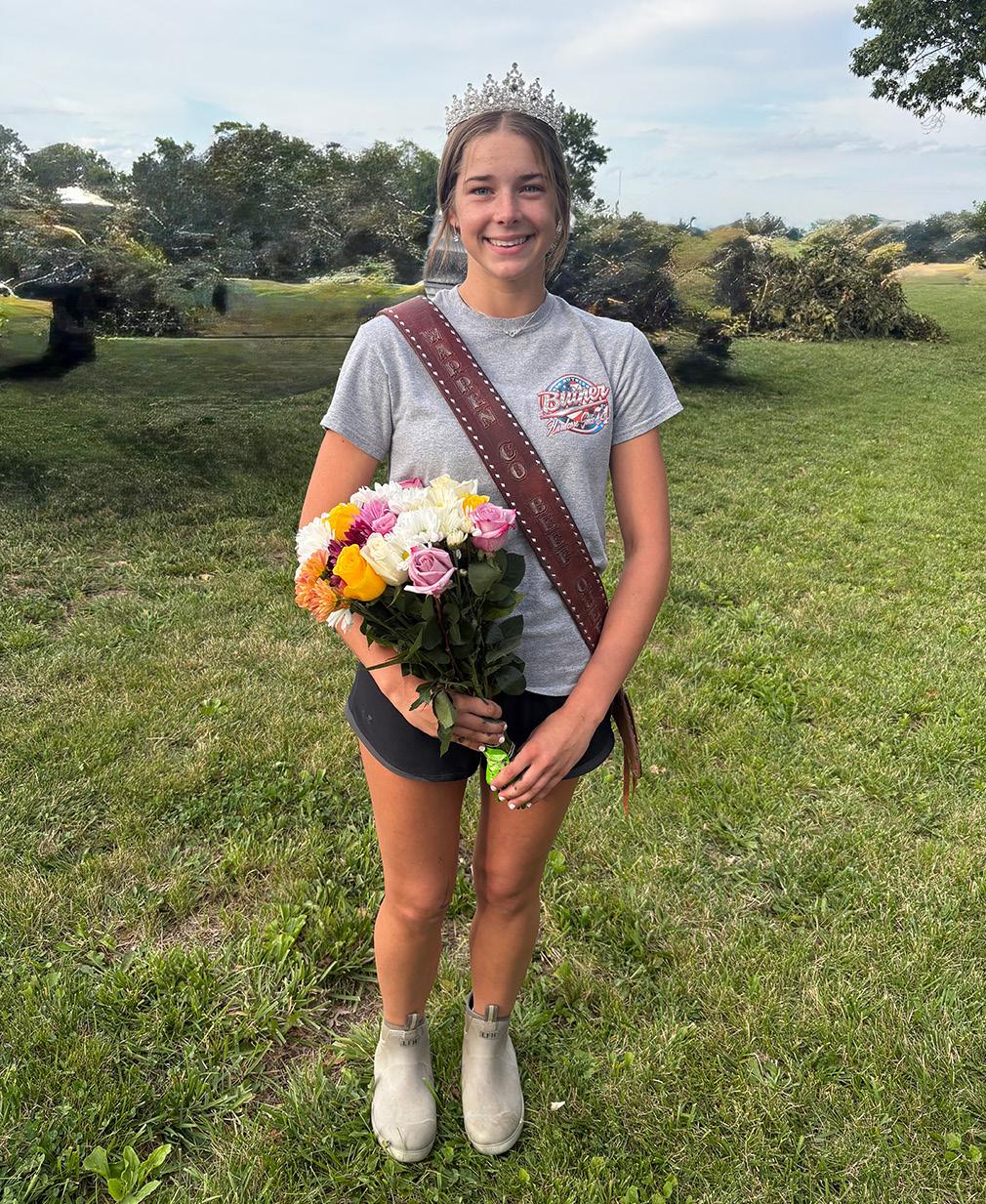
In June, we crowned our 2026 Warren County Beef Queen, Savannah Miller, daughter of Bill and Jennifer Miller. Savannah proudly represented the Warren County Cattlemen’s Association throughout the Warren County Fair, serving as an excellent ambassador for the beef industry.
We are also looking forward to serving in the Beef House at the Missouri State Fair on August 14th. This
annual event is always a highlight for our members and provides another great opportunity to promote Missouri beef to fairgoers from across the state.
Our next major event will be the Warrenton Fall Festival in September. Visitors can once again enjoy our full menu featuring ribeye steak sandwiches, hamburgers/ cheeseburgers, all-beef hot dogs, and our popular curly fried potatoes. This year’s festival will also feature entertainment by the Marshall Tucker Band, making it an event our members and the community look forward to each year.
2026 Warren County Beef Queen, Savannah Miller.
Missouri Angus Breeders
www.meadfarms.com
Dennis M. Famuliner
Dennis Melvin Famuliner, 72, of Carrollton, Missouri, passed away July 3, 2026, at Liberty Hospital in Liberty, Missouri, with his wife and daughter by his side.
Dennis was born November 12, 1953, in Carrollton, Missouri, the son of Sherman and Jean Famuliner. He attended Wakenda Elementary School and graduated from Carrollton High School in 1972.
Dennis was a grain and livestock farmer. After the Great Flood of 1993, he expanded into land reclamation and earthmoving, eventually performing reclamation work in Missouri, Texas, and New Mexico.
A devoted husband, Dennis enjoyed watching and attending University of Missouri football games alongside his wife, taking the long way home when traveling, drinking coffee, and watching Westerns. He made his family a priority and selflessly focused on helping those who needed him most.
Dennis was active in his community and privately supported many organizations in Carroll County, contributing his time and resources to groups working to better the area. Among his efforts, he helped secure land and funding for a livestock arena and was active in its construction. The arena was used by local FFA and 4-H chapters and others to host horse shows, cattle roping, and rodeos.
He was a natural leader and served on many boards throughout his life, including:
• Carroll County Pork Producers
• Missouri Cattlemen’s Association (Officer)
• Carroll County Cattlemen’s Association (President)
• Wakenda School Board (President)
• Carrollton Municipal Airport Board (Officer)
• Carrollton Township Board (Officer)
• Levee Board (Officer)
• United Methodist Church of Carrollton (Member)
• Little League coach
• Founding member of the Beef and Pork Palace
He received awards for his contributions to soil conservation and wildlife management.
Dennis is survived by his wife, Sarah Jane Famuliner; daughter Aubrey Michele Famuliner; grandson
Augustus Monroe Finkeldei, all of Carrollton; brother Donald Joe Famuliner of Wakenda; and several nieces and nephews.
He was preceded in death by his parents, sister Martha, and sister-in-law Kelli.
Memorials are asked to H.E.L.P. Cancer Fund of Carrollton or The Carroll County Memorial Hospital Foundation and can be mailed or dropped off to Hidden Valley Funeral Home of Carrollton, 2 East Benton Street, Carrollton, MO 64633
A graveside service was held on Thursday, July 16, 2026 at Oak Hill Cemetery in Carrollton. A celebration service followed at the Carrollton Country Club.
Grant Available to Food Businesses in Parts of Missouri, Kansas
Application deadline is Aug. 31st for grants ranging from $5K to $25K.
Source: MU Extension News
COLUMBIA, Mo. – Food businesses in parts of western Missouri and rural Kansas may be eligible for a new grant designed to strengthen local food and farm enterprises, said Bill McKelvey, senior project coordinator for University of Missouri Extension.
Applications for the Harvest to Market grant are due by Aug. 31. Funds must be spent over a six-month period, said McKelvey. Grants range from $5,000 to $25,000; no matching funds are required. Recipients will be notified around mid-November.
Kingsville Livestock Auction
Kingsville, Missouri
Hwy. 58 • 45 Miles SE of Kansas City, MO
Special Cow & Bull Sale Saturday, August 22 • 11:00 a.m.
Cattle Sale Every Tuesday 9:00 a.m.
For information call Rick, Jeremy, or Jared Anstine 816-597-3331 Visit our website kingsvillelivestock.com or E-mail us at: anstineauction@gmail.com
Priority will be given to investments in processing equipment, distribution equipment, logistics systems and marketing investments that help food businesses serve local and regional markets more effectively, said McKelvey.
Missouri applicants must live in one of these counties: Andrew, Atchison, Bates, Benton, Caldwell, Carroll, Clinton, Dekalb, Daviess, Gentry, Grundy, Harrison, Henry, Holt, Lafayette, Livingston, Mercer, Nodaway, Pettis, Ray, St. Clair, Saline, Vernon or Worth.
Businesses that might be eligible include retail food sales outlets, farms and ranches, food and farm cooperatives, value-added processors, businesses involved in aggregation and distribution, food hubs and tribal food and farm enterprises. Nonprofits are not eligible to apply.
Examples of how the funds can be used include building a website, setting up an online store, marketing activities, feasibility studies, packaging, equipment, alterations of existing buildings or facilities, construction, direct costs related to personnel working on the project, and meat processing after slaughter and initial processing.
“These grants are intended to help businesses in the local food space take the next step to reach more customers and grow their business,” said McKelvey. “Ultimately, this helps meet the demand for locally grown food and support rural economies.”
Projects involving multiple farms and/or food businesses—such as pooling products to fulfill larger orders—will receive additional consideration.
Contact: Mike Williams Higginsville, MO 816-797-5450 mwauctions@ctcis.net
Specializing
in Land Equipment and Livestock
For more information, including answers to frequently asked questions, application form and how to get help, visit https://heartlandfoodbusiness.org/harvest-tomarket-grant. There is also a YouTube video about the grant.
This project is part of the Heartland Food Business Coalition and is operated by New Growth/West Central Missouri Community Action Agency. Project partners include The Kansas City Food Hub, The Food Circle, University of Missouri Extension, Kansas State University Research and Extension, and the Kansas Rural Center.
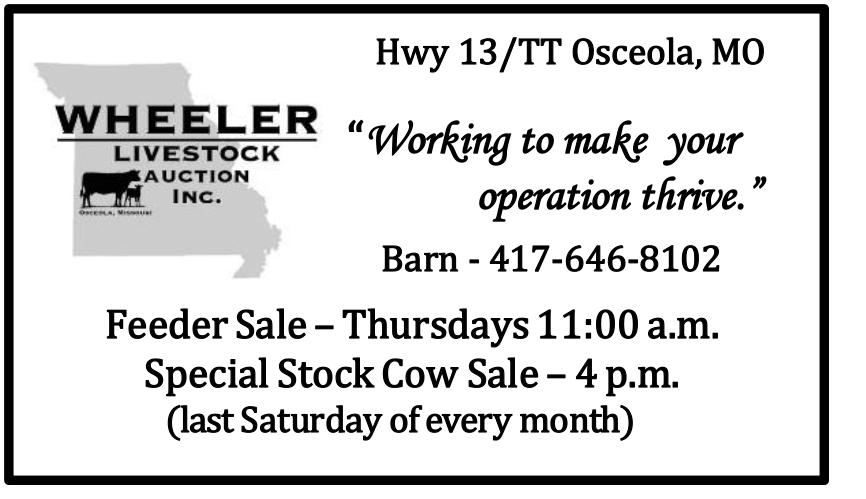
Selling All classes of Cattle Wednesday • 10:00 a.m. Featuring ‘Star-Vac Program’ Cattle Weekly DVAuction Service for convenient online viewing & bidding Hwy 42 West • Vienna Missouri 65582 45 Miles South of Jefferson City
For Upcoming Sale Info: www.wheelerauctions.com
For More Infor mation Call David Patton Of fice Ross Patton Bill Patton 573-308-6655 573-422-3305 573-308-6657 573-308-6658 Visit our website: www scrsvienna com or E-mail us: scrsvienna@gmail com “Make South Central your Livestock Market”
Missouri’s Youth Workforce is Shrinking, but More High School Grads Going Straight to Work
New Report From MU Extension Highlights Trends
Source: MU Extension News
COLUMBIA, Mo. – Many Missouri employers depend on young workers, but there are fewer of them to hire.
A new brief from University of Missouri Extension notes that the state’s population of 16- to 24-yearolds has shrunk over the past decade even as a bigger share of young people are entering the workforce right after high school—a trend that highlights the need for
training, apprenticeships and other career development opportunities.
The July 13th edition of the Missouri Economy Indicators series, published by MU Extension’s ExceedRegional Economic and Entrepreneurial Development program, reports that Missouri has about 21,000 fewer people ages 16-24 than it did 10 years ago, a decline of 2.8% during that period.
The brief, Young Worker Trends, was authored by Matt Pezold, MU Extension field specialist in labor and workforce development, and Alan Spell, MU assistant extension professor.
“Despite this decline, Missouri youth continue to participate in the labor market at a rate above the national average,” Pezold and Spell write.
Employees under 25 make up 16% of Missouri’s privatesector workforce. They account for nearly four out of every 10 jobs in leisure and hospitality and one-quarter of jobs in retail. Restaurants alone employ one in four young workers in the state.
Young Workers Remain Vital To Key Industries
Pezold and Spell observe that rural communities rely more heavily on younger workers than metro areas do: Young people account for 18.4% of private-sector employment in nonmetro counties, compared to 15.8% in metro areas. Rural manufacturers and construction firms, in particular, depend more on younger employees.
At the same time, more Missouri students are choosing work over college immediately after graduation. While most high school graduates still enroll in two- or fouryear colleges, that share has gradually fallen since 2012. Last year, 30% of high school graduates in metro areas entered the civilian or military workforce shortly after graduation, up from 21% a decade earlier. In nonmetro
areas, the share rose from 31% to 39%.
The shift reflects changing economic realities for many young adults. A strong job market and rising college costs have encouraged more graduates to begin earning paychecks right away, according to Pezold and Spell.
For employers, these trends present both an opportunity and a challenge. While more young people are entering the workforce after high school, a shrinking youth population means competition for workers is likely to remain intense.
Training And Career Paths Can Strengthen Talent Pipeline
The brief notes that many of today’s in-demand jobs require education or training beyond high school, even if they do not require a traditional four-year degree. Healthcare, maintenance and machinery are among the fields offering opportunities for workers who gain skills through certifications, apprenticeships or on-the-job training.
“While entry-level jobs remain plentiful, a shrinking youth population will make it increasingly important to upskill these workers and provide advancement opportunities,” the authors write. Partnerships between employers, schools and training providers can help young Missourians explore career paths while giving businesses a stronger talent pipeline.
The brief draws on the U.S. Census Bureau’s 2024 five-year estimates, as well as data from the Missouri Economic Research and Information Center and the Missouri Department of Elementary and Secondary Education.
The report, as well as past entries in the Missouri Economy Indicators series, is available at https://muext. us/MEI.
Callaway Livestock Center, Inc.
Cattle 12:30 p.m. 1st Thursday Nite of Each Month: 6:00 p.m. Bred Cows and Breeding Bull Sale
Offal Restrictions Impact May Pork Exports, Beef Export Value Above Year-Ago
Source: USMEF
Although May exports of U.S. pork were higher yearover-year, volumes were significantly diminished by Mexico’s restrictions on pork offal items, according to data released by USDA and compiled by the U.S. Meat Export Federation (USMEF). May beef exports were below last year’s volume but edged higher in value.
May pork exports
to Japan, Colombia, Central America offset lower totals for Mexico
Pork exports totaled 245,874 metric tons (mt) in May, up 10% from a year ago, with value up 8% to $701 million. But exports in May 2025 were unusually low due to heightened trade tensions with China, which temporarily pushed China’s tariff rate on U.S. pork as high as 172%. This impasse heavily impacted exports of pork variety meat, which totaled just over 30,000 mt in May 2025. While pork variety meat exports exceeded 40,000 mt in May 2026, this was easily the lowest total of the year as January-April shipments averaged nearly 49,000 mt. May variety meat exports to Mexico were just 3,157 mt, down 80% from a year ago, due
to restrictions imposed after the April 30 detection of pseudorabies virus (PRV) antibodies in five boars in Iowa. May bright spots for U.S. pork included the largest shipments to Japan since 2021, an outstanding performance from Colombia and strong growth in Central America. Export value per head slaughtered topped $71.
For January through May, pork and pork variety meat exports totaled 1.28 million mt, up 5% from a year ago, while value was also up 5% to $3.59 billion. In both volume and value, pork exports are less than 1% below the record pace established in 2024.
“While U.S. pork exports are posting a strong performance in 2026, the May results underscore the urgent need for Mexico to fully remove its PRV-related restrictions on pork offal and other products,” USMEF President and CEO, Dan Halstrom explained. “This situation is costing the U.S. industry millions of dollars per week and severely impacting customers in Mexico, who are scrambling to find alternative products and suppliers.”
Although Mexico modified its restrictions in early June to allow pork offal shipments from states other than Iowa and Texas, source verification requirements, and the importance of Iowa as the leading hog-producing state, continue to pose significant obstacles for exporters.
May Beef Export Highlights Led by Value Growth in Taiwan, Japan, Latin America
May beef exports totaled 91,925 mt, down 5% from a year ago. But value increased 2% to $818.1 million, bolstered by value increases in Taiwan, Japan, the ASEAN region, Central and South America and Egypt. Export value per head of fed slaughter soared to
$468 in May, the highest in nearly four years. Despite China’s mid-May renewal of expired U.S. beef plant registrations, May exports to China remained minimal as technical obstacles are yet to be resolved.
For January through May, beef exports were 10% below last year’s pace at 457,063 mt, while value fell 5% to $3.95 billion. But when excluding China from these results, January-May beef exports were down less than 1% in volume and were 6% higher in value.
“Despite significant headwinds, we are seeing some encouraging trends on the beef side,” Halstrom said. “Many facilities remain suspended and unable to export to China, while exporters overall remain reluctant to ship until technical obstacles are resolved and China agrees to meet its Phase One Agreement commitments. But Taiwan has been a major bright spot this year and while exports to South Korea have trended lower, we expect an uptick in Korea’s demand when a higher tariff rate on Australian beef is triggered later this month.”
By mid-July, Korea’s imports of Australian beef are expected to exceed the safeguard threshold established in the Korea-Australia FTA. Through the end of the year, Korea’s tariff rate on Australian beef will increase from 5.3% to 24%. U.S. beef enters Korea at zero duty under the Korea-U.S. FTA. Australia triggered its beef
safeguard for China on June 18, and has since faced a 55% tariff for exports entering that market.
Lamb Exports Continue Downward Trend
Exports of U.S. lamb muscle cuts totaled 215 mt in May, down 41% from a year ago, valued at $1.3 million (down 28%). After a strong start to the year, January-May exports slipped 8% below a year ago in volume (1,257 mt) and 5% lower in value ($7 million). Larger exports to the Caribbean and Central America have been offset by lower shipments to Mexico and no exports to Canada have been reported in 2026.
A detailed summary of the January-May export results for U.S. pork, beef and lamb, including market-specific highlights, is available from the USMEF website.
Give me a call for your next trailer 800-897-9840 www.Jimsmotors.com
Scott Cape, Owner of Jim’s Motors in Cuba, Missouri. All I have ever done is sell and trade trailers.
Capitol Update with Nancy Giddens & Shannon Cooper
Working our Way Through
There are some jobs you can put off for years. Cleaning out an old barn shouldn’t be one of them.
This summer, my family and I have been working our way through my dad’s barns, sheds, and shop after his passing. “Working our way through” is the polite way to say we’re digging through decades of farming, fixing, saving, collecting, and planning for the next project. Every shelf tells a story. Every coffee can is full of bolts that might fit something. Every drawer holds tools you forgot existed or never knew existed in the first place.
My father wasn’t a hoarder. He was a farmer.
Farmers have a way of seeing value where other people see clutter. That rusty bracket came off a piece of equipment that hasn’t run in thirty years, but it might fit something tomorrow. That bucket of chain? Still good. The coffee cans of nuts and washers sorted by size? Worth their weight in gold when the hardware store is twenty miles away and it’s Sunday afternoon.
As we’ve cleaned, I’ve realized we aren’t just sorting through stuff. We’re sorting through a lifetime of investment. Every welder, wrench, livestock panel, gate hinge, and fence stretcher represents hours of work and years of building an operation. The man didn’t accumulate these things overnight. They were purchased one check, one calf crop, one decision at a time.
Of course, the sentimental moments are frequently interrupted by the less glamorous parts of the job.
Not everyone in the family shares the same enthusiasm for reaching into dark corners. We have identified who is brave enough to move old plywood, who is willing to climb into the loft, and who immediately volunteers for “inventory duty” when a suspicious-looking pile appears. Between the spiders, mice, and the occasional startled snake, everyone has
Nancy Giddens & Shannon Cooper
discovered a personal comfort zone. Mine gets tested more often than I’d like to admit.
Somehow, though, laughter has become just as common as dust. We’ve teased each other, swapped stories we’d forgotten, and argued over whether a mysterious piece of iron belongs in the “keep” pile or the “what on earth is this?” pile. More than once, someone has held up an odd-looking tool only to have another family member instantly explain exactly what Dad used it for.
It’s hard work. It’s dirty work. And, if I’m honest, it’s emotional work.
But I’m grateful we’re doing it together.
It’s also made me realize what a gift it is when these conversations happen before they’re necessary. Knowing what equipment matters, what tools have history, and what can finally be hauled off makes an enormous difference. Cleaning out barns isn’t just about making space. It’s about preserving stories and making life easier for the next generation.
So, here’s my encouragement to my fellow cattlemen and cattlewomen: don’t wait.
Take some time and clean out a corner of the shop. Throw away the broken parts that nobody will ever use. Tell your kids why you’ve kept that old tool or piece of equipment all these years. They may roll their eyes today, but someday they’ll be thankful they know the story.
And if you happen to uncover a snake while you’re doing it, don’t call me. I’ve already fulfilled my family quota.
Until next time, Nancy and Cooper
Aug. 27
SALE CALENDAR
R-C Ranch Inaugural Wagyu Sale, Online
Aug. 29 Wild Indian Acres Sale, Blackwell, MO
Sept. 7 Autumn in the Ozarks Sale, Strafford, MO
Sept 12 Bradley Field Day, Marshfield, MO
Sept. 19
Central Missouri Polled Hereford Breeders
Association Sale, Cuba, MO
Sept. 28 Gardiner Angus Ranch Fall Bull Sale, Ashland, KS
Oct. 2
Oct. 3
Oct. 3
Birk Genetics Sale, Jackson, MO
JN Black Hereford Herd Builder Sale, Leavenworth, KS
MSU/Journagan Ranch Sale, Springfield
Oct. 3 Lucas Cattle Co. Sale, Cross Timbers, MO
Oct. 6
Oct. 9-25
Oct. 9
Cantrell Creek Angus Sale, Marshfield, MO
American Royal Livestock Show, Kansas City, KS
Smith Valley Angus Sale, Salem MO
Oct. 10 East Central Missouri Angus Ass’n Fall Sale, Cuba, MO
Oct. 10
Oct. 17
Oct. 17
New Day Genetics Sale, Salem, MO
Angell-Thomas Sale, Paris
Byergo Angus Sale, Savannah, MO
Oct. 17 3C Cattle Co. Sale, Carrollton, MO
Oct. 17
Oct. 17
Seedstock Plus Fall Bull & Female Sale, JRS - Carthage, MO
Gerloff Farms Bull Fest Sale, Bland, MO
Oct. 17 Fink Beef Genetics Bull Sale, Randolph, KS
Oct. 17
Fred Smith Cattle Ranch Sale, Clayton, NC
Oct. 17 Linhart Limousin Fall Production Sale, Leon, IA
Oct. 18
Oct. 19
Oct. 20
Missouri Angus Ladies of Autumn Sale, Point Lookout, MO
Hinkle’s Prime Cut Angus Sale, Nevada, MO
Missouri Shorthorn Association Production Sale, Online
Oct. 21 Peterson Prime Angus Sale, New Boston, MO
Oct. 24
Oct. 24
Oct. 26
Oct. 31
Nov. 2
Nov. 4
Nov. 5
Nov. 6-7
Nov. 6
Nov. 7
Lacy’s Red Angus and MC Livestock
Annual Production Sale, Drexel, MO
Mead Farms Sale, Versailles, MO
Buck Ridge Cattle Co. Sale, Seymour, MO
Bradley Cattle Co. Bull Sale, Osceola, MO
Bradley/Hankins Sale, Online
Henke Angus Sale, Salisbury, MO
Galaxy Beef Sale, Macon, MO
GenePlus Brangus & UltraBlack
Bull and Female Sale, Concord, AR
Brinkley Angus Ranch Sale, Milan, MO
Seedstock Plus Red Reward Fall Edition Bull & Female Sale, Osceola, MO
Nov. 7 Heart of the Ozarks Angus Association Bull & Female Sale, West Plains, MO
Nov. 7
Nov. 7
Nov. 8
Nov. 8
Worthington Angus Bull & Commercial Female Sale, Dadeville, MO
Wright Charolais Sale, Kearney, MO
Frank/Hazelrigg Cattle Co. Sale, Fulton, MO
Missouri Hereford Association Opportunity Sale, Sedalia, MO
Nov. 14 Valley Oaks Female Sale, Warsaw, MO
Nov. 14 Gibbs Farms Sale, Ranburne, AL
Nov. 14 Edwards Limousin Private Treaty Sale, Higginsville, MO
Nov. 16 Green Springs Bull Test featuring Garton Angus Ranch Females, Nevada, MO
Nov. 19
Benoit Angus Female Sale, Esbon, KS
Nov. 20 Lenz Farms Female Sale, Prairie Home, MO
Nov. 21
Sydenstricker Genetics Fall Production Sale, Mexico, MO
Nov. 21 Dalebanks Angus Ranch, Eureka, KS
Nov. 28 Gilbert Cattle Co. Sale, Oldfield, MO
Dec. 3
Dec. 12
Dec. 12
Dec. 17
Sydenstricker Influence Commercial Heifer Sale, Kingdom City, MO
Wheeler Angus Sale, Paris, MO
Missouri Select Sale at Schupback Farms, Keytesville, MO
Glendenning’s JBarJ Holiday Classic Sale, Online L365 Auctions 2027
Feb. 27
March 6
March 13
March 27
Seedstock Plus North Missouri Bull Sale, Kingsville, MO
Seedstock Plus Arkansas Bull Sale, Hope, AR
Seedstock Plus Red Reward Bull & Female Sale, Osceola, MO
Seedstock Plus South Missouri Bull & Female Sale, JRS - Carthage, MO
MBC Classified
The MBC Classified column appears monthly. Classified advertising is only 50¢ per word. Send your check with your ad to Missouri Beef Cattleman, P.O. Box 480977, Kansas City, MO 64148. Deadline 15th of month before an issue.
“REESE” DISC MOWERS, CADDY V-RAKES, “REESE” TUBE-LINE BALE WRAPPER, AITCHISON DRILLS, SELF-UNLOADING HAY TRAILERS, HEAVY DUTY BALE AND MINERAL FEEDERS, FEED BUNKS, BALE SPIKES, CONTINUOUS FENCING, COMPLETE CORRAL SYSTEMS, INSTALLATION AVAILABLE: Tigerco Distributing Co. 660-645-2212, 800-432-4020 or www.tigercoinc.com.
BLACK SIMMENTAL BULLS SINCE 1993: Calving Ease, Attractive, Athletic, Sound Footed and Docile. We Deliver. Mike Williams, Higginsville, 816-797-5450
SYCAMORE CREEK SIMANGUS BULLS & BRED HEIFERS FOR SALE. Great EPDs. Wayne and Anita Vanderwert -15 minutes from Columbia. 573-808-3000 or 303-506-3508
SIM-ANGUS BULLS - Top EPD’s for Calving Ease and Growth. Lynn Snow Call Matt McQuitty 660-924-8037.