According to the survey released to the Portuguese population by JLL, as a direct impact of the pandemic ...
43% would look for a new home as a result of the pandemic – a 24% increase compared to the period before the pandemic
15% would move away from the urban centre
49% would make adjustments in the home, of which: 51% intend to create an office space 34% intend to upgrade the outdoor area 33% intend to redecorate the house
A 22 pp increase in respondents who have come to consider the existence of a “Private outdoor space” as very important (compared to the pre-covid period)
A 20 pp increase in respondents who have come to consider the existence of a “Private work space” as very important (compared to the pre-covid period)
Changing home and priorities
In early March 2020, Covid-19 arrived in Portugal and quickly began to spread throughout the country. A few weeks later came social confinement that led to the closure of many companies, schools, restaurants, stores and offices. To contain and fight the virus, the country went into lockdown and the Portuguese population locked themselves at home.
The home that, for many, represented merely the basic functions of “eating and sleeping”, became, from suddenly, the place where everything happens, accumulating both the functions of work and leisure.
This enormous challenge at a personal, family and professional level, led to the need for new solutions to facilitate and adapt the homes to the multiplicity of purposes they had to meet. It was with this in mind that JLL challenged the Portuguese to respond to a survey regarding their homes to understand what changes the confinement brought about, and which will remain in the future.
With scarce outings and only allowed for specific purposes like the supermarket, to walk pets or for professional reasons, the house has become the office, the school, the health centre, the entertainment space, the resting space, the place of silence and the place of chaos. Professional life, and the challenges added by the pandemic, was mixed with day-to-day tasks, to which others were added such as an overload in domestic tasks, remote school monitoring and even more attentive care for family members at risk or ill.
The way in which this time was lived was inevitably marked not only by the way we interacted towards whom we lived with, but also by the spaces that were available for our use, the comfort they provided, access to technology and the services that were available to us at close by location wise.
The results of this survey aim to unveil the new concerns that have arisen and the way in which the homes of the future must accommodate the structural changes imposed by this experience.
Almost half of the respondents would make changes to their home, the main change being the creation of an office space. Combined with the trend towards remote working, this seems to be a fundamental issue at a time when a transformation is expected both in the time we spend at home and in the way we regard our homes. They cease to be an end-of-day resting space, often with a purely utilitarian perspective, to be a space where comfort, leisure and the accommodation of a wider range of activities must be possible to exist.
What adjustments would you make?
Expand the home Improvement in internet conditions Renovation works for upgrade in energetic efficiency
Conclusion 1
Changes within the home but not in the lifestyle
Of the respondents, 43% would move home as a result of the confinement, whereas before the pandemic, only 19% wanted to move. Will the pandemic mean a step back from the Urbanization trend? Will we now prioritize a life outside the big cities, along with a strong possibility of great adherence to remote work (both from employees and the companies) in the post covid era?
International experts from the World Economic Forum believe that the pandemic could somehow reverse the trends of globalization and urbanization, slowing the growth of cities, given the new motivation to live in large spaces with less people. However, the pandemic, despite evidencing some needs for change in our homes, did not impact enough to change our lifestyle - according to the results of this survey, only 15% would move away from cities / urban centres.
Respondents who live outside cities are nevertheless the most averse to change, which reveals the well-being associated with life in these places.
Were you looking for a new home before the pandemic?
As a direct impact of the pandemic would you move within the next two years?
Did you know: According to a 2019 United Nations report “the world population is increasingly urban and it is estimated that 76% would live in urban centres by 2030 (in 2019 it was 50%) ”
As a direct impact of the pandemic would you move within the next two years?
would make adjustments in the home, of which:
to create an office
Conclusion 2
Priorities that change as a result of the pandemic
The “post covid” home will reflect a space reimagined in order to accommodate priorities that came about with the intense living experience in homes that were not conceived to serve moments such as the ones we are going through. New needs have become apparent, thus despite the certainty that the home’s main function will always be related to the personal day-to-day, it’s a given that school, work and even leisure will continue to take place mostly outside the residence.
So what are the biggest changes, what are the new priorities? The greatest increase is the possibility of having a private outdoor space. The search for outdoor spaces was a growing reality before the pandemic and the confinement only intensified the importance attributed to these spaces. Remote work was also a growing trend, intensified by the pandemic, reflected in a 20% growth in the need for an area of the home destined for work. The capacity and speed of the internet scored third place, an increasingly relevant factor both inside and outside the home.
Proximity to quality schools
Proximity to public transport
Proximity to parks / green areas
Proximity to convenience and take away services
Did you know: In the last 3 months, during the pandemic, JLL experienced a 24% increase in sales and rentals of homes with a terrace/outdoor area.
The most important factors in the Before, During and Post confinement periods
With an average rating above 3.5 (from 0 to 5) – i.e., it’s always been and will be ‘important’ or ‘very important’ before, during and after covid
Conclusion 3
Remote work as the biggest driver of change in home spaces
During the confinement, many were forced to work from home. This experience is far from representing a typical picture of remote work, but it will accelerate a reality that was bound to happen sooner or later - the massification of remote work.
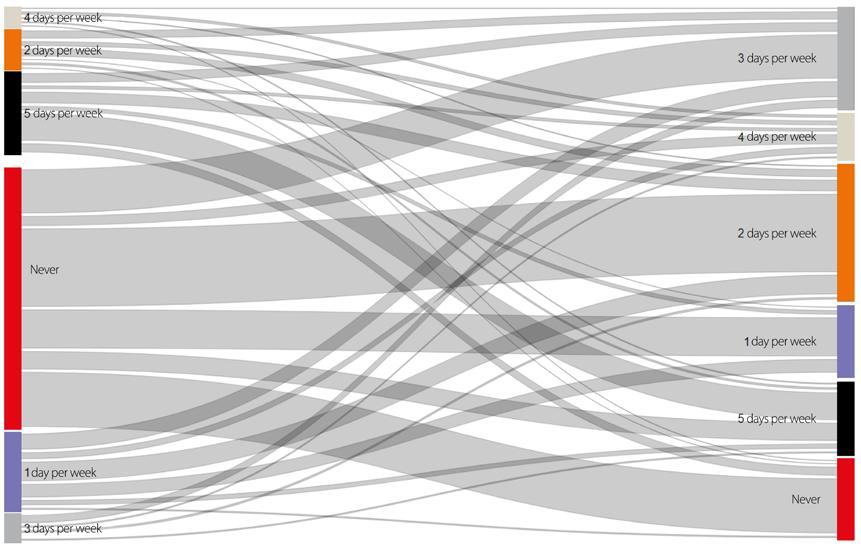
The results reflect a clear preference for remote work on the part of younger generations: 70% of participants aged between 25 and 44 would like to work from home between 1 to 3 days a week. Older generations, on the other hand, prioritise presence in the office with more than 30% of participants aged between 55 and 65 or more never expressing a preference for working from home.
This way, the need for a workspace has gained a significant relevance, which, as we saw earlier, reflected a 20% increase in priorities when looking for a new home.
In home design and organization, the main idea is to minimize distractions and adapt the space for work calls (minimize background noise and have an appropriate setting), creating comfortable spaces that provide conditions for maximum productivity and at the same time a sense of evasion and for a ‘pause’, thus permitting a balance between personal and professional life.
+20%
Increase in the number of respondents who started to consider as
very important the existence of a “Private space for work”.
Did you know: According to the Remote Work survey
conducted by JLL, the results of which were published in the “Remote Work in Portugal” study, 84% of respondents value working from home for professional reasons and 86% mentioned a good adaptation of companies to remote work during the pandemic.
The willingness for remote work
of the participants did not work from home any day of the week before the pandemic
How many days did you work from home before the pandemic?
How many days would you like to start working from home after the pandemic?
believe it would be ideal to work from home at least one day per week
Conclusion 4
The increasing importance of leisure spaces
Given the impossibility of leaving home during the confinement, we witnessed, literally from one day to the next, a huge increase in the value given to outdoor spaces. These spaces not only provide the feeling of freedom that one feels outdoors, but can also be places for physical exercise or even to relax and have fun. This is confirmed by the factors that gained more importance right behind the work spaces: the private outdoor spaces, the condominium pool or gym, or even the outdoor areas in a private condominium. But it is the private outdoor spaces that gain importance with a 20 percentage point increase in the degree of importance among the participants. Those living in an apartment were naturally the ones who began to attribute a greater value to this factor - increasing 23% when compared to those who already lived in a townhouse or isolated home, where the increase was only 5% and 3%, respectively.
As expected, those who rated these spaces as the most important were the respondents who live, ‘with husband / wife or partner / partner and children’ and ‘with parents’. In contrast, those who live ‘with friend (s)’ attribute less importance to these spaces, despite valuing the existence of a gym.
The home is more and more the place where dreams of a lifetime are generated. If pre-covid, the criteria was more marked by a utilitarian and daily perspective, there is currently a notorious concern related to well-being and leisure.
Of the most important, depending on who one lives with, from 1 to 5, how do these spaces quantify
If so, what are the top 3 property search criteria
A vision of Europe
JLL EMEA team launched a similar survey to all its employees across 15 countries as a result of which 2000 responses were obtained.
• The biggest conclusions are that almost half (46%) of the participants want to move home as a direct result of the pandemic experience. Before the pandemic, only 30% considered to move homes. A greater effect among those who live in cities (52%) and apartments (54%). It was in southern Europe and Poland that this choice prevailed.
• Almost half (43%) intend to make changes to their homes as a result of the pandemic, with improvements in decoration (79%) and modernization of outdoor spaces (38%) at the top of the priorities. The youngest age groups (18-34 years) were those who most appointed these preferences.
• More than two thirds of respondents (69%) already work intermittently from home, the high percentage of which intend to continue, the majority opting for 1-2 days a week.
• At a European level, the effects of the confinement and working from home are also obvious, as can be concluded from our survey to the Portuguese population. In the centralized European survey, results show that priorities at home also include an increase in the importance of outdoor spaces, private spaces for work and internet speed. Interestingly, the importance of proximity to public transport has fallen in all countries.
Proximity
Proximity
Proximity
Top 5 post-covid priorities
Conclusions
More comfortable and leisure-oriented houses that allow any family member to have their own space whenever possible
A pandemia trouxe um novo modo de viver e por isso nem tudo voltará a ser como dantes – A casa do “pós covid” terá os seus espaços reimaginados de modo a acomodar prioridades que se criaram com a intensa vivência durante o confinamento.
No
aspect of the house loses importance
A major conclusion of the study is that all aspects of the house, gained importance, even if slightly.
Spaces dedicated to remote work gain priority and are associated with greater sustainability
With many positive meanings associated, namely, another barrier that falls between work and personal life making it healthier (there is evidence in the recent JLL publication ‘Remote Work in Portugal’ that working from home is positive for our well-being); Daily trips to the office are reduced, which in addition to decreasing stress due to hours spent in transport or traffic, reduces our ecological footprint.
With confinement, naturally, the consumption of water, electricity and gas increased considerably, and consequently the monthly costs associated to these essential goods
Therefore, it may be time to reconsider more sustainable alternatives. Sustainable and self-sufficient houses in energy and water: the buildings of the future will be independent, from detached houses to apartment buildings, they may even have their own water and energy source as security.
Small autonomous stations generating alternative energy will become a reality with the larger purpose of one day, if necessary, being able to survive independently from the outside world and minimizing the risks of a general shutdown or suspension of services.
More outdoor spaces
Time for a ‘break’ has always been and will always be very important for each one’s wellbeing. Outdoor spaces, from a balcony to gardens with a swimming pool, as long they are private or have limited access to the condominium, provide something that everyone enjoys and needs, without breaking the social distance. Some grass, flower pots and garden chairs may be enough to create the feeling of being ‘on the street’, to enjoy quality family time, to have meals or even a little conversation with others without compromising the safety distance.
An opportunity for investors and promoters
The residential market has been seen as one of the most resilient markets during the pandemic. According to official data from Confidencial Imobiliário, prices remained stable with house prices rising 0.9% in May. Also, with this survey we were able to provide the market with a vision of the new priorities for those looking for a home.