How US Fashion Brands Can Verify Overseas Supplier Costs Before Placing an Order
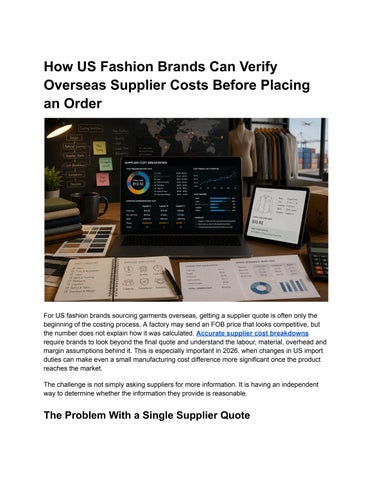
For US fashion brands sourcing garments overseas, getting a supplier quote is often only the beginning of the costing process. A factory may send an FOB price that looks competitive, but the number does not explain how it was calculated. Accurate supplier cost breakdowns require brands to look beyond the final quote and understand the labour, material, overhead and margin assumptions behind it. This is especially important in 2026, when changes in US import duties can make even a small manufacturing cost difference more significant once the product reaches the market. The challenge is not simply asking suppliers for more information. It is having an independent way to determine whether the information they provide is reasonable.
The Problem With a Single Supplier Quote
Imagine a sourcing team receives an FOB quote of $4.20 for a knit garment. There is no operation list, no efficiency figure and no explanation of how the labour cost was calculated. The supplier has performed the calculation, but the brand only sees the final result. Inside that price are several different elements: ● ● ● ●
Bill of Materials, including fabric, trims, labels and packaging Cost-to-Make, covering cutting, sewing and finishing labour Factory overhead Factory margin
The basic relationship is: FOB Price = BOM Cost + CM + Factory Overhead + Margin The final landed cost adds other expenses such as freight, import duty and inbound handling: Landed Cost = FOB + Freight + Import Duty + Inbound Handling This distinction matters because not every part of the final landed cost can be controlled by the brand. Duty rates, for example, are largely outside the sourcing team's control. Manufacturing cost is different. It can be examined, challenged and negotiated.
Why Cost Transparency Matters More in 2026 The cost of getting manufacturing assumptions wrong becomes much more noticeable when additional import costs are applied. According to the data cited in the source, the average applied tariff rate on US apparel imports under HS Chapters 61 and 62 increased from 14.7% in January 2025 to 35.1% by December 2025. The legal situation then changed during 2026, including the invalidation of IEEPA tariffs, a temporary Section 122 surcharge and the subsequent introduction of Section 301 forced-labour tariffs across 60 economies. The important point for apparel brands is not simply the exact duty level. It is the relationship between factory pricing and the costs that come afterward. If the manufacturing cost is unnecessarily high, the resulting duty burden can make that mistake even more expensive. This makes accurate CM costing a practical sourcing priority rather than just an accounting exercise.
What Should Be Inside an Accurate Cost Breakdown?
An open supplier cost sheet should separate the major components instead of presenting one bundled figure.
1. Bill of Materials The BOM covers everything that goes into making the garment, including fabric, trims, labels and packaging. Wastage allowances should also be considered. This is generally one of the easier areas for brands to investigate because sourcing teams can compare material prices against suppliers and market information.
2. Cost-to-Make CM represents the labour involved in cutting, sewing and finishing the garment. This is where the costing challenge becomes more complicated. CM depends on two important variables: time and cost per minute. The cost per minute can be estimated using factors such as wages, contracted working hours and social charges. The time required to manufacture the garment is much harder for a brand to verify.
3. Factory Overhead Overhead can include rent, utilities, supervision, quality control, compliance and administration. These expenses are legitimate parts of manufacturing, but brands still need to understand how they are allocated.
4. Margin The supplier's profit margin is another component of the final price. Unlike many external costs, margin is something that can be discussed commercially. The real difficulty, therefore, is not identifying the four components. It is establishing whether the labour calculation within them is accurate.
Why Asking for a Breakdown Is Not Enough Many sourcing teams already ask suppliers to provide detailed cost sheets. That is a useful first step, but it does not automatically create an accurate cost model. A supplier's breakdown explains how the factory arrived at its own number. It does not independently prove that the number is correct.
For example, the factory may use its own operation times, construction assumptions and efficiency expectations. If the brand has no separate benchmark, there is little against which those figures can be tested. This is particularly important because even manufacturers can experience significant differences in SMV calculations between production lines. The source highlights Suzhou Tianyuan Garments, a large Chinese sportswear manufacturer, which reported SMV variations of up to 30% across its own production lines before introducing method-based costing. Following standardisation, the company reported 98% SMV accuracy and 95% cost estimation accuracy. The lesson is straightforward: an operation time should not automatically be accepted simply because it appears on an official supplier cost sheet.
The Missing Piece: An Independent Labour Benchmark The strongest way to examine the labour portion of a supplier quote is to establish an independent Standard Minute Value. Standard Minute Value, or SMV, is the standard time required for a qualified operator working at standard performance to complete a specific garment operation, including applicable allowances. The basic costing formula is: CM Cost = Total Garment SMV × Factory Cost Per Minute And: Cost Per Minute = Monthly Labour Cost ÷ Available Productive Minutes Per Month Once the brand has its own SMV, it can calculate an expected CM and compare it directly with the supplier's figure. This changes the conversation. Instead of asking, "Why is your price so high?" the sourcing team can ask, "Why does your quoted labour time differ from the agreed standard?" That is a much more productive discussion.
Construction Comes Before Cost An important point is that SMV cannot be separated from garment construction.
The tech pack and operation bulletin need to establish how the garment is going to be made. This can include seam types, stitch classes, closures, trims and finishing sequences. If the construction method is unclear, the expected manufacturing time will also be unclear. That is why brands should establish the method first and calculate the time second. Doing this before sampling can be particularly valuable because construction decisions may still be changed at the design stage. A brand does not necessarily need to wait until a production line exists before developing a labour benchmark.
PMTS Makes Pre-Order Costing Possible Traditional stopwatch studies are useful when a garment is already running on a production line. They measure actual operators performing actual operations in a specific factory. But that approach has an obvious limitation for sourcing teams: there is no production line to observe before an order is placed. A predetermined motion time system, or PMTS, provides another approach. PMTS breaks manufacturing operations into basic motions and assigns established time values to those motions. This allows a standard time to be created independently of a factory's current performance. General Sewing Data, or GSD, is a widely used PMTS approach in apparel. GSDCost uses 39 standard motion codes to build operation-level manufacturing times. Because the methodology is standardized, the resulting SMVs can be used as a common benchmark across suppliers and locations. For brands, this creates something valuable: a labour standard that travels with the product rather than changing every time the supplier changes.
A Five-Step Approach to Better Supplier Costing US fashion brands can build a stronger costing process by following five practical steps.
Step 1: Define the Construction Start with the tech pack and establish exactly how the garment will be assembled.
Step 2: Create an Independent SMV
Use a method-based approach to determine the standard labour time rather than relying entirely on the supplier's estimate.
Step 3: Calculate Expected CM Apply the independent SMV to a documented cost per minute based on the sourcing country's labour conditions and realistic efficiency assumptions.
Step 4: Compare the Supplier's Breakdown Request an open cost sheet and compare the two calculations. Pay particular attention to four variables: ● ● ● ●
Labour time Cost per minute Factory efficiency Margin
Step 5: Resolve the Gap and Maintain the Standard Once the difference is understood, negotiate the parts that need adjustment and retain the agreed Bill of Labour as a controlled reference for future costing.
Don't Compare Factories on FOB Alone One of the biggest mistakes in multi-supplier sourcing is simply asking several factories for the same style and selecting the lowest FOB price. The problem is that each supplier may structure its FOB differently. One factory could have a lower quoted cost per minute but lower efficiency. Another may have a higher rate but significantly stronger efficiency. The PDF provides an illustrative example using three suppliers with the same locked 14-minute SMV. Vendor A quotes $0.095 per minute at 52% efficiency, while Vendor C quotes $0.130 at 82% efficiency. After adjusting for efficiency, Vendor A has an effective cost per minute of $0.183, compared with $0.159 for Vendor C. This demonstrates why headline rates can be misleading. The formula is: Effective Cost Per Minute = Quoted Cost Per Minute ÷ Factory Efficiency
A higher quoted rate does not automatically mean a more expensive manufacturing operation.
A Higher Quote Is Not Always a Bad Quote Independent costing should not become another way to force suppliers to accept unrealistic prices. There are legitimate reasons why one supplier may have a higher CM. These can include: ● ● ● ● ●
Lower genuine factory efficiency Greater investment in machinery or automation Fair living wage and compliance costs Small-order surcharges More complex approved construction
Fair wage costs deserve particular attention. A brand should be able to distinguish between genuine labour costs associated with better wage standards and unnecessary cost inflation. The source notes that GSDCost includes a fair wage tool using Fair Wage Network data and ILO-aligned standards to make these factors more visible. The objective is not simply to reduce CM. It is to understand CM.
Watch for Costing Red Flags Once brands have their own labour benchmark, several warning signs become easier to identify. These include operation times that do not match the agreed construction method, efficiency assumptions that appear inconsistent with known factory capability, overhead allocations that rise disproportionately, or margin being disguised within labour. A supplier that refuses to provide operation-level information after agreeing to an itemised costing approach may also require closer review.
Technology Can Make the Process Practical Independent costing can be challenging when brands manage large seasonal collections and multiple suppliers. Manual method analysis takes time, and spreadsheets can gradually develop different assumptions across teams and seasons.
This becomes increasingly difficult when several vendors are quoting the same styles. AI-assisted costing can help reduce the time required to create a Bill of Labour. The source describes GSDQuest, an AI enhancement to GSDCost launched in 2025, which can analyse product images, tech packs or PDFs, identify construction features and generate a standardised Bill of Labour with SMVs. Coats Digital reports that the approach can reduce costing time by roughly 90%. For growing brands, the value is not just speed. It is the ability to establish an independent benchmark early enough for it to influence sourcing decisions.
The Bigger Shift in Apparel Costing The biggest change is moving cost control earlier in the product lifecycle. Instead of waiting for a supplier to provide a quote and then negotiating around that number, brands can develop their own expected manufacturing cost before the purchase order is placed. That gives sourcing teams a stronger position without turning supplier negotiations into a confrontation. The supplier still has an opportunity to explain genuine differences in efficiency, wages, machinery, order quantities or construction. But the conversation starts from a shared, evidence-based reference point. For US fashion brands facing uncertain trade costs and increasingly complex global sourcing decisions, that distinction matters. The strongest sourcing teams are not necessarily the ones that negotiate the hardest. They are the ones that understand what a garment should cost to make before asking a supplier what they will charge. When brands own the labour-time assumption, a supplier quote becomes more than a number to accept or reject. It becomes a calculation that can be understood, compared and improved. That is the foundation of a more reliable cost breakdown and a smarter overseas sourcing strategy.