TIEPOLO
DANS LES COLLECTIONS PRIVÉES
GALERIE
ÉRIC COATALEM
PARIS
DENIS TON
Cet ouvrage est publié à l’occasion de l’exposition
Les Tiepolo dans les collections privées présentée à la galerie Éric Coatalem à Paris du 13 février au 3 avril 2026.
p. 4
p. 9
SOMMAIRE à
Charles, Louis, Pauline, Pierre et Victor
INTRODUCTION ÉRIC COATALEM
ESSAI
Tiepolo et la France : une reconnaissance tardive
EMMANUELLE BRUGEROLLES, conservatrice générale honoraire du patrimoine, directrice d’études émérite à l’École Pratique des Hautes Études
DAVID GUILLET, conservateur général honoraire du patrimoine
— Introduction
— I. Le Grand Tour
— II. Commandes et chantiers : les artistes vénitiens en Europe au XVIIIe siècle
— III. La réception de l’art vénitien du XIXe à nos jours — Épilogue
p. 27
ESSAI
Les Tiepolo, génies vénitiens
DENIS TON, Historien de l’art
— Introduction
— I. « Bizzarrie di pensieri » — II. Études et exercices : l’album Orloff
— III. Un testament en images
— IV. Le difficile héritage : Giandomenico et Lorenzo Tiepolo
— V. Nouveau Testament
— VI. Images de la vie contemporaine et de Polichinelle
p. 45
p. 192
p. 199
CATALOGUE
BIBLIOGRAPHIE
COPYRIGHT
INTRODUCTION
Comment évoquer Venise sans penser aux merveilleux artistes qu’étaient les Tiepolo, les Guardi ou Canaletto qui, chacun dans un style si différent, surent retranscrire la lumière bleue ou grise de la lagune, les façades ocres des palais se reflétant dans le Grand Canal, les courtisanes Place Saint Marc mais aussi montrer la vie des vénitiens, pauvres ou riches, costumés ou simples gondoliers ? Leurs œuvres respectives sont intemporelles et ont, non seulement marquées le XVIIIe siècle italien et européen mais aussi l’art du paysage, de la lumière et de la Peinture.
Si les personnages de Canaletto sont « froids », posés à la perfection mais avec une technique presque « mécanique », ceux de Francesco Guardi sont griffés dans la toile avec des vibrations déjà impressionnistes. À l’opposé, les Tiepolo sont incisifs et sculptent la lumière avec de merveilleux lavis d’encre plus ou moins bruns, des sanguines époustouflantes ou dans des toiles et des fresques magistrales réalisées en Italie, Espagne ou en Allemagne.
Giambattista, le père de Gian Domenico et de Lorenzo, fut le premier à inventer ces personnages déguisés en Polichinelles mais ce thème reste un peu anecdotique par rapport à son œuvre très prolifique consacrée aux sujets religieux ou mythologiques, qu’elle soit peinte ou dessinée à la fresque ou sur des toiles mais toujours avec une facilité déconcertante et une créativité époustouflante.
Giandomenico, le premier fils, inventa une série merveilleuse de plus de cent dessins sur le thème des Polichinelles, dont nous avons la chance de présenter 11 œuvres, mais aussi une série importante consacrée au Nouveau Testament avec plus de 300 feuilles d’une virtuosité spectaculaire. Après une mise en place rapide à la pierre noire, il sculpte, au pinceau ou à la plume, les lumières grâce à de savants lavis aux couleurs blondes ou cuir, de l’ocre clair aux bruns plus sombres ménageant toujours des réserves de blanc exceptionnelles.
Lorenzo, le fils moins connu, meurt à l’âge de 30 ans après une carrière essentiellement passée en Espagne, et, malgré de formidables pastels, son œuvre reste encore à reconstituer. Effacé par le génie de son Père et de son Frère, il n’est connu aujourd’hui que comme un collaborateur, ce qui est loin de lui rendre justice quand on admire la qualité des deux somptueux et puissants dessins que nous avons la chance de présenter.
Une fois de plus, grâce à l’immense générosité de 22 collectionneurs, français et étrangers, nous avons pu réunir plus de 50 œuvres de ces trois artistes merveilleux et avoir ainsi la chance d’admirer leurs techniques, leurs virtuosités et leurs imaginations débordantes. Nous espérons que cette exposition consacrée à ces monstres sacrés de la peinture vénitienne du XVIIIe siècle enchantera les visiteurs, amateurs éclairés ou simples curieux, et leur donnera l’envie de découvrir toutes les facettes de leur art.
REMERCIEMENTS
Je tiens à remercier très chaleureusement Emmanuelle Brugerolles et David Guillet pour leur passionnante introduction consacrée à la place des œuvres des Tiepolo dans les collections publiques et privées françaises mais aussi Denis Ton pour son long texte érudit qui apporte un nouvel éclairage sur l’art et la technique des trois Tiepolo.
Je tiens à exprimer ma sincère gratitude envers Frank Dabell, pour son travail de traduction rigoureux, dans le respect des intentions des auteurs, réalisé en un temps record.
Je tiens à remercier pour leur aide et leur soutien Katrin Bellinger, Anne Searle Bent, Marco Simone Bolzoni, François Borne, Alesa Boyle, Emmanuelle Brugerolles, Benoît Choné, Christie’s, Frank Dabell, Martial Damblant, Pauline Doutrebente, Éric Doutrebente, Agathe Dupont, Mr & Mrs Eveillard, Yvan Farin, Angélique Franck, Éric † et Caroline Freymond, David Guillet, Bob Haboldt, Thomas Hennocque, Roberta J.M. Olson et Alexander B.V. Johnson, Frédéric Jourdeuil, Sidonie Laude, Thomas Le Claire, Dominique Le Marois, Sandrine Le Nech, Sally et Howard G. Lepow, David Leventhal, Julien Moulié, Stephen Ongpin, Carlo Orsi, François Poirier, Hélène Rihal, Edmondo di Robilant, Kate de Rothschild Agius, Claire Sarti, Ariane et Lionel Sauvage, Christelle & Nicolas et Louis Schwed, Daniel Thierry, The Tobey Collection, Rafael Valls, Dominique Vitart, Marco Voena.
Je remercie enfin, et une nouvelle fois, tous les collectionneurs qui ont préféré garder l’anonymat malgré la générosité de leurs prêts afin que nous puissions redécouvrir et partager l’amour de ces immenses artistes.
ÉRIC COATALEM
INTRODUCTION
How can one conjure up Venice without thinking of marvelous artists like the Tiepolos, the Guardis, or Canaletto, who succeeded – each in their distinct style – in capturing the blue-gray light of the lagoon, the ochre façades of the palazzi reflected in the Grand Canal, the courtesans in Saint Mark’s Square, not to mention the lives of Venetians, poor or rich, dressed up or as simple gondoliers? Their respective works have a timeless quality, and they left their mark not only on eighteenth-century Italy and Europe but also on the world of landscape and light, and the art of painting itself.
While Canaletto’s figures are “cold”, posed to perfection but with an almost “mechanical” technique, Francesco Guardi’s are sketched onto the canvas, already quivering with a sense of impressionism. In contrast, the Tiepolos are incisive, sculpting light with marvelous ink washes in varying shades of brown, creating breathtaking red chalk drawings, or painting masterful canvases and frescoes in Italy, Spain, and Germany.
Giambattista, the father of Giandomenico and Lorenzo, was the first to disguise his characters as Punchinellos, but this theme remains somewhat anecdotal compared to his prolific work with religious or mythological subjects, whether painted or drawn, in fresco or on canvas, but always with disconcerting ease and amazing creativity.
Giandomenico, the eldest son, created a marvelous series of over one hundred drawings on the theme of Punchinello, of which we are fortunate to present eleven sheets; he also dedicated a significant series devoted to the New Testament with over 300 sheets of spectacular virtuosity. After a swift initial composition in black chalk, he gave shape to light with a brush or pen, using skillful washes in blond or leather-colored tonalities ranging from light ochre to darker browns, always keeping extraordinary areas of white in reserve.
Lorenzo, the lesser-known son, died at the age of thirty after a career spent mostly in Spain, and apart from some remarkable pastels, his oeuvre still needs to be reconstructed. Eclipsed by the genius of his father and brother, he is now generally regarded as a collaborator, which scarcely does him justice when one admires the quality of the two sumptuous and powerful drawings we are fortunate enough to present here.
Once again thanks to the great generosity of collectors – twenty-two in France and beyond – we have succeeded in bringing together over fifty works by these three remarkable artists, and thus offer an opportunity to admire their techniques, virtuosity, and boundless imagination. We hope that this exhibition dedicated to these giants of eighteenth-century Venetian painting will delight visitors, whether they are seasoned art lovers or simply curious observers, and inspire them to explore all facets of the Tiepolos’ art.
ACKNOWLEDGEMENTS
I should like to extend my warmest thanks to Emmanuelle Brugerolles and David Guillet for their fascinating introductory essay on the Tiepolos’ works in French public and private collections, and to Denis Ton for his extensive scholarly text, which sheds new light on the art and technique of the three Tiepolos.
My sincere gratitude goes to Frank Dabell for his meticulous translation, carried out in record time, and respectful of the authors’ intentions.
I am grateful for the help and support of Katrin Bellinger, Anne Searle Bent, Marco Simone Bolzoni, François Borne, Alesa Boyle, Emmanuelle Brugerolles, Benoît Choné, Christie’s, Frank Dabell, Martial Damblant, Éric Doutrebente, Agathe Dupont, Mr & Mrs Eveillard, Yvan Farin, Angélique Franck, Éric † and Caroline Freymond, David Guillet, Bob Haboldt, Roberta J.M. Olson and Alexander B.V. Johnson, Frédéric Jourdeuil, Sidonie Laude, Thomas Le Claire, Dominique Le Marois, Sandrine Le Nech, Sally and Howard G. Lepow, David Leventhal, Julien Moulié, Stephen Ongpin, Carlo Orsi, François Poirier, Hélène Rihal, Edmondo di Robilant, Kate de Rothschild Agius, Claire Sarti, Ariane and Lionel Sauvage, Christelle & Nicolas and Louis Schwed, Daniel Thierry, The Tobey Collection, Rafael Valls, Dominique Vitart, and Marco Voena.
Finally, I should once again like to thank all the collectors who preferred to remain anonymous notwithstanding the generosity of their loans, so that we may all rediscover and share the love of these towering artists.
ÉRIC COATALEM
EMMANUELLE BRUGEROLLES
conservatrice générale honoraire du patrimoine, directrice d’études émérite à l’École Pratique des Hautes Études
DAVID GUILLET
conservateur général honoraire du patrimoine
Tiepolo et la France : une reconnaissance tardive
INTRODUCTION
En 1880, Philippe de Chennevières (1820-1899), qui fut directeur de l’administration des Beaux-Arts, cofondateur des Archives de l’art français, membre de l’Académie des Beaux-Arts et… éminent collectionneur, commente l’exposition des Dessins de maîtres anciens présentés à l’École des Beaux-Arts l’année précédente, en rendant hommage à « l’école vénitienne [qui] vient finir par un bouquet éblouissant de ces derniers peintres charmeurs qui lui firent des funérailles superbes1 ». On ne saurait mieux dire que, selon les historiens et amateurs français de l’époque, les dessins de Giambattista Tiepolo (16961770) – dont une superbe Vénus et l’Amour –, comme ceux de Giovanni Antonio Canaletto (1697-1768) et Francesco Guardi (1712-1793), sont le chant du cygne d’un foyer artistique éminent, auquel on doit surtout Titien, Tintoret et Véronèse.
En fait, deux, voire trois générations, d’artistes se succèdent, de la fin du XVIIe siècle aux dernières années du XVIIIe, pour incarner brillamment le renouveau de la peinture vénitienne, éclipsée au Seicento par Rome, Bologne, Naples et Gênes. Dans tous les registres et domaines, de l’histoire au genre sans oublier le portrait et le paysage, la production de la Sérénissime et des foyers artistiques de la Terraferma s’impose en Angleterre, à Madrid, en Pologne, auprès de l’impératrice Catherine de Russie et dans les cours allemandes de Dresde à Würzburg et Cologne. Parmi ces nombreux artistes, peintres et dessinateurs pour l’essentiel, le nom de Tiepolo s’impose comme le plus célèbre, incarné par trois figures, celles de Giambattista et de ses deux fils, Giandomenico (17271804) et Lorenzo (1736-1776).
I. LE GRAND TOUR
On ne saurait dissocier ce phénomène des voyages en général et plus précisément du Grand Tour – dont Venise est avec Rome une des principales étapes sinon la plus importante –, qui mènent en Italie artistes, amateurs et collectionneurs mais aussi aristocrates et têtes couronnées. Les attirent tant le paysage, la lumière, les églises et les palais que les tableaux et décors qu’ils abritent, ainsi que les collections de dessins et estampes. Toutefois, à bien lire les récits et journaux qui en résultent, non seulement les auteurs français placent au-dessus de tout la peinture du XVIe siècle – incarnée par Titien, Tintoret et Véronèse –, qu’ils commentent bien plus longuement que les œuvres contemporaines, mais encore l’appréciation qu’ils portent sur ces dernières s’accompagne presque toujours de réserves, lesquelles évoluent dans leur nature comme dans leur vigueur au fil des décennies.
– LES ANNÉES 1710 –CROZAT, CAYLUS ET MARIETTE
Si l’on s’attache à ceux qui peuvent être considérés comme les premiers de ces visiteurs français à Venise au XVIIIe siècle, il faut mentionner les amateurs et collectionneurs Pierre Crozat (1665-1740) – par ailleurs financier – à qui l’on doit le fameux Recueil éponyme, publié en 1729, où sont reproduits des tableaux des plus importantes collections européennes de son temps, et le Comte de Caylus (16921765), antiquaire auteur du Recueil d’antiquités égyptiennes, étrusques, grecques et romaines, dessinateur et graveur formé par Watteau, tous deux par ailleurs très proches2
Ils effectuent leurs voyages en Italie respectivement à la fin de l’année 1714 pour le premier, de 1714 à 1715 pour le second et sont avant tout sensibles à la peinture du XVIe siècle mais remarquent Rosalba Carriera (1675-1757) que Crozat rencontre et incite à se rendre en France, ce qu’elle fait en 1720. En revanche ils ne font pas la connaissance de Tiepolo qui n’est alors pas encore « né » à la peinture, puisque ses premiers tableaux connus datent de 1716 et, par ailleurs, trahissent l’influence de ses aînés immédiats comme Giovanni Battista Piazzetta (1682-1754), marqués par les teintes sombres et la tonalité dramatique inspirées de l’école bolonaise.
Ils sont suivis peu après par Pierre-Jean Mariette (16941774), lui aussi collectionneur érudit, qui passe quelques semaines à Venise de décembre 1719 à janvier 1720 et rencontre le comte Anton Maria Zanetti (1689-1767) avec qui il se lie d’amitié. Celui-ci lui fait découvrir sa collection de tableaux et lui présente Rosalba Carriera.
– LES ANNÉES 1740 ET 1750 –CHARLES-NICOLAS COCHIN
Trois décennies plus tard, soit de 1749 à 1751, CharlesNicolas Cochin (1715-1790) incarne la seconde génération de ces voyageurs et propose, dans le tome troisième de son Voyage d’Italie, ou recueil de notes sur les ouvrages de Peintures & de sculptures, qu’on voit dans les principales villes d’Italie, publié en 1758 3 , un panorama à visée exhaustive – où, il est vrai, les inexactitudes et erreurs de fait sont nombreuses, comme l’a relevé Maria Teresa Caracciolo4 – des œuvres conservées dans les églises et palais de Venise. S’il marque, lui aussi, une nette préférence pour la peinture du XVIe siècle, ses commentaires des peintures et décors réalisés par Giambattista, dit Tiepoletto, et Giandomenico Tiepolo, sont souvent bienveillants. Il loue des « morceaux […] plein d’esprit & de génie », le « goût », le « beau faire » et le « beau pinceau » qui les caractérisent, la facture « très-facile », ainsi que la composition généralement qualifiée d’« ingénieuse », sans omettre les « tons charmans dans les chairs ombrées ».
Pour autant, il assortit généralement cette appréciation d’une réserve qui semble rédhibitoire : ces compositions sont à ses yeux « cruellement maniéré[e]s », tantôt par le « dessin », tantôt par des détails des figures comme les « pieds […] trop grands & maniérés » du Martyre de saint Barthélémy, de l’église « S. Eustachio, dit S. Itac », aujourd’hui San Stae, le plus souvent par la « couleur […] charmante : claire & lumineuse, vigoureuse dans les ombres, mais plus belle que la nature, & par conséquent fausse et maniérée ». C’est le cas à ses yeux du plafond à fresque, représentant Sainte Thérèse dans la gloire des Carmelitani Scalzi ou l’église des Carmes déchaussés […] où la couleur est dure,
3- Lausanne, chez J. Pierre Heubach, 1773.
4- Caracciolo 2000, p. 42.
5- Cochin, op. cit., 1773, p. 68, 89, 117, 123
6- De Chennevières, de Montaiglon 1853, tome VI, p. 300, article consacré à Tiepolo.
7- Cochin 1777 ; Michel 1991, n˚ 145, p. 25.
8- Rosenberg 2019, tome III, p. 1194 à 1197, n˚ 12016-12023.
9- Ibid , tome I, p. 25.
maniérée et monotone, & les ombres sont trop égales5 », comme des plafonds de l’ « Église des Dominicains Réformés appelés Gesuati », indiscutablement de la main de Giambattista mais qu’il considère comme des œuvres de son fils aîné, « très-bien de plafond, de couleur belle dans les ombres, mais rouge dans les chairs, et maniérée ».
À cette appréciation sans complaisance fait écho l’Abecedario de Pierre-Jean Mariette (1694-1774), dont le manuscrit est établi quelques années plus tôt, entre 1740 et 1750, mais publié de 1853 à 1862 par Philippe de Chennevières et Anatole de Montaiglon. Mariette, non sans louer chez Giambattista les « compositions où brilloit la richesse de son génie », précise les griefs de ses devanciers en relevant que « cette trop grande facilité a fait tort à la correction, et qu’on peut luy reprocher d’avoir négligé cette partie en se livrant trop à la fougue de son imagination. Il n’a pas été plus curieux de la vérité de ses teintes. Son coloris est faux, quelque séduisant qu’il soit. Il ne sçut jamais faire des têtes gracieuses. Voilà ses défauts, qui sont relevés par tous les avantages d’un génie riche et fertile et par tout ce qui produit l’illusion sur des yeux qui aiment estre séduits. Sa touche est avec cela très spirituelle6 ».
Les critiques – convergentes – formulées par Cochin et Mariette s’expliquent mieux à la lecture du deuxième Discours sur l’enseignement des Beaux-Arts prononcé par le premier : « J’appelle manière […] tout ce qui s’éloigne de la nature, toute convention apprise ou imaginée, qui n’a pas le vrai pour base, soit qu’elle vienne de l’imitation des maîtres, ou de nos propres erreurs7 . »
On ne compte d’ailleurs dans la collection de Mariette que très peu de dessins – dont plusieurs aujourd’hui controversés – de Giambattista Tiepolo, aucun de la main de ses fils Giandomenico et Lorenzo 8 , alors qu’il fait part dans sa correspondance avec l’écrivain et architecte Tommaso Temanza (1705-1789) de son souhait de réunir des œuvres d’autres artistes de son temps originaires de Vénétie, comme Cignaroli, Diziani, Balestra, Carpioni mais aussi Longhi et Canaletto 9 .
LE VOYAGE DE SAINT-NON
En 1761 l’Abbé de Saint-Non (1727-1791), auteur du Voyage pittoresque, ou, Description des Royaumes de Naples et de Sicile 10 , séjourne du 8 mai au 23 juin à Venise. Il est accompagné du jeune Fragonard (17321806), alors pensionnaire de l’Académie de France à Rome, autorisé par le directeur de l’institution, Charles-Joseph Natoire (1700-1777) et le marquis de Marigny (1727-1781), Surintendant des Bâtiments du Roi, à faire avec lui la route qui mène de Rome à la France en passant par le Veneto.
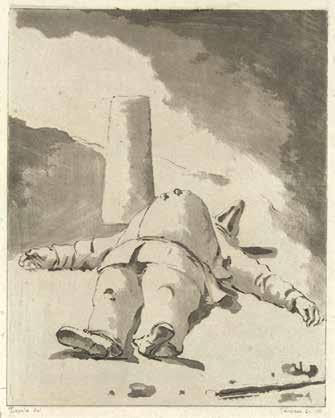
ill. 1 – Jean-Claude Richard de Saint-Non, d’après Giambattista Tiepolo, Polichinelle couché, eau-forte tirée du Recueil de Griffonis, de vuës, paysages, fragments antiques et sujets historiques, n° 91, vers 1780.
Après ces six semaines, retracées dans son Journal ou notes sur un voyage fait en Italie, Saint-Non dit « avoir plus que satisfait [sa] curiosité sur tout ce qui en mérite dans cette ville 11 » et assure l’avoir quittée « sans regrets »… Il est vrai que le comte Francesco Algarotti (1712-1764),
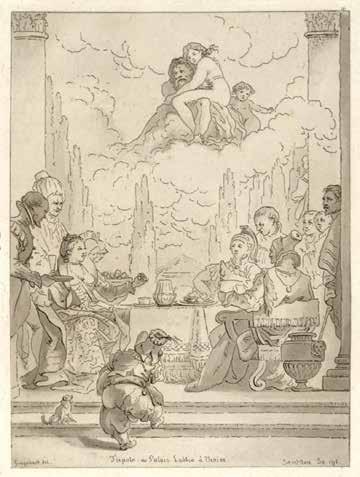
ill. 2 – Jean-Claude Richard de Saint-Non, d’après Giambattista Tiepolo, Le festin d’Antoine et Cléopâtre, d’après Giambattista Tiepolo, aquatinte, tirée du Recueil de Griffonis, de vuës, paysages, fragments antiques et sujets historiques, n° 267, vers 1780.
« poète philosophe » cosmopolite ouvert aux sciences comme aux arts, notamment conseiller artistique de la cour de Saxe, a veillé sur son séjour en lui ouvrant toutes les portes et en attirant particulièrement son attention sur l’œuvre de Giambattista Tiepolo qu’il protégeait. Ce, au point que le Recueil de griffonis, de vuës, paysages, fragments antiques et sujets historiques, gravés tant à l’eau-forte qu’au lavis, publié par l’abbé vers 1780, renferme une aquatinte d’après un Polichinelle couché de l’artiste (ill. 1), dessin vraisemblablement jadis dans la collection du comte 12 . Dans ce recueil gravé figure également la composition du Festin d’Antoine et Cléopâtre, d’après Giambattista, que Saint-Non copie lui-même (ill. 2) d’après l’eau-forte exécutée par Fragonard en 1763 (ill. 3).
10- Paris, imprimerie de Jacques-Gabriel Clousier.
11- Mascoli 1989, p. 423-438.
12- Dessin conservé à la Pierpont Morgan Library, New York, Inv. EVT 169.
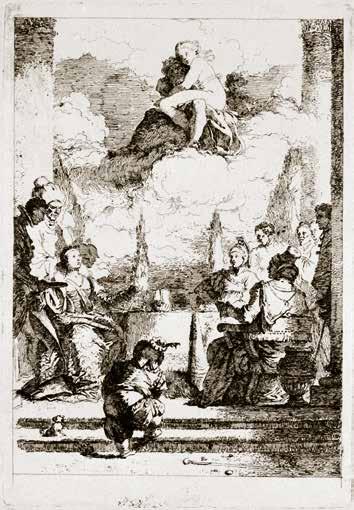
ill. 3 – Jean-Honoré Fragonard d’après Giambattista Tiepolo, Le festin d’Antoine et Cléopâtre, d’après Giambattista Tiepolo, eau forte, Paris, musée du Louvre, Département des Arts graphiques, Collection Edmond de Rothschild, 17982 LR/recto.
Aussi l’abbé put-il découvrir « un grand nombre de palais et d’églises […] remplis des ouvrages de Tiepolo, tous avec un caractère et une manière à lui qui se fait aisément reconnaître, mais toujours plutôt pour un homme de goût que pour un grand maître 13 », mais aussi les décors monumentaux que le maître avait achevés une décennie plus tôt au palais Labia à Venise, ainsi qu’à la villa Contarini sur la Terraferma, à Piazzola sul Brenta. Du premier il dit que « tout est grand et noble, de la plus riche composition », ajoutant qu’il aurait « souhaité plus de noblesse dans la figure de Cléopâtre et de Marc-Antoine, mais les détails en sont ravissants. Mille accessoires de chiens, de nains sont admirables et bien à leur place 14 . » Il ne put en revanche admirer les fresques de la villa Pisani à Stra, « qui n’étai[ent] pas encore fini[es]15 . »
13- Rosenberg, Brejon de Lavergnée 1986, p. 189-214 et Rosenberg 1987, p. 133.
14- Rosenberg, Brejon de Lavergnée 1986, p. 189-214.
15- Ibid
16- Bergeret de Grancourt 1895, XVII, p. 388 ; Rosenberg 1987, p. 405.
17- Knox 1970, n. p.
18- Lenoir 1816, XV.
19- La plupart sont conservées au Norton Simon Museum à Passadena ; Rosenberg 1987, p.133.
– 1774 – LE VOYAGE DE BERGERET DE
GRANCOURT…
En 1774, soit quatre ans après la mort à Madrid de Giambattista, Pierre-Jacques-Onésyme Bergeret de Grancourt (1715-1785), riche financier et collectionneur, qui avait épousé en premières noces la sœur de l’Abbé de Saint-Non, entreprend à son tour un voyage en Italie, accompagné de l’architecte Pierre-Adrien Pâris et… de Fragonard.
Son journal témoigne de l’impression que lui fit la découverte du palais Labia et du décor peint réalisé par les Tiepolo, qu’il découvre alors : « Tout y est large, grand et plein de goût et fait pour plaire à tout le monde 16 .» Il est possible qu’il ait alors acquis les dessins de Giandomenico qui sont aujourd’hui conservés au musée Atger à Montpellier 17
… ET LES SÉJOURS DE FRAGONARD À VENISE
Né en 1732, Fragonard s’installa à Rome dès 1756 et ses deux séjours vénitiens, dans des conditions exceptionnellement favorables en compagnie de collectionneurs et connaisseurs éminents, exercèrent sur son art et sa sensibilité une influence durable. A. Lenoir rapporte, quelques décennies plus tard, les termes dans lesquels il relatait sa rencontre avec les grands maîtres italiens comme un bouleversement : « L’énergie de Michel-Ange m’effrayait […] j’éprouvais un sentiment que je ne pouvais rendre ; en voyant les beautés de Raphaël, j’étais ému jusqu’aux larmes, et le crayon me tombait des mains ; enfin je restai quelques mois dans un état d’indolence que je n’étais plus le maître de surmonter, lorsque je m’attachai à l’étude des peintres qui me donnaient l’espérance de rivaliser un jour avec eux : c’est ainsi que Baroche, Piètre de Cortone, Solimène et Tiepolo fixèrent mon attention18 »
À la lecture de ces propos, on comprend mieux le plaisir et l’aisance avec lesquels il aborda les artistes vénitiens au cours de ses deux séjours sur la lagune, au point de s’inspirer de la liberté de leurs recherches et de s’approprier leur art du coloris et de la lumière. Parmi les nombreuses copies dessinées qu’il réalisa – une soixantaine semblet-il, selon P. Rosenberg19 – on en connaît au moins quatre d’après des fresques et des tableaux d’autels de Giambattista
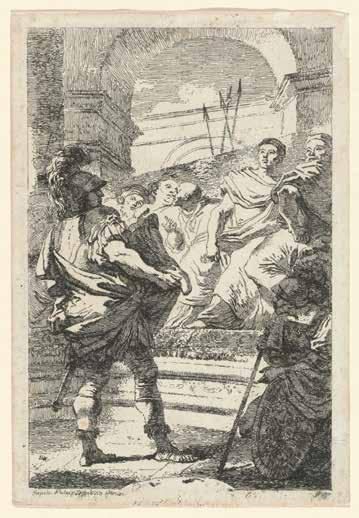
ill. 4 – Jean-Honoré Fragonard d’après Giambattista Tiepolo, Fabius Maximus devant le Sénat de Carthage 1763, eau-forte, Washington, National Gallery of Art, Gift of Kate Ganz, 2014.131.5.
Tiepolo, qu’il transcrivit en eaux-fortes à son retour en France en 1763 : Le Festin d’Antoine et Cléopâtre du palais Labia et Fabius Maximus devant le Sénat de Carthage du Palais Dolfin (ill. 4), ainsi que La Vierge en gloire avec sainte Catherine et L’Éducation de la Vierge, tableaux d’autels de Santa Maria della Fava 20 (ill. 5).
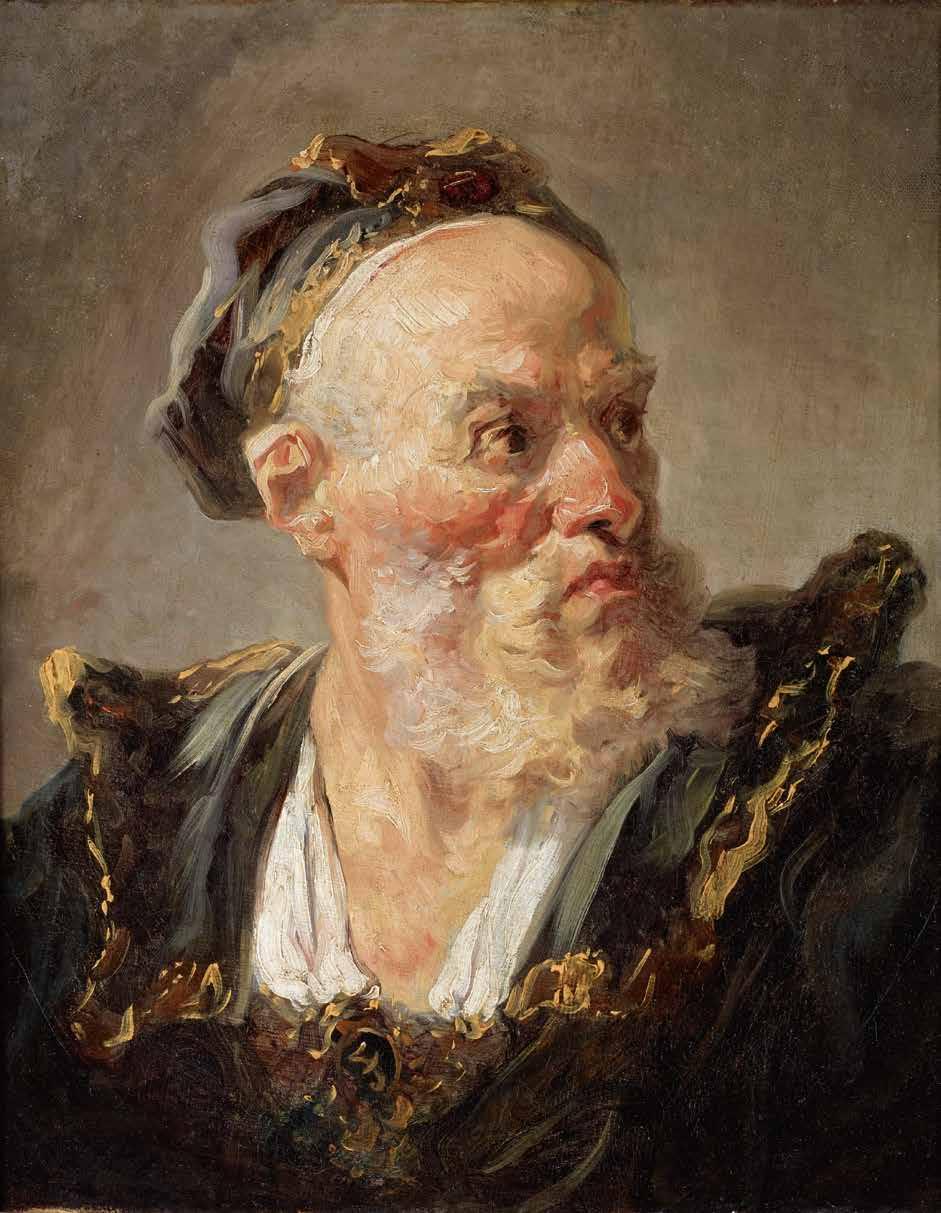
À sa façon, il est aussi un des vecteurs de la transmission de l’art vénitien en France, dans la mesure où il offre aux amateurs une production à la fois française et éclairée par les audaces que les artistes vénitiens sont alors seuls à s’autoriser. Comme l’écrivent les Goncourt « Il prend à Tiepolo son esprit, son pétillement 21 ». D’ailleurs le Baron de Portalis ne s’y trompe pas, qui, quelques années plus tard, décrit son Buste de vieillard à la toque du musée Jacquemart André 22 (ill. 6) comme « dans la manière de Tiepolo 23 .»
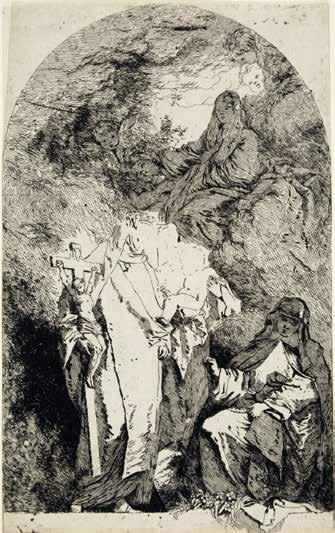
ill. 5 – Jean-Honoré Fragonard d’après Giambattista Tiepolo, La Vierge en gloire avec sainte Catherine, sainte Rose qui tient l’Enfant Jésus et sainte Agnès, 1763, eau-forte, Paris, Bibliothèque nationale de France, Département
20- Rosenberg 1987, p. 133, n˚ 5, p. 134, n˚ 52 et p. 474, fig. 4.
21- Goncourt 1880, p. 317.
22- Rosenberg 1987, n˚ 98.
23- Portalis 1889, p. 290.
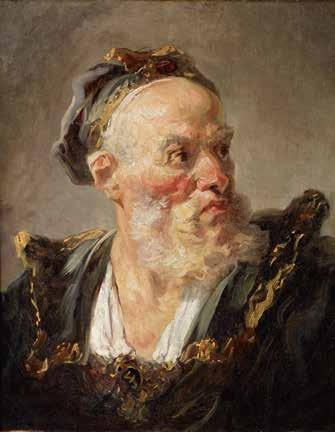
6 –
ill.
Jean-Honoré Fragonard, Buste de vieillard à la toque, huile sur toile, musée Jacquemart André, Paris.
II.
COMMANDES ET CHANTIERS :
LES ARTISTES VÉNITIENS EN EUROPE
AU XVIII E SIÈCLE
HISTOIRE D’UN ENGOUEMENT
Au terme de ces séjours, certains voyageurs, anglais notamment, quittent Venise enthousiastes et passent bientôt des commandes à des artistes vénitiens ou leur proposent de véritables chantiers de décors de palais, demeures et églises, qui ont laissé une empreinte durable dans leurs pays respectifs. Dès lors, l’art vénitien du XVIIIe siècle est bientôt présent dans toute l’Europe, de l’Angleterre à l’Espagne et à la Pologne, jusqu’en Russie, sans oublier la Saxe, la Bavière et les principautés allemandes.
De manière significative, les premières réalisations débutent dès les deux premières décennies du siècle, quelques années même avant les voyages de Crozat, Caylus et Mariette. On les doit d’abord à l’initiative de Charles Montagu (1656-1722), comte puis premier duc de Manchester, ambassadeur de la couronne britannique à Venise en 1707-1708, qui regagne le Royaume Uni accompagné de Giovanni Antonio Pellegrini (1675-1741) et de Marco Ricci (1676-1730). Ceux-ci, chargés, entre autres, du décor de Castle Howard et des scénographies d’opéra du Haymarket Theater, sont suivis notamment de Sebastiano Ricci (1659-1734) puis de Jacopo Amigoni (1682-1752) et, plus tard encore, de Giovanni Antonio Canal dit Canaletto (1697-1768), ce dernier par l’entremise d’Owen McSwiny (1676-1754) puis du consul Joseph Smith (1674-1770).
On retrouve les mêmes artistes au service des Électeurs palatins à Bensberg et à Mannheim, mais aussi Gaspare Diziani (1689-1767) auprès de l’Électeur de Saxe à Dresde et à la cour de Bavière à Münich, Francesco Fontebasso (1707-1769) au Palais d’Hiver de Saint-Pétersbourg, Giambattista Pittoni (1687-1767) chargé de commandes pour la Couronne d’Espagne, l’Électeur de Saxe et l’Archevêque-Électeur de Cologne…
Paradoxalement le plus célèbre d’entre eux et de loin, Giambattista Tiepolo, assisté de ses fils Giandomenico et Lorenzo, n’a répondu qu’à deux sollicitations hors de la péninsule, concernant il est vrai des chantiers majeurs, celui de la Résidence de Würzburg en Franconie à la demande du Prince-Évêque Karl Philipp von Greiffenklau zu Vollraths (1690-1754) de 1750 à 1753 et celui que lui confie Charles III d’Espagne (1716-1788) au palais royal de Madrid, qui l’occupe de 1762 à 1766. Plus étonnant encore, l’histoire de ses relations avec la France, ses maîtres d’ouvrage, collectionneurs et amateurs demeure celle d’un rendez-vous manqué.
L’EXCEPTION FRANÇAISE
Aux réticences des voyageurs français face aux œuvres vénitiennes du XVIIIe siècle – dont celles des Tiepolo – fait écho la tiédeur avec laquelle les peintres venus de la Sérénissime sont accueillis à Paris. Dès 1719, il est vrai, Giovanni Antonio Pellegrini reçoit du Régent Philippe II d’Orléans, par l’intermédiaire du banquier écossais John Law, la prestigieuse commande du plafond de la galerie du Mississipi de l’hôtel de Nevers, alors siège de la Banque royale. Toutefois, aussitôt achevée, l’œuvre – qui illustre le Bon gouvernement – suscite des réactions vives, voire hostiles, de la part de François Lemoyne qui espérait en être chargé mais aussi et surtout de Caylus et Mariette.
Le premier en fait même un cas d’école illustrant les libertés prises par les artistes vénitiens avec la nature et la vérité : « Pellegrini, et plusieurs autres peuvent […] nous servir d’exemples. Jamais on n’a fait ni dû faire l’éloge de leur légèreté : leur peu de terminé, leur impatience, ou leur promptitude n’ont été que des apparences ou des faux semblants de cette partie, et jamais un homme au fait de l’art, n’a pu s’y tromper 24 » Le décor est détruit dès 1722 et son destin illustre un malentendu durable. Malgré les deux morceaux de réception à l’Académie Royale peints par Pellegrini et son confrère Marco Ricci – actif à Paris à la même époque –, qui font partie des collections du musée du Louvre, La Modestie présentant la Peinture à l’Académie et l’Allégorie de la France 25 , seul le succès spectaculaire de Rosalba Carriera, adoptée par l’aristocratie, les amateurs et collectionneurs, fait exception à un rejet presque unanime.
Les raisons de cette réticence sont de deux natures au moins. L’une, clairement exprimée par Caylus, est d’ordre esthétique comme le résume Maria Teresa Caracciolo : « Dans le climat qui s’était créé dans les milieux érudits parisiens de l’époque […] c’est avant tout « la facilité » ou la « légèreté de l’outil » des peintres italiens qui est stigmatisée26 . » L’autre tient à la spécificité de l’organisation des Beaux-Arts dans le royaume, peu propice à l’accueil d’artistes dont la carrière et la renommée s’étaient construites hors du cadre de l’Académie et qui, fort de leur expérience, ne jugeaient pas utile de s’assurer de l’assentiment de leurs confrères… et censeurs français.
TIEPOLO ET LA FRANCE, UN RENDEZ-VOUS MANQUÉ ?
C’est sans doute largement, comme le souligne Marc Fumaroli, ce contexte spécifiquement français qui explique qu’après l’échec de Pellegrini, « Paris fit […] exception dans une Europe catholique où la gloriole des princes rêvait d’une glorification par Tiepolo », habitué à « des commanditaires cléricaux ou laïcs laissant au peintre, connu pour son extraordinaire feu inventif, liberté d’exécution, pourvu qu’il fût docile à la lettre du programme prévu par contrat […]27 ».
Cette rupture – en quelque sorte annoncée par les écrits des voyageurs – fut durablement consommée dans la seconde moitié du siècle, lorsque artistes et critiques adoptèrent très largement les canons de l’esthétique néoclassique, promue notamment par Diderot, dont les Salons ne furent publiés que bien plus tard mais qui exerça un magistère moral durable 28 . Maria Teresa Caracciolo note qu’à partir des années 1750 « la critique française de cette époque se consacrait désormais entièrement et exclusivement à façonner la gloire des peintres « modernes » de la nation 29 ». Il est vrai que Giambattista Tiepolo connut en Espagne, dans les dernières années de sa vie, sinon une disgrâce du moins une désaffection qui rappelle la situation française, lorsqu’après l’exécution du décor du Palais Royal de Madrid, ses projets furent soit écartés soit différés, son rival Anton Raphaël Mengs revenant même en grâce après son décès.
Ce parti trouve une autre expression dans l’absence de toute œuvre de Giambattista et de ses fils dans les collections de peintures de la Couronne de France au XVIIIe siècle, confirmée par Stéphane Loire au terme de longues investigations qui ont permis d’écarter les différentes hypothèses, dont aucune n’est corroborée ni
par les inventaires de l’époque ni par les correspondances longtemps invoquées, « dont l’existence même […] est elle aussi désormais contestée 30 »
En revanche le rôle des amateurs a été déterminant pour la diffusion des eaux-fortes des Tiepolo en France. En témoigne l’achat, réalisé en 1775 par le Cabinet du Roi auprès de Pierre-Jean Mariette – qui jugeait que la « touche » de Giambattista « brill[ait]surtout dans ce qu’il a gravé 31 » -, d’un important fonds d’eaux-fortes des Tiepolo, accompagné d’un manuscrit qui rend compte des relations très étroites que le collectionneur entretenait avec Anton Maria Zanetti mais aussi du rôle de conseil et d’agent joué par ce dernier auprès de Giandomenico, pour assurer la meilleure diffusion de ses compositions et la réimpression, voire la reprise de celles de son père, dont les Vari Capricci et les Scherzi di fantasia 32 .
LES SAISIES RÉVOLUTIONNAIRES
Les partis esthétiques qui président aux achats de la couronne et des particuliers sont marqués par une remarquable continuité pendant la période révolutionnaire, qui aurait pourtant pu permettre de combler des lacunes dans les collections royales eu égard à la richesse de celles des cours et églises d’Italie et du Saint Empire. Stéphane Loire fait observer que les « œuvres prélevées […] étaient très faibles et bien peu représentatives de la richesse et de la création picturale en Italie au cours du siècle », constatant que « les commissaires chargés de la sélection […] ignorèrent complètement Tiepolo. Piazzetta ou Pittoni33 . » Lorsqu’en 1797 le général Bonaparte, à la tête des troupes françaises, pénétra dans la ville, contraignit le doge à l’abdication pour proclamer un gouvernement provisoire et donna l’ordre de transférer en France les Chevaux de Saint-Marc et les Noces de Cana de Véronèse, les œuvres des Tiepolo furent pareillement ignorées. La présence, sur certaines des scènes de genre de Giandomenico, du VV – Viva Venezia –, qui était alors le signe de ralliement des citoyens vénitiens hostiles à la présence française, a pu jouer un quelconque rôle dans cet oubli34 qui ne saurait être une simple coïncidence.
26- Caracciolo 2000, p. 36.
27- Fumaroli 2007, p. 9-20.
28- Caracciolo 2000, p. 42.
29- Ibid
30- Loire 2000, p. 26.
31- De Chennevières, de Montaiglon 1853, p. 300.
32- Acquisition de 190 eaux-fortes ; Succi 1986, p. 27-28 et Matile 2016, p. 145-146.
33- Loire 2000, p. 27.
34- Ces deux initiales figurent en effet sur le mur d’une auberge, dans un dessin intitulé Polichinelle à la Malvasia de Giandomenico Tiepolo ; dessin conservé dans une collection privée américaine ; Venezia 2004, p. 38.
III.
LA RÉCEPTION DE L’ART VÉNITIEN
DU XIX E À NOS JOURS
Au cours des décennies qui suivent en France la Révolution et le Premier Empire, on assiste en revanche à un regain d’intérêt progressif pour l’art vénitien et pour les Tiepolo en particulier, auquel a contribué, entre autres facteurs, l’existence de collections dues à des amateurs particulièrement proches de l’artiste, lesquelles furent plus ou moins tardivement mises en vente.
LES PREMIERS COLLECTIONNEURS, PROCHES OU FAMILIERS DES TIEPOLO
Ainsi la collection du comte Francesco Algarotti fait-elle l’objet de plusieurs ventes qui attirent l’attention des amateurs sur les œuvres des Tiepolo qu’il possédait, tout
d’abord peu après son décès, le 3 mai 1764 à Pise. Une partie de la collection est alors transmise à son héritier et frère, le comte Bonomo Algarotti, puis à sa mort le 9 septembre 1776 à sa fille la comtesse Maria Algarotti Corniani, avant d’être dispersée.
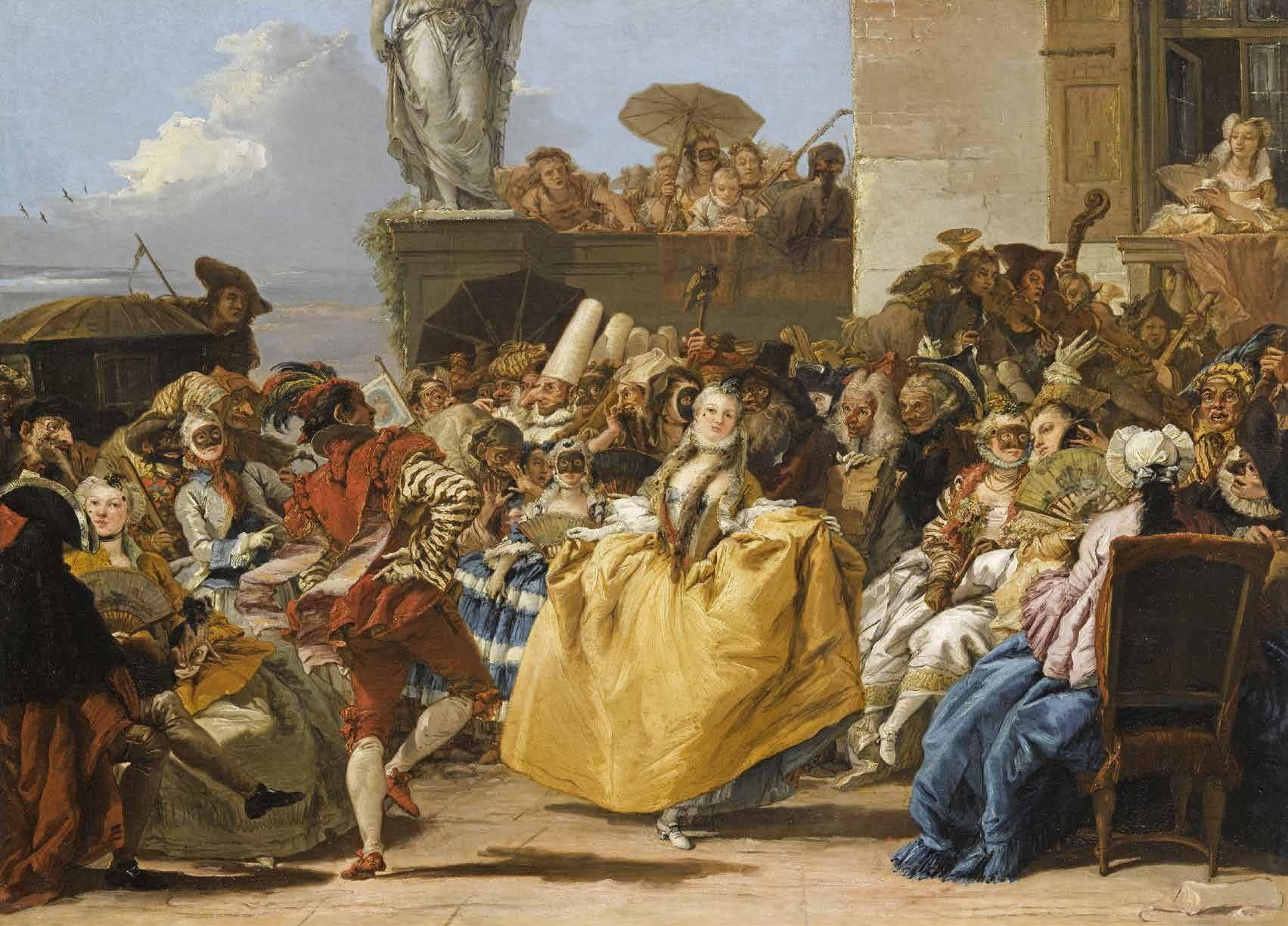
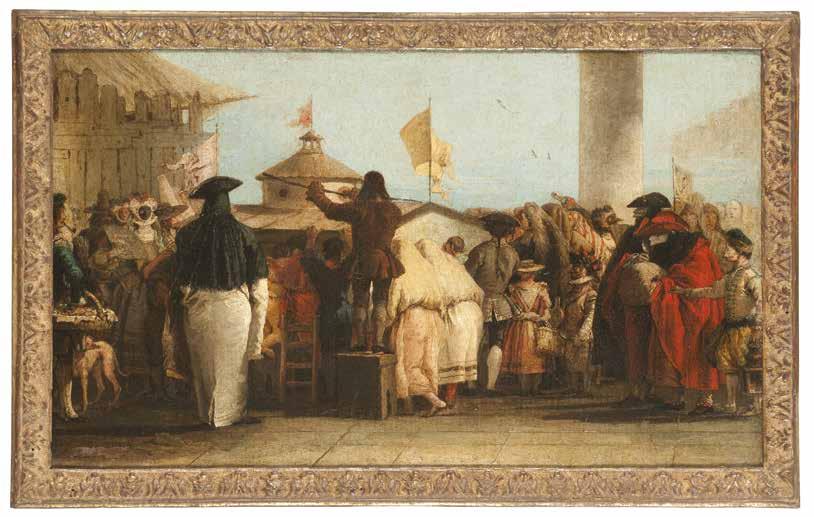
C’est le cas de Le Charlatan ou l’arracheur de dents et de la Scène de Carnaval ou Le Menuet (ill. 7) de Giandomenico que l’on retrouve le 17 mai 1904 à la vente de la princesse Mathilde (n˚ 67), laquelle les avait acquis vers 1868. Ces deux tableaux sont aujourd’hui conservés au musée du Louvre 35 , cependant qu’un ensemble plus important de feuilles de même provenance est aujourd’hui au Fitzwilliam Museum de Cambridge 36 .
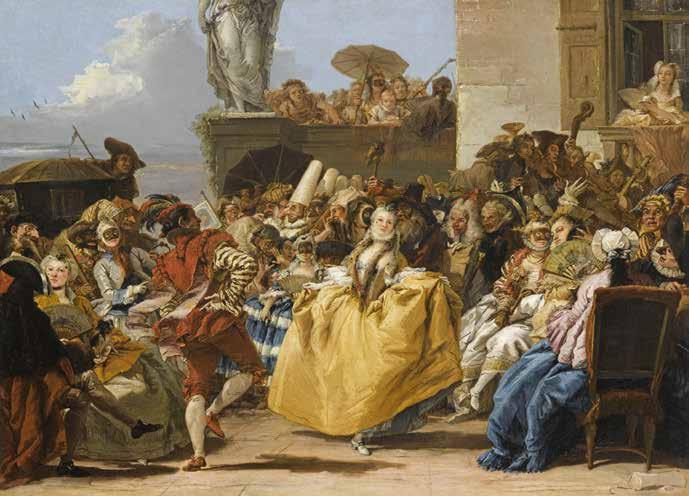
ill. 7 – Giandomenico Tiepolo, Scène de Carnaval ou Le Menuet, 1754, huile sur toile, musée du Louvre, Paris RF 1938 100.
Parallèlement le sculpteur néoclassique
Antonio Canova (1757-1822) – collectionneur passionné des dessins des Tiepolo – put acquérir auprès du comte Leopoldo Cicognara (1767-1834), archéologue et membre de l’Académie des arts de Venise qu’il présida à partir de 1808, un lot considérable d’albums que Giambattista avait confié en 1762, juste avant son départ pour Madrid, à son fils Giuseppe Maria, religieux au couvent des Padri Somaschi de Santa Maria della Salute. Comme le souligne Sergio Marinelli, cet itinéraire témoigne d’une part que « la rupture proclamée » entre le XVIIIe siècle et « le siècle nouveau – le XIXe siècle – était plus apparente que profonde », d’autre part que, si les dessins vénitiens du XVIIIe siècle n’ont pas toujours trouvé grâce aux yeux des « spécialistes du dessin », « les artistes en ont toujours raffolé », les considérant non « en parallèle avec la peinture » mais comme un « a priori nécessaire37 » à cette dernière, comme à tous les arts, voire comme des œuvres autonomes à aborder pour leur intérêt intrinsèque. Toujours est-il que les feuilles réunies par Canova ont, plusieurs décennies après sa mort, fait le bonheur des collectionneurs les plus exigeants et des musées qui les ont acquises auprès d’eux jusqu’à nos jours, notamment en France 38 [cat. 9, 10]
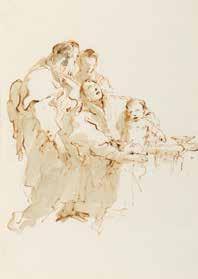
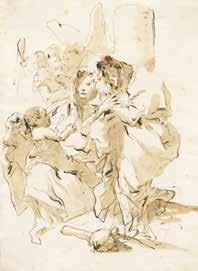
Sans prétendre à l’exhaustivité, il faut aussi mentionner le rôle de Giovanni Domenico Bossi (1767-1853), né à Trieste et élève de Giandomenico, qui fit carrière comme miniaturiste et s’établit à Munich. Il transmit à sa fille Maria Theresa Caroline Bossi (1825-1881) et à son époux Carl Christian Friedrich Beyerlen (1826-1881) l’importante collection de quelque 800 dessins de son maître, de Giambattista et de Lorenzo, qu’il avait constituée. Cette dernière fut dispersée après leur décès les 27 et 28 mars
37- Montpellier 2006, p. 12-13.
1882 à Stuttgart et une part importante de ce fonds est aujourd’hui conservée à la Staatsgalerie de cette ville, quelques feuilles ayant été acquises par des amateurs français39 . [cat. 51]
LES ARTISTES ET AMATEURS DU XIX E SIÈCLE
Comme Fragonard en son temps, certains artistes français du XIXe siècle sont sensibles à l’art vénitien en général, en particulier aux œuvres des Tiepolo qu’ils étudient avec soin, parfois jusqu’à s’en porter acquéreurs, voire à les collectionner.
C’est le cas du baron Louis Auguste de Schwiter (18051889), lié à Delacroix qui peignit son portrait. Formé à Paris de 1823 à 1826, il participa à l’émergence du courant romantique et à l’intérêt renouvelé des artistes qui le composaient pour le mouvement et la couleur, exposa des portraits au Salon de 1831 à 1859 et fut aussi collectionneur. Il admirait Watteau et Fragonard, mais plus encore les Tiepolo dont il acquit 29 dessins. Les ventes de sa collection, respectivement en 1883 et 1886, contribuèrent au regain d’intérêt pour l’art vénitien en France dans les dernières années du siècle 40
Il faut aussi mentionner son contemporain Jean-François Gigoux (18061894), peintre, dessinateur et lithographe, qui entra à l’École des Beaux-Arts en 1828, connu pour ses portraits lithographiés dans L’Artiste et les dessins qu’il réalisa en vue de l’édition de 1835 de l’Histoire de Gil Blas de Santillane. Il constitua à partir de 1828 une importante collection dont une partie fut vendue en 188241 [cat. 27], mais il en légua l’essentiel en 1894 à sa ville natale de Besançon, dont 28 œuvres des Tiepolo, parmi lesquelles on compte deux tableaux de Giandomenico et 26 dessins
38- Deux de ces dessins, représentant une Sainte Famille et provenant des collections Armand Valton et Charles Drouet, ont été donnés respectivement en 1908 et 1909 aux Beaux-Arts de Paris (Inv. n˚ EBA 391 et 390), de même que deux études de personnage isolé provenant de la collection Jean Masson en 1925 (Inv. n˚ Mas 2408 et Mas 2409).
39- Stuttgart 1970 ; Jean-François Gigoux acquit un dessin de la collection Bossi, aujourd’hui au musée des Beaux-Arts et d’archéologie de Besançon, Inv. n˚ D.1662.
40- 17 dessins vendus sous les n°135 à 150 du catalogue de la vente du 20 au 21 avril 1883, 12 sous les n°82 à 90 du catalogue de celle du 3 mai 1886, lors de laquelle furent aussi vendus sous les n°38 à 41 quatre tableaux de Giambattista ; Jean Masson y acquit sous le n˚ 82 deux caricatures aujourd’hui conservées aux Beaux-Arts de Paris (Inv. n˚ Mas 2407 et Mas 2420).
41- Vente des 20-23 mars 1882 à Hôtel Drouot à Paris, plus de 1000 dessins.
dont une feuille provenant de la collection Bossi Beyerlen 42
Quant aux amateurs, Jean Fayet Durand (1826-1888) est à la fois le plus énigmatique et le plus ambitieux. En effet, lors de la vente en 1833 sur la Piazza di San Marco à Venise d’un ensemble de plus de 300 dessins de Giandomenico, tous consacrés à des scènes du Nouveau Testament, il en acquiert 138 qui furent légués en 1889 au Louvre, les autres revenant à Victor Luzarche, maire de Tours et bibliophile43 . Plus modestement, son contemporain Jean-Marie Léonce Mesnard (1826-1890), maître des requêtes au Conseil d’État et auteur de nombreuses publications sur les arts aux XVIIe et XVIIIe siècles, possédait cinq dessins des Tiepolo qui entrèrent dans les collections du musée de Grenoble 44 par voie de don et de legs entre 1869 et 1914.
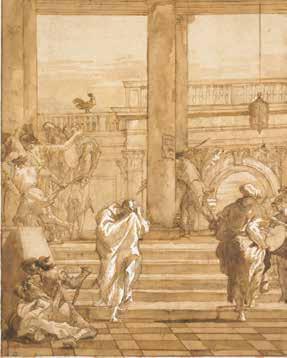
cat. 27 ~
Des réserves demeurent toutefois chez certains amateurs, notamment de la part du dessinateur, graveur et lithographe Auguste Desperet (1804-1865) dont l’importante collection, qui passa en vente à Paris du 7 au 10 juin 1865, comptait seize dessins de Francesco Guardi (lots 61 à 71) mais seulement deux de Giandomenico (lot 132).
Parallèlement, le philosophe et historien positiviste Hippolyte Taine (18281893), qui fut professeur d’histoire de l’art et d’esthétique à l’École des BeauxArts avant d’être élu membre de l’Académie française, et auteur d’une Philosophie de l’Art 45 , parue en 1865,
publie l’année suivante un Voyage en Italie. Il y mentionne, sans indiquer son prénom, « le dernier des décorateurs de plafonds, Tiepolo, […] un maniériste qui dans ses tableaux religieux, cherche le mélodrame et dans ses tableaux allégoriques le mouvement et l’effet, qui de parti pris bouleverse ses colonnes, renverse ses pyramides, déchire ses nuages, éparpille ses personnages, de manière à donner à ses scènes l’aspect d’un volcan en éruption 46 ».
LA « BELLE ÉPOQUE »
Manifestement, de telles réticences ne sont alors plus qu’un épiphénomène. Comme l’indique en 2000-2001 Stéphane Loire, « Beaucoup d’œuvres de Tiepolo étaient conservées à la Belle Époque dans des collections privées françaises : près de la moitié des peintures de Tiepolo à présent conservées hors d’Italie sont passées en France entre 1860 environ et de nos jours 47 ».
Les collectionneurs comme les musées français s’efforcent donc de compenser les effets d’une longue période d’indifférence en comblant le retard du pays en la matière par l’achat d’œuvres majeures.
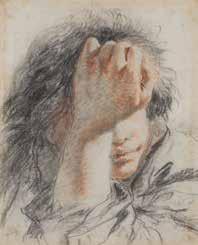
cat. 51 ~
Le musée du Louvre acquiert ainsi en 1877 la Cène de Giambattista 48 et en 1903 l’esquisse peinte pour le Triomphe de la Religion , œuvre tardive de Giandomenico 49 , avant de bénéficier en 1914 du legs de l’Apollon et Daphné –peint en 1744 par Giambattista –, consenti par le baron de Schlichting50 Dans les mêmes années, plus précisément en 1902, Eugène et Auguste Dutuit
42- Tableaux Inv. n˚ 896.1.102 et 896.1.103 ; dessins Inv. n˚ D.1657 à D.1659, D. 1661 à D.1664, D.1666 à D.1668, D. 1671 à D.1675, D. 2229 à 2236, D . 3016 à D.3018 ; voir Whiteley 2006, tome I, p. 141-145.
43- À la mort de Giandomenico Tiepolo, sa veuve Margherita Moscheni vend cette série dessinée qui se retrouve sur le marché vénitien en 1833.
44- DG D2695, MG D392, MG D349, D. 928 et D. 351.
45- Paris, 2008, Éditions Hermann, collection « Savoir. Arts », textes présentés et annotés par Jean-François Revel.
46- À Venise, Voyage en Italie III, collection Le regard littéraire, Édition complexe, Paris, réédition 1990, p. 73.
47- Op. cit., p. 28.
48- Inv. n˚ RF 176.
49- Inv. n˚ RF1504.
50- Inv. n˚ RF 2107 ; Loire 2000, p. 28.
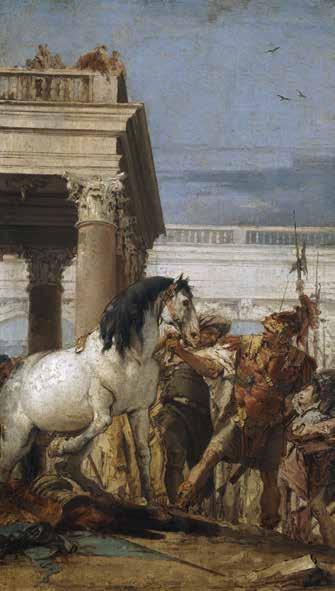
font au Petit Palais don d’Alexandre et Bucéphale, œuvre tardive de Giambattista51 (ill. 8) et, deux ans plus tard, c’est au tour du Musée des Arts décoratifs de bénéficier de la générosité de Jules Maciet qui lui fait don de l’huile sur toile du Monde nouveau52 de Giandomenico (ill. 9).
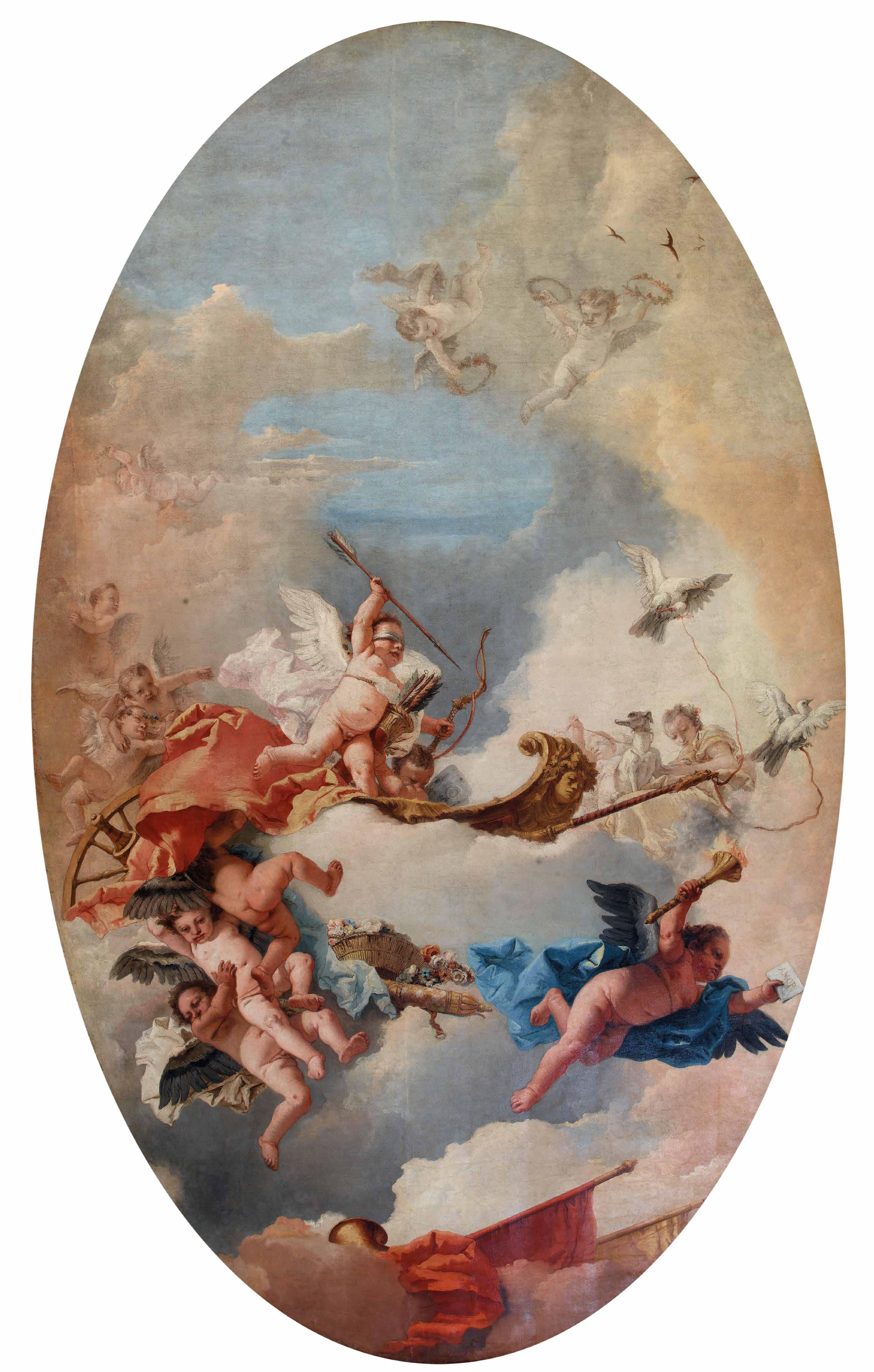
L’événement majeur de ces années est toutefois un double achat spectaculaire, réalisé en 1893 par Nélie Jacquemart André (1841-1912) et Édouard André (1833-1894). Il s’agit d’une part de deux fresques de Giambattista Tiepolo provenant du palais Revendin anciennement palais Corner Mocenigo, dans le quartier de San Polo à Venise, La Paix et la Justice et L’Apothéose d’Hercule du palais53 .
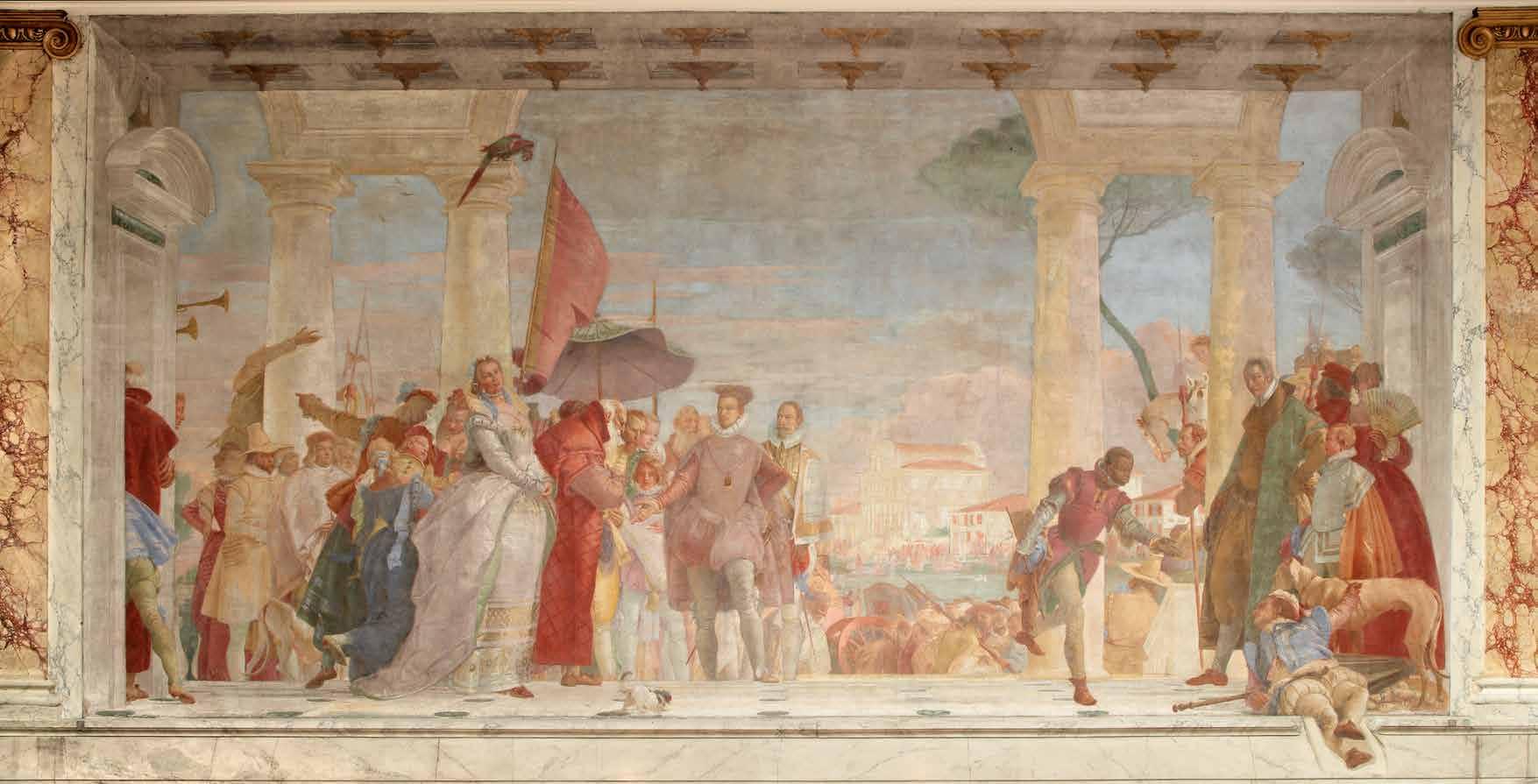
D’autre part des fresques, elles aussi peintes par Giambattista en 1750, provenant de la Villa Contarini et illustrant l’accueil par le doge de Venise d’Henri III lors du voyage en Italie qu’il effectua sur la route de Cracovie à Paris où il fut couronné (ill. 10). Ces acquisitions – intégrées aux collections du musée Jacquemart André – créèrent l’événement en raison du caractère monumental des œuvres mais aussi de la complexité de leur acheminement et de leur mise en place, respectivement dans deux cabinets et dans l’escalier d’honneur de l’hôtel particulier du couple.
Dans un article publié peu après l’événement, Henry de Chennevières ne manque pas d’en relever l’importance et les enjeux tant esthétiques que politiques, en concentrant le propos sur Henri III reçu à la Villa Contarini : « C’est un magnifique Tiepolo… français. De l’alliance de ces deux mots, si bien faits pour s’unir, on a tous droits d’attendre une exquise rareté et l’œuvre tient et même très au-delà, toutes les promesses. Aucun Tiepolo ne peut nous être plus à cœur, car on le dirait fait pour nous. Le dernier grand peintre vénitien, l’un des génies les mieux compris par notre art et nos yeux de Français, célébrant, en une fresque de toute lumière, un coin d’épisode de l’histoire de France : n’est-ce pas le plus radieux mélange de vénitien et de français, de français et de vénitien ? Il y a là toute l’invraisemblance du rêve, en pleine réalité vivante54 ».
LES GRANDES VENTES DES ANNÉES 1920 : DE LONDRES À PARIS
Au tournant du siècle, de la fin des années 1880 aux années 1920, une part non négligeable des ventes d’œuvres des Tiepolo est organisée à Londres. C’est le cas d’une des plus importantes, celle d’Edward Cheney (1803-1884) qui s’installa très tôt en Italie, d’abord à Rome et Naples, puis à Venise où il constitua une remarquable collection d’antiquités, de tableaux, de dessins et d’estampes, avec une prédilection marquée pour les œuvres de Giambattista Tiepolo, dont il réunit des albums de dessins ayant appartenu à Canova – figures isolées, paysages et pas moins de 67 représentations de la Sainte Famille.
ill. 8 – Giambattista Tiepolo, Alexandre et Bucéphale, huile sur toile, musée du Petit Palais, Paris.
en vente chez Sotheby’s à Londres le 29 avril 1885. Elle comptaient neuf albums (lot 1024) dont deux furent acquis par le Victoria & Albert Museum, les autres étant démontés et les dessins dispersés, pour certains au bénéfice de collectionneurs français comme Alfred Armand et Charles Drouet, avant de trouver place dans des collections publiques 55
Moins de deux mois plus tard, le 6 juillet 1920, c’est la maison Sotheby’s qui mit en vente à Londres les 104 feuilles de la série des Divertimenti per li regazzi 56 , acquise pour 610 livres par la galerie Colnaghi, laquelle les revendit pour 800 livres au marchand londonien Richard Owen (1873-1946). Ce dernier, qui résidait à Paris, les exposa en 1921 au musée des Arts décoratifs, avant de les vendre, pour l’essentiel aux grands musées nordaméricains – notamment de Cleveland, Kansas City et Princeton – qui constituaient l’essentiel de la clientèle de sa galerie du 15, quai Voltaire57. [cat. 36 à 46]
considère l’importance des ventes où sont proposés, dans les mêmes années, des tableaux et – en plus grand nombre encore – des dessins de Giambattista et Giandomenico Tiepolo. Parmi les plus importantes on compte celle de la collection d’Alexis Nikolaïevitch Orloff (1867-1916), général russe attaché à l’ambassade de Russie à Paris à partir de 1894, vendue les 29 et 30 avril 1920 à la galerie Georges Petit, où est présenté un important ensemble d’œuvres des Tiepolo, dont trois tableaux de Giambattista58 [cat. 1 à 5]
Un an plus tard le 30 avril 1921 se tient, toujours à la Galerie Georges Petit, la vente Roger Cormier de Tours rassemblant 32 lots de la série du Nouveau Testament de Giandomenico59 . Cet ensemble vendu à la mort de l’artiste par sa veuve Margherita Moscheni, avait été en partie acheté en 1833 Piazza San Marco par Victor Luzarche (1805-1869), bibliophile et maire de Tours de 1847 à 1848. En 1868, il devint la propriété du peintre orientaliste et illustrateur Camille Adolphe Rogier (1810-1896), avant d’être acquis par Roger Cormier. [cat. 17, 18, 21, 23 à 25, 30 à 33]
55- Dons Armand Valton en 1908 et Charles Drouet à l’École des Beaux-Arts, Inv. n˚ EBA 391 et EBA 390.
56- Voir le récent ouvrage de Giorgio Agamben, Pulcinella ovvero Divertimenti per li regazzi, Milan, éditions i sassi nottetempo, 2015.
57- Danielle Hampton Cullen, « The elusive Mr. Richard Owen : a dealer’s rise and fall in the art market in the United States », Nineteenth Century Art Worldwide, volume 21, n˚ 2, été 2022.
58- Les dessins de Giambattista figurent sous les lots n˚ 70 à 155 et les dessins de Giambattista, Giandomenico et Lorenzo sous les lots n˚ 156 à 165.
59- Gealt, Knox 2006.
ÉPILOGUE
La vente Cormier compte parmi les dernières de cette ampleur, portant sur les ultimes vastes corpus subsistant encore, peu ou prou, dans l’état où les artistes – père et fils – les avaient laissés à leur décès 60. Quelques ensembles à la fois cohérents et conséquents sont demeurés, bien sûr dans le cas des décors monumentaux, malgré les démontages ou déposes de fresques dont ont bénéficié collectionneurs et musées, à l’instar du couple – puis du musée – Jacquemart André.
S’agissant des fonds de dessins et d’estampes en revanche, ils ont été pour la plupart dispersés au fil des décennies et au gré des successions et ventes, à quelques exceptions près – majeures et précieuses il est vrai.
60- Lorenzetti 1946.
61- Venise 2018.
62- Voir note 31.
63- Voir note 38.
Ainsi doit-on au zèle et aux relations d’Anton Maria Zanetti61 tout à la fois la présence d’œuvres de Giambattista et de Giandomenico au musée Correr et à la bibliothèque Marciana, à la Staatliche Kunstsammlungen de Dresde mais aussi dans les collections d’estampes de la Bibliothèque nationale de France 62 . Le fonds du musée du Louvre résulte pour une large part de la collection de Jean Fayet Durand, comme ceux de Stuttgart et Würzburg respectivement des efforts de la famille Bossi et de Martin von Wagner, qui ont porté leurs fruits au tournant du XVIIIe et du XIXe siècles 63 .
L’époque « glorieuse » où quelques collectionneurs historiquement proches des artistes détenaient l’essentiel de leurs œuvres graphiques et picturales est donc révolue. En revanche la notoriété de Giambattista et Giandomenico bénéficie sans doute, paradoxalement, de la dispersion de leur production, désormais mieux connue et appréciée, en raison des travaux scientifiques dont elles ont fait l’objet et des nombreuses expositions consacrées à l’art vénitien dont ils sont devenu, tardivement mais incontestablement, les figures de proue.
Un rapide panorama de ces manifestations témoigne que les organisateurs et commissaires ont, depuis quelques décennies, souvent choisi de faire figurer le patronyme des Tiepolo dans le titre de l’exposition et une de leurs
œuvres pour l’affiche et la couverture du catalogue. Ainsi dès 1935 de L’Art italien : de Cimabue à Tiepolo au Petit Palais à Paris, puis en 1956 de De Tiepolo à Goya. Panorama de la peinture au XVIIIe siècle à la Galerie des Beaux-Arts de Bordeaux, puis en 1982 de Le portrait en Italie au siècle de Tiepolo, au Petit Palais, en 1998 de la monographie Giambattista Tiepolo, 1696-1770 au Petit Palais à nouveau, plus récemment en 2000-2001 du Settecento, Le Siècle de Tiepolo au musée des Beaux-Arts de Lyon et au Palais des Beaux-Arts de Lille, en 2017 de Sérénissime ! Venise en fête de Tiepolo à Guardi au musée Cognacq-Jay et en 2025 de L’eau-forte, outil du peintre de Parmesan à Tiepolo, au musée des Beaux-Arts de Caen.
Une injustice durable est ainsi réparée pour le plus grand plaisir des amateurs comme du grand public.
ill. 10 – Giambattista Tiepolo, Henri III reçut par le doge Contarini à la villa Contarini, fresque marouflée sur toile, vers 1745, musée Jacquemart André, Paris.
DENIS TON Historien de l’art
Les Tiepolo, génies vénitiens
INTRODUCTION
Le corpus graphique de Tiepolo est sans conteste l’un des plus riches, multiformes et de plus complexes qui nous soit parvenu. Et si l’on élargit encore le regard à ce que non seulement le maître produisit au cours de sa carrière, mais aussi aux dessins réalisés par ses deux fils ainsi que par ses collaborateurs et disciples les plus proches, l’œuvre acquiert la stature d’un véritable monument.
La variété des techniques adoptées, la multiplicité des effets, la diversité des intentions qui présidèrent à la conception de ces feuilles est inégalable. Cette extraordinaire profusion trouve bien peu d’équivalents dans l’art des grands maîtres européens de toutes les époques 1 et, considérée avec attention, permet de dissiper définitivement tout lieu commun sur la « manière vénitienne » supposée indifférente au dessin, à la différence de l’école toscane et, plus généralement, de l’Italie centrale 2 .
Par une curieuse coïncidence, qui n’est autre qu’un indice révélateur de goût de l’époque, c’est à Paris, au début des années 1920, que la redécouverte de la valeur de l’art graphique des Tiepolo prit une tournure décisive. En peu de temps, grâce à d’importantes ventes aux enchères et expositions, apparurent certains des groupes de dessins les plus créatifs : en avril 1920, à la galerie Georges Petit, on pouvait voir les merveilleuses feuilles de l’album alors appartenant à Alexis Orloff, auquel il donna son nom, contenant des chefs-d’œuvre de Giambattista ; l’année suivante, dans la même galerie, ce fut au tour des feuilles de Giandomenico, issues de la série du Nouveau Testament, qui appartenaient de Roger Cormier de Tours ; la même année encore, mais sans catalogue, le musée des Arts décoratifs exposait les feuilles du Divertimento per li regazzi également de Giandomenico. On assiste en réalité, entre la fin du XIXe et le début du XXe siècle, en compensation du relatif désintérêt du XVIIIe siècle, à une véritable redécouverte générale de l’art des Tiepolo. Parallèlement aux acquisitions majeures des fresques détachées aujourd’hui conservées au musée Jacquemart-André à Paris, et à la parution de
l’étude pionnière qu’Henry de Chennevières consacra aux Tiepolo en 1898, de nombreux dessins surgissent sur le marché et changent de mains, témoignant d’une véritable passion, et de ce que l’on pourrait presque appeler une « Tiepolo-Renaissance 3 ». C’est également à cette époque que Marcel Proust, dans sa Recherche, évoque la teinte particulière de rose de leurs peintures en la reliant aux tenues d’Odette Swann, et leurs architectures aériennes en les associant aux ciels vénitiens 4 . De même, c’est précisément dans le Paris de ces années-là, que l’art expérimente certains des mouvements d’avant-garde qui allaient façonner le XXe siècle. Le dessin et l’appréciation des expérimentations inventives des Tiepolo renaissent ainsi au cœur même de la modernité.
Il est donc particulièrement significatif qu’un peu plus d’un siècle après ces événements, qui ont été l’étincelle à l’origine des études les plus importantes consacrées aux dessins des Tiepolo, la galerie Coatalem consacre à ces grands maîtres une exposition permettant de voir des feuilles restées inaccessibles depuis très longtemps, comme certaines non exposées depuis la vente Roger Cormier à la galerie Petit en 1921.
Tiepolo et ses fils adoptèrent une approche radicalement différente de ce que l’on entend parfois, d’un point de vue académique, par l’étude du dessin, en en faisant un élément fondamental de leur imagination et de leur conception artistique. Dessins à la plume, à la pierre noire ou à la sanguine 5 , sur un papier blanc fin fortement encollé ou sur un papier bleu légèrement rugueux, utilisation de la craie blanche pour les rehauts et ajouts de lavis en larges aplats ou pour de rapides esquisses, feuilles conçues comme études préparatoires pour des gravures ou des illustrations de livres imprimé, esquisses de figures isolées destinées à être insérées dans les immenses fresques ou les grandes toiles de Giambattista, intuitions fulgurantes pour de grandes compositions décoratives ou encore dessins entièrement achevés, conçus comme parties intégrantes de cycles narratifs plus vastes et donc destinés à constituer les fondements d’une série cohérente : il n’y a pratiquement aucun domaine dans
1- Comme l’a fait remarquer Adriano Mariuz, le seul à qui on puisse le comparer à bien des égards est probablement Rembrandt (Mariuz 1983 (2008), p. 197).
2- Pour un résumé efficient sur le sujet, voir : Whistler 2016, pp. XXX-XXXV.
3- Pour en savoir plus sur le succès rencontré au XIXe siècle en France par Tiepolo et ses fresques détachées, voir : Lo Giudice 2023, pp. 13-31.
4- Pour un résumé du succès de Tiepolo en France au cours des années en question et de son importance pour Proust, voir : Mariuz 1996. Pour l’intérêt français pour Tiepolo, voir également : Fumaroli 2007.
5- Compte tenu de la nature de la présente contribution, un examen des feuilles au crayon dépasse le cadre de cet article. Il suffit donc ici de renvoyer à la monographie et au catalogue raisonné de Knox (1980), tout en rappelant les différentes positions des chercheurs sur la nature de ce matériau si varié, souvent utilisé pour des exercices et des études d’atelier.
lequel l’atelier de Tiepolo ne se soit pas mesuré par le biais du dessin. Étudier cette production revient donc à s’offrir une position privilégiée pour observer le processus de pensée de Giambattista, avant tout son esprit à l’œuvre mais aussi sa capacité inépuisable et infaillible à saisir la vérité de ce qui l’entourait tout en la projetant dans un univers onirique cohérent et tout à fait personnel 6 .
I. « BIZZARRIE DI PENSIERI »
Tiepolo dessine comme il respire. Observer, regarder et imaginer semblent chez lui ne faire qu’un. Nombre de ses feuilles semblent jaillir d’un seul trait de plume, comme par enchantement, sans erreurs ni repentirs. Une aisance, pourrait-on dire une nécessité vitale, attestée par les documents relatifs à sa jeunesse. Il convient de rappeler la célèbre note de Vincenzo da Canal à propos de son apprentissage auprès de Gregorio Lazzarini, selon laquelle : « Egli è fecondissimo d’ingegno; percio intagliatori e copiatori cercano d’intagliarne le opere, di averne le invenzioni e le bizzarrie di pensieri; e già i di lui disegni sono in tanta estimazione, che ne spedi de’ libri a’ piu lontani paesi 7 » (Il possède un talent exceptionnel ; si bien que graveurs et copistes s’efforcent de reproduire ses œuvres pour s’approprier ses inventions et ses idées fantaisistes et déjà ses dessins jouissent d’une telle estime que l’on en envoie des recueils jusque dans des pays lointains.) Mais, avant même cela, on apprend que Giambattista, dès son plus jeune âge, avait l’habitude de dessiner sur les murs sur lesquels il traçait de petites figures de saints, et que l’une de ses premières commandes fut la réalisation de décorations au-dessus des portes de quelques boulangeries du quartier de San Biasio 8 . Le contexte familial dans lequel grandit Tiepolo était marqué par une profonde indigence et le dessin fut pour lui un premier pas vers l’émancipation sociale, lui permettant d’acquérir très tôt le status
de maître et de satisfaire à des demandes et à des mécènes de tous horizons. Certaines de ses premières commandes consistaient à réaliser des études destinées à la gravure, que ce soit pour des projets en série 9 ou pour l’illustration des livres, un domaine dans lequel il s’affirma très tôt comme un spécialiste exceptionnel10 . Cette cosmogonie, qui se déploie sous le regard du spectateur dans les plus grandes compositions de Tiepolo – des cieux peuplés de figures à fresque, à contempler tête levée –, trouve son origine sur ces feuilles à la pierre noire ou à la plume, à examiner de près, afin d’en apprécier l’exactitude des détails et la vivacité de l’exécution. Le Settecento fut le siècle où l’on découvrit la beauté de l’invention et où on l’apprécia comme le lieu privilégié pour saisir l’acte créatif.
fig. 1 – Giambattista Tiepolo, Artistes dessinant un nu dans une académie, pierre noire et craie sur papier bleu, Katrin Bellinger collection, 1993-022
Un autre aspect décisif, susceptible de surprendre ceux qui sont encore victimes de certains préjugés sur l’art du XVIIIe siècle, et vénitien en particulier, est l’étude du réel qui semble constituer l’une des sources essentielles de ce trésor graphique et, plus généralement, de l’imagination de Tiepolo. Ses études naissent en effet de la réalité, comme le montre la très célèbre feuille dite de l’Artistes dessinant un nu dans une académie (fig. 1), grâce à une pratique qui a marqué toute une série d’artistes encore attachés aux œuvres de la fin du XVIIe siècle, tels que son maître Gregorio Lazzarini ou encore Giambattista Piazzetta, figure emblématique de la peinture vénitienne du Settecento, très différent de Tiepolo par son tempérament mais qui nous a lui aussi laissé une œuvre graphique incontournable 11 .
Si l’on ajoute que sa maîtrise s’étendait non seulement aux dessins préparatoires ou achevés, mais aussi aux gravures de reproduction ou d’invention, on comprend alors qu’il maîtrisait presque toutes les techniques avec succès et dans une liberté de conception absolue.
6- Il existe de nombreuses études sur les dessins de Tiepolo, à commencer par la monographie sur les œuvres graphiques de von Hadeln (1927) et celle sur les dessins de Knox (1980). Pour des synthèses actualisées, voir : Marini 2004 ; Whistler 2004.
7- Da Canal 1732 (1809), p. XXXI.
8- Bostock 2009, p. 221 : l’étude souligne à juste titre la possibilité que ces récits soient en partie influencés par la volonté des témoins de construire un mythe, à la manière de Vasari, sur la précocité du génie de Tiepolo.
9- Parmi celles-ci, la plus célèbre est sans aucun doute Il Gran Teatro di Venezia de Domenico Lovisa, sur lequel on peut voir : Bonaninni 1993 ; Schulz 2000.
10- Sur Tiepolo dessinateur pour l’édition, phénomène qui a récemment fait l’objet d’une attention particulière, voir notamment : Middeldorf Kosegarten 2007 ; Ton 2012 ; Ton 2019 ; Delorenzi 2024.
11- Pour un aperçu actualisé sur le dessin de nu et d’après nature à Venise au début du XVIIIe siècle, voir : Whistler 2004 ; Craievich 2020.
II. ÉTUDES ET EXERCICES :
L’ALBUM ORLOFF
L’art graphique de Giambattista évolue, d’un point de vue technique, avec beaucoup d’assurance vers une simplification et une économie de traits toujours plus grandes.
Ses premiers dessins semblent avant tout avoir été conçus avec l’ambition de reconstituer, sur le papier, les effets de clair-obscur des images suivant une logique héritée de sa première approche néo-ténébriste du monde des arts : ses traits de plume, souvent tourbillonnants et parallèles, tels des toiles d’araignée imitant la technique de l’eau-forte, construisent des figures aussi souples et insaisissables que des flammes. Par la suite, lorsque son processus créatif atteignit sa pleine maturité, on reconnaît l’idée d’une exécution en « trois temps 12 » : d’abord un schéma général dessiné à la pierre noire, puis un croquis à la plume et à l’encre et enfin le lavis, souvent en deux nuances et intensités de ton. Cette technique s’affirme pleinement dans les années 1730 et est particulièrement visible dans les feuilles liées au projet de décoration de la villa Loschi au Biron de Monteviale.
Parmi les grands albums de Tiepolo, l’un des plus significatifs, et le mieux représenté dans cette exposition, est assurément celui d’Alexis Orloff (cat. 1-5), vendu à Paris en 1920 13 . Bien qu’il soit impossible de reconstituer avec exactitude en quelles circonstances ce dernier entra en possession de cet extraordinaire album14 , il ne fait aucun doute que la série contient certaines des feuilles les plus importantes et les mieux conservées de la production graphique à la plume de Giambattista. Cette exposition offre une occasion unique d’étudier de près cinq dessins de ce groupe, rarement montrés au public, qui permettent de comprendre l’évolution du style graphique de Tiepolo. Contrairement à d’autres albums similaires – comme celui du Museo Civico Sartorio de Trieste 15 – il ne s’agit pas d’études de figures individuelles, destinées à mettre en valeur des détails ou des personnages
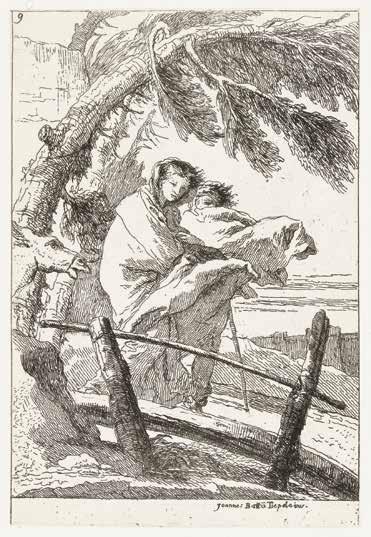
fig. 2 – Domenico Tiepolo (d’après Giambattista Tiepolo), La Fuite en Égypte, gravure, Amsterdam, Rijksmuseum, RP-P-1950-490
spécifiques à intégrer dans des compositions de plus grande envergure, mais bien de compositions très élaborées, de véritables scènes autonomes, conçues dès le départ comme des feuilles achevées. Les formats, plus grands que ceux de l’album de Trieste, incitent à les considérer comme des inventions ou comme des exercices aboutis, ce qui explique la répétition fréquente d’un même sujet avec des variations minimes. George Knox, qui a été le premier à offrir une analyse approfondie de cet album, a proposé des datations allant de 1715 à 1760 mais pour diverses raisons, notamment matérielles, il est difficile de croire que les feuilles rassemblées couvrent une période aussi longue. Les recherches16 ont en effet mis en évidence une technique graphique de jeunesse d’une grande audace, radicalement différente des dessins à la plume
12- Vigni 1942, p. 17. Pour une autre analyse précise des différentes étapes de réalisation des dessins de Tiepolo, voir : Alpers, Baxandall 1994, pp. 51-63.
13- Catalogue des tableaux anciens des écoles du Moyen-Age et de la Renaissance, XIVe, XVe, XVIe siècles, portraits des XVIIe et XVIIIe siècles et autres œuvres de A. Canaletto, F. Guardi, G.-B. Tiepolo, etc. : Dessins par G-.B. Tiepolo. Composant la Collection de son excellence feu le prince Alexis Orloff dont la vente aura lieu à Paris Galerie Georges Petit, catalogue de vente 29-30 avril 1920, Paris.
14- Knox (1961, pp. 269-270) avance quelques hypothèses sur la provenance de ces dessins, parmi lesquelles la possibilité d’un lien de parenté avec Vladimir Orloff, président de l’Académie des sciences de Saint-Pétersbourg. Selon Irina Artemieva, que je remercie pour cette information, il n’y avait cependant aucun lien particulier entre cet Alexis Orloff et les frères Orloff, déjà proches de Catherine, et nous ne disposons donc pour l’instant d’aucune information particulière sur la date à laquelle il a acquis ces feuilles. Le catalogue de vente rappelle également que : “Les dessins compris au présent Catalogue sont inédits. Conservés de longues années en album, à l’abri de la lumière, ils n’ont été encadrés que très récemment et doivent à cette fortune leur extrême fraicheur”.
15- Pour cet album, nous renvoyons à l’étude de Lorenza Resciniti (2021), même si l’ouvrage de Vigni, dans ses deux éditions (Vigni 1942 ; Vigni 1972), reste fondamental.
16- Aikema 1998 ; Pavanello 2011
contenus dans l’album Orloff, comme en témoigne l’album dit de Dantzig 17 ou celui, peu connu, du Kupferstichkabinett de Berlin, que je considère, contrairement à une historiographie récente 18 , être en grande partie autographe et l’expression authentique des inventions les plus précoces de l’imagination de Tiepolo. Le dessin le plus ancien de la série parue à Paris en 1920 doit être daté d’au moins une décennie après la proposition de Knox, voire du début des années 1730. C’est le cas pour l’étude d’une sainte conversation, La Vierge et l’Enfant Jésus adorés par saint François et sainte Rose de Lima (cat. 1), où l’utilisation marquée du lavis pour les ombres et le soin apporté aux contours, indiquent que la feuille a été exécutée durant une période de pleine maturité stylistique, à l’instar d’autres dessins de thème religieux de cette série 19 .
Certains dessins du groupe sont des chefs-d’œuvre parfaitement aboutis comme celui représentant la Fuite en Égypte (cat. 2), probablement des années 1740 : ici, l’usage de la plume est tout à fait marginal et tout semble avoir été réalisé au lavis, avec un petit pinceau. L’encre, légèrement plus foncée et opaque, sert à la fois à renforcer les zones d’ombre et à suggérer les contours principaux des personnages et de l’arbre qui, courbé vers la gauche comme poussé par un vent impétueux, semble imprimer un mouvement ondulatoire à toute la scène et à ses personnages, tandis que Marie, enveloppée dans son manteau déployé comme une voile en pleine mer, serre l’Enfant contre elle. Quelques touches précises pour définir la clôture au premier plan suffisent à animer toute la scène et à créer une profondeur inattendue. Une feuille si réussie que, sans surprise, Giandomenico choisit de la graver à l’eau-forte (fig. 2) et elle constitua sans doute l’un des précédents fondamentaux pour le développement de la série d’eaux-fortes réalisées à Wurtzbourg, où il élabora pour la première fois un cycle complexe d’inventions sur le même sujet. La Déposition du Christ (cat. 3), sensiblement comparable à la Fuite en Égypte, est entièrement construite par des contrastes d’ombres posées au lavis. Pour autant que l’on
17- Sur ce sujet, voir récemment : Piai 2024.
18- Aikema, Tuijn 1996, n. 3.
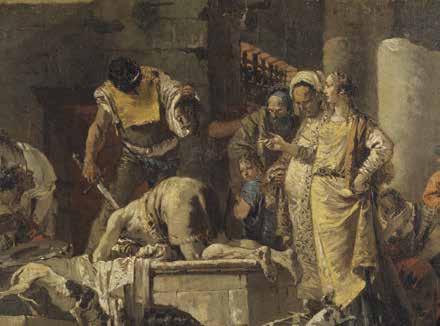
sache, ce dessin ne semble pas être lié à une œuvre peinte, mais constitue un nouvel exemple d’exercice d’étude indépendant et parfaitement abouti. D’un tout autre caractère sont les deux dessins représentant des scènes de martyre : dans le premier, probablement une étude pour une Décollation de saint Jean-Baptiste (cat. 4 ; fig. 3 ), Tiepolo présente ses figures dans une pose tout à fait anticonformiste : le protagoniste, agenouillé de dos, a déjà été décapité, tandis que le bourreau lève la tête tranchée après l’horrible mutilation. On observe ici non seulement un usage nerveux et presque sténographique de la plume mais aussi un dessin sous-jacent à la pierre noire, particulièrement complexe, avec de subtiles variations de pose : il s’agit donc d’une véritable étude visant à explorer différentes combinaisons et points de vue.
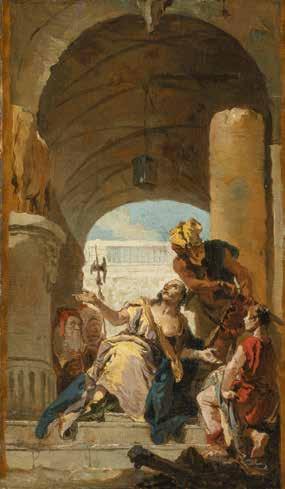
Dans un autre dessin représentant le Martyre d’une sainte, probablement sainte Théodora (cat. 5), la composition est, en revanche, parfaitement équilibrée et soignée dans ses moindres détails, jusqu’à l’arrière-plan architectural, un lavis habilement posé créant une zone d’ombre sur laquelle se détachent les personnages principaux, ce qui indique que le projet était à un stade avancé. Il s’agit en effet de l’un des rares exemples, au sein du groupe Orloff, où l’on peut établir un lien direct avec un tableau : le Martyre de sainte Théodora, sujet connu en deux versions, l’une au Museo del Settecento à Ca’ Rezzonico et l’autre
19- Voir par exemple deux feuilles représentant l’Annonciation, datées vers le milieu des années 1730 par Aikema (1996, pp. 68-71, nn. 22-23).
fig. 3 – Giambattista Tiepolo, La Décapitation de saint Jean-Baptiste, huile sur toile, Stockholm, Nationalmuseum, NM
dans une collection privée, diversement considérées comme autographes par les spécialistes, la version vénitienne semblant toutefois prévaloir (fig. 4). Il est généralement rare de trouver des dessins de la dernière période de Tiepolo conçus comme
des études approfondies pour des décorations à fresque ou des peintures de chevalet.
À cet égard, une feuille de la collection David M. and Julie Tobey revêt une grande importance car elle témoigne d’une œuvre perdue qui devait constituer une sorte d’« expérimentation » dans le travail de Tiepolo : elle représente César contemplant la tête de Pompée (cat. 6) et est liée à une commande reçue par l’intermédiaire de Francesco Algarotti pour Auguste III de Saxe 20 . Le polygraphe vénitien avait imaginé une série de sujets inspirés de la mythologie et de l’histoire ancienne pour le « Musée Royal de Dresde », dont il était le conseiller artistique. En 1742, trois différents projets avaient été envisagés pour Tiepolo, avant que lui soit finalement commandé un tableau représentant Timothée ou les effets de la musique , qui ne fut jamais réalisé, mais remplacé par l’épisode historique concernant César. Le dessin peut-être daté avec une certaine précision vers 1745, puisque le tableau ne fut achevé que l’année suivante. Tous les sujets avaient été pensés pour susciter une « poetica degli affetti » (c’est-à-dire la capacité de donner forme et expression à divers états d’âme et sentiments), alliée à la précision historique et descriptive dont Algarotti estimait Tiepolo capable. Dans cette finalité expressive, il est particulièrement intéressant d’observer comment, dans notre dessin, Tiepolo s’est concentré, sur l’illustration, selon le récit des sources antiques et de Plutarque en particulier, de la réaction de répulsion de César, ému de pitié devant cet hommage macabre. Cette solution fut ensuite abandonnée dans la version finale, comme en témoigne un tableau qui semble l’avoir copiée et atteste ainsi de la composition définitive 21 (fig. 5). En revanche, d’autres éléments, comme la position des personnages présentant la tête de Pompée et la tête de cheval à droite, correspondent parfaitement au dessin.
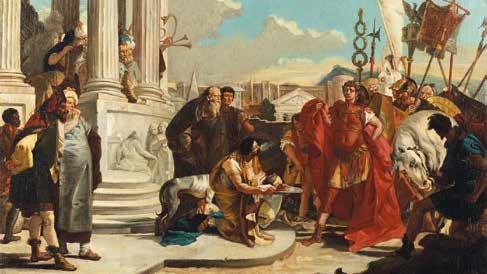
fig. 4 – Giambattista Tiepolo (école de), Le Martyre d’une Sainte, huile sur toile, Venise, Ca’ Ezzonico, Museo del Settecento Veneziano
20- Pour un résumé de la question, ainsi que des relations entre Algarotti et Tiepolo, voir : Craievich 2012. 21- Christie’s, Londres, 16 décembre 1998, n. 195.
fig. 5 – Atelier de Giambattista Tiepolo, Jules César contemplant la tête tranchée de Pompée, huile sur toile
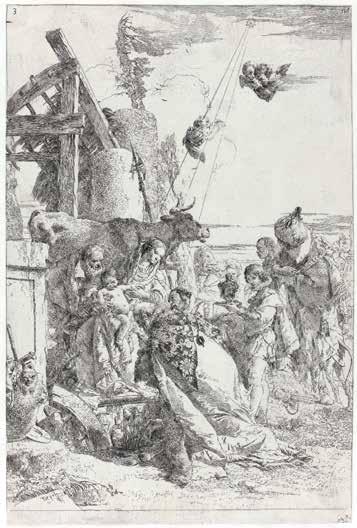
fig. 6 – Giambattista Tiepolo, Adoration des mages, Gravure, Amsterdam, Rijksmuseum, RP-P-1950-647
La facture fluide de cette feuille réalisée par touches rapides et légères, des ombres et des lavis, révèle sa nature heuristique, tout comme une Adoration des Mages (cat. 7), dont on ne peut déterminer l’appartenance à un album particulier. Le haut podium sur lequel la Vierge présente l’Enfant et l’allusion architecturale qui forme l’arrière-plan évoquent une scène de Paolo Véronèse, semblable à celles que l’on retrouve dans les peintures et les gravures contemporaines. Ces éléments suggèrent une datation proche de celle de l’eau-forte du même sujet (fig. 6), où ces références à l’œuvre de Véronèse sont particulièrement manifestes. Cette œuvre de grand format fut peut-être la gravure la plus difficile à réaliser de toute la carrière de Tiepolo et pour laquelle les études
préparatoires durent être nombreuses. Dans notre dessin, cependant, certains détails diffèrent comme le cavalier, emprunté semble-t-il à l’Adoration des Mages de Santa Corona à Vicence 22
La définition de l’image par une utilisation fluide et habile du lavis est ici particulièrement évidente, avec ces zones d’ombre denses, une technique qui, comme cela a été souligné, est étonnamment similaire à celle utilisée par Guercino, dont l’œuvre a pu inspirer Tiepolo dans le développement de sa propre technique graphique23 Les traits de plume, brisés et anguleux, bien que liés dans une certaine mesure à l’héritage de Véronèse, ressemblent à ceux de la seule feuille datée par Tiepolo en 1744, conservée au Museo Civico Sartorio de Trieste24 (fig. 7), tandis que l’utilisation prépondérante et presque débordante du lavis, avec de larges aplats couvrants, situe l’œuvre vers 1750, terme ante quem vraisemblable pour la gravure, par comparaison avec les quelques dessins à la plume connus de la période de Wurtzbourg et ceux de son retour à Venise 25 .
À l’instar de ce dessin, une datation dans les années 1740 peut être envisagée pour une feuille qui, bien que de nature différente, présente des caractéristiques similaires, l’Allégorie de la Gloire et de la Valeur (cat. 8), un groupe de figures souvent utilisé, à des fins commémoratives, dans les grandes décorations de Tiepolo.
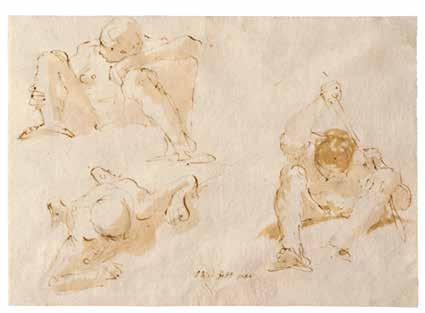
fig. 7 – Giambattista Tiepolo, Trois études de nus, daté en bas au centre « il di 17 feb. O 1744 » Plume et encre brune, lavis brun sur papier, Trieste, Museo Civico Sartorio, D_8717
22- Comme cela a été remarqué, la datation de la gravure de l’Adoration des Mages peut être située avant 1750 et, par conséquent, bon nombre des principales interprétations graphiques comparables à cette œuvre peuvent également être datées de cette période (Succi 1986, pp. 40-42).
23- Voir les réflexions d’Aikema 1996, pp. 103-105.
24- Vigni 1972, p. 74, n. 118 ; pour la comparaison avec la technique graphique de Véronèse, voir Marini 2014, p. 35.
25- Pour la question des dessins à la plume réalisés au cours du séjour en Allemagne, et des nouvelles propositions de feuilles qui pourraient être des études pour la décoration de la Chiesa della Pietà, maintenant à la Morgan Library de New York, comparables d’une certaine manière au dessin en question, voir : Hicks 2024.
III. UN TESTAMENT EN IMAGES
Plus on explore le parcours créatif de Giambattista, plus on observe une transformation radicale dans ses dessins à la plume et à l’encre : le maître semble réduire progressivement ses traits et concevoir ses visions avec une lucidité exceptionnelle, comme si, tel un simple transcripteur, il était au service d’une apparition si pure et si précise qu’aucune hésitation ne pouvait être tolérée. Par une extrême économie de moyens, chaque trait, de plume ou de pinceau, chargé d’un lavis toujours plus léger, paraît conçu non pour marquer une ombre mais pour révéler une lumière. Ses feuilles de papier, étonnamment blanches et fines et fortement encollées comme on peut l’observer sur les exemplaires les mieux conservés, sont traitées comme de véritables réserves lumineuses. En parfaite cohérence avec ce qu’il réalisait alors en peinture, tant à fresque que sur toile, Tiepolo semble « surexposer » ses images, atteignant une luminosité et une clarté presque aveuglantes. Cette tendance, déjà perceptible dans les études réalisées vers 1740 pour la décoration du palais Clerici à Milan, se radicalise encore à partir des années 1750. Comme l’a observé Adriano Mariuz : « Solo in certi pittori estremo-orientali è possibile riscontrare un modo analogo di intendere la carta come valore luminoso e un’altrettanto geniale immediatezza di esecuzione26 » (Seuls certains peintres extrême-orientaux possèdent une telle maîtrise de la valeur lumineuse du papier et une immédiateté d’exécution tout aussi brillante). Cette transformation s’accentue encore dans les dessins les plus directement liés à ses travaux décoratifs, comme ceux pour la villa Valmarana à Vicence (1757) et durant la période précédant son départ définitif de la Sérénissime pour l’Espagne en 1762. C’est probablement pendant ces années – où il travaille également à l’extraordinaire fresque du plafond de La Gloire de la famille Pisani dans le grand salon de la villa du même nom à Stra, dans l’arrière-pays vénitien sur les rives de la Brenta – qu’il se consacre à une série graphique singulière et surprenante.
26- Mariuz 1983 (2008), p. 202.
27- Knox 1960, pp. 3-9.
28- Morassi 1959, p. 46.
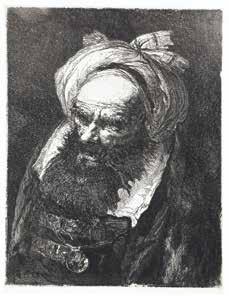
fig. 8 – Domenico Tiepolo, Tête d’homme avec un turban, gravure, Amsterdam, Rijksmuseum, RP-P-1950-587
Je fais référence ici au groupe de feuilles représentant la Sainte Famille, dont l’histoire peut être reconstituée avec une assez grande certitude27. Une note du catalogue de l’exposition de la Savile Gallery à Londres en mai 1959, rédigée par Eduard Cheney, qui posséda ces dessins au XIXe siècle, indique : « This collection was made by G. B. Tiepolo himself and given by him to her son for the Library of the Sommasco Convent (S. Maria della Salute) at Venice in which he was professed. At the suppression of the convents the volumes felt into the hands of Cicognara by whom they were given in an exchange to Canova from whom they passed after his death to Mons. Canova his brother, by him they were sold to Sigr. Francesco Posaro and by him to me / E.C. Venice 184228 » (Cette collection fut rassemblée par G. B. Tiepolo lui-même et donnée par lui à son fils pour la bibliothèque du couvent des Pères Somaschi (S. Maria della Salute) de Venise, où celui-ci était profès. Lors de la suppression des couvents, les volumes passèrent entre les mains de Cicognara qui les échangea avec Canova. Après la mort de celui-ci, ils passèrent à son frère, Monsignor Canova, qui les vendit à M. Francesco Posaro, et de lui me parvinrent. / E. C., Venise 1842.). Cet ouvrage se compose d’environ soixante-dix feuilles qui suscitent l’admiration pour la manière dont le maître a utilisé de subtiles variations et changements de composition, afin de créer toute une gamme de nuances émotionnelles, voire sentimentales, autour de ce sujet en apparence si simple, où, pour reprendre les mots d’Adriano Mariuz, l’artiste « attinge il palpito e la pura bellezza dell’arabesco » (atteint le frémissement et la pure beauté de l’arabesque).
En léguant l’album à son fils Giuseppe Maria, religieux du couvent des Pères Somaschi à la Salute, Giambattista a sans doute reconnu « il valore di un testamento al tempo stesso artistico e spirituale 29 » (sa valeur d’un testament à la fois artistique et spirituel).
Comme dans d’autres dessins de cette série, on admire non seulement le talent de Tiepolo pour varier à l’infini ses inventions mais aussi sa capacité à impré -
29- Mariuz 1983 (2008), p. 202. De même, Morassi, qui eut l’occasion d’en étudier plusieurs lorsqu’ils étaient dans la collection Talleyrand, considérait ces dessins comme parmi les plus humains et les plus émouvants de toute l’œuvre de Tiepolo (Morassi 1958, p. 15).
gner ces sujets d’une dimension à la fois pathétique et sentimentale, teintés de mélancolie et d’une infinie tendresse. Dans les deux dessins présentés dans l’exposition actuelle (cat. 9-10), on perçoit une tonalité spirituelle : dans le regard de Marie levé vers le ciel et les mains croisées sur la poitrine de Joseph, se révèle la profondeur d’un sentiment religieux vécu sans emphase particulière, mais au contraire pleinement inscrit dans la vie quotidienne.
Il est surprenant que Tiepolo ait exprimé ces idées sur la famille au moment même où il prenait définitivement ses distances avec les siens – à l’exception de ses fils, ses collaborateurs – et durant les années où il développait également ses caricatures et inventions sur le thème de Polichinelle, qui allaient profondément influencer l’œuvre de Giandomenico. Les scènes de Sainte Famille de l’album des Pères Somaschi, à l’instar de ces dernières, mais sans la moindre ironie, possèdent la simplicité et la pureté de l’illustration enfantine. Il va sans dire que cette simplicité et cette pureté ne sont pas le fruit de l’ingénuité, mais le résultat de la maîtrise suprême de Tiepolo, capable de décliner une seule idée à l’infini, à la manière des variations musicales de J. S. Bach sur un thème 30
IV. LE DIFFICILE HÉRITAGE :
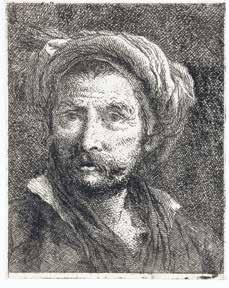
fig. 9 – Domenico Tiepolo (d’après Giambattista Tiepolo), Tête d’homme avec un turban, gravure, Amsterdam, Rijksmuseum, RP-P-1950-611
GIANDOMENICO ET LORENZO TIEPOLO
Comme nous l’avons vu précédemment, Giambattista Tiepolo lui-même considérait le dessin non seulement comme un exercice préparatoire à l’élaboration de ses œuvres principales, mais aussi comme une fin en soi31 Cet aspect devint encore plus prépondérant avec le développement de l’activité indépendante de ses fils.
Il faut imaginer qu’à son entrée à l’atelier au début des années 1740, Giandomenico (Venise, 1727–1804) considérait la pratique du dessin avant tout comme un moyen d’apprendre les techniques et les inventions de son père. Le nombre important de feuilles, principalement à la pierre noire et à la sanguine sur papier bleu, dont la fonction et l’attribution restent sujettes à débat32 , laisse à penser que, comme beaucoup d’autres élèves ayant fréquenté l’atelier des Tiepolo, Giandomenico fut formé par la reproduction et la copie des dessins de Giambattista33 . Lorenzo (Venise, 1736 – Madrid, 1776), le plus jeune des fils, qui ne commença à travailler seul qu’à partir des années 1750, resta fidèle à la pierre noire et la sanguine, souvent utilisées conjointement, puis aux pastels, techniques qui devaient lui convenir particulièrement. Quant à la remarquable production de dessins de têtes, qui suscite encore une certaine confusion quant à l’attribution à chacun des trois artistes34 , Lorenzo sut trouver sa propre voie en privilégiant des figures particulièrement émouvantes, aux visages « suspendus », réalisés avec une technique de hachures polychromes (cat. 50-51). Ce qui le passionnait manifestement, c’était le jeu de la lumière et des expression, accentué par la dissimulation du regard du personnage. Il s’agissait là d’un prolongement, à travers d’autres médiums, de l’attention portée au réel qui avait été au cœur de l’éducation et de la formation de son père. Giambattista et son frère Domenico avaient eux-mêmes produit, tant sur papier que sur toile35 , d’admirables études de têtes – figures d’Orientaux, de philosophes (cat. 11, 47, 48, 49), mais aussi des beautés féminines – que Francesco Algarotti lui-même considérait, à l’instar des « mezze figure », comme analogues à « un Madrigale, o sonetto in Poesia36 » (un madrigal ou un sonnet de poésie). Ces idées furent ensuite à la base d’une série extraordinaire d’eauxfortes de Giandomenico (fig. 8, 9), clairement inspirées des inventions de Rembrandt37
30- Pour cette comparasion avec Bach, et en particulier l’Offrande musicale, voir : Mariuz 1983 (2008), p. 201.
31- Morassi 1965, p. 13.
32- Pour un résumé et une référence à cette vexata quaestio (question controversée), voir Aikema 2015. L’étude la plus complète sur le corpus graphique au crayon reste, malgré les nombreuses révisions auxquelles elle peut être soumise, celle de Knox en 1980.
33- Sur ce thème, voir encore : Loisel 2018. Pour les pratiques d’apprentissage dans l’atelier de Tiepolo, rappelons également le journal intime de l’artiste suisse Bullinger (Aikema 1996, pp. 16-25).
34- Je me permets de renvoyer sur ce point à mon intervention, actuellement en cours d’impression, Pathos and Reality: Chalk Drawings of Heads by Giambattista, Domenico, and Lorenzo Tiepolo, intervention lors du colloque international Tiepolo Drawings: Reconsiderations and Discoveries, à la Morgan Library & Museum, New York, le 25 janvier 2024.
35- Sur ce genre, voir : Pavanello 2006. Sur la série de têtes féminines pour la Russie : Ton 2024.
36- Bettagno, Magrini 2002, p. 127.
37- Rizzi 1971, pp. 110-114.
On a longtemps cru que, pour distinguer les auteurs, la question des dessins à la plume était relativement plus simple que celle des dessins au crayon, dont le style graphique plus brut, plus impétueux et plus vibrant rendait les dessins préparatoires de Giandomenico facilement reconnaissables par rapport à ceux de son père. Pourtant, de nombreux indices témoignent de sa capacité à imiter la technique plus synthétique de la maturité de Giambattista 38 Aujourd’hui encore, il existe un certain nombre de dessins à la plume généralement attribués au père qui peuvent être, avec vraisemblance, rendus au fils, comme le dessin représentant Le Temps dévoile la Vérité (fig. 10), déjà mis en relation avec la toile conservée au Museum of Fine Arts de Boston, mais qu’il convient de considérer comme une méditation de Giandomenico à partir de ce précédent, avec quelques variations39 . Sa technique graphique est plus manifeste lorsqu’on l’imagine s’attelant à des études particulièrement détaillées et raffinées, telles que des dessins de présentation, alternatifs ou préparatoires à l’élaboration de véritables modèles peints à petite échelle. C’est vraisemblablement le cas d’une feuille de dimensions non négligeables, représentant Vénus et l’Amour entourés de putti (cat. 15) dont l’encadrement composite distinctif montre qu’il s’agit d’un schéma de composition détaillé pour un projet de décor de plafond, proche du Triomphe de l’Amour aujourd’hui conservé à la villa Ephrussi de Rothschild à Saint-Jean-Cap-Ferrat 40 (fig. 11). De cette œuvre, dont la destination reste encore inconnue aujourd’hui, dérive probablement, vers les années 1760–1770, toute une population de putti volants dans les nuages, avec d’innombrables variantes et déclinaisons, témoignant du talent particulier de Giandomenico pour la réitération 41 .
Toutefois, l’expression artistique la plus authentique de Giandomenico ne réside pas tant dans les études préparatoires ou dans les recherches de compositions destinées à la conception d’œuvres achevées, à fresque ou sur toile. Reprenant la pratique consistant à varier les sujets et les idées, propre au goût du XVIIIe siècle et à son père lui-même, il s’est passionné pour certains thèmes et personnages, les reproduisant inlassablement, comme s’il relevait un défi visant à rendre manifeste son talent pour la combinaison et la fantaisie.
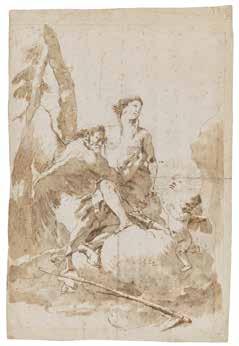
fig. 10 – Domenico Tiepolo, Le Temps dévoile la Vérité, plume et encre brune, lavis brun, pierre noire sur papier, collection privée
Parmi ceux-ci, son thème favori semble avoir été celui des faunes et des satyres (cat. 13 ), figures qu’il représente également dans la grande décoration, notamment dans les scènes monochromes qu’il fut appelé à peindre à plusieurs reprises, notamment à la villa Pisani à Stra ou dans divers palais de Vicence 42 . Une fois encore, l’inspiration lui venait d’inventions de son père, qu’il commença à explorer par le dessin lors de la décoration de la galerie du palais Clerici à Milan, comme en témoignent les feuilles conservées à l’École des Beaux-Arts de Paris43 (fig. 12) ou les feuilles du musée Horne de Florence.
En 1770, de retour d’Espagne après la mort de son père, Giandomenico devient l’un des artistes les plus appréciés pour les grandes commandes de fresques décoratives mais il se découvre surtout une vocation particulière en devenant son propre mécène et en réalisant, au fil des années, dans sa propre demeure familiale de Zianigo, certaines des scènes les plus extraordinaires de la peinture européenne du XVIIIe siècle – fresques aujourd’hui à Venise, conservées au Museo del Settecento Veneziano à Ca’ Rezzonico. La série de scènes de satyres et centaures en particulier, peinte en 1771, pourrait avoir été élaborée comme la réponse vénitienne au nouveau courant suscité
38- Sur ces réflexions, voir: Ton 2016.
39- Christie’s, Londres, 16 octobre 2025, n° 308, feuille également apparue à Venise en 1980 (p. 59, no. 79) et attribuée à Giambattista. Pour reconnaître la main de Giandomenico, il suffit d’observer la construction nerveuse, cursive et emphatique de l’aile de l’Allégorie du Temps.
40- Mariuz 1971.
41- Sur ce tableau et les dessins qui y sont associés, voir: Knox 1973.
42- Pour un aperçu récent sur ces thèmes dans les œuvres graphiques de Giandomenico, voir : Cailleux 1974 ; Delneri 1988 ; Uluçam 2024.
43- Paris 2024, pp. 84-87, n. 23.
44- Mariuz 1971, p. 74.
par la publication des Antichità di Ercolano Esposte, illustrant les découvertes d’Hercu lanum et réinterprété à travers le prisme de Fragonard 44 . Mais là où l’artiste français imagine de faux reliefs, alliant vision « à l’antique » et goût pour la ruine, Giandomenico, lui, projette ses inventions dans un contexte quotidien. Il réalisa plus d’une centaine de dessins autour de ces groupes de figures, aux poses sans cesse renouvelées, avec une liberté conceptuelle et des compositions d’un originalité sans pareille, d’un trait de plus en plus indépendant et nerveux par rapport à celui de son père. Le groupe de dessins, étudié pour la première fois de manière approfondie par Jean Cailleux 45 , peut être rattaché à la période où apparaissent pour la première fois ces protagonistes particuliers dans sa peinture.
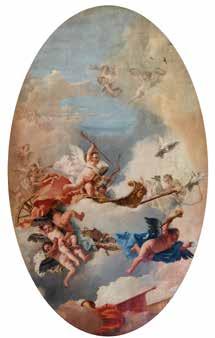
Comme nous l’avons mentionné, dans l’album Orloff, Giambattista lui-même s’était mesuré à ce sujet. Dans la série du fils cependant, la tonalité du récit est différente, avec une narration détaillée et quotidienne, qui confère un ton intime et domestique à la succession des scènes. C’est très vraisemblablement ce projet qui constitue la prémisse et l’exercice préliminaire d’une aventure graphique ultérieure parmi les plus remarquables et pourtant les plus méconnues de l’art européen du XVIIIe siècle : je fais référence à la série de dessins achevés comportant d’innombrables sujets tirés du Nouveau Testament.
V. NOUVEAU TESTAMENT
Le développement de ces inventions est tel que Giandomenico semble réaliser, selon une expression heureuse, « quasi un ’reportage’ su un’Arcadia ridotta a dimensioni quotidiane 46 » (« presque un reportage sur une Arcadie réduite à des dimensions quotidiennes »). Ces expérimentations, inspirées une fois encore par les inventions foisonnantes des Capricci et des Scherzi di fantasia de son père, comprennent également certaines études de figures que l’on pourrait qualifier de fantastiques, tantôt orientalistes (cat. 14, 16), tantôt mythologiques, comme les Divinités fluviales (cat. 12), d’un style et d’une facture tout à fait comparables et donc datables autour des années 1760.
Il faut toutefois préciser que la première incursion de Domenico dans l’art de la réitération et de la combinaison fut en réalité gravée. Publiée en 1753, la série Idee pittoresche sulla fuga in Egitto, réalisée alors qu’il séjournait encore en Allemagne avec son père et dédiée à Karl Philipp von Greiffenklau, prince-évêque de Wurtzbourg – commanditaire des fresques de la Résidence –, constitue une extraordinaire suite d’idées liées à l’épisode de l’Évangile 47 .
45- Cailleux 1974.
46- Mariuz 1971, p. 74.
47- Rizzi 1971, pp. 160-217.
48- Udine, Bloomington 1996.
Il s’agit d’un récit par images d’épisodes des Évangiles et des Actes des Apôtres, ainsi que de scènes tirées des Évangiles apocryphes et même de la Légende dorée. Un narration continue, presque cinématographique, qui, selon une inspiration que l’on trouve déjà dans la série de peintures de jeunesse représentant le Chemin de Croix pour l’Oratorio del Crocifisso près de l’église de San Polo à Venise, se perd dans des détails et des scènes accessoires et apparemment digressives, décrit des personnages secondaires improbables et élabore des cadrages inhabituels.
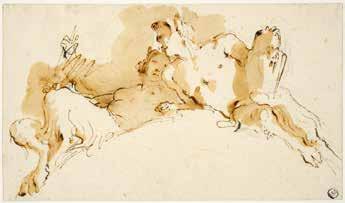
fig. 12 – Giambattista, Faunes et faunesses, plume et encre brune sur papier, Paris, École des Beaux-Arts, EBA389
fig. 11 – Domenico Tiepolo, Le Triomphe de l’Amour, Saint-Jean-Cap-Ferrat, Villa Ephrussi de Rothschild
Depuis l’exposition de la Frick Collection (2006–2007), jamais autant de feuilles de cette série n’avaient été présentées au public. Et l’on peut ajouter qu’en Europe, malgré le riche fonds de 138 dessins reliés en album conservé au Louvre, notre exposition est la plus importante du genre depuis la dispersion de 1920 et l’exposition de 1997-1997 à Udine et Bloomington (1996–1997)48 .
Comme l’ont souligné Byam Shaw, puis Gealt et Knox, dans leur étude monumentale sur ces dessins publiée à l’occasion de l’exposition new-yorkaise 49 , cette série est intimement liée au collectionnisme français. En effet, comme le rappelle Henri de Chennevières, alors conservateur du Louvre, le noyau principal de cette collection est aujourd’hui communément appelé le Recueil Fayet , du nom du collectionneur Jean Fayet Durand (1806-1889) qui acquit l’album à Venise en 1833 et en fit ensuite don, sur les conseils de l’artiste et illustrateur Camille Rogier50 . C’est probablement à cette même époque qu’un autre groupe de feuilles fut acquis par Victor Luzarche (1805-1869), originaire de Tours – ville dont il fut maire – et, après plusieurs changements de propriétaires, quatre-vingt-deux d’entre elles furent vendues aux enchères à Paris en 1921 par Roger Cormier, leur nouveau propriétaire51
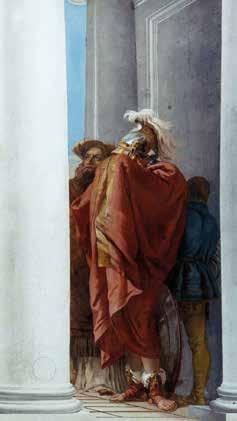
fig. 13 – Giambattista Tiepolo, Le Sacrifice d’Iphigénie, fresque, Vicence, Villa Valamrana
D’autres dessins sont passés dans des collections différentes et le groupe, qui pourrait encore s’enrichir de nouveaux ajouts, compte plus de trois cents feuilles. Dans ces scènes, le sacré se mêle au quotidien, et le miraculeux, bien qu’il ponctue ces scènes, relève davantage de l’aventure et du conte de fée que de l’exaltation mystique, comme dans La Rencontre d’Anne et de Joachim devant la Porte Doré (cat. 17 ), où la nuée d’anges et de chérubins, qui entoure le couple s’apprêtant gravir les
49- Gealt, Knox 2006.
marches, ne trouble en rien la simplicité d’une scène où un petit chien se place au premier plan, en pleine lumière, aux côtés d’un cavalier. On est surpris par la complexité architecturale dans l’espace restreint de la feuille, comme dans Marie et Joseph quittant le temple (cat. 20), où l’on admire la maîtrise du trait vibrant de Domenico et son habileté à orchestrer le clair-obscur et les touches de lumière pour différencier les plans et marquer la profondeur de la scène. La grâce simple du récit transparaît dans les épisodes relatifs à la Nativité et à l’enfance de Jésus, tels que Le Retour de la Sainte Famille à Nazareth (cat. 19) ou L’Annonce aux bergers (cat. 18), ces derniers étant représentés dans leurs humbles vêtements près d’une cabane au toit de paille, saisis et bouleversés par l’apparition angélique. Dans l’une des scènes consacrées au Baptême du Christ (cat. 21 ), un épisode qui a marqué l’imagination de Giandomenico et qu’il a traité dans de multiples dessins aux différents formats, la colombe du SaintEsprit s’est – chose incroyable – posée sur la tête du Christ, comme un oiseau importun l’obligeant à baisser la tête, tout en irradiant une lumière aveuglante qui, avec l’inscription “Questo è il mio diletto figlio e ’l caro oggetto della mia compiacenza” (« Celui-ci est mon fils bien-aimé en qui je trouve ma joie »), impose à toutes les personnes présentes de s’agenouiller. Les élans de surprise et d’émotion se propagent, comme une décharge électrique, dans toutes les scènes de guérisons miraculeuses du Christ ou ses apôtres, par exemple dans La Résurrection du fils de la veuve de Naïn (cat. 22), La Résurrection de Lazare (cat. 23 ) ou dans la scène où Pierre guérissant un paralytique à Lydd a (cat. 30). Les scènes liées à la Passion du Christ sont marquées par le pathos et un rythme dramatique, comme dans La prière dans le jardin de Gethsémani (cat. 26), récemment réapparue
50- De Chennevières 1898, p. 140: “Au mois de juin 1892, le Louvre était mis en possession d’un legs de M. Fayet, ancien représentant à l’étranger d’une grande maison de commerce parisienne. Au cours de ses voyages annuels, M. Fayet ne manquait guère de passer une large quinzaine à Venise où l’avait connu M. Camille Rogier et où il se faisait une joie de la fréquentation de la petite colonie d’artistes français, s’enquérant auprès d’eux des occasions chez les boutiquiers de brocante, car il collectionnait suivant ses moyens et furetait avec bonheur. Un jour, en 1833, il questionnait M. Camille Rogier : – « Ma foi, lui dit l’artiste, voyez donc un étalagiste sous les Procuraties ; j’ai aperçu hier toute une liasse de dessins de Tiepolo le fils…ça doit être dans les quarante sous pièce… et des bistres très crânes ! >>> M. Fayet ne se le faisait pas redire… et le lendemain, il n’y avait plus l’ombre de croquis de Domenico sous les Procuraties. À distance d’années, M. Rogier, revoyant M. Fayet, lui reparlait de ces dessins : « Vous savez, c’est une vraie collection, c’est une suite pour musée, faites-en donc bénéficier le Louvre un jour… ». 51- Paris, Galerie Georges Petit, G.B. Tiepolo : Catalogue des Dessins par Giovanni-Domenico Tiepolo. Composant la Collection de M. Cormier de Tours, 30 avril 1921.
et exposée au public pour la première fois, la Flagellation (cat. 28) ou encore la Crucifixion de saint Pierre (cat. 31). Dans le Reniement de saint Pierre (cat. 27 ), la scène se déroule sous un portique au style inspiré de Véronèse, défiant toute vraisemblance historique : l’apôtre gravit l’escalier presque immobile, la main sur la tête (fig. 13), tandis que le coq de l’Évangile apparaît à l’arrière-plan et que des hommes de main et des soldats semblent fuir hors de la scène. Recourant à un procédé souvent employé, l’artiste crée les effets de lumière les plus intenses en réserve sur le blanc du papier, par ailleurs largement recouvert de lavis, de sorte que le protagoniste, dans son isolement, paraît en jaillir.
Giandomenico devient souvent un observateur, apparemment à la fois fasciné et révulsé, de la violence du monde, donnant forme à des scènes telles qu’une lapidation, dans un épisode difficile à identifier et qui est exposé et illustré ici pour la première fois (cat. 32), où le personnage central jetant des pierres semble presque faire allusion au fanatisme révolutionnaire de la fin du siècle, ou encore dans L’Exécution (cat. 33), qui reprend, et anticipe peut-être, la composition de la Fusillade de Polichinelle du Divertimento per li regazzi , exploitant pour la première fois une idée de Jacques Callot52
On a l’impression que les épisodes du Nouveau Testament et les récits apocryphes et légendaires dont il s’est également inspiré, ont offert à Giandomenico l’opportunité et le prétexte de construire sa propre version de la Comédie humaine où il pouvait représenter une grande variété de caractères et de situations, allant de la tendresse à la trivialité, de la violence brute à l’apparition du divin dans l’expérience humaine. L’ampleur impressionnante de la série, dont on ignore si elle était destinée à être gravée, suscite des réflexions quant à sa place dans la chronologie de l’artiste. Si la date « 1760 » placée au début du Recueil Fayet doit, comme cela a été justement relevé53 , être considérée avec prudence, eu égard à sa précocité improbable, il est tout aussi difficile de croire qu’une telle œuvre ait été réalisée en quelques années seulement. La période entre 1786 et 1790 proposée par Knox, après l’achèvement du plus important projet décoratif de l’artiste dans la Sala del Maggior Consiglio au Palais Ducal de Gênes, doit également être considérée comme purement hypothétique. Il y a tout lieu de penser, en effet, que contrairement à une série témoignant d’une
inspiration plus continue et cohérente, telle que le Divertimento per li regazzi, Giandomenico soit revenu à plusieurs reprises sur ce vaste ensemble, enrichissant parfois les épisodes qui stimulaient le plus son imagination de scènes décrivant les moments immédiatement antérieurs ou postérieurs aux épisodes cruciaux, à la manière de vignettes tirées d’un story-board . Même sur le plan stylistique, les différences sont marquées, sans parler des détails des costumes de certains personnages ordinaires, des citoyens qui auraient pu figurer dans les Scènes de la vie contemporaine. La qualité et la finition de certaines scènes, parfaitement comparables à celles mettant en scène Polichinelle, laissent supposer que son travail sur cette série a pu être long, parfois repris puis abandonné et s’est en partie superposé à d’autres projets graphiques.
Durant les vingt dernières années de sa carrière, lorsqu’il cesse pratiquement d’accepter des commandes publiques et de réaliser des fresques, un domaine dans lequel il aurait certainement pu tirer profit d’un héritage sans égal, Giandomenico semble poursuivre ses propres fantasmes. Le nombre de dessins qu’il réalisa durant cette période est, à certains égards, saisissante, surtout si l’on part du principe que tout découlait d’une nécessité intérieure et qu’il était son propre mécène, comme ce fut le cas pour la décoration de la villa familiale à Zianigo.
Giandomenico poursuit des images – voire, pourrait-on dire, des obsessions – comme si elles défilaient sous ses yeux et qu’il ressentait le besoin de leur donner forme avant qu’elles ne disparaissent. La construction de l’image, au-delà de la mimèsis du langage si reconnaissable de Giambattista, s’y oppose frontalement : chez ce dernier, les figures flottent librement dans un espace indéfini et infini, déjà potentiellement projetées dans l’une de ses apothéoses ou gloires célestes alors que chez le fils, cette vision est réduite et tout se compose et se déploie dans une sorte de théâtre miniature. Les figures minuscules sont presque perdues dans des scènes d’intérieur ou d’extérieur, qui semblent habitées par des apparitions psychiques, au milieu de fumées et des nuages dont la substance n’est pas celle de phénomènes réels, mais celle de la mise en scène et des accessoires théâtraux. L’utilisation de la plume et du lavis n’obéit plus à une économie du geste, exploitant la réserve du papier : au contraire, il s’attarde, esquissant les arrière-plans et les architectures, couvre les espaces d’un trait tremblé, presque sismographique.
52- Mariuz (1986, p. 268) avait mis en évidence le rôle de la gravure de Callot pour la scène de la Fusillade de Polichinelle.
53- Voir les observations de George Knox, in Gealt, Knox 2006, p. 1.
VI. IMAGES DE LA VIE
ET DE POLICHINELLE
Nous savons peu de choses sur cette série, baptisée par Byam Shaw54 , Scènes de la vie contemporaine, qui doit avoir été réalisée en grande partie vers 1791, comme l’indique la date inscrite sur certaines feuilles du groupe. Giandomenico y développe son inclination naturelle à observer le monde qui l’entoure avec amusement et, parfois, une tendre mélancolie, dans toute cette quête absurde de divertissement et d’abandon à un monde d’illusions. Les protagonistes sont issus de la vie urbaine ou rurale, comme dans le dessin Une famille de paysans se rendant à l’église de la collection Tobey (cat. 34) exposé ici, où l’on voit les personnages représentés de dos, conformément au choix particulier de Giandomenico dans ses œuvres tardives, que l’on retrouve également dans la fresque du Nouveau Monde pour la villa de Zianigo.
fait, l’art de Giandomenico semble réunir ces deux tendances : dépeindre ses contemporains et la vie sociale de la seconde moitié du XVIIIe siècle, bien représentée par les nombreux épisodes illustrés dans les fresques de la Villa de Zianigo, et jouer avec les topoi de la figure masquée ou travestie56 .
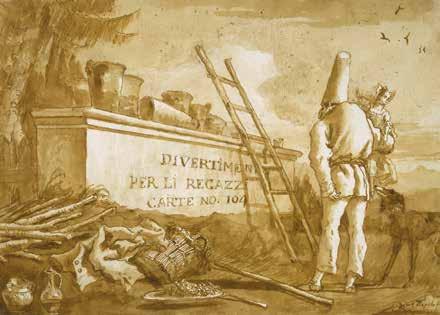
Le regard que Giandomenico porte sur le monde qu’il dépeint n’est pas cruel, comme chez Hogarth ou d’autres dessinateurs anglais tels que Rowlandson, mais plutôt mélancolique55 , soulignant toujours son caractère absurde et déroutant. Les scènes qui l’inspiraient passionnément pouvaient tout aussi bien concerner la futilité du quotidien (cat. 35) que des lieux exotiques lointains et improbables, où son imagination pouvait s’épanouir librement, représentant par exemple des Orientaux conduisant une caravane de chameaux (cat. 16), avec une pyramide à droite de la composition sur laquelle Giandomenico appose sa signature, suivant un usage probablement lié au besoin de distinguer ses dessins de son père.
Les chercheurs ont donc aisément mis en évidence une correspondance spirituelle et temporelle avec les mondes littéraires et théâtraux de l’époque de l’artiste : avec Carlo Goldoni et, plus encore avec Gasparo Gozzi qui défendit la Commedia dell’Arte contre ses détracteurs, tout en renouvelant le genre féérique de la nouvelle. De
54- Byam Shaw 1962, pp. 46-51.
55- Mariuz 1971, p. 85; Pedrocco 1990, p. 22.
Ces feuilles préparatoires, par leur raffinement stylistique et leurs expérimentations de composition, préparent le dernier grand projet artistique de Giandomenico, celui qui constitue sans doute son héritage le plus énigmatique et troublant, le Divertimento per li regazzi. Il s’agit de 104 feuilles qui représentent, de la naissance à la mort, les aventures de l’un des personnages les plus célèbres de la Commedia dell’arte italienne : Polichinelle. Le groupe de dessins est apparu à Londres le 6 juillet 1920 – apparemment sans aucune trace de sa provenance initiale57 – lors d’une vente aux enchères chez Sotheby’s58 et a, un an plus tard, été exposé pour la première fois au public, sans catalogue, au musée des Arts Décoratifs à Paris. Le premier de ces dessins, conçu comme une illustration de frontispice et conservé aujourd’hui à la Nelson Atkins Gallery de Kansas City, porte le titre sous lequel la série est connue (fig. 14) et représente Polichinelle avec sa bosse caractéristique, observant un tombeau sur lequel est appuyée une échelle, tout en tenant une poupée. Cette image, à la fois symbolique et provocatrice, révèle
56- Tumanov (2019) met l’accent sur les relations avec le monde du théâtre, de la scénographie et des représentations de marionnettes.
57- Selon Morassi (1958, p. 21), avant la vente de Londres, l’album se trouvait dans la collection Guggenheim à Venise, mais il ne semble pas possible de confirmer cette information (Byam Shaw 1962, p. 52, note 1).
58- Domenico Tiepolo. One hundred and two Carnival Scenes, with many figures, drawn with pen and bistre and enriched with washes of bistre and Indian ink, signed.
fig. 14 – Domenico Tiepolo, Page de titre pour le « Divertimento per li Regazzi », plume et encore brune, lavis brun sur une esquisse à la pierre noire, Kansas City, Nelson Atkins Museum of Art, 32-193/9
d’emblée une duplicité insaisissable : un jeu d’enfant qui ne se prend pas trop au sérieux, tout en véhiculant une cogitatio mortis sombre et quelque peu inquiétante, comme si le topos de l’Et in Arcadia ego propre à la « grande » peinture s’était inversé tout en s’insinuant dans le domaine des plaisanteries enfantines.
La grandeur de cette œuvre réside précisément dans sa nature insaisissable : en déchiffrer le véritable ton est impossible. Les sujets, souvent trop dramatiques pour susciter le rire, sont, du fait de leur interprétation par des maschere, tournés en dérision et trop grotesques pour être pris au sérieux. Comme l’a observé Adriano Mariuz, le plus grand interprète de ce chef-d’œuvre, le Divertimento, malgré la numérotation et les tentatives pour lui donner une séquence, « sfugge a ogni nostro tentativo di ordinarlo secondo uno sviluppo logico; appena ci illudiamo di avere trovato il filo della storia, siamo imprevedibilmente portati fuori strada, “di-vertiti”, secondo l’originario significato etimologico del termine 59 » (échappe à toute tentative de l’organiser selon un développement logique : dès que nous nous imaginons avoir trouvé le fil narratif, nous sommes, de façon inexorable, détournés, « di-vertiti », selon le sens étymologique du terme en italien).
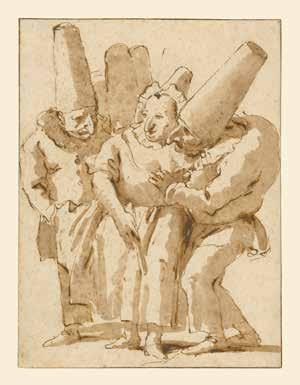
fig. 15 – Giambattista Tiepolo, Polichinelles courtisant une femme, plume et encre brune, pinceau et lavis brun sur une esquisse à la pierre noire, Los Angeles, J. Paul Getty Museum, 2003.131
Le Divertimento, qui emprunte son nom au langage musical, parachève la révolution sémantique opérée par les gravures de Giambattista, les Capricci et les Scherzi di fantasia . Notre regard se perd, est captivé et toute tentative d’interprétation est nécessairement éludée. Dans un jeu de miroirs incessants et, à certains égards, insoutenable, celui qui contemple les dessins de cette série découvre qu’il observe les épisodes banals et triviaux
de la vie, de la naissance à la mort, s’y reconnaissant de manière déformée. Pour saisir les rythmes de la vie, Giandomenico utilise un code d’énigmes qui, en apparence, se présente sous un masque. Polichinelle est ainsi à la fois une marionnette sans âge capable de mourir et de renaître, et une métonymie de la créature qu’elle travestit : l’homme. Une divinité peut-être déchue et contrainte de se multiplier, interprétant tous les rôles et vivant toutes les aventures. Observons quelquesunes des feuilles que nous avons la chance de voir dans cette exposition : dans le dessin intitulé Polichinelle apprenant à marcher (cat. 37 ), nous voyons le protagoniste en miniature portant déjà son masque sur le visage, mais sans son couvrechef caractéristique, placé dans un étrange déambulateur que l’on dirait en osier, tandis qu’un adulte l’attire avec un bussolà (un biscuit en forme d’anneau de Burano) et que sa mère observe la scène à proximité. L’intérieur est ici bourgeois et cossu, avec des vases précieux posés sur des consoles d’appliques rococo de chaque côté de la cheminée ornée d’un miroir. Dans d’autres dessins, cependant, le cadre semble principalement rural et rustique : un jeune Polichinelle observe le travail de ses semblables en train de creuser un trou (cat. 39) – peut-être pour enterrer quelqu’un ? – ou s’adonne à des tâches domestiques et quotidiennes comme filer de la laine dans une cour dans Polichinelle et sa famille dans une ferme (cat. 40) ou encore, se mêle aux « humains » faisant leurs courses au marché aux légumes tout en courtisant une femme vêtue d’une robe particulièrement décolletée (cat. 41, fig. 15) Il semble difficile de croire, comme cela a été suggéré, que les événements qui se succèdent ici concernent un seul protagoniste. Ce qui se déroule sous nos yeux n’est autre que le déroulement de la vie dans toute son « comica
59- Mariuz 1986, p. 267. Byam Shaw avait déjà remarqué que, dans la première documentation photographique de Richard Owen, la numérotation au stylo que l’on retrouve ensuite sur les feuilles était absente. Knox (in Udine 1996, pp. 244-247) a donné crédit à cette numérotation et proposé une séquence. Pour une autre proposition et un aperçu des différentes séquences hypothétiques proposées jusqu’à présent, voir : Bostock 2009b, II, pp. 315-318. La découverte de deux albums photos ayant appartenu à Italico Brass et aujourd’hui conservés à la Fototeca Morassi de l’université Ca’ Foscari à Venise permettrait d’avoir une trace de la séquence des dessins autour de la date de leur dispersion et de cette possible provenance ancienne. Notons au passage que, souvent, la disposition des albums de dessins du XVIIIe siècle au début du XXe siècle ne garantit pas un respect fidèle aux conceptions originales voulues par les auteurs qui ont créé et rassemblé les dessins, comme le montre l’histoire des Fasti veneziani d’Antonio Guardi (pour lesquels nous renvoyons à Ton 2023). Pour plus d’informations sur ces deux albums de photos, voir : https://www.savevenice.org/project/two-photo-albums-of-giandomenico-tiepolos-divertimento-per-regazzi-in-ca-foscari-university-archive.
assurdità 60 » (absurdité comique) : dans les moments quotidiens comme dans les plus inattendus de l’existence humaine, c’est précisément le masque – qui lisse et uniformise les visages et les corps – qui, en fin de compte, révèle plutôt qu’il ne dissimule. Ainsi, le personaggio (personnage sur scène) de la Commedia dell’arte devient une persona, le masque des temps anciens à travers lequel, comme le suggère le mot latin, résonne la voix de l’homme.
procédé que l’on retrouve également dans ses peintures de chevalet et ses fresques, Giandomenico surprend de nouveau ses protagonistes de dos, renversant le point de vue du spectateur d’une manière dont on ne peut sousestimer la portée subversive. Ce fut un tournant décisif pour la culture artistique anthropocentrique d’Europe occidentale, qui considérait l’homme au centre de l’espace et de la représentation visuelle et conceptuelle.
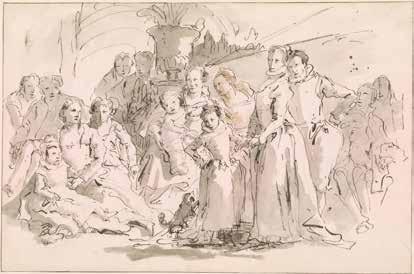
fig. 16 – Giambattista Tiepolo, Portrait de famille, plume et encre brune, lavis brun, plume et encre noire, lavis, sur une esquisse à la pierre noire, New York, The Morgan Library & Museum, 1997.23
Polichinelle vit, grandit et tombe même amoureux, ou du moins s’immisce dans des rendez-vous galants et joue son rôle dans la comédie de l’amour : le voici menant son épouse, très élégante avec son manchon de fourrure au bras, en tête du cortège nuptial parmi d’autres Polichinelles et des musiciens projettant des ombres vespérales sur le sol (cat. 36) ; ou bien il accompagne son épouse dans une promenade à travers la campagne, précédé par des enfants déjà parfaitement vêtus à la dernière mode de la fin du siècle (cat. 44). Le ventre rebondi et satisfait, il apparaît avec son opulente et riche famille dans le jardin d’une villa, dans une scène qui semble parodier les portraits de groupe de nobles (fig. 16) et peut-être aussi les sublimes apothéoses familiales dont son père avait décoré la Villa de Stra (cat. 38) 61 . Dans un autre épisode (cat. 43), qui semble représenter une scène de séduction, apparaissent trois Polichinelles : l’un d’eux tient le bras d’une jeune femme de dos mais dont on distingue la silhouette élancée, une longue chevelure et le geste affecté de l’éventail ouvert. Reprenant un
60- Mariuz 1986, p. 273.
Une autre feuille très célèbre, L’Exécution de Polichinelle, représente le personnage carnavalesque à la fois victime et bourreau dans une scène saisissante où le peloton d’exécution est entièrement composé de répliques de lui-même et dans laquelle il est impossible de ne pas y reconnaître l’émergence moqueuse des idéaux égalitaires importés par la Révolution française et les campagnes napoléoniennes qui menèrent à la dissolution de la République de Venise. On pourrait dire que Polichinelle entretenait « una speciale relazione con la morte 62 » (une relation particulière avec la mort) et qu’il disposait de nombreuses vies. Sa mort est l’occasion de plusieurs scènes déconcertantes : il est alité, malade et, comme précédemment décrit, fusillé mais aussi pendu, on le transporte sur un brancard vers sa tombe au cours de Funérailles (cat. 45) maladroites et agitées et, enfin, dans L’Apparition du squelette de Polichinelle devant sa tombe (cat. 46) (fig. 17 ) un squelette encore coiffé de son couvre-chef emblématique semble reprendre vie, effrayant ses compagnons et tentant d’escalader un tombeau. Si l’on garde à l’esprit que la série a débuté précisément par un monument funéraire, dès la première feuille, on comprend que le Divertimento possède une « ring composition » (composition en anneau) qui amplifie le sentiment de vertige, comme dans le dénouement d’une nouvelle de Jorge Luis Borges.
En observant les innombrables citations que Domenico emprunte au langage pictural de son père, aux décors souvent inspirés par la peinture d’histoire de Giambattista et par d’autres sources visuelles savantes, on constate qu’il renverse consciemment ces modèles tout en leur rendant un ultime et émouvant hommage. Selon toute vraisemblance, le Divertimento per li regazzi fut conçu
61- Giambattista Tiepolo avait également réalisé quelques dessins à la plume qui semblent avoir été conçus comme des études préparatoires pour des groupes familiaux (Venise 1980).
62- Agamben 2015, p. 65.
durant les mêmes années où Giandomenico préparait l’extraordinaire décoration à fresque de la Chambre des Polichinelles pour sa villa familiale de Zianigo, achevée en 1797, année de la Chute de la Sérénissime, que la plupart des spécialistes considère comme déterminante car il marque la fin, pour l’art des Tiepolo et, pourrait-on dire, pour celui de l’Ancien Régime, de ses mythes et de ses idoles63 . Giandomenico a peut-être continué à travailler sur ces feuilles jusqu’à sa mort, survenue en 180464
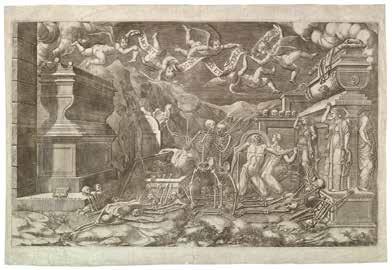
Ce n’est pas seulement la qualité exceptionnelle des sujets et des scènes qui suscite l’admiration et captive le regard : c’est aussi la parfaite adéquation du style graphique de Giandomenico au thème choisi. Il compose ses scènes en découpant des portions de figures, parfois en les coinçant dans des angles, créant ainsi des compositions asymétriques et déséquilibrées, parfois pour ménager de l’espace – comme dans Trois Polichinelles à cheval (cat. 42) –aux paysages, aux villes montagneuses et fortifiées, aux cieux sillonnés par des vols lointains d’hirondelles qui semblent tout droit sorties des cieux madrilènes des ultimes œuvres de son père.
Cependant, si l’équilibre de la composition et de la syntaxe est manifestement rompu, le trait retrouve, dans cet ultime défi, une clarté et une assurance limpide. Comme si la plume
tourmentée et frémissante des œuvres de jeunesse et de la première maturité avait acquis de l’assurance et que le lavis pouvait capter la luminosité d’une pièce, d’un paysage ou d’une étoffe. Là encore, à sa manière, sans la qualité miraculeuse et synthétique de son père, mais en s’en inspirant, Giandomenico comprenait que la lucidité de la vision était une condition essentielle à la mise en scène de cette séquence hallucinatoire et déroutante qui, peut-être en raison de son apparente affabilité, n’a pas reçu la considération qu’elle méritait de la part des spécialistes des artistes de l’imaginaire entre la fin du XVIIIe et du début du XIX e siècle 65 . Jean Starobinski, quant à lui, avait parfaitement perçu que « la horde parasitaire » des Polichinelles était engendrée par un regard plus cruel encore que celui de Gasparo Gozzi, donnant vie à un « cauchemar cocasse », bien plus qu’à un conte de fée, où coexiste « je ne sais quelle irréalité, je ne sais quel fantastique agile et souffreteux 66 ». Il est dès lors impossible de résister à la tentation de considérer cette série graphique – au même titre que les fresques de Zianigo aujourd’hui conservées à Ca’ Rezzonico ou de certains tableaux isolés (fig. 18) – comme le testament poignant de Giandomenico qui, en leur donnant l’apparence d’un jeu et d’un « divertimento » (divertissement) pour enfants et en minimisant apparemment leur portée, a soustrait ces dessins au regard trop sérieux des adultes, les préservant et les léguant à la postérité, tel un jouet oublié prêt à s’animer.
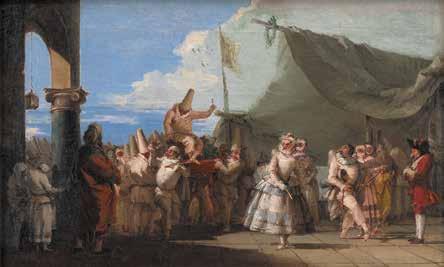
18 – Domenico Tiepolo, Le Triomphe de Polichinelle huile sur toile, Copenhague, Statens Museum for Kunst, KMS3830
63- Pour une lecture récente de l’imaginaire politique qui pourrait être à la base de certaines scènes du Divertimento, voir : McHale 2012.
64- C’est la datation proposée à l’époque par Byam Sham (1962, p. 57) et à laquelle la plupart des chercheurs se sont ensuite ralliés.
65- Allusion à la définition donnée par Giuliano Briganti (1977).
66- Starobinski 1973.
fig. 17 – Giorgio Ghisi (d’après Giovanni Battista Bertano), La Vision d’Ezéchiel, gravure, New York, Metropolitan Museum, 53.600.595
fig.
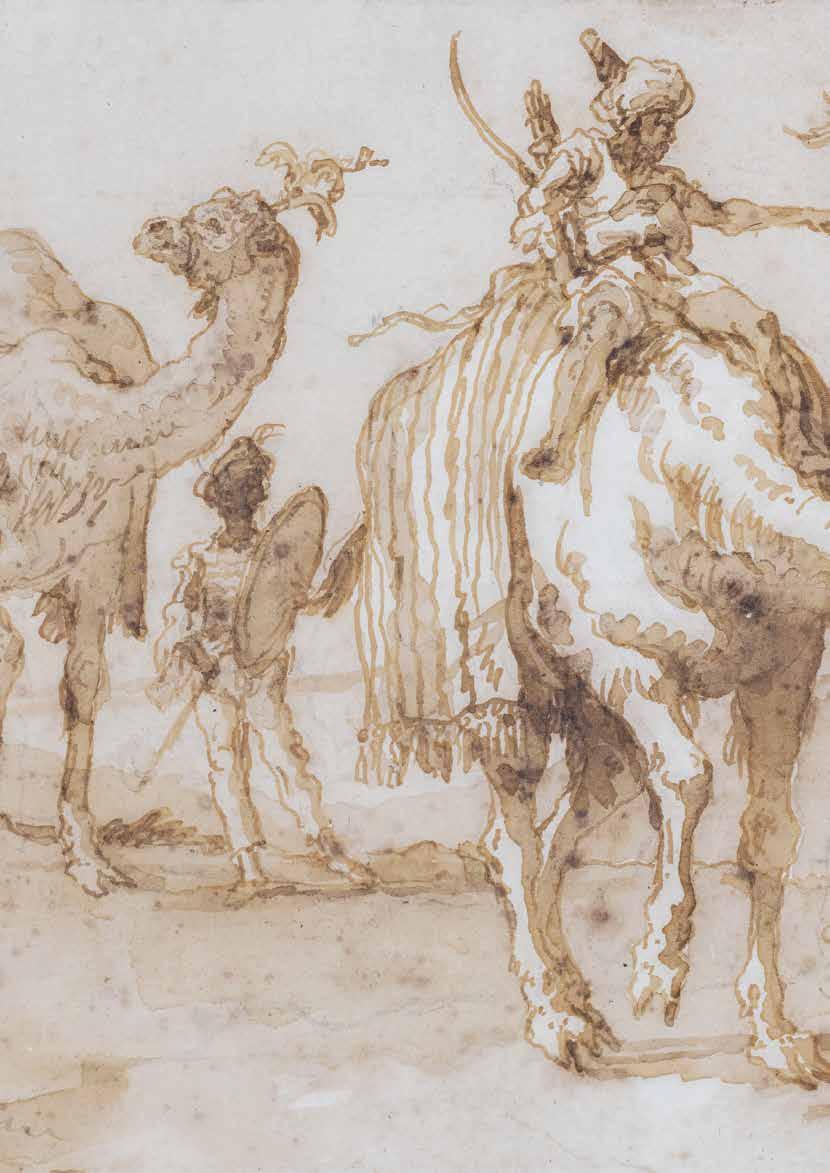
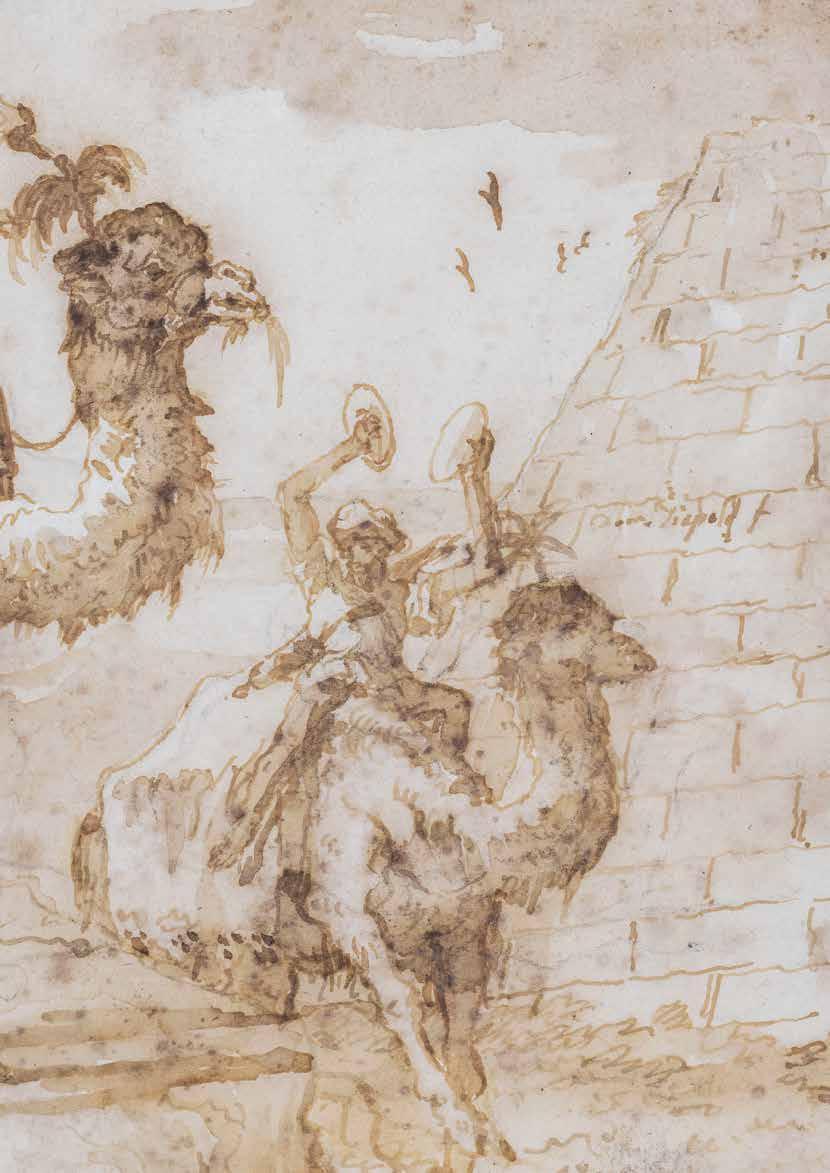
CATALOGUE
GIAMBATTISTA TIEPOLO
La Vierge et l’Enfant Jésus adorés par saint François et sainte Rose de Lima
Plume, encre brune et lavis sur une esquisse à la pierre noire
H. 420 ; L. 230 mm
Prov. :
Paris, Galerie Georges Petit, 29-30 avril 1920 (vente Alexis Orloff), n° 129 ; Paris, G.B. Lasquin ; Paris, Galerie Georges Petit, 8 juin 1928 (vente Lasquin), n° 219 ; marché de l’art parisien ; collection privée.
Bibl. :
Knox 1961, p. 274.
Exp. : Paris 1950, n° 145 ; Paris 1971, n° 244.
La datation proposée à l’époque par Knox pour cette feuille (1715-1720) ne semble pas compatible avec les nouvelles connaissances sur les dessins de jeunesse de Giambattista Tiepolo. On ne trouve pas dans cette étude l’audace expérimentale qui caractérise ses premières œuvres et sa composition peut plutôt être comparée à certaines feuilles de l’album Orloff, comme par exemple La Vierge à l’Enfant et trois saints de la Morgan Library de New York, de même provenance (inv. 1974.28), datable vers 1730-35, ou encore la Vierge à l’Enfant et des saints de la collection Lehman au Metropolitan Museum (1975.1.440). Notre dessin ne présentant toutefois pas encore la liberté de trait de ces deux feuilles, avec une construction encore très liée au dessin à la plume, il semble préférable de situer son exécution entre les années 1720 et le début des années 1730.
Virgin and Child Adored by Saints Francis and Rose of Lima
Pen and brown ink, brown wash, over black chalk
H. 420; W. 230 mm
The date proposed by Knox for this sheet (1715-1720) appears incompatible with what we now know about the drawings by the young Giambattista Tiepolo. It lacks the sense of bold experimentation that marks his early work, and can instead be usefully compared from a compositional point of view with other inventions in the Orloff album, such as the Virgin and Child with three Saints in the Morgan Library & Museum, New York (1974.28), datable to about 173035 and with the same provenance, or the Virgin and Child with Saints in the Robert Lehman Collection at the Metropolitan Museum of Art, New York (1975.1.440). However, since it lacks the freedom of handling found in those sheets, and still evinces a structure very closely linked to the pen drawing, it seems preferable to place its execution between the 1720s and early 1730s.
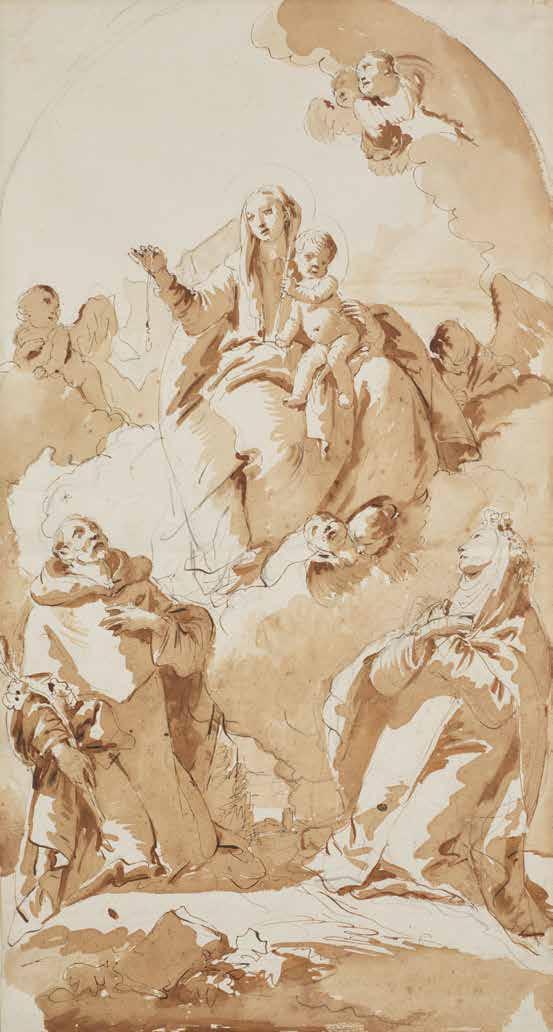
Prov. :
La Fuite en Égypte
Plume, encre brune et lavis sur une esquisse à la pierre noire
H. 410 ; L. 280 mm
Paris, Galerie Georges Petit, 29-30 avril 1920 (vente Alexis Orloff), n° 85 ; Paris, Madame Doucet ; Paris, Drouot, 21-22 novembre 1966, n° 99 ; Mrs. Schaeffer, 1969 ; Londres, Stephen Ongpin Fine Art ; collection privée.
Bibl. :
von Hadeln 1927, I, p. 28, fig. 69 ; Knox 1961, p. 275 ; Knox, in Cambridge 1970, n° 14 ; Rizzi 1971, p. 158, n° 65 ; Gealt 2016, p.105, note 25 ; Marjorie B. Cohn, ’A Note in Media and Methods’, Knox, ibid., 1970, pp. 218-220, fig.3.
Exp. : Cambridge 1970, n° 14.
H. 420; W. 280 mm GIAMBATTISTA
Ce dessin est l’une des inventions de Giambattista sur le thème de la Fuite en Égypte, qui a certainement inspiré la célèbre série de son fils Giandomenico, Idee pittoresche sulla fuga in Egitto , parue en 1753. Cet ensemble graphique, comme l’atteste le frontispice, ne contenait que des œuvres de Giandomenico. Ce dernier avait toutefois traité ce sujet en observant les prototypes paternels et notre dessin est à l’origine d’une gravure à l’eau-forte portant l’inscription « Joannes Batta Tiepolo inv. ». Comme l’a observé Rizzi (1971, pp. 158-159, n˚ 65), il est difficile de penser que ces gravures soient postérieures à la série réalisée à Würzburg (1750-1753) et il faut croire qu’elles ne la précèdent pas de beaucoup. La datation de cette feuille, que Knox situe entre 1725 et 1735, peut, peut-être, être mieux circonscrite entre 1730 et 1735. La Morgan Library de New York (inv. 2012.27) conserve un autre dessin lié au thème de la Fuite en Égypte et provenant de l’album Orloff, qui témoigne des réflexions continues de Giambattista sur ce sujet.
Flight into Egypt
Pen and brown ink, brown wash, over black chalk
This is one of Giambattista’s compositions related to the subject of the Flight into Egypt, which certainly inspired his son Giandomenico’s famous series of etchings, Idee pittoresche sulla fuga in Egitto, published in 1753. That graphic collection, as attested by the title page, contained inventions exclusively by Giandomenico. However, he had also explored the subject through his father’s prototypes, and the sheet in question is the basis of a reverse etching bearing the inscription “Joannes Batta Tiepolo inv.”. As noted by Rizzi (1971, pp. 158-159, no. 65), it is unlikely that these engravings are later than the series produced in Würzburg (1750-1753); nonetheless, it cannot be assumed that they are very early in date. Knox believed that this sheet could be from the period 1725-1735, but it can perhaps be more accurately circumscribed to 1730-35. Another drawing linked to the theme of the Flight into Egypt, from the Orloff album, is in the Morgan Library & Museum, New York (2012.27) and bears witness to Giambattista’s constant reflection on this theme.
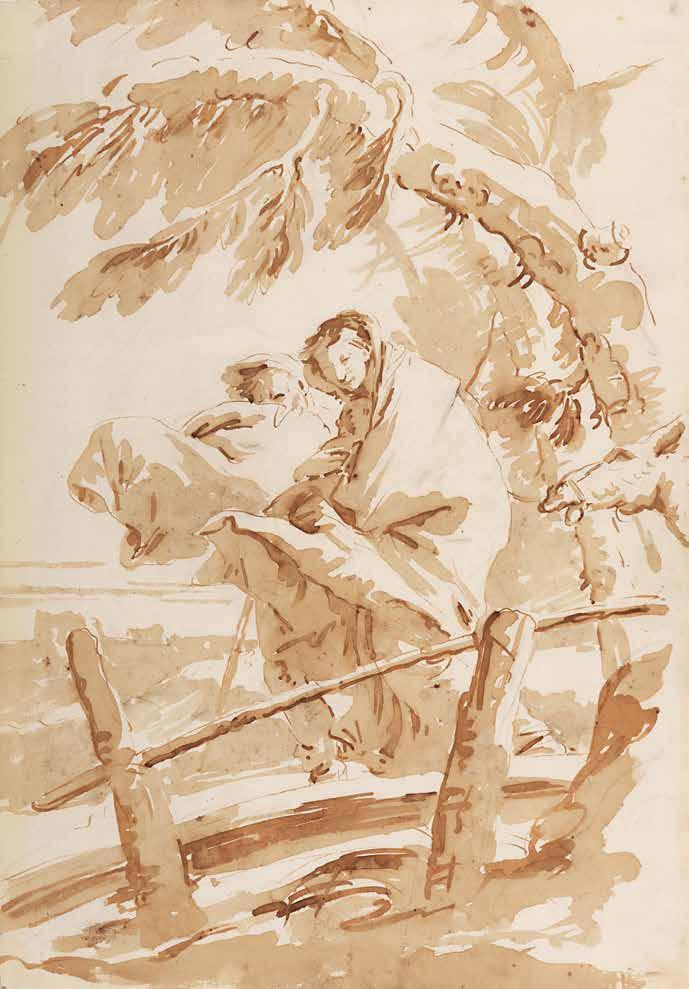
La Déposition du Christ
Plume, encre brune et lavis sur une esquisse à la pierre noire, H. 410 ; L. 280 mm
Prov. :
Paris, Galerie Georges Petit, 29-30 avril 1920 (vente Alexis Orloff), n° 100 ; collection François Revel ; Lyon, Mtres Chenu-Bérard-Péron, 27 mars 2011, n° 5 ; collection privée.
Bibl. : Knox 1961, p. 275.
Deposition
Pen and brown ink, brown wash, over black chalk H. 410; W. 280 mm
Knox believed the sheet could have been created between 1725 and 1735, which can be confirmed here, although a date in the 1730s would be preferable, when Giambattista’s style became more uniform. The drawing is certainly one of the finest studies from the Orloff album, with a subject of profound pathos that was also treated in another sheet, albeit more limited in composition (Sotheby’s New York, January 27, 2021, lot 274). The design was the basis of an anonymous forgery, known to Byam Shaw, which reproduces the most characteristic features of the composition (Baroni 2024, p. 146). ~ cat. 3 ~ ~ cat. 3 ~
Selon Knox, cette feuille pourrait avoir été réalisée entre 1725 et 1735 et cette datation peut être confirmée, avec une préférence pour les années 1730, lorsque le style de Giambattista se stabilise et devient plus homogène. Ce dessin est certainement l’une des meilleures études de l’album Orloff, sur un sujet très émouvant, étudié également dans une autre feuille à la composition plus réduite (New York, Sotheby’s, 27 janvier 2021, n˚ 274). Cette idée fut à l’origine d’une contrefaçon anonyme, connue de Byam Shaw, qui reproduit les éléments caractéristiques de la composition (Baroni 2024, p. 146).
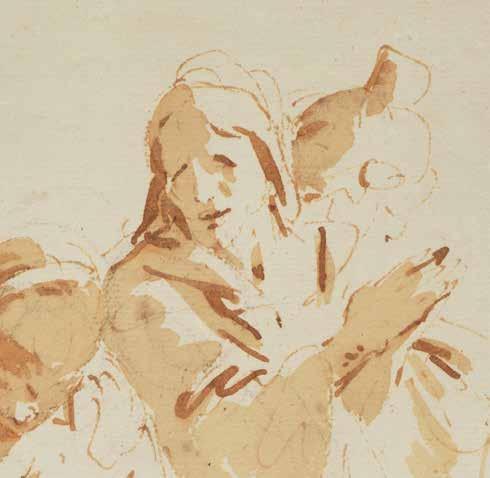
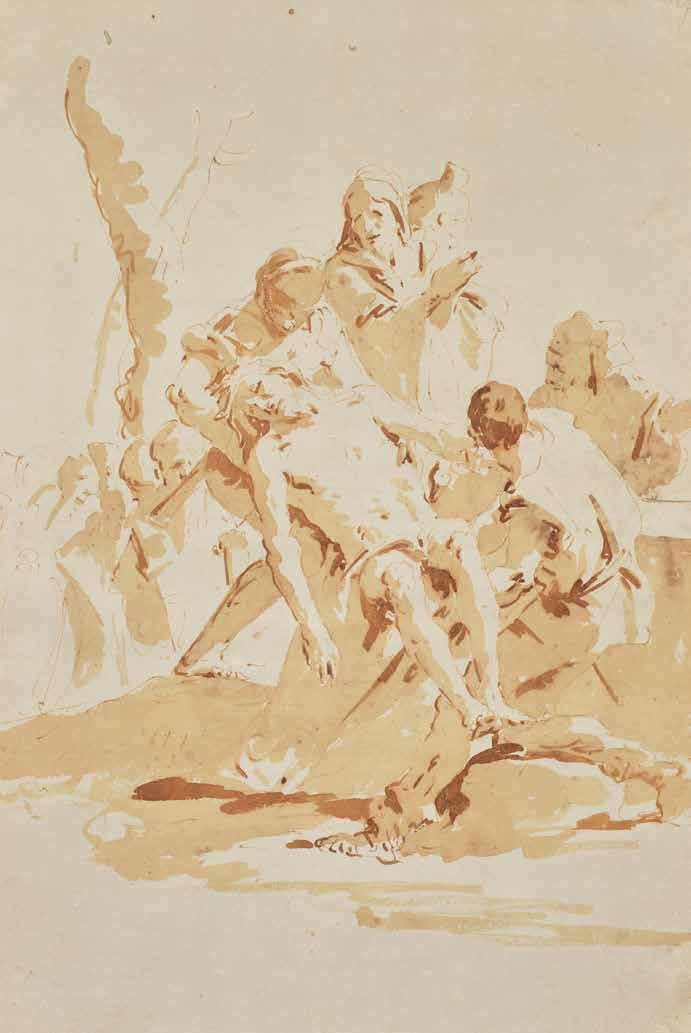
GIAMBATTISTA TIEPOLO
La Décollation de saint Jean-Baptiste
Plume, encre brune et lavis sur une esquisse à la pierre noire
H. 300 ; L. 226 mm
Prov. :
Paris, Galerie Georges Petit, 29-30 avril 1920 (vente Alexis Orloff), n° 126 ; Genève, collection Bemberg ; Genève, Piguet, 6 juin 2024, n° 11 ; Paris, Galerie Éric Coatalem.
Bibl. :
Knox 1961, p. 275, n° 76.
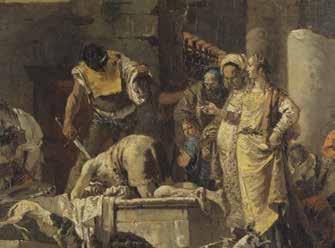
Le dessin pourrait représenter une réflexion sur le thème de la Décollation de saint Jean-Baptiste. Un personnage, agenouillé sur un escalier, vient d’être décapité par le bourreau qui se tient derrière lui en tenant, de son bras levé, sa tête coupée. Bien qu’il n’y ait pas de lien direct du point de vue au de la composition, l’idée a pu naître des recherches développées par Tiepolo pour la réalisation de la fresque représentant, dans une lunette de la chapelle Colleoni à Bergame, la Décollation de saint Jean-Baptiste vers 1732-1733. Ce dessin est particulièrement intéressant car on y voit les traces de pierre noire qui esquissent les arcades d’un décor architectural et une première solution pour l’emplacement du bras du bourreau, légèrement modifié dans la version finale à la plume. La position du corps du Baptiste agenouillé, qui sera ensuite sensiblement différente dans la fresque, est conservée dans une étude préparatoire du Nationalmuseum de Stockholm (inv. NM 188 ; fig. 3), témoignant ainsi du processus créatif de Tiepolo, fonctionnant par ajustements successifs. Pour ces raisons, il semble préférable de situer l’œuvre bien avant la date proposée à l’époque par Knox, vers 1740-50, et plutôt donc à l’époque de la réalisation de la fresque à Bergame (1733).
(fig. 3 )
Giambattista Tiepolo, La Décapitation de saint Jean-Baptiste, huile sur toile, Stockholm, Nationalmuseum, NM
(fig. 3 )
Giambattista Tiepolo, Beheading of John the Baptist, oil on canvas
Beheading of Saint John the Baptist
Pen and brown ink, brown wash, over black chalk
H. 300; W. 226 mm
The drawing may represent a reflection on the subject of the Beheading of Saint John the Baptist. A figure kneeling near the top of some steps has just been beheaded by the executioner behind him, who holds up his severed head. Although there is no strict compositional connection, the idea may have arisen as Giambattista was planning the apinted lunette with the Beheading of the Baptist for the Colleoni Chapel in Bergamo, c. 1732-1733. Most interestingly, this work allows us to note traces of black chalk, which in this case serve to develop the arches of an architectural backdrop, and an initial solution for the position of the executioner’s arm, later slightly modified in the final version in pen and ink. The kneeling position of the Baptist’s body, later significantly modified in the fresco, is retained in a small preparatory modello in the National Museum, Stockholm (NM 188; fig. 3 ), revealing Tiepolo’s creative process, which evolved through progressive adjustments. For these reasons, a much earlier dating seems preferable to that proposed by Knox (c. 1740-50), in the period around the execution of the fresco in Bergamo (1733).
~ cat. 4
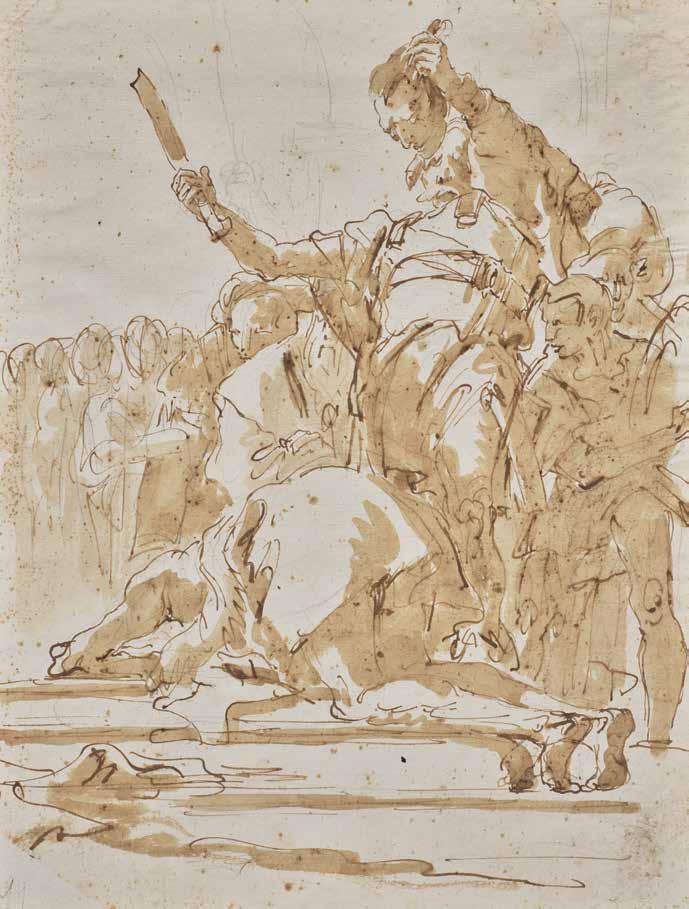
Le Martyre de sainte Théodora
Plume, encre brune et lavis sur une esquisse à la pierre noire H. 427 ; L. 289 mm
Prov. :
Paris, Galerie Georges Petit, 29-30 avril 1920 (vente Alexis Orloff), n° 125 ; Suisse, collection privée ; Berne, Galerie Kornfeld, 6 juin 2008, n° 9 ; collection privée ; Londres, Stephen Ongpin Fine Art.
Bibl. :
Hadeln 1927, I, p. 28, fig. 21 ; Knox 1961, p. 274.
cat. 5 ~
Martyrdom of Saint Theodora
Pen and brown ink, brown wash, over black chalk
H. 427; W. 289 mm
The study was identified by Knox as a Martyrdom of Saint Agatha , although the most direct relationship is instead with the so-called Martyrdom of Saint Theodora in the museum at Ca’ Rezzonico in Venice (Cl. I no. 1813), a canvas variously attributed to Giambattista or his school, but confirmed as by the master by some scholars, with a date around 1745 (Gemin, Pedrocco p. 392, no. 367). Another canvas, formerly in the collections of Guglielmo Lochis in Bergamo and then Antonio Piccinelli, reproduces the composition exactly (Brignoli 2021, pp. 257259, no. 103). The position of the saint, her arms outstretched, and the gesture of the executioner ready to unsheathe his sword, as well as the architectural details of the setting, match each other precisely in the drawing and the canvases. Despite the misidentification of the subject as Saint Agatha, Knox’s proposed dating of 1725-1735 seems right. Such a detailed drawing, which follows the basic lines of the composition with the staircase where the martyrdom takes place and the archway behind it, yet with several variations compared to the final version, must have been conceived as an advanced preparatory study for the final modello. The elderly male figure on the right seems absent from the two paintings and appears instead in an older, very finished study, now in the Metropolitan Museum of Art, New York (37.165.14; Bean, Griswold 1990, pp. 196-197, no. 188). ~ cat. 5 ~
Cette étude a autrefois été reconnue par Knox comme un Martyre de sainte Agathe, mais doit plutôt être rapprochée d’un Martyre de sainte Théodora de Ca’ Rezzonico à Venise (inv. Cl. I n. 1813), toile diversement attribuée à Giambattista ou à son école, mais que certains attribuent au maître lui-même, en la datant vers 1745 (Gemin, Pedrocco p. 392, n˚ 367). Une autre toile, qui appartenait autrefois à Guglielmo Lochis à Bergame, puis à Antonio Piccinelli, en reprend exactement la composition (Brignoli 2021, pp. 257-259, n. 103). En effet, la position de la sainte les bras ouverts, le geste du bourreau prêt à dégainer son épée, ainsi que les détails architecturaux du décor, sont parfaitement superposables entre le dessin et les toiles. Malgré l’identification erronée du sujet par Knox, la datation qu’il propose, 1725-1735, peut être confirmée. Une feuille d’une telle précision a dû être conçue comme une étude préparatoire avancée en vue de la réalisation du modelletto proprement dit : elle reprend en effet les principales lignes de la composition avec l’escalier où a lieu le martyre et l’arcade dans le fond, mais avec plusieurs variantes par rapport à la version définitive. L’homme âgé qui se tient à droite est absent des deux œuvres picturales mais apparaît en revanche dans une étude très raffinée plus ancienne, aujourd’hui conservée au Metropolitan Museum de New York (Bean, Griswold 1990, pp. 196-197, n˚ 188).
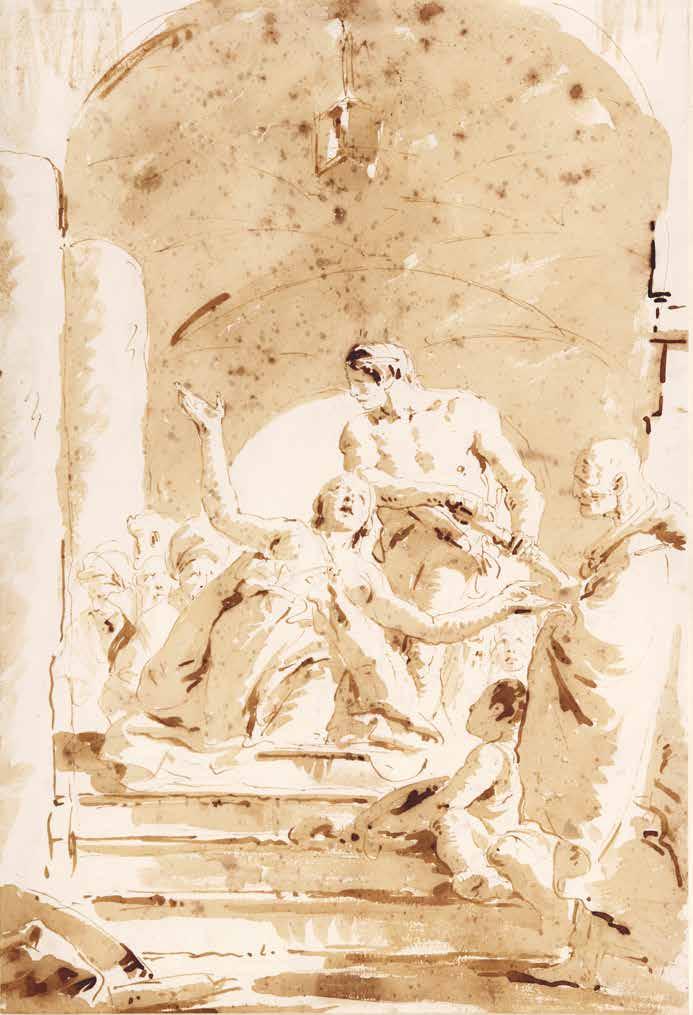
GIAMBATTISTA TIEPOLO
César contemplant la tête de Pompée
Plume, encre brune et lavis sur esquisse à la pierre noire H. 206 ; L. 294 mm
Prov. :
New York, Sotheby’s, 16 janvier 1986, n° 147 ; Londres, Christie’s, 6 juillet 1993, n° 91 ; New York, The Tobey Collection.
Bibl. :
Barcham 1992, p. 86 ; Weber 1996, pp. 183-84 ; Würzburg 1996, I, n° 94 ; L. Wolk-Simon, in New York 2010, p. 206-208, n 64 ; Whistler 2016, p. 130.
Exp. :
New York 2010, n° 64.
Ce dessin est un rare exemple d’étude d’ensemble conçue par Giambattista pour la composition d’une peinture à l’huile sur toile (Linda Wolk Simon, à New York en 2010). Il est généralement associé à la commande passée par Francesco Algarotti à Tiepolo pour la collection d’Auguste III de Saxe, roi de Pologne (voir l’essai dans le présent volume) et peut donc être daté de l’époque de cette importante commande, vers 1745. Une toile de plus petites dimensions (53,8 x 72,6 cm), passée à plusieurs reprises sur le marché de l’art et autrefois présente dans les collections Giusti à Modène, peut nous en apprendre davantage sur cette commande : bien que ne pouvant être considérée comme autographe, elle est cependant utile pour documenter la composition originale du prototype perdu de Tiepolo (Gemin, Pedrocco 1993, pp. 362-363, n˚ 299). On y retrouve en effet les traits saillants de la composition, avec la présence marquée de la tête de cheval à droite, les figures des vieillards à gauche et le personnage agenouillé devant César présentant sur un plateau la tête de Pompée. Les modifications les plus significatives concernent les arrière-plans architecturaux et la position de César. Si, dans le dessin, ce dernier semble en effet afficher un mouvement de dégoût et de compassion à l’égard de cet hommage macabre, cette attitude sera abandonnée dans la version finale où il apparaît avec un maintien plus viril et retenu. La technique graphique est singulièrement touffue et créative, inhabituelle dans la production de Tiepolo, comme si Giambattista procédait par essais et cherchait l’émotion du récit, en faisant une mise au point progressive.
Julius Caesar Contemplating the Head of Pompey
Pen and brown ink, brown wash, over black chalk
H. 206; W. 294 mm
This is one of Giambattista’s rare overall studies for the composition of an oil painting on canvas; it has generally been associated with Francesco Algarotti’s commission for the collection of Augustus III of Saxony, King of Poland (see the essay in this volume). A smaller canvas (53.8 x 72.6 cm), formerly in the Giusti collection in Modena and on the art market on several occasions, has been linked to the same commission, but cannot be considered autograph; rather, it is a derivation useful for documenting the original compositional development of Tiepolo’s lost prototype (Gemin, Pedrocco 1993, pp. 362-363, no. 299). It shows the salient features of the composition, with the vigorous horse’s head on the right, the old men on the left, and the figure kneeling before Caesar, holding Pompey’s head on a platter. The most significant changes are in the architectural backgrounds and Caesar’s posture: in the present study, he seems to express a sense of disgust and compassion towards the macabre tribute. This approach was abandoned in the final version, where Caesar appears with a more robust and dignified demeanor. The handling is singularly disorderly and creative, unusually for Giambattista, as if he were proceeding by trial and error, seeking the emotional center of the narrative and the event through progressive stages of focus. The nature of the sheet itself – a full compositional study – is also unusual (Wolk-Simon, in New York 2010). The dating of the sheet could be connected with the artist’s reflection on this important commission, and therefore around 1745. ~ cat. 6 ~
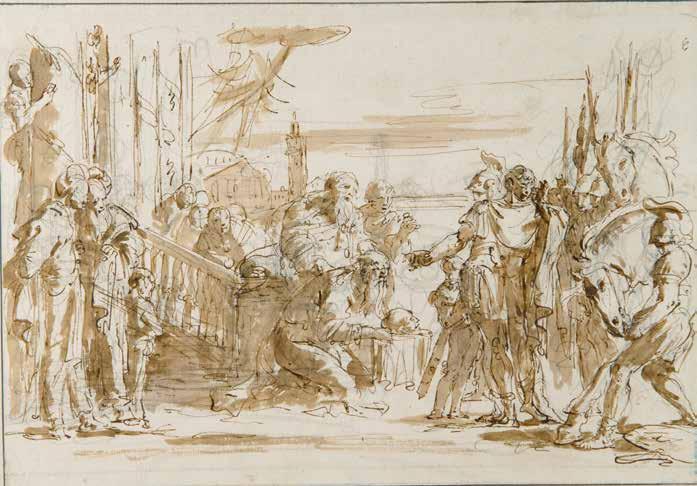
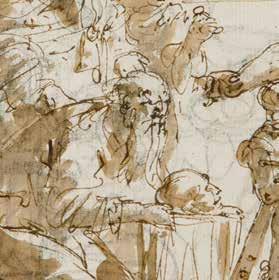
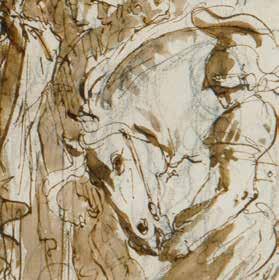
Prov. :
GIAMBATTISTA TIEPOLO
L’Adoration des Mages
Plume, encre brune et lavis sur une esquisse à la pierre noire H. 270 ; L. 200 mm
New York, Christie’s, 10 janvier 1996, n° 146 ; collection privée.
Le dessin aborde un thème que Giambattista a traité à de nombreuses reprises, non seulement dans son œuvre graphique, mais aussi dans son œuvre picturale. Parmi les feuilles similaires à la nôtre, nous pouvons citer celle qui appartenait à la collection Cheney, aujourd’hui conservée au Metropolitan Museum de New York (Rogers Fund, 1937 ; inv. 37.165.16), celle qui se trouve aujourd’hui au Kupferstichkabinett de Berlin (Sack 1910, p. 251, n˚ 263) et celle du Cleveland Museum of Art (Dudley P. Allen Fund, 1944.474). Elle se distingue cependant de l’ensemble par un style différent même si l’on peut trouver quelques similitudes minimes avec celle de Cleveland, comme le geste de l’un des mages soulevant une coupe. Le dessin apparaît en effet beaucoup plus vif, sténographique et, d’une certaine manière, urgente : avec des traits de plume extrêmement fulgurants et convulsifs, accompagnés d’un lavis inhabituellement dense et couvrant pour souligner les parties ombragées, comme pour le visage du roi agenouillé. Cette étude pourrait avoir été conçue dans le cadre de réflexions sur la gravure du même sujet, réalisée avant 1750, et nous pouvons donc la dater des années 1740.
Adoration of the Magi
Pen and brown ink, brown wash, over black chalk H. 270; W. 200 mm
Giambattista explored this subject on numerous occasions, not only in his graphic œuvre but also in painting. Other similar drawings include those in the Metropolitan Museum of Art, New York (Rogers Fund, 1937, 37.165.16, formerly in the collection of Edward Cheney), the Kupferstichkabinett in Berlin (Sack 1910, p. 251, no. 263), and the Cleveland Museum of Art (Dudley P. Allen Fund, 1944.474). While there are a few passages that coincide with those in the last of these – such as the gesture of the Magus raising the cup – the present sheet is altogether different in style, with drawing that appears much quicker, more shorthand and somewhat “urgent”, with extremely swift, frenetic pen strokes, accompanied by unusually dense and opaque watercoloring to emphasize the shadowed areas, as in the face of the kneeling Magus. Since the drawing could have been conceived in connection with Giambattista’s reflections on an etching of the same subject, made before 1750, it can be dated to the 1740s.
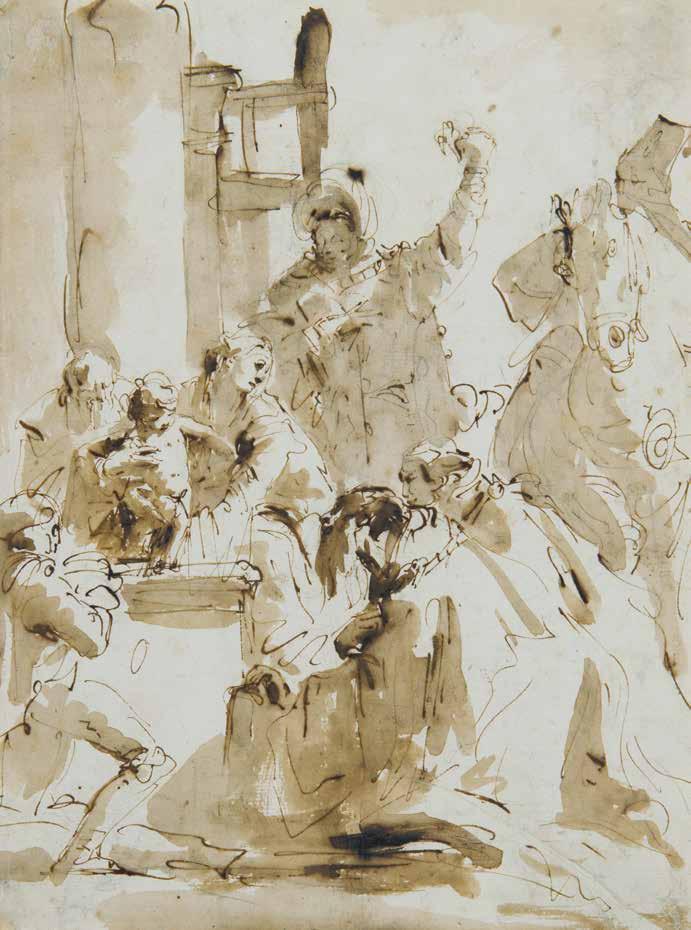
~ cat. 8 ~
Prov. :
GIAMBATTISTA TIEPOLO
Allégorie de la Gloire et de la Valeur
Plume, encre brune et lavis sur une esquisse à la pierre noire
H. 216 ; L. 289 mm
Grantchester, William Bateson, 1910 ; Neuillysur-Seine, collection Adrien Fauchier-Magnan ; Winterfeld collection ; Londres, Sotheby’s, 9 décembre 1936, n° 59 ; New York, E. V. Thaw and Co. ; Lexington (Kentucky), John R. Gaines ; New York, Sotheby’s, 17 novembre 1986, n° 23 ; collection privée ; Londres, Christie’s, 5 juillet 2016, n° 28 ; Londres, Stephen Ongpin Fine Art. Bibl. : Sack 1910, p. 252, n° 103 ; Ongpin 2017, n° 4. Exp. : Londres 1911, n° 65.
Un héros barbu couronné de lauriers, habillé à l’antique, la main gauche posée sur son épée, trône parmi les nuages. Derrière lui se trouve son bouclier. À ses côtés, la déesse de la gloire tient une trompette. Ce dessin a déjà été associé à d’autres représentations allégoriques incluant la figure d’un vieux soldat – comme l’Allégorie de la Valeur de la Courtauld Gallery de Londres – ou à des projets de plafonds (comme celui du Palazzo Barbaro aujourd’hui au Metropolitan de New York ou la fresque de Ca’ Rezzonico à Venise). Il ne semble cependant pas pouvoir être lié à une œuvre en particulier mais résulte plutôt des réflexions sur des thèmes similaires que Tiepolo a menées tout au long de sa carrière. D’autres dessins ont utilisé cette même composition, comme l’Apothéose d’un guerrier du Metropolitan (Rogers Fund, 1937 ; inv. 37.165.26 ; cf. Bean, Griswold 1990, p. 235, n˚ 226) ou le dessin de la Morgan Library de New York (inv. IV, 105), interprété comme une Allégorie du Mérite, dans lequel on remarque l’insertion d’une autre figure allégorique. Notre dessin se distingue cependant de ces œuvres par un trait à la pierre noire et une approche créative particulièrement reconnaissables et peut donc être daté de la fin des années 1740 ou déjà de la décennie suivante.
~ cat. 8 ~
Allegory of Valor and Fame
Pen and brown ink, brown wash, over black chalk
H. 216; W. 289 mm
A bearded hero dressed in ancient robes and crowned with laurel is enthroned on clouds, his left hand resting on his sword. Behind him lies his shield. Beside him is the goddess of glory, with a trumpet. The sheet has been associated with other allegorical depictions that feature an old man in armor, including the Allegory of Valor in the Courtauld Gallery in London, and other ceiling projects (such as that for Palazzo Barbaro, now in the Metropolitan Museum of Art, or the fresco at Ca’ Rezzonico in Venice), but does not appear to be connected with a specific composition; rather, it would reflect Tiepolo’s exploration of similar themes throughout his career. Other drawings can be associated with the same general composition, such as the so-called Apotheosis of a Warrior in the Metropolitan Museum of Art (Rogers Fund, 1937, 37.165.26; Bean, Griswold 1990, p. 235, no. 226) or the sheet in the Morgan Library & Museum, New York (IV, 105), there interpreted as an Apotheosis of Merit, which includes a third allegorical figure. With respect to those iterations, the present sheet features a clearly recognizable preliminary drawing in black chalk, and its creative process probably indicates that it is a study datable to the late 1740s or even the following decade.
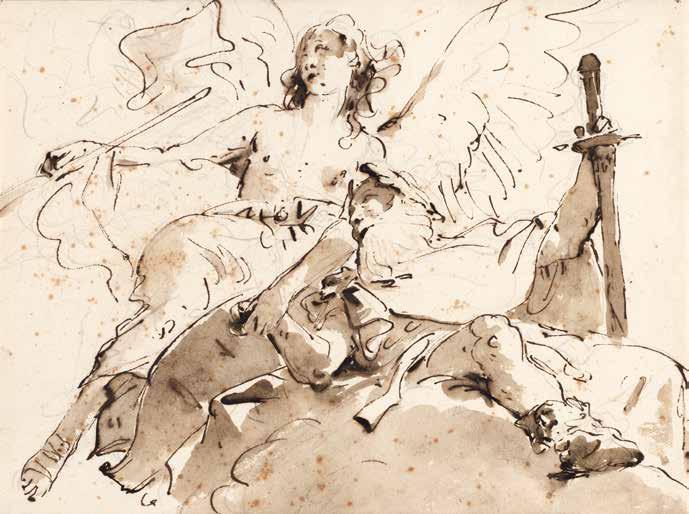
~ cat. 9 ~
Prov. :
GIAMBATTISTA TIEPOLO
La Sainte Famille
Plume, encre grise et lavis brun sur une esquisse à la pierre noire H. 284 ; L. 204 mm
Venise, Santa Maria della Salute, Couvent des Pères Somaschi ; Venise, Leopoldo Cicognara ; Venise, Antonio Canova ; Francesco Pesaro ; Edward Cheney ; Alfred Capel-Cure ; Londres, Sotheby’s, 29 avril 1885, n° 1024 ; Paris, Artcurial, 30 mars 2011, n° 50 ; New York, Michael Altman
Fine Art Gallery, 2016 ; Paris, Christie’s, 27 mai 2020, n° 20 ; Londres, Stephen Ongpin Fine Art.
Bibl. :
Pavanello 1996, p. 44.
Exp. :
Londres, Savile Gallery, 1928, n° 26 ; Paris 1971, p. 164, n° 248 ; New York, 2016.
Ce dessin, comme le suivant, faisait partie d’un album important destiné au couvent des Pères Somaschi de Venise, et contenait certaines des plus belles feuilles de la maturité de Giambattista. Cet album a appartenu à plusieurs collectionneurs d’exception tels que Leopoldo Cicognara et Antonio Canova, le génie de l’époque néoclassique qui fut toujours un grand admirateur de Tiepolo (Pavanello 1996). Arrivé finalement entre les mains d’Edward Cheney, le groupe fut démembré, mais une partie importante se trouve aujourd’hui au Victoria & Albert Museum de Londres. La collection comprenait également une série extraordinaire d’inventions ayant pour thème principal la Sainte Famille. Cette version se caractérise par la pose emphatique de la Vierge, le visage levé vers le ciel. Comme pour toutes les feuilles de cette série, on observe une importante et désormais magistrale économie de traits, permettant de sublimer le blanc du papier, avec seulement quelques touches de plume et de lavis, se révélant comme une pure valeur lumineuse. Ces caractéristiques permettent de dater le dessin vers 1760, lorsque Tiepolo travaillait à ses dernières œuvres en Vénétie – la décoration de la Villa Pisani à Stra, par exemple – et s’apprêtait à quitter définitivement la Sérénissime pour s’installer en Espagne.
~ cat. 9 ~
Holy Family
Pen and brown ink, grey wash, over black chalk
H. 284; W. 204 mm
Like the drawing that follows, this belonged to an important album destined for the convent of the Somascan Fathers in Venice, containing some of the most beautiful sheets from Giambattista’s mature period. This was later owned by exceptional collectors such as Leopoldo Cicognara and Antonio Canova, the presiding genius of the Neoclassical era who was always a great admirer of Tiepolo (Pavanello 1996). After it passed to Edward Cheney, the album was eventually disassembled, although a substantial group of drawings is now housed in the Victoria & Albert Museum in London. The collection also included an extraordinary series of inventions with the Holy Family as their principal subject. The present sheet is notable for the Virgin’s emphatic pose, with her face raised upward. As with all the sheets in this series, what stands out is the extreme and by now masterful economy of line, with a few effective touches of pen and watercolor transforming the white of the paper into a source of pure luminosity; these features make it possible to date the drawing around 1760, when Tiepolo was engaged on his last endeavors in the Veneto, such as the decoration of Villa Pisani at Stra, as he prepared to leave the Serenissima for the last time before his move to Spain.
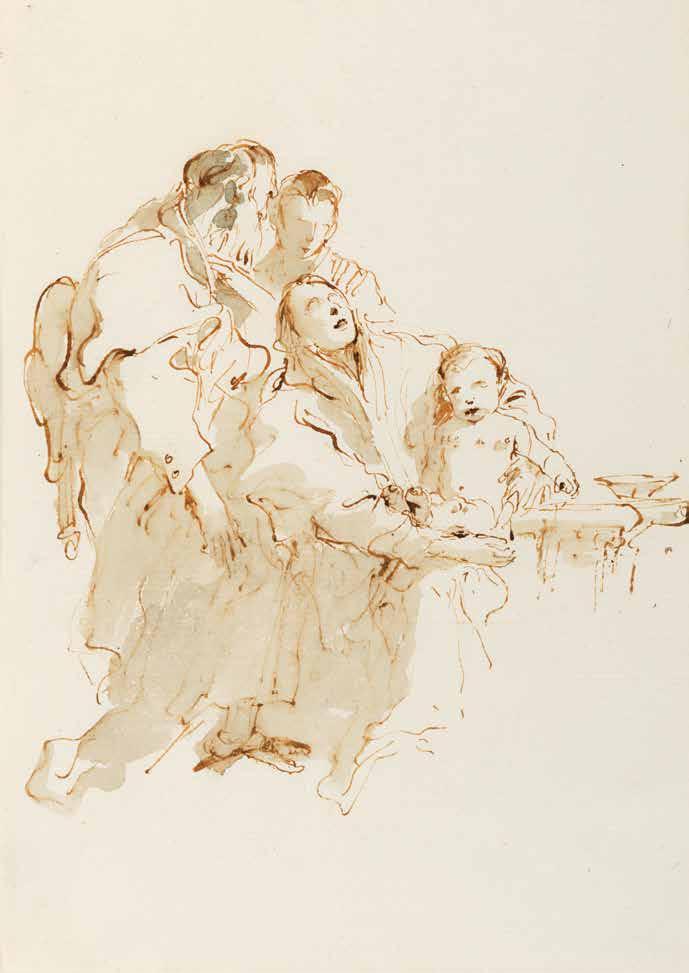
Prov. :
GIAMBATTISTA TIEPOLO
La Sainte Famille
Plume, encre brune, et lavis sur une esquisse à la pierre noire
H. 285 ; L. 206 mm
Venise, Couvent des Pères Somaschi, Santa Maria della Salute ; Venise, Leopoldo Cicognara ; Venise, Antonio Canova ; Francesco Pesaro ; Edward Cheney ; Alfred Capel-Cure ; Londres, Sotheby’s, 29 avril 1885, n° 1024 ; Londres, Savile Gallery, 1928, n° 2 ; Saint-Brice-sousForêt, Duc de Talleyrand ; Londres, The British Rail Pension Fund, 29 juin 1987 ; New York, Sotheby’s, 28 janvier 2015, n° 54 ; collection privée.
Bibl. :
Morassi 1958, p. 15, n° 15 ; Pavanello 1996, p. 45.
Exp. : Venise 1929 ; Venise 1980, p. 63, n° 91.
cat. 10 ~ ~ cat. 10 ~
Cette feuille partage son origine illustre avec la précédente et témoigne du dernier style graphique du maître, sur le point de quitter définitivement l’Italie pour s’installer à Madrid. Ce dessin se caractérise également par une extrême simplicité et une grande précision de conception : avec quelques traits à la plume et au lavis, Giambattista parvient à donner forme à l’une des nombreuses variantes de ce sujet qui semble lui avoir tenu à cœur pendant ses dernières années vénitiennes. Les nombreuses gravures réalisées sur le même sujet et qui étaient conservées dans le riche fonds de l’atelier des Tiepolo (finalement vendu à Paris en 1845) ont été une possible source d’inspiration pour cette série de dessins : parmi celles-ci se trouvaient également de belles inventions de Sébastien Bourdon et de Nicolas Loir (Pavanello 2013, p. 6).
Holy Family
Pen and brown ink, brown wash, over black chalk
H. 285; L. 206 mm
This sheet shares its illustrious provenance with the previous one and displays the master’s culminating graphic style before his permanent departure from Italy and move to Madrid. Here too, the drawing is marked by extreme simplicity and precision of conception: with a few touches of pen and watercolor, Giambattista succeeds in giving form to one of the many variations of the theme that seems to have been congenial to him during his final years in Venice. Among the possible sources of inspiration for the series of drawings are the numerous prints of the Holy Family in the substantial collection of the Tiepolo workshop, finally sold in Paris in 1845; these included a rich group of compositions by Sébastien Bourdon and Nicolas Loir (Pavanello 2013, p. 6).
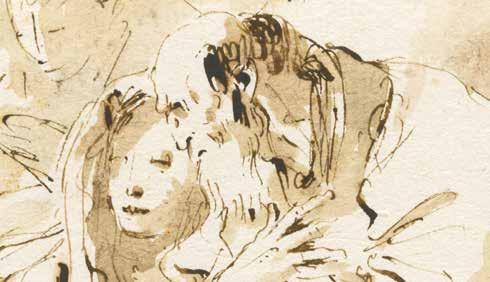
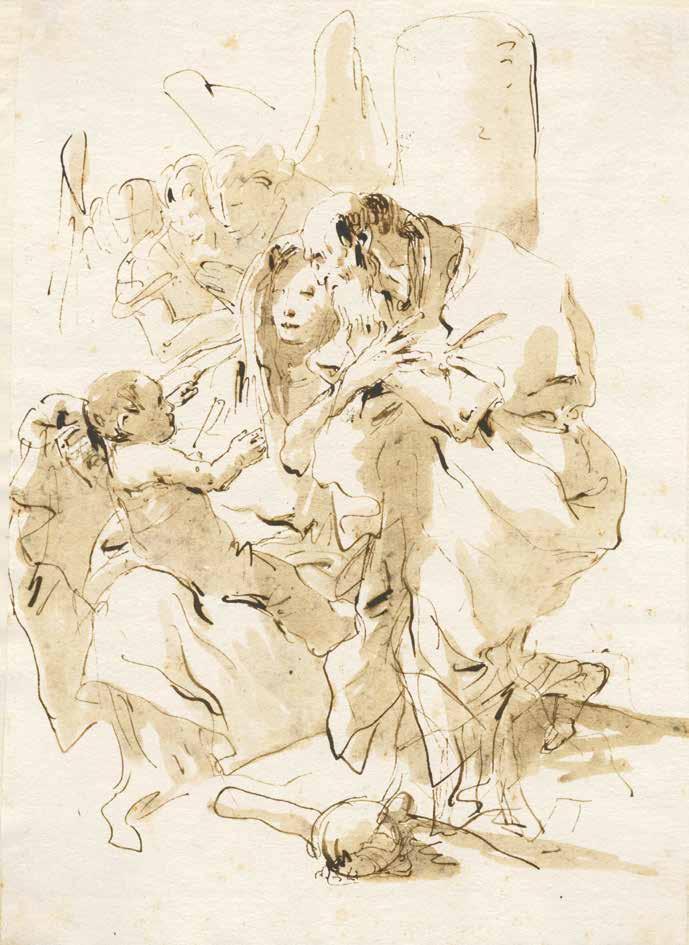
cat. 11 ~
Prov. :
GIAMBATTISTA TIEPOLO
Tête d’un oriental avec moustache et turban
H. 43,5 ; L. 35,5 cm
Milan, collection Rasini ; Milan, Galerie Carlo Orsi.
Bibl. :
Morandotti, Roma 1941, p. 42, n° 37 ; Lorenzetti, Venise 1951, pp. 99-100, n° 74 ; Morassi 1955, p. 147, n° 38 ; Morassi 1962, p. 28, Pallucchini 1968, n° 225 ; Pallucchini 1968, n° 225 ; Rizzi 1971, p. 378, n° 194 ; Succi 1988, p. 219 ; Gemin, Pedrocco 1993, p. 437, n° 30 ; Pedrocco 2002, pp. 291, n° 233 ; Pancheri 2024, p.195.
Exp. : Roma 1941, n° 37 ; Venise 1951, n° 74.
Cette toile, qui compte parmi les exemples les plus originaux et les plus fantaisistes du genre, appartenait à l’importante collection milanaise de Giovanni Rasini (à ce sujet, voir : Pancheri 2024). Exposée à Rome et à Venise au début des années 1940 et 1950, elle fait depuis lors partie intégrante du corpus autographe de Giambattista Tiepolo. Cette attribution est confirmée par la touche fluide et rapide du turban multicolore encadrant le visage du personnage ainsi que par l’habileté des quelques coups de pinceau qui dessinent son regard intense et pénétrant. La palette est contrôlée et maintenue dans des tonalités sourdes, afin que l’image puisse s’illuminer grâce au rouge présent sur le bord inférieur du turban et qui contraste intelligemment avec le vert de l’écharpe et le brun de la casaque. Cette invention, qui revient au maître, a été gravée par Domenico dans la série Raccolta di Teste en 1774 (Knox 1970, n˚ II/3, pour la datation de la série : Succi 1988), mais cette œuvre de Giambattista doit remonter à plusieurs années auparavant et, compte tenu des caractéristiques mentionnées ci-dessus, peut être datée du milieu des années 1750 (fig. 9).
cat. 11 ~
Bust of an Oriental Man with a Moustache and Turban
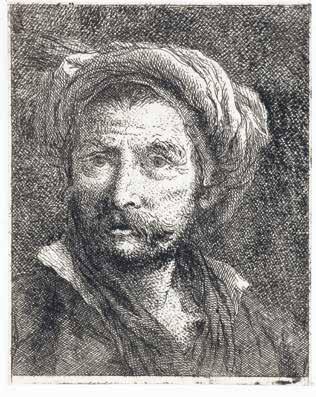
One of the most original and imaginative of its kind, this canvas belonged to the important collection of Giovanni Rasini in Milan (on whom see Pancheri 2024). Exhibited in Rome and Venice in the early 1940s and 1950s, it has since been securely accepted in Giambattista Tiepolo’s autograph œuvre. This is confirmed by the liquid, flowing brushstrokes that structure the multicolored turban framing the figure’s face, and the few, confident touches that describe his penetrating, almost arrogant gaze. The palette is carefully limited to a few subdued tones, allowing the image to be lit up by the red along the lower edge of the turban, which is intelligently contrasted with the green of the scarf and chestnut brown of the jacket. No doubt created by the head of the family workshop, the invention was etched by Giandomenico in the Raccolta di Teste series, printed in 1774 (Knox 1970, II/3; for its dating see Succi 1988), but Giambattista must have conceived it many years earlier. Bearing in mind the elements mentioned above, we may date the picture to the mid-1750s (fig. 9).
(fig. 9)
Domenico Tiepolo (d’après Giambattista Tiepolo), Tête d’homme avec un turban, gravure, Amsterdam, Rijksmuseum, RP-P-1950-611
(fig. 9)
Domenico Tiepolo (after Giambattista Tiepolo), Head of a Man Wearing a Turban, etching,
Oil on canvas
H. 43, 5; W. 35,5 cm
Huile sur toile
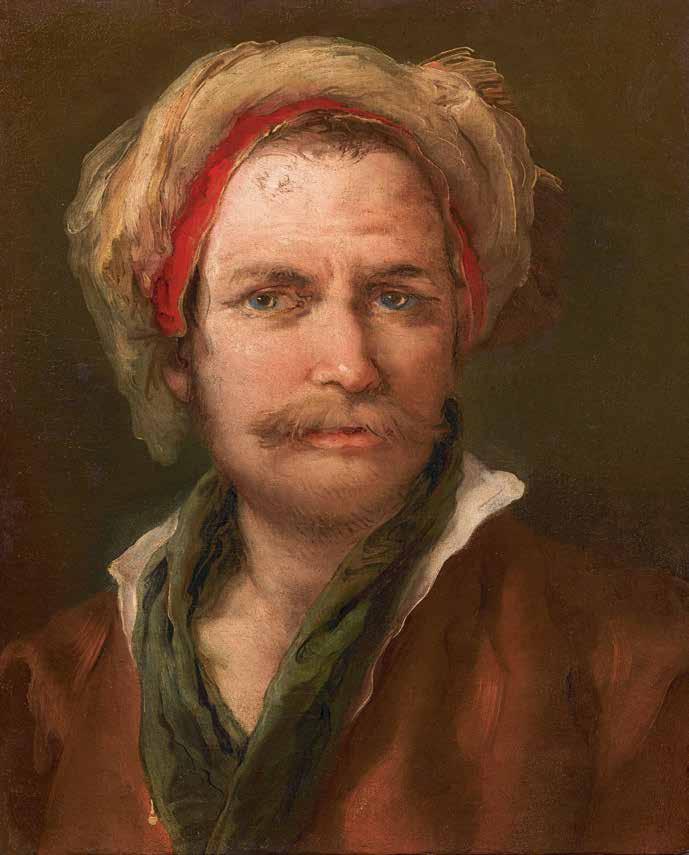
~ cat. 12 ~
GIANDOMENICO TIEPOLO
Dieux fleuves
Plume, encre brune et lavis sur une esquisse à la pierre noire
H. 360 ; L. 260 mm
Signé en bas à droite : « Domo Tiepolo f »
Prov. :
comte Robert de Vogüé ; Vaux-Le-Vicomte, comte de Vogüé ; collection privée.
Exp. :
Paris 1971, p. 187, n° 302.
Ce dessin pourrait être lié, d’une manière ou d’une autre, à l’eau-forte de Giandomenico d’après un dessin de Giambattista représentant des Divinités fluviales. Nous ne savons pas si cette idée est née directement comme une étude graphique (comme le suppose Knox 1960, p. 65) ou comme une peinture (idée exprimée par Rizzi 1971, p. 274, n˚ 124). Le rapport entre cette feuille et la gravure est quoi qu’il en soit assez libre, suggérant plutôt une comparaison avec d’autres œuvres de Giambattista, y compris celles perdues ou retrouvées dans l’album du Victoria & Albert Museum de Londres (Knox 1960, p. 65, n˚ 129). Une certaine clarté de la ligne et les passages de clair-obscur réalisés au lavis suggèrent une tentative d’imitation de la technique paternelle, encore emprunte d’une certaine simplicité. La feuille doit donc être datée des années 1750, lorsque ces idées étaient vraisemblablement développées dans l’atelier.
~ cat. 12 ~
River Gods
Pen and brown ink, brown wash, over black chalk
H. 360; W. 260 mm
Signed lower right: “Domo Tiepolo f”
This drawing can be associated with an etching by Giandomenico made after a drawing by Giambattista, representing River Gods, although we do not know whether the original idea lay in a graphic study, as hypothesized by Knox (1960, p. 65), or as a painting (as proposed by Rizzi 1971, p. 274, no. 124). The relationship between this sheet and the print, in any case, is relatively loose, suggesting comparisons with other ideas by Giambattista, some of which are lost or in the album of the Victoria & Albert Museum, London (Knox 1960, p. 65, no. 129).
A certain rigidity of handling and crudeness of chiaroscuro passages rendered in watercolor suggest an attempt to emulate his father’s technique, albeit with some lack of experience. The sheet should therefore be placed around the 1750s when these ideas were likely being developed within the workshop.
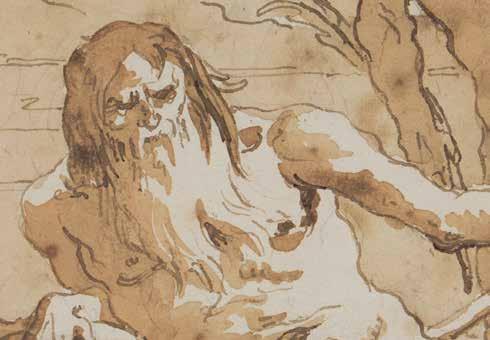
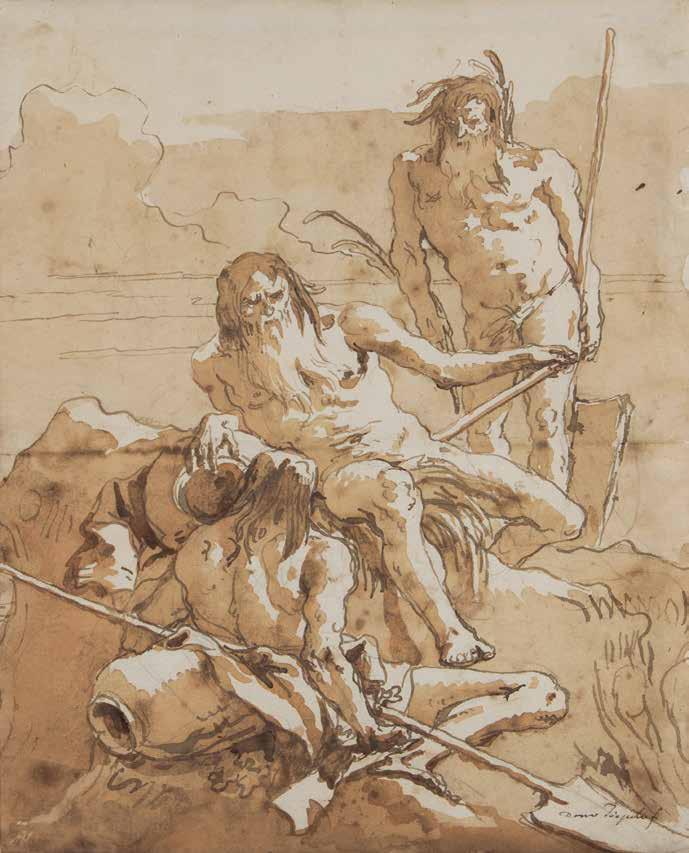
cat. 13 ~
Prov. :
GIANDOMENICO TIEPOLO
Satyres
Plume, encre brune et lavis sur une esquisse à la pierre noire
H. 192 ; L. 243 mm
Signé en bas à gauche : « Dom.o Tiepolo f »
New York, Juan Jorge Peoli ; New York, American Art Galleries, 8 mai 1894, n° 597 ; Londres, Sotheby’s, 23 mars 1972, n° 132 ; Paris, Galerie Cailleux, 1974 ; Londres, Christie’s, 8 juillet 1980, n° 49 ; Londres, Stephen Ongpin Fine Art, 2011 ; collection privée.
Bibl. :
Cailleux 1974, p. XV, n° 34 N&D d6, fig. 30 ; Bean, Griswold 1990, p. 253, n° 248.
Le dessin appartient à une série représentant, dans différentes poses et compositions, des satyres et des satyresses. Cette feuille en particulier fait partie d’un sousensemble que l’on supposait lié à l’épisode de Nessus et Déjanire (Métamorphoses IX, 101-272), hypothèse toutefois improbable dans ce cas précis étant donné que la figure féminine, représentée ici avec ses oreilles animales, ressemble davantage à une faunesse qu’à une femme. Ce groupe de dessins dérive d’un thème développé préalablement par Giambattista dans une série de feuilles aujourd’hui conservées au musée Horne de Florence (Collobi Ragghianti 1968), puis par Giandomenico pour la création de fausses sculptures et bas-reliefs monochromes dans de grandes décorations, comme en témoigne celle, par exemple, de la Villa Pisani à Stra, toujours en collaboration avec son père, mais aussi dans d’autres entreprises autonomes beaucoup plus tardives telles que la frise du Palazzo Contarini dal Zaffo à Venise en 1784 (Pavanello 2023, I, pp. 121-127), preuve du fait que Domenico resta toujours attaché à ce motif. La datation proposée en son temps par Cailleux pour la plupart de ces feuilles, vers les années 1750, et plus précisément entre le retour d’Allemagne et le départ pour l’Espagne (1762), reste toutefois valable.
cat. 13 ~
Satyrs
Pen and brown ink, brown wash, over black chalk
H. 192; W. 243 mm
Signed lower left: “Dom.o Tiepolo f”
The drawing belongs to a series of sheets depicting male and female satyrs in various poses and compositions. This particular sheet belongs to a subset presumed to be connected to the episode of Nessus and Deianira (Metamorphoses IX, 101272), a very unlikely hypothesis in this case given that the female figure here, with animal-like ears, resembles a faun rather than a woman. In any case, this group of drawings stems as always from a theme devised by Giambattista in a series of sheets now in the Museo Horne in Florence (Collobi Ragghianti 1968) and subsequently developed by Giandomenico through the depiction of fictive sculptures and monochrome reliefs for large-scale decoration; one such example is found in the Villa Pisani at Stra, again produced in collaboration with his father, but also in other much later independent projects such as the frieze of Palazzo Contarini dal Zaffo in Venice, painted in 1784 (Pavanello 2023, I, pp. 121-127), attesting to the fact that Domenico always remained attached to this motif. The dating proposed by Cailleux for most of these sheets –around the 1750s, and more specifically between his return from Germany and departure for Spain (1762) – remains valid.
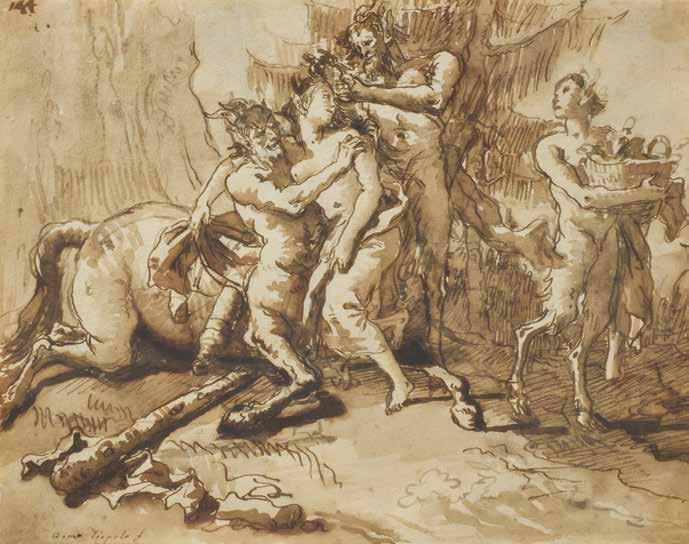
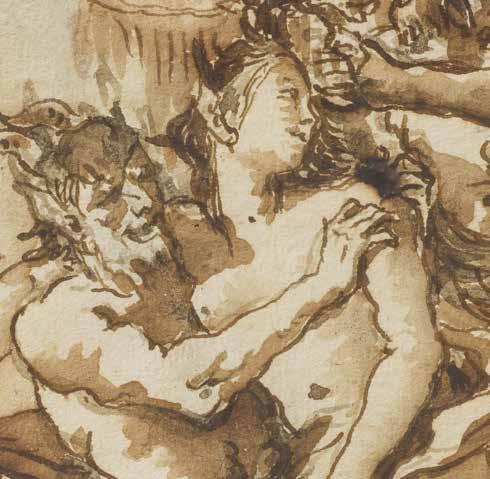
cat. 14 ~
Philosophes orientaux et Cupidon
Plume, encre brune et lavis brun
H. 265 ; L. 300 mm
Signé en bas à droite : « Dom.o Tiepolo f »
Prov. :
Paris, Me Vincent, Palais Galliera, 29 novembre 1976, n° 1; Paris, Hôtel Drouot, Mes Blanchet & Associés, 18 novembre 2009, n° 6 ; Paris, Galerie Éric Coatalem ; collection privée.
La feuille, dont le sujet n’est pas facile à déchiffrer, représente un curieux rassemblement de philosophes orientaux avec un homme nu et un Cupidon qui s’approche de lui. Il s’agit d’un dessin qui, par ses caractéristiques stylistiques, son sujet et ses dimensions, s’apparente à la série des 166 feuilles dite Album Beauchamp, du nom de son propriétaire au moment de sa vente à Londres (Christie’s, 15 juin 1965). Comme ce groupe de dessins, qui appartint à Horace Walpole et qui est presque certainement antérieur à 1783 (Knox 1996, p. 49), cette feuille peut être datée entre les années 1760 et 1770.
Oriental Philosophers and a Cupid
Pen and brown ink, brown wash, over black chalk
H. 265; W. 300 mm
Signed lower right: “Dom.o Tiepolo f”
The subject of this sheet is not easily decipherable: it depicts a curious gathering of Oriental philosophers and a nude male figure with a Cupid approaching him. It is similar in style, subject matter and dimensions to the series of 166 sheets of the so-called Beauchamp Album, named after the owner at the time of its sale in London (Christie’s, June 15, 1965). Like that group of drawings, owned by Horace Walpole and which was almost certainly created before 1783 (Knox 1996, p. 49), the sheet can be dated to the 1760s or 1770s.
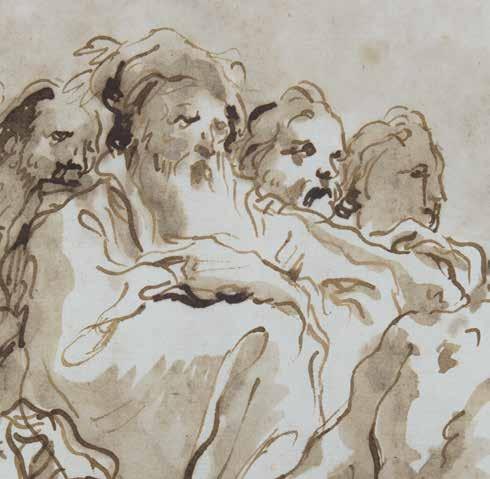
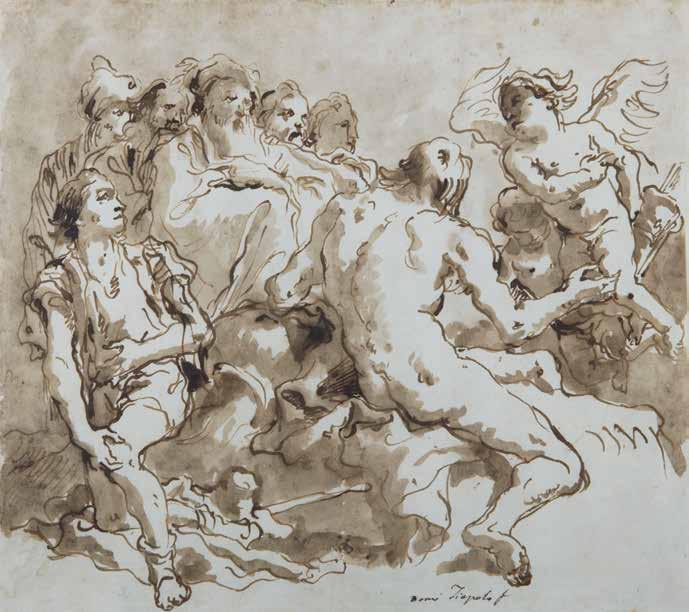
GIANDOMENICO TIEPOLO
Vénus et l’Amour entourés de putti
Pierre noire, plume et encre brune, lavis brun
H. 435; L. 240 mm
Signé en bas au centre: « Dom o Tiepolo »
Prov. :
Paris, Pierre Defer ; Paris, Henri Dumesnil ; Paris, Hôtel Drouot, 10-12 mai 1900, n° 249 ; Genève, collection Bemberg ; Genève, Piguet, Hôtel de Vente, 5-18 juillet 2025, n° 2705 ; Paris, Galerie Éric Coatalem ; collection privée.
Exp. :
Paris 1879, p. 58, n° 224.
Les dessins représentant des putti et l’Amour, souvent les yeux bandés, constituent une autre variation sur un thème typique de la production de Giandomenico, comme l’a déjà remarqué Byam Shaw (1962, pp. 38-39). L’historien considérait que cette thématique était née en même temps que d’autres inventions similaires réalisées pour la décoration de la Villa Valmarana à Vicence en 1757, en collaboration avec son père. Cependant, ce dessin en particulier semble être un schéma assez précis pour la décoration d’un plafond, à fresque ou sur toile, comme celui qui se trouve aujourd’hui dans la villa Rothschild-Ephrussi à Cap-Ferrat (fig. 11) ; selon Mariuz 1971, p. 116) datée entre 1760 et 1770. Cette datation semble également plausible pour la présente feuille.
Venus and Cupid surrounded by Putti
Pen and brown ink, brown wash, over black chalk
H. 435; W. 240 mm
Signed lower center: “Dom o Tiepolo”
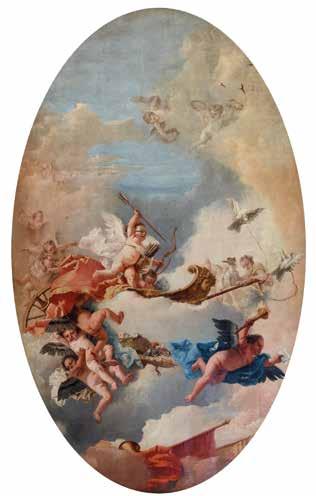
Giandomenico’s drawings with Cherubs and Cupids, often blindfolded, represent yet another variation on a typical theme in his œuvre, as pointed out by Byam Shaw (1962, pp. 38-39). The scholar believed the subject was born alongside similar inventions made for the decoration of Villa Valmarana in Vicenza in 1757, together with his father, although this drawing in particular seems to be a carefully-designed scheme for a ceiling decoration, in fresco or on canvas, like that now in the Villa Ephrussi de Rothschild at Saint-Jean-Cap-Ferrat (fig. 11), dated by Mariuz (1971, p. 116) to 1760-1770, a period which also seems plausible for the present sheet.
(fig. 11)
Domenico Tiepolo, Le Triomphe de l’Amour, Saint-Jean-Cap-Ferrat, Villa Ephrussi de Rothschild (fig. 11)
Domenico Tiepolo, Cupid driving a Chariot drawn by Doves
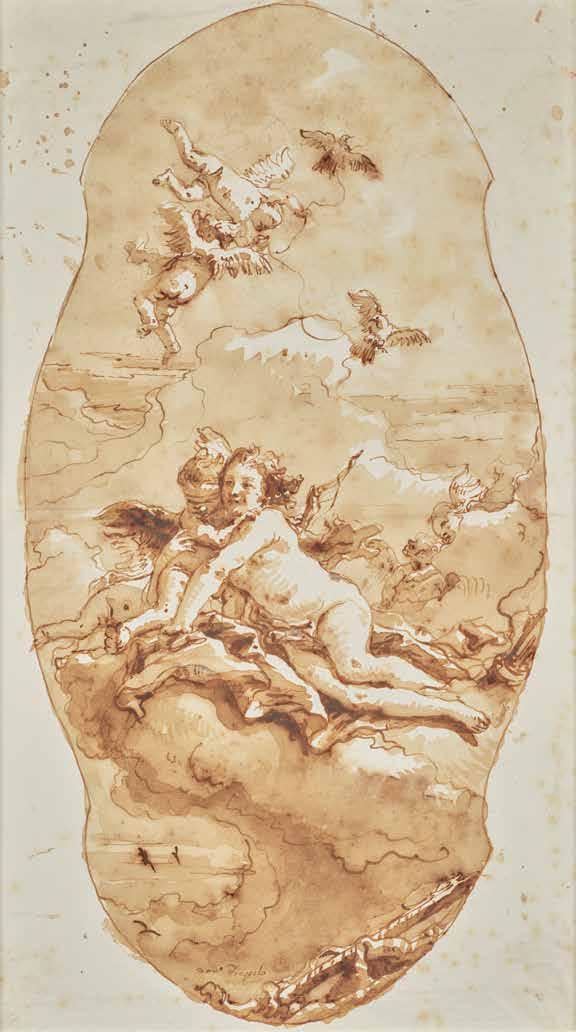
Prov. :
GIANDOMENICO TIEPOLO
Oriental conduisant une caravane de dromadaires
Plume, encre brune et lavis sur une esquisse à la pierre noire
H. 191 ; L. 283 mm
Signé au milieu à droite : « Dom. Tiepolo f »
La composition reprend fidèlement celle contenue dans l’album Divertimento per li regazzi (Gealt 1986, pp. 134-135, n˚ 55) où, à la place des personnages orientaux, figurent des Polichinelles, preuve supplémentaire de la réflexion constante de Giandomenico qui revisite et réélabore ses inventions au fil du temps. Domenico se passionne pour ces images exotiques et intemporelles qui lui permettent de réaliser des dessins fantaisistes et féériques, en accord avec son goût pour l’imagination et son talent pour représenter les animaux. Une autre feuille similaire à celle-ci, représentant Polichinelle montant un dromadaire à la tête d’une caravane est conservée au Getty Museum de Los Angeles (inv. 2017.81). Cette feuille peut être rapprochée, par son sujet, de la série des Scènes de la vie quotidienne , mais elle en diffère toutefois par ses dimensions plus réduites. Une datation dans la dernière décennie du siècle semble toutefois plausible, compte tenu des affinités stylistiques et thématiques.
Orientals Leading a Caravan of Dromedaries
Pen and brown ink, brown wash, over black chalk
H. 191; W. 283 mm
Signed lower center: “Dom. Tiepolo f”
The composition closely follows the one in the album Divertimento per li regazzi (Gealt 1986, pp. 134-135, no. 55), where there are Punchinellos instead of Oriental characters. This is further evidence of Giandomenico’s ceaseless reflection on and revisiting of his inventions over the decades. He fell in love with these exotic and timeless images, which allowed him to create bizarre, fable-like drawings, indulging his imaginative flair and talent in drawing animals. A similar work, with a Punchinello riding a dromedary at the head of a caravan, is in the Getty Museum, Los Angeles (2017.81). Thematically, the work can be linked to the so-called Scenes of Contemporary Life series, but it has smaller dimensions. However, given the resemblances of style and subjectmatter, a date in the last decade of the century seems plausible. The sheet belonged to Philip Pouncey (1910-1990), the great scholar and former Keeper of Drawings and Prints at the British Museum. ~ cat. 16 ~ ~ cat. 16 ~
Londres, Philip Pouncey ; New York, Sotheby’s, 21 janvier 2003, n° 77 ; collection privée.
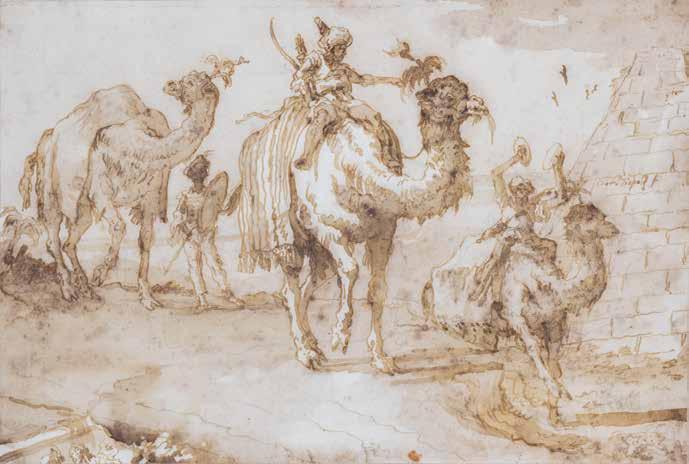
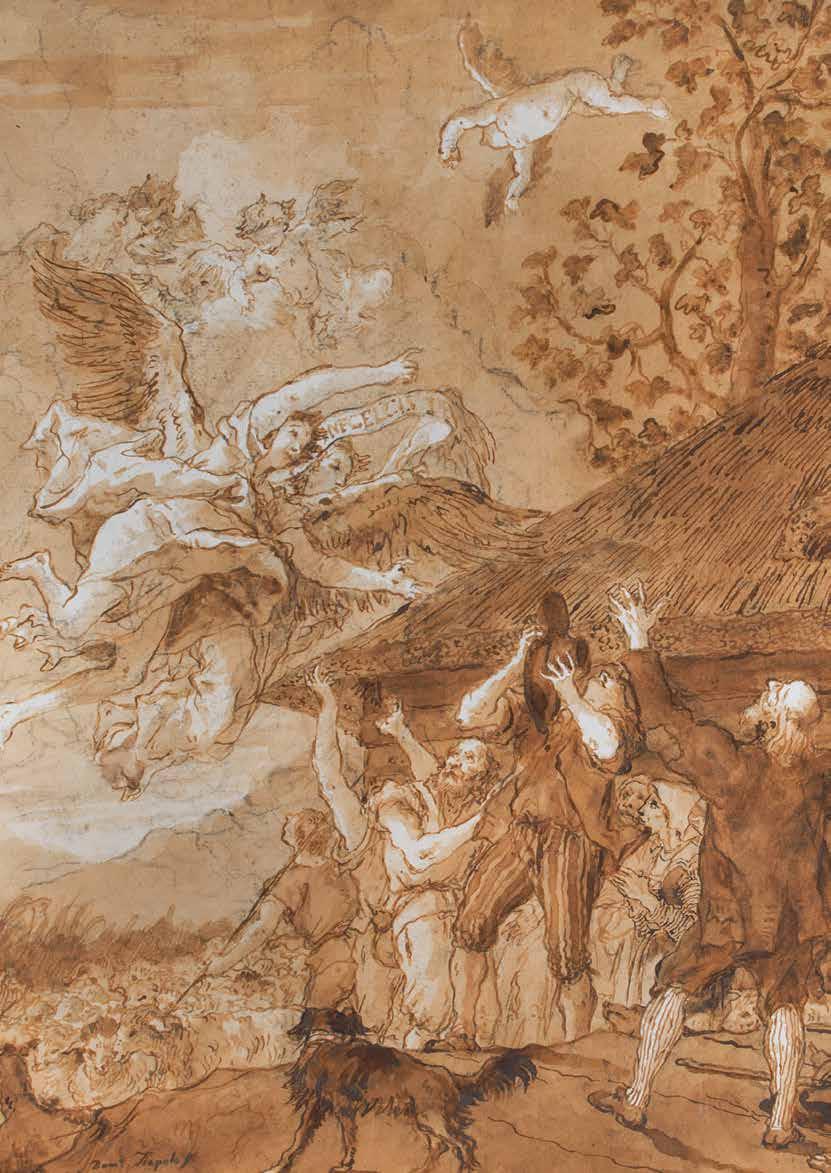
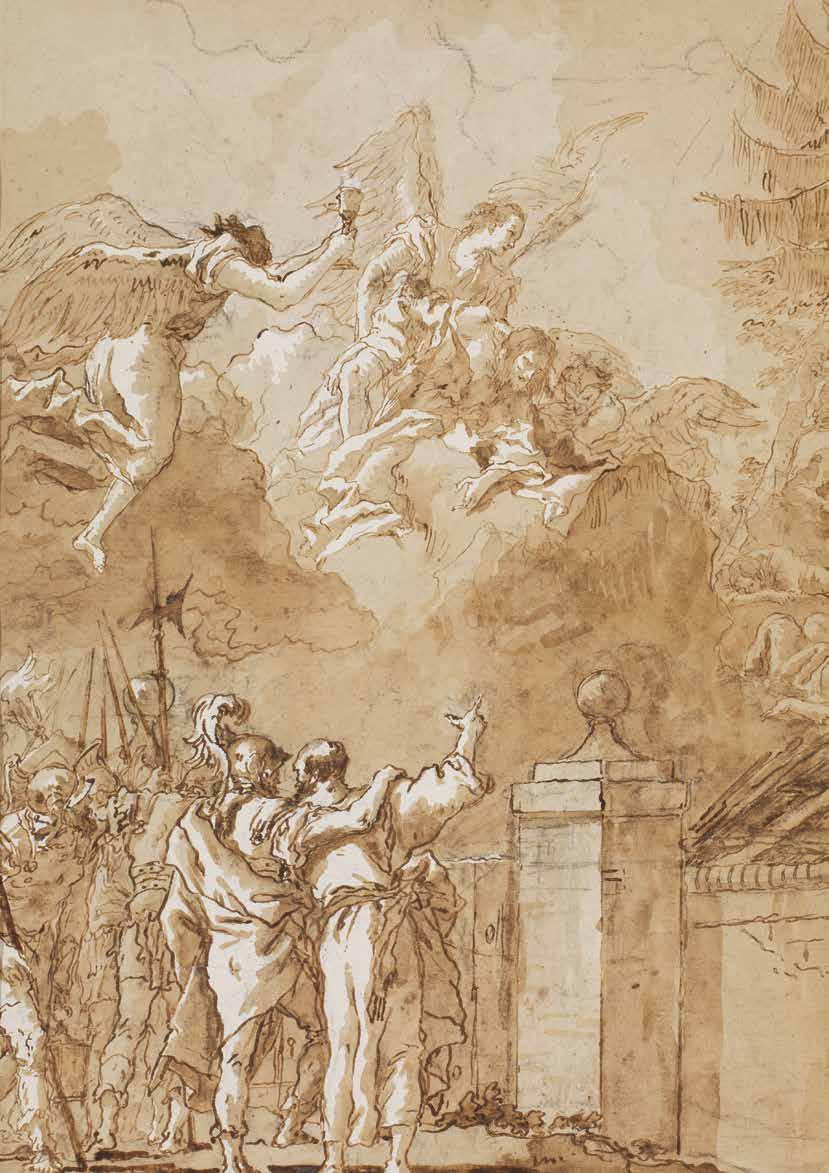
NOUVEAU TESTAMENT
NEW TESTAMENT
~ cat. 17 ~
GIANDOMENICO
TIEPOLO
La Rencontre d’Anne et de Joachim devant la Porte Dorée
Plume, encre brune et lavis sur une esquisse à la pierre noire
H. 480 ; L. 375 mm
Signé sur le mur au centre à gauche : « Dom.o / Tiepolo / f »
Prov. :
Paris, Galerie George Petit (vente Roger Cormier), 30 avril 1921, n° 12 ; Paris, Hôtel Drouot, 24 juin 1985, n° 9 ; Paris, Galerie Bérès ; Paris, Léon Suzor ; Paris, Prunier, 25 mai 2013, n° 100 ; Paris, Galerie Éric Coatalem ; collection privée.
Bibl. :
Gealt, Knox 2006, pp. 88-89, n° 10 ; Gealt 2016, p. 54.
Exp. :
Paris, Galerie Éric Coatalem, 2004.
~ cat. 17 ~
La scène montre la rencontre entre Joachim et Anne, les parents de Marie, qui, selon l’Évangile apocryphe du Pseudo-Matthieu (3,5), repris ensuite dans la Légende dorée de Jacques de Voragine, eut lieu devant la Porte d’Or ou Porta Aurea de Jérusalem, lorsque tous deux reçurent l’annonce de la grossesse prochaine d’Anne. Giandomenico enrichit la scène en y ajoutant des cavaliers, des marchands ambulants et surtout des anges en train de voler pour souligner le caractère miraculeux et exceptionnel du dessein divin.
The Meeting of Anna and Joachim at the Golden Gate
Pen and brown ink, brown wash, over black chalk
H. 480; L. 375 mm
Signed on the wall, center left: “Dom.o / Tiepolo / f”
The scene shows the meeting between Joachim and Anna, parents of the Virgin Mary, which, according to the apocryphal Gospel of Pseudo-Matthew (3:5), later also cited in Jacopo de Voragine’s Golden Legend , took place before the Golden Gate ( Porta Aurea) in Jerusalem, when they had both received the announcement of Anna’s impending pregnancy. Domenico develops the scene, enhancing it with figures of horsemen and street vendors, and above all hovering angels to underline the miraculous, exceptional aspect of the divine plan.
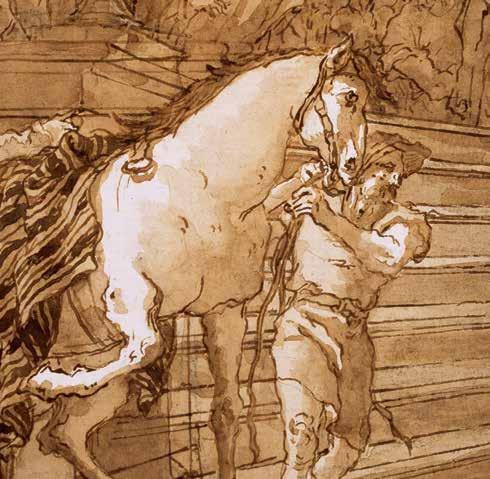
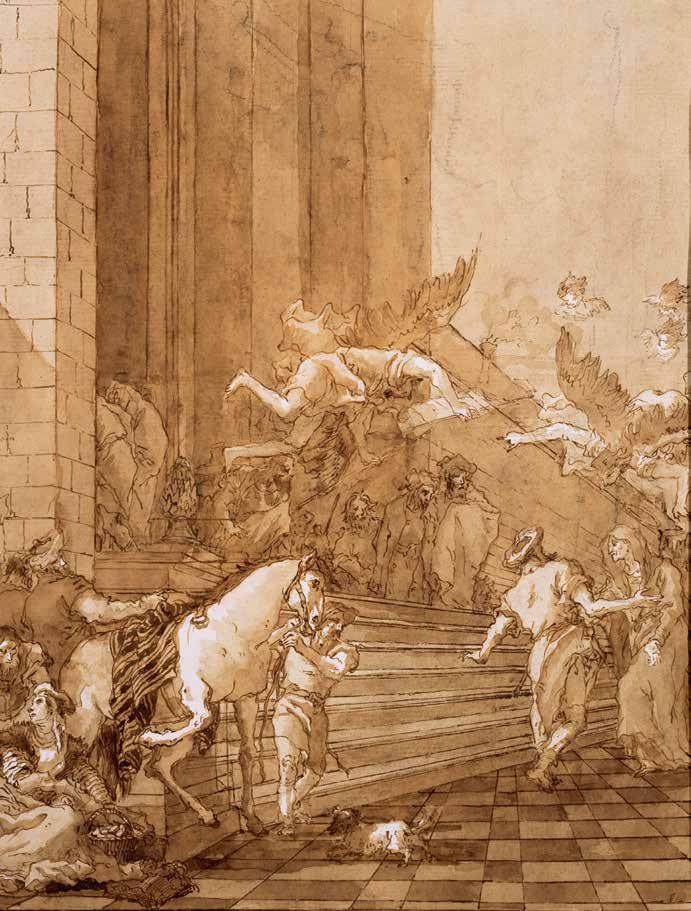
Prov. :
GIANDOMENICO TIEPOLO
L’Annonce aux Bergers
Plume, encre brune et lavis sur une esquisse à la pierre noire
H. 476 ; L. 374 mm
Signé en bas à gauche : « Dom o Tiepolo f »
Tours, Luzarche Collection ; Paris, Galerie George Petit (vente Roger Cormier), 30 avril 1921, n° 1 ; Londres, Christie’s, 7 juillet 1998, n° 150 ; Paris, Nesrine Toussoun ; collection privée.
Bibl. :
Guerlin 1921a, pp. 34, 41-42 ; Gealt, Knox 2006, pp. 144-145, n° 37.
Exp. : Baltimore 1978, n° 55.
cat. 18 ~ ~ cat. 18 ~
L’épisode de l’Évangile est raconté par Luc (2:9) et offre à Giandomenico l’occasion de représenter l’apparition de l’ange et le bouleversement des bergers face à cette manifestation céleste. Alors que la partie supérieure semble s’inspirer de modèles illustres, issus du répertoire de son père ou de Paolo Véronèse, la partie inférieure est tout à fait cohérente avec son don pour observer la vie quotidienne, même dans les milieux modestes.
Annunciation to the Shepherds
Pen and brown ink, brown wash, over black chalk
H. 476; W. 374 mm
Signed lower left: “Dom o Tiepolo f”
The Gospel episode, narrated by Luke (2:9), provides Giandomenico with an opportunity to describe the sudden appearance of angels and the shepherds’ perturbed reaction to the celestial apparition. While the upper part seems to look to illustrious prototypes, such as his father’s repertoire or that of Paolo Veronese, the lower one is entirely consistent with Giandomenico’s ability to observe everyday life and even humble environments.
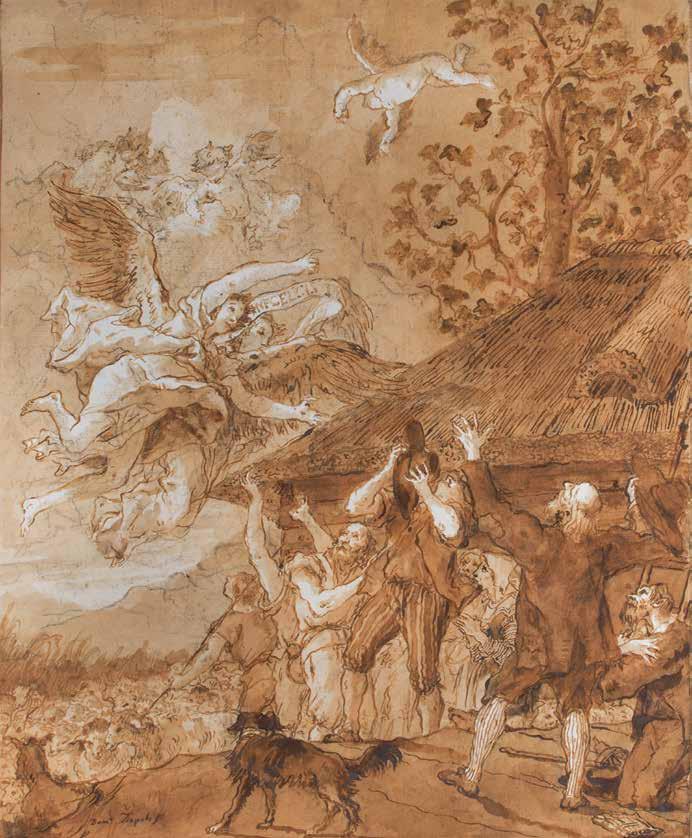
~ cat. 19 ~
GIANDOMENICO TIEPOLO
Le Retour de la Sainte Famille à Nazareth
Plume, encre brune et lavis sur une esquisse à la pierre noire
H. 481 ; L. 376 mm
Prov. :
Paris, Hôtel Drouot, M.L. Joly, 26 janvier 1911, p. 174 ; Paris, collection Jacques Guérin ; sa vente, Paris, Hôtel Drouot, 20-21 janvier 1922, n° 63 ; Tours, Hôtel de Ventes, 7 mai 1979, n° 11 ; Paris, Galerie Paul Prouté, 1980, n° 58 ; Paris, Hôtel Drouot, 2 décembre 1987, n° 22 ; Paris, Henri Gross and Stefanie Gross ; Londres, Sotheby’s, 2 juillet 2025, n° 166 ; Paris, Galerie Éric Coatalem.
Bibl. :
Gealt, Knox 2006, pp. 224-225, n° 76.
~ cat. 19 ~
L’épisode, raconté dans les Évangiles (Matthieu, 2:23), est abordé par Domenico dans l’un des dessins techniquement parmi les plus beaux de la série. On le voit en particulier dans la manière dont il crée une grande profondeur grâce aux différents traitements graphiques : entre le premier plan avec le jeune Jésus et Joseph qui avancent, où les zones de clair-obscur sont plus marquées et les lavis intenses, et le second plan avec Marie accompagnée d’anges où la manière et les ombres sont plus douces.
Return of the Holy Family to Nazareth
Pen and brown ink, brown wash, over black chalk
H. 481; W. 376 mm
This subject, narrated in the Gospels (Matthew 2:23), is treated by Domenico in one of the most beautiful drawings of the series, also as regards technique. There is a notable difference in the graphic approach between the parts with sharper chiaroscuro contrasts and washes in the foreground, with the young Jesus and Joseph moving forward, and the background scene with Mary accompanied by angels, where the manner and shading are softer, creating an effective sense of distance.
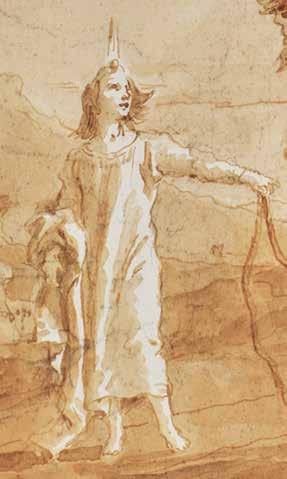
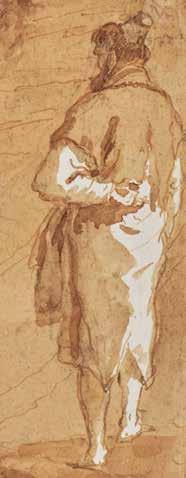
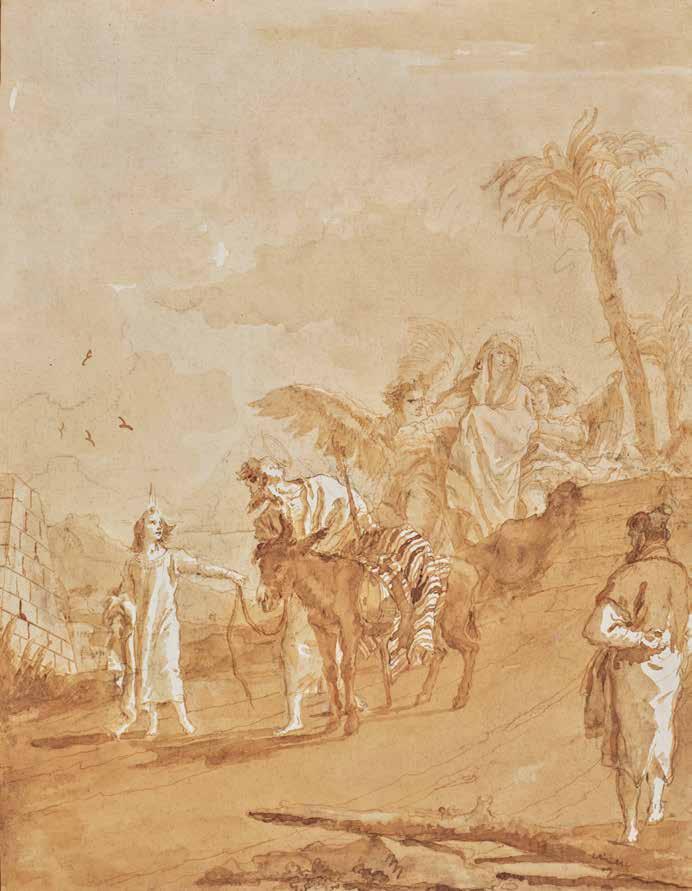
~ cat. 20 ~
Prov. :
Marie et Joseph quittant le Temple
Plume, encre brune et lavis sur une esquisse à la pierre noire
H. 475 ; L. 365 mm
Signé au milieu, au-dessus des personnages : « Dom o. Tiepolo f »
Paris, Léon Suzor ; Louviers, Jean Emmanuel
Prunier, 25 mai 2013, n° 100 ; Paris, Galerie
Éric Coatalem ; collection privée.
Bibl. :
Gealt, Knox 2006, pp. 126-127, n° 28.
Exp. :
Paris 1952, n. 34, fig. 55.
~ cat. 20 ~
Pen and brown ink, brown wash, over black chalk
H. 47 ; W. 365 mm
Signed in the center: “Dom o. Tiepolo f” GIANDOMENICO
Selon Gealt et Knox, cet épisode, absent des grands textes de référence, aurait été une invention de Domenico. Il pourrait toutefois représenter le moment où Marie et Joseph quittent le Temple de Jérusalem sans réaliser qu’ils ont perdu le jeune Jésus, resté pour prêcher parmi les Docteurs, épisode raconté dans l’Évangile selon Luc (2:43-45).
Mary and Joseph Leaving the Temple
According to Gealt and Knox, this scene is not recounted in any of the major textual sources and could have been invented by Giandomenico. However, it might instead represent the moment in which Mary and Joseph have left the Temple in Jerusalem without realizing that they have lost the young Jesus, who has remained there to preach among the Doctors. The episode is narrated in the Gospel of Luke (2:43-45).
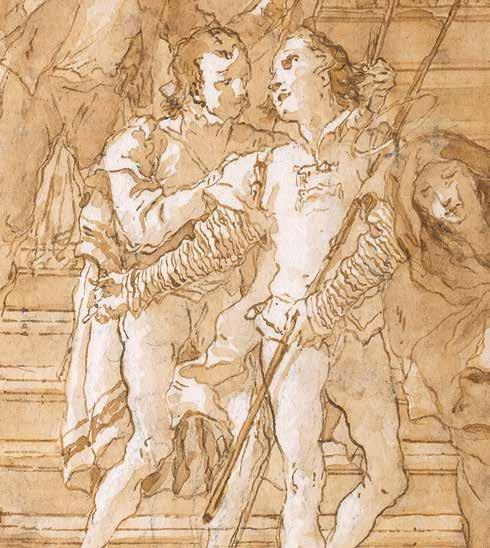
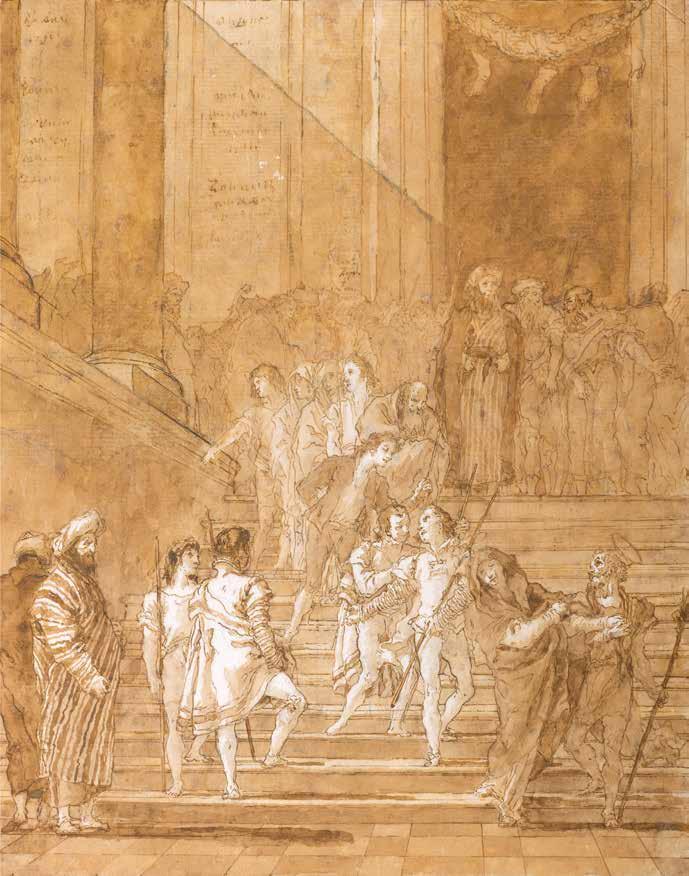
Prov. :
GIANDOMENICO TIEPOLO
Le Baptême du Christ
Plume, encre brune et lavis sur une esquisse à la pierre noire
H. 460; L. 360 mm
Signé en bas à gauche : « Domo Tiepolo f ». Annoté dans le ciel, en italien : « Voici mon Fils bien-aimé et l’objet de ma plus grande joie »
Tours, Victor Luzarche ; Paris, Galerie George Petit (vente Roger Cormier), 30 avril 1921, n° 19 ; collection du Duc de Trévise, Edouard Mortier de Trévise (1883-1946) ; sa vente, Paris, Hôtel Drouot, 8 décembre 1947, n° 29 ; Paris, Auction Art – Rémi Le Fur & Associés, 29 novembre 2010, n° 18 ; collection privée.
Bibl. :
Gealt, Knox 2006, p. 262, n° 95 ; Gealt 2016, p. 56, n° 3.17.
Identifiée avec hésitation par Gealt et Knox à une autre feuille, portant l’inscription « Ecce Agnus Dei », l’œuvre n’est réapparue et n’a été correctement publiée que récemment (Gealt 2016). La quantité de dessins consacrés au même sujet nous aide à comprendre la variété de pistes et d’idées que Giandomenico a exploré dans les récits évangéliques, allant même jusqu’à développer plusieurs scènes pour les mêmes épisodes. Dans cette feuille, les zones d’ombre et de lumière éclatante (qui rayonne autour de l’inscription et de l’apparition de la colombe) sont créées par un savant dégradé de différentes nuances de lavis.
The Baptism of Jesus
Pen and brown ink, brown wash, over black chalk
H. 460; W. 360 mm
Signed lower left: “Dom o Tiepolo f”
Inscribed in the sky, in Italian: “Here is my beloved Son and the object of my greatest joy”
Identified with some hesitation by Gealt and Knox as another sheet, which bears the inscription “Ecce Agnus Dei”, the work reemerged only recently and was published correctly (Gealt 2016). The number of drawings dedicated to this subject helps us understand the variety of inspirations and ideas that Giandomenico found in the Gospel stories, sometimes designing multiple compositions for the same episode. Different degrees of watercolor are used to skillfully create planes of shadow and dazzling light, which surrounds the inscription and the manifestation of the dove of the Hoy Spirit.
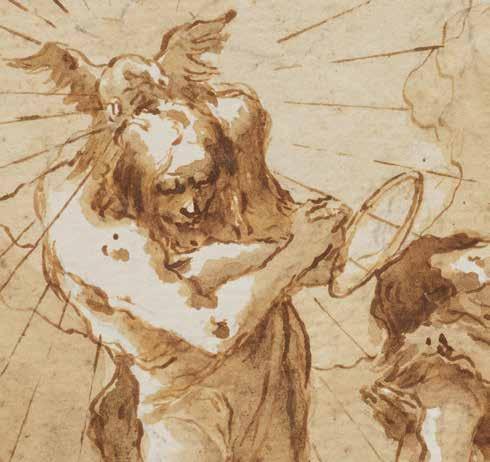
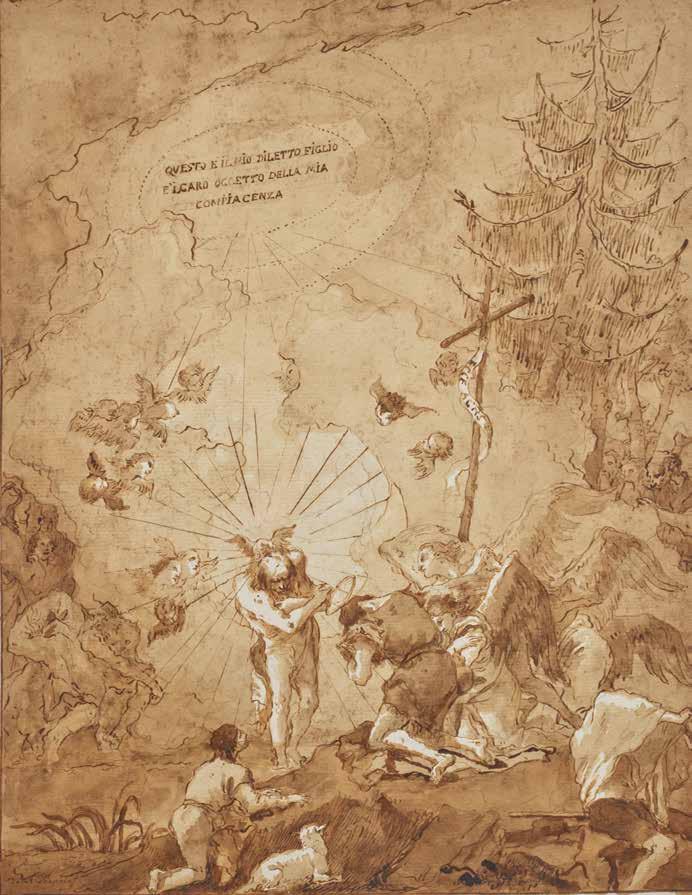
Prov. :
La Résurrection du fils de la veuve de Naïn
Plume, encre brune et lavis sur une esquisse à la pierre noire
H. 470 ; L. 365 mm
Signé sur un rocher en bas à droite : « Dom o Tiepolo / f »
Paris, Hôtel Drouot, 14 décembre 1938, n° 10 ; Michel-Lévy ; Mme. A.L.D ; Paris, Piasa, Hôtel Drouot, 21 novembre 2001, n° 67 ; collection privée.
Bibl. :
Gealt, Knox 2006, pp. 316-317, n° 121.
The Raising of the Son of the Widow of Nain
Pen and brown ink, brown wash, over black chalk
H. 470; W. 365 mm
Signed on the rock, lower right: “Dom o Tiepolo / f”
This is a grandly-composed scene highlighting the miraculous episode in the Gospel of Luke (7:15-17), with monumental architecture in the background, not unlike the more involved compositions on similar subjects painted by Giandomenico in his mature years, for example the scenes of The Pool of Bethesda and Christ and the Adulteress, both in the Musée du Louvre, Paris (Mariuz 1971, p. 132). ~ cat. 22 ~ ~ cat. 22 ~
Cette scène mélodramatique met l’accent sur l’épisode miraculeux (Luc, 7 : 1517), avec de grandes architectures en arrière-plan. Elle ressemble à celles que l’on peut trouver dans les tableaux aux sujets analogues que Giandomenico a pu réaliser pour des commandes importantes durant ces années de maturité, comme, par exemple, les scènes de La Piscine probatique et du Christ et la femme adultère, toutes deux conservées au musée du Louvre à Paris (Mariuz 1971, p. 132).
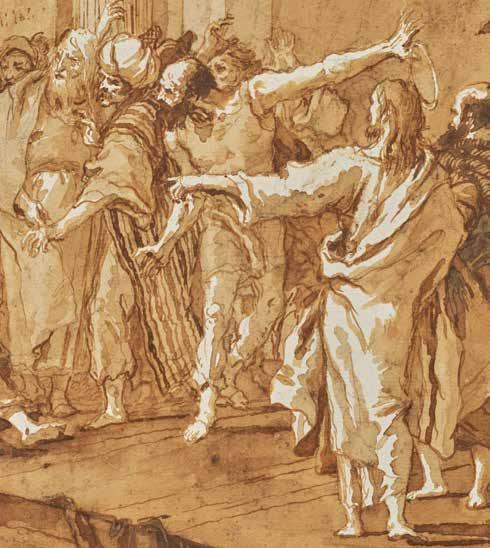
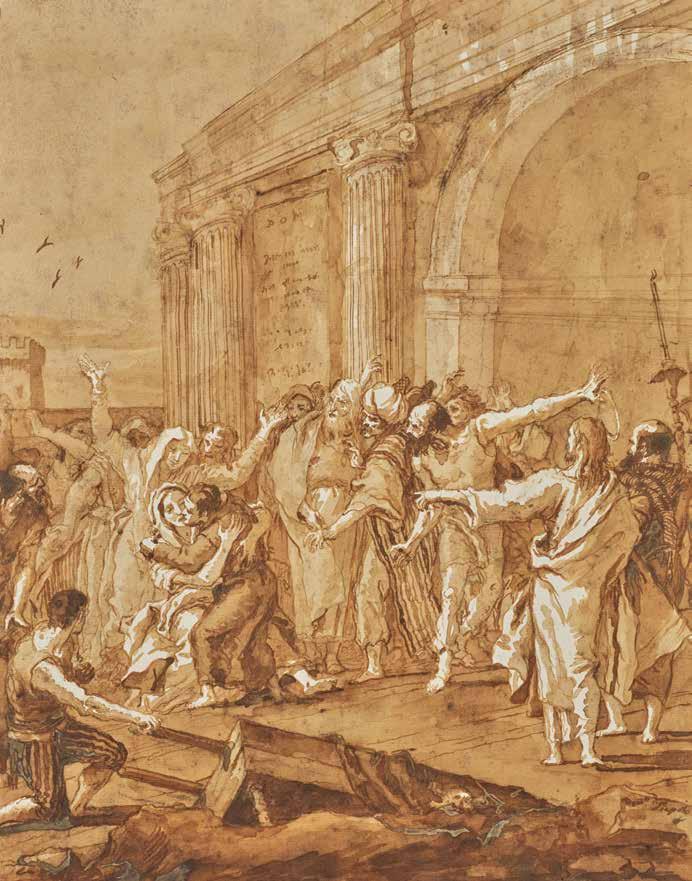
cat. 23 ~
Prov. :
La Résurrection de Lazare
Plume, encre brune et lavis sur une esquisse à la pierre noire
H. 460 ; L. 360 mm
Porte un numéro « 41 » en haut à gauche, dans la marge
Paris, Galerie George Petit (vente Roger Cormier), 30 avril 1921, n° 68 ; collection privée.
cat. 23 ~
N’étant pas illustrée parmi les dessins apparus à la vente parisienne de 1921, l’identification de cette œuvre n’est pas certaine. Bien qu’il soit fait mention d’un Christ guérit un malade, il semble plus probable qu’il s’agisse ici de la Résurrection de Lazare (Jean 11:1-44). Le dessin n’était pas connu de Knox et Gealt au moment de leur monographie sur la série en 2006 et constitue donc un ajout important au groupe.
The Raising of Lazarus
Pen and brown ink, brown wash, over black chalk
H. 460; W. 360 mm
Number “41” inscribed upper left in the margin
Since it is not illustrated among the drawings in the 1921 Paris sale, the identification of the drawing (listed there as Christ healing a sick man) is uncertain, as is the subject itself. However, it seems likely that the present sheet represents the Raising of Lazarus (as in John 11:1-44). The drawing was not known to Knox and Gealt at the time of their 2006 monograph on the series and therefore represents an important addition to the New Testament group.
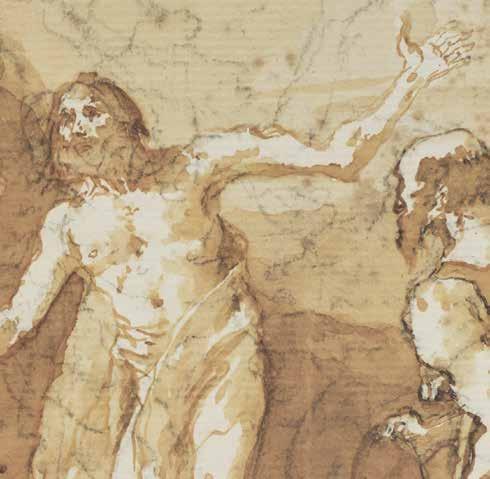
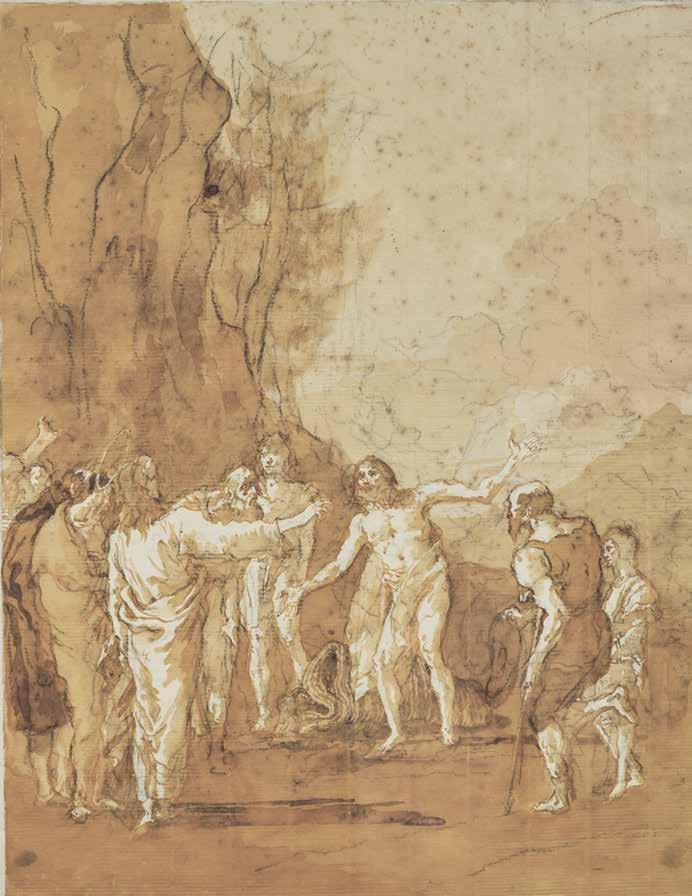
cat. 24 ~
Le fils prodigue au milieu des porcs
Plume, encre brune et lavis sur une esquisse à la pierre noire
H. 460 ; L. 360 mm
Signé en bas au centre : « Domo Tiepolo f »
Prov. :
Paris, Galerie George Petit (vente Roger Cormier), 30 avril 1921, n° 53 ; collection privée.
Bibl. :
Guerlin 1921a, pp. 67-68 ; Gealt, Knox 2006, p. 378, n° 151.
cat. 24 ~
Le dessin illustre l’épisode raconté par Jésus dans la parabole du Fils prodigue (Luc 15, 15-16) au moment où, ayant dilapidé la fortune paternelle, il est réduit à garder des porcs, animaux considérés comme impurs. Il vit dans la misère la plus totale et décide alors de rentrer chez lui pour implorer le pardon de son père. Le jeune homme est agenouillé, déjà marqué par le repentir. Cette scène offre à Domenico l’occasion de dépeindre un cadre rural, avec la chaumière dépouillée et le troupeau de porcs, mettant ainsi en valeur son talent pour représenter des animaux, que l’on retrouve souvent au cœur de ses créations.
The Prodigal Son among the Swine
Pen and brown ink, brown wash, over black chalk
H. 460; W. 360 mm
Signed lower center: “Domo Tiepolo f”
The drawing depicts the episode narrated by Jesus in his Parable of the Prodigal Son (Luke 15:15-16), which represents the lowest point in the story of the son who has squandered his father’s wealth and is now reduced to herding pigs (animals considered impure), living in abject poverty until he decides to return home to beg forgiveness. The young man is kneeling and appears to be already contrite. The scene offers Domenico the occasion to depict a rural setting, with the simple hut and herd of swine, showcasing his skill in drawing various kinds of animals, who often play a protagonist’s role in his inventions.
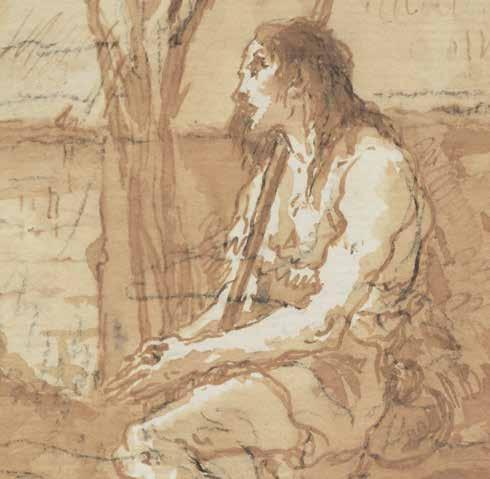
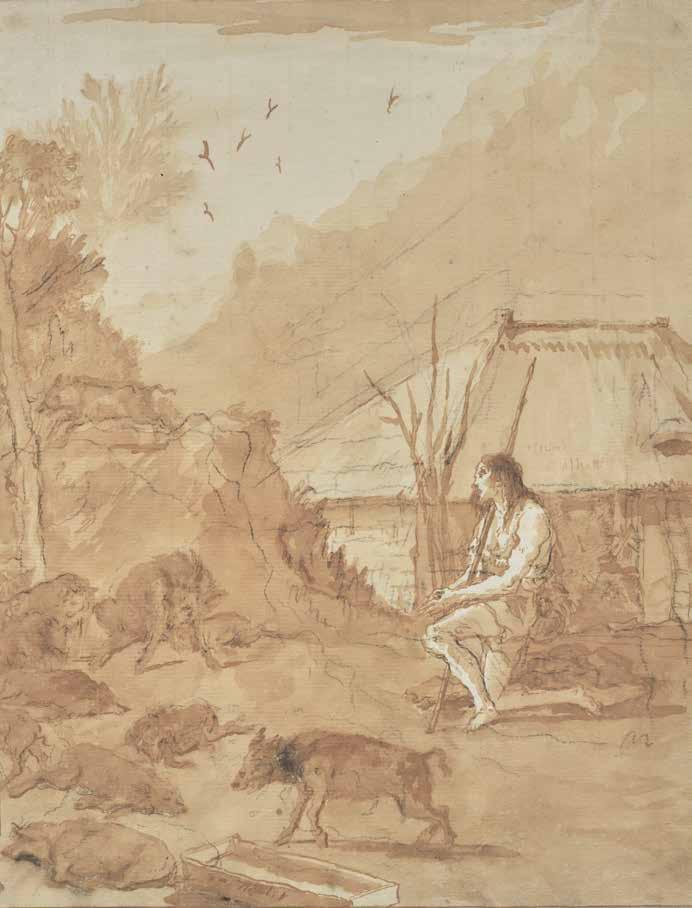
La Rencontre de Jésus et Zachée
Plume, encre brune et lavis sur une esquisse à la pierre noire
H. 458 ; L. 356 mm
Signé en bas à droite : « Dom o Tiepolo f »
Prov. :
Paris, Galerie George Petit (vente Roger Cormier), 30 avril 1921, n° 15 ; Londres, Sotheby’s, 21 juin 1978, n° 40 ; Paris, Adolphe Stein ; Allemagne, collection privée ; Londres, Colnaghi, Katrin Bellinger, avril 2011 ; Paris, collection Hubert Guerrand-Hermès ; Paris, Sotheby’s, 13 décembre 2023, n° 37 ; Paris, Galerie Éric Coatalem ; collection privée.
Bibl. :
Gealt, Knox 2006, pp. 412-413, n° 168.
Jesus Meetings Zacchaeus
Pen and brown ink, brown wash, over black chalk
H. 458; W. 356 mm
Signed lower right: “Dom o Tiepolo f”
This Gospel episode (Luke 19:2-7) opens the final days of Jesus’ earthly ife as he prepares to enter Jerusalem to face his Passion and death. It tells of the tax collector Zacchaeus, who had climbed a sycamore tree to observe Jesus’s arrival. Addressing him by name, Jesus prompts his conversion. For Giandomenico, the scene provides the occasion to depict an extensive sequence of old men’s heads, dressed “all’orientale”, as they observe the scene outside the city walls. ~ cat. 25 ~ ~ cat. 25 ~
L’épisode de l’Évangile selon Luc (19, 2-7) ouvre la dernière phase de la vie de Jésus, alors qu’il se prépare à entrer à Jérusalem pour souffrir sa Passion. Il relate l’histoire de Zachée le collecteur d’impôts qui, afin de voir Jésus passer, grimpe à un sycomore. Jésus l’interpelle alors par son nom, ce qui provoque sa conversion. Pour Giandomenico, cette scène permet de représenter une longue série de têtes de vieillards, vêtus à l’orientale, observant la scène depuis l’extérieur des remparts de la ville.
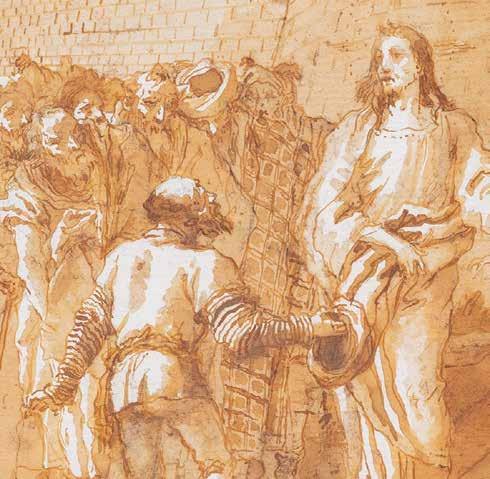
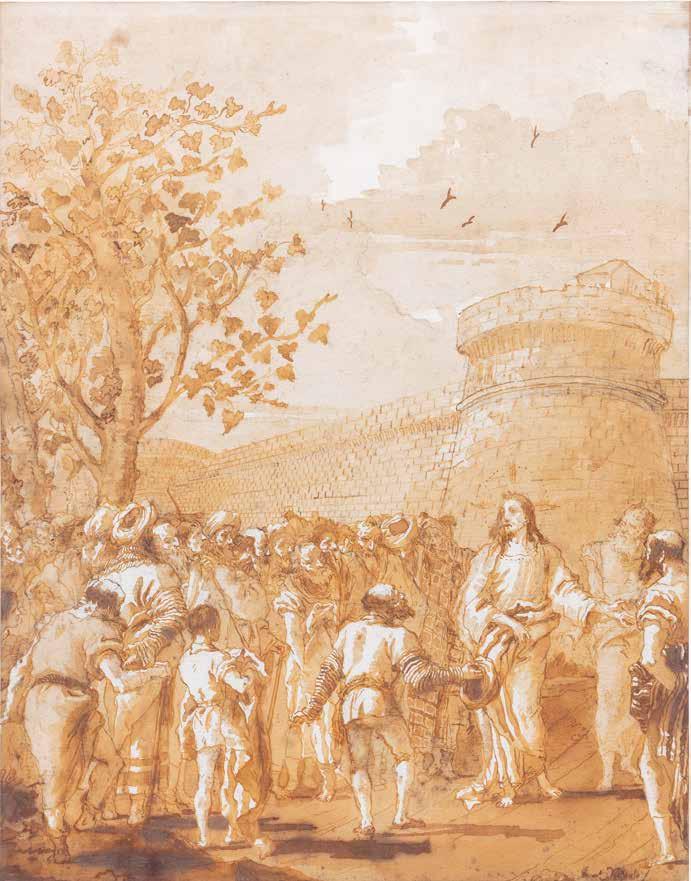
La Prière dans le jardin de Gethsémani
Plume, encre brune et lavis sur une esquisse à la pierre noire
H. 460 ; L. 360 mm
Signé en bas à droite : « Dom o. Tiepolo f »
Prov. :
Tours, Victor Luzarche ?; Paris, collection privée ; Paris, Christie’s, 29 mars 2012, n° 33 ; Paris, Galerie Éric Coatalem et Hambourg, Le Claire Kunst ; collection Anne S. Bent.
Bibl. :
Gealt 2016, p. 58.
Dans sa série de dessins inspirés du Nouveau Testament, Giandomenico a consacré trois feuilles à ce moment, extrêmement poignant, de la prière du Christ dans le jardin. Il y est alors représenté seul en train de prier ou au moment de son arrestation. Cette feuille-ci, en revanche, illustre l’instant où le Christ, réconforté par des anges sur un promontoire rocheux, est désigné par Judas, qui accompagne les soldats venus l’arrêter.
Agony in the Garden
Pen and brown ink, brown wash, over black chalk
H. 460; W. 360 mm
Signed lower right: “Dom o. Tiepolo f”
In his series of drawings illustrating the New Testament, Giandomenico dedicated three sheets to the supremely dramatic episode of Christ in the Garden of Gethsemane, depicting Jesus alone in prayer and then his arrest. This sheet represents the moment when Christ, comforted by angels on a rocky outcrop, is identified by Judas as he accompanies the soldiers who have come to take him into custody. ~ cat. 26 ~ ~ cat. 26 ~
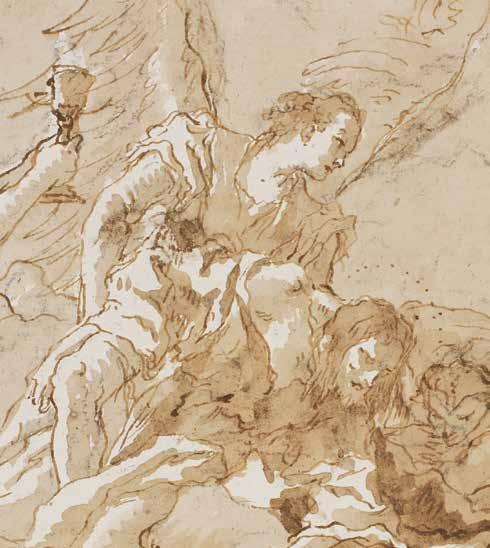
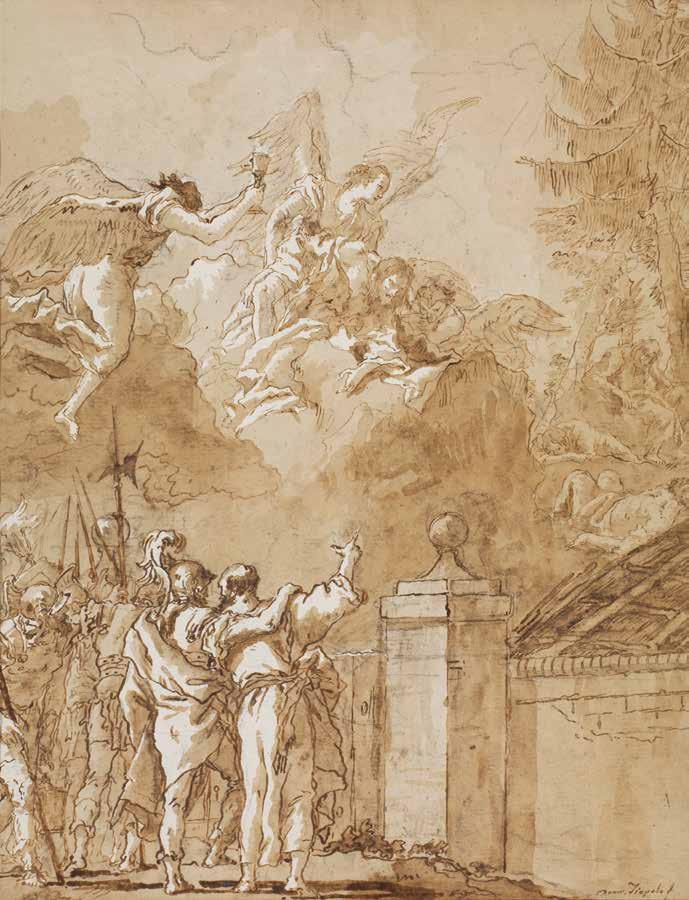
Prov. :
GIANDOMENICO TIEPOLO
Le Reniement de saint Pierre
Plume, encre brune et lavis sur une esquisse à la pierre noire
H. 460 ; L. 360 mm
Signé sur la colonne centrale : « Dom o Tiepolo f »
Paris, Jean-François Gigoux, 1882, n° 175 ; vente Trotti, 1932 ; Paris, Galerie Éric Coatalem ; collection privée.
Bibl. :
Gealt, Knox 2006, pp. 464-465, n° 191.
Cet épisode représente un moment crucial du récit évangélique de la Passion du Christ (Matthieu 26 : 74-75 ; Marc 14 :68) quand, comme Jésus l’avait prédit lors de la Cène, Pierre le renie trois fois avant le chant du coq. La scène, qui semble se dérouler sous un portique de la place Saint-Marc plutôt qu’à Jérusalem, est caractérisée par la figure de Pierre qui, descendant les marches, se cache le visage, rongé par la honte et la culpabilité. Comme souvent, il s’agit d’un emprunt au répertoire de Giambattista Tiepolo, que Domenico adapte pour l’occasion : en l’occurrence, un calque de l’Agamemnon figurant dans le Sacrifice d’Iphigénie de la Villa Valmarana à Vicence (1757) (fig. 13).
of Peter
Pen and brown ink, brown wash, over black chalk
H. 460; W. 360 mm
Signed on the central column:
“Dom o Tiepolo f”
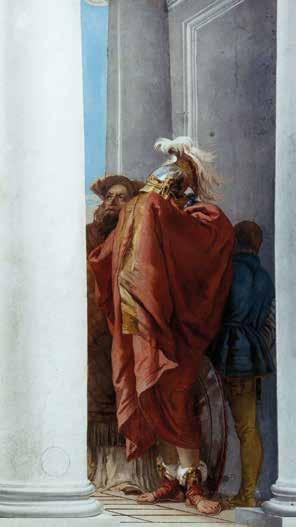
The episode represents a crucial moment in the Gospel account of the Passion of Christ (Matthew 26:74-75; Mark 14:68), when, as predicted by Jesus during the Last Supper, Peter denies knowing him on three occasions before the cock crows. The scene, which seems to take place under a portico in Venice’s Piazza San Marco rather than in Jerusalem, is centered on the figure of Peter who hides his face out of shame and guilt as be descends the stairs. As was often the case, this is one of the many borrowings from Giambattista Tiepolo’s repertoire, adapted by Domenico for his own purposes, in this case a reiteration of the figure of Agamemnon from the Sacrifice of Iphigenia frescoed in the Villa Valmarana, Vicenza (1757) (fig. 13).
(fig. 13 )
Giambattista Tiepolo, Le Sacrifice d’Iphigénie, fresque, Vicenza, Villa Valmarana (fig. 13 )
Giambattista Tiepolo, The Sacrifice of Iphigenia, fresco
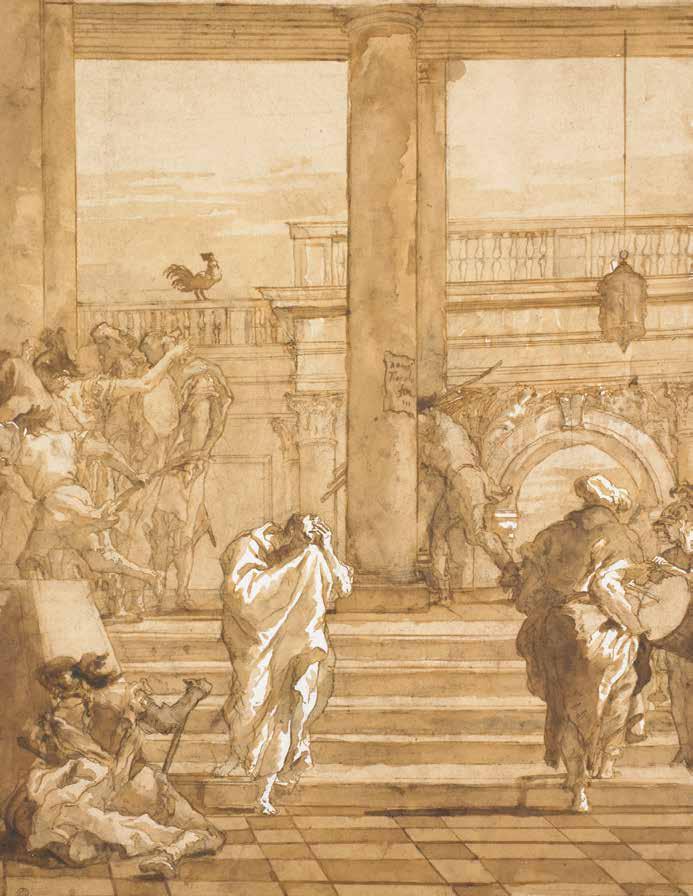
cat. 28 ~
Prov. :
GIANDOMENICO TIEPOLO
La Flagellation
Plume, encre brune et lavis sur une esquisse à la pierre noire
H. 460 ; L. 360 mm
Signé sur une colonne à droite : « Domo Tiepolo f »
Genève, Durand-Matthiesen, 1966 ; Monaco, Sotheby’s, 2 décembre 1989, n° 22 ; New York, Peter Jay Sharp ; collection privée.
Bibl. : Guerlin 1921a, pp. 79-80 ; Gealt, Knox 2006, pp. 468-469, n° 193.
Exp. : New York 1994, n° 30 ; Udine-Bloomington 1996, n° 103.
~ cat. 28 ~
Flagellation
Pen and brown ink, brown wash, over black chalk
H. 460; 360 mm
Signed on a column, on the right: “Domo Tiepolo f”
La composition de ce fameux épisode évangélique relatif à l’histoire de la Passion (Jean 19:1) reprend, dans ses lignes fondamentales, l’invention picturale créée par Domenico pendant sa période espagnole pour l’église de San Filippo Neri (aujourd’hui Madrid, Museo Nacional del Prado). On trouve en particulier la figure du bourreau donnant un coup de pied au premier plan et le croisement des lignes projetées par les verges levées au-dessus de la tête du Christ par les différents tortionnaires.
The composition of the well-known Gospel episode in the story of Christ’s Passion (John 19:1) essentially follows the composition created by Domenico during his Spanish period, painted for the church of Saint Philip Neri (now in the Museo del Prado, Madrid), and in particular the figure of the kicking assailant in the foreground and the crossed lines of the rods raised over Christ’s head by the various tormentors.
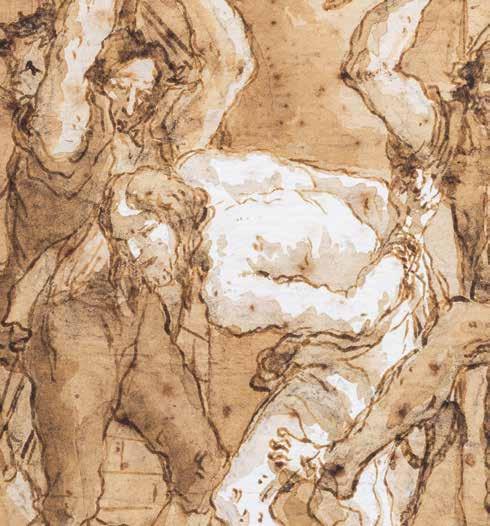
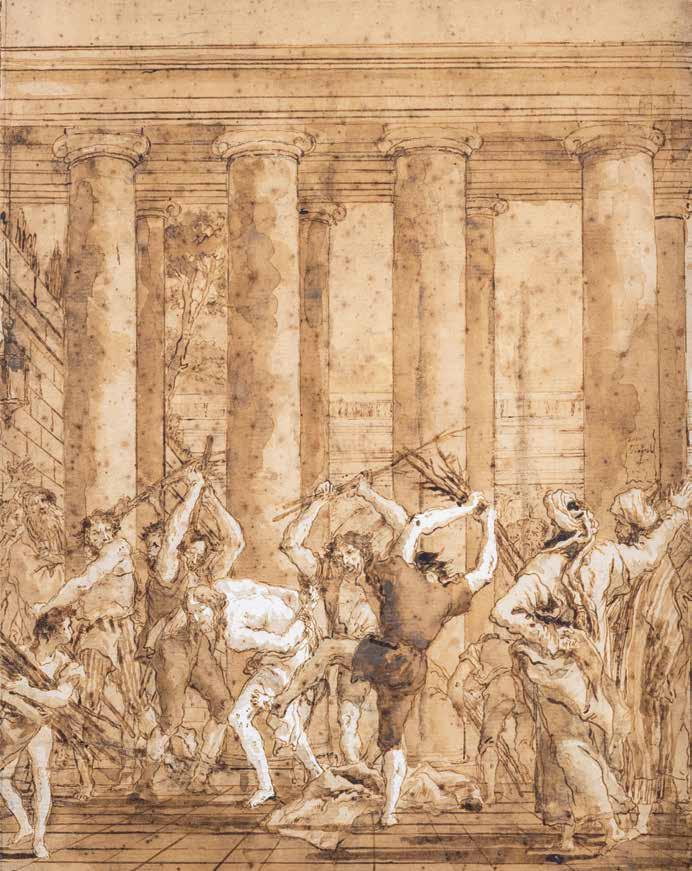
Prov. :
GIANDOMENICO TIEPOLO
L’Érection de la Croix
Plume, encre brune et lavis sur une esquisse à la pierre noire
H. 460 ; L. 355 mm
Signé en bas à droite : « Dom.o Tiepolo f »
Tours, Victor Luzarche ?; Paris, Paul Suzor ; Paris, Millon, 8 décembre 2010, n° 1 ; Londres, Stephen Ongpin Fine Art ; collection privée.
Bibl. : Gealt 2016, p. 60.
Exp. : Bloomington 2007 ; Stanford 2011 ; Bloomington 2016, pp. 66-67.
~ cat. 29 ~ ~ cat. 29 ~
Ce dessin, récemment réapparu sur le marché de l’art, était inconnu de Knox et Gealt lors de leur étude de la série. Il représente manifestement un épisode intermédiaire entre le Christ cloué sur la croix et la Crucifixion proprement dite (Gealt, Knox 2006, p. 482-485, nn˚ 199, 200). On reconnaît en particulier les mêmes soldats arborant des insignes romains que l’on aperçoit dans l’épisode qui le précède.
The Raising of the Cross
Pen and brown ink, brown wash, over black chalk
H. 460; W. 355 mm
Signed lower right: “Dom.o Tiepolo f”
This sheet has only recently resurfaced on the art market; it was unknown to Knox and Gealt when they studied the series. It evidently represents an intermediate moment between the episodes of Christ being nailed to the cross and the Crucifixion itself (Gealt, Knox 2006, pp. 482-485, nos. 199, 200). In particular, the soldiers with Roman insignia seen in the first of those images reappear in this drawing.
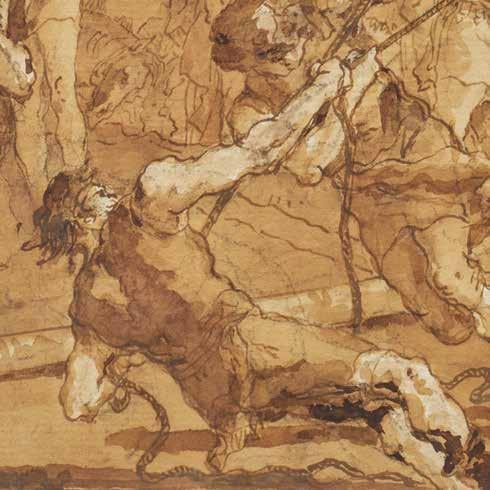
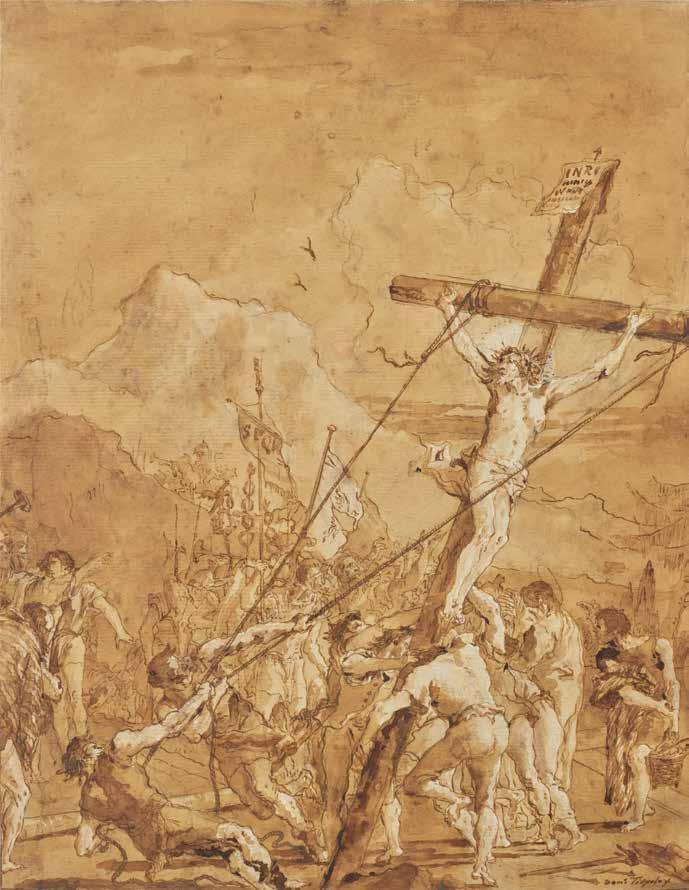
cat. 30 ~
Prov. :
GIANDOMENICO TIEPOLO
Pierre guérissant un paralytique à Lydda
Plume, encre brune et lavis sur une esquisse à la pierre noire, H. 460 ; L. 360 mm
Signé sur le mur : « Dom.o Tiepolo f »
Porte une inscription : « Dans la ville de Lyda, saint Pierre guérit un paralytique qui n’avait pas quitté son lit depuis 8 ans »
Paris, Galerie George Petit (vente Roger Cormier), 30 avril 1921, n° 10 ; collection du Duc de Trévise, Edouard Mortier de Trévise (1883-1946) ; sa vente, Paris, Hôtel Drouot, 8 décembre 1947, n° 27 ; Paris, Hôtel Drouot, 9 mars 1988, p.165 ; Londres, Kate de Rothschild ; collection privée.
Bibl. :
Guerlin 1921a, pp. 109-111 ; Gealt, Knox 2006, pp. 570-571, n° 240.
cat. 30 ~
L’épisode de la guérison miraculeuse est relaté dans les Actes des Apôtres (9 : 32-35). Domenico trace les lignes de perspective de son petit théâtre, dans lequel se pressent de nombreux personnages, parmi lesquels, au centre, Pierre qui désigne le paralytique en train se relever de sa modeste couche. Derrière lui, l’inscription qui décrit et précise cet épisode peu connu simule, avec une invention capricieuse, une véritable épigraphie.
Peter Healing a Paralytic in Lydda
Pen and brown ink, brown wash, over black chalk
H. 460; W. 360 mm
Signed: “Dom.o Tiepolo f”
Inscribed: “In the city of Lyda, Saint Peter healed a paralytic who had not left his bed for 8 years”
The episode of the miraculous healing is narrated in the Acts of the Apostles (9:32-35). Domenico uses a perspective grid to create a small theatrical space in which the figures crowd into an interior. The many characters include Peter, in the center, whose hand points to the paralyzed man rising from his modest bed. Behind them, inventively placed on a wall tablet, an inscription is used to specify the little-known episode.
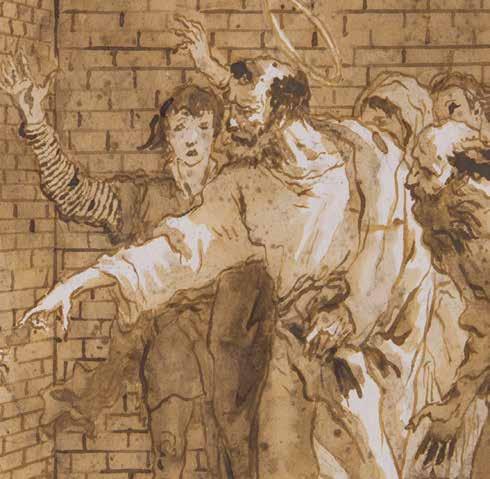
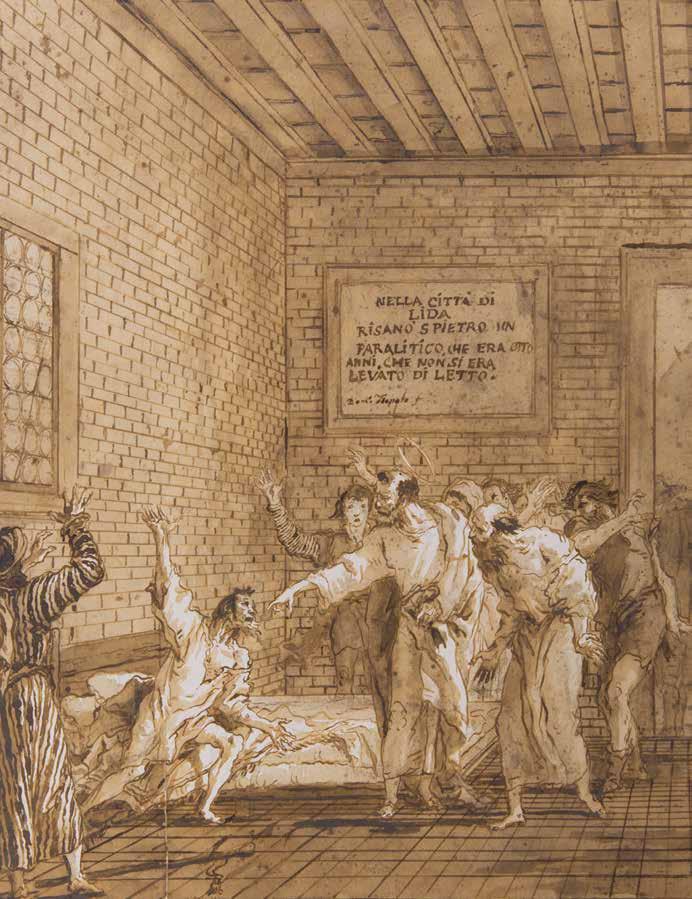
GIANDOMENICO
TIEPOLO
La Crucifixion de saint Pierre
Plume, encre brune et lavis sur une esquisse à la pierre noire
H. 460 ; L. 360 mm
Signé en bas à droite : « Dom o Tiepolo f »
Prov. :
Paris, Galerie George Petit (vente Roger Cormier), 30 avril 1921, n° 82 ; New York, George & Frances Blumenthal, 1936 ; collection du Duc de Trévise, Édouard Mortier de Trévise (1883-1946) ; sa vente, Paris, Hôtel Drouot, 8 décembre 1947, n° 52; collection privée.
Bibl. :
Guerlin 1921a, pp. 127-128; Gealt, Knox 2006, pp. 610-611; Gealt 2016, p. 60.
Exp. :
Chicago 1938, p. 43, n° 92.
cat. 31 ~
Crucifixion of Peter
Pen and brown ink, brown wash, over black chalk
H. 460; W. 360 mm
Signed lower right: “Dom o Tiepolo f”
The composition is clearly divided into upper and lower sections: below, we see the actual martyrdom – Peter was famously crucified upside down – while bystanders crowd the background, which includes a depiction of the Colosseum in Rome. In the upper area, angels swoop down, bearing not only the palm of martyrdom but also the keys of the Kingdom of Heaven, which were to become the distinctive attribute of Peter and of all Vicars of Christ. ~ cat. 31 ~
La composition est nettement divisée en deux parties. La partie inférieure représente la crucifixion de Pierre, connu pour avoir été exécuté la tête en bas, tandis qu’à l’arrière-plan, une foule de badauds se presse, laissant entrevoir le Colisée. Dans la partie supérieure, un ange descend du ciel en portant non seulement la palme du martyre, mais aussi les clés du Royaume des Cieux, qui deviendront l’attribut emblématique de Pierre et du Vicaire du Christ.
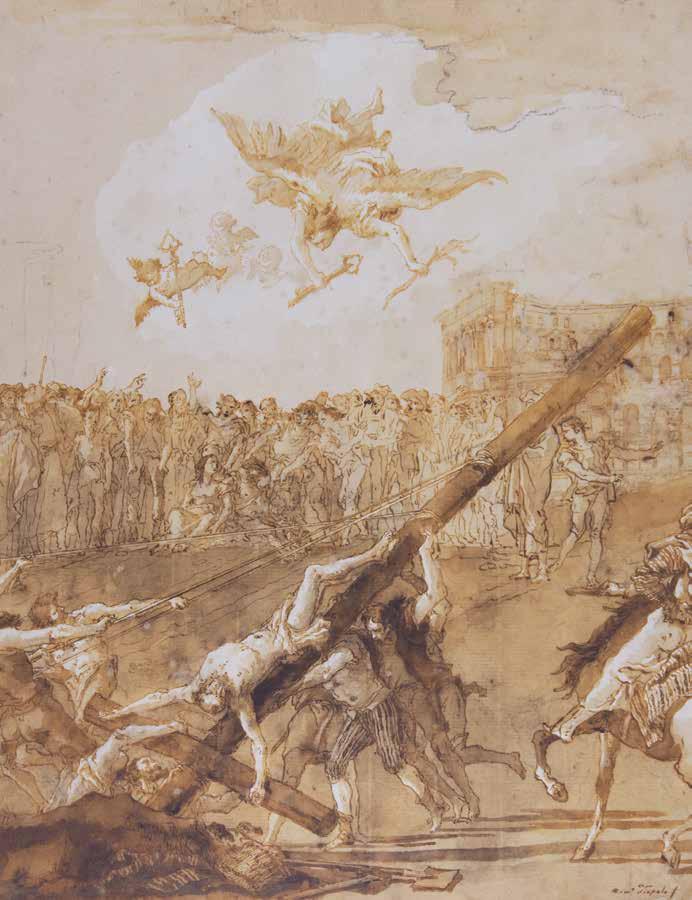
GIANDOMENICO TIEPOLO
La Lapidation de Simon Magus (?)
Plume, encre brune et lavis sur une esquisse à la pierre noire
H. 460 ; L. 360 mm
Signé en bas à gauche : « Dom o Tiepolo f »
Prov. :
Paris, Galerie George Petit (vente Roger Cormier), 30 avril 1921, n° 57 ; collection privée.
Bibl. :
Gealt, Knox 2006, p. 664, n° 288.
Ce dessin, reproduit ici pour la première fois, représente un épisode des Actes des Apôtres difficile à identifier. Il pourrait s’agir de la tentative de lapidation subie par Paul à Lystre (14, 19-28), sujet proposé dans le catalogue de vente de la galerie George Petit en 1921. Il est cependant plus probable qu’il s’agisse d’un autre épisode, également lié aux Actes des Apôtres mais attesté par plusieurs sources apographiques : la lapidation de Simon le Mage. Le personnage persécuté et lapidé par la foule ne ressemble en effet à aucun des apôtres ; son étrange coiffe suggère même qu’il pourrait s’agir d’un mage. Simon le Mage était le protagoniste d’autres scènes de la série, deux feuilles notamment étaient consacrées à sa chute. La lapidation aurait eu lieu immédiatement après.
Stoning of Simon Magus (?)
Pen and brown ink, brown wash, over black chalk
H. 460; W. 360 mm
Signed lower left: “Dom o Tiepolo f”
The drawing, illustrated here for the first time, depicts an obscure episode narrated in the Acts of the Apostles. On the one hand, it could be the attempted stoning of Saint Paul in Lystra (14:19-28), as proposed in the catalogue of the sale at the Galerie Georges Petit in 1921. On the other, it could more likely be a second episode, also associated with the Acts of the Apostles, and attested by several apocryphal sources, namely the Stoning of Simon Magus. The figure persecuted and attacked by the crowd does not appear to resemble any of the apostles in appearance, and – given his curious headdress – could be identified as a magician. Simon Magus was the protagonist of other scenes in the series, and indeed two sheets were dedicated to his fall; the stoning would have occurred immediately afterward.
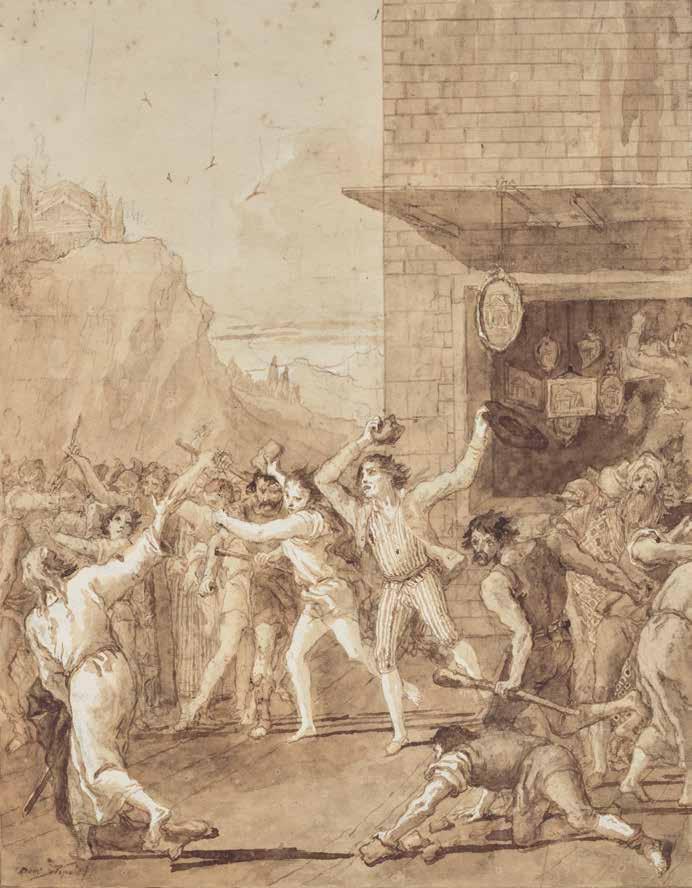
GIANDOMENICO TIEPOLO
L’Exécution
Plume, encre brune et lavis sur une esquisse à la pierre noire
H. 489 ; L. 387 mm
Signé en bas à droite : « Dom o Tiepolo f »
Prov. :
Tours, Victor Luzarche ?; Paris, Galerie George Petit (vente Roger Cormier), 30 avril 1921, n° 28 ; Paris, Hôtel Drouot, 17 décembre 1942, n° 11 ; Paris, Hôtel Drouot, 4 février 1959, n° 53 ; Berne, Klipstein and Kornfeld, 16 juin 1960, n° 323 ; New York, Sotheby’s, 13 janvier 1993, n° 106 ; D. Feinberg ; Londres, Sotheby’s, 6 juillet 2016, p. 175, n° 237 ; collection Roberta J.M. Olson et Alexander B.V. Johnson.
Bibl. :
Guerlin 1921b, p. 226 ; Byam Shaw 1962, p. 62 ; Gealt, Knox 2006, pp. 708-709, n° 309.
La composition est très proche de celle du peloton d’exécution du Divertimento per li regazzi , où tant les bourreaux que les victimes sont des Polichinelles (Gealt 1986, p. 166-167, n˚ 71) mais, si l’usage de fusils était acceptable dans ce cas, ici elle ne l’est évidemment pas (malgré l’interprétation de Gealt et Knox). La structure générale de cette image est principalement liée à une gravure de Callot représentant une scène de fusillade (Mariuz 1986, p. 268), que Domenico avait utilisée des années auparavant pour la première fois pour la série du Nouveau Testament. Cette invention dut tellement l’impressionner qu’il l’a réemployée ici pour une scène qui, de toute évidence, pour des raisons de contexte historique, ne pouvait comporter aucune arme à feu.
Parade Ground
Pen and brown ink, brown wash, over black chalk
H. 489; W. 387 mm
Signed lower right: “Dom o Tiepolo f”
The composition closely follows that of the firing squad in the Divertimento per li Regazzi , where both executioners and the victims are Punchinellos (Gealt 1986, pp. 166-167, no. 71). In that case, the presence of rifles is evident, obviously unlike here (notwithstanding Gealt and Knox’s interpretation). The overall structure of that image is linked primarily to a print by Callot depicting a scene of execution by shooting (Mariuz 1986, p. 268), and Domenico used it for the first time years earlier in the New Testament series. The invention must have impressed him so much that he adapted it here for a scene in which firearms could evidently not have been historically appropriate.
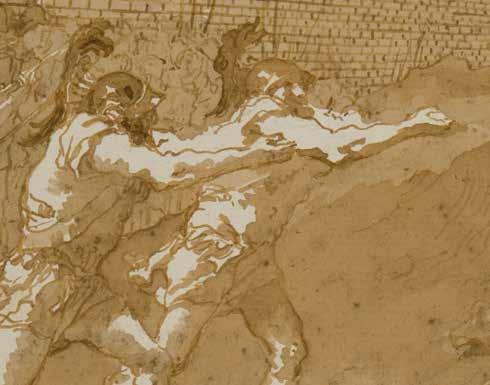
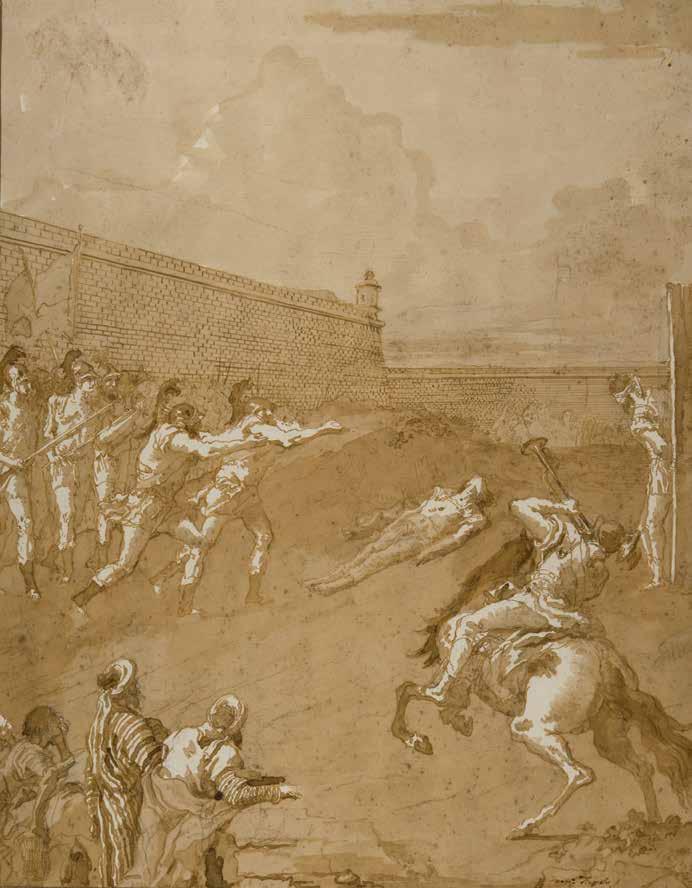
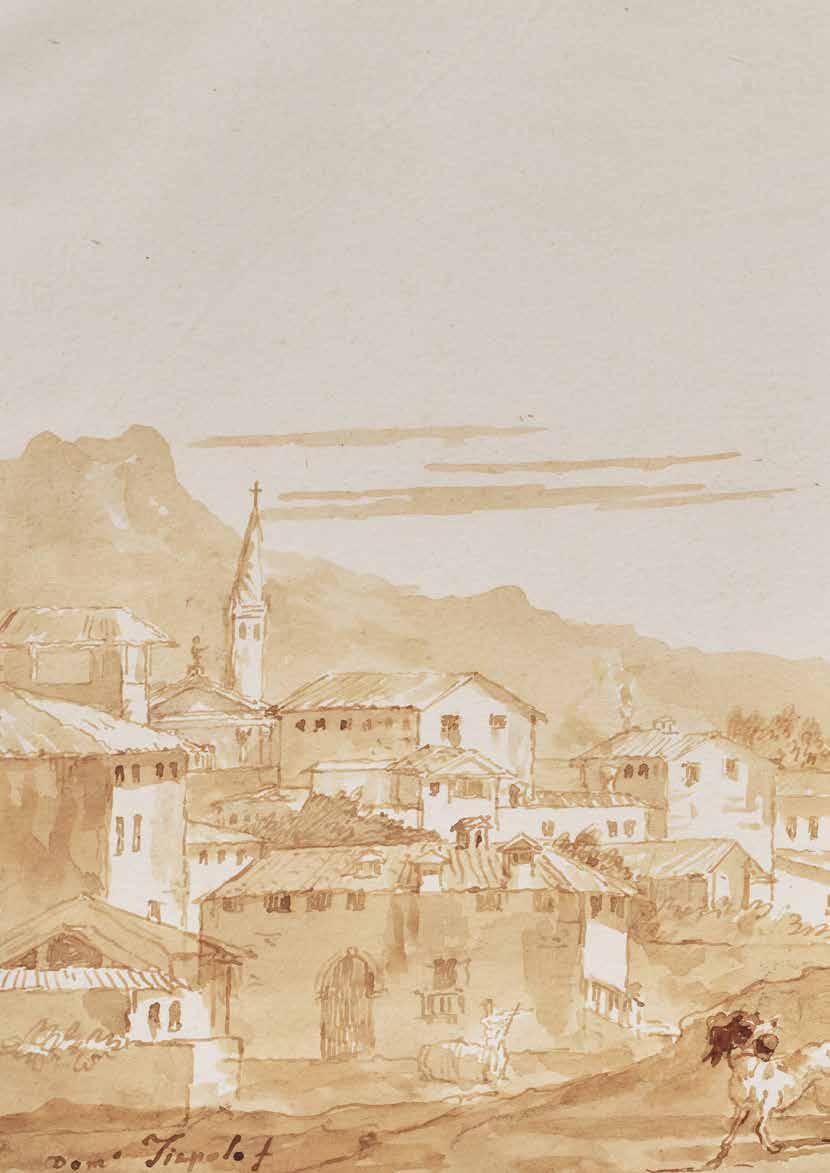
SCÈNE DE LA VIE
CONTEMPORAINE
SCENES OF CONTEMPORARY LIFE
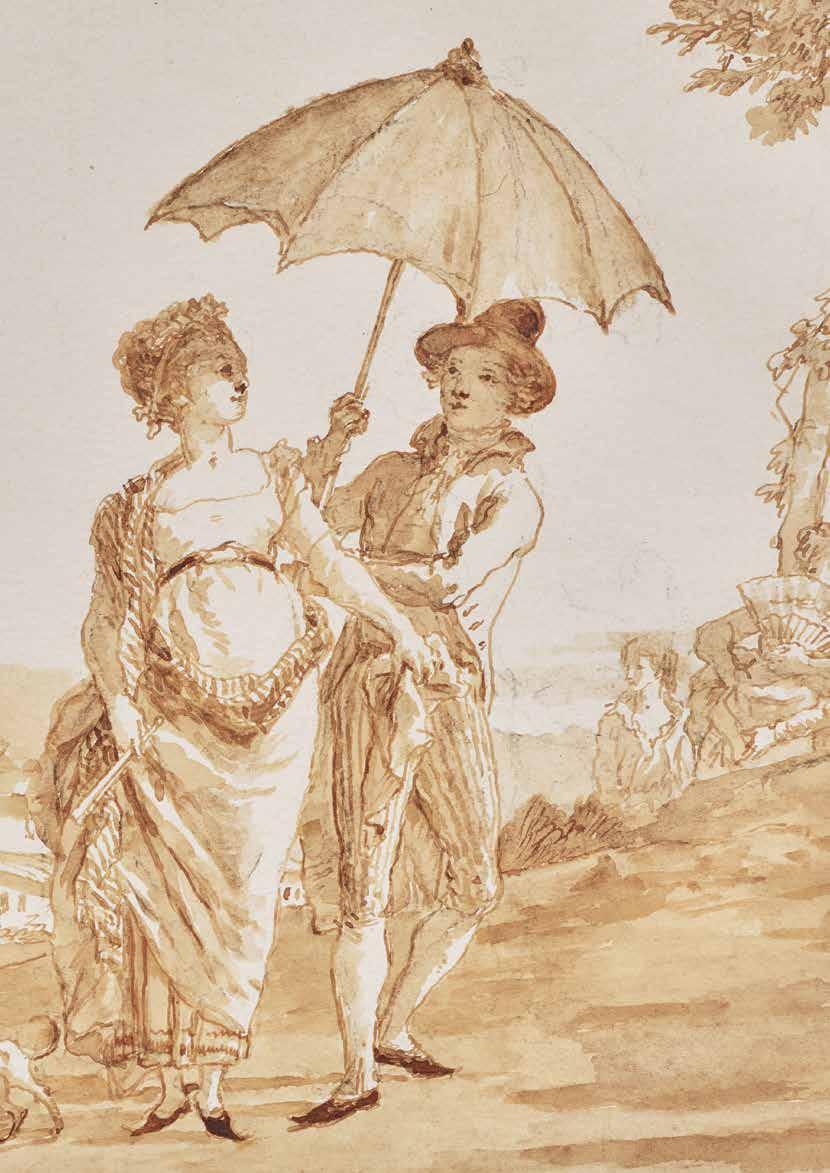
Une Famille de paysans se rendant à l’église
Plume, encre brune et lavis sur une esquisse à la pierre noire
H. 379 ; L. 507 mm
Signé en bas à droite : « Dom.o Tiepolo f »
Prov. :
Alfred Beurdeley (?) ; T.L. de Gara ; Londres, Sotheby’s, 11 novembre 1965, n° 24 ; Londres, Agnew’s ; Londres, Christie’s, 8 décembre 1987, n° 136 ; New York, Christie’s, 10 janvier 1990, n° 88 ; New York, Peter Jay Sharp ; New York, National Academy of Design ; Londres, Christie’s, 8 juillet 2008, n° 64 ; New York, The Tobey Collection.
Bibl. :
Knox 1974, fig. 69 ; L. Wolk-Simon, New York 2010, p. 224, n° 71.
Exp. : New York 1994, n° 29; UdineBloomington 1996, p. 198, n° 137 ; Gealt, Knox 2005, p. 90, n° 6 ; New York 2010, n° 71.
On suppose que l’église représentée sur le dessin est la Madonna delle Grazie à Udine, certainement connue des Tiepolo qui firent de fréquents séjours dans cette ville du Frioul. Comme souvent, Domenico manifeste une sympathie particulière pour les plus humbles de ses contemporains, comme il l’avait déjà montré dans le « stile naturale » (style naturaliste) de la Villa Valmarana à Vicence. La famille qui, représentée de dos, se rend à l’église, semble être entraînée par une petite fille tentant d’échapper à l’étreinte de sa mère, aussi enthousiaste que le petit chien qui mène le cortège. Cette feuille appartient à la série des Scènes de la vie contemporaine, qui peut être datée environ de 1791, et porte le numéro 6 de ce groupe.
Peasants Going to Church
Pen and brown ink, brown wash, over black chalk
H. 379; W. 507 mm
Signed lower right: “Dom.o Tiepolo f”
It has been supposed that the church depicted in the drawing is the Madonna delle Grazie in Udine, certainly known to the Tiepolos from their frequent visits to the Friulian city. As was often the case, Domenico entertained a particular sympathy for the humblest of his contemporaries, as he had shown through his work in “stile naturale” for the Foresteria of the Villa Valmarana in Vicenza. Observed from behind, the family walking toward the church appears to be pulled ahead by a little girl who wants to escape her mother’s hand, as excitedly as the small dog leading the procession. The sheet belongs to the so-called Scenes of Contemporary Life, the series of drawings datable to c. 1791; it is number 6 of the group.
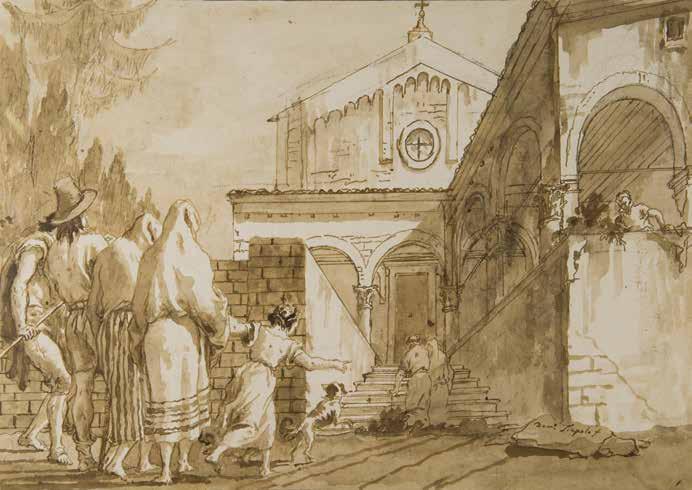
La Promenade champêtre
Plume, encre brune et lavis sur une esquisse à la pierre noire
H. 380 ; L. 507 mm
Signé en bas à gauche : « Dom o Tiepolo f »
Prov. :
collection privée ; Londres, Artemis Fine Arts
Ltd, 2000 ; collection privée.
Cette feuille appartient très probablement à la série des Scènes de la vie quotidienne datée vers 1791 et, comme d’autres au format similaire, représente un moment lié à la villégiature, thématique abordée à plusieurs reprises dans cette série. La scène de la promenade champêtre, en particulier, a été représentée au moins quatre autres fois par Giandomenico (Gealt, Knox 2005, p. 133-137, n˚ 39-42). Un jeune couple élégant occupe le premier plan, accompagné d’un petit chien, l’homme tenant une ravissante ombrelle pour protéger sa compagne du soleil. À l’arrière-plan, près d’un arbre, on aperçoit d’autres personnages, parmi lesquels une dame portant un éventail ouvert. Sur la gauche s’ouvre un magnifique paysage piémontais, avec un village composé de maisons aux vastes belvédères et l’esquisse d’une église avec son clocher. Ces inventions d’une grande fraîcheur témoignent de l’attention particulière portée par Giandomenico au paysage vénitien de son époque et ponctuent souvent ses meilleurs dessins, comme, dans cette même série, la feuille du musée Bonnat de Bayonne (Gealt, Knox 2005, p. 85, n˚ 2) ou le Lancier oriental près d’une ville du Metropolitan Museum de New York (ibid ., p. 111, n˚ 20). Outre les croquis d’après nature, il ne faut pas oublier que, pour ces compositions, Domenico s’est également inspiré d’idées empruntées à des sources graphiques antérieures, comme les gravures de Giampiccoli d’après Marco Ricci (Byam Shaw 1962, p. 60, note 2).
A Walk in the Country
Pen and brown ink, brown wash, over black chalk
H. 380; W. 507 mm
Signed lower left: “Dom o Tiepolo f”
The sheet most probably belongs to the so-called Scenes of Contemporary Life, datable to c. 1791, and, like others of similar dimensions, represents a moment linked to life in the countryside, a subject Giandomenico treated several times in the series. Indeed, the scene of a country walk is depicted at least four other times (Gealt, Knox 2005, pp. 133-137, nos. 39-42). An elegant young couple occupies the foreground, accompanied by a small dog, while the man daintily offers a parasol to shield his companion from the sun. In the background, other figures emerge near a tree, including a lady with an open fan. On the left, we see a beautiful foothill landscape and a small town with houses and covered terraces as well as a church with a bell tower. These are inventions of great freshness, which denote an attentive vision of the Veneto landscape of the time and often punctuate Giandomenico’s finest drawings, such as two examples in this series: the sheet in the Musée Bonnat, Bayonne (Gealt, Knox 2005, p. 85, no. 2) and the Turkish Lancer Approaching a Town in the Metropolitan Museum of Art, New York (ibid ., p. 111, no. 20). In addition to what he studied from life, we should remember that for these compositions Domenico also used ideas drawn from earlier graphic artists, such as Giampiccoli’s etchings after Marco Ricci (Byam Shaw 1962, p. 60, note 2).
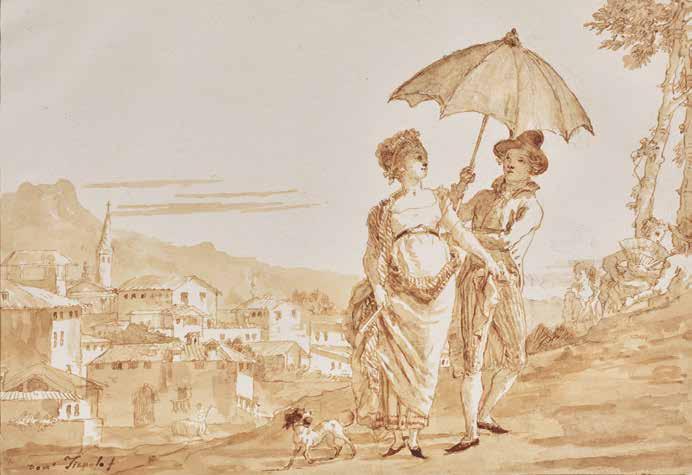
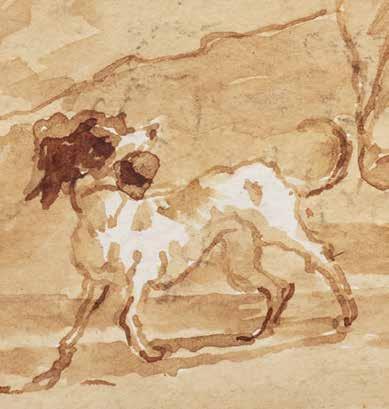
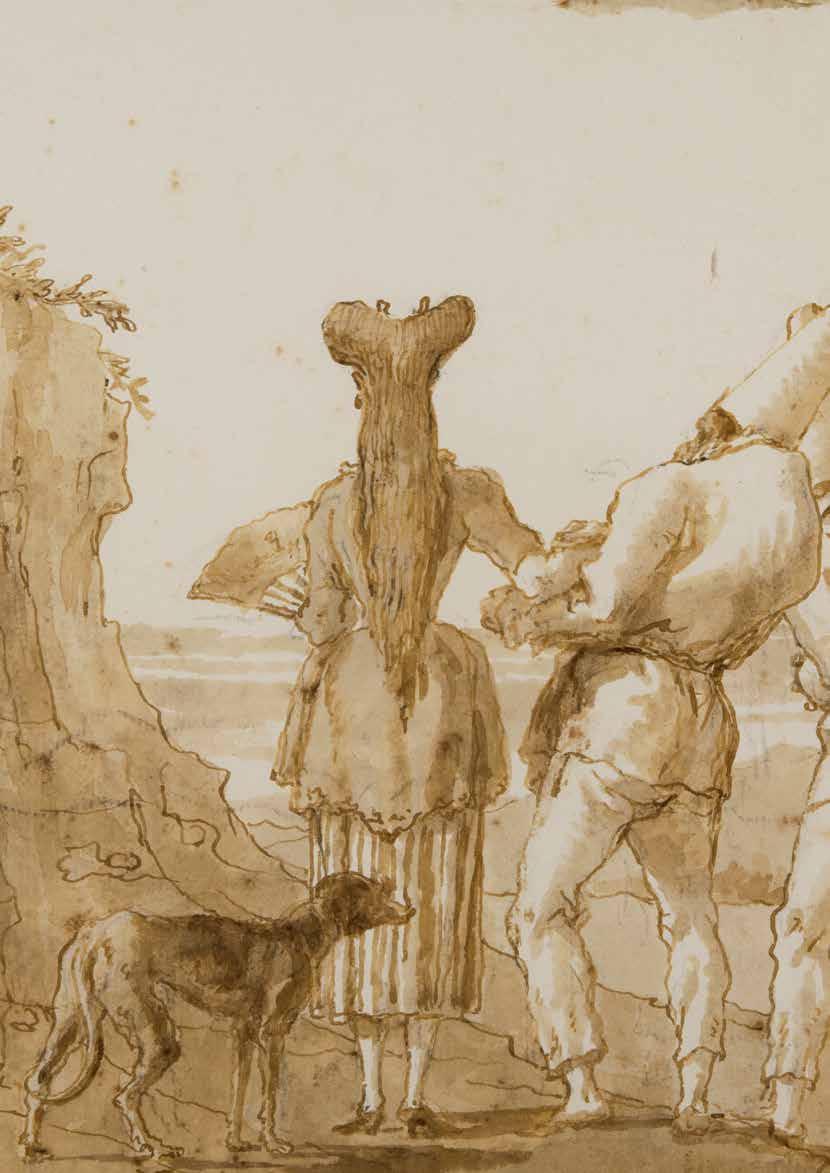
DIVERTISSEMENTS POUR LES ENFANTS
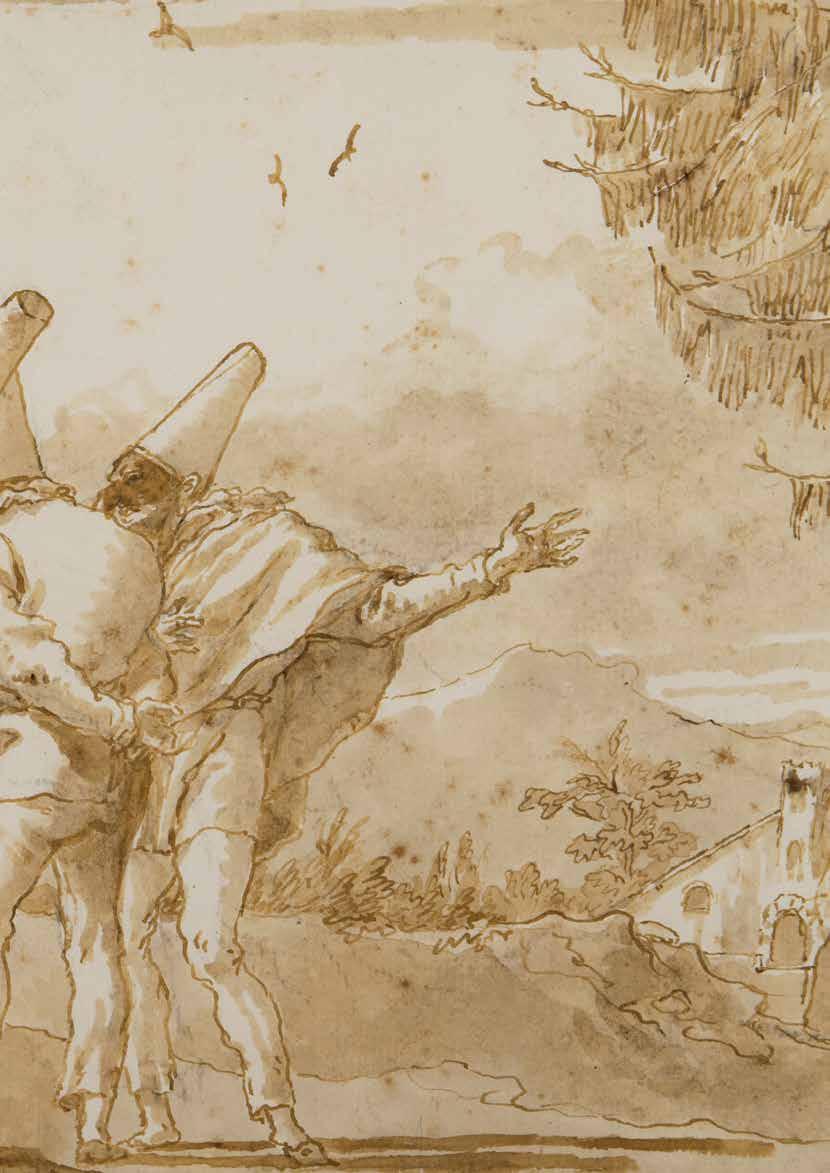
ENTERTAINMENT FOR CHILDREN
Divertimento per li regazzi
GIANDOMENICO TIEPOLO
Le Cortège nuptial de Polichinelle
Plume, encre brune et lavis sur une esquisse à la pierre noire
H. 290 ; L. 410 mm
Prov. :
Londres, Sotheby’s, 6 juillet 1920, partie du n° 41 ; Londres, Colnaghi ; Paris, Richard Owen ; San Francisco, Celia Tobin Clark ; Londres, Sotheby’s, 1 juillet 1971, n° 65 ; New York, E.V. Thaw & co ; Londres, Christie’s, 6 juillet 2004, n° 77 ; Paris, Galerie Éric Coatalem ; collection privée.
Bibl. :
Byam Shaw 1962, pp. 55, 91, n° 82 ; Vetrocq, Bloomington-Stanford 1979, p. 50, n° 7 ; Gealt 1986, p. 181, n° 80 ; Bostock 2009b, I, p. 213, n° 2.
Exp. : Paris 1921 ; Bloomington-Stanford 1979, n° 7 ; New York, Frick Collection, 1980.
Signé en bas à droite : « Dom.o Tiepolo f » ; en haut à gauche, dans la marge, un numéro « 2 » ~ cat. 36 ~ ~ cat. 36 ~
Pen and brown ink, brown wash, over black chalk
H. 290; W. 410 mm
Signed lower right: “Dom.o Tiepolo f”
Number “2”» inscribed upper left in the margin
Ce dessin, parmi les plus clairs et les plus précis de toute la série, se caractérise par un tracé léger à la pierre noire qui définit les éléments essentiels et révèle une étude minutieuse de la composition. L’élégance légèrement affectée de la mariée, dont les traits délicats sont mis en valeur par son collier de perles et le ruban dans ses cheveux, contraste vivement avec la figure caricaturale de Polichinelle au nez crochu, créant ainsi un couple saisissant, d’autant plus qu’il pourrait être interprété comme un écho à la Rencontre d’Antoine et Cléopâtre, peinte par son père Giambattista dans la salle du Palazzo Labia à Venise. Domenico provoque des étincelles en associant des personnages apparemment sans rapport, puisant dans le répertoire de son père pour tisser avec lui un dialogue distant qui est à la fois un hommage émouvant et un désaveu implacable.
This is one of the clearest, most painstaking drawings in the entire series, with fine black chalk used to delineate salient features, indicating a careful compositional study. The bride’s slightly affected elegance, with delicate features framed by the string of pearls around her neck and the ribbon in her hair, stands in antithesis to the erect figure and hooked nose of Punchinello, creating a jarring pair of figures – especially if we consider that this could be interpreted as a recollection of the Meeting of Antony and Cleopatra frescoed by Giambattista Tiepolo in the great hall of Palazzo Labia in Venice. Domenico ignites contrasts by pairing seemingly unrelated figures, using imagery from his father’s repertoire and weaving a remote dialogue that is both a moving homage and a merciless palinode.
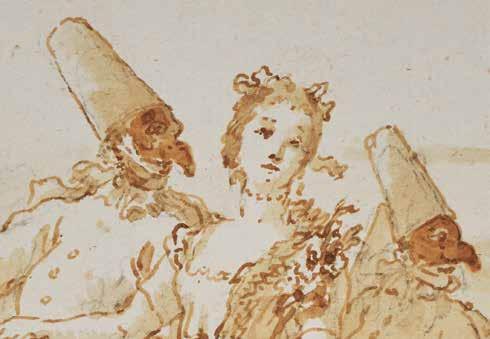
Punchinello’s Bridal Procession
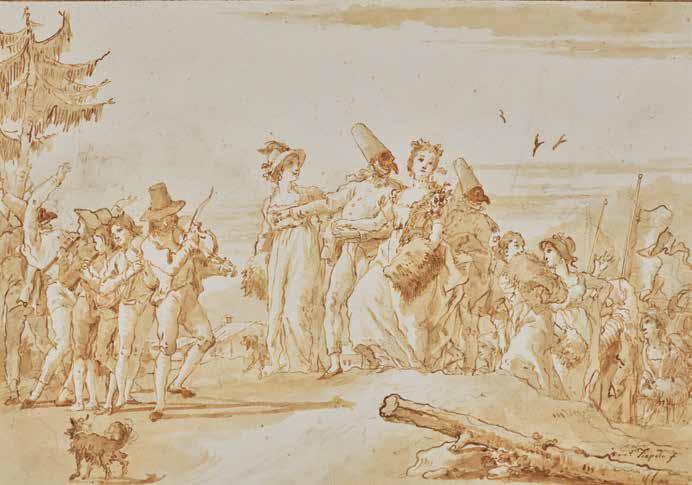
GIANDOMENICO TIEPOLO
Polichinelle apprenant à marcher
Plume, encre brune et lavis sur une esquisse à la pierre noire
H. 293 ; L. 413 mm
Prov. :
Londres, Sotheby’s, 6 juillet 1920, partie du n° 41 ; Londres, Colnaghi ; Paris, Richard Owen ; Londres, Matthiesen Gallery Ltd ; Londres, Brinsley Ford ; Londres, Christie’s, 29 juillet 2020, n° 56 ; New York, The Tobey Collection.
Bibl. :
Watson, Londres 1951, n° 138b ; Byam Shaw 1962, p. 92, n° 85 ; Vetrocq, Bloomington-Stanford 1979, p. 117, n° S5 ; Gealt 1986, n° 16 ; Mariuz 1986, p. 266 ; Udine-Bloomington 1996, p. 244, n° 11 ; Gealt 1986, pp. 56-57, n° 16 ; Russell 1998, p. 172 ; Gealt, Venise 2004, p. 197, n° 128 ; Bostock 2009b, I, p. 222, n° 11.
Exp. :
Paris 1921; Londres 1939, p. 138, n° 139 ; Exeter 1946, n° 143 ; Londres 1951, n° 138b ; Birmingham 1971, p. 38, n° 138b ; Venise 2004, p. 197, n° 128 ; Venise 2019, p. 372, n° VII.08.
Signé en bas à droite : « Dom.o Tiepolo f » ; en haut à gauche, dans la marge, un numéro « 11 » ~ cat. 37 ~ ~ cat. 37 ~
D’après la numérotation à la plume et la référence à l’enfance de Polichinelle, on peut supposer qu’il s’agit d’une des premières feuilles de la série. Le garçon, trop jeune dans d’autres épisodes pour porter le masque, apparaît ici avec le déguisement habituel de Polichinelle, allusion peut-être au rôle qui, d’une certaine manière, finit par s’imposer à chacun en grandissant.
Punchinello Learning to Walk
Pen and brown ink, brown wash, over black chalk
H. 293; W. 413 mm
Signed lower right: “Dom.o Tiepolo f”
Number “11” inscribed upper left in the margin
Based on the pen numbering and the subject referring to Punchinello’s childhood, it can be supposed that this was among the first sheets in the series. The boy, who is in other episodes too young to wear a mask, now appears in Punchinello’s typical disguise, perhaps a reference to the role which is to some extent imposed on everyone as they grow up.
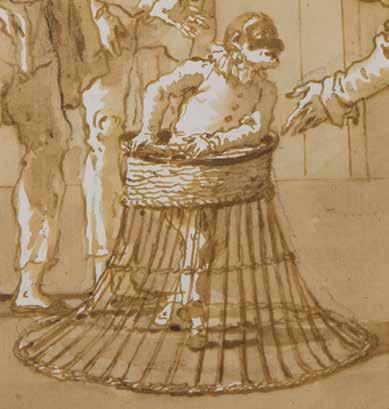
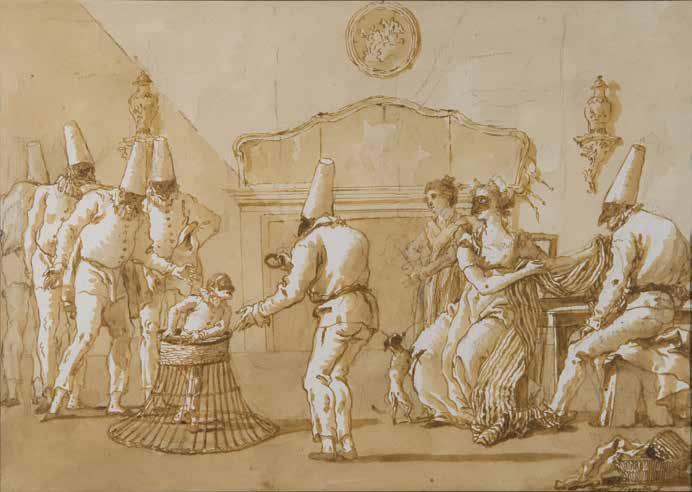
Prov. :
Une Famille de Polichinelles dans le jardin d’une villa
Plume, encre brune et lavis sur une esquisse à la pierre noire
H. 355 ; L. 473 mm
Signé en bas à droite : « Dom o Tiepolo »
Londres, collection privée ; Londres, Sotheby’s, 6 juillet 1920, partie du n° 41 ; Paris, Richard Owen ; Madame Henry Lapauze ; New York, Wildenstein & Co. ; 1982, collection Anne S. Bent.
Bibl. :
Byam Shaw 1962, p. 88, n° 70 ; Vetrocq, Bloomington-Stanford 1979, p. 142, n° S11 ; Gealt 1986, p. 182, n° 83 ; Udine-Bloomington 1996, p. 244 ; Bostock 2009b, I, p. 230, n° 19.
Exp. :
Paris 1921.
cat. 38 ~ ~ cat. 38 ~
Polichinelle est assis sur un élégant sofa, près de la balustrade du jardin d’une villa. Il enlace de jeunes membres de sa famille et est entouré d’autres personnages, dont une femme allaitant, que l’on peut interpréter comme son épouse (Gealt 1986). Il ressemble alors à une sorte de noble patriarche. Comme cela a déjà été observé (ibidem), le dessin semble reprendre la composition de feuilles similaires de Giambattista, représentant des portraits de famille, conservés au musée Horne de Florence (inv. 6317) ou à la Morgan Library de New York (inv. 1997.23). Il reprend par ailleurs, avec une précision encore plus grande, la composition de l’un de ses propres dessins, un Portrait de famille, issu de la série dite des Scènes de la vie contemporaine (Gealt, Knox 2005, p. 133, n˚ 36). L’observation de ces variations permet de penser que le Divertimento est une « mutation » d’idées, de pensées et de scènes de la vie quotidienne, revêtue d’un masque d’une imperturbable ambiguïté.
A Family of Punchinellos in the Garden of a Villa
Pen and brown ink, brown wash, over black chalk
H. 355; W. 473 mm
Signed lower right: “Dom o Tiepolo”
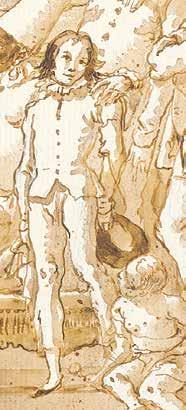
Near the garden wall of a villa, a Punchinello sits on an elegant divana, embracing young family members and surrounded by other figures, including a woman breastfeeding, who could be interpreted as Punchinello’s wife (Gealt 1986). The resulting image of him is that of a sort of patriarch of a noble family. As Gealt observed, the drawing appears to replicate the composition of similar drawings by Giambattista in the Museo Horne in Florence (6317) and the Morgan Library & Museum in New York (1997.23), which depict similar family group portraits. At the same time, it even more closely reiterates the composition of one of the drawings from the so-called Scenes of Contemporary Life representing a Family Portrait (Gealt, Knox 2005, p. 133, no. 36). It is precisely by observing these derivations that one senses that the Divertimento is a “mutation” of ideas, thoughts and scenes from everyday life, clothed in a mask of impenetrable ambiguity.
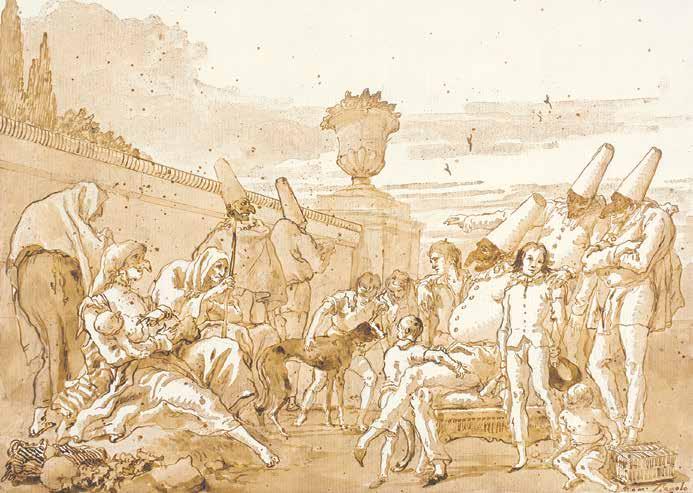
~ cat. 39 ~
GIANDOMENICO TIEPOLO
Polichinelles creusant un trou
Plume, encre brune et lavis sur une esquisse à la pierre noire
H. 292 ; L. 419 mm
Signé en bas à droite : « Dom. Tiepolo f » ; en haut à gauche, dans la marge, un numéro « 43 »
Prov. :
Londres, Sotheby’s, 6 juillet 1920, partie du n° 41 ; Londres, Colnaghi ; Paris, Richard Owen ; Londres, Matthiesen Gallery Ltd ; Londres, Brinsley Ford ; Londres, Christie’s, 29 juillet 2020, n° 58 ; collection privée ; Galerie Éric Coatalem ; collection privée.
Bibl. :
Vetrocq, Bloomington-Stanford, 1979, p. 125, n° S30 ; Knox 1984, p. 129; Gealt 1986, pp. 4041, n° 8 ; Udine-Bloomington 1996, p. 245, n° 43 ; Russell 1998, p. 172 ; Bostock 2009b, I, p. 254, n° 43.
Exp. :
Paris 1921 ; Exeter 1946, n. 146 ; LondresBirmingham 1951, p. 38, n° 138g ; Venise 2019, p. 376, n° VII.18.
~ cat. 39 ~
Dans un cadre champêtre, marqué par la présence placide de deux bœufs qui deviennent de véritables protagonistes de la scène, plusieurs Polichinelles s’affairent à creuser. Tandis que l’un d’eux, pelle à la main, creuse un trou, deux autres l’observent : le plus jeune, les bras croisés, semble être réconforté ou du moins instruit par l’adulte à ses côtés.
Punchinellos Digging a Hole
Pen and brown ink, brown wash, over black chalk
H. 292; W. 419 mm
Signed lower right: “Dom. Tiepolo f”
Number “43”, inscribed upper left in the margin
In a rural setting, marked by the meek presence of two oxen who function as co-protagonists, some Punchinellos are engaged on a dig. While one, shovel in hand, digs a hole in the ground, two others look on: the younger one, arms folded, appears consoled or at least instructed by the adult standing beside him.
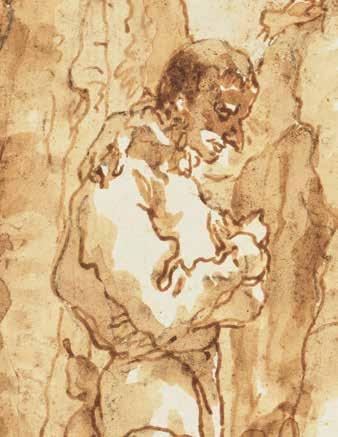
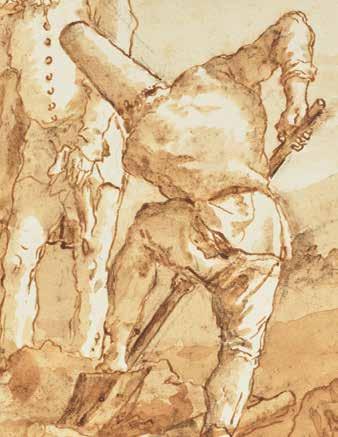
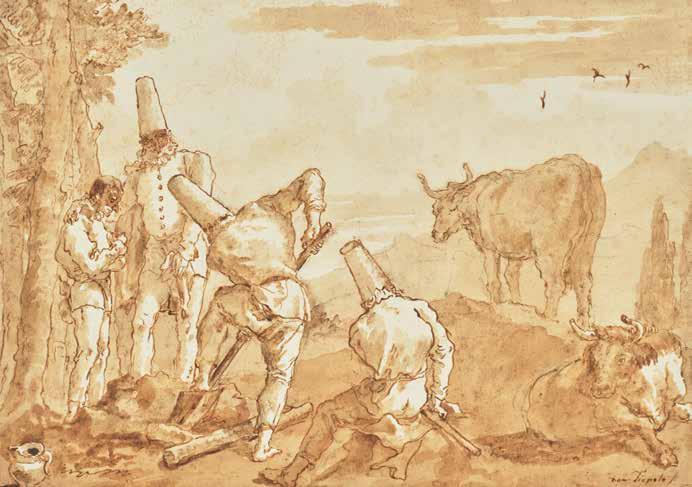
~ cat. 40 ~
GIANDOMENICO TIEPOLO
Polichinelle et sa famille dans une ferme
Plume, encre brune et lavis sur une esquisse à la pierre noire
H. 345 ; L. 464 mm
Signé en haut à gauche : « Dom.o Tiepolo f » ; en haut à gauche, dans la marge, un numéro « 44 »
Prov. :
Londres, Sotheby’s, 6 juillet 1920, partie du n° 41 ; Londres, Colnaghi ; Paris, Richard Owen ; Londres, Brinsley Ford ; Londres, Christie’s, 4 juillet 2023, n° 41 ; Londres, Stephen Ongpin
Fine Art.
Bibl. :
Vetrocq, Bloomington-Stanford 1979, p. 118, n° S7 ; Knox 1984, p. 127 ; Gealt 1986, pp. 36-37, n° 6 ; Mariuz 2008, p. 228 ; Russell 1998, p. 172 ; Bostock 2009b, I, p. 255, n° 44.
Exp. :
Paris 1921 ; Exeter 1946, n° 148 ; Londres 1951, n° 138h ; Venise 2019, p. 376, n° VII.17.
~ cat. 40 ~
Au premier plan, un enfant et un jeune homme jouent avec un chien tandis qu’un Polichinelle adulte semble les rappeler au travail. Au centre, une femme file à l’aide d’un fuseau, assistée à dévider sa laine par un Polichinelle assis sur une chaise, tandis que d’autres Polichinelles l’observent près d’un mur contre lequel est appuyée une échelle. La scène qui, en filigrane, semble évoquer en partie le thème mythologique d’Hercule et Omphale, se déroule dans une atmosphère paisible d’aisance rustique, non sans rappeler la scène des Paysans au repos peinte par Giandomenico dans l’auberge de la Villa Valmarana à Vicence, bien des années auparavant (1757). Ses fantaisies et ses rêveries mises en peinture réapparaissent ici, sous une forme détournée, après de nombreuses années.
Punchinello and His Family on a Farm
Pen and brown ink, brown wash, over black chalk
H. 345; W. 464 mm
Signed upper left: “Dom. o Tiepolo f”
Number “44”, inscribed upper left in the margin
A child and a young man in the foreground play with a dog while an adult Punchinello appears to be calling them back to work. In the center, a woman is busy with a spindle, helped by a seated Punchinello who unravels the thread, while other Punchinellos stand near a low wall with a ladder resting against it. Read on another level, the scene seems in part to allude to the mythological story of Hercules and Omphale. The setting is peaceful and exudes a tranquil atmosphere of rustic comfort, not so different from the scene of the Peasants at Rest painted by Giandomenico in the Foresteria of Villa Valmarana in Vicenza many years earlier (1757). The whims and dreams he staged in painting now return, though masked, after the passage of years.
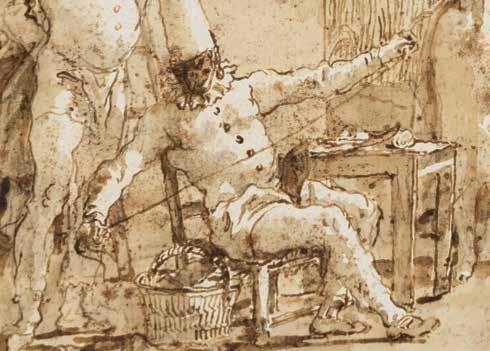
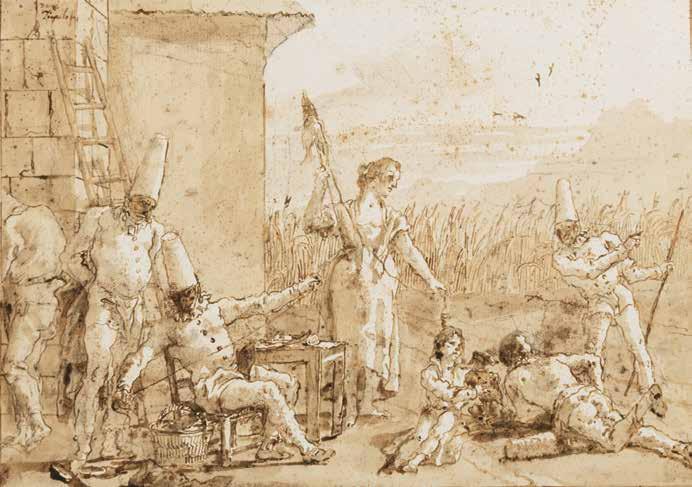
~ cat. 41 ~
GIANDOMENICO TIEPOLO
Polichinelle dans un marché de fruits et légumes
Plume, encre brune et lavis sur une esquisse à la pierre noire
H. 292 ; L. 419 mm
Signé en bas à droite : « Dom.o Tiepolo f » ; en haut à gauche, dans la marge, un numéro « 51 »
Prov. :
Londres, Sotheby’s, 6 juillet 1920, partie du n° 41; Londres, Colnaghi ; Paris, Richard Owen ; Londres, Matthiesen Gallery Ltd ; Londres, Brinsley Ford ; Londres, Christie’s, 4 juillet 2023, n° 46 ; collection privée.
Bibl. :
Byam Shaw 1962, pp. 53, note 5, 57, note 2 ; Vetrocq, Bloomington-Stanford 1979, p. 131, n° S47 ; Knox 1983, p. 144, n° 51 ; Gealt 1986, pp. 120-121, n° 48 ; Russell 1998, p. 172 ; Bostock 2009b, I, p. 262, n° 51.
Exp. : Paris 1921 ; Exeter 1946, n° 131 ; LondresBirmingham 1951, p. 38, n° 13j ; Venise 1951, p. 188, n° 143 ; Venise 2019, p. 377, n° VII.19.
Dans le tourbillon d’aventures du Divertimento , les épisodes fantastiques et rocambolesques alternent avec des scènes d’une banalité, voire d’une trivialité, indéniable. C’est le cas ici où l’on voit plusieurs Polichinelles se rendre au marché pour acheter quelques légumes, tandis que deux d’entre eux semblent négocier un tout autre genre de prestation, en abordant une femme qui paraît volontiers y concéder. Cette scène s’inspire d’un dessin à la plume de Giambattista, datant probablement de la fin des années 1730, représentant Polichinelle s’approchant d’une femme (aujourd’hui conservé au Getty Museum de Los Angeles, inv. 2003.131 ; fig. 15) et dont il existe également une copie d’atelier, apparue sur le marché de l’art (Londres, Colnaghi, 27 juin 1953, n˚ 32, fig. IX).
~ cat. 41 ~
Punchinellos at the Fruit and Vegetable Market
Pen and brown ink, brown wash, over black chalk
H. 292; W. 419 mm
Signed lower right: “Dom.o Tiepolo f”
Number “51” inscribed upper left in the margin
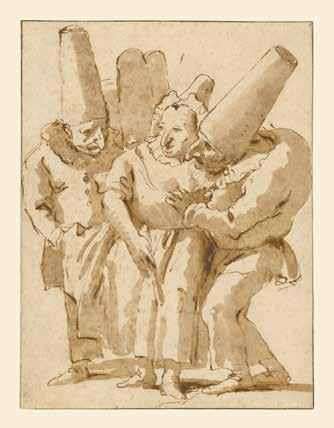
The Divertimento ’s whirl of adventures alternates between fantasy and imagination, on the one hand, and scenes of undeniable banality or even triviality, as in the present image, in which some Punchinellos have gone to the market to buy vegetables, while another couple appears to be bargaining for another sort of service, approaching a woman who appears to be offering it willingly. The inspiration comes from a pen drawing by Giambattista, presumably from the late 1730s, depicting Punchinellos approaching a woman, now in the Getty Museum in Los Angeles (2003.131; fig. 15), of which a workshop copy also exists, formerly on the art market in London (Colnaghi, 27 June 1953, no. 32, fig. IX).
fig. 15)
Giambattista Tiepolo, Polichinelles courtisant une femme, Plume et encre brune, pinceau et lavis brun sur une esquisse à la pierre noire, Los Angeles, J. Paul Getty Museum, 2003.131
fig. 15)
Giambattista Tiepolo, Punchinellos Approaching a Woman, pen and brown ink and brush with brown wash over black chalk on paper
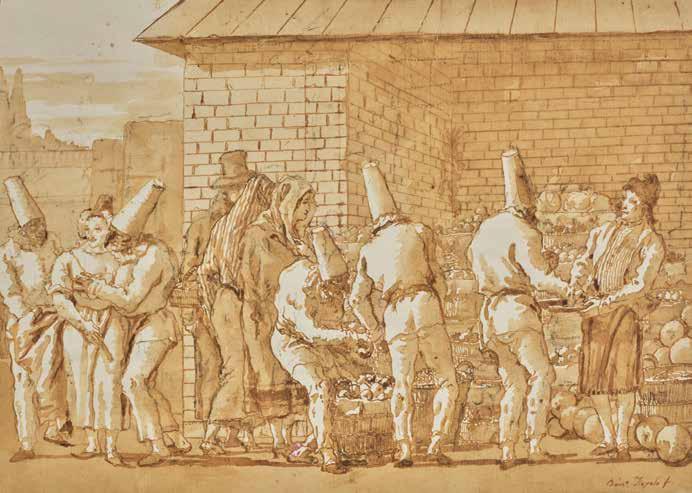
cat. 42 ~
Prov. :
GIANDOMENICO TIEPOLO
Trois Polichinelles à cheval
Plume, encre brune et lavis sur une esquisse à la pierre noire
H. 370 ; L. 470 mm
Signé en bas à droite : « Dom o Tiepolo f »
Londres, Sotheby’s, 6 juillet 1920, partie du n° 41 ; Londres, Colnaghi ; Paris, Richard Owen ; collection privée ; Paris, Galerie Éric Coatalem ; collection privée.
Bibl. :
Byam Shaw 1962, p. 57, n° 1 ; Vetrocq, BloomingtonStanford 1979, p. 126, n° S32 ; Knox 1984, p. 145 ; Gealt 1986, p. 190, n° 98 ; Bostock 2009b, I, p. 270, n° 59.
Exp. : Paris 1921.
cat. 42 ~
Dans une composition ostensiblement asymétrique, trois Polichinelles-cavaliers maîtrisent leurs chevaux cabrés, un peu héros et un peu brigands. L’un d’eux se retourne, comme pour observer – voire défier – le spectateur. Du côté opposé se déploie un paysage avec une maison de campagne flanquée d’une tour, tandis que le ciel est traversé par des hirondelles en vol. Bien qu’inversée par rapport à la nôtre, la composition rappelle un autre dessin à la plume de Giandomenico, conservé à l’Ermitage de Saint-Pétersbourg, où plusieurs Polichinelles observent un cavalier (Knox, à Venise 2004, p. 112, n˚ 32).
Three Punchinellos on Horseback
Pen and brown ink, brown wash, over black chalk
H. 370; W. 470 mm
Signed lower right: “Dom o Tiepolo f”
In a flagrantly asymmetrical composition, three mounted Punchinellos hold their rearing steeds – part heroes, part bandits. One of them turns around, as if to observe and provoke the viewer. On the opposite side of the scene, we see a turreted building and a sky marked by swallows in flight. The composition recalls another pen drawing by Giandomenico, in the Hermitage Museum in Saint Petersburg, where several Punchinellos observe a horseman, on the opposite side with respect to the figures in the present sheet (Knox, in Venice 2004, p. 112, no. 32).
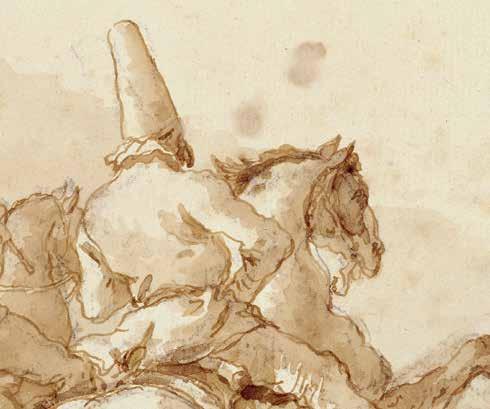
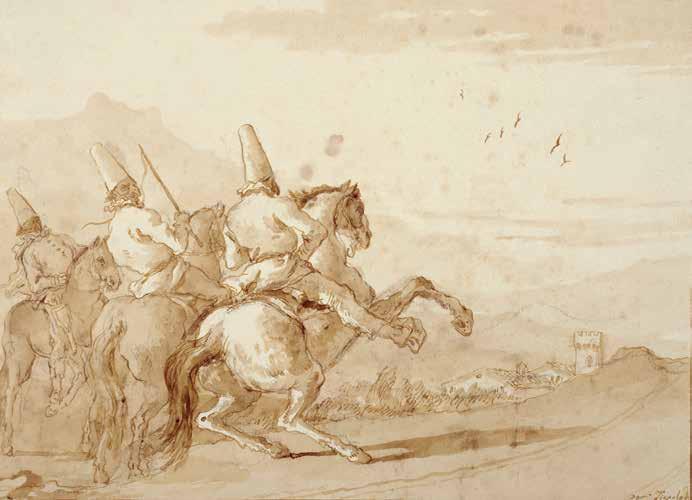
Prov. :
GIANDOMENICO TIEPOLO
Groupe de Polichinelles accompagnant une jeune femme
Plume, encre brune et lavis sur une esquisse à la pierre noire
H. 352 ; L. 470 mm
Signé en bas à gauche : « Dom.o Tiepolo f » ; en haut à gauche, dans la marge, un numéro « 73 »
Londres, Sotheby’s, 6 juillet 1920, partie du n° 41 ; Londres, Colnaghi ; Paris, Richard Owen ; collection Roberta J.M. Olson et Alexander B.V. Johnson.
Bibl. :
Vetrocq, Bloomington-Stanford 1979, p. 156, n° S46 ; Knox 1984, p. 145 ; Gealt 1986, p. 188, n° 94 ; Bostock 2009b, I, p. 284, n° 73.
Exp. :
Paris 1921; Princeton 1997, n° 169.
cat. 43 ~ ~ cat. 43 ~
On observe ici une idée de composition chère à Domenico : la figure vue de dos. Dans ce cas précis, il s’agit d’un groupe composé d’une femme abordée de manière galante, quoique assez brusque, par trois Polichinelles. La lumière venant de la gauche projette de longues ombres au sol, suggérant une promenade au crépuscule avec, à l’arrière-plan, un paysage montagneux, un mas et un arbre qui, à droite, clôt la composition. La silhouette féminine est parfaitement identique à celle d’une esquisse à la plume, conservée à l’Ermitage de Saint-Pétersbourg, autrefois attribuée à Giambattista, mais qui peut plus vraisemblablement être de la main de son fils (Grigorieva 2019, p. 68, cat. II.09).
A Group of Punchinellos accompanying a
Pen and brown ink, brown wash, over black chalk
H. 352; W. 470 mm
Signed lower left: “Dom. o Tiepolo f”
Number “73”» inscribed upper left in the margin
Young Woman
We here observe a compositional solution that was dear to Domenico, the figure seen from behind. In this case, the group consists of a woman being approached with gallantry, though in a disjointed way, by three Punchinellos. The light from the left casts long shadows on the ground, indicating that the scene is a sunset stroll against a mountainous landscape, with a farmhouse, and a tree that closes off the composition on the right. The female figure can be superimposed in every detail with a pen and ink sketch in the Hermitage Museum, Saint Petersburg, previously attributed to Giambattista but more likely by his son (Grigorieva 2019, p. 68, cat. II.09).
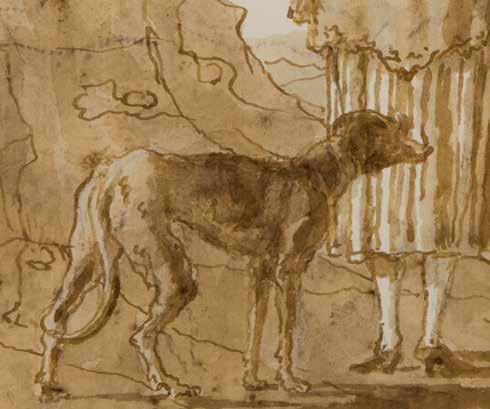
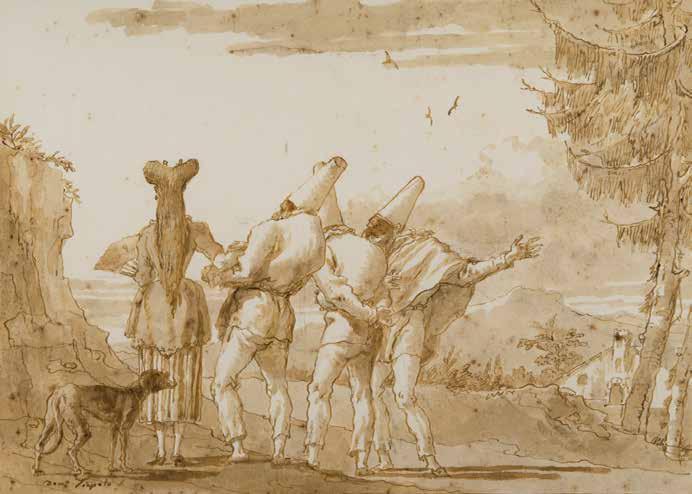
~ cat. 44 ~
Prov. :
Polichinelle courtisant une jeune femme
Plume, encre brune et lavis sur une esquisse à la pierre noire
H. 357 ; L. 472 mm
Signé en bas à droite : « Dom.o Tiepolo f »
Londres, Sotheby’s, 6 juillet 1920, partie du n° 41 ; Londres, Colnaghi ; Paris, Richard Owen ; New York, Elsie de Wolfe, dite Lady Mendl ; Versailles, Paul-Louis Weiller ; Paris, Christie’s, 27 mai 2020, n° 25 ; collection privée.
Bibl. :
Vetrocq, Bloomington-Stanford 1979, p. 155, n° S44 ; Knox 1984, p. 145 ; Gealt 1986, p. 187, n° 93 ; Gealt, Knox, Udine-Bloomington 19961997, p. 246, n° 76 ; Bostock 2009b, I, p. 287, n° 76.
Exp. :
Paris 1921.
~ cat. 44 ~
Pen and brown ink, brown wash, over black chalk
H. 357; W. 472 mm
Signed lower right: “Dom.o Tiepolo f” GIANDOMENICO
Dans une scène en plein air, tandis que quelques Polichinelles apparaissent à l’arrière-plan avec un cheval, un couple fait une promenade champêtre accompagné d’un chien et de deux enfants vêtus avec soin. Le Polichinelle, protagoniste de la scène, est en compagnie d’une dame très élégante, le visage dissimulé par une bauta (masque vénitien). Le dessin met entièrement l’accent sur le contraste entre l’allure noble et légèrement hautaine de la femme et l’aspect disgracieux et bossu de Polichinelle.
Punchinello Courting a Young Woman
In an outdoor scene, while other Punchinellos appear in the background with a horse, a couple strolls in the foreground, accompanied by a dog and two meticulously dressed children. The Punchinello who is the protagonist of the scene is accompanied by an extremely elegant lady, her face hidden by a bautta The drawing focuses entirely on the contrast between the noble and slightly haughty aspect of the woman and the unpleasant, hooked figure of Punchinello.
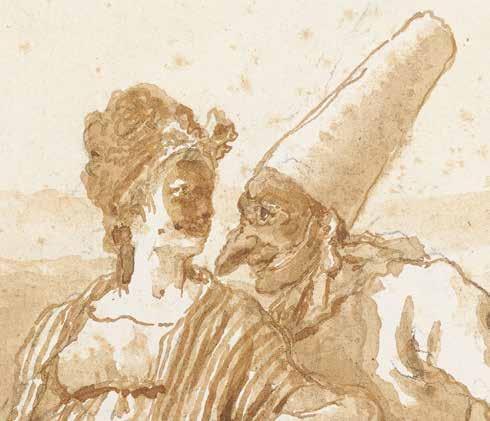
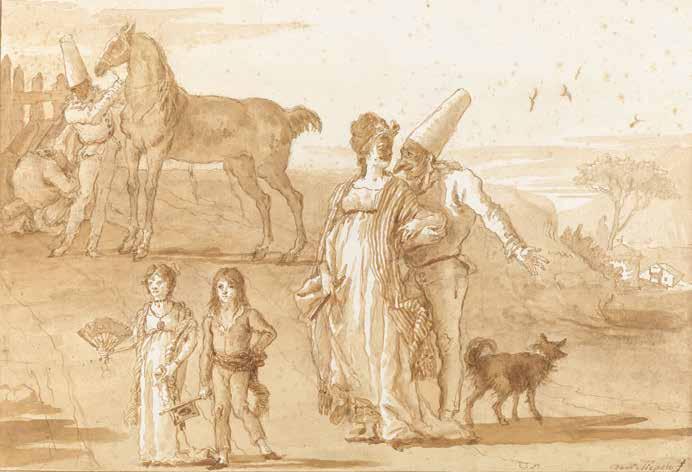
GIANDOMENICO TIEPOLO
Les Funérailles de Polichinelle
Plume, encre brune et lavis sur une esquisse à la pierre noire
H. 355 ; L. 470 mm
Signé à gauche sur le monument funéraire : « Dom o Tiepolo f » ~ cat. 45 ~
Prov. :
Londres, Sotheby’s, 6 juillet 1920, partie du n° 41 ; Londres, Colnaghi ; Paris, Richard Owen ; New York, Paul Rosenberg ; Zürich, David Lachenmann ; collection privée.
Bibl. :
Vetrocq, Bloomington-Stanford 1979, p. 123, n° S24 ; Knox 1984, p. 146 ; Gealt 1986, pp. 174175, n° 75 ; Mariuz 1996 (2008), p. 392 ; Bostock 2009b, I, p. 312, n° 101.
Exp. :
Paris 1921.
cat. 45 ~
Le dernier voyage terrestre de Polichinelle est ici représenté, au terme d’une veillée funèbre, par un cercueil porté par ses compagnons vers le tombeau. Une assemblée de Polichinelles masqués, cadrée à mi-corps, s’est regroupée au premier plan pour observer la scène. Il en résulte une composition particulièrement dense et asymétrique, structurée par la diagonale de la civière sur laquelle repose le corps de Polichinelle. En face, sur le mur, se dresse un monument funéraire orné d’un buste qui n’est autre qu’une nouvelle métamorphose de Polichinelle. La mort apaise et unifie toute existence. Comme l’a noté Mariuz, Domenico a dû parfois se reconnaître lui-même sous ce masque, dans cette figure d’anti-héros, au point d’apposer sa signature sous le buste de ce cénotaphe.
Funeral of Punchinello
Pen and brown ink, brown wash, over black chalk
H. 355; W. 470 mm
Signed on the left: “Dom o Tiepolo f”
Punchinello’s final earthly journey shows him in a coffin, at the end of a wake, lifted by his companions to a burial mound. A large group of maschere, depicted from the waist up, observes in the right foreground. This results in a particularly crowded and skewed scene, built on the diagonal of the litter bearing Punchinello’s body. Opposite, set on the wall, a funerary monument has a bust with none other than Punchinello, once more transformaed. Death smooths out all existence and makes it uniform. As Mariuz noted, Domenico must have sometimes seen himself in the guise of this maschera and anti-hero, so much so that here he placed his signature below the bust on the cenotaph.
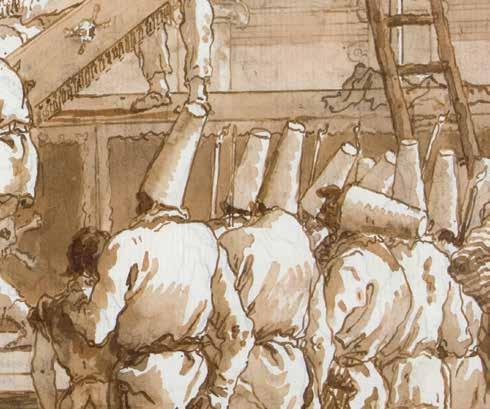
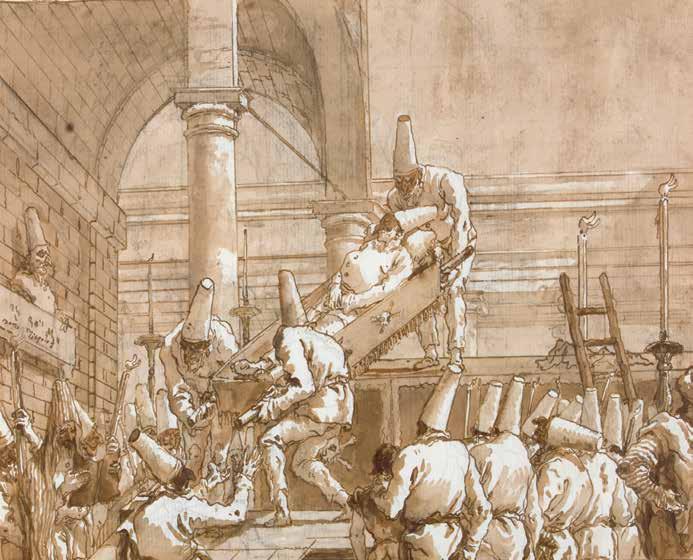
~ cat. 46 ~
GIANDOMENICO TIEPOLO
L’Apparition du squelette de Polichinelle devant sa tombe
Plume, encre brune et lavis sur une esquisse à la pierre noire
H. 350 ; L. 470 mm
Signé en bas à droite : « Do.o Tiepolo f » ; en haut à gauche, dans la marge, un numéro « 104 »
Prov. :
Londres, Sotheby’s, 6 juillet 1920, partie du n° 41 ; Londres, Colnaghi ; Paris, Richard Owen ; Londres, Matthiesen Gallery Ltd, 24 mars 1937 ; Paris, Léon Suzor ; Paris, Hôtel Drouot, 19 mars 1965, n° 71 ; Paris, George Bemier ; New York, M. et Mrs Jacob M. Kaplan ; New York, Eugene V. Thaw & Co. ; Londres, Christie’s, 5 juillet 2022, n° 20 ; collection privée.
Bibl. :
Byam Shaw 1962, p. 55 ; Mariuz 1971, p. 87, n° 107 ; Bean, Stampfle 1971, p. 111, n° 284 ; Fehl 1978-1979, pp. 787, 789 ; Vetrocq, BloomingtonStanford 1979, p. 50, n° 11 ; Bantel 1981, n° 44 ; Knox 1984, pp. 130, 146 ; Gealt 1986, pp. 178179, n° 77 ; Gealt 1996, p. 98 ; Bostock 2009b, I, p. 304, n° 103 ; Agamben 2015, pp. 82-83.
Exp. :
Paris 1921 ; Paris, 1950, n° 152 ; New York 1971, n° 284 ; Bloomington-Stanford 1979, p. 50, n° 11 ; New York, Frick Collection, 1980.
Parmi les épisodes les plus déconcertants et, en même temps, résolument comiques de toute la série du Divertimento per li regazzi, l’apparition du squelette pourrait bien aussi être une farce plutôt qu’un épisode miraculeux. Un squelette coiffé du chapeau conique caractéristique de Polichinelle semble grimper sur une sorte de monument funéraire orné de deux cariatides, tandis qu’un autre squelette gît à ses pieds, la tête enfouie dans le sol. De l’autre côté, un groupe de Polichinelles terrorisés s’enfuit à toutes jambes en poussant des cris de stupeur. Cependant, avec la gestuelle de ces bras levés qui semble imiter celle des « vivants », on ne comprend pas réellement qui effraie et qui est effrayé. Comme le note Byam Shaw (communication rapportée in Bean, Stampfle 1971, p. 111), la composition s’inspire d’une gravure du XVIe siècle, la Vision d’Ézéchiel de Giorgio Ghisi (d’après Giovan Battista Bertani), datée de 1554 (fig. 17 ), où apparaît le même monument funéraire et la figure du squelette qui y est adossé. On sait également que Domenico possédait une riche collection de gravures probablement héritée de l’atelier de son père, parmi lesquelles figuraient des gravures du même Ghisi (Pavanello 2013, p. 15, n˚ 51), preuve supplémentaire de son talent pour utiliser des modèles disparates de manière comique et irrévérencieuse.
~ cat. 46 ~
Punchinello’s Skeleton appears before his Tomb
Pen and brown ink, brown wash, over black chalk
H. 350; W. 470 mm
Signed lower right: “Do. o Tiepolo f”
Number “104” inscribed upper left in the margin
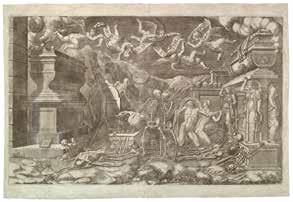
(fig. 17 )
Giorgio Ghisi (d’après Giovanni Battista Bertano), La Vision d’Ezéchiel, gravure, New York, Metropolitan Museum, 53.600.595 (fig. 17 )
Giorgio Ghisi (after Giovanni Battista Bertano), The Vision of Ezekiel, etching
Among the most disconcerting and at the same time decidedly comical episodes of the entire Divertimento per li regazzi , this apparition of a skeleton could actually depict a prank rather than a miracle-like event. A skeleton wearing Punchinello’s characteristic conical hat appears to clamber up a sort of sepulchral monument with two caryatids, while at its feet another skeleton still lies in the ground with its head buried. On the left, another group of Punchinellos burst into shouts and gestures of amazement, fleeing in fear. But given the gestures of the skeleton’s raised arms, which seem to mimic those of the living, it is unclear who is in the act of frightening, and who is frightened. As noted by Byam Shaw (reported in Bean, Stampfle 1971, p. 111), the composition is indebted to a sixteenth-century engraving, Giorgio Ghisi’s Vision of Ezekiel (after Giovan Battista Bertani) dated 1554 (fig. 17 ), which features the same funerary monument and the figure of the reclining skeleton. We also know that Domenico owned a rich collection of prints, likely inherited from his father’s workshop, and among these were engravings by Ghisi himself (Pavanello 2013, p. 15, no. 51), further evidence of Domenico’s ability to use disparate models through a comic and irreverent lens.
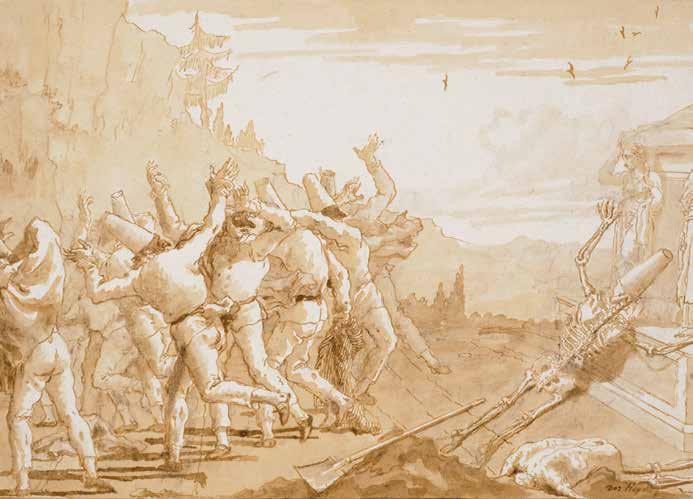
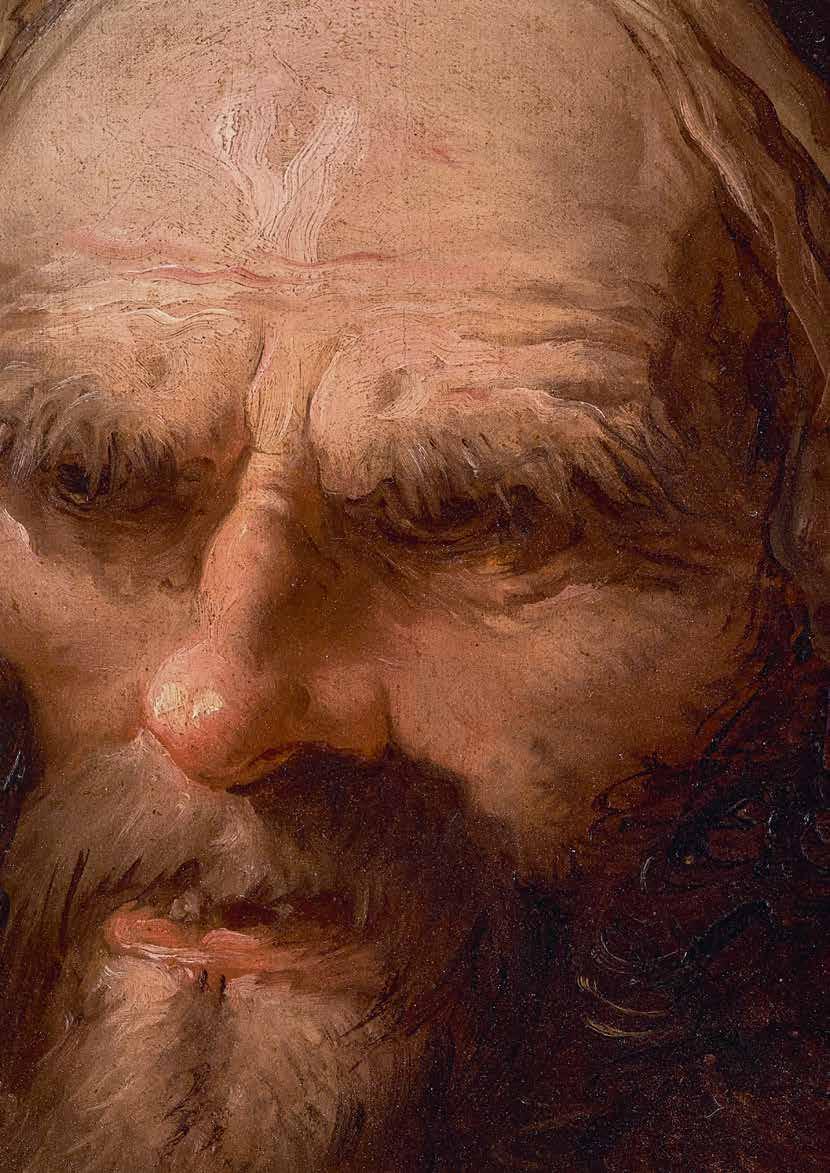
PORTRAITS DE PHILOSOPHES BUSTS OF PHILOSOPHERS
~ cat. 47 ~
GIANDOMENICO
TIEPOLO
Portrait d’oriental
Huile sur toile H. 55 ; L. 45 cm
Porte une inscription « Socrates » en haut à gauche
Prov. :
Europe, collection privée ; New York, Sotheby’s, 26 janvier 2023, n° 158 ; Robilant+Voena, Londres, Milan, Paris, New York.
Les trois tableaux, de même format, furent manifestement conçus comme une série et représentent des têtes de philosophes imaginaires, offrant l’occasion de figurer des vieillards barbus et vêtus de manière excentrique. Giambattista Tiepolo avait inauguré cette mode du goût du XVIIIe siècle avec d’extraordinaires têtes de philosophes et d’orientaux (Knox 1974), bientôt gravées à l’eau-forte par son fils Domenico dans un recueil paru pour la première fois en 1774, mais qui connut plusieurs éditions et ajouts. Domenico s’en inspira lui-même, les déclinant aussi bien au féminin qu’au masculin, dans ce dernier cas avec des visages similaires de vieillards austères et pensifs, revêtus de vêtements extravagants, de turbans et de fourrures. Ces trois tableaux témoignent du grand talent de peintre de Domenico, qui porte une attention particulière à la description des drapés des vêtements et des étoffes, ainsi qu’aux détails du visage, avec une obsession pour le dessin des sourcils et des rides. Tandis que le regard du Socrate est presque voilé dans l’ombre d’une orbite particulièrement sévère, le visage de Démosthène se révèle plus serein. Tirant habilement parti de la lumière, Domenico confère à ses têtes un relief et une vivacité remarquables. Jouant sur les contrastes du clair-obscur et faisant resplendir de reflets dorés les précieux vêtements et bijoux, l’artiste se confronte aux grands modèles de Rembrandt, maître qui connut un succès considérable dans la Venise du XVIIIe siècle. La tête de Socrate reproduit avec une grande précision la gravure figurant dans la Raccolta di Teste de Domenico, d’après les modèles de son père (Rizzi 1971, p. 350, n˚ 165), tandis que celle de Démosthène est comparable au Vieil homme barbu (ibid ., p. 370, n˚ 186).
~ cat. 47 ~ Portrait of an Oriental Man
Oil on canvas
H. 55; W. 45 cm
Inscribed upper left: “Socrates”
These three canvases, equal in size, were evidently conceived as a series depicting imaginary heads of philosophers, an opportunity for the painter to create images of bearded and bizarrely dressed older men. Giambattista Tiepolo had inaugurated this eighteenth-century genre with some extraordinary heads of philosophers and so-called Oriental men (Knox 1974), soon etched by his son Giandomenico in a volume first published in 1774, of which there were also various reprints and additions. Domenico evidently drew inspiration from these, representing them in both female and male versions, in the latter case with similar heads of rather severe, pensive old men, dressed in fanciful clothing, turbans and furs.
The paintings exhibited here reveal some of Domenico’s finest qualities, with a graphic emphasis on folds of clothing and fabrics, as well as facial details, with an obsessive attention to the description of eyebrows and wrinkles. While the gaze of the “Socrates” is almost concealed by the figure’s intense frown, “Demosthenes” is more tranquil. Skillfully exploiting the background lighting, Domenico lends these figures a great sense of spatial relief and vivaciousness. Playing on chiaroscuro contrasts and creating golden flickers on the precious clothing and jewelry, the artist stands in conscious comparison with the great models painted by Rembrandt, who enjoyed significant success in eighteenth-century Venice. The head of “Socrates” precisely reiterates the etching in Domenico’s Raccolta di Teste, based on the models designed by his father (Rizzi 1971, p. 350, no. 165), while the “Demosthenes” may be compared with the Bearded Old Man (ibidem , p. 370, no. 186).
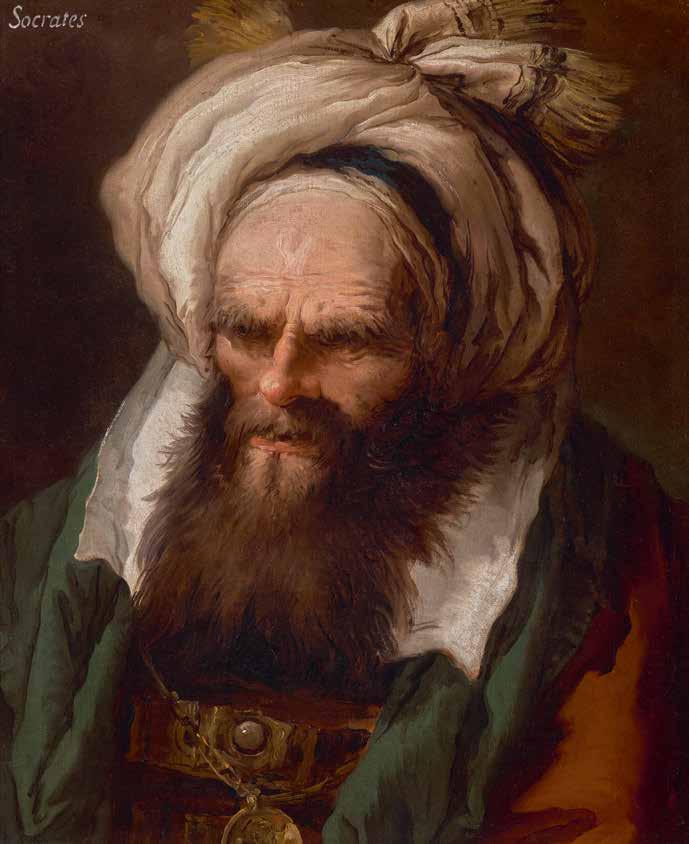
GIANDOMENICO TIEPOLO
Portrait d’oriental
Huile sur sa toile d’origine
H. 55,9 ; L. 45,7 cm
Porte une inscription « Aristoteles » en haut à gauche ~ cat. 48 ~
Prov. :
Europe, collection privée ; New York, Sotheby’s, 26 janvier 2023, n° 430 ; Paris, Galerie Éric Coatalem.
~ cat. 48 ~ Portrait of an Oriental Man
Oil on canvas
H. 55,9; W. 45,7 cm
Inscribed upper left: “Aristoteles”
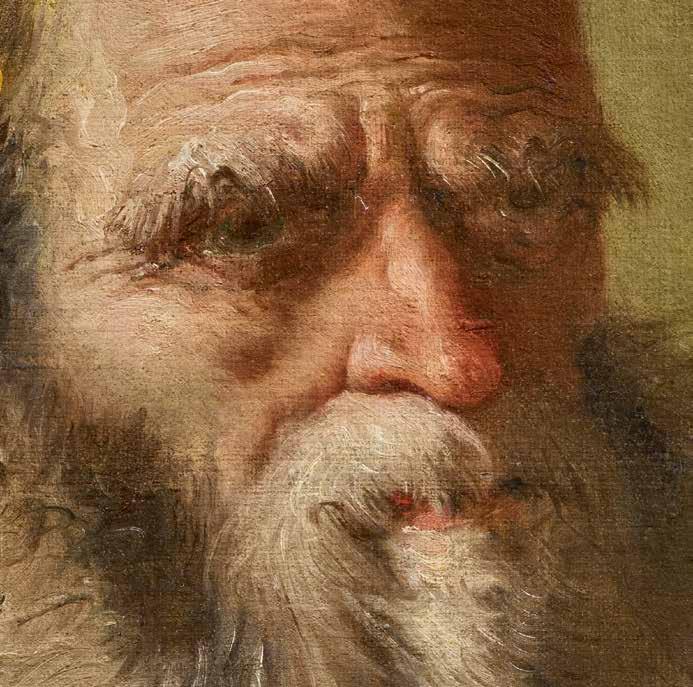
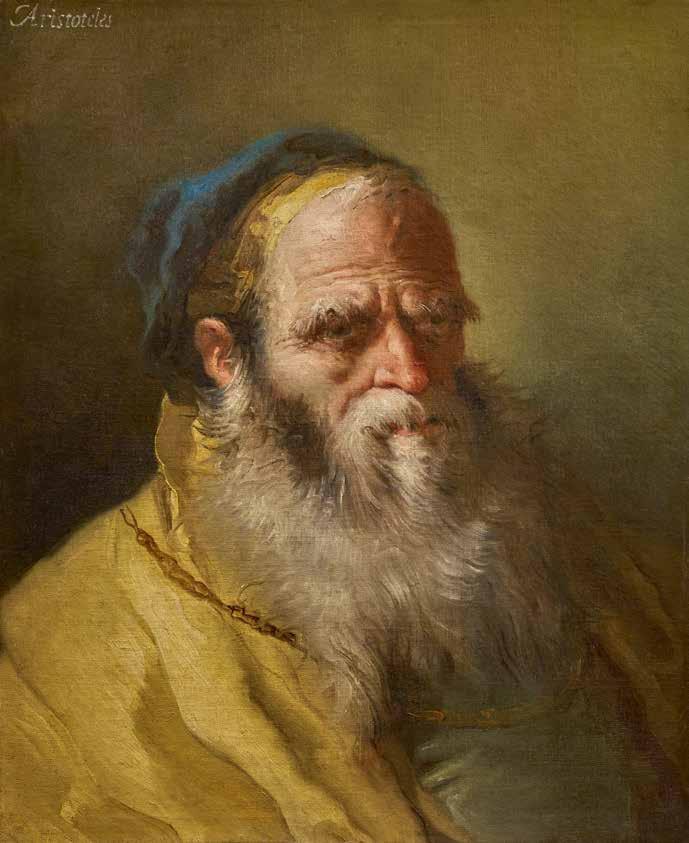
~ cat. 49 ~
GIANDOMENICO TIEPOLO
Portrait d’un oriental
Huile sur sa toile d’origine
H. 55 ; L. 45 cm
Porte une inscription « Demostenes » en haut à gauche
Prov. :
Europe, collection privée ; New York, Sotheby’s, 26 janvier 2023, n° 157 ; Paris, Galerie Éric Coatalem.
~ cat. 49 ~ Portrait of an Oriental Man
Portrait of an Oriental Man Oil on canvas
H. 55 ; W. 45 cm
Inscribed upper left: “Demostenes”
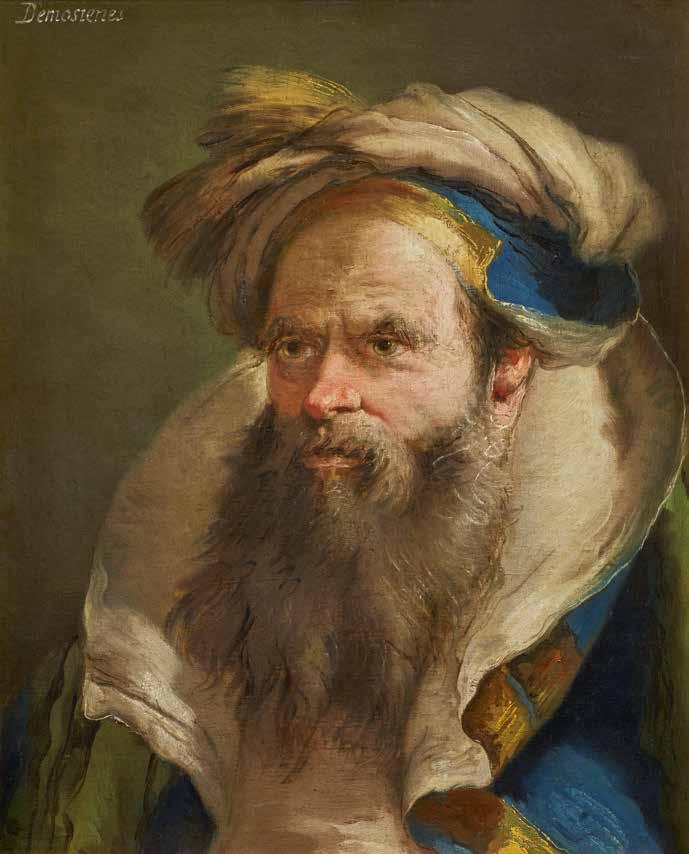
LE TROISIÈME GÉNIE THE
THIRD GENIUS
~ cat. 50 ~
Tête d’un jeune homme endormi
Pierre noire et sanguine
H. 405 ; L. 285 mm
Porte une inscription dans la marge inférieure à droite : « Tiepolo »
Prov. :
~ cat. 50 ~
Black and red chalk
H. 405; W. 285 mm
Ce dessin présente des similitudes techniques avec une feuille similaire, récemment passée en vente sur le marché de l’art américain et représentant une Tête de jeune homme coiffé d’un turban (412 x 285 mm), appartenant également à la collection parisienne d’André Lefèvre d’Ormesson. Il s’agit d’un dessin caractéristique des débuts de Lorenzo Tiepolo, qui révèle déjà son habileté à conjuguer l’influence de son père à celle des « têtes de fantaisie » de Giambattista
Piazzetta, tout en y ajoutant l’usage particulier de la combinaison de pierre noire et de sanguine, une technique qu’il développera davantage grâce à l’emploi du pastel, domaine dans lequel il deviendra un spécialiste reconnu, notamment lors de son séjour à Madrid, ville où il mourut. Ce dessin semble particulièrement similaire à certaines feuilles qui précèdent le voyage en Espagne, comme celle conservée aujourd’hui à la Fondation Marco Brunelli à Milan (Aikema 1996, pp. 305-306, n˚ 114 ; Romalli 2020, pp. 155-157, n˚ LXVII) et donc toujours des années 1750 ou du début des années 1760.
Head of a Sleeping Youth
Inscribed lower right in the margin: “Tiepolo”
The drawing technically resembles a similar sheet with the same provenance which was with W.M. Brady in New York in January 2024: the Head of a Young Man with a Turban (412 x 285 mm) also formed part of the collection of André Lefèvre d’Ormesson in Paris. This is a characteristic drawing by Lorenzo Tiepolo from his early period, already revealing his ability to combine his father’s legacy with that of Giambattista Piazzetta’s “teste di fantasia”, although it also features his distinctive use of a combination of black and red chalks. He was to further develop this technique with the adoption of pastel, a field in which he became a recognized specialist, especially during his stay in Madrid, where he died. This drawing seems very close to sheets that precede his journey to Spain, such as the one now in the Fondazione Marco Brunelli in Milan (Aikema 1996, pp. 305-306, no. 114; Romalli 2020, pp. 155-157, no. LXVII) and therefore still datable to the 1750s or early 1760s.
Paris, Comte André Lefèvre d’Ormesson ; New York, W.M. Brady ; collection privée.
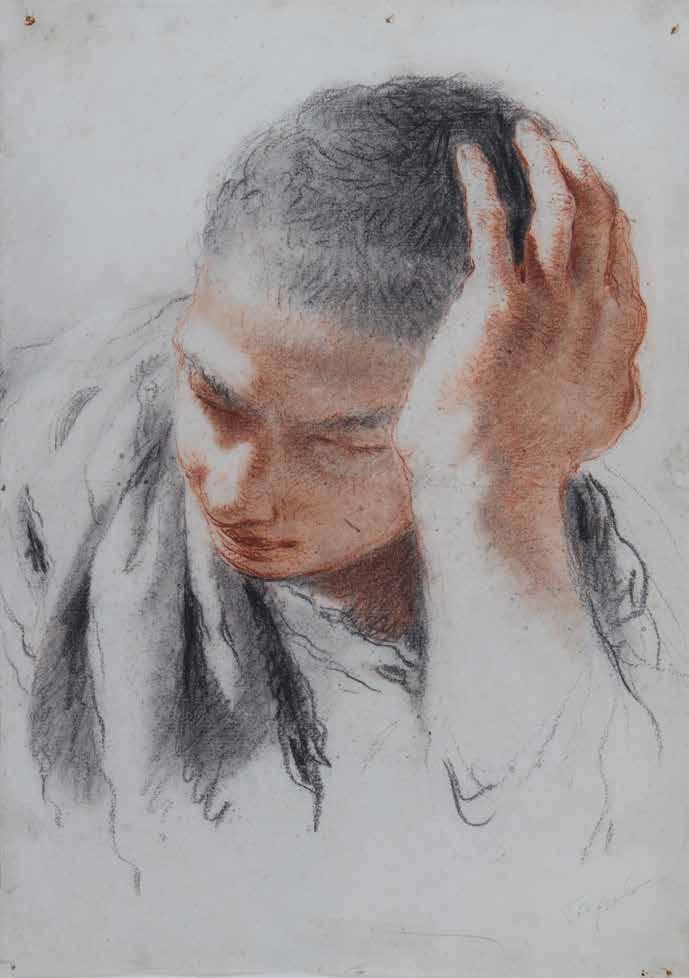
~ cat. 51 ~
LORENZO TIEPOLO
Tête d’un jeune homme la main devant le visage
Pierre noire et sanguine
H. 380 ; L. 280 mm
Inscription au verso à la pierre noire : « Lorenzo Tiepolo morto in spagnia / 4fxrs No 3855 »
Prov. :
Giovanni Domenico Bossi (1767-1853) ; Stuttgart, Maria Theresa Karoline Bossi ; Stuttgart, Karl Christian Friedrich Beyerlen ; Stuttgart, Gutekunst, 27 mars 1882 ; Londres, Sotheby’s, 28 juin 1979, n° 200 ; collection privée.
Bibl. :
Thiem 1994, p. 347, n° 19 ; Krückmann 1996, pp. 118-119, fig. 7 ; Aikema 1996, pp. 302-303, n° 113 ; Vance 1997, p. 22.
Exp. : Cambridge 1996, n° 113.
~ cat. 51 ~
Black and red chalk
H. 380; W. 280 mm
Le fait que ce dessin appartienne à l’album dit Bossi-Beyerlen (voir Knox 1980, I, p. 200-207), ainsi que son analyse stylistique, suggèrent qu’il a été réalisé par Lorenzo entre les années 1750 et le début des années 1760, avant son installation en Espagne avec son père et sa spécialisation dans le portrait au pastel. Il s’agit de l’un des plus beaux exemples de « tête de fantaisie », domaine dans lequel Lorenzo s’inspira non seulement des œuvres de son père Giambattista, mais témoigna également d’un grand intérêt pour certaines idées de Piazzetta qui, comme lui, avait développé une production variée et commercialement rentable de dessins de têtes « a capriccio ». À l’instar d’autres dessins, notamment ceux conservés à Weimar, Lorenzo ajoute ici une touche personnelle, créant des inventions toujours diverses et originales, comme cette main qui vient cacher une partie du visage. Il combine une technique graphique à la pierre noire, parfois avec plusieurs couleurs comme ici, et une texture de hachures extrêmement sophistiquée, presque semblable à une « toile d’araignée ».
Head of a Youth with his Hand covering his Face
Inscribed on the back with black chalk : “Lorenzo Tiepolo morto in Spagnia / 4fxrs No 3855”
The fact that this drawing belongs to the so-called Bossi-Beyerlen album (for which see Knox 1980, I, pp. 200-207), as well as a study of its style, would indicate that it was created by Lorenzo between the 1750s and early 1760s, before he moved to Spain with his father and became a specialist in pastel portraiture. This is one of the finest examples of the “testa di fantasia”, in which Lorenzo drew inspiration from his father Giambattista but also showed what he had learned from the insights and ideas of Piazzetta, who had built up a varied and commercially successful output in the genre of finished drawings of heads “a capriccio”. Here, as in other sheets, such as those in Weimar, Lorenzo adds a personal element, creating constantly changing and original inventions, occasionally including hands to obscure parts of the face. He combines a graphic chalk technique, sometimes using more than one color, as in this case, with extremely sophisticated hatching, almost like a spiderweb.
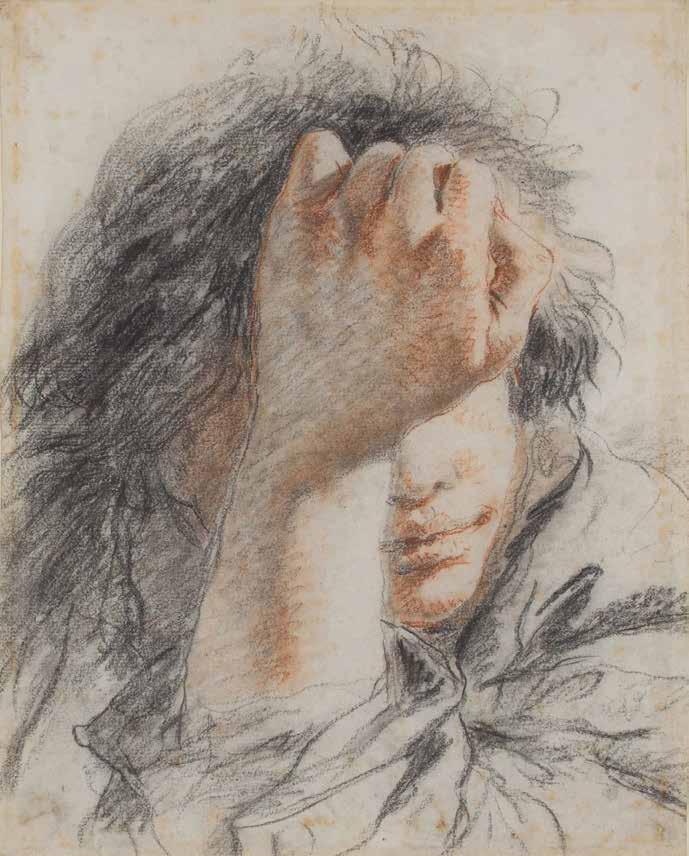
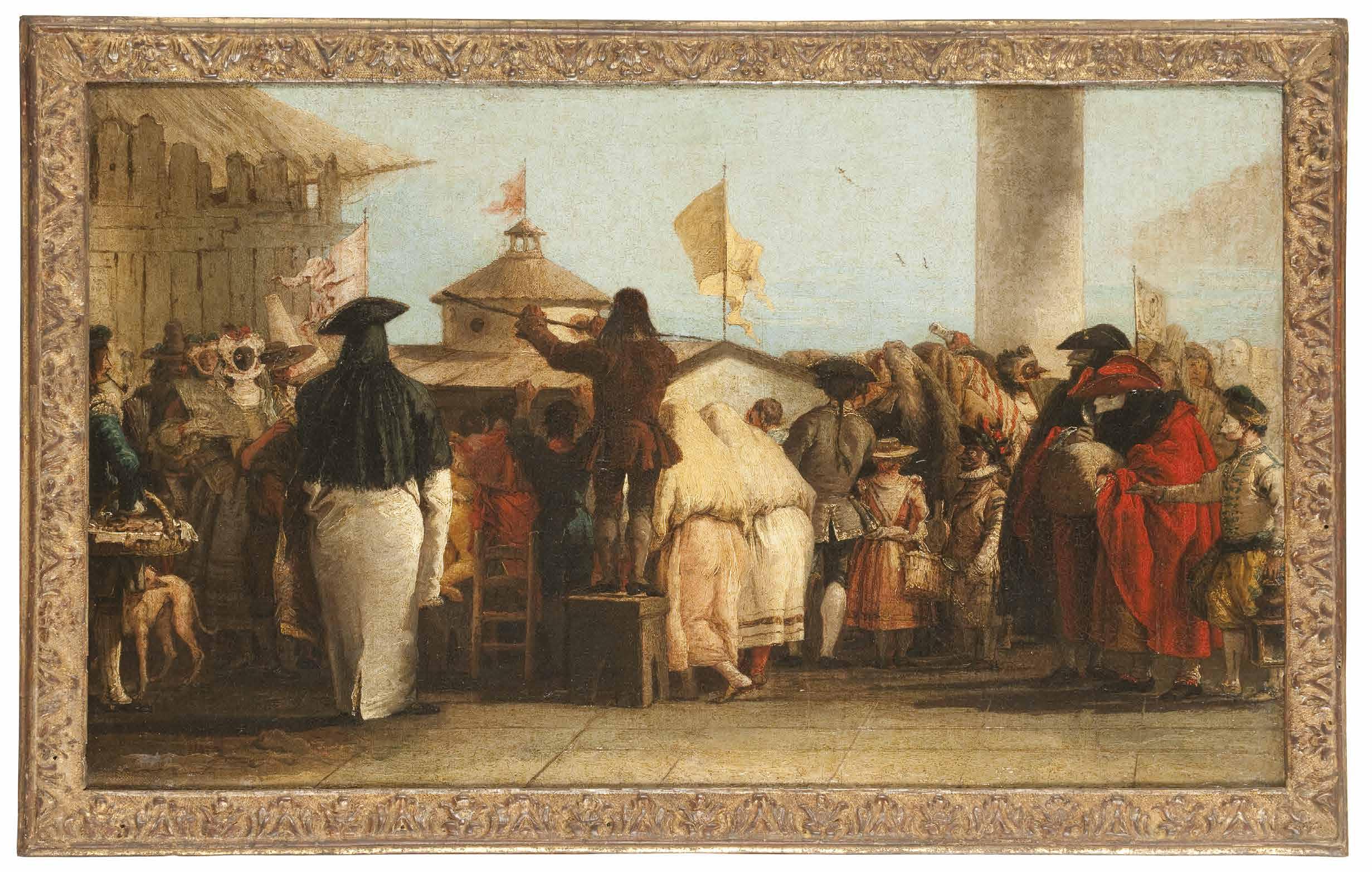
ESSAY
EMMANUELLE BRUGEROLLES
conservatrice générale honoraire du patrimoine, directrice d’études émérite à l’École Pratique des Hautes Études
DAVID GUILLET
conservateur général honoraire du patrimoine
Tiepolo and France: a tardy recognition
INTRODUCTION
In 1880, Philippe de Chennevières (1820-1899), director of the Beaux-Arts administration in Paris, co-founder of the Archives de l’art français, member of the Académie des Beaux-Arts, and eminent collector, commented on the exhibition of Dessins de maîtres anciens presented at the École des Beaux-Arts the previous year, paying homage to “the Venetian school [which] culminates in a stunning bouquet of these last charming painters, who provided it with a splendid funeral”1 . The French historians and amateurs of the time said it perfectly: the drawings of Giambattista Tiepolo (1696-1770) –including a superb Venus and Cupid – like those of Giovanni Antonio Canaletto (1697-1768) and Francesco Guardi (1712-1793), are the swan song of an eminent art tradition, to which we are indebted above all for Titian, Tintoretto and Veronese.
Indeed, two or even three generations of artists succeeded one another between the late seventeenth century and the last years of the eighteenth, brilliantly generating the revival of Venetian painting, which had been eclipsed during the Seicento by Rome, Bologna, Naples, and Genoa. In every pictorial type and style, from history to genre painting, not to mention portraiture and landscape, the output of the Serenissima and the cities of Venice’s Terra Ferma made its mark in England, Madrid, Poland, at the court of Empress Catherine of Russia, and in the German courts of Dresden, Würzburg and Cologne. Among the numerous artists, primarily painters and draftsmen, one name stands out as the most celebrated – Tiepolo – represented by three individuals, Giambattista and his sons Giandomenico (1727-1804) and Lorenzo (1736-1776).
I. THE GRAND TOUR
This phenomenon cannot be separated from travel in general, and more specifically from the Grand Tour – of which Venice, together with Rome, was one of the main segments, if not the most important one – which brought artists, amateurs and collectors, as well as aristocrats and crowned heads, to Italy. Those who made the journey were drawn to landscape, to light, to churches and palaces, as well as the paintings and decoration they housed, and to collections of drawings and prints. However, a close reading of contemporary accounts and journals reveals that not only did French authors place sixteenth-century painting – embodied by Titian, Tintoretto, and Veronese – above all else, commenting on it at far greater length than on works of their own time, but also that their appreciation of the latter was almost always accompanied by reservations, which evolved in both nature and forcefulness over the decades.
– THE 1710 s –
CROZAT, CAYLUS AND MARIETTE
If we focus on the first of these eighteenth-century French visitors (or who may be considered so), mention must be made of the amateurs and collectors Pierre Crozat (1665-1740) – who was also a financier, and to whom we owe the celebrated eponymous Recueil, published in 1729, which reproduces paintings from the most important European collections of his time – and the Comte de Caylus (1692-1765), antiquarian and author of the Recueil d’antiquités égyptiennes, étrusques, grecques et romaines (Anthology of Egyptian, Etruscan, Greek, and Roman Antiquities), a draftsman and printmaker trained by Watteau; the two men were also close friends2 .
1- Philippe de Chennevières, “Les dessins de maîtres anciens exposés à l’École des Beaux-Arts”, Gazette des Beaux-Arts, Paris, 1880, p. 32.
2- Alexandra Blanc, Collections et pratiques d’un amateur au XVIIIe siècle: Les recueils de dessins gravés du comte de Caylus; étude comparée du volume offert à Jacques-Antoine Arlaud , Neufchâtel: Éditions Alphil-Presses universitaires suisses, 2013.
3- Lausanne, chez J. Pierre Heubach, 1773.
4- “La France du XVIIIe siècle et les ’peintres modernes’ des écoles d’Italie”, in Settecento; Le siècle de Tiepolo. Peintures italiennes du XVIIIe siècle exposées dans les collections publiques françaises, exhibition catalogue, Musée des Beaux-Arts et Palais des Beaux-Arts, 2000-2001, p. 42.
5- Cochin, op. cit., 1773, p. 68, 89, 117, 123.
Crozat and Caylus made their trips to Italy, the former at the end of 1714 and the latter from 1714 to 1715, and they were primarily drawn to sixteenth-century painting. They do make mention of Rosalba Carriera (1675-1757), whom Crozat met and encouraged to come to France, which she did in 1720, but they did not meet Tiepolo, who had not yet fully emerged as a painter, since his first known paintings date from 1716 and in any case betray the influence of his immediate predecessors, such as Giovanni Battista Piazzetta (1683-1754), whose painting was marked by dark tonalities and a dramatic tone inspired by the Bolognese school. Crozat and Caylus were soon followed by
Pierre-Jean Mariette (1694-1774), another learned collector, who spent a few weeks in Venice between December 1719 and January 1720 and met Count Anton Maria Zanetti (1689-1767), whom he befriended; Zanetti showed him his collection of paintings and introduced him to Rosalba Carriera.
– THE 1740s AND 1750 s –CHARLES-NICOLAS COCHIN
Three decades later, between 1749 and 1751, CharlesNicolas Cochin (1715-1790) represents the second generation of travelers. In the third volume of his Voyage d’Italie, ou recueil de notes sur les ouvrages de Peintures & de sculptures, qu’on voit dans les principales villes d’Italie (Travels in Italy, or a compendium of notes on works of painting and sculpture seen in Italy’s principal cities), published in 17583 , he offers an exhaustive overview – albeit with numerous inaccuracies and factual errors, as Maria Teresa Caracciolo has noted 4 – of the works housed in the churches and palaces of Venice. While he, too, shows a marked preference for sixteenth-century painting, his remarks on works by Giambattista and Giandomenico Tiepolo, referred to as “Tiepoletto”, are often favorable. He praises “pieces […] full of wit and genius”, their “taste”, “fine craftsmanship” and “beautiful brushwork”, their “effortless” execution, and their composition, generally described as “ingenious”; and he does not fail to refer to the “delightful shading of flesh tones”.
However, he generally qualifies this assessment with crippling reservations: in his eyes, these compositions are “cruelly mannered”, here in the dessin, there in figure details such as the “excessively large and mannered feet” in the Martyrdom of Saint Bartholomew, in the church of “S. Eustachio, known as S. Itac” (San Stae), and most often in the “couleur […] charmante: clear and luminous, energetic in the shadows, but more beautiful than nature, and consequently false and mannered.”
This was true, in his view, with the frescoed ceiling depicting Saint Teresa in glory of the « Carmelitani Scalzi » (Discalced Carmelites), whose color, according
to him, is “harsh, mannered, and monotonous, with shadows that are too even.”, as well as the ceilings of the “Church of the Reformed Dominicans, called Gesuati” which is indisputably by Giambattista but which he regards as by his eldest son, “very good as a ceiling, with beautiful colors in the shadows, but red in the flesh tones, and mannered.”5
This uncompromising assessment was echoed in the Abecedario by Pierre-Jean Mariette (1694-1774), the manuscript of which was compiled a few years earlier, between 1740 and 1750, but only published between 1853 and 1862 by Philippe de Chennevières and Anatole de Montaiglon. While praising Giambattista’s “compositions that shone with the richness of his genius”, Mariette elaborated on the grievances of his predecessors, noting that “this excessive facility has been detrimental to his being correct, and he can be reproached for having neglected this aspect by giving free rein to his fervid imagination. He showed little concern for the accuracy of his colors. His coloring is false, however seductive it may be. He never knew how to paint graceful heads. These are his flaws, offset by all the advantages of a rich and fertile genius, and by everything that illusion can create for eyes that love to be seduced. His touch is also very witty.”6
The matching critiques by Cochin and Mariette are better understood if one reads the second Discours sur l’enseignement des Beaux-Arts delivered by the former: “I call manière […] all that departs from nature, any learned or imagined norm that is not based on truth, whether it comes from the imitation of the masters, or from our own errors”7
Moreover, Mariette’s collection contained very few drawings by Giambattista Tiepolo – several of them now disputed – and none by his sons Giandomenico and Lorenzo 8 , even though his correspondence with the writer and architect Tommaso Temanza (1705-1789) states his wish to assemble works by other artists of his time from the Veneto, such as Cignaroli, Diziani, Balestra, Carpioni, but also Longhi and Canaletto 9 .
6- Abecedario de P.J. Mariette et autres notes inédites de cet amateur sur les arts et les artistes, ouvrage publié d’après les manuscrits autographes conservés au cabinet des estampes de la bibliothèque impériale, et annotés par Philippe de Chennevières et A. de Montaiglon, Paris: J. B. Dumoulin, 1853-1862, vol. VI, p. 300, entry on Tiepolo.
7- Discours (second et troisième discours sur l’enseignement des Beaux-Arts) prononcé à la séance publique de l’Académie des sciences, belles-lettres et arts de Rouen en 1777 par M. Cochin, Paris: L. Cellot, 1779; Christian Michel, Le Voyage d’Italie de Charles-Nicolas Cochin, Rome: École française de Rome, 1991, no. 145, p. 25.
8- Pierre Rosenberg, Les dessins de la collection Mariette. Écoles italienne et espagnole, Paris: Somogy, Paris, 2019, vol. III, pp. 1194-1197, nos. 12016-12023.
9- Ibid., vol. I, p. 25.
THE VOYAGE OF THE ABBÉ DE SAINT-NON
In 1761 the Abbé de Saint-Non (1727-1791), author of the Voyage pittoresque, ou, Description des Royaumes de Naples et de Sicile 10 , sojourned in Venice between May 8 and June 23. He was accompanied by the young Fragonard (1732-1806), then a pensionnaire at the French Academy in Rome, who was authorized by the director of that institution, Charles-Joseph Natoire (1700-1777), and the Marquis de Marigny (1727-1781), Superintendent of the King’s Buildings, to travel with him from Rome to France, passing through the Veneto.
Punchinello lying down, etching from the Recueil de Griffonis, de vuës, paysages, fragments antiques et sujets historiques, no. 91, circa 1780
After those six weeks, recounted in his Journal ou notes sur un voyage fait en Italie, Saint-Non wrote that he had “more than satisfied [his] curiosity about everything in that city worthy of note”11 , and asserts that he left it “without regrets.” It is true that Count Francesco Algarotti (1712-1764), the cosmopolitan “poet-philosopher” who was open to both the sciences and the arts, and who acted as artistic advisor to the Saxon court, looked after him during his stay, opening every door and drawing his
10- Paris: Jacques-Gabriel Clousier, 1781-1786.
2 – Jean-Claude Richard de Saint-Non, after Giambattista
attention particularly to the work of Giambattista Tiepolo, his protégé – so much so that the Recueil de griffonis, de vuës, paysages, fragments antiques et sujets historiques, gravés tant à l’eau-forte qu’au lavis (Collection of Sketches, Views, Landscapes, Ancient Fragments and Historical Subjects, in etchings and wash drawings) published by the abbé in about 1780, contains an aquatint after a Drunken Punchinello by the artist (ill. 1), a drawing probably formerly in Algarotti’s collection12 . The anthology of prints also illustrates the Banquet of Anthony and Cleopatra, after Giambattista, which Saint-Non himself copied (ill. 2) from the etching made by Fragonard in 1763 (ill. 3).
The abbé was thus able to discover “a great number of palaces and churches […] filled with works by Tiepolo, all with his distinctive character and style, easily recognizable, but always more as a man of taste than as a great master”13 , as well as the monumental decorations the master had completed a decade earlier in the Palazzo
11- Laura Mascoli, “Le Journal du voyage en Italie de l’abbé de Saint-Non (1759-1761)”, Dix-huitième Siècle, 1989, no. 21, 1989, pp. 423-438.
12- The drawing is in the Morgan Library & Museum, New York, inv. EVT 169 (2017.241).
13- P. Rosenberg and B. Brejon de Lavergnée, Panopticon Italiano, un diario di viaggio ritrovato 1759-1761 / Saint-Non, Fragonard , Rome: Edizioni dell’Elefante, 1986, pp. 189-214; and Fragonard , exhibition catalogue, Paris and New York, Galeries
and
nationales du Grand Palais
The Metropolitan Museum of Art, 1987-1988, p. 133.
ill. 1 – Jean-Claude Richard de Saint-Non, after Giambattista Tiepolo,
ill.
Tiepolo, The Feast of Antony and Cleopatra, aquatint, from the Recueil de Griffonis, de vuës, paysages, fragments antiques et sujets historiques, no. 267, circa 1780
ill. 3 – Jean-Honoré Fragonard after Giambattista Tiepolo, The Feast of Antony and Cleopatra, etching, Paris, musée du Louvre, Département des Arts graphiques, Collection Edmond de Rothschild, 17982 LR/recto
Labia in Venice and the Villa Contarini on the Terra Ferma at Piazzola sul Brenta. Of the former, Saint-Non says that “everything is grand and noble, of the richest composition,” adding that he would have “wished for more nobility in the figures of Cleopatra and Mark Anthony, but the details are delightful. Countless incidental figures of dogs and dwarves are admirable and perfectly placed”14 . However, he was unable to admire the frescoes of the Villa Pisani at Stra, “which were not yet finished”15
– 1774 – THE VOYAGE OF BERGERET DE GRANCOURT…
In 1774, four years after Giambattista’s death in Madrid, Pierre-Jacques-Onésyme Bergeret de Grancourt (1715-
14- Op. cit., 1986, pp. 189-214.
15- Op. cit., 1986, pp. 189-214.
1785), a wealthy financier and collector whose first marriage was to the sister of the Abbé de Saint-Non, made his own journey to Italy, accompanied by the architect Pierre-Adrien Pâris – and Fragonard. His journal attests to how impressed he was by the Palazzo Labia and the painted decoration created by the Tiepolos: “Everything there is spacious, grand, and full of taste, designed to please everyone”16 . Iv may have been then that he purchased the drawings by Giandomenico which are now in the collection of the Musée Atger in Montpellier 17
… AND FRAGONARD’S SOJOURNS IN VENICE
Born in 1732, Fragonard settled in Rome in 1756, and his two sojourns in Venice, under exceptionally favorable conditions in the company of eminent collectors and connoisseurs, had a lasting influence on his art and sensibility. Some decades later, A. Lenoir recounted how the artist described his encounter with the great Italian masters as a profound experience: “Michelangelo’s energy frightened me […] I experienced a feeling I could not express; I was moved to tears by the beauties of Raphael, and my crayon fell from my hands; at length I remained in an insurmountable state of indolence for several months, until I devoted myself to the study of the painters who gave me hope of one day rivaling them: it was thus that Barocci, Pietro da Cortona, Solimena and Tiepolo captured my attention”18
Reading these remarks, one has a better understanding of the pleasure and ease with which Fragonard approached Venetian artists during his two stays in the lagoon city, to the point of being inspired by their expressive freedom and appropriating their art of color and light. Among the numerous drawings he produced – some sixty, it seems, according to Pierre Rosenberg 19 – at least four are known to be after frescoes and altarpieces by Giambattista Tiepolo, which he transcribed into etchings when he returned to France in 1763: The Banquet of Anthony and Cleopatra from the Palazzo Labia and Fabius Maximus before the Senate of Carthage from the
16- Jacques-Onésyme Bergeret de Grancourt, Voyage d’Italie, précédé d’une étude par A. Tornézy: “Bergeret et Fragonard, journal inédit d’un voyage en Italie, 1773-1774”, in Bulletin et Mémoires de la Société des antiquaires de l’Ouest 1894, 1895, XVII, p. 388; P. Rosenberg, in exh. cat. Paris and New York, op. cit., 1987-1988, p. 405.
17- George Knox, Domenico Tiepolo: raccolta di teste 1770-1970, Milan: Electa, 1970, n. p.
18- A. Lenoir, “Fragonard”, in Biographie universelle ancienne et moderne (Biographie Michaud), Paris, 1816, XV.
19- Most of them are in the Norton Simon Museum, Pasadena; see exh. cat. Paris and New York, op. cit., 1987-1988, p.133.
Palazzo Dolfin (ill. 4), as well as The Virgin in Glory with Saint Catherine and The Education of the Virgin , altarpieces from Santa Maria della Fava 20 (ill. 5).
In his own way, he also played a role in how Venetian art was received in France, offering enthusiasts a body of work that was both French and imbued with the audacity that only Venetian artists at the time dared employ. As the Goncourt brothers wrote, “He takes his spirit, his sparkle, from Tiepolo”21 . Baron de Portalis was certainly not mistaken when he described his Bust of an Old Man with a Cap in the Musée JacquemartAndré 22 (ill. 6) as “in the style of Tiepolo”23 .
20- See exh. cat. Paris and New York, op. cit., 1987-1988, p. 133, no. 5, p. 134, no. 52, and p. 474, fig. 4.
21- L’art du XVIIIe siècle, vol. II, Paris: A. Quantin, 3rd ed., 1880, p. 317.
22- See exh. cat. Paris and New York, op. cit., 1987-1988, no. 98.
23- Baron de Portalis, Honoré Fragonard, sa vie, son œuvre, Paris, 1889, p. 290.
ill. 4 – Jean-Honoré Fragonard after Giambattista Tiepolo, Fabius Maximus before the Senate of Carthage 1763, etching, Washington, National Gallery of Art, Gift of Kate Ganz, 2014.131.5
ill. 5 – Jean-Honoré Fragonard after Giambattista Tiepolo, The Virgin in Glory with Saint Catherine, Saint Rose holding the Infant Jesus, and Saint Agnes, 1763, etching, Paris, Bibliothèque nationale de France,
ill. 6 – Jean-Honoré Fragonard, Bust of an Old Man wearing a Hat, oil on canvas, Paris, musée Jacquemart André
II.
COMMISSIONS AND PROJECTS: VENETIAN ARTISTS IN EIGHTEENTH-CENTURY EUROPE
THE HISTORY OF AN ENCHANTMENT
At the end of these sojourns, some travelers, particularly the English ones, left Venice filled with enthusiasm, and soon commissioned works from Venetian artists or offered them substantial projects for the decoration of palaces, residences and churches, which left an enduring mark on their respective countries. From this moment on, eighteenth-century Venetian art was present throughout Europe, from England to Spain and Poland, as far as Russia, not to mention Saxony, Bavaria, and the German principalities.
Significantly, the first accomplishments were achieved in the first two decades of the century, some years before the journeys of Crozat, Caylus and Mariette. These were primarily due to the initiative taken by Charles Montagu (1656-1722), Earl and later first Duke of Manchester, British ambassador to Venice in 1707-1708, who returned to the Britain accompanied by Giovanni Antonio Pellegrini (1675-1741) and Marco Ricci (1676-1730). These artists, whose projects included the decoration of Castle Howard and opera sets for London’s Haymarket Theatre, were followed by Sebastiano Ricci (1659-1734) and Jacopo Amigoni (1682-1752) and, later still, by Giovanni Antonio Canal, known as Canaletto (1697-1768), whose employment was facilitated by Owen Swiny (1676-1754) and then by consul Joseph Smith (1674-1770).
The same artists served the Electors Palatine in Bensberg and Mannheim, while Gaspare Diziani (1689-1767) worked for the Elector of Saxony in Dresden and at the Bavarian court in Munich; Francesco Fontebasso (17071769) was active in the Winter Palace in Saint Petersburg; and Giambattista Pittoni (1687-1767) was in charge of commissions for the Crown of Spain, the Elector of Saxony and the Archbishop-Elector of Cologne.
Paradoxically, the most famous of these by far, Giambattista Tiepolo, assisted by his sons Giandomenico and Lorenzo, only responded to two requests beyond the Italian peninsula, admittedly for truly major projects: the
Residence at Würzburg, in Franconia, under the patronage of Prince-Bishop Karl Philipp von Greiffenklau zu Vollraths (1690-1754), from 1750 to 1753; and the task entrusted to him by Charles III of Spain (1716-1788) at the Royal Palace in Madrid, which occupied him between 1762 and 1766. What is even more surprising is that the history of Giambattista’s relations with France, his clients, collectors and enthusiasts is that of a missed opportunity.
THE FRENCH EXCEPTION
The reluctance of French travelers regarding eighteenthcentury Venetian works – including those of the Tiepolos – is echoed by the lukewarm reception given to painters from the Serenissima in Paris. As early as 1719, Giovanni Antonio Pellegrini received a prestigious commission from the Regent Philippe II d’Orléans, through the Scottish banker John Law, for the ceiling of the Mississippi Gallery in the Hôtel de Nevers, at that time the seat of the Royal Bank. However, as soon as it was completed, the work – which depicts Good Government – provoked strong and even hostile reactions from François Lemoyne, who had hoped to gain the commission, but also and above all from Caylus and Mariette. The former even made a textbook case out of it, illustrating the liberties taken by Venetian artists as regarded nature and vérité: “Pellegrini and several others can […] serve as examples for us. Their légèreté (frivolity) has never been praised, nor should it be. Their lack of terminé (finish), their impatience, or their swiftness of handling have never been more than appearances or pretenses of this aspect, and no one who knows about art could ever be mistaken about this” 24 . The decoration was destroyed in 1722 and its fate exemplifies a lasting misunderstanding. Notwithstanding the two reception pieces for the Académie Royale painted by Pellegrini and his colleague Marco Ricci – who was active in Paris at the same time – now in the Louvre, Modesty presenting Painting to the Academy and the Allegory of France 25 , only the spectacular success achieved by Rosalba Carriera, who was adopted by nobles, amateurs and collectors, stands as an exception to almost unanimous rejection.
24- Comte de Caylus, Vies d’artisteS du XVIIIe siècle. Discours sur la peinture et la sculpture. Salon de 1751 et de 1753. Lettre de Lagrenée, publiés par André Fontaine, Paris, 1910, p. 151. 25- Inv. nos. 1166 (1801 catalogue) and 1188; Stéphane Loire, “La peinture italienne du XVIIIe siècle dans les collections du Louvre”, in Settecento; Le siècle de Tiepolo. Peintures italiennes du XVIIIe siècle exposées dans les collections publiques françaises, exh. cat., Lyon and Lille, Musée des Beaux-Arts and Palais des Beaux-Arts, 2000-2001 Settecento, p. 27.
There were at least two reasons for this reticence. One, clearly expressed by Caylus, was aesthetic, as has been outlined by Maria Teresa Caracciolo: “In the climate that had evolved in Parisian learned circles of the time […] it was above all Italian painters’ ’facility’ and ’lightness of touch’ that was condemned”26 . The other reason relates to the uniqueness of the Fine Arts structure in the French kingdom, which was scarcely propitious to welcoming artists whose careers and reputations had built themselves up beyond the framework of the Académie and whose experience led them to consider it unnecessary to secure the approval of their French colleagues, or indeed of their censors.
TIEPOLO AND FRANCE – A MISSED OPPORTUNITY?
As Marc Fumaroli has pointed out, it was undoubtedly this specifically French context which would explain why, after Pellegrini’s fiasco, “Paris was the exception in a Catholic Europe in which princely vainglory yearned for glorification by Tiepolo,” accustomed as he was to “clerical or lay patrons granting freedom of execution to the painter, known for his extraordinary inventive passion, provided he adhered strictly to the plan stipulated in the contract […]”27
This rupture – to a certain extent foreshadowed by the writings of travelers – had its final consummation in the second half of the century, when artists and critics broadly adopted the canons of Neoclassical aesthetics, notably promoted by Diderot, whose Salons were only published much later but who exerted a lasting moral authority28
Maria Teresa Caracciolo notes that starting in the 1750s, “French criticism of the period devoted itself entirely and exclusively to shaping the glory of the nation’s ’modern’ painters”29 . It is true that in Spain, in the last years of his life, Giambattista Tiepolo experienced a loss of reputation – if not disgrace, at least disaffection – reminiscent of the situation in a France, when, after the completion of the decoration of the Royal Palace in Madrid, his projects were either rejected or postponed, and his rival Anton Raphael Mengs even regained favor after his death.
26- “La France du XVIIIe siècle et les ’peintres modernes’ des écoles d’Italie”, in exh. cat. Lyon and Lille, op. cit., 2000-2001, p. 36.
27- “La conscience de Venise. Giambattista Tiepolo”, Revue des Deux Mondes, 2007, pp. 9-20.
28- Maria Teresa Caracciolo, op. cit., 2000-2001, p. 42.
29- Ibid
30- Stéphane Loire, op. cit., 2000-2001, p. 26.
31- Abecedario de P.J. Mariette, op. cit., p. 300.
This bias is also reflected in the total absence of works by Giambattista and his sons in the collection of the French Crown in the eighteenth century, as confirmed by Stéphane Loire after lengthy investigations that rule out various hypotheses, none of which is corroborated, either by period inventories or long-supposed correspondence “whose very existence […] is now also in question”30 . Conversely, the role played by amateurs was decisive in disseminating etchings by the Tiepolos in France, as is shown by the purchase in 1775 by the Cabinet du Roi from Pierre-Jean Mariette – who judged that Giambattista’s touch “shone especially through his prints”31 – of a sizable collection of etchings. This was accompanied by a manuscript that reveals the close relationship between the collector and Anton Maria Zanetti, as well as the latter’s role as advisor and agent for Giandomenico, ensuring the broadest dissemination of his compositions and the reprinting and even re-publication of those by his father, including the Vari Capricci and Scherzi di fantasia 32 .
CONFISCATIONS DURING THE FRENCH REVOLUTION
The aesthetic prejudices that governed purchases made by the Crown and private individuals remained remarkably similar during the Revolutionary period, although this could have been the occasion for filing the gaps in the royal collections, in view of the wealth of those owned by the courts of Italy and the Holy Roman Empire. Stéphane Loire has observed that “confiscated works […] were very weak and hardly representative of how rich the pictorial output of Italy had been during the century”, noting that “the officers in charge of selecting works […] were completely unaware of Tiepolo, Piazzetta or Pittoni”33 .
When in 1797 General Bonaparte and his French troops entered Venice, forced the Doge to abdicate and proclaimed a provisional government, ordering the transfer to France of the bronze Horses of Saint Mark’s and the Wedding at Cana by Veronese, works by the Tiepolos were similarly ignored. The presence on some of Giandomenico’s genre scenes of the sign VV – Viva Venezia , the rallying-cry of Venetian citizens who were hostile to French presence – may have played a certain role in this oblivion34 , which cannot be a mere coincidence.
III.
THE RECEPTION OF VENETIAN ART FROM THE NINETEENTH CENTURY TO OUR OWN TIME
Yet in France, during the decades that followed the Revolution and the First Empire, there was a gradual renewal of interest in Venetian art and for the Tiepolos in particular. Among the contributing factors here was the existence of collections formed by amateurs who were particularly close to the artists and offered for sale at a relatively late date.
THE FIRST COLLECTORS, CLOSE TO THE TIEPOLOS, OR RELATED TO THEM
Thus the collection of Count Francesco Algarotti passed through several sales, drawings the attention of art
lovers to the works he owned by the Tiepolos, initially only a short while after his death on May 3, 1764 in Pisa. One part of his collection passed to his heir and brother, Count Bonomo Algarotti, and then on his death on September 9, 1776 to his daughter Countess Maria Algarotti Corniani, before it was dispersed. This was the case of the Charlatan, or Tooth-Puller and the Carnival Scene, or the Minuet (ill. 7), which resurfaced as lot 67 in the May 17, 1904 sale of Princess Mathilde Bonaparte, who had acquired them around 1868. These two paintings are now in the Louvre 35 , while a larger group of sheets with the same provenance is now in the Fitzwilliam Museum, Cambridge 36 .
7 – Giandomenico Tiepolo, Carnival Scene or The Minuet, 1754, oil on canvas, Paris, musée du Louvre, RF 1938 100
32- 190 etchings were acquired. See Dario Succi, Giambattista Tiepolo, il segno e l’enigma , exh. cat., Venice, Ca’ Rezzonico, 1986, pp. 27-28, and Michael Matile, Della Grafica Veneziana, Das Zeitalter Anton Maria Zanettis (1680-1767), exh. cat., Graphische Sammlung ETH Zürich, Petersberg: Michael Imhof Verlag, 2016, pp. 145-146.
33- Stéphane Loire, op. cit., p. 27.
34- The two initials appear on the wall of a hostelry in Giandomenico’s drawing of Punchinello in a Malvasia , now in an American private collection; see Tiepolo, Ironia e comico, exh. cat., Venice, Fondazione Cini, 2004, p. 38.
35- RF 1938-100 and RF 1838-99.
36- Da Pisanello a Tiepolo. Disegni veneti dal Fitzwilliam Museum di Cambridge, exh. cat., Venice, Fondazione Cini, 1992, pp. 154-194, 198-201, nos. 68-88 and 90-91.
ill.
At the same time, the Neoclassical sculptor Antonio Canova (1757-1822) – a keen collector of Tiepolo drawings – was able to acquire from Count Leopoldo Cicognara (1767-1834), archaeologist and member of Venice’s Academy of Fine Arts (of which he was president from 1808) a considerable lot of albums which Giambattista had entrusted in 1762, just before his departure for Madrid, to his son Giuseppe Maria, a cleric in the convent of the Somascan Fathers at Santa Maria della Salute.
As Sergio Marinelli has pointed out, this passage shows on the one hand that “the proclaimed rupture” between the Settecento and “the new century – the nineteenth – was in fact more apparent than deep”, and on the other that, while Venetian drawings of the eighteenth century did not always find favor with “drawings specialists”, “artists always adored them”, regarding them not “parallel to painting” but as a “necessary prerequisite”37, as for all the arts, or even as autonomous works to be approached for their intrinsic interest. In any case, decades after his death, the sheets collected by Canova delighted the most demanding collectors, and the museums which acquired them from those collectors, particularly in France38 [cat. 9, 10]
Without claiming to be exhaustive, we should also mention Giovanni Domenico Bossi (1767-1853), born in Trieste and a pupil of Giandomenico, who pursued a career as a miniaturist and settled in Munich. To his daughter Maria Theresa Caroline Bossi (1825-1881) and her husband Carl Christian Friedrich Beyerlen (18261881) he bequeathed his collection of 800 drawings by his master and Giambattista and Lorenzo Tiepolo. After their deaths these were dispersed on March 27
and 28, 1882, in Stuttgart, and a significant portion of that collection has remained at the Staatsgalerie in that city, with a few sheets acquired by French collectors 39 . [cat. 51]
NINETEENTH-CENTURY ARTISTS AND AMATEURS
Like Fragonard in his day, these were some nineteenth-century French artists who were drawn to Venetian art in general, and particularly to the work of the Tiepolos, which they studied attentively, sometimes even purchasing or collecting them.
This was the case with Baron Louis Auguste de Schwiter (1805-1889), a friend of Delacroix, who painted his portrait. Trained in Paris between 1823 and 1826, he took part in the emergence of the Romantic movement and the renewed interest of its artists in movement and color, exhibiting portraits at the Salons from 1831 to 1859; he was also a collector. He admired Watteau and Fragonard, but even more the Tiepolos, by whom he acquired 29 drawings. The sales of his collection in 1883 and 1886 contributed to the resurgence of interest in Venetian art in France in the last years of the century40
Mention must also be made of his contemporary JeanFrançois Gigoux (1806-1894), a painter, draftsman, and lithographer, who entered the École des Beaux-Arts in 1828. He is known for his lithographed portraits in L’Artiste and the drawings he made for the 1835 edition of the Histoire de Gil Blas de Santillane . From 1828 onward, he assembled a significant collection, part of which was sold in 1882 41 [cat. 27 ], but in 1894 he bequeathed its core to his native city of Besançon,
37- “Le dessin vénitien des XVIIe et XVIIIe siècles”, in Venise. L’art de la Serenissima. Dessins du XVIIe et XVIIIe siècles, exh. cat., Montpellier, Musée Fabre, 2006, pp. 12-13.
38- Two of these drawings with images of the Holy Family and with a provenance from the Armand-Valton and Charles Drouet collections, were donated, respectively in 1908 and 1909, to the École des Beaux-Arts in Paris (invs. EBA 391, 390), which later received two studies of single figures from the Jean Masson collection in 1925 (invs. Mas 2408, Mas 2409).
39- Tiepolo, Zeichnungen von Giambattista, Domenico und Lorenzo Tiepolo aus der Graphischen Sammlung der Staatsgalerie Stuttgart, aus württembergischem Privatbesitz und dem Martin von Wagner Museum der Universität Würzburg, exh. cat., Graphische Sammlung Staatsgalerie Stuttgart, 1970; Jean-François Gigoux acquired one drawing from the Bossi collection, now in the Musée des Beaux-Arts et d’archéologie, Besançon, inv. D.1662.
40- 17 drawings were sold on April 20-21, 1883, lots 135-150; 12 on May 3, 1886, lots 82-90, a sale that also featured four paintings by Giambattista (lots 38-41); Jean Masson acquired lot 82, two caricatures now in the École des Beaux-Arts, Paris (invs. Mas 2407, Mas 2420).
including twenty-eight works by the Tiepolos, including two paintings by Giandomenico and twenty-six drawings, one of which had been in the Bossi Beyerlen collection 42 .
As for amateurs, the most enigmatic and ambitious was Jean Fayet Durand (1826-1888). At the 1833 sale in Piazza di San Marco in Venice of a collection of more than 300 drawings by Giandomenico, all illustrating scenes from the New Testament, he acquired 138 sheets; these were bequeathed to the Louvre in 1889, while others went to Victor Luzarche, a bibliophile and mayor of Tours 43 . On a more modest scale, his contemporary Jean-Marie Léonce Mesnard (1826-1890), maître des requêtes at the Council of State and author of numerous publications on the arts of the seventeenth and eighteenth centuries, owned five drawings by the Tiepolos, which entered the Musée de Grenoble 44 through donations and bequests between 1869 and 1914.
a Philosophie de l’Art (1865) 45 , published his Voyage en Italie in 1866. There, without stating the artist’s first name, he speaks of “the last of the ceiling decorators, Tiepolo, […] a mannerist who seeks melodrama in his religious paintings and movement and effects in his allegorical paintings, and who deliberately disrupts his columns, inverts his pyramids, tears apart his clouds, and scatters his figures, so as to give his scenes the appearance of an erupting volcano” 46 .
THE BELLE ÉPOQUE
Evidently, then, these reservations were merely a minor phenomenon. As Stéphane Loire wrote in 2000-2001, “There were many works by Tiepolo in French private collections during the Belle Époque: nearly half of the Tiepolo paintings now held outside Italy came to France between about 1860 and the present day”47
Yet some collectors remained hesitant, notably the draftsman, engraver and lithographer Auguste Desperet (18041865), whose extensive collection, sold in Paris from June 7 to 10, 1865, included sixteen drawings by Francesco Guardi (lots 61-71) but only two by Giandomenico (lot 132). Meanwhile, the positivist philosopher and historian Hippolyte Taine (1828-1893), professor of art history and aesthetics at the École des Beaux-Arts before he was elected to the Académie Française, and author of
41- Over 1,000 drawings were auctioned on March 20-23, 1882 at the Hôtel Drouot in Paris.
Collectors and French museums alike thus strove to compensate for the effects of years of neglect by making up for the nation’s lagging artistic heritage through the purchase of major works. In 1877 the Louvre acquired Giambattista’s Last Supper48 and, in 1903, the oil sketch for Giandomenico’s late Triumph of Religion49; and in 1914 the museum received the Apollo and Daphne – painted in 1744 by Giambattista – in a bequest by Baron von Schlichting50 In the same period, in 1902, Eugène and Auguste Dutuit donated Alexander
42- Paintings: invs. 896.1.102 and 896.1.103; drawings: invs. D.1657-1659, D. 1661-1664, D.1666-1668, D. 1671-1675, D. 2229-2236, D. 3016-3018. See Jon Whiteley, “Jean Gigoux entre Besançon et Paris”, in L’artiste collectionneur (Rencontres internationales du Salon du dessin), 2006, vol. I, pp. 141-145.
43- On the death of Giandomenico Tiepolo, his widow Margherita Moscheni sold this series of drawings; it appeared on the Venetian art market in 1833.
44- DG D2695, MG D392, MG D349, D. 928 and D. 351.
45- See the annotated edition by Jean-François Revel, Paris: Éditions Hermann, 2008 (collection Savoir arts).
46- Voyage en Italie. A Venise, III, republished Paris, 1990 (collection Le regard littéraire, Édition complexe), p. 73.
47- Op. cit., p. 28.
48- Inv. n˚ RF 176.
49- Inv. n˚ RF1504.
50- Inv. RF 2107; Stéphane Loire, op. cit., p. 28.
and Bucephalus, a late work by Giambattista51 (ill. 8) to the Petit Palais, and two years later, Jules Maciet donated the oil on canvas of the Mondo Nuovo to the Musée des Arts Décoratifs52 (ill. 9).
However, the major event of these years was a spectacular double purchase made in 1893 by Nélie Jacquemart André (1841-1912) and Édouard André (1833-1894). This consisted firstly of two frescoes by Giambattista Tiepolo from the Palazzo Revedin (formerly Corner Mocenigo) in the San Polo district of Venice: Peace and Justice and the Apotheosis of Hercules 53 . There were also frescoes from the Villa Contarini, painted by Giambattista in
about 1750, with the scene of the Doge of Venice welcoming Henri III of France during his journey through Italy between Krakow and Paris, where he was crowned (ill. 10). These acquisitions – which then passed to the Jacquemart-André Museum – caused a sensation, owing not only to their monumental nature but also to the complexity of their shipping and installation, respectively in two rooms and the grand staircase of the couple’s Parisian hôtel particulier
In an article published shortly after the event, Henry de Chennevières was quick to note its importance and what was at stake, both aesthetically and politically, making specific reference to the Reception of Henri III at the Villa Contarini: “It is a magnificent… French Tiepolo. Given the union of these two words, so perfectly suited to each other, one has every right to expect an exquisite rarity, and the work lives up to its promise, and well beyond. No Tiepolo could be closer to our hearts, for it seems as if it were made for us. The last great Venetian painter, one of the geniuses best understood by our art and our French eyes, celebrating a minor episode of French history in a fresco made of pure light: is this not the most radiant blend of Venetian and French, of French and Venetian? There one has all the improbability of a dream, in the midst of actual reality”54
THE GREAT SALES OF THE 1920 s IN LONDON AND PARIS
At the turn of the century, between the end of the 1880s and the 1920s, a significant number of works by the Tiepolos were auctioned in London. One of the most important groups had been the property of Edward Cheney (1803-1884) who had settled in Italy early on, first in Rome and Naples, then in Venice where he assembled an outstanding collection of antiquities, paintings, drawings and prints, with a marked preference for works by Giambattista Tiepolo, by whom he assembled albums of drawings that had belonged to Canova –single figures, landscapes and no less than sixty-seven representations of the Holy Family. After his death in England, these were offered for sale at Sotheby’s in
51- Inv. n˚ PDUT 887.
52- Inv. n˚ 11305.
53- Giancarla Cilmi, “Nélie et Édouard André et le commerce de l’art italien au XIXe siècle”, Revue de l’Art, 2019/4, no. 206, pp. 25-34.
54- Henry de Chennevières, “Les Tiepolo de l’hôtel Edouard André. Henri III chez Federico Contarini”, Gazette des Beaux-Arts, January 1896, XV/3, pp. 121-126.
ill. 8 – Giambattista Tiepolo, Alexander and Bucephalus, oil on canvas, Paris, musée du Petit Palais
(lot 1024), two of which were acquired by the Victoria & Albert Museum; the others were disassembled and the drawings dispersed, some to French collectors such as Alfred Armand and Charles Drouet, before finding their way into public collections 55 .
Less than two months later, on July 6, 1920, Sotheby’s auctioned the 104 sheets of the Divertimenti per li regazzi series 56 , which were acquired for £610 by the Colnaghi gallery, which in turn sold them for £800 to the London dealer Richard Owen (1873-1946). The latter, who lived in Paris, had them exhibited in 1921 at the Musée des Arts Décoratifs, before selling them, mostly to important North American museums – notably in Cleveland, Kansas City and Princeton – which formed the bulk of the clientele of his gallery at 15, Quai Voltaire 57 [cats. 36-46]
However, the Parisian market was not to be outdone, judging by the quantity of paintings and – in even
Giandomenico Tiepolo. Among the most substantial was the collection of Alexis Nikolayevich Orloff (1867–1916), a Russian general attached to the Russian embassy in Paris from 1894, sold on April 29 and 30, 1920, at the Galerie Georges Petit, with a significant group of works by the Tiepolos, including three paintings by Giambattista 58 . [cats. 1-5]
One year later, on April 30, 1921, there was the sale of Roger Cormier of Tours, again at the Galerie Georges Petit, bringing together thirty-two lots from Giandomenico’s New Testament series 59 . Part of this collection, sold after the artist’s death by his widow Margherita Moscheni, had been purchased in 1833 in Piazza San Marco by Victor Luzarche (1805-1869), a bibliophile and mayor of Tours in 1847–1848. In 1868, it passed to the Orientalist painter and illustrator Camille Adolphe Rogier (1810-1896), before being acquired by Roger Cormier. [cats. 17, 18, 21, 23-25, 30-33]
55- Armand-Valton (1908) and Charles Drouet gifts to the École des Beaux-Arts, invs. EBA 391 and EBA 390.
56- See Giorgio Agamben, Pulcinella ovvero Divertimenti per li regazzi, Milan: i sassi nottetempo, 2015.
57- Danielle Hampton Cullen, “The elusive Mr. Richard Owen: a dealer’s rise and fall in the art market in the United States”, Nineteenth Century Art Worldwide, vol. 21, no. 2, Summer 2022.
58- Giambattista’s drawings appear in lots 70 to 155 and those by Giambattista, Giandomenico and Lorenzo in lots 156 to 165.
59- A. M. Gealt and G. Knox, Domenico Tiepolo. A New Testament, Bloomington, 2006.
EPILOGUE
The Cormier sale was among the last of its kind, encompassing the final bodies of work that had endured more or less in the state in which the artists – father and son – had left them at their deaths60. A few coherent and substantial groups of works survived, of course including monumental decorations, despite the detachment or removal of frescoes that benefited collectors and museums, for example the Jacquemart-André couple, and later their museum. As for collections of drawings and prints, on the other hand, these were mostly dispersed over the decades through inheritances and sales, with a few exceptions – admittedly major and invaluable ones.
Thus, it is to the zealous and well-connected Anton Maria Zanetti61 that we owe the presence of works by Giambattista and Giandomenico in the Correr Museum and Marciana Library in Venice, the Dresden State Art Collections and the print collections of the Bibliothèque Nationale de France62 . The holdings in the Louvre largely originate from the collection of Jean Fayet Durand, as do those in Stuttgart and Würzburg, respectively, due to the commitment of the Bossi family and Martin von Wagner, which bore fruit at the turn of the nineteenth and twentieth centuries 63
60- Giulio Lorenzetti, Le Carnet de dessins des Tiepolo au musée Correr de Venise, Venice: Daria Guarnati and Paris: Arts et métiers graphiques, 1946.
61- La vita come opera d’arte. Anton Maria Zanetti e le sue collezioni, exh. cat., Ca’ Rezzonico – Museo del Settecento, 2018-2019, ed. by Alberto Craievich.
62- See note 31.
63- See note 38.
The “glorious” era, when a few collectors historically close to the artists themselves owned the core of their graphic and pictorial works, was therefore at an end.
On the other hand, and paradoxically, Giambattista and Giandomenico’s renown no doubt benefited from the dispersal of their œuvre, which was now better known and appreciated thanks to scholarship and numerous exhibitions dedicated to Venetian art, of which they became – belatedly but undeniably – the leading figures.
A brief overview of these events reveals that organizers and curators have for several decades chosen to include the family name of the Tiepolos in exhibition titles, and a work by one of them on posters or catalogue covers. Examples include the 1935 exhibition L’Art italien:
de Cimabue à Tiepolo at the Petit Palais in Paris, followed in 1956 by De Tiepolo à Goya. Panorama de la peinture au XVIIIe siècle at the Galerie des Beaux-Arts in Bordeaux, then in 1982 by Le portrait en Italie au siècle de Tiepolo at the Petit Palais, which also hosted Giambattista Tiepolo, 1696-1770 in 1998-1999. In 2000-2001 Settecento, Le Siècle de Tiepolo was held at the Musée des Beaux-Arts in Lyon and the Palais des Beaux-Arts in Lille, and in 2017 the Musée Cognacq-Jay in Paris hosted Sérénissime ! Venise en fête de Tiepolo à Guardi. Most recently, in 2025, an exhibition of etchings was held at the Musée des Beaux-Arts in Caen: L’eau-forte, outil du peintre de Parmesan à Tiepolo . A long-standing injustice has thus been rectified, to the delight of both art lovers and the general public.
ill. 10 – Giambattista Tiepolo, Henri III received by the doge Contarini at the villa Contarini, fresco laid on canvas, circa 1745, Paris, musée Jacquemart André
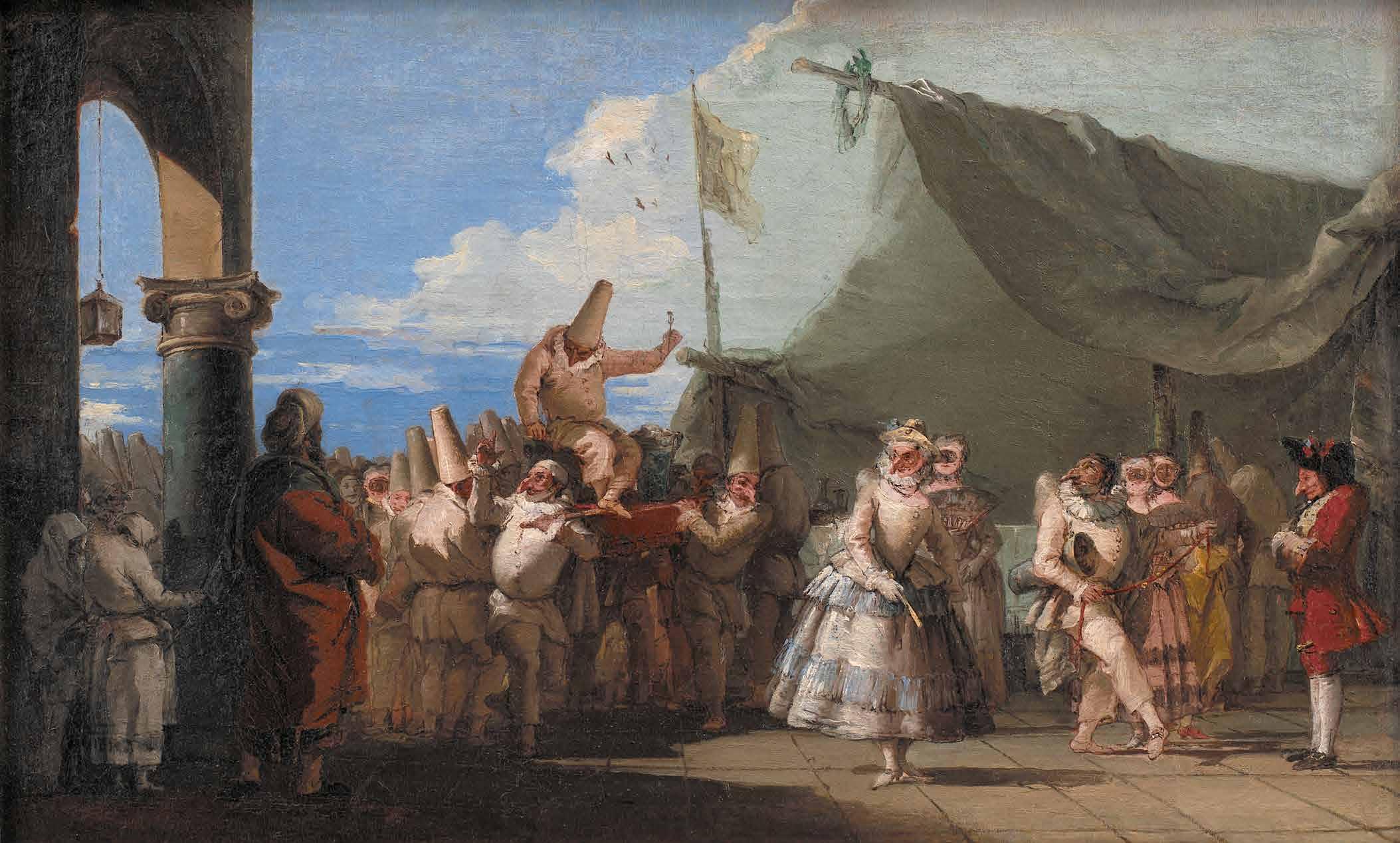
DENIS TON Art historian ESSAY
A Legacy in Lines: The Tiepolos on Paper
INTRODUCTION
Tiepolo’s graphic oeuvre is undoubtedly one of the richest, most multifaceted and complex that has come down to us. If we broaden our gaze and encompass not only what the head of the workshop was able to create during his career but also the drawings produced by his two sons, not to mention his closest collaborators and followers, the material becomes truly monumental.
The range of techniques he employed, the variety of his output, and the diversity of purpose for which these drawings were conceived are unparalleled. This extraordinary quality has very few points of comparison in the art of the greatest European masters1 , and if we think about it carefully, it allows us to utterly dispel any cliché defining the Venetian manner as disinterested in drawing, unlike the Tuscan school or, more generally, Central Italian art 2
By a curious coincidence – and this also serves as a significant indicator of taste – the decisive location for the rediscovery of the value of the Tiepolos’ graphic art was Paris in the early 1920s. In rapid succession, through major auctions and exhibitions, there emerged some of the most important groups of their creative drawings. In April 1920, at the Galerie Georges Petit, one could see the marvelous sheets from the album then owned by Alexis Orloff, with masterpieces by Giambattista (the album was later named after Orloff); the following year, at the same gallery, it was Giandomenico’s turn, with the sheets connected to his New Testament series, which then belonged to Roger Cormier of Tours; and in the same year, though without a catalogue, the sheets of the Divertimento per li regazzi (Entertainment for Children) also by Giandomenico, were exhibited at the Musée des Arts Décoratifs. Indeed, between the late nineteenth and early twentieth centuries – in partial compensation for eighteenth-century indifference –there was a general rediscovery of the Tiepolos’ art. During the same years as the important acquisition of the detached frescoes now in the Musée JacquemartAndré in Paris and the publication in 1898 of the
pioneering study of the Tiepolos by Henry de Chennevières, numerous drawings also appeared and changed hands, signaling a genuine passion and what one might almost call a Tiepolo Renaissance 3 . This was also the moment when Proust used the particular shade of pink in Giambattista’s paintings to describe Odette Swann’s dress in À la Recherche du Temps Perdu , and recalled the painter’s airy architecture in relation to Venetian skies4 . Likewise, it was precisely the Paris of those years that generated the experimentation and development of avant-garde movements that would shape the course of the twentieth century. Drawing and appreciation for the inventive experiments of the Tiepolos were reborn at the heart of modernity.
It seems particularly significant, then, that a little more than a century after these events, which served as the spark that prompted all the most important studies on the graphic art of the Tiepolos, the Galerie Coatalem is dedicating an exhibition to these great masters. The show once again makes visible many of those drawings, some of which have long been inaccessible, as is true of sheets never displayed since the Roger Cormier sale of 1921 at the Galerie Petit.
Tiepolo and his sons took a completely different approach to what could in an academic sense be understood as the study of drawing, instead making it a fundamental element of their imagination and artistic conception. Drawings in pen, black chalk and red chalk5 , on heavily sized thin white paper, and on slightly rough blue paper; using white chalk for highlights, and with the addition of watercolor, in broad washes or applied for quick sketching; sheets conceived as preliminary studies for engravings and illustrations in printed books; ideas for single figures to be inserted into Giambattista’s enormous frescoed compositions or grand canvases, expressing bursts of intuition for vast decorative compositions; or entirely finished drawings planned as parts of larger narrative cycles and therefore intended as the foundations of a cohesive series: whatever Tiepolo’s workshop took on, there was hardly a field in which drawing was
1- As Adriano Mariuz has observed, the only artist with whom he can be compared, in many ways, is probably Rembrandt (Mariuz 1983 [2008], p. 197).
2- For an incisive summary of this topic, see Whistler 2016, pp. XXX-XXXV.
3- For the nineteenth-century critical fortunes of Tiepolo and of his detached frescoes in France, see Lo Giudice 2023, pp. 13-31.
4- For a good summary of Tiepolo’s critical fortunes during these years, in France too, and of his importance for Proust, see Mariuz 1996; and for the French interest in the artist, Fumaroli 2007.
5- A close examination of the chalk drawings is beyond the scope of the present essay, given its nature. The reader is therefore directed to the monograph and catalogue raisonné by Knox (1980), albeit with a reminder of the diversity of scholarly opinion with respect to the widely varied material; such sheets are often considered as exercises and studies made in the workshop.
not involved. Studying this oeuvre therefore means we must gain a privileged position in order to observe Giambattista’s thought process, first and foremost, his mind at work, and that inexhaustible and infallible ability to capture and retain the truth of what surrounded him and at the same time project it into a coherent and entirely personal dream world 6 .
“BIZZARRIE DI PENSIERI”: FANCIFUL IDEAS
For Tiepolo, drawing was like breathing. For him, observation, looking and imagination were one and the same. Many of his sheets seem to come from a single stroke of the pen, as if driven by a spell, by magic, without error or afterthought. Such familiarity – one might call it a vital necessity – is confirmed by documents relating to his youth. Outstanding among these is the well-known account by Vincenzo da Canal, who wrote of his apprenticeship with Gregorio Lazzarini: “He has a most fertile talent, so that printmakers and copyists seek to engrave his work in order to have his inventions and fanciful ideas; and already his drawings are held in such high esteem that albums of them have been sent to distant countries”7. But even before that, we learn that when he was still a child Giambattista had the habit of drawing on walls, creating little figures of saints; one of his first commissions was to make decorations over the doors of some bakeries at San Biasio 8 . Tiepolo’s family was very poor, and drawing became the first step in freeing himself socially, obtaining an early status as a master who was able to satisfy a wide range of demands and types of patronage. His first commissions included preparing studies for printmakers, either associated with serial projects 9 or for book illustration, a field in which he soon asserted himself in an exceptionally professional way10 .
The cosmic order that unfolds before the beholder’s gaze in Tiepolo’s major compositions – those skies peopled with frescoed figures, to be seen with eyes raised – is founded on his chalk and pen sheets, to be contemplated close at hand, with an appreciation for precision of detail and liveliness of execution. In any case the Settecento was the century that discovered the beauty of invention , and appreciated it as the place to witness the creative act at its very origins.
Another decisive aspect that may surprise anyone still suffering from certain prejudices regarding eighteenth-century art (particularly Venetian art) is the practice of studying from life, which appears to offer vital nourishment for this graphic treasure house, and, more generally, Tiepolo’s imagination. His studies are born in visible reality – as is evident from the celebrated sheet with the so-called Accademia del nudo (fig. 1) – through a practice that marked a whole series of artists who were still tied to the works of the late seventeenth century, like his own teacher Gregorio Lazzarini, or Giambattista’s more advanced point of reference, Giambattista Piazzetta, the other giant of Venetian Settecento painting, very unlike Tiepolo in temperament but who also succeeded in passing on an imposing graphic oeuvre we cannot ignore 11
If we add that his proficiency encompassed not only preparatory or finished drawings, but prints, either reproductive or autonomous (di invenzione), it becomes clear that he practiced almost every technique successfully and with absolute conceptual freedom.
6- Tiepolo’s drawings have been studied on many occasions, beginning with the monograph by von Hadeln (1927) and that on the chalk drawings by Knox (1980); useful updated summaries appear in Marini 2004 and Whistler 2004.
7- “Egli è fecondissimo d’ingegno; perciò intagliatori e copiatori cercano d’intagliarne le opere, di averne le invenzioni e le bizzarrie di pensieri; e già i di lui disegni sono in tanta estimazione, che ne spedì de’ libri a’ piu lontani paesi”: Da Canal 1732 (1809), p. XXXI.
8- Bostock 2009, p. 221 rightly draws attention to the possibility that such stories may in part be influenced by the desire to construct a Vasari-inspired legend of Tiepolo as a precocious genius.
9- The most famous of these is unquestionably Il Gran Teatro di Venezia by Domenico Lovisa, for which see Bonaninni 1993 and Schulz 2000.
10- On the subject of Tiepolo and his drawings for publications, the focus of recent study, see in particular Middeldorf Kosegarten 2007; Ton 2012; Ton 2019; and Delorenzi 2024.
11- For an updated overview of studies of the nude and drawing from life in early eighteenth-century Venice, see Whistler 2004 and Craievich 2020.
fig. 1 – Giambattista Tiepolo, Artists Drawing a Nude in an Academy, black and white chalk on blue paper. Katrin Bellinger collection, 1993-022
II. STUDIES AND EXERCISES: THE ORLOFF ALBUM
From the standpoint of technique, Giambattista’s graphic art developed with great confidence toward an ever-greater simplification and economy of style.
His first drawings appear to have been conceived with the ambition above all of reconstructing on paper the chiaroscuro effects of images, following a logic inherited from his early neo-Tenebrist approach to the world of the arts: his pen strokes, often swirling and parallel in form, like spiderwebs in their mimicry of etching technique, construct figures as lithe and elusive as flames. Subsequently, during the period that saw his creative process at its most established, one can recognize the idea of a “three-part” execution12: first a general image drawn in black chalk; then a compositional outline in pen and ink; and finally watercolor, which could often involve two levels and intensities of tone. The technique began to assert itself in the 1730s, and this new method of constructing the image can be best perceived in the sheets related to the decoration of Villa Loschi at Biron di Monteviale.
Among the great albums of Tiepolo drawings, one of the most significant, and best represented in this exhibition, is that of Alexis Orloff (cats. 1-5), which was sold in Paris in 1920 13 . Although it has not yet been possible to reconstruct precisely when the Russian nobleman came into possession of this extraordinary album14 , there can be no doubt that the series contains some of the most important and best-preserved sheets of Giambattista’s drawings in pen and ink. This exhibition offers an outstanding opportunity for first-hand study of five drawings from this group which have rarely been on public view, and which indeed enable us to understand the evolution of Tiepolo’s graphic style. With respect to other similar albums – as for example the one in the Civico Museo Sartorio in Trieste 15 – these are not individual figure studies designed to
highlight details or specific figures for insertion into broader compositions, but rather highly structured compositions in themselves, often consisting of entirely independent scenes that may have originated as finished sheets. Moreover, their formats, larger than those in the Trieste album, suggest they were finished inventions or exercises, and for that reason the same subject often appears repeated with minimal variations. George Knox, who was the first to offer a thorough examination of the album, proposed dates that vary from 1715 to 1760, but for several reasons, including material ones, it is hard to believe that this collection spans such a broad temporal range. First of all, evolving scholarship 16 has now recognized a youthful drawing technique which differs radically from the pen drawings
12- Vigni 1942, p. 17. For another attentive analysis of the varied time involved in creating a drawing, see Alpers, Baxandall 1994, pp. 51-63.
13- Catalogue des tableaux anciens des écoles du Moyen-Age et de la Renaissance, XIVe, XVe, XVIe siècles, portraits des XVIIe et XVIIIe siècles et autres œuvres de A. Canaletto, F. Guardi, G.-B. Tiepolo, etc. : Dessins par G-.B. Tiepolo. Composant la Collection de son excellence feu le prince Alexis Orloff dont la vente aura lieu à Paris, Galerie Georges Petit, sale catalogue, 29-30 April 1920, Paris 1920.
14- Knox (1961, pp. 269-270) put forward several hypotheses regarding provenance, including the possibility of a family link with Vladimir Orloff, president of the Saint Petersburg Academy of Sciences. According to Irina Artemieva, to whom I grateful for this information, there was no particular connection between Alexis Orloff and the Orloff brothers, who had been close to Catherine the Great; thus, we currently lack information on when he acquired the sheets. The Paris catalogue states that “Les dessins compris au présent Catalogue sont inédits. Conservés de longues années en album, à l’abri de la lumière, ils n’ont été encadrés que très récemment et doivent à cette fortune leur extrême fraicheur.” (The drawings in this catalogue are unpublished. Long preserved in an album, sheltered from light, they were only recently framed and owe their extremely fresh appearance to these fortunate circumstances.)
15- The Trieste album was studied by Lorenza Resciniti (2021), though Vigni’s volume (in both editions, Vigni 1942; Vigni 1972) should still be considered fundamental.
16- Aikema 1998; Pavanello 2011. Amsterdam, Rijksmuseum, RP-P-1950-490
in the Orloff album, and shows great audacity, as found in the so-called Danzig album17 or the little-known album from the Kupferstichkabinett in Berlin which, contrary to recent critical opinion18 , I believe to be largely autograph and a genuine expression of Tiepolo’s earliest inventive imagination. The oldest drawing in the Paris group of 1920 must date from at least a decade later than Knox’s proposal, if not already in the early 1730s. This is the case with the study for a sacra conversazione with the Virgin and Child with Saints (cat. 1) in which the emphatic use of ink wash for the shadows and the attention to contours would indicate that the sheet was executed in a period of conscious stylistic maturity, as is true of other drawings of sacred subjects in this series 19 .
Some of the Orloff drawings are perfectly finished masterpieces, such as the Flight into Egypt (cat. 2), probably from the 1740s: here, the use of the pen is marginal, and everything seems to have been constructed using watercolor alone, with a small brush. The slightly darker, more opaque ink has the dual function of strengthening the shadows and enabling one to imagine the main contours of the figures and the tree, which is bent to the left by some powerful wind and seems to give an undulating motion to the entire scene and its characters, with Mary wrapped in her cloak, unfurled like a sail on the open sea, clutching the Child to her body. A few touches to define the fence in the foreground are enough not only to lend liveliness to the entire scene but also to create unexpected depth. This is such an accomplished work that Giandomenico (unsurprisingly) chose to etch it (fig. 2), and it no doubt constituted one of the fundamental precedents for the evolution of the series of prints made in Würzburg in which he first elaborated a complex series of inventions on the same subject.
A work substantially comparable to the Flight into Egypt is the Deposition (cat. 3), entirely governed by direct contrasts of watercolor shading. As far as we
17- On which see most recently Piai 2024.
18- Aikema, Tuijn 1996, no. 3.
know, it appears not to be connected to a painting, instead being another of those perfectly finished and independent study-exercises. At variance with these are drawings depicting two different martyrdom scenes: in the first, probably in preparation for a Beheading of the Baptist (cat. 4; fig. 3), Tiepolo studies an absolutely unconventional pose, with the protagonist, already decapitated, in a kneeling position and with his back turned, and the executioner holding up the severed head after its horrific mutilation. In this case we can observe not only an incisive, shorthand use of the pen but also a particularly complex underlying drawing in black chalk, with subtle variations in pose: it thus shows itself to be a true study, forming part of an exploration of varied combinations and views.
Another sheet represents the Martyrdom of a Female Saint, probably Saint Theodora (cat. 5), with a composition well-defined in every detail and an architectural background, skillfully watercolored to create a shaded area against which the main figures stand out, that indicates the project had reached an advanced stage. This is one of the rare instances within the Orloff group that can be directly related to a painting, the Martyrdom of Saint Theodora , a subject known in two versions, one now in the Museo del Settecento at Ca’ Rezzonico and another in a private collection, variously considered
19- For example, two sheets representing the Annunciation, dated to the mid-1730s by Aikema (1996, pp. 68-71, nos. 22-23).
fig. 3 – Giambattista Tiepolo, Beheading of John the Baptist, oil on canvas. Stockholm, Nationalmuseum, NM 188
autograph by scholars, although the version in Venice seems to take precedence (fig. 4). It is generally rare to find drawings from Tiepolo’s later years conceived as comprehensive studies for frescoed decorations or easel paintings.
In this sense, a drawing in the David M. and Julie Tobey Collection is very important because it documents a lost work that must have constituted an experiment of sorts in Tiepolo’s oeuvre: it depicts Julius Caesar Contemplating the Head of Pompey (cat. 6) and is connected with a commission received through Francesco Algarotti for Augustus III of Saxony20 . The Venetian polymath had envisioned a series of subjects linked to mythology and ancient history for the “Royal Museum of Dresden” which he served as artistic advisor. In 1742, three different options had been imagined for Tiepolo, but instead he was entrusted with a painting representing Timoteo, o gli effetti della musica , which was never realized; the subject was ultimately replaced by the episode regarding Caesar. The drawing can be dated with a degree of precision to about 1745, since the painting was completed only in the following year. All these subjects, however, were conceived to evoke a very specific “poetica degli affetti”, that is, the ability to give form and expression to varied states of mind and human sentiment, combined with the historical and descriptive accuracy of which Algarotti believed Tiepolo was capable. As for expressive purpose, it is particularly interesting to note how, in the drawing in question, Tiepolo focused on the illustration – according to the account provided by ancient sources, and by Plutarch in particular – of Caesar’s supercilious reaction, moved to pity by the macabre homage. This element was abandoned in the final iteration, which can be recognized in a painting that appears to have copied it, bearing witness to its definitive composition 21 (fig. 5). Other elements, such as the position of the figures making the offering and the horse’s head on the right, match the drawing perfectly.
fig. 4 – Giambattista Tiepolo (school of), Martyrdom of a Female Saint, oil on canvas, Venice, Ca’ Rezzonico, Museo del Settecento Veneziano
fig. 5 – Studio of Giambattista Tiepolo, Julius Caesar contemplating the severed head of Pompey, oil on canvas
20- For an overview of the question, and the relationship between Algarotti and Tiepolo, see Craievich 2012.
21- Christie’s sale, London, 16 December 1998, lot 195.
fig. 6 – Giambattista Tiepolo, Adoration of the Magi, etching. Amsterdam, Rijksmuseum, RP-P-1950-647
The fluid handling of this sheet, a work made with swift, light strokes, shading and washes, reveals its heuristic nature, not unlike an Adoration of the Magi (cat. 7 ) for which it seems impossible to trace a provenance from a specific album. The high podium on which the Madonna places the Child, and the architectural allusion that forms the backdrop, bring to mind a scene by Paolo Veronese, of the kind also found in Giambattista’s contemporary paintings and engravings. These elements suggest a date close to that of the etching (fig. 6), identical in subject, in which such references to Veronese’s work are particularly evident. This large-scale work may have been the most challenging
in Tiepolo’s entire printmaking career, for which he no doubt had to make multiple preparatory studies. However, the drawing also features different details, such as the figure of the horseman, which appears to have been borrowed from Veronese’s Adoration of the Magi in the church of Santa Corona in Vicenza 22 .
Defining the image through a flowing, skillful use of watercolor is particularly evident here, with some dense patches of shadow: a technique which, as has been pointed out, is unusually similar to that used by Guercino, whose work may have offered inspiration as Tiepolo’s graphic art evolved23 . The broken, angular strokes of the pen – albeit to some extent connected with Veronese’s legacy – resemble those of the only sheet dated by Tiepolo in 1744, housed in the Museo Civico Sartorio in Trieste24 (fig. 7), while the prevailing and almost excessive use of opaque patches of watercolor places it around 1750 (the latest plausible date for the etching, too), by comparison with the few known pen drawings from the Würzburg period and that of his immediate return to Venice 25 . Not unlike this drawing, one can assign a date in the 1740s to a sheet which, though different in nature, has similar features and represents an Allegory of Valor and Fame (cat. 8), a group of figures often adopted, with a celebratory function, in Tiepolo’s large-scale decorative endeavors.
fig. 7 – Giambattista Tiepolo, Three nude figures, dated at the bottom center « il di 17 feb.o1744 », pen and brown ink, brown wash on paper, H. 201 mm; W. 282 mm. Trieste, Museo Civico Sartorio, D_8717
22- As has been noted, the engraving of the Adoration of the Magi can be dated to before 1750, and many of the major drawings pertaining to the project can therefore also be situated near that date (Succi 1986, pp. 40-42).
23- See the reflections made by Aikema 1996, pp. 103-105.
24- Vigni 1972, p. 74, no. 118; and for comparison with Veronese’s graphic technique, Marini 2014, p. 35.
25- For the pen drawings of Tiepolo’s German years, and new proposals for sheets that could be studies for the decoration of the Church of the Pietà, now in the Morgan Library & Museum in New York, in some way comparable with the drawing in question, see Hicks 2024.
III. A TESTAMENT OF IMAGES
The further we explore Giambattista’s creative path, the more we observe a radical transformation in his pen and ink drawings: the master seems to progressively reduce his strokes and conceive his visions with exceptional clarity, as if, like a simple transcriber, he were at the service of an apparition so clean and precise as to admit no hesitation. In its supremely summary way, every stroke of either pen or brush, dipped with increasing degrees of lightness in watercolor, seems conceived not so much to emphasize a shadow as to reveal a light. His sheets of paper, singularly white and sized – as can be seen among those in finest condition – are treated as a true element of luminosity.
In perfect harmony with what he was creating in both fresco and easel painting, Tiepolo seems to “overexpose” his images, achieving an almost blinding brightness and lucidity. This tendency, already visible in his studies of about 1740 for the decoration of Palazzo Clerici in Milan, becomes ever more radical from the 1750s onwards. As Adriano Mariuz observed, “Only in certain painters of the Far East is it possible to find a similar understanding the luminous value of paper and an equally brilliant immediacy of execution.”26 This transformation gains further momentum in the drawings most directly associated with his decorative endeavors, such as his paintings of 1757 in Villa Valmarana in Vicenza, and in the period preceding his farewell to the Serenissima with his permanent move to Spain in 1762. It was probably in the years before his departure – which also saw him engaged on the extraordinary ceiling fresco with the Glorification of the Pisani Family in the salone of the eponymous villa in Stra, in the Venetian hinterland on the banks of the Brenta – that he worked on a singular and startling graphic enterprise.
I refer here to the group of sheets with representations of the Holy Family, whose history can be reconstructed with a fair degree of certainty27. A note in the exhibition catalogue of the Savile Gallery in London in May 1959, written by Edward Cheney, who had owned these drawings in the nineteenth century, states the following: “This collection was made by G. B. Tiepolo himself and given by him to his son for the Library of the Sommasco Convent (S. Maria della Salute) at Venice in which he was professed. At the suppression of the convents the volumes fell into the hands of Cicognara by whom they were given in an exchange to Canova from whom they passed after his death to Mons. Canova his brother, by him they were sold to Sigr. Francesco Posaro [sic] and by him to me / E.C. Venice 1842.”28 .
This consists of about seventy sheets that prompt admiration at how the master used subtle variations and compositional shifts to create a range of emotional and indeed sentimental nuances around this seemingly simple subject. Here – once again in the words of Adriano Mariuz – the artist “draws on the pulse and pure beauty of the arabesque.” Bequeathing the album to his son Giuseppe Maria, a priest in the convent of the Somascan Fathers at the Salute, Giambattista must have recognized its “value as a testament both artistic and spiritual”29 .
As in other drawings in this series, one admires not only Tiepolo’s talent in varying and creating new inventions, but also how he was able to imbue these subjects with a pathetic and sentimental quality, tinged with both melancholy and infinite tenderness. In the two drawings exhibited here (cats. 9, 10) one can observe a spiritual tone: Mary’s heavenward gaze and Joseph’s hands crossed on his chest succeed in underlining
26- Mariuz 1983 (2008), p. 202.
27- Knox 1960, pp. 3-9.
28- Morassi 1959, p. 46.
29- Mariuz 1983 (2008), p. 202. Likewise, Morassi, who had occasion to study many of them when they were in the Talleyrand collection, regarded these drawings as among the most human and touching of Tiepolo’s entire output (Morassi 1958, p. 15).
fig. 8 – Domenico Tiepolo, Head of a Man Wearing a Turban, etching. Amsterdam, Rijksmuseum, RP-P-1950-587
deep religious feeling, yet the absence of any particular emphasis enables them to appear interwoven with daily life.
It is surprising that Tiepolo expressed his ideas about the family just when he was definitively taking leave of his own kin – with the exception of his sons, who were his professional collaborators – and during the years in which he was also developing his caricatures and inventions on the Pulcinella (Punchinello) theme, which was to profoundly influence the work of Giandomenico. The Holy Family scenes from the album of the Somascans, like the latter, but without a trace of irony, have the simplicity and purity of children’s illustration. It goes without saying that such simplicity and purity are not the fruit of ingenuousness but the goal of Tiepolo’s supreme mastery, which could vary a single idea infinitely, like one of Bach’s musical variations on a theme30
9 – Domenico Tiepolo (after Giambattista Tiepolo), Head of a Man Wearing a Turban, etching. Amsterdam, Rijksmuseum, RP-P-1950-611
IV. A DIFFICULT LEGACY: GIANDOMENICO AND LORENZO TIEPOLO
As we have noted, Giambattista Tiepolo considered drawing not only as preparatory practice for the development of his principal works, but also as an end in itself31 . This aspect became even more predominant with the evolution of his sons’ independent activity.
We must imagine that initially, when he entered the workshop in the early 1740s, Giandomenico (Venice, 1727–1804) regarded drawing primarily as a training method for learning his father’s techniques and inventions.
The substantial number of sheets, especially in black chalk and red chalk on blue paper, whose functions and respective authorship continue to be the subject of debate32 , leads one to believe that like many other students who passed through the Tiepolo studio, Domenico was instructed through the reiteration and copying of drawings by Giambattista33 . Lorenzo (Venice, 1736–Madrid, 1776), the youngest son, who only began working independently in the 1750s, remained largely attached to black and red chalks (often used alongside one another) and later to pastels, both mediums that must have been particularly congenial to him. As for the remarkable output of drawings of heads, which are still accompanied by considerable confusion as regards the respective hands of the three artists34 , Lorenzo was able to find an individual path, focusing on powerful pathos in suspended images of faces, marked by a peculiar hatching technique and executed in several colors (cats. 50, 51). What clearly fascinated him was the fall of light and play of expressions, enhanced by the abstracted gazes of his figures. This was a continuation, through other mediums, of the attention to reality that had been at the heart of his father’s education and training. Moroever, Giambattista and Lorenzo’s brother Domenico had produced admirable studies of heads both on paper and canvas 35 , often depicting figures of Orientals and philosophers (cats. 11, 47, 48, 49), but also of female beauties, which Algarotti himself considered, like the “mezze figure”, as resembling “a Madrigal, or a sonnet in Poetry”36 . Such ideas later formed the basis of an extraordinary series of etchings by Giandomenico (figs. 8, 9), clearly inspired by the inventions of Rembrandt37
30- For this comparison with Bach, and in particular the Musical Offering, see Mariuz 1983 (2008), p. 201.
31- Morassi 1965, p. 13.
32- For a summary and reference to this vexata quaestio, see Aikema 2015. The most complete study on the black chalk drawing remains Knox 1980, notwithstanding the numerous revisions that can be applied to it.
33- For this topic see also Loisel 2018. For training practices in Tiepolo’s school, one should also bear in mind the diary of the Swiss artist Bullinger (Aikema 1996, pp. 16-25).
34- May I refer the reader to my paper, currently in press, “Pathos and Reality: Chalk Drawings of Heads by Giambattista, Domenico, and Lorenzo Tiepolo”, given at the international conference Tiepolo Drawings: Reconsiderations and Discoveries, held at the Morgan Library & Museum, New York, January 25, 2024.
35- On this genre, see Pavanello 2006; and on the series of female heads for Russia, Ton 2024.
36- Bettagno, Magrini 2002, p. 127.
37- Rizzi 1971, pp. 110-114.
fig.
It has long been believed that when it comes to distinguishing hands, the question of pen drawings was relatively simpler than that of those in chalk, whose coarser, more impetuous and electric graphic style would make Giandomenico’s preparatory drawings much more recognizable than those of his father. Yet there are multiple indications of his ability to mimic the more summary handling of Giambattista’s maturity38 . There still exist a number of pen drawings, commonly believed to be by his father, which can plausibly be attributed to Domenico, such as the sheet with Time Revealing Truth (fig. 10), formerly associated with the canvas now in the Museum of Fine Arts, Boston, but nonetheless to be considered a meditation by Giandomenico on that earlier work, with a few variations39 . His graphic technique is more evident when one can imagine him striving for particularly detailed and highly finished studies, such as presentation drawings, alternative or preparatory to the creation of actual small-scale painted models. This is probably true of a relatively large sheet with Venus and Cupid surrounded by Putti (cat. 15) whose distinctive composite framing shows it to be a detailed compositional layout for a decorative ceiling project similar to the Triumph of Love now in the Villa Ephrussi de Rothschild, near SaintJean-Cap-Ferrat 40 (fig. 11).
canvas. Reviving the practice of varying subjects and inventions that were typical of eighteenth-century taste (and that of his father), he became enamored of certain themes and characters, reproducing them sequentially, almost as if taking up a challenge aimed at highlighting his talent for combination and whimsy.
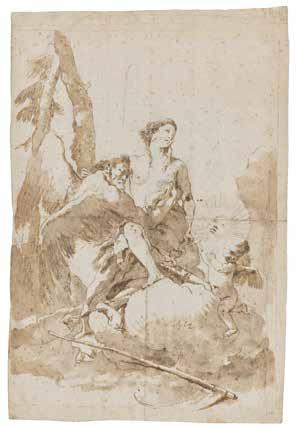
One of the themes he appears to have been passionate about is the realm of fauns, not to mention male and female satyrs (cat. 13 ), figures that Giandomenico also treated these subjects in large-scale decoration, for example in the monochrome scenes he was called upon to paint on several occasions, for example at the Villa Pisani in Stra but also in various palaces in Vicenza 42 . Once again the inspiration came from his father’s inventions, which he began to explore through drawings during the decoration of the gallery in Palazzo Clerici in Milan, for example in the sheets at the École des Beaux-Arts in Paris (fig. 12) or those in the Museo Horne in Florence 43 .
That work, destined for a still unknown setting, must have generated an entire population of cloudborne putti during the 1760s, with countless variants that reflect Giandomenico’s peculiar talent for reiteration 41 However, his most authentic artistic expression is not to be found so much in preparatory studies or compositional inventions for finished works in fresco or in
38- For some reflections on this, see Ton 2016.
In 1770, having returned from Spain after his father’s death, Giandomenico became one of the most favored artists for large decorative fresco commissions. But above all he discovered a special pursuit by becoming his own patron, creating over a period of years some of the most extraordinary scenes of eighteenth-century European painting in his family residence at Zianigo; the frescoes are now in Venice, displayed in the Museo del Settecento veneziano at Ca’ Rezzonico. In particular, the sequence of Scenes with Satyrs and Centaurs, painted in 1771, may have originated as a Venetian response to the new trend prompted by the publication of Le Antichità di Ercolano Esposte, illustrating the finds at
39- Christie’s, London, 16 October 2025, lot 308; the sheet also appeared in Venice 1980 (p. 59, no. 79), attributed to Giambattista. Giandomenico’s hand is readily recognizable in the agitated, cursive and emphatic construction of the wing on the figure of Time.
40- Mariuz 1971.
41- For this painting and its associated drawings see Knox 1973.
42- For a recent overview of these subjects in Giandomenico’s graphic œuvre, see Cailleux 1974; Delneri 1988; Uluçam 2024.
43- Paris 2024, pp. 84-87, no. 23
fig. 10 – Domenico Tiepolo, Time revealing Truth, pen and brown ink, brown wash, black chalk on paper. Private collection
Herculaneum, and reinterpreted through the lens of Fragonard 44 . But where the French artist evokes faux relief decoration, revealing his antiquarianism and taste for ruins, Giandomenico instead projects his inventions through an everyday context. He prepared a hundred drawings of these figure groups, in ever-changing poses and with an unparalleled freedom of conceptual associations and compositions, and with handling which was increasingly independent and agitated compared to that of his father. The series, initially studied organically by Jean Cailleux45 , can be associated with the period of his painting career in which these peculiar protagonists first appear.
also commissioned the frescoes in the Residenz. As we have noted, Giambattista also treated this subject in the Orloff album, but the narrative level is different in his son’s series, with detailed, everyday storytelling that lends an intimate, domestic tone to the progression of images. It is very likely that this project constitutes the basis and preliminary exercise for a subsequent graphic venture, among the most notable yet underrated in eighteenth-century European art. I am referring here to the series of finished drawings with countless subjects drawn from the New Testament.
V. NEW TESTAMENT
These inventions evolved in such a way that Giandomenico produced “what could almost be called a reportage on an Arcadia reduced to quotidian dimensions”46 . These experiments of his – again inspired by the figures that crowd into the masterful inventions of his father’s Capricci and Scherzi di fantasia – also include studies of figures one could call fantastical, in some cases orientalizing (cats. 14, 16), in others mythological, such as the River Gods (cat. 12) of entirely comparable handling and style, and therefore datable to the 1760s. It must be said, though, that Domenico’s first endeavor in the art of reiteration and combination was with printmaking: in the Idee pittoresche sulla fuga in Egitto, a series made when he was still in Germany with his father, he tried his hand at an extraordinary sequence of ideas linked to the Gospel episode 47. This was published in 1753 and dedicated to Karl Philipp von Greiffenklau, the PrinceBishop of Würzburg who
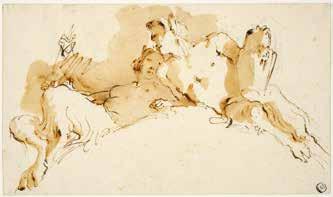
This is a visual narrative of episodes from the Gospels and Acts of the Apostles, and scenes from the apocryphal Gospels and even the Golden Legend: a continuous, almost cinematic narrative that reflects the creative flair of the youthful Stations of the Cross painted for the Oratorio del Crocifisso in the church of San Polo in Venice, losing itself in details, incidental scenes, apparent digressions, unlikely extras, and unusual framing. Not since the exhibition at the Frick Collection in 2006–2007 have so many sheets from this series been on public display; and one may add that in Europe, notwithstanding the rich collection of 138 sheets housed in the Louvre (though these are bound in albums), this occasion is the greatest of its kind since the 1920 dispersion and the exhibition of 1996-1997 in Udine and Bloomington 48 As pointed out first by Byam Shaw and then Gealt
44- Mariuz 1971, p. 74.
45- Cailleux 1974.
46- Mariuz 1971, p. 74.
47- Rizzi 1971, pp. 160-217.
48- Udine and Bloomington 1996.
fig. 11 – Domenico Tiepolo, Cupid driving a Chariot drawn by Doves. Saint-Jean-Cap-Ferrat, Villa Ephrussi de Rothschild
fig. 12 – Giambattista Tiepolo, Faun and female Faun, pen and brown ink, brown wash on paper, Paris, École des Beaux-Arts, EBA389
and Knox, who together published a monumental study on these drawings on the occasion of the Frick exhibition 49 , the series is intimately linked to French collecting. As recounted by Henry de Chennevières, curator at the Louvre in the late 1800s, the most important nucleus of this collection is now commonly known as the Recueil Fayet, after the collector Jean Fayet Durand (1806-1889), who later donated the album he had purchased in Venice in 1833 on the advice of the artist and illustrator Camille Rogier50 . It was probably in this period that another group of sheets was acquired by Victor Luzarche (1805-1869), from Tours – a city of which he was mayor – and after some further passages of ownership, eighty-two were sold at the 1921 auction in Paris as the property of Roger Cormier51 .
Other drawings found their way into different collections, and the group, which could still be augmented, comprises more than three hundred sheets. The sacred becomes immersed in the everyday, and the miraculous, though it punctuates these scenes, is an adventurous, fairy-tale element, far more than one of mystical exaltation, as in The Meeting of Anna and Joachim at the Golden Gate (cat. 17), where the swarm of angels and cherubs surrounding the couple preparing to climb the steps does not disturb the simplicity of a scene in which a little dog can earn his place in the foreground by approaching the horseman in full light.
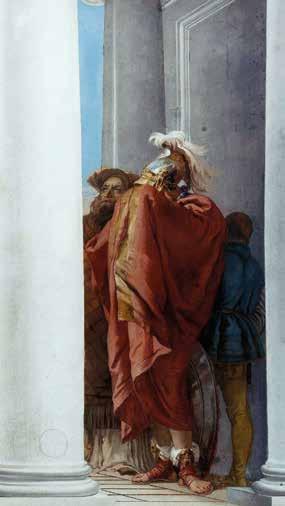
one can admire the confidence of Domenico’s vibrant strokes of the pen and his skillful orchestration of chiaroscuro and light to distinguish the planes and depth of the scene. The simple grace of the narrative emerges in the sheets illustrating the Nativity and childhood of Jesus, such as the Return of the Holy Family to Nazareth (cat. 19) or the Annunciation to the Shepherd s, the latter shown in their humble garments, near the straw-covered hut, startled and shaken by the angelic apparition (cat. 18). In one of the scenes dedicated to the Baptism of Jesus (cat. 21), an episode that struck Giandomenico’s imagination and which he treated in multiple drawings and different formats, the dove of the Holy Spirit has – incredibly – landed on the head of Christ’s head, like some troublesome bird that forces him to lower his head, but at the same time radiating a blinding light which, together with the inscription “This is my beloved Son, in whom I am well pleased”, forces all those present to kneel.
One is occasionally surprised by the complexity of architecture set within the limited space of the sheet, as in Mary and Joseph Leaving the Temple (cat. 20), where
49- Gealt, Knox 2006.
Feelings of surprise and excitement spread like a jolt through all the scenes of miraculous healings by Christ or his Apostles, for example in The Raising of the Son of the Widow of Nain (cat. 22), The Raising of Lazarus (cat. 23) or Peter Healing the Paralytic in Lydda (cat. 30). Scenes associated with the Passion of Christ are marked by pathos and syncopated drama, as in the recently rediscovered Agony in the Garden (cat. 26), on public display for the first time, la Flagellation (cat. 28) or the Crucifixion of Peter (cat. 31). In the Denial of Peter (cat. 27), the scene is set within a Veronese-style portico, defying any historical truth: the apostle ascends the steps almost motionless,
50- De Chennevières 1898, p. 140: “Au mois de juin 1892, le Louvre était mis en possession d’un legs de M. Fayet, ancien représentant à l’étranger d’une grande maison de commerce parisienne. Au cours de ses voyages annuels, M. Fayet ne manquait guère de passer une large quinzaine à Venise où l’avait connu M. Camille Rogier et où il se faisait une joie de la fréquentation de la petite colonie d’artistes français, s’enquérant auprès d’eux des occasions chez les boutiquiers de brocante, car il collectionnait suivant ses moyens et furetait avec bonheur. Un jour, en 1833, il questionnait M. Camille Rogier : – « Ma foi, lui dit l’artiste, voyez donc un étalagiste sous les Procuraties ; j’ai aperçu hier toute une liasse de dessins de Tiepolo le fils…ça doit être dans les quarante sous pièce… et des bistres très crânes ! » M. Fayet ne se le faisait pas redire… et le lendemain, il n’y avait plus l’ombre de croquis de Domenico sous les Procuraties. A distance d’années, M. Rogier, revoyant M. Fayet, lui reparlait de ces dessins : « Vous savez, c’est une vraie collection, c’est une suite pour musée, faites-en donc bénéficier le Louvre un jour… ».” 51- Paris, Galerie Georges Petit, G.B. Tiepolo : Catalogue des Dessins par Giovanni-Domenico Tiepolo. Composant la Collection de M. Cormier de Tours, 30 April 1921.
fig. 13 – Giambattista Tiepolo, The Sacrifice of Iphigenia, fresco. Vicenza, Villa Valmarana
his hand on his head (fig. 13), while the rooster from the Gospel account appears in the background and henchmen and men-at-arms appear to flee from the scene. Adopting a frequently-employed expedient, the artist creates the most pronounced highlights in reserve on the white of the extensively watercolored paper, so that the protagonist, in his isolation, appears to burst out of it.
Giandomenico himself often becomes an observer, apparently both fascinated and repelled, of the world’s violence, giving shape to scenes such as a stoning, whose subject is hard to identify and which is exhibited and illustrated here for the first time (cat. 32), where the central figure casting stones almost seems to allude to the revolutionary fanaticism of the end of the century; or again the Execution in a Parade Ground (cat. 33), which is a replica of and perhaps anticipates the compositional scheme of the Execution of Punchinello that was to appear in the Divertimento per li regazzi , for the first time utilizing an idea of Jacques Callot52
One senses that the New Testament episodes and the apocryphal and legendary stories from which he also drew offered Giandomenico the opportunity and pretext to construct his own sort of Comédie humaine, in which he could find a way of representing a great variety of characters and situations ranging from the tender to the coarse, or from brute violence to the appearance of the divine in human experience. The substantial size of the series, for which no printed destination is known, leads to some reflections regarding its place in the artist’s chronology.
While the date 1760 at the opening of the Recueil Fayet must be treated with great caution, as has rightly been observed53 , given the very early date it implies, it is equally hard to believe that such an accomplishment was produced in the space of only a few years. The time frame between 1786 and 1790 proposed by George Knox, after the conclusion of the artist’s most important decorative project in the Sala del Maggior Consiglio in the Palazzo Ducale in Genoa, must also be considered completely hypothetical. Indeed there is reason to believe that unlike a series involving more continuous and coherent inspiration, such as the Divertimento per li regazzi , Giandomenico returned to this huge group on
repeated occasions, sometimes enriching the episodes that most excited his imagination with scenes describing the moments just after or before the crucial ones, like vignettes from a storyboard in a film sequence. Even on a stylistic level the differences are marked, not to mention the costume details of the more mundane characters – “citizens” who might have appeared in the Scenes of Contemporary Life. The confident and polished quality of certain images, comparable in every way to those inhabited by Punchinello, would suggest that his work on this series may have been protracted, sometimes resumed and abandoned, and that it overlapped in part with other graphic endeavors.
One gets the impression that during the last twenty years of his career, when he virtually stopped taking on public commissions and fresco decoration – an area in which he could certainly have benefited from an unrivaled legacy – Giandomenico was pursuing his own personal fancies. The series of drawings he produced in this period is in some ways impressive, especially if we must assume that everything stemmed from entirely personal needs, and that he was, in this case, his own patron, as was the case in the decoration of his ancestral villa at Zianigo.
Giandomenico pursues images – in some cases, we might say, obsessions – as if they were passing in sequence before his eyes and he felt an urge to give them form before they vanished. The construction of his image, beyond the mimesis of Giambattista’s everrecognizable language, stands in antithesis to it. The father’s figures float free in an indefinite and infinite space, already potentially projected into one of his apotheoses or celestial glories; in those of the son, this vision is scaled down, and everything is composed and unfolds in a sort of miniature theater. The diminutive figures are almost lost in interiors or exteriors that seem inhabited by psychic apparitions, amidst smoke and clouds whose substance is not that of real phenomena but of stagecraft and theatrical props. The use of pen and ink wash is not adopted in reserve, playing on economy of gesture and exploiting the white of the paper: instead, it lingers, sketching the backdrops and architecture, filling the structured spaces with trembling, seismographic marks of the pen.
52- Mariuz (1986, p. 268) emphasized the role of Callot’s print for the scene of the Shooting of Pulcinella
53- See George Knox’s observations in Gealt, Knox 2006, p. 1.
VI. IMAGES OF CONTEMPORARY LIFE, AND PUNCHINELLOS
Little is known about the series James Byam Shaw54 christened Scenes of Contemporary Life, which must to a great extent have been produced around 1791, as implied by the date inscribed on some of its sheets. In it, Giandomenico develops his natural inclination to observe the world around him with amusement and, one might sometimes feel, melancholy tenderness, in all its absurd pursuit of distraction and abandonment to a world of illusion. The protagonists come from urban or rural life, such as the Peasants Going to Church in the Tobey collection (cat. 34) exhibited here, where we see the figures from behind, in keeping with Giandomenico’s peculiar approach in his late work, also found in the Mondo Novo fresco painted for the villa at Zianigo.
Giandomenico’s gaze on the world he portrays is not cruel, as in Hogarth or other English artists such as Rowlandson, but rather melancholy55 , always emphasizing its ridiculous and alienating quality. The scenes that inspired him passionately could be as much about fatuous everyday life (cat. 35) as distant and unlikely exotic settings, where his imagination could unfold freely, in a drawing like Orientals Leading a Caravan of Dromedaries (cat. 16 ), against the backdrop of a pyramid on which Giandomenico affixes his signature, following a habit probably born from the need to distinguish his drawings from those of his father.
portraying his contemporaries and social life of the second half of the eighteenth century, well represented by varied and multifaceted episodes (as in the frescoes of the villa at Zianigo), but also playing with the topos of the maschera , the masked or masqueraded figure 56
In their stylistic refinement and compositional experimentation, these drawings are preparatory for Giandomenico’s last great artistic undertaking,
Scholars have therefore found it easy to underline a spiritual and temporal consonance with the literary and theatrical worlds of the artist’s time: with Carlo Goldoni, and even more so with Gasparo Gozzi and his defense of Commedia dell’Arte, while simultaneously renewing the fairy-tale vein of a novella. Actually, these tendencies seem to coexist in Giandomenico: not only
54- Byam Shaw 1962, pp. 46-51.
55- Mariuz 1971, p. 85; Pedrocco 1990, p. 22.
undoubtedly his most enigmatic and disturbing legacy: the Divertimento per li regazzi (Entertainment for Children). These 104 sheets depict, from birth to death, the adventures of one of the best-known stock characters of the Italian Commedia dell’arte, Pulcinella (Punchinello). This group of drawings appeared – apparently without a trace of its early provenance 57 – on July 6, 1920, at a Sotheby’s auction in London58 , and a year later they were exhibited in public for the first time, without a catalogue, at the Musée des Arts Décoratifs in Paris. The first of the drawings, intended as a frontispiece, now in the Nelson-Atkins Museum of Art in Kansas City, bears the title by which the series is known (fig. 14). It represents a characteristically hunchbacked Punchinello observing a tomb with a ladder resting on it, while holding a doll. This is a
56- Tumanov (2019) underlines the links with the world of theater, stage design and marionette performance.
57- Morassi (1958, p. 21) believed that before the London sale, the album was in the Guggenheim collection in Venice, but this seems impossible to confirm (Byam Shaw 1962, p. 52, note 1).
58- Domenico Tiepolo. One hundred and two Carnival Scenes, with many figures, drawn with pen and bistre and enriched with washes of bistre and Indian ink, signed.
fig. 14 – Domenico Tiepolo, Title Page of the “Divertimento per li Regazzi”, pen and brown ink, brown brush over black chalk on paper. Kansas City, Nelson Atkins Museum of Art, 32-193/9
programmatic image that immediately flaunts an elusive duplicity: a child’s game that doesn’t take itself too seriously while also conveying a lugubrious and slightly disturbing cogitatio mortis – a meditation on death – as if the topos of Et in Arcadia ego proper to “elevated” painting had been inverted but had at the same time insinuated itself within the realm of childhood pranks.
The greatness of this endeavor lies precisely in its elusive nature: deciphering its authentic tone is impossible. The subjects are often too dramatic to prompt laughter, but because they are performed by maschere, become pilloried and too ridiculous to be taken seriously. As observed by Adriano Mariuz, the finest interpreter of this masterpiece, the Divertimento , despite its numbering and attempts to give it a sequence, “defies any attempt to arrange it according to a logical development; as soon as we delude ourselves into thinking we’ve found the thread of the story, we are unpredictably led astray – ’di-verted’ – as in the etymology of the term” in Italian (compare the English equivalent, diversion, meaning both deviation and entertainment59). With its very name borrowed from the language of music, the Divertimento consummates the semantic revolution brought about by Giambattista’s series of etchings, the Capricci and Scherzi di fantasia. Our gaze loses itself, we become a captive audience, and every effort at interpretation is forcibly denied. In a constant and, in some ways, unsustainable game of mirrors, anyone contemplating the drawings in this series will find that they are looking at even banal and trivial episodes of ordinary life, from birth to death, as a recognition of their deformed selves.
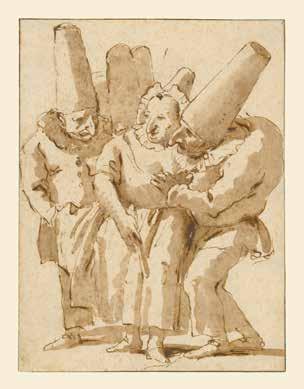
fig. 15 – Giambattista Tiepolo, Punchinellos Approaching a Woman, pen and brown ink and brush with brown wash over black chalk on paper. Los Angeles, J. Paul Getty Museum, 2003.131
But what Giandomenico uses to capture life’s rhythms is a code of enigmas which presents itself, on the surface, in disguise. Punchinello is thus at once an ageless puppet, capable of dying and being reborn, and a metonymy of the creature disguised by the artist: a human being. A fallen divinity, perhaps, forced to multiply, playing every role and experiencing every occurrence. This is clear from the drawings we are fortunate enough to exhibit: in Punchinello Learning to Walk (cat. 37), we see the miniature protagonist already wearing a mask on his face but without his typical headdress, placed inside a bizarre walker seemingly made of wicker twigs, while a grown-up tempts him with a bussolà (a ring-shaped biscuit from Burano) and his mother watches from nearby. The interior here is bourgeois and well-to-do, with precious vases supported by rococo wall consoles flanking the fireplace, which is adorned with a mirror. In other drawings, however, the setting seems mostly rural and rustic: a young Punchinello watches while his fellows dig a hole (cat. 39) – perhaps to bury someone? – or engages in domestic, everyday activities such as spinning outdoors in the barnyard in Punchinello and His Family on a Farm (cat. 40); or mingling with “humans” shopping at the vegetable market while making advances to a woman in a particularly low-cut dress (cat. 41, fig. 15). It seems hard to believe, as has been proposed, that the sequence of events here pertains to a sole protagonist. What happens, taking place before us, is instead the simple unfolding of life in all its “comic absurdity”60: the quotidian moments, as well as the surprising ones, in the life of human beings, where it is precisely the use of a mask – as it removes and makes uniform our faces and bodies – that ultimately reveals, rather than conceals. Thus the personaggio (in Italian, on-stage character) of
59- Mariuz 1986, p. 267. Byam Shaw had already noted that Richard Owen’s early photographic documentation lacked the pen numbering found on the sheets. Knox (in Udine 1996, pp. 244-247) supported this numbering and proposed a sequence. For another proposal and an overview of the various sequences that have thus far been hypothesized, see Bostock 2009b, II, pp. 315-318. The discovery of two photo albums formerly owned by Italico Brass and now in the Fototeca Morassi at Ca’ Foscari University in Venice should provide a clue as to the sequence of the drawings close to the date of their dispersion, and information on possible early provenance. It should be added, in passing, that the rearrangement of eighteenth-century drawing albums in the early twentieth century often fails to guarantee fidelity to the original conceptions of those who created and collected the drawings, as demonstrated by the history of Antonio Guardi’s Fasti veneziani (for which see Ton 2023). For information on these two photo albums see: https://www.savevenice.org/project/two-photo-albums-of-giandomenico-tiepolos-divertimento-per-regazzi-in-ca-foscari-university-archive.
60- Mariuz 1986, p. 273.
the Commedia dell’Arte becomes a persona, the mask (and masked character) of ancient times through which, as the Latin suggests, our human voice resonates
Punchinello lives, grows up, and even falls in love, or at least insinuates himself into trysts and plays his part in the comedy of love: here he is, leading his elegant bride, with a fur muff on her arm, at the head of the wedding procession, among other Punchinellos
subversive value cannot be underestimated. This was the point of no return for Western European and anthropocentric artistic culture, which saw the human individual as the focal point of visual and conceptual space and representation.
and with musicians casting evening shadows on the ground (cat. 36); or accompanying his spouse on a stroll through the countryside, preceded by children already perfectly dressed in the latest fin-de-siècle fashion (cat. 44). Pot-bellied and content, together with his wealthy and well-to-do family, he appears in the garden of a villa, in a scene that appears to mimic group portraits of nobles (fig. 16) and perhaps the sublime family apotheoses that Giambattista had painted in the Villa Pisani at Stra (cat. 38) 61. In another image (cat. 43), which appears to be a courtship scene, three Punchinellos appear, one of whom holds the arm of a young lady whose back is turned, although we can discern her slender figure and long hair, and the affected gesture of the open fan. Adopting a device also found in his easel and fresco paintings, Giandomenico again catches his subjects from behind, establishing the beholder’s point of view through a reversal whose
Another celebrated sheet, The Execution of Punchinello, shows the carnival figure as both victim and executioner in a shocking scene where the firing squad is composed entirely of replicants, and in which it is impossible not to recognize the mocking emergence of the egalitarian ideals imported through the French Revolution, and Napoleon’s campaigns, which led to the dissolution of the Venetian Republic. But one could say that Punchinello had “a special relationship with death”62 –and many lives. His passing provides the occasion for several disconcerting scenes: he lies ill in bed and (as just described) is shot, but also hanged; he is carried to his tomb on a bier during an awkward and agitated Funeral (cat. 45); and finally, in Punchinello’s Skeleton appears before his Tomb (cat. 46; fig. 17 ), a skeleton still wearing his typical headdress seems to come alive, terrifying his companions and trying to climb onto a tomb. If we bear in mind that the series began precisely with a sepulchral monument, in the first sheet of the sequence, we can recognize that the Divertimento has a “ring composition” that augments its sense of vertigo, like the finale of a short story by Jorge Luis Borges.
If we consider the countless citations of his father’s pictorial language, and the settings often seen in Giambattista’s history paintings and in other cultivated visual sources, we can note that Domenico consciously overturns those models, at the same time offering a final, emotional tribute. In all likelihood, the Divertimento per li Regazzi was conceived in the same years in which Giandomenico was preparing the extraordinary fresco decoration of the Punchinello room in his family villa at Zianigo – a work completed in 1797, the year of the Fall of the Serenissima, which most
61- Giambattista Tiepolo had also made some pen drawings that appear to have been intended as preparatory studies for family group portraits (Venice 1980).
62- Agamben 2015, p. 65.
63- For a recent reading of the political imagery that may underlie some scenes of the Divertimento, see McHale 2012.
fig. 16 – Giambattista Tiepolo, Large Family Portrait, pen and brown ink and brown wash, pen and black ink and wash, over black chalk on paper. New York, The Morgan Library & Museum, 1997.23
scholars have considered decisive for the farewell given by the entire art of the Tiepolos, and, one might say, that of the Ancien Régime, to its own legend and its idols 63 . Giandomenico may have continued to work on these sheets until his death in 1804 64
It is not only the exceptional quality of the subjects and scenes that prompts admiration and holds us in thrall: it is also the perfect adherence of Giandome -
crossed by distant flights of swallows that seem to have migrated from the Madrid skies of his father’s last works.
nico’s graphic style to his chosen theme. He lays out scenes by cutting out portions of figures, sometimes wedging them into corners, creating lopsided, unbalanced compositions, sometimes to make room – as in the Three Punchinellos on Horseback (cat. 42) – for landscape views, hillside and turreted towns, skies
However, if on the one hand the balance of composition and syntax has clearly been broken, Giandomenico’s concluding achievement reveals that his handling had recovered clarity and confidence – as if his pen, tormented and trembling from the trials of youth and early maturity, had acquired certainty, and as if watercolor had succeeded in capturing the luminosity of a room, a landscape, or a fabric. Here too, in his own way – without the miraculous summary quality of his father’s hand, but drawing inspiration from it – Giandomenico understood that lucidity of vision was a prerequisite for the staging of this hallucinatory and alienating sequence, which perhaps only because of its apparent affability has not enjoyed due consideration among scholars of late eighteenth and early nineteenth-century artists of the imaginary65 . Meanwhile, Jean Starobinski, clearly understood how the “parasitic horde” of Punchinellos was generated by a gaze crueler than that of Gasparo Gozzi, giving life to a “comic nightmare”, far more than to a fairy tale, in which there coexists “something unreal, fantastic, agile and sickly”66 . It is therefore impossible to resist the temptation of regarding this graphic series – like the Zianigo frescoes now at Ca’ Rezzonico, or certain single paintings (fig. 18) – as the heart-rending testament of Giandomenico, who by defining them as a game and “entertainment” for children, and thus apparently diminishing their significance, hid the drawings from the overly serious gaze of adults, saving them and handing them to posterity, like a forgotten toy ready to come to life.
64- This is the dating proposed at the time by Byam Shaw (1962, p. 57), to which most scholars have since adhered.
65- I allude to the definition offered by Giuliano Briganti (1977).
66- Starobinski 1973.
fig. 17 – Giorgio Ghisi (after Giovanni Battista Bertano), The Vision of Ezekiel, etching. New York, Metropolitan Museum, 53.600.595
fig. 18 – Domenico Tiepolo, The Triumph of Punchinello, oil on canvas. Copenhagen, Statens Museum for Kunst, KMS3830
BIBLIOGRAPHIE
Aikema 1996
Bernard Aikema, Tiepolo e la sua cerchia. L’opera grafica. Disegni dalle collezioni americane, Venice: Canal & Stamperia Editrice, 1996.
Aikema 1998
Bernard Aikema, “Early Drawings for Prints by Giambattista Tiepolo”, Master Drawings, 36, no. 3, Autumn 1998, pp. 251-274.
Aikema 1998b
Bernard Aikema, “La formazione artistica di Giovanni Battista Tiepolo. I disegni”, in Giambattista Tiepolo nel terzo centenario della nascita, Atti del convegno internazionale di Stud i, ed. by Lionello Puppi, 2 vols., Venice: Venezia arti, 1998, I, pp. 21-31.
Aikema 2015
Bernard Aikema, “Un foglio di Domenico Tiepolo e la questione dei disegni tiepoleschi a gessetto all’epoca di Würzburg”, Bollettino dei Musei Civici Veneziani, 3, Ser. 9/10, 2014/15 (2015), pp. 150-153.
Aikema, Tuijn 1996
Bernard Aikema, Marguerite Tuijn, eds., Tiepolo in Holland: Works by Giambattista Tiepolo and His Circle in Dutch Collections, exh. cat., Rotterdam, Museum Boijmans Van Beuningen, Ghent: Snoeck-Ducaju, 1996.
Alpers, Baxandall 1994
Svetlana Alpers, Michael Baxandall, Tiepolo and the Pictorial Intelligence, New Haven & London, 1994.
Bantel 1981
Linda Bantel, The Alice M. Kaplan Collection, New York: Columbia University Press, 1981.
Barrès 1988
Maurice Barrès, Un homme libre, présentée par Ida-Marie Frandon, « L’Église triomphante », Imprimerie nationale, 1988, p. 242-246.
Baroni 2024
Luca Baroni, “Tiepolo falsificato: da Bernard Berenson a Eric Hebborn”, in Tiepolo: i disegni, Atti del convegno internazionale di studi, Udine, Palazzo Antonini Belgrado, ed. by Maria Paola Frattolin, Sergio Marinelli, Andrea Piai, Verona: Scripta, 2024, pp. 139-163.
Bean, Griswold 1990
Jacob Bean, William Griswold, 18th Century Italian Drawings in The Metropolitan Museum of Art, New York, 1990.
Bean, Stampfle 1971
Jacob Bean, Felice Stampfle, eds., Drawings from New York Collections. III. The 18th Century in Italy, exh. cat., New York, The Metropolitan Museum of Art, New York, 1971.
Bergeret de Grancourt 1773
Jacques-Onésyme Bergeret de Grancourt, « Voyage d’Italie » précédé d’une étude par A. Tornézy : Bergeret et Fragonard, journal inédit d’un voyage en Italie, 17731774 », dans Bulletin et Mémoires de la Société des Antiquaires de l’Ouest 1894, 1895, XVII.
Bettagno, Magrini 2002
Alessandro Bettagno, Marina Magrini, eds., Lettere artistiche del Settecento veneziano, Vicenza: Neri Pozza, 2002.
Blanc 2013
Alexandra Blanc, Collections et pratiques d’un amateur au XVIIIe siècle : Les recueils de dessins gravés du comte de Caylus ; étude comparée du volume offert à Jacques-Antoine Arlaud, Editions Alphil-Presses universitaires suisses, Neufchâtel, 2013.
BIBLIOGRAPHY
Bonaninni 1993
Alessia Bonaninni, “Dall’ideazione alla realizzazione: note sulla raccolta di Domenico Lovisa”, in Venezia 1717 Venezia 1993. Immagini a confronto, exh. cat., Venice, Palazzo Ducale, ed. by Umberto Franzoi, Maria Giulia Montessori, Alessia Bonaninni, Cinisello Balsamo: Silvana Editoriale, 1993, pp. 23-28.
Bostock 2009
Sophie Bostock, “Novità biografiche sugli anni giovanili di Giambattista Tiepolo”, Arte Veneta, 66, 2009, pp. 220-228.
Bostock 2009b
Sophie Bostock, The Pictorial Wit of Domenico Tiepolo, 2 vols., PhD thesis, University of Warwick, 2009.
Briganti 1977
Giuliano Briganti, I pittori dell’immaginario. Arte e rivoluzione psicologica, Milan: Electa, 1977.
Brignoli 2021
Luca Brignoli, La collezione di Antonio Piccinelli (1816-1891), Bergamo: Lubrina Bramani Editore, 2021.
Byam Shaw 1962
James Byam Shaw, The Drawings of Domenico Tiepolo, London: Faber & Faber, 1962.
Byam Shaw, Knox 1987
James Byam Shaw and George Knox, Italian Eighteenth-Century Drawings in the Robert Lehman Collection, New York: The Metropolitan Museum of Art, 1987.
Cailleux 1974
Jean Cailleux, “L’Art du Dix-huitième Siècle: Centaurs, Fauns, Female Fauns, and Satyrs among the Drawings of Domenico Tiepolo”, The Burlington Magazine, vol. 116, no. 855, June 1974 (Supplement), pp. I-XXVIII
Calasso 2006
Roberto Calasso, Il Rosa Tiepolo, Milano, Adelphi, 2006.
Caracciolo 2000
Maria Teresa Caracciolo, « La France du XVIIIe siècle et les « peintres modernes » des écoles d’Italie, dans cat. exp. Lyon et Lille, Settecento ; Le siècle de Tiepolo. Peintures italiennes du XVIIIe siècle exposées dans les collections publiques française s, musée des Beaux-Arts et Palais des Beaux-Arts, 2000-2001, p.31-43.
Caylus 1751
comte de Caylus, Vie d’ artistes du XVIIIe siècle. Discours sur la peinture et la sculpture. Salon de 1751 et de 1753. Lettre de Lagrenée, publiée par A. Fontaine, Paris, 1910.
Cilmi 2019
Giancarla Cilmi, « Nélie et Édouard André et le commerce de l’art italien au XIXe siècle » dans la Revue de l’Art, 2019, n°4, n°206, p. 25 à 34.
Cochin 1777
Charles-Nicolas Cochin, Discours (second et troisième discours sur l’enseignement des Beaux-Arts) prononcé à la séance publique de l’Académie des sciences, belles-lettres et arts de Rouen en 1777 par M. Cochin, Paris, impr.de L. Cellot 1779.
Couturier 2011
Sonia Couturier, Pour l’Amour de l’art. Artistes et amateurs français à Rome au XVIIIe siècle, cat. exp. Ottawa et Caen, musée des Beaux-Arts du Canada et musée des Beaux-Arts, 2011-2012.
Craievich 2012
Alberto Craievich, “Giambattista Tiepolo e Francesco Algarotti”, in Giambattista Tiepolo “il miglior pittore di Venezia”, exh. cat., Passariano, Villa Manin, ed. by Giuseppe Bergamini, Alberto Craievich, Filippo Pedrocco, Passariano, Villa Manin, 2012, pp. 51-62.
Craievich 2020
Alberto Craievich, “Disegnare dal vero”, in Disegnare dal vero. Tiepolo, Longhi, Guardi, exh. cat., Venice, Ca’ Rezzonico, Museo del Settecento Veneziano, ed. by Alberto Craievich, Verona: Scripta, 2020, pp. 13-15.
Collobi Ragghianti 1968
Licia Collobi Ragghianti, “Disegni dei Tiepolo al Museo Horne di Firenze”, Critica d’arte, XV (XXXIIII), n.s., no. 99, 1968, pp. 43-72.
Da Canal 1809
Vincenzo Da Canal, Vita di Gregorio Lazzarini scritta da Vincenzo Da Canal P.V. pubblicata la prima volta nelle nozze Da Mula-Lavagnoli, ed. by Gianantonio Moschini, Venice, 1809.
De Chennevières 1880
Philippe de Chennevières, « Les dessins de maîtres anciens exposés à l’Ecole des Beaux-Arts », dans Gazette des Beaux-Arts, Paris, 1880.
De Chennevières 1896
Henry de Chennevières, « Les Tiepolo de l’hôtel Edouard André. Henri III chez Federico Contarini », in Gazette des Beaux-Arts en janvier 1896, XV, 3e période, p.121-126.
De Chennevières 1898
Henry de Chennevières, Les Tiepolo, Paris: Librairie de l’Art, 1898.
De Chennevières, de Montaiglon 1853
Philippe de Chennevières, et Anatole de Montaiglon, Abecedario de PJ. Mariette et autres notes inédites de cet amateur sur les arts et les artistes. Ouvrage publié d’après les manuscrits autographes conservés au cabinet des estampes de la bibliothèque impériale, et annotés par Philippe de Chennevières et A. de Montaiglon, 6 tomes, Paris, J.B. Dumoulin, 1853-1862.
Delneri 1988
Annalisa Delneri, “Un’Arcadia domestica: fauni, satiri, centauri e ninfe”, in I Tiepolo. Virtuosismo e ironia, exh. cat., Mirano, Barchessa Villa XXV Aprile, ed. by Dario Succi, Turin: Allemandi, 1988, pp. 81-94.
Delorenzi 2024
Paolo Delorenzi, “Settecento in bianco e nero. Dinamiche e protagonisti dell’incisione nel territorio friulano”, in Pittori del Settecento tra Venezia e Impero. Arte attraverso i territori del Friuli Venezia Giulia, exh. cat., Udine, Musei Civici; Gorizia, Musei Provinciali, ed. by Liliana Cargnelutti, Vania Gransinigh, Alessandro Quinzi, Udine: Musei Civici di Udine, 2024, pp. 117-141.
Fehl 1978-1979
Philipp Fehl, “Farewell to Jokes: The last ’Capricci’ of Giovanni Domenico Tiepolo and the Tradition of Irony in Venetian Painting”, Critical Inquiry, VI, 1978-1979, pp. 761-791.
Fumaroli 2007
Marc Fumaroli, “La conscience de Venise: Giambattista Tiepolo”, Revue des Deux Mondes, 2007 (mars), pp. 9-20.
Gealt 1986
Adelheid M. Gealt, Domenico Tiepolo: i disegni di Pulcinella, Milan: Mondadori, 1986.
Gealt 1996
Adelheid M. Gealt, “La linea rivelatrice: Giandomenico Tiepolo disegnatore / narratore”, in Giandomenico Tiepolo. Maestria e gioco. Disegni dal mondo, exh. cat., Udine, Castello; Bloomington, Indiana University Art Museum, ed. by Adelheid M. Gealt, George Knox, Milan: Electa 1996, pp. 62-107.
Gealt 2016
Adelheid M. Gealt, ed., Giambattista and Domenico Tiepolo: Master Drawings from the Anthony J. Moravec Collection, exh. cat., Bloomington, Sidney and Lois Eskenazi Museum of Art, Bloomington: Indiana University Press, 2016.
Gealt, Knox 2005
Adelheid M. Gealt, George Knox, eds., Giandomenico Tiepolo. Scene di vita quotidiana a Venezia e nelle terraferma, with essays by Dario Succi, Piermario Vescovo, Venice: Marsilio, 2005.
Gealt, Knox 2006
Adelheid M. Gealt and George Knox, Domenico Tiepolo: A New Testament, exh. cat., New York, The Frick Collection, 2006-2007, Bloomington: Indiana University Press, 2006.
Gemin, Pedrocco 1993
Massimo Gemin, Filippo Pedrocco, Giambattista Tiepolo. I dipinti. L’Opera completa, Venice: Arsenale, 1993
Goncourt 1880
Edmond et Jules de Goncourt, L’art du XVIIIe siècle, tome II, Paris, A. Quantin, 3e édition, 1880.
Grigorieva 2019
Irina Grigorieva, “L’album di disegni di Giambattista Tiepolo all’Ermitage”, in Venezia e San Pietroburgo. Artisti, principi e mercanti, exh. cat., Mestre, Centro Culturale Candiani, ed. by Irina Artemieva, Alberto Craievich, Venice: Lineadacqua, 2019, pp. 63-68.
Guerlin 1921a
Henri Guerlin, Giovanni Domenico Tiepolo au temps du Christ. Jésus, la Vierge, les Apôtres, Tours: Alfred Mame et fils, 1921.
Guerlin 1921b
Henri Guerlin, “Giovanni Domenico Tiepolo: une collection de ses dessins”, Revue de l’art ancien et moderne, vol. 39, 1921, pp. 221-230.
von Hadeln 1927
Detlev von Hadeln, Handzeichnungen von G.B. Tiepolo, Florence: Pantheon Casa Editrice, 1927.
Hicks 2024
Ian Hicks, “Giambattista Tiepolo’s ’Scalzi-Style’ Drawings Reconsidered: New Proposals for the Würzburg Residenz and the Church of the Pietà, Venice”, Master Drawings, 62, no. 2, Summer 2024, pp. 233-262.
Knox 1960
George Knox, Catalogue of the Tiepolo Drawings in the Victoria and Albert Museum, London: Her Majesty’s Stationery Office, 1960.
Knox 1961
George Knox, “The Orloff Album of Tiepolo Drawings”, in The Burlington Magazine, vol. 103, no. 699, June 1961, pp. 269-275.
Knox 1970
George Knox, Domenico Tiepolo. Raccolta di Teste, Milan: Electa, 1970.
Knox 1970b
Knox, George, Tiepolo : a Bicentenary Exhibition, 1770-1970 : Drawings mainly from American Collections, by Giambattista Tiepolo and his Circle, cat. exp. Fogg Art Museum, Harvard University, 1970.
Knox 1973
George Knox, “A Footnote to the Exhibition of Tiepolo Drawings from the Heinemann Collection”, Master Drawings, 11, no. 4, Winter 1973, pp. 387-389, 449-450.
Knox 1975
George Knox, “’Philosopher Portraits’ by Giambattista, Giandomenico and Lorenzo Tiepolo”, The Burlington Magazine, vol. 117, no. 864, March 1975, pp. 147-153
Knox 1980
George Knox, Giambattista and Domenico Tiepolo. A study and Catalogue Raisonné of the Chalk Drawings, Oxford: Clarendon Press, 1980, 2 vols.
Knox 1983
George Knox, “Domenico Tiepolo’s Punchinello Drawings: Satire, or Labor of Love?”, in Satire in the Eighteenth Century, New York & London: Garland, 1983.
Knox 1996
Giandomenico Tiepolo: disegni, in Udine-Bloomington 1996-1997, pp. 39-61.
Krückmann 1996
Peter O. Krückmann, ed., Der Himmel auf Erden. Tiepolo in Würzburg, exh. cat., Würzburg, Residenz Würzburg, Munich & New York: Prestel, 1996.
Lenoir 1816
Alexandre Lenoir, « Fragonard » article dans la Biographie universelle ancienne et moderne (Biographie Michaud), Paris, 1816, XV.
Lo Giudice 2023
Chiara Lo Giudice, Tiepolo restituito. Affreschi di Giambattista e Giandomenico Tiepolo coinvolti nei due conflitti mondiali, Genoa: Sagep, 2023.
Loire 2000
Stéphane Loire, « La peinture italienne du XVIIIe siècle dans les collections du Louvre », dans cat. exp. Lyon et Lille, Settecento ; Le siècle de Tiepolo. Peintures italiennes du XVIIIe siècle exposées dans les collections publiques françaises, musée des Beaux-Arts et Palais des Beaux-Arts, 2000-2001, p. 25-29.
Loisel 2018
Catherine Loisel, “À propos de l’’Album Gatteri’ du Museo Correr de Venise: réflexions sur les méthodes de travail dans l’atelier des Tiepolo et sur le rôle de Giandomenico”, in Libri e album di disegni 1550-1800, ed. by Vita Segreto, Rome: De Luca, 2018.
Loisel 2024
Catherine Loisel, “Giandomenico et Lorenzo Tiepolo, copie, invention, citation”, in Les Tiepolo. Invention et virtuosité à Venise, exh. cat., Paris, Cabinet des dessins et des estampes – Jean Bonna, Beaux-Arts de Paris, ed. by Hélène Gasnault, Giulia Longo, Paris: Beaux-Arts de Paris éditions, 2024 pp. 13-19.
Lorenzetti 1946
Giulio Lorenzetti, Le Carnet de dessins des Tiepolo au musée Correr de Venise, Edizione Daria Guarnati, Venise – Arts et métiers graphiques, Paris, 1946
Marinelli 2006
Marinelli Sergio, « le dessin vénitien des XVII et XVIIIe siècles », dans cat. exp. Montpellier, Venise. L’art de la Serenissima. Dessins du XVIIe et XVIIIe siècles, musée Fabre, 2006, p. 11-15.
Marini 2004
Giorgio Marini, “Caratteri e dinamiche del disegno tiepolesco, Giambattista Tiepolo e il disegno”, in Tiepolo. I colori del disegno, exh. cat., Roma, Musei Capitolini, Palazzo Caffarelli, ed. by Giorgio Marini, Massimo Favilla, Ruggero Rugolo, Rome: Campisano, 2014, pp. 25-39.
Mariuz 1971
Adriano Mariuz, Giandomenico Tiepolo, Venice: Alfieri, 1971.
Mariuz 1983 (2008)
Adriano Mariuz, “Les dessins de Giambattista Tiepolo”, in Dessins vénitiens du dix-huitième siècle, exh. cat., Brussels, Palais des Beaux-Arts, Paris, 1983, pp. 21-70, now in Adriano Mariuz, Tiepolo, ed. by Giuseppe Pavanello, Verona: Cierre, 2008, pp. 197-212.
Mariuz 1986
Adriano Mariuz, “I disegni di Pulcinella di Giandomenico Tiepolo”, Arte Veneta, XL, 1986, pp. 265-273.
Mariuz 1996 (2008)
Adriano Mariuz, “Giandomenico Tiepolo nelle lettere di Ferdinando Tonioli”, in Pavanello 1996, pp. 77-83 (now in Mariuz 2008, pp. 391-396)
Mariuz 1996b
Adriano Mariuz, “Giambattista Tiepolo: Painting’s True Magician”, in Giambattista Tiepolo 1696-1996, exh. cat., Venice, Ca’ Rezzonico; New York, The Metropolitan Museum of Art, ed. K. Christiansen, New York: Harry N. Abrams, 1996, pp. 3-13
Mariuz 2008
Adriano Mariuz, Tiepolo, ed. by Giuseppe Pavanello, Verona: Cierre, 2008.
Mascoli 1989
Laura Mascoli, « Le Journal du voyage en Italie de l’abbé de Saint-Non (1759-1761), dans Dix-huitième Siècle, Année 1989, n° 21, 1989, p. 423-438.
Matile 2016
Michael Matile, Della Grafica Veneziana, Das Zeitalter Anton Maria Zanettis (1680-1767), Zürich, Graphische Sammlung der ETH Zürich, Michael Imhof Verlag, Petersberg, 2016.
McHale 2012
Katherine McHale, “Child’s Play? Giandomenico Tiepolo’s Punchinello Drawings and the Fall of Venice”, Master Drawings, 50, no. 1, Autumn 2012, pp. 95-114.
Michel 1991
Christian Michel, Le Voyage d’Italie de Charles-Nicolas Cochin, École française de Rome, Rome 1991.
Middeldorf Kosegarten 2007
Antje Middeldorf Kosegarten, “Giambattista Tiepolos Entwürfe für Illustrationen der ’Rerum italicarum scriptores’, ediert von Lodovico Antonio Muratori”, Münchner Jahrbuch der bildenden Kunst, 58, 2007, pp. 93-193.
Morassi 1955
Antonio Morassi, G.B. Tiepolo, London: Phaidon Press, 1955.
Morassi 1958
Antonio Morassi, Dessins Vénitiens du Dix-huitième Siècle de la Collection du Duc de Talleyrand, Milan: Edizioni Daria Guarnati, 1958.
Morassi 1959
Antonio Morassi, Disegni veneti del Settecento nella collezione Paul Wallraf, exh. cat., Venice, Fondazione Giorgio Cini, Venice: Neri Pozza, 1959.
Morasi 1962
Antonio Morassi, A Complete Catalogue of the Paintings of G.B. Tiepolo, London: Phaidon Press, 1962.
Morassi 1965
Antonio Morassi, “Disegni del Tiepolo”, in Disegni del Tiepolo, exh. cat., Udine, Loggia del Lionello, ed. by Aldo Rizzi, Udine: Ente Manifestazione Udinesi, 1965, pp. 13-40.
Ongpin 2017
Stephen Ongpin, Master Draughtsmen of the Venetian Settecento: Drawings by Giovanni Battista and Giovanni Domenico Tiepolo, London: Stephen Ongpin Fine Art, 2017.
Pallucchini 1968
Anna Pallucchini, L’opera completa di Giambattista Tiepolo, Milan: Rizzoli, 1968.
Pancheri 2024
Roberto Pancheri, “Un collezionista milanese di Tiepolo: Giovanni Rasini di Castel Campo (1892-1952)”, in Tiepolo: i disegni, Atti del convegno internazionale di studi, Udine, Palazzo Antonini Belgrado, ed. by Maria Paola Frattolin, Sergio Marinelli, Andrea Piai, Verona: Scripta, 2024, pp. 179-203.
Pavanello 1996
Giuseppe Pavanello, Canova collezionista di Tiepolo, Possagno, Fondazione Canova, 1996 (“Quaderno del Centro Studi Canoviani”, I).
Pavanello 2006
Giuseppe Pavanello, “Leggiadrissime teste fatte a capriccio”, in Teste di fantasia del Settecento veneziano, exh. cat., Venice, Galleria di Palazzo Cini a San Vio, ed. by Renzo Mangili, Giuseppe Pavanello, Venice: Marsilio, 2006, pp. 15-19.
Pavanello 2011
Giuseppe Pavanello, “Un pittore ’tutto spirito e foco’”, in Il giovane Tiepolo. La scoperta della luce, exh. cat., Udine, Musei Civici, ed. by Giuseppe Pavanello, Vania Gransinigh, Udine: Musei Civici, 2011, pp. 21-61.
Pavanello 2013
Giuseppe Pavanello, ed., La vendita Tiepolo (Parigi 1845), Venice: Fondazione Giorgio Cini, 2013.
Pavanello 2023
Giuseppe Pavanello, Gli affreschi del Settecento nei palazzi veneziani, Crocetta del Montello: Antiga, 2023, 3 vols.
Pedrocco 1990
Filippo Pedrocco, Disegni di Giandomenico Tiepolo, Milan: Berenice, 1990.
Pedrocco 2002
Filippo Pedrocco, Giambattista Tiepolo, Milan: Rizzoli, 2002.
Piai 2024
Andrea Piai, “Il ’Taccuino di Danzica’ nella produzione grafica giovanile di Giambattista Tiepolo", in Tiepolo: i disegni, Atti del convegno internazionale di studi, Udine, Palazzo Antonini Belgrado, ed. by Maria Paola Frattolin, Sergio Marinelli, Andrea Piai, Verona: Scripta, 2024, pp. 32-57.
Portalis 1889
Baron de Portalis, Honoré Fragonard, sa vie, son œuvre, Paris, 1889.
Resciniti 2021
Lorenza Resciniti, Tiepolo. Catalogo dei disegni del Civico Museo Sartorio di Trieste, Comune di Trieste: Civici Musei di Storia ed Arte, 2021.
Rizzi 1971
Aldo Rizzi, L’opera grafica dei Tiepolo. Le acqueforti, Milan: Electa, 1971.
Roland Michel 2001
Marianne Roland Michel, cat exp. Marseille, collection Maurice et Pauline de Borsat, collectionneurs. Dessins français et étrangers du XVII au XIXe siècle, musée Borlély, Édition Jeanne Lafitte 2001.
Romalli 2020
Cristiana Romalli, Cento disegni dalla collezione della Fondazione Marco Brunelli, Rome: Ugo Bozzi, 2020.
Rosenberg, Brejon de Lavergnée 1986
Pierre Rosenberg et Barbara Brejon de Lavergnée, Panopticon Italiano, un diario di viaggio ritrovato 1759-1761 / Saint-Non, Fragonard, Rome, Edizioni dell’Elefante,1986.
Rosenberg 1987
Pierre Rosenberg, cat. exp. Paris et New York, Fragonard, Galeries nationales du Grand Palais et The Metropolitan Museum of Art, 1987-1988.
Rosenberg 2019
Pierre Rosenberg, Les dessins de la collection Mariette. Écoles italienne et espagnole, 4 tomes, Somogy, Paris, 2019.
Russell 1998
Francis Russell, “Italian drawings in Sir Brinsley Ford’s collection”, in The Ford Collection – II (The Walpole Society, 60, 1998), pp. 162-175.
Sack 1910
Eduard Sack, Giambattista und Domenico Tiepolo: Ihr Leben und ihre Werk, Hamburg: Clarmanns Kunstverlag, 1910.
Schulz 2000
Jürgen Schulz, “Il Gran Teatro di Venezia di Domenico Lovisa”, in Studi in onore di Renato Cevese, ed. by Guido Beltramini, Vicenza: Centro Internazionale di Studi di Architettura Andrea Palladio, 2000, pp. 443-458.
Succi 1986
Dario Succi, ed. Giambattista Tiepolo. Il segno e l’enigma, exh. cat., Venice, Ca’ Rezzonico, Venice: Vianello Libri, 1986.
Succi 1988
Dario Succi, ed. I Tiepolo. Virtuosismo e ironia, exh. cat., Mirano, Barchessa Villa XXV Aprile, Turin: Allemandi, 1988, pp. 24-39.
Starobinski 1973
Jean Starobinski, 1789: Les Emblèmes de la Raison, Paris: Flammarion, 1973.
Thiem 1994
Christel Thiem, “Lorenzo Tiepolo as a Draftsman”, Master Drawings, 32, no. 4, Winter 1994, pp. 315-350
Ton 2012
Denis Ton, “Bizzarrie di pensieri”. Giambattista Tiepolo e la sua cerchia, in Vincenza Cinzia Donvito, Denis Ton, eds. Tiepolo. Piazzetta. Novelli. L’incanto del libro illustrato del Settecento veneto, exh. cat., Padua, Musei Civici agli Eremitani – Palazzo Zuckermann (24 November 2012 – 6 April 2013), Crocetta del Montello: Antiga, 2012, pp. 58-61.
Ton 2016
Denis Ton, “Domenico Tiepolo’s Early Preparatory Study for an Etching by Crescenzio Rizzi”, Master Drawings, 54, no. 4, Winter 2016, pp. 501-508.
Ton 2019
Denis Ton, “Tiepolo in Milan. Culture, publishing and art in the Archinto circle”, in Tiepolo in Milan. The lost frescoes of Palazzo Archinto, exh. cat., New York, Frick Collection, ed. by Xavier F. Salomon, Andrea Tomezzoli, Denis Ton, London & New York: Paul Holberton Publishing, 2019, pp. 82-104.
Ton 2023
Denis Ton, Antonio Guardi. I fasti veneziani, Turin: Allemandi, 2023.
Ton 2024
Denis Ton, “Le ’mezze figure a capriccio’ di Giambattista Tiepolo per Elisabetta Petrovna: una nuova proposta”, Arte Veneta, 81, 2024, pp. 116-127.
Tumanov 2019
Rostislav Tumanov, “Groteskes Korpus. Theatrale, narrative und referenzielle Aspekte des Divertimento per li Regazzi von Giovanni Domenico Tiepolo”, Wallraf-Richartz-Jahrbuch für Kunstgeschichte, LXXX, 2019, pp. 205-240.
Úbeda de los Cobos 2014
A. Úbeda de los Cobos, ed. El artista en la corte. Giandomenico Tiepolo y sus retratos de fantasía, exh. cat., Bilbao, Museo de Bellas Artes, 2014.
Uluçam 2024
Aylin Uluçam, “Creature ibride come vibranti ornamenti: i disegni di satiri e satiresse di Giambattista Tiepolo”, in Tiepolo: i disegni, Atti del convegno internazionale di studi, Udine, Palazzo Antonini Belgrado, ed. by Maria Paola Frattolin, Sergio Marinelli, Andrea Piai, Verona: Scripta, 2024, pp. 89-101.
Vance 1997
William L. Vance, “Tiepolo’s Drawings in American Collections”, On Paper, March - April 1997, vol. 1, no. 4, March - April 1997, pp. 22-25.
Vigni 1942
Giorgio Vigni, Disegni del Tiepolo, Padua: Le Tre Venezie, 1942.
Vigni 1972
Giorgio Vigni, Disegni del Tiepolo (2nd ed.), Trieste: La editoriale libraria, 1972.
Whistler 2004
Catherine Whistler, “Life Drawings in Venice from Titian to Tiepolo”, Master Drawings, 42, no. 4, Winter 2004, pp. 383-384.
Whistler 2014
Catherine Whistler, “Giambattista Tiepolo e il disegno”, in Tiepolo. I colori del disegno, exh. cat., Rome, Musei Capitolini, Palazzo Caffarelli, ed. by Giorgio Marini, Massimo Favilla, Ruggero Rugolo, Rome: Campisano, 2014, pp. 19-23.
Whistler 2016
Catherine Whistler, Venice & Drawing 1500-1800. Theory, Practice and Collecting, New Haven & London: Yale University Press, 2016.
Whiteley 2006
Jon Whiteley, « Jean Gigoux entre Besançon et Paris », dans Rencontres internationales du Salon du dessin, L’artiste collectionneur, 2006
EXHIBITIONS
Baltimore 1978
Old Master Drawings, 1500-1800, ed. by W.R. Rearick, Baltimore Museum of Art, 1978
Bloomington-Stanford 1979
Domenico Tiepolo’s Punchinello Drawings, Indiana University Art Museum, exh. cat., Bloomington, Indiana University; Stanford, Stanford University Museum of Art, ed. by Marcia E. Vetrocq, Indiana University Art Museum, 1979.
Bloomington 2016
Adelheid M. Gealt, ed., Giambattista and Domenico Tiepolo: Master Drawings from the Anthony J. Moravec Collection, exh. cat., Bloomington, Sidney and Lois Eskenazi Museum of Art, Bloomington, Indiana University Press, 2016.
Bordeaux 1956
De Tiepolo à Goya. Panorama de la peinture au XVIIIe siècle, Bordeaux, musée des Beaux-Arts, 1956 (Martin-Mery)
Cambridge 1970
Tiepolo. A bicentenary exhibition 1770-1970. Drawings, mainly from American Collections, by Giambattista and the members of his circle, exh. cat., Fogg Art Museum, Harvard University, Cambridge, Mass., 1970.
Cambridge 1996
Tiepolo and His Circle. Drawings in American Collections, exh. cat., Cambridge, Harvard University; New York, Morgan Library, ed. by B. Aikema, Cambridge, Mass.,1996.
Chicago 1938
Loan Exhibition of Paintings, Drawings and Prints by the Two Tiepolos: Giambattista and Giandomenico, exh. cat., Chicago, The Art Institute, 1938
Exeter 1946
Works of art from the Ford collection, exh. cat., Exeter, Royal Albert Memorial Museum, ed. by Brinsley Ford, Exeter, Exeter City Art Gallery, 1946.
London 1911
Exhibition of Venetian Painting of the Eighteenth Century, exh. cat., London, Burlington Fine Arts Club, London, 1911.
London 1939
Exhibition of Venetian paintings and drawings of the 18th century held in aid of Lord Baldwin’s fund for refugees, exh. cat., London, Matthiesen Gallery, London, 1939.
London-Birmingham 1951
Eighteenth century Venice, exh. cat., Birmingham, Museum and Art Gallery, ed. by Francis J.B. Watson, Birmingham, 1951.
Lille-Lyon 2000
Settecento. Le siècle de Tiepolo. Peintures italiennes du XVIIIe siècle exposées dans les collections publiques françaises, Lyon et Lille, musée des Beaux-Arts et Palais des Beaux-Arts, 2000-2001 (sous la direction d’Arnaud Brejon de Lavergnée et Pilippe Durey).
Montpellier 2006
Venise et l’art de la Serenissima, Dessins des XVIIe et XVIIIe siècles, Montpellier, musée Fabre, 2006-2007 (sous la direction de Catherine Loisel).
New York 1971
Jacob Bean, Felice Stampfle, eds., Drawings from New York Collections. III. The 18th Century in Italy, exh. cat., New York, The Metropolitan Museum of Art, New York, 1971.
New York 2010
Linda Wolk-Simon, Carmen Bambach, eds., An Italian Journey. Drawings from the Tobey Collection: Correggio to Tiepolo, exh. cat., New York, The Metropolitan Museum of Art, New Haven: Yale University Press, 2010.
New York 2016
In Pursuit of Timeless Quality, exh. cat., New York, Michael Altman Fine Art, 2016.
Paris 1879
Dessins de maîtres anciens, exh. cat., Paris, École des Beaux-Arts, Paris: George Chamerot, 1879.
Paris 1921
Giandomenico Tiepolo “Divertimento per li regazzi”, Paris, Musée des arts décoratifs, Paris 1921 (without catalogue).
Paris 1950
Chefs-d’œuvre des collections parisiennes, exh. cat., Paris, Musée Carnavalet, Paris: Amis de Carnavalet, 1950.
Paris 1952
Tiepolo et Guardi: Exposition de peintures et dessins provenant de collections françaises publiques et privées, exh. cat., Paris, Galerie Cailleux, Paris: Presses artistiques, 1952.
Paris 1971
Venise au dix-huitième siècle. Peintures, dessins et gravures des collections françaises, exh. cat., Paris, Orangerie des Tuileries, Paris: Éditions des Musées Nationaux, 1971.
Paris 1982
Le portrait en Italie au siècle de Tiepolo, Paris, musée du Petit-Palais, 1982 (Marco Chiarini)
Paris 1998
Giambattista Tiepolo, Paris, musée du Petit-Palais, 1998-1999 (Georges Brunel, Gilles Chazal, Stéphane Loire, José de Los Llanos)
Paris 2018
Éblouissante Venise. Venise, les arts et l’Europe au XVIIIIe siècle, Éditions de la Réunion des musées nationaux, Paris, Galeries nationales du Grand Palais, 2018-2019 (sous la direction de Catherine Loisel)
Paris 2024
Les Tiepolo. Invention et virtuosité à Venise, exh. cat., Paris, Cabinet des dessins et des estampes – Jean Bonna, Beaux-Arts de Paris, ed. by Hélène Gasnault, Giulia Longo, Paris: Beaux-Arts de Paris éditions, 2024.
Princeton 1997
In Celebration: Works of Art from the Collections of Princeton Alumni and Friends of The Art Museum, exh. cat., Princeton University, 1997.
Rome 1941
Mostra di Pittura Veneziana del Settecento, exh. cat., Rome, Palazzo Massimo alle Colonne, ed. by Alessandro Morandotti, Rome: Antiquaria, 1941.
Rotterdam 1996
Bernard Aikema, Marguerite Tuijn, eds, Tiepolo in Holland. Works by Giambattista Tiepolo and His Circle in Dutch Collections, exh. cat., Rotterdam, Museum Boijmans van Beuningen, Rotterdam, 1996.
Stuttgart 1970
Tiepolo, Zeichnungen von Giambattista, Domenico und Lorenzo Tiepolo aus der Graphischen Sammlung der Staatsgalerie Stuttgart, aus württembergischem Privatbesitz und dem Martin von Wagner Museum der Universität Würzburg, Graphische Sammlung Staatgalerie Stuttgart, 1970.
Udine-Bloomington 1996-1997
Giandomenico Tiepolo. Maestria e gioco. Disegni dal mondo, exh. cat., Udine, Castello; Bloomington, Indiana University Art Museum, ed. by Adelheid M. Gealt, George Knox, Milan: Electa, 1996.
Venice 1951
Mostra del Tiepolo, exh. cat., Venice, Palazzo dei Giardini-Ca’ Rezzonico, ed. by Giulio Lorenzetti, Venice: Alfieri, 1951.
Venice 1980
Disegni veneti di collezioni inglesi, exh. cat., Venice, Fondazione Giorgio Cini, ed. by Julien Stock, Venice: Neri Pozza, 1980.
Venice 2004
Tiepolo Ironia e comico, exh. cat., Venice, Fondazione Giorgio Cini, ed. by Adriano Mariuz, Giuseppe Pavanello, Venice: Marsilio, 2004.
Venise 2018
La vita come opera d’arte. Anton Maria Zanetti e le sue collezioni, Venezia, Ca’ Rezzonico – Museo dell Settecento, 2018-2019, (commissaire Alberto Craievich).
Venice 2019
Canaletto & Venezia, exh. cat., Venice, Palazzo Ducale, ed. by Alberto Craievich, Venice: Fondazione Musei Civici di Venezia, 2019.
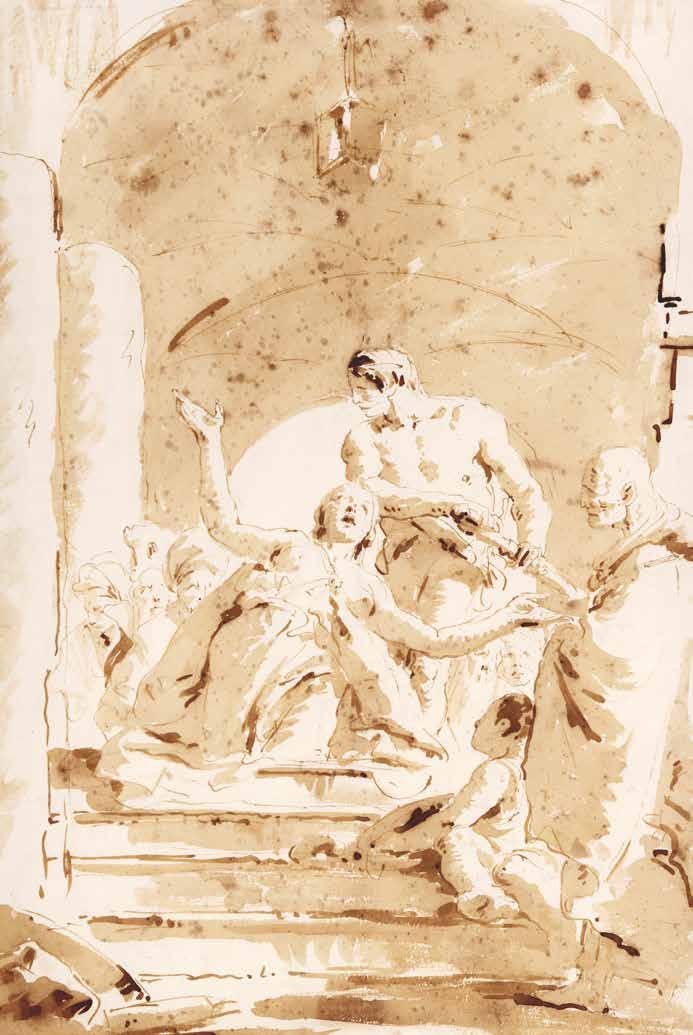
Crédits photographiques
CRÉDITS – BRUGEROLLES - GUILLET
ill. 1 © Getty Research Institute
ill. 2 © Getty Research Institute
ill. 3 © GrandPalaisRmn (musée du Louvre) / Madeleine Coursaget
ill. 4 © domaine public
ill. 5 © Galerie Éric Coatalem
ill. 6 © Studio Sébert Photographes
ill. 7 © GrandPalaisRmn (musée du Louvre) / Franck Raux
ill. 8 © GrandPalaisRmn / Agence Bulloz
ill. 9 © Les Arts Décoratifs/Jean Tholance
ill. 10 © Studio Sébert Photographes
CREDITS – DENIS TON
fig. 1. © Matthew Hollow
fig. 2. © public domain
fig. 3. © Erik Cornelius
fig. 4. © Per fentile concessione delle Fondazione Musei Civici di Venezia
fig. 5. © Christie’s
fig. 6. © public domain
fig. 7. © Trieste, Museo Civico Sartorio
fig. 8. © public domain
fig. 9. © public domain
fig. 10. © Private collection
fig. 11. © Villa et jardins Ephrussi de Rothschild
fig. 12. © Beaux-Arts de Paris, Dist. GrandPalaisRmn / image Beaux-arts de Paris
fig. 13. © Per gentile concessione della Fondazione Musei Civici di Venezia
fig. 14. © Nelson-Atkins Digital Production & Preservation, Melville McLean
fig. 15. © public domain
fig. 16. © public domain
fig. 17. © public domain
fig. 18. © public domain
CRÉDITS – CATALOGUE
cat. 1 © Thomas Hennocque
cat. 2 © Stephen Ongpin Fine Arts, London
cat. 3 © Thomas Hennocque
cat. 4 © Thomas Hennocque
cat. 5 © Stephen Ongpin Fine Art, London
cat. 6 © Camerarts
cat. 7 © Camerarts
cat. 8 © Stephen Ongpin Fine Art, London
cat. 9 © Stephen Ongpin Fine Art, London
cat. 10 © Collection privée
cat. 11 © Giuseppe e Luciano Malcangi
cat. 12 © Camerarts. Courtesy Howard G. Lepow
cat. 13 © Thomas Hennocque
cat. 14 © Collection particulière
cat. 15 © Thomas Hennocque
cat. 16 © Collection privée
cat. 17 © Collection privée cat. 18 © Camerarts. Courtesy Howard G. Lepow cat. 19 © Thomas Hennocque
cat. 20 © Collection privée cat. 21 © Thomas Hennocque cat. 22 © Thomas Hennocque cat. 23 © Thomas Hennocque cat. 24 © Thomas Hennocque
cat. 25 © Thomas Hennocque
cat. 26 © Stephen Ongpin Fine Arts, London cat. 27 © Thomas Hennocque
cat. 28 © Collection particulière cat. 29 © Thomas Hennocque
cat. 30 © Camerarts
cat. 31 © Camerarts
cat. 32 © Thomas Hennocque
cat. 33 © Camerarts
cat. 34 © Camerarts
cat. 35 © Thomas Hennocque cat. 36 © Galerie Éric Coatalem cat. 37 © Camerarts
cat. 38 © The Art Institute of Chicago cat. 39 © Thomas Hennocque cat. 40 © Stephen Ongpin Fine Art, London cat. 41 © Thomas Hennocque cat. 42 © Collection privée cat. 43 © Camerarts
cat. 44 © Christie’s cat. 45 © Camerarts. Courtesy Howard G. Lepow
cat. 46 © Christie’s
cat. 47 © Robilant+Voena, London, Milan, Paris, New York cat. 48 © Thomas Hennocque
cat. 49 © Thomas Hennocque
cat. 50 © Camerarts
cat. 51 © Camerarts. Courtesy Howard G. Lepow
Conception graphique
Achevé d’imprimer en février 2026 sur les presses de l’Imprimerie : Deckers Snoeck - Graphius Group - Gent
: Studio Martial Damblant - Moulins-lès-Metz