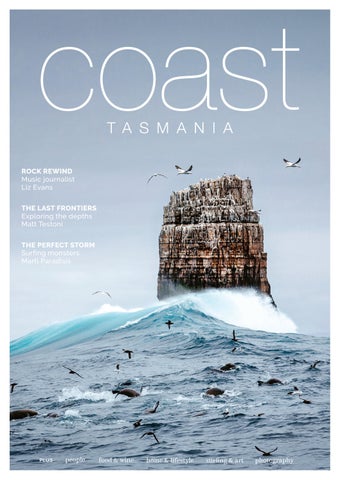
ROCK REWIND Music journalist Liz Evans THE LAST FRONTIERS Exploring the depths Matt Testoni THE PERFECT STORM Surfing monsters Marti Paradisis
PLUS
people
food & wine
home & lifestyle
surfing & art
photography
CONTENTS
26
46
32
MICHAEL MCWILLIAMS
MATT TESTONI
LIZ EVANS
If the eyes are the windows to the soul, then Tasmanian painter and passionate environmentalist Michael McWilliams seems to be calling us to look deep into the spirit of the animal kingdom.
Marine biologist Matt Testoni explores the wild underwater frontiers of Tasmania. Below thirty metres, the reef transforms into something few Australians realise exists – massive sponges and delicate cold-water corals – something unique and worth preserving.
Writer and psychologist Liz Evans spent the early years of her career reporting on rock gods and punk queens, including a memorable three-week stint in Seattle in 1990 alongside Nirvana, Soundgarden and Alice in Chains.
THE REGULARS
THE PEOPLE
THE PLACES
22 38 53 73 78 80 91
14 21 24 32 44 62 87
14 44 66 73 92 116 120
tassie life events guide food and wine let’s drive where to stay arts feature homes and gardens
marti paradisis taran armstrong tayla field liz evans robert pennicott nicola mason susan leyland
pedra branca tasman peninsula kettering ross bruny island longford cape grim
66
92
08
CRAIG & ZIGGY WEBB
THE TUNNEL
REBECCA TROLLIP
Among towering trees overlooking the wild beauty of southern Tasmania, Craig and Ziggy Webb from Raptor Refuge have dedicated themselves to giving injured raptors a second chance at life.
Part luxury retreat, part architectural statement, The Tunnel on Bruny Island appears almost mythical. Rising from the coastal heath among twisted gums, it looks as though it has been carved from land itself.
Becca’s life is an epic tale that would rival the best novels. From her early years in South Africa to the joyous birth of her twins, and through the fight of her life against breast cancer, her resilience is inspiring. She’s not just a survivor – she’s a thriver.
THE PHOTOGRAPHY
CONTENTS
FC 08 14 16 18 26 73
andrew chisholm nerissa stanley stu gibson mat tildesley nick green ness vanderburgh renee thurston
80
14
24
SOPHIE WITTER
MARTI PARADISIS
TAYLA FIELD
Sophie Witter isn’t your archetypal artist. She has little time to splash paint across a cavernous studio while contemplating the mysteries of life. More often, she’s answering a text from one of her four kids, holding a counselling session, mentally calculating dinner, and eyeing a pile of washing growing in the corner. Somewhere in the middle of all that, she paints.
If there were an Everest for surfers, Marti Paradisis has conquered it. The big-wave surfer, author, father, and adventurer loves taking life to the extreme. He takes on Tasmania’s Pedra Branca, one of the world’s most isolated and fearsome waves.
Tayla is an agricultural scientist with a passion for growing flowers. Her small flower farm just South of Hobart has to fit around her real job in the veg industry. Donning gumboots, we follow her footsteps as she collects armfuls of flowers beneath skies full of bees.
coast 5
EDITOR’S LETTER Welcome to Coast Tasmania! Putting this first issue together has been an absolute joy. It gave us so many goosebump moments, which makes me feel like we’re on the right track. This magazine is our love letter to Tasmania – to its people and places, from the country to the coast. We celebrate the innovators and groundbreakers, artists and adventurers, growers and makers, community champions and everyday heroes who make this such an extraordinary place. Thank you for opening your doors, sharing your stories and trusting us to tell them. For our Tasmanian publisher, this magazine has been a longheld dream. In a world that often feels loud and uncertain, she wanted to create something grounded – a publication that shares authentic stories that connect all Tasmanians. In this issue, we paddle offshore with fearless big-wave surfer Marti Paradisis as he chases the legendary swells of Pedra Branca – a place where the waves are enormous and the conditions are unforgiving. You’ll also meet Craig and Ziggy Webb, two passionate wildlife champions doing everything they can to protect and rehabilitate Tasmania’s magnificent birds of prey. Former rock writer Liz Evans invites us behind the curtain of a career spent interviewing music royalty, including Nirvana’s Kurt Cobain, and we take a deep dive with marine biologist Matt Testoni and explore the great underwater frontiers. Our sincere thanks go to our brilliant contributors, photographers, writers, partners and supporters. Your creativity, enthusiasm and belief have helped turn a dream into the pages you’re holding today.
Two ocean-loving souls, the editor and publisher
PUBLISHER Annette Spinks EDITOR Aissa Reed SUB EDITOR Chloe Kent WORDS Katie Cincotta, Aissa Reed, Sally O’Neill, Emma Wilkins, Laura Farnan, Samantha Prentice PHOTOGRAPHY Andrew Cottier, Renee Thurston, Nerissa Stanley, Ness Vanderburgh, Michelle Crawford, Bronwyn Scanlon, Matt Testoni, Sharni Venturoni DESIGN Casey Bourekas SOCIAL MEDIA Coast Media PRINT MANAGER Nigel Quirk ADVERTISING MANAGER Colette McMacken 0436 929 610 | ads@coasttasmania.com.au COVER IMAGE Eddystone/Pedra Branca by Andrew Chisholm (andychiza on Insta)
Here’s to celebrating Tasmania and its people, taking the scenic route whenever possible, and discovering what’s waiting around the next bend. Enjoy the journey.
Aissa x
Coast Tasmania is printed using vegetable based inks on an elemental, chlorine free paper. The stock is FSC certified and is manufactured using the ISO 14001 environmental management systems. Printed in Australia under ISO 14001 Environmental Certifications.
Coast Tasmania acknowledges the original story tellers of Lutruwita (Tasmania). We pay our respect to the Traditional Owners and elders past, present and future for their culture, knowledge and storytelling.
Welcome to Coast Tasmania. It’s a magazine that celebrates life from the Tasmanian country to the coast. Beautiful, collectable and thoughtfully crafted, Coast shines a light on the people, places and stories that make Tasmania so extraordinary. From health and wellness, to surfing, food + wine, stunning homes and gardens, dynamic local businesses and arts + events, we explore the heart and soul of Tassie.
words sally o’neill photos nerissa stanley
BECCA BOMBSHELL Rebecca Trollip
For a gal who doesn’t think she “has a story”, Rebecca Trollip’s life so far is an epic tale that would rival the best novels.
Right now, life in Huon Valley is sweet for Bec, her husband Rowan and their three children on the 51-acre haven (including 40 of bush) they’re proud to be “custodians” of.
“As a parent, it seems crazy – I couldn’t imagine leaving my kids and moving across the world – but it didn’t seem such a big deal, as a kid, you just adapt.”
“We mostly just rattle around the front 10 acres where we’ve got our huge veggie garden, orchard, sauna and greenhouse – you can even find Dad in his grandpa flat,” says Bec.
Bec and her Dad relocated to Australia, where they lived on a property he managed on Phillip Island. Aside from the “culture shock”, Bec discovered lifelong friends and a love of surfing. Her Dad moved to another job, but she chose to stay in a little caravan on site to put herself through the last two years of school – working at a hair salon on Thursday nights and Saturday mornings, then skateboarding across the bridge to work at a supermarket until close.
She is consciously shaping their world, striving to give her children a piece of her own country childhood. What she won’t match is the colourful chaos of her early years in South Africa with four siblings on a biodynamic dairy farm. “I remember going to the garden, raiding the strawberry patch and making milkshakes in my secondhand little blender and things like that.” Each morning, she’d walk to the bus stop in the dark for the 60-kilometre drive to school on the community bus. Once a week, her Dad would take the wheel, adding fresh dairy goods to the onboard fridges for him to deliver around town. “It was a big, green wood-powered Camphill bus with roof racks full of wood so we could keep feeding the furnaces.” When she was seven, her parents split, with her Mum migrating to Sweden.
coast 8
She “fell” into a hairdressing apprenticeship and, as soon as the four years were done, immediately bought a round-theworld ticket – first stop Cape Town. “I always had a longing to go back and see it from an adult point of view.” Touching down at Cape Town International, it wasn’t her friend Chrissi at the airport as planned, it was her old school friend Rowan. They started hanging out, surfing and then dating. Her planned three-month stay became 12, and then she sponsored Rowan to Australia on a proposed marriage visa so they could be together.
coast 9
“Once you’ve been told you have cancer, that previous self is gone, and you can never go back.”
coast 10
“Marriage wasn’t on my list of things to do in this lifetime. I was never a little girl dreaming of wearing a white dress – we were still babies.” Visiting her school friend Jo in the Huon Valley years before had put Tasmania firmly on her radar, so when daughter Harriet was born, the couple got serious about making Tasmania their home. “We had bought a block of land, and when we found our dream property in the Huon Valley, we used that block to buy it. We’d had it for ten years and didn’t go up a cent!” They moved to Tasmania when Harriet was one. “As soon as I stepped off the plane, I felt I was home. I was like…exhale… I’ve arrived.” They lived in Hobart while Rowan built a small house on the block for the family to live in until their large house was completed in 2020. Then, as the couple was about to buy tickets for a surfing trip to celebrate their 10-year wedding anniversary, Bec found she was pregnant – with twins. That trip back to South Africa is still yet to happen.
The birth of the twins was joyous, but then the story takes a terrible, unexpected turn. As Bec was breastfeeding Harriet and the twins, she felt a lump and, even though she was sure it was fine, had it tested. “They’re like, yes, it’s breast cancer, and it’s aggressive. Oh my God – it was a big shock.” The news totally rocked Bec and her family to the core. Things moved fast with surgery for a mastectomy straight up, followed by chemo and radiation. “COVID added an extra layer of stress by being immunecompromised, but luckily we live in Tassie, so it wasn’t as hectic as the mainland and rest of the world.” She worked hard with conjunctive therapies to get through four rounds of chemo. “Then they said I was handling it so well, they’re going for six! I wish they’d just said that from the start.” Friend Jess coordinated an amazing fundraiser, and their community pulled together.
coast 11
“That’s the joy of living in a smaller community, everyone just shows up. We were getting meals delivered for months.”
home day. Life centres around home with enough work to “fill her cup,” and the children as top priority.
This experience was the end of one story and marked the beginning of a new Bec and a new life.
“We’ve been learning new skills. There just seems to be lots of knowledge from all over Australia here, and so many people to learn from. We’re having a go at growing saffron and garlic, and keeping chickens and revegetating the creek.”
“Once you’ve been told you have cancer, that previous self is gone, and you can never go back. There’s a heaviness, but also an immense clarity of where you want to invest your energy and spend your time. It just puts perspective on life – literally every day is a blessing.” Chapter one of the new story. Family life goes on. Bec drops the kids at Steiner school and is about to be part of the team opening Hobart’s first hair co-operative. “It will be run by the community for the community with values based on democracy, equality and solidarity in a relaxed, fun salon space.” Although she denies it, Bec is a bit of a style icon with people often commenting on her clothes or how she changes her hair. “I really don’t put much thought into it. I wear clothes that people give me or from clothes swap parties – my style is just a combination of the people around me, and the fact that I hate shopping!” One day a week is mapped out for surfing, skating (including street skating lessons) or bushwalking, and another is her
coast 12
Her skateboard is always in the car, and on weekends the family will often go on coastal adventures with the Esky packed full of snacks, fires on the beach and memories made as she encourages her kids to share her love and respect for the ocean. The next chapter of this epic story is about slowing down, creating space and living close to nature. “I feel like I have time, even though I’ve had cancer in my thirties. I’m looking forward to living each day in the present. There’s too much hectic stuff going on in the world; it’s just nice to see what’s right in front of you. Live in the moment and not look too far into the future or the past. I have a friend who comes and takes an annual photo shoot of my family. And that’s my gift to me for being alive for another year.”
Enough room for a life well-lived.
Two thoughtful ways to create a home that supports your wellbeing, sits comfortably with your values and leaves a lighter footprint.
For completely custom homes + home improvements.
For considered + customizable house plan designs at a fraction of the cost.
designful.com.au enquiries@designful.com.au @designfulstudio
homefulbydesignful.com.au homeful@designful.com.au @homefulbydesignful
Tasmanian-based | available throughout South Eastern Australia 0438 578518
coast 13
PERFECT STORM Marti Paradisis
words sally o’neill photo stu gibson
If there were an Everest for surfers, Marti Paradisis has conquered it. The big-wave surfer, author, father, and adventurer loves taking life to the extreme and living purely in the moment.
coast 14
coast 15
photo mat tildesley
coast 16
Marti readily admits that surfing in Tasmania, especially the kind he and his mates take on, is not for everyone. Each wave is a “mission” requiring knowledge, experience, patience, courage and a strong sense of adventure. Those who choose to ride the monstrous winter storm swells know that when everything comes together, you can be rewarded with the ride of your life. “You’re dealing with anywhere from minus five to ten degrees Celsius, with chilling, stiff winds that penetrate right through you. You’re cold to the bone, sometimes walking in knee-deep water and mud, and it’s snowing on the beach as you’re getting into your wetsuit. When you’re chasing these swells, that’s generally the weather you’re dealing with.” The first time Marti’s life changed forever was when his family moved from the northern suburbs of Hobart to the coastal town of Clifton Beach. “It was where I belonged – everything just felt right. I’d get home from school and go down the beach. I didn’t even need to surf; I’d just sit and look out into the ocean and feel at peace. That was a pivotal time in my life,” Marti, the son of a Greek fisherman, recalls. The second was surfing Pedra Branca for the first time. The conditions were right, the planets aligned, and he lived to tell the tale of riding one of the world’s most isolated and fearsome waves. Like a drug, the feeling of that day is something he and his tight crew will always be chasing. That moment was years in the making. Camping with friends from his mid-teens, they ventured off the beaten path to check out new areas and waves. Older crew at Clifton Beach, like Dustin Hollick and Andrew Campbell, became young Marti’s mentors. “They taught me how to read the weather patterns; we’d get all our gear ready and pack the car for long drives to places I’d never been. We’d set up our tents, and the next morning, walk another hour or two to get to the waves. You take a lot from your elders, because they’ve put the hard yards in before you’re even on the scene. It’s like chefs who’ve already done the experimentation, and they know what works. And then it comes down to taking the chance, having a crack and seeing if it pays off.” Over the years, the masters introduced their apprentice to bigger waves in wider oceans at the bottom of the state, and he got the taste for pushing himself out of his comfort zone in remote breaks where no one’s coming to save you. “We were just lucky enough to be the generation that came along as slab surfing was booming and Shipsterns was discovered – something that will never happen again in surfing. After years of surfing Shippys, we started sacrificing big swells there to see if there was something bigger and better somewhere else.” This led to Pedra Branca in 2008. Deep in the Southern Ocean, it’s a huge slab wave that breaks off Eddystone Rock.
“You take a lot from your elders, because they’ve put the hard yards in before you’re even on the scene. It’s like chefs who’ve already done the experimentation, and they know what works.” coast 17
“He got the taste for pushing himself out of his comfort zone in remote breaks where no one’s coming to save you.”
coast 18
photo nick green
coast 19
“The weather and swell combination that you need for everything to line up perfectly is super rare, so the first trip was a long time in the making and a logistical nightmare, but really monumental for all of us.” Since he was a kid, Marti had a fascination with exploration and pioneering. His dream to go where no one had gone before was finally achieved on that first trip to Pedra. Everyone got on their skis to check the wave without their boards. As Marti’s ski was being unloaded into the water, the straps broke, sending it crashing into the side of the boat. It completely smashed the front of his ski, but somehow ended up starting. “We grabbed the boards, jumped on the ski and raced straight over into the lineup. Bobbing in the ocean out the back of a break no one had ever surfed before felt surreal. And riding that first wave is a moment I will never forget. The whole day seemed like I was in a dream. I wasn’t scared, just focused. I’ve never been so present in my life and the best mindset I’ve ever been in the surf.” Time may have passed since that magic day, but that surf lives on in bright technicolour in his mind. He wrote and published a coffee table book about that trip to Pedra and many more wild stories from the adventures and experiences his crew have had chasing their dreams. The whole self-publishing process spurred him to start his own business, Salty Minds. “As well as the surfing books, we now have children’s books, a sunglasses range, and soon-to-be-released lifestyle apparel.” He runs the business from the backyard of the house he shares with girlfriend Jaymie and two daughters, Josie and Junie. Like stepping onto the face of a massive aqua slab of water, you don’t know where life will take you, but Marti will keep being present, having a crack and waiting for that next wave…
photo stu gibson
coast 20
YOUNG & INSPIRED
TARAN ARMSTRONG
Tasmanian-born and bred, Taran Armstrong has always looked ahead. As a child, he wasn’t just dreaming about the future he wanted – he was quietly laying the foundations for it, cultivating the habits, discipline and self-belief that would eventually carry him to the highest level. “It’s something I always thought I was going to do, and from a very young age I took basketball seriously,” the 24-year-old North-West Tasmanian says. That unwavering focus has carried Armstrong a long way. After years of relentless work, he became the first Tasmanian to reach the NBA and is regarded as one of Australia’s brightest basketball talents. It was a path shaped not only by determination, but by family: Armstrong’s father and uncle both played semiprofessionally, while his older brother played professionally too. Now, after a career that’s taken him from Cairns to California to Dubai, the Burnie boy has signed a one-year deal with the Tasmania JackJumpers, with the option of a second season. His return has been a long time coming. “I’ve been away from my family since I was 16,” Armstrong says. And while he’s kept in touch with the group of friends he made as a student via a group chat, “We talk every day and have spoken every day since I left” – it’s still been “a heavy cost”. “Nowadays, I have a great appreciation for the time I do get with my family and with my friends,” he says. “Those are very special moments.” “The more I’ve been around the world and experienced different things, the more I realise how good I actually had it growing up.” The Burnie school Armstrong attended had ocean views, and he’d often see the water from the car; now he realises how remarkable that was. “Just seeing the water all the time is something that I’ve really come to appreciate. It’s so funny how you take it for granted growing up here.”
words emma wilkins photo liam boric
Although Armstrong describes himself as “far from a finished product”, he’s eager to embrace the JackJumpers’ renowned development culture and contribute beyond the scoreboard. Just as importantly, he hopes his journey can inspire the next generation of Tasmanian players. “I hope that when a local kid with big dreams sees, ‘He’s from Burnie, he’s from Wynyard, he’s from where I’m from,’ they’ll think, ‘I can do that.’”
coast 21
TASSIE LIFE Things we are loving this Spring
coast 22
FARM FRESH
CREATIVE HEARTS
SPRING INTO SWIMMING
From country to coast, Tasmania is home to some of the world’s finest produce. Gardners Bay Farm grows seasonal vegetables for local produce boxes and Huon Valley restaurants, connecting farmers, food and place. Visitors can also join farm tours to see regenerative agriculture in action and discover how Korean Natural Farming builds healthy soil, supports biodiversity and grows resilient crops.
Susan Leyland’s striking, layered 3D timber wall art captures the imagination. Part owner and the brainchild behind Tasman Artisan House in Sorrell, the gallery is a place to slow down, explore and connect with local artists. Stories are told through art and makers are championed. If you’re exploring Southern Tasmania, it’s a destination well worth discovering.
The birds are singing, the buds are blooming – spring is finally here! It’s time to get out of hibernation and shake off the winter blues. Get out in the ocean and experience what many cold-water swimmers describe as a post-swim high. Cold water triggers a release of dopamine – the body’s feel-good hormones. Jump in the wild ocean for the best (and free) natural high.
gardnersbayfarm.com.au
Tasman Artisan House 21 Gordon Street, Sorrell Find them on Facebook
WHEN THE OCEAN AWAKENS When The Ocean Awakens is a stunning premium coffee-table book by Marti Paradisis that takes readers inside the world of Tasmania’s legendary big-wave surf breaks, including Shipstern Bluff and Pedra Branca. Featuring breathtaking photography and firsthand stories from surfers, photographers and adventurers, it captures three decades of courage, exploration and life on the edge of the Southern Ocean. saltyminds.com.au
CHARTS FESTIVAL
CONVICT CITY ROLLERS
The CHArts Festival is the northwest coast’s only month-long celebration of culture, heritage and the arts. Spanning 29 days and featuring more than 40 events, the festival transforms towns and communities across the region into creative hubs, with activities stretching from Redpa to Rocky Cape and from Smithton to the iconic village of Stanley.
Convict City Rollers is a grassroots roller derby club that brings people together through their shared love of the sport. It’s an empowered and socially inclusive sporting community that welcomes participants of all ages and abilities. Have fun, get fit – and get involved! convictcityrollers.org.au
One of the festival’s most anticipated highlights is the CHArtchibald competition – a distinctly local twist on Australia’s famous Archibald Portrait Prize. One not to miss! chartsfestival.com coast 23
words aissa reed photo james oakes
15 MINUTES OF FAME
BLOOMING BEAUTY Tayla Field
At the crack of dawn, when most of us are barely awake, Tayla Field has already argued with a goose, fed the ducks, and the dogs, the geese and the guinea fowl . . . and inspected row upon row of ranunculus with her muddy gumboots sinking into the rich Tasmanian soil.
Tayla is an agricultural scientist with a passion for growing flowers. Her small flower farm just South of Hobart has to fit around her real job – as a Regional Development Officer for the vegetable industry in Tasmania. It still makes her laugh that she ended up here. As a kid growing up in the suburbs, she had never really stepped foot on a farm. Her world was traffic lights, terraces, and school excursions to museums. Flowers were things wrapped in paper at supermarkets, not entire ecosystems buzzing with bees and guarded by suspicious guinea fowl. At university, she started studying environmental systems, imagining a sensible future involving reports and office buildings with potted plants withering quietly in corners. But then came the Ag science students. They talked about soils the way poets talk about love. There were field trips, muddy paddocks, onion crops, spinach farms, and something about standing in the middle of a working landscape that just clicked. By graduation, she was hooked. Tasmania came next. Then horticulture. Then vegetables. Then onions. Then a tiny, hopeful collection of flowerpots and a dream . . . That dream now sprawls across a one-hectare hobby farm, where poppies sway like silk dresses and dahlias bloom in
coast 24
every colour. She grows too many varieties, according to every sensible flower-farming guide ever written, but restraint has never really survived in the presence of beauty. There are snapdragons, cosmos, sweet peas, lupins, strawflowers, and rows upon rows of ranunculus – flowers she relates to because, she says, they have layers. Lots of them. The ducks patrol for snails. The geese supervise everything with alarming sincerity. The dogs trail behind her like loyal interns. And every afternoon, after long days working in Ag development, she returns home to her other job – gathering armfuls of flowers beneath skies full of bees. The flowers themselves no longer feel rare to her. Not exactly. Seeing them every day changes something. They become companions instead of decorations. Less precious, but more deeply understood. Still, every time she delivers bunches to her local café, Maxi Coffee in Kingston and watches someone walk away smiling with poppies tucked under their arm, she feels the same quiet magic. Not because flowers last . . . but because they don’t. And that, she thinks, might be the whole point.
coast 25
words katie cincotta photos ness vanderburgh & michael mcwilliams
coast 26
ANIMAL MAGNETISM Artist Michael McWilliams
If the eyes are the windows to the soul, then Tasmanian artist Michael McWilliams seems to be calling us to look deep into the spirit of the animal kingdom.
It’s an artistic technique that’s bold and pointed – animals portrayed on their sides, with their heads turned to look you squarely in the face – in what Michael describes as the beginning of a conversation. “Having that direct stare is important in beginning a dialogue between the portrayed and the viewer. When someone looks directly at you, it is hard to ignore them,” he says. As a boy who grew up in the rural farming town of Longford, the natural world rises to attention in all of Michael’s work. Like colonial artist John Glover, who also lived and painted in Glover Country not far from Longford, Michael was fascinated by the light, the landscape, the sky and the animals that surrounded him.
coast 27
He and his three sisters enjoyed a childhood of imagination and freedom across the bush, exploring and playing from the mountains of the Western and Eastern Tiers to the river systems in the valley. The backdrop was idyllic, but there was realism built into the picture. Their father bought animal skins, and Michael remembers visiting farms with him to buy rabbit, possum and sheep skins – in the aftermath of pest control. As a passionate environmentalist, Michael admits he’s continually “dismayed, disappointed and disgusted” by the encroachment of business on the natural world. His paintings introduce animals, both native, farmed and feral, to draw them back into focus. “The animals are innocent; they didn’t choose to be brought here to become feral, in plague proportions.” Like many homegrown Tasmanians, he’s concerned by the displacement of animals caught up in the corporate push
coast 28
and pull for development. It annoys him so much, he’s dubbed some of this work ‘protest paintings.’ “The destruction of habitat seems to increase by the day, with the added difficulty in Tasmania that sea-based aquaculture is destroying our amazingly important marine environments.” Michael’s nature crusade is balanced by the wonderful humour in his art, which he hopes leaves room for us to confront some of the problems with a sense of optimism. “People get a bit tired and disengaged when they are continually confronted by serious issues. I don’t want to produce ugly, confronting images that polarise people. I always try to make my paintings still show beauty and a sense of hope that change may occur.” This is where his realistic style of painting floats into surrealism, playing on bizarre context and fanciful predicaments. Cows floating through water. Sheep in grasscovered living rooms. Pugs popping up on tables and in giant
“I just think it makes people imagine different possibilities when they look at my work.”
clam shells alongside the famous Birth of Venus by Botticelli. His juxtaposition of reality and fantasy vibrates with abandon, like a dance of whimsy from land to sea. “I just think it makes people imagine different possibilities when they look at my work.” One of his most notable paintings is Miss Fish Fingers – a Medusa-like sea creature dressed in 50s tailored suiting, which calls to mind glamorous actresses of the era like Grace Kelly and Jayne Mansfield. “I based her jacket on the style of clothes my mother used to wear when I was young. She used to make most of her clothes and was quite inspired by the tailored styles of the 40s and 50s.” A canary on her shoulder, an octopus brooch and a crab pocket handkerchief add a trademark quirkiness to her floating form, which once greeted patrons at The Glasshouse,
a whiskey bar on Hobart’s waterfront. After the business changed hands, Miss Fish Fingers was resold to a local who always admired her at the bar on the floating wharf. The Renaissance painters, including Botticelli and Arcimboldo, inspire the intricacy of his work, as he admits he continues to learn technique by studying the Italian masters. “I’ve always loved to look closely at other people’s paintings, it’s important to determine the process of laying down colour, of understanding how composition plays a major part in a work . . . you never stop learning about technique if you engage with other artists’ works.” In 2025, Michael’s art career was celebrated with a survey show spearheaded by Shane Fitzgerald, the Director of the Queen Victoria Museum and Art Gallery in Launceston, who describes his work as a love letter to Tasmania. The two-year process of hunting down paintings from all over Tasmania and the mainland resulted in an exhibition of
coast 29
100 works, which Michael says was an emotional experience, like a chance to reunite with precious friends from the past. “It was overwhelming to see all the paintings again, in one gallery, all together. As an artist, you rarely get to see your work again once it has been through the gallery and sold. Most artists would agree, you paint away and spend so much time on individual works, they become like old friends, then you pack them up and send them off to the gallery for an exhibition and never get to interact with them again.” Hundreds queued to see the first public showing of the Tasmanian’s portfolio of a landscape in flux, with many of the 35,000 visitors returning several times. His next exhibition will be at Philip Bacon Galleries in Brisbane for June 2027, leaving him a year to produce work alongside a renovation project with his partner, Robert, at their 1820s colonial house, Clairville. The couple bought the farmhouse on its 13-acre block from a family who had lived and farmed there since 1857. “We have a great life together, we live in a fantastic old house that has had very few changes to it since it was built,” he says. Michael first began painting on furniture pieces that were beyond restoration at the family’s antiques shop. So, it’s no surprise that he admires Clairville with the forensic eye of an artist cued to pinpoint fine detail.
coast 30
“One room has a ceiling light but no power points! This room contains an extremely rare panoramic wallpaper installed in the very early 1830s. It is French wallpaper and depicts the reopening of the Bosporus Straits to allow access to the Mediterranean Sea for the Russian Fleet, believed to be the only example of this wallpaper in situ in the world. So, it is a great responsibility to preserve it for the future.” Like all the hidden animals in his paintings, Michael’s art wills us to look deeper and further, calling us to laugh and smile to temper the intensity. Discombobulating at times, but maybe that’s the point. What is never in doubt is the magnetic pull towards the animal kingdom – creatures great and small calling you to attention, daring you to bear witness to the impact of man’s definition of what ‘home’ looks like for every species competing for a place in the ecosystem. For Michael and Robert, it’s an open-door policy for animals, having once shared their home with seven pugs. They are in the process of ‘rewilding’ their back paddock to welcome native animals and are protecting old trees in the English style parkland at the property’s entrance. A co-existence delicately balanced – the very ethos of Michael McWilliams’s paintings, which challenge you to think about every layer of human impact, tearing at the seams of Tasmania’s 1.4-billionyear-old foundations.
coast 31
ROCK REWIND Writer Liz Evans
So many rock icons didn’t survive the ‘90s grunge era, which notoriously claimed Kurt Cobain, Layne Staley and Kristen Pfaff in untimely deaths from suicide or drug overdose. Writer Liz Evans saw the angst up close, as she recalls a decade reporting on the rock gods and punk queens of her early writing career.
When you’ve had a distinguished writing career that’s spanned the decades and the continents, there’s bound to be stories to tell. British-born journalist and author Liz Evans let us time-travel back to the ‘90s grunge revolution that birthed Nirvana, Soundgarden, and Pearl Jam, which she covered for top music and fashion mags, including NME and Elle. Decades on, the word ‘grunge’ still irks her, as it did the legends of the genre. “The term grunge was never used at the time, and none of the bands liked it. So, I still have an uneasy relationship with it in some ways,” she says. More than 30 years since telling some of the music world’s grittiest stories from the UK to the USA, the 60-year-old calls the Huon Valley of Tasmania home, sharing a small weatherboard cottage on an acre with her Queensland-born husband and their young adult children. What has followed her from that heady era as a music journo is a pair of John Fluevog sandals gifted to her by Sonic Youth’s Kim Gordon, who is still making music and performing at 73. They’re a treasured reminder of that time, and her 19-year-old daughter has her eyes on them.
coast 32
words katie cincotta photos michelle crawford & paul harries
coast 33
“I went to interview her at her apartment in New York, and she took me into her walk-in closet, and I said ‘you’ve got some Fluevogs’ and she said ‘I don’t really wear them very much, they look like they might fit you, so you should just take them’ so I did, and ended up wearing them all the time. My daughter is asking for them now, but I’m not going to let her have them just yet. Maybe one day!”
“I would try my best to gain trust and develop a good connection with people. That was about listening, about asking intelligent questions, really thinking about who I was talking to, listening to the music if I was talking to someone about an album, thinking about the lyrics and what they were trying to say. But with some people, you couldn’t get past the image, and that would impact the story.”
As a teen from Gloucestershire, Liz saw her first live bands perform in Bristol at the ages of 14 and 15, being lucky enough to have older friends who drove her to the concerts. By the time she moved to London at 19 to study English, the seeds of the rock scribe were taking root.
One such example was Courtney Love, who appeared unable to separate her public persona from her private self.
A college friend started a band. Liz wrote a live music review to try and increase their exposure, posting it off to three music papers, fully expecting to find it in print when she went to the newsagent to scour the pages. She admits that publishing was a mystery to her at that stage and didn’t realise the important role played by commissioning editors. But she wasn’t deterred. “After about three weeks, my piece still hadn’t been published, so I rang up one of the papers and asked when it would be appearing. The reviews editor was completely taken aback, which made me even more determined. I went straight out and told everyone I knew that I was going to become a music journalist, so I guess I ended up being published through a mixture of ignorance, bloodymindedness and determination!” Before long, Liz began writing regularly for a rock magazine, and at 22 was excited by the prospect of a job that gave her a front row seat to the scene’s emerging talent. “I knew I didn’t want a regular 9-to-5 job. I wanted to have fun, and being a rock journalist seemed like a good way to do it. Like everybody else I knew, I went to parties and gigs all the time. London was very vibrant in the 80s. All my friends were living in squats. It was an interesting time to be there.” The music was loud, the misogyny was rife, but Liz overcame the obstacles to become a successful music reporter, cementing relationships with Kurt Cobain, Eddie Vedder, Kim Gordon and Bjork, much to the disgruntlement of some of her male colleagues.
“Courtney Love had a huge personality and was very ambitious. But the second time I interviewed her, I realised she wasn’t very well. In the 90s, that stuff wasn’t very well understood.” The Hole frontwoman didn’t appreciate Liz’s visceral piece on her for Select magazine in 1992, which showcased Liz’s talent for earning trust and establishing rapport. During the interview, Courtney confessed that doing heroin with Kurt felt romantic, that she felt judged for taking drugs while she was pregnant, and that the infamous Vanity Fair story, which led to child welfare temporarily removing their daughter Frances Bean, sent her into ‘such a rage I could have killed someone.’ But when Liz’s article appeared, Kurt and Courtney called Liz from Los Angeles. They were both very upset. “It was a real shame because my intention with the article was to make amends for the Vanity Fair profile, by writing a better, fairer piece. But one of the Select editors had added a smattering of salacious commentary and changed the context of some of my words. I’d known Kurt since 1989, and had a good relationship with Nirvana, so it was all pretty sad. But they were both very vulnerable at the time. “Luckily, everything was fine with Kurt in time. And I saw Courtney when she played a secret Hole gig in London, so it all settled down. But there was a lot of volatility at that time, and quite a few fragile egos, and musicians didn’t have the right kind of support back then.” When Kurt Cobain died in 1994 from a self-inflicted gunshot to the head at the age of 27, Liz heard the news directly from one of her more trusted editors.
“I was one of the very few women in that space. To me, it didn’t feel like an advantage. It made my job a lot more difficult because I had to overcome a lot of preconceptions and a lot of biases. There was a lot of misogyny in that world, especially from male journalists.”
“He rang me personally before it hit the news because he knew I’d had a good connection with Nirvana and he wanted to tell me himself. I was on my way to see a friend’s band, and I remember feeling deeply upset, but also really angry. It was very complex, like all suicides, and also hard not to think that perhaps it might have been avoidable.”
Undeterred, she spent 10 years covering music, including a memorable three-week stint in Seattle in 1990 with Nirvana, Soundgarden, Alice in Chains, Mudhoney, and the guys who would eventually come together to form Temple of the Dog and Pearl Jam.
Liz had known Nirvana since 1989, when the young boys from the logging town of Aberdeen were ‘happy and goofy’, so it was an emotional blow to see the Gen X icon meet such a tragic end.
“Later that year, I interviewed Nirvana when they came to London. Kurt told me he was hoping to make it into the Top 40. He said he’d quite like to break out of the metal charts and into the mainstream with his new album. He was talking about Nevermind.” Her stories are colourful narratives peppered with observational detail and illuminating quotes. She approached the work with diligence, discretion and an ability to navigate egos, and carefully crafted images, to get to the real story.
coast 34
“They weren’t big city guys. They were mates, and they had parties in the bush. Obviously, they wanted to make a living out of their music, but fame did spoil things for people. Kurt struggled to reconcile himself with it, although Courtney really wanted stardom. She would have done anything to be famous, but Kurt wasn’t comfortable with that kind of attention. He wanted musical success and liked the idea of breaking out of the metal charts, but no one could have predicted what happened after Nevermind came out, and it wasn’t something he ever really managed.”
Namely, that the album was a global hit that sold 30 million copies. Kurt was declared the voice of a generation, and 35 years on, the album continues to be lauded as one of the greatest rock albums of all time. By her mid-30s Liz was losing zest for the job and made a conscious decision to bow out of music journalism. It hadn’t all been glamour and gigs. Once, she had to fob off the creepy advances of a middle-aged muso. “I remember my editor telling me I was being unprofessional because I’d lost my temper with the guy, but I wasn’t going to be treated like that in my workplace by anyone.” “After ten years, I’d had enough. I’d met everyone I wanted to meet and written for all the music titles in the UK at that time. I was in my early ‘30s and meeting bands who were 10 years younger than me, full of enthusiasm and passion, and I just couldn’t meet them there anymore.” One of the last interviews Liz did in the ‘90s was with Ozzy Osbourne in 1998, captured in a photograph of the two of them laughing at a hotel on the Champs-Élysées in Paris. “He was just a genuine, lovely, funny, self-effacing guy. I pretty much laughed all the way through that interview. He was shaking like a little old man; he’d had quite a life by then, drank himself into the ground, taken God knows how many drugs. Without Sharon, he would have been dead many years prior to that.” She gave herself time and space to think about the next step, which turned out to be psychotherapy and academia. Liz met her husband when they were both doing a Master’s degree in the UK. They relocated to Melbourne with their young children after London became unaffordable, eventually turning a holiday in Tasmania into a permanent move. “The forests, mountains, and oceans are all nearby, so it’s been a great place to raise a family.”
coast 36
As well as writing, Liz’s career has included psychotherapy, university lecturing, and studying for a PhD in Creative Writing, which led to the publication of her first novel, ‘Catherine Wheel’, a psychological thriller. She’s recently developed a podcast, Remotely Lit, to focus on the Tasmanian literary scene, interviewing authors and individuals connected to the writing community, and exploring topics such as festivals, awards, the City of Literature designation, and AI, which represents a threat not just to writers but to society at large. “I think AI is extremely dangerous. Data centres are being built all over the country, and companies like Palantir are securing government deals. Sadiq Khan, the Mayor of London, is trying to block Palantir’s deal with the Metropolitan Police. The problem is, if you engage powerful AI companies run by billionaires with dangerous political views, then you’re compromising the safety of millions.” Liz is going to see Massive Attack when they tour Australia in August and is impressed by the band’s ongoing commitment to using their platform for political activism. Among her pile of current reads is ‘Empire of AI’ by Karen Hao about the tech arms race for artificial general intelligence, which she admits is bleak, but also hopeful. “The governments don’t seem to be saying no to it because these companies have got so much money, so what are we going to do about it? We as individuals have the power to say no, and if we don’t, we will lose democracy, we will lose self-agency.” Perhaps you don’t spend 10 years of your life immersed in the raw, angst-filled ‘Seattle Sound’ without some echo of rebellion.
PENGUIN BEER CO. BREWS, CHEWS & VIEWS
03 6437 1204 | 85 Main Rd, Penguin | penguinbeerco.com.au |
ISLAND STATE BREWING
DEVONPORT’S BEST PIZZA
03 6155 4374 | Market Square Pavillion, 17 Oldaker St, Devonport | islandstatebrewing.com.au |
2026
EVENTS GUIDE
HARD CORE | JULIAN CHARRIÈRE GOES DEEP AT MONA French-Swiss artist Julian Charrière will present his first solo exhibition in Mona. He has made art in extreme environments around the world – including volcanic ridges to ocean abysses. Mona’s founder, David Walsh, says, ‘Ideas burst from Julian like licks from an overfriendly dog. Sometimes it’s a lot – attending one of Julian’s exhibitions can be overwhelming. But Julian isn’t a meddler. His ideas are deep and incisive, the sort of ideas that expose the soft white underbelly of reality.’ June 6, 2026 – March 29, 2027 MONA Museum of Old and New Art, Hobart Instagram & Facebook @monamuseum | mona.net.au Pictured left: Controlled Burn (video still), 2022, Julian Charrière. Copyright the artist; VG Bild-Kunst, Bonn, Germany. Courtesy of the artist and Mona.
© luke tscharke
BLOOMING BEAUTIFUL WYNYARD TULIP FESTIVAL The Wynyard Tulip Festival is an annual flagship regional event celebrating the largest walkable tulip bloom in the Southern Hemisphere at Table Cape Tulip Farm. Now in its 34th year, the event attracts thousands of locals and visitors each spring to Gutteridge Gardens in Wynyard, set against the picturesque Inglis River. The festival showcases the best of North West Tasmania, bringing together community, culture, food, entertainment and family-friendly experiences. Free shuttle services connect visitors between the event and Table Cape Tulip Farm, enhancing access to the region’s iconic tulip displays. September 12 – October 10, 11am-9pm Gutterridge Gardens, Wynyard wynyardtulipfestival.com.au
LUTRUWITA ANIMATION FESTIVAL The Lutruwita Animation Festival (LUTAF) is a one-day celebration of animation from Lutruwita/Tasmania and beyond, held at the historic State Cinema. Featuring a vibrant program of screenings, talks, workshops, and a student competition, LUTAF spotlights Australian animated filmmakers, from cutting-edge releases to diverse and under-represented voices. Participants can discover animated works rarely seen elsewhere, connect with industry professionals, and immerse themselves in Nipaluna/Hobart’s dynamic cultural scene.
coast 38
November 7 State Cinema, 375 Elizabeth Street, Hobart lutaf.org
PARTY IN THE PADDOCK It all began with a paddock and a dream. More than two decades later, Party in the Paddock is a staple Tasmanian summer music festival, celebrating the island’s creative spirit and platforming acts like A. Swayze & the Ghosts, Amyl and the Sniffers and Empire of the Sun. Ideal for colourful costume wearers, happy campers and the wild at heart. February 4–7, 2027 Tasmanian independent music & arts festival Quercus Park, 415 Oaks Road, Carrick
A TASTE OF SUMMER The Taste of Summer is Tasmania’s premier festival, celebrating the region’s vibrant food, drink, and entertainment culture. Located on Hobart’s picturesque waterfront, this event is the ultimate celebration and a must-attend for food lovers, music enthusiasts, and families alike. With a variety of local vendors showcasing fresh produce, seafood, and Tasmanian wines and spirits, the festival offers a delightful taste of everything the island has to offer. December 27, 2026 – January 3, 2027 Princes Wharf N1, Hobart tasteofsummer.com.au
THE ART OF CRAFT DELORAINE’S CRAFT FAIR Australia’s largest working arts and craft fair is on again, for three days across Deloraine. From textiles and fashion, to woodcraft, glass, sculpture, visual arts and other contemporary disciplines. There is a vibrant kids program that nurtures young creative minds, and the $10,000 Premiers award – one of the most valuable craft and arts awards in Australia. October 30 – November 1 Venues across Deloraine tascraftfair.com.au
SPRING
EVENTS GUIDE SEPT
Wisdom through wood September 12th School of Green and Traditional Woodworking 127 Betts Road, Neika wisdomthroughwood.com In the open-air workshop, you’ll have your own pole lathe, draw horse and hand tools to learn woodcrafting skills.
Macbeth | Bell Shakespeare
A Natural Escape October 9th – 31st Beautiful locations around Tasman council (see website) anaturalescape.au Over three weeks, enjoy 50+ natureinspired activities and workshops.
October 16th Whitemark Showgrounds 290 Palana Road discovertasmania.com.au
Shakespeare’s most haunting thriller.
Hits of the ’60s and ’70s by The 60 Four
Come and enjoy the gorgeous display of Spring flowers by the Launceston Horticultural Society.
Judbury Market September – May (every 2nd Sunday) 10am-2pm 1273 Glen Huon Road, Judbury facebook.com/JudburyMarket Judbury Market is one of the Huon Valley’s hidden gems – a relaxed, family-friendly event nestled beside the Huon River at Calvert Park.
October 23rd Theatre Royal 29 Campbell Street, Hobart the60four.com
November 7th Albert Hall 47 Tamar Street, Launceston theatrenorth.com.au Enjoy one of the best Glam Rock bands of all time.
November 8th Pontville Recreation Grounds 325 Brighton Road, Brighton brightonshow.com.au A traditional agricultural show where you can catch a glimpse of rural life in Tasmania.
Bicheno Food & Wine Festival November 21st Waubs Bay, Bicheno bichenofestivals.com.au
The 60 Four are turning back the clock with a brand-new show that feels straight out of Las Vegas.
Andrew Goodwin & Lydia Munro: Creating Stories
The Festival of Roses at Woolmers Estate
October 29th – Nov 1st The Old Wool Store 1 Macquarie Street, Hobart australianhistoryresearch.info
November 22nd 658 Woolmers Lane, Longford woolmers.com.au
Historical stories of Andrew Goodwin, convict, Scarborough 1788 and LydiaLetitia Munro-Munroe, convict, Prince of Wales 1788, who arrived in Hobart in 1808.
OCT
October 8th – 18th Venues across Launceston northfestival.com.au
October 30th Theatre Royal 29 Campbell Street, Hobart alist.com.au
Celebrate the best of northern produce across some of Launceston’s favourite venues.
NOV
This isn’t your run-of-the-mill food fest. It’s a full-flavour frenzy just metres from the ocean, with world-class Tasmanian wine, bold local brews, spirits and tasty bites.
Lawrence Mooney: Full Moon Party
NORTH festival
Artist and maker studios, pop-ups, galleries and museums.
Brighton Show Flinders Island Show
A family-friendly event, this agricultural show on Flinders Island is one not to miss!
September 19th – 20th 8 High Street, Evandale launcestonhorticultural.org.au
October 23 – 25th Various locations (see website) huonvalleystudioarttrail.org.au
The Sweet: The Final Blitz Tour
September 17th – 19th Theatre Royal 29 Campbell Street, Hobart theatreroyal.com.au
Launceston Spring Flower Show
Huon Valley Studio Art Trail
From the Front Bar to Melbourne International Comedy Festival, get ready for a comedy supernova – Lawrence Mooney.
Experience the magic of thousands of roses in bloom at a stunning heriatage estate.
DEC
Heritage Christmas Lunch December 6th 55 High Street, Campbell Town thechurchtas.com.au Bring your family and friends and enjoy Christmas lunch at The Church, a beautifully restored sandstone church.
THE CHARTS FESTIVAL 0 3 6452 4803 | CH AR TSFESTIVAL.CO M SEPT 2026 - CI R CULAR H EAD - NOR T H WEST TASMANIA C HAR TS@C I R CULARH EAD.TAS.GO V.AU
PHRONTISTERION words aissa reed photos mona | jesse hunniford
A remarkable space has emerged at Hobart’s Museum of Old and New Art (Mona). Located beneath Anselm Kiefer’s monumental concrete amphitheatre, Elektra, and connected by tunnels in the sandstone, is Phrontisterion, a library designed for exploration, much like Mona itself.
Breaking from the familiar logic of traditional libraries, Phrontisterion rejects the Dewey Decimal System in favour of custom-built technology that allows books to be organised through instinct, association and curiosity. The ever-changing collection has no fixed shelving order, yet remains entirely searchable.
curiosities. Open to the public for the first time this year, it invites visitors to browse rather than seek specific titles, with shelves connecting subjects as diverse as Antarctic expeditions, ancient brewing techniques, heavy metal pollution, casinos, science fiction, sex, charcuterie, winter rituals and the museum’s own collection.
Nic Whyte of Art Processors, who oversaw development of both the technology and Mona’s The O platform, explains, “David’s brief was beautifully simple - put a book anywhere and never lose it. So we’ve built a library with no fixed order that’s still completely searchable. As far as we know, it’s the first of its kind.”
Reflecting on the significance of libraries in his own life, Walsh says, “I was always all-in on books and libraries. My first library card was the great leveller, the thing that gave impoverished child-me a chance to seek.”
The library houses Mona founder David Walsh’s intensely personal collection of fiction, nonfiction, rare books, maps, manuscripts, autographs and an eclectic mix of intellectual
coast 42
Among the collection’s standout works are Shakespeare’s First Folio, the second edition of Isaac Newton’s Opticks and the final lifetime edition of Charles Darwin’s On the Origin of Species. Elsewhere, you can discover signed books by Umberto Eco, J.G. Ballard and Hunter S. Thompson, alongside
handwritten documents by Balzac, David Bowie, Walt Whitman, Gustave Flaubert, Albert Einstein, Isaac Newton, Guglielmo Marconi and Alexander Graham Bell. For Mona librarian Mary Lijnzaad, the library offers perhaps the clearest insight into its creator. “If you really want to understand David, start with his bookshelves.” Access to many of the collection’s rarest and most fragile objects is made possible through a digital reader developed by Art Processors, allowing you to examine delicate works that cannot be handled without risking damage. Phrontisterion extends well beyond rows of books. Its interconnected spaces include a study, lounge, map room and a cave-like children’s library stocked with books from the personal collections of Walsh’s daughters, Grace and Sunday. Hidden alcoves are filled with curiosities, while an
Ames illusion room playfully distorts visitors’ perception in unmistakable Mona style. Art is woven through and around the library, with newly displayed works by Joshua Yeldham, Lucas Grogan, Rachel Marks, Ben Jakober and Yannick Vu, Matthew Barney and Julian Charrière. Local blacksmith and artist Pete Mattila has also left his mark, creating a monumental desk, sculptural staircase and dramatic chandeliers that anchor the space. Designed around discovery rather than certainty, Phrontisterion offers an experience where wandering is encouraged, unexpected connections emerge naturally and every visit reveals something different. Like the most rewarding finds, it has been hiding in plain sight.
coast 43
coast 44
words aissa reed photos pennicott wilderness journeys
A DEEPER PURPOSE The Pennicott Foundation
The first glimpse of the Tasman Peninsula is awe-inspiring. Towering dolerite columns rise almost 300 metres from the ocean, while seals, dolphins, seabirds and migrating whales gather in the nutrient-rich waters below. White-bellied sea eagles nest on the cliffs, rare skinks shelter in the sheared heath, and every summer thousands of shearwaters and fairy prions return to breed. For most visitors, it’s a oncein-a-lifetime sight. For tourism legend Robert Pennicott, it’s one that still stops him in his tracks.
“I must have been there over a thousand times,” he says. “But every time I look up at those cliffs, it still gives me chills.” For more than two decades, Robert has introduced visitors to Tasmania’s wild coastline through Pennicott Wilderness Journeys. Yet sharing these remarkable places has always come with a deeper purpose. “My family and I are genuinely dedicated to operating in harmony with the environment and local communities,” he says. “Personally, I think it’s so important to leave the world in a better place than you found it.” That belief sparked one of Tasmania’s most significant island restoration projects. In 2007, Robert approached Tasmania Parks and Wildlife Service with a simple question: how could his business give back? The answer lay on Tasman Island, where feral cats, introduced during the lighthouse keeper era, were devastating seabird colonies, killing an estimated 50,000 birds every year. What followed was a painstaking three-year effort involving Parks staff, volunteers and NZ wildlife specialists. After carefully tracking the cats and refining baiting strategies, the eradication began in 2010. Within days, the island’s feral cat population had been removed, and by the following year the project was declared a success. “I shed a tear at the outcome,” Robert says. “When we tell visitors the story as we cruise past the island, I still choke up thinking about all those birds thriving there again.” Today, the transformation is unmistakable. Caves once littered with dead seabirds now shelter nesting fairy prions. Shearwater populations are steadily increasing, while bird species absent from the island for decades are making a welcome return. Infrared camera footage reveals thriving colonies, with healthy adults successfully raising chicks.
Beyond the island itself, the project has become a benchmark for island restoration across Tasmania. The knowledge and techniques developed here have gone on to inform conservation programs on other remote islands. Its success inspired the creation of the Pennicott Foundation in 2011, which has since invested in conservation, education and community initiatives across Tasmania. From eradicating invasive rats on Big Green Island and George Rocks to funding marine research in the D’Entrecasteaux Channel and supporting school triathlons and health programs, the foundation continues to grow alongside the business that funds it. “I really believe you shouldn’t operate a business unless you can make a difference,” Robert says. Every ticket sold contributes directly to the foundation, inviting travellers to become part of the conservation story. Visitors don’t simply experience Tasmania’s wild places – they help protect them. Robert believes that connection between tourism and stewardship is one of the most powerful outcomes of the journey, inspiring people to value fragile environments long after they return home. Standing on the edge of Tasmania’s wild coastline, where soaring cliffs meet an untamed sea, it’s easy to understand why Robert has devoted so much of his life to protecting it. He believes conservation isn’t reserved for governments or philanthropists; it’s something everyone can contribute to, no matter how small the gesture. In the same way individual drops of water come together to form an ocean, every act of kindness and generosity has the power to create meaningful change. “If we’re fortunate enough to be doing well, we have an opportunity – and a responsibility – to help people, wildlife and the environment. That’s the philosophy I live by.”
coast 45
words aissa reed photos matt testoni
coast 46
THE FINAL FRONTIER Tasmania’s wild oceans
Matt Testoni hovers 40 metres beneath the surface of the ocean when the shark appears. The water is cold enough to numb fingertips, and the light has faded to a deep, inky blue. Then, emerging from the dimness, he sees it – a Broadnose Sevengill shark nearly two and a half metres long gliding effortlessly through the water.
coast 47
The shark swims directly towards him. Most people would panic. Matt reaches for his camera. As the shark closes the distance, he realises it’s too close to comfortably frame through the viewfinder. Instead, he keeps eye contact with the animal and shoots from the hip, firing off photographs while maintaining his calm. Years of diving have taught him to trust his instincts. The marine biologist in him knows the shark isn’t considered dangerous. The photographer in him knows this is the kind of encounter people dream about. The shark circles briefly, seems to inspect him, then melts back into the blue water. Matt watches it disappear and grins behind his regulator. Moments like this are why he moved to Tasmania. The funny thing is that becoming a marine biologist was never really part of his plan. Growing up in Sydney, Matt was fascinated by land animals, but not necessarily marine ones. At university, he studied chemistry and zoology, gravitating towards terrestrial wildlife. The ocean was simply another subject among many. But somewhere between those classes and his first dives, something shifted. What began as curiosity quickly became fascination. After university, Matt obtained his dive licence and started exploring beneath the surface. Every dive revealed new creatures, unfamiliar landscapes and questions that nobody seemed able to answer.
coast 48
The deeper he went, the more he realised how much of our planet remains unexplored. People often talk about remote jungles or distant deserts as the last frontiers, but Matt would argue the real frontier lies beneath the water. Most Australians live near the ocean, yet few have any real understanding of what exists below the surface. That fascination eventually carried him south. First came Melbourne, where he spent years diving and developing his underwater photography. Then came Tasmania, where he returned to university to complete a Master’s degree in Marine Biology. Tasmania’s coastline, particularly around the Tasman Peninsula, contains some of the most remarkable underwater environments Matt has ever encountered. While the Great Barrier Reef dominates public attention, Tasmania’s deep reefs remain relatively unknown. “It’s like diving in the final frontier,” he says. Below thirty metres, the reefs transform into something few Australians realise exists. Massive sponges cling to underwater cliffs. Delicate cold-water corals bloom in vibrant colours. Dense ecosystems thrive in nutrient-rich currents flowing up from the Southern Ocean. People often imagine deep water as dark and lifeless, but that’s not what he sees. The light becomes softer and bluer, while life remains everywhere. With a torch or camera strobe, entire walls suddenly burst into brilliant reds, oranges and yellows that would otherwise remain hidden.
“Massive sponges cling to underwater cliffs. Delicate cold-water corals bloom in vibrant colours. Dense ecosystems thrive in nutrient-rich currents flowing up from the Southern Ocean.”
For Matt, photographing these places became almost as important as studying them. His interest in photography began during a dive instructing internship on the Great Barrier Reef. Before long, he realised he wasn’t interested in simply recording species. He wanted to create images that made people feel something. “There are books full of fish photos,” he says. “But most of them are there for identification.” Matt wanted his images to tell stories. He wanted people who had never worn a wetsuit to feel connected to a shark emerging from the blue, an octopus hiding beneath a jetty, or a tiny pygmy seahorse clinging to coral. In his view, conservation begins with connection. People protect what they love, and they love what they understand. Although trained as a marine biologist, Matt increasingly found himself drawn towards science communication. He became frustrated by how often scientific knowledge remained trapped within academic circles. Too often, scientists were talking only to other scientists. The disconnect seemed particularly strange in Australia, a country surrounded by water. Matt often points out that school kids can name lions, tigers and bears (that they’ve never seen before) but knew almost nothing about the extraordinary creatures living just offshore and on their doorstep.
coast 49
“The solution isn’t complicated. Protect habitats. Maintain healthy fish populations. Support marine parks. Restore oyster reefs and seaweed forests. And fish responsibly.” coast 50
His response was to create a podcast called Seacreatures. Rather than focusing on technical diving equipment or environmental doom and gloom, the podcast celebrates marine life through storytelling and curiosity. Scientists appear alongside dive guides, photographers, fishers and ocean enthusiasts, each bringing their own perspective. Matt believes science belongs to everyone. The goal is not to create experts, but to help people feel connected to the ocean and the animals that inhabit it. Because once that connection exists, everything changes. People become interested in conservation. They care about healthy reefs, sustainable fishing and marine parks. The ocean stops being an abstract concept and becomes something personal. Large fish play a critical role in maintaining balance. Remove too many of them, and the consequences ripple throughout the ecosystem. The same applies to southern rock lobsters, one of the key predators of spiny sea urchins. Without enough predators, urchins gain the upper hand, and huge tracts of underwater forests begin to disappear to their insatiable appetites. To Matt, the solution isn’t complicated. Protect habitats. Maintain healthy fish populations. Support marine parks. Restore oyster reefs and seaweed forests. And fish responsibly. One idea he talks about often is simple: if you catch a fish, eat it fresh. ”There shouldn’t be fish sitting in freezers for months,” he says. ”That fish could have been out there reproducing and contributing to the ecosystem.” It’s not a judgment on people who fish. In fact, Matt believes recreational fishers are an important part of the solution. The goal is not to create division between conservation and fishing, but to help people understand that the future of both is deeply connected. That belief eventually inspired one of his more unusual projects: a card game called Big Fish. Players quickly discover that catching every large fish isn’t the path to success. If they overexploit the resource, fish populations crash, and everyone loses. Protect habitats, support restoration projects and fish strategically, however, and both the ecosystem and the players thrive. “It’s about showing that sustainability isn’t about stopping people doing things,” Matt explains. “It’s about doing them better.” That same philosophy underpins his photography and podcast.
coast 51
“Matt isn’t interested in lecturing people. He’s interested in helping them fall in love with the ocean.”
Matt isn’t interested in lecturing people. He’s interested in helping them fall in love with the ocean. Because after thousands of dives, he has become convinced of one thing: people protect what they feel connected to. Show someone a statistic about biodiversity loss, and they might forget it by tomorrow. Show them a curious octopus peering from its den, a handfish walking across the seabed, or a giant manta ray gliding effortlessly through the water, and suddenly the conversation changes. The ocean stops being an abstract environmental issue. It becomes a living world worth protecting. And that’s ultimately what drives Matt every time he slips beneath the surface. The photographs, the podcast, the science, the teaching and even the card game are all part of the same mission. To help people see what he sees. And in Matt’s view, seeing, understanding and caring is where conservation begins.
coast 52
FOOD & WINE FEATURE
words samantha prentice photos dearna bond, jonathan wherrett, samantha prentice
OIRTHIR Where two coasts meet
There is a quiet sense of protection about Oirthir. Named for the Scottish Gaelic word for coast, the restaurant rests beneath the rolling green hills of Bream Creek, where fertile paddocks and grazing dairy cows soften the landscape before it gives way to the wild coastline of Marion Bay. Grounded in place and guided by provenance, Oirthir is the shared culinary vision of husband-and-wife chefs Bob Piechniczek and Jillian McInnes. It is where decades devoted to their craft, and a life built together, meet Tasmania’s finest produce in a dining experience that feels less like a formal degustation and more like a seat at their table.
Bathed in afternoon sunlight, the intimate dining room draws the landscape in. Beyond the windows, tiny birds dance atop the tall stems of flowering kangaroo paw, while the green fields of Bream Creek stretch towards the coast. It is impossible to separate Oirthir from the country surrounding it. The landscape is not simply a backdrop, but an essential part of the restaurant’s story, echoed through a menu that brings Tasmania and Scotland into thoughtful conversation.
coast 54
I’m cocooned in the warm glow of the afternoon sun and lovingly cared for by maître d’ Jyoti, who is as knowledgeable as she is joyful. Her calm excitement sets the scene, carrying a promise of what’s to come. She ensures I’m comfortable, my water glass is filled, and I’m aware of my personal cutlery drawer, secretly stowed beneath the timber bench. I’m encouraged to eat with my hands should I prefer and reminded to enjoy the journey.
The meal begins with the Fàilte Plate, an aptly named welcome that immediately establishes Oirthir’s sense of generosity. A Pacific oyster dressed with sea pearls and seaweed vinegar delivers the taste of the open ocean in a single mouthful. Paired with Apogee Deluxe Vintage Brut, its refined bubbles carrying a gentle note of honey, the combination is elegant and assured. Beside it, the Arundel Farm haggis quietly dismantles expectation. Made with Tasmanian lamb from the Derwent Valley, it is crisp and delicate, rich with savoury flavour and a generous warmth of pepper. This is not the heavy haggis of popular imagination, but something lighter and infinitely more refined. Then comes the wood-fired treacle and stout soda bread with truffle honey butter. Softly crumbling, gently sweet and deeply comforting, it is the kind of bread that makes restraint seem entirely unnecessary. I asked for seconds. Even the butter knives tell a story. Handcrafted by Bob’s father, they bring family to the table from far beyond the Scottish coast. This, too, reveals something essential about Oirthir. Here, provenance extends beyond the ingredients. It lives in the objects, relationships and family histories woven through every sitting. The Tasmanian scallops are among the afternoon’s defining dishes. Served with black pudding, apple and King Edward potato, they form a marriage of land and sea, Tasmania and Scotland. The sweetness of the scallops and the earthy richness of the black pudding do not compete, but draw greater depth from one another. Apple brings brightness and crisp acidity, while a silken cloud of potato, dusted with dried potato skin and scallop roe, gathers each element into perfect balance. Cock-a-leekie offers a different kind of pleasure. A modern interpretation of the traditional Scottish soup, it is warm, nostalgic and reminiscent of something prepared with love
to stave off the cold. Tender chicken and thinly sliced truffle sit within a clear, deeply flavoured consommé, finished with prune purée, puffed wild rice and a decadent shard of crisp chicken skin. It is love in a bowl, layered with both memory and imagination. Sounds Rivulet mushrooms with black garlic soubise demonstrate the confidence required to make simplicity compelling. Three preparations of mushroom, pickled, charred over a hibachi flame and dried raw, reveal different dimensions of the same ingredient. Presented with little adornment, the dish could almost be considered audacious, yet its restraint is precisely what makes it sing. Wild Oatlands venison follows, the shank cooked slowly for hours before being wrapped in radicchio leaves and glazed until sticky. Paired with medium-rare loin and beetroot purée, it moves effortlessly between smoke, salt, sweetness and umami. Rich and decadent, it remains beautifully controlled. It is perfectly paired with Jyoti’s iced tea blend, a smoky, sweet sencha featuring hibiscus and a hint of strawberry. A vivid blackcurrant sorbet clears the palate with a rush of sweet and sour before the final course, an Arctic Roll of feijoa, honey and yoghurt. Delicate sponge infused with kunzea honey wraps around yoghurt ice cream, with fragrant feijoa jam bringing brightness and complexity. Light, elegant and quietly surprising, it is a fitting conclusion to a meal defined by balance. What remains long after the final plate is cleared is not simply the memory of exceptional food, but the feeling behind it. Oirthir is deeply personal, shaped by Bob and Jillian’s marriage, their heritage and the years they have spent refining their craft side by side. Every course carries something of the landscape, and every detail offers something of themselves. The result is a restaurant of rare warmth and generosity, where fine dining feels not distant or ceremonial, but intimate, heartfelt and quietly unforgettable.
coast 55
WHERE TO EAT
A quick guide to the best eats & drinks around Tasmania
ALPENROSE BISTRO
DON CAMILLO RESTAURANT
7 Waldhorn Dr, Grindelwald tamarvalleyresort.com.au
5 Magnet Ct, Sandy Bay doncamillorestaurant.com.au
Overlooking Lake Serine, enjoy the best of Tasmanian fare
Delicious Italian food
DON FRICO BREAD + BUTTER BAKERY 20 George St, Launceston breadandbuttertasmania.com.au Delicious fresh bread and pastries every day
22 Montpelier Retreat, Battery Point donfrico.com New York style pizza, cocktails and vinyl
DRIFT BREWLAB CRAFT BEER CAFE
41 Bluff Rd, Devonport driftdevonport.com
22 Gepp Pde, Derwent Park brewlab.net.au
Great food and drinks in a relaxed beachside atmosphere
Finest craft beers and tasty food
BRINE Site 1/10a Bangalee St, Lauderdale @b_r_i_n_e_ on Instagram Bringing a bright, briny sparkle to Hobart’s dining scene
2 Upper McEwans Rd, Legana evenfallwinery.com Delicious contemporary dining with delectable wines
BUSH INN BREWHOUSE
FLEUR BY FORBIDDEN SWEETS
7-9 Meander Valley Rd, Deloraine bushinn.com.au
77-79 Wilmot St, Burnie fleurbyforbiddensweets.com.au
Craft beer and delicious pizza
Indulge in Moroccan and Spanish-inspired delights and indulgent desserts
CHRISTMAS HILLS RASPBERRY FARM CAFE 9 Christmas Hills Rd, Elizabeth Town raspberryfarmcafe.com Delicious menu selections and drinks, often with a raspberry twist
COMMUNION BREWING CO
coast 56
EVENFALL WINERY AND RESTAURANT
GIGI’S DINER 17a Castray Esp, Battery Point gigisdiner.com.au Great breakfasts and lazy brunches
HIGHLAND RESTAURANT
57 Wilmot St, Burnie communionbrewing.com.au
4038 Cradle Mountain Rd, Cradle Mountain cradlemountainlodge.com.au
Beers and traditional pub fare with a twist
One of Tasmania’s premier dining experiences
HELLYERS RESTAURANT AT CRADLE MOUNTAIN 3816 Cradle Mountain Rd, Cradle Mountain discoveryholidayparks.com.au Crafting exceptional dining experiences using unique Tasmanian ingredients
ISLAND STATE BREWING 17 Oldaker St, Devonport islandstatebrewing.com.au Freshly brewed beers and Devonport’s best pizza
LOBBY EATERY Lands Building, 134 Macquarie St, Hobart lobbyeatery.com.au Fresh baked bread in-house daily
OIRTHIR
THE SOURCE
357 Marion Bay Rd, Bream Creek oirthir.com
655 Main Rd, Berriedale mona.net.au
Michelin-starred duo Bob Piechniczek and Jillian McInnes craft menus that feel elemental yet refined
You’re invited to consume not just food, but enjoy a sensory experience atop Mona
OMOTENASHI
THE AGRARIAN KITCHEN
4/160 Elizabeth St, Hobart omotenashihobart.com
11a The Avenue, New Norfolk theagrariankitchen.com
You’ll forget where you are when you taste this exquisite Japanese cuisine, with emphasis on Tassie’s best produce
Every dish feels alive with seasonality: wood-fired sourdough, just-picked greens, slow-smoked meats
PENGUIN BEER CO.
TERRACE KITCHEN
85 Main Rd, Penguin penguinbeerco.com.au
Country Club Ave, Prospect Vale countryclubtasmania.com.au
Brews, chews and views
Fresh, seasonal produce, locally sourced and cooked to perfection
STILLWATER RESTAURANT
LOVE LUCY BOOTS
2 Bridge Rd, Launceston stillwater.net.au
45 William St, Westbury lovelucyboots.com.au
Fresh local produce and premium Tasmanian wines
Coffee + wine – expect the unexpected
21/25 West Esp, Smithton tarkinefreshoysters.com.au
2 Best St, Devonport mrgoodguy.com.au
Fresh and delicious award-winning oysters and platters
Asian kitchen and bar
THE QUAMBY PAVILION 34-36 Cambridge Rd, Bellerive marlasinger.net Where daytime brunch ease transforms into an electric wine bar by night
1145 Westwood Rd, Hagley quambyestate.com.au Enjoy fine Tasmanian produce in a historic homestead
THE RICE CORNER
NEW SYDNEY HOTEL
22 Francis St, Battery Point thericecornerhobart.com
87 Bathurst St, Hobart newsydneyhotel.com.au
Everyday rice, everyday comfort Thai-Viet cuisine
The best little pub in town
755 West Tamar Hwy, Legana timbrekitchen.com Their delicious menu changes seasonally and daily
TARKINE FRESH OYSTERS
MR GOOD GUY
MARLA SINGER
TIMBRE KITCHEN
VAN DIEMENS LAND CREAMERY
10 Christmas Hills Rd, Elizabeth Town vdlcreamery.com.au Farm-fresh icecream and gelato
WANDERING TROUT 100 Pioneer Dr, Mole Creek wanderingtrout.com.au Hosted dining and heritage stays
WELLINGTON & WOLFE WINES 2 Upper McEwans Rd, Legana wellingtonwolfe.com Wines are to be enjoyed with friends, in the sun, with a good feed coast 57
coast 58
RESTAURANT REVIEW
LE COQ Tristan Punelle
The coastal town of Bicheno, Tasmania, might seem an odd place to be met by Bonjour. Yet, at its heart you’ll find the greeting neatly frosted onto the door of Le Coq. A French bistro providing provincial dining for both settled locals and curious explorers.
Tristan Punelle and partner Sally Whitton purchased the Salty Splash Cafe & Takeaway in 2023 and began the gruelling task of turning a fish and chippery into a bistrot.
expenses, he would offer his services as a private chef. A favourite, the time he prepared a five-course meal over an open fire for a couple’s ten-year anniversary.
Punelle’s love of food began while working for his uncle’s fruit and vegetable stall at Créteil Village Markets, in the South East of Paris. He recalls the scents of the markets fondly. It’s here he learned how food evokes the senses and instilled this into his own practices. The uniquely Australian ingredient, Vegemite, whipped into butter and served with freshly made ciabatta on the revolving menu of Le Coq is a tasteful example.
The Swedish café Governörs in Bicheno hosted one event. Tristan had a love for the East Coast from his time at Saffire, but it was here that he considered a place to call home.
Following a dissatisfying career as a real estate agent, Tristan ventured to Sydney, Australia, aged 24. There, he bought an old Commodore and took a job at a sawmill in a town called Dingo. A far cry from his heart’s true passion. The only outlet was a camping stove over an open fire and a crowd of fellow hungry travellers. It was his Grandpa’s joy in preparing hearty feasts for the whole family that embedded a lifelong appreciation for the comfort and community that food can bring. After a year of backpacking and a brief return to Paris, he rejoined an old love in Hobart, Tasmania, and decided to chase his dream. With little but a passion for food on his resume, he clambered from the pass of Paesano Pizza & Pasta in West Hobart to the kitchen of Saffire Freycinet Restaurant in Coles Bay. His work ethic echoed something his dad used to say: “The rooster is the only animal with two feet in the shit and still singing.” His first venture on his own was a pop-up experience called Venue. Which borrowed the brick and mortar of established restaurants to showcase his culinary learnings. To cover
Tristan and Sally had pondered opening a restaurant in Hobart; however, the costs and competition in Tasmania’s capital were too significant. When they saw that a business on the main street of Bicheno was open for offers, they made the bold decision to give it a try. Working full-time jobs, the duo would travel up on their weekends to renovate. Sam and Katie, two of their closest friends, provided labour and encouragement to see the project through. The inspiration for Le Coq doesn’t stem from a single origin. Tristan jokes it is because Sally often calls him her ‘goodlooking rooster’. Then references the quote from his dad and follows up with a nod to the unofficial national symbol of France. The menu of Le Coq itself pays homage to the local community, who provided substantial support for the restaurant’s opening in January 2024. A rich source of assistance that will come in handy for the young family who have no intention of slowing down. They envisage a French delicatessen; cabinets of freshly made salads, locally sourced meats and cheeses, the space filled with the scents of his youth. An elegant ode to the roots of Tristan’s working life in the Parisian markets.
words laura farnan photos supplied
coast 59
Handcrafted in Tasmania Made with premium local ingredients Rich, authentic flavours A true taste of Tasmania
vdlcreamery.com.au 10 Christmas Hills Rd, Elizabeth Town @vdlcreamery
THE BEST LITTLE PUB IN TOWN Old friends and new are assured of a warm welcome. 03 6234 4516 | newsydneyhotel.com.au | . reservations@newsydneyhotel.com.au 87 Bathurst St, Hobart
AUSTRALIAN-MADE MERINO WOOL CLOTHING We are proud to be earth-friendly, utilising natural fibres that are sustainable and biodegradable with our designs of merino wool clothing made ethically in Australia.
03 6212 0197 | admin@smittenmerino.com | smittenmerino.com
coast 61
coast 62
words aissa reed photos supplied smitten
THE COMMON THREAD Nicola Mason
Smitten is a brand deeply woven into the fabric of the Tasmanian community. But when life took a devastating turn, owner Nicola Mason found herself becoming not only the thread that held her entire family together, but the business too.
For nearly two decades, Smitten has been a family business built on partnership. Nicola, the dreamer and designer, found inspiration in the colours of the Tasmanian landscape, transforming fine merino wool into beautiful garments. Her husband, Carl, was the adventurer, strategist and numbers man who helped turn Nicola’s vision into reality. Their daughter, Brooke, modelled the collections and kept the business running behind the scenes with her BAS expertise. Sister Holly managed social media and became the friendly face of the brand, while their son, Daniel, contributed to designs and modelled the men’s range. Together, they did more than create a clothing label - they built a community . . . Next year, they celebrate 20 years, but the road to this milestone has been far from straightforward. When Nicola and Carl moved from Western Australia to Tasmania in 2000, they saw potential in the island’s incredible natural resources. Sheep filled the hillsides, yet few modern
wool products celebrated Tasmania’s incredible fibre. Nicola, with her love of sewing and design, decided to change all that. Smitten was born from a simple idea: create beautiful, sustainable clothing inspired by the place they called home. The brand flourished because it reflected the people behind it. Customers became friends. Newsletters became genuine conversations rather than marketing campaigns. Nicola and Carl shared their successes, challenges and everyday moments openly, creating a real connection that became the heart of Smitten. Then everything changed. Last year, while doing what he loved most, Carl suffered a catastrophic mountain biking accident. He broke his neck from C2 to C7, leaving him paralysed and dependent on a ventilator. His riding friends performed CPR for more than 17 minutes, saving his life before emergency services arrived.
coast 63
For ten and a half months, Nicola has lived between Tasmania and Melbourne, balancing five employees, three properties, three adult children and a husband fighting unimaginable odds in hospital. “There were days,” she says, “when I simply had to stay in bed, take stock, and begin again tomorrow.” Her resilience and positivity in the face of adversity are inspiring. Carl had always managed the business finances – tax, payroll, suppliers and bookkeeping – while Nicola focused on fabrics, sketches and design. Suddenly, she had to learn an entirely new side of the business. “I told Carl the finances are still in the black,” she laughs. “Which is honestly a miracle.” There were steep learning curves and countless calls to their bookkeeper Hazel. But somehow, Nicola kept going. And she didn’t do it alone. Daughter Holly managed their social media updates, while longtime team member Alice became a quiet hero within the business, keeping day-to-day operations running whenever Nicola was by Carl’s bedside. Friends travelled across the country to support her. Carl’s mountain biking mates offered help in every way they could, from moving boxes to tending the garden. Strangers sent heartfelt messages after reading Smitten’s newsletters. “It’s overwhelming,” Nicola says. “People have just been so kind.” Today, Carl is out of hospital. Each morning, wrapped warmly against the Melbourne weather, he wheels down to meet Nicola for coffee. They sit together in the sunshine. Those simple moments now feel extraordinary. Although his body has changed, Carl remains the same person Nicola has always known – quick-witted, generous and endlessly supportive. He still helps guide her through the business, even explaining complicated accounting software from memory. “He’s my rock,” she says. Running Smitten alone was never part of Nicola’s plan, but she refuses to let tragedy define their family or their business. Instead, it has reinforced the values that have always shaped Smitten: honesty, resilience and gratitude. As the company approaches its 20th anniversary, Nicola dreams of bringing Carl home to Tasmania. The office already has a wheelchair ramp, installed years ago for customers, long before they imagined they would need it themselves. She hopes Carl will wheel through those doors again. She hopes they will celebrate two decades of Smitten together. Above all, she hopes their story reminds others that life rarely follows the path we expect. Sometimes it asks us to become stronger than we believed possible. Sometimes it asks us to begin again. And sometimes, like Nicola has done, all we can do is keep creating, keep believing, and trust that tomorrow is another chance.
coast 64
“Although his body has changed, Carl remains the same person Nicola has always known – quick-witted, generous and endlessly supportive.”
coast 65
words aissa reed photos bronwyn scanlon
coast 66
RESCUING RAPTORS Raptor refuge
To watch a rehabilitated wedge-tailed eagle soar to the horizon is to witness something raw and profoundly moving . . . a life restored, a debt repaid, a wild, beating heart finding its way home.
coast 67
All eyes remain fixed on the sky as an eagle flies higher and higher. Just months earlier, it may have lain broken beneath a power line, injured by a vehicle, or starving after an accident left it unable to hunt. Now, with each powerful beat of its wings, it leaves suffering behind. What remains is a feeling difficult to describe: relief, joy, wonder – and most of all – hope. For Craig Webb and his son Ziggy, these moments are the reward for a lifetime devoted to saving Tasmania’s birds of prey. At Raptor Refuge in Kettering, among towering trees overlooking the wild beauty of southern Tasmania, they have dedicated themselves to giving injured raptors a second chance at life. But behind every release is a story few people ever see. There is the emergency phone call in the middle of the night. A bird is found injured beside a road. The shattered wing. The burns from powerlines. The silent struggle between life and death. The months of treatment and rehabilitation. Setbacks that threaten to undo weeks of progress. Long days and even longer nights. There is patience when healing is slow and resilience when hope feels lost.
coast 68
Most importantly, there is an unwavering commitment to be a voice for wildlife that cannot speak for itself. For Craig, that commitment began when he was just ten years old. He still remembers the day he found a blue-tongue lizard on the gravel road near his childhood home. The animal had been run over by a car and was gravely injured. “Seeing this poor but beautiful creature in such distress hit me hard,” he recalls. “I knew what I had to do.” With tears streaming down his face, he ended the animal’s suffering. “I cried,” he says. “I was only ten years old.” It was a heartbreaking experience, but it planted a seed that would ultimately shape the course of his life. Years later, while travelling through Western Australia, Craig took a job as a service station attendant in a remote outback town. One day, a crowded Land Cruiser pulled into the servo. Among the passengers was a tiny Agile wallaby joey, whose mother had just been shot. After a brief conversation, the joey was placed into Craig’s arms. The vehicle disappeared in a cloud of dust.
coast 69
He cared for that little wallaby and named him Nigel. That chance encounter changed everything. Soon afterwards, Craig found himself working at a veterinary clinic in the outback, where he spent four years immersed in the care of Australia’s native wildlife. “I soaked up knowledge like a sponge,” he says. From crocodiles and kangaroos to lizards, jabirus and eagles, he learned everything he could. More importantly, he discovered his purpose. When he eventually returned to Tasmania, he knew exactly what he wanted to do. He wanted to build a sanctuary for wildlife. He secured the permits needed to rehabilitate birds of prey, and before long, injured raptors began arriving. Then more arrived. And more. Word spread quickly that there was now a “raptor bloke” willing to help. Craig found himself racing to build aviaries as
coast 70
fast as the birds were appearing. More than two decades later, Raptor Refuge stands as a testament to that determination. “There was nothing here 26 years ago,” he says. Everything visitors see today has been built largely by hand. The rehabilitation aviaries grew larger and larger to meet the needs of recovering eagles and raptors. One circular flight enclosure stretches more than 80 metres in circumference and stands 10 metres high, allowing birds to rebuild their strength in continuous flight, and Craig says, “I got completely carried away and then built a monster-sized aviary to prepare eagles for the demands of life back in the wild.” It is a remarkable achievement, born not from government funding or corporate investment, but from persistence, vision and countless hours of hard work. He reflects, “It’s been a struggle, on many levels. There have been so many hurdles to jump to make this place happen. It really was a one-man show for so many years, and my work as a concreter helped pay the way.”
“While most kids spent weekends playing sport, Ziggy was helping his dad feed injured birds, cleaning aviaries and learning the intricacies of wildlife care.”
His son Ziggy, at 23 years old, has never known a life without raptors. He grew up surrounded by eagles, hawks, falcons and owls. While most kids spent weekends playing sport, Ziggy was helping his dad feed injured birds, cleaning aviaries and learning the intricacies of wildlife care. Today, he has become an extraordinary wildlife ambassador in his own right. Gentle, thoughtful and deeply knowledgeable, Ziggy has a natural gift for helping people connect emotionally with the animals around them. Through educational tours, public presentations and a growing social media audience (see raptorrefuge on Instagram), he introduces thousands of people to the beauty and importance of Tasmania’s birds of prey. He has been likened to Tasmania’s own Robert Irwin. Together, father and son make a formidable team. Craig is fiercely protective of the wildlife in his care and unafraid to challenge industries whose actions threaten vulnerable species. Ziggy brings empathy and storytelling, helping people understand not only the science of conservation but also the emotional connection that inspires change. Their shared mission has never been more important.
coast 71
Tasmania is home to 13 species of raptors, including the iconic Tasmanian wedge-tailed eagle, one of the rarest eagle subspecies in the world. Every year, many of these birds are injured or killed through preventable causes. Powerlines remain one of the greatest threats. Eagles can collide with wires they cannot see or suffer fatal electrocutions while perching. Road strikes claim countless birds attracted to roadside carrion. Wind turbines, when poorly located, kill countless birds and illegal shootings still occur. Each bird that arrives at Raptor Refuge tells a story about the challenges wildlife faces in a rapidly changing world. “Education is key,” Craig and Ziggy say repeatedly. The refuge is not a zoo. The birds are not there for entertainment. Many are undergoing rehabilitation and require a calm environment to recover. Others have suffered injuries so severe they can never be released and instead become educational ambassadors for their species. Through small, guided tours and educational experiences, visitors learn the stories behind these birds and gain a deeper understanding of the pressures they face in the wild. Awareness is the first step toward meaningful change. Simple solutions can save lives. Power line markers can make wires more visible. Infrastructure can be designed with wildlife in mind. Wind energy developments can avoid critical raptor habitat. Communities can report injured wildlife, lobby government, and support conservation efforts.
coast 72
The future of Tasmania’s raptors depends on people caring enough to act. As a not-for-profit organisation, Raptor Refuge relies heavily on volunteers, donors and supporters to continue its work. Every rescued bird, every rehabilitation program and every educational experience is made possible by a community of people who believe these magnificent creatures deserve a future. And perhaps that future can best be understood in those final moments before a release. As the eagle reaches its final destination, the towel is removed. We watch in awe as a gentle pair of hands launch it skyward. For an instant, the bird hangs suspended between two worlds – the one that nearly claimed its life and the one it is reclaiming. As it disappears into the distance, it leaves behind more than an empty sky. It leaves hope for the future. Hope that what has been broken can be healed . . . and hope for a better future for these magnificent raptors. If you would like to help the plight of endangered species, you can make a donation to help their ongoing work at raptorrefuge.com.au, lobby the government for more protections, take an educational “walk and talk” tour, stay at Eagle Ridge retreat, which helps fund their work, or call 1800(RAPTOR)727867 to report injured or dead raptors.
LET’S DRIVE
EXPLORE ROSS In the heart of Tasmania’s Midlands lies Ross, a beautifully preserved Georgian village where golden sandstone buildings, cobbled paths and grand, old elm trees invite you to slow down and enjoy life.
photos renee thurston
coast 73
Just an hour from Launceston and 90 minutes from Hobart, this picturesque town is the perfect destination for a day trip or extended stay. Begin your visit at the Ross Wool Centre and Visitor Information Centre, where friendly locals can point you towards the very best experiences the village has to offer. History is woven into every corner of Ross. The magnificent Ross Bridge, built by convict hands and completed in 1836, is the third oldest bridge in Australia and a remarkable example of colonial craftsmanship. Just a short stroll away, the Ross Female Factory Historic Site offers a moving glimpse into the lives of the women and children transported to Van Diemen’s Land.
coast 74
Take your time exploring beyond the main street. Art lovers will enjoy The Hearth, a striking living sculpture nestled beneath two ancient trees on the hill above the village, while Species Habitat showcases beautifully crafted timber sculptures that provide homes for threatened native wildlife. Even the town’s iconic red telephone boxes have become beloved local landmarks. If you’re visiting on the third Sunday of the month, don’t miss the Ross Country Market, where you’ll find local produce, handcrafted treasures and plenty of delicious treats. Before you leave, browse the beautiful handmade wares at 1821 Ross Crafts & Gifts and Classwood Shop to take a little piece of Ross home with you.
Ross Bridge Step back in time at the magnificent Ross Bridge, one of Tasmania’s finest colonial landmarks.
Ross Village Bakery
Historic Churches
Each year, thousands of Japanese visitors make a pilgrimage to Ross Village Bakery, enchanted by its resemblance to the setting of the beloved anime film Kiki’s Delivery Service. Housed in a charming 1860s wood-fired bakery, it’s also home to one of Tasmania’s most famous vanilla slices.
Ross is home to three beautiful historic churches – St John’s Anglican Church, the Ross Uniting Church and the Roman Catholic Church (Our Lady of the Sacred Heart) – each reflecting the rich community spirit and colonial heritage that have shaped this remarkable village.
coast 75
coast 76
Shepherds Story Extend your stay with a night at Shepherds Story, a beautifully restored stone cottage that blends rustic charm with modern comfort, offering the perfect base to explore Ross at a leisurely pace. shepherdsstory.com.au
coast 77
WHERE TO STAY
© ben little THE TUNNEL
COACHMAN’S COTTAGE
EAGLE RIDGE RETREAT
Retreat to the edge of the world on Bruny Island. The Tunnel showcases a striking brutalist, concrete-designed tunnel that seamlessly merges art and architecture. Every interior detail has been carefully considered, from the Danish furnishings to the ‘tunnel vision’ water views through the structure. Unwind in the outdoor bath, kayak the tranquil waters, cosy up by the outdoor fire or set up a picnic on the peninsula deck.
Escape to Coachman’s Cottage, nestled within the breathtaking Woolmers Heritage Estate in Longford. Sleeping up to six guests across three charming bedrooms, it blends historic character with cosy comforts, including a wood fire and electric blankets. Enjoy a complimentary breakfast and traditional Devonshire tea, making your stay as relaxing as it is memorable in this beautiful heritage setting.
Experience a unique union of luxury and wilderness at Eagle Ridge Retreat, located in the pristine Tasmanian bush at Kettering – with views over the D’Entrecasteaux Channel, Bruny Island, and Fluted Cape. These exclusive studios, inspired by Tasmania’s largest raptors – the Wedge-tailed Eagle and the White-bellied Sea Eagle – provide a haven for relaxation and reconnection with nature, each crafted with sophistication and natural beauty in mind. A stay at these retreats supports the important conservation efforts at Raptor Refuge.
tunneltasmania.com
woolmers.com.au
raptorrefuge.com.au
coast 78
PUMPHOUSE POINT
SHEPHERDS STORY
CHAMBLS SHACK
Pumphouse Point is an adults-only wilderness retreat perched near the glistening waters of Lake St Clair. Surrounded by ancient myrtle forests, time slows down among Tasmania’s raw beauty. No butlers or formalities, just genuine hospitality and space to be. Inclusive dining, e-bikes and communal lounges create an experience that is refreshingly different.
Located in the historic town of Ross, Shepherds Story is a stunning property that has been meticulously crafted to evoke a sense of tranquillity and a return to a bygone era. Restored using the original sandstone, with sustainable living through an offgrid, solar-powered setup, it not only preserves the 19th-century charm but also aligns perfectly with the theme of reconnecting. Shepherds Story invites you to appreciate the beauty of simplicity, the embrace of nature, and the joy of shared moments.
Chambls Shack rewards visitors with a relaxing, slow stay, overlooking the sandy beach at Verona Sands. It’s an authentic shack, complete with a 1970s kitchen, open fireplace, light shades, and laid-back style. There’s plenty of warmth and charm in this sweet little shack. Only one hour from Hobart, Chambls welcomes travellers who want to relax and enjoy the 70s style in comfort – with luxe linens, an open fire and a good bottle of red.
pumphousepoint.com.au
@chambls on Instagram
shepherdsstory.com.au
coast 79
coast 80
ARTS FEATURE
NOT A STILL LIFE Artist Sophie Witter
Sophie Witter isn’t your archetypal artist. She has little time to splash paint across a cavernous studio while contemplating the mysteries of life. More often, she’s answering a text from one of her four kids, holding a counselling session, mentally calculating dinner, and eyeing a pile of washing growing in the corner. Somewhere in the middle of all that, she paints.
It’s this ordinariness that makes her story compelling. Unlike the myth of the artist who retreats from the world, Sophie’s creativity has always existed in the thick of life. Art has never been separate from motherhood, work, grief, or family chaos – it’s just threaded through it. Growing up in Sydney, art was her first love. She was accepted into Fine Arts after school but chose social work instead, building a career supporting people through vulnerable moments. Art stayed in the background, just waiting. The turning point came in her thirties when her family moved to Tasmania. Sydney had become expensive and exhausting, while Hobart offered space and a slower pace. Alongside practicality was a promise to herself: she would reclaim the creative part of her life that had never fully disappeared.
words aissa reed photos renee thurston & supplied
coast 81
It began simply, around the family table with children drawing beside her. She took evening classes, experimenting with materials and colour, slowly rebuilding her confidence. There was no pressure to produce anything significant – only a commitment to show up and make work because it brought her joy. When her mother was diagnosed with terminal cancer, Sophie and her siblings organised a small exhibition that became a celebration in the midst of their grief, a way of creating something beautiful for their mum while time was running out. Her mother loved it. And the paintings sold.
coast 82
For many artists, this is the moment private making becomes public. For Sophie, it was the realisation that her work connected with people in ways she hadn’t expected. She began sharing work online. Then a gallery in Hobart reached out and offered representation, but her life remained grounded. She was still a social worker, raising four children, painting at night or on weekends, often in short, concentrated bursts of time between responsibilities. Then came COVID. As people spent more time at home and turned their attention inward, demand for art grew. Her work was picked up by Fenton & Fenton, and her momentum continued to build. She was twice shortlisted as a finalist in the National Emerging Art Prize, along with several other local and national awards. Since then, she has exhibited in
both solo and group shows across a number of galleries in metropolitan and regional areas throughout New South Wales, Victoria and Queensland. She describes herself as an intuitive painter, working quickly and instinctively. Rather than overworking a piece, she lets colour, shape, and feeling lead the process. Colours are mixed on the canvas. One work flows into the next, creating a rhythm that suits both her temperament and her life. She has little interest in gatekeeping. Art, she believes, is not reserved for the formally trained or naturally gifted – it is a human impulse, available to anyone willing to engage with it. That belief is reflected in her subject matter: domestic interiors, still lifes, ceramics, and everyday objects.
Not because she set out to elevate them, but because they are the world she knows intimately. These are the objects and spaces that hold daily life together, often unnoticed but deeply familiar. Many women recognise themselves in these works – the reality of creating while managing a household, where art happens between cooking dinner, answering questions from another room, and folding laundry. The paintings don’t separate art from life; they acknowledge how intertwined they are. For Sophie, art and life are inseparable. Her paintings form a kind of visual diary, holding memory, mood, and relationship. Looking back across her work is also a way of tracing different chapters of her life.
coast 83
coast 84
This connection became even more important during her mother’s illness. As a counsellor, she was used to language and its precision, but grief reminded her of its limits and failures. Sophie and her mother would visit galleries together and sit quietly, allowing the work to speak to their sadness. Paintings offered another language.
“Underlying everything is a simple belief: creativity is fundamentally human. It is a way of making meaning, telling stories, and understanding the world around us.”
It wasn’t about explanation, but presence – sitting with emotion as it moved through colour and form without needing to be resolved or fully understood. The process itself became restorative, not because it fixed anything, but because it allowed space for what couldn’t be spoken. Today, she continues to balance counselling and painting. They are deliberately separate practices, each serving a different part of her life. When she paints, the mental noise quiets. Music plays, time loosens, and she enters a state of flow she deeply values as someone prone to overthinking. She now works from a studio in Verona Sands, surrounded by water, bush, and shifting coastal light. Still, she knows creativity doesn’t depend on ideal conditions. Some of her most meaningful work was made in the middle of domestic life, in short pockets of time carved out between everything else. Underlying everything is a simple belief: creativity is fundamentally human. It is a way of making meaning, telling stories, and understanding the world around us. If you would like to view more of Sophie’s work, visit despard-gallery.com.au
coast 85
5 MORRISON ST, HOBART THERACONTEUR.CO WED-SUN 11AM TO 4PM @THE_RAC_ON_TEUR @THERACONTEUR_FARM
DAINTREE RAIN TREE coast 86
RAIN
|
BLACK TEA
|
FOREST LEAVES
|
ANCIENT WOODS
words aissa reed photos andrew cottier
TASMAN ARTISAN HOUSE Discover the spirit of Tasmanian art
In the heart of Sorell, Tasman Artisan House is a celebration of Tasmania’s creative spirit. Much more than a gallery, it is a welcoming space where art, craftsmanship and storytelling come together, inviting visitors to discover the people, passion and creativity behind every piece.
Showcasing exclusively Tasmanian-made art and handcrafted goods, the gallery brings together an eclectic collection of artists, makers and small producers from across the state. From handcrafted ceramics and original artworks to locally distilled spirits, native Pepper-berry products and beautifully scented candles, every item has been carefully selected for its quality, authenticity and connection to place. Step inside and you’ll quickly realise this is no ordinary retail space. Nothing here is mass-produced. Every piece has a maker, and every maker has a story. Among the gallery’s creators are owners Susan Leyland and her long-time friend and collaborator, Tony Graddon, whose striking 3D timber wall art captures the imagination. Handcrafted leather and fabric handbags are created by a former motor mechanic who has transformed practical skills into artistry, while the candles that fill the gallery with their inviting fragrances are made by local artisan Todd, whose creative hobby has grown into a thriving business.
coast 87
Art, of course, sits at the heart of the experience. Some works command attention. Others spark conversation or quietly stir emotion. Throughout the gallery, visitors will discover a rich variety of creative expression, from original paintings and mixed-media works to jewellery, textiles, felted creations, pottery, industrial lighting and much more. One of the gallery’s standout makers is Georgia Mars, whose highly sought-after ceramics are inspired by Tasmania’s native flora and fauna. Each sculpture, vessel, bowl and mug is individually crafted, carved and glazed with remarkable attention to detail, ensuring no two pieces are exactly alike. Visitors will also find the beautiful work of Eve from Sea Urchin Designs. Working from Tasmania’s rugged coastline, she hand screen-prints original designs inspired by the island’s landscapes, wildlife and coastal treasures. Her cushions, tea towels and homewares capture the essence of Tasmania in every stitch. Part of the joy of visiting Tasman Artisan House is discovering the unexpected. You might find unusual Hoya plants from grower Pia, beautiful local honey, boutique Tasmanian whisky, gin and wine, artisan books, hemp products, handmade children’s clothing or nature-inspired creations crafted from foraged botanicals. The diversity is part of the charm. Whether you’re searching for a meaningful gift, a unique piece of taste of Tasmania to take home, or simply a piece that catches your eye, there’s always something new to discover. Tasman Artisan House also believes that art should be accessible. With pieces ranging from a few dollars to significant collector works, visitors can support local makers regardless of budget. Emerging artists exhibit alongside established names, creating an inclusive and welcoming environment where creativity belongs to everyone. For many visitors, the gallery offers a deeper glimpse into Tasmania’s thriving creative culture. While the island is known for major cultural events such as Dark Mofo, Tasman Artisan House reveals the artistic talent, craftsmanship and innovation that flourish year-round throughout the state. Behind the gallery is Susan Leyland, whose passion for supporting local artists and makers helped shape the space into the vibrant destination it is today. Together with her business partner Tony Graddon, she has created more than a gallery – it is a community showcase where creativity is nurtured, celebrated and shared. Looking ahead, visitors can expect workshops, tastings, artist events and curated gift baskets designed to offer an authentic taste of Tasmania. At its heart, Tasman Artisan House is a place to slow down, explore and connect. It is where local stories are told through art, where makers are championed, and where every visit offers the chance to uncover something truly special. If you’re exploring Southern Tasmania, it’s a destination well worth discovering. Tasman Artisan House, 21 Gordon Street, Sorell p 0401 914 874. Find them on Facebook.
coast 88
Authentically Tasmanian. Beautifully handmade. tasmanartisanhouse.com.au 21 Gordon St, Sorell 0401 914 874 | .
coast 89
Sustainable, solid, hand-made timber furniture. Designed and produced in Tasmania utilising iconic Tasmanian timbers. Lifestyle Furniture. Furniture for life.
Photo location provided by Leah Warren, Petrusma Property, Howrah TAS 7018.
03 6231 9922 | lifestylefurnituretas.com.au | info@lifestylefurnituretas.com.au 73 Bathurst Street, Hobart TAS 7000
coast 90
HOMES & GARDENS FEATURE
coast 92
words aissa reed photos renee thurston
THE TUNNEL Bruny Island escape
Some places gently whisper to you . . . while others grab you firmly by the shoulders and refuse to let go. For Dane Taylor, the majesty of Bruny Island definitely did the latter.
Years ago, he found himself standing on the island’s rugged coastline, staring across the wild sweeping waters of the D’Entrecasteaux Channel. The wind was doing what Tasmanian winds do best – roaring and wild, generally behaving like it owned the place. The feeling stayed with him long after he left. During the strange, suspended reality of the COVID years, an extraordinary piece of land on Bruny appeared on the market. Perched high above the channel, it offered uninterrupted views of sea, sky and wilderness. There was only one problem. He couldn’t actually visit it. Travel restrictions made inspections impossible. Common sense suggested waiting. Instead, Dane bought it. Sight unseen. A gamble? Absolutely. A brilliant gamble? As it turned out . . . yes! “When I finally got down there six months later, it was even better than I imagined.” What followed was not a plan to blend quietly into the landscape. Dane had something bolder in mind. Inspired by brutalist architecture, he imagined a home that would stand in deliberate contrast to its surroundings – a clean, sculptural form dropped into the untamed wilderness like a piece of contemporary art. The idea was to build something minimalistic and high-end, in the middle of this rugged, wild landscape. Three years and hundreds of tonnes of precast concrete later, that vision became a reality thanks to David Overeem and the team from Merlin Constructions, Tasmania.
coast 93
coast 94
The TUNNEL. Part luxury retreat, part architectural statement, part giant concrete telescope pointed directly at the watery horizon. From a distance, the building appears almost mythical. Rising from the coastal heath among twisted gums and weathershaped vegetation, it looks as though it has been carved from the headland itself. Wind, salt and time seem to have sculpted it into existence. Yet its greatest trick is restraint. For all its confidence, The Tunnel never competes with the landscape. Instead, it frames it. The experience begins long before you reach the front door. Guests wind through native bushland, catching teasing glimpses of concrete between the trees. A corner here. A shadow there. Just enough to build anticipation. Then the building finally reveals itself. And so does the view. The architects made a daring decision: they eliminated side windows altogether. There is only one direction to look. Out. Your gaze is pulled through the length of the home and straight across the channel to the vast southern horizon beyond. The effect is almost disorienting. One moment you are standing on solid ground; the next you feel suspended somewhere between earth, ocean and sky. Inside, light performs its own quiet magic. A central courtyard floods the interiors with northern sunshine, while coloured light wells subtly transform the atmosphere throughout the day. Morning arrives in soft gold. By lunchtime, warm amber tones drift across the walls. As evening approaches, the spaces glow with rich crimson hues. No two days feel exactly the same. “Everyone gets a different experience,” Dane says. The interiors continue the conversation between refinement and wilderness. Danish furniture by VIPP sits comfortably alongside works by Tasmanian artists, while sculptures by Danish artist Lin Utzon (daughter of the Sydney Opera house designer) create unexpected moments of connection between Scandinavia and the Southern Ocean. But the true luxury here isn’t furniture, art or architecture. It’s something much rarer: space, silence and stillness. From the expansive decks, weather systems drift across the channel like a slow-moving production. The sea changes costumes by the hour – polished silver one moment, stormy slate the next. Eagles soar overhead. Dolphins and seals appear below. During migration season, whales occasionally emerge beyond the headlands, delivering a perfectly timed cameo. Meanwhile, Bruny Island carries on being wonderfully, unapologetically wild. White wallabies hop from the bush. Quolls emerge after dark. Little penguins waddle ashore at dusk as though they have absolutely no interest in impressing anyone.
coast 95
“The Tunnel offers a rare gift: a place where distractions fade, nature takes centre stage, and doing absolutely nothing suddenly feels like the most important thing in the world.”
coast 96
And perhaps that is the magic of this place. Guests often arrive armed with ambitious itineraries and carefully planned adventures. Then something happens. Books finally get opened. Baths stretch well past sunset. Local cheeses, honey and wine become leisurely feasts overlooking the water. Schedules dissolve. Time softens. At the far edge of Australia, where the Southern Ocean begins its long journey towards Antarctica, The Tunnel offers a rare gift: a place where distractions fade, nature takes centre stage, and doing absolutely nothing suddenly feels like the most important thing in the world.
EVERY WINDOW TELLS A STORY As a proud Tasmanian, family-run window furnishings studio, we believe interiors do more than frame a view, they shape how we live. Through crafted design and thoughtful detail, Cover & Co. help create spaces that feel as good as they look.
Blinds, curtains, shutters, awnings & more.
03 6229 2915 | hello@coverandco.com.au coverandco.com.au | . 2 Mertonvale Circuit, Kingston TAS
As the quiet flame rises, it casts a warm hush through the air. Smoke drifts like a soft spell, carrying memory, mystery and an unseen essence. Our candle burning gently feels ancient, alive and comforting, bringing a sense of magic, stillness and warmth. This candle is perfect for reflection and connection to your living space.
40 Upton Dr, Honeywood, TAS 0408 050 111 | admin@malano.com.au | malano.com.au @malanoaustralia
From island to island, The Tasmanian Matcha Co brings premium Japanese matcha from the tea fields of Japan to the shores of Tasmania.Thoughtfully sourced and ground to order in Japan, our matcha celebrates freshness, quality and tradition — connecting two island cultures through a shared appreciation for nature, craft and the simple ritual of slowing down.
Perth, Tasmania 0458 300 879 | tasmatchaco@outlook.com tasmanianmatchaco.com.au @tasmatchaco
photos aaron jones
MARLBROOK Pontville - For sale
Situated in the historic township of Pontville, Marlbrook is a magnificent Georgian residence dating back to the early 1800s. Established just a decade after the founding of Hobart Town, the property offers a remarkable glimpse into Tasmania’s colonial past. With its thick sandstone walls and elegant period features, the home is every bit as captivating as the gardens that surround it.
coast 100
coast 101
coast 102
For Sale MARLBROOK
For Sale MARLBROOK Enquiries | Georgie Rayner 0418 660 388 | hobart@abercrombys.com.au
photos sharni venturoni
LOVE SHACK BABY
Chambls is a mid-century beach shack that takes you back to simpler times. Overlooking the beach at Verona Sands, this retro beauty celebrates everything we love about the 1970s shack lifestyle.
coast 105
coast 106
The original retro kitchen is the heartbeat of this home and invites you to stay a while. A wall of picture windows frames the ever-changing view of the coast, and sometimes you might be lucky enough to spot a seal playing in the waves from your comfy spot on the lounge. Step inside, and recycled, vintage and retro pieces create a comfortable vibe that is very welcoming. The shack feels wonderfully secluded, while still capturing the laid-back spirit of the surrounding seaside town. It’s the kind of place where you can truly switch off, breathe in the sea air and settle into holiday mode.
coast 107
“The shack feels wonderfully secluded, while still capturing the laid-back spirit of the surrounding seaside town.” coast 108
@Chambls_Shack on Instagram
small-batch certified organic chocolate made from bean to bar MINDFUL TREATS | HOT CHOCOLATE | ELIXIR CACAO
chocolate@dearvalentine.com.au | Sheffield, Tasmania |
photos aurora perennials
THE MAGIC GARDEN The beauty of perennials
A perennial garden creates a living landscape that grows more beautiful every year.
This stunning winter garden by Aurora Perennials is a fine example. Rich in texture, shape and structure, it has been designed to create a space that feels both natural and inspired. Unlike annuals that flower for just one season, perennials return year after year, emerging each spring with fresh growth and renewed colour. The first tender shoots emerging after winter are a quiet reminder of nature’s resilience and the promise of the seasons ahead. As the garden settles and matures, it develops a rhythm of its own. Flowers bloom in succession, foliage shifts with the changing light, and nature returns to a reliable source of food and shelter. A perennial garden is never truly finished. It grows and evolves alongside the gardener, becoming more beautiful with each passing season while fostering a lasting connection to the landscape and the natural world. auroraperennials.com.au
coast 111
coast 112
“A perennial garden is never truly finished. It grows and evolves alongside the gardener, becoming more beautiful with each passing season.”
coast 113
words katie cincotta photos nat mendham
SMALL HOME, FULL LIFE Less is more
Founding director and head designer Jane Hilliard of Designful has emerged as a trailblazer for home builds in Tasmania, with a philosophy that moves us back to small homes and towards a more sustainable future.
coast 114
“I worked for other architectural firms that were ‘sustainable’, but what I observed was that everyone was stressed – clients were stressed about how much it was going to cost, which they didn’t find out until right at the end, and the directors were stressed. The brief was always much bigger than the budget. I thought there’s got to be a better way; we don’t have to do it like this.” Jane says what we see on Instagram and Pinterest doesn’t necessarily translate to the real world, ends up saddling people with mortgage stress, and adding to the consumerism culture eating away at our finite resources. “There’s this story we’ve all been told to aspire to for your dream home, but it’s not the dream home that’s going to make you happy; it’s actually a dream lifestyle … time to just be in your home, time for your hobbies, and not financially maxed out.” In her 15 years as a home designer, Jane has seen clients end up spending three times their budget and feel defeated. It’s inspired the Designful ethos of ‘enoughness’ when considering your build. “Everything is costing more. Life is costing more. I think we need to readjust our expectation of what is enough.” Against a backdrop of cost-of-living pressure, Designful’s formula of ‘small home + less stress = full life’ seems an enticing shift. “Since COVID, wellbeing and mental wellbeing have become something we’re all wanting. The 10/10 Instagram home isn’t going to give you that if you’re mortgaged up to your eyeballs. Being mindful of your financial capacity is one of the biggest things we can do for our wellbeing.” Jane says it’s getting harder for people at either end of the life cycle to find housing – both young people and retiring downsizers – exacerbated by the fact that while Australia’s
average house size is growing, the household is shrinking. “There are more single parents, and older single women. We just don’t have sufficient right-sized homes available in the general market for those people. Building smaller homes that are more affordable helps add to that building stock not just for people now, but for future generations.” With intergenerational living gaining momentum, large family homes built in the 80s and 90s are being redesigned to allow young people to live with their ageing parents and share costs and child-rearing. “They can be creatively designed and modified to have two little homes in one. It doesn’t always have to be building something new; you can retrofit something that already exists.” Designful’s clients are often surprised how thermally comfortable a small home is – they don’t need to add much supplementary heating, even in a Tassie winter. “People are really surprised by how comfortable the temperature is in a small home, that’s heat zoned.” Ultimately, Jane says the happy home match always involves asking the deep questions. “Sometimes we feel like therapists. It’s super personal, and we take that seriously. At the start of every project, we don’t ask how many bedrooms or bathrooms you want; we ask what your values are, and that’s the big question.” Sometimes there are tears, and fights between couples, but any idea passing through the ‘value’ filter results in a home that will be meaningful, with no hangover regret. “There’s a bit of a vibe now that it’s not that cool to have a massive house. Our aim is to create change for the wellbeing of people and for the planet.” Smaller houses. Less stuff. More peace.
coast 115
coast 116
words aissa reed photos kelsea midson & claire takas
WHERE HISTORY BLOOMS Brickendon & Woolmers estates
Some gardens may charm you with their beauty, while others stay with you because they hold the stories of the people who have loved them. At Tasmania’s neighbouring Brickendon and Woolmers heritage estates, every tree, rose and winding path speaks of those who have gone before, and cared for these extraordinary places.
The garden at Brickendon estate has been cherished by every generation of the Archer family for almost 200 years. Each has left a gentle imprint, planting for the future while honouring what was already there. Through it all, one thing has remained unchanged – a deep love of trees. The first great planting took place in the 1830s, followed by another two decades later. Many of those young trees made the remarkable journey from England inside Wardian cases – glass transport boxes that allowed delicate plants to survive months at sea. It’s amazing to think that today’s magnificent giants arrived in Tasmania as tiny saplings, crossing the oceans before putting down roots at Brickendon. Once, the collection included a tree from every continent. Today, visitors can wander beneath English, Algerian, Cork, Pin and Scarlet oaks, alongside towering Douglas Fir, Atlas Cedar, Persian Ironwood, Purple Beech and English Yew. Standing among them is Australia’s own Bunya Pine, while more recent additions include precious native treasures including Wollemi Pines, Huon Pine and King Billy Pine, ensuring the story of the garden continues to grow. Beneath this leafy canopy, the four-hectare garden unfolds with all the relaxed charm of an old English country garden. Wide lawns invite children to kick off their shoes and explore, while heritage roses weave through the borders in pink and cream. Among the most treasured is the beautiful Stanwell Perpetual rose, introduced in 1838 (and almost as old as the garden itself ). One of the first roses to flower throughout the season, its blooms and perfume have thrilled visitors for generations.
White Russell lupins soften the archway, a graceful white wisteria welcomes visitors into the wilderness garden, and each spring the Judas Tree and Saucer Magnolia burst into colour. From the old garden wall, the view stretches across the paddocks to neighbouring Woolmers, linking two estates that have shared both history and the landscape for generations. Beyond the garden, Brickendon’s story continues across the surrounding farm, where more than 30 kilometres of hawthorn hedges – planted by convict labour – still divide the paddocks just as they did almost two centuries ago. They are a quiet reminder that these landscapes have been shaped not only by nature, but by countless hands and lives. Across the road, Woolmers Estate tells its own story through flowers. Established in 1817 and once renowned for its orchards, it is now home to one of Australia’s most celebrated collections of heritage roses. More than 3,000 roses, representing around 350 varieties, bloom throughout the gardens, tracing the history of the rose from ancient species to the much-loved David Austin varieties of today. Don’t miss the Festival of Roses on the 22nd of November. One of the garden’s most memorable spaces is the long rose arbour, where the climbing rose Westerland creates a canopy of apricot and copper flowers. It’s the kind of place that invites you to slow your pace, breathe deeply and simply enjoy the moment. Together, Brickendon and Woolmers estates offer far more than beautiful gardens. They are living landscapes where history continues to grow, season after season.
coast 117
ktkitchens.com.au design@ktkitchens.com.au 131 Bathurst St, Hobart TAS
© Max Combi
At KT Kitchens by YT Joinery, we create beautiful, considered joinery for any room while delivering a renovation experience centered around our clients. Through seamless project management, clear communication, and meticulous attention to detail, we take care of every step, allowing you to enjoy the process as much as the final result. © Max Combi
KT Kitchens
@ktkitchens_
words aissa reed photos kraig carlstrom and tourism tasmania
A BREATH OF FRESH AIR Kennaook/Cape Grim
For half a century, a lonely outpost on the rugged cliffs of Tasmania has been quietly listening to the atmosphere.
High above the crashing waves of the Southern Ocean, at Kennaook/Cape Grim in Tasmania’s remote north-west, scientists have spent the last 50 years collecting some of the most important clues about the health of our planet. It is here, where powerful winds sweep across thousands of kilometres of open ocean before reaching land, that Australia monitors what is often described as the cleanest air in the world. The story began on 1 April 1976, when the first atmospheric measurements were taken at the site. Scientists chose the location for a simple but remarkable reason: the air arriving from the Southern Ocean is largely untouched by cities, industry, and recent human activity. It provides a rare snapshot of the atmosphere in its most natural state – a baseline against which changes across the globe can be measured. What started as a modest operation has grown into one of the world’s most important atmospheric monitoring stations. Today, air is continuously drawn into instruments from high above the cliffs and analysed around the clock. Scientists track greenhouse gases such as carbon dioxide and methane, along with tiny particles and dozens of pollutants that influence climate, air quality and the protective ozone layer. The station’s long record has revealed a powerful story about humanity’s impact on the atmosphere. Over five decades, researchers have observed carbon dioxide levels steadily
coast 120
climbing as a result of human activities. At the same time, they have witnessed encouraging signs of progress. Harmful ozone-depleting chemicals, including chlorofluorocarbons (CFCs), have declined significantly, demonstrating that international cooperation can make a difference. According to CSIRO scientist Dr Melita Keywood, the station’s unique data allows researchers to understand how the atmosphere is changing and helps governments make informed decisions about the future. The findings show not only the challenges posed by climate change, but also the success of global agreements designed to reduce pollution. The station’s own history reflects how far science has come. In its early days, measurements were taken from a caravan donated by NASA after the Apollo missions. Since then, technology has advanced dramatically, allowing scientists to detect pollutants at extraordinarily small concentrations. Yet the mission remains the same: to build an accurate picture of the atmosphere and how it is evolving. Each season, air samples are carefully collected and stored for future generations. These atmospheric time capsules are preserved in Melbourne, creating a priceless archive that stretches back to 1978. Scientists can return to these samples years later to answer new questions about the past. From a windswept cliff overlooking the vast Southern Ocean, this remarkable station has spent 50 years telling the story of Earth’s atmosphere – one breath of clean air at a time.
coast 121
STOCKISTS
SUBMISSIONS Hill Street Dodges Ferry Hill Street Latrobe Hill Street Lauderdale Hill Street Longford Hill Street New Town
Proudly stocking Coast:
Hill Street Sandy Bay
Hill Street Blackman’s Bay
Hill Street South Hobart
Hill Street Devonport
Hill Street West Hobart
Also available from all leading stockists including:
Photo and story submissions are welcome for consideration at editorial@coasttasmania.com.au
Brisbane Street News and Lotto Launceston
Successful presentations will be contacted by email.
Centre Newsagency and Lotto Devonport
© Published by Coast Media Pty Ltd. The publisher is not responsible or liable for any omissions or human error in this publication. Material in this publication cannot be published or reproduced without the publisher’s written consent. All material contained in this publication is protected by Australian copyright regulations. All rights reserved.
Deloraine Providore Newsagent
PREMIUM PARTNERS
BREWLAB
Coast Tasmania is now taking bookings for our summer issue. To book your advertising, visit coasttasmania.com.au phone 0436 929 610 or email ads@coasttasmania.com.au.
Subscribe to Coast
Order here
Never miss an issue 4 issues - 12 months single issues Conveniently delivered to your door
coast 123
SOPHIE WITTER Just Hold On 2024 Acrylic on canvas despard-gallery.com.au