

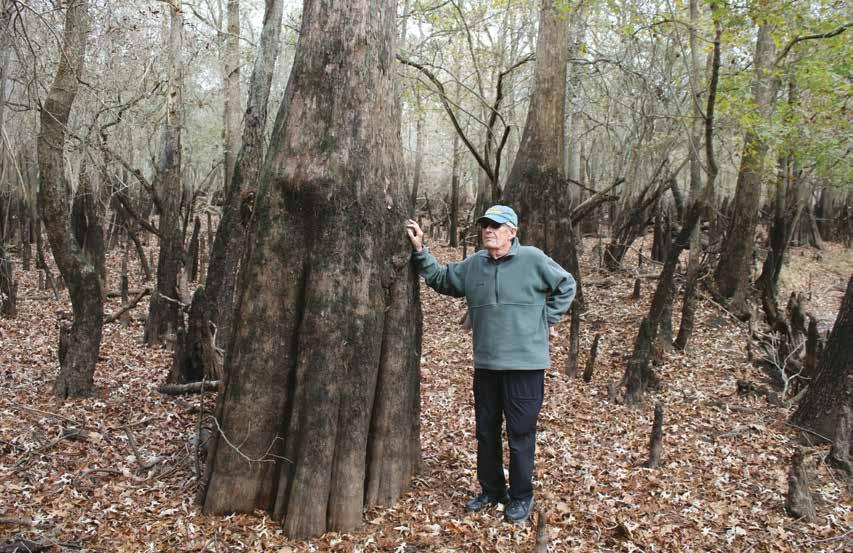
Standing among the timeless cypress swamps of eastern North Carolina, Stan Riggs reminds us that true legacy lies in caring for the coast – protecting its lands, waters, and wild beauty for generations to come.
Few people have done more to help North Carolinians understand and appreciate our coast than Stanley R. Riggs, PhD. For over six decades, Dr. Riggs, or Stan as he likes to be called, has studied barrier islands, estuaries, and shorelines, speaking not just to scientists but to policymakers, communities, and everyday people about his research and findings. The sum of his scientific work is now
being compiled into a planned 10-part book series about North Carolina’s ever-changing coastal system, Paradigm for a Coastal System Ethic – beginning with his first book of the series, Cape Lookout National Seashore: Paradigm for a Coastal System Ethic. The books are being published by R.A. Fountain in cooperation with the North Carolina Land of Water (NCLOW), a North Carolina
nonprofit and regional economic development initiative Stan founded that seeks to successfully integrate the coastal region’s human culture, history, natural resources, and societal needs. This first book of the series focusing on the Cape Lookout National Seashore blends science, history, and culture to show why Cape Lookout is extraordinary and
RIGGS, cont’d. on page 3
Dear Members and Friends,
The Coastal Land Trust began its new fiscal year on October 1, and I am optimistic and excited to start a second year as President of the Coastal Land Trust’s Board of Directors. Our Annual Meeting on October 11 was a joyous event that took place on a stormy afternoon and evening under a big tent, perhaps a metaphor for the wide range of supporters for our conservation mission. The enthusiasm and energy of the 150+ supporters who braved the elements to celebrate past successes and get a glimpse of new projects was palpable and provided confidence that the future remains bright.
The Coastal Land Trust Board is the governing body of the organization and is comprised of volunteers chosen to provide a variety of experiences, expertise, and geographical awareness as the Board considers various matters. The Board has the responsibility of keeping the organization true to its mission of protecting important properties throughout the coast and ensuring it operates in a responsible

and ethical manner.
Board and staff are currently engaged in a strategic review to ensure we continue our mission in a smart and intelligent fashion, seeking to serve the conservation interests of the communities in our region while protecting important properties throughout the coast. Thank you for your support during the past 12 months, and I hope you will continue or increase your financial gifts to the Coastal Land Trust in the coming months.
With great appreciation,
Bob Emory President, Board of Directors Coastal Land Trust
guide our approach to resilience in the face of storms, sea-level rise, and development.
Stan’s core message has always been clear: barrier islands are not fixed. They are living systems in motion. A sustainable future for the barrier islands and how we live on them depends upon learning to live with that change.
Stan exclaims, “When society decides to stabilize the barrier island’s inlet/outlet systems with jetties, ocean beaches with groins and bulwarks of sand-bags, or highways with sand-bag and ephemeral dune dikes, the natural functions of these highly important, but mobile sand piles are strangled. Barrier islands are the ocean’s speed bumps!”
Dr. Riggs earned a B.S. from Beloit College, an M.A. from Dartmouth College, and a Ph.D. in geology from the University of Montana. In 1967, he joined the faculty at East Carolina University, establishing ECU’s geology and marine science programs and becoming a distinguished profes-
Scan the QR code to grab your copy today!

sor and later a professor emeritus.
In addition to his foundational work at ECU, Stan has lectured and collaborated broadly in coastal science as an adjunct professor at NC State, Duke, and UNC-Chapel Hill. He is a noted author and co-author on numerous books and scientific papers in coastal dynamics and policy and has long worked in close collaboration with prominent North Carolinians such as naturalist Tom Earnhardt and fellow coastal scientist Orrin Pilkey.
Beyond his scholarship, Stan is a conservation landowner and serves on the board of the Coastal Land Trust. His lifetime commitment to healing landscapes – through scientific rigor, public engagement, and personal stewardship – resonates deeply with our mission.
For the Coastal Land Trust, featuring Stan’s work is more than honoring one of our community’s own. It’s a reminder of why we do this work: to conserve eastern North Carolina’s extraordinary lands and waters, and to share their stories in a way that inspires

care, connection, and action.
“Stan’s work reminds us that conservation is not just about protecting land – it’s about understanding the living systems that shape it,” said Harrison Marks, Executive Director of the Coastal Land Trust. “His lifelong dedication to studying and sharing the story of North Carolina’s coast has deepened how we care for these places and inspired countless others to do the same.”
Folks lined up at the Coastal Land Trust’s Annual Celebration & Lawn Party on Saturday, October 11, where Stan graciously signed copies of his gorgeous book featuring “vivid images of shifting dunes, barrier islands, and coastal wildlife . . . beside carefully crafted maps and drawings, sometimes in powerful combination, creating a visual journey as compelling as the story itself” (www.nclandofwater.org).
Cape Lookout National Seashore: Paradigm for a Coastal System Ethic is now available for purchase, with 100% of the proceeds supporting the Coastal Land Trust’s mission.

By Gary Michael Flanagan for the Coastal Land Trust
Words cannot begin to describe the sights and sounds of up to 75,000 Tundra Swan ending their great winter migration at the Pocosin Lakes National Wildlife Refuge in coastal North Carolina. In fall, the Tundra Swan, amongst over a dozen other species, take their long voyage south along the Atlantic Flyway to overwinter at the refuge. North Carolinians as well as birders from all over the world visit the area to witness this magnificent event.
Katerina Ramos, Outreach Coordinator for the North Carolina Wildlife Federation remarks: “It’s an awe-inspiring moment! A fantastic experience of wonderment!” as she points to a huge flock in the distance
while leading a bird walk as part of a PBS NC documentary, Science in Flight. Ramos however also described the delicate balance of the environment and and warming winter weather that could lead to these birds no longer visiting North Carolina, instead favoring colder areas such as Michigan instead.”
The good news is that there is a combined effort from government, nonprofit organizations such as the Coastal Land Trust as well as local farmers who provide some of their crops to ensure these birds continue to find North Carolina their winter home for many years to come.
Although far rarer, the occasional Snowy Owl as well as Snow Bunting also arrive in winter to areas such as Pea Island National Wildlife Refuge and the

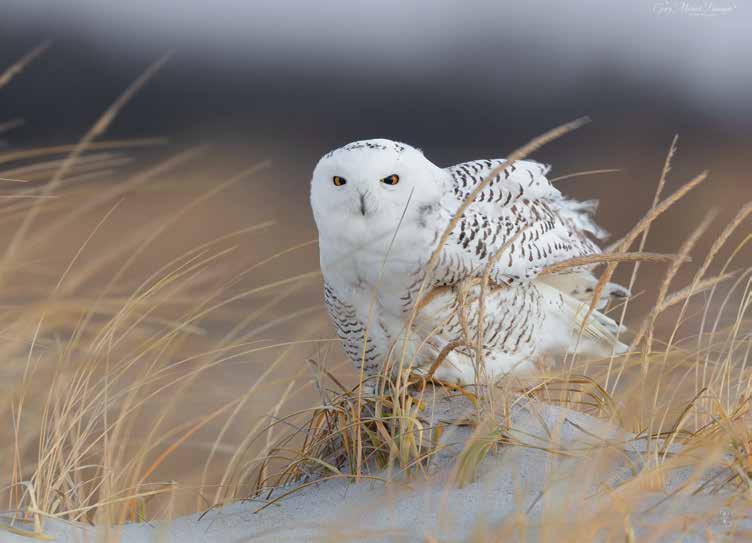
Rare but not impossible; the breath-taking Snowy Owl (Bubo scandiacus) has been spotted in Ocracoke over the past few Decembers.
Coastal Land Trust’s Springer’s Point Preserve on Ocracoke Island, preferring our sandy beaches in search of food and a milder winter.
This winter, it’s important to highlight some of our colonial nesting birds here in coastal North Carolina ahead of the spring of 2026 nesting season. According to NC Audubon, “colonial waterbirds get their name because of how they nest: all in one place, often in large numbers”. There are over 21 colonial nesters in North Carolina, which include egrets, terns, pelicans, and gulls. Audubon counted 59,111 colonial waterbird nests for over 200 sites along the North Carolina coast.
On the Coastal Land Trust’s Hutaff Island, a colony of Least Terns is monitored and managed thanks to a partnership with Audubon North Carolina.The partnership protects about 1,300 acres and ensures colonial nesting birds as well as marine life continue to have a coastal habitat free from development. The smallest tern species in the United States, Least Tern
arrive in mid-April every year, from their wintering grounds in the Caribbean and northern South America. They lay their eggs in small dips in the sand and hatch 1-3 eggs. The colony nesting strategy helps the birds warn one another of potential predators. Hutaff Island is just one of many locations along the coast where human effort at nesting areas has a positive impact on preserving these colonies. At Emerald Isle, the N.C. Wildlife Resources Commission and a dedicated volunteer group, known as the Beach Bird Stewards of Emerald Isle, combine efforts to mark off a 1.5-mile area with flags, ropes and posts. Local elementary school children also provide drawings infused into the signs to spread the word to keep these birds safe from harm.
Thanks to dedicated volunteers, supporters, nonprofits, and partnerships with state agencies, the future looks bright for these birds. You can do your part by volunteering or donating to organizations involved in coastal land conservation and wildlife protection, like the Coastal Land Trust.

The Coastal Land Trust recently transferred its 303.5-acre Pasquotank River Preserve in Camden County to the State of North Carolina to be managed by the North Carolina Wildlife Resources Commission (NCWRC). Camden County is largely agricultural, yet because of its proximity to the Tidewater area of Virginia, it is experiencing rapid population growth and burgeoning residential subdivision development. Located near several residential subdivisions, the Preserve lies along 1.7 miles of the Pasquotank River, a blackwater system within the Pasquotank River basin – a
part of the Albemarle-Pamlico Estuarine System, the second largest estuarine system in the United States.
The Coastal Land Trust purchased the property in March 2008 with funding provided by a North Carolina Clean Water Management Trust Fund (now the North Carolina Land and Water Fund) grant. For the past seven years, the Coastal Land Trust has monitored the property to ensure it retained its natural, scenic, and open space values.
In addition to its significant fish and wildlife conservation values, the Coastal Land Trust was keen
on protecting the property’s extensive forested riparian buffer and exceptional bottomland hardwood forest from commercial logging and major soil-disturbing activities. The Pasquotank River Preserve lies within a North Carolina State Ecosystem Enhancement Program’s Targeted Local Watershed and is considered to be a wetland of exceptional significance by the North Carolina Division of Coastal Management. The Preserve is also located adjacent to the Whitehall Shores Hardwood Forest State Significant Natural Heritage Area and southeast of the Shipyard Landing Natural Area, also a State

The American Bald Eagle is among many different wildlife that rely on this untouched swath of land for nesting and foraging.
Photo Credit: Brian Rubino
Significant Natural Heritage Area.
“We’re proud to see the Pasquotank River Preserve become part of North Carolina’s public conservation lands,” said Harrison Marks, Executive Director of the Coastal Land Trust. “This transfer ensures lasting protection for vital wetlands, wildlife habitat, and water quality in the Pasquotank River basin.”
“The North Carolina Wildlife Resources Commission (NCWRC) is grateful to the North Carolina Coastal Land Trust for the donation of the Pasquotank River tract, which expands our North River Game Land in Camden County by just over 300 acres. This property protects important wildlife habitat for game species and for species of concern like black-throated green warblers, and provides an opportunity to the public for hunting, fishing, and other wildlife-associated recreation,” expresses Crystal Cockman, Land Acquisition Specialist, Land and Water Access, NCWRC. “Thanks also to the NC Clean Water Management Trust Fund which helped provide funds for North Carolina Coastal Land Trust to acquire the tract originally. This is a great addition to our game land program.”
With the State’s recent acquisition of a neighboring property (managed by NCWRC), this transfer of the Pasquotank River Preserve to the State will facilitate long-term coordinated conservation management of both properties.
For the past two years, the Coastal Land Trust has reimagined our Annual Celebration and Lawn Party. The goal was simple: to open the doors wider, welcome new faces, and make the evening as inviting as possible. The result has exceeded expectations, and attendance has nearly tripled.
Of course, a larger crowd also means increased costs to host a memorable event that reflects our gratitude for our members’ support. To meet this challenge, we turned to generous sponsors who rose to the occasion, and thanks to their support, the Coastal Land Trust has been able to remove the general ticket price, making the event free for all guests. Sponsors’ commitment to coastal conservation has allowed us not only to sustain the high quality of the event, but also to increase revenue compared to previous years.
By making the Annual Celebration and Lawn Party free, we’ve created an evening that truly embodies the spirit of community and appreciation – even when we have to pivot to a “tent” party due to less desirable weather. More people are connecting with the Coastal Land Trust’s mission, and thanks to sponsors, the event has become both more welcoming and more successful than ever.

Thank you to the 150 attendees of this year’s Annual Celebration and Lawn (Tent) Party in October who made this event extra special. While the air was damp and windy, the energy was bright and warm.
$25,000 – $100,000 +


$2,500


CLARK PROPERTIES OF OCRACOKE, LLC





• Campbells Snacks
• Carol Sue Blueberry Farm
• Cheerwine
• The Country Club of Landfall
• Davey Resource Group


• Dunn, Pittman, Skinner & Ashton Attorneys at Law
• Hunt Brothers Pizza
• Lackey Lighting and Irrigation
• Perfetti
• Port City Direct Primary Care


• Resource Management Systems, LLC
• Village Craftsmen of Ocracoke, Inc.
• Wild Bird and Garden
• XXL Wines
Every year, the Land Trust Alliance hosts a national conference (Rally) for land conservation practitioners from around the world. Attendees are a mixture of nonprofit staff, board members, and topic experts who are dedicated to conserving cherished places in their communities. Rally serves as the premier training and networking conference for land trusts, offering learning sessions focused on land conservation topics, networking events, exhibits, plenary sessions, and an awards presentation celebrating conservation leadership.
In September, Associate Director Jesica Blake and Environmental Education and Stewardship Coordinator Bryce Tholen made the journey to Cleveland to participate in the nation’s largest gathering of conservation practitioners and leaders. They learned about new and exciting ways to save land, connect people with nature, and serve communities we work in. This year was the conference’s 40th year, which hosted more than 290 expert speakers (Jesica
included) and representatives from 56 states, countries, or territories.
As Bryce’s first Rally, he reflects, “This was one of the best learning experiences of my career. Connecting with other stewardship staff from across the country and learning how other organizations address common problems in the stewardship world was invaluable.” He enjoyed sessions on remote sensing, connecting children to nature, education, and discussions about how to manage stewardship issues.
Jesica has been attending Rally for many years and is able to give back to the land trust community by leading a workshop or two and helping to host the Stewardship breakfast. Her takeaway stays the same year after year: “I come back re-energized by all the great work that’s happening across the country, with fresh ideas to move Coastal Land Trust forward and some lessons learned by others about what not to do.”


Created out of a deep passion for connecting corporate partners to our important land conservation work, the Annual Golf Tournament benefitting the Coastal Land Trust became an institutional event in 2002. Each year, corporate partners of PMG Carolinas convenience stores and golf enthusiasts gather for a full day on the green.
This year, 40 golf teams competed for the lowest strokes on the Country Club of Landfall’s
Jack Nicklaus 18-hole course in Wilmington. In the afternoon, they were welcomed with a Cheerwine BBQ as their time on the course wrapped up and the lively raffle began.
“Our lead partner for the tournament transitioned to PMG Carolinas in 2023, and since then, PMG has continued to drive our mission forward with focus, precision, and dedication,” exclaims Executive Director Harrison Marks.
Thanks to their continued support
and enthusiasm, the 23rd Annual Golf Tournament (which was held on September 15 this year) raised about $125,000 – the most successful tournament to date. To showcase its significance, this single event raised about 76% of the organization’s annual events budget. The Coastal Land Trust is so grateful to PMG Carolinas, the Country Club of Landfall, and the many supporters of the golf tournament. Let’s see if we can elevate the bar (again) for next spring’s tournament!
The following nominees were elected by NCCLT members during the October 11 Annual Celebration:
Mavis is a “death and dirt” attorney and conservation professional with nearly twenty years of experience, dedicated to empowering generational, family real estate owners, particularly heirs’ property owners, with the knowledge and tools to sustain ownership and stewardship of their land. Her work highlights the critical role of heirs’ property in advancing affordable housing, rural and urban planning, climate resiliency, and equitable markets. By integrating strategies inclusive of natural resource conservation, Mavis champions innovative approaches to stabilizing family land ownership while promoting sustainable land use practices. As the CEO of HeirShares, Mavis is leading the development of groundbreaking technology to provide affordable solutions for intergenerational, family-owned real estate ownership. A 2024 Loeb Fellow at the Harvard Graduate School of Design, she previously directed the eight-state Sustainable Forestry and African American Land Retention

Program and managed The Gragg Law Firm, PLLC. Mavis has chaired the boards of the North Carolina Parks and Recreation Trust Fund Authority and the Triangle Land Conservancy land trust, reflecting her commitment to conservation leadership. In addition to her legal and conservation work, she is an art enthusiast and co-founder of Pop Box Gallery, a zero-commission art gallery in Durham, NC, where she also serves on the Nasher Friends’ Board and the North Carolina Museum of Art Foundation Board.
Webb Fuller grew up in Ahoskie, North Carolina, and considers himself a lifelong resident of Northeastern North Carolina. He earned a degree in Forestry from NC State, as well as a Master’s in Public Administration. He is also a graduate of the Weldon Cooper Center for Public Service at the University of Virginia. Fuller began his career as a policy analyst in the Secretary’s Office of the Department of Human Resources during the Holshouser administration. At the age of 26, he left that position to become the county manager for Currituck County. In 1982, he became

the city manager of Nags Head, a position he held until his retirement in 2005. After retiring, he served one term on the Nags Head Board of Commissioners. In addition to his professional work, Fuller has served on numerous boards, including the Senior Executive Institute at the University of Virginia for 10 years. He was a member of the North Carolina City and County Management Association and was president in 2021 and 2022. He also serves on the North Carolina Coastal Resources Advisory Council, where he has served twice as chairman and is currently serving as vice chairman. Fuller and his wife, Dorie, have three children and five grandchildren, all of whom reside in Dare County.
Linda is a retired licensed clinical social worker who worked for Lower Cape Fear Hospice for 20 years. During her years at hospice, she was also a volunteer chaplain at New Hanover Regional Medical Center. She serves in lay leadership positions at her church in Wilmington. She and her husband Reid have served on numerous nonprofit boards in Wilmington and Wyoming. Linda is a past board chair of the Wyoming Chapter of The Nature Conservancy and currently serves as board chair for the Center of the West in Cody, WY. Linda previously served two 3-year terms on the Coastal Land Trust Board, including two years as President.

William Snyder is a professional forester with a Master’s degree in Forest Economics from Virginia Tech. He spent 39 years with International Paper Company until his retirement in 2019. During his employment, he held managerial positions in forest management, wood procurement, land sales, and business support. During his career, William also served as Chairman for the Society of American Foresters at state and regional levels, served on various committees for the South Carolina, North Carolina, and Virginia Forestry Associations, served on the Board of Directors and the Executive Committee for the Virginia Forestry Association, and was appointed to The Virginia Board of Forestry and the Chesapeake Bay Advisory Committee. William’s first involvement with the Coastal Land Trust was in 2002 when he oversaw International Paper Company’s first conservation easement with the Coastal Land Trust at Town Creek in Brunswick County. He later negotiated and closed land sales with Coastal Land Trust and The Nature Conservancy including Coharie Swamp, Angola Bay, Bear Garden, and Juniper Creek. More recently, William was able to facilitate the Coastal Land Trust’s acquisition of The South End at Topsail Beach. William is currently the Chairman of the Topsail Island Shoreline Protection Commission and the Chairman of the Beach Inlet Sound Committee for Topsail Beach. William and his wife, Vicky, have been married 49 years (as of 2025) and have 3 children and 5 grandchildren.

This summer, the Coastal Land Trust launched the South Topsail Stewards volunteer program. From Memorial Day to Labor Day, there was a daily volunteer presence on the preserve. During these walks, stewards made observations, picked up trash and debris, and had informative conversations with visitors. Wearing their special South Topsail Stewards t-shirt and hat, they served as a positive, helpful presence on the preserve. Our goal was for stewards to connect with visitors and provide environmental education that will help those visiting understand the importance of protecting the South Topsail Preserve, and how we can all pitch in to do so. We are grateful to this inaugural group of 25 volunteers who dedicated a total of 298 hours to the preserve.
The Coastal Land Trust also hosted a series of weekly guided hikes during July and August. Every Tuesday, staff and guest hike leaders covered a range of topics including barrier island dynamics, sea turtles, shorebird

We are grateful to Caroline and John Busbice, volunteers and supporters of the Coastal Land Trust, who have been devoted champions for saving the South Topsail Preserve.
nesting, and more. The hikes, primarily attended by island tourists, helped the Coastal Land Trust fulfill its goal of spreading information about the conservation values of the South Topsail Preserve.
The first year of the South Topsail Stewards and guided hike

programs were wildly successful, and we can’t wait to continue our relationships with these wonderful volunteers and community members well after we transfer the property to the State of North Carolina to be managed by the NC Division of Coastal Management.
From page 2
Answer: False – As cold-blooded animals, or ectotherms (reptiles and amphibians), snakes enter a process called “brumation” during the winter months. This involves a state of reduced activity and appetite but still allows for movement and drinking. During this period, snakes will spend much of their time sheltering in burrows, rock crevices, or other protected areas. Brumation is often confused with hibernation, a process seen in some warm-blooded animals, or endotherms (mammals), that includes a deep sleep characterized by significant drops in body temperature and metabolism.

About 2,000 people – making this the most successful Fire in the Pines Festival to date – engaged in a variety of educational activities focused on longleaf pine forests, fire, native plants, and wildlife. Attendees enjoyed a live fire demonstration, interaction with live animals, crafts, music, food trucks, and more. The Coastal Land Trust is grateful to be a partner of this event alongside The Nature Conservancy, the City of Wilmington, and the NC Forest Service.


Above: Coastal Land Trust staff enjoyed watching the friendly competition between golf teams throughout the day. From L to R: Event Coordinator Lizzie Barkley, Development and Communications Specialist Laura Wilson, Administrative Assistant Mary Catherine Parker, Associate Director Jesica Blake, and Development Associate Bridget Crabtree.
Right: Making their debut on the green! This foursome joined us for their first Coastal Land Trust Golf Tournament. From L to R: Bob Moreland, Kurt and Shannon Sandlin, and Stacy Ankrum.


nCino Inc raised more than $26,500 for the Coastal Land Trust from its annual golf tournament in which staff choose the beneficiary each year. From L to R: nCino Senior Inclusion, Community, & Philanthropy Specialist Kyle Metzger-Gee, nCino Senior Executive Assistant Stephanie Hayes, NCCLT Executive Director Harrison Marks, NCCLT Board Member Hannah Holt, and nCino CEO Sean Desmond.
Photo Credit: Ben Johnson
RECEIVED JULY 16, 2025 – OCTOBER 15, 2025
IN HONOR OF
W. Frank Dell
Camilla M. Herlevich
Jo-Ann MacWilliams-Wolf
Nancy Lynn Skinkle
Jessica Whitehurst
IN MEMORY OF
Maxine Britt
Nancy Payne
Daniel B. Phillips
Susan Hurst Rappaport
President Bob Emory New Bern, NC
Vice President
Merrie Jo Alcoke New Bern, NC
Lorrie Basnight Greenville, NC
Vice President/Secretary
Hannah Holt Wilmington, NC
Bernest Hewett
Bolivia, NC
Treasurer
Ken Hines
Nick Parker Wilmington, NC
Wilmington, NC
Lorrie Basnight Greenville, NC
Webb Fuller Nags Head, NC
Mavis Gragg Durham, NC
Ken Hines
Wilmington, NC
Linda Spencer Murchison Wilmington, NC
Michael Murchison Wilmington, NC
Yoshi Newman, Ph.D. Greenville, NC
Chad Pearson Wilmington, NC
Bill Rich Ocracoke, NC
Dr. Stan Riggs Greenville, NC
Brian Rubino Kitty Hawk, NC
Ann Cary Simpson Chapel Hill, NC
Cheryl Bradley Smith Pine Knoll Shores, NC
William Snyder Topsail Beach, NC
Mary Tillery Chapel Hill, NC

Giving Tuesday
CoastalLandTrust.org/GT
December 2
Volunteer Day
Reaves Chapel
December 6
Bird Hike & Open Hike Day
Everett Creek Preserve
December 20
NCCLT Offices Closed
December 24 – January 1
Volunteer Day
Brunswick Nature Park
January 3
Open Hike Day
Everett Creek Preserve January 17 & 18
Volunteer Day East Arcadia
February 7
Love Our Lands Hike
Multiple Preserves February 14
MAIN OFFICE
3 Pine Valley Drive
Wilmington, NC 28412 (910) 790-4524
Harrison Marks Executive Director harrison@CoastalLandTrust.org
Lizzie Barkley Office & Event Coordinator lizzie@CoastalLandTrust.org
Jesica C. Blake Associate Director jesica@CoastalLandTrust.org
Bridget Crabtree Development Associate bridget@CoastalLandTrust.org
Mellissa Dionesotes Land and Stewardship Manager mellissa@CoastalLandTrust.org
Red Beans & Bluegrass
Wrightsville Beach Brewery February 22
Reaves Chapel
Open House
Reaves Chapel March 6
Volunteer Day –Rice Festival
Reaves Chapel March 7
Kenneth J. Lingerfelt Director of Land Protection kenneth@CoastalLandTrust.org
Mary Catherine Parker Administrative Assistant marycatherine@ CoastalLandTrust.org
Bryce Tholen Environmental Education and Stewardship Coordinator bryce@CoastalLandTrust.org
Lauren Waibel Volunteer and Trail Coordinator lauren@CoastalLandTrust.org
Laura Wilson
Development and Communications Specialist laura@CoastalLandTrust.org
Tidewater Thank You Cruise
Wilmington Riverfront
March 18
Open Hike Day
Everett Creek Preserve March 21

NORTHEAST OFFICE
Lee L. Leidy Attorney and Northeast Region Director Elizabeth City, NC 27909 (252) 335-9495 lee@CoastalLandTrust.org
ADDITIONAL CONTACT
Lena Austin O’Neal Springer’s Point Preserve Steward lena.oneal@nccat.org


3 Pine Valley Drive Wilmington, North Carolina 28412
This newsletter is printed on Forest Stewardship Council (FSC) certified paper, ensuring environmentally and socially responsible forestry practices.
Scan for ways to connect!


A quick monitoring visit to Abbey Nature Preserve (owned by Pender County Parks and Recreation and permanently protected by a Coastal Land Trust conservation easement) reminds us that, in the coastal plain of North Carolina, beauty can be experienced all year long.