NORTHEAST OFFICE
Lee L. Leidy
Northeast Region Director
Attorney at Law
205 N. Water Street, Suite 1 Elizabeth City, NC 27909 (252) 335-9495 lee@coastallandtrust.org
CENTRAL OFFICE
Janice L. Allen
Deputy Director
3301-G Trent Road New Bern, NC 28562 (252) 634-1927 (252) 633-4179 Fax janice@coastallandtrust.org
MAIN OFFICE
131 Racine Drive, Suite 202 Wilmington, NC 28403 (910) 790-4524 (910) 790-0392 Fax
Camilla M. Herlevich Executive Director ext. 206 camilla@coastallandtrust.org
John Napiecek Business Manager ext. 204 john@coastallandtrust.org
Mary Ellen Slugg
Legal and Administrative Assistant ext. 208 maryellen@coastallandtrust.org
Jesica C. Blake
Director of Stewardship ext. 203 jesica@coastallandtrust.org
Jennifer Avesing
Stewardship Biologist ext. 207 jennifer@coastallandtrust.org
Tatum Justice Stewardship Assistant ext. 201 tatum@coastallandtrust.org
Vann Pearsall
Director of Development ext. 210 vann@coastallandtrust.org
Beth W. Steelman
Development Associate/ Volunteer Coordinator ext. 200 bsteelman@coastallandtrust.org
Stephanie Borrett Development Assistant ext. 209 stephanie@coastallandtrust.org
STAY IN TOUCH


www.CoastalLandTrust.org
COASTLINES
LAND OF RIVERS
Oh the Places Our Rivers and Streams Flow
The Coastal Plain of North Carolina is threaded by a magnificent system of rivers and streams. There are slow-moving “blackwater” rivers like the Waccamaw and the Lumber that begin in the low terraces of the coastal plain, and flow lazily towards the sea. We also have faster-moving “brownwater” rivers, like the Neuse, the Tar, and the Cape Fear, that
rise in the piedmont, gathering speed (and sediment) as they race towards the ocean.
Biologists understand the importance to animals large and small played by rivers and the wetlands and swamps that line the banks of rivers. Rivers are places where birds, and other wildlife forage for food, find water to drink, mate and raise their young, and use as migratory corridors.
Many species of fish come upriver to mate and spawn before heading back into estuaries or the ocean.
Botanists celebrate the diversity and abundance of plants that grow at the edges of rivers and streams where water meets land. Transitional habitats and micro-climates allow special plants to flower.
Historians point to rivers as primary transportation routes used by Native Americans and by early settlers from Europe. For the enslaved men and women brought to work Carolina’s plantations, rivers were a spiritual connector via waters that flowed to the Atlantic, and then lapped the shores of Africa.
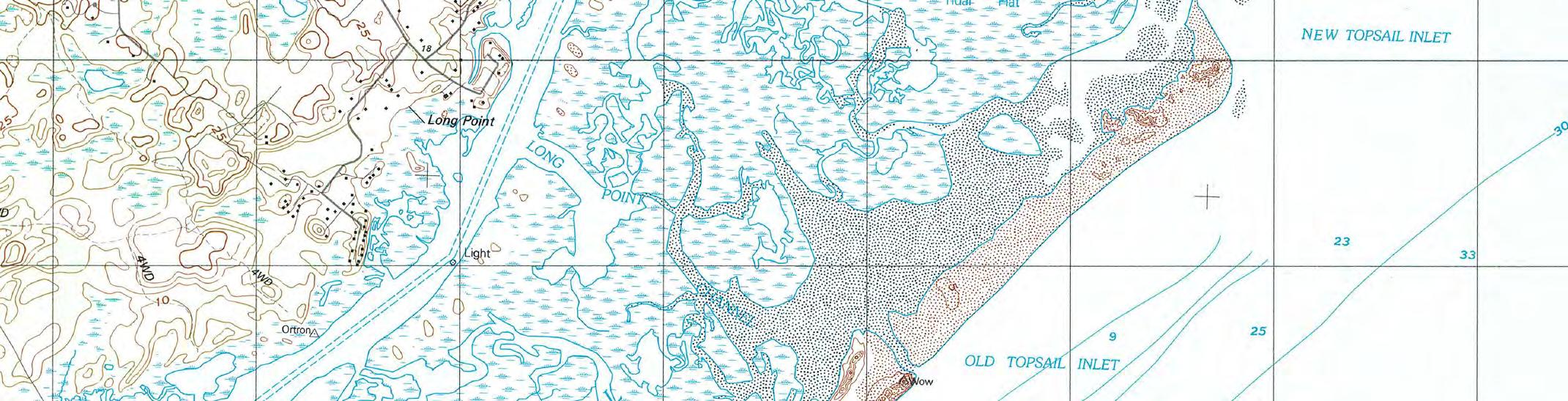
The financial “value” of rivers and streams are almost beyond calculation. Rivers supply drinking water for cities and towns up and down the coast and water for commercial uses such as irrigation. Our seafood industry depends on estuaries, where rivers meet the ocean, as nurseries for shrimp, oysters, and other shellfish. And rivers are also places for great fun—for fishing, boating, sailing, and paddling. We all depend on clean water!
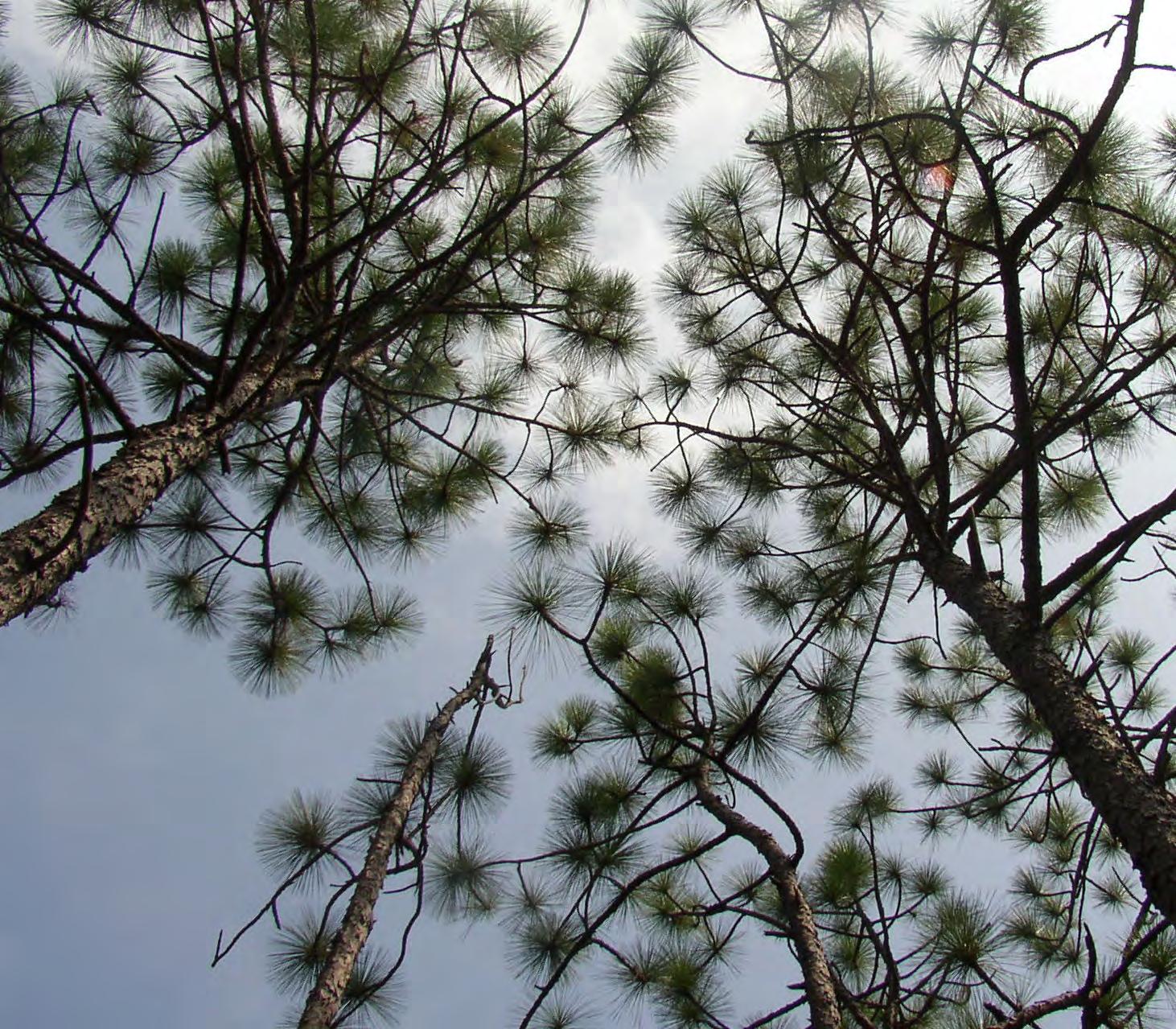
Rivers supply many of nature’s most abundant gifts, wherever they are located. From our beginning, the Coastal Land Trust has focused on saving rivers by saving the lands through which rivers and creeks flow. We’ve saved bottomland hardwood forest filled with oaks, tupelo, and cypress and sandy river banks of loblolly and longleaf pine. Protecting these river buffers is key to keeping water clean and safe for everyone.
Below we provide some news on two of our favorite rivers along the southeastern coast - the Waccamaw and Northeast Cape Fear.
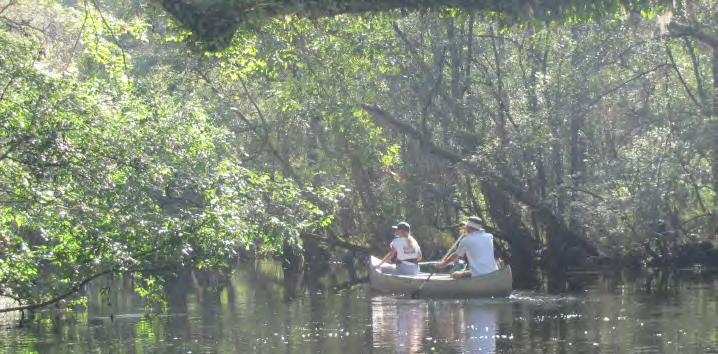
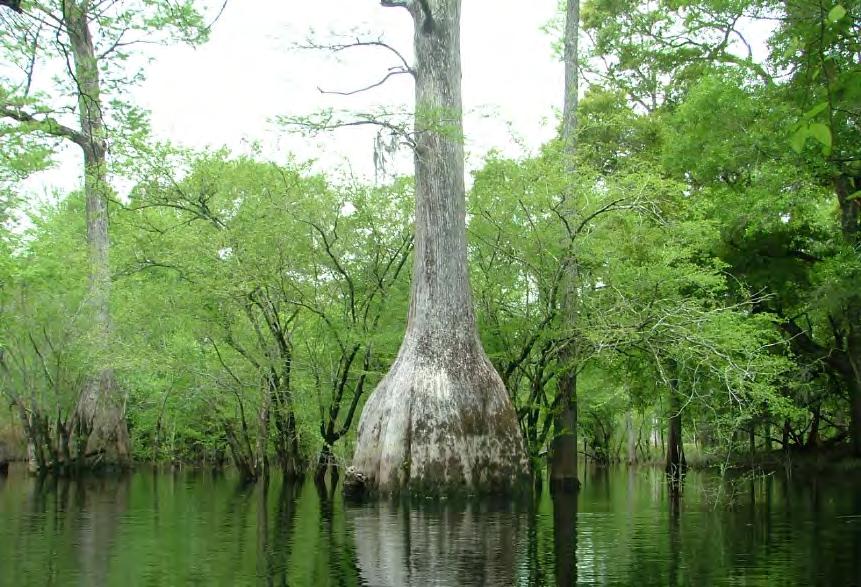
The Coastal Land Trust recently completed the purchase of 670 acres of bottomland hardwoods and cypress-gum swamp along the Waccamaw River just south of Lake Waccamaw State Park. Lake Waccamaw and the Waccamaw River, which flows south from the lake, are recognized by scientists as nationally significant because of the variety and abundance of nature that can be found there. “The Waccamaw is unique and wild,” said Janice Allen, Deputy Director of the Coastal Land Trust. “It includes some of the most beautiful and extensive cypress swamps in the state, and portions of the river and Lake Waccamaw contain fish and mollusks that are found nowhere else on Earth.”
The property was sold to the Coastal Land Trust by Campbell Global LLC, a timberland investment company based in Oregon, with offices in Wilmington. “We are pleased to have the opportunity to work with our partner, the Coastal Land Trust, so that this region of the Waccamaw is preserved,” said John
Gilleland, CEO of Campbell Global.
The Coastal Land Trust used part of its award from a 2012 courtordered settlement of the Clean Water Act case brought by the US Attorney against Freedman Farms, a corporate hog farm, to buy the property. We raised additional funds from the North Carolina Attorney General’s Environmental Enhancement Grant program, from a U.S. Fish and Wildlife Service North American Wetlands Conservation Act grant, and from private donors Fred and Alice Stanback of Salisbury, NC.
“Acquisition of this property on the Waccamaw is exactly the result that was contemplated in the court settlement ordered in 2012,” said U.S. Attorney for the Eastern District of North Carolina Thomas G. Walker. NC Attorney General Roy Cooper said, “We all rely on clean water and our Environmental Enhancement Grant program works to improve water quality by funding worthy projects like this effort to protect the Waccamaw River, one of North Carolina’s gems.”
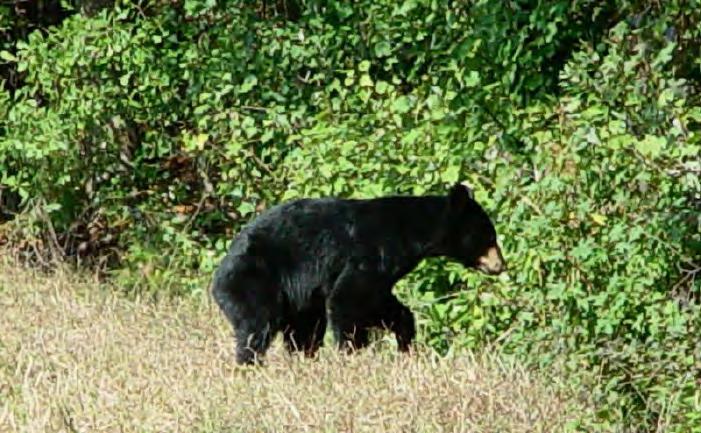
The Northeast Cape Fear River flows 120 miles through Duplin and Pender Counties to its confluence with the Cape Fear River in New Hanover County. It is a shallow, slow, meandering river, with wide floodplains and rich swamp forests along its banks. Ranked as nationally significant for its ecological values, the land that drains into the river (its watershed) includes some of the state’s largest game lands, the 64,000-acre Holly Shelter Game Lands and 33,000acre Angola Bay Game Lands. This vast landscape hosts a variety of creatures from rambling black bear to the secretive gopher frog.
In 2002, the Coastal Land Trust received the donation of a conservation easement over the 1,200+ acre Five Eagle Partners Farm by the Thomas family. Since then, the Coastal Land Trust has protected about 5,000 acres with more than $3.7M in capital funds invested.
And stay tuned, there may be
more to come! Our partnership with the Owens Family of Pender County last December resulted not only in a conservation easement over 2,300 acres of their family holdings, but also an innovative partnership to protect another 2,000 acres or so on the Northeast Cape Fear.
The Coastal Land Trust’s successful, on-the ground conservation work provides the community an opportunity to envision the Northeast Cape Fear River corridor as a refuge for plants, animals, and wildlife.
VOLUME 15 // ISSUE 1 WINTER 2015
NORTH CAROLINA COASTAL LAND TRUST
Pre-Press Composition By: Copycat Printshop, Wilmington, NC
NC Coastal Land Trust
Above: Janice Allen and Scott Pohlman of the NC Natural Heritage Program paddle from Babson’s to Pireway landing on the Waccamaw River.
Photo credit: Christine Ellis of the Winyah Rivers Foundation of the Waccamaw
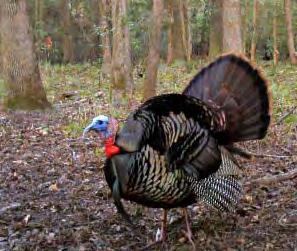
Both black bears and wild turkeys are common along the NE Cape Fear.
Photo credit: Joe Hughes
Waccamaw
Northeast Cape Fear
Iam deeply honored to serve as president of the board of directors of the North Carolina Coastal Land Trust. I have been involved in the land trust movement across the state of North Carolina from the Blue Ridge Parkway, through the Piedmont, to the outer banks working as staff member for the Land Trust for Central NC, the Conservation Trust for North Carolina and as special real property counsel for the Clean Water Management Trust Fund. I currently serve on the board of two land trusts including the Costal Land Trust.
Being involved in the land trust movement in North Carolina for the past seventeen years has given me a deep appreciation for the work of the North Carolina Coastal Land Trust. The staff is without equal and the projects that they have worked on are the envy not only of the state but our entire region.
The North Carolina Coastal Land Trust has protected a total of 62,690 acres in 201 places,
transferring fee simple title to governmental entities of 5,821 acres and placing 35,097 acres under conservation easement. Just in 2013 we protected 12,255 acres in 16 places, including 275 acres in fee title, and 11,553 acres protected by conservation easements. That is an astounding record; and those of you who support our work are to be commended, as is the staff, the board and the many partners we work with throughout our thirty one county region.
Due to the recent elimination of the North Carolina conservation tax credits and to reduced funding from the North Carolina trust funds we may see a reduction in projects and land protected; but we still have a tremendous stewardship job on our hands to make sure that these many special places are protected “in perpetuity.” Yes, that is the promise we make when we take a conservation easement: we promise to protect those lands forever. That is a long time!
This coming year will begin a new strategic
planning process, reviewing what we have done and creating a road map for the future of the organization. We may be calling on you, our supporters, to help us frame the vision for the organization going forward. But this is my observation: We have been phenomenally successful in protecting land. Now we must protect the organization of the NCCLT and its good work and make sure that it remains viable and sustainable into the foreseeable future.
We have been blessed with a handful of very generous donors and we have received generous funding from the state and federal government; but we must broaden and deepen our support so that we can keep that promise of protecting these special places and lands forever. After we create our strategic plan this year, we will need to implement it the following year. That is when we will be calling on you for your support! Thank you for your continued commitment to this incredible organization.
wildlife, from recreation resources to scenic beauty. Thanks to your support, we’ve been able to pre serve miles and miles of “thin green lines” here in the coastal plain. And while we can’t protect every linear foot of waterfront (because folks do like to build on the water!), it’s truly amazing how much we have saved—
miles and of miles of waterfront along rivers as varied as the Chowan River in the northeast, and Town Creek in Brunswick County. Let’s keep at it!
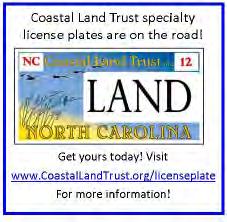
purchasing a specialty plate, you can fund our future by creating a new sustainable revenue stream that can greatly increase our ability to protect the beauty of the NC coast. For each plate on the road, the Land Trust receives $20 to fund coastal conservation – the other $10 supports tourism and highway beautification throughout the state. Visit www.CoastalLandTrust.org/licenseplate for more information on how you can get yours today!
PAGE 2
LAND ACQUISITION OPERATING REVENUE The Coastal Land Trust RAISED $1,275,000 for land purchases, SAVING 11,250 ACRES valued at $27,599,000. OPERATING EXPENSES Members $1,913,014 61% Other $ 402,600 13% Corporations $ 366,272 12% Foundations $ 279,271 9% Federal, State and $ 162,800 5% Municipal Grants Total $3,123,957 Land Acquisition $ 799,168 64% Development $ 187,329 15% Land Stewardship $ 132,386 11% Conservation Education $ 79,898 6% General Administrative $ 49,948 4% Total $1,248,729 Since our beginning in 1992, the Coastal Land Trust has set out to preserve the thin lines of green, the forested riparian areas, along rivers and streams that flow
The
along our rivers feature such
extraordinary array of conservation values—from water quality to The Coastal Land Trust preserves the forests, waterways, beaches and farms that make our coast such a great place to live, work, and play. Since 1992, we’ve protected more than 62,000 acres in the Coastal Plain of North Carolina. By
through the coastal plain.
lands
an
“However far the stream flows, it never forgets its source.” -African Proverb
Message from the President
Message from the Director
Edward P. Norvell
October 1, 2013 - September 30, 2014 * NCCLT Annual Report of Funds COASTLINES
Camilla M. Herlevich
* Unaudited
Annual Celebration Lawn Party
Scrapbook: NCCLT Events
Family Fun Day
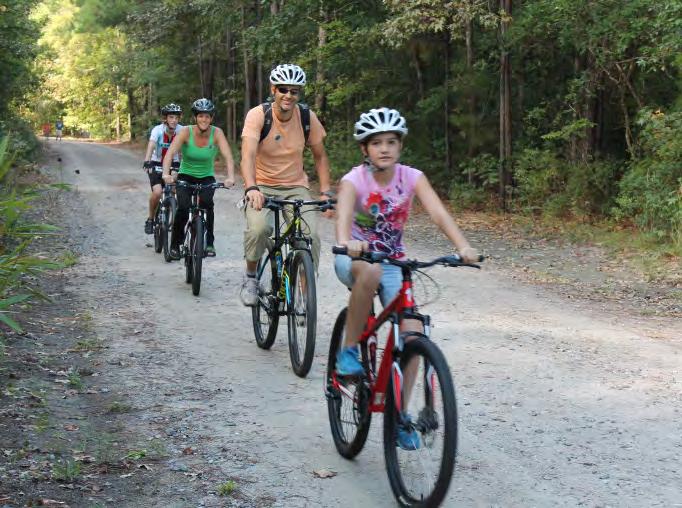
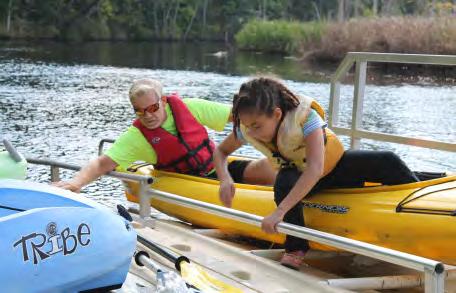
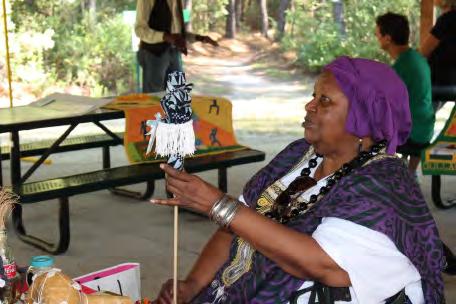
 Clockwise from above: These trails are made for biking. Father and daughter leave the kayak launch on Town Creek. Gullah artist and folklorist Vermelle Rodrigues weaves a tale for a captive audience.
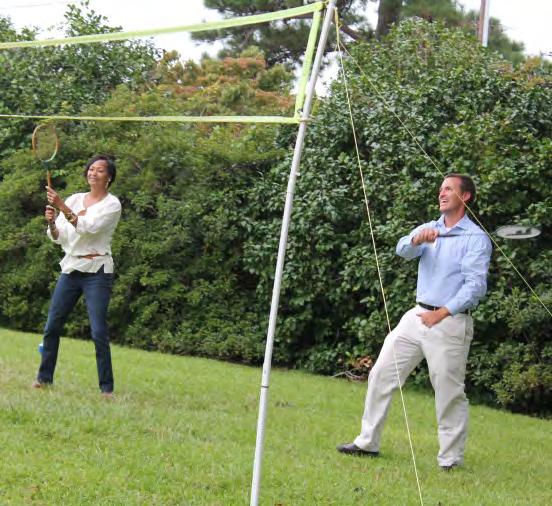
Left: Paul Blalock of Wells Fargo Bank teams up with Stephanie Haley for badminton. Wells Fargo was the Presenting Sponsor of the Annual Celebration Lawn Party.
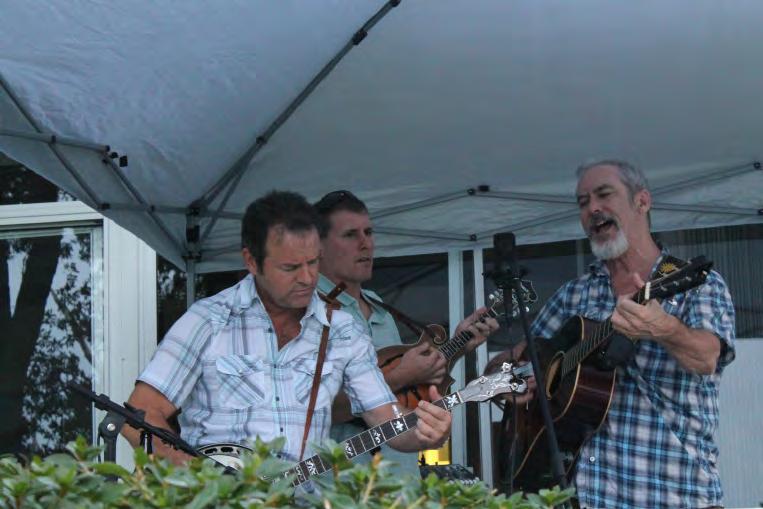
Far Left: Members of the folk and progressive bluegrass band, End of the Line, are from left: Perry Hewlett (banjo, dobro), Paul Slovik (mandolin) and John Fonville (guitar).
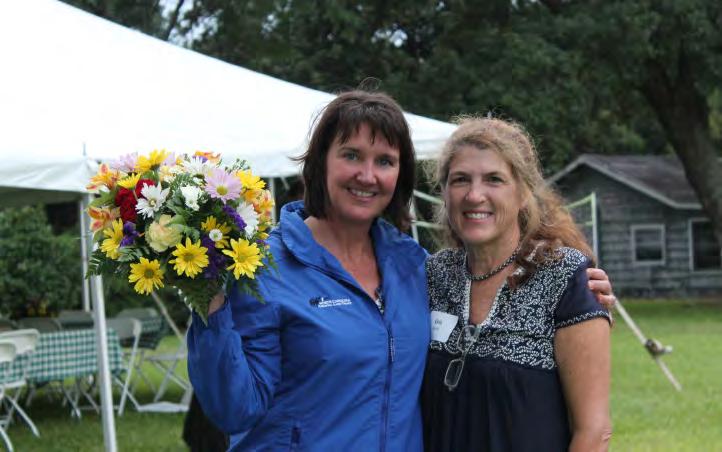
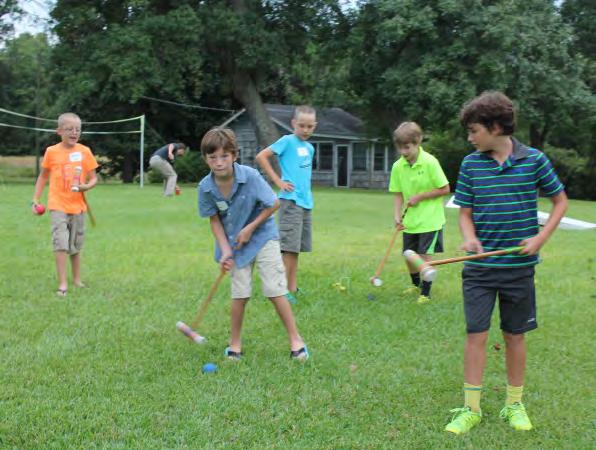
Far left: What’s a lawn party without croquet? Left: Table decorations for the Annual Celebration were provided by a Floral Grant from Julia’s Florist. The arrangements became take-home surprises (if your chair was marked with a red dot). Shown above is Diana Corbett with Cris Point.
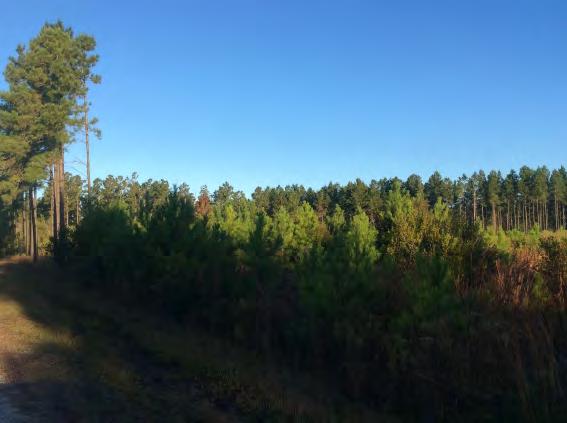
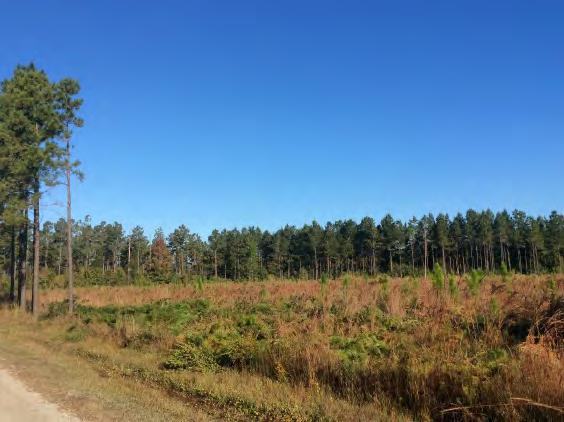
In late October, a crew working at the Brunswick Nature Park hand cut the loblolly and hardwood regrowth in the longleaf restoration area. Loblolly and hardwood compete with the longleaf seedling. Next on the agenda is a prescribed burn out at the site to clear out small trees and brush to open up the forest floor. Shown are the before and after photos.
Workdays at Brunswick Nature Park BEFORE AFTER
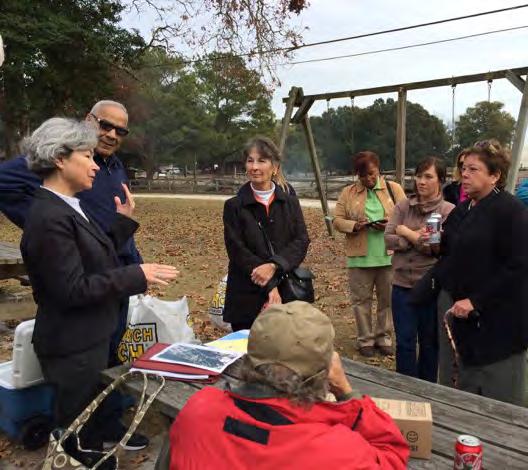
Board members explore Camp Sam Hatcher. Shown front to back are: Paul Hosier, John Fussell with former Board member Don Hoss, Merrie Jo Alcoke with Kevin Hicks (hidden behind her).
Camp Sam Hatcher
Newport | September 11, 2014
Wilmington | September 20, 2014
Brunswick Nature Park | October 4, 2014
After picnicking on the grounds at Poplar Grove, board members toured the manor house and explored the Abbey Nature Preserve. Shown from left are Camilla Herlevich, John Haley, Sadie Price, Lovay Wallace-Singleton and staff members Jen Avesing and Beth Steelman. Seated with back to camera is John Fussell.
Poplar Grove Plantation
Clockwise from above: These trails are made for biking. Father and daughter leave the kayak launch on Town Creek. Gullah artist and folklorist Vermelle Rodrigues weaves a tale for a captive audience.
Left: Paul Blalock of Wells Fargo Bank teams up with Stephanie Haley for badminton. Wells Fargo was the Presenting Sponsor of the Annual Celebration Lawn Party.
Far Left: Members of the folk and progressive bluegrass band, End of the Line, are from left: Perry Hewlett (banjo, dobro), Paul Slovik (mandolin) and John Fonville (guitar).
Far left: What’s a lawn party without croquet? Left: Table decorations for the Annual Celebration were provided by a Floral Grant from Julia’s Florist. The arrangements became take-home surprises (if your chair was marked with a red dot). Shown above is Diana Corbett with Cris Point.
In late October, a crew working at the Brunswick Nature Park hand cut the loblolly and hardwood regrowth in the longleaf restoration area. Loblolly and hardwood compete with the longleaf seedling. Next on the agenda is a prescribed burn out at the site to clear out small trees and brush to open up the forest floor. Shown are the before and after photos.
Workdays at Brunswick Nature Park BEFORE AFTER
Board members explore Camp Sam Hatcher. Shown front to back are: Paul Hosier, John Fussell with former Board member Don Hoss, Merrie Jo Alcoke with Kevin Hicks (hidden behind her).
Camp Sam Hatcher
Newport | September 11, 2014
Wilmington | September 20, 2014
Brunswick Nature Park | October 4, 2014
After picnicking on the grounds at Poplar Grove, board members toured the manor house and explored the Abbey Nature Preserve. Shown from left are Camilla Herlevich, John Haley, Sadie Price, Lovay Wallace-Singleton and staff members Jen Avesing and Beth Steelman. Seated with back to camera is John Fussell.
Poplar Grove Plantation
PAGE 3 www.CoastalLandTrust.org
Scotts Hill | December 11, 2014
The Coastal Land Trust has helped the City of Havelock acquire seven target tracts - over 80 acres - along Slocum Creek and tributaries in Craven County as part of our Havelock Area Water Quality and Parks Partnership Project.
Several of the properties complement the City’s Slocum Creek Waterfront Access Plan adjacent to their Tourist and Event Center and one site will become a new City park.
Katrina Marshall, planning director for the city of Havelock, is helping lead an effort to develop the Slocum Creek Waterfront Park on acreage situated on a bluff overlooking
the creek.
“The location there on Slocum Creek is beautiful,” Marshall is quoted as saying in an article written by Drew Wilson for the Havelock News.
“It’s right there in the heart of the city, yet you feel like you’re deep in the woods. The natural environment there, the habitat, it is wildlife at its finest.”
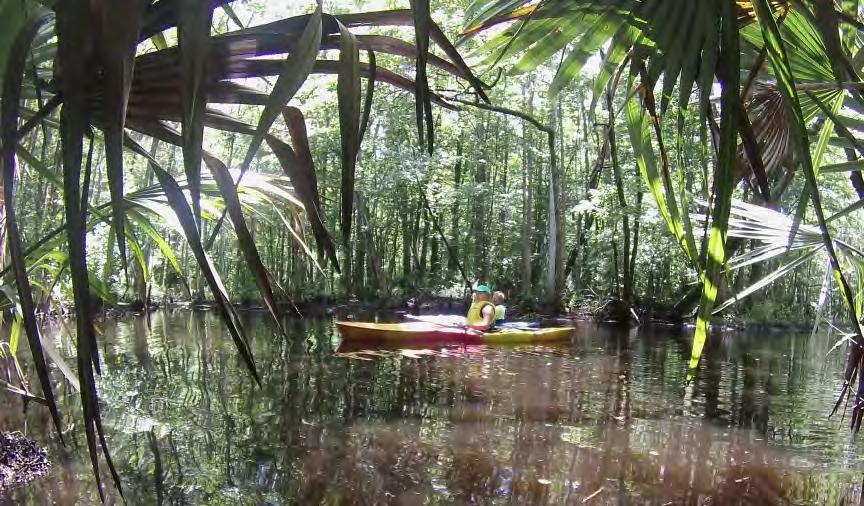
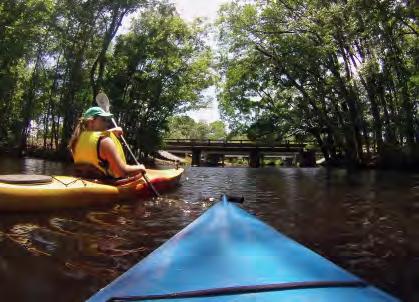
The creek is a paradise for paddlers and anglers. Slocum Creek is home for alligators, beavers and various freshwater fish like largemouth bass and bream.
In the coming year two kayak launches will be added to afford easy access to
Hoggard Senior Takes on Conservation Project
the location. The Waterfront Park gives excellent water access to all members of the community, particularly Marines and their families who comprise approximately one third of the residents of the city.
According to city manager and former Cherry Point commander Frank Bottorff, “Clearly, when you are talking canoeing and kayaking, Marines are substantial users of those available resources.” (Havelock News)
All of the properties are within noise corridors and help buffer the Marine Corps Air Station Cherry Point’s main base in Havelock.
The Gullah/Geechee Cultural Heritage Corridor, designated by Congress, encompasses a cultural and linguistic area along the US southeastern coast from Pender County North Carolina to St. John’s County Florida and 30 miles inland. The lands and the culture of this region were shaped by enslaved Africans brought from the rice-producing regions of West and Central Africa and their descendants.
On August 8, 2014, staff from the Coastal Land Trust and the Conservation Trust for North Carolina attended a meeting of the Gullah/Geechee Cultural Heritage Corridor Commission held in Calabash to explore ways to contribute to the goal of protecting and preserving natural and cultural resources that are significant to the Gullah/Geechee people. The Corridor Commission is administered by the US Park Service as part of the National Heritage Area program.
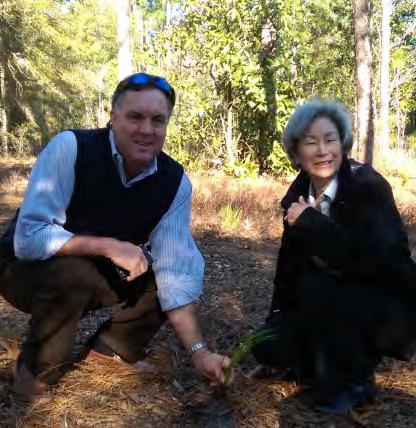
and Camilla Herlevich plant a long leaf pine seedling at Piney Ridge Nature Preserve in honor of Nelson’s father, Hugh MacRae II.
MacRae, who celebrated his 90th birthday on November 20, 2014. The Coastal Land Trust holds a conservation agreement on the land, which is owned by The Oleander Company.
For more information about Gullah/ Geechee culture: http://www.nps.gov/guge/
“As
Conservation groups are praising a new law that makes flytrap poaching a felony. Under the previous law, flytrap poaching was a misdemeanor. The new law, effective December 1, 2014 makes flytrap poaching a class H felony, punishable by up to 25 months in prison.
“We hope that by elevating the charge, people will think twice about stealing our natural heritage,” said Camilla Herlevich, Executive Director of the North Carolina Coastal Land Trust. “Thanks to Rep. Ted Davis, Jr. for leading the effort to make this change, which is important for southeast North Carolina.”
The Venus flytrap is a very rare, interesting plant, which Charles Darwin described as “one of the most wonderful plants in the world.” Venus flytraps are found in the wild in only one tiny corner of the planet – an area roughly 100 miles around Wilmington, North Carolina.
Plants need nutrients such as nitrogen,
In November, Sage coordinated site preparation and planting of 90 long leaf pine seedlings on the land that is to become part of Piney Ridge Nature Park. The seedlings were planted in honor of Hugh
Cape Fear Academy students assisted with site preparation. Coastal Land Trust staff and volunteer foresters joined in for the planting.
phosphorus and potassium. Venus flytraps live in bogs with really poor soil that doesn’t contain many nutrients. Eating insects provides flytraps and neighboring carnivorous plants with essential nutrients.
These native plants’ habitat has been under assault from development and fire suppression, decreasing their population sharply. Plant poaching has also contributed to their designation as “threatened”. Lands protected by the Coastal Land Trust and The Nature Conservancy have lost flytraps as a result of poaching.
The Nature Conservancy Government Relations Director Will Morgan and Coastal Land Trust attorney Meryl Murtagh worked with Rep. Davis and other legislators on the new law. “We appreciate Rep. Davis’ persistent effort to shepherd this bill through the legislature, and his willingness to work in cooperation with the state’s conservation community,” said Morgan. “Thanks to his leadership, there will now be greater protection for this ecologically and culturally significant plant.”
Consumers can fight poaching by buying flytraps from reputable sources that have cultivated them in green houses.
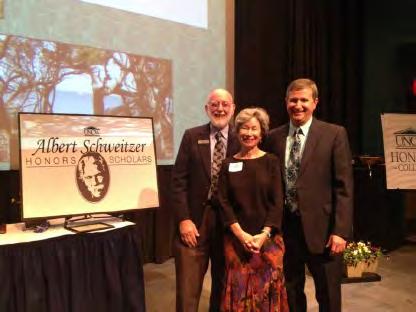
Last fall, Executive Director Camilla Herlevich was recognized as an Albert Schweitzer Honors Scholar and asked to deliver a lecture to the UNCW Honors Freshman Seminar. Camilla spoke about Schweitzer’s “Reverence for Life.”
In her closing remarks, Camilla said “… to the extent that the North Carolina Coastal Land Trust has carried out Dr. Schweitzer’s interest in protecting nature, and the plants and animals who live in the world in all their beauty and abundance, I am honored to accept this generous award.”
COASTLINES
Meredith Wilson, a student at the University of North Carolina at Chapel Hill, paddles along Slocum Creek near the U.S. 70 bridge. Photo credit: Drew C. Wilson/Havelock News
Kayakers will notice an abundance of interest ing plants along the banks of Slocum Creek like these overhanging fan palms.
Photo credit: Meredith J. Wilson/Freelance
WORKDAY AT BRUNSWICK NATURE PARK
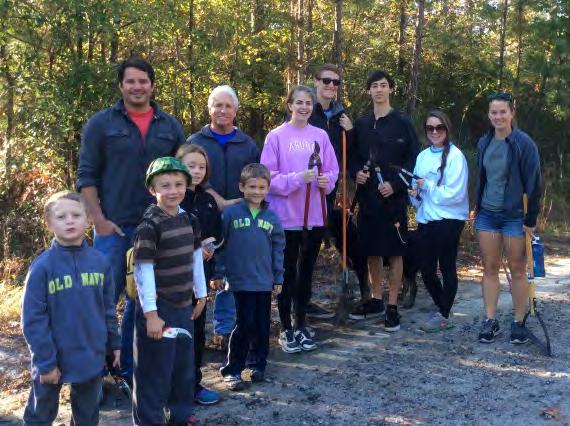
Sage McKenna, whose senior project at Hoggard is “The Importance of Land Conservation,” hosted a trail work day at the Brunswick Nature Park. Classmates, family and Coastal Land Trust volunteers made up her work crew worked diligently to clear a ½ mile of trail.
we were leaving, people asked if it was open and were using it as we drove away,” said Jesica Blake, the Coastal Land
Partnership Project to Afford Easy Access to Slocum Creek
Venus Flytraps Gain New Protection - New Law Makes Flytrap Poaching a Felony
400 Miles of Coastal Plain Rich in Gullah/Geechee Culture
Herlevich Receives UNCW’s Schweitzer Award
NATURE TRIVIA - ANSWER
AThe Waccamaw fatmucket (Lampsilis fullerkati), the Waccamaw spike (Elliptio waccamawensis) and Savannah lilliput (Toxoplasma pullus) are all rare freshwater mussels known to the Waccamaw drainage.
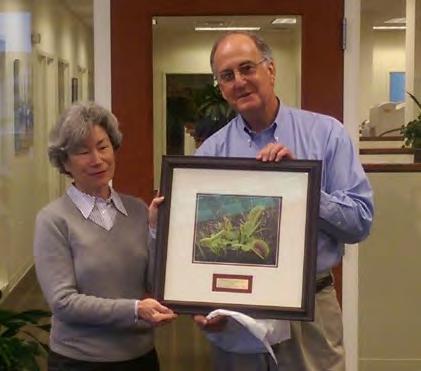
Camilla recognized Representative Davis at the December Board meeting for leading the legislation to make it a felony to poach Venus Flytraps.
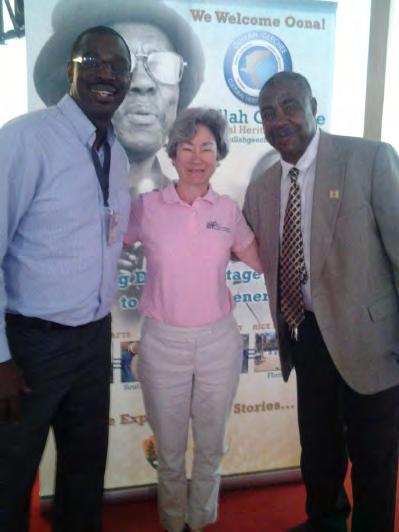
From left: Michael Allen, Community Partnership Specialist for National Park Service, Camilla Herlevich, and Navassa Mayor Eulis Willis, at the meeting of the Gullah/Geechee Cultural Heritage Corridor Commission, Calabash NC.
FAR LEFT: Back row from left: Rodney Vanek, Michael Snyder, Sydney Westmoreland, Raymond Samuel, Tiago Bland, Sage McKenna, and Meg Blake Kids in front: Wes Vanek, Sterling Scott, Reagan Vanek, Jake Vanek
LEFT: Nelson MacRae
Pictured with Camilla are prior Schweitzer Award winners: Don Skinner (left), founder of Phoenix Employment Ministry, and Dr. J. Richard Corbett, physician, and education and health advocate.
Trust’s Director of Stewardship. “It was so satisfying to see our work be immediately enjoyed by park users just after we’d finished clearing the trail!”
LONG LEAF PLANTING AT PINEY RIDGE
PAGE 4
People in the News
A Conservationist for All Seasons and All Regions
New Legal / Administrative Assistant
This summer, the directors of three North Carolina land trusts received a simple email announcing three amazing gifts. Everett Bowman, a Charlotte attorney, said he would be making sixfigure donations to the NC Coastal Land Trust, Catawba Lands Conservancy and Southern Appalachian Conservancy.
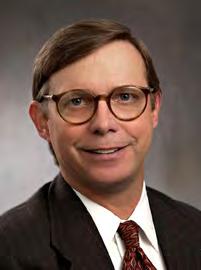
Everett grew up clamming and sailing in Wilmington; he lives in Charlotte; and he enjoys kayaking and hiking in the mountains. His three donations help support conservation
Two Jewels of Ocracoke
efforts throughout the state. Each of the three land trusts is building an “Everett Bowman Trail” to commemorate the gift. The Coastal Land Trust has selected Camp Sam Hatcher Preserve as the site for its trail.
Bowman was recognized for his conservation efforts by business and environmental leaders in Charlotte on October 17th with the 2014 Catalyst Award, which was awarded by the NC League of Conservation Voters, on whose Board of Directors he serves.
“I believe that, as citizens and as human beings, our greatest responsibility and ethical calling is stewardship of the Earth,” wrote Bowman. “As I see it, that means to support environmental conservation, preservation, and restoration — to preserve and protect the diversity of plant and animal species and the native habitats of those species, and to stop and reverse global warming and other deleterious effects we human beings and our civilization have had on the environment. From my informal research and investigation, I think your organizations are addressing these concerns efficiently and well.”

Ellen joined the North Carolina Coastal Land Trust as a legal/ administrative assistant in August, 2014. She is from northern Virginia where she was engaged in private law practice for twenty-four years. After being retired for almost three years, the call of the coast was too strong to resist and she relocated to Kure Beach. Mary Ellen earned her law degree from The George Mason University School of Law in 1987 and her B.S. degree in Public Administration from George Mason University in 1984.
UNCW Fall Stewardship Intern
Springer’s Point Preserve, a jewel of Ocracoke, shines even brighter because of the hard work, dedication, vision and talent of Len Skinner, the Preserve Steward. Len may not be an Ocracoke native, but after living on the Island for more than two decades, everyone on Ocracoke knows him – and his work. Len’s artistic talent and craftsmanship are evident not only at Springer’s Point, but throughout the island. In addition to serving as the Preserve Steward and crafting functional, yet exceptional, woodwork in businesses and homes across the Island, Len helps with the Ocracoke Ponies, the Ocracoke Preservation Society (OPS) Museum and other Island causes.
Paula Shramel, owner of The Flying Melon, said she could not have opened the restaurant without Len, who crafted the fleur-de-lis and shelving in the bar. “He can do anything . . . he incorporated everything I envisioned – but better; it is perfect and exactly what I wanted. He knows just what to do and how to do it for each job; he can just do anything!” said Paula.
Locals say that Len is always willing to help out, and if you need something, Len will take care of it. At the OPS Museum, Len has made benches, a hand-carved family tree for families highlighted in the Museum, and a period doll house – “everyone’s favorite” - according to Amy Howard, OPS Administrator. “If you can roughly describe it, he can make it into what you want it to be,” said Amy.
Springer’s Point Preserve is an outstanding example
Len volunteered at Springer’s Point for years before the Coastal Land Trust could hire a Steward. From trail and shoreline maintenance, to carving dead tree stumps into critters, live oaks into signs and constructing beautiful fences using windswept remnants that washed upon the Springer’s Point beach, Len has an incredible eye and knack for making the ordinary into something extraordinary. Next time you are at
Justin Klein is a senior at the University of North Carolina at Wilmington, and is soon to graduate with a degree in environmental science and a minor in geospatial technologies. Raised in Carteret County, Justin has grown up near much of the land that the Coastal Land Trust helps protect and is very eager to help them with their conservation endeavors.
Over the fall, he helped the Coastal Land Trust’s Stewardship Department with restoration efforts, trail work, and annual monitoring of properties. Justin has previously worked as a GIS technician on the Marine Corps Air Station in Cherry Point, as well as volunteering with Habitat for Humanity. In his free time Justin enjoys performing music, playing sports, and of course enjoying the outdoors.
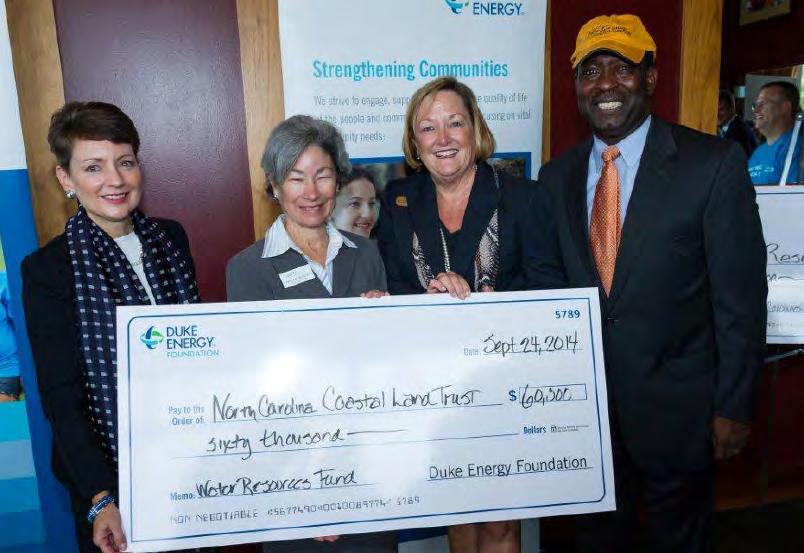
The Coastal Land Trust received $60,000 to pay for site improvements that will facilitate public access at two of its projects. The two properties, a 200-acre tract on Gales Creek near Newport, called Camp Sam Hatcher, and a 250acre tract on Everett Creek near Sneads Ferry, are each ideally suited to connect children to nature.
“This grant will expand access to two wonderful pieces of land as we begin work to develop them into true nature preserves that will welcome hundreds of visitors each year,” said Coastal Land Trust
Look for us in your workplace giving campaigns! NCCLT-SECC #1113, CFC #91392 EarthShareNC - SECC #1100, CFC #15322
Mary
Justin Klein
Mary Ellen Slugg
Everett Bowman
Springer’s Point Preserve & Len Skinner
Coastal Land Trust Benefits From New Water Resources Fund
- Everett Bowman of Len’s handiwork and dedication.
Springer’s Point, take a moment to notice Len’s touches at the Preserve, and if you run into him on the trail, be sure to thank him for his exceptional work!
Pictured at Duke Energy’s Grant Presentation event in Charlotte on September 24th, are (L to R): Lynn Good, Duke Energy President; Camilla Herlevich, Coastal Land Trust Executive Director; Millie Chalk, Duke Energy District Manager for Government and Community Relations; and Stick Williams, Duke Energy Foundation President.
Photo Courtesy of Duke Energy.
The
North Carolina Coastal Land Trust was the recipient of one of eight seed grants from Duke Energy’s newly created Water Resources Fund for waterways in the Carolinas and neighboring states.
Lynn Good, Duke Energy’s president and CEO said in a news release “We are proud to be expanding our support for waterways in the Carolinas and throughout the region, and we look forward to helping local organizations have an even greater impact in protecting and enhancing our natural resources.”
executive director Camilla Herlevich. “We are very grateful to Duke Energy for this generous grant.”
























COASTLINES CORPORATE SPONSORS PAGE 6 www.CoastalLandTrust.org BARTRAM SPONSORS LIVE OAK SPONSORS TIDEWATER SPONSORS COASTAL STEWARDS Carol Sue Blueberry Farm Cothran Harris Architecture Hanover Center HealtHabit Land Management Group McKim & Creed Mount Olive Pickle Company, Inc. Rountree Losee LLP Southern Insurance Agency, Inc. Sage Salon & Spa LUKENS ISLAND TIMBER ENTERPRISES, LLC SOUTHERN DIVERSIFIED TIMBER LOCALLY DISTRIBUTED BY R.A. JEFFREYS POINT CLAN, LLC The Murchison Group of Wells Fargo Advisors, LLC Field Day at Five Eagles Partners Farm Rocky Point, NC Flytrap Frolic Stanley Rehder Carnivorous Plant Garden, Wilmington, NC GOPC Land Trust Day Support the Coastal Land Trust by shopping at your local Great Outdoor Provision Company in Greenville, NC and Wilmington, NC 7 March Holt Oil CStore Golf Tournament River Landing, Wallace, NC 14 April Family Fun Day at Brunswick Nature Park Winnabow, NC Annual Celebration Lawn Party Wilmington, NC 6 3 10 25 June Oct. Oct. April Be Our VaLANDtine! Wilmington, NC Sunset Cruise on the Northeast Cape Fear River for Tidewater, Live Oak and Bartram Society Members 24 March SAVE THE DATE PIEDMONT NATURAL GAS FOUNDATION 2015
2014 Honor Roll of Donors
$100,000 and above
Mr. Everett Bowman
Orton Plantation Holdings LLC
Fred and Alice Stanback
$25,000 - $99,000
Dr. and Mrs. John T. Bray
The Cannon Foundation
Conservation Trust for North Carolina
Mr. Richard W. Dodd and Ms. Cheryl Grandfield Duke Energy Foundation
F. M. Kirby Foundation, Inc.
Orton Foundation LLC
Mr. and Mrs. William F. Williams Jr.
$10,000 - $24,999
Ms. Agnes R. Beane
Mr. and Mrs. Randy Beardsworth
The Eddie and Jo Allison Smith Family Foundation, Inc.
Golden Leaf Foundation
The Harold Bate Foundation
Mr. and Mrs. Brian J. McMerty
Mr. Sam Rankin
Mr. and Mrs. Bill Stanback
$5,000 - $9,999
Christopher and Dana Reeve Foundation
Claudia Taylor Limited Partnership
The Dickson Foundation
Live Oak Bank
Linda and Reid Murchison
North Carolina Foresters Association
Sustainable Forest Initiative
The Raymond E. and Ellen F. Crane Foundation
Brad and Shelli Stanback
Wells Fargo Foundation
Dr. and Mrs. Douglas Wolfe
$2,500 - $4,999
BB&T
The Burt’s Bees Greater Good Foundation
Mr. and Mrs. Eric R. Calhoun Sr.
Grace Jones Richardson Trust
Mr. Thomas J. Haley
Ms. Patricia A. Horstman
Murchison, Taylor, & Gibson PLLC
Mr. John C. Nicholls Jr.
Mr. and Mrs. Kristopher Pickler
Mr. and Mrs. William A. Raney Jr.
Restoration Systems LLC
Ms. Suzanne Nash Ruffin
Mrs. Nancy Sample
Mr. and Mrs. Thomas Skelton
Mr. Dean Weber
$1,000 - $9,999
Ms. Sally Anger
BP America
The Boeing Company
Mr. and Mrs. Clemens Bribitzer
Dr. and Mrs. Malcolm Brown
Mr. Louis Burney Jr.
Mr. John M. Camp III
Camp-Younts Foundation
Cape Fear Garden Club
Virginia and Thomas Colantuono
Corbett Package Company
Scott and Diana Corbett
Peter and Cay Davis
Mr. H. Renwick Dunlap
Edwards of Ocracoke
Fletcher, Toll & Ray LLP
Mr. and Mrs. Dick Fox
Mr. John Fussell III
Hannah and William Gage
Mr. Robert Glenn
Ms. Frances Goodman
Grady White Boats
Great Outdoor Provision Company
HVW Legacy Holdings FLP
Dr. and Mrs. John H. Haley III
The Honorable Mary Price Taylor Harrison
Mr. and Mrs. Paul Heill
Mr. Tom Hollinshed
Hannah and Stephanie Holt
Mr. and Mrs. Gregory Honeycutt
Mr. and Mrs. George Horton
Ms. Kathryn B. Howd
Joe and Gloria Hughes
Mr. and Mrs. Gene Huntsman
The Joanna Foundation
Ms. Elaine R. Jordan
Julian Price Family Foundation
Mr. Ken Karn and Ms. Sally Buchanan
Dr. and Mrs. James L. Kesler
Mr. and Mrs. Jason L. Kesler
Ms. Lee Kimball and Mr. R. Tucker Scully
Kitty Hawk Kites
Dr. and Mrs. Thomas W. Leonard
The Longleaf Foundation
M.R. Williams, Inc.
Ms. Anne Marshall
Ms. Jane R. McBryde
McGuire Woods LLP
Anne and Chuck Moody
Morgan Stanley Foundation
Mr. Michael Murchison and Ms. Barbara Sullivan
The Murchison Group of Wells Fargo Advisors LLC
Ed and Susan Norvell
Ocean Atlantic Rentals
PPD
John S. Pace and Rachel Pickett Pace Mr. and Mrs. David Paynter Mr. Stuart Paynter
Pepsi Bottling Ventures LLC
Petro Construction Point Clan #2 LLC
R. A. Jeffreys
RC Land Design and Maintenance Dr. Mark Ragozzino and Ms. Karen Beth Hanson
Mr. and Mrs. Walker H. Rayburn Jr. Ms. Lynn Regnery
Resource Management Service LLC
Dr. and Mrs. Robert Sherman
Mrs. Lovay W. Singleton
Southern Diversified Timber LLC
Laurence Sprunt Family
Ben and Beth White Steelman Ms. Katherine G. Stern
TCI Timber Company LLC
Mr. and Mrs. Terry Tait Mr. Benjamin N. Taylor
Triangle Community Foundation Mr. and Mrs. Charles Wakild Ward and Smith, P.A.
Mr. and Mrs. Samuel L. Whitehurst
Mr. and Mrs. Clark Wright Zillies Inc.
$500 - $999
Janice and Dave Allen
Mr. and Mrs. Lynn G. Amos
Mr. and Mrs. James L. Andrews Jr.
Ann and Kevin Brennan
Mrs. Maxine Britt
Mr. and Mrs. William Campbell Mr. and Mrs. Steve Capps
CarolinaEast Health System
Mr. George T. Clark Jr.
Coastal Beverage Company, Inc.
Cothran Harris Architecture
Mr. Alan Craig Mr. and Mrs. Robert Crenshaw Ms. Iris de la Motte
Dr. and Mrs. Noel Dunivant
E.J. Pope and Sons
East Carolina Dermatology
Fidelity Charitable Gift Fund
First Citizens Bank
Frito Lay
Harley and Associates Commercial Real
Estate Inc.
Mr. and Mrs. Kevin Hicks
Highland Industries, Inc
Dr. and Mrs. Paul Hosier
Don and Carolyn Hoss
Mr. and Mrs. David E. Huffine
J.L. Morris Enterprises
Mr. and Mrs. Richard R. Jacoby
Mr. Bob Jones and Ms. Peggy Sloan
Kathleen Glancy, PA
Mr. Thomas S. Kenan III
Dr. Kenneth Klein and Ms. Bobbi Harmon
Land Management Group
Liberty Petroleum
Dr. Lanneau D. Lide Jr.
MGySgt George S. Liner Jr. Ret. and Mrs. Liner
Mr. Lee Lowrimore and Ms. Dorothy H. Rankin
Mr. W. Daniel Martin III
Bob and Carol Mattocks
Mr. John McCartney McKim and Creed
Mr. and Mrs. Paul McNamara
Mrs. Cyndi McNeill
Meco Inc. of Florence
Mr. and Mrs. John Merriner
Ms. Mandy Misner and Mr. Martin Willard
Stephanie and John Mitchell
Mount Olive Pickle Company, Inc.
Mr. John R. Murchison II
Mutual Distributing Company
The Oleander Company, Inc.
Mr. and Mrs. Chad Pearson
Julie Rehder
Mr. Michael W. Rodelius
Rountree Losee LLP
Mr. and Mrs. Arthur Rovins
S&D Coffee, Inc.
Sage Salon & Spa
Mr. and Mrs. Jim Sayre
Mr. and Mrs. Al Scarborough Ann and Bland Simpson
Mr. Nathan R. Skipper Jr.
Southern Insurance Agency, Inc. Dr. Mark Stanback
Steele Electrical Contractors
Sumrell, Sugg, Carmichael, Hicks & Hart P.A. Ms. Nancy Walker
Mr. and Mrs. Robert E. Thomson Jr. Unifirst
Ms. Karen Villeda
Weyerhaeuser
Whole Foods Market
Mr. Tom Wilson and Ms. Merrie Jo Alcoke
$250 - $499
Dr. and Mrs. David A. Adams Arts of the Albemarle
Atlantic Shores Distributors
Mr. Paul W. Austin and Ms. Susan D. Wilder
Mr. and Mrs. A. Mack Baker
Mr. Jim Barefoot
Mrs. Martha B. Beery
Betsy Leonard, REALTOR Intracoastal Realty Corp.
Mrs. Susan T. Block
Ms. Rebecca Boston and Mr. Scott Shore
Mr. William M. Bryan Jr.
Mr. and Mrs. Julian H. Burnett
Foy and Micah Chu
Dr. and Mrs. Gordon D. Coleman
Mr. John T. Cox
Craven Physical Therapy and Spine, Inc.
Ms. Taylor Cromartie
Cruse Construction
Mr. and Mrs. Travis Cruse
Davis Hartman Wright PLLC
Deaton Yacht Service Inc.
Mr. and Mrs. Stephen Diab Ms. Susan M. Dodd
Dunn, Pittman, Skinner & Cushman PLLC
ECS Carolinas LLP
Mr. and Mrs. Robert R. Emory Jr.
Environmental Professionals
Ms. Wendy Fisher
Mr. Jere D. Freeman III
HealtHabit Natural Foods
Ms. Camilla M. Herlevich and Mr. Jim Brier
Ms. Roxanne Hicklin
Ms. Laura A. Holt-Kabel
Dr. and Mrs. John C. Huffman
Interstate Sign Co.
Jim Wallace, Intracoastal Realty
Mr. and Mrs. Norman Johnson
Mr. Patrick P. Joyce
Kitchen Gardeners International
Lance Snacks
John and Betsy Leonard
Mr. and Mrs. Larry Lynn
Dr. and Mrs. Henry J. MacDonald Jr. Mr. James Macrae
Ms. Lana M. Mansfield
Dr. and Mrs. Tom Mates
Mr. and Mrs. Bill Mauney
Mr. and Mrs. Charles K. McCotter Jr. Mr. and Mrs. Andrew McCrocklin
Mr. Kyle McIntyre
Dr. and Mrs. John F. McQuade Mr. Charles Meeker
Metcalf Associates, Inc.
Mr. and Mrs. Daniel Miller
Mr. Art Mines and Mrs. Elizabeth Dyer
Donna and Tom Moffitt Ms. Julie H. Moore
Rob and Nancy Moul
Murphy Family Ventures LLC
NC Subway Group, Inc.
Dr. and Mrs. Charles R. Neal Mr. Chuck Neil
Clint and Amy Brown North
Mr. Bob Oakes and Ms. Sophia Sharp
Mr. and Mrs. Michael Oppegaard
Orton Longleaf LLC
Ms. Ariana Pancaldo
Bob and Rebecca Philpott
Dr. and Mrs. James R. Pick
Mr. and Mrs. Stephen Pizer
Mr. and Mrs. Jim Price
Rachel Cameron Camp Foundation
Mr. and Mrs. Frank Rackley
Mr. Peter Rascoe
Mr. and Mrs. Cliff Ray
Mr. G. Stanley Rehder Jr.
Ms. Lynn Richardson
Jay and Cynthia Russell
Mr. and Mrs. Gene Sawyer
Ms. Betty L. Shotton and Mr. Chris Hyland Mr. Willis Slane and Ms. Caroline Chiles
Mr. and Mrs. Percy Smith
Mr. Howard Stier and Dr. Catherine Chew
Ms. Elizabeth P. Storie and Mr. Michael McOwen
Mr. and Mrs. John H. Tappan
Mr. and Mrs. Odell Thompson
Mr. and Mrs. David Ward
Owen and Sue Weddle
Ms. Jessica Whitehurst
Mr. and Mrs. Greg Wilkinson
Mr. and Mrs. George H. Wood
$100 - $249
Mr. and Mrs. John Alexanderson
Mr. and Mrs. Robert F. Allen
Mr. David Ammons
Dr. John P. Arrowood Jr.
Mr. and Mrs. Rudolph Ashton III
Beth Atkins
Mrs. Natalie Baggett
Mr. Richard Balamucki and Ms. Susan Hollobaugh
Mr. and Mrs. O. B. Battle
Mr. Todd Beamish
Mr. and Mrs. Howard Bennink Jr.
Mr. and Mrs. Karl Berberich
Dr. Katherine L. Bick
Dr. and Mrs. Robert Blair
Ms. Dianne K. Blanke
The North Carolina Coastal Land Trust expresses our gratitude to the families, foundations, and corporations who made a gift during our fiscal year (October 1, 2013 – September 30, 2014). Your support helps us fulfill our mission: protecting the beauty, history, and the natural treasurers of the NC Coastal plain. Thanks for your support.
*If you have questions or would like to change the listing of your name in our publications, please contact Vann Pearsall at (910) 790-4524 ext. 210
PAGE 7 www.CoastalLandTrust.org
Mr.
Mr. Charles Broadfoot III
Mr. Paul Brown and Ms. Susan Lindsay
Mr. John H. Brunjes and Mrs. Catherine Brunjes
Dr. and Mrs. S. Joseph Buff
Mr. and Mrs. Barry Burgan
Mr. and Mrs. Russell Burney
Mr. and Mrs. Ralph Buxton
Cambay Partners
Cape Carteret Garden Club
Ms. Gail Capel
Carolina Kayak Club
Mr. and Mrs. Oliver Carter III
Mr. and Ms. David Chaika
Mr. and Mrs. Neal Cheek
Dr. and Mrs. John Cho
City of Havelock
Mr. Walter Clark
Mr. and Mrs. Thomas Cochran
Stephen and Louise Coggins
Mr. and Mrs. Jim Cole
Mr. and Mrs. Ronald Coleman
Mr. Frank Conlon
Mr. and Mrs. Bradford Connett
Mrs. Joanne K. Corbett
Mr. and Mrs. Miles Coxe
Mr. and Mrs. Tom Craney
Rev. Rainey G. Dankel
Dr. Andy Davidson
Mr. and Mrs. Bill Davis
Jim and Kathy Deal
Mr. Jay DeChesere and Mrs. Heather Smith
Dr. Ronald C. Demas and Mrs. Ronald Demas
Mr. Eric L. Dietze and Mrs. Victoria Seewaldt Eastern Geomatics PLLC
Ebenconcepts, Inc
Ms. Bobette Eckland and Mr. Richard Kamens
Mr. and Mrs. Timothy Edgett
Donalt and Patricia Eglinton Ms. Jen Esham
Mr. and Mrs. J. Daniel Eudy Jr. Mr. and Mrs. Victor Fasolino
Ms. Ruth S. Fazzari
Dr. and Mrs. Darwin Ferry
Mr. and Mrs. Robert L. Foy III
Mr. and Mrs. Dargan Frierson
GE Foundation
Ms. Kathryn T. Gallagher
Mrs. Helen M. Gant
Mr. and Mrs. Bruce Gibson
Mr. Frank B. Gibson and Mrs. Judith R. Gibson
GlaxoSmithKline Foundation
Mr. and Mrs. Deanes Gornto Ms. Carol J. Green
Mr. and Mrs. John M. Griffin
Ms. Stacey Griffith
Dr. Gool Gupta and Dr. J.D. Gupta HICAPS, Inc
Ms. Catherine Halligan
Mr. John S. Hardwick
Mr. and Mrs. Wilson Hardy
Ms. Gael Hawkins and Mr. William Miller
Mr. and Mrs. James Helm
Mr. and Mrs. Lewis Hicks
Mr. and Mrs. Richard Hiskey
Mr. and Mrs. Robert B. Hobbs Jr.
Ms. Olivia B. Holding
Mr. and Mrs. David M. Holland
Mr. and Mrs. Bill Holz
Mr. Daniel Hood
Mr. Chuck Hotchkiss and Mrs. Liz Hotchkiss
Mr. and Mrs. Kirk Howard
Mr. Philip Howard
Mr. and Mrs. William C. Howard Jr.
Mr. Roy Huntley
IBM International Foundation
Mr. Van Jackson and Mrs. Betty J. Jackson
Mrs. Susan P. Jackson
Mr. Keith Jensen
Ms. Ellen M. Johnson
Mrs. Annie Gray Johnston
Mr. and Mrs. Bill Jones
Mr. and Mrs. David Jones
Mr. Ken Jordan
Mr. and Mrs. George Kean
Mr. and Mrs. Robert E. Keith
Mr. Jason C. Keller
2014 Honor Roll of Donors
Ms. Veda Kennedy
Mr. and Mrs. Edward Kiefhaber
Mr. and Mrs. Bill King
Mr. and Mrs. W. W. King III
Mr. Edmund T. Knott
Dr. Gary G. Koch
Mr. Michael Koppenhafer
Mr. and Mrs. Robert Kraus
Mr. Malcolm W. Kroeber
Ladies AUX VFW 9960
Mr. and Mrs. John Lair
Mr. and Mrs. Harold Larson
Mr. and Mrs. William R. Lathan
Mr. L. Brent Lawrence
Mr. Jack Lee
Mr. Robert Lee
Dr. Robert Lee and Dr. Marie Ann Talton
Ms. Lee L. Leidy
John and Betsy Leonard
Mr. R. Michael Leonard
Dr. Amy Lewis
Mr. James D. Little
Mr. and Mrs. Charles E. Llewellyn III Lorillard Tobacco Company
Page and Herb Lowry
Ms. Anne Mackie
Maola Milk and Ice Cream LLC
Dr. Nina Marable and Dr. Noelle Kehrberg
Mr. and Mrs. Omar Mardan
Mr. and Mrs. Timothy Marr
Mr. Patrick W. Marriott
Mr. and Mrs. Michael Marston
Dick and Winnie Martin
Mr. Christopher Martis
Mr. and Mrs. David Massey
Mr. Michael McCormick
Mr. Timothy McGloin
Mr. Bruce McGuire and Ms. Nancy Bullock
Mr. and Mrs. Donald McRee Charles and Bettina Meekins
Merchants Fixture
Dr. and Mrs. Peter Meyer
Mr. and Mrs. James B. Moore
Morgan Stanley
Mr. and Mrs. Malcolm B. Morrison
Mr. Ian Moseley
John and Mary Anne Napiecek
Pembroke and Gretchen Nash
Mr. Frank Nesmith
Mr. and Mrs. Mike Nevin
Dr. Michael Nichols Ms. Mary Beth Nickolich
Mr. and Mrs. James Norment
Mr. Charles Norwood Jr.
Ocean Isle Beach Land Conservancy Inc Mr. and Mrs. Jerome Ocorr
Mr. and Mrs. John Olkowski Mr. John Olsson
Mr. Alan Oppenheimer
Dr. and Mrs. John Ormand Orrell and Reiner P.C.
Outer Banks Conservationists, Inc.
Mr. and Mrs. Hugh Overholt
Ms. Jenny Owens Ms. Laura Padgett James and Frances Parnell
Mr. Jeff Parrott and Ms. Ellen Agler
Mr. and Mrs. Robert Parsley
Linda and Sam Pearsall
Mr. Martin D. Penry
Mr. and Mrs. Howard A. Penton Jr.
Mr. Robert Perry and Ms. Katherine Crawford
Mr. and Mrs. James J. Pertzborn
Mr. and Mrs. Dan Phillips
Mr. and Mrs. James Pierson
Mrs. Helen R. Pinckney
Mr. and Mrs. Ashmead P. Pipkin Dr. and Mrs. Hoke Pollock
Mr. and Mrs. C. H. Pope Mr. and Mrs. Michael Pope
Mr. and Mrs. Knox Proctor
The Prudential Foundation Matching Gifts Program
Mr. Ken Purdy and Ms. Nancy S. Buckingham
Ms. Shannon Puryear
Mr. Allen Etheridge and Ms. Shanna S. Ramsey
Ms. Karen Reap
Mr. Van Reid and Ms. Patricia Casaw
Ms. Caroline Rhodes Ms. Kay O. Riddick
Dr. and Mrs. Stan Riggs
Zelig Robinson
Mr. and Mrs. Charles Roe
Ms. Margaret Rorison
Mr. and Mrs. Samuel R. Rose
Mr. Clint D. Routson
Ms. Patricia A. Rowe
Mr. and Mrs. Herman J. Rozycki
Mr. and Mrs. Bob Ruffner
Mr. J. Taylor Ryan
Mr. and Ms. Frank Sanders Jr.
Mr. Christopher Savard and Mrs. Frances Rudolph
Mr. Dennis Saver and Ms. Nancy White
Mr. Tom Sawyer and Ms. Susan Kille
Mr. and Mrs. Herman Schiller Dr. and Mrs. Walter T. Schmid Frie and Liz Schulz
Mr. and Mrs. Michael Searson
Mr. Roger Self
Frank and Roxanne Sheffield
Mr. D. M. Shoemaker
Mr. Johnston Sifly
Dr. and Mrs. Henry P. Singletary
Mr. and Mrs. James B. Slaughter
Mr. Douglas L. Sligh and Ms. Mary Ann Parham
Ms. Donis N. Smith
Mr. J. Troy Smith Jr.
Mr. James B. Snow III and Ms. Susan Sprenger Mr. Michael Snyder
Soo’s Chocolate & Bakery
Southport Historical Society
Mr. and Mrs. Charles Sparacino
Dr. Sam Spicer and Mrs. Jane Spicer Mr. A.W. Stafford Jr. Mr. B. R. Staton
Ms. Musette D. Steck
Mr. and Mrs. Mack Storrs
Ms. Susan E. Stuck
Mr. and Mrs. James Summey Mrs. Charlotte Sutton Dr. Alina M. Szmant
Mr. and Mrs. Tim Tabak
Mr. John B. Taggart
Mr. and Mrs. Dave T. Tayloe Jr. Mr. Rob Temucin
Mr. and Mrs. John W. Thomas Jr. Mr. and Mrs. Robert Thomas Ms. Judith Tillman
Mr. and Mrs. Richard Totino
The Transplanted Garden Trask Land Company, Inc. Mr. and Mrs. Heide Trask
Ms. Roberta Tremain
Trent Cadillac
Dr. Margaret Turner
Dr. and Mrs. Reed Underhill
Dr. and Mrs. Gerard Henderik Van Rens
Mr. Peter Vankevich
Ross Vaughan M.D.
Capt. Merriwell W. Vineyard
Mr. and Mrs. Edward J. Vosnock Mr. Dean Wadsworth Mrs. Clarence W. Walker
Ms. Esten M. Walker
Mr. and Mrs. Timothy Walters
Mr. and Mrs. Edward Ward Mr. and Mrs. William R. Watson
Mr. and Mrs. Dave Weaver
Dr. and Mrs. William Webster
Wessell and Raney, LLP
Mr. and Mrs. John Wessell
Mr. Peter E. West
Dr. Alice White
Ms. Rama White
Mr. Aubrey Wiggins
Ms. Tatyana Wildman
Ms. Rhonda F. Willett
Mr. and Mrs. John T. Williams
Mr. and Mrs. Ren Williamson
Mr. and Mrs. A. R. Willis III
Dr. and Mrs. Brent Wilshire Mr. and Mrs. Kenneth R. Wooten Mr. and Mrs. Harvey Wright Mr. and Mrs. Bruce Young
$50 - $99
Anonymous Mr. and Mrs. Peter Adolph Aetna Foundation
Mr. and Mrs. David A. Akerhielm
Ms.
Ms.
Mr. Richard Arett
Ms. Ann Arrowood
and Mr. Randy J. McDonald
Mr. and Mrs. Timothy L. Aydlett
Mr. and Mrs. Graham A. Barden III Ms. Mary M. Beam
Mr. and Mrs. Michael Beaudoin
Vince and Ann Bellis
Mr. and Mrs. Bill Birkemeier
Ms. Jesica Blake
Ms. June Blotnick and Mr. Douglas Sea
Ms. Emily B. Blount
Dr. and Mrs. Brian Boehlecke
Ms. Katherine Boone
Capt. and Mrs. Ben Bowditch Jr.
Mr. and Mrs. Albert Bowers
Mrs. Evelyn Bradshaw
Mr. Ronnal Brendle and Mrs. Jane Brendle
Mr. John Brier
Mr. and Ms. Lew E. Brinkley
Mr. and Mrs. John R. Brodman
Mr. and Mrs. Bennie Bunn
The Honorable and Mrs. Gilbert H. Burnett
Mr. and Mrs. Robert Burns
Mr. and Mrs. Greg Capoblanco
Mr. J. D. Capps
Mr. and Mrs. Rich Carpenter Miss Eugenie W. Carr
Mr. George Carroll
Mr. and Mrs. Pierre R. Chalaron
Mr. Stephen J. Chiappisi
Mr. and Mrs. Ken Clagett
Mr. Joseph L. Clark
Mr. Robert F. Coleman III
Mr. John H. Compton
MSGT George F. Cook Ret. Mr. and Mrs. Richard Cook
Mr. Andrew Cooke
Mrs. Valdina Creasy
Mr. and Mrs. Auley Crouch
Mr. William Crowe
Mr. Marc A. Cubeta
Ms. Dorian D’Agati
Ms. Barbara Darden
Mr. John Deaton
Mr. and Mrs. Steven Dembickie Mrs. Elsa P. Desrochers
Mr. and Mrs. Thomas Dinero
Mr. Wallace Dixon
Mr. Robert Doherty and Mrs. Kerstin Doherty
Mr. Brian Dorn
Mr. and Mrs. William C. Duke
Mr. and Mrs. Murdock Dunn Mr. Ed Echols
Mr. and Mrs. Robert S. Ehle Ms. Anne Ellis
Mr. John Ennis
Mr. Paul Fanning
Mr. Ted Fillette and Ms. M. Ellen Holliday Mr. J. S. Forney
Mr. Rex Fountain
Mr. and Mrs. John Fragakis
Mr. and Mrs. Daniel C. Fuccella
Mr. William R. Futrell Jr.
Ms. Kristen Glover
Mr. and Mrs. Greg Grant
Mr. and Mrs. Erik Gray
Mr. Edward S. Gregory Jr.
Mr. and Mrs. John F. Grinder
Mr. James L. Gruenebaum
and Mrs. Victoria L. Block
Mr. William Gwathmey
Dr. and Mrs. Nortin M. Hadler
Mr. and Mrs. John A. Hagan
Mr. and Mrs. Karl Hammers
Ms. Kathleen L. Hannah
Hardy Moving and Storage
Mr. and Mrs. Christopher Harris
Mr. and Mrs. Patrick Harrison
Mr. Samuel Hart
Dexter and Margaret Hayes
Rev. and Mrs. Robert W. Haywood III
Ms. Margaret Heberlein
Mr. Berl Heffner
Ms. Agatha Henriksen
Mr. Jim Herstine and Mrs. Irene Herstine
Dr. Jeff Hill and Ms. Joan Wilson
Mr. Mike Hillegaas and Ms. Grizelle Fearing
John and Ruth Hood
Mr. Robin J. Boucher
Rev. Dr. Richard C. and Susan A. Boyd
Scott Bradley
Mr. Charles Allison III
Ginnie Anton
Mary Ellen Appleman
PAGE 8
Hyundai of New Bern
Dr. Fred Irons III
Mr. and Mrs. Roger James
Mr. John A. Jaskolka
Mr. Charles Jones
Dr. J. Juechter
Just Give
Mr. and Mrs. Max Kahn
Dr. and Mrs. Bernard E. Kane Jr.
Mr. and Mrs. Thomas Kehoe
Ms. Mary Jane Kelly
Mr. Christopher S. Kelso
Mr. Robert Kimzey
Mr. and Mrs. John Klecker
Ms. Caroline M. Klein
Mr. and Mrs. David Koehler
Mr. Anthony Koonce
Dr. and Mrs. Kenneth Kotz
Mr. and Mrs. John Larsen
Mr. and Mrs. Sam Lathan
Mr. Richard LeBlond
Mr. Thomas R. Leidy
Ms. Constance Leinbach
Mr. Jeffrey A. Leinicke
Mr. Thomas Leonard
Mr. and Mrs. Will Leonard
Mr. Melvin Leshner
Mr. and Mrs. Richard Lockwood
Mr. William R. Logan Jr.
Mr. Robert J. Lorenz
Mr. Geoffrey Losee
Mr. William F. Loyd
Ms. Loraine J. Maddox
Mr. John R. Mattocks
Ms. Barbara Maurer
Mr. and Mrs. Dale McCall
Ms. Ina Ann McCoy
Mr. and Mrs. Bruce McCutcheon
Mr. Leon A. McKay
Mr. Ray Meiggs
Mr. Worth Merritt
Mr. John Mestas
Ms. Yvonne Moody
Mr. Ken Moore and Ms. Kathy Buck
Mr. and Mrs. Skip Morgan
Ms. Esther Morrison
Mr. and Mrs. Helmut Mueller
Mr. and Mrs. Joseph Murchison
Mr. Shane W. Naber
Mr. and Mrs. Zach Nichols
Mr. and Mrs. Henry Nuttle
Mr. Kevin O’Grady and Mrs. Diane Guida
Mr. Andrew Olsen and Anne Fondren
Mr. and Mrs. Richard Olsen
Mr. Derrick Ornelas
Mr. and Mrs. Floyd H. Overman
Mr. Thomas H. Pahl
Ms. Constance Parker
Mr. Larry Parks Jr.
Mr. and Mrs. Jim Pawloski
Ms. Marian C. Perry
Mr. and Mrs. Todd L. Peterson
Mr. and Mrs. David Pickel
Mr. Charles Pollock and Mrs. Elizabeth Pollock
Mr. and Mrs. Allyn Powell
Mr. Jack J. Preiss
Andrew and Caroll Preston
Quible & Associates P.C.
Ms. Marilyn Ramsey
Mr. and Mrs. Robert Ramsey
Mr. Allen Rawls
Ms. Debra R. Ray
Mike and Nina Repeta
Mr. William Reppy and Ms. Juliann Tenney
Mr. and Mrs. Charles W. Riesz Jr.
Mr. Charles Robbins
Dr. Norm Robinson and Ms. Hannah Vaughan
Mr. and Mrs. Syd Rodenbarger
Mr. and Mrs. David W. Rohde
Mr. and Mrs. Ren Rotondo
Ms. Harriet K. Sato
Mr. and Mrs. Will Scales
Mr. and Mrs. Daniel R. Scharf
Dr. Susan Schmidt
Mr. Michael Schramel and Mrs. Paula Schramel
Mr. and Mrs. Jason Schultz
Ms. Kelsey Seitter
Mr. and Mrs. Andrew Semple
Mr. and Mrs. David Senseney
2014 Honor Roll of Donors
David
Dr. Mark Shields
Ms. Frances Simpson
Mr. Hunter Simpson
Mr. and Mrs. Ronald Sizemore
Mr. Len Skinner
Mr. and Mrs. Thomas Slater Bryan and Cheryl Smith
Ms. Celia L. Snow
Mr. Thomas Solley
Ms. Peggy Spallek
Charles and Donna Springle
Dr. and Mrs. A. Ryan Stanley
Mr. John Steadman
Ms. Bailey Stearns
Mr. Stephen Steranchak
Mr. and Mrs. Barry Stone
Mr. and Mrs. Michael Street
Ms. Jacqueline Stroud
Mr. J. Richard Tamisiea
Mr. and Mrs. Edwin L. Todd
Toll Investment Group
Dr. and Mrs. G. Earl Trevathan Jr.
Mr. and Mrs. Robert A. Turcotte Sr.
Mr. John M. Tyrrell
Mr. Steve Tyson Mrs. Jean A. Ulshoefer
Mr. and Mrs. Eduardo Valdivieso
Ms. Prudence K. Van Ness
Mr. James P. Vaughan
Vineyard Productions
Mr. and Mrs. Bruce Vrana Ms. Daryl F. Walker Lewis and Jerri Wallace
Mr. Worley Warren and Mrs. Kim Warren Mrs. Pam Watkins
Welcome Service LLC
Ms. Louise G. Weld
Dr. Randall P. White and Ms. Vickie Matthews
Mr. Les Whitten Ms. Nancy Wilcox Mr. and Mrs. Emerson Willard Ms. Joan Willey
Mr. Donald R. Williams Jr.
Mr. and Mrs. Kenneth W. Winston Jr. Mrs. Katharine Woodwell
Mr. and Mrs. Bill Yoest
John and Tina Youngs Ms. Susan Zarutskie
$49 - $1
Mr. and Mrs. Andrew L. Ammons Mr. and Mrs. Karl E. Andersen Mr. John Anderson
Mr. Richard C. Andrews and Mrs. Joan V. Andrews
Mr. Nick Balding Dr. and Mrs. Ralph B. Barden
Mr. and Mrs. Martin Beasley
Mr. Heyward Bellamy Ms. Jessica Bellas
Mrs. Lillian Benton
Ms. Pamela K. Berger
Dr. William R. Berry and Mrs. Julia Berry Ms. Ava Bevins
Dr. and Mrs. Stuart R. Borrett
Mr. Kevin Breed Ms. Eileen Bress
Mr. W. Lentz Brewer
Ms. Mary Bridges and Ms. Ranae Rogerson Mr. Douglas Brown Mr. and Mrs. Lee F. Butzin
Mr. Sam Byrd Eppy and Clem Camacho
Ms. Allison P. Canady
Cape Fear Engineering, Inc. Dr. John Cheesborough
Mr. and Mrs. John Chrystal
Mr. David Cignotti and Ms. Susan Creasy Mr. Laurence Clark
Mrs. Elizabeth C. Clarke
Mr. R. Kelly Coffey
Ms. Tania Corbi
Mr. E. B. Cox
Mr. Ford Cross dailygood
Mr. Will Darrogh
Mr. and Mrs. J. H. Davis IV
Mr. George Diab
Mr. and Mrs. Peter Dietz
Ms. Ann Ehringhaus
Elevate Construction
Ms. Patricia Elsaesser
Mr. Jerry Evans
Mr. Robert Farnham
Mr. and Mrs. Steve Floyd
Mr. and Mrs. Michael R. Foster
Ms. Felicity Gage
Mr. Hugh D. Gibson
Mr. Thomas M. Gilbert
Ms. Kathryn L. Gillenwater
Ms. Nancy Gilliland
Mr. and Mrs. Matthew Godwin
Mr. Barry Goldstein
Mr. and Mrs. Brett Goulding
Mr. and Mrs. John Gray
Mr. Richard B. Gwathmey Jr.
Ms. Miriam Hage
Mr. and Mrs. David E. Hale
Ms. Heather Harkley
Ms. Janice E. Harris
Dr. and Mrs. John Haverkamp
Ms. Margaret E. Haynes
Mr. and Mrs. Miles Higgins
Mr. and Mrs. Kenny Hill Ms. Linda S. Hitchcock
Rev. Laura A. Hollister
Mr. Rod Hooker
Mr. David Hoolahan
Ms. Penny Hooper
Mr. Tommy Huettl
Mr. Donald Huggins
Rev. Dr. Geraldine Ingram
Mr. David John and Ms. Sherri Philpott
Mr. Chris Johnson
Ms. Livian L. Jones
Ms. Rebecca J. Joyce
Mr. Walter R. Kalmar and Mrs. Angela Kalmar
Mr. Richard Kane
Ms. Caroline M. Klein
Mr. and Mrs. Charles Kernan Mr. and Mrs. Richard Klein
Mr. Derek Kon Mr. Kyle Lackey
Mr. Ross Lampe
Ms. Nancy M. Lane
Ms. Betty Lazo
Mr. and Mrs. Jimmie C. Lee Sr. Mr. Justin Lewis Steve and Ellen Lilyquist
Ms. Marie A. Logan
Mr. and Mrs. Ted Lord Mr. Richard W. Ludden
Mr. and Mrs. Robert Luppino
Ms. Maryann L. Luxeder
Mr. and Mrs. Jim MacKenzie
Mr. Steven Maharrey
Mrs. Elizabeth A. Martin
Ms. Jane M. Martin
Ms. Jill C. Mayer
Dr. William F. McDonnell III Ms. Linda McGowen
Ms. Wendy Merrill
Mr. and Mrs. Edgar Miller Mr. Buddy Milliken Mr. and Mrs. Richard Misner
Mrs. Mary R. Morris
Ms. Meryl Murtagh
Ms. Patricia Nagorski
Mr. and Mrs. Allen Olmstead
Ms. Loraine Oppenheimer
Dr. Leland Park
Mr. Robert J. Parker
Mr. Matthew Parr
Mr. Neel Patrick
Mr. Thomas Payne
Mr. and Mrs. Cobern V. Peterson
Ms. Susan Phillips
Mr. and Mrs. Jim Piland
Pompadour Inc.
Mr. Terry G. Pridgen
Ms. Carolyn Pryor
Mr. Alan Purdie
Mr. James Ramsey
Mr. and Mrs. Phillip Reid
Mr. Michael D. Rice
Mrs. Marian Rippy
Ms. Ahnie Rising
Mr. John A. Rudolph
Mr. and Mrs. James C. Sabella
Mr. and Mrs. David Sanford
Mr. Roger Schlobin and Mrs. Peggy Novotny
Ms. Laura Beth Sedlock
Ms. Donna S. Shawver
Mr. James Shelton
Mr. and Mrs. Roger Shew
Mr. and Mrs. J. M. Smith
Mr. Robert Smith
Mr. Larry Sneeden
Mr. and Mrs. Jay M. Soffian
Mr. Jim Soles
Ms. Laura Solomon
Ms. Diane Soltis-Mathis
Mrs. Teresa D. Sorrenti
Ms. Carolyn G. Stevens
Ms. Gayla M. Stone
Swanson and Associates
Mr. and Mrs. Harold Talton
Dr. James M. Tart Jr.
Ms. Virginia Taylor
Mr. and Mrs. William C. Thompson
Mr. Richard Thomson and Mrs. Theo Thomson
Dr. Ali and Mr. Michael Travis
Mrs. Mary Sertell Tripp
Dr. Van Vagianos and Mrs. Karen L. Vagianos
Mr. Ashley Wade
Ms. Camille Warren
Mr. and Mrs. Douglas Warren
Mr. and Mrs. Eber Warren
Mr. Woodrow Weeks
Ms. Julia H. Wessell
Lucien and Elise Wilkins
Mr. Jeff Williams
Mr. and Mrs. Jeremy Wilson
Mr. and Mrs. William Winfield
Mr. Ted H. Winter and Mrs. Ann V. Latimer
Mr. John R. Wojciechowski
Mr. and Mrs. Raye P. Woodin
In Honor of
Mr.Tim Armstrong
Ms. Kristen Glover
Ms. Camilla M. Herlevich
Dr. and Mrs. Thomas W. Leonard
Ms. Penny Hill
Mr. Peter Dietz
Mr. Jim Keyzer
Mr. William A. Davis
Mr. Michael Murchison
Mr. Joseph Murchison
Cris and Judge Point
Dr. and Mrs. Charles R. Neal
Mr. Samuel Rankin
Mr. and Mrs. Harvey Wright
Mr. Dan Sheret
Mr. David Hoolahan
Ms. Ann Simpson Mr. Hunter Simpson
In Memory of
Mr. Donald Blome
Mr. and Mrs. Michael Marston
Ms. Mary C. Dunham
Mr. John T. Cox
Mr. Stedman Gage
Mr. John T. Cox
Mr. Charles G. Hollister
Ms. Laura A. Hollister
Ms. Marilynn Meeker
Dr. and Mrs. Douglas Wolfe
Ms. Susan H. Rappaport
Mr. Robert F. Coleman III
Mr. Bill Rogers
Mr. Kenneth Eaton
Mr. Eric Schneckenberger
Mr. Michael McCormick
Ms. Sherrill Senseney
Mr. and Mrs. David Senseney
Mr. Jim Stephenson
Ms. Sally Anger
Mr. and Mrs. Paul Heill
Mr. Stephen Swain
Ms. Jessica Bellas
Ms. Lee L. Leidy
Mr. Al Ulmer
Ms. Elaine R. Jordan
Mr. Bruce Watkins
Dr. Mark Ragozzino and Ms. Karen Beth Hanson
Mr. William Hunt
Ms. Linda Shaw
and Ursula Shears
PAGE 9 www.CoastalLandTrust.org
Recently my wife and I have begun having discussions
career have all been blessings in my life.
I have an incredible family, and my faith and friends as well as my
I have been truly blessed in this life. I have married a great wife,
mangroves and bioluminescent bays.
background befuddled tour guides on kayaking trips through
personality as a corporate real estate lawyer with a quirky coastal
jaunts to trips to the Caribbean and the Cayman islands. Here my
from the coast forced a progression in our travels from simple
loved so much. Once we moved to Davidson, our further distance
to the NC coast so that I was able to share with her parts of what I
After I moved to Raleigh and met my wife, we made trips down
family vacations, and finally resulting in extended family vacations.
coast with my dad for camping trips at Ocracoke, progressing into
areas on the NC coast hold special memories too, from drives up the
Nature Trivia
Waccamaw State Park’s website
Photo Credit: N. Howell for Lake
Answer on page 4.
segmented bodies like millipedes)
C. Myriapod (arthropods with
B. Crustacean (like crayfish)
A. Mollusk (or mussels)
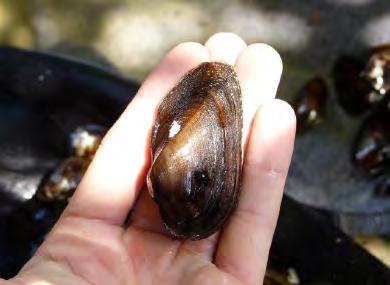
“spike” or “lilliput?”
common names of “fatmucket,”
What group of animals include the
weekends and summers there, and ultimately to living there. Other
my parents instilled in me, first as day trips to Ocean Isle, later to
a love of the North Carolina coast that
clear though: my career started with
Development Vann Pearsall at (910) 790-4524, ext. 210.
finally to Charleston, SC. One thing is
your Legacy, contact your financial advisor, attorney or Director of
For information on how the Coastal Land Trust can be a part of
DC, and then to Massachusetts, and
changed as I moved to Washington,
was relatively small. This gradually
almost 20 years ago, my world view
our wills and estate planning.
reason we will be including the North Carolina Coastal Land Trust in
and be both inspired and grounded by it as I also have. For this
When I started at Duke University
experiences at our wonderful beaches and tidal creeks that have
me and my development. would like to think that many others can have the kinds of
stewardship of the natural coastal resources that were so pivotal to
throughout my career to now help protect, preserve, and provide
good purpose to use the resources that have been provided to me
regarding end-of-life issues, such as our own wills. I feel it is a
Wilmington, North Carolina 28403
131 Racine Drive, Suite 202
U.S. Postage PAID Permit No. 316 Wilmington, NC
Non-Profit Org.
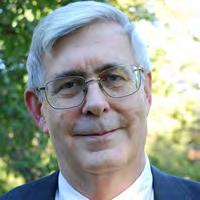
Randy has recently moved to the Wilmington area, having served in the United States on active duty for the US Coast Guard, and continuing to serve two administrations in a civilian capacity as Director for Defense Policy on the National Security Council staff, where his responsibilities included oceans policy and deployment readiness issues. He subsequently served the Department of Homeland Security, where he oversaw the agency’s counterterrorism strategic planning. He currently serves as the principal of Catalyst Partners, a security consulting firm.
Lovay served as an Air Traffic Controller for the US Navy for twenty years. Subsequently, after positions serving disabled veterans in Indiana, she worked for the US Department of Interior in Mississippi and Louisiana, where she managed budgeting for different agencies.
When Lovay moved to New Bern, she assisted in referral management at the naval clinic at Cherry Point. Lovay took up gardening as therapy for workrelated disabilities, and has become passionate about the power of gardening to heal.
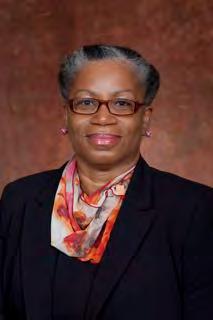
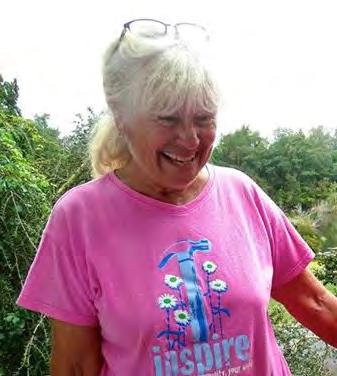
She serves on numerous community and gardening boards, including the Chamber of Commerce’s Minority Business Council, Tryon Palace gardens, Craven County Food bank garden, Civitans, and the NC Community Garden Partners. She is founder and President of Veterans Employment Base Camp and Organic Garden.
Having grown up in California, Nancy has lived and taught school (40 years total) in eastern North Carolina for more than 37 years. She has taught at the elementary, middle school and high school levels in Pitt County. She received the Governor’s Award for Excellence in Teaching Science in 1990 and was a state Finalist for the Presidential Award for Excellence in Math and Science Teaching in 1997 and 1998. Her undergraduate degree is from St. Mary-of-the-Woods College and her Master’s is from Loyola.
Nancy has served in leadership positions on the boards of NC Science Teachers Association, the Regional Science Fair, the NC Student Academy of Science, and various other educational groups. She and her husband John Bray are the founders and primary volunteers at A Time for Science, located on their property in Grifton, NC.
Randy is interested in vibrant non-profit organizations and in coastal issues. A graduate of the US Coast Guard Academy, he received his Master’s in Business Administration from the University of Colorado. Land Trust By the Numbers
Board of Directors
NORTH CAROLINA COASTAL LAND TRUST COAST LINES Planned Giving Kris Pickler’s Coastal Legacy
TOTAL ACRES PROTECTED: 62,690
NCCLT Welcomes New Board Members
RANDY BEARDSWORTH / wilmington
LOVAY WALLACE-SINGLETON / new bern NANCY BRAY / greenville
Board members serve three, three-year staggered terms. Board members are elected each year by the membership during the annual meeting.
TREASURER
Sadie S. Price Wilmington, NC
PRESIDENT Edward Norvell Salisbury, NC & Ocracoke, NC
VICE PRESIDENT
Kevin Hicks Wilmington, NC
SECRETARY
Mary Jo Alcoke New Bern, NC
John Haley, III Wilmington, NC
Paul E. Hosier Wilmington, NC
Randy Beardsworth Wilmington, NC
Nancy J. Bray Grifton, NC
John Fussell Morehead City, NC
Bob Oakes
Nags Head, NC
Peter Rascoe, III Southern Shores, NC
David Huffine Wilmington, NC
Bob Jones Wilmington, NC
Jason L. Kesler Wilmington, NC
Ann Cary Simpson Chapel Hill, NC
Lovay Wallace-Singleton New Bern, NC
Clark Wright New Bern, NC
