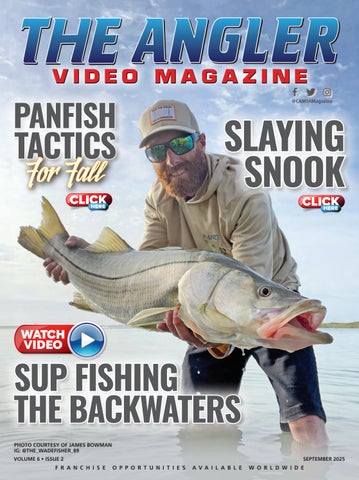
PANFISH TACTICS For Fall
@CAMTAMagazine
SLAYING SNOOK
WATCH VIDEO
SUP FISHING THE BACKWATERS PHOTO COURTESY OF JAMES BOWMAN IG: @THE_WADEFISHER_89 VOLUME 6 • ISSUE 2
F R A N C H I S E
SEPTEMBER 2025
O P P O R T U N I T I E S
A V A I L A B L E
W O R L D W I D E
10"
13"
16"
22"
24"
You want new charts? You got new charts! Explore the ocean with vibrant terrain & depth shading, using all-new TZ MAPS. Don’t just take our word for it. See for yourself. Scan here, and we’ll show you!
Furuno’s NavNet TZtouchXL Delivers “Off The Charts” Performance
F
uruno has again raised the bar for the most powerful, easiest-to-use Multi Function Displays (MFDs) with the new NavNet TZtouchXL. Five sizes of MFDs provide all the functionality boaters desire and never-before-seen features. An all-new chart offering called TZ MAPS sets these MFDs far ahead of the field. Navigators have complete control of data they download, such as raster or vector charts, satellite photos and bathymetric data. Plus, they can select specific areas to keep updated. Objects can be turned on and off in the Layers menu with a single swipe on the display. Users can create custom objects or update charted objects, on the system on the fly. Custom objects can be shared with other users through TimeZero’s service. Another new feature, BathyVision,
offers “off the charts” bathymetric data with contours that can be easily configured to a resolution three times better than anything else on the market. Bathymetric data can be overlaid onto navigation charts. All of this can be rendered with custom color palettes and terrain shading. Purchase of TZ MAPS areas also unlocks AI Routing to plan routes. The free TZ iBoat app for mobile devices allows at-home planning that transfers to TZtouchXL. With a free TimeZero account, waypoints and routes can be backed up or retrieved from the cloud. Charts can be purchased directly from the MFD! DRS Radar connection unlocks two new safety features: Risk Visualizer™ and
AI Avoidance Route™. These two features provide 360° representation of collision risks and a route around them that can be sent to a Furuno NAVpilot autopilot. The series comprises five MFDs with displays from 10” to 24”. All feature a powerful hexacore processor for lightningfast response. All magnetron or Solid-State Doppler Radars, high-powered Fish Finders, AIS, Autopilot, and Deep Water Multibeam Sonar options of NavNet TZtouch3 are compatible with TZtouchXL. Many of the must-have features are also available, including Target Analyzer™, Bird Mode, Rain Mode, and PIN Code Lock. The TZT10X, TZT13X, and TZT16X feature a built-in 1kW TruEcho CHIRP or CW Fish Finder and built-in 235kHz or 455kHz CHIRP Side-Scan. Two new remote-control options are also available. To learn more, visit:
www.NavNet.com
WATERMAN WINS 22ND ANNUAL VIRGINIA BEACH BILLFISH TOURNEY SCORING 33 WHITE MARLIN RELEASES WATCH
VIDEO
W
ithout question, the 22nd Annual Virginia Beach Billfish Tournament was a resounding success. Despite a near-miss from a major hurricane and a delayed start, the 39 teams competing put on an absolute angling showcase. In two days of fishing the smaller fleet released 420 billfish, including 409 white marlin, eight blue marlin, two sailfish and a spearfish. In the end, Waterman, a local 70 Ricky Scarborough owned by VBBT Board Member Mike Standing, triumphed with 33 whites on its ledger, worth 2,310 points. The team, guided by Capt. Ben Horning, was the top boat both days. With the win, Waterman earned $298,500. The winning categories included Top VBBT Boat and multiple first-place daily/tournament jackpots and trophies. In addition to Standing and Horning, the team consisted of Tom Baer, Garrett Holden, Antonio (Tony) Huerta, Jason Votzi, Jack Bobbitt and Aaron Horning. Waterman also took home the top tuna prize of $9,750 (74.1 pounds/Tony Huerta). Don’t Panic, a 64 Viking run by Capt. Bryan Peele, made a hard charge up the leaderboard, including 19 whites on Sunday, to finish with 26 releases overall (1,820 points). Don’t Panic is pocketing $55,575 for its efforts, including second place boat overall and jackpots. Andrew Norris is the boat’s owner. Capt. Colin Oxnard and his team on Fender Bender, a 62 Spencer Yacht based in Manteo, was the third-place finisher with 22 fish and 1,540 points. Fender Bender won $66,525 as the third-place boat, plus jackpots. The team also won second-place in the Legacy Jackpot and first-place in the Day 2 Charity Mystery Fish drawing. Outnumbered (65 Viking/Capt. James Breen) earned 1,540 points for 22 releases based
on time for fourth place overall, while Griffin (65 Rybovich/Capt. John Adams) earned fifthplace recognition by releasing 19 fish for 1,330 points. Griffin scored a $8,775 payout based on a second-place daily jackpot. Outnumbered also won $5,000 for the Wayne Sawyer Victory Lap Hard Charger Award. In the individual awards categories, William (Wayne) Enroughty Jr. boated the top dolphin at 25.6 pounds, good for a $9,750 purse. He was fishing aboard Sniper (58 Paul Mann/Capt. Chris Raiford). Whitney Simmons, competing on Sea Toy (59 Spencer/Capt. Bull Tolson) was named the Top Lady Angler with 10 marlin releases to her credit. Fifteen-year-old Sutton Paul (The Kid) is taking home the Bryan “Pick” Dalheim Memorial Trophy as the top junior
angler after scoring a white marlin release. Paul was competing on Sea Escape (53 RG Boatworks/Capt. Kevin Paul). “It’s been a wild, crazy week but we finished with a flurry,” Tournament Director Paula Davis said after Sunday’s awards presentations. “I’d like to thank the 39 teams for sticking with us and putting on a show, our wonderful and generous sponsors, and all our hardworking staff and volunteers for going above and beyond. We couldn’t have pulled this off without all of you. But let me go on record right now. For next year, I’m pre-ordering bluebird skies, fair winds and following seas.” The 23rd Annual Virginia Beach Billfish Tournament is set for August 19-22, 2026.
Visit vbbt.com to learn more.
FISHING LEGEND FLIP PALLOT PASSES
T
he fishing world lost one of its heroes as Flip Pallot passed away on August 26, 2025. Author, inventor, spokesperson and industry consultant, Flip was truly a “Renaissance Man” who inspired generations of anglers to pursue excellence and cherish the wonders and beauty of nature. His TV show Walkers Cay Chronicles helped introduce the world to sportfishing. Throughout his storied career Flip remained humble and approachable, making each of us feel appreciated and worthy. He was truly a down-to-earth celebrity. Volumes could be written about his influence on the outdoor industry and the iconic brands that his influence helped to create/develop. His broad smile and warm handshake will be missed, but his legend will live on. Thank you, Flip.
Ben Martin Editor In Chief Coastal Angler Magazine
www.visitusvi.com
N
Culturally, the US Virgin Islands are equally estled in the heart of the Caribbean, the US Virgin in tune. The music, dance, and festivals Islands embody a harmonious reflect a vibrant heritage rooted in African, blend of natural beauty, European, and Caribbean traditions. cultural vibrancy, and laid- The spirited calypso beats and reggae back serenity. These islands are more than rhythms are expressions of life’s ongoing just a picturesque getaway; they are a living dance—celebrating resilience, community, testament to nature’s rhythm and resilience, effortlessly in tune with the world around them. From the moment you arrive, the islands’ natural rhythm is palpable. The gentle sway of palm trees, the soothing sound of surf crashing against sandy shores, and the vibrant melodies of local music all echo the heartbeat of this tropical paradise. The islands’ lush landscapes, with their verdant hills and crystal-clear waters, mirror the steady pulse of life that sustains the local ecosystems and communities alike. The US Virgin Islands’ environment is a symphony of biodiversity with world class fishing and diving.These natural elements are not static; they dance in harmony, influenced NO and joy. These by the tides, wind, and seasonal PASSPORT cultural expressions changes—further emphasizing are an extension of the the islands’ intrinsic rhythm. This REQUIRED! islands’ natural rhythm, delicate balance underscores the showcasing how human life importance of conservation efforts, here moves seamlessly with ensuring that future generations nature’s flow. continue to experience the islands’ In a world often dictated by natural cadence.
chaos and rapid change, the US Virgin Islands serve as a reminder of the beauty of being in sync with nature’s tempo. Their natural, cultural, and ecological rhythms offer a blueprint for sustainable living and harmony. As travelers and residents alike continue to embrace this rhythm,
they uphold a legacy of balance—one that celebrates life’s natural flow and the enduring spirit of these remarkable islands. In the US Virgin Islands, being in rhythm isn’t just an ideal; it’s a way of life.
LEARN MORE AT
www.visitusvi.com
CHANGE IS ON THE WAY
Tim Barefoot
S
eptember is a peculiar month. Some of the hottest days of the year, hurricane season is in full swing and the first northeast winds and cold fronts are about to occur. This is the time of year when wahoo and yellowfin can be caught right up against the beach on big schools of cigar minnows and sardines, or out in the deeper water. There is no rhyme or reason to it this time of
year; these fish simply follow the bait schools This is also the time of year when scamp grouper are very vulnerable. If you have the ability to keep a pinfish trap in the water, it’s a good idea to take live pinfish with you offshore for a number of reasons. One, pinfish are very hearty and will live until the end of the day in the live well. Two, they WATCH
are very sought after by scamps because scamps view them as egg eaters and will kill them (eat them) so they don’t eat their eggs. And three, they are readily available at all fish cleaning stations, at most marinas. Yes, I strongly suggest taking two or three boxes of frozen cigar minnows for bait, but live pinfish are a ringer for scamps and other grouper/snapper species in the deeper water. September is when you will see all the tropical species in places you don’t normally see them. All the tropical snappers are everywhere now. Frozen cigar minnows on the Squid Decoy Jig are a wonderful option, but live cigs and sardines are a “whole nother story.” As shown in the VIDEO photo, the all-time IGFA world record scamp was caught on the 12 ounce with a cigar minnow. Proof is in the pudding...and here’s your proof. I’ve always said if you find the bait you find the fish, and if you find big marks of bait (cigs, sardines, tinks, beeliners etc…) you’ll find the fish. It’s always a good thing to have a “spotlight trolling motor” option to be able to sit on the bait or at least slow your drift in currents, but fish under the bait on or near the bottom for grouper and snappers and keep the light line out for all the pelagics. Designate one person in the crew to keep multiple light-line baits tended. Do not let this person get complacent and start bottom fishing. The same person should stay focused on the baits and working the Sabiki for whatever bait is below the boat. I’ve always said “Don’t walk in a Chinese restaurant and order a pizza,” meaning whatever is there is what they’re eating! A couple obvious execptions to this is pinfish on the bottom and greenies/sardines; these baits are universal. We can’t keep gag grouper this time of year or American red snapper, but you can definitely fill the box with other species. Be ready for that big bite on the light line by choosing your tackle wisely as well. Yes, you need to keep the leader (floro and wire) size small to get the bites, but use the correct size hooks, reel and line capacity to handle bigger fish. Like I mentioned earlier, this is the time of year when wahoo are everywhere...and nowhere. You could catch a giant wahoo or tuna inshore, or in the deep water, just be prepared for it and be ready to chase it down if need be. The kite is always a great option if you have the team that can fly the kite and bottom fish simultaneously as it can be a challenge with wind speed, direction and current. Learn more from Tim Barefoot on his YouTube channel and at barefootcatsandtackle.com.
10
SEPTEMBER 2025
THE ANGLER VIDEO MAGAZINE
FloridasForgottenCoast.com
Welcome to Fishing Paradise... T
he Forgotten Coast’s fertile waters boast some of the most productive fishing in Florida. Thanks to the unique topography of the Apalachicola River and Bay systems, combined with our area’s prime location on the Gulf coast, Franklin County is home to diverse, highly productive marine habitats. Franklin County’s fresh and salt waters are home to an astonishing array of fish species. The type of fish you’ll catch here depends on a number of factors, including which waters you’re fishing, what type of bait you’re using, the time of year and the tides. Want to plan a bay fishing excursion? Wade, paddle or motor out into the Apalachicola Bay, St. George Sound or Ochlockonee Bay, where you’ll have a chance to land redfish, speckled trout, flounder, tripletail, black drum, pompano, grouper, Spanish mackerel and more. When you’re ready to hook into saltwater species, it’s time to head to the coast of Carrabelle, Alligator Point or St. George Island for some offshore fishing. The prolific Gulf waters around the Forgotten Coast are teeming with grouper, mackerel, snapper, hogfish, tripletail, amberjack, cobia, mahi mahi, blackfin tuna, Spanish mackerel, king mackerel, wahoo and more! If you’re a freshwater fishing fanatic, head over to the Apalachicola River, Carrabelle River or Ochlockonee River, where you’ll find abundant bass, bream, stripers and catfish action, as well as some saltwater species in the winter months. There is a variety of ways to fish each of these active areas—whether by your own boat, a guided charter, a kayak, canoe or paddleboard, the shore, wade fishing or a pier. In other words, the Forgotten Coast offers fishing for everyone!
TO LEARN MORE VISIT:
FloridasForgottenCoast.com
FOUR CLUBS. TWO DAYS. ONE CHAMPION. SFC’s Zane Grey Championship Playoffs is a four-boat tournament in Cabo San Lucas taking place Oct. 19-20. The top two angling clubs from the Atlantic and Gulf Division standings earned playoff berths after a 12-tournament regular season. A season which saw the Atlantic Division crisscross the Eastern Seaboard, from Fort Lauderdale, Florida and Walker’s Cay, Bahamas to as far north as Oak Bluffs and Cape Cod. Meanwhile, the Gulf division competed in every single state bordering the Gulf coast. The winning club will be crowned league champions and take home $250,000, capping off a season that has awarded more than $2 million in prize money. Nestled along the pristine shores of Medano Beach, Corazón Cabo Resort & Spa will host the 2025 Zane Grey Championship Playoffs. This luxurious beachfront property boasts breathtaking views of the iconic Cabo Arch and offers an unparalleled five-star experience. Guests will find themselves just a short stroll from the vibrant Cabo San Lucas Marina, brimming with an array of shops and restaurants. SFC’s Zane Grey Trophy
THE 2025 SFC ZANE GREY CHAMPIONSHIP CROWNS THE LEAGUE’S CHAMPION.
SFC’s championship trophy is named after Zane Grey, the fishing icon who held numerous world records — including catching the first marlin to weigh more than 1,000 pounds. In 1998, Grey was inducted into the inaugural class of the IGFA Fishing Hall of Fame. One of the most highly regarded venues for sportfishing globally, Cabo San Lucas is an incredibly diverse fishery, commonly known as the marlin capital of the world. The October months are prime for Blue and Black Marlin, with Pacific sailfish and striped marlin available year round. Stay tuned for continuing coverage of the four playoffbound angling clubs on sportfishingchampionship.com and on SFC’s social media channels as they prepare for the showdown in Cabo San Lucas, Mexico.
PADDLEBOARD FISHING THE
BACKWATERS A Quiet Revolution on the Water By Skye Burkhardt
I
n recent years, paddleboard fishing has quietly emerged as one of the most immersive and rewarding ways to fish, particularly in the backwaters—where nature whispers and big fish lurk in shallow, untouched waters. Combining the stealth of a kayak with the freedom and perspective of stand-up paddling, fishing from a paddleboard offers a unique experience that connects anglers to their environment in a deeply personal way. You become part of the environment—just another element in a quiet, dynamic system. Every ripple matters, every shadow could be a fish. It’s fishing stripped to its essentials: a board, a rod, and your wits.
WHY THE BACKWATERS? Backwaters—those slow-moving or stagnant tributaries and tidal creeks separated from larger bodies of water—are havens for fish and wildlife. They’re often shallow, weedy, and difficult to access with motorboats, making them ideal for paddleboards. These secluded waterways harbor species like redfish, snook, bass, tarpon, and trout, depending on your region. The calm water allows for sight fishing
• Stealthiness: Paddleboards glide silently, and careful stalking, while the surrounding vegetation provides natural structure and cover allowing you to approach fish without for fish. For anglers seeking peace, solitude, and disturbing them. the thrill of spotting and targeting fish in crystal• Sight Fishing: Standing gives anglers a clear shallows, backwaters are unmatched. better vantage point to see fish and structure below the surface. THE PADDLEBOARD • Portability: Easy to transport and launch, ADVANTAGE paddleboards can be carried to remote areas Paddleboards offer several distinct with little effort. advantages in the backwaters: • Minimal Impact: Paddleboards have a • Maneuverability: They can access shallow low environmental footprint, making them a and narrow areas where boats can’t go. great choice for conservation-minded anglers.
GEAR ESSENTIALS
Fishing from a paddleboard requires packing smart. Space is limited, so prioritize: • Rod and Reel: A medium-action spinning setup is versatile for most species. • Tackle Box: A compact, waterproof tackle box with your go-to lures, soft plastics, hooks and leaders. • Anchor or Stakeout Pole: To hold position in wind or current. • Cooler: Dual-purpose for storage and seating. continued on next page
• PFD (Personal Flotation Device): likely spots, and avoid sudden movements. Required by law and essential for safety. 5. Time Your Trip: Early morning and late • Dry Bag: Keep your phone, wallet, and evening offer cooler temps, calmer water, and other valuables safe. more active fish. • Sun Protection: A hat, sunscreen and polarized sunglasses are must-haves.
CONCLUSION
TIPS FOR SUCCESS
1. Practice Paddle Control: Master basic paddling and balance techniques before trying to fish while standing. 2. Stay Organized: Use carabiners and bungee cords to keep gear secure and accessible. 3. Scout the Water: Stand and scan for tailing fish, bait activity, or subtle ripples. 4. Be Patient: Quietly drift or pole through
fish, and yourself. For anglers ready to trade noise and crowds for silence and solitude, the backwaters await. If you’re interested in paddleboard fishing, but don’t have the equipment or gear, be sure to enter my “Ultimate Halloween Paddleboard Fishing Package” giveaway presented by Coastal Angler Magazine, where you could score a “Tricked Out” Live Watersports paddleboard equipped with an ePropulsion eLite electric motor, paddleboard fishing gear, accessories, apparel and more! Scan the code on the next page or visit coastalanglermag. com/CAM-giveaway for details and to enter.
Paddleboard fishing in the backwaters is more than a hobby—it’s a return to simplicity and intimacy with nature. It’s a growing movement that emphasizes lowimpact adventure, self-reliance, and a deep appreciation for wild, often overlooked places. Whether you’re targeting snook in a mangrove tunnel, bass in a hidden freshwater creek, or redfish on a mud flat, the experience of fishing Check out Skye’s fishing paddleboard setup, from a paddleboard is less about the catch and catches and more on Instagram: @brassyangler87 and find her on Facebook: @inshoreskye. more about the connection—to the water, the
Skye Burkhardt’s Halloween H
H
SCAN the CODE!
H
Presented by Skye Burkhardt & Coastal Angler Mag, this Halloween, you could win a “TRICKED OUT” Live Watersports paddleboard equipped with an eLite electric motor from ePropulsion,, Fishing Gear, Accessories, Apparel & More!
WATCH VIDEO
COASTALANGLERMAG.COM/CAM-GIVEAWAY
THE LIGHTEST, MOST POWERFUL ELECTRIC MOTOR IN THE INDUSTRY.
eLite 500W
Electric Outboard Motor
Whether you’re fishing from a paddleboard, kayak, canoe or small boat, the ePropulsion eLite 500W redefines your on-water experience with innovative features and commitment to sustainability. Designed to be the most compact and lightweight electric outboard in its class, the eLite is an easy-to-use alternative to small internal combustion engines for enthusiasts worldwide. Max 5.6 miles at half throttle and 3.5 miles at full throttle.
ELITE 500W Compact, Portable Lightweight and Easy-to-Use ◊ Ultra Portable - Only 14.7 Lbs. ◊ 24V 1.5 Hp for Small Crafts ◊ Internal Lithium Battery ◊ Max 5.6 miles at half throttle and 3.5 miles at full throttle
NO EXTERNAL BATTERY NEEDED!
epropulsion.com
EPROPULSION ELITE 500W:
THE ULTIMATE IN PORTABLE ELECTRIC PROPULSION
I
n general, the trend in boating these days is bigger is better. Right? Engine horsepower is getting higher and higher, and boats are being built able to accommodate two, four, even six engines. But what about the other end of the spectrum—anglers and cruisers that are looking for the ultimate in portable propulsion? Whether you are looking for a boost for your kayak or a reliable motor for your inflatable fishing boat or tender, the perfect engine should be lightweight, easy to take on and off, easy to use and provide the range and speed for almost any conditions. It should be self-contained, so you don’t have to deal with lugging around a fuel tank, or even have to purchase and safely store gasoline on your boat. Electric propulsion is the way to go,
but no one has really gotten the right combination of affordability, reliability and power—until now. The ePropulsion eLite, which has been created for the tender and smaller boating market, represents a new era in clean, quiet, and eco-friendly marine
propulsion. The direct-drive motor and advanced propeller design delivers high efficiency with near-silent operation, especially attractive for anglers, as it is less likely to scare away fish. With a focus on minimal maintenance and cutting-edge technology, this addition to the ePropulsion range raises the bar in electric boating standards. Designed to be the most compact and lightweight electric outboard in its class, the ePropulsion eLite 500W electric outboard is an easy-touse carbon-free solution for small engine application. Its Sport mode adds an additional 50% boost in power for challenging conditions bringing the top speed to over five miles per hour. With multiple charging options, including 110/220V AC, 12V DC and solar with the use of optional ePropulsion converters, the eLite can be fully
charged in around four hours. For added capability and convenience, the engine includes a USB-C output that allows users to charge and power other electrical devices. At just under three-feet in length and weighing 14.7-pounds including the built-in battery, the eLite stores easily and the one-click quick-release bracket allows for installation and removal in a matter of seconds. For exceptional portability, the tiller handle converts to a perfectly balanced carry handle. With multiple trim and tilt angles, adjustable steering resistance and shaft length, and a shallow-water mode, the eLite is completely customizable. Its Smart Battery Monitoring System efficiently optimizes performance, carefully regulating battery level, temperature, and remaining state-of-charge all displayed on an ultra-simple interface, leading to extended range, a more energy-efficient operation and longer battery life. Built to last, it is IP67 waterproof, and is constructed of aviationgrade aluminum alloy for lighter weight and greater durability. In addition, the anti-ground auto kick-up feature protects the motor from accidental damage. Available for under $1,000, it is also the most affordable electric outboard in its class. There’s no time like today to upgrade to the electric outboard of the future. The ePropulsion eLite is in stock and ready to take you quietly and sustainably to your next adventure.
EPROPULSION.COM
THE ANGLER VIDEO MAGAZINE
SEPTEMBER 2025
21
Experience Watauga River Home of world class fishing on the beautiful Watauga Lake, rugged Doe River and designated trophy trout stream, Watauga River
Watauga Lake Doe River PLAN YOUR TRIP AT TOURCARTERCOUNTY.COM
Tennessee’s Mountain Playground
PRO FISHING TECHNIQUES
SNOOK FISHING WITH ARTIFICIAL SHRIMP
T
he common snook, a.k.a. linesider, a.k.a. robalo, is one of the most sought after gamefish in Florida waters. Sportsmen and women from all over the world come to Florida to catch these hard fighting, jumping, head shaking, drag pulling fish. Snook will definitely eat top water lures, jigs, jerkbaits, wake baits, suspending hard baits, spoons, and flies—but they love artificial shrimp. Artificial shrimp will catch snook all year long; day or night; salt or fresh water; in every ecosystem, anywhere that snook live. One of the best ways to catch snook with artificial shrimp is skipping them under and around structures like mangrove branches, docks, sea walls, sand bars and oyster bars. Pitch the shrimp to the structure and let it sink. Then give it a twitch, twitch and let it sink again, then twitch, twitch and repeat the process until your arms get tired of reeling in linesiders.. Snook like a slower retrieve in the cooler months. Make sure to slow it down when
when water temperatures are between 75 and 85 degrees. Snook often stop biting when water temperatures get above 90 degrees. Another great characteristic of the artificial shrimp is that it skips like a dream. The 3 inch shrimp is the go to artificial Capt. Mike Smith shrimp lure for most hardcore snook fishermen. However, there are days when the water temperatures the snook are more discerning and a 2.75 approach the 70 degree level or less. A faster retrieve works better inch or a larger 4 inch shrimp is the better size and profile choice. The best color choices for shrimp lures are transparent, natural colors with gold or silver glitter in them for sunny days and clear water scenarios. More opaque and darker colors work better in dirty water and on cloudy days. Many fishermen struggle when fishing artificial lures into tight cover scenarios. Sometimes, it takes about 50 casts and the loss of a half dozen shrimp lures to perfect the technique. But it is definitely a skill that any serious snook fisherman needs to master. Capt. Mike Smith, owner of Fish Your Ass Off Charters, is an inshore fishing guide who has been fishing the inshore waters, oyster bars and grass flats of Florida for more than 40 years. Reach him at (561) 339-2317, email: contact@fishyourassoff.com or visit fishyourassoff.com.
WATCH
24
SEPTEMBER 2025
THE ANGLER VIDEO MAGAZINE
VIDEO
Catch More Fish
With The Original Shallow Water Pole Anchor
MOTOR MOUNTS
POLE HANDLES
STERN MOUNTS
BOW MOUNTS
POLE SPIKES & EXTENSIONS
stayputanchor.com
386.682.5558
THE ANGLER VIDEO MAGAZINE
SEPTEMBER 2025
25
Four of Tennessee’s Best State Park Fisheries When it comes to freshwater fishing, Tennessee has an embarrassment of riches. From massive rivers and reservoirs to small ponds and high-elevation trout streams, the state is home to incredible fishing opportunities. Tennessee State Parks are excellent base camps for on-the-water adventures. They offer amenities for lodging or camping, and many of them are right on the water, with unparalleled access to some of the best fisheries in the nation.
Here are a few great Tennessee State Park fishing destinations: • ROAN MOUNTAIN STATE PARK: Fed from elevations of around 6,000 feet, the Doe River runs clear and cold through the center of Roan Mountain State Park. Its tributaries are home to healthy year-round populations of native brook trout and both wild and stocked rainbows and browns. The 2,000-acre park is dominated by hardwood forests and rugged ridgelines. It is a beautiful place to be, whether you’re casting flies or just camping and going for a hike. • HARRISON BAY STATE PARK: Just outside of Chattanooga, Harrison Bay is a 1,200-acre park with 40 miles of shoreline on Chickamauga Lake. If you’re a bass angler, you know “The Chick’s” reputation as a big-bass factory. It is ranked among the best largemouth fisheries in the world. The massive reservoir is also a great fishery for smallmouth bass, striped bass, crappie, walleye and big Tennessee River catfish.
• ROCK ISLAND STATE PARK: North of McMinnville, Rock Island is an 883-acre state park on the headwaters of Center Hill Lake, where the Caney Fork, Collins and Rocky rivers meet. These rivers and the lake itself are some of the best fisheries in this part of the world for “The Fish of 10,000 casts.” If the mighty muskellunge is on your hit list, this is a good place to chase one. The park is also a fantastic place to catch walleye when the rivers fill up with spawning walleye in early spring. There’s plenty of bank space to fish from, and it’s a great area for kayaks, canoes and boats. • NORRIS DAM STATE PARK: A short drive from Knoxville, Norris Dam State Park is 4,000 acres on Norris Lake. The lake is renowned for excellent smallmouth bass fishing as well as good fishing for largemouth bass, catfish, striped bass and walleye. If that isn’t enough get you excited, the Clinch River downstream of Norris Dam is one of the best tailwater trout fisheries in the Southeast.
These four Tennessee State Parks are just the tip of the iceberg. With fishing as a primary draw to more than 40 state parks in the volunteer state, you’ll need to do some research to plan your next adventure.
For information, visit tnstateparks.com.
Stay t yP Powered. owere . SStay tay O On n The The Wa Water! ter!
S a
Upgrade to Lithium Battery Power and enjoy longer runtimes, lighter setups, and worry-free days on the water. Shop Now at lithiumbatterypower.com
12V 108Ah
24V 90Ah
Get The Best Deals Here!
powerbox
(727) 223-9831
36V 60Ah
LITHIUM BATTERY POWER WINS BEST ENERGY AWARD AT ICAST 2025 FOR GAMECHANGING POWERBOX SYSTEM
L
ithium Battery Power (LBP), a leading innovator in advanced battery solutions, has taken top honors in the Energy category at the 2025 International Convention of Allied Sportfishing Trades (ICAST). The company’s groundbreaking Powerbox 2.5 kW / Solar Panel Lithium Battery Charging System was awarded the Best of Category: Energy, signaling a major leap forward in sustainable, high-performance energy technology for anglers and outdoor enthusiasts. Held annually in Orlando, ICAST is recognized as the world’s largest sportfishing trade show and a hub for innovation within the industry. Each year, hundreds of new products are submitted for consideration across multiple categories, but only the most impressive make it to the winner’s circle. LBP’s Powerbox system stood out for its combination of portability, power, and green energy integration.
The award-winning Powerbox 2.5 kW system delivers robust, reliable energy storage and output in a compact, rugged form factor. It’s designed to meet the demanding needs of outdoor enthusiasts who rely on consistent power in off-grid environments. Integrated with a high-efficiency solar charging panel, the system ensures power sustainability even during extended trips, reducing the need for fuel-powered generators or frequent dock visits. “We are honored to receive this recognition at ICAST,” said Don Mitchell, Sales Director for Lithium Battery Power. “Our goal has always been to push the boundaries of battery technology while supporting eco-conscious outdoor recreation. The Powerbox system is a direct response to what today’s anglers need— power that lasts, in a package that’s smart, clean, and easy to use.”
The judges at ICAST praised the Powerbox for its innovative design, versatility, and emphasis on clean energy. Weekend power outages, hurricanes and critical jobsite power along with the heavy 12 volt demands in marine environments got their attention over all others in the Energy category. This win marks a significant milestone for Lithium Battery Power, reinforcing its position as a leader in the renewable energy sector within recreational vehicle and marine markets. As the industry shifts toward more sustainable and efficient energy solutions, Lithium Battery Power’s win at ICAST 2025 signals that the future of on-the-water power is not just electric - it’s solar, smart, and built for adventure.
LITHIUMBATTERYPOWER.COM
THE ANGLER VIDEO MAGAZINE
SEPTEMBER 2025
29
e m i T a n Tu Keys e h t in By A. deGruchy
L
ate summer in the Florida Keys means steady blackfin tuna action. Look for them around offshore humps like Marathon and Islamorada, especially early in the morning, and over wrecks in 200 to 600 feet of water. Troll small feathers, ballyhoo, or bonito strips when the fish are feeding near the surface. If they’re holding deeper, vertical jigging is the way to go. Savage Gear jigs in the 100 to 200 gram range work great. Drop them straight down and work them quickly to trigger bites. For gear, the new Penn Spinfisher VII combo in the 4500 to 6500 size is a solid choice. Spool it with 30 to 50 pound braid and 30 pound fluoro. It’s a strong and smooth setup that handles tuna with ease. Watch for bird activity like frigates and terns diving. That usually means tuna are pushing bait to the surface. And always fish with respect. Don’t troll behind another boat or crowd or someone who is already on a school. Give space and enjoy the bite. Blackfin tuna grade is better than bluefin in my opinion; you can eat it raw, do poke bowls, sushi rolls or sear it with sesame seeds! Be sure to follow deGruchy’s adventures on YouTube (Bean Sportfishing TV) and @bean_sportfishing on Instagram.
Cast Away in Grayson County, VA: A Fishing Paradise in the Blue Ridge Mountains
G
rayson County, Virginia, nestled in the heart of the Blue Ridge Mountains, is a haven for outdoor enthusiasts—and for anglers, it’s nothing short of paradise. With pristine rivers, clear mountain streams, and serene lakes, Grayson offers some of the best freshwater fishing in the Southeast. At the top of the list is the New River, one of the oldest rivers in the world and a top-tier destination for smallmouth bass fishing. Flowing through the scenic valleys of Grayson County, the New River’s cool, clean waters are also home to musky, walleye, catfish, and panfish. Whether you’re fly fishing from the banks, casting from a kayak, or joining a local guide service for a float trip, the New River promises an unforgettable fishing experience. Just a short drive from the river is Grayson Highlands State Park, where mountain streams like Wilson Creek and Big Wilson Creek provide excellent trout fishing. These high-elevation streams are stocked with rainbow, brook, and brown trout and offer peaceful surroundings for those seeking a more remote and tranquil experience. Fly anglers will especially appreciate the challenge and reward of landing a native brook trout in these cold, clear waters. For those who enjoy lake fishing, Rural Retreat Lake and nearby Crooked Creek Wildlife Management Area offer wellmaintained facilities, family-friendly fishing, and regular stocking. These spots are ideal for beginners and seasoned anglers alike. Grayson County is not just about great fishing—it’s about the whole experience. Surrounded by breathtaking views, charming small towns, and a welcoming community, it’s the perfect destination for a fishing trip that balances adventure with relaxation. Whether you’re after a trophy catch or just want to enjoy a quiet day by the water, Grayson County invites you to cast a line and discover the natural beauty of Southwest Virginia.
TO LEARN MORE VISIT: GraysonCountyVA.com
GO LIGHT FOR BIG SNAPPER By Will Schmidt
I
f you have spent any time bottom fishing you know that occasionally on the heaviest of tackle you can outsmart a big snapper and end up with a solid fish. Other days you can struggle to get even shorts. If you really want to up your game, it is time to lighten up. When I say light, I mean straight 20 or 30lb mono and light wire 3/0 hooks. You may get broken off at times, but it is worth it for a box full of stud mangos and ARS. My go to big snapper setups is G Loomis IMX Pro Blues 843 casting rod with Shimano Trinadad TN20. This outfit is light, sensitive, and deadly on snapper. Some might like a bit lighter action rod but I have found that even with straight 20lb test you can really put a lot of pressure on these fish and the backbone is nice to get them off the bottom as quickly as you can. A bit heaver is also nice when that grouper inevitably grabs the bait. Here is a pro tip. One of the key elements
34
SEPTEMBER 2025
WATCH
VIDEO
for success to get big snapper, especially mangos, is the ability to react fast. Snapper get their name because they will often quickly snap at a bait and then release it. With these sensitive rods and a gear ration of 6.2 to 1 you can pick up 46 inches of line in a single turn. A sensitive rod and a fast reel means when you feel that tap, you can come tight instantly even in deep water. Remember you must use circle hooks so reeling vs setting the hook is the way to connect to these fish. A fast reel might be the most important tool when snapper fishing. My go to bait is a live pinfish because, everything eats a pinfish. I like having a livewell full of nice hand size pins. I do also use threadfins both live and dead. Threadfins are great baits, but a good stout live 7 inch thread is remarkably strong and can be tough to get to
THE ANGLER VIDEO MAGAZINE
the bottom as they swim off with your lead. That means dead threads can be easier to get to the strike zone. Cut the heads and tails off and make a thread “plug.” Thread “plugs” are awesome for snapper bait especially when live bait is not available. If hook ups are tough, I will double up my hooks, snelling 2 circle hooks close together and getting both hidden inside the plug to increase my hookup ratio. Regardless, I use 3 to 4 feet of mono leader then a swivel and a 3 ounce lead to hold the rig right on the bottom. Whether you really want to target big snapper or the bite is just really tough, try going light and you will likely find the results are worth it. Will Schmidt is a seasoned tournament angler who has been writing about fishing for more than two decades.
SECURE HOLD & FAST ACCESS TO YOUR CELL PHONE Tired of worrying about your cell phone slipping, falling, or getting damaged while you’re out on the water? Hold Fast Pro provides the must-have boat accessory that gives you exactly what you need—a STRONG HOLD and FAST ACCESS to your cell phone.
Use Promo Code CAM10 for 10% OFF
HoldFastPro.com
Built to handle the water, salt, and sun, our adjustable boat phone holder boasts a secure design, versatile features, universal fit, and the ultimate in durability and convenience.
RUSTPROOF. ADJUSTABLE.
BOATER APPROVED.
THE ANGLER VIDEO MAGAZINE
SEPTEMBER 2025
35
WE ARE THE LARGEST DISTRIBUTOR OF ZODIAC INFLATABLE BOATS WORLDWIDE!
BUILT TO EXPLORE
THOUSANDS OF INFLATABLE BOATS AND OUTBOARD MOTORS IN STOCK!
Inventor of the inflatable boat, Zodiac Nautic offers products with exceptional durability and reliability. Trusted by professionals and weekend warriors alike, Defender brings you...
UNBEATABLE PRICES & EXPERT SUPPORT
OUTFIT WITH CONFIDENCE. UPGRADE WITH PURPOSE. SHOP WHERE THE PROS SHOP—AT DEFENDER. SHOP NOW AT
DEFENDER.COM CALL: 800-628-8225
PHOTO COURTESY OF KNOCKIN TAIL LURES®
Chasing Giants on the Gulf Coast
Quiet Water, Violent Strikes:
When the end of summer is near and the tides align, there’s no place I’d rather be than Southwest Florida—with a rod in hand and visions of giant snook, reds and trout dancing in my head. This year, my buddies and I made the pilgrimage with a simple mission: land a personal best. Big fish only. No compromises.
TEXAS STYLE
Hard Twitch Baits: Strike First, Strike Hard
By Capt. Michael Okruhlik
SURF FISHING
If I had to pick just one, hard twitch baits take the top spot. There’s something about that sharp, erratic dart through the water that drives trout wild — and the strikes are violent. Like “wake-up-your-neighbors”, violent. Twitch it, pause it, twitch again—boom! Bonus: many of these lures rattle, which adds an extra layer of appeal in the slightly stained surf water.
Topwaters: The Surface Showdown
When I want a front-row seat to the chaos, I tie on a topwater. Watching a speckled trout explode on a surface lure in the calm surf is pure adrenaline. If it misses, keep working it. Trout in the surf are fired up and aggressive — they’ll often come back for seconds (or thirds). Like the twitch baits, these lures rattle too, which helps draw fish in from a distance.
Old School Silver Spoon: Timeless and Deadly
The silver spoon has earned its place in Texas fishing history, and for good reason —
it still flat-out works. I prefer a steady retrieve style spoon for consistent action over a jigging one, but that’s just personal taste. And hey, I’m a paddletail guy at heart, so a steady retrieve comes naturally.
Soft Plastics: PaddleTails & Shrimp with a Twist
Soft plastics shine in the surf, but go for durability. These fish aren’t sitting around like they do in the bay — they’re moving, and fast. The last thing you want is to waste time swapping lures after every catch. I use paddle tails with built-in tail rattles and super-loud rattling shrimp. Yes, rattling shrimp exist — and when trout are keyed in on shrimp, nothing else will do. The realism and noise can turn a slow day into a flurry of action.
Live Bait: Sometimes, You Just Gotta Go Natural
Live shrimp under a rattling popping
cork? That’s trout candy. It’s simple, effective, and deadly on calm days. But if the bite gets finicky, break out the big guns: live croaker. Controversial? Sure. Effective? Absolutely. When the water’s crystal clear and the trout are being picky, croaker can be a daysaver.
Bonus Round: Redfish in the Mix
Don’t be surprised if a slot red—or even an oversized bruiser—crashes the party. Every lure and bait on this list will get crushed by reds in the surf. Be ready. The surf might be calm, but your drag won’t be.
Bring the Kids – And Leave the Southwest Wind Behind
Calm surf days are perfect for family fishing. Easy wading, plenty of action, and good-sized fish make it a blast for kids and adults alike. One final tip: if there’s any southwest wind at all, do what the surfers do on flat days — stay in bed. It’ll save you some frustration. So check that forecast, grab your favorite rattling lure, and remember: always take a kid fishing. Capt. Michael Okruhlik is the inventor of Knockin Tail Lures®, and the owner of www.MyCoastOutdoors.com.
Recycle Your Fishing Lures with SALTGATOR!
F
or anglers who are passionate about and refurbished for resale or repurposed into tackle without contributing to environmental both fishing and the environment, new products. It’s a win-win: less waste in harm. The company’s mission is to promote SALTGATOR offers a simple and landfills and a chance to reduce the cost of responsible fishing and reduce waste in effective way to recycle used, broken, or buying brand-new tackle. SALTGATOR also rewards participants the sport. By offering this recycling option, unwanted fishing lures. With sustainability becoming a growing concern in the with store credit for eligible lures, creating an SaltGator not only helps individual anglers but also supports a outdoor community, SALTGATOR’S recycling broader movement Next time you find yourself with a pile of initiative gives new life toward conservation to old gear while helping and sustainable outdoor beat-up lures, don’t throw them away...reel in keep waterways clean. practices. a smarter solution with SaltGator.com. The process is easy. Getting started is SALTGATOR accepts straightforward: visit a variety of hard baits—like crankbaits, added incentive to recycle. Once your lures SaltGator.com, navigate to the lure recycling jerkbaits, topwater lures, and more—that are inspected and accepted, you’ll receive a page, and follow the simple instructions to are no longer in use. Instead of tossing them credit that can be used toward any purchase send in your gear. Whether you’re clearing into the trash, anglers can mail in their used on the site—including new and refurbished out an old tackle box or looking to declutter lures directly to SALTGATOR’S recycling gear. This encourages a circular economy before a new season, recycling with SaltGator program. From there, lures are either repaired where anglers can responsibly upgrade their is an easy step toward greener fishing.
BEFORE
AFTER
SHOP NOW AT WWW.SALTGATOR.COM
Cherokee County, Alabama Home Of Beautiful Weiss Lake
Cherokee County Chamber of Commerce & Tourism www.cherokee-chamber.org • 256-927-8455
WATCH
W
VIDEO
hether for sport or for the table, panfish— especially slab crappies and hand-sized bull bluegills—are a favorite target among anglers. And when the air cools and leaves start to fall, panfish fishing heats up. Autumn can be one of the best times to catch these fish, but it comes with a unique set of challenges. Changing vegetation, dropping water temperatures, lake turnover, and baitfish migrations can make finding panfish feel like solving a seasonal puzzle. Fortunately, by learning to read these fall cues you’ll consistently find success on the water. As lake temperatures cool and turnover occurs, baitfish begin shifting toward shallower cover where they can find safety and warmth. This movement sets off a chain reaction. Panfish follow the food, often stacking up around cover like submerged wood or rocky structure. These areas become prime real estate for fall fishing. Weather plays a major role, too. On cold, blustery fall days, panfish often slide deeper, becoming more predictable and easier to find with electronics. Deep basin areas in 20 to 25 feet of water can light up with schools of crappies—and sometimes bluegills—suspended and ready to bite. These deeper fish are often aggressive, making for a rewarding but ethically sensitive bite. When fishing at those depths, barotrauma becomes a real issue. Released fish often don’t survive, even if they swim off, so it’s important to harvest what you catch, regardless of size. On the flip side, when the weather is mild and the sun is out, panfish can be found shallower, relating to weedlines, cribs, and brush piles. Healthy, vertical weeds are a magnet for fall panfish and can hold fish all the way into first ice. In fact, some of the best fall bluegill bites happen in just five to eight feet of water, especially in lakes where dense, green weedbeds persist. Lake size also influences fall behavior. On smaller lakes—200 acres or less—dropping water temps and decaying weeds tend to concentrate fish even more. As long as green weeds remain, panfish will hold tight to them. But as those weeds die off, the fish begin to push toward deeper structure or out into the basins in preparation for winter. Crappies in particular become more predictable in the fall, often schooling up tighter and acting more aggressively than during other seasons. They’re easier to pattern as they transition from summer haunts to winter basins, often stopping along the way at deep weedlines or submerged timber. In lakes with ample wood or crib structure, these can be hotspots that hold large schools well into late fall. Bluegills, while more opportunistic and scattered, still relate strongly to weed edges and shallow cover when the conditions are right. Their adaptability means they can be caught both shallow and deep, but they may take more searching to find than their crappie counterparts. Despite the variables, the recipe for fall panfish success remains relatively consistent: follow the forage, find healthy weeds or cover, and adjust based on the weather. Whether you’re chasing aggressive schools of crappies in deep water or hunting bluegills in shallow weed patches, fall offers a window of opportunity that savvy anglers won’t want to miss.
By TAM Staff
A WHOLE NEW LEVEL Introducing Dometic’s DG3 Gyro
Smooth Sailing Experience a new level of comfort on the water with our DG3 Gyro Stabilizer. By minimizing boat roll, it ensures a smooth, steady ride, even in choppy conditions. Whether you’re fishing, dining, or just unwinding, the Gyro creates a more enjoyable and stable environment. Operating quietly and without the need for external fins, it lets you focus on what matters most: making every moment on the water truly relaxing.
dometic.com
Award Winning Dometic DG3 Gyrostabilizer Featured On New Regulator 35 CC
T
he boating industry is jumping onboard with Dometic’s revolutionary DG3 Gyrostabilizer, due to its groundbreaking spin-up and spindown times, energy efficiency and superior performance in all types of sea conditions. This solution has literally taken vessel stabilization to a “Whole New Level,” capturing the attention of boaters and boat builders around the world. The first in a planned line of advanced stabilization solutions by Dometic, the new DG3 is targeted at the 35- to 41-foot fishing boat market. Soon after Dometic won the 2025 NMMA Innovation Award at the Miami International Boat Show for the DG3, leading American boat builder Regulator Marine announced that its new-for-2025 Regulator 35 Center Console would be offered with Dometic’s DG3. “We are honored to have a respected builder like Regulator come onboard,” said Dometic Marine Segment President Eric Fetchko. “Their latest center console flagship is an ideal match for our system in terms of size, hull performance, overall quality and a wide range of premium features and technology. It’s also a wonderful platform to showcase our advanced capabilities, including energy efficiency that enables offshore use without the need for an onboard generator,” added Fetchko. The DG3 reduces spin-up time by more than 65%, reaching full readiness in just 16 minutes, compared to the typical 50 minutes required by current systems in the market. This means you’ll get out on the water and out to distant fishing grounds faster. The system’s downtime is equally impressive, fully lowering in just 20 minutes, a significant improvement over the eight or more hours (15X faster) required by current systems. Dometic also pioneered innovations in energy storage and recapture, enabling the battery to recharge efficiently. DG3 uses Dometic’s proprietary, industry-proven Inverted Roller Screw technology for true dynamic control and significantly improved roll reduction performance over a wide range of sea sates. In addition, the push-pull motion of Dometic’s all-electric procession actuator is used to create power that contributes to running the system. During spin down, Dometic’s regenerative braking technology recharges the system’s dedicated 48V Lithium-Ion spin-up battery for the next use. Overall, the DG3 reduces power consumption by an impressive 40% compared to other gyros on the market. DG3’s Inverted Planetary Roller Screw technology and proprietary allelectric procession actuator provide dynamic control of the gyro hemisphere
for instant response to vessel movement and superior comfort over a full range of sea states. This allows DG3 to react faster to heavy wave motions, while also smoothing the ride in small and long period waves, where current gyros are less effective. Durability and reduced maintenance were also key goals for Dometic engineers. Dometic’s proprietary all-electric procession actuator replaces hydraulic actuators that require fluid and are prone to leaks. The solution enhances long-term durability, minimizes required service, and reduces total cost of ownership. Featuring a slower-spinning flywheel, larger, more robust bearings, patent-pending inner race cooling, parallel path cooling, and a titanium heat exchanger, the DG3 is designed to stay cool and operate reliably for the long run. Dometic designed the DG3 as an easy “drop-in” replacement for other comparably sized systems available in the market today. The DG3 fits within the same footprint and clearance specifications and features reversible mounting feet to address common challenges encountered by installers. To meet the needs of today’s boating market, Dometic’s DG3 is compatible with 12-, 24- and 48-volt house battery systems. To learn more about how Dometic’s DG3 can take your offshore fishing adventure to a whole new level, visit www.dometic.com.
SEPTEMBER SNOOKIN’ Slaying Slobs on Florida’s Space Coast
S
eptember is one of the best months to target snook on Florida’s Space Coast. They can be caught on the beaches, at the inlet, and in the lagoon. Assuming we get a decent mullet run, the snook should be fired up and found feeding on many of the mullet schools migrating south.
BEACHES:
Locating the mullet is crucial, and staying with them is the key. These schools can sometimes move very quickly, and if you don’t stay with them, you’re effectively in no man’s land, so be prepared to be mobile. This makes live bait fishing more difficult in these situations, so throwing artificials proves to be a great tactic for the fast-moving schools. I usually opt for the Hogy 2 oz. paddletails in the mullet color pattern during these times. Work the edge of the schools with a steady retrieve and keep that same retrieve all the way to the shoreline, as oftentimes the snook will eat extremely close to the beach. If anything, reel faster than slow with your steady retrieve; often, that will generate a reaction strike. As for leader, 40 lb. mono or flouro is generally what I’m throwing for snook in these scenarios.
By Ryan Caravello
For live bait, net or snag mullet, and use a good quality circle hook like the Owner Mutu Light. For finger mullet, go with a 3/0 size; for larger mullet, opt for a 5/0 to 7/0. Using a good surf rod in the 9’ to 10’6” range is what I’d recommend for most days, but a smaller rod can work well if the mullet are in really close. My usual beach setup for targeting snook is a 9’ SEBASTIAN INLET: Star VPR paired with a Shimano Twin Power If you’re lucky enough to be at the inlet 5000 spooled with 20 lb. braid. This setup is when a school of mullet comes through and light, casts well, and has plenty of power to the snook zero in on them, you’re in for an quickly land the biggest of snook. epic bite! I like to rig my mullet on a long 40 INDIAN RIVER LAGOON: lb. leader and with a small split shot to get The snook fishing in the IRL can be epic in them under the school and slowed down. September. As with the beaches, the key is to Depending on where you are in the inlet, the fish around the mullet schools, and you’ll be tactics change, but when it’s hot, it’s hot. A in the game. With how hot it is, we can expect good bet if you’re fishing from land is right the fish to be in areas with shade and in the jetty pocket on the beach deeper water often. If you see a school side during the mullet run. Here of mullet headed for an area like you can throw artificials and live that, that’s the best scenario to fish. mullet with success and it can be A great tactic is to use live mullet as spectacular! the fish are keyed in on them, and Good luck, and have fun!
Ryan Caravello has spent countless hours stalking the Indian River Lagoon and Brevard’s beaches, targeting snook and tarpon, and has made a name for himself doing it. Ryan has passionately shared this experience with his wife and two daughters, and cites the memories of catching snook with his family as his most cherished. If you’re one of the many who have wanted to fish with Ryan, your chance is coming soon as he’s offering guided trips aboard his 26 Andros starting this fall. Instagram: @rcaravello.
WATCH
they’re readily available to cast net. Artificials can be used with success as well. Paddletails/ soft plastics work well, and topwater lures work great early morning. My setup for fishing the lagoon is a 7’ medium heavy rod paired with a 5000 reel spooled with 20 lb. braid and tied onto a 40 lb. leader. I use circle hooks exclusively to protect the fish from being gut hooked, as we release the majority of the snook we catch.
VIDEO
THE ANGLER VIDEO MAGAZINE
SEPTEMBER 2025
47
NOW AVAILABLE! UPDATED 300AP MODELS
EXPLORE THE NEWLY DESIGNED OUTBOARDS TODAY
5 YEAR LIMITED WARRANTY applies to qualifying purchases of Suzuki outboard motors sold and delivered to the retail purchaser, for pleasure (non-commercial) use only, from April 1, 2021 through March 31, 2026. See Suzuki Limited Warranty for additional details. Suzuki, the “S” logo, and Suzuki model and product names are Suzuki Trademarks or ®. © 2025 Suzuki Marine USA, LLC. All rights reserved.
Suzuki Marine Wins 2025 Boating Industry Top Products Award For Re-Launched V6 200Hp Outboard
S
uzuki Marine USA has announced that its re-launched V6 200HP 4-stroke outboard motor has earned a 2025 Top Products Award from Boating Industry Magazine. Boating Industry unveiled its 2025 Award Winners to the world’s recreational boating industry in May and will feature all the winning products in an upcoming issue of the popular magazine. “On behalf of Suzuki Marine USA and the Suzuki factory in Japan, we are grateful for this recognition from Boating Industry,” said Brandon Cerka, Vice President Sales and Marketing for Suzuki Marine USA. “We have always focused on listening to our customers, dealers and boatbuilder partners, and it was clear from our conversations there was a need for V6 200 to be offered alongside our popular inline 4-cylinder 200HP. With both these motors in our 2025 lineup, boaters can now choose the 200 that best suits their type of vessel and boating lifestyle,” Cerka added. Suzuki’s V6 200HP is an ideal fit for boaters and anglers who want the torque, powerful hole shot, and strong acceleration of Suzuki’s 3.6-liter, 24-valve V6 powerhead for single and multiple engine installations. This 2025 model is a great choice for today’s heavy center consoles, large pontoon boats, and other popular vessels that can benefit from a little extra “kick in the rear.” Suzuki’s 2025 V6 200 is packed with proven Suzuki technology, along with some new features not previously found on earlier V6 models. Among these new-to-
the-class features are easy integration with Suzuki’s new CANbus system for easier and more reliable rigging, Suzuki’s easy start system, automatic trim, keyless starting and troll mode. “This is Suzuki’s 60th Anniversary in the outboard motor business, something we are very proud of,” said Cerka. “A big part of our success over these many years has been keeping our finger on the pulse of the market and coming out with the right products at the right time. Receiving this recognition from a publication like Boating Industry demonstrates that we are on the right track.” LEARN MORE AT
www.suzukimarine.com THE ANGLER VIDEO MAGAZINE
SEPTEMBER 2025
49
Alaska’s Can’t Miss Freshwater Fishing Adventures SA
A
SA
,U
IST
K •ALAS
A
,
Interior Alaska If you’re looking for a quiet place to fish, with scenery, comfortable cabins and located far from the crowds, drive down to Denali National Park and visit Kirk Martakis at Fish Denali. He offers several lakes on private property that offer about 3,000 wild rainbow trout to 31 inches and trophy-sized grayling. They cruise the lake like sharks, and the clear water makes sight casting to them with singlehook jigs, nymphs or topwater lures too much
,
• ALASK
with whom is key. I’ve fished and covered Alaska’s fishing for more than 42 years, and I’ve helped countless anglers find the trip best suited for them. Each angler has separate needs. In the freshwater realm, here are some of the top considerations for can’t miss adventure, fish-hooking action and personal service worthy of the Alaska experience.
2025
BUCKET L
,U
a
A
laska sportfishing offers wilderness realized rather than imagined and quickens the pulse in all types of anglers, from panfishermen to veteran world anglers. When an angler returns from Alaska and shares an evening on the flats or at the catfish hole with friends, talk quickly turns from big catfish stories to Alaska fishing adventures. The reason is obvious. If you are searching for action, the roostertails of spray generated by a 50-pound chinook salmon on a five-jump run through shallow water will satisfy your need. If the sight of huge shad migrations have you tying on a lure in finger-fumbling fashion, wait until you view pristine rivers teeming with five species of Pacific salmon that are counted not by the thousands, but by the millions. Valdez anglers see the return of as many as 11 million pink salmon to intertidal waters. Choosing the right Alaska adventure is complex, with its various runs, timing and weather. Knowing when to go, where to go and
US A
U
S k A • ALas
By Christopher Batin
• ALASK
A
fun. It’s some of the best lake rainbow fishing I’ve experienced. Cozy, fully equipped cabins located at lakeside offer everything you’ll need for a multi-day stay, including Wi-Fi and multiple bedrooms. It’s a good choice for large families, fishing buddies or couples who want a quiet, laid-back trip with some of Alaska’s best scenery (www.adventuredenali.com). The Kenai Peninsula For a quick day of fishing, the Kenai River offers big king salmon to 70-plus pounds that sizzle drags. Guide Joe Connors was my instructor back in my college days, and he’s still as tough on catching fish as he was on me learning public speaking. He’s a longtime Kenai veteran, and his guides at Big Sky Charter and Fish Camp have a long-time, sterling reputation for helping anglers of all skill levels catch silver and sockeye salmon, char and rainbow trout in the 25- to 34-inch range. He offers comfortable riverside cabins, evening barbecues and a quiet place to enjoy the river (www.kenaiguide.com).
Bristol Bay Bristol Bay lodges offer the crème de le crème of Alaska sportfishing in these western Alaska waters, where tens of millions of salmon move into various watersheds each year. A couple hundred lodges and camps offer a variety of services, from bare-basic outfitted trips to spectacular lodges with flyout fishing, shore lunches, and gourmet meals. Mike Gorton runs Goodnews River Lodge, the only lodge located on the 400-mile-long river that offers some of the best boat-accessible river fishing for silver salmon, rainbow trout and char you’ll find
in the region. It is a mixed-bag fishery, where no matter the weather, you can fish. There wasn’t a stretch of the Goodnews when friend Mark Wade and I fished that didn’t have silver salmon hammering our flies and big rainbow trout swarming in numbers like piranhas. The guides have great people skills and are skilled in their knowledge of the river (www. goodnewsriverlodge.com).
the remote, beautiful jungle streams of the Tongass National Forest. You don’t walk long distances here, as most of the good fishing is within a half mile or so of saltwater, which also guarantees fish as fresh as they come. The most fun in fishing these shallow waters is watching salmon attacking your fly or lure. Personal service is top-notch. (www. fishwrangell.com).
Southeast Alaska In southeast Alaska, Marlin Benedict, of Fish Wrangell, offers freshwater fishing for salmon, cutthroat trout and char in
Chris Batin is editor of The Alaska Angler and author of nine award-winning books and Alaska fishing DVDs. He is featured as an Alaska legend in “Alaska’s Greatest Outdoor Legends,” a book published by the University of Alaska Press.
F
orty-nine reservoirs stretch across the Tennessee Valley like a string of pearls. And for those who love to fish, those lakes are just as valuable. Whether it’s bass, crappie, walleye, or catfish, whether for sport, food, or just fun, you can find world-class lake fishing only hours away from any spot in the Tennessee Valley. From more than 11,000 miles of shoreline or while floating on more than 700,000 acres of water, residents and visitors will quickly learn why this area is considered one of the best fishing destinations in the U.S. and, some would say, the world.
Find Your Own Fishing Hole
Fishing from the shore can be restful and rewarding—and anyone can do it. All you need is a little intel about how to find a spot where the fish might be biting. Here are a few tips for successful shore fishing from the Tennessee Wildlife Resources Agency: • Fish are often swimming near the shore in the spring and fall. If you’re fishing from the shore in the heat of summer, do it in the evening or early morning—or even after dark. • Fish near-unique features such as docks, logs, trees, rocks, or rocky areas; aquatic vegetation; or places where creeks enter the water. • When fishing in moving water, look at the surface for boils and breaks—this means there is some underwater structure blocking the current, which could be the perfect hiding place for fish. • Begin fishing (casting) close and parallel to the bank, then work your way outward (fan casting) toward deeper water. • If you don’t get any bites, try switching baits. If this doesn’t work, move to another hole. • Wear polarized sunglasses so you’ll be able to see fish as well as submerged objects more clearly. (Your eyes will also be protected from the tackle.) If you love outdoor sports—boating, hunting, fishing—and the natural world, or if you just like to observe wildlife, build birdhouses, maintain a bird feeder or are just curious about the critters in your backyard, the Tennessee Wildlife Resources Agency is here to help enrich your outdoor experience. Visit us at www.tn.gov/twra/.
By Kelsey Woody
T
he Appalachian Mountains formed before eyes existed to see them. They towered high as the Himalayas long before there were legs to hike their peaks or trees to define their hazy, blue silhouette. For most of their lifetime, the Appalachians simply existed—unseen and indifferent, but by no means stagnant. Over the course of one billion
Fishing in the Ancient Appalachians years, the Appalachians were built in dynamic bursts as shifting continents repeatedly collided and broke apart, crumpling rock layers into tangled masses and lofting them high above the surrounding landscape. Young mountains were sanded and shaped by water and wind, but there were no root systems to crumble their layers into soil for the first half of their
yawning lifetime. The Blue Ridge Mountains are one of few surviving ranges from the very first Appalachian mountain-building event, making them true elders even among their mountain peers. Even with time-smoothed edges, compacted by stories and myths, the Blue Ridge Mountains defy comprehension. They were here when we appeared, and they
A rock slab from Virginia hosts an approximately 4 in specimen of D. macrurus. Sample currently housed in the British Natural History Museum.
will persist long after we are gone. When mountains rise, the life inhabiting them is forced to rise too, often isolating species or forcing them to coexist. The divergence or combination of streams can do something similar, occasionally kicking off entirely new evolutionary paths. Consequently, the uplifted, river-sculpted Appalachians may have been a crucible for diversification of freshwater species over Earth history. Unfortunately, the study of extinct mountain fish species poses an acute scientific challenge. Lakes, with their calm waters and rapid sedimentation rates, are much better environments for fossil preservation than babbling brooks. As a result, the search for intact specimens from ancient mountain habitats takes no shortage of patience and a whole lot of luck. Despite the spotty recollection of rocks, we still know quite a bit about ancient Appalachian ecosystems, including some of the earlier fish to call these mountains a home. Freshwater fish first pop up in the fossil record around 420 million years ago, during a chunk of Earth history in which fish are so common and varied that Earth historians literally refer to it as “The Age of Fishes”. However, to find the oldest preserved freshwater fish in the Southern Appalachians,
Magnified images of a well-preserved tail and skull of D. macrurus (Schaeffer & McDonald, 1978). The unique skull structure make D. macrurus easier to identify than many other freshwater fish in the fossil record. Ornamentations like these exist on some modern fish too, though they are arranged differently—try comparing these images the bumps on the snout of a hornyhead.
A schematic reconstruction of D. macrurus based on examination of numerous fossils (Schaeffer & McDonald, 1978).
we must travel forward in time a whopping 200 million years—to the age of the dinosaurs. By this time, restless tectonic plates have slammed all of Earth’s landmasses together into one giant continent, then have promptly begun to rip them apart all over again. That stretching and tearing generated a smattering of lakes across North Carolina and Virginia that began busily depositing mucky sediments jampacked with freshwater fossils. In the oldest of these bygone habitats, a little freshwater fish named Dictyopyge macrurus (or D. macrurus, for those of us without a national spelling bee title) thrived. To meet D. macrurus, let’s set out together to a lake in modern-day Virginia on a hot, humid day approximately 230 million years ago. Ferns brush against your face as you bushwack through brush, avoiding the pointy spindles of conifers as you make your way to the shaded water’s edge. You lean against the squat, woody trunk of an odd, short plant topped with palmlike fronds, positioning yourself slightly back from the lake to avoid casting a shadow as you scan the placid surface. You watch patiently until you catch the nearly imperceptible flick of a fin that gives away the fusiform shape of a small fish, holding impossibly still despite the gentle motion of the water. Now, with your eyes tuned, you pick out a second fish, then a third, camouflaged in the murky depths. Insects fill
the air with a low drone, and a tiny fly ricochets across the serene surface, leaving no ripple in its wake. You’ve paid careful attention to the bulky midsections, long abdomens, and intricate, translucent wings of this bug, and quietly remove a Parachute Adams from your gear, attaching it to your line. You cast, flicking the line out, back, out again. Eventually, you coax a curious fish—no more than five inches across—to nibble your line and quickly yank back, locking it onto your hook. As you reel your first catch in, you sigh. Another D. macrurus. Too small to make a good meal, but they sure are fascinating to look at. Holding it firm in your hands, you take in its sleek, elongate body, covered in striking diagonal rows of hard, gleaming scales. As it opens and closes its mouth, you catch glimpses of tiny, uniform teeth. But the truly unique feature of D. macrurus is its bizarre skull. A series of flat ridges and bumps weave together and split apart in unpredictable patterns, creating a strange zebra effect across its skull, culminating in a snout ornamented with a chaotic mosaic of tiny nodules. You scratch your head, wondering what on Earth those could be useful for as you lower it gently back into the water. As you begin to stand, you catch a slithering motion in your periphery and drop low as a behemoth reptile swims lazily into view—its narrow, crocodile-like snout parting
the water in advance of its twenty-six foot long, armored body. A fiercer predator has claimed this lake—it’s time to head home. Today, D. macrurus is beyond the grasp of even the savviest angler—unless, perhaps, she were to trade her rod for a hand lens and start poking around roadcuts. Unfortunately, D. macrurus is long-extinct, leaving countless questions unanswered about the behavior and exact appearance of this ancient, little fish. But the enormity of the Appalachians and its many ecosystems—in both time and space— is humbling. We are not the first species they have harbored, nor will we be the last. Next time you cast your line, take a moment to appreciate today’s finned denizens of the Blue Ridge, before the chance passes us by. *The name of this article (“Time Flies”) is inspired by a scientific publication on Triassic insects (Blagoderov et al., 2007) from which the fossil insect images in this article were selected. Kelsey Woody is a geologist from Asheville, NC, currently pursuing her Ph.D. in Earth Science in St. Louis, MO. Though her graduate work focuses on understanding the origin of volcanic rocks from the Eastern Pacific, she grew up fishing the Smokies and was delighted by an opportunity to write about the fascinating geologic history of the Blue Ridge. To reach her with questions about ancient fish (or the Eastern Pacific), email kelsey.woody22@gmail.com.
In a twist of fate, we also have an idea of which flies a Triassic fisherman might have needed to catch D. macrurus. Insects like flies and mosquitos lack readily preserved hard parts, making insect specimens exceptionally rare geologic finds. These images show a selection of 230 million year old insect fossils from the Solite Quarry in Cascade, Virginia (Blagoderov et al., 2007). The exceptional preservation of body structures and wing detail makes these fossils truly unique. I posit that you could fool D. macrurus with a Parachute Adams—do you agree?
Best tooling Best construction Best finishing Best delivery Best rod components on the market today.
THE ANGLER VIDEO MAGAZINE
SEPTEMBER 2025
57
Visit Cherokee County
One can never get lost here visitcherokeecountync.com
LOSING COUNT ON THE CLINCH RIVER By Nick Carter
WATCH
E
VIDEO
very now and then, there are magical days when all the variables align. It can seem almost too easy. The fish just eat what you’re throwing, and it’s glorious. Of course, these days happen more often for those who have a fishery dialed in. And for the rest of us who can’t be on the water daily to learn a river, the next best thing is to go with someone who can. That’s where Capt. Dane Law and Bill Stranahan, of Southeastern Anglers, stepped in during a recent trip on the Clinch River, northwest of Knoxville, Tenn. The Clinch is one of the Southeast’s premier trout fisheries. It is a 13-mile tailwater fed by cold, oxygenated waters of Norris Dam. Tennessee stocks the river with rainbow and brown trout, and bank anglers line up near stocking points to pitch baits for a seven-fish limit. That’s all well and good, but for anglers in search of more than a fish dinner, the river is great because of all the trout that survive this initial onslaught. There is some natural
reproduction in the river, and with a 14- to 20-inch protected length range and an allowance of one keeper fish longer than 20 inches, trout that reach the protected slot are free to grow. And they grow quickly. The Clinch has gained a reputation for being fickle and for requiring delicate presentation of tiny flies. “The Grinch or The Cinch,” is a clichéd phrase Bill related to me while launching his jet-powered G3 on a hot Tuesday morning in June. By mid-afternoon, it was difficult to imagine this river being stingy. Maybe a minute into our first drift, Dane hooked up with a gorgeous rainbow that pushed the upper end of that 20-inch slot. It was an indicator of good things to come. The action remained constant for the next five hours. We must have caught 30 or more trout, including four that measured 18 to 20 inches and a couple presumably larger fish that snapped the 6x tippet required to draw strikes.
And it was simple fishing. Dane and Bill showed up armed to the teeth with 5- to 7-weight rods and reels, with everything from floating to 300-grain sinking lines. Their flies ran the gamut from tiny midges to big articulated streamers. On this day, the vast majority of their arsenal saw no action. The only thing we needed was Bill’s initial suggestion: a size 16 bead-head Prince Nymph dropped 5 feet beneath a foam hopper. Several times, Dane or Bill remarked that the river normally doesn’t fish this ridiculously well. But when it all comes together, there is nothing more fun than floating a river and losing count of the fish. Southeastern Anglers is a multi-state fly fishing outfitter. Check out all the trips they offer at www.southeasternanglers.com
THE ANGLER VIDEO MAGAZINE
SEPTEMBER 2025
59
SPEND LESS TIME ON TASKS
g n i h s i F e m e Ti
Mor
It’s no fish tale when you run with a John Deere. You can get everything done faster and easier, so you get more time on the water. Plus, our special offers make them the catch of the day. EvergladesFarmEquipment.com
18 locations serving Central and South Florida! Belle Glade | Boynton Beach | Brooksville | Fort Myers | Fort Pierce Homestead | Immokalee | Largo | Leesburg | Loxahatchee Naples | North Port | Odessa | Okeechobee | Orlando Palmetto | Plant City | St. Cloud
VISIT US AT: www.EFE1963.com
TEXT US TODAY! 866-991-3892
WATCH
VIDEO
By Capt. Charlie Slattery
I
t started as just an idea for a family vacation, and it turned into a new passion for the sport of spearfishing and freedive, as well as a new relationship with some great friends. Being a professional guide organizing and hosting worldwide spearfishing adventures, I’ve had the luxury of meeting some incredible people, but this trip was special. It started with a phone call from a Texas number and a man on the line interested in the sport. He had been following some fishing and spearing social media pages, and I struck his interest after he noticed I live in Treasure Island, Fla. It was one of those small-world scenarios. He had previously done a fishing charter with a friend of mine. The man on the phone, Mike Fry, said he liked my style based on what he saw on my social media pages. I always strongly stress the importance of freedive safety, while on the other hand pushing the wild side to send everyone home with a new adrenaline rush that will leave them starving for more. Mike had nothing, not even a clue. He was open for anything as long as it got him a big fish. We started with weeks of emails and texts, getting him set up with the best gear on the market for him and his son Tanner. They needed everything: wetsuits, fins, masks, snorkels, weights and belts, gloves, freedive watches, float lines, buoys and spearguns. We started at Maverick America, my favorite onestop shop for the best gear available. Luca, the shop manager, took care of Mike with five-star service. Then it was time for his gun. Mike wanted something versatile, something he could use to hunt the blue water 62
SEPTEMBER 2025
as well as oil rigs and reefs. I hooked him up with a local gun builder and friend Travis Emory, of Flatline Custom Spearguns. Using only salvaged repurposed wood, Travis makes some of the most beautiful guns out there. Every gun holds a small piece of history with that salvaged wood, and Travis’ craft gives it the ability to live on and make more history. Mike was set. It was time for his family’s adventure. Mike, Tabby, Tanner and Shelby Fry, a small-town family from Texas, flew to Costa Rica to spearfish. Upon arrival in San Jose, I awaited them with my van driver. Joining them on the trip were Megan Romine, a realtor looking to get away, and a surprise friend of hers, Anthony Colettii. Both were not so fresh as the Fry family, but they were definitely beginners. We packed up all the luggage, and the journey began to Nosara, a village renowned for sportfishing on northern Costa Rica’s Pacific Coast. There was much to see on the way. The scenery is breathtaking with coastline, waterfalls, river bridges, with hundred of giant crocs underneath, and endless mountains. There was plenty of time to talk in the van and over a nice waterfront lunch. When we made it to the resort, we settled in with a few mixed drinks, and we were already like a small family. The next day was a relaxing training day in the pool. Blackout safety training is more important than anything in freedive spearfishing. After hours in the pool with the divers, we were all very confident and feeling safe about our dive partners who would be in the water to protect us in the event of a blackout.
THE ANGLER VIDEO MAGAZINE
After a few freedive tips consisting of breath-ups, dive techniques and gear safety, we were ready to spear some fish. Much to my surprise with a group of newbies, the first day was madness. The entire group was diving like pros. Mike, Megan and Anthony made drops of nearly 90 feet to shoot some monster snappers! I could not believe it; I was so stoked. Even Tanner, diving with only one fin because of a broken ankle, was able to dive 60 feet. I was so proud of everyone. Megan let nothing stop her; she had never before been able to dive deeper than 30 feet. Geared up with her brand new C4 carbon fiber fins and a C4 carbon fiber speargun, she did it, making it all the way to the bottom into an unbelievably big school of pargo. She got her big fish. Breaching the surface with a huge smile, she said, “That’s what fishin’ is all about.” Anthony and Mike made it look easy, dive after dive filling the fish box. Needless to say, the spearfishing adventure was a success. Every night we shared our fresh catch with the family back at the lodge, inviting my local longtime friends over every night, the Brandon Richardson family. Not one piece of the fish went to waste. Catering to the non-divers on the trip, and giving our bodies a rest, we ziplined the longest line in the entire world, took surf lessons, and were dragged through all the local shops with the ladies. Parting from this group was hard, but I knew it wasn’t over. We were all lifelong friends now, and that’s what it’s all about—making memories, meeting new people and enjoying an incredible life experience. It’s all about a good time! Spearing a trophy fish is always a bonus.
THE ANGLER VIDEO MAGAZINE
SEPTEMBER 2025
63
Largest Charter Fleet on Alabama’s Gulf Coast
Experience the Best Fishing on the Gulf Of America — Call to Book! Tiki Cruise
Boat Sales
Jet Skis
Inshore / Offshore Fishing
251-981-4044 | ZEKESLANDING.COM 26619 PERDIDO BEACH BLVD, ORANGE BEACH, AL 36561
DISCOVER THE THRILLS OF FISHING
AT ZEKE’S LANDING MARINA IN ORANGE BEACH, AL
N
estled along the stunning Gulf Coast, Zeke’s Landing Marina in Orange Beach, Alabama, stands out as a premier destination for fishing enthusiasts and adventure seekers alike. Known for its picturesque views and vibrant marine life, this marina offers an array of fishing charters that cater to both novice anglers and seasoned veterans.
A Fisherman’s Paradise - Zeke’s Landing
Marina is strategically located near some of the most productive fishing grounds in the Gulf of America. The warm, nutrient-rich waters are teeming with diverse species, making it an ideal spot for a successful day of fishing. Whether you’re after trophy-sized redfish, snapper, or the elusive marlin, the experienced charter captains at Zeke’s can guide you to the best spots.
Variety of Charters Available - From
half-day trips to extended deep-sea adventures, there’s something for everyone. Families can
enjoy relaxed inshore fishing trips, while adrenaline junkies might opt for overnight excursions targeting bigger game fish. Each charter is designed to provide a unique experience, tailored to the group’s preferences and skill levels.
Additional Amenities - We offer a variety of amenities to enhance your visit. Enjoy onsite dining options that serve fresh seafood and local cuisine, or relax at the marina’s beautiful surroundings after a day on the water. Additionally, the marina hosts various events Experienced Captains - You’ll find a team throughout the year, from fishing tournaments to community gatherings, ensuring there’s of knowledgeable and friendly captains who always something happening. are passionate about fishing and committed to making your trip enjoyable. With years of local Bring Us What You Caught! Have it experience, they not only know the waters like grilled, blackened or fried with crispy fries, and the back of their hand but also share valuable house coleslaw. Served up family style for an tips and insights about fishing techniques, local unforgettable end to your charter trip. ecology, and the best practices for sustainable Dockstore - We offer top brands like: fishing. AFTCO, Costa, Reefs, Phins, Sun Bum, Swig, Family-Friendly Atmosphere - The Maui Jim, Wild Republic, Bogg Bags, Ice Mule, marina’s family-friendly atmosphere makes it Gecko, Tervis, Toadfish and much more! We also an excellent choice for families looking to bond offer: Fuel, beverages, snacks, beer, hard seltzers, over an outdoor adventure. Kids can learn wine spritzers, sunscreen, branded t-shirts, hats, the ropes of fishing, participate in catch-and- coolers, marine supplies and more! release practices, and enjoy the thrill of reeling in their first fish. Visit ZEKESLANDING.COM to learn more.
SCAN TO CHECK US OUT
WWW.AOCOOLERS.COM
COOLERS, the leader in high-performance soft-sided coolers, is hitting the
water this year with new, upgraded fishing products. Our fishing team partners told us what they needed, and we listened! Products are in stock and ready to ship; The Fishing Cooler Backpack, 2, 4 & 6ft Fish bags, Fillet bags, Boat fenders, EVA Traction pads, Inflatable Docks, ISUPs, and of course, our high-performance coolers specifically designed for use on boats, guaranteed not to leak, and to keep ice cold for up to 24 hours. Thirty years ago, AO was launched to provide active, hard-core people with quality products at a reasonable price. We started selling our soft-sided coolers to the hard-core, go-fast boaters and fishermen in Lake Havasu. We aimed to keep ice in our coolers for up to 24 hours in 120-degree Havasu heat. That goal was accomplished 30 years ago, and we’re still at it. We know our customers; they fish and boat in the summer and ride the dunes or trails in the winter. AO products give those high-octane souls greater freedom to embark on and enjoy what’s important to them. Make sure that your gear does not hold you back from doing what you love. AO products are built to handle whatever offshore adventure is coming next. AO is flexibly rugged, seriously fun, and honestly real! We’re looking for active, adventurous folks that demand quality and performance from their gear. Share your adventure and send us your fish story or photo.
www.aocoolers.com
FLORIDA BARRAMUNDI FISHING!
The only location in North America to catch Barramundi!
Osceola Outback is a full time guide service offering you some of Florida’s most unique fishing adventures.
Capt. Byron Hennecy bkhennecy@gmail.com
800 Hennecy Lane St Cloud, FL • 34773
OSCEOLAOUTBACK.COM | 407.908.3216
OSCEOLA OUTBACK ADVENTURES: A UNIQUE FISHING EXPERIENCE IN FLORIDA If you’re an avid angler seeking a one-of-a-kind fishing adventure, look no further than Osceola Outback Adventures. Located in Central Florida, just 45 minutes from the Orlando airport, Disney, and other attractions, this full-time guide service offers some of the Sunshine State’s most unique fishing experiences. Barramundi Fishing: “Fish The Pit” At Osceola Outback, you can embark on an unforgettable barramundi fishing expedition. What makes this experience truly special? Well, Osceola Outback is the first and only Barramundi guide service in North America. Native to Australia and weighing as much as 100 pounds, barramundi are hard-hitting, drag-screaming fighters that love to leap out of the water to display their power. The property is a working farm, ensuring that no angler goes home without hooking up multiple times. It’s a rare opportunity to catch these impressive fish! Bowfishing: Targeting Non-Game Fish Florida is a go-to state for bowfishing, thanks to its warm climate and abundant “non-game” fish. Osceola Outback offers both daytime and nighttime bowfishing trips. You’ll have the chance to shoot tilapia, gar, bowfin, and catfish in the state’s extensive network of lakes, ponds, and rivers. Airboat Bass Fishing: Explore Uncharted Waters For an adrenaline-pumping experience, try airboat bass
fishing. Osceola Outback’s custom-built airboats are equipped with 8-foot Blade Power-poles, trolling motors, and full walkaround fishing decks. With seating for three anglers and 500-horsepower motors, these boats can take you to places you’ve never explored before. It’s common for two anglers to land 60+ bass in a single 4-hour trip. Keep an eye out for alligators, wading birds, and birds of prey! Bass Fishing on Kissimmee Chain of Lakes Known worldwide for huge stringers of largemouth bass, the Kissimmee Chain of Lakes offers fantastic fishing opportunities. Osceola Outback provides fully rigged bass boats, and their captains are United States Coast Guard certified and licensed. You can choose between fishing with artificial lures or locally caught live wild shiners. The International Inshore Slam Here’s something truly unique: Osceola Outback is the only place in the world where anglers can land an International Inshore Slam. This prestigious achievement consists of catching barramundi, peacock bass, and largemouth bass all in one location. With barramundi native to Australia and weighing up to 100 pounds, this is an angler’s dream come true. Whether you’re a seasoned angler or a first-timer, Osceola Outback Adventures promises unforgettable fishing experiences. So grab your gear, cast your line, and get ready for an adventure like no other!
BOOK A BARRAMUNDI TRIP NOW! ▶
Be Your Own Boss! FRANCHISE OPPORTUNITIES AVAILABLE NATIONWIDE!
FREE EDITION /VOLUSIA BREVARD
azine
@CAMTAMag
INSHORE S TRANSITION
SPRING E OFFSHSO, SR AILS, TUNA
If you love the outdoors and dream of being in business for yourself—but not by yourself, now is the perfect time to make a change and choose a Coastal Angler or The Angler Magazine Franchise.
Established Brand • Proven Systems Complete Training & Ongoing Support We have freshwater and saltwater territories available throughout the country and abroad. Ask one of our specialists about franchise availability in your area.
LOCAL PHOTOS & S FORECAST 27 • VOLUME
ISSUE 324
M DWIDE G. CO W O R L ERV AMI LA A B L E N GL A LA I E S A A ST U N I T CO P O R T S E O P
C H I
agazin
e
SPRING RUNS
SPAWNIN G
JURASSI C
BASS!
F R A
franchise.coastalanglermag.com
RTESY OF: S PHOTO COU G CHARTER RTFISHIN IONFISHING ACTION SPO ACT ABSOLUTE / IG: @ABSOLUTE HING.COM MARCH 2022
CTIONFIS
ABSOLUTEA
FREE @CAMTAM
PHOTO IG: @R CREDIT: PAU SOCFISHI L MACIN NG NIS VOLUM E 27 • ISSUE 324
1-888-800-9794 • info@coastalanglermagazine.com
F R A N
KINGS & MORE!
N C H
I S E
LOC PHOTOSAL FORECA & THEA NGLE STS RMA G .C O P P
O R T
U N I
T I E S
A VA
VIEW OUR ONLINE BROCHURE HERE: https://bit.ly/3DpwS1x
I L A
OM
B L E
W O R
L D W
I D E
MARCH
2022
Come Join Our Team! Be a Part of the Largest Outdoor Publication in the U.S.
With a combined national readership of over a million per month and distribution to over 11,000 businesses in four regions, Coastal Angler Magazine and The Angler Magazine are the preferred resources for anglers and outdoor enthusiasts. Our brand is well known throughout the fishing world, and our free monthly magazines are recognized as well-designed, thoughtful publications that provide newsworthy and entertaining information pertinent to the marine and fishing industries.
Be in Business For Yourself...But Not By Yourself.
An exceptionally rewarding and fulfilling business opportunity, as a co-publisher of your area’s Coastal Angler or The Angler Magazine, you’ll enjoy the benefits of controlling your own time and future. Our proven franchise publishing system enables individuals with no prior publishing experience to publish a credible and profitable localized version of our award winning magazine. We provide complete training and on-going support to ensure your success.
www.franchise.coastalanglermag.com 888.800.9794 • info@coastalanglermagazine.com
888-800-9794 | info@vidmag.com www.VidMag.com
The Angler Video Magazine connects fishing and boating enthusiasts with industry news and shared community interests in a unique, industry-first format — a video magazine. Sent to over 3.2 MILLION licensed anglers, The Angler Video Magazine is provided to its readers for FREE. No subscriptions or payments are required for viewing. Support The Angler Video Magazine’s mission to provide FREE content to the recreational fishing and boating communities and industries throughout the world by sharing, subscribing and advertising.
SHARE • SUBSCRIBE • ADVERTISE