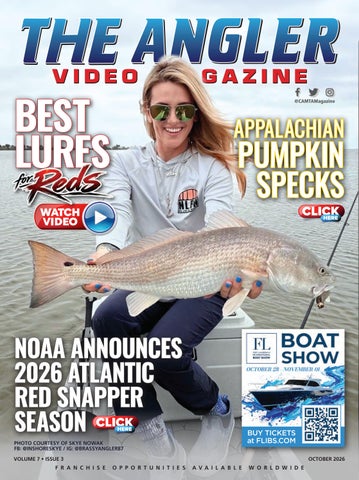
BEST LURES
@CAMTAMagazine
APPALACHIAN
PUMPKIN SPECKS
WATCH VIDEO
NOAA ANNOUNCES 2026 ATLANTIC RED SNAPPER SEASON
BUY TICKETS at FLIBS.COM
PHOTO COURTESY OF SKYE NOWAK FB: @INSHORESKYE / IG: @BRASSYANGLER87 VOLUME 7 • ISSUE 3
F R A N C H I S E
OCTOBER 2026
O P P O R T U N I T I E S
A V A I L A B L E
W O R L D W I D E
NOAA Announces 2026 Federal Recreational Red Snapper Season, Exempted Fishing Permits in South Atlantic
N
OAA Fisheries announced today the 2026 federal recreational red snapper fishing season in the South Atlantic and the issuance of three exempted fishing permits (EFPs) to Florida, Georgia, and South Carolina. The federal recreational red snapper season will open for three days this year from October 9 through October 11 —one day longer than
last year’s two-day recreational season. In addition, NOAA Fisheries has issued EFPs to Florida, Georgia, and South Carolina authorizing extended recreational red snapper fishing seasons for eligible participants from October 9 through October 22. After a comprehensive view of the October season and additional information, NOAA Fisheries and the states will jointly determine whether
a second season may take place in December 2026. NOAA’s EFPs allow states to pilot test new data collection and management strategies for the recreational harvest of red snapper in state and federal waters in 2026. “NOAA is dedicated to working with our state partners, fishermen, and fishery managers to advance sustainable fisheries and strengthen the science that supports them,” said Neil Jacobs,
Ph.D, NOAA administrator. “These efforts enable us to test new, innovative approaches and improve recreational data collection to support the long-term sustainability of South Atlantic red snapper.” “Recreational fishermen and the states play an indispensable role in helping us better understand and manage the South Atlantic red snapper fishery,” said Eugenio Piñeiro Soler, assistant administrator for NOAA
Fisheries. “These pilot projects provide a great opportunity to strengthen our data and inform future management approaches.” NOAA Fisheries is working closely with the South Atlantic Fishery Management Council offsite link and states to rebuild the red snapper stock and investigate ways to reduce recreational discards. The goal is to work collaboratively with the states to improve the collection of recreational fishing data; expand insights into
effort, catch, and discards; and to evaluate the potential benefits of state-specific management strategies while maintaining catches and discards within sustainable levels and informing long-term, state-led management. Always check with your state’s fishing and wildlife agency for the most up-to-date rules and regulations. CLICK HERE to find out more from NOAA Fisheries regarding each state’s EFP.
/26
9:14 AM
ERT28 - NOVEMBER 01 he 67th Fort Lauderdale International Boat Show (FLIBS) returns to the Yachting Capital of the World October 28-November 1, 2026, bringing a new wave of debuts, luxury experiences and marine industry attractions. As the world’s largest in-water boat show, FLIBS offers something for every boating interest and lifestyle. Across six show sites, attendees can explore everything from sportfishers and center consoles to the latest marine technology, accessories, fishing gear, diving equipment and personal watercraft. New this year is a floating pickleball court at Las Olas Marina, including a tournament for yacht crew members. “Entering our 67th year, FLIBS continues to prove why Fort Lauderdale is the Yachting Capital of the World,” said Andrew Doole, President of U.S. Boat Shows at Informa Markets. “There’s something special about returning to this city year after year to bring together the world’s most incredible vessels and deliver an unforgettable
experience for our attendees.” The Windward VIP Experience returns with two destinations. Superyacht Village will feature a VIP lounge with gourmet food, a premium open bar, exclusive activations, private restrooms and one-hour early access. The newly relocated Windward VIP Cabana Club at Bahia Mar Marina offers an intimate waterfront retreat with similar amenities. Both will feature culinary talent from Chef Ryan O’Sullivan of Hell’s Kitchen and Chef Dave White of Below Deck and Chopped. Also returning to Bahia Mar is Goslings Island Bar, located between Docks C and D. Goslings is the official rum of FLIBS. The Broward County Convention Center will again anchor the show with fishing boats, runabouts, cruisers, marine accessories, fishing and diving gear, and personal watercraft. The venue will host The Blue Wild, interactive
F LI BS .CO M
exhibits and the FLIBS Kids Corner. Don Dingman’s “Hook the Future” kids fishing clinics return Saturday and Sunday at noon and 2 p.m., with participants receiving a free fishing rod and reel. The Convention Center also serves as the transportation hub, with more than 3,000 parking spaces for $20 per day and complimentary shuttles and golf carts connecting show locations. FLIBS generates more than $1.79 billion in annual economic impact and supports more than 100,000 jobs across South Florida, according to the Marine Industries Association of South Florida. Tickets are available exclusively online at FLIBS.com; there is no onsite box office. Active military members and veterans can request one complimentary General Admission ticket for Sunday, November 1, by submitting a request in advance at informamarkets.jotform. com/252513285345153.
OCTOBER 28 - NOVEMBER 01 F L I B S .CO M
6 LOCATIONS | 1,300+ BOATS | 5 UNFORGETTABLE DAYS
®
VISIT SUZUKIMARINE.COM FOR MORE INFORMATION
SUZUKI MARINE ADDS TWO NEW MODELS TO GROWING STEALTH LINE® FAMILY OF OUTBOARDS New 25HP and 9.9HP STEALTH LINE® Motors Debut at 2026 Minneapolis Boat Show
S
uzuki Marine USA opened the 2026 Minneapolis Boat Show by unveiling two important new additions to its growing STEALTH LINE® family of outboard motors. These two new models—the Stealth Line 9.9HP and 25HP—bring this popular look to an especially high-volume segment of the overall boating market. They also bring their Stealth Line family to 10 total models ranging from 9.9 to 350HP. These two newest additions are an ideal power match for wide range of freshwater fishing and hunting boats, combining Suzuki’s proven performance, fuel efficiency and reliability with a distinctive look that matches the popular look of larger Stealth Line outboards. “Our dealers and boat building partners have been asking for kicker motors that provide a bold and cohesive appearance for their vessels, regardless of size,” said Brandon Cerka, VP Sales and Marketing for Suzuki Marine USA. “The 9.9HP outboard is an industry standard kicker choice for aluminum boat builders, particularly for small hunting and walleye boats. And our 25HP is a perfect choice for larger kicker applications that require additional thrust and power. When boaters pair either of these new outboards with our higher-horsepower Stealth Line models on the transom, their boat gets a one-of-a-kind look that stands out from the pack,” added Cerka. Suzuki’s STEALTH LINE outboards feature a distinctive matte black finish from top to bottom with matching chrome black accents, for a look that gives
any boat a touch of “luxury sportscar” attitude. As a bonus, the light absorbing properties of this matte black finish eliminate the need for owners of aluminum hunting boats to camouflage or repaint their motors, providing dealers with a ready-made solution for this important part of the market. Under their distinctive cowls, these Suzuki motors offer features and technology honed over 60 years in the outboard business. For example, both the 25HP and 9.9 Suzuki motors offer advancements like battery-less electronic fuel injection for easy starting and better performance, and Suzuki Lean Burn Control for enhanced efficiency. In fact, Suzuki’s 25HP outboard won an NMMA Innovation Award for bringing a range of breakthrough features to this class of smaller boats. “This is another example of how Suzuki Marine listens to its business partners and responds quickly to give the market what it wants,” said Cerka. “These motors give us a clear advantage in a very important segment of the overall boating market. More importantly, they give boaters a chance to go Full Stealth Mode with their aluminum fishing and hunting boats.”
To learn more about Suzuki’s leading range of 4-stroke outboard models —from 2.5 to 350HP— visit your authorized Suzuki Marine dealer or visit:
suzukimarine.com
PRO FISHING TECHNIQUES
3 Best Lures for Redfish Y
ou can find redfish around oyster bars, grass flats, mangroves, dock pilings, mud flats and any other place where they can find crabs, shrimp, snails and fish to eat. PRO TIP - Redfish spend most of their lives looking down with their heads “literally” in the mud. The best way to get their attention is with a lure that stinks and/or makes a lot of noise to maximize your catch. GULP! SHRIMP - That is why my number one lure choice for catching redfish in every inshore scenario is the Berkeley Gulp! 3” shrimp. I usually couple that lure with a 1/8 ounce jig head and a 20 pound leader. Cast it to your target and let it sink to the bottom. Then bounce it on the bottom back to you slowly and repeat. I think that many anglers fish their jigs too quickly. You have to give the redfish a chance to notice your lure and then come over and attack it. Another great technique is using a
popping cork with 18 to 24 inches of line beneath the cork. You are using the same Gulp shrimp and jig head but you are dangling it just off of the bottom and popping the cork to get the redfish’s attention. This is a great combination because it lets the redfish use its nose and its lateral line to find the bait. GOLD SPOONS- Gold spoons have been the gold standard of redfish anglers for decades. This simple lure catches the heck out of redfish anywhere redfish live. There are long time redfish anglers who only use gold spoons to target reds. You will want to get a weed less gold spoon because you need to fish them in the bottom part of the water column. They work the best when they are bounced on the bottom or when they are presented just off of the bottom. Cast your gold spoon and bounce it slowly on the bottom as you reel it back to you. The spoons do not have any scent to
CAPT. MIKE SMITH
attract the redfish but they can see the flash and feel the low frequency vibrations as the lure moves through the water. PADDLETAIL - A 3-inch paddletail catches just about every fish that swims and it is very easy to fish with. Redfish prefer a slow and steady retrieve that bounces off of the bottom. Your best paddletail colors for redfish are white with gold glitter for clean water scenarios or brown with gold glitter for dirty water scenarios. Choose a paddletail with lots of wiggle so the redfish can feel your lure even if they can’t smell it. Bring the three lures mentioned in this article for your next redfish trip and you will be very happy with your results. Go get ‘em.
Capt. Mike Smith, owner of Fish Your Ass Off Charters, is an inshore fishing guide who has been fishing the inshore waters, oyster bars and grass flats of Florida for more than 40 years. Reach him at (561) 339-2317, email: contact fishyourassoff.com or visit fishyourassoff.com.
8
OCTOBER 2026
THE ANGLER VIDEO MAGAZINE
Redfish Regs
F
all is prime time for targeting redfish, but rules and regulations vary by state and often change, so always check with your state’s official Fish & Wildlife agency for the most current rules before fishing. • Texas: 3 fish, 20-28 inches; special regulations apply to oversized fish. • Louisiana: 4 fish, 18–27 inches. • Mississippi: 3 fish, 18–30 inches, plus 1 over 30 inches. • Alabama: 3 fish, 16–26 inches, plus 1 oversized fish. • Florida: Generally 1 fish, 18–27 inches. Indian River Lagoon is catch-and-release only, with regional differences elsewhere. • Georgia: 3 fish, 15–24 inches. • South Carolina: 1 fish, 15–23 inches. • North Carolina: 1 fish, 18–27 inches.
Submit Your Best Redfish Photos for a Chance to Get Featured in Coastal Angler Mag!
THE ANGLER VIDEO MAGAZINE
OCTOBER 2026
9
TZT16X | 22X | 24X
9"- 24" MFDs
Level Up
TZT9E | 13E
TZT10X | 13X
Your Helm
When helm space is at a premium, the 9" and 13" TZtouchE MFDs give you maximum screen area to view their eye-popping TZ MAPS charts and builtin TruEcho CHIRP™ Fish Finder with Side-Scan. Plus, TZtouchE is fully networkable with the TZtouchXL family of 10", 13", 16", 22", & 24" MFDs and a wide range of best-in-class sensors – legendary Furuno Radars, Sonars, Fish Finders, Autopilots, and more. Furuno... The reason to level up your helm!
Marine Electronics
Small Footprint. Serious Power.
FURUNO LAUNCHES TZMAP STAND-ALONE MFDS
F
uruno is expanding its line with the introduction of the TZMAP9 and TZMAP13, two new, powerful all-in-one stand-alone Multi Function Displays with built-in TruEcho CHIRP™ Fish Finders that bring the power of Furuno’s acclaimed TZ MAPS cartography to smaller vessels desiring to operate from a single display. Designed for boaters who want simplified, reliable navigation without network complexity, these models deliver powerful features through a user-friendly multi touch interface for a variety of boat types and sizes. The 9” TZMAP9 and 13” TZMAP13 feature responsive, sunlight-readable multitouch displays powered by a streamlined version of the TZtouchXL operating system. These MFDs are equipped with a 300W/600W/1kW, single-frequency TruEcho CHIRP™ or dualfrequency CW Fish Finder, CHIRP Side-Scan capability (230kHz or 455kHz), and advanced chart plotting capability built around Furuno’s revolutionary TZ MAPS platform. With a free My TimeZero account, waypoints and routes can be easily backed up or retrieved from the cloud with just a few taps, ensuring critical data remains safe and secure. Designed for simplicity while retaining advanced functionality, these units support Radar options such as the Solid-State Doppler DRS2DNXT and DRS4DNXT. They also offer integration with the TZ iBoat App and support AI Routing, helping boaters plan smarter, safer routes. TZMAP units come ready-to-navigate out of the box with pre-loaded,
official NOAA Vector charts for the entire coastal US. For a serious upgrade at an incredible value, optional TZ Maps charts can be purchased directly from the MFD. TZ Maps delivers customizable, detailed cartography built on a foundation of official hydrographic charts, high-resolution BathyVision™ bathymetry, satellite imagery, and community-sourced data. It’s the most intuitive and powerful charting system Furuno has ever offered, and it’s built right into every TZMAP9 and TZMAP13. Plus, your first chart purchased through the TZMAP MFD is available at a special low introductory price of only $150 an incredible price for the entire USA, or any other chart area. With details this precise and coverage areas this large, TZ MAPS is one of the most affordable chart options on the market. From bay boats to kayaks and sailboats to cruisers, the TZMAP9 and TZMAP13 offer an accessible entry point into Furuno’s navigation ecosystem. These units are ideal for boats 16’ and up in need of essential fish-finding tools, cutting-edge charts, and affordable Radar options in a clean, stand-alone package. For more information on the TZMAP9 and TZMAP13, contact your authorized Furuno dealer or visit
www.FurunoUSA.com.
12
OCTOBER 2026
THE ANGLER VIDEO MAGAZINE
The Magic Starts in October
T
TIM BAREFOOT
his is the time of year I live for, especially for offshore bottom fishing of numerous species. This year is going to be different, however, thanks to regulations that have completely shut down our gag grouper fishing. October, November, December, and the first three weeks of January are the absolute apex of gag grouper fishing. In my opinion, flawed science and highly extrapolated data are the reasons we are now facing a zero creel limit for gag grouper for the rest of the year. The situation with the Atlantic’s American red snapper is just as bad. Divers report having to wait for the Americans to get out of the way before they can shoot other target fish, and hook-and-line fishing is off the chart. It’s common to catch and release 20 red snapper per trip, yet we are legally forbidden from keeping a single one, at least for the moment. Where did they get the data to justify shutting down and keeping the American red snapper fishery closed? I would love to take these decision makers out on the water, or show them the underwater video footage captured by my diving friends, because it completely contradicts the flawed data they are using to make decisions. Despite the regulatory headaches, the beauty of October through January is the gags and snapper will be literally right up on the beach. Last year, some of our best trips were within eyesight of the beach and we caught a serious number of fish. The larger male gags are starting to congregate on the inshore edges now in anticipation of the females coming soon. They will gather enlarged numbers on traditional spawning grounds that typically have good bottom and schools of bait, like
cigars and sardines, and the little known fact of it is the same places will hold squid. I always say, “Find the bait … find the fish!” Yes, it’s important to find pretty bottom with some type of structure. If nothing else, look for live bottom and vegetation, but the ultimate scenario is finding big stacks of bait right on top of it. Let’s face it. That’s where your fish are going to be. You wouldn’t hang around in a place with nothing to eat, and neither will they. It’s a simple recipe this time of year to catch everything on the bottom. I always make sure to grab two boxes of frozen cigar minnows and whatever live bait we happen to have in the traps at the marina. But one of the best things you could possibly do is put one person on the Sabiki when you get to where you’re going. In addition to the frozen cigars, catch some live snappers or live cigar minnows and/ or sardines. A live sardine on the bottom has a life expectancy under five seconds. It’s easily one of the most effective baits, especially when attached to a Crab Decoy Jig. The beauty of the shallow water gag and American red snapper fishing in the fall is that almost none of the fish are injured with bladder inflation. You can release them at the side of the boat and they will take off immediately back to the bottom healthy and unharmed. The biggest problem we have now is the sharks are on to us. Wherever we stop, they hear the trolling motor and the fish struggling, so they come to it. Chances are pretty good you’re going to get a gag bit in half. When that happens, you need to move right away, otherwise you’re just feeding the sharks. They start gathering in numbers - we’ve seen as many as six or eight full grown sharks under the boat at one time. Here’s your sign…it’s time to move. Above all, take your kids out on the water, let them experience these amazing resources, and teach them to be good stewards for the future. To learn more tips and techniques from Tim Barefoot, visit barefootcatsandtackle.com.
THE ANGLER VIDEO MAGAZINE
OCTOBER 2026
13
SCAN TO CHECK US OUT
WWW.AOCOOLERS.COM
COOLERS, the leader in high-performance soft-sided coolers, is hitting the
water this year with new, upgraded fishing products. Our fishing team partners told us what they needed, and we listened! Products are in stock and ready to ship; The Fishing Cooler Backpack, 2, 4 & 6ft Fish bags, Fillet bags, Boat fenders, EVA Traction pads, Inflatable Docks, ISUPs, and of course, our high-performance coolers specifically designed for use on boats, guaranteed not to leak, and to keep ice cold for up to 24 hours. Thirty years ago, AO was launched to provide active, hard-core people with quality products at a reasonable price. We started selling our soft-sided coolers to the hard-core, go-fast boaters and fishermen in Lake Havasu. We aimed to keep ice in our coolers for up to 24 hours in 120-degree Havasu heat. That goal was accomplished 30 years ago, and we’re still at it. We know our customers; they fish and boat in the summer and ride the dunes or trails in the winter. AO products give those high-octane souls greater freedom to embark on and enjoy what’s important to them. Make sure that your gear does not hold you back from doing what you love. AO products are built to handle whatever offshore adventure is coming next. AO is flexibly rugged, seriously fun, and honestly real! We’re looking for active, adventurous folks that demand quality and performance from their gear. Share your adventure and send us your fish story or photo.
www.aocoolers.com
CHASING TUNA WITH THE LEGENDARY BATSON FAMILY
T
here is something surreal about being on the water with people who have basically written the manual on custom rod building and have experienced all types of fishing around the world. “Beyond excited” is how I felt when I found out I was getting the chance to fish and film with Bill Batson, his son Keller and daughter Eden for an episode of “Let’s Take It Outside.” The plan was to meet in Pensacola, Florida, in the spring for yellowfin tuna season and fish with UnReel Fishing Outfitters. However, before we jump into the filming and fishing trip, let me bring you up to speed on who the Batson family is and why they are so important to the fishing industry. In 2000, Bob Batson, founder of Batson
Enterprises, began his family’s legacy at home in his humble garage on Maui. Fast-forward 26 years, and his legacy is now carried on by his son Bill, his grandchildren Keller and Eden, and other members of the Batson family. Now, you may say, “I’ve never heard of Batson Enterprises.” Maybe not, but I can assure you that you have probably fished one of their rods. They are the largest family-owned supplier of fishing rod blanks and components in the U.S. today. Some of their most popular brands are RainShadow, ALPS and ForeCast, which are sold across the globe. It’s fun talking to Bill as he laughs with joy while explaining how blessed he is and how much he enjoys his “research and development”
expeditions across the country. Talk about having one of the best jobs in the world—I think Bill takes the cake! Bill and the Batson family have a complete focus on integrity, quality and a passion for fishing, and they personally work with thousands of suppliers year-round, earning lots of frequent-flyer miles in the process. This past spring, Bill and his team met me in Perdido Key, Florida, to head offshore with Capt. Tommy LaRonge and mate Alex Varner to target yellowfin tuna. Eden and Keller Batson were especially excited, as neither had yet landed a yellowfin tuna. This could be their moment. Of course, before showing up in Florida, Keller and I had worked together on some custom “Misty Wells” rods designed specifically
for this trip and targeting big tuna. Needless to say, I was excited to unwrap these rods and put them to the test. I had never had my own custom rods before, so this was a first for me. Upon arriving in Perdido Key, we were greeted by Capt. Tommy and Alex at the “Tuna Town” house where we were all staying. Each year during peak tuna season in the northern Gulf, Capt. Tommy of UnReel Fishing Outfitters rents a large home and runs epic tuna trips for the most adventurous anglers. April, May and June are peak season for yellowfin tuna fishing in the northern Gulf, and Capt. Tommy has that area dialed in. This past year, Tommy and Alex came very close to breaking the Florida state record with a 210-pound yellowfin tuna to kick off the new season. That night, we all went over the fishing game plan for the next day and decided to hit the hay early. After all, 5 a.m. comes fast. Jumping right into the action, we started by catching live bait under the bridge before heading offshore for the day. Not only were we testing out my new rods, but we were also filming a full episode of “Let’s Take It Outside” for Discovery Channel. Needless to say, excitement was in the air as Tommy throttled up his 42-foot Invincible to a cool 45 miles per hour, and we headed 80 miles offshore. On the way to our first stop, Tommy noticed a big school of tuna feeding on the surface, so naturally, we turned toward the school to test our luck. The best approach when chasing a school of yellowfin tuna is to get ahead of the school in a wide circle, drop your baits back and let the fish come to you.
Tip: Never run directly toward the school or through it. They will sound, and you may never see them again. To get the bite going, we started throwing a bunch of “live chummers” into the school to create a feeding frenzy. Then we grabbed two large live baits, rigged them on 5/0 circle hooks and cast in front of the school. Instantly, we had a double hookup! But just as quickly as we hooked two fish, Bill got broken off. Bill may have lost his fish, but Keller still had his large yellowfin on the line, and the fight was on. Even though Keller had never landed a yellowfin before, he fought that fish like a pro. Keller and Bill traded off the rod for more than 45 minutes until the fish finally gave up. We estimated Keller’s fish at a solid 75 pounds as we tossed it in the box, but there was no time to waste. We still had a full day ahead of us. Now that we had one fish in the box, some of the pressure was off, but Eden and I needed our time on the rod as well. Pulling up to the first FAD, there was plenty of action, with tuna popping everywhere. If you’re not familiar with what a FAD is, it stands for Fish Aggregating Device. A FAD is a man-made object placed in the water specifically to attract pelagic fish such as tuna, mahi, marlin and wahoo. They work by providing a visual reference point and shelter in the open ocean, attracting smaller baitfish and eventually drawing in larger predators through the food chain. Those FADs certainly worked because Eden and I hooked up at the same time, and we dug in for the fight. Unfortunately, it was short-lived for both of us. Eden and I were
faces. We were “one big, happy Batson family.” Back at the dock, although tired and weary, we hung our catches for the day and posed for some memory-making photos. While fishing offshore with the Batson family, I realized just how important these days on the water are. Bill Batson cherishes not only the memories he creates with his own family, but also the opportunity to help create those memories for thousands of anglers he may never meet. Steeped in three generations of the fishing industry, Batson Enterprises has some of the deepest roots—and has helped create some of the greatest memories—in fishing. Congratulations on more than 26 years in the fishing industry, Batson family. We look forward to many more with you and your team. Bill, Keller and Eden, thank you for fishing with Capt. Tommy, Alex and me, and thank you for my new fishing memories. Readers, don’t forget that you can tune in to watch the full, action-packed episode of the “Let’s Take It Outside” Batson Family Tuna Trip on Discovery GO & Plus, Waypoint TV, Carbon TV and Wild TV. And please subscribe to my YouTube channel. If you are looking to book the fishing trip of a lifetime, reach out to me at mistywells.com or ucatchfish.com. Until next time, tight lines, and thank you for following my adventures as I take you around the world, “one catch at a time.” Misty Wells is an award-winning Florida-based outdoor personality, producer, and host of the fishing and adventure “Let’s Take it Outside” television show, which airs to 220 million on the Discovery Channel, Wild TV, Outdoor Channel and other networks. As a prominent outdoor writer and conservationist, she is founder of “A Reel Future,” a non-profit devoted to teaching the passion of fishing and conservation to foster children—4,000 children and counting. Visit MistyWells.com and AReelFuture.com to learn more.
both broken off almost simultaneously. It was heartbreaking. But like the saying goes, “There are plenty of fish in the sea,” so it was time to fish on. As the day went on and the tides changed, the bite grew a bit slower and the schools became harder to find. Finally, we located an active school, and we were ready to land a yellowfin for Eden. Once we chummed up the water, Eden hooked a nice fish, and this one was no joke. True to form, our Batson custom rods joined us in the fight of a lifetime as we worked to land Eden her first yellowfin tuna. So many things can go wrong when you are fighting tuna: equipment failure, knot failure, the fish swimming under the boat or wrapping around the FAD are just a few. It’s important that the crew knows when to move and reposition the boat to reduce the chances of the fish getting under the motors or the boat. For more than an hour, Eden fought that fish and never gave up. She and Capt. Tommy shared the rod and battled that fish until they finally raised the beast to the surface. Things can go wrong right up until the very end, but with a perfect gaff shot, Alex got that tuna into the boat. I had mixed feelings about the day. I was happy that Eden and Keller had landed their first yellowfin tuna, but I was a little sad that all of mine had gotten off. I was coming home empty-handed. Finally, our long day of fishing was complete, and it was time to head back to shore. We were all beat, as you can imagine. As we settled into our beanbags for the ride home, huge grins crossed our 18
OCTOBER 2026
THE ANGLER VIDEO MAGAZINE
Best tooling Best construction Best finishing Best delivery Best rod components on the market today.
THE ANGLER VIDEO MAGAZINE
OCTOBER 2026
19
POWER MEETS PORTABILITY. kLite 750W
Electric Outboard Motor Building on the award-winning technology that shattered convention with its highly portable eLite, ePropulsion expands with the introduction of its kLite 750 — a powerful, silent, eco-friendly electric outboard motor contained in a lightweight and compact form factor ideal for recreational or fishing kayaks alike.
epropulsion.com
Click Here to Find Your Local ePropulsion Partner
ePROPULSION ENTERS POWERED KAYAK FISHING MARKET WITH INNOVATIVE KLITE ELECTRIC OUTBOARD
G
lobal leader in marine electric propulsion systems and services, ePropulsion Americas recently announced that it is entering the powered kayak market with the all-new kLite 750 electric outboard. Building on the award-winning technology that shattered convention with the highly portable eLite, the kLite 750 is powerful, but contained in a lightweight and compact form factor ideal for recreational or fishing kayaks alike.
Coming in under 15 lbs. with a 378Wh integrated battery, it is perfect for quick trips and carry-in access. Optional accessories allow third-party battery recharging while fishing or floating. Go Mode delivers 500W continuous power or double tap the mode switch for a 750W Sport Burst (60 seconds) to shoot rapids or punch through rips. Toggle to Fish Mode for refined low-end control to hit every laydown and pocket. The kLite operates in less than seven inches of water or it can be adjusted deeper for big water. The rudder-shaped design steers even when the throttle is off. It has a spring-tensioned mechanism that delivers up to 300W in reverse, ensuring the propeller won’t kick up and spook fish. The spring gives way smoothly on collision with underwater objects or rocks or manual lift. A separated display keeps your eyes on the water. The sun-shaded color monitor mounts on console, deck, or track. The low-profile throttle tucks beside the seat without snagging clothing. Users simply snap motor onto mounting pin, connect steering lines and cables, and anglers are ready to fish in minutes. The unit includes a grab handle in case the mount blocks your kayak’s existing carry handle. “When we showed our original prototype at ICAST last year, the interest was substantial,” Tom Watson, president of ePropulsion Americas. 2026, and will also be available for on the water demonstrations on July 14. “The eLite has already been revolutionary for tenders and small craft, and Units will be available for purchase in August, 2026. . we are confident that the kLite is going to take kayak anglers to new and For more information on ePropulsion or its revolutionary electric motors and exciting places.” The kLite will be on display at ICAST 2026, in booth #1608, July 14-17, accessories, visit www.ePropulsion.com or contact jeff.little@epropulsion.com.
By Capt. Michael Okruhlik
PHOTOS COURTESY OF KNOCKIN TAIL LURES®
AN OCTOBER
GAME PLAN
O
ctober is one of my favorite months to fish the coast. Cooler weather makes a day on the water more comfortable, boat traffic begins to thin out, and the bays and marshes come alive. Trout, redfish, and flounder are feeding on shrimp and finfish, and it is not uncommon to find all three in the same area. My October game plan starts before I launch the boat. Satellite imagery is a great tool for locating shallow coves connected to drains, bayous, or small cuts. I look for areas with shell, grass, subtle depth changes, and a drain that is still open rather than sanded in. Once I arrive, I slow down and look for bait. A promising shoreline without bait usually does not hold my attention for long. Outgoing tides are my first choice because moving water concentrates bait and fish. Mouths of drains are obvious places to start, but do not overlook bends, narrow sections of a bayou, points extending into a bay, or cuts through a reef. Anything that increases current or funnels bait can create a feeding area. I will occasionally start with a topwater, but most of the time I have a durable paddletail tied on. A smaller paddletail helps match the young bait common in the marsh, while a 4-inch version is a dependable choice on open flats. I rig it weedless around grass and other cover or use a jig head in cleaner or deeper water. A paddletail lets me cover water quickly, and its vibration helps fish locate it. Add a built-in rattle and the lure gives fish another reason to investigate. Before changing colors or lures, I change my retrieve. Redfish often respond to a steady
retrieve. Trout may prefer an erratic twitch- next. Enjoy the cooler weather, try a different twitch action. For flounder, I keep the lure approach when the bite slows, and take a kid close to the bottom with the rod tip down or fishing. to the side and use firm twitches that make the lure dart forward without jumping too Capt. Michael Okruhlik is the inventor and owner of Knockin Tail Lures® — knockintaillures.com. high. Around a drain, I concentrate casts along the edges, bends, and small washouts where flounder can wait in ambush. Fish do not read fishing articles, so none of these rules are absolute. Let the bait, current, knockintaillures.com structure, and strikes tell you what to do THE ANGLER VIDEO MAGAZINE
OCTOBER 2026
23
43,000 acres of legendary fishing from trophy bass, to world class sauger. A true Bill Dance Signature Lake.
ExplorePickwickTN.com
L
ocated on the Tennessee River where Tennessee, Alabama, and Mississippi meet, Hardin County is a premier southern destination built for anglers. While the area offers endless outdoor adventure, the true heartbeat of Hardin County lies in its world class waters, rich history, and deepfried southern traditions. Sitting idyllically on the banks of the river is Savannah, the county seat and the proud “Catfish Capital of the World.” This historic town is home to friendly family parks, historic homes, and the roots of authentic southern comfort food. For the ultimate post fishing feast, head to nearby Hagy’s Catfish Hotel Restaurant. Perched right on the riverfront, this legendary hot spot has been serving up baskets of golden hushpuppies and pristine fried catfish to locals and traveling anglers for over 80 years. For those visiting to bend a rod, the opportunities are endless. Whether you prefer targeting catch on the main lake, working the current below the dam, slipping into a secluded cove, or casting from the bank, fishing is big business in the area. Explore Pickwick TN has rolled out the red carpet for the sport, consistently recruiting major tournament circuits like BASSMASTERS and Major League Fishing to these fertile waters. On the shore of Pickwick Lake sits Pickwick Landing State Park. Featuring a recently renovated lodge, full-service marina, championship golf course, and convenient boat rentals, it serves as the ultimate launchpad for a weekend on the water. Boaters coming off the lake can grab a bite at the restaurant located within the Lodge or tie up to enjoy great local pizza, burgers, or flavorful BBQ around Pickwick. The Pickwick area is so deeply tied to the water that it has become an ideal retirement destination for anglers looking for pristine lakefront properties or quiet acreage with rambling creeks.
TRENDING SALES@CAPSMITH.COM
Fishing CAPS
Business’s FULFILLING YOUR HEADWEAR NEEDS
BUY ONE CAP JUST FOR YOU
BUY CUSTOM
CAPS IN BULK
1-800-228-3889 26
OCTOBER 2026
THE ANGLER VIDEO MAGAZINE
The Fall Kingfish Migration is Coming!
WATCH
VIDEO
A
s summer fades and cooler water begins pushing south along the East Coast, one of the most exciting migrations of the year is about to get underway. King mackerel are on the move, and October can be prime time for chasing them. Known as kingfish or “smokers” to anglers, king mackerel are built for speed. They are powerful predators that spend much of their time chasing baitfish along the coast, and their seasonal movements are closely tied to water temperature and food availability. NOAA Fisheries says kings prefer water warmer than about 68 degrees and migrate north during the summer before heading south for the winter. For East Coast anglers, that southbound migration is what makes fall so special. North Carolina’s Division of Marine Fisheries notes that king mackerel move inshore along beaches and near the mouths of inlets and rivers during the summer and fall. The fish follow concentrations of bait such as menhaden, mullet, threadfin herring and sardines, and feeding kings can sometimes be spotted skyrocketing through schools of bait on the surface. That makes October a great month to start watching the water. From North Carolina and South Carolina through Georgia and Florida, kingfish can show up anywhere from nearshore structure and artificial reefs to the edges of bait schools farther offshore. A moving body of bait is often a better clue than simply fishing a particular piece of bottom structure. Trolling remains one of the most popular ways to target them. Live bait such as menhaden, cigar minnows and other locally available baitfish can be deadly, while dead ribbonfish and artificial lures also have their place in the fall kingfish arsenal. And when a big king decides to eat, things can get exciting in a hurry. The fall migration also brings tournament anglers out in force. King mackerel support a substantial recreational fishery and are a favorite target in tournaments throughout the Southeast. For anglers planning October trips, the key is to follow the bait and watch the water temperature. Kings migrate south as conditions change, so the fish that are showing up off one area early in the month may be considerably farther south later in the season. The good news is that the migration stretches along a huge portion of the Atlantic coast. And somewhere between the beaches of the Carolinas and the waters of Florida, the next big smoker is already on the move.
THE ANGLER VIDEO MAGAZINE
OCTOBER 2026
27
Dometic Premier Film Reveals the Innovation Behind Award-Winning DG3 Technology
D
ometic recently premiered “The Voyage,” a new documentarystyle film chronicling the development of its award-winning DG3 Gyrostabilizer. Featuring engineers, designers, and innovators at Dometic Marine, the film provides a behind-the-scenes look at how Dometic challenged conventional gyro technology to deliver significantly faster spin-up times, 40% lower power consumption, and broader accessibility for recreational boaters. With their ability to counteract wave motion and reduce side-to-side boat roll by as much as 95%, gyrostabilizers have the power to make recreational boating more comfortable and enjoyable whether fishing, cruising, or relaxing on the anchor. With its new DG3, Dometic set out to overcome common obstacles to gyro ownership, delivering industry-leading spin-up and spindown times, greatly reduced energy consumption, electric actuators with active precession for faster response and better performance, and maintenance-free design. The technology behind Dometic’s DG3 is so groundbreaking, it won both an NMMA Innovation Award at the 2025 Miami International Boat Show and the Dame Design Award at METS Trade 2025 in Amsterdam. This new film shares how the Dometic Marine team overcame engineering and design challenges throughout DG3’s development. It also explains the “why” — how Dometic designers and engineers set out to make the benefits of gyro stabilizing technology accessible to more boats and boaters around the world. The Voyage was filmed and produced in and around Dometic Marine’s design and manufacturing center in Vancouver, Canada — where many of the company’s award-winning boating products were designed, manufactured, and tested in one of the industry’s most 28
OCTOBER 2026
THE ANGLER VIDEO MAGAZINE
advanced facilities. “We recognized early on that we needed outside-the-box thinking and bold adaptations of our core technologies to truly take gyro performance to a “Whole New Level,” said Dometic Marine Segment President Eric Fetchko. “For DG3 to be truly revolutionary in terms of spin-up time, power consumption, ride-smoothing performance, and durability, we had to achieve things that had never been done. This film takes the audience into our design room, factory floor and testing facilities as we create what will be the first of many gyro systems in the future,” added Fetchko. To learn more about Dometic’s award-winnning DG3 technology, visit your nearest Dometic Marine retailer or go to www.dometic.com.
A WHOLE NEW LEVEL Introducing Dometic’s DG3 Gyro
Smooth Sailing Experience a new level of comfort on the water with our DG3 Gyro Stabilizer. By minimizing boat roll, it ensures a smooth, steady ride, even in choppy conditions. Whether you’re fishing, dining, or just unwinding, the Gyro creates a more enjoyable and stable environment. Operating quietly and without the need for external fins, it lets you focus on what matters most: making every moment on the water truly relaxing.
dometic.com
By A. deGruchy
ctober is a great month to chase blackfin tuna in the Florida Keys. The weather starts to change a little, the bait gets moving, and the offshore bite can get really good. Blackfin are one of those fish that can turn a slow morning into chaos pretty quickly. Once you find them, it is usually fast action, hard runs, and a lot going on at once. Around the Keys, we usually start looking around deeper wrecks, offshore structure, current edges, and anywhere bait is getting pushed around. There are plenty of deeper wrecks and artificial reefs scattered off Key Largo, Islamorada, Marathon and the Lower Keys that can hold blackfin. You do not always have to be right on top of the wreck either. A lot of times the fish will be moving around the area, especially if there is good current and bait nearby. Birds are always worth watching too. If you see birds dipping, bait getting pushed up, bonito going
crazy or flying fish getting chased, there is a good chance something is feeding underneath them. Trolling is one of the easiest ways to cover water and find fish. Small feathers, skirts, diving plugs, and other smaller tunastyle baits all work well. Blackfin are fast fish, so you can keep the boat moving and still get plenty of bites. We like to spread the baits out behind the boat and work around an area instead of just trolling in a straight line all day. Once you get a bite, circle back through that same area because where there is one blackfin, there are usually more. If birds are working, try not to run straight through the middle of them. Work the edge, keep the baits in clean water, and let the fish come to you. Vertical jigging is probably one of the most
fun ways to catch blackfin. If the fish are holding deeper around a wreck, drop a jig down and work it back up fast. Sometimes they will eat it deep, and other times they will follow it halfway back to the boat before crushing it. Savage Gear jigs are a great choice for this style of fishing because they drop fast, have a good profile, and are easy to work through the water column. Current plays a big role in what size jig we use.
If it is ripping, go heavier. If the current is lighter, you can fish something smaller and get a little more action out of the jig. The biggest thing is keeping it moving because blackfin usually want something fast. For this kind of fishing, we like a PENN Authority spinning reel matched with a Carnage III rod. It is a solid setup for jigging, casting, or throwing a bait at fish that suddenly pop up on the surface. The Authority has plenty of drag for a hardrunning tuna, and the Carnage III has enough backbone to put real pressure on the fish. That matters a lot in the Keys because getting the tuna to the boat is only half the battle. The sharks have been bad, especially around some of the deeper wrecks. You can hook a perfectly good blackfin, fight it halfway up, and then suddenly everything changes. Sometimes you get the head, sometimes you get half a tuna, and sometimes you get absolutely nothing back. It is frustrating, but it is part of fishing these areas right now. The best thing you can do is put pressure on the fish and get it to the boat as quickly as possible. This is not really the time to play a tuna for 20 minutes if you can help it. Once the sharks figure out what is going on, they can make fishing the same spot pretty tough, so if you start losing multiple fish, sometimes the best move is to leave the area and find another school instead of feeding the sharks all afternoon. Having a heavier setup like the PENN Authority and Carnage III really helps because you can pull harder and shorten the fight. One of the best parts about fishing blackfin in October is that you do not have to stick with one method. Start trolling and cover some water. If you find fish around a wreck, drop Savage Gear jigs. If they suddenly start blowing up on bait, grab a spinning rod and start casting. Things can change quickly, so having a few rods rigged and ready makes a big difference. October can be a really fun month offshore in the Florida Keys. The blackfin are fast, they fight hard, and when you get into a good school, the action can be nonstop. Just make sure you get them to the boat before the sharks do. Follow all of deGruchy’s adventures at @bean_sportfishing on Instagram and YouTube.
TEEN ANGLER LANDS NEW FLORIDA STATE RECORD JAGUAR GUAPOTE
A
t just 16 years old, Miami angler Xzavier Peon has already made his mark in the Florida fishing record books. Peon recently landed a 3.02-pound, 16-inch jaguar guapote from the Westwood Lakes area of South Florida, earning the new Florida state record for the species. Peon was targeting fish with live bait when the jaguar guapote struck. At first, he thought he had hooked a peacock bass, but when the fish surfaced, he quickly realized he had something special. “Once the giant jaguar came up I knew that it was a state record almost instantly.” The catch breaks a nine-yearold Florida state record for jaguar guapote. The nonnative species is now established in several South Florida canal systems and has become a popular target for freshwater anglers. The Florida Fish and Wildlife Conservation Commission encourages anglers to harvest nonnative freshwater species when regulations allow, helping reduce potential impacts on Florida’s native fish and ecosystems. For Peon, though, the biggest reward is having his name attached to a Florida fishing record at only 16 years old. Not a bad way to make your mark.
SPECIES SPOTLIGHT: JAGUAR GUAPOTE
T
he Jaguar Guapote is a large, non-native freshwater cichlid now established in southeastern Florida’s coastal canal systems, with records as far north as the West Palm Beach area. It has a robust, semi-elongated body with a large oblique mouth and prominent canine teeth, and is easily recognized by its broken lateral line and striking black-spot and blotch pattern along a pale body — reminiscent of a jaguar’s spots. This species is an aggressive predator, feeding mainly on small fish and aquatic insects, but also consuming snails, worms, and other prey. In Florida, jaguar guapote tolerate poor water quality and warm temperatures, thriving in canals and sluggish waters. They spawn on hard surfaces, with both parents guarding eggs and young. Though valued by some anglers and considered good to eat, this nonnative predator can impact native fish communities due to its voracious feeding habits. THE ANGLER VIDEO MAGAZINE
OCTOBER 2026
33
DRAWING HELD 12/18/26
ENTER TO WIN AT: One entry per person. No cash value. Prize does not include airfare or transportation to Clearwater Beach or destinations. Winner is responsible for transportation. Subject to blackout dates. Actual prizes may vary from what is listed and subject to change without notice. Winner has up to 72 hours to claim their prize. If winner does not confirm receipt, another drawing will be held. Winner announced 12/18/26 on Facebook and will be notified via email and any other secondary contact listed. Must be 18 years or older. Please email webmaster@coastalangleragazine.com for any questions. Thank you and good luck!
SCAN ME
THE ANGLER VIDEO MAGAZINE
OCTOBER 2026
35
THE FALL STRIPED BASS MIGRATION IS COMING
C
ooler water means one thing for East Coast anglers: the fall striped bass migration is about to get underway. From New England to the Mid-Atlantic, October is one of the most anticipated months of the year for striped bass fishermen. As water temperatures drop and baitfish begin moving south, stripers follow their food source along the coast, creating some of the best opportunities of the season. The migration doesn’t happen all at once. Fish begin moving out of their summer areas as conditions change, with larger concentrations eventually showing up around inlets, beaches, rips, rock piles, bridges and other areas where bait becomes concentrated. For surf fishermen, October can be
particularly exciting. Striped bass often move close to shore while feeding on menhaden, bunker, mullet, sand eels and other baitfish. When predators push bait against the beach, the action can be fast and furious. Boat anglers have plenty of options as well. Trolling, casting plugs and jigs, drifting live bait and working rips and structure can all produce during the fall run. Finding the bait is often the first piece of the puzzle. The timing of the migration varies from year to year and from north to south. New England fish generally begin their move earlier, while the migration continues down the Mid-Atlantic coast as fall progresses. That makes October an especially good
month to keep an eye on reports from neighboring states. A strong push of fish in one area can be an indication of what’s coming next down the coast. Of course, striped bass regulations vary considerably by state, including size limits, bag limits and seasonal restrictions. Anglers should always check the current regulations in the state where they plan to fish. For those who have been waiting all summer, though, the message is simple: the water is cooling, the bait is moving and the fall striper run is coming. And when the migration gets rolling, it’s one of the most exciting fisheries on the East Coast.
Visit Cherokee County
One can never get lost here visitcherokeecountync.com
Chasing The Fall Feed Chasing T The Fall Feed WATCH
VIDEO
By Bait Cave Customs Pro Joey Bloom
he days may still be hot now, but the nights will begin to cool as fall moves closer. Water temperatures that have been in the 80’s and 90’s slowly drop, and bass start changing their behavior. This seasonal transition can create some of the best opportunities of the year to catch a true monster. During the summer months, many of the biggest bass spend a lot of their time around deeper structure, offshore cover and areas where they can find cooler, more comfortable water. As we move toward fall, baitfish become the key. Shad begin moving, and bass know that an easy meal is available. When I see that transition starting, I want a bait that can imitate those shad and give me the ability to cover water. That’s one reason I developed the Bloom Shad with Bait Cave Customs. Making its debut at ICAST 2026, the Bloom Shad is designed to imitate a natural shad profile while giving me plenty of versatility. I can fish it around grass, brush, docks and other cover, or work it through areas where bass are actively feeding on baitfish. When the bass are roaming, I want something I can cast, retrieve and cover water with while still having the ability to slow it down when I find a productive area. It has quickly become one of my favorite soft plastics to utilize when I’m looking for quality fish. One of the biggest keys during this transition is paying attention to the bait. If I find shad around points, creek channels, grass lines or the mouths of pockets, I know there’s a good chance bass won’t be far away. I also pay close attention to changing water conditions. Fall rains can raise lake levels, push fresh water into the system and move baitfish into newly flooded cover. When that happens, some of the biggest bass in the lake will take advantage of the opportunity to feed up. I like to start shallow when conditions tell me the bait is there, but I’m always prepared to move deeper if the bass haven’t followed the baitfish yet. The transition isn’t always predictable, and sometimes the best fish can be caught by checking several different depths until you figure out where the bass are positioned.
For me, the biggest lesson is to follow the food. Bass don’t have a calendar telling them it’s fall—they respond to water temperature, weather and, most importantly, the movement of their prey. When those first signs of fall begin showing up, I’ll have a Bloom Shad tied on and I’m going to be looking for that one area where the bait and the big bass come together. That’s when the summer-to-fall transition can turn into some of the most exciting fishing of the entire year. Follow Joey Bloom on Instagram, Facebook and YouTube at Joey Bloom Fishing. The Bloom Shad will soon be available at batcavecustoms.com. THE ANGLER VIDEO MAGAZINE
OCTOBER 2026
39
Leaving Nature Better than You Found It.
PackOutMore.com
Pack Out More™: A Simple Shift That Changes Everything F
By Joe Woody
or years, I’ve spent time on rivers, streams and backcountry waters that most people will never see. Places that feel untouched. Wild. Worth protecting. But over time I started noticing something that didn’t belong. Discarded fishing line. Sometimes it’s barely visible—caught in a branch or wrapped around a rock. Other times it’s impossible to ignore. Tangled, drifting, or worse…impacting wildlife that never should have encountered it in the first place. The truth is, most anglers don’t leave it behind intentionally. But it’s there. And if you spend enough time on the water, you’ve seen it. I know I have. For a long time, I did what many of us do. I noticed it… and kept fishing. At some point, that changed. I stopped asking if it was my place to do something about it—and started asking if it was my responsibility. That shift is what led to Pack Out More™. It’s not complicated. It’s not about perfection. It’s about a simple idea: If you enjoy the water, leave it better than you found it. One piece of line. One piece of trash. One small decision at a time. Because movements don’t start with big moments. They start with small actions
that people choose to repeat. And when enough people make that choice, something bigger begins to take shape. A new standard. A new kind of angler. To make that action easier, we created the Leader Eater™—a simple, purposebuilt tool designed to help anglers remove and safely collect discarded fishing line and small debris while they’re on the water. If you’re ready to be part of this shift, you can learn more and get yours at PackOutMore.com. Because this only works if enough of us decide to start.
Be Part of the Shift
Pack Out More™ starts with a simple decision—one piece at a time. The Leader Eater® was built to make that decision easier, giving anglers a simple way to remove and safely collect discarded fishing line and small debris while on the water. PATENT PENDING
Get yours at
PackOutMore.com
Specks in the Smokies AUTUMN IN APPALACHIAN BROOK TROUT COUNTRY By Devin Davenport
W
hen people think of autumn in the Smoky Mountains, they think of crisp,cool mornings, bluebird skies, and the leaves changing into striking yellow, orange and red hues as they begin to fall. What many don’t realize, is that a spectacle just as remarkable is taking place under the surface as well. Southern Appalachian brook trout in autumn put on a show as they prepare for their coming spawn, which usually occurs in mid to late October. As the season approaches, larger brook trout begin to boast the most vibrant colors that they will have all year. Their fins and bellies turn bright orange. Fish also produce more pronounced red dots, blue halos—and aggressive attitudes. This is all in an attempt to attract a suitable mate. It is the best time of the year to catch one of the prettiest fish in North America. Brook trout are the only salmonid species native to the Southern Appalachian region, and a fish that has lost 70% or more of its historical native range. This is primarily due to logging in the 18th and early 19th centuries, as well as the introduction of non-native fish such as rainbow and brown trout. While they are not typically picky eaters, they can be difficult to find, as they inhabit only the
coldest, cleanest, and highest-elevation creeks in Appalachia. Over 99% of native Appalachian brook trout never reach 8 inches in length, so finding a truly large Appalachian brook trout is a real feat for most fly anglers in the Southeast. There are also some areas with stocked brook trout in the southeast, and even these fish in the fall can boast some very impressive colors, and
often are greater in size. Appalachian brook trout are most often found in tributaries that exceed 3,000 feet in elevation. They inhabit creeks so thick with rhododendron that casting room is often very limited. They exist below this, but the best place to find them is above 3K as high water temperatures in the late summer months can play a huge role in their existence.
In most areas brook trout are found, food sources can be scarce. Bug life is limited the higher up you go, and the fish are opportunistic when a fly or lure is presented in a natural manner. The purest way to target a brook trout is with a dry fly, such as an Elk Hair Caddis or Parachute Adams. These flies have withstood the test of time and are a staple when it comes to rising brook trout. It’s
a beautiful sight seeing a large, orange brook trout rise from the depths to crush a fly on the surface. Flies such as pheasant tails and prince nymphs are also very productive. One of the best ways to target larger brook trout is with a small streamer or spinner, as they will attack smaller fish that come within range. They are a remarkable fish and we are lucky they still have some strongholds in the Appalachians.
Devin Davenport, (@appalachian.trout on Instagram) grew up fly fishing in the Southern Appalachian mountains. He primarily fishes for wild trout, smallmouth bass, musky, and other fish found in western North Carolina and East Tennessee. While he lived in South Florida for several years and loves saltwater fishing, he now resides back in the mountains of East Tennessee.
F
orty-nine reservoirs stretch across the Tennessee Valley like a string of pearls. And for those who love to fish, those lakes are just as valuable. Whether it’s bass, crappie, walleye, or catfish, whether for sport, food, or just fun, you can find world-class lake fishing only hours away from any spot in the Tennessee Valley. From more than 11,000 miles of shoreline or while floating on more than 700,000 acres of water, residents and visitors will quickly learn why this area is considered one of the best fishing destinations in the U.S. and, some would say, the world.
Find Your Own Fishing Hole
Fishing from the shore can be restful and rewarding—and anyone can do it. All you need is a little intel about how to find a spot where the fish might be biting. Here are a few tips for successful shore fishing from the Tennessee Wildlife Resources Agency: • Fish are often swimming near the shore in the spring and fall. If you’re fishing from the shore in the heat of summer, do it in the evening or early morning—or even after dark. • Fish near-unique features such as docks, logs, trees, rocks, or rocky areas; aquatic vegetation; or places where creeks enter the water. • When fishing in moving water, look at the surface for boils and breaks—this means there is some underwater structure blocking the current, which could be the perfect hiding place for fish. • Begin fishing (casting) close and parallel to the bank, then work your way outward (fan casting) toward deeper water. • If you don’t get any bites, try switching baits. If this doesn’t work, move to another hole. • Wear polarized sunglasses so you’ll be able to see fish as well as submerged objects more clearly. (Your eyes will also be protected from the tackle.) If you love outdoor sports—boating, hunting, fishing—and the natural world, or if you just like to observe wildlife, build birdhouses, maintain a bird feeder or are just curious about the critters in your backyard, the Tennessee Wildlife Resources Agency is here to help enrich your outdoor experience. Visit us at www.tn.gov/twra/.
INSHORE FISHING THE FALL MULLET MIGRATION By Skye Nowak
T
he Atlantic coast of Florida experiences one of the planet’s greatest migrations each fall: the fall mullet run. When millions of mullet push south in giant schools toward spawning grounds off the southern end of the state, it presents an exciting prospect for fishing. It’s an event anglers anticipate all year long. The mullet run doesn’t have an official start or end date. Large schools of mullet, some being the size of three football fields, move south as temperatures cool. Tarpon, sharks, kingfish and redfish are just some of the gamefish that move with these pods. Most years the fishing is on fire in the months of October and November.
46
OCTOBER 2026
Obviously, mullet is the bait to use this time of the year. I prefer freelining finger-sized mullet as pretty much everything will bite! I mainly fish inshore, so light tackle is the way for me. However it is important to be prepared to switch up, depending on the size and species of the game fish present. In the backcountry, I like a light-to medium-action 2000 size spinning setup to fish 10/15 pound leader to a 3/0 circle hook, using a simple loop knot, tying a FG knot or double uni to connect leader to braid (main lines) creating a true free line without the added weight of the swivel. The rigging is pretty much the same if needed to beef up for larger catches. That being
THE ANGLER VIDEO MAGAZINE
said, in a 2500 size setup I’ll fish 15/20 pound leader, but I’ll bump that up to 25/30 pound test on a 3000 size gear for bigger game fish. To fish with mullet, I simply follow the pods, casting to the outside of the schools, opening my bail to let the bait swim naturally. When you hit it right you’ll find yourself hooking up on nearly every cast. With species changing from one cast to the next. From snook to tarpon. Big gamefish tend to seek out isolated or injured mullet, which is exactly what your bait is. This backcountry lady angler enjoys sight fishing and scouting the marshes from the Tomoka Basin to Mosquito Lagoon along Florida’s central Atlantic Coast. I’ll target large
breeder reds in the inlets, however I spend my days chasing snook, reds, tarpon, black drum, and sighting tails in our estuaries and marshes. This style of fishing is perfect for throwing artificials on light tackle. This time of the year any artificial that resembles a mullet will produce—swimbaits, Rapala X-Raps, Bomber Lures, Savage Gear Pulse Tail Mullets, LIVETARGET Slow-Roll Mullets, MirroOlure Suspending Twitch Bait Mullets and, my “go-tos,” the NLBN 3-3.75 paddletail jigs, K-Tails and 4- to 7-inch mullets. (You can never go wrong with a good ol’ fashioned spoon!) Please remember that during the fall mullet run our breeder redfish are much more susceptible to being caught from beaches, boats, bridges, docks and piers. Handling them with care and releasing them safely is important to the future of our fisheries! The statewide slot limit is 18-27 inches, intended to protect the larger fish which are part of the spawning stock. Landing a larger redfish this time of the year is easy with the mullet running simply freelined, or drop one on a weighted rig to land that trophy! Before you experience that drag-pulling run you should be knowledgeable on how to properly handle and release your fish. In recent years, Florida has adopted management plans for redfish, and there are new regulations across nine different zones. Anglers need to understand these regulations because they are intended to protect one of our iconic species in the face of habitat loss. Most of the state now has a one fish per person daily limit in the 18-27 inch slot. Some regions have two fish per vessel limit and others have a four fish per vessel limit. The Indian River zone, from New Smyrna Beach South Causeway to the Martin/Palm Beach County line (not including Locks Of Hatchy), is strictly catch-and-release only for redfish. Make sure to visit myfwc.com for your area’s regulations, as well as instruction on safe handling and release. Check out Inshore Adventures with Skye on Facebook @inshoreskye and follow her on Instagram @brassyangler87. THE ANGLER VIDEO MAGAZINE
OCTOBER 2026
47
How Fast Do Zincs Burn? By Jarrett Maryon — Founder, Misting Monsoon Diving LLC
“H
ow fast should my zincs burn?” is the most common corrosion question on the dock, and the science gives a sharper answer than “every few months.” Anode life is governed by electrochemistry, not the calendar. In seawater, dissimilar metals form a galvanic cell, and a sacrificial anode is simply the most active metal in that cell, engineered to corrode so propellers, shafts, struts and rudders do not. How fast it goes depends on the load placed on it: salinity, temperature, the amount and type of metal it protects, the bonding system, and stray current in the slip. Two boats in the same Tampa Bay marina can run very different anode lives and both be normal. The protection threshold is defined, not guessed. The American Boat & Yacht Council’s E-2 cathodic-protection standard requires an anode to drive the protected metal at least 200 millivolts more negative than its natural resting potential, measured against a silver/silverchloride reference cell, the same instrument the corrosion engineers at AMPP, formerly NACE International, use to place marine metals on the galvanic series. A reference-electrode reading taken in the water confirms in minutes whether a hull actually sits inside its protected range. A zinc still bolted on is not proof of protection; the millivolt number is. Material chemistry decides the rest, and here Tampa Bay’s brackish water is the key variable. Zinc passivates in low-chloride water: it
48
OCTOBER 2026
THE ANGLER VIDEO MAGAZINE
grows an insulating calcareous film that shifts its potential too noble to protect, so a “long-lasting” zinc in brackish water is usually a dead one. Aluminum has the opposite history. Raw aluminum also passivates, self-forming a gamma-alumina oxide film that stalls it near negative 0.7 volts, until it is alloyed with a trace indium activator that keeps the surface electrochemically open. That indium-activated aluminum-zinc alloy, evaluated for fleet service at the U.S. Navy’s Naval Surface Warfare Center in Carderock and built to military spec MIL-DTL-24779, holds roughly 1,100 amp-hours per pound of capacity against zinc’s 368, and works across salt, brackish and fresh water. For most local boats, it is the technically correct default. Magnesium, the most active of the three, is a freshwater-only anode; in salt it over-protects and lifts paint. That is why a fast-disappearing anode is data, not a verdict. Accelerated loss flags poor metal-to-metal contact, a degraded bonding connection, an electrically hot slip, or stray current. Anodes do almost nothing against that last cause, which is separate and fails faster. The reverse reads just as clearly: an anode that looks new after months is typically not bonded to the metal it should protect. The replacement point follows the same logic: renew anodes at roughly 50 percent consumed, before protective potential falls off. A thirty-dollar anode is cheap insurance against thousands in running gear. Below the waterline, the small parts report first. Jarrett Maryon is a PADI Open Water Instructor and runs Misting Monsoon Diving in St. Petersburg. mistingmonsoon.com
THE ANGLER VIDEO MAGAZINE
OCTOBER 2026
49
SPEND LESS TIME ON TASKS
g n i h s i F e m e Ti
Mor
It’s no fish tale when you run with a John Deere. You can get everything done faster and easier, so you get more time on the water. Plus, our special offers make them the catch of the day. EvergladesFarmEquipment.com
18 locations serving Central and South Florida! Belle Glade | Boynton Beach | Brooksville | Fort Myers | Fort Pierce Homestead | Immokalee | Largo | Leesburg | Loxahatchee Naples | North Port | Odessa | Okeechobee | Orlando Palmetto | Plant City | St. Cloud
VISIT US AT: www.EFE1963.com
TEXT US TODAY! 866-991-3892
LAKE MONTICELLO’S TROPHY BASS COMEBACK
F
or anglers who remember Lake Monticello as one of Arkansas’ premier trophy bass destinations, the latest reports coming from the southeast Arkansas lake are bringing back some familiar excitement. After undergoing a major renovation, Lake Monticello is once again showing signs that it could become a destination for anglers chasing big largemouth bass. Arkansas Game and Fish Commission biologists say the lake is trending in the right direction, and recent catches are providing plenty of evidence. Two bass weighing more than 10 pounds were caught during the spring, including a 10.22-pound largemouth caught by Rod Martinez that qualified for Arkansas’ inaugural Legacy Lunker program. That fish was donated to the AGFC’s hatchery program, where it was paired with a male Titan MAXX Florida bass in an effort to produce future trophyclass offspring. Another bass weighing more than 10 pounds PHOTOS COUR TESY OF AGFC was caught in April, after the Legacy Lunker donation period .COM had ended. The big fish aren’t the only encouraging sign. During its spring electrofishing survey, AGFC biologists found bass in the 6-pound selected Florida largemouth bass range, with catch rates exceeding both the regional average and the lake’s from Red Hills Fishery in Georgia, including its Titan MAXX 2025 numbers. Anglers have also reported catching bass of 8 pounds strain, which was selected for traits associated with trophy growth. and larger. Just as important, the lake now has an abundant food supply. Much of the lake’s potential can be traced back to its renovation and Biologists have documented strong populations of threadfin shad, stocking program. Lake Monticello was drawn down after structural redear sunfish and bluegill—exactly the kind of forage that can fuel work on the dam, and the lake began refilling in 2022. Beginning in rapid growth in largemouth bass and crappie. 2023, AGFC stocked forage species before introducing largemouth bass Management has also shifted as the fishery matures. and crappie. The agency later added approximately 22,000 genetically Beginning in 2026, anglers were
allowed to harvest five bass per day, but only one may be 16 inches or longer. The regulations are designed to allow some harvest while continuing to protect the lake’s larger fish. For now, Lake Monticello’s comeback is still a work in progress. But with abundant forage, strong sampling results and multiple bass topping 10 pounds already hitting anglers’ scales, Arkansas may once again have a trophy bass lake worth putting on the national radar. To learn about more fishing opportunities in Arkansas, visit the Arkansas Game and Fish Commission at www.agfc.com. THE ANGLER VIDEO MAGAZINE
OCTOBER 2026
53
COME JOIN OUR TEAM! FRANCHISE OPPORTUNITIES AVAILABLE NATIONWIDE!
If you love the fishing, boating and outdoors lifestyle, and dream of being in business for yourself— but not by yourself— now is the time to spring into action and become a Coastal Angler or The Angler Magazine Co-Publisher. No Experience Neccesary—We Will Train You!
FREE
@CAMTAMagazine
ALASKAN SUMMER
We have freshwater and saltwater territories available throughout the country and abroad. Ask one of our specialists about franchise availability in your area.
LOCAL REPORTS & CATCH PHOTOS
MAHI EVERYONE'S OFFSHORE FAVORITE
M LE RM AG .CO R L D W I D E CO AS TA LA NG A V A I L A B L E W O
OF ALYSSA VEGA PHOTO COURTESY / TIKTOK:@FISHWITHLYSS IG:@FISHWITHLYSS 337 T U N I T I E S VOLUME 28 • ISSUE E O P P O R
S F R A N C H I
APRIL 2023
FREE
CATCH BIG BASS
@CAMTAMagazine
BUCKET LIST FOR MOUNTAIN TROUT
WITH BIG BAIT
LOCAL REPORTS & CATCH PHOTOS PHOTO COURTESY OF MAGGIE CARSELLO IG: @MAGGIEJO_OUT DOORS / FB: @MAGGI EJOOUTDOORS VOLUME 30 • ISSUE 364 JULY 2025
F R A N C H I S E
THE ANG LER MA G.C O P P O R T U N I
T I E S
OM
A V A I L A B L E
BECOME A
PUBLISHER MAY 2025
Find Out How Inside!
W O R L D W I D E
• ESTABLISHED BRAND WITH PROVEN SYSTEMS • COMPLETE TRAINING & ONGOING SUPPORT • LOW STARTUP COSTS AND OVERHEAD • WORK FROM HOME — BE YOUR OWN BOSS!
SCAN THE CODE TO VIEW OUR BROCHURE:
1-888-800-9794
info@coastalanglermagazine.com
franchise.coastalanglermag.com
GRANT SIMPSON & FAMILY FLORIDA TREASURE COAST CO-PUBLISHERS
PARTNER WITH THE INDUSTRY LEADER.
BE IN BUSINESS FOR YOURSELF...BUT NOT BY YOURSELF! An exceptionally rewarding and fulfilling business opportunity, as a Co-Publisher of your area’s Coastal Angler Magazine or The Angler Magazine, you’ll enjoy the benefits of controlling your own time and future while being a part of the largest outdoor publication in the U.S. Our proven franchise publishing system enables individuals with no prior publishing experience to publish a credible and profitable localized version of our award-winning, free monthly magazine. With a combined readership of over one million per month and distribution to over 11,000 businesses in four regions, our brand is well known throughout the fishing world, and our magazines are recognized as well-designed, thoughtful publications that provide newsworthy and entertaining content pertinent to the marine and fishing industries, as well as respected resources for localized fishing reports, tournament news, tide charts, catch photos and more.
Join Our Team Today!
888-800-9794 | info@vidmag.com www.VidMag.com
The Angler Video Magazine connects fishing and boating enthusiasts with industry news and shared community interests in a unique, industry-first format — a video magazine. Sent to over 3.2 MILLION licensed anglers, The Angler Video Magazine is provided to its readers for FREE. No subscriptions or payments are required for viewing. Support The Angler Video Magazine’s mission to provide FREE content to the recreational fishing and boating communities and industries throughout the world by sharing, subscribing and advertising.
SHARE • SUBSCRIBE • ADVERTISE