
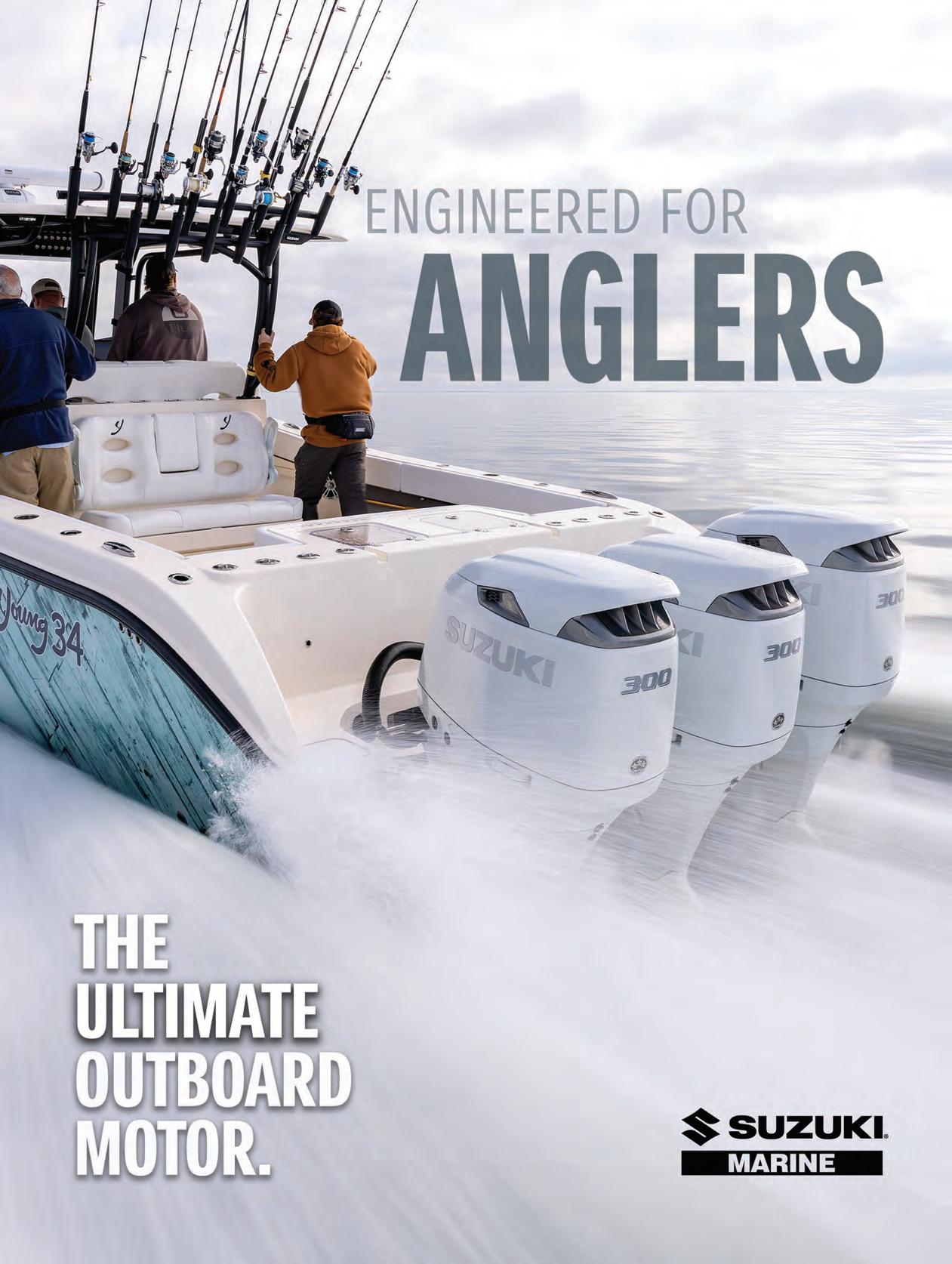
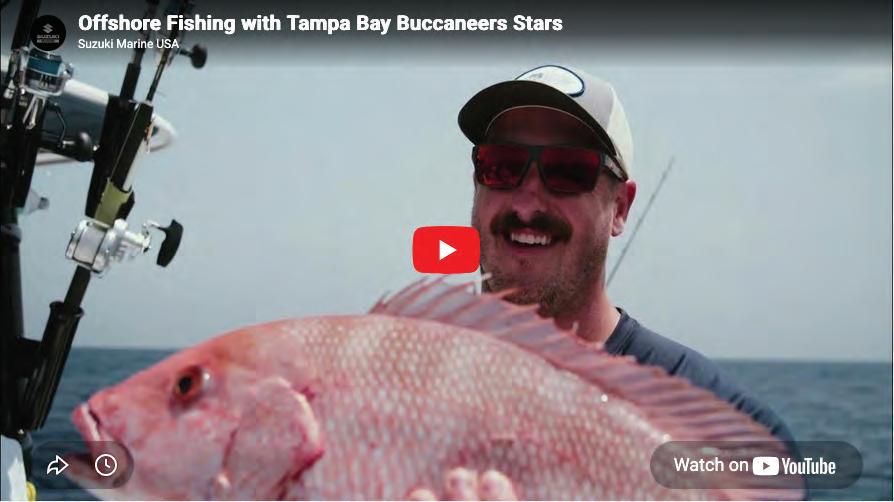
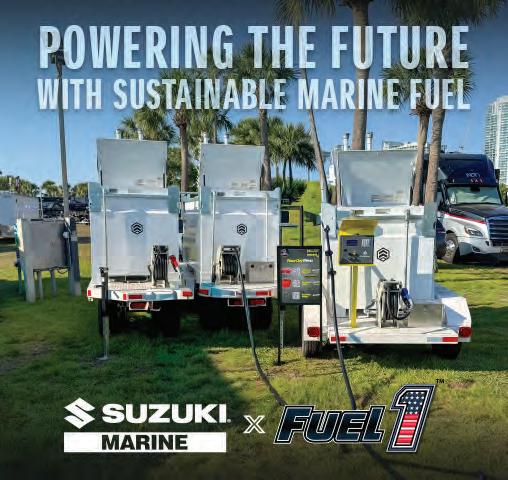
Suzuki Marine has partnered with Fuel 1 to provide an opportunity for its dealer network to offer certified Sustainable Marine Fuels to its customers right from their facilities. By teaming up with Fuel 1—a national retailer of advanced fuel delivery and portable fueling systems—Suzuki Marine is helping its dealers better serve their communities by meeting an important consumer need, maximizing the performance and reliability of their customer’s boats, and supporting sustainability goals important to Suzuki Marine and the entire recreational boating industry.
Working with Fuel 1 provides Suzuki Marine dealers with important advantages, such as the ability to deploy a fully supported fueling ecosystem with zero capital investment. Fuel 1 will provide free MicroStation Deployment; fully branded portable fueling stations installed at participating dealer locations. In addition to direct fueling solutions, portable distribution systems including 20-gallon exchange pods and tote programs make it easy for customers to fuel their boats with PurFuels’ 93-octane, ethanol-free fuel that has been developed specifically for marine operating conditions.
the industry’s efforts to educate the boating public about these cleaner burning, more sustainable fuels. Now, we are stepping up to the plate to help get this fuel to more boaters, using their trusted Suzuki Marine dealers as the source,” added Cerka.
The program also makes strong business sense for dealers. A revenue sharing model will provide dealers with solid profits and recurring income. Fuel 1 will manage all compliance, liability, inventory, refueling and point-of-sale systems, making it easy for dealers to provide this valuable service to both loyal and new customers. Fuel 1 provides unmatched business and marketing support, including national marketing campaigns to drive customers to the dealership, dealer spotlighting across Fuel 1 Direct and partner platforms, invitations to participate in Fuel 1’s national sponsorships and marine events, and customer aggregation tools to help position dealerships as a preferred destination for premium marine fuel.
“Making sustainable marine fuels more accessible in different areas of the country is a great win for our dealers and customers alike,” said Brandon Cerka, Suzuki Marine Vice President Sales & Marketing. “This partnership is also a major step in Suzuki Marine’s ongoing effort to reduce the environmental footprint of boating. We have long supported
“We have used these fuels exclusively at our Suzuki Marine U.S. Technical Center during engine testing, durability trials, and performance benchmarking. Over years of testing, we have proven that these fuels help Suzuki Marine’s products run at peak performance, efficiency, and durability in real-world conditions. We have every confidence in these fuels and are pleased to be offering them to our customers,” added Cerka.
To learn more about the key benefits of PurFuels sustainable marine fuel, visit www.fuel1direct.com
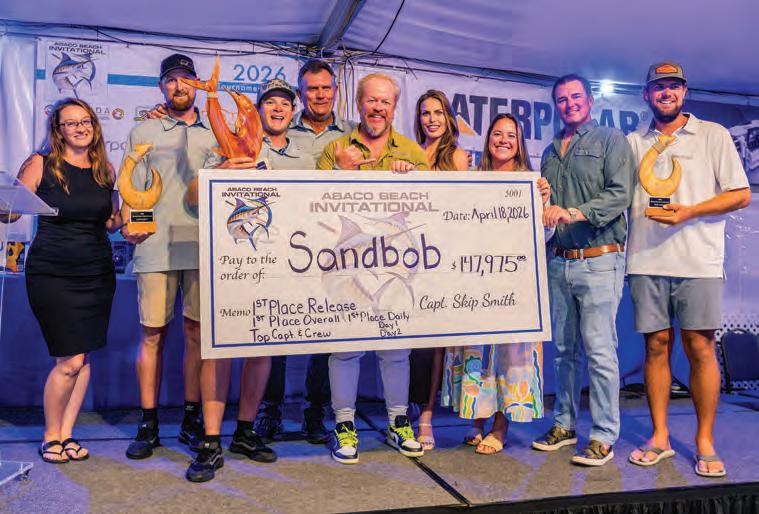
The inaugural Abaco Beach Invitational concluded this past weekend at the Abaco Beach Resort in the Bahamas and Sandbob, a 74 Viking run by Capt. Chris Correia, is the first-ever champion. The team released four blue marlin, two whites and four sailfish to earn 2,300 points and a payout of $147,875. Sandbob’s anglers included Sean Dunnuck, Chase Higgins, Justin Lord, Chad Moss, Juliana Van Lannew, Margo Volman and Allen Winchel. Chad Moss was named the Top Angler overall with 1,300 points to his credit.
Reel Steel, a 66 Hines-Farley, was the secondplace team overall. Capt. Jason Parker and his anglers released four blue marlin, one white marlin and two sailfish, good for 1,950 points and a $19,125 payout. Rounding out the top three was Right Hook, a 58 Croswait with Capt. Austin Spitz on the flying bridge. The team tallied three blues and four whites for the event, earning 1,650 points and $25,500 in cash prizes.
The other big money winners included Cheeseburger (60 Sculley/Capt. Gabe Toepfer) and Marlin Brando (68 Viking/Capt. Cody Mitchell). Teams could enter optional jackpot categories for bigger payouts based on daily and overall catches.
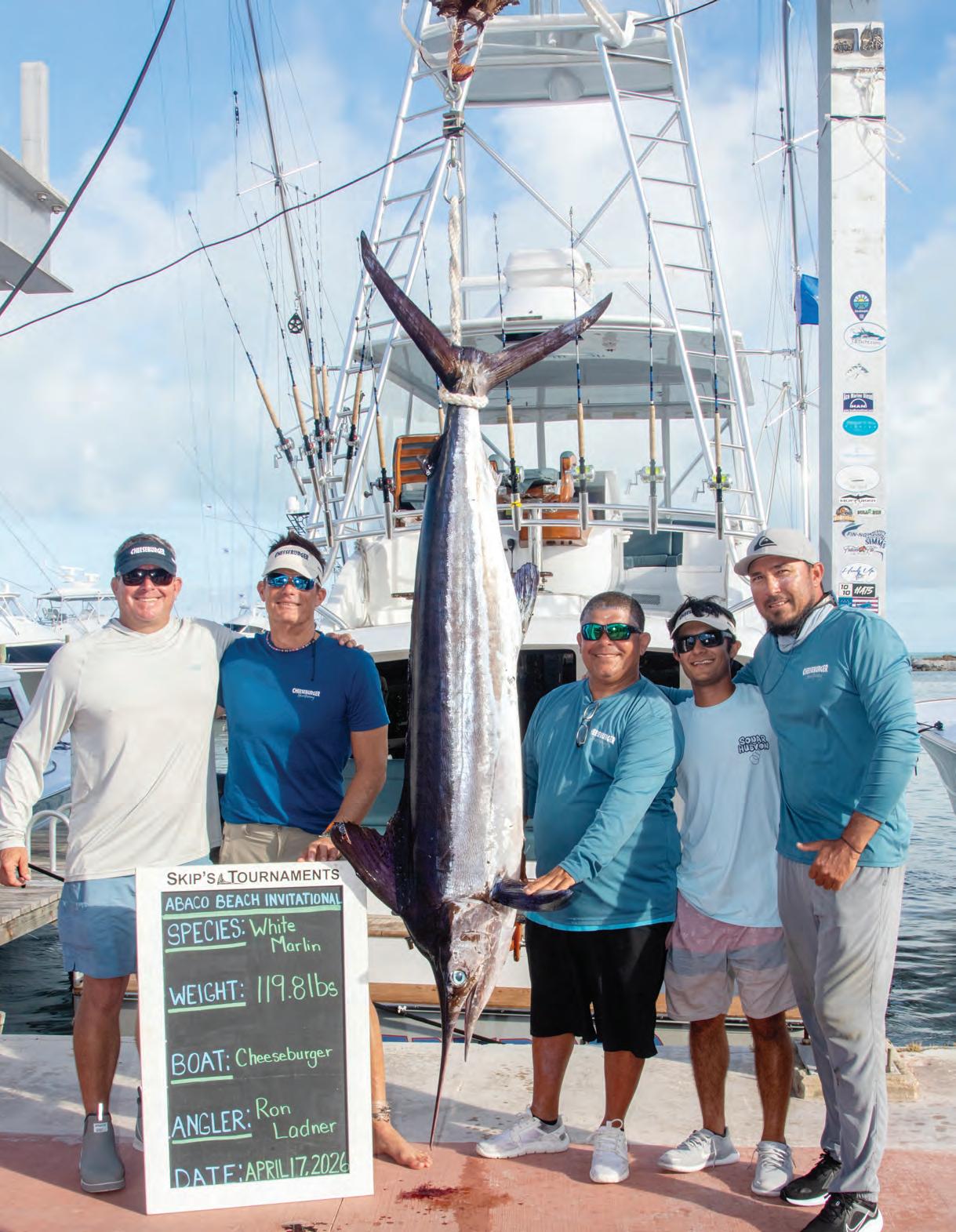
The Abaco Beach Invitational is mainly a catch and release billfish contest. Blue marlin releases score 400 points, white marlin and spearfish 150 and successful sail-fish releases earn 100 points each. There are weight divisions for blue and white marlin with minimum length requirements. Boats are limited to six lines/six anglers with no live bait allowed. Cheeseburger weighed a 119.8-pound white marlin, caught by Ron Ladner. Luis Ballote on Right Hook also
weighed a white at 81.8 pounds. Those fish paid out $44,625 and $19,125, respectively, in optional entry jackpots.
In other individual honors Kristina Lasserre, competing aboard Kennel Up (92 Viking/Capt. Jeremy Beller) scored a slam of a blue marlin, white marlin and sailfish to earn the Top Lady Angler award.
Josh Wiley boated the winning wahoo, a 75.8-pound entry, competing aboard Lunatico (70 Titan/Capt. Cory Gillespie). Manuel Ortiz topped the dolphin leaderboard with a 44.4-pound bull. Ortiz was fishing with Capt. Zane Andrews on Time Out, a 64 Viking based in Panama City, Florida. Both game fish leaders
paid $12,998.70 in prize money. There were no qualifying tuna recorded.
“What a great way to start a new tradition,” said Tournament Director Sherry Santino. “We had beautiful weather, outstanding fishing and a fun time. I’d like to thank all our teams and our host Abaco Beach Resort for the perfect venue. I’m ready to build on this success next year.”
The 28 teams competing in the first Abaco Beach Invitational released 30 blue marlin, 32 white marlin and 36 sailfish overall. Two white marlin were weighed.
For more information and details on upcoming tournaments, visit skipstournaments.com.

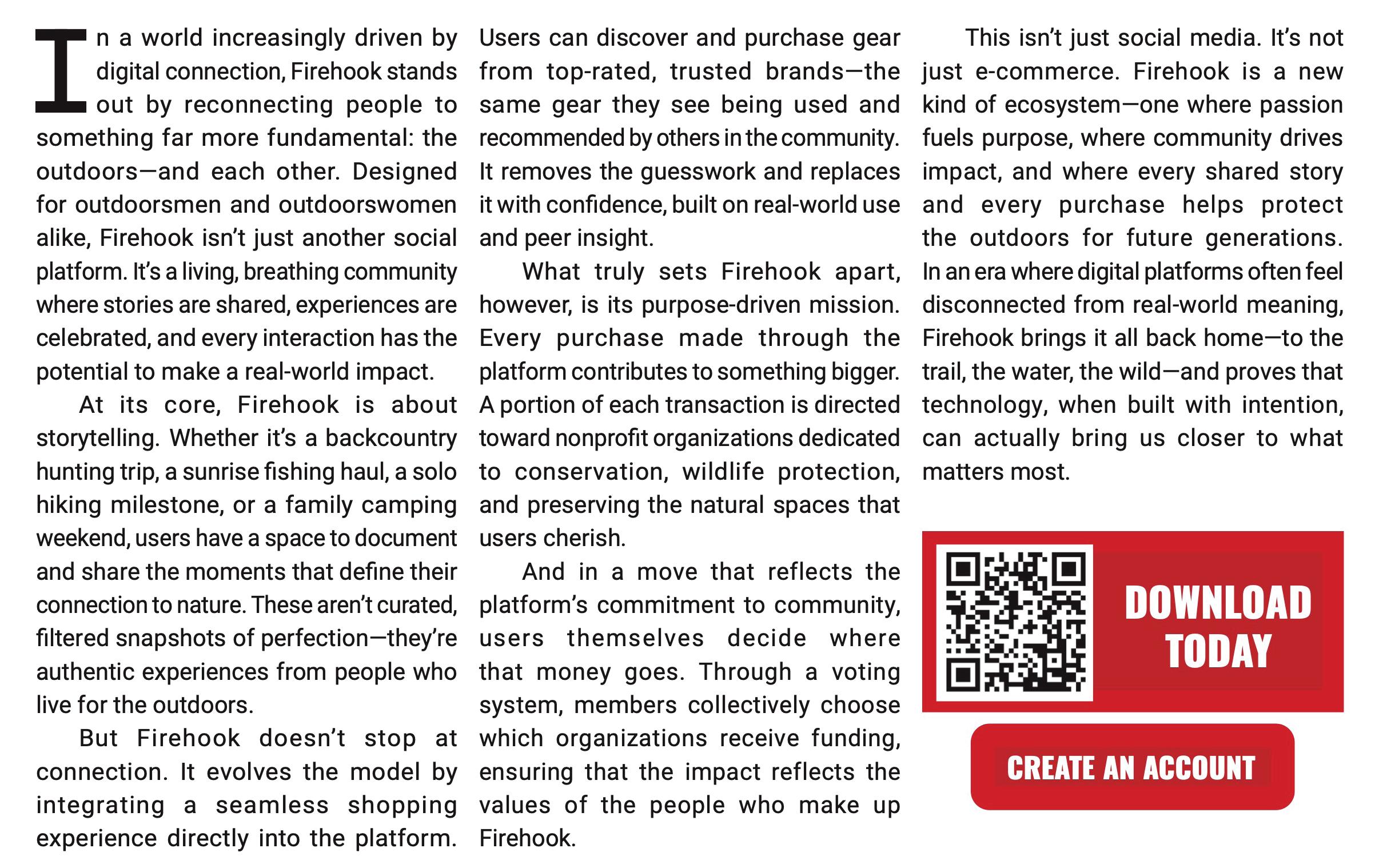

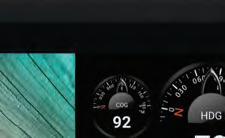
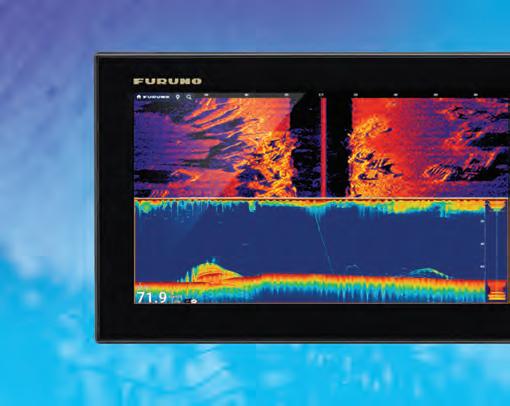
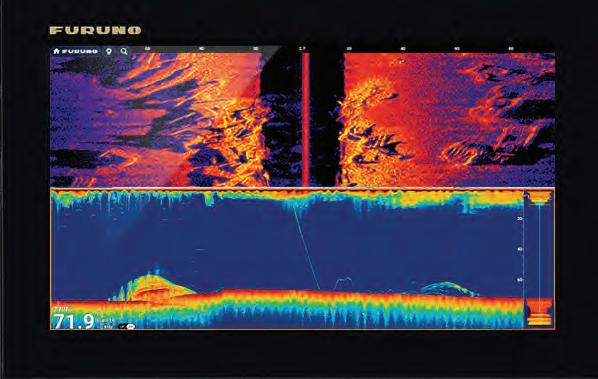
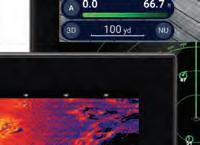
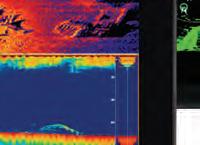
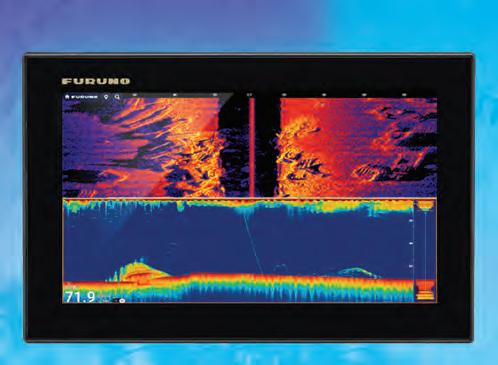
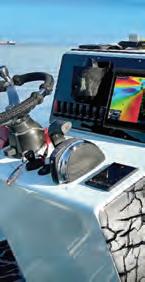
Furuno is expanding its line with the introduction of the TZMAP9 and TZMAP13, two new, powerful all-in-one stand-alone Multi Function Displays with built-in TruEcho CHIRP™ Fish Finders that bring the power of Furuno’s acclaimed TZ MAPS cartography to smaller vessels desiring to operate from a single display. Designed for boaters who want simplified, reliable navigation without network complexity, these models deliver powerful features through a user-friendly multi touch interface for a variety of boat types and sizes.

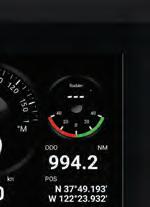
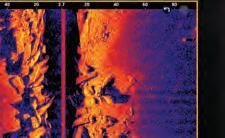
The 9” TZMAP9 and 13” TZMAP13 feature responsive, sunlight-readable multitouch displays powered by a streamlined version of the TZtouchXL operating system. These MFDs are equipped with a 300W/600W/1kW, single-frequency TruEcho CHIRP™ or dualfrequency CW Fish Finder, CHIRP Side-Scan capability (230kHz or 455kHz), and advanced chart plotting capability built around Furuno’s revolutionary TZ MAPS platform. With a free My TimeZero account, waypoints and routes can be easily backed up or retrieved from the cloud with just a few taps, ensuring critical data remains safe and secure.
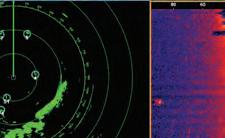
Designed for simplicity while retaining advanced functionality, these units support Radar options such as the Solid-State Doppler DRS2DNXT and DRS4DNXT. They also offer integration with the TZ iBoat App and support AI Routing, helping boaters plan smarter, safer routes. TZMAP units come ready-to-navigate out of the box with pre-loaded,
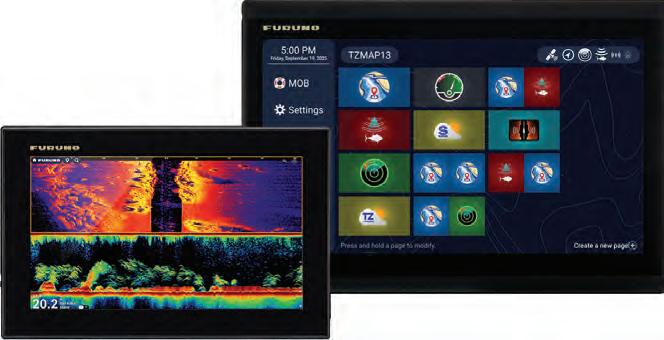
official NOAA Vector charts for the entire coastal US. For a serious upgrade at an incredible value, optional TZ Maps charts can be purchased directly from the MFD. TZ Maps delivers customizable, detailed cartography built on a foundation of official hydrographic charts, high-resolution BathyVision™ bathymetry, satellite imagery, and community-sourced data. It’s the most intuitive and powerful charting system Furuno has ever offered, and it’s built right into every TZMAP9 and TZMAP13. Plus, your first chart purchased through the TZMAP
MFD is available at a special low introductory price of only $150an incredible price for the entire USA, or any other chart area. With details this precise and coverage areas this large, TZ MAPS is one of the most affordable chart options on the market.
From bay boats to kayaks and sailboats to cruisers, the TZMAP9 and TZMAP13 offer an accessible entry point into Furuno’s navigation ecosystem. These units are ideal for boats 16’ and up in need of essential fish-finding tools, cutting-edge charts, and affordable Radar options in a clean, stand-alone package.



















Purpose-Built, Made Just For You.

























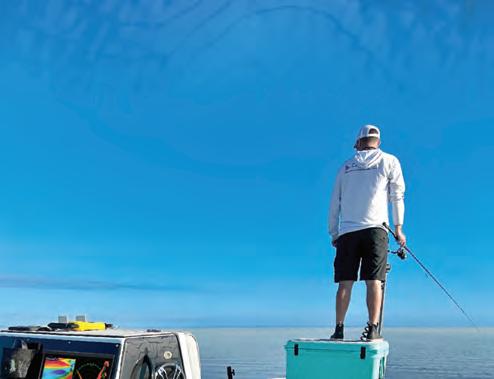





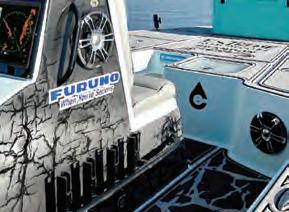
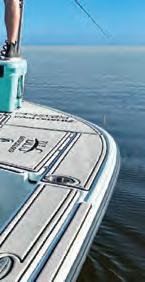










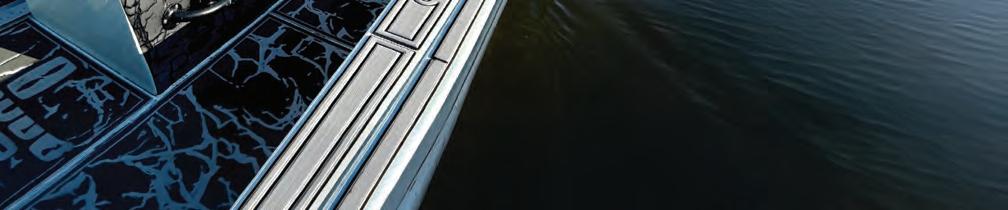
With this streamlined MFD, Furuno is bringing big-boat confidence to everyone. & More Fish
Less Stress






I KNEW IF I WOULD HAVE LET GO OF THAT FISH, NOBODY WOULD HAVE BELIEVED ME. — HUNTER HICKS ‘‘
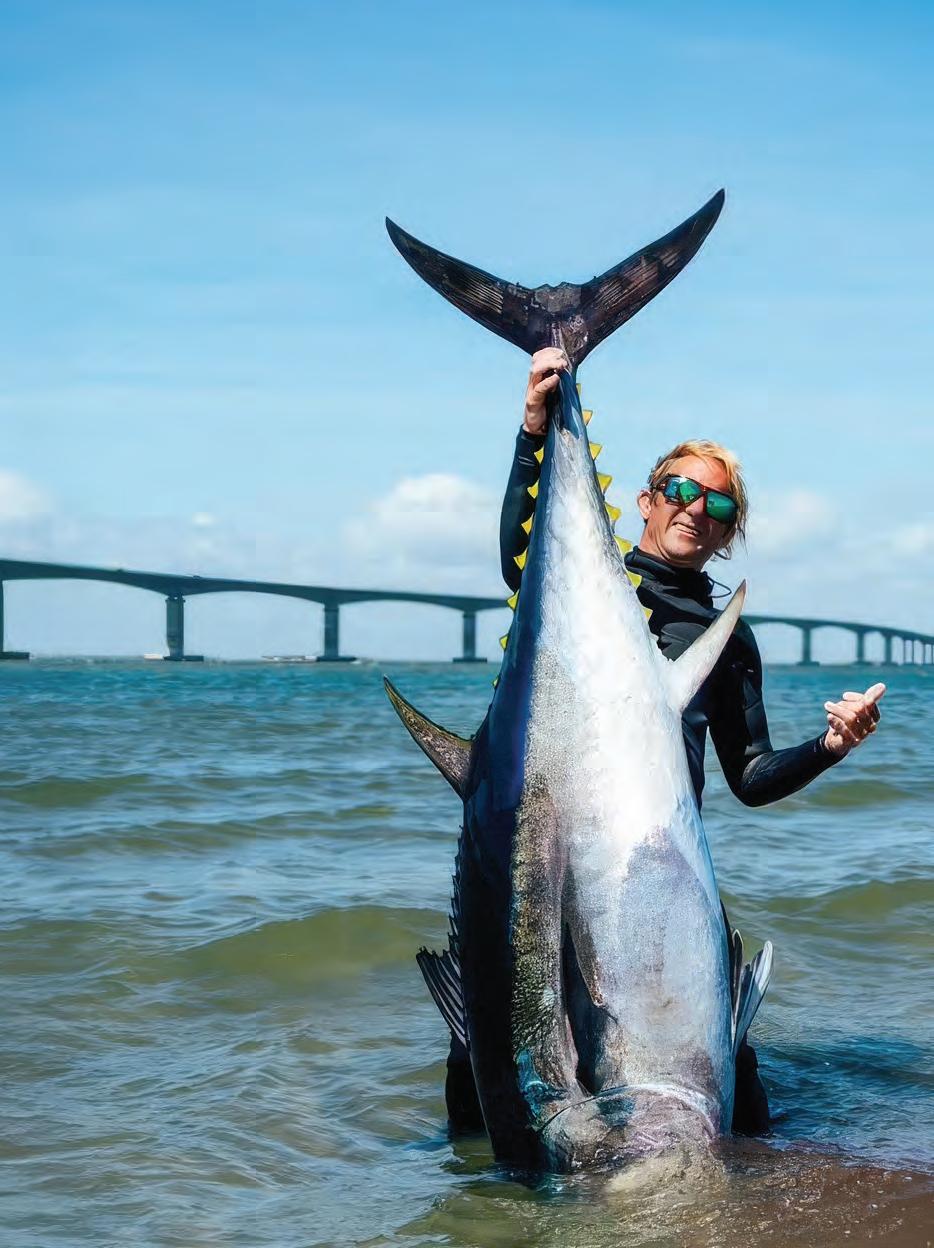
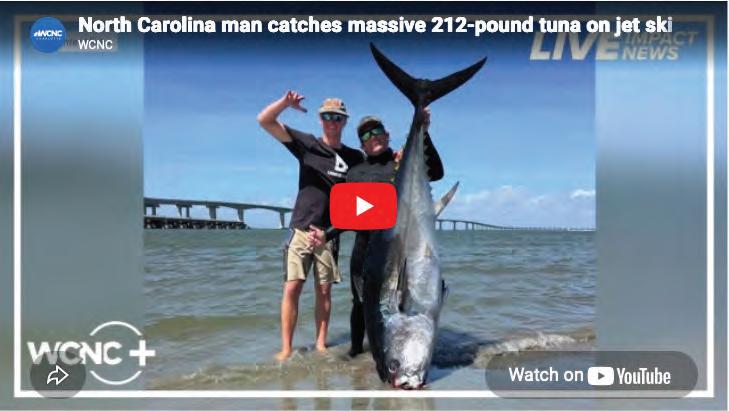
For most fishermen, landing a bluefin tuna is a career-defining achievement. For Hunter Hicks, a 15-year veteran of the Outer Banks and a professional mate for Longer Days Sportfishing, it became the “worst fight” of his life. On Easter Sunday 2026, Hicks redefined the limits of personal watercraft fishing by catching a massive 212-pound, 70-inch bluefin tuna while solo on a Jet Ski.
The adventure wasn’t originally intended to be a solo act. Hicks had planned to head out at 3:00 AM with a friend, but when his partner failed to wake up, Hicks decided to brave the Atlantic alone.
About 10 miles offshore from Oregon Inlet, the water erupted with life. Hicks initially hooked what he estimated to be a 500-pound tuna, but the giant “spit the hook.” Undeterred, he cast again
and hooked the 212-pound “beast” that would take him on an grueling multihour journey.
Without a traditional fishing boat’s stability, Hicks was forced to battle the tuna using raw strength and grit.
No Safety Net: He fought the fish solo, without a fighting belt or a rod holder to assist him.
The “Mike Tyson” Effect: Hicks later described the struggle as “kind of like fighting Mike Tyson… but losing”.
Physical Toll: The intensity was so great that Hicks suffered bruises across his body and was unable to move or open his arm for two days following the catch.
Once the fish was subdued, the challenge was far from over. Hicks had to gaff the tuna, secure it with a mouth
rope, and tow it nearly 10 miles back to shore.
As land disappeared from view, the situation grew tense. Without a chart plotter or GPS, and with his phone battery dwindling, Hicks—a selfdescribed “waterman”—relied on his instincts to navigate back to the beach.
Upon reaching the shore, Hicks was greeted by a crowd of roughly 30 people who gathered to witness the rare sight of a massive tuna being towed by a Jet Ski. To transport the prize home, the team used a unique method: they slid the 70inch fish into a surfboard bag filled with ice.
While the physical recovery took days, Hicks says he wouldn’t trade the experience for anything, though he admitted he wishes someone had been there to share the “fishing high” of the moment.
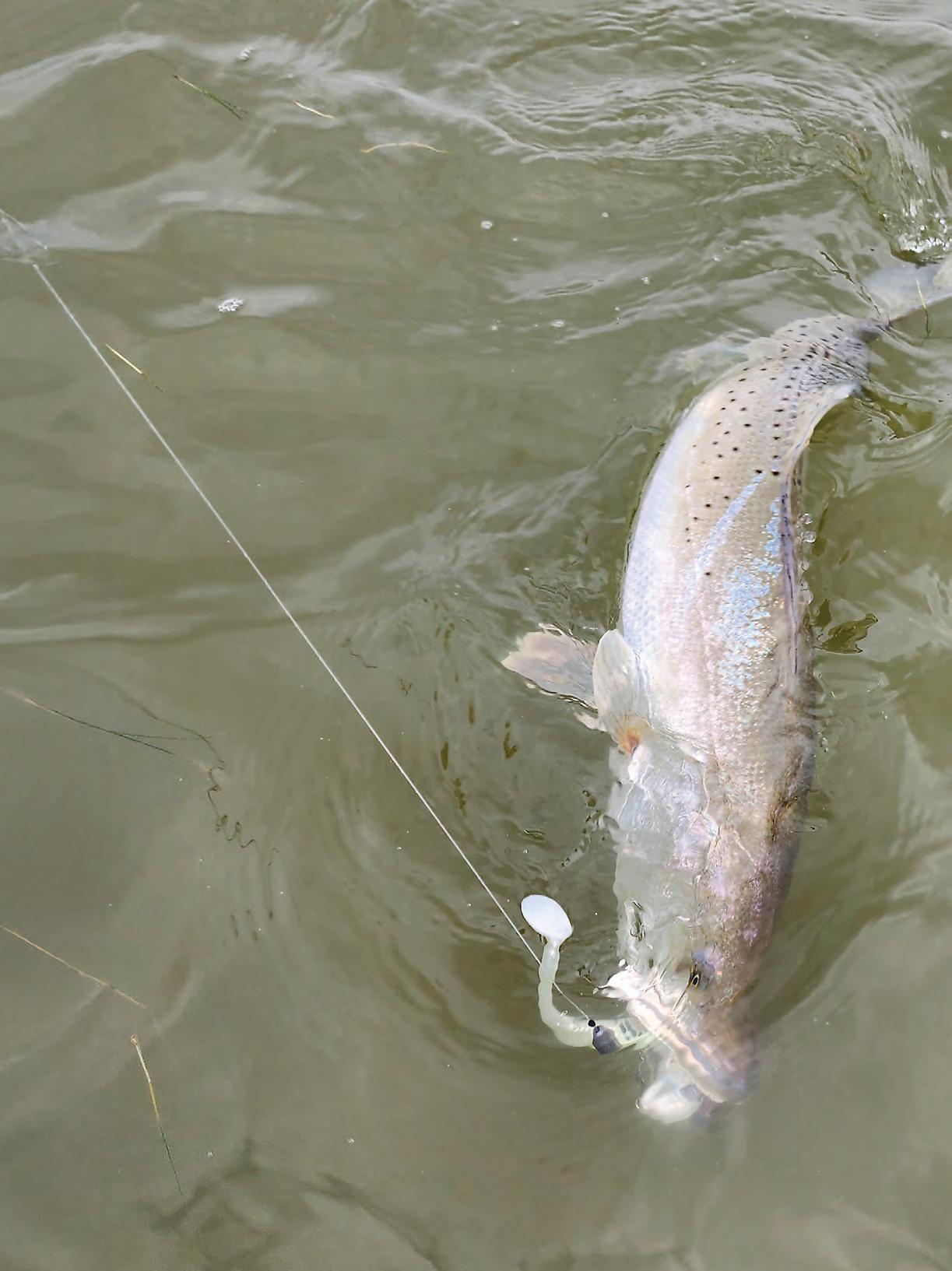
If you’re a big trout enthusiast like me, you know there’s still time left to chase a personal best—if you haven’t had your fill over the past few months. While most anglers focus on trophy speckled trout from December through early April, May quietly remains one of the most underrated windows of the year. With the full moon in late May, many of those big females will hold eggs all month, giving anglers one last legitimate shot at a heavy trout before the spawn wraps up.
What makes May even better is how enjoyable it is to be on the water. The cold winter grind is behind us, waders can finally come off, and the warmer conditions allow for a more aggressive approach. Unlike winter, when slow presentations dominate, May lets you fish with more confidence and energy. Topwater explosions become a real possibility again, and there are few things more exciting than watching a big trout crush a lure on the surface.
That said, topwaters aren’t the only tool in play. Slow-sinking and suspending baits still produce, and soft plastics—especially paddle tails—shine this time of year. With water temperatures rising, trout are more active and willing to chase. Adding sound, like a subtle tail rattle, can make a noticeable difference in getting bites from these larger fish. Sizes from 3” to 5” can all be effective, so don’t hesitate to mix it up until you find what they want.
Location plays just as important a role as lure selection. I like to focus on grass flats in knee- to waist-deep water, especially those with nearby drains from small lakes or creeks. These areas concentrate bait and naturally pull in predators. Subtle features— like potholes, small depressions, or even a one-foot drop-off— can hold fish and shouldn’t be overlooked.
Approach is everything in shallow water. Whether you’re wading or fishing from a kayak, stealth matters. Position yourself far enough off your target area to avoid spooking fish, especially in clear conditions. Cover water methodically with a fan-cast approach, working from short casts to longer ones. Starting close allows you to pick off fish in front of you before potentially spooking them with longer casts.
Shallow water may look too skinny to hold quality fish, but time and time again it proves otherwise. The key is reading the conditions, moving deliberately, and letting the fish tell you where they want to be. Some days they’ll be scattered across a flat, while other times they’ll stack up along a subtle edge or current break.
May is your last real shot at an egg-heavy trophy trout before summer patterns take over. Take advantage of the warmer weather, fish with confidence, and enjoy the experience. And if you can, take a kid fishing—they like big trout too.
Capt. Michael Okruhlik is the inventor and owner of Knockin Tail Lures® — knockintaillures.com.


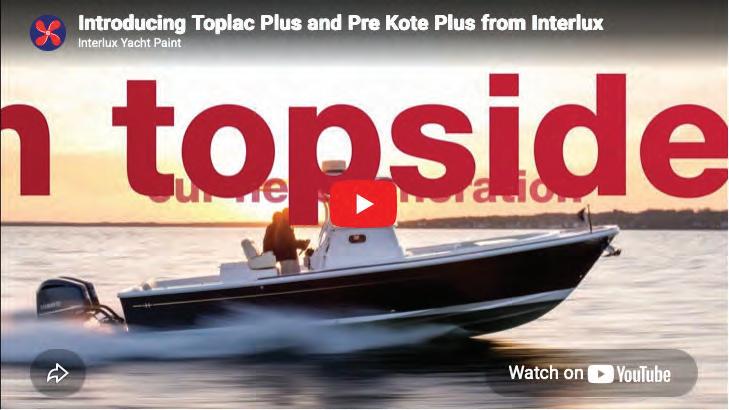

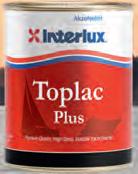
Introducing our next generation, premium topside system with professional level results in an easy to use one part finish.
Toplac Plus provides a best in class high gloss finish with longer lasting UV protection that is easy to apply with exceptional roller application, without the need for tipping, available in a full range of vibrant colors. Apply over Pre Kote Plus, our improved one part undercoat and topside primer all in one, with substrate protection, an extra smooth finish, and lower VOCs.
An amazing finish has never been so easy. Experience a revolution in topside paints, from Interlux®
Relentless performance for every yacht, everywhere, every time.
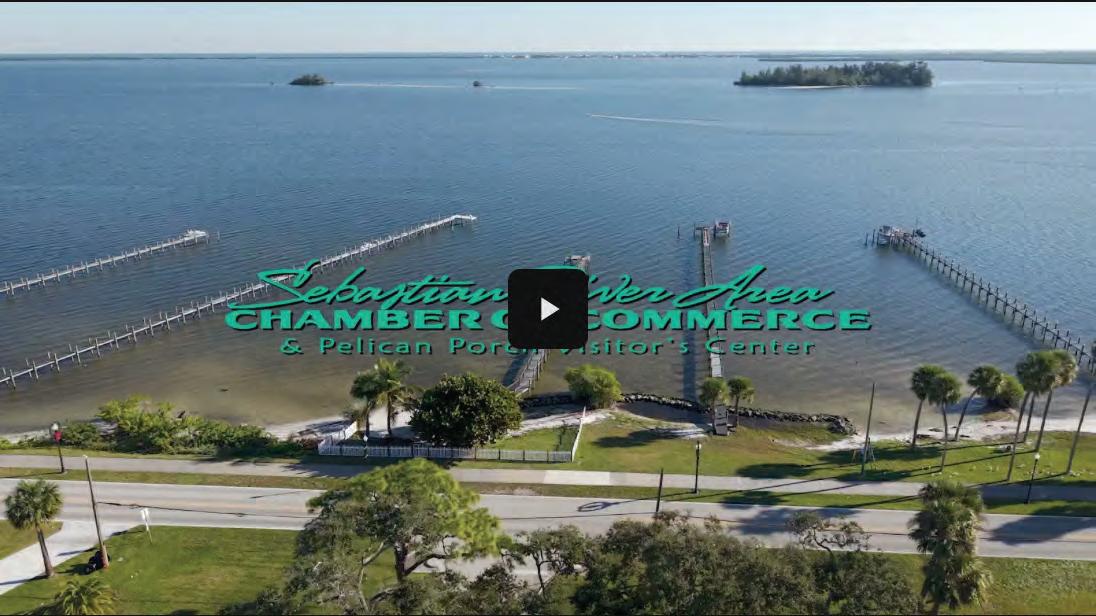
Tucked along the Indian River Lagoon on Florida’s Treasure Coast, Sebastian is a waterfront haven where anglers, adventurers, and coastal dreamers feel instantly at home. With its historic fishing legacy, unspoiled natural beauty, and breezy small-town vibe, Sebastian offers the perfect escape for those who live life by the tides.
For anglers, this is paradise. Cast into the legendary waters of Sebastian Inlet, where snook, redfish, tarpon, and grouper challenge even seasoned pros. Drift the tranquil St. Sebastian River, kayak the mangrove tunnels along the lagoon, or launch offshore for deep-sea excitement. Here, you can fish at dawn, surf by noon, and unwind with a waterfront dinner at sunset, all without ever losing sight of the coast.Beyond the
rod and reel, Sebastian overflows with natural wonder.
Explore the region’s protected estuaries, spot dolphins skimming the lagoon, watch ospreys and herons hunt the shoreline, or stroll pristine beaches where the Atlantic breeze feels like a welcome Invitation. Pair that with live music, outdoor markets, charming shops, and waterfront lodging, and you’ve got a getaway that feels both laidback and unforgettable. Enjoy this sneak peek video of the Chambers new Familiarization Tour Video for 2026, can you visit all of these locations in one day? Like and subscribe to their socials to stay up to date with the Sebastian River Area!
In Sebastian, history isn’t just remembered… it’s lived. Cast a line. Catch the moment. Discover Sebastian.

Many anglers haphazardly run around searching for fish. They see a fishy looking point and anchor up and start casting. Hours later they give up and go home empty handed.
That fishy looking point probably does have fish on it some of the time, but not all the time.
What did they do wrong? They forgot that fish move around based on water temperatures, food resources, currents, water quality and the presence of larger predators. In my experience, 80% of the fish will be in 20% of the area based on those conditions.
Here are the three most important pro tips to help you catch more fish.
1. Find Feeding Fish. My fishing charters always start by scanning mangrove shorelines, grass flats, and spoil islands for feeding fish. Obviously, this is the easiest way to figure out where the fish are.
If you can find baits being crushed by predatory fish, then start casting there. Even
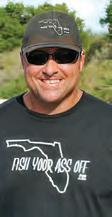
CAPT. MIKE SMITH
if you only find nervous bait, that’s still a great spot to start casting.
2. Find Food Resources. When the fish are not actively feeding your next best bet is finding bait. Sometimes the bait is obvious and you can start casting along the edges of the schools.
If you can’t actually see any bait then let the birds tell you where it is and what size it is. Birds always know where the food is. When you see diving pelicans or a great blue heron perched on a mangrove branch you know there is bait there.
The various bird species will tell you what lures to cast. When you see small wading birds like snowy egrets, little blue herons, green herons and tri-colored herons, then you know to cast something small.
This really helps because you can grab your three-inch paddle tail or 2.75 inch shrimp and know that you are fishing with the right size lure. Those smaller herons usually target baits
that are three inches or smaller.
When you see great white egrets, great blue herons and brown pelicans it gets a little harder to figure out the size of the baits to use. You know there is food there but those birds will eat anything from a two-inch minnow up to an eight-inch mullet.
This is when you need an assortment of different sizes and profiles of lures. I usually have a three-inch paddle tail, an artificial shrimp and a four to five and half inch jerkbait (fluke) rigged on my rods. Start casting until you figure out what the fish want on that day.
3. Find Moving Water. The next important factor is moving water. All of the predatory inshore species that you want to catch like a little bit of current.
They will typically be facing into the current waiting for some unsuspecting food resource to flow past their ambush point.
Your strongest currents are going to occur during the full moon and the new moon. Coincidentally, the best fishing occurs around these two moon phases.
Go get ‘em!
Capt. Mike Smith, owner of Fish Your Ass Off Charters, is an inshore fishing guide who has been fishing the inshore waters, oyster bars and grass flats of Florida for more than 40 years. Reach him at (561) 339-2317, email: contact@ fishyourassoff.com or visit fishyourassoff.com.
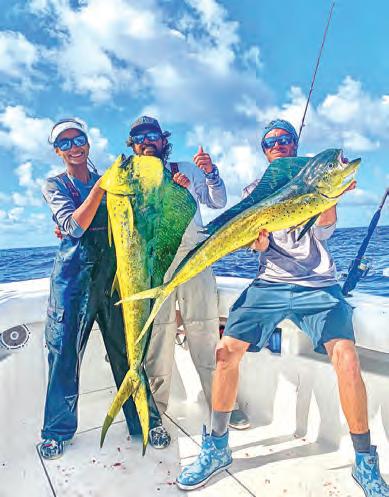
If you love the fishing, boating and outdoors lifestyle, and dream of being in business for yourself— but not by yourself— now is the time to spring into action and become a Coastal Angler or The Angler Magazine Co-Publisher. No Experience Neccesary—We Will Train You! We have freshwater and saltwater territories available throughout the country and abroad. Ask one of our specialists about franchise availability in your area.
SCAN TO VIEW OUR BROCHURE:

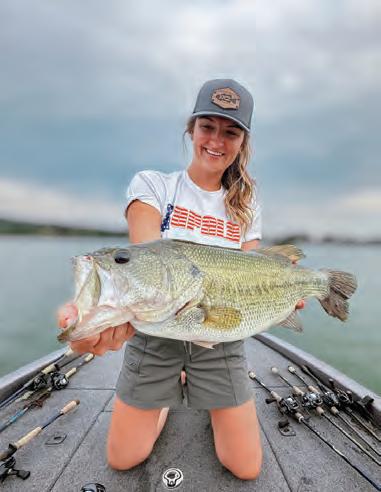

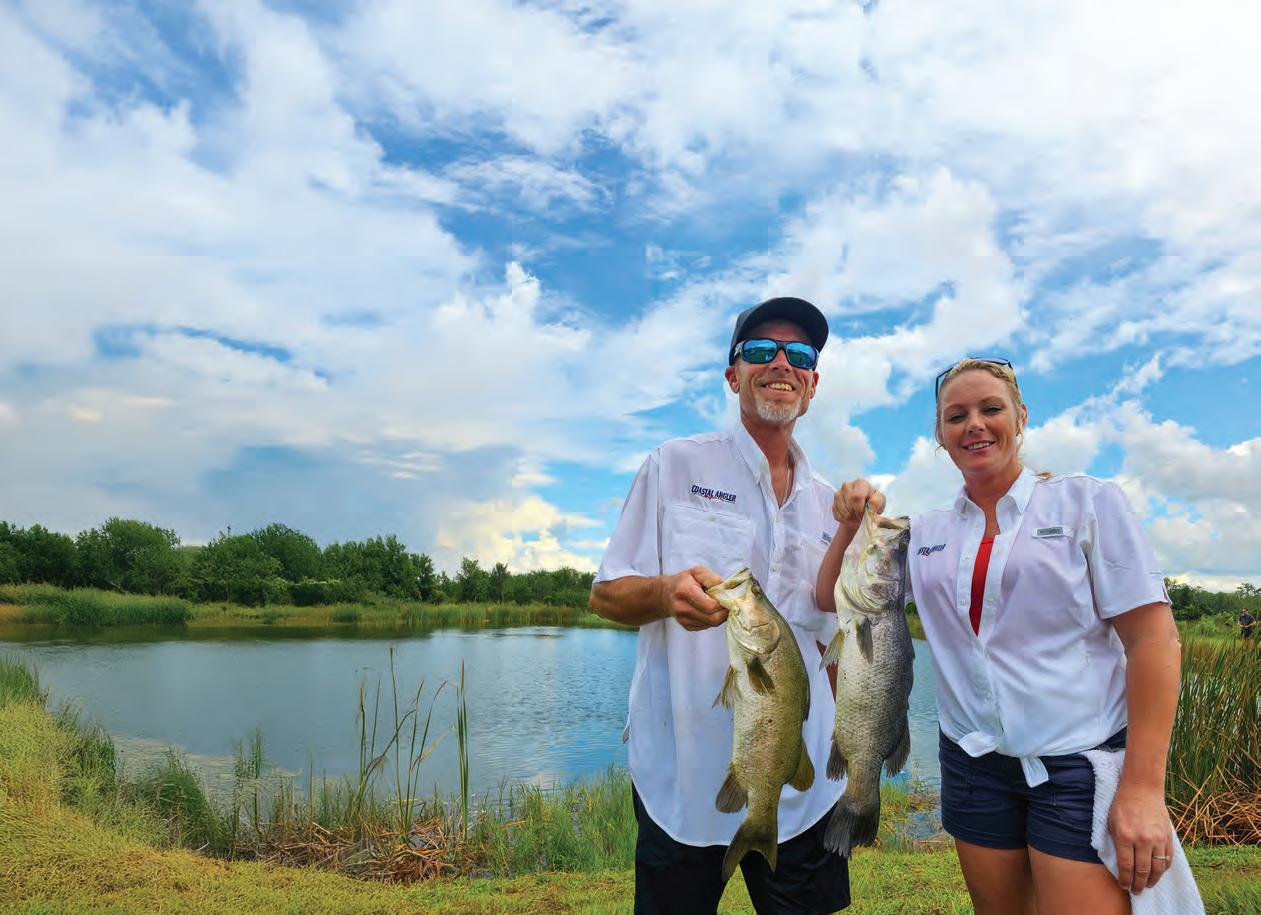
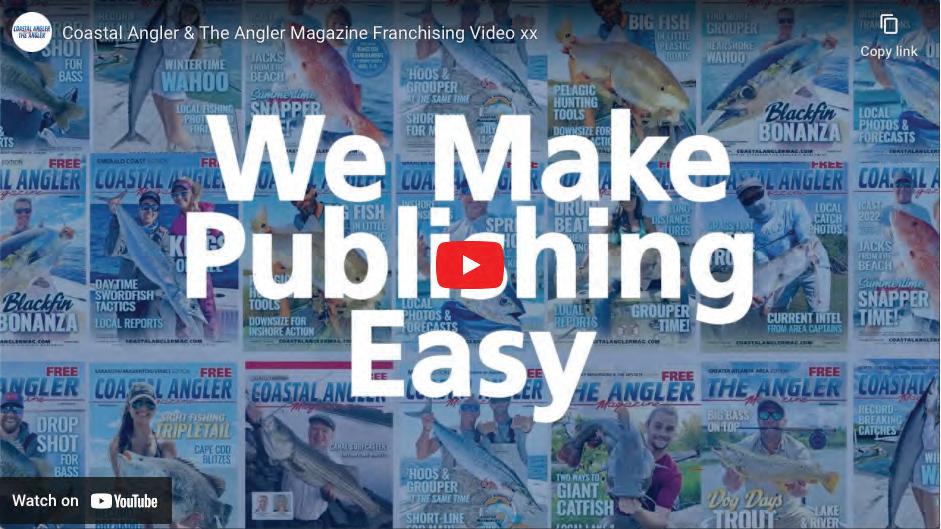
An exceptionally rewarding and fulfilling business opportunity, as a Co-Publisher of your area’s Coastal Angler Magazine or The Angler Magazine, you’ll enjoy the benefits of controlling your own time and future while being a part of the largest outdoor publication in the U.S. Our proven franchise publishing system enables individuals with no prior publishing experience to publish a credible and profitable localized version of our award-winning, free monthly magazine. With a combined readership of over one million per month and distribution to over 11,000 businesses in four regions, our brand is well known throughout the fishing world, and our magazines are recognized as well-designed, thoughtful publications that provide newsworthy and entertaining content pertinent to the marine and fishing industries, as well as respected resources for localized fishing reports, tournament news, tide charts, catch photos and more.

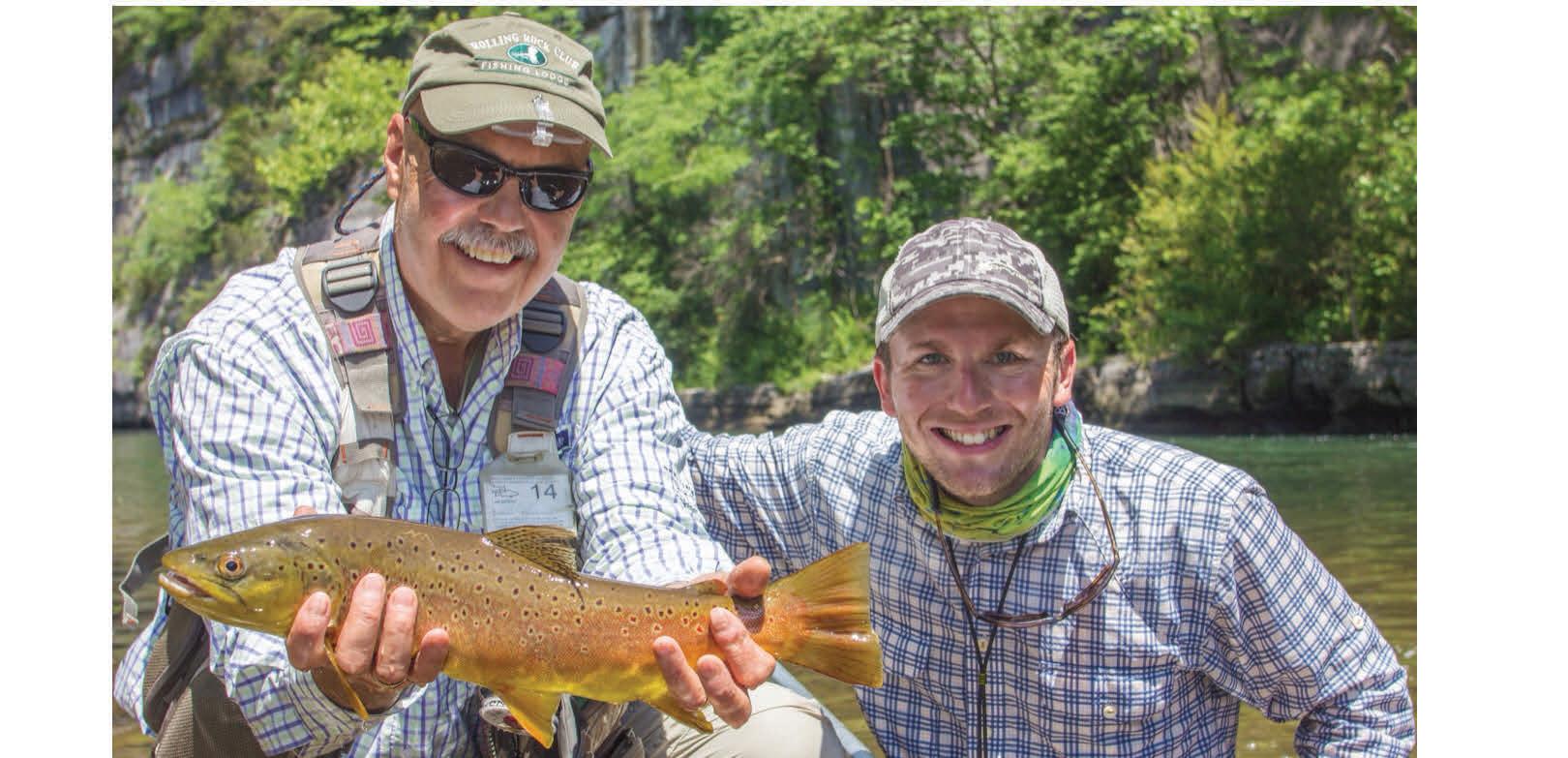



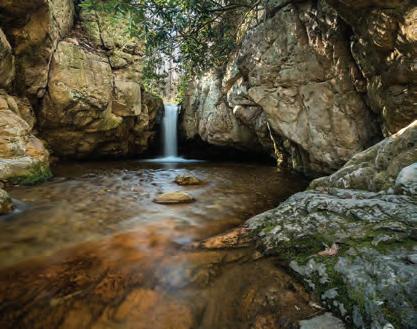

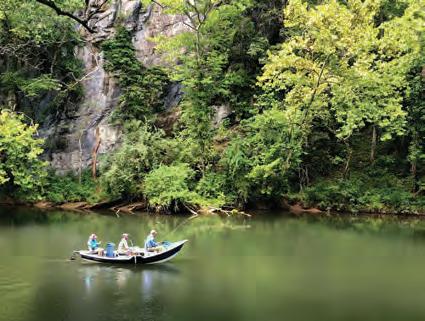

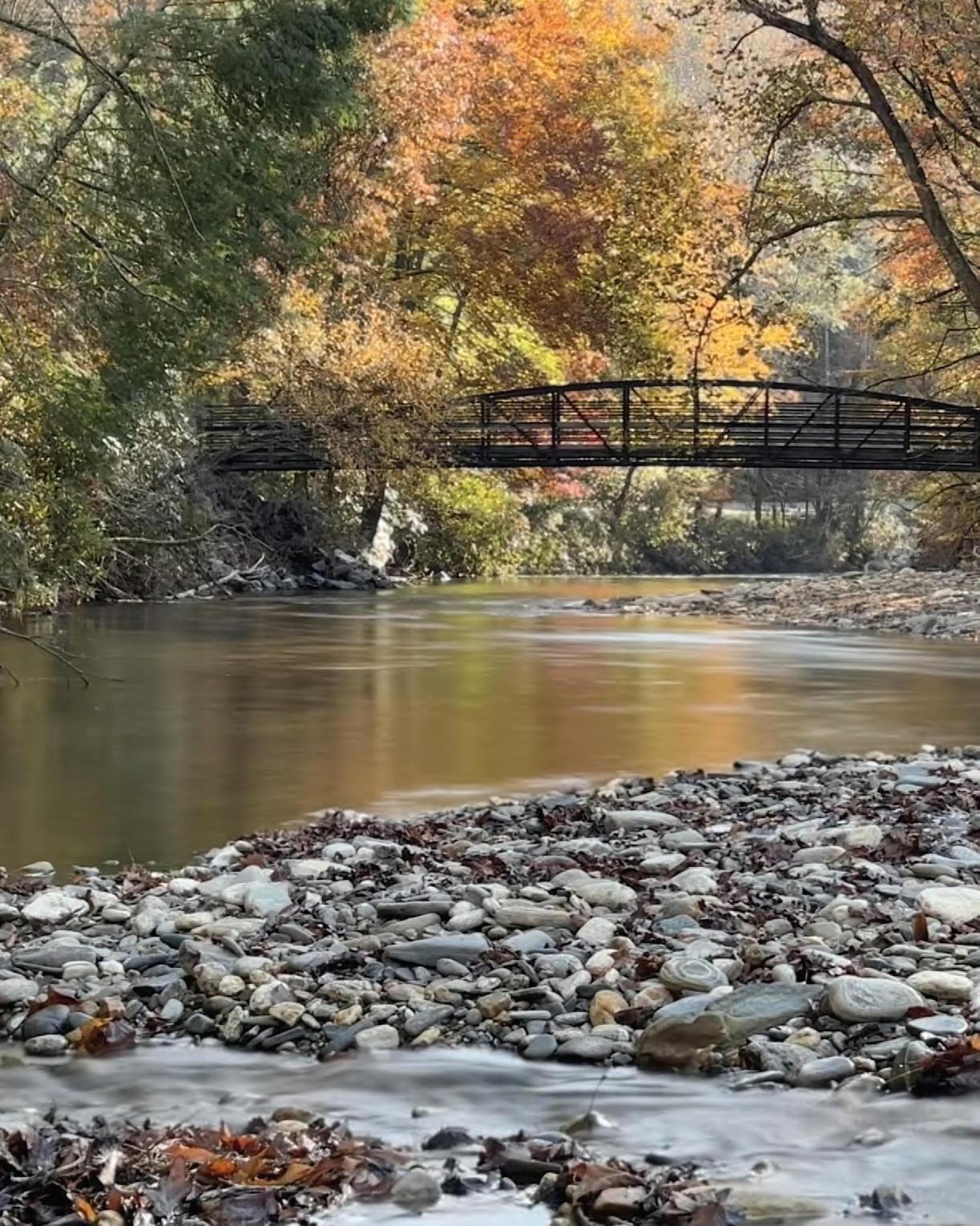
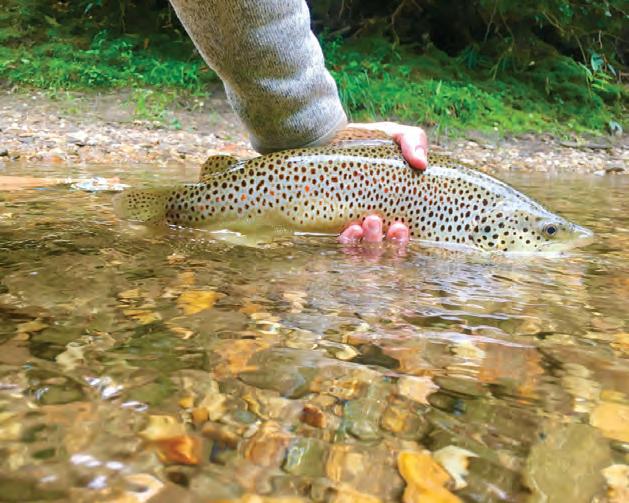
The Davidson River is located in Western North Carolina within the Pisgah National Forest, right near the town of Brevard and approximately 40 minutes south of Asheville. It is a renowned trout stream flowing 15 miles through Transylvania County to the French Broad River. Known for its clear, cold waters
originating from the surrounding mountains, the river and its tributaries offer every option for anglers; native brook trout in headwater streams, blue line fishing for wild rainbow and brown trout, and hatchery-supported fishing downstream. Reports of fish over 20 inches long support the reputation of this fishery.
The Davidson River is one of the most
celebrated trout fisheries in the southeastern United States, drawing anglers from across the country as this river offers a unique blend of accessibility and complexity that appeals to both beginners and seasoned fly fishers. Part of the Davidson’s appeal, or its main drawback, is easy access. The river flows roadside through most its publicly-accessible length.
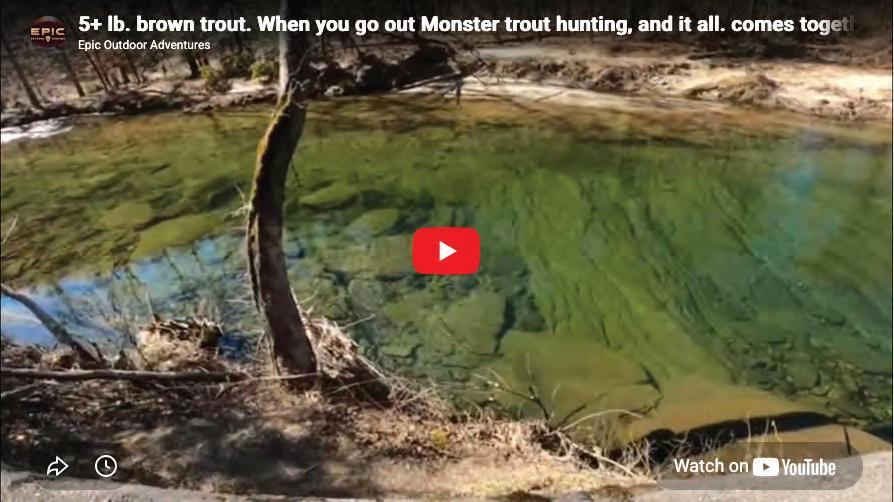
There is small water in the headwaters accessible only by foot, but for the most part it is a park-and-fish kind of place.
What makes the Davidson River special is its designation as a delayedharvest stream along much of its upper section. From fall through late spring, the river is heavily stocked with rainbow, brown, and brook trout, and strict catch-and-release regulations help maintain high fish density. During this period, anglers can expect frequent hookups—but not without effort. The fish here are pressured and highly selective, making presentation and fly choice critical.
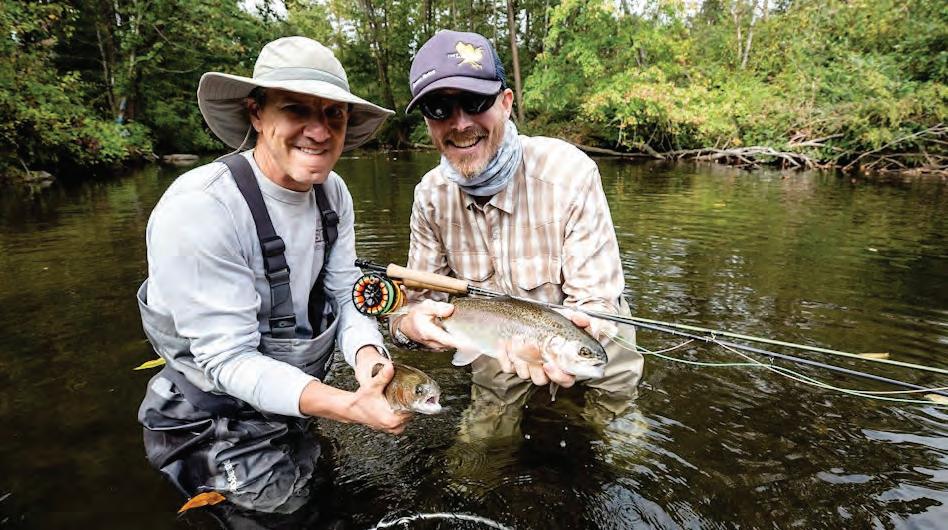
be excellent during hatches, but matching the hatch closely is key—these fish are not
Water clarity is both a blessing and a curse. On most days, the Davidson runs crystal clear, allowing anglers to spot fish easily. However, this also means the fish can see you just as well. Stealth becomes essential: careful wading, longer leaders, and delicate casts often make the difference between success and frustration. Many experienced anglers opt for 12-foot leaders tapered down to 6X or even 7X tippet to avoid spooking wary trout.
Fly selection on the Davidson tends toward the small and subtle. Midges, Blue-Winged
Nymphing is particularly productive, with double nymph rigs drifting naturally through deeper runs and pools. Dry fly fishing can
One of the river’s most famous sections, often referred to as “the hatchery section,” lies just below the fish hatchery. Here, trout are plentiful but extremely educated. It’s not uncommon to see dozens of fish holding in a single pool, refusing nearly every offering. This section becomes a proving ground for anglers looking to refine their technique. Beyond the hatchery, the river transitions into more wild and scenic water. In the national forest, anglers will find fewer crowds and more opportunistic fish. While still technical, these stretches reward exploration and can provide a more traditional mountain stream experience. Timing also plays a role in success. Early mornings and late afternoons tend to be more productive, especially during warmer months. After rain, when the water gains a slight tint, fishing can improve dramatically as trout become less cautious.
Fishing the Davidson River is not just about catching fish—it’s about learning patience, precision, and observation. It challenges anglers to slow down, study the water, and adapt constantly. For those willing to embrace its demands, the Davidson offers not only the chance to catch trout, but to become a better angler in the process.
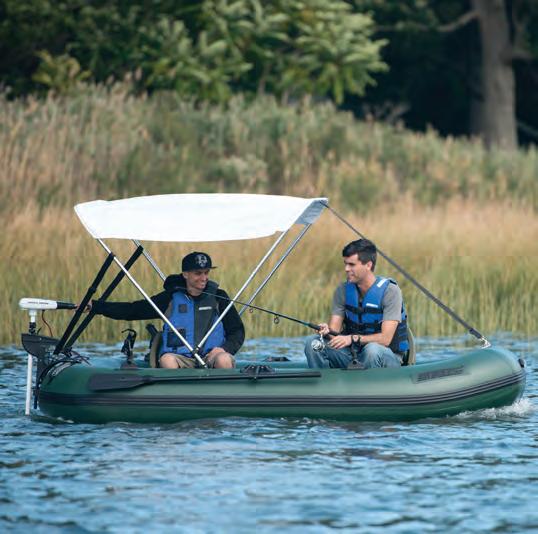
Slip into water others can’t reach. The Stealth Stalker 10 isn’t just portable—it’s purpose-built for serious anglers who refuse to be limited by ramps, trailers, or crowded shorelines.
Why
Ultra-Portable –
Packs Into Your Trunk, No Trailer Required Rock-Solid Stability –Stand, Cast, And Fight Fish With Confidence Built Tough –Rugged, Puncture-Resistant Construction Fish-Ready Design –Swivel Seats, Rod Holders, Smart Layout Go Anywhere Access –Lakes, Rivers, Bays, Hidden Backwaters
This Is Your Personal Fishing PlatformLightweight, Durable, And Ready When You Are.
Watersnake® Motor Canopy Package
Upgrade to effortless control. Move farther, stay on fish, and glide in silently without the hassle of gas.
Just $1859 +applicable sales tax
1 of 7 Great Packages!
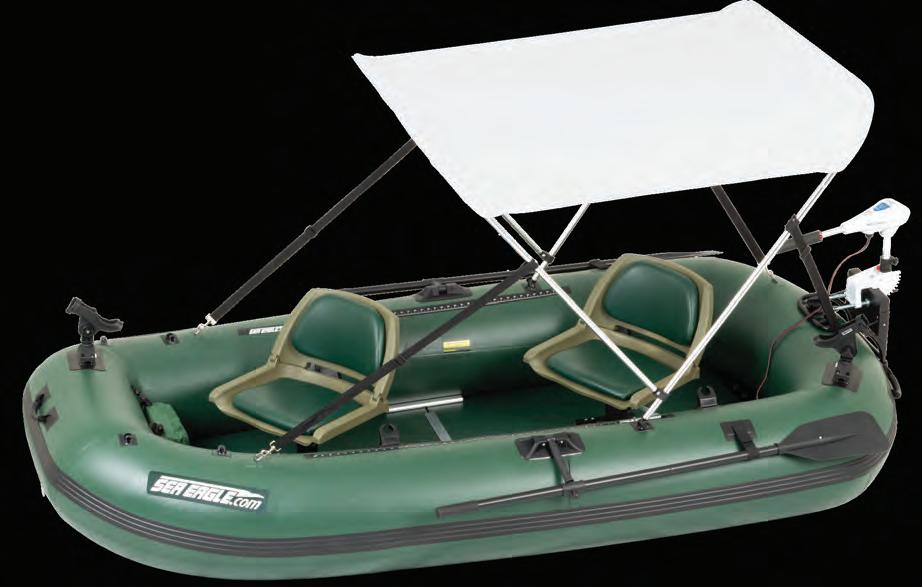

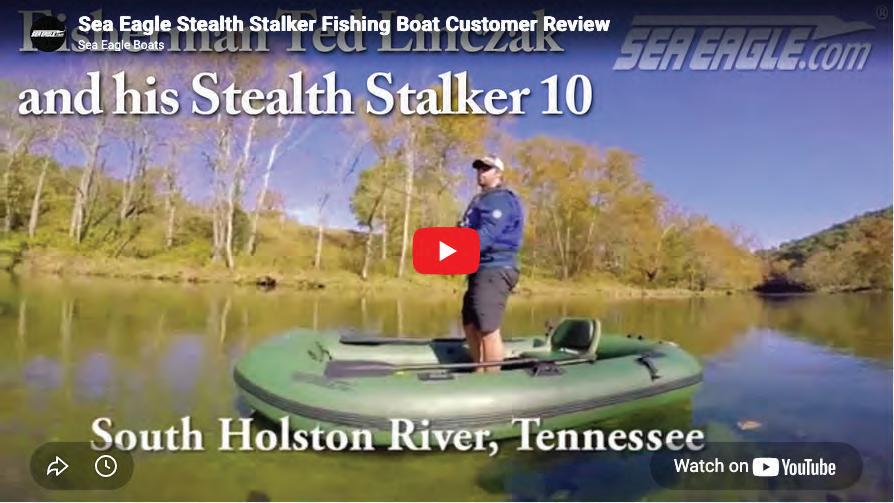
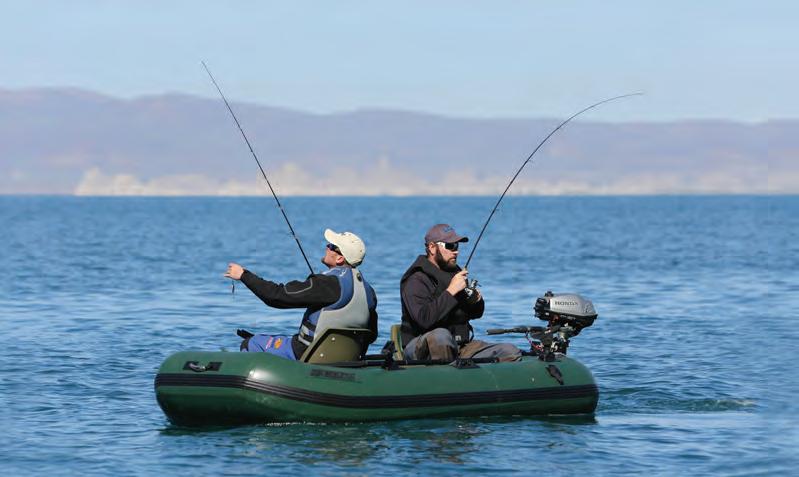
The Sea Eagle Stealth Stalker 10 (often called the STS10) is a thoughtfully designed inflatable fishing boat that stands out for how well it balances portability, stability, and real fishing performance. At just over 10 feet long, it’s compact enough to transport easily, yet it offers a surprisingly solid and capable platform for one or two anglers with gear. What makes it particularly appealing is that it eliminates many of the barriers associated with traditional boats—there’s no need for a trailer, dedicated storage space, or even a large vehicle. When deflated, it packs down small enough to fit in a car trunk, making it accessible to people who might otherwise never consider owning a boat.
The STS10 is constructed from thick, reinforced PVC and built with multiple independent air chambers, which not only enhance durability but also provide an extra level of safety on the water. Once inflated, the boat
feels impressively stable, especially when paired with its optional rigid floorboards. This stability is one of its defining characteristics, allowing anglers to stand and cast with confidence—something that many inflatables struggle to support. In practice, it behaves more like a small hard boat than a typical raft, which is a big part of its appeal.
The boat’s shallow draft further expands where it can go. Because it only needs a few inches of water to float, it can access backwaters, flats, and narrow creeks that are off-limits to larger, heavier boats. This opens up a range of fishing opportunities that many anglers simply can’t reach with traditional setups. At the same time, it’s capable of handling a small gas or electric motor, giving users flexibility in how they power it.
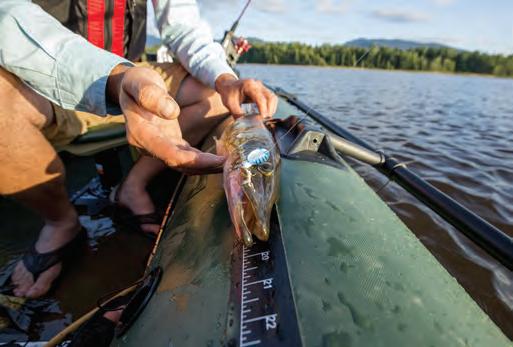
Another aspect that sets the Stealth Stalker apart is its deliberate focus on fishing. The design isn’t generic or multipurpose; it’s clearly built with anglers in mind. Features like built-in rod holders, accessory mounting points, and optional swivel seating create a customizable setup that can adapt to different fishing styles. Its low-profile, huntergreen color scheme also plays a role, helping it blend into natural surroundings and move quietly through the water—an advantage when trying not to spook fish.
Ultimately, what makes the Sea Eagle Stealth Stalker 10 stand out is how effectively it bridges the gap between convenience and capability. Many portable boats sacrifice stability or usefulness, while more robust boats demand significant storage and transport commitments. The STS10 manages to offer both in a way that feels intentional and well-executed, making it a compelling choice for anglers who value simplicity without giving up performance.
LEARN MORE AT

For years, I’ve spent time on rivers, streams and backcountry waters that most people will never see. Places that feel untouched. Wild. Worth protecting.
But over time I started noticing something that didn’t belong.
Discarded fishing line.
Sometimes it’s barely visible—caught in a branch or wrapped around a rock. Other times it’s impossible to ignore. Tangled, drifting, or worse…impacting wildlife that never should have encountered it in the first place.
The truth is, most anglers don’t leave it behind intentionally. But it’s there. And if you spend enough time on the water, you’ve seen it.
I know I have.
For a long time, I did what many of us do. I noticed it… and kept fishing.
At some point, that changed.
I stopped asking if it was my place to do something about it—and started asking if it was my responsibility.
That shift is what led to Pack Out More™.
It’s not complicated. It’s not about perfection. It’s about a simple idea: If you enjoy the water, leave it better than you found it.
One piece of line. One piece of trash. One small decision at a time.
Because movements don’t start with big moments. They start with small actions
By Joe Woody
that people choose to repeat.
And when enough people make that choice, something bigger begins to take shape.
A new standard.
A new kind of angler.
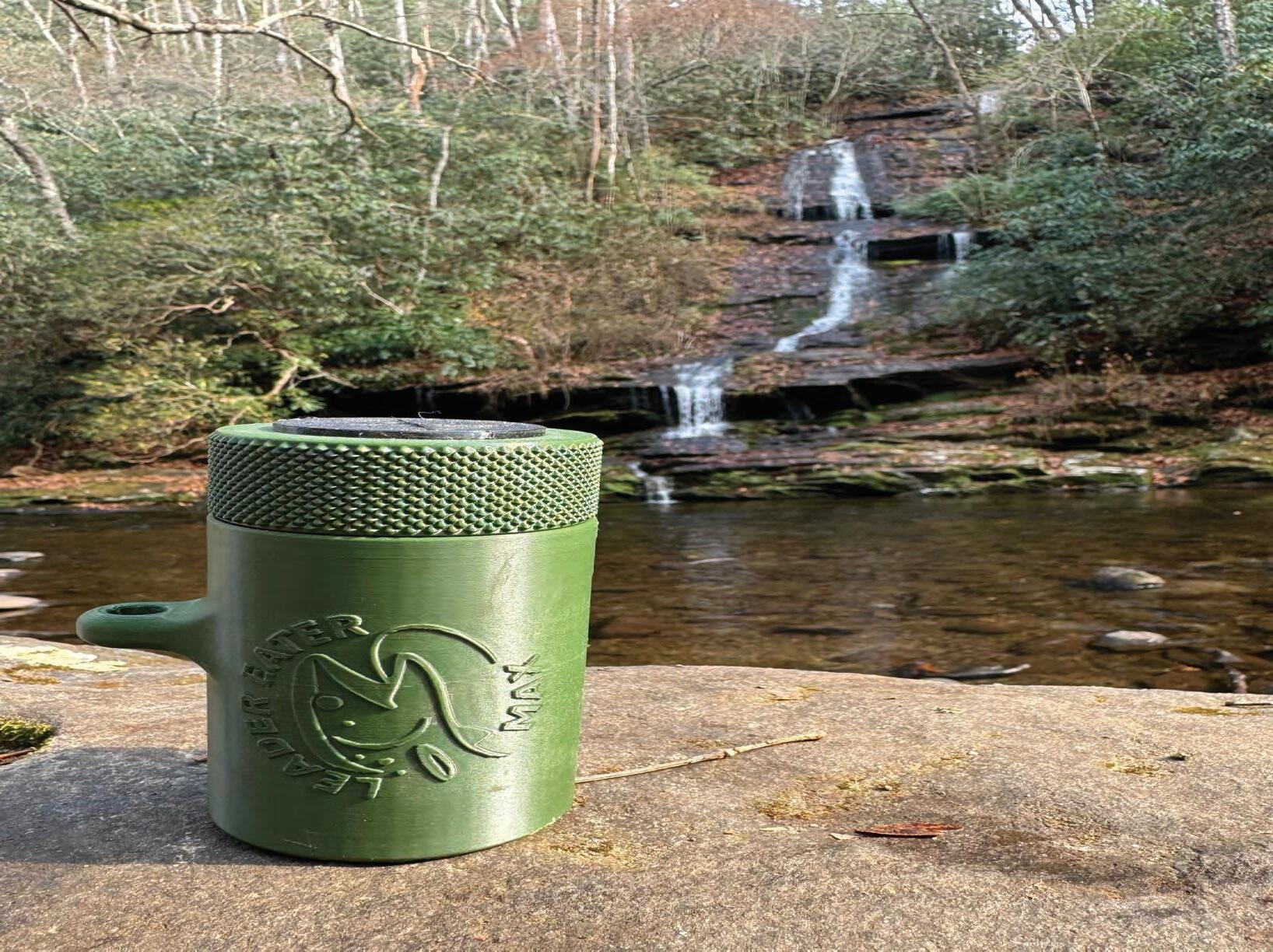
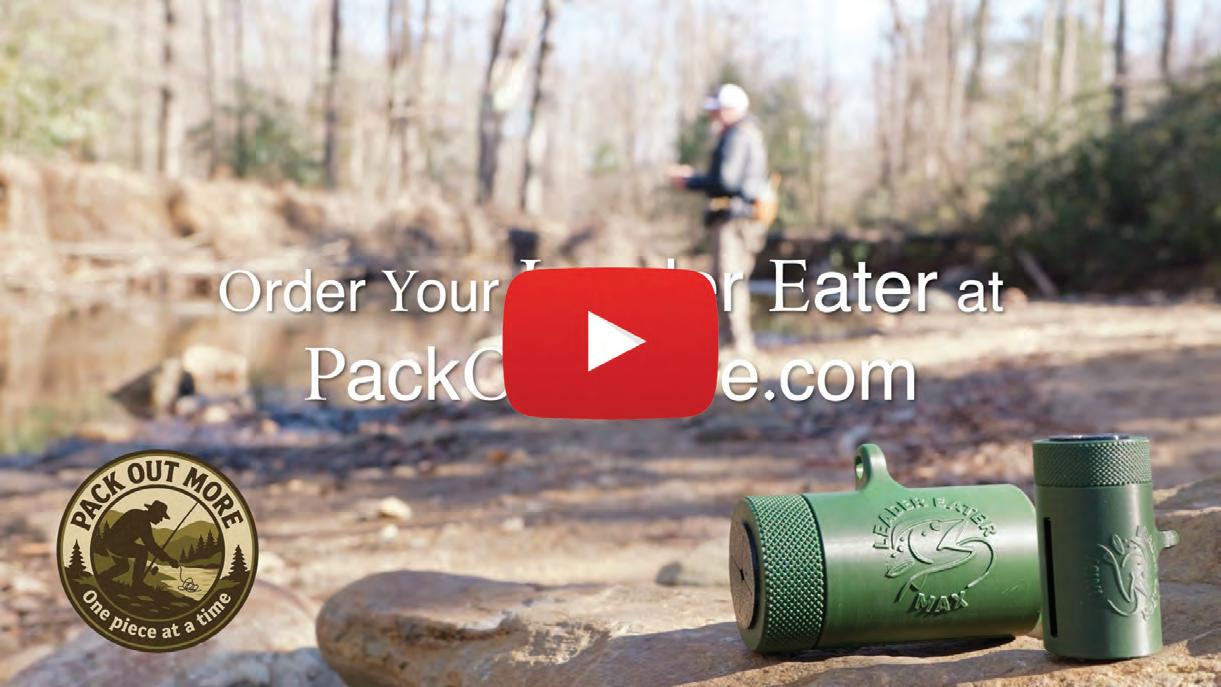
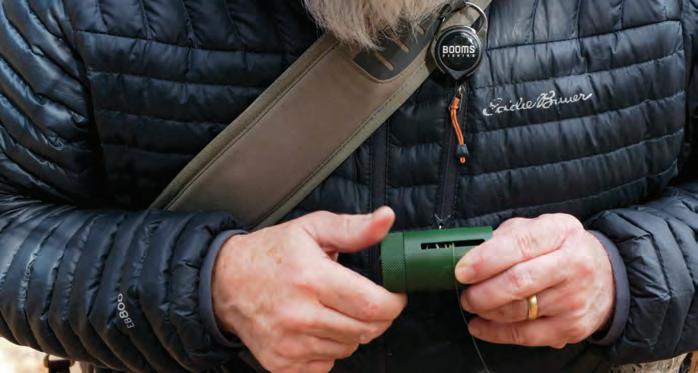
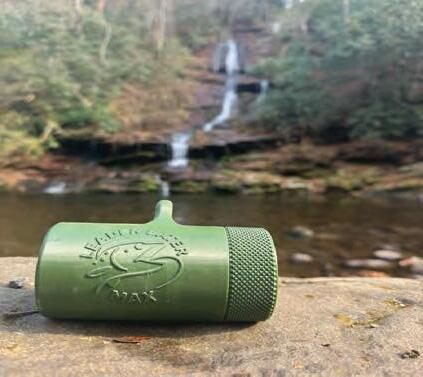
To make that action easier, we created the Leader Eater™—a simple, purposebuilt tool designed to help anglers remove and safely collect discarded fishing line and small debris while they’re on the water.
If you’re ready to be part of this shift, you can learn more and get yours at PackOutMore.com
Because this only works if enough of us decide to start.
Be
Pack Out More™ starts with a simple decision—one piece at a time.
The Leader Eater® was built to make that decision easier, giving anglers a simple way to remove and safely collect discarded fishing line and small debris while on the water.
By NPFL Pro Angler Joey Bloom
Lipless vibrating lures have long been staples in bass fishing, but few create more debate—or more bites—than the lipless crankbait (rattle trap) and the chatterbait. While both rely on vibration to trigger reaction strikes, their effectiveness depends heavily on forage, seasonal timing, and even the rod and reel used to fish them.
A lipless crankbait is a hard-bodied bait designed for speed and sound. Its tight vibration and internal rattles allow bass to locate it from long distances, making it ideal when fish are actively feeding on baitfish like shad. These baits excel in open water or over submerged grass, where anglers can burn them, yo-yo them, or rip them free to trigger reaction strikes. For rattle traps, rod selection plays a major role in landing fish. A 7’ to 7’3” medium-heavy rod with a moderate or moderate-fast action is ideal. The slightly softer tip allows bass to fully load the rod before the hooks engage, reducing the chances of pulling treble hooks free during surging fights. The longer length also helps make long casts, which is critical when covering water or targeting schooling fish. You typically want to throw the trap on a faster gear ratio reel like a 7.1 or 7.3. The faster gear ratio helps pick up the line on long cast when you get a bite and
need to catch up with the fish.
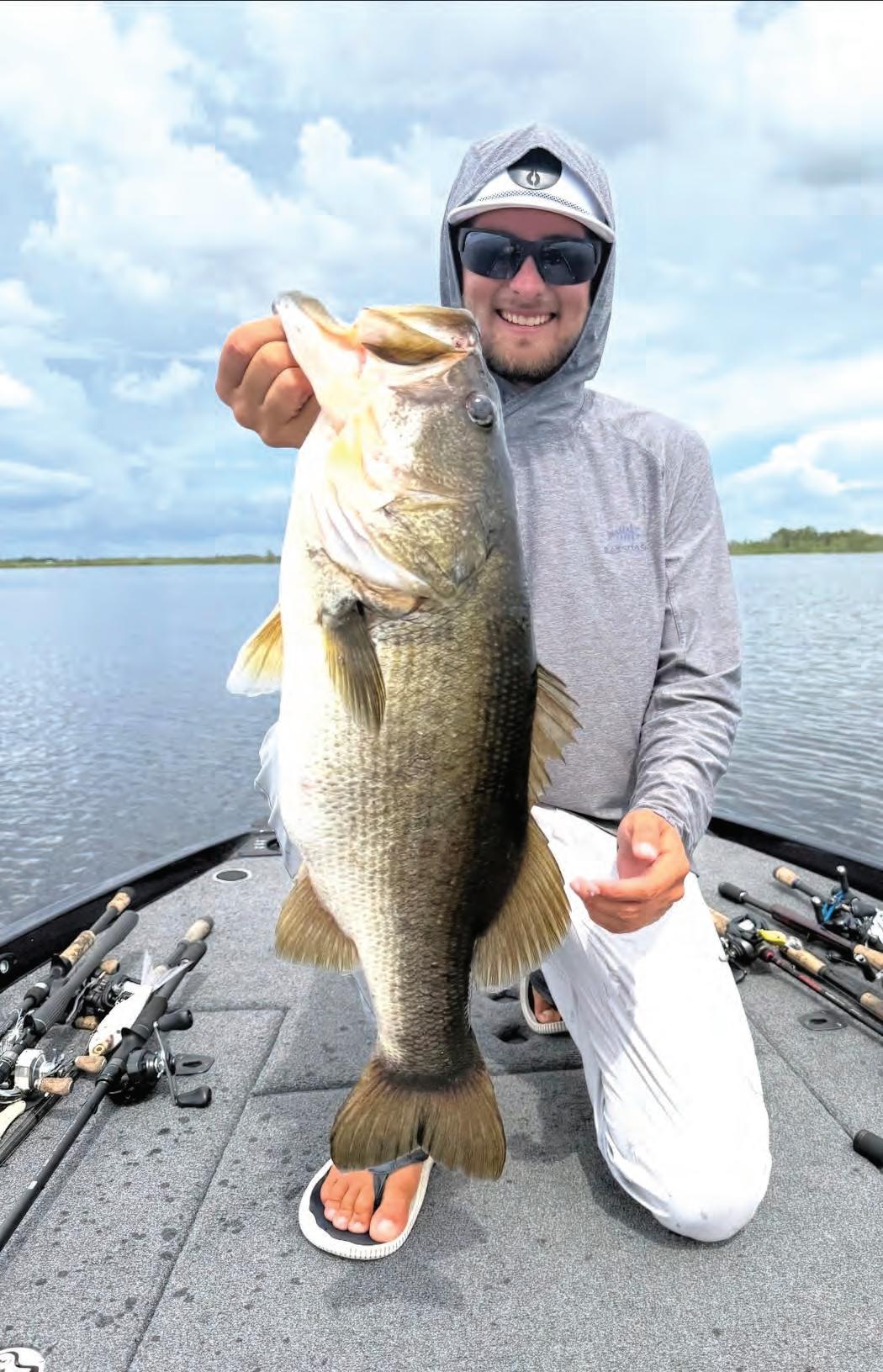
A chatterbait, or bladed jig, produces a wider, thumping vibration and a more natural profile when paired with a soft plastic trailer. This lure shines around shallow grass, docks, and wood, especially in stained water where bass rely more on vibration than sight. Chatterbaits often mimic bluegill or bream, making them deadly around spawning areas and shallow cover. Because chatterbaits use a single heavy hook, anglers benefit from a slightly different rod setup. A 7’ to 7’4” medium-heavy rod with a fast action provides the backbone needed to drive the hook home while still offering enough tip to keep fish pinned. This setup also allows anglers to control fish quickly when pulling them out of thick cover.
Beyond lure, reel, and rod choice, matching the hatch remains one of the most important elements of success. Bass often focus on a specific forage, and lures that match the size, color, and movement of that prey get bit more consistently. Chrome or white rattle traps imitate fleeing shad in open water, while green pumpkin or bluegill-pattern chatterbaits blend perfectly into shallow cover scenarios. To maximize these techniques, anglers must learn
to follow the bait throughout the season. In late winter and early spring, baitfish move toward warming flats, making rattle traps excellent search tools. After the spawn, bluegill become a primary food source, and chatterbaits excel around shallow cover and spawning grounds. In summer, bait often shifts to deeper grass lines or offshore structure, where slow-rolled chatterbaits can shine. Come fall, shad migrate into the backs of creeks, and rattle traps once again dominate as bass feed aggressively ahead of winter. By pairing the right vibrating lure with proper reel and rod length and action—and matching it to seasonal forage—anglers can significantly increase efficiency and landing percentage. In bass fishing, success often comes down to details, and choosing the right reel and rod can be just as important as choosing the right bait.
Follow all of Joey Bloom’s fishing and fun on Instagram, Facebook, and YouTube at Joey Bloom Fishing.
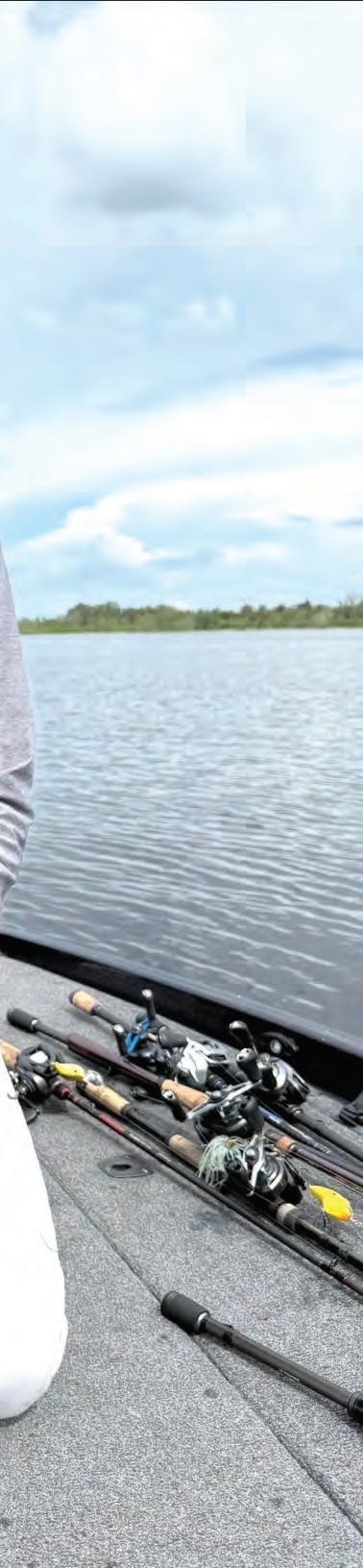
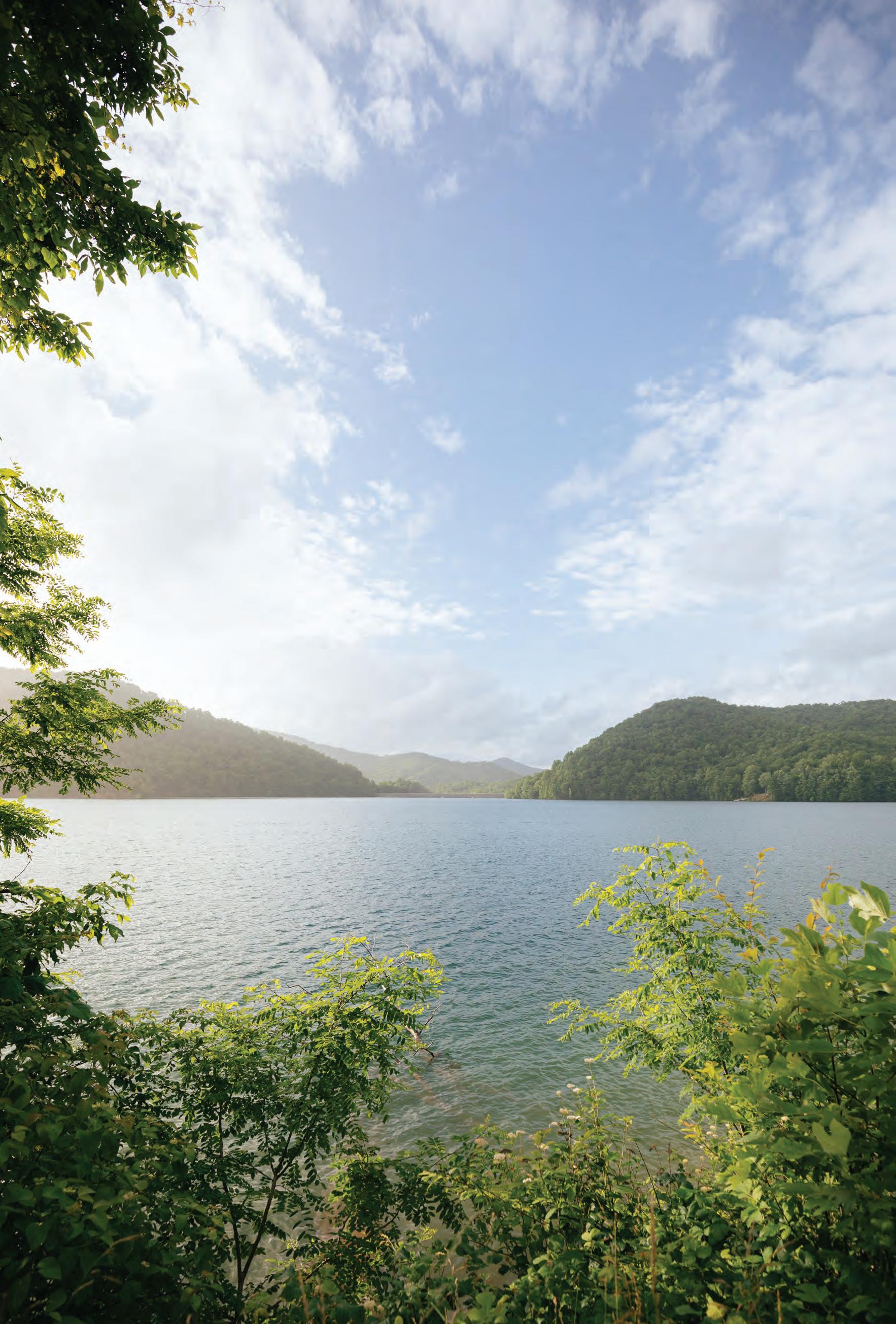
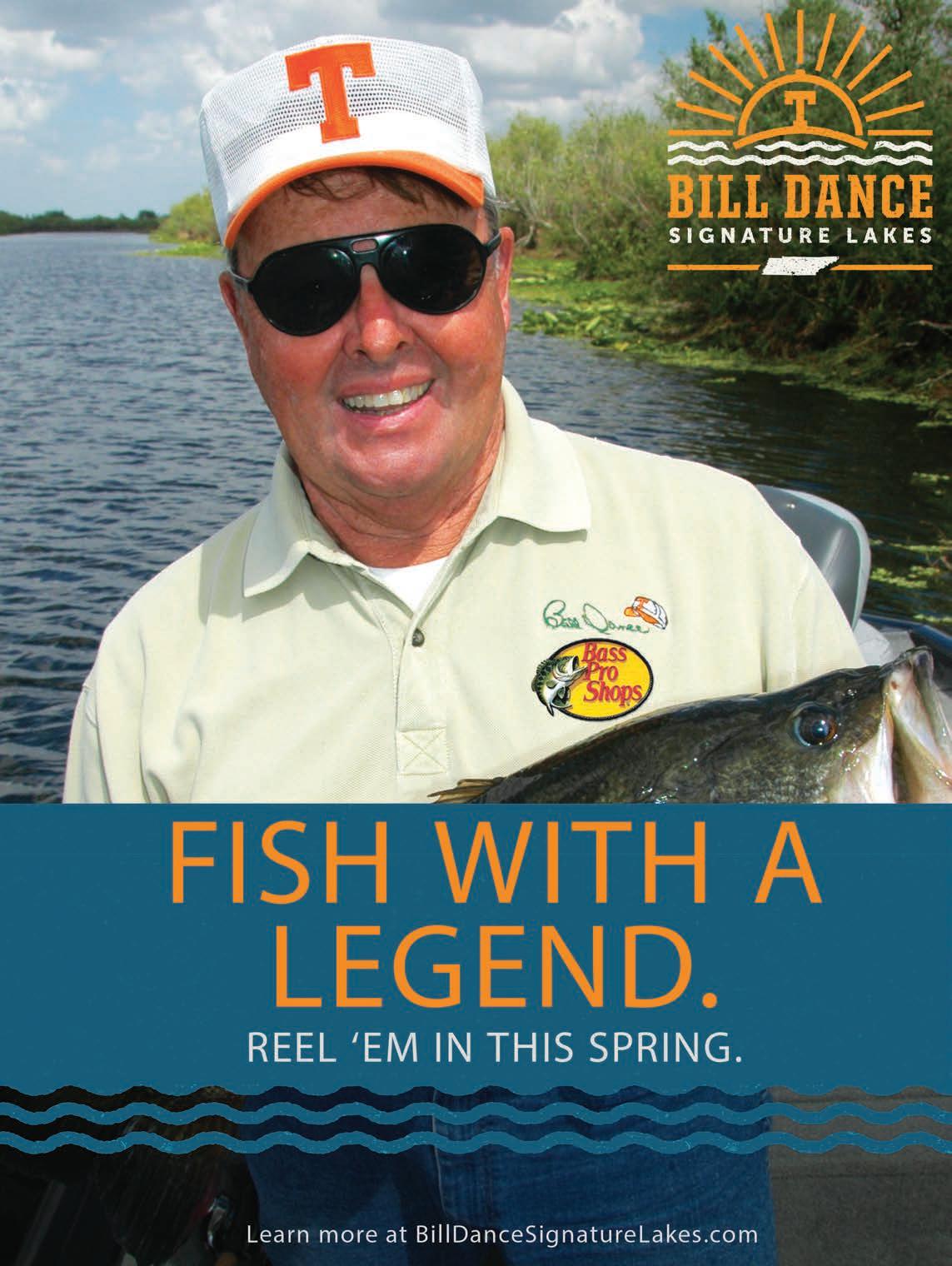
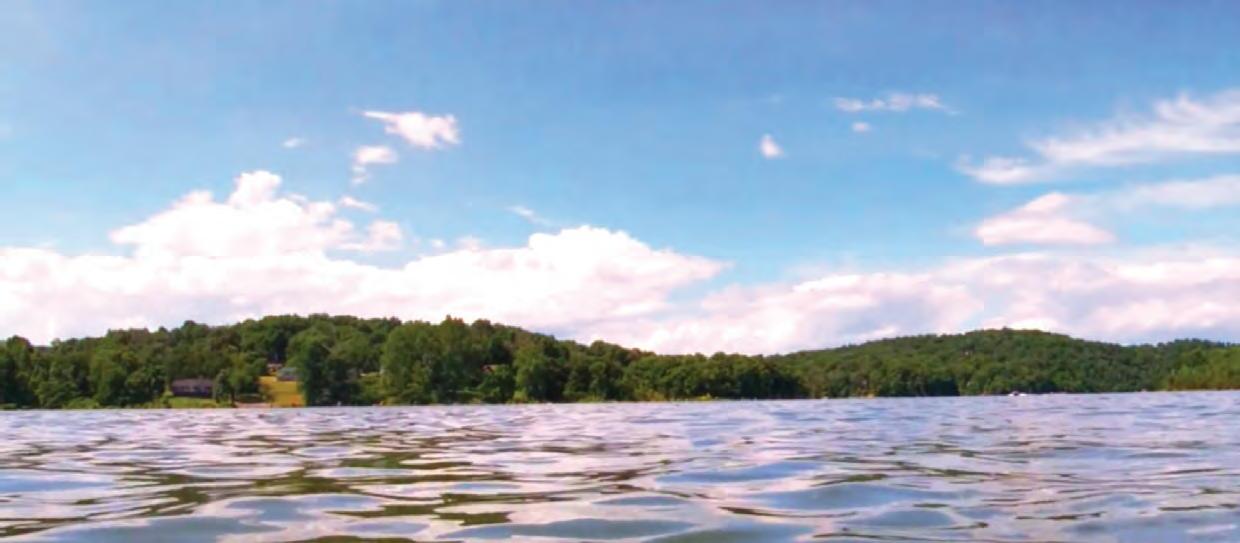
Forty-nine reservoirs stretch across the Tennessee Valley like a string of pearls. And for those who love to fish, those lakes are just as valuable. Whether it’s bass, crappie, walleye, or catfish, whether for sport, food, or just fun, you can find world-class lake fishing only hours away from any spot in the Tennessee Valley. From more than 11,000 miles of shoreline or while floating on more than 700,000 acres of water, residents and visitors will quickly learn why this area is considered one of the best fishing destinations in the U.S. and, some would say, the world.
Fishing from the shore can be restful and rewarding—and anyone can do it. All you need is a little intel about how to find a spot where the fish might be biting. Here are a few tips for successful shore fishing from the Tennessee Wildlife Resources Agency:
• Fish are often swimming near the shore in the spring and fall. If you’re fishing from the shore in the heat of summer, do it in the evening or early morning—or even after dark.
• Fish near-unique features such as docks, logs, trees, rocks, or rocky areas; aquatic vegetation; or places where creeks enter the water.
• When fishing in moving water, look at the surface for boils and breaks—this means there is some underwater structure blocking the current, which could be the perfect hiding place for fish.
• Begin fishing (casting) close and parallel to the bank, then work your way outward (fan casting) toward deeper water.
• If you don’t get any bites, try switching baits. If this doesn’t work, move to another hole.
• Wear polarized sunglasses so you’ll be able to see fish as well as submerged objects more clearly. (Your eyes will also be protected from the tackle.)
If you love outdoor sports—boating, hunting, fishing—and the natural world, or if you just like to observe wildlife, build birdhouses, maintain a bird feeder or are just curious about the critters in your backyard, the Tennessee Wildlife Resources Agency is here to help enrich your outdoor experience. Visit us at www.tn.gov/twra/



When Suzuki Marine USA signed angling superstar Jacob Wheeler to its Suzuki Ultimate Fishing Team in October 2025, everybody at the Tampa, Florida-based company expected great things. It didn’t take long for Wheeler to prove them right, adding REDCREST Champion to his already impressive list of accomplishments, capturing the $300,000 prize and the REDCREST trophy in dominating fashion during the Championship Round of Major League Fishing’s Bass Pro Shops 2026 REDCREST tournament.
A REDCREST trophy was one of the few pieces of hardware that had eluded Wheeler over his illustrious career— one including 11 Bass Pro Tour wins, a Bassmaster Elite Series win and four Fishing Clash Anger of the Year titles. This was his sixth time fishing in Major League Fishing’s championship event, but despite four respectable Top 6 finishes previously, Wheeler hadn’t yet reached the top of the MLF mountain.
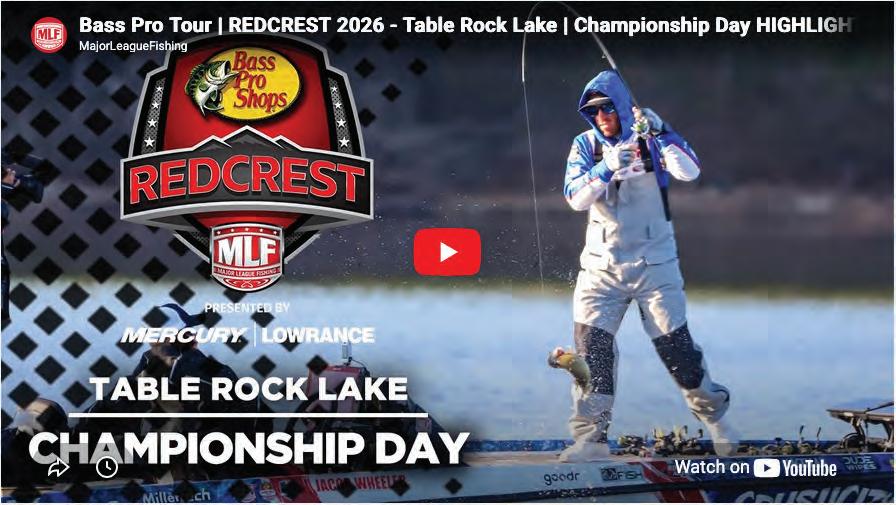
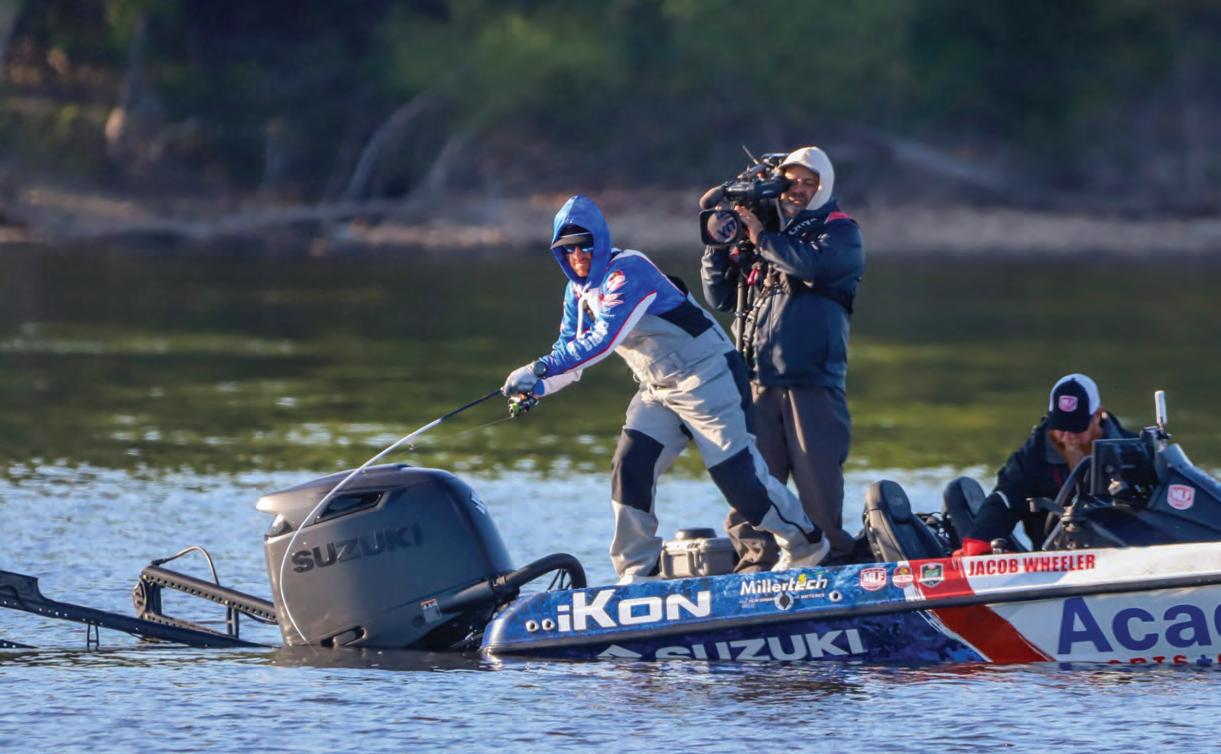
This all changed Sunday, April 19 on Table Rock Lake, Missouri. With a new Suzuki Stealth Line 250V6 powering his iKonX21 bass boat, Wheeler started strong on Day 1, used Day 2 to stay above the cutline while forming his Day 3 strategy, and then dominated the championship field of 10, ending the final round more than 13 pounds ahead of the next closest finisher.
With 2-1/2 hours left to fish, Jacob Wheeler sat on the front deck of his bass boat and made a phone call. Trying to distract himself from the fact that the $300,000 prize and REDCREST trophy that had long eluded him were within reach, Wheeler FaceTimed his wife, Alicia, and their two children, Olivia and Hudson, during the final period break.
At that point, Wheeler led his nearest pursuer by more than 17 pounds. With postfrontal conditions making for a tough bite on Table Rock Lake, just about
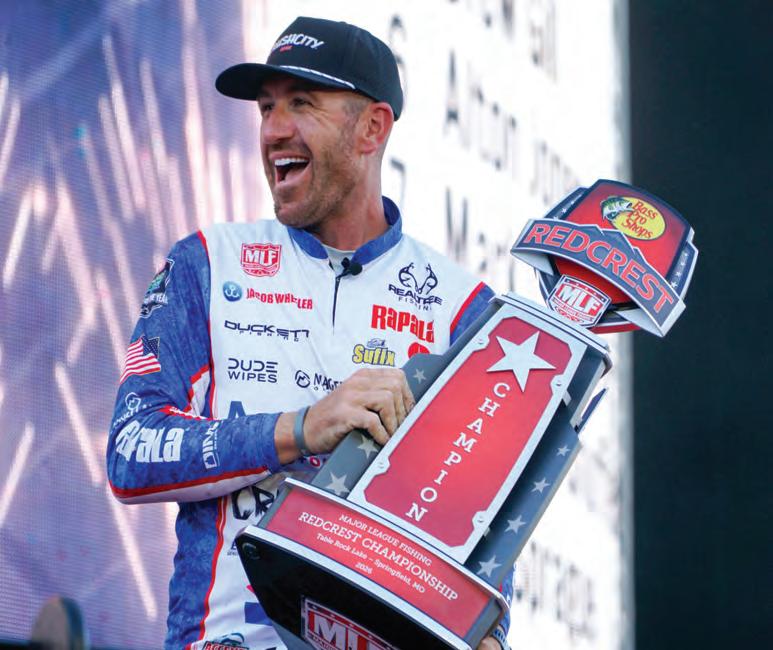

everyone knew that the title that had long seemed inevitable was now imminent— including Olivia. The 7-year-old asked, “Daddy, you’re going to win, right?”
“I’m just like, ‘Honey, I’m going to try, but it’s not a guarantee,’” Wheeler said with a laugh. “’It’s okay if I don’t. We’re going to try our hardest.’”
This win was a master class in both angling skill and strategy. Wheeler scored an impressive 52 pounds, 2 ounces on Day 1, putting him in third place and 14 pounds above the cutline. He was so confident in his plan that after reaching 75 combined pounds for Days 1-2, he removed the hooks from his lures and used the rest of the day to scout the fish and build his strategy for the next day’s championship push. All 10 qualifiers start even on Day 3, and this is where Wheeler’s
strategy really paid off. His first bass of the day (a solid 4-pounder) gave Wheeler the lead just 15 minutes in, and he never relinquished the top spot. Within the first hour, Wheeler’s total reached 20 pounds, 7 ounces for eight bass. He ended the day with 21 scoreable bass for 51 pounds, 11 ounces and a convincing trip to the winner’s stand.
On the Championship Stage, an emotional Wheeler dedicated the victory to his father, who passed away from cancer just a few days before REDCREST 2025.
“It was super emotional, because my dad told me he wanted me to win one for him before he passed away, and (not doing so) was just a tough one to swallow,” Wheeler said.
But his prevailing emotion was relief. Wheeler can finally stop hearing about how he hasn’t won the big one.

“This is why we’re so proud to be associated with Jacob,” said Suzuki Marine Vice President Sales & Marketing Brandon Cerka. “He is a great angler, a great family man, and an excellent ambassador for Suzuki Marine. We may not sponsor a large number of professional anglers, but I like to think we sponsor the best. It was a thrill to be there with our Suzuki Marine staff to cheer on Jacob and supports the rest of our Suzuki Ultimate Fishing Team at REDCREST.”
Suzuki’s Stealth Line outboards, with their exclusive all matte-black finish with matching
Black Chrome graphics, have quickly gathered attention from the bass fishing crowd. And while Suzuki outboards may not yet dominate the transoms of tournament bass rigs, they are becoming the top choice of elite anglers coastto-coast. For example, eight of the 35 anglers who qualified for REDCREST 2026 were powered by Suzuki outboards. “At Suzuki, we focus on reliability, durability, and consistency — many of the same traits that helped Jacob rise to the top against the best professional anglers in the world. Our representation at the upper levels of professional bass fishing speaks
not only to our products, but to the caliber of anglers associated with Suzuki Marine,” added Cerka.
The REDCREST 2026 win means more than perhaps any previous win for Wheeler’s résumé, too. He further bolstered his standing as the dominant angler of his era and one of the greatest of all time. Since the inception of the Bass Pro Tour in 2019, he’s up to 12 wins to go along with four Angler of the Year titles, and joins Kevin VanDam as the only angler ever to win multiple tour championship events and four-plus AOY crowns.



Tucked into the northeast corner of Mississippi, Tishomingo County offers anglers a surprisingly diverse and scenic freshwater fishery that feels far removed from the typical Southern landscape. According to Explore Tishomingo County, the area is defined by clear lakes, winding creeks, and access to the Tennessee River system—creating a destination where both casual fishermen and serious anglers can find productive water.
At the center of it all is Pickwick Lake, a well-known hotspot that consistently produces quality fish. This lake is particularly famous for its trophy smallmouth bass, but it also supports strong populations of largemouth bass, crappie, catfish, and bluegill. The structure here is what makes it special— expansive open water transitions into
creek channels, rocky points, and shallow coves, giving anglers multiple patterns to work depending on the season. Whether you’re dragging jigs along ledges or casting into backwater pockets, Pickwick offers year-round opportunity and even hosts tournaments and guided trips for those looking to dial things in.
For a quieter, more laid-back experience, Tishomingo State Park provides access to smaller waters like Haynes Lake, a 45-acre fishery ideal for bank anglers and small boats. Here, you’ll find a steady bite of bass, crappie, catfish, and bream—perfect for a relaxed day or introducing someone new to fishing. The park’s rugged terrain and wooded shoreline add to the experience, making it feel more like a backcountry trip than a typical lake outing. Running through the park, Bear Creek offers a completely different style of fishing.
This rocky, flowing creek is ideal for anglers who prefer light tackle and moving water. Spotted bass, sunfish, and even smallmouth can be found in its deeper pools, especially along shaded banks and current breaks. It’s a place where fishing blends with exploration—casting between paddles as you float through sandstone bluffs and hardwood forests. What makes Tishomingo County stand out isn’t just the fishing—it’s the accessibility and variety. From full-service marinas and boat ramps to remote creeks and shoreline spots, anglers can tailor their trip to match their style. Whether you’re chasing trophy bass on Pickwick or easing into a quiet morning bite on a small lake, this corner of Mississippi delivers a well-rounded, under-the-radar fishing experience worth exploring.

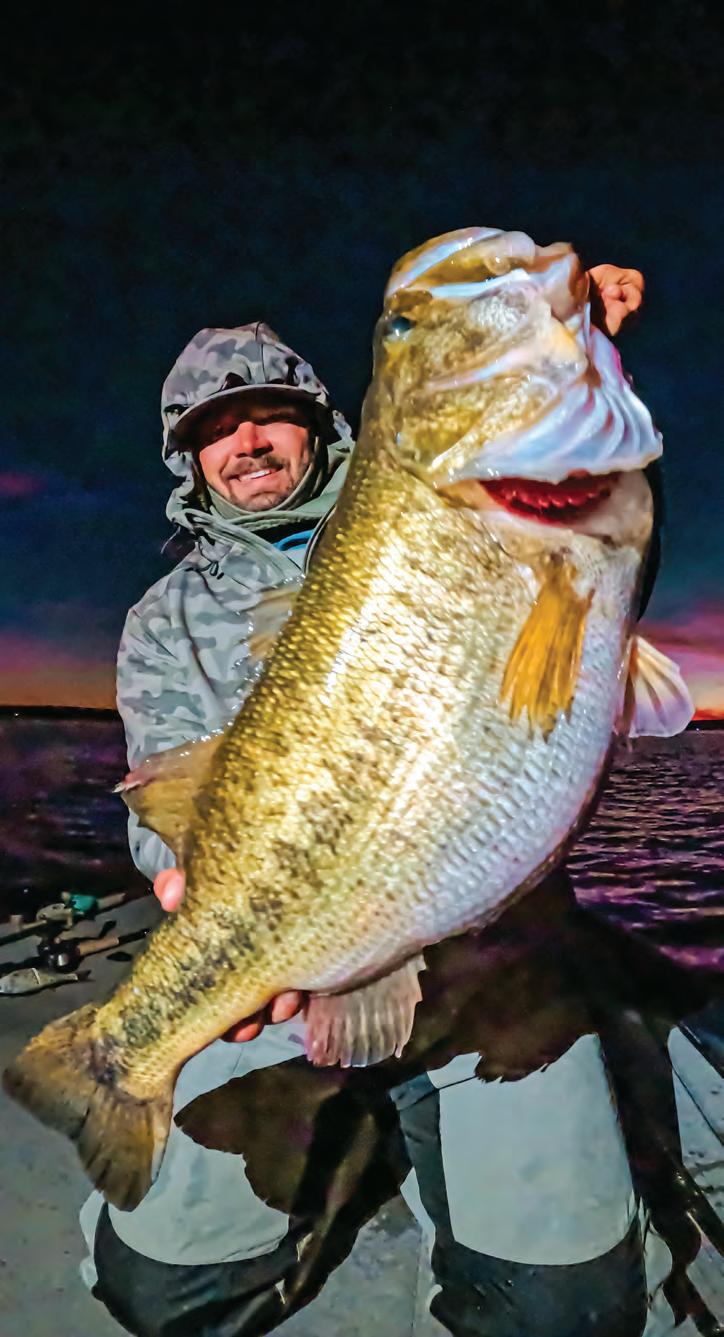
TYLER WOOLCOTT
Every spring, it feels like the bank bite will last forever. Fish are shallow, visible, and predictable cruising, spawning, and guarding fry. It’s the time of year when confidence is high and decisions feel easy. But like everything in fishing, that window doesn’t stay open long. Before most anglers realize it, the fish that were once easy to find have simply vanished.
That disappearance marks the beginning of what seasoned anglers know as the offshore shift. As water temperatures climb and the spawn wraps up, bass begin pulling away from the bank and setting up on offshore structure. Ledges, shell beds, brush piles, and subtle depth changes start to hold more fish than the shoreline ever could. It’s not an overnight move, but it happens quickly enough that many fishermen get left behind, still casting to water that’s no longer alive.
One of the biggest mistakes anglers make during this transition is assuming the fish have stopped biting. In reality, they’ve just relocated. Instead of being scattered along miles of bank, bass begin grouping up in smaller, more defined areas. The challenge shifts from covering water visually to understanding what lies beneath the surface. It becomes less about instinct and more about intention reading depth, structure, and subtle changes that aren’t visible at a glance.
Making the adjustment isn’t always easy, especially for anglers who are comfortable fishing shallow. It requires slowing down, trusting your electronics, and committing to areas that might not show immediate signs of life. But once you connect with your first offshore group, everything changes. What felt like a tough day can turn into a flurry of action in just a few casts, often with better quality fish than what the bank was offering.
The offshore shift is more than just a seasonal pattern—it’s a turning point. It separates those who react to changing conditions from those who anticipate them. As summer approaches, the anglers who embrace the move away from the bank will find themselves ahead of the curve, dialing in on schools of bass that are no longer pressured by the crowds. And while the shoreline may feel empty, the real action is just a little deeper.
Capt. Tyler Woolcott is a professional tournament angler, as well as owner/operator of Florida Big Fish Adventures, providing bass and saltwater guided fishing trips: www.floridabigfishadventures.com.
It’s no fish tale when you run with a John Deere. You can get everything done faster and easier, so you get more time on the water. Plus, our special offers make them the catch of the day.





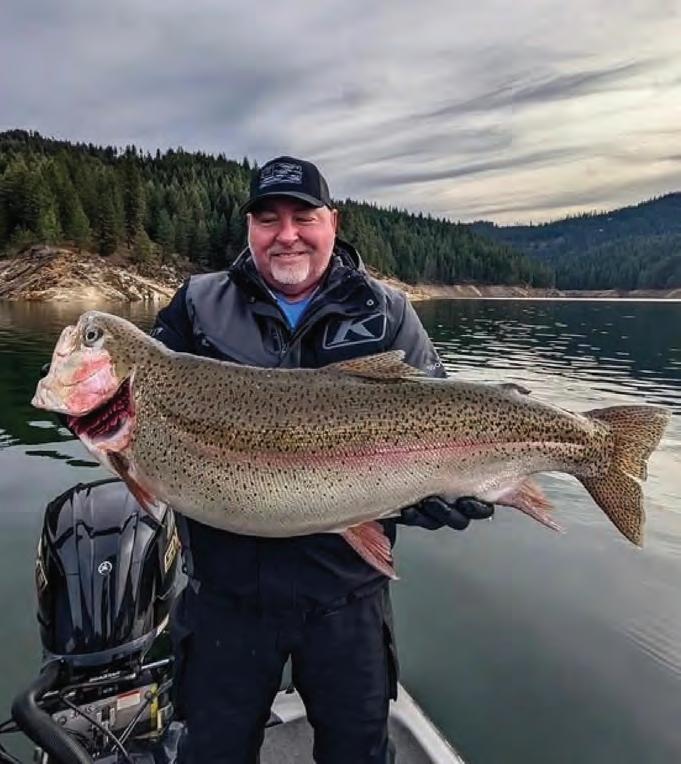
While fishing North Central Idaho’s Dworshak Reservoir, Todd Phillips landed a monster rainbow trout the size of a Chinook salmon and, in so doing, took his spot atop the Idaho state record books by the narrowest of margins.
Phillips, of Fruitland, Idaho, was taking advantage of some breaks in the cloudy weather while fishing the reservoir near Orofino on January 13. At one point, his rod tip bent violently towards the water, and after several minutes, he landed the Dworshak giant.
Now, most anglers will agree, any time a rainbow trout takes two hands to hold up, it’s worthy of a day’s highlight reel. But this one turned out to be a new Idaho certified weight record as Phillip’s rainbow weighed in at 20.03 pounds, eclipsing the previous record by a mere .03 pounds, or .48 ounces, according to Idaho Fish and Game. The former record of 20 pounds was set in 2009 by Michelle LarsenWilliams, who caught her trout from the Snake River.
By TAM Staff
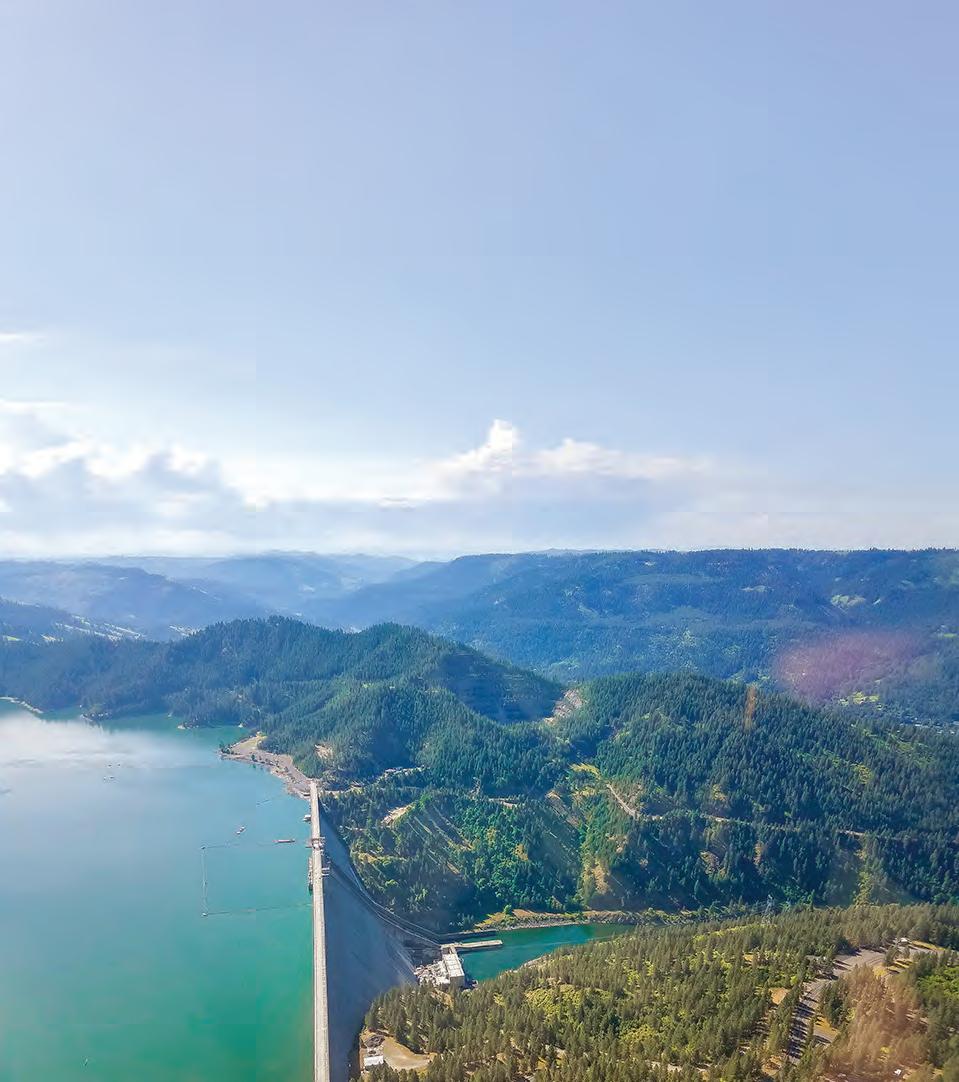
Known for producing large rainbow trout due to its cold, deep water and abundant food supply, the Dworshak Reservoir is the largest reservoir in Idaho and fourth-largest in the Pacific Northwest. The dam, with a height of 717 feet, is the third-tallest in the U.S. Stretching 55 miles long, it has long been known as a destination where anglers have
a legitimate chance to land a recordsetting fish. Most often, anglers target trophy smallmouth bass fattened on abundant kokanee. In fact, the current Idaho certified weight record for smallmouth bass was set at Dworshak in 2006 by Dan Steigers of Juliaetta, Idaho, whose fish weighed 9.72 pounds. The reservoir also holds the catch-and-release smallmouth bass record, which has changed hands several times in recent years.
This winter, however, it was Phillips’ extraordinary rainbow trout that secured Dworshak’s place in the spotlight—and earned him the honor of notching his name in the Idaho fishing record book.
Did you notice my attempt at a little humor with that headline? Just what we need after a long closed season. In my personal view, the closure has been unnecessary, much like the situation with Atlantic red snapper. Many of us are simply trying to catch seabass and grunts for dinner, but we keep getting pushed off our favorite spots where red snapper and gags are abundant. Yet, these species are still considered endangered. I think you know where I stand on this topic, so I won’t dwell on it any further.
As warm water moves in closer to the beach, expect to find kingfish and cobia frequenting the same spots where you’re catching gags when the water temperature rises above 68°F. Always have a pitch rod ready as cobia may swim right up to the boat. However, don’t be surprised if you catch cobia while bottom fishing with a decor jig and an appealing bait. In fact, more cobia are often caught on the bottom than on the surface when anchored up and targeting grouper.
I’ve always said, “Find the bait, find the fish.” Go to all your familiar haunts with structure of one kind of another, whether it’s ledges, rock out crops, wrecks, etc. The bonus will be finding schools of cigar minnows and sardines on them. You don’t need to look any further when you find this combination of bait because the fish will be right there. It’s always a good idea to keep one person on the Sabiki jigging up. A live sardine or a live cigar on a decoy has a life expectancy of under ten seconds around any kind of fish. We try to never leave the marina without a couple boxes of frozen cigar minnows and live pinfish. That live pinfish can sometimes be the best selection of all because it’s too large for any of the trash bites.
Any kind of little snapper about the size of your hand makes for the ultimate bait. I’m no longer fishing for barely-legal gag or scamp. Instead, I’m looking for one good bite at a time. I’ll let that bait soak on the bottom and be patient waiting for the old man to show up. Don’t get me wrong, more fish have been caught on frozen cigar minnows and sardines than all the other baits combined, but a live one is simply irresistible to every grouper and/or snapper out there. Period. Nearly everything on the bottom will take a whack at it, but only the fish with the correct sized mouth can eat that small snapper. Because the
TIM BAREFOOT
If you’re anchoring and not just using the trolling motor, it’s a great idea to fly the kite. Keep a couple baits suspended with little to no leader in the water. Live greenies, cigs or sardines under the kite is the ultimate presentation. You can even get away with fluorocarbon using circle hooks depending on the current. Don’t hesitate to put a bait out with a small amount of weight in front of it to get it down 30 to 50 feet behind the boat. This will get you that large wahoo bite.
creel limits are so low, you’ll easily reach your grouper limit. Once you have, it’s wise to take advantage of other species like vermilions, mangroves, grunts and seabass.
In addition to all the other stuff on the bottom, it’s always good to keep a light line out for kings, blackfin, wahoo and dolphin. It’s not a bad idea to keep one under a float (so you can keep an eye on it) and another one without a float, but you have to be mindful of that bait getting back into props or under the boat tangling other lines.
There are so many options available this time of year in the warmer water, so be ready to take advantage of all of them once you fill your cooler with one species or another. This is the ideal time to broaden your approach and become skilled in targeting not only different types of snapper and grouper, but also pelagics.
MAY you find calm seas, tight lines and delicious dinners this month!
Learn more from Tim Barefoot at barefootcatsandtackle.com.



By Astrid deGruchy
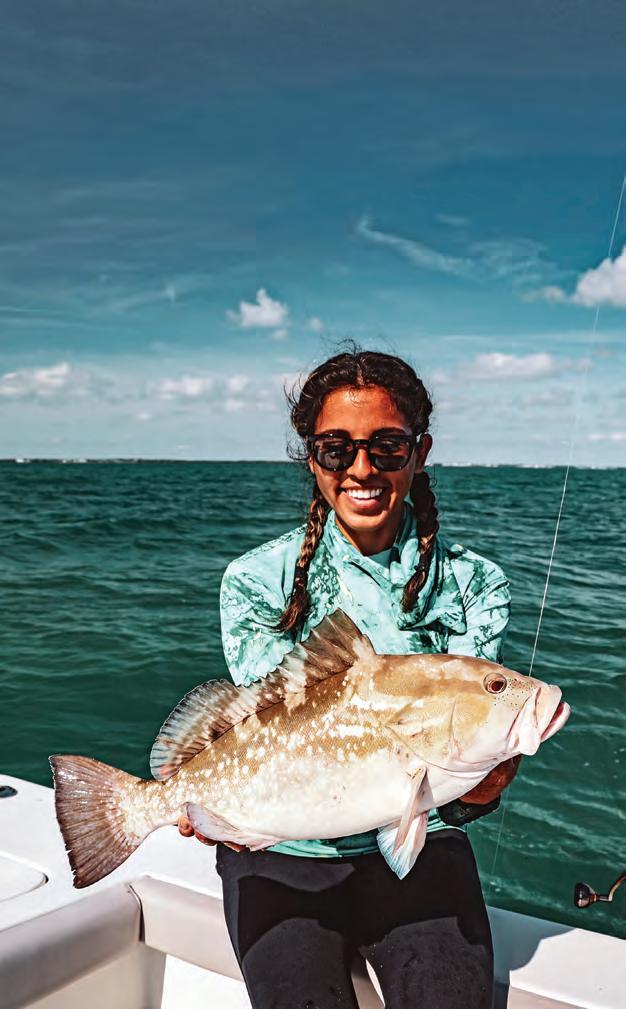
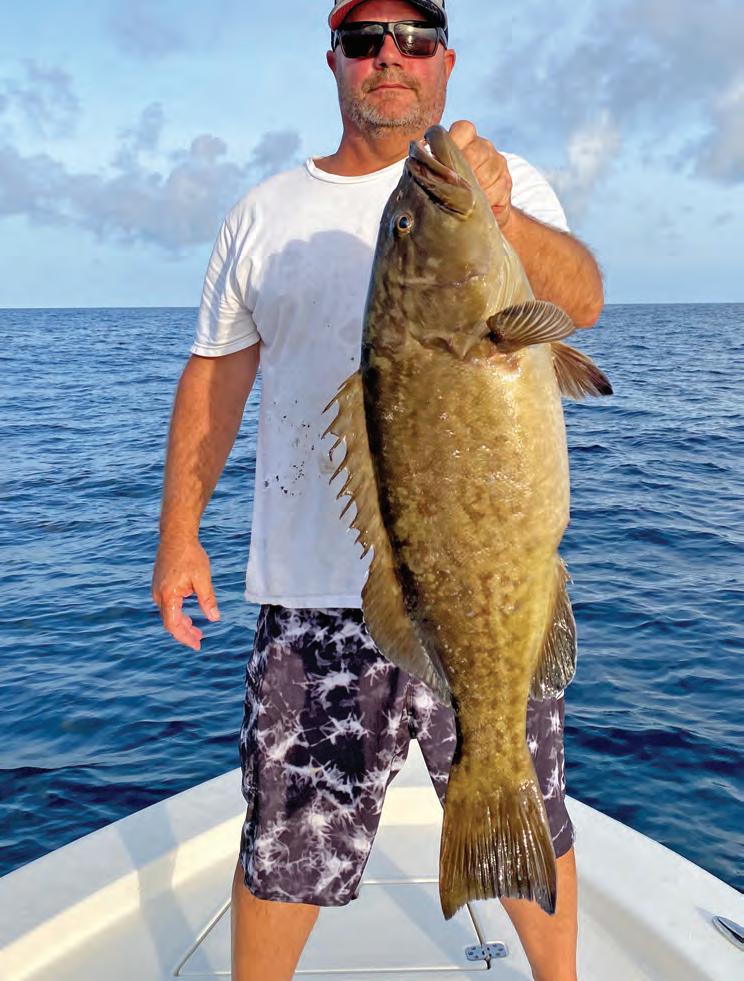
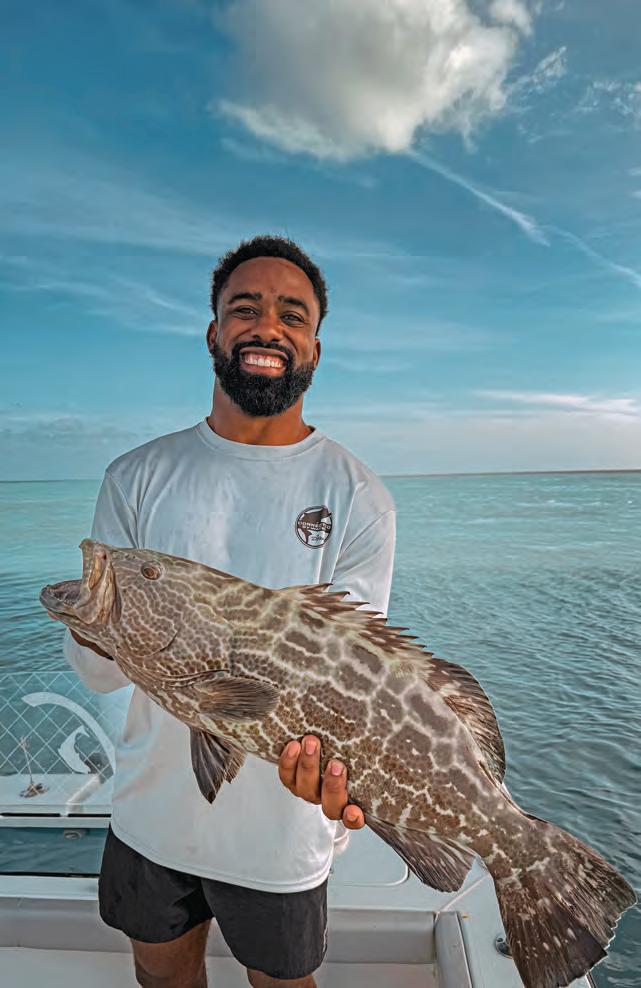
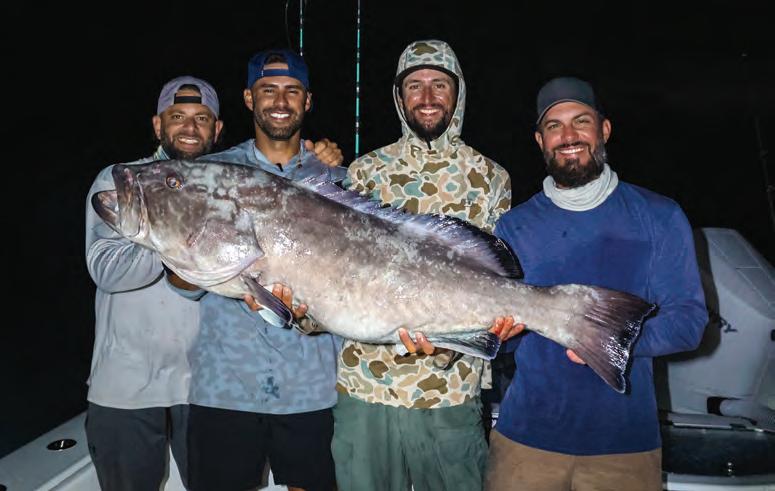
ay 1st marks one of the most anticipated days in the Florida Keys: the reopening of grouper season. The Florida Keys offers a variety of grouper species, each with its own habits and appeal. Black grouper are the top prize, known for their size and power, typically found on deeper reefs and wrecks. Red grouper are more common on patch reefs and ledges and are a great target for steady action. Gag grouper show up more in deeper water and are prized for both their fight and table quality.
Grouper fishing is all about positioning and strength. These fish live in holes, ledges, and wrecks, and when they bite, they immediately try to return to structure. Success depends on getting your bait down quickly and pulling hard the second you feel a strike. There is no waiting. You either win the first few seconds or lose the fish.
Tackle matters. A heavy-duty setup using PENN conventional reels paired with strong rods gives you the drag and lifting power needed to keep fish out of the rocks. On the terminal
conservation.
Live bait like pinfish or grunts is ideal. Bigger baits often mean bigger grouper, especially when targeting black grouper offshore. It is also important to understand that grouper are a slow-growing species. Many take years to reach legal size, and they are particularly vulnerable during spawning
periods. That is why strict regulations, seasons, and gear requirements exist. Responsible anglers follow the rules, handle fish carefully, and use tools like descending devices when releasing fish from deeper water.
Here in the Keys, your approach can vary based on conditions. Offshore trips offer a shot
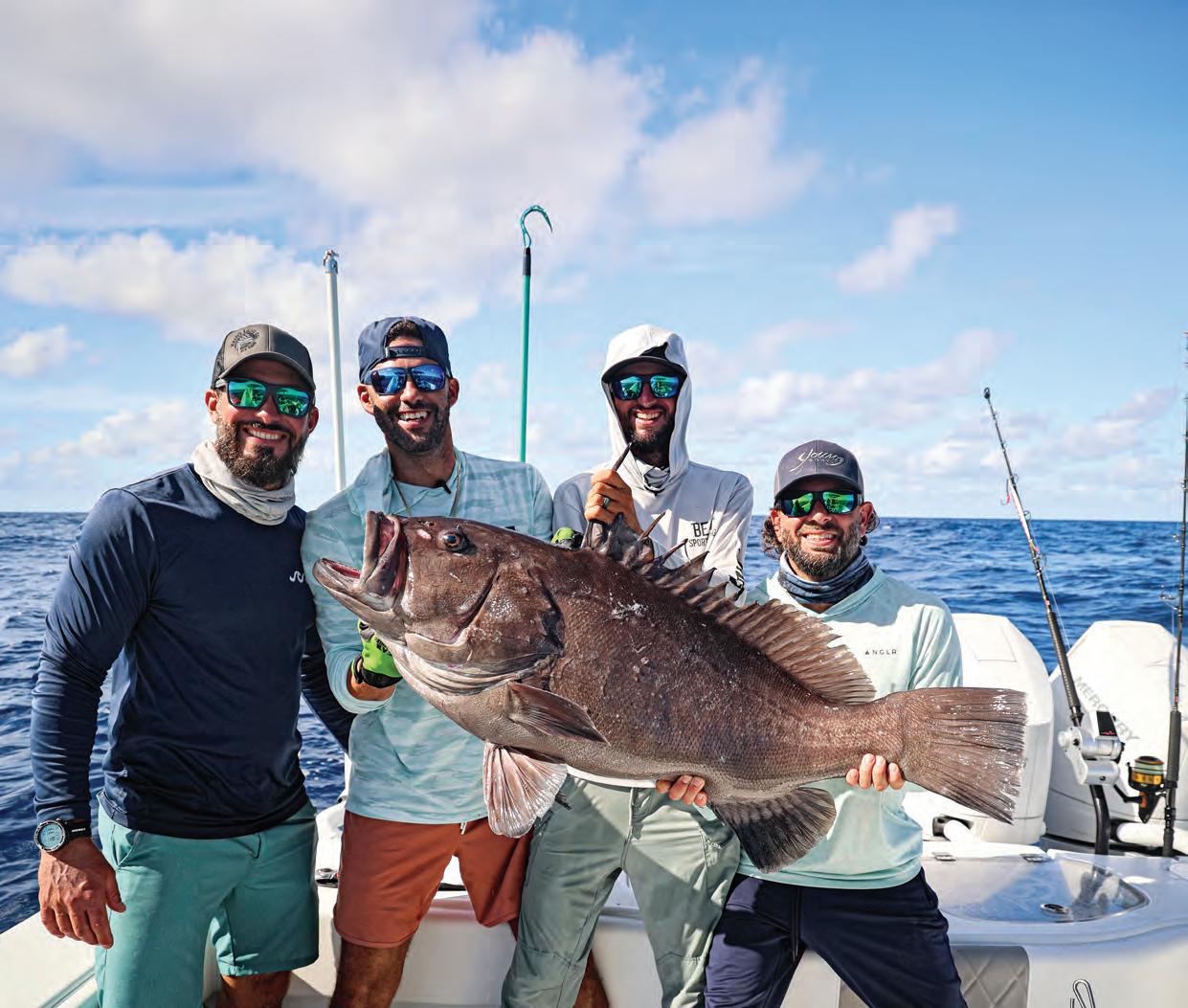
at larger fish in deeper water, while patch reef fishing can provide more consistent action and shorter runs. Both are productive, and the best option often depends on weather and current conditions. Show up prepared, fish hard, and respect the resource so it stays strong for years to come.
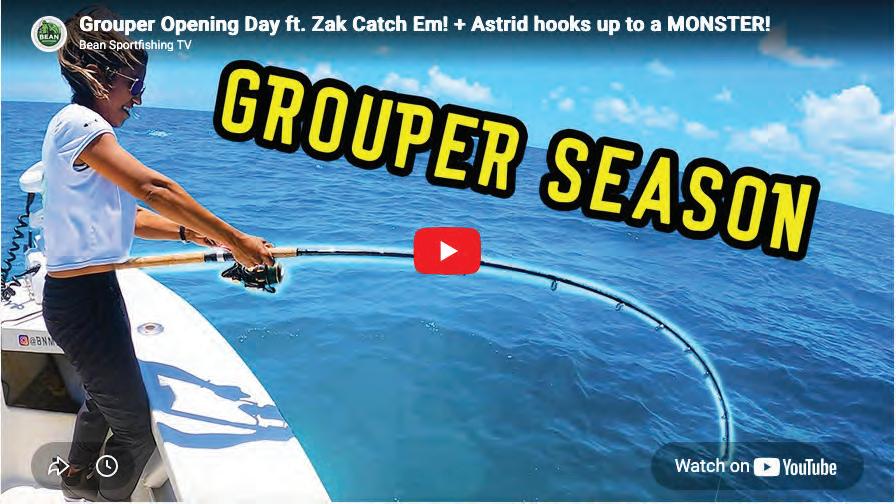
For more real-world fishing action in the Florida Keys, follow Bean Sportfishing on YouTube
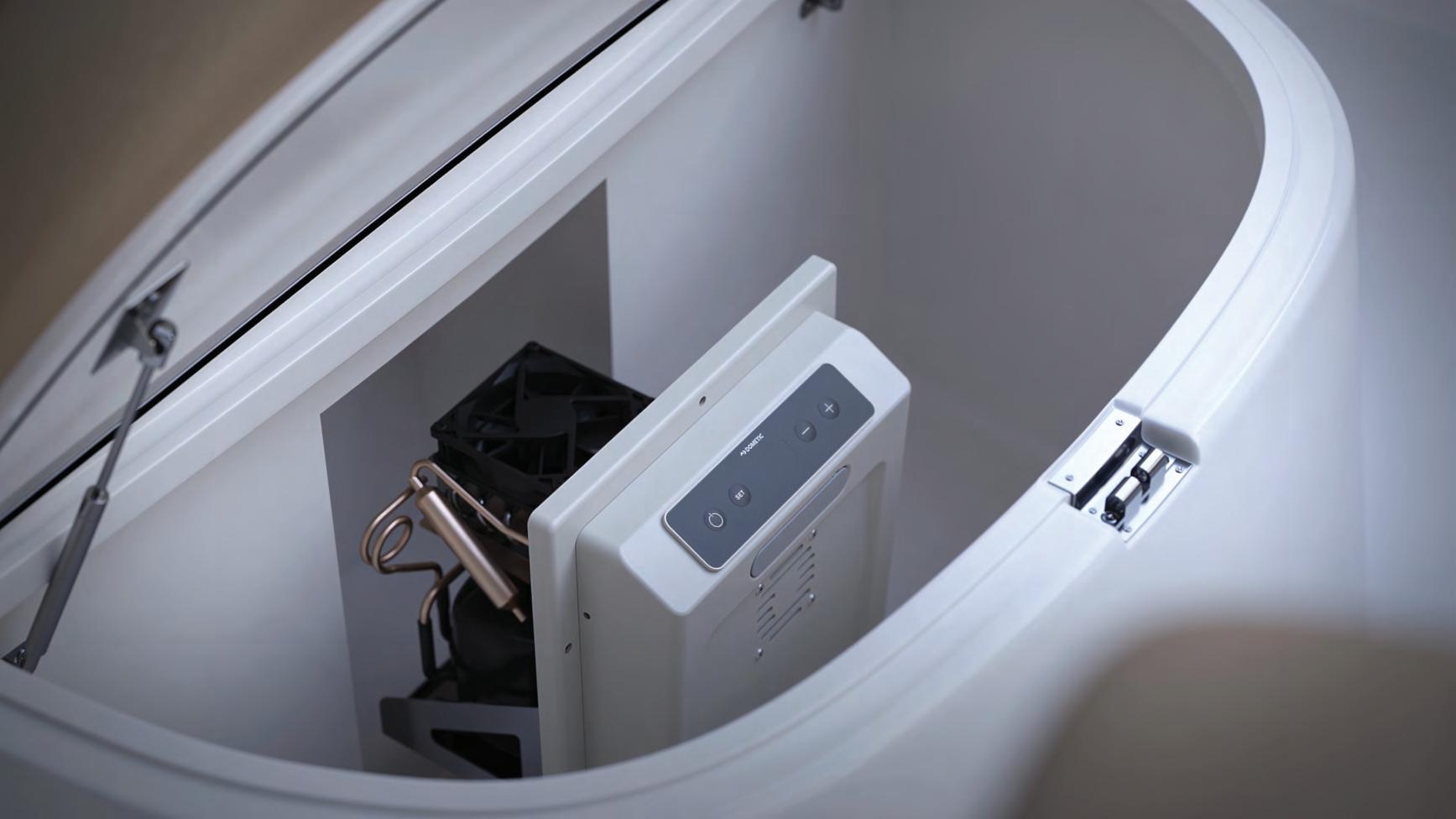

The Dometic CSX is a self-contained cooling system engineered for effortless installation and reliable performance. Ideal for volumes between 50 and 400 L, it combines a high-efficiency compressor, fan-cooled evaporator and digital temperature control in one space-saving unit. Simply drop it in, connect power, and enjoy consistent cooling without the complexity of remote couplings.




Florida anglers are always looking for ways to keep their food, drinks, and day’s catch cold and fresh during long, hot days on the water. That usually means stopping on the way out of the marina for many pounds of block or cubed ice, then moving food and drinks around throughout the day to keep them cold and prevent them from getting soaked or waterlogged.
Fortunately for Florida’s coastal and offshore anglers, leading outdoor brand Dometic recently launched an ingenious solution — the CSX Series “Coldmachine” self-contained refrigeration system. How ingenious? Over the past few months, Dometic’s CSX Series was honored with a 2025 NMMA Innovation Award at IBEX and a 2025 DAME Design Award at METS Trade in Amsterdam. Engineered to accommodate storage volumes from 60L up to 400L, the CSX Series combines a high-efficiency compressor, fan-cooled evaporator, and digital temperature control in one space-saving unit.
refrigerator or freezer without the complexity of remote couplings. Utilizing Dometic’s refrigeration technology proven in the RV and marine markets, the CSX Series features fanassisted airflow to accelerate cool-down times and maintain consistent temperatures — even as ambient conditions fluctuate over the course of the day. Built-in LED compartment lighting helps boaters see and access items easily, even when installed in a boat’s interior spaces.
This system’s compact footprint makes it ideal for use in a variety of spaces found on today’s boats. With an easy-to-install design, anglers just need to mount it in place, connect 12/24VDC power and enjoy a space-saving
Dometic’s integrated digital temperature control and precise thermally sensitive sensor delivers optimal cooling performance and energy efficiency. An automatic defrost logic embedded in the system’s electronics helps prevent ice buildup on the evaporator.
The CSX Series “Coldmachine” comes
in two refrigerator versions and one deep-freezer version. The CSX200 refrigerates up to 200L, the CSZX400 refrigerates up to 400L, and the CSX150FZ provides up to 150L freezing capacity.
Its compact footprint makes in an ideal addition to the builtin cooler/seating area forward of the console on many popular offshore center console and larger bay boats. With a CSX Coldmachine unit installed, anglers can do away with buying bags and bags of ice while enjoying better allday-long cooling performance. They can also focus on catching fish and enjoying time on the water, rather than dealing with meltwater or soggy sandwiches. In addition, the deepfreeze version is ideal for keeping rigged or whole baits and boxes of chum frozen solid until they’re needed, saving money and wasted bait.
This performance and convenience upgrade makes the Dometic CSX “Coldmachine” a great boat improvement project before the summer fishing season arrives.
To learn more, visit your nearest Dometic Marine retailer or visit
.
By Quentin Turko
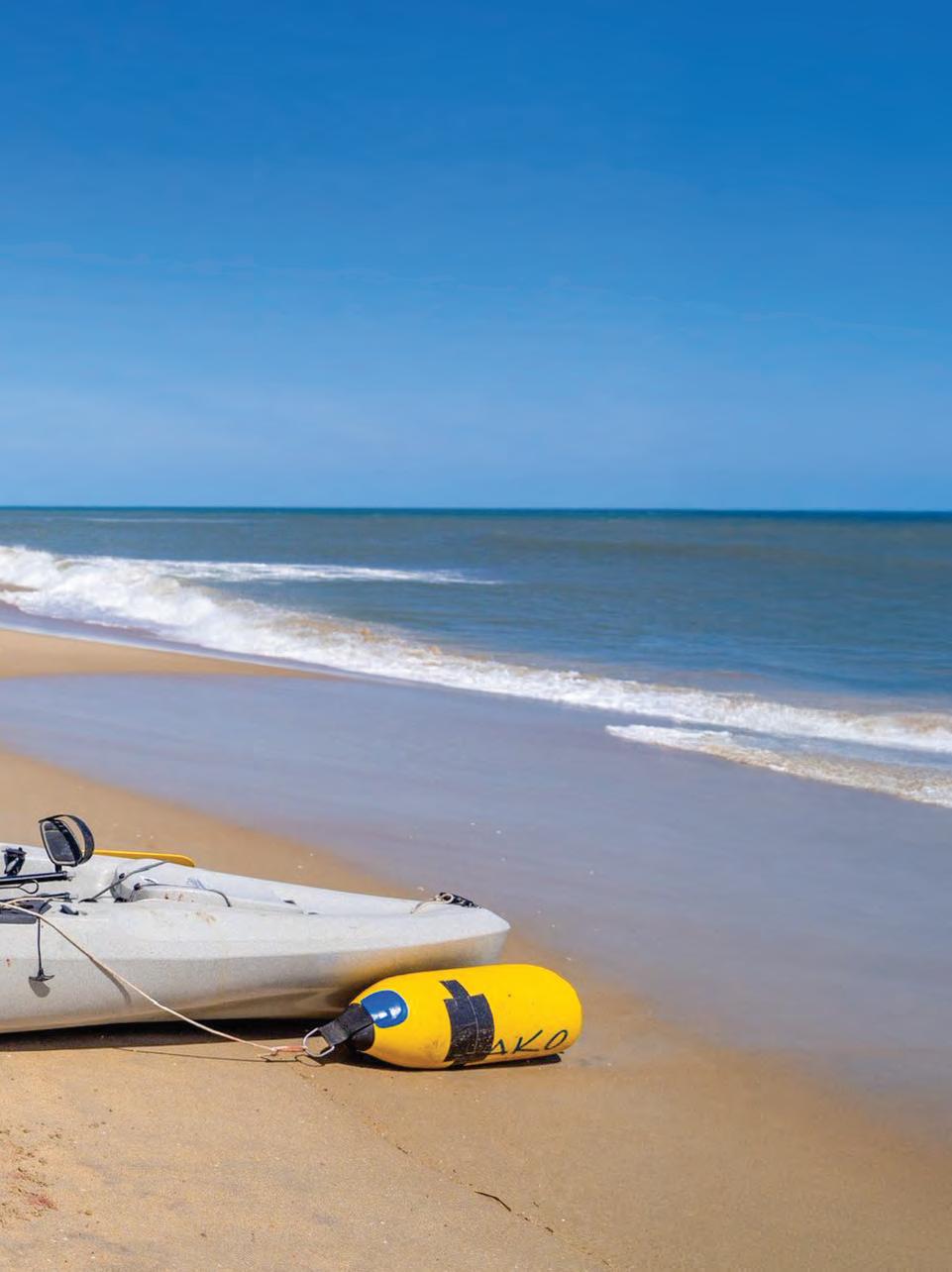
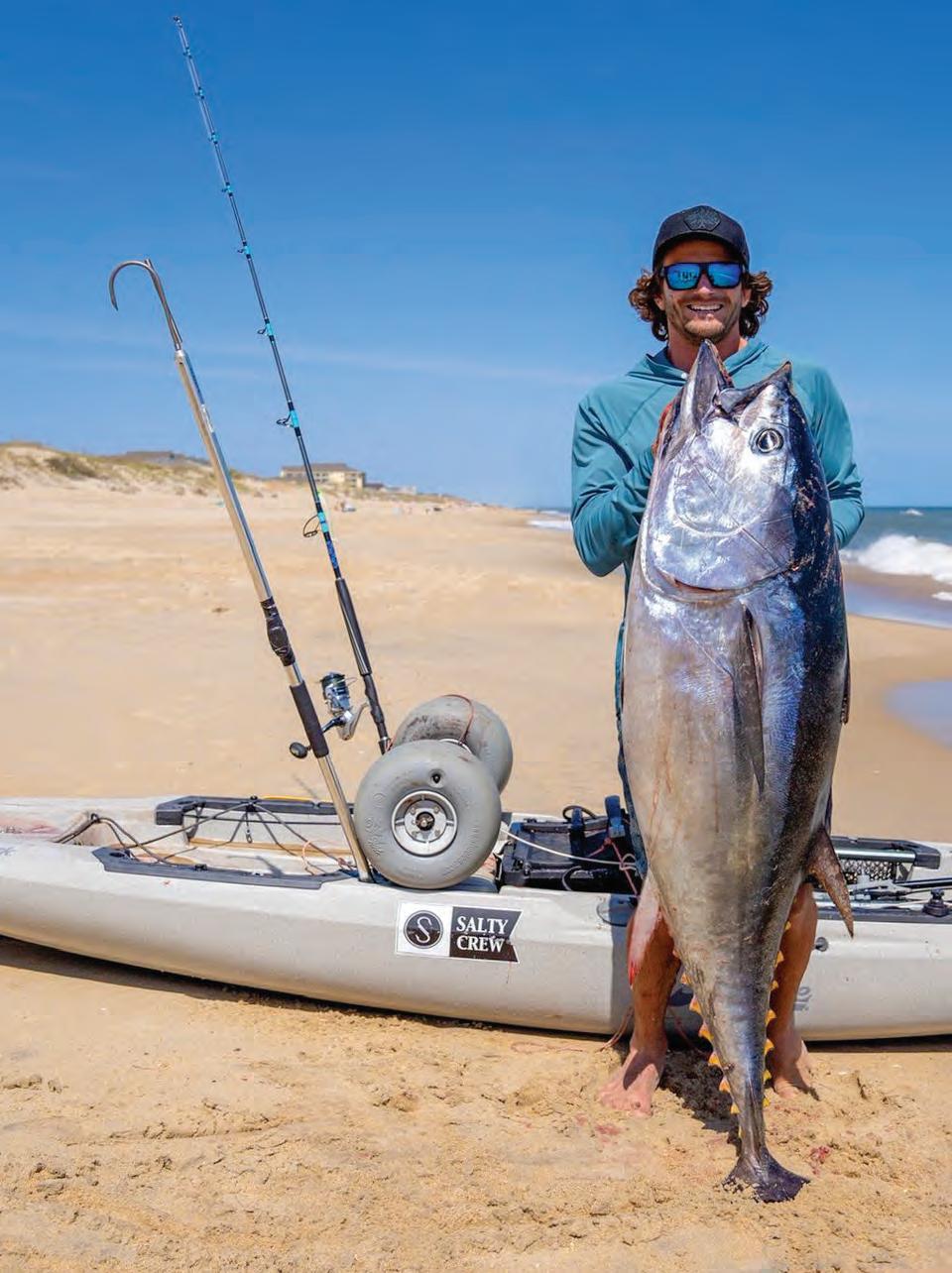
This was easily one of the wildest fishing experiences of my life. I never imagined I’d be launching a kayak off the beach in the Outer Banks and hooking into an Atlantic bluefin tuna. That idea didn’t even feel possible—until about a year ago, when my brother made history by becoming the first person to land a bluefin tuna from a kayak off the coast of North Carolina.
From that moment on, I knew I had to try it for myself. The biggest question was whether the tuna would ever come that close to shore again. These fish are typically caught 30 to 40+ miles offshore from large sportfishing boats, so seeing them within a mile of the beach is incredibly rare—let alone targeting one solo from a kayak.
Almost exactly a year later, the opportunity came. The bluefin were back.
Having caught bluefin from boats before, I already knew how powerful and relentless they can be. But battling one from a kayak is on an entirely different level. What unfolded that day was something I’ll never forget—a true test of strength, patience, and pure adrenaline.

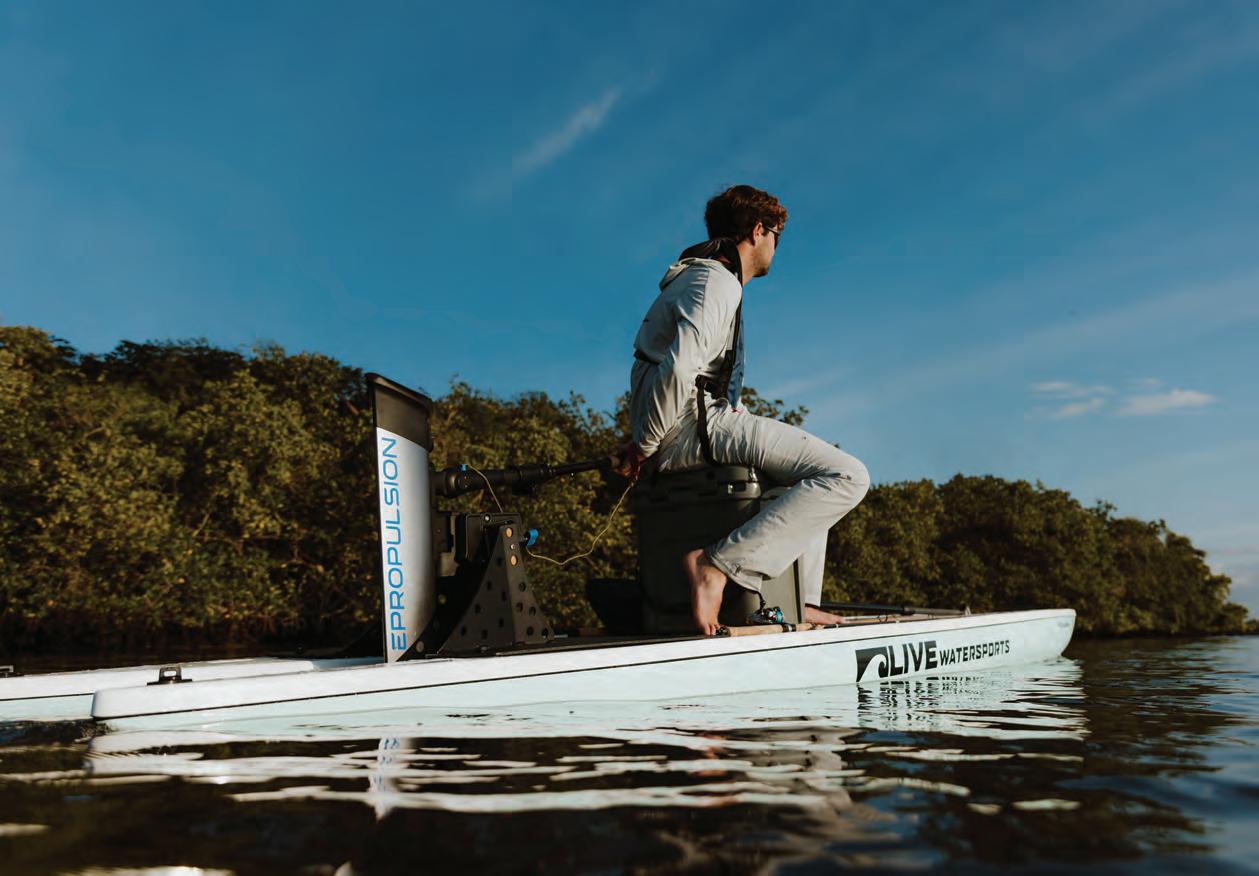
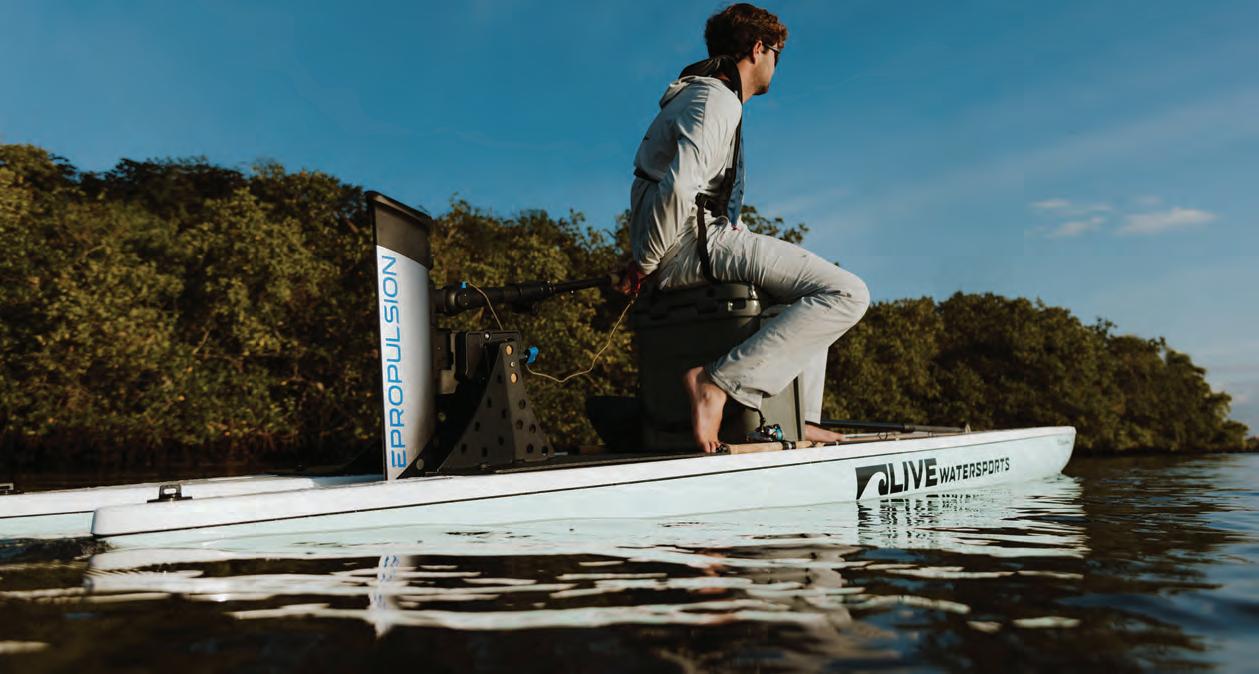
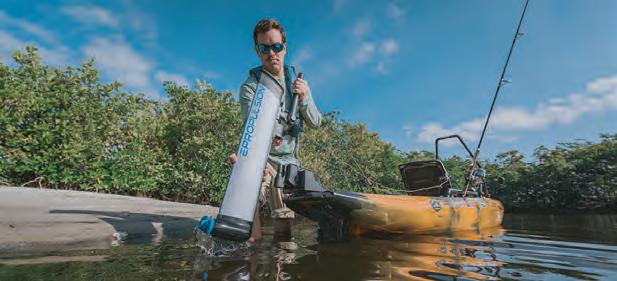
Whether you’re fishing from a paddleboard, kayak, canoe or small boat, the ePropulsion eLite 500W redefines your on-water experience with innovative features and commitment to sustainability. Designed to be the most compact and lightweight electric outboard in its class, the eLite is an easy-to-use alternative to small internal combustion engines for enthusiasts worldwide. Max 5.6 miles at half throttle and 3.5 miles at full throttle.
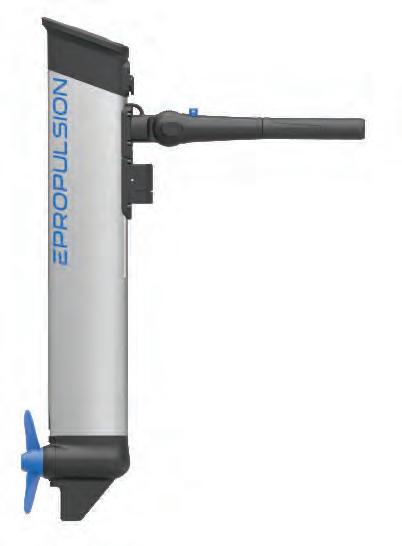



In general, the trend in boating these days is bigger is better. Right? Engine horsepower is getting higher and higher, and boats are being built able to accommodate two, four, even six engines. But what about the other end of the spectrum—anglers and cruisers that are looking for the ultimate in portable propulsion? Whether you are looking for a boost for your kayak or a reliable motor for your inflatable fishing boat or tender, the perfect engine should be lightweight, easy to take on and off, easy to use and provide the range and speed for almost any conditions. It should be self-contained, so you don’t have to deal with lugging around a fuel tank, or even have to purchase and safely store gasoline on your boat. Electric propulsion is the way to go, but no one has really gotten the right combination of affordability, reliability and power—until now.
The ePropulsion eLite, which has been created for the tender and smaller boating market, represents a new era in clean, quiet, and ecofriendly marine propulsion. The direct-drive motor and advanced propeller design delivers high efficiency with near-silent operation, especially attractive for anglers, as it is less likely to scare away fish. With a focus on minimal maintenance and cutting-edge technology, this addition to the ePropulsion range raises the bar in electric boating standards.
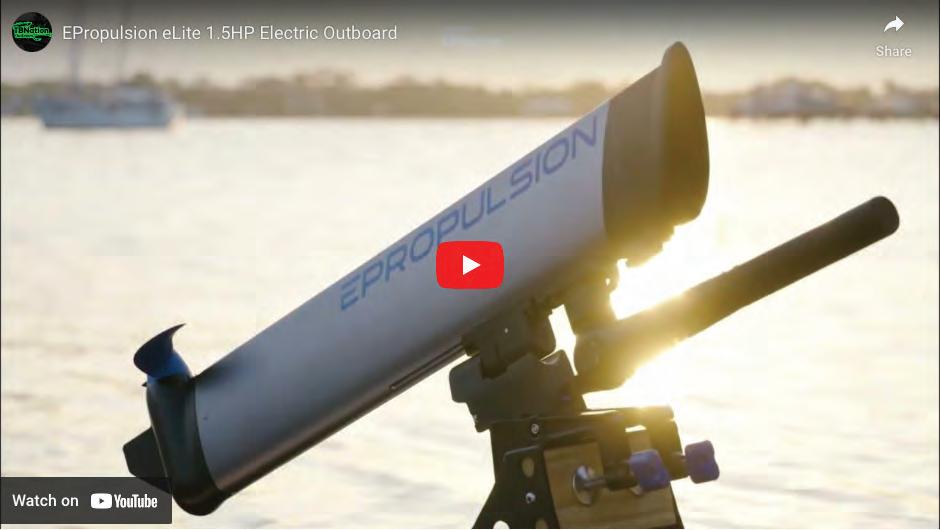
Designed to be the most compact and lightweight electric outboard in its class, the ePropulsion eLite 500W electric outboard is an easy-to-use carbon-free solution for small engine application. Its Sport mode adds an additional 50% boost in power for challenging conditions bringing the
Whether you’re fishing small boat, the ePropulsion reliable companion. Max throttle and 3.5 miles
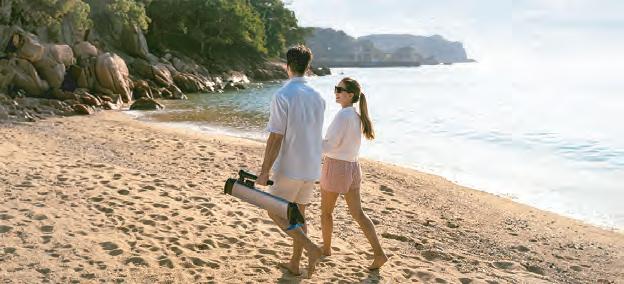
top speed to over five miles per hour. With multiple charging options, including 110/220V AC, 12V DC and solar with the use of optional ePropulsion converters, the eLite can be fully charged in around four hours. For added capability and convenience, the engine includes a USB-C output that allows users to charge and power other electrical devices. At just under three-feet in length and weighing 14.7-pounds including the built-in battery, the eLite stores easily and the one-click quick-release bracket allows for installation and removal in a matter of seconds. For exceptional portability, the tiller handle converts to a perfectly balanced carry handle. With multiple trim and tilt angles, adjustable steering resistance and shaft length, and a shallow-water mode, the eLite is completely customizable. Its Smart Battery Monitoring System efficiently optimizes performance, carefully regulating battery level, temperature, and remaining state-of-charge all displayed on an ultra-simple interface, leading to extended range, a more energy-efficient operation and longer battery life. Built to last, it is IP67 waterproof, and is constructed of aviation-grade aluminum alloy for lighter weight and greater durability. In addition, the anti-ground auto kick-up feature protects the motor from accidental damage. Available for under $1,000, it is also the most affordable electric outboard in its class. There’s no time like today to upgrade to the electric outboard of the future. The ePropulsion eLite is in stock and ready to take you quietly and sustainably to your next adventure.
Experience the eLite Go Electric. Go Silent.
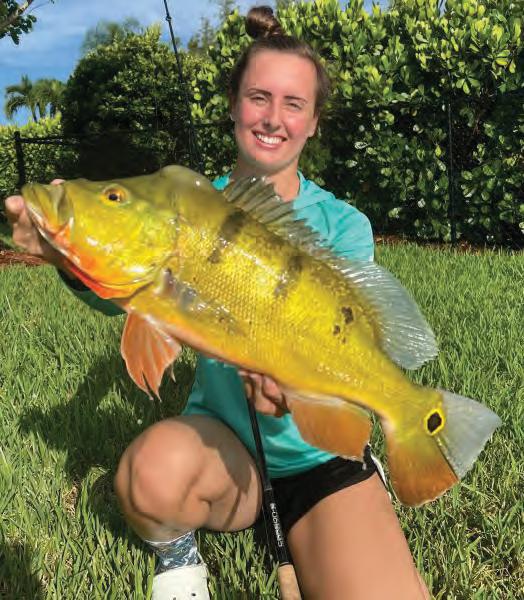
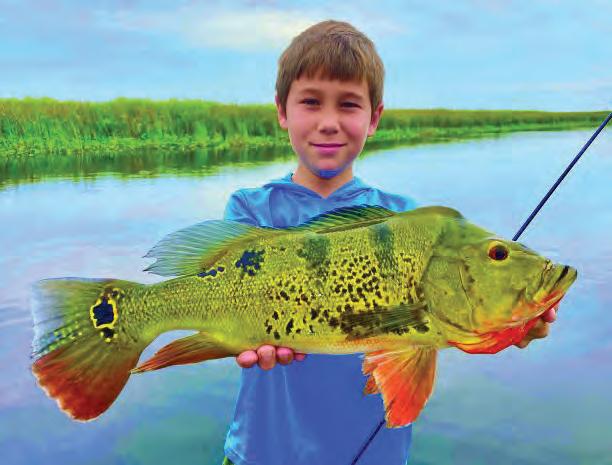
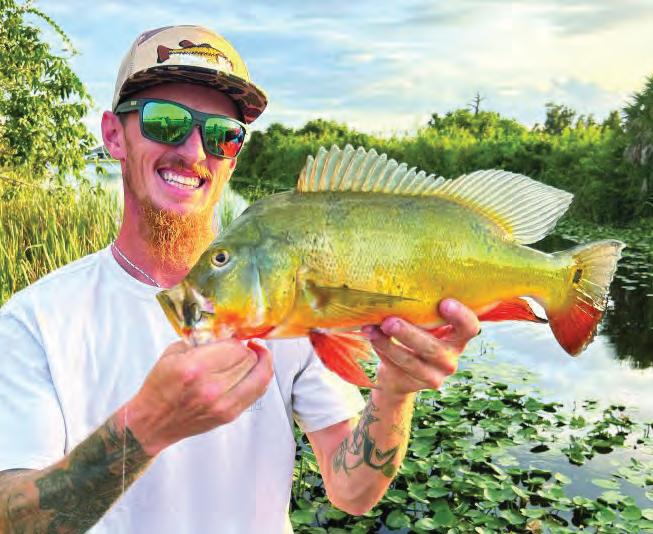
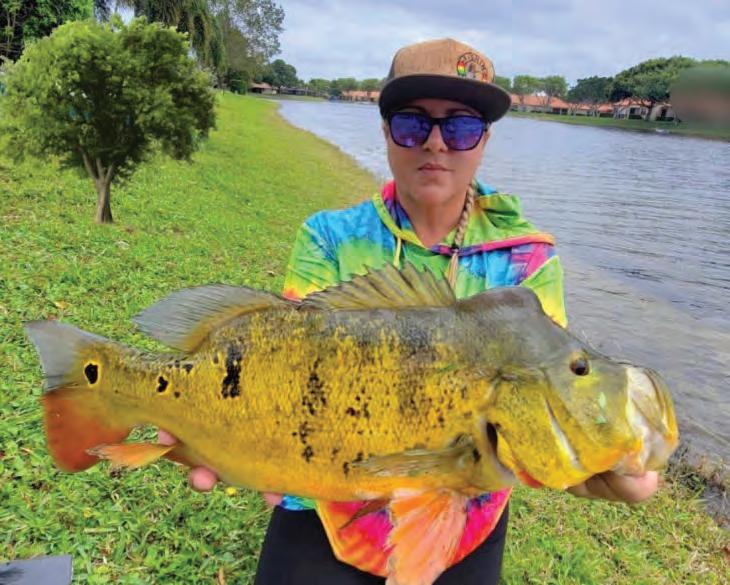
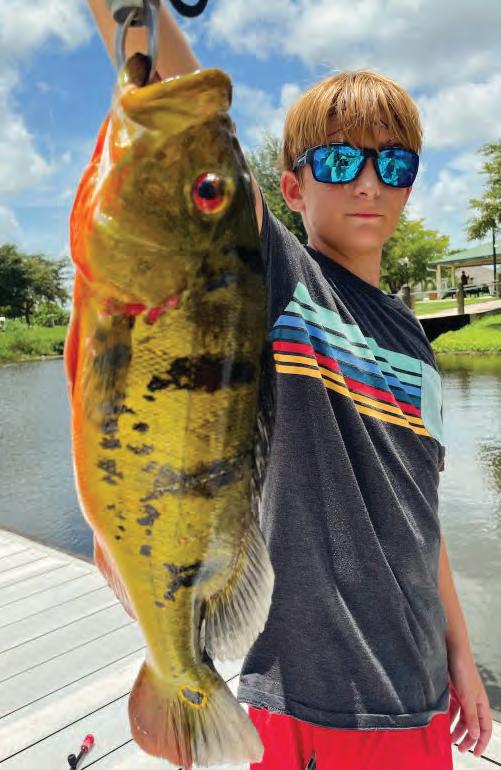
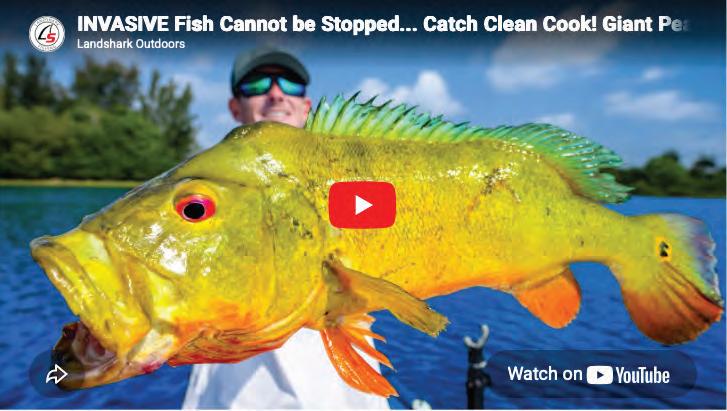
Peacock bass are one of Florida’s most unique and exciting freshwater game fish, often considered a hidden gem among anglers. Native to South America, they were introduced to South Florida in the 1980s by the Florida Fish and Wildlife Conservation Commission to help control invasive species like tilapia. The program proved highly successful, and today peacock bass thrive throughout the region’s canal systems and urban waterways.
Unlike largemouth bass, peacock bass prefer warm, stable water temperatures and are primarily found in South Florida, especially around Miami and Fort Lauderdale. They do not tolerate cold weather well, which limits their range but also helps maintain a balanced ecosystem without negatively impacting native fish populations.
What makes peacock bass especially appealing is their aggressive nature and hardfighting ability. They are known for explosive strikes, often hitting topwater lures with force, and putting up strong battles on light tackle. Their vibrant coloration—featuring gold, green, and black markings with a distinctive eye spot near the tail—adds to their appeal.
Peacock bass can grow to impressive sizes, with fish in the 3- to 6-pound range common and larger trophy catches possible. They are most active during the warmer months, particularly in spring and summer, when water temperatures are ideal and feeding activity increases.
Accessible, exciting, and visually striking, peacock bass offer a unique angling experience that differs fromw traditional freshwater fishing in Florida. Whether casting from the bank or fishing from a boat in the canals, anglers have the chance to target a powerful and aggressive species in a convenient, urban setting—making peacock bass one of Florida’s most underrated fisheries.




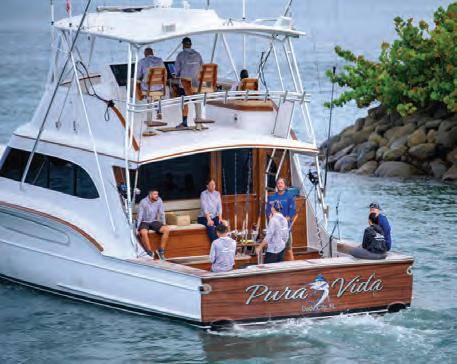
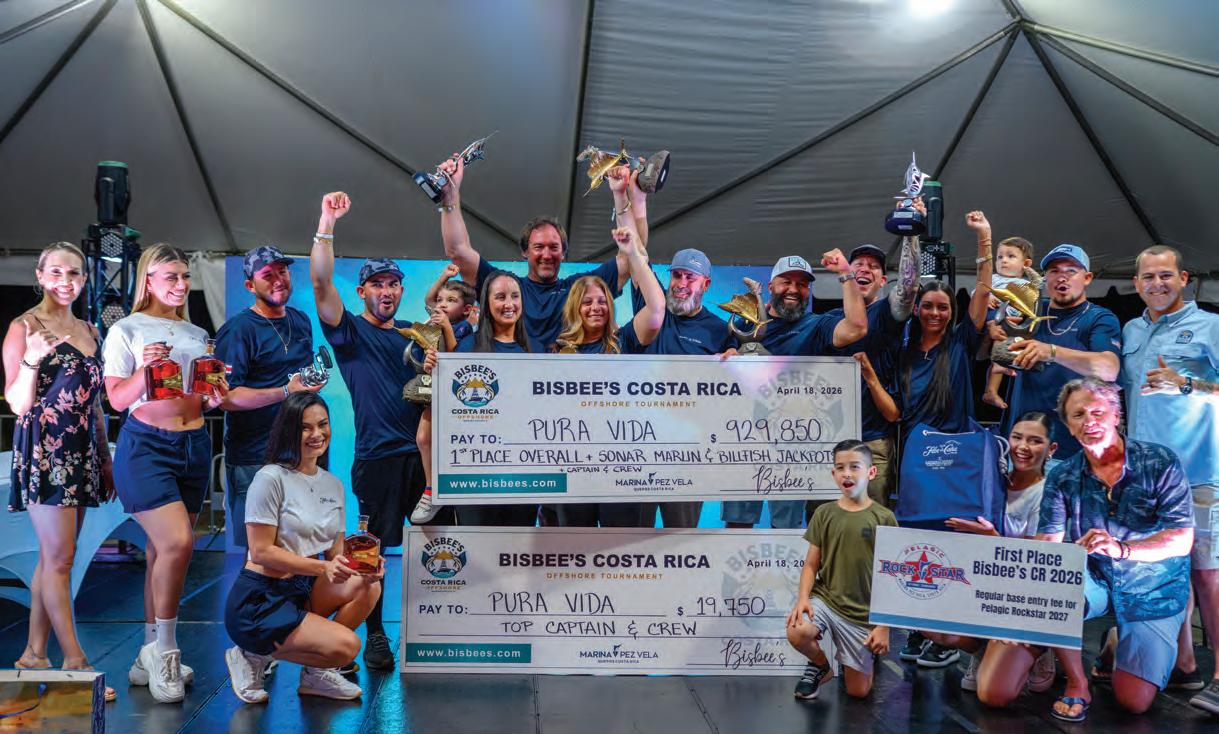
It’s no coincidence that the Costa Rican national motto is pura vida—pure life. The gregarious people and the country’s abundant national resources lend to a happy cultural environment. It’s also no coincidence that the top team in the inaugural Bisbee’s Costa Rica Offshore tournament would be named Pura Vida. The seasoned family and friend team put on an angling display this past week and were well rewarded for the prowess. The team is pocketing $929,850 for its accomplishments, taking the major share of the $2,155,900 in overall prize money. Seventy-nine boats competed from Marina Pez Vela in the first-ever Bisbee’s tournament outside of Mexico. Fifteen teams received payouts at Saturday’s awards ceremony in Quepos.
Pura Vida’s Capt. Rudy Arguedas, mates Armando Delgado, Sebastian Delgado, Stiward Porras and owners JC and Aileen Gonzalez, plus team mates Evan Alonzo, Ericka Sandi and Chris Witherington released 59 sailfish and three blue marlin aboard the 62 Paul Mann. In doing so, the team won the top overall release team, top captain and crew and multiple daily sonar billfish and marlin release jackpots.
Fish Tank/Galati, a 64 Viking run by Capt. Ben Horning, was the second-place team overall. Fish Tank tallied one blue and black marlin each, plus 54 sailfish overall. Deal Sled/Junk Male, (50 Dean Johnson/Capt. Andy Moyes) released the third-most fish for the week. The team scored one blue and 55 sailfish. Rounding out the top teams were Poco Ocho (58 Weaver/Capt. Sean Gallagher) and Miss Behavin’ (72 Ricky
Scarborough/Capt. Jose Reyes), each with 57 sailfish apiece. Blackhawk earned a big check ($343,400) on the basis of multiple marlin jackpots. The team released five blues to go with their 40 sailfish. Optional daily bets often result in bigger payouts for teams despite their catch log or overall standing.
In the non-sonar division, the big winners were Five More Minutes, Kelly Dawn (45 Rybovich/Capt. Will Ochse), Double Nickel (43 Buddy Harris/Capt. Michael Zuniga), E&A (Capt. Jonathan Arn) and Reel Gold (35 Cabo/ Capt. Stan Cook).
North Star Costa Rica brought their game fish skills to Quepos this week. The team (35 Swordfish/Capt. Randy Morales) boated the heaviest tuna, a 187-pound yellowfin, to take top honors in the division and also won jackpots for tuna and dorado. North Star Costa Rica earned $186,550 for their catch.
Howler (38.3 Viking/Capt. Jean Carlos Segura Serrato) captured the biggest bull dorado, which tipped the scales at 60.91 pounds, gaining the team a check for $79,450. Other big winners in the game fish divisions were Concan Castaways (Capt. Greg Giampapa) for their 149.7 tuna, Zancudo Lodge Z-1 (44 Contender/Capt. Maudiel Quiros) for a 141.9-pound yellowfin and Rock N Reel (80 Merritt/Capt. Dick Younger) with a 29.8 pound dorado that paid out $107,100 due to optional entries.
Nikita Timmermans, competing on Salochankita, a 74 Viking run by Capt. Andrew Mason, was named the Top Lady Angler for the week after releasing 18 sailfish. Daily Flor de Cana Happy Hour trophy winners included Trophy Fly (Capt. Mainor Oporta), Pura Vida and Fish Tank
The 2026 CRO catch totals included 1,722 Pacific sailfish, 33 blue marlin, two black marlin, 55 tuna and eight dorado among the 79-boat fleet.
“What a great tournament,” said Director of Operations Blake Bisbee. “I’m really proud of how this first one came together, and honestly honored by the level of teams that showed up and made it what it was. The fishing was incredible, the sportsmanship was top-notch and it set a strong tone for what this event can become. Big thanks to our host nation and everyone at Marina Pez Vela for taking such great care of us. This is just the start—we’re already looking ahead to making 2027 even better.”
The 2027 Bisbee’s Costa Rica Offshore will be held April 6-10, 2027, at the Marina Pez Vela in Quepos, Costa Rica. For more information, visit: www.bisbees.com


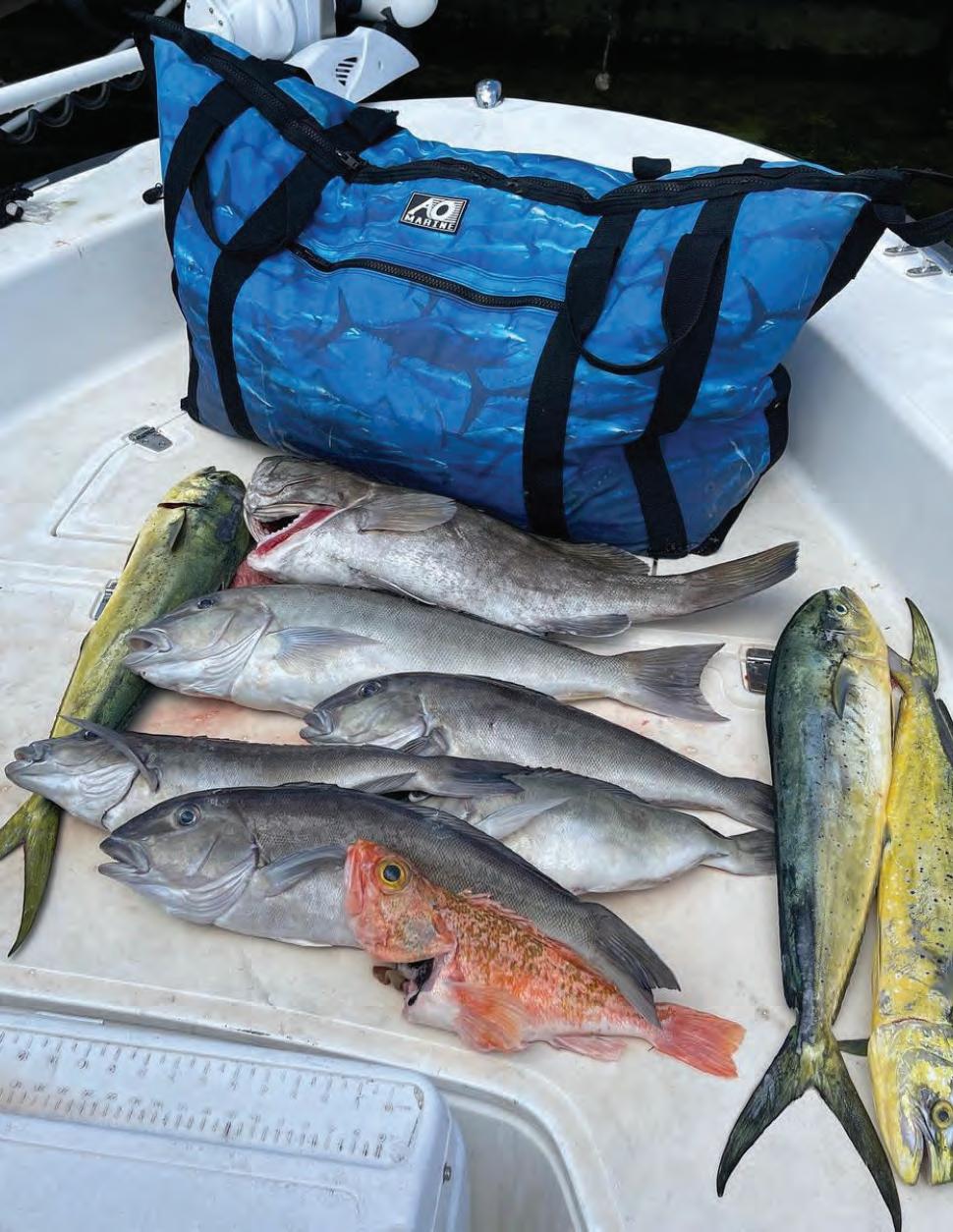
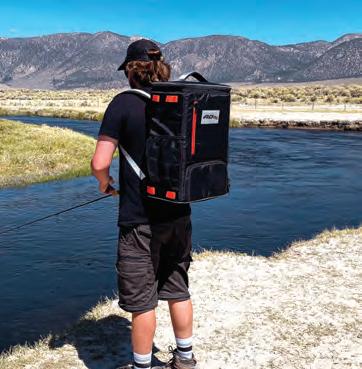
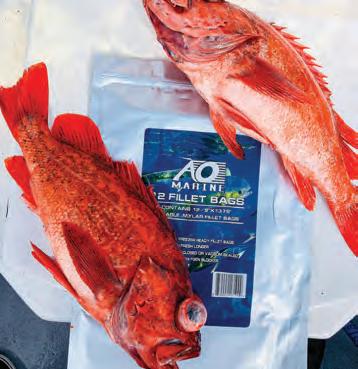
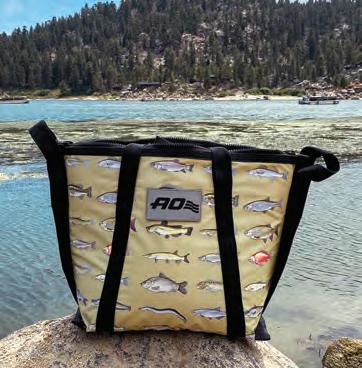

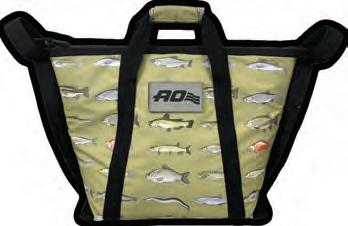
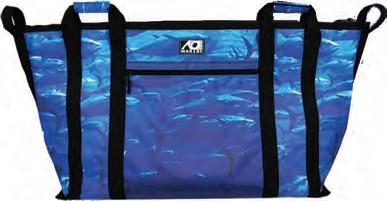
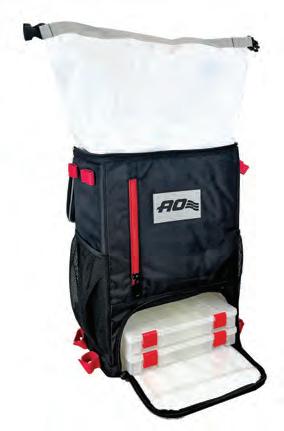
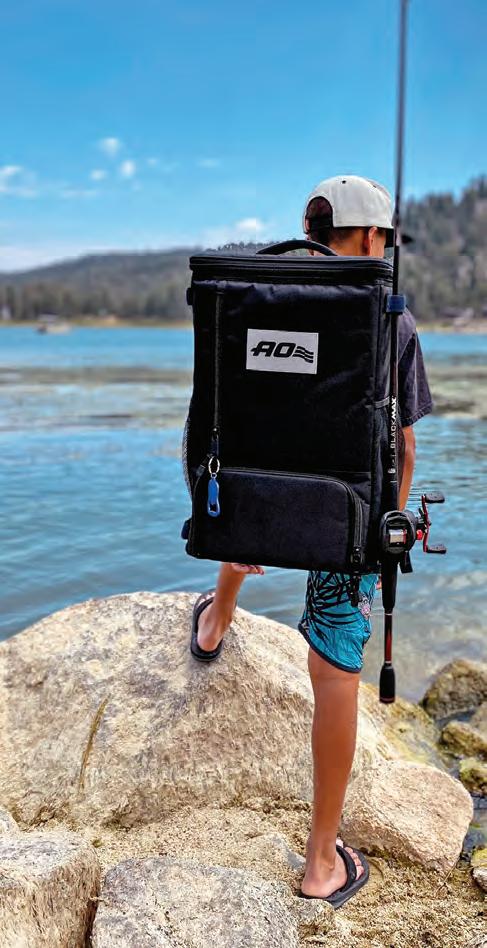
, the leader in high-performance soft-sided coolers, is hitting the water this year with new, upgraded fishing products. Our fishing team partners told us what they needed, and we listened!
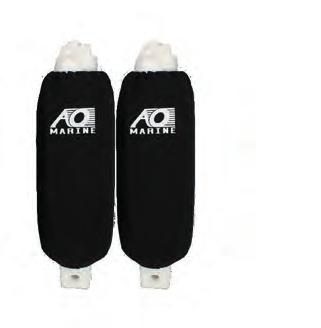
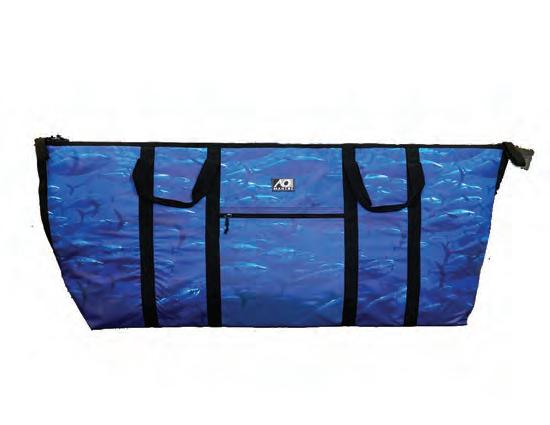
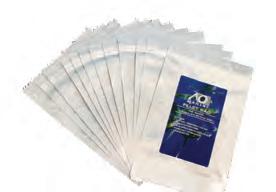
Products are in stock and ready to ship; The Fishing Cooler Backpack, 2, 4 & 6ft Fish bags, Fillet bags, Boat fenders, EVA Traction pads, Inflatable Docks, ISUPs, and of course, our high-performance coolers specifically designed for use on boats, guaranteed not to leak, and to keep ice cold for up to 24 hours.
Thirty years ago, AO was launched to provide active, hard-core people with quality products at a reasonable price. We started selling our soft-sided coolers to the hard-core, go-fast boaters and fishermen in Lake Havasu. We aimed to keep ice in our coolers for up to 24 hours in 120-degree Havasu heat. That goal was accomplished 30 years ago, and we’re still at it.
We know our customers; they fish and boat in the summer and ride the dunes or trails in the winter. AO products give those high-octane souls greater freedom to embark on and enjoy what’s important to them.
Make sure that your gear does not hold you back from doing what you love. AO products are built to handle whatever offshore adventure is coming next.
AO is flexibly rugged, seriously fun, and honestly real!
We’re looking for active, adventurous folks that demand quality and performance from their gear. Share your adventure and send us your fish story or photo.



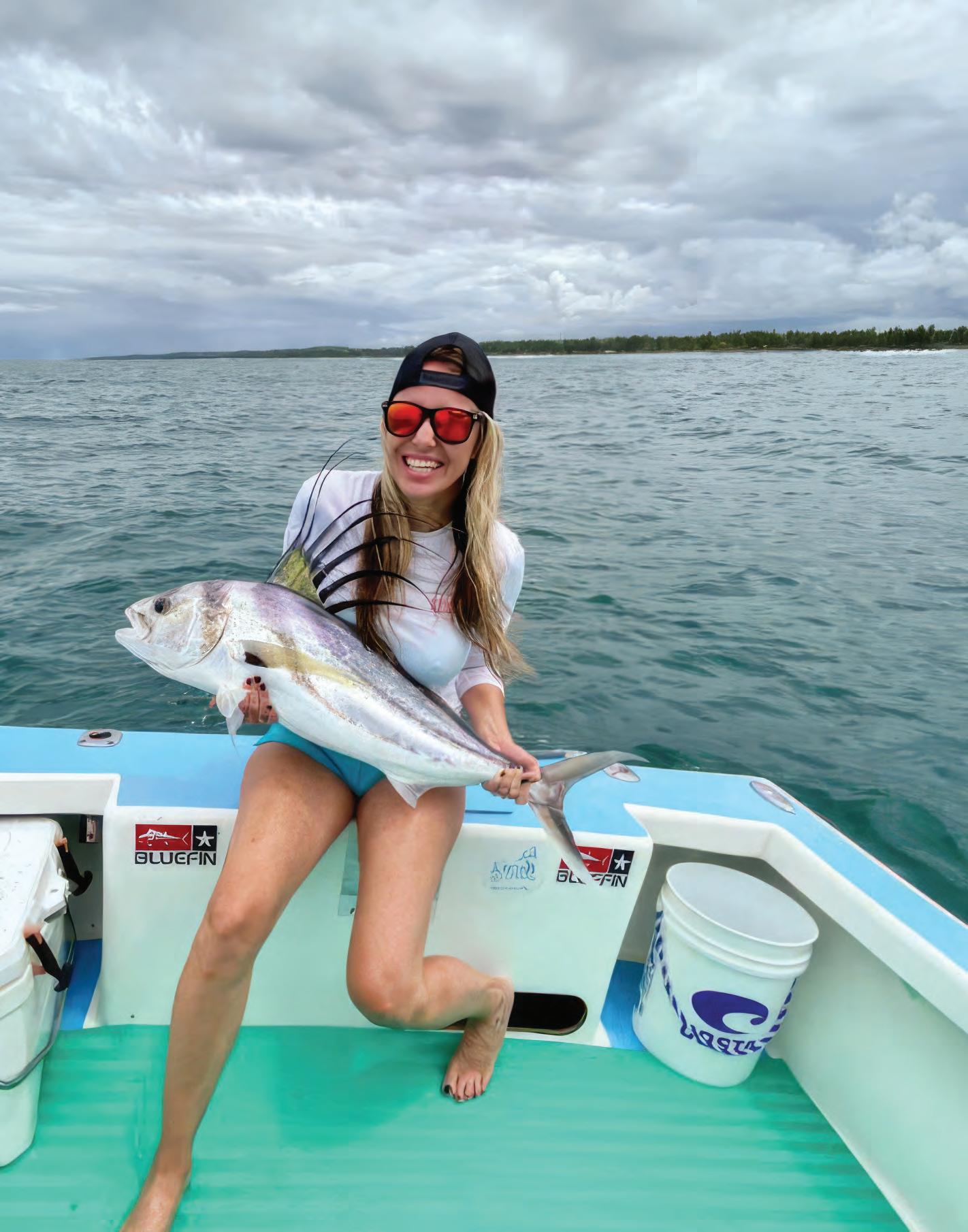
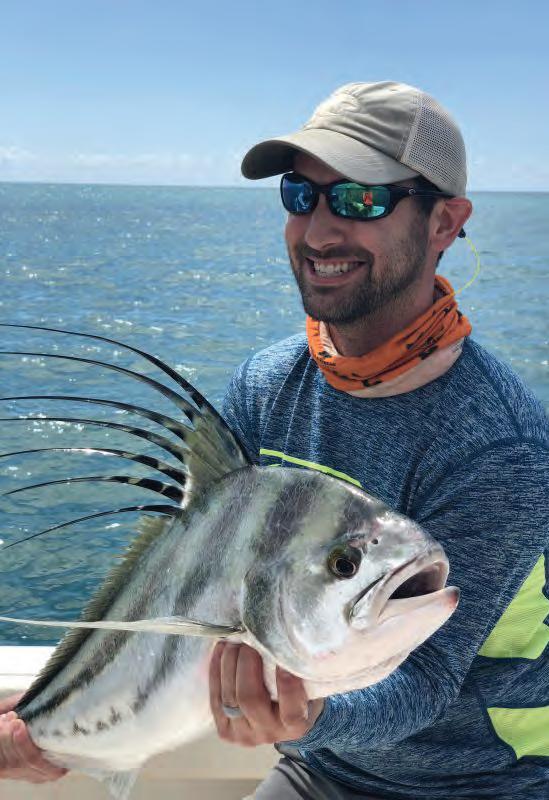
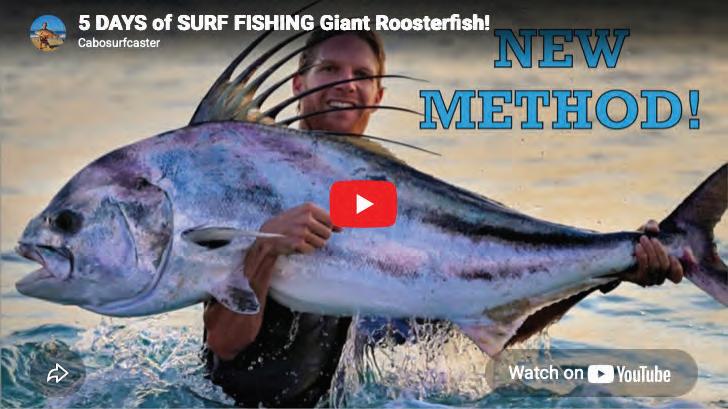
One of my favorite fish of all is the exotic roosterfish. Let me tell you something about this awesome fish. It has a dorsal fin that looks like the tail feathers of a rooster thus giving it the name rooster fish. This unique fish is a member of the jack family and fights as hard as they all do. However, the rooster doesn’t make good table fare. It’s just a great fighting game fish that should always be released.
This odd looking fish is found from the southern Baja to Ecuador where it almost always hugs the shoreline from a few feet to 500 yards offshore. They feed on bait fish, mainly mullet and sardines, but I think their favorite is the ladyfish. The rooster prefers water temperatures of 80 F and higher, at least the monsters do. The average fish caught is about 10 to 35 lbs. Anything over 50 lbs. is a real trophy. The IGFA world record right now is 114 pounds, caught in 1960 at La Paz, Mexico. Fishing for these beauties you can surf cast, casting lures that resembles a bait fish into the waves or using live bait like a sardine casting out and letting it free swim.
Another way is fly fishing from the beach. When you feel the line going out wait nine seconds. Then put on the drag and hang on. The fight has begun.

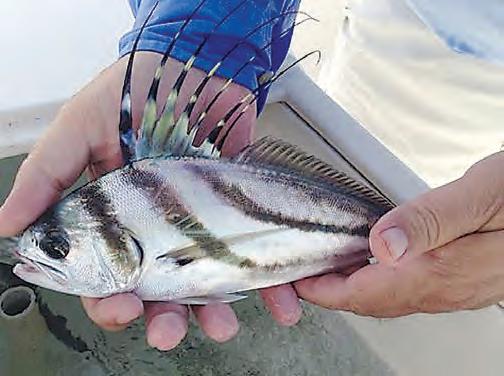
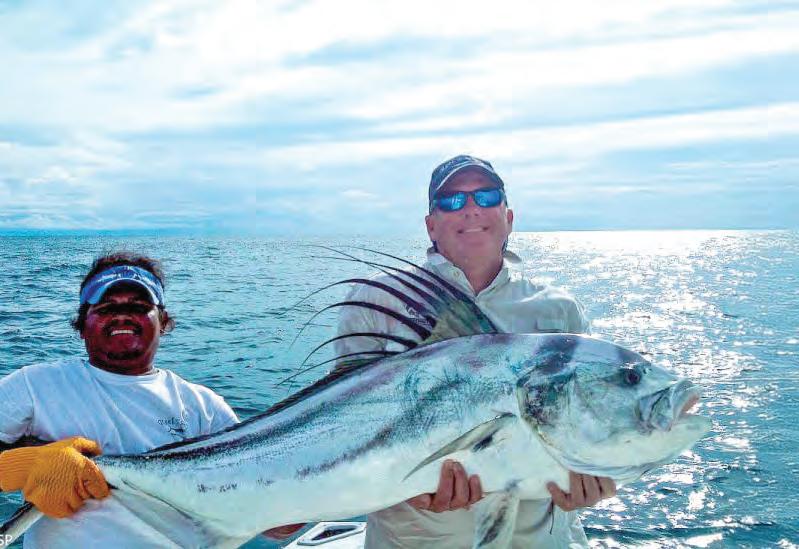


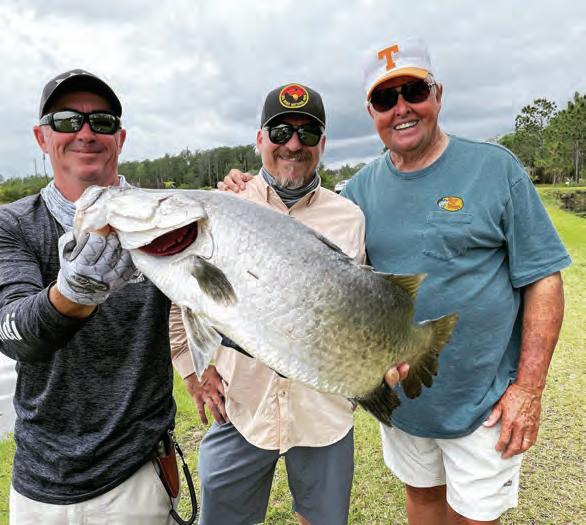

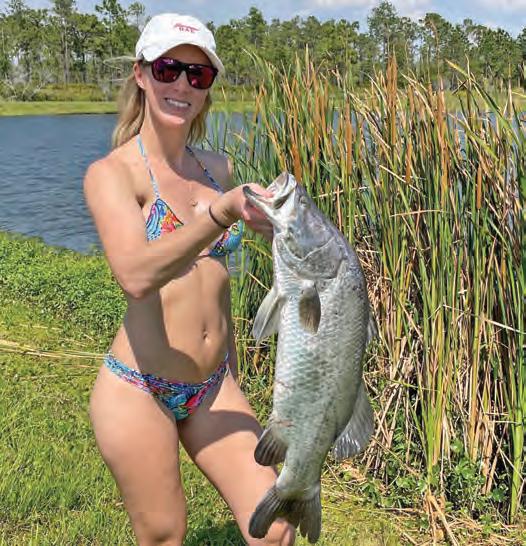
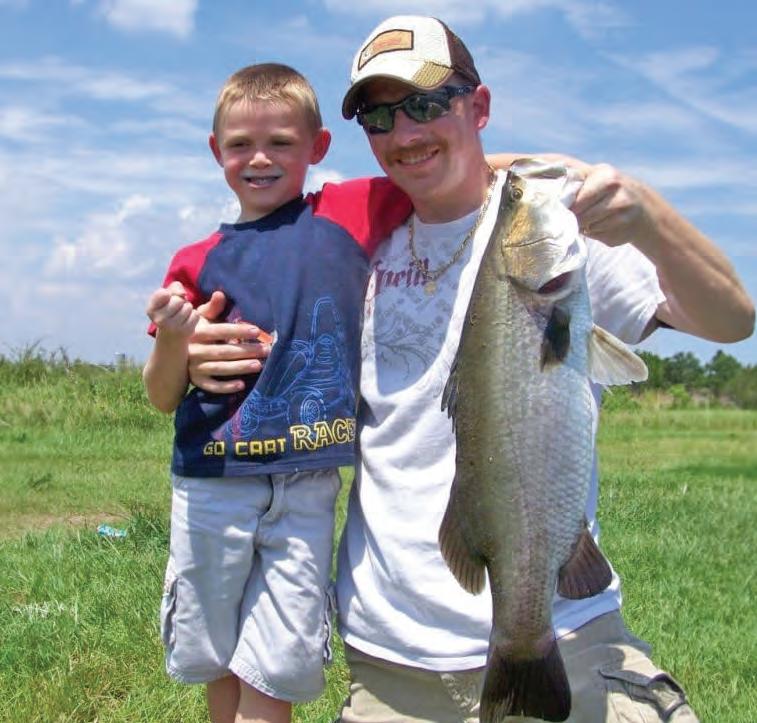
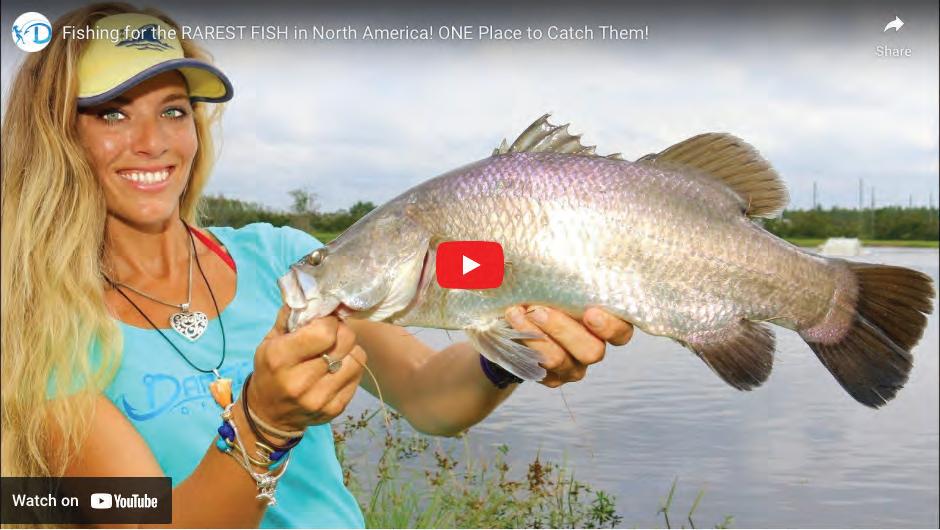
If you’re an avid angler seeking a one-of-a-kind fishing adventure, look no further than Osceola Outback Adventures. Located in Central Florida, just 45 minutes from the Orlando airport, Disney, and other attractions, this full-time guide service offers some of the Sunshine State’s most unique fishing experiences.
At Osceola Outback, you can embark on an unforgettable barramundi fishing expedition. What makes this experience truly special? Well, Osceola Outback is the first and only Barramundi guide service in North America. Native to Australia and weighing as much as 100 pounds, barramundi are hard-hitting, drag-screaming fighters that love to leap out of the water to display their power. The property is a working farm, ensuring that no angler goes home without hooking up multiple times. It’s a rare opportunity to catch these impressive fish!
Florida is a go-to state for bowfishing, thanks to its warm climate and abundant “non-game” fish. Osceola Outback offers both daytime and nighttime bowfishing trips. You’ll have the chance to shoot tilapia, gar, bowfin, and catfish in the state’s extensive network of lakes, ponds, and rivers.
Airboat Bass Fishing: Explore Uncharted Waters
For an adrenaline-pumping experience, try airboat bass

fishing. Osceola Outback’s custom-built airboats are equipped with 8-foot Blade Power-poles, trolling motors, and full walkaround fishing decks. With seating for three anglers and 500-horsepower motors, these boats can take you to places you’ve never explored before. It’s common for two anglers to land 60+ bass in a single 4-hour trip. Keep an eye out for alligators, wading birds, and birds of prey!
Known worldwide for huge stringers of largemouth bass, the Kissimmee Chain of Lakes offers fantastic fishing opportunities. Osceola Outback provides fully rigged bass boats, and their captains are United States Coast Guard certified and licensed. You can choose between fishing with artificial lures or locally caught live wild shiners.
Here’s something truly unique: Osceola Outback is the only place in the world where anglers can land an International Inshore Slam. This prestigious achievement consists of catching barramundi, peacock bass, and largemouth bass all in one location. With barramundi native to Australia and weighing up to 100 pounds, this is an angler’s dream come true.
Whether you’re a seasoned angler or a first-timer, Osceola Outback Adventures promises unforgettable fishing experiences. So grab your gear, cast your line, and get ready for an adventure like no other!
The Angler Video Magazine connects fishing and boating enthusiasts with industry news and shared community interests in a unique, industry-first format — a video magazine. Sent to over 3.2 MILLION licensed anglers, The Angler Video Magazine is provided to its readers for FREE. No subscriptions or payments are required for viewing.
Support The Angler Video Magazine’s mission to provide FREE content to the recreational fishing and boating communities and industries throughout the world by sharing, subscribing and advertising.