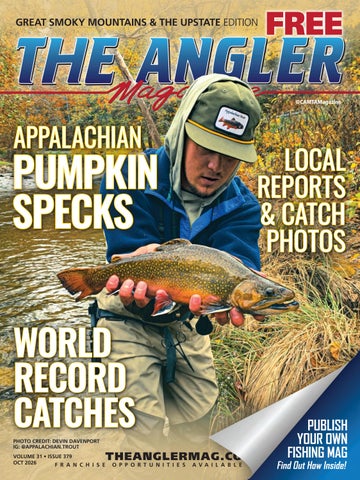
GREAT SMOKY MOUNTAINS & THE UPSTATE EDITION
FREE @CAMTAMagazine
APPALACHIAN
PUMPKIN SPECKS
LOCAL REPORTS & CATCH PHOTOS
WORLD RECORD CATCHES PHOTO CREDIT: DEVIN DAVENPORT IG: @APPALACHIAN.TROUT
VOLUME 31 • ISSUE 379 OCT 2026 F R A N C H I S E
THEANGLERMAG.COM O P P O R T U N I T I E S
A V A I L A B L E
PUBLISH YOUR OWN FISHING MAG SEPTEMBER 2026
Find Out How Inside!
W O R L D W I D E
ADVERTISEMENT
five things you should know about boat insurance Are you ready to embark on your next on-water adventure? Before you set sail, here are five things to know about boat insurance.
1. Boat insurance isn’t just for accidents With comprehensive coverage, you’ll also be protected financially for theft, vandalism, and unexpected events like storms if you need repairs or replacements due to damage.
4. Most lenders require boat insurance If you financed your boat, you’ll likely need boat insurance since most lenders require boat insurance to protect their investment. Additionally, some marinas or municipalities require proof of insurance for docking.
2. Accidents can happen to anyone When accidents happen, boat insurance offers liability coverage for damages or injuries you cause while boating, up to specified limits. It can also cover lawsuit costs if you’re sued.
5. Progressive offers specialized boat coverages Ever worry about getting stuck on the water? Progressive’s Sign & Glide® On-Water Towing coverage** can help. It’s an additional coverage that steps in if your boat is disabled or breaks down on the water, paying for on-water towing, jump starts, soft ungroundings, and fuel delivery. Fuel cost isn’t included.
3. Boat insurance can cover medical payments Boat insurance offers a range of optional medical payments coverage limits, helping to cover medical expenses if you’re in an accident or someone is hurt on your boat, regardless of fault.
Don’t let unforeseen circumstances disrupt your voyage. Cruise with confidence thanks to Progressive Boat insurance. Because when it comes to your boat, peace of mind is the ultimate luxury.
Progressive Casualty Ins. Co. and affiliates. Product features are subject to policy terms and conditions and may not be available in all states or for all vehicles and coverage selections. No. 1 rating based on boat market share data from Ratefilings.com. *
** Sign & Glide® is an optional coverage you can add to any Progressive Boat policy and costs $30/annually ($50/annually in Florida). Prices are subject to change.
Scan to get a quote in as little as 4 minutes. Go to progressive.com to learn more.
One look at that bow and he was hooked for good. With up to $10,000 of optional fishing equipment coverage, Progressive made sure the rods and reels were protected—so they could keep the spark alive, tide after tide. 1-80 0 -PROGR E S SI V E
PROGR E S SI V E .COM
Get an online quote in as little as 4 minutes
Progressive Casualty Insurance Co. & affiliates. No. 1 rating based on 2023 filings with state departments of insurance. Fishing Equipment coverage is subject to policy terms. Prices vary based on how you buy.
The Magic Starts in October
T
his is the time of year I live for, especially for o!shore bottom fishing of numerous species. This year is going to be di!erent, however, thanks to regulations that have completely shut down our gag grouper fishing. October, November, December, and the first three weeks of January are the absolute apex of gag grouper fishing. In my opinion, flawed science and highly extrapolated data are the reasons we are now facing a zero creel limit for gag grouper for the rest of the year. The situation with the Atlantic’s American red snapper is just as bad. Divers report having to wait for the Americans to get out of the way before they can shoot other target fish, and hook-andline fishing is o! the chart. It’s common to catch and release 20 red snapper per trip, yet we are legally forbidden from keeping a single one, at least for the moment. Where did they get the data to justify shutting down and keeping the American red snapper fishery closed? I would love to take these decision makers out on the water, or show them the underwater video footage captured by my diving friends, because it completely contradicts
2 NATIONAL
OCTOBER 2026
TIM BAREFOOT
the flawed data they are using to make decisions. Despite the regulatory headaches, the beauty of October through January is the gags and snapper will be literally right up on the beach. Last year, some of our best trips were within eyesight of the beach and we caught a serious number of fish. The larger male gags are starting to congregate on the inshore edges now in anticipation of the females coming soon. They will gather enlarged numbers on traditional spawning grounds that typically have good bottom and schools of bait, like cigars and sardines, and the little known fact of it is the same places will hold squid. I always say, “Find the bait … find the fish!” Yes, it’s important to find pretty bottom with some type of structure. If nothing else, look for live bottom and vegetation, but the ultimate scenario is finding big stacks of bait right on top of it. Let’s face it. That’s where your fish are going to be. You wouldn’t hang around in a place with nothing to eat, and neither will they.
COASTALANGLERMAG.COM • THEANGLERMAG.COM
It’s a simple recipe this time of year to catch everything on the bottom. I always make sure to grab two boxes of frozen cigar minnows and whatever live bait we happen to have in the traps at the marina. But one of the best things you could possibly do is put one person on the Sabiki when you get to where you’re going. In addition to the frozen cigars, catch some live snappers or live cigar minnows and/or sardines. A live sardine on the bottom has a life expectancy under five seconds. It’s easily one of the most e!ective baits, especially when attached to a Crab Decoy Jig. The beauty of the shallow water gag and American red snapper fishing in the fall is that almost none of the fish are injured with bladder inflation. You can release them at the side of the boat and they will take o! immediately back to the bottom healthy and unharmed. The biggest problem we have now is the sharks are on to us. Wherever we stop, they hear the trolling motor and the fish struggling, so they come to it. Chances are pretty good you’re going to get a gag bit in half. When that happens, you need to move right away, otherwise you’re just feeding the sharks. They start gathering in numbers - we’ve seen as many as six or eight full grown sharks under the boat at one time. Here’s your sign…it’s time to move. Above all, take your kids out on the water, let them experience these amazing resources, and teach them to be good stewards for the future. To learn more tips and techniques from Tim Barefoot, visit barefootcatsandtackle.com.
TZT16X | 22X | 24X
9"- 24" MFDs
Level Up
TZT9E | 13E
TZT10X | 13X
Your Helm
When helm space is at a premium, the 9" and 13" TZtouchE MFDs give you maximum screen area to view their eye-popping TZ MAPS charts and builtin TruEcho CHIRP™ Fish Finder with Side-Scan. Plus, TZtouchE is fully networkable with the TZtouchXL family of 10", 13", 16", 22", & 24" MFDs and a wide range of best-in-class sensors – legendary Furuno Radars, Sonars, Fish Finders, Autopilots, and more. Furuno... The reason to level up your helm!
Marine Electronics
AUTUMN IN APPALACHIAN BROOK TROUT COUNTRY
By Devin Davenport
W
hen people think of autumn in the Smoky Mountains, they think of crisp,cool mornings, bluebird skies, and the leaves changing into striking yellow, orange and red hues as they begin to fall. What many don’t realize, is that a spectacle just as remarkable is taking place under the surface as well. Southern Appalachian brook trout in autumn put on a show as they prepare for their coming spawn, which usually occurs in mid to late October. As the season approaches, larger brook trout begin to boast the most vibrant colors that they will have all year. Their fins and bellies turn bright orange. Fish also produce more pronounced red dots, blue halos—and aggressive attitudes. This is all in an attempt to attract a suitable mate. It is the best time of the year to catch one of the prettiest fish in North America. Brook trout are the only salmonid species native to the Southern Appalachian region, and a fish that has lost 70% or more of its historical native range. This is primarily due to logging in the 18th and early 19th centuries, as well as the introduction of non-native fish such as rainbow and brown trout. While they are not typically picky eaters, they can be di%cult to find, as they inhabit only the coldest, cleanest, and highest-elevation creeks in Appalachia. Over 99% of native Appalachian brook trout never reach 8 inches in length, so finding a truly large Appalachian brook trout is a real feat for most fly anglers in the Southeast. There are also some areas with stocked brook trout in the southeast, and even these fish in the fall can boast some very impressive colors, and o&en are greater in size. Appalachian brook trout are most o&en found in tributaries that exceed 3,000 feet in elevation. They inhabit creeks so thick with rhododendron that casting room is o&en very limited. They exist below this, but the best place to find them is above 3K as high water temperatures in the late summer months can play a huge role in their existence. In most areas brook trout are found, food sources can be scarce. Bug life is limited the higher
4 NATIONAL
OCTOBER 2026
up you go, and the fish are opportunistic when a fly or lure is presented in a natural manner. The purest way to target a brook trout is with a dry fly, such as an Elk Hair Caddis or Parachute Adams. These flies have withstood the test of time and are a staple when it comes to rising brook trout. It’s a beautiful sight seeing a large, orange brook trout rise from the depths to crush a fly on the surface. Flies such as pheasant tails and prince nymphs are also very productive. One of the best ways to target larger brook trout is with a small streamer or spinner, as they will attack smaller fish that come within range. They are a remarkable fish and we are lucky they still have some strongholds in the Appalachians. Devin Davenport, (@appalachian.trout on Instagram) grew up fly fishing in the Southern Appalachian mountains. He primarily fishes for wild trout, smallmouth bass, musky, and other fish found in western North Carolina and East Tennessee. While he lived in South Florida for several years and loves saltwater fishing, he now resides back in the mountains of East Tennessee.
COASTALANGLERMAG.COM • THEANGLERMAG.COM
PRO FISHING TECHNIQUES
Specks of the Smokies
COASTALANGLERMAG.COM • THEANGLERMAG.COM
OCTOBER 2026
GREAT SMOKY MOUNTAINS & THE UPSTATE 1
SMOKY MOUNTAINS TENNESSEE/VIRGINIA/KENTUCKY/ALABAMA
Sky Islands and Southern Appalachian Brook Trout
T
____________________________________________ By Tom Champeau, Pisgah Chapter of Trout Unlimited
he Blue Ridge Parkway Visitor Center at Craggy Gardens has an excellent display about Sky Islands; why they support species that originated from northern (boreal) regions of the North American continent, and why these habitats are threatened by climate change. Over the history of the Earth, ice sheets have migrated from the polar caps many times. The latest major glacial advance period occurred over the past 2.5 million years ending with the Wisconsin Glacial Episode about 11,000 years ago. Since then, glaciers have retreated during the current inter-glacial period as a result of climate warming. Boreal plant and animal species, including eastern brook trout, had their geographic ranges expand during glaciation into the southeastern part of the country. As the glaciers retreated, these species persisted in the region as the climate warmed, and now exist in the higher elevations. The cool, moist conditions of the southern Appalachian mountains and ridges provide the last remaining refugia for many boreal species, and are referred to as ecological sky islands. Climate warming is being accelerated by greenhouse gas emissions since the Industrial Revolution. Southern Appalachian Sky Islands will experience reduction in habitats that support many boreal plant communities and animal species.
The highest mountain peaks of the Southern Appalachians harbor isolated populations of plants and animals more at home 1,000 miles to the north of this region. Photo credit: National Park Service Glaciation terminated north of North Carolina near the southern borders of Kentucky and West Virginia. Photo credit: National Park Service
Pleistocene (~11,000 years ago)
Present Day
It is uncertain how future conditions will affect Southern Appalachian Brook Trout (SABT). Scientists don’t know how SABT will adapt to a warmer climate, but know that as water temperatures exceed 70 degrees, SABT survival is reduced. One thing is for sure: More frequent and prolonged periods of water temperatures over 70 degrees will imperil SABT populations in many western North Carolina mountain streams. Key conservation strategies are the protection of headwater seeps, springs, and tributaries. Protecting and increasing groundwater inputs and riparian tree canopies along streams are critical to maintaining cooler water temperatures. Collaboration between the North Carolina Wildlife Resources Commission, the U.S. Forest Service, and the Great Smoky National Park, Trout Unlimited, Eastern Brook Trout Joint Venture, and other partners, has resulted in many conservation projects to improve aquatic habitat, increase conductivity between streams, increase SABT population size and genetic diversity, and reduce potential competition
Continued, see SKY ISLANDS Page 8 2 GREAT SMOKY MOUNTAINS & THE UPSTATE
OCTOBER 2026
COASTALANGLERMAG.COM • THEANGLERMAG.COM
or es to
COASTALANGLERMAG.COM • THEANGLERMAG.COM
OCTOBER 2026
GREAT SMOKY MOUNTAINS & THE UPSTATE 3
Humility Creek
H
__________ By Jim Mize
umility Creek is not its real name. It’s just a better name. Besides, if I used its real name, you might recognize the stream. Let me describe Humility Creek and you’ll understand. For starters, casting here reminds me of throwing a thread through a straw. The trees on Humility Creek reach across to shake hands, leaving a narrow, crooked tunnel underneath. Going forward and back, your line has to move and unfurl inside this feathery channel of branches. Typically, this must be attempted while hunched over, peering around some obstacle and casting across your body. To make matters even more challenging, these trees crossed somewhere eons ago with Venus flytraps. In particular, the hemlocks can snare the smallest fly with their outstretched fingers, closing their grasp around them like a Venus flytrap engulfs a moth. If you fish a fly with a dropper, the fingers of these branches can tie a knot with them before you can turn around to witness it. Invariably, it will be a foot beyond your reach. I still remember my first trip to Humility Creek. I developed a metric that says everything about my day on the stream. It’s the “Tree-to-Fish Ratio.” Just divide your tree catch number by your fish number. Mine was a ten in favor of the trees. It has since improved, but only because I have moved each side of the ratio slightly in the right direction. Calling the water of Humility Creek clear is like saying Tiger Woods can swing a club. Pouring gin into it would make it cloudier. So tactics here often rely on strategic uses of poor visibility. For example, riffles help a bit, but when I feel the need to cheat, I go deeper into the woods and fish in the shadows. Better yet, I pray for rain. Surface distortion and an influx of drowned terrestrials will bring the browns out like sharks in a cheap movie. Rewarding as this can be, I know I’m cheating.
4 GREAT SMOKY MOUNTAINS & THE UPSTATE
OCTOBER 2026
Certainly, I want to take nothing away from the fish. You would need to go back many generations to find one with a hatchery birth certificate. Multiple generations of dodging herons, scooting away from otters, and tantalizing fishermen have given them skittish reflexes and the ability to see through the speckles on their tails. Low profile hardly describes the required approach to these fish. You’ll wear out the knees of your waders on this stream long before the boots go. At times, I’ve slithered in under a bank so low that I’ve looked up to see a snake. To catch one of these trout, I’ve resorted to fishing flies I judge to be smaller than the one used by the guy before me. To live on bugs this small, these fish survive on the equivalent of Nutri-systems by Orvis. But repetitive surface sippers are the mainstay and on a good day, they may just mistake my offering of lint on a hook for food. With fish this smart and water this clear, you need advanced math to decipher all the X’s on the tippet label. Longer than my rod and finer than an inch-worm’s thread, my leader is designed more for tree tangles than
Continued, see HUMILITY CREEK Page 8
COASTALANGLERMAG.COM • THEANGLERMAG.COM
before ooked
dge to gs this is. But y may
ath to r than s than
COASTALANGLERMAG.COM • THEANGLERMAG.COM
OCTOBER 2026
GREAT SMOKY MOUNTAINS & THE UPSTATE 5
How Important is Approach When Trout Fishing ______________ By James Lackey
H
ow important is approach when trout fishing? Most say to fish up river, coming in behind the trout, because we all know they face upstream. This approach works casting above the fish and getting a good drift where the fish are located. This technique can require mending at different speeds and often times with line and leader in the water will cause missed fish. Regardless, it is a correct method and does fool trout, but it takes an experienced angler to have the right combination in that split second. However, could repositioning yourself either in the water or perhaps on the bank eliminate or make it easier to make a good cast either by casting up and across or high-sticking the same cast. As you may have guessed, the cast I’m referring to is not your twenty- or thirty-foot cast; it’s the creek or stream cast that targets the medium or small runs that hold fish. Trout do see you. We target the fish that have just missed us. One of the biggest mistakes fly fishermen make is not paying attention to how they set themselves up in making a cast. Most think it doesn’t make much difference but it’s as important as a good drift. As a guide with two or three people on wild water, it is a constant look ahead and planning out our next move. How can I get these people to set-up make a decent cast without being noticed or standing out. My clients will tell you, and sometimes it sounds ridiculous, but I will tell them to take one step forward or a half-step forward or a half-step down or up river and then cast. Many times, that has proven productive even though I know they think I am “crazy”. Remember you are in their habitat and their survival
depends on them being aware of every movement and sometimes that one step of half-step can determine your success. Trout are amazing fish. You never stop learning about them. Every day is different; from where they may be or what they may eat. Trout do see color; blue, green, red, yellow and even ultra violet light. Red and yellow are colors that stand out to them. Their sight is 1/14 better than ours in water and they are very attracted to shadow and movement in and along creeks and streams. Purple is also a color they recognize and science says that it’s flashier and brighter to them. The least visible of colors, surprisingly is green, maybe because it blends so well in water and is an integral part of the trout’s natural surroundings. They have a threehundred-and-thirty-degree vision capability with blind spots directly in front of their nose and directly behind their tail. They also see in dark conditions but we are not sure how much they feed during the dark hours. Trout are focused on size, profile, color, and animation. They can see from a few inches to several feet away. Some biologist believe they can see as far away as twenty-five feet, but at that distance things are unclear, regardless it does produce a feeling of approaching danger. Trout detect movement from their lateral line that runs from behind the gill to almost the tail. It also allows them to detect water pressure changes and other changes in a creek or stream, like murky water or rising water. Pressure waves in a stream are detected by trout and that is why it’s so important
Continued, see HOW IMPORTANT IS APPROACH Page 8
#1 Guide Service in the Smokies Complete Fly Shop • Professional Guide Service Fly Tying • Fishing Equipment Rental • Spinning Tackle Our guides can help the most experienced fly fisherman have a trip to remember or turn a beginner into a lifelong fly fishing enthusiast.
865-436-8746 TWO LOCATIONS:
469 Brookside Village Way, Gatlinburg TN 37738 618 South Gay Street Knoxville, TN 37902 ORVIS • SIMMS • SAGE • ECHO • CORTLAND
www.SmokyMountainAngler.com
6 GREAT SMOKY MOUNTAINS & THE UPSTATE
OCTOBER 2026
LAMSON • REDINGTON • SOLITUDE • S.A.
COASTALANGLERMAG.COM • THEANGLERMAG.COM
es that
Every out do d and r than ent in ze and ble of er and threectly in n dark hours. an see ey can nclear, detect almost other essure ortant
SMOKY MOUNTAINS NORTH CAROLINA/ SOUTH CAROLINA/GEORGIA
T
Attention To Change
moving bass will be scattered bass. Do not fish one spot too long. Make a few casts in target areas and move on. Remember to match the hatch. They are going for the small shad so downsize you lures. Adjust your colors to water clarity. If it’s clear use natural colors. If it’s stained water use bright colors. With Rain and cooler nights, the warm water starts to trend downward. They will start to feed heavy until the winter months arrive. This is a great time to fish because the bass will be at their biggest size starting now. You will start to catch bass with small heads They will start to move up shallow with big bodies much like a football. Catch again and find those shady places to ambush them on the baits you have been using, you those small shad that have grown since the just have to go with a smaller profile. It is spawn. Docks are going to be a hot bed for a great time to use your bait finesse gear those bass to hangout in. A good sign that right now. This is the strategy you will want the bass are moving is the grass starts to die all the sudden. When you now but will change again a few months from now. Have fun and learn see that, it is happening. They will also be in the grass that’s still healthy. something new. Make sure you look for signs of life because you do not want to waste your time fishing where they are not. They will also be in current breaks Scott Norton is a Western North Carolina native. Born in Asheville, where it is wind related, from a river, or a dam release. Look for these N.C., he is a long-time hunter, angler and weekend warrior. places and you will find them. Be willing to cover lots of water because
he cool nights are upon us and the change will happen. After Labor Day weekend the boat traffic starts to go away, and anglers can finally enjoy calm waters to fish. Most still find hot weather in the day and the normal patterns start to change. One day your catching fish like you normally do and the next day you got nothing. What happened to the fish? What happened is that as soon as cold temperatures hit at night those bass can sense the call to start moving. In the day you feel like nothing changed but it is what happens when you’re not there. You will notice the summer holes are empty everywhere.
COASTALANGLERMAG.COM • THEANGLERMAG.COM
OCTOBER 2026
GREAT SMOKY MOUNTAINS & THE UPSTATE 7
HUMILITY CREEK continued from page 4
HOW IMPORTANT IS APPROACH continued from page 6
fish fights. When I fish Humility Creek, I always go alone. Not that I don’t value company, nor even am I concerned with revealing the stream to newcomers. It’s not like they could put a dent in the fish population anyway. More than likely, they would do as I did and merely feed the trees. My reasoning for fishing here alone, plain and simple, is that on a stream like this, who needs a witness? When I can coax a backcast through the opening in the hemlocks behind me and unfurl it beneath the overhanging alders before me, I can land a twenty-something midge larvae in front of the nose of a brown trout whose weight exceeds the rating on the last eighteen inches of tippet and surely has more take-off power than the strength of the first two knots. With luck, he’ll sip in my midge in the same mouthful as a number of others and chew it long enough for me to sink a tiny barb into the corner of his mouth. He will then have a number of snags, rocks, and roots to wind my leader through and will use the entire pool to do it. On those infrequent instances the fish graces my net with his presence, the sparkling colors take my breath as surely as the struggle took his. At least a few moments are necessary to revive us both. I’ve never met a pan worthy of such a fish and regardless of the regulations, could never keep a fish from Humility Creek. So by now, you probably have an inclination why I fish here. Perhaps you would be surprised to learn this tangled trap of vegetation is my favorite stream. Not because of the challenge or even the occasional reward; I fish here for the humility it teaches. All the other streams I fish train me for this one. Should I ever become master of this creek, I’ll surely give up fly fishing, having finally become too proud to improve. Luckily, knowing what I do about Humility Creek, I’ll never quit fishing. “Humility Creek” is an excerpt from the award-winning book, A Creek Trickles Through It. You can purchase the book online or as part of a gift pack at a reduced price at www.acreektricklesthroughit.com.
to move slowly, stay out of the water as much as possible, and always try to stay low and stealthy if possible. Trout have all five senses so you are not facing off with just any fish. After a strike, and we miss the fish or the fish feels the fly; I tell my clients that they’ve had their shot. Seldom, will the trout come back again, it usually takes 48 to 72 hours for the trout to calm down and catchable again. SLOW DOWN! I can’t say that enough. That beautiful hole you are wanting to fish may be 50 yards upstream, but you may pass up great water trying to get to it. Fish a spot, look upstream, plan and figure out where you can get into position without spooking the fish. Anglers are impatient, me included, but just observing and planning may put more fish in the net. I always tell my clients do not throw over a fish to get to a fish. Do everything possible to minimize yourself on the stream. I don’t wear camouflage, but it’s usually something dark. If I do have to make a longer cast usually up an across, I keep the rod tip high getting as much line off the water as I can without moving the fly. A lot of guys roll their line upstream during a drift trying to help their presentation, but in my opinion that creates a splash and a lot of movement on the water that can spook fish. Use the water and surroundings as much as you can. Trout vision in swifter water is always compromised so fishing a seam (where fast and slow water meet) can be effective, but requires an almost perfect presentation. Rocks, trees, even brush can be a perfect cover to get close to the water you want to fish. Roll casting works best on spooky fish. False casting only creates motion a fish may see or it may spook them. And remember where ever the cast lands on the water good or bad let it drift. Picking flies up and down on the water trying to get that perfect cast will spook trout fast than anything. Practice your approach, find where you need to make that first cast, use rocks or trees as cover and always manage your drift. Jimmy Lackey has been a guide for 10 years with Hunter Banks Fly fishing in Asheville, N.C. jameslackey9856@gmail.com 704-477-9856
SKY ISLANDS continued from page 2 from non-native trout. The goals of these projects are to increase resiliency and redundancy of SABT populations by restoring habitat and SABT populations. Resiliency: Enhance connections between SABT populations by improving water quality throughout watersheds, reducing sedimentation, removing barriers to fish passage, and enhancing aquatic habitat. Resiliency ensures that if environmental events decimate a particular population, SABT from other streams in the watershed can migrate to naturally re-populate impacted streams. Redundancy: Even where SABT populations cannot effectively migrate, maintaining viable SABT populations throughout western North Carolina helps ensure SABT sustainability. Redundancy projects increase the abundance of SABT populations that have sufficient size and genetic diversity to ensure population viability. Restoration: SABT population restoration consists of the introduction of SABT into fish-less sections of streams, and removal of non-native trout followed by SABT re-introduction. Sections of streams are selected for restoration by their habitat quality and the presence of waterfalls to prevent upstream migration of non-native trout. Volunteers with Trout Unlimited chapters from across the Southeast help agencies and other conservation organizations document impacts, monitor brook trout populations, collect water quality and temperature data, and restore habitat. If you are interested in getting involved as a volunteer in the conservation of Southern Appalachian Brook Trout in North Carolina, consider joining your local chapter of Trout Unlimited (https://www.tu.org/chapters/north-carolina/). 8 GREAT SMOKY MOUNTAINS & THE UPSTATE
OCTOBER 2026
COASTALANGLERMAG.COM • THEANGLERMAG.COM
COASTALANGLERMAG.COM • THEANGLERMAG.COM
OCTOBER 2026
GREAT SMOKY MOUNTAINS & THE UPSTATE 9
Stripers…Why Not?
H
______________ By Ronnie Parris
ey folks, I hope you are all doing well. Loving this awesome fall weather. This is just mountain paradise right now. I’ve been trying not to complain, but come on NCWRC we’ve been waiting and waiting for you to get Fontana back to the glory days of walleye fishing. Last couple of years we’ve gotten some small walleye stockings, but the problem is, when the state stocks walleye they are stocking such small amounts, in a lake the size of Fontana, it’s like pissing in a farm pond. It just don’t amount to
Fontana Lake Fishing Guides – Ronnie Parris, Owner & Head Guide LAKE, CREEK & RIVER FISHING • FLY FISHING • CAMPING We offer both full and half day trips with the most competitive rates available. All tackle and supplies you will need while you are on your trip is covered by our listed price.
1012 East Alarka Road, Bryson City, NC • 828-488-9711, Cell: 828-736-9471
smokymountainoutdoorsunlimited.com
10 GREAT SMOKY MOUNTAINS & THE UPSTATE
OCTOBER 2026
Continued, see STRIPERS Page 14
COASTALANGLERMAG.COM • THEANGLERMAG.COM
COASTALANGLERMAG.COM • THEANGLERMAG.COM
OCTOBER 2026
GREAT SMOKY MOUNTAINS & THE UPSTATE 11
D
Real Fun on a Real Family Farm
arnell Farms is a true agro-tourism experience for the whole family. We are in a beautiful valley along the banks of the Tuckasegee River in Bryson City, North Carolina. We’re an active, second-generation family farm. Our farm produces 100 acres of strawberries, pole beans, sweet corn, pumpkins, squash, a variety of tomatoes and much more. Darnell Farms’ passion for farming sprang from the patriarch, Jeff Darnell’s, passion for land preservation. During the 1970’s in Western North Carolina, there was an interesting boom in land sales for development. While this added population to the rural area, it also took out beautiful and viable farmland, which was already few and farbetween in these Southern Appalachia’s. Finding nutrient rich valleys located amongst water was becoming increasingly difficult, as people began building on precious land. Jeff Darnell decided as a young man that he was going to counteract the booming build for selling off the farmland, and he started farming every piece that he could. Today, the Darnells farm over 100 acres of precious farmland in Western North Carolina, all while working towards putting their farmland into Agricultural Preservation Programs through Mainspring Conservation Trust- ensuring that the land stays farmland for generations to come. We have several festivals throughout the year. In addition, we host special events and activities for various organizations in our area. We also offer educational field trips to our farm. During our field trips we love sharing information about farm life, methods used to raise our Our mission is to educate, protect, and influence the preservation crops, and how to be good stewards of our precious land. We even and understanding of Appalachian Agriculture in the Great Smoky discuss the history of the lands we farm, including the ties to the Eastern Mountains of Western North Carolina, by making our working farm a Band of Cherokee Indians, who are literally our next-door neighbors. memorable experience for everyone.
12 GREAT SMOKY MOUNTAINS & THE UPSTATE
OCTOBER 2026
COASTALANGLERMAG.COM • THEANGLERMAG.COM
COASTALANGLERMAG.COM • THEANGLERMAG.COM
OCTOBER 2026
GREAT SMOKY MOUNTAINS & THE UPSTATE 13
STRIPERS continued from page 10 anything. Plus, you have to figure over half get eaten by our spotted bass before they get big enough to even think about spawning. We all know the main problem is the blueback herring, which run up in the river where the walleye and white bass spawn. The problem is they’re there at the prime spawning time and they’re eating most of the eggs and fry from the walleye and white bass. So what’s the solution? Well you have to lower the numbers on the herring, and there’s several fish you could stock to accomplish this, with striped bass being at the top of the list. Not only are they a great sporting fish, but great eating as well. Stripers have a tendency to follow schools of herring and will eat pounds of these bait fish a day, thereby lowering the number so walleye have a chance to spawn. Hiwassee introduced striper a few years ago and it’s been a success story Several people talked like our biologist was gonna help us out by stocking stripers, but last word I got, he was being stubborn and didn’t want to help us. So what I’m gonna suggest is for all Fontana residents an anglers to contact our state biologist and the higher-up, government powers that be and plead for help. It’s ridiculous to have a lake the size of Fontana and the freshwater streams feeding it and not get any help from the state to get it back on track. Sorry for having to hear me whine, but really. As always take a kid fishing.
14 GREAT SMOKY MOUNTAINS & THE UPSTATE
OCTOBER 2026
COASTALANGLERMAG.COM • THEANGLERMAG.COM
potted We all in the hey’re e eggs
ers on mplish they a dency it fish nce to een a
us out n and ntana er-up, have a nd not a kid
COASTALANGLERMAG.COM • THEANGLERMAG.COM
OCTOBER 2026
GREAT SMOKY MOUNTAINS & THE UPSTATE 15
The Value of Wild Fish
I
_________________ By David A. Ramsey
t was around 35 years ago when I first learned of Lee Wulff ’s famous fishing by the very place quote, in which he declared, “Game fish are too valuable to be caught where I came to fish. only once.” As an avid trout and bass fisherman, I readily embraced I learned early on that the common perception that Wulff ’s declaration, made back in the 1930s, great Southern Mountain fishing memories don’t even have to have great marked the birth of catch and release, a practice we now take for granted fish in them. and know actually started long before he said what he said. But it’s not Another contributor to the high value of wild fish is the therapeutic the origin or history of that practice that I’ve been pondering lately—it’s factor, which is, of course, related to the aforementioned scenic habitat the conception, which Lee Wulff strongly advocated for, that living fish factor. All that really needs to be said here is that you can spend an hour (especially wild fish) have extraordinary value. and a couple hundred bucks, every week, with a stranger in a dim room, By “valuable,” I believe Wulff was referring to a few of things, not the or you can walk straight into paradise on Earth and spend a glorious least of which was the value in gifting a beautiful live fish to another angler mountain morning with other living beings who won’t even ask your by carefully and quickly releasing it to be caught again. He also understood name. They will just sing and watch as you meditate your way through the potential economic impact of that act, whereby maintaining larger that realm of cool, diamond-clear creation. populations of fish in popular fisheries meant more opportunities for Finally, and in my view most importantly, there is what we call “the more fishers. More fishers meant more stimulus to local economies, to natural connection factor” in assessing the value of wild fish. Spending tackle and gear companies, to the travel industry, etc. time in the places where wild fish exist inspires us to want to protect those Certainly, the value of wild fish became more apparent to me personally places. Sometimes we become strongly connected to them emotionally, as I spent more and more time learning about and pursuing them in their even spiritually, to the extent we become advocates for preserving other wild, beautiful habitats—hence, one of the other main contributors to said such places. Ultimately then, the value of wild fish grows to enhance the value: where fish live. Golf courses are pretty. Beaches and parks are nice. value of wild Earth. But a high, wild, mountain trout stream is most often next-level, dropIt is more important than ever that we remind ourselves and each other dead stunning, by just about anybody’s standards. that we are all connected to the same natural world, and therefore, to each When I first got into wild trout fishing, long before I half-way figured other. How we play our parts in that world matters greatly to all the other out what I was doing angling-wise, I found myself constantly daydreaming parts. The value we place on the fish we pursue, for all the reasons stated, about various remote headwater streams in the Blue Ridge backcountry. matters greatly. My true hope for this new year is that many more of us The primeval lure of those places was powerful—greater even than the will come to know and embrace the fact that, in so many ways, it isn’t just pull of fishing in them. To this day, I’m often highly distracted from my about the fishing—it’s about the living.
16 GREAT SMOKY MOUNTAINS & THE UPSTATE
OCTOBER 2026
COASTALANGLERMAG.COM • THEANGLERMAG.COM
PRO FISHING TECHNIQUES
3 BEST LURES FOR REDFISH
Y
CAPT. MIKE SMITH
ou can !nd red!sh around oyster bars, grass %ats, mangroves, dock pilings, mud %ats and any other place where they can !nd crabs, shrimp, snails and !sh to eat. PRO TIP - Red!sh spend most of their lives looking down with their heads “literally” in the mud. &e best way to get their attention is with a lure that stinks and/or makes a lot of noise to maximize your catch. GULP SHRIMP - &at is why my number one lure choice for catching red!sh in every inshore scenario is the Berkeley Gulp 3” shrimp. I usually couple that lure with a 1/8 ounce jig head and a 20 pound leader. Cast it to your target and let it sink to the bottom. &en bounce it on the bottom back to you slowly and repeat. I think that many anglers !sh their jigs too quickly. You have to give the red!sh a chance to notice your lure and then come over and attack it. Another great technique is using a popping cork with 18 to 24 inches of line beneath the cork. You are using the same Gulp shrimp and jig head but you are dangling it just off of the bottom and popping the cork to get the red!sh’s attention. &is is a great combination because it lets the red!sh use its nose and its lateral line to !nd the bait. GOLD SPOONS- Gold spoons have been the gold standard of red!sh anglers for decades. &is simple lure catches the heck out of red!sh anywhere red!sh live. &ere are long time red!sh anglers who only use gold spoons to target reds. You will want to get a weed less gold spoon because you need to !sh them in the bottom part of the water column. &ey work the best when they are bounced on the bottom or when they are presented just off of the bottom. Cast your gold spoon and bounce it slowly on the bottom as you reel it back to you. &e spoons do not have any scent to attract the red!sh but they can see the %ash and feel the low frequency vibrations as the lure moves through the water. PADDLETAIL - A 3-inch paddletail catches just about every !sh that swims and it is very easy to !sh with. Red!sh prefer a slow and steady retrieve that bounces off of the bottom. Your best paddletail colors for red!sh are white with gold glitter for clean water scenarios or brown with gold glitter for dirty water scenarios. Choose a paddletail with lots of wiggle so the red!sh can feel your lure even if they can’t smell it. Bring the three lures mentioned in this article for your next red!sh trip and you will be very happy with your results. Go get ‘em. Capt. Mike Smith, owner of Fish Your Ass Off Charters, has been fishing the inshore waters, oyster bars and grass flats of Florida for more than 40 years. Reach him at (561) 339-2317, email: contact fishyourassoff.com or visit fishyourassoff.com.
Redfish Regs
F
all is prime time for targeting red!sh, but rules and regulations vary by state and often change, so always check with your state’s official Fish & Wildlife agency for the most current rules before !shing. • Texas: 3 !sh, 20-28 inches; special regulations apply to oversized !sh. • Louisiana: 4 !sh, 18–27 inches. • Mississippi: 3 !sh, 18–30 inches, plus 1 over 30 inches. • Alabama: 3 !sh, 16–26 inches, plus 1 oversized !sh. • Florida: Generally 1 !sh, 18–27 inches. Indian River Lagoon is catch-and-release only, with regional differences elsewhere. • Georgia: 3 !sh, 15–24 inches. • South Carolina: 2 !sh, 15–23 inches. • North Carolina: 1 !sh, 18–27 inches.
Submit Your Best Redfish Photos for a Chance to Get Featured in Coastal Angler Mag!
Wholesale • Retail CUSTOM MADE TO ORDER. Since 1967
(321) 508-2836 CALL TO ORDER! HANDMADE IN THE USA 206 Pine St. • West Melbourne, FL 32904
COASTALANGLERMAG.COM • THEANGLERMAG.COM
OCTOBER 2026
NATIONAL 5
Dometic Premier Film Reveals Innovation Behind Award-Winning DG3 Technology
D
ometic recently premiered “The Voyage,” a new documentarystyle film chronicling the development of its award-winning DG3 Gyrostabilizer. Featuring engineers, designers, and innovators at Dometic Marine, the film provides a behind-the-scenes look at how Dometic challenged conventional gyro technology to deliver significantly faster spin-up times, 40% lower power consumption, and broader accessibility for recreational boaters. With their ability to counteract wave motion and reduce side-toside boat roll by as much as 95%, gyrostabilizers have the power to make recreational boating more comfortable and enjoyable whether fishing, cruising, or relaxing on the anchor. With its new DG3, Dometic set out to overcome common obstacles to gyro ownership, delivering industry-leading spin-up and spin-down times, greatly reduced energy consumption, electric actuators with active precession for faster response and better performance, and maintenancefree design. The technology behind Dometic’s DG3 is so groundbreaking, it won both an NMMA Innovation Award at the 2025 Miami International Boat Show and the Dame Design Award at METS Trade 2025 in Amsterdam. This new film shares how the Dometic Marine team overcame engineering and design challenges throughout DG3’s development. It also explains the “why” — how Dometic designers and engineers set out to make the benefits of gyro stabilizing technology accessible to more boats and boaters around the world. The Voyage was filmed and produced in and around Dometic Marine’s design and manufacturing center in Vancouver, Canada — where many of the company’s award-winning boating products were designed, manufactured, and tested in one of the industry’s most advanced facilities. “We recognized early on that we needed outside-the-box thinking and bold adaptations of our core technologies to truly take gyro performance
to a “Whole New Level,” said Dometic Marine Segment President Eric Fetchko. “For DG3 to be truly revolutionary in terms of spin-up time, power consumption, ride-smoothing performance, and durability, we had to achieve things that had never been done. This film takes the audience into our design room, factory floor and testing facilities as we create what will be the first of many gyro systems in the future,” added Fetchko. To learn more about Dometic’s award-winnning DG3 technology, visit your nearest Dometic Marine retailer or go to www.dometic.com.
WHY BUY NEW WHEN YOU CAN RENEW?!?
YOUR GAUGE RESTORATION SPECIALISTS
5049 HWY. 17 SOUTH • GREEN COVE SPRINGS, FL 32043 904-701-9726 • GAUGESAVER.COM 6 NATIONAL
OCTOBER 2026
COASTALANGLERMAG.COM • THEANGLERMAG.COM
on y
A WHOLE NEW LEVEL Introducing Dometic’s DG3 Gyro
Smooth Sailing Experience a new level of comfort on the water with our DG3 Gyro Stabilizer. By minimizing boat roll, it ensures a smooth, steady ride, even in choppy conditions. Whether you’re fishing, dining, or just unwinding, the Gyro creates a more enjoyable and stable environment. Operating quietly and without the need for external fins, it lets you focus on what matters most: making every moment on the water truly relaxing.
dometic.com
ANGLERS LAND NEW COME JOIN IGFA WORLD RECORDS OUR TEAM! FREE
@CAMTAMagazine
MAHI
ALASKAN SUMMER LOCAL REPORTS & CATCH PHOTOS
EVERYONE'S OFFSHORE FAVORITE
Y OF ALYSSA VEGA PHOTO COURTES S / TIKTOK:@FISHWITHLYSS IG:@FISHWITHLYS 337 T U N I T I E S VOLUME 28 • ISSUE E O P P O R
COA STA LAN
F R A N C H I
AG.ECOM I D E GLEARM W O R L D W V A I L A B L
APRIL 2023
S
FREE
CATCH BIG BASS
@CAMTAMagazine
BUCKET LIST FOR MOUNTAIN TROUT
WITH BIG BAIT
LOCAL REPORTS & CATCH PHOTOS PHOTO COURTESY OF MAGGIE CARSELLO IG: @MAGGIEJO_OUTDOOR S / FB: @MAGGIEJOOUTDOORS
VOLUME 30 • ISSUE 364 JULY 2025
F R A N C H I S E
THEA NGLE RMA G.CO O P P O R T U N I
T I E S
A V A I L A B L E
BECOME A
M
PUBLISHER MAY 2025
Find Out How Inside!
W O R L D W I D E
FRANCHISE OPPORTUNITIES AVAILABLE NATIONWIDE!
T
he International Game Fish Association (IGFA) tracks record !sh catches around the globe. Here are a few highlights from their newly approved world records. To see all newly approved IGFA world records go to igfa.org.
Lytle’s Weakfish Rowan Lytle was !shing Long Island Sound in Connecticut on May 14, 2026, when he landed this 25.19-inch weak!sh. With this !sh, Rowan has set the IGFA AllTackle Length Fly World Record for the species. &e record weak!sh struck his Clouser and was landed after a short !ght. He then recorded the length on his official IGFA Measuring Device before releasing the !sh safely.
Wroth’s Skipjack Tuna
If you love the fishing, boating and outdoors lifestyle, and dream of being in business for yourself—but not by yourself—now is the time to spring into action and become a Coastal Angler or The Angler Magazine Co-Publisher.
• Established Brand With Proven Systems • Complete Training & Ongoing Support • Low Startup Costs And Overhead • Work From Home & Be Your Own Boss!
GRANT SIMPSON & FAMILY Florida Treasure Coast Co-Publishers
On April 3, 2026, &omas Wroth was !shing Rottnest Island out of Perth, Australia, when he landed this 10.4-pound skipjack tuna. With this !sh, &omas has set the IGFA Junior Men’s 4-kg (8 lb) Line Class World Record for the species. He was trolling aboard the “Natraliste” when the record skipjack struck his lure. He was able to boat the !sh after a 30-minute !ght and returned to the Fremantle Sailing Club for an official weight on a certi!ed scale.
Taylor’s Bonefish Laura Ann Taylor was !shing the %ats of Molokai, Hawaii, on April 30, 2026, when she landed this 8.9-pound Paci!c bone!sh. With this !sh, Laura has set the IGFA Women’s 6-kg (12 lb) Tippet Class Record for the species. After an exciting !ght, she was able to land the bone!sh that had struck her shrimp %y, record the weight on her certi!ed scale, and release it safely.
Nechuta’s Walleye
SCAN THE CODE
TO VIEW OUR BROCHURE
1-888-800-9794
info@coastalanglermagazine.com
franchise.coastalanglermag.com 8 NATIONAL
OCTOBER 2026
COASTALANGLERMAG.COM • THEANGLERMAG.COM
On May 10, 2026, Carter Nechuta, age 16, was !shing Big Eau Pleine Reservoir when he landed this impressive 27.17inch walleye. With this !sh, Carter has set the IGFA AllTackle Length Junior World Record for the species. Carter landed the record walleye on a jerkbait. He was able to record the length on his official IGFA Measuring Device before releasing the !sh safely.
I ‘Bearly’ Made It Out Alive A 12-inch stainless steel knife for only $79
®
Staueler Price
ImpossibLY ON
$79
What Stauer Clients Are Saying About Our Knives
“The feel of this knife is unbelievable... this is an incredibly fine instrument.” — H., Arvada, CO
“This knife is beautiful!” — J., La Crescent, MN
I
t was a perfect late autumn day in the northern Rockies. Not a cloud in the sky, and just enough cool in the air to stir up nostalgic memories of my trip into the backwoods. This year, though, was different. I was going it solo. My two buddies, pleading work responsibilities, backed out at the last minute. So, armed with my trusty knife, I set out for adventure. Well, what I found was a whole lot of trouble. As in 8 feet and 800-pounds of trouble in the form of a grizzly bear. Seems this grumpy fella was out looking for some adventure too. Mr. Grizzly saw me, stood up to his entire 8 feet of ferocity and let out a roar that made my blood turn to ice and my hair stand up. Unsnapping my leather sheath, I felt for my hefty, trusty knife and felt emboldened. I then showed the massive grizzly over 6 inches of 420 surgical grade stainless steel, raised my hands and yelled, “Whoa bear! Whoa bear!” I must have made my point, as he gave me an almost admiring grunt before turning tail and heading back into the woods.
Join more than 322,000 sharp people who collect stauer knives I was pretty shaken, but otherwise fine. Once the adrenaline high subsided, I decided I had some work to do back home too. That was more than enough adventure for one day. Our Grizzly Hunting Knife pays tribute to the call of the wild. Featuring stick-tang construction, you can feel confident in the strength and durability of this knife. And the hand carved, natural bone handle ensures you won’t lose your grip even in the most dire of circumstances. I also made certain to give it a great price. After all, you should be able to get your point across without getting stuck with a high price.
But we don’t stop there. While supplies last, we’ll include a pair of $99 Stauer pocket binoculars FREE when you purchase the Grizzly Hunting Knife. Make sure to act quickly. The Grizzly Hunting Knife has been such a hit that we’re having trouble keeping it in stock. Our first release of more than 1,200 SOLD OUT in TWO DAYS! After months of waiting on our artisans, we've finally gotten some knives back in stock. Only 1,337 are available at this price, and half of them have already sold!
EXCLUSIVE
FREE Stauer Pocket
Binoculars -a $99 value-
with your purchase of the Grizzly Hunting Knife
Knife Specifications: • Stick tang 420 surgical stainless steel blade; 7 ¼" blade; 12" overall • Hand carved natural brown and yellow bone handle • Brass hand guard, spacers and end cap • FREE genuine tooled leather sheath included (a $49 value!)
The Grizzly Hunting Knife $249 $79* + S&P Save $170 California residents please call 1-800-333-2045 regarding Proposition 65 regulations before purchasing this product. *Special price only for customers using the offer code.
1-800-333-2045
Your Insider Offer Code: GHK375-04
Stauer, 14091 Southcross Drive W., Dept. GHK375-04, Burnsville, MN 55337 | www.stauer.com
Stauer | ®
AFFORD THE EXTRAORDINARY
®
®
VISIT SUZUKIMARINE.COM FOR MORE INFORMATION