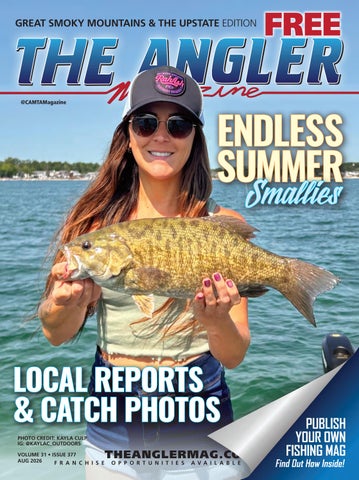
GREAT SMOKY MOUNTAINS & THE UPSTATE EDITION
FREE
ENDLESS SUMMER
@CAMTAMagazine
Smallies
LOCAL REPORTS & CATCH PHOTOS PHOTO CREDIT: KAYLA CULP IG: @KAYLAC_OUTDOORS VOLUME 31 • ISSUE 377 AUG 2026 F R A N C H I S E
THEANGLERMAG.COM O P P O R T U N I T I E S
A V A I L A B L E
PUBLISH YOUR OWN FISHING MAG MARCH 2026
Find Out How Inside!
W O R L D W I D E
POWER YOUR NEXT ADVENTURE
5072 West Lake Road Auburn, NY 13021
rro nded y a er on m e de e raord nary a o a e e a e o er 610 feet of private shoreline . a re or d a n and memora e nr e and n e . d
rare o or n y o o n one o n e a er ron ro er e .
REL n oy
N N . e e .
R
e
n er a e mo
E EN NS L SE N Rare. Exclusive. All yours.
and many more . . .
ER N EE
L
LE S ES RE E
E R BLE S NR SES S NSE S EA
Steven Barrett Licensed NYS Real Estate Broker
est a e oa
Montserrat
o
R
A
ADVERTISEMENT
five things you should know about boat insurance Are you ready to embark on your next on-water adventure? Before you set sail, here are five things to know about boat insurance.
1. Boat insurance isn’t just for accidents With comprehensive coverage, you’ll also be protected financially for theft, vandalism, and unexpected events like storms if you need repairs or replacements due to damage.
4. Most lenders require boat insurance If you financed your boat, you’ll likely need boat insurance since most lenders require boat insurance to protect their investment. Additionally, some marinas or municipalities require proof of insurance for docking.
2. Accidents can happen to anyone When accidents happen, boat insurance offers liability coverage for damages or injuries you cause while boating, up to specified limits. It can also cover lawsuit costs if you’re sued.
5. Progressive offers specialized boat coverages Ever worry about getting stuck on the water? Progressive’s Sign & Glide® On-Water Towing coverage** can help. It’s an additional coverage that steps in if your boat is disabled or breaks down on the water, paying for on-water towing, jump starts, soft ungroundings, and fuel delivery. Fuel cost isn’t included.
3. Boat insurance can cover medical payments Boat insurance offers a range of optional medical payments coverage limits, helping to cover medical expenses if you’re in an accident or someone is hurt on your boat, regardless of fault.
Don’t let unforeseen circumstances disrupt your voyage. Cruise with confidence thanks to Progressive Boat insurance. Because when it comes to your boat, peace of mind is the ultimate luxury.
Progressive Casualty Ins. Co. and affiliates. Product features are subject to policy terms and conditions and may not be available in all states or for all vehicles and coverage selections. No. 1 rating based on boat market share data from Ratefilings.com. *
** Sign & Glide® is an optional coverage you can add to any Progressive Boat policy and costs $30/annually ($50/annually in Florida). Prices are subject to change.
Scan to get a quote in as little as 4 minutes. Go to progressive.com to learn more.
o or
**
r or
One look at that bow and he was hooked for good. With up to $10,000 of optional fishing equipment coverage, Progressive made sure the rods and reels were protected—so they could keep the spark alive, tide after tide. 1-80 0 -PROGR E S SI V E
PROGR E S SI V E .COM
Get an online quote in as little as 4 minutes
Progressive Casualty Insurance Co. & affiliates. No. 1 rating based on 2023 filings with state departments of insurance. Fishing Equipment coverage is subject to policy terms. Prices vary based on how you buy.
4 NATIONAL
AUGUST 2026
tina Georg e
F
ishing for greater amberjack— By CAM Staff a!ectionately known as “reef donkeys” or “AJs”—is one of saltwater angling’s most grueling and rewarding challenges. These hard-fighting predators are famous for their sheer strength, blistering runs, and ability to test both angler and tackle to the absolute limit. Greater amberjack are structure-oriented predators that primarily inhabit o!shore waters. They congregate around deep wrecks, artificial reefs, oil rigs, and steep rocky ledges. Adult amberjacks can exceed 60 pounds, though common catches range from 20 to 40 pounds. Because they are competitive and aggressive, they often hunt in packs, making them highly receptive to fast-paced fishing tactics. Due to the amberjack’s habit of diving straight into sharp structure when hooked, you cannot use light tackle. Anglers typically rely on heavy-action conventional or spinning gear. Use a heavy 6-foot (or shorter) rod paired with a high-capacity reel. The shorter length gives you better leverage to turn the fish’s head away from the reef. Spool up with a minimum of 50 to 80 lb. braided line, connected to a heavy 80- to 100-lb. monofilament or fluorocarbon leader. Whether you are drifting over the deep wrecks of the Gulf of Mexico or fishing o! the Atlantic coast, the two most e!ective methods are live baiting and vertical jigging. Live bait is often the most productive method for targeting the largest amberjacks. Prized baits include blue runners, hardtails, pinfish
EDIT: Chris
TIPS FOR CATCHING GREATER AMBERJACK
PHOTO CR
Taming Reef Donkeys
and cigar minnows. Rig your bait using a heavy circle hook (7/0 to 10/0 depending on the bait size) and drop it down into the lower third of the water column just above the submerged structure. Pro anglers often clip the tail of a lively baitfish so it doesn’t swim away too quickly, making it an easy target. If you prefer an active fishing style, heavy metal jigs (4 to 10 ounces) are incredibly e!ective. Butterfly jigs and traditional diamond jigs mimic the frantic movement of injured baitfish. Drop the lure to the bottom and rapidly reel it upward using a jerking, pumping motion. Amberjacks react intensely to speed and competition, so a fast, erratic retrieve often triggers a violent reaction strike. Hooking an amberjack is only half the battle; bringing it to the surface is the real test! When hooked, the “reef donkey” will immediately bolt straight down toward the safety of the wreck or reef. If they reach the structure, your line will be sliced on sharp metal or rocks. You must apply heavy drag and use a “lift and reel” technique, steadily pumping the rod and winding quickly to force the fish upward. To protect greater amberjack from overfishing, they are strictly regulated. These rules depend entirely on whether you are fishing o! the Gulf Coast or the Atlantic Coast. The Gulf population is heavily managed due to low stock numbers. For 2026, recreational harvest in the Gulf opens for 43 days, running from September 1 through October 14, 2026. Fish must be a minimum of 34” fork length (measured from the tip of the jaw to the center fork of the tail). Anglers are strictly limited to 1 fish per person, per day. Captain and crew on charter boats have a bag limit of zero. The Atlantic coast o!ers longer open windows but a di!erent sizing scale. Harvest is open most of the year but features a mandatory spawning closure from April 1 through April 30.The minimum size drops to 28” fork length. The limit mirrors the Gulf at 1 fish per person, per day. Before heading out, check your state’s licensing requirements and rules for specific reef-fishing gear to improve fish survival rates after release such as non-stainless steel circle hooks, dehooking device and a rigged, readyto-use venting tool or descending device to safely handle fish experiencing barotrauma.
COASTALANGLERMAG.COM • THEANGLERMAG.COM
COASTALANGLERMAG.COM • THEANGLERMAG.COM
AUGUST 2026
GREAT SMOKY MOUNTAINS & THE UPSTATE 1
SMOKY MOUNTAINS NORTH CAROLINA/ SOUTH CAROLINA/GEORGIA
Coffee By a Trout Stream _____________
S
By Ethan Hollifield
ome of the fondest memories I had as a child were of my family camping trips. My parents had an old Jayco popup that we spent our family summers in, traveling from Shenandoah all the way to the Outer Banks. These trips were usually accompanied by my great grandparents who were both avid coffee drinkers (some might say excessive, but to each their own). Because of my love of fishing from an early age; these trips were usually catered to camping close by some sort of body of water. I would get up before sunrise usually to find my great grandfather sitting by the campfire already halfway through a cup of coffee, with his fishing rod leaned up against the side of the camper anticipating my arrival. The combination of strong, black coffee mixed with woodsmoke is still to this day a very nostalgic smell for me. I remember one particular instance camping in East Tennessee, where my great grandfather lovingly scolded me for being in such a hurry to get to the stream. “The trout ain’t gonna grow legs, slow down and enjoy the walk lest I spill my coffee.” At the time, I didn’t think anything of it. I can’t even really remember the rest of the events of that one day, other than him and me sitting by the water’s edge and him letting me sip on his cup of coffee that he always brought fishing. It wasn’t so much that I even liked coffee, but it made me feel more like an adult (along with the leaves of his beechnut wintergreen
2 GREAT SMOKY MOUNTAINS & THE UPSTATE
AUGUST 2026
I took from him when he offered). Those trips, and those memories, are some of the best parts of my life. I credit them with getting me to where I am today as a guide and for my love of fishing. When I am done with a trip and find myself alone on the river, I’ll make a fresh cup of coffee and sit by the water’s edge, reminiscing on the events of the day but more so on my great grandfather’s words all those years ago. I’m not sure he realized it at the time how impactful that was on my personal philosophy of fishing. When I sit in the midst of rushing water on a trout stream, hearing the songbirds and feeling the warmth of my coffee in my hands forces me to slow down and appreciate where I am in the present. Joe Humphries often talks about “looking up” when going fishing for this reason. It can be so easy to be focused on the technical aspects of fishing when I think most anglers sometimes forget just how fortunate they are to be on the water surrounded by all of the natural beauty we have here in the first place. Time has muddled many of my childhood memories, but the smell of strong coffee takes me back to a much simpler time when the only thing that was rushing anything, was the water tumbling over the rocks at my feet. In a world that seems to make less sense to me as the days go by, those memories are precious things. Ethan Hollifield is a member of a conservation organization called 2% For Conservation and a guide for Southern Appalachian Anglers
COASTALANGLERMAG.COM • THEANGLERMAG.COM
y life. I my love e river, ing on those was on
ng the me to s often be so k most water ce. mell of thing at my those
2% For Anglers
COASTALANGLERMAG.COM • THEANGLERMAG.COM
AUGUST 2026
GREAT SMOKY MOUNTAINS & THE UPSTATE 3
Bears, Boars and Bees __________
M
By Joe Woody
y next door neighbor, Dylan Dicus The bear sitting at the end Dylan’s driveway had a bear encounter the other eating pink cupcakes is a little surreal and a morning. Not a terrifying encounter perfect segway into a recent “near” encounter but a bear encounter nonetheless…most are at I’ve had. I say “near” because I actually didn’t see least a little pucker inducing. the bear but I’m quite sure he played a trick on He walked out of his front door smack me. dead into a three or four hundred pound My buddy, Barry Holcombe, and I recently bear casually munching on his daughters completed a “Hazel Creek Walk”. If you are not pink cupcakes. Apparently, there had been familiar with the term, a “Hazel Creek Walk” a birthday party during the week, and the consists of a trip of three to four days walking leftovers were placed in the trash for pickup… and fishing the Hazel Creek Watershed in the it was a Tuesday. The bear was not startled and Great Smoky Mountain National Park. This trip continued his breakfast. The bear made meals is usually completed one of two ways. You can out of a few other trash cans that morning. I picked most of the trash up start at Proctor on the North Side of Fontana Lake and fish upstream, or before most people came out. you can start at the top like Barry and I did. Starting at the top eliminates I’m telling this story to highlight the preponderance of bear the strenuous uphill climb coming out of the watershed. Either way, be interactions we are having around the mountains lately. There are bears prepared to walk twenty-five miles or more depending on your side downtown. There are bears at the mall. There are bears at the hospital… fishing excursions up Walker or Proctor creeks. bears everywhere. I would imagine if a bear could write an article for a We started our trip from the Clingman’s Dome Parking Area. We fishing magazine, he would be wondering why are all these people in walked up the steep Tower Trail for obligatory selfies at the top of the my backyard? He might even write a story about leaving his den one tower then struck out west on the AT toward double springs gap and morning and running smack dead into a three or four hundred pound the trails intersection with Welch Ridge Trail. A mile into our walk, we man eating all his blue berries. started finding numerous, large piles of bear poop. When we turned With all these bears venturing into civilization, just imagine how south down Welch Ridge, the piles became larger and closer together. We many bears there are out in the wilderness. Personally, I’m running into them everywhere, I’m sure other adventure anglers are doing the same.
Continued, see BEARS, BOARS AND BEES Page 9
4 GREAT SMOKY MOUNTAINS & THE UPSTATE
AUGUST 2026
COASTALANGLERMAG.COM • THEANGLERMAG.COM
If you love the outdoors and dream of being in business for yourself–but not by yourself, now is the perfect time to make a change and choose a Coastal Angler or The Angler Magazine Franchise.
ESTABLISHED BRAND PROVEN SYSTEMS COMPLETE TRAINING & ONGOING SUPPORT
828-768-9663
woody@theanglermagazine.com coastalanglermag.com/great-smoky-mountains
COASTALANGLERMAG.COM • THEANGLERMAG.COM
AUGUST 2026
GREAT SMOKY MOUNTAINS & THE UPSTATE 5
How Did Brook Trout Get to the Southern Appalachian Mountains? ___________________________________
O
By Tom Champeau, Pisgah Chapter of Trout Unlimited
ne of the iconic symbols of Appalachian heritage, culture, and natural history is the Southern Appalachian Brook Trout (SABT - Salvelinus fontinalis), colloquially-known as “Specks.” Although considered the same species as Eastern Brook Trout throughout its range in the eastern U.S. and Canada, thousands of years of geographic isolation has caused genetic divergence resulting in populations in the Southern Appalachian Mountains to be genetically-distinct from populations in central and northern portions of their range. For a long time, it was believed that the New River in Virginia was a demarcation of the “southern” and “northern” strains, however, recent genetic analyses reveal that brook trout genomes are very complex with a wide region of mixed southern and northern alleles (= various types of a particular gene). Geneticists group Eastern Brook Trout that exist along the Appalachian Mountains into three primary groups: Arcadian (most of New England); Mid-Atlantic (Pennsylvania, Maryland, West Virginia, and northern Virginia); and Southern Appalachian (southern Virginia, North Carolina, Tennessee, South Carolina, and Georgia). However, there is considerable overlap between these distinctions. So how did brook trout get to where we find them today? What occurred that allowed a coldwater species to find a home in the Southern Appalachian Mountains? Various hypotheses attempt to answer these questions and what is described here is based on the work by Dr. Eric Hallerman, who recently retired from Virginia Tech, and author, John
6 GREAT SMOKY MOUNTAINS & THE UPSTATE
AUGUST 2026
Western Interior Seaway and Hudson Seaway connection via the PaleoBell River in North America, the likely route for ancestors of lake and brook trout to the northeastern Canada. (From National Geographic and ScienceDirect)
Hall (https://doi.org/10.1016/j.hisbio.2026.100038). Tracing the geologic history along with current genetic analysis reveals a fascinating story that began millions of years ago. Brook trout are actually a charr (or char) that are members of the salmonid family of fishes that dates its lineage back about 50 million years in British Columbia and the Pacific Ocean. There are over 200 living species of salmonids including whitefishes, ciscoes, graylings, salmon, trout, and charrs. Brook trout, lake
Continued, see BROOK TROUT Page 8
COASTALANGLERMAG.COM • THEANGLERMAG.COM
aleond
ceDirect)
COASTALANGLERMAG.COM • THEANGLERMAG.COM
AUGUST 2026
GREAT SMOKY MOUNTAINS & THE UPSTATE 7
BROOK TROUT continued from page 6 trout, Arctic charr, Dolly Varden, and bull trout are all charrs. Dolly Varden got their name from a Charles Dickens novel, Barnaby Ridge, where the Dolly character was known for dressing in vibrant colors. Most charr species are found in higher latitudes of the Pacific. From 50 to 3 million years ago the Paleo-Bell River system was as large as the Amazon and drained the drying Western Interior Seaway to the Hudson Seaway and Labrador Sea facilitating a transcontinental flow towards the Atlantic. If you have ever visited the eastern regions of Arizona, Utah, Colorado, Wyoming, Montana, and the Dakotas, you were on the eroded ancient bed of the Western Interior Seaway. Lake trout and brook trout diverged from a common ancestor about 10 million years ago. Continental uplift during the Miocene Epoch further raised the Appalachians and separated Canadian Shield lakes from the Mississippi watershed resulting in geological isolation that drove speciation of lake trout and brook trout. Members of this common ancestor became trapped in a large Miocene lake, adapted to a lentic environment, and evolved to become lake trout. Brook trout evolved in Canadian Shield rivers and while their ranges currently overlap, brook trout live in sympatry with lake trout in many lakes. Hybridization or natural reproduction of “splake” is extremely rare as the two species spawn at different times, places, and habitats. If you ever caught a splake, it was most likely a hybrid produced in a hatchery. Atlantic salmon, Arctic charr, grayling, lake trout, and brook trout are the only salmonids that are native to eastern North America. Grayling were common in Michigan’s Great Lakes basin but went extinct by 1936 due to logging and overfishing. The introduction of rainbow and brown trout and steelhead in the late 1800’s to replace declining grayling was likely the final driver of their extinction. Besides being a riverine fish, brook trout exhibit an adaptable life history
Maximum extent of glaciers that ended 11,000 years ago.
in lakes - known as coasters in Lake Superior, and a sea-run phase called salters. This variable life history enabled brook trout to thrive for millions of years with salters expanding south to Mid-Atlantic rivers such as the Roanoke, James, Rappahannock and Potomac. Global cooling occurred about 5.3 - 2.6 million years ago that allowed brook trout to migrate south from higher latitudes including the Savanna River system which includes Southeastern streams east of the Eastern Continental Divide (although this assumption is currently undergoing genomic analysis).
BEAR
8 GREAT SMOKY MOUNTAINS & THE UPSTATE
AUGUST 2026
COASTALANGLERMAG.COM • THEANGLERMAG.COM
called illions as the curred south cludes gh this
Brook trout in the Paleo-Bell River may have moved south to upper Mississippi streams by a linkage formed during the Miocene uplift. During periods of extreme global cooling, salters may have trekked around Florida into the Gulf of Mexico and entered the Mississippi River, migrating upstream to invade the Tennessee Valley. Once in the Tennessee system, they populated the Ohio, Kanawha, and New River, and of course the Pigeon, French Broad, and other rivers we know so well. When brook trout initially expanded into Southeastern rivers is debatable, but likely occurred when the Atlantic Ocean cooled during the Late Pliocene (3.0 - 2.6 million years ago). For the past 2 million years during the Pleistocene, a series of glaciation events advanced and retreated across North America. At times, most of eastern Canada and the northeastern U. S. were covered by a mile-thick layer of ice. Imagine at the peak of the last glacial advance that ended about 11,000 years ago when the ice sheet’s southern terminus extended to the lower Midwest. The Mississippi River may would have resembled an Alaskan River with cold water tinted blue from glacial till. Brook trout were probably abundant all the way to the Gulf of Mexico. While the southern Appalachians were not covered by ice, the mountains were likely locked in a frozen grip, with brook trout existing within a much larger area of lower elevations than they are found now. As the climate warmed and glaciers retreated for the last time in the Pleistocene - 10,000 years ago, brook trout from three primary refugia: Acadian, Mid-Atlantic, and Mississippian re-populated their American range. Later on, the range of brook trout shrank as lower elevation waters became too warm to sustain them. With dozens of glacial advances and retreats over 2 million years that shifted brook trout populations around, it is not surprising that their genomics are so complex. Over the past 300 years of human-caused watershed alterations, brook trout populations have become fragmented and isolated with very little migration between populations that allows gene flow which maintains high population genetic diversity. Nearby but isolated populations can experience rapid genetic divergence, by a process called genetic drift. So within a particular population, genetic diversity can be concerningly low, however, the genetic differences between populations can be high. It is this low genetic diversity within a population that has biologists concerned that isolated populations may not have the genetic “tools” necessary to adapt to changing environmental conditions.
BEARS, BOARS AND BEES continued from page 4 passed large swaths of earth, recently rooted up by large bands of wild hogs found at high altitude during the summer. We passed a large grassy are recently pressed down by a large “Sounder” of hogs. We never saw the animals, but just out of sight we often heard large animals busting through the underbrush to avoid us. It was kind of unnerving. This continued all the way down the valley…bear poop and boar root. Our fourth day before our last push out to Fontana, we decided to explore a seldom fished area across Hazel Creek from the Sugar Fork Campground. Barry went ahead of me…I had some reel maintenance I had to take care of which put me about fifteen minutes behind him. I crossed the creek and immediately came across fresh bear tracks. What do you do when you come across fresh bear tracks…in the middle of the wilderness…by yourself…obviously you follow them. The bear was in a playful mode. He crisscrossed the little island five or six times. He walked through a little swampy area. He rubbed himself on a tree and scratched it up. I then followed him back to the creek where he jumped into the water about seventy-five yards from where Barry was fishing on a rock. He left almost perfect tracks in a little sandy area next to the bank. I studied the tracks for a few minutes, almost mesmerized by them. I love tracks, they tell a story if you have the patience. I squatted down to get a closer look. I then noticed more tracks in the shallow water almost washed away. The bear was almost jumping up and down. I was trying
Historical range represents where brook trout were thought to exist at the time of European colonization.
As we are experiencing extremely rapid warming over the past 170 years, SABT are holding on in the coldwater streams of the southern Appalachians at elevations above 3,000 feet. They are a legacy of this amazing past shaped by geological forces and a changing climate. Besides an important sport fish, they are important to First Nation culture and mountain heritage. While their imperilment from watershed development, habitat loss, non-native trout competition, and climate change is well documented, how many other aquatic species may also be facing local extinctions? As an iconic, keystone species, SABT might be the “canary-in-the-coal mine” that represent threats to the globally-high level of biodiversity that WNC is known for. SABT have no where to go as air and water temperatures climb, and it is up to us to do what we can to protect watersheds and tributaries that provide thermal refugia, increase population genetic diversity, and expand their presence across their range. By actively mitigating these threats to their sustainability, we can help ensure that brook trout will continue to find a home in the Southern Appalachian Mountains.
to put the pieces of the puzzle together. Then off to my right, I noticed a grey cloth like substance. Before I fully recognized what it was, the hornets started swarming me. This bear had knocked a hornets nest out of a tree almost as if he knew I was following him. He led me into a trap, and I never saw it coming. Never saw the bear either. I’m not saying this bear hatched a plan to get me stung by hornets. I’m saying that bears are curious and mischievous by nature and can and will create trouble wherever they wander. Whether it be eating pink cupcakes out of your trash can or ripping down a hornets nest to set you up for a few stings. All in all, I was lucky. I was only stung once but my whole left hand was swollen. Barry, oblivious to all I was doing because he was absolutely slaying fish, only saw me running toward him in a panic swatting at unseen bees. When I finally made it to safety, he simply asked…”You Ok”? I said yes and we both kept fishing like nothing had happened. We only spoke of it lightly on the way out when we high fived toward the end of our trip. My swollen hand reminding me of what just happened. I guess stories about bears, boars and bees become more interesting over time.
COASTALANGLERMAG.COM • THEANGLERMAG.COM
Joe Woody is Co-Publisher of The Angler Magazine Great Smoky Mountains with his wife Debra. He is an Army Veteran and a self proclaimed “Adventure Angler”. You can usually find him wandering around Western North Carolina telling fishing lies. He is also a baseball nut and a crazy FCS Football fan. He has a Bigfoot magnet on the back of his truck. AUGUST 2026
GREAT SMOKY MOUNTAINS & THE UPSTATE 9
Mountain Heritage Trout Waters Program
T
he Mountain Heritage Trout Waters program is a cooperative effort between the N.C. Wildlife Resources Commission and local governments to encourage trout fishing as a heritage tourism activity in western North Carolina cities that are designated as a “Mountain Heritage Trout Water City.” Currently, 17 cities are participating in the program. Each of these cities provides public access to a trout stream that runs through or is adjacent to the city. North Carolina residents and non-residents who want to fish in a stream that is designated as a Mountain Heritage Trout Water may purchase a 3-day license for $8. The license is valid only for waters that are designated as Mountain Heritage Trout Waters. Anglers with an inland fishing license can fish in Mountain Heritage Trout Waters without a Mountain Heritage Trout Waters license. A resident or nonresident of this state who served as a member of the Armed Forces and who separated under honorable conditions is exempt from the Mountain Heritage Trout Waters fishing license requirements while fishing in waters designated by the Wildlife Resources Commission as Mountain Heritage Trout Waters. In order to qualify the individual shall have valid documentation of their service on his or her person at all times during the fishing activity. Purchase a Mountain Heritage Trout Waters license using a credit card: Call 833-950-0575. (8 a.m.-5 p.m., Mon.-Fri.) or visit https://www. ncwildlife.gov/fishing/fishing-programs/mountain-heritage-troutwaters-program Important note: The Mountain Heritage Trout Water license can only be purchased online or by calling the toll-free number above. Wildlife Service Agents do not sell this license. To fish for trout in Public Mountain Trout Waters that are not designated as “Mountain Heritage Trout Waters,” anglers age 16 and over must have a valid inland fishing license.
No Rod and Reel? No Problem!
Anglers can borrow a rod and reel free of charge for the day. The loaner rods and reels are provided by city and town governments and the N.C. Wildlife Resources Commission through the agency’s Mountain Heritage Trout Waters Tackle Loaner Program. This program operates like a library. Anglers of all ages register at participating Mountain Heritage Trout Waters program-tackle-loaner sites to receive a tackle loaner ID card, which allows them to check out a rod and reel for the day. Anglers under age 18 must have a parent or guardian to complete the registration form. Anglers receive a free one-time mini-tackle box containing assorted lures the first time they register in the program. One tackle box per participant is permitted. Loaner rods and reels are available for a one-day loan and must be returned to the participating loaner site by the end of the business day. See a list of tackle loaner site locations: https://www.ncwildlife.gov/fishing/fishing-programs
Trout Fishing Tips
Fly-fishing is a great sport but it’s more than a long pole, a fake bug and a casual cast into the water. Fly-fishing takes time and practice. Knowing what lure to fish, as well as when and where to fish is as important as landing a cast in just the right spot with just the right touch. Download a printable “Tips for the Novice Fly-Fisher” card here: https://www.ncwildlife.gov/troutfishingtipspdf/download?attachment
Mountain Heritage Trout Cities Map
Download a printable map and regulations of the stream section that is designated as a Mountain Heritage Trout Water in that location. Visit https://www.ncwildlife.gov/fishing/fishing-programs/mountainheritage-trout-waters-program
10 GREAT SMOKY MOUNTAINS & THE UPSTATE
AUGUST 2026
COASTALANGLERMAG.COM • THEANGLERMAG.COM
m
rative n and ritage ed as a
these h or is s who Trout nly for nglers Trout
of the xempt ments ission vidual son at
credit www. trout-
n only ildlife
re not 6 and
y. The nd the untain erates untain tackle or the mplete le box gram. els are pating er site
ug and owing ant as
here: ment
ection ation. ntain-
COASTALANGLERMAG.COM • THEANGLERMAG.COM
AUGUST 2026
GREAT SMOKY MOUNTAINS & THE UPSTATE 11
SMOKY MOUNTAINS TENNESSEE/VIRGINIA/KENTUCKY/ALABAMA
Fly Fishing on the Clinch River in Tennessee ___________
T
By Jim Marsh
he Clinch can be a tough river to fish for some anglers. Its water stays clear and cold, and it flows smooth in many places you need to fish. Success demands long, light leaders and tippets under these conditions. Most of the time the flies you will be using will be no larger than a size 18. Midges are the main aquatic insect that you will need to imitate. There is a weir dam located about a mile below the dam. It forms a large pool of slow moving water. Although it is usually full of trout, they are very difficult to catch. We suggest you don’t waste time there unless you just enjoy experimenting. In the Miller’s Island area there is a public boat launch area which provides a good place to fish if you are planning on wading. The water isn’t as smooth-flowing as it is in most other places, and it is somewhat easier for many anglers to fish. There are some riffles and runs in this area. The best way to fish the Clinch River is to float it. If you use your own boat, be sure you are aware that it does have a lot of shallow rock ledges. You can tear up a boat fairly easy if you are not careful. The best time to fish the river from a drift boat is during the times one generator is operating. Two generators operating brings about some fast moving water. It is certainly possible to catch trout under these conditions, but you will drift down the river very fast. It is also possible to drift the river in a canoe provided they are not running any water. You can move around the river and stop to wade when the conditions are suitable.
12 GREAT SMOKY MOUNTAINS & THE UPSTATE
AUGUST 2026
The two big things to keep in mind is that the water discharges are of utmost importance on the Clinch River. You have to fish according to what the dam is doing. The other thing to keep in mind is that fishing dry flies is usually not the way to go. If you don’t like fishing nymphs and/or streamers, then you would be happier fishing somewhere else other than the Clinch River.
Clinch River Hatches and Trout Flies
Our information on aquatic insects is based on our stream samples of larvae and nymphs, not guess work. We base fly suggestions on imitating the most plentiful and most available insects and other foods at the particular time you are fishing. Unlike the generic fly shop trout flies, we have specific imitations of all the insects in the Clinch River and in all stages of life that are applicable to fishing. If you want to fish better, more realistic trout flies, have a much higher degree of success, give us a call. We not only will help you with selections, but you will also learn why, after trying Perfect Flies, 92% of the thousands of our customers will use nothing else. 1-800-594-4726. There are a few mayflies and quite a few caddisflies that emerge on the Clinch River, but the hatches are not consistent day in and day out. There is a sulphur hatch that can be good at times. It is about the only
Continued, see CLINCH RIVER Page 13
COASTALANGLERMAG.COM • THEANGLERMAG.COM
ee
COASTALANGLERMAG.COM • THEANGLERMAG.COM
AUGUST 2026
GREAT SMOKY MOUNTAINS & THE UPSTATE 13
CLINCH RIVER Continued from page 12 mayfly hatch of any importance. It starts in late April and peaks during May. By the first of June it has ended in most areas. Many days you will be lucky to see midges on the surface. Most of the fly fishing should be done subsurface. The river has a population of both scuds and sow bugs and at times it seems they are the preferred food of the trout. However, as plentiful as they are, imitations of them don’t always work. There are several species of Cinnamon Caddis. They can hatch off and on from June through the month of September. Little Sisters are also present in limited quantities. They hatch in late June and on into the first two weeks of July. Other species are present but not in large quantities. This is an excellent river to fish large streamers in for two reasons. When they are running two generators, it is about the only way you can fish it. The other reason has to do with the huge brown trout that exist in the river. Fish from twenty to thirty inches long are not uncommon. They are used to eating large baitfish. This method requires a lot of cast and plain work, but it can be very effective. Just don’t expect a fish every few minutes. When you do catch one, it most likely will be a good one. The best conditions for a drift boat trip is when they are running one generator. You can occasionally catch trout on a dry fly provided a hatch is occurring when one is running, but most often you will need to fish subsurface. It is also possible to catch a trout on a dry fly midge imitation.
It depends on the water levels and flow conditions and of course, the hatch. Most of the time you will be better off fishing a midge larva or pupa imitation. If you notice any midges hatching, go to the midge pupa imitation. If you don’t, fish a midge larva imitation. We prefer to fish either of them without a strike indicator, but they do work fairly well on the Clinch. You should add a small amount of split shot above the larva imitation and adjust the indicator depending on the depth and speed of the water. You can fish imitations of scuds and sowbugs the same way as the midge larva flies. Add some weight to the tippet a few inches above the fly and fish them on or just above the bottom. Strike indicators can also be used with them if you prefer. Don’t forget streamer flies. They work great, especially when the water is running high and fast, or when it is off-color from heavy rain. Double or tandem rigs are popular on the Clinch. Some anglers fish a larger mayfly nymph and a small midge larva or pupa together. Others fish two midge flies a few inches apart, both a midge larva and a pupa imitation. We don’t prefer these multiple rigs, but they do catch trout. If you haven’t done so already, please give our “Perfect Flies” a try. We feel sure you will find them to be very effective on the Clinch tailwater. Our Scud and Sowbug imitations are the best you can buy. Our Sulphur imitations work great on this river as well as anywhere else for that matter.
#1 Guide Service in the Smokies Complete Fly Shop • Professional Guide Service Fly Tying • Fishing Equipment Rental • Spinning Tackle Our guides can help the most experienced fly fisherman have a trip to remember or turn a beginner into a lifelong fly fishing enthusiast.
865-436-8746 TWO LOCATIONS:
469 Brookside Village Way, Gatlinburg TN 37738 618 South Gay Street Knoxville, TN 37902 ORVIS • SIMMS • SAGE • ECHO • CORTLAND
www.SmokyMountainAngler.com
14 GREAT SMOKY MOUNTAINS & THE UPSTATE
AUGUST 2026
LAMSON • REDINGTON • SOLITUDE • S.A.
COASTALANGLERMAG.COM • THEANGLERMAG.COM
COASTALANGLERMAG.COM • THEANGLERMAG.COM
AUGUST 2026
GREAT SMOKY MOUNTAINS & THE UPSTATE 15
CAPTAIN JIM DURHAM FISHING KY / TN FISHING REPORT
P
rovided by Captain Jim Durham, Owner StriperFun Guide Service, Tennessee and Kentucky Walleye, Crappie and Muskie Charters, Superbaittanks.com, Captain Jim Marine Electronics and much more…… DATE OF REPORT: August 2026 Greetings to my readers! I hope that the world finds you and your family doing well!
STRIPER FUN GUIDE SERVICE ON CHEROKEE LAKE
Cherokee Lake remains red hot!!! Cherokee Lake in Eastern Tennessee covers 30,300 acres, is 59 miles long and has 463 miles of shoreline. Cherokee Lake is full of big stripers but is also “loaded” with big fat “hybrid” stripers as well! StriperFun’s guides are all over them! We average 20 fish days catching both striper and hybrids! We fish live bait and Captain Jim Striper Magic lures (see our website) to surfacing fish, August and September are great months to fish! Our 4 guides all have decades of experience!
STRIPER FUN GUIDE SERVICE ON THE CUMBERLAND RIVER
Captain Jim’s StriperFun Guide Service Cumberland River Adventures fishes the Cumberland River in TN and KY for several reasons. • First, the stripers are much larger in the Cumberland River system in TN and KY than other freshwater lakes. Per the two State’s Wildlife Boards, there is an average of over 15 stripers caught annually in excess of 50 pounds and 40-pound fish are not uncommon. The smallest fish we generally catch daily is over 3 feet long! These fish mostly eat high protein rainbow trout, large gizzard shad and skipjack and also fight the current all day, making them much heavier and stronger than “lake” fish. In the cold waters of the Cumberland River, the caught fish survive very well and can be released unharmed. The average size trout we use in TN for bait is 12 inches with some up to 16 inches long (we do casting trips in KY) and we also occasionally use big skipjack up to 20 inches long (“yes” the Stripers in the Cumberland River are large enough to eat a 20-inch piece of bait!). When a big river striper comes after a large bait, the bait will be tail dancing all over the surface trying to get a way. Sometimes the “dance” will last half a minute (as you watch the big predator circling the prey!) until the striper finally gets the big bait then its “Kabam”!! The rod gets yanked down and the reel is screaming! We also catch huge fish casting Captain Jim Special (see photo) Striper Magic “glide” baits! As I advised above, throughout the year, it is not uncommon to see 40 or 50 pound “goliath” stripers pulled from the beautiful waters of the Cumberland River. This fishing is not for the faint of heart however! These big fish hit like freight trains, making long powerful runs in the constantly flowing waters of the river! We use large rods, heavy duty reels, 50-pound test line and titanium hooks! August, September and October are great months to hunt monster stripers on the Cumberland River It is great to be alive and be a “free” American! I look forward to seeing all of you this year on the water. Always remember to stop and shake the hand of a person in uniform or wearing garb that shows they are a veteran! Their service is why you speak English, can vote and can enjoy the freedoms you do! Until next time, blue skies and tight lines! With full State licensing and insurance, all Captain Jim’s Guide Service guides (16 guides on 18 waterways) can take you on a safe, fun and unforgettable fishing adventure! Check out all of our fishing services as well as our exclusive “online” store at www.striperfun.com or call 931-403-2501 to make reservations today.
16 GREAT SMOKY MOUNTAINS & THE UPSTATE
AUGUST 2026
COASTALANGLERMAG.COM • THEANGLERMAG.COM
COASTALANGLERMAG.COM • THEANGLERMAG.COM
AUGUST 2026
GREAT SMOKY MOUNTAINS & THE UPSTATE 17
The 2026–27 East Tennessee Crappie Tournament Trail ______________
H
By Perry Hensley, Sr.
as released it schedule for the upcoming season. I am excited that 4 events will be on my local lakes of Douglas and Cherokee. After our 5 the place finish in the points race last season and ending up inside of the Elite 6 Crappie Madness Bracket Tournament. This year promises to be better than the last. If you haven’t fished any of their events you definitely do not know what fun you are missing out on. The format and registration for these tournaments are as follows. Registration to join is a one-time $40 then each event is $40 per event per boat of two for members and $60 for non-members. Blast off is usually 7am with lines in at 7:30 and lines out at 3:30 pm with weigh in at 4:30. You must be at weigh in on time no exception or you are in forfeit With this trail each participant is given a chance to win something! That being said at the end of each event is a section of the tournament called Roll the Dice where those that were not in the money get a chance to win many different prizes from the ETCTT sponsors those include Bait Pop and ACC Crappiestix just to name a couple. There is also a Big Fish payout for each tournament! We invite you to come get in on all the fun this season at one of
18 GREAT SMOKY MOUNTAINS & THE UPSTATE
AUGUST 2026
the events listed. Do not feel intimidated, this trail teaches us all to become better Anglers, with the sharing of strategies ,tips and tricks where the fish were and how they were caught. As always God Bless and get up and get out and enjoy all that Our Creator has given us. Tight Lines!
COASTALANGLERMAG.COM • THEANGLERMAG.COM
COASTALANGLERMAG.COM • THEANGLERMAG.COM
AUGUST 2026
GREAT SMOKY MOUNTAINS & THE UPSTATE 19
The Fish Experience theHateful Magic of FallHole in Galax, VA: _________ A Journey Through Nature’s Palette
M A
By Jim Mize
y daughter named this hole. I was sitting back in the woods watching her cast s the scorchingtoheat of summer rainbow repeatedly a twenty-inch way to the coolher andoffering, crisp she was and all gives the while it refused days of fall, Galax, Virginia, muttering under her breath, “Hateful, hateful, emerges hateful.” as a captivating destination for The travelers a breathtaking Hatefulseeking Fish Hole, in case you lack good autumn amid the upper end sense andexperience. want to fishNestled there, lies on the Blue Ridge Mountains, Galax transforms of Humility Creek, the stream where hemlocks into a wonderland vibrantconsume colors and crossed with Venusofflytraps enough flies seasonal delights, making it anbusiness. ideal The fish to keep the local fly-tackle shop in place relisharethe ofrearview the fallmirrors, so on thistostream saidmagic to sport season. regardless of your direction of approach, they take Galaxa wave sits of adjacent to the worldoff with their tails. famous Blue Ridge Parkway, a scenic The Hateful Fish Hole looks like any other highway renowned its awe-inspiring nondescript flat run,forwith a riffle at the top and a vistas and at leaf-peeping small ledge the bottomopportunities that brings the flow to during the fall. As the foliage begins to the next a stop before plummeting three feet into change, the hills and valleys transform hole. Only hip deep at its deepest point, in this hole into a usually medley can of be reds, the fish seenoranges, lined up and in a feeding lane that ranges from yellows. Take a leisurely the bottom to the top paralleldrive to thealong flow. Bump one fish and he bumps the parkway, onethe ofnext the until numerous the next, who hike bumps all have gone to hide. trails, or !nd a peaceful spot to revel My daughter can fling a fly with theinbest of them and knows enough the beauty nature’s autumn masterpiece. about bugsof and branches to guide edible flies through the overhangs on Nothing saysand fall catch like pumpkins, and apple butter! Visit Humility Creek these wildapple trout.cider, Upstream or downstream, local orchards and farmers’ markets to sample fresh apple cider,them. pick rainbows or browns, the fish fall to the temptations she floats past It’s just this one hole that won’t share its fish.
20 GREAT 8 GREATSMOKY SMOKYMOUNTAINS MOUNTAINS&&THE THEUPSTATE UPSTATE
On this particular day, she had tried an assortment of flies from small caddis to stonefly pumpkins, and get your !ll of nature’s nymphs, only to have trout inspect her offering fall bounty. Enjoy a local fall festival and politely decline. All during this episode, I or Art & Ag Tour, where you can could see fish rise to sip midges, open their mouths experience live music, art, and cultural underwater in a flash of white, or roll sideways to heritage demonstrations. nudge a nymph loose. As the holiday season approaches, After she had flailed to her dissatisfaction, I Galax comes alive with the High eased into the hole and tried a tan caddis with a Country Lights Show in Felt’s Park. midge dropper, usually the ticket for picky trout From Thanksgiving Day until New in these parts. Rainbows would rise to look, drift Year’s Day, the park is transformed into a backwards with the fly, then settle into their mesmerizing display of twinkling lights, original positions. After a while, they didn’t even festive decorations, and holiday cheer. rise to look. It’s an enchanting experience for all ages, I went through my box of tricks to see what making it a perfect way to kickstart the else I could drift past these masters of indecision. holiday season. Considering the possibilities, I first thought that From the spectacular leaf season on maybe my midge was the wrong color. But how can the Blue Ridge Parkway to the delightful you spot the color of an insect too small to see? We flavors of apple cider and apple butter, had already drifted larger flies, and I had presented my smallest flies, Galax offers an abundance of seasonal both with the same result. delights. So, pack your bags and start We concluded that these trout were just hateful. your mountain adventure to Galax, Whenever we fish this stretch of Humility Creek, we give extra effort where nature’s beauty and warm hospitality await. For more information: to the Hateful Fish Hole. It’s become a challenge, knowing that if we can www.VisitGalax.com
Continued, see the HATEFUL FISH HOLE Page 22
SEPTEMBER AUGUST 2026 2025 COASTALANGLERMAG.COM COASTALANGLERMAG.COM • THEANGLERMAG.COM • THEANGLERMAG.COM
:
ature’s estival u can ultural
aches, High Park. New into a lights, cheer. l ages, rt the
on on ghtful butter, asonal start Galax, ation:
COASTALANGLERMAG.COM • THEANGLERMAG.COM
AUGUST 2026
GREAT SMOKY MOUNTAINS & THE UPSTATE 21
THE HATEFUL FISH HOLE Continued from page 20 catch these fish, we can catch any fish. Last fall, on an afternoon when the browns were battering a Foxee Clouser, I came to the Hateful Fish Hole with renewed confidence. After all, I’d had enough luck already to almost lose my humility and replace it with confidence. At the head of the pool, the last storm had pushed a log into the hole and wedged it against a boulder on the far side. The gorge in these mountains channels an inch of rainfall into a foot of stream flow, so the debris gets rearranged with every major storm. With that log providing cover, any big brown holed up here would lie in its shadow. So, I drifted the Clouser a breath off the log and without hesitation the brown rolled on the fly. He just didn’t take it. It looked like one of those football drills where linemen jump over each other while another one rolls under them. The fish rolled over the fly, flashed that big bronze belly at me, and came down on the other side of my line with no fly in its mouth. I set the hook, sent a perfectly-good Clouser into the hemlock behind me, which took it in one big gulp, and I swear I heard it belch. The brown went back into his ambush spot in the Hateful Fish Hole and waited for the next unsuspecting fisherman. During the dark hours of the night, I often ponder the secret to the Hateful Fish Hole. I tie ever-smaller midges in various colors, plot approaches to stay more concealed, and constantly buy smaller Fluorocarbon tippet every time a new brand comes out. I concluded that I needed to wait them out, wait for the perfect season, the perfect water, and the perfect weather. Then, this week it came. Late in the summer, Humility Creek gets a little warm and the water a little low. So, I leave the fish alone until the nights cool. Then, if a piece of a tropical storm breaks off, we can get several days of back-to-back drizzle. Not enough to muddy the water, just enough to perk up the fish.
Give them a good dose of oxygen and a few more inches of current to hide in. So, when that storm came, I took off and headed to the Hateful Fish Hole. Using the stretch downstream to fine-tune my offer, I found the browns most receptive to an inchworm. I tie a small one with a curled tail and it looks like it just fell from the sky. Maybe my tippet passes for its web, but the browns strike like they haven’t had a meal since spring. I had already released a handful of browns and rainbows when I had fished my way up to the hole. I watched it before moving in to see if any fish were active. On this day, nothing moved. I tried the tail of the hole first to avoid bumping any browns that had moved into the shallows to feed. Three quick casts, left, center, and right of the stream flow produced nothing. Up near the boulder, subsequent storms had taken the log downstream, so the most likely spot now for a big fish was behind the rock and under a mountain laurel branch. I carefully worked about fifteen feet of line and twelve more of leader side-armed to keep it low and landed the inchworm with a noticeable “kerplop”, just the way browns like it. Before the rings could expand, a brown pounced and I set the hook. To my amazement, the brown actually was on my line, in the Hateful Fish Hole, just like any other fish and hole. Maybe the curse was broken. Or maybe not. The brown took off on a tear toward me at the lower end of the hole. On the opposite bank, brush had piled up and the brown streaked toward it. I leaned into the three-weight and 6X-tippet as much as I dared but knew I would be better off risking a broken line than letting that fish get into the brush. Even with his head of steam, I managed to turn him enough to skirt the brush pile and as soon as I did, I discovered it had all been a ruse. He never meant to go into the brush. Instead, he immediately dived under a flat rock. This rock looked like any other part of the stream bed, flat, three feet across, and at first glance, flush with the bottom. There couldn’t have been more than a couple inches of clearance on the back side, but he squeezed in with my line scraping over the top. I tried pulling him out, but he found a hold and I couldn’t. Not wanting to lose my first hateful fish, I waded out to get an angle from the back side and pry him loose. But by the time I got there, he’d found some leverage on tippet or fly, worked it loose, and made his departure just as I got there. From where I stood, his tail seemed to wave good-bye. So, in the wee hours when it’s quiet and dark, I still plot strategies for the Hateful Fish Hole. I will keep buying smaller tippets with each new technological breakthrough. I will track my fishing log for hatches and stream conditions to plan the time of attack. And maybe I will come up with a different color midge that a trout with good eyesight can’t resist. But on a creek that teaches humility, hateful fish are master instructors. “The Hateful Fish Hole” is an excerpt from the award-winning book, A Creek Trickles Through It. You can order copies online or purchase autographed copies at www.acreektricklesthroughit.com. Award-winning author, Jim Mize, has written a humorous book specifically for fly fishermen. Titled, A Creek Trickles Through It, this collection delves into such topics as carnivorous trees, persnickety trout, and the dangers of fly-tying. This book was awarded first place in the Southeastern Outdoor Press Association’s Excellence in Craft competition. Whether you are an arm-chair fisherman or one with well-earned leaky waders, it will be a welcome addition to your fishing library. Jim has received over one hundred Excellence-In-Craft awards including one for each of his other books including The Winter of Our Discount Tent, Fishing With Beanpole, Hunting With Beanpole, and The Jon Boat Years. His articles have appeared in Gray’s Sporting Journal, Fly Fisherman Magazine, Fly Fishing & Tying Journal, as well as many conservation publications. You may order copies through Amazon or get autographed copies from his website at www. acreektricklesthroughit.com
22 GREAT SMOKY MOUNTAINS & THE UPSTATE
AUGUST 2026
COASTALANGLERMAG.COM • THEANGLERMAG.COM
Fishing with Children Plans over the Summer Summer
T A
______________ By___________ Andrew A. Cox
By Scott Norton he Summer months are now • Shorten the fishing day; do here along with the adventprogress of not expect spendphase, the entire day s the summer months you will and wind. During a newtomoon the bass the summer school to sundown start to see the bitesvacation slow down to a trickle. will hang outfrom near sun-up cover since visibility fishing is low. time period. For many children, a down child. and Short periods Bass along with other fish will take cover You will need with to slow usetime a worm or a they have time on their hands and are in order to maintain interest. in the shade or go deep to get away from the sun jig to catch these bass. are for water activities to keep breaks fishing, and looking those high temps. To locate bass, you I find Take usingfrequent dark colors likefrom black, blue, themselves Fishing maybe interspersing fishinginwith have to havebusy. a plan. Therecould is not abelot of time to go and purple will give you a better presents the aongood activityfor forrandom them tobites. engage another outdoor the search Once the mid-day water. Dark colors will throwactivity. a nice silhouette during summer months. Many • Be and sun getsthe high their bite window will start to taper during a full moon, butprepared you can with catchdrinks them with families also schedule their family snacks for use over the course of the off. It is better to get there before the sun rises so any color if you please. During the new moon vacations during these months. fishing day you can position yourself for success. there is no light, so it doesn’t really matter what Incorporating fishing into family • Be prepared to take frequent You will find can much success fishing the shad you use. The secret is to breaks use rattles or something vacation outings encourage a bathroom spawn. Bass will key in on this bite before the sun big that will disperse water. your lighting child’s interest in angling. • Plan to goKeep fishing only when comes up. taking Rocky banks to a minimum, will seeisyougood. coming if aim When a childand or wood youngare good places thebass weather Children to find fishing, this. Once up you it at the water.will Red most lights likely give offnot enough so person theythe aresun notisgoing to can fish deeper enjoyglow being to extendthe that biteasoransometimes you can miss obstacles in theitwater andhot, not cold, alert approach same adult. Theirit will continue outdoors when is overly in the shade. into and fighting the swells them that you’re coming. attention spanIfisyou’re much not shorter, or raining. from skiers, havefish options. have nighttheir interest. say, fishing in theand rainlive or baits. a cloud children will then likelyyou require actionYou to maintain • Plan to use a variety of baitsItowill include both artificial Be fishing or youthe can take a kayak the horsepower is and another that works in summer. Consider following pointsinwhen taking young people fishing: prepared to tie knots, rigcover tackle, bait plan hooks. You maygreat also be required restricted lakes where it’s nice and calm.for the child’s skill level and size. to make some casts for the I child have ifdefinitely caught big during a • Use fishing equipment appropriate they are unfamiliar withbass the equipment TheyTimes may require starting out with reelsaand shorter rods, then • Do not expect thedownpour. young person to bass cast get perfectly. Prepare for time line to go night fishing will spincast be the best These very active at this later facemoon spinning hooking on shoreline Try on to weekgraduating leading uptotoopen the full and reels the darkness of the new moon. Not tangles and willand lash out at up forage. You will and needunderwater good rain obstructions. gear, or just put • Target to for catch in order to maintain theit child’s fishing do not have a lotbe of hot trees, rocks, You or weeds many peoplefish fishthat the are neweasy moon reasons of visibility. I find better pick youropen bathing suitslocations and justthat get wet, since it will anyway. have interest. Seek a mixed bag ofphase fish species include panfish, anda to minimize tangles. on kayaks in the new moon becausetoyou cannot safelycatfish, plane out a lot of options this season, so choose what works for you and have fun. bass if fishing warm waters. • Expose young people to conservation and protecting the fishing boat in total darkness. Try and time your fishing close to or just before Lookisfor trout if fishing in cold water the •moon at hatchery its highest.supported During the full waters moon stage, it’s easy to fish and locale. Do not litter and discard used fishing line, bait holders, drink and Scott Norton is a Western North Carolina native. Born in Asheville, N.C., settings. Theselots hatchery supported fish may to catch than you can cover of water using moving baitsbe likeeasier the ones you chuck is a FISHING long-time hunter, angler and weekend warrior. Continued,hesee WITH CHILDREN Page 10 wild trout.
A Creek copies it.com.
ally for to such g. This iation’s man or fishing cluding nt Tent, rs. His ne, Fly ou may t www. hit.com COASTALANGLERMAG.COM AUGUST 2026 SMOKY MOUNTAINS & THE UPSTATE 23 8 GREAT SMOKY MOUNTAINS & THE UPSTATE • THEANGLERMAG.COM JULY 2025 COASTALANGLERMAG.COM •GREAT THEANGLERMAG.COM
24 GREAT SMOKY MOUNTAINS & THE UPSTATE
AUGUST 2026
COASTALANGLERMAG.COM • THEANGLERMAG.COM
circle drop it above ail of a making heavy tterfly rantic ottom otion. n, so a ike. ging it nkey” of the will be ag and d and
ey are er you tion is vest in ber 14, tip of sh per f zero. scale. losure ength.
rules e such readyencing
STAY ON TOP By Britt Stoudenmire
FOR SUMMERTIME
RIVER SMALLIES
T
he late-summer months are an overlooked window to catch big smallmouth bass that have been lazily lying in the middle of the river a!er a long spawning season. The insect hatches and emergences that occur throughout the day including mayflies, damsel flies and my favorite, the cicada, spur feeding frenzies and create an excellent opportunity to throw topwater lures and flies. One of my favorite lures to target topwater smallies during this period
is the Pop-R. I make long casts with a 6-foot to 6-foot, 6-inch G.Loomis medium-action rod with a Shimano Stradic 2500 C4+ reel spooled with 20/6 Power Pro braided line. On entry into the water, I let the bait dead dri! for about five seconds before working it erratically back to the boat. I target current seams, eddies, corner pockets and any type of structure or current break in the middle of fast water. It is important to continue working the bait with the same cadence, even if a fish is crashing behind it. Once you feel the rod load, reel into the fish and swing the rod back. Once hooked up, keep the rod—and fish—down in the water. Many big fish are lost while trying to pull the fish up to get a look at it. Another one of my favorite topwater presentations is the buzzbait. I will target the same areas as above using a slightly stouter medium-heavy setup to drive the hook home. The key to the buzzbait is to get the bait up on the surface as soon as it hits the water. I favor a straight, steady retrieve, reeling just fast enough to keep the bait on the surface. When a fish eats it, allow him to load the rod before setting into him with a hard hook set. I favor longer sha!ed buzzbaits for better hook-ups, as I don’t use trailer hooks because of the damage they can do to smallies. If you have a blow up on your buzzbait and do not touch him with the hook, a quick follow up with a so! plastic will o!en garner an immediate bite from the same fish. If you like to fly fish, summer’s slower, less-busy water o!en presents the perfect scenario to fly fish for big smallmouth. My favorite presentation for smallies on the fly is dead-dri!ing cicada bugs. Big smallies are addicted to these “dog days” dying cicada bugs and the easy meal they present, and we sight cast to these fish that o!en eclipse 20” or more. This technique has produced some of my clients’ and my personal best fly-rod fish. When dead dri!ing cicada bugs aren’t working, several other presentations can produce explosive strikes. Any popper in the size 4 to 6 range can attract smallies. When they strike, remember to strip up the slack line and into them before raising the rod tip hard to drive home the hook. If fish aren’t responding to the popper, another option is a slider-style fly. When stripped, the fly will dive slightly beneath the surface giving a darting and diving action. The Sneaky Pete is a good example, and this type of presentation can be deadly. Britt Stoudenmire owns and operates New River Outdoor Co. who guides on the New River in Southwest Virginia. www.newriveroutdoorco.com.
WHY BUY NEW WHEN YOU CAN RENEW?!?
YOUR GAUGE RESTORATION SPECIALISTS
5049 HWY. 17 SOUTH • GREEN COVE SPRINGS, FL 32043 904-701-9726 • GAUGESAVER.COM COASTALANGLERMAG.COM • THEANGLERMAG.COM
AUGUST 2026
NATIONAL 5
Working the Night Shift TIM BAREFOOT
I
RHINO SPINNING COMBO WINS ICAST 2026 BEST OF SHOW
I
n an industry increasingly dominated by high-tech fish finders, forwardfacing sonar, and motorized watercra!, the biggest story of ICAST 2026 came down to a refreshing return to roots. Rather Outdoors and its iconic Zebco brand shocked the fishing world at the Orange County Convention Center in Orlando, Fla., by winning the overall Best of Show award for the newly engineered Rhino 30 6’6’’ 2-piece Medium Spinning Combo. The victory marks a monumental comeback for the legacy Rhino name, a brand built entirely on bulletproof reliability for the everyday angler. “Zebco has been the first chapter in so many people’s fishing stories, and the Rhino relaunch is helping make sure that first experience is one that lasts,” said Chris Littau, Vice President of Zebco, following the historic win. Before capturing the industry’s ultimate prize, the Rhino setup first secured its foothold by winning the competitive Rod & Reel Combo category in the ICAST 2026 New Product Showcase, where industry heavyweights and innovative newcomers competed for 39 different Best of Category awards, selected by credentialed buyers and media who voted during the trade show.
SCAN THE CODE or visit VIDMAG.COM to check out our extensive coverage and videos from ICAST 2026.
Wholesale • Retail CUSTOM MADE TO ORDER. Since 1967
(321) 508-2836 CALL TO ORDER! HANDMADE IN THE USA 206 Pine St. • West Melbourne, FL 32904 6 NATIONAL
AUGUST 2026
remember the dog days of August as almost unbearable for myself and clients during the daylight hours. Some days on commercial trips we would put the fan on us and rest during the heat of the day and fish in the late a!ernoon and at night for a number of fish, including snappers and mackerel. The yellowfin and wahoo bite could sometimes be a pleasant surprise while king mackerel fishing under the lights. The first wahoo I ever caught from an anchored up boat was at night. It literally swam right to the boat and I was able to almost hand feed him. That was a game-changing experience for me. This is where I learned how to catch live squid in numbers under the lights with a long-handled dip net and on the Sabiki. Cigar minnows and sardines would gather in huge swarms under the lights and, therefore, it would attract all the predators, not to mention the bite on the bottom and in the mid depth of the water column. The full moon of August is traditionally the best beeliner fishing of the year. A lot of the snappers spawn during the full moon of July and August; the mackerel too. A lot of the snappers and triggers are not on the bottom, but will suspend in the water column, so I would recommend a level wind reel when fishing the water column to locate the depth of the largest snappers. Descend your baits, slowly letting your thumb off the spool to release more line, one rod-length strip at a time. I like to use a double tackle with small pieces of squid and small circle hooks for this style of fishing. When you feel the first bite, click the reel in gear and barely come tight to it...sometimes you’ll have two at a time. This is the perfect time to put a small snapper on the bottom, a snapper Packed out... 2-4 lb. beeliners during large enough to eliminate first half of the night on the full moon. all the trash bites and attract only the largest grouper. The largest gag I ever caught was in August (at night) on a small pink snapper. Gutted it weighed 51 pounds and we estimated that it was probably 54 pounds. August has a lot of opportunities. We just have to change tactics to take advantage of it, and the night shi! is a great way to avoid the searing daytime temperatures and fill the box with organic groceries. This is also a good time to keep at least one person on the Sabiki, catching cigar minnows and sardines for future trips. Considering the cost of a five-pound box of frozen cigars, it makes it worthwhile to jig up 15 or 20 pounds of cigs, sardines, squid and/or tinker macs. Keep them all in the live well until you’re ready to leave in the morning and chill the remainder of the livewell all at one time for the ride home. Fish through the night and during the first couple of hours of daylight on the productive bottom and come home with a box full of fish! This is how to get the most out of an August trip. Load the box with plenty of ice when you get home, go inside, take a good nap and get up in the a!ernoon to clean and freeze the catch. Learn more from Tim Barefoot at barefootcatsandtackle.com and on his YouTube channel: @timbarefoot5698.
COASTALANGLERMAG.COM • THEANGLERMAG.COM
hours. us and and at el. The rprise I ever swam at was how to andled gather act all he mid onally spawn
m, but a level ng the locate argest your your ool to , one time. double pieces circle yle of u feel he reel come etimes time. t time per on napper minate s and argest t) on a mated
tactics avoid rganic on the
ars, it dines, you’re vewell
urs of ox full ad the good .
m
priority service for members
That’s in our wheelhouse Boating can be unpredictable and you don’t want to be left waiting during stressful situations on the water. With a BoatU.S. Towing Membership, you come first! For a year of worry-free boating, take US with you.
24/7 Towing by Local Captains You Can Trust
Scan the QR Code or visit BoatUS.com/Wheelhouse
Details of services provided can be found online at BoatUS.com/Agree. TowBoatU.S. is not a rescue service. In case of an emergency, contact the Coast Guard or a government agency immediately.
COME JOIN OUR TEAM! FRANCHISE OPPORTUNITIES AVAILABLE NATIONWIDE!
FREE
@CAMTAMagazine
MAHI
ALASKAN SUMMER
If you love the fishing, boating and outdoors lifestyle, and dream of being in business for yourself— but not by yourself— now is the time to spring into action and become a Coastal Angler or The Angler Magazine Co-Publisher. No Experience Neccesary—We Will Train You! We have freshwater and saltwater territories available throughout the country and abroad. Ask one of our specialists about franchise availability in your area.
LOCAL REPORTS & CATCH PHOTOS
EVERYONE'S OFFSHORE FAVORITE
OF ALYSSA VEGA PHOTO COURTESY / TIKTOK:@FISHWITHLYSS IG:@FISHWITHLYSS 337 T U N I T I E S VOLUME 28 • ISSUE E O P P O R
CO AS TA LA NG
F R A N C H I
S
M WIDE AG .CO LE RM E W O R L D V A I L A B L A
APRIL 2023
FREE
CATCH BIG BASS
@CAMTAMagazine
BUCKET LIST FOR MOUNTAIN TROUT
WITH BIG BAIT
LOCAL REPORTS & CATCH PHOTOS PHOTO COURTESY OF MAGGIE CARSELLO IG: @MAGGIEJO_OUT DOORS / FB: @MAGGI EJOOUTDOORS VOLUME 30 • ISSUE 364 JULY 2025
F R A N C H I S E
THE ANG LER MA G.C O P P O R T U N I
T I E S
BECOME A
OM
A V A I L A B L E
PUBLISHER MAY 2025
Find Out How Inside!
W O R L D W I D E
• ESTABLISHED BRAND WITH PROVEN SYSTEMS • COMPLETE TRAINING & ONGOING SUPPORT • LOW STARTUP COSTS AND OVERHEAD • WORK FROM HOME — BE YOUR OWN BOSS!
SCAN THE CODE TO VIEW OUR BROCHURE:
1-888-800-9794
info@coastalanglermagazine.com
franchise.coastalanglermag.com
GRANT SIMPSON & FAMILY FLORIDA TREASURE COAST CO-PUBLISHERS
How to Be Cut Off From Civilization When it’s you against nature, there’s only one tool you need: the stainless steel River Canyon Bowie Knife—now ONLY $49!
Y
ou are a man of the wilderness. The only plan you have is to walk up that mountain until you feel like stopping. You tell your friends that it’s nothing personal, but this weekend belongs to you. You’ve come prepared with your River Canyon Bowie Knife sheathed at your side. This hand-forged, unique knife comes shaving sharp with a perfectly fitted hand-tooled sheath. The broad stainless steel blade shines in harmony with the stunning striped horn, wood and bone handle. When you feel the heft of the knife in your hand, you know that you’re ready for whatever nature throws at you. This knife boasts a full tang blade, meaning the blade doesn’t stop at the handle, it runs the full length of the knife. According to Gear Patrol, a full tang blade is key, saying “A full tang lends structural strength to the knife, allowing for better leverage ...think one long steel beam versus two.” With our limited edition River Canyon Bowie Knife you’re getting the best in 21st-century construction with a classic look inspired by legendary American pioneers. What you won’t get is the trumped up price tag. We know a thing or two about the hunt–– like how to seek out and capture an BONUS! Call today and you’ll outstanding, collector’s-quality knife that also receive this genuine leather sheath! won’t cut into your bank account. This quintessential knife can be yours to use What customers are saying out in the field or to display as the art piece it truly is. But about Stauer knives... don’t wait. A knife of this caliber typically cost hundreds. Priced at an amazing $49, we can’t guarantee this knife will “First off, the shipping stick around for long. So call today! was fast and the quality is Your satisfaction is 100% guaranteed. Feel the knife in your beyond what I paid for the hands, wear it on your hip, inspect the craftsmanship. If you don’t feel like we cut you a fair deal, send it back within 30 knife. Overall I am a satisfied days for a complete refund of the sale price. But we believe that customer!” once you wrap your fingers around the River Canyon’s handle, — D., Houston, Texas you’ll be ready to carve your own niche into the wild frontier.
River Canyon Bowie Knife $79*
Offer Code Price Only $49 + S&P Save $30
1-800-333-2045
TAKE 38% OFF INSTA NTLY!
When you use
Your Insider Offer Code: RCK520-01 You must use the insider offer code to get our special price.
your
INSIDER OFFER COD E
Not shown actual size.
14091 Southcross Drive W., Dept. RCK520-01 Burnsville, Minnesota 55337 www.stauer.com *Discount is only for customers who use the offer code versus the listed original Stauer.com price.
Rating of A+
• Full tang 4 ¼" stainless steel blade, 9" overall length • Genuine horn, wood and bone handle • Polished brass guard and spacers • Includes leather sheath
Smart Luxuries—Surprising Prices ™
TZMAP MFD SERIES A Rock-Solid, Purpose-Built, Stand-Alone MFD Made Just For You.
TZMAP13 - 13"
TZMAP9 - 9"
Find Less Stress & More Fish With this streamlined MFD, Furuno is bringing big-boat confidence to everyone.
Less Stress