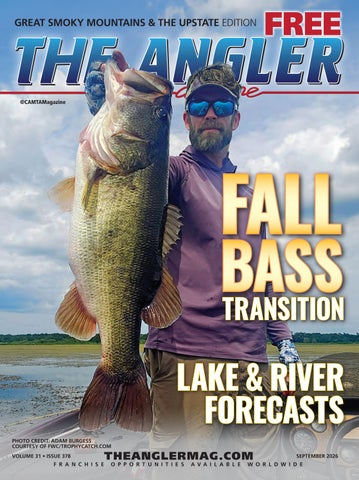
GREAT SMOKY MOUNTAINS & THE UPSTATE EDITION
FREE
@CAMTAMagazine
FALL
BASS TRANSITION
LAKE & RIVER FORECASTS PHOTO CREDIT: ADAM BURGESS COURTESY OF FWC/TROPHYCATCH.COM VOLUME 31 • ISSUE 378
F R A N C H I S E
THEANGLERMAG.COM O P P O R T U N I T I E S
A V A I L A B L E
SEPTEMBER 2026
W O R L D W I D E
®
ADDITIONAL $250 REBATE ON NEW 250HP ELIGIBLE MODELS
A WHOLE NEW LEVEL Introducing Dometic’s DG3 Gyro
Smooth Sailing Experience a new level of comfort on the water with our DG3 Gyro Stabilizer. By minimizing boat roll, it ensures a smooth, steady ride, even in choppy conditions. Whether you’re fishing, dining, or just unwinding, the Gyro creates a more enjoyable and stable environment. Operating quietly and without the need for external fins, it lets you focus on what matters most: making every moment on the water truly relaxing.
dometic.com
ADVERTISEMENT
five things you should know about boat insurance Are you ready to embark on your next on-water adventure? Before you set sail, here are five things to know about boat insurance.
1. Boat insurance isn’t just for accidents With comprehensive coverage, you’ll also be protected financially for theft, vandalism, and unexpected events like storms if you need repairs or replacements due to damage.
4. Most lenders require boat insurance If you financed your boat, you’ll likely need boat insurance since most lenders require boat insurance to protect their investment. Additionally, some marinas or municipalities require proof of insurance for docking.
2. Accidents can happen to anyone When accidents happen, boat insurance offers liability coverage for damages or injuries you cause while boating, up to specified limits. It can also cover lawsuit costs if you’re sued.
5. Progressive offers specialized boat coverages Ever worry about getting stuck on the water? Progressive’s Sign & Glide® On-Water Towing coverage** can help. It’s an additional coverage that steps in if your boat is disabled or breaks down on the water, paying for on-water towing, jump starts, soft ungroundings, and fuel delivery. Fuel cost isn’t included.
3. Boat insurance can cover medical payments Boat insurance offers a range of optional medical payments coverage limits, helping to cover medical expenses if you’re in an accident or someone is hurt on your boat, regardless of fault.
Don’t let unforeseen circumstances disrupt your voyage. Cruise with confidence thanks to Progressive Boat insurance. Because when it comes to your boat, peace of mind is the ultimate luxury.
Progressive Casualty Ins. Co. and affiliates. Product features are subject to policy terms and conditions and may not be available in all states or for all vehicles and coverage selections. No. 1 rating based on boat market share data from Ratefilings.com. *
** Sign & Glide® is an optional coverage you can add to any Progressive Boat policy and costs $30/annually ($50/annually in Florida). Prices are subject to change.
Scan to get a quote in as little as 4 minutes. Go to progressive.com to learn more.
o or
**
r or
He gave her fuel. She gave him thrills. Progressive gave them peace of mind— with up to $10,000 of optional fishing equipment coverage because rods and reels are replaceable, even if the stories aren’t. 1-80 0 -PROGR E S SI V E
PROGR E S SI V E .COM
Get an online quote in as little as 4 minutes
Progressive Casualty Insurance Co. & affiliates. No. 1 rating based on 2023 filings with state departments of insurance. Fishing Equipment coverage is subject to policy terms. Prices vary based on how you buy.
PRO FISHING TECHNIQUES
Snook Season Must Haves
F
CAPT. MIKE SMITH
inally, September is here and everyone’s favorite inshore fish is back on the menu. This article will cover the best bait and tackle to hunt down slot-sized linesiders. Check your local rules and regulations before keeping any snook. You can do jail time and get heavy fines by harvesting under- and over-slot snook.
WHAT TACKLE DO YOU NEED TO CATCH A KEEPER SNOOK?
It really depends upon where you are fishing for them. If you are out on the flats or on the beach, then you can get away with lighter tackle. You can land a slot snook with a medium-action rod, a 2500 series reel spooled with 10 pound braid and a 30 pound leader. You don’t need heavy tackle when there is no structure around to get cut off on. If you are fishing for snook around docks, bridges, rocks, mangroves or oyster bars, then you might want to use heavier tackle. A medium/ heavy rod with a 4000 series reel spooled with 20 pound braid and a 40 pound leader will usually do the trick.
WHAT ARE THE BEST BAITS FOR CATCHING SNOOK?
Natural baits usually work the best for snook. Snook love croakers, pinfish, mullet, shrimp and white baits like threadfin herring. The key to using natural baits is using the correct sized hook for the bait that you are using. You wouldn’t want to use a 5/0 hook with a shrimp or a white bait because it’s too heavy to allow the bait to swim. You would want to use a 1/0 or 2/0 hook for those smaller baits. Conversely, you would not want to use a small hook for a large, 10-inch mullet. The small hook would most likely not set properly once the snook ate it. You would want to use a 5/0 or larger hook for a large mullet. You want to match your hook to the bait
4 NATIONAL
SEPTEMBER 2026
size, not the size of the fish that you are trying to catch.
WHAT ARE THE BEST LURES FOR SEPTEMBER SNOOK?
The best thing about September is the mullet run typically begins about then. Millions of mullet will flood the inshore and offshore waters of Florida; a little later for Georgia and the Carolinas. Every marine predator will be gorging themselves on these delicious baits. Mullet imitations of varying sizes will be a good bet when the schools are passing through. The key is to match the size of the mullet in your area. Mullet within the schools might range from 15 inches down to 4-inch finger mullet. Large topwater lures work great around the outer parts of the schools. My personal favorites are Heddon’s Super Zara Spooks in pearl white, but oftentimes they will hit any color that mimics the size and profile of the fish they are feeding on correctly. Another great choice is the D.O.A. Bait Buster Shallow Runner. This is a soft plastic topwater/ subsurface lure that perfectly matches 4- to 5-inch mullet. Go get ’em. Capt. Mike Smith, owner of Fish Your Ass Off Charters, has been fishing the inshore waters, oyster bars and grass flats of Florida for more than 40 years. Reach him at (561) 339-2317, email: contact fishyourassoff.com or visit fishyourassoff.com.
COASTALANGLERMAG.COM • THEANGLERMAG.COM
COASTALANGLERMAG.COM • THEANGLERMAG.COM
SEPTEMBER 2026
GREAT SMOKY MOUNTAINS & THE UPSTATE 1
SMOKY MOUNTAINS NORTH CAROLINA/ SOUTH CAROLINA/GEORGIA
Trends in Temperature and Rainfall Affecting Trout Habitat in the ___________________________________ Southern Appalachian Mountains
A
By Tom Champeau, Pisgah Chapter of Trout Unlimited
ll trout anglers know that their favorite quarry requires cold water to survive. Rainbow trout, native to the Pacific Northwest, and brown trout, native to Europe, were stocked in the Eastern United States for the past 120 years to replace native brook trout after their populations were decimated by widespread timber harvest and watershed development. Brook trout are a species of charr that arose in northeast Canada 10 - 15 million years ago. All trout in North Carolina are from the Salmonid family and suffer when water temperatures exceed 68 degrees. Brook trout expanded to the Upper Midwest and Northeast and were pushed south by glaciers that covered most of northern US and Canada at times by mile-thick sheets of ice. These glaciers advanced and retreated over a period of two million years ending 12,000 years ago. In the Southeast, brook trout continued to exist in the Appalachian Mountains above 3,000 feet, the higher elevation allows groundwaterfed streams to stay cold even as the climate continued to warm. Like spruce, balsam, and fir trees hanging on at higher elevations, brook trout are relics of the Ice Age in the Southern Appalachians. For a long time, brook trout could freely move between watersheds, migrating downstream to larger rivers where they could find another
Map derived from Trout Unlimited’s Conservation Success Index, a tool that incorporates federal, state, and public data. See https:// spatialdynamics.com/ for more information. Brook trout population data provided by the Eastern Brook Trout Joint Venture.
tributary to inhabit. This allowed streams that had intense fires, floods, landslides, or other catastrophic events that wiped out brook trout to be repopulated. Free movement of brook trout also ensured high genetic diversity that enabled populations to adapt to changing environmental conditions. As we developed watersheds with farms, cities, roads, dams, culvert pipes, and other barriers to fish migration, brook trout populations became fragmented, putting many isolated populations at risk of local extinction. Low population size and lack of genetic diversity severely limits the ability of brook trout in small mountain streams to adapt and survive in changing conditions. The figure shows where brook trout populations are most threatened. Two of the biggest drivers of environmental change in Southern Appalachian streams have been acid precipitation and climate change. The April issue of this magazine dealt with long term research findings about the impacts of acid precipitation in the Great Smoky Mountains National Park. Spoiler alert - there is some good news, but you have to
Continued, see TRENDS IN TEMPERATURE Page 4 2 GREAT SMOKY MOUNTAINS & THE UPSTATE
SEPTEMBER 2026
COASTALANGLERMAG.COM • THEANGLERMAG.COM
ut s
a // n data
floods, t to be enetic mental
ulvert ations f local verely pt and trout
uthern hange. ndings ntains ave to
COASTALANGLERMAG.COM • THEANGLERMAG.COM
SEPTEMBER 2026
GREAT SMOKY MOUNTAINS & THE UPSTATE 3
TRENDS IN TEMPERATURE continued from page 2 look up the April issue to learn the details! The other big threat that Southern Appalachian brook trout face is a warming climate. The subject energizes great political animus, and some fisheries biologists are hesitant to discuss at talks they give to the public. While future predictions, mitigation measures, and potential economic and social impacts are hotly debated, when it comes to what is happening in our streams, it is good to start the conversation with data collected with thermometers and rain gauges. The State Climate Office of North Carolina (SCONC) is the primary scientific extension resource for weather and climate science for the state of North Carolina. Located on the campus of NC State University, it was established in 1976 and collaborates with all institutions within the university system. In 2009, NC State created the NC Institute for Climate Studies (NCICS) that is sponsored by the National Oceanic and Atmospheric Administration (NOAA) and is located in Asheville. NCICS analyzes temperature and rainfall data collected throughout the state for over a hundred years and provides reports for the public, agriculture, industry, and local government. The latest NC Climate Science Report is available from their website: https://ncics.org. Here are some key findings from the report: North Carolina has warmed over the past 120 years, and warming has accelerated over recent decades. Nights have been getting hotter and this concerns fisheries biologists, since streams typically release heat at night and if nights are hotter, streams will not cool enough to keep Observed annual number of extreme precipitation events (days with daytime temperatures below 68 degrees. 3 inches of rain or more) for the Western North Carolina mountains, Annual rainfall totals do not show a trend, however, the frequency of 1900 - 2018. Sources: NCICS, NOAA, NCEI, National Centers for high rainfall events (over 3 inches over 24 hours) has increased. Impacts Environmental Information, SCONC to mountain stream habitat from frequent floods have been documented even before Hurricane Helene devastated many rivers in the Southeast. that can decimate miles of benthic habitat. High flows increase erosion and landslides deposit significant sediment Brook trout do not fare well under high flows while rainbows do
4 GREAT SMOKY MOUNTAINS & THE UPSTATE
SEPTEMBER 2026
COASTALANGLERMAG.COM • THEANGLERMAG.COM
better. Biologists have documented population shifts where rainbows dominate during a series of higher rainfall years, while brookies rebound during drier years. Brown trout do better during lower rainfall periods as well, and this might be related to browns and brookies being fall spawners and higher flow events typically occur more frequently during the late summer/early fall. But when high rainfall events occur during winter, newly-hatched brook and brown trout are extremely vulnerable, and populations can experience year-class failures. While flooding events are increasing, so are the frequency and duration of droughts. We are in a severe drought now and while hot days, floods, and droughts have always occurred, relying on our memories is not the best approach to understand what is really happening. Weather is defined by annual, seasonal, and even daily extremes in temperature and rainfall. Climate science analyzes changes in long term averages. Distinctions must be recognized between variable weather conditions over the short term, and long-term changes in climate patterns. The Earth’s climate is always changing over long time scales - our orbital periods, the sun’s output, shifting continents changing ocean circulation, volcanic eruptions, and asteroid impacts have greatly changed the climate over hundreds of millions of years. For the past 10,000 years that humans have been populating the planet, the climate has been relatively stable. But over the past 150 years since the Industrial Revolution and the burning of fossil fuels for energy production, the rate of climate change has been extremely rapid. Plants and animals have been able to adapt to past changes in climate, but scientists worry that the rapid rate of change that we are experiencing now may exceed their ability of adapt. For trout and many other species in Southern Appalachia, migration is not an option, there is nowhere to go. To gain a better understanding of mountain stream temperatures, scientists, organizations, and volunteers are installing temperature loggers across the Southeast. Much of this information is being
COASTALANGLERMAG.COM • THEANGLERMAG.COM
Observed annual number of warm nights (over 70 degrees) for the Western North Carolina mountains, 1900 - 2018. Sources: NCICS, NOAA, NCEI, National Centers for Environmental Information, SCONC
Continued, see TRENDS IN TEMPERATURE Page 9
SEPTEMBER 2026
GREAT SMOKY MOUNTAINS & THE UPSTATE 5
Canton: A Base Camp for Mountain Water ________________
W
By Angler Magazine Staff
here do I begin? That’s sometimes a difficult question when you’re talking about fishing in Western North Carolina. I could give you a list of streams, tell you where they are, what lives in them and maybe even what fly to throw. But where’s the fun in that? If you’ve spent any time wandering around these mountains with a fly rod in your hand, you already know that some of the best fishing trips begin with a map, a back road and the thought, I wonder what’s up there? Canton, North Carolina, is a pretty good place to start wondering. Sitting in Haywood County with the Pigeon River running right through town, Canton is surrounded by some of the most beautiful mountain water in Western North Carolina. You can unpack your bags, make Canton your base camp and spend several days fishing without having to fish the same kind of water twice. There are larger rivers, little mountain tributaries, stocked trout water, wild trout streams and even a mountain lake just a short drive away. And then there are those little creeks disappearing into places where the rhododendron seems determined to prevent a fly fisherman from entering. Those are usually the places I want to go.
Follow the Water
The Pigeon River watershed reaches deep into the mountains surrounding Canton. Follow its forks and tributaries toward their beginnings and the character of the water changes. The river gets smaller. The roads get narrower. Eventually the pavement may disappear altogether. Cold, clear water tumbles down from the high country, gathering in little branches and creeks before beginning its journey toward the Pigeon. Some of these tributaries hold trout. Others are simply beautiful places that remind you where a mountain river comes from. The West Fork of the Pigeon River, running through the country around Lake Logan and below Cold Mountain, is one of the better-known trout waters in the area. But don’t let the named water on a map become the entire adventure. Look at those little blue lines feeding it. I have a weakness for little blue lines. Some lead nowhere. Some lead to waterfalls. Some lead into rhododendron hell where you’ll spend more time untangling your fly from a bush than fishing. Every once in a while, though, one leads somewhere special. That’s part of what makes fishing around Canton so much fun. You’re surrounded by water, and there’s always another bend in the road or another creek coming down from the mountains asking to be explored.
Jonathan Creek and Maggie Valley
Drive west from Canton toward Maggie Valley and you’ll encounter another piece of Haywood County’s fishing story: Jonathan Creek. Jonathan Creek flows right through Maggie Valley, and that’s part of its charm. You don’t have to hike five miles into the backcountry to reach it. There are places where you can park, walk to the water and start fishing. Sections of Jonathan Creek are managed as public trout water, giving anglers an accessible opportunity to wet a line without having to disappear deep into the backcountry. It’s an especially good place to introduce someone to mountain trout 6 GREAT SMOKY MOUNTAINS & THE UPSTATE
SEPTEMBER 2026
fishing. But there’s another part of the Jonathan Creek story that I like. People care about it. There’s been a growing effort throughout Haywood County to clean up waterways, protect these mountain streams and recognize just how valuable they are to the communities they flow through. That matters. Photo courtesy of the town of Canton, NC A trout stream running through the middle of a community can become something people drive past without noticing. Or it can become part of the community. Jonathan Creek is the latter. Walk along it. Fish it. Sit beside it for a while. And if you see a piece of trash along the bank, pick it up. Maybe pick up one more.
A Change of Pace at Lake Junaluska
Keep exploring and you won’t have to travel far before the moving water gives way to something completely different. Lake Junaluska offers an angler a chance to slow things down. If you’ve spent the previous couple of days crawling over rocks, ducking under rhododendron and trying to put a dry fly into a hole about the size of your kitchen sink, that might not be such a bad thing. The lake offers fishing for bass, crappie, bluegill, perch and trout, among other species. Fishing is open to the public in designated areas with a valid North Carolina fishing license. Put down the little three-weight for a while and pick up something with a little more backbone. Or don’t. I’ve never been very good at telling somebody what kind of fishing they’re supposed to enjoy. That’s one of the things I like about Lake Junaluska. Fishing doesn’t necessarily have to be the entire reason for going there. Bring the family. Walk around the lake. Rent a kayak or canoe. Watch the birds and waterfowl. Find somewhere to sit and enjoy the mountains reflected across the water. And, naturally, bring a fishing rod. There’s something else about Lake Junaluska worth mentioning. People are taking care of this water, too. The lake has promoted clean-fishing efforts encouraging anglers to think about discarded fishing line, tackle and the effect we can have on the wildlife that shares these waters with us. I like that. As fishermen, we’re usually pretty good at noticing what comes out of the water. Maybe we should pay just as much attention to what we leave behind. Take your fishing line with you. Pick up that empty bottle beside the bank. And if somebody else left something behind, maybe grab that too. Leave the place a little better than you found it. After all, these waters belong to the next fisherman too.
Then There Are the Smokies
Of course, eventually my eyes always turn west. Great Smoky Mountains National Park isn’t far away, and for a trout fisherman who enjoys exploring, that’s where things can get interesting. The Smokies contain hundreds of miles of fishable streams ranging from larger, easily accessible water to tiny headwater creeks holding wild Southern Appalachian brook trout. COASTALANGLERMAG.COM • THEANGLERMAG.COM
Some require little more than pulling into a parking area. Others require a backpack, a map, some good boots and questionable decision-making skills. Those are usually my favorites. There’s something different about catching a wild trout in a mountain stream. Maybe it’s knowing that the fish belongs exactly where you found it. Maybe it’s the cold water, the moss-covered rocks or the realization that you’re standing in a place that has looked essentially the same for generations. Whatever it is, these mountains have plenty of it. Just remember that Great Smoky Mountains National Park has its own fishing regulations. Know them before you go, carry the appropriate license and treat those wild fish—and their home—with the respect they deserve.
Stop at the Fly Shop
Before heading into the mountains, stop by Mountain Fly Outfitters in downtown Canton. Local fly shops are important. Sure, you can buy flies and leaders online. What you can’t order from a website is somebody standing behind the counter saying, “If I were fishing today, I’d probably head over there.” That kind of information is worth considerably more than the three flies you came in to buy and somehow turned into a $75 purchase. We’ve all done it. Mountain Fly Outfitters is more than simply a place to pick up a few flies or replace the leader you managed to leave sitting on the kitchen counter. A good local fly shop is part of the fishing community. These are the folks who know the water, talk to fishermen coming off the streams and understand what’s happening from one week to the next. Stop in. Buy something. Ask questions. Just don’t expect them to give away all their secret spots. I wouldn’t trust them if they did.
COASTALANGLERMAG.COM • THEANGLERMAG.COM
Stay Awhile
Here’s the point of all this. Canton is a wonderful place to stay if fishing is part of your reason for visiting Western North Carolina. Make it your base camp. Fish the Pigeon. Explore the West Fork. Spend a morning on Jonathan Creek in Maggie Valley. Take an afternoon and slow things down at Lake Junaluska. Study a map and investigate one of those little blue lines you’ve been staring at. Then dedicate a day—or three—to wandering around the Smokies. And when you’re not fishing, there’s plenty more to do. Drive the Blue Ridge Parkway. Hike to a waterfall. Visit Maggie Valley. Explore Waynesville. Walk around Lake Junaluska. Grab a meal or a beer in town. Take the family sightseeing in Great Smoky Mountains National Park. Or just sit beside the river for a while. And here’s the thing about visiting this part of the world. Every once in a while, somebody comes here for a few days and starts wondering what it might be like if they didn’t have to leave. I understand that. If your fishing trip turns into looking at cabins, mountain homes or a little place of your own somewhere near all this water, Thomas and Christine Mallette with Heritage, Better Homes and Gardens Real Estate can help you figure out what comes next. They’re local people who know the area, and they’ll take good care of you. I spent a good portion of my life traveling around the world before realizing that the place I had been looking for was right here in these mountains. There is adventure everywhere. Sometimes all you need is a fly rod, a map and a little blue line disappearing into the mountains. And sometimes you find a place that makes you want to stay. Canton is a pretty good place to start looking.
SEPTEMBER 2026
GREAT SMOKY MOUNTAINS & THE UPSTATE 7
Why Fish? ___________
H
By Ronnie Parris
ey folks I hope all is well with you. As I write this, I was looking back through my pictures, mostly the ones I have of my dad, and I guess I realized most of my pictures of dad are either hunting or fishing. It got me to thinking about why we hunt and fish. I imagine the answers would be different from person to person, because we all go about it in different ways. Some guys want to only target trophy fish or other game. Some will only use a certain technique to catch or hunt the species they are after and will go as far as to belittle anyone using another technique. So, I got to thinking and questioning why I like to fish and hunt. I
Fontana Lake Fishing Guides – Ronnie Parris, Owner & Head Guide LAKE, CREEK & RIVER FISHING • FLY FISHING • CAMPING We offer both full and half day trips with the most competitive rates available. All tackle and supplies you will need while you are on your trip is covered by our listed price.
1012 East Alarka Road, Bryson City, NC • 828-488-9711, Cell: 828-736-9471
smokymountainoutdoorsunlimited.com
8 GREAT SMOKY MOUNTAINS & THE UPSTATE
SEPTEMBER 2026
came up with multiple reasons as to why it’s so ingrained in my culture. I think number one was from childhood when my dad took me, and it was a bonding comradery. Number two, I love eating fish and wild game. I know what’s in it and what’s not. I know how it’s been handled and the care taken to preserve it. I love trying to utilize every edible piece of meat as a show of appreciation and respect to the game that gave up its life for me. Number three, I really enjoy being in the wild with just the quite peaceful sounds. I can connect with my lord and savior here without the noise of the world getting in the way. Number four, I absolutely love the camaraderie of hunting and fishing with my buddies and my family and seeing the enjoyment shared by all. And I really love the feeling that, through hunting and fishing, I’m connecting to my ancestors that had to hunt and fish to survive.
Continued, see WHY FISH Page 9
COASTALANGLERMAG.COM • THEANGLERMAG.COM
TRENDS IN TEMPERATURE continued from page 5 collected and evaluated across the landscape to provide a comprehensive picture of what is happening to brook trout habitat from the Southern Appalachians to Maine. With these data, biologists can determine which streams are being buffered from summer temperatures by adequate groundwater inflow which keep streams cooler. Also, the amount of tree canopy that shade streams can be evaluated which will inform projects to plant scrubs and trees to reduce solar heating. The threats of warming go beyond our native brook trout. Rainbows and brown trout have slightly higher tolerances for water temperatures above 68 degrees but not much. The cellular biochemistry and genetics involved with evolving thermal tolerance to survive at higher temperatures is extremely complex and limits the rate and extent that plants and animals can persist. If more of our trout streams exceed 68 degrees over the summer, we will lose our trout fisheries as they transition to cool and warm water fisheries. The North Carolina Wildlife Resources Commission measures water temperatures before they stock and decades of data were recently analyzed and published in a scientific paper. The results showed that some stocking sites will have to be eliminated and schedules modified as the water is simply too warm to stock fish. It is bad enough that our native brook trout are threatened by climate change, but when non-native trout stocking is impacted, it should serve as a wakeup call to everyone who loves to fish for trout. So, let’s study the issue so we can move beyond the pathos and understand the science.
COASTALANGLERMAG.COM • THEANGLERMAG.COM
WHY FISH continued from page 8
In today’s world of social media, it’s easy to see hunters and fishermen knock one another for the way or reason they hunt and fish and this is a dangerous slippery slope. Make no mistake, if the antis have their way, not just one type of hunting or fishing will stop, but all will, whether you do it on public or private land or stream. We better open our eyes and band together, as hunters, fishermen and sportsman, to preserve our heritage if we want our kids and grandkids to have this great opportunity— whether or not we agree on technique and such. So, get out there and enjoy what God gave us—and as always, take a kid fishing! Ronnie Parris is owner and head guide of Smoky Mountain Outdoors Unlimited-Fontana Lake Fishing Guides, headquartered in Bryson City, N.C., heart of the Great Smoky Mountains, www. smokymountainoutdoorsunlimited.com; (828) 488-9711.
SEPTEMBER 2026
GREAT SMOKY MOUNTAINS & THE UPSTATE 9
E
very year, as the warmer season fades, I feel a calling to visit the ocean. In times of hardship, I want to sink my toes into the salty sand. When I feel adrift, I want to breathe in the tidal air. There is something about standing at the edge of such a vast body of water that puts life back into perspective. The steady rhythm of the waves reminds me that even when circumstances change, there are still things in this world that remain constant. In no year have I felt these things stronger than I did in 2020. No one will ever say that 2020 was without its challenges and crises. So much of what we once considered normal seemed to shift beneath our feet. We were asked to adjust, to wait, to worry and, in many ways, to reconsider what truly matters. That makes the relief and rejuvenation I get from visiting the coast that much more important. More than I’ve ever seen in my lifetime, we need to continue to pull together as a community and as a country. I feel like we need to allow ourselves to be vulnerable but strong. That, to me, is the oceans lesson. The waves do not apologize for crashing against the shore, and the shoreline does not stop welcoming them back. There is strength in movement, strength in change and even strength in surrendering to
10 GREAT SMOKY MOUNTAINS & THE UPSTATE
SEPTEMBER 2026
those things we simply cannot control. Nature has a remarkable way of reminding us that resilience does not always mean standing still. Sometimes resilience means bending, adapting and continuing on. So, for this month’s “River Reflections” column, I decided to do something entirely different. I want to share a poem with you. I hope that it provides you with peaceful images and feelings of gratitude for the beauty that nature still offers us. Even during uncertain times, there are sunsets to notice, waves to listen to, breezes to feel and quiet moments worth holding onto. And I hope that when you look back on hard times, these words can give you encouragement to stay strong, vigilant and purposeful. May they also remind you to pause occasionally, breathe deeply and recognize how far you have already traveled. Like the ocean, we may be changed by every storm we encounter, but we can continue to return to ourselves, to one another and to hope.
COASTALANGLERMAG.COM • THEANGLERMAG.COM
Strength From The Sea _______________
A Poem By Matt Mittan Funny the way a man is drawn to the sea – so longing in his desire to be wetted by the salty mist and kissed by the reflective sun. The waves speak to a heavenly rhythm often drowned out by the rigors of his earthly dance. The tones of crash and sand mix sweetly with the distant trace of laughter and happy cheers of children being chased by the crashing tide. The sounds themselves unlock a softer side of our souls. A lesson in there, scope of sight stretched thin. Not to be feigned, fought but to be truly soaked in. What violent torrents of white foamed rolls, swelled up from the treacherous sea, yet stretch to a solid flat line that reach infinity. Gentle shades of green, brown and blue somehow mix together creating something entirely new. So timeless and wonderful are her treasures and lust, that time slows down here… resting into a gentle hush.
COASTALANGLERMAG.COM • THEANGLERMAG.COM
The secret healing of the sea comes from being defined by her desire, her pace and her ability to be free. One’s heart, spirit and mind find strength in that surrender, to chase that which we know we should and must be. We are reminded that we are not the architects, but the passengers, of this ride. So, our chest opens widely – passions have nowhere to hide. What purpose could there be in trying to hold back these waves? They are eternal, restless and intent on things that go well beyond the grave. Be like the oceans, discern the ebb and flow, the bittersweet balance of tranquility and turmoil. Let them move your desire, set your pace and steady your hands so that others may be drawn to you, as you yourself are drawn to the sea. Provide strength to your fellow man. Matt Mittan is the owner of Biz Radio Asheville and Co-Host of the Matt & Michele Outdoors program. Visit www.MattMittan.com for more information and to contact him.
SEPTEMBER 2026
GREAT SMOKY MOUNTAINS & THE UPSTATE 11
Keys to Success ___________
H
By Ronnie Parris
ey folks I hope you’re all doing well and cooing with the heat. This can be a stressful time of year especially if you’re wanting to get on the lake a catch a good mess of fish. The fish you were catching just weeks ago have abandoned the shallow hiding spots and all your well placed casts are coming back empty. The key to success now depends on 2 things first finding the thermocline and second finding sections of the lake with the highest concentration of bait. Finding the thermocline is easy just up the sensitivity on your fish finder till you see the staticky band of water on the screen. On my Lowrance, it’s a staticky blue band, and right now it’s 35 to 50 ft deep depending on the lake and the weather. This is gonna be the band of water with the most oxygen and best temperature for the fish you’re after. The next thing is your gonna have to find the bait fish. This can take some time watching your fish finder and knowing what you’re seeing is priceless but also watching the surface for breaking fish or pods of minnows as well as watching for birds or other wildlife that feed on these minnows is a clue. If you come to an area and see kingfishers or otters or eagles and ospreys, it’s a good bet you’re in the right spot Also think back to previous years and likely you have found bait and fish in the same areas in the past. Match the hatch so to speak if you’re seeing threadfin shad and they are an inch long, don’t fish a 5 inch bait. It’s a lot easier to get a bite when you’re using what they are eating now. Another good tip is to fish early or late midday may be easier on you and your sleeping pattern but the fish usually aren’t active midday unless you have a front moving in This is a great time of year for trolling with downriggers hitting fish suspended in that thermocline and it’s also a great time to take family and kids out on the water to build memories that will last a lifetime. So, get out of that bed early load up the ones you love a go have some fun enjoying what god has given us an as always take a kid fishing.
12 GREAT SMOKY MOUNTAINS & THE UPSTATE
SEPTEMBER 2026
COASTALANGLERMAG.COM • THEANGLERMAG.COM
COASTALANGLERMAG.COM • THEANGLERMAG.COM
SEPTEMBER 2026
GREAT SMOKY MOUNTAINS & THE UPSTATE 13
SMOKY MOUNTAINS TENNESSEE/VIRGINIA/KENTUCKY/ALABAMA
Old ‘Tennessee Trash’ is Still Alive and Kickin’ ____________
I
By David Ramsey
n the late 1970s, here in my home state of Tennessee, there was a wellknown public service ad on TV that showed a nasty looking character, driving down an otherwise scenic highway in a nasty old convertible, throwing out massive amounts of nasty trash as he cruised along. The lyrics to the twangy tune that accompanied the spot declared, “There ain’t no lower class than Tennessee Trash.” You can still find it on YouTube. That ad campaign came along not long after the famous national campaign, “Keep America Beautiful,” featuring a commercial that depicted a tearful Indian paddling his canoe through a river full of trash, sludge and dead fish. And sure enough, the awareness created by these and other such programs, all across the country, did raise awareness of the scale of industrial and general pollution, including the mindless trashing of our roads, waterways, parks and other public spaces. But if you believe the despicable practice of trashing the great outdoors had actually ended since then, you’d be badly mistaken. It’s been getting worse. That’s right, ol’ Tennessee (Carolina, Virginia, Georgia—take your pick) Trash is still around, not only on the highways and byways as shown in the old TV spot, but also out there fouling and polluting our cherished recreational lands and waters at an alarming level—and pretty much getting away with it. Research shows that sport fishing alone drives more than $1.2 billion in economic activity in Tennessee, supporting about 7,500 jobs, yet that
activity is threatened by what is happening to the species and habitat that support it. Tennessee Wildlife Federation has stated that, “Despite public education efforts, Tennessee’s litter problem hasn’t improved. And studies are finding litter is more harmful to wildlife than we thought— from releasing toxins when it’s eaten, to changing the structure and ecosystems of lakes and riverbeds.” For an idea of the scale of the problem, TWF also said that “…a recent study showed that the Tennessee River contains more microplastics per gallon of water than any other tested river in the world. It’s dumping 32 million pieces of it into the Ohio River every second. That is to say nothing of the non-plastic litter.” Really? @#%&, people—that’s messed up! Why is it that we still fail miserably in committing adequate resources to curtailing, if not eliminating, this blight on our natural resources and communities? The fact that volunteers, from various non-profit and civic organizations throughout the region (and many thanks to them all), go out every year or so and attempt to clean up some of the mess does not excuse the rest of the population, especially elected officials and law enforcers, to ignore the problem or shirk from the responsibility of tackling it head-on. Fact is, the decision makers and enforcers will do pretty much exactly what we demand they do, if enough of us demand it. Unfortunately, it seems that sometimes even we self-professed outdoor lovers turn a blind eye to the garbage and its damage we encounter while we’re loving the outdoors. Would just a few more well-placed refuse stations in our communities be that cost prohibitive? Would establishing and enforcing stronger penalties for dumpers and making an extra effort to identify and hold them accountable really be that hard? Would a stronger, wide-scale education project be that hard to establish? As the saying goes, if we’re not part of the solution, we must be part of the problem—and believe me, there’s a problem. For example, when household appliances, furniture and other types of junk are found along the treasured Appalachian Trail, there’s a problem. When garbage, old tires and car parts, building materials, TVs, couches, toilets, microwave ovens and countless other large objects are repeatedly dumped off beside the roads and streams that traverse the national forests in our region, there’s a problem. And when the vital streams, rivers and lakes that bring us such incredible recreational enjoyment and economic benefits are treated like liquid landfills, there’s a problem. And I mean, if people can carry full their Natural Lite, Mountain Dew, Skoal, or any of a thousand kinds of food and snacks into the woods or out on the water, but then can’t manage to carry back out the empty containers and wrappers, there’s definitely a problem. That one blows my mind. No rocket science here. There are solid ways to get control of this problem—depending, of course, on the public’s wishes and will. In my view, one of the best and fastest ways to make a big difference is for a whole lot more of us outdoor-loving non-trashers to work harder to ensure the trashers are identified, legally and effectively penalized and their ways corrected. Otherwise (and, no, it’s not too strong at all), we are at least their enablers and at worse, their accomplices. David A. Ramsey is a regionally and nationally recognized outdoor photographer and writer from Unicoi, TN. His recently released book, Rocky Fork: Hidden Jewel of the Blue Ridge Wild, is available at Mahoney’s in Johnson City and online at www.ramseyphotos.com
14 GREAT SMOKY MOUNTAINS & THE UPSTATE
SEPTEMBER 2026
COASTALANGLERMAG.COM • THEANGLERMAG.COM
n’
utdoor Rocky ney’s in os.com COASTALANGLERMAG.COM • THEANGLERMAG.COM
SEPTEMBER 2026
GREAT SMOKY MOUNTAINS & THE UPSTATE 15
Experience the Magic of Fall in Galax, VA: Trending Baits?
A M
A__________________ Journey Through Nature’s Palette By Perry Eugene Hensley, Sr.
s the scorching heat of summer pumpkins, and get your fill of nature’s gives the cool fall bounty. Enjoy a local fall festival anyway baitsto have comeand andcrisp gone, but some hold true, being days of fall, Galax, Virginia, or Art & Ag Tour, where you can proven as great go-to baits when it comes to bass fishing— emerges as captivating destination experience live music, art, and cultural likeathe spinnerbait/buzz bait, the lizard/Senko, or the everfor travelers seeking abaits. breathtaking heritage demonstrations. popular Rat-L-Trap-style autumnNo experience. amid are the always evolving in the fishing As the holiday season approaches, matter theNestled trend, things Blue Ridge Mountains, Galax transforms Galax comes alive with the High world, which brings us to my topic in this article: the new Urchin/ into a wonderland of vibrant colors and Country Lights Show in Felt’s Park. -style baits flooding the market right now. With different colors, styles, seasonal delights, making it an ideal From Thanksgiving Day until New and sizes, along with different variations like its cousin, the dice bait, place to relish the magic of the fall Year’s Day, the park is transformed into a there is no shortage of choices. No doubt by now, I’d say every bait shop season. mesmerizing display of twinkling lights, in the U.S. has at least one in their shop. Galax sits adjacent to the worldfestive decorations, and holiday cheer. Although no oneParkway, is quite sure what the bait mimics in freshwater— famous Blue Ridge a scenic It’s an enchanting experience for all ages, and really,renowned who cares? by the effectiveness of these baits, it looks highway forJudging its awe-inspiring making it a perfect way to kickstart the as if theand urchin-style baits opportunities will become one of those trusted go-to baits vistas leaf-peeping holiday season. for many story begins short, to fish love them, and I see them during theanglers. fall. As Long the foliage From the spectacular leaf season on becoming time goes on. change, theeven hillsmore andevolved valleys as transform the Blue Ridge Parkway to the delightful wouldofI say is a fad and bait or a trending bait? Yes, yes, I into a So, medley reds,thisoranges, flavors of apple cider and apple butter, would! But I will that this baitalong is flat-out smashing the bass, and I yellows. Take a add leisurely drive Galax offers an abundance of seasonal would not be hike surprised if it eventually mass-produced by most of the parkway, one of thewere numerous delights. So, pack your bags and start the well-known bait makers world. trails, or find a peaceful spotintothe revel in your mountain adventure to Galax, Untilofnext time,autumn remember to get up, get out there, and enjoy all where nature’s beauty and warm hospitality await. For more information: the beauty nature’s masterpiece. says has fall given like pumpkins, apple cider, and apple butter! Visit www.VisitGalax.com thatNothing our Creator us. localTight orchards lines! and farmers’ markets to sample fresh apple cider, pick
16 GREAT 8 GREATSMOKY SMOKYMOUNTAINS MOUNTAINS&&THE THEUPSTATE UPSTATE
SEPTEMBER SEPTEMBER2025 2026
COASTALANGLERMAG.COM COASTALANGLERMAG.COM• •THEANGLERMAG.COM THEANGLERMAG.COM
:
ature’s estival u can ultural
aches, High Park. New into a lights, cheer. l ages, rt the
on on ghtful butter, asonal start Galax, ation:
COASTALANGLERMAG.COM • THEANGLERMAG.COM
SEPTEMBER 2026
GREAT SMOKY MOUNTAINS & THE UPSTATE 17
What Is Next ___________ By Scott Norton
T
he dog days of summer has come to an end and so the next season has come upon us. A new transition will start to happen as soon as the cool night temperatures start to show. Bass will abandon their summer ambush spots to look for shad to feed on. This period will start the process to prepare bass for those cold winter months. They will pack on weight as their appetites become a flame. A steady downward trend of cooler water temperatures will drive this instinct as nature does to all its living creatures. What bass will start to do is school up and corral shad so that feeding is efficient. You will need a plan that will imitate the forage and moving patterns of what they are feeding on. Topwater baits of all kind will still dominate at this time. Sub surface baits like spinner baits, under spins, a-rigs, swim jigs, and swim baits will be the top baits in this category. You will find other baits not in this list that bass will take interesting as well. You want to pick baits that move and baits that have blades so that your bait will stand out among all the shad. Cover lots of water until a pattern is established and find key features that bass are using to push these fish in. Use a fast cadence to fire up those schools of bass then move on to the next batch. This is what anglers call run and gun. You will still have hot days during this time period so expect skiers and wake boats to be in those areas. You can use this to your advantage because the waters will get stirred up and create an oxygen rich area for fish. Those who fight the swells will not have much competition. Look for waterfalls and currents in the lake for this oxygenated environment and you will find the fish. If you are in a kayak go to a lake with horsepower
restrictions and look for the same thing just without the boaters and wakes. Big bass will be deeper under the schools picking off the injured shad to save energy. Your smaller bass will be doing the most chasing so now you know which group to target. The best times to go will be during the work week with smaller numbers of people at the lake. This season will be fun so have a blast and introduce new people at this time for some of the best memories. Scott Norton is a Western North Carolina native. Born in Asheville, N.C., he is a long-time hunter, angler and weekend warrior.
18 18GREAT GREAT SMOKY SMOKY MOUNTAINS MOUNTAINS & THE & THE UPSTATE UPSTATE SEPTEMBER SEPTEMBER 2026 2026 COASTALANGLERMAG.COM COASTALANGLERMAG.COM • THEANGLERMAG.COM • THEANGLERMAG.COM
s and
d shad o now ng the n will me of
, N.C., arrior.
COASTALANGLERMAG.COM • THEANGLERMAG.COM
SEPTEMBER 2026
GREAT SMOKY MOUNTAINS & THE UPSTATE 19
Thankful For What We Have _____________
M
By James McManus
y wife Judy and I went to the lake this weekend just to ride and look. We realized it had been two years exactly since we took the same trip as “lockdown” was in full swing. It really has been a two year cluster. We didn’t know when we were driving then if we would be arrested, run up on roadblocks, or all of a sudden be overtaken by a crew wearing hazmat suits and gas masks. The roadblock became reality at the Graham county line. Without our passports and other papers there was no guarantee we weren’t going to spend the night with others who dared leave the house in a covid detention center. Kudos to the nice deputies; when they saw us and our boat, they let us pass to get to the boat ramp at Lemmons Branch on Fontana.
Fast forward two years and we never thought twice about leaving our house. Thank God the worst of this mess is behind us. I have kin, friends, and others who have not been as lucky as us, some are no longer with us. There have been terrible trials on us all through this pandemic. One of the saving graces though has been the ability to get on the water. At the onset that was even in jeopardy. I pulled the boat to Hartwell at one point and found all the ramps closed. That seems like a century ago and thankfully that chapter didn’t last long. The point of this rambling is that we are blessed to live in a country and particularly in a part of the country that is surrounded by beautiful water. Whether you fish, ski, swim (all but wakeboard), we need to be thankful for what we have. This time of the year our fish will feel the urge to hit the banks looking for love. Our mountain lakes typically hide fish in deep water during the coldest weather. Once spring breaks they head shallow and that first cast to the bank that receives that thump melts my heart. I concentrate on gravel points that aren’t too steep. They are better if a breeze is blowing into them, that breaks up the surface and makes an ambush station for our finny friends. Along with jigs I love to throw jerk baits, toss them across the points and include some long pauses during your retrieve. You might get the rod snatched out of your hand if you aren’t careful. Keep a few for the table and again be thankful for what we have been granted. Share as you can with younguns so they can appreciate God’s blessings. Spend time just riding sometimes, it ain’t all about filling the cooler. Later, Capt. James Capt. James McManus owns 153 Charters. Give him a call for a great day on the water at (828) 421-8125
20 GREAT SMOKY MOUNTAINS & THE UPSTATE
SEPTEMBER 2026
COASTALANGLERMAG.COM • THEANGLERMAG.COM
m a call 1-8125
COASTALANGLERMAG.COM • THEANGLERMAG.COM
SEPTEMBER 2026
GREAT SMOKY MOUNTAINS & THE UPSTATE 21
If You Know, You Know __________
I
By Joe Woody
could start with a diatribe about the constant struggle to keep our traveled to some of those places I used to dream about. Some places lived wild places secret and protected. How people who talk publicly about up to the hype. Hawaii, The Nile River, Tanzania, The Hindu Kush, to said places are privately and publicly ridiculed by our self-appointed name a few, could be breathtaking…others not so much. Wild Place Protection Possies (WPPP’s). I’m not ridiculing the WPPP, in When I retired from the Army and moved to the Smoky Mountains, fact they are an honorable people who want our secret places to remain I inadvertently found myself living in the middle of a masterpiece. secret. I just needed to give this group a name for the article. Although I was born just down the Blue Ridge in Upstate South Carolina, I could also start with a description of my sincere love of storytelling I was unaware of the beauty and adventure waiting for me just over the and how I love to describe the journey into wild places in our mountains to horizon in Western North Carolina and East Tennessee. I had landed in the reader. The planning of the trip, the logistics involved, the adventures the place I had searched for all my life without knowing it. involved in getting to the stream…the bears…the people…the broken My love of trout fishing and exploration combined. I gathered up bones and twisted ankles. The whole story would inevitably reveal the my camping gear, fishing vest and 4-piece fly rod and hit the trails. I location of the wild place thus placing myself and my publication in spent years wandering through our mountains looking for wild trout. direct confrontation with the WPPP. The further back in the back of beyond the better. My exploring became As you can tell by the dilemma described above, I’m internally almost an obsession. I would spend days at a time either alone or with conflicted. my fishing buddies Ben Bailey and Barry Holcombe. Sometimes all three In the Francis Ford Coppola masterpiece, “Full Metal Jacket”, a gruff of us would take off and go. It’s tough to find fishing buddies…I’m a Colonel asked the main character, Joker…How can you write “Born to fortunate man. Kill” on your helmet and wear a peace symbol on your body armor? Joker In my explorations, there are few sections of streams in the Smoky responds, “I think I was trying to suggest something about the duality of Mountains that have eluded my footprints and fly rod. man…Sir.” One of those places is a section of remote water flowing out of the Now I’m not claiming that my dilemma is as devastating to the soul as national park to its impoundment in a remote lake in North Carolina. Joker’s. I’m just pointing out that there is a conundrum involved. I’ve read stories from folks who’ve kayaked it but very few stories of those Since I’ve gotten that off my chest, how do I write a story about a who’ve walked it. The rocks are just gnarly in there. They are what I call recent fishing adventure to a pristine wild place without giving away the leg breakers, especially in the section closer to the lake. I’m sure there are location and name? Should I speak freely about the place or appease my people who’ve done it…I have not. own internal need to protect our areas described by Kephart as the “Back The other stream, I’ve not had the chance to explore, until recently, of Beyond”? is a magical section of the Smokies only spoken of in whispers. I’m not I will attempt to do both. Hopefully I won’t fail miserably. I’ll call it… going to tell you what stream it’s on; you will have to figure that out. Adventures in a Place That Can Not be Named: Let those who can This stream, on my bucket list since I first started fishing these figure it out do what they will. mountains, is easy to find on the map. I identified it by its geography So here goes… before I knew what it was, or its history. If you spend time studying a map I’ve always had a passion for maps. When I was a youngster, I was of the Great Smoky Mountains National Park in search of places to catch lucky enough to have wall size world map in my room. I would spend wild trout, you can’t miss it. The map details three streams emptying into hours studying every nook and cranny of mountain ranges and islands a large pool marking the beginning of a fairly major river system. It calls in faraway places. I would then imagine myself standing on top of that out to the explorer…”Come find me”. mountain or on the coast of that island. Steeped in local folklore and legend, this stream has been explored I’ve been lucky enough due to my military and contracting life to have for thousands of years by Native Americans and others. Its headwaters, remote and rugged, protected by thick vegetation, steep ridgelines, and deep gorges is rarely visited, even by locals. The journey alone requires miles of bushwhacking or hours walking through creeks, climbing boulders, and scaling waterfalls. Some say you would do it better with mountain climbing gear. It is no place for those unfamiliar with wilderness trekking. There are no “legal’ campgrounds within two miles of a large pool marking the confluence of its left, middle, and right forks. The trip from the nearest campsite to the pool is an exercise in terrain association, map reading and time management. Believe me, your GPS will not work. My buddy, Barry Holcombe, and I planned the trip for months. We’d constructed detailed Google Earth maps complete with routes and terrain descriptions. Our gear was checked and rechecked. Our September departure date was chosen so we would not have to carry the extra weight of cold weather gear. I won’t bore you with the route we chose to our campsite. Let’s just say it is a moderately steep and rocky trail. The campsite, considered decent by bloggers, was not ideal. The main site, carved out of the ground on a sloping, washed out perch between two ridgelines, had a major flaw. We discovered quickly that any amount Matt McCarthy, son of Dr. Kevin McCarthy, of rain created a creek right through the middle of camp. We resorted to caught this 34 inch, 15 pound striped bass pitching our tents in a level spot we found further in the woods. A water on Lake Norris last month. source is close by so drinking water is not a problem. There’s pully system
22 GREAT SMOKY MOUNTAINS & THE UPSTATE
SEPTEMBER 2026
COASTALANGLERMAG.COM • THEANGLERMAG.COM
Fishing with Children over the Summer
for your packs and food just up the hill from camp like most sanctioned there admiring the crystal-clear waters for several moments before GSMNP campsites require. crossing to the other side. We already knew that the creek we had just ______________ Our plan was to hike to our site, make camp, and eat dinner the first traveled down was worth a return fishing trip. We could spend a couple Byweather AndrewofA. Cox night. We would then choose our route based on terrain and days on it alone. We now discovered the left fork may have been a then strike out themonths next day the large pool fed by the confluence of better destination. The middle fork, although small, the probably held fishdo if he Summer arefor now • Shorten fishing day; three remote forks. you followed it up to some pocket water the mountain. There here along with the advent of notfurther expect up to spend the entire day Rain to fall shortly after dinner the first night and did not stop is just so much water to fish. Once on the sun-up right side the pool fishing facing thebegan summer school vacation from to ofsundown until after breakfast the next morning. From our research, we knew we downstream, we congratulated ourselves journey, lunch and time period. For many children, with on a the child. Short ate time periods they have time hands and or get caught in the deep gorge of the geared up for what we knew would beare in order maintain interest. did not want to on set their out on our trek an epic day oftofishing. are for activities to or keep Takethis frequent breaks from fishing, rightlooking fork in high water. Long heavy rain of any sort equaled dangerous The “good medicine” surrounding stream is stronger than themselves Fishing could be fishingI built with conditions. busy. We had to decide. anything I’ve ever encountered in themaybe Smokyinterspersing Mountains. Maybe a good for them to engage outdoorI activity. The activity rain stopped shortly after 9AM. The water level of the spring it up in my mind with my research another and planning. remember saying during the travel summer months. prepared withwith drinks and we would down fromMany our campsite receded quickly. The skies a prayer to the Creator of All Things. •I Be asked for help respect families alsowe schedule their familyto begin our journey. We gathered our and patience and the ability to treat this snacks for use of the cleared and made the decision water withover all the the course reverence it vacations during the these months. fishing day gear and followed spring down hill dropping nearly one thousand deserved. I prayed for recognition of time and that I did not overstay my Incorporating fishing family with the right fork…the path to our welcome. If you listen, you will be instructed. • Be prepared to take frequent feet in elevation to its into confluence vacation outings can encourage a bathroom breaks destination. In the first hole we fished, I caught a healthy, strong, and beautiful child’s interest in angling. • Plan to go fishing only when We waded, slid, and climbed down the spring to the larger creek. Southern Appalachian Brook Trout. I remember the colors of the fish When taking a child or young the weather is good. Children There were no discernable trails. After a half hour or so, we reached the were striking. The take was strong and confident like the fish had never person fishing, they are not going to will most likely not enjoy being right fork,the tied a ribbon on a Their tree branch to mark our entry point, then experienced the danger of a stalkingoutdoors fly fishermen. released approach same as an adult. when itIisquickly overly hot, cold, took a left turn, continuing our journey down the middle of the creek, it back into the crystal water. Barry, who had crossed the creek just attention span is much shorter, and or raining. climbingwill down waterfalls slick rock faces. their interest. downstream, gave me a mental five. We paralleled each other children likely require and fish action to maintain • Plan to use a variety of baits high to include boththen artificial and live baits. Be During my I read several from people fishermen and other prepared down thetostream to the hole. Consider theresearch, following points whenaccounts taking young fishing: tie knots, rignext tackle, and bait hooks. You may also be required hikers describing the rocks appropriate on the rightfor fork extremely slick.and Usually, On my next cast, broke myifline Rhododendron branch. While • Use fishing equipment theaschild’s skill level size. to make some casts forI the child theyon area unfamiliar with the equipment creek may rocksrequire at high elevations are easily walked withshorter standard wading on another fly, the I noticed glare to oncast the water had Prepare grown dimmer. They starting out with spincast reels and rods, then tying • Do not expect youngthe person perfectly. for line shoesgraduating or felt tip boots. not the case I lookedand up hooking in the sky clouds rolled in over the mountains, later to openThis faceisspinning reelson this stream. The rocks faces tangles upand on dark shoreline andhad underwater obstructions. Try to were downright dangerous and tested Do yourself solid pick blocking sun locations from thethat deepdoriver valley. While walking • Target fish that are easy to catchmy in water orderlegs. to maintain the achild’s open the fishing not have a lot of trees, rocks,tooranother weeds and wearSeek wading shoesbag with metal studs to if include you make this journey. The to hole, the Great Spirit, answering my prayer, sent a rain drop directly into interest. a mixed of fish species panfish, catfish, and minimize tangles. chance of a legwarm injury is significant and there is no easy way to get out. my •eye. bass if fishing waters. Expose young people to conservation and protecting the fishing •We Look for hatchery supported trout waters if fishing cold before water locale. Do not litter and discard used fishing line, bait holders, drink and stayed in the creek for another two and a half in hours settings. hatchery be easier to catch than roundingThese the bend wheresupported it emptied fish intomay the big pool. We both stood Continued, see IF YOU KNOW, YOU KNOW Page 24 Continued, see FISHING WITH CHILDREN Page 10 wild trout.
T
COASTALANGLERMAG.COM • THEANGLERMAG.COM SEPTEMBER 2026 SMOKY MOUNTAINS & THE UPSTATE 23 8 GREAT SMOKY MOUNTAINS & THE UPSTATE JULY 2025 COASTALANGLERMAG.COM •GREAT THEANGLERMAG.COM
IF YOU KNOW, YOU KNOW Continued from page 23 Barry and I made eye contact, instantly aware that we were in trouble if we did not leave immediately. I’m not saying we were frantic, but we quickly broke down our fishing rods and readied our gear for the journey back to our campsite. In total, we’d fished for roughly fifteen minutes. With our gear secured, we made our way back up to the large pool, waded to the right fork, stopped briefly to pay our respects then turned sharply up the creek. Five minutes into the journey, the sky opened up. Ten minutes later, the creek we had walked down just one hour earlier, never encountering water past our knees, was at our waist. Fifteen minutes later, we were fighting rushing, chest-deep water. We climbed waterfalls with the water square in our faces. At one point, I lost my footing and washed down a slick rock surface twice before making it back to my feet. It was quite funny, and I remember laughing out loud at its absurdity. Barry didn’t see me do it as he was busy negotiating a raging waterfall that stood in our way. I’m sure I would have never heard the end of it if he had. I watched him trying to find a way around the falls without success. He turned to me just as I regained my footing as if to say, “What do we do now?”. We began searching for a way out of the water but the ridgelines on each side were so steep that climbing out was impossible. We were in trouble. In unison, Barry and I realized we had no choice but to continue up the raging creek. Adrenaline kicked in; not that it had not already been there. We climbed the falls. In the military, we sometimes referred to these situations as “Embracing the Suck”. Time stood still. Even though the next part of the journey took over an hour, it felt like only a few moments. We reached the ribbon tied on the tree branch marking our entry point to the small spring we’d climbed down earlier in the day. We’d
been extremely fortunate. One missed step or injury could have been a disaster. We then climbed the steep branch and made it back to our campsite, soaked to the bone, bruised, and exhausted. While we were gone, the wind and rain had knocked down the shelter protecting our site. We repaired the damage, fixed dinner, then retired to our tent to wait out the rain. Our plan was to spend another two days exploring other routes leading to this remote area, but the rain had other plans. We broke camp the next morning and walked out in the rain. Our gear was soaking wet and much heavier, making the rocky and slick trail even harder to negotiate. The tension broke somewhat as we neared our truck. I began to relax a bit. About a quarter mile out, I stepped over a tree that had fallen across the trail. My front foot slipped in the mud and my back knee buckled. I limped into the parking area, but the damage was done. It’s been five months since the trip, and my knee is just now getting back to normal; I still don’t trust it. This adventure, if you decide to take it, is not for the casual hiker. It requires planning, the right equipment, and a confidence in your abilities. It also requires a certain reverence to the Spirit, palpable in every step you take in its waters and valleys. I’m positive that if you allow yourself to listen, it will speak to you. In retrospect, and I think Barry agrees with me, our trip, although shortened by weather and riddled with danger, was the most exciting trip I’ve ever undertaken in our mountains. We will go back. Hopefully the WPPP will cut me some slack for telling this story. Joe Woody is Co-Publisher of The Angler Magazine Great Smoky Mountains with his wife Debra. He is an Army Veteran and a self proclaimed “Adventure Angler”. You can usually find him wandering around Western North Carolina telling fishing lies. He is also a baseball nut and a crazy FCS Football fan. He has a Bigfoot magnet on the back of his truck.
#1 Guide Service in the Smokies Complete Fly Shop • Professional Guide Service Fly Tying • Fishing Equipment Rental • Spinning Tackle Our guides can help the most experienced fly fisherman have a trip to remember or turn a beginner into a lifelong fly fishing enthusiast.
865-436-8746 TWO LOCATIONS:
469 Brookside Village Way, Gatlinburg TN 37738 618 South Gay Street Knoxville, TN 37902 ORVIS • SIMMS • SAGE • ECHO • CORTLAND
www.SmokyMountainAngler.com
24 GREAT SMOKY MOUNTAINS & THE UPSTATE
SEPTEMBER 2026
LAMSON • REDINGTON • SOLITUDE • S.A.
COASTALANGLERMAG.COM • THEANGLERMAG.COM
Fishing the Wild Waters of
Cay Sal Bank By A. deGruchy
O
ur Cay Sal trip started at Cat Cay, just south of Bimini, where we checked into the Bahamas before heading south in a 47foot Freeman. Once you leave Bimini behind, the water keeps getting better. Cay Sal Bank is remote, beautiful and surrounded by the kind of bright blue tropical water that makes you want to stop the boat and jump in. The fishing was just as good as the scenery. We fished everything from shallow reefs in about 50 feet of water to deep drops reaching nearly 1,500 feet. On the reef, we caught yellowtail snapper, mutton snapper, rock hinds and several other types of grouper. You never really knew what was going to eat next, which kept things fun. Our main setup was Penn International VISX reels paired with custom Connolly rods. We mostly used chicken rigs baited with squid. We also used a ton of virtual jigs. The deep water was one of the coolest parts of the trip. Dropping a bait more than 1,000 feet takes some patience, but it is always exciting when the rod finally loads up. We caught mystic grouper, yelloweye snapper and queen snapper. Watching one of those bright red deepwater fish come into view after a long fight never gets old. We also found tuna and mahi while moving between spots and fishing along the deeper edges of the bank. Out there, you always have to keep an eye out for birds, current lines or floating debris because the action can happen fast. Cay Sal is not only about fishing. We spent time snorkeling, exploring
the reefs and checking out the area’s historic lighthouses. The water was incredibly clear, and it was great to take a break from fishing and see everything below the surface. The lighthouses also give the trip a little bit of history. Being that far from land, surrounded by reefs and open water, really makes you appreciate how wild and remote the area is. A trip like this takes planning. Cay Sal is a long way from help, so having a capable boat, experienced crew, plenty of fuel, reliable navigation and the right safety equipment is important. The 47-foot Freeman gave us the speed, range and room we needed to explore comfortably. Between the reef fishing, deep dropping, tuna, mahi, snorkeling and tropical scenery, Cay Sal delivered a little bit of everything. It is the kind of place where every stop feels like a new adventure, and you never know what might come up on the next drop. Follow all of deGruchy’s adventures at @bean_sportfishing on Instagram and YouTube.
COASTALANGLERMAG.COM • THEANGLERMAG.COM
SEPTEMBER 2026
NATIONAL 5
The September Season of Change TIM BAREFOOT
T NORTH CAROLINA’S TWO-WEEK RECREATIONAL FLOUNDER SEASON OPENS SEPTEMBER 1
N
orth Carolina anglers will get a short window to target flounder this fall when the state’s 2026 recreational harvest season opens September 1. The N.C. Wildlife Resources Commission will open the 2026 recreational flounder harvest season from September 1 through September 14 in Inland Fishing Waters and Joint Fishing Waters. Anglers may harvest flounder by hook and line during the two-week season. The regulations allow anglers to keep one flounder per day, with a minimum size limit of 15 inches. The limited season is part of North Carolina’s ongoing effort to carefully manage its flounder fishery while still providing recreational anglers with an opportunity to harvest the popular coastal species. The season and regulations are consistent with the state’s flounder fishery management measures. Anglers should be aware that the season applies specifically to the waters and fishing methods covered by the Wildlife Commission’s regulations. With only two weeks available, anglers hoping to put flounder in the cooler will want to plan ahead. As always, checking the latest regulations before heading out is recommended, particularly for anglers fishing waters where jurisdiction can change. For North Carolina’s flounder fishermen, September 1 marks the beginning of a short but highly anticipated opportunity to get back after one of the state’s most popular coastal game fish. Visit https://www.ncwildlife.gov/fishing to learn more.
he middle to end of September is when we should start getting our first good cold fronts. This will start to change the surface temperature and begin the mass migration of cigar minnows and sardines to the traditional nearshore spawning grounds. This will trigger the migration of a lot of the pelagic and bottom fish that are following these huge schools of bait. September is also the height of hurricane season, which can change things drastically, but we always work around that. Hopefully it will be like last year with a minimal amount of hurricanes. Of course we are hoping for zero hurricanes, but we’ll see what happens. September is always the month of surprises with wahoo and yellow tuna very close to the beach in and around big schools of bait. This is also the time of year when the bottom fishing starts to kick into gear. You can expect the best snapper fishing of the year for the next couple months, and certainly the grouper action is just starting to take off. Some of the best scamp bites I’ve ever been on have been in September. I understand that it takes precious time away from the fishing day, but I would strongly suggest spending the first hour or more catching live cigar minnows and sardines. Certainly, I always take two boxes of frozen cigar minnows in case “Plan A” doesn’t work out. Yes they will eat frozen cigars, however, a live one is an instant bite they cannot deny. If you have at least two people on the Sabiki and you get into decent schools of minnows, you will quickly put 100 baits in a live-well in an hour. This will definitely pay dividends. September is also the time of year to go to the edge to bottom fish and keep someone specifically in charge of the light line. Depending on the current, you may not need a float, but if there is not much current, a float tackle is always a good idea. Again, don’t be surprised if there’s not a wahoo bite on the light line. Blackfin and dolphin are given the light line and if they don’t want frozen cigar minnows, a whole squid is an excellent choice. Dolphin simply cannot swim by a whole (frozen) squid on the light line. The bottom line is this…bag all the trolling and go sit on some pretty bottom. Put some baits out on the light line behind a boat and let the fish come to you. Cut off the motors and the radio and listen to the beauty of the ocean and reels screaming. Sound travels long distances underwater, and the fish are very much aware of you if you’re making a bunch of noise, so don’t slam cooler lids or stomp around the deck, and don’t have the music rumbling. Make sure that everyone on board has good raincoat. Please take your children fishing and take plenty of photos and videos they will remember forever. Check out my website for our new 16 ounce Octopus Decoy Jig. To learn more tips and techniques from Tim Barefoot, visit barefootcatsandtackle.com and his YouTube channel: @timbarefoot5698.
Wholesale • Retail CUSTOM MADE TO ORDER. Since 1967
(321) 508-2836 CALL TO ORDER! HANDMADE IN THE USA 206 Pine St. • West Melbourne, FL 32904 6 NATIONAL
SEPTEMBER 2026
COASTALANGLERMAG.COM • THEANGLERMAG.COM
tart to ration wning ic and ember things be like we are
o and of bait. o kick or the arting e been
priority service for members
fishing more s take work nstant Sabiki ly put dends. m fish nding much prised hin are ows, a m by a
some a boat io and travels of you stomp
se take ey will
oy Jig.
That’s in our wheelhouse Boating can be unpredictable and you don’t want to be left waiting during stressful situations. With a BoatU.S. Towing Membership, you come first! For a year of worry-free boating, take US with you on the water.
24/7 Towing by Local Captains You Can Trust
Scan the QR Code or visit BoatUS.com/Wheelhouse
Details of services provided can be found online at BoatUS.com/Agree. TowBoatU.S. is not a rescue service. In case of an emergency, contact the Coast Guard or a government agency immediately.
CAPITALIZING On the Summer-to-Fall Transition T
By Pro Bass Angler Joey Bloom
he transition from summer into fall is a great time of the year to chase bass. It’s also one of the most misunderstood. A lot of anglers assume bass immediately flood the backs of creeks as soon as the calendar says fall, but that’s rarely the case. What really gets the transition rolling is a combination of shorter days, cooling water temperatures, and one of the biggest factors of all— heavy rainfall. After weeks of hot, stable summer conditions, a good stretch of rain can completely change a lake overnight. Rising water levels flood fresh cover, increase current, and wash nutrients into the system. That fresh influx of water attracts baitfish, and wherever the bait goes, the bass aren’t far behind. One of the first places I look after heavy rains is newly flooded shoreline cover. Bushes, grass lines, willow trees, laydowns and isolated wood suddenly become prime ambush points. Bass move shallow because they now have fresh cover to hide in and an endless buffet of bluegill, shad, crawfish and other forage moving into these areas. My approach during this transition is to cover water until I locate active fish. That’s where the Bait Cave Customs Bloom Shad really shines. Its realistic baitfish profile perfectly imitates the young-of-the-year shad that become abundant this
time of year. Whether I’m rigging it on a Big Daddy Baits jighead, fishing it weightless around flooded cover, or using it as a trailer on a vibrating jig, the Bloom Shad consistently produces bites from bass feeding on roaming schools of bait. As I narrow down productive areas, I slow my presentation with one of my favorite confidence baits—the Bait Cave Customs Zora. This versatile soft plastic urchin style bait is the hottest bait craze on the water anywhere. During the summer-tofall transition, bass often position around the first available piece of cover just outside spawning flats or creek channels before making a full migration into the backs of creeks. The Zora allows me to thoroughly pick apart those high-percentage areas. Another overlooked factor after heavy rains is water color. While many anglers avoid stained or muddy water, I actually embrace it. Bass become more comfortable moving shallow in reduced visibility, allowing anglers to get much closer without spooking them. I simply adjust my bait colors to match the conditions—natural shad colors in cleaner water and darker, high-contrast colors when visibility is limited. Current also becomes a major player. Water flowing through creek channels, around bridge crossings, or across points positions bass in predictable feeding locations. Even subtle current can turn an average stretch of bank into a feeding
frenzy, so always pay attention to where the water is moving. The key during the summer-to-fall transition is staying flexible. Bass are constantly relocating, and conditions can change daily. Keep an eye on rising water levels, follow the bait, and don’t be afraid to fish newly flooded cover that wasn’t in the water just days before. For me, having confidence in proven baits like the Bait Cave Customs Bloom Shad and the Zora makes adapting to changing conditions much easier. When heavy rains begin to raise the lake and fall starts knocking on the door, that’s when some of the biggest bass of the season become catchable. Stay mobile, trust what the conditions are telling you, and you’ll be ready to capitalize on one of the most exciting transitions of the year. Follow Joey Bloom on Instagram, Facebook and YouTube at Joey Bloom Fishing.
WHY BUY NEW WHEN YOU CAN RENEW?!?
YOUR GAUGE RESTORATION SPECIALISTS
5049 HWY. 17 SOUTH • GREEN COVE SPRINGS, FL 32043 904-701-9726 • GAUGESAVER.COM 8 NATIONAL
SEPTEMBER 2026
COASTALANGLERMAG.COM • THEANGLERMAG.COM
Throw Yourself a Bone Full tang stainless steel blade with natural bone handle —now ONLY $79!
T
he very best hunting knives possess a perfect balance of form and function. They’re carefully constructed from fine materials, but also have that little something extra to connect the owner with nature. If you’re on the hunt for a knife that combines impeccable craftsmanship EXCLUSIVE with a sense of wonder, the $79 Huntsman Blade is the trophy you’re looking for. The blade is full tang, meaning it doesn’t stop at the handle but Stauer® Pocket extends to the length of the grip for the ultimate in strength. The Binoculars blade is made from 420 surgical steel, famed for its sharpness and its -a $99 valueresistance to corrosion. with purchase of Huntsman Blade The handle is made from genuine natural bone, and features decorative wood spacers and a hand-carved motif of two overlapping feathers— a reminder for you to respect and connect with the natural world. This fusion of substance and style can garner a high price tag out in the marketplace. In fact, we found full tang, stainless steel blades with bone handles in excess of $2,000. Well, that won’t cut it around here. We have mastered the hunt for the best deal, and in turn pass the spoils on to our customers. But we don’t stop there. While supplies last, we’ll include a pair of What Stauer Clients $99 Stauer power pocket binoculars Are Saying About and a genuine leather sheath FREE Our Knives when you purchase the Huntsman Blade. Your satisfaction is 100% “This knife is beautiful!” guaranteed. Feel the knife in your — J., La Crescent, MN hands, wear it on your hip, inspect the impeccable craftsmanship. If you don’t feel like we cut you a fair deal, “The feel of this knife send it back within 30 days for a is unbelievable...this complete refund of the item price. is an incredibly fine Limited Reserves. A deal like this instrument.” won’t last long. We have only 1120 — H., Arvada, CO Huntsman Blades for this ad only. BONUS! Call today and Don’t let this beauty slip through your you’ll also receive this fingers. Call today! genuine leather sheath!
FREE
Huntsman Blade $249*
Offer Code Price Only $79 + S&P Save $170
1-800-333-2045 Your Insider Offer Code: HBK353-03 You must use the insider offer code to get our special price.
Stauer
®
Rating of A+
14091 Southcross Drive W., Dept. HBK353-03 Burnsville, Minnesota 55337 www.stauer.com
*Discount is only for customers who use the offer code versus the listed original Stauer.com price.
California residents please call 1-800-333-2045 regarding Proposition 65 regulations before purchasing this product. • 12” overall length; 6 ¹⁄2” stainless steel full tang blade • Genuine bone handle with brass hand guard & bolsters • Includes genuine leather sheath
Stauer… Afford the Extraordinary.®
TZT16X | 22X | 24X
9"- 24" MFDs
Level Up
TZT9E | 13E
TZT10X | 13X
Your Helm
When helm space is at a premium, the 9" and 13" TZtouchE MFDs give you maximum screen area to view their eye-popping TZ MAPS charts and builtin TruEcho CHIRP™ Fish Finder with Side-Scan. Plus, TZtouchE is fully networkable with the TZtouchXL family of 10", 13", 16", 22", & 24" MFDs and a wide range of best-in-class sensors – legendary Furuno Radars, Sonars, Fish Finders, Autopilots, and more. Furuno... The reason to level up your helm!
Marine Electronics