






















TZT16X | 22X | 24X 24X


































TZT10X | 13X





TZT9E | 13E

























space 9"
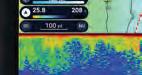
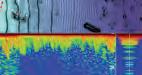
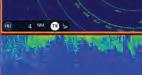
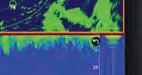
When helm space is at a premium, the 9" and 13" TZtouchE MFDs give you maximum screen area to view their eye-popping TZ MAPS charts and builtin TruEcho CHIRP™ Fish Finder with Side-Scan.



Plus, TZtouchE is fully networkable with the TZtouchXL family of 10", 13", 16", 22", & 24" MFDs and a wide range of best-in-class sensors – legendary Furuno Radars, Sonars, Fish Finders, Autopilots, and more.
Furuno... The reason to level up your helm!





Are you ready to embark on your next on-water adventure? Before you set sail, here are fve things to know about boat insurance.
1. Boat insurance isn’t just for accidents
With comprehensive coverage, you’ll also be protected fnancially for theft, vandalism, and unexpected events like storms if you need repairs or replacements due to damage.
2. Accidents can happen to anyone
When accidents happen, boat insurance offers liability coverage for damages or injuries you cause while boating, up to specifed limits. It can also cover lawsuit costs if you’re sued.
3. Boat insurance can cover medical payments
Boat insurance offers a range of optional medical payments coverage limits, helping to cover medical expenses if you’re in an accident or someone is hurt on your boat, regardless of fault.
4. Most lenders require boat insurance
If you fnanced your boat, you’ll likely need boat insurance since most lenders require boat insurance to protect their investment. Additionally, some marinas or municipalities require proof of insurance for docking.
5. Progressive offers specialized boat coverages
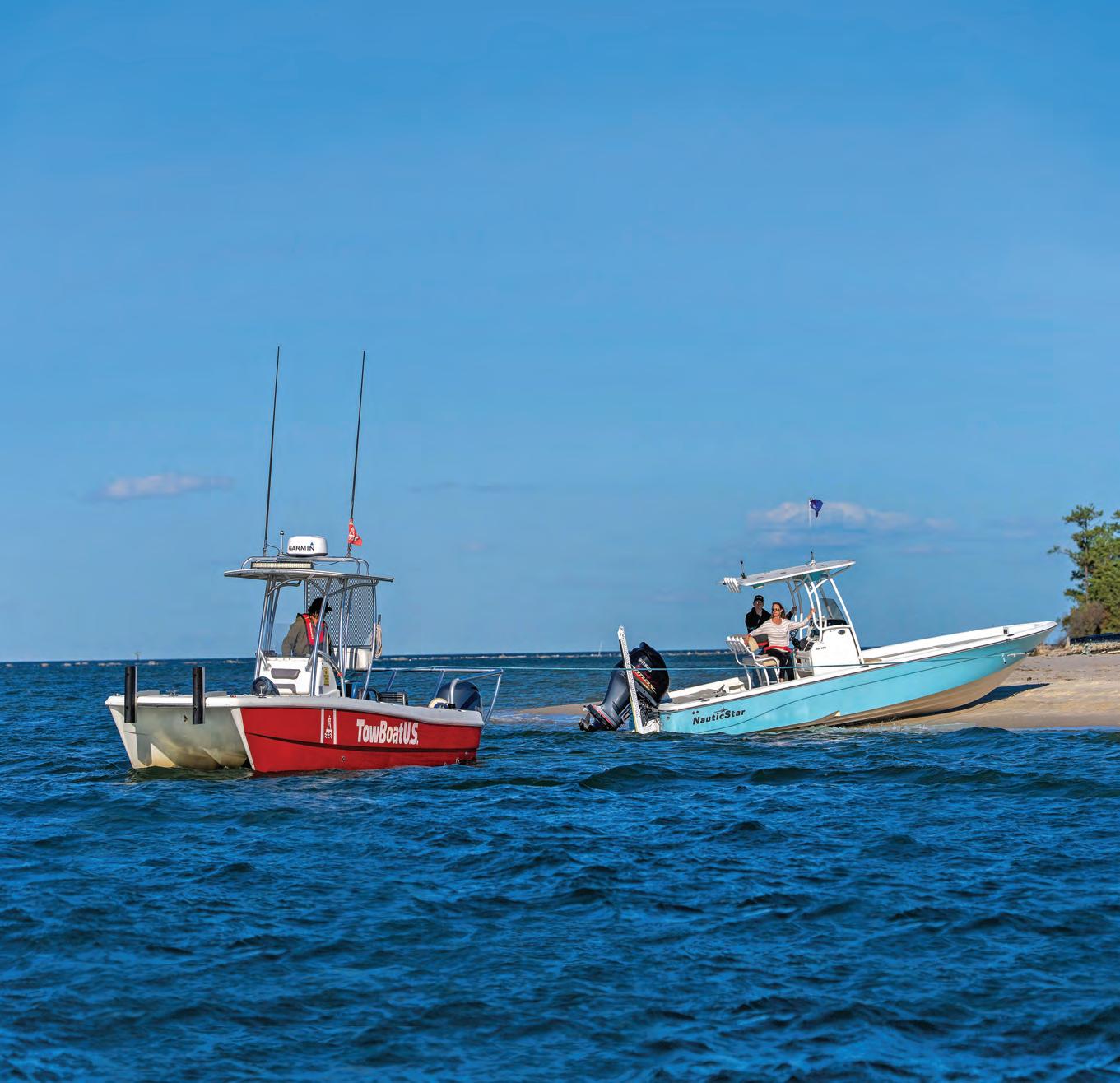
Ever worry about getting stuck on the water?
Progressive’s Sign & Glide® On-Water Towing coverage** can help. It’s an additional coverage that steps in if your boat is disabled or breaks down on the water, paying for on-water towing, jump starts, soft ungroundings, and fuel delivery. Fuel cost isn’t included.
Don’t let unforeseen circumstances disrupt your voyage. Cruise with confdence thanks to Progressive Boat insurance. Because when it comes to your boat, peace of mind is the ultimate luxury.
Scan to get a quote in as little as 4 minutes.
to learn more.













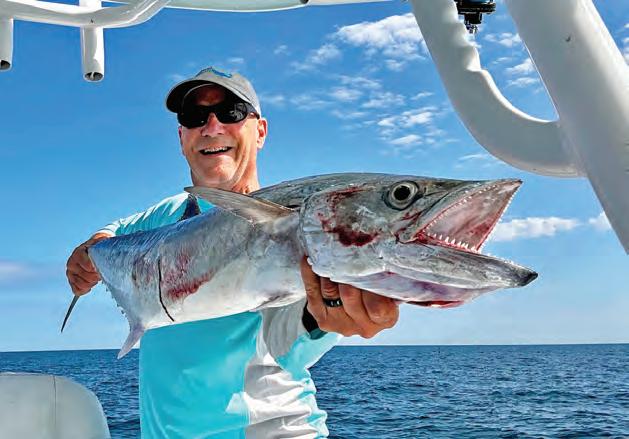



By Will Schmidt
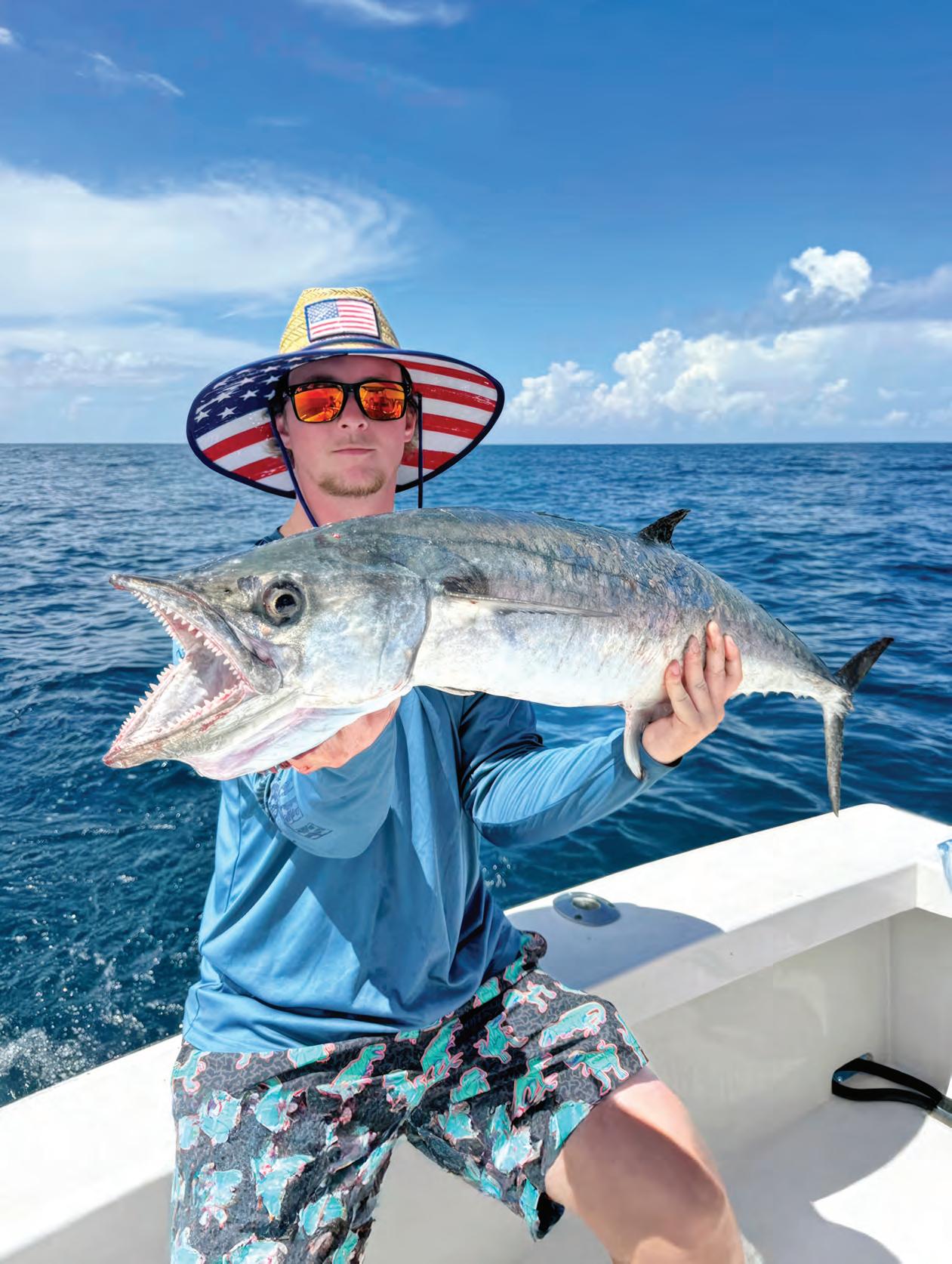
Nothing quite gets your heart rate up like the sound of drag screaming as a king rips line from the reel. Maybe it’s so exciting because for many, king!sh !shing can be slow, especially when targeting big !sh. e good news is there are some tournament proven techniques that can really help.
Perhaps the most well know tactic to bring kings to you is chumming. ere are several forms. Cutting up chunks of thread!ns and tossing them into the current is certainly a tried-and-true method. is is a great method especially if you are anchored. e challenge here is getting enough bait to keep the ow going. Another option we use in tournament !shing is a constant drip of menhaden oil. Using a bag like an IV bag you can set have a slow drip continually putting scent in the water as you troll. It’s great for covering ground and still helps to bring !sh to you at the same time. Unfortunately, menhaden oil has become a bit pricey.
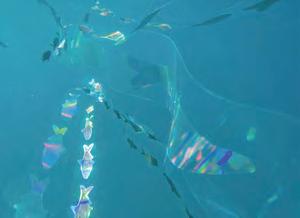
ese techniques work great, but on tournament days I believe there is so much scent in the water that they become less e$ective. So, now my new go to is to add an extra sensory stimulation in the form of eye candy. Speci!cally, a Fish Razr mylar dredge. Made of re ective strips that look like a school of bait, they shine like an underwater disco ball. Plus are easy to use and reusable so they are cost e$ective. Simply attach them to a kite rod or cleat and toss them over the side. I’ve literally had !sh in my spread within seconds of deploying the dredge.
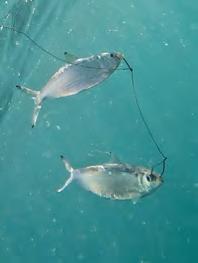
For baits I do prefer big blue runners, but sometimes they can be hard to come by. A good trick when big baits are sparse is to double up smaller baits, like sardines or thread!ns. I use two hooks wired about 5 inches apart with a stinger o$ the second to create a larger pro!le o$ering. I believe the added ash of multiple baits helps as well.
For tackle I like 20 to 30 pound trolling gear like a Shimano Terez medium action rod with Talica A 16. For years we went very light on our tackle thinking that kings had so mouths and needed to be babied. While they are somewhat more delicate, a big !sh is tough and you still need gear that can do the trick. is setup has a light enough tip and silky smooth drag to help absorb the initial hit but plenty of backbone to battle a hardier smoker king. A mono top shot also helps with that opening blow.
For me the key to king!sh !shing is to combine looking for them while also having them look for me. Adding the dredge to my spread is a real gamechanger.
Will Schmidt is a seasoned tournament angler who has been writing about shing for more than two decades. Follow Will on Instagram @saltynstrong.

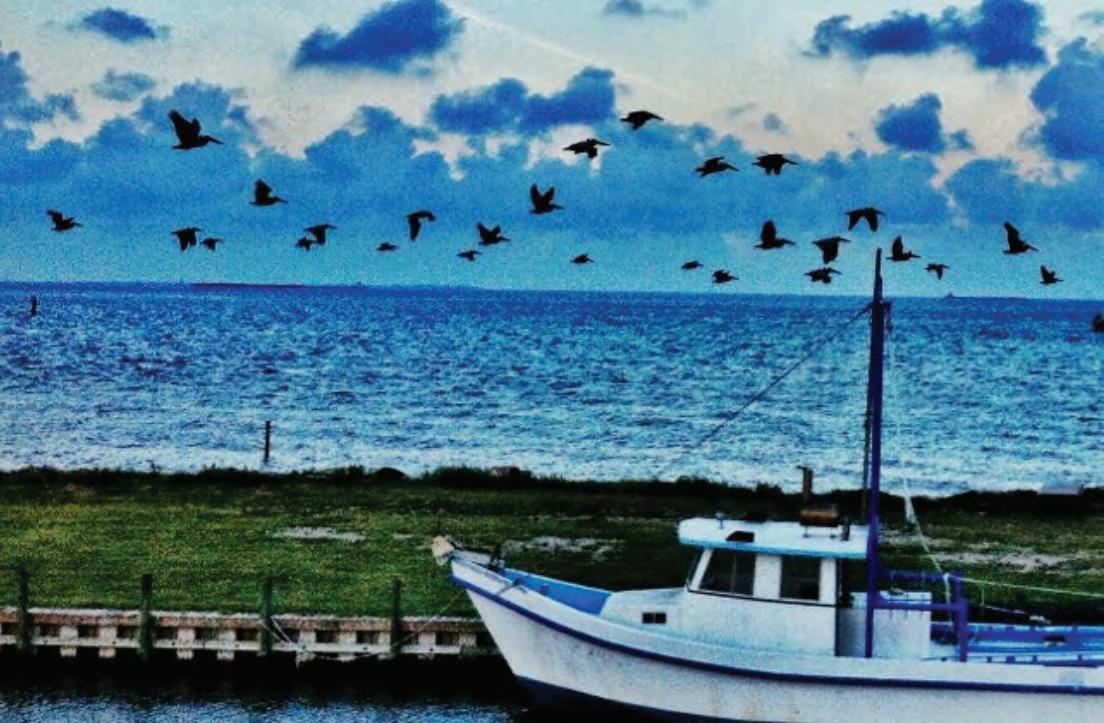
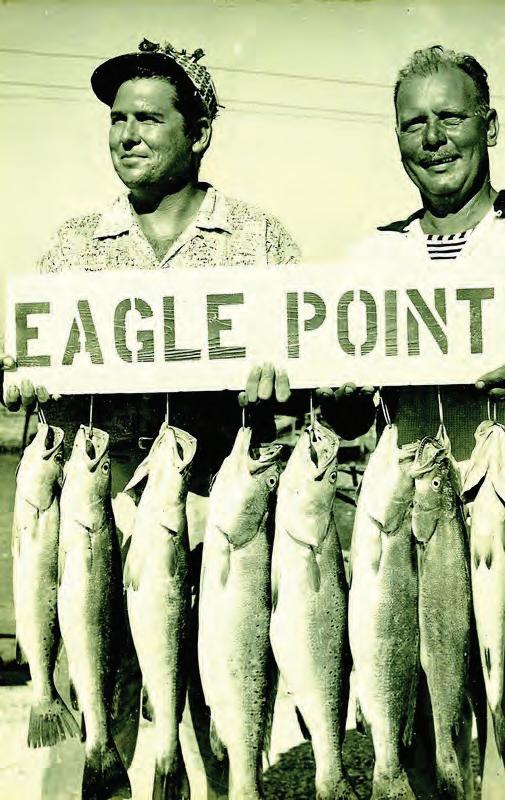
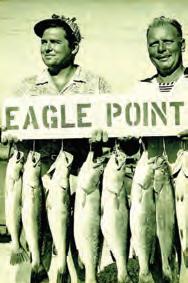
What’s made Eagle Point Fishing Camp unique since 1929 is its location and business model. Because it’s in the center of the Galveston Bay, EPFC allows anglers to conveniently fish a vast stretch of water spanning from Houston to Galveston. Using the same full-service concept as its date of establishment, EPFC has proven for nearly a century that easy access to the water combined with a skilled staff creates the perfect fishing experience. Along with the boat ramp, boat storage, live bait for purchase, tackle shop, and RV park, EPFC has always had a fleet of shrimp boats to supply the bait that so many of their regular customers desire. Their successful commercial shrimping business has been an intricate part of what makes EPFC unique.

the time, Texas regulations prohibited retaining any tarpon regardless of size, so the fish was never officially weighed.
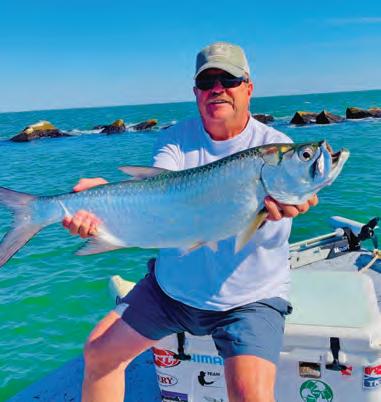
The "Silver King" is one of the most soughtafter sportfish in the world. Known for blistering runs, acrobatic leaps, and sheer power, tarpon have captivated anglers for generations.
Even President Franklin D. Roosevelt once traveled to the Texas coast to pursue these magnificent fish near Port Aransas. The historic Tarpon Inn still displays the scale used to weigh his catch, along with his signature hanging on the wall.
Many anglers are surprised to learn that tarpon are not just a South Texas species. Are there tarpon off Galveston Island? The answer is a firm yes.
Few people understood that better than the late Captain Mike Williams, who likely caught more tarpon off Galveston than any other angler in history. During his lifetime, Williams landed tarpon of all sizes and spent more than five decades studying their habits along the upper Texas coast.
One of his most memorable days produced 27 tarpon and a single speckled trout. Ironically, the trout weighed seven pounds, while every tarpon caught that day was smaller than the trout. His largest tarpon was estimated at 215 pounds. At
Texas' tarpon record book has a strong connection to Galveston waters. The state record has been broken four times, and three of those fish came from the Galveston coastline.
The first record tarpon weighed 190 pounds and was landed on August 31, 1961, by the late Dave Huddleston Sr. While fishing for bull redfish from a pier in the Galveston Ship Channel, he hooked a fish that would establish Texas' first tarpon benchmark.
That record stood until November 13, 1973, when angler Tom Gibson landed a 210-pound giant while fishing with legendary guide Junior Wells near the Port Isabel jetties. The fish fell to a live mullet and reset the state record.
More than three decades later, on October 6, 2006, Jeremy Ebert was fishing for bull reds from the 91st Street Fishing Pier in Galveston when he hooked a tarpon that weighed 210 pounds, 11 ounces, reclaiming the record for Galveston waters.
The current Texas state record belongs to Shane LaRue, who was fishing with his late father, Captain Mike LaRue, in an area known as "Tarpon Alley" off the Galveston beachfront. Their fish struck a soft-plastic jig called a Coon Pop and tipped the scales at an incredible 229 pounds.
For decades, Williams and fellow captains
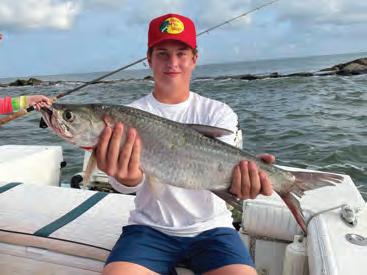
James Plaag, Jamie Pinter, Chris Jamail, and others have searched the Gulf waters off Galveston for giant tarpon. The stretch of water known as Tarpon Alley remains one of the most productive areas on the Texas coast for anglers seeking a fish of a lifetime.
The quest for a new record continues. On October 16, 2015, a tarpon weighing 246 pounds was landed off the Louisiana coast, setting a new Louisiana state record and becoming the largest tarpon ever caught on rod and reel in U.S. waters.
As summer settles in and Gulf waters warm, seasoned captains and dedicated tarpon anglers once again turn their attention offshore. Every season brings the possibility that the next cast could produce a fish capable of rewriting the Texas record books.
This year, conditions appear primed for an excellent tarpon season off Galveston. So when does tarpon season begin?
The answer is simple: right now.
See y'all on the water.






4
5 Sun 10:38 1.0 1:41 0.0 6:24 8:22
6 Mon 10:07 1.0 11:04 0.6 2:02 0.3 5:18 0.3 6:25 8:22
7 Tue 9:55 1.1 1:44 0.6 5:29
8
9
10
13 Mon 10:25 1.6 10:00 -1.0 6:28 8:21
14 Tue 1:26 1.6 10:59 -0.9 6:29 8:20
15 Wed 3:07 1.5 11:59 -0.7 6:29 8:20
16 Thu 4:36 1.3 6:30 8:20 17 Fri 10:57 1.0 6:13 1.1 12:56 -0.4 2:15 1.0 6:30 8:19
18 Sat 10:03 0.9 8:07 0.9 1:49 -0.1 3:23 0.6 6:31 8:19
19 Sun 9:40 1.0 10:35 0.8 2:37 0.3 4:14 0.3 6:32 8:18
20 Mon 9:34 1.0 3:23 0.6 4:56 0.0 6:32 8:18
22 Wed 4:32 1.2 9:42 AM 1.2 6:46 1.2 6:06 -0.5 6:33 8:17
23
24
25 Sat 6:45 1.4 7:59 -0.6 6:35 8:15 26
8:14
29 Wed 10:23 1.3 10:57 -0.3 6:37 8:13
30 Thu 10:46 1.3 11:36 -0.2 6:38 8:12 31 Fri 10:12 1.2 6:38 8:12



www.USHarbors.com

1 Wed 6:44 2.1 10:44 -0.4 6:23 8:22
2 Thu 7:15 2.1 11:20 -0.3 6:23 8:22
3 Fri 7:44 2.0 11:59 -0.1 6:24 8:22
4 Sat 8:10 1.9 6:01 1.1 3:39 1.1 6:24 8:22
5 Sun 8:32 1.8 7:56 1.1 12:43 0.2 3:32 0.8 6:25 8:22
6 Mon 8:49 1.6 9:55 1.2 1:36 0.5 3:47 0.5 6:25 8:22
7 Tue 9:00 1.5 11:48 1.5 2:49 0.9 4:15 0.2 6:26 8:22
8 Wed 9:02 1.4 4:30 1.2 4:52 -0.2 6:26 8:22
9 Thu 1:12 1.8 5:36 -0.5 6:27 8:21
10 Fri 2:15 2.2 6:24 -0.8 6:27 8:21
11 Sat 3:10 2.4 7:16 -1.0 6:27 8:21
12 Sun 4:00 2.5 8:10 -1.2 6:28 8:21
13 Mon 4:48 2.6 9:05 -1.2 6:29 8:20
14 Tue 5:33 2.5 10:00 -1.0 6:29 8:20
15 Wed 6:15 2.3 3:04 1.6 12:47 1.5 6:30 8:20
16 Thu 6:52 2.2 4:32 1.5 1:11 1.3 6:30 8:19
17 Fri 7:24 2.0 5:58 1.4 1:47 1.1 6:31 8:19
18 Sat 7:52 1.8 7:32 1.3 12:44 0.0 2:28 0.8 6:31 8:19
19 Sun 8:15 1.6 9:24 1.4 1:45 0.5 3:13 0.5 6:32 8:18
20 Mon 8:31 1.5 11:35 1.5 3:03 0.9 3:57 0.2 6:32 8:18
21 Tue 8:37 1.4 4:53 1.2 4:41 0.0 6:33 8:17
22 Wed 1:16 1.8 5:24 -0.2 6:33 8:17
23 Thu 2:19 1.9 6:07 -0.3 6:34 8:16 24
25
26 Sun 4:17 2.2 8:07 -0.4 6:36 8:15
27 Mon 4:47 2.1 8:44 -0.4 6:36 8:14
28 Tue 5:14 2.1 9:19 -0.4 6:37 8:14
29 Wed 5:39 2.1 9:53 -0.3 6:37 8:13
30 Thu 6:03 2.0 10:27 -0.2 6:38 8:12 31 Fri 6:25 2.0 4:15 1.4 12:51 1.2 6:39 8:12
















BY CAPT. MICHAEL OKRUHLIK MyCoastOutdoors@yahoo.com www.MyCoastOutdoors.com
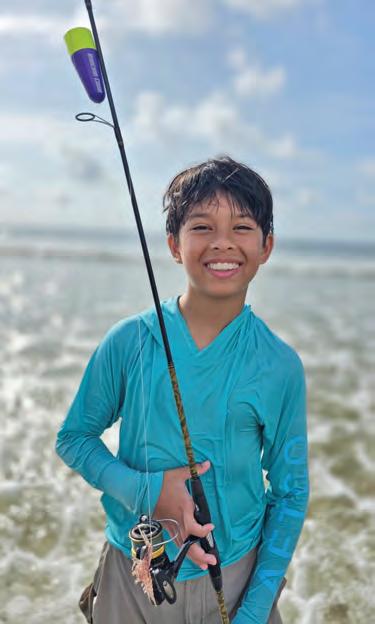
One of my favorite things about fishing isn't catching fish myself—it's watching a kid catch one. There's something special about seeing a young angler's face light up when a cork disappears, and a speckled trout starts pulling back. Over the years, I've introduced a lot of kids to fishing, including my own boys, and one of the easiest ways I've found to help them succeed is with a popping cork.
Kids don't always have the patience to wait on a fish to bite. They want to cast, reel, and stay involved. A popping cork gives them something to do while keeping a bait or lure in the strike zone. Every pop creates noise and commotion that imitates feeding fish, helping trout locate the bait. More importantly, it keeps kids engaged and focused.
When fishing live bait, it's hard to beat a lively shrimp under a popping cork. Whether you're fishing shorelines, reefs, or grass beds, the cork attracts trout while keeping the bait at the proper depth. The sound gets their attention, and the shrimp does the rest. It's a simple setup that consistently catches fish and builds confidence in young anglers.
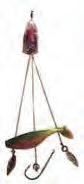
Artificial lures work just as well. I often prefer them when fishing with kids because I spend less time rebaiting hooks and more time helping them catch fish. A soft plastic under a popping cork allows kids to cast, pop, and retrieve while covering water efficiently. It also teaches them how to work a lure
without making things overly complicated. One thing I've learned is that tackle designed for adults doesn't always hold up when kids are involved. Rods get dropped, tackle gets stepped on, and gear gets bounced around the boat. That's one reason I've moved away from many traditional wire-style corks.
Most anglers have opened a tackle box and found a wire cork bent after a day on the water. Once the wire is bent, the cork rarely casts the same. Many wire designs also have several moving parts that can tangle during a cast, especially in the hands of a young angler. Over time, the wire can even nick fishing line, creating weak spots that often show up when a good trout is hooked.
Durability is another advantage of hardplastic corks. Unlike foam designs that can crack, chip, loose its color, hard-plastic corks can handle years of abuse in a boat and continue performing like new.
At the end of the day, taking kids fishing should be fun. A durable popping cork paired with live bait or a soft plastic lure keeps things simple, productive, and exciting. The more bites kids get, the more they stay interested, and that's how future anglers are made.
Take a kid fishing, I will!
CAPT PAUL MARCACCIO
T.P. & W. & USCG License Marcaccio Fishing Academy captpaul@gofishgalveston.com www.gofishgalveston.com
How many times have you found yourself saying, “Man, I wish they would show a little courtesy when pulling into or out of my favorite fishing spot?”
Unfortunately, it's something that happens far too often on Galveston Bay—and just about every other body of water. We all head out there for the same reason: to enjoy the outdoors, spend time on the water, and hopefully catch a few fish. The truth is, none of us are perfect. I know I’m not. Over the years, I’ve made my share of mistakes, rarely on purpose, but mistakes nonetheless. If you've spent enough time fishing, you've probably found yourself saying, “Been there, done that.”
One of the most important unwritten rules of fishing is simple: respect the other angler on the water. Every fisherman deserves the opportunity to work an area without unnecessary interference. While we all have the right to fish public waters, that right comes with a responsibility to be courteous.
When approaching an area already being fished, take a moment to observe what others are doing. Set up your drift or wade-fishing pattern so it doesn't interfere with anglers already in position. Following this one rule will keep you out of trouble most of the time.
Another good rule of thumb is to move slowly and quietly when entering or leaving a fishing area. Too often, anglers come blasting into a shoreline or reef, crisscrossing established drifts and scattering fish in every direction. Likewise, when leaving, try to drift clear of the area before powering up if conditions allow.
If your boat is equipped with a trolling motor, use it. It may take a few extra minutes, but your courtesy will be appreciated. If you plan to make another drift through the same area, resist the urge to power up, circle around, and throw a large wake across everyone else's fishing pattern. Not only does it disrupt the bite for others, but it may also ruin your own next drift.
Wade fishermen deserve special consideration. When running shorelines around Galveston Bay, always keep an eye out for anglers in the water. Pushing a large wake into someone standing chest-deep is not only inconsiderate—it can be dangerous. Wade fishermen are usually visible from a long distance away. Give them plenty of room. If shallow water or a channel
forces you to pass nearby, simply slow down. That small gesture goes a long way.
Courtesy also applies among wade fishermen. If anglers have formed a line moving with the wind or current, join at either end rather than cutting into the middle. Remember, they were there first.
Perhaps the biggest test of fishing etiquette comes when someone nearby starts catching fish. We've all seen it happen. One angler hooks up, then suddenly boats begin moving closer. The temptation to crowd a bent rod can be overwhelming, but remember—those anglers found the fish. They put in the work and deserve the opportunity to enjoy their success without interference.
Fish move. Often the best strategy is simply to hold your position and be patient. Schools of trout and redfish travel, and before long they may move within your casting range.
A little courtesy on the water makes everyone's day more enjoyable. It reduces conflicts, improves fishing opportunities, and helps preserve the friendly atmosphere that makes Galveston Bay such a special place to fish.
As always, have fun outdoors, stay safe, and good luck fishing.
See y'all on Galveston Bay.
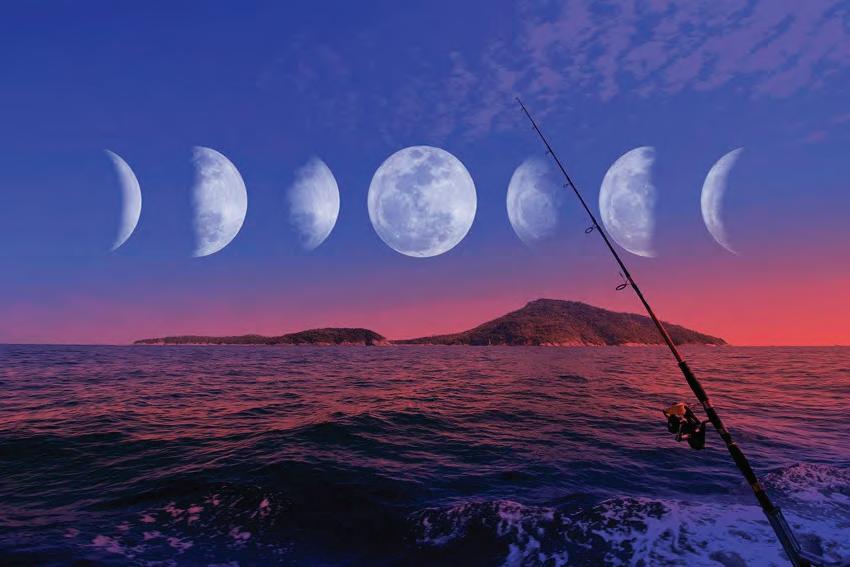
JULY MOON PHASES
First Quarter – July 1
Full Moon – July 10
Last Quarter – July 18
New Moon – July 24
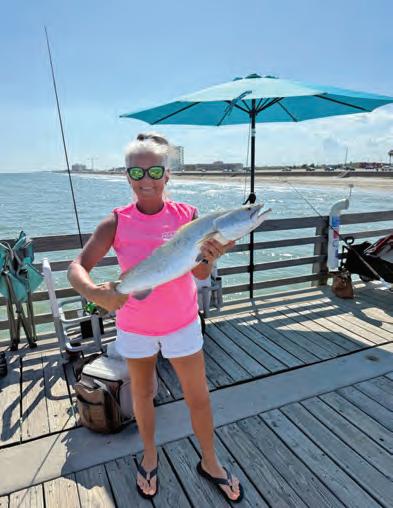
July is prime time on Galveston Bay. Speckled trout will be concentrated around reefs, shell pads, and current-driven structure during the early morning hours. As water temperatures climb into the upper 80s, look for trout to feed aggressively around sunrise and again near sunset.
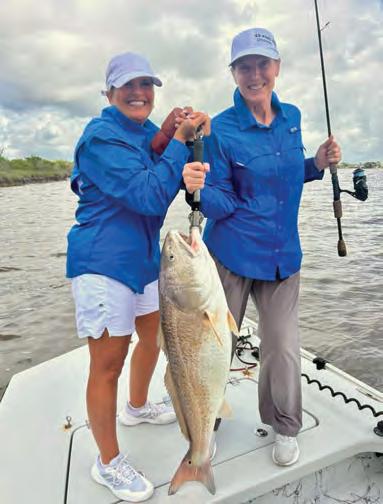
Redfish action remains excellent along marsh shorelines, drains, and deeper bayou mouths. Schools of bull reds will begin showing near the beachfront and jetties.
Offshore, July marks the peak of tarpon season along the Galveston beachfront. Anglers targeting the Silver King should watch for rolling fish early and late in the day around bait concentrations and color changes.
The strongest feeding periods this month will occur near sunrise and sunset when combined with moving water. Fish early whenever possible. During periods of light wind, don't overlook slicks forming over reefs and shell pads. These natural signs often indicate actively feeding trout.
BEST FISHING DAYS OF THE MONTH July 1-3 July 15-18
July 29-31
GOOD FISHING DAYS
July 4-6
July 12-14 July 19-21 July 26-28
FAIR TO SLOW DAYS
July 7-11
July 22-25
Week of July 1
Sunrise: 6:24 AM
Sunset: 8:22 PM
Week of July 22
Sunrise: 6:33 AM
Sunset: 8:17 PM
Week of July 8
Sunrise: 6:26 AM
Sunset: 8:21 PM
Week of July 15
Sunrise: 6:30 AM
Sunset: 8:20 PM
Week of July 29
Sunrise: 6:37 AM
Sunset: 8:13 PM
Location: Galveston Beachfront and Tarpon Alley
Best Baits: Live Mullet Large Swimbaits Coon Pops Topwater Plugs
Best Time: Sunrise to 10:00 AM 5:00 PM to Sunset
Average Size: 80-180 Pounds
Trophy Potential: 200+ Pounds

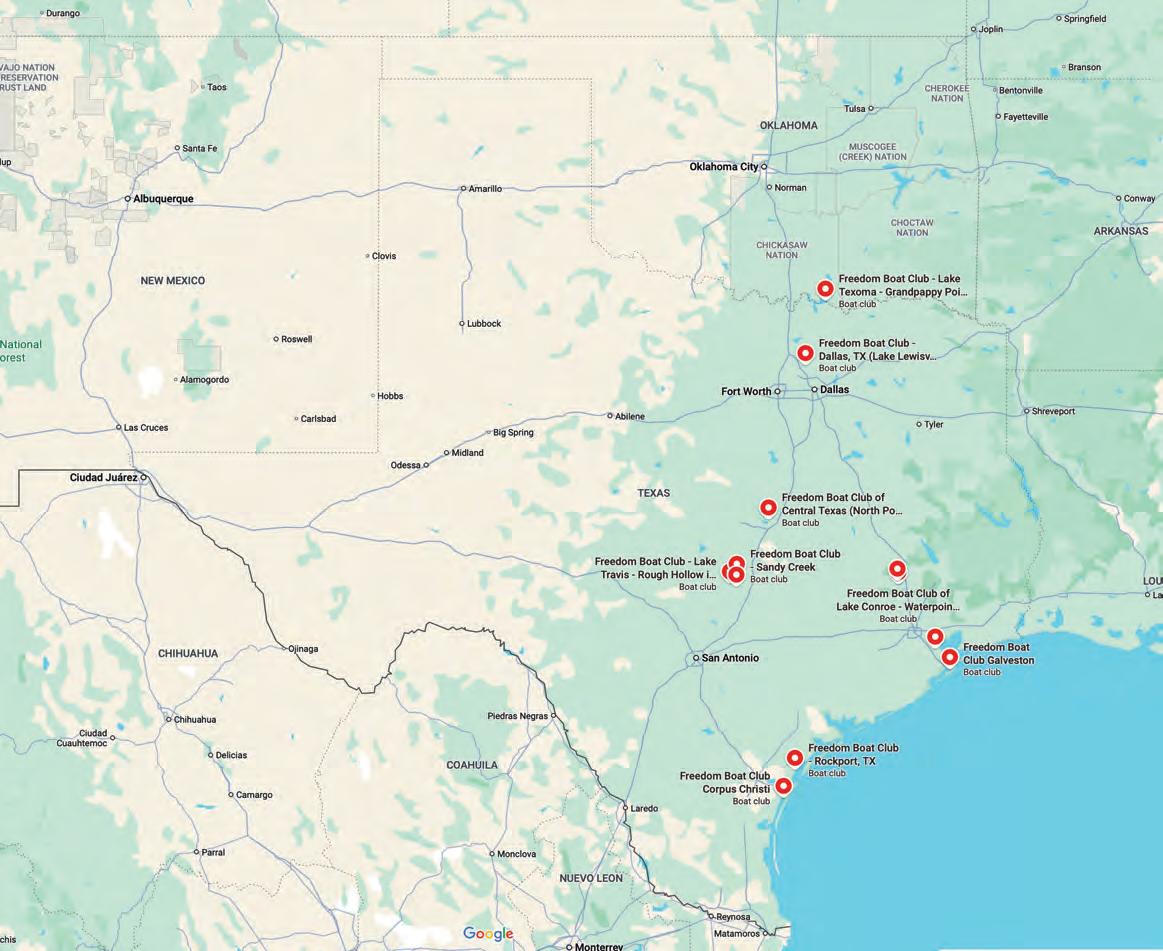
SOUTH SHORE HARBOUR MARINA
2400 South Shore Harbour Blvd, League City, TX 77573
LAKE LEWISVILLE
1481 E Hill Park Rd, Lewisville, TX 75056
GRANDPAPPY POINT
1789 Harbor Dr, Denison, TX 75020
NORTH POINT MARINA
3681 Cedar Ridge Park Rd, Temple, TX 76502
WALDEN MARINA
12050 Melville Dr Suite 6, Montgomery, TX 77356
WATERPOINT MARINA
15320 TX-105 Suite 500, Montgomery, TX 77356
ROUGH HOLLOW IN LAKEWAY
105 Yacht Club Cove, Lakeway, TX 78734
SANDY CREEK MARINA
8714 Lime Creek Rd, Leander, TX 78641
1705 S Quinlan Park Rd, Austin, TX 78732
MARKER 37 MARINA
13317 S Padre Island Dr, Corpus Christi, TX 78418
PELICAN REST MARINA
7819 Broadway St, Galveston, TX 77554

COVE HARBOR YACHT CLUB 121 Cove Harbor Rockport, TX 78382 Boats available for











ATYLER WOOLCOTT

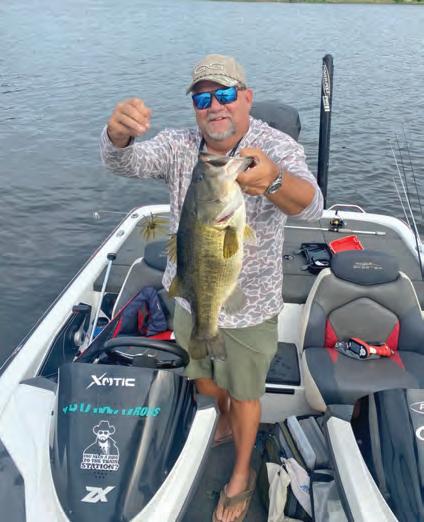
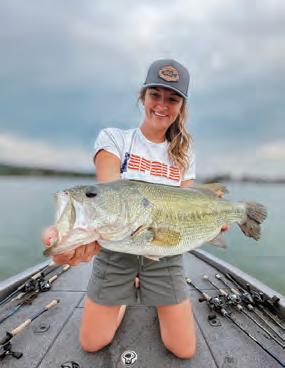
s the summer season settles in and water temperatures rise, many anglers automatically downsize their presentations in hopes of getting more bites. While smaller baits can certainly catch !sh, summer can also be one of the best times of year to target trophy bass with larger-pro!le lures. Big bass still need to feed, and they o en prefer a larger meal that provides more energy with less e ort.
One of the biggest reasons larger baits excel during the summer months is the abundance of bigger forage. Bluegill, shad and other bait!sh have had months to grow, giving bass access to larger prey. Matching the size of the available forage can o en help anglers attract the attention of the biggest !sh in the area.
Large worms, oversized swimbaits, big jigs, and magnumsized topwater baits are all excellent options for targeting quality !sh. While these presentations may not generate the same number of bites as smaller o erings, they o en appeal to more mature bass that are willing to commit to a larger meal. Many anglers are surprised by how o en a giant bass will choose the biggest bait in the boat.
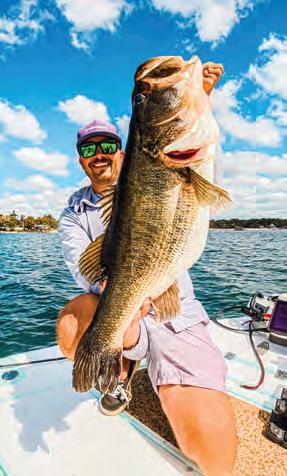
Con!dence is key when !shing larger baits. $ere may be longer periods between bites, but anglers should remember that the goal is quality rather than quantity. Staying committed to a bigger presentation can be di cult, especially when other anglers are catching smaller !sh, but patience is o en rewarded with the !sh of a lifetime.
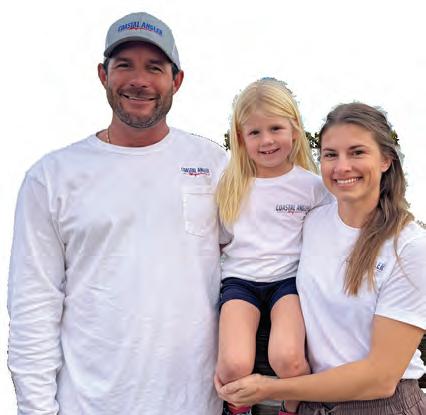
If you’re looking to improve your chances of catching a trophy bass this summer, don’t be afraid to upsize your o erings. Bigger baits won’t guarantee a giant on every trip, but they can help put the odds in your favor. Sometimes one bite is all it takes, and that bite o en comes from the biggest !sh in the lake.
Capt. Tyler Woolcott is a professional tournament angler, as well as owner/operator of Florida Big Fish Adventures, providing bass and saltwater guided shing trips: www. oridabig shadventures.com.
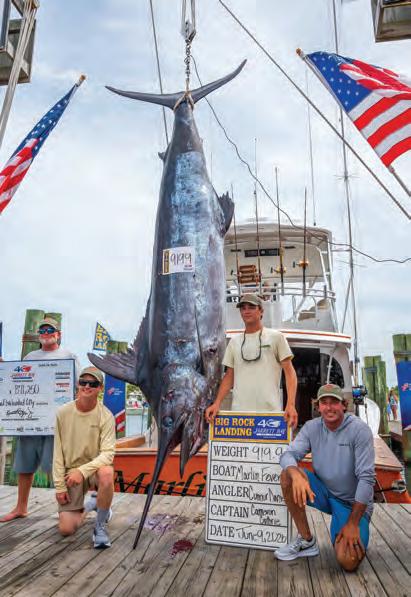
History was made, big checks were paid, and an insane at-the-buzzer leaderboard shakeup took place at the 68th Annual Big Rock Blue Marlin Tournament, held June 5–14, 2026 in Morehead City, North Carolina.
Marlin Fever brought the heat to Big Rock Landing on Day 2, bringing a tournament recordbreaking 919.9 lb. blue marlin to the scales, securing the Level V Fabulous Fisherman’s Prize worth $871,250 as the !rst blue marlin of at least 500 pounds weighed in. Eighteen-year-old Connor Daniel served as the designated angler and fought the !sh for roughly two hours. ($e crew later reported the marlin had recently eaten two sail!sh!)
Captained by Cameron Guthrie, the 63’ Jarrett Bay out of Wilson, NC, held the top spot on the leaderboard through Saturday’s !nal weigh-ins, delivering Marlin Fever the championship—and a staggering $6,513,188 payday.
And while Marlin Fever’s historic catch swept
all the blue marlin categories, it was the nail-biting weigh-in that came just before 10 p.m. on the last day of the tournament that topped o a dramatic week and sent spectators on the dock into a frenzy.
A er a grueling 6.5-hour !ght, Haphazard, a 60’ Spencer out of Manteo, NC captained by Joey Belton, delivered a true buzzer-beater. $e team arrived at Big Rock Landing just in time to weigh in one last blue marlin. It was 635.6 pounds—enough to catapult them into third place for heaviest blue marlin, knocking Free Ranger’s 597.4-pounder o the podium at the last minute. What an ending!
Fender Bender !nished in second with its 644.1-pound blue marlin weighed on Day 3, worth $467,962.50. Haphazard’s catch earned the team a $311,975 payday.
In the release division, Double G captured the title with 1,850 points a er releasing four blue and two white marlin, earning $168,937.50.
Doc Fees claimed the dolphin title and $584,500 with a 66.10-pound mahi; Magic Moment


won the wahoo division with a 53.4-pound catch; and Watertight won the tuna division with a 70.8-pounder.
A total of 278 boats !shed for a piece of the tournament’s record $9,038,225 purse.
For o cial results, payouts, and future dates, visit tournament.thebigrock.com and check them on facebook @bigrocktournament for all the tournament highlights.



TIM BAREFOOT

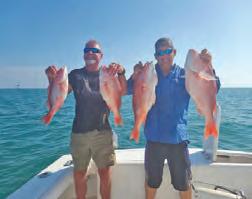
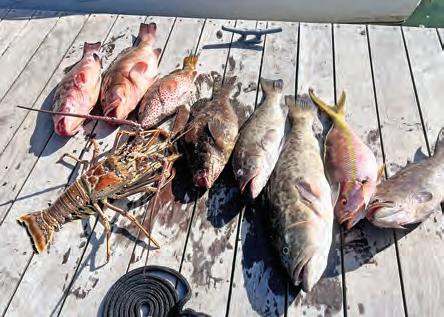
The surface water temperature will continue to climb in July, but the water temperature on the bottom will regulate itself to where it needs to be. $is is time of year to catch all the tropicals, starting now until early fall. Of course, the grouper and snapper bite will be o the chain, but this is when you will see all the snapper and grouper show up way north of Florida (as seen in photo). $ey will be available outside of their usual haunts and, of course, an occasional lobster. $is is truly the time of year to catch a giant grouper as well. I cannot emphasize this enough, but this is the time of year to spend an hour or more if necessary to Sabiki live cigar minnows and sardines for the ultimate bites on the bottom, not to mention the light line. Don’t be surprised to catch a giant wahoo on a 5-inch live cigar or sardine…elephants eat peanuts.
I would strongly suggest not playing loud music, not stomping around the deck, nor slamming cooler lids because the sail!sh and dolphin will swim up to the boat and check you out. $is is when you need to have a pitch rod ready. It’s never a bad idea to have a large squid on a pitch rod. Nothing in the ocean can refuse a well presented squid on the light line or pitch bait. It’s also not a bad idea to keep a frozen squid 50 to 75 feet deep using a small amount of weight (depending on the current).
kite for the ultimate presentation. If you have the correct weather pattern, I would strongly suggest spending the night o shore and using lights to attract the bait !sh. When you have a livewell chock full of live cigar and sardines and squid for the daylight bite, your success rate dramatically increases. Live squid or a live sardine on the bottom on a decoy jig has a life expectancy of !ve seconds or less. Don’t ask them to bite, demand the bite. Ask and you shall receive, my brothers and sisters. I’m not into all the “!shing,” per se; I’m into the catching...and there is a huge di erence. If you have the correct bait and make the correct presentation, you will get the bite!
Yes, we always carry a couple boxes of frozen cigar minnows and a box of frozen squid, but we always look for live bait, and we will spend some time on a school of bait using the Sabiki.
When the current is not running hard, a 1/4 or 3/8 oz. will get it down to the perfect depth. If the current is running a little bit, a 1/2 to 3/4 oz. might be needed. I would also suggest a live bait under a oat or under the
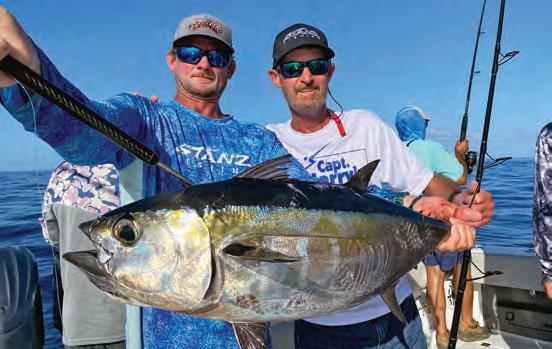
NOAA Fisheries recently adjusted the Atlantic blue!n tuna daily retention limits for recreational !shermen. $e adjusted limits took e ect June 1, 2026, and will extend through December 31, 2026, unless NOAA takes additional action later in the year to further adjust the retention limits or close the !shery.
As of June 1, 2026, the retention limits will be:
Highly Migratory Species
Vessel/Permit Type
Private vessels with Highly Migratory Species
Angling permits
Charter boats with Highly Migratory Species
Charter/Headboat permits, when fishing recreationally
Headboats with Highly Migratory Species
Charter/Headboat permits, when fishing recreationally
Limit per Vessel per Day/Trip (lengths in curved fork length)
2 bluefin tuna measuring 27 to <73”, of which only 1 may be a large school/small medium bluefin tuna (47 to <73”)
3 bluefin tuna measuring 27 to <73”, of which only 1 may be a large school/small medium bluefin tuna (47 to <73”)
6 bluefin tuna measuring 27 to <73”, of which only 1 may be a large school/small medium bluefin tuna (47 to <73”)
Note: $e retention limits are per vessel, per day/trip—not per angler. Regardless of the duration of a !shing trip, no more than a single day’s retention limit may be possessed or retained at the end of the trip upon landing. For example, whether a private vessel (!shing under the Angling category retention limit) takes a two-day trip or makes two trips in one day, the day/trip retention limit of 2 blue!n tuna, of which only 1 may be a large school/small medium, applies and may not be exceeded upon landing.
$e !sh are just like us. We prefer to eat breakfast, maybe lunch, and a good dinner. Be there for the daylight bite or the late a ernoon bite. Put some beautiful live bait on the bottom and expect immediate bites on the decoy jig.
One of the most important pieces of advice for !shing in July is to ensure your children are prepared for the weather. A ernoon thunderstorms are common during this month, so it’s essential to dress them appropriately and be ready for sudden squalls. $is preparation is a fundamental part of the !shing experience.
Beyond safety, take the opportunity to teach your children the proper way to care for and release !sh. $ese practices instill a sense of respect for nature and promote responsible !shing. $e lessons learned during these outings will stay with them for a lifetime, making each !shing trip both enjoyable and educational.
Learn more tips and techniques at barefootcatsandtackle.com.
$e changes apply to Highly Migratory Species Angling and Highly Migratory Species Charter/Headboat permitted vessels when !shing recreationally. $e daily retention limits are e ective for all areas except for the Gulf of America, where NOAA Fisheries does not allow targeted !shing for blue!n tuna.
Catch reporting
Highly Migratory Species Angling and Highly Migratory Species
Charter/Headboat permitted vessel owners are required to report the catch of all blue!n tuna retained or discarded dead within 24 hours of landing or the end of trip by:
• Accessing the Highly Migratory Species Permit Shop
• Using the Highly Migratory Species Catch Reporting app
• Calling 888-872-8862 (Monday through Friday 8 a.m.-4:30 p.m.)
Keep up with all federal shing rules and regulations by visiting https://www. sheries.noaa.gov.


For centuries, Damascus steel has been prized for its strength, beauty and legendary performance. Its distinctive flowing patterns have made it one of the world’s most sought-after blade materials. The problem? Genuine Damascus knives often come with premium price tags. That’s why we created the Stauer Damascus Explorer Knife. Built for adventurers, outdoorsmen and collectors alike, this handsome knife combines rugged utility with timeless craftsmanship. Whether you’re preparing kindling, tackling camp chores or simply admiring its artistry, it’s a blade you’ll be proud to own.





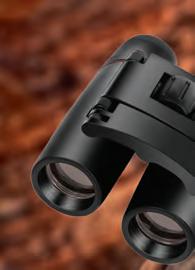
Stauer Pocket Binoculars a $99value with your purchase of the Damascus Explorer Knife

The first thing you’ll notice is the striking Damascus steel blade. Its signature rippled pattern isn’t just beautiful — it’s the mark of a centuries-old forging tradition. At a full 8 inches long, the blade offers impressive cutting power while maintaining excellent balance and control.
The rich rosewood handle provides a comfortable, secure grip, while the included sheath keeps your knife protected and ready for action. Every detail reflects the kind of quality typically found in knives costing far more.
Thanks to Stauer’s direct-to-you model, we’re able to offer this premium Damascus blade at an exceptional value. But supplies are limited, and once this shipment is gone, we can’t promise another opportunity at this price.
If you’ve been looking for a knife that blends performance, craftsmanship and value, now is the time to act. Damascus Explorer Knife PLUS FREE Binoculars $349* Offer Code Price Only $99 + S&P Save $250 1-800-333-2045


*Discount is only for customers who use the offer code versus the listed original Stauer.com price.


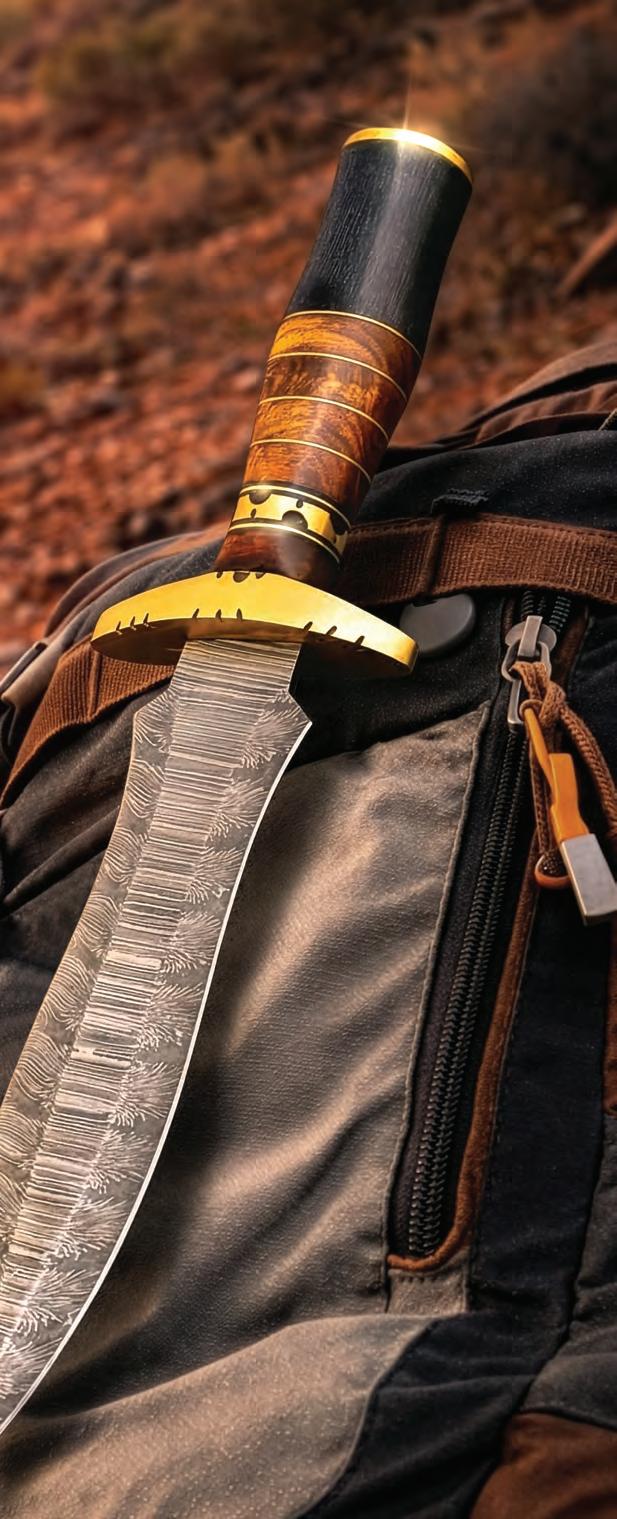
Knife Specifications
• Damascus steel blade
• 8" blade. 13" overall length
• Rosewood handle
• Sheath included
What customers are saying about Stauer knives...
“First off, the shipping was fast and the quality is beyond what I paid for the knife.Overall, I am a satisfied customer!” — D., Houston, Texas




California residents, please call 1-800-333-2045 regarding Proposition 65 regulations before purchasing this product. $99 +FREE Binoculars Impossible PriceONLY


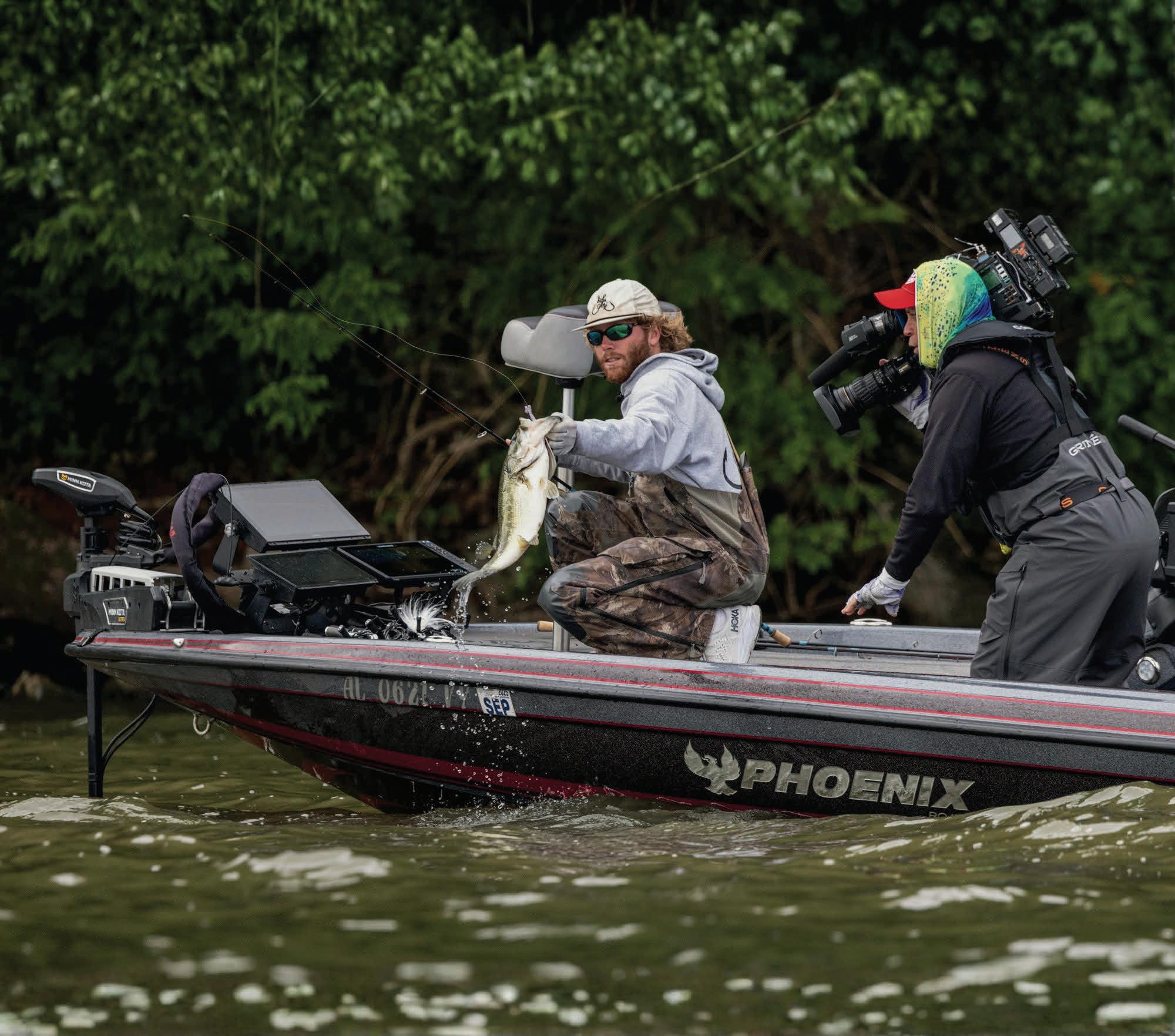
43,000 acres of legendary fishing from trophy bass, to world class sauger. A true Bill Dance Signature Lake.