

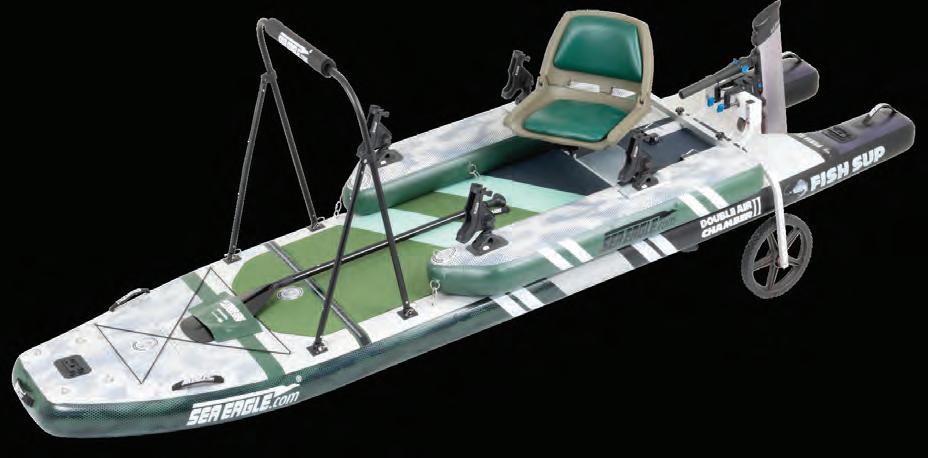
The versatility of the FishSUP™1210 is unmatched! Use it bare bones with just the board, a paddle & your !shing gear or deck it out with swivel seat, side pontoons, casting bar, motor and more! Incredibly stable, extra wide, swallow-tail !shing SUP holds up to 500 lbs! The FS1210 takes electric and gas motors up to 3 hp. There’s even an option for a bow trolling motor.
Choose From 6 Packages
Starting At Just $999
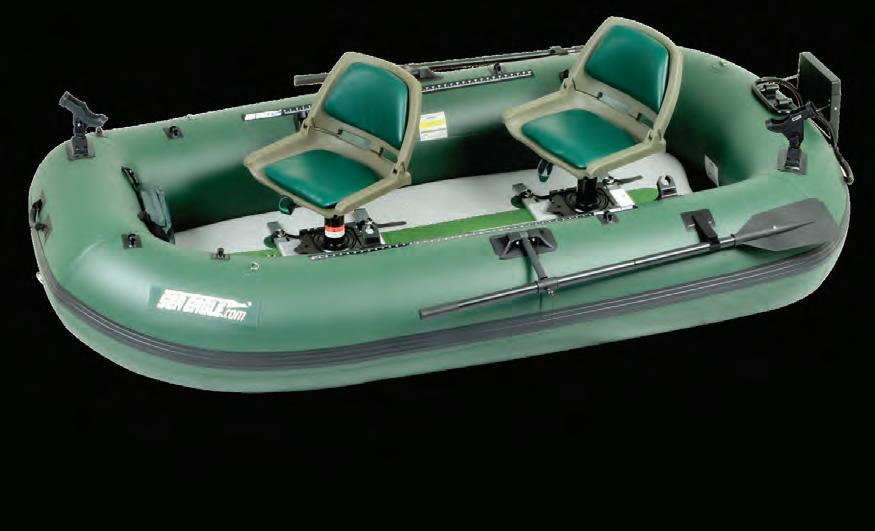
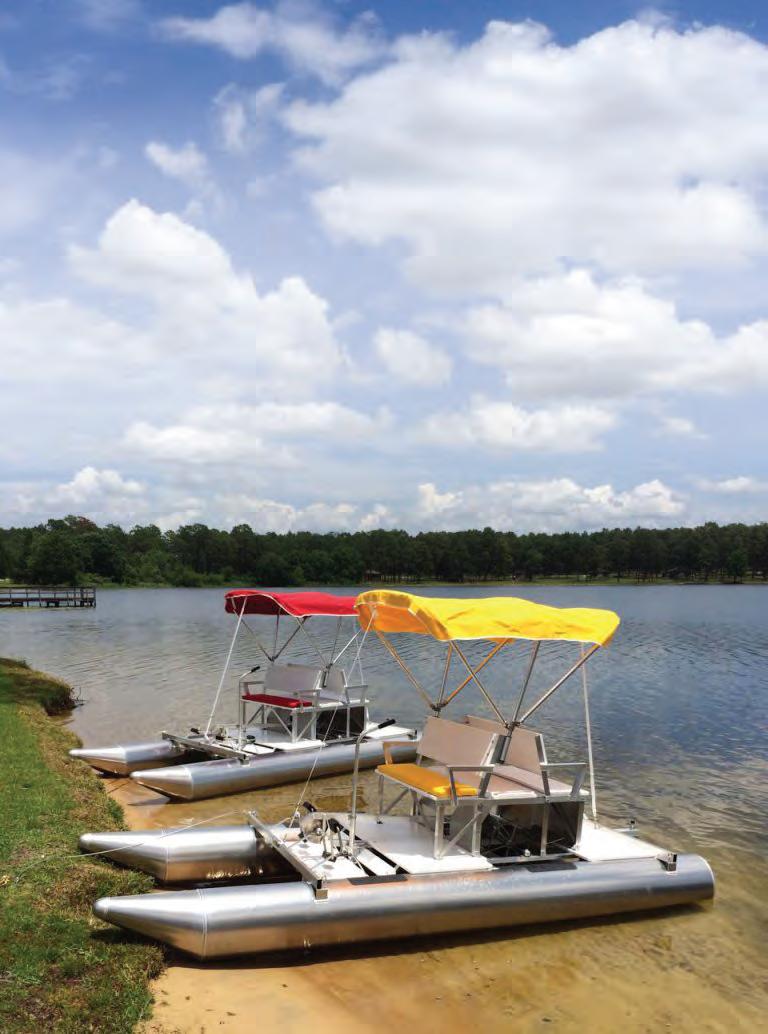
Perfect for !shing rivers, lakes and bays. The STS10 is a lightweight, roomy 1 or 2 person pontoon boat that’s packed with features anglers need & love including 2 built-in !sh rules, 4 built-in rod holders & 2 Scotty® mounts for more rod holders, anchor locks, camera posts or any other Scotty® accessory. Now available with a drop-stitch in atable oor or wooden oorboards.
Choose From 7 Packages
Starting At Just $1449
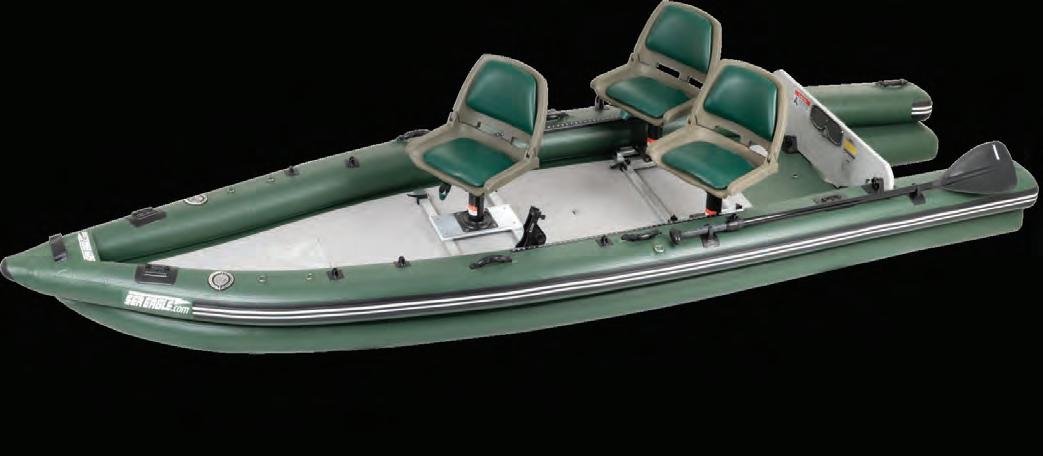
This “low-rider” gives you access to the water to reel in and release !sh easily. With a new patented outside, in atable, rigid keel the FSK16 glides through the water at speeds up to 21 mph to get you to the !sh fast! Perfect for 1-3 anglers and room for plenty of gear.
Choose From 9 Packages
Starting At Just $2999



















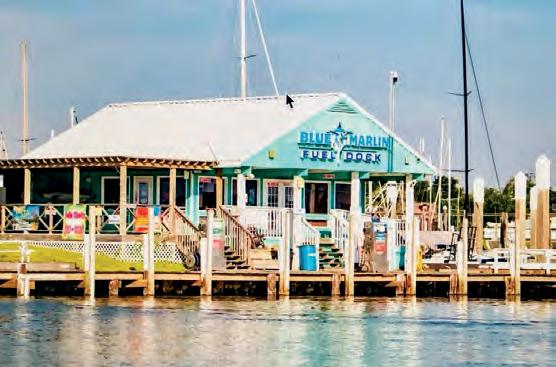
Ever see a commercial harbor full of Furuno Marine Electronics and wonder why the pros rely on us?


See why here










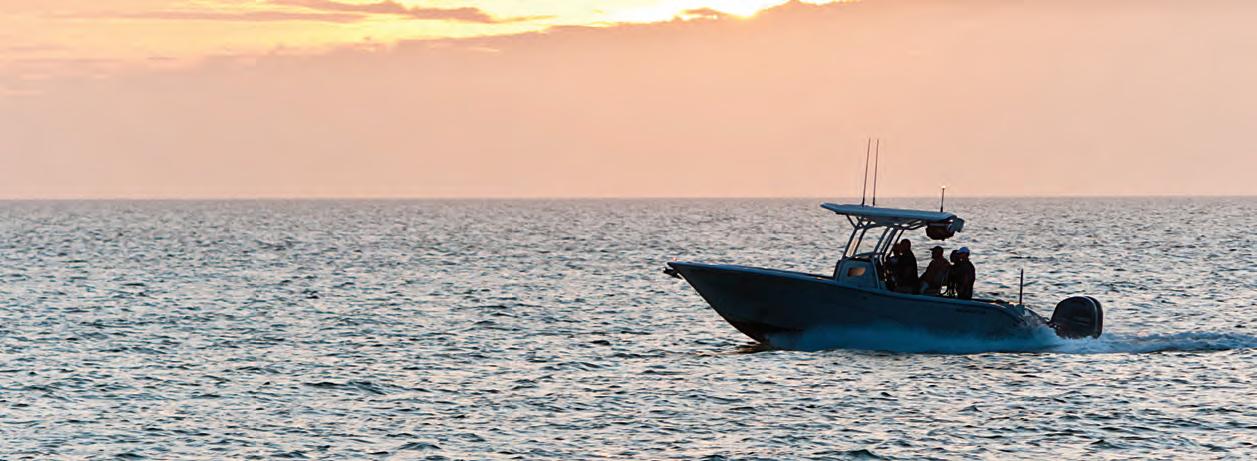
Are you ready to embark on your next on-water adventure? Before you set sail, here are fve things to know about boat insurance.
1. Boat insurance isn’t just for accidents
With comprehensive coverage, you’ll also be protected fnancially for theft, vandalism, and unexpected events like storms if you need repairs or replacements due to damage.
2. Accidents can happen to anyone
When accidents happen, boat insurance offers liability coverage for damages or injuries you cause while boating, up to specifed limits. It can also cover lawsuit costs if you’re sued.
3. Boat insurance can cover medical payments
Boat insurance offers a range of optional medical payments coverage limits, helping to cover medical expenses if you’re in an accident or someone is hurt on your boat, regardless of fault.
4. Most lenders require boat insurance
If you fnanced your boat, you’ll likely need boat insurance since most lenders require boat insurance to protect their investment. Additionally, some marinas or municipalities require proof of insurance for docking.
5. Progressive offers specialized boat coverages
Ever worry about getting stuck on the water? Progressive’s Sign & Glide® On-Water Towing coverage** can help. It’s an additional coverage that steps in if your boat is disabled or breaks down on the water, paying for on-water towing, jump starts, soft ungroundings, and fuel delivery. Fuel cost isn’t included.
Don’t let unforeseen circumstances disrupt your voyage. Cruise with confdence thanks to Progressive Boat insurance. Because when it comes to your boat, peace of mind is the ultimate luxury.
Scan to get a quote in as little as 4 minutes.
to learn more.
















By Will Schmidt
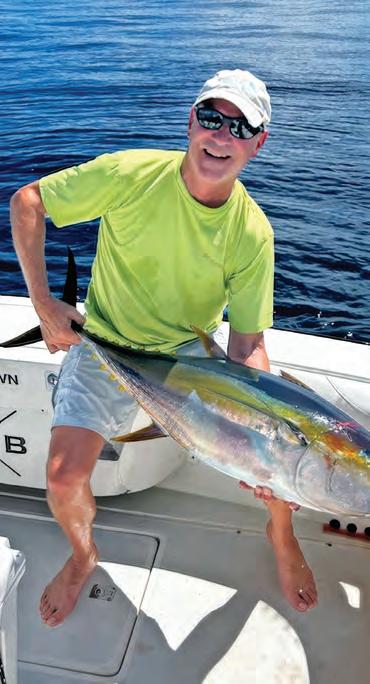
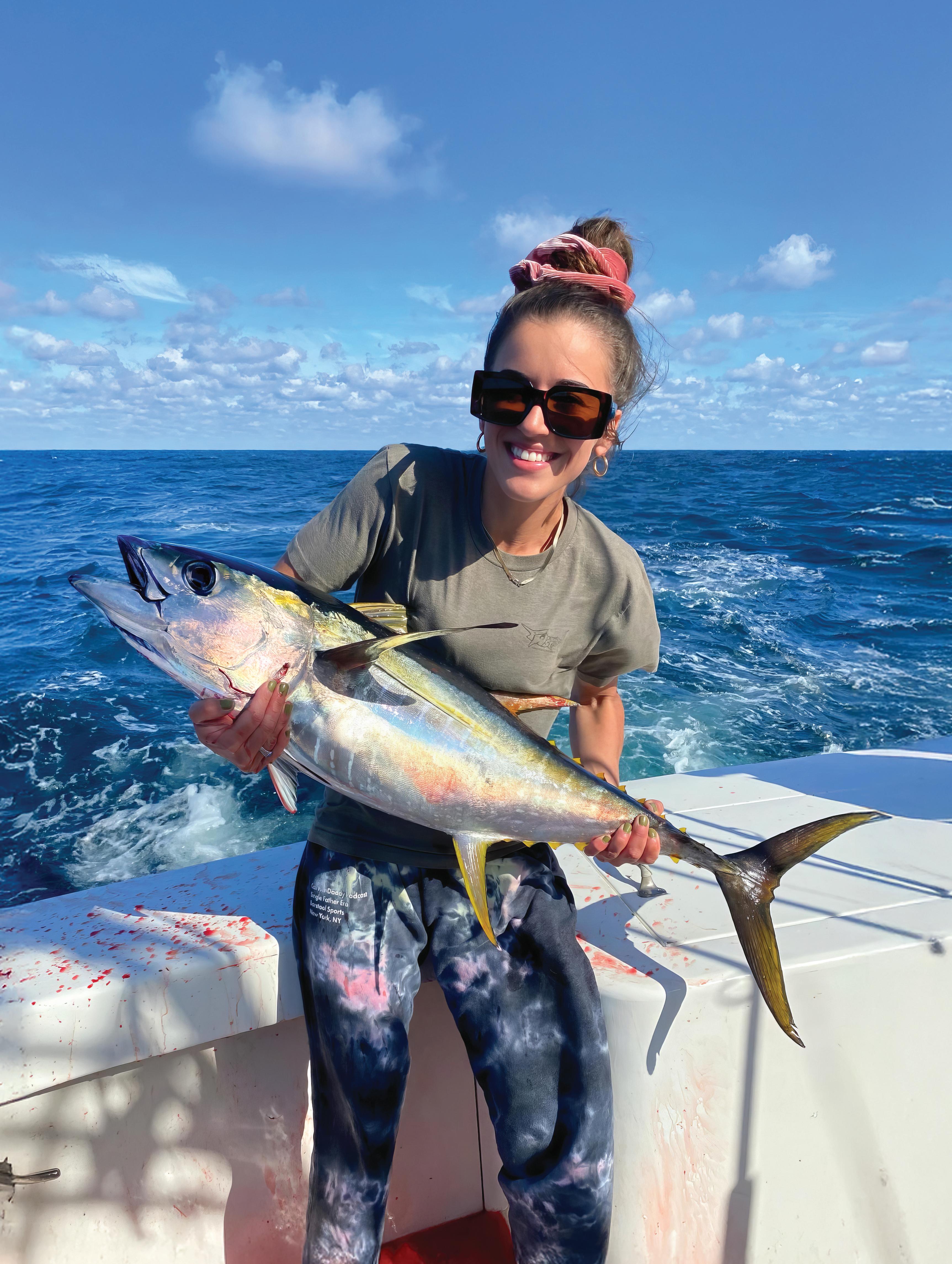
Tere were birds diving, porpoise rolling and he y yellow n tuna skyrocketing like Fourth of July reworks. Both on the water and in the boat, the energy was palatable. With one angler on the bow ready to cast a top water plug into the fray and me in the stern with ready to deploy live bait, the boat throttled back. !e plug went ying, meanwhile I simply dropped my bait behind the boat and started freelining. Almost instantly the plug was blasted in the air but not connecting. Meanwhile, I tossed a handful of baits o the back of the boat. By now the fray had subsided but the sh were clearly still looking for an easy meal. 50 feet behind me one of the chummers was blasted overhead by a 150 pound yellow n who was skyward bound a er it. Just below I could see my bait franticly swimming as another engulfed it, leading to a great battle before releasing the 100 pound class sh.
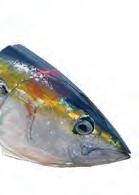
While top water shing for tuna is all the rave right now, it really makes sense to deploy multiple tactics to take advantage of these opportunities, as the school o en retreats as the boat nears. Our back up plan is very simple and almost always produces sh. As the boat gets into casting range of the school, we drop live bait o the stern and free line them. We always keep a couple ready to go. !is way, if the school disappears there are other baits ready for those who have been plugging.
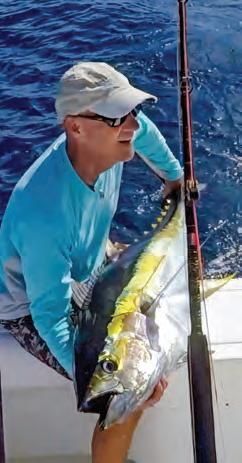
For bait google eyes or blue runners, rigging them on a 10/0 circle hook is ideal. Bridling the bait and using a non-slip loop knot presents the most natural movement as the baits ee. Also, tossing a handful of chummers in, as the surface activity disperses, usually brings shing looking to pick up stragglers into the strike zone. Chumming really helps keep the sh around, so make sure you have plenty of bait. When you get hit, give it a ve count real tight and hang on!
I like to use a bit heavier tackle with the live bait, as we o en seem to nd bigger sh. My go to is Shimano Terez BW Roller Striper medium heavy with a Talica 25A. I use 80lb braid to 80lb mono. !is is a great set up that’s fun for sh from 40 to 140 and can handle the occasional really big one. the rod with a better ghting angle. It also helps to keep the line away from the gunnel as a spiraling sh ascends. !is is a great asset for many anglers on these tough sh.
Will Schmidt is a seasoned tournament angler who has been writing about shing for more than two decades. Follow Will on Instagram @saltynstrong.

When you think of drums, does it take you back to the start of high school football? I remember walking into the school yard, and the band would be practicing on the field. Just sit back for a moment and close your eyes. I'm sure all of us could hear the beat of those drums.
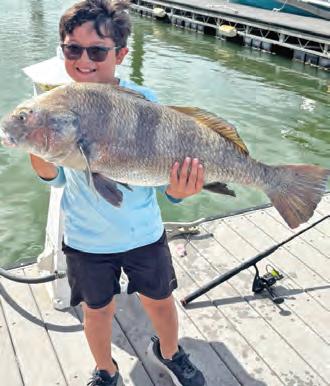
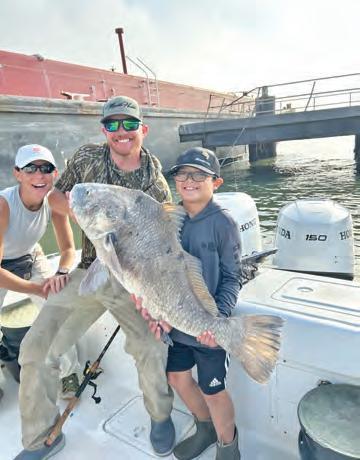
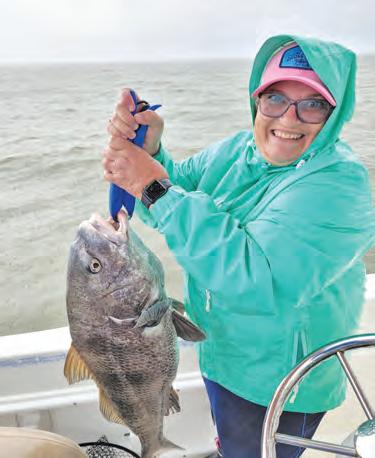
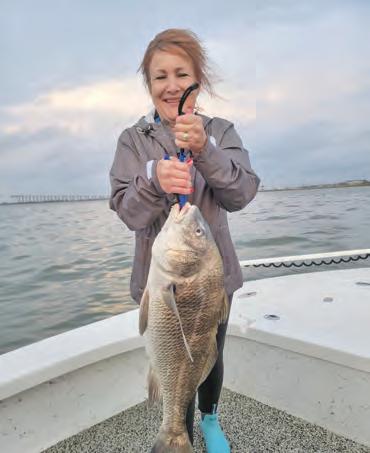
Well, those aren't the same drums I'm going to write about for this column. It's the black drum, the fish, and when March rolls around, these drum show up in abundance along the Galveston jetties. Also, the Texas City Dike. Let me make this clear. the drum I'm talking about are the large, oversized fish, not the small slot sized fish that can be caught year-round in all our bay systems.
Years ago, anglers were by law, able to retain these large fish. I fondly remember catching these giants and taking them back to Houston where I lived at the time and selling each fish for twenty dollars. Yes, it was legal. Texas Parks and Wildlife, then noticed a decrease in the number of smaller drum and imposed the slot limit. Truthfully, I never kept a big black drum for myself, because of the number of worms in the fish.
These fish are fairly easy to catch. Live crabs, shrimp, cut mullet, and shad will all produce strikes. In ranking the best baits for these giants, that typically range between 20 - 40 pounds, is live crab, followed by live shrimp. I wouldn't rule out live crawfish, because I've caught drum on these little crustaceans. Although this year, they would be quite expensive to use as bait.
As far as tackle, I suggest a medium-tomedium heavy rod and reel set up. You can catch them on light tackle, but you have a higher chance of stressing out the fish, due to the extended time from when the fish is hooked to landing the fish. I also suggest using a circle hook. You can slightly offset the hook, which will allow you to 'set the hook,' rather than the fish setting the hook itself.
If you ever really looked at a black drum, you'll notice the mouth of the fish is on the lower jaw. These fish are bottom feeders, using that big head and mouth to forage for their food. That's why it's important to keep that bait on the bottom. Adjust the amount of weight, depending upon the tidal flow.
I personally haven't fish for these giants for a few years. March is prime time when it comes to catching these drum. One particular March day, several years ago, Brian Castille, his dad Dr. Gerry Castille, and I boated 62 drum in a little over 4 hours of fishing. Every fish swam off, released promptly after being landed, and we


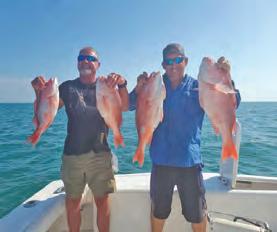

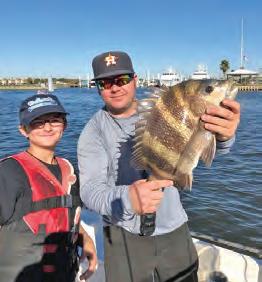
used a venting tool if needed. If you decide to fish for these majestic giants, please take care on how you handle the fish. Release them promptly after being unhooked. Make sure you properly vent them so they're able to swim off and not float away with the tide. These are the breeders, the future of retaining a healthy stock. Save the 'hero shots' of everyone in the boat holding up an oversized drum. I know, not all those fish were landed at the exact same time. Be respectful of the resource. and quickly take a picture and release the fish.







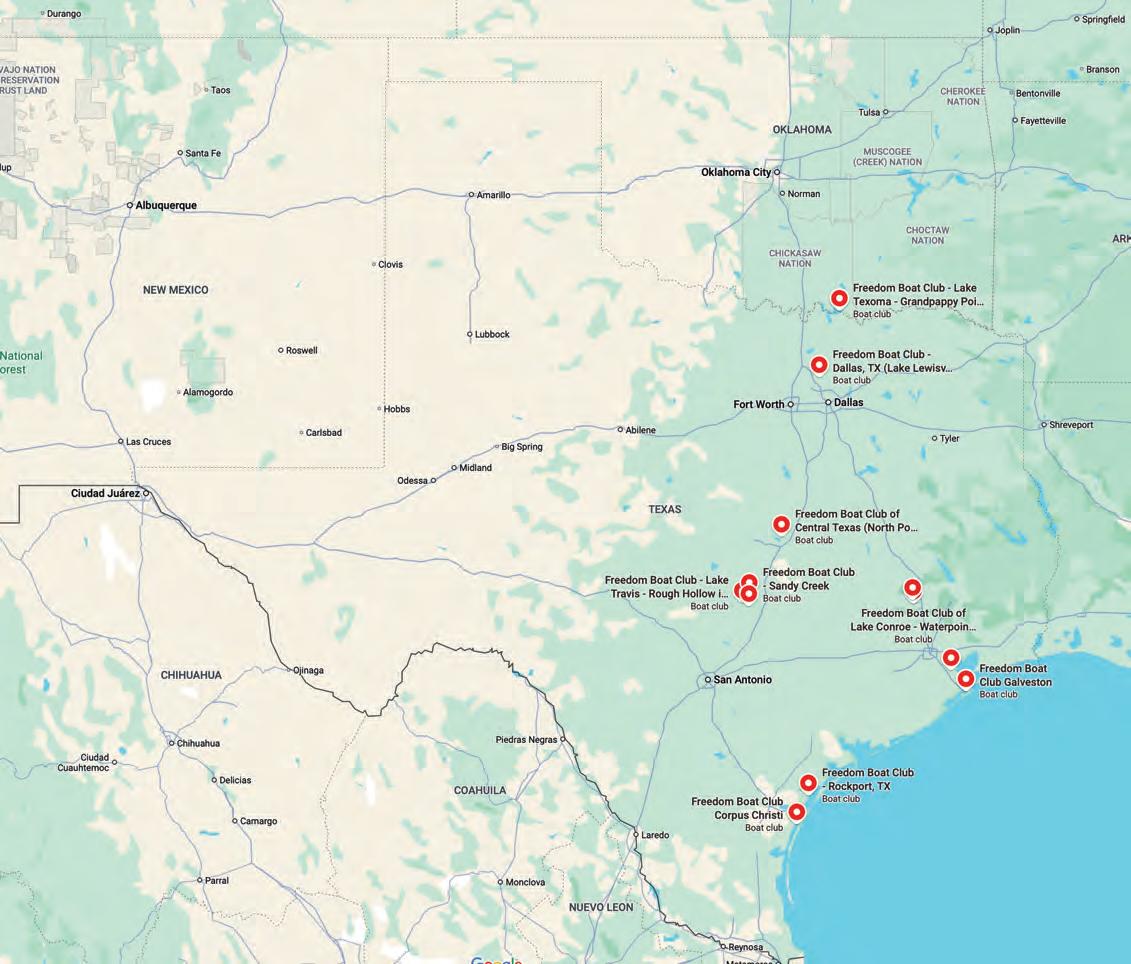
SOUTH SHORE HARBOUR MARINA
2400 South Shore Harbour Blvd, League City, TX 77573
LAKE LEWISVILLE
1481 E Hill Park Rd, Lewisville, TX 75056
GRANDPAPPY POINT
1789 Harbor Dr, Denison, TX 75020
NORTH POINT MARINA
3681 Cedar Ridge Park Rd, Temple, TX 76502
WALDEN MARINA
12050 Melville Dr Suite 6, Montgomery, TX 77356
WATERPOINT MARINA
15320 TX-105 Suite 500, Montgomery, TX 77356
ROUGH HOLLOW IN LAKEWAY 105 Yacht Club Cove, Lakeway, TX 78734
SANDY CREEK MARINA
8714 Lime Creek Rd, Leander, TX 78641
1705 S Quinlan Park Rd, Austin, TX 78732
MARKER 37 MARINA
13317 S Padre Island Dr, Corpus Christi, TX 78418
PELICAN REST MARINA 7819 Broadway St, Galveston, TX 77554
COVE HARBOR YACHT CLUB 121 Cove Harbor Rockport, TX 78382


Boats available for members to enjoy fishing and exclusive amenities.










3 Tue 3:11 1.3 5:57 0.8 10:32 -0.1 10:31 0.6 6:41 6:19
4 Wed 4:20 1.2 5:34 0.9 11:11 0.2 11:14 0.3 6:40 6:20
5 Thu 5:32 1.1 5:28 0.9 11:47 0.5 11:52 0.1 6:39 6:21
6 Fri 6:52 1.0 5:30 1.0 12:22 0.7 6:38 6:21
7 Sat 8:39 1.0 5:29 1.1 12:28 -0.1 12:56 1.0 6:37 6:22
8 Sun 2:45 1.2 1:03 -0.2 7:36 7:23
9 Mon 3:22 1.3 2:41 -0.3 7:35 7:23
10
12 Thu 5:47 1.4 5:15 -0.1 7:31 7:25
13 Fri 6:36 1.4 6:23 -0.1 7:30 7:26
14 Sat 7:19 1.3 7:32 -0.1 7:29 7:26
15 Sun 7:40 1.2 8:34 0.0 10:13 1.2 7:28 7:27
16 Mon 1:38 1.3 6:52 1.1 9:25 0.0 9:59 1.0 7:27 7:28
17 Tue 2:52 1.3 5:39 1.0 10:10 0.2 10:22 0.8 7:25 7:28
18
19 Thu 5:14 1.3 5:11 1.1 11:31 0.6 11:34 0.2 7:23 7:29
20 Fri 6:28 1.4 5:13 1.2 12:13 0.9 7:22 7:30
21 Sat 7:48 1.4 5:10 1.3 12:14 -0.1 12:57 1.2 7:21 7:31
22 Sun 9:39 1.5 4:24 1.5 12:57 -0.3 1:35 1.4 7:20 7:31
23 Mon 2:40 1.6 1:44 -0.5 7:18 7:32
24
25
26 Thu 5:11 1.7 4:52 -0.2 7:15 7:34
27
28 Sat 6:05 1.4 7:39 0.0 9:05 1.3 7:12 7:35
1:07
29
30
31


www.USHarbors.com Galveston Pleasure Pier, TX - Mar 2026 Low ft AM ft PM ft Rise Set Moon

1 Sun 12:09 1.4 3:17 1.7 7:39 -0.6 8:51 1.0 6:44 6:18
2 Mon 1:26 1.5 3:41 1.6 8:30 -0.4 9:12 0.8 6:43 6:19
3 Tue 2:33 1.5 4:01 1.4 9:19 -0.1 9:38 0.6 6:41 6:20
4 Wed 3:36 1.5 4:19 1.3 10:07 0.2 10:08 0.4 6:40 6:20
5 Thu 4:37 1.6 4:35 1.2 10:57 0.5 10:41 0.2 6:39 6:21
6 Fri 5:40 1.6 4:47 1.2 11:57 0.8 11:17 0.1 6:38 6:21
7 Sat 6:48 1.6 4:53 1.1 1:20 1.0 6:37 6:22
8 Sun 9:05 1.6 7:36 7:23
9 Mon 10:37 1.6 1:47 0.0 7:35 7:23
10 Tue 12:07 1.7 2:46 -0.1 7:34 7:24 11 Wed 1:12 1.8 3:52 -0.1 7:33 7:25
12 Thu 1:58 1.8 4:57 -0.1 7:31 7:25
13 Fri 2:35 1.8 5:56 -0.2 7:30 7:26
14 Sat 3:03 1.8 6:48 -0.2 9:42 1.3 7:29 7:26
15 Sun 3:27 1.8 7:35 -0.2 9:11 1.2 7:28 7:27
16 Mon 1:20 1.4 3:47 1.7 8:20 -0.1 9:08 1.0 7:27 7:28
17 Tue 2:26 1.5 4:04 1.6 9:04 0.0 9:22 0.8 7:26 7:28
18 Wed 3:27 1.7 4:21 1.5 9:51 0.2 9:47 0.5 7:24 7:29
19 Thu 4:28 1.8 4:35 1.4 10:42 0.5 10:20 0.2 7:23 7:29
20 Fri 5:30 2.0 4:48 1.3 11:41 0.8 10:59 -0.1 7:22 7:30
21 Sat 6:36 2.1 4:57 1.3
25
26
27
28
29 Sun 12:36 1.5 2:57 1.8 7:40 0.0 8:44 1.0 7:11 7:35
30 Mon 1:57 1.7 3:18 1.7 8:39 0.3 9:03 0.8 7:10 7:36
31 Tue 3:04 1.8 3:34 1.6 9:34 0.5 9:25 0.6 7:09 7:36

















SISTERS HELPING SISTERS
April 18, 2026 West Bay, TX FishWestEnd.com


April 25–26, 2026 San Leon, TX shstexas.org BABES ON THE BAY
May 16-17,2026
Rockport,TX babesonthebay.com

BY CAPT. MICHAEL OKRUHLIK
MyCoastOutdoors@yahoo.com www.MyCoastOutdoors.com
March is one of the most underrated months for saltwater fishing along the Texas coast. As winter loosens its grip and water temperatures begin to rise, fish start shifting patterns, bait becomes more active, and anglers who understand the seasonal transition can experience some of the year’s best action— often with less pressure than peak spring months. Water temperatures in March typically range from the mid-50s to low-60s, depending on location and weather trends. These warming conditions trigger increased feeding behavior among speckled trout, redfish, and flounder. However, cold fronts are still common, making adaptability the key to success.
Speckled trout are the primary focus for many anglers this time of year. In early March, trout often hold in deeper water such as channels, guts, and drop-offs adjacent to flats. As sunny afternoons warm shallow areas, trout will slide up to feed, especially where dark mud bottoms absorb heat. Slow-worked soft plastics, suspending twitch baits, and slow-sinking paddletails are effective presentations, particularly when fished patiently.
As the month progresses, trout begin staging near shorelines and grass beds in preparation for spring spawning.
Redfish remain reliable throughout March and are often more forgiving than trout. They can be found in marshes, back lakes, and shallow flats, especially during warming trends. On colder mornings, reds may school tightly in deeper pockets, making them easy to locate. As the day warms, they’ll push shallow and tail aggressively. Gold spoons, soft plastic shrimp imitations, and paddle-tail swimbaits excel during this period.
Flounder fishing begins to improve as well. While the main flounder run is over, March sees these ambush predators moving from deeper winter haunts toward shorelines, drains, and bayou mouths. Slow-dragged soft plastics and jigheads bounced along the bottom are the most effective approach.
March weather can change quickly, so paying attention to wind and tides is crucial. Strong north winds following cold fronts will drain water from shallow bays, pushing fish into deeper areas. Conversely, sustained south winds and rising tides will flood shorelines and backwater areas, creating excellent sight-fishing opportunities.
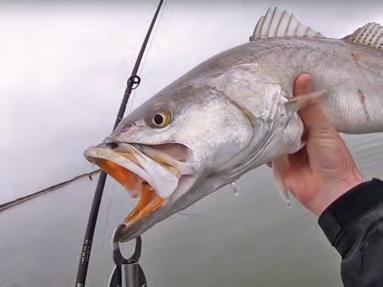
Bait activity also increases this month. Mud minnows, shrimp, and small baitfish become more prevalent, which directly influences lure selection. Matching the hatch—both in size and action—often makes the difference between a slow day and a memorable one.
March saltwater fishing in Texas rewards anglers who stay flexible, fish methodically, and adjust to changing conditions. Whether you’re wading a grassy flat, drifting a muddy bay, or probing deeper structure, this transitional month offers the chance to connect with quality fish and set the tone for a strong spring season on the water.



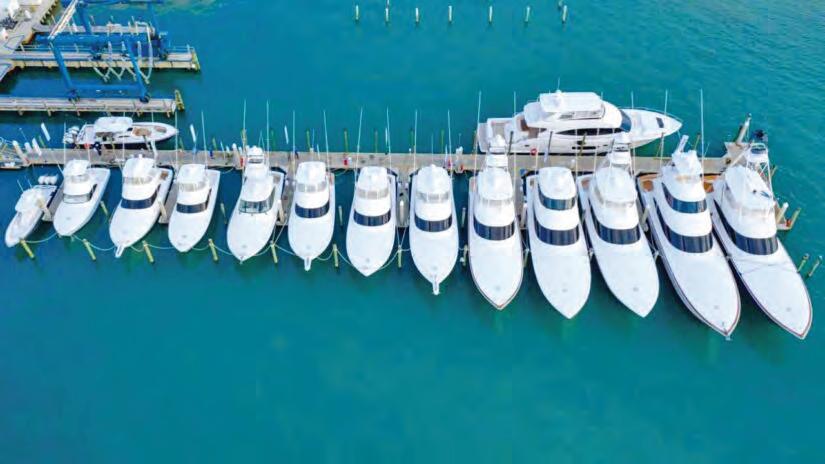



Buying a boat is exciting. Whether it’s your first bay boat, a serious offshore fishing machine, or a cruising yacht for the family, the anticipation of time on the water is hard to beat. But purchasing a boat — especially in today’s market — is also a major financial decision. That’s why experienced buyers often turn to a professional yacht or boat broker to guide the process.
Unlike buying directly from a private seller, a buyer’s broker represents your interests. Their job is not just to show boats — it’s to protect you throughout the transaction. From identifying fair market value to spotting potential red flags, a broker provides an experienced set of eyes on what can otherwise be a complicated deal.
Boats are not like cars. Pricing can vary widely based on hours, maintenance history, upgrades, electronics, condition, and even regional demand. A broker understands market trends and comparable sales. That knowledge can prevent you from overpaying — or missing out on a well-priced opportunity.
Many quality boats never hit major listing websites. Brokers often know about upcoming listings before they go public. They also have
access to off-market opportunities through professional networks. That expanded reach can save buyers time and open doors to boats they might never have found on their own.
INSPECTION AND SURVEY PROCESS IS WHERE A BROKER’S VALUE REALLY BECOMES CLEAR.
Once you’ve identified a boat, the due diligence phase begins. This includes reviewing maintenance records, verifying title status, checking for liens, arranging sea trials, and coordinating a professional marine survey. A broker helps organize and manage this process to ensure nothing is overlooked.
Marine surveys can reveal issues ranging from minor cosmetic items to structural or mechanical concerns that could cost thousands to repair. A seasoned broker knows how to interpret survey findings and negotiate repairs or price adjustments accordingly. Without that guidance, buyers may either panic unnecessarily or overlook serious concerns.
Boat transactions often involve offers, counteroffers, contingencies, deposits, sea trials, survey approvals, and closing documentation. Emotions can run high, especially if a buyer has fallen in love with a particular vessel. A broker
acts as a buffer, keeping negotiations professional and objective. Their experience helps structure offers that protect the buyer while keeping the deal moving forward.
Improper documentation can create major headaches down the road. Brokers ensure that titles, Coast Guard documentation (if applicable), tax considerations, and registration paperwork are handled correctly. Mistakes in these areas can delay closing or create ownership disputes later.
A good broker doesn’t disappear once the keys are handed over. They often assist with referrals for captains, marinas, service providers, insurance agents, and financing sources. For buyers new to boating — or new to a particular type of vessel — this support can make the transition smoother and more enjoyable.
In the end, using a broker isn’t about adding complexity — it’s about reducing risk. Boats represent significant investments of both money and lifestyle. Having a knowledgeable professional in your corner helps ensure the process is smooth, informed, and ultimately rewarding.
When the right boat meets the right buyer under the right terms, everyone wins — and a broker helps make that happen.







CAPT PAUL MARCACCIO
T.P. & W. & USCG License
Marcaccio Fishing Academy captpaul@gofishgalveston.com www.gofishgalveston.com
Last fall, a small group of us were wading the flats near the mouth of the Trinity River.
A dozen anglers were scattered across the shoreline, most of them catching and releasing speckled trout and redfish. It was steady action. But what caught my attention wasn’t the bite — it was the number of undersized fish being handled.
At least one in five trout landed that morning measured under the 15-inch minimum. From a guide’s perspective, I can say with confidence that many of those undersized fish did not survive. Some were seen floating. Others likely sank and never made it.
To be fair, more than half of those anglers handled their fish with care. They released undersized trout and redfish gently and with good intentions. But the remaining few did not. I saw hooks ripped out forcefully. Fish were squeezed tightly while pliers twisted free a lure. One angler removed the hook and then hurled the fish back as far as he could, saying he didn’t want to catch that one again. It’s doubtful those fish survived.
There has been plenty of research on catchand-release survival rates. The results vary depending on conditions, but some things are consistent. Fish that are lip-hooked and handled
properly have a high survival rate. Fish hooked in the gills or deeply in the throat face much lower odds. Water temperature also plays a major role. In the heat of summer, when dissolved oxygen levels drop, mortality can climb dramatically. In cooler months, survival rates improve significantly.
Over the years, I’ve become much more mindful about how I release fish. Maybe that comes with age and perspective.
When I started fishing in the late 1950s and early ’60s, we kept nearly everything except piggy perch and hardheads. It wasn’t unusual to fill multiple ice chests with trout and redfish. I sold speckled trout in Galveston alongside my grandfather for 10 to 15 cents a pound. There were no size or bag limits then. Ten- and twelveinch trout routinely went on the stringer. No one imagined the population declines that would come later — from major freezes, increased fishing pressure, floods, and habitat loss.
Back then, we were part of the problem. Today, we have the opportunity to be part of the solution.
If a fish is to survive after release, handling must be minimized. Ideally, the fish should remain in the water while the hook is removed. If you must handle it, wet your hands first. A fish’s protective slime coating is its first line of defense against infection, and dry hands can remove it quickly.
Use needle-nose pliers or a hook remover to back the hook out gently. If the fish is hooked deep in the mouth or near the gills, cut the line rather than digging for the hook. Most hooks will corrode and fall out in time. The damage done by
aggressive hook removal is often far worse than leaving the hook in place.
Once the hook is free, lower the fish gently back into the water. Do not throw it. Speckled trout are not built like tarpon; they are not designed to withstand impact. The shock of hitting the water can stun them internally. Some trout may swim off after being tossed, but that does not mean it will survive.
If revival is needed, hold the fish upright in the water and move it slowly forward to allow water to pass naturally over the gills. Do not push it back and forth aggressively. Support the fish by the tail until it kicks free under its own power.
Gills are to fish what lungs are to us. Without proper oxygen flow, survival odds diminish quickly.
Every released trout represents future opportunity. A carefully handled 14-inch fish today may become a five-pound trophy in a few seasons. More importantly, it may help sustain the resource for our children and grandchildren.
The Upper Coast has endured freezes, hurricanes, floods, and unprecedented fishing pressure. Regulations have tightened for good reason. Recovery takes time, and responsible angling plays a critical role in that process.
Catch and release is not simply about letting a fish go. It’s about how you let it go.
As my dad once told me, “Leave it a little better than you found it.” That advice applies just as much to our bays as it does to life.
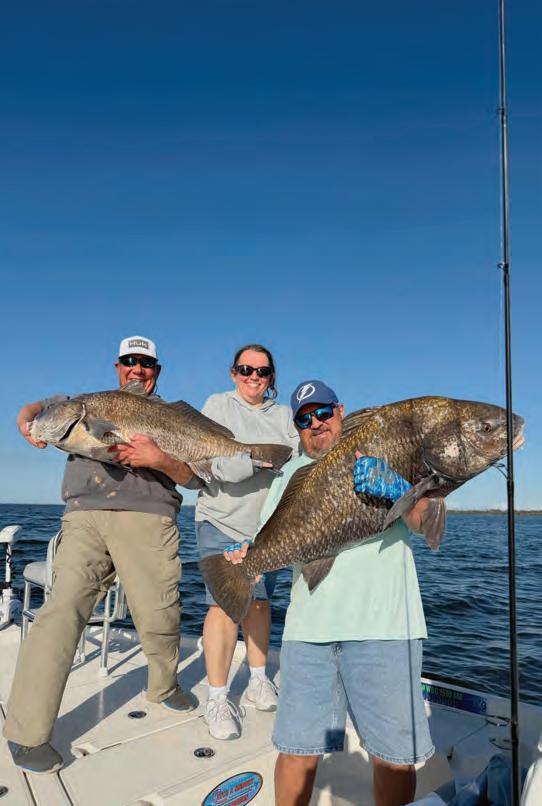
By Capt. Jim Ross
s a charter captain, as well as a regular contributor to the Brevard County, Florida edition of Coastal Angler Magazine, every year there are certain events that happen that I try to predict in advance so that clients and readers can catch more !sh. However, there are many times that even we so called “professionals” don’t get it exactly right. Obviously, my crystal ball isn’t 100 percent correct all of the time...maybe it needs a tune up. LOL!
ings like the giant black drum schooling up, spring cobia run, June tarpon run, fall mullet run, and winter pompano run aren’t things you can pin down to a certain day of the month, but most of the time we can at least predict the month. Hopefully, I can achieve at least a 90 percent e ciency rating a er doing this report for the past 25 years.
I was just telling my clients one day last week, a er catching a bunch of small trout and a couple of lady!sh, that the big uglies were probably going to show up in a few weeks and if they had a chance to come back out with me then that they may have a shot at catching some much larger !sh than the ones we had landed that morning. Just !ve minutes a er saying this I spotted something unusual about 500 yards up the at. It was exactly what I had just been talking about- a 300 !sh school of 30 to 50-pound black drum.
e !sh in this big school were happy-tailing and waking as they pushed their way down the at. We eased up to them, cast our shrimp in their direction, and as you !gured, the battles were on. All three anglers were hooked up to huge drum that had absolutely no respect for them. Drags screamed, rods doubled over, and dozens of yards of line dumped o their reels. Grunts and groans were heard between laughter and smiles as they worked to tire these beasts. e boat deck looked like a country bar dance oor as anglers shu ed and two-stepped under and over each other in an e ort not to lose their prized catches.
We ended up extending the trip from a 3/4 day to a full day outing because each !sh took 15 to 25-minutes to land.
e moral of the story? Don’t ever count on !sh to be there and don’t ever think that it’s not quite the right time to catch them. e bottom line is just go !shing every chance you get. at is the only way that you can be sure to catch your next memory.
Capt. Jim Ross is owner/operator of Fineline Fishing Charters on Florida’s Space Coast and host of “Catch a Memory Outdoors” live radio show and podcast. www. neline shingcharters.com • www.catchamemoryoutdoors.com





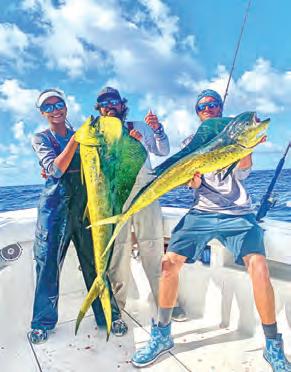
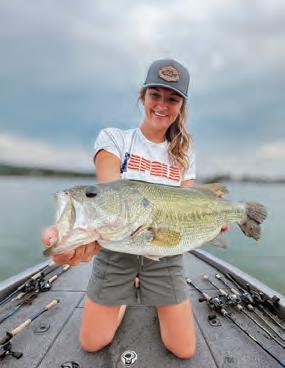




So many anglers have a “go-to” color lure that they swear by. What they do not understand is that the color of your lure barely makes the top three most important factors for catching tons of !sh.

Mistake #1 - e number one mistake anglers make is ignoring the importance of the size and pro!le of the lures they use. When snook, tarpon, red!sh, speckled trout or ounder are feeding, they o en become laser focused on that particular forage species. In other words, if they are feeding on a 6-inch mullet your 3-inch paddletail or shrimp lure will probably be ignored.
PRO TIP: Have a few of your rods rigged up with various sizes and pro!les of lures on them. I like to have a 3-inch paddletail, an arti!cial shrimp and a 4- to 5.5-inch jerk bait ( uke) rigged up when I can’t determine what bait is around. Try all three sizes and pro!les of lures until you !gure out what the !sh in the area are feeding upon.
Mistake #2 - e number two mistake most anglers make is thinking one retrieve style works best for all of the !sh all of the time. ere are so many di erent factors to consider when retrieving your lures. Here are a few to consider:
• Is the water cold or hot? Fish are cold blooded and move more slowly in cold water. is means that you have to slow down your retrieve when the water is cold. Conversely, you want to move your lure faster when the water is hot.

• What species are you targeting? Di erent !sh species like di erent retrieves. For instance, the best retrieve for a red!sh is slowly bouncing your lure o of the bottom. A tarpon likes a low and steady retrieve. A ounder likes a very slow bounce/dragging retrieve no higher than 12 inches from the bottom. A speckled trout likes a vertical jig and will usually hit the lure as it falls through the water column. Snook like a fast and erratic retrieve most of the time.
• Is the water clear or murky? Low light, cloudy skies and murky water scenarios makes it harder to get a !sh’s attention. Use a retrieve or lure that creates vibrations and ashes in the water. You also want to fan cast the area keeping your lure placement close together because they are less apt to seek out your lure. When it is sunny and the water is clear it is easier to get the !sh’s attention. You can make your casts further apart and make the !sh come to your lure.
Mistake #3 - e third biggest mistake is thinking !sh care about lure colors. A saltwater tackle box with white lures and something dark like root beer or purple is all that you need to catch any !sh. PERIOD. e bottom line is that if you want to catch more !sh, switch up your sizes and pro!les and vary your retrieves for di erent species and conditions. I GUARANTEE that you will catch more !sh.
Capt. Mike Smith is owner of Fish Your Ass O Charters.Reach him at (561) 339-2317, contact@ shyourasso .com or shyourasso .com.










“It’s a beautiful knife with a great blade and a sure grip” — William B. Wilmington, NC
My friend Sergio is a mixed martial arts fighter. His shoulders are broad. His muscles have muscles. He’s not the kind of person you want to be on the wrong side of.
This manly man has a saying about being tough: You should either know how to fight or look like you do.
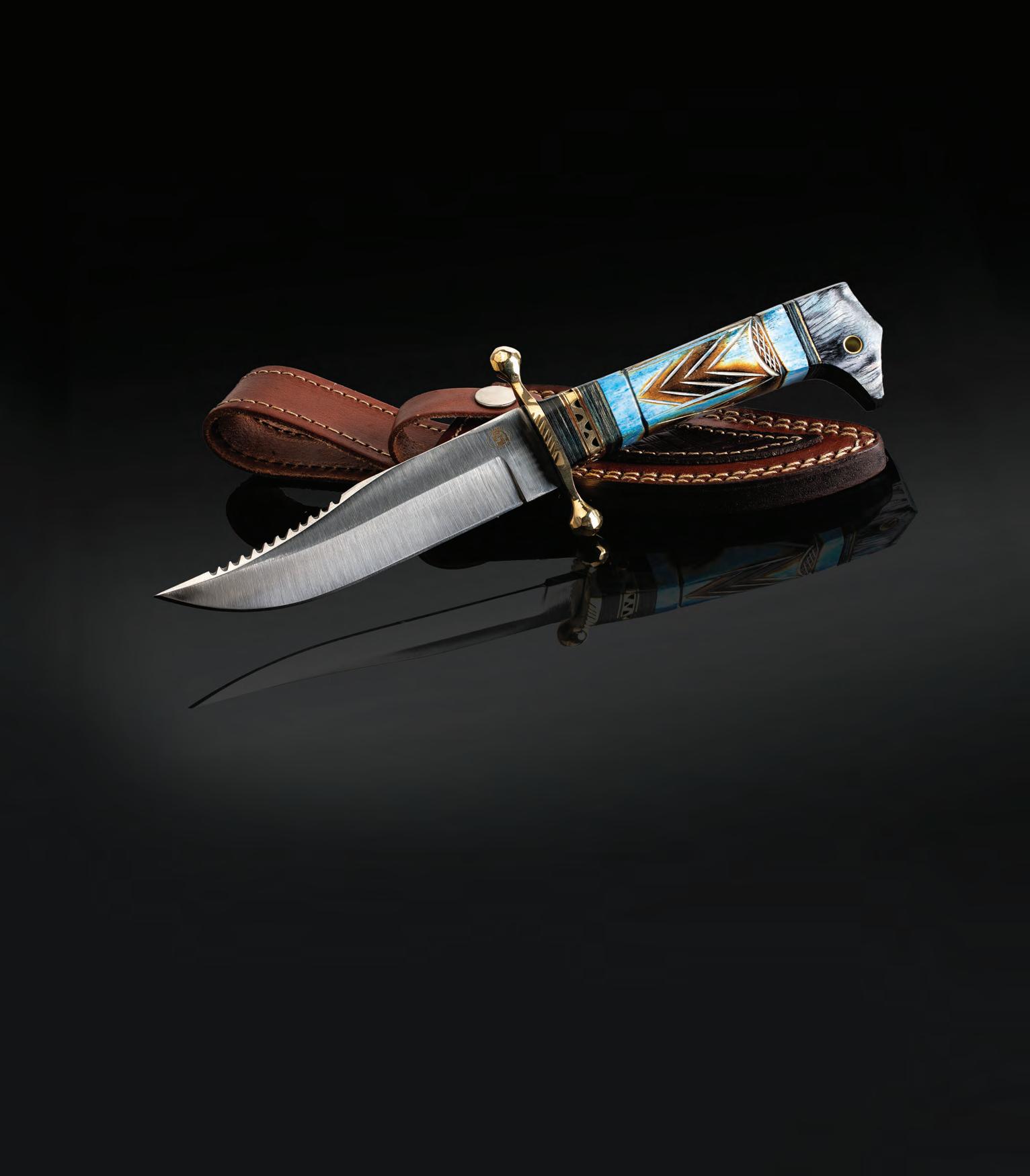
The message is simple enough. People spoiling for a fight usually don’t pick the biggest guy in the bar. If you look like someone who shouldn’t be messed with, you likely won’t be. With our Blue Bone Bowie Knife on your hip, that’s exactly the message you’ll send.
As beautiful as it is functional, this knife is 10" overall and features a high-quality 420 surgical stainless steel blade with a serrated spine. The handle is constructed of genuine natural bone with redwood spacers. On the handle you’ll find design work that’s carved by hand, a testament to its craftsmanship.
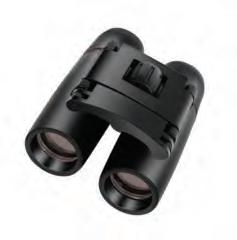
This knife is stick tang, meaning it won’t wimp out when you need it. This knife also features brass hand guards and brass spacers with file work, so you won’t lose your grip. For easy carrying, it comes with a genuine tooled leather sheath. CALL NOW! If you’re one of the rst 700 587 callers for this ad, we’ll throw in a pair of Stauer HD Pocket Binoculars — a $99 value — ABSOLUTELY FREE!
Walk around with the Blue Bone Bowie Knife and you’ll feel a lot safer. I know I do.
Knife Speci!cations:
• 10" overall length
• 420 surgical stainless steel and stick tang construction
• Genuine natural bone and redwood hand-carved handle
• Genuine leather sheath included
Blue Bone Bowie Knife
EXCLUSIVE FREE
Stauer Pocket Binoculars a $99 value with your purchase of the Blue Bone Bowie Knife
$299 $79* + S & P Save $220
*Special price only for customers using the offer code. 1-800-333-2045
Your Insider Offer Code: BBK164-02
California
please
regarding