@CAMTAMagazine FRANCHISE OPPORTUNITIES AVAILABLE WORLDWIDE THEANGLERMAG.COM SEPTEMBER 2023 VOLUME 27 • ISSUE 342 PHOTO COURTESY OF TREVOR PELLAND FREE
GREATER ATLANTA AREA EDITION
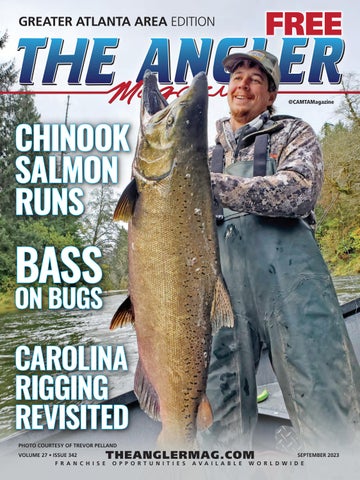
CAROLINA RIGGING REVISITED CHINOOK SALMON RUNS BASS ON BUGS



Shhhhh. No wake zone. Protect your baby (and their toys) with coverage for shing gear and personal property too. 1 - 800 - PROGRESSIVE / PROGRESSIVE.COM Progressive Casualty Insurance Co. & af liates. Additional charge may apply. Prices vary based on how you buy.
MAXIMIZE YOUR OUTPUT With
Dometic’s Mega Jackplate

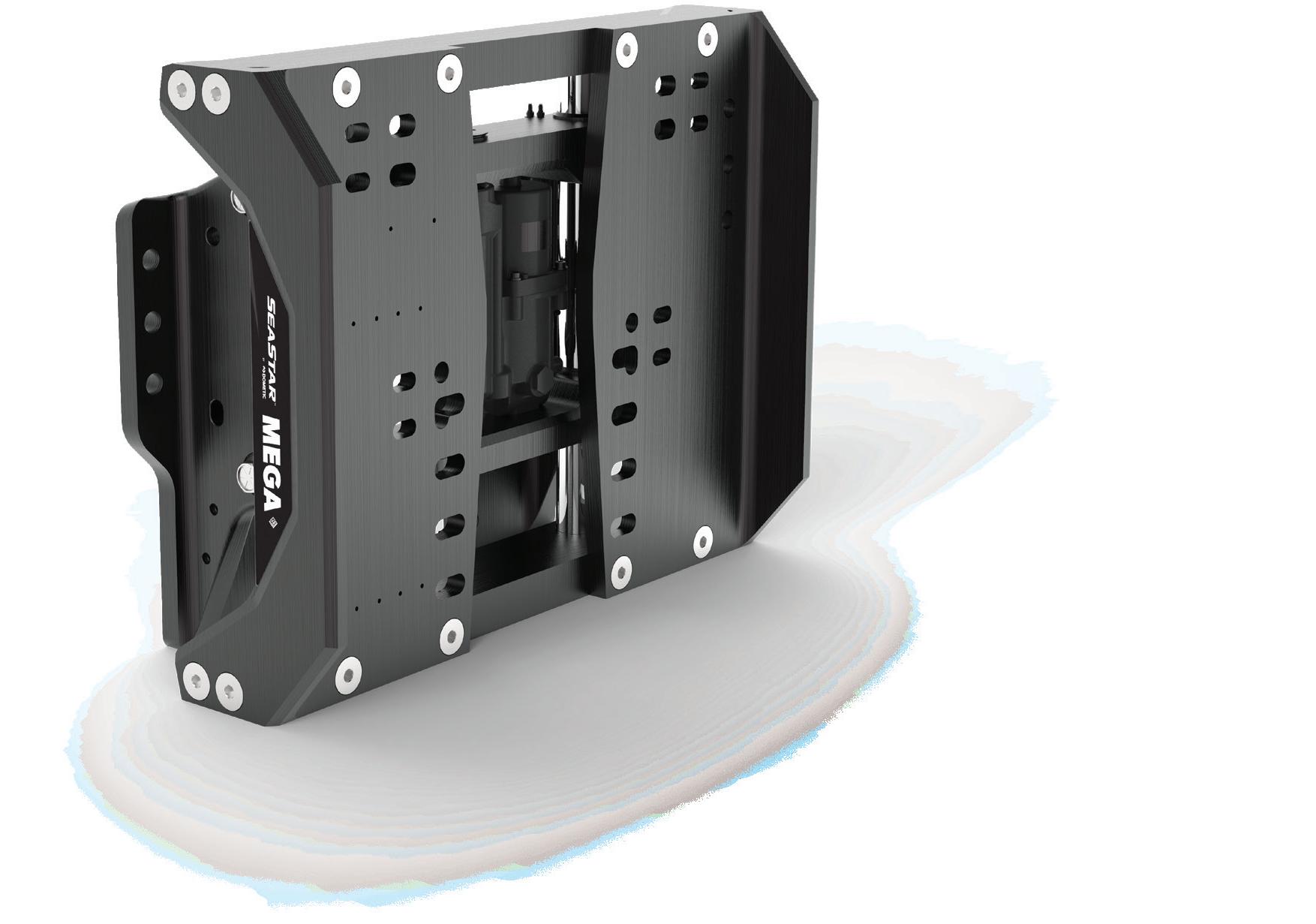
ENGINEERED TO HANDLE THE STRONGEST OUTBOARD ENGINES ON THE MARKET
Today’s engine manufacturers are building engines that are more powerful and heavier than ever before. Dometic’s new Mega Jackplate has been developed to withstand the power of high performance engines and provide boaters with the ability to maximize the output of their engines while offering more flexibility in shallow water. The Mega Jackplate is rated to 600 HP and is an extension of our existing product line. It will be offered in 6”, 8” and 10” setbacks. There will be 2 versions available, a standard bolt pattern designed to fit engines like Yamaha XTO and a wide bolt pattern designed to fit Merc 500/600.
www.dometic.com
Go Big!
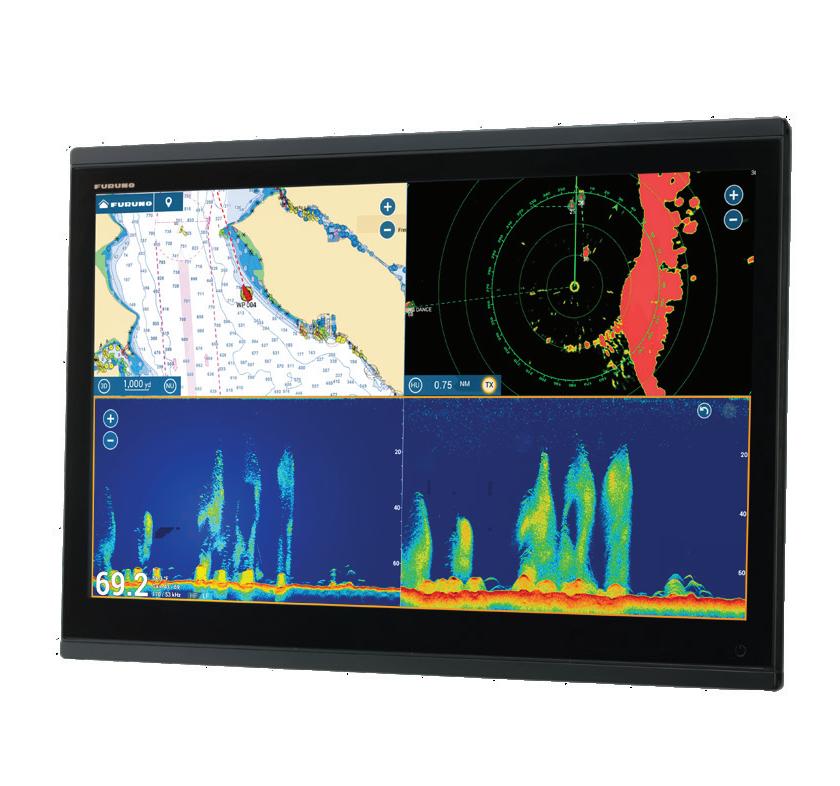
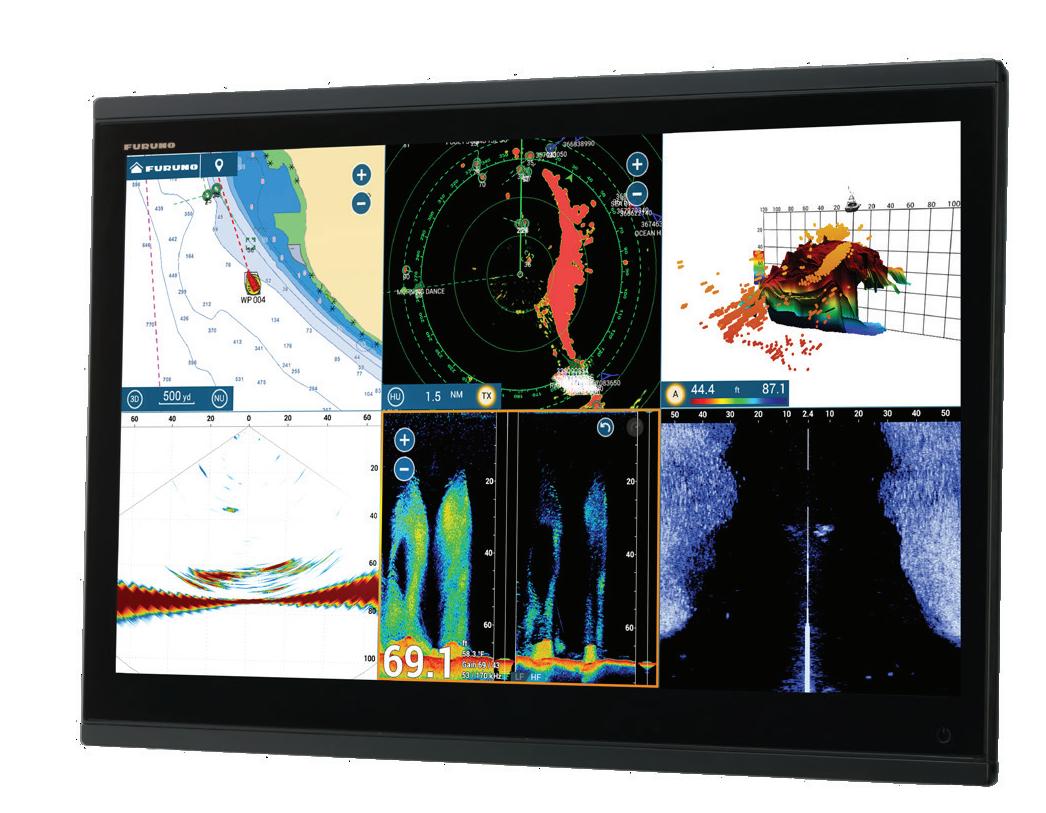
Up your game like never before with the biggest and brightest TZtouchXL MFDs.
on a
New NavNet TZtouchXL 22” & 24” MFDs deliver the power to see & do more with unprecedented clarity.
Go
power trip with
10 screen layouts, including new 6-way split screen
DFF3D Multibeam Sonar see 120° Port-Starboard
DFF3-UHD high-power 2/3 kW TruEcho CHIRP™ Fish Finder NavPilot features keep you on the fish
High-power X-Class & NXT Radar options
TZT24X 24 " Multi-Touch MFD 1920 x 1080 (FHD)
TZT22X 22 " Multi-Touch 1920 x 1080 (FHD)
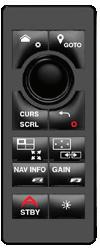
MCU006
Enhanced Remote Control
Furuno Ambassador Duane “Diego” Mellor
Get the whole story at NavNet.com
FRANCHISE OPPORTUNITIES AVAILABLE NATIONWIDE!
PUBLISH YOUR OWN FISHING MAGAZINE!
If you love the outdoors and dream of being in business for yourself, now is the time to choose a Coastal Angler or e Angler Magazine Franchise.
Established Brand • Proven Systems Training & Ongoing Support Work
• Alabama - SOLD
• Big Bend, FL
• Charlotte, NC
• Connecticut/Rhode Island
• Daytona Beach, FL - SOLD
• Destin/Pensacola, FL - SOLD
• Eastern Tennessee
• Georgia (Coastline, Savannah)
• Hilton Head, SC - SOLD
• Lake Erie, Ohio
• Lake Michigan
• Long Island, NY
POPPER SEASON IS ON FIRE IN EAST TENNESSEE
By Capt. Bill Stranahan
• Miami, FL - SOLD!
• Myrtle Beach, SC
• New Hampshire
• New Jersey
• New Orleans, LA
• North Carolina (Raleigh, Wilmington)
• Okeechobee, FL - SOLD
• Outer Banks, VA
• Panama City, FL - SOLD!
• Tallahassee, FL/SW GA
• Texas (Coastal, Houston)
• ...YOUR HOMETOWN!
Don’t see your location? Ask one of our specialists about franchise availability in your area.
1-888-800-9794
info@coastalanglermagazine.com
franchise.coastalanglermag.com
WATCH OUR ONLINE VIDEO HERE: https://bit.ly/3sjhMoP
This is a hard time of year for most Southern trout anglers. Water temperatures are warm all over, and most of our trout shing has slowed way down or is just plain over for a bit.
Here in East Tennessee, we are currently bringing 5- and 6-weight y rods and dri shing topwater poppers for spotted and smallmouth bass on several local rivers. We are catching some nice sh, and we’re also catching very good numbers, all on top.
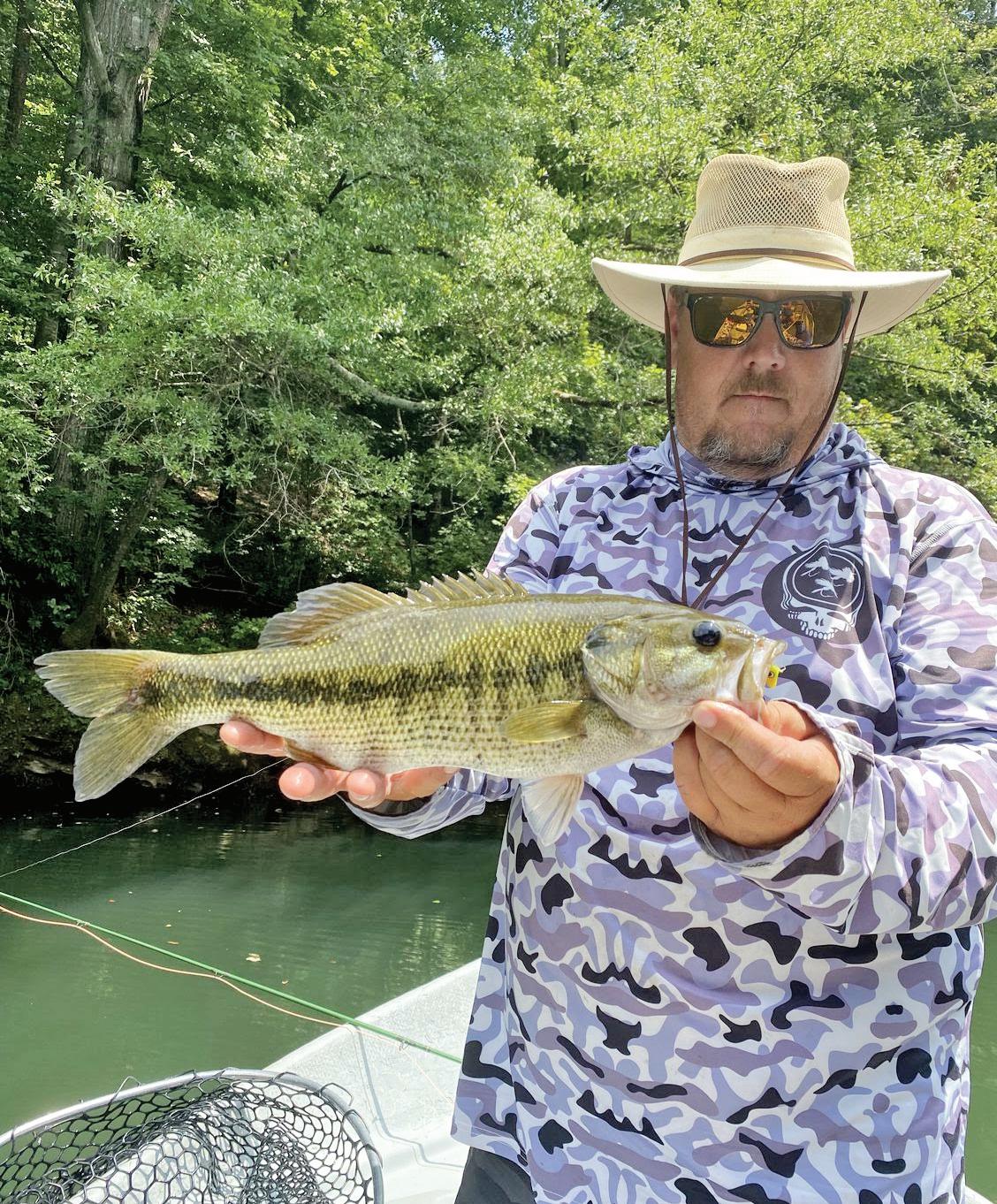
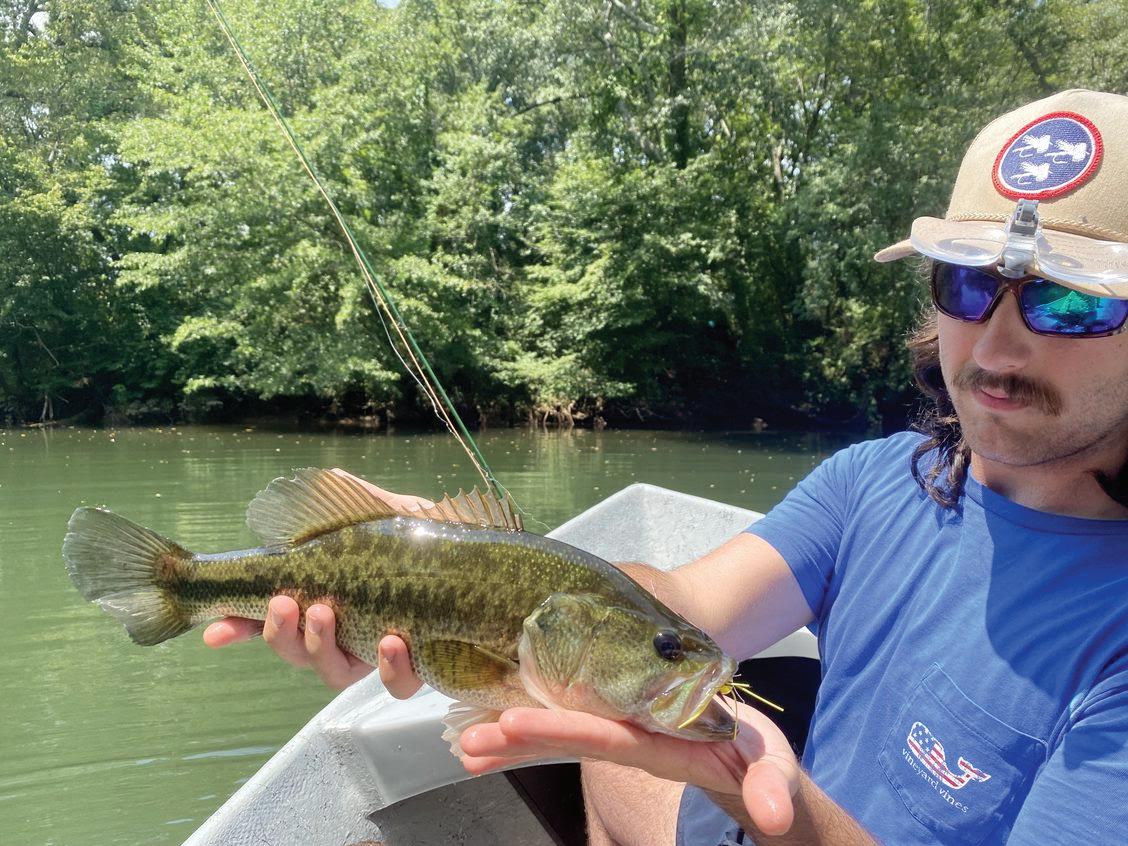
It’s like hopper shing, just on the warm-water side of things. e bass are happy and should be looking up for the remainder of the summer through October, depending on water ows and weather.
It’s a nice change of pace for a bit, with many sh being in the 15- to 16-inch range and averaging a pound and a half or two, with shots at larger sh on any given dri . Giant pumpkinseed bream will also come up and hammer a popper on occasion.
If you’re getting into the bassy side of things, I recommend 2x leaders, 5- and 6-weight rods and your favorite color poppers. e occasional pop and twitch is just a way to say hello to let them know it’s there and see who comes up.
If you want to catch some hard- ghting sh and have a fun day on the water, give us a call before it’s over.
Contact Hiawassee River Guides at (423) 208-8602. See their website at http://hiwasseeriverguides.blogspot.com/.
4 NATIONAL SEPTEMBER 2023 COASTALANGLERMAG.COM • THEANGLERMAG.COM
From Home • Be Your Own Boss
Home of world class fishing on the beautiful Watauga Lake, rugged Doe River and designated trophy trout stream, Watauga River



Experienc
e
PLAN YOUR TRIP AT TOURCARTERCOUNTY.COM Watauga River Watauga Lake Doe River
Fall Snook
AND THE MULLET MIGRATION
By Nick Carter
Fall is a ne time to be an angler on the Florida coast. e summer crowds dwindle as the summer heat begins to taper o , and snook season opens Sept. 1 ahead of the mullet run.
Capt. Adam White, of St. Lucie Flats Fishing on Florida’s Treasure Coast, said this time of year o ers good snook and tarpon shing in his area. Whether he’s shing bridges at night or inshore structure during the day, there are a lot of snook to be caught around Fort Pierce and a lot of places to catch them.
“From the beach to the inlet, the bridges at night and the seawalls during the day, there’s a lot
of di erent places to sh for them,” he said. “You’ll only get four or ve bites per spot, and if you don’t get a bite in 10 minutes or so, leave. I don’t let grass grow under my feet.”
Run-and-gun tactics make for fun shing, with spurts of activity between quick boat rides. Capt. White said he can’t guarantee a one- sh-perperson snook limit because the 28- to 32-inch slot is a small window, but he said anglers can expect consistent action from under-slot snook or a shot at a big over-slot sh.

Inshore, White likes light (up to 15-pound)

spinning rigs for pitching live baits to currentswept structure, such as mangrove islands, spoil bars and docks. Snook are strong, and a decent one will take you for a ride on light tackle.
e best shot at a big snook is out in the inlet, where White will anchor up and drop baits to the bottom in hopes of just three or four bites over the course of a trip. e payo might be a snook in the 35- to 38-inch range with an outside shot at a 40-incher. ese sh might weigh 15 to 20-plus pounds.
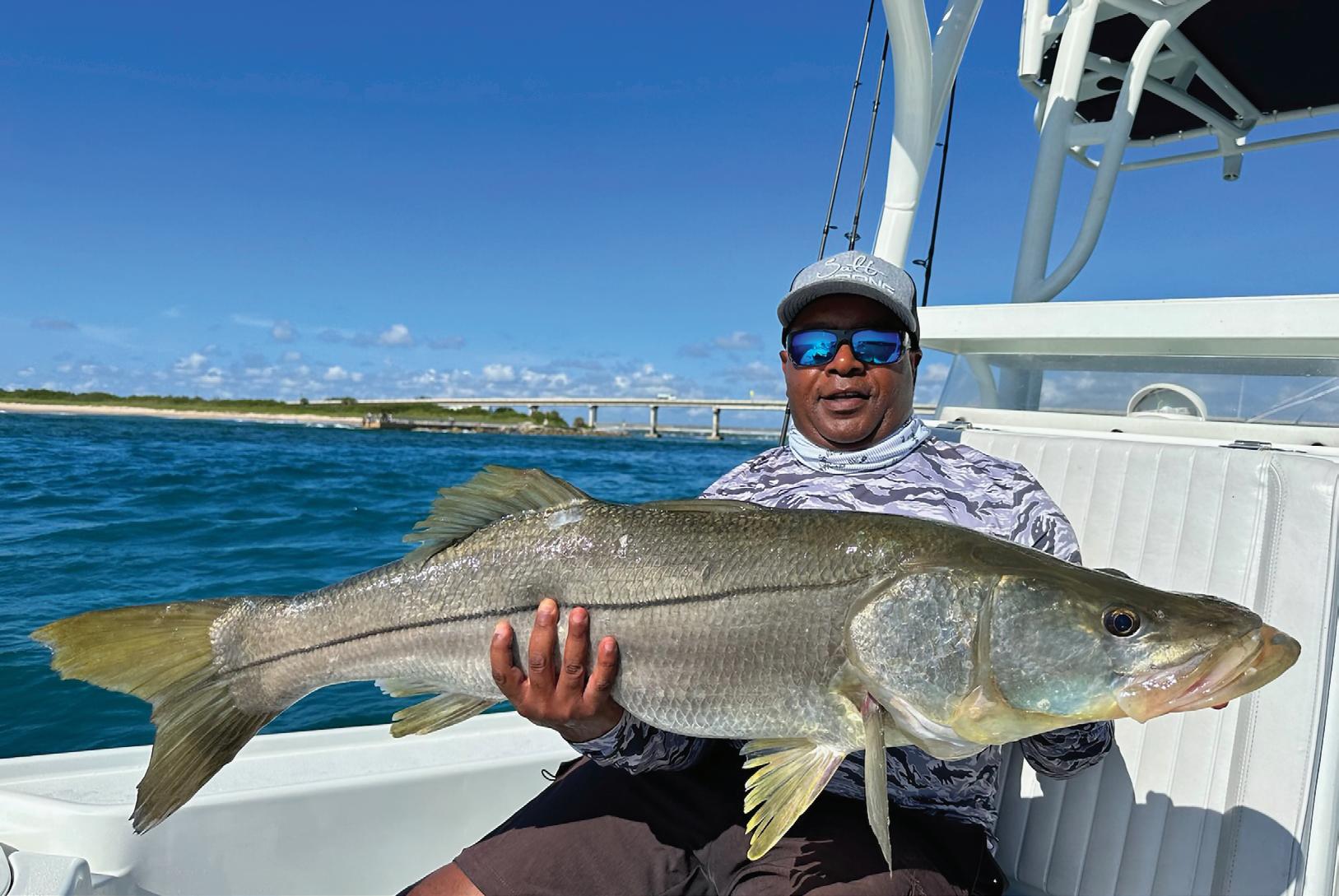
Live bait is the best bet, and snook will eat whatever is available at the time. Live mullet or croakers are White’s preferred baits, and he doesn’t shy away from using bigger 5- to 8-inch baits, which even small snook will hammer.
Anglers who prefer arti cials will nd good action at night at the bridges. White suggested lipped-plugs like the Bomber Windcheater, which has a good mullet-like pro le in the 4 ½-inch size. Another great lure is the locally made so -plastic umper Shrimp. Rig one on a jig head with enough weight to get it down and work it slowly across the bottom.
As for the annual mullet run, when predators hound millions of mullet pushing south to spawning grounds o south Florida, White said he likes the front end of the migration. O St. Lucie County, the shing is best around the second week of September, when mullet begin trickling into the shery. Once the migration is full-blown, there are so many bait sh in the water that it’s hard to get sh to notice your bait.
6 NATIONAL SEPTEMBER 2023 COASTALANGLERMAG.COM • THEANGLERMAG.COM
Contact Capt. Adam White through his website at stlucie ats shing.com, or call (609) 820-6257.
PHOTO CREDIT: WALT LAUREL
1920s Style for a 1920s Price
It was a warm summer afternoon and my wife and I were mingling with the best of them. The occasion was a 1920s-themed party, and everyone was dressed to the nines. Parked on the manse’s circular driveway was a beautiful classic convertible. It was here that I got the idea for our new 1920s Retrograde Watch.
Never ones to miss an opportunity, we carefully steadied our glasses of bubbly and climbed into the car’s long front seat. Among the many opulent features on display was a series of dashboard dials that accentuated the car’s lavish aura. One of those dials inspired our 1920s Retrograde Watch, a genuinely unique timepiece that marries timeless style with modern technology.
With its remarkable retrograde hour and minute indicators, sunburst guilloche face and precision movement, this design is truly one of a kind. What does retrograde mean?
Instead of displaying the hands rotating on an axis like most watches, the hands sweep in a semicircle, then return to their starting point and begin all over again.
Retrograde watches by the big brands can set you back thousands; one recent offering from a big French fashion house is selling for more than $150,000! But because we’ve designed the 1920s Retrograde Watch in-house, we can offer it to you for just $99!


This watch is so wildly popular with our customers that we’re actually concerned about running out; we only have 937 729 left for this ad!
Join more than 1 smart people who love stauer watches

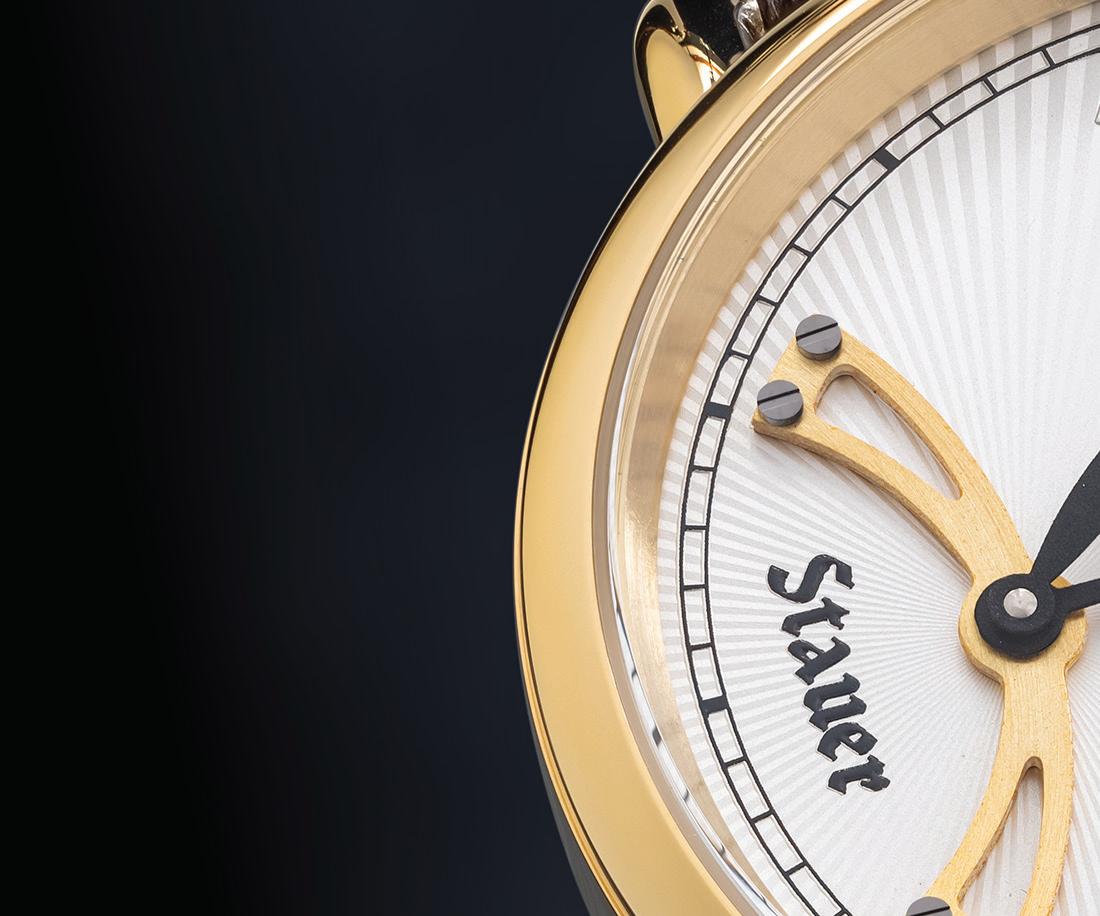

Watch Specifications:
• Precision movement
• Stainless steel case, caseback and crown
• Retrograde hour and minute indicators





• Water-resistant to 5 ATM



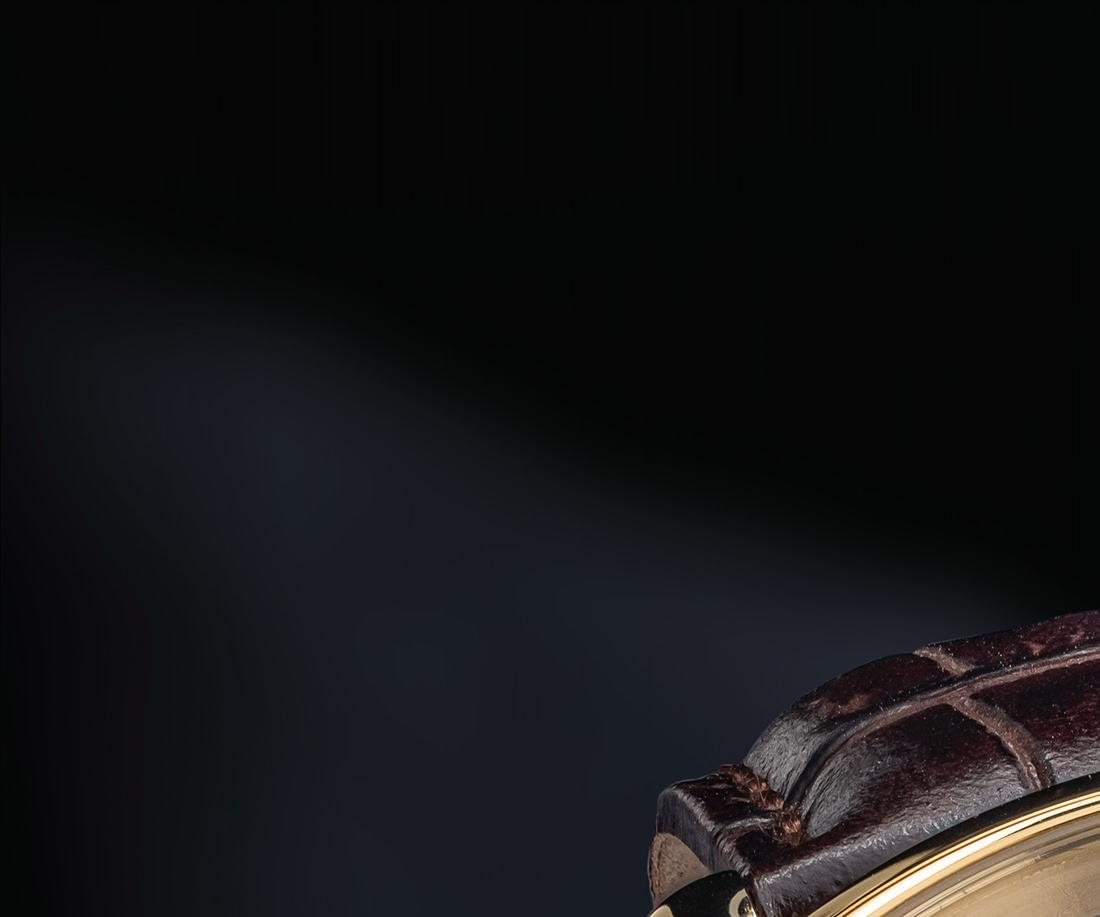
• Brown genuine leather band
• Fits wrists up to 8"
1920s Retrograde Watch
$399 $99* + S&P Save $300
*Special price only for customers using the offer code.
Stauer, 14101 Southcross Drive W., Ste 155, Dept. RGW125-01, Burnsville, MN 55337 www.stauer.com
Insider Offer
AFFORD THE EXTRAORDINARY 99 Impossible PriceONLY
1-800-333-2045 Your
Code: RGW125-01
“An elegant and exciting timepiece that every collector will love.”
— George omas, internationally renowned watch expert
“[A] unique and beautiful timepiece.”
— Carlos C., Los Banos, CA
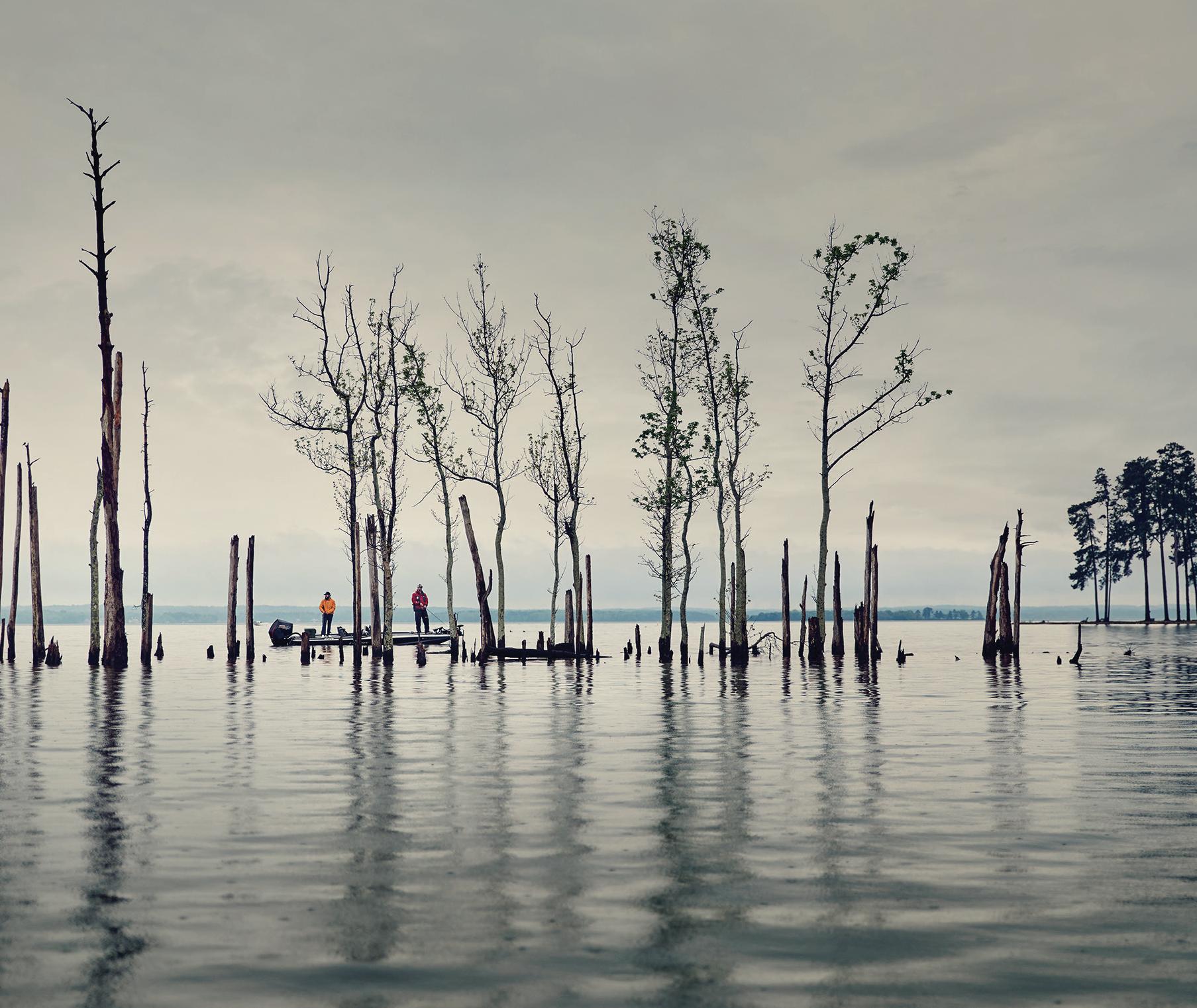
chinook are Running in the Pacific Northwest
By Nick Carter
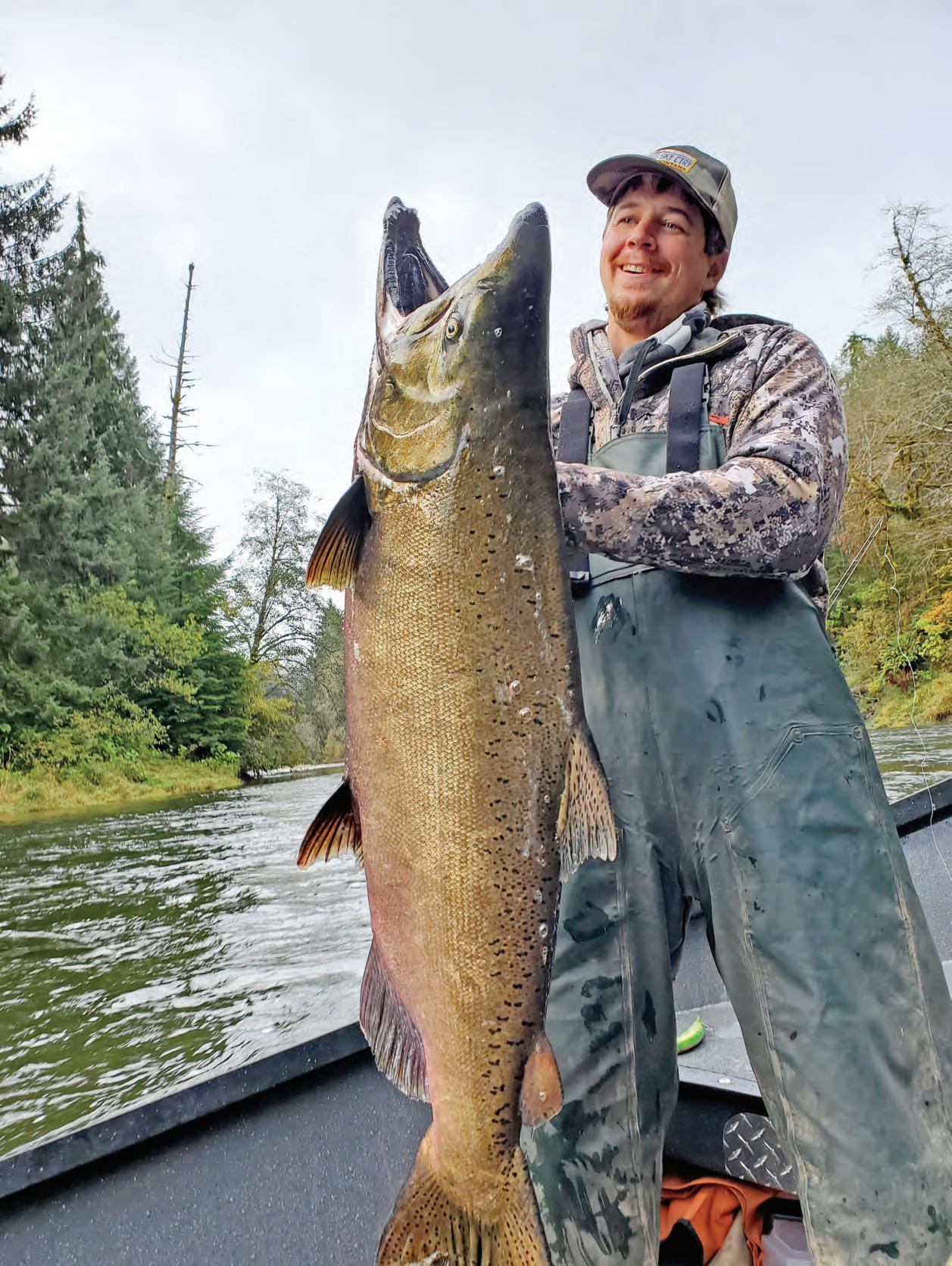
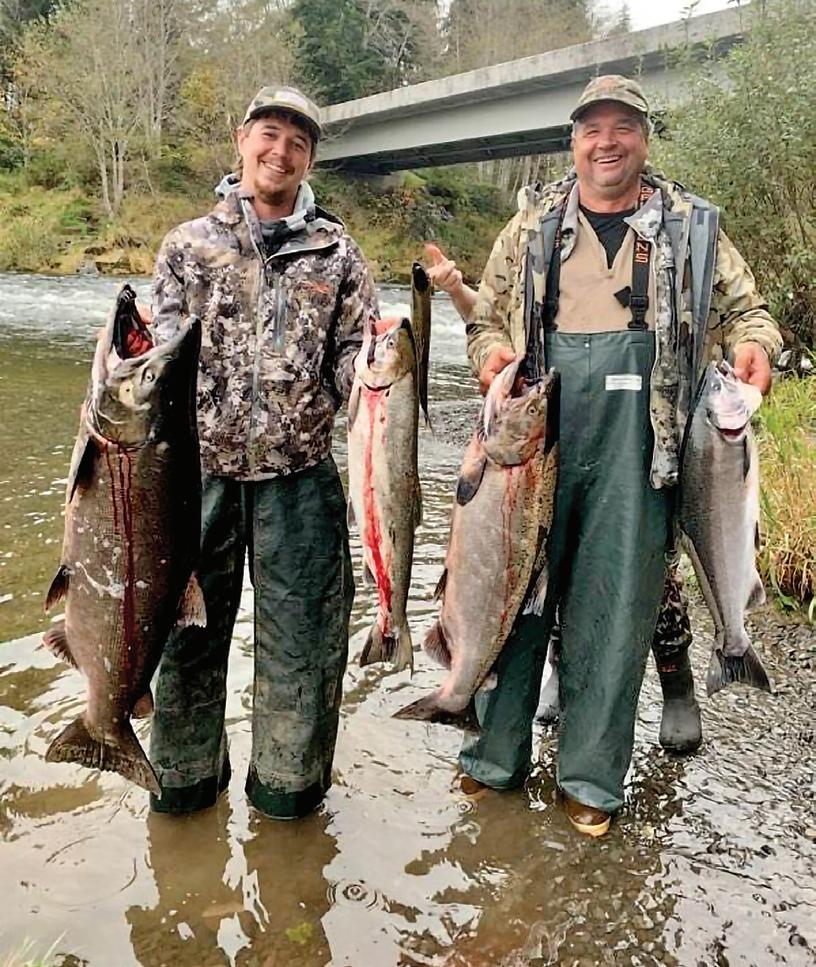
Right now, there’s a migration gearing up in the Paci c Northwest. Chinook salmon are staged to push up out of the cold Paci c and into the inlets and coastal rivers of Washington, Oregon and Northern California. Just like they do in the famed Alaskan runs, big king salmon are making a nal return to the spawning grounds where they hatched to begin the next generation before they die.
With his father, Trevor Pelland, has shed these runs on the Hoh and Sol Duk rivers of Washington’s Olympic Peninsula since he was 8 or 9 years old. His dad was doing it before him. It’s an annual event with a time window that runs from August through December, depending on the particular drainage along this long stretch of coastline. e allure is large, hard ghting sh that are delicious seared, grilled or smoked. It’s a shing tradition that existed since long before Europeans arrived on the continent.
Fall runs are famous in places like the Columbia, the rivers that feed Tillamook Bay and others. Chinook push into the main stems and larger tributaries of many coastal rivers and as far up them as the water will allow. Pelland said backtrolling plugs tempts these big sh in the rivers. He’s caught 20-, 30- and 40-pound kings,
which proves it works.
In Oregon, District Fish Biologist Robert Bradley has watched these runs dwindle in recent years. He said the sheries are still worthwhile and draw anglers from all over, but that size and numbers of sh have been falling since at least 2015, due to ocean and environmental conditions. He said the projections for this fall are well below average.
“ e draw is the size of the sh,” he said. “Historically, you could see 60- and 70-pounders, but you could still reasonably expect to catch a 20or 30-pound sh. An average is probably 10 to 15 pounds.”
e states have been hatching and releasing chinook salmon smolt for decades to coincide with the natural progression of sh moving out to sea. Bradley said chinook spend one to ve years growing up in the Paci c o British Columbia and Alaska. e hatchery sh and wild sh return with similar survival rates, but not many of the stocked sh spawn with the wild group. He said most hatchery sh return to the hatchery.
e stocking does give anglers something else to sh for. Hatchery reared chinook have clipped adipose ns and don’t count toward a wild sh limit in most sheries. e seasons and regulations can be confusing and vary widely
from place to place and year to year, but one wild chinook per person, per day is the norm. Check the regulations before you go or hire a guide who knows.
e runs ramp up when fall rains spur the sh to push upriver into the current, Bradley said. In some places, the coho salmon and chinook runs coincide. Make plans now, because runs on most rivers peak in mid-October.
For up-to-date information on Oregon’s salmon sheries, go to myodfw.com.


8 NATIONAL SEPTEMBER 2023 COASTALANGLERMAG.COM • THEANGLERMAG.COM
CHATTOOGA RIVER
Provided By: Karl Ekberg Chattooga River Fly Shop www.chattoogariverflyshop.com


864-638-2806
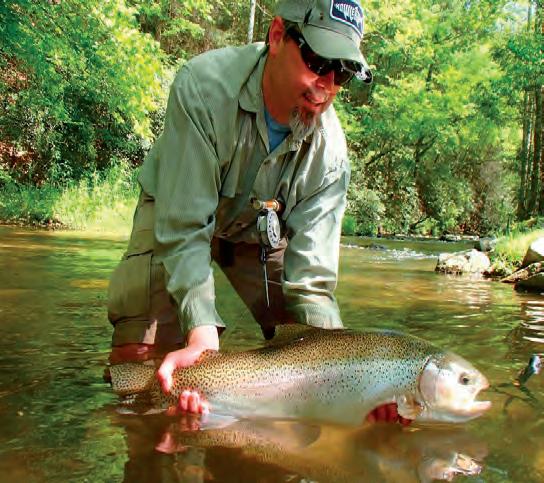
The unofficial end of summer comes with the arrival of Labor Day weekend. The kickoff to college, high school, and professional football seems to create the big excitement of conversation, as every team starts the season with championship dreams. Trout fishing in the lower elevation streams and rivers, are like teams starting fall practice, not quite ready for a game or to be fished until the water temperatures drop. This is the preseason, to Delayed Harvest tune ups for equipment, end of summer vacations, tying flies, and purchases of new equipment, getting ready for the “championship trips” to the rivers during the Fall fishing season.
As the heat of the summer passes by, the streams and rivers start to cool
down and the trout become a bit more active throughout the river, instead of seeking thermal refuge in the depths of the river bottoms. Early mornings tend to be the most opportunistic times to fish, prior to the heat of the day warming the waters, and the fish returning to the depths. Fish can be very wary at times, with gin clear water conditions, low river flows and heights, and minimal hatching bugs, so lengthened leaders and smaller diameter tippet sizes can lead to a great day. Longer casts with drag free drifts will be an essential asset, as well, to these wary and skittish fish.
As we look forward to the cooler temperatures of the fall season, we will start to see the emergence of the first of the “Fall bugs”. The rocks in the rivers are loaded with very small dark nymphs as well. Try swinging the larger emerger imitations or a heavy nymph with a smaller nymph dropper, through the riffle areas of the river and into the heads of the
pools. As daytime temperatures heat up, the fish will move further into the depths of the rivers, so getting a bit deeper with a heavier front fly or a pinch of split shot will help greatly. Baitfish are abundant in the watershed, and the streamer bite will be quite rewarding. Try swinging and retrieving small bait fish patterns in the deeper pockets, back eddies, and off the seam lines throughout the watershed.
While waiting for the fall water temperatures to kick in, the fall bass and panfish season is underway. These eager fish are awaiting meals to drop from the riverside foliage,
NEW MOON
SEPTEMBER 14, 2023
FULL MOON
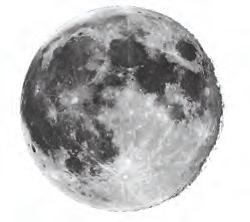
SEPTEMBER 29, 2023


wet wading is still in gear, and there is no better way to cool off from some late summer or early fall heat, than casting some top water terrestrials and poppers to these awaiting fish.
A guided trip, fly tying lesson, or new gear can be a great tune up for the upcoming fall fishing season, all of which can be found through our shop. Let’s all remember while we are enjoying the greater outdoors, let’s “Leave No Trace”, and it does not hurt any of us to bring out a little more than we walked in with, we hope to see everyone out on the water.
LOCAL RIVERS & FLY FISHING SEPTEMBER 2023 ATLANTA 1 COASTALANGLERMAG.COM • THEANGLERMAG.COM
• Fly Fishing Trips • Rentals • Clinics & Classes • Apparel FULL SERVICE OUTFITTER
THE CASTING CORNER
Contributed By: Rene J. Hesse Certified Casting InstructorFederation of Fly Fishers & Atlanta Fly Fishing and Camping Meetup Organizer



The Check Haul
If you are just starting out casting, the essentials of the cast are the most important. Learning to make a good 30-40ft cast is the groundwork. From there, start thinking along the lines of making that cast better. Not further, just better loops, better layouts. When you are looking to improve from there....
In fly casting there is a term called hauling. Simply stated it means to pull on the line. Its purpose is to increase the line speed. Hauling is something that will take a little practice to get the feel of, but there are a few drills to make the learning curve a little easier. Hauling will become a natural movement once you learn it. The cast
will almost feel wrong if you are not doing a haul once you know how.
I’m going to tell you about a little ‘cheater’ haul, known as a check haul. It is a short, crisp pull of the line at the end of the stroke or nearing the end of the fly delivery to the target. When done at the end of the casting stroke, it will seem to send the line off with more energy. It should be done at the stop of the rod, just as the line is launched. When doing it that way it is just a haul, but a really short one, very late in the stroke. Caution, if done too late or too hard it will tangle the line with a tailing loop.
Another way to do a check haul is when the rod has stopped, and
the fly is on its way to the target. It will increase the speed of the fly leg, that will help turn over the loop in the fly line. So, if you make the cast and the fly looks like it will not make it to the target because there is not enough line speed, you can give a swift tug on the line that is in your hand. You will stop the line from shooting out of the rod tip, all the energy (speed) will transfer to
the fly to the target.

This may sound complicated, but it is really just a matter of making a short, sharp tug on the line at either the end of the casting stroke, or when the fly is on the way to the target.
The general statement is, ‘Short cast- short haul, Long cast-long haul.’ This method is a variation of the haul that isn’t talked about


YOUR LOCAL BLUE RIDGE FLY SHOP


LOCAL RIVERS & FLY FISHING 2 ATLANTA SEPTEMBER 2023 WWW.FACEBOOK.COM/THEANGLERMAGAZINEATLANTA/ • Guided Fishing Trips - Trout* Striped Bass* Spotted Bass* • Fly Fishing & Fly Tying Classes • Outdoor Lifestyle Apparel • Fish on Our Private Trout Water • Worldwide Travel • Cabin Rental Available
BAIT & TACKLE “LetUsBaitYourHook” CompletelineofTackle•Rod&ReelRepair•LiveBait 706-970-3780 • 375 N. Main St., Hiawassee, GA 30546 Fax: 706-977-3781 Email: squiggleywormbaitandtackle@gmail.com We Have Blueback Herring We Have Ammo
TROUT AREN’T EVERYWHERE
Contributed by David Hulsey


International Federation of Fly FishersMaster Certified Casting Instructor




http://www.hulseyflyfishing.com
770-639-4001
Trout seek out specific areas in a stream to feed, hide from predators, and to rest. Anglers can really cut down the time it takes to find them by keeping a few things in mind. When I approach a new piece of water, I immediately look for trout visibly feeding on or near the surface but also towards the bottom. Amber lenses in a high-quality pair of glasses are as important as your fly reel. If a feeding fish is spotted, the “locating” part is already done. What if there are no visible signs of fish? How do you find them?
Reading the water is an art in itself as much as learning to fly cast well. Feeding trout aren’t everywhere in a stream but in sometimes very tiny spots in a trouty looking area. I usually tell beginning fly fishers to fish where they can’t see the bottom of the river clearly. This could be due to water depth or riffles that give the trout protection from predators. Fishing the green colored water also accomplishes basically the same thing. This is a very broad way of looking for fish because locating that spot within the spot is what separates the folks that catch fish occasionally with the
ones that catch fish consistently. Bubble lines are also good places to look for feeding fish. “Foam is home” is a saying you will hear a lot from guides trying to coax a good drift or give your client a target to toss a fly at. Bubble lines on the surface of the water is just oxygen trapped in the surface tension but is also where ninety percent of what a trout eats on a given day will be found. Seams where fast water meets slower water is also a good spot to drift a fly. Trout will hold along these areas and slip in and out of the current to retrieve food items. Much like deer or rabbits, trout are creatures of edge. Edge of current, edges of rock to sand, even the drip edge of streamside vegetation can concentrate numbers of fish. Spots with combinations of more than one of these can be that target area that holds numbers or larger than normal fish. Actively feeding trout will hold in these areas but will spook to the nearest deep water, log, ledge rock or undercut bank at the first sign of danger. Approach these areas carefully with a well-executed cast and you might be rewarded with a sweet hook up.
LOCAL RIVERS & FLY FISHING SEPTEMBER 2023 ATLANTA 3 COASTALANGLERMAG.COM • THEANGLERMAG.COM A great place to stay when visiting the North Georgia Mountains Convenient to Lake Nottely, Brasstown Bald Mountain and Vogel State Park Best Western Milton Inn 201 Highway 515 West, Blairsville, GA 30512 Toll Free Central Reservations (800) 780-7234 Hotel Direct Number 706-745-6995 Clean comfortable rooms Complimentary breakfast buffet Free WiFi and Cable TV Microwave and refrigerator in every room Business Center
CHATTAHOOCHEE RIVER
Contributed By: Chris Scalley River Through Atlanta Guide Service

Fly Fishing Film Tour Plays LaGrange on Oct. 1

Land-based-bugs!!! Otherwise known as terrestrial insects which have a life cycle that occurs exclusively on dry land. The good news is that there is a 35-mile stretch of the Chattahoochee River from Buford Dam to Roswell Road bridge which equates to roughly 70 miles of shoreline where these terrestrial bugs can potentially wind up in the river making for some great trout food. Ants, beetles, crickets, grasshoppers, caterpillars, inchworms, lightning bugs, bees, and much more are on this summer trout menu. Nymph anglers notice more and more fish checking out their strike indicators and sometimes actually trying to eat them mistaking your bobber for a land bug. Also remember that most
terrestrial insects initially float but then drowned and sink offering another subsurface food source. Dust off those big attractor flies and terrestrial fly patterns who knows you might be pleasantly surprised!
Pure Life House of Music and FlyFishGA are happy to present the regional premiere of the 17th annual FLY FISHING FILM TOUR (F3T). This spectacular collection of award-winning shorts is presented by Costa, YETI and Simms and features locations from Cuba to Patagonia, Mexico to Australia, Alaska, Wyoming, the South, Massachusetts and beyond. Anglers and non-anglers alike will find plenty to enjoy in these tales of adventure, comedy, friendship and family.
But this isn’t just a film, it’s an experience—and one you won’t want to miss. Outside, we’ll have live music, great food, unique and contemporary brews from Beacon Brewery, flycasting and fly tying demos, artist exhibitions, plus several local and regional fishing guides who fly fish our local waters.
A “kid’s area” will be available, so bring the family. It could even be the place where the youngsters might find a healthy new interest outside of video games!
All profits from the event will be donated to the Chattahoochee Riverkeeper and the Flint River-
keeper. Their representatives will be here so you can learn about the work they do or consider ways that you can help keep our rivers alive and healthy.
The F3T is the original and largest fly fishing film event of its kind. Many door prizes will be awarded, including Costa sunglasses, some cool YETI accessories, a Simms Dry Creek Gear Pouch, and much more. There will also be a raffle for a number of prizes including several guided fishing trips. One raffle ticket will be included with paid admission, and additional tickets will be on sale at the event.



The tour is also supported by Scientific Anglers, Dale’s by Oskar Blues Brewery, Rarewaters, Sage, Outside, Fly Lords, Puffin Drinkwear, Blue Line Co., Angling Destinations, Iceland Fishing Guide, Drift West, Any Creek, Letmrun Drift Boats and Roam.
Come enjoy the film, fellowship, music and food. Doors open at 12 noon, and the films start at 2:30. Please contact FlyFishGA or Pure Life House of Music for all communication concerning this event.
LOCAL RIVERS & FLY FISHING 4 ATLANTA SEPTEMBER 2023 WWW.FACEBOOK.COM/THEANGLERMAGAZINEATLANTA/
Fishing Guide Service Hawk’s ON BEAUTIFUL LAKE EUFAULA BASS -BREAM CRAPPIE-CATFISH CAPTAIN SAM WILLIAMS 334-355-5057 HAWK184@EARTHLINK.NET, WWW.HAWKSFISHING.COM

1-770-725-7772 www.striplings.com Ingredients: Directions: 4501 Monroe Hwy, Watkinsville, GA 30677 We have ethanol-free gas for boats! Certified Angus Steaks
OUT YONDER
By Jeff Durniak Unicoi Outfitters
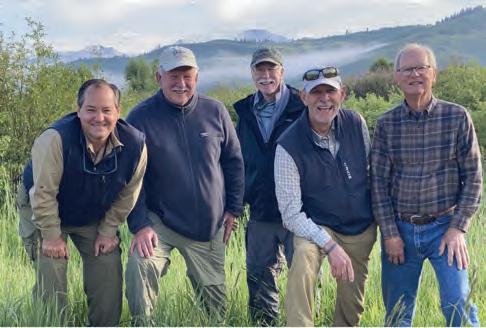
“Out Yonder.” That’s a magical term used by Rabunites to describe our summer flyfishing excursions to the Rockies. Our own quartet recently returned from WY/MT, where we were blessed to hit the Salmonfly hatch on the Madison. Have you been out yonder yet? Is it still on your bucket list? While my trip is still a fresh memory, I’ll offer five tips to help you make your own “out yonder” dream a reality. Here we go.
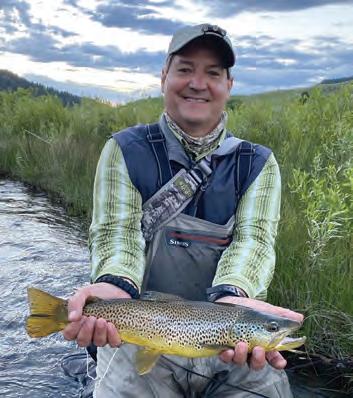
Tip 1: draft your team. Fishing trips are much more fun and affordable with friends, so pick a good travel team of 1-3 extra buddies. In 2007 we formed our own Yellowstone quartet, folks with similar interests. While we buy our own plane tickets and fishing licenses, all other trip expenses (food, lodging, SUV rental) are tossed into one pot and we split that trip total four ways when we return home.
Tip 2: agree on expectations. Make sure everyone’s on the same page regarding food, lodging, and fishing experiences. Will you be cooking camp suppers or dining in town? Are you tent camping, sleeping in rustic cabins, or being pampered in a highend resort? Will you fish till you drop or take time to enjoy local attractions like scenery, wildlife, and historic sites? Do you desire a lot of smaller, easier fish or just a few chances at educated trophy trout? Consistency in the members’ trip expectations will enhance team harmony.
Tip 3: determine your destination. Based on your team’s budget and trip expectations, start searching for your best destinations. There are
plenty to choose from across the Rockies, Canada, the Pacific Northwest, and even Alaska. Talk with other friends who’ve traveled, google the web for fish stories and fly shop reports, and read some of the flyfishing guidebooks for each western state. This is half the fun, and you can start this fall!
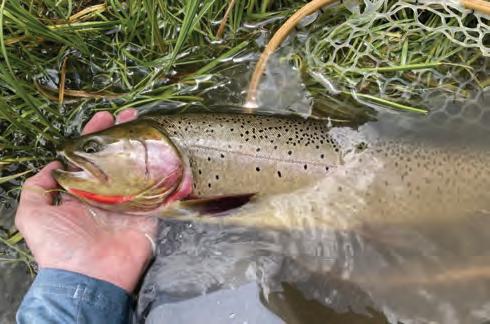
Tip 4: do your homework. Once you have an idea of your destination, start mapping out your trip. Which waters are targeted? Where’s the best lodging along your route? What’s the best time of the year to go? What are the best hatches and fly selections? This is really fun homework when you’re stuck around the house.
Tip 5: shop around. For most lodging, booking early will give you the best selections. Lock in your campsites and cabins ASAP with a deposit and know the cancellation policies beforehand. For flights and car rentals, shop around. We like travel advice from clarkhoward.com and trip shopping options on the Kayak app. This year we saved about $2K on plane tickets and SUV rental by
a) flying into Salt Lake City instead of Bozeman and
b) by rebooking the car rental three times as prices dropped through spring.
These five tips have helped our foursome to enjoy 17 years of summer fun while not breaking our bank accounts. I hope a few of these suggestions will help you to migrate “out yonder,” as well. Go soon and knock that western trip off your bucket list. Shoot, you might just make it an annual priority, too!
LOCAL RIVERS & FLY FISHING 6 ATLANTA SEPTEMBER 2023 WWW.FACEBOOK.COM/THEANGLERMAGAZINEATLANTA/
DAYBREAK ON ALLATOONA
Contributed By: Tim Dangar
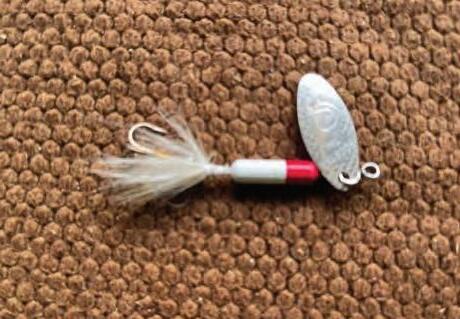
Wow, is it hot or what? With that being said, there is some good, cool fishing to be enjoyed around sunrise on the Toona. We camped for a week at Sweetwater Creek Campground on the North end of Lake Allatoona right before school started and found the early morning bite to be fun. Out from the mouth of Sweetwater Creek, you will find what I refer to as humps and most of them are marked with white poles. The fish will feed on bait fish around these humps early in the morning before it gets hot, and they go deep. What we found to work best was trolling a red and white Rooster Tail (1/6oz) around these humps. The catch was primarily hybrids with an occasional spotted bass. If you are
LOCAL LAKES AND FORECAST


LANIER STRIPERS
really lucky, the fish will bust the top of the water in a feeding frenzy. When that happens, cast into the action, and hold on, it could get big and wild! My grandson, Tyler and I found these two-hour early morning trips to be big fun. The rest of the day you need to be neck deep in the lake or up in the air conditioning. Till next time, stay calm and fish on.
Forecast
by:
Capt. Clay Cunningham www.catchingnotfishing.com
770-630-2673
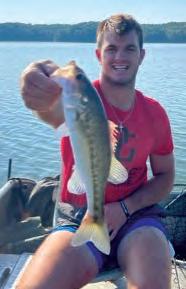
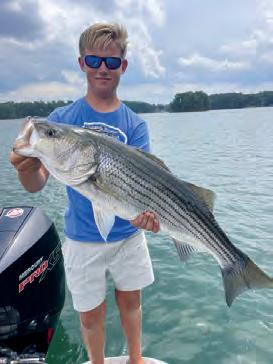
After a hot August, it is almost time for some Fall, here on the Lanier. The water is clear, the lake is down, and the water temperature is still in the low eighties. As long as the weather stays hot, look for the stripers to stay deep on the south end of the lake feeding on herring. Deep this year, is not deep as normal. Most of the fish are 30-40 feet deep. We are catching almost no fish past 50 feet. The fish are pinched in the water column so release the fish as fast as possible to reduce mortality.
The last few weeks lead core has been the best tactic as the fish are pinched at the 30–40-foot range. Lead core is a weighted line you pull behind the boat. It is color coded to help you dictate your depth. On the end of the lead core line, tie a thirty-to-fifty-foot piece of 20-pound Trilene 100% flourocarbon tipped with a white Berkley Fusion bucktail, or a Capt. Mack white chipmunk jig. You need a wide selection of these bucktails from 1 to 2 oz. Some days they will key in on a particular jig or color. White and chartreuse will be the primary colors in the bucktails. Tip the bucktail with a 4” chartreuse Capt. Mack Shad Body as a starting point. Every bait store around the lake has these bucktails and shad bodies. Be sure to purchase several colors of the shad bodies as well. Some days a certain color will outperform other colors due to numerous factors like cloud cover. The Capt. Mack Shad bodies are fairly cheap, so purchase several colors to be prepared for changing weather conditions.
If lead core is not an option for you, stay with the downline. With the right electronics like the Humminbird Solix Series you can see the fish feeding through the schools of bait and biting your herring on the hook. To catch these fish deep you need a Carolina type rig using a
Capt. Mack Swivel Sinker, a six-foot piece of Trilene 100% flourocarbon leader material and a 1/0 Gamakatsu Octopus straight eye hook. The key rod being the medium light Shakespeare Ugly Stick striper edition paired with a Penn Fathom 15 Linecounter reel. When you are all set up, hook the herring right up between the nostrils and drop them right above the schools of stripers on your electronics. You can see the Capt. Mack swivel sinker and the bait swimming around on the hook. You can even, many times, see the fish come up from the bottom and call the strike before it happens. Rely on your electronics for success right now. If you do not see fish on your unit, do not stop the boat to fish.
Lastly, in late September the weather will begin to cool off. Be sure to have several topwater rods loaded with topwater baits and swimbaits for any early topwater. Baits like a Berkley Canewalker and Berkley J-Walker and the Berkley Magic Swimmer are essentials. Day in and day out, the Berkley Magic Swimmer is the most consistent performer. We really expect the topwater to take off early this year. A great casting reel like the Abu Garcia Revo makes the difference. With the large number of fishermen on Lanier a little extra distance makes a difference. See you on the water.
SEPTEMBER 2023 ATLANTA 7 COASTALANGLERMAG.COM • THEANGLERMAG.COM
A Fa mily Oriented Fishing Club Proud Sponsors Of Fall Children’s Fishing Classic Military Heero’s Fishing Tournament www.northgeorgiacrappieanglers.com Fishing Tournaments Social Activities Good Fellowship Check Out Our Web Site Below For More Information
LAKE ALLATOONA
and live to tell you the tale of what my friends are thinking and doing.
By: Joseph Martinelli 404-919-4918

Greetings, fellow anglers! There are still plenty of summer-like days to enjoy through the next month or so. Here in North Georgia, we are going to feel a little cool down coming into September, but we are still going to be concentrating on what has been working through August on lovely Lake Allatoona. This summer has shown a few consistencies on the reservoir. Water levels have maintained right at 840 feet full pool. Water temps have stayed in the low to mid 80-degree mark. There are days when the fish bite when it is your day to fish, and then there are days when lockjaw appears to prevail.
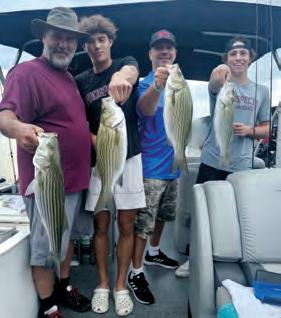
In this month’s forecast we will concentrate on the “Linesides”Striped Bass, Hybrid Striped Bass and White Bass. Just like the other species in the Etowah River and Reservoir, the recently established forage base addition of herring has slightly altered the established patterns and behaviors that were previously much easier to predict. This is both for the angler and likely even the fish themselves as the herring move differently. They do not tend to relate to the same structure patterns that the threadfin shad do. As the herring have become quite an established and proliferate food source, getting to know how and why they move around could be a key to finding your target species. Oh, to be a little herring for a week
As we’re starting to see better schooling of fish again after some dog days of summer, select patterns are still going to be the most effective overall. We are starting to find some good schools piling up along the channel bends, especially where the structure and channels meet. Marinas and long points are about the only set of obvious structures here in Allatoona. The clear cutting of the lands prior to flooding makes this reservoir somewhat unique compared to our other reservoirs where underwater forests still exist. Overlooked structures that do not have an above-water face include roadbeds, ditches, and humps. Locating and concentrating on all the above-mentioned structure sets will better keep you in the right zones. There is a lot of water out there. Some are just for passing through and some are ideal for schooling and feeding.
Down-lining is a tried-and-true proven fish buster. This is where one may have a 3/8-2-ounce weight attached to the main-line (egg sinkers and other trolling sinkers with swivels are the way to go here) with a 4–6-foot leader of 8-12# test fluorocarbon and a size 2- 2/0 octopus or mosquito hook tied on the end. Most ideal hook sizes are directly related to the size of your bait. When using a smaller 3” threadfin, a size 2 hook is ideal. If your bait that day is a 5-6” herring, gizzard shad or larger, a size 1-1/0 hook may be more appropriate.
For the most part, target depths have been between 15 to 20 feet down when slow trolling at around .5 mph. These delicate baits just
don’t last very long at depths below this during this time of year. This is mainly attributed to lower dissolved oxygen at deeper depths. As the herring don’t tend to get pushed up when being chased by game fish, and rather tend to dive down, there are times when your target depths for active fish may be 25 to 30 feet down and deeper at times. When fishing at depths such as this, it is highly recommended that you check your bait every few minutes. Not much is less effective than dragging dead bait through a school of active fish.
Keeping a “free line” live bait or two out with 8–10-pound test and possibly adding a small BB to a size 7 split shot in the mix is almost a must on most days. You might see the school hanging out 20 feet down, but the active fish are only coming up to feed on top or just subsurface. When trolling, toggling your speed a little bit up or down might tell you exactly what the fish want and where they want it at. These same freeline rigged rods will often produce when pitching bait across a point as well. To this end, another notable application of working a free line bait is slow trolling or pitching/casting these up in the flats or onto long points both in the a.m. and early p.m. hours into dark.
Sometimes live bait is just not your jam. It is not always easy to procure fresh and frisky live bait. That’s ok. There are several artificial techniques that can work well such as trolling and casting Alabama rigs (we love Captain Mack’s Minis and Picasso bladed a-rigs) and larger umbrella rigs, as well as diving jerk baits and crankbaits. Depending on your electric motor thrust and top mph, you might even be able to troll these in stealth mode without the outboard running. The fact is, there are times when scouting, that
these are the best baits and tools for the job. There are also certain times where (and for a multitude of reasons) that the artificial bite is the key to getting fish in the boat on any given day. Spooning with 3”-6” spoons have their own techniques as previously reported on, in other issues. Channel edges, point breaks and boat transoms have been the target locations for these techniques.
We have been hammering the spotted bass. Through this summer, it has been predominantly on live bait while working on keeping up with the linesides. However, there have not been many trips out, where we have not caught one or three or even smashed 10-20+ spotted bass on a small topwater such as a Zara puppy, Shower Blow .77, or a few other specialty lures that we keep on hand and ready to throw. This bite has also morphed, and we are doing best on the spotted bass bite when they are pushing threadfin toward the top during the heat of the day. No doubt creature baits will get the job done, as well as, we have had several spitting up crayfish when boated.
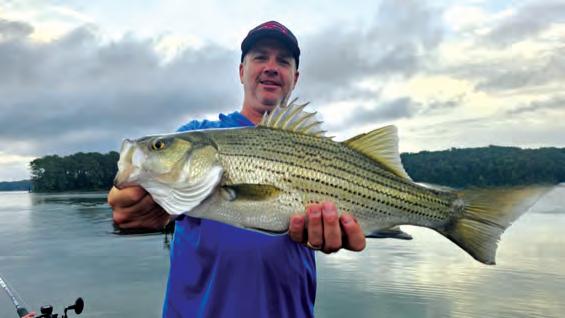
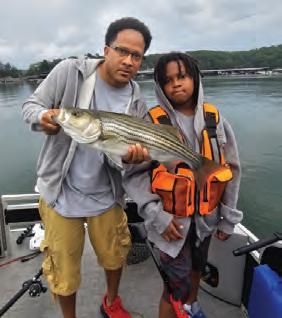
Now, let’s go fishing! We do hope that some information gleaned here will help you get on to the bite. If you are considering a full-service fishing adventure with as much instruction as we can provide during our time together, we would sure love to have you aboard our boats. Please do not hesitate to call or message us at 404-919-4918 or email us: heronoutdooradventures@gmail. com, any time. From first-time to advanced anglers, from kids to corporate trips, we truly feel we have something to offer everybody. Most of all, we love making new friends. God bless you and tight lines, friends!
8 ATLANTA SEPTEMBER 2023 WWW.FACEBOOK.COM/THEANGLERMAGAZINEATLANTA/ LOCAL LAKES AND FORECAST
A REMINDER THAT FALL IS AROUND THE CORNER
Dr. Andrew Cox
September is a transition month for the angling year. The first of the month continues to be hot with warm water temperatures making some days outdoors uncomfortable. However, observant anglers will feel tinges of Fall during the early morning hours. For the later days during this month, anglers will definitely feel the first days of Fall reminding us that Fall angling will be in full swing in October and November. September and the other Fall months are my favorite time of the angling season.
Anglers on the water during this month, may find fish schooling on area lakes and waterways. Anglers may catch schooling bass, hybrids, and possibly stripers. Unfortunately, this fishing activity is over just as quickly as it begins with the fish moving elsewhere or going into deeper water. Crappie and catfish may be found fishing during evening hours.
As September proceeds, anglers can find cooler water temperatures, hopefully making fish more active and in shallower water. Anglers can explore streams and rivers entering reservoirs. With their cooler, shaded, and flowing waters, fish may be easier to locate and catch.
September is a good month to explore Georgia’s trout waters. The Chattahoochee River from Lake Lanier’s Buford Dam into Atlanta’s northern suburbs offers good bank, wading, and boat access, particularly within the Chattahoochee River National Recreation areas. Some stretches of the river also offer angling opportunities for shoal bass and stripers. Checking the national recreation area website will show you various access points. Streams and rivers in Georgia’s extreme northern counties can provide excellent trout fishing throughout this month. Make sure to consult the Georgia fishing regulations to determine special regulations regarding certain streams in the north Georgia trout fishing area. Information available through the Georgia Department of Natural Resources will provide information on the trout stocking schedule for area waterways.
LAKE SEMINOLE
Forecast By: Jeff Hamm Lake Seminole Guide | 770-912-7936
As we head into the late summer months the bass fishing conditions on Lake Seminole are shaping up to be quite exciting. With water temperatures hovering in the mid-80s during August, anglers are finding the best bites early in the morning and late in the evening. During this period, bass are honing in on baitfish, making it a golden rule: locate the bait, and you’ll find the bass.
indicated by bird activity and even bass pushing bait fish out of the water, igniting feeding frenzies. Be prepared for these moments with lures like Zara Spooks, Ima Sticks, or Gunfish.
An added bonus of September fishing is that area waters are not as crowded and have less boating activity. School is in full swing by the time this month rolls around, particularly after the Labor Day holiday. Hunting and keeping up with college football takes other outdoor enthusiasts off the water. Accordingly, there is typically less boat traffic with quieter and more tranquil water conditions. Though continuing to be hot and muggy at times, September reminds us that Fall is just around the corner. Good fishing can be found over the course of this month for the angler willing to be outdoors and able to adapt one’s angling methods to the gradually changing water and weather conditions. Good angling and be safe.
Dr. Andrew Cox is a contributing writer to outdoor publications and newspapers. His writing interests specialize in angling and travel, human interest, and general fishing technique oriented topics. He is a member of the Georgia Outdoor Writer’s Association. He has been fishing the waters of Georgia, Alabama, and north Florida for over forty years. He has also fished the waters of most states within the United States, Canada, United Kingdom, New Zealand, Australia, and several Caribbean islands. He enjoys fresh and saltwater fishing for bass, bream, crappie, trout, redfish, and speckled trout using fly, baitcasting, and spinning equipment. Dr. Cox financially supports his fishing habits as Professor Emeritus at Troy University, Phenix City, Alabama. He may be contacted at andrewtrout@aol.com.

Employing side imaging and down imaging technology proves indispensable in locating bait schools along the creek channels. For a successful catch, concentrate your efforts on points and bowls where bass are likely to ambush their prey. As the sun rises higher, baitfish tend to dive deeper, leading you to focus on humps near the channels. On cloudy days, the baitfish often remain closer to the upper water column near the grass lines.
Effective bait choices in August include hollow belly frogs, white buzz baits, deep-diving crankbaits such as the Strike King XD 5 and 6, the Spro deep-diving crankbait, and, of course, the reliable chatterbait. Incorporating Garmin LiveScope technology proves invaluable, especially when working with crankbaits and chatterbaits.
August weather has been scorching, with air temperatures soaring into the upper 90s and heat indexes exceeding 110 degrees. Relief from this heat is eagerly anticipated as we transition into September. The good news is that the bass will likely maintain their focus on baitfish as the pattern from August extends into September. However, a key difference is that this successful pattern will be effective throughout the day.
September holds promises of more exciting fishing experiences. Expect increased schooling activity,
In closing, remember that success on Lake Seminole is all about understanding the baitfish patterns, utilizing effective imaging technology, and adapting to weather conditions. Whether you’re a seasoned angler or a novice, these insights should enhance your chances of a rewarding fishing trip.
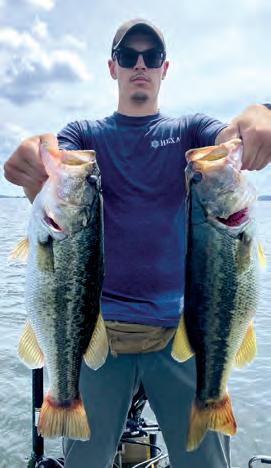
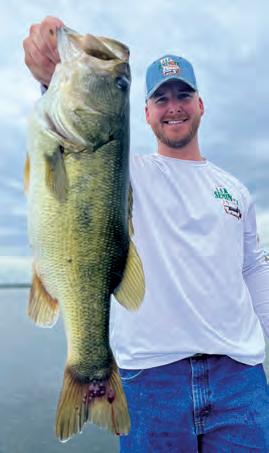
The picture is from a recent morning trip with my Nephew, Marine SSG Grayson Anthony holding a couple of 4 pounders caught on the Jackhammer Chatterbait. When you’re eager to explore the angling opportunities on the beautiful Lake Seminole, please get in touch with me to book your next bass fishing adventure. As always, “May All of Your Lines Be Tight.”
SEPTEMBER 2023 ATLANTA 9 COASTALANGLERMAG.COM • THEANGLERMAG.COM LOCAL LAKES AND FORECAST
WE NOW HAVE SPONSORSHIP AVAILABLE FOR OUR WALL OF FRAME PAGE! CONTACT: CRAIG@THEANGLERMAGAZINE.COM
Provided By: Capt David B Hare

 Alex City Guide Service | 256-401-3089

2036 Cherokee Rd., Suite 205
| Alexander City, Al. 35010 davidbhare@yahoo.com | www.alexcityguideservice.com
Fbook/alexcityguideservice/LakeMartin


August with extreme heat and water temperatures has been pretty slow bookings for us although the trips we did run have been successful by pulling downriggers.
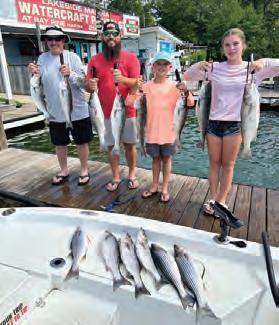
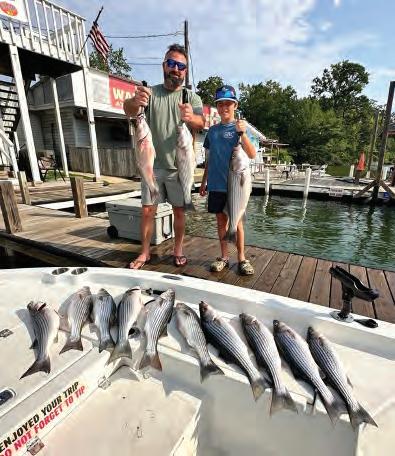
September will probably start out a little challenging unless you’re trolling. I’m hopeful that this September will be like the last two and have the stripers starting to bust on top. If the top water action occurs as in the past, you should be able to have a lot of fun with light spinning rods rigged with most any type of top water plug. Plan on doing a lot of running and gunning as the stripers will go down and come back up just out of casting distance, so you will chase the schools a lot.
Another lure that comes in handy is made by Live Target and looks like a small “ A” rig, I think it’s called Bait Ball. We have had a lot of successful trips by casting this particular lure as well.
Later toward end of September, I think the live bait fishing will pick up again, so September can be a challenge to know what bait to use, but if you try a variety of these techniques you should have some fun times .
Until next time catch one for me!
Tight Lines
10 ATLANTA SEPTEMBER 2023 WWW.FACEBOOK.COM/THEANGLERMAGAZINEATLANTA/ LOCAL LAKES AND FORECAST EVERYTHING YOU VALUE www.kubota.com Kubota Tractor Corporation 2017 Kommander-Pro Series A Clean Cut For Every Budget. Kommander-Pro Series A Clean Cut For Every Budget. © Kubota Tractor Corporation, 2018 KubotaUSA.com Optional equipment may be shown.
LAKE MARTIN
Forecast By: Eric Crowley Lake & Stream Guide Service (706) 669-4973 lakeandstreamguideservice@gmail.com


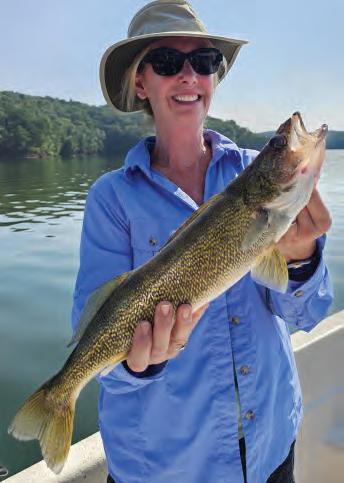
September can be a hot sticky mess, but this lake has an amazing cold-water river that feeds it. The Toccoa river feeds Blue Ridge Lake and this is a great place to be this month. Fishing from point 5 up to Tilley bend will hold a variety of fish this month, but the one we concentrate on is the walleye. The fish should be along the river channel bends holding in around 60ft of water on the bottom. The type of bottom will vary but typically rocky bottom is what you’re looking for. We like to fish this fish with spoons, jigs, and live worms. It’s a pretty easy system. Find the fish, give them your bait of lure. If they don’t react to it, then go and find the next fish. Covering water till you find active fish is key right now vs trying to get a fish to bite. The
BLUE RIDGE
more ground you cover the more fish you will catch. On cloudy days look shallower and post front blue bird sky days the fish will always be
deep on this clear mountain lake. The bass bite has picked up a lot with plenty of nice size spotted bass coming to the boat. We have been trolling and casting the Cast Prodigy 4.1 for walleye and spots in white as well as the purple color options. Rigging these with a 1/4 or 3/8 jig head will keep them just off the bottom, while trolling. Slow rolling them over points or humps just off or tapping bottom has been a big producer.
REEL TIME REEL FUN to land
Welcome Gai s e’s Lake Lanier!
Lake Lanier is 38,000 acres of prime fishing and home to some of the best spotted bass and striped bass in the world. There are dozens of hotels within minutes of the lake, professional fishing guides to increase your odds of catching the “big ones” and plenty of action in Gainesville, Georgia to keep the family entertained! Check us out at ExploreGainesville.org to find out more.
SEPTEMBER 2023 ATLANTA 11 COASTALANGLERMAG.COM • THEANGLERMAG.COM LOCAL LAKES AND FORECAST
Temp 83 Clarity 10ft
Level - 3 ft from full (draw down will start soon)
WE NOW HAVE SPONSORSHIP AVAILABLE FOR OUR WALL OF FRAME PAGE! CONTACT: CRAIG@THEANGLERMAGAZINE.COM















Window Tinting • Spray in Bedliners • Car Audio & 877-322-4734 220. W. MAY WINDER, WWW.WILDWILLIESACCESSORIES.COM Customizations from











Electronics • Wheels & Tires and SO much more! 877-322-4734 MAY STREET, GA 30680 WWW.WILDWILLIESACCESSORIES.COM from Mild to WILD
OCONEE ON THE FLY-





 Contributed By Capt. Wayne Moore - USCG
Humbling Lessons from Yoda
For those of you who don’t know, Yoda (the Jedi Master in Star Wars) is a name many of us guides like to call Doug Nelms.



Doug has been guiding here on Lake Oconee for more that 20 years. He was kind enough recently to come out on my boat and give me lessons on my newly acquired Humminbird Solix 12, as my goal is to become better at fishing submerged structure for crappie.
Doug made it look so easy as we approached some submerged structure which he knew the location of. He used the side scan to find the structure, created a waypoint, and
then we circled back for a better look on down scan.

I went out the next day to the waypoint, I saw the structure, and I threw out a buoy marker just as it first appeared on the screen. I circled back and I would swear to you that while I was circling back someone moved that structure!
Two points here: 1) experience matters, and 2) Doug’s willingness to help other guides (and the guide community) is remarkable. The name of Doug’s guide service is “Big Fish Heads,” and every year since 2015 Doug has held the Big Fish Heads Derby. For those of you not

familiar with this annual event, it is a tournament where the biggest Striped Bass, Hybrid Bass and Crappie caught each week wins a prize.
There’s also a wonderful charitable twist. This year the Derby raised $8,000 for Saint Jude’s Children’s Hospital. So, look Doug up at https://bigfishheads. com/ book a trip with him, and know that he’s helped many of us Padawans (apprentice Jedi) here in the guide community serve our customers better!

14 ATLANTA SEPTEMBER 2023 WWW.FACEBOOK.COM/THEANGLERMAGAZINEATLANTA/ LOCAL LAKES AND FORECAST THEOUTDOORDEPOT.NET 250 JOHN MORROW PKWY GAINSVILLE,GA 30501 M-F 9-7/SAT 9-6/ SUN 1-5 WE HAVE A FULL LINE AND ARCHERY SHOP WITH FULL TIME ARCHERY TECHNICIANS ON STAFF Yeti Coolers and ClothingH Costa Sunglasses and Clothing Full Line of Fishing Tackle We Carry EVERY Great Brand! 770-539-9356 Guided Fly Fishing and Conventional Tackle Trips for Hybrids, Stripers, and Crappie Booking now, novice or experienced anglers. On the water instruction, top of the line fly gear! Mix it up with light spinning tackle as well for a great combo trip! Captain Wayne Moore - Oconee On The Fly, Inc 404-317-9556 www.oconeeonthefly.com / wmoore1700@outlook.com
Licensed www.oconeeonthefly.com
Small Hooks for Big Fish
By Capt. Cefus McRae | Nuts & Bolts Fishing Series Hartwell, GA


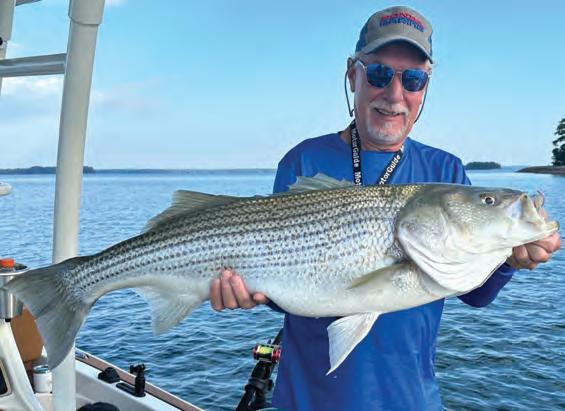
throat and lodges on either their jaw hinge or their lip. Basically, the fish hooks itself. All you need to do is lift up on the rod and start reeling. Performing a ‘swing-for-the-outfield’ hookset will only pull the bait out of the fish’s mouth. Simply keep a reasonable bend in the rod and let the hook do the work. And yep, this style of hook works with plugs and artificial baits too. I’ve replaced the treble hooks on my topwater plugs with 2/0 circles, and they work great. If you’re fishing soft plastics like flukes and worms, try nose-hooking the bait with a circle hook.
There’s an axiom that states,
“Elephants eat peanuts”. I think that’s true for fish too. Fish don’t necessarily eat peanuts…but big fish will often focus on very small prey. I’ve seen 25-pound stripers crashing baitfish that were an inch long. And I’ve seen 40-pound amberjack gulping 3-inch glass minnows. The only way to catch those fish was with smaller baits. And that meant sizing down the terminal tackle to match.
So, the next time you rig up, take a moment to consider your quarry and the bait you’re using. Then try sizing down and be prepared to reap the rewards of the big fish you’ll catch. Tight Lines and Calm Seas
On a recent trip to the salt, I stopped by a local tackle store to pick up some odds and ends. There were a couple other guys from out-of-town shopping as well, and we all happened to be looking at hooks. I struck up a conversation to ask what they were fishing for, and they listed a variety of inshore targets… speckled trout, flounder and redfish all made their list. Then I happened to notice the hooks they were selecting seemed more suited to tuna or marlin. One said, “We need big hooks to catch big trout”. Not wanting to contradict their thinking, I smiled and wished them luck on their adventure.
I’ve got a lot of buddies who are passionate fly anglers. One thing I’ve learned from them is a better understanding of hook size. And the fact you don’t necessarily need a hook made from rebar to catch a big fish. The biggest rainbow trout I ever caught was over seven pounds, and I caught it with a fly tied to a #18 size hook. By the way, a seven-pound rainbow is a pretty big, very strong fish. By contrast, a #18 hook is small…really small.
I believe a mistake many anglers make is using hooks that are too big. They think you need a big hook to catch a big fish. In some cases, that’s true. Strong fish require a strong hook that won’t straighten out under pressure.
My rule of thumb is to always use the smallest, lightest hook I can get away with. And that rule of thumb is guided by the size of the bait that I’m using… not the size of the fish I’m fishing for. Usually, the two will go hand-in-hand. The more you can conceal the hook from your quarry, the more likely they
are to eat the bait attached to it. A hook properly matched to the bait will allow that bait to move more naturally and keep them frisky longer too.
Nowadays, I use circle hooks most of the time. Once you get used to the hook-set technique, you’ll find you have a better success rate. And if you are in the catch-and-release mode, fish have a much better chance for survival after the release because there are fewer guthooks with circles.
Circles come in a variety of sizes, from super light wire for crappie and panfish, to sizes for offshore monsters like tuna and billfish. Their shorter shank means there’s less hook exposed that might shy fish away. Personally, I like Daiichi Bleeding Bait circle hooks. They’re red, and that red color triggers a feeding response. Your bait looks like it is the weakest link in the chain, and an easy meal. Daiichi hooks are known for their sharpness and their strength. You need both when targeting strong fish with tough mouths like tarpon or catfish.
If you’ve never fished with a circle hook before, there’s a bit of a learning curve to get the fish to the boat. First the fish ‘eats’ the bait and as the fish swims away the hook slides out of their
If you would like to place an ad, please contact us:

SEPTEMBER 2023 ATLANTA 15 COASTALANGLERMAG.COM • THEANGLERMAG.COM LOCAL LAKES AND FORECAST
craig@theanglermagazine.com
THREE DAYS IN PANACEA!
By Gary Turner https://youtube.com/@FishingWithGary

“Tight Lines and Squealing Reels Put a Smile on My Face Every Time.”
I thought Matt had a Monster Snapper…. Panacea may not be paradise, but three days of great fishing, great food, and friends makes it a paradise for me! My friend Preacher Matt told me he was doing a revival meeting that week in Panacea, Florida and asked if I wanted to come down and do some fishing with them. Well, I always seem to have a lot going on between working, grandkids, traveling and fishing, but I saw a few days open and said, “Yes!” I’m getting ready to head to Alaska soon, and then Brazil not long after that, so squeezing in another trip was tough but I made it happen! I drove down on Wednesday night just in time for church, and then dinner at Angelos after. They have a dish called South of the Border Grouper that is so delicious!
The next morning, we were at the dock before sunrise meeting our friend Tanner of Panacea Outfitters. We headed out to the flats looking for grass where the speckled and white trout would be. Well, there were some good trout in there but there were also a ton of 16–24-inch sharks, a few skates, and flounder.
We caught several good trout then headed in search of some redfish off the grass lines and oyster bars. Matt hooked a good redfish, and was reeling it in when I got bit, but mine came unbuttoned. The next cast, I hooked a monster, it took off, line peeling off the reel, I couldn’t slow it down! When I was almost spooled Tanner said, “That’s got to be a big ray.” I should have known it wasn’t a record redfish, but I said I was gonna reel it in any way! Thirty minutes later I had it almost in the net, but it kept digging in the mud. A little trick to get them out of the mud: when the line is tight, pluck the line making it sing, they don’t like this. Finally, he was right in front of the boat and we were going to net it for the video I was shooting, but when Tanner had it next to the net it swirled, hit the line with its tail, and cut the line. I was lifting on the rod so you can guess what happened next, the rod flew up and whacked me in the forehead! My friend Roy has always said, “If you are gonna be dumb, you got to be tough.” (LOL, that’s what came to my mind.) We caught a few more reds, releasing
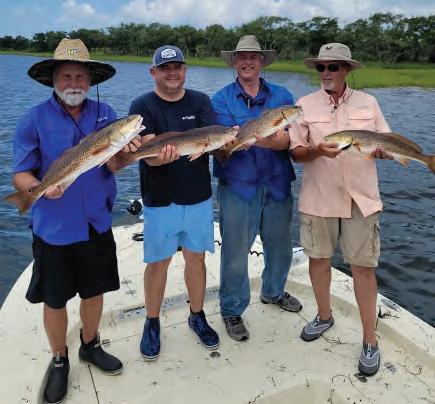
all but two. Then we cleaned up and headed to Porter Island Seafood Restaurant, my favorite place to eat when I’m in Panacea, to eat with Pastor B.B. and some friends. The shrimp, oysters and grouper were delicious, everything there is always great. Junior sitting next to me ordered a steakburger, and it looked and smelled delicious too. Before we left, I ordered burgers for us for after the revival meeting that night and ended up ordering burgers again for after the revival meeting the next night – so good! The revival that night saw a packed house at the church.
Later that night our friends Melton and Daron arrived, and the next morning they found us at the dock early where we were meeting Tanner. We loaded up and headed for the rock piles. We caught a ton of Key West snappers, rock bass, trigger fish, blue fish, and several other species and filled the cooler up. We had to throw back the triggers though because they were out of season. That night the revival was good with Matt preaching and Matt, Melton and Daron singing. They were all formerly with the gospel quartet The Inspirations and now sing together with the Resurrection Quartet.
Later that night, Matt’s son-inlaw John David (the fourth member of the Resurrection Quartet) came down and joined us, and the next morning we met up with B.B, his son Chris, and his wife Stacy on their boat. We headed out into the bay to catch some red snappers.
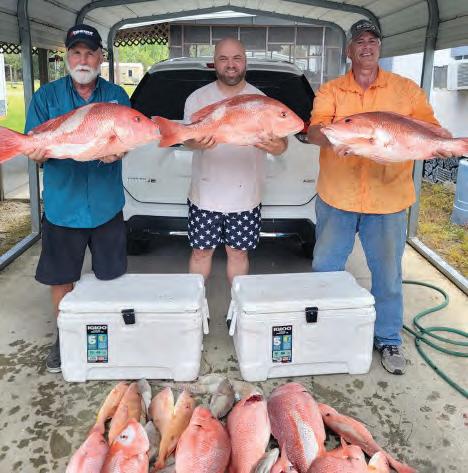
When we got to the first drop, the red snappers were on fire! We caught several before it slowed down. A shark was attracted to our catches and shut down the fish, so we moved to another spot and caught a couple more and that’s when Matt hooked a Beast! He was hanging on as line pulled off the reel. I thought this was going to be a really big snapper, then I saw it, it was a giant shark with a huge snapper in his mouth with just the snapper’s lips sticking out. Then the line went slack, and we never saw that shark or snapper again, but it was very exciting! We also caught and released several big groupers and several other species of fish, even an octopus. It was such a fun trip. The water was some of the calmest seas I’ve seen, however, it was also sweltering hot! Days like this are hard to beat, good people, great fishing, and calm seas. We ate one last time at Porter Island, I had the shrimp and catfish, delicious! The Resurrection Quartet, Matt, Melton, Daron and John David, sang that night at the church and it was great! If you are in town on Sunday or Wednesday, you can visit Pastor B.B. at Panacea Full Gospel. For information on fishing with Tanner Plouffe of Panacea Outfitters, you can call him at 850-7786769. You can reach me at gary@ purgeright.com, and check out my YouTube channel at https://youtube.com/@FishingWithGary.
Please remember, if you are not going to eat it, don’t kill it.
16 ATLANTA SEPTEMBER 2023 WWW.FACEBOOK.COM/THEANGLERMAGAZINEATLANTA/ LOCAL LAKES AND FORECAST
(706)
CARTERS LAKE
Forecast By: Eric Crowley Lake & Stream Guide Service









669-4973
 | lakeandstreamguideservice@gmail.com





September is always an interesting month on Carters Lake. The end of summer is nearing and it’s like the fish know Fall is coming. This month will open up several options for walleye fishing. You can still catch them deep on spoons vertically or trolling crank baits but, there’s fish in shallow water too. Humps, points, shoals, in the 30-to-50-foot range, that has bait congregated around it, will attract walleyes over the next month or so. They are feeding on the 3 to 4” Alewives, so your bait selections need to mimic them. One bait we’ve had great success on this past month was the Cast Prodigy 4.1 swimbaits in the chartreuse as well
as white colors. We’ve been fishing them a couple different ways from
casting to trolling them and they are producing fish. The striper bite has been steady while fishing fresh live baits. It is standard summertime stuff fishing over the Hydro Glow lights early and then down lining baits on light leaders and small circle hooks just off the bottom or over the trees in 50 to 60ft of water. Start early be-
cause the bite slows as the day goes on. Look for fish in open water after midday. These are great fish to show a Capt. Mack’s umbrella rig or mini mack rig too. There are some giant hybrids still lurking in this lake. They are mixed in with the stripers in the same areas.

Temp 83

Clarity 6 ft Level full


SEPTEMBER 2023 ATLANTA 17 COASTALANGLERMAG.COM • THEANGLERMAG.COM
LOCAL LAKES AND FORECAST
THE BEST PRICE ON THE BEST BOATS SALES-SERVICE-PARTS-FINANCING 4631 Smithson Blvd, Oakwood, GA 30566 (770) 718-1144 tandsmarine.com
By Capt Sam Williams | Hawks Fishing Guide Service hawk184@earthlink.net | 334-355-5057


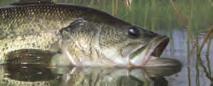
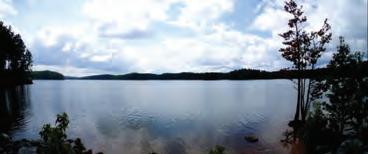
The water level continues to creep down, and the hot water is moving the fish to deeper water. The crappie and shellcrackers are acclimating to the deeper water to spawn as the normal shallow bedding areas are dry. They fan out a bed and then the water drops off them. These deeper bedding areas are ideal spots to concentrate for feeding bass. Crank baits suited for these depths are a good choice. Jigs with a soft plastic trailer, Texas rigged worms and creature baits, or a Carolina rig are a good bet as well. If you find floating pads or vegetation, flukes and frogs in the cover or poppers around the cover,
will get a strike very early or just before dark.
Crappie are holding on deeper cover and minnow tipped jigs are really doing well.
Shellcrackers are in deeper water and eating wigglers.
Bluegill continue to hold near blowdowns and cover on the creek banks. Crickets are your better choice here.
Catfish have moved deeper to find cooler water. Lengthen your jugs and bait with cut bait or stir fry strips. Bottom fishermen can also try night crawlers.
This extreme heat is really rough on the fishermen in the direct
sun right now. Be sure and drink plenty of water and use sunscreen. It is still a great time to spend family time on the river, making those precious memories. God has provided us a beautiful playground, enjoy it.
Pray for each other and all our folks and their families in uniform. Check out www.alclassic.com, the Lee King Memorial Bass Tour-

nament and consider making a donation to help us fund the research to find a cure for these precious, terminally ill children or call Capt. Sam for more information.



God Bless & Good Fishn’
Water Level: 187.38 msl

Water Temp

Upper 80’s to low 90’s Water Clarity: Clear to good stain




Two
18 ATLANTA SEPTEMBER 2023 WWW.FACEBOOK.COM/THEANGLERMAGAZINEATLANTA/ LOCAL LAKES AND FORECAST
East Morris Street
GA
226-3595
Highway 92
GA 30101
974-0629
daltonmarineinc.com daltonmarineinc.com Dalton Location 1117
Dalton,
30721 (706)
Acworth Location 4725
Acworth,
(770)
Great Locations: North Georgia’s Premier Authorized Ranger and Mercury Dealer
Serving Atlanta and North Georgia Since 1968. New & Pre-Owned Ranger and Mercury Sales Service and Repair Warranty Work Certified Master Techs with over 30 Years’ Experience
daltonmarineinc.com
Dalton Location 1117 East Morris Street Dalton, GA 30721 (706) 226-3595
Special Orders Freshwater & Saltwater Models Fiberglass & Aluminum, Bass, Bay, Skiff, Angler, Reata & Inter-Coastal North Georgia’s Premier Authorized Ranger and Mercury Dealer
East Morris
2022 2022
Acworth Location 4725 Highway 92 Acworth, GA 30101 (770) 974-0629 Two Great Locations:
1117
Street Dalton, GA 30721 (706) 226-3595
LAKE EUFAULA
Capt. Joseph Martinelli 404-919-4918 www.heronoutdooradventures.com FB: Heron Outdoor Adventures @heronoutdooradventures Your premier Lake Allatoona & Carter’s Lake Guide Service. Specializing in instructional trips for people of all experience levels. CORPORATE TRIPS AVAILABLE Let’s Go Fishing! Your Adventure Awaits.
LAKE NOTTELY
Forecast By:Will Harkins- Getfishingguide.com | Williamharkins11@gmail.com
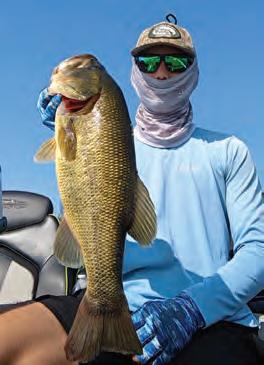
For those who have fished Nottely lately, you know the lake has been anything but predictable. Overall, this summer was slower than average for our precious bass population. The good news is that fall is right around the corner! The fish seemed to have sensed it too because the bite is picking up quickly! With some cooler mornings, Nottely will be right back to where it ought to be! Gone are the crowded days full of wake boats, pontoons, and worst of all, bugs. September is the tipping point for the lake in several ways. With the water beginning to fall, many fish will move out of the hard-to-reach creeks, overhanging bushes, and docks. The fish will always follow the water, so naturally they will
begin to hang on the outside of the cover. Tips of laydowns, any shallow cover with water still on it, and the ends of docks will all be viable places to catch bass. As we get later in the month, many of these bass will move off the bank completely to chase herring and threadfin shad. At the same time, the spotted bass that have been hanging out deep in their summer haunts will move shallower for the same reason. With two waves of fish moving to the same depth column and pattern, fishing will be firing on all cylinders. These shad will be congregated on the flats and longer points, especially those with wind. The wind pushes the plankton, which the baitfish feed on, and, in turn, bass feed. So, keep an
eye out for main lake pockets and flats with the wind blowing into. I have two favorite ways to catch them this time of year. One is a windy day special, spinnerbait. ⅜ to ½ oz white double willow blade spinnerbaits are extremely hard to beat this time of year. It’s a bait that will catch numbers and size. When there’s little to no wind, however, the spinnerbait loses much of its effectiveness. Fish get a better view of the bait before eating, which leads to some stubborn fish. This is when I will change it up to a 3-inch swimbait rigged on a ¼ oz jighead. This allows for a more subtle option to the spinnerbait. Of course, topwater is always on deck as well. With the congregation of bass on shad, you will nearly always see schooling fish at some point in the day. So having a topwater handy is a great way to get some heart thumping blowups. Just remember that fishing is always more than the fish. Get out there, enjoy the beauty the mountains offer, laugh with
family and friends, and use it to slow the speeding world. There is a bigger picture than what we see, and fishing is a great way to open your eyes to the life around you!
So, get out there and Get Fishing!
#Godsgotthis
Lake Level: 3 feet below full pool.
Temp: 79-81 degrees
Clarity: Clear, stained in creeks
LOCAL LAKES AND FORECAST Authorized *2017 Tournament 198P with Mercury® Specializing in Mercury and Ranger HUNTING AND FARMLAND SALES WHITETAILPROPERTIES.COM MATT GLANDER 404.538.7000
The Bass have been biting on Lake Seminole this Summer and we expect it to get even better through the Fall! Currently, the Bass have been biting Topwater lures in the mornings and afternoons. Walking baits like a 6th Sense Dogma Topwater Walking Bait and buzzbaits continue to generate some explosive strikes on the grass lines on the main lake. Plastic worms like a 6th sense Boosa 9.6” Ribbon Tail in Junebug fished along the grass lines have been very productive after the Topwater bite slows.
The September forecast, the Topwater bite should continue and get even better as the bass start the fall feed. If coming to Lake Seminole in September make sure to bring top water, crank baits and Jerk-baits can be very productive especially if the shad are running. The hollow belly frog is also a must in the Fall on Lake Seminole!
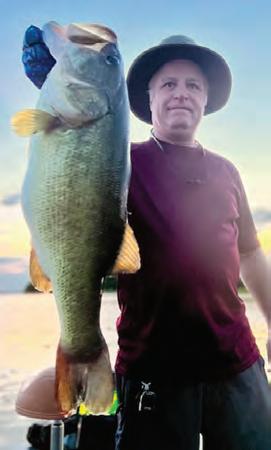
As the bite begins to slow down, that’s when I like to pick up the frog rod and start working the thicker grass, especially paying attention to any holes in the grass beds. My favorite frog for doing this is a Spro Bronzeye Popping Frog. When fishing the frog, you need a rod that has enough backbone to get the big bass out of the grass. My go-to rod is a 7’3” heavy action Temple Fork Tactical Bass Casting rod in fast action. This rod has a soft tip and enough backbone to get Lake Seminole’s biggest bass out of the grass.
The crappie fishing on Lake Seminole is good all year long, but the fall through the winter months is exceptional! My favorite lures for catching crappie are the wicked shad and baby shad baits made by ATX lures. They have an extensive line of panfish lures. These baits are offered in a variety of colors, but a couple of my favorite colors are Alewife and Chartreuse/white. I rig these on a 1/32 to 1/8oz jig head, depending on depth and wind conditions. I combine these with a size 10 open face spinning reel and 4-to-6-pound monofila-
ment line. When fishing a light bait, the rod, reel and line are important to get the best results. I prefer a Temple Fork Outfitters 6’ to 7’ light action rod from their Trout and Panfish line.
For an exciting Lake Seminole Fishing Adventure, email us @ lakeseminolefishingadventures@ gmail.com or follow us on Instagram @capt.paultyrefishing and Facebook @ capt.paultyrefishing
Give us a call at 850-264-7534 to check availability!







20 ATLANTA SEPTEMBER 2023 WWW.FACEBOOK.COM/THEANGLERMAGAZINEATLANTA/ LOCAL LAKES AND FORECAST
Meat And Seafood At Their Very Best 1210 Commerce Drive Suite 111 Greensboro, GA 30642 Phone: 706-453-4445 • Fax: 706-453-2334 Meat And Seafood At Their Very Best 1210 Commerce Drive Suite 111 Greensboro, GA 30642 Phone: 706-453-4445 • Fax: 706-453-2334 Hours: Tuesday – Saturday 10:00 AM to 6:00 Pm Major Credit Cards & Debit Cards www.poundersseafoodmarket.com Black Angus Beef and Fresh Seafood Beef • Pork • Seafood • Produce • Poultry • Veal and Lamb Catering Service • Cooked to Order Pounders Seafood Market Pounders All SizeS of GizzArd ShAd AvAilAble for SprinG 678-971-5607 2807 DAWSONVILLE HIGHWAY, GAINESVILLE, GA 30506 LIVE BAIT WIDE VARIETY OF FISHING TACKLE FULL BBQ MENU – LUNCH/DINNER DINE-IN OR TAKE-OUT CERTIFIED SCALE ON SITE
LAKE SEMINOLE
Forecast By: Captain Paul Tyre | Tyrelakeseminolefishingadventures2gmail.com
Eric Welch Welch’s Guide Service www.welchguideservice.com 706-455-2323
Bass: Guide Eric Welch reports: “Fishing has been good. We’re in our summer patterns, with a little bit of top-water action going on. I’m still marking a lot of bait deep, as they have not been staying up in the water column for a really good top-water bite. I’ve been catching fish out in ditches and offshore structures while using my electronics, and Garmin Livescope. To catch these fish, I’m throwing a shaky head, drop shot, and swimbaits. This coming month the bait fish should start moving up and feeding at night, so the top-water bite should start

LAKE CHATUGE
getting better. I always keep at least two top-water baits tied on, and on the front deck, so I can get to them quickly. The Berkley Cane Walker and Strike King sexy dawg Jr. are two of my favorites. Now depending on the size of the bait fish, I will also have a Strike King sexy swimmer on a 1/4 oz jig head, to cast where the fish have blown up and won’t hit a top-water bait. Now if you like fishing banks, lay-downs, and points, try throwing a shaky head, Texas rig, and drop shot will work. I also have been pitching a 3/8 oz jig around lay-downs and brush.
Good Luck
Chatuge: Level: 1’ Below Full pool. Temp: 83-86 degrees. Clarity: Clear
SEPTEMBER 2023 ATLANTA 21 COASTALANGLERMAG.COM • THEANGLERMAG.COM LOCAL LAKES AND FORECAST “I’ll give you your money’s worth to go fishing.” Capt. Bill Wheeler (706) 914-9859 • (706) 444-6365 Striper/Hybrid Trips on Lake Oconee for only www.gonefishingstriper.com “I’ll give you your money’s worth to go fishing.” Capt. Bill Wheeler (706) 914-9859 • (706) 444-6365 $250 www.gonefishingstriper.com $300
If you would like to place an ad, please contact us: craig@theanglermagazine.com
LOCAL LAKES AND FORECAST
RECOMMENDATION
By James K. Pressley jameskpressley@gmail.com
I started at 3:15 and he finally was up by 3:30, which I considered to be way ahead of schedule. We rolled out promptly at 4 with Chris and we were up at Lanier by 5:45, because at that time of the day, there is absolutely no traffic. Henry showed up at 6 and we were off!!! Oh man it was a beautiful morning!
WEST POINT LAKE
Forecast By: Capt. Keith Hudson Keith Hudson Guide Service

 hudsonprobass@gmail.com | www.LakeWestPointFishing.com 706-844-1483
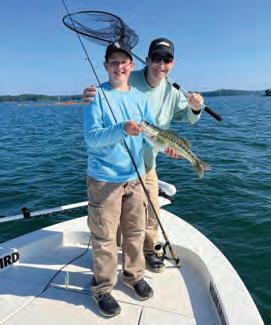
You all know I have been booking and using guides for most of my life. Well, I have recently had to change my opinion on not fishing with normal folks. Now don’t get me wrong. I still firmly believe the more a whacked-out guide fishes the better he is but there are exceptions to the rule. Henry Cowen guided a fishing trip for my son, Beau, my good friend, Chris Auflegger and myself on Lanier. Henry is by no means normal. He is after all a Yankee and a Red Sox fan. But he isn’t whacked out and overly weird either. You just have to listen carefully because he has this weird accent.
I was scrolling Instagram one evening about a month ago and I saw this fundraising campaign for Capt. Clay Cunningham’s group of HS bass fisherman for their trip to the nationals up in La Crosse, Wisconsin back in June. Well, I have always wanted to fish with Henry. On top of this my son really admires him and ties a lot of Henry’s fly patterns. So, my buddy Chris and I went in together and bought the trip with Henry. Chris and Henry go way back and fish together a lot. From what I understand Henry carried out several small miracles by getting Chris his first striper on a fly rod several years ago and later his first bonefish as well. That’s how Henry tells the story at any rate.
Well, the morning of the trip came, and we left Oconee around 4 in the morning. That’s not a big deal for me. At my age I usually get up around that time anyway for several reasons. However, if any of you have 12-year-old boys, imagine the trouble I had getting him out of bed.
Here was the plan. We were going to throw topwaters as well as fly fish for stripers and spotted bass, which all of you know, are my favorite bass species. Henry goes above and beyond with his clients. He had scouted the day before and had a solid game plan on where to fish, laid out. We started hitting spots and about the third one we found stripers busting on the surface with spots mixed in with them. Beau and Chris were fishing with a Zara Spook and an Evergreen Showerblows topwater bait and they doubled up on a pair of really nice stripers! Beau’s was his largest ever on an artificial bait at around 12lbs and Chris caught a solid 6lber that pulled him around for a while!
The day progressed along those lines for us. Pretty much at each spot they picked up one or two fish. By 10 AM it was hotter than a wool sweater on the 4th of July and felt twice as oppressive! Our total between those two was around 10-12 fish. We laughed and cut up so much that honestly, I don’t think anyone counted till it was over and then it wouldn’t have mattered if the count was zero. Henry made the day so much fun. He cared deeply about the enjoyment of each of us but, especially cared that Beau caught fish. He was constantly giving Beau info, lessons, and talking to him like a grandfather. I’ll say this. I’ve fished with a ton of guides. I am a guide. I have yet to have a better time than that morning with Henry and my son is still talking about his new friend Henry. Henry is the kindest and most knowledgeable guide I have ever been with. If you want an experience like this, give him a chance. You can find him at henrycowenflyfishing.com. Tell him Beau sent you. If you mention me, he might hang up…
Tight lines and following seas y’all!
Bass: FAIR – As the days start to get a little shorter and the temps cool just a little, expect a slow improvement in bass fishing. A few largemouth and spots are still being caught on deeper brush piles, ledges, and roadbeds in the main lake area, basically holding more to a summer pattern. Try big deep diving crankbaits or Texas rigged Ol Monster worms. Also, drop shotting can be effective in these areas. The best fishing is around brush piles or other structures in these areas, if you can find them. Water generation always improves this bite. Downsize baits in these same areas & improve your chances for spotted bass. With the unusually high water from this summer’s rains, some fish choose to remain shallow, and this pattern should improve as the water cools, and we move toward fall. Top water baits such as Flukes, Whopper Ploppers and Poppin frogs can still be effective for shallow fish, especially around grass and weed beds. Try targeting the mouths of feeder creeks north of the 219 bridge in the Chattahoochee. Also have a jig handy to pitch into wood cover in these same areas.
Slower than normal, but still fairly consistent, spotted bass are still your best bet on the south end of the lake. Spots are being caught by casting Spot Remover heads loaded with Zoom finesse worms at bridge pilings or just dragging a Carolina-rigged Zoom finesse worm around shoal markers. Also try a small Texas rigged worm or a pig-n -jig around blow down trees. Actively schooling groups of fish will also hit the Flash Mob jr. rig, a personal favorite in the early fall.
Linesides: FAIR – It has been a mostly disappointing summer in general for schooling topwater action on the main lake. I still expect surface schooling on the main lake at some point this fall.
These fish can generally be caught on Roostertails, topwaters, pop n cork rigs and Storm Swim Shad lures. Start early or stay late for the best results. Expect the downline bite on live bait to continue to improve as we move toward early fall. Trolling with crankbaits /bucktail combo should also continue to be fairly effective. Try old faithful areas like the Railroad Trestle Hump and the humps out from Amity Park for good results.
Crappie: FAIR – The fish will typically move out and hold on deeper brush & structure or under docks until the water temps drop into the low 70s or so. Try dropshotting minnows or shooting docks in 10-15 feet of water for the best results. You can really do well if you find one of these schools. Try the cuts & coves in Yellow Jacket creek and from Highland Marina north to Wolf Creek in the Chattahoochee. Some fish will start to move a little shallower as the water slowly cools, maybe by the end of the month. Minnows fished under a float will usually work on them when you find them. Any blowdown near deep water is a good starting point. Night fishing is still pretty good. Try under the bridges with lights.
Catfish: GOOD – Lots of channel cats are being caught by the few anglers that target them. Live & cut baits (and worms of course) fished on bottom will catch cats all over the lake, as long as fairly deep water is nearby. Jug Fishing is also fun & productive. To target flatheads, go to a larger bait like a 4–5-inch bream or large shiner and fish deeper channels north of the 219 bridge. Be sure to increase the size of your rigs as fish in the 2030-lb. range are fairly common.
The lake is still near full pool and surface temps in the mid to upper 80’s.
22 ATLANTA SEPTEMBER 2023 WWW.FACEBOOK.COM/THEANGLERMAGAZINEATLANTA/
SEPTEMBER – A MONTH OF OPTIONS
Contributed By: Jim “Jimbo” Mathley www.jimboonlanier.com
A traditional September on Lake Lanier offers anglers many choices of approach. This September on Lake Lanier should be no different. The lake has been around full pool most of the year, and we may go into September down 3-4 feet, barring a major storm hitting our area. The water temperatures have been normal to lower than normal for late Summer, so the traditional late summer patterns should be in play. Often during these kind of conditions, you can find fish very deep as well as very shallow, and some in between. Today we will look at the options for fishing Lanier this September and how to approach catching bass in this key transitional month.
Location
Understand that the primary concern of both game fish and bait fish are oxygen and food source, in that order. During a normal September, the “comfort zone” of both the bait fish and spotted bass becomes multi-faceted. In September, we often find spotted bass in 3 different types of locations: 1. Very deep (30-50 ft) off the ends of humps and points, relating to timber lines. 2. Very Shallow in the backs of creeks and creek arms in major tributaries around the lake or shallow on rocky bluff walls. 3. Suspended in the mouths of major creeks around brush in 25-35 feet of water, as well as deeper pockets near the main lake. Now that we understand where we can find them, let’s look at some of the tools we can use to catch them in each of the above situations.
Lures and Presentation DEEP
1. Drop-Shot – This is a great tool to target deep fish. This presentation can be made vertically into cover, or it can be cast toward the target and slowly retrieved. I prefer the Lanier Baits Fruity drop shot worms. Light line is a must. I prefer 6-8lbs test Seaguar Abrazx. Light line helps provide a more natural presentation and will garner more strikes.
2. Jigging Spoon/Flutter Spoon –Always a great option when the fish are deep. A Georgia Blade flutter spoon can be a great option this time of year. Experiment with the presentation once you have located the fish. Some sort of rip/pause or fast reel/ pause cadence should do the trick. Their mood and the presentation required to catch them will vary daily with conditions. Look around timber lines and treetops near the mouths of creeks.
SHALLOW
1. Buzz Bait – While Lanier is not necessarily known as a buzz bait lake, this can be a very effective tool in both shallow situations discussed above. Make your retrieve an erratic one and present around cover where possible in addition to steep rocky banks early in the morning. I like the Georgia Blade choices for a buzz bait.
2. Spinnerbait – An old favorite that can be deadly around flooded shoreline cover, by shallow docks and blow down trees, as well as steeper rocky banks. Try the new offerings from Georgia
If you would like to place an ad, please contact us:
craig@theanglermagazine.com
Blade – they offer a nice variance of bait sizes and blade types.

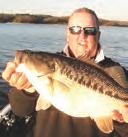
3. Crankbait – Opt for a shallow to medium diving plug and work the same areas as you would the spinnerbait. Try the Berkley Bad Shad and Fritts Side crankbaits!
4. Jig/Worm – When the fish are not chasing, don’t be afraid to pitch Berkley Power worms on a Texas rig or jig head and/or GA jigs to the flooded shoreline cover. This can be a very effective technique to catch fish with a smaller strike zone. Georgia Jigs rule!
SUSPENDED
1. Topwater – When the water starts to cool, the topwater action can be awesome. Look around manmade brush or offshore structure such as humps and points for fish that are hanging out. Topwater baits such as a Berkley Cane Walker and Drift Walker can be an excellent way to catch these fish – and a lot of fun too! If the fish are resistant to the full topwater offerings, try ripping a fluke over brush – that can be a winner!
2. GA Blade Shad Spin – This is an excellent producer on Lanier. Fish the bait at the depth you see the fish suspending near bait balls. Understand the fall-rate for your rig and count the bait down
to the depth of the fish and maintain that depth.
3. JerkBait – Another great tool for targeting suspending fish. Choose a bait that suspends at the depth the fish are holding and experiment with your retrieve cadence until you zero in on what the fish are looking for any given day. Try the Berkley Stunna for your jerkbait – some great action and color choices.
4. Spy Bait – his bait has become popular in recent years. It is a great option when the fish are not hitting your topwater or jerkbait presentations. Cast this bait out, count it down to 10 and then begin a very slow retrieve. This technique is the epitome of finesse fishing. Slow and methodical is the key. I like the Duo Realis offerings in the G-fix 80 size which you can purchase at Hammonds Fishing or through Lanier Baits.
I still have a few dates available this September so call me to book a trip! See you on the water! Jimbo
Jimbo is a Full-Time, Year-Round Spotted Bass Guide on Lake Lanier. Contact him today to book a trip! Mobile - 770-542-7764
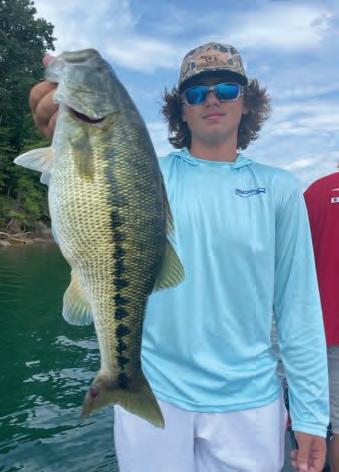
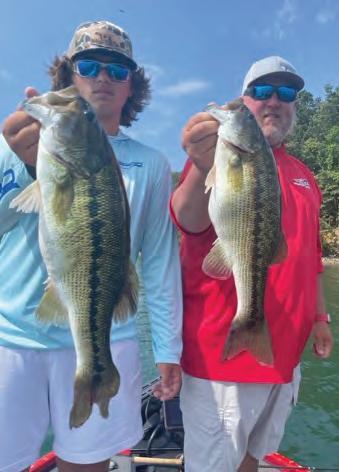
SEPTEMBER 2023 ATLANTA 23 COASTALANGLERMAG.COM • THEANGLERMAG.COM LOCAL LAKES AND FORECAST LOCAL LAKES AND FORECAST

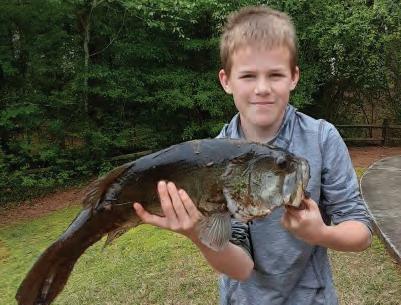
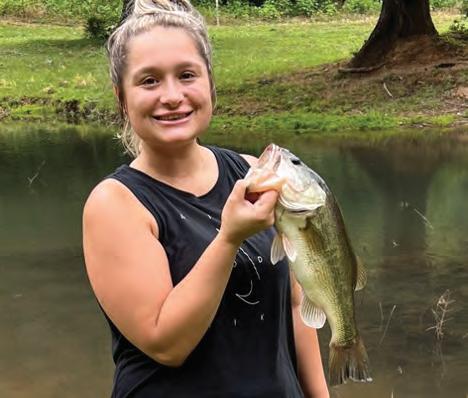
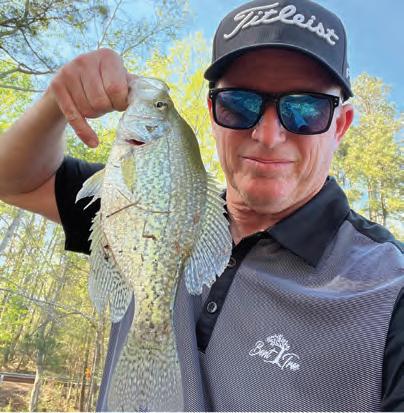
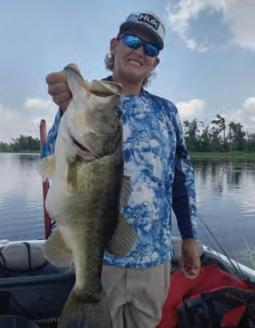
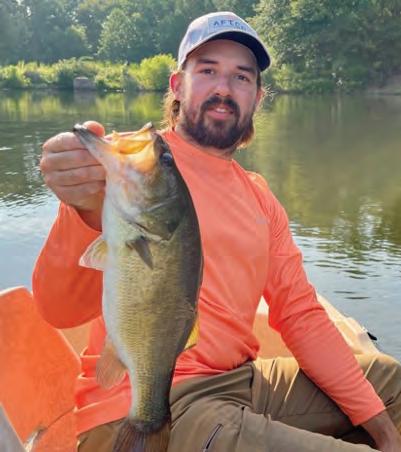
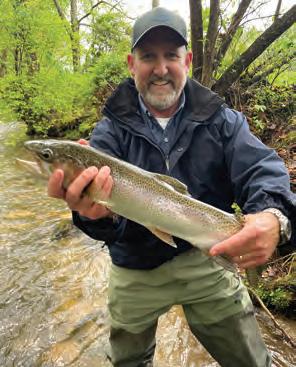


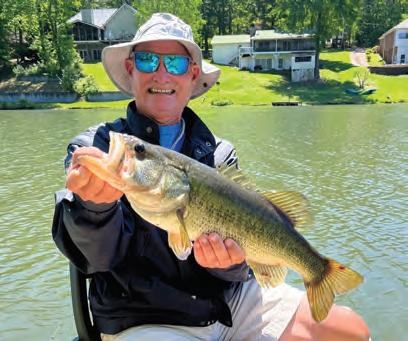
Wall of Fame WIN A FREE ANGLER MAGAZINE CAP! One will be given away each month for the best reader submitted photo! SPONSORED BY: John Megel Ford 2742 US 129 South | Cleveland, GA 30528 MEGELFORD.COM 706-865-2168
The Angler in the picture is Cody Koehler. A super fisherman that just won his first Kayak bass tournament.
Kaydee “Shorty” Draper from Temple with a nice spot bass!
cut
Rich Gillespie with a nice Villa Rica slab.
Craig Glander with a Rainbow from Blue Ridge, GA.
Waylon Faircloth won big fish with this monster in a recent Lake Seminole Tournament!
Andy Micacchione with a nice Fairfield Plantation bass.
The Angler in the picture is Cody Koehler. A super fisherman that just won his first Kayak bass tournament.
When


it’s you against nature, there’s only one tool you need: the stainless steel River Canyon Bowie Knife—now ONLY
You are a man of the wilderness. The only plan you have is to walk up that mountain until you feel like stopping. You tell your friends that it’s nothing personal, but this weekend belongs to you. You’ve come prepared with your River Canyon Bowie Knife sheathed at your side. This hand-forged, unique knife comes shaving sharp with a perfectly fitted hand-tooled sheath. The broad stainless steel blade shines in harmony with the stunning striped horn, wood and bone handle. When you feel the heft of the knife in your hand, you know that you’re ready for whatever nature throws at you. This knife boasts a full tang blade, meaning the blade doesn’t stop at the handle, it runs the full length of the knife. According to Gear Patrol, a full tang blade is key, saying “A full tang lends structural strength to the knife, allowing for better leverage ...think one long steel beam versus two.”
With our limited edition River Canyon Bowie Knife you’re getting the best in 21st-century construction with a classic look inspired by legendary American pioneers. What you won’t get is the trumped up price tag. We know a thing or two about the hunt–– like how to seek out and capture an outstanding, collector’s-quality knife that won’t cut into your bank account.
This quintessential knife can be yours to use out in the field or to display as the art piece it truly is. But don’t wait. A knife of this caliber typically cost hundreds. Priced at an amazing $49, we can’t guarantee this knife will stick around for long. So call today!
customers are saying about Stauer knives... êêêêê









off, the shipping was fast and the quality is beyond what I paid for the knife. Overall I am a satisfied customer!”
—



COASTALANGLERMAG.COM • THEANGLERMAG.COM SEPTEMBER 2023 NATIONAL 9 14101 Southcross Drive W., Ste 155, Dept. RCK477-01 Burnsville, Minnesota 55337 www.stauer.com • Full tang 4 ¼" stainless steel blade, 9" overall length • Genuine horn, wood and bone handle • Polished brass guard and spacers • Includes leather sheath Stauer ® Smart Luxuries—Surprising Prices Rating of A+ *Discount is only for customers who use the offer code versus the listed original Stauer.com price. Not shown actual size.
Your satisfaction is 100% guaranteed. Feel the knife in your hands, wear it on your hip, inspect the craftsmanship. If you don’t feel like we cut you a fair deal, send it back within 30 days for a complete refund of the sale price. But we believe that once you wrap your fingers around the River Canyon’s handle, you’ll be ready to carve your own niche into the wild frontier. $49!
How to Be Cut Off From Civilization
BONUS! Call today and you’ll also receive this genuine leather sheath! What
D., Houston, Texas River Canyon Bowie Knife $79* Offer Code Price Only $49 + S&P Save $30 1-800-333-2045 Your Insider Offer Code: RCK477-01 You must use the insider offer code to get our special price. TAKE 38% OFF INSTANTLY! When you use your INSIDER OFFER CODE
“First
By Capt. Michael Okruhlik FLOUNDER


September is a new beginning of sorts when it comes to saltwater shing on the Gulf Coast. First, it is somewhat cooler, although some of our visiting northern neighbors might not agree. Many anglers nd themselves torn between other passions and obligations, some of which include school in session, weekend sporting events, dove and deer hunting, and the list goes on. ese activities thin the herd of boats on the water and opens the bays back up for those of us who focus all of our free time on the water.
is is de nitely noticeable at the boat ramp the rst weekend a er Labor Day, and I can’t wait!
Less boat tra c means shing the mouths of bayou drains is wide open. I avoid these areas for safety reasons when there’s heavy boat tra c. I just don’t like boats driving over my lines or waking me, which is what happens if you sh in a boat lane during peak season. I like drains in back lakes this time of the year, because they hold “the big three”: trout, red sh and ounder.
I will speci cally target ounder in these areas in September and early October. Since the spring migration, these tasty morsels have been working their way as far back in the marsh as they could get. With autumn around the corner, they start to congregate in these drains. Outside of the fall run, many anglers do not target these ground huggers. With the pressure light,
the ounder bite can be lights out for those who know where and how to target them. part is you might not see another boat all day!
An outgoing tide is optimal to stake out one of these drains. e tide carries bait out of the deeper bayou and adjacent marsh grass and sends it on a deadly path with hungry ounder fattening up for their winter spawn. When the bite is on, it is not uncommon to see ounder breaking free of the water’s surface chasing a meal. e time I witnessed this years ago, it took me awhile to gure out what was jumping. I will never forget that day!
Paddletail so plastics are my go-to in this situation. I like bright colors such as white lightning, chartreuse with glitter, or pearl with a chartreuse tail in a 4-inch or 3.25-inch bait. Keep the lure twitching along the bottom. Quick jerks with the rod tip pointing down activates the tail vibration and kicks up clouds of mud, which really grabs their attention. A so plastic with a tail rattle adds an extra attractant.
Get a jump start on your ounder x before the rst cold front and the long lines of anglers targeting them during the fall run.
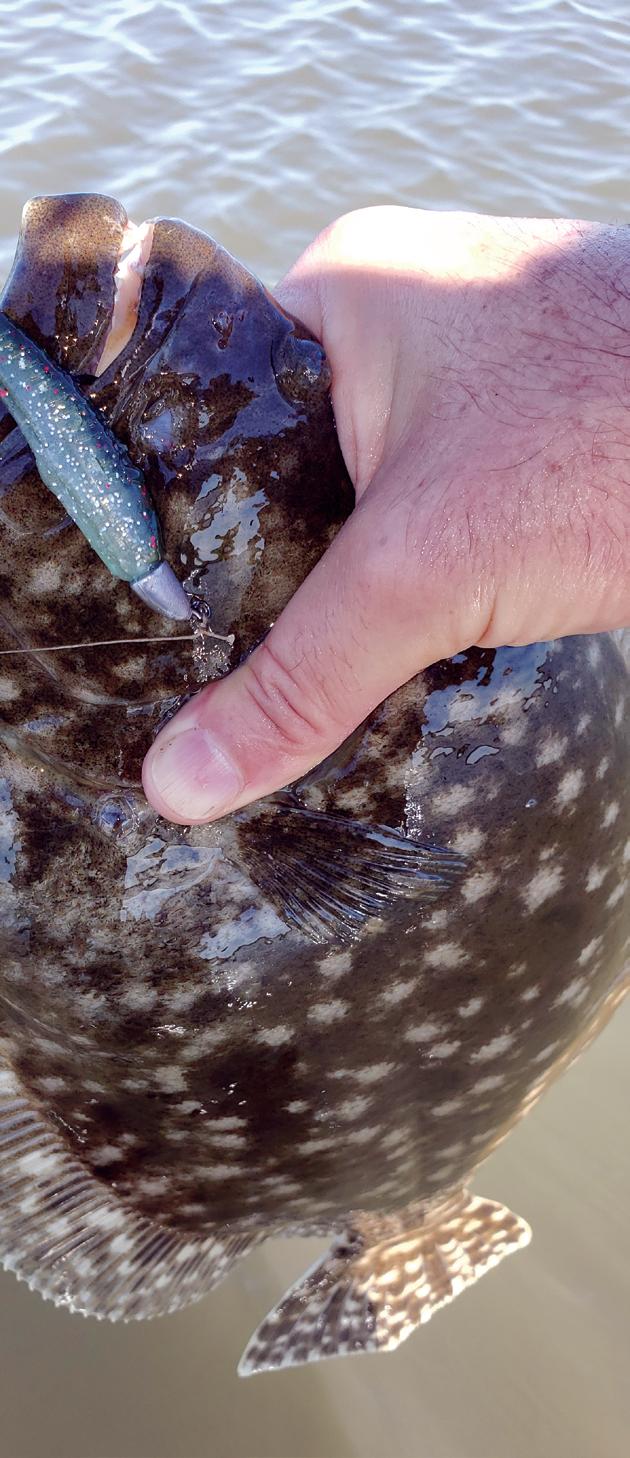
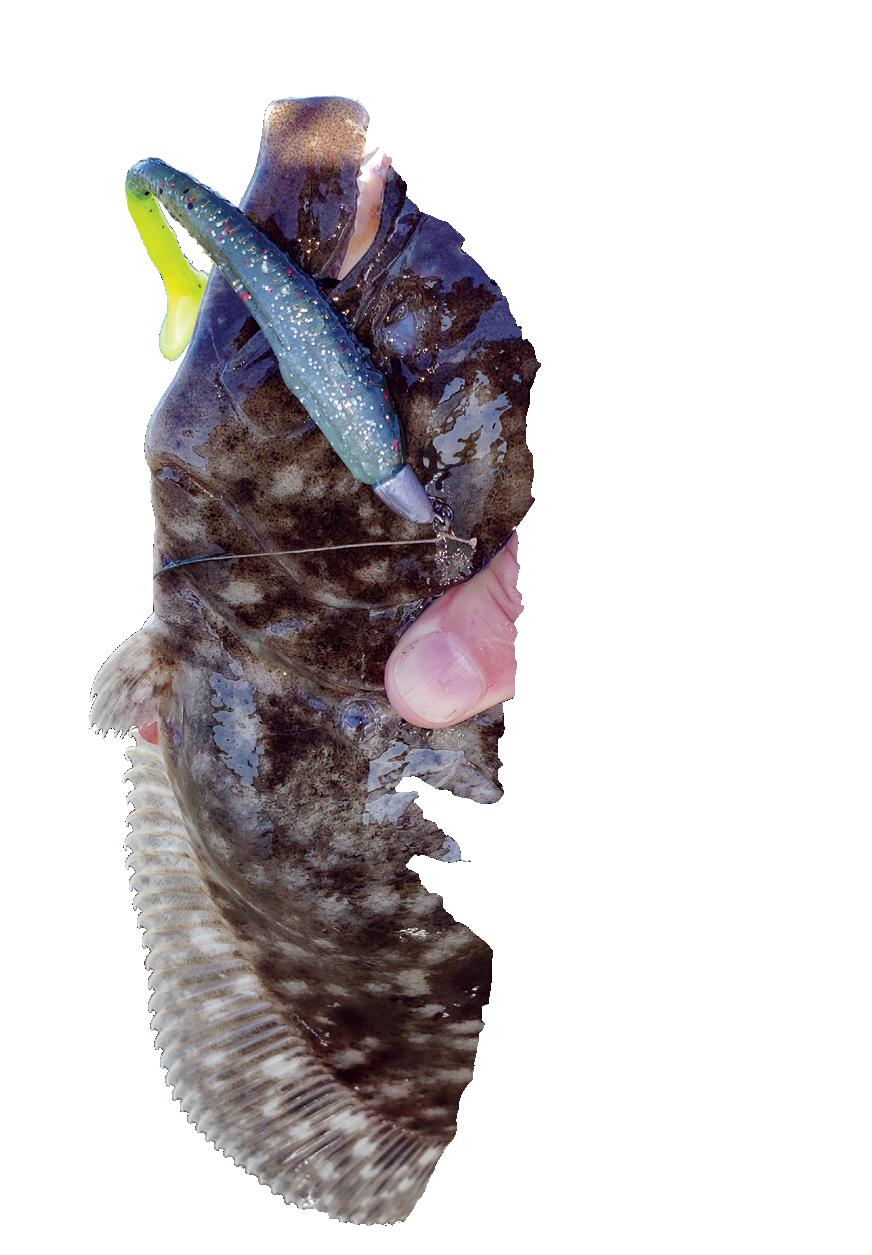
10 NATIONAL SEPTEMBER 2023 COASTALANGLERMAG.COM • THEANGLERMAG.COM
PHOTO COURTESY OF KNOCKIN TAIL LURES®
SUMMER’S
LATE
Forgo en
Fishflagstellthestory! Catch all 4 Hanap‘a “slippahs” from Scott Hawaii scotthawaii.com FAMILY RUN IN HAWAII FOR 90 YEARS
Capt. Michael Okruhlik is the inventor of Knockin Tail Lures®, and the owner of www.MyCoastOutdoors.com.
Hanapa‘a - Mahi
Hanapa‘a - Ono
Hanapa‘a - Ahi
Hanapa‘a - Marlin
Fish flags inspired by Sun Dot Marine Flags.
@fishflags
why get towing?
THEY KNOW FALL IS COMING
Tim Barefoot
Fish know fall is coming because of the reduction of daylight minutes in a day. e shorter days make a lot of species start a whole new pattern of activities. For example, the grouper complex will start the process of moving into traditional spawning areas. at migration mirrors the cigar minnows, sardines and squid. I’ve always said this and will say it again: Find the bait, nd the sh!
e cigs and sardines form large schools that attract a number of predators including kings and sail sh on the surface, and the big snappers and grouper will be on them as well. e shortened daylight hours become obvious during the middle of this month, when it triggers the “feed” to fatten up for winter and the spawn. Go to the traditional areas you’ve found bait in the past, and that’s a great place to start shing.
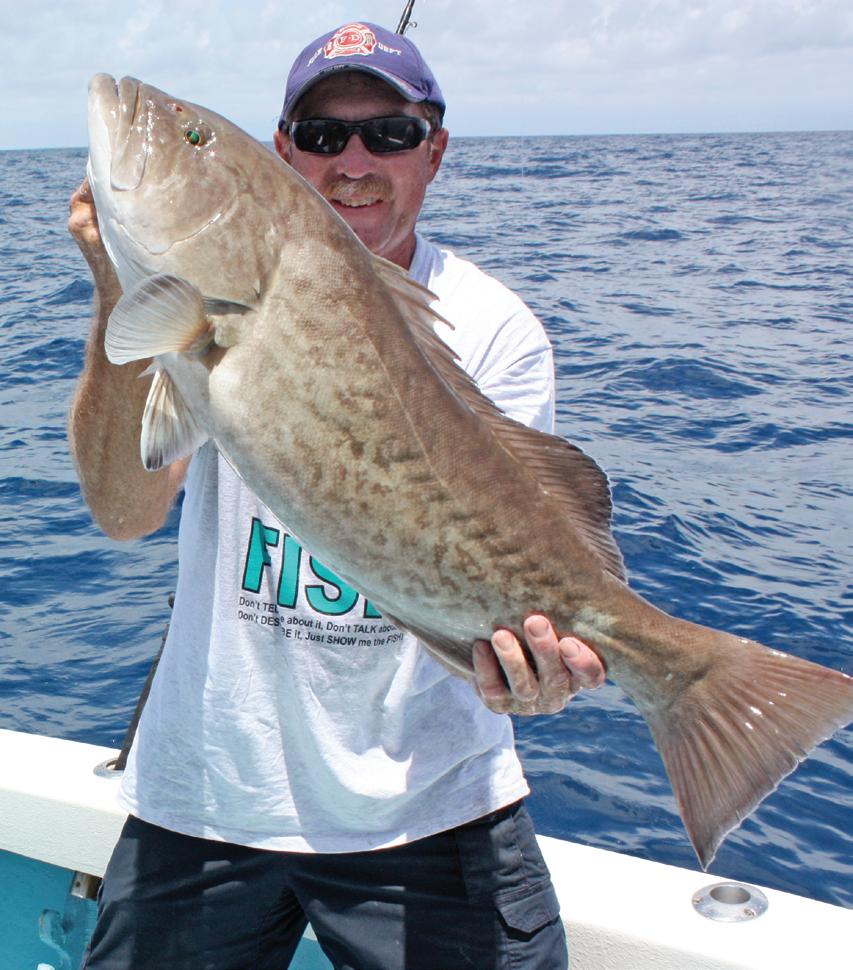
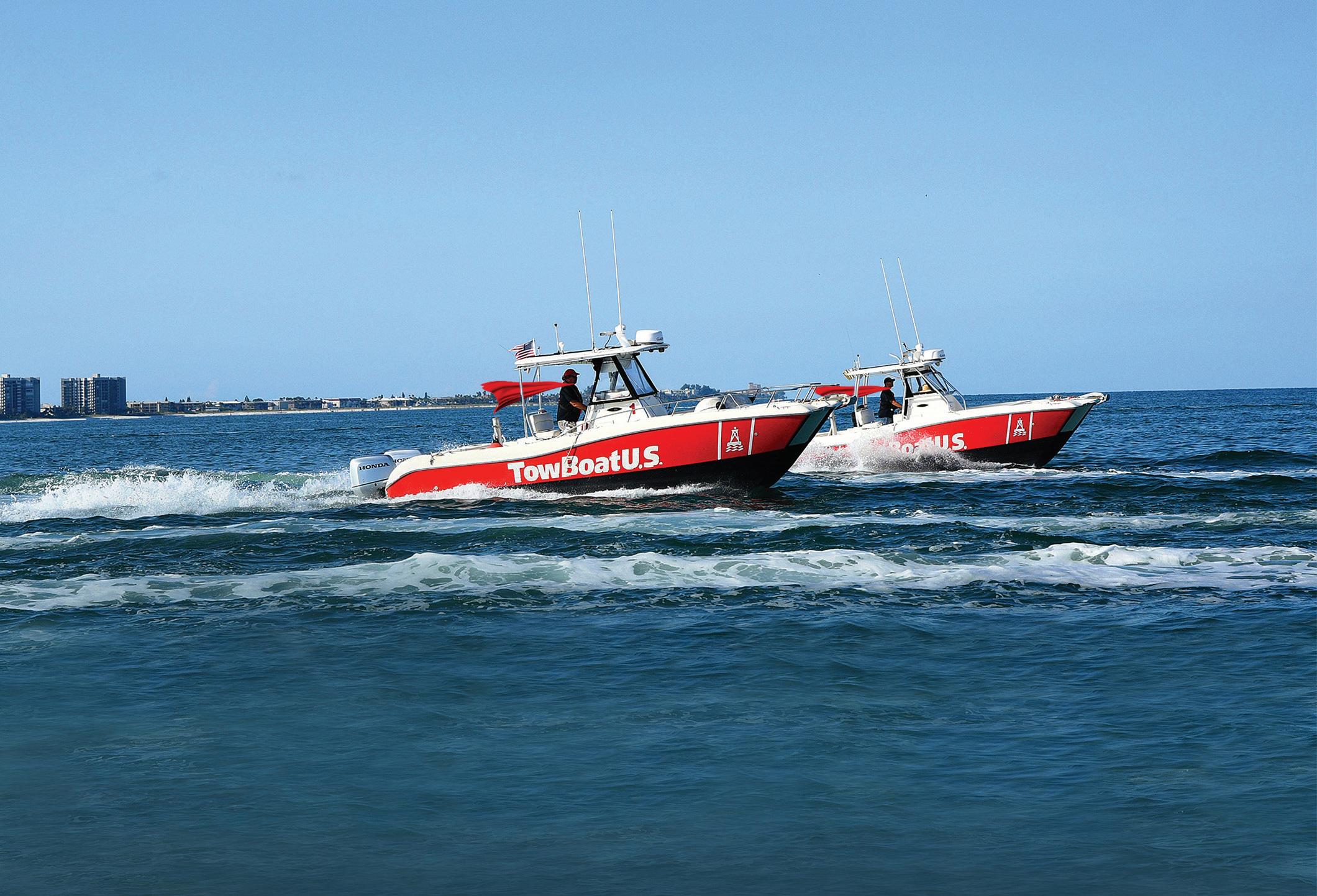
Another thing I’ve said in the past is: don’t go to a Chinese restaurant and order a pizza, meaning don’t drop baits that are foreign to sh that are working a school of cigs and sardines. Always have a couple boxes of frozen cigs and/ or sardines just in case you can’t nd the
bait. At least you’ll have bait that “matches the hatch” of what they normally eat.
I try to stay on the sabiki catching baits while everyone else on the boat is shing with grass grunts, sailors choice, cigs/sardines, etc. If you get on a big knot of cigs or sardines, it might be helpful to have two people on the sabiki lling the livewell. e best bait of all is whatever is there. Just put it right back down.

is is also the time of year to nd squid inshore, mixed in with cigs and sardines. If you have a live squid for bait, its life expectancy is under 10 seconds once it touches the bottom on a jig. It’s an instant bite, just like several other baits mentioned above.
e only problem I have with the live or frozen minnows is everything on the bottom will give them a whack, and you wind up catching a lot more snapper and smaller bass than if you use a larger live bait. We almost always have live pin sh from the marina that eliminate most of the trash bites. If you have a larger pin sh, grass grunt or sailor’s choice on the jig, nothing but larger bass, grouper, jacks and big snapper can put it in their mouth. I like to speci cally target grouper by putting the larger live baits down on the jig that eliminate the undesirable bites. Of course, this is a very attractive bait to the sharks, also. Every now and then you have to pay the “tax man” in a grey suit, but that’s just the chance I take. Check out some of the rigging and shing videos on the website or on youtube to see what I’m talking about.
See more from Tim Barefoot at Barefootcatsandtackle.com.
COASTALANGLERMAG.COM • THEANGLERMAG.COM SEPTEMBER 2023 NATIONAL 11 With 600+ boats in 300+ locations across the country, we’re ready to rush to your aid when you need help on the water. One call and we’re on the way to save your day. JOIN TODAY! BoatUS.com/Towing Details of services provided can be found online at BoatUS.com/Agree. TowBoatU.S. is not a rescue service. In an emergency situation, you must contact the Coast Guard or a government agency immediately. to save the day
ALASKA STATE RECORD OUTWEIGHS WORLD RECORD

Alaska’s new state record shortraker rock sh was caught in late July. On uncerti ed scales at a remote shing lodge, it weighed 48 pounds, which would have crushed the existing IGFA world record by about 4 pounds. e angler, charter guide Keith DeGra , however, chose to preserve the meat by bleeding the sh instead of waiting to get an o cial weight on certi ed scales.
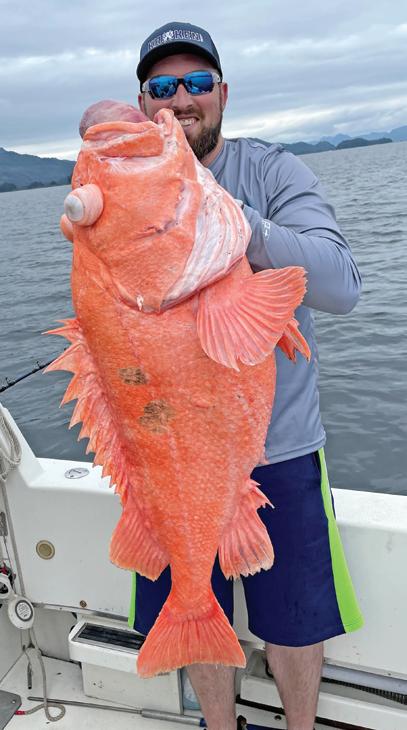
Days later, when DeGra nally got a certi ed weight in front of an Alaska Game and Fish representative, the sh weighed 42.4 pounds, which was good enough to set a new Alaska state record.
“It feels like the biggest accomplishment of my shing career,” DeGra said. “ is species takes time and dedication to drop down to such huge depths, and I spent a whole lot of hours and reeled miles of line trying to break this record, and it nally came to fruition.”
DeGra caught the sh from Prince William Sound on July 28 with his ancée and some friends from a rented boat. DeGra was shing 1,000 feet deep with a conventional (non-electric) Avet 2-speed 30/2 reel, a custombuilt Adventurous Custom rod built by Derwood Roberts, 3-pounds of weight, 80-pound braid and a circle hook baited with salmon and herring. e previous Alaska state record shortraker rock sh weighed 39.1 pounds. It was caught by Henry Liebman in 2013. e IGFA all tackle world record weighed 44.1 pounds. It was caught in 2017 by Angelo Sciubba at Cross Sound, Alaska, but it’s not recognized in the Alaska Game and Fish list. For more information, see www.adfg.alaska.gov.
Industry leader Dometic is o ering a “new turn” on steering for a whole new category of cable-steered boats that have o been overlooked when it comes to driving innovation.
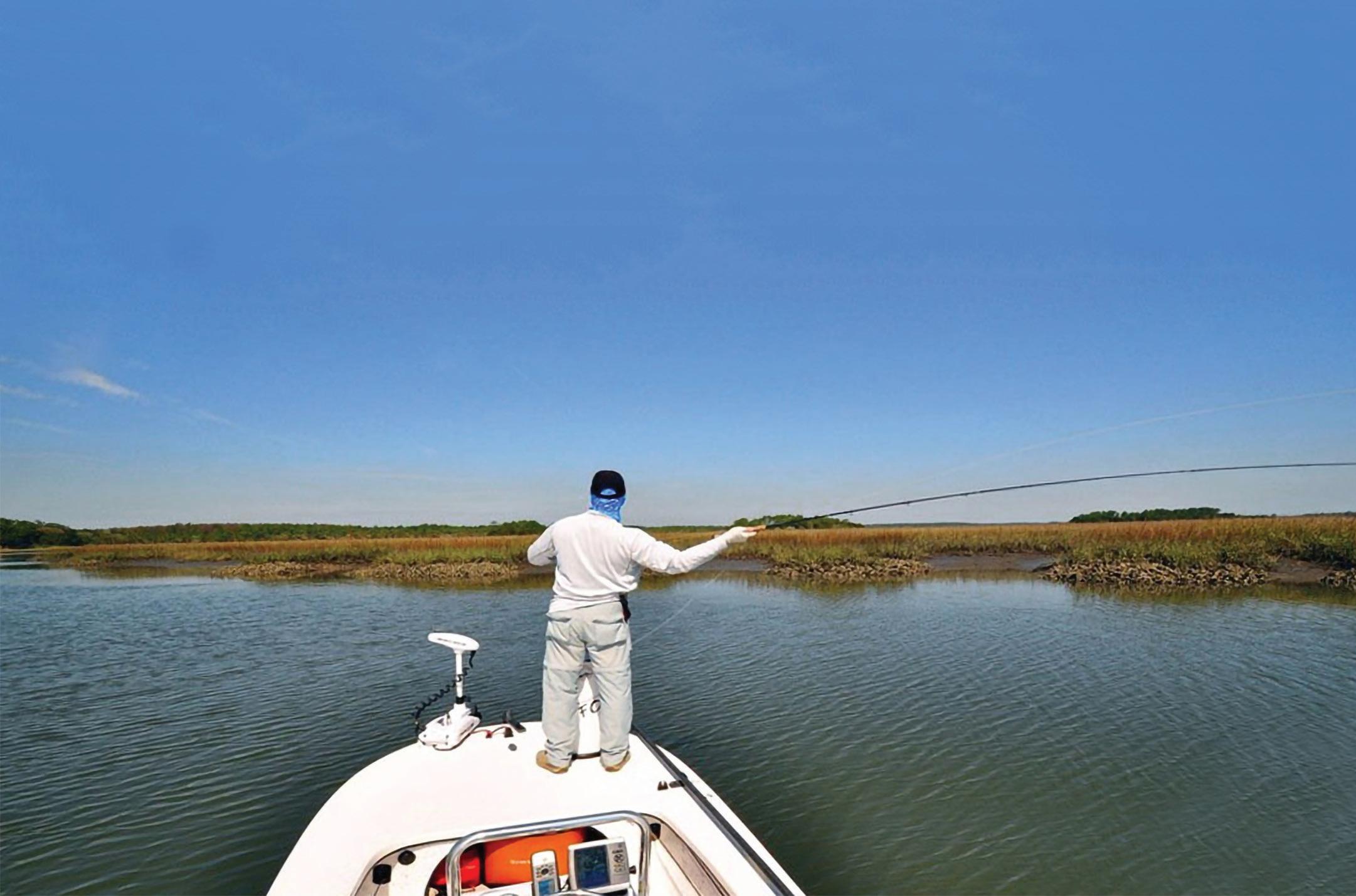
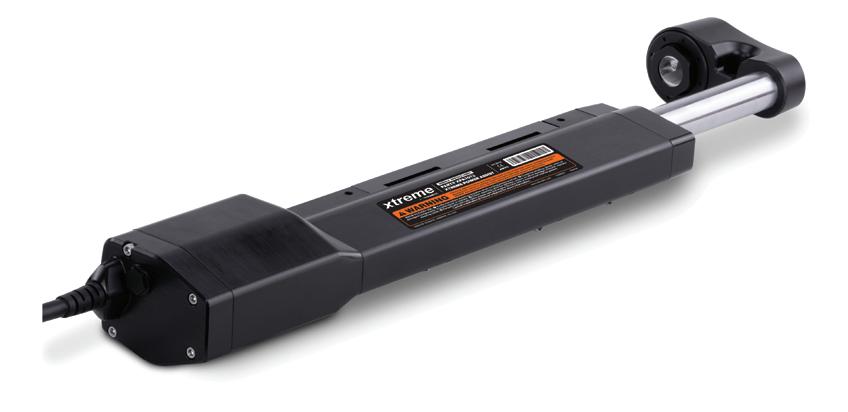

Designed to integrate with a boat’s existing SeaStar cable steering system, new Xtreme Power Assist (XPA) steering provides smooth, e ortless electric power steering for a range of boats with single outboard motors from 90 to 200 hp. is makes it ideal for smaller ats boats, center consoles, shallow water open ski s and other coastal shing vessels that currently use mechanical steering.
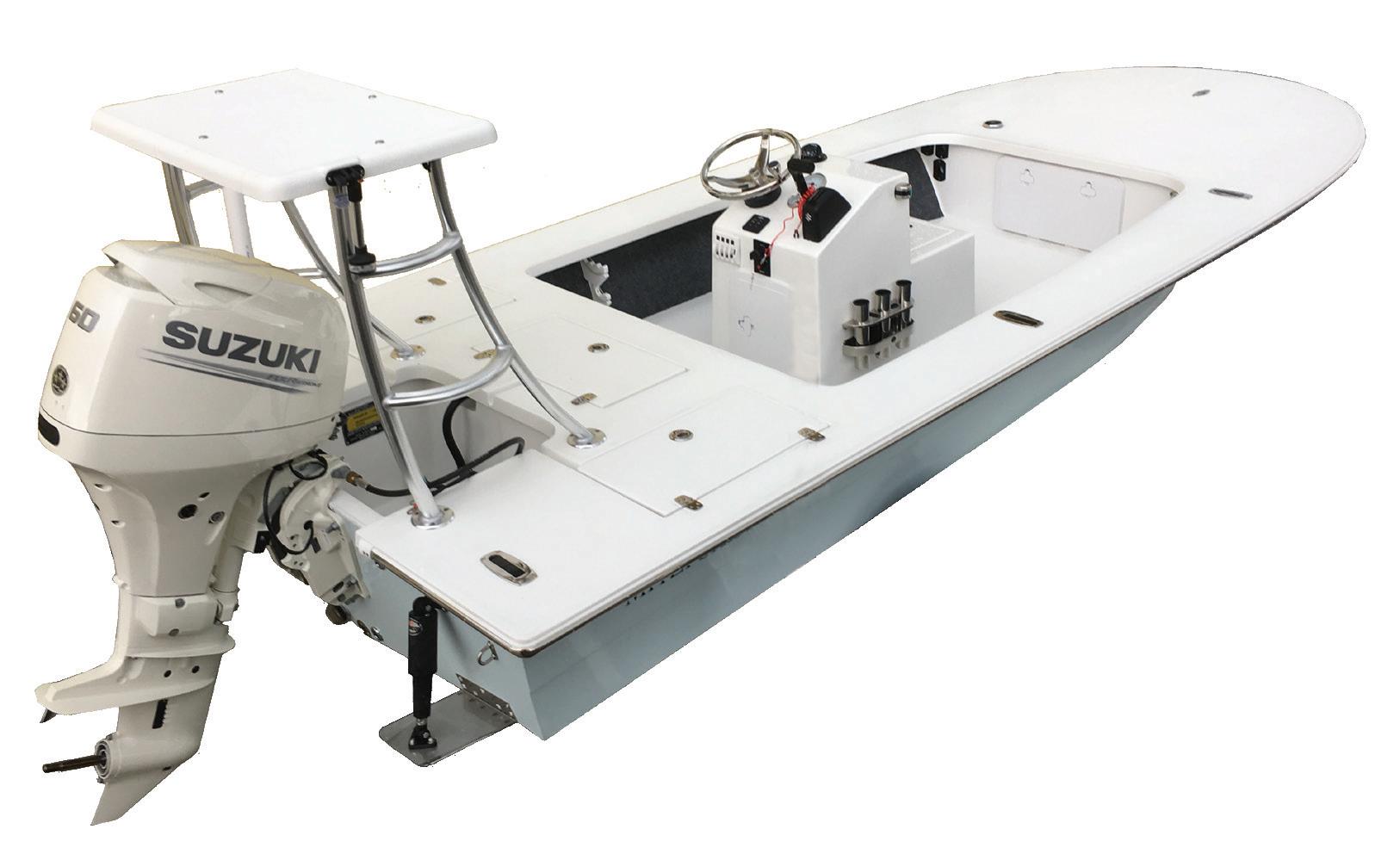
Dometic’s XPA mounts easily to all outboard brands and works with all types of SeaStar mechanical steering (including rack and rotary,

need to replace the existing steering. Installing XPA requires only simple wiring and can be done by DIY boaters in about 30 minutes.
Once XPA is installed, the steering cable only turns the power assist unit—while an advanced electric steering actuator moves the engine load. is eliminates steering torque through the wheel and provides smooth, nearly e ortless steering at any speed.
While an ideal upgrade, this new system is being adopted by top boat builders as a factory standard feature or optional upgrade on new boats.
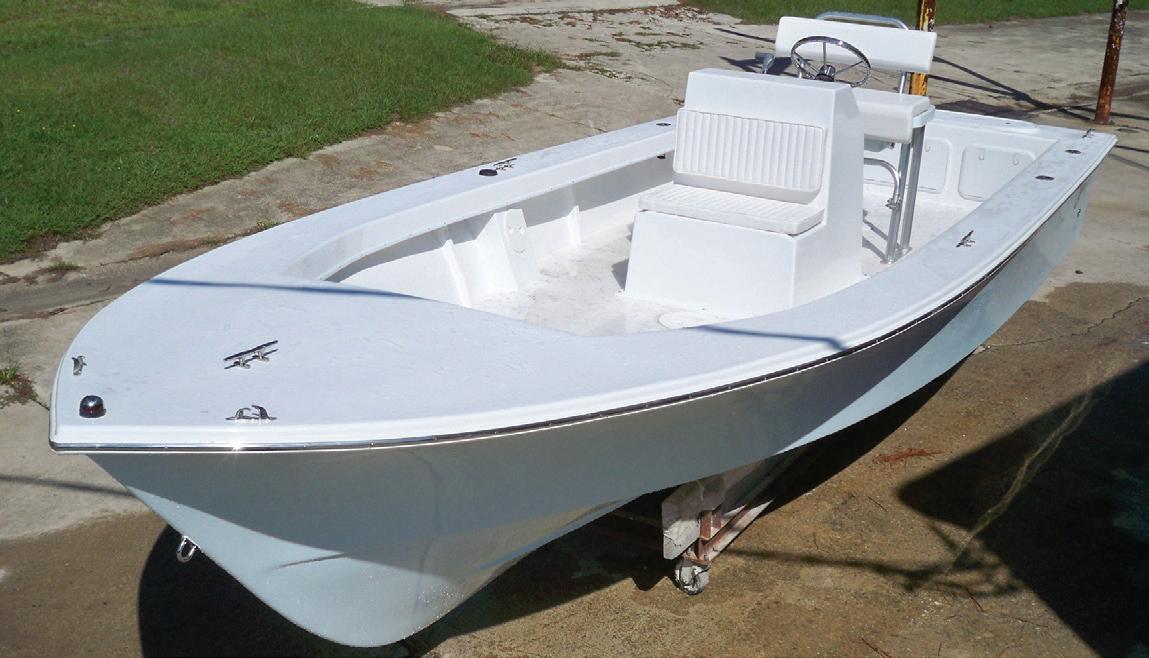
12 NATIONAL SEPTEMBER 2023 COASTALANGLERMAG.COM • THEANGLERMAG.COM
WWW.DOMETIC.COM
www.MitziSkiffs.com www.CHawkBoats.net DON’T MISS YOUR CHANCE TO GET OUT ON THE WATER... Visit Us Online To Find Your Nearest Dealer
DOMETIC XTREME POWER ASSIST STEERING
MOBILE BAY
ARE EASY PICKINGS







right, shrimp, crabs, ounder and more oat to the surface in the shallows, where people just scoop them up.
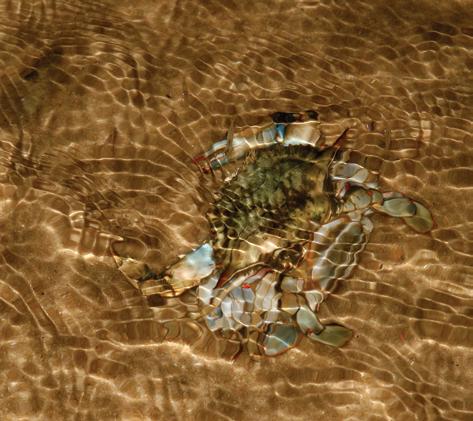
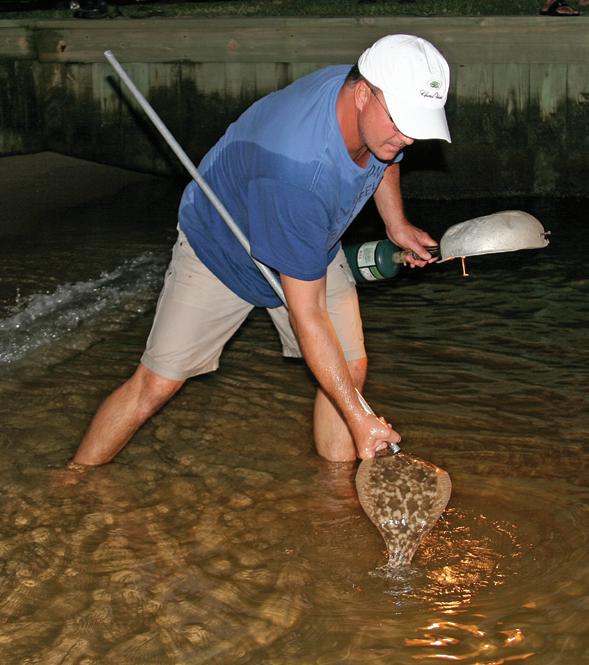
In one of his weekly columns, David Rainer, with the Alabama Department of Conservation and Natural Resources explained these uncommon events: e event starts with an incoming tide with very warm, still water, followed by organic load that creates a situation that depletes the oxygen in the water. O en, jubilees follow an a ernoon rain shower and an easterly or northeasterly wind. e Mobile Bay National Estuary Program explains that phytoplankton also contributes to this phenomenon by consuming oxygen near the surface of the water. When the easterly breeze starts blowing, this creates a water current that causes the oxygen-poor water to migrate toward the shore. is has a corralling e ect, herding the bottom-dwelling species into the shallows. ere those species become so lethargic that people can just pick them up. ese events usually lasts two to three hours.
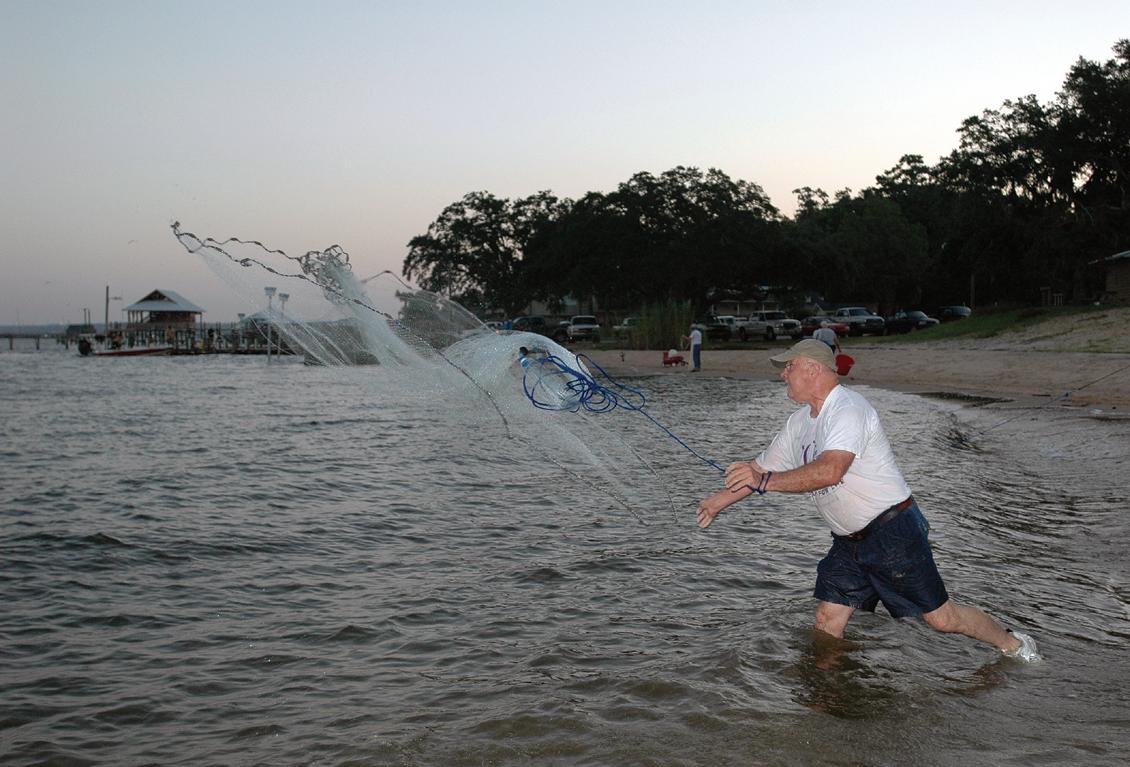
Because they are short lived and rare, jubilees are a source of excitement for some Mobile Bay families who send word out to friends and loved ones to drop what they’re doing and go collect some seafood. However, Rainer warned in his column that a jubilee is not a free-for-all. Normal size and creel limits remain in e ect during the phenomenon. Alabama Marine Resources Division Director Scott Bannon said most species survive to swim or scuttle away when dissolved oxygen levels return to more normal levels.
or most folks, a jubilee is an anniversary celebration, or maybe it’s a ambe dessert made with cherries. For people in the know on the Eastern Shore of Alabama’s Mobile Bay, a jubilee is a natural phenomenon that leads to ridiculously easy seafood. When weather, water and tidal conditions occasionally align just
In case you were wondering whether Mobile Bay’s jubilees are the result of climate change or pollution, know that they have a very long history going back to a time when bells would ring to sound the jubilee because locals were dependent on seafood to feed their families.
“Nowadays, it’s more of an interesting phenomenon that occurs in only two places in the world, Mobile Bay and Tokyo Bay in Japan,” Bannon said.


August and September are the best months to encounter an Alabama jubilee, but it’s not the kind of thing you can predict. You just have to be there and hope to encounter it… or have friends in the know on social media.


For more information, see Rainer’s detailed article on jubilees at www.outdooralabama.com.

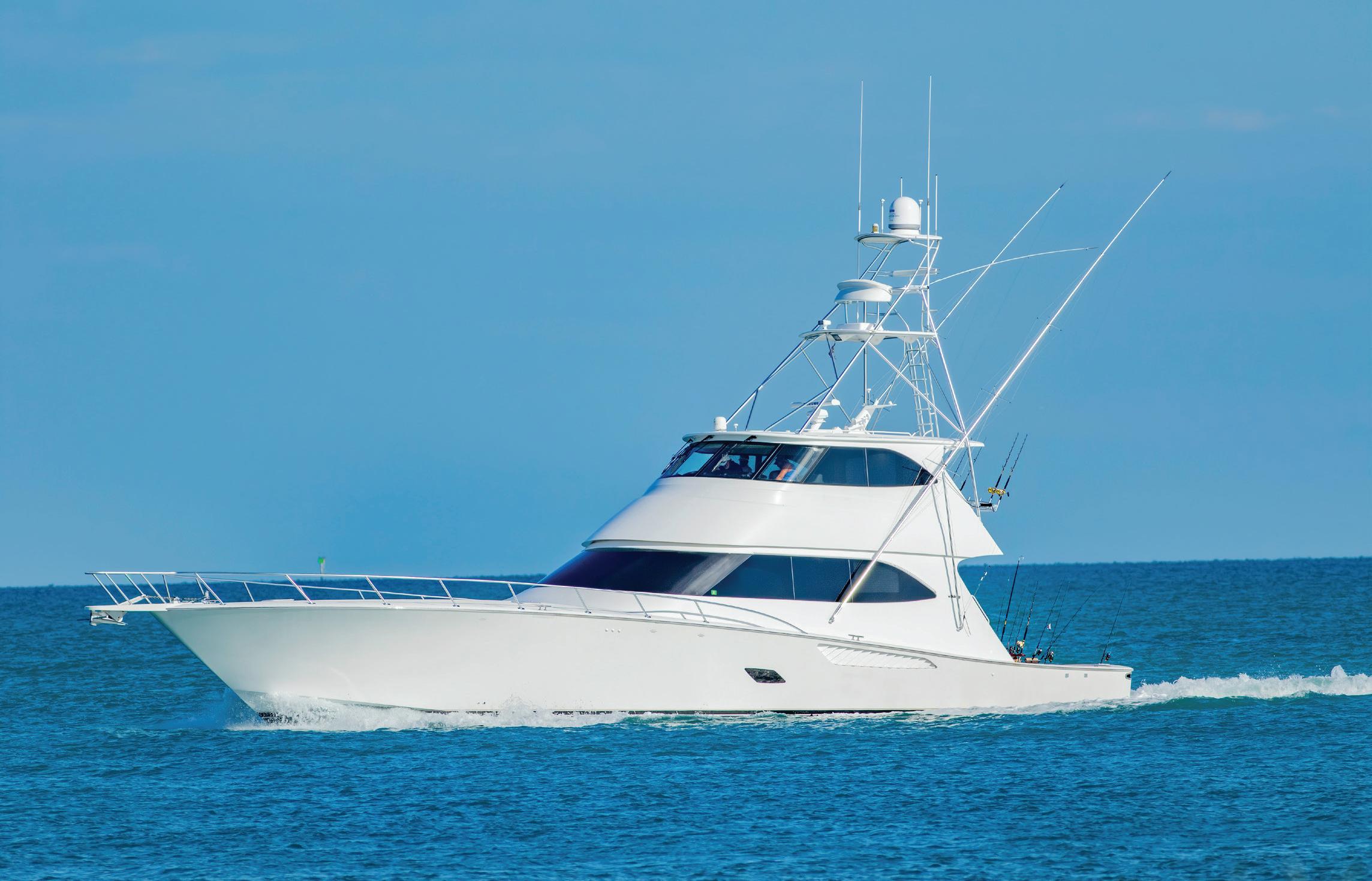
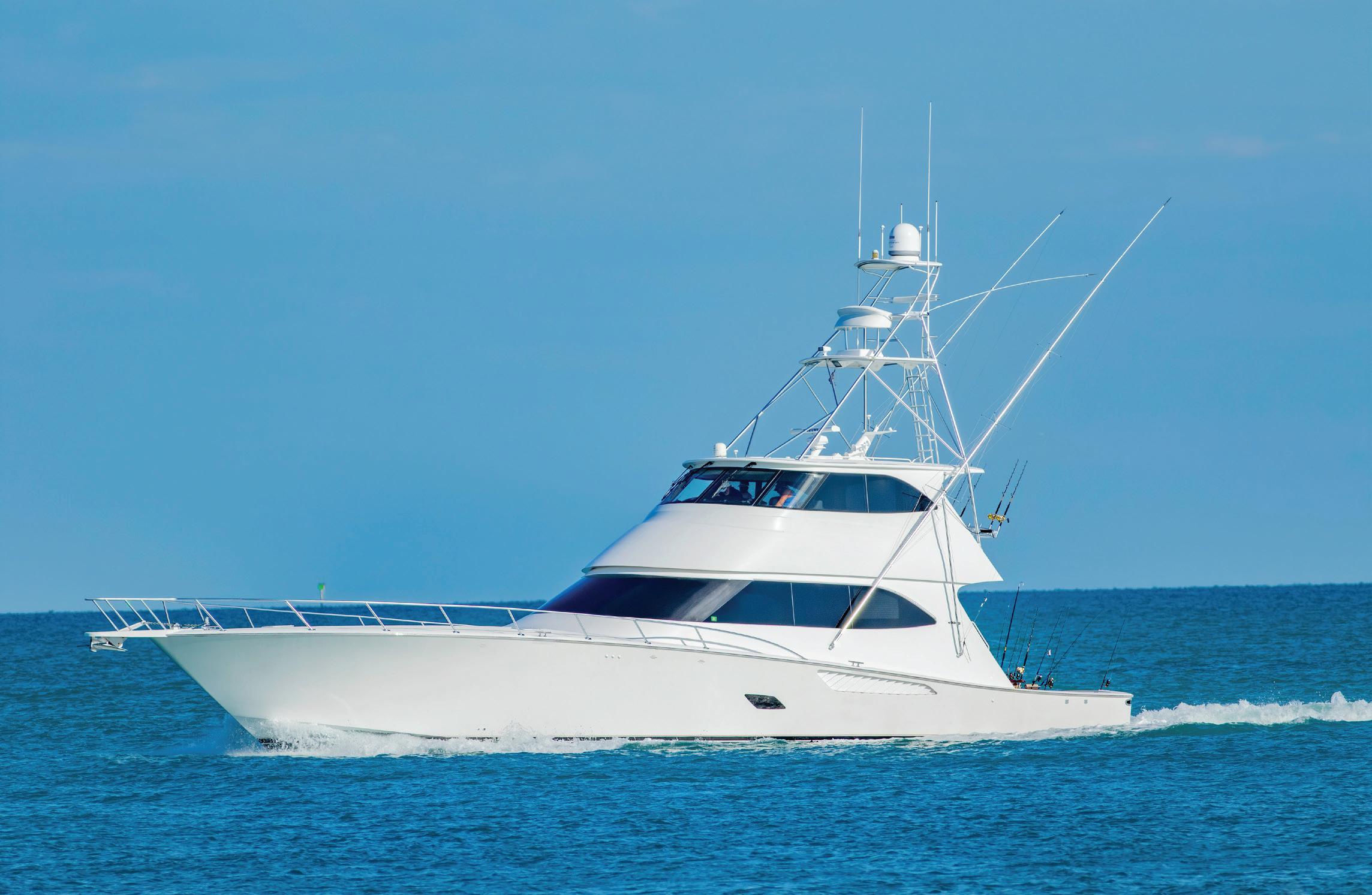
COASTALANGLERMAG.COM • THEANGLERMAG.COM SEPTEMBER 2023 NATIONAL 13 Clean, Waxes & Protects Glass, Lexan, Isinglass, Metal, Gelcoat, Fiberglass, Paint, Plastic & Rubber Remove & Prevents Oxidation, Scuff Marks, Bird & Spider Poop, Fish Blood, Rust, Water & Exhaust Stains Restores Gelcoat, Fiberglass, Metal, Plastic Windows & Rubber www.koenigpolish.com • 1-877-843-9929 USE CODE BOAT10 FOR 10% 0FF CLEANS EVERYTHING. PERIOD.
ADCNR PHOTOS BY DAVID RAINER
Re-Discover Old Florida Waterfront Charm
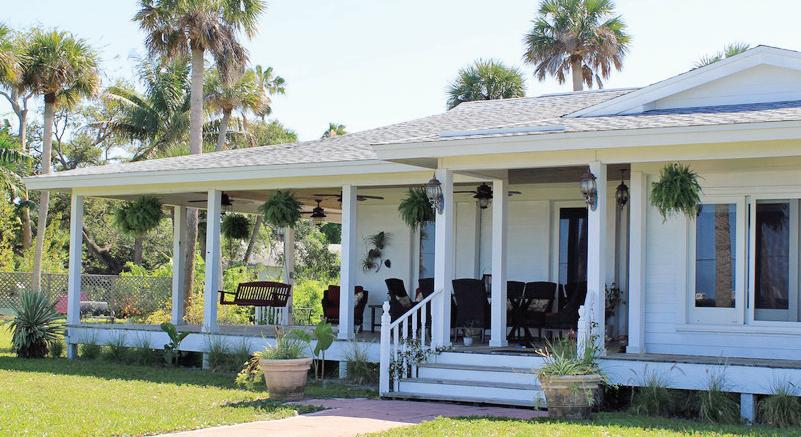
The Perfect Vacation Getaway for Fishing, Boating & Outdoor Enthusiasts

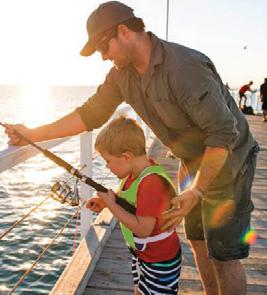
Nestled on six lush tropical acres of pristine waterfront directly on the Indian River Lagoon, take a step back in time to experience the very best of Old Florida charm with modern conveniences and services to make your stay truly memorable and unforgettable.
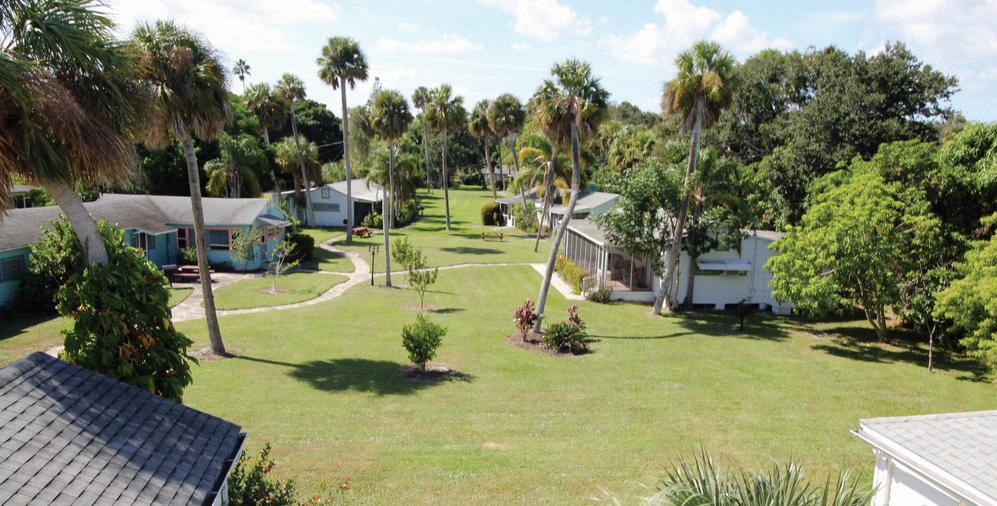
• FULLY FURNISHED 3 ROOM COTTAGES WITH FULLY EQUIPPED KITCHENS
Kingfsh Lodge includes a wide screenTV and bar for small gatherings
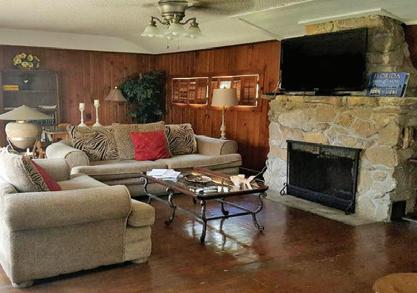
Sailfsh House features a wide covered wrap-around porch for larger groups
• Boat Trailer Parking on site w/ Water and Power
• 250 Foot Dock w/ Covered Area
• FREE Ice / FREE Guest Dockage
• Cable TV, Hi-Speed Internet


• 2 miles to the Ft. Pierce Inlet
• 12 miles to the Gulf Stream
TYLER WOOLCOTT
If you aren’t familiar with it, a Carolina rig is when you put a bullet weight and then a bead on your line and then tie a swivel to the end. To the swivel, I use about a 2-foot section of leader and then a worm hook to put a bait on. is rig gets deep, and the leader with a weightless bait provides a more subtle presentation than a traditional Texas rig.
Obviously, you want to drag this rig around some sort of cover that bass are attracted to. I use it everywhere from Southern largemouth in deep grass to deep smallmouth on rock up north. With the weight clicking against the bead and the free action of the bait, this old-school rig still dominates a lot of tournaments to this day.
ere are two presentations I go for when choosing a so plastic to Carolina rig. I like either a bait sh or a craw sh. If the available forage is bait sh, I use a uke-style bait in a natural bait sh color. If the bass are eating craw sh, I like a Zoom Speed Craw or a Strike King Menace grub in green pumpkin or some type of brown or orange color. ese two baits have a lot of action and small bodies to keep the bait streamlined while dragging. My go-to hook is a 4/0 Hayabusa WRM956 wide gap.
Cover
Your Vacation with Travel Insurance

• Laundry, BBQ Grilles and FREE use of our Kayaks
NIGHTLY • WEEKLY • MONTHLY • SEASONAL RATES
3011 N. Indian River Dr., Ft. Pierce, FL 34946 www.indianriverlagoonwaterfrontcottages.com
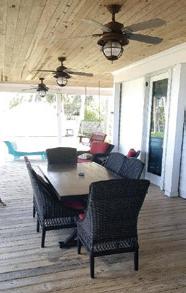
eptember is supposed to be the beginning of fall, but the reality— at least in the South—is the month is just a continuation of summer. Bass can be pretty tricky, but there are ways to target sh in cooler, deeper water. Dragging a Carolina rig is one of my favorites.You can play around with the size of the weight and the diameter of your leader line. In shallower 5- to 10-foot depths, a lighter weight can help your bait look more natural. I’d suggest ¼ to ½ ounce in that depth range. If you’re shing deeper water in 15 to 30 feet, shing a heavier ¾ to 1 ounce weight gets you down more quickly and allows you to cover bottom more e ectively.
I like the leader between my swivel and hook to be lighter than my main line because it’s less visible to the sh and allows better bait action. If I’m shing 15-pound mainline, I’ll use a 10- to 12-pound leader.
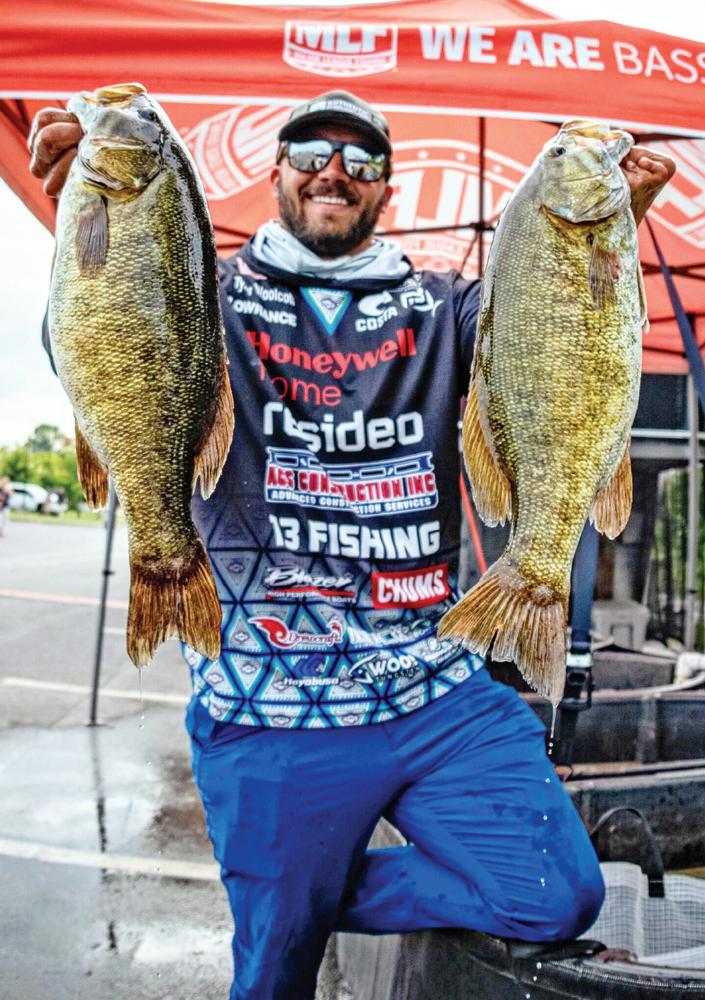
Carolina Rig Gear:
When using this rig, making long casts to cover water is a must, and being able to hook a sh at the end of a long cast is critical. For these reasons, I use a pretty long rod. My go to is a 13 Fishing 7’6” MH Omen Black Casting rod.
You’ll also need to pick line up fast with the reel to remove slack on the take. I use a 13 Fishing Concept A 8:3:1 reel, which eats up line quickly. Spool this reel with 15-pound Seaguar uorocarbon, and grab a small spool of 10- or 12-pound line for leaders.
Tyler Woolcott is a professional tournament angler and guide. Check out his website at www.tylerwoolcott shing.com.
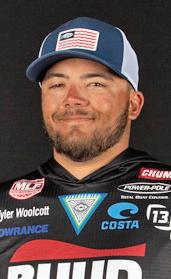
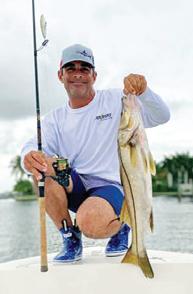
14 NATIONAL SEPTEMBER 2023 COASTALANGLERMAG.COM • THEANGLERMAG.COM
TRAVEL PROTECTION
and
are our utmost concern.
Reservations and Information: (772) 349-2206 are in full e ect. All accommodations are completely cleaned and sanitized prior to guest arrival
Your Health
Safety
COVID-19 CDC Guidelines
NEW BRICK PAVER SIDEWALKS THROUGHOUT!
S
TIPS FROM A PRO
DRAG A CAROLINA RIG
One of the most beloved coins in history is a true American Classic: The Buffalo Nickel. Although they have not been issued for over 75 years, GovMint.com is releasing to the public bags of original U.S. government Buffalo Nickels. Now they can be acquired for a limited time only—not as individual collector coins, but by weight—just $49 for a full QuarterPound Bag.

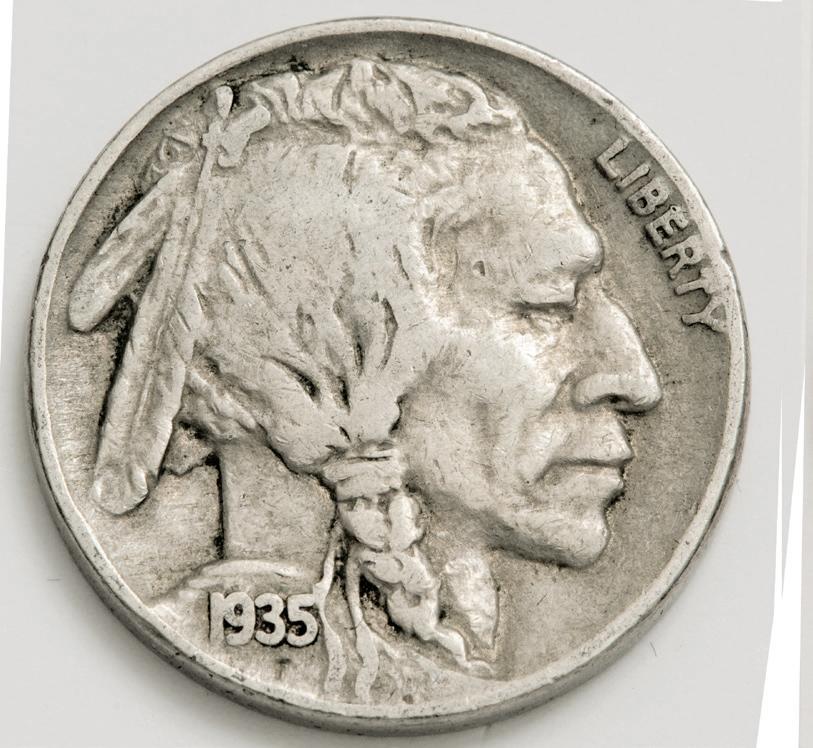

100% Valuable Collector Coins—GUARANTEED!

Every bag will be filled with collectible vintage Buffalos from over 75 years ago, GUARANTEED ONE COIN FROM EACH OF THE FOLLOWING SERIES (dates our choice):
• 1920-1929—“Roaring ’20s” Buffalo
• 1930-1938—The Buffalo’s Last Decade
• Mint Marks (P,D, and S)
• ALL Collector Grade Very Good Condition
• FREE Stone Arrowhead with each bag

Every vintage Buffalo Nickel you receive will be a coveted collector coin—GUARANTEED!





Plus, order a gigantic full Pound bag and you’ll also receive a vintage Liberty Head Nickel (1883-1912), a valuable collector classic!
Long-Vanished Buffalos Highly Coveted by Collectors
Millions of these vintage Buffalo Nickels have worn out in circulation or been recalled and destroyed by the government. Today, significant quantities can often only be found in private hoards and estate collections. As a result, these coins are becoming more soughtafter each day.
Supplies Limited— Order Now!
Supplies of vintage Buffalo Nickels are limited as the availability of these classic American coins continues to shrink each and every year. They make a precious gift for your children, family and friends—a gift that will be appreciated for a lifetime.
NOTICE: Due to recent changes in the demand for vintage U.S. coins, this advertised price may change without notice. Call today to avoid disappointment.
30-Day Money-Back Guarantee

You must be 100% satisfied with your bag of Buffalo Nickels or return it within 30 days of receipt for a prompt refund (less s/h).
Order More and SAVE
QUARTER POUND Buffalo Nickels
(23 coins) Plus FREE Stone Arrowhead
$49 + s/h
HALF POUND Bag
(46 coins) Plus FREE Stone Arrowhead



$79 + s/h SAVE $19

ONE FULL POUND Bag
(91 coins) Plus FREE Stone
Arrowhead and Liberty Head Nickel
$149 + FREE SHIPPING




SAVE $47
FREE Liberty Head Nickel with One Full Pound

FREE SHIPPING over $149!


Limited time only. Product total over $149 before taxes (if any). Standard domestic shipping only. Not valid on previous purchases.

GovMint.com • 1300 Corporate Center Curve, Dept. VBB604-08, Eagan, MN 55121
to the Public: Bags of Vintage Buffalo Nickels Historic 1920-1938 “Buffalos” by the Pound
LOW AS $49 plus shipping & handling
Released
FREE Stone Arrowhead with every bag
GovMint.com® is a retail distributor of coin and currency issues and is not a liated with the U.S. government. e collectible coin market is unregulated, highly speculative and involves risk. GovMint.com reserves the right to decline to consummate any sale, within its discretion, including due to pricing errors. Prices, facts, gures and populations deemed accurate as of the date of publication but may change signi cantly over time. All purchases are expressly conditioned upon your acceptance of GovMint.com’s Terms and Conditions (www.govmint.com/terms-conditions or call 1-800-721-0320); to decline, return your purchase pursuant to GovMint.com’s Return Policy. © 2023 GovMint.com. All rights reserved. 1-877-566-6468 Offer Code VBB604-08 Please mention this code when you call. 2 EASY WAYS TO ORDER: CALL TOLL FREE OR GO ONLINE Representatives are able to take your calls from 8am-8pm M-F, 9am-7pm Sat and Sun Central Time To order online, place phone camera over QR code to scan or use link below: www.govmint.com/vbb













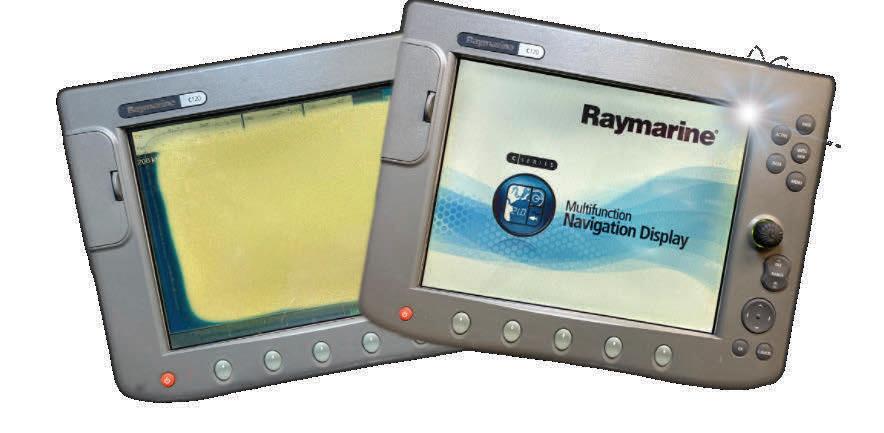

16 NATIONAL SEPTEMBER 2023 COASTALANGLERMAG.COM • THEANGLERMAG.COM Custom Built Quality Outdoor BBQ Products Since 1989 For More Info 1-252-236-4464 www.BQGRILLS.com 6043 Hwy 301N, Elm City, NC Pig Cookers, Patio Grills, Smokers, Customized BBQ Trailers 904-701-9726 • GAUGESAVER.COM SPECIALIZING IN RESTORATION OF AGED, SUNBURNT, OR FADED LIQUID CRYSTAL DISPLAYS. WE SERVICE MORE THAN JUST GAUGES! CHART PLOTTERS, VHF’S, RADARS, SOUNDERS, AUTOPILOTS, JET SKI CLUSTERS, AND MUCH MORE. 5049 HIGHWAY 17 SOUTH, GREEN COVE SPRINGS, FL 32043 If your device has an LCD that has faded over time, or want to inquire about possible repair options for your unit, give us a call or visit our website!
We’ve Found the Most Beautiful Endangered Species

Theirs sold at auction for $226,000. Ours is JUST $29! Curious? Read on!
To art nouveau jewelers at the turn of the last century, nothing was more beautiful than the dragon y. In the dragon y’s long body and outstretched wings, jewelers found the perfect setting for valuable stones. ese jewelers’ dragon y designs have become timeless statements of style; a dragon y pendant designed by French jeweler René Lalique recently sold at auction for $226,000. Inspired by his stunning artistry, we’ve crafted our Dragon y Nouvelle Collection, an elegant jewelry set for JUST $29!

True artisanship in Austrian crystal and yellow gold. is necklace and earring set features gorgeous multicolored enamel paired with Austrian crystals and a yellow gold nish. Ask any jeweler and they’ll tell you it takes true artisanship to properly blend the blues and purples found in this enamel. While art nouveau dragon ies are hard to come by, we’re helping to repopulate their numbers with this artfully stylized depiction of some of nature’s smallest wonders!
Buy the pendant, get the earrings FREE. If Stauer were a normal company, we’d sell the necklace and earrings for $199 each, but because we engage the world’s best artisans and cut out the middlemen to sell directly to you, we’re o ering the necklace for JUST $29! Even better: If you buy within the next few days, we’ll throw in the earrings for FREE! at’s a nearly $400 value for JUST $29!
Act fast! e rst time we ran this jewelry in our catalog, it sold out in a matter of days. Get this collection now before this o er goes extinct!
Jewelry Speci cations:
• Enamel with Austrian crystal. Yellow gold nish
• Pendant: 1 ½" W x 1 ¼" H.


Chain: 18" + 2", lobster clasp.
Earrings: 1 ¼" L, french wire
Dragonfly Nouvelle Collection
A. Necklace $199 $29* + S&P Save $170
B. Earrings $199 FREE with purchase of Dragonfly Nouvelle Necklace
*Special price only for customers using the offer code.


1-800-333-2045



Your Insider Offer Code: DFC163-01




Stauer, 14101 Southcross Drive W., Ste 155, Dept. DFC163-01, Burnsville, MN 55337 www.stauer.com

AFFORD THE EXTRAORDINARY 29
pendant, get earrings FREE!
Buy
A JUST $29! FREE! A $199 value!
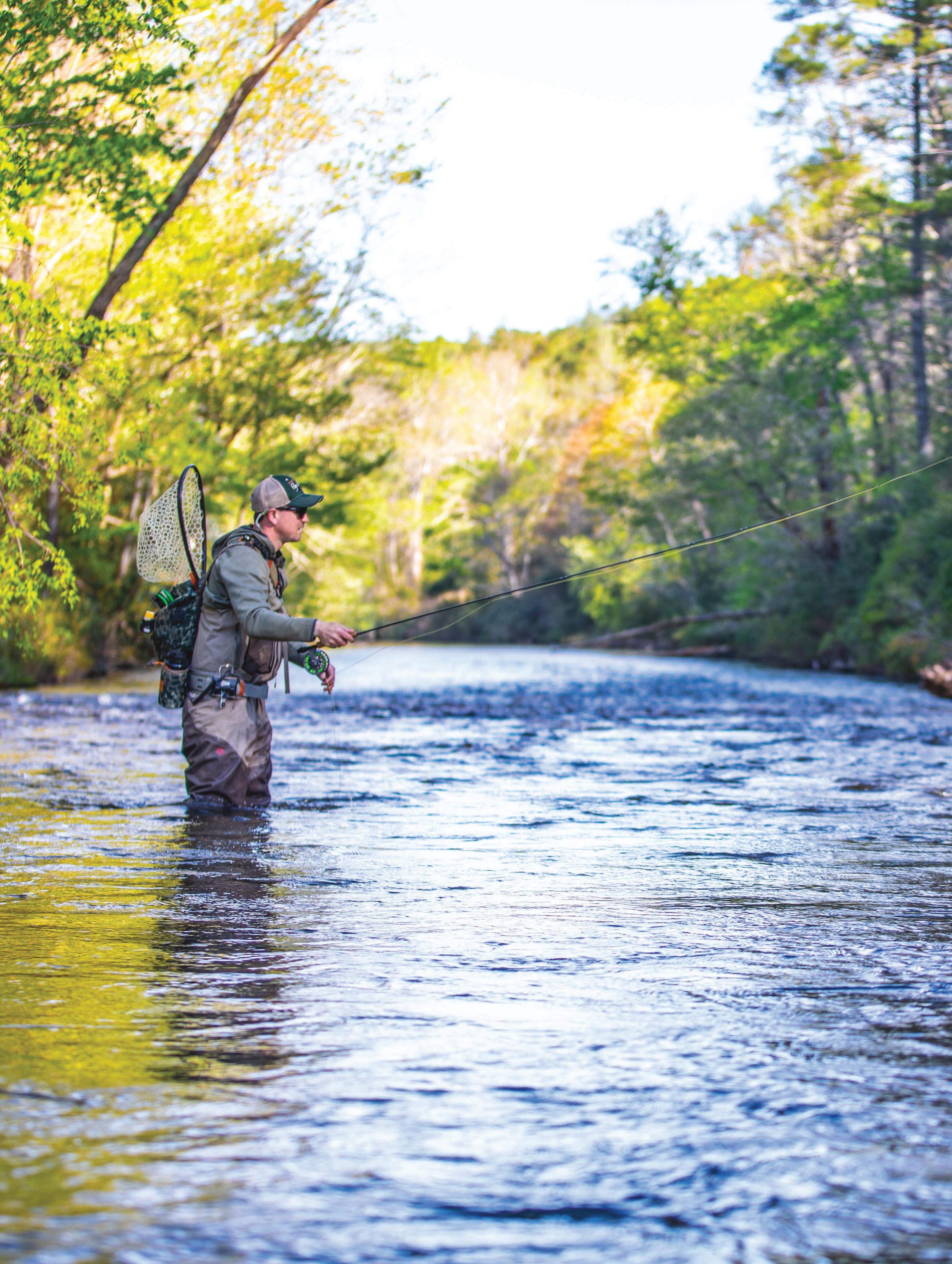

LakeHartwellCountry.com Visit LHC to plan your next fishing getaway. The art of going fishing when you should be doing something else.