Mullet Run TARPON @CAMTAMagazine
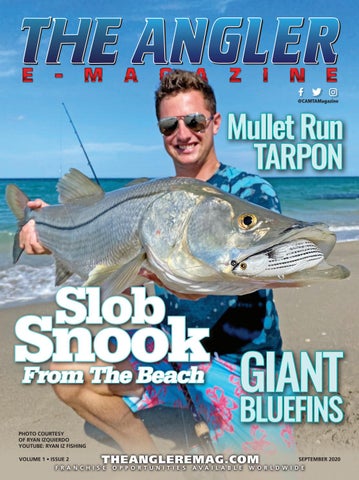
Slob
Snook From The Beach
PHOTO COURTESY OF RYAN IZQUIERDO YOUTUBE: RYAN IZ FISHING VOLUME 1 • ISSUE 2
GIANT BLUEFINS
THEANGLEREMAG.COM
F R A N C H I S E
O P P O R T U N I T I E S
A V A I L A B L E
SEPTEMBER 2020
W O R L D W I D E
INTELLIGENT DESIGN ON EVERY HORIZON
JOYSTICK CONTROL SYSTEM Optimus 360 gives your boat a whole new dimension of control. By developing the joystick function to be intuitive, Optimus 360 allows you to move your boat not only forward and back, but also sideways, a dime, all with a simple twist of the joystick.
Take command at dometic.com
TAKE COMMAND OF YOUR VESSEL WITH DOMETIC'S OPTIMUS 360 ELECTRONIC POWER STEERING SYSTEM Optimus 360 gives your boat a whole new dimension of control. By developing the joystick function to be intuitive, Optimus 360 allows you to move your boat not only forward and back, but also sideways, by pushing the joystick to the left, or to the right, and even, rotate on a dime, all with a simple twist of the joystick. Optimus 360 is designed for low speed maneuvering, and really excels in the marina, when pulling in and out of your slip, or when docking. Intelligent programming minimizes the amount of shifting required to complete a maneuver. With progressive throttling, the joystick becomes a natural extension of your hand. A light push on the joystick provides minimal thrust while more thrust can be applied by pushing harder on the joystick. The boost mode increases the RPM to give you more thrust when needed.
TOTAL CONTROL AT YOUR FINGERTIPS
F
uruno’s NavNet TZtouch, TZtouch2, and TZtouch3 deliver a huge step forward in touch screen technology. LED backlighting pushes light through every pixel for remarkable brightness and clarity. Anti-reflective glass coating makes your display viewable in any lighting conditions. Configure your system with a wide variety of sensors, and build a navigation suite that meets all of your needs.
Nothing Is Faster Than TimeZero NavNet's TimeZero™ technology delivers chart processing like you’ve never seen before – seamless chart handling, zooming and panning without the screen disappearing. TimeZero™ technology will completely transform the way you navigate. Scroll, pan, and zoom in/out with a smooth, fast and seamless graphics engine - TimeZero technology updates the information
on your screen with virtually no redraw. Timezero also facilitates simplified route planning, because Navigating in a fully 3D environment offers you a true perspective and wider area of view around the ship.
Multi Touch Control NavNet TZtouch, TZtouch2, and TZtouch3 deliver intuitive Multi Touch capability for the most intuitive navigation experience. You'll have full control of each component connected to the network right at your fingertips. As soon as your fingers touch the display, taps, pinches and swipes are instantly transformed into action. You will learn your controls so quickly that you'll be up and running in no time.
For more information, visit furuno.com.
Go on a power trip with
GET BENT. With all this power, you'll find, pinpoint & catch fish like never before.
THREE ALL-NEW MFDs
Unleash the power to see fish clearer, deeper & on both sides of your boat, with unprecedented clarity. Built-in Dual Channel 1kW TruEcho CHIRP™
2kW/3kW TruEcho CHIRP™ DFF3D Multi Beam Sonar "Deep Impact" Power Booster See 120° Port-Starboard
Hi-Power Radar* With Premium Bird Detection Mode Fishing & CMOR Charts
Get the whole story at NavNet.com
PHOTO BY TOM SCHLICHTER
Albies CLOSE AT
I
By Peter Cammann
QUARTERS
’ve fished the Shinnecock Inlet in Hampton Bays, N.Y. for many years and have usually found plenty of striped bass and bluefish to keep me occupied. One afternoon last September, I pulled into the parking lot on the inlet’s west side, took a look at the water and smiled as I saw a large school of bait flashing on the surface. Something, or a lot of somethings were feeding on them. There was a flotilla of maybe 15 boats chasing the school, including a party boat, which was crammed with weekend anglers. The school moved quickly and as I worked my way along the jetty, I could just make out larger predator fish thrashing about on the surface. It
was a real blitz! On the shore with me were 20 or so anglers, all trying to keep up as fish zipped north to south and back north again. At times, they were too far away to cast to, and all we could do was watch as the boats tried to corral the school. The fish repeatedly slid through the gaps and veered off in another direction. Even though there were close to 100 anglers involved in this melee, all of whom at one point or another were able to cast into the midst of the feeding frenzy, no one got so much as a strike. Except for the guy standing just off to my left. He had driven from in Montauk, where
he had spent a fruitless morning looking for stripers. He was tired when he got to the inlet, so he parked his vehicle and settled in for a nap. When he opened his eyes, the school was right in front of him. Maybe because he was more rested than anyone else, or perhaps because he was simply a better angler, he hooked into two different fish on a pencil popper. The first spat the hook quickly, but the second stayed on. It didn’t take long for him to realize what he’d laced into. It was a false albacore. Albies are not huge, but they fight like a fish of much greater size. The runs this guy’s fish made were extraordinary, both for their length and speed. It never jumped, as the other blitzing albies had while gorging on the baitfish, but his fish did come within view a couple of times. It looked to be close to 10 pounds, which the guy confirmed once he’d landed and released it. “That was my first albie!” he shouted. It was the first time I’d even seen one, so I walked over to offer congratulations and we chatted for a bit. The other anglers were too busy trying to get their lures back into the water to join us. Peter Cammann has been writing fishing stories for magazines and newspapers for over 30 years. He is the author of three books: Fishing Vermont’s Streams and Lakes, Ultralight Spin Fishing, and a novel titled SlipNot, all of which are available on amazon.com.
Choosing Scout Means You’ve Made the Decision to Be Aboard the Elite.
S
cout is recognized the world over for building luxury sportfishing center console, luxury crossover, dual console and inshore/bay boat models ranging from 17’ to 53’. Since our founding over three decades ago, our company’s goal has been to manufacture the best-built boats in their distinctive sportfishing niches. Each Scout hull is a true original, as our in-house research and design team works closely with engineering to take concepts from blueprint to production more efficiently, growing our company’s world-class reputation for quality, strength, durability and value. From our design to your destination, there’s nothing like a Scout. Industry-first innovations, uncompromising build quality and precise attention to detail are fused into each model. Alluring lines that perform on top of the water like the prize catch you’re chasing under it. Experiences waiting to be had. Lasting memories to be made. Heads to turn. Creating award-winning models that separate us from the industry mediocrity first starts with having the finest craftsmanship; unparalleled boat building experience that spans our entire manufacturing facility. Knowledge to know how to do things the right way. Talent to know how to do those things better. Courage to do the old things a new way. Every Scout team member that has a hand on your boat has pride and precision in what they’re building, and for
whom they’re building. Glide your fingertips anywhere across the model. Feel 100% handlaid fiberglass construction, the luxury of the upholstery, the richness in the accents. Feel the clean design inside and out, all the way to the completely-finished bilges and underside of all doors, lids and hatches. Bow to stern, port to starboard, above deck and below, everywhere you look and touch you’re experiencing the Scout difference. Timeless styling and painstaking perfection are fused into every model our Scout family
builds. We continue to be first-to-market with our industry-leading innovations and groundbreaking ideas. We are a fresh, vibrant company that’s changing the history of boating by bringing you the future of boating. Our Scout customer family continues to spread across the world, and with our model size range, you’re sure to find the perfect model. If you’re ready to upgrade and join our growing family…then you’re ready to Discover More. Visit scoutboats.com for more information.
SLOB SNOOK By Ryan Izquierdo
T
he anticipation is over. Snook season opened Sept. 1 on Florida’s Atlantic coast, and I know a lot of anglers who are excited to get that thump, fire up the skillet and enjoy a beautiful keeper snook with friends and family. Snook, in case you didn’t know it, are pretty much the most awesome inshore gamefish around. They grow large, up into the 30- and 40-pound range. They are aggressive feeders, and the fight is definitely something to write home about. Florida anglers are lucky to live in one of the world’s best places to catch snook. For everyone else, it’s definitely worth a fall trip to the Sunshine State to do battle with these tacklebusters. Regulations allow you to keep just one fish a day in the 28- to 32-inch slot limit. One of the best ways to catch that one keeper—or a giant slob snook—is beach fishing. You don’t need a fancy boat. All you need is your own two legs, a rod and reel and the appropriate tackle. Location — When fishing for snook, tarpon
and other gamefish, there are a few key things to look for: birds flying/diving, baitfish being ambushed, obvious structure and current flow. I always bring binoculars to the beach and scan the shoreline for birds and baitfish. If you don’t see any action, keep moving down the beach. I drive my truck to every beach access, quickly hop out and scout. This is the fastest way to cover ground and scan for what you are looking for! The more you fish the beach, the more you will learn and understand a pattern. Snook are hunters; they stage up in obvious areas ready to ambush prey. The beach may all look the same on the surface, but underwater is a different story. Be on the lookout for deep holes, rocks, grass, dropoffs, swash channels and any other structure you might find. Any time sand meets grass or rocks, that’s a great area to fish. Look past the obvious structure, and sometimes that will yield fish other anglers fail to notice. Equipment — When it comes to beach snook fishing, finesse is everything. However, the goal is to get the fish in quickly to ensure a healthy release if it’s not a keeper. Typically, you want to
downscale your line, leader, and hook when beach fishing. My go-to set up is a 4000 spinning reel; 10- to 20-lb. braid; a 7-foot medium action rod; 3 to 4 feet of 30-lb. fluorocarbon leader; a 1/4- to 3/8-ounce jig-head; and 3- to 6-inch swimbaits, depending on the forage, depth and fishing conditions. Jerkbaits and plugs that dive 3 to 5 feet are also a good option. Matching the hatch is key. Use lures that look similar in size and color to what the fish are feeding on. Fishing with live bait is also a good option. I always keep a 5- or 6-foot cast net in the bed of my truck. It’s lightweight, easy, and gets the job done. Pilchards, threadfin, mullet, croaker and whiting are all great baits found on Florida’s east coast beaches. Keep an aerator and bucket with a lid to ensure the baits are alive and cool. The bigger the bait, the bigger the tackle you will need. I like to free line baits, but I carry pinchon split shot weights if I need to get baits down into the strike zone. I recommend 2/0 to 6/0 circle hooks for the best hook up ratio. Time — The best times to go fishing are at dawn and dusk. Tides are also extremely important. The best time to fish for beach snook is the first hour before and after incoming and outgoing tides. I’ve had the best results right before and after high tide. It is important to check the tides and plan ahead. I also log my catches in a small notebook, where I write down the date, tide, time, tackle/bait used. Start a logbook, and you will eventually have excellent data to use in planning. That is the best way to truly learn and master beach snook fishing. Follow Ryan Izquierdo on YouTube (RyanIzFishing) and Instagram (Instagram.com/Ryan_Izquierdo) to check out his fishing adventures.
Progressive Casualty Ins. Co. & affiliates. Annual premium for a basic liability policy not available all states. Prices vary based on how you buy.
There’s a reason they say, Curse like a sailor. That’s why we offer basic plans starting at $100 a year and options with On-Water Towing. 1.800.PROGRESSIVE | PROGRESSIVE.COM
Pro Topwater Strategies for Redfish & Seatrout
P
ENN Fleet Capt. Chris Condon fishes the shallows around Charleston, South Carolina, where redfish are suckers for topwater lures. Low-light is the best time to throw a topwater, but Condon also employs the technique any time of day when fishing over oyster bars. “Topwater is the only way to fish without getting snagged,” he explained. He especially likes topwater fishing in calm conditions with no wind, when the lure has the best chance to get a fish’s attention. Condon’s favorite application is when a school of reds is crashing shrimp along a marsh bank. Condon will toss a Berkley J-Walker 100 a few feet ahead of the pack and wait for them to get close to start twitching the lure. For increased accuracy, Condon likes a 7-foot, fast-action, medium power Fenwick HMG Inshore. The rod is well suited to heavier lures and allows him to walk the dog with a tight pattern. Condon matches the rod to a PENN Clash II 2500 reel. The reel is
lightweight, with a full metal body to reduce flex. He said the HT-100 drag picks up smoothly, without sticking or surging, which could pull the hook. 700 miles away, Capt. CT Williams, a PENN Fleet Captain from Shell Beach, Louisiana, turns to topwater lures for gator trout. Williams likes a Berkley J-Walker 120. He fishes reflective lures—such as the blue and chrome “Blue Bullet” color—in low-light, and he’ll switch to Bone colored bait during the brighter part of the day. Williams said the biggest challenge to topwater fishing is hooking the fish. A big trout strikes with a violent explosion, shaking its head, and throwing water everywhere. It can be tough, but anglers should wait for the fish to start pulling the lure away before setting the hook. A trout’s paper-thin mouth requires a delicate touch. Williams suggested letting the tackle do the work. He likes a softer, parabolic rod with a long, slow bend. The rod absorbs the shock of the strike and prevents the angler from jerking the
lure out of the fish’s mouth. Once the fish takes off, Williams relies on a PENN Clash II with super smooth drag. With trout, the lower end of the drag pressure is more important than maximum drag. “Smooth drag through the range applies steady pressure through the fight,” Williams said. A lighter drag setting keeps the hook from pulling, while the softer rod absorbs the headshakes. Topwater fishing isn’t only effective, it’s fun. The excitement of watching a predator attack its prey gets the heart racing and blood flowing.
MASSIVE FORT LAUDERDALE’S
MULLET RUN
TARPON C apt. Jeff Maggio said it’s been a great summer for tarpon in Fort Lauderdale, and he’s anxiously awaiting the fall migration of massive mullet schools through south Florida. This is the fabled mullet run down Florida’s Atlantic coast, when every predator that swims the beaches and inlets can be caught following and feeding on enormous schools of baitfish. “It’s so visual,” Maggio said. “You see the massive schools of bait, and the birds, and the fish busting on the surface. It’s really spectacular. It’s the kind of thing where even if you only catch a couple fish, you’ll think you had the best fishing of your life just because you witnessed it.” Most years, smaller finger mullet show up on the beaches and in the Intracoastal Waterway around Sept. 1, said Maggio. Everything—the bait, the schools and the fish chasing them—gets larger as the migration progresses. By October, the mullet run is usually in full effect, and big tarpon, giant snook, jack crevalle, bluefish, Spanish mackerel, spinner sharks and others will all be hounding southbound mullet. Capt. Maggio is a tarpon specialist. He spends summer evenings putting anglers on big tarpon off the beaches and using light tackle or fly rods to catch juveniles in the canals. The mullet run is a phenomenon that puts 100-plus-pound tarpon in everyone’s reach. “This time of year when there’s no wrong place to be,” he said. “We call it happy bait. It’s the time when everybody can get bait, everybody’s catching fish, and everybody’s having a good time.” The key is to encounter the massive schools of bait. Maggio said they keep a close eye on bird action off the beaches. Mullet run tight to Fort Lauderdale beaches, usually inside the swim buoys, which puts big tarpon, snook and everything else in range of shore anglers. “It depends on the tides,” he said. “On the lower tides, it’s better to be in a boat. On the higher tides, it’s better to be on the sand.” From either side of the action, a live mullet netted straight out of the school and freelined with no weight or big soft baits like a Hogy or a SpoolTek are good bets for tempting tarpon. Add some weight if you want a giant snook. They typically feed near the bottom. “If fish are feeding aggressively, you can do anything and be successful,” he said. “But you’re waiting for yours to be found among millions of others.”
By Nick Carter
Maggio said he prefers when fish are running parallel with the schools and not actively crashing them. In these conditions, a well-presented bait on the edge of a mullet school is likely to get hit. On the Intracoastal, Maggio likes to stake out a pinch point and wait as the action passes in waves. From Boca Inlet in Boca Raton south to Haulover Inlet at the north end of Biscayne Bay, the Intracoastal is squeezed down into a bottleneck. Pinch points funnel fish along the way. “Because it’s so tight, it just magnifies everything,” he said. Competent anglers might bring three or four big tarpon to Maggio’s boat on a good day, which means they’ll have jumped 10. Several big jack crevalle, some spinner sharks and often a giant 20-plus-pound snook might be considered bycatch. But Maggio, an active steward of the waters, threw in a big disclaimer. “We’re on pins and needles waiting to see what happens this year,” he said. “I’ve been fishing Fort Lauderdale since I was a kid in the 70s, and last year was the worst I’ve ever seen. We think it was the red tides, but it was the first time in my life I didn’t see the mullet run come through.” Here’s hoping, for the sake of fish and anglers, that the 2020 mullet run marks a return to the norm.
Photos courtesy of Capt. Jeff Maggio
Contact Capt. Jeff Maggio by email at jeff@ lunkerdog.com. See his website www.lunkerdog.com, and check out his podcast “Lunker Dogs Reel Guy Show” on all the major the major platforms.
GULP! PADDLESHAD ®
YOUR FISH. OUR SCIENCE.
SCENT
TASTE
FISH SMELL 1000X BETTER THAN WE DO. Underwater. In current. And even in nutrient-dense saltwater, fish can pick up a scent at the parts per billion level. Think that’s impressive? How about a bait with the ability to trick that sense of smell into believing it is even better than real food. In scientific tests, Gulp!® proved so effective on saltwater gamefish, it actually outfished real bait time and time again. Not only does the scent outperform real and artificial bait, it has 400 times the scent dispersion of the best competing soft plastic bait. Now, Gulp! is available in all of the most popular sizes, colors and actions, including the new Firetail options. Berkley® Gulp! We’ve done the science, now you catch the fish. berkley-fishing.com ©2020 Pure Fishing, Inc.
You didn’t see it coming. Neither did the fish. Discover the unique FISH PRO™. The world’s first personal watercraft designed for fishing will bring you closer to the action for an experience like never before.
Discover yours at Sea-Doo.com
®
© 2020 Bombardier Recreational Products Inc. (BRP). All rights reserved. , TM and the BRP logo are trademarks of BRP or its affiliates. In the U.S.A., products are distributed by BRP US Inc. Carefully read the operator’s guide and safety instructions. Observe applicable laws and regulations. Always wear appropriate protective clothing, including a personal flotation device and wetsuit bottoms.
SEA DOO FISH PRO:
DOES IT FISH? S
hort answer: a resounding yes, but to really appreciate the fishability of this fun and efficient vessel, you’ve got to give one a try. We did, and fishing on this sleek powerful personal watercraft is more fun than you can imagine. Everything about this little vessel is fun, fun, fun and user friendly. We trailered it with a Honda Civic and launched at a “kayak ramp.” The detachable rear cooler easily converts to a great livewell, and the positioning of the rear rod holders enables a nice spread for trolling. And everything’s within easy reach of the driver or passenger. While the recommended navigational depth is officially 3 feet or deeper, the actual draft of this angler-friendly vessel is only 11 inches. We had no problem drifting and poling through very shallow water chasing bait. Yes, you can definitely cast a net from this vessel, which we did, and there’s ample storage for your net in one of the front hatches.
The modifications on the Sea Doo Fish Pro are definitely angler intuitive. As early owners of Sea Doos pioneered its use as a fishing vessel, the standards required became somewhat universal. The Sea Doo Fish Pro is the result of careful attention to the details these innovators added to their early Sea Doo models. If there are two words that sum up this sporty little vessel, they are “fun” and “efficient.” The Garmin electronics screen is easy to view and access while driving, and the achievable speeds on this powerhouse personal watercraft will blow your hat off. With a suggested retail price of only $14,999, the Fish Pro is a lot of vessel and years of fun on the water for the price. Another important attribute of this class of personal watercraft
By CAM Staff
is access. Its small footprint give you access to launch spots that would not be accessible by most traditional motorized watercraft. Again, if you really want to know how much fun this vessel can bring to your fishing endeavors, just test drive one for yourself. We did, and we’re convinced the Fish Pro fishes! To learn more, visit: www.sea-doo.com.
ULTIMATE
INNOVATION
Remember, drinking and driving don’t mix. Always wear a USCG-Approved life jacket and read your owner’s manual. Suzuki, the Suzuki S and model names are Suzuki trademarks or ®. © 2020 Suzuki Motor of America, Inc.
SUZUKI DF300B OUTBOARD
T
he new DF300B V-6 4-stroke joins Suzuki’s flagship 350hp contra-rotating outboard, and brings a new level of acceleration, performance and efficiency to a whole new class of boats rated for 300hp maximum (or 600/900hp maximum in twin/triple installations). Suzuki’s proven contra-rotating propeller system provides superior “grip” on the water when boaters hit the throttle, for excellent hole shot and strong acceleration, even when pushing heavy, fully loaded boats. With the engine’s power distributed over six blades, rather than three, Suzuki is able to reduce the size of the gears and create a sleek, hydrodynamic lower unit that slices through the water with minimum drag. This increased propeller blade surface area and contra-rotating action also deliver exceptional acceleration while providing incredible reverse thrust. In the Suzuki tradition, this new outboard is packed with innovative technology from the bottom to the top. The DF300B’s robust 4.4-liter displacement engine features a 10.5:1 compression ratio and duel fuel injectors for optimum performance and efficiency using 87 octane fuel. By using two smaller fuel injectors, Suzuki delivers a precise amount of fuel to the center of the combustion chamber, improving atomization and avoiding off-center combustion, a common cause of engine knock. Injecting 100% of the fuel into the cylinder at once also keeps the fuel cool, providing additional power. A dual-louver, direct air intake system on the DF300B helps the engine breath freely for optimum performance while separating out water, spray and moisture for improved reliability. This unique intake system also provides the engine with cooler, denser air for a more powerful combustion cycle. The DF300B features the offset driveshaft engine layout found on other Suzuki outboards, allowing for an overall compact design, along with two-stage gear reduction (2.29:1) for plenty of low-end torque without sacrificing top-end performance. This compact size, light weight (727 lbs. for 25” shaft) and easy integration with Suzuki Precision Control drive-by-wire throttle and shift controls make the DF300B a clear choice for rigging on a wide variety of boats in single or twin installations — particularly on vessels with second stations.
To learn more, visit: www.suzukimarine.com
HAVALON TALON:
CUTTING EDGE INNOVATION A By CAM Staff
ny surgeon or taxidermist will tell you the best tool for cutting flesh is a scalpel. And that’s where knife-maker Havalon got its start. Their parent company, Havel’s, is a medical device company that supplies scalpels for surgical use. When the idea arose to bring the same incredibly sharp blades to the outdoors, it gave tools to outdoorsmen that are more precise than any hunting or fillet knife ever invented. The first Havalon Piranta was a blade modeled after an autopsy scalpel that folded into a sturdy handle. It offered all sorts of outdoorsmen the benefits of an ultra-sharp scalpel blade in the form of a pocketknife. But the blade itself was not built to handle the rigors of everyday use. That’s when Havalon began tinkering to find the best combination of sharpness and strength. The resulting innovation has made Havalon one of the top-selling knife companies in the country and the leader in the hunting industry. “We have always felt—that a sharp blade does not need to be used with
any excessive force,” said Havalon Marketing Director Ryan Cull. “This is still a core belief of our company, but we know there is a segment of consumers that want to have sturdier blades.” The need for a sturdier blade that retains Havalon-level sharpness launched the Talon project. Designers set out to create a knife handle that accommodates an entire collection of different ultra-sharp blade styles. With a 3-inch serrated blade, a 3-inch gut hook combo blade and fillet blades of 5, 7 and 9 inches, it is the only knife you’ll ever need at the cutting board or skinning pole. This all-in-one precision cutting tool was three years in the making. Designing a handle mechanism to swap out blades quickly and easily was achieved with the ingeniously simple push-button Quik Change II system. Finding the sweet spot between scalpel sharp and durable was the next step, and the blades also needed to be tailored to their particular uses. Through more tinkering and testing, Havalon landed on AUS-8
steel—the gold standard—which offers the best combination of edge retention and strength. Thickness and shapes of the different blades were custom designed. Fillet knives require flexibility; gut hooks do not. Each blade type was carefully considered and rigorously tested to achieve optimal performance for its intended use. The final result is a single knife kit that outperforms a whole cutlery set of traditional knives. Extreme sharpness is something Havalon users have come to expect with blades intended for replacement when they lose their edge. Talon blades are different. They are scalpel
sharp, yet they are strong enough to be resharpened. “So long as users don’t pry on the blades with extreme force or damage them in some other unforeseeable way, they should be able to go years without buying replacements,” said Cull. “The versatility of the blade styles along with the strength and sharpness of the blades make the Talon one of the most innovative products to come out in the industry in years.” To see all the features of the Talon and all of Havalon’s other scalpel-sharp knives, go to www.havalon.com.
Spider Rigging To Catch
Crappie By Darcie Arahill
C
rappie, also known as “specks,” and “sac-a-lait” and a host of other names, depending on where you live, are absolutely delicious and are easy to catch for the whole family. I grew up saltwater fishing and did not know much about crappie. However, all it took was one trip to the lake and I was hooked on these fish; on the correct light tackle crappie are just as much fun as larger fish, and more “yummy” than most! Crappie, both white and black variations, can be found in almost any body of freshwater from Michigan to Florida. I usually catch them in Lake Okeechobee, Fla. Depending on the time of year, you will catch them in grass mats, along edges, in deep holes, and even through the ice. They generally hold tight to some type of cover like brushpiles or sunken timber, and they eat primarily smaller fish. Small minnows
or baits that mimic small minnows work best. When the fish are biting, it is easy on many lakes to see where crappie are by the dozens of boats seeking to catch what I call “lake lobster!” This type of fishing is a way of life for many lake anglers. My favorite way to catch them is often called “spider rigging.” Anglers set out multiple specially designed rods, up to 20 sometimes, such as the BP Crappie Max Crappie Rod, with very light line and leader (no more than 4- to 8-lb. test), a bobber, then a split shot and a small hook. We generally use size #1, #2 or #4 Mustad Aberdeen hooks, and you can try different color hooks as well—gold, bronze or red. The easiest bait to catch crappie with is tiny live minnows from the local tackle shop. Set your rods at varying depths, and discover where they are biting! If you want to up your game, try
jigging for them. Mustad crappie jigs are usually “ball head” jigs and come in a variety of colors. Drop your jig into deep holes and along grass mats or slow troll a spread of jigs around the mouths of creeks. You can attach a variety of trailers, curly tails, minnows and some even add spinners to the jig. Lastly, to really make it fun you can even fly fish for crappie. They will hit many types of flies, and be sure to focus on the size of the fly as much as anything. In conclusion, the only way to catch crappie is to GO, get out there! It’s time to bring the entire family, kids and everyone, for a wonderful day on the water and an even better dinner. This type of fishing is a great way to introduce young kids to fishing because it’s hard to not catch a crappie or other by-catch like bass, catfish, sunfish and bluegills when out the lake. Find “Darcizzle Offshore” on all the major social media platforms. Darcie has more than 850 videos of her fishing adventures on YouTube and would love to hear from you.
Insist on Only the Best Cast Net for Grabbing Your Bait America’s #1 Cast Net Choice, Year After Year America’s Best
www.castnets.com | sales@castnets.com | 1-800-332-6387 ext. 110 |
An Average Tow is $750
LET US PICK UP THE TAB
UNLIMITED TOWING $85/$159* Don’t get mad, get an Unlimited Towing Membership from BoatU.S. That way breakdowns, running out of fuel and soft ungroundings won’t throw you for a loop. For a year of worry-free boating, get towing before you get going.
JOIN TODAY! BoatUS.com/Towing | 800-395-2628 *One year Freshwater/Saltwater Membership pricing. Details of services provided can be found online at BoatUS.com/Agree. TowBoatU.S. is not a rescue service. In an emergency situation, you must contact the Coast Guard or a government agency immediately.
Bluefin Bonanza Boats
MASSIVE TUNA H ere’s what anglers in Maine were up to in August. The Casco Bay Bluefin Bonanza, out of South Portland, Maine, hauled in more than 10,000 pounds of bluefin tuna Aug. 6-8. That’s a whole lot of good eating. The field of 41 boats landed 23 big fish, and the top four finishers all boated bluefins heavier than 600 pounds. Local captain Pete Speeches and the crew of Backstabber won the tournament and $6,250 for a 687.5-pound giant they brought to the scale the third and final day of fishing on Saturday, Aug. 8. Weigh-ins were exciting and filled with drama on Day 3, as the top five positions changed multiple times in just a few hours. Capt. Keith Jordan (Bailey & Bella) established an early lead on the first day with a 679.5-pound bluefin. Last year’s winner, Capt. Kurt Christensen (Molly Jane) brought in a 538-pounder on the second day, followed shortly thereafter by Capt. Nate Bolduc (Cecelia Jean) with a 501.5 pounder. Molly Jane’s second fish, a 671.5-pounder reeled in by Aiden McLean and Reid Hansen seemed a solid second place. Just two hours later, Bailey & Bella’s second fish looked to be a contender but fell just shy at 637 pounds. Their fish had barely been hoisted and weighed when Backstabber brought in a 687.5-pound behemoth that launched them into first place. Capt. Kevin Lord (Square Footage) shuffled the deck again after lunch with a 547 pounder. Here’s the list of the top-10: 1st: Pete Speeches - Backstabber - 687.5 - $6,250 2nd: Keith Jordan - Bailey & Bella - 679.5 - $3,250 3rd: Kurt Christensen - Molly Jane - 671.5 - $1,500 4th: Keith Jordan - Bailey & Bella - 637 - $1,000 5th: Kevin Lord - 547 - $500 6th: Kurt Christensen - Molly Jane - 538 7th: Nate Bolduc - Cecelia Jean - 501.5 8th: Rusty Parmenter - Patricia Ann - 483 9th: Jeremy Loomis - Kelsey Anne - 466 10th: Shawn Moore - Katelyn A – 462
Dr. Walt Golet, adjunct professor from the University of Maine, and team members with the Gulf of Maine Research Institute collected biological samples from all fish landed for continuing work on bluefin tuna. In its second year, the Casco Bay Bluefin Bonanza is a charitable organization dedicated to raising funds for scholarships to Maine’s community college system. In 2019, the Bonanza awarded a $1,000 scholarship to one student from each of the seven schools. Proceeds come from generous donations by local, regional and national businesses and individuals. For more, visit www.bluefinbonanza.org and social media outlets at Facebook, Instagram, and YouTube.
Advantages of JetDock Boat Lifts and Floating Docks
J
etDock systems make boating easier and more enjoyable with their ease of customization and operation. A JetDock solution has many advantages over other lift options including their versatility, durability, boat accommodation, and safety. Spend less time turning cranks and more time on the water with our simple and safe drive-on lift system. JetDock owners estimate that they find themselves being able to use their watercraft up to 3 times more after purchase due to the ease of use and ownership of our drive-on lift systems and floating dock solutions.
JetDock systems are versatile JetDocks can be used for as walkways or drive-on docks that are both extremely lightweight and durable - making traditional boat lift technology obsolete. Fully portable, modular, and interchangable, our floating boat lifts operate in any water conditions including deep or shallow water and saltwater or freshwater. JetDock boat lifts are designed to work effectively in any kind of tide, current change, or even waves.
Our boat lifts and floating dock systems are durable and virtually maintenance free All JetDock systems are made with quality materials that are nonpolluting, resistant to utlraviolet damage, require no electricity, and are non-corroding. JetDock’s design also makes them easy to transport without the use of a trailer. Spend more time enjoying life on the water and less time maintaining and hauling your boat lift with JetDock.
Owning a JetDock system makes maintaining your boat easier With a 270° walk-around platform, JetDock systems make fueling, servicing, covering, and securing your boat a breeze! Safely perform maintenance on your boat without worrying about your footing.
JetDock works with a variety of watercraft Whether your prized boat is a powerboat, dinghy, kayak, Jet Ski, sea plane, or pontoon boat - a JetDock boat lift is the solution for you. We offer different systems for different boat styles including static, air-assisted, and multi-hull. Our custom-designed boat lifts can also accommodate most boat lengths, making them one of the most versatile boat lift options in the world!
Customize your JetDock With JetDock, your floating boat dock and boat lift systems are designed to suit your watercraft needs. With its modular design, JetDock systems are available in any size, arrangement, or shape. Need to change your floating walkway to accommodate more boats? Transform your “T”-shaped dock to a “U”-shaped dock easily to customize your dock as needed.
One Life. Live It On The Water.
SM
Drive-On Dry Docking For Boats Up To 50 Feet
Life Can Be Complicated. Docking Shouldn’t Be. • • • • • • • • • •
“Start and Go” Convenience Effortless Spontaneous Trips Simple Drive-On Safely Moored in Seconds Complete Dry Docking Protection Prevents Fouling - Pays For Itself Spacious, Stable Walk-Around Platform Quick Loading, Safe Boarding Access Makes Caring for Craft Easy Maintenance-FREE
800-JET-DOCK
JetDock.com
COASTALANGLERMAG.COM • THEANGLERMAG.COM
JUNE 2020
LOCATION 1
Own Your Own
FRANCHISE • Best Consumer Value! • Home Based Business with Low Overhead • Complete Training with Ongoing Support • Years of Experience with Proven Results • Turnkey Systems
• Low Startup Costs
• Exclusive Territories
We’re Working Right
Now! MISTI & GARY GUERTIN Treasure Coast Co-Publishers
Love the outdoors? Enjoy meeting new people? Self-motivated? If you are passionate about the outdoors and want to enjoy the freedom and benefits of owning your own business, come join our team of successful franchisees by publishing a Coastal Angler / The Angler Magazine in your area!
Be a part of the largest outdoor publication in the U.S. Become our next Coastal Angler/The Angler Magazine Franchise.
With a combined national readership of over a million per month and distribution to over 11,000 businesses in four regions, Coastal Angler Magazine and The Angler Magazine are the preferred resources for anglers and outdoor enthusiasts. Our brand is well known throughout the fishing world, and our free monthly magazines are recognized as well-designed, thoughtful publications that provide newsworthy and entertaining information pertinent to the marine and fishing industries. Be in Business For Yourself...But Not By Yourself. An exceptionally rewarding and fulfilling business opportunity, as a co-publisher of your area’s Coastal Angler or The Angler Magazine, you’ll enjoy the benefits of controlling your own time and future. Our proven franchise publishing system enables individuals with no prior publishing experience to publish a credible and profitable localized version of our award winning magazine. We provide complete training and on-going support to ensure your success.
COME JOIN OUR TEAM!
For more information visit:
www.franchise.coastalanglermag.com 888-800-9794 • info@coastalanglermagazine.com
Two North Carolina Catfish Records Fall NCWRC Photos
S
ummertime means catfish to a lot of anglers, and it was one heck of a summer for catfish in North Carolina. In July, two state catfish records were broken. The first, an enormous Lake Gaston blue cat, weighed more than 120 pounds. The second, a 78-pound, 14-ounce Neuse River flathead broke a record that has stood for 15 years. Joey Baird, of Lawrenceville, Va., caught his state record 121-pound, 9-ounce blue catfish out of Six Pound Creek at Lake Gaston on July 5. The
monster fish, which ate a chunk of cut bait, was more than 5 feet long, with a girth of 40.5 inches. It broke a 117-pound, 8-ounce record that has stood since June 2016. Lake Gaston is a 20,000-acre reservoir of the Roanoke River up on North Carolina’s northern border with Virginia. It has a history of producing giant blue catfish, as this is the fourth North Carolina record blue to come from its waters. The Roanoke River system also lays claim to the world record blue catfish. The largest blue catfish ever certified came from Kerr Lake, Virginia, which is one dam upstream of Lake Gaston on the Roanoke. That fish, which weighed 143 pounds, was caught in June 2011. The new North Carolina record flathead was caught by Pikeville angler Tyler Barns. The 78-pound, 14-ounce beast ate a live bream fished in the Neuse River on July 20. Barns’ monster fish was more than 4 feet long and had a girth of more than 3 feet. It bested the 78-pound record flathead caught from the Cape Fear River in 2005. The Neuse River runs from Falls Lake north of Raleigh all the way to the coast to feed the Atlantic Ocean at Pamlico Sound.
UTAH RECORDS FALL New Menhaden Management DURING PANDEMIC Benefits Striped Bass
“Y
a’ll have been busy rippin’ lips during the pandemic!” was the Facebook post from the Utah Division of Wildlife Resources in late July. Five new Utah state fishing records were set from May through July, chief among them was a monster 53-pound, 15-ounce lake trout caught by Chance Scott at Flaming Gorge Reservoir east of Salt Lake City. Scott’s fish measured 44.1 inches long and 34.7 inches in Chance Scott’s more than girth. It bested a 32-year-old 53-pound Flaming Gorge lake record of 51 pounds, which also trout is a new Utah state record. came from Flaming Gorge back PHOTO COURTESY OF UDWR in 1988. Here’s a list of the other Utah records that fell during the pandemic: Spearfishing: A 15.75-inch black crappie speared by Matt Turner on June 11 weighed 1 pound, 14 ounces. Catch and Release: Michael Christiansen caught a 10.5-inch catchand-release record Yellowstone cutthroat at Johnson Creek on June 14. Catch and Release: Kendall Johnson caught a catch-and-release record golden trout at Marsh Lake on June 16. It was 15.25 inches long. Catch and Release: David MacKay’s 34-inch splake, caught on May 8 from Fish Lake, broke the catch-and-release record of 33 inches that was set through the ice in January.
T
he Atlantic States Marine Fisheries Commission voted unanimously in August to improve management strategies for Atlantic menhaden. Consideration for the small MD DNR PHOTO BY FRANK MARENGHI baitfish’s impact on fish up the food chain is critical for important sportfish like striped bass, which rely on healthy menhaden populations for survival. After recreational anglers weighed in, the commission adopted the new ecological management system, which considers the needs of predator species and will begin the process of allowing fish like striped bass to meet population targets. Menhaden is the first fishery on the east coast to shift to an ecosystem management approach. The commission worked for more than a decade to vet several ecosystem models that led to the development and implementation of these ecological reference points for Atlantic menhaden. The selected model includes important predator species like Atlantic striped bass and bluefish as well as alternative prey such as Atlantic herring. Ultimately, these reference points can be used to set quotas that will help ensure enough menhaden are left in the water to help Atlantic striped bass, bluefish and Atlantic herring rebuild. “Today’s decision is a critical step towards acknowledging that forage fish like menhaden are ecologically important to recreationally important species like striped bass and bluefish,” said Mike Leonard, vice president of Government Affairs for the American Sportfishing Association. “A healthy Atlantic menhaden stock, and quotas that account for the needs of predators, is the science-based management we look for to help support a healthy ecosystem and the sportfishing opportunities it provides.” For more information, see www.asmfc.org.
The Return of a Legend By CAM Staff
L
egendary boat builder Forrest Munden’s re-entry into the boating industry has caused quite a stir. With his history as managing partner at Sea Cat in the 90s to his leadership role at World Cat, there’s no doubt Munden knows the cat-hull space. Last year’s introduction of the “new-andimproved” Sea Cat was the correct choice for numerous well-informed boat buyers in 2019 and so far in 2020. The stability and fuel economy that comes from a dual-hull vessel has certainly begun to take hold within the U.S. boating market. Long established as the hull of choice in Australia’s consistently choppy seas, the dual-hull concept and the original Sea Cat
introduced to the U.S. market in the 90s took some time for boaters to recognize. Today dual-hull boats are available throughout the country. You’ll find most boat tow services utilize cat-hull boats because they are extremely stable and have superior fuel economy. If you haven’t sea trialed a cat-hull boat, you owe it to yourself to see how they ride in a 2- to 3-foot or 3- to 5-foot chop. There is no more pounding. Cat hulls don’t require a plane, instead they effortlessly cut through the chop. This eliminates the pounding effect experienced with more conventional hulls. The Sea Cat 26 is no exception. Coastal Angler Magazine purchased the
second boat off the Sea Cat production line in early 2019. “This vessel rides like a dream,” said Coastal Angler Editor in Chief Ben Martin. “I couldn’t be more pleased.” While Sea Cat has definitely re-entered the boat market with their 26-foot, Hybrid 260 model, word on the street is a 36-foot model capable of speeds in excess of 90 mph is currently being prototyped for production in 2021. Imagine a center console fishing boat that can achieve speeds of 90-plus mph. It might just be the fastest center-console fishing boat on planet Earth. Look for more news on this revolutionary vessel in the future. Learn more at www.seacatboats.com
ned To Last g i s e D Wa
r ra nted for Lif e
SeaCatBoats.com
.
228-206-4042
THEN&NOW
30 YEARS OF E-Z INNOVATION
F
ounded in a small Michigan fishing town and then moved to Florida, E-Z Anchor Puller Mfg. Co. went from a Navy SeaBee’s small side-hustle to a full-blown business with an arsenal of dealers and boat builders on-board in Canada and the United States. From charters to recreational marine enthusiasts, for 30 years E-Z Anchor Puller has continued to transform the way North America anchors, with the quality and dependability that sets them apart from the competition. Purchasing an E-Z Anchor Puller drum anchor winch eliminates the need to tie off to a cleat, provides a 316 stainless steel spool that neatly stores your rode and chain, and allows you to choose and change the diameter of your anchor rode, whether it’s super-thin dyneema or extra-thick nylon rope. E-Z Anchor Puller drum anchor winches put an end to jams, tangled lines and wasted time. Unlike a windlass, our units keep your
anchor rode and chain neatly spooled onto the drum rather than just dumping it into your rope locker or deck. E-Z Anchor Puller Mfg. Co. is an American-owned and womenoperated professional maritime manufacturing company that offers friendly and prompt service to customers and affiliates. Technical support, customer service, marketing assistance, consultations and more are among the readily available services this manufacturing company provides. Technical Support answers phones 9 a.m. to 7 p.m. EST, Monday through Friday, and social media posts keep customers in the loop on maritime news, product announcements and more. E-Z Anchor Puller warehouses ship orders same-day from four fully stocked fulfillment centers in Seattle, Washington; Baltimore, Maryland; Tampa, Florida and Amsterdam, Netherlands. As an enthusiastic, industry-changing business, E-Z Anchor Puller is always looking for affiliates and customers who are excited about providing their customers with innovative, in-demand products that provide convenience and an ease-of-use that gives boaters and commercial fishermen a better experience on the water. Some of the benefits of partnering with E-Z Anchor Puller include social media exposure, featured content on the company website—including a spot in our Dealer Locator map and Industry Blog—and referrals to customers. No more jams, no more tying off to a cleat, and no more tangled lines. These three keystone attributes of the E-Z anchoring experience have appealed to commercial fishermen for three decades due to its ability to drop anchor at fast speeds and retrieve it effortlessly. The Rebel series, especially, has been known for its versatility from east coast fishing to west coast boating. In 2019, Carolina Skiff outfitted their 2020 35’ HFC Center Console Sea Chaser with the free-fall Rebel EZ-4 for it’s more automated, ease-of-use functionality. Still holding the longest warranty in the industry (7-year recreational / 3-year commercial), quality products are backed by outstanding customer service and hyper-focused attention to invention, with new products and experiences on the way! For more information about the company, call toll-free at 1-800-800-1640 or email ezanchorpuller@ezanchorpuller.com, or view our products on https://www.ezanchorpuller.com/collections/anchor-winch.
BUILD YOUR OWN FISH CLEANING TABLE
I
Tim Barefoot
f you catch a lot of fish and spend time at the cutting board, you know the back pain of a cleaning table that forces you to stoop to clean your fish. It’s OK to fillet a fish or two off a cooler, but when you’re dealing with a pile of them, the correct table height is a necessity. Here’s how to make your own fish cleaning station that attaches to a chain link or wooden fence in your backyard and folds down when you’re not using it. For most of us, it rests at a comfortable height for cleaning fish. The only materials you’ll need are: 1. 24 inches of 3/8” (1.375”) aluminum tubing 2. 24 inches of 1 ½” (1.500”) aluminum angle 3. 24” x 40” slab of ¾” Starboard marine plastic 4. Stainless wood screws For a chain link fence, you’ll need to accurately measure the top rail of the fence to determine the correct size aluminum tubing needed. The typical size for the top rail of chain link fence is 1 5/16” (1.312”). Aluminum tubing with a 1 3/8” (1.375”) inside diameter is the correct size for the table. You’ll have to saw the top rail in two (with a metal cutting saw or disc grinder with a cut off wheel) and slide the aluminum tubing over the cut. Put the cut line in the center of the tubing. This will not weaken the fence. The snug-fitting aluminum
tubing is extremely strong. My table has weathered several hurricanes without a problem. After drilling the 3/16-inch clearance holes in the aluminum angle, you’ll need to weld the tubing to the angle and screw the Starboard to the angle. A standard-size curb trashcan is a perfect height to match most fences, and serves as a sturdy support for the cleaning table. After the fish cleaning is complete, simply pull the trash can out, and the table folds down to be neatly stored until it’s needed. For a detailed video on making the collapsible table, visit
BAREFOOTCATSANDTACKLE.COM
Preserving The Quality Of Your Catch
H
ow you handle your freshly caught fish can make all the difference when it comes time to pull it out of the freezer. By following a few simple steps, you can ensure your catch remains firm, flavorful and delicious. 1) Whether it’s bound for the freezer or straight to the fryer, quickly cooling fish is the first step in preserving its quality. Kill the fish with a club or a quick slice of the knife as soon as you bring it onboard and then put it on ice immediately. Crushed ice works more quickly than cubed ice because it covers more surface area. If you can find it, saltwater ice is an excellent way to preserve fish. Make sure your ice is distributed evenly around your fish, and leave the drain plug open so your supper isn’t
soaking in bloody slush. 2) If you find a little free time on the boat when the bite slows down, it’s a good idea to go ahead and gut your fish and pack the cavity with ice. Refresh ice as needed. 3) Once you clean your catch, it will keep well in the refrigerator for several days. Pat fillets dry with a paper towel, and then wrap them tightly in plastic wrap. For the best results, store them in a bowl of ice or put a bag of ice on top of them. 4) Frozen fish retains its quality for months and up to a year depending on the type of fish and if it is stored properly. Lean fish like snapper, grouper or walleye does better in the freezer than fatty fish like tuna, salmon or trout. With any fish, the key is to avoid freezer burn, which means eliminating contact with air.
If you catch and eat a lot of fish, it’s worth investing in a vacuum sealer to package fish before freezing. If you don’t have a vacuum sealer, use a freezer bag and push all the air you can out of the bag. 5) Freezing fish in water is another option that completely eliminates air contact. Use saltwater for saltwater fish and freshwater for freshwater fish. Place fillets in a freezer bag, fill it with water, seal it up and freeze. 6) Properly thawing your catch is also very important to the finished product. Think ahead and thaw it in the refrigerator overnight. If you’re short on time, place the sealed bag in a bowl of cold water. Water that is circulating thaws meat faster than still water, so leave the bowl in the sink and let cold water trickle into it continuously to speed up the process.
TOURNAMENT WINNING ‘TOP GUN’
SALTWATER TROLLING LURES WAHOO “COWBELLS’’
47
TOURNAMENT
WINS
$79.95 ea. or 3-Pack for $199
TUNA ‘P’NUT
3” FEATHERS W/ CONCAVE HEAD LOOKS LIKE AN ANCHOVIE BOUNCHING ACROSS THE WATER SCHOOLIES - ALBACORE
BANCHEE A-SALT WEAPON 32 OZ - NO WEIGHT REQUIRED! TROLLS 6-10 OR UP TO 20 KNOTS WAHOO CHAMPIONSHIP FAVORITE!
DEEP DROP LIGHT RIG
SWORDS - TUNA - GROUPER DOUBLE LIGHTS - DOUBLE HOOKS TWIST LIGHTS ON/OFF ADD YOUR WEIGHT AND GO!
‘’SNAGGER’’ DOLPHIN LURES
14
TOURNAMENT
WINS
WAHOO “WACKO”
6 OZ. -O-10 KNOTS • 300# S.S. CABLE HOOK W/SPINNER BLADE ATTRACTOR!
ALBACORE ALLSTAR
4-1/2” HEX HEAD FEATHER OR DOUBLE VINTL SKIRTS
DOUBLE VINYL SKIRTS OR FEATHERS TROLL AS IS OR ADD STRIP BAIT
SOFT IRON “SQUID DOGS” CAST - JIG - BOUNCE - DRAFT “EVERYTHING EATS
“SNAGGER DAISY CHAIN” CREATE YOUR OWN BAIR SCHOOL! CENTERLINE DEEP OR OUTRIGGERS
4” or 6” CEDAR FEATHERS
CROSS BETWEEN COMMON BAITFISH AND HIGHLY DESIRED SQUID.
ALL LURES RIGGED & READY TO GO!
EE SHIPP
I
NG
(714) 545-0196
FREE SHIP PING FR
H Y O L O L D A B
FR
E
E
G
6-Pack Special $69.00 w/ FREE Case
SHIPPIN
www.BALLYHOOD.com
Ballyhood Builds Better Custom
BIG GAME LURES B
allyhood International has been producing custom big game trolling lures since 1992. Darrell Primrose, former owner/operator of the Finisterra Tortuga sport fishing fleet in Cabo San Lucas, brings years of experience and first-hand knowledge to the design and manufacturing process of Ballyhood lures. Specializing in big-game trolling lures for tuna, marlin, shark and wahoo, Ballyhood’s custom lures are sold manufacturer direct, although you’ll also find their lures at some of the better offshore outfitters. The list of tournament wins with Ballyhood lures is expansive. The high trolling speed available with the majority of Ballyhood lures gives an angler a real advantage. Covering more ground and enticing bigger fish is the reason these lures are sought out and preferred by experienced Tournament Anglers. Check out these bonafides: • 47 Tournament Wins • 32-oz. Banchee (cowbell) – 27 Tournament Wins • Wahoo Express – 14 Tournament Wins • Wahoo Payback – 2 Tournament Wins – Puerto Rico • 1st place — Red Rum Shoot Out – Cabo San Lucas, Mexico • 1st place — Fish Heads Tournament – Panama City, Panama
Ballyhood Hi-speed Wahoo Lures are designed to troll fast and below the surface to attract really big fish. All lures come professionally “tournament rigged.” If you’re an offshore angler and haven’t tried a Ballyhood Lure, you owe it to yourself to see first-hand how these lures give an advantage to your trolling efforts. If your results are like everyone else’s, you’ll be trolling faster and catching bigger! Learn more at www.ballyhood.com.
LIST PRICE $749
90% OFF
NOW ONLY
$69
PLUS SHIPPING
YOU SAVE $680
By Daniel Steiger
“THE NEXT GENERATION
OF HYBRID”
Lazerblue Two Tone By Daniel Steiger
BEST-SELLING HYBRID BACK BY POPULAR DEMAND Timepieces International brings you the incredible Daniel Steiger Lazer Blue Watch. In our opinion, the best looking hybrid watch on sale! What’s so incredible about the Daniel Steiger Lazer Blue? Outside of having an ultra-modern look and style, this amazing watch is packed full of features and functions and is available in three fantastic colors Original Two-Tone Steel and Plated 18k Yellow Gold, Full Plated 18k Yellow Gold, and Classic Steel. This fantastic watch features a metal case structure, digital format windows showing 24hrs, days of the week, and seconds with an easily accessible alarm system. Lazer Blue is robust enough for those always on the move, and yet made with comfort in mind, while also boasting a modern sporty look. But perhaps the most stunningly cool feature of this astonishing timepiece is its lens. The Lazer Blue crystal and its unique integrated coloring takes it appeal to another level! The level of AWESOME! What else is awesome about this fantastic timepiece? Simply Its price, at an incredible $69 (plus s&h) this is a singular buying opportunity not to be Available in missed! Call our sales team (quoting your promo code) or enter code on Steel & Gold Color Versions our website! Order today to avoid disappointment!
ORDER YOURS TODAY! TOLL AND QUOTE CA28LZ FREE 24/7 ON 1-800 733 8463 PROMO CODE: timepiecesusa.com/ca28lz Use Promo Code CA28LZ For SPECIAL $69 PRICE!
Brookies Getting Big In The Smokies
W
hile numbers of native brook trout are down in the Great Smoky Mountains National Park, average size of individual fish is up. That’s exactly what the folks at R&R Fly Fishing in Townsend, Tenn. have been seeing on the streams. A blog post on the R&R website (randrflyfishing.com) reported on recent surveys conducted with fisheries biologists that show a population decline on one particular stream from a typical 1,500 brook trout per mile down to just 500 brookies per mile this year. That’s a startling decline, but there’s no reason for alarm. It is a reminder that fisheries are cyclical by nature. R&R pointed to the last two winters of excessive rainfall and flooding as the culprit for population decline that likely translates to other regional streams. Heavy rains during and after the fall spawning season can lead to depressed reproduction, as tiny brook trout fry are washed away by high waters. The result is a temporary population decline. The blog post assures that 500 mostly adult brook trout per mile is plenty of fish to repopulate a stream in a single successful spawning season. The bright side of the situation is those adult fish in the Smokies have plenty of room to spread out and more forage due to a lack of
PHOTO BY NICK CARTER
competition with younger year classes. R&R reports that the average size of fish caught has gone up and that the potential for exceptionally large brookies is as good as they have seen. Since brown trout spawn at the same time as brookies, it is likely a similar scenario for browns in the Smokies. Populations of rainbow trout, which spawn in spring, are strong. Check out the R&R Fly Fishing website at randrflyfishing.com.
Handle Fish With Care By Jerry Kane
W
PHOTO BY NICK CARTER
hether you intend to release a fish you catch or plan to legally keep it, the fish should be handled properly. For the fish’s sake – and yours. Any caught fish that you do not intend to keep should be returned to the water immediately with as little stress to the fish as possible. That means minimal handling of the fish. One thing can make handling fish challenging: Fish are slimy, potentially making grasping and holding them difficult. A fish’s
coat of slime is what protects it from diseases and parasites. The more a fish is handled, the more its protective slime coat is compromised. The best way to release a fish without causing damage to it is to remove the hook and release the fish while in the water. There is another option. Take an old kitchen towel with you fishing and soak it. When you catch a fish, cradle the fish in that wet towel. It not only will let you get a good grasp on the fish and prevent possible punctures from fish spines, but it will protect the fish and its slime coat. Remove the hook while holding
the fish and then release the fish back into the water. For removing hooks from fish, use needlenose pliers or forceps. If you plan on releasing all your fish, use the pliers to bend down the barb on the point, making hook removal easier. Another tool you can use is a net made of fish-friendly material that minimizes stress on fish. On the other hand, if you want to harvest some fish, there are ways to handle that. A bucket of water or stringer will keep fish for a short time. Otherwise, place the caught fish on ice immediately.
SEA EAGLE 285FPB FRAMELESS PONTOON BOAT
ONE MAN FISHING MACHINE F
or over 10 years, the Sea Eagle 285fpb Frameless Pontoon Boat has been a winner for anglers everywhere. The unique U-hull configuration of this one-man fishing boat provides the maximum fishing space with the least amount of hull. At just 9’ x 4’, with a hull weight of only 30 pounds (42 pounds with the floorboard and motor mount), it’s small but mighty.
Three large air chambers allow the boat to support an incredible amount of weight (up to 450 pounds), yet the boat drafts as little as 4 inches of water, allowing access to shallows where heavier boats cannot go. The 285fpb is great for rivers, bays, lakes, creeks, ponds, almost any type of water. The stealthy hunter green 1000 denier reinforced PVC tubes and black bottom
make this boat perfect for fishing or hunting. It’s easy to get anywhere quietly with the included oars, or use a small gas engine or electric trolling motor that easily attach to the included motor mount. The padded, swivel seat gives you a full 360-degree view of the water. The wooden floorboard provides a stable platform from which to safely stand and cast. And, because they are equipped with universal Scotty Mounts, you can customize the 285fpb Frameless Pontoon Boat as you wish! Outfit the boat with multiple rod holders, sounder mount, anchor lock, running lights, bait board or cup holders. Sea Eagle offers an assortment of Scotty accessories to suit your needs. The best part is the 285fpb packs down to just 24” x 14” x 12”, so it fits in small spaces and can be thrown in a trunk, in a motor home storage bin or truck bed. It’s perfect for a long fishing or camping trip. Sea Eagle offers four ready-to-go packages starting at $599. All come standard with the 285fpb hull, oars, motor mount, foot pump, repair kit and storage bag. For more information, visit http://sea.gl/285COASTALANGLER or call (800) 748-8066, Monday–Friday, 9-5 EST.
Hook, Line & Sea Eagle Inflatable Sea Eagle 285fpb
All you need to catch your limit is hook, line & Sea Eagle
285fpb Inflatable Frameless Pontoon Boat.
Lightweight, u-hull boat is incredibly stable. Three separate air chambers inflate in 5 minutes. Packs small to fit in a car trunk and goes anywhere the real lunkers lurk! Row, float or motor. • 30 lb. hull • 9’ x 4’ Inflated • Takes up to 3 HP • Holds 1 adult & gear • Fits in a car trunk • Folds down to 24” x 14” x 14”
Rolls up and fits in a bag!
1-800-944-7496 for a FREE catalog SeaEagle.com for more info Dept CS070B,
19 N. Columbia St., Ste 1 Port Jefferson, NY 11777
Packa g Startin es g at $599