1
SEPTEMBER / OCTOBER 2026
Pro-Trucker Driver’s Choice Magazine
2
Pro-Trucker Driver’s Choice Magazine
SEPTEMBER / OCTOBER 2026
3
SEPTEMBER / OCTOBER 2026
Pro-Trucker Driver’s Choice Magazine
4
DELTA 800.891.8858 - CALGARY 877.720.7171 - EDMONTON 800.610.1019 - MISSION 877.460.1239 WINNIPEG 866.397.5524 - NANAIMO 877.878.5979 -
PRINCE RUPERT 250.627.1981
WWW.OCEANTRAILER.COM Pro-Trucker Driver’s Choice Magazine
SEPTEMBER / OCTOBER 2026
5
DISCOUNT Local and Highways FUEL CARD Works over 150 locations FOR TRUCKERS across Canada.
Whether you have a small or medium fleet, your company is eligible.
604.724.8976 Truckers Together Fuel Services info@truckerstogether.ca
1.800.213.9820
SEPTEMBER / OCTOBER 2026
Pro-Trucker Driver’s Choice Magazine
6
AT B&W INSURANCE, TRUCKING IS OUR SPECIALTY. FOR MORE THAN 30 YEARS, WE HAVE BEEN A LEADER IN THE TRANSPORTATION INSURANCE INDUSTRY. Our dedicated transportation division ensures each client’s portfolio encompasses tailor-made coverages; from private auto, cargo and pollution to D&O, bonding and warehousing. Our unique relationships with major transportation insurers, allows us to negotiate enhanced coverages at the most competitive rates available. Our in-house claims manager follows every claim along to a successful conclusion and is available 24 hours a day, 7 days a week.
If you have any questions concerning a competitive quote on your transportation insurance, or would like to set up a fleet or prorate account, please contact our Commercial Division and speak with one of our transportation specialists.
604-449-3339
Commercial Office LANGLEY 201-5735 – 203rd Street
ICBC & Prorate Office LANGLEY 19825 Fraser Highway
604-449-3339
604-530-9993
ABBOTSFORD
DELTA
SURREY
CLOVERDALE
#4-2054 Whatcom Rd.
#108-8434 120th St.
16007 Fraser Hwy.
306-18690 Fraser Hwy.
604-853-0077
604-591-7891
604-597-6555
604-575-8454
www.bwinsurance.com
Pro-Trucker Driver’s Choice Magazine
1-866-866-9780
SEPTEMBER / OCTOBER 2026
7
FROM THE EDITOR’S DESK BY JOHN WHITE
EDITOR-IN-CHIEF John White: john@ptmag.ca PUBLISHER Coast2Coast Business Pages Ltd. ADVERTISING/MARKETING Tony Arora: tony@coast2coastpages.com John White: john@ptmag.ca
We’re All Driving the Same Road Spend enough years behind the wheel and you learn pretty quickly that the highway doesn’t care where you were born, what language you grew up speaking, what colour you are or who you voted for. When the snow is blowing sideways through Rogers Pass, the fog rolls in or somebody loses control in front of you, we’re all facing the same problem. Unfortunately, you wouldn’t always know that by listening to the world around us today. Politics has become increasingly divisive. Too often the message is us against them. Canadian against immigrant. Left against right. East against west. Rural against urban. Pick a side, find somebody to blame and start yelling. That attitude has found its way into trucking too. There is no question that Canadian trucking has problems involving licensing, training and enforcement. We have seen legitimate concerns raised about questionable driving schools, licence fraud, poor training and drivers being put behind the wheel before they are ready. But before we start blaming the driver because of where he came from, maybe we should be looking a little higher up the food chain. The real problem lies with governments that have failed to ensure that every province is training and licensing commercial drivers to a high and consistent standard. We have drivers crossing provincial borders every day, operating the same equipment on the same highways, yet we still don’t have one truly consistent national standard for becoming a professional truck driver. How does that make sense? A Class 1 licence issued in one province allows that driver to operate across the country. If we’re going to recognize the licence everywhere, then the training and testing behind that licence should meet the same high standard everywhere. That is government’s job. The driver beside you didn’t write Canada’s immigration policy. He didn’t establish the provincial licensing standards, and he certainly didn’t decide how much training was required before somebody handed him the keys. If governments allow loopholes, close them. If training standards aren’t good enough, improve them. If someone obtained a licence fraudulently, take it away and prosecute those responsible. And if a carrier knowingly puts an unqualified driver on the highway, hold that carrier accountable. SEPTEMBER / OCTOBER 2026
CONTRIBUTING WRITERS • Colin Black • Greg Evasiuk • Scott Casey • Dave Madill • Glen Millard • Myrna Chartrand • Andy Roberts PHOTOGRAPHY Ben Proudley • Alicia Cornish David Benjatschek wowtrucks.com
COAST2COAST BUSINESS PAGES LTD.
HEAD OFFICE #235 - 8138 128th St. Surrey BC V3W1R1 P: 604-724-8976 | F: 604-598-9264 tony@coast2coastpages.com I www.driverschoice.ca
The contents of this publication may not be reproduced by any means, in whole or in part, without prior written consent of the publisher. The advertiser agrees to protect the publisher against legal action based upon libelous or inaccurate statements; the unauthorized use of materials or photographs; and/or any other errors or omissions in connection with advertisements placed in the Magazine. The publisher can and will refuse any advertising which in his opinion is misleading or in poor taste. The publisher does not endorse or make claim or guarantee the validity or accuracy of any advertisement herein contained. All materials submitted for publication are subject to editing at the publisher’s discretion. The act of mailing or e-mailing material shall be considered an expressed warranty by the contributor that the material is original and in no way an infringement on the rights of others. Publications Mail Agreement #42378023. Return Undeliverable Canadian Address to: #235 - 8138 128th St. Surrey BC V3W1R1.
For Sales & Advertising, Call:
1.877.724.8976
Pro-Trucker Driver’s Choice Magazine
8
But judge the individual driver by his actions, not his nationality. I’ve met good truck drivers from just about everywhere, and I’ve met a few Canadian-born drivers I wouldn’t trust with a wheelbarrow. Most immigrants driving trucks in Canada are doing exactly what generations before them did. They came here looking for a better life, went to work and are trying to provide for their families. Many are excellent professional drivers who take tremendous pride in what they do.
NA
RE GROUP OF
AR
NT
C
FO
OM
CE
TIO
NAL ORGAN
IZA
CERTIFIED
QUALITY R S
TA N D A R D I Z AT
T
N
IN
ER
IO
T
That doesn’t mean we lower our standards in the name of political correctness. Quite the opposite. Raise the standard—and make everyone meet it. If you’re going to operate an 80,000-pound truck on Canadian highways, you should be properly trained, understand the rules, be able to communicate when necessary and demonstrate that you can safely operate that equipment. I don’t care whether you were born in Vancouver, New Delhi, Manila, Warsaw or Moose Jaw. Meet the standard and welcome aboard.
Fail the standard and you shouldn’t be driving. Politicians and social media can make a pretty good living keeping people angry at each other. Anger gets votes, clicks and attention. Unfortunately, it doesn’t make our highways any safer. Truck drivers know something politicians occasionally seem to forget. When you’re stuck on the side of the Coquihalla at two in the morning, you probably aren’t going to ask the driver who stops to help where he was born. You’ll just be damn glad he stopped. Maybe there’s a lesson in that. There is room for serious discussion about immigration and trucking standards. There should be. But let’s put the responsibility where it belongs. Government must make sure every person who earns a commercial licence has been properly trained and has proven they are competent enough to safely share our highways. One road. One profession. One standard. And then let’s judge drivers by how they drive—not by where they came from.
IO
N
IES
THE GE
PA N
IVE
SE
OF
DR
TRAIN EXPE
RT
I
NOW OFFERING ONLINE PARTS SHOPPING AT SHOP.GEARCENTRE.COM
SERVING OWNER OPERATORS & FLEET CUSTOMERS
Since 1975!
FOR A BRANCH NEAR YOU CALL 1-800-661-8825
Pro-Trucker Driver’s Choice Magazine
SEPTEMBER / OCTOBER 2026
9
SEPTEMBER / OCTOBER 2026
Pro-Trucker Driver’s Choice Magazine
10
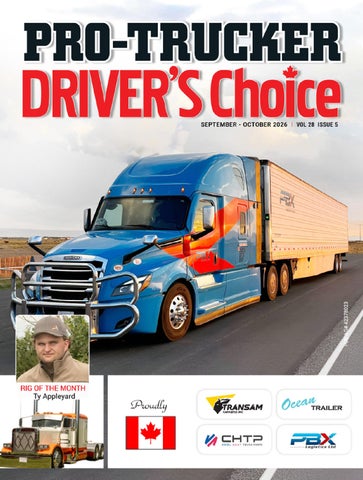
RIG OF THE MONTH
Pictures by: David Benjakschek www.wowtrucks.com
This issue’s driver is a classic example of a young man who came up through the ranks the way so many good drivers have—on a farm. Growing up around tractors, trucks, and all sorts of equipment teaches a kid things you just can’t learn in a classroom. Farm boys have been the backbone of this industry for generations. This is Ty Appleyard’s story: Ty Appleyard
I
was born and raised on our family farm northeast of Strathmore, Alberta. Agriculture has always been a big part of my life, so growing up meant being around cattle, grain, trucks and equipment from a young age. Trucks were always coming and going from our yard, hauling cattle, grain, bales, or equipment depending on the time of year. I was drawn to them and always paid attention to what they were hauling when one pulled into the yard, where it was headed, and watched the drivers Pro-Trucker Driver’s Choice Magazine
maneuver into our cattle chute, which wasn’t exactly in the most convenient spot. I’d even throw on my boots and run out the door to help guide them in. Looking back, I’m pretty sure none of them actually listened to my directions, but at the time I was convinced I was making all the difference. As I got older, watching from the sidelines naturally turned into wanting to get behind the wheel myself. Trucking and agriculture have always gone hand in hand for me. Many of my family members and close
friends have their Class 1 licences, so trucks were simply part of everyday life growing up. Being surrounded by people who drove them made it feel natural that, eventually, I would too. My dad, Greg Appleyard, was the one who taught me to drive. He knew I had an interest in trucks and equipment and gave me the opportunity to learn from a young age. We had plenty of both around the farm, so there was never a shortage of opportunities to get some experience. The first big truck I drove was a Kenworth T800. Like most things SEPTEMBER / OCTOBER 2026
11
when you’re young, I was probably a lot more confident in my abilities than I had any reason to be.
of joking around or giving each other a hard time, which made even the longest days a lot more enjoyable.
My dad has also been the person I’ve looked up to most throughout my life. I grew up watching him work hard, expand our farming and cattle operation and build other businesses along the way. He gave me plenty of opportunities, but he also made sure I understood that having an opportunity and earning your place are two different things.
Livestock hauling doesn’t exactly come with a predictable schedule. Days start early, end late and rarely go exactly according to plan, so the people you’re working with can make all the difference. Eric and Rodney treated me like one of their own, taught me a lot and gave me the opportunity to gain the kind of experience you can only get by actually doing the job. I have a lot of respect for both of them and for Westland, and I still recommend them whenever I get the chance.
I got my Class 1 licence in 2021. By then, the new training requirements had made getting a licence quite a bit more involved than it had been previously. But the driving portion wasn’t what worried me. The written test was. I never particularly enjoyed school, and sitting down to study for a written test wasn’t exactly my idea of a good time. I would have much rather been outside actually driving the truck. Turns out being able to drive the truck and being able to pass a test about driving the truck are two very different skill sets. The written portion probably caused me more grief than anything else in the process, but I eventually got through it and got my licence.
Spending more time on the road also gave me a different perspective on driving. You don’t fully appreciate some of the decisions people make around trucks until you’re the one behind the wheel of one. People will cut in front of you, sit in your blind spot or pull out in front of you and then take their sweet time getting up
to speed. Apparently, the large truck coming toward them at highway speed isn’t always enough of a hint that maybe now isn’t the best time to pull out. Then there are the less exciting parts of trucking: scales, inspections, paperwork and regulations. I definitely wasn’t standing in the farmyard as a kid dreaming about logbooks and pulling into scales, but they’re part of the job. You learn pretty quickly that driving the truck is only one piece of it. Today, I do most of my trucking for our family operation, Appleyard Land and Cattle. With our operation heavily involved in both cattle and grain, there is always something that needs to be hauled and rarely a shortage of time behind the wheel. My mom spent most of her life running the cow-calf side of the operation and is easily one of the hardest-working people I know. I
Once I had my Class 1, I was able to do more trucking for our family operation and also started driving for Westland Livestock out of Acme, Alberta. That became an important part of my experience because it got me outside of our own operation. I was able to haul commercially, gain experience on my own and learn from people who had been in the industry much longer than I had. At Westland, I worked with Eric Hempel and Rodney Ratzlaff, and I couldn’t have asked for two better people to work alongside. They quickly became more like brothers than coworkers, which was a big part of why I enjoyed my time there so much. We worked hard, but there was never a shortage SEPTEMBER / OCTOBER 2026
Pro-Trucker Driver’s Choice Magazine
12
grew up watching her put in long days and do whatever needed to be done, regardless of the weather or time of year. Dad focused on continuing to grow the farm and cattle businesses while also starting Agra Risk Solutions, an agricultural risk management company. I also have a twin sister who works in the family operation. We are a close family, although my sister and I ended up being interested in very different sides of the business. My main focus is trucking logistics and equipment operations. If there is a truck, tractor, loader, combine, chopper or another piece of equipment that needs to be run, that’s usually where I’ll be. My sister works more on the office side, dealing with data, budgets and numbers. Personally, I can’t imagine anything more boring, which is probably exactly why we work so well together. We each have our own
Pro-Trucker Driver’s Choice Magazine
lane, and I’m more than happy to let her stay in hers while I stay out of the office. Growing up on a farm also teaches you pretty quickly that operating equipment and maintaining it are two parts of the same job. Equipment gets used hard, and things break—usually when you’re busiest and least interested in fixing them. Over time, you learn to notice when something doesn’t sound or feel right. Looking after equipment properly saves a lot of trouble later, and I’ve always taken pride in keeping the things I operate in good condition. That is especially true when it comes to the truck I drive now. It’s a 1994 Peterbilt 379 with a 60 Series Detroit, an 18-speed transmission, 3.55 gears and 38 rear ends. The truck means a lot more to me than simply being something I enjoy
driving. It was originally my dad’s truck, and I rebuilt it from the frame up. I spent countless hours taking it apart, going through everything, and slowly putting it back together the way I wanted it. One thing I made sure to keep was the original paint colour. I wanted to make the truck my own, but I also wanted it to still look like the truck I remembered as Dad’s. There were definitely times during the rebuild when I questioned why I had taken on such a big project, but seeing it back on the road made all of those hours worth it. Because it was my Dad’s truck, there is a history behind that Peterbilt that I wouldn’t have with something I simply went out and bought. I don’t think I could buy a new truck that would mean nearly as much to me as that 379 does. One of the things I like most
SEPTEMBER / OCTOBER 2026
13
about trucking is that no two days are quite the same. Every truck is a little different, every load handles differently and there’s always something new to learn. I also like the independence that comes with it. Once you’re on the road, you have a job to do and you’re responsible for getting it done properly. I’ve always preferred that kind of work over sitting behind a desk all day. That’s probably obvious considering my opinion of my sister’s job. Agriculture as a whole has been a good life for me. It isn’t always easy, and it definitely isn’t a nine-to-five job. There are long days, busy seasons, breakdowns, bad weather and plenty of things that don’t go according to plan. Every once in a while, someone also decides to drive somewhere they probably shouldn’t, which usually brings out one of my grandpa’s favourite sayings: “Don’t drive where the ducks swim!” Unfortunately, that advice is usually remembered about SEPTEMBER / OCTOBER 2026
five minutes too late. Some days it feels like everything decides to break at once, the plan changes three times before lunch, and you start to wonder why you bother. Usually, you complain about it for a while, fix whatever broke, come up with a new plan and get back to work. Then the next morning, you get up and do it all over again. Overall, though, I wouldn’t change much. I like working with my family. I like being around cattle. I like trucks and equipment, and I like having work where no two days are exactly the same. I’ve also been fortunate to meet and work with people I genuinely respect and enjoy spending time with. Some of the best relationships I’ve made have come from agriculture and trucking. A lot of the way I approach work comes from Dad. He taught me to work hard, take care of what I was given and take pride in what I do.
More importantly, he taught me that if you’re going to do something, you should do it properly. Trucking will continue to be a major part of my role within our family operation. As Appleyard Land and Cattle has grown, so has the amount of logistics required to keep everything moving. Between the cattle, grain, feedlots and farming operation, there is always something going somewhere. At the end of the day, I don’t have a complicated explanation for why I like trucking. I grew up around it, and I enjoy driving. A perfect day to me is sitting behind the wheel with some music playing, heading down the road to pick up or deliver the next load. I grew up watching trucks come and go from our farm, knowing that eventually I wanted to be the one behind the wheel. These days, that’s where I spend most of my time, and I can’t think of anywhere I’d rather be. Pro-Trucker Driver’s Choice Magazine
14
Letters to the Editor John, How come the powers that be always talk about tired truck drivers but don’t give us a place to park? You run out your hours, and every truck stop and rest area is full. Then you park somewhere else and you get a ticket. What are we supposed to do, disappear? We don’t need fancy rest areas. Give us somewhere safe to pull in, a toilet and a garbage can. That’s about it. They keep saying safety is important. Well then show us how important it is to you and give us somewhere to get off the road when we’re tired. — Dave M., Chilliwack, BC Editor’s Note: Politicians comments are said to assure the non educated public, during photo ops, that they are truly concerned about their safety. They then forget about it until the next photo op presents itself. Nothing changes. To the Editor, I thought I was a pretty good driver when I started
Pro-Trucker Driver’s Choice Magazine
cker azine Pro-Tru Choice Mag s Driver’
trucking in Saskatchewan. Then I hit the BC mountains for the first time, and I was scared sh$#less. I found out real fast that being a good Prairie driver didn’t mean I knew mountain driving. The governments solution is always more rules, but we already have enough of them. What new drivers need is time with experienced drivers who know the road. Some things you just can’t learn from a book. Bill Stark, Saskatchewan Editor’s Note: Over the years we have featured dozens of drivers from the prairies as our Rig of the Month and many of them have expressed the same thing when traversing the mountains for the first time. I feel like I am beating a dead horse but here I go again. Trucking should be a certified red seal profession with endorsements for specific things like mountain driving and some of the more complex combinations of trailers and loads that the average dry van driver will never have to handle.
SEPTEMBER / OCTOBER 2026
15
TEAM OWNER OPERATORS BC - California
BC - East Coast
BC - Ontario/Ontario- BC
WE OFFER Consistent Cross Border Loads Competitive Pay Long Distance (Steady Runs) All Miles Paid
SIGN UP & SAFETY
BONUS
Company Paid Fuel, Insurance, Toll
WE REQUIRE Clean Driving Record Must be able to Cross Border Minimum 2 Years of Experience Truck Requirement - within 3 Years SEPTEMBER / OCTOBER 2026
1454 Cliveden Ave, Delta, BC
778-858-9370 dispatch@mmtrans.ca Pro-Trucker Driver’s Choice Magazine
16
Pro-Trucker Driver’s Choice Magazine
SEPTEMBER / OCTOBER 2026
17
SEPTEMBER / OCTOBER 2026
Pro-Trucker Driver’s Choice Magazine
18
It’s a Fine Line
T
he roar of a finely tuned engine, the gleam of polished paint and the shape of a wellbuilt custom car or truck are what usually grab your attention first. I love all of that, but for me there is something about a clean, handpainted line that can stop me in my tracks. That really hit home on a recent holiday road trip through Idaho and Utah. We travelled through a lot of small towns, past old barns, weathered buildings and faded signs painted right on brick walls. It got me thinking about a time when so much of what we saw around us was made by hand. At the end of our two-week trip, we stopped at the Ignite the Nites car show in Libby, Montana. There were plenty of beautiful cars and trucks there, but what caught my attention was a pinstriper working by hand. I stood and watched him lay down long, clean lines with a small brush. No tape. No stencil. No computer. Just a steady hand, a good eye and years of practice. That brought back memories from home in Alberta. From the 1960s through the 1990s, almost all of my dad’s trucks and trailers were painted and handlettered by a fellow named Morley White from Whitecourt. Morley was self-taught and extremely talented. He could take a brush and make lettering or artwork look effortless. One of my favourites was on one of our 48-foot freight vans. Morley Pro-Trucker Driver’s Choice Magazine
painted a large mural celebrating Whitecourt as the “Snowmobile Capital of Alberta.” As a kid, I probably didn’t fully understand the amount of skill that went into it, but I certainly remember it. Looking back, I think that is where my appreciation for hand lettering and pinstriping started. Long before vinyl lettering and wraps, hand painters were everywhere. Delivery trucks, logging trucks, storefronts, buses and trailers all needed someone who could lay out the lettering, mix the paint and put it on by hand. Pinstriping itself goes back even farther than the automobile. In the 1800s, carriage builders used painted lines to highlight the shape of horsedrawn wagons and passenger cars. When automobiles came along, some of those same techniques carried over. By the 1950s, pinstriping had become a big part of hot rod culture. One of the best-known names was Kenny Howard, better known as Von Dutch. Instead of simply following the body lines of a car, he turned pinstriping into artwork of its own, with freehand designs and the famous flying eyeball that became associated with his work. But there were also thousands of local painters like Morley who were simply doing the job that needed to be done. Before computer-cut vinyl, a company name on a truck had to be painted on. The painter had to figure
By Greg Evasiuk Greg is a 3rd generation trucker with over 1 million miles and 22 years in trucking.
out the spacing, size and balance of the letters, then make it all fit the side of a door, sleeper or trailer. Watching somebody good at it is still impressive. A pinstriper uses a special brush, often called a sword or dagger brush. Traditionally, many were made with squirrel hair because the long hairs hold enough paint to pull a long line without constantly stopping to reload. The paint also has to flow properly. One of the best-known brands is 1Shot enamel, which has been used by sign painters and stripers for generations. There is not much room for error. A shaky hand, too much pressure or a momentary lapse in concentration can ruin a line. Hand lettering takes another level of skill. A painter has to lay out the words by eye, usually using chalk or a grease pencil as a guide. Curved doors, body lines and uneven surfaces all have to be taken into account. There is a lot more to it than simply knowing how to paint a letter. By the late 1980s and early 1990s, things began to change quickly. Vinyl plotters and large-format printers SEPTEMBER / OCTOBER 2026
19
made it possible to produce lettering and graphics much faster and cheaper. For businesses, it made sense. A hand-lettered truck might take a couple of days. Vinyl lettering could often be produced and installed in a fraction of that time. As more companies switched over, fewer young people learned the old trade. A lot of skilled painters retired, and for a while it looked like hand lettering and pinstriping might eventually disappear.
There is something about watching a person create something by hand that still appeals to people.
While researching this article, I learned that Morley passed away on June 4 of this year at the age of 96.
A vinyl graphic can be perfectly straight and perfectly uniform, but a hand-painted line has character. If you look closely, you can sometimes see tiny differences in the brush strokes. To me, that is part of what makes it special.
I wish I could point to one particular mural or sign in Whitecourt and say, “That one was Morley’s.”
Thankfully, that hasn’t happened.
The same goes for an old handpainted truck door or sign. The paint fades. The colours change. Years of sun, weather and road grime leave their mark.
In fact, there seems to be a renewed interest in it today.
Instead of ruining it, sometimes that age makes it even better.
You see young artists learning from older painters, practicing on glass, metal panels and anything else they can get their hands on. At hot rod and custom car shows, pinstripers often work right there in front of the crowd.
That trip through Idaho, Utah and Montana brought all of those memories back. Watching that pinstriper in Libby took me right back to Morley White painting my dad’s trucks in Alberta. It was also timely that this all came back to me when it did.
Maybe there are still some out there. I hope so. Because men like Morley left their mark on far more than trucks and buildings. They were part of a generation that could take a blank surface, a brush and a can of paint and create something people would remember for decades. That is worth preserving. And as long as there are still people willing to pick up a brush and learn how to pull that fine line, I think it will be.
The Compromise
Dave Madill Sadly Dave Madill passed on May 1st, 2025. He will always be fondly remembered and missed.
SEPTEMBER / OCTOBER 2026
The highway calls out to me, come take another run Calls for me to take the road, head for the setting sun That lonely endless blacktop somehow reaches deep inside Touches something I can’t name and once again I ride. What is this deep inside me that causes me to roam? Why can’t I be like others, settle down and have a home? A man touched with wanderlust, with diesel in my veins To be happy I must move, no days can be the same Yet even as I wander, I need to take a rest, Like a swallow in the springtime, I return to her nest She waits for me with open arms and welcomes me back home Tied down by job and family, she has no need to roam. Yet she too hears the highway as it calls and takes her man, She fights it every way she knows and does the best she can. That lonely empty highway, it keeps her family fed Yet it also takes me away and keeps me from her bed, Life becomes a compromise, as to work, I have to roam She lives for when I can rest and spend some time at home. Pro-Trucker Driver’s Choice Magazine
20
Trucking’s Aging Workforce BY: BC TRUCKING ASSOCIATION
Canada’s aging population is reshaping the labour market- and the trucking industry is feeling it first.
T
he country’s labour market is undergoing one of the most significant demographic shifts in its history. While discussions about labour shortages often focus on economic cycles, wages, or immigration, the underlying reality is much more fundamental: Canada is getting older. The retirement of the Baby Boom generation is reducing the number of experienced workers available across virtually every industry. Nowhere is this challenge more visible than in the trucking industry, where an aging workforce and increasing freight demand are creating long-term recruitment pressures. A Nation Growing Older Statistics Canada’s 2021 Census revealed a milestone that should concern every employer. For the first time, more than one in five Canadians of working age (21.8%) were between 55 and 64 years old, meaning they are approaching retirement. At the same time, Canada’s labour force participation rate declined from 65.2% in 2016 to 63.7% in 2021 as more Baby Boomers exited or prepared to exit the workforce. In other words, Canada’s labour Pro-Trucker Driver’s Choice Magazine
force is aging faster than it is being replaced. This demographic trend is expected to continue throughout the next decade, with retirements outpacing the number of young Canadians entering the workforce. Every sector that depends on skilled, experienced employees will need to rethink recruitment, training, and retention strategies. British Columbia Reflects the National Picture British Columbia is experiencing similar demographic pressures, but the effects vary significantly depending on geography. Greater Vancouver continues to attract younger workers through immigration, educational institutions, and employment opportunities. According to the 2021 Census, the Vancouver Census Metropolitan Area has a median age of 40.8 years, with 17.4% of residents aged 65 and older. Approximately 68.5% of the population falls within the traditional working-age bracket of 15 to 64 years. By comparison, many interior communities have significantly older populations. Communities such as Trail,
Nelson, Cranbrook, Salmon Arm, Penticton, and the Kootenays generally report median ages in the mid-to-late 40s or even above 50 years, substantially older than Metro Vancouver. Several Interior regional districts have more than one in every four residents over the age of 65, well above both the provincial and national averages. These communities often attract retirees while simultaneously seeing younger adults relocate to larger urban centres for education and career opportunities. The result is a widening demographic divide. Metro Vancouver continues to replenish much of its workforce through immigration and migration, while many rural and interior communities face shrinking pools of working-age residents. For employers operating throughout British Columbia, especially those with operations outside the Lower Mainland, this creates a persistent recruitment challenge. Labour Shortages Extend Well Beyond Trucking An aging population affects every occupation.
SEPTEMBER / OCTOBER 2026
21
Healthcare requires nurses, physicians, care aides, and technicians to support a growing senior population. Construction needs skilled tradespeople to build housing and infrastructure. Manufacturing requires experienced operators, mechanics, and maintenance staff. Forestry, mining, agriculture, and municipal services are all competing for the same limited labour pool. This competition means that employers are no longer simply replacing retirees- they are competing against every other industry for a dwindling number of available workers. Population aging is therefore not just creating vacancies; it is fundamentally changing how organizations recruit, train, and retain employees. Trucking Faces an Even Greater Challenge The trucking industry sits at the intersection of several demographic trends. The existing driver workforce is older than that of many other occupations. Many professional drivers entered the industry decades ago and are now approaching retirement. And replacing experienced drivers is becoming increasingly difficult. Commercial driving requires specialized licensing, significant training, safe driving records, and a willingness to work schedules that may include nights, weekends, and extended time away from home. As veteran drivers retire, years of practical experience leave with them.
SEPTEMBER / OCTOBER 2026
Recruiting new drivers becomes only part of the solution; employers must also invest in mentoring, onboarding, and knowledge transfer to maintain safety and service standards. The Rural Challenge The demographic picture becomes even more complicated outside major urban centres. The communities where many of these businesses operate are aging more rapidly than Metro Vancouver.
retaining experienced employees. Technology will help improve productivity, but it will not eliminate the need for professional drivers. Advanced safety systems, route optimization, electronic documentation, and fleet management software make drivers more efficient, yet someone still needs to safely move goods across thousands of kilometres of Canadian highways. Ultimately, people remain the industry’s greatest asset.
“Truck drivers are highly trained professionals whose primary responsibility is predicting what idiots are about to do.”
A smaller population of young adults means fewer people are available to obtain commercial licences or begin careers in transportation. Even when employers offer competitive wages, housing shortages and limited local labour pools can restrict hiring. As experienced drivers retire from these communities, replacing them becomes increasingly difficult. Building the Next Generation of Drivers The trucking industry’s response will likely depend on a combination of recruitment, retention, and innovation. Employers are increasingly investing in paid training programs, apprenticeships, mentorship opportunities, and partnerships with driving schools. Flexible scheduling, improved benefits, modern equipment, and wellness initiatives are also becoming more important for
Looking Ahead Canada’s aging population is not a temporary labour market issue- it is a structural demographic shift that will shape the economy for decades. Businesses that recognize this reality today will be better positioned tomorrow. Those that invest in attracting younger workers, supporting new Canadians, retaining experienced employees, and building strong workplace cultures will have a competitive advantage. For British Columbia’s trucking industry, the road ahead is clear. Demand for freight transportation will continue to grow, but so will competition for skilled drivers. Understanding the demographic forces behind today’s labour shortages is the first step toward building a resilient workforce capable of keeping Canada’s economy moving.
Pro-Trucker Driver’s Choice Magazine
22
Fitness Is Where You Find It
L
ike that old Joe Walsh song says, “Life’s Been Good to Me So Far.” I could look at all the things that go wrong and let them bring me down, but I’ve found that making an effort to see the bright side of things does wonders for the mind. Since I started working on my positive thinking, I rarely feel like strangling people anymore! After decades of trucking, your back doesn’t necessarily have to hurt from sitting for too many hours either. I’ve discovered that picking up trash can actually be pretty good exercise. All that bending over does the body good. I’m certainly not encouraging anyone to throw their garbage out the window. But let’s face it, it happens. There are always some ignorant POS
many garbage cans are available. So I pick it up. I’m a senior citizen with a strong back, and maybe I have all that trash to thank for it. It may not be the exercise program you’ll find advertised at some fancy gym, but that’s the point. Fitness is where you find it. There is so much you can do to stay active if you take fitness seriously. You just have to be creative. Look around you. Opportunities are everywhere. Bend down and pick something up. Walk instead of ride when you can. Take the stairs. Do a little more today than you did yesterday. It all counts. And if you’ve become a little
“There’s always somebody who can back up better than you. Unfortunately, he’s usually standing outside watching.”
people who are too damn lazy to walk a few steps to a garbage can, even when one is right there. The container industry has evolved to the point where we have zip ties on all four corners, and somehow a lot of that stuff still ends up on the ground, no matter how
Pro-Trucker Driver’s Choice Magazine
too gravity-sensitive, like I was for a while back in the day, there are things you can do about that too. You can rely entirely on prescription drugs, or you can also take charge of the things you can control. Chances are, you already know some of what got you there in the first place.
By Marcel Larouche There is no magic button. Getting yourself back into better shape takes time, commitment and, most importantly, no more excuses. One meal a day has worked well for me. A carnivore diet, along with exercise, has also helped me. For someone else, it might be vegetarian, vegan, fish, cutting back on carbs or something completely different. We are all different, and whatever works for you, I wish you well. The important thing is to find something sensible that works for you, get moving and stick with it. You don’t need a gym membership or a room full of expensive equipment. Sometimes your workout is sitting right there in front of you—or lying on the ground because some lazy bugger couldn’t find the garbage can. Either way, opportunity. Now... come on. Git-R-Dun!
there’s
an
SEPTEMBER / OCTOBER 2026
23
Your sign to make the road a safe place for all.
As an employer, it’s your responsibility to provide your roadside workers with supervision, training, equipment, and resources to help keep them safe. Learn how at RoadSafetyAtWork.ca/WorkZone.
SEPTEMBER / OCTOBER 2026
Pro-Trucker Driver’s Choice Magazine
24
Truck Power
W
hen I think back to the days of my youth, trucks were powered by old, reliable diesels; Cummins 220 and Gardner 180 were very common. The Gardner engine was a boss’s favourite, economical and reliable, but I would rather have had a Cummins 220 under the engine cover beside my left leg. But now various fuels power our trucks; McDonald’s is using old vegetable oil salvaged from their burger outlets. Some haulage companies tried running LPG or LNG trucks, but they didn’t seem to last too long. Looking at the increasing number of electric-powered vehicles on our roads, I think, ultimately, electric will be the way companies will go. Over here, every second car you see is a Jaecoo, or an Omoda, a BYD, or an MG, all Chinese. China took over the MG brand a while ago. The Jaecoo is a Range Rover lookalike at a bargain price. If it continues like this, Chinese electric cars will soon outnumber petrol- and diesel-powered models. The only thing holding back electric vehicles is the range, but that’s getting longer as new vehicles come on the market. Of course, there’s also the risk of the lithium batteries bursting into flames to think about.
Pro-Trucker Driver’s Choice Magazine
By Colin Black Colin Black lives in Bellshill, Lanarkshire, Scotland and has been driving truck for over 40 years. His story shows us once again that the problems drivers face are universal.
A couple of weeks ago, a shop in the centre of Glasgow was charging the cigarette replacement vapes it sells when they burst into flames. An old three-story Victorian building above and around the shop was destroyed. Once the lithium starts to burn, there’s no extinguishing it. Luckily, the fire service guys managed to keep the fire from spreading to the Central railway station and hotel. The hotel is another old building in central Glasgow, many old film stars have stayed there. The one that always sticks in my mind is Roy Rogers and Trigger.
called Pollock, decided to invest in four electric trucks. They had a contract to ship parcels for Amazon from their depot in Bathgate up to Inverness. After working with Amazon for about twenty years, they had talks with Amazon about reducing their carbon footprint. The company started by switching trucks on the Amazon contract from diesel to Hydrotreated vegetable oil, and installed a tank for the oil next to the diesel tank.
I read in a magazine that an old, established haulage company,
To completely cut exhaust emissions, it was decided to go
SEPTEMBER / OCTOBER 2026
25
Join our winning team. is HIRING Owner Operators To run Canada & USA
• Late model tractor preferred • $3000 sign on bonus • Safety bonus paid quarterly • Increased mileage rate 10/2021 Please call Dina or Kaolin at • Scales/tolls/faxes paid • Fuel Cap of 47 cents per litre 1-800-663-2339 • Group insurance • Fuel performance pay program or Send resumes to • Excellent home time and • Direct deposit, paid twice monthly kaolinm@berryandsmith.com flexible dispatch • Fast cards and passports preferred dinae@berryandsmith.com • No cost satellite communication system • Paid pick ups and drops • Insurance/license subsidy is upto 50%, • All miles paid/practical miles equal monthly payments, no interest • Stable company in business since 1954 Safe driving record • Mechanically sound tractor • Cross border capability • Customer service focus
electric. They purchased four electric trucks at £245,000 each, then had to install charging points in the depot to charge the trucks overnight. Next, they contacted the electricity company to install a bigger substation to power the chargers; with another £780,000 on the bill, they were ready to charge the trucks. But they had another thing to think about before the trucks could start pulling parcels to Inverness. The round trip to Inverness was 550km, but the trucks’ range was 500km. Luckily, a company called Stagecoach had a bus depot about a mile from the Amazon depot that ran electric buses in the town;
SEPTEMBER / OCTOBER 2026
The best safety equipment in any truck sits in the space between the seat and the steering wheel.
a deal was struck for the Pollocks’ trucks to have a two-hour topup there to get them home. And all this just to reduce the carbon footprint for Amazon and the haulage company. I suppose somebody in the company must be doing the arithmetic, so a profit is made, but to me, it seems like a big outlay just to reduce your carbon footprint. Then there’s the extra two hours
on the driver’s day for the top-up charge. Just wait until the trucks are running through a freezing northern Scottish winter - the cold isn’t very kind to batteries. What happens if the electric trucks are stuck in a tailback because of traffic stuck in the snow? Will the driver be able to keep the cab warm until the tailback clears?
Pro-Trucker Driver’s Choice Magazine
26
Are You Part of the Solution?
A
s professional drivers, we go about our busy and sometimes long days trying to be as efficient as possible. An organized driver is always more productive than one who flies by the seat of their pants. Having what you need for the day organized the night before makes for a much more relaxed and enjoyable start to your day or trip. That includes your personal needs—food, drinks, and maybe a change of clothes in case that fuel nozzle slips out of the tank and gives you a bath. Your trip plan should include a check of loading and unloading locations. Google Street View is great for this. You should also have a plan for fuel and possible shower stops. If it’s a multiday trip, you probably already have your preferred rest stops and border crossings, especially if it’s a regular route. A last-minute check of the weather and DriveBC for closures, and out the door you go. Your favourite music, podcasts,
The one constant in our business is change. It could be a change in pickup location, a lastminute trip, a broken-down truck, a closed highway, or a detour. No matter how well you plan and prepare, we all need to become masters of dealing with change. The more organized you are, the easier those changes are to deal with. In some cases, your hours of service may give you a little extra time to deal with the unexpected, but most of the time you still have to stay within the prescribed limits. That’s where communication becomes the next key to your success. When something unexpected comes up, who needs to know? Who can help you solve the problem the fastest and get you back on the road if you’re broken down? Your dispatcher is probably the first call. From there, agree on who is going to contact the service or repair shop. Dispatchers
“Truck drivers are highly trained professionals whose primary responsibility is predicting what idiots are about to do.”
or audiobooks are loaded on your phone and, hopefully, you have a pleasant drive ahead of you.
Pro-Trucker Driver’s Choice Magazine
are busy people and usually have several things going on at once, so sometimes you’re better off making
By Andy Roberts President Mountain Transport Institute
as many of the required calls as possible yourself. Some companies will support that approach and others won’t, so check with your manager. Is there an in-house mechanic you need to talk to? Do you need permission before calling an outside repair shop? Does your company require a purchase order? When you’re providing information about a breakdown, flat tire, air leak, or whatever the problem may be, details make all the difference. Telling a mechanic that you have “an air leak” is like telling someone your shoe size when they’re trying to sell you a hat. It’s information, but it’s nowhere near enough to solve the problem efficiently. When does it leak? All the time? Only when the parking brake is released? Only when you make a brake application? Does it leak out of both the primary and secondary air tanks or only one of them? The more detail you can provide, the quicker the problem can usually be diagnosed. We all carry cameras now, so use them. Pictures or videos can provide a mechanic with valuable information along with your written or verbal explanation.
SEPTEMBER / OCTOBER 2026
27
Once a solution to your problem has been put in motion, who else needs to know? Is there a delivery or pickup appointment that needs to be changed? Do you have a cross-shift driver expecting the truck to be available at a certain time? Respecting your customers’ and co-workers’ time is important. When you communicate properly and keep people informed, you build trust. Then, when you need a favour somewhere down the road, your professionalism and consideration may come back to help you. If you’re able to, be sure to change your duty status and take some off-duty time while you’re waiting. Preserve your driving time for when you can actually get moving again. Maybe it’s time for a nap, some exercise, or a chance to tidy up the truck, clean the windows and mirrors, and make your workplace a little brighter and more pleasant. If the delay is related to a road closure caused by an accident, landslide, or some other natural disaster, communication becomes even more important because now people’s safety may depend on it. When approaching anything unusual—a road blockage, a large number of vehicles moving slowly, or traffic suddenly stopped— reduce your speed immediately. This is especially important in winter when you may not be able to make an emergency stop. Turn on your four-way flashers to warn drivers behind you that something is wrong. They may not be looking as far ahead as you are. If you have a CB or VHF radio, get on the local channel and warn other drivers.
SEPTEMBER / OCTOBER 2026
On higher-speed roads especially, getting traffic slowed down can
a driver who is having trouble backing up instead of getting out
“A clean windshield, a full tank and nobody calling your phone—that’s about as close to heaven as trucking gets.”
prevent another collision and possibly save someone from being injured. If you’ve lost control of your own vehicle and are blocking the road, the same thing applies. Get the four-ways on, warn other drivers, and if possible move your vehicle far enough out of the way that it doesn’t cause another incident. If you’re one of the first people on the scene of an accident, call 911. If it’s safe to do so, help people get out of vehicles or away from danger. If it were your family involved, you’d hope another driver would stop and help. We should be prepared to do the same. And speaking of all those cameras everyone carries these days, are you helping your fellow drivers improve, or are you recording their mistakes so you can post them online? When I started driving trucks almost 40 years ago, there wasn’t a camera in everyone’s hand recording every screw-up I made. And I made my share of them. I learned more than a few lessons the hard way, but I also had experienced drivers take me under their wing. They helped guide me through some tough situations and, more than once, stopped me before things got expensive. Recording
and helping them seems crazy to me. Put the camera away and be part of the solution. Help your fellow driver improve, whether they work for your company, a competitor, or come from a different nationality or background. We are all out there doing the same job and sharing the same roads. At the same time, we also have to be prepared to report drivers who are genuinely unsafe. Reporting dangerous driving to an employer, the local police, or CVSE may sometimes be the only way things improve. The time of the incident, location, unit numbers, company name, and any other useful details can make a big difference. I believe most carriers want their vehicles operated safely and legally. If nobody tells them one of their drivers is doing something dangerous, they may simply assume everything is okay. Yes, making a report can be a hassle and it can take a little time, but nothing is going to improve unless all of us are willing to do our part. Think about your family members sharing the roads with these trucks every day. Safety has to come first. At the end of the day, the goal is pretty simple: everybody goes home.
Pro-Trucker Driver’s Choice Magazine
28
DRIVERS WANTED Berry & Smith .......................................................................... 25 M & M Transport .................................................................. 15 PBX Logistics .......................................................................... 03
22
TRUCKING SERVICES
FITNESS IS WHERE YOU FIND IT Marcel Larouche
Transam Carriers Inc. .......................................................... 32
TRUCKING SERVICES B & W Insurance ................................................................... 06 CBS Parts ................................................................................. 29
24
TRUCK POWER Colin Black
Cool Heat Truck Parts ......................................................... 02 Cool-it ....................................................................................... 31
INDEX
Howes Lubricator ...................................................... 16 & 17 JD Factors ................................................................................ 30 Ocean Trailer ......................................................................... 04 Road Safet At Work ........................................................... 23 The Gear Centre ...................................................................... 08 Truckers Together ................................................................. 30
26
ARE YOU PART OF THE SOLUTION? Andy Roberts
18
IT’S A FINE LINE Greg Evasiuk
19
THE COMPROMISE Dave Madill
20
TRUCKING’S AGING WORKFORCE BC Trucking Association
Pro-Trucker Driver’s Choice Magazine
RIG OF THE MONTH Ty Appleyard
SEPTEMBER / OCTOBER 2026
29
SEPTEMBER / OCTOBER 2026
Pro-Trucker Driver’s Choice Magazine
30
Since 1989
• Cash for Invoices in 24 Hours • No Application fees or hidden fees
WHAT OUR FACTORING PROGRAMS DO FOR OUR CLIENTS:
• Customized low rates
• Improve Cash Flow and Reduce Credit Risk
• Free credit checks on your customers
• Reduce employee workload by outsourcing credit
• Non recourse Program (Credit Guarantee)
• Dedicated Account Executives
• Fuel Card Services Available
• Utilize credit strength of their customers to help
create a strong credit standing on their own
• Free Invoice Processing
• Real Time Online Access
checking, invoice processing and collection duties
• Receive invoice payments by direct deposit when
money is most needed • Have ready and available cash to pay suppliers and
efficiently grow the business
Your Flexible Finance Partners www.jdfactors.com Toronto 1-800-263-0664 • West 587-483-2630 • Quebec 1-888-694-8721 SEPTEMBER / OCTOBER 2026 Pro-Trucker Driver’s Choice Magazine Atlantic Canada 902-993-0808
31
SEPTEMBER / OCTOBER 2026
Pro-Trucker Driver’s Choice Magazine
32
HERE
FO R
T HE
LONG
HIRING COMPANY DRIVERS A-Z
HAUL
Our requirements: • Two years of verifiable experience • Clean record • Eligible to cross the US border
CONSISTENT WORK
SEASONAL OPPORTUNITIES
DRIVE WITH TRUST
TOP-TIER PAY
Are you an experienced truck driver looking for your next opportunity? At Transam Carriers, we understand what matters most: steady work, reliable income, and respect for your expertise. Join a team that values you and your contributions. Apply today.
MODERN EQUIPMENT
COMPREHENSIVE BENEFITS
Contact us:
T. 416-907-8101 5 Toll-Free: 877-907-8101 Address: 205 Doney Crescent, Concord, ON L4K 1P6 Email: hr@transamcarriers.com
ALL JOB OPPORTUNITIES ARE transamcarriers.com/
ON OUR WEBSITE careers
@TransamCarriers @Transam_Carriers Pro-Trucker Driver’s Choice Magazine
SEPTEMBER / OCTOBER 2026