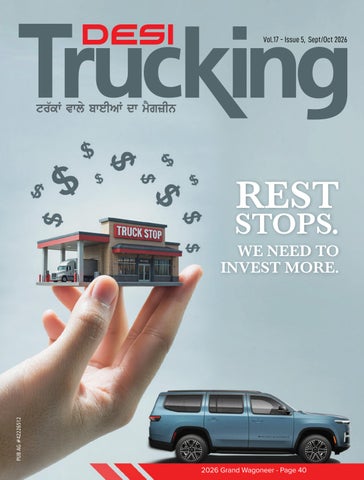
Vol.17 - Issue 5, Sept/Oct 2026
REST
STOPS. WE NEED TO INVEST MORE.
2026 Grand Wagoneer - Page 40
Your sign to make the road a safe place for all.
As an employer, it’s your responsibility to provide your roadside workers with supervision, training, equipment, and resources to help keep them safe. Learn how at RoadSafetyAtWork.ca/WorkZone.
2
SEPTEMBER OCTOBER 2026
NATIONAL MAGAZINE
MADE FOR WHERE YO U ’ RE H E A D E D.
When the haul is long, every drop of fuel counts. Pioneerʼs enhanced aerodynamics and powertrain deliver up to 11% better fuel economy, engineered to go the distance without compromise.
When regional routes get tight, precision matters. Anthemʼs redesigned frontal profile and reduced bumper-to-cab dimensions keep you in control through every turn, every block, and every delivery.
EXPLORE H I G H W AY
NATIONAL MAGAZINE
SEPTEMBER OCTOBER 2026
3
CONTENTS
08 rYst stwps[ swƒ hor invyS krn dI loV hY[
16 Considerations for Upgrading Equipment
18 tr~ikMg ieMfstrI dI aumrdrwz huMdI lybr Pors
12
22 No Driver, No Limits: TFI Takes Autonomous Freight to US Highways
27 CBSA ny blU vwtr ibRj 'qy 35.5 imlIAn fwlr dI S~kI kokIn kIqI zbq
30
24
28
APM Terminals Signs Record Deal for 96 Orange EV Electric Yard Tractors
34
32
AHeer tRWsportySn ny port Aw& vYnkUvr dy ELECTRA pRogrwm nwl ielYkitRk tr~ikMg ƒ id~qw bVwvw
36 Border Crossings. What to Remember.
40 2026 Grand Wagoneer
38
44
ADVERTISERS Ace Truck Repairs ................................. 29
Howes Lubricators ............................... 09
Peterbilt ................................................... 48
CBS Parts Ltd. ........................................ 07
Inland Kenworth ................................... 05
Road Safety At Work ........................... 02
Challenger Fastfrate Group .............. 39
JD Factors ............................................. 21
Truckers Together .............................. 25
Cool It ....................................................... 31
Keystone Law Group .......................... 46
Volvo ....................................................... 43
Cummins ................................................. 47
Mack Trucks. ........................................... 03
Glasvan Great Dane ............................. 11
Ocean Trailer ......................................... 13
4
SEPTEMBER OCTOBER 2026
NATIONAL MAGAZINE
PERFECTED FOR THE ROAD AHEAD. The pinnacle of Kenworth’s engineering: the T680, a masterpiece of aerodynamics designed for long-haul efficiency. This tractor combines a high-perfomance PACCAR powertrain with durable, easy-to-maintain components for unparalleled uptime. Enhanced with cutting-edge technology, it offers a driving experience that’s both intuitive and safe, reducing driver fatigue. The cabin, akin to the luxury found in top-tier automobiles, elevates comfort to new heights. Welcome to the next level of trucking with the Kenworth T680.
inland-group.com
EDITOR’S NOTE | sMpwdkI BIG CHANGES ARE COMING Change is a part of life—and the trucking industry is certainly no stranger to it. As we approach a new season, JGK Media is preparing for some exciting changes. Beginning with the January/February 2027 issue, Desi Trucking Magazine, Canada’s largest and most popular bilingual trucking publication, will introduce a new and updated look, along with several exciting features. Readers can look forward to company and individual profiles, a dedicated recruiting section, and greater coverage of products, technology and innovations shaping the trucking industry. Our goal is to make the magazine even more informative, engaging and relevant to the people who make up Canada’s trucking community. These changes will be reflected in both our print and digital editions. We are excited about what is ahead — and we hope you will be too. Meanwhile, the trucking industry continues to face uncertainty. The Canadian-U.S. tariff war is intensifying, with both countries introducing tariffs on various products. The scale of this trade dispute is unlike anything we have seen in recent history. Tariffs affect far more than governments and corporations; they
can impact businesses, consumers, workers and the transportation industry. We can only hope both sides reach a settlement before the situation causes further economic hardship. For trucking, 2026 has been a roller-coaster ride, with some months bringing positive signs and others proving much more challenging. Earlier this year, there was optimism that the market might begin returning to more normal conditions following the disruption of COVID. Whether that recovery continues remains to be seen. As summer gives way to autumn, drivers should also be prepared for changing weather and road conditions. Rain, fog and shorter daylight hours can create additional challenges, so stay alert and adjust your driving accordingly. And remember, school is back in session. Please slow down around school and playground zones and DO NOT SPEED. A few extra seconds are never worth putting a child, or anyone else, at risk. Stay informed with the latest trucking news and stories in English and Punjabi at www. desitrucking.com. Big changes are coming. Stay tuned!
6
SEPTEMBER OCTOBER 2026
Publisher JGK Media Inc. 1-877-598-3374 (Desi) Advertising & Sales Jag Dhatt Art Director Ranjit Singh (Orangebox Media) IT Manager Ranjit Singh Bhamra Cover Design Ranj Bhamra Cover Photo Credit Anadolu Agency / Contributor
v~fIAW qbdIlIAW Aw rhIAW hn qbdIlI izMdgI dw ih~sw hY — Aqy tr~ikMg ieMfstrI ies qoN iblkul Axjwx nhIN[ ijvyN AsIN ie~k nvyN sIzn v~l vD rhy hW, JGK Media vI kuJ idlcsp qbdIlIAW leI iqAwrI kr irhw hY[ jnvrI/PrvrI 2027 dy AMk qoN Deis Trucking Magazine, kYnyfw dw sB qoN v~fw Aqy sB qoN lokipRX do-BwSweI tr~ikMg mYgzIn, ie~k nvyN Aqy ibhqr rUp nwl pyS hovygw[ ies dy nwl keI nvyN Aqy idlcsp PIcr vI Swml kIqy jwxgy[ pwTk kMpnIAW Aqy ivAkqIAW dIAW pRoPweIlW, BrqI leI ie~k ivSyS sYkSn, Aqy tr~ikMg ieMfstrI iv~c Aw rhy nvyN auqpwdW, qknwlojI Aqy nvIAW kwFW bwry vDyry jwxkwrI dI aumId kr skdy hn[ swfw mksd mYgzIn ƒ kYnyfw dI tr~ikMg kimaUintI leI hor vI jwxkwrIpUrn, idlcsp Aqy lwBdwiek bxwauxw hY[ ieh qbdIlIAW swfy ipRMt Aqy ifzItl dovyN AYfISnW iv~c nzr AwauxgIAW[ AsIN Awaux vwlIAW qbdIlIAW ƒ lY ky auqSwihq hW—Aqy aumId krdy hW ik qusIN vI hovogy[ ies dOrwn, tr~ikMg ieMfstrI Ajy vI keI cuxOqIAW Aqy AinSicqqwvW dw swhmxw kr rhI hY[ kYnyfw Aqy AmrIkw ivckwr tYirP jMg hor qyz ho rhI hY Aqy dovyN dyS v~K-v~K auqpwdW au~qy tYirP lgw rhy hn[ ies dw Asr srkwrW Aqy
Jag Dhatt Editor-In-Chief
v~fIAW kMpnIAW qoN ielwvw kwrobwrW, KpqkwrW, kwimAW Aqy trWsportySn ieMfstrI au~qy vI pY skdw hY[ AsIN Aws krdy hW ik dovyN dyS jld koeI smJOqw krngy qW jo hor AwriQk nukswn qoN bicAw jw sky[ tr~ikMg leI vI 2026 ie~k rolr-kostr swl irhw hY[ kuJ mhIny aumIdjnk rhy, jdik kuJ kw&I cuxOqIpUrn swbq hoey[ swl dy SurU iv~c ieh aumId sI ik COVID qoN bwAd mwrkIt muV kuJ Awm hwlwqW v~l vwps Aw skdI hY[ ieh suDwr ikMnw jwrI rihMdw hY, ieh Awaux vwlw smW hI d~sygw[ ijvyN grmIAW dw mOsm ^qm ho ky pqJV SurU ho rhI hY, frweIvrW ƒ bdldy mOsm Aqy sVkW dIAW hwlwqW leI vI iqAwr rihxw cwhIdw hY[ mINh, DuMd Aqy G~t huMdI idn dI rOSnI frweIivMg ƒ hor cuxOqIpUrn bxw skdI hY[ ies leI swvDwn rho Aqy AwpxI frweIivMg hwlwqW muqwbk bdlo[ Aqy Xwd r~Ko, skUl muV Ku~lH gey hn[ skUl Aqy plygRwaUNf zonW iv~c ikrpw krky gqI hOlI r~Ko Aqy DO NOT SPEED[ kuJ sikMt jldI phuMcx leI iksy b~cy jW iksy hor ivAkqI dI sur~iKAw ƒ ^qry iv~c pwauxw kdy vI TIk nhIN[ AMgryzI Aqy pMjwbI iv~c tr~ikMg nwl sbMDq qwzw ^brW Aqy khwxIAW leI www.desitrucking.com ’qy zrUr jwE[ v~fIAW qbdIlIAW Aw rhIAW hn[ juVy rho!
Contributing Writers Jag Dhatt; Michael Howe; Pash Brar; Ray Gompf; Jimmy Gill; Staff Reporters Translator Tirath S. Khabra; Jesse Khabra
JAG DHATT Corporate VP, Marketing Cell: 604-767-4433 E: jag@jgkmedia.ca Address: #235 - 8138, 128 Street, Surrey BC V3W 1R1 F: 604-598-9264
All Rights Reserved. No material herein or portions thereof may be printed without the written consent of the publisher. DISCLAIMER: JGK Media Inc. assumes all advertisers to be reliable and responsible for any and all liability for their claims. The publisher reserves the right to refuse any advertisement it may find unfit for publication. The opinions expressed in articles and features are of the writers and may not be those of the publisher. THE PUBLISHER ASSUMES NO RESPONSIBILITY OF ANY KIND.
PUBLICATIONS MAIL AGREEMENT #42226512
Postmaster if undeliverable Canadian Address to #235 - 8138 128 Street, Surrey BC V3W 1R1
NATIONAL MAGAZINE
NATIONAL MAGAZINE
SEPTEMBER OCTOBER 2026
7
rYst stwps[ swƒ hor invyS krn dI loV hY[ jdoN vI iksy vI dyS dI srkwr iksy audXog dy Bly leI dKlAMdwzI krdI hY, qW ausdy nqIjy Aksr aumId qoN G~t hI inkldy hn[ swfy dyS iv~c rYst eyrIAw dI Gwt, jW auhnW dI mwVI dyKBwl, iesy qrHW dw ie~k nqIjw hY[ ies mu~dy dI SurUAwq Hours of Serivce (HOS) dy inXmW nwl hoeI, ijs dy Asr Q~ky hoey frweIvrW ƒ sVk qoN dUr r~Kx dy d~sy gey mksd qoN ikqy izAwdw A~gy q~k gey[ Asl sm~isAw ieh sI ik HOS dy inXm robotW ƒ iDAwn iv~c r~K ky ilKy gey sn jo rozwnw ie~ko ijhw kMm krdy hn, ijs iv~c iksy ienswnI frweIvr dy mwVy idn leI koeI guMjwieS nhIN C~fI geI[ jdoN 8
rwStrpqI
AweIznhwvr
SEPTEMBER OCTOBER 2026
ny
ieMtrstyt hweIvyA isstm dI Xojnw bxweI sI, qW iehnW hweIvyAz leI mwpdMf qYA kIqy gey sn ik hr 30 mIl 'qy ie~k rYst eyrIAw hovygw qW ik frweIvr rsqy iv~c Awrwm kr skx[ aus 30-mIl vwly inXm iv~c bhuq G~t CotW sn[ nwl hI, AweIznhwvr dy mwpdMfW Anuswr, iehnW hweIvyAz 'qy koeI vI Flwx 6 PIsdI qoN izAwdw nhIN ho skdI sI[ AweIznhwvr dy smyN vI HOS inXm huMdy sn, pr auh ies qrHW bxwey gey sn ik frweIvr inXmW dy AMdr rih ky kMm kr skdy sn; jykr auh auplbD GMitAW dw pUrw lwB auTwauNdy sn Aqy Q~ky nhIN huMdy sn, qW auh ie~k idn iv~c 750 mIl q~k dw s&r qYA kr lYNdy sn[ auh auh idn sn jdoN qusIN Awpxy auplbD GMitAW ƒ ie~k cMgy rYst pIrIAf nwl vMf skdy
jI ryA gON&, sI fI
sI[ bwAd iv~c HOS iv~c soDW kIqIAW geIAW; Aqy hux, frweIvr Kwxy dy bRyk leI vI nhIN ruk skdy sn, ies leI Awrwm krn dw qW svwl hI pYdw nhIN huMdw sI[ tRk stwps ijhVy tr~k frweIvrW leI keI qrHW dIAW syvwvW idMdy sn, auhnW dy Pu~l-srivs rYstorYNt KwlI hox l~g pey[ kMm clwauNdy rihx leI, auhnW ny Awpxy PUf srivs dw ih~sw Pwst-PUf cynz ƒ lIz 'qy dy id~qw[ hux pOSitk Kwxw nhIN iml irhw sI, ies dI jgHw sB qoN G~t poSk q~qW vwly Kwxy dIAW kYlorIz auplbD krvweIAW geIAW[ izAwdwqr frweIvr hux Awpxy tr~kW dy AMdr hI Awpxw Kwxw iqAwr krn l~gy[ Pu~l-srivs tr~k stwpW ƒ Awpxw NATIONAL MAGAZINE
ibzns mwfl bdlxw ipAw[ auhnW dy pwrikMg lwt hux isr& qyl pvwaux vwly gwhkW nwl Brn l~gy[ keI Coty Aqy GrylU tr~k stwp bMd ho gey, ivk gey, jW auhnW ny Awpxy kwrobwr dw qrIkw bdl ilAw[ ies dw nqIjw ieh hoieAw ik lwzmI Awrwm leI kmrSIAl tr~kW ƒ pwrk krn leI loVINdIAW QwvW gwieb ho geIAW[ ie~QoN q~k ik ieMtrstyt rYst eyrIAwz qoN vI pUry dy pUry stwp htw id~qy gey, ijs nwl hzwrW tr~k pwrikMg QwvW Kqm ho geIAW[ pRweIvyt mwrkIt v~fy tr~kW leI loVINdI pwrikMg dI mMg ƒ pUrw nhIN kr skI[ hux hwlwq ieh hn ik tr~k frweIvrW 'qy Aijhy inXm Tosy gey hn jo inXm nw mMnx 'qy jurmwnw lgwauNdy hn, jdoN ik dUjy pwsy inXmW dI pwlxw krn leI zrUrI pwrikMg QwvW ƒ hI Kqm kr id~qw igAw hY[ jykr srkwrW sur~iKAw dy mksd leI inXmW dI pwlxw krvwauxw cwhuMdIAW hn — jo ik ie~k slwhuxXog mksd hY — qW auhnW ƒ tr~k rYst eyrIAwz dI igxqI iv~c v~fy p~Dr 'qy vwDw krnw cwhIdw hY[
NATIONAL MAGAZINE
srkwrI nIqI ny HOS ƒ ie~k ivvhwrk inXm qoN bdl ky Aijhw bxw id~qw hY ijs dI pwlxw krnw ie~k robot leI vI AOKw hovygw[ iesy nIqI ny hzwrW rYst pwrikMg QwvW Kqm kr id~qIAW[ iehnW srkwrW leI smJdwrI vwlI g~l ieho hovygI ik auh pRweIvyt QwvW dI Gwt ƒ pUrw krn leI tr~k pwrikMg dI FukvIN smr~Qw vwly rYst eyrIAw bxw ky dyx[
iSpr qoN irsIvr q~k dw gyVw lgwauNdy hn Aqy ikMny lONg-hOl tr~k siv~c rn 'qy hn[ ieh Aijhy AMkVy nhIN hn ijnHW leI iksy bhuq v~fy srvy jW pVHweI dI loV hovy[ srkwrW kol ieh swry AMkVy pihlW hI hn[ auh CyvIN jmwq dI swDwrn gixq dI vrqoN krky AwswnI nwl ihswb lgw skdIAW hn ik trWsport Kyqr leI ikMnIAW rYst eyrIAw QwvW dI loV hY[
ieh loV izAwdw tRYiPk vwly ielwikAW iv~c bhuq izAwdw zrUrI hY, ij~Qy tr~k pwrikMg dIAW bhuq izAwdw QwvW cwhIdIAW hn qW jo frweIvr sur~iKAq FMg nwl ruk skx Aqy inXmW dI pwlxw vI kr skx[ mONtrIAl, torWto-hYimltn Kyqr, ivnIpYg, ryjInw, sskwtUn, kYlgrI, AYfmMtn, Aqy vYnkUvr vrgy v~fy kyNdrW iv~c vwDU pwrikMg dI bhuq s^q loV hY[ ies qoN ielwvw iehnW SihrW dy ivckwrly rsiqAW 'qy vI pwrikMg cwhIdI hY ij~Qy frweIvrW ƒ hr kuJ GMitAW bwAd rukxw pYNdw hY[
eyAr PRyt audXog ƒ srkwrI shwieqw imldI hY jhwzW dI pwrikMg leI QW XkInI bxweI jw sky[ smuMdrI audXog ƒ shwieqw imldI hY kwimAW qoN izAwdw kMm nw ilAw jwvy Aqy auhnW dI tRyinMg iv~c kmI nw rhy[ srkwrI shwieqw nwl hI smuMdrI audXog kol jhwz hn jo srdIAW iv~c smuMdrI rsqy Ku~lHy r~Kdy hn[ rylvy Kyqr ƒ srkwrI shwieqw imldI hY kwmy cMgI qrHW isKlweI pRwpq Aqy sur~iKAq rihx[
srkwrW ƒ cMgI qrHW pqw hY ik hryk sUby iv~c ikMny tr~k hn[ auhnW ƒ ieh vI pUrw pqw hY ik auh tr~k ikhVy rsiqAW 'qy c~ldy hn[ auh jwxdy hn ik ikMny tr~k
hwlWik, sVkI trWsport ƒ frweIvrW dy Awrwm leI tr~k pwrk krn vwsqy nwmwqr jW koeI shwieqw nhIN imldI[ ies cIz ƒ bdlx dI loV hY[ tr~k frweIvr vI hor trWsport KyqrW vWg brwbr ie~zq Aqy QW dy h~kdwr hn[
SEPTEMBER OCTOBER 2026
9
REST STOPS. WE NEED TO INVEST MORE.
G. RAY GOMPF, CD
E
very time a government of any stripe from any country interferes in the best interest of an industry, the results are consistently less than expected. Our lack of rest areas, or their upkeep, across our country is just one such result. The issue dates back to the hours of service (HOS) regulation that had ramifications well beyond the stated goal of keeping tired drivers off the road. The problem being that the HOS was written for robots who perform the same day in and day out, with no room for a human driver having a bad day. When President Eisenhower conceived the interstate system of highways, there were standards written for these highways in which there would be a rest area every thirty miles so that 10
SEPTEMBER OCTOBER 2026
drivers could rest along the way. There were very few exceptions to that thirty-mile rule. Also, in Eisenhower’s standards, no grade on these highways would be more than six per cent. There were HOS back in Eisenhower’s day, but the HOS were structured in such a way that drivers could work within the rules; if they figured things out to maximize the hours available and they weren’t tired, they could accomplish 750 miles in a day. Those were the days when you could split your available hours with a significant rest period. The tweaking of the hours of service was amended; and now, drivers couldn’t even stop for meal breaks, so rest breaks were out of the question. Truck stops that provided a whole host of services for truckers found their fullservice restaurants empty, and
to stay open, leased out the food services part of their business to the fast-food chains. No more nutritious meals being served. But instead, the calories from the least nutritious food were made available. More and more drivers were preparing their own food within their trucks. The full-service truck stops pivoted. Their parking lots filled with fuel only customers. Many mom-and-pop truck stops just folded, sold out, or otherwise changed the style and purpose of the business. The result was that parking spaces needed for commercial truck traffic to park for mandatory rest periods disappeared. Even the interstate rest areas were slowly removing entire rest areas, eliminating thousands of truck parking places for resting. The private market could not absorb the required NATIONAL MAGAZINE
number of parking spaces for big trucks. So now, you have truck drivers governed by regulations that demand penalties for noncompliance while removing those parking places required to comply. Governments, should they maintain compliance rules for safety purposes, which is an admirable goal, must dramatically increase the number of truck rest areas. Regulations backed by penalties for non-compliance may be well intentioned, but failing to provide drivers with adequate space to comply with those rules is unreasonable and counterproductive. Government policy has changed the hours of service from workable to that which even a robot would have difficulty being compliant. The same policy removed thousands of rest
parking spaces. It’s just sane for those governments to provide the rest areas with adequate volumes of truck parking to compensate for those private spaces no longer available. That need is especially urgent in high-traffic areas, where far more truck parking spaces are required so drivers can lay over safely and remain compliant. Major centres such as Montreal, the Toronto-Hamilton area, Winnipeg, Regina, Saskatoon, Calgary, Edmonton, and Vancouver are all in dire need of additional capacity, as are the stretches between them where drivers must be able to stop every few hours. Governments know precisely how many trucks are in each province. They, again precisely, know where those trucks travel. They know how many trucks are on shipper to receiver runs and they know how many long hauls
are on switch runs. These aren’t numbers that require extensive study. The governments know the numbers. They can use a little bit of grade six math to know precisely how many rest area spots are required for the transport sector of the transportation industry. The air freight industry gets government support to ensure there is room for airplanes to park. The marine industry gets support to ensure workers aren’t overworked nor undertrained. The marine industry, with government support, has ice breakers to keep winter routes open. The rail sector has government support to ensure workers are well trained and protected. However, the road sector gets little or no support to park trucks for rest periods of drivers. And this needs to change. Truckers deserve the same respect and space as other transportation sectors.
USED LATE-MODEL AUTOCAR SHUNT TRUCKS. ARRIVING THIS FALL.
GOING STRONG. READY FOR MORE.
Used 2021–2023 Autocar shunt trucks with 12,000–20,000 engine run hours are coming off lease and will be available from Glasvan this fall. At less than half the cost of brand-new equipment, these loaded yard trucks have been fully maintained and supported by Glasvan throughout their time in operation. Keep your operation moving with a new or used shunt truck from Glasvan. Cummins authorized. Plus, parts and service for all makes and models.
NATIONAL MAGAZINE
1.888.GLASVAN
GlasvanGreatDane.com
3 GTA Locations SEPTEMBER OCTOBER 2026
11
au~qrI AmrIkw iv~c 'kYb-Evr' tr~k ikauN nhIN hn? kI qusIN kdy soicAw hY ik kYb-Evr tr~k XUrp leI qW ibhqr hn, pr swfy leI au~qrI AmrIkw dy hweIvyA 'qy AmlI ikauN nhIN hn? ivdySW iv~c c~lx vwly PlYt-PrMt tr~kW Aqy swfy duAwrw rozwnw clwey jWdy lMbI bont vwly rvwieqI tr~kW ivckwr ieh v~fw AMqr PYfrl lMbweI dy kwƒnW, BUgol, Aqy stIAirMg vIlH dy ip~Cy ijMdgI ibqwaux dIAW srIrk cuxOqIAW krky hY[ dhwikAW q~k, au~qrI AmrIkw dy Pryt Kyqr iv~c kYb-Evr-ieMjx (COE) mwflW dw dbdbw sI, iblkul ausy kwrn krky jo A~j vI XUrp iv~c hY: ku~l lMbweI dIAW sImwvW[ 1980 dy dhwky dy SurU qoN pihlW, PYfrl kwƒnW ny trYktr Aqy tRylr dovW dI imlw ky bMpr-qoN-bMpr lMbweI inrDwrq kIqI hoeI sI[ izAwdw qoN izAwdw mwl Fox Aqy lMbw trylr iK~cx leI, PlIt mwlkW ny frweIvrW ƒ kYb-Evr clwaux leI mzbUr kIqw, ijs iv~c kYb ƒ ieMjx Aqy Agly AYksl dy iblkul au~pr r~iKAw jWdw sI[ 1982 dy 'srPys tRWsportySn AisstYNs AYkt' (STAA) dy pws hox nwl sB kuJ bdl igAw[ STAA ny isr& 12
SEPTEMBER OCTOBER 2026
tRylr dI lMbweI 'qy sImw lgw id~qI—ijs nwl 53-Pu~t dy tRylrW dI iejwzq iml geI—jdoN ik trYktr dI lMbweI dI sImw htw id~qI geI[ rwqo-rwq, Awpxy Awp ƒ ie~k Coty kYb-Evr iv~c smwaux dI kwƒnI mzbUrI ^qm ho geI[ ijvyN hI trYktr dI lMbweI dI pwbMdI htI, PlIt mwlkW ny qurMq lMby bont vwly rvwieqI tr~kW v~l ru~K kIqw, ikauNik ieh rihx Aqy kMm krn leI bhuq izAwdw Awrwmdwiek sn[ ieMjx ƒ AwpxI sIt dy hyToN k~F ky A~gy krn nwl AMdrlI bhuq izAwdw grmI, rOlw Aqy kYb dI kMbxI qurMq G~t geI[ frweIvr dI sIt ƒ Agly AYksl dy au~pr r~Kx dI bjwey ausdy ip~Cy krn nwl, Krwb hweIvyA 'qy Jtky l~gxy bMd ho gey[ iehnW tr~kW ny v~fy slIprW leI rsqw KoilHAw ijs iv~c KVHy hox leI pUrI jgHw, vDIAw bY~f, Aqy Gr vrgIAW shUlqW imlIAW jo ie~k kYbEvr iv~c kdy nhIN Aw skdIAW sn[ ies qoN ielwvw, A~gy lMbw bont hox nwl hwdsy vyly frweIvr dI sur~iKAw leI ie~k mzbUq bPr imldw hY, Aqy rozwnw pRI-itRp ieMspYkSn jW ieMjx dI dyKBwl leI pUrI kYb ƒ cu~kx dI bjwey ieMjx q~k phuMcxw
jYg F`t
bhuq Awswn ho jWdw hY[ dUjy pwsy, XUrpIAn tRWsportrW ƒ lMbweI dy kwƒnW iv~c auh Cot kdy nhIN imlI[ XUrpIAn XUnIAn dy kwƒn Ajy vI ku~l g~fI dI lMbweI ƒ 16.5 mItr (lgBg 54 Pu~t) 'qy s^qI nwl sImq krdy hn[ ikauNik bont dw koeI vI vwDU Pu~t is~Dw kmweI dyx vwly mwl dI jgHw GtwauNdw hY, XUrpIAn kMpnIAW kol kYb-Evr clwaux qoN ielwvw koeI cwrw nhIN hY[ au~QoN dw buinAwdI FWcw ies AMqr ƒ hor vI p~kw krdw hY[ XUrpIAn frweIvrW ƒ Aksr sdIAW purwxIAW qMg SihrI sVkW, Coty gol-c~krW Aqy qMg loifMg fOks 'qy tr~k clwauxy pYNdy hn, ij~Qy moV k~tx leI Cotw vHIlbys Aqy iq~Kw trinMg ryfIAs bhuq zrUrI hY[ iesdy ault, au~qrI AmrIkw dw nY~tvrk cOVy hweIvyA, v~fy tr~k stwpW, Aqy PYly hoey ifstRIibaUSn sYNtrW nwl bixAw hY[ hwlWik kYb-Evr qMg jgHw iv~c ibhqr muVdw hY, pr au~qrI AmrIkw dIAW lMbIAW dUrIAW, Ku~lHy hweIvyA, Aqy frweIvr dy Awrwm dI loV ny lMbI noz vwly tr~kW ƒ ie~QoN dw p~kw bwdSwh bxw id~qw[ NATIONAL MAGAZINE
DELTA 800.891.8858 - CALGARY 877.720.7171 - EDMONTON 800.610.1019 - MISSION 877.460.1239 WINNIPEG 866.397.5524 - NANAIMO 877.878.5979 -
PRINCE RUPERT 250.627.1981
WWW.OCEANTRAILER.COM NATIONAL MAGAZINE
SEPTEMBER OCTOBER 2026
13
WHY DOESN’T NORTH AMERICA HAVE CAB-OVER TRUCKS?
H
ave you ever wondered why cabover trucks are ideal for Europe, but simply don't make sense for us on North American highways? The sharp divide between the flat-faced rigs running overseas and the long-nose conventionals we drive every day comes down to federal length regulations, geography, and the harsh physical realities of spending your life behind the wheel. For decades, cabover-engine (COE) models dominated North American freight for the exact same reason they still rule Europe: total length limits. Before the early 1980s, federal regulations capped the total bumper-tobumper length of both your tractor and trailer combined. To haul maximum freight and pull a longer box, fleet owners forced drivers into cabovers, tucking the cab directly over the engine and front axle. Everything shifted with the passage of the Surface Transportation Assistance Act (STAA) of 1982. The STAA changed the rules by placing length restrictions only on the trailer—allowing standard 5314
SEPTEMBER OCTOBER 2026
JAG DHATT foot boxes—while lifting limits on tractor length. Overnight, the legal requirement to squeeze yourself into a compact cabover disappeared. Once tractor length was deregulated, fleets pivoted to conventional front-engine trucks because they are flat-out better to live and work in. Pulling the engine out from under your seat instantly cut out the excessive heat, engine roar, and constant cab vibration. Moving the driver's seat behind the steer axle instead of sitting right on top of it eliminated the brutal, kidneybusting ride quality of a COE on rough interstate pavement. Conventionals also opened the door for massive sleeper berths with full stand-up headroom, proper beds, and home amenities that a cabover frame could never accommodate. Just as importantly, having a long hood out front gives you a crucial safety crumple zone, while making daily pre-trips and engine maintenance a lot easier than tilting an entire cab just to check your oil.
Across the ocean, European haulers never got that regulatory break. European Union laws still strictly cap total vehicle combination length at 16.5 meters (about 54 feet). Because any extra foot of hood directly takes away from revenue-generating cargo space, European carriers have no choice but to run cabovers. Infrastructure makes the divide even permanent. European drivers regularly navigate ancient, narrow city streets, tight roundabouts, and cramped loading bays built centuries ago, where a short wheelbase and sharp turning radius are essential just to make the turn. Out here, North American logistics was built around wide multi-lane interstates, spacious truck stops, and sprawling distribution centers built for conventional rigs. While a cabover still handles tight spaces better, the brutal mileage, open highways, and basic need for real driver comfort in North American long-haul freight made the long-nose engine design the undisputed champion.
NATIONAL MAGAZINE
Since 1989
• Cash for Invoices in 24 Hours • No Application fees or hidden fees
WHAT OUR FACTORING PROGRAMS DO FOR OUR CLIENTS:
• Customized low rates
• Improve Cash Flow and Reduce Credit Risk
• Free credit checks on your customers
• Reduce employee workload by outsourcing credit
• Non recourse Program (Credit Guarantee)
• Dedicated Account Executives
• Fuel Card Services Available
• Utilize credit strength of their customers to help
create a strong credit standing on their own
• Free Invoice Processing
• Real Time Online Access
checking, invoice processing and collection duties
• Receive invoice payments by direct deposit when
money is most needed • Have ready and available cash to pay suppliers and
efficiently grow the business
Your Flexible Finance Partners www.jdfactors.com Toronto 1-800-263-0664 • West 587-483-2630 • Quebec 1-888-694-8721 SEPTEMBER OCTOBER 2026 15 Atlantic Canada 902-993-0808
NATIONAL MAGAZINE
CONSIDERATIONS FOR UPGRADING EQUIPMENT PASH BRAR
A
long-time client called advising me he wanted to upgrade his equipment. He wanted to sell his current equipment and get newer equipment, so he didn’t have to deal with major repairs and more maintenance costs he said. It makes sense and I agreed. He told me he already had a buyer lined up for his current equipment and would get him to call me. He had also already called the bank where his current lease was done and gotten a payout balance. He also found the equipment he wanted to upgrade to. He was well organised and had really thought it all through. Knowing when your equipment needs an upgrade is crucial. It still has some life in it but will start costing more money for you to maintain. Always discuss this with a trusted mechanic. I would suggest upgrading before needing major repairs, but leaving enough time before the major repair, so the new owner can still earn a good income on it for at least a year. If you wait too long, no one will want to buy it because they must invest heavily right away and repairs don’t add a lot of value. If you get the repairs done yourself and then sell, you won’t earn the money back you just paid. You cannot add the repair bill to the sale price. The price is current market value. You essentially pay the large repair bill for someone else. So, in this case you should keep the equipment until you have earned the repair back and then sell it. Timing, whether before or after a repair is what you must consider carefully. Next you must consider the 16
SEPTEMBER OCTOBER 2026
equipment you are upgrading to. Is it new or used? New you get warranty, a much larger loan or lease payment, but much lower maintenance or repairs. Buying used but newer than current, you need to check if it needs a major repair and how long before it does. Will it get you lower maintenance bills for upgrading? Will the higher payment and lower maintenance cancel each other out? If your current equipment still has a lease or loan on it, will the bank let you out of the contract? Or is the payment transferable? In the case of the driver who called me, he had not checked with the bank if it was transferable. He said the new buyer would prefer a transfer. If it is transferable, the new buyer must qualify for that rate that is already existing. In many instances they might not qualify. If the buyer does not qualify for a transfer, will they qualify for a lease or loan with their own payment terms? Or is it flat out decline? Does your buyer need or even have a down payment available to buy your old equipment? Another big question is, what if your buyer gets declined and you are approved. Do you go ahead with your own deal and carry two payments until the original equipment sells? Do you even qualify for both loans? Many banks will do a conditional approval until your original equipment sells. If it takes time to sell, the equipment you wanted may not be there by the time you get the old equipment sold. Sometimes waiting until your old equipment is paid in full can be a good strategy so there is no
risk of two payments, but if you need the sale to give the down payment on the new equipment, you can still be stuck. With the driver who called me, he had not realized he might be stuck making two payments. After talking to the buyer he had, he was a decline, so the whole deal fell apart. Do you sell your equipment for what is owing? Or do you sell at market rate? Depending on any repair work needed, a slow market, and depreciation, some do sell for just the remainder of the loan. All the money you put down, and years of payments is all gone. A well-designed loan or lease from the start usually allows you to sell for more than owing. A poorly designed lease or loan will have the equipment worth less than is owed, which can cause you to pay out of pocket to get rid of it. That can eat up the down payment for the newer equipment you want to buy, and you won’t be able to proceed. So set yourself up with a good lease or loan you can exit easily and don’t have to pay in to later just to exit. When you are ready to upgrade your equipment, I hope you will time it well, you will enjoy and make money with the upgrade and hopefully the buyer of your old equipment will enjoy and make money as well. It’s great to seek advice from your bank, mechanic and fellow drivers when ready to upgrade. Asking those with experience and thoughtful consideration will always be a good guide so there’s less chance for error. NATIONAL MAGAZINE
pYS brwV
iekuiepmYNt ƒ A~pgRyf krn vyly iDAwn dyx Xog g~lW myry ie~k purwxy klwieMt ny mYƒ Pon krky d~isAw ik auh Awpxw iekuiepmYNt A~pgRyf krnw cwhuMdw hY[ auh AwpxI purwxI g~fI vyc ky nvIN lYxw cwhuMdw sI qW jo aus ƒ v~fy KricAW Aqy irpyAr dIAW muSklW dw swhmxw nw krnw pvy[ aus dI g~l shI sI Aqy mYN vI sihmq ho igAw[ aus ny d~isAw ik aus kol purwxI g~fI leI KrIddwr iqAwr hY jo mYƒ Pon krygw[ aus ny Awpxy bYNk qoN mOjUdw lIz dw pyA-AwaUt (bkwieAw) vI pqw kr ilAw sI Aqy nvIN g~fI vI l~B leI sI[ auh bhuq vDIAw qrIky nwl iqAwrI kr ky c~l irhw sI[ ieh jwxnw bhuq zrUrI hY ik quhwfI g~fI/iekuiepmYNt ƒ A~pgRyf krn dw shI smW kdoN hY[ hwlWik aus iv~c Ajy kuJ jwn bwkI huMdI hY, pr aus dI dyKBwl 'qy quhwfw Krcw vDx l~g jWdw hY[ ies bwry hmySw Awpxy BrosymMd mkYink nwl slwh kro[ myrI slwh hY ik v~fI irpyAr Awaux qoN pihlW hI A~pgRyf kr lvo, pr ieMnw smW zrUr C~fo ik nvW mwlk aus qoN G~to-G~t ie~k swl vDIAw kmweI kr sky[ jykr qusIN bhuq izAwdw dyr kr idMdy ho, qW koeI vI aus ƒ KrIdxw nhIN cwhygw, ikauNik aunHW ƒ qurMq v~fw Krcw krnw pvygw Aqy irpyAr nwl g~fI dI kImq nhIN vDdI[ jykr qusIN Awp irpyAr krvw ky vycdy ho, qW vI qusIN lgwey pYsy vwps nhIN kmw skdy, ikauNik qusIN irpyAr dw ibl vycx dI kImq iv~c nhIN joV skdy[ g~fI dI kImq mwrkIt ryt Anuswr hI imlygI[ ies dw mqlb hY ik qusIN dUjy leI irpyAr dw v~fw ibl Br id~qw[ ies leI Aijhy mwmly iv~c, g~fI ƒ audoN q~k Awpxy kol r~Ko jdoN q~k qusIN irpyAr dw Krcw pUrw nw k~F lvo[ irpyAr qoN pihlW vycxw hY jW bwAd iv~c, ies smyN dI cox bhuq socNATIONAL MAGAZINE
smJ ky krnI pYNdI hY[ AglI g~l ieh socx vwlI hY ik jo nvW iekuiepmYNt qusIN lY rhy ho, auh iblkul nvW hY jW vriqAw hoieAw nvyN iv~c quhwƒ vwrMtI imldI hY, pr lIz jW ikSqW bhuq v~fIAW huMdIAW hn, hwlWik irpyAr dw Krcw bhuq G~t huMdw hY[ jykr qusIN vriqAw hoieAw pr purwxI nwloN nvW iekuiepmYNt lYNdy ho, qW ieh dyKxw pvygw ik kI aus ƒ iksy v~fI irpyAr dI loV hY Aqy auh ikMnw smW inklygw[ kI A~pgRyf krn nwl irpyAr dy ibl Gtxgy? kI v~fI ikSq Aqy G~t irpyAr dw Krcw Awps iv~c brwbr ho jwxgy? jykr quhwfI mOjUdw g~fI 'qy Ajy vI lIz jW lon bwkI hY, qW kI bYNk quhwƒ kMtrYkt qoN bwhr inklx dyvygw? jW kI auh ikSqW nvyN KrIddwr dy nwm tRWsPr ho skdIAW hn? ijs frweIvr ny mYƒ Pon kIqw sI, aus ny bYNk qoN ieh cY~k hI nhIN kIqw sI ik ikSqW tRWsPr ho skdIAW hn jW nhIN[ aus ny ikhw ik nvW KrIddwr tRWsPr krvwauxw cwhuMdw hY[ jykr tRWsPr sMBv vI hovy, qW vI nvyN KrIddwr ƒ mOjUdw SrqW 'qy pUrw au~qrnw pvygw[ bhuq swry mwmilAW iv~c KrIddwr kvwlIPweI nhIN kr pwauNdy[ jykr auh tRWsPr leI kvwlIPweI nhIN krdw, qW kI auh AwpxIAW SrqW 'qy nvyN lon jW lIz leI mnzUrI lY skygw? jW bYNk is~Dw hI nWh kr dyvygw? kI quhwfy KrIddwr kol purwxI g~fI KrIdx leI fwaUn pymYNt (fYpoizt) hY? ie~k hor v~fw svwl ieh hY ik jykr KrIddwr dw lon r~d ho jWdw hY pr quhwfw nvIN g~fI leI mnzUr ho jWdw hY, qW kI qusIN A~gy vDogy Aqy purwxI g~fI ivkx
q~k do-do ikSqW Brogy? kI qusIN dovyN lonW leI kvwlIPweI vI krdy ho? bhuq bYNk Srq Anuswr mnzUrI idMdy hn ik jdoN q~k purwxI g~fI nhIN ivkdI, audoN q~k ruko[ jykr purwxI g~fI ivkx iv~c smW l~gdw hY, qW ho skdw hY jo nvIN g~fI qusIN l~BI sI, auh audoN q~k ivk jwvy[ keI vwr purwxI g~fI dy pUry pYsy imlx q~k ieMqzwr krnw cMgI rxnIqI huMdI hY qW jo do ikSqW dw Kqrw nw rhy, pr jykr quhwƒ nvIN g~fI dI fwaUn pymYNt leI purwxI g~fI dy pYisAW dI loV hY, qW qusIN Ps skdy ho[ mYƒ Pon krn vwly frweIvr ƒ ieh Aihsws hI nhIN sI ik auh do ikSqW Brn dI muSkl iv~c Ps skdw hY[ jdoN aus ny Awpxy KrIddwr nwl g~l kIqI, qW KrIddwr dw lon r~d ho igAw, Aqy ieh pUrI fIl hI r~d ho geI[ kI qusIN Awpxw iekuiepmYNt (g~fI) bwkI rihMdy lon dI rkm 'qy vycdy ho? jW kI qusIN ies ƒ mwrkIt ryt 'qy vycdy ho? irpyAr dy kMm, mMdI dy dOr Aqy g~fI dI GtdI kImq ƒ dyKdy hoey, kuJ lok ies ƒ isr& bwkI rihMdy lon dI rkm ijMny 'qy hI vyc idMdy hn[ ies nwl quhwfI lgweI fwaUn pymYNt Aqy swlW dIAW BrIAW ikSqW sB bykwr clIAW jWdIAW hn[ SurU qoN hI soc-smJ ky ilAw igAw lon jW lIz quhwƒ bwkI rihMdy lon nwloN izAwdw kImq 'qy vycx dw mOkw idMdw hY[ dUjy pwsy, glq qrIky nwl ilAw igAw lon jW lIz g~fI dI kImq ƒ bwkI rihMdy lon nwloN Gtw idMdw hY, ijs kwrn quhwƒ ies qoN KihVw Cufwaux leI AwpxI jybH coN pYsy Brny pY skdy hn[ ieh Krcw quhwfI nvIN g~fI dI fwaUn pymYNt ƒ Kqm kr skdw hY, Aqy qusIN A~gy nhIN vD skogy[ ies leI SurU iv~c hI AijhI lIz jW lon cuxo ijs qoN bwhr inklxw Awswn hovy Aqy bwAd iv~c vycx smyN quhwƒ AwpxI jybH coN pYsy nw lgwauxy pYx[ jdoN vI qusIN Awpxw iekuiepmYNt A~pgRyf krn leI iqAwr hovo, mYN aumId krdw hW ik qusIN shI smW cuxogy, ies A~pgRyf qoN vDIAw kmweI krogy Aqy ies dw AwnMd lvogy, Aqy nwl hI quhwfI purwxI g~fI KrIdx vwlw vI ies qoN vDIAw kmweI kr skygw[ A~pgRyf krn vyly Awpxy bYNk, mkYink Aqy swQI frweIvrW qoN slwh lYxw bhuq vDIAw rihMdw hY[ qjrbykwr lokW qoN pu~Cxw Aqy soc-smJ ky PYslw lYxw hmySw ie~k cMgw mwrgdrSn swbq huMdw hY, ijs nwl glqI hox dI guMjwieS bhuq G~t jWdI hY[
SEPTEMBER OCTOBER 2026
17
tr~ikMg ieMfstrI dI aumrdrwz huMdI lybr Pors kYnyfw dI bzurg huMdI jw rhI AwbwdI lybr mwrkIt ƒ nvW rUp dy rhI hY- Aqy tr~ikMg ieMfstrI ies dw Asr sB qoN pihlW mihsUs kr rhI hY[ dyS dI mzdUr mMfI Awpxy ieiqhws dy sB qoN mh~qvpUrn jnsMiKAwqmk bdlwvW iv~coN ie~k iv~coN lMG rhI hY[ jdoN mzdUrW dI Gwt bwry g~l huMdI hY, qW Aksr AwriQk c~krW, qnKwhW jW iemIgRySn ‘qy iDAwn id~qw jWdw hY[ pr 18
SEPTEMBER OCTOBER 2026
Asl hkIkq hor vI buinAwdI hY: kYnyfw dI AwbwdI bu~FI ho rhI hY[ bybI bUm pIVHI dy irtwier hox nwl lgBg hr audXog iv~c qjrbykwr krmcwrIAW dI igxqI Gt rhI hY[ ieh
cuxOqI tr~ikMg audXog iv~c sB qoN v~D sp~St nzr Aw rhI hY, ij~Qy bu~FI ho rhI vrkPors Aqy vD rhI mwl FuAweI dI mMg lMby smyN leI BrqI dy dbwA pYdw kr rhI hY[
NATIONAL MAGAZINE
ie~k bu~Fw ho irhw dyS stYitsitks kYnyfw dI 2021 dI jngxnw ny ie~k Aijhw moV drswieAw jo hr inXogqw leI icMqw dw ivSw hoxw cwhIdw hY[ pihlI vwr, kMmkwjI aumr dy hr pMj iv~coN ie~k qoN v~D kYnyfIAn (21.8%) dI aumr 55 qoN 64 swl dy ivckwr sI, ijsdw ArQ hY ik auh irtwiermYNt dy nyVy hn[ iesdy nwl hI, kYnyfw dI lybr Pors BwgIdwrI dr 2016 iv~c 65.2% qoN Gt ky 2021 iv~c 63.7% ho geI, ikauNik v~D qoN v~D bybI bUmr vrkPors qoN bwhr ho rhy sn jW irtwiermYNt dI iqAwrI kr rhy sn[
aumrdrwz hY[ tRyl, nylsn, kRYnbrUk, sYlmn Awrm, pYNitktn Aqy kUtynyz vrgIAW kimaUintIAW iv~c Awm qOr ‘qy m~D aumr 40 dy ivckwr jW AKIr iv~c, jW keI QwvW ‘qy 50 swl qoN vI v~D hY[ ieMtIrIAr dy keI rIjnl ifsitRktW iv~c hr cwr iv~coN ie~k qoN v~D vsnIk 65 swl qoN au~pr hn[
dUjy SbdW iv~c, kYnyfw dI mzdUr SkqI ijMnI qyzI nwl bu~FI ho rhI hY, ausy qyzI nwl ausdI QW nvyN krmcwrI nhIN Aw rhy[
nOjvwn bwlg vI is~iKAw Aqy krIAr dy mOikAW leI v~fy SihrI kyNdrW v~l jwx dI izAwdw sMBwvnw r~Kdy hn[ iesdy nqIjy vjoN jnsMiKAwqmk vMf hor v~D rhI hY: mYtro vYNkUvr iemIgRySn Aqy mweIgRySn rwhIN AwpxI vrkPors dw vDyry ih~sw muV iqAwr kr skdw hY, jdik keI pyNfU Aqy ieMtIrIAr kimaUintIAW iv~c kMmkwjI aumr dy lokW dI igxqI Gt rhI hY[
ieh ruJwn Agly dhwky dOrwn vI jwrI rihx dI aumId hY, ij~Qy nOjvwn kYnyfIAnW dy vrkPors iv~c dwKl hox dI igxqI nwloN irtwier hox vwilAW dI igxqI v~D hovygI[ hr auh Kyqr jo hunrmMd Aqy qjrbykwr krmcwrIAW ‘qy inrBr krdw hY, ausƒ BrqI, tRyinMg Aqy krmcwrI bxweI r~Kx dIAW rxnIqIAW ‘qy muV ivcwr krnw pvygw[
tr~ikMg ƒ hor vI v~fI cuxOqI dw swhmxw tr~ikMg audXog keI jnsMiKAwqmk ruJwnW dy kyNdr iv~c hY[ mOjUdw frweIvr vrkPors hor keI pyiSAW dy mukwbly v~D aumr dI hY Aqy keI pySyvr frweIvr, ijnHW ny dhwikAW pihlW ies Kyqr iv~c dwKlw ilAw sI, hux irtwiermYNt dy nyVy hn[
ibRitS kolMbIAw vI iesy qsvIr ƒ drswauNdw hY ibRitS kolMbIAw vI iesy qrHW dy jnsMiKAwqmk dbwA dw swhmxw kr irhw hY, pr iesdy pRBwv BUgol dy Anuswr v~Kry hn[
kmrSIAl frweIivMg leI ivSyS lwiesYNs, mh~qvpUrn tRyinMg, sur~iKAq frweIivMg irkwrf Aqy Aijhy SifaUl ‘qy kMm krn dI iqAwrI loVINdI hY ijs iv~c rwqW, vIkAYNf Aqy Gr qoN lMby smyN q~k dUr rihxw Swml ho skdw hY[ jdoN qjrbykwr frweIvr irtwier huMdy hn, qW swlW dw ivhwrk qjrbw vI aunHW dy nwl clw jWdw hY[
gRytr vYNkUvr iemIgRySn, is~iKAw sMsQwvW Aqy rozgwr dy mOikAW rwhIN nOjvwn krmcwrIAW ƒ AwkriSq krdw rihMdw hY[ 2021 dI jngxnw dy Anuswr, vYNkUvr sYNss mYtropolItn eyrIAw dI m~D aumr 40.8 swl hY, jdik 17.4% vsnIk 65 swl jW ies qoN v~D aumr dy hn[ lgBg 68.5% AwbwdI 15 qoN 64 swl dI rvwieqI kMmkwjI aumr dy smUh iv~c AwauNdI hY[ iesdy mukwbly, ieMtIrIAr dIAW keI kimaUintIAW dI AwbwdI kw&I izAwdw NATIONAL MAGAZINE
nvyN frweIvrW dI BrqI h~l dw isr& ie~k ih~sw hY[ sur~iKAw Aqy syvw dy imAwr kwiem r~Kx leI inXogqwvW ƒ mYNtriSp, EnborifMg Aqy igAwn dy qbwdly iv~c vI invyS krnw pvygw[ frweIvrW dI AglI pIVHI iqAwr krnw tr~ikMg audXog dw jvwb sMBwvq qOr ‘qy BrqI, krmcwrI bxweI r~Kx Aqy nvIN qknwlojI dy imly-july aupXog ‘qy
inrBr krygw[ inXogqw Bugqwn vwly tRyinMg pRogrwmW, ApRYNitsiSpW, mYNtriSp dy mOikAW Aqy frweIivMg skUlW nwl BweIvwlIAW iv~c invyS kr rhy hn[ lckdwr SifaUl, ibhqr lwB, AwDuink aupkrn Aqy krmcwrI qMdrusqI nwl juVIAW pihlkdmIAW vI qjrbykwr krmcwrIAW ƒ kwiem r~Kx leI hor mh~qvpUrn bx rhIAW hn[ qknwlojI auqpwdkqw iv~c suDwr krygI, pr ieh pySyvr frweIvrW dI loV ƒ Kqm nhIN krygI[ au~nq sur~iKAw pRxwlIAW, rUt AwptImweIzySn, ielYktRwink dsqwvyzIkrn Aqy PlIt mYnyjmYNt sOPtvyAr frweIvrW ƒ hor pRBwvSwlI bxwauNdy hn, pr kYnyfw dIAW hzwrW iklomItr lMbIAW hweIvyz ‘qy mwl ƒ sur~iKAq qrIky nwl phuMcwaux leI iPr vI iksy ivAkqI dI loV rhygI[ AMq iv~c, lok hI audXog dI sB qoN v~fI pUMjI hn[ A~gy dw rsqw kYnyfw dI bu~FI ho rhI AwbwdI koeI AsQweI lybr mwrkIt sm~isAw nhIN hY—ieh ie~k FWcwgq jnsMiKAwqmk bdlwA hY jo Awaux vwlIAW keI dhwikAW q~k ArQivvsQw ƒ pRBwivq krygw[ ijhVy kwrobwr A~j ies hkIkq ƒ smJ lYNdy hn, auh k~lH leI ibhqr iqAwr hoxgy[ ijhVy nOjvwn krmcwrIAW ƒ AwkriSq krn, nvyN kYnyfIAnW dI shwieqw krn, qjrbykwr krmcwrIAW ƒ kwiem r~Kx Aqy mzbUq kMmkwjI sMsikRqI bxwaux iv~c invyS krngy, aunHW ƒ mukwbly iv~c Pwiedw imlygw[ ibRitS kolMbIAw dy tr~ikMg audXog leI A~gy dw rsqw sp~St hY[ mwl FuAweI dI mMg vDdI rhygI, pr hunrmMd frweIvrW leI mukwblw vI vDygw[ A~j dIAW mzdUr GwtW dy ip~Cy mOjUd jnsMiKAwqmk qwkqW ƒ smJxw ie~k AijhI mzbUq vrkPors bxwaux v~l pihlw kdm hY jo kYnyfw dI ArQivvsQw ƒ A~gy vDwauNdI rhy[
SEPTEMBER OCTOBER 2026
19
TRUCKING’S AGING WORKFORCE Canada’s aging population is reshaping the labour market- and the trucking industry is feeling it first. BY: BC TRUCKING ASSOCIATION The country’s labour market is undergoing one of the most significant demographic shifts in its history. While discussions about labour shortages often focus on economic cycles, wages, or immigration, the underlying reality is more fundamental: Canada is getting older. The retirement of the Baby 20 SEPTEMBER OCTOBER 2026
Boom generation is reducing the number of experienced workers available across virtually every industry. Nowhere is this challenge more visible than in the trucking industry, where an aging workforce and increasing freight demand are creating long-term recruitment pressures.
A Nation Growing Older Statistics Canada’s 2021 Census revealed a milestone that should concern every employer. For the first time, more than one in five Canadians of working age (21.8%) were between 55 and 64 years old, meaning they are approaching retirement. At the same time, Canada’s labour force participation rate declined from NATIONAL MAGAZINE
65.2% in 2016 to 63.7% in 2021 as more Baby Boomers exited or prepared to exit the workforce. In other words, Canada’s labour force is aging faster than it is being replaced. This trend is expected to continue throughout the next decade, with retirements outpacing the number of young Canadians entering the workforce. Every sector that depends on skilled, experienced employees will need to rethink recruitment, training, and retention strategies. British Columbia Reflects the National Picture British Columbia is experiencing similar demographic pressures, but the effects vary by geography. Greater Vancouver continues to attract younger workers through immigration, educational institutions, and employment opportunities. According to the 2021 Census, the Vancouver Census Metropolitan Area has a median age of 40.8 years, with 17.4% of residents aged 65 and older. Approximately 68.5% of the population falls within the traditional working-age bracket of 15 to 64 years. By comparison, many Interior communities have significantly older populations. Communities such as Trail, Nelson, Cranbrook, Salmon Arm, Penticton, and the Kootenays generally report median ages in the mid-to-late 40s or above 50 years. Several Interior regional districts have more than one in every four residents over the age of 65.
NATIONAL MAGAZINE
Younger adults are also more likely to relocate to larger urban centres for education and career opportunities. The result is a widening demographic divide: Metro Vancouver can replenish more of its workforce through immigration and migration, while many rural and Interior communities face shrinking pools of working-age residents. Trucking Faces an Even Greater Challenge The trucking industry sits at the intersection of several demographic trends. The existing driver workforce is older than that of many other occupations, and many professional drivers who entered the industry decades ago are now approaching retirement. Commercial driving requires specialized licensing, significant training, safe driving records, and a willingness to work schedules that may include nights, weekends, and extended time away from home. As veteran drivers retire, years of practical experience leave with them. Recruiting new drivers is only part of the solution. Employers must also invest in mentoring, onboarding, and knowledge transfer to maintain safety and service standards. Building the Next Generation of Drivers The trucking industry’s response will likely depend on recruitment, retention, and innovation. Employers are investing in paid training programs, apprenticeships, mentorship opportunities, and partnerships with driving schools. Flexible scheduling, improved benefits, modern
equipment, and wellness initiatives are also becoming more important for retaining experienced employees. Technology will help improve productivity, but it will not eliminate the need for professional drivers. Advanced safety systems, route optimization, electronic documentation, and fleet management software make drivers more efficient, yet someone still needs to safely move goods across thousands of kilometres of Canadian highways. Ultimately, people remain the industry’s greatest asset. Looking Ahead Canada’s aging population is not a temporary labour market issue—it is a structural demographic shift that will shape the economy for decades. Businesses that recognize this reality today will be better positioned tomorrow. Those that invest in attracting younger workers, supporting new Canadians, retaining experienced employees, and building strong workplace cultures will have a competitive advantage. For British Columbia’s trucking industry, the road ahead is clear. Demand for freight transportation will continue to grow, but so will competition for skilled drivers. Understanding the demographic forces behind today’s labour shortages is the first step toward building a resilient workforce capable of keeping Canada’s economy moving.
SEPTEMBER OCTOBER 2026
21
NO DRIVER, NO LIMITS: TFI TAKES AUTONOMOUS FREIGHT TO US HIGHWAYS JAG DHATT
C
anada’s largest transportation and logistics carrier, TFI International Inc., is preparing to cross into new territory by deploying driverless big rigs across the United States. Partnering with a major U.S.based autonomous technology provider, the Montreal-based freight titan plans to begin real-world testing within months, paving the way for full commercial deployment next year. The initiative marks a significant step forward in the push to integrate self-driving technology into long-haul freight corridors. Speaking during a recent earnings call, TFI International Chief Financial Officer David Saperstein outlined the strategic drivers behind the project, emphasizing that autonomous operations offer transformative advantages in efficiency, safety, and operational reliability. The most immediate financial argument for driverless rigs lies in equipment utilization. Traditional long-haul trucking is tightly constrained by government-mandated Hours of Service regulations designed to prevent driver exhaustion. Autonomous vehicles, however, operate without fatigue, illness, or mandatory rest stops. "It can drive day and night. There are no hours of service," Saperstein told analysts, pointing out that continuous operation drastically increases the miles a single tractor can cover each week. Beyond sheer hours on the road, Saperstein highlighted 22 SEPTEMBER OCTOBER 2026
the operational efficiency of algorithmic driving. Autonomous driving systems eliminate wasteful idling and execute acceleration, braking, and gear management with far greater precision than human drivers. This metered driving style reduces mechanical wear and yields substantial fuel savings— one of the largest line items on any fleet’s balance sheet. The commercial freight sector has long struggled with driver shortages and high attrition rates. By transitioning dedicated hub-to-hub routes to automated systems, carriers can stabilize their service delivery and mitigate staffing volatility. "You don't have to deal with driver turnover and the reality of people not showing up to work," Saperstein noted, identifying labor unpredictability as a primary friction point in supply chain management. Under TFI’s planned model, autonomous tractors will not navigate complex inner-city streets immediately. Instead, they will be assigned to fixed, repeatable, long-distance highway routes between major distribution hubs and freight terminals. This controlled environment leverages the strengths of autonomous perception systems while minimizing unpredictable urban hazards. While driverless heavy trucks remain a rare sight on most North American highways, the underlying technology has already moved past the experimental phase in parts of the United States. TFI’s unnamed
tech partner brings millions of logged autonomous miles across the Southern U.S., providing a deep repository of safety and operational data. Commercial autonomous freight is already actively generating revenue in the Sunbelt: • Aurora Innovation operates autonomous rigs carrying food and dairy cargo across major Texas highway corridors. • K o d i a k Robotics runs selfdriving haulers moving specialized loads like frac sand over dedicated roadways in Texas and New Mexico. TFI’s decision to launch its driverless initiative in the U.S. underscores a growing divide in regulatory momentum and inf rastructure readiness between the two nations. While American states like Texas, Arizona, and New Mexico have established clear legal frameworks to foster autonomous freight testing, Canada has been far slower to hit the gas on self-driving semis. For Canadian carriers like TFI, testing and scaling south of the border allows them to capitalize on favorable regulatory environments and predictable weather patterns while building the operational expertise needed for eventual adoption nationwide.
NATIONAL MAGAZINE
ibnW frweIvr, ibnW rukwvt: TFI AmrIkI hweIvyA 'qy auqwrygI Awtonoms tr~k jYg F`t kYnyfw dI sB qoN v~fI trWsportySn Aqy lOijsitks kMpnI, TFI International Inc., AmrIkw iv~c ibnW frweIvr vwly v~fy tr~kW ƒ auqwrn dI iqAwrI kr rhI hY[ ie~k pRmu~K AmrIkI Awtonoms qknwlojI BweIvwl nwl iml ky, mWtrIAl siQq ieh kMpnI Agly ku~lHIAW mhIinAW iv~c Asl dunIAw iv~c iesdI
sur~iKAw Aqy sMcwln dI BrosyXogqw iv~c v~fy suDwr ilAwauNdIAW hn[ frweIvr rihq tr~kW dw sB qoN v~fw iv~qI Pwiedw ienHW dI lgwqwr vrqoN iv~c hY[ pwrMprk lMbI dUrI dI trikMg frweIvr dI Qkwvt ƒ rokx leI bxwey gey srkwrI 'EvrW dy inXmW' nwl b~JI huMdI hY[ hwlWik, Awtonoms vwhn ibnW Qkwvt, ibmwrI jW zrUrI Awrwm dy lgwqwr c~l skdy hn[ "ieh idn-rwq c~l skdy hn[ ienHW leI Hours of Service dI koeI sImw nhIN hY," syprstIn ny ivSlySkW ƒ d~isAw[ aunHW ny not kIqw ik lgwqwr c~lx nwl ie~k hI trYktr h&qy iv~c bhuq izAwdw mIl qYA kr skdw hY[ sVk 'qy ibqwey GMitAW qoN ielwvw, syprstIn ny Algoirdimk fRweIivMg dI kuSlqw 'qy vI cwnxw pwieAw[ Awtonoms fRweIivMg isstm ibnW vjHw AweIfilMg ƒ Kqm krdy hn Aqy mnu~KI frweIvrW nwloN ikqy v~D stIkqw nwl AYkslytr, bRyk Aqy gyArW dI vrqoN krdy hn[ ieh sMjimq fRweIivMg SYlI mSInI iGswvt ƒ GtwauNdI hY Aqy qyl dI v~fI bcq krdI hY—jo ik iksy vI PlIt dw sB qoN v~fw Krcw huMdw hY[
tY s itM g SurU krn dI Xojnw bxw rhI hY, ijs nwl Agly swl pUrI qrHW kmrSIAl SurUAwq dw rwh p~Drw hovygw[ ieh pihlkdmI lMbI dUrI dy Pryt korIforW iv~c sYlP-fRweIivMg qknwlojI ƒ joVn dI idSw iv~c ie~k v~fw kdm hY[ ie~k hwlIAw ArinMgz kwl dOrwn, TFI International dy cIP PwienWSIAl APsr fyivf syprstIn ny ies pRojYkt dy rxnIqk kwrnW bwry d~isAw Aqy zor id~qw ik ibnW frweIvr dIAW g~fIAW kuSlqw, NATIONAL MAGAZINE
kmrSIAl Pryt Kyqr lMby smyN qoN frweIvrW dI Gwt Aqy frweIvrW dy kMm C~fx dI sm~isAw nwl jUJ irhw hY[ ie~k trmInl qoN dUjy trmInl q~k dy qYA rUtW ƒ Awtomyitf isstmW 'qy bdl ky, kMpnIAW AwpxIAW syvwvW ƒ ibhqr bxw skdIAW hn Aqy stwP dI AinSicqqw ƒ Gtw skdIAW hn[ "quhwƒ frweIvr trnEvr Aqy lokW dy kMm 'qy nw Awaux dI prySwnI nwl nhIN nij~Txw pYNdw," syprstIn ny splweI cyn pRbMDn iv~c lybr dI AinSicqqw ƒ ie~k mu~K sm~isAw d~sidAW ikhw[ TFI dI Xojnw dy qihq, ieh sYlPfRweIivMg trYktr SurUAwq iv~c Sihr dIAW
BIV-BV~ky vwlIAW sVkW 'qy nhIN c~lxgy[ ies dI bjwey, ieh v~fy ifstRIibaUSn h~bW Aqy Pryt trmInlW ivckwr inSicq, lMbI dUrI dy hweIvyA rUtW 'qy clwey jwxgy[ ieh inXMqirq mwhOl Awtonoms isstm ƒ AwpxI pUrI smr~Qw nwl kMm krn dw mOkw idMdw hY Aqy Acwnk swhmxy Awaux vwly KqirAW ƒ GtwauNdw hY[ BwvyN izAwdwqr au~qrI AmrIkI hweIvyA 'qy ibnW frweIvr vwly BwrI tr~k Ajy G~t hI dyKx ƒ imldy hn, pr ieh qknwlojI AmrIkw dy kuJ ih~isAW iv~c pRXoigk dOr qoN A~gy inkl cu~kI hY[ TFI dw qknIkI BweIvwl d~KxI AmrIkw iv~c l~KW Awtonoms mIl clwaux dw qjrbw r~Kdw hY, jo sur~iKAw Aqy sMcwln dw ie~k mzbUq fwtw pRdwn krdw hY[ AmrIkw dy snbYlt Kyqr iv~c Awtonoms Pryt pihlW hI kmrSIAl qOr 'qy kMm kr irhw hY: • Aurora Innovation tYksws dy mu~K hweIvyA 'qy Bojn Aqy fyArI dw swmwn Fox leI Awtonoms tr~k clwauNdI hY[ • Kodiak Robotics tYksws Aqy inaU mYksIko iv~c smripq sVkW 'qy PRYk sYNf (frac sand) vrgy ivSyS swmwn dI FoAw-FuAweI leI sYlP-fRweIivMg tr~kW dI vrqoN krdI hY[ TFI dw AmrIkw iv~c AwpxI ies pihlkdmI ƒ SurU krn dw PYslw dovW dySW ivckwr inXmW Aqy ienPrwstRkcr dI iqAwrI dy Prk ƒ drswauNdw hY[ ij~Qy tYksws, ArIzonw Aqy inaU mYksIko vrgy AmrIkI rwjW ny Awtonoms Pryt tYsitMg leI sp~St kwƒnI FWcw iqAwr kIqw hY, au~Qy hI kYnyfw sYlP-fRweIivMg sYmI-tr~kW dy mwmly iv~c kw&I hOlI irhw hY[ TFI vrgIAW kYnyfIAn kMpnIAW leI, AmrIkw iv~c tYsitMg Aqy ivsQwr krn nwl aunHW ƒ AnukUl kwƒnI mwhOl Aqy vDIAw mOsm dw lwhw imldw hY, ijs nwl auh Biv~K iv~c Awpxy dyS iv~c iesƒ lwgU krn leI loVINdw qjrbw hwsl kr skdIAW hn[
SEPTEMBER OCTOBER 2026 23
PASH BRAR
Pane Vino Pizzaria 3996 Irvine Rd Lake Country, BC V4V 2G4
I
went to Kamloops to attend a birthday party. I made friends with the DJ at the party, and I mentioned that I was heading to Vernon the next day to see my friend for lunch. She then told me I HAD to go to Pane Vino. She said it was the best restaurant she had been to in her LIFE! That was a very big claim. I took a chance and told my friend to meet me there the next day. The drive up was beautiful. But at the time I’m writing this, only a few days later the very highway I took from Kamloops to head towards Vernon is closed due to wildfires. I hope the fires are long gone by the time this is published and no one is hurt. As I drove just past Vernon into Lake Country, I noticed how blue the lake was. It was turquoise! There were lots of people on bikes in the area. The parking was a gravel lot. There was a souvenir shop there and a fruit stand as well. People were stacking boxes of apricots into their cars. I was seated on the outside patio amongst beautiful grape vines providing shade. I was impressed with the beauty. 24 SEPTEMBER OCTOBER 2026
When my friend arrived a few minutes later, she said, “WOW!” My friend said her kids took horse back riding lessons nearby and that she and her husband had heard the restaurant was good, so she was glad to finally get to try it.
quality imports from Italy, and it was so delicious. The dough wasn’t heavy. It had clearly been fermented over time and was much lighter, chewy, and easier to digest. To make a good pizza dough it takes time to develop the flavor and gluten.
We ordered the prosciutto with cantaloupe and mozzarella to start. The melon was so juicy! It reminded me of being in Italy in summer and gorging on the melon. When you’re on a patio, the sun is out, and there’s a beautiful turquoise lake across the street, then everything just tastes so much better! Next, we ordered a pistachio pasta, Pesto di Pistachio with pancetta and parmesan. I had never tried anything like it. The pasta was clearly handmade and cooked al dente. It was so delicious!
To end our meal, we each had affogato. My friend wanted coffee, so mixing gelato and espresso was the perfect ending to our meal. It was delicious. The staff poured the espresso on top of the gelato in front of us. A hot summer day always needs gelato!
We had to have pizza as we saw all the pizzas coming to each table. We decided on Capricciosa with mushroom, artichoke, Italian ham, black olives and basil. The crust was perfect and had a good char on the bottom. The toppings were clearly high-
I loved Pane Vino. The setting was amazing. The staff advised it was owned by an Italian family from Naples, and all four chefs employed there all spoke fluent Italian. If you want authentic Italian food and real Neopolitan pizza in the Okanagan region, this is worth a stop. Many people eating were biking and wearing bike clothes. In the summer bring or rent a bike, enjoy the turquoise lake and then stop by for a bite. You won’t regret it.
NATIONAL MAGAZINE
ARE YOU GETTING ENOUGH If Not, Let us Help You Save More Money with our Fuel Card!
Significant Discounts at Major Fuel Centers across Canada & USA
Truckers Together Fuel Services
1.800.213.9820 info@truckerstogether.ca
NATIONAL MAGAZINE
SEPTEMBER OCTOBER 2026 25
CBSA SEIZES $35.5 MILLION IN SUSPECTED COCAINE AT BLUE WATER BRIDGE
JAG DHATT
Suspected cocaine seized at the Blue Water Bridge on Aug. 13, 2026. (Source: CBSA)
L
aw enforcement officials have intercepted one of the largest drug shipments of the year at the Blue Water Bridge border crossing, confiscating roughly 385 kilograms (849 pounds) of suspected cocaine from a commercial transport truck entering Canada from Michigan. The Royal Canadian Mounted Police (RCMP) estimated the street value of the illicit haul at approximately $35.5 million. The intercept occurred when Canada Border Services Agency (CBSA) officers stationed at the Point Edward port of entry referred an incoming commercial tractor-trailer for a secondary inspection. During the detailed examination, border officers discovered the contraband concealed within the vehicle's cargo area. 26 SEPTEMBER OCTOBER 2026
CBSA officers immediately arrested the commercial truck driver at the scene and transferred custody, along with the seized narcotics, to the RCMP’s Federal Policing division for further criminal investigation.
importing a controlled substance and possession of a controlled substance for the purpose of trafficking under the Controlled Drugs and Substances Act. The charges have not yet been proven in court.
"This significant seizure of cocaine demonstrates the professionalism and expertise of border services officers working at the Blue Water Bridge port of entry," said Michael Prosia, Regional Director General for the CBSA’s Southern Ontario Region, in a statement. "Every day, they are working with law enforcement partners to secure Canada's border and prevent harm in our communities."
Public Safety Minister Gary Anandasangaree commended the joint effort, highlighting border security as a key priority for national safety and organized crime prevention.
Following the initial interdiction, RCMP Federal Policing charged the driver— identified as a resident of Brampton, Ontario—with
The Blue Water Bridge, connecting Port Huron, Michigan, to Point Edward, Ontario, serves as one of North America's busiest commercial trade corridors, making joint intelligence operations between the CBSA and RCMP critical in intercepting cross-border contraband while keeping commercial supply chains moving. NATIONAL MAGAZINE
CBSA ny blU vwtr ibRj 'qy 35.5 imlIAn fwlr dI S~kI kokIn kIqI zbq
jYg F`t A portion of suspected cocaine seized at the Blue Water Bridge on Aug. 13, 2026. (Source: CBSA)
kwƒn lwgU krn vwly AiDkwrIAW ny blU vwtr ibRj srh~dI lWGy 'qy ies swl dIAW sB qoN v~fIAW nSIly pdwrQW dIAW KypW iv~coN ie~k ƒ zbq kIqw hY, ijs iv~c imSIgn qoN kYnyfw iv~c dwKl ho rhy ie~k kmrSIAl trWsport tr~k qoN lgBg 385 iklogRwm (849 pONf) S~kI kokIn brwmd kIqI geI hY[ RCMP ny brwmd kIqI gYr-kwƒnI Kyp dI bwzwrI kImq lgBg $35.5 imlIAn AMkVI hY[
ieh brwmdgI audoN hoeI jdoN puAwieMt AYfvrf port AwP AYNtrI 'qy qwienwq kYnyfw bwrfr srivisz eyjMsI (CBSA) dy AiDkwrIAW ny Aw rhy ie~k kmrSIAl trYktr-trylr ƒ dUjI jWc leI ByijAw[ bwrIkI nwl kIqI geI jWc dOrwn, bwrfr AiDkwrIAW ny vwhn dy kwrgo ih~sy iv~c CupweI geI gYr-kwƒnI sm~grI dI Koj kIqI[
NATIONAL MAGAZINE
CBSA AiDkwrIAW ny mOky 'qy hI kmrSIAl tr~k frweIvr ƒ igRPqwr kr ilAw Aqy A~gy dI AprwiDk jWc leI zbq kIqy nSIly pdwrQW smyq ausƒ RCMP dI PYfrl puilisMg ifvIzn dy hvwly kr id~qw[
"ieh mh~qvpUrn zbqI blU vwtr ibRj port AwP AYNtrI 'qy qwienwq bwrfr srivisz AiDkwrIAW dI pySyvrqw Aqy mwhrqw ƒ drswauNdI hY," sIbIAY~sey dy swaUdrn EntwrIE rIjn dy rIjnl fwierYktr jnrl mweIkl pRosIAw ny ie~k ibAwn iv~c ikhw[ "hr idn, auh kYnyfw dI srh~d ƒ sur~iKAq r~Kx Aqy swfy BweIcwirAW iv~c nukswn ƒ rokx leI kwƒn lwgU krn vwly BweIvwlW nwl iml ky kMm kr rhy hn[" SurUAwqI brwmdgI qoN bwAd, Awr. sI.AY~m.pI. PYfrl puilisMg ny frweIvr— ijs dI pCwx bRYNptn, EntwrIE dy invwsI vjoN hoeI hY—au~qy 'kMtrolf fr~gz AYNf
sbstWisz AYkt' qihq kMtrolf pdwrQ dI drwmd krn Aqy qskrI dy mksd leI kMtrolf pdwrQ kol r~Kx dy doS lgwey hn[ ieh doS Ajy Adwlq iv~c swbq nhIN hoey hn[ jnqk sur~iKAw mMqrI gYrI AnMdsMgrI ny ies sWJy Xqn dI SlwGw kIqI, Aqy rwStrI sur~iKAw Aqy sMgiTq AprwD ƒ rokx leI srh~dI sur~iKAw ƒ mu~K qrjIh vjoN aujwgr kIqw[ port ihaUron, imSIgn ƒ puAwieMt AYfvrf, EntwrIE nwl joVn vwlw blU vwtr ibRj au~qrI AmrIkw dy sB qoN ivAsq vpwrk lWiGAW iv~coN ie~k hY, jo vpwrk splweI cyn ƒ cwlU r~Kdy hoey sImw-pwr gYr-kwƒnI sm~grI ƒ rokx leI CBSA Aqy RCMP ivckwr sWJy KuPIAw AwpRySnW ƒ Aihm bxwauNdw hY[
SEPTEMBER OCTOBER 2026 27
ALBERTA SHUTS DOWN 20 UNSAFE TRUCKING COMPANIES IN SAFETY CRACKDOWN
BY: JGK STAFF
T
he Alberta government has removed 20 unsafe commercial trucking companies from provincial highways following a targeted enforcement sweep aimed at curbing severe safety violations, fraudulent training schemes, and regulatory evasion. According to details released by Minister of Transportation and Economic Corridors Devin Dreeshen, provincial authorities have issued 443 administrative penalties and blocked dozens of non-compliant operators since the crackdown expanded. A primary target of the enforcement campaign is the proliferation of "chameleon carriers"—operators that deliberately attempt to evade safety oversight, outstanding fines, or regulatory bans by shutting down, changing corporate names, and reregistering under new entities or across different provincial jurisdictions. Officials revealed that 13 of the 20 shuttered companies were identified 28 SEPTEMBER OCTOBER 2026
as chameleon operations. In addition, documentation reviews prevented another 40 suspected chameleon carriers from receiving safety fitness certificates. The heightened enforcement follows high-profile incidents, including a fatal crash in Brandon, Manitoba, involving Conquer Transportation Inc. Alberta investigators discovered the carrier engaged in "wilful and sustained non-compliance" and had previously operated under a revoked registration in Manitoba before re-establishing itself under a slightly altered name in Alberta. The province subsequently downgraded Conquer Transportation’s Safety Fitness Rating to "Unsatisfactory" and issued $16,500 in administrative penalties, permanently ending its operations. Beyond carrier closures, the crackdown targets driver training standards and labor misclassification schemes. Alberta transportation officials have audited 95% of the province's licensed Class 1 driving facilities,
resulting in the closure of five fraudulent training schools. Authorities are also focusing on the "Driver Inc." model, where commercial carriers improperly classify employees as independent contractors to bypass labor laws and standard safety protocols. Recent driver status inspections revealed that approximately 20% of checked commercial drivers were suspected of operating under improper classifications. To prevent carriers from exploiting interprovincial loopholes, Alberta is partnering with federal, provincial, and territorial counterparts alongside the Canadian Council of Motor Transport Administrators to develop a centralized national tracking database. "Our families' safety won't be put at risk by reckless operators who ignore the rules," Dreeshen stated regarding the province's zero-tolerance policy. "Anyone cutting corners or operating unsafe trucks will be removed from our roads."
NATIONAL MAGAZINE
Albrtw iv~c sur~iKAw inXmW dI s^qI: 20 Asur~iKAq tr~ikMg kMpnIAW dy lwiesYNs r~d AYfmMtn
hux I.C.B.C jwx dI loV nhIN klym nMbr ilAwE
bwkI swfy qy C`fo!
ENTS
IGNM ES & AL
FRAM
Albrtw srkwr ny sVkI sur~iKAw inXmW dI aulMGxw, DoKwDVI Aqy gYrkwƒnI gqIivDIAW 'c Swml 20 kmrSIAl tr~ikMg kMpnIAW ƒ bMd kr id~qw hY[ trWsportySn Aqy ieknwimk korIfor mMqrI fyivn fRISn v~loN jwrI kIqI geI jwxkwrI Anuswr, sUbweI AiDkwrIAW ny hux q~k 443 pRbMDkI jurmwny lgwey hn Aqy 20 Asur~iKAq kMpnIAW dy sMcwln lwiesYNs r~d kr id~qy hn[ bMd kIqIAW geIAW kMpnIAW iv~coN 13 AijhIAW sn ijnHW ƒ igrigt vWg rMg bdlx vwlIAW' kMpnIAW vjoN pCwixAw igAw[ ieh kMpnIAW Awpxw Krwb irkwrf jW jurmwny lukwaux leI Awpxw nwm, kwrobwrI rijstRySn jW sUbw bdl ky dubwrw kMm SurU kr lYNdIAW sn[ srkwr ny ieh s^qI mYnItobw dy bRYNfn Sihr iv~c hoeI ie~k jwnlyvw tr~k hwdsy qoN bwAd vDweI hY[ jWc qoN pqw l~gw sI ik hwdsy iv~c Swml Conquer Transportation Inc. nwmk kMpnI dw mYnItobw iv~c lwiesYNs r~d ho cu~kw sI, pr ausny Albrtw iv~c nvyN nwm hyT rijstRySn krvw leI sI[ ies aulMGxw NATIONAL MAGAZINE
leI Albrtw srkwr ny kMpnI ƒ 16,500 fwlr dw jurmwnw lgwieAw Aqy ies dI sur~iKAw ryitMg Gtw ky ies dw kMmkwj qurMq pRBwv nwl bMd kr id~qw[
LISTS
ECIA P S N O I COLLIS
mMqrI fRISn ny d~isAw ik Albrtw srkwr AMqr-sUbweI KwmIAW ƒ dUr krn leI ie~k rwStrI tr~ikMg fwtwbys bxwaux vwsqy kyNdr Aqy hor sUibAW nwl iml ky kMm kr rhI hY[ ies qoN ielwvw, dsqwvyzW dI s^q jWc dOrwn 40 hor S~kI kMpnIAW ƒ sur~iKAw srtIiPkyt dyx qoN mnHw kr id~qw igAw hY[ sUbw srkwr ny 5 DoKybwz 'klws 1' frweIivMg skUl vI bMd kIqy hn Aqy 6 AMqrrwStrI trWsport AwprytrW ƒ htwieAw hY[ ies dy nwl hI Dirver Inc. skIm ivru~D vI kwrvweI kIqI jw rhI hY, ijs iv~c kMpnIAW tYksW Aqy sur~iKAw inXmW qoN bcx leI frweIvrW ƒ p~ky krmcwrIAW dI bjwey glq qrIky nwl 'svY-ruzgwr' (Self-employed) idKwauNdIAW hn[ hwl hI iv~c kIqI geI cYikMg dOrwn lgBg 20 PIsdI frweIvr ies skIm hyT kMm krdy pwey gey[
PAINT & Y D O B
For all your heavy equipment needs, call:
604.888.1133 E: aceequip@telus.net
19155SEPTEMBER 96th Ave. SURREY, OCTOBER 2026 29 BC
APM TERMINALS SIGNS RECORD DEAL FOR 96 ORANGE EV ELECTRIC YARD TRACTORS
BY: JGK STAFF
tired gantry (eRTG) cranes from Konecranes, bringing the facility’s total commitment to 130 zero-emission heavy equipment units.
I
n one of the largest single port electrification commitments to date, APM Terminals Elizabeth has officially placed an order for 96 pure-electric terminal trucks from Kansas Citybased manufacturer Orange EV. The move marks a major shift away from diesel-powered equipment at the Port of New York and New Jersey, signaling that major maritime terminal operators are moving past limited pilot testing and standardizing around zero-emission yard tractors at scale. The order centers on Orange EV’s heavy-duty HUSK-e XP model. Designed specifically for rigorous, round-the-clock port operations, each tractor features a 310 kWh lithium iron phosphate (LFP) battery pack—the largest in Orange EV’s lineup—and is rated to haul up to 180,000 pounds
30 SEPTEMBER OCTOBER 2026
Port Authority officials emphasized that decarbonizing equipment at East Coast marine hubs is vital for both regional air quality and operational competitiveness. The infrastructure shift is backed in part by federal funding, including the U.S. Environmental Protection Agency’s Clean Ports Program awards. of combined weight. Built at Orange EV’s Kansas City facility, the units also comply fully with domestic Build America, Buy America Act (BABA) standards. "This order, along with our Pier 400 expansion earlier this year, is evidence of an inflection point in ports as operators move past the pilot and testing phase to standardize around Orange EV’s turnkey solution," said Kurt Neutgens, CEO of Orange EV. The fleet upgrade is part of a broader, terminal-wide overhaul at APM Terminals Elizabeth. Handling nearly 30% of the container throughput for the Port of New York and New Jersey, the facility is undergoing a comprehensive modernization program aimed at reaching net-zero operations by 2040. Alongside the 96 electric terminal tractors, APM Terminals recently ordered 34 electric rubber-
For APM Terminals, procurement decisions came down to total cost of ownership and real-world reliability. Across its North American deployment base, Orange EV tractors have logged over 33 million operating miles and 14 million duty hours while maintaining an average fleet uptime exceeding 97%. The Elizabeth deployment mirrors a parallel push on the West Coast, where APM Terminals expanded its fleet at Pier 400 in Los Angeles to 60 Orange EV units earlier this summer following a successful yearlong rental pilot. Delivery and integration of the new electric tractors in Elizabeth are slated to begin as charger installation and site infrastructure updates wrap up.
NATIONAL MAGAZINE
NATIONAL MAGAZINE
SEPTEMBER OCTOBER 2026
31
REVOY’S PLUG-AND-PLAY EV UNIT BRIDGES THE GAP FOR COMMERCIAL FLEET ELECTRIFICATION
BY: JGK STAFF
A
San Francisco-based startup is offering Class 8 truck operators an immediate path toward zero-emission freight without
32 SEPTEMBER OCTOBER 2026
forcing them to throw out their existing diesel rigs. As the transportation
commercial industry
faces increasing pressure to cut carbon emissions, fleet managers are caught in a tough spot. Brand-new battery-electric semi-trucks
NATIONAL MAGAZINE
approach. The company designed an electrified, standalone tandem trailer— often referred to as an EV dolly—that connects directly between a standard diesel tractor and a 53-foot trailer. • The setup requires no hardware modifications or driver training. A tractor’s standard fifth-wheel hitch connects to the front of the Revoy unit, while the cargo trailer hitches directly onto the back of the EV dolly. Inside the unit sits a massive 525 kWh to 800 kWh LFP battery pack coupled with an electric drive axle. While driving, intelligent onboard software processes vehicle telemetry and automatically engages the electric drive axle to propel the rig. By taking over the heavy lifting during acceleration, hill climbs, and steady cruising, the Revoy EV reduces the load on the truck's diesel engine.
demand high upfront capital investment, offer limited range, and require long charging stops that disrupt tight delivery schedules. Revoy, founded by CEO Ian Rust, aims to resolve this dilemma with an innovative middle-ground solution: transforming existing Class 8 diesel trucks into clean, high-efficiency hybrids—in less than five minutes. Unlike conventional retrofits that require ripping out the internal combustion engine or rewiring the chassis, Revoy takes a modular hardware
NATIONAL MAGAZINE
The results of this dualpower approach dramatically change fleet economics: •
•
Huge Fuel Savings: Conventional Class 8 diesel trucks typically achieve between 6 and 8 MPG. When hooked to a Revoy unit, overall diesel fuel economy spikes to anywhere from 35 MPG to nearly 70 MPG on shorter routes—a 60% to 90% reduction in direct fuel burn. Zero Downtime via Battery Swapping: Instead of forcing drivers to sit at megawatt chargers for hours, Revoy operates
specialized swap stations. An attendant disconnects a depleted Revoy unit and installs a fully charged one in under five minutes, allowing drivers to get back on the road instantly. Safety & Stability Features: Beyond efficiency, the unit acts as an intelligent stabilizer. It comes equipped with automatic blind-spot detection, regenerative braking, extra downhill stopping power, and auto-correction software engineered to prevent jackknifing or rollovers.
Revoy operates on a subscription-and-mileage model rather than selling the units outright. Fleets can deploy the units with zero upfront capital expenses, paying for the miles driven. Because the technology is removable, fleets retain complete operational flexibility: if a route goes outside Revoy's swapping network or exceeds strict weight limits, the truck drops the dolly and runs on standard diesel power. By utilizing existing vehicle assets while bypassing long charging delays, Revoy presents a practical bridge toward cleaner long-haul shipping. https: //www.youtube.com/ watch?v=NnuhRQKc2yU This video provides a direct visual breakdown of the Revoy plug-in axle unit, demonstrating how it hooks up to a conventional semi-truck and functions on the road.
SEPTEMBER OCTOBER 2026 33
AHeer tRWsportySn ny port Aw& vYnkUvr dy ELECTRA pRogrwm nwl ielYkitRk tr~ikMg ƒ id~qw bVwvw
AHeer tRWsportySn ilmitf meI/jUn 2026 iv~c port Aw& vYnkUvr dy 'ielYkitRk kMtynr tr~ikMg pRogrwm' (ELECTRA) rwhIN Awpxy bYtrI-ielYkitRk tr~k lWc krky mwl dI FoAw-FuAweI ƒ vDyry sPweI Aqy itkwaU bxwaux v~l ie~k v~fw kdm cu~k rhI hY[ ELECTRA pRogrwm Asl dunIAw dy kMtynr fryeyj kMmkwj iv~c zIro-AYimSn hYvI-ifaUtI tr~kW dI vrqoN dw prK krn leI audXog, srkwr Aqy tRWsportySn BweIvwlW ƒ ie~k nwl ilAwauNdw hY[ ieh pihlkdmI vpwrk syvw iv~c Cy bYtrIielYkitRk klws 8 tr~k Swml krdI hY, ijs nwl ih~sw lYx vwlIAW kMpnIAW ƒ ielYkitRk qknwlojI dw kImqI qjrbw imlygw Aqy G~t pRdUSx vwlI mwl FoAwFuAweI v~l kYnyfw dy bdlwA ƒ smrQn imlygw[
34 SEPTEMBER OCTOBER 2026
ies pRogrwm ƒ tRWsport kYnyfw, ibRitS kolMbIAw sUby, vYnkUvr PRyzr port AQwrtI, Aqy BC Hydro v~loN iml ky $3 imlIAn (30 l~K fwlr) dI PMifMg imlI hY[ AhIr tRWsportySn dy nwl-nwl hor kMpnIAW vI ies iv~c ih~sw lY rhIAW hn, ijvyN ik Holding, Simard Westlink, TransBC Freight, Aqy West Coast Freight. ies pihl dy ih~sy vjoN, ieh tr~k Awm vpwrk kMtynr syvw iv~c c~lxgy, ijs nwl g~fI dI prPwrmYNs, aUrjw dI Kpq, cwrijMg dIAW loVW, clwaux dw Krcw Aqy mzbUqI/BrosyXogqw dw AslI fwtw imlygw[ ieh pRogrwm 12 mhIinAW dw AwpRySnl fwtw iek~Tw krn leI iqAwr kIqw igAw hY, jo kYnyfw dy tRWsport Kyqr iv~c hYvI-ifaUtI ielYkitRk tr~kW ƒ lwgU krn dy PwieidAW Aqy cuxOqIAW dI fUMGI jwxkwrI dyvygw[
AhIr tRWsportySn leI, ELECTRA iv~c ih~sw lYxw ie~k vDIAw mOkw hY qW jo ieh dyiKAw jw sky ik ielYkitRk tr~k BwrI vpwrk mwhOl iv~c ikvyN kMm krdy hn, Aqy nwl hI itkwaU mwl FoAw-FuAweI dy ivkws iv~c Awpxw Xogdwn pwieAw jw sky[ ieh pRogrwm tRWsportySn dy pRdUSx ƒ Gtwaux leI tr~ikMg kMpnIAW, srkwrW, portW Aqy aUrjw pRdwqwvW ivckwr vD rhy sihXog ƒ vI drswauNdw hY[ ELECTRA rwhIN iek~TI kIqI jwxkwrI Biv~K dIAW nIqIAW, ienPRwstRkcr iv~c invyS, Aqy PlIt rxnIqIAW ƒ bxwaux iv~c mdd krygI[ AhIr tRWsportySn dI ieh ih~sydwrI ieh swbq krdI hY ik kYnyfIAn tr~ikMg kMpnIAW ie~k sw&, vDyry nvInqwkwrI Aqy itkwaU tRWsportySn ieMfstrI bxwaux iv~c ikMnI mh~qvpUrn BUimkw inBw skdIAW hn[ NATIONAL MAGAZINE
BY: JGK STAFF
AHEER TRANSPORTATION DRIVES ELECTRIC FREIGHT FORWARD VIA PORT OF VANCOUVER’S ELECTRA INITIATIVE
AHeer Transportation Ltd. is advancing sustainable freight operations by deploying a battery-electric truck through the Port of Vancouver’s Electric Container Trucking Program (ELECTRA) starting in May/ June 2026. This initiative brings together key public and private stakeholders — including Transport Canada, the Province of British Columbia, the Vancouver Fraser Port Authority, and BC Hydro — backed by $3 million in joint funding. AHeer Transportation joins several other commercial carriers, including Holding, Simard Westlink, TransBC Freight, and West Coast Freight, in testing NATIONAL MAGAZINE
zero-emission technology across real-world drayage operations. The ELECTRA program integrates six Class 8 batteryelectric trucks into active service to gather 12 months of comprehensive operational metrics. Throughout the trial, participating fleets will track vehicle range, energy usage, charging infrastructure demands, operating expenses, and overall equipment dependability. This real-world data will evaluate both the viability and practical hurdles of operating heavy-duty electric rigs within demanding supply chains.
For AHeer Transportation, participating in ELECTRA offers a firsthand look at zeroemission performance while helping drive the transition toward cleaner transportation. The project highlights cross-industry cooperation among motor carriers, port authorities, utility providers, and government agencies to lower transport emissions. Insights generated from the 12-month pilot will help guide future regulatory frameworks, infrastructure spending, and fleet modernization strategies across Canada's commercial trucking sector.
SEPTEMBER OCTOBER 2026 35
BORDER CROSSINGS. WHAT TO REMEMBER.
G. RAY GOMPF, CD
C
rossing the border has always added a much longer checklist to the process than with changing jurisdictions within the country. While some of these are easy to deal with, others require more care. The first consideration is security. As a truck driver, you are solely responsible for every part of the load crossing the border, whether you loaded it or not. Far too often, truck drivers are hooking up to a preloaded trailer and assuming everything is correct when the interior of that trailer could be compromised. Lately, preloaded trailers have a seal locking the trailer and this is recorded on the bill of lading for the load. Some drivers fail to compare the number on the seal with the number recorded on the bill of lading, thus compromising the chain of custody. In the meantime, between the seal recorded as being attached to the door handles and the driver pinning the load, the seal could have been broken and contraband added to the load and a replacement seal attached to the trailer door handle. This is totally possible and does happen. If the driver doesn’t compare the numbers on the seal and report any discrepancy, there is a significantly higher risk of the discrepancy being discovered by customs and the driver held in custody until the chain of custody is proven. Chain of custody is one of the most critical elements of the trucking industry, yet it’s rife with lax verification. Lax verification leads to corrupt people who try to get away with law breaking where innocents pay the price. Even with serious enforcement at border crossing points, enough gets through to make the bad guys willing to play the odds. Thus, 36 SEPTEMBER OCTOBER 2026
to be safe, drivers must recognize when chain of custody has been compromised and report such discrepancy.
for the US and Canada to have harmonized laws and regulations,
Crossing the border is where authorities with the powers to detain, report and charge those they deem have committed a crime. Every single person crossing the border will come in direct contact with an authoritarian who can make one’s day nothing like they’ve planned. Do not, under any circumstance, try to mislead this authoritarian. This is a time for the truth, the whole truth and nothing but the truth. Answer every question without hesitation. Be cooperative, friendly but not overly friendly, and if you are invited to secondary for further inspection, proceed like you have nothing to fear. If you have a weapon, tell them what the weapon is and where it is. If you’re allowed to proceed with that weapon, you will be on your way. If not, you will be given the opportunity to surrender that weapon to be recovered by you when you return to the jurisdiction where your weapon is accepted. If you haven’t declared that weapon and authorities find it, not only will the weapon be confiscated, but you’ll be also invited to enjoy three square meals a day behind bars while the matter is dealt with in court. The point is, when crossing the border, make sure everything that should be disclosed, is. Remember, you are a guest in that country and thus, understand their laws and regulations may be different from the laws and regulations that is for the country in which you live. Over the past few decades, huge strides have been made
at least in the road sector of the trucking industry. Many of the commonsense issues are quite similar on both sides of the border. That being said, remember that laws and regulations may look similar, but can be interpreted differently. Colloquial differences can lead to two people speaking the same language to misinterpret phrases. If you don’t fully understand something, don’t be afraid to ask for clarification. Accents can present issues of their own. Most people, especially border enforcement people, are highly trained to recognize accents and give leeway for mispronunciations, but don’t rely on their ability to understand you. Canadians apparently have pronunciation difference from our American cousins – who knew! They say “zee” while we Canadians say “zed”. They say “Y’all” we say, “All of you”. There are many such differences between our nations. Be aware, especially at the border. NATIONAL MAGAZINE
bwrfr pwr krnw: iDAwn iv~c r~Kx vwlIAW mu~K g~lW
jI ryA gON&, sI fI
dyS dy AMdr ie~k sUby qoN dUjy sUby jwx dy mukwbly bwrfr pwr krn vyly inXmW
v~D jWdw hY[ Aijhy iv~c frweIvr ƒ audoN q~k ihrwsq iv~c r~iKAw jw skdw hY jdoN
qW AiDkwrIAW ƒ sw& d~so ik hiQAwr ikhVw hY Aqy ik~Qy r~iKAw hY[ jykr quhwƒ hiQAwr nwl jwx dI iejwzq hovygI, qW qusIN jw skdy ho[ jykr nhIN, qW quhwƒ hiQAwr jmHW krvwaux dw mOkw id~qw jwvygw, jo qusIN vwps AwauNdy smyN lY skdy ho[ pr jykr qusIN hiQAwr bwry pihlW nhIN d~isAw Aqy AiDkwrIAW ny Awp l~B ilAw, qW hiQAwr qW zbq hovygw hI, nwl hI AdwlqI kwrvweI c~lx q~k quhwƒ jylH dI hvw vI KwxI pY skdI hY[ mu~K g~l ieh hY ik bwrfr pwr krdy smyN, ijhVI vI cIz bwry d~sxw zrUrI hY, aus dI jwxkwrI zrUr idE[ Xwd r~Ko, qusIN aus dyS iv~c ie~k mihmwn ho, ies leI ieh smJo ik aunHW dy kwƒn Aqy inXm quhwfy Awpxy dyS dy kwƒnW nwloN v~Kry ho skdy hn[
Aqy cY~kilst dI sUcI hmySw lMmI huMdI hY[ iehnW iv~coN kuJ g~lW nwl inptxw Awswn huMdw hY, pr kuJ leI izAwdw swvDwnI dI loV huMdI hY[ sB qoN pihlI Aqy mh~qvpUrn g~l hY sur~iKAw[ ie~k tr~k frweIvr hox dy nwqy, bwrfr pwr krn vwly swry mwl dI pUrI izMmyvwrI isr& quhwfI huMdI hY—cwhy auh mwl qusIN Awp lof kIqw hovy jW nhIN[ Aksr frweIvr pihlW qoN lof hoey tRylr nwl tr~k joV lYNdy hn Aqy ieh mMn lYNdy hn ik sB kuJ TIk hY, jdoN ik aus tRylr dy AMdrly mwl nwl CyVCwV hoeI ho skdI hY[ A~jk~lH, pihlW qoN lof hoey tRylrW ƒ ie~k sIl lgw ky lwk kIqw jWdw hY Aqy ieh sIl nMbr ibl Aw& lYifMg 'qy drj huMdw hY[ kuJ frweIvr sIl dy nMbr ƒ ibl Aw& lYifMg 'qy ilKy nMbr nwl imlwauxw Bu~l jWdy hn, ijs nwl sur~iKAw cyn tu~t jWdI hY[ ies dOrwn, drvwzy 'qy sIl lgwaux Aqy frweIvr duAwrw tRylr joVn dy ivckwr, ho skdw hY ik sIl qoV ky AMdr koeI gYr-kwƒnI cIz r~K id~qI geI hovy Aqy drvwzy 'qy koeI nvIN nklI sIl lgw id~qI geI hovy[ ieh iblkul sMBv hY Aqy Aijhw huMdw vI hY[ jykr frweIvr sIl nMbrW dw imlwn nhIN krdw Aqy iksy Prk dI irport nhIN krdw, qW kstm vwilAW duAwrw ieh gVbV PVy jwx dw Kqrw bhuq NATIONAL MAGAZINE
q~k s~cweI swhmxy nhIN AwauNdI[ sur~iKAw cyn (Chain of Custody) tr~ikMg ieMfstrI dw ie~k bhuq hI mh~qvpUrn ih~sw hY, pr iPr vI ies dI jWc iv~c Aksr iF~l vrqI jWdI hY[ iF~lI jWc dy kwrn glq lok kwƒn qoV ky bc inklx dI koiSS krdy hn, ijs dI kImq inrdoSW ƒ cukwauxI pYNdI hY[ bwrfr 'qy s^q cYikMg dy bwvjUd, kwƒn qoVn vwly iksmq Azmwaux leI iqAwr rihMdy hn[ ies leI, sur~iKAq rho—jykr quhwƒ l~gdw hY ik sIl jW mwl nwl koeI CyVCwV hoeI hY, qW qurMq aus dI irport kro[ bwrfr pwr krdy smyN AiDkwrIAW kol quhwƒ ihrwsq iv~c lYx, irport krn Aqy kys drj krn dw pUrw h~k huMdw hY[ bwrfr pwr krn vwlw hr ivAkqI Aijhy AiDkwrI dy swhmxy huMdw hY jo quhwfy pUry idn dy plwn ƒ ivgwV skdw hY[ iksy vI hwlq iv~c AiDkwrI ƒ guMmrwh krn dI koiSS nw kro[ ieh smW pUrw s~c bolx dw huMdw hY[ hr svwl dw jvwb ibnW iJjk idE[ sihXog kro, inmr rho (pr bhuq izAwdw PRYNk hox dI loV nhIN), Aqy jykr quhwƒ hor jWc leI ByijAw jWdw hY, qW ibnW iksy fr dy A~gy vDo[
ipCly kuJ dhwikAW iv~c, AmrIkw Aqy kYnyfw ny tr~ikMg ieMfstrI dy rof sYktr leI kwƒnW Aqy inXmW ƒ ie~ko ijhw bxwaux iv~c v~fI qr~kI kIqI hY[ bwrfr dy dovyN pwsy Awm smJ nwl juVy bhuq swry inXm kw&I imldy-juldy hn[ ies dy bwvjUd, ieh g~l iDAwn iv~c r~Ko ik kwƒn dyKx iv~c ie~k vrgy l~g skdy hn, pr aunHW dI ivAwiKAw v~KrI ho skdI hY[ bolcwl Aqy Awm BwSw dy Prk kwrn ie~k hI BwSw bolx vwly do ivAkqI vI g~l dw glq mqlb k~F skdy hn[ jykr quhwƒ koeI g~l pUrI qrHW smJ nw Awvy, qW dubwrw pu~Cx iv~c iJjko nw[ bolx dy lihjy kwrn vI muSkl Aw skdI hY[ hwlWik izAwdwqr lok, Kws krky bwrfr AiDkwrI, v~K-v~K lihijAW ƒ smJx leI cMgI qrHW tRynf huMdy hn Aqy glq au~cwrn ƒ AxdyKw kr idMdy hn, pr iPr vI aunHW dI smJx dI smr~Qw 'qy pUrI qrHW inrBr nw rho[ kYnyfIAnW dy bolx dw qrIkw swfy AmrIkI guAWFIAW nwloN v~Krw hY—kOx jwxdw sI! AmrIkI "Z" ƒ "zI" (zee) kihMdy hn jdoN ik AsIN kYnyfIAn "zY~f" (zed) kihMdy hW[ auh "Y'all" kihMdy hn Aqy AsIN "All of you" kihMdy hW[ swfy dovW dySW ivckwr Aijhy bhuq swry Prk hn[ ies leI Kws krky bwrfr 'qy iehnW g~lW dw iDAwn r~Ko[
jykr quhwfy kol koeI hiQAwr hY, SEPTEMBER OCTOBER 2026 37
CROSS-BORDER TRADE RELATIONS STRAIN AS U.S. IMPOSES 50% TARIFFS FOLLOWING NEGOTIATIONS BREAKDOWN
A
major escalation in North American economic ties took effect Friday night after high-stakes negotiations between Washington and Ottawa collapsed. The U.S. Trade Representative's office confirmed the immediate implementation of severe 50% tariffs targeting roughly $20 billion in Canadian imports, effective as of midnight. Prime Minister Mark Carney recalled Canadian negotiators from Washington moments before the deadline, citing lastminute shifts in U.S. proposals as unfair, uneconomic, and detrimental to Canada's longterm interests. In response, Ottawa announced plans to retaliate with matching dollarfor-dollar trade measures to 38 SEPTEMBER OCTOBER 2026
safeguard domestic businesses and workers.
office, the two sides failed to reach a final compromise.
The abrupt breakdown caught market observers off guard following days of seemingly positive momentum. Earlier in the week, U.S. President Donald Trump had temporarily paused the proposed tariffs, signaling a possible resolution. Optimism grew further after Canadian Minister Dominic LeBlanc spent hours in direct discussions with U.S. Trade Representative Jamieson Greer, expressing confidence that a formal agreement was within reach. However, despite continuous bargaining sessions that stretched late into Friday evening at the U.S. Trade Representative's
While Canadian officials maintained that unexpected adjustments to the proposed terms undermined the reliability of any prospective deal, Washington offered a contrasting perspective. U.S. Representative Jamieson Greer stated early Saturday that Ottawa chose to walk away from a highly competitive agreement that would have granted favorable access to the American market. With both nations standing their ground, the focus now shifts to the immediate economic fallout and the enforcement of retaliatory trade policy.
NATIONAL MAGAZINE
APPLY TODAY! www.challenger.com/careers NATIONAL MAGAZINE
SEPTEMBER OCTOBER 2026 39
MY RIDE
2026 GRAND WAGONEER IT IS GRAND
JAG DHATT
I
’ve said it many times before – I’m a Jeep lover. Having owned YJs, Grand Cherokees, and two Wrangler Rubicons, I’ve hated either selling or giving back every single one after a lease. A lot of people asked why I keep buying Jeeps; yes, the Wranglers are loud, the Grand Cherokee has oil leak issues, etc etc etc. Regardless, I’d still buy another one, maybe now 40 SEPTEMBER OCTOBER 2026
something more refined. When Jeep launched the Wagoneer and Grand Wagoneer a few years ago, it made an impact, though it struggled to match the sales appeal of mainstays like the Tahoe or Expedition. Now, Jeep has consolidated the lineup strictly into the Grand Wagoneer while introducing some major
improvements, leaving open the question of whether these updates are enough to challenge the sales figures of its GM and Ford rivals. And with the 2026 Grand Wagoneer, I’d say Jeep is on the hunt. Visually, the Grand Wagoneer has a unique design that may not appeal to everyone. It is NATIONAL MAGAZINE
MY RIDE
undeniably big and boxy, but the body proportions can feel a bit off, particularly with a hood that appears too small for the rest of the body compared to the smoother flow found on the Ford Expedition, GMC Yukon Denali, or Toyota Sequoia. That being said, the front end has been completely redesigned with great results, ditching the excessive chrome in favor of a sleek grille, refreshed fascia, and cleaner lower bumper. Jeep also executed the crossvehicle signature lighting up front remarkably well, especially during startup. The rear benefits from a much sleeker look with an updated horizontal light bar. The Grand Wagoneer commands immense road presence, and for those requiring even more space, the long wheelbase “L” option stretches longer than all its key NATIONAL MAGAZINE
competitors. If the exterior leaves room for debate, the interior is bound to impress, offering a level of refinement that could make the competition feel jealous. Jeep didn't make drastic changes inside as the cabin was already exceptional to begin with. Even if the brand isn't traditionally labeled as high luxury, this interior would feel right at home in any elite luxury SUV. Centered in the cabin is a 12-inch display running Jeep’s quick, bulletproof Uconnect software with wireless Apple CarPlay and Android Auto. Crucially, the layout strikes a great balance by integrating enough physical buttons and dedicated controls for key functions like climate control, heated and ventilated seats, and the heated
steering wheel, avoiding the frustration of burying everything inside a touchscreen menu. Finished off with Nappa leather seating, a stitched dashboard, a head-up display, and an incredible-sounding 19-speaker McIntosh audio system, the cabin experience is top-tier. Comfort across all three rows is remarkable, accommodating up to eight people comfortably. Our test vehicle had captain chairs in the second row, but a bench is available. A standout feature in the second row – fantastic for families – allows you to tilt and slide the outer seat forward without needing to uninstall an infant or child car seat. This is a technology more manufacturers ought to adopt. The third row is surprisingly spacious, providing SEPTEMBER OCTOBER 2026
41
2026 Jeep Grand Wagoneer Basics: Starting Price: $92, 585 Price as Tested: $106, 852 Engine: 3.0L Twin-Turbo Inline 6-Cylinder Hurricane Transmission: 8-Speed Automatic
enough legroom and support that sitting in the very back on longer road trips wouldn't be an issue. When all three rows are occupied, cargo space does get compromised, so buyers who frequently carry full passenger loads alongside heavy luggage should opt for the L version. Throughout the entire cabin, passengers will also find plenty of connectivity and charging ports to keep devices powered up. And as a random fact, the Grand Wagoneer has over 10 cup holders. Under the hood, the Grand Wagoneer is now powered exclusively by a 3.0-liter twinturbo inline-six "Hurricane" engine paired with an eightspeed automatic transmission and standard four-wheel drive. Outputting 420 horsepower and 468 lb-ft of torque, this powertrain outperforms the Hemi V8 in every measurable aspect. Acceleration from 0 to 100 km/h drops to roughly 5.3 seconds compared to the Hemi's 6.1 seconds. On 42 SEPTEMBER OCTOBER 2026
the road, the ride is exceptionally smooth and refined, with our test vehicle's optional air suspension elevating ride quality even further. Sound insulation is excellent, keeping road and wind noise quiet enough for easy cabin conversation without raised voices, even when stepping hard on the gas pedal. The only minor drawback with the twin-turbo setup is that it can occasionally feel a bit sluggish off the line in city driving, where the V8 provides more immediate lowend punch. It’s a tough decision the buyer has to make; go with the more powerful engine (the Hurricane) or the throaty and more responsive V8. Despite its massive footprint, the driving dynamics are unexpectedly agile. The Grand Wagoneer turns easily in tight parking lots and feels much more nimble on the move than a vehicle of this footprint has any right to. With a wide variety of drive modes for both on- and off-road conditions, plus power delivered
to all four wheels, it provides a confidence-inspiring and secure drive in true Jeep fashion. The main trade-off comes down to fuel efficiency. While official estimates quote around 10.5 L/100 km highway and 14.2 L/100 km city, my real-world testing hovered around the 16 L/100 km mark, and this is without aggressive driving. People might think that the 6-cylinder will be “cheaper”; however, this fullsize SUV moving still demands a noticeable compromise at the pump. Ultimately, Jeep has done a great job addressing some of the earlier, quirkier design cues, making the updated model far better on the eyes. Combining fantastic driving dynamics with a massive, luxurious cabin packed with the latest in technology and safety features, the Grand Wagoneer stands out as a compelling contender. For those searching for a truly premium full-size SUV in this price range, it might just be the ideal choice. NATIONAL MAGAZINE
own the day Introducing the all-new Volvo VNR
The new Volvo VNR promises to redefine your expectations for productivity, safety, and maneuverability. Boasting up to 7.5% improved fuel efficiency compared to our legacy model. A new era is arriving for Class 8 local and regional haul. Learn more at volvotrucks.ca
Volvo Trucks. Driving Progress NATIONAL MAGAZINE
SEPTEMBER OCTOBER 2026 43
PORTABLE POWER FOR YOUR TRUCK
BY: JGK STAFF
When choosing between an ultra-compact unit like the Rocksolar Weekender 80W and
a larger power hub such as the Rocksolar Utility 300W, the main trade-off comes down to cab
space and specific power needs in the sleeper berth.
Rocksolar Weekender Portable Power Station
The 80W Weekender features an 88Wh lithium battery capacity and weighs under 2 lbs, fitting into door side-pockets or overhead lockers. Its modified sine wave AC outlet handles up to 80W continuous (120W peak), making it tailored for smartphones, tablets, handheld
GPS units, and LED lights. Because of its low draw limits, it will not power appliances like mini-fridges, hot plates, or 12V travel cookers. However, its small footprint keeps cab space uncluttered, and its low price point makes it an easy, dedicated backup hub for personal tech.
80W
The Rocksolar Weekender 80W is an ultra-lightweight power station made to keep personal electronics running overnight without draining truck starter batteries.
44 SEPTEMBER OCTOBER 2026
NATIONAL MAGAZINE
ROCKSOLAR Utility 300W Portable Power Station The Rocksolar Utility 300W is a heavy-duty power station built to run small sleeper appliances, CPAP machines, and laptop workstations during extended off-duty hours.
The 300W Utility model steps up to a 333Wh battery capacity and weighs roughly 8.3 lbs. Its dual 110V AC outlets output up to 300W continuous (500W peak) with a Pure Sine Wave inverter. This extra output and clean wave form allow drivers to run small 12V mini-fridges, medical CPAP machines for full 8-hour sleep
cycles, electric blankets, laptop chargers, and small cooling fans. It takes up more physical space in the bunk and comes at a higher cost, but it functions as a functional power source for drivers spending multiple consecutive nights away from home.
Feature & Capability Comparison
Battery Capacity
Rocksolar Weekender 80W Portable Power Station Opens in a new window
ROCKSOLAR Utility 300W Portable Power Station Opens in a new window
CA$112.00 · ROCKSOLAR 3.5 (27) Opens in a new window
CA$332.00 · ROCKSOLAR Opens in a new window
Battery Capacit 88Wh
Battery Capacity 333Wh
AC Output Power AC Output Power 80W Continuous (120W Peak)
AC Output Power 300W Continuous (500W Peak)
AC Waveform
AC Waveform Modified Sine Wave
AC Waveform Pure Sine Wave
Weight
Weight 1.9 lbs
Weight 8.3 lbs
Primary Use Case
Primary Use Case Smartphones, ELD tablets, e-readers, flashlights
Primary Use Case CPAP machines, mini-fridges, laptops, fans
If the primary goal is simply keeping personal communication gear topped up overnight without putting stress on the truck's main starting batteries, the Rocksolar
NATIONAL MAGAZINE
Weekender 80W is the most practical, space-saving choice. If the job requires running medical equipment, laptop workstations, or small comfort cooling/heating appliances in
the sleeper, upgrading to the Rocksolar Utility 300W provides the required capacity and pure sine wave power delivery.
SEPTEMBER OCTOBER 2026 45
46 SEPTEMBER OCTOBER 2026
NATIONAL MAGAZINE
Free truck health check Stay ahead of repairs with expert recommendations Scan to learn more
Conditions apply
1-800-CUMMINS
NATIONAL MAGAZINE
SEPTEMBER OCTOBER 2026 47
PROUDLY CANADIAN
Peterbilt’s versatile lineup of medium duty and heavy duty trucks is designed to exceed the needs of customers in virtually any application. Our trucks feature durable construction, innovative safety technologies, spacious, comfortable interiors and a selection of proprietary PACCAR engines and transmissions for outstanding performance and efficiency. And, our trucks are proudly Made in Canada at our world-class facility in Ste. Therese, Quebec. Visit your Peterbilt dealer to order your new trucks today! 48 SEPTEMBER OCTOBER 2026
NATIONAL MAGAZINE