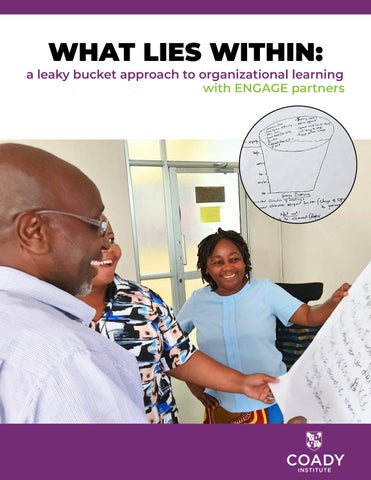
WHAT LIES WITHIN:
a leaky bucket approach to organizational learning with ENGAGE partners
What lies within: a leaky bucket approach to organizational learning Eric Smith & Catherine Irving, Coady Institute, St. Francis Xavier University July, 2024
Introduction ENGAGE: Women’s Empowerment and Active Citizenship is 6.5-year collaboration involving Coady Institute and five partner organizations to advance gender equality and poverty reduction by enhancing women’s capacity to participate in the social, economic and civic life of their communities. Funded through Global Affairs Canada, the approach ensures that local communities, and in particular women, exercise ownership and control over development initiatives that respond to their realities and priorities. Women’s agency and empowerment are key building blocks of a community-based strategy for poverty reduction— women’s active citizenship is reinforced by a strengthened civil society (including women’s rights organizations) and promoted through an active learning agenda. The gender equality analysis that informs the ENGAGE project’s theory of change draws primarily upon the country-specific analysis provided by project partners at the outset of the project, Coady’s own country assessments and past work. Each partner has documented gender-based barriers and capacity gaps based on their long-standing experience in their respective countries. This analysis also aligns closely with Canada’s Feminist International Assistance Policy’s (FIAP) core area of gender equality and the empowerment of women and girls (Government of Canada, 2025). The framework that the project team developed—adapted from Rao and Kelleher (2005)—integrates the myriad factors undermining equality, such as pervasive power imbalances, gender-based violence (GBV), and cultural norms and attitudes that discriminate against women and influence laws and the workings of institutions. The framework maps out domains of change—spaces for engagement within and across sectors, from household and community levels to economic, legal and policy contexts.
The Partners
CCDB works at community level to support the formation and strengthening of local women’s organizations to develop community-based climate change adaptation plans and alternative livelihoods that address the specific needs of women and girls. Training and action research examines the vulnerabilities of women in the context of climate change; supports them to engage in advocacy and campaigns, and interact with local government.
CLE leads Fanm Angaje, a women’s leadership program in social entrepreneurship. The program is designed for young social change Haitian women leaders (ages 18-35). By strategically targeting and investing in a select group of young women, CLE employs a multiplier effect whereby these women are able to spread a message of women-led, asset-based change across Haiti.
Located in Mi’kma’ki, the ancestral and unceded territory of the Mi’kmaq People, at StFX University, Antigonish, Nova Scotia, Coady Institute is committed to breaking down the North-South divide by bringing people together to exchange innovations and learn from each other. Through relevant adult education programs, effective partnerships, and applicable research, Coady Institute is equipping community leaders and their organizations with the knowledge and practical tools needed to bring about the change they want for themselves.
TGNP focusses on empowering women to lead gender equitable change in their communities through Gender Responsive Budgeting (GRB) that equips women with tools and methods to engage with budgets and identify priorities for their local community, focused on gender related challenges. It also works to develop the capacity for civil society engagement in women’s rights and GRB-related advocacy, as well as engage directly with governments and agencies that hold authority over – or can influence – decision-making on local and national budgets.
SEWA is a member-based organisation of more than 3.8 million self-employed women workers of the informal sector. The SEWA Manager ni School (SMS) provides leadership and management education to grassroots members from the informal economy. SEWA provides community-based training of women leaders focused on the “future of work” in the informal sector; and is building the capacity of SMS as a centre for innovation and learning.
WISE strives to promote transformative women's leadership in their households, businesses, communities and cooperatives. WISE facilitates collective action, bringing women together for creating access to financial services, collective voice and sustainable development. WISE offers training for women leaders with a focus on women’s empowerment, assetbased approaches, and enterprise development.
Monitoring, Evaluation, and Learning Integral to the project is a monitoring and evaluation (M&E) process to track progress, report results to donors, and to document learning. With multiple partners across multiple countries, this process utilizes different methods of data collection. Funded community development projects often must demonstrate deliverables and value for money, with detailed measures of activities and impact in the community (Eyben, et al, 2015). Implementation and reporting schedules rarely offer space for organizations to reflect on the impact of the project on their own health and learning. That said, civil society organizations do desire to integrate learning strategies and activities in their work (Smith, 2017). M&E is often seen as an area for “experts” with organizations deferring to hired consultants due to a lack of internal capacity and time for such work (Wadsworth, 2010). While external evaluations have a role, ongoing internal M&E work helps organizations learn and make adjustments as a project progresses. In the international development sector, community and organization-level tools have grown alongside other local, participatory engagement approaches (Oakley, 2001, Earle, 2005, Wadsworth, 2010), but it is a skill that appears to require constant relearning in the face of bureaucratic systems defining reporting protocols. For our collaboration, we wanted to ensure there is space for reflection and organizational learning. A core component of the design of the Engage project was grounded in the desire to build stronger relationships and opportunities for co-learning across the partnership. We wanted to learn more about the impact of the project on each of our organizations, not just on the community-level activities they implemented. Recognizing the reticence practitioners may have for M&E, we wanted to present an engaging and participatory tool that could be used at the community-level on an ongoing basis to assess our partnership, project, and remaining questions.
The Leaky Bucket Tool The Leaky Bucket is a popular education tool to help communities and households analyse their economic contexts. It has existed in various forms for decades (Hustedde et al, 1984, Fairbairn, et al., 1991, Cunningham, 2011) and has been used at Coady in training and project activities. Beginning with a simple image of a water bucket, participants are invited to visualize the various sources of income (inflows of water) that fill the bucket. Next, attention is turned to identifying the holes in the bucket that represent the different expenses that drain the water away. Seeing the inputs and outputs visualized in such a way, can encourage discussions regarding potential economic opportunities that could increase the flows of funds into the bucket, and plug the leaks that would retain wealth locally through activities such as local capacity building or market development.
Try out the digital leaky bucket
Adapting the Tool for Organizational Learning A modified version of the Leaky Bucket tool was developed to review the project on an annual basis. We chose to modify the existing Leaky Bucket tool because project partners were familiar with its use in other ABCD training and community consultation contexts. We also wanted to demonstrate how a community literacy tool can be used in different ways in our lives and programs. For the ENGAGE project, each partner organization (including Coady) drew their own Leaky Bucket and shared it with the other partners as part of annual meeting discussions. The information gathered from the bucket activity then informed reporting for project monitoring and learning. For project and organizational evaluation, the focus of the Leaky Bucket tool is intended to facilitate conversations around three key questions:
Positive - energy giving aspects flowing into the bucket; Negative - energy-draining (exhausting) aspects, and; Energy level - health of the organization in light of these positive and negative aspects.
We had to do it too! Coady colleagues in the library, and online discussing what filled their bucket.
Reflections on the Tool Simple is good! There is nothing profound in asking about positives and negatives in reviewing a program, but we observed that having those discussions using the tool deepened the reflection and analysis. It also increased the energy in the room. Responses were appreciative and positive (sometimes surprisingly, particularly in very challenging settings). Discussions did not get bogged down in negativity and complaints when people were able to compare the contributions and costs of project work. That said, the conversations also helped to articulate challenges that partners were facing. Richness of conversation is irreplaceable. Ability to see commonalities and differences visually across the partners at the same time in a consistent format is helpful. Can be used at any level within the organization, providing a space for those whose roles are often overlooked in projects to have a say on impacts from their perspective. Showed to participants the importance of a variety of tools, the discussion was different than information from a survey or focus group. Coady colleagues began to ponder what other standard tools we use that could be revived for other uses. The artistic way opens up the brain. Partners also used a variety artistic ways to report back as well, such as performing skits and songs.
Still Adapting It is now being used to foster discussions in other aspects of the project, like the progress for feminist movement building:
This is a work in progress, a draft training guide on the use of the leaky bucket tool for organizational learning has been written, and the results of the activities are being integrated into annual reporting. By the end of the Engage project, we intend to provide a more comprehensive analysis of the collective learning that has grown through the partnership. The Leaky Bucket continues to be a helpful data collection tool for these discussions.
What fills and drains your bucket? What old popular education tool have you revived?
References and Acknowledgements: Cunningham, G. (2011). Community economic development and the “leaky bucket”. Coady Occasional Paper No. 9. Government of Canada (2025). Canada’s Feminist International Assistance Policy. Earle, L. (Ed.). (2004). Creativity and constraint: Grassroots monitoring and evaluation and the international aid arena. Intrac. Eyben, R., Guijt, I., Roche, C., & Shutt, C. (Eds.) (2015). The politics of evidence and results in international development. Practical Action. Fairbairn, B., Bold, J., Fulton, M., Ketilson, L.H., & Ish, D. (1991). Co-operatives and community development: Economics in social perspective. Centre for the Study of Cooperatives. Hustedde, R., Shaffer, R., & Pulver, G. (1984). Community economic analysis: A how to manual. North Central Regional Center for Rural Development. Oakly, P. (Ed.). Evaluating empowerment. Intrac. Rao, A. and Kelleher, D. (2005) Is there life after gender mainstreaming? Gender and Development, (13), 2. Smith, E. (2017). The learning needs and experiences of Canadian civil society organizations in international cooperation for development. In L. Mougeot (Ed.), Putting knowledge to work. International Development Research Centre. Wadsworth, Y. ( 2010). Building in research and evaluation: Human inquiry for living systems. Left Coast Press.
coady.stfx.ca/engage