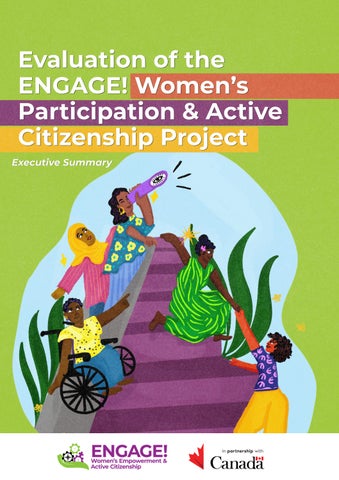
Evaluation of the ENGAGE! Women’s Participation & Active Citizenship Project Executive Summary
Report Information Report Title: Evaluation of the ENGAGE! Women’s Empowerment and Active Citizenship Project: Executive Summary Date: June 2026 Lead Authors: Dr. Leva Rouhani and Dr. Kate Grantham Organization: FemDev Consulting
Evaluation Team: Dr. Kate Grantham, Co-Lead and Feminist Evaluator Dr. Leva Rouhani, Co-Lead and Feminist Evaluator Anowara Khatun and Dr. M.A. Mannan, Researchers (Bangladesh) Gloria Shechambo, Researcher (Tanzania) Ipsita Dwivedi, Researcher and Storyteller (India) Medginah Lynn Alexandre, Researcher (Haiti) Tirsit Sahledengle, Researcher (Ethiopia)
2
Executive Summary This report presents the final external evaluation of the ENGAGE! project, a 6.5year initiative implemented between 2019 and 2026 by the Coady Institute in partnership with the Centre Haïtien du Leadership et de l’Excellence (CLE) in Haiti, Christian Commission for Development in Bangladesh (CCDB), the Organization for Women in Self Employment (WISE) in Ethiopia, the Self Employed Women’s Association (SEWA) in India, and the Tanzania Gender Networking Programme (TGNP) in Tanzania. Funded by Global Affairs Canada (GAC), the project aimed to advance gender equality and poverty reduction by strengthening women’s leadership, active citizenship, and collective action at household, community, and institutional levels. The evaluation assessed the project’s relevance, effectiveness, coherence, efficiency, impact, and sustainability using the OECD-DAC evaluation criteria. It also examined how ENGAGE contributed to women’s empowerment and social change across diverse contexts marked by political instability, economic pressures, climate-related shocks, gender inequality, and shrinking civic space. The evaluation adopted a mixed-methods and participatory approach grounded in feminist evaluation principles. Data collection included a desk review of project documentation; key informant interviews (KIIs) with Coady and partner organization staff, local stakeholders from government and civil society in implementation countries, and donor representatives; small group discussions (SGDs) with project participants; and participatory validation and sensemaking workshops with partners. The evaluation emphasized triangulation, contextual analysis, and the inclusion of participant perspectives and lived experiences throughout the process.
3
Key Findings
Impact Relevance Effectiveness Sustainability
Coherence Efficiency
4
Relevance The evaluation found that ENGAGE was highly relevant to the needs, priorities, and lived realities of participating women, partner organizations, and communities. Across all countries, the project responded to persistent gender inequalities related to women’s leadership, economic insecurity, exclusion from household and community decision-making, and participation in public life. The project’s Asset-Based and Community-Led Development (ABCD) approach and flexible, partner-led design were widely valued for building on women’s existing capacities and enabling activities to be adapted to diverse and changing contexts, including COVID-19, political instability, climate-related shocks, and economic crises. Community-based training activities were also adapted to participants’ literacy levels, livelihood realities, and local contexts, contributing to strong accessibility and relevance. At the same time, the evaluation found opportunities to strengthen more direct participation of women in project design, priority-setting, and feedback processes.
Effectiveness The evaluation found strong evidence that ENGAGE contributed to meaningful changes in women’s confidence, participation, leadership, collective agency, and community engagement across multiple contexts. Women described increased self-confidence, stronger communication skills, greater participation in household and community decision-making, and increased willingness to engage in public life and collective action. The project also strengthened partner organizations’ capacities in facilitation, participatory approaches, gender equality programming, and community mobilization. Cross-partner learning, exchange, and collaborative learning processes were widely identified as important contributors to implementation effectiveness and organizational learning. The project’s flexible and partner-led design supported contextual adaptation and responsiveness, while broader structural transformation remained gradual and uneven due to persistent social, political, and economic barriers. Partners also noted that donor-driven MEL and reporting requirements sometimes limited the ability to fully capture complex and non-linear forms of social change.
5
Efficiency The evaluation found that ENGAGE was implemented with a high degree of adaptability and responsiveness under highly complex and changing conditions, including COVID-19, political instability, insecurity, inflationary pressures, and climate-related disruptions. The project’s flexible implementation model and trust-based partnership approach enabled partners to adapt activities, timelines, and delivery approaches while maintaining continuity of programming and local ownership. Longstanding relationships between Coady and implementing organizations also supported adaptive problem-solving and collaborative decision-making. At the same time, the project’s breadth and complexity created coordination and management demands, while external pressures increased operational costs and implementation challenges across several contexts.
Coherence The evaluation found that ENGAGE demonstrated strong coherence between its objectives, methodologies, partnership approach, and feminist principles. The project’s emphasis on participatory, asset-based, and community-led approaches aligned closely with its goals related to women’s leadership, active citizenship, collective organizing, and empowerment. The project complemented broader local gender equality ecosystems by emphasizing collective organizing, peer learning, and community mobilization alongside other actors providing specialized services. It also strengthened collaboration and connections between community groups, civil society organizations, grassroots actors, and local institutions. However, coordination and engagement with external actors varied across contexts and were sometimes constrained by political dynamics, insecurity, and logistical challenges.
6
Impact The evaluation suggests that ENGAGE contributed most strongly to individual and relational empowerment outcomes, particularly in relation to women’s confidence, agency, leadership, collective action, and community engagement. Many participants described increased autonomy, stronger voice within households and communities, greater awareness of rights, and enhanced ability to organize around shared concerns. The project also contributed to broader social and relational changes in some contexts, including increased acceptance of women’s leadership, improved household gender relations, strengthened peer networks, and greater community recognition of women’s contributions. However, institutional and systems-level change remained more limited and highly dependent on broader political, social, and economic conditions. Many of the project’s most significant outcomes were qualitative, relational, and nonlinear in nature, making them difficult to fully capture through conventional quantitative indicators alone.
Sustainability The evaluation found promising foundations for sustainability, particularly where women’s groups, peer networks, leadership structures, and community-based processes had become embedded within local contexts. The project’s emphasis on collective organizing, local leadership, and participatory approaches strengthened ownership and increased the likelihood that some outcomes would continue beyond the project period. Sustainability appeared strongest where local partners demonstrated strong organizational alignment with project objectives and where women’s groups had developed clear internal structures and community legitimacy. At the same time, sustainability remained uneven and vulnerable to broader contextual pressures, including funding constraints, political instability, economic insecurity, staff turnover, and shrinking civic space. In several contexts, sustaining momentum will require continued investment in local organizations, long-term accompaniment, and stronger institutional linkages.
7
Recommendations The evaluation identified recommendations to inform the design and delivery of future initiatives aimed at advancing gender equality and supporting genderequitable change.
Donors Support gender equality programming that combines economic empowerment with women’s leadership, collective action, and systems change. Provide longer-term funding to support gradual and non-linear processes of gender-transformative change. Support flexible and core funding models that strengthen organizational resilience, adaptive capacity, and long-term sustainability. Recognize organizational strengthening, peer learning, and movement-building as core components of gender equality programming. Support MEL systems that better capture qualitative, relational, and emergent dimensions of gender equality and women’s empowerment.
8
Implementing Organizations Continue investing in participatory, asset-based, and contextresponsive approaches that strengthen women’s collective agency and leadership. Prioritize practical, accessible, and locally adaptable approaches that participants and organizations can sustain within existing resource realities. Strengthen structured mechanisms for participant voice, feedback, and co-creation within program design and implementation. Build stronger community-level systems for knowledge sharing, mentorship, and sustainability. Invest in peer exchange and collaborative learning as mechanisms for sustainability and adaptation.
9