Feminist Asset-Based and Community-Led Development Practice: The Case of the Tanzania Gender Networking Programme (TGNP)

Summary of Findings
This research was conducted by Coady Institute with support from the Tanzania Gender Networking Programme (TGNP)
2026 © Coady Institute, St Francis Xavier University (StFX)
Creative Commons Attribution-NonCommercial-ShareAlike 2 5 Canada License http://creativecommonsorg/licenses/by-nc-sa/2 5/ca/
All or parts of this publication may be copied and distributed for non-commercial purposes without requesting written permission, provided the author(s) and Coady Institute are explicitly acknowledged as the source of the material. Any work adapted from this material must also be made available to others under identical terms
This study is part of the Engage: Women’s Empowerment and Active Citizenship project and is funded by Global Affairs Canada

For more information about the research and the report, please contact:
Coady Institute
St Francis Xavier University PO Box 5000
Antigonish, NS, Canada, B2G 2W5
wwwcoadystfxca
coady@stfxca
+1 902 867 3960
1 866 820 7835 (within Canada)
Articulating Feminist Asset-Based and Community-Led Development Practice: The Case of the Tanzania Gender Networking Programme (TGNP): Summary of Findings
by Dr. Wellington Sousa, Coady Institute
June 2026
Summary compiled and edited by Catherine Irving, Coady Institute
Introduction
This study examines how Asset-Based and Community-Led Development (ABCD) is taken up, interpreted, and sustained within a feminist movement organization Drawing on a qualitative single-case study of the Tanzania Gender Networking Programme (TGNP), conducted within the ENGAGE: Women’s Empowerment and Active Citizenship initiative, the research explores three themes through which ABCD becomes meaningful in practice: feminist organizational culture as the infrastructure that sustains ABCD; learning and strategic pragmatism as modes of organizational governance; and authority of community knowledge
As a feminist organization, TGNP has decades of experience in collective agency, participation, and social transformation. Community knowledge discernment and mobilization are key in shaping both local action and policy advocacy Through ENGAGE, ABCD has been interwoven in their approaches through learning, collective discernment and pragmatic navigation of institutional constraints. TGNP demonstrates how asset-based approaches can remain politically generative when embedded within feminist organizational purpose and relational governance.
Feminist Organizational Practice and Asset-Based Community-Led Development
The study is situated within the context of ENGAGE: Women’s Empowerment and Active Citizenship, a 6.5-year initiative (2020-2026) funded by Global Affairs Canada and implemented across Bangladesh, Ethiopia, Haiti, Tanzania, and India ENGAGE was designed to advance gender equality and reduce poverty by strengthening women’s empowerment and active citizenship through nonformal education and community-led approaches Empowerment is linked to
to women’s capacity to exercise greater influence over decisions and resources affecting their lives, while active citizenship emphasizes women’s meaningful participation in civic and political processes, including engagement with local governance and accountability mechanisms. Both concepts are explicitly grounded in agency the capacity to act individually and collectively toward shared social, economic, and political goals
ENGAGE: Situating ABCD
In response to deficit-oriented development approaches that focus on the needs of communities, Asset-Based and Community-Led Development (ABCD) approaches start with existing assets, capacities, and relationships; recognizing people as citizens rather than clients; and fostering locally driven action (Kretzmann & McKnight, 1993; Mathie & Cunningham, 2005) Within ENGAGE, ABCD is intended to facilitate the identification and mobilization of local strengths, relationships, and capacities emphasizing community ownership of change processes that position people as active agents ENGAGE’s multi-country design and emphasis on partner-driven learning encourages each partner to interpret, adapt, and localize ABCD in ways that align with their organizational identities, political commitments, and local contexts Partners are supported to engage with ABCD principles and methods through learning spaces, communities of practice, mentoring, and peer exchanges.
Research on ABCD approaches highlight the importance of relational processes, trust, and local leadership, but run the risk of romanticizing community, obscuring power and privilege inequities, and being co-opted within neoliberal governance shifting state responsibilities onto communities (Blickem, et al, 2018; MacLeod & Emejulu, 2014). These critiques challenge celebratory narratives and underscore the need for reflexive, power-aware practice. Emphasizing power,
learning, and adaptation by attending to power within, power with, power to, and power over (Mathie & Gaventa, 2015), highlights its potential political dimensions when implemented reflexively It is also important not to reduce ABCD to discrete tools, such as asset mapping, but to conceptualize it as an orientation toward practice that evolves through ongoing learning and contextual judgment (Blickem et al, 2018)
ABCD literature has also largely focused on community-level practice or projectbased interventions. Organizations most often appear as facilitators, implementers, or intermediaries rather than as analytic subjects in their own right. This gap is significant given the institutional environments in which many feminist and community-led organizations operate. Donor accountability requirements and policy engagement often privilege standardized indicators and linear reporting, creating tensions with relational, process-oriented approaches such as ABCD (MacLeod & Emejulu, 2014).
Feminist Organizational Practice, Power, and Knowledge
Feminist scholarship has long challenged technocratic and instrumental approaches to development by examining underlying issues related to participation and power Attentive to these dynamics, feminist organizations emphasize collective agency, prioritizing participatory decision-making, shared leadership, and movement-building as ethical and political commitments in keeping with their feminist grounding (Batliwala, 2010,; Rao & Kelleher, 2005)
Feminist NGOs must navigate tensions between transformative political commitments and donor-driven accountability regimes that privilege standardized indicators, measurable outputs, and depoliticized narratives of change (Rao & Kelleher, 2005). Conventional monitoring and evaluation
frameworks risk obscuring power relations and silencing marginalized knowledge. Feminist organizations are keenly aware of whose knowledge counts, how evidence is produced, and how lived experience is translated into advocacy and policy influence (Eyben, 2012). In response, the use of reflexive, participatory, and learning-oriented approaches explicitly acknowledge values and politics (Podems, 2018) Community knowledge, collective reflection, and experiential expertise are positioned as legitimate sources of authority, particularly in contexts of feminist advocacy and movement-building.
How can ABCD function as a practice that is selectively integrated, negotiated, and governed within a feminist organizational project? With ENGAGE’s central focus on women’s empowerment, these concerns regarding ABCD and power are particularly relevant to learn more about the intersection of ABCD, organizational contexts and feminism.
Tanzania Gender Networking Programme
TGNP is an overtly feminist, movement-building organization with a mature community-led praxis, but no prior organizational articulation of ABCD (TGNP, 2021). This creates an opportunity to examine ABCD not as a framework that introduces community-led practice where none existed, but as an approach that is encountered, negotiated, and reshaped through engagement with feminist histories, epistemologies, and organizing forms. Examining TGNP in this way allows the study to explore how asset-based approaches are translated at the organizational level, how they interact with feminist commitments to power, advocacy, and collective agency, and how they are governed and sustained under real institutional conditions
Founded in the early 1990s, TGNP emerged within a period of intensified feminist
mobilization in Tanzania and globally, closely connected to the momentum generated by the Fourth World Conference on Women in Beijing. TGNP’s own organizational narratives situate its development within what it describes as a Beijing journey oriented toward women’s collective agency, participation in public decision-making, and structural transformation (TGNP, 2024). As such, TGNP is a feminist knowledge-producing and movement-building institution, committed to linking grassroots realities with national and global struggles for gender justice. TGNP’s ideological grounding is rooted in transformative feminist analysis, which understands gender inequality as structurally produced through intersecting systems of patriarchy, governance, and political economy TGNP emphasizes collective responsibility, political consciousness, and sustained engagement with institutions of power. This orientation is reflected in TGNP’s long-standing focus on feminist learning, participatory research, and policy engagement, particularly in relation to public budgeting, accountability, and governance processes (TGNP, 2021; TGNP, 2024).
Over time, TGNP has developed a distinctive praxis, the Intensive Movement Building Cycle (IMBC), that integrates participatory adult education, feminist participatory action research, grassroots animation, and movement-oriented advocacy through which women generate knowledge, build confidence, and act collectively to influence social, economic, and political systems. Learning, research, and action are mutually reinforcing, consistent with feminist traditions that view knowledge production itself as a site of power and transformation (TGNP, 2024). the IMBC cycle typically begins with participatory research that enables women to collectively examine issues affecting their lives and communities This research is explicitly political and educational, aimed at building critical consciousness and shared analysis. Research findings are then translated into feminist education and community animation, supporting
dialogue, solidarity, and collective visioning. These processes feed into collective action and advocacy, including engagement with local authorities, participation in planning and budgeting processes, and broader movement campaigns Reflection and learning complete the cycle, allowing women and organizers to assess change, respond to resistance, and adapt strategies over time (TGNP, 2021; TGNP, 2024)
At the community level, TGNP anchors this movement-building work through Knowledge Centres (KCs), which function as community-owned feminist learning and organizing hubs where women collectively reflect on lived experience, generate shared analysis, and mobilize for action in relation to local development priorities and governance processes (TGNP, 2021). Governed by locally elected leadership structures, with women holding most leadership roles, KCs reinforce collective ownership, relational leadership, and accountability. They also serve as bridging spaces that connect grassroots women’s experiences and knowledge to engagement with ward, district, and national decision-making structures, reflecting TGNP’s long-standing commitment to linking local action with structural change (TGNP, 2024).
Although TGNP did not initially frame its work using the language of ABCD, many of its established practices align closely with asset-based and communityled principles. Women’s knowledge, relationships, organizing capacities, and lived experiences have long been recognized as resources for change within TGNP’s feminist praxis. At the same time, TGNP’s ideological commitments ensure that these assets are understood in relation to power relations, historical inequalities, and institutional constraints, rather than being romanticized or treated as substitutes for systemic reform (TGNP, 2021).
This feminist genealogy, shaped in part through TGNP’s Beijing journey, is critical for understanding why ABCD was later engaged in particular ways within ENGAGE When ABCD entered TGNP through ENGAGE-supported learning spaces and partner exchanges, it encountered an organizational landscape in which community-led practice already existed, but was articulated through feminist movement-building rather than asset-based development discourse TGNP’s engagement with ABCD therefore involved a process of interpretation and translation, as ABCD principles were examined in relation to feminist analyses of power, collective agency, care, and well-being (TGNP, 2021; TGNP, 2024)
Study Design
As a long-standing feminist organization with a sustained partnership with the Coady Institute and, more recently, through ENGAGE, TGNP provides a unique opportunity within the project to explore ABCD as an evolving organizational logic shaped by feminist politics, relational practices, and institutional conditions
By examining TGNP as a case, this research explores how ABCD evolves when it encounters an overtly feminist organization with a mature community-led infrastructure and a historically grounded commitment to political transformation
Yin’s (2018) single-case study approach was used for this study to learn about the organization and its engagement with ABCD. Data analysis is guided by Reflexive Thematic Analysis (RTA), a qualitative approach oriented toward meaningmaking and reflexive engagement (Braun and Clarke, 2023).
This study is informed by my positioning as a scholar–practitioner with longstanding engagement in ABCD and collaborative research with ENGAGE partners. My relationship to the field, including prior involvement in ABCD
training and partnership-based research, shaped both access to the study context and the interpretive lens brought to the analysis. The data analyzed in this study consist of semi-structured qualitative interviews conducted in May 2025 with seven individuals engaged with TGNP across different organizational levels, including executive, managerial, and operational roles. Ethical approval was obtained through the relevant institutional review process, and all participants provided informed consent prior to participation. Given the organizational focus of the study and the involvement of participants occupying identifiable roles within TGNP, particular attention was paid to confidentiality and anonymity
Interview questions were organized around key organizational domains such as policies and practices, training and capacity building, decision-making processes, partnerships, monitoring and evaluation, organizational culture, and resource allocation. Participants were invited to reflect on how ABCD principles are interpreted and embedded across different aspects of organizational life The interview transcripts were then analysed through iterative phases for sensemaking and deeper analysis. Quotes in this paper have been edited only for readability
Findings
The findings here are presented in three themes: feminist organizational culture and ABCD learning and strategic pragmatism; and community knowledge as authority
Theme 1: Feminist Organizational Culture and ABCD
At TGNP, the uptake and sustainability of ABCD are made possible by a deeply
embedded feminist organizational culture where they identify ABCD approaches that resonate with and deepen existing values and ways of working. ABCD is an emerging organizational priority to strengthen and institutionalize over time, a process closely tied to the ENGAGE project:
Promoting gender equality is what we do every day. It's everything that we are doing. Promoting ABCD, I think as I've told you, yes, we are trying to do. The thing is to be honest. That's the ENGAGE project. We have been very conscious that ENGAGE project we have to make sure that we institutionalize ABCD. (Participant 3)
This participant then named the unfinished nature of this work:
All right It is something that we still need to work on to make sure that everything we do we integrate ABCD. Because we can say, okay, the gender equity, making sure that we integrate the gender equity principles, that is obvious. But now, how the gender equity principles that have been integrated in integrating ABCD, how does they look like? what are they? (Participant 3)
ABCD is understood as something that deepens through practice, reflection, and intentional integration, rather than something that is implemented once and completed illuminating how organizational change actually happens over time and sets the stage to understand how feminist culture enables this logic, how it is governed through learning and pragmatism, and how it produces political and epistemic effects beyond the organization.
Feminist commitments as the foundation
Gender equality is foundational, non-negotiable and is at the core of TGNP’s work as stated above. ABCD enters this context not as a competing framework, but as something that must align with, and strengthen, an already established feminist orientation:
When you talk about ABCD, it means whatever you are doing, using the resource which you have, but at the end of the day, we should take you to women’s empowerment, gender equity and equality. It’s just like when you use ABCD like a road that take us where we want to see (Participant 4).
ABCD functions as a pathway, subordinated to and stabilized by a feminist organizational logic that precedes it. This helps explain why ABCD is experienced at TGNP not as disruptive or transformative in itself, but as coherent, compatible, and useful within an organizational culture where gender equality is nonnegotiable. ABCD is described as deeply embedded in what TGNP does, even when it is not explicitly articulated as policy:
You see, the very vision of the organization is centered around deepening the understanding of the issues relating to gender equality amongst the community But that has to be coupled with women empowerment You can't have gender equality without women empowerment And we realize that in fact, we've been using probably before, but... much more now, the ABCD, in everything we do. In fact, it is kind of integrated in everything that we do. Maybe you may not see it in the policy, but in our practice. (Participant 1)
The absence of policy language points to how ABCD functions as a way of working that is enacted through everyday decisions and relationships, and made visible in reporting:
We talk about ABCD. ABCD is actually enshrined in our practice…I don't see how you can read any of our reports and not see ABCD somehow mentioned because that's what we actually do. (Participant 1)
Feminist culture shaping participatory practice and decision-making
The enabling role of feminist culture is also evident in decision-making processes, where participation and collective deliberation are normalized:
For TGNP, the key decisions are made starting from the staff. But we have the highest level of decision making, which is the Annual General Meeting, composed of members But before the issues is taken by the members, it has to be raised by staff and needs to go to management, and it needs to go to the AGM I think it’s kind of following [ABCD] principles it's not one person who can make decision it is a participatory way of discussing and then make decision Participatory, I think, is one of the principles over here It is also integrated in decision-making at TGNP because it's participatory. (Participant 4).
The identification of ABCD principles in decision-making is possible because participatory, relational, and reflective practices are already culturally legitimate within a feminist organization
To a great extent I think there is incorporation of the ABCD principles in the process of decision making within the organization. Even though it's not always intentional, I think it just somehow finds itself weaving, I don't know, somehow. That's my perception. (Participant 2)
The language of “weaving” captures how ABCD principles become part of the organization’s habitual ways of thinking and acting. This supports the interpretation of ABCD as an enabling logic rather than a procedural framework.
Feminist culture extending into partnerships and advocacy
Feminist organizational culture extends beyond internal processes into collaboration and partnerships, where relationships are framed as political and movement-oriented, involving community in decision-making:
So, we want to go to the parliament, we're not going by ourselves because we go together with the community members together with the likeminded organization. It is believed that as one of the ABCD aspects that you should not go by yourself, you should also involve the others who are like-minded and also creates a room for opportunity for other people also to participate, especially in decision-making. (Participant 5)
Through this process, community knowledge is elevated and mobilized in national advocacy spaces Community members are political actors whose knowledge carries authority.
Theme 2: Learning and Strategic Pragmatism
Learning from projects and programmes is an intentional organizational practice through which TGNP governs itself. Learning is valued, organized, and mobilized to align staff, sustain feminist commitments, and support the ongoing integration of ABCD Learning and collective sharing of knowledge and skills are explicitly linked to TGNP’s feminist ethos:
For culture or for organization, first we have a culture of feminists which is (…) to ABCD. We have a culture of voluntarism here, where people come for volunteer, people come for mentorship, which we build in relationships through the mentorship. And also, we have a culture of people using their skills that they have (Participant 6)
Learning is embedded in everyday organizational life through mentorship, voluntarism, and the recognition of existing skills learning is relational, collective and ongoing:
I think there's a leeway of ensuring that you get the necessary trainings for you to be able to understand so that you're also in a position of knowing how you incorporate gender aspects in your work. I think necessary and basic trainings for all the staff as well…to ensure there's that kind of fairness as well. But there's a lot of learning. It's a learning environment really in here. You learn new things all the time. (Participant 2)
This account situates training within a broader learning environment, where capacity-building serves not only skill development but also fairness, alignment, and shared understanding of gender commitments across the organization
Deliberate post-field reflective spaces circulate knowledge beyond those directly involved in implementation:
For staff, maybe a bubble session after the consultant comes from the field They come for a bubble session so staff are being aware of what has been going on…maybe I didn't go to the field, but I know what the things that happened [in] the field. (Participant 6)
These practices reinforce learning as collective and consolidated across staff as part of organizational functioning. Learning also operates as a governance signal in relation to ABCD as the observation of “work still to do” fosters continued experimentation, identifies organizational priorities, and authorizes adaptation over time
Governing through pragmatic choices in monitoring and evaluation
The governance role of pragmatism is most explicit in the domain of Monitoring and Evaluation frameworks, where decisions about what is measured, how it is
We have specific indicators to address development in gender equality. We do not have specific indicators for advancing ABCD. You understand what I'm saying? We don't have specific indicators to actually track that. To us, ABCD is an approach that we use to get the community to have what they need But in the end, we report on what they have achieved and we will say this was done employing the approach of ABCD (Participant 1)
The participant further explained: “We don't have a specific matrix to track utilization of ABCD we do outcome harvesting” (Participant 1) In this sense, ABCD is repositioned as the logic guiding practice rather than the object of measurement.
Adaptive decision-making as governance in practice
The role of learning and strategic pragmatism is also evident in TGNP’s decisionmaking processes:
I think it depends on what decision is made There are some decisions which are participatory, there are some because there's the member organization supposed to be members to have a decision, and also have management within the organization. There are some decisions which management are the one who make it. And there are other decisions which … are participatory. Where even if staff are being involved.
(Participant 6)
Participation, management authority, or collective deliberation are resources that are drawn upon selectively Decisions are calibrated to context, drawing on accumulated organizational experience and shared values. ABCD is observed particularly through attention to existing capacities and resources in the organization and among partners
By making deliberate choices about measurement, reporting, and decisionmaking, TGNP preserves space for ABCD and feminist practice within institutional environments that often privilege standardization and control
Understanding governance in this way helps explain how ABCD remains active
and influential at TGNP despite the absence of dedicated indicators or formalized systems. Learning provides the mechanism through which gaps are identified and addressed, while pragmatism allows the organization to operate effectively without compromising its core values.
Theme 3: Community Knowledge as Authority
The authority of community knowledge is central to TGNP’s work. TGNP recentres communities as agents in both meaning-making and political decisionmaking. TGNP includes ABCD-informed practices to support the ways lived experience is valued and mobilized for advocacy, capable of challenging official narratives, shaping agendas, and influencing policy outcomes.
Knowledge as a basis for community-led action
The political significance of community knowledge at TGNP is not limited to its upward translation into advocacy or policy spaces. Through asset mapping and reflective facilitation, communities identify existing capacities and mobilize them to address locally defined challenges, often without waiting for institutional intervention. Knowledge Centres are understood locally as trusted sites of collective problem-solving:
In the process of doing gender equality work, community members, especially the afflicted women and children, they look to the knowledge centre as the organization to help It’s like the backup mechanism for ill feelings or their problems (Participant 7)
Here, authority is grounded in relational trust and proximity to lived experience rather than formal expertise. Community knowledge is inseparable from responsibility and action. Asset-based practices further enable communities to recognize and mobilize resources that might otherwise remain invisible:
We use ABCD for community groups to realize some of the resources that will help them… For example, in Saranga, they find those waste products in houses and use it to make a composite manure. They sell it… we are also looking at it on the area of leadership, especially decision-making position.” (Participant 4)
Knowledge operates as a practical resource, enabling communities to link economic activity with leadership development and gender equity Shared community knowledge also enabled collective action to address child protection and gender-based violence:
Together, the knowledge centre, community government, and the church leadership, agreed to do something to rescue children… they agreed for the church building to be used as a daycare centre” (Participant 7).
Another knowledge centre mobilized local resources to improve infrastructure:
They decided to put some sacks of sand so that during the rainy season, they could cross a valley that is filled with water And they have named it “ABCD Street” (Participant 7).
Community knowledge as counter-evidence
The knowledge centres play a central role in advocacy by bringing lived realities directly into national political spaces:
So, the knowledge centres, they become like hearing from a horse's mouth when we go to the parliament They're the ones saying, ‘Okay, you are talking of water that we have reached 87% access to water But look here, in our village, in our ward. We don't have water. We are still working three hours to reach water sources. (Participant 3)
Community knowledge functions as counter-evidence to official statistics, providing embodied, place-based accounts that expose gaps between policy claims and lived experience. Authority is redistributed away from abstract data and toward those directly affected by development interventions
Mobilizing community knowledge across scales
Findings generated at the grassroots are carried into national advocacy through coordinated partnerships:
We share with the ministries, their (community) findings. And most of the time when we go share (with) the ministries, we go with the local level, representatives from the knowledge centres, but we also go with our partners at national level, the members of our networks at national level. Then we go and (give) feedback to the ministries We go to the parliament, feedback to the parliamentarians on the findings and that connects our advocacy strategy local level and national level (Participant 3)
Community knowledge travels with communities, supported by organizational relationships and networks that maintain the visibility and legitimacy of local actors in national spaces.
From lived experience to policy change
The political authority of community knowledge becomes especially visible when it leads to concrete policy outcomes. Grassroots engagement around menstrual hygiene generated a shared agenda across multiple districts for formal policy change:
And the good example is the issue of sanitary towels. When we did the intensive movement building cycles to areas at the grassroots level, we found out that girls were not going to school because they didn't have sanitary towels. And it was like, six districts, they all had that as a priority… So, we started engaging with the Ministry of Health and Ministry of Education through parliamentarians and NGOs And it became a national agenda, a national campaign And the result of that, when we were revising the health policy, they incorporated the issue of menstrual hygiene management” (Participant 3)
Lived experience becomes not only evidence, but a driver of political decisionmaking. Community knowledge is recognized as credible, consequential, and capable of generating action at multiple levels, from community-led problem definition, asset mobilization, collective action through to formal policy influence.
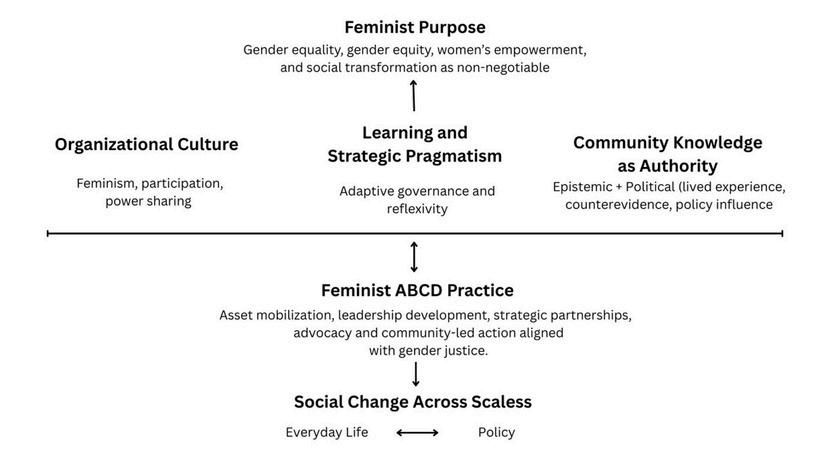
Articulating a Feminist ABCD
TGNP has adapted and implemented ABCD by embedding it within their organizational culture, governing it through a process of learning, organizational
culture, governing it through a process of learning, organizational sense-making, pragmatism and political practice. ABCD becomes meaningful and effective at TGNP because it is selectively integrated in ways that remain responsive to context, values, and power relations. ABCD is lived, governed, and enacted through relationships, judgment, and collective action aligned with their feminist commitments
Feminist ABCD as organizationally anchored practice
As noted earlier, for TGNP, feminism, not ABCD, defines the organization’s core commitments Gender equality and equity, collective agency, and social transformation are foundational organizing principles. ABCD functions as a means through which these feminist commitments are pursued. Feminist organizational scholarship has long emphasized that gender equality work is inherently political and organizational rather than technical (Batliwala, 2010; Rao & Kelleher, 2005). The TGNP case shows ABCD can be subordinated to, and stabilized by feminist organizational politics This anchoring helps explain why ABCD can remain informal, adaptive, and incompletely codified without losing coherence or legitimacy within the organization. Commitments central to ABCD such as valuing existing capacities, prioritizing collective agency, treating participation as consequential, and recognizing local knowledge as authoritative, closely align with feminist organizational practices already embedded within TGNP. ABCD becomes an extension of familiar feminist ways of working.
At the same time, the TGNP case does not suggest that tensions between feminist advocacy and asset-based community practice have been fully resolved. Feminist advocacy, particularly through human rights–based approaches, often foregrounds oppression and intersectional harm to justify claims, secure resources, and hold institutions accountable. In contrast, ABCD-informed
practice at TGNP deliberately resists deficit framing at the level of community engagement, refusing to allow experiences of oppression to define people or delimit their capacity to act Participants’ reflections indicate that this shift is actively being pursued, but also recognized as incomplete and requiring further intentional work. This coexistence reflects an ongoing organizational negotiation. Deficit framing is mobilized strategically in advocacy and policy spaces as a political claim directed toward institutions, while asset-based framing increasingly shapes everyday community practice to sustain agency, dignity, and collective action. This case speaks directly to critiques within the ABCD literature concerning the risks of toolification and depoliticization. The TGNP case suggests that ABCD’s political potential is not realized through formalization alone, but through its ongoing embedding within an explicitly feminist organizational project, one that remains reflexive about its limits and committed to further deepening asset-based, community-led practice.
Learning as governance in feminist ABCD
Reflective spaces, mentorship, post-field sense-making sessions, and iterative adjustment enables TGNP to steer its practice without freezing ABCD into rigid systems or indicators Feminist ABCD is preserved through collective practices that reinforce alignment between feminist values, community-led orientations, and everyday organizational action. Strategic pragmatism allows TGNP to engage donor accountability regimes while resisting epistemic capture by measurement frameworks ill-suited to relational and emergent change This finding resonates with feminist evaluation scholarship that calls for evaluation designs that are adaptable, recognizing local cultural and political contexts (Podems, 2018) ABCD is sustained through ongoing judgment about what it means to act in feminist and community-led ways.
Authority of community knowledge
Community knowledge enables locally defined problem-solving, functions as counter-evidence in policy and advocacy spaces, and travels across organizational and political scales without being abstracted away from those who produced it. Knowledge centres, in this sense, function as infrastructures of community-led action and authority TGNP demonstrates how community knowledge is not only voiced but mobilized to generate material change in everyday life.
Policy influence emerges as a possible outcome of feminist ABCD, but not its defining purpose. Community-led action retains intrinsic value even when it does not translate into formal policy reform. This resists linear theories of impact that prioritize measurable outputs over lived transformation and aligns with critical development scholarship that questions technocratic notions of effectiveness (MacLeod & Emejulu, 2014). Strategic engagement with institutional systems becomes a means of expanding political space
Feminist ABCD as Organizational Translation
ABCD is localized through alignment with feminist values, governed through learning and strategic pragmatism, and enacted through relationships and judgment. Feminist ABCD is a situated practice that becomes possible when feminist organizational purpose, relational governance, and community knowledge converge