
CNG Keystone 16 Virtual Catalog

Page 1


CLASSICAL NUMISMATIC GROUP, INC.

KEYSTONE AUCTION 16

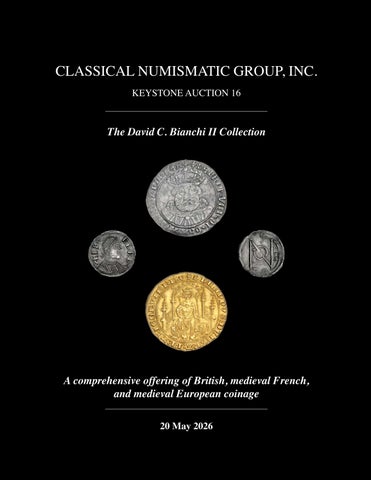
A comprehensive offering of British, medieval French, and medieval European coinage 20 May 2026

The David C. Bianchi II Collection

CNG Keystone Auction 16

The David C. Bianchi II Collection

A comprehensive offering of British, medieval French, and medieval European coinage

20 May 2026
10:00 AM EST

Featuring:

The Jourdan & Mallison Alfred Londonia Penny

Four Very Rare Groats of Edward I

Edward III Gold Coinage

An Impressive Henry VIII Testoon

A Detailed Offering of Edward VI Fine Silver Issues

Five Guinea of William & Mary

A Selection of Scottish & Irish Coinage

Anglo-Gallic Gold of Edward the Black Prince

An Extensive Group of French Gold and Silver Issues

Rare and Attractive Teston du Moulin

Large Size Early Dated Austrian Silver

Early Joachimstal Taler

A Pedigreed Sicilian Augustale

US Office

PO Box 479

Lancaster, PA 17608-0479

Phone (717) 390.9194 • Fax (717) 390.9978

California Office

CNG Authorized Partner

4040 Macarthur Blvd., Suite 307

Newport Beach, CA 92660

Phone (949) 932.0500

UK Office

De Morgan House, 57-58 Russell Square London WC1B 4HS, UK

Phone +44.20.7495.1888 Fax +44.20.7499.5916

EU Office

Noordeinde 64a 2514GK, The Hague, NL

Phone +31.851.301.541

Grading Conditions

English Deutsch Français Italiano

Proof Polierte Platte

Mint State/Uncirculated Stempelglanz

Extremely Fine (EF) Vorzüglich

Very Fine (VF)

Sehr Schön

Flan Bruni Fondo Specchio

Fleur de Coin Fior di Conio

Superbe Splendido

Très Beau Bellissimo

Fine Schön Beau Molto Bello

Good/Fair Gut

Common Abbreviations

AD Anno Domini

Bien

Bello

BE Bithynio-Pontic Era IY Indictional Year

Æ Bronze BI Billon MBS Mail Bid Sale

AE Actian Era CE Common Era mm Mintmark

AH Anno Hegirae

Cf. Confer (compare) PB Lead

AR Silver c/m Countermark p. Page

AV Gold CY Civic Year (Era) pl. Plate

BBS Buy or Bid Sale EL Electrum RPE Roman Provincial Era

BC Before Christ FPL Fixed Price List RY Regnal Year

BCE Before the Common Era g Gram SE Seleukid Era

See Bibliography on our website, www.cngcoins.com, for a complete list of reference abbreviations.

Bank Accounts

Beneficiary: Classical Numismatic Group, Inc.

US$ Account:

Northwest Bank

€ Account:

HSBC Bank plc

£ Account:

HSBC Bank plc

100 Liberty St., Warren PA 16365 60 Queen Victoria Street, London EC4N 4TR 60 Queen Victoria Street, London EC4N 4TR

Account Number: 243374218

ABA Number: 7216021910

BIC or SWIFT: NWBIUS33

Account Number: 84309198

Sort code: 40 12 76

IBAN: GB82HBUK40127684309198

BIC or SWIFT: HBUKGB4B

Account Number: 71170910

Sort code: 40 11 60

IBAN: GB45HBUK40116071170910

BIC or SWIFT: HBUKGB4B

Classical Numismatic Group, Inc. is a United States limited company. Auction license number AY002406. United Kingdom Registration No. FC035702, Branch No. BR020787.

All lots in this auction were in the possession of CNG in CNG’s Lancaster, Pennsylvania office no later than 27 March 2026. This information is provided for the protection of buyers in the event that US import restrictions are introduced subsequent to that date on any of the types of coins that are included in this auction.

Notice Regarding “Slabs”

Coins that have been encapsulated (“slabbed”) by a grading and/or authentication service may not be returned for any reason, including authenticity, if they have been removed from the encapsulation (“slab”).

Acknowledgement

CNG would like to thank Jan Moens (jan.moens@bvdmc.com) for creating and providing the Numismatica Medievalis font used in this sale.

AUCTION TERMS

This is a public and Internet auction conducted by Classical Numismatic Group, Inc. (CNG). Bidding in the auction constitutes acceptance of the following terms:

1. The property listed in this catalogue is offered for sale by CNG for itself and as agent for various owners and other consignors. We reserve the right to reject any bid, to determine the opening price, to set bidding increments, to vary the order of the auction, to reopen bidding in the case of a dispute, to withdraw any lot, to bid on behalf of CNG, to bid on behalf of the consignor, to permit the auctioneer to bid on his own behalf, and to permit the consignor, where reserves have been agreed, to bid on his own lots. CNG may loan or advance money to consignors or prospective bidders, and may have an interest other than commission charges in any lot. CNG may bid on its own account as an “insider” with information not available to the public.

2. A buyer’s fee will be charged to all successful bidders as follows on the hammer price:

A. 25% for written, fax, email, and telephone bids.

B. 22.5% for floor bids placed in person at the auction and electronic bids placed directly on www.cngcoins.com. All written bids, email bids, nonlive telephone bids, live internet bid registrations, and live telephone bid registrations must be received before 5PM Eastern time on the day before the auction begins. CNG reserves the right to change the format of www. cngcoins.com at any time.

3. All coins are guaranteed genuine. Attribution, date, condition, and other descriptions are the opinion of the cataloguer, and no warranty is expressed or implied. Please note that an auction sale is not an approval sale. Grading is subjective and the opinion of the cataloger. The photographs and videos (when available) of each coin provide additional information for the bidder and supplement the written description found in the catalog. It is the responsibility of the bidder to view photographs and videos and draw their own conclusion as to the quality of the coin they are bidding on. CNG expressly makes no guarantee that our grade and coin descriptions will match those provided by others. No refund will be provided due to grade or “adjectival” comments by a third-party grading service if a coin is submitted for grading after the sale. Any claim of lack of authenticity must be made in writing by the original purchaser immediately after discovery that an item is not authentic, and upon making such a claim the original purchaser must immediately return the lot to CNG in the same condition as at the time of the auction. Any coin returned as “not authentic” which CNG feels is genuine will be submitted to the International Association of Professional Numismatists Authentication Bureau (IBSCC) for final decision of authenticity. No refund shall be made on such coins until the IBSCC makes their determination. This includes coins that have been submitted to a third-party grading service after the auction. Coins that have been previously encapsulated (“slabbed”) by a grading and/or authentication service may not be returned for any reason, including authenticity, if they have been removed from the encapsulation (“slab”). If payment is made by credit card, rights of return are governed by these Auction Terms which supersede any rights of return promulgated by the card issuer. Estimates are intended as a guide only and not as a statement of opinion of value.

4. Invoices are due and payable immediately upon receipt. Interest and late fees of 2.0% per month, or at the highest rate permitted by law, whichever is less, from the date of the auction, shall be payable on invoices not settled within 30 days of the auction date. Payment may be made by check or bank wire. Credit cards (Visa or MasterCard) will be accepted; credit card payments will not be accepted more than 14 days after the sale date. Payment by credit card for printed sale auctions will be charged a 2.5% handling fee. Payment by check must be made in either US dollars ($) drawn on a US bank or British sterling (£) drawn on a British bank. All successful bidders outside North America and the United Kingdom will be charged an additional $20 fee for bank charges that are the result of international wire transfer fees; this fee will be deducted for credit card or check payment as described above. CNG may reduce or compromise any charge or fee at its discretion.

5. Bidders not known to us must provide us with satisfactory credit references or pay a deposit as determined at CNG’s discretion before bidding. Minors are not permitted to bid without written consent of a parent guaranteeing payment. CNG may require payment in full from any bidder prior to delivery of lots. Title does not pass until lots are paid in full. Upon receipt of lots, the buyer assumes full responsibility for loss or damage. Delivery to the buyer’s address of record shall constitute receipt by the buyer regardless of the identity of the person accepting delivery.

6. Estimates are in U.S. dollars ($US) and bids must be in even dollar ($)

amounts. CNG will execute mail bids on behalf of mail bidders. Subject to reserves and opening prices, mail bids will be executed at one bidding increment (approximately 10%) over the next highest bid. In the case of identical bids, the earliest bid wins. A mail bid has priority over an identical floor bid. Bid by lot number. No lots will be broken. Bidders are responsible for errors in bidding. Check your bid sheet carefully.

7. All lots are subject to reserve unless otherwise indicated.

8. Bidders personally guarantee payment for their successful bids, including bidders executing commission bids from other parties and bidders representing corporations or other entities. Buyers accepting commission bids from other parties do so at their own risk and remain responsible for payment under these Auction Terms.

9. At the conclusion of bidding for each lot, the sale contract is concluded and the successful bidder becomes liable for immediate payment under these Auction Terms. In the event a successful bidder fails to make full payment within 30 days of the auction date, CNG reserves the right either: (a) to require payment as provided under these Auction Terms; or (b) to deem the sale incomplete and to re-auction the material, in which case the successful bidder agrees to pay for the reasonable cost of such a sale and also to pay any shortfall between the re-auction price and the successful bidder’s purchase price. CNG reserves all rights that it is entitled to under the Pennsylvania Uniform Commercial Code, including the right to offset any sums due from a successful bidder against any future consignment or purchase or monies or goods in possession of CNG.

10. Sales tax, postage, handling and insurance are the responsibility of the buyer and are added to all invoices where appropriate. For buyers in the United Kingdom, CNG may import lots into the United Kingdom prior to shipment and charge buyers the import Value Added Tax. On any tax not paid by the purchaser which should have been paid, even if not invoiced by CNG, the purchaser agrees to pay the same on demand together with any interest or penalty that may be assessed. It is the responsibility of the buyer to comply with foreign customs and other regulations.

11. Prices realized are published after the sale and are mailed with CNG’s next publication. Prices realized are also posted after the sale on CNG’s web site: www.cngcoins.com

12. Bidders hereby waive any claim for incidental, consequential or exemplary damages arising from this auction. The sole remedy that any participant in the auction shall have for any claim or controversy arising out of the auction shall be a refund, without interest, of all or part of the purchase price paid by the participant.

13. All rights granted by CNG or otherwise available to bidders and purchasers, under these Auction Terms or otherwise, are personal and may not be assigned or transferred to any other person or entity, whether by operation of law or otherwise. No third party may rely on any benefit or right conferred by these Auction Terms. Bidders acting as agents must disclose the agency in writing to CNG prior to the auction; otherwise rights are limited to the agent and are not transferable to the undisclosed principal.

14. Any dispute regarding this auction shall be governed by the laws of Pennsylvania and shall be adjudicated only by the Lancaster County Court of Common Pleas or the U.S. District Court for the Eastern District of Pennsylvania; all bidders submit themselves to the personal jurisdiction of these courts for this purpose, consent to service of process by registered or certified mail, and waive any contrary provisions of Articles 14 or 15 of the French Civil Code and any similar provisions in any jurisdiction. All bidders consent to the confidentiality of consignors’ identities and waive any right to require disclosure of the name of the consignor or owner of any auction lot, whether such right is based on New York GOL §5-701(a) or any other provision in any jurisdiction. In any dispute regarding this auction, the prevailing party shall be entitled to recover its reasonable costs and attorney fees.

Mike Gasvoda President Victor England Consulting Director

Tursi Director, EU

Steve Lloyd Numismatist Islamic Specialist

Dave Michaels Manager Shows & Consignments

Aleeza Brown Numismatist Consignments

Meet the Team

Eric McFadden Consulting Director

Steve Pruzinsky Chief Financial Officer

Paul Hill Director, London

Travis Markel Vice President Operations

Kan Liu (Vera) Manager Consignments

Holmes Numismatist Consignments

Marten Scherpenzeel Numismatist Consignments

Miles Thompson Numismatist Consignments

Lance Hickman Vice President Sales

Bill Dalzell Vice Presisdent Numismatics

Julian Okun-Dubitsky Numismatist Consignments

Oliver Reece Numismatist Consignments British & World Coinage

Vint Numismatist Consignments

Consignments

Caroline
Angelien Ponsioen Numismatist
Max
Katie

Meet the Team

Bradley R. Nelson Senior Numismatist Cataloging

Jared Goldfarb Librarian/Numismatist Cataloging

Siska Goldfarb Administration & Shipping

Lynn Gasvoda Administrative Assistant

D. Scott VanHorn Senior Numismatist Cataloging

Christian Ventura Photography Lead

Jeffrey B. Rill Numismatist Cataloging

Tom Mullally Numismatist Cataloging

James III Photographer

Sharon Pruzinsky Accounting

Rill Customer Relations Manager

Additional Support

A.J. Gatlin IT Consultant

Tim Wilkes Islamic Consultant

John W. Yurchak Printing Control

Jeffrey B. Rill Auctioneer PA License No. AU006206

Brian Callahan Auctioneer PA License No. AU005870

Daniel Burch Numismatist Cataloging

Office

Motter Shipping

Shipping

David
Nate Penwell Photographer
Dylan Ossman
Manager, London
Jennifer Ventura
Kate
Julia

With the CNG Bidding Portal, you can:

• Log on and bid at any time at auctions.cngcoins.com

• View the lots, follow the bidding, and see hammer prices as they are sold

• Hear and see the auctioneer live

• Enjoy all the advantages of an auction room bidder to win your favorite lots

To bid live in this Feature auction:

• Visit our new Bidding Portal before the auction at auctions.cngcoins.com

• Register online with your email address and a password

• Once approved, you may place pre-bids up until the moment the lot opens in the auction room

• Login to join the auction and participate live

Please Note

• If you have not already registered for our bidding platform, you must create a new registration at auctions.cngcoins.com/register. Your old cngcoins.com handle and password will not allow you to log on or bid.

• You must register to bid before 5PM EST on Tuesday, May 19, 2026

• All lots won through the CNG Bidding Portal will be subject to a 22.5% buyer’s fee

Lot Viewing

Lancaster, PA

Auction lots may be viewed at our Lancaster Office from April 13 – April 28, 2026, by appointment only, except when they are on exhibition at the viewings below. Lancaster Office Hours: 10 AM - 5 PM (Monday - Friday).

Hong Kong

Select lots will be available for viewing at the Hong Kong Coin Show, April 10–12, 2026, at The Mira Hong Kong, Tsim Sha Tsui, Hong Kong.

Schaumberg, IL

Auction lots will be available for viewing at the Central States Numismatic Convention, April 22–25, 2026, at the Schaumberg Renaissance Hotel and Convention Center, 1551 North Thoreau Drive, Schaumberg, IL.

London, UK

Auction lots may be viewed at our London Office from May 4 – May 12, 2026, by appointment only

Online Viewing

Enlargements of all single lots and selected multiple lots may be viewed on the internet at

We are sorry, but photographs of individual coins in multiple lots cannot be provided

Auction Location

This sale will be conducted online from our Lancaster, PA Office

Lot Pickup

Lots will be mailed from our Lancaster, PA office subsequent to the sale

The David C. Bianchi II Collection

David ‘Chuck’ Bianchi in Ireland in the Spring of 2011

I was born on May 24, 1945, in Houston, Texas to David C. Bianchi and Ann Herod Bianchi. After my parents named me after my father, they decided that having two Davids in the family would be too confusing, so they started calling me Chuck after my middle name Charles. I have been known as Chuck ever since by both family and friends. I spent the first 14 years of my life in Houston. Dad was a stamp collector and when I was 10 he introduced me to stamp collecting. A year or so later I acquired my first Whitman Coin Folder for Lincoln cents. This marked my first tentative step to coin collecting, a hobby which over time would overshadow but never fully replace stamp collecting. We had a next-door neighbor who worked in the petroleum industry and made frequent trips to Mexico, Venezuela and Ecuador. The coins he brought back were my introduction to the wonders of foreign coins. Another neighbor, when he discovered my interest in coins, gave me a worn 1797 eight reales coin minted in Mexico. His father, a construction engineer, had discovered it buried in the dirt in Panama while working on the building of the Panama Canal. In February 1959 Dad, who worked for Baker Oil Tools in Houston, was sent by that company to the southern half of South America to investigate the possibility of Baker setting up an office in that region. On his return he took a week’s vacation and went to Jamaica. Mom left my sister and I with her parents in Houston and flew to Jamaica to join my father. Jamaica at that time had issued only two coins, an aluminum-bronze halfpenny and penny. All the higher denomination coins were British, and most were silver. Dad pulled every different coin he received in his change and brought them back to me. Thus began my interest in British coins.

Based on Dad’s evaluation, Baker decided to open an office in Buenos Aires, Argentina and Dad was promoted to Sales Engineer to head that office. So, in October 1959 my family moved to Buenos Aires where I stayed until 1964 when I graduated high school from the American Community School there. While there I developed an interest in South American coins. Upon graduation I returned to the United States to attend the University of Texas in Austin. In 1966 at the end of my sophomore year, not knowing what I wanted to study and major in, I dropped out of college and enlisted in the US Navy for four years where I was designated a radioman involved in radio communication. From the summer of 1967 to the summer of 1968, I served

on board a tank landing ship operating in the rivers of the Mekong River Delta in Vietnam as a support vessel for a squadron of river patrol boats. By this time my parents had been transferred by Baker to England. In Christmas 1967, while I was still in Vietnam, my parents shipped me a Christmas package containing the 1968 edition of the Standard Catalogue of British Coins published by Seaby. This was my first exposure to the full extent of English coins in their historic context and in my free time on board ship I studied the catalog extensively. Shortly afterwards I acquired ‘Coins in History’ by John Porteous. These two books became the greatest influences on my developing numismatic interests. I now knew that I wanted to concentrate primarily in the future on British and European coins with an emphasis on the medieval and early modern periods.

Following my honorable discharge from the navy in the summer of 1970 I returned to University of Texas in Austin to study history with an emphasis on British and European history. After graduation, I attended the University of Texas School of Law. Upon graduating in May 1975 and passing the Texas state bar exam I moved to Houston where I found employment as an Oil and Gas Attorney, a profession I pursued for the next 30 years until I retired in 2005. I now had the resources to seriously research and acquire coins of the British Isles and medieval and early modern European coins.

For the past 50 years this hobby has given a tremendous amount of joy and pleasure to my life. In the 1970s and 1980s walk in coin stores proliferated. There were numerous such stores in London for example: Seaby’s (probably the finest such store I have ever encountered), Spink & Sons, Baldwin’s and Knightsbridge Coins among others. In the 1980s when I traveled to London, I would spend a whole day at Seaby’s searching through their wonderful coin trays. I always budgeted $1000 to spend there each time I went, and I never failed to spend the full amount. Unfortunately, walk in coin stores seem to have become a thing of the past.

During the ongoing development and expansion of my collection, I became close friends with fellow coin collectors and dealers while in pursuit of this hobby. Among the dealers I established a good relationship with were Charles Wolf of Ohio, Allan Davisson of Minnesota, Allen Berman in New York State, Bill Welch of the Permian Basin in West Texas when I lived in Midland, Texas, and of course Victor England. Victor and I met in Denver in 1977 when we were both members of DAWN (Denver Area World Numismatics) a coin club devoted only to foreign coins. Certainly, neither of us had any inkling at the time that almost 50 years later the company Victor founded, Classical Numismatic Group (CNG), would be auctioning my collection.

I am a member of the American Numismatic Association (ANA), the Texas Numismatic Association, and the Greater Houston Coin Club. When living in Midland I was a member of the Permian Basin Coin & Stamp Club where I served as president for three years. From 2006 to 2025 I was a member of the British Numismatic Society. An article I wrote ‘The Life & Times of a Medieval Moneyer’ was published in the January 2005 issue of the Numismatist magazine. I attended the ANA Summer Seminar series 18 years in a row starting in 2000. Among the instructors that befriended me were Arthur Fitts and his wife Prue. Arthur and I shared a common interest in British numismatics, and Prue, an expert on the coinage of the Byzantine Empire, in a two-night mini-seminar, enlightened me in an area of numismatics in which my knowledge was seriously deficient. In my final years in attendance at the Summer Seminars, I became an instructor as well as a student. Allan Davisson and I, as co-instructors, taught two

one-week long courses: ‘History of British Coinage’ in 2014, and ‘Topics in British Numismatics’ in 2017. In addition, I taught three two-night mini-seminars: in 2008 the ‘History of Irish Coinage’ in session 1, and the ‘Coins of Roman Britain’ in session 2; and in 2016 ‘From Offa to Edward I: The 500-Year Reign of the English Silver Penny’ in session one.

In 2014 I moved back to Houston from Midland. I have lived in the Houston area ever since and in 2015 I joined the Greater Houston Coin Club (GHCC). During the pandemic when GHCC ceased having live meetings, five of us from the club formed a zoom group to offset the boredom of sheltering in place. The zoom group meetings worked so well that we continued them after GHCC resumed live meetings. We now try to hold the zoom meetings twice a month. In addition, I have become fairly adept at creating PowerPoint numismatic presentations to present at either a zoom meeting or a GHCC meeting. The titles of a few examples are: ‘The Roman Origins of the ‘Seated Britannia’ Iconic Image on British Coins’, ‘The Alfred the Great London Monogram Coinage’, ‘The origin, evolution and development of ANNO DOMINI dates on the coins of Medieval Europe’; ‘Royal Portraits on the Coins of the Tudor Monarchs of England 1485-1603, and most recently ‘How to Circle a Square – the Strange Friesacher Pfennig of Medieval Austria’. Notwithstanding the upcoming sale of my collection I plan to stay involved in numismatics by continuing numismatic research and the preparation of further educational presentations for both my zoom group and future GHCC meetings until the time comes for my transit to the Great Coin Show in the Sky.

I hope that upon reviewing this collection one sees a coin collector and not a coin investor. I also hope that each successful bidder on the lots in this collection derives as much enjoyment and pleasure in their possession of these coins as I have had. And so, I leave you with this thought: that we numismatists are, in a manner of speaking, custodians of the past for the benefit of the future. And now it is time for me to pass these artifacts of time and history on to new custodians to protect and maintain for the benefit of future generations to come.

While it may be something we hear all the time, I do believe there truly IS something for every collector in this sale. There are a good number of stunning pieces: gorgeous AngloSaxon issues, including a good selection of Mercian and other early types, a fantastic Alfred London monogram penny, and a run of three exceptional Athelstan pennies. Attractive gold coins of Edward III, Edward IV, and the Tudors are coupled with a lovely selection of more modest pieces. Milled, Scottish, and Irish coinage all make a good showing as well. My kudos to the collector for thinking to include a few coins from the Hanoverian dynasty’s continental holdings. Likewise, the medieval French and European sections offer an excellent array of types, with very strong selections of French gold and base metal issues, large size early dated Austrian silver, and a number of what I would consider the most iconic and artistic gold types of the medieval period, including the iconic Sicilian Augustale of Frederick II Hohenstaufen.

Even among this bounty, there were a few areas that particularly spoke to me as a numismatist. The first is the group of four (four!) Edward I Groats. Not only do these coins each represent a different variety, but they are remarkably mostly free from the usual post-mint damage and mounting so common for the series.

The second area that stood out was the fine silver coinage of Edward VI. I would not normally pay them much attention, and would not have previously thought the series had much depth, but the consummate skill with which Chuck sought out and selected the varieties truly captured me. In fact, having them all on my desk inspired me take a closer look myself, the result of which is a simple examination of the types and varieties of the portrait series, published at the start of this catalog.

Lastly, I must mention again the wonderful selection of medieval French coinage in gold and silver. The gold, of course, is delightful. Enough of the myriad types are included for prospective bidders to begin to truly appreciate these masterpieces of numismatic art. And yet, somehow, the humble silver coinage may be even more remarkable. So many types are represented in the collection, from the countless varieties of the Gros tournois to the numerous debased issues of Philippe VI and Jean II. More so than deep pockets, the collector of this series must have patience and a good eye for rarity. I personally think that this is the mark of a true collector.

Working with Chuck’s collection has been a pleasure. I hope our collectors of these series find something for their own collections, or perhaps find a new and exciting area of numismatics to explore.

Varieties of the Portrait Coinage of Edward VI

Summer 1551 found the English coinage in a sorry state. Decades of debasement, beginning under Henry VIII, had drained the markets of all trust and bankrupted the monarchy. A dramatic change was needed. In October 1551, the crown ordered a new coinage, with the goal of fully restoring its quality in the eyes of the people. In gold, a “fine gold” coinage – intended to harken back to the old, fine gold of Henry VII – was struck in parallel to the existing “crown gold” denominations. The silver was restored to a full .925 fineness, with new Crown and Halfcrown denominations joining the others with novel, bold designs. King Edward took a personal interest, himself drafting a design for the equestrian types of the new silver coinage. For the silver shilling, sixpence, and threepence, a three-quarter facing portrait was chosen.1

The earliest issues of the fine silver coinage are crowns, halfcrowns, shillings, and sixpence that bear the У initial mark, used only in 1551. The tun initial mark was used from 1551-1553, appearing on the same denominations, plus the threepence and ‘sovereign’ penny, an extreme rarity today. A pierced mullet was used on sixpence and threepence struck at the York mint from 1552-1553.

Numismatists have for some time been aware that the portraits on the fine silver coinage can be found in several distinct varieties, but little attention has been paid to them. The Standard Catalog of British Coins merely notes, “several bust varieties” for the shillings and “bust varieties” for the sixpence. The catalog of the Roger Shuttlewood Collection (Spink 151, 15 March 2001) goes into greater detail, describing shillings with an “early portrait with narrow face and prominent ear,” a “normal bust with rounder cheek,” and a “late bust, face in higher relief,” as well as a few varieties of sixpence (Spink 151, lots 269-271).2 Four examples of the shilling can be found in the David Bianchi Collection, demonstrating the interest that the collector took in the series. Using the coins in this collection and a cursory review of examples in CoinArchives allows us to present a survey of varieties of the portrait coinage of Edward VI.

Shillings

Three basic portrait styles can be found on the shillings: a boyish, round-faced portrait; a narrow, ‘emaciated’ portrait; and a mature bust. These styles are paired with either a single, continuous collar; a two-ringed, continuous collar; or an open collar. The crown ornamentation provides further differentiation: one ornamented with ten plain dashes in the upper band, the other with six bifoliate ornaments. On the reverse, two lis punches and four lion punches can be distinguished, though others almost certainly likely exist. The lion 2 punch appears to only occur with the ‘emaciated’ portrait style (type 2 below).

A cursory example of shillings in CoinArchives suggests that Type 2 (the ‘emaciated’ bust) is the rarest, followed by Type 1, and Type 3. Type 4 appears to be the most common.

1 Challis, C.E. The Tudor Coinage. Manchester, 1979. p. 211-214. For Edward’s involvement, see: C. E. Challis, “Presidential Address 1993,” in BNJ 63 (1993), p. 175-176.

2 Spink. The Roger Shuttlewood Collection of Tudor Silver Coins. Spink Auction 151 (15 March 2001), lots 1-450.

Type 1 – Initial mark У. Boyish, round-faced portrait. Crown 1. Single, continuous collar. (Bianchi lot 179)
Type 2 – Initial mark У. Narrow, ‘emaciated’ portrait. Crown 1. Two-ringed, continuous collar. (Bianchi lot 180, Shuttlewood lot 269)
Type 3 – Initial mark tun. Mature bust. Crown 1. Open collar. (Bianchi lot 181, Shuttlewood lot 270)
Type 4 – Initial mark tun. Mature bust. Crown 2. Open collar. Large or medium letters in legend. (Bianchi lot 182, Shuttlewood lot 271)

Crown 1

Ten plain dashes for ornaments in upper band. Pellets below lis and central cross in middle band. Frosting in caul.

Crown 2

Six bifoliate ornaments in upper band. Pellets in lower band. No frosting in caul.

Lis 1

Spindly limbs

Long, straight tail. Four or five legs

Lis 2

Sharply curved limbs

Lion 2

Broken tail and face, lines of main on lower side of top two lions

tail

Lion 1
Lion 3
Visible face. Long, curved, bifurcated tail
Lion 4
Visible face. Short, curved

Sixpence

A similar structure to the shillings appears to exist for the sixpence as well, with similar varieties of crowns and collars. The earliest type depicts a boyish portrait wearing a continuous collar paired with crown 1. No direct parallel to Type 2 of the shillings could be found, but the gap may be filled by a variety of the boyish portrait with large, irregularly spaced lettering and the initial mark only on the reverse. The mature portrait style and open collar is again paired with the tun initial mark, again with crown types 1 and 2. Further varieties in the collars of type 4 could likely be distinguished with further research.

In this denomination, the mature portrait and plain dash crown (bust 3) is the rarest, absent from both the Bianchi and Shuttlewood Collections, followed by the boyish portrait and initial mark on reverse (bust 2). The mature portrait with six bifoliate ornaments in the crown (bust 4) is again the most common. The York mint issue with the voided mullet initial mark is certainly on the rarer side, but as an already known and collected variety it may simply be singled out for auction more frequently.

Type 1 – Initial mark Y. Boyish portrait. Crown 1. Two-ringed, continuous collar. (Rosen Collection [CNG Keystone 14], lot 158; Shuttlewood lot 272)
Type 1a – Initial mark voided mullet. Boyish portrait. Crown 1. Two-ringed, continuous collar. (CNG E-447, lot 684; Shuttlewood lot 275)

Type 2 – Initial mark У on reverse only. Boyish portrait. Crown 1. Two-ringed, continuous collar. Large, irregularly spaced lettering (Bresset Collection [CNG Keystone 6], 1117; Shuttlewood lot 273)

Type 3 – Initial mark tun. Mature portrait. Crown 1 (often overlapping inner border). Open collar.

(Triton XXIV, lot 1395)

Type 4 – Initial mark tun. Mature portrait. Crown 2. Open collar (there appear to be multiple collar varieties).

(Bianchi 183; Shuttlewood 274)

Crown 1

Plain dashes for ornaments in upper band. Pellets below lis and central cross in middle band.

Crown 2

Six bifoliate ornaments in upper band. Pellets in lower band.

Threepence

The threepence dies have been fully described by D.I. Greenlaugh.3. All examples of this denomination are very or extremely rare.

Only the tun and voided mullet mintmarks are known. All tun dies use a crown with ten plain dashes for ornaments in upper band. The collar on these dies is distinct from any other denominations, with a v-shaped upper element and open bottom element. The York mint voided mullet mintmark occurs on only two dies. One appears to have a more mature portrait, the other more youthful (Dies 1ii and 1ii, respectively).

Type 1 – Initial mark tun (Bianchi lot 184; Shuttlewood lot 276)

Type 2 – Initial mark voided mullet (Fitts Collection [CNG E-527], lot 843; Shuttlewood lot 277)

These varieties lay out only the barest framework for numismatists to use as they more deeply explore this coinage. Doubtless further small varieties exist. A comprehensive analysis, particularly focusing on the punches used for the lis and lion, would confirm or correct the arrangement proposed here. In the meantime, we hope that this classification will help collectors develop a deeper appreciation of the series.

3 Greenlaugh, D.I. The Galata Guide to Hammered and Milled Threepenny Pieces 1551-1662. Llanfyllin, 2016.

BRITISH – ROMAN PERIOD

Beginning during the latter imperatorial period during the campaigns of Julius Caesar, Roman interest and influence in Britannia grew throughout the next three centuries. Many emperors were personally involved in campaigns, which were often commemorated on their respective coinages.

The first Roman incursions into Britain were led by Julius Caesar in 55 BC and 54 BC and were intended as a response to the British tribes’ support for the Gauls. While no permanent presence was established on the island, it did draw the Britains further into the Roman world and set the stage for the conquest a generation later. No coins were struck by Caesar commemorating this event (but see lot 1 for a denarius of Caesar from a traveling military mint).

During the reign of Claudius, Verica, king of the Atrebates and ally of Rome, was forced into exile by invasions of the Catuvellauni, a neighboring tribe to the east. This served as the pretense for Claudius’ invasion of Britannia in AD 43, led by the general Aulus Plautius, who subsequently served as governor of the region (the future emperor Vespasian also ranked among the commanders). While Claudius had some participation in the campaigns–bringing reinforcements and elephants to Camulodunum–and received a triumph after his return to Rome, he refused the title Britannicus. The success of these invasions was commemorated on various issues. One, an issue of aurei and denarii (lot 5), depicts the two triumphal arches erected by the Roman Senate–one in Gaul and the other in Rome–in honor of these momentous victories. So momentous was the successful establishment of Roman rule in Britain that Claudius celebrated it even on a provincial issue from the far eastern mint in Cappadocia.

The next emperor to directly commemorate Roman rule in Britain was Hadrian, who, between the years AD 119 and 136, traveled throughout the Roman Empire, visiting various provinces to take stock of his inheritance and calm the disquiet which had arisen in the later years of Trajan’s reign. The first tour was specifically designed to shore-up Rome’s northern borders. Hadrian first visited the provinces of Gaul and Germania, then crossed the Channel to Britannia where, during his stay, construction began on a seventy-three-mile long wall across the north of the province, known to this day as Hadrian’s Wall. All of the provinces he visited were commemorated on various issues of coinage, and in multiple denominations. An as depicting a figure of Britannia was struck during his reign (lot 14).

Under Antoninus Pius, revolts in Britannia were again a focus of the emperor’s concerns, as one of Pius’ first actions was to send Q. Lollius Urbicus, a previous governor of Germania Inferior, to Britain to quell a number of revolts. While most of the sources note the Brigantes (located in Northumbria) as the primary focus of these events, circa AD 143-144, most of his campaigning was against the lowland tribes of Scotland–the Votadini, Selgovae, Damnonii, and Novantae. His campaigns were successfully completed by AD 144, after which Urbicus and the Legio II Augusta built the Antonine Wall. These victories were commemorated on issues of sestertii and asses (lot 15-16).

Four decades later, Commodus issued coins to commemorate the victories in Scotland of the governor Ulpius Marcellus in 184-185 (lot 17). These campaigns were in response to a major barbarian invasion several years earlier that in significant damage to Hadrian’s Wall, which had been temporarily overrun, and the defeat and death of the Roman governor.

The Severan period saw the issuance of the greatest number of coin types celebrating Roman campaigning in Britannia. As can be seen on an array of silver and bronze issues (lots 20-24, 26-28, 30), Septimius Severus’ last military campaign against the Caledonians on the northern border of Britain was decisive in its role on Roman coinage, with Severus himself dying at his campaign headquarters at York in February AD 211. Among those who accompanied him on the campaign were his wife, Julia Domna, and his two quarrelsome sons, Caracalla and Geta, who also figured prominently in this series of British victory coinage.

After a hiatus of related types for nearly the remainder of the third century AD, Britannia-themed iconography returned for a final time during the brief Romano-British empire of Carausius and Allectus. Isolated from the expanse of the eastern and western branches of the Roman empire, Britannia was seized by one of her generals, Carausius, who was succeeded by one of his own generals, Allectus. Their coins were the first issues to be struck at an official Roman mint in Britain, and some issues had reverse types that were local in character. For instance, a very small number of Carausius’ issues feature the emperor clasping hands with Britannia, here at long last represented as the personification of the homeland rather than as a foreign possession (see lots 33-36 for general issues of these two Romano-British emperors). Following the death of Allectus and Britannia’s reunification with the Roman empire, the number of locally inspired motifs ended entirely. Nonetheless, the mint at Londinium (London) that was established under Carausius was maintained, and fulfilled the need for coinage in Britannia and the west during the first quarter of the fourth century AD (lots 31-31, 37, 39).

1. Julius Caesar. April-August 49 BC. AR Denarius (18mm, 3.98 g, 12h). Military mint traveling with Caesar. Elephant advancing right, trampling on horned serpent / Emblems of the pontificate: simpulum, aspergillum, securis, and apex. Crawford 443/1; CRI 9; Sydenham 1006; RSC 49; RBW 1557; SCBC 456. Old cabinet toning, areas of weak strike. VF. ($500)

From the David C. Bianchi II Collection, purchased from C.H. Wolfe, January 1981.

The Western Bronze Mints of Claudius

2. Claudius. AD 41-54. Æ Sestertius (35mm, 24.84 g, 6h). Uncertain Iberian mint. Struck AD 41-42. Countermark applied in Italy during the reign of Vespasian, AD 69-79(?). Laureate head right; NCAPR (Nummus Caesare Augusto PRobatus?) in rectangular countermark / EX S C/ O B/ CIVES/ SERVATOS in four lines within oak wreath. Besombes & Barrandon pl. VI, 1, engraver A; cf. RIC I 96 (for Rome mint); cf. von Kaenel Type 54 (for Rome mint); cf. SCBC 470C (for another sestertius type). For c/m: Pangerl 60. Brown patina, some porosity and marks. Fine. ($200)

From the David C. Bianchi II Collection. Ex Lakeview Collection (Classical Numismatic Group Electronic Auction 87, 14 April 2004), lot 31. With the cessation of western provincial coinage under Gaius and the closure of the Lugdunum mint in AD 41, the coin supply of western provinces was stretched thin. Apparently, the mint of Rome was unable to keep up with the insatiable demand for coin, particularly in light of the pending conquest of Britain, and several official mints sprung up in Spain and Gaul in response to the shortage. These mints have long been neglected by numismatists studying the Julio-Claudian coinage, and Von Kaenel himself erroneously assumes they were all products of the Rome mint. Besombes & Barrandon have broken down these western mints and separated them from both the Rome mint and the numerous imitative issues by their distinctive styles, metal content, and pattern of hoard finds.

3. Claudius. AD 41-54. Æ Sestertius (33mm, 22.60 g, 6h). Uncertain Iberian mint. Laureate head right / Spes advancing left, holding up flower and raising hem of skirt. Cf. Besombes & Barrandon pl. VI, 1, engraver A (for similar style); cf. RIC I 115 (for Rome mint); cf. von Kaenel Type 79 (for Rome mint); SCBC 470C. Brown patina, porosity. Fine. ($150)

From the David C. Bianchi II Collection, purchased from Thomas P. McKenna, 1977.

Lugdunum Mint Aureus

4. Claudius. AD 41-54. AV Aureus (18mm, 6.82 g, 8h). Lugdunum (Lyon) mint. Struck AD 46-47. Laureate head right / Constantia seated left on curule chair, feet on footstool, right hand raised. RIC I 31; von Kaenel Type 25; Lyon 48; Calicó 340; cf. SCBC 470A and 633 (for other types). Scratches and marks. Fine. ($1500)

From the David C. Bianchi II Collection. Ex Classical Numismatic Group Electronic Auction 122 (7 September 2005), lot 351.

5. Claudius. AD 41-54. AR Denarius (17mm, 2.90 g, 7h). Lugdunum (Lyon) mint. Struck AD 46-47 or AD 4950. Laureate head right / DE BRITANN on architrave of triumphal arch surmounted by equestrian statue left between two trophies. Cf. RIC I 34 or 45; cf. von Kaenel Type 27 or 31; cf. Lyon 53 or 61; cf. RSC 18 or 19; SCBC 634. Toned, deposits, date off flan. Near Fine. ($300)

From the David C. Bianchi II Collection. Ex Spartan BBS 9 (15 February 1999), lot 140.

The first Roman coin to mention Britain.

Lovely Gallic Mint Dupondius

6. Claudius. AD 41-54. Æ Dupondius (29mm, 15.09 g, 6h). Uncertain Gallic mint. Bare head left / Ceres seated left on throne, holding two grain ears and torch. Cf. Besombes & Barrandon pl. IX, 4; cf. RIC I 110 (for Rome mint); cf. von Kaenel Type 73 (for Rome mint); SCBC –. Brown and green patina. Fine. A lovely example of the long-necked style portraits typical of the understudied Gallic mints of Claudius. ($150)

From the David C. Bianchi II Collection. Ex Father Wilbur B. Dexter Collection (Classical Numismatic Group Electronic Auction 137, 12 April 2006), lot 200.

7. Claudius. AD 41-54. Æ As (28mm, 11.37 g, 7h). Rome mint. Struck AD 42-43. Bare head left / Libertas standing right, holding pileus and extending hand. RIC I 113; von Kaenel Type 77; SCBC 471. Brown patina, minor roughness. Near VF. ($150)

From the David C. Bianchi II Collection. Ex Classical Numismatic Group Electronic Auction 58 (12 February 2003), lot 103.

8. Claudius. AD 41-54. Æ As (28mm, 10.60 g, 7h). Contemporary imitation. Bare head left / Minerva advancing right, brandishing spear and holding shield. Sutherland Class I; cf. RIC I 100 (for official issue); cf. von Kaenel Type 60 (same); SCBC 746. Brown patina, smoothing. Good Fine. A fine style imitation with a charmingly angled portrait. ($150)

From the David C. Bianchi II Collection. Ex Classical Numismatic Group Electronic Auction 96 (18 August 2004), lot 141.

Imitations of the Minerva as were widely produced in Spain, Gaul, and possibly Britain as well. The quality of the engraving ranges from quite convincing (as on the present lot) to wildly crude and underweight (lot 9).

9. Claudius. AD 41-54. Lot of three (3) Æ Asses. Contemporary imitations. Includes. Libertas reverse. Sutherland Class I; SCBC – // Minerva reverse. Sutherland Class II; SCBC 746 // Minerva reverse. Sutherland Class III; SCBC 746. Brown patina, some roughness. Average Fine. Three (3) coins in lot. ($150)

From the David C. Bianchi II Collection.

10. Nero. AD 54-68. AR Denarius (17mm, 3.39 g, 1h). Rome mint. Struck circa AD 65-66. Laureate head right / Salus seated left on ornamented throne, holding patera and resting hand at side. RIC I 60; RSC 314. Iridescent toning. Fine. ($200)

From the David C. Bianchi II Collection. Ex Classical Numismatic Group Electronic Auction 86 (31 March 2004), lot 85.

11. Vespasian. AD 69-79. Æ Dupondius (27mm, 12.44 g, 7h). Rome mint. Struck AD 74. Radiate head right / Felicitas standing left, holding caduceus and cornucopia. RIC II.1 715. Brown patina, faint porosity, tiny green deposits. VF. Excellent portrait. ($200)

From the David C. Bianchi II Collection. Ex Classical Numismatic Group 70 (21 September 2005), lot 896; Classical Numismatic Group Electronic Auction 69 (23 July 2003), lot 105.

Vespasian commanded Legio II Augustus during the Claudian Invasion of Britain.

12. Titus. AD 79-81. AR Denarius (18mm, 3.43 g, 6h). Rome mint. Struck after 1 July AD 79. Laureate head right / Venus standing right, seen from behind, leaning on column, holding spear and helmet. RIC II.1 34; RSC 268. Toned, scratches. VF. ($200)

From the David C. Bianchi II Collection. Ex Classical Numismatic Group Electronic Auction 88 (28 April 2004), lot 219.

13. Domitian. AD 81-96. Æ Quadrans (16mm, 3.08 g, 5h). Rome mint. Struck AD 84-85. Rhinoceros walking left / IMP DOMIT AVG GERM around large S • C. RIC II.1 250. Green patina, some roughness. VF. ($100)

From the David C. Bianchi II Collection, purchased from Barry Murphy.

Domitian recalled the general Agricola in circa 83-84, ultimately abandoning the conquest of Scotland in circa 87.

Hadrian

14. Hadrian. AD 117-138. Æ As (24mm, 8.36 g, 7h). Rome mint. Struck AD 119-circa mid 120. Laureate bust right, slight drapery / Britannia seated left, head facing, foot on rock, resting head on hand and holding scepter, elbow resting on large shield. RIC II.3 241; SCBC 635. Rough green and brown patian. Good Fine. ($100)

From the David C. Bianchi II Collection. Ex Andrew Wayne Collection (Classical Numismatic Group Electronic Auction 139, 10 May 2006), lot 347.

Britannia Types of Antoninus Pius

15. Antoninus Pius. AD 138-161. Æ Sestertius (33mm, 27.97 g, 5h). Rome mint. Struck AD 143-144. Laureate head right / Britannia seated left on heap of rocks, holding signum and spear, resting left elbow on shield set on cuirass. RIC III 745; Banti 48; SCBC 643A. Dark brown surfaces. Fine. ($200)

From the David C. Bianchi II Collection, purchased from York Coins, September 2010.

16. Antoninus Pius. AD 138-161. Lot of three (3) bronze issues. Rome mint. Includes: Æ As. RIC III 732; SCBC 644 // Æ Dupondius. RIC III 930; SCBC 645. Ex Andrew Wayne Collection (Classical Numismatic Group Electronic Auction 139, 10 May 2006), lot 349 // Æ As. RIC III 934; SCBC 666. Some porosity, one with chipped patina. Fine to Near VF. Three (3) coins in lot. ($200)

From the David C. Bianchi II Collection.

17. Commodus. AD 177-192. Æ Sestertius (30mm, 25.70 g, 12h). Rome mint. Struck AD 185. Laureate head right / Victory seated right on rocks, holding palm frond and resting shield on knee; two shields on ground to left; VICT BRIT in exergue. RIC III 452; MIR 18, 665-6/30 var. (VIC BRIT); Banti 486; SCBC 648. Brown patina, edge splits, faint scratch. Near VF. ($200)

From the David C. Bianchi II Collection. Ex Dr. Thomas Dailey Collection (Classical Numismatic Group 69, 8 June 2005), lot 1643, purchased from Joel Malter.

Commodus issued coins to commemorate the victories in Scotland of the governor Ulpius Marcellus in 184-185. These campaigns were in response to a major barbarian invasion several years earlier resulting in serious damage to Hadrian’s Wall, which had been temporarily overrun, and the defeat and death of an unknown governor.

18. Clodius Albinus. As Caesar, AD 193-195. AR Denarius (17mm, 3.13 g, 6h). Rome mint. Struck under Septimius Severus, AD 194-195. Bare head right / Felicitas standing left, holding caduceus and long scepter. RIC IV 4; RSC 15. Iridescent toning, tight flan. VF. ($150)

From the David C. Bianchi II Collection. Ex Classical Numismatic Group Electronic Auction 18 October 2006), lot 272.

In AD 193, shortly after hearing of the assassination of Pertinax and subsequent elevation of Didius Julianus, Clodius Albinus, who was then governor of Britain, began preparations to seize the throne for himself. At the same time, Septimius Severus, the governor of Upper Pannonia, had been declared emperor by his troops and was preparing to march on Rome. Upon hearing of Albinus’ plans, Septimius offered him the rank of Caesar and heir to the throne should Albinus join him. Albinus must have sensed that Septimius had stronger support than himself and prudently agreed. Septimius marched on Rome and entered the city without resistance soon after Julianus was killed on 1 June.

After securing the capital, Septimius proceeded to issue a series of coins from Rome, including an issue for his Caesar, Albinus. That short issue was superseded by a second issue beginning in January, AD 194, when Albinus and Septimius jointly served as consul, each for the second time.

The harmony between the two was short-lived. Both had different ambitions, Clodius to become emperor himself, Septimius to establish his family as the ruling house, and the arrangement seemed only necessary insofar as to give each the time to prepare to accomplish their own goal. While Septimius was away in the east fighting Pescinnius Niger, he learned of Albinus’ machinations against him and responded by breaking their arrangement and elevating his own son, Caracalla, to the rank of Caesar. Albinus responded by declaring himself Augustus, rallying his troops in Britain, and began marching on Rome. His forces were stalled by resistance in Gaul as Septimius moved west. Eventually the two armies, comprising over 100,000 men, met on the fields outside Lugdunum (Lyon) on 19 February AD 197. After making initial gains, Albinus’ army was routed, and he committed suicide when he became trapped in a house near the Rhône.

19. Clodius Albinus. AD 195-197. AR Denarius (17mm, 2.71 g, 11h). Lugdunum (Lyon) mint. 2nd emission. Laureate head right / Clasped right hands, holding aquila, the eagle perched on thunderbolt. RIC V 20b; Lyon 23/2 (D49/R49) RSC 24. Toned. VF. ($300)

From the David C. Bianchi II Collection. Ex Gordon S. Parry Collection (Classical Numismatic Group 79, 17 September 2008), lot 1133.

20. Septimius Severus. AD 193-211. AR Denarius (18mm, 3.03 g, 11h). British Victory issue. Rome mint. Struck AD 210-211. Laureate head right / Victory advancing right, holding wreath and palm frond. RIC IV 332; RSC 727; SCBC 651. Old cabinet toning, minor edge split. Good VF. ($100)

From the David C. Bianchi II Collection, purchased from Seaby, May 1981.

21. Septimius Severus. AD 193-211. AR Denarius (18mm, 3.24 g, 12h). British Victory issue. Rome mint. Struck AD 210-211. Laureate head right / Victory seated left on shield, holding shield and palm frond. RIC IV 335; RSC 731; SCBC 651C. VF. ($100)

From the David C. Bianchi II Collection, purchased from Barry Murphy, November 2002.

22. Septimius Severus. AD 193-211. AR Denarius (19mm, 3.03 g, 7h). British Victory issue. Rome mint. Struck AD 210-211. Laureate head right / Victory standing right, holding palm frond and attaching round shield to palm tree. RIC IV 336; RSC 730; SCBC 651A. VF. ($150)

From the David C. Bianchi II Collection, purchased from Barry Murphy, November 2002.

23. Septimius Severus. AD 193-211. Æ Sestertius (33mm, 26.60 g, 1h). British Victory issue. Rome mint. Struck AD 210. Laureate head right / Two Victories, both draped, standing vis-à-vis, holding between them a shield and placing it on palm tree in center; at base of palm tree flanking, two seated captives, both with hands bound behind back; S C in exergue. RIC IV 818; Banti 167; SCBC 652. Green surfaces, smoothed and tooled, areas of fill. VF. LOT SOLD AS IS, NO RETURNS. ($200)

From the David C. Bianchi II Collection, purchased from York Coins, January 2008.

24. Septimius Severus. AD 193-211. Lot of two (2) Æ Asses. British Victory issue. Rome mint. Includes: Struck AD 210-211 RIC IV 837a; SCBC 655. Ex L.C.P. Messenger Collection (Glendining, 21 November 1951), lot 186 // Struck AD 211. RIC IV 812a; cf. SCBC 655. Ex J.S. Vogelaar Collection (Classical Numismatic Group Electronic Auction 204, 11 February 2009), lot 132. Brown surfaces, one with some roughness. Near VF. ($200)

From the David C. Bianchi II Collection.

25. Julia Domna. Augusta, AD 193-217. AR Denarius (18mm, 3.32 g, 6h). Rome mint. Struck under Septimius Severus, circa AD 193-196. Draped bust right / Venus Victrix, naked to hips, standing right, leaning on column to left, holding palm frond and apple. RIC IV 536 (Septimius); RSC 194. Iridescent toning. Good VF. ($150)

From the David C. Bianchi II Collection, purchased from Barry Murphy, November 2002.

26. Caracalla. AD 198-217. AR Denarius (19mm, 3.06 g, 1h). British Victory issue. Rome mint. Struck AD 210-211. Laureate and bearded head right / Victory advancing left, holding wreath and palm frond. RIC IV 231; RSC 632; SCBC 658. Toned, deposit, edge splits. VF. ($100)

From the David C. Bianchi II Collection, purchased from Barry Murphy, November 2002.

27. Caracalla. AD 198-217. AR Denarius (19mm, 3.27 g, 12h). British Victory issue. Rome mint. Struck AD 210-211. Laureate and bearded head right / Victory advancing right, holding trophy in both hands. RIC IV 231A; RSC 629; SCBC 658A. Toned. VF. ($100)

From the David C. Bianchi II Collection, purchased from Nilus Coins, March 2007.

28. Caracalla. AD 198-217. Æ Sestertius (32mm, 28.58 g, 5h). British Victory issue. Rome mint. Struck AD 211. Laureate bust right, slight drapery / Victory standing right erecting trophy, on the right stands a woman facing, captive at her feet. RIC IV 483d var. (rev. legend); Banti 133; SCBC 659A. Green patina, some smoothing and tooling. Near VF. ($300)

From the David C. Bianchi II Collection. Ex Dr. J.S. Vogelaar Collection (Spink 191, 28 November 2007), lot 94.

29. Caracalla. AD 198-217. AR Antoninianus (23mm, 5.59 g, 12h). Rome mint. Struck AD 217. Radiate and draped bust right / Serapis standing facing, head left, holding grain ears and scepter. RIC IV 289d; RSC 383b. Toned. Good VF. ($150)

From the David C. Bianchi II Collection. Ex Classical Numismatic Group Electronic Auction 83 (18 February 2004), lot 203.

30. Geta. AD 209-211. AR Denarius (20mm, 3.10 g, 5h). British Victory issue. Rome mint. Struck AD 210-211. Laureate and bearded head right / Victory standing left, holding wreath and palm frond. RIC IV 92; RSC 219; SCBC 662. Lightly toned, flan cracks. Good VF. ($150)

From the David C. Bianchi II Collection. Ex Classical Numismatic Group Electronic Auction 151 (1 November 2006), lot 255; Weigand Collection, purchased from Palladium Numismatics.

31. Maximianus. First reign, AD 286-305. Æ Follis (28mm, 8.75 g, 7h). Londinium (London) mint. Struck circa AD 296-303. Laureate and cuirassed bust right / Genius standing left, holding patera and cornucopia. RIC VI 6b and 17; RML 33 (this coin illustrated); C&T 2.01.007; SCBC 702. Brown patina with some silvering. Good VF. ($150)

From the David C. Bianchi II Collection. Ex Classical Numismatic Group Electronic Auction 107 (2 February 2005), lot 195.

RML Plate Coin

Maximian as Honorific Senior Augustus

32. Maximianus. As Senior Augustus (2nd reign), AD 307-310. Æ Follis (26mm, 7.89 g, 6h). Londinium (London) mint. Struck circa May-end of November AD 307. Laureate and cuirassed bust right / Genius standing left, holding patera and cornucopia; PLN. RIC VI 85 & 90; RML 191; C&T 5.01.003; SCBC 704. Brown patina with minor green deposits. VF. ($100)

From the David C. Bianchi II Collection.

It should be noted that on this issue of the London mint, struck under Constantine I, Maximian is titled in the dative indicating that his title as Senior Augustus is considered honorific only following his retirement in AD 305 (C&T, 146). However, at this time in Rome, Maxentius had already made his true intentions known with the support of Maximian who came out of his brief retirement to support his son. According to Drost, the second emission of Maxentius at Rome which cites Maximian as MAXIMIANVS SEN P F AVG was issued from early-March AD 307. The third emission of summer-autumn AD 307 alters Maximian’s titles to indicate his role as an active Augustus. The contemporary ruling members of the Tetrarchy, however, did not acknowledge Maxentius’s revolt nor the return of Maximian. Consequently, at this time, this London mint emission under Constantine specifically refused to cite Maximian in the nominative which would have indicated his active role as emperor.

33. Carausius. Romano-British Emperor, AD 286-293. Antoninianus (24mm, 3.93 g, 1h). Londinium (London) mint. Struck circa AD 288-290. Radiate, draped, and cuirassed bust right / Pax standing left, holding olive branch and vertical scepter; F|O//ML. RIC V.5 2045; SCBC 672A. Dark green patina. Good VF. ($150)

From the David C. Bianchi II Collection, purchased from Nilus Coins, July 2004.

Extremely Rare Carausius

34. Carausius. Romano-British Emperor, AD 286-293. Antoninianus (22mm, 5.08 g, 7h). Londinium (London) mint. Struck circa AD 291-293. Radiate, draped, and cuirassed bust right, seen from front / Fides standing facing, holding signum in each hand; S|P//MLXXI. RIC V.5 2211; SCBC –. Brown patina, some roughness. Fine. Extremely rare – only one other example recorded in RIC. ($100)

From the David C. Bianchi II Collection, purchased from Bargain Bin Ancients, January 2009.

35. Allectus. Romano-British Emperor, AD 293-296. Antoninianus (22mm, 4.27 g, 7h). Londinium (London) mint. Struck circa AD 293-294. Radiate, draped, and cuirassed bust right, seen from behind / Pax standing left, holding olive branch and transverse scepter; S|P//ML. RIC V.5 55; SCBC 684A. Thick green and brown patina, some roughness. Fine. ($100)

From the David C. Bianchi II Collection, purchased from C.H. Wolfe, January 1981.

36. Allectus. Romano-British Emperor, AD 293-296. Quinarius (20mm, 2.07 g, 6h). ‘C’ mint. Struck circa AD 293/4. Radiate and cuirassed bust right / Galley right, with ram, mast, and prow; waves below; QC. RIC V.5 552; SCBC 692. Green patina with some chipping at edge, minor roughness. Near VF. ($100)

From the David C. Bianchi II Collection, purchased from Nilus Coins, July 2008.

37. Constantius I. AD 305-306. Æ Follis (29.5mm, 9.92 g, 7h). Londinium (London) mint. Struck circa AD 303-1 May 305. Laureate and cuirassed bust right / Genius standing left, holding patera and cornucopia. RIC VI 37a; RML 78; C&T 3.01.024; SCBC 706. Glossy dark green-brown patina, some roughness. Near EF ($100)

From the David C. Bianchi II Collection. Ex Classical Numismatic Group Electronic Auction 52 (6 November 2002), lot 122; Dix Noonan Webb 53 (13 March 2002), lot 41 (part of); 2000 Langtoft, East Yorkshire Hoard.

38. Magnus Maximus. AD 383-388. AR Siliqua (17mm, 1.51 g, 5h). Treveri (Trier) mint. Pearl-diademed, draped, and cuirassed bust right / Roma enthroned facing, head left, holding globe and scepter; TRPS. RIC IX 84b.1 corr. (scepter not spear); RSC 20†a corr. (same); SCBC 626. Old cabinet toning. Good VF. ($200)

From the David C. Bianchi II Collection, purchased from C.H. Wolfe, August 1983.

A capable general of Spanish birth, Flavius Magnus Clemens Maximus was appointed military commander of Britain in AD 380. Three years later, Maximus made a bid for the throne of the Western Roman Empire, then ruled by the teenaged Gratian and his young brother Valentinian II. After disposing of Gratian, Maximus proposed a three-way division of the Empire, with himself ruling Britain, Gaul, Germany and Spain, Valentinian II ruling Italy and Africa, and Theodosius I, another Spaniard, holding the East. This uneasy equilibrium lasted about three years but, thereafter, Maximus began encroaching upon Valentinian II’s territory. In AD 387, Maximus raised his son Flavius Victor to the rank of Augustus and launched an invasion of Italy, provoking a final showdown with Theodosius. But in a lightning campaign, Theodosius struck eastward and defeated Maximus before he could fully martial his forces. Both Maximus and Victor were summarily executed by Theodosius, who restored Valentinian II to the Western throne.

Lot of eleven (11)

39.
London mint bronze issues. Includes: Carausius. Antoninianus. RIC V.5 1957 // Diocletian, as Senior Augustus. Æ Follis. RIC VI 77a; C&T 4.01.002 // Galerius. Æ Follis. RIC VI 41; C&T 4.03.002 // Constantine I. Æ Follis. RIC VI 120 corr. (obv. legend); C&T 6.02.009 // RIC VII 267; C&T 9.05.005 // RIC VII 289 var. (bust type); C&T 10.01.001 // Crispus. Æ Follis. RIC VII 275; C&T 9.05.025 // Constantine II. Æ Follis. RIC VII 198; C&T 9.02.011 // RIC VII 287; C&T 9.05.039 // RIC VII 257; C&T 9.06.023 // RIC VII 117; C&T 8.09.023. Roughness on some. Average VF. Eleven (11) coins in lot. ($300)
From the David C. Bianchi II Collection.

BRITISH – ANGLO-SAXON & NORMAN

40. ANGLO-SAXON, Primary Sceattas. Circa 670/5-690. AR Sceatt (12mm, 1.19 g, 6h). Series A2. Mint in Kent. Radiate bust right; TIC before, chevron and annulet behind / ‘Standard’ with TOT II; triangle with pellets above, pseudolegend around. Abramson 3-30; MEC 8 Series Ab; North 40; SCBC 775. Toned, some roughness. Near VF. ($150)

From the David C. Bianchi II Collection, purchased from Nilus Coins, November 2001.

41. ANGLO-SAXON, Kings of Northumbria. Eanred. 810-841. BI Styca (13mm, 1.22 g, 6h). York mint; Daegberct, moneyer. + EANRED REX around central pellet-in-annulet / + DAEςBERCT around central pellet-in-annulet. Pirie, Guide 3.4h; North 186; SCBC 860. Toned. VF. ($150)

From the David C. Bianchi II Collection, purcahsed from C.H. Wolfe, January 1981.

42. ANGLO-SAXON, Kings of Northumbria. Eanred. 810-841. BI Styca (13mm, 1.03 g, 1h). York mint; Uilheah, moneyer. + EANRED REX around central pellet-in-annulet / + VILHEAH around central pellet-in-annulet. Pirie, Guide 3.4f; North 186; SCBC 860. Toned, areas of roughness. VF. ($150)

From the David C. Bianchi II Collection, purchased from York Coins, January 2007.

Naismith Plate Coin

43. ANGLO-SAXON, Kings of Kent. Cuthred. 798-807. AR Penny (19mm, 1.31 g, 9h). Cross-and-wedges type. Canterbury mint; Heremod, moneyer. Struck 805-807. Diademed bust right / ม ዡዞʼዞȮɭዝዢ

, cross pommée, wedges in angles. Naismith C32e (this coin); SCBI 67 (BM), 690 (same obv. die); North 211; SCBC 877. Toned, pierced, edge chip. VF. ($1000)

From the David C. Bianchi II Collection, purchased from Spink, November 1986. Ex Glendining (9 June 1976), lot 3.

Cuthred, King of Kent (798-807) succeeded as a vassal of his older brother Coenwulf, King of Mercia. During his reign, the Archbishopric of Canterbury regained its status of primate of England, which had earlier been transferred to the Archbishop of Lichfield by Offa.

Ceolnoth Penny – Ex Garrett Collection

44. ANGLO-SAXON, Archbishops of Canterbury. Ceolnoth. 833-870. AR Penny (21mm, 1.27 g, 12 or 3h). Inscribed Cross type. Canterbury mint; Hebeca, moneyer. Struck circa 854-864. Tonsured and draped facing bust / ม ዡዞዛዞ Ḧ/ ü_ ዦɭnዞͿ_ arranged in limbs of, and around, beaded cross. Naismith C154i = SCBI 30 (North American), 224 (this coin); North 245; SCBC 894. Toned, minor edge loss. EF. Rare. ($2000)

From the David C. Bianchi II Collection. Ex Ealing Collection (Classical Numismatic Group 111, 29 May 2019), lot 1060; Spink Numismatic Circular CXIII.2 (April 2005), no. HS2000; Triton VII (13 January 2004), lot 1239; John Work Garrett Collection (Part II, Numismatic Fine Arts & Leu, 16 October 1984), lot 772, purchased from St. Louis Coin & Stamp, 21 October 1923.

Ceolnoth, Archbishop of Canterbury (833-870) labored to protect the integrity and interests of the English Church in the clash between Mercia and Wessex. He would also be forced to deal with the destruction wrought by the Viking Great Army (865-878).

45. ANGLO-SAXON, Kings of Mercia. Offa. 757-796. AR Penny (17mm, 1.02 g, 6h). Light coinage. London mint; Æthlweald, moneyer. Struck circa 785-792/3. ɭዟዟ_ / ʼዞҏ / ዞčዞ⌦ / ӄ_⌦ʼ . Chick 13j = SCBI 20 (Mack), 561; North 287/1; SCBC 904. Toned, edge loss, some porosity. Near VF. Rare. ($750)

From the David C. Bianchi II Collection. Ex R.P. Mack Collection (not in Glendining sales); F.A. Walters Collection (Sotheby & Co., 24 October 1932), lot 34. Possibly ex H. Howard (†1738) Collection (Sotheby, Wilkinson, & hodge, 20 May 1874), lot 1.

During the eighth century AD, Mercia, under its king, Offa (757-796), was the largest and most powerful Anglo-Saxon kingdom in England. As such, this kingdom maintained diplomatic and cross-cultural, and economic contacts with the Carolingian Empire on the Continent (see J. Nelson, “Carolingian Contacts,” in M.P. Brown and C.A. Farr, Mercia [London & New York, 2005]). The coinage reform that began under Pepin I and was implemented by his son and successor, Charlemagne, produced deniers struck on broad flans of good metal. This new coinage became the denominational standard throughout the Carolingian Empire, replacing the earlier, smaller Merovingian silver issues and the sceats found in northern Europe and across the English Channel. In Anglo-Saxon England, these earlier coin types were replaced with a new denomination, the penny. Based on the Carolingian denier, these coins first appear in two very rare issues of the Kentish kings, Heaberht and Ecgberht. It was Offa, however, who introduced the penny to a much wider audience in England, with both heavy and light issues in various portrait and non-portrait types. So successful was this new denomination that it continued to be the sole English silver denomination until the introduction of the groat, halfpenny, and farthing under Edward I in 1279.

46. ANGLO-SAXON, Kings of Mercia. Coenwulf. 796-821. AR Penny (18mm, 1.26 g, 5h). Tribrach type. Canterbury mint; Sæbeorht, moneyer. Struck 797/8-circa 805. M within beaded circle / ˨⌓/ B⌓ ያ h counterclockwise in angles of threelined tribrach moline with pellets at ends. Naismith C15.2b = SCBI 16 (Norweb), 94 (this coin); North 342; SCBC 914. Old cabinet toning, chipped. VF. Apparently chipped between the time it was photographed for the SCBI and for the Spink sale. ($1000)

From the David C. Bianchi II Collection. Ex Davissons E-Auction 15 (25 May 2016), lot 40; E.M. Norweb Collection (Part III, Spink 56, 19 November 1986), lot 762, purchased from Baldwin’s, April 1965.

Ruling over the early medieval kingdom of Mercia for a quarter century, Coenwulf served as the final Mercian king to exercise dominance over some of the surrounding kingdoms of the Anglo-Saxon Heptarchy, such as East Anglia and Kent. During his reign, Mercia remained one of the dominant forces in dark age England. Following his death, however, the kingdom quickly fell permanently out of his family, and the rise of the Kingdom of Wessex began under Egbert, eventually leading to a unification of the various kingdoms under the Wessex king, Aethelstan, nearly a century later in 927.

Ex Norweb – Naismith Plate Coin

Coenwulf Portrait Penny - SCBC Plate Coin

47. ANGLO-SAXON, Kings of Mercia. Coenwulf. 796-821. AR Penny (19mm, 1.33 g, 9h). Large portrait type. Canterbury mint; Tidbeorht, moneyer. Struck circa 810-821. Diademed and draped bust right / ม ˸ዢዝዛዞʼ h ዦɭɉ˸¥ , cross pommée over quatrefoil with pellet in angles. Naismith C44.1d (this coin); SCBI 67 (BM), 173; North 350; SCBC 915 (2025 ed., this coin illustrated). Toned, small rim chip. Good VF. Attractive portrait. ($1500)

From the David C. Bianchi II Collection. Ex Ealing Collection (Classical Numismatic Group 111, 29 May 2019), lot 1064; Spink Numismatic Circular XCIX.5 (June 1991), no. 3560; Spink Numismatic Circular XCVI.8 (October 1988), no. 6302.

48. ANGLO-SAXON, Kings of Mercia. Burgred. 852-874. AR Penny (19.5mm, 1.37 g, 12h). Lunette type D (BMC d). London mint; Guthere, moneyer. Phase III, circa 868/70-874. Diademed bust right / ű⎍ዝ H / ዦɭn / / ዞͿ_ / in lunettes above and below. MacKay H12.33 (dies O1/R1); SCBI 67 (BM), 595 (same dies); North 423; SCBC 942D. Toned. VF. ($300)

From the David C. Bianchi II Collection.

49. ANGLO-SAXON, Kings of East Anglia. Æthelstan I. Circa 827-845. AR Penny (19.5mm, 1.26 g, 9h). Early Nonportrait type. Mint in East Anglia (Ipswich?). Struck circa 830-837/8. ม ⌓ĕ⌓l/Sͻ±n , large barred ¥ , no inner circle / ม ˌ⌓ҏ ±nű (wedges within), large barred ⎓ , no inner circle. Naismith E32.1y corr. (this coin, no pellets on rev.); cf. SCBI 67 (BM), 836-846; North 439; SCBC 950. Toned, minor edge chip, faint crease on reverse. VF. Rare. ($750)

From the David C. Bianchi II Collection. Ex Collection of an Underwriter (Classical Numismatic Group 97, 17 September 2014), lot 985; Spink Numismatic Circular CXX.1 (April 2012), no. HS4744; Spink Numismatic Circular CIII.7 (September 1995), no. 4792; Sotheby’s (9 October 1992), lot 948.

50. ANGLO-SAXON, Anglo-Viking (Danish East Anglia). St. Edmund memorial coinage. Circa 895-918. AR Penny (19mm, 1.29 g, 5h). Mint in East Anglia (Ipswich?); Ansigar, moneyer. Large _ / ม ¨n˞ዢý¨ʼɭዢ , cross pattée. BMC 238; North 483; SCBC 961. Old cabinet toning. Good VF. ($400)

From the David C. Bianchi II Collection, purchased from Spink, May 1981.

51. ANGLO-SAXON, Anglo-Viking (Danish Northumbria). Cnut. Circa 900-905. AR Penny (21mm, 1.24 g, 7h). Class IIe/Cunneti type. York mint. Legend arranged around inverted patriarchal cross with pellets in upper angles / Short cross pattée with pellets in second and third quarters. North 501; SCBC 993. Old cabinet toning. EF ($750)

From the David C. Bianchi II Collection, purchased from Seaby, May 1981.

Two Æthelwulf Pennies

52. ANGLO-SAXON, Kings of Wessex. Æthelwulf. 839-858. AR Penny (21mm, 1.22 g, 7h). Saxoniorvm type. Canterbury mint; Manna, moneyer. Struck 839-circa 844. Cross pattée over cross pattée in saltire / ม ዦ©nn© ม ዦɭɉͿ© , Ӳ©ҟ / ɭnዢɭ / ʼ⎍ዦ in three lines. Naismith C100n (this coin); SCBI 67 (BM), 1102; North 596; SCBC 1044. Old cabinet toning, scratches. VF. Rare. ($2000)

From the David C. Bianchi II Collection. Ex Patrick Zabel Collection (Davissons 42, 1 March 2023), lot 282, purchased from Davissons, January 1995; Spink Numismatic Circular XCVIII.1 (February 1990), no. 185; Rev. D.G. Matthews Collection.

Æthelwulf (839-858), King of Wessex and son of Ecgberht, sealed a marriage alliance with King Burgred of Mercia, which later proved decisive in checking the Viking Great Army. A pious man, he not only consolidated royal power, but also managed to make a pilgrimage to Rome in 855-856. He willed to his sons Æthelbald (858-860) and Æthelberht (860-865) the Kingdoms of Wessex and Kent, respectively. The realms were united on Æthelbald’s premature death.

53. ANGLO-SAXON, Kings of Wessex. Æthelwulf. 839-858. AR Penny (21mm, 1.37 g, 10h). Inscribed Cross type. Canterbury mint; Æthelnoth, moneyer. Struck circa 854-858. Draped bust right / ม ዞ T ዞ⌦n ɭ T ዦɭ n ዞ Ϳ © arranged on limbs of, and around, beaded cross. Naismith C139; SCBI 1 (Fitzwilliam), 528; North 618; SCBC 1051. Old cabinet toning, minor edge loss. Near EF. ($2000)

From the David C. Bianchi II Collection. Ex Davissons E-Auction 29 (24 April 2019), lot 75; Classical Numismatic Auctions VIII (27 September 1989), lot 765.

54. ANGLO-SAXON, Kings of Wessex. Æthelberht. 858-865/6. AR Penny (19mm, 0.94 g, 12h). Inscribed Cross type. Rochester mint; Manning, moneyer. Struck 858-circa 864. Draped bust right / ม ዦ_nዞ nü ዦɭ n ዞ Ϳ © arranged on limbs of, and around, beaded cross. Naismith R43; SCBI 9 (Ashmolean), 239; North 620; SCBC 1053. Toned, porous, edge loss, flan cracks. Fine. ($100)

From the David C. Bianchi II Collection, purchased from C.H. Wolfe, January 1981.

The Jourdan & Mallison Alfred Londonia Penny

55. ANGLO-SAXON, Kings of Wessex. Alfred the Great. 871-899. AR Penny (18mm, 1.52 g, 2h). London monogram type (BMC vi). London mint. Struck circa 883. ® ዥዟያ ዞዝ ያዞม , diademed bust right / Londonia monogram, four pellets in central O; small crosses pattée above, trefoil of pellets below. MacKay, London type A1(ii), 3.10 corr. (dies O3/R3; this coin, incorrect weight recorded); SCBI 30 (American), 302 (same dies); North 644; SCBC 1061. Old cabinet toning, minor metal flaws on reverse. Near EF. Wonderful portrait. Rare. ($15,000)

From the David C. Bianchi II Collection. Ex Richard A. Jourdan Collection (Triton XXIII, 14 January 2020), lot 1231, purchased from C.H. Wolfe, 1999; J. P. Linzalone Collection (Stack’s, 7 December 1994), lot 2353; Reverend A. Mallinson Collection (Spink 39, 6 December 1984), lot 74, purchased from Spink.

Alfred the Great (871-899), King of Wessex, succeeded his brother Aethelred I and bought a respite so that he could strengthen Wessex against future Danish attacks. He is the only English monarch to ever earn the epithet “the Great.” Alfred implemented legal, administrative, and military reforms that ensured that his successors would unite all England and end the Danish threat. A scholar, he translated into English Boethius’ Consolation of Philosophy and, in tandem with his biographer Bishop Asser, sponsored a general revival of letters and arts in England. In 878, he negotiated the Treaty of Wedmore dividing England into an expanded Kingdom of Wessex and the Danelaw. In 880, Alfred recaptured London and in celebration struck splendid pennies bearing the city’s monogram.

56. ANGLO-SAXON, Kings of Wessex. Edward the Elder. 899-924. AR Penny (22mm, 1.55 g, 12h). Circumscription cross/Horizontal-Trefoil 1 (HT 1) type (BMC i). Wessex dies (prob. Winchester); Ætheræd, moneyer. Late period II, struck circa 920-924. Small cross pattée / ®T ዞʼ / ዞዝ ዦ! ɭ in two lines; three crosses pattée between, trefoils above and below. CTCE 66iii; SCBI 4 (Copenhagen), 678; North 649; SCBC 1087. Toned, edge chip, minor ghosting. VF. ($400)

From the David C. Bianchi II Collection. Ex Davissons Numismatic Notebook & Catalog (Fall 2006), no. 77; Davissons 24 (8 December 2005), lot 188.

Three Æthelstan Pennies

57. ANGLO-SAXON, Kings of Wessex. Æthelstan. 924-939. AR Penny (21.5mm, 1.61 g, 9h). Bust Crowned type (BMC viii). Norwich mint; Hrodgar, moneyer. ม ®î ዞ⌦ӲͿ©ዧ ያዞҟ , crowned and draped bust right / ม ዡያɭዝű¥ያ

, small cross pattée. Blunt, Aethelstan 284; SCBI 34 (BM), 143 (same obv. die); SCBI 30 (American), 337 (this coin); North 673; SCBC 1094. Toned, tiny edge crack, small flaw and smoothing in obverse field. Good VF. ($3000)

From the David C. Bianchi II Collection. Ex Triton XXII (8 January 2019), lot 1372; Alan Williams Collection (Part I, Spink 252, 21 March 2018), lot 63; E. M. Norweb Collection (Part III, Spink 56, 19 November 1986), lot 785, purchased from Spink, April 1969; ‘Old German Collection’ dispersed by Jacques Schulman.

Æthelstan was a remarkably successful monarch who managed to establish dominion over the whole of the island of Britain, having driven the Danes from York and received the submission of Constantine of Scotland, Hywel Dda of Wales, and Owain of Strathclyde, and Ealdred of Northumbria. Ruling over these diverse people required a new, centralized government ruled through ealdormen and advised by the Royal Council. Æthelstan also reformed legal codes, standardized the coinage, and promoted the church. Unfortunately, his kingdom did not survive long after his death. York quickly reverted to Viking control under Olaf Guthfrithsson of Dublin. Æthelstan’s successor, his half-brother Eadmund, spent most of his reign attempting to maintain control of his threatened kingdom.

58. ANGLO-SAXON, Kings of Wessex. Æthelstan. 924-939. AR Penny (22mm, 1.26 g, 9h). Circumscription Cross (CC) (BMC v). Derby mint; Ondrese (Andreas/Andrew?), moneyer. ม ዞዝዞ⌦Ӳ˸©Ƀ ያዞᛸ Ӳ©มɭያ⎍ዡ , small cross pattée / ม ɭዡዝያዞӲ ዦɭ ˸ዢn ዝዞɭያ©ዛ⎍ዢ , small cross pattée; ዦ in field. Blunt, Aethelstan –; SCBI –; North 672; SCBC 1093. Toned, a few faint scratches. Superb EF. Extremely rare – an apparently unpublished moneyer for this type and mint. ($3000)

From the David C. Bianchi II Collection. Ex Classical Numismatic Group 112 (11 September 2019), lot 807.

59. ANGLO-SAXON, Kings of Wessex. Æthelstan. 924-939. AR Penny (22mm, 1.60 g, 2h). Circumscription Rosette type (BMC vi). Chester mint; Aslakr, moneyer. ม ®î ዞ⌦ӲͿ©n ያዞҟ ˸ɭ ዛያ , rosette / ม ɭӲ⌦©ü ዦɭnዞ ⌦ዞűዞü , rosette. Blunt, Aethelstan 355; SCBI 34 (BM), 189; North 680; SCBC 1098. Iridescent toning. EF. Rare. ($2000)

From the David C. Bianchi II Collection. Ex Triton XXII (8 January 2018), lot 1374.

60. ANGLO-SAXON, Kings of All England. Eadgar. 959-975. AR Penny (20mm, 1.10 g, 10h). Horizontal-Trefoil 1 (HT 1) type (BMC i). North East V dies; Ifa, moneyer. Struck circa 959-968/9. Small cross pattée / / ዢ⎍ዞ ዡ / ɭnዞͿ in two lines; three small crosses between, trefoils above and below. CTCE 59; SCBI 34 (BM), 946-7; North 741; SCBC 1129. Toned, slightly wavy flan. VF. ($400)

From the David C. Bianchi II Collection, purchased from C.H. Wolfe, January 1982.

King Eadgar, the son of Edmund and his first wife Ælfgifu, from 957 ruled the lands north of the Thames, while his older brother Edwig (955959) ruled the ancestral kingdom of Wessex. With Edwig’s death in 959, Eadgar reigned over a united kingdom of England.

61. ANGLO-SAXON, Kings of All England. Æthelred II. 978-1016. AR Penny (20mm, 1.70 g, 9h). Crux type (BMC iiia, Hild. C). Exeter mint; Ælfnoth, moneyer. Struck circa 991-997. Draped bust left; trefoil-tipped scepter to left / ม ® ⌦ዟnɭ T ዦ!ɭ ዞ©ҟüዞ , voided short cross; ü ʽ ⎍ ҟ in quarters. North 770; SCBC 1148. Toned, minor deposits. VF. ($400)

From the David C. Bianchi II Collection, purchased from Gebura & Co., November 1980.

Aethelred II, nicknamed the Unready, from unræd (poor counsel), failed to check renewed Viking attacks from 991 on and frequently bought off Vikings by the payment of Danegeld. Aethelred, however, provoked a war of conquest by King Svend Forkbeard of Denmark and his son Cnut the Great (Knud) by ordering the St. Brice’s Day Massacre of recent Danish settlers on November 13, 1002

62. ANGLO-SAXON, Kings of All England. Æthelred II. 978-1016. AR Penny (20mm, 1.25 g, 9h). Long Cross type (BMC iva, Hild. D). Lydford mint; Goda, moneyer. Struck circa 997-1003. Draped bust left; pellet behind neck / ม ű/∂ ዝ¨ ዦ ቸ/∂ ⌦ӎዝ¨ , voided long cross, with pellet at center and triple-crescent ends. North 774; SCBC 1151. Old cabinet toning, peck marks, pierced. EF. ($150)

From the David C. Bianchi II Collection, purchased from Spink, November 1986. Ex F. Elmore-Jones Collection (Glendining, 12 May 1971), lot 549.

The English pennies with reverse type of the Long Cross were struck in large numbers and were paid out in Danegeld. Reported payments totaled £180,000 (perhaps 43.2 million pennies). These pennies were widely imitated in Scandinavia and Hiberno-Norse Dublin.

63. ANGLO-SAXON, Kings of All England. Æthelred II. 978-1016. AR Penny (20mm, 1.42 g, 6h). Helmet type (BMC viii, Hild. E). Exeter mint; Ælfric, moneyer. Struck circa 1003-1009. Helmeted bust left / Ḧ ม / ® ⌦ ዟʼዢü ዦቸ ∂ ዞ¨ҟዞ , voided long cross with triple-crescent ends and pellet at center; in each quarter, trefoil on pile. North 775; SCBC 1152. Iridescent toning, slightly wavy flan, a few peck marks. VF. ($300)

From the David C. Bianchi II Collection, purchased from C.H. Wolfe, January 1981.

64. ANGLO-SAXON, Kings of All England. Cnut. 1016-1035. AR Penny (18mm, 1.13 g, 9h). Pointed Helmet type (BMC xiv, Hild. G). Winchester mint; Leofweald, moneyer. Struck circa 1023-1030. Bust left, wearing pointed helmet; trefoiltipped scepter before / ม ⌦/ዞɭ/ዟዩ/ɭዝ Ḧ ɭn Ḧ ዩዢnዞ , voided short cross, limbs united at base by two concentric circles with pellet in center; in each angle, broken annulet enclosing pellet. Harvey 1236 (dies A/a); North 787; SCBC 1158. Toned, peck mark, minor lamination. VF. ($300)

From the David C. Bianchi II Collection. Ex Classical Numismatic Group Inventory 881759 (March 2011).

Cnut the Great (1016-1035) maintained the system of Anglo-Saxon mints, striking a significant coinage of pennies (on a lower weight standard) that paid for his army and navy that maintained a North Sea Empire embracing England, Denmark, and, after 1028, Norway. Recorded levies totaled £82,500 (19.8 million pennies).

65. ANGLO-SAXON, Kings of All England. Edward the Confessor. 1042-1066. AR Penny (20mm, 1.82 g, 3h). Expanding Cross type, heavy issue (BMC v, Hild. E). Lincoln mint; Godric, moneyer. Struck circa 1050-1053. Diademed bust left; scepter to left / ม űɭዝʼዢü ɭn ⌦ዢnüɭ⌦ , voided short cross with expanding limbs; at center, circle around pellet-in-circle. Mossop p. LXXXIV, 7 (dies B/c); Freeman 165; North 831; SCBC 1177. Old cabinet toning, a few minor scratches, flan flaw. VF. ($300)

From the David C. Bianchi II Collection. Ex Seaby Coin & Medal Bulletin 720 (August 1978), no. E404.

Edward the Confessor, the son of Æthelred II and Emma, grew up an exile at the Norman court and was more inclined to the life of a monk rather than a king. The English nobility headed by Harold Godwinson, Earl of Wessex, invited him to assume the throne because they feared Magnus the Good of Norway would assert his claim at the head of a Viking fleet. The pennies of Edward’s long and troubled reign carry an imaginative range of types.

66. ANGLO-SAXON, Kings of All England. Edward the Confessor. 1042-1066. AR Penny (19mm, 1.32 g, 3h). Sovereign/Eagles type (BMC ix, Hild. H). Lewes mint; Eadweard, moneyer. Struck circa 1056-1059. Edward seated facing on throne, holding scepter and globus cruciger / ม

, voided cross, with martlet in each quarter. Freeman 27; North 827; SCBC 1181. Toned. Good VF. ($500)

From the David C. Bianchi II Collection. Ex Marshall Faintich Collection (Triton XV, 3 January 2012), lot 1855; Classical Numismatic Group inventory 721981 (January 2001).

67. ANGLO-SAXON, Kings of All England. Edward the Confessor. 1042-1066. AR Penny (19mm, 1.33 g, 8h). Pyramids type (BMC xv, Hild. I). Hastings mint; Theodred, moneyer. Struck circa 1065-1066. Crowned bust right; scepter before / ม T ዞɭዝʼዞዝ ɭn ዡዢዞ Ḧ , voided cross with annulet in center; pyramids in quarters. Freeman 60; North 831; SCBC 1184. Old cabinet toning. EF. Very rare mint and moneyer – only three recorded by Freeman. ($750)

From the David C. Bianchi II Collection, purchased from Rice Coin & Stamp, June 1980.

68. NORMAN. William I ‘the Conqueror’. 1066-1087. AR Penny (19.5mm, 1.34 g, 12h). Paxs type (BMC viii). Salisbury mint; Osbern, moneyer. Struck circa 1083-1086. Crowned facing bust, holding scepter; annulet on right shoulder / ม ɭSዛዞʼn ɭn Sዢዞʼ , cross pattée; letters of ዩ a ҟ S in annulets within quarters. BMC 902: North 848; SCBC 1257. Old cabinet toning. VF. ($500)

From the David C. Bianchi II Collection, purchased from Seaby, May 1980.

On the death of Edward the Confessor in early 1066, three claimants attempted to attain the throne. Harold Godwinson, Earl of Wessex, was elected and crowned by Archbishop Aldred. However, two neighboring and more powerful rulers also sought the English throne: Duke William of Normandy, and King Harald Hardraada of Norway. Harald was the first to act, invading Northern England while the King was in the south, awaiting an invasion from Normandy. Learning of the Norwegian’s plans, Harold quickly rode north, gathering an army en route. On September 25, 1066, the English army thoroughly routed the invading Norwegians at the Battle of Stamford Bridge, securing Harold’s throne on one front.

Yet Harold Godwinson still had another claimant to contend with, and three days after the victory in Yorkshire Norman forces under Duke William landed at Pevensey. He proceeded to Hastings, where he built a castle and awaited the English king. On October 14, 1066 William and Harold finally met in the famous Battle of Hastings, resulting in Harold’s death and beginning the Norman conquest of England. William was crowned King of England by the same Archbishop Aldred on Christmas day 1066. The whole episode took less than a year.

69. NORMAN. Henry I. 1100-1135. AR Penny (20mm, 1.36 g, 4h). Pellets in Quatrefoil type (BMC xiv). London mint; Wulfgar, moneyer. Struck circa 1123. Crowned facing bust A, holding scepter; star to right / + [PVLFG]AR : ON : LVNDE, quatrefoil with central star and three pellets in each limb; lis in each quarter. Allen, Henry 423 (dies A/a); BMC 149 var. (obv. legend and bust type); North 870; SCBC 1275. Iridescent toning, usual areas of weak strike, edge snick. VF. ($200)

From the David C. Bianchi II Collection, purchased from Seaby, May 1981.

Henry I married Matilda of Scotland (Good Queen Maud), who was the granddaughter of Edward Aethling, the son of Edmund Ironside. By this marriage, Henry united the Norman royal family to the house of Wessex. In 1106, at the Battle of Tinchebray (28 September 1106), Henry defeated his elder brother Duke Robert Curthose and so united the thrones of England and Normandy

70. NORMAN. Henry I. 1100-1135. AR Pennny (19mm, 1.41 g, 6h). Quadrilateral on Cross Fleurée type (BMC xv). London mint; Eastmund, moneyer. Struck 1125-1135. Crowned bust facing slightly left, holding scepter / + ESTMVND : ON : LVND :, quadrilateral with incurved sides and fleurs at limbs; all over cross fleurée. BMC 248-50 var. (obv. legend); North 871; SCBC 1276. Toned, marks and scratches. VF. Well struck with fully readable legends. ($500)

From the David C. Bianchi II Collection. Ex Dougles Bayern Collection (Davissons 37, 21 February 2018), lot 124.

Exceptional Watford Type Penny

71. NORMAN. Stephen. 1135-1154. AR Penny (19mm, 1.46 g, 1h). Cross Moline (‘Watford’) type (BMC i). Hastings mint; Sæwine, moneyer. Struck circa 1136-1145. Crowned bust right, holding lis-tipped scepter / + SAP[INE : ON : HA]ST :, cross moline. Mack 15b; North 873; SCBC 1278. Iridescent toning, usual areas of weak strike, a few faint cleaning scratches. Good VF. Lovely portrait. ($1000)

From the David C. Bianchi II Collection. Ex Davissons 42 (1 March 2023), lot 297; Dix Noonan Webb 92 (21 June 2011), lot 82. Stephen, Count of Blois, son and namesake of the reluctant Crusader Stephen of Blois and Adela, the strong-willed daughter of William the Conqueror, seized the English throne upon the death of his uncle Henry I. Stephen, however, was opposed by Henry’s only surviving daughter Matilda, the “Empress” and widow of the Holy Roman Emperor Henry V. The ensuing wars of succession known as the Anarchy (1139-1154) saw the final breakdown of the system of Anglo-Saxon currency as barons asserted regional power and coined in their names. By the Treaty of Wallingford (1154), Stephen recognized as his heir the future Henry II, son of Matilda the Empress and her second husband Count Geoffrey V of Anjou. Upon the death of Stephen (October 25, 1154), Henry II succeeded the English throne.

72. NORMAN, Civil War. Local/Irregular issues. Circa 1138-1153. Cut AR Halfpenny (20mm, 0.68 g, 12h). Watford type variety, ‘Eastern Variant’ (BMC i [var.]). Lincoln mint; Roger, moneyer. Crowned bust right, holding lis-tipped cross / · RO[GER · ON · LI]N, thick cross pattée with pellets at center and terminals, lis in angles. Mossop pl. LXXXVII, 25 (dies A/a); Mack 172; North 904; SCBC 1289. Porous, wavy flan, stress crack. Fine. Very rare . ($100)

From the David C. Bianchi II Collection. Ex Classical Numismatic Group Electronic Auction 78 (26 November 2003), lot 125 (part of).

BRITISH – PLANTAGENET

73. PLANTAGENET. Henry II. 1154-1189. AR Penny (20mm, 1.50 g, 9h). Cross-and-crosslets (‘Tealby’) coinage; class A2. Carlisle mint; Willem, moneyer. Struck 1158-circa 1163. Crowned facing bust, holding scepter / [+] WILLEL[M : ON CA]RD[V], cross pattée, with crosslet in angles. BMC 212 (same dies); North 952/2; SCBC 1337. Old cabinet toning, usual areas of weak strike. VF. ($300)

From the David C. Bianchi II Collection. Ex Sidney W. Harl & Kenneth W. Harl Collection (Triton XXVIII – Session 6, 22 January 2025), lot 6573, purchased from J. Linzalone, September 2012; G.V. Doubleday (Glendining, 8 June 1988), lot 905 (part of); L.A. Lawrence (Part IV, Glendining, 28 November 1951), lot 991 (part of).

74. PLANTAGENET. Henry II. 1154-1189. AR Penny (19mm, 1.40 g, 6h). Cross-and-crosslets (‘Tealby’) coinage; class A2. Newcastle mint; Willem, moneyer. Struck 1158-circa 1163. Crowned facing bust, holding scepter / + WILLEM : ON : NEVCA, cross pattée, with crosslet in angles. BMC 585-585a (same dies); North 952/2; SCBC 1337. Old cabinet toning, some ghosting. VF. ($300)

From the David C. Bianchi II Collection. Ex Sidney W. Harl & Kenneth W. Harl Collection (Triton XXVIII – Session 6, 22 January 2025), lot 6574, purchased from Stack’s.

75. PLANTAGENET. Henry II. 1154-1189. AR Penny (20mm, 1.42 g, 12h). Cross-and-crosslets (‘Tealby’) coinage; class A2. Winchester mint; Herebert, moneyer. Struck 1158-circa 1163. Crowned facing bust, holding scepter / + hER[BER] T : ON : VINCS, cross pattée, with crosslet in angles. Harvey – (dies A/b; unlisted die combination); BMC 758; North 952/2; SCBC 1337. Deeply toned, usual off center and weak strike. VF. ($300)

From the David C. Bianchi II Collection, purchased from York Coins, January 2007.

76. PLANTAGENET. Henry II. 1154-1189. AR Penny (19mm, 1.47 g, 1h). Cross-and-crosslets (‘Tealby’) coinage; class B. Canterbury mint; Roger, moneyer. Struck circa 1162-1163. Crowned facing bust, holding scepter / + ROG[IER ON C] A ·, cross pattée, with crosslet in angles. Cf. BMC 162-3 (for type); North 953-5; SCBC 1338. Old cabinet toning, usual areas of weak strike. VF. ($200)

From the David C. Bianchi II Collection, purchased from Pegasi, November 2005. Ex Pegasi BBS 131 (27 July 2004), lot 468.

77. PLANTAGENET. Henry II. 1154-1189. AR Penny (20mm, 1.37 g, 12h). Cross-and-crosslets (‘Tealby’) coinage; class C1. Bury St. Edmunds mint; Willem, moneyer. Struck circa 1163-1167. Crowned facing bust, holding scepter / + PILLAm :S : EDmVN, cross pattée, with crosslet in angles. Eaglen, Bury 55 (dies F/f); BMC 52-3 (same dies); North 956; SCBC 1339. Toned, usual areas of weak strike, faint porosity, light scratches. Near VF. ($300)

From the David C. Bianchi II Collection, purchased from C.H. Wolfe, January 1978.

Die

Linked Issues of William FitzErembald, Moneyer of Newcastle and Carlisle

78. PLANTAGENET. Henry II. 1154-1189. AR Penny (20mm, 1.44 g, 10h). Cross-and-crosslets (‘Tealby’) coinage; class D3. Newcastle mint; Willem, moneyer. Struck circa 1167-1170. Crowned facing bust, holding scepter / + PILLAm : ON : NE, cross pattée, with crosslet in angles. BMC 595 (same dies); North 959; SCBC 1340. Deeply toned, usual areas of weak strike, some ghosting. VF. This obverse die was also used at Carlisle (BMC 219-221). ($300)

From the David C. Bianchi II Collection. Ex Andrew Wayne Collection (Classical Numismatic Group Electronic Auction 273, 8 February 2012), lot 550; Spink Numismatic Circular (May 2010), no. HS4096.

Willem of Carlisle who was the son of the moneyer Herebald who coined at Carlisle for Stephen, the king of Scots & the Earl of Northumbria, his son. The roundness and the rather light impression are typical of Carlisle at this period, and point to some refinement of the normal crude technique. The silver used here was local, the moneyer being also lessee of the Alston mine.

79. PLANTAGENET. Henry II. 1154-1189. AR Penny (20mm, 1.49 g, 2h). Cross-and-crosslets (‘Tealby’) coinage; class F1. Carlisle mint; Willem, moneyer. Struck circa 1174-1180. Crowned facing bust, holding scepter / + WI[LLEL]M : O[N : C]A[R], cross pattée, with crosslet in angles. BMC 225 (same dies); North 961/1; SCBC 1342. Deeply toned, usual areas of weak strike, slight ghosting, minor marks. VF. This obverse die was also used at Newcastle (BMC 606). ($300)

From the David C. Bianchi II Collection, purchased from Charles H. Wolfe, January 1981.

80. PLANTAGENET. Henry II. 1154-1189. AR Penny (20mm, 1.43 g, 3h). Cross-and-crosslets (‘Tealby’) coinage; class F1. Carlisle mint; Willem, moneyer. Struck circa 1174-1180. Crowned facing bust, holding scepter / + WILLELM : ON : CAR, cross pattée, with crosslet in angles. BMC 225 (same dies); North 961/1; SCBC 1342. Iridescent toning, some ghosting, very slight wave. Good VF. This obverse die was also used at Newcastle (BMC 606). ($300)

From the David C. Bianchi II Collection. Ex Classical Numismatic Group Electronic Auction 41 (29 October 2001), lot 64861.

81. PLANTAGENET. Henry II. 1154-1189. AR Penny (19mm, 1.33 g, 4h). Cross-and-crosslets (‘Tealby’) coinage; class F1. Newcastle mint; Willem, moneyer. Struck circa 1174-1180. Crowned facing bust, holding scepter / + W[ILLEL]M : ON : NIV, cross pattée, with crosslet in angles. BMC 606 (same dies); North 961/1; SCBC 1342. Deeply toned, usual areas of weak strike. Good VF. This obverse die was also used at Carlisle (BMC 225). ($300)

From the David C. Bianchi II Collection. Ex Triton XVI (9 January 2013), lot 1557; F. Elmore Jones Collection (Part II, Glendining’s, 10 April 1984), lot 1457 (part of).

Scandal at the Mint

82. PLANTAGENET. Henry II. 1154-1189. AR Penny (19.5mm, 1.38 g, 6h). Short Cross type, class 1a5. London mint; Fil Aimer, moneyer. Struck 1180. Crowned bust facing, holding scepter / + FIL · ΛIMЄR · ON LVN, voided short cross; quatrefoil in each angle. SCBI 56 (Mass), 41 (same dies); North 962; SCBC 1343. Toned, very slightly wavy flan. VF. ($300)

From the David C. Bianchi II Collection. Ex Baldwin’s Argentum Auction (6 June 2015), lot 94; L.A. Lawrence Collection (Part II, Glendining’s, 14 March 1951), lot 392 (part of).

Philip Aimer was a specialist exchanger brought to London from Tours, France to play an important role in the introduction of the short cross coinage in 1180. He proved to be extremely productive and became for a time the most prolific London moneyer. However, his tenure was fraught with scandal. Most notably, the Worcester moneyer Edric was executed for fraud, and in 1180 London moneyer Henry Pinefarthing was removed from office and later fined for an exchanging offence in 1182/3. These improprieties apparently contributed to the abrupt discontinuation of Philip Aimer’s employment at the mint in May 1181.

83. PLANTAGENET. Henry II. 1154-1189. AR Penny (19mm, 1.44 g, 2h). Short Cross type, class 1b1. Winchester mint; Adam, moneyer. Struck 1180-circa 1182. Crowned bust facing, holding scepter / + ΛDΛM · ON · WINCЄ, voided short cross; quatrefoil in each angle. Harvey 2439 (dies E/f); SCBI 56 (Mass), 492 (same rev. die); North 963; SCBC 1344. Old cabinet toning, minor areas of weak strike, faint scratches, edge split. VF. ($200)

From the David C. Bianchi II Collection, purchased from C.H. Wolfe, January 1980.

84. PLANTAGENET. Richard I. 1189-1199. AR Penny (20mm, 1.46 g, 7h). Short Cross type, class II. Lincoln mint; Edmund, moneyer. Struck in the name of Henry II, circa 1189-circa 1190. Crowned bust facing, holding scepter / + ЄDMVND · ON · NIC, voided short cross; quatrefoil in each angle. Mossop pl. XCIV (dies A/a); SCBI 56 (Mass), 715-8 (same obv. die); North 965; SCBC 1346. Old cabinet toning, slightly wavy flan, small delamination. VF. ($200)

From the David C. Bianchi II Collection. Ex Davissons E-Auction 15 (25 May 2016), lot 46.

85. PLANTAGENET. John. 1199-1216. AR Penny (19.5mm, 1.46 g, 3h). Short Cross type, class IVb. London mint; Ricard, moneyer. Struck in the name of Henry II, circa 1200-1203/4. Crowned bust facing, holding scepter / + RICΛRD · ON · LVN, voided short cross; quatrefoil in each angle. SCBI 56 (Mass), 1107; North 968/2; SCBC 1348C (Richard I). Toned, weak strike. VF. ($100)

From the David C. Bianchi II Collection, purchased from Seaby, May 1981.

86. PLANTAGENET. John. 1199-1216. AR Penny (19mm, 1.51 g, 9h). Short Cross type, class Vb2. Lincoln mint; Hue, moneyer. Struck in the name of Henry II, 1205-1207. Crowned bust facing, holding scepter / + hVЄ · ON · NICOLЄ, voided short cross; quatrefoil in each angle. Mossop pl. XCVI, 15 (dies B/b); SCBI 56 (Mass), 1532 (same dies); North 970; SCBC 1351. Toned. VF. ($100)

From the David C. Bianchi II Collection. Ex Classical Numismatic Group Electronic Auction 42 (12 November 2001), lot 65040.

87. PLANTAGENET. John. 1199-1216. AR Penny (18mm, 1.46 g, 9h). Short Cross type, class Vc. London mint; Walter, moneyer. Struck in the name of Henry II, 1207-circa 1210. Crowned bust facing, holding scepter / + WALTЄR · ON · LV, voided short cross; quatrefoil in each angle. SCBI 56 (Mass), 1698-1700; North 971; SCBC 1352. Toned. Good VF. ($200)

From the David C. Bianchi II Collection, purchased from Seaby, May 1981.

88. PLANTAGENET. John. 1199-1216. Lot of two (2) AR Pennies. Includes: Short Cross type, class VIa1. London mint; Walter, moneyer. SCBI 56 (Mass), 1750 (same dies); North 974/1; SCBC 1353 // Short Cross type, class VIc1. Canterbury mint; Iohan, moneyer. SCBI 56 (Mass), 1798; North 976/4; SCBC 1355. Toned. Fine. Two (2) coins in lot. ($100)

From the David C. Bianchi II Collection.

89. PLANTAGENET. Henry III. 1216-1272. AR Penny (18mm, 1.42 g, 9h). Short Cross type, class VIc3. London mint; Raulf, moneyer. Struck in the name of Henry II, circa 1217. Crowned bust facing, holding scepter / + RAVF · ON · LV(ND)Є, voided short cross; quatrefoil in each angle. SCBI 56 (Mass), 1867; North 976/3; SCBC 1355. Deep iridescent toning, tight flan. VF. ($100)

From the David C. Bianchi II Collection, purchased from C.H. Wolfe, January 1982.

90. PLANTAGENET. Henry III. 1216-1272. AR Penny (16mm, 1.45 g, 12h). Short Cross type, class VIIa3. Canterbury mint; Roger of R, moneyer. Struck in the name of Henry II, circa 1220-1222. Crowned bust facing, holding scepter / + ROGER OF R ON CA, voided short cross; quatrefoil in each angle. SCBI 56 (Mass), 1926; North 978; SCBC 1356A. Toned, a few marks. VF. ($100)

From the David C. Bianchi II Collection, purchased from Davissons, August 2008.

91. PLANTAGENET. Henry III. 1216-1272. Lot of two (2) AR Pennies. Includes: Short Cross type, class VIIb2. London mint; Ricard, moneyer. Cf. SCBI 56 (Mass), 2040-1 (for type); North 979; SCBC 1356B // Short Cross type, class VIIIb. London mint; Nicole, moneyer. Cf. SCBI 56 (Mass), 2136-7 (for type); North 981/2; SCBC 1357B. Ex Classical Numismatic Group Electronic Auction 59 (26 February 2003), lot 206; William J. Conte Collection; Peter Woodhead Collection (Spink 75, 29 March 1990), lot 107; W.C. Wells Collection. Toned. VF. Two (2) coins in lot. ($100)

From the David C. Bianchi II Collection.

92. PLANTAGENET. Henry III. 1216-1272. AR Penny (17mm, 1.46 g, 12h). Long Cross coinage, class 1b. London mint. Struck 1247. Crowned facing head / Voided long cross, with central pellet; triple pellets in quarters. C&T L54; North 984; SCBC 1359. Toned, minor deposits. Good VF. ($200)

From the David C. Bianchi II Collection. Ex Davissons 27 (17 September 2008), lot 131.

93. PLANTAGENET. Henry III. 1216-1272. AR Penny (17mm, 1.43 g, 9h). Long Cross coinage, class 1b/2 mule. London mint; Nicole, moneyer. Struck 1247. Crowned facing head / Voided long cross, with central pellet; triple pellets in quarters. C&T L98; North –; SCBC 1360. Toned, minor areas of weak strike. VF. ($100)

From the David C. Bianchi II Collection, purchased from York Coins, August 2009.

94. PLANTAGENET. Henry III. 1216-1272. AR Penny (17mm, 1.33 g, 1h). Long Cross coinage, class 2a. London mint; Nicole, moneyer. Struck 1247. Crowned facing head / Voided long cross, with central pellet; triple pellets in quarters. C&T L108; North 985/1; SCBC 1361. Toned, slight bend, flan crack. Good VF. ($150)

From the David C. Bianchi II Collection. Ex Classical Numismatic Group inventory 809471 (March 2008); Ross Schraeder Collection; Classical Numismatic Group 37 (20 March 1996), lot 2572.

95. PLANTAGENET. Henry III. 1216-1272. Lot of three (3) AR Pennies. Long Cross coinage, class 3a. Struck 12481250. Includes: London mint; Nicole, moneyer // Gloucester mint; Ion, moneyer // Northampton mint; Tomas, moneyer. Ex Classical Numismatic Group Electronic Auction 131 (18 January 2006), lot 444. North 986; SCBC 1362. Toned. Average VF. Three (3) coins in lot. ($150)

From the David C. Bianchi II Collection.

96. PLANTAGENET. Henry III. 1216-1272. AR Penny (18mm, 1.49 g, 7h). Long Cross coinage, class 3b. Hereford mint; Roger, moneyer. Struck 1248-1250. Crowned facing head / Voided long cross, with central pellet; triple pellets in quarters. C&T Her 17; North 987; SCBC 1363. Deeply toned. Good VF. Well struck. ($200)

From the David C. Bianchi II Collection. Ex Classical Numismatic Group Electronic Auction 57 (29 January 2003), lot 229.

97. PLANTAGENET. Henry III. 1216-1272. AR Penny (19mm, 1.43 g, 12h). Long Cross coinage, class 4a. London mint; Nicole, moneyer. Struck 1250-1272. Crowned facin bust, holding scepter / Voided long cross, with central pellet; triple pellets in quarters. C&T L479; North 989; SCBC 1365. Toned, slightly off center. Good VF. ($200)

From the David C. Bianchi II Collection. Ex D. Shuttleworth Collection (Classical Numismatic Group Electronic Auction 308, 7 August 2013), lot 483, purchased from Spink.

98. PLANTAGENET. Henry III. 1216-1272. Lot of two (2) AR Pennies. Long Cross coinage. Struck 1250-1272. Includes: Class 5a3. London mint; David, moneyer. North 992/2; SCBC 1367A. Ex Davissons E-Auction 9 (29 April 2015), lot 46 // Class 5b2. London mint; Henri, moneyer. North 992/2; SCBC 1368A. Toned. Average VF. Two (2) coins in lot. ($100)

From the David C. Bianchi II Collection.

99. PLANTAGENET. Edward I. 1272-1307. AR Penny (18mm, 1.11 g, 12h). Long Cross coinage, class 6. Bury St. Edmunds mint; Ion, moneyer. Struck in the name of Henry III, circa 1272-1278. Crowned facing bust, holding scepter / Voided long cross, with central pellet; triple pellets in quarters. Eaglen, Bury 349 (dies A/a); North 1001; SCBC 1377. Toned. VF. ($100)

From the David C. Bianchi II Collection. Ex Classical Numismatic Group Electronic Auction 421 (30 May 2018), lot 756.

Rare Class 7 Voided Long Cross Penny

100. PLANTAGENET. Edward I. 1272-1307. AR Penny (19mm, 1.39 g, 8h). Long Cross coinage, class 7. London mint; Phelip, moneyer. Struck in the name of Henry III, circa 1272-1278. Crowned facing bust, holding scepter / Voided long cross, with central pellet; triple pellets in quarters. North 1002; SCBC 1378. Toned, a few marks. VF. Rare. ($500)

From the David C. Bianchi II Collection. Ex Andrew Wayne Collection (Classical Numismatic Group Electronic Auction 279, 16 May 2012), lot 909, purchased from Mike Vosper, May 1997.

Four Very Rare Groats of Edward I

101. PLANTAGENET. Edward I. 1272-1307. AR Groat (29mm, 5.49 g, 10h). New coinage, variety a. London (Tower) mint. Struck circa 1279. ม ģĀѾ_ˆĀ⎍⎄ Ḧ Ā=Ʊ Ḧ ŷˆ_= Ḧ ˆģX Ḧ _ɀŷǮ Ḧ , crowned facing bust with rosette below, cinquefoils flanking; all within triple quadrilobe; trefoils in spandrels / Ḧ Āɀ⎄ ƌƱBɀ= ģ Ā⎍X _ʠ⎍Ϳ / Ǯɭɀ Āɭɀ Ʊ_ ý Ʊ⎍Ʊ , long cross fleurée; triple pellets in quarters. Allen, Groats 5-6 (dies a3/r4); SCBI 39 (North), 1; North 1007; SCBC 1379A. Old cabinet toning, remains of gilding on reverse, edge split, mount marks as common for issue. VF. Very rare. ($5000)

From the David C. Bianchi II Collection, purchased from Davissons, October 2005. Ex W.C. Boyd (1840-1906) Collection (Baldwin’s 42, 26 September 2005), lot 956 (part of); G.H. Gaviller (†1880) Collection.

In 1279, Edward I undertook a massive recoinage that would establish the basic types and weights of English coinage for the next three centuries. The basic design of a crowned facing bust of the king on the obverse and on the reverse a long cross pattée with triple pellets in each corner would be duplicated across all four silver denominations struck during his reign: the Groat, Penny, and Farthing from 1279, and the Halfpenny from 1280. The impetus for the new, large groat was the French Gros tournois, first struck from 1266-1270 under Louis IX (lot 446). Like that coin, the groats of Edward would be short-lived, only struck for about a year and not seeing wide circulation, with nearly all examples known today exhibiting some evidence of decorative use. However, by the reign of Edward III, the Groat would become the dominant denomination of English coinage, pivotal to both local and regional trade.

102. PLANTAGENET. Edward I. 1272-1307. AR Groat (29mm, 5.71 g, 9h). New coinage, variety b. London (Tower) mint. Struck circa 1279. ม ģĀѾ_ˆĀ⎍⎄

, crowned facing bust with rosette below, cinquefoils flanking; all within triple quadrilobe; trefoils in spandrels / ḧ

ģ

_ʠ⎍Ϳ / Ǯɭɀ

Ʊ_ ý Ʊ⎍Ʊ , long cross fleurée; triple pellets in quarters. Allen, Groats 21 (dies b2/r/; this coin); SCBI 39 (North), 7 (same obv. die); North 1008; SCBC 1379B. Toned, very minor edge marks. Good VF. ($10,000)

From the David C. Bianchi II Collection. Ex Heritage 3089 (21 January 2021), lot 31155 (there encapsulated as NGC AU 50); Penn Collection (Heritage 3061, 7 January 2018), lot 32242; L. Stack Collection (Sothebys, 22 April 1999), lot 703; Christie’s (28 February 1989), lot 211; Christie’s (28 February 1989), lot 211; Circa 1988/90 Sprowston, Norwich Hoard.

This and lot 104 are wonderful examples of the first series of English groats, and are notable in that both are nearly free of the extensive postmint damage so commonly seen on the issue, and further significant in that they are two of only three recorded examples to trace back to a hoard. All were reportedly found in the same field in Sprowston, Norwich, between circa 1988 and 1990. The series clearly saw only limited and brief circulation, with so many examples once used as ornaments, making the these coins important relics of English numismatic history.

103. PLANTAGENET. Edward I. 1272-1307. AR Groat (29mm, 5.35 g, 1h). New coinage, variety e. London (Tower) mint. Struck circa 1279. ม ģĀѾ_ˆĀ⎍⎄ ḧ Ā=Ʊ ḧ ŷˆ_= ḧ ˆģX ḧ _ɀŷǮ ḧ , crowned facing bust, cinquefoils flanking; all within triple quadrilobe; trefoils in spandrels / ḧ Āɀ⎄ ƌƱBɀ= ģ Ā⎍X _ʠ⎍Ϳ / Ǯɭɀ Āɭɀ Ʊ_ ý Ʊ⎍Ʊ , long cross fleurée; triple pellets in quarters. Allen, Groats – (dies e2/r29[?]; unlisted die combination); SCBI 39 (North), 12; North 1006; SCBC 1379E. Toned, light porosity, very minor edge mark. VF. Exceptional condition for type. ($7500)

From the David C. Bianchi II Collection. Ex D. Wolfson Collection (Spink 24004, 4 April 2024), lot 63, purchased from Spink, March 1976.

104. PLANTAGENET. Edward I. 1272-1307. AR Groat (29mm, 5.79 g, 7h). New coinage, variety f.2. London (Tower) mint. Struck circa 1279. ๘ ģĕ⎍⎍_ʼĕ⎍˨ ḧ ĕ=Ʊ ḧ gʼ_=ḧ ʼģᛸ

_Ng⌦= , crowned facing bust with rosette below, cinquefoils flanking; all within triple quadrilobe; trefoils in spandrels / ḧ

ģ ĕ⎍ᛸ _ ʠ⎍Ʊ˶= / ⌦ɭN ĕɭN Ʊ_ æ Ʊ⎍Ʊ , long cross fleurée; triple pellets in quarters. Allen, Groats 57 (dies f5/r34; this coin illustrated); SCBI 39 (North), 15; North 1003; SCBC 1379F. Toned, tiny edge mark, minor flan flaws. Good VF. Exceptional condition for type, and nearly free of the gilding or traces of mounting so often encountered. ($7500)

From the David C. Bianchi II Collection. Ex Richard A. Jourdan Collection (Triton XXIII, 14 January 2020), 1245, purchased from Charles H. Wolfe, III, 2002; Triton V (15 January 2002), lot 2545; Spink Numismatic Circular XCIX.1 (February 1991), no. 166; Circa 1988/90 Sprowston, Norwich Hoard.

This and lot 102 are wonderful examples of the first series of English groats, and are notable in that both are nearly free of the extensive postmint damage so commonly seen on the issue, and further significant in that they are two of only three recorded examples to trace back to a hoard. All were reportedly found in the same field in Sprowston, Norwich, between circa 1988 and 1990. The series clearly saw only limited and brief circulation, with so many examples once used as ornaments, making the these coins important relics of English numismatic history.

105. PLANTAGENET. Edward I. 1272-1307. AR Penny (18mm, 1.32 g, 6h). New coinage, class 1c. London (Tower) mint. Struck May-December 1279. Crowned facing head / Long cross pattée; triple pellets in quarters. SCBI 39 (North), 32; North 1012; SCBC 1382. Toned, some roughness, slightly ragged edge, areas of weak strike. VF. ($150)

From the David C. Bianchi II Collection. Ex Classical Numismatic Group inventory 809333 (March 2008); Ross Schraeder Collection.

106. PLANTAGENET. Edward I. 1272-1307. AR Penny (17mm, 1.17 g, 2h). New coinage, class 1d. London (Tower) mint. Struck May-December 1279. Crowned facing head / Long cross pattée; triple pellets in quarters. SCBI 39 (North), 39-40 var. (direction of Ns); North 1013; SCBC 1383. Iridesccent toning. Fine. ($100)

From the David C. Bianchi II Collection, purchased from Seaby, July 1968.

107. PLANTAGENET. Edward I. 1272-1307. AR Penny (20mm, 1.43 g, 12h). New coinage, class 3c. Bristol mint. Struck circa June 1280-circa December 1281. Crowned facing head / Long cross pattée; triple pellets in quarters. SCBI 39 (North), 99; North 1018; SCBC 1416. Toned, some ghosting. VF. Well struck. ($100)

From the David C. Bianchi II Collection. Ex Classical Numismatic Group Electronic Auction 102 (24 November 2004), lot 227.

108. PLANTAGENET. Edward I. 1272-1307. AR Penny (18mm, 1.37 g, 2h). New coinage, class 9b1. Kingston-uponHull mint. Struck circa 1299-late 1300/early 1301. Crowned facing head; star on breast / Long cross pattée; triple pellets in quarters. SCBI 39 (North), 403; North 1034/1; SCBC 1426. Lightly toned, some ghosting. VF. ($100)

From the David C. Bianchi II Collection. Ex Classical Numismatic Group inventory 729388 (May 2002); William J. Conte Collection; Baldwin’s 21 (11 October 1999), lot 987; 1998 Gorefield, Cambridgeshire Hoard.

109. PLANTAGENET. Edward I. 1272-1307. AR Penny (18mm, 1.23 g, 5h). New coinage, class 9b2. Durham mint; im: plain cross. Struck circa 1299-late 1300/early 1301. Crowned facing head / Long cross pattée; triple pellets in quarters. Allen 65; CBI 39 (North), 443-4 var. (no star on breast); North 1037-1; SCBC 1421. Iridescent toning, some ghosting. VF. ($100)

From the David C. Bianchi II Collection. Ex Classical Numismatic Group Electronic Auction 56 (8 January 2003), lot 218; Peter Woodhead Collection.

Ex North Collection

110. PLANTAGENET. Edward I. 1272-1307. AR Penny (18mm, 1.37 g, 2h). New coinage, class 10cf1. Durham mint; im: cross moline. Antony Bek, bishop. Struck circa mid 1305-circa mid 1306. Crowned facing head / Long cross pattée; triple pellets in quarters. Allen 76 (this coin cited); SCBI 39 (North), 595 (this coin); North 1040; SCBC 1423. Old cabinet toning, slightly double struck. VF. ($100)

From the David C. Bianchi II Collection. Ex Classical Numismatic Group inventory 729406 (May 2002); William J. Conte Collection; J.J. North Collection.

111. PLANTAGENET. Edward I. 1272-1307. AR Penny (18mm, 1.34 g, 5h). New coinage, Withers type 5. Berwickupon-Tweed mint. Struck circa 1300-1310. Crowned facing bust / Long cross pattée; triple pellets in quarters. Withers, Edward, type 5b; SCBI 39 (North), 1139-1140; North 1078; SCBC 1415. Toned, some porosity and scratches, off center, ghosting. Near VF. ($100)

From the David C. Bianchi II Collection, purchased from Seaby, May 1981.

112. PLANTAGENET. Edward I. 1272-1307. Lot of three (3) AR Pennies. New coinage. Includes: Class 3g. Canterbury mint. North 1022; SCBC 1419 // Exeter mint. Class 9b2. North 1037/1; SCBC 1425 // Newcastle-upon-Tyne mint. Class 9b2. North 1037/1; SCBC 1428. Toned. Average Fine. Three (3) coins in lot. ($150)

From the David C. Bianchi II Collection.

113. PLANTAGENET. Edward I. 1272-1307. AR Halfpenny (14mm, 0.59 g, 10h). New coinage, class 3e. London (Tower) mint. Struck 1280. Crowned facing head / Long cross pattée; triple pellets in quarters. Withers type 1A, 1/a; SCBI 39 (North), 970; North 1045/1; SCBC 1432. Toned, wavy flan. Fine. ($100)

From the David C. Bianchi II Collection, gift from Allan Davisson, October 2005.

114. PLANTAGENET. Edward I. 1272-1307. AR Farthing (12mm, 0.40 g, 4h). New coinage, class 3c. London (Tower) mint. Struck 1280. Crowned facing head / Long cross pattée; triple pellets in quarters. Withers type 8, 1/b; SCBI 39 (North), 1008-9; North 1053/1; SCBC 1445. Toned, double struck. VF. ($150)

From the David C. Bianchi II Collection, purchased from Spink, February 1985.

115. PLANTAGENET. Edward I. 1272-1307. AR Farthing (11mm, 0.36 g, 5h). New coinage, class 3de. London (Tower) mint. Struck 1280. Crowned facing head / Long cross pattée; triple pellets in quarters. Withers type 10, 1/a; SCBI 39 (North), 1012; North 1053/2; SCBC 1445A. Toned, slight ghosting. VF. ($150)

From the David C. Bianchi II Collection. Ex Classical Numismatic Group inventory 809304 (March 2008); Ross Schraeder Collection.

116. PLANTAGENET. Edward I. 1272-1307. Æ Reckoning Counter – Jeton (22.5mm, 1.64 g). Sterling bust type. Class 4. Struck 1282-1288. Crowned facing bust; all within border of alternating Is and rosettes / Ornate cross fleurdelisée with rosettes in each arching petal; stars and crescents in quarters; triple pellets around in outer margin. Berry Type 1, 4/1; Mitchiner, Jetons I 87. Green patina with earthen deposits in devices, pierced in center. Near VF. Rare. ($100)

From the David C. Bianchi II Collection. Ex Classical Numismatic Group Electronic Auction 454 (16 October 2019), lot 581.

117. PLANTAGENET. Edward II. 1307-1327. AR Penny (18mm, 1.41 g, 12h). New coinage, class 14. London (Tower) mint. Struck circa 1317-1320. Crowned facing head / Long cross pattée; triple pellets in quarters. SCBI 39 (North), 904 var. (barred A); North 1065; SCBC 1460. Old cabinet toning, some ghosting. Near VF. ($100)

From the David C. Bianchi II Collection. Ex Classical Numismatic Group Electronic Auction 142 (28 June 2006), lot 307.

Gold Coinage of Edward III

118. PLANTAGENET. Edward III. 1327-1377. AV Noble (33mm, 7.69 g, 9h). Fourth coinage, pre-Treaty period, class G. Tower (London) mint; im: cross 3. Struck 1356-1361. ი Ě dѾaˆd ი dĚƱ ი gʽa ი ˆĚҞ ი aƱƱg⌦ ი Ԥ ი ŖˆaƱƱý ი d ƌӎ B , Edward standing facing in ship with bowsprit, holding sword and shield; ornaments -1-1-, ropes 2/1, quatrefoils 3/3, lis 5. Retrograde Є for D in kings name / ๘ Ʊƌý ი a⎍ͿĚ⍴ ი ͿˆaƱƱýƱĚƱƱ˨ ი ʖ ი ⍴ĚdƱ⎍⍴ ი Ʊ⌦⌦ɭˆ⎍⍴ ი ƱBaͿ , voided short cross potent over cross fleurée; in each angle, crown over lion passant over trefoil; at center, Є within quadrilobe; lis in second quarter; all within polylobe, with trefoils in spandrels. Lawrence AS/80; Schneider 43 (same obv. die); North 1179; SCBC 1498. Toned, a few edge marks. Good VF. An interesting engraver’s error in the name. ($3000)

From the David C. Bianchi II Collection. Ex Classical Numismatic Group 124 (19 September 2023), lot 1022.

Edward III was one of the greatest kings of England, whose military triumphs and strong popularity brought about a renaissance of Medieval England, restoring its self-esteem and its powerful position among Europe’s monarchies. The son of Edward II, he was crowned as a minor upon his father’s death, but once he came of age, he asserted his control by executing his father’s murderer (Roger Mortimer, his mother’s lover), exiling his mother, Isabella of France, and putting-down a number of rebellions. His initial military successes began with a major defeat of the Scots at Halidon Hill in 1333. His most illustrious successes, though, were against the French. Through his mother, the daughter of the French king Philip IV, Edward had a legitimate claim to the French crown after Charles IV died without an heir. The French did not recognize maternal bloodlines, so they chose Charles’ cousin, Philip de Valois, as their new king. In 1337, Edward pressed his claim and invaded France, beginning the Hundred Years War. The initial invasion was only moderately successful, but a second invasion in 1346 yeilded great success. Edward scored a number of victories including a crushing defeat of the French at Crécy that same year. The campaign continued over the next ten years, culminating in the capture of the French king, Jean II (son of Philip V, who died in 1350), after the successful seige of Poitiers in 1356. A lull in the war followed, but unsuccessful negotiations led Edward to invade again in 1359. At the time, the Black Death was ravaging Europe, and the campaign ground to a halt, forcing both sides to negotiate a treaty at Brétigny in 1360, with Edward giving up his claim in exchange for the recognition of the English territories in France (mainly, Aquitaine and Calais). It was during the second invasion that Edward established his magnificent court at Windsor Castle, modelled on the Arthurian legend. He created the Order of the Garter, which was based on the Knights of the Round Table, with his elder son, Edward the Black Prince, as the first inducted. Chivalry and knighthood were promoted, and tournaments flourished throughout the kingdom, resulting in an unprecedented level of esprit-de-corps between Edward and his nobles. Another great feat of Edward was that he was able to maintain the finances and administration of England during the plague. After 1360, though, his fortunes began to wane: the plague made a resurgence in 1361, Jean II died in English captivity in 1364, and Jean’s son, Charles V, successfully rallied the French, who began a strong campaign to retake Aquitane. Most devastating to Edward, personally, were the deaths of his beloved wife Philippa in 1369 and the Black Prince in 1376. By the end of his reign, the Black Death and the ongoing struggle with France drove England into near ruin, and led to the collapse of the Plantagenet dynasty (his decendants’ rival claims to the throne led to the War of the Roses). Nevertheless, his reign reinvigorated the English national identity and placed the kingdom securely on a level with the greatest monarchies of Europe, which endured long past his time.

119. PLANTAGENET. Edward III. 1327-1377. AV Noble (33mm, 6.81 g, 11h). Fourth coinage, Treaty period. Calais mint. Struck 1361-1369. ḣ Ěd Ѿaˆd Ḻ dĚƱ Ḻ gʽa Ḻ ˆĚҞ Ḻ aɀg⌦

, Edward standing facing in ship, holding sword and shield; ornaments -11-11, ropes 3/2, quatrefoils 4/3, lis 4; flag at stern / ๘ Ʊƌý Ḻ a⎍ͿĚ⍴ Ḻ ͿˆaɀýƱĚɀ˨ Ḻ ʖĚˆ Ḻ ⍴ĚdƱ⎍ Ḻ Ʊ⌦⌦ɭˆ⎍⍴ Ḻ ƱBaͿ , voided short cross potent over cross fleurée; in each angle, crown over lion passant over trefoil; at center, C within quadrilobe; all within polylobe, with trefoils in spandrels. Schneider 102 (for same rev. die); North 1236; SCBC 1504. Toned, minor edge marks. VF. ($3000)

From the David C. Bianchi II Collection. Ex Coin Galleries FPL (Winter 1981/2), no. 150.

120. PLANTAGENET. Edward III. 1327-1377. AV Half Noble (27mm, 3.88 g, 5h). Fourth coinage, Treaty period. Tower (London) mint. Struck 1361-1369. Edward standing facing in ship, holding sword and shield; ornaments -11-11, ropes 3/2, quatrefoils 4/4, lis 4 / Voided short cross potent over cross fleurée; in each angle, crown over lion passant over trefoil; at center, Є within quadrilobe; all within polylobe, with trefoils in spandrels. Cf. Schneider 77-80 (for type); North 1238; SCBC 1506. Lightly toned. Good VF. ($1500)

From the David C. Bianchi II Collection. Ex Davissons 34 (21 January 2015), lot 12.

121. PLANTAGENET. Edward III. 1327-1377. AV Quarter Noble (20mm, 1.94 g, 5h). Fourth coinage, Treaty period. Tower (London) mint. Struck 1361-1369. Coat-of-arms; all with double polylobe / Cross fleurée, with lis-in-quadrilobe at center; in each angle, lion passant above lis; all within double polylobe. Cf. Schneider 81-4 (for type); North 1243; SCBC 1510. VF. ($750)

From the David C. Bianchi II Collection.

122. PLANTAGENET. Edward III. 1327-1377. AR Halfpenny (16mm, 0.64 g, 5h). Second (Star marked) coinage. London (Tower) mint. Struck 1335-1343. Crowned facing bust / Long cross pattée; triple pellets in quarters. Withers II type 5, 1/b; cf. SCBI 39 (North), 1052-4; North 1102; SCBC 1540A. Toned, some roughness, scuff, ragged edge. Good Fine. ($100)

From the David C. Bianchi II Collection, purhcased from Seaby, November 1986.

123. PLANTAGENET. Edward III. 1327-1377. AR Penny (19mm, 1.25 g, 10h). Third (Florin) coinage. London (Tower) mint. Struck 1344-1351. Crowned facing bust / Long cross pattée; triple pellets in quarters. GGMP 6/A; SCBI 39 (North), 1078; North 1114; SCBC 1544. Toned, ghosting, minor deposits. Near VF. ($100)

From the David C. Bianchi II Collection, purchased from Allan Davisson, January 2008.

124. PLANTAGENET. Edward III. 1327-1377. AR Halfpenny (14mm, 0.60 g, 7h). Third (Florin) coinage. London (Tower) mint. Struck 1344-1351. Crowned facing bust / Long cross pattée; triple pellets in quarters. Withers type 7, 1/a; SCBI 39 (North), 1100-1 ; North 1131; SCBC 1557. Toned, marks, slightly wavy flan. Good Fine. ($100)

From the David C. Bianchi II Collection, purchased from Victor England, January 1984.

125. PLANTAGENET. Edward III. 1327-1377. AR Groat (28mm, 4.42 g, 6h). Fourth coinage, Pre-treaty period, series C. London (Tower) mint; im: cross 1. Struck 1351-1352. Crowned facing bust within tressure of arches; trefoils at cusps / Long cross pattée; triple pellets in quarters. North 1147; SCBC 1565. Toned, flan crack, marks, flan flaws, areas of weak strike. Near VF. ($150)

From the David C. Bianchi II Collection. Ex Davissons 25 (1 February 2007), lot 105; Davissons 2 (30 November 1993), lot 148.

126. PLANTAGENET. Edward III. 1327-1377. AR Groat (27mm, 4.54 g, 2h). Fourth coinage, Pre-treaty period, series E. London (Tower) mint; im: cross 2. Struck 1354-1355. Crowned facing bust within tressure of arches; trefoils at cusps / Long cross pattée; triple pellets in quarters. North 1163; SCBC 1567. Deep iridescent toning. VF. ($200)

From the David C. Bianchi II Collection, purchased from Seaby, July 1968.

127. PLANTAGENET. Edward III. 1327-1377. AR Groat (27mm, 4.39 g, 10h). Fourth coinage, Pre-treaty period, series E. York mint; im: cross 2. Struck 1354-1355. Crowned facing bust within tressure of arches; trefoils at cusps / Long cross pattée; triple pellets in quarters. North 1164; SCBC 1572. Toned, scratches and marks. Near VF. ($200)

From the David C. Bianchi II Collection. Ex Davissons 22 (28 April 2005), lot 174.

128. PLANTAGENET. Edward III. 1327-1377. AR Halfgroat (23mm, 2.26 g, 5h). Fourth coinage, Pre-treaty period, series C. London (Tower) mint; im: cross 1. Struck 1351-1352. Crowned facing bust within tressure of arches; trefoils at cusps / Long cross pattée; triple pellets in quarters. MHG 9/1; North 1148; SCBC 1574. Old cabinet toning, minor marks. VF. ($100)

From the David C. Bianchi II Collection.

129. PLANTAGENET. Edward III. 1327-1377. AR Groat (26mm, 4.15 g, 2h). Fourth coinage, Treaty period. London (Tower) mint. Struck 1361-1369. Crowned facing bust within tressure of arches; trefoils at cusps; annulet at start of legend / Long cross pattée; triple pellets in quarters. North 1257; SCBC 1617. Toned, a few light marks. Good Fine. ($100)

From the David C. Bianchi II Collection. Ex Pegasi BBS 146 (26 August 2014), lot 555.

130. PLANTAGENET. Richard II. 1377-1399. AR Penny (15mm, 1.13 g, 6h). Type II, local dies. York mint. Crowned facing bust; lis on breast, pellets flanking neck / Long cross pattée with voided quatrefoil center; triple pellets in quarters. GGMP 3/A (dies 3iv/A); North 1330B; SCBC 1692. Deeply toned. Fine. ($100)

From the David C. Bianchi II Collection. Ex Classical Numismatic Group Electronic Auction 142 (28 June 2006), lot 315.

BRITISH – LANCASTER & YORK

131. LANCASTER. Henry V. 1413-1422. AR Groat (24mm, 3.32 g, 2h). Class C. London (Tower) mint. Crowned facing (‘frowning’) bust within tressure of nine arches; mullet on right shoulder / Long cross pattée; triple pellets in quarters. North 1387a; SCBC 1765. Toned, some roughness, minor marks. Fine. ($100)

From the David C. Bianchi II Collection. Ex Classical Numismatic Group Electronic Auction 142 (28 June 2006), lot 316.

132. LANCASTER. Henry VI. First reign, 1422-1461. AV Half Noble (27mm, 3.43 g, 2h). Annulet issue. Tower (London) mint. Struck 1422-circa 1430. Henry standing facing in ship, holding sword and shield; annulet to left of hand; ornaments: 1-1-1 / Voided short cross potent over cross fleurée; in each angle, crown over lion passant over trefoil; at center, Һ within angled quadrilobe; all within polylobe, with annulet and trefoils in spandrels. Cf. Schneider 291-4 (for type); North 1417; SCBC 1805. Areas of weak strike, slightly ragged edge. Good VF. ($2000)

From the David C. Bianchi II Collection. Ex Seaby Coin & Medal Bulletin 797 (January-February 1985), no. EG3.

The only son and heir of Henry V and Catherine de Valois, and the grandson and heir of Charles VI of France, Henry VI was a person in whom many great expectations were invested, but who, because of his age and mental ill-health, not only precipitated the onset of the so-called “Wars of the Roses,” but also reinvigorated French confidence in the Hundred Years War through English mismanagement and the appearance of Jeanne d’Arc.

Henry VI, a baby of only nine months, became king in 1422 with the sudden death of his father. During the king’s minority, a tripartite regency was established, made up of the king’s uncles. By 1424, however, factionalism between the regents began to arise, so that by 1429 when Henry VI achieved his majority, many of the successes of Henry V in France were lost.

133. LANCASTER. Henry VI. First reign, 1422-1461. AR Groat (27mm, 3.63 g, 10h). Annulet issue. Calais mint; im: pierced cross. Struck 1422-1430. Crowned facing bust within tressure of arches; trefoils at cusps, annulets flanking neck / Long cross pattée; triple pellets in quarters, additional annulets in second and third quarters. North 1427; SCBC 1836. Deeply toned, scratches. VF. ($100)

From the David C. Bianchi II Collection, purchased from Seaby, August 1978.

134. LANCASTER. Henry VI. First reign, 1422-1461. AR Penny (13mm, 0.50 g, 10h). Annulet issue. Calais mint. Struck 1422-1430. Crowned facing bust; annulets flanking / Long cross pattée; triple pellets in quarters. Withers A.1/a; North 1435; SCBC 1849. Toned. VF. Well struck. ($100)

From the David C. Bianchi II Collection, purchased from C.H. Wolfe, August 1983.

135. LANCASTER. Henry VI. First reign, 1422-1461. AR Groat (26mm, 3.62 g, 6h). Rosette-mascle issue. Calais mint; im: cross patonce/plain cross. Struck 1427-1430. Crowned facing bust within tressure of arches; trefoils at cusps / Long cross pattée; triple pellets in quarters. North 1446; SCBC 1859. Toned, some roughness, holed. Near VF. ($100)

From the David C. Bianchi II Collection. Ex Spartan BBS 44 (2007), lot 459.

136. LANCASTER. Henry VI. First reign, 1422-1461. AR Halfgroat (21mm, 1.77 g, 7h). Rosette-Mascle issue. Calais mint. Struck 1427-1430. Crowned facing bust within tressure of arches; trefoils at cusps / Long cross pattée; triple pellets in quarters. MHG 8/2; North 1448; SCBC 1862. Toned. Near VF. ($150)

From the David C. Bianchi II Collection, purchased from Scott & Lisa Loos, July 2005.

Edward IV Ryal

137. YORK. Edward IV. First reign, 1461-1470. AV Ryal (34mm, 7.63 g, 4h). Light coinage, type VI. Tower (London) mint; im: sun. Struck 1465-1466. Half-length figure of Edward standing facing in ship with bowsprit, holding sword and shield; Є on banner on stern, rose on hull / Rose over sun with fleurs, crowns, and lions; small trefoils in spandrels. Webb Ware dies 10/VI; Blunt & Whitton type VI, var. a; Schneider 351 (same dies); North 1549; SCBC 1950. Lightly toned. Good VF. ($3000)

From the David C. Bianchi II Collection. Ex Triton XVI (9 January 2013), lot 1559.

138. YORK. Edward IV. First reign, 1461-1470. AR Groat (27mm, 3.84 g, 2h). Heavy coinage, type III. London (Tower) mint; im: rose. Struck 1464. Crowned facing bust within tressure of arches; fleurs on cusps, trefoil on breast, quatrefoils flanking neck / Long cross pattée; triple pellets in quarters; eye in legend. Blunt & Whitton type III; North 1532; SCBC 1974. Toned, areas of weak strike, slightly double struck. VF. ($300)

From the David C. Bianchi II Collection. Ex Classical Numismatic Group inventory 871700 (June 2010); Dix Noonan Webb 85 (17 March 2010), lot 275.

139. YORK. Edward IV. First reign, 1461-1470. AR Groat (27mm, 2.91 g, 5h). Light coinage, type Va. London (Tower) mint; im: rose. Struck 1465. Crowned facing bust within tressure of arches; fleurs on cusps, annulets flanking neck / Long cross pattée; triple pellets in quarters; eye in legend. Blunt & Whitton type Va; North 1562; SCBC 1995. Deeply toned. VF. Struck from dies initially used in Edward’s heavy coinage. ($400)

From the David C. Bianchi II Collection. Ex Classical Numismatic Group Electronic Auction 463 (11 March 2020), lot 590; Ray Inder Collection (Dix Noonan Webb 152, 14 November 2018), lot 696, purchased from L. Bennett, January 2017; Baldwin’s 101 (28 September 2016), lot 3148; F. Brady Collection (Spink 209, 6 October 2011), lot 151, purchased from Spink.

140. YORK. Edward IV. First reign, 1461-1470. AR Groat (26mm, 3.01 g, 2h). Light coinage, type VI. Coventry mint; im: sun. Struck 1465-1466. Crowned facing bust within tressure of arches; fleurs on cusps; C on breast, quatrefoils flanking neck / Long cross pattée; triple pellets in quarters. North 1581; SCBC 2008. Richly toned, a few marks, slightly double struck. VF. Rare. ($300)

From the David C. Bianchi II Collection. Ex Classical Numismaic Group inventory 197767 (November 2004); Dix Noonan Webb 63 (7 October 2004), lot 253.

141. YORK. Edward IV. First reign, 1461-1470. AR Groat (26mm, 3.18 g, 10h). Light coinage, type VIIIB. York mint; im: lis. Struck 1467-1470. Crowned facing bust within tressure of arches; fleurs on cusps; Є on breast, quatrefoils flanking neck / Long cross pattée; triple pellets in quarters. North 1583; SCBC 2012. Toned, a few marks. VF. ($200)

From the David C. Bianchi II Collection, purchased from Bill Chase, May 2004.

142. YORK. Edward IV. First reign, 1461-1470. AR Halfgroat (21mm, 1.43 g, 6h). Light coinage, type VIII. York mint; im: lis/–. Struck 1467-1470. Crowned facing bust within tressure of arches; fleurs on cusps; Є on breast, quatrefoils flanking neck / Long cross pattée; triple pellets in quarters. MHG 2/3; North 1588; SCBC 2038. Toned. Fine. ($100)

From the David C. Bianchi II Collection, purchased from Thomas D. Walker, January 1988.

143. LANCASTER (Restored). Henry VI. Second reign, 1470-1471. AR Groat (25mm, 2.82 g, 9h). London (Tower) mint; im: cross pattée/restoration cross. Crowned facing bust within tressure of arches; trefoils on cusps / Long cross pattée; triple pellets in quarters. North 1617; SCBC 2082. Toned, marks, slightly wavy flan. Near VF. ($300)

From the David C. Bianchi II Collection. Ex Classical Numismatic Group inventory 871717 (June 2010); Dix Noonan Webb 85 (17 March 2010), lot 286.

Second Reign Edward IV Angel

144. YORK (Restored). Edward IV. Second reign, 1471-1483. AV Angel (28mm, 5.15 g, 12h). Type XIV. Tower (London) mint; im: annulet. Struck 1471-1472. Archangel Michael slaying the dragon to right with spear terminating in cross crosslet / Ship bearing shield and cross, Є and rose flanking cross. Webb Ware dies 7/8; Blunt & Whitton type XIV; Schneider 454 (same rev.); North 1626; SCBC 2091. Polished, edge marks. VF. ($2000)

From the David C. Bianchi II Collection. Ex Coin Galleries FPL (Winter 1981/2), no. 153.

The restoration of Edward IV to the English throne was one episode in the thirty-year dynastic conflict known to history as the “Wars of the Roses” (1455-1485). So-named because of the roses employed by the competing houses – a red one for the Lancastrians and a white one for the Yorkists – the war was the result of the conflict that occurred between the sons of Edward III and their respective descendants in competition for the English throne. Beginning with the deposition in 1399 of Richard II by Henry Bolingbroke (subsequently Henry IV), the Lancastrian branch became the ruling family. The untimely death of Henry’s successor, Henry V in 1422, left the throne to the infant Henry VI. Until 1437, when he achieved his majority, the country was ruled by regents; after this, Henry’s own inability to rule effectively, as well as his personal insanity, created a volatile political instability that allowed for the rise of the Yorkists. In 1461, Henry VI was deposed by Edward, Duke of York, who became Edward IV. Edward, through the support of his cousin, Richard Neville, Earl of Warwick (“The Kingmaker”) consolidated his position as king, but the two fell out over Edward’s marriage to Elizabeth Woodville, the widow of a Lancastrian sympathizer. Warwick rebelled, capturing Edward, but subsequently being compelled by the nobles to release him. In 1470, Warwick again rebelled, restoring Henry VI (who had been in the Tower since 1465) again briefly to the throne. Following the decisive Battle of Tewkesbury on 4 May 1471, Edward IV was restored as king and Henry VI, deposed for the final time, was re-imprisoned in the Tower, where he died a little over two weeks later. Edward and the House of York now ruled unopposed, since direct Lancastrian opposition had been checked. Only Henry Tudor, the great-great grandson of John of Gaunt, remained – an exile in France.

145. YORK (Restored). Edward IV. Second reign, 1471-1483. AR Groat (25mm, 2.94 g, 9h). Type XVIII. Tower (London) mint; im: pierced cross and pellet. Struck 1477-1480. Crowned facing bust within tressure of arches; fleurs on cusps / Long cross pattée; triple pellets in quarters. Blunt & Whitton type XVIII; North 1631; SCBC 2098. Toned, areas of weak strike. VF. ($150)

From the David C. Bianchi II Collection, purchased from Seaby, May 1981.

BRITISH – TUDOR

146. TUDOR. Henry VII. 1485-1509. AR Groat (25mm, 2.89 g, 6h). Facing bust issue, type I. London (Tower) mint; im: lis on halved rose. Struck 1485-1487. Crowned facing bust within double polylobe with fleurs at cusps, rose on breast; open crown / Long cross pattée; three pellets in quarters. North 1703; SCBC 2193. Deeply toned. Good VF. ($500)

From the David C. Bianchi II Collection. Ex Classical Numismatic Group inventory 914720 (December 2011); F. Brady Collection (Spink 209, 6 October 2011), lot 248, purchased from Baldwin’s, September 1995.

147. TUDOR. Henry VII. 1485-1509. AR Groat (24.5mm, 2.93 g, 4h). Facing bust issue, type IIa. London (Tower) mint; im: cinquefoil. Struck 1489-1493. Crowned facing bust within double polylobe with fleurs at cusps, nothing on breast; two plain arches in crown / Long cross pattée; three pellets in quarters. North 1704; SCBC 2195. Toned, dents, slightly wavy flan. Good Fine. ($100)

From the David C. Bianchi II Collection. Ex R.D. Frederick Collection (Classical Numismatic Group Electronic Auction 373, 20 April 2016), lot 657.

148. TUDOR. Henry VII. 1485-1509. AR Groat (26mm, 2.84 g, 4h). Facing bust issue, type IIIc. London (Tower) mint; im: anchor. Struck 1499-1502. Crowned facing bust within double polylobe with fleurs at cusps; one jewelled, one plain arch in crown / Long cross fourchée; triple pellets in quarters. North 1705c; SCBC 2199. Toned, scratches. VF. ($200)

From the David C. Bianchi II Collection, purchased from C.H. Wolfe, January 1983.

149. TUDOR. Henry VII. 1485-1509. AR Groat (25mm, 2.96 g, 5h). Facing bust issue, type IVa. London (Tower) mint; mm: cross-crosslet. Struck 1504-1505. Crowned facing bust within double polylobe with fleurs at cusps; single arch in crown, double bar, four crockets / Long cross fourchée; triple pellets in quarters. North 1706a; SCBC 2200. Toned, some roughness, scratches and marks, areas of weak strike. VF. ($300)

From the David C. Bianchi II Collection. Ex M. Rasmussen FPL 21 (Summer 2011), no. 51.

150. TUDOR. Henry VII. 1485-1509. AR Halfgroat (18mm, 1.42 g, 5h). Facing bust issue, type IIIc. Canterbury mint; im: tun. John Morton, archbishop. Struck 1498-1499. Crowned facing bust within double polylobe; one jeweled and one plain arch in crown / Long cross pattée; three pellets in quarters. No stops. North 1712; SCBC 2211. Toned. VF. ($150)

From the David C. Bianchi II Collection. Ex Classical Numismatic Group inventory 963400 (April 1993).

European Influence: The Introduction of the Profile Groat

151. TUDOR. Henry VII. 1485-1509. AR Groat (26.5mm, 2.64 g, 7h). Tentative profile issue, type Ib. Tower (London) mint; im: –/lis. Struck 1504. Crowned bust right; double band to crown / Coat-of-arms over long cross fourchée. Potter & Winstanley type V, Ib, obv. die 4, rev. 10; SCBI 23 (Ashmolean), 764 var. (obv. legend; same rev. die); North 1744; SCBC 2256. Toned, scratches and marks. Near VF. Very rare early tentative issue reading hENRIC. ($1000)

From the David C. Bianchi II Collection. Ex Classical Numismatic Group 123 (23 May 2023), lot 969.

The “Tentative” profile issue of Henry VII , struck in 1504, would introduce the Renaissance elegance to the English coinage. The portraits were the work of German medallist and engraver Alexander of Bruchsal. This style of profile bust would be featured on the coinage of Henry VII and VIII, until the introduction of the facing bust coinage of Henry VIII.

Extremely Rare Tentative Issue Mule

152. TUDOR. Henry VII. 1485-1509. AR Groat (25mm, 2.96 g, 9h). Tentative profile issue, type Ib/IIa mule. Tower (London) mint; im: –. Struck 1504. Crowned bust right; double band to crown / Coat-of-arms over long cross fourchée. Potter & Winstanley type V, Ib/IIa (unrecorded mule); SCBI 23 (Ashmolean), 767 (same dies); North 1744; SCBC 2256. Toned, minor areas of weak strike. VF. Extremely rare. ($1500)

From the David C. Bianchi II Collection. Ex Classical Numismatic Review XLI.2 (Summer 2016), no. 433374.

153. TUDOR. Henry VII. 1485-1509. AR Groat (2626mm, 2.99 g, 10h). Tentative profile issue, type IIIb. Tower (London) mint; im: cross-crosslet. Struck 1504-1505. Crowned bust right; double band to crown / Coat-of-arms over long cross fourchée. Potter & Winstanley type V, IIIb; SCBI 23 (Ashmolean), 778; North 1743; SCBC 2254. Richly toned, scratches. VF. Bold portrait. ($750)

From the David C. Bianchi II Collection, purchased from M. Rasmussen, January 2007. Ex J.M. Ashby Collection (Spink 145, 12 July 2000), lot 2365.

154. TUDOR. Henry VII. 1485-1509. AR Groat (26mm, 2.99 g, 7h). Regular profile issue. Tower (London) mint; im: pheon. Struck 1505-1509. Crowned bust right / Coat-of-arms over long cross fourchée. P&W type V; North 1747; SCBC 2258. Toned. VF. ($150)

From the David C. Bianchi II Collection.

155. TUDOR. Henry VII. 1485-1509. AR Halfgroat (20mm, 1.40 g, 10h). Regular profile issue. York mint; im: martlet. Christopher Bainbridge, archbishop. Struck 1504-1509. Crowned bust right / Coat-of-arms over long cross fourchée; two keys below. North 1781/1; SCBC 2262. Deeply toned. VF. ($150)

From the David C. Bianchi II Collection, purchased from Davissons, February 1988.

Henry VIII Crown of the Double Rose

156. TUDOR. Henry VIII, with Katharine of Aragon. 1509-1547. AV Crown of the Double Rose (26mm, 3.65 g, 11h). Second coinage, crown gold. Tower (London) mint; im: arrow. Struck 1529-1532. Crowned rose; crowned h K flanking / Crowned coat-of-arms; crowned h K flanking. Cf. Schneider 587-97 (for type); North 1788; SCBC 2274. Lustrous. EF ($3000)

From the David C. Bianchi II Collection, purchased from Seaby, June 1983.

There are few opportunities for collectors of Tudor coins to incorporate the wives of Henry VIII into their collections. Though no portrait issues were ever struck or them, the women were commemorated on Henry’s crown gold coinage and the silver harp types for Ireland. On this example, the crowned letter K to the right of the devices represents Henry’s first wife, Katharine of Aragon. Katharine was unable to bear a heir for Henry, ultimately leading to the English church’s break from Rome and the establishment of Henry as Supreme Head of the Church of England in 1535.

Third

Coinage Half Sovereign

157. TUDOR. Henry VIII. 1509-1547. AV Half Sovereign (30mm, 6.12 g, 7h). Third coinage. Southwark mint; im: S. Struck 1544-1547. Henry enthroned facing, holding scepter and globus cruciger; rose below / Crowned coat-of-arms with lion and griffin supporter; crown below. Schneider 621 var. (no Є on rev.); North 1828; SCBC 2296. Toned, double struck, areas of weak strike, flan crack. VF. ($2500)

From the David C. Bianchi II Collection, purchased from Seaby, February 1985.

158. TUDOR. Henry VIII. 1509-1547. AR Groat (25mm, 2.53 g, 10h). First coinage, profile issue. Tower (London) mint; im: crowned portcullis. Struck 1509-1526. Crowned bust right with features of Henry VII (Laker A) / Coat-of-arms over long cross fourchée. North 1762; SCBC 2316. Toned. VF. ($300)

From the David C. Bianchi II Collection, purchased from Rice Coin & Stamp, July 1979.

Tournai Groat

159. TUDOR. Henry VIII. 1509-1547. AR Groat (26mm, 2.67 g, 2h). First coinage. Tournai mint; im: crowned τ. Struck 1513-1518. Crowned bust right (Laker B) / Coat-of-arms over long cross fourchée. Lionell M. Hewlett, “Anglo-Gallic Coins,” in NC 19 (1919), type 2; Whitton –; North –; Stewartby p. 437; SCBC 2317. Toned, slight bend, flan crack. Fair. A rare and desirable issue. ($300)

From the David C. Bianchi II Collection, purchased from Andy Singer, May 1982. The Belgian town of Tournai (Doornik) was captured by English forces under the young king Henry VIII after a brief siege from 10-23 September 1513. Henry was campaigning in the Low Countries with Emperor Maximilian I in what is today known as the War of the League of Cambrai, one of many theaters in the series of conflicts between the Austrian Hapsburgs and the French Valois. English forces would hold the city until it was returned to the French in the Treaty of London in 1518.

A limited series of English-style silver groats would be struck in Tournai during the city’s brief period of Tudor control. Marked with a crowned τ initial mark, the dies for this short-lived coinage would later be repunched with the portcullis mark and pressed into service in London. The issue is today very rare, so much so that R. Carlyon-Britton considered these to be patterns. In addition to English-style groats and halfgroats, two types of French-style gros are known, both extremely rare (Vanhoudt G417-8).

160. TUDOR. Henry VIII. 1509-1547. AR Groat (26mm, 2.49 g, 4h). Second coinage. Tower (London) mint; im: rose. Struck 1526-1544. Crowned bust right (Laker A3) / Coat-of-arms over long cross fourchée; saltires in forks. North 1797; SCBC 2337C. Toned, some porosity, roughness, scratches. Good Fine. ($200)

From the David C. Bianchi II Collection, purchased from Victor England, January 1988.

161. TUDOR. Henry VIII. 1509-1547. AR Groat (25mm, 2.63 g, 11h). Second coinage. Tower (London) mint; im: rose. Struck 1526-1544. Crowned bust right (Laker C) / Coat-of-arms over long cross fourchée; saltires in forks. North 1797; SCBC 2337D. Deep iridescent toning, a few marks and scratches. Good VF. Well struck. Rare. ($500)

From the David C. Bianchi II Collection. Ex Davissons 36 (22 February 2017), lot 143.

Rare Sunburst Mintmark – Heralding the

Birth of Edward VI

162. TUDOR. Henry VIII. 1509-1547. AR Groat (25.5mm, 2.75 g, 4h). Second coinage. Tower (London) mint; im: sunburst. Struck 1526-1544. Crowned bust right (Laker D) / Coat-of-arms over long cross fourchée; saltires in forks. North 1797; SCBC 2337E. Deeply toned, minor marks. VF. Rare sunburst mintmark. ($500)

From the David C. Bianchi II Collection. Ex Classical Numismatic Review XLII.3 (Summer 2017), no. 460004; Lord Stewartby Collection (Part V, Spink 243, 28 March 2017), lot 1589; C.J. Martin FPL XXII.2 (May 1995), no. H142.

Among the rarer marks on Henry VIII’s silver coinage, the sunburst likely held some special function beyond that of the usual initial marks. It may commemorate the birth of Henry’s son and successor Edward, born to Jayne Seymour on 12th October 1537 in Hampton Court Palace.

163. TUDOR. Henry VIII. 1509-1547. AR Groat (24mm, 2.52 g, 9h). Second coinage. Tower (London) mint; im: arrow. Struck 1526-1544. Crowned bust right (Laker D) / Coat-of-arms over long cross fourchée; saltires in cross ends. North 1797; SCBC 2337E. Toned, scratches and marks. Fine. ($150)

From the David C. Bianchi II Collection, purchased from Bowers & Ruddy, January 1977.

164. TUDOR. Henry VIII. 1509-1547. AR Groat (25mm, 2.49 g, 10h). Second coinage. York mint; im: voided cross. Thomas Wolsey, archbishop. Struck 1526-1530. Crowned bust right (Laker D) / Coat-of-arms over long cross fourchée; saltires in cross ends, T W flanking, tasseled gallero below at base of cross. North 1799; SCBC 2339. Toned, a few light scratches. Near VF. ($200)

From the David C. Bianchi II Collection, purchased from Seaby, May 1980.

165. TUDOR. Henry VIII. 1509-1547. AR Halfgroat (19mm, 1.48 g, 8h). Second coinage. Canterbury mint; im: cross patonce. William Warham, archbishop. Struck 1526-1532. Crowned bust right / Coat-of-arms over long cross fourchée; W A flanking. North 1802; SCBC 2343. Toned, scratches. VF. ($150)

From the David C. Bianchi II Collection, purchased from Allan Davisson, November 1984.

166. TUDOR. Henry VIII. 1509-1547. AR Penny (14mm, 0.59 g, 9h). Second coinage, sovereign type. London (Tower) mint; im: arrow/–. Struck 1526-1544. Henry enthroned facing, holding lis-tipped scepter and globus cruciger / Coat-of-arms over long cross fourchée. Whitton (iv); North 1808; SCBC 2349. Toned. VF. ($100)

From the David C. Bianchi II Collection, purchased from Seaby, February 1985.

Impressive Henry VIII Testoon

167. TUDOR. Henry VIII. 1509-1547. AR Testoon (30mm, 7.82 g, 3h). Third coinage. Tower (London) mint; im: lis. Struck 1544-1545. Crowned facing bust / Crowned rose; crowned h R flanking. Jacob O.1/R.1; Whitton A(1), a(i); North 1841; SCBC 2364. Toned, a few marks, usual weak strike on face. Near VF. ($5000)

From the David C. Bianchi II Collection. Ex Alexander Christopher Collection (Classical Numismatic Group 127, 17 September 2024), lot 1167 (hammer $10,000); Stack’s (7 December 1993), lot 2985.

On this popular type we are confronted by one of the most recognizable faces in British history. Working in low relief, the unknown engraver conveys the forceful presence of the mature Henry VIII who, by 1544, wielded more power than any previous English king. Indeed, as Supreme Governor of the Church of England, he stood second only to God in his realm. Yet, while convincingly representing Henry’s overbearing appearance, the portrait also shows a careworn man: by 1544 the king was corpulent and in poor health; at odds over matters of faith with his sixth wife Catherine Parr; frustrated in his attempts to marry his son Edward to the infant Mary Stuart, Queen of Scots; and about to embark on the largest ever invasion of France by an English army. The need for funds to finance this war forced Henry’s government to embark on a great manipulation of the currency which resulted in a new silver coinage of reduced fineness. This testoon, a denomination which had not been struck for 40 years, is one of the earliest products of this Great Debasement.

168. TUDOR. Henry VIII. 1509-1547. AR Testoon (30.5mm, 6.88 g, 2h). Third coinage. Tower (London) mint; im: pellet-in-annulet. Struck 1544-1547. Crowned facing bust / Crowned rose; crowned h R flanking. Jacob O13/R17; North 1841; SCBC 2365. Porous, edge splits. Near Fine. ($500)

From the David C. Bianchi II Collection. Ex Pegasi BBS 106 (16 March 1998), lot 406.

Rare Variety with Annulet on Inner Circle

169. TUDOR. Henry VIII. 1509-1547. AR Testoon (30mm, 7.73 g, 5h). Third coinage. Tower (London) mint; im: pellet-in-annulet. Struck 1544-1547. Crowned facing bust; annulet on inner circle / Crowned rose; crowned h R flanking; annulet on inner circle. Jacobs O12A/R14A; North 1841; SCBC 2366. Toned, weak strike, usual porosity. Near Fine. Rare. ($300)

From the David C. Bianchi II Collection, purchased from Allen Berman, January 2017. 168 169

Wonderful Portrait of Henry VIII

170. TUDOR. Henry VIII. 1509-1547. AR Testoon (25mm, 2.57 g, 10h). Third coinage. Tower (London) mint; im: lis. Struck 1544-1547. Crowned and mantled facing bust (Laker C) / Coat-of-arms over long cross fourchée; annulets in forks. North 1844; SCBC 2369. Toned, flan crack. Good VF. A wonderful portrait struck on good metal. ($1000)

From the David C. Bianchi II Collection, purchased from Rice Coin & Stamp, July 1980.

171. TUDOR. Edward VI. 1547-1553. AR Groat (25mm, 2.30 g, 12h). Bristol mint; im: –/(WS). Struck in the name of Henry VIII, January 1547-January 1549. Crowned and mantled facing bust (Laker C) / Coat-of-arms over long cross fourchée; lis in forks. North 1874; SCBC 2406. Toned. Fine. ($100)

From the David C. Bianchi II Collection, purchased from C.H. Wolfe, January 1982.

172. TUDOR. Edward VI. 1547-1553. AR Halfgroat (18.5mm, 1.05 g, 2h). Tower (London) mint; im: arrow. Struck in the name of Henry VIII, 1547-1551. Crowned and mantled bust facing slightly right / Coat-of-arms over long cross fourchée. North 1877; SCBC 2410. Toned, some porosity. Good Fine. ($100)

From the David C. Bianchi II Collection, purchased from Allan Davisson, November 1984.

Edward VI Half Sovereign

173. TUDOR. Edward VI. 1547-1553. AV Half Sovereign (23.5mm, 4.74 g, 1h). Third period, crown gold. Tower (London) mint; im: tun. Struck 1551-1553. Crowned and armored bust right, holding sword and globus cruciger / Crowned coat-of-arms; E R flanking. Schneider 694-7 var. (legends); North 1928; SCBC 2451. Hairlines, a little clipped, a few minor marks. Near VF. ($3000)

From the David C. Bianchi II Collection. Ex Classical Numismatic Group 108 (16 May 2018), lot 1152.

174. TUDOR. Edward VI. 1547-1553. AR Shilling (28mm, 5.04 g, 10h). Second period. Tower (London) mint; im: grapple. Dated 1549. Crowned and mantled bust 3 right / Coat-of-arms. North 1917; SCBC 2466. Toned, deposits, scratches. Fine. ($100)

From the David C. Bianchi II Collection, purchased from C.H. Wolfe, January 1980.

175. TUDOR. Edward VI. 1547-1553. AR Shilling (30mm, 4.96 g, 2h). Second period. Southwark mint; im: Y. Dated 1550. Crowned and mantled bust 5 right / Coat-of-arms. North 1919/2; SCBC 2466B. Toned, edge splits, scrapes, double struck. Good Fine. ($150)

From the David C. Bianchi II Collection, purchased from Pegasi, December 2015.

176. TUDOR. Edward VI. 1547-1553. Base AR Shilling (28mm, 4.67 g, 6h). Third period, very base issue. Southwark mint; im: lis. Dated 1551. Crowned bust and mantled bust 6 right / Coat-of-arms. North 1944/2; SCBC 2473A. Toned, edge splits, usual porosity. Fine. ($150)

From the David C. Bianchi II Collection, purchased from Civitas Galleries.

The Fine Silver Coinage of Edward VI

Edward VI. 1547-1553. AR Crown

Third period, fine silver issue. Tower (London) mint; im: У. Dated 1551. Edward, armored and holding sword, on caparisoned horse right / Coat-of-arms over long cross fourchée. Woodbridge dies A/7; North 1833; SCBC 2478. Toned, a few scratches, scrape, edge marks, weak strike. Near Fine. ($300)

From the David C. Bianchi II Collection, purchased from C.H. Wolfe, January 1977.

The young Edward VI is known to have taken a direct role in the production of his Fine Silver coinage. The king himself had drawn a design for the new crowns and halfcrowns, though it is not certain if the image that ultimately prevailed was his own. What is certain is that the distinct shape of the numeral 5 was directly recommended by Edward. For further discussion, see: C. E. Challis, “Presidential Address 1993,” in BNJ 63 (1993), p. 175-6.

From the David C. Bianchi II Collection, purchased from C.H. Wolfe, January 1984.

177. TUDOR.
(43mm, 30.44 g, 9h).
178. TUDOR. Edward VI. 1547-1553. AR Halfcrown (36mm, 15.24 g, 12h). Third period, fine silver issue. Tower (London) mint; im: tun. Dated 1551. Edward, armored and holding sword, on caparisoned horse right / Coat-of-arms over long cross fourchée. North 1935; SCBC 2480. Toned, minor marks, edge marks. Near VF. ($600)

The Portraits of Edward VI

179. TUDOR. Edward VI. 1547-1553. AR Shilling (31mm, 6.07 g, 10h). Third period, fine silver issue. Tower (London) mint; im: У. Struck 1551. Crowned facing bust with early round-faced portrait; rose to left, XII (mark of value) to right / Coat-of-arms over long cross fourchée. Dalzell & Bianchi type 1; North 1938; SCBC 2482. Toned, bent and straightened with associated marks. VF. An early portrait with a rounded facing and small, delicate eyes. ($200)

From the David C. Bianchi II Collection, purchased from Nilus Coins, November 2000.

A note from the collector: The fine shillings of Edward VI have several distinctive portrait types. The Y and tun im portraits are particularly different and should probably have separate designations in the standard listings. The Spink Standard Catalog relies on published research. Little formal attention has apparently been given to varieties in this series, unlike, for example, the groats of Henry VII and VIII, the base silver shillings of Edward VI, and the shillings and sixpences of Elizabeth I.

The types into which I have divided the shillings of Edward VI’s fine silver coinage of 1551-1553 are derived from the descriptions given to Lots 269, 270 & 271 of the auction catalog for the Roger Shuttlewood Collection of Tudor Silver Coins (Spink 151, 15 March 2001).

See the introduction to this catalog for a new article exploring the series in more detail.

180. TUDOR. Edward VI. 1547-1553. AR Shilling (33mm, 6.07 g, 3h). Third period, fine silver issue. Tower (London) mint; im: У. Struck 1551. Crowned facing bust with narrow ‘emaciated’ transitional portrait; rose to left, XII (mark of value) to right / Coat-of-arms over long cross fourchée. Dalzell & Bianchi type 2; North 1938; SCBC 2482. Toned. Near VF. A transitional portrait with a narrow, ‘emaciated’ face. ($200)

From the David C. Bianchi II Collection. Ex Classical Numismatic Group inventory 505113 (February 2019).

181. TUDOR. Edward VI. 1547-1553. AR Shilling (33mm, 6.04 g, 2h). Third period, fine silver issue. Tower (London) mint; im: tun. Struck 1551-1553. Crowned facing bust with fully developed portrait with turned collar; rose to left, XII (mark of value) to right / Coat-of-arms over long cross fourchée. Dalzell & Bianchi type 3; North 1938; SCBC 2482. Attractively toned. Near EF. Well struck on a broad flan. A fully developed portrait with a turned collar. ($500)

From the David C. Bianchi II Collection, purchased from Rice Coin & Stamp, June 1980.

182. TUDOR. Edward VI. 1547-1553. AR Shilling (32mm, 6.13 g, 10h). Third period, fine silver issue. Tower (London) mint; im: tun. Struck 1551-1553. Crowned facing bust with late portrait; rose to left, XII (mark of value) to right / Coat-ofarms over long cross fourchée. Dalzell & Bianchi type 4; North 1938; SCBC 2482. Toned. Good Fine. A late portrait style. ($100)

From the David C. Bianchi II Collection, purchased from Colonial Coins, March 1979.

183. TUDOR. Edward VI. 1547-1553. AR Sixpence (27mm, 3.10 g, 10h). Third period, fine silver issue. Tower (London) mint; im: tun. Struck 1551-1553. Crowned facing bust; rose to left, VI (mark of value) to right / Coat-of-arms over long cross fourchée. Dalzell & Bianchi type 4; North 1938; SCBC 2483. Toned, bent and straightened, slightly ragged edge. VF. ($200)

From the David C. Bianchi II Collection, purchased from Allan Davisson, November 1983.

184. TUDOR. Edward VI. 1547-1553. AR Threepence (21mm, 1.22 g, 2h). Third period, fine silver issue. Tower (London) mint; im: tun. Struck 1551-1553. Crowned facing bust; rose to left, III (mark of value) to right / Coat-of-arms over long cross fourchée. GGHMTP 4ii/D; Dalzell & Bianchi type 1; North 1940; SCBC 2485. Toned, holed, marks. VF. ($200)

From the David C. Bianchi II Collection, purchased from Seaby, February 1985.

185. TUDOR. Mary. 1553-1554. AR Groat (24mm, 1.89 g, 6h). Tower (London) mint; im: pomegranate. Crowned bust left / Coat-of-arms over long cross fourchée. North 1960; SCBC 2492. Toned, heavy scratches near crown. Near VF. ($150)

From the David C. Bianchi II Collection, purchased from C.H. Wolfe, January 1980.

On account of Henry VIII’s quarrel with Rome and Pope Clemens VII, Henry was excommunicated and thus, installed himself as the head of the newly established Anglican Church. When Mary (Henry’s daughter by his first marriage to Catherine of Aragon) became queen, she wished to restore the religion of her mother and cousin, Holy Roman Emperor Charles VI (Carlos I of Spain), returning the Catholic Church to England. Mary’s reign–and the restoration of Catholicism to England–would end in 1558 with her death at the age of 42 and the accession of her Anglican half-sister, Elizabeth I, who would return the primacy of the Church of England.

186. TUDOR. Philip & Mary. 1554-1558. AR Shilling (30mm, 5.74 g, 4h). Tower (London) mint; im –. Dated 1554. Confronted busts of Philip, armored, and Mary, veiled; crown above. Full titles / Crowned coat-of-arms; X II (mark of value) flanking crown. North 1967; SCBC 2500. Toned, porous, bent and straightened with associated cracks. Near VF. ($200)

From the David C. Bianchi II Collection, purchased from C.H. Wolfe, January 1978.

187. TUDOR. Philip & Mary. 1554-1558. AR Sixpence (27mm, 2.89 g,

Tower

Dated 1554. Confronted busts of Philip, armored, and Mary, veiled; crown above / Crowned coat-of-arms; V I (mark of value) flanking crown. North 1970; SCBC 2505. Toned, smoothed and tooled. Near VF. ($300)

From the David C. Bianchi II Collection, purchased from York Coins, March 2010.

188. TUDOR. Philip & Mary. 1554-1558. AR Groat (24mm, 2.11 g, 10h). Tower (London) mint; im: lis. Crowned bust left / Coat-of-arms over long cross fourchée. North 1973; SCBC 2508. Toned, holed and plugged, scratches, slightly bent. VF. ($100)

From the David C. Bianchi II Collection, purchased from M. Rasmussen, January 2007.

4h).
(London) mint.

Sixth Issue Angel

189. TUDOR. Elizabeth I. 1558-1603. AV Angel (30mm, 5.15 g, 10h). Sixth issue, fine gold. Tower (London) mint; im: crescent (over escallop)/crescent. Struck 1587-1589. Archangel Michael slaying the dragon to right with spear terminating in cross crosslet / Ship bearing shield and cross, Є and rose flanking cross. Brown & Comber C34; Schneider 789 (same dies); North 2005; SCBC 2531. Toned, slight crimp at edge. Good VF. ($2500)

From the David C. Bianchi II Collection.

Elizabeth Seventh Issue Pound

190. TUDOR. Elizabeth I. 1558-1603. AV Pound (33.5mm, 10.99 g, 6h). Seventh issue, crown gold. Tower mint; im: 2. Struck 1602-1603. Crowned bust left, wearing ruff / Crowned coat-of-arms; E R flanking. Brown & Comber F24; Schneider 806; North 2008; SCBC 2539. Toned, slightly weak strike on face, faint hairlines, graffiti. VF. ($5000)

From the David C. Bianchi II Collection. Ex Classical Numismatic Group 108 (16 May 2018), lot 1157.

The graffiti in the field appears to be an incomplete star, but could also be an early appearance of the Masonic square and compass symbol.

191. TUDOR. Elizabeth I. 1558-1603. AR Shilling (33mm, 6.18 g, 12h). Second issue. Tower (London) mint; im: crosscrosslet. Struck 1560-1561. Crowned bust 3C left, wearing ruff / Coat-of-arms over long cross fourchée. North 1985; SCBC 2555. Toned, marks and scratches. Near VF. ($200)

From the David C. Bianchi II Collection, purchased from Classical Numismatic Group, May 1993.

192. TUDOR. Elizabeth I. 1558-1603. AR Groat (23mm, 1.76 g, 3h). Second issue. Tower (London) mint; im: crosscrosslet. Struck 1560-1561. Crowned bust 1F left, wearing ruff / Coat-of-arms over long cross fourchée. North 1986; SCBC 2556. Toned, bent and straightened with associated cracks. VF. ($100)

From the David C. Bianchi II Collection, purchased from Seaby, June 1983.

193. TUDOR. Elizabeth I. 1558-1603. AR Sixpence (25mm, 3.06 g, 9h). Fourth issue. Tower (London) mint; im: eglantine. Dated 1575. Crowned bust 5A left, wearing ruff; rose to right / Coat-of-arms over long cross fourchée. North 1997; SCBC 2563. Toned, scratches. Good Fine. ($100)

From the David C. Bianchi II Collection, purchased from Rice Coin & Stamp, September 1979.

194. TUDOR. Elizabeth I. 1558-1603. AR Threehalfpence (16mm, 0.76 g, 8h). Third issue. Tower (London) mint; im: pheon. Dated 1561. Crowned bust left; rose to right / Coat-of-arms over long cross fourchée. North 2000; SCBC 2569. Toned, deposits, marks, some porosity. Near VF. ($100)

From the David C. Bianchi II Collection, purchased from Seaby, June 1983.

195. TUDOR. Elizabeth I. 1558-1603. AR Threefarthings (13mm, 0.39 g, 1h). Fourth issue. Tower (London) mint; im: ermine. Dated 1573. Crowned bust left, wearing ruff; rose to right / Coat-of-arms over long cross fourchée. Withers Type 1, 1Cc; North 2002; SCBC 2571. Toned, usual tight flan and ragged edge. Near VF. ($100)

From the David C. Bianchi II Collection. Ex Classical Numismatic Group inventory 769687 (August 2006).

196. TUDOR. Elizabeth I. 1558-1603. AR Shillling (30mm, 5.82 g, 4h). Sixth issue. Tower (London) mint; im: woolpack. Struck 1594-1596. Crowned bust 6B left, wearing ruff / Coat-of-arms over long cross fourchée. North 2014; SCBC 2577. Iridescent toning, a few marks, areas of weak strike. Fine. ($150)

From the David C. Bianchi II Collection, purchased July 1968.

197. TUDOR. Elizabeth I. 1558-1603. AR Halfgroat (16mm, 0.92 g, 5h). Sixth issue. Tower (London) mint; im: key. Struck 1595-1598. Crowned bust left, wearing ruff; two pellets to right / Coat-of-arms over long cross fourchée. North 2016; SCBC 2578. Toned, scratches. Fine. ($100)

From the David C. Bianchi II Collection, purchased from Rice Coin & Stamp, September 1979.

198. TUDOR. Elizabeth I. 1558-1603. AR Halfpenny (10mm, 0.23 g). Sixth issue. Tower (London) mint; im: key (over woolpack). Struck 1595-1598. Portcullis / Cross moline; triple pellets in quarters. Withers type 1, 12; North 2018; SCBC 2581. Toned. VF. ($100)

From the David C. Bianchi II Collection, purchased from Spink, February 1985.

199. TUDOR. Elizabeth I. 1558-1603. AR Crown (42mm, 29.88 g, 2h). Seventh issue. Tower (London) mint; im: 1. Struck 1601-1602. Crowned and draped bust left, wearing ruff, holding lis-tipped scepter and globus cruciger / Coat-of-arms over long cross fourchée. Cooper dies C/3; BCW 1-1/1-a3; North 2012; SCBC 2582. Toned, minor marks and scratches. VF. A lovely example of the type. ($3000)

From the David C. Bianchi II Collection. Ex Martin Kortjohn Collection (Coin Galleries, 15 November 1979), lot 408.

200. TUDOR. Elizabeth I. 1558-1603. AR Halfcrown (35mm, 14.84 g, 2h). Seventh issue. Tower (London) mint; im: 1. Struck 1601-1602. Crowned and draped bust left, wearing ruff, holding lis-tipped scepter and globus cruciger / Coat-of-arms over long cross fourchée. BCW 1-1/1-a2; North 2013; SCBC 2583. Old cabinet toning with splashes of iridescence, minor marks. VF. ($2000)

From the David C. Bianchi II Collection, purchased from C.H. Wolfe, 1983.

Elizabeth I Crown and Half Crown

201. TUDOR. Elizabeth I. 1558-1603. AR Shilling (30mm, 5.75 g, 10h). Seventh issue. Tower (London) mint; im: 2. Struck 1602. Crowned bust 6B left, wearing ruff / Coat-of-arms over long cross fourchée. North 2014; SCBC 2584. Toned, a few marks. Fine. Rare shilling from the final issue of Elizabeth I. ($150)

From the David C. Bianchi II Collection. Ex Classical Numismatic Group Electronic Auction 196 (1 October 2008), lot 485.

202. TUDOR. Elizabeth I. 1558-1603. AR Sixpence (26mm, 2.75 g, 4h). Seventh issue. Tower (London) mint; im: 1. Dated 1602. Crowned bust 6C left, wearing ruff / Coat-of-arms over long cross fourchée. North 2015; SCBC 2585. Toned, slight bend, faint scratches, edge split. Fine. Rare 1602 dated example of im 1. ($100)

From the David C. Bianchi II Collection, purchased from Antony Wilson, February 2013.

203. TUDOR. Elizabeth I. 1558-1603. AR Shilling (30mm, 6.06 g, 6h). Milled coinage, medium flan variety. Tower (London) mint; im: star. Dated 1562. Crowned bust A left, wearing ruff / Coat-of-arms over long cross fourchée. Borden & Brown 16-O3/16-R3; North 2023; SCBC 2591. Richly toned, light marks. VF. ($500)

From the David C. Bianchi II Collection, purchased November 1983.

204. TUDOR. Elizabeth I. 1558-1603. AR Sixpence (26mm, 3.05 g, 6h). Milled coinage. Tower (London) mint; im: star. Dated 1562. Crowned bust B left, wearing ruff; rose to right / Coat-of-arms over long cross fourchée. Borden & Brown 23-06/23-R5; North 2025/2; SCBC 2594. Toned, weak strike, light scratches and marks. Fine. ($100)

From the David C. Bianchi II Collection, purchased 1972.

205. TUDOR. Elizabeth I. 1558-1603. AR Sixpence (26mm, 3.01 g, 7h). Milled coinage. Tower (London) mint; im: star. Dated 1562. Crowned bust D left, wearing ruff; rose to right / Coat-of-arms over long cross fourchée. Borden & Brown 25-O9/25-R6; North 2027; SCBC 2596. Toned, weak strike, a few light scratches. Near VF. ($150)

From the David C. Bianchi II Collection. Ex Classical Numismatic Group Electronic Auction 196 (1 October 2008), lot 463.

BRITISH – STUART

206. STUART. James I. 1603-1625. AR Shilling (30mm, 5.81 g, 6h). First coinage. Tower (London) mint; im: thistle. Struck 1603-1604. Crowned second bust right; XII (mark of value) behind / Coat-of-arms. North 2073; SCBC 2646. Toned, large graffito ‘X’, weak portrait. Fine. ($100)

From the David C. Bianchi II Collection, purchased from Rice Coin & Stamp, 1979.

207. STUART. James I. 1603-1625. AR Sixpence (27mm, 2.58 g, 10h). First coinage. Tower (London) mint; im: thistle. Dated 1603. Crowned first bust right; VI (mark of value) to left / Coat-of-arms. North 2075; SCBC 2647. Toned, stain, edge splits. Good Fine. ($200)

From the David C. Bianchi II Collection.

208. STUART. James I. 1603-1625. AR Shilling (31mm, 5.72 g, 6h). Second coinage. Tower (London) mint; im: lis. Struck 1604-1605. Crowned third bust right; XII (mark of value) to left / Coat-of-arms. North 2099; SCBC 2654. Toned, graffiti. Fine. ($100)

From the David C. Bianchi II Collection, purchased from C.H. Wolfe, January 1977.

209. STUART. James I. 1603-1625. AR Shilling (30mm, 5.89 g, 4h). Second coinage. Tower (London) mint; im: rose. Struck 1605-1606. Crowned fourth bust right; XII (mark of value) behind / Coat-of-arms. North 2100; SCBC 2655. Toned, spot of discoloration, a few minor scratches. Near VF. ($200)

From the David C. Bianchi II Collection. Ex Patrick Cooper Collection (Classical Numismatic Group 61, 25 September 2002), lot 2638 (part of).

210. STUART. James I. 1603-1625. AR Shilling (31mm, 5.58 g, 10h). Second coinage. Tower (London) mint; im: coronet. Struck 1607-1609. Crowned fifth bust right; XII (mark of value) behind / Coat-of-arms. North 2101; SCBC 2656. Deeply toned, areas of weak strike, minormarks. Near VF. Rare coronet initial mark with fifth bust. ($200)

From the David C. Bianchi II Collection, purchased from Victor England, January 1983.

211. STUART. James I. 1603-1625. AR Sixpence (26mm, 2.79 g, 6h). Second coinage. Tower (London) mint; im: coronet. Dated 1608. Crowned fourth bust right; XII (mark of value) behind / Coat-of-arms. North 2113; SCBC 2658. Toned. Good Fine. ($100)

From the David C. Bianchi II Collection, purchased from Rice Coin & Stamp, September 1979.

212. STUART. James I. 1603-1625. AR Crown (41mm, 29.68 g, 9h). Third coinage. London (Tower) mint; im: lis. Struck 1623-1624. James on caparisoned horse right, holding sword over shoulder and reins / Coat-of-arms. Cooper, English dies X/XVIII; North 2120; SCBC 2664. Attractively toned, edge flaw and marks. Near VF. ($500)

From the David C. Bianchi II Collection, purchased from Frank Kovacs, February 1980.

213. STUART. James I. 1603-1625. AR Halfcrown (36mm, 14.72 g, 10h). Third coinage. London (Tower) mint; im: lis. Struck 1623-1624. James on caparisoned horse right, holding sword over shoulder and reins / Coat-of-arms. North 2122; SCBC 2666. Toned, scratches. Fine. ($200)

From the David C. Bianchi II Collection, purchased from Davissons, July 2014.

214. STUART. James I. 1603-1625. AR Shilling (30mm, 5.81 g, 10h). Third coinage. London (Tower) mint; im: lis. Struck 1623-1624. Crowned sixth bust right; XII (mark of value) behind / Coat-of-arms. North 2124; SCBC 2668. Toned, a few scratches. Near VF. ($150)

From the David C. Bianchi II Collection. Ex Classical Numismatic Group Electronic Auction 196 (1 October 2008), lot 497.

215. STUART. Charles I. 1625-1649. AR Crown (43mm, 28.55 g, 4h). Group I, type 1a. Tower (London) mint; im: lis. Struck 1625. Charles on caparisoned horse left, holding raised sword and reins / Coat-of-arms over long cross fourchée. Cooper, Silver dies IV/I; Brooker 232 (same dies); North 2190; SCBC 2753. Toned, flan flaws, edge split, minor marks, edge marks. Fine. ($500)

From the David C. Bianchi II Collection, purchased from Mayfair Coin Co., November 1968. 214 215

216. STUART. Charles I. 1625-1649. AR Halfcrown (34mm, 12.87 g, 7h). Group I, type 2a. Tower (London) mint; im: plume. Struck 1630-1631. Charles on caparisoned horse left, holding sword and reins / Coat-of-arms with plume above; C R above, pellets around. Brooker 300 (same obv. die); North 2208; SCBC 2769. Toned, tight flan. Fine. ($200)

From the David C. Bianchi II Collection, purchased from Allen Berman, December 2015.

217. STUART. Charles I. 1625-1649. AR Halfcrown (34mm, 14.73 g, 5h). Group IV, type 4. Tower (London) mint; im: triangle-in-circle. Struck 1641-1643. Charles on horseback left, holding sword and reins / Coat-of-arms. Brooker 371; North 2214; SCBC 2779. Toned, spot of discoloration, usual weak strike, a few minor marks. VF. ($150)

From the David C. Bianchi II Collection, purchased from Allen Berman, December 2015.

218. STUART. Charles I. 1625-1649. AR Shilling (30mm, 6.00 g, 6h). Briot’s Second Milled issue. Tower (London) mint; im: anchor and в. Struck 1638-1639. Crowned and mantled bust left; XII (mark of value) to right / Coat-of-arms over cross moline. Brooker 726 (same dies); North 2305; SCBC 2859. Toned. VF. Free of the usual adjustment marks. ($500)

From the David C. Bianchi II Collection. Ex Classical Numismatic Group inventory 525048 (April 2020); Baldwin’s of St. James 38 (26 September 2019), lot 1090.

219. STUART. Charles I. 1625-1649. AR Sixpence (25mm, 2.99 g, 6h). Briot’s Second Milled issue. Tower (London) mint; im: anchor and в. Struck 1638-1639. Crowned and mantled bust left; VI (mark of value) to right / Coat-of-arms over cross moline. Brooker 731 (same dies); North 2306; SCBC 2860. Toned, marks and scratches, spot of discoloration, adjustment marks. VF. ($150)

From the David C. Bianchi II Collection, purchased form Seaby, June 1983.

220. STUART. Charles I. 1625-1649. AR Halfcrown (34mm, 14.85 g, 12h). Type 7. York mint; im: lion passant. Struck 1643-1644. Charles on horseback left, holding reins and raised sword; EBOR below / Crowned coat-of-arms. Brooker 1086 (same dies); North 2315; SCBC 2869. Toned, polished, holed and plugged. VF. ($300)

From the David C. Bianchi II Collection. Ex Davissons E-Auction 3 (7 December 2013), lot 61.

221. STUART. Charles I. 1625-1649. AR Shilling (31mm, 5.52 g, 8h). Type 1. York mint; im: lion passant. Struck 16431644. Crowned bust left; XII (mark of value) left / Coat-of-arms over long cross fourchée; EB OR above. Brooker 1090 (same dies); North 2316; SCBC 2870. Toned, holed. VF. ($200)

From the David C. Bianchi II Collection, purchased from Brian Kritt, January 2013.

222. STUART. Charles I. 1625-1649. AR Sixpence (22mm, 1.72 g, 2h). Aberystwyth mint; im: open book. Struck 1638/9-1642. Crowned and armored bust left; plumes to left, IIII (denomination) to right / Coat-of-arms; plumes above. Brooker 771 (same dies); North 2339; SCBC 2892. Toned, a few scratches. Good Fine. ($100)

From the David C. Bianchi II Collection.

Shrewsbury Half Pound

223. STUART. Charles I. 1625-1649. AR Half Pound (46mm, 58.27 g, 10h). Declaration type. Shrewsbury mint. Dated 1642. Charles, holding reins with left hand and sword in right, on horseback left, trampling arms below / Declaration in two lines between parallel lines; three Oxford plumes and ·X· (mark of value) above, 1642 below. Morrieson, Shrewsbury F/3 (same dies as illustration); Brooker 804 (same dies); North 2368; SCBC 2924. Toned, deep edge split, double struck, a few minor marks. VF. ($2500)

From the David C. Bianchi II Collection, purchased from Knightsbridge Coins, August 1983.

224. STUART, Siege money. Newark. 1645-1646. AR Halfcrown (34x39mm, 15.16 g, 12h). In the name of Charles I. Dated 1646. Large crown; C R flanking; XXX (mark of value) below / OBS :/ NEWARK/ 1646. Brooker 1222; North 2638; SCBC 3140A. Toned, areas of flat strike, edge marks. Fine. ($1000)

From the David C. Bianchi II Collection. Ex Davissons 33 (30 January 2014), lot 185.

225. STUART, Siege money. Newark. 1645-1646. AR Shilling (28x28mm, 5.18 g, 12h). In the name of Charles I. Dated 1646. Large crown; C R flanking; XII (mark of value) below / OBS :/ NEWARK/ 1646. Brooker 1225 (same dies); North 2640; SCBC 3143. Toned, mount marks and crimp. Fine/Fair. ($200)

From the David C. Bianchi II Collection, purchased from Allen Davisson, November 1983.

Attractive Commonwealth Unite

226. COMMONWEALTH. 1649-1660. AV Unite (33mm, 8.79 g, 12h). Tower (London) mint; mm: sun. Dated 1651. Coat-of-arms within wreath / Two coats-of-arms; ·XX· (mark of value) above. Bull, Gold 7; Schneider 339 var. (no overdate); North 2715; SCBC 3208. Warmly toned, minor scratches, slight wave on edge, minute edge marks. VF. ($4000)

From the David C. Bianchi II Collection. Ex Davissons 38 (27 February 2019), lot 9; Triton I (2 December 1997), lot 2260.

227. COMMONWEALTH. 1649-1660. AR Crown (42mm, 29.86 g, 4h). Tower (London) mint; im: sun. Dated 1653. Coat-of-arms within wreath / Two coats-of-arms; ·V· (mark of value) above. A for V in VS. Bull 7; ESC 6A; North 2721; SCBC 3214. Toned, edge split, trace of double strike. VF. ($1500)

From the David C. Bianchi II Collection, purchased from Frank L. Kovacs, February 1980.

228. COMMONWEALTH. 1649-1660. AR Halfcrown (35mm, 14.67 g, 10h). Tower (London) mint; im: sun. Dated 1653/2. Coat-of-arms within wreath. Only stops by mintmark / Two coats-of-arms; · II · VI · (mark of value) above. Bull 38; ESC 433; North 2722; SCBC 3215. Toned, scratches, ege marks. Near VF. ($400)

From the David C. Bianchi II Collection, purchased from Davissons, April 2007. G over T in THE

229. COMMONWEALTH. 1649-1660. AR Shilling (30mm, 6.05 g, 12h). Tower (London) mint; im: sun. Dated 1653. Coat-of-arms within wreath. T in THE over G / Two coats-of-arms; · XII · (mark of value) above. Bul 128; ESC –; North 2724; SCBC 3217. Toned, scuffs. VF. ($150)

From the David C. Bianchi II Collection, purchased from Rice Coin & Stamp, September 1979.

An interesting engraver’s error, where the diesinker clearly started punching in the reverse legend, before quickly realizing and overwriting his mistake.

230. COMMONWEALTH. 1649-1660. AR Halfgroat (16mm, 0.94 g, 11h). Coat-of-arms within wreath / Two coatsof-arms; ·II· (mark of value) above; all within wreath. Bull 224; ESC 2160; North 2728; SCBC 3221. Iridescent toning. VF. Excellent strike. ($100)

From the David C. Bianchi II Collection. Ex Patrick Cooper Collection (Classical Numismatic Group 61, 25 September 2002), lot 2638 (part of). 229 228

231. COMMONWEALTH. Oliver Cromwell. Lord Protector, 1653-1658. AR Crown. Blondeau’s mint, Drury House, London. Dies by Thomas Simon. Dated 1658/7. Lessen E12; Bull 240; ESC 10; SCBC 3226. Toned, short scratch. Fine. ($1000)

From the David C. Bianchi II Collection, purchased from Seaby, April 1980.

In the summer 1656, after years of petitioning, Pierre Blondeau was authorised by Parliament to strike coins using his own milling machinery. In response he produced some of the most celebrated coins in the entire English series. Initially a small issue of gold Broads and silver Halfcrowns dated 1656 were struck using dies engraved by Thomas Simon. Bearing an imposing effigy of the Lord Protector, legends in Latin and in case of the Halfcrown, a lettered edge, the 1656 issue represented a radical departure from the puritanical simplicity of the coinage of the Commonwealth, which had been crudely struck by hand. Lessen has suggested that the 1656 Halfcrowns were ‘circulated in the sense that they were distributed on a high social level (Parliament?), possibly as an experiment for general circulation’ (M. Lessen, “A Summary of the Cromwell Coinage” in BNJ XXXV (1966), pp. 163–72). A much larger issue of silver followed dated 1658, the Crown, Halfcrown and Shilling of which are commonly available.

232. COMMONWEALTH. Oliver Cromwell. Lord Protector, 1653-1658. AR Halfcrown. Blondeau’s mint, Drury House, London. Dies by Thomas Simon. Dated 1658. Lessen I26; Bull 242; ESC 447; SCBC 3227A. Toned, polished, scuffs. VF. ($1000)

From the David C. Bianchi II Collection, purchased from Davissons, July 2014.

233. STUART. Charles II. 1660-1685. AR Halfcrown (33mm, 14.23 g, 7h). Hammered coinage, third issue. Tower (London) mint; im: crown. Struck 1660-1662. Crowned bust left; XXX (mark of value) to right / Coat-of-arms over short cross fleurée. Bull 301; ESC 456; North 2761; SCBC 3321. Toned, scratches. Fine. ($150)

From the David C. Bianchi II Collection, purchased from Gebura & Co., November 1990.

234. STUART. Charles II. 1660-1685. AR Shilling (32mm, 5.92 g, 10h). Hammered coinage, third issue. Tower (London) mint; im: crown. Struck 1660-1662. Crowned bust left; XII (mark of value) to right / Coat-of-arms over short cross fleurée. Rare longer obv. legend with BRI : FRA : ET : HIB. Bull 309; ESC 1019; North 2764; SCBC 3322. Toned, edge split, slight double strike, minor marks. Fine. Rare legend variety. ($200)

From the David C. Bianchi II Collection, purchased from Davissons, January 2008. 233 234

235. STUART. Charles II. 1660-1685. AR Crown. Dated 1662 on reverse and edge. First bust. Bull 351; ESC 18; SCBC 3352. Toned, marks in fields and on edge. Fine. Very rare with date on edge. ($150)

From the David C. Bianchi II Collection, purchased from Seaby’s, May 1981.

236. STUART. Charles II. 1660-1685. AR Crown. Dated 1678 and RY V. OCTAVO. Third bust. Bull 397; ESC 51; SCBC 3358. Toned, scratches and marks. Fine. ($150)

From the David C. Bianchi II Collection, purchased from Seaby, July 1968.

237. STUART. Charles II. 1660-1685. AR Halfcrown. Dated 1671 and RY V. TERTO. Third bust. Bull 457; ESC 468; SCBC 3366. Iridescent toning. VF. ($200)

From the David C. Bianchi II Collection, purchased from Harlan J. Berk, January 2013.

238. STUART. Charles II. 1660-1685. AR Halfcrown. Dated 1679 and RY T. PRIMO. Fourth bust. Bull 480; ESC 481; SCBC 3367. Lightly toned with underlying luster. Good VF. ($300)

From the David C. Bianchi II Collection. Ex Davissons E-Auction 13 (4 November 2015), lot 60.

Interesting Multiple Strike Error

239. STUART. Charles II. 1660-1685. AR Halfgroat. Dated 1683. Bull 639; ESC 1857; SCBC 3384. Deeply toned. VF. Multiple off center strikes. ($100)

From the David C. Bianchi II Collection, purchase April 1985.

240. STUART. Charles II. 1660-1685. CU Farthing. Dated 1672. Peck 519; SCBC 3394. Brown surfaces, wiped, worn dies. Near VF. ($100)

From the David C. Bianchi II Collection, purchased from Davissons, January 2008.

241. STUART. James II. 1685-1688. AR Crown. Dated 1688 and RY QVARTO. Second bust. Bull 746; ESC 80; SCBC 3407. Toned, a few marks and hairlines. Fine. ($150)

From the David C. Bianchi II Collection, purchased from Gabura & Co., November 1980.

242. STUART. James II. 1685-1688. AR Halfcrown. Dated 1686 and RY TERTIO. First bust. Bull 751; ESC 496; SCBC 3408 (reportedly the plate coin for the 1991 ed.). Toned. Good VF. ($300)

From the David C. Bianchi II Collection, purchased from Classical Numismatic Group, October 1994.

William & Mary Five Guineas

243. STUART (ORANGE). William III & Mary. 1688-1694. AV Five Guineas. Dated 1691 and RY TERTIO. First busts. Bull, Gold I 344; MCE 136; SCBC 3422. Scattered marks and scuffs, hairlines, edge mark. Good VF. ($7500)

From the David C. Bianchi II Collection. Ex Tradewinds Collection (Classical Numismatic Group 91, 19 September 2012), lot 1546.

244. STUART (ORANGE). William III & Mary. 1688-1694. AR Crown. Dated 1691 and RY TERTIO. Bull 820; ESC 82; SCBC 3433. Toned, minor marks and scratches. Fine. ($200)

From the David C. Bianchi II Collection, purchased from Frank Kovacs, February 1980.

245. STUART (ORANGE). William III & Mary. 1688-1694. AR Halfcrown. Dated 1689 and RY PRIMO. First busts. Caul only frosted, with pearls. Bull 831; ESC 505; SCBC 3434. Toned, hairlines. Good VF. ($300)

From the David C. Bianchi II Collection. Ex Tradewinds Collection (Classical Numismatic Group 91, 19 September 2012), lot 1545; Goldberg 62 (1 February 2011), lot 4467 .

246. STUART (ORANGE). William III & Mary. 1688-1694. AR Halfcrown. Dated 1689 and RY PRIMO. First busts. Caul only frosted, no pearls. Bull 834; ESC 506; SCBC 3434. Toned with hints of iridescence, areas of weak strike, adjustment marks. Good VF. Interesting die breaks on reverse. ($300)

From the David C. Bianchi II Collection, purchased from Seaby, April 1980.

247. STUART (ORANGE). William III & Mary. 1688-1694. AR Halfcrown. Dated 1691 and RY TERTIO. Second busts. Bull 850; ESC 516; SCBC 3436. Toned, minor marks, edge bump. VF. ($200)

From the David C. Bianchi II Collection, purchased from Baldwin’s, August 2011.

248. STUART (ORANGE). William III & Mary. 1688-1694. CU Halfpenny. Dated 1694. Peck 602; SCBC 3452. Brown surfaces, deposit, wiped, edge bump. VF. ($100)

From the David C. Bianchi II Collection. Ex Davissons E-Auction 12 (16 September 2015), lot 65.

249. STUART (ORANGE). William III & Mary. 1688-1694. CU Farthing. Dated 1694. Peck 618; SCBC 3453. Brown surfaces, porosity. Near VF. ($100)

From the David C. Bianchi II Collection, purchased from York Coins, October 2015.

250. STUART (ORANGE). William III. 1694-1702. AR Crown. Dated 1695 and RY SEPTIMO. First bust, first harp, first shield. Bull 990; ESC 86; SCBC 3470. Iridescent toning, edge flaw, minor scratches, weak strike. VF. ($150)

From the David C. Bianchi II Collection, purcahsed from Gebura & Co., November 1980.

251. STUART (ORANGE). William III. 1694-1702. AR Crown. Dated 1696 and RY OCTAVO. Third bust, first harp, first shield. Bull 1004; ESC 94; SCBC 3472. Toned, minor marks. Fine. ($100)

From the David C. Bianchi II Collection, purchased May 1968.

252. STUART (ORANGE). William III. 1694-1702. AR Halfcrown. Chester mint. Dated 1697 C and RY NONO. Bull 1068; ESC 545; SCBC 3489. Toned, edge splits, banker’s mark in hair, graffiti. Fine. ($100)

From the David C. Bianchi II Collection, purchased from Davissons, December 2004.

253. STUART (ORANGE). William III. 1694-1702. AR Shilling. Dated 1698. Fourth bust (’flaming hair’). Bull 1141; ESC 1115; SCBC 3515. Toned, a few marks. Near VF. ($100)

From the David C. Bianchi II Collection.

254. STUART (ORANGE). William III. 1694-1702. AR Sixpence. Norwich mint. Dated 1696 N. First bust, early harp, large crowns. Bull 1288; ESC 1538; SCBC 3524. Toned, amrks and scratches. Near VF. ($100)

From the David C. Bianchi II Collection, purchased from Karl Stephens, January 2013.

255. STUART. Anne. 1702-1714. AR Crown. Edinburgh mint. Dated 1707 E and RY SEXTO. Post-Union issue. Second bust. Bull 1352; ESC 103; SCBC 3600. Toned, marks, edge marks. Good Fine. ($200)

From the David C. Bianchi II Collection, purchased November 1968.

256. STUART. Anne. 1702-1714. AR Halfcrown. Dated 1707 VIGO and RY TERTIO. Pre-Union issue. First bust. Bull 1358; ESC 569; SCBC 3580. Toned, minor mark, small edge split. Fine. ($100)

From the David C. Bianchi II Collection, purchased from Seaby, May 1981.

The War of the Spanish Succession, sparked by Louis XIV of France’s attempts to expand his regional hegemony, flared into a continent-wide conflict, with France, Spain, and Bavaria opposed by a coalition centered around England, Holland, and Austria. One aim of the Allies was to deprive Spain of the wealth derived from its American colonies. When Admiral Sir George Rooke, commander of the combined fleet, learned the 1702 treasure had arrived at Vigo Bay in Spain, he resolved to seize it. His force of fifty ships besieged the harbor, destroying the French fleet guarding the convoy, sinking most of the ships and capturing cargo worth some 2 million pounds at the time. A special issue of gold and silver coins was struck from the captured plate and a number of medals honored the great naval victory.

257. STUART. Anne. 1702-1714. AR Halfcrown. Dated 1712 and RY UNDECIMO. Post-Union issue. Second bust. Roses and plumes in angles. Bull 1374; ESC 582; SCBC 3607. Toned, wiped, haymarking. Near VF. ($100)

From the David C. Bianchi II Collection. Ex Richard Deyo Collection (Classical Numismatic Group Electronic Auction 266, 19 October 2011), lot 572.

258. STUART. Anne. 1702-1714. AR Shilling. Dated 1705. Pre-Union issue. Second bust. Plumes in angles. Obverse engraved IS (or SI). Bull 1392; ESC 1135; SCBC 3588. Toned, faint hairlines. Fine. ($100)

From the David C. Bianchi II Collection, purchased from Bill Chase, November 2000.

259. STUART. Anne. 1702-1714. AR Shilling. Dated 1708. Post-Union issue. Third bust. Plumes in angles. Bull 1400; ESC 1148; SCBC 3611. Toned. VF. ($100)

From the David C. Bianchi II Collection, purchased from York Coins, November 2013. 258

BRITISH – HANOVER

260. HANOVER. George II. 1727-1760. AV Quarter Guinea. Dated 1718. Bull, Gold I 550; MCE 277; SCBC 3638. Toned, marks. VF. ($300)

From the David C. Bianchi II Collection, purchased from Spink, February 1985.

261. HANOVER. George I. 1714-1727. AR Crown. Dated 1720/18 and RY SEXTO. Roses and plumes in angles. Bull 1543; ESC 113; SCBC 3639. Toned, minor marks and scratches. Fine. ($300)

From the David C. Bianchi II Collection, purchased from Seaby, May 1981.

262. HANOVER. George I. 1714-1727. AR Halfcrown. Dated 1715 and RY SECUNDO. Roses and plumes in angles. Bull 1550; ESC 587; SCBC 3642. Deep iridescent toning, haymarking, a few scratches. Good VF. ($600)

From the David C. Bianchi II Collection, purchased from Spink, October 2005.

Rare Variety with French Arms at Date

263. HANOVER. George I. 1714-1727. AR Shilling. Dated 1723 SS C. French coat-of-arms at date. Bull 1589; ESC 1177; SCBC 3647. Toned. Fine. Rare variety. ($100)

From the David C. Bianchi II Collection, purchased from form York Coins, December 2013.

264. HANOVER. George II. 1727-1760. AR Crown. Dated 1739 and RY DVODECIMO. Young head. Roses in angles. Bull 1665; ESC 122; SCBC 3687. Deep iridescent toning, a few minor scratches. VF. ($400)

From the David C. Bianchi II Collection, purchased from Seaby, April 1980.

265. HANOVER. George II. 1727-1760. AR Crown. Dated 1743 and RY D. SEPTIMO. Old head. Roses in angles. Bull 1667; ESC 124; SCBC 3677. Iridescent toning, minor marks. VF. ($500)

From the David C. Bianchi II Collection, purchased November 1968.

266. HANOVER. George II. 1727-1760. AR Halfcrown. Dated 1731 and RY QVINTO. Young head. Roses and plumes in angles. Bull 1674; ESC 595; SCBC 3642. Toned, small dig on cheek, edge ding. VF. ($200)

From the David C. Bianchi II Collection. Ex Classical Numismatic Group Electronic Auction 131 (17 January 2006), lot 469.

267. HANOVER. George II. 1727-1760. AR Halfcrown. Dated 1746 LIMA and RY D. NONO. Old head. Bull 1688; ESC 606; SCBC 3695A. Deep iridescent toning, scratch. Near EF. ($200)

From the David C. Bianchi II Collection, purchased from Classical Numismatic Group, May 1993.

In early autumn 1740, Commodore George Anson set out with a squadron of six vessels to harass Spanish possessions in the New World. Among various adventures along the Atlantic and Pacific shores of South America, Anson’s ships captured a quantity of silver and gold bullion bound for Spain. This precious metal was borne back to Britain following a dramatic circumnavigation across the Pacific, and was struck into coins bearing the commemorative legend LIMA.

268. HANOVER. George III. 1760-1820. AV Guinea. Dated 1788. ‘Spade’ type, fifth bust. Bull, Gold I 715; MCE 392; SCBC 3729. Deposits, hairlines, minor marks. VF. ($600)

From the David C. Bianchi II Collection, purchased from Spink, November 1988.

269. HANOVER. George III. 1760-1820. AV Half Guinea. Dated 1806. ‘Military’ type, seventh bust. Bull, Gold I 851; MCE 446; SCBC 3737. Toned, haymarks. Good VF. ($400)

From the David C. Bianchi II Collection. Ex Malthouse Collection (Classical Numismatic Group 123, 24 May 2023), lot 1053.

Attractive Northumberland Shilling

270. HANOVER. George III. 1760-1820. AR Shilling. Dated 1763. ‘Northumberland’ type. Bull 2124; ESC 1214; SCBC 3742. Rich iridescent toning. EF. ($1000)

From the David C. Bianchi II Collection. Ex Davissons 31 (28 November 2012), lot 231.

The Royal Mint struck a small issue 100,000 shillings in 1763, of which 2,000 were distributed by Hugh, Earl of Northumberland, upon his arrival in Dublin as the new Viceroy of Ireland.

271. HANOVER. George III. 1760-1820. AR Shilling. Dated 1787. No hearts. Bull 2125; ESC 1216; SCBC 3743. Lightly toned, scratches. Near EF. ($100)

From the David C. Bianchi II Collection, purchased from Scott & Lisa Loos, July 2005.

272. HANOVER. George III. 1760-1820. AR Sixpence. Dated 1787. No hearts. Bull 2187; ESC 1626; SCBC 3748. Iridescent toning with underlying luster. UNC. ($100)

From the David C. Bianchi II Collection. Ex Classical Numismatic Group Electronic Auction 149 (4 October 2006), lot 430.

273. HANOVER. George III. 1760-1820. AR Maundy Set. Dated 1800. Includes: Groat // Threepence // Twopence // Penny. Bull 2239; ESC 2421; SCBC 3764. Iridescent toning. AU or better. Four (4) coins in lot. ($200)

From the David C. Bianchi II Collection.

Four Bank of Engand Countermarked Issues

274. HANOVER. George III. 1760-1820. AR Dollar. Struck 1797. Oval countermark on a Mexican portait-type 8 Reales dated 1793 Mo FM. Bull 1852; ESC 129; SCBC 3765A. Toned, scratches and marks. C/m: Good VF. Host: VF. ($400)

From the David C. Bianchi II Collection, purchased from W.R. Chase, August 1981.

In the late 18th century, the circulating coinage in Britain was in a pathetic state. Counterfeit coins, both in copper and silver, were the rule, rather than the exception. The Royal mint, rather than competing with the flood of false issues, simply shut its doors.

In 1788, industrialist Matthew Boulton stepped in to attempt to reform the copper coinage where the government would not. A wealthy industrialist and partner of the steam-engine inventor James Watt, Boulton had made his fortune manufacturing other small metallic objects. Using the steam technology at his disposal, he created the first modern mint at Soho in Birmingham. Yet Boulton was initially unable to obtain a patent to strike coinage and instead opened his mint to merchants. The vast majority of provincial tokens struck in England at this time originated from the Soho mint.

Meanwhile, the Bank of England endeavored to stabilize the silver coinage. Taking Spanish eight reales coins, they stamped on them a small image of King George, valuing them at a dollar of five shillings. This simple solution did not fare well with the public, as they were extremely easy to counterfeit. The failed issue spawned a popular nursery rhyme, “The Bank to make their Spanish dollars pass/Stamped the head of a fool on the head of an ass.” The Bank soon turned to Boulton and his steam presses. By 1805, fully struck dollars from the Soho mint could be seen in change.

275. HANOVER. George III. 1760-1820. AR Dollar. Struck 1797. Oval countermark on a Peruvian portait-type 8 Reales dated 1793 (LIMÆ) IJ. Cf. Bull 1858; ESC 133; SCBC 3765A. Toned. C/m: Good VF. Host: VF. ($400)

From the David C. Bianchi II Collection, purchased from Del Parker, February 2015. Ex Noble 107 (18 November 2014), lot 1715.

276. HANOVER. George III. 1760-1820. AR Dollar. Struck 1804. Octagonal countermark on a Peruvian portait-type 8 Reales dated 1797 (LIMÆ) IJ. Bull 1872; ESC 140A; SCBC 3766. Toned, minor edge marks. C/m: VF. Host: VF. ($1000)

From the David C. Bianchi II Collection. Ex Davissons 22 (28 April 2005), lot 250.

277. HANOVER. George III. 1760-1820. AR Half Dollar. Struck 1797. Oval countermark on a Spanish portait-type 4 Reales dated 1784 M JD. Bull 1875; ESC 611; SCBC 3767. Toned, hairlines. C/m: Good VF. Host: VF. ($400)

From the David C. Bianchi II Collection. Ex Classical Numismatic Group Electronic Auction 23 (25 February 2001), lot 61799.

278. HANOVER. George III. 1760-1820. AR Dollar. Dated 1804. Bull 1951; ESC 164; SCBC 3768. Iridescent toning, minor scratches and marks, hairlines. EF. ($200)

From the David C. Bianchi II Collection, purchased from Seaby, April 1980.

279. HANOVER. George III. 1760-1820. AR Three Shillings. Dated 1811. Bull 2065; ESC 408; SCBC 3769. Iridescent toning with hints of luster, a few faint hairlines. AU. ($100)

From the David C. Bianchi II Collection, purchased from Mayfair Coin Co., December 1967.

280. HANOVER. George III. 1760-1820. AR Three Shillings. Dated 1814. Bull 2083; ESC 422; SCBC 3770. Iridescent toning with hints of luster, a few faint scratches. AU. ($100)

From the David C. Bianchi II Collection, purchased from Mayfair Coin Co., December 1967.

281. HANOVER. George III. 1760-1820. AR Eighteenpence. Dated 1811. Bull 2112; ESC 969; SCBC 3771. Lustrous, a few scratches. UNC. ($100)

From the David C. Bianchi II Collection, purchased from Jim Merbs, June 2007.

282. HANOVER. George III. 1760-1820. CU Twopence. Soho (Birmingham) mint. Dated 1797. Peck 1077; SCBC 3776. Brown surfaces, dings and nicks in fields and on edge. VF. ($100)

From the David C. Bianchi II Collection, purchased from Seaby, July 1968.

283. HANOVER. George III. 1760-1820. AV Sovereign. Dated 1820. Bull, Gold II 906; Marsh 4; SCBC 3785C. Hairlines, marks and scratches. Good VF. ($1000)

From the David C. Bianchi II Collection. Ex Davissons E-Auction 21 (2 August 2017), lot 3.

284. HANOVER. George III. 1760-1820. AR Crown. Dated 1819 and RY LIX. Bull 2010; ESC 215; SCBC 3787. Iridescent toning, faint hairlines and scratches. AU. ($300)

From the David C. Bianchi II Collection.

285. HANOVER. George III. 1760-1820. AR Halfcrown. Dated 1817. Bull 2090; ESC 616; SCBC 3788. Deep iridescent toning. AU. ($150)

From the David C. Bianchi II Collection, purchased from Mayfair Coin Co., July 1988.

286. HANOVER. George III. 1760-1820. AR Halfcrown. Dated 1818. Bull 2099; ESC 621; SCBC 3789. Iridescent toning, hairlines. AU. Clashed reverse die. ($150)

From the David C. Bianchi II Collection.

George

Very Rare 1826 Crown

287. HANOVER.
IV. 1820-1830. Proof Pattern AR Crown. Dated 1826 and RY SEPTIMO. Bull 2336; ESC 257; SCBC 3806. Toned, marks and scratches. VF. ($2000)
From the David C. Bianchi II Collection, purchased from Seaby, June 1981.

288. HANOVER. George IV. 1820-1830. AR Halfcrown. Dated 1820. Bull 2357; ESC 628; SCBC 3807. Iridescent toning. AU. ($150)

From the David C. Bianchi II Collection, purchased from Seaby, June 1983.

289. HANOVER. George IV. 1820-1830. AR Halfcrown. Dated 1823. Bull 2365; ESC 634; SCBC 3808. Iridescent toning with underlying luster. UNC. ($200)

From the David C. Bianchi II Collection, purchased from Seaby, June 1983.

290. HANOVER. George IV. 1820-1830. AR Halfcrown. Dated 1825. Bull 2371; ESC 642; SCBC 3808. Iridescent toning, a few small edge bumps. EF. ($150)

From the David C. Bianchi II Collection. Ex Frank Robinson Collection (Davissons 38, 27 February 2019), lot 147.

291. HANOVER. William IV. 1830-1837. AR Halfcrown. Dated 1836. Bull 2482; ESC 666; SCBC 3834A. Iridescent toning, hairlines. EF. ($150)

From the David C. Bianchi II Collection, purchased from Davissons, November 1984.

292. HANOVER. Victoria. 1837-1901. AV Sovereign. Dated 1852. Young head. Bull, Gold II 1100; Marsh 35; SCBC 3852C. Lightly toned. Good VF. ($750)

From the David C. Bianchi II Collection, purchased in the 1960s.

293. HANOVER. Victoria. 1837-1901. AV Sovereign. Dated 1884. Young head. Bull, Gold II 1217; Marsh 92; SCBC 3856B. EF. ($750)

From the David C. Bianchi II Collection, purchased from Eph.

294. HANOVER. Victoria. 1837-1901. AV Half Sovereign. Dated 1876. Young head. Die no. 77. Bull, Gold II 1282; Marsh 451; SCBC 3860E. Fine. ($400)

From the David C. Bianchi II Collection.

295. HANOVER. Victoria. 1837-1901. AV Sovereign. Dated 1870 S. AUSTRALIA type. Bull, Gold II 1513; Marsh A375. Toned. VF. ($750)

From the David C. Bianchi II Collection.

296. HANOVER. Victoria. 1837-1901. AV Sovereign. Sydney mint. Dated 1871 S. Young head. Bull, Gold II 1518; Marsh 69A; SCBC 3855. UNC. ($750)

From the David C. Bianchi II Collection, purchased from Ephesus Numismatics, August 2017.

297. HANOVER. Victoria. 1837-1901. AR Crown. Dated 1845 and RY VIII. Young head. Bull 2564; ESC 282; SCBC 3882. Iridescent toning, minor marks. EF. ($300)

From the David C. Bianchi II Collection, purchased from Davissons, November 1984.

298. HANOVER. Victoria. 1837-1901. AR Crown. Dated 1845 and RY VIII. Young head. Bull 2564; ESC 282; SCBC 3882. Iridescent toning, marks. Good VF. ($200)

From the David C. Bianchi II Collection, purchased from Bill Welch, June 2011.

Rare Edge Variety with FT for ET

299. HANOVER. Victoria. 1837-1901. AR Crown. Dated 1845 and RY XI. Young head. FT for ET on edge. Bull 2568; ESC –; SCBC 3882. Toned. Fine. Rare variety. ($150)

From the David C. Bianchi II Collection, purchased from Allen Berman, December 2016.

Victoria’s Famed Gothic Crown

From the David C. Bianchi II Collection, purchased from Mayfair Coin Co., December 1967.

purchased September 1990.

300. HANOVER. Victoria. 1837-1901. Proof AR Crown. London mint. Dated 1847 and RY UNDECIMO. Gothic type. Edge lettering, struck en medaille. Bull 2571; ESC 288; SCBC 3883. Iridescent toning, marks, scratches, hairlines. Proof. ($2000)
301. HANOVER. Victoria. 1837-1901. AR Halfcrown. Dated 1840. Young head. Bull 2715; ESC 673; SCBC 3887. Iridescent toning with hints of luster. AU. ($200)
From the David C. Bianchi II Collection,
302. HANOVER. Victoria. 1837-1901. AR Halfcrown. Dated 1842. Young head. Bull 2717; ESC 675; SCBC 3888. Iridescent toning, hairlines. AU. ($200)
From the David C. Bianchi II Collection.

303. HANOVER. Victoria. 1837-1901. AR Halfcrown. Dated 1849. Young head. 9 in date repunched. Bull 2730 var. (repunching not noted); ESC 682 var. (same); SCBC 3888. Deep iridescent toning, minor marks and deposits, edge marks. Near EF. ($100)

From the David C. Bianchi II Collection.

304. HANOVER. Victoria. 1837-1901. AR Halfcrown. Dated 1881. Young head. Bull 2758; ESC 707; SCBC 3888. Iridescent toning, underlying luster, a few marks. AU. ($200)

From the David C. Bianchi II Collection, purchased from Blackburn & Blackburn, January 1991.

305. HANOVER. Victoria. 1837-1901. AR Florin. Dated 1849. ‘Godless’ type. Bull 2815; ESC 802; SCBC 3890. Deep iridescent toning, a few scratches. AU. ($200)

From the David C. Bianchi II Collection, purchased from Bill Welch, June 2011.

306. HANOVER. Victoria. 1837-1901. AR Florin. Dated 1858. ‘Gothic’ type. Bull 2839; ESC 816; SCBC 3891. Toned. AU. ($150)

From the David C. Bianchi II Collection, purchased from Seaby, June 1983.

307. HANOVER. Victoria. 1837-1901. AR Florin. Dated 1881. ‘Gothic’ type. Partially filled X in date, making it appear to read XXRI. Bull 2905; ESC 859; SCBC 3900. Toned, minor scratches and marks. Fine. ($100)

From the David C. Bianchi II Collection, purchased from Lang Royal Coin & Jewelry, March 2015.

308. HANOVER. Victoria. 1837-1901. AR Shilling. Dated 1853. Young head. Bull 3002; ESC 1300; SCBC 3904. Iridescent toning, hairlines. UNC. ($100)

From the David C. Bianchi II Collection. Ex Frank Robinson Collection (Davissons 37, 21 February 2018), lot 243.

The Coin that Launched the Collection

309. HANOVER. Victoria. 1837-1901. AR Threepence. Dated 1841. Young head. Struck for colonial use. Bull 3368; ESC 2052; SCBC 3914. Toned. VF. ($50)

From the David C. Bianchi II Collection.

This seemingly innocuous coin was acquired by the collector from his father’s pocket change brought back from a trip to Jamaica in 1959 and is the single coin that launched the whole collection.

310. HANOVER. Victoria. 1837-1901. Maundy Set. Dated 1884. Young head. Includes: Groat // Threepence // Twopence // Penny. Bull 3541; ESC 2498; SCBC 3916. Iridescent toning. UNC. In original case of issue. Four (4) coins in lot. ($150)

From the David C. Bianchi II Collection.

311. HANOVER. Victoria. 1837-1901. AV Sovereign. Sydney mint. Dated 1889 S. Jubilee type. Bull, Gold II 1574; Marsh 140A; SCBC 3868B. Good VF. ($750)

From the David C. Bianchi II Collection.

312. HANOVER. Victoria. 1837-1901. AR Double Florin. Dated 1887. Jubilee type. Roman I in date. Bull 2695; ESC 394; SCBC 3922. Iridescent toning with underlying luster, hairlines. UNC. ($100)

From the David C. Bianchi II Collection.

313. HANOVER. Victoria. 1837-1901. AV Sovereign. Melbourne mint. Dated 1900 M. Old Head type. Bull, Gold II 1780; Marsh 160A; SCBC 3875. UNC. ($500)

From the David C. Bianchi II Collection.

314. HANOVER. Victoria. 1837-1901. AR Halfcrown. Dated 1901. Old head. Bull 2787; ESC 735; SCBC 3938. Iridescent toning with underlying luster. UNC. ($100)

From the David C. Bianchi II Collection, purchased from Spink, February 1985.

315. HANOVER. Victoria. 1837-1901. AR Florin. Dated 1898. Old head. Bull 2968; ESC 882; SCBC 3939. Light golden toning, minor marks. AU. ($100)

From the David C. Bianchi II Collection, purchased from Davissons, December 2005.

316. HANOVER. Victoria. 1837-1901. Maundy Set. Dated 1900. Old head. Includes: Groat // Threepence // Twopence // Penny. Bull 3558; ESC 2515; SCBC 3943. Iridescent toning. UNC. In original case of issue. Four (4) coins in lot. ($150)

From the David C. Bianchi II Collection.

317. HANOVER. Victoria. 1837-1901. CU Penny. Dated 1855. Peck 1508; SCBC 3948. Red-brown surfaces. EF. ($100)

From the David C. Bianchi II Collection. Ex Classical Numismatic Group Electronic Auction 79 (17 December 2003), lot 199.

318. HANOVER. Victoria. 1837-1901. CU Half Farthing. Struck for use in Ceylon. Dated 1843. Peck 1563; SCBC 3951. Brown surfaces with hints of red. EF. ($100)

From the David C. Bianchi II Collection, purchased from Barry Tatum, March 2007.

BRITISH – SAXE-COBURG-GOTHA & WINDSOR

319. SAXE-COBURG-GOTHA. Edward VII. 1901-1910. AV Sovereign. Dated 1907. Bull, Gold II 1413; Marsh 179; SCBC 3969. AU. ($750)

From the David C. Bianchi II Collection.

320. SAXE-COBURG-GOTHA. Edward VII. 1901-1910. AV Sovereign. Perth mint. Dated 1903 P. Bull, Gold II 1866; Marsh 196; SCBC 3972. UNC. ($750)

From the David C. Bianchi II Collection.

321. SAXE-COBURG-GOTHA. Edward VII. 1901-1910. AR Crown. Dated 1902. Bull 3560; ESC 361; SCBC 3978. Iridescent toning with underlying luster. UNC. ($150)

From the David C. Bianchi II Collection, purchased from Seaby, September 1967.

322. SAXE-COBURG-GOTHA. Edward VII. 1901-1910. Matte Proof AR Halfcrown. Dated 1902. Bull 3568; ESC 747; SCBC 3980. Proof. ($100)

From the David C. Bianchi II Collection. Ex Davissons 35 (3 February 2016), lot 258.

323. SAXE-COBURG-GOTHA. Edward VII. 1901-1910. AR Florin. Dated 1902. Bull 3577; ESC 919; SCBC 3981. Iridescent toning, edge ding. AU. ($100)

From the David C. Bianchi II Collection, purchased from Seaby, June 1983.

324. WINDSOR. George V. 1910-1936. AV Sovereign. Praetoria, South Africa mint. Dated 1925 SA. Bull, Gold II 1920; Marsh 289; SCBC 4004. Lustrous. UNC. ($750)

From the David C. Bianchi II Collection, purchased from Davissons, December 2004.

325. WINDSOR. George V. 1910-1936. AR Crown. Dated 1933. Bull 3643; ESC 373; SCBC 4036. Toned with underlying luster. UNC. ($100)

From the David C. Bianchi II Collection, purchased from Mayfair Coin Co., December 1967.

326. WINDSOR. George V. 1910-1936. AR Halfcrown. Dated 1931. Bull 3741; ESC 780; SCBC 4037. Lustrous. UNC. ($100)

From the David C. Bianchi II Collection, purchased from Spink, October 1999.

327. WINDSOR. Elizabeth II. 1952-2022. AV Sovereign. Dated 1965. Bull, Gold II 1483; Marsh 303; SCBC 4125. Lustrous. UNC. ($750)

From the David C. Bianchi II Collection.

328. WINDSOR. Elizabeth II. 1952-2022. AV Five Pounds. Dated 1984. U in circle to left of date. SCBC SE2. Lustrous. UNC. ($5000)

From the David C. Bianchi II Collection.

329. WINDSOR. Elizabeth II. 1952-2022. AV Five Pounds. Dated 1988. U in circle to left of date. SCBC SE5. Lustrous. UNC. ($5000)

From the David C. Bianchi II Collection.

330. WINDSOR. Elizabeth II. 1952-2022. Proof AV Two Pounds. Dated 1987. SCBC SD2. Proof. ($2000)

From the David C. Bianchi II Collection.

331. WINDSOR. Elizabeth II. 1952-2022. Proof AV Two Pounds. Commemorating the Commonwealth Games. Dated 1986. SCBC K1. Proof. ($2000)

From the David C. Bianchi II Collection.

332. WINDSOR. Elizabeth II. 1952-2022. Proof AV Sovereign. Dated 1984. SCBC SC1. Proof. ($750)

From the David C. Bianchi II Collection.

333. WINDSOR. Elizabeth II. 1952-2022. Proof AV Sovereign. Dated 1987. SCBC SC2. Proof. ($750)

From the David C. Bianchi II Collection.

334. WINDSOR. Elizabeth II. 1952-2022. Proof AV Half Sovereign. Dated 1984. SCBC SB1. Proof. ($400)

From the David C. Bianchi II Collection.

335. WINDSOR. Elizabeth II. 1952-2022. Proof AV Half Sovereign. Dated 1987. SCBC SB2. Proof. ($400)

From the David C. Bianchi II Collection.

Elizabeth

From the David C. Bianchi II Collection.

Commemorating the

336. WINDSOR.
II. 1952-2022. Proof Sovereign Set.
500th Anniversary of the Sovereign. Dated 1489 and 1989. Includes: Five Pounds // Two Pounds // Sovereign // Half Sovereign. SCBC PGS10. Proof. Four (4) coins in lot. In original case of issue. ($3000)

WINDSOR. Elizabeth II. 1952-2022. Proof AV Britannia Set. Dated 1989. Includes: AV 1 Oz – 100 Pounds // AV 1/2 Oz – 50 Pounds // AV 1/4 Oz – 25 Pounds // AV 1/10 Oz – 10 Pounds. SCBC PBG05. Proof. Four (4) coins in lot. In original case of issue. ($5000)

From the David C. Bianchi II Collection.

Elizabeth II. 1952-2022. Proof AV Britannia Set. Dated 1991. Includes: AV 1 Oz – 100 Pounds // AV 1/2 Oz – 50 Pounds // AV 1/4 Oz – 25 Pounds // AV 1/10 Oz – 10 Pounds. SCBC PBG08. Proof. Four (4) coins in lot. In original case of issue. ($5000)

From the David C. Bianchi II Collection.

337.
338. WINDSOR.

BRITISH – SCOTLAND

339. SCOTLAND. William I ‘the Lion’. 1165-1214. AR Penny (19.5mm, 1.49 g, 7h). Second (Crescent & Pellet) coinage, class II. Roxburg mint; Raul Derling, moneyer. Struck circa 1180-1195. Crowned head left; cross-pommée tipped scepter to left / [+ RA]VL DЄ [ROC]ЄBV[RG], cross pattée; pellet-in-crescent above pellet in quarters. Burns 15 (fig. 37); cf. SCBI 35 (Ashmolean & Hunterian) 41-6; SCBC 5025. Toned, usual areas of weak strike. VF. Bold portrait. ($300)

From the David C. Bianchi II Collection. Ex Classical Numismatic Review XLI.2 (Summer 2016), no. 436304; Baldwin’s Argentum (4 June 2016), lot 225.

340. SCOTLAND. William I ‘the Lion’. 1165-1214. AR Penny (18mm, 1.29 g, 1h). Short Cross and Stars coinage, phase Bii. Edinburgh or Perth mint; Hue and Walter, moneyers. Struck circa 1205-1214. Crowned head left; scepter to left / + hVЄ WALTЄR ·:·, voided short cross; stars in quarters (4 stars of 6 points). Burns 13 (fig. 49); SCBI 35 (Ashmolean & Hunterian), –; SCBC 5029. Toned, some roughness, areas of weak strike. VF. ($200)

From the David C. Bianchi II Collection.

341. SCOTLAND. Alexander III. 1249-1286. AR Penny (18mm, 1.40 g, 12h). First coinage. Long Cross and Stars, type IIIa. Perth mint; Ion Cokin, moneyer. Struck 1250-circa 1280. Crowned head left; scepter to left; retrograde legend / I(ON) CO kIN (ON) P, voided long cross; stars in quarters (4 stars of 6 points). Burns 38-41 (fig. 111-4); SCBI 35 (Ashmolean & Hunterian), 129-30; SCBC 5043. Toned, bend at edge. VF. ($300)

From the David C. Bianchi II Collection.

Rare Class R Penny

342. SCOTLAND. Alexander III. 1249-1286. AR Penny (20mm, 1.43 g, 9h). Second coinage, class R. Struck circa 1280-1286. Crowned head left; scepter to left / Long cross pattée; mullets in quarters (4 mullets of 6 points). Stewart & North class R; SCBI 35 (Ashmolean & Hunterian), –; SCBC 5055A. Toned, some ghosting. VF. Rare. ($100)

From the David C. Bianchi II Collection, purchased from Nilus Coins, March 2006.

343. SCOTLAND. David II. 1329-1371. AR Groat (28mm, 4.13 g, 2h). Second coinage. Edinburgh mint. Struck 13571367. Crowned bust left; scepter to left; all within tressure of arches with trefoils in spandrels / Long cross pattée; mullet of five points voided by cinquefoil in quarters. SCBI 35 (Ashmolean & Hunterian), 359-61; SCBC 5092. Toned, areas of weak strike, edge splits, minor marks. VF. ($300)

From the David C. Bianchi II Collection, purchased from York Coins, August 2010.

344. SCOTLAND. David II. 1329-1371. AR Halfgroat (22mm, 2.05 g, 2h). Second coinage. Edinburgh mint. Struck 1357-1367. Crowned bust left; scepter to left; all within tressure of arches / Long cross pattée; voided mullets of five points in quarters. Cf. SCBI 35 (Ashmolean & Hunterian), 396 (for type); SCBC 5106. Richly toned. Good VF. ($300)

From the David C. Bianchi II Collection. Ex Triton XVII (8 January 2014), lot 1469.

345. SCOTLAND. David II. 1329-1371. AR Groat (28mm, 3.77 g, 10h). Third (Light) coinage. Edinburgh mint. Struck 1367-1371. Crowned bust left; scepter to left with star at base; all within tressure of arches with trefoils in spandrels / Long cross pattée; mullet of five points voided by cinquefoil in quarters. Cf. SCBI 35 (Ashmolean & Hunterian), 416-28 (for type); SCBC 5125. Toned, slightly wavy, double struck. Near VF. ($100)

From the David C. Bianchi II Collection, purchased from Seaby, May 1980.

346. SCOTLAND. David II. 1329-1371. AR Halfgroat (21mm, 1.79 g, 1h). Third (Light) Coinage. Edinburgh mint. Struck 1367-1371. Crowned bust left; scepter with star on handle before; all within tressure of arches with trefoils in spandrels / Long cross pattée; voided mullets of five points in quarters. Cf. SCBI 35 (Ashmolean & Hunterian) 433-6 (for type); SCBC 5127. Toned. Near VF. ($100)

From the David C. Bianchi II Collection.

347. SCOTLAND. Robert II. 1371-1390. AR Groat (27mm, 3.80 g, 10h). Perth mint. Crowned bust left; lis tipped scepter to left, with star at base; all within tressure of arches with trefoils in spandrels / Long cross pattée; mullet of five points voided by cinquefoil in quarters. Cf. SCBI 35 (Ashmolean & Hunterian) 460-72 (for type); SCBC 5136. Toned, roughness, scratches, flan cracks. Near VF. ($100)

From the David C. Bianchi II Collection, purchased from Phil Wallick, October 1998.

348. SCOTLAND. Robert III. 1390-1406. AR Groat (27mm, 2.71 g, 4h). Heavy coinage. Edinburgh mint. Struck 1390-circa 1403. Crowned facing bust within tressure of seven arches with triple pellets at cusps / Long cross pattée; triple pellets in quarters. SCBI 35 (Ashmolean & Hunterian), 550/552 (same obv./rev. dies); SCBC 5164. Deeply toned, areas of flat strike, ghosting. VF. ($150)

From the David C. Bianchi II Collection, purchased from Pegasi, August 2010. Ex Classical Numismatic Group inventory 736798 (February 2004); Dr. James Davidson Collection (Part II, Dix Noonan Webb 60, 9 December 2003), lot 378, purchased from Spink.

349. SCOTLAND. James I. 1406-1437. AR Groat (23mm, 2.19 g, 11h). First fleur-de-lis issue. Edinburgh mint. Crowned facing bust; lis-tipped scepter and saltire to left, I to right; lis and two saltires on breast; all within tressure of seven arches with lis at cusps / Long cross pattée; trefoils with additional pellets in first and fourth quarter, lis in second, lis flanked by pellet and saltire in third. Cf. SCBI 35 (Ashmolean & Hunterian), 644 (for type); SCBC 5195. Toned, a few deposits, minor marks, areas of weak strike. VF. ($200)

From the David C. Bianchi II Collection. Ex Classical Numismatic Group 99 (13 May 2015), lot 1262.

350. SCOTLAND. James II. 1437-1460. AR Groat (26mm, 3.17 g, 6h). Second coinage, second issue. Type I. Edinburgh mint. Struck 1451-1460. Crowned facing bust within tressure of nine arches with lis at cusps; lis to right of crown / Long cross pattée; alternating crowns and triple pellets with additional pellets in quarters. Burns 17 (fig. 532); SCBC 5233 var. (no lis); cf. Spink 183, lot 477 (for same dies). Toned, clipped. VF. Rare in this state of preservation. ($300)

From the David C. Bianchi II Collection. Ex Dr. William E. Triest Collection (Classical Numismatic Group Electronic Auction 429, 26 September 2018), lot 573; Finn FPL 12 (February 1998), no. 299.

351. SCOTLAND. James III. 1460-1488. AR Groat (25mm, 2.77 g, 10h). Main issue. Edinburgh mint. Struck 14841488. Crowned three-quarter facing bust; annulet on border to left / Long cross pattée; crowns in first and fourth quarters, triple pellets and annulets in second and third. Cf. SCBI 35 (Ashmolean & Hunterian), 784-5 (for type); SCBC 5288. Toned, double struck, ragged and chipped edge, flan crack. Near VF. ($100)

From the David C. Bianchi II Collection.

In the last years of his reign, James III struck a captivating issue of groats and half groats bearing a distinctive three-quarter facing bust of uniquely Scottish origin, differing from the many examples Renaissance portraiture then proliferating throughout European coinage.

Superb Portrait of James V

352. SCOTLAND. James V. 1513-1542. AR Groat (25mm, 2.73 g, 4h). Second coinage, type III. Edinburgh mint. Struck 1526-1539. Crowned and mantled bust right / Coat-of-arms over long cross fourchée. SCBI 58 (Edinburgh), 923; SCBC 5378. Toned, minor marks, a few small edge flaws. Good VF. A superb portrait. ($400)

From the David C. Bianchi II Collection, purchased from Seaby, February 1985.

Revalued Mary Ryal

353. SCOTLAND. Mary. 1542-1567. AR Ryal (42mm, 29.83 g, 10h). Fifth period, second widowhood. Edinburgh mint. Dated 1567. Countermarked for the Revaluation of 1578. Crowned coat-of-arms; thistles flanking / Tortoise climbing crowned palm tree decorated with banner. SCBC 5429. For c/m: SCBC p. 76. Toned, numerous scratches, edge marks. VF. ($750)

From the David C. Bianchi II Collection, purchased from Steve Eyer, January 1988.

354. SCOTLAND. James VI. 1567-1625. AR Ryal – Sword Dollar (42mm, 3.061 g, 11h). First coinage. Edinburgh mint. Dated 1567. Crowned coat-of-arms; crowned I R flanking / Crowned upright sword; pointing hand to upper left, XXX (mark of value) to upper right. SCBC 5472. Toned. edge marks, graffiti. VF. ($1000)
From the David C. Bianchi II Collection, purchased from Davissons, January 2008.
355. SCOTLAND. James VI. 1567-1625. AR 30 Shillings (35mm, 14.37 g, 7h). Tenth coinage. Edinburgh mint; im: thistle. Struck 1609-1625. James on caparisoned horse right, holding sword and reins / Coat-of-arms. SCBC 5504. Toned. Near Fine. ($100)
From the David C. Bianchi II Collection, purchased from C.H. Wolfe, January 1980. 355

356. SCOTLAND. Charles I. 1625-1649. AR 30 Shillings (35mm, 14.79 g, 4h). First coinage. Edinburgh mint; im: thistle. Struck 1625-1634. Charles on caparisoned horse right, holding sword and reigns / Coat-of-arms. SCBC 5541. Toned, a few scratches and marks. Fine. ($150)

From the David C. Bianchi II Collection, purchased from Nilus Coins, July 2002.

357. SCOTLAND. Charles I. 1625-1649. AR 30 Shillings (35mm, 14.49 g, 6h). Third coinage, Briot’s issue, type I. Edinburgh mint; im: B and flower/B and thistle. Struck 1637-1642. Charles on horseback left, holding sword and reigns / Crowned coat-of-arms. SCBC 5553. Toned, areas of weak strike. Good Fine. ($150)

From the David C. Bianchi II Collection. Ex Classical Numismatic Group inventory 941981 (March 2013).

358. SCOTLAND. Charles I. 1625-1649. AR 30 Shillings (35mm, 14.57 g, 6h). Third coinage, intermediate issue, type II. Edinburgh mint; im: thistle. Struck 1637-1642. Charles on horseback left, holding sword and reigns / Crowned coat-ofarms. SCBC 5554. Toned, a few flan flaws. Fine. ($150)

From the David C. Bianchi II Collection.

359. SCOTLAND. Charles I. 1625-1649. AR 30 Shillings (35mm, 14.74 g, 6h). Third coinage, Falconer’s second issue, type IV. Edinburgh mint; im: thistle and F. Struck 1637-1642. Charles on horseback left, holding sword and reigns; F below / Crowned coat-of-arms; two stars above. SCBC 5555. Toned. Fine. ($200)

From the David C. Bianchi II Collection. Ex Classical Numismatic Group Electronic Auction 323 (26 March 2014), lot 841.

360. SCOTLAND. Charles I. 1625-1649. AR 30 Shillings (35mm, 14.34 g, 6h). Third coinage, Falconer’s second issue, type IV. Edinburgh mint; im: thistle and F. Struck 1637-1642. Charles on horseback left, holding sword and reigns; F below / Crowned coat-of-arms; two stars above. SCBC 5556. Toned. VF. ($200)

From the David C. Bianchi II Collection.

361. SCOTLAND. Charles I. 1625-1649. AR Twelve Shillings (29mm, 5.86 g, 9h). Third coinage, Falconer’s first issue, type III. Edinburgh mint; im: –/F. Struck 1637-1642. Crowned, armored, and draped bust left; XII (mark of value) to right / Crowned coat-of-arms; crowned C R over lozenges flanking; F above crown. SCBC 5560. Toned, scratches. VF. ($400)

From the David C. Bianchi II Collection, purchased from C.H. Wolfe, January 1980.

362. SCOTLAND. Charles II. 1649-1685. AR 4 Merks. First coinage, type II. Edinburgh mint. Dated 1664. SCBC 5605. Toned, edge marks, adjustment marks, uneven strike. Near VF. Very rare. ($750)

From the David C. Bianchi II Collection. Ex Classical Numismatic Group 88 (14 September 2011), lot 2085; M. J. Linger Collection.

363. SCOTLAND. Charles II. 1649-1685. AR Merk. First coinage, type II. Edinburgh mint. Dated 1669. SCBC 5611. Toned, sightly irregular flan. Fine. ($100)

From the David C. Bianchi II Collection, purchased June 2000.

364. SCOTLAND. Charles II. 1649-1685. AR Dollar. Second coinage. Edinburgh mint. Dated 1682. SCBC 5618. Toned, minor marks. VF. ($750)

From the David C. Bianchi II Collection. Ex Classical Numismatic Group 88 (14 September 2011), lot 2105; M. J. Linger Collection.

365. SCOTLAND. Charles II. 1649-1685. AR Half Dollar. Second coinage. Edinburgh mint. Dated 1675. SCBC 5619. Toned, a few light scratches. Fine. ($500)

From the David C. Bianchi II Collection. Ex Dr. William E. Triest Collection (Classical Numismatic Group 109, ), lot 1057.

366. SCOTLAND. Charles II. 1649-1685. AR Quarter Dollar. Second coinage. Edinburgh mint. Dated 1677. SCBC 5620. Toned, minor deposits, light scratches. Fine. ($100)

From the David C. Bianchi II Collection, purchased from Seaby, November 1986.

Rare LACESSIET Edge Legend Error

367. SCOTLAND. James VII, as James II of England. 1685-1689. AR Forty Shillings. Edinburgh mint. Dated 1687 and RY TERTIO. LACESSIET error on edge. SCBC 5637. Toned, cleaned, a few light scratches and marks. Fine. Rare edge variety. ($200)

From the David C. Bianchi II Collection. Ex Dr. William E. Triest Collection (Classical Numismatic Group Electronic Auction 429, 26 September 2018), lot 675.

368. SCOTLAND. James VII, as James II of England. 1685-1689. AR Ten Shillings. Edinburgh mint. Dated 1687. SCBC 5641. Toned, scratch, minor delamination on reverse. Fine. ($100)

From the David C. Bianchi II Collection, purchased from Brian Kritt, January 2017.

369. SCOTLAND. William & Mary. 1689-1694. AR Sixty Shillings. Edinburgh mint. Dated 1691 and RY TERTIO. SCBC 5642. Toned, adjustment marks, small edge bump. VF. ($2000)

From the David C. Bianchi II Collection. Ex Firth of Clyde Collection (Stack’s, 22 April 2009), lot 2312.

370. SCOTLAND. William & Mary. 1689-1694. AR Forty Shillings. Edinburgh mint. Dated 1693 and RY SIXTO. No lozenges in Dutch shield. SCBC 5656. Toned, light scratches and marks. Good Fine. ($300)

From the David C. Bianchi II Collection. Ex Dr. William E. Triest Collection (Classical Numismatic Group Electronic Auction 429, 26 September 2018), lot 680.

371. SCOTLAND. William & Mary. 1689-1694. AR Twenty Shillings. Edinburgh mint. Dated 1693. SCBC 5657. Toned. Fine. ($200)

From the David C. Bianchi II Collection. Ex Davissons E-Auction 43 (8 June 2022), lot 166.

372. SCOTLAND. William II (III of England). 1694-1702. AR Forty Shillings. Edinburgh mint. Dated 1695 and RY SEPTIMO. SCBC 5679. Attractively toned, a few minor scratches. VF. ($300)

From the David C. Bianchi II Collection. Ex Davissons 35 (3 February 2016), lot 304.

373. SCOTLAND. Anne. 1702-1714. AR Five Shillings. Edinburgh mint. Dated 1706. Pre-Union issue. SCBC 5706. Toned, a few scratches. Good Fine. ($100)

From the David C. Bianchi II Collection. Ex Davissons E-Auction 43 (8 June 2022), lot 168.

The pre-Union Edinburgh mint issue of Anne represents the final series of Scottish coinage. While the mint remained open for a few years more, it would strike only English denominations and types. The mint would lie dormant with only a handful of permanent officials on the books until 1814, and would be ultimately abolished in 1817.

BRITISH – IRELAND

374. IRELAND, Hiberno-Norse. Phase III. Circa 1035-1055/60. AR Penny (17mm, 0.90 g, 4h). Uncertain mint signature and moneyer. Draped bust left / Voided long cross, with triple crescent ends; ‘hands’ in second and third quarters, quatrefoil in first. SCBI 8 (BM), –; SCBI 22 (Copenhagen), 183 (same obv. die); SCBI 32 (Ulster), 231 (same dies); SCBC 6132. Old cabinet toning. EF. ($400)

From the David C. Bianchi II Collection, purchased from Seaby, February 1985.

The minting of coinage in Ireland began shortly before 1000 when the Hiberno-Norse king of Dublin, Sihtric III Olafsson, authorized the striking of silver coins to pay for the town’s defenses. Copying directly from contemporary Anglo-Saxon issues of Æthelred II (979-1016) and Cnut (1016-1035), these pennies bear the name Sihtric or Æthelred on the obverse, and the moneyer and mint name of Dublin on the reverse. In addition to these coins, a series of derivative types, based on Æthelred’s Long Cross coinage type, became so popular that they continued to be struck until at least 1150. The designs of these later issues grew increasingly more schematized and the legends unintelligible. Numismatists call this coinage Hiberno-Norse (or, sometimes, Hiberno-Danish), since it was struck for those of combined Norse-Gaelic background who settled in the area of the Irish Sea.

375. IRELAND. John. As Lord of Ireland, 1172-1199. AR Halfpenny (14mm, 0.55 g, 6h). Second (‘DOMinus’) coinage, group 1b. Dublin mint; Iohannes, moneyer. Struck circa 1185/90-1208/9. Crowned facing head / Voided cross potent, with annulet in each quarter. Withers VI 4/h; SCBC 6205. Deeply toned. VF. ($200)

From the David C. Bianchi II Collection, purchased from C.H. Wolfe, January 1983.

376. IRELAND. John. As King, 1199-1216. AR Penny (18mm, 1.44 g, 4h). Third (‘Rex’) coinage. Dublin mint; Roberd, moneyer. Struck 1208/9-circa 1211/2. Crowned facing bust, holding scepter; rosette to lower right; all within triangle / Sun, moon, and three stars within triangle. SCBC 6228. Old cabinet toning, areas of weak strike. VF. ($150)

From the David C. Bianchi II Collection, purchased from Spink, February 1985.

377. IRELAND. John. As King, 1199-1216. AR Halfpenny (14mm, 0.70 g, 2h). Third (’Rex’) coinage. Dublin mint; Roberd, moneyer. Struck 1208/9-circa 1211/2. Crowned facing head, three stars around; all within triangle / Short cross pattée within crescent moon; three stars around; all within triangle. Withers VI 4/c; SCBC 6231. Toned, a few minor scratches. VF. ($100)

From the David C. Bianchi II Collection, purchased from York Coins, July 2008.

378. IRELAND. Henry III. 1216-1272. AR Penny (17mm, 1.44 g, 7h). Class Ia. Dublin mint; Davi, moneyer. Struck 1251-1254. Crowned facing bust, holding cruciform scepter; cinquefoil to right; all within double triangle / Voided long cross, with pellet at center; triple pellets in quarters. SCBC 6235. Toned. Good VF. ($200)

From the David C. Bianchi II Collection. Ex Peter Moffat Collection (Classical Numismatic Group Electronic Auction 277, 11 April 2012), lot 405.

379. IRELAND. Henry III. 1216-1272. AR Penny (18mm, 1.49 g, 9h). Class IIa. Dublin mint; Ricard, moneyer. Struck 1251-1254. Crowned facing bust, holding cruciform scepter; cinquefoil to right; all within triangle / Voided long cross, with pellet at center; triple pellets in quarters. SCBC 6240. Toned, minor marks. VF. ($100)

From the David C. Bianchi II Collection, purchased from C.H. Wolfe, February 1982.

380. IRELAND. Edward I. 1272-1307. AR Penny (17mm, 1.13 g, 10h). Second (’ЄDW’) coinage, class Ib. Waterford mint. Struck 1279-1284. Crowned facing bust; trefoil of pellets below; all within triangle / Long cross pattée; triple pellets in quarters. SCBC 6249. Toned, slight ghosting. Near VF. ($100)

From the David C. Bianchi II Collection, purchased from C.H. Wolfe, January 1983.

381. IRELAND. Edward I. 1272-1307. AR Halfpenny (15mm, 0.68 g, 9h). Second (’ЄDW’) coinage, class Ib. Waterford mint. Struck 1279-1284. Crowned facing bust; all within triangle / Long cross pattée; triple pellets in quarters. Withers VI 2c; SCBC 6254. Toned, slight porosity, marks, some ghosting. Near VF. ($100)

From the David C. Bianchi II Collection, purchased from Scott & Lisa Loos.

Interesting Flip-Over Double Strike on Farthing

382. IRELAND. Edward I. 1272-1307. AR Farthing (11mm, 0.30 g, 8h). Second (’ЄDW’) coinage, class I. Dublin mint. Struck 1279-1284. Crowned facing bust; all within triangle / Long cross pattée; triple pellets in quarters. Withers VI 1a; SCBC 6256. Toned, slightly ragged edge, flip-over double struck. VF. ($100)

From the David C. Bianchi II Collection, purchased from Del Parker, February 2015. Ex Dix Noonan Webb 120 (5 December 2013), lot 3019 (part of).

383. IRELAND. Henry VII. 1485-1509. AR Groat (23mm, 1.72 g, 1h). Early ‘Three Crowns’ issue. Dublin mint. Struck 1485-1487. Coat-of-arms over long cross with triple pellet ends / Three crowns over long cross with triple pellet ends. D&F 183; SCBC 6414. Toned, a few marks, areas of weak strike. VF. ($200)

From the David C. Bianchi II Collection, purchased from Spink, February 1985.

384.

with

First

Tower (London) mint; im: crown. Struck 1534-1535. Crowned coat-of-arms over long cross fourchée / Crowned harp; crowned h A flanking. D&F 201; SCBC 6472. Toned, deposits, scratches. VF. ($200)

From the David C. Bianchi II Collection, purchased from Del Parker, February 2015.

im: crown. Struck 1536-1537. Crowned coat-of-arms over long cross fourchée / Crowned harp; crowned h I flanking. D&F 202; SCBC 6473. Toned, scratches, areas of weak strike. VF. ($200)

From the David C. Bianchi II Collection, purchased from Seaby, November 1978.

IRELAND. Henry VIII,
Anne Boleyn. 1509-1547. AR Groat (23mm, 2.65 g, 12h).
Harp issue.
385. IRELAND. Henry VIII, with Jane Seymour. 1509-1547. AR Groat (24mm, 2.17 g, 8h). First Harp issue. Tower (London) mint;

Charming Local Style Portrait

386. IRELAND. Edward VI. 1547-1553. AR Groat (24mm, 2.59 g, 2h). Old Head coinage, class III, local style. Dublin mint; im: –/boar’s head. Struck in the name and types of Henry VIII, 1547-circa 1540. Crowned facing bust facing slightly right / Coat-of-arms over long cross fourchée. D&F 215; SCBC 6487. Toned, usual areas of weak strike. VF. ($300)

From the David C. Bianchi II Collection, purchased from Allan Davisson, November 1984.

387. IRELAND. Edward VI. 1547-1553. AR Groat (26mm, 2.78 g, 7h). Old Head coinage, class IV, late ‘Tower’ style. Dublin mint; im: –/P. Struck in the name and types of Henry VIII, 1547-circa 1540. Crowned facing bust facing slightly right / Coat-of-arms over long cross fourchée. D&F 215; SCBC 6488. Toned, minor edge split, a few light scratches, usual weak strike. VF. ($200)

From the David C. Bianchi II Collection. Ex Classical Numismatic Group Electronic Auction 264 (21 September 2011), lot 609.

388. IRELAND. Edward VI. 1547-1553. Brass Shilling – ‘Bungal’ (30mm, 5.20 g, 4h). Contemporary imitation of the Dublin mint; im: harp. Dated 1552 (in Roman numerals). Crowned bust right / Coat-of-arms. Cf. D&F 213 (for official issue); SCBC 6494A. Brown surfaces, porosity, scratches, bent and straightened with associated crack. Fine. ($100)

From the David C. Bianchi II Collection, purchased from York Coins, February 2008.

389. IRELAND. Mary. 1553-1554. AR Shilling (27mm, 5.04 g, 5h). Tower (London) mint; im: lis. Dated 1553 (in Roman numerals). Crowned bust left / Crowned harp; crowned M R flanking. D&F 226; SCBC 6495. Toned, porosity, scratches, bent with associated crack, large edge chip. VF. ($1000)

From the David C. Bianchi II Collection, purchased from York Coins, September 2007. Ex Avá Louise Collection (Spink 189, 27 June 2007), lot 306.

390. IRELAND. Philip & Mary. 1554-1558. AR Shilling (34mm, 8.81 g, 1h). Tower (London) mint; im: –/portcullis. Dated 1555. Confronted busts of Philip and Mary; crown above / Crowned harp; crowned P M flanking. D&F 232; SCBC 6500. Toned, usual porosity, flan crack, a few scratches and marks. Fine. Rare. ($200)

From the David C. Bianchi II Collection. Ex Classical Numismatic Group 60 (22 May 2002), lot 2445; Classical Numismatic Group 34 (6 May 1995), lot 518.

391. IRELAND. Philip & Mary. 1554-1558. AR Groat (26mm, 2.99 g, 1h). Tower (London) mint; im: –/rose. Dated 1556. Confronted busts of Philip and Mary; crown above / Crowned harp; crowned P M flanking. D&F 236; SCBC 6501A. Toned, a few marks, usual weak strike. Fine. ($100)

From the David C. Bianchi II Collection, purchased from Victor England, January 1988.

392. IRELAND. Elizabeth I. 1558-1603. AR Shilling (32mm, 8.49 g, 8h). First (base) coinage. Tower (London) mint; im: rose. Struck 1559. Crowned bust left, wearing ruff / Crowned harp; crowned E R flanking. D&F 241; SCBC 6503. Toned, minor porosity. Fine. ($100)

From the David C. Bianchi II Collection, purchased from Spink, November 1986.

393. IRELAND. Elizabeth I. 1558-1603. AR Groat (25mm, 2.52 g, 4h). First (base) coinage. Tower (London) mint; im: rose. Struck 1559. Crowned bust left, wearing ruff / Crowned harp; crowned E R flanking. D&F 246; SCBC 6504. Toned, deposits, marks, chipped. Good Fine. ($100)

From the David C. Bianchi II Collection, purchased from York Coins, September 2007. Ex Avá Louise Collection (Spink 189, 27 June 2007), lot 309.

394. IRELAND. Elizabeth I. 1558-1603. AR Shilling (30mm, 4.45 g, 10h). Second (fine) coinage. Tower (London) mint; im: harp. Dated 1561. Crowned bust left, wearing ruff / Crowned coat-of-arms. D&F 248; SCBC 6505. Toned, scuff, wavy flan, minor deposits. Near VF. ($300)

From the David C. Bianchi II Collection, purchased from Allan Davisson, May 1984.

395. IRELAND. Elizabeth I. 1558-1603. AR Groat (21mm, 1.50 g, 4h). Second (fine) coinage. Tower (London) mint; im: harp. Dated 1561. Crowned bust left, wearing ruff / Crowned coat-of-arms. D&F 249; SCBC 6506. Toned, holed, wavy flan. Near VF. Rare. ($100)

From the David C. Bianchi II Collection, purchased from York Coins, September 2007. Ex Avá Louise Collection (Spink 189, 27 June 2007), lot 311.

Attractive Base Coinage Shilling

396. IRELAND. Elizabeth I. 1558-1603. AR Shilling (29mm, 5.74 g, 2h). Third ‘Base’ coinage. Tower (London) mint; im: trefoil. Struck 1601. Coat of arms / Crowned harp. D&F 252; SCBC 6507. Toned, usual areas of weak strike. VF. Attractive for issue. ($100)

From the David C. Bianchi II Collection. Ex Davissons FPL (Summer 1989), no. 192.

397. IRELAND. James I. 1603-1625. AR Sixpence (23mm, 2.25 g, 5h). First coinage. Tower (London) mint; im: bell. Struck 1603-1604. Crowned first bust right / Crowned harp. D&F 260; SCBC 6514. Toned, marks, slightly weak strike. Fine. ($100)

From the David C. Bianchi II Collection, purchased from Spink, November 1985.

398. IRELAND. James I. 1603-1625. AR Shilling (29mm, 4.32 g, 10h). Second coinage. Tower (London) mint; im: martlet. Struck 1604-1605. Crowned third bust right / Crowned harp. D&F 261; SCBC 6515. Toned, scratches and marks, edge splits, areas of weak strike. Near VF. ($100)

From the David C. Bianchi II Collection, purchased from Seaby, November 1986.

399. IRELAND. James I. 1603-1625. AR Shilling (26mm, 4.27 g, 9h). Second coinage. Tower (London) mint; im: rose. Struck 1605-1606. Crowned fourth bust right / Crowned harp. D&F 262; SCBC 6516. Toned, some porosity, areas of weak strike. Fine. ($100)

From the David C. Bianchi II Collection, purchased from C.H. Wolfe, January 1985.

The Great Rebellion – Ormonde Half Crown

400. IRELAND, The Great Rebellion. Issues of the Lords Justices. 1642-1649. AR Halfcrown (35mm, 15.13 g, 2h). “Ormonde Money” issue. Struck 1643-1644. Large C • R (ornamental); crown above; all within linear and beaded border / Large II VI; S D above; all within linear and beaded border. D&F 293; SCBC 6545. Toned, usual obverse die flaws, a few minor scratches. VF. ($1000)

From the David C. Bianchi II Collection. Ex Classical Numismatic Group inventory 914839 (January 2012); Innisfree Collection, purchased from C. J. Denton.

Following the increase in racial and religious discrimination against the native Irish population during the first third of the seventeenth century, an open rebellion exploded in October 1641 as two Protestant Lords Justices had prevented the Irish parliament from passing a bill which would have alleviated Catholic grievances. Though the rebel forces failed in their attempt to seize Dublin Castle, they quickly found success at Ulster, whence the rebellion spread around the countryside. Following the outbreak of civil war between King Charles and the English parliament the next year in 1642, the rebel forces of Irish Catholics gave their support to the King, further placing them at odds with the English Protestants.

An emergency coinage was first issued during this period under the Lords Justices, with various denominations struck on cut pieces of flattened plate, commonly referred to as ‘Inchiquin Money’ after Lord Inchiquin, who was appointed to command the Protestant forces at Munster. The later issues of this coinage continued with more regular flans, though acknowledged allegiance to Charles with a crowned ‘C R’ on their obverses. Known as ‘Ormonde Money,’ they were named after the Earl of Ormonde, who was appointed Lieutenant of Ireland in 1643.

Type Imported to New Jersey

401. IRELAND. temp. Charles II. 1660-1685. CU ‘Halfpenny’. ‘St. Patrick’s’ coinage. Uncertain mint in Dublin. Struck 1670s(?). Distinct brass splash as normal for issue. Martin 1/A; W-11540; D&F 340; SCBC 6567. Brown surfaces. Fine. An attractive example. ($200)

From the David C. Bianchi II Collection. Ex Stack’s Americana (24 January 2012), lot 7014.

Around 1680-1681, a large quantity of these coppers were brought by Quaker immigrant Mark Newby to what was then the province of West New Jersey. They were officially authorized for circulation there on 18 May 1682.

402. IRELAND. Charles II. 1660-1685. CU Halfpenny. Armstrong and Legge’s regal coinage. Dated 1682. D&F 356; SCBC 6575. Brown surfaces, hint of die clash. VF. ($100)

From the David C. Bianchi II Collection, purchased from York Coins, March 2011.

403. IRELAND. James II. 1685-1691. CU Halfpenny. Dated 1688. D&F 365; SCBC 6576. Brown surfaces, numerous scratches. VF. ($100)

From the David C. Bianchi II Collection, purchased from York Coins, January 2012.

404. IRELAND. James II. 1685-1691. Æ Crown. ‘Gunmoney’ coinage. Dublin mint. Dated 1690. Withers 5s 46/50; D&F 366; SCBC 6578. Brown surfaces. VF. Overstruck on earlier Gunmoney halfcrown. ($100)

From the David C. Bianchi II Collection. Ex Classical Numismatic Group Electronic Auction 29 (21 May 2001), lot 62754.

405. IRELAND. James II. 1685-1691. Æ Halfcrown. ‘Gunmoney’ coinage. Dublin mint. Dated August 1689. Withers 2s6d Aug 89, 9/8; D&F 376; SCBC 6579B. Brown surfaces, usual areas of weak strike. VF. ($100)

From the David C. Bianchi II Collection, purchased from Seaby, April 1980.

406. IRELAND. James II. 1685-1691. Æ Shilling. ‘Gunmoney’ coinage. Dublin mint. Dated March 1690. Withers 1s March 90, 25/22; D&F 429; SCBC 6581J. Brown surfaces, usual areas of weak strike, die breaks. VF. ($100)

From the David C. Bianchi II Collection. Ex Classical Numismatic Group Electronic Auction 29 (21 May 2001), lot 62752.

The Last Dated Gunmoney Shilling

407. IRELAND. James II. 1685-1691. Æ Shilling. ‘Gunmoney’ coinage, small size. Limerick mint. Dated September 1690. Withers 1s small Sept 90, 1/2; D&F 448; SCBC 6582G. Brown surfaces, a few scratches and marks, flan flaw on obverse. Near Fine. Rare final dated issue of the Gunmoney shilling series. ($100)

From the David C. Bianchi II Collection. Ex Innisfree Collection (Classical Numismatic Group Electronic Auction 277, 11 Aril 2012), lot 461.

408. IRELAND. James II. 1685-1691. Æ Halfpenny. Limerick Besieged. Limerick mint. Dated 1691. Withers Hibernia large 3/3; D&F 486; SCBC 6594. Brown surfaces. VF. Overstruck on a large size Gunmoney shilling. ($200)

From the David C. Bianchi II Collection, purchased from York Coins, March 2008.

409. IRELAND. William & Mary. 1689-1694. CU Halfpenny. Dublin mint. Dated 1693. D&F 496; SCBC 6597. Brown surfaces. VF. ($100)

From the David C. Bianchi II Collection. Ex Classical Numismatic Group inventory 877868 (February 2011); Spink 203 (24 June 2010), lot 1157 (part of).

410. IRELAND. William II (III of England). 1694-1702. CU Halfpenny. Dublin mint. Dated 1696. D&F 498; SCBC 6598. Brown surfaces. Good Fine. ($100)

From the David C. Bianchi II Collection. Ex Classical Numismatic Review XL.1 (Spring 2015), no. 401733.

Three Wood’s Hibernia Coppers – Of American Interest

411. IRELAND. George I. 1714-1727. CU Halfpenny. William Wood’s coinage. Dated 1722. Martin 4.4/Be.1; W-12790; D&F 504; SCBC 6600. Brown surfaces, scratches in fields and between harp strings. VF. ($100)

From the David C. Bianchi II Collection. Ex Brain Danforth Collection (Stack’s Americana, 12 January 2009), lot 7111; McCawley & Grellman (10 November 2001), lot 50.

William Wood, a British mine owner, convinced the British government to authorize the private manufacture of bronze coinage for the North American colonies (Rosa Americana) and Ireland (Hibernia). However, the king’s avaricious mistress, Ehrengarde Melusina, Duchess of Munster and Kendal, aka “The Maypole”, grabbed the patents after George signed them, leaving Wood adrift until he paid her £10000 for the authorizing documents. Wood finally struck his coinage at private mints at the French Change in London and in Bristol, with a low regard for quality control and weight standards (that £10000 would have been put to good use). The new coins were roundly rejected in both Ireland and America, whose colonial governments also objected to their issuance without any input from local officials. Wood got into a bitter public slanging match with the Irish press, goaded on by the satirist Jonathan Swift, which did not help his cause. He abandoned the effort in 1725 upon payment of a stipend to give up the patents. In later years speculators bought up the Hibernia coinage as scrap metal and shipped large quantities to America, where a dire coin shortage eventually lead to their acceptance, no matter how poor quality they were.

412. IRELAND. George I. 1714-1727. CU Halfpenny. William Wood’s coinage. Dated 1723/2. Martin 4.60/Da.1; W-12850; D&F 510; SCBC 6601. Brown surfaces, minor marks, small pits on cheek. VF. ($150)

From the David C. Bianchi II Collection, purchased from York Coins, September 2007.

Pedigreed to 1974

413. IRELAND. George I. 1714-1727. CU Farthing. William Wood’s coinage. Dated 1723. Late die state. Martin 3.3/ Ba.1; W-12255; D&F 525; SCBC 6604. Brown surfaces, a few faint deposits. VF. A lovely example of the type. ($100)

From the David C. Bianchi II Collection. Ex Brain Danforth Collection (Coin Galleries, 11 March 2009), lot 1607; Coin Galleries (19 February 1998), lot 2505; Stack’s (11 November 1974), lot 309.

414. IRELAND. temp. George II. 1727-1760. CU Halfpenny. ‘Voce Populi’ coinage. Dated 1760. An early die state of the popular ‘VOOE’ variety, before the chip connects the serifs of the C. Zelinka 7/A; W-12850; D&F 573; SCBC –. Brown surfaces, a few minor marks and deposits, flan flaw. VF. ($100)

From the David C. Bianchi II Collection. Ex Brain Danforth Collection (Stack’s Americana, 12 January 2009), lot 7170, purchased from Tony Teranova, November 2004.

Though struck in Ireland and only known to have circulated there, the 1760 VOCE POPULI coppers are commonly collected as a part of the American Colonial series, due to their sharing a legend with a 1783 George Washington token.

415. IRELAND. Contemporary counterfeit & evasion coppers. CU Halfpenny. Struck 1770s-1780s. THOMAS SEYMOUR, helmeted and armored bust left / * MUSIC CHARMS, harp left. TB 440; CGCC EH-440; D&F p. 99; SCBC –. Brown surfaces, trace of die clash. VF. Usual weak strike. ($100)

From the David C. Bianchi II Collection, purchased from Bill Walsh, September 2007.

416. IRELAND. George III. 1760-1820. AR Six Shillings. Bank of England issue. Dated 1804. D&F 614; SCBC 6615. Iridescent toning with underlying luster, heavy scratches. AU. ($300)

From the David C. Bianchi II Collection, purchased from Allan Davisson, July 2009.

417. IRELAND. George III. 1760-1820. Proof Bronzed CU Halfpenny. Soho (Birmingham) mint. Dated 1805. D&F 598; SCBC 6621. Brown surfaces, a few marks. Proof. ($150)

From the David C. Bianchi II Collection, purchased from Antony Wilson, January 2008. Ex Avá Louise Collection (Spink 189, 27 June 2007), lot 372.

418. IRELAND. George IV. 1820-1830. CU Halfpenny. London mint. Dated 1822. D&F 629; SCBC 6623. Brown surfaces. AU. An attractive example. ($100)

From the David C. Bianchi II Collection, purchased from Mark Rasmussen, January 2008.

BRITISH – CHANNEL ISLANDS

419. JERSEY. temp. George III. 1760-1820. AR Three Shillings Token. Dated 1811. Pridmore 1; SCBC –. Iridescent toning, extensive hairlines. AU. ($100)

From the David C. Bianchi II Collection.

BRITISH – ANGLO-GALLIC

420. ANGLO-GALLIC. Richard I. 1189-1199. AR Denier (20mm, 0.90 g, 2h). Short cross pattée / PIC/TAVIE/NSIS. AGC 340A, 1/b; SCBC 8008. Toned, a few scratches, areas of weak strike. Fine. ($100) From the David C. Bianchi II Collection, purchased from Seaby, May 1980.

421. ANGLO-GALLIC. Edward I. 1272-1307. AR Denier (17mm, 0.96 g, 12h). Bordeaux mint. Struck 1291-1294. Lion rampant left; AGL’/ Є below / Cross pattée; Є in first quarter. AGC 16, 2/d; SCBC 8018. Toned, faint porosity. VF. ($150)

From the David C. Bianchi II Collection, purchased from Classical Numismatic Group, April 2005.

422. ANGLO-GALLIC. Edward I. 1272-1307. AR Obole (14mm, 0.51 g, 2h). Bordeaux mint. Struck 1291-1294. Lion rampant left; AGL’/ Є below / Cross pattée; Є in first quarter. AGC 17, 1/a; SCBC 8019. Toned, faint porosity. VF. ($100)

From the David C. Bianchi II Collection, purchased from Allan Davisson, November 1984.

423. ANGLO-GALLIC. Edward II. 1307-1327. AR Maille blanche Hibernie (22mm, 1.58 g, 6h). Tower (London) mint. Struck 1326-1327. Cross pattée / Chatel aquitanique with crenellated turrets; three pellets below. AGC 22A, 8/a; SCBC 8026. Toned, slight porosity, edge split, usual tight flan. Near VF. ($100)

From the David C. Bianchi II Collection, purchased from Victor England, January 1987.

Two Gold Issues of Edward the Black Prince

424. ANGLO-GALLIC. Edward the Black Prince. As Prince of Aquitaine, 1362-1372. AV Noble guyennois à la rose – Pavillon d’or (32mm, 5.37 g, 7h). Bordeaux mint. Struck 1362(?). Ěd & ʖɨ & gɀ˨ & ˆĚg aɀg⌦ & ʖɀʖ˨ & aʠƱ , Edward wearing rose wreath, standing facing, holding sword up in right hand and raising left hand; at feet, two leopards couchant; to left and right, two ostrich feathers with tips curved right; all within ornate Gothic portico / ๘ dɀ˫ % aƱ⎍ͿƱɨ % ә % ʖͿĚýƱɨ % ⍴Ě % ә % ƱƱʖɨ % ˨ʖa⎍ƱͿ % ýɨˆ % ⍴Ě⎍⍴ % B , ornate cross quernée with rose in center, lion passant and lis in opposite quarters; all within arched quatrefoil set on quadrate frame with roses in angles; pelleted trilobes in spandrels. AGC 154B, 8/g; Elias 149a; cf. Schneider 40-1 (for type); SCBC 8123. Small punch on obverse. Good VF. Formerly NGC encapsulated AU Details. Rare. ($4000)

From the David C. Bianchi II Collection. Ex Heritage 61253 (16 January 2022), lot 99060 (hammer $7500); Künker 264 (24 June 2015), lot 3152.

‘Under Edward III and his son Edward, the Black Prince, who was created Prince of Aquitaine in 1362, the [Anglo-Gallic] coinage became for a time one of the most splendid of medieval France. If the early gold coins, florins and ecus a la chaise, were no more than copies, the later ones are largely original in design: leopards, guiennois, pavillons and hardis, some of these showing the prince pointing to the sword he holds with exactly the same significant gesture as, on the royal d’or the king of France points to his sceptre.’ Grierson, p.147 425. ANGLO-GALLIC. Edward the Black Prince. As Prince of Aquitaine, 1362-1372. AV Noble guyennois à l’E –Pavillion d’or (31mm, 4.43 g, 9h). Second issue. Bordeuax mint ḣ Ěd % ʖɨ % gɀ˨ % ˆĚg aɀg⌦ % ʖɀý˨ % aʠ ḣ , Edward wearing rose wreath, standing facing, holding sword up in right hand and raising left hand; at feet, two leopards couchant; to left and right, two ostrich feathers with tips curved inward; all within ornate Gothic portico / ๘ dɀ˫ % aƱ⎍ͿƱɨ % ә % ʖͿĚýƱɨ % ⍴Ě % ә % ƱƱʖɨ % ˨ʖa⎍ƱͿ % ýɨˆ % ⍴Ě⎍⍴ % B , ornate cross quernée with Є in center, lion passant and lis in opposite quarters; all within arched quadrilobe set on quadrate frame with roses in angles; pelleted trilobes in external voids. AGC 161A, 2/a; Elias 154b; cf. Schneider 54 (for type); SCBC 8126. A few minor flan flaws, slightly wavy flan, areas of weak strike, edge marks. VF. ($4000)

From the David C. Bianchi II Collection. Ex Classical Numismatic Review XLI.1 (Spring 2016), no. 420796 .

426. ANGLO-GALLIC. Edward the Black Prince. As Prince of Aquitaine, 1362-1372. AR Demi-gros (23mm, 1.97 g, 7h). Second issue. Limoges mint. Half-length figure of Edward right, wearing floral wreath, holding sword and raising hand in benediction; all within tressure of arches / Long cross pattée, trefoils in quarters. AGC 195, 19/b (unlisted combination); SCBC 8131. Toned, ghosting, areas of weak strike, slightly wavy flan, a few minor marks. Good Fine. ($100)

From the David C. Bianchi II Collection, purchased from Stack’s, April 2005.

427. ANGLO-GALLIC. Edward the Black Prince. As Prince of Aquitaine, 1362-1372. AR Esterlin – Sterling (18mm, 1.15 g, 8h). Second issue. Bordeaux mint. Half-length figure of Edward right, wearing floral wreath, holding sword over shoulder and raising hand in benediction / Long cross pattée, trefoils in quarters. AGC 206, 2/a; SCBC 8133. Iridescent toning, areas of weak strike, some ghosting. Near VF. ($200)

From the David C. Bianchi II Collection, purchased from Victor England, January 1987.

428. ANGLO-GALLIC. Edward the Black Prince. As Prince of Aquitaine, 1362-1372. AR Hardi d’argent (18mm, 0.91 g, 11h). La Rochelle mint. Struck circa 1368. Half-length figure of Edward facing beneath Gothic canopy, holding sword and raising hand in benediction / Long cross pattée; lis in first and fourth quarters, leopard in second and third. AGC 231B, 13/d; SCBC 8134. Toned, some ghosting. VF. ($200)

From the David C. Bianchi II Collection, purchased from Colonial Coins, June 1984.

429. ANGLO-GALLIC. Henry IV-VI. 1399-1461. AR Hardi d’argent (17mm, 1.17 g, 9h). Half-length figure of king facing, holding sword and raising hand in benediction; annulet above crown; all within arched circle / Long cross pattée; leopards in first and fourth quarters, lis with annulet base in second and third. AGC 283B, 4/a; SCBC 8147. Toned, ghosting. VF. ($200)

From the David C. Bianchi II Collection. Ex Classical Numismatic Group Electronic Auction 143 (23 August 2006), lot 425.

430. ANGLO-GALLIC. Henry V. 1413-1422. AR Florette (25.5mm, 3.00 g, 7h). Rouen mint. Third issue, authorized 12 January 1420. Crown over three lis flanked by rampant lions. Pellet under V / Cross fleurée; crown in first quarter, leopard in fourth. Pellet under D. AGC 363A, 1/b; SCBC 8158. Toned, areas of weak strike. VF. ($200)

From the David C. Bianchi II Collection. Ex TJH Collection (Classical Numismatic Group Electronic Auction 341, 17 December 2014), lot 632.

431. ANGLO-GALLIC. Henry V. 1413-1422. BI Niquet ou léopard (22mm, 2.09 g, 3h). Saint-Lô mint. Authorized 30 November 1421. Crowned leopard passant left; fleur-de-lis above. Pellet under R / Large cross pattée; h at center; trefoils in angles. Pellet under I. AGC 373, 1/a; SCBC 8162. Toned, deposits. VF. Rare mint for issue. ($150)

From the David C. Bianchi II Collection. Ex Davissons 33 ( 30 January 2014), lot 260.

432. ANGLO-GALLIC. Henry VI. 1422-1461. AV Salut d’or (26mm, 3.45 g, 9h). Second type. Rouen mint; im: leopard. Étienne Marcel, mintmaster. Second issue, 1433-1444. The Annunciation: the Virgin standing right, receiving tablet inscribed AVЄ from the Archangel Gabriel standing left; heavenly light above, two coats-of-arms below; pellet-in-annulet under last letter of legend / Latin cross, with lis to left, lion passant guardant to right, and Һ below; all within polylobe, with lis in each point; pellet-in-annulet under last letter of legend. AGC 386F, 1/b; Schneider 111-2; SCBC 8164. Light scratches, edge marks. VF. ($1000)

From the David C. Bianchi II Collection. Ex Pegasi 22 (20 April 2010), lot 734.

433. ANGLO-GALLIC. Henry VI. 1422-1461. AR Grand blanc (26mm, 3.10 g, 2h). Saint-Lô mint; im: lis. Struck 1422-1449. Conjoined coats-of-arms; hЄRICVS with macron above / Latin cross; lis to left, leopard passant to right; hЄRICVS with macron above. AGC 407A, 3/b; SCBC 8166. Iridescent toning. Near VF. ($100)

From the David C. Bianchi II Collection, purchased from Allan Davisson, November 1983.

434. ANGLO-GALLIC. Henry VI. 1422-1461. AR Petit blanc (22mm, 1.33 g, 3h). Rouen mint; im: leopard. Struck 1422-1449. Conjoined coats-of-arms / Latin cross; h R flanking. AGC 415, 1/b; SCBC 8167. Toned, ghosting, a few faint marks. VF. ($150)

From the David C. Bianchi II Collection. Ex Classical Numismatic Group inventory 763563 (August 2006); Ivan Buck Collection (Spink 176, 30 November 2005), lot 291.

BRITISH – THE HANOVERIAN DYNASTY IN BRUNSWICK

435. GERMANY, Braunschweig-Lüneburg-Calenberg-Hannover (Principality & Electorate). Georg I. As King of Great Britain & Elector, 1714-1727. AR Taler (42mm, 29.11 g, 6h). Clausthal mint. Dated 1717 HCB. Laureate, draped, and cuirassed bust right / Crowned coat-of-arms within garter; crowned lion and unicorn supporters. Edge: plain. Smith 27; Davenport 2078; KM 101.1. Iridescent toning with hints of luster, minor flan flaws, a few scattered marks. Good VF. ($400)

From the David C. Bianchi II Collection. Ex Davissons 35 (3 February 2016), lot 391.

436. GERMANY, Braunschweig-Lüneburg-Calenberg-Hannover (Principality & Electorate). Georg I. As King of Great Britain & Elector, 1714-1727. AR 2/3 Taler (36mm, 13.22 g, 12h). Clausthal mint. Dated 1727 CPS. Laureate, draped, and cuirassed bust right / Crowned cruciform coats-of-arms around denomination. Smith 35; Davenport 425; KM 100. Iridescent toning, a few marks. EF. ($200)

From the David C. Bianchi II Collection. Ex Davissons 35 (3 February 2016), lot 392.

437. GERMANY, Braunschweig-Lüneburg-Calenberg-Hannover (Principality & Electorate). Georg III. King of Great Britain & Elector, 1760-1814. AR Taler (40mm, 29.08 g, 6h). Clausthal mint. Dated 1761 IWS. Crowned coat-of-arms / St. Andrew standing facing, leaning on cross. Smith 221; Davenport 2104; KM 343. Toned, minor marks, faint hairlines. VF. ($150)

From the David C. Bianchi II Collection.

438. GERMANY, Braunschweig-Lüneburg-Calenberg-Hannover (Principality & Electorate). Georg III. King of Great Britain & Elector, 1760-1814. AR 2/3 Taler – Gulden (33mm, 13.04 g, 6h). Clausthal mint. Dated 1791 C. Crowned coat-of-arms; denomination below / Denomination in three lines. Smith 231; KM 341. Iridescent toning with underlying luster, faint hairlines, deposit. AU. ($100)

From the David C. Bianchi II Collection.

439. GERMANY, Braunschweig-Lüneburg-Calenberg-Hannover (Principality & Electorate). Georg III. King of Great Britain & Elector, 1760-1814. AR 2/3 Taler – Gulden (32mm, 13.07 g, 6h). Clausthal mint. Dated 1813 C. Laureate head right / Denomination. Smith 228; KM 100.1. Iridescent toning, hairlines, marks. AU. ($100)

From the David C. Bianchi II Collection. Ex Classical Numismatic Group 164 (9 My 2007), lot 179.

BRITISH – MEDALS

440. HANOVER. Victoria. 1837-1901. AR Medal (56mm, 83.47 g, 12h). Diamond Jubilee. London mint. By G.W. de Saulles, after T. Brock and W. Wyon. Dated 1837 and 20 June 1897 (the latter in Roman numerals). VICTORIA ANNVM REGNI SEXAGESIMVM FELICITER CLAVDIT XX · IVN · MDCCCXCVII · , crowned and veiled bust left / Head left, wearing bandeau, set on filleted olive branch; to left LONGI-/ TVDO/ DIERVM/I N/ DEXTERA/ EIVS in six lines to left, ET IN/ SINISTRA / GLORIA in three lines to right. Eimer 1817a; BHM 3506. Iridescent toning. EF. In original case of issue. ($300)

From the David C. Bianchi II Collection. Ex Classical Numismatic Review XXXIX.2 (Summer 2014), no. 979840.

441. WINDSOR. Edward VIII. As Prince of Wales, 1911-1936. AR Medal (35mm, 20.75 g, 12h). Investiture as Prince of Wales at Caernarvon Castle. London mint. By W. Goscombe John. Dated 13 July 1911 (in Roman numerals). INVESTITVRE · OF · EDWARD · PRINCE · OF · WALES · K · G, crowned bust facing slightly left, wearing coronation regalia; across fields, CARN- -ARVON/ IVLY XIII MCMXI / TYWYSOG · CYMRU · M · G · · ARWISGIAD · IORWERTH, view of Caernarvon Castle, rising sun in background; above, crowned plumes within Garter; below, griffin standing left, raising front paw. Giordano CM23b; BHM 4079; Eimer 1925. toned. EF. In original case of issue. ($300)

From the David C. Bianchi II Collection. Ex Classical Numismatic Review XXXIX.2 (Summer 2014), no. 979850.

MEDIEVAL & EARLY MODERN WORLD – FRANCE

442. FRANCE, Carolingians. Louis ‘le Pieux’ (the Pious). As Emperor Louis I, 814-840. AR Denier (19.5mm, 1.56 g, 3h). Class 3. Uncertain mint. Struck 822-840. Cross pattée; pellets in quarters / Temple façade. Coupland, Money –; Depeyrot 1179; M&G 472; MEC 1, –. Toned. VF. ($150)

From the David C. Bianchi II Collection, purchased from Victor England, November 1984.

An interesting example, with a shorter obverse cross and very neat, small lettering, particularly for the O. It does not match any of the groups recorded by Simon Coupland.

443. FRANCE, Carolingians. temp. Charles le Chauve (the Bald) – Louis d’Outremer. Circa 875-950. AR Denier (21mm, 1.68 g, 1h). Immobilized type of Charles the Bald as king of West Francia. Metullo (Melle) mint. Cross pattée / Karolus monogram. Depeyrot 627; M&G 1064; MEC 1, 952-8. Toned. Good VF. ($150)

From the David C. Bianchi II Collection.

444. FRANCE, Royal. Philippe I. 1060–1108. AR Denier (21mm, 0.82 g, 7h). Orléans mint. City gate / Short cross pattée; S in first and fourth quarters. Duplessy 50; Ciani –. Lightly toned. VF. ($100)

From the David C. Bianchi II Collection, purchased from Allen Berman, July 2004.

445. FRANCE, Royal. Lot of seven (7) silver issues. Includes: Robert II. AR Obole. Paris mint. Duplessy 5 // Louis VI. AR Denier. Orléans mint. Duplessy 120 // Pontoise mint. Duplessy 131 // Louis VII. AR Denier. Paris mint. Duplessy 146 // Philippe II. AR Denier. Paris mint. Duplessy 164 // Louis VIII-IX. AR Denier tournois. Duplessy 187 // Louis IX. AR Denier tournois. Duplessy 193. Average Fine. Seven (7) coins in lot. LOT SOLD AS IS, NO RETURNS. ($200)

From the David C. Bianchi II Collection.

446. FRANCE, Royal. Louis IX (Saint Louis). 1226–1270. AR Gros tournois (25mm, 4.02 g, 1h). Struck 1266-1270. Short cross pattée / Châtel tournois; border of twelve lis. Van Hengel L16; Duplessy 190D; Ciani –. Richly toned. EF. ($200)

From the David C. Bianchi II Collection.

Issued by St. Louis in 1266 the gros tournois was ‘the first heavy silver coin to be struck north of the Alps, and was nearly a gram heavier than the grosso introduced thirteen years earlier at Rome. It was of ‘pure’ silver, i.e. of argent-le-roi (958/1000 fine), weighed 4.22g, and was worth exactly 12 denier tournois or one sou (solidus). Its design was basically that of the denier, but the chatel side was surrounded with a border of 12 ovoids each containing a fleur de lis - the number was perhaps intended to indicate the value and the cross side by a religious invocation.’ (Grierson, pp. 114–5).

From the David C. Bianchi II Collection, purchased from Pegasi, December 2014.

The Gros Tournouis
447. FRANCE, Royal. Philippe III le Hardi (the Bold). 1270–1285. AR Gros tournois à l’O rond (25mm, 3.97 g, 9h). Short cross pattée / Châtel tournois; border of twelve lis. Van Hengel P22.02; Duplessy 202; Ciani 188. Toned. VF. ($100)

448. FRANCE, Royal. Philippe III le Hardi (the Bold). 1270–1285. AR Gros tournois à l’O rond (25mm, 3.97 g, 2h). Short cross pattée / Châtel tournois; border of twelve lis. Van Hengel 16.12; Duplessy 213 (Philippe IV); Ciani 201 (same). TOned. VF. ($100)

From the David C. Bianchi II Collection.

449. FRANCE, Royal. Philippe III le Hardi (the Bold) or Philippe IV le Bel (the Fair). 1270-1285 or 1285–1314. AR Gros tournois à l’O rond (25mm, 4.00 g, 5h). Cross pattée. Uncial T / Châtel tournois; border of twelve lis. Van Hengel 550.02; Duplessy 213A (Philippe IV); Ciani 245 (Philippe V). Iridescent toning, areas of weak strike. VF. Rare variety with uncial T. ($150)

From the David C. Bianchi II Collection. Ex Michael Joffre Collection (Classical Numismatic Group Electronic Auction 351, 20 May 2015), lot 757.

Denier d’Or à la Masse of Philippe IV

450. FRANCE, Royal. Philippe IV le Bel (the Fair). 1285–1314. AV Denier d’or à la masse (30mm, 6.96 g, 7h). First emission, authorized 10 January 1296. ๘ PƌƱ⌦ƱPP⎍˨

ḽ reҝ , Philippe enthroned facing on lion head throne, holding lis-tipped scepter and lis; all within tressure of nine arcs, with lis at cusps and annulets in spandrels / ๘ ҞP=ý ḽ ⎍ƟnýƟͿ ḽ ҞP=ý ḽ ʼĿgn¥Ϳ ḽ ҞP=ý ḽ ƟȶPĿʼ¥Ϳ , cross feuillue and fleuronnée; in center of cross, quatrefoil within quadrilobe; lis in quarters; all within angled quadrilobe; angles ending in trefoils. Duplessy 208; Ciani 196; Friedberg 254. Lightly toned, faint hairlines, very slightly wavy flan with some weak strike, minor edge split and edge marks. Near EF. Rare. ($5000)

From the David C. Bianchi II Collection. Ex Brittany Collection (Heritage 61253, 16 January 2022), lot 99063. Philippe IV inherited from his father a monetary system featuring lower-quality fractional denominations – “black money” – paired with a wildly popular large silver coinage in the Gros tournois. Gold coinage, though briefly attempted under Louis IX, was notably absent. This system was maintained until rising bullion prices necessitated a reform in 1290, when a gold coin of roughly florin weight was introduced, thus setting the kingdom firmly on a bimetallic system. As the ration of gold to silver fluctuated, new gold issues were required, including the Denier d’or à la masse in 1296, the largest gold coin of its brief era.

451. FRANCE, Royal. Philippe IV le Bel (the Fair). 1285–1314. AR Gros tournois à l’O longue (26mm, 3.93 g, 10h). Struck 1290-1295. Short cross pattée; lis on L / Châtel tournois; border of twelve lis. Van Hengel 516.02; Duplessy 214; Ciani 206. Richly toned. Near EF. Rare variety. ($150)

From the David C. Bianchi II Collection, purchased from Victor England, January 1984.

452. FRANCE, Royal. Philippe IV le Bel (the Fair). 1285–1314. AR Gros tournois à l’O longue (24mm, 4.12 g, 2h). Struck 1290-1295. Short cross pattée; hook on L / Châtel tournois; border of twelve lis. Six-pointed star at end of legend. Van Hengel 518.01; Duplessy 214; Ciani 206. Iridescent toning, areas of weak strike. Near EF. ($200)

From the David C. Bianchi II Collection, Ex Pegasi XXXI (28 October 2014), lot 795.

453. FRANCE, Royal. Philippe IV le Bel (the Fair). 1285–1314. AR Gros tournois à l’O rond (25mm, 3.95 g, 2h). Struck after 1295. Cross pattée. Triple wedges on L / Châtel tournois; border of twelve lis. Van Hengel 702.02; Duplessy 213A; Ciani 203. Toned, flan crack. Good VF. ($150)

From the David C. Bianchi II Collection. Ex Classical Numismatic Group Electronic Auction 275 (7 March 2012), lot 282.

454. FRANCE, Royal. Philippe IV le Bel (the Fair). 1285–1314. AR Maille blanche (22mm, 2.00 g, 12h). Authorized 10 January 1296. Cross pattée / Châtel tournois; border of twelve lis. Duplessy 215; Ciani 207. Toned. VF. ($100)

From the David C. Bianchi II Collection, purchased from C.H. Wolfe, January 1984.

455. FRANCE, Royal. Philippe IV le Bel (the Fair). 1285–1314. AR Maille tierce à l’O rond (17mm, 1.39 g, 3h). Authorized September 1306. Cross pattée / Châtel tournois; border of ten lis. Duplessy 219C; Ciani 213. Lightly toned, some porosity. VF. ($100)

From the David C. Bianchi II Collection, purchased from Victor England, January 1984.

456. FRANCE, Royal. Philippe IV le Bel (the Fair). 1285–1314. Lot of three (3) silver issues. Includes: AR Denier tournois à l’O long. Duplessy 225 // AR Double tournois. Duplessy 229 // AR Obole bourgeoise. Duplessy 233. Fine to VF. Three (3) coins in lot. LOT SOLD AS IS, NO RETURNS. ($150)

From the David C. Bianchi II Collection.

457. FRANCE, Royal. Philippe V le Long (the Tall). 1316–1322. AR Gros tournois à l’O long et au lis (26mm, 4.10 g, 4h). Cross pattée / Châtel tournois surmounted by lis; border of twelve lis. Uncial T. Van Hengel f 4; Duplessy 217 (Philippe IV); Ciani 200 (Philippe IV). Toned. Good VF. Rare. ($150)

From the David C. Bianchi II Collection. Ex Michael Joffre Collection (Classical Numismatic Group Electronic Auction 345 (25 February 2015), lot 610.

458. FRANCE, Royal. Philippe V le Long (the Tall). 1316–1322. AR Gros tournois à l’O rond (26mm, 4.03 g, 2h). Cross pattée / Châtel tournois; border of twelve lis. Van Hengel PV7 var. (trefoil for obv. legend break); Duplessy 238; Ciani 244. Lightly toned, a few edge splits, minor flan flaws. Good VF. ($150)

From the David C. Bianchi II Collection. Ex Michael Joffre Collection (Classical Numismatic Group Electronic Auction 345 (25 February 2015), lot 611.

459. FRANCE, Royal. Charles IV le Bel (the Fair). 1322–1328. AR Maille blanche (23mm, 1.69 g, 9h). Third emission, from 24 July 1324. Cross pattée / Châtel tournois; border of ten lis, upper lis flanked by two pellets. Duplessy 243; Ciani 256. Toned, a few marks, areas of weak strike. VF. ($150)

From the David C. Bianchi II Collection. Ex Classical Numismatic Group Electronic Auction 275 (7 March 2012), lot 284 Classical Numismatic Auctions IV (21 September 1988), lot 830.

The Gold Coinage of Philippe VI

460. FRANCE, Royal. Philippe VI de Valois (of Valois). 1328-1350. AV Royal d’or (26mm, 4.23 g, 8h). Authorized 2 May 1328. ი

, Philippe standing facing under gothic dais, holding scepter

, cross fleurée within quadrilobe; trefoils at cusps, crowns in spandrels. Duplessy 247; Ciani 269; Friedberg 271. EF. ($3000)

From the David C. Bianchi II Collection. Ex Triton XVI (7 January 2013), lot 1361.

At the start of Philippe VI’s reign, French authorities set to restore the coinage and return to a hard money policy following years of debasement in the silver and billon coinage. A staged program was initiated, operating on a dual system of “tournois” and “parisis” issues in gold, silver, and billon. In gold, these were represented by the Royal d’or (lot 460) and the Parisis d’or (lot 461), respectively. Though a well meaning attempt, it was destined to fail due to the rising tensions with England, culminating in the outbreak of the Hundred Years’ War in 1337. From then on, debasement was once again the order of the day. The two metals maintained a roughly consisted ratio in official valuations until about 1342, when debasement of the silver coins accelerated rapidly, with rations shifting to as much as 5:1. In practice, even with these extreme ratios, the gold coinage was completely disconnected from the silver, with the French crown itself often unable to enforce their own valuations.

Though a nightmare for the royal administrators and merchants of the day, this monetary chaos created a boon to numismatists. The coins produced during Philippe’s reign represent some of the most exquisite pieces of medieval numismatic art. Many of the types derived from the basic designs of the earlier issues: the king seated on an ornate throne, sometimes under a canopy (see lots 462-465), while others set out novel types, such as the short-lived Couronne d’or (Duplessy 252), and the beautiful Ange d’or (Duplessy 255) and Florin Georges (Duplessy 257).

Exceptional Parisis d’or

461. FRANCE, Royal. Philippe VI de Valois (of Valois). 1328-1350. AV Parisis d’or (31mm, 6.99 g, 10h). Authorized 6 September 1329. ๘ ʖƑƩǹƩʖʖѝs

, Philippe seated facing on elaborate Gothic throne, holding scepter surmounted by Hand of Justice in left hand and lis-tipped scepter in right; lion crouching beside each foot; mullet flanked by annulets after ʖƑƩǹƩʖʖѝs / ๘ ҡʖý ḽ ѝƩɇýƩ΍

ḽ ƩȎʖĿˆA˶ , cross fleurée over voided short cross potent, with voided quatrefoil at center and lis in each quarter; all within double polylobe, with trefoil at each spandrel. Duplessy 248; Ciani 268; Friedberg 264. UNC. Formerly in NGC encapsulation 6062581-002, graded MS 63, then Top Pop. ($15,000)

From the David C. Bianchi II Collection. Ex Valois Collection (Triton XXVII, 9 January 2024), lot 1104; Brittany Collection (Heritage 61253, 16 January 2022), lot 99069 (hammer $24,000).

462. FRANCE, Royal. Philippe VI de Valois (of Valois). 1328-1350. AV Écu d’or à la chaise (28mm, 4.50 g, 12h). 2nd emission, authorized 10 April 1343. ๘ PƌƱǭPP⎍˫ Ḻ ĕĚƱ

ʼĚҞ , Philippe enthroned facing, holding sword; coat-of-arms to right; all within tressure of arches / ๘ ҞP=ý Ḻ ⎍ƱɀýƱ˶ Ḻ ҞP=ý Ḻ ʼĚŷɃ¨˶ Ḻ ҞP=ý Ḻ ƱɃPĚʼ_˶ , ornate cross fleurée with voided quatrefoil at center and leaves in quarters; all within quadrilobe with arches ending in trefoils. Duplessy 249A; Ciani 283; Friedberg 270. Slight die shift, minor edge mark. Good VF. ($1000)

From the David C. Bianchi II Collection. Ex Classical Numismatic Group inventory 833376 (February 2009).

463. FRANCE, Royal. Philippe VI de Valois (of Valois). 1328-1350. AV Lion d’or (31mm, 4.86 g, 5h). Authorized 31 October 1338. ი ʖƑ= ḽ ċĿƩ

ŒˆaNý ḽ ˆĿҡ ი , Philippe seated facing within Gothic portico, holding lis-tipped scepter in each hand; at feet, lion seated left, head facing / ๘ ḽ ҡʖ=ý ḽ ѝƩNýƩ΍ ḽ

ҡʖ=ý ḽ ƩɃʖĿˆa˶ , cross quadrilobée, feuilluée, and fleurdelisée; quadrilobe in center of cross; all within quadrilobe, arcs ending in trefoils; crowns in spandrels. Duplessy 250; Ciani 290; Friedberg 265. Toned, small scuff. Good VF. Formerly in NGC encapsulation 6062604015, graded AU 55. ($3000)

From the David C. Bianchi II Collection.

464. FRANCE, Royal. Philippe VI de Valois (of Valois). 1328-1350. AV Pavillon d’or (32mm, 5.02 g, 8h). Authorized 8 June 1339. Ṟ ዩƌƱǭƱዩዩ⎍˫

, Philippe, holding lis-tipped scepter, seated facing on throne decorated with lions and within draped pavilion decorated with lis / ๘ ი Ҟዩ=ý ḽ ⎍ƱɃýƱ˶

Ʊ⍵ዩĚˊ_˶ , arched cross fleurée over voided short arched cross, with voided quatrefoil at each limb; quatrefoil at center; all within quadrilobe, with inward-facing lis in each angle and crown in each spandrel. Duplessy 251; Ciani 270; Friedberg 266. Lightly toned. UNC. Formerly in PCGS encapsulation 44667119, graded MS 62. ($4000)

From the David C. Bianchi II Collection. Ex Goldberg 128 (28 June 2022), lot 1168.

465. FRANCE, Royal. Philippe VI de Valois (of Valois). 1328-1350. AV Chaise d’or (31mm, 4.71 g, 1h). Authorized 17 July 1346. ๘ PƌƱǭPP⎍˫

, Philippe seated facing on ornate Gothic throne, lis-tipped scepter in and lis; all within tressure of seven arches; trefoils in spandrels / ๘ ḽ ҞP=ý ḽ ⎍ƱNýƱ˶

ḽ ҞP=ý ḽ ƱዦPĚʼ¨˶ , ornate cross fleurée with central four petalled flower, bars end in lis flanked by leaves; lis in quarters; all within quadrilobe with arches ending in trefoils, crowns in spandrels. Duplessy 258; Ciani 290; Friedberg 269. Slight weakness on face. UNC. Formerly in NGC encapsulation 6104196-006, graded MS 62. ($2000)

From the David C. Bianchi II Collection. Ex Heritage 3101 (25 August 2022), lot 34155; Chaponniere & Firmenich 14 (20 November 2021), lot 142; Monnaies d’Antan 28 (28 November 2020), lot 558.

Rare and Important Gros parisis

466. FRANCE, Royal. Philippe VI de Valois (of Valois). 1328-1350. AR Gros parisis (30mm, 4.75 g, 2h). Authorized 29 September 1329. Cross pattée; inward facing lis in second and third quarters / Crown over FRACO/ Ph’I; all within border of fifteen lis. Duplessy 260; Ciani 294. Toned, marks and scratches, edge split. Good VF. Rare. ($2000)

From the David C. Bianchi II Collection. Ex F.P. Briand Collection (Heritage 3061, 7 January 2018), lot 30338 (hammer $4800); Elsen 83 (12 March 2005), lot 1214.

467. FRANCE, Royal. Philippe VI de Valois (of Valois). 1328-1350. AR Gros à la couronne (23mm, 2.45 g, 7h). 2nd emission, authorized 31 October 1338. Cross pattée / Crowned châtel tournois with three annulets at center, star below; all within border of twelve lis. Duplessy 262A; cf. Ciani 97 (for type). Toned, light porosity. VF. ($100)

From the David C. Bianchi II Collection. Ex Pegasi XXVIII (28 May 2013), lot 776.

468. FRANCE, Royal. Philippe VI de Valois (of Valois). 1328-1350. AR Gros à la fleur de lis (25mm, 2.38 g, 10h). 2nd emission, authorized 17 February 1341. Cross pattée / Lis. Duplessy 263A; Ciani 304. Toned, areas of weak strike. VF. ($100)

From the David C. Bianchi II Collection. Ex Pegasi XXIX (5 November 2013), lot 772.

469. FRANCE, Royal. Philippe VI de Valois (of Valois). 1328-1350. AR Gros à la queue (26mm, 3.21 g, 5h). Authorized 27 September 1348. Latin cross / Châtel tournois; all within outer border of twelve lis. Duplessy 265; Ciani 306. Toned, areas of weak strike. VF. ($100)

From the David C. Bianchi II Collection. Ex Pegasu XXXIV (24 May 2016), lot 790.

470. FRANCE, Royal. Philippe VI de Valois (of Valois). 1328-1350. Lot of three (3) silver issues. Includes: AR Gros à la queue. Duplessy 265 // AR Denier

parisis. Duplessy 275 // AR Denier tournois. Duplessy 278. Fine to VF. Three (3) coins in lot. LOT SOLD AS IS, NO RETURNS. ($100)
From the David C. Bianchi II Collection.
467
468
469

471. FRANCE, Royal. Jean II le Bon (the Good). 1350-1364. AV Mouton d’or (29mm, 4.73 g, 12h). Authorized 17 January 1355. ๘ Aŷɇ ∂ ēĿƱ

M⎍=ēƱ

MƱSĿrĿrĿ ∂ NɦÙ , Agnus Dei standing left, head upturned right; behind, banner flying from ornate cruciform staff; Ʊɦƌ= rĿҡ below; all within tressure of fourteen arcs / ๘ ҡʖ=ý % ѝƩɃýƩ˶ % ҡʖ=ý % ˆĿŷɃA˶ % ҡʖ=ý % ƩȵʖĿˆA˶ , cross tréflée and feuillue, and fleurdelisée; in center of cross, cinqefoil within angled quadrilobe; lis in quarters; all within angled quadrilobe; in spandrels, lis flanking angles. Duplessy 291; Ciani 354; Friedberg 280. Minor edge marks. EF. ($2000)

From the David C. Bianchi II Collection. Ex Classical Numismatic Group 93 (22 May 2013), lot 1478.

472. FRANCE, Royal. Jean II le Bon (the Good). 1350-1364. AV Franc à cheval (29mm, 3.88 g, 11h). Authorized 5 December 1360.

, Jean, crowned and in full armor, left on caparisoned horse, holding sword /

, cross tréflée and feuillue; at center, pellet within quadrilobe; all within quadrilobe, trefoil fleurée at end of each arc; trilobe in spandrels. Duplessy 294; Ciani 361; Friedberg 279. A few light scratches, minute edge marks, areas of weak strike. Near EF. Formerly in NGC encapsulaton 3237093-008, graded AU 50. ($750)

From the David C. Bianchi II Collection. Ex Querendon Collection (Stack’s, 10 January 2011), lot 301.

An Exceptional Selection of Jean le Bon Silver Issues

473. FRANCE, Royal. Jean II le Bon (the Good). 1350-1364. AR Blanc aux quadrilobes (26mm, 1.90 g, 2h). Third emission, authorized 29 March 1355. Cross pattée with pellets at terminals; voided quadrilobes in angles / Large • FRAnC • across field; above and below, crown flanked by lis; all flanked by pellets. Duplessy 299B; Ciani 378. Toned, some porosity and deposits, areas of weak strike. Good Fine. ($100)

From the David C. Bianchi II Collection. Ex Michael Joffre Collection (Classical Numismatic Group Electronic Auction 347, 25 March 2015), lot 635; iNumis 3 (23 March 2007), lot 308.

474. FRANCE, Royal. Jean II le Bon (the Good). 1350-1364. AR Gros à la queue (26mm, 3.26 g, 8h). Second emission, authorized 17 August 1355. Latin cross pattée; crown above / Châtel tournois surmounted by crown; all within border of twelve lis. Duplessy 300; Ciani 381. Toned, areas of weak strike. Near VF. ($100)

From the David C. Bianchi II Collection. Ex Michael Joffre Collection (Classical Numismatic Group Electronic Auction 347, 25 March 2015), lot 636.

473
474

475. FRANCE, Royal. Jean II le Bon (the Good). 1350-1364. AR Blanc au châtel fleurdelisé (26mm, 3.82 g, 9h). First emission, authorize 16 January 1356. Cross pattée; lis above / Châtel tournois surmounted by lis; border of twelve lis. Duplessy 301; Ciani 408. Toned, areas of weak strike, scratches. Good Fine. ($100)

From the David C. Bianchi II Collection, purchased from Allen Berman, January 2017.

476. FRANCE, Royal. Jean II le Bon (the Good). 1350-1364. AR Gros blanc à la couronne (26mm, 3.24 g, 10h). Authorized 26 March 1357. Short cross pattée; lis in second and third quarters / Crown within border of twelve lis. Duplessy 303; Ciani 385. Toned, a few scratches, areas of weak strike, small edge mark. Fine. ($100)

From the David C. Bianchi II Collection. Ex Pegasi BBS 135 (25 February 2014), lot 569.

477. FRANCE, Royal. Jean II le Bon (the Good). 1350-1364. AR Gros à la fleur de lis (27mm, 3.73 g, 9h). First emission, authorized 22 January 1358. Large ornate fleur-de-lis within tressure of eight arcs; rosettes in spandrels / Cross pattée; lis in quarters. Duplessy 304; Ciani 307. Toned, areas of weak strike, a few scratches. Near VF. ($100)

From the David C. Bianchi II Collection. Ex Spartan BBS 61 (2014), lot 493.

478. FRANCE, Royal. Jean II le Bon (the Good). 1350-1364. AR Gros blanc à la couronne (28mm, 3.28 g, 2h). Second emission, 30 October 1358. Latin cross fleurdelisée / Crown over FRAnCO/RV : RЄX (triple pellet stops) in two lines; all within border of twelve lis. Duplessy 305B; Ciani 399. Toned, areas of weak strike. VF. ($100)

From the David C. Bianchi II Collection. Ex Michael Joffre Collection (Classical Numismatic Group Electronic Auction 347, 25 March 2015), lot 642; iNumis 3 (23 March 2007), lot 310.

479. FRANCE, Royal. Jean II le Bon (the Good). 1350-1364. AR Gros à l’étoile (27mm, 3.45 g, 11h). Fourth emission, authorized 21 January 1360. Cross pattée; spur rowel in second and third quarters / • IOhS/FRACO/REX • in three lines; all within border of twelve or thirteen lis. Duplessy 308C; Ciani 414. Toned, green deposits, areas of weak strike, edge split, marks. Near VF. ($100)

From the David C. Bianchi II Collection. Ex Spink Numismatic Circular XC.7 (September 1982), no. 6809.

480. FRANCE, Royal. Jean II le Bon (the Good). 1350-1364. AR Blanc au fleurs de lis (29mm, 3.65 g, 2h). Authorized 5 December 1360. Cross pattée; crowns in quarters / Semé of of nine lis; all within border of thirteen lis. Duplessy 312; Ciani 425. Toned, deposits, some porosity, areas of weak strike, ghosting. Good Fine. ($100)

From the David C. Bianchi II Collection. Ex Michael Joffre Collection (Classical Numismatic Group Electronic Auction 347, 25 March 2015), lot 645.

481. FRANCE, Royal. Jean II le Bon (the Good). 1350-1364. AR Gros tournois (24mm, 3.38 g, 10h). Struck for use in Languedoc. First issued 3 July 1359. Small cross pattée / Châtel tornouis within border of twelve lis. Duplessy 351; Ciani 401. Toned, deposits, flan crack. VF. ($200)

From the David C. Bianchi II Collection. Ex Michael Joffre Collection (Classical Numismatic Group 99, 13 May 2015), lot 994.

482. FRANCE, Royal. Charles V le Sage (the Wise). 1364-1380. AV Franc à pied (28mm, 3.81 g, 4h). Authorized 20 April 1365. k¨ˊɨǮ⎍S

, Charles standing facing within Gothic arch; semé of seven lis to left and right, holding sword, and main de Justice / ๘ Ҟʖý ᚨ

ˊĚŷH¨˶ ᚨ Ҟʖý

ƩȵʖĚˊ¨˶ , cross tréflée; in center of cross, pellet within angled quadrilobe; lis in first and fourth quarters, crown in second and third; all within angled quadrilobe; lis in spandrels. Duplessy 360; Ciani 457; Friedberg 284. A few minor scratches, edge marks. EF. ($1000)

From the David C. Bianchi II Collection. Ex Querendon Collection (Stack’s, 10 January 2011), lot 303.

483. FRANCE, Royal. Charles V le Sage (the Wise). 1364-1380. AR Blanc au K (25mm, 2.51 g, 1h). Second emission, authorized 3 August 1369. Cross pattée / Châtel tournois surmounted by crown; all within border of twelve lis. Duplessy 362A; Ciani 470 (for type). Toned, minor deposits. VF. ($150)

From the David C. Bianchi II Collection. Ex Michael Joffre Collection (Classical Numismatic Group Electronic Auction 351, 20 May 2015), lot 758; iNumis 11 (19 March 2010), lot 367.

484. FRANCE, Royal. Charles V le Sage (the Wise). 1364-1380. AR Blanc au K (27mm, 2.33 g, 7h). Authorized 20 April 1365. Crowned K with lis flanking; all within border of twelve lis / Short cross pattée. Duplessy 363; Ciani 471. Toned. VF. ($100)

From the David C. Bianchi II Collection, purchased from C.H. Wolfe.

485. FRANCE, Royal. Charles VI le Bien-Aimé/le Fol (the Well-Beloved/the Mad). 1380-1422. AV Écu d’or à la couronne (29mm, 3.96 g, 2h). Paris mint; différent: pellet under 18th letter. 3rd emission, 29 July 1394. ๘ Nj_rɨLVs Ḻ

Ḻ gr_ýƩ_ Ḻ ōraNýɨrVM Ḻ rĿҞ , crowned coat-of-arms / ๘

ƟɃʁĿʼaͿ , cross fleurdelisée and feuillue; star in center; all within quadrilobe; lis at end of each arc, crowns in spandrels. Duplessy 369C; Ciani 488; Friedberg 292. EF. ($500)

From the David C. Bianchi II Collection. Ex Classical Numismatic Group 85 (15 September 2010), lot 1333.

486. FRANCE, Royal. Charles VI le Bien-Aimé/le Fol (the Well-Beloved/the Mad). 1380-1422. AR Blanc dit «Guénar» (2525mm, 3.00 g, 6h). Paris mint; mm: annulet under initial cross. 4th emission, authorized 20 October 1411. Coat-of-arms / Cross pattée; alternating lis and crowns in angles. Duplessy 377C; Ciani 509. Iridescent toning, double struck. VF. ($100)

From the David C. Bianchi II Collection, purchased from Clickner’s Coin & Stamp, January 1980.

487. FRANCE, Royal. Charles VI le Bien-Aimé/le Fol (the Well-Beloved/the Mad). 1380-1422. AR Demi-guénar (23mm, 1.45 g, 4h). Uncertain mint; no pellets below legend. 4th emission, authorized 20 October 1411. Coat-of-arms / Cross pattée; lis in second quarter, crown in third. Duplessy 378D; cf. Ciani 512 (for type). Lightly toned, minor deposits, some ghosting. VF. A better type, particularly without a pellet indicating the mint. ($100)

From the David C. Bianchi II Collection. Ex Pegasi BBS 144 (20 August 2013), lot 565.

488. FRANCE, Royal. Charles VI le Bien-Aimé/le Fol (the Well-Beloved/the Mad). 1380-1422. AR Gros au lis (26mm, 2.87 g, 8h). Tournai mint; mm: pellet under 16th letter. Authorized 7 June 1413. Three lis / Cross fleurée. Duplessy 381; Ciani 518. Iridescent toning, scratches, slight bend. VF. An attractive example. ($200)

From the David C. Bianchi II Collection. Ex Classical Numismatic Group Electronic Auction 303 (29 May 2013), lot 652.

489. FRANCE, Royal. Charles VI le Bien-Aimé/le Fol (the Well-Beloved/the Mad). 1380-1422. AR Gros aux lis sous une couronne (27mm, 3.58 g, 3h). Rouen mint; mm: pellet under 15th letter. Authorized 3 November 1413. Cross pattée / Crown over three lis. Duplessy 384; cf. Ciani 520 (for type). Toned, edge splits. VF. ($100)

From the David C. Bianchi II Collection, purchased from Allen Berman, January 2013.

490. FRANCE, Royal. Charles VI le Bien-Aimé/le Fol (the Well-Beloved/the Mad). 1380-1422. AR Gros dit «Florette» (24mm, 2.81 g, 6h). Roeun mint; mm: pellet under 15th letter. Second emission, 21 October 1417. Crown over three lis. Cross bâtonnés at start of legend / Cross fleurée; crown in second and third quarters. Duplessy 387A; Ciani 526. Toned, minor marks. VF. ($100)

From the David C. Bianchi II Collection, purchased from C.H. Wolfe, January 1984.

491. FRANCE, Royal. Charles VI le Bien-Aimé/le Fol (the Well-Beloved/the Mad). 1380-1422. BI Denier tournois (20mm, 1.13 g, 12h). Second emission, authorized 11 September 1389. Two lis / Cross pattée. Duplessy 394A; cf. Ciani 556 (for type). Toned. VF. ($100)

From the David C. Bianchi II Collection. Ex Michael Joffre Collection (Classical Numismatic Group Electronic Auction 347, 25 March 2015), lot 648.

492. FRANCE, Royal. Charles VII le Victorieux (the Victorious). 1422-1461. AR Gros de Roi (30mm, 3.53 g, 8h). Lyon mint; mm: trefoil. Second emission, 16 June 1455. Crown above three lis / Cross fleurée. Duplessy 518A; Ciani 698. Iridescent toning. EF. Exceptional for issue. ($200)

From the David C. Bianchi II Collection. Ex Richard A. Jourdan Collection (Classical Numismatic Group Electronic Auction 464, 25 March 2020), lot 89, purchased from C.H. Wolfe, 1997.

493. FRANCE, Royal. François I le Pére et Restaurateur des Lettres (the Father and Restorer of Letters). 1515-1547. AV Écu d’or au soleil (26mm, 3.33 g, 10h). Saint-André de Villeneuve-lès-Avignon mint; im: pilgrim’s staves in satire. Third emission, authorized 21 July 1519. Crowned coat-of-arms; sun above / Cross fleurée with voided quatrefoil center; alternating lis and Fs in quarters. VG 315; Duplessy 775; Ciani 1073; Friedberg 338. Slightly off center, a few light scratches. Good VF. ($400)

From the David C. Bianchi II Collection. Ex Classical Numismatic Group inventory 965156 (November 2013).

494. FRANCE, Royal. François I le Pére et Restaurateur des Lettres (the Father and Restorer of Letters). 1515-1547. AV Écu d’or au soleil du Dauphine (25mm, 3.38 g, 9h). First type. Crémieu mint; mm: pellet under 1st letter. First emission, struck before 1528. Coat-of-arms; sunburst above / Cross fleurée, with polylobe in center. VG 321; Duplessy 782; Ciani 1082; Friedberg 354. Lightly toned. VF. ($500)

From the David C. Bianchi II Collection.

495. FRANCE, Royal. François I le Pére et Restaurateur des Lettres (the Father and Restorer of Letters). 1515-1547. AR Teston (29mm, 9.39 g, 5h). Lyon mint; mm: trefoil and pellet under 12th letter. Struck before 1540. Crowned bust right / Crowned coat-of-arms; crowned F’s flanking. VG 287A; Duplessy 810; Ciani 1110. Toned, minor edge mark, minor marks. VF. ($200)

From the David C. Bianchi II Collection. Ex Pegasi XXXIII (10 November 2015), lot 792.

496. FRANCE, Royal. François I le Pére et Restaurateur des Lettres (the Father and Restorer of Letters). 1515-1547. AR Demi-teston (26mm, 7.31 g, 7h). Lyon mint; mm: trefoil and pellet under 12th letter. Struck before 1540. Crowned bust right / Crowned coat-of-arms; crowned F’s flanking. VG 267A; Duplessy 811; Ciani 1129. Toned. Near VF. ($150)

From the David C. Bianchi II Collection, purchased from C.H. Wolfe, January 1985.

497. FRANCE, Royal. François I le Pére et Restaurateur des Lettres (the Father and Restorer of Letters). 1515-1547. AR Teston de Dauphiné (29mm, 9.18 g, 12h). Romans mint; point below second letter. Authorized 8 October 1528. Crowned bust right / Coat-of-arms; F above. VG 293A; Duplessy 823A; Ciani –. Toned, minor scratches and marks. VF. Rare. ($300)

From the David C. Bianchi II Collection. Ex Classical Numismatic Group Electronic Auction 381 (24 August 2016), lot 530.

498. FRANCE, Royal. Henri II. 1547-1559. AR Teston (29mm, 9.19 g, 3h). Limoges mint; différents: trefoil and pellet under 12th letter. Dated 1556 D M. Armored bust right / Crowned coat-of-arms; crowned H’s flanking. VG 373A; Duplessy 983; Ciani 1266. Toned, edge split. Fine. ($100)

From the David C. Bianchi II Collection. Ex Coin Galleries (7 December 2008), lot 492.

The Teston du Moulin and the First French Milled Coinage

499. FRANCE, Royal. Henri II. 1547-1559. AR Teston du Moulin (28mm, 9.54 g, 6h). Paris (Moulin) mint. Dated 1554 A. Laureate and armored bust right / Crowned coat-of-arms. VG 377; Duplessy 990; Ciani 1285. Old cabinet toning. Near EF. A beautiful example. Rare in this condition. ($1500)

From the David C. Bianchi II Collection. Ex Kroisos Collection (Stack’s, 14 January 2008), lot 2468. France briefly experimented with machine-struck coinage in the 1550s. The equipment was made in Augsburg and set up in Paris at the Étuves de Palais – also known as the Moulin. Etienne de Laune and Jean Érondelle engraved the dies for this special, high quality coinage, which was struck for circulation from 1552-1558. As would occur in England under both Elizabeth I and Charles I, vested interests of the mint workers and high costs of maintenance would stymy attempts to adopt a milled coinage more broadly. The mint at the Moulin would continue to operate sporadically for the next hundred years, primarily striking medallic pieces.

500. FRANCE, Royal. Lot of five (5) silver and billon issues. Includes: Charles VI. BI Double tournois. Duplessy 393A // Charles VII. Blanc à la couronne. Duplessy 519C // Louis XI. AR Blanc à la couronne. Duplessy 550 // Charles VIII. AR Karolus. Duplessy 593 // Henri II. AR Douzain aux croissants. Duplessy 997. Fine to VF. Five (5) coins in lot. LOT SOLD AS IS, NO RETURNS. ($200)

From the David C. Bianchi II Collection.

501. FRANCE, Royal. Lot of three (3) Æ Jetons. Includes: Struck circa 1373-1415 // Chatel tournois surmounted by lis; lis flanking / Cross fleurée with voided quatrefoil center within quadrilobe with lis at cusps; A V Є m in spandrels. Cf. Mitchiner, Jetons 505 // Struck 1375-circa 1415/22. Crown / Cross fleurée with voided quatrefoil center within quadrilobe with lis at cusps; A V Є m in spandrels. Mitchiner, Jetons 468-475 // Nürnberg mint. Struck circa 1480s-1490s. Cross fleurée with alternating dolphins and triple lis in angles / Ten lis in field. Mitchiner, Jetons 1045. Fine to Near VF. Three (3) coins in lot. LOT SOLD AS IS, NO RETURNS. ($100)

From the David C. Bianchi II Collection.

502. FRANCE, Provincial. Anjou (county). Geoffroi II or III. 1040–1067. AR Denier (20mm, 1.27 g, 10h). Short cross pattée; Λ ω below / Fulco monogram. Duplessy, Féodales 369A. Toned. VF. ($100)

From the David C. Bianchi II Collection, purchased from Colonial Coins, April 1984.

503. FRANCE, Provincial. Blois (county). Anonymous issues. Circa 1050-1080. AR Denier (20mm, 1.17 g, 3h). Stylized Blois-style head right; pellet to right / Cross pattée. Duplessy, Féodales 578. Toned, flan crack. VF. ($100)

From the David C. Bianchi II Collection. Ex Michael Joffre Collection (Classical Numismatic Group 347, 25 March 2015), lot 664.

504. FRANCE, Provincial. Bretagne (duchy). Jean V. 1399-1442. AR Blanc à la targe (27mm, 2.91 g, 11h). Second period. Rennes mint. Struck 1436-1442. Coat-of-arms / Cross pattée. De Mey, Bretagne 355; Duplessy, Féodales 297. Iridescent toning, areas of weak strike, edge splits. VF. ($100)

From the David C. Bianchi II Collection, purchased from Baldwin’s, February 1985.

505. FRANCE, Provincial. Bretagne (duchy). François II. 1458-1488. AR Gros à l’écu (28mm, 3.68 g, 3h). Nantes mint. Coat-of-arms / Cross fleurée with n in central quadrilobe; top of each arch surmounted by pellet. De Mey, Bretagne 414; Duplessy, Féodales 337A. Deeply toned. Good VF. ($100)

From the David C. Bianchi II Collection. Ex Classical Numismatic Group Electronic Auction 351 (2 May 2015), lot 760.

506. FRANCE, Provincial. Lorraine (duchy). Antoine le Bon (the Good). 1508-1544. AR Teston (29.5mm, 9.58 g, 10h). Nancy mint. Dated 1523. Crowned and armored bust left / Crowned coat-of-arms. Flon 18. Iridescent toning. Near EF. ($300)

From the David C. Bianchi II Collection. Ex Classical Numismatic Group inventory 150297 (September 2003).

From the David C. Bianchi II Collection, purchased from Scott & Lisa Loos, June 2007.

From the David C. Bianchi II Collection. Ex Classical Numismatic Group 79 (17 September 2008), lot 1463.

507. FRANCE, Provincial. Lorraine (duchy). Antoine le Bon (the Good). 1508-1544. AR Quart de teston (23mm, 2.24 g, 3h). Nancy mint. Dated 1544. Crowned and armored bust left / Crowned coat-of-arms; Lorraine crosses flanking. Flon 48. Toned. VF. ($150)
508. FRANCE, Provincial. Lorraine (duchy). Antoine le Bon (the Good). 1508-1544. AR Double gros (28mm, 3.42 g, 5h). Nancy mint. Crowned coat-of-arms / Armored arm wielding sword descending from clouds. Flon 81. Good VF. ($200)

509. FRANCE, Provincial. Metz (Bishophric). Thierry V de Boppart. 1365-1384. AR Gros (26mm, 3.35 g, 1h). Thierry standing facing, raising hand in benediction and holding croizer / Cross pattée. Robert 1; Boudeau 1641. Deep iridescent toning. EF. ($300)

From the David C. Bianchi II Collection, purchased from C.H. Wolfe, January 1985.

510. FRANCE, Provincial. Metz (Bishophric). Anonymous. 14th-16th centuries. AR Gros (26mm, 2.79 g, 10h). St. Étienne kneeling left; coat-of-arms of Metz to left and right; manus Dei above / Cross pattée with star in each quarter. Robert 4; Boudeau 1659. Iridescent toning. Near EF. ($200)

From the David C. Bianchi II Collection, purchased from Pegasi, August 2015.

511. FRANCE, Provincial. Metz (Bishophric). Anonymous. 14th-16th centuries. AR Gros (26mm, 2.78 g, 9h). St. Étienne kneeling left; coat-of-arms of Metz to left and right; manus Dei above / Cross pattée with star in each quarter. Robert 4; Boudeau 1659. Lightly toned with underlying luster, a few light scratches. Near EF. ($100)

From the David C. Bianchi II Collection.

512. FRANCE, Provincial. Nevers (county). nomine Louis IV. Circa 1050-1100. AR Denier (18mm, 1.09 g, 6h). Schematized REX / Cross pattée. Duplessy, Féodales 751. Toned. VF. ($100)

From the David C. Bianchi II Collection, purchased from Clickner Coin & Stamp, January 1980.

513. FRANCE, Provincial. Normandie (Duchy). Richard I. 943-996. AR Denier (22mm, 1.20 g, 3h). Rotomagus (Rouen) mint. Struck circa 980-985. Short cross pattée, with pellet in each angle / Lothaire monogram. Dumas, pl. XV, 10 var. (obv. legend); Duplessy, Féodales 18; Legros 208; Fécamp 3367-4146. Lightly toned. VF. ($100)

From the David C. Bianchi II Collection. Ex Classical Numismatic Group inventory 776902 (August 2006).

514. FRANCE, Provincial. Normandie (Duchy). temp. Guillaume le Conquerant (the Conqueror)–Henri I Beauclerc. 1035-1135. Lot of three (3) AR Deniers. Rotomagus (Rouen) mint. Struck circa 1075-1130. Includes: Dumas Group C, pl. XX, 24; Legros 340 (Robert II); Duplessy, Féodales – // Dumas Group C, pl. XX, 4; Legros 348 (Robert II); Duplessy, Féodales – // Dumas Group C, pl. XX, 14; Legros 393 (Henri I); Duplessy, Féodales –. Average VF. Three (3) coins in lot. LOT SOLD AS IS, NO RETURNS. ($150)

From the David C. Bianchi II Collection, purchased from Allen Berman, April 2005.

515. FRANCE, Provincial. Poitiers (County). nomine Charles le Simple. Lot of two (2) silver issues. Cross pattée / Circa 930-1100. AR Denier. Duplessy, Féodales 907 var. (pellet at center on rev.) // 12th century. AR Obole. Duplessy, Féodales 914. Toned. VF. Two (2) coins in lot. LOT SOLD AS IS, NO RETURNS. ($100)

From the David C. Bianchi II Collection.

516. FRANCE, Provincial. Provence (county). Robert. 1309-1343. AR Sol provençal – Provençal coronat d’argent (23mm, 2.15 g, 10h). Struck 1337-1343. Crown / Cross fleurdilisée; lis in quarters. Rolland 56b; Duplessy, Féodales 1651. Toned, deposits, minor ghosting. VF. ($100)

From the David C. Bianchi II Collection, purchased from Allen Berman, December 2014.

517. FRANCE, Provincial. Provence (county). Jeanne I. 1343-1382. AV Florin d’or provençal (21mm, 2.99 g, 3h). Saint-Remy mint; différent: label over lis. Authorized 1372. Coat-of-arms / Saint John the Baptist standing facing, holding cross-tipped scepter decorated with pellet and raising right hand in benediction. Rolland 87c; Duplessey, Féodales 1673; MIR 31 (Naples); Scarfea, Imitazioni 664 (Naples); Friedberg 210; Adams I 789 (Naples; this coin). Minor scratch, lightly clipped. Good VF. ($2000)

From the David C. Bianchi II Collection. Ex Dr. Lawrence A. Adams (Classical Numismatic Group 100, 7 October 2015), lot 789, purchased from Harlan J. Berk, November 1980.

518. FRANCE, Provincial. Toulouse (County). Raymond V-VII. 1148–1249. AR Denier (19mm, 1.15 g, 3h). Toulouse mint. Cross pattée; S in second quarter / P II + around central field. Duplessy, Féodales 1228. Deeply toned. Near EF. ($100)

From the David C. Bianchi II Collection, purchased from Victor England, October 1984.

519. FRANCE, Provincial. Toulouse (County). Raymond V-VII. 1148–1249. AR Obole (14mm, 0.49 g, 5h). Toulouse mint. Cross pattée; S in second quarter / P II + around central field. Duplessy, Féodales 1229. Near EF. ($100)

From the David C. Bianchi II Collection, purchased from Allen Berman, January 2018.

520. FRANCE, Provincial. Lot of six (6) silver issues. Includes: Aquitaine (Duchy). William IX-X. AR Denier. Duplessy, Féodales 1020 // Béarn (Seignory). nomine Centule. AR Denier. Duplessy, Féodales 1241 // Bourgogne (Duchy). Hugues V. AR Denier // Cahors (Bishophric). Anonymous. AR Denier. Duplessy, Féodales 1158 // Champagne. Henri I-II. AR Denier. Boudeau 1760 // Chartres (County). Anonymous. AR Denier. Duplessy, Féodales 431. Average VF. Six (6) coins in lot. LOT SOLD AS IS, NO RETURNS. ($200)

From the David C. Bianchi II Collection.

521. FRANCE, Provincial. Lot of six (6) silver issues. Includes: Lorraine (Duchy). Antoine le Bon. AR Quart de plaque // Metz (Bishophric). Jean I. AR Denier Robert 8862 // Poitou (County). Alphonse de France. AR Denier tournois. Duplessy, Féodales 931 // Tours. Abbey of St. Martin. AR Denier. Duplessy, Féodales 412 // Valence (Bishophric). Anonymous. AR Denier. Duplessy, Féodales 2255 // Vienne (Archbishophric). Anonymous. AR Denier. Duplessy, Féodales 2383. Fine to VF. Six (6) coins in lot. LOT SOLD AS IS, NO RETURNS. ($200)

From the David C. Bianchi II Collection.

MEDIEVAL & EARLY MODERN WORLD – OTHER

Two Important Early Dated Austrian Issues

522. AUSTRIA, Holy Roman Empire. Sigismund. Archduke, 1446-1490. AR Guldiner – Taler (41mm, 31.42 g, 8h). Hall mint. Dated 1486. Crowned, draped, and armored figure standing facing, holding globe-tipped scepter on shoulder and hilt of sword; to left, coat-of-arms held by lion; to right, crested and crowned helmet / Knight in German Gothic armor, holding banner, on caparisoned horse galloping right; 1486 below; helmet decorated with elaborate crowned crest; coats-of-arms around. Moeser & Dworachak 97; Moser & Tursky 64; Levinson IV-49a; Frey 274; Davenport 8087. Toned, hairlines, edge marks, very lightly chased. VF. ($5000)

From the David C. Bianchi II Collection. Ex Triton XIII (5 January 2010), lot 1456.

The increasing pace of international trade in the late 15th century created a need for a large silver coin, and fresh discoveries of silver ore in the Alpine foothills provided the raw material for their production. As a result, Archduke Sigismund of Tyrol set up a mint in Hall (east of Innsbruck) close to the silver mines of nearby Schwaz. The Hall mint, operating from within the protective walls of Burg Hasegg, quickly became a major innovator in mint technology. Sigismund’s half guldiners of 1484 and full guldiners of 1486 are regarded as the bridge between medieval and modern coinage. Though the types are evocative of medieval knighthood, these coins represent a significant advancement as the first crown-sized silver coins to circulate in Europe.

523. AUSTRIA, Holy Roman Empire. Sigismund. Archduke, 1446-1490. AR Half Guldiner (35mm, 15.64 g, 10h). Hall mint. Dated 1484. Crowned, armored, and draped bust right, holding scepter and resting hand on hilt of sword / Knight in German Gothic armor, holding banner, on caparisoned horse galloping right; 1484 below; helmet decorated with elaborate crowned crest; coats-of-arms around. Moeser & Dworschak 76; Moser & Tursky 60; Levinson IV-45a; Frey 261. Toned, edge marks, scratches and marks. VF. ($4000)

From the David C. Bianchi II Collection. Ex Classical Numismatic Group inventory 858296 (November 2009).

524. AUSTRIA, Holy Roman Empire. Sigismund. Archduke, 1446-1490. AR Sechser (24mm, 3.16 g, 8h). Hall mint. Struck 1482-1483. Crowned and armored bust facing slightly right holding scepter and hilt of sword / Long cross pattée; coats-of-arms in quarters. Moeser & Dworschak 49; Moser & Tursky 48. Toned, flan crack, areas of weak strike, a few faint scratches. VF. ($100)

From the David C. Bianchi II Collection. Ex Classical Numismatic Group Electronic Auction 345 (25 February 2015), lot 600.

525. BOHEMIA, Kingdom of Bohemia. Vaclav II. 1278-1305. AR Groš (28mm, 3.61 g, 4h). Kutná Hora (Kuttenburg) mint. Struck 1300-1305. Crown / Lion rampant left. Frynas B.25.16. Toned, areas of weak strike, a few minor marks. VF. ($100)

From the David C. Bianchi II Collection, purchased from Pegasi, February 2015.

The son of Ottokar II and Kunigunda Rostislavna, Václav II was kept from the crown during his regency, but returned to Bohemia in 1283 and became the Duke of Kraków in 1291. Following the death of Przemysł II, Václav became King of Poland as well. With the rich silver strike discovered in Kutná Hora, Václav took control of the mine and made silver production a royal monopoly, with the “Pražské groše” (Prague groschen) becoming one of the most popular silver coins of the period.

526. BOHEMIA, Kingdom of Bohemia. Jan of Luxembourg. 1310-1346. AR Groš (29mm, 3.59 g, 7h). Kutná Hora (Kuttenburg) mint. Struck 1318-1327. Crown / Lion (type III) rampant left. Castelin, Chronologii 12, 13, 16; Frynas B.27.2. Toned, areas of weak strike, a few scratches. VF. ($100)

From the David C. Bianchi II Collection, purchased from C.H. Wolfe, January 1981.

The eldest son of the Holy Roman Emperor Henry VII and Margaret von Brabant, Jan of Luxembourg became one of the seven PrinceElectors of the Empire after the deposition of Jindřich IV Korutanský. Viewed as an outsider in Bohemia, Jan embarked on a voyage through Western Europe, siding with the Teutonic Knights in the Polish-Teutonic War from 1326-1332 and with the French in the Hundred Years’ War, ultimately dying at the Battle of Crécy.

The Birth of the Taler

527. BOHEMIA, Schlick (Šliků [County]). Stephan, Burian, Heinrich, Hieronymous, and Lorenz. Early 16th century. AR Guldengroschen – Taler (41mm, 29.02 g, 2h). In the name of Ludwig II, King of Hungary and Bohemia. Joachimstal (Jáchymov) mint. Struck 1519. St. Joachim standing slightly left, holding sack and shovel; S I across field; coat-of-arms to lower left / Crowned lion rampant left. Schulten, Deutsch 4382; Davenport 8138. Toned, edge marks, minor flan flaw. VF. ($1500)

From the David C. Bianchi II Collection. Ex HLT Collection (Triton XIV, 4 January 2011), lot 1226; Heritage 441 (28 September 2007), lot 50325.

This early and historically important taler was struck in Bohemia by the noble Schlick family, which received the rank of imperial counts in 1437 from Holy Roman Emperor Sigismund. The source of the Schlicks’ wealth was silver mines found in their Bohemian estates, which allowed them to produce the earliest taler coins. In fact, the name of the denomination “taler” is taken from the valley, Joachimstal, where the silver was mined.

Although the counts of Schlick enjoyed wealth in the early 16th century, their fortune was not to remain. The family had an unstable relationship with the Austrian Habsburgs, frequently supporting their Bohemian brethren in uprisings against the emperor. In 1620, at the outset of the Thirty Years War, many members of the Schlick family were stripped of their titles and estates after supporting Frederick the Winter King in his fight against Holy Roman Emperor Ferdinand II.

528. CRUSADERS, Antioch. Bohémond III. 1163-1201. AR Denier (17mm, 0.98 g, 6h). Class C. Antioch mint. Struck circa 1163-1188. Bust left, wearing Norman helmet decorated with cross pattée and chainmail coif; crescent to left, star to right / Cross pattée; crescent in second quadrant. Metcalf, Crusades 388-391; CCS 66a. Toned, small deposit. VF. ($100)

From the David C. Bianchi II Collection, purchased from Classical Numismatic Group, June 2004.

529. CRUSADERS, County of Tripoli. Bohémond VII. 1275-1287. AR Gros (26mm, 4.11 g, 1h). Cross pattée within tressure of twelve arcs / Triple-towered castle façade; towers and walls crenelated; all within tressure of twelve arcs. Metcalf, Crusades 497-9; CCS 26. Toned with underlying luster, weak strike at center. EF. ($200)

From the David C. Bianchi II Collection. Ex Agora Auctions 24/Spartan BBS 66 (13 January 2015), lot 336.

530. CRUSADERS, Lusignan Kingdom of Cyprus. Hugh IV. 1324-1359. AR Grros (25mm, 4.62 g, 3h). Famagusta(?) mint. Hugh seated facing, holding lis-tipped scepter and globus cruciger / Jerusalem cross. M&P p. 25, 2 (obv. die X); Metcalf, Crusades 752; CCS 67. Toned, slight double strike. VF. ($100)

From the David C. Bianchi II Collection, purchased from Victor England, October 1984.

531. CRUSADERS, Principality of Achaea. Guillaume II de Villehardouin. 1246-1278. BI Denier (17mm, 0.91 g, 12h). Group II. Corinth mint. Cross pattée; pellet to right of initial cross / Châtel tournois; pellet and wedge flanking initial cross. Tzamalis GV 223; Metcalf, Crusades 939; CCS 10b. Toned, usual ghosting. VF. ($100)

From the David C. Bianchi II Collection.

532. CRUSADERS, Duchy of Athens. Gui II de La Roche. 1287-1308. BI Denier (20mm, 0.87 g, 9h). Variety 1d/2. Thebes mint. Cross pattée / Châtel tournois; pierced mullet below. Cf. Metcalf, Crusades 1070/1077 (obv./rev.); cf. CCS 96. Toned, areas of weak strike, minor edge splits. VF. ($100)

From the David C. Bianchi II Collection. Ex Classical Numismatic Group inventory 781633 (April 2007); Alistair Lilburn Collection (Baldwin’s 49, S6 September 2006), lot 1817 (part of).

533. CRUSADERS, Neopolitan Princes of Eprius and Corfu. Philippe de Taranto. 1294-1313. BI Denier (19mm, 0.68 g, 2h). Type 2a, ii. Lapanto (Naupaktos) mint. Struck 1307-1313. Cross pattée; spade-shaped leaf at beginning of legend, lis at end / Châtel tournois; small cross at beginning of legend, pellet at end. Metcalf, Crusades 1105-1112; CCS 111b. Toned, usual minor ghosting, small edge splits. VF. ($100)

From the David C. Bianchi II Collection, purchased form Allen Berman, June 2015.

531
532
533

534. GERMANY, Aachen (Imperial mint city). Ludwig IV der Bayer (the Bavarian). As Holy Roman Emperor, 13281347. AR Sterling (20mm, 1.41 g, 2h). Crowned facing bust / Long cross pattée; eagle in first quarter, triple pellets in other three. Menadier 83c; Mayhew 336. Toned. Good VF. ($100)

From the David C. Bianchi II Collection. Ex Jack A. Frazer Collection (Classical Numismatic Group Electronic Auction 457, 4 December 2019), lot 538, purchased from Victor England, September 1985.

The Plantaganet Short Cross series of pence, known in northern Europe as the English sterling, saw such a great output during the 13th century that its wide circulation caused the minting of several imitations throughout the region. These parallel coinages were not only a practical convenience, but also enabled merchants to trade freely, avoiding a de facto tax on international trade and a recoinage of money at each end. With the eventual decrease in the English output in the latter parts of the century, the imitation coinage of France and the Low Countries, such as the esterlin of Brabant, increased in popularity, which in turn served as the prototype for later coinages throughout the region.

1419 – Early Dated Aachen Groschen

535. GERMANY, Aachen (City). AR Groschen (25mm, 1.98 g, 9h). Dated 1418 (in Roman numerals). Crowned halflength bust of Charlemagne facing, head slightly left, model of cathedral and globus cruciger; coat-of-arms below / Short cross pattée. Levinson I-14; Menadier 116. Iridescent toning, minor marks. VF. Clear date. ($400)

From the David C. Bianchi II Collection. Ex Goldberg 90 (2 February 2016), lot 3947.

536. GERMANY, Lüneburg (City). AR Schilling (26mm, 2.03 g, 7h). Struck circa 1432/1433. City walls with three towers; coat-of-arms at gate / Coat-of-arms on quadrilobe at center of cross pattée with trefoils in angles. Mader 88; Jesse 523. Toned, double struck, edge splits. VF. ($100)

From the David C. Bianchi II Collection. Ex Classical Numismatic Group Electronic Auction 204 (11 February 2009), lot 452; Classical Numismatic Group 78 (14 May 2008), lot 2040; Westfälische Auktionsgesellschaft 37 (29 July 2006), lot 1585; Westfälische Auktionsgesellschaft 33 (12 December 2005), lot 1473.

537. GERMANY, Lüneburg (City). AR Taler (41mm, 28.51 g, 12h). Dated 1548. City walls with three towers; coat-ofarms at gate / Face right in crescent moon. Mader 162; Davenport 9419. Toned, minor edge marks, edge split. VF. ($750)

From the David C. Bianchi II Collection. Ex Coin Galleries (17 December 2008), lot 64; Coin Galleries (12 April 1994), lot 1135.

538. GERMANY, Magdeburg (Archbishophric). Wichman von Seeburg. 1152-1192. AR Brakteate (28mm, 1.00 g). Half-length bust of St. Maurice facing, holding sword and banner; all within cathedral / Incuse of obverse. Mehl 254; Kestner 1514-6. Toned, slightly off center. VF. ($150)

From the David C. Bianchi II Collection, purchased from J. Kern, January 2015.

539. GERMANY, Münster (Bishophric). temp. Otto I von Oldenbur. 1203-1218. AR Pfennig (20mm, 1.24 g, 2h). Nimbate facing bust of St. Paul facing; stars flanking / Three-towered church. Ilisch 1. Richly toned. VF. ($150)

From the David C. Bianchi II Collection. Ex Michael Joffre Collection (Classical Numismatic Group 99, 13 May 2015), 1009; Lepczyk 61 (13 March 1985), lot 1398.

Early Dated Goldgulden

540. GERMANY, Pfalz (Electorate & County Palatine). Ludwig IV. 1436-1449. AV Goldgulden (22mm, 3.44 g, 9h). Bacharach mint. Dated 1438 (in Roman numerals). Coat-of-arms over long cross pattée / Three coats-of-arms in trefoil pattern; star at center. Felke 1254; Levinson I-51; Friedberg 1977. Lightly toned. Good VF. ($750)

From the David C. Bianchi II Collection. Ex R.J. Weinstein Collection (Triton XVI, 8 January 2013), lot 1673, purchased from C.H. Wolfe.

541. ITALY, Ancona. AR Grosso (12mm, 2.40 g, 2h). Struck 13th century. Cross pattée / St. Judas Cyriacus (Quiriacus) standing facing, holding crozier and raising hand in benediction. Biaggi 34. Toned. VF. ($100)

From the David C. Bianchi II Collection, purchased from Pegasi, July 2004.

542. ITALY, Bologna. Republic. 1191-1337. AR Bolognino grosso (20mm, 1.32 g, 12h). In the name of Enrico IV, Holy Roman Emperor. Large A; four pellets around / • I • P • R • T • around central pellet. MIR 1. Iridescent toning, a few minor marks. VF. ($100)

From the David C. Bianchi II Collection. Ex Classical Numismatic Group Electronic Auction 514 (20 April 2022), lot 697.

The Gold Florin

543. ITALY, Firenze. Republic. 1189-1532. AV Fiorino d’oro (20mm, 3.54 g, 6h). Segno: pitcher. Struck 1267-1303. Ornate lily of Florence / St. John the Baptist standing facing, holding long cross. MIR 4/63; Berrnocchi 284; Friedberg 275. Underlying luster. EF. Well struck. ($1500)

From the David C. Bianchi II Collection.

The Fiorino d’oro – known in English as the gold Florin – was introduced in 1252, and depicted on its obverse the lily, symbol of Florence, and on the reverse a figure of St. Johnt he Baptist. At the time, Mediterranean trade was dominated by the bezant, a colloquial name for the gold dinars of the various Islamic and Crusader states. But the Fiorino, proving to be a sound and reliable coin, soon overcame the bezants in popularity, thus becoming the first European gold trade coinage since Roman times. The type was imitated throughout Europe, with vast numbers struck not only in Florence, but in Hungary, France, and Spain as well. These early imitations generally conformed to the lily/Saint type, with later issues gradually developing more local types, while still retaining the Florentine weight standard.

544. ITALY, Firenze. Republic. 1189-1532. AR Fiorino di stella (20mm, 1.72 g, 2h). Struck circa 1256-1260. Ornate lily of Florence / Bust of St. John the Baptist facing, holding cross-tipped scepter and raising hand in benediction. MIR 38; Bernocchi 33. Toned, lamination flaw. Good VF. ($300)

From the David C. Bianchi II Collection. Ex Thomas Bentley Cederlind Estate (Classical Numismatic Group 103, 14 September 2016), lot 1051.

545. ITALY, Genova. Gabriele Adorno. Doge, 1363-1370. AV Genovino (20mm, 3.53 g, 4h). Stylized castle surrounded by alternating rosettes and pointed trilobes; all within tressure of eight arches; stars in spandrels; segno: U / Cross pattée surrounded by alternating rosettes and pointed trilobes; all within tressure of eight arches; stars in spandrels; segno: I. MIR 40; cf. MEC 12, 289 (for type); Friedberg 357. Toned. EF. ($1000)

From the David C. Bianchi II Collection.

The Iconic Renaissance Testone

546. ITALY, Milano (Duchy). Galeazzo Maria Sforza. 1466-1476. AR Grossone da 20 soldi – Testone (28mm, 9.60 g, 10h). Reform coinage. Struck 1474-1476. Armored bust right; pellet-in-annulet to left / Helmet left, crested by dragon consuming human figure; branding irons with buckets to left and right; G3 M flanking. MIR 201/2; Crippa 6/A; cf. MEC 12, 733-5 (for type). Toned, minor edge marks. VF. ($500)

From the David C. Bianchi II Collection. Ex Classical Numismatic Group inventory 868929 (April 2010).

Originating in Renaissance Milan, where it was first issued in 1468, the testone was a large denomination of good silver and was so-called because its obverse bore a naturalistically-styled head (testa) of the reigning duke. Owing to the influx of silver as a result of trade fueled by new sources of ore, the Milanese Sforza family used the denomination to promote their power and regional influence. They followed Renaissance artistic principles, and the portraits of the family are presented in a more naturalistic and accurate manner than the more stylized medieval portraits. Like the French gros tournois of the thirteenth century, the testone gained popular acceptance and soon other areas in Italy began minting similar coins, bearing portraits of their own rulers. By the end of the fifteenth century, France, England, and Scotland began minting their own versions, known as the teston in France, and the testoon in England and Scotland, these coins with their Renaissance-style portraits may be viewed as the first modern European coinages.

From the David C. Bianchi II Collection. Ex Richard A. Jourdan Collection (Triton XVIII, 6 January 2015), lot 1578.

Described as ‘some of the most beautiful coins ever made’ the Milanese Testone by the goldsmith and medallist Caradosso portray on one side Giovavanni Galeazzo as ‘a youth of ravishing beauty’ and, on the other, Ludovico ‘the archetypal wicked uncle.’ As Porteous observed, ‘the conjunction of the two on either side of the same piece in the years 1481-94 is dramatic.’

547. ITALY, Milano (Duchy). Giovanni Galeazzo Maria Sforza, with Lodovico Maria Sforza. 1476-1494. AR Grossone da 21½ soldi – Testone (27mm, 8.63 g, 7h). Second period. Struck circa 1492/3-1494. Armored bust of Gian Galeazzo Sforza right / Armored bust of Lodovico Maria Sforza right. MIR 221/1; Crippa 3; MEC 12, 761. Iridescent toning, a few faint scratches, flan flaw. Good VF. ($1500)

548. ITALY, Napoli (Kingdom). Carlos I d’Angiò. 1266-1285. AV Carlino – Saluto d’oro (23mm, 4.46 g, 6h). Napoli mint. Struck 1278-1285. ๘ ǖªˆɭ⌦ኪ dĿƱ / ŷˆª / ƱĿˆ⌦=M / SƱæƱ⌦ƱĿ / ˆĿᛸ , stars, rosettes, and crescent around coat-ofarms / ๘ ªчĿ / ŷˆªæƱª / ʓ⌦Ŀɀª / dɭ⍵ƱɀчS / ˶Ŀæч⍴ , the Annunciation: Archangel Gabriel standing right, holding lily and pointing toward the Virgin standing left, orans, both wearing nimbus crown; lily in vase between. MIR 18; Pannuti-Riccio 1; MEC 14, 675-6; Friedberg 808; Adams I 788 (this coin). Good VF. ($2000)

From the David C. Bianchi II Collection. Ex Dr. Lawrence A. Adams (Classical Numismatic Group 100, 7 October 2015), lot 788, purchased from M. Louis Teller, January 1981.

549. ITALY, Napoli (Kingdom). Carlos I d’Angiò. 1266-1285. AR Carlino – Saluto d’orgento (24mm, 3.31 g, 11h). Napoli mint. Struck 1278-1285. Coat-of-arms / The Annunciation: Archangel Gabriel standing right, holding lily and pointing toward the Virgin standing left, orans, both wearing nimbus crown; lily in vase between. MIR 20; Pannuti-Riccio 3; MEC 14, 677-8. Toned, minor marks. VF. ($100)

From the David C. Bianchi II Collection.

550. ITALY, Napoli (Kingdom). Roberto I il Saggio (the Wise) d’Angiò. 1309-1343. AR Gigliato (25mm, 4.01 g, 4h). Napoli mint. Roberto seated facing on leonine throne, wearing crown and holding lis-tipped scepter and orb / Cross fleurée, with lis in each quarter. MIR 28; Pannuti-Riccio 1; cf. MEC 14, 700-1 (for type). Toned. EF. ($100)

From the David C. Bianchi II Collection. Ex Classical Numismatic Group Electronic Auction 336 (8 October 2014), lot 443; Classical Numismatic Group XXIX (30 March 1994), lot 1439.

551. ITALY, Napoli (Kingdom). Alfonso I il Magnanimo (the Magnanimous) d’Aragona. 1442-1458. AR Carlino (26mm, 3.46 g, 1h). Class A1. Napoli mint. Coat-of-arms / Alfonso seated facing on leonine throne, wearing crown and holding lis-tipped scepter and orb. MIR 54; Pannuti-Riccio 3; cf. MEC 14, 849-53 (for type). Toned, minor marks. Good VF. ($100)

From the David C. Bianchi II Collection. Ex Classical Numismatic Group 96 (14 May 2014), lot 1185; Archer M. Huntington Collection (HSA 1001.1.26583).

552. ITALY, Napoli (Kingdom). Ferdinando I (Don Ferrante). 1458-1494. AR Cornato (25.5mm, 3.38 g, 6h). Second coinage, class 1. Napoli mint. Struck 1462-1472. Cross potent; m below / Ferdinando, holding scepter and globus cruciger, enthroned facing, being crowned by cardinal to left, standing right; to right, bishop standing slightly left, reading from book. MIR 66/3; Pannuti-Riccio 12b; cf. MEC 14, 958-60 (for type). Lightly toned, a few faint scratches. Near EF. ($200)

From the David C. Bianchi II Collection. Ex Classical Numismatic Group 103 (14 September 2016), lot 1061.

553. ITALY, Napoli (Kingdom). Ferdinando I (Don Ferrante). 1458-1494. AR Coronato (25mm, 3.91 g, 9h). Third coinage, class 2. Napoli mint. Struck 1472-1488. Crowned and draped bust right; C to left / Cross potent; C below. MIR 68/16; Pannuti-Riccio 16b; cf. MEC 14, 981-2 (for type). Toned, edge marks, heavy scratches. VF. ($150)

From the David C. Bianchi II Collection. Ex Classical Numismatic Group 96 (14 May 2014), lot 1198; Archer M. Huntington Collection (HSA 1001.1.26624).

554. ITALY, Sicilia (Kingdom). Ruggero I. Conte, 1071-1101. Æ Trifollaro (28mm, 11.92 g, 10h). Mileto mint. Struck circa 1098-1101. Knight on horseback riding left, holding lance / The Virgin seated right on throne, holding Infant Christ, both wearing nimbus crown. MIR 497; cf. MEC 14, 93-100 (for type). Brown and green patina. Good VF. A wonderful example of the issue. ($200)

From the David C. Bianchi II Collection, purchased from C.H. Wolfe, January 1984.

555. ITALY, Sicilia (Kingdom). Ruggero II. Conte, 1105-1130. Æ Follaro (17mm, 4.95 g, 6h). Messina mint. Struck circa 1127-1130. Roger standing facing, holding scepter and globus cruciger / Christ enthroned facing. MIR 19; Spahr 53; cf. MEC 14, 164 (for type). Green patina. VF. ($100)

From the David C. Bianchi II Collection. Ex Classical Numismatic Group Electronic Auction 96 (18 August 2004), lot 215.

556. ITALY, Sicilia (Kingdom). Guglielmo II il Buono (the Good). 1166-1189. Æ Follaro (21mm, 9.37 g, 11h). Messina mint. Lion head facing slightly left / Palm tree with two clusters of dates. MIR 36; Spahr 117 (Palermo; Trifollaro); MEC 14, 425-7. Green patina, minor cleaning scratches. VF. ($100)

From the David C. Bianchi II Collection. Ex Classical Numismatic Group Electronic Auction 85 (17 March 2004), lot 123.

Iconic Augustale – Pedigreed to 1915

557. ITALY, Sicilia (Kingdom). Federico I (Federico II, Holy Roman Emperor). 1198-1250. AV Augustale (21mm, 5.26 g, 6h). Messina mint. Struck 1231-1250. æģ˨⌈ʼ

ʼɭ⍵ , laureate, draped, and cuirassed bust right / ๘ ŖʼƱዝዞ ʼƱæ⎍˨ , eagle standing left, head right, with wings spread. Kowalski dies U11/A38, no. 491 (this coin); MIR 59; Spahr 98; MEC 14, 515; Friedberg 134 (Brindisi). Toned, some marks behind bust and on edge, tiny edge split. Good VF. Rare. ($5000)

From the David C. Bianchi II Collection. Ex J. Eric Engstrom Collection (Triton XXVII, 9 January 2024), lot 1061 (hammer $9000); P. R. Franchville Collection (Heritage, 12 December 1985), lot 463; Giuseppe Ruggero Collection (R. Ratto, 8 February 1915), lot 3452.

Frederick II Hohenstaufen, “Stupor Mundi” (Wonder of the World), was the most enlightened ruler of medieval Europe. Besides encouraging the study of both the ancient and natural worlds, Frederick was instrumental in improving relations with the Muslims, negotiating free access to Christian holy sites in Palestine, where all Crusader armies had been unsuccessful. One of his innovations was a gold coinage comparable in style and quality to the gold of the ancient Caesars. The classical motifs proclaimed his inheritance of the legacy of Rome, and the augustale and its fractions were issued concurrently with the publication of the Constitution of Melfi, his codification of Norman law meant to follow the famous Roman law codes. These coins were struck until Frederick’s death in 1250, and may have been continued by his successors for about another fifteen years.

558. ITALY, Sicilia (Kingdom). Pietro I il grande (the Great), with Constanza II. 1282-1285. AV Pierreale d’oro (24mm, 4.37 g, 2h). Messina mint. ๘ ი Sш⍴⍴ª

, coat-of-arms / ๘ ҟʖS / шƩNæƩ˶

/ ๘ æɭS˶ª / dĚƩ /

/

/ SƩæƩǭ / ˆĚg , eagle standing left with wings spread, head right. MIR 170; Spahr 6; MEC 14, 756; Friedberg 654. Lustrous, small edge mark. EF. ($4000)

From the David C. Bianchi II Collection, purchased from Del Parker.

The eldest son of Jaime I of Aragon and his second wife Violante of Hungary, Pietro spent much of his his youth and early adulthood fighting his father’s wars of the Reconquista against the Moors, where he gain a great deal of military experience for his future enterprises. His marriage on 13 June 1262 to Constanza II of Sicily, daughter of King Manfredo, provided him with the legitimate excuse to remove the “usurper” Carlo I d’Angiò, who had seized control of the region following Manfredo’s death in 1266. In early 1282, a popular rebellion, known as the War of the Sicilian Vespers, broke out in reaction to the rule of Carlo. Taking advantage of this situation, Pietro launched his invasion to claim the throne for himself. Although he installed himself successfully on the throne and Carlo was driven into exile in Naples, the remainder of Pietro’s short reign in Sicily was beset by warfare. The first involved his conflict with Carlo and was halted short of of trial by duel arranged in France to be judged by Edward I of England. While Pietro was ultimately successful against Carlo, the second conflict, the Aragonese Crusade, beginning in 1284 and continuing until Pietro’s death the following year, embroiled France in the region and helped to undermine Aragonese power.

Gold Pierreale of Pietro I

559. ITALY, Sicilia (Kingdom). Pietro I il grande (the Great), with Costanza II. 1282-1285. AR Pierreale (25mm, 3.25 g, 4h). Class B3. Messina mint. Coat-of-arms; three rosettes around; all within tressure of arches with annulets in spandrels / Crowned eagle standing left with wings spread, head right; all within tressure of arches with annulets in spandrels. MIR 173; Spahr 24; cf. MEC 14, 763-4 (for type). Toned. Good VF. ($150)

From the David C. Bianchi II Collection. Ex Classical Numismatic Group Electronic Auction 327 (28 May 2014), lot 1027; Archer M. Huntington Collection (HSA 1001.1.26532).

560. ITALY, Venezia (Venice). Michele Steno. 1400-1413. AV Ducato (21mm, 3.27 g, 6h). St. Mark standing right and Doge kneeling left, holding banner between them / Christ standing facing within mandorla containing nine stars. Paolucci 1; Friedberg 1230. Scratches and edge marks. Good VF. ($400)

From the David C. Bianchi II Collection. Ex Classical Numismatic Group Electronic Auction 429 (26 September 2018), lot 401.

561. LOW COUNTRIES, Brabant (Duchy). Jan III van Brabant. 1312-1355. AR Esterlin (18mm, 1.50 g, 7h). Bruxelles (Brussels) mint. Struck 1318. Châtel brabançon / Long cross pattée; triple pellets in quarters. Ghyssens, “L’esterlin bruxellois au châtel brabançon,” in Cercle d’études numismatiques Bulletin vol. 10, no. 4 (October-December 1973), p. 83-4; Delmonte, Brabant 19 (Jean II); De Mey, Louvian & Brabant 156 (Jean II). Toned. VF. ($100)

From the David C. Bianchi II Collection. Ex Classical Numismatic Group inventory 153808 (March 2005).

562. LOW COUNTRIES, Henegouwen (Hainaut [County]). Jan I. 1280-1304. AR Esterlin (20mm, 1.29 g, 7h). Mons mint. Struck circa 1291-1297. Bust facing, wearing crockard / Long cross pattée; triple pellets in angles. Lucas 60; Den Duyts 278 var. (obverse legend); Mayhew 34. Toned, deposits, some ghosting. VF. ($100)

From the David C. Bianchi II Collection. Ex Marshall Faintich Collection (Classical Numismatic Group 90, 23 May 2012), lot 2312.

563. LOW COUNTRIES, Utrecht (Bishophric). David van Bourgondië. 1456-1496. AR Groot – Groat (26mm, 2.67 g, 10h). Wijk-bij-Duurstede mint. Dated 1479 (in Roman numerals). Coat-of-arms / Cross pattée. De Mey, Utrecht 315; Levinson III-115. Toned, broken and chipped. VF. Rare. LOT SOLD AS IS, NO RETURNS. ($100)

From the David C. Bianchi II Collection.

561
562
563

564. LOW COUNTRIES, Vlaanderen (Flanders [County]). Lodewijk II van Male. 1346-1384. AR Dubbele groot Botdrager – Double gros (31mm, 4.04 g, 3h). Gent or Mechelen mint. Struck 1365-1384. Helmeted lion seated left; all within a tressure of fifteen arches / Cross fleurée. Elsen 30; De Mey, Flanders 220. Toned, edge splits. VF. ($150)

From the David C. Bianchi II Collection. Ex Classical Numismatic Group 204 (11 February 2009), lot 458.

565. LOW COUNTRIES, Vlaanderen (Flanders [County]). Jan zonder Vrees (the Fearless). 1404-1419. AR Dubbele groot – Double gros (33mm, 4.90 g, 10h). Second emission, 1409. Crested helmet over two coats-of-arms / Cross pattée; lions and lis in alternating quarters. De Mey, Flanders 301. Toned, a few scratches. Good VF. A broad and impressive type. ($100)

From the David C. Bianchi II Collection, purchased from Victor England, January 1984.

566. LUXEMBOURG. Wenzel II. 1383-1419. AR Gans (29mm, 3.12 g, 9h). Struck 1384-1388. Eagle facing with wings spread, head left / Crowned coat-of-arms. Weiller 154b; De Mey, Luxembourg –. Toned, areas of weak strike. Good VF. ($100)

From the David C. Bianchi II Collection. Ex Michael Joffre Collection (Classical Numismatic Group 99, 13 May 2015), lot 1044.

567. SPAIN, Visigoths. Sisebut. 612-621. AV Tremissis (20mm, 1.51 g, 6h). Emerita (Mérida) mint. Facing bust / Facing bust. MV 284a; Miles, Visigoths 192a; CNV 258; MEC 1, 231 var. (legend). EF. ($600)

From the David C. Bianchi II Collection, purchased from Peter Jones, June 2016. 568. SPAIN, Umayyads of Spain. al-Hakam II b. ‘Abd al-Rahman. AH 350-366 / AD 961-976. AR Dirham (22mm, 2.99 g, 8h). Madinat al-Zahra mint. Dated AH 353 (AD 964/5). Album 352.2; ICV 558. Lightly toned, edge split, slightly wavy flan. VF. ($100)

From the David C. Bianchi II Collection, purchased from Allen Berman, December 2015.

569. SPAIN, Castile & León. Alfonso VIII el Noble (the Noble). King of Castile, 1158-1214. BI Dinero (17mm, 0.82 g, 7h). Uncertain (Toledo?) mint. Struck after circa 1211. Crowned bust left / Castle surmounted by cross; two stars above. ME 1067; MEC 6, 376. Toned. VF. ($100)

From the David C. Bianchi II Collection, purchased from Civitas Galleries, October 2015.

570. SPAIN, Castile & León. Sancho IV el Bravo (the Brave). 1284-1295. BI Cornado – Dinero noven (19mm, 0.76 g, 12h). Burgos mint. Struck 1286-1295. Crowned bust left / Castle surmounted by cross; B and star above. ME 1179; MEC 6, 440-443. Toned. Good VF. ($100)

From the David C. Bianchi II Collection, purchased from Civitas Galleries, October 2015.

Two Impressive Gold Doblas

571. SPAIN, Castile & León. Pedro I el Cruel (the Cruel). 1350-1369. AV Dobla de 35 Maravedís (26mm, 4.51 g, 6h). First period. Sevilla mint. Struck 1350-1366. แ PĿtˆ⍋S

, castle façade; S below; all within polylobe / แ PĿtˆ⍋S

, lion rampant left within polylobe. ME 1218; cf. MEC 6, 532 (for types); Friedberg 108. Lustrous. EF. ($4000)

From the David C. Bianchi II Collection. Ex Clasical Numismatic Group 109 (12 September 2018), lot 849; Classical Numismatic Group 87 (18 May 2011), lot 1979.

Pedro I is commonly remembered as a cruel tyrant, murderer of all who opposed him. However, this view was popularized by the chroniclers of his usurper, Enrique II. Pedro’s supporters viewed him in a more positive light, calling him “el Justiciero.” This alternative viewpoint is expressed by the Monk in the Canterbury Tales, who laments the Castillian king’s death.

572. SPAIN, Castile & León. Pedro I el Cruel (the Cruel). 1350-1369. AV Dobla de 35 Maravedís (27mm, 4.52 g, 6h). First period. Sevilla mint. Struck 1350-1366.

crowned bust left

, plain cross with castles and lions in alternating quarters; S in fourth quarter. ME 1276; cf. MEC 6, 533 (for type); Friedberg 105. Toned, minor edge marks, a few thin flan cracks, handful of faint scratches. VF. ($2000)

From the David C. Bianchi II Collection. Ex Classical Numismatic Group 93 (22 May 2013), lot 1827; Heritage 397 (9 January 2006), lot 14601.

573. SPAIN, Castile & León. Pedro I el Cruel (the Cruel). 1350-1369. AR Real (26mm, 3.45 g, 7h). Sevilla (Seville) mint. Struck 1350-1366. Crowned P / Quadrilobe coat-of-arms; annulets in upper spandrels; S below. ME 1289; cf. MEC 6, 538-41 (for type). Good VF. ($300)

From the David C. Bianchi II Collection. Ex Classical Numismatic Group inventory 854556 (September 2009).

574. SPAIN, Castile & León. Pedro I el Cruel (the Cruel). 1350-1369. BI 4 Maravedis(?) (30mm, 4.41 g, 12h). Second period. Sevilla mint. Struck 1366-1369. Castle façade; S below; all within polylobe with trefoils at cusps, rosettes in spandrels / Lion rampant left within polylobe with trefoils at cusps, rosettes in spandrels. ME 1297; cf. MEC 6, 546-7 (for type). Toned, minor deposits. VF. Well struck for issue. ($100)

From the David C. Bianchi II Collection. Ex Classical Numismatic Group inventory 262580 (August 2005).

575. SPAIN, Castile & León. Enrique II. 1369-1379. AR Real (23mm, 3.37 g, 10h). Sevilla mint. Struck 1373-1379. Crowned Єn / Coat-of-arms within quadrilobe; rosettes in upper spandrels, S in lower. ME 1313; cf. MEC 6, 597-8 (for type). Toned. Good VF. ($200)

From the David C. Bianchi II Collection. Ex Classical Numismatic Review XLI.2 (Summer 2016), no. 428339; Classical Numismatic Group Electronic Auction 365 (16 December 2015), lot 487.

576. SPAIN, Castile & León. Fernando V & Isabel I (Los Reyes Católicos - the Catholic royals). 1474-1504. AR 4 Reales (31mm, 13.69 g, 5h). Sevilla mint. Struck after 1497. Crowned coat-of-arms; S to left, o/IIII to right / Yoke over bundle of six arrows; quadrate D to upper left. Calicó 211; ME 2814; cf. MEC 6, 777 (for type). Toned, edge marks. VF. ($200)

From the David C. Bianchi II Collection, purchased from Bill Welsh, October 2013.

574
575

577. SPAIN, Castile & León. Fernando V & Isabel I (Los Reyes Católicos - the Catholic royals). 1474-1504. AR Real (25mm, 2.87 g, 12h). Burgos mint. Struck after 1497. Crowned coat-of-arms / Yoke over bundle of six arrows; B below. Calicó 288; ME 2626; cf. MEC 6, 787 (for type). Toned. VF. ($100)

From the David C. Bianchi II Collection, purchased from Bill Welsh, October 2013.

578. SPAIN. Lot of three (3) billon issues. Includes: Castille & Léon. Alfonso X. BI Dinero prieto – Pepion. Burgos mint. Struck circa 1269/70-1284. ME 1115; cf. MEC 6, 405 (for type) // Castile & Léon. Alfonso XI. BI Cornado. Struck 1334-1350. ME 1250; cf. MEC 6, 498-9 (for type) // Aragon. Jaime II. BI Dinero. Barcelona mint. ME 1845; cf. MEC 6, 122-3 (for type). Average Fine. Three (3) coins in lot. LOT SOLD AS IS, NO RETURNS. ($100)

From the David C. Bianchi II Collection.

579. Lot of nine (9) silver issues. Various medieval states. Includes: Austria, Salzburg (Archbishophric). Eberhard II. AR Pfennig // Austria, Kärnten (Duchy). Bernhard II. AR Pfennig. CNA Cb14 // Austria, Holy Roman Empire. Sigismund. AR Kreuzer. Hall mint // Bulgaria. Second Empire. Ivan Aleksandar. AR Groš // Germany, Hall in Swabia. AR Pfennig // Italy, Genova. Republic. AR Denaro // Italy, Venice. Jacopo Tiepolo. AR Grosso // Italy, Venice. Augustin Barbarigo. AR Marcello // Serbia. Stefan Uros II Militun. AR Dinar. Fine to VF. Nine (9) coins in lot. LOT SOLD AS IS, NO RETURNS. ($150)

From the David C. Bianchi II Collection.

End of Auction

Banti

GENERAL BIBLIOGRAPHY

Please refer to our online bibliography at www.cngcoins.com for a complete listing of specialized and general references used, and abbreviations.

ANCIENT

A. Banti. I grandi bronzi imperiali 9 Vols. Florence. 1983-1986.

BMC Various authors. Catalogue of Greek Coins in the British Museum. 29 Vols. London. 1873-1927.

BMCRE

H. Mattingly et al. Coins of the Roman Empire in the British Museum. 6 Vols. London. 1932-1962.

BN J. Giard. Bibliothèque Nationale, catalogue des monnaies de l’empire romain 3 Vols. Paris. 1976-present.

Bodenstedt

F. Bodenstedt. Die Elektronmünzen von Phokaia und Mytilene. Tübingen. 1981. Boehringer

E. Boehringer. Die Münzen von Syrakus. Berlin and Leipzig. 1929. Bopearachchi

O. Bopearachchi. Monnaies Gréco-Bactriennes et Indo-Grecques. Paris. 1991. Depeyrot

G. Depeyrot. Les monnaies d’or (Diocletian à Constantin I, Constantin II à Zenon). Wetteren. 1995-1996. Calicó

X. Calicó. The Roman avrei catalogue 2 Vols. Barcelona. 2002.

CNS R. Calciati. Corpus Nummorum Siculorum: la monetazione di bronzo. 3 Vols. Italy. 1983-87. Crawford M. Crawford. Roman Republican Coinage. 2 Vols. Cambridge. 1974.

CRI

D. Sear. The History and Coinage of the Roman Imperators 49-27 BC. London. 1998. Fischer-Bossert

W. Fischer-Bossert. Chronologie der Didrachmenprägung von Tarent 510-280 v.Chr. Berlin 1999. Flament

Hendin

C. Flament. Le monnayage en argent d’Athènes. De l’époque archaïque à l’époque hellénistique (c. 550-c. 40 av. J.-C.). Lovainla-Neuve. 2007.

D. Hendin. Guide to Biblical Coins. 6th Edition. New York. 2021. HN Italy

N.K. Rutter, ed. Historia Numorum. Italy. London. 2001.

Kumar S. Kumar. Treasures of the Gupta Empire. A Catalogue of Coins of the Gupta Dynasty. San Francisco. 2017. Meshorer Y. Meshorer. A Treasury of Jewish Coins from the Persian Period to Bar Kokhba. Jerusalem. 2001.

MK R. Göbl. Münzprägung des Kušanreiches. Vienna. 1984.

MIR R. Göbl, et al. Moneta Imperii Romani. 5 Vols. Vienna. 1984-present.

Price

Prieur

M.J. Price. The Coinage in the Name of Alexander the Great and Philip Arrhidaeus. London. 1991.

M. Prieur. A type corpus of the Syro-Phoenician tetradrachms and their fractions from 57 BC to AD 253. Lancaster. 2000.

RIC H. Mattingly, et al. The Roman Imperial Coinage. 10 Vols. London. 1923-1994.

RPC A. Burnett, et al. Roman Provincial Coinage. 9 Vols. London and Paris. 1992-present.

RSC D. Sear, et al. Roman Silver Coins 5 Vols. London. 1978-1987.

SC A. Houghton & C. Lorber. Seleucid Coins: A Comprehensive Catalog. 2 Parts. Lancaster. 2002 and 2008.

Sellwood D. Sellwood. An Introduction to the Coinage of Parthia. 2nd edition. London. 1980.

SNG ANS Sylloge Nummorum Graecorum, American Numismatic Society. New York. 1969-present.

SNG BM Black Sea Sylloge Nummorum Graecorum, British Museum, 1: The Black Sea. London. 1993.

SNG Copenhagen Sylloge Nummorum Graecorum, Danish National Museum Copenhagen. 1942-1979.

SNG BN Sylloge Nummorum Graecorum, Cabinet des Médailles, Bibliothèque Nationale. Paris. 1993-2001.

SNG Kayhan Sylloge Nummorum Graecorum, Turkey 1: The Muharrem Kayhan Collection. Istanbul. 2002.

SNG Levante Sylloge Nummorum Graecorum, Switzerland; E Levante - Cilicia Bern. 1986.

SNG Lloyd Sylloge Nummorum Graecorum, Lloyd Collection. London. 1933-1937.

SNG Lockett Sylloge Nummorum Greacorum, Lockett Collection. London. 1938-1949.

SNG München Sylloge Nummorum Graecorum, München Staatlische Münzsammlung Berlin. 1968-present.

SNG von Aulock Sylloge Nummorum Graecorum, Sammlung Hans Von Aulock. Berlin. 1957-1968.

Starr C. Starr. Athenian coinage 480-449 BC. London. 1970.

Svoronos J. Svoronos.

. Athens. 1904-08.

Traité E. Babelon. Traité des monnaies grecques et romaines. 9 Vols. Paris. 1901-1932. Weidauer L. Weidauer. Probleme der frühen Elektronprägung Fribourg. 1975.

BYZANTINE, MEDIEVAL, WORLD, and BRITISH

Album S. Album. A Checklist of Popular Islamic Coins 3rd ed. Santa Rosa. 2011. Biaggi E. Biaggi. Monete e zecche medievali italiane dal seculo VIII al seculo XV. Torino. 1992. Bitkin V. Bitkin. Composite Catalogue of Russian Coins. 2 vols. Kiev. 2003.

BMC Vandals W. Wroth. Catalogue of the Coins of the Vandals, Ostrogoths and Lombards and of the Empires of Thessalonica, Nicaea and Trebizond in the British Museum. London. 1911. (Reprinted as Western and Provincial Byzantine Coins in the British Museum.)

CIS S. Goron and J.P. Goenka. The Coins of the Indian Sultanates. New Delhi. 2001.

CNI Corpus Nummorum Italicorum. 20 Vols. Rome. 1910-1943. Davenport J.S. Davenport. Various works on European crowns.

ESC H.A. Seaby & P.A. Rayner. The English Silver Coinage from 1649 London. 1992. Friedberg R. Friedberg. Gold Coins of the World. 8th ed. Clifton. 2009.

KM C.L. Krause & C. Mishler. Standard Catalogue of World Coins. Krause Publications. Iola. Levinson R.A. Levinson. The Early Dated Coins of Europe. Clifton, NJ. 2007. Lunardi G. Lunardi. Le monete delle repubblica di genova. Genoa. 1975.

MEC P. Grierson & M. Blackburn. Medieval European Coinage. Cambridge. 1986.

MIB W. Hahn. Moneta Imperii Byzantini 3 Vols. Vienna. 1973-81.

MIBE W. Hahn and M.A. Metlich. Money of the Incipient Byzantine Empire. Vienna. 2000.

MIR Various. Monete Italiane Regionali. 5 Vols. Pavia. ND.

NM G. Depeyrot. Le numéraire mérovingien. 5 vols. Wetteren. 1998-2001.

North J.J. North. English Hammered Coinage. 2 Vols. London. 1963, 1975.

SB D. Sear, et al. Byzantine Coins and Their Values 2nd edition. London. 1987.

SCBC Standard Catalogue of British Coins. London. Annually.

SCBI Various authors. Sylloge of the Coins of the British Isles.

Turn static files into dynamic content formats.

Create a flipbook