one
September 2026
God • World • Human Family • Church
Embracing mission Providing help Restoring hope
one COVER STORY
14
Stepping In Raising Ukraine’s children impacted by war text and photos by Anna Klochko
FEATURES
Exuberant Embrace of Faith and Charity 6 An CNEWA takes the lead in responding to crises by Michael J. La Civita
Will Be Better’ 20 ‘Times Forging paths toward peace in the Holy Land by Judith Sudilovsky
Letter From Ethiopia 26 AFeeding the hungry even as aid dissipates by Argaw Fantu
Deepening Fragility 30 AFostering dialogue amid social tensions in Jordan text by Laure Delacloche with photographs by Raghida Skaff
DEPARTMENTS
4 Connections to CNEWA’s world Last Word 38 The Perspectives from the president by Msgr. Peter I. Vaccari
t Violist Ester Slepchenko, 22, in Jerusalem dreams of connecting students of diverse cultures and creeds through music.
CNEWA.org
CNEWA
CNEWA1926
CNEWA_OFFICIAL
OFFICIAL PUBLICATION OF CATHOLIC NEAR EAST WELFARE ASSOCIATION
Volume 52 Number 3
6
14
DO YOU KNOW
HOW IT
FEELS TO GO
20
30
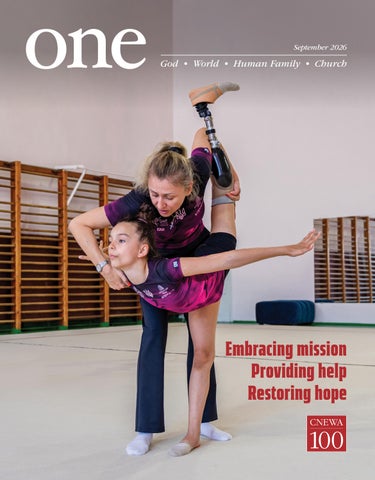
Front: Gymnast Oleksandra Paskal trains with her coach, Inga Kovalchuk, in Ukraine.
Publisher Msgr. Peter I. Vaccari
Back: Msgrs. John Nolan of CNEWA and Andrew Landi of C.R.S. coordinated Catholic aid for Lebanon during the country’s civil war.
Executive Editor Michael J. La Civita
Photo Credits Front cover, pages 3 (upper right), 15-19, Anna Klochko; pages 2, 3 (lower left), 22, Joseph Saadeh; page 3 (top), Maria Grazia Picciarella/SOPA Images/LightRocket via Getty Images; pages 3 (upper left), 7-13, back cover, CNEWA Archives; pages 3 (lower right), 30-37, Raghida Skaff; pages 3 (far right), 26-29, CNEWA Ethiopia; pages 4, 39, Vatican Media; page 11 (far right), Sister Christian Molidor, R.S.M.; pages 21, 24-25, George Jaraiseh; page 23, Nick Brundle Photography/Getty Images. ONE is published quarterly. ISSN: 1552-2016 CNEWA Founded by the Holy Father, CNEWA shares the love of Christ with the churches and peoples of the East, working for, through and with the Eastern churches. CNEWA connects you to your brothers and sisters in need. Together, we build up the church, affirm human dignity, alleviate poverty, encourage dialogue — and inspire hope.
Editorial Laura Ieraci, Editor David Aquije, Contributing Editor Barb Fraze, Contributing Editor Elias D. Mallon, Contributing Editor Creative Timothy McCarthy, Digital Assets Manager Paul Grillo, Senior Graphic Designer Samantha Staddon, Graphic Designer Elizabeth Belsky, Copy Writer Officers Archbishop Ronald A. Hicks, Chair and Treasurer Msgr. Peter I. Vaccari, Secretary Tresool Singh-Conway, Chief Financial Officer Editorial Office 220 East 42nd St, New York, NY 10017 1-212-826-1480; www.cnewa.org ©2026 Catholic Near East Welfare Association. All rights reserved. Member of the Catholic Media Association of the United States and Canada.
HUNGRY? Not for a night. Or even a weekend. Imagine going weeks at a time without reliable access to food — not just for yourself, but for your children, too. This is reality for countless people in Ethiopia living on the brink of starvation right now. • Give to CNEWA, and help us save lives. cnewa.org/donate
Connections to CNEWA’s world
Pope Leo XIV greets CNEWA President Msgr. Peter I. Vaccari at the Vatican 18 June, after the pope’s address to the participants of donor agencies that work in support of the Eastern churches. The pope praised the agencies for their work and reiterated his appeal for reflection on the consequences of war and instability. Msgr. Vaccari was joined in Rome by the director and staff of CNEWA’s national office in Canada on a pilgrimage to mark CNEWA’s centennial. Holy See Supports UNRWA The Holy See has reaffirmed its financial support for the United Nations Relief and Works Agency for Palestine Refugees in the Near East (UNRWA), describing the agency as an “essential lifeline for millions of Palestinian refugees” and urging the international community to ensure its work can continue unhindered. A report in Vatican News said the Permanent Observer Mission of the Holy See to the United Nations addressed the U.N. General Assembly’s Ad Hoc Committee for the Announcement of Voluntary Contributions to UNRWA on 30 June and said that “for over seven decades, UNRWA has provided education, health care, food assistance and social services.”
4
CNEWA.ORG/ONE
The Permanent Mission stressed that UNRWA offers not only tangible help, but “the opportunity to live with dignity.” For decades, Israel has questioned the neutrality and objectivity of the largest U.N. humanitarian aid organization in Gaza and the West Bank, alleging Hamas members have infiltrated UNRWA and assisted in the planning of the 7 October 2023, attacks in Israel. Lebanon Crisis Continues Lebanon’s churches continue to play key roles in helping the more than 430,000 people who remain displaced by the ongoing fighting between Hezbollah and the Israel Defense Forces. More than 730,000 people have returned to
their homes, but many homes have been damaged or destroyed. ReliefWeb reported in mid-July that in the 23 days after the ceasefire announcement on 20 June, more than 340 people had been killed and 220 injured. After the United States and Israel attacked Iran on 28 February, the militant group Hezbollah fired rockets from their centers in Lebanon into Israel, which responded with airstrikes 2 March. Church groups immediately prepped to help the displaced and injured; some had stockpiled supplies after the 66-day war in Lebanon in 2024. CNEWA-Pontifical Mission has supported these initiatives, initially rushing $100,000 in emergency
funds for distribution of food parcels across southern Lebanon and in the Bekaa Valley. It helped subsidize heating fuel expenses for numerous families and distributed food parcels to families sheltering at the refugee camp in Dbayeh through its local partner, the Joint Christian Committee. In the area around Beirut, CNEWAPontifical Mission distributed $50 in food coupons during four months for 500 families of all faiths. Save the Dates! Two hallmark events will mark CNEWA’s centennial with galas scheduled on Friday, 6 November, at St. Elias Centre in Ottawa, and Tuesday, 15 December, at The Plaza Hotel in New York City. In Ottawa, Major Archbishop Sviatoslav Shevchuk of the Ukrainian Greek Catholic Church will receive CNEWA’s Faith & Culture Award for his leadership, unwavering witness to the Christian faith, and steadfast commitment to preserving the spiritual and cultural heritage of the Ukrainian people. At its annual Healing & Hope Gala in New York, CNEWA’s guest of honor and recipient of the Timothy Michael Cardinal Dolan International Leadership Award will be Frá John T. Dunlap, prince and 81st grand master of the Sovereign Military Order of Malta, whose work on a global scale has touched countless lives of the marginalized and vulnerable. CNEWA’s Faith & Culture Award will be conferred to Sister Raffaella Petrini, F.S.E., president of both the Pontifical Commission for Vatican City State and the Governorate of Vatican City State. A noted academic and administrator, Sister Raffaella
oversees the operations of Vatican City State, making her the highestranking woman in the Vatican. CNEWA, ONE Honored In June, the Catholic Media Association (C.M.A.) named ONE magazine Mission Magazine of the Year, honoring staff and contributors for vivid, detailed reporting, compelling photographs and design, and effective messaging. CNEWA broke its own record in garnering 62 awards overall for its communications, marketing and media efforts. Elizabeth Belsky, CNEWA’s marketing manager, was named Advertising Business/ Marketing Professional of the Year. Among its 17 first-place awards, CNEWA earned best press release, best blog on social justice issues and on topical news. The awards were conferred in June at the C.M.A.’s annual conference in Atlantic City, where members of CNEWA’s communications and marketing team offered a workshop, “How to Adapt News Stories to Create Social Media Content That Pops.” To highlight its centennial, CNEWA also sponsored a breakfast for Catholic media professionals on 19 June. This year, Michael J. La Civita, CNEWA’s director of communications
and marketing, completed his third term as a member of the C.M.A. board of directors, which included time as vice president. Laura Ieraci, ONE editor and senior communications officer, was elected to the board and began her term in June. For the past three years, she has served on the C.M.A.’s conference planning committee and recently on the ethics committee. The C.M.A. includes more than 365 organizations as members and more than 900 individual media and marketing professionals. New Legacy Society Website CNEWA has launched a new estate planning website. Named in honor of Pope Paul VI, whose pontificate made an indelible mark on the life of this agency of the Holy See, the St. Pope Paul VI Legacy Society website, cnewa.mylegacygift.org, is newly redesigned and offers helpful information and resources to make the planning process simple and meaningful. For more information, sample bequest language or to discuss how one’s legacy can reflect one’s faith and philanthropic priorities, please contact Brian McGinley, director of development, at 1-646-791-0291 or bmcginley@cnewa.org.
There is even more on the web Visit cnewa.org for updates
u __ __ __ __ __
Find videos, audio, stories from the field and breaking news at cnewa.org/blog
100 YEARS OF HEALING & HOPE
5
A CENTURY OF HEALING AND HOPE by Michael J. La Civita
An Exuberant Embrace of Faith and Charity From the editors: This feature is the third in a series highlighting CNEWA’s milestones in the past 100 years and the ways in which the mission has adapted to the changing needs of the world of the Eastern churches. These articles will be assembled into a special commemorative volume titled, “A Century of Healing and Hope,” and published in 2027.
“ ‘Thanks be to God I’m back safe. I never thought I’d make it out alive,’ ” wrote Msgr. Robert L. Stern in the pages of this magazine soon after the death of Bishop Nolan in November 1997 about a conversation he had had with the bishop years earlier. “What happened?” I asked.
I
t may seem cliché — and perhaps insensitive — to cite how men of consequence have shaped world events in a series that chronicles faith-based initiatives in the pursuit of healing and hope, justice and peace. Yet, the story of CNEWA is shaped indeed by persons of consequence, men and women, who have read the signs of the times in the light of faith and responded to the humanitarian, socioeconomic and spiritual challenges of our volatile world.
In earlier installments this cast has included the names of once prominent figures, now largely forgotten, whose vision, leadership, grit and determination positioned CNEWA, and its operating vehicle in the Middle East, Pontifical Mission for Palestine, as a quiet and effective force of the Holy See — the very definition of “soft power.” Incontestably, the principal protagonist in this story is St. Pope Paul VI, whose solicitude for the land and peoples of the Middle East especially chartered the course of CNEWA. Surrounding the pontiff, however, assembled a supporting cast of men and women no less worthy, no less heroic or consequential.
6
One such figure is John Gavin Nolan.
CNEWA.ORG/ONE
“Well, the last week I was in Saudi Arabia, two friends invited me to go with them on a trip into the Dead Zone, the great desert in the south. We were traveling by camel with two Bedouin guides. The second day into the desert, they couldn’t find the oasis where we had planned to spend the night. One of the guides went searching for it, but never returned. We kept going the next day, until we ran out of water.” I was hooked. I was on the edge of my seat, wondering what would come next. Dramatically, he continued: “That night the other guide vanished while we slept. My friends started to panic, but I told them not to worry. The next night the camels collapsed and died of thirst. …” “Wait a minute,” I interrupted, “camels don’t die of thirst after three days.”
Msgr. John Nolan, who directed CNEWA-Pontifical Mission from 1966 to 1987, greets a child from an orphanage run by Pontifical Mission for Palestine on a pastoral visit to the Holy Land.
A CENTURY OF HEALING AND HOPE
responsibility first fell on the shoulders of Msgr. Ryan, it would be his confrere, Msgr. Nolan, who would carry things on when elected CNEWA’s national secretary in March 1966, after the pope appointed Msgr. Ryan as archbishop of Anchorage. “His heart was always in the Holy Land,” continued Msgr. Stern, who succeeded Bishop Nolan in 1988. “As did his predecessors, he spent every Christmas there. He always shared in the ceremony and splendor of Midnight Mass in Bethlehem. Then, Christmas morning, he would go to the Pontifical Mission Girls’ Orphanage and offer Mass for them. After, with the children gathered around him, the celebrant would become Santa Claus, giving each of them her gift.” “This is my parish,” he would say with deep feeling. “This is my family.” Wherever he went, whomever he was with, he would spin them a fascinating tale, but end up asking them to sponsor a child. His imagination was so great that he always imagined others would respond with the same love he had.
I suddenly realized that I had fallen for it again. Once more my boss, Msgr. (later, Bishop) John G. Nolan, had spun out a tale, plausible at first and then increasingly so far-fetched that it didn’t seem that it could be true — at least, not entirely true. A priest of the Diocese of Albany, Msgr. Nolan joined CNEWA in 1962, first serving in Beirut, where he directed the activities of Pontifical Mission throughout the Middle East. A few years later he returned to New York to serve alongside his brother priest from Albany, Msgr. Joseph T. Ryan, who, as national secretary of CNEWA and president of Pontifical Mission for Palestine, had accompanied Paul VI in January 1964 on his historic pilgrimage to the Holy Land. The consequences of that journey would make an indelible mark on CNEWA. While the burden of
8
CNEWA.ORG/ONE
And they usually did. When Msgr. Nolan concluded his service with CNEWA — having been appointed auxiliary bishop for the Archdiocese for the Military Services, U.S.A., serving once again alongside his friend Archbishop Ryan — CNEWA’s average annual income had soared from about $4 million to more than $18 million. Much of this income was associated with CNEWA’s Needy Child Sponsorship Program, which at its height enrolled more than 30,000 children in child care programs of the Eastern churches from Argentina to India. Early in his tenure, Msgr. Nolan conceived of a fund to be marketed as a one-to-one sponsorship plan in which CNEWA would invite sponsors to contribute $10 a month toward the support of a specific child in the care of a church-run facility. Sponsors in turn would receive letters from the religious sisters or priests caring for the child four times a year. He enlisted the support of the Rev. John McCarthy, an American priest serving the Holy See’s Congregation for the Eastern Church, as its liaison to CNEWA, persuading the priest to embark on a 70-day fact-finding trip to identify qualified programs in 12 countries. Father McCarthy returned on 6 January 1967, “exhausted,” he confessed in an interview with
Msgr. John Nolan celebrates Christmas at the Pontifical Mission Orphanage in Bethlehem. The orphanage was profiled in a documentary hosted by Hugh Downs. Opposite, Msgr. Nolan visits with Pope Paul VI.
this author years later, but convinced of the need for such a program, which Msgr. Nolan promptly began within the month. From that day forward, Msgr. Nolan was a tireless advocate on behalf of these children in need. As Peg Maron, who helped document the history of CNEWA, wrote in 2001: Whether “in elevators, at dinners, at meetings, he would beg friend and stranger alike to sponsor his ‘kids.’ ” “The needy child sponsorship program that Msgr. Nolan started,” Msgr. Stern continued, “helped not only those little girls in Bethlehem, but tens of thousands of children all over the world.” Ever the showman, Msgr. Nolan selected three of these children to appear in a promotional film about CNEWA’s work in the Holy Land. Milton Fruchtman, who won Peabody Awards for his documentaries, produced “The Untold Story” in 1970. The film included the first-ever record of a private papal audience, featuring Msgr. Nolan, three girls from the Pontifical Mission Orphanage in Bethlehem, Sister Elisabeth Marie of the Missionary Sisters of Our Lady of the Apostles, who ran the orphanage, and the pope. Hugh Downs hosted the 30-minute special, which focused on the work of CNEWA-Pontifical Mission with children throughout the Holy Land, which aired nationally on Christmas Eve 1971, with an estimated viewing audience of five million. Msgr. Nolan’s gift with people and storytelling came in handy for, not long after he took the helm at CNEWA-Pontifical Mission, the situation in the Holy Land deteriorated. It took on a new level of urgency even as he strengthened longstanding partnerships and moved forward with programs inspired by the papal visit in 1964. For nearly two decades, more than a million Palestinian refugees — homeless, stateless, desperate, angry and dependent on foreign sources for humanitarian and moral support — turned their frustrations on the state of Israel. Some joined resistance and national movements that launched
attacks from bases in nearby Egypt, Jordan, Lebanon and Syria, provoking sharp Israeli reprisals that exacerbated poor relations among the neighboring states until 5 June 1967, when war erupted. Within a week, the Israeli military defeated the combined forces of Egypt, Jordan and Syria, and occupied the Old City of Jerusalem and the remainder of Arab Palestine, which then included the West Bank, Gaza, the Sinai Peninsula and the Golan Heights. Overnight, a second wave of displaced Palestinian civilians, many dispossessed a second time, fled the imposition of martial law by the occupying Israeli military and sought refuge with their neighbors. Already burdened with the weight of a people suffering from anguish and desperate with no prospects of ever returning home, the governments of Jordan and Lebanon nearly collapsed as war raged
100 YEARS OF HEALING & HOPE
9
A CENTURY OF HEALING AND HOPE
there ( Jordan,1970-71; Lebanon, 1975-90), when the Palestinian resistance movements took on the leaders of their host nations. The effects of what is commonly called the Six-Day War — a continuation of the first Arab Israeli confrontation — have been calamitous, and remain behind much of the troubles in the region today. Yet, the global Catholic community has remained ever close to “these brothers and sisters of ours,” as Paul VI stated in his 1974 apostolic exhortation, “Nobis in Animo,” “who live where Jesus lived and who, in the vicinity of the holy places, are the successors of the very first church, which gave rise to all the other churches.” Immediately after the cessation of hostilities, CNEWA organized a conference in Beirut of regional nongovernmental organizations, Catholic and secular. Chaired by Constantine C. Vlachopoulos — a former official with the United Nations Relief and Works Agency for Palestine Refugees in the Near East (UNRWA), recruited by Msgr. Nolan in 1966 to serve as executive director of Pontifical Mission for Palestine — the organizations assessed the short- and long-term humanitarian needs and planned a coordinated response to assist those Palestinians remaining under military occupation in the West Bank and Gaza and the refugees living in exile.
10
CNEWA.ORG/ONE
Concurrent with the conference, the Holy See dispatched Msgr. Nolan to the region. In his subsequent report to Cardinal Angelo Dell’Acqua of the Secretariat of State, dated 29 June 1967, Msgr. Nolan reported that Palestinians “in the area newly occupied by the Israelis are still emigrating to the East Bank [Jordan] … with travel assistance as far as the Jordan [River] provided by the Israelis,” adding that “once they leave, these people are not permitted by the Israelis to return to their homes in the West Bank. “The economy of ‘old’ Jerusalem and the West Bank, tied so closely to tourism, is virtually at a standstill. … Religious institutions are also without cash as all bank deposits have been frozen by the Israelis. “While continuing its activities in Lebanon, the West Bank and, hopefully, the Gaza Strip,” he added, “the [Pontifical Mission] will set up an office in Amman to assist the 100,000 new refugees there …” That week, Msgr. Nolan and Mr. Vlachopoulos assembled an “emergency team” in Amman, led by Carol Hunnybun, the administrator of the Jerusalem office. The team began receiving, sorting and distributing relief supplies donated in support of the refugees from throughout the Catholic world, which included some 5,600 tons of food and milk
powder; 26,700 blankets; more than 50 tons of clothing and shoes; 90 tents; 10,000 mess kits; 5,500 cooking stoves; 17 tons of medical supplies, antibiotics and vitamins; and more than 1,000 tins of potted meat.
To the far left, Msgr. Nolan and members of the Catholic press meet with King Hussein I of Jordan during a CNEWA-sponsored media tour of the region. In the center image, Msgr. Nolan stands at center stage during a graduation ceremony at Bethlehem University. Above, the Sisters of St. Dorothy teach deaf children at the Ephpheta Paul VI Institute in Bethlehem. On page 13, Cardinal John O’Connor of New York holds a child during a 1985 visit to Ethiopia with Msgr. Nolan to assist with famine relief.
The crisis response work of CNEWA’s Pontifical Mission team in Amman was replicated elsewhere, including Gaza, where the Pontifical Mission School for the Blind was devastated during the six days of fighting, its records destroyed and supplies and equipment looted. Quickly, CNEWA renovated and reopened the school, as did other social service works of the church, particularly in the West Bank and Jerusalem, where religious communities of men and women had long operated schools, foundling hospitals, homes for the aged and those with special needs, trade schools and workshops. Nevertheless, the tide had turned, and the region’s Christians, most of whom were from the middle classes, began to emigrate in large numbers.
“Now Archbishop Pio Laghi was responsible for all the big breakthroughs in the Holy Land,” said Ms. Hunnybun.
“We have already had occasion to express openly our anxiety at the decreasing number of Christians in the ancient regions that were the cradle of our faith,” Paul VI wrote in his 1974 exhortation. “Unfortunately, the local church is lacking in material means. It is also suffering from the serious and prolonged consequences of the war that, it can be said, has been
In May 1969, the pope appointed him as his representative, or apostolic delegate, for Jerusalem and Palestine. In an interview with CNEWA in 1999, Cardinal Laghi described the pope’s instructions when he assumed the role: “ ‘Please try to limit the exodus of Christians [from the Holy Land]. Do whatever you can.’
going on for decades. And it is not possible to ask the local faithful for sufficient help, since most of them have barely enough to keep themselves alive.” Guided by the actions, words and vision of the pontiff, the global Catholic communion responded.
100 YEARS OF HEALING & HOPE
11
A CENTURY OF HEALING AND HOPE
“What could I do?” he reflected. “I established immediately a commission for justice and peace … and I gathered all the ordinaries: the Latin patriarch, the custos, the auxiliaries, the responsibles of the other Catholic communities, and we started to speak out.” The prelate had many ideas, “but the ideas [could] not be implemented unless you had money and support. Not only financial support, but moral support as well.” The apostolic delegate found that support in Msgr. Nolan and CNEWA-Pontifical Mission. “I immediately sympathized with him,” Cardinal Laghi recalled when he first met the young John Nolan, then stationed in Beirut as special assistant to CNEWA’s Msgr. Joseph Ryan.
“
“I knew he was a man I could work with, that we could understand each other. I relied on him and on those who represented him … Carol Hunnybun and Helen Breen.”
“ ‘When I was there in 1964,’ ” Cardinal Laghi recalled the pope saying, “ ‘I promised to establish an institute for the deaf and mute. Please do it.’ ” On 30 June 1971, with the approval of the Holy See, the Sisters of St. Dorothy and CNEWA-Pontifical
CNEWA.ORG/ONE
That same year, the Ecumenical Institute for Theological Research, or Tantur, opened — a realization of a wish of the pope to establish a place of shared prayer, study and dialogue, a place of encounter with Jews and Muslims. But, the cardinal recalled just a few years after the death of Bishop Nolan, “We needed a university that would prepare young Palestinians for a Palestinian society. … We had to correct this. We had to establish a Catholic university in Bethlehem. … We needed a school to prepare chefs, tourism and hotel management, business and the arts. And we needed teachers. We had to prepare teachers.
The Mission will have to expect, in the situation, which is now evolving, to contribute to projects of aid, of rehabilitation and development.
Together, this team forged partnerships worldwide, engineering housing programs, such as the Holy Land Arab Housing Society, repurposing facilities to address new needs, such as the opening of the Notre Dame Centre as a pilgrim hospice, and bolstering a host of existing programs that, while serving the common good, also supported the Christian community with employment, thereby stemming emigration. But there were several initiatives directly inspired by the pontiff’s pilgrimage to the Holy Land in 1964 that remain as symbols of that time.
12
Mission for Palestine founded the Ephpheta Paul VI Institute in Bethlehem, which for 55 years has taught hearing impaired Palestinian children from the age of 5 through high school to lip read and speak, freeing them from a prison of silence and isolation.
“Now all this may seem insignificant, but in the Holy Land, if you build with a little stone, it becomes a monument.”
In 1973, the De La Salle Brothers of the Christian Schools, who Paul VI had asked to administer such a school, opened Bethlehem University with operating funds secured by CNEWA and the Congregation for the Eastern Churches. Despite the sociopolitical and economic challenges of operating in such a hostile environment, the university is indeed a monument to fortitude and hope, enrolling more than 3,000 students a year; 17,000 have graduated, men and women, Christian and Muslim, who, in the Lasallian tradition, continue to build and serve Palestinian civil society.
”
The exuberant embrace of faith and charity given by Paul VI, especially through those associated with CNEWA and its Pontifical Mission for Palestine, were not reserved exclusively for the peoples of Palestine. Marking its 25th anniversary, Paul VI wrote
to Msgr. Nolan, “its diligent president,” that “we have followed with personal interest this activity in the various forms which it has taken to meet the grave and multiple needs of the refugees,” adding that its work “has been one of the clearest signs of the Holy See’s concern for the welfare of the Palestinians, who are particularly dear to us because they are the people of the Holy Land, because they include followers of Christ and because they have been and still are being so tragically tried.” Nevertheless, he continued, “our Mission for Palestine is thus about to be faced with a compelling task. In addition to continuing its assistance without distinction of nationality or religion to those who have suffered or are suffering in any way as a result of the repeated conflicts which have devastated that region, the Mission will have to expect, in the situation, which is now evolving, to contribute to projects of aid, of rehabilitation and development.” Msgr. Nolan, and his team of partners that included members of the laity and religious, took up this task, opening mobile medical clinics in rural Jordan and Gaza; setting up emergency aid programs for families besieged by factional warfare in Lebanon; covertly visiting the U.S. hostages taken in Tehran during its revolution; and quietly enlisting the support of wealthy oil magnates for Msgr. Nolan’s “kids.” Toward the end of his years at CNEWA, as famine began to devastate Ethiopia, he took his good friend, John J. O’Connor — who then served as cardinal archbishop of New York and ex officio chair of CNEWA — to that ancient land, enlisting more support for its malnourished children and raising the profile of the needs of its people among Catholic and secular organizations alike. Years later, at his funeral in a jammed St. Patrick’s Cathedral in New York, after all the tributes were paid and prayers said, that same cardinal said, “I knew that rascal pretty well myself,” affectionately reminding all those in attendance how this man of exuberance and faith was also a man with a deep reservoir of love and joy. Read the next installment in the December issue.
HERE FOR THE
LONG HAUL
Join us as we accompany the church for another century of service. cnewa.org/donate
Executive Editor Michael J. La Civita is director of communications and marketing.
100 YEARS OF HEALING & HOPE
13
Stepping In War in Ukraine is reshaping children’s minds, bodies, homes and schools. Families, teachers and church communities are taking action to help. text and photos by Anna Klochko
E
very parent knows how quickly children can grow. A new pair of sneakers, a dress or jeans become too small almost as soon as they are purchased. For Oleksandra “Sasha” Paskal, 10, growing also means getting the socket for her prosthesis adjusted or replaced every three months and securing a new artificial foot twice a year to match the growth of her right foot. In 2022, when Oleksandra was 6 years old, she lost her leg in a Russian missile strike in the Odesa region of Ukraine. She also lost a finger and sustained multiple injuries to her head and torso. She survived, underwent rehabilitation and received a bionic prosthesis. Now Oleksandra, a gymnast, is training again in Chornomorsk, southern Ukraine. Her mother, Maria Paskal, remembers when her daughter was pulled from the rubble of their home. The family thought only about keeping her alive. At first, her
14
CNEWA.ORG/ONE
parents did not know amputation would be necessary. Only later did doctors tell them Oleksandra’s leg could not be saved. After treatment and rehabilitation in Austria, the family returned home. About a month later, Oleksandra wanted to train again. “Sasha herself wanted to return to gymnastics,” said Ms. Paskal, “and we supported her.” Oleksandra’s coach, Inga Kovalchuk, decided the young gymnast would train with the same girls as before her injury — four hours a day, five days a week — and represent Ukraine at international competitions. Recently, Oleksandra won a gold medal at a competition in Romania. “I clearly understood that I had to offer her support and, at the same time, not make Oleksandra ‘a separate category’ within her own team,” said Ms. Kovalchuk, a renowned rhythmic gymnastics coach in Ukraine. “She works with everyone. Some elements must be adapted to her
abilities, but she receives praise and corrections just like everyone else. We do not divide the children. “I always tell Oleksandra: We have to make people proud of you, inspired by you — not sorry for you,” Ms. Kovalchuk said. “The most important thing is that she is alive, that she is back in the gym, that she smiles and inspires others,” she added. “The real victory is her resilience.” Asked what rhythmic gymnastics means to her, Oleksandra replied: “Rhythmic gymnastics is my life. I love gymnastics very much.” Oleksandra’s story shows one of war’s most visible consequences for children: a wounded body. A child takes part in a day of orienteering, organized by a regional youth center in Sumy, northeastern Ukraine. In front-line regions, these activities take place only within city limits, since forests are dangerous due to land mines and the presence of Russian troops.
PAVING CHILDREN’S PATHS FORWARD
15
100 YEARS OF HEALING & HOPE
The CNEWA Connection Father Roman Prokopets, director of the Orphan Care Center in Lviv, plays Jenga with children who live in a family-style children’s home. Opposite, Oleksandra Paskal trains in rhythmic gymnastics in Chornomorsk, southwestern Ukraine.
I CNEWA has been assisting Ukrainian children in need for decades. Long before Ukraine achieved its independence from the Soviet Union, CNEWA supported child care programs of Ukrainian Greek Catholic women religious in Argentina and Brazil, where Ukrainian communities in exile put down roots. Support for the activities of the Catholic churches in Ukraine have grown significantly, especially after Russia’s full-scale invasion in 2022, with CNEWA deploying more than $10 million in support of humanitarian and pastoral aid, focusing on the most vulnerable, including children, the displaced and homeless, those with special needs and the elderly. To support CNEWA’s work in Ukraine, call 1-866-322-4441 (Canada) or 1-800-442-6392 (United States) or visit cnewa.org/donate. The United Nations reported in July that more than 800 Ukrainian children have been killed and more than 2,950 children injured since Russia’s invasion in 2022. These numbers only detail the confirmed dead or wounded; the U.N. notes it is difficult to verify numbers in active war zones, and the fear is the numbers may be much higher. However, tens of thousands of children in Ukraine have been impacted in less visible ways, namely by parental loss. As of 1 January, more than 59,000 children were registered officially as orphans or as children deprived of parental care, according to Ukraine’s Ministry of Social Policy.
16
CNEWA.ORG/ONE
The majority — 95 percent — were being raised in family-based forms of care. At the same time, institutional care remains a major issue. Government records indicate that of nearly 25,000 children living or studying full time in residential institutions in Ukraine in 2025, only about 4,000 children had no parents, which meant the majority were not orphans but were separated from family for social or economic reasons. In 2025, the government purchased housing to create 124 family-style children’s homes as part of its broader effort to move children away from institutional care toward family-based support.
n Lviv, the Orphan Care Center of the Ukrainian Greek Catholic Archeparchy of Lviv has been supporting orphans and abandoned children in institutional housing, family-style children’s homes and foster families since 2009. The center provides these children with pastoral care, as well as caregiver and material support, including food, hygiene items or laptops for learning. The center also operates the House of Mercy of St. Nicholas, which serves as a shelter for children and others in need. Before 2022, the center reached more than 1,000 children a year through a variety of projects, daily activities, outreach programs and volunteer initiatives. Since then, the center has expanded day care facilities, providing psychosocial support and increasing its distribution of food and essential items. In 2026, the center is reaching some 1,200 children and young people, including about 200 children in 20 family-style children’s homes, 500 children in nine institutional care facilities, and 80 children under the care of social services. The center’s chaplains also minister to the children enrolled at a kindergarten and elementary school of the Ukrainian Greek Catholic Church and to some 300 children from families in difficult circumstances. “We stay close,” said the Rev. Roman Prokopets, director of the Orphan Care Center. “That is one of the most important mottos of our organization — to be close to those who need it.”
“The real victory is her resilience.” Father Prokopets said the center’s work is built on the continuity and stability of the church’s ongoing presence, regardless of the frequency with which the child’s life is disrupted with moves between institutions, schools or caregivers. Father Nazariy Pryshlyak, a center chaplain, said the war “adds even more tragedy” to children already wounded by orphanhood or institutional life. Yet when asked what they want to pray for, “they
speak about supporting our soldiers,” he said. The center’s programming includes camps, catechesis, workshops, sports and outings. Its soccer team, FC KOPA, is for children who have lost one or both parents, are in foster care or displaced by the war. The team has competed internationally, including in Poland in 2025 and the Magic Cup in the United States in 2026. Yuliia Ilchyshyn, head of the center’s sports program, said
soccer has become “an instrument of acceptance” for these children. “We wanted to help them see a future,” she said. Brother Andriy Kharkiv, a chaplain who works with familystyle children’s homes and foster families, said activities are meant to keep children active and to give them a sense of community. War forces children to grow up too soon, he added. Brother Andriy said he believes what
100 YEARS OF HEALING & HOPE
17
“We wanted to help them see a future.”
children need most is to be heard and to know they are loved. “I remember myself at their age: I prayed for a dog, for good weather, for friends. These children pray for soldiers, for victory, for missiles to stop,” he said. The center also facilitates adoption. Deacon Taras Kotlinsky assists adults who are considering adoption, guardianship, patronage care or fostering. In general, Ukrainians have become more hesitant to foster or adopt with the uncertainties of the war, he said. Only 770 children were adopted legally in Ukraine between January and August last year. “I personally urge people not to put off until tomorrow, or some
18
CNEWA.ORG/ONE
distant future, what we can give today,” he said. Oksana Dolynska and her husband, parishioners of the Church of the Mother of God of Perpetual Help in Lviv, had been thinking about adoption for years, but doubted whether they had enough strength, experience or space in their home to be good adoptive parents. The center’s chaplains gave them the encouragement they needed and, in early 2025, they welcomed Ivan and Valeria. The fraternal twins were displaced from the Donbas region, eastern Ukraine, to Lviv, where they were in institutional care after their father died and their mother was unable to provide care.
Oksana Dolynska and her daughter, Valeria, attend an evening service in mid-June at the Church of the Mother of God of Perpetual Help in Lviv.
Ms. Dolynska does not romanticize foster care or adoption — she said she knows Ivan and Valeria, now 11 years old, will likely experience trauma for many years — but she has seen improvements after 18 months of being a family together. “Ivan and Valeria have become calm at home with us,” she said. “They have become our children.” The church, too, has become a place of trust. Father Prokopets invited Ivan to serve at the altar. At first, Ivan was afraid of fire and incense, but before long he was
handling a candle and thurible with confidence. Valeria has become active in parish life, singing, praying during the Divine Liturgy and helping to lead the rosary. Kateryna Dolhova, who has raised 15 children in a family-style group home supported by the Orphan Care Center in Lviv, said family does not only provide a roof overhead. “Family is a community, and community is strength,” she said. Family can hold a child when the world around them is falling apart, she added.
I
n Sumy, northeastern Ukraine, children who have a home and parents can appear more withdrawn and anxious than those farther from the front in Lviv, who have lost parents but are surrounded by support. Air-raid alerts, explosions, shelters and waiting on bad news have become routine in Sumy. Parents are near but often exhausted by fear for their children and for family in the military. Families still offer love, but they cannot always offer safety. Children have spent years between shelters and online classes, with rare opportunities to play with friends and classmates. In response, the Sumy Regional Center for Extracurricular Education and Work With Talented Youth organized a summer wellness hub with workshops, games, crafts, sports and time with peers. “Children enjoy doing creative work,” said Lyudmyla Gayeva, who leads the arts and crafts club. “But most importantly, they communicate — because that is what they lack so much now.” Over time, the trauma of war can settle into the body. “Even if it is not an explosion, just some sharp sound, a child still flinches,” said Yevheniia Kozyr.
Her sons miss their father, who serves in the military. When he can call from the front or check his phone, they send him photos of drawings and crafts they made at school. Nataliia Sosnovenko is a psychologist and the director of the Center for Psychological Expertise and Methodology at Voices of Children, a nationwide Ukrainian charitable foundation with 15 centers across the country that provide psychological and social support to children and families. She said the consequences of war on children extend beyond individual trauma to include forced emigration, displacement, deportation, family separation, life under occupation, disrupted education, broken socialization and child death. Together, they present a challenge of grave proportions the country will feel for years, she said. “The demographic crisis is not only a question of population numbers. It is a question of human potential,” she said. Some children may not return from abroad. In February, UNICEF reported nearly 1.8 million Ukrainian children are living as refugees outside the country. Others will return needing longterm support, while still others are growing up under chronic stress, with their mental and emotional resources directed not toward development, but survival. However, Ms. Sosnovenko cautioned against calling them a “lost generation.” Should children have stable adults nearby and access to education, psychological support and a safe environment, she said, they will have a great capacity to recover. Anna Klochko is a multimedia journalist who covers Ukraine and Central Europe.
KIDS BELONG IN
CLASSROOMS
NOT IN SHELTERS
Support our efforts to care for young survivors of war. cnewa.org/donate
Take a closer look at this story through ONE ’s exclusive audio and video content.
100 YEARS OF HEALING & HOPE
u
19
V
iolist Ester Slepchenko, a young Israeli Messianic Jew, dreams of initiating musical projects that will promote connections among students of diverse cultures and religions. The 22-year-old studies at the Magnificat Institute, located at the Franciscan St. Saviour Monastery in Jerusalem’s Old City, as well as at the Jerusalem Academy of Music and Dance at Hebrew University of Jerusalem. Ms. Slepchenko’s dream is inspired by her experience at the Magnificat Institute. Founded 30 years ago as a small music school that taught organ and piano, the institute evolved into a de facto multifaith community as it expanded to teach other instruments, bringing together students of all creeds with Jewish teachers. In recent years, Christian and Muslim teachers also have joined the faculty. “I want to make that change, [to show] that it is always possible to do something different,” Ms. Slepchenko said about the institute’s multifaith reality. “That this way of connection, peace and friendship is something that is possible.” Father Alberto Pari, O.F.M., institute director for the past 11 years, envisions the Magnificat Institute and other interreligious initiatives in the Holy Land as “spreading seeds that will bloom into beautiful flowers and trees that will bear fruit. “We allow for possibilities and spaces to be together and to grow,” said the Italian Franciscan, who has lived in the Holy Land since 2007. “When any war will finish, when calmness will come back, or normalcy, there will be wounds that are so huge to heal that they need someone external who is not Muslim, who is not Palestinian, who is not Israeli, not Jewish.”
20
CNEWA.ORG/ONE
The Franciscans “have this privilege — to be together with them, but not part of them completely,” he continued. “Our task will be really to create bridges and try to reconcile. To [make spaces for] meeting and listening to each other, knowing each other.” Tanya Beltser, the institute’s artistic director, said the school welcomes students of all creeds. “It is part of the school’s D.N.A. that it belongs to everybody,” said Ms. Beltser, an observant Jew from Ukraine who was among the first teachers to join the institute in 2004 when it broadened its program. “We are not focused on the differences,” she said, referring to the various religions among students and staff. “We are focused on the right thing: high-quality music education, which is creating something very beautiful.” The institute is not a “bubble,” said Tala Akkawi, 25, a classical guitar teacher who is Muslim and joined the staff in 2023. Rather it is a space where teachers and students can fully exist and interact with each other, bonding over their love of music. For many, it is the first opportunity they have to interact with people from diverse backgrounds, she said. “There are some Muslim students who, for example, have never actually interacted with Christian teachers, so this is a new experience for them — to have Christian classmates, or Christian teachers or even Jewish teachers,” said Ms. Akkawi. “It changes the perspective on things, and we don’t have a lot of that in Jerusalem.”
E
ven within seemingly unending conflicts in Israel, faith leaders have developed peacemaking and dialogue initiatives through small acts of personal connection.
A monthly interfaith text study between the Hebrew-speaking Catholic Community of Sts. Simeon and Anne and the Jewish traditional Zion community in Jerusalem is among these initiatives. For 13 years, between 30 and 40 people, about half from each community, have gathered one Wednesday a month at Sts. Simeon and Anne Church in the center of the city. They study the Hebrew Bible, the New Testament, Psalms, and Jewish and Christian commentaries on these texts, and writings by Christian and Jewish scholars. The group has become a “safe space of connection and mutual respect,” said Ilana Rivka Nelson, a member of the Zion community, who co-founded the group. She said the group “feels like a healing embrace within the broken reality of alienation, hatred and war that surrounds us.” “Every month I walk out of our gathering with renewed faith in humanity and God.” Rabbi Tamar Elad-Appelbaum of the Zion community said such connections among different faith traditions form an alliance “against extremism, racism and hate” and create “an action of faith, within the abyss.” The group began as part of a multifaceted initiative in tandem with the founding of the Zion community by Rabbi EladAppelbaum and her husband, Joseph, in honor of their grandparents. However, the story of her French grandfather was particularly meaningful for her. As an ultra-Orthodox young man during the Holocaust, he joined a partisan group led by a priest to save Jewish and Roma children. Joseph Hazboun speaks at an interfaith meeting at Maison d’Abraham in East Jerusalem in April 2024.
PROMOTING DIALOGUE & PEACE
‘Times Will Be Better’ Throughout the Holy Land, faith leaders are working to counter conflict by building connections and friendships by Judith Sudilovsky
100 YEARS OF HEALING & HOPE
21
Such connections among different faith traditions form an alliance “against extremism, racism and hate” and create “an action of faith, within the abyss.”
Rabbi Tamar Elad-Appelbaum leads the Zion community in Jerusalem. Opposite, the blue dome of Our Lady of Sorrows Church and the gilded Dome of the Rock grace the skyline of Jerusalem.
Most of her grandfather’s family was killed in Auschwitz, and when he arrived in Israel it was important for him to have a “connection of gratitude, courage and care” with the Christian community in Jerusalem, she said. The Zion community, the joint text study group, and the social activist and charity work the two communities do together are in his honor and in honor of other righteous people, she said. The two communities “pray for each other, and we are also friends for each other,” she said. “We do many endeavors, and one of them is studying together. It is one of our [mutual] traditions of studying, of contemplating, of depth of conversation. Not only activism, but also very gentle listening to each other and getting to know each other’s sacred texts and respecting each other,” she added. “We believe that conversation, dialogue and fraternity are the responsibility of every believer, every person of faith, especially those who live in the holy city of Jerusalem,” she said. Topics studied together include family, generosity and gratefulness in each tradition. “Every time we [take] one theme and we [see] how similar we are and how our traditions are driven by similar values, but also how sometimes we are different and how we complete each other, and it’s wonderful,” she said. “We support each other, defend each other; we do everything we can to create a model exemplar of coexistence.”
T
he Rev. Piotr Zelazko, patriarchal vicar of St. James Vicariate for Hebrew-speaking Catholics in Israel, has no illusions about the smallness of the peacebuilding community in the Holy Land, but he said the church’s commitment to dialogue is rooted in its vocation and must remain steadfast despite the ongoing challenges. “It will always be like a drop in the ocean,” said Father Zelazko. “But if a drop says, ‘I’m nothing,’ then there’s no ocean.” The aftermath of the Hamas onslaught of southern Israeli communities on 7 October 2023, and the Israel-Hamas war that followed, have harmed coexistence efforts in the Holy Land, deepening fear, anger, grief and mistrust across the board. In these conditions, religious fundamentalism has grown on all fronts, straining Jewish-Muslim, Jewish-Christian and MuslimChristian relations. Those engaged in dialogue and peacemaking often are viewed as delusional at best and traitors at worst. The threat of war continues to weigh heavily on the region. The ceasefire brokered between the United States and Iran has collapsed. Ongoing clashes between the Israeli Defense Forces and Lebanon’s Hezbollah combatants and continued Israeli strikes in Gaza have further contributed to a pervasive sense of insecurity, uncertainty and heightened stress. Within Israel and the occupied Palestinian West Bank, settler violence directed at Palestinians has increased as Palestinian attacks against Israeli civilians, especially in Jerusalem, continue. The Religious Freedom Data Center reported a significant increase in harassment cases against Christians throughout Israel. Founder Yisca Harani noted more than 88 incidents had been
The CNEWA Connection
CNEWA’s presence in what is today Israel and Palestine dates to the agency’s earliest days. Although Christians are a minority, the church’s social programs care for all segments of society. These include investing in and participating in dialogues with the larger Jewish and Muslim communities, with the idea that stronger trust and understanding can lay the foundation for broader engagement and, ultimately, contribute to a more lasting peace in the region, said Joseph Hazboun, director of the Jerusalem regional office for CNEWA-Pontifical Mission. To support this crucial work, call 1-866-322-4441 (Canada) or 1-800-442-6392 (United States) or visit cnewa.org/donate. documented this year by early June, most in the Old City of Jerusalem, with 63 in the second quarter alone, putting 2026 on track to surpass last year’s total of 181 cases. The Israel-Hamas war also impacted the work of the Interfaith Initiative in the Negev. Father Zelazko founded the group with Jewish and Muslim leaders 13 years ago, while serving at St. Abraham Church in Beersheva, south of Jerusalem. Although they scaled back activities when the Israel-Hamas war began, members continue to visit schools and other groups when invited. “We have to keep working on it and the times will be better,” Father Zelazko said. For the past four years, he has led Christians at the annual Interfaith March for Human Rights
and Peace in Jerusalem, where Jews, Muslims, Christians and Druze advocate for equality, a shared society and human rights. This countermarch is organized by the Interfaith Forum for Human Rights close to Jerusalem Day, an Israeli national holiday that commemorates the Six-Day War of 1967. The goal of the interfaith march is to convey an alternative vision for Jerusalem to the more prominent flag parade promoted on the actual holiday, which of late has become a flashpoint of Israeli nationalist extremism directed against Christians and Muslims. Father Pari from the Magnificat Institute participates in the interfaith march; this year, a flute-and-clarinet duet from the institute performed at the opening of the march on 14 May.
100 YEARS OF HEALING & HOPE
23
Catholic participation at the march reflects a broader tradition of Catholic engagement in building bridges among Jerusalem’s religious communities. At the heart of this tradition is the Benedictine Dormition Abbey on Mount Zion — considered the birthplace of “Nostra Aetate,” Vatican II’s declaration on the church and its relations with non-Christian religions — which has been a cornerstone of Catholic interreligious dialogue in Israel, said Abbot Nikodemus Schnabel, O.S.B. The abbey’s commitment to dialogue with Jews and other faiths remains central to its identity. Abbot Schnabel said effective dialogue in the Holy Land must involve “looking together in the same direction” and engaging in shared initiatives. In August 2024, at the height of the Israel-Hamas war, when most
24
CNEWA.ORG/ONE
cultural venues were closed, the abbey hosted Jerusalem’s Manofim Contemporary Art Festival, featuring Jewish and Muslim artists addressing themes of war. Hosting the event was based on the theological conviction that human dignity, lost in war, is restored through creativity, as humans are created in the image of God, said Abbot Schnabel. “You come in contact with your dignity when you’re creative, and this was the reason I said: ‘Come all to us. Come all to us. We were the shelter for the artist,’ ” he said.
T
he Holy Land’s religious and cultural diversity should make it a place of dialogue, but instead, decades of conflict have deepened divisions and mistrust, said Joseph Hazboun, who directs CNEWA-Pontifical Mission’s regional office in Jerusalem.
Religious leaders attend an interfaith meeting at Maison d’Abraham in Jerusalem in April 2024. Opposite, Muslim and Christian youth play sports together at the Arab Orthodox Cultural Club in Beit Sahour, West Bank.
Within this fraught environment, he added, the church and its social institutions have a responsibility to rebuild relationships before polarization worsens. CNEWA-Pontifical Mission has spent decades developing programs that bring Christian and Muslim children together in safe, nonpolitical settings. Efforts include a three-year extracurricular initiative, starting in 2011, in Jerusalem, Bethlehem, Ramallah and the northern West Bank, engaging Christian and Muslim students in debate programs, environmental projects and theater classes; a continuing
reading program that began in 2019 with the CNEWA-Pontifical Mission library in Bethlehem, and an environmental program in northern Israel with students in Nazareth and the Melkite Greek Catholic village of Mi’ilyah. This year, CNEWA-Pontifical Mission started a three-year program aimed at strengthening ties between Christian and Muslim youth sports clubs in partnership with Bethlehem’s Evangelical Bible College. “The only problem is ignorance, which leads to boycott, which leads to hatred,” Mr. Hazboun said. “These are the three factors that we’re trying to overcome. “Because if I don’t know you, it’s easy for me to judge you, but when I meet with you and start working with you or playing with you ... I rediscover that you are simply a human being, just like I am, and that we share the same challenges,” he said. “This is what we’re aiming for: rediscovering the human face of the other.” In Nazareth, northern Israel, CNEWA-Pontifical Mission plans to support a similar initiative for Christian and Muslim elementary school students in partnership with the Interreligious Coordinating Council in Israel (I.C.C.I.), which is affiliated with the Middle East Council of Churches, a longtime partner of CNEWA-Pontifical Mission. Hiba Abu Khadra, a project manager at I.C.C.I., said Christians and Muslims live largely in the same towns, but the children rarely interact because they attend different schools. This sports program will give them
opportunities to interact and discuss religious and cultural differences, she said. Shireen Awwad Hilal, director of outreach at Bethlehem Bible College, noted the importance of addressing the “ghettoization” of Christian and Muslim communities in Bethlehem, where she lives. Although daily life is lived side-byside, social activities tend to be segregated, fostering stereotypes. She realized the urgency for such a program to start at younger ages when, during a meeting with Muslim university students after COVID-19, Christian Palestinians were referred to as “guests” in Palestine and even “crusaders.” Amid growing political and religious fundamentalism, sports offer a common, accessible ground for interaction and relationshipbuilding, she said. The goal is to move beyond mere coexistence to a genuine mutual understanding
and shared identity as Palestinians, she added. Ms. Awwad Hilal said she cannot guarantee the sports project will impact the entire Palestinian community, but she believes “it can make a change in my small community.” “This is the center of Christians and Muslims living together,” she said of Bethlehem. “Yet they’re not living together as they should be living together.” Judith Sudilovsky has been covering religion in Israel and Palestine for more than 30 years.
Take a closer look at this story through ONE ’s exclusive audio and video content.
100 YEARS OF HEALING & HOPE
u
25
A Letter From
Ethiopia The church is all that remains among the people after everyone else has left by Argaw Fantu
D
espite Ethiopia’s marked economic growth in recent years, humanitarian needs remain significant, with alarming food insecurity caused by internal ethnic-based conflicts and external geopolitical pressures. The World Food Program reported in June that “conflict has become one of the main drivers of hunger and malnutrition in Ethiopia” and has “severely disrupted farming, trade and humanitarian access, leaving millions without reliable food sources. Fighting has displaced communities and destroyed crops and infrastructure.” For a person reading this news from far away, the situation may seem of little significance. Or else the news from Ethiopia is not circulated widely enough to create awareness for the global community. But for a person on the ground encountering this
26
CNEWA.ORG/ONE
situation daily, it is more acute and painful than any news article can relate. For the people on the ground, facing the daily challenge of survival is a concrete reality. The Catholic Church in Ethiopia experiences and shares in the daily challenges and suffering of the people who ask for help at the doorsteps of its institutions. When I think of the religious sisters and priests serving in such realities, I feel the steadfastness of their dedication and their lifelong commitment to stand always with those who suffer. They truly deny themselves and carry their lifelong crosses (cf. Mt 16:24). As director of CNEWA’s regional office in Ethiopia, I have the Women in Edaga Hamus, in Ethiopia’s northern Tigray region, are given flour during a CNEWAsponsored food distribution.
At Vernam as voluptas alibus nullorendam ut adicabo repellit iderro ma voluptur? Henis pelesto tatur, sit ut excero con exped ut labo. Anis eum volo inihici pienisit, as quiae
RUSHING EMERGENCY AID
100 YEARS OF HEALING & HOPE
27
The CNEWA Connection Argaw Fantu, left, and Sister Dinknesh Getachew, center, assist with food distribution in Mendida, north of Addis Ababa.
In May, CNEWA released an initial $100,000 for emergency aid to Ethiopia, where more than 10 million people face high levels of acute malnutrition or need immediate intervention to save lives. In Mendida, a church-run feeding and medical treatment program for children is expected to help more than 1,750 people. In Gondar, 30 families totaling 150 people receive food monthly, and in Edaga Hamus, an emergency nutrition and maternity care project is helping 1,750 people as well. To help CNEWA expand its program to feed the hungry in Ethiopia, call 1-866-322-4441 (Canada) or 1-800-442-6392 (United States) or visit cnewa.org/donate. privilege to visit remote villages where the church stands with those who suffer. It is a privilege to be close to religious women and clergy who dedicate their lives without reservation to the service of those in need. Through these visits, I genuinely have learned what true church means. When I hear of suffering in different areas of the country, I immediately call the sisters and priests who are present there and ask them about the situation. And when the challenges become severe, these servants of the church will call my office or appear at my door unannounced.
28
CNEWA.ORG/ONE
How painful it is to hear their stories! How painful it is hearing of their inability to respond to the needs of those who suffer due to their lack of financial resources! Msgr. Peter I. Vaccari, president of CNEWA, asked me to write an update about the current food insecurity in Ethiopia. My report led to the launch of an emergency campaign in May and the release of emergency funds, initially $100,000, aimed at sharing the burden of the church in those remote areas and bringing hope for survival to food-insecure people.
I felt privileged to respond on behalf of CNEWA to the dire needs in at least three places in northern Ethiopia affected by conflict, drought and economic hardship. The church is well-established in these areas, providing education and health services for more than 50 years. However, a hunger crisis caused by unexpected wars and ethnic conflict, displacement, climate shock and economic hardship has stunted these developmental initiatives of the church. Once the emergency funds were secured in May, religious women in those respective places in no time determined the most-affected families, purchased food and nonfood items, and arranged emergency food distribution. They invited me to take part in this distribution, and I listened to stories about these families. They were heartbreaking. In Mendida, Sister Dinknesh Getachew told me about a mother of three, including a baby 5 months old, who spent several evenings with no food at home and no one to ask for support. “I hurried to reach this poor lady, knocked at the door and asked her to open,” Sister Dinknesh said. “The response from the inside was, ‘Who is that? Are you coming to kill me and my baby?’ ” Tearful, Sister Dinknesh replied: “I am a sister. Please open your door and come to receive some food items from our clinic.” How touching is such a story! The Medium Clinic in Mendida is currently offering multiple services, feeding 80 malnourished children daily, providing medical treatment to the sick, and running emergency food distribution for acutely
These servants, who have committed to be with and among those who suffer after everyone else has gone, are the reality of the church. affected people. Thanks to CNEWA’s support, more than 1,750 people will benefit from these efforts. In Arbaba, Cistercian Father Tamiru Adugna collaborated with the sisters in determining needy families and delivering food items. A widow and her five children, now displaced and with no income, are on the verge of starvation. Her husband, the family’s breadwinner, died in the two-year war in Tigray. Support from the Daughters of St. Anne has given her the hope to sustain for the next three months. The sisters are helping 30 acutely affected families with this support. However, I observe that the need is more than expected, and the burden of the requests for food has fallen on the sisters’ shoulders. In Edaga Hamus, where the sisters’ school and health center compounds were occupied by the military during the Tigray war, 400 female-headed families come to benefit from the emergency food distribution program. Almost all beneficiaries are young mothers suffering the trauma of war and the current severe food shortage. During these visits, a painful thought clicked in my mind:
“Argaw! You are here today for a short visit; the sisters’ daily encounter is to be close to the suffering people with meager resources or at times with no resources. They are there, always, in good times and bad times. They don’t abandon these people.” This is a difficult thought for me. The next question is: How we can be closer to these sisters and to the priests who encounter and suffer with those who suffer? These servants, who have committed to be with and among those who suffer after everyone else has gone, are the reality of the church. CNEWA’s initial emergency food response was intended to reach 6,180 people. According to the World Food Program update of June, “over 10 million people are facing acute hunger in Ethiopia.” My recent visits testify to the increasing number of people suffering. And thanks to the generosity of friends and donors, we will be able to address multiple needs, including helping the church to remain faithful to its mission of being with and among those who suffer. For on the final day, I am reminded, God will ask us, “How did you respond when I was hungry?” n
THEY NEED
YOUR HELP,
URGENTLY
Your support can rush emergency food support to those most in need. cnewa.org/donate
u
Learn more about the needs in Ethiopia through an exclusive ONE video
cnewa.org/one
100 YEARS OF HEALING & HOPE
29
30
CNEWA.ORG/ONE
RESPONDING TO HUMAN NEEDS
A deepening
fragility Support for Jordan’s most vulnerable continues while a new venture to ease social tensions begins text by Laure Delacloche with photographs by Raghida Skaff
A
new venture in the Hashemite Kingdom of Jordan between the Royal Institute for Inter-Faith Studies and CNEWA-Pontifical Mission aims to promote greater understanding and appreciation about Christianity. The collaboration points to CNEWA-Pontifical Mission’s credibility in Jordan after decades of working effectively in interreligious contexts, especially among refugees and other vulnerable, majority-Muslim populations. The initiative is intended to “help Jordanians get correct information about Christians in Jordan,” says Ra’ed Bahou, regional director of CNEWA-Pontifical Mission in Amman. “We are locals, not foreigners.” Sister Maryan Khume visits with a baby, a twin, born a week earlier at 4 pounds, at the clinic she heads in Zerqa, Jordan.
The Christian presence in what constitutes contemporary Jordan dates to the earliest days of the faith and was at its height during the Byzantine era. Christians now represent less than 3 percent of Jordan’s population of 11.5 million, of which 97 percent adhere to Islam. A country with low sectarian conflict, Jordan has experienced heightened social tensions since the Hamas attacks on Israel on 7 October 2023, Israel’s subsequent retaliatory assault on Gaza, which the U.N. Commission of Inquiry has called a “genocide,” and the U.S. and Israeli war on Iran in February. Jordan is an ally to Israel and the United States, and its airspace is used to intercept Iranian missiles launched toward Israel. Destroyed missiles become shrapnel that falls within the country. In addition, Iran bombed U.S. military bases in Jordan in June and then again
100 YEARS OF HEALING & HOPE
31
“The war has created a growing gap between religions, between Sunni and Shiite Muslims, and between the Christians and the Muslims.”
after the collapse of the Iran-U.S. agreement on 8 July. “The war has created a growing gap between religions, between Sunni and Shiite Muslims, and between the Christians and the Muslims,” Mr. Bahou says. Iran is officially a Shiite Muslim nation and backs both Hamas in Gaza and Hezbollah in Lebanon. “Some people see Christians as more Western” and see the West as backing Israel, he says. “They also perceive the United States as Christian,” so “the Christians can suffer indirectly” from this perception. The context of war in the region underlines the necessity for dialogue and increased understanding, especially since religion commonly “is seen as the cause of war and is used to justify land occupation,” says Amer Al-Hafi, academic adviser at the institute and professor of interfaith
32
CNEWA.ORG/ONE
studies at Al al-Beit University in Jordan. “We live this coexistence [in Jordan], but we do not speak much about it,” says Mr. Hafi, underlining that coexistence needs to be established in cultural and academic fields, hence the cooperation that began this year between the institute and CNEWAPontifical Mission. The Royal Institute for Inter-Faith Studies was founded under the patronage of Jordanian Prince El Hassan bin Talal in 1994, the year Jordan signed its peace agreement with Israel. The institute promotes interreligious dialogue and organizes youth activities on Jordan’s Christian heritage. “Since the ’60s, the royal family has played a major role” in interfaith dialogue, says Norig Neveu, a historian with the French Institute of the Near East, researching religious issues
in Jordan. “Between 1948 and 1967, Jordan had authority over the holy sites in Jerusalem, maintained relations with the Vatican and oversaw pilgrimages.” “This positions the Jordanian monarchy as a royal family who protects the Christians, who acts as a mediator and protector,” Ms. Neveu says. This is more than symbolic, as the Hashemite family had governed Islam’s holiest city of Mecca from the 10th century until the early 20th century and descends from the family of the prophet Muhammad. In line with the Hashemite family’s solicitude for dialogue with Christians, the institute held its eighth joint interreligious conference with the Dicastery for Interreligious Dialogue at the Vatican in mid-May on the theme, “Compassion and Human Empathy in the Modern Age.”
“We need to have a correct understanding of religion,” Mr. Hafi says, “and we need to understand our heritage, because Christianity is a crucial part of our history and civilization. “We need to be more aware about interreligious relations,” he adds, “and to create resources to develop the knowledge of Jordanians about these issues.”
T
he Christian population in Jordan, although small, is diverse. According to the Jordanian government, the majority is Greek Orthodox. However, Armenian Apostolic, Eastern and Roman Catholic, Coptic and Syriac Orthodox, and a few Protestant communities flourish, and include as members Bedouin families in Madaba and near the crusader-era city of Kerak. In addition to providing pastoral care to the faithful, these churches offer an array of social services,
including health care and education, to the millions of vulnerable people who have migrated to Jordan over the past century, seeking work or refuge from war and persecution. Evan Behnam, a Christian, came to Jordan from Iraq, where he had worked in construction. In mid-June, he sat fatigued, looking at his medical X-ray at the Italian Hospital, founded in 1926 in one of Amman’s poorest neighborhoods. Mr. Behnam was told he will need gallbladder surgery that will cost nearly $1,200, which he cannot afford. “Everything has become expensive and I cannot work,” says Mr. Behnam. His wife cleans houses to support the family; one of their three children has special needs. Mr. Behnam is dependent on health care support provided by church-led organizations: CNEWA-
Iraqi Christian refugees gather for Mass at the Church of St. John Baptist De La Salle in Jabal Al Hussein, Jordan.
Pontifical Mission has covered $352 of his medication, and he is responsible for the remaining $141. Nancy Haddad, who oversees the coordination between CNEWA-Pontifical Mission and the Italian Hospital, administered by the Dominican Sisters of the Presentation of Mary, says CNEWAPontifical Mission will cover $282 of Mr. Behnam’s surgery, and the hospital will ask Caritas Jordan to cover the rest. “Most patients I refer are Jordanians,” Ms. Haddad says. “The rest are of various nationalities, and we support them regardless of their faith.” In March 2025, UNHCR Jordan estimated that “close to $19.4 million in funding toward the health sector had been
100 YEARS OF HEALING & HOPE
33
withdrawn” due to cuts in foreign aid, anticipating an impact on “454,000 refugees and 75,000 Jordanians.” Omar Abawi, acting executive director of Caritas Jordan, says his office lost a quarter of its budget — $2.5 million — in funding over the past year due to cuts in foreign aid.
“We used to cover one million dinar ($1.4 million) in health care expenses at the Italian Hospital, and now we are down to half of that,” he says. Nassim Samawi, administrative director of the hospital, reports the funding cuts have been devastating.
“As a result, our number of patients decreased by 25 percent in 2025 compared with 2024, and by a further 15 percent in 2026 compared with 2025,” he says. Heading a private, nonprofit hospital, he worries about the hospital’s decreasing revenue. “We have been in a deficit since the pandemic,” he says.
“The most important thing is stability, especially for the children.”
The CNEWA Connection
A
beer Maradi, a mother of six, is among the 12,000 Iraqis in Jordan, including Christians, who fled Islamist militias. Her family fled their home in Mosul in 2021, with “a few clothes and first Communion pictures,” after weeks of repeated threats against her husband, Osama. They moved in with her sister in Al Hashimi Al Shamali, an area of Amman with many economic and social challenges. “The most important thing is stability, especially for the children,” Ms. Maradi says, wiping away tears as she recalls how her family home was destroyed by Islamic State militants, and how her father was killed in the Iran-Iraq war when she was 4. Her family is among the 930 Iraqi refugee families in Amman to benefit from CNEWA’s food coupon program, which includes distributions at least twice a year. “If there were work, it would be okay,” Ms. Maradi says. A UNHCR report on a survey of refugees in Jordan this year found 66 percent of refugees in the country live below the poverty line. “Despite relative stability in poverty rates since 2023, economic vulnerability has deepened,” it says. Jordan is not a party to the 1951 U.N. Refugee Convention. Therefore, all refugees have the status of “temporary guests,” except for Palestinians, who constitute a considerable segment of Jordan’s population. Although in theory they are allowed to work, in practice, Iraqi refugees Osama and Abeer Maradi, and their daughter Lourdes, buy groceries at a supermarket in Amman with CNEWA-sponsored food coupons. Top right, Evan Behnam and his wife, Mina, look at his X-rays at the Italian Hospital in Amman.
As some humanitarian organizations reduce operations in Jordan in the wake of cuts in foreign funding, CNEWA-Pontifical Mission has seen “a 10 percent surge in demand” for support, says Ra’ed Bahou, regional director of CNEWA-Pontifical Mission’s office in Amman. These requests come on top of the agency’s regular commitments: $95,000 to subsidize the annual budget of Mother of Mercy Clinic in Zerqa; $68,000 for the health care needs of 870 patients at the Italian Hospital in Amman; and $120,000 toward a yearlong food coupon program for 930 refugee families. To support this crucial work, call 1-866-322-4441 (Canada) or 1-800-442-6392 (United States) or visit cnewa.org/donate. permits can be almost impossible to obtain due to national policies and cost, which can amount to several months’ wages. Ms. Maradi cleans homes for cash, which earns her about $56 per month. Sometimes the church informally employs her husband and eldest son. Ms. Maradi’s siblings and mother resettled in Australia, and her mother covers their $253 monthly rent. “As for the rest, we have to find solutions,” Ms. Maradi says. With the $70 food coupon she received from CNEWA-Pontifical Mission in June, she purchased chicken, as well as cooking oil, tomato paste, rice and shampoo. “Today we bought expensive things, thanks to the food coupons,” she says.
Mr. Bahou says inflation has impacted the food coupon program. The increase in the price of meat “by at least 10 percent” this past year means “fewer people are able to afford it.” This increased financial strain occurs against a backdrop of U.S. foreign aid cuts, starting in January 2025, and shrinking foreign aid budgets in European countries. The tourism sector, which accounts for 15 percent of Jordan’s gross domestic product, also ground to a halt in March, due to closed airspace and security concerns with the war in Iran, according to The Washington Institute for Near East Policy. The UNHCR, which assists 440,000 registered refugees in Jordan, has been “highly impacted”
100 YEARS OF HEALING & HOPE
35
“Since the ’60s, the royal family has played a major role” in interfaith dialogue.
by these cuts, says spokesman Yousef Taha. “We had to reduce some services, such as cash assistance,” he says. By the end of May, the agency had received only 23 percent of the funding requested from international donors for 2026. Jalal al Husseini, an associate researcher at the French Institute of the Near East, says refugees in Jordan “rarely go hungry, but limited access to health care puts them in danger.” “If they are not insured and cannot pay for their health care expenses, they rely on local charities, churches, the UNHCR, N.G.O.s, as well as royal institutions and the [Jordanian] Zakat Fund, a government body that manages the distribution of alms and charity at the local level,” he says. The Mother of Mercy Clinic located in Zerqa — an industrial city in Jordan that has welcomed Palestinian refugees since their expulsion from their lands in 1948 — has been providing health care services to refugees and other vulnerable groups for 44 years. The Dominican Sisters of St. Catherine of Siena have been running the clinic since 2001. “The war has led to higher prices, and UNRWA [the U.N. agency for Palestinian refugees] limited their services, so we anticipate that more patients will come to us this year,” says Sister Maryan Khume, a medical doctor and director of the clinic. “Before the war in Gaza, we used to see 40 patients per day. Jordan prides itself on being a Muslim country that is tolerant of other religions and that promotes interreligious dialogue.
Now, we receive around 60,” she says. The clinic provides free consultations for men, women and children; psychological counseling; as well as laboratory tests and medicines at a discounted rate. “My patients’ salaries cannot cover more than the first 10 days of the month,” says Dr. Isaura Rajab, a gynecologist. She limits her prescriptions to “one or two medicines, as the patients cannot afford more.” She says the food they can afford, which is of poor quality, leads to deficiencies. She diagnoses anemia and sees “women losing their teeth around the fifth month of pregnancy.” On 24 June, twins Houda and Lama, a week old and weighing less than four pounds, had their first visit to the clinic. “My daughter came here during her pregnancy. They monitored her weight and blood pressure. She had her ultrasounds here,” says Hind Tarawoni, the twins’ grandmother. “They took very good care of her, and she didn’t pay anything.” “Here we feel respected and really looked after,” the Jordanian woman says. “And when we told the team that my daughter was pregnant after nine years of trying, they were even happier than us!” “The clinic is a blessing for the patients, and our patients are a blessing to us,” Sister Maryan says. “I am happy to see them coming with their families. It shows their trust.” Laure Delacloche is a journalist based in Beirut, who covers the Middle East. Her work has been published by Al Jazeera and the BBC.
NO WAY
HOME
Help us aid those seeking refuge in Jordan. cnewa.org/donate
Take a closer look at this story through ONE ’s exclusive audio and video content.
100 YEARS OF HEALING & HOPE
u
37
The Last Word
Perspectives from the president by Msgr. Peter I. Vaccari
“My dear friends, as I look at you and reflect on the quiet, benevolent service you carry out — and of the many benefactors who, through you, channel resources to those in need — I cannot help but think of how much money, in this dark period of history, is being wasted on killing, squandered by so many who foment wars. While you generate life, they sow death; while you reach out to your brother, they seek enemies to crush; while you create dialogue, they seek monologues; while you open paths of hope, they lock people into fear; while you build the future, they destroy the present.” – Address of Pope Leo XIV to the Reunion of Aid Agencies for the Eastern Churches, ROACO, 18 June
I
n June, after my visits to the offices of CNEWAPontifical Mission in Jerusalem, Amman and Beirut, I attended the annual plenary session in Rome of ROACO, a committee of approximately two dozen Catholic aid agencies that offer humanitarian and pastoral assistance to the Eastern churches. Adriana Bara, national director of CNEWA’s office in Canada, also attended. This important meeting provides the group with reports from the ground. This year, Joseph Hazboun, our regional director in Jerusalem, and Michel Constantin, our regional director in Beirut, offered video updates on the situations within their respective jurisdictions. For Jerusalem, those areas include the West Bank, Gaza and Israel. For Beirut, they include Lebanon, Syria, Iraq and Egypt. The apostolic nuncio to Lebanon, Archbishop Paolo Borgia, also addressed those gathered through video conference. The meeting always includes a report from the prefect of the Dicastery for the Eastern Churches, Cardinal Claudio Gugerotti. The agencies also share with each other their practices in the field, given the extremely challenging locations where we work. We cannot minimize the importance of CNEWA’s offices on the ground, in situ — we are there! The powerful words of Pope Leo describe precisely what we strive to do on the scene. This year, CNEWA marks its 100th anniversary as a papal agency of healing, hope and peace. In the countries where we serve, people’s daily experiences
38
CNEWA.ORG/ONE
include the trauma of war, human trafficking of all forms, starvation and famine, growing hostility and persecution of Christians, an ever-increasing number of refugees, lack of basic education, and the absence of proper health care. Many Middle Eastern countries face the lack of clean water because of climate change, poor agricultural policies and the horrific increase of regional conflicts, which have caused the destruction of water networks and desalination plants. CNEWA works in the world’s most water-scarce region! CNEWA’s effectiveness at communicating these events in our world was recognized once again at the annual meeting of the Catholic Media Association in June, where CNEWA received a record 62 media awards, including 17 firsts, 16 seconds, 7 thirds and 22 honorable mentions. The wins span the panoply of efforts of communications, marketing and creative services, from best magazine, multimedia materials, blog, news, social media channels, design and layout, advertisements, press releases, advisories and individual excellence. These awards were won in a highly competitive and prestigious field, including an array of national Catholic media organizations. Congratulations to our magazine’s executive editor, Michael J. La Civita, our editor, Laura Ieraci, our digital assets manager, Timothy McCarthy, the teams in communications, marketing and creative services, and the indispensable assistance that comes through our network of journalists, photographers and others through the leadership of our regional offices.
Pope Leo XIV poses for a photo with participants at the annual assembly of ROACO, a committee of aid agencies that serve the Eastern churches, during a meeting at the Vatican on 18 June. CNEWA President Msgr. Peter I. Vaccari sits to the right, in the first row, third from the center aisle.
This current issue of ONE continues the great tradition of the magazine. Read the letter on the challenge of hunger in Ethiopia, where much of the population finds itself between famine and starvation! The conditions grow worse as international aid groups depart from the country. CNEWA continues to make an emergency appeal for Ethiopia. Please, be informed, consider prayerful discernment, donate on the CNEWA website. Please, donate, today! As well, Mr. La Civita offers his third article in the series on the history of CNEWA. A poignant article from Ukraine focuses on how war deeply affects children at all levels: parental loss, education and human development. The articles from the Holy Land focus on efforts to work for justice and peace in the region. They also reflect on the impact of war on displaced persons and refugees. How has the war between Iran, the United States and Israel impacted the efforts of local groups, in the search for justice and peace, in promoting a local culture of dialogue? In Memoriam. On 26 May, Carl Hétu, who served as the national director of CNEWA in Canada for 18 years, starting in 2004, passed through the doors of death into the fullness of eternal life. Please keep the following special dates for CNEWA’s centennial in mind and plan on joining us:
13 December Centennial Mass, 10:15 a.m. St. Patrick’s Cathedral, New York City Christmas Concert for Peace, 6:30 p.m. Cathedral of Our Lady of Lebanon, Brooklyn 15 December Centennial Gala Dinner The Plaza Hotel, New York City Guest of Honor and Timothy Michael Cardinal Dolan International Leadership Award Recipient: Frà John Dunlap 81st Grand Master of the Sovereign Military Order of Malta CNEWA’s Faith & Culture Award Recipient: Sister Raffaella Petrini, F.S.E. President of the Pontifical Commission for Vatican City State and President of the Governorate of Vatican City State With my gratitude and prayers,
Peter I. Vaccari President
100 YEARS OF HEALING & HOPE
39
CNEWA a papal agency for humanitarian and pastoral support 220 East 42nd Street, Floor 27, New York, NY 10017 • 1-212-826-1480 • cnewa@cnewa.org 223 Main Street, Ottawa, ON K1S 1C4 • 1-866-322-4441 • www.cnewa.ca