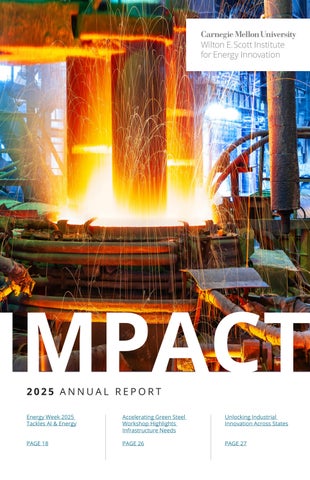
Scott Institute Impact Report 2025

Page 1


DIRECTORS’ LETTER

Costa Samaras Director, Wilton E. Scott Institute for Energy Innovation

Trustee Professor, Department of Civil and Environmental Engineering

Valerie Karplus

Associate Director, Wilton E. Scott Institute for Energy Innovation

Professor , Department of Engineering and Public Policy

Daniel Tkacik

Executive Director, Wilton E. Scott Institute for Energy Innovation

As the world continues to navigate the complexities of the energy transition, the Wilton E. Scott Institute for Energy Innovation remains steadfast in its mission of supporting the development of breakthrough technologies, policies and systems that will accelerate the transition to a sustainable, net-zero energy future. As you’ll see in our latest IMPACT Report, 2025 was a very productive year.

In 2025, the Scott Institute helped elevate CMU’s expertise in AI, innovation, and energy. In March, our flagship event, CMU Energy Week, brought together investors, entrepreneurs, and researchers to explore what’s next for AI and energy (p. 18). In July, CMU hosted the Pennsylvania Energy and Innovation Summit, which underscored Pittsburgh’s and CMU’s pivotal role in the national dialogue on AI and energy competitiveness. Scott Affiliates wrote two dozen AI and energy research memos to inform this important nationwide conversation (p. 22).

We’ve also worked productively with our Grand Challenge Partners (p. 16-17), who continue to provide strategic insight and support to advance the frontier of energy research. Our Grand Challenge Partners include the Rankin family (p. 17) and Trane Technologies (p. 17), and this year we were thrilled to welcome our newest Grand Challenge Partner, Anthropic (p. 17), for work that leverages artificial intelligence (AI) for electric grid modernization and sustainability. This partnership accelerates cutting-edge projects like our work on nocturnal AI (p. 28), focused on improving resilience in the face of mounting energy demands from data centers.

Innovation translates fundamental research into real-world solutions. The 2025 Seed Grants program (p. 10) funded diverse projects including clean hydrogen production, AI hardware efficiency, and transportation decarbonization. We also launched the Scott Institute Entrepreneurship Award (p. 13), enabling student-led ventures like Sabana (p.13). In the area of entrepreneurship, we were also incredibly proud to see our multi-institutional collaboration with WVU and Pitt named a finalist for the $160 million NSF Regional Innovation Engines Award (p. 27).

In addition to Energy Week, our events fostered dialogue and inspired the next generation of energy leaders. Our Distinguished Lecture Series brought energy leaders to CMU, such as Lou Martinez Sancho, the Chief Technology Officer of Westinghouse (p. 12). In September, the Accelerating Green Steel Workshop, hosted by the Scott Institute and the Center for Iron and Steelmaking Research for the third consecutive year, engaged a diverse group of technical leaders representing roughly 25% of global production (p. 26).

We are truly grateful for the many contributions of our faculty, staff, students, and partners of the Scott Institute and look forward to building on this momentum in the coming year.

36 Donors & Partners

PAGE 7

SEED GRANT SPOTLIGHT: GIVING PLASTICS A NEW LEASE ON LIFE

Thanks to a one-two punch of chemistry and computational modeling, a seed grant project supported by the Scott Institute for Energy Innovation is giving plastics a new lease on life.

PAGE 10

SCOTT INSTITUTE ANNOUNCES 2025 SEED GRANT WINNERS

For the thirteenth year, the Wilton E. Scott Institute for Energy Innovation awarded seed grant funding to sustainability projects helmed by faculty across Carnegie Mellon University.

Scott Institute Director Costa Samaras and Associate Director Valerie Karplus

PAGE 12

WESTINGHOUSE CTO LOU MARTINEZ SANCHO VISITS CMU TO STRENGTHEN COLLABORATION

Carnegie Mellon’s collaboration with Westinghouse Electric Company spans several projects and disciplines.

PAGE 13

NEW AWARD GIVES ENTREPRENEURSHIP A BOOST

Building sustainably with Sabana.

PAGE 18

NINTH ANNUAL CMU ENERGY WEEK

Over three days, investors, entrepreneurs, and researchers explored how AI and energy can complement each other.

PAGE 21

SCOTT INSTITUTE SUMMER PROGRAMS

The automotive industry in the U.S. is shifting away from gas-powered vehicles toward electric vehicles, introducing the need for a strong supply chain for common battery materials like lithium and cobalt. 2

In August 2025, the Scott Institute was proud to once again co-host SUCCEED, with the Department of Engineering and Public Policy, a free climate and energy education program for high school teachers and students.

PAGE 28

NOCTURNAL AI TO SOLVE ENERGY CURTAILMENT

Peter Zhang’s research received the AI + energy research award co-sponsored by the Scott Institute for Energy Innovation and the Block Center for Technology and Society at Carnegie Mellon University.

PAGE 29

SEED GRANT SPOTLIGHT: INCREASING TRANSPORTATION RESILIENCE

Scott Institute Associate Director Valerie Karplus speaks at Reuters Future of Heavy Industries USA 2025. Read more about Scott Institute affiliates’ policy and speaking engagements on pages 22 and 23.

HIGHLIGHTS TIMELINE

JANUARY 2025

Westinghouse CTO Lou Martinez

Sancho visits The Scott Institute and delivers a Distinguished Lecture.

MARCH 2025

Scott Institute hosts Energy Week 2025, centered around the theme of AI + energy.

Scott Institute announces 2025 seed grant recipients and the inaugural winners of a new entrepreneurship award and a co-sponsored award to support AI + energy research with The Block Center for Technology & Society.

FEBRUARY 2025

Margaret Harding McGill begins her role as Director of Policy Engagement in a joint appointment with the Scott Institute and the Department of Engineering and Public Policy.

JULY 2025

Anthropic, an AI safety and research company, joins the Scott Institute as its third Grand Challenge Partner to support research that leverages AI for electric grid modernization, sustainability, efficiency, and resilience.

Scott Institute faculty affiliates publish memos that showcase CMU’s research prowess at the busy intersection of AI, innovation, and energy.

SEPTEMBER 2025

The Scott Institute co-hosts the third annual Accelerating Green Steel Workshop.

NOVEMBER 2025

The Scott Institute hosts a discussion about the future of AI and energy research at CMU, engaging faculty, staff, and student attendees with interactive discussions and panels.

OCTOBER 2025

Juan Torres of the National Laboratory of the Rockies (formerly NREL) visits CMU’s CyLab and the Scott Institute. Torres delivers a Distinguished Lecture about his area of expertise at the intersection of energy and security.

DECEMBER 2025

The Scott Institute, as part of the Resilient Energy Technology and Infrastructure (RETI) consortium, releases a discussion paper on supporting resilient energy systems and technologies through regional entrepreneurship.

BUILDING SUSTAINABLE CLIMATE SOLUTIONS

We address the world’s most important energy-related challenges by enabling collaborative research, strategic partnerships, policy outreach, entrepreneurship, and education.

We support transformative work that advances innovation in the energy system and reduces the environmental and social impacts associated with energy production and use. We also catalyze the development of breakthrough technologies that will accelerate the transition to a sustainable, net-zero energy future.

AI, robotics, and automated science for decarbonization and climate resilient systems

Decarbonizing iron and steelmaking and other industrial materials and manufacturing

Life cycle assessment, supply chain resilience, and circular economy

Equitable and affordable electrification of buildings and personal transportation

Regional decarbonization, resilience, engaging communities and workers

Hydrogen, e-fuels, materials, and solutions for industry beyond electrification

Nature-based and engineered systems for infrastructure climate resilience

THE WILTON E. SCOTT INSTITUTE FOR ENERGY INNOVATION BY THE NUMB ERS

SEED GRANT AWARDED $5 MILLION RESULTING IN NEARLY +

ENERGY RELATED COURSES AT CMU

SEED GRANT SPOTLIGHT: GIVING PLASTICS A NEW LEASE ON LIFE

Stefanie Sydlik, an associate professor of chemistry, and Gerald Wang, an assistant professor of civil and environmental engineering, have poured their resources into manipulating the properties of polymers in order to upcycle plastics.

As Sydlik explained, polymers can be either synthetic, as in the case of plastics; or natural, as in the case of DNA and proteins found in the body.

“A polymer, in its most simple definition, is a repeating unit of some molecular structure that happens over and over to make a macroscopic material,” said Sydlik. “The polymers that people worry about are the synthetic ones, which have structures that are incredibly stable because you see a lot of carbon-carbon bonds, which don’t occur very often in nature.”

THANKS TO A ONE-TWO PUNCH OF CHEMISTRY AND COMPUTATIONAL MODELING, A SEED GRANT PROJECT SUPPORTED BY THE SCOTT INSTITUTE FOR ENERGY INNOVATION IS GIVING

PLASTICS A NEW LEASE ON LIFE.

That durability, which creates many everyday products like water bottles, also makes it hard for plastics to break down naturally, leading to microplastics. The researchers’ ultimate goal is to rethink the recycling process. Typically plastics can be recycled a few times at most before they’re out of commission. Sydlik and Wang want to make polymer composites with chemical properties that allow them to be revived back to food grade quality and degrade more easily when their lifecycle ends.

This could accomplish even more than reducing waste. An added benefit is that upcycled plastics can support energy infrastructure — for example, windmills use polymer coatings on their blades.

Wang elaborated that a lot of clean and renewable energy technologies would benefit from the low-permeability of the barrier that polymers create, particularly for preventing water damage and other types of weathering.

“Anything involving hydropower, anything involving offshore wind, you’re going to have so much need for coating to prevent both water and salt from getting to surfaces,” Wang said. “Solar is also a real workhorse for clean energy, and solar panels have to sit out in the field where they can get rained on all the time.”

Wang uses molecular modeling to help identify plastics that could be ideal candidates for the upcycling method Sydlik has studied and refined as a chemist, which uses dynamic depolymerization and covalent attachment to graphene oxide.

One of the project’s tangible results is likely to be an opensource polymer simulation tool that will make it easier for the research community to experiment with a relatively new, unexplored concept. This example also underscores the importance of seed funding to help innovative projects flourish and grow.

Stefanie Sydlik, associate professor of chemistry, CMU
Gerald Wang, assistant professor of civil and environmental engineering, CMU

RESEARCH HIGHLIGHTS

WILL FAST-CHARGING YOUR EV KILL ITS BATTERY?

The answer, according to the study published in the Journal of Power Sources, is that it depends on what kind of lithium ion battery the vehicle has. The research team — including Jeremy Michalek (EPP/ MechE) and Jay Whitacre (EPP/MSE) tested three common electric vehicle battery types, LFP, NMC, and NCA — with different combinations of fast and slow charging. The findings suggest that LFP batteries, which are more likely to require fast charging due to a lower driving range, are thankfully less susceptible to increased degradation; the most vulnerable NCA batteries are primarily used in long-range vehicles, giving drivers more flexibility to wait until they can slow charge.

RIDING OUT EXTREME HEAT

In cities across the US, heat waves are becoming longer, more frequent, and more intense over time. A case study of New York City’s 2019 heat waves indicates that in extremely hot weather, people may be more likely to turn to ride-hailing services like Uber or Lyft for their transportation needs, especially those living in higher-income neighborhoods. Corey Harper (CEE), Destenie Nock (CEE/EPP), and Jeremy Michalek (EPP/ MechE) conducted this research, published in Transportation Research Part D: Transport and Environment, with support from the USDOT and the Scott Institute for Energy Innovation.

A SECOND LIFE FOR AIR QUALITY MONITORS

To make indoor air quality monitoring more accessible, researchers including Reeja Jayan (MechE), Gerald Wang (CEE), and Albert Presto (MechE) have developed a low cost, long-lasting, indoor formaldehyde sensor. A unique polymer coating on the MXene-based sensor not only extends its halflife by 200% but also enables it to regenerate when performance begins to degrade. This research was published in Science Advances.

PRINTED MATERIALS INSPIRED BY NATURE

A research team including Mohammad Islam (MSE) published a study in Advanced Materials Technologies that illustrates a new method for creating superhydrophobic surfaces using an aerosol jet printer and polymer solutions. The findings illustrate a technique through which polymer microgel particles are deposited onto a substrate in a specific pattern — offering precise control over the shape and location of the structures, while requiring no post processing. Retardation of droplet evaporation could result in improved efficiency in cooling systems and improvements in water conservation. Droplet manipulation could also improve energy efficiency by enhancing heat transfer in cooling systems.

INFANT MORTALITY TIED TO CONCENTRATION OF LEAD IN THE AIR

In a National Bureau of Economic Research Working Paper, researchers including Karen Clay (Heinz) used data on lead emissions in the air to estimate the effects of air lead concentration on infant mortality. The study found a statistically significant relation between air lead concentration and infant mortality.

REBATES TO SUPPORT ENERGY RETROFITS

Researchers including Costa Samaras (Scott/CEE) and Destenie Nock (CEE/EPP) found that financial rebates and incentives offered in the Inflation Reduction Act increase adoption of energy retrofits in low to moderate income households. This research appeared in Environmental Research Letters

CLIMATE POLICY CAN SAVE HALF OF THE WORLD’S GLACIERS

Current climate policies put the world on track for a temperature increase of 2.7°C by the year 2100. Results of a study published in Science show that, because glaciers adjust slowly to temperature change, substantial mass loss is unavoidable even if temperatures stabilized today; however, strong climate policy can preserve twice as much ice compared to current warming trajectories. David Rounce (CEE) was among the researchers.

TO ENSURE ENERGY AUDITS HELP CLIMATE GOALS, TARGET EMISSIONS

Industrial energy efficiency is crucial to climate change mitigation. Improvement efforts often involve energy audits, which reveal opportunities for companies to save physical energy use or cost by making firms aware of their own practices. But without clear targets surrounding greenhouse gas consumption and emission reduction, these well-intentioned audits may not help companies achieve energy and emissions reductions. New research found that less well-managed firms in particular learned from audits how to reduce not just their energy use, but also their related costs, potentially limiting the audit’s effectiveness at achieving efficiency goals. Valerie Karplus (Scott/EPP) worked on this study, which was published in Nature Energy

SMOKE FROM US WILDFIRES, PRESCRIBED BURNS CAUSED PREMATURE DEATHS, BILLIONS IN HEALTH DAMAGES

Nicholas Muller (Tepper/EPP) coauthored a study in Communications Earth & Environment that examines the associated social costs of wildfire smoke in the US. Damages from fire smoke in 2017 amounted to more than $200 billion (17% of the total across all emission sources in the contiguous United States).

INDUSTRIAL EVOLUTION: RESEARCHERS SIMULATE WORKFORCE IMPACT

The adoption of decarbonized production methods in heavy manufacturing industries is widely considered a key step toward global climate change mitigation. For communities where these industries have a strong presence, the workforce implications of decarbonization can feel just as significant, and more immediate. Researchers including Valerie Karplus (EPP/

Scott), Christophe Combemale (EPP), and Chris Pistorius (MSE) have developed a generalizable approach for analyzing the impact of such decarbonization scenarios on a region’s workforce. This research was published in Proceedings of the National Academy of Sciences

SCOTT INSTITUTE ANNOUNCES 2025 SEED GRANT WINNERS

For the thirteenth year, the Wilton E. Scott Institute for Energy Innovation awarded seed grant funding to sustainability projects led by faculty across Carnegie Mellon University, with particular emphasis on supporting cross-disciplinary research and projects that engage with building electrification and climate adaptation and resilience.

Seed grants totaling over $400K were awarded to five projects spanning the College of Engineering, the School of Computer Science, and Mellon College of Science. The seed grant award is a prized opportunity for the Scott Institute to give ambitious projects a boost, with the intention that researchers will use the funding to grow their early-stage projects into larger efforts that will attract follow-on funding. Since 2013, 82 seed grant projects have garnered a further $26 million in funding as the projects grew.

2025 SCOTT INSTITUTE SEED FUNDING AWARDEES

Ana Inés Torres, an assistant professor of chemical engineering, is leading research with regional impact. Torres received funding for the project “Decarbonized hydrogen, carriers, and sustainable aviation fuels production for the western Pennsylvania area,” which will study “the potential production of clean hydrogen and carriers in western Pennsylvania and nearby areas.” Torres’ research group has expertise in techno, environmental, and economic assessment of clean hydrogen production processes. The project’s end goal is to produce an understanding of what clean hydrogen production methods might work best for the greater Pittsburgh region.

Dimitrios Skarlatos, an assistant professor in the computer science department, is using support from the Scott Institute to tackle the growing energy demand of AI data centers — a theme that also took center stage during Energy Week 2025.

“Energy-efficient AI datacenters,” Skarlatos’ official project title, includes the development of a proof-of-concept that “enables finegrained, efficient power management without requiring changes to existing AI software stacks.” These technical changes support the ultimate goal of improving performance and efficiency of AI hardware by a factor of 20.

Kate Whitefoot, an associate professor of mechanical engineering and engineering and public policy, is principal investigator for the project “Increasing Resiliency of U.S. Transportation Electrification.” Thanks to support from the Rankin Grand Challenge Program, Whitefoot’s research team will explore how to support decarbonization of the transportation sector while remaining adaptable to likely changes in the supply chain; varying greenhouse gas (GHG) emissions policies stateside and abroad; as well as differing consumer demands. Read more about Kate Whitefoot’s research on page 29.

Mario Bergés, a professor of civil and environmental engineering, has a seed grant project that aligns with the mission of Trane Technologies, one of the Scott Institute’s Grand Challenge Partners. “Ibex-RL: Reinforcement Learning Meets Physics for Scalable HVAC Control in Residential Buildings,” the proposal, “addresses the critical challenge of decarbonizing buildings through the electrification of heating systems, with a focus on optimizing the operation of heat pumps” with the help of reinforcement learning (RL).

Krzysztof (Kris) Matyjaszewski is the J.C. Warner University Professor of Natural Sciences in Chemistry. “High Lithium Transport Solid Polymer Electrolyte for Lithium-Metal Batteries,” the project that earned seed funding from the Scott Institute, supports the commercialization of lithium-metal batteries by finding solid polymer electrolytes (SPE) that can provide stability during the cycling process that ages batteries through charges and recharges.

SCOTT INSTITUTE HARDWARE & SOFTWARE TOOL UPGRADE PROGRAM RECIPIENTS

Albert Presto, a research professor in mechanical engineering, received support from the Scott Institute for the purpose of upgrading the sulfur dioxide monitor used by the Center for Atmospheric Particle Studies (CAPS). The research group, of which Presto is a director, will use the refurbished monitor to track the presence of sulfur dioxide since it’s a known precursor to atmospheric fine particulate matter (PM), which is hazardous to human health and detrimental to the climate. The new and improved monitor will be applied to field research as well as to measure for the pollutant in the Pittsburgh area.

Mike Blackhurst, executive director of the Open Energy Outlook, received support from the Scott Institute to continue refining the abilities of the OEO’s key resource, Temoa, a linear optimization model of macro energy systems.

Temoa’s database is meant to stay up to date with all potential technologies in the U.S. energy transition, a challenge because of the constant changes and the high volume of information. Blackhurst will use the award to upgrade outdated features and enhance the database — including the addition of estimates of land use, water use, and labor demand in model energy results, which allow for more accurate and holistic recommendations.

WESTINGHOUSE CTO LOU MARTINEZ SANCHO VISITS CMU TO STRENGTHEN COLLABORATION

Carnegie Mellon’s collaboration with Westinghouse Electric Company spans several projects and disciplines. So, when Westinghouse’s Chief Technology Officer and Executive Vice President of R&D, Lou Martinez Sancho, gave a Distinguished Lecture at the Scott Institute for Energy Innovation in January 2025, it was a chance to expand the collaboration even further.

“WE’RE

EXPLORING THE RIGHT BUSINESS MODEL TO FINANCE

THE TECHNOLOGY.”

Lou Martinez Sancho, Chief Technology Officer and Executive Vice President of R&D, Westinghouse Electric Company

Students attending from across CMU’s seven schools learned about the variety of talent Westinghouse needs — not just nuclear specialists. Indeed, Westinghouse and CMU have already formed a strong pipeline of opportunities for students and faculty. For example, Jack Beuth, a professor of mechanical engineering and a faculty affiliate of the Scott Institute, collaborated with Westinghouse to 3D print a critical component for nuclear reactors. Chemical engineering undergraduates, Abby Umscheid and Catherine Kress, interned at Westinghouse last summer. Ongoing research from

Westinghouse and faculty affiliate Pingbo Tang focuses on safety guidelines and regulations with remote operations of microreactors.

There is something unique about the constructive collaboration between CMU and Westinghouse according to Matthew Bartman, the College of Engineering’s Director of Research Partnerships, because of what each represents to the Pittsburgh region in terms of history and innovation. Westinghouse pioneered nuclear energy, so it’s not surprising that around 50 percent of the world’s nuclear plants operating today use Westinghouse technology. Thanks to boundless AI expansion and demand for global energy security, shuttered nuclear plants such as Three Mile Island are coming back online to support growth.

“For me, it’s not a question of technology,” Martinez Sancho said of bringing nuclear to scale. “We’re exploring the right business model to finance the technology,” referring to Westinghouse’s AP1000®, AP300™, and eVinci™ reactors that operate at different scales and have their own maintenance requirements. Martinez Sancho noted that scaling nuclear energy requires a multi-pronged approach that includes revamping the supply chain, building new infrastructure, and training a workforce. The deepening collaboration between Westinghouse and CMU helps make this vision a reality now and into the future.

NEW AWARD GIVES ENTREPRENEURSHIP A BOOST

The Scott Institute for Energy Innovation launched a new entrepreneurship award to grow the Carnegie Mellon energy and climate startup community and to make it easier to translate CMU cleantech innovations from research to the market.

The inaugural winners come from disciplines such as business, robotics, and architecture and include faculty and students.

BUILDING SUSTAINABLY WITH SABANA

came to Carnegie Mellon University to earn an MBA while taking a serious interest in energy and sustainability, a complementary set of interests that led him to co-found Sabana, an AI-powered data management startup that puts sustainability in the hands of the design team at architecture firms. Quesada was an inaugural recipient of the Scott Institute for Energy Innovation’s new entrepreneurship award.

Sabana’s business model looks at sustainability through the lens of embodied carbon, which represents the greenhouse gas emissions that span a product’s lifecycle from raw materials to eventual disposal.

Design teams, including architects, engineers, and specification writers, routinely review hundreds to thousands of products in a given year to choose the best materials for construction projects. Environmental product declarations (EPD) are sometimes included with product information.

“Architects typically don’t have time to absorb that information and then review it and then compare it. We’re trying to simplify the process,” said Quesada. “We see our product being highly collaborative and needed by larger firms because of the sheer amount of data.”

Quesada likens the importance of EPDs to comparing nutrition labels: some products are more environmentally friendly than others, but that information is difficult to sort through. Sabana scrapes unstructured product information available on websites and PDFs, then uses its AI to parse the data and present it to users in a structured format, making it easier to compare EPDs and choose the more sustainable option.

Sabana will use support from the Scott Institute to hit the ground running in its second product

rollout. Based on feedback from early beta testers at roughly half a dozen architecture firms, Quesada and his team will refine the product to add more collaborative features and provide additional product information like a cost log, comments, and cross referencing features. So far, Sabana has worked with architecture firms mostly in the Pittsburgh region, and in anticipation of scaling up operations the team relocated to San Francisco for the summer to build more relationships around the country.

“LEAVE YOUR BUILDING. SOMETIMES WE GET SILOED AND I THINK THAT PREVENTS US FROM DOING REALLY GREAT THINGS.”

Ruben Quesada, co-founder, Sabana

Quesada, who graduated from the Tepper School of Business this past spring, benefited from the robust support system at CMU for entrepreneurial-minded students. In addition to the Scott Institute, he cites the Swartz Center for Entrepreneurship and Project Olympus as invaluable resources for growing an idea into a company.

Quesada has words of wisdom for other aspiring student entrepreneurs.

“Leave your building. Sometimes we get really siloed, and I think that prevents us from doing some great things,” he said, noting the valuable connections he made when he took classes in computer science and engineering.

“The people I collaborate with at the startup are studying AI and computer science. We’re able to build something completely unique, and I think that’s the value of CMU.”

FEATURED AWARDS & HONORS

Faculty fellow Destenie Nock (CEE/EPP) was named a Science Defender by the Union of Concerned Scientists, receiving recognition for achievements both in academic research and as a cleantech entrepreneur, shining a light on energy affordability with her company, Peoples Energy Analytics.

Faculty affiliate Ismaila Dabo (CMU-Africa/MSE) received a Presidential Early Career Award for Scientists and Engineers (PECASE), the highest award bestowed by the U.S. government on early career scientists and engineers. Dabo’s research centers on applying computational tools for efficiency purposes.

Faculty affiliate Howie Choset (SCS) was named a fellow of the American Association for the Advancement of Science (AAAS), the world’s largest general scientific society and publisher of the Science family of journals. Choset was recognized for “distinguished contributions to the field of robotics, and for leadership in entrepreneurship and education.”

Recipients of the prestigious National Science Foundation’s Faculty Early Career Development (CAREER) Award included Scott Institute faculty affiliates Yorie Nakahira (ECE), Giulia Fanti (ECE), Hamish Gordon (ChemE), Ana Torres (ChemE), Guannan Qu (ECE), and Akshitha Sriraman (ECE).

Yorie Nakahira
Giulia Fanti
Hamish Gordon
Ana Torres
Guannan Qu
Akshitha Sriraman

Chris Pistorius (MSE) was named as an American Institute of Mining, Metallurgical and Petroleum Engineers (AIME) Honorary Member, one of the highest honors the Institute bestows on an individual.

Faculty affiliate Jeremy Michalek (EPP/MechE) was named a fellow by the American Society of Mechanical Engineers (ASME). Michalek’s research focuses on vehicle electrification, and he is recognized globally as an expert on electric vehicles and shared mobility.

Faculty affiliate Chris Hendrickson (CEE/EPP), professor emeritus, was honored with the National Academies Transportation Research Board’s 2025 Roy W. Crum Award. Awardees are recognized for their outstanding achievements in transportation research.

SAMARAS PRESENTS AT EMTECH MIT

In November 2025, Scott Institute Director Costa Samaras presented at EmTech MIT to address the overlapping themes of AI, energy use, and electricity. “We’re seeing a dramatic increase in the need for energy, transmission, and infrastructure around AI,” said Samaras. While AI’s contribution to electricity demand is relatively small, Samaras noted, it is of great significance when considering how the power grid will handle a shift toward electrification in other industries.

EmTech MIT, hosted by MIT Technology Review.

GRAND CHALLENGE PARTNERSHIP PROGRAM

Grand Challenge Partnerships are part of the Scott Institute’s strategy to grow research in key areas on some of the most challenging questions facing the net-zero, climate-resilient energy transition.

“The Grand Challenges represent a growing family of big, systemlevel questions facing energy systems that must be tackled to achieve our mid-century climate goals,” said Valerie Karplus, associate director of the Scott Institute.

As we transition to sustainable energy systems, each of the Scott Institute’s Grand Challenges addresses a cross-disciplinary question that must be answered to advance deep decarbonization and resilience of our energy systems, drawing on our expertise in science and engineering, infrastructure, policy design, and workforce and community engagement.

A painting by the daughter of donors Aaron and Yeming Rankin, who established the first Grand Challenge Partnership.

RANKIN FAMILY GRAND CHALLENGE

In late 2023, Yeming and Aaron Rankin made a generous commitment to establish the Engineering Resilience for Climate Adaptation Fund. The fund supports initiatives focused on engineering resilience for energy and climate adaptation and the associated Ph.D. student-led projects that will be overseen by faculty in the Department of Civil and Environmental Engineering (CEE) and the Scott Institute.

Ramteen Sioshansi (EPP) and Granger Morgan (EPP) are developing a robust optimization model that is capable of analyzing threats to the grid and providing commensurate responses that improve its resilience and mitigate supply disruptions.

Kate Whitefoot (EPP/MechE) is exploring resilient decarbonization pathways for EV batteries via computational models that optimize vehicle manufacturers’ technology and production decisions over probabilistic disruptions to paint a picture of how prices and availability of minerals might change. The findings are relevant to consumers, automakers, and policymakers alike.

Two Ph.D. student fellows in CEE’s Center for Engineering Resilience and Climate Adaptation (CERCA), Matthew Weathers and Maral Doctorarastoo, have been supported by the Rankins’ gift to advance their climate adaptation research. Weathers’ research focuses on co-developing adaptation strategies with communities in Mississippi and Texas to increase their resilience to the compounding threats of extreme precipitation, storm surge, and sea-level rise; Doctorarastoo is developing novel data-driven agent-based models that represent how human behaviors and social interactions influence infrastructure performance to better align technological systems with how people actually respond to stress and disruption.

CERCA also sponsored David Rounce’s travel to participate in COP29 and represent CERCA activities. David gave three talks and participated in three panels. He also met with a high-level staff member for the UN Secretariat General.

TRANE TECHNOLOGIES GRAND CHALLENGE

Global climate innovator Trane Technologies is working to advance clean, electric-powered climate control solutions that dramatically reduce greenhouse gas emissions in homes, buildings, and industry as part of its ambition to decarbonize the built environment and cold chain for a more sustainable world. The company’s vision strongly aligns with the Scott Institute for Energy Innovation’s ambition to accelerate decarbonization. The multi-year collaboration will study the maximum penetration of electrified residential heating and cooling systems that can be expected across the U.S., given existing distribution infrastructure and household electrical capabilities. Trane has given the Scott Institute the opportunity to award seed funding for projects like Karen Clay’s (Heinz) analysis of past energy transitions to shed light on how policies could accelerate the current net-zero push. Mario Bergés (CEE) is refining a model called Ibex-RL that uses both machine learning and physics-based concepts to efficiently control heating, ventilation, and air conditioning (HVAC) functions in buildings.

ANTHROPIC GRAND CHALLENGE

Anthropic, an artificial intelligence (AI) safety and research company founded in 2021, provides $1M in funding over three years to support research that leverages AI for electric grid modernization and sustainability, driving energy efficiency and resilience.

“With the deep expertise of our cross-disciplinary faculty and support from Anthropic as our next Grand Challenge Partner, the Scott Institute is ready to meet the moment and drive solutions for the grid at the nexus of AI and energy,” said Scott Institute Director Costa Samaras

Ninth annual CMU energy week

Over three days, investors, entrepreneurs, and researchers explored how AI and energy can complement each other.

ENERGY WEEK 2025 TACKLES AI & ENERGY

Carnegie Mellon’s ninth Energy Week focused on AI, a theme that is evolving in real time. AI presents unique challenges and opportunities — a promising and powerful tool with endless sustainability applications that also consumes eye-watering amounts of energy to power its data centers.

DAY ONE

Energy Week 2025 officially kicked off with Investor Day, which explored the role of industry innovators and investors in merging AI and sustainability.

The opening keynote was from Lisa Hansmann of Foundry Logic, who also participated in the Investor Forum Panel Discussion alongside professionals at Innovation Works, Helios Climate Ventures, and Operator Collective.

This event engaged with figures from academia, industry, and government — and hosted opportunities for entrepreneurs and student researchers — to take stock of where we are and theorize what’s next at the intersection of two crucial topics.

One of the highlights of the first day was a chance to glimpse the future of clean energy technologies at the Energy and Cleantech Startup Pitch Showcase. Thanks to participation from 20 startups — including Sabana, J.P. Robotics, and SeaLion Energy — the competition was a strong showing of CMU’s entrepreneurial side. Company founders got valuable face time with investors capable of meeting their funding needs to take their innovations — ranging from improving battery life to automating disassembly to AI-driven data management — to the next level, with greater potential for public impact.

Following the startup pitch showcase, the nonpartisan nonprofit organization Team Pennsylvania presented three energy scenarios for the state – which they colloquially referred to as Highways, Homesteads and Fields – to explore the impact of different hypothetical scenarios on Pennsylvania’s energy investments, emissions, and the economy.

DAY THREE

DAY TWO

AI & Energy was the focal point of Energy Week’s second day. A timely topic with local and global dimensions, many of the most pressing questions about AI’s energy demands, the future of the energy workforce, and the frontiers of AI in promoting energy and climate solutions were contemplated during a series of panel discussions.

Day two started and concluded with keynotes from high-caliber professionals who offered a glimpse of the tech industry’s approach to leveraging AI for sustainable purposes. Google’s Lucia Tian, head of clean energy and decarbonization technologies at the search engine, started off the day’s agenda.

In the afternoon, Marianne Walck, director of the National Energy Technology Laboratory, gave a keynote presentation, as did Allegheny County Executive Sara Innamorato. The final keynote was from Vibhu Kaushik, Global Head of Energy at Amazon Web Services, who joined the Scott Institute’s director, Costa Samaras, for a fireside chat to wrap up the day’s agenda.

Energy Week 2025 wrapped up with Student Day, spotlighting the thinkers who represent the future of the energy industry. Many student organizations were front and center, including at the Tepper Energy & Clean Tech Club Case Competition. Teams from CMU, Cornell, Rice University, and the University of Pittsburgh were among the many competitors from around the nation. The Student Energy Research Poster Competition formed a gallery of innovation. First place went to Corinne Smith-Lewis, a Ph.D. candidate in mechanical engineering, for a presentation on applying an operando voltage sensor for a gas recombination catalyst. First runner up was Judy Park, a Ph.D. student in engineering and public policy, for the poster “Mortality and Distributional

Effects of Air Pollution from Integrated Steelmaking in the United States.” Receiving third place was electrical and computer engineering Ph.D. student Aayushya Agarwal’s “ML-Physics Synergy for Robust Strategies Against Weather and Load Fluctuations.” Jessy Ha’s project on proton exchange membrane water electrolyzers was voted the most innovative research idea.

Energy Week concluded with the Careers in Energy Networking Reception, with participation from Duquesne Light Company, National Renewable Energy Laboratory, and Trane Technologies, among others.

2025 Scott Institute EV Show

Scott Institute Summer Programs

SUCCEED — THE SUMMER CENTER FOR CLIMATE, ENERGY, AND ENVIRONMENTAL DECISION MAKING

SUCCEED was founded in 2011 by Carnegie Mellon University’s Center for Climate and Energy Decision Making and is now supported by the Department of Engineering and Public Policy, the Scott Institute for Energy Innovation, and the Industrial Decarbonization Analysis, Benchmarking, and Action (INDABA) Partnership, funded by the U.S. National Science Foundation.

In August 2025, the Scott Institute was proud to once again to co-host SUCCEED, Carnegie Mellon University’s free summer climate and energy education program for high school teachers and students.

Faculty experts including Peter Adams, Destenie Nock, Granger Morgan, and Albert Presto led educators from across Southwestern Pennsylvania in exploring topics including air quality and equity, energy transitions, and climate change education.

High school students joined from the Pittsburgh area, New York, North Carolina, and Arizona for panels and lectures, hands-on activities, and tours. Highlights included a Q&A with Congresswoman Summer Lee, a tour of the Center for Iron and Steelmaking Research, and a career panel with experts in sustainability, infrastructure management, and engineering. Also in 2025, the Summer Academy for Math and Science (SAMS) program featured a dynamic College of Engineering master class and lab tour called “Into the fire: How to make iron and steel, understanding its environmental impacts.”

Students learned about how the steel industry affects climate change, local air pollution, and health, as well as technologies that could reduce these impacts, and brainstormed potential solutions involving policy and neighboring communities. They examined and visualized the environmental impact of two of today’s steelmaking technologies, and then explored iron and steelmaking materials, furnaces, and experiments firsthand in the CMU Center for Iron and Steelmaking Research.

Both of these summer programs are part of the activities of the Industrial Decarbonization Analysis, Benchmarking, and Action (INDABA) Partnership, a CMU-led initiative focused on the future of heavy industries funded by the U.S. National Science Foundation.

POLICY OUTREACH, INDUSTRY INTERACTIONS,

WORK THAT MATTERS

Ahead of the Pennsylvania energy and innovation summit hosted at CMU, the Scott Institute’s director of policy engagement, Margaret McGill, coordinated the publication of a collection of research memos to showcase the expertise of our faculty. Far more than just these areas, they covered a range of topics at the intersection of AI and energy.

TKACIK NAMED TO NREL’S 2025

EXECUTIVE LEADERSHIP COHORT

Executive director Daniel Tkacik was among 19 leaders selected for a four-month National Renewable Energy Laboratory program that offers executive decision makers an opportunity to learn in depth about energy technologies and analytical tools directly from NREL’s most prominent researchers, engineers, and professionals.

SAMARAS FEATURED AT NATIONAL ACADEMIES’ ROUNDTABLE ON AI AND CLIMATE CHANGE

Director Costa Samaras was named to the roundtable, which seeks to “foster ongoing discussions, shared learning, and nimble coordination around emerging issues related to AI and climate change.” Samaras was on hand for the roundtable’s first public meeting in May 2025.

KARPLUS PRESENTS AT REUTERS FUTURE OF HEAVY INDUSTRIES USA 2025

At the conference, Associate Director Valerie Karplus emphasized how machine learning, informed by deep disciplinary expertise in materials science and policy analysis, can help producers discover and implement effective decarbonization solutions. She also led a demonstration of decarbSTEEL, an opensource technoeconomic model on future steelmaking pathways developed by faculty, postdoc, and graduate student researchers at CMU.

INTERACTIONS, AND SPEAKING ENGAGEMENTS

DATA CENTERS AND ELECTRICITY BILLS

A report by the Open Energy Outlook, a key initiative at the Scott Institute led by Paulina Jaramillo and Mike Blackhurst, estimates that electricity prices could increase by 8 percent nationally and by as much as 25 percent in certain regions across the U.S.

PROMOTING BEV SAFETY

PROTECTING ENERGY EXPANSION FROM CYBER THREATS

Harry Krejsa, director of studies at CMU’s Institute for Strategy & Technology, published a white paper detailing recommendations to protect US cybersecurity infrastructure, which is poised to play an expanded role in the clean energy transition.

Researchers at the Scott Institute and CMU’s Safety21 National University Transportation Center released a policy brief that offers technology and policy recommendations to increase battery electric vehicle (BEV) safety as more people get behind the wheel.

SCOTT INSTITUTE AFFILIATES SHARE EXPERTISE WITH CONGRESSIONAL STAFF

Scott Institute leadership Costa Samaras and Valerie Karplus, as well as faculty affiliates like Paulina Jaramillo and Jeremy Michalek, conducted congressional staff briefings during 2025 on research topic areas including EVs and green steel.

JARAMILLO COMPLETES AAAS FELLOWSHIP

Paulina Jaramillo (EPP) completed a one-year AAAS Science & Technology Policy Fellowship, where she continued work on climate policy, in Washington, D.C.

STUDENT NEWS

STUDENTS COMPETE FOR ENERGYTECH

UNIVERSITY

PRIZE

A team of two materials science and engineering doctoral students from CMU was selected as a finalist for the 2025 Energy Technology University Prize (EnergyTech UP) organized by the Department of Energy (DOE). Jeremy Drew and Andrew Timmins reviewed a list of technologies that had been developed at DOE National Laboratories, but had yet to be commercialized. After analyzing the available projects, they chose to pursue a cathode recycling technology in order to advance the lithium-ion battery supply chain.

“When batteries are essentially near their end of their life, companies will shred them and create ‘black mass,’ which is essentially all of the useful materials in a battery,” said Timmins. “The idea of this technology is that you can take this black mass and, using an electrochemical process, leech out the materials that are of interest and use them in new battery development.”

Through the project, Drew and Timmins assessed the market potential of this technology and created a business plan for commercialization. The evaluation of their plan then went on to a regional final that was hosted by the Scott Institute for Energy Innovation.

As finalists, Drew and Timmins were awarded $5000 and were invited to attend the National Pitch Event this summer at the Colorado School of Mines, where they delivered their final pitches to a panel of industry stakeholders and DOE Office of Technology Commercialization leadership.

USING ENTREPRENEURSHIP TO MITIGATE RED TIDES

Mechanical engineering

Ph.D. student TJ Thomas is using support from the Scott Institute’s entrepreneurship award to develop a semi-automated solution for removal of harmful algal blooms — AKA red tides — which are detrimental to human health, aquatic life, and ecosystems while also affecting the economies where they occur.

HVAC FILTERS AS A KEY TO HEALTHY, SUSTAINABLE ARCHITECTURE

Waku Ken-Opurum, a Ph.D. student at the School of Architecture, is looking to boost indoor air quality and sustainability of buildings by developing a prototype of a passive biomimetic biodegradable air filter. Ken-Opurum was another student winner of the Scott Institute’s new entrepreneurship award.

Jeremy Drew and Andrew Timmins

CMU’S AUTONOMOUS REFORESTATION ROBOT WINS NATIONAL AWARD

The award-winning project — an autonomous reforestation robot named Johnny B. Root — demonstrated outstanding commitment to environmental sustainability while emphasizing overall ecosystem health. Out of 22 teams, Appleseed Labs, part of the Kantor Lab at CMU’s Robotics Institute, was one of six to receive an award.

GREEN PATHWAYS

Impact CMU featured studentled projects with social impact from across the university, including many from the College of Engineering. Projects included mechanical engineering student Ellen Lee’s Green Pathways: Campus Sustainability Tour Revitalization, which aims to update and modernize CMU’s Environmental Walking Tour to better showcase the university’s sustainability efforts and resources.

SUSTAINABILITY-MINDED 2027 INNOVATION SCHOLAR

With a passion for systems optimization and environmental sustainability, electrical and computer engineering undergraduate Carys Doyle is driven to leverage her experience in environmental research to improve existing processes and decrease their negative environmental impact. Doyle was one of a dozen students named Innovation Scholars by CMU’s Swartz Center for Entrepreneurship.

GRAD STUDENT NAMED TO DOE FELLOWSHIP PROGRAM

Stephen Huan, a student in the Machine Learning Department at CMU, was selected for the Department of Energy Computational Science Graduate Fellowship program.

Accelerating Green Steel Workshop Highlights Infrastructure Needs

Hosted by the Scott Institute for Energy Innovation and the Center for Iron and Steelmaking Research (CISR) since 2023, the Accelerating Green Steel Workshop gathers representatives across the global iron and steel supply chain in person in Pittsburgh to assess progress and challenges towards the industry’s decarbonization goals.

The 2025 Proceedings report, which is produced by Carnegie Mellon University and does not necessarily reflect the views of any particular company, summarizes the discussion and the results of the workshop’s annual survey, which describes producers’ efforts, ambitions, and bottlenecks in the transition.

Valerie Karplus, conference co-chair and associate director of the Scott Institute, emphasized the importance of the conference’s multidisciplinary analysis. Karplus and co-chair Chris Pistorius, CISR’s co-director, led sessions that focused on companies’ progress updates, breakthroughs, technology costs, and public policy for decarbonization.

“It was exciting to see how much momentum to decarbonize persists, despite recent headwinds,” said Karplus. “The question was not if, but when and how – including how to source sufficient clean electricity for operations and how to improve the economics of hydrogen direct reduced iron and carbon capture.”

The workshop survey revealed that compared to three years ago, fewer attendees see technology as a barrier to deep decarbonization, suggesting steady progress across the industry. Workforce or community resistance to decarbonization showed a trend toward decreased concern, from already low levels in 2023. Decarbonization carries potentially large local environmental and health benefits, although the workforce impacts may be mixed.

When evaluating changes in the industry’s decarbonization progress over the past year, attendees reported mixed experiences, pointing mainly to policy reversals or slowing ambition affecting expectations of progress. However, over half of participants saw no change from prior years, and there was a common interest in creating decarbonization strategies that are insulated from policy shifts and can support uninterrupted progress, and a shared opinion that demonstrating decarbonization technologies is a crucial step toward bringing them to scale.

Hydrogen-based direct reduced iron (DRI) was discussed as a promising iron production option. Even though this process is expected to behave similarly to that of natural gas-based DRI, uncertainties remain with identifying the optimal operating conditions — like hydrogen flow rate, gas temperature, and humidity — and determining the best way to produce the needed hydrogen without creating a surge in electricity demand.

“It was very helpful to share our research on known unknowns when it comes to hydrogen DRI as a future ironmaking pathway,” Pistorius said. “Innovators in industry shared valuable perspectives on strategies for overcoming some of the challenges, real or perceived, to realize the potential of this deeply decarbonized process.”

2025 Accelerating Green Steel Workshop attendees, including co-chairs Valerie Karplus and Chris Pistorius.

Unlocking Industrial Innovation Across States

A discussion paper released by the RETI Consortium lays out recommendations for building regional innovation capabilities that cross industry boundaries and state borders in the West Virginia-Western Pennsylvania region.

The region has all the ingredients needed to be a powerhouse of industrial innovation: grid infrastructure, strong industrial bases, and t research universities with deep expertise in artificial intelligence (AI), energy systems, robotics, and automation. The challenge is how to ensure the region leverages these strengths to lead in — and, importantly, benefit from — the next wave of economic opportunity, spurred by the development of new industries such as manufacturing and data centers and their energy demands.

The Resilient Energy Technology and Infrastructure (RETI) Consortium, led by West Virginia University, the University of Pittsburgh, and Carnegie Mellon University, represents an effort to innovate and implement critical energy technologies and resilient infrastructure in ways that contribute to regional growth and prosperity.

Pennsylvania ranks 23rd and West Virginia ranks 50th in the country in venture capital funding relative to GDP.

“Our goal is to gain a better understanding of what actions could help to accelerate regional economic growth and opportunity at the intersection of energy, manufacturing, and technology entrepreneurship,” said Valerie Karplus, associate director of CMU’s Scott Institute for Energy Innovation who also serves as the RETI Consortium’s director of policy.

The discussion paper, “Unlocking Opportunities in the Industrial Innovation Economy for West Virginia and Western Pennsylvania,” breaks down six key challenges facing innovation and industrial growth in the region. The findings are based on an interactive discussion hosted by RETI at the Scott Institute in July 2025 that invited local business and thought leaders to contemplate factors that might inhibit or support energy and infrastructure modernization.

“OUR GOAL IS TO GAIN A BETTER UNDERSTANDING OF WHAT ACTIONS COULD HELP ACCELERATE REGIONAL ECONOMIC GROWTH AND OPPORTUNITY.”

The half-dozen categories identified by the group illustrate the range of factors, from policy to funding, that interact with entrepreneurship and industrial innovation. A category of barriers related to institutions and culture at the systems level emerged as important for many participants.

The group also recognized that solutions were likely to be different across populations and contexts within the region. Recommendations for boosting innovation focused on workforce readiness and specialized training; early access to capital for startups; and site selection and permitting processes.

“Policy touches every aspect of our economy and energy sectors. Our future success as a region in securing reliable energy and ensuring that energy can power the future of American industry relies on having aligned policy approaches,” said Erienne Olesh, CEO of the RETI Consortium. “Working across various groups and including multiple perspectives will ensure that developed policy approaches have the greatest benefit to the region.”

A second workshop in October 2025 gave participants an opportunity to comment on the next iteration of the paper, and also allowed participants and members of the policy community to discuss the major takeaways and the feasibility of suggested actions to overcome barriers.

NOCTURNAL AI TO SOLVE ENERGY CURTAILMENT

Peter Zhang’s research, which blends components of economics, policy, and engineering to accommodate AI’s growing energy demands with minimal disruption, received an AI + energy research award co-sponsored by The Scott Institute for Energy Innovation and The Block Center for Technology and Society at Carnegie Mellon University.

A central question, How can we optimally design energy supply chains and schedule AI work to best utilize solar and wind energy?, is timely amid mounting curiosity about the most efficient way to power AI data centers as they grow in number. Zhang’s approach gets in front of concerns about large language models and other AI programs producing unsustainable greenhouse gas emissions by finding a solution in two renewable energy sources.

Zhang, an assistant professor of operations research at Heinz College for Information Systems and Public Policy, brings an overlooked issue into focus — energy curtailment, a reduction of usable energy caused by grid restraints. “The power grid has to be physically balanced to function, so we can’t arbitrarily feed it these different renewable energies,” said Zhang. “Given that we have a certain amount of installed capacity, sometimes wind and solar farms can’t use all of their energy and they have to dump it. This project is a perfect opportunity to understand the potential of applying energy that isn’t being used to support the future load from data centers that we’ll see on the grid.”

Solar and wind energy can’t be stored overnight due to storage and grid constraints. Humans follow a largely predictable demand curve for energy, but that demand curve does

not match the renewable energy production curve. Nocturnal and more flexibly-scheduled AI workload seems a logical choice to solve that mismatch since many computational functions like processing and cleaning up data sets, and training large machine learning models, can be scheduled ahead of time as batch jobs — improving the supply-demand match, reducing wasted energy, and creating less interference between human consumption and AI energy demands.

Zhang’s approach to powering AI is not only complementary to human use, but solves a problem rooted in grid restraints.

“This project thinks completely out of the box to say that AI doesn’t have to follow the sun and the moon or the human pattern of periodic sleep and work,” said Zhang.

Making this out-of-the-box thinking possible is a two-stage optimization model that Zhang is developing with help from publicly available cloud computing data that identifies computing jobs and their characteristics, like duration and usage, to paint a picture of how current AI models consume energy and how that trend could change in the future.

The model’s two stages are designed to provide guidance on macro-level decisions, like where to build data centers and how to design an engineering system; and micro-level variables that determine grid capacity on a daily to hourly basis.

SEED GRANT SPOTLIGHT: INCREASING TRANSPORTATION RESILIENCE

The automotive industry in the U.S. is shifting away from gas-powered vehicles toward electric vehicles, introducing the need for a strong supply chain for common battery materials like lithium and cobalt. To adequately support electrification of the U.S. transportation sector, which claims the greatest energy use and greenhouse (GHG) gas emissions in the country, it’s important to make the supply chain resilient and adaptable to changing policies, global trade conditions, and consumer demand.

Using a seed grant from the Scott Institute for Energy Innovation, faculty fellow Kate Whitefoot is merging policy and technology to identify decarbonization pathways for lightduty passenger vehicles such as sedans, SUVs, and pickup trucks.

“People have wondered if the transition to electric vehicles is happening too quickly because we need to make sure there are secure supplies of these battery minerals,” said Whitefoot, a professor of mechanical engineering and engineering and public policy at Carnegie Mellon University.

“This research directly addresses those concerns by finding ways to be resilient to disruptions. Planning for disruptions allows us to produce electric vehicles with minimized risk about the supply of minerals.”

The key research tools are computational models that optimize vehicle manufacturers’ technology and production decisions over probabilistic disruptions to paint a picture of how prices and availability of minerals might change. Its findings are relevant to consumers, automakers, and policymakers alike.

“These models allow us to pinpoint the disruptions that we need to pay the most attention to and that could have negative impacts on both the automotive industry and U.S. households,” said Whitefoot, noting that vehicles are typically the second-largest purchase in a household after purchasing a home, meaning price jumps would have a significant impact.

One mitigation tactic is to develop multiple battery chemistries, particularly a selection of reliable cobalt-free backups that manufacturers can quickly pivot to if there is a supply chain shock since many battery materials are sourced overseas. On the policy side, this could be reinforced by incentivizing manufacturers to design modular battery packs and electric vehicles that could easily switch to cobalt-free alternatives like lithium-ion phosphate batteries.

By starting with passenger vehicles, Whitefoot’s research lays the groundwork for other transportation sectors including heavy-duty vehicles like buses and dump trucks, which require larger battery packs.

INNOVATION NEWS

Pearl Street Technologies, a software company that supports power grid interconnectivity and was co-founded by Larry Pileggi (ECE) in 2018, was acquired by Enverus.

Ecotone Renewables, a food waste startup, was honored at the 2025 NREL Industry Growth Forum. Alumnus Dylan Lew (IMB ‘21), co-founder and CEO, received the People’s Choice Award alongside Kyle Wyche, co-founder and COO at the company.

Startup company NovoLINC, which makes cooling technology for high-power electronics like CPUs and GPUS and also counts Sheng Shen (MechE) as a cofounder, has secured seed funding led by M Ventures.

Former director of the Scott Institute, Jay Whitacre’s startup, Stratus Materials, received $3M from the DOE’s Fiscal Year 2024 Vehicle Technologies Office Research & Development Funding Program to develop a cathode that combines the high energy density attributes of lithiumrich/manganese-rich materials with the low cost and high safety of phosphate-based materials.

CorePower Magnetics, a spinoff of CMU and the National Energy Technology Laboratory, received $500K from the Richard King Mellon Foundation to be put towards site selection and and development of a curriculum to open a new manufacturing facility in Pittsburgh for the magnetic steel alloys that are more efficient than ones currently used in EV motors. Co-founders Sam Kernion (Ph.D. ‘12) and EPP adjunct professor Paul Ohodnicki (Ph.D. ‘08) hope to create a thousand new jobs through these efforts.

Two startups — Reclamation Factory, which uses automation to make plastics recycling accessible and was founded by alumna Georgia Crowther (MS ‘19); and Ethos Collaborative, which advances green infrastructure and features Damon Weiss (CEE) as principal — were chosen to participate in PGH Lab Cohort 10.0.

Ph.D. student Bashu Aman (MechE) leads Wavon Ceramics, a young startup changing the way solid ceramics are made from powder particles — including reducing emissions by a factor of six compared with traditional processes. Wavon was named to the 2024 Cleantech Open Northeast Cohort by the Alliance for Climate Transition.

Sabana, an AI-driven data management platform that makes it easier for developers to find sustainable building materials, received numerous accolades from within and beyond CMU. The company placed third in the annual McGinnis Venture Competition and was named a 2024 Most Disruptive MBA Startup by Poets & Quants. Ruben Quesada (MBA ‘25) started the company with computer science student Saket Kulkarni (BS ‘27).

Multiple energy-related startups with CMU origins, including SeaLion Energy Inc and Peoples Energy Analytics, presented at the energy and innovation summit hosted on campus in July 2025. SeaLion’s founder and CEO is faculty fellow Reeja Jayan (MechE) and the company uses a coating technology to extend battery life. Faculty fellow Destenie Nock (CEE/EPP) leads Peoples Energy, a company that delivers a complete business solution for identifying and reaching at-risk customers before they default on their energy bills.

FACULTY IN THE MEDIA

The following is just a sample of how Scott Institute leadership and faculty affiliates have used their knowledge to complement discussions of energy’s intersections with timely topics like power grid infrastructure, AI expansion, and public policy.

Scott Institute Director Costa Samaras, along with Emma Strubell (SCS) and Ramayya Krishnan (Heinz), wrote about ensuring power grid infrastructure can handle the growing demands of AI and energy for MIT Technology Review.

Valerie Karplus associate director of the Scott Institute, spoke with Canary Media about the European Union’s Clean Industrial Deal to reduce CO2 emissions and improve energy security.

Jeremy Michalek (EPP/ MechE) talked to Fast Company about the national ramifications that would result from a possible repeal of California’s long-standing ability to set its own stricter auto emission restrictions.

Destenie Nock (CEE/EPP) spoke with local NPR station 90.5 WESA about data centers popping up around the Pittsburgh area and what it means economically for local communities.

Karen Clay (Heinz) talked with the Pittsburgh Post-Gazette about the negative health effects of pollution from wildfires as air quality alerts were issued around Pittsburgh.

Nicholas Muller (Tepper) was a guest on Bloomberg’s Odd Lots podcast to discuss his research that explores how firewood has played a role in the U.S. economy for over 300 years, including how it has factored into energy transitions.

Param Singh (Tepper) was interviewed on WPXI’s Our Region’s Business to discuss AI and energy research at CMU.

Ramteen Sioshansi (EPP) spoke to Marketplace about the supply chain backlog for natural gas turbines in relation to accommodating increasing energy demands from AI data centers.

Emma Strubell (SCS) talked to POLITICO about the intersection of AI and energy as part of the outlet’s Morning Tech newsletter.

Akshaya Jha (Heinz) spoke to ABC News about the cost effectiveness of natural gas and renewable energy sources compared with coal.

Reeja Jayan (MechE) was quoted in The Detroit News about how battery storage technology fits into the clean energy transition.

Anthony Rollett (MSE) was featured on Additive Manufacturing Media’s Cool Parts Show, where he explained how 3D printing is being used to produce heat exchangers used in the solar energy industry.

Kate Whitefoot (EPP/MechE) was quoted in IBM about how future innovations in digital twins could support sustainable manufacturing.

Research published by the Open Energy Outlook, a key initiative at the Scott Institute led by Paulina Jaramillo (EPP), was cited in a New York Times article about the impact of AI data centers on the national power grid and electricity costs.

Scenes from the Scott Institute’s 2025 events

Each year, the Scott Institute is fortunate to welcome speakers for our distinguished lectures series to provide opportunities for our community to learn about energy research, careers, and innovation — 2025 was no exception.

After a successful CMU Energy Week focused on AI & Energy, the Scott Institute hosted an internal event, “AI & Energy: A CMU Community Summit,” aimed at discussing CMU’s research priorities in AI and energy.

Left: Distinguished Lecture with Gordon van Welie, President and CEO of ISO New England Inc.
Left: Distinguished Lecture with Juan Torres, Associate Laboratory Director, Energy Security, Resilience, and Integration, NREL.

LEADERSHIP & STAFF

Costa Samaras (Engineering ‘08) Director, Trustee Professor, Department of Civil and Environmental Engineering, Engineering and Public Policy (Courtesy), Heinz (Courtesy), (Engineering ‘08)

Valerie Karplus

Associate Director Professor, Department of Engineering andPublic Policy, Heinz (Courtesy)

Andrew Gellman Co-Director

Lord Professor of Chemical Engineering, Chemistry (Courtesy), Materials Science and Engineering (Courtesy)

Daniel Tkacik Executive Director (Engineering 2012)

Katelyn Haas-Conrad Assistant Director for Partnerships

Margaret McGill Director of Policy Engagement

Virginia Delaney

Senior Administrative Coordinator

Giordana Verrengia Communications Manager

Jackie Kulfan Director of Research Partnerships – Energy

Teddy Mermigas Events Manager

Zach Hunley Project Coordinator

BOARD OF ADVISORS

Aristides S. Candris

(Ret.), President and CEO, Westinghouse Electric Co. Trustee, Carnegie Mellon University (Engineering 1974, 1978)

Joseph “Joe” S. Hezir Principal, Energy Futures Initiative (Engineering 1972, Heinz 1974)

Michael W. Howard

President and Chief Executive Officer, Electric Power Research Institute

Kathryn Jackson

Director, Energy & Technology Consulting, KeySource, Inc. (Engineering 1990)

Raymond J. Lane

Managing Partner, GreatPoint Ventures Partner Emeritus, Kleiner Perkins Caufield & Byers Trustee, Carnegie Mellon University

Kathleen A. McGinty

Vice President, Global Government Relations, Johnson Controls

J. Michael McQuade

Board of Advisors Member Emeritus Vice President for Research, Carnegie Mellon University (Mellon College of Science 1977, 1978, 1983)

Oliver Morton Briefings Editor, The Economist

David L. Porges (Ret.), Chief Executive Officer, EQT Corporation Trustee, Carnegie Mellon University

Sherman A. Scott President, Delmar Systems, Inc. (Engineering 1966)

Daniel S. Swanson Software Systems Engineer, Lockheed Martin Corporation (Engineering 1985)

Susan Tierney Managing Principal, Analysis Group

Carol A. Williams (Ret.), Executive Vice President, Dow Chemical Company Trustee, Carnegie Mellon University (Engineering 1980)

DONORS & PARTNERS

Thank you to our generous supporters.

2025 SCOTT INSTITUTE SUPPORTERS AND SPONSORS

Aaron and Yeming Rankin

Alfred P. Sloan Foundation

Anthropic

Damany Foundation

Duquesne Light Company

Exus Renewables

K&L Gates

KeyLogic

Peoples Natural Gas

Resilient Energy Technology and Infrastructure (RETI) Consortium

Sargent Electric Company

Trane Technologies

U.S. Department of Energy EnergyTech University Prize

Wabtec Corporation

Westinghouse Electric Company

Women of Renewable Industries and Sustainable Energy (WRISE) Pittsburgh

The legacy of Wilton E. Scott, oil and gas geologist and energy industry leader, lives on through the Wilton E. Scott Institute for Energy Innovation. His son Sherman (Engineering 1966) and wife Joyce Bowie Scott (Fine Arts 1965) — pictured at left — established the Institute in 2012, providing support along with the Richard King Mellon Foundation to house it in the Sherman and Joyce Bowie Scott Hall.

Sherman and Joyce Bowie Scott

WILTON E. SCOTT INSTITUTE FOR ENERGY INNOVATION

5000 FORBES AVENUE

5127 SCOTT HALL

PITTSBURGH, PA 15213 USA

T: 412-268-7434

E: scottinstitute@andrew.cmu.edu

CMUENERGY

CARNEGIE MELLON UNIVERSITY’S SCOTT INSTITUTE FOR ENERGY INNOVATION

CMU SCOTT INSTITUTE FOR ENERGY INNOVATION ENERGY.CMU.EDU

Turn static files into dynamic content formats.

Create a flipbook