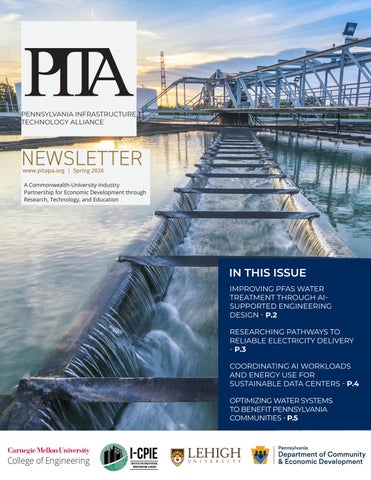
PITA Newsletter: 2026

Page 1


PENNSYLVANIA INFRASTRUCTURE TECHNOLOGY ALLIANCE

www.pitapa.org | Spring 2026

A Commonwealth-University-Industry Partnership for Economic Development through Research, Technology, and Education

IN THIS ISSUE

IMPROVING PFAS WATER TREATMENT THROUGH AISUPPORTED ENGINEERING DESIGN - P.2

RESEARCHING PATHWAYS TO RELIABLE ELECTRICITY DELIVERY - P.3

COORDINATING AI WORKLOADS AND ENERGY USE FOR SUSTAINABLE DATA CENTERS - P.4

OPTIMIZING WATER SYSTEMS TO BENEFIT PENNSYLVANIA COMMUNITIES - P.5

Directors’ Letter

The Pennsylvania Infrastructure Technology Alliance (PITA) has connected Pennsylvania’s companies with the Commonwealth’s world-class university researchers and their students for the past 28 years, promoting economic development in Pennsylvania. Funded by the Pennsylvania Department of Community and Economic Development (DCED), PITA helps Pennsylvania increase the state’s market competitiveness through the development of new technologies and process improvements.

We are proud of the program’s strong history of working with Pennsylvania companies and students to foster economic growth in the state. The program has supported over 1,450 technology and process improvement projects in partnership with more than 570 Pennsylvania companies, obtaining more than two dollars of funding from industry and federal sources for every dollar of state funding. PITA has also mobilized more than 525 faculty members and over 2,400 students to work on Pennsylvaniaspecific technology, process improvement, and educational outreach projects. It has also enabled 15 startup companies to be created from PITAsponsored technologies.

In this edition of the PITA Newsletter, we highlight recent partnerships with:

• Circular Water Solution, LLC (Ambler, PA) and Ethos Collaborative (Pittsburgh, PA)

• Duquesne Light Company (Pittsburgh, PA)

• Bosch Research (Pittsburgh, PA)

• CoStream (Berwick, PA)

As always, we welcome partnerships with new companies. Those interested in working with faculty and graduate students on short-term technology development or process improvement projects should contact the PITA associate directors: Chad Kusko at Lehigh University (chk205@lehigh.edu) or Colleen Mantini at Carnegie Mellon University (cmantini@cmu.edu).

BURAK OZDOGANLAR

PITA Co-Director

Carnegie Mellon University ozdoganlar@cmu.edu

ALBERTO LAMADRID

PITA Co-Director

Lehigh University

all512@lehigh.edu

PITA Newsletter 2026

Improving PFAS Water Treatment through AI-Supported Engineering Design

The Water Resources Development Act (WRDA) of 2024 outlines federal priorities for conserving and developing U.S. water resources and infrastructure. One growing priority is ensuring that water treatment systems can remove per- and polyfluoroalkyl substances (PFAS), often referred to as “forever chemicals,” from public drinking water.

“PFAS are synthetic chemicals that can persist in water and accumulate over time, which can be harmful to humans when ingested in large amounts,” says Pingbo Tang, associate professor of civil and environmental engineering at Carnegie Mellon University (CMU).

“The Environmental Protection Agency is regulating water treatment nationwide to ensure that water utilities achieve a certain level of PFAS compliance to protect the health of the community.”

Designing systems to remove PFAS from drinking water is a complex engineering challenge because conventional treatment is often ineffective, and regulations are tightening. Engineers typically adapt established technologies—such as granular activated carbon, ion exchange, and membranes—but must re-optimize them for PFAS behavior and new regulatory limits, often based on site-specific pilot testing and evolving design guidance.

To address this challenge, CMU researchers are collaborating with industry partners Circular Water Solution, LLC (Ambler, PA) and Ethos Collaborative (Pittsburgh, PA) to help water utilities move more quickly from design concept to engineered systems and deployable infrastructure.

Jinghua Xiao, president and principal engineer at Circular Water Solution, served as the project’s environmental engineer. She brought extensive experience in environmental issues and water chemistry to address the regulatory specifications for PFAS systems.

“Dr. Xiao is the domain scientist on this project," says Tang. "She provided our team data to analyze the relationship between chemical doses and the treatment speed of the water—calculations that are EPA-regulated and therefore critical to testing your design.”

Meanwhile, Damon Weiss, a civil engineer at Ethos Collaborative, contributed his expertise in water infrastructure design and engineering to the project.

“We are leveraging Damon's expertise to build a digital twin of CMU’s campus to understand how sewage systems generate wastewater and how wastewater should be treated," says Tang. "This analysis of an existing sewage system helped us build a knowledge base for differentiating between good and poor engineering design.”

Tang explains that support from industry partners helps researchers tackle what engineers call an ill-defined problem— one where existing treatment technologies must be re-engineered and integrated under new regulatory constraints and site-specific conditions. Rather than designing PFAS systems entirely from scratch, engineers face a tedious, iterative process of adapting and optimizing available options into deployable treatment trains, a task that increasingly requires digital computational tools to coordinate design–engineering collaboration.

The project investigated how artificial intelligence can streamline the design process for PFAS treatment systems. By analyzing how high-performing engineering teams communicate during the design process, the researchers hope to identify strategies that help water utilities move more quickly from concept to deployable infrastructure. Communication gaps between teams of environmental engineers (process designers) and mechanical engineers can lead to repeated design iterations, slowing the delivery of deployable solutions.

“What we are trying to do is observe both high-performing teams and teams that struggle with communication,” says Tang. “By studying how these groups exchange information, we hope to identify communication patterns that help teams reduce the number of design revisions needed to reach a final solution of mechanical systems design that properly implements the process design subject to all engineering constraints.”

To study how design decisions affect system usability, the research team is testing designs in a digital twin environment. In these simulations, human operators interact with an AIpowered assistant as they learn to operate a virtual water treatment system. Operators can ask the AI co-pilot questions about procedures—such as whether a particular action is safe or appropriate. Each interaction provides the engineering design team with feedback on parts of the design that can cause difficulties for operators in monitoring and controlling the mechanical systems that should fully satisfy the expected PFAS treatment performance subject to engineering constraints.

“We can compare two designs based on the questions users ask,” Tang explains. “If operators need fewer clarifying questions to understand how the system works, that’s usually a sign of a better design. Ideally, the system should be intuitive enough that operators can run it safely and efficiently without relying heavily on chatbot support.”

Continues on page 6

Researching Pathways to Reliable Electricity Delivery

Customers rely on electric utilities to deliver reliable electricity to their homes without interruption. Duquesne Light Company (DLC), a Pittsburgh-area electric utility serving more than 600,000 customers in two counties, knows this well. To better serve its customers, DLC developed its own research lab to explore new technologies, processes, and implementation methods to enhance energy delivery.

DLC partnered with Javad Khazaei, assistant professor of electrical and computer engineering at Lehigh University, to explore this effort. Khazaei leads the INTEGrated, Resilient, and IntelligenT energY systems (INTEGRITY) Lab at Lehigh University, where his team studies grid challenges in a laboratory setting.

The electric power grid that supplies most modern infrastructure operates predominantly using alternating current (AC). AC power is the standard for bulk generation and longdistance transmission. It is produced at power plants, stepped up to high voltages for efficient transport over transmission networks, and then stepped down through distribution systems before being delivered to homes and industries.

In contrast, direct current (DC)-based architecture offers several technical advantages at the system level, including simpler protection coordination, more straightforward powerflow control, and fewer conversion stages for inherently DC resources and loads. Consequently, DC is often considered more efficient and cost-effective in certain applications, particularly in modern grids with high penetration of power electronics, renewable energy sources, storage systems, and data-center-type loads.

In this collaboration with Khazaei’s team of researchers, DLC wanted to investigate the development of a DC power grid.

“This is part of DLC’s grid modernization plan,” Khazaei says. “Instead of having an AC utility system, they wanted to explore the feasibility of localized DC systems serving different districts. They were testing to see what kinds of issues they might face if they operated these DC systems.”

Since this work aligns with DLC’s future plans, the research team developed recommendations for controlling and protecting DC grid systems.

Khazaei says, “This research developed a computationally efficien t equivalent fault model for grid-interlinking converters in DC microgrids, enabling accurate prediction of transient and steadystate responses to grid-side symmetrical faults and supporting large-scale resilience assessment without the heavy computational burden of detailed electromagnetic transient simulations.”

Establishing a viable DC grid architecture has the potential to reduce system costs through improved conversion efficiency and simplified protection schemes while enhancing resilience to faults and disturbances. The research conducted by Khazaei’s lab on modeling and protecting DC microgrids can contribute to more reliable and cost-effective power delivery to end users over the long term.

A similar collaboration was initiated in 2025 between the INTEGRITY Lab and DLC to evaluate microgrid components, including grid-forming and grid-following inverters, protection devices, and real-time simulation platforms. To avoid the operational risks and service disruptions associated with testing on energized utility infrastructure, DLC established an in-house research and validation laboratory capable of emulating a range of operating conditions.

Continues on page 6

Dr. Khazaei's research team (left to right): Zhongtian Zhang, Elham Jamalinia, Maral Shadaei, and Dr. Javad Khazaei.

Coordinating AI Workloads and Energy Use for Sustainable Data Centers

Artificial intelligence (AI) is poised to drive the next industrial revolution. Large language models alone attract millions of users weekly and process billions of prompts each day. Despite its proven utility across virtually every industry, the data centers powering these systems consume enormous amounts of electricity, placing considerable pressure on the electric grid.

As AI adoption accelerates, data center power consumption is projected to rise significantly. Meeting that demand by building new data centers is costly, both financially and in navigating regulatory requirements. At the same time, the rapid growth of AI computing is creating new challenges for energy providers trying to maintain grid stability.

Researchers at Carnegie Mellon University (CMU) are partnering with Bosch Research (Pittsburgh, PA) to explore how AI data centers can operate more efficiently by coordinating computing workloads with energy availability. Their project focuses on jointly optimizing AI job scheduling and energy use to reduce grid strain and increase renewable energy utilization.

“The world is going through a major AI revolution in regard to large models that are changing our daily lives,” says Guannan Qu, assistant professor of electrical and computer engineering at CMU. “These large models must run in data centers, which consume substantial energy. This, in turn, only feeds the interest to develop even more data centers to support additional models.”

Large AI workloads can place significant strain on electrical infrastructure. When major training jobs start or end, sudden changes in demand can disrupt the power grid and affect nearby communities.

“AI labs run large training workloads, which causes frequency fluctuations on the grid because those workloads will use a lot of energy but then suddenly will use much less energy,” says Gauri Joshi, associate professor of electrical and computer engineering at CMU. “Energy providers occasionally need to bring in additional sources of energy, such as spinning up generators, to support increased energy demand. This can affect people living near data centers, raising their electricity bills. Reports of these cases are appearing in many states that have data centers, including Pennsylvania.”

To address these challenges, the research team is investigating how AI workloads can be scheduled more intelligently to work around peak energy demands. Instead of running computing tasks whenever servers are free, data centers could align workloads with periods when renewable energy is abundant.

“If you think about a data center that has a renewable energy element in it, such as a battery system, you want to schedule the AI jobs to match your renewable generation, which can be highly variable,” says Qu. “Ideally, you want to schedule more of your AI jobs to run when more renewable energy is available and defer non-urgent AI jobs for a later time when renewable energy is scarce.”

AI workloads vary widely in their size, duration, and urgency, presenting opportunities for more flexible scheduling strategies.

“AI training jobs often use hundreds of servers for a long period of time—sometimes for several days or even weeks at a time,” says Joshi. “Although these jobs are large-scale and consume large amounts of energy, they are somewhat flexible: you can pause the task and then resume it later. Conversely, AI inference jobs—such as sending a prompt to ChatGPT and waiting for a reply—consume less energy but are more time-sensitive. We’re taking time constraints into account when scheduling such inference jobs.”

To manage these complex scheduling decisions, the researchers are exploring machine learning techniques to predict energy availability and optimize the distribution of computing workloads.

Joshi explains: “From the energy system management perspective, if we want to incorporate renewables into the energy mix that is used to run data centers, we need a good prediction of how much energy is going to come in from the renewable sources. To do that prediction, we could use AI concepts like reinforcement learning.”

The CMU team is currently working with Bosch Research to evaluate the approach by applying AI training and inference workloads in a computing cluster. If successful, the project could enable data centers to rely more heavily on renewable energy while continuing to meet the rapidly growing demand for AI.

“The Bosch team has readily been willing to share their time with our students,” says Joshi. “Bosch researchers regularly schedule meetings with our students, which has greatly aided the project’s development. They are also willing to host some of our students as interns, which has made the project a fantastic two-way collaboration.”

The CMU–Bosch team anticipates the project will generate valuable insights for designing future AI infrastructure, particularly as states like Pennsylvania attract new data center development. Continues on page

Optimizing Water Systems to Benefit Pennsylvania Communities

In 2022, Farrah Moazeni, assistant professor of civil and environmental engineering at Lehigh University, received a PITA grant for a project focused on improving how smart water systems operate in small- to medium-sized Pennsylvania communities.

The research was based on an algorithm that Moazeni and her team developed as an advanced control for cyber-physical systems—systems that use data analysis to manage physical processes. A common example is an office building control system that automatically adjusts lighting and temperature to optimize efficiency.

Moazeni lab-tested her algorithm on several projects but wanted to test it in a real-world setting to "scale it up to an actual water network." This opportunity came via CoStream, an industry partner Moazeni has worked with on several other projects.

CoStream (Berwick, PA) helps municipalities monitor and optimize their water systems. The company installed its supervisory control and data acquisition (SCADA) technology into the water-energy infrastructure of Galeton, PA, a mid-sized, low-income community in the state’s Northern Tier. Through her partnership with CoStream, Moazeni was able to integrate her algorithm with realtime data from Galeton’s system. Moazeni says the township is “the perfect size to allow us to test the algorithm's scalability,” and its recent upgrade to a SCADA system enabled real-time data use.

Moazeni’s algorithm has demonstrated benefits for water systems in two Pennsylvania communities—Galeton and Telford—largely based on cost-saving efficiencies. The algorithm “not only improves the water system,” Moazeni says, “it optimizes the scheduling of the pumps.” This approach helps municipalities streamline electricity consumption, saving money on energy expenses.

The algorithm can also save on maintenance and repairs by extending the lifespan of the valves in the water system through smart operation. Moazeni says the algorithm should scale to a larger municipality, though it has not yet been tested.

Hank Hosler, CEO and president of CoStream Technologies, Inc., endorses the project, saying it “fostered strong synergies between academia and industry, enabling us to identify new opportunities to enhance water distribution systems,” and advance applied research in water systems, leading to a scalable system for waterenergy systems.

In line with PITA’s mission, the project was squarely centered in Pennsylvania industry and attuned to the program's goals. Moazeni was happy to work with CoStream, a business founded in

and operating primarily in the Commonwealth, and to do work that will benefit low-income communities as they modernize their infrastructure. “We wanted to make sure that if a low-income community wants to adopt it, they can do that,” says Moazeni.

The project also contributes to the development of the Commonwealth’s workforce for both collaborators. CoStream is employee-owned, and Moazeni says this type of project serves as a way for Lehigh undergraduate students to develop valuable skills that can make them more successful in the job market. Hosler notes that the collaboration between CoStream and Lehigh provided “valuable experiential learning for students and practical insights for industry practitioners.”

“I had two master’s students and one undergraduate student supervised by a Ph.D. student who worked on this PITA project with CoStream,” Moazeni says. “They all got a job right after that, and the skills that they used to get those jobs are the skills they used on this PITA project.”

Moazeni says the area of water systems is expanding as data centers, known to be water-intensive, are being developed. “You have tech companies that are hiring water people—they need people who understand machine learning, optimization, coding, things traditionally that only software engineers would learn. These are things they learn by doing these kinds of interdisciplinary projects.”

Moazeni is grateful for the PITA program–not only for the research it allows her to conduct, but also for its help in attracting undergraduates interested in research. PITA allows for demonstration-oriented industry research, which attracts and involves undergraduates. The project ultimately delivers three benefits: solving a real-world industry problem, helping Pennsylvania communities operate more economically, and preparing students with valuable workforce skills. 

Dr. Farrah Moazeni is the Director of the interconnected Critical infrastructure systems engineering (CONCISE) laboratory at Lehigh University.

PFAS Water Treatment

Continued from page 2

After these simulations, the researchers plan to use another AI system to analyze the conversations between the chatbot and the operators. Identifying recurring questions or points of confusion can help designers modify aspects of the design to reduce uncertainty.

Tang believes that capturing the behaviors and communication patterns of high-performing PFAS treatment process designers and engineering teams can help other designers and engineers.

“As we study how PFAS treatment process designers and engineering teams collaborate, we’re asking ourselves how their behaviors can be captured and reused in future water treatment system design and engineering projects,” he says. “We’re hopeful that what we learn through this project will not be limited to water system design. These approaches could be used broadly in civil engineering and product design research.” 

Sustainable Data Centers

Continued from page 4

“Pennsylvania is set to become a national leader in data centers,” says Qu. “I hope the output of this research project will inform the design of the future generation of data centers, which can tremendously improve the sustainability and lower the grid-integration barrier of these data centers. That's a win for Pennsylvania's economy.”

Joshi adds that the work reflects a growing intersection between two rapidly evolving fields.

“We are excited about the convergence of AI and energy,” says Joshi. “AI requires so much energy, and it's growing exponentially. We’re excited to see if this project can lead to more sustainable, stable growth of AI in the long term without adversely affecting the energy system that's supporting it.” 

Reliable Electricity Delivery

Continued from page 3

Within this environment, DLC engaged Khazaei’s team to support the design and development of an AC microgrid test configuration composed of multiple hybrid inverters capable of operating in both grid-connected and islanded modes. The primary objective was to characterize the dynamic performance and protection behavior of commercially available inverters under realistic scenarios, including fault events, large load transients, and other system disturbances.

The study can also inform further research into protection devices. Jessica Valentine says, “The research performed by Lehigh University under the award for integration of distributed energy resources (DERs) to the grid via DC interlinks provided valuable information on protection requirements of DERs for grid integration, which informed potential investment planning for DLC utilities, increased stakeholder engagement, and provided insight into future project pathways.”

Khazaei expects his partnership with DLC to continue, particularly as the power company continues to develop its research program. Lehigh’s facilities, which consist of commercially available products, complement DLC’s facilities.

DLC provides parameters for a scenario or a set of operating conditions, and Khazaei uses his lab equipment to perform testing, emulation, and modeling of those faults.

Khazaei is in the process of bringing Siemens into a PITA project with DLC, expanding the collaboration. Josh Gould, director of Advanced Grid Solutions and Enterprise Strategic Planning at DLC, also expresses hope that the connection between DLC and Lehigh University will continue in “future research collaborations with regional partners.”

For Pennsylvania, this collaboration can result in a more efficient and resilient energy grid, offering better service to customers overall. In an era when energy consumption is rising steeply, research into future grid improvements by Lehigh University and DLC can produce the technologies needed to meet that demand, as well as a technically proficient workforce to keep it running smoothly. 

PENNSYLVANIA INFRASTRUCTURE TECHNOLOGY ALLIANCE

PITA is an industry-led program that enables companies to identify opportunities for Lehigh University and Carnegie Mellon University, and for the universities to provide expertise and capabilities, through faculty and students, that the companies may not otherwise be able to access.

Pennsylvania companies gain access to faculty expertise, university equipment, and students. University faculty and students are afforded the opportunity to work on real-world, market-driven challenges confronting Pennsylvania companies.

Faculty and students assist companies in creating technology of the future and enhancing the competitiveness of Pennsylvania companies with the goal of the creation of jobs in Pennsylvania and the retention of highly trained/educated students in Pennsylvania.

PITA Technology focus areas include:

• Transportation

• Telecommunications and information technology

• Facilities

• Water systems

• Energy

• Life sciences

• Hazard mitigation & disaster recovery

Contacts

Nathan Edward Snizaski Chief Editor

Carnegie Mellon University nathanedward@cmu.edu 412-268-9157

Chad Kusko PITA Co-Associate Director Lehigh University chk205@lehigh.edu 610-758-5299

Colleen McCabe Mantini PITA Co-Associate Director Carnegie Mellon University cmantini@cmu.edu 412-268-5314

CARNEGIE MELLON

Turn static files into dynamic content formats.

Create a flipbook
PITA Newsletter: 2026 by CMUEngineering - Issuu