Centralight, Central Michigan University Alumni Magazine, Special Issue, Spring 2026
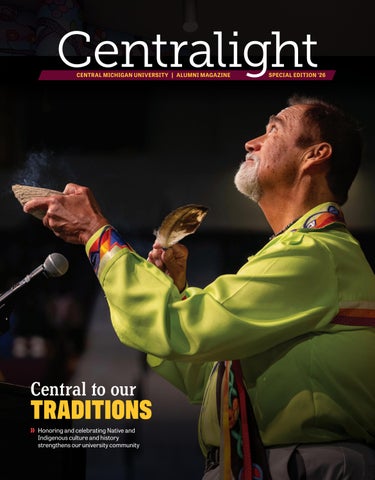
Honoring and celebrating Native and Indigenous culture and history strengthens our university community
Executive Editor and Deputy Chief of Alumni Relations & Constituent Engagement
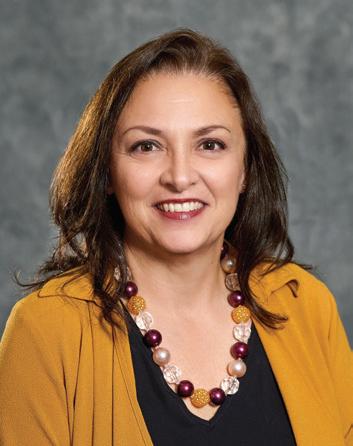
Marcie Otteman, ’87
Editor Robin Miner-Swartz
Visual Media Director
Amy White
Graphic Designer
Erin Rivard, ’07, MBA ’16
Photographer
Michael Armistead
Steve Jessmore Photography
Adam Sparkes
Aaron Moore
Ella Miller
Writers Ray Hall, ’87
Jasmine Locklear
Robin Miner-Swartz
Kasey Perez, ’13
Research Associate
Bryan Whitledge, ’19 M.A.
Editorial Assistant
Alison Foster
Vice President for Advancement
Jennifer Cotter, ’01
Vice President for Marketing and Communications
Harlan Teller
Deputy Chief Marketing Officer for University Communications
Abby Dean
Executive Director for Strategic Communications
Ari Harris
For advertising information
Call Cindy Jacobs, ’93 (800) 358-6903
Send change of address information to: Alumni Relations
Central
Phone: (800) 358-6903
Fax: (989) 774-7159
Email: alumni@cmich.edu
Features Centralight
SPECIAL EDITION 2026
Saginaw Chippewa Indian Tribe
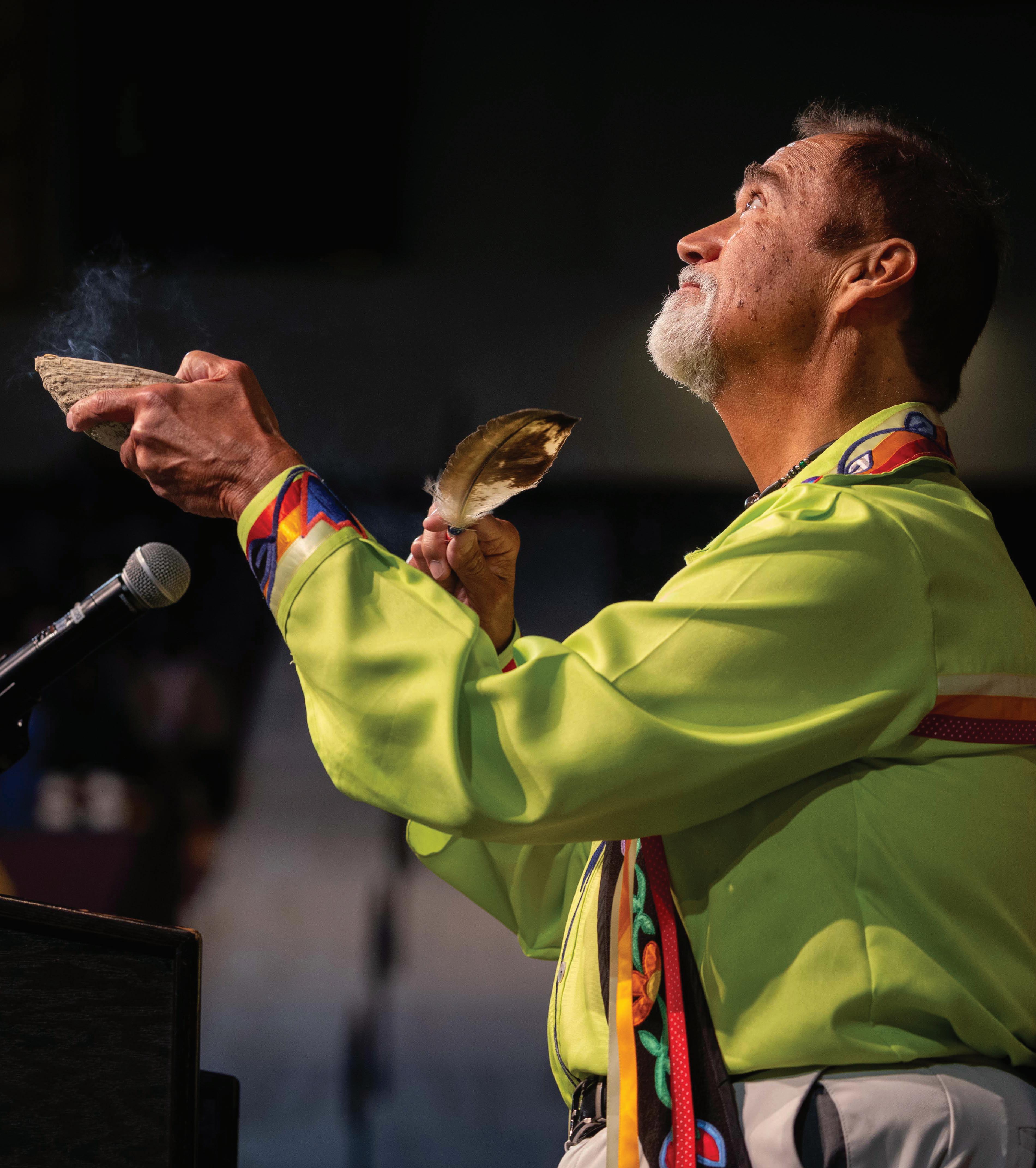
Elder Joseph Sowmick performs a traditional smudging of the commencement stage in December 2025.
Photo by MICHAEL ARMISTEAD
Students, faculty, staff and alumni highlight the importance of visibility on campus.
Celebrating heritage and community
This is an invitation to learn from and honor CMU’s Native and Indigenous students and alumni
We are proud to present our third special edition of Centralight. In this issue, we’re shining a spotlight on the stories, experiences and cultures of our Native and Indigenous students and alumni, continuing our commitment to highlight the many identities and communities that shape the full CMU experience.
As with past special editions, this publication creates space to listen, learn and celebrate the voices that strengthen our university. Each story reflects the deep connections, traditions and leadership that the Native and Indigenous communities bring to our campus and beyond.
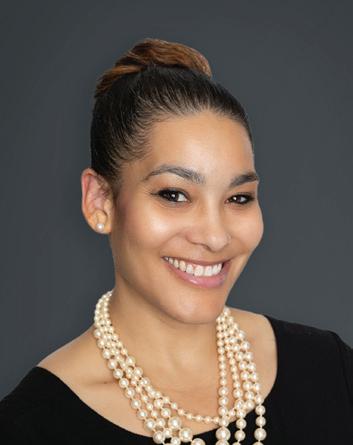
I’m pleased to hand over the remainder of my column space to Dr. Shawna Patterson-Stephens, vice president of university engagement and student affairs, whose team is dedicated to creating an environment where every member of our community can achieve their true potential on campus and in our communities.
I hope you enjoy the stories within this issue.
In addition to following the Associated Press and CMU’s University Communications style guides, throughout this issue, we are reflecting the style of CMU’s Division of University Engagement and Student Affairs regarding language. We followed the lead of the people interviewed regarding how they define their identity.
Greetings, CMU community, and welcome! Over the past year, our university has experienced meaningful, high-level change. New structures, new partnerships and new opportunities have strengthened the ways we serve students and one another. Yet even as we evolve, some things remain constant — our commitment to our values and to the communities who call Central Michigan University home.
The creation of the Division of University Engagement and Student Affairs reflects that commitment in action. By bringing together teams and resources in new ways, we are expanding our capacity to support the many and nuanced ways students grow and develop. This work recognizes that learning does not happen in isolation. The lived experiences of faculty and staff shape the student experience, and community-informed practices help create environments where everyone can thrive.
As a division and as a university, we continue striving toward inclusive excellence. That means embracing new opportunities to cultivate belonging while centering the stories, histories and contributions of our students, faculty, staff and alumni. When people feel seen, heard and valued, they are better able to learn, lead and serve.
I am especially grateful for the opportunity to continue this work at home, alongside fellow CMU alumni. Together, we are strengthening long-standing traditions while also reimagining what our collective future can be.
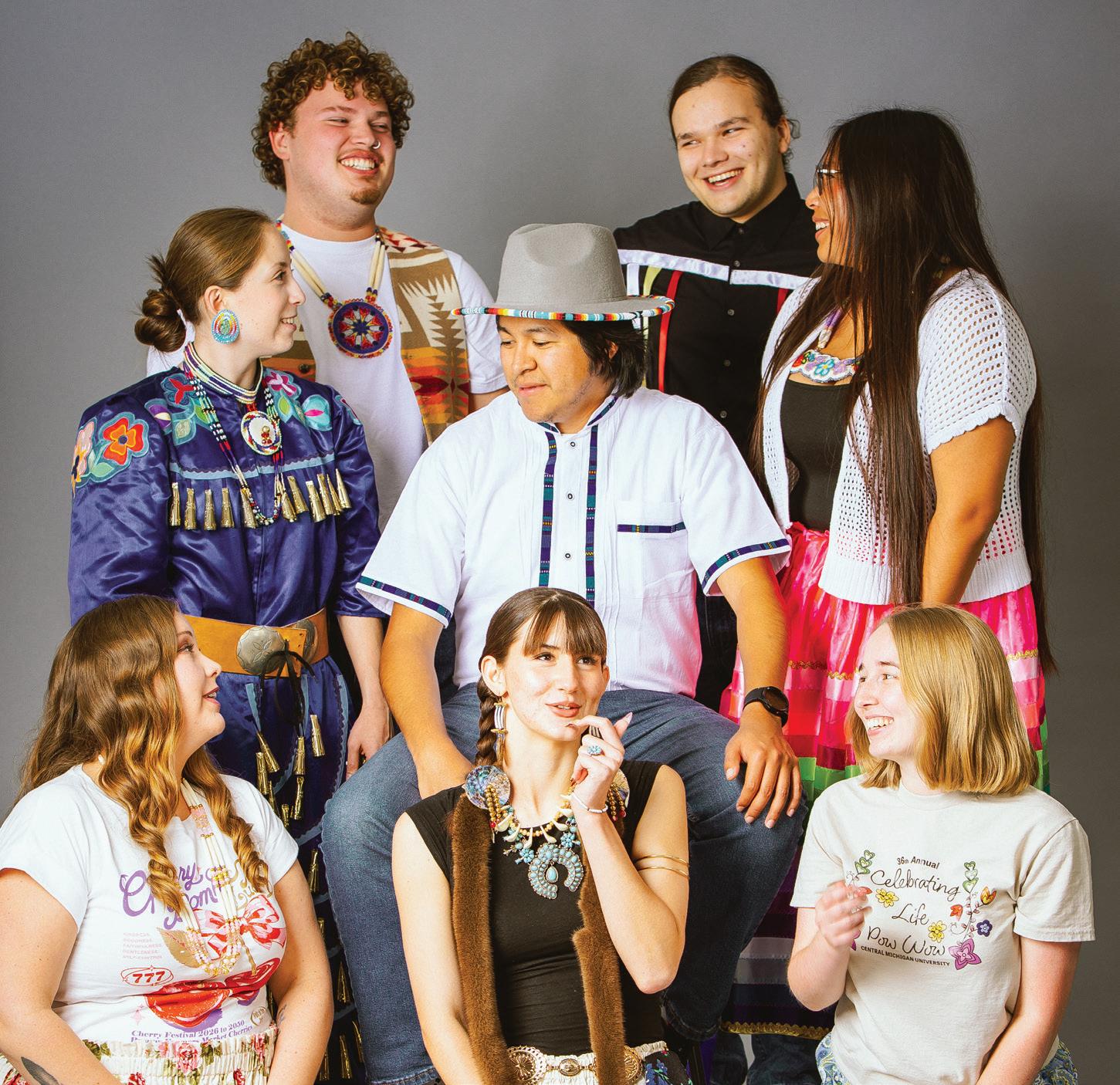
In this special issue of Centralight, we are proud to highlight CMU’s Native and Indigenous alumni and students, representing several tribal nations in the region and across the U.S. Throughout these pages, you will see the many ways culture, heritage and honor show up across our campus and beyond. This magazine highlights the countless ways leadership, resilience and connection to community enrich our university.
There is space for every story at CMU. We invite you to learn, celebrate and continue building this community with us.
Dr. Shawna PattersonStephens, ’03, Vice President of University Engagement and Student Affairs
Walking together in truth and respect
We celebrate Native and Indigenous people and culture at CMU
President Neil MacKinnon, Ph.D.
As I walk across Central Michigan University’s campus, I am often reminded that the ground beneath our feet holds stories far older than our university’s founding. We reside on ancestral Anishinaabe lands, and our relationship with today’s Saginaw Chippewa Indian Tribe is rare and truly special. It is a vital part of our identity.
CMU is profoundly transformed by our Indigenous students, faculty, staff and alumni. They lead us toward a more holistic understanding of our world. Through the lens of the Seven Grandfather Teachings — Wisdom, Love, Respect, Bravery, Honesty, Humility and Truth — our community learns to approach education as a lifelong commitment to the collective good.
The vibrancy of our campus is elevated by Native and Indigenous faculty and staff who bring invaluable perspectives to research and to the preservation of the Ojibwe language and Anishinaabe cultures.
Events like the annual CMU Celebrating Life Powwow are energetic and educational, fostering cross-cultural friendship. And our successful graduates continue to prove that when we learn and work together, we lift all communities.
Our commitment to Native and Indigenous communities seeks to connect historical truth with future opportunity. We are honored to walk this path together, ensuring that our university remains a space where Indigenous culture flourishes.
Chi miigwech,
Neil MacKinnon, Ph.D. President, Central Michigan University
CMU TODAY
Alumna helps others define their own success
Saginaw Chippewa Tribal College president to retire next year
BY RAY HALL, ’87
In every new face on the Saginaw Chippewa Tribal College campus, Carla Sineway sees a version of her younger self, who first enrolled at CMU in 1973.
As a young woman navigating higher education in the 1970s, Sineway, ’88, often felt lost and alone, struggling to find her path. Next year, she plans to wrap up a 40-year career centered around guiding and supporting others. She has worked at the Saginaw Chippewa Tribal College for 23 years, the last 13 as college president.
CMU alumna named to state service role
Isaac appointed to Michigan’s Native American Heritage Fund Board
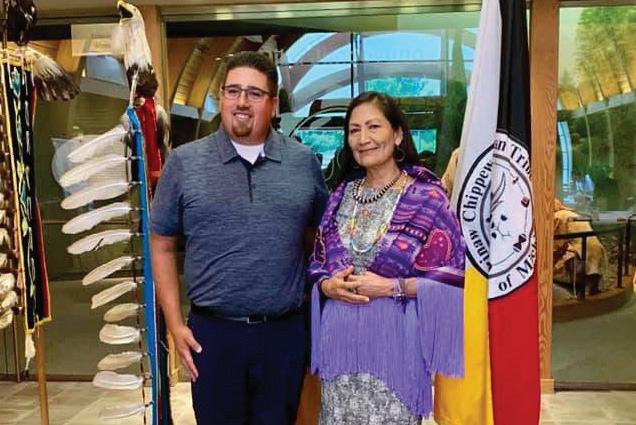
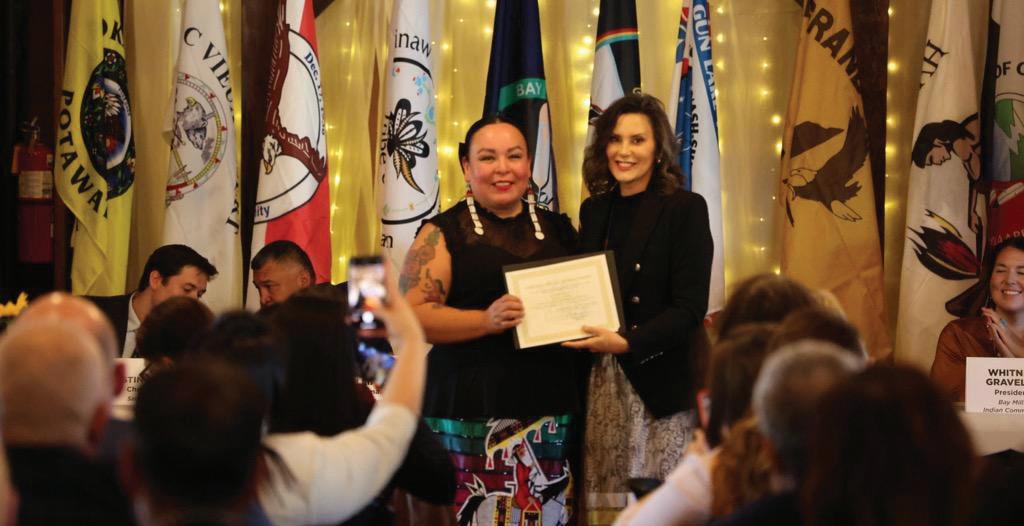
In December, Gov. Gretchen Whitmer appointed Melissa Isaac to the Native American Heritage Fund Board.
“I am deeply honored to receive an appointment from Gov. Whitmer,” said Isaac, ’06, M.S.A. ’15, Ed.D. (in progress). “I look forward to working alongside tribal leaders and partners to continue this important work in a way that honors our ancestors and creates opportunities for future generations.”
Isaac is an enrolled citizen of the Saginaw Chippewa Indian Tribe.
Established by the Nottawaseppi Huron Band of the Potawatomi, the NAHF was created to promote positive relationships between public and private K-12 schools, colleges, universities, local units of government and Michigan’s
“When I graduated from high school, few on the reservation went to college, so there was no one who could really help me through the process,” she said.
“I struggled and ended up at several other schools before coming back to CMU years later.”
Sineway has made it her mission to help others become academically successful and empower them to define their own success.
“Some might say, ‘I’m 40 years old and finally graduated, and now I’ll make sure my kids and grandkids go to college.’
That’s something to celebrate,” she said. “Or maybe a mom with little ones attends part-time and earns a three-point GPA, proving to themselves they’re capable of succeeding academically. We’ll celebrate that, too.”
No individual is their own strength, Sineway said. “Everyone has their personal strength, but they’re made stronger by their surroundings and what they work through.” •
Melissa Isaac (left) poses with Gov. Gretchen Whitmer following the announcement of her appointment to the Native American Heritage Fund Board.
federally recognized Native American Tribes.
Up to $500,000 per year from NHBP’s state revenue sharing payments go into the fund, which is dedicated to promoting understanding, history and good relationships with the state’s Native Americans. The funds are distributed in
the form of grants to schools, colleges and universities, and local governments to assist with initiatives to improve curricula and resources related to Native American issues, and mascot or imagery revisions, ideally in collaboration with Michigan’s federally recognized tribes. •
Carla Sineway, ’88, was honored as the 2024-2025 Tribal College President of the Year by the American Indian College Fund.
CMU TODAY
‘This
land holds the blood memory of our ancestors’ Native American Heritage Month highlights pride for campus community
BY KASEY PEREZ
Since 1990, the United States — including CMU — has celebrated November as Native American Heritage Month.
Although the 574 federally recognized sovereign tribal nations in America have long celebrated their heritage, it’s refreshing to have communities, universities, schools, cities and more recognize and learn throughout the month of November about our rich culture.
When it was signed by President George H.W. Bush into law, designating November as NAHM, there was recognition that Native American people were the original people who inhabited this land.
We know we have grown this land, stewarded this land, protected this land. November is a start for everyone else to learn this piece of history and present-day knowledge.
This land holds the blood memory of our ancestors.
NAHM gives Indigenous people space to bring their art forms forward, space to
share who they are and where they’ve come from.
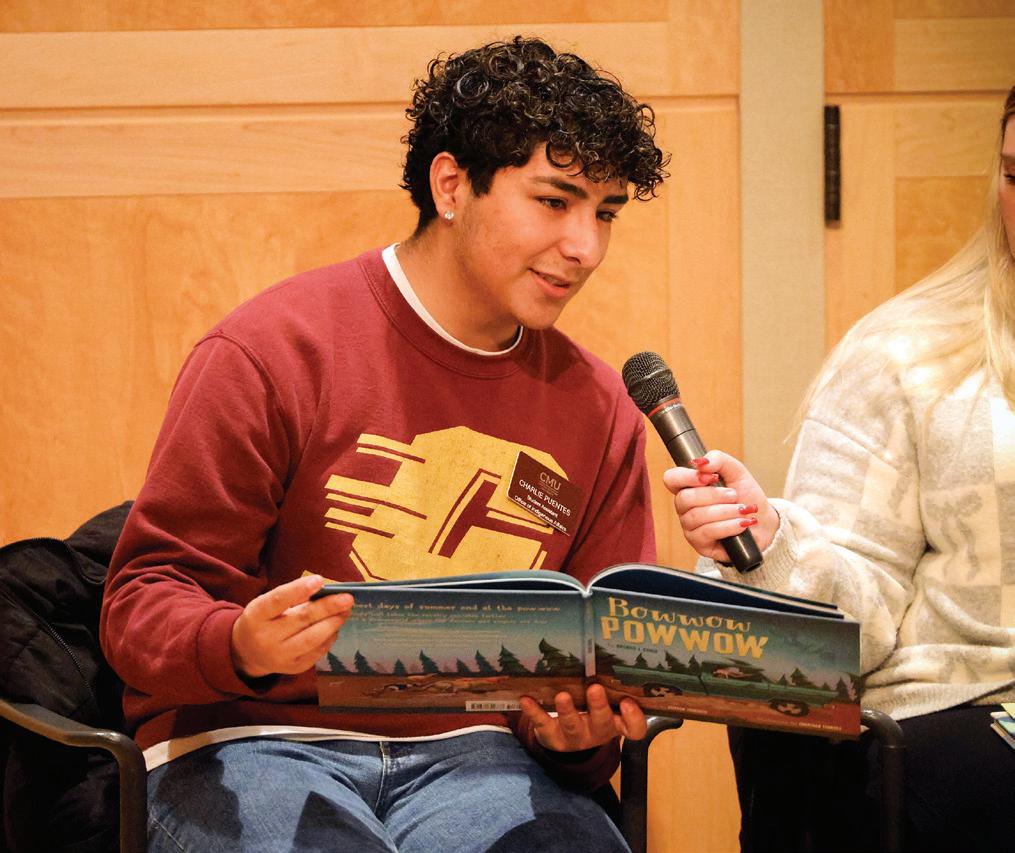
It’s been amazing to see so many wonderful Native authors, singers, actors, educators, rappers, researchers and more on CMU’s campus.
When students attend these events, they are introduced to something they may not have had on their radar, which can lead them to exploring more about the culture and themselves at the same time.
I feel such a sense of pride when I see the
Community Legacy Ball returns to campus
Annual event celebrates inclusive excellence and belonging at CMU
The fifth annual CMU Community Legacy Ball will be held at CMU’s Finch Fieldhouse on April 17.
The event celebrates community successes around inclusive excellence
and belonging throughout the Great Lakes Bay region and across the state.
The night kicks off with live music provided by the Eric Elmoore Quintet featuring a musical collaboration of CMU students, followed by a brief program that includes award recognitions for campus and community engagement, all wrapped around a catered dinner. The evening closes with dancing.
campus community attend NAHM events and learn about Indigenous cultures; the representation taking place matters.
Kasey Perez is the director of the Office of Indigenous Affairs and the Student Transition Enrichment Program at CMU.
This is an abridged version of a column that original appeared in Central Michigan Life. Read the full version here: https://go.cmualum.com/ perezcmlife110625
•
Matt Franklin, ’04, serves as the MC.
Find the list of honorees for this year at go.cmualum.com/cmulegacyball
See past years’ winners at go.cmualum. com/legacyballawardwinners
And be sure to save the date for next year’s event! It will be held on Friday, April 16, 2027. •
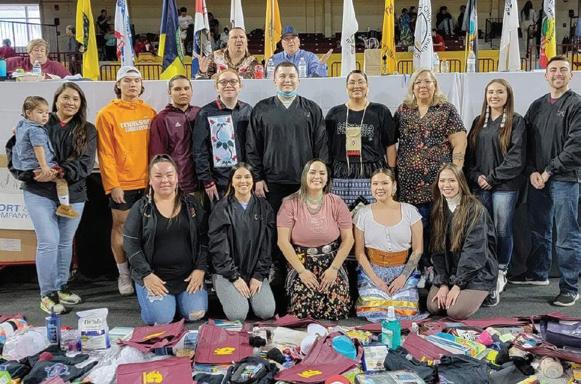
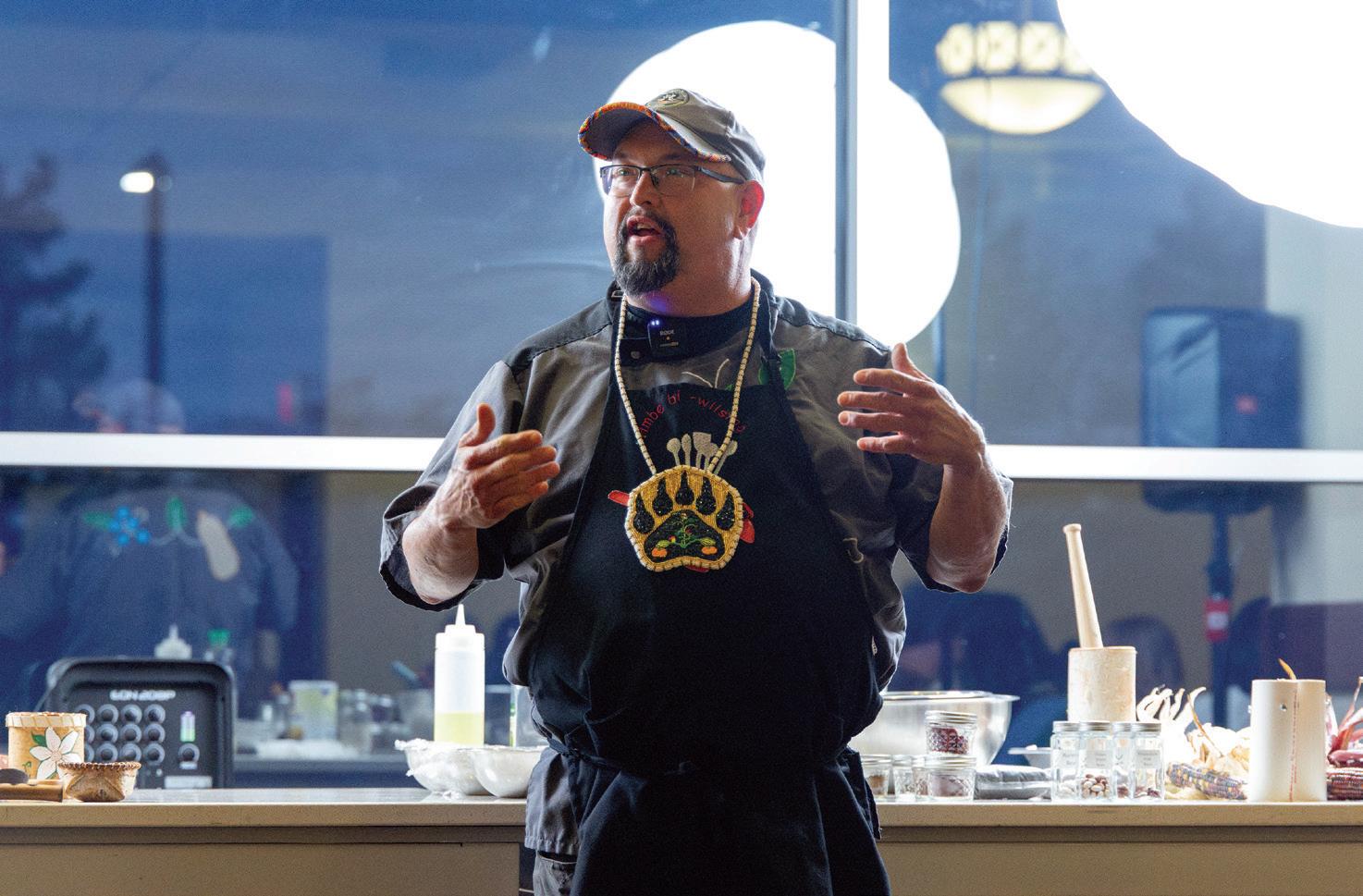
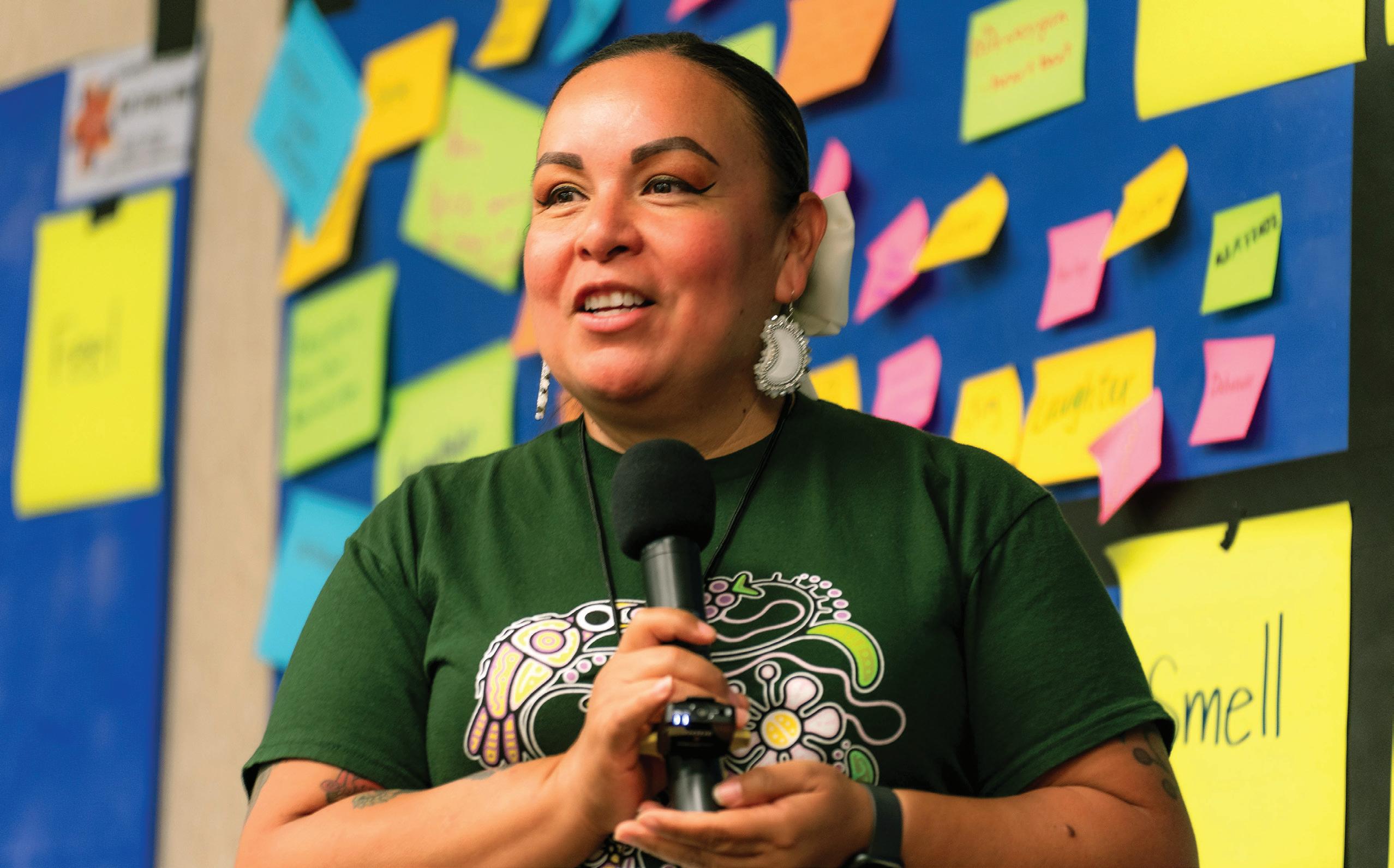
Chef Sam Anglin, a member of the Saginaw Chippewa Indian Tribe, leads an Indigenous food demonstration on campus last fall.
PHOTO
Honoring culture and ceremony
Students, faculty, staff and alumni have helped highlight the importance of visibility for Native and Indigenous presence on campus
The first time Kasey Perez points someone toward Native culture on CMU’s campus, she rarely starts with the biggest, most photographed events.
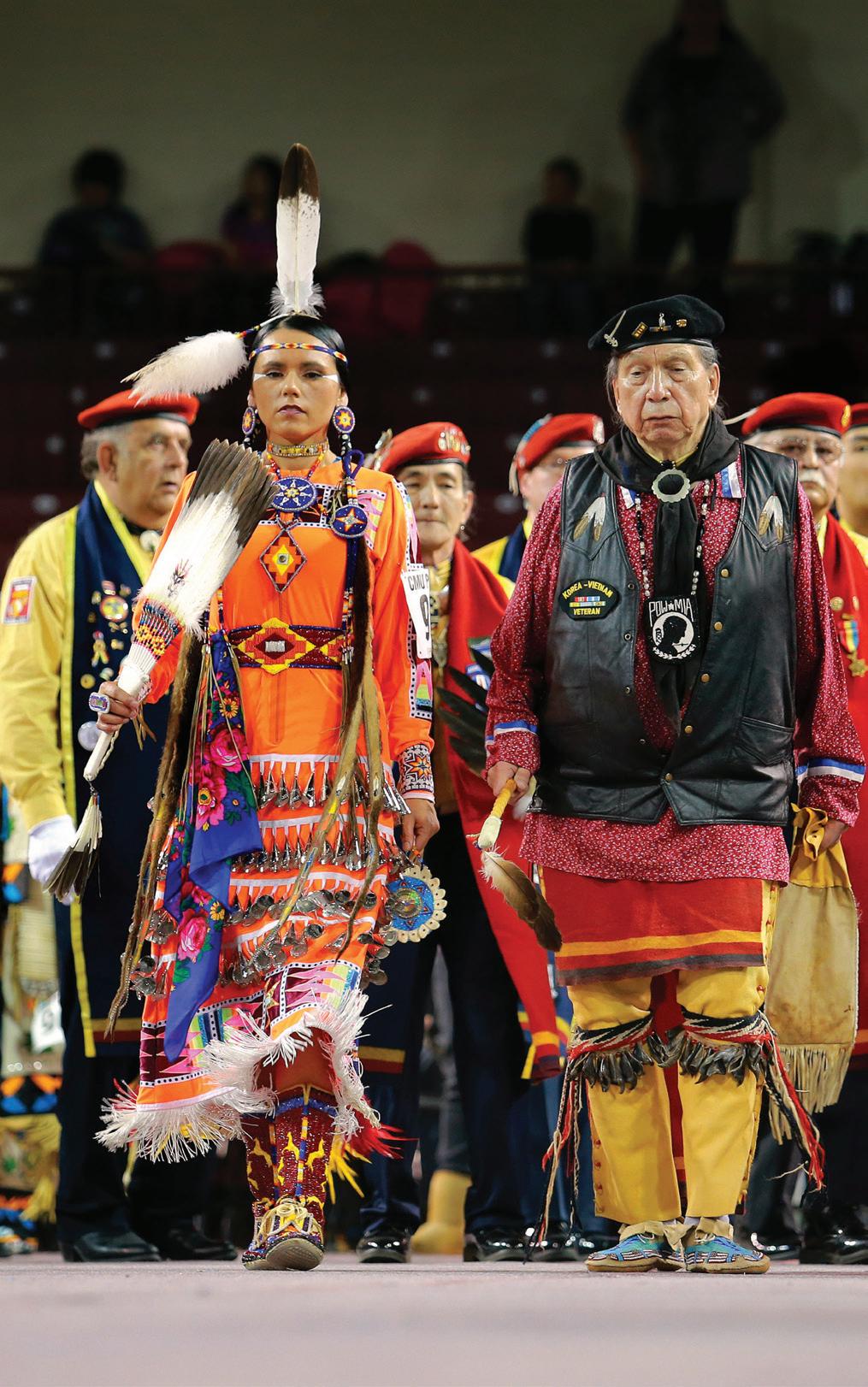
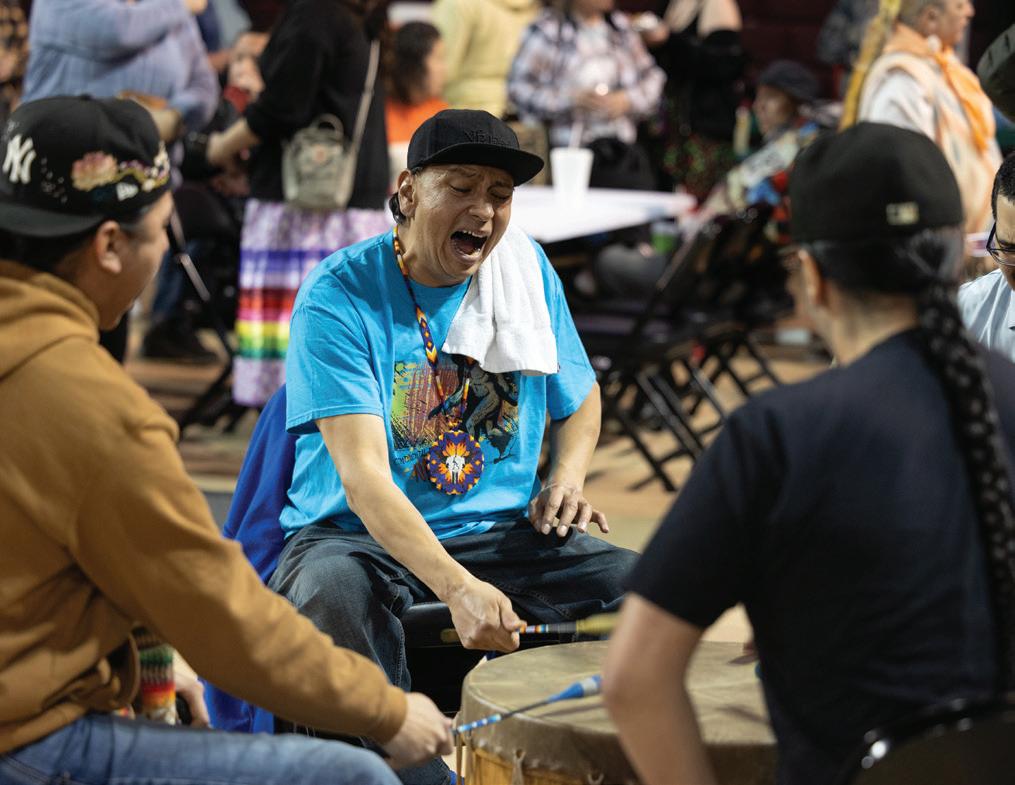
Yes, Central hosts a powwow that draws people back year after year. Yes, drum circles and dancers have become a familiar sight at athletic events. But Perez, director of the Office of Indigenous Affairs, prefers to begin with the quieter, everyday signals that tell Native students, staff and visitors: You are seen here.
“Powwow is much more of a social gathering, as opposed to understanding the culture,” Perez said. “It’s a small part of our culture too. The different ceremonies and the language and what make us who we really are is not centered around powwow.”
Perez, ’13, is Anishinaabe, which includes the Potawatomi, Ojibwe and Odawa nations. She is enrolled with the Hannahville Indian Community, a federally recognized Potawatomi tribe, and has family ties to the Little River Band of Ottawa Indians through her father. She earned her degree from CMU, left Mount Pleasant briefly and returned. By her count, she has been part of this campus work, in one role or another, since 2009.
The office Perez leads has been on campus for decades, though its name is newer. In fall 2023, the Office of Native American Programs became the Office of Indigenous Affairs. Perez stepped into the director role in January 2024.
That evolution mirrors what she has watched among students. When Perez was a first-year student, membership in the Native student organization was small enough to count on one hand. “There was like four of us,” she recalled. Today, she sees events fill and, at times, overflow. “They want more, and they want to see things done the correct way, from the lens of the Anishinaabe people.” >
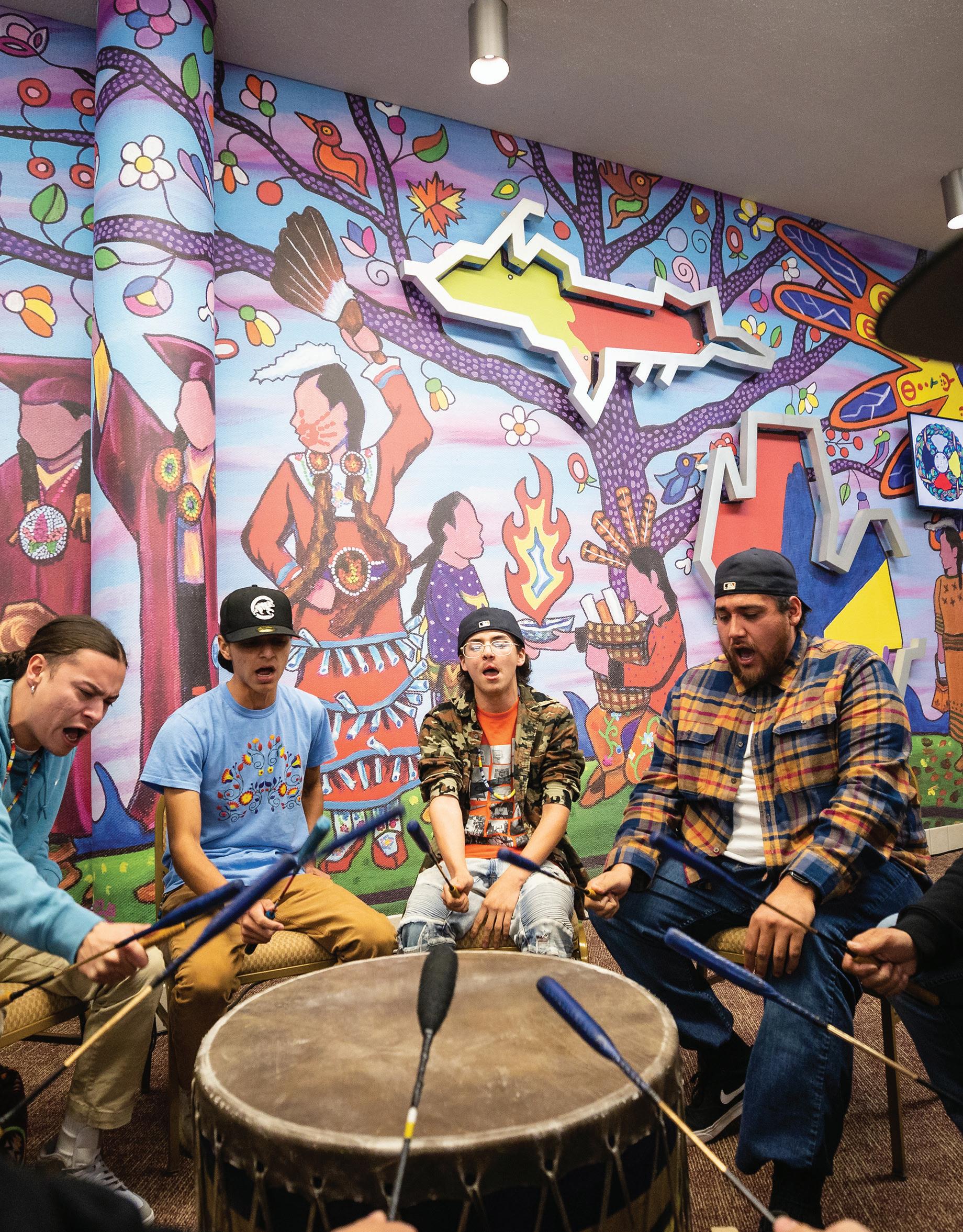
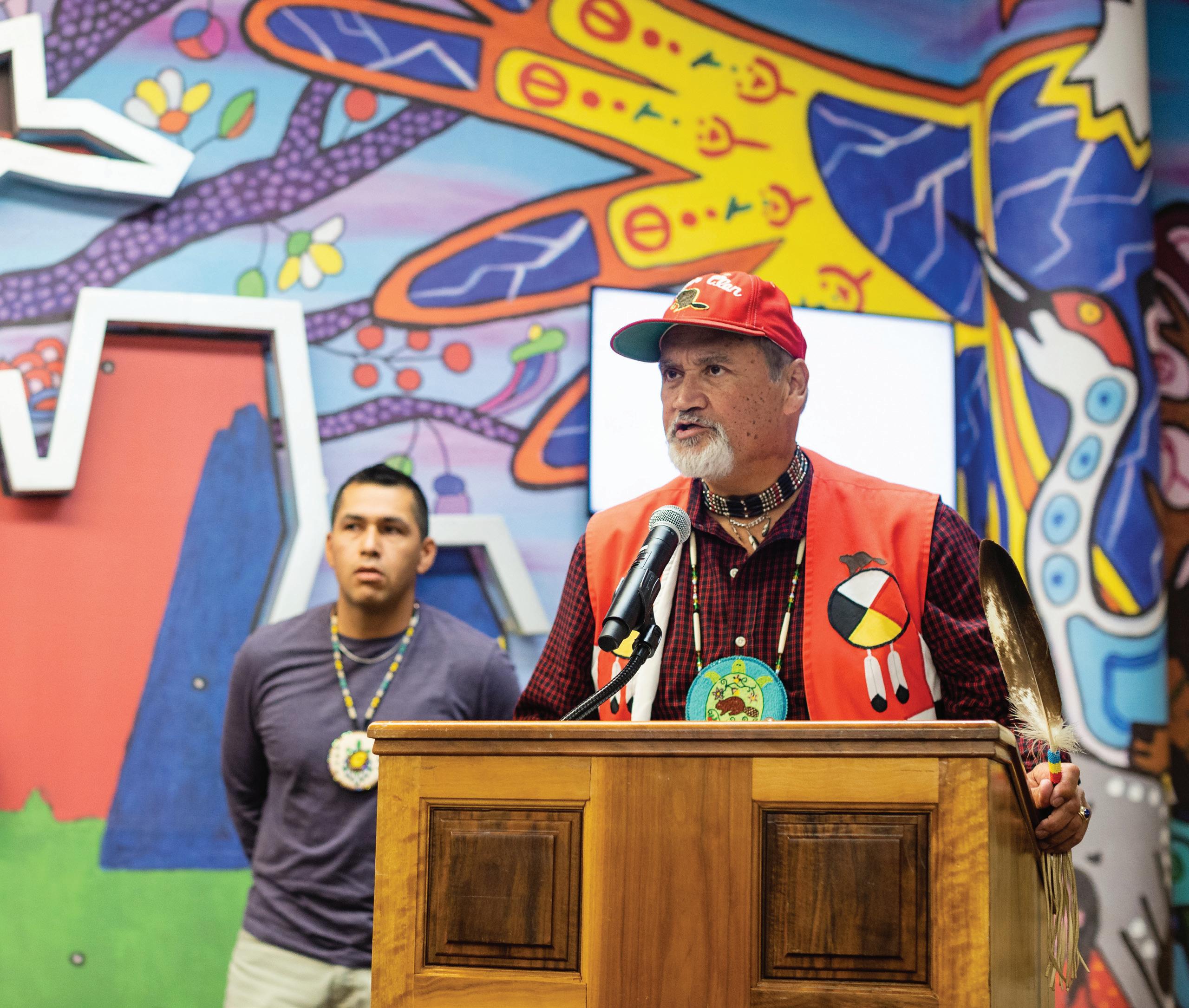
Some of what students want is visible from the moment someone walks into the Bovee University Center. Since October 2022, in the building’s rotunda, a mural by Anishinaabe artist Alan Compo anchors the space, offering an unmistakable statement that Native people belong at the center of campus life, not at its margins.
That mural exists because students advocated for it.
Onyleen Zapata, ’22, an enrolled citizen of the Nottawaseppi Huron Band of the Potawatomi, helped lead the effort as a student. She also has family ties to multiple Ottawa bands and identifies as Mexican and Comanche. A Michigan native who grew up near the Pine Creek Indian Reservation and earned a degree in anthropology with a minor in museum
studies, Zapata now works for her tribe as tribal historic preservation officer.
For Zapata and Ayebah Wilson — her friend and fellow CMU student — the mural began as a practical question with a bigger purpose.
“For a school to be named after Chippewas, making sure that’s properly represented was a big thing,” Zapata said.
It is also a key part of creating a welcoming environment.
“It would have been really important to see a mural walking in,” Zapata said, thinking about her first days on campus.
“That’s one of the first buildings you go to after you check in for orientation. If I could have seen that when I was 18 years old, that would have been like, whoa, we’re here.”
If the mural is one kind of welcome, language is another.
In recent years, CMU students have gained new ways to learn Anishinaabemowin, the Ojibwe, Odawa and Potawatomi languages, including classes taught by Judy Webkamigad (see sidebar, Page 7). Perez sees those offerings as part of a broader shift toward cultural knowledge that students can carry into daily life, not just special events.
She also points to the growing presence of tribal elders at campus events and cultural teachings that help students connect to practice and spirituality while living in a modern college setting.
“We’ve been able to have more of a hands-on presence with different tribal elders from across Michigan,” Perez said. For students who did not grow up in their tribal communities, those gatherings can fill in what distance and circumstance interrupted.
“They’ve been able to come to events and learn about smudging and why we do that, learn about a water ceremony, learn about how to use traditional tobacco to pray, and how we can do that on a college campus.”
For Hannah Bartol, that bridge between campus life and Native life became personal work.
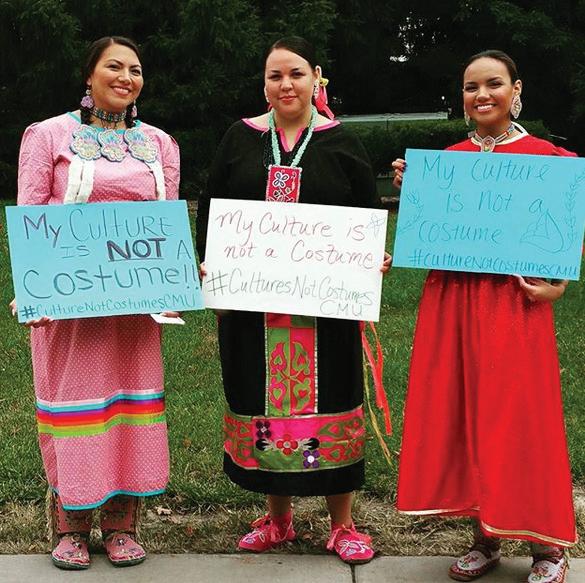
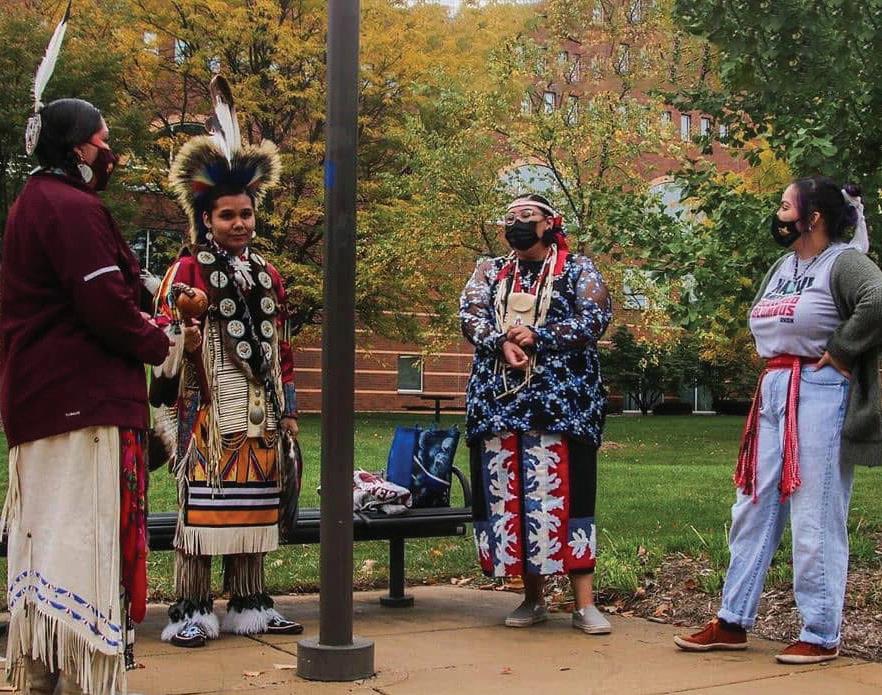
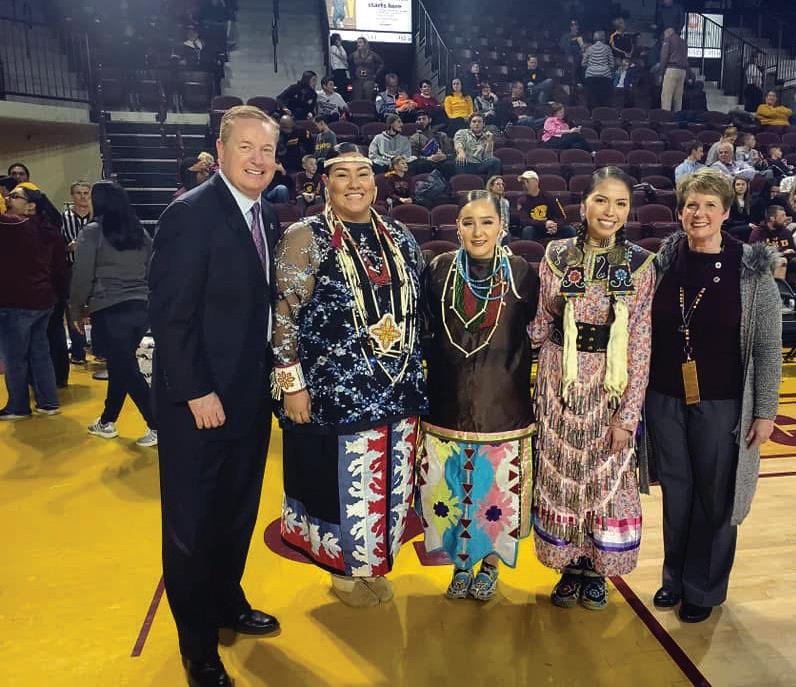
Former CMU President Bob Davies (left photo) welcomes people to campus for the 2022 powwow. Former CMU Athletic Director Michael Alford (right photo) poses with dancers Onyleen Zapata, Cicilee Chivis and Maya Schuyler and former CMU First Lady Cindy Davies at a 2020 basketball game.
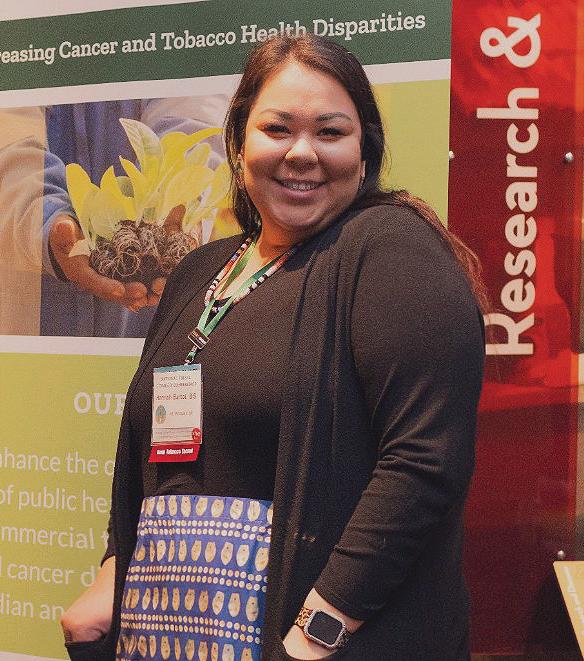
Bartol, ’19, grew up in Escanaba and attended the tribal school on the Hannahville Indian Reservation before coming to CMU. She earned a Bachelor of Science in health administration and now works as a program associate with the National Network of Public Health Institutes, focused on research and evaluation for a public health infrastructure grant.
As a student employee in what was then the Office of Native American Programs, she looked around campus and began asking simple questions that led to permanent change.
“I saw that other schools were doing Indigenous Peoples’ Day,” she said. “And I said, ‘Hey, do we do that here?’”
When the answer was no, she took the idea to Student Government Association, drafted legislation by studying models from other campuses and built the case for why it mattered at CMU, given its proximity to the Saginaw Chippewa Indian Tribe and the university’s long relationship with the community. Indigenous Peoples’ Day was added to the campus calendar, where it remains to this day.
Then she did it again, this time with words spoken aloud, at the beginning of events.
Land acknowledgements, now common at major university gatherings, started with Bartol drafting a statement that “fit Central” and presenting it at a multicultural graduation celebration. From there, the practice spread. She credits former CMU President Bob Davies with helping bring land acknowledgements into larger, campuswide ceremonies.
“It just took one question to say, ‘Hey, can I do that?’” she said.
Bartol’s visibility work did not stop with dates and scripts. It grew into classroom presentations across colleges, including the CMU College of Medicine, where she spoke about Native health, cultural safety and what it looks like to show up with humility in Indigenous communities.
“As long as you come with an open heart and an open mind, you’ll be really well received,” she told future health professionals.
Today, she watches the student population grow and sees the momentum as generational. Students before her made space for smudging in residence halls and campus buildings. She helped establish campus practices that signal recognition. Students now, she said, take it further, showing up in
Ojibwe language classes
CONNECT WORDS TO CULTURE
For Judy Webkamigad, language instruction is never just vocabulary.
An enrolled citizen of the Hannahville Potawatomi community and a lifelong Anishinaabemowin learner, Webkamigad, ’22, teaches Ojibwe at CMU with a broader goal: helping students understand the culture that gives those words meaning.
“We can’t learn our language if we don’t know our culture and if we don’t know our culture we don’t know our language,” she said. “Language and culture
intertwine, therefore the foundations of both must be equal.”
Her courses emphasize all three related dialects — Ojibwe, Odawa and Potawatomi — taught phonetically and grounded in stories, ceremony and place. Students learn how to introduce themselves, name their clan and describe where they come from before moving into sentence structure and conversation.
The class draws both Native and non-Native students, including those reconnecting with ancestry
SGA, on social platforms and in leadership roles across campus.
“It’s been this snowball effect,” Bartol said.
For Perez, that is the point. The most meaningful change is not a single event on a single weekend. It is the accumulation of choices that make a predominantly white institution feel less like a challenge to endure and more like a place Native students can call home.
“How do you utilize what’s around you in the modern world to draw on your heritage and your culture and your spirituality?” Perez asked.
On CMU’s campus, more students are answering that question in public now, in art, in language, in ceremony and in the daily rhythms of belonging. •
or simply wanting to better understand the land they study on.
Webkamigad sees the work as community-building as much as academic.
“We’re not just teaching words,” she said. “We’re teaching who we are.”
In addition to teaching at CMU, Webkamigad is also the mother of Kasey Perez and Hannah Bartol.
We are STILL HERE
Indigenous Heritage Month is more than a remembrance; it is a declaration BY JASMINE LOCKLEAR
For too long, Native people have been treated like a footnote in America’s past, as if we only exist in textbooks, movies or museum galleries. The truth is more complex. Indigenous people were once the majority on this land, and though we are now among the most marginalized, we have never been erased. Our history, culture and future continue to move forward.
Our ancestors, grandparents and great-grandparents were forced into boarding schools by the government, where they were treated like problems to be solved. Their languages and songs silenced, their hair cut and traditions cast aside. Some children never returned home. Others carried trauma that still lingers through generations. Families were separated from their languages and culture.
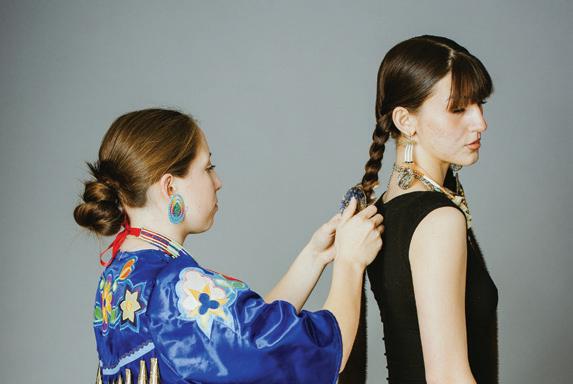
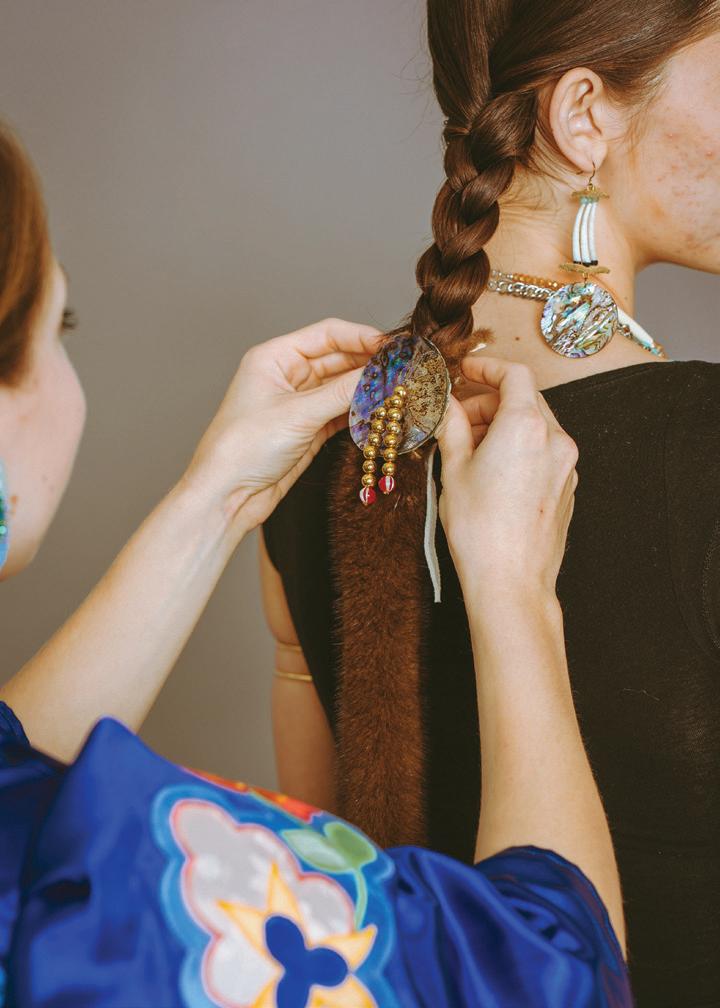
And yet, against all odds, songs continued to be sung, languages spoken and ceremonies carried forward. Pride endured through it all, quietly passed from generation to generation. Reclaiming traditions, languages and ceremonies made that pride visible again, celebrated openly and strengthened the ties to our communities. Each one a moment of reclamation. Even the smallest details hold meaning in that reclamation. Braids, for many tribes, symbolize the unity of mind, body and spirit. For others, they represent the connection between earth, sky and people. Boarding schools tried to sever that >
connection by cutting children’s hair, stripping away not just identity but belonging. Today, Native children walk proudly with braids, living proof that tradition survived. Every braid is both heritage and resistance, a statement that culture cannot be erased.
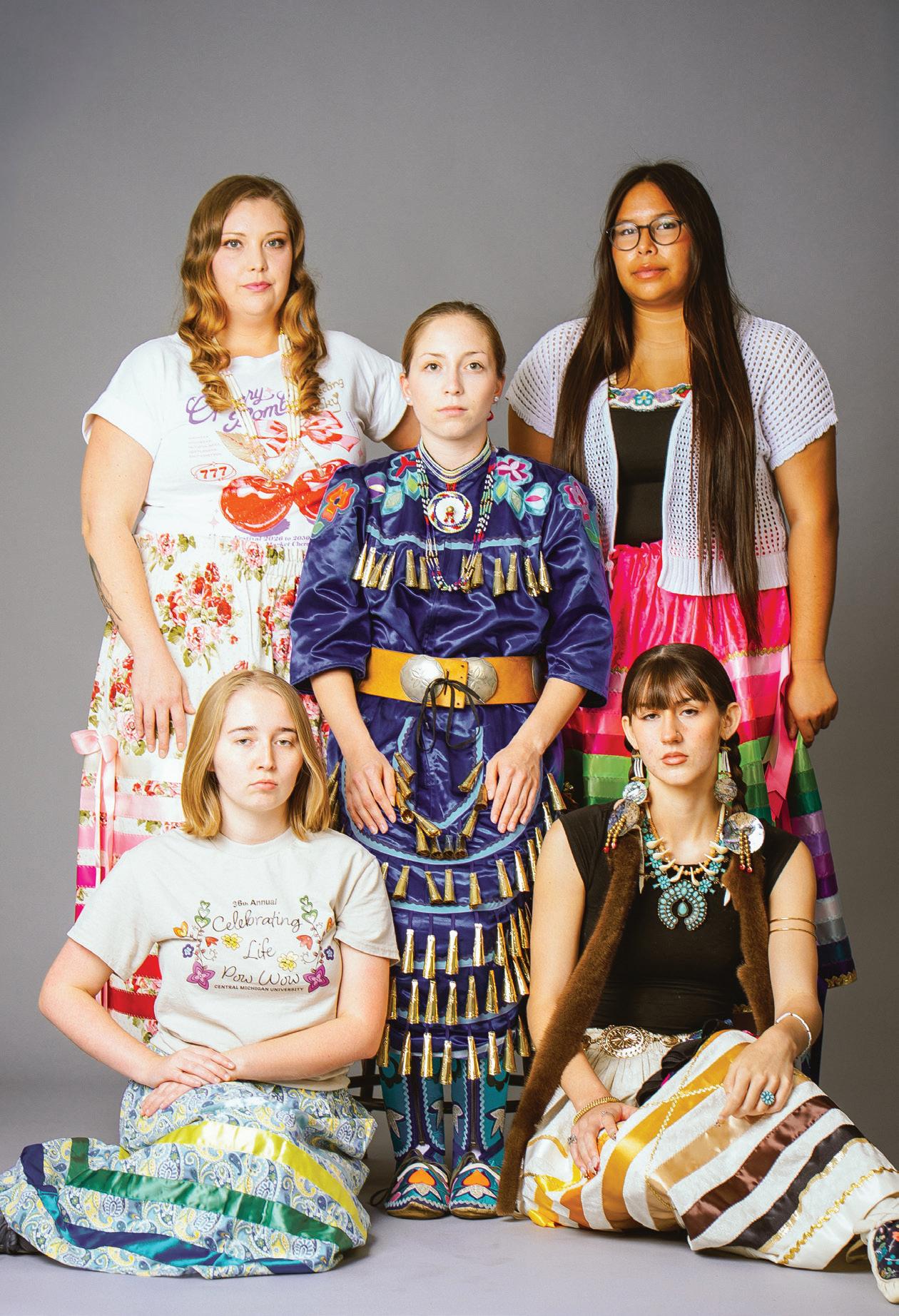
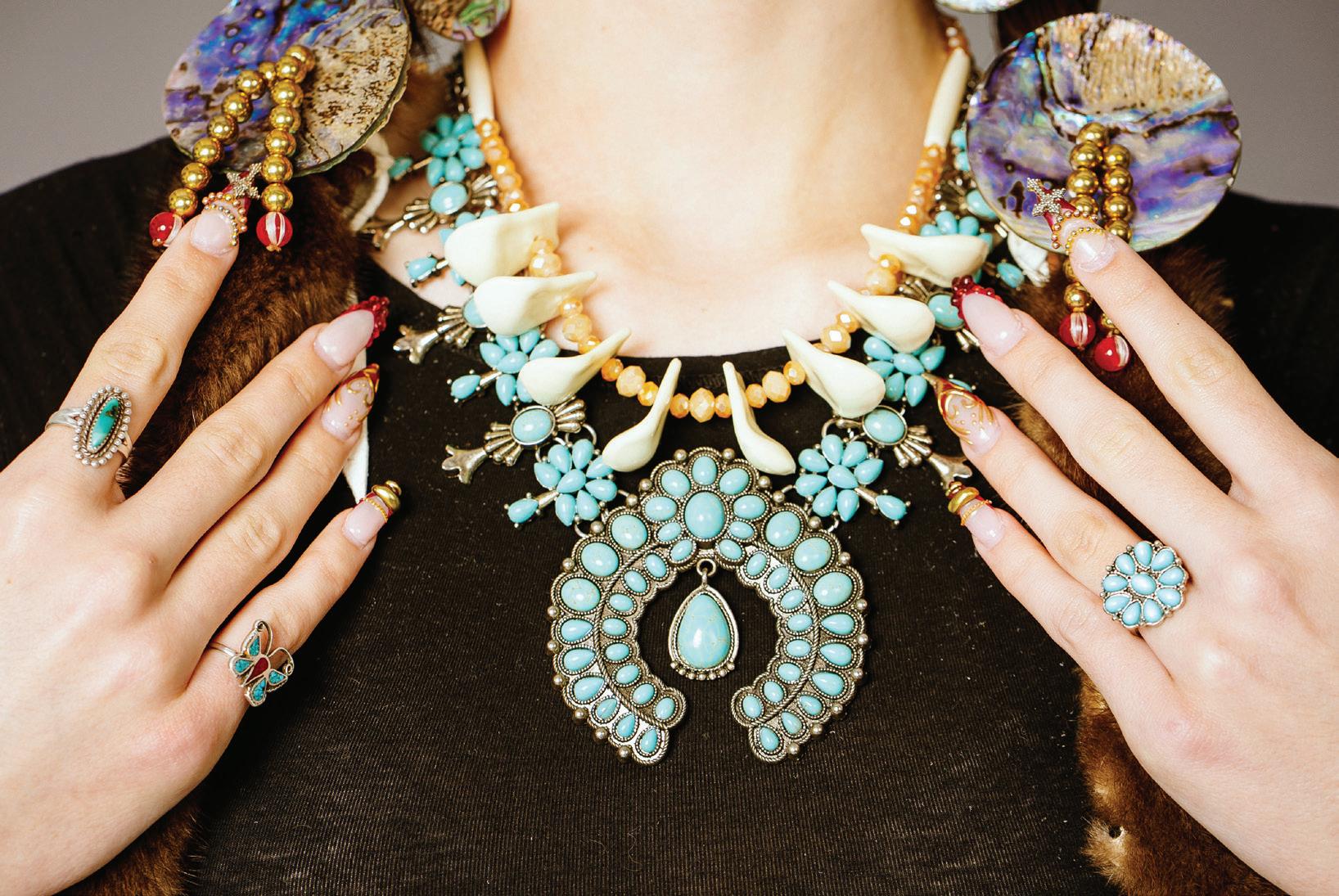
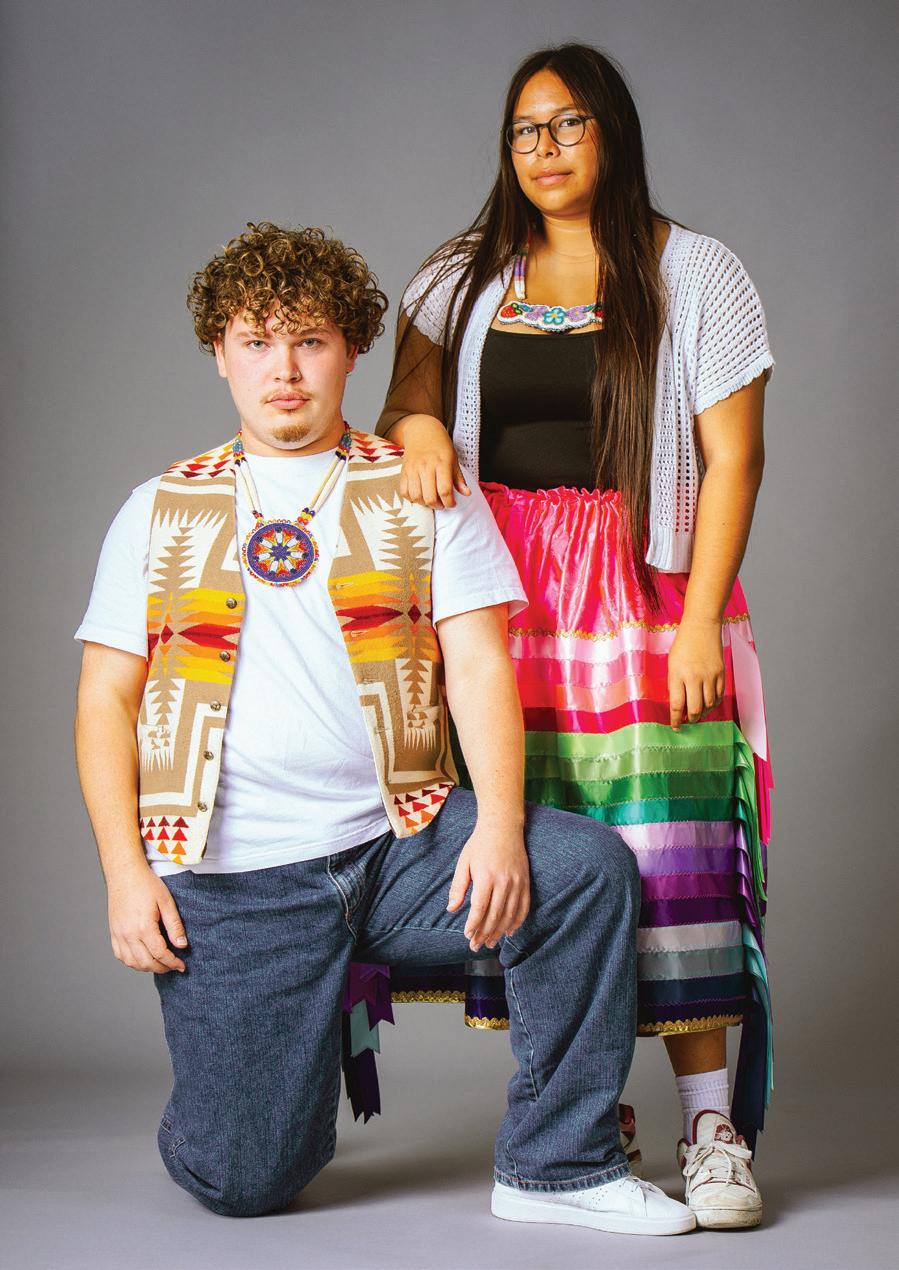
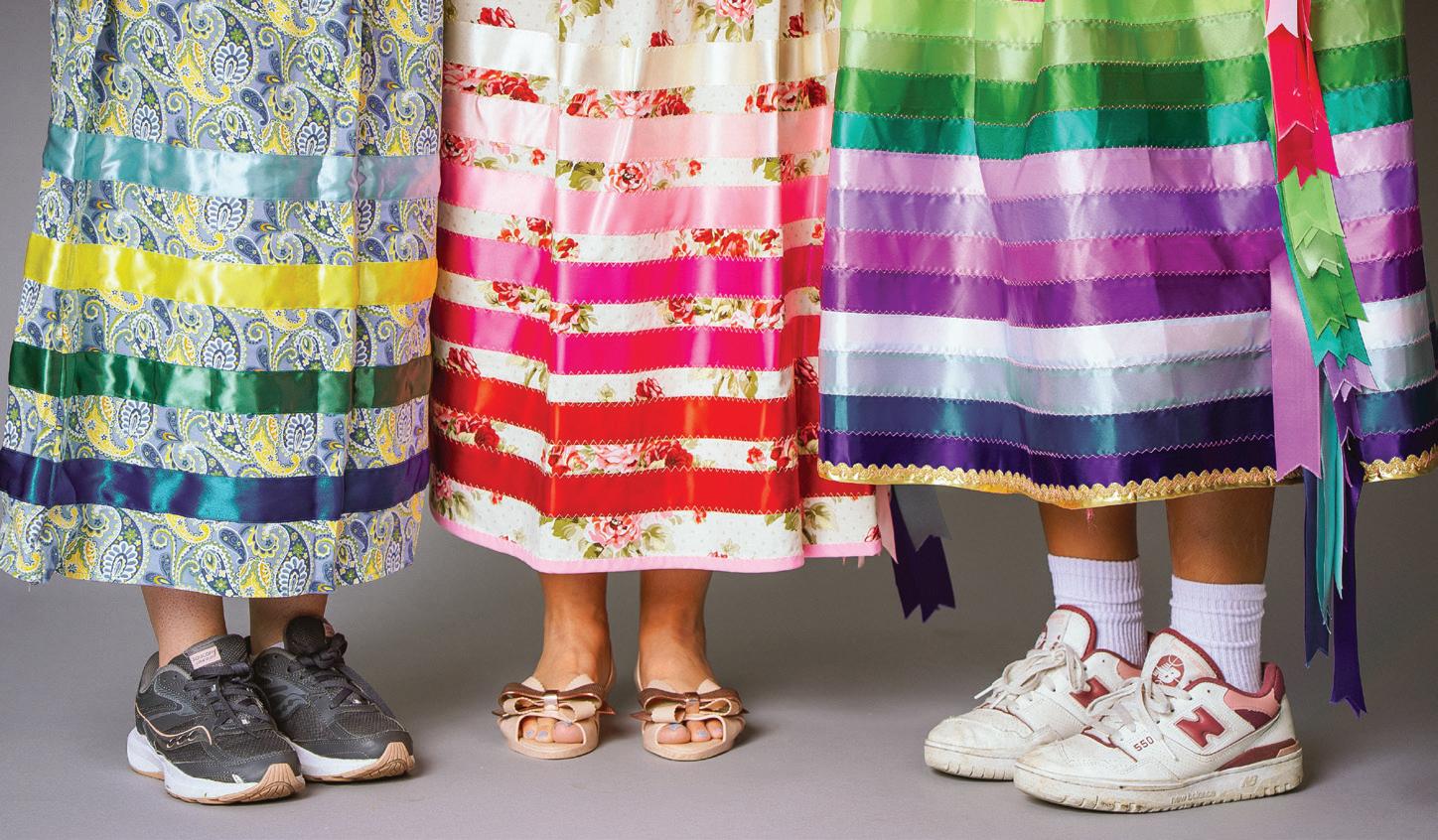
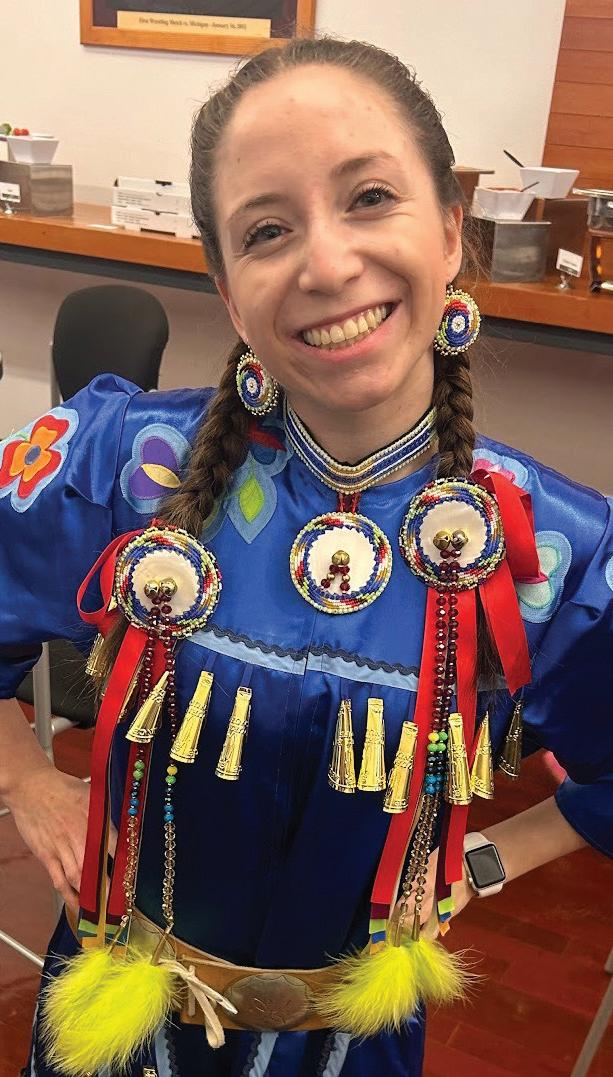
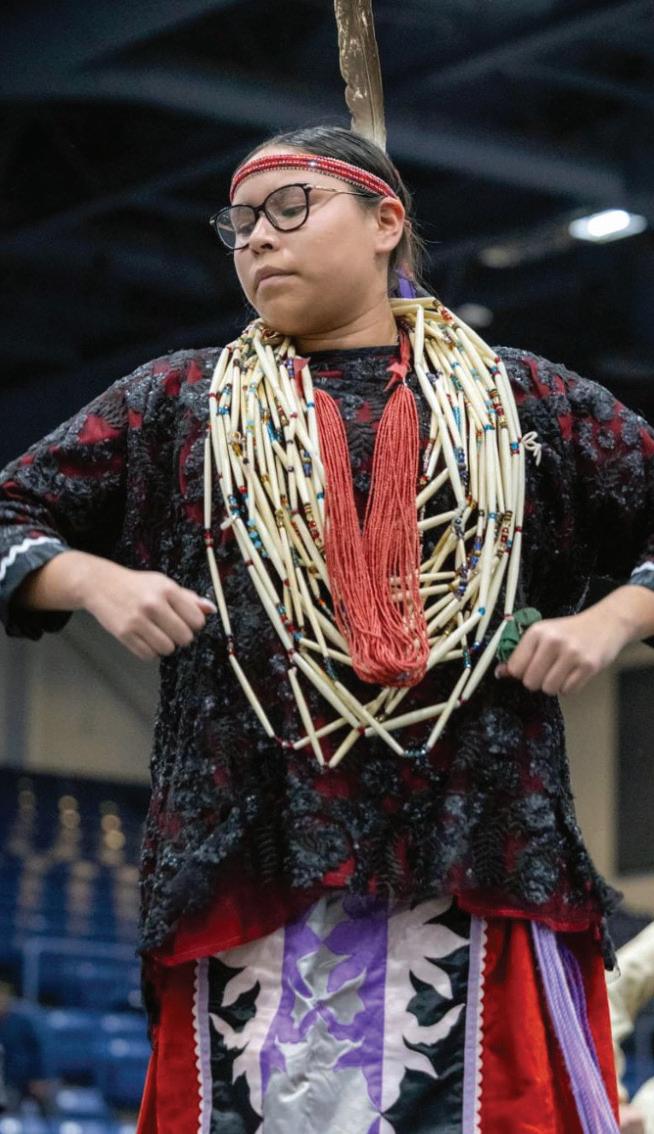
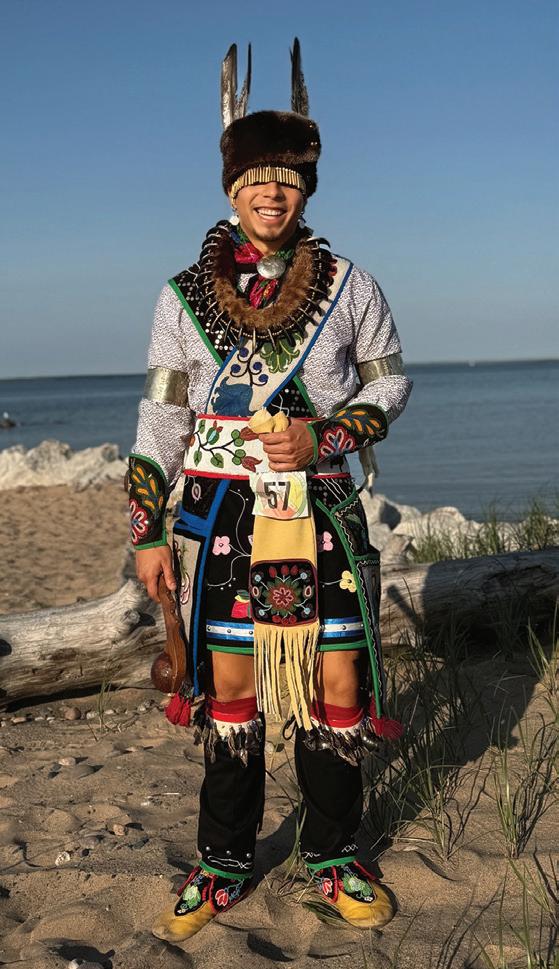
One of the clearest expressions of who we are is in our regalia. It is more than fabric, beads or feathers, it is history stitched into every piece. Each design, each color, each beadwork pattern carries meaning unique to the Nation it comes from.
Native designers are reclaiming fashion to represent culture authentically. Native filmmakers and directors are finally bringing real stories to the screen. These artists and activists are breaking barriers, proving that representation is not just visibility, it is power.
That power is felt in every classroom where Indigenous students study, every runway where Indigenous fashion walks, every film set where our stories are told with truth. Our communities are no longer asking to be included; we are creating space, setting trends and leading conversations.
Our heritage is not something fading into the past. It lives in every powwow drumbeat, every braid worn with pride, every language spoken again and every story retold. This is no longer just survival, it is resurgence.
We are still here. We have always been here. And we will always be here. •
This is an abridged version of a larger feature in the CMU student publication Verge Magazine. Order copies of the magazine at https://vergemagazinecmu.square.site.
Alumni share how CMU strengthened their confidence, leadership and community
BY ROBIN MINER-SWARTZ
We invited four alumni to share their CMU experience, their journeys of professional success, and the value of connection within the Native and Indigenous student and alumni community.
Angeline Boulley, ’88, M.P.A. ’01
Growing up in New Buffalo, in the far southwest corner of Michigan, Angeline Boulley didn’t overcomplicate her college search.
She attended a “CMU and You Day” in the fall of her senior year of high school, walked across campus and simply knew.
“I remember the campus tour and walking on the north end of campus, and it just felt like, wait. I think this is what college is supposed to feel like,” she said. “I feel like this is really a place where I could be and see myself.”
She never applied anywhere else.
At CMU, Boulley earned a bachelor’s degree in psychology with a minor in management, later returning for a Master of Public Administration. But what shaped her most wasn’t just coursework — it was opportunity.
She helped restart what was then called the American Indian Student Organization, now NAISO, served as a resident assistant in The Towers for three years and consistently stepped outside her comfort zone.
“There were different ways where I was able to try new things,” she said. “I think that has served me so well in terms of taking chances, trying something new, not talking myself out of an opportunity.”
After graduation, Boulley built a career in Native education, working for the Saginaw Chippewa Indian Tribe, her own Ojibwe tribe in Sault Ste. Marie and eventually the U.S. Department of Education. Along the way, she kept returning to an idea that had followed her since high school.
“When I was in high school, a really good friend of mine went to a school nearby and told me about this new boy in all her classes. She thought he might be my type.”
While he didn’t turn out to be Boulley’s type, she learned something surprising.
“There was a drug bust, and it turned out that the new boy was actually an undercover police officer,” she said.
“And I remember thinking, ‘What if we would have met, and what if there were sparks?’”
She thought more about it and started to imagine it differently, “What if it wasn’t that he liked me, but he needed my help? I was raised on Nancy Drew and soap operas, so my overactive imagination is always creating drama scenarios.”
She started writing at 44, squeezing in pages before her kids woke up. It took a decade to craft a manuscript she believed in.
That book became her debut novel, “Firekeeper’s Daughter,” which quickly found a literary agent and sold at auction.
Today, Boulley is a full-time author whose work has reached readers around the world. Yet her connection to CMU remains strong. She has returned to campus for speaking engagements, most recently as a December 2025 commencement speaker, where she also received an honorary Doctor of Letters degree.
She’s witnessed significant change since her student days, when Native representation on campus was sparse and cultural awareness limited.
“To see graduation opened with a smudge ceremony, and the care and concern that’s taken with new students coming onto campus, it’s just incredible,” she said. “The relationship with the tribe has grown so much.”
Her advice to prospective students, especially Native and Indigenous students, is simple: take the leap.
“I would highly recommend Central,” she said. “That respect for Indigenous peoples comes through in the programming, the events, the support. You really feel it.”
Melissa Isaac, ’06, M.S.A. ’15, Ed.D. (in progress)
For Melissa Isaac, staying close to home has never meant thinking small.
An enrolled citizen of the Saginaw Chippewa Indian Tribe, Isaac is originally from the Mount Pleasant area — “part of my ancestral Anishinaabe homelands,” she said. “This land — its waters, stories and relationships — are my home.” Today, she still lives on Saginaw Chippewa land.
CMU was a natural next step, shaped by both family expectations and community examples. On her father’s side, higher education was a given — “my aunties have doctorates,” she said — and on her mother’s side, she saw Indigenous women she admired choosing Central.
Isaac chose Central for its education program and for something else she felt, even before she could fully name it: the presence of the Saginaw Chippewa Tribe in campus life. “It was because of the Indigenous community, my tribe,
their partnership,” she said. “I didn’t really know too much about it at the time, but I knew that there was something going on there, so to me, it was just the obvious choice.”
Isaac came to CMU intending to teach elementary school. “I thought I was going to go to school and be a lifelong teacher,” she said, and she earned a Bachelor of Science in education. But CMU also expanded her sense of what was possible.
“It brings into your vision the things that you don’t really see about yourself,” she said.
She went on to earn a Master of Science in administration and moved into educational administration. She is currently writing her dissertation in CMU’s Doctorate in Educational Leadership program. “I am a lifelong learner.”
That love of learning is personal. Isaac reflected that during difficult stretches in her life, school provided steadiness. “School was consistent. It had structure. I knew what to expect,” she said.
Today, Isaac’s work sits at the intersection of education systems and Indigenous communities statewide. She is employed with the Michigan Department of Education’s Indigenous Education Initiative as Gizhwaasod: Protector of the Young. She is also vice president of the Mount Pleasant Public Schools Board of Education, serves on the Michigan College Access Network board, serves on the Michigan Two-Spirit & Indigiqueer Coalition and recently received a gubernatorial appointment to the Native American Heritage Fund Board.
In her MDE role, she works across all tribal nations in Michigan, with a focus on Native students in public schools. Leaving her tribe’s education system after more than 20 years took reflection — “talking to elders and my family and everybody else” — but she felt called to support students who may not have the same advocacy and community-based resources.
Her time at CMU prepared her for that work in a specific way: learning to move through complex institutions without shrinking herself.
“My biggest takeaway was that you should show up how you are, who you are,” she said. “You don’t have to compromise that walking into CMU.”
That lesson, she believes, matters beyond any single student.
“When you do show up as you are, it informs institutions on how they can adjust the things that they’re doing,” she said. “Those women in my life who went to CMU made me interested in going, and I’m doing the same thing for the ones that are coming after me.”
And for Native and Indigenous students considering CMU today, she offers a clear message, rooted in her own experience:
“CMU can be a place where you build both capacity and confidence,” she said. “You don’t have to leave who you are at the door to succeed here.”
Erik Rodriguez, ’14, M.S.A. ’19
Erik Rodriguez arrived at Central with a wide set of interests — and the willingness to change course until he found the right fit.
“I switched my major three times,” he said, starting in accounting, moving briefly into computer science and ultimately settling on sports management with a marketing minor. He imagined a future in professional baseball or sports operations, but his career took a different shape after an internship opportunity with the Saginaw Chippewa Indian Tribe.
Through the tribe’s leadership program, Rodriguez worked in recreation, then transitioned from the gaming side at Soaring Eagle Casino to tribal government. When a public relations assistant position opened in 2014, he applied despite having little background — and surprised himself by how quickly it clicked.
“I fell in love with the world of all things that I did not like previously,” he said. “I did not like politics, I did not like public speaking. I was kind of an introvert.”
Today, Rodriguez is the interim public relations director for the Saginaw Chippewa Indian Tribe — a role he has
held for “10 out of the last 12 years” because of how leadership transitions work within tribal government. His permanent title is public relations manager, but his day-to-day responsibilities have consistently placed him at the center of relationship-building and public-facing work across the region. He traces much of that confidence back to CMU.
“It was the opportunity just to really push me outside of my comfort zone,” he said, pointing to group projects, time management and “paying attention to the little things, the details.” Most of all, he credits Central with sharpening how he thinks. “It gave me the ability to think critically, not just give a standard answer of repeating information from a textbook,” he said. “It was the opportunity to have creative thoughts, to interpret something a little bit differently.”
Rodriguez remains deeply connected to the university, both professionally and personally. In his role with the tribe, he serves as a key liaison between the Saginaw Chippewa Indian Tribe and CMU, working regularly with the president’s office, CMU Athletics and the Office of Indigenous Affairs. He also speaks to classes in areas such as journalism and public relations and recently joined CMU’s Advancement Board.
“Sometimes I feel like I’m a part-time employee of Central,” he said. “I’m still very much connected into the university itself.”
From his vantage point, CMU’s partnership with the Saginaw Chippewa Indian Tribe has become more intentional and visible, particularly through cultural programming connected to athletics and campuswide events. He describes a relationship built on education, respect and sustained collaboration — and believes it’s a defining strength for prospective students.
“What is unique about Central Michigan University is that a student can feel at home,” he said. “Having a tribe that is so close to the university really gives you that personal connection. It’s intentional, and it’s really closely tied.”
Even years after graduation, Rodriguez says that sense of connection remains.
“The resources, even after graduation, are very accessible,” he said. “CMU is a great size university that allows you to form very personal relationships and connections that you can hold on to for future years.”
Lucas Sprague, ’20, M.S.A. ’23
Luke Sprague’s path to Central was shaped as much by persistence as it was by proximity.
Born and raised in Mount Pleasant, Sprague grew up watching CMU students move through town in maroon and gold — “that was some eye candy for me,” he said, laughing. “I wanted to be like them, one of those days.” Later, seeing other tribal citizens pursuing college helped him picture that future more clearly. “Erik Rodriguez was going to Central at the time, and Karmen Fox was the first person in my family to earn a master’s degree — also from CMU — that really inspired my pursuit of higher education.” Sprague began his college journey at the Tribal College, enrolling cautiously.
“I didn’t know if I could do it,” he said. “So, I started with one class, then I went to two classes, three classes, and then four.”
It took him five years to earn an associate degree, then he transferred to Central, building his course load slowly while working full time. “My parents and family never gave up on me through all my hardships.” Within five years, he completed a bachelor’s degree in sports management with a communications minor and, later, a Master of Science in administration.
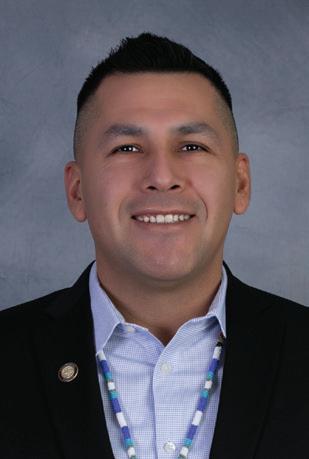
His formal education ran alongside another kind of growth. Sprague now serves as tribal chief of the Saginaw Chippewa Indian Tribe, a position he stepped into on Dec. 2, 2025, after serving multiple terms on tribal council — first as a council member, then as sub-chief.
He did not imagine himself in the role, he said. “When I was a child, I was actually a shy kid.”
He describes a life shaped by hard lessons, accountability and a turning
point in his early 20s after becoming a father. “My oldest really changed my life,” he said. “I decided to start working. And then a couple years later, I started going to school.”
Today, Sprague sees his leadership as grounded in staying close to community. “Being at the highest position with the tribe, I’m still in with my people,” he said. “I don’t carry myself on a pedestal.”
His CMU experience reinforced that sense of connection — both culturally and personally. He describes Central as “very inclusive,” particularly during his time as a graduate student.
“I was in class with a lot of international students, and I was the first Native American they’d ever met, so in some of those classes, I was like the coolest guy there,” he said, laughing. “They’d ask me questions, and I’d try to educate them about our culture, then I would ask, ‘What does your food taste like?’ and the next class they’re bringing me all this great, spicy food from India.”
In his current role, Sprague remains an active bridge between the tribe and the university, particularly through athletics and leadership relationships.
“I will be having lunch with President MacKinnon to hopefully come up with some new ideas to strengthen the relationship between the tribe and the university,” he said.
Sprague is especially encouraged by what he’s seeing in the next generation. From what he calls a “bird’s eye view,” he sees more Native youth moving directly into college after high school — and more continuing on to advanced degrees.
“The numbers are growing every single year,” he said. “To me, that’s amazing.”
And he approaches his own leadership the same way he approached school: steadily, reflectively, and with an eye toward what comes next.
“I will be a different person as my term goes on,” he said. “Even six months from now, I’ll be a lot stronger than I am now. I’m focusing on self-improvement to become the leader the community deserves.” •
MEET THE NEXT GENERATION of Central Michigan University alumni
Today’s students are leading the way — almost from the moment they step on campus
Kacie George
» Hometown: Comstock Park, Michigan
» Identity: Part of the Little Traverse Bay Band of Odawa Indians and the Chippewas of Kettle and Stoney Point
» Studying: Early childhood education
» Expected graduation: 2027
Central felt familiar to Kacie before she ever stepped on campus. Her dad is an alumnus, and she grew up hearing about his experience. As an Indigenous student with family ties in the region, she also hoped to find a stronger cultural connection nearby. The university’s smaller size ultimately sealed the decision. Compared with larger campuses, CMU felt more personal and manageable — a place where she could build relationships, get involved quickly and not feel lost in the crowd. It offered both a sense of home and the opportunity to shape her own path.
What do you like about CMU? “When I was looking at other colleges, I noticed CMU offered programs for students to participate in before school starts — IMPACT and Safari — so I really liked that. And then I liked how small it is, and that everyone’s super close to each other. Getting involved in RSOs helps you a lot with meeting people. I feel like being able to go to a smaller university has helped me be able to do so much more than I would at a bigger university, and you can walk around campus and see people you’ve met and talk to them.”
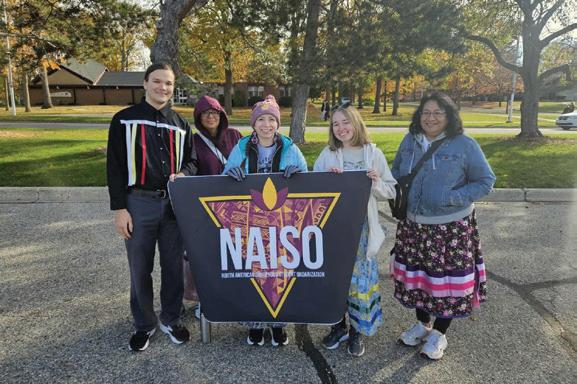
What experiences have you had that made a significant impact on what you’ve learned at CMU? “I would say IMPACT and being in NAISO have made the most impact on me. When I started college, I was still trying to find out who I was. Joining NAISO (the North American Indigenous Student Organization) has helped a lot. During my freshman year, CMU, MSU, GVSU and all the NAISO groups got together, and it was an eye opener to know that there’s other people just like me. Being president of NAISO now, I’m planning events like beading nights and the round dance. NAISO was also invited to present at a CMU Board of Trustees meeting — that was a first for us. It’s a lot of work, but I’m glad I’m able to do it. IMPACT was instrumental in getting to meet students on campus and giving me a group to hang out with. I think that’s important because students who are involved are more likely to stay and it also gives you people to lean on when you’re struggling.”
What would you like Native and Indigenous alumni to know about what it’s like to be a student at CMU today? “For me, it’s busy, but I feel like I have a great connection with Kasey Perez in the Office of Indigenous Affairs, and she’s always someone I can go talk to if I have questions. I’m just glad to have a community that is like family here. NAISO is still going strong, and we’re still having a lot of fun and making connections with everyone. Even though it’s a smaller group, it really feels close, and it helps a lot to know you have people around you who understand you.”
What would you say to an Indigenous or Native young person considering enrolling at CMU? “I would say, go for it, because it’s a smaller community. One thing that really helps is going to the IMPACT and Safari programs offered before school starts. I still talk to my Safari people who I met freshman year, and I’m still in contact with my mentors. We’re a small community, so we all help each other with whatever we need. It’s really cool to have a small group of people that you can go to.”
Waaba Medawis
» Hometowns: Manistee and Grand Rapids, Michigan
» Identity: Enrolled member of the Little River Band of Ottawa Indians in Manistee, Michigan, and a part of the Odawa and Ho-Chunk nations
» Studying: Biochemistry/ pre-med
» Expected graduation: 2029
Waaba said she chose CMU because it felt grounded in community and connection. She was drawn to the fact that the university is located on the tribal land of the Saginaw Chippewa Indians and wanted to be close to Native community and family in the area. From the start, she believed CMU could feel like a home away from home. As she learned more about the university — through tours and meeting current students — that feeling solidified. She said the campus felt welcoming, and she could picture herself finding her place and building her own community here.
What do you like about CMU? “There are a lot of opportunities here. I’m just a freshman, and I’ve already been involved in leadership roles — I’m the student government rep for NAISO. There’s always something for you to do here. In high school, I wasn’t in any clubs, but at CMU there’s definitely a club for everyone.”
What experiences have you had that made a significant impact on what you’ve learned at CMU? “I definitely have learned the most from going to our campus events throughout like Black History Month, Native American Heritage Month, Hispanic Heritage Month, they always have events going on that not only help you learn about other cultures, but also that you can participate in. I definitely have learned a lot more about different cultures that I ever had the chance to get to know before coming to CMU.”
What would you like Native and Indigenous alumni to know about what it’s like to be a student at CMU today? “CMU makes it known that they stand for what’s right, and they include everyone. I think it’s really important that CMU has made sure that people on campus have knowledge about different cultures and ethnicities and religions, so we are a more inclusive, diverse campus.”
What would you say to an Indigenous or Native young person considering enrolling at CMU? “I think coming to CMU as an Indigenous person is the best choice I could have made for myself. Indigenous and Native students will find a place that they feel is like a home away from home, with all of the people that you meet here.”
Myeengan Tyee Syrette
» Hometown: White Salmon, Washington
» Identity: Enrolled member of the Batchewana Ojibwe First Nation in Ontario and a member of the Shoalwater Bay Tribe, Lower Chehalis, off the coast of Washington
» Studying: Environmental Science
» Expected graduation: 2026
Myeengan came to CMU with family ties and a sense that Michigan could connect him more closely to his Ojibwe roots. His biological father is from Kalamazoo, and his sister — a CMU alum — encouraged him to apply to Central as he neared high school graduation. He applied broadly, including to schools closer to home in Washington, and initially wasn’t sure he would attend college at all. A turning point came when he applied for CMU’s MAC scholarship and advanced through the competitive process, ultimately earning the full-ride award of distinction.
What do you like about CMU? “CMU is one of the more diverse universities that I’ve seen. We have a lot of cultural representation. I’m proud to be an upcoming alumni.”
What experiences have you had that made a significant impact on what you’ve learned at CMU? “When I came to CMU, one of the first organizations I joined was NAISO. That played a major role in setting my foundation here at CMU, making connections and being around familiar things and familiar people, being around other Native people and having mentors. In my second or third year, I became vice president of NAISO, and it’s been a really good experience for me to learn how to manage and communicate with a larger group of people. I was also the director for the powwow committee and that was a ton of work, but it was a great experience. It taught me how to manage myself and it gave me a good sense of how to be a leader.”
What would you like Native and Indigenous alumni to know about what it’s like to be a student at CMU today? “As an incoming student, we face difficult decisions, but those early choices shape what comes next. Especially lately, coming up to graduation, I’m very proud of my past self for making the decisions I did. I love it, and I don’t think I would have wanted to be at any other university than at CMU.”
What would you say to an Indigenous or Native young person considering enrolling at CMU? “I would definitely recommend that they look at RSOs they can join — specifically NAISO, of course, but it doesn’t matter. It could be any RSO. Cultural RSOs often collaborate, so that can help you build a big network. It really sets your foundation and puts a lot of resources in your tool belt.” •
DID YOU KNOW
INDIGENOUS RESOURCES abound in the Clarke Historical Library
BY JOHN BERCH AND MARIAN MATYN
CMU honors Native American heritage in collaboration with the Saginaw Chippewa Indian Tribe through educational initiatives, cultural events and speakers, and educational resources for the campus and tribal communities. CMU Libraries celebrate Indigenous peoples through its Native American Heritage collection and the Clarke Historical Library’s corridor displays, including 19th-century Indigenous portraits.
The Clarke Historical Library has the most complete collection in the state regarding Michigan’s first people. This collection focuses on, but is not limited to, Michigan’s Indigenous peoples from pre-statehood to the present.
A good starting point for researchers is the Indigenous bibliography. Most researchers start searching for ancestors in the Government Relations section of the bibliography. These extensive records document treaties and treaty rights, military service, annuity payments, removals of Indigenous people from their ancestral lands, and forced assimilation in U.S. Indian schools.
Despite the loss of their lands and rights, Indigenous people have endured and revitalized their languages and cultural knowledge. Indigenous research is challenging because many of the records that survive in archives are from a white perspective and were generated to serve white purposes.
Harmful language is part of the historical record and documents how people thought and acted at a specific point in time. Our history is messy and, at times, was very unpleasant for diverse groups of people. Systems used to describe and catalog library and archival materials were generated by white people who lacked Indigenous knowledge. The need for reparative cataloging and description projects is now understood to be an ethical priority within the professions of archivists and librarians.
Since 2019, CMU Libraries staff have tried to create more respectful subject headings and descriptions. Since they are not Indigenous themselves, they listen and learn from those who are to learn the most appropriate ways to describe Indigenous people.
The Saginaw Chippewa Indian Tribe Library staff are reclassifying their collections, creating a new classification system based on their Indigenous culture, language and understanding of information and how it relates to and emanates from them.
To learn more about their efforts, the Overdue podcast features an episode titled “Weeding Out Oppression in Libraries S3, E4: Maawn Doobiigeng Classification System with Anne Heidemann and Melissa Isaac.” Find it here: https://go.cmualum.com/ overduepodcast24
2012
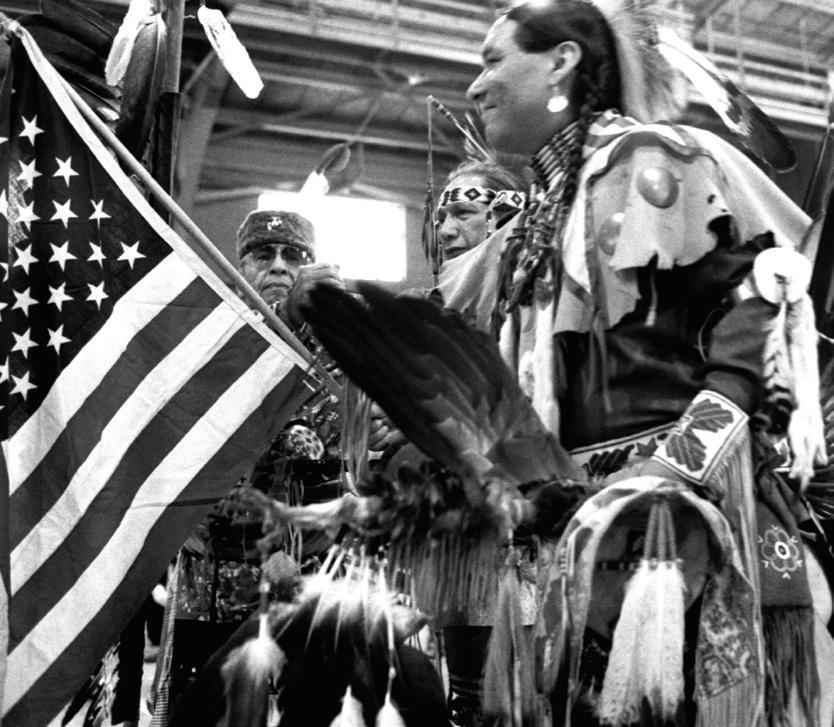
1989 Tribal members participate in the powwow on campus.
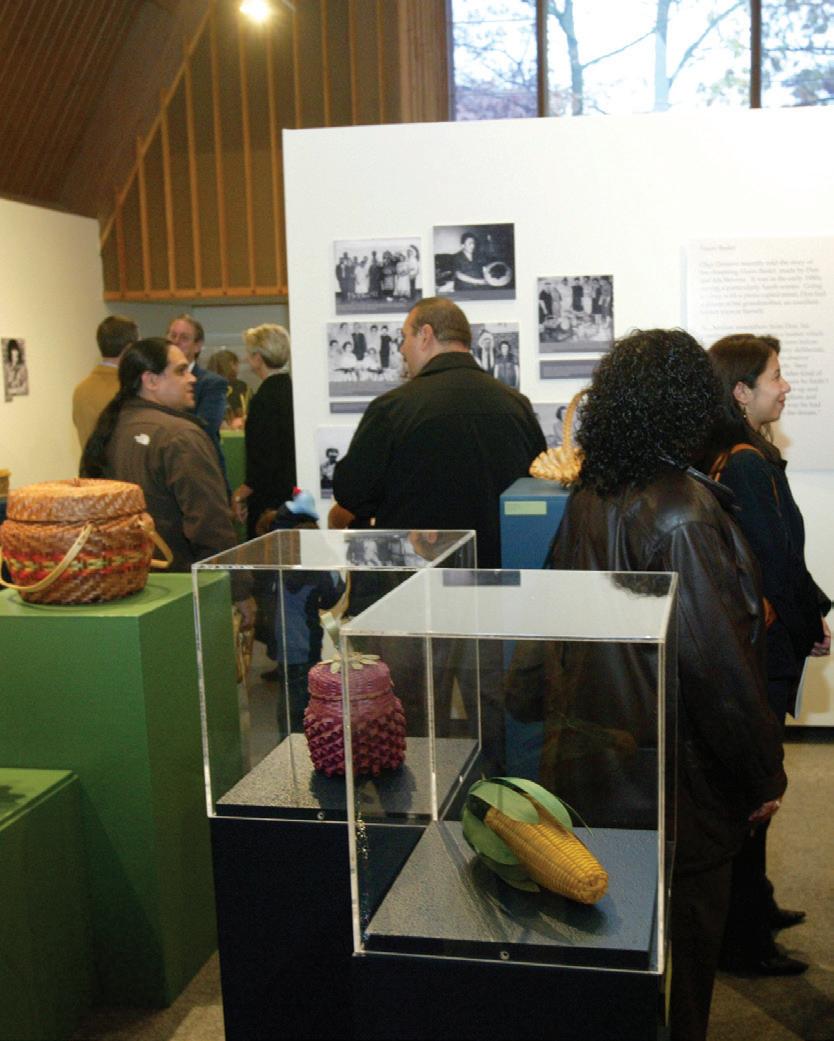
2006 A museum exhibit highlights handwoven pieces by Native American tribal members.
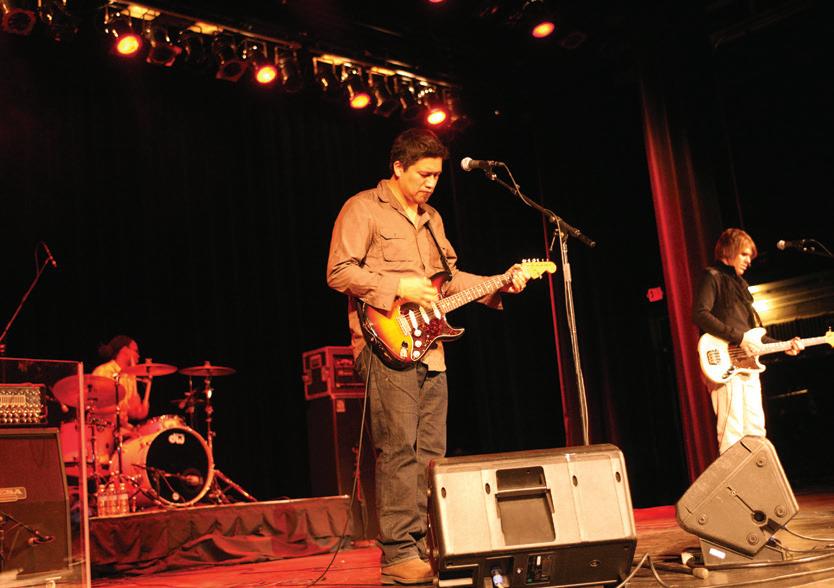
The American blues rock group Indigenous performs a concert on campus.
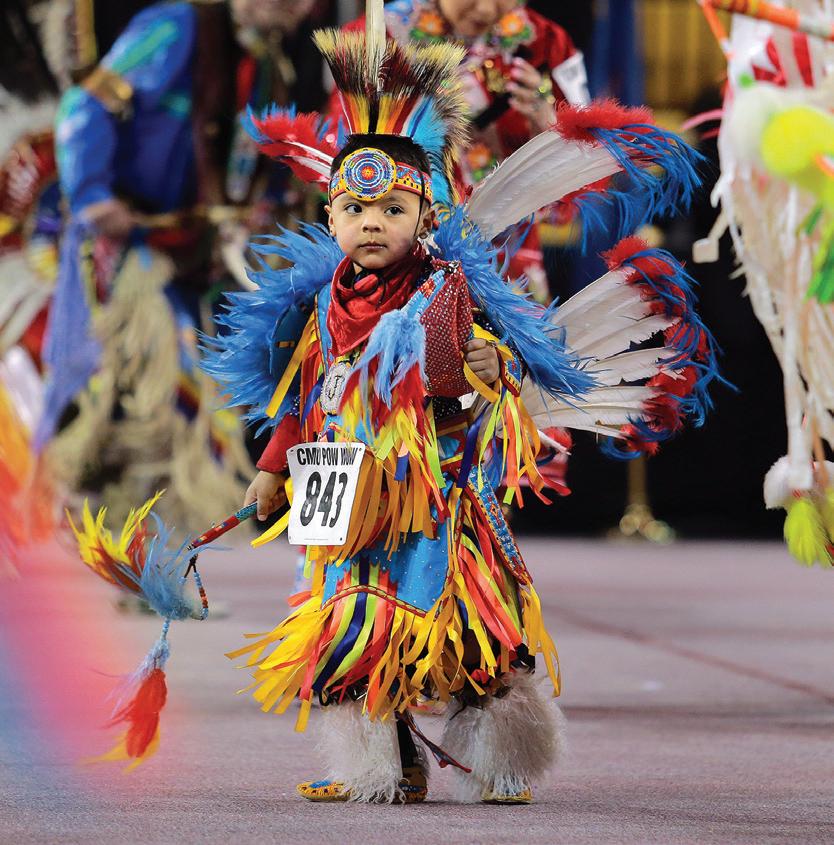
2014 A young child participates in the 25th annual campus powwow.
2004
2015 Participants in a Native Skywatchers event sharing Indigenous star and Earth knowledge.
2022
The Bovee University Center mural dedication features traditional music.
Visiting the Clarke
Learn more about these resources and how you can visit the Clarke at https://www.cmich.edu/ research/clarke-historical-library
John Berch is the Acquisitions and Cataloging Specialist at the Clarke Historical Library.
Marian Matyn is an archivist in the Clarke Historical Library and a faculty member in the CMU Libraries.
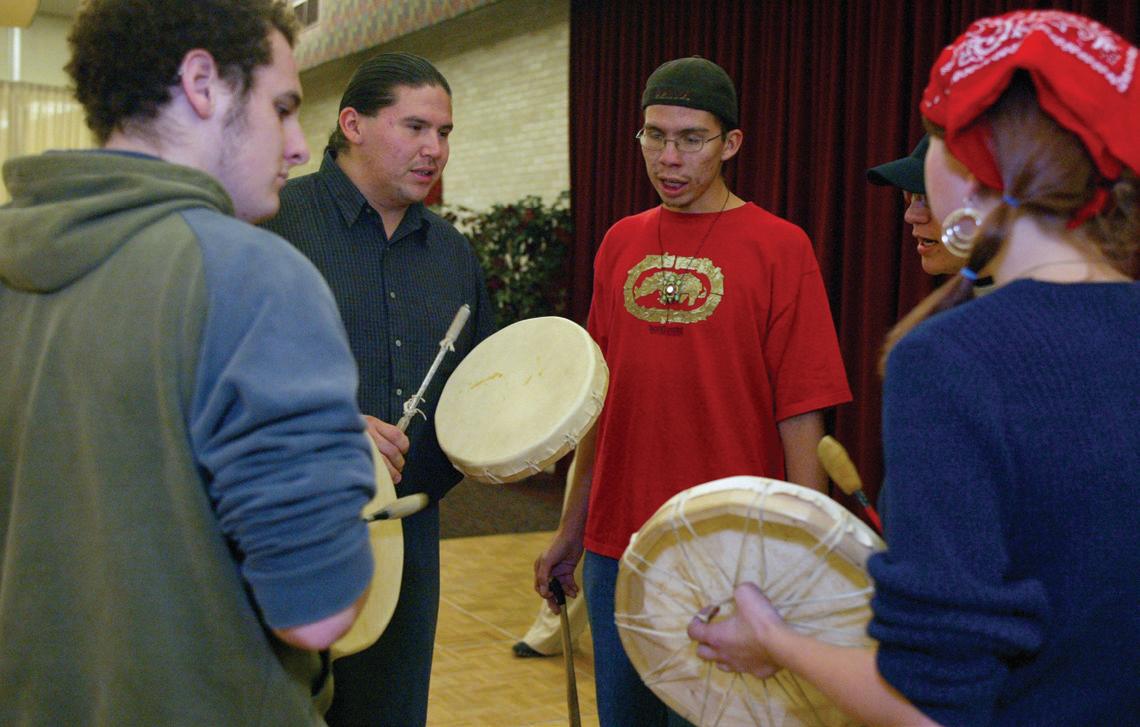
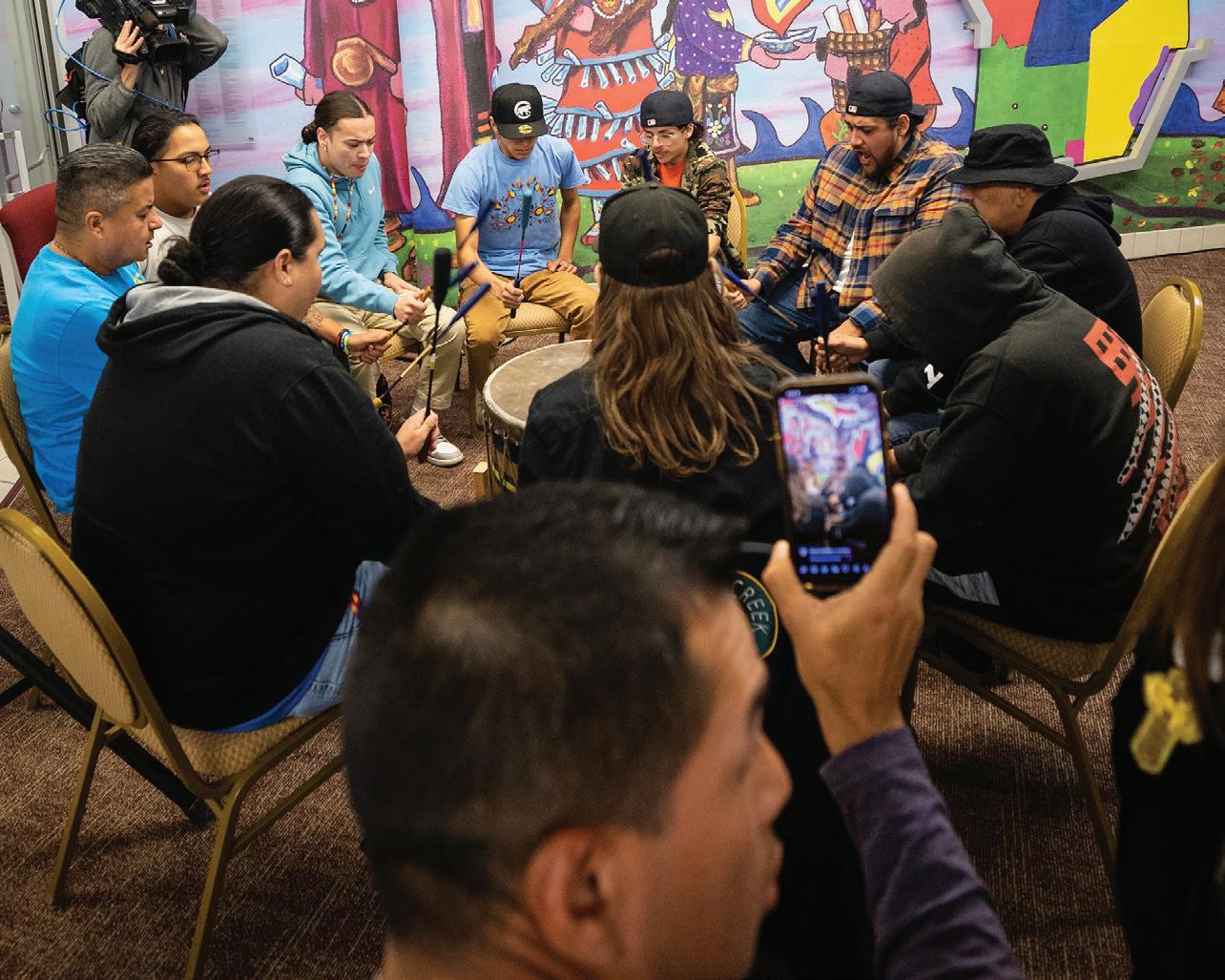
Students participate in drumming with tribal elders.
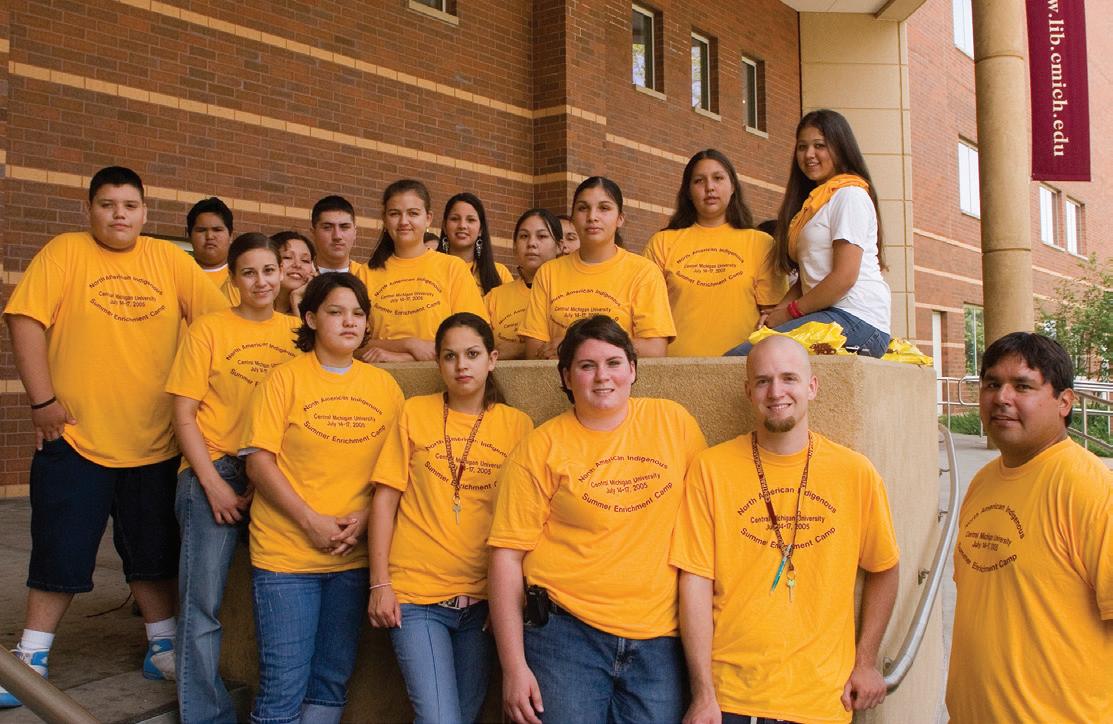
2005 Students take part in the North American Indigenous Summer Enrichment Camp on CMU’s campus.
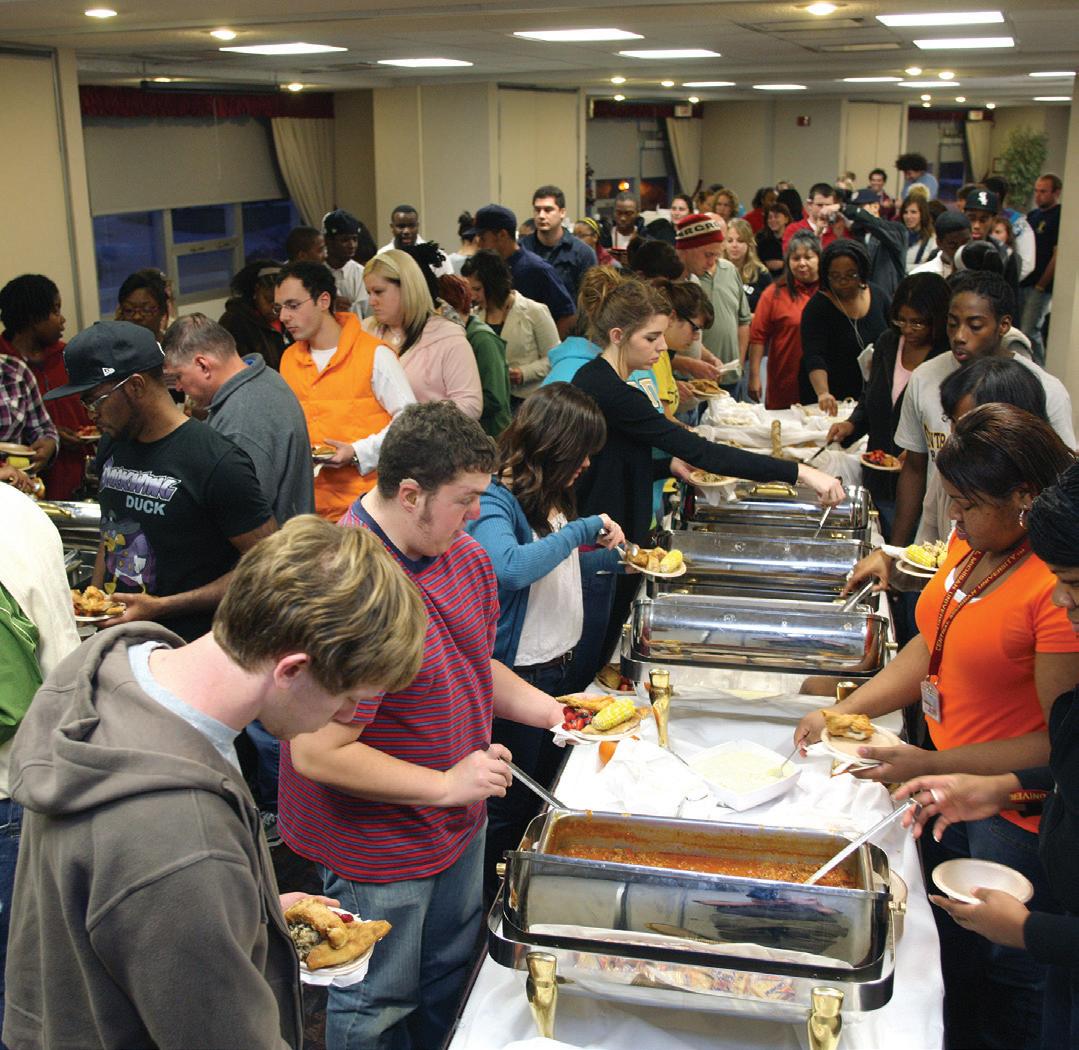
2009 Students dig into a Native American food tasting event on campus.
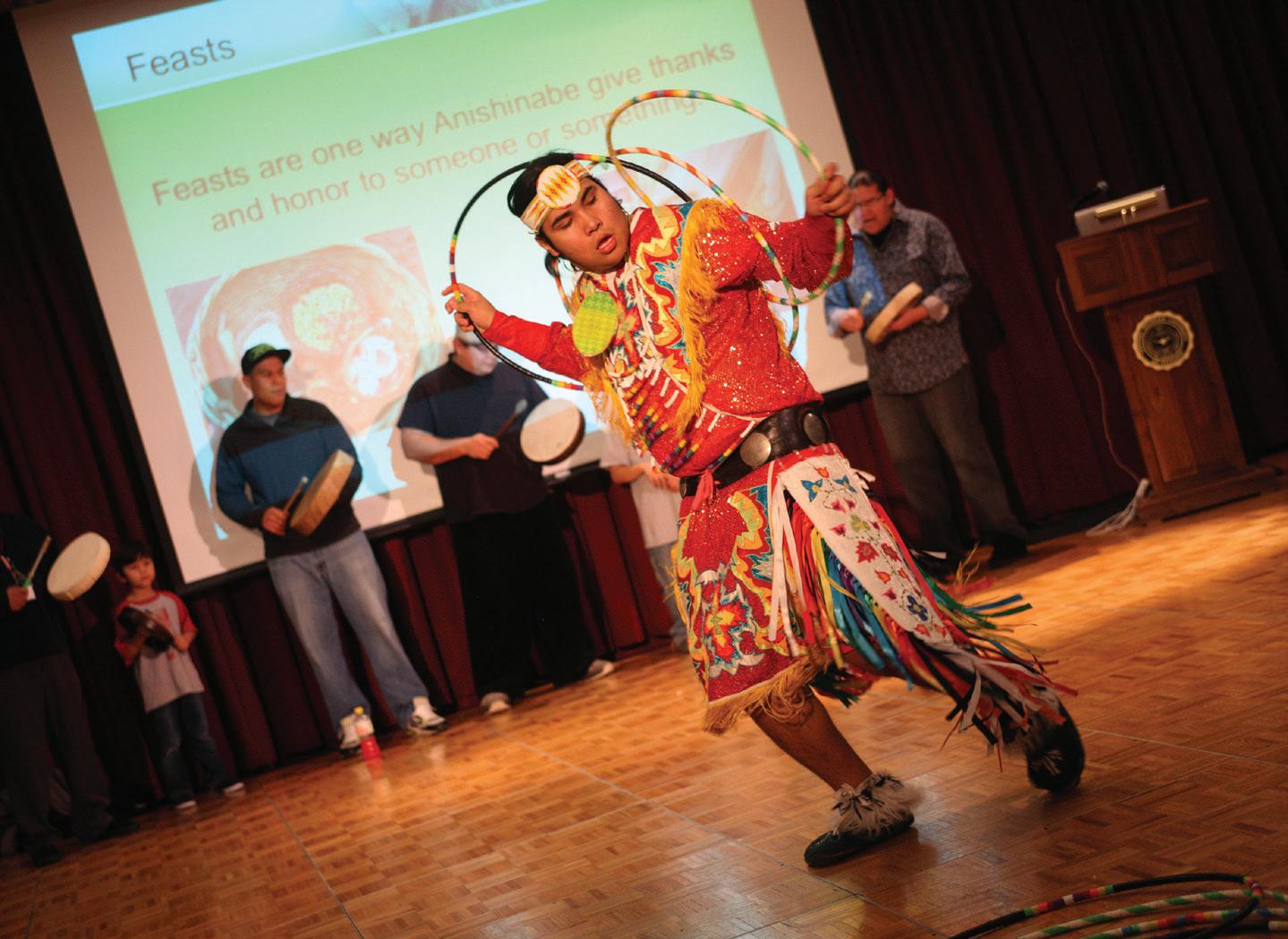
A Native American food tasting event on campus also featured dancers demonstrating giving thanks and honor.
Centralight
Carlin Alumni House
Central Michigan University Mount Pleasant, MI 48859
Saginaw Chippewa Indian Tribe
Elder Joseph Sowmick speaks at the dedication of the Native American mural inside the Bovee University Center in 2022.
Giving Opportunities
Support academic opportunities for Native and Indigenous students on campus.
Central Michigan University’s commitment to Diversity, Equity, Inclusion, Justice and Belonging is not just a statement but a steadfast dedication to creating a campus environment where every individual feels valued, respected and empowered to thrive. Your donations support CMU’s strategic goals, which includes fostering a culture of belonging and understanding. By supporting our values, you directly contribute to innovative programs and initiatives geared toward ensuring everyone can participate in the endeavor of learning. Together, we can cultivate a community where everyone is celebrated and has the opportunity to thrive.