Belmont University School of Music
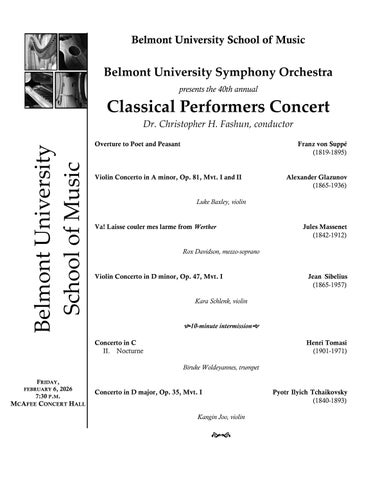
Belmont University Symphony Orchestra
presents the 40th annual
Classical Performers Concert
Dr. Christopher H. Fashun,
Overture to Poet and Peasant
presents the 40th annual
Overture to Poet and Peasant
FRIDAY, FEBRUARY 6, 2026
7:30 P.M.
MCAFEE CONCERT HALL
Violin Concerto in A minor, Op. 81, Mvt. I and II
Luke Baxley, violin
Va! Laisse couler mes larme from Werther
conductor
Franz von Suppé (1819-1895)
Alexander Glazunov (1865-1936)
Jules Massenet (1842-1912)
Rox Davidson, mezzo-soprano
Violin Concerto in D minor, Op. 47, Mvt. I
Kara Schlenk, violin
10-minute intermission
Jean Sibelius (1865-1957)
Concerto in C Henri Tomasi II. Nocturne (1901-1971)
Biruke Woldeyannes, trumpet
Concerto in D major, Op. 35, Mvt. I
Kangin Joo, violin

Pyotr Ilyich Tchaikovsky (1840-1893)
Overture to Poet and Peasant - Franz von Suppé possessed both a distinguished and geographically curious name: though born Francesco Ezechiele Ermenegildo Cavaliere Suppé Demelli in what is now Croatia, he adopted the Germanic “Franz von Suppé” when establishing his career in Vienna. As a young man studying in Padua, he encountered the operas of Rossini, Donizetti, and Verdi composers whose melodic charm and theatrical flair made a deep impression on him. When Suppé later settled in Vienna, he masterfully combined the Italian operatic lyricism he had absorbed with the rhythmic verve and charm of the Viennese waltz. In doing so, he became one of the principal architects of the nineteenth-century Viennese operetta, achieving celebrity status (like Rossini in Italy) and paving the way for masters such as Johann Strauss II and Franz Lehár.
Composed in 1846, the Poet and Peasant Overture (Dichter und Bauer) is among von Suppé’s most enduring works, known for its vibrant orchestral color and dramatic contrasts. Written as the introduction to his comic operetta of the same name, the overture follows a quasi rondo form not typical of the time: a noble, slow introduction featuring a soulful cello solo, a lively and rhythmic main section filled with dance-like energy, with two interjections of a Viennese waltz that alternates with the syncopated, dance like themes concluded with a coda that brings the piece to an exuberant close. Suppé’s orchestration particularly his use of brass fanfares, lyrical woodwind solos, and technical string writing beautifully captures the color and rustic vitality of the story, which centers on the contrasting worlds of a heartbroken poet’s artistic aspirations and countryside simplicity of everyday life. Originally a three-act comic opera, the overture transcends its theatrical origins, standing today as a shining example of Suppé’s gift for melodic invention and orchestral sparkle.
by Dr. Christopher H. Fashun, School of Music Faculty
Violin Concerto in A minor, Op. 81, Mvt. I and II - Glazunov’s Violin Concerto in A minor was composed in 1904, and premiered in 1905. It is his best known concerto and a staple of the romantic era violin repertoire. He dedicated this piece to the great violinist Leopold Auer, and it really shows Glazunov’s Romantic lyricism and gives virtuosic demands for the soloist. The structure of the concerto is unusual. It’s often described as having three or four movements, but each of these sections flow seamlessly into one another without breaks, creating an immersive musical experience, instead of isolated movements.
The first movement begins with an expressive theme principal theme, that has a slightly Russian inflection. Glazunov seamlessly slides from one theme to another, and a virtuosic run conjoins the first and second movement together. The second movement begins a new theme, now in D-flat major. The progression of this movement is a bit more agitated, with quick sixteenth note passages, finally concluding into a cadenza.
Program Note by Luke Baxley, School of Music Student
Va! Laisse couler mes larme from Werther - The opera Werther was completed in 1887 and was performed for the first time as a German translation of the French text in Vienna, Austria. The plot of Werther follows the story of Charlotte, the eldest daughter of a Magistrate. She is escorted to an event by Werther, a family friend, who is enamored with Charlotte and tries to confess his feelings to her, but is interrupted by Albert, Charlotte’s fiance. Charlotte promised her dying mother she would marry Albert, even though she does not love him, and leaves Werther. A few months later, Charlotte and Albert get married and attend an event which is also attended by Werther, who tries to speak to Charlotte, but she tells him to leave her, though she indicates she would be willing to
speak to him on Christmas day. On Christmas Eve Charlotte is reading the letters she has received from Werther and crying when her sister, Sophie, tries to cheer her up. She then sings the aria Va! laisse couler mes larmes, begging Sophie to leave her to her tears and let her cry.
Program Note by Rox Davidson, School of Music Student
Va! Laisse couler mes larmes elles font du bien, ma chérie! Les larmes qu’on ne pleure pas, dans notre âme retombent toutes, et de leurs patientes gouttes
Martèlent le Coeur triste et las! Sa résistance enfin s’éspuise; le coeur se creuse et s’affaibilt: il est trop grand, rien ne l’emplit; et trop fragile, tout le brise!
Tout le brise!
Go! let my tears flow they do good, darling! The tears we do not cry, in our souls all fall, and with their patient drops Hammer the sad and weary heart! His resistance is finally exhausted; the heart digs and weakens: it is too big, notion fills it; and too fragile, all the breeze! All the breeze!
Violin Concerto in D minor, Op. 47, Mvt. I - Jean Sibelius's Violin Concerto in D minor in one of the most distinct virtuosic works in the violin repertoire, reflecting his lifelong fascination with the violin and the wintry landscape of his Finnish homeland. As a young man, Sibelius longed to be a violin virtuoso, and although he ultimately pivoted to composition, the violin remained paramount in his musical imagination. His one and only violin concerto draws inspiration from his unfulfilled career as a soloist, the stark beauty of the forests of Finland, and his struggles with alcoholism and financial instability it's a tribute to the violin's expressive possibilities while still being a deeply personal work. Sibelius wrote the piece from 1903-1904 and later revised it after an unsuccessful premiere; the 1905 revision is the version performed today.
The first theme of the first movement is linked to central European folk music, using stillness to evoke the calmness of a Finnish lake. Instead of a bold orchestral opening, Sibelius decides to allow the violin to quietly drift over the glassy, shimmering backdrop the orchestra provides, leaning into dissonance and long, searching phrases that reflect improvisation. The violin gradually intensifies, weaving between lyric meditation and restless motion before the central cadenza enters as dramatic monologue that develops the piece further rather than interrupts it. Rather than let the concerto become a traditional showpiece, Sibelius allows the violin to alternate between moments of isolation and sudden dramatic force, leaving the soloist to occasionally confront the music alone.
Program Note by Kara
Schlenk, School of Music Graduate Student
Concerto in C - Henri Tomasi’s writing of his trumpet concerto was notably different from what was expected of the instrument at the time. He combined Baroque-style linear writing with complex harmonic language and contemporary styles like jazz. The concerto was first deemed “unplayable” by officials at the Paris Conservatory, canceling the first performance. Tomasi challenged this perception when trumpeter Jas Doets performed it. The concerto is built in three movements, the second movement titled Nocturne, a term that simply refers to a nighttime setting. In contrast to the other movements, which showcase the trumpet's brilliance and militaristic qualities, this movement asks the instrument to step away from the foreground and speak quietly and personally. A defining feature of the Nocturne is Tomasi’s decision to have the trumpet play almost the entire movement muted. Tomasi leans into the use of mutes, using them to describe the emotional weight of the music. Tomasi utilizes the use of two different mutes, and both mutes represent multiple emotional states.
Written in 1948, the concerto reflects Tomasi’s response to the aftermath of World War II, and this emotional focus is especially present in the Nocturne. The movement is not built around a strict tempo; instead, it unfolds freely, pulling forward and backward. The piece begins with long, extended sixteenth notes played by the piano or harp, evoking a nocturne. When the trumpet enters, it is played with care and restraint. The orchestra remains largely subdued throughout, with muted strings and hints of woodwind colors keeping the focus on the solo line. The one-time Tomasi asks the trumpet to play unmuted is marked by heightened intensity moving through the entire range of the instrument. The movement does not end on a clear conclusion; it gradually recedes into silence.
Concerto in D major, Op. 35, Mvt. I - While residing in Clarens, Switzerland, Peter Ilyich Tchaikovsky began writing the Violin Concerto in D major on March 5th, 1878 and completed it in later that month. He brought the violinist Josef Kotek to Clarens to assist in playing through the initial sketch of the concerto, but due to Kotek’s dissatisfaction with the second movement, Tchaikovsky completely rewrote it. Consequently, Tchaikovsky dedicated the concerto to Leopold Auer, a Hungarian violinist and teacher who succeeded Wieniawski as violin professor at the St. Petersburg Conservatory. However, Auer felt the concerto was technically awkward and too long and refused to perform it. For this reason, Tchaikovsky rededicated the concerto to a Russian violinist, Adolf Brodsky, who performed the premiere to great success for the Vienna Philharmonic Society in 1881. Unfortunately, the concerto created strong negative reactions from most of the Viennese critics. Nonetheless, Brodsky believed in the concerto’s potential and soon presented the work in Germany, where the concerto was an instant success and has been one of the standard concerti for violin for decades.
The first movement is in sonata form, which comprises an introduction, exposition, development, recapitulation, and coda, while also containing elements of a theme and variations. The concerto opens with a simple and elegant 8-bar theme from the strings, followed by the woodwinds, and agitating the orchestral introduction that sets out the drama for the soloist’s opening. After the orchestral introduction, the solo violin opens its own unaccompanied, elegant introduction, presenting a formal opening sentence like "Once upon a time," that sets the music in motion. Then, the soloist introduces the main cantabile theme, and Tchaikovsky extends the theme by prolonging the phrase with virtuosic passagework that includes fast-running scales and arpeggios from the soloist. With a romantic second theme in the middle of the exposition, the virtuosic passagework from the soloist gradually intensifies and builds up to a majestic climax, leading to a satisfying arrival of the main theme played by the full orchestra. After a brief development section with another virtuosic writing of demanding fast-paced double stops from the soloist, a grandiose orchestral tutti of the main theme builds the movement up to Tchaikovsky’s own cadenza. The cadenza in the first movement is very technically demanding, requiring the soloist to have extreme precision in reaching some of the highest notes of the violin from the lowest register in a brief second, and lightning-fast arpeggios repeatedly occurring. After this virtuosic cadenza, the orchestra begins the recapitulation with the main theme once again and concludes the movement with a big, heroic cadence followed by an intense and dramatic coda. Tchaikovsky’s concerto uses the full tessitura of the violin both technically and expressively, demanding a masterful combination of virtuosity and lyricism.
Program Note by Kangin Joo, School of Music Graduate Student
Luke Baxley is currently a junior at Belmont University, pursuing the Bachelor of Commercial Music with an Emphasis in Performance. Born in Panama City, Florida, he started studying violin at four. He moved to Birmingham, Alabama in 2014, and studied at the Alabama School of Fine Arts. Baxley has been studying at Belmont since 2023 under the direction of Dr. Ryan Joseph and Dr. Elzbieta Tokarska.
Rox Davidson is an American-Australian mezzo-soprano with performance experience in Singapore, Thailand, Germany, and the United States. Davidson is a graduate of Nashville School of the Arts and is currently working towards the Bachelor of Music in Music Performance at Belmont University under the instruction of Dr. Angela Yoon. Davidson has performed as part of Belmont University's Chorale Ensemble and Opera Theatre for the past two years. They will be singing the role of Lazuli in Belmont's production of L'étoile in March. Davidson has also performed in Belmont's Classical Singers Recital for the past two years. In the summer of 2025, Davidson performed as a part of the Berlin Dramatic Voices Program, and in the summer of 2026, they will perform as part of the Berlin Opera Academy.
Kara Schlenk is a first-year graduate student and alum of Belmont University's School of Music Class of 2025. While pursuing her undergraduate degrees, Schlenk enjoyed being part of the Belmont Symphony Orchestra, playing in classical string quartets, and was selected as a Classical Performers Competition soloist in 2024 and a soloist in the Undergraduate Honors Recital in 2023. Her broad musical experience includes pit orchestra for musical theatre and opera, studio recordings and teaching violin and viola in North Nashville. While in her undergrad, Schlenk was on the Dean's List for all her eight semesters, earned the Bachelor of Arts in Public Relations and Bachelor of Music in Music. She hopes to work in classical music management and continue playing in symphonies and chamber ensembles after she earns her master's degree. Aside from music, Schlenk loves to practice yoga and review movies. She would like to thank Professor Boris Abramov and Dr. Ela Tokarska for their constant support and inspiration, and for always pushing her to be better than she was yesterday.
Biruke Woldeyohannes is a sophomore at Belmont University pursuing the Bachelor of Business Administration in Business Systems and Bachelor of Business Administration in Supply Chain Management with a Minor in Music. He began his musical journey at the age of ten on the clarinet and switched to the trumpet at the age of twelve, which he has been playing for over seven years. Woldeyannes is a member of the Belmont University Symphony Orchestra and enjoys performing in a variety of ensemble settings. Outside of music, he stays involved on campus, enjoys working out, and spending time with friends. Woldeyannes is thrilled to perform his favorite concerto, Henri Tomasi’s Concerto in C, in the 2026 Classical Performers Concert.
Kangin Joo is a first-year graduate student pursuing the Master of Music in Instrumental Performance with Professor Boris Abramov. He received the Bachelor of Music in Music Performance from the Schwob School of Music at Columbus State University in 2025. Joo was also selected to perform at the Graduate Honors Recital and won first prize at the Tennessee Music Teachers Association Collegiate Strings Competition in his first semester at Belmont University. Prior to Belmont University, Joo won first prize in the Charleston International Music Competition and the Birmingham International Music Competition. He was also awarded the Edward Braunstein New York State Assembly Award and the Ron Kim New York State Assembly Award after winning second place in the New York International Music Concours. Joo was a fellowship recipient of the Montecito International Music Festival and received guidance from many notable
violinists, including Aaron Boyd, Martin Charlifour, Gary Levinson, Dennis Kim, and Sergiu Schwartz. A passionate orchestral musician, Joo has performed with the Los Angeles Sinfonietta at the Walt Disney Concert Hall in Los Angeles. He was also appointed concertmaster for the California Orchestra Institute in 2023 and served as a section coach in 2024 under the baton of Larry Livingston. An active chamber musician, Joo is currently the violinist of the Koroleva Trio, based in Columbus, Georgia. Joo is beyond grateful for this wonderful opportunity to perform with the Belmont University Symphony Orchestra and is excited for more opportunities at Belmont University.
Violin I
Jade LaGore, concert master
Macahila Hinnenkamp, assistant concertmaster
Rocco Greco
Nathaniel Eulentrop
Owen Swiggum
Eliana Woodman
Harrison Mabon
Isaac Hardin
Sam Lock
Florence Schaumann
Luke Baxley
Kangin Joo**
Violin II
Kimmie Raucher*
Daniel Ramirez
Brooke Harden
Natalie Piedra
Zachary Hardin
Shelby Fuller
Nadia Foote
Lauren Nolte
Viola
George Graefen*
Anne-Marie Nguyen
Bella Kinard
Mackenzie Combs
Melanie Migneco
Jillian Baez
Daniel Olopade
Cello
Madelyn Little*
Graham DeHaan**
Je’Nai O’Connor
Thomas Cañas
Hannah Silverman
Owen Siller
Corrine Hawkey
Zoë Wilson
Angie Jackson
Caylie Rader
Ingrid Bakeman
Ava Kronenberger
Bass
Alex Haldane*/**
Joseph Bonvissuto
Ari Stoker
Rylan Stone
Talon Seidel
Flute
Brendon Wilson*
Mya Ploor**
Jake King
Oboe
Amanda Rebstock*/**
Shawn Redmond**
Lily Chantler
Clarinet
Michelle Babyak*
Tommy Steele
Bass Clarinet
Mya Ploor
*principal **School of Music Graduate Student
Bassoon
Emily Okumara*
Harrison Sampson
Alto Saxophone
Shawn Redmond**
Horn
Holden Cessna*
Grace Helton
Alli Voyles
Ellie McClellan
Caroline Holmes
Trumpet
Luke Woody*
Kristen Lester
Isabella Jones
Biruke Woldeyannes
Trombone
Luke Meyers*
Adam Chavez
Dawson Fulcher
Tuba
Hudson Bulter*
Harp
Audrey Smith
Aliyah Wenneker
Percussion
Gramm Raedeke*
Cole Counihan
Joshua Wingard
Miriam Marks
Jazz String Septet
Sunday, February 8, 6:30 p.m.
Massey Concert Hall
Faculty Concert Series: Mark Volker
Monday, February 9, 7:30 p.m.
McAfee Concert Hall
Music and Discourse: Channing Shippen
“Living in Between: Music Therapy as Liminal Space for People Experiencing Homelessness”
Wednesday, February 11, 10:00 a.m.
Hitch 130
Join Belmont University’s College of Music and Performing Arts for Sounds of Belmont: The 36th Annual President’s Concert & Reception on Saturday, April 25th in the Fisher Center at Belmont University. Experience an evening of stories and songs to support our talented students. The concert will begin at 6:30 p.m. followed by a festive dessert reception for all guests and performers. The purchase of a ticket to this concert and reception will benefit endowed music and theatre scholarship funds for students in the college. Premier works from the College of Music and Performing Arts Fall 2025-Spring 2026 performance season will be showcased. This concert and reception is celebrating its thirty-sixth year (formerly the President’s Concert and Reception).

For more information on upcoming concerts and events, please visit www.belmont.edu/cmpa or “like” Belmont University School of Music on Facebook.