OUTLOOK FOR CANADIAN RATE

Communication

Communication
Takeaways from industry forum p.30









CUSTOM SUCCESSION
The right succession plan for a mortgage business is very personal – and the process looks different for everyone BY LISA GORDON
THE CMBA-BC FUTURE FORWARD CONFERENCE
Insights, connections and what’s next for B.C.’s mortgage broker community BY SAMANTHA ASHENHURST
CELEBRATING INDUSTRY LEADERS
Awards acknowledge CMBA-BC’s best
ADOPTING AI IN FINANCIAL SERVICES
Key takeaways from the Second Financial Industry Forum on AI BY KOKER CHRISTENSEN AND ISABELLE SAVOIE
CMBA-ONTARIO GALA
Building a stronger, more connected mortgage community in the Heartland Province BY SAMANTHA ASHENHURST
FINTRAC PROVIDES INFORMATION ON RECENT CHANGES TO CANADA’S AML REGIME BY KOKER CHRISTENSEN, CAITLIN SABETTI AND ISABELLE SAVOIE
JUST SAY NO (THANK YOU) A record tide of illicit money BY DOANE GRANT THORNTON LLP





VOLUME 11 ISSUE 2 SPRING 2026
THE CANADIAN MORTGAGE BROKERS ASSOCIATION
EXECUTIVE DIRECTOR Carla Giles
CMBA - ATLANTIC
Mortgage Brokers Association of Atlantic Canada 12 M - 7095 Chebucto Road, Halifax, NS B3L 0A1
CMBA - BC
Mortgage Brokers Association of British Columbia 900-2025 Willingdon Avenue, Burnaby, BC V5C 0J3
CMBA - ONTARIO
Independent Mortgage Brokers Association of Ontario 7 - 40 Winges Road, Woodbridge, ON L4L 6B2
CMBA - QUEBEC L'Association des courtiers hypothecaires du Québec 5855 Taschereau #202, Brossard, QC J4Z 1A5
CANADIAN MORTGAGE BROKER
magazine is produced by the Canadian Mortgage Brokers Association (CMBA National)
EDITOR
Carla Giles
STAFF WRITER
Samantha Ashenhurst
MANAGING
EDITOR
Kathleen Freimond
ART DIRECTOR
Scott Laing
BILLING AND SALES
Debra Hiller
CONTRIBUTORS
Koker Christensen
Carla Giles
Lisa Gordon
Brendon Ogmundson
Caitlin Sabetti
Isabelle Savoie
Doane Grant Thornton
IMAGES
Adobe iStock
BC Real Estate Association
CANADIAN MORTGAGE BROKER © All rights reserved.
The views expressed in CANADIAN MORTGAGE BROKER are those of the respective contributors and are not necessarily those of the publisher or staff.


PUBLICATIONS MAIL AGREEMENT 41297283
Please return undeliverable Canadian addresses to 900-2025 Willingdon Ave., Burnaby, BC V5C 0J3


Canada needs a diverse and competitive broker channel across communities of all sizes
BY CARLA GILES, MBA, CAE, CEO OF CMBA-BC, MBIBC, EXECUTIVE DIRECTOR, CMBA NATIONAL
Afair and competitive mortgage market depends on more than the number of lenders, products or rate options available. It also depends on whether Canadians can access qualified mortgage advice in the communities where they live.
Across the country, mortgage brokers help consumers compare options, understand complex lending requirements and make informed decisions. This role is especially important in smaller, rural and regional markets, where access to financial services and lender choice may already be limited. In many communities, brokers are part of the local financial ecosystem.
In Canada, provincial regulatory frameworks are increasingly focused on strengthening consumer protection. This is important and necessary. But consumer protection cannot be viewed in isolation from how regulation is implemented. Licensing fees, compliance requirements, administrative processes and implementation timelines
all shape whether mortgage brokers, as well as smaller brokerages, can continue to operate viably.
If the cumulative cost and complexity of implementation make it harder for brokers in lower-volume markets to remain viable, the result may be fewer independent businesses, greater consolidation of mortgage advice and fewer options for consumers. A framework designed to protect consumers should not unintentionally reduce the choice, access and local expertise that consumers rely on.
Strong regulation should raise standards while preserving a diverse and competitive broker channel across communities of all sizes. This requires implementation that is proportionate, practical and informed by how mortgage services are actually delivered across Canada, including in rural, remote and lowervolume markets.
The mortgage broker channel is diverse, from national networks to small independent brokerages serving local communities. A regulatory model that does not account for this diversity risks unintentionally favouring scale over service.
British Columbia’s new Mortgage Services Act (MSA) provides a timely example. The MSA, which will come into force on October 13, 2026, is intended to improve consumer protection and modernize mortgage services regulation. As implementation moves forward, early industry feedback is identifying areas where the practical application of the framework may benefit from further review.
Changes in branch office licensing fees is one example. Branch locations often do more than satisfy an administrative requirement; they show where brokers are serving clients and give consumers a clearer sense of local access. If branch licensing becomes significantly more expensive, brokerages may centralize their licensing footprint, even while brokers continue serving clients across the province.
This may appear administrative, but the implications are important. If local broker presence becomes less visible, consumers may have a harder time identifying mortgage professionals in their own communities, particularly in smaller, rural and remote markets where financial services may already be limited.
Another example relates to Personal Mortgage Corporations, or PMCs, which allow licensed mortgage brokers to provide services through a corporation rather than solely as individuals. Under the new framework, PMCs may employ unlicensed assistants, but not licensed assistants. This does not fully reflect the realities of the profession, where many mortgage brokers rely on licensed assistants to support client service, documentation and file management. It may also create an unintended incentive for assistants to become unlicensed, reducing opportunities for regulatory oversight, supervision and compliance. If the goal is stronger consumer protection, the framework should encourage appropriate licensing, supervision and professional support for assistants.
These examples illustrate a larger point. The success of regulatory reform depends not only on the intent of the legislation, but
on how the rules work once they are applied to real businesses, real consumers and real communities. A framework can be wellintentioned and still produce outcomes that warrant reconsideration.
The concern is not simply that costs may rise or that new requirements may take time to implement. It is that cumulative cost and complexity may discourage new entrants, push smaller firms toward consolidation, or reduce local visibility and service. For consumers, this can mean fewer choices, less access to independent advice and greater reliance on a smaller number of providers.
This is particularly important as Canadians face renewal pressures, affordability challenges, changing household needs and more complex financing decisions. These are not simple transactions. They require careful guidance, clear communication and professional judgment.
In this context, the value of mortgage brokers should not be measured only by volume or market share. It should also be measured by the access they provide, the advice they offer and the role they play in helping consumers understand the implications of one of the most important financial decisions they will make.
This is not only a B.C. issue. Across Canada, regulators and policymakers are working to strengthen oversight and respond to emerging risks. As frameworks evolve, associations and industry professionals have an important role to play in identifying practical implementation challenges and helping bridge the gap between policy intent and market reality.
The future of mortgage brokering in Canada should not be limited to major urban centres or large-scale business models. When regulation is fair, proportionate and responsive to the realities of the profession, it strengthens both consumer protection and consumer
in communities of all sizes, including
and remote markets.







BY BRENDON OGMUNDSON, CHIEF ECONOMIST, BC REAL ESTATE ASSOCIATION
There is, at least in theory, a world in which output expands at a steady clip, prices behave themselves and households go about their business with a sense of quiet contentment. It is a comforting notion, though one increasingly relegated to the realm of fiction. Recent box-office disappointments for Marvel suggest that even escapism has its limits; the public, it seems, has little appetite for multiverses. In the real one, the global economy has once again been tipped into disorder. Volatility has returned, oil prices are surging and the spectre of renewed inflation is stalking markets that had only just begun to relax.
After drifting lower through much of February, North American bond markets have responded nervously to the war with Iran. Five-year government bond yields in both Canada and the United States have climbed back to levels last seen at the end of 2025, as investors reassess geopolitical risk and the inflationary implications of higher energy prices. Movements in the Canadian yield curve suggest the rise in the yields is equal parts markets expecting a higher overnight
rate in response to higher inflation and a rising global term premium. The good news is a swift resolution to the conflict should prompt a reversal in yields, though that outcome seems far from likely.
Fixed mortgage rates have followed bond yields higher. Having declined modestly at the start of the year, uninsured five-year fixed rates have stabilized at around 4.6 per cent. With the five-year Government of Canada yield now back
above 3 per cent, further modest increases look likely over the coming quarter. Markets are beginning to price in both a higher risk premium and the possibility that central banks may yet be forced to respond to an oil-driven inflation shock. Much will hinge on the Bank of Canada’s guidance at its April meeting. A signal that policymakers are prepared to look through a temporary rise in inflation could take some pressure off fixed rates in the second half of this year.
Variable rates, by contrast, have been conspicuously dull. After three consecutive rate holds, the average variable mortgage rate offered by Canadian lenders remains at roughly 4.1 per cent, around 35 basis points below the prime business rate. With uncertainty elevated and risk appetite subdued,
lenders appear in no hurry to adjust discounts. The path of variable rates will ultimately depend on how severe and persistent the oil-price shock proves to be. Caution suggests little movement; we expect variable rates to remain unchanged through 2026, but rates may feel some upward pressure next year as the Bank looks to bring its policy rate back to the mid-point of neutral.
Canada’s economy ended 2025 on a weak note. Output contracted at an annualized pace of 0.6 per cent in the fourth quarter, undershooting the Bank of Canada’s forecast of flat growth. The disappointment was largely the result of a sharp drawdown in inventories, only partly offset by resilient household consumption and public spending.
Source: BCREA Economics. Chart courtesy Brendon Ogmundson
A tentative recovery in exports failed to compensate for earlier tariff-related declines, leaving trade a net drag on growth for the year.
Trade tensions between Ottawa and Washington have not disappeared, but for the moment they have been eclipsed by the more immediate consequences of the Iran conflict. As an oil producer, Canada may enjoy some uneven regional benefits from higher crude prices. Nationally, however, the balance of effects is likely to be negative. Higher fuel costs will squeeze household budgets and raise input costs for firms, damping activity even before any monetary tightening is taken into account.
Compounding these headwinds is a marked slowdown in population growth, following changes to immigration policy. While governments are keen to trumpet
new trade agreements and ambitious infrastructure projects, their economic dividends lie well beyond the current forecast horizon. Taken together, these forces point to another year of belowtrend growth, with GDP expanding by only 1 to 1.5 per cent in 2026.
Following a brief rate-cutting cycle late last year, the Bank of Canada has kept its overnight rate at 2.25 per cent for three consecutive meetings. Until recently, markets expected this holding pattern to persist throughout 2026. Indeed, as the year began, a renewed case for easing was emerging. Core inflation has continued to cool, with three-month measures now averaging just above 1 per cent. Growth is likely to undershoot the Bank’s relatively sanguine first-quarter projections, and
employment growth has slowed to its weakest pace since 2022.
The spike in oil prices has complicated matters. A supply shock of this nature forces central bankers into an uncomfortable trade-off. Higher energy costs risk feeding into broader inflation expectations – an argument for vigilance – even as the underlying economy shows signs of fatigue. Our estimates suggest that a prolonged period of elevated oil prices could add as much as one percentage point to inflation, pushing headline CPI back above 3 per cent.
Whether that would justify higher interest rates is far from clear. In a welltimed speech, Deputy Governor Sharon Kozicki noted that the appropriate response to a supply shock depends on both its size and its staying power. A large and persistent shock risks becoming
embedded in expectations, as occurred during the pandemic-era supply disruptions. A temporary one may not warrant a policy response. Yet the Bank’s credibility is not unscarred: its delayed response to rising inflation during COVID remains fresh in the public mind, a reminder that waiting too long can prove costlier than acting too soon. For now, the Bank may choose to look through near-term price pressures and focus on weakening domestic fundamentals. But with uncertainty unusually high, conviction is in short supply. In this multiverse, policy certainty is as elusive as ever.
Please note: All analysis and commentary are based on data and conditions current at the time of writing (April 2026).


Longtime mortgage professional Gord Appel identifies commitment and communication as the keys to industry success. BY
LISA GORDON
Gord Appel has never been afraid to roll up his sleeves and put in the work – a philosophy that has defined his career from the very beginning.
At just 19 years old, he made such a strong impression on his boss at the Hudson's Bay Company that he was named regional manager for Atlantic Canada, an early opportunity to develop the customer service and management skills that would serve him well for decades to come.
“I always committed to growing within the roles I held,” recalled Appel during a recent interview with Canadian Mortgage Broker
In 2004, after years of sales and customer service experience across multiple organizations, a friend invited Appel to join a small independent mortgage brokerage –and the fit was immediate.
“I had used a mortgage broker when I got my mortgage, but I didn't think of it as a possible career [path] at the time," he said. "My friend being in the business encouraged me to take a closer look, and it aligned with how I saw the world.”
That worldview centres on community and mutual benefit. For Appel, the mortgage broker model works precisely because it creates value on all sides of the transaction.
“We provide the consumer with something better than what they'd get on their own, and as the only individuals licensed to give advice on mortgages, brokers are uniquely positioned to bring value to the Canadian borrower,” he explained.

“
The broker space has become more sophisticated, innovative and collaborative since its inception – there are amazing industry players in all regions across the country, which will ensure its longevity.
“We also provide the lender with a much clearer picture more quickly, and an efficient pipeline of predictable business. The way the mortgage broker fits into the ecosystem is supportive – it's a great thing to find opportunities to contribute to the people around you.”
Today, Appel is based in Calgary and holds dual roles as president, COO and compliance officer at Indi Mortgage, and senior vice-president of Brokerage Operations at Orbis Independent Mortgage Group (OIM). Indi Mortgage traces its roots to 1994, before Appel and his wife Tanya (Appel) – who entered the mortgage business in 2011 – bought into the organization in 2019. The launch of the Indi Mortgage brand in 2024 proved to be a catalyst, igniting a new chapter of growth for the brokerage.
“When we rebranded, we had 250 agents,” Appel noted. “Today, we have over 500. We are now part of the newly formed OIM Group, which has about 800 agents coast to coast.”
For Appel, the appeal of the business isn't tied to any particular market cycle. Challenges exist in every environment, and that's exactly what keeps him engaged.
“When you look at what mortgage brokers have been able to do to the marketplace, it's pretty powerful,” he said. “Banks used to sell posted rates – now the posted rate is used for penalty calculations almost exclusively. They have aggressive daily rates to compete with what we as brokers presenting.”
He sees the broker's role as enduring regardless of broader market conditions. “We don’t need real estate to change hands for mortgage brokers to be useful,” he said.
When it comes to the future, Appel is less interested in forecasting than in preparation.
“There's no value in predicting the future – our job is to adapt to it,” he said. “The broker space has become more sophisticated, innovative and collaborative since its inception – there are amazing industry players

Gord and Tanya Appel enjoy travelling and have their sights set on Asia for their next big trip.
in all regions across the country, which will ensure its longevity.”
Appel attributes his own success to two fundamentals: work ethic and communication. “No matter what stage of your career, there really is no substitute for doing the work,” he said, adding “good communication can fix most problems.”
Away from the office, Appel is a devoted family man, closely involved with his two adult children and passionate about live music and travel. Born in Germany, he feels a deep connection to Europe, but his appetite for adventure knows no borders. He and Tanya are seasoned travel companions, and this year they have set their sights on Asia for the first time.
Wherever the next trip takes him, he returns with the same conviction that has shaped his career: that the best opportunities come from building real relationships and saying yes to new horizons.




In today’s market, the right lender matters.
Specializing in non-traditional and self-employed borrowers, we work with you to find the right solutions.
Joe Rosati VP, Business Development
jrosati@icsavings.ca 647.668.2807 icsmb.ca


Ultimately, crafting the right succession plan for a mortgage business is very personal – and the process looks different for everyone
BY LISA GORDON
According to a 2021 survey conducted by the Canadian Federation of Independent Business, 42 per cent of business owners expected the COVID-19 pandemic to delay their retirement.
That was certainly the case for Brenda Colman, who joined the mortgage industry in 2005 and went on to found Kamloops, B.C.-based Colman & Associates Mortgage Consultants, an Invis brokerage.
Mortgages are Brenda’s second career, following 20 years as a dental assistant. She has worked hard to build a solid client base, with referrals and repeat clients being the cornerstone of her business. Colman & Associates serves the B.C. interior and is also licensed in Alberta.
“We do a lot of refinancing, and we do like to deal with first-time buyers,” she told Canadian Mortgage Broker. “We try to be a real resource to our clients when it comes to planning and finances – so, when it comes to divorce, debt, growing families, you name it – we try to do a little bit of everything.”
She said Kamloops is not a huge community, so word of mouth is very important.
“I like the client relationships. I like helping people through a process that is unfamiliar to them.”
Just before the COVID-19 pandemic broke out in March 2020, Brenda had been thinking about scaling back. At age 55, she already knew she would one day transition the business to her son, Travis Colman, who began working with her in 2015.
“Back then, I was looking to grow my business and I was looking for someone to help me. I thought Travis was too young and inexperienced, and so I overlooked him at first. But my husband kept saying the person I was searching for was right in front of me!”
Brenda came to realize her husband was right.
“I like to say Travis is an old soul in a young body,” she said. “He has a double major in math and economics, he works hard and is very conscientious about everything he does. I hired Travis and there was no looking back.”
By the time the pandemic hit in 2020, both Brenda and Travis found themselves immersed in the busiest real estate market in decades, fuelled by rock bottom interest rates.
The succession from Brenda Colman to son Travis has evolved naturally since he joined the business. Brenda is optimistic Travis will take the helm of the brokerage within the next year or two.




“We all ended up working 10 to 12 hours a day, trying to navigate that real estate market,” recalled Brenda. “I couldn’t step away then. We had to make sure the right staff was in place – we needed policies and procedures to bring the right people in to start taking over what I was doing. I didn’t think the process would take as long as it has. I’m actually quite amazed to see the structure that needs to be in place, whether you are coming in or leaving.”
During that tumultuous time, Travis became a 50/50 partner in Colman & Associates. Now that the pandemic is in the rearview mirror, Brenda is again thinking about easing away from her hectic schedule.
“I’ve been talking about it, but I want to make sure everything is good for Travis by the time I leave,” she said. “It’s hard when you’ve built a business from scratch and you’re emotionally attached to that business. And then it’s even harder when you’re emotionally attached to the person who is taking it over.”
Preparing for the transition has happened naturally since Travis joined the business – it’s been more about sharing ideas than formal training, said Brenda.
She is optimistic that Travis will take the helm of the brokerage within the next year or so.
For his part, Travis remembers shadowing his mother for the first three to four months on the job.
“I started totally green; I was young and had just finished school. I sat and listened to how my mom communicated with everyone.”
Within four years, “I was generating my own business, my own client relationships, my own referral partners,” reflected Travis. “Then COVID hit and poured gas on the fire. Mortgages were the hot topic.”
In a time when it was swim or be swept away by the incredible wave of business, he believes Colman & Associates set itself apart.
“I think that has set us up for being a long-lasting success,” said Travis. “It was a good growing opportunity for us. We really took it in stride.”
He agreed that the mortgage industry is evolving quickly.
“I feel the goalpost is always moving. In hindsight, I feel we did a good job weathering all the challenges along the way. On one hand, it feels like a short 10 years; other times, some days seem never-ending.”
Travis repeated the old adage that you can’t just work in your business – you have to work on it, too.
“My biggest struggle when I started out was wondering if I would be successful with everyone who walked through the door. But, you can’t get experience without working at it. It’s the same feeling anyone has coming into a new role.”
Travis – the father of five children under the age of 10 – said he doesn’t let the stress of the business get to him.
“For me, it’s about achieving goals along the way. I like meeting with people and trying to find a solution for them. That part of it is really satisfying.”
For others preparing to take over a mortgage brokerage, he advised patience and time.
“There is a lot of learning and asking questions in the beginning – a lot of listening and being curious. If you’re open and receptive to what you can learn, this is a great business to be in.”
Looking down the road, Travis feels a more detailed business plan will help Colman & Associates achieve growth.
“We need to get the right people in place to increase capacity, so we can delegate servicing and administration,” he said. “But, I listen to my Mom, too, and I think there are aspects of this she will miss. So, I wonder if she will want to stay on in some capacity?”
Brenda said she would consider parttime work at the brokerage.
“I have lived and breathed this business since the day I started it,” she said. “I’ve worked hard to see it grow, and I look back and I’m very proud of the reputation we have in Kamloops. I feel we’re very well respected with our lenders, too. We also try to support what we can in the community, and that makes me very proud.”
“We had to make sure the right staff was in place – we needed policies and procedures to bring the right people in to start taking over what I was doing.
I didn’t think the process would take as long as it has. I’m actually quite amazed to see the structure that needs to be in place, whether you are coming in or leaving.
Brenda Colman
She’s also aware that not every business has the right successor waiting in the wings.
“I believe I’m very fortunate to have Travis coming in to take on this business,” she said. “I’m very proud of him. I know he’s going to be able to run with it.”
Not to be outdone, Travis knows he’s been lucky, too.
“Maybe I don’t say it enough, but I do attribute much of my success to my mom – to what she taught me and the business she built before me,” he concluded. “I do appreciate having that coat tail to start on.”
Experience and solid business relationships take years to build, so it makes sense to keep senior members of a firm engaged in a mortgage business – for as long as they want to be there.
That’s the case at the Ingram Mortgage Team in Surrey, B.C., co-founded by Mark Ingram and his son, Jeff Ingram.
“As long as I feel like I’m relevant, I want to hang around,” said Mark. “That’s the biggest thing for me now at this stage in my life and career.”
Mark, 69, has been working in mortgage and finance for 45 years. Jeff joined him 17 years ago, after he finished school and was looking for a flexible career that would accommodate his then-work as a travelling referee in the American Hockey League.
Today, the duo heads up the Ingram Mortgage Team, which focuses primarily on B.C.’s Fraser Valley area. In 2023, Mark and Jeff partnered with another broker to create BrokerSquared Mortgage Group, with 37 brokers covering Vancouver Island to Cranbrook.
Mark – who once worked with his own father in the lending industry – said it’s a priority to ensure that no matter what, work is work and family is family. Both Ingrams said their business relationship has evolved naturally over the years, with Jeff eventually taking the lead on team management and technology implementation. Meanwhile, Mark is the culture king, passing along his own view
that all clients should be treated like part of the Ingram mortgage family.
“We want to make sure our customers feel heard,” said Mark. “We share family stories with them and it doesn’t feel transactional. It feels personal.”
Jeff agreed, adding that 80 per cent of the firm’s business comes from repeat clients. “We do a pretty good job of creating those deep-rooted connections. The culture piece is something Dad is very good at. And I think that whatever Dad wants his days to look like, he’s earned it by this point.”
Admittedly, Jeff said there was a time several years ago when he just assumed his father would want to retire.
“I didn’t ask him about it,” he recalled. “In my head, I had kind of been thinking about ways he could do that.”
It was their Mastermind business group coach who proposed a different way to look at it.
“He said maybe my dad’s hobby is hanging out with his oldest son and going to work every day,” recalled Jeff. “That was a big lightbulb moment for me. My mind was no longer thinking about how to set him up to exit stage left. Now, it’s about whatever our team can do to set him up to take long weekends to see his grandkids. I don’t see a lot changing over the next few years. Dad brings a ton of value with his experience, his relationships and his culture building.”
For his part, Mark said business is good and he loves the team they’ve built.
“I feel I still have something to offer. People I started with in the industry are now running companies, so I have access to a lot of influential people. Again, I want to be relevant. If I feel I’m no longer relevant, then I’ll step away.”
Mark is happy that Jeff joined the company and brought fresh ideas with him.
“The big thing I’m super grateful for is technology. If it hadn’t been for us working together, I might have been left in the dust a long time ago. People do get stuck in their ways.”
He said that some of his friends in the industry have not adapted to technological innovations as smoothly, and the Ingrams
“I feel I still have something to offer. People I started with in the industry are now running companies, so I have access to a lot of influential people. Again, I want to be relevant. If I feel I’m no longer relevant, then I’ll step away. Mark Ingram
have provided guidance on how they can gradually leave the industry, while still ensuring their customers will be served.
“We are helping people within our brokerage to find suitable younger brokers they can transition their book of business to,” added Jeff. “The key is finding that person early. You need to start thinking about it three to four years ahead of time. Find the right person, and get them involved in your business early on, so there is a natural progression.”
Both Ingrams said that participating in the local Mastermind business group for 10 years was a gift.
“We could see different perspectives. Every one of them got to know our business, as we did theirs. We talked about direction a lot,” said Mark.
As he reflects on his legacy in the mortgage world, Mark Ingram is proud that he’s always done his best to educate clients and show them the benefits of a particular strategy.
For his part, Jeff appreciates the longevity in the Ingram Mortgage Team.
“We have a team that’s been with us for a long time. I’m proud of the fact that we can employ people through the good times and the low times, and we all kind of stick together. Others I know are envious of how we’ve had such loyal staff members and the culture we’ve created on our team. We trust them and they trust us. It’s important to me that we continue to be good people to work for.”
No matter what the future brings, Mark looks forward to it. He’s shifted much of his focus to helping older clients make retirement more affordable.
“It’s gratifying to find ways to make retirement better for someone who has worked all their life and may be struggling now,” he said.
When it comes to transitioning any business to the next generation, early communication and planning are essential. Don’t assume that someone wants to ride off into their golden years – they may, but they might also want to stick around in some capacity.
As Mark put it, “I’m loving this part of it. It feels good, helping people this way.”
Ingram Mortgage Team in Surrey, B.C., was co-founded by Mark Ingram and his son, Jeff Ingram. Today, the team that focuses primarily on the Fraser Valley area comprises: (back row, from left) Kristen Anakotta, Adam Thorson and Jacklyn Bellamy; (front row, from left) Mark Ingram, Jeff Ingram and Kelly Shaw.


Julie Sheremeto is intentional about building a life that makes her happy – from mortgages to mermaids, she’s all about creating positive experiences
BY LISA GORDON
Julie Sheremeto calls herself a serial entrepreneur. From running a coffee shop to founding Your Mortgage Design Team – part of the Tango Financial network – Kelowna, B.C.-based Sheremeto has had some interesting careers, including as a high school math teacher.
But the common thread that runs through all of them is the fact that she is a people person who likes to help others.
After teaching in Ottawa for 15 years, Sheremeto pressed reset on her career in 2017, reinventing herself as a licensed mortgage broker. When the pandemic hit in 2020, she realized she could work from anywhere, so she began to spend more time in Kelowna, obtaining her B.C. broker licence so she could work in both provinces.
That’s when she decided to explore wakesurfing, a water sport she’d been introduced to a decade earlier. Essentially, she explained, a surfer pulls themselves up on their board using a rope, travelling just 10 to 12 feet behind a boat with an inboard motor. Then, they drop the rope and ride the standing wave created by the boat’s wake, relying on that wave to propel them forward.
“There’s a short learning curve to wakesurfing,” explained Sheremeto. “Some people get up on their first try. Generally, one to 12 attempts is how long it takes people to stand up. Then it’s about the mechanics of how to position behind the boat, before letting go and riding the high of truly surfing the wave!”
While investigating the sport, Sheremeto was invited to join a Sunday morning class with a group of local female wakesurfers, known collectively as “The Mermaids.”
“I went out, and honestly, that was one of my best days ever,” she recalled. “They were very encouraging and super supportive.”
Sheremeto realized that she wanted to create that same supportive environment for other women. She joined forces with fellow wakesurfer Kat Bensler to found OK Swell Wakesurf Company, offering wakesurfing charters, lessons and group tour packages on Okanagan Lake.
“Kat was a huge support,” said Sheremeto. “I got a boat and the business licence, and Kat is a licensed instructor.”
The pair got the word out through Instagram ads and began to build their business.
“The wakesurfing community is fairly small,” explained Sheremeto. “We got out there by word of mouth; people would reach out to see if anything was open. I wanted to make it more affordable and offer a drop-in schedule.”
OK Swell welcomes women who want to try something new. Every Tuesday night is Ladies Night, with women-only wakesurf sessions. Although these sessions are among Sheremeto’s favourites to host, she recently decided to simplify both of her businesses to achieve a better balance.



“
We’ve built a really great team over the last couple of years and that’s been another good coaching opportunity for me.
I’ve been designing systems in the back end, so we can have our team humming like a well-oiled machine.

“I’ve learned I can’t do all of it,” she said, referring to running OK Swell and her mortgage business. “Wakesurfing basically takes over the summer. So, I’m going to hire more instructors to handle charters and group sessions. I’ll still do ladies-focused sessions, but I’ll be selective in how many I do.”
On the mortgage side, Sheremeto already relies on her colleagues at Your Mortgage Design Team, and said teams are the solution at both of her businesses.
Reflecting on her busy schedule, she admits that “free time is not a skill set I possess.”
Her solution? A regimented calendar where specific tasks need to get done during specific time slots.
“I make sure my calendar is open to clients in specific blocks; and, when I’m free, I try to be outside as much as possible. I live in the Okanagan and it’s the perfect playground!”
Regardless of her love for wakesurfing, Sheremeto sees mortgages as her end game.
“This is the career I want to continue to build until I retire, maybe in another 10 to 15 years,” she said. “We’ve built a really great team over the last couple of years and that’s been another good coaching opportunity for me. I’ve been designing systems in the back end, so we can have our team humming like a well-oiled machine.”

No matter how she fills her days, Sheremeto has always loved interacting with people and ensuring they have a positive experience.
From coffee shop to classroom – and later from mortgage deals to boat docks – she has just one end goal in sight: “I want to wake up and live my life feeling good.”
This interview with Julie Sheremeto continues our series Brokers Off-the-Clock. In every issue, we ask a mortgage broker to tell us what they like to do when they’re not behind a desk. Be it travelling to exotic places, supporting community initiatives or being involved with sports, we want to know how you unwind. Would you like to be profiled in a future edition – or suggest a fellow mortgage broker? Contact info@cmba-achc.ca
BY SAMANTHA ASHENHURST
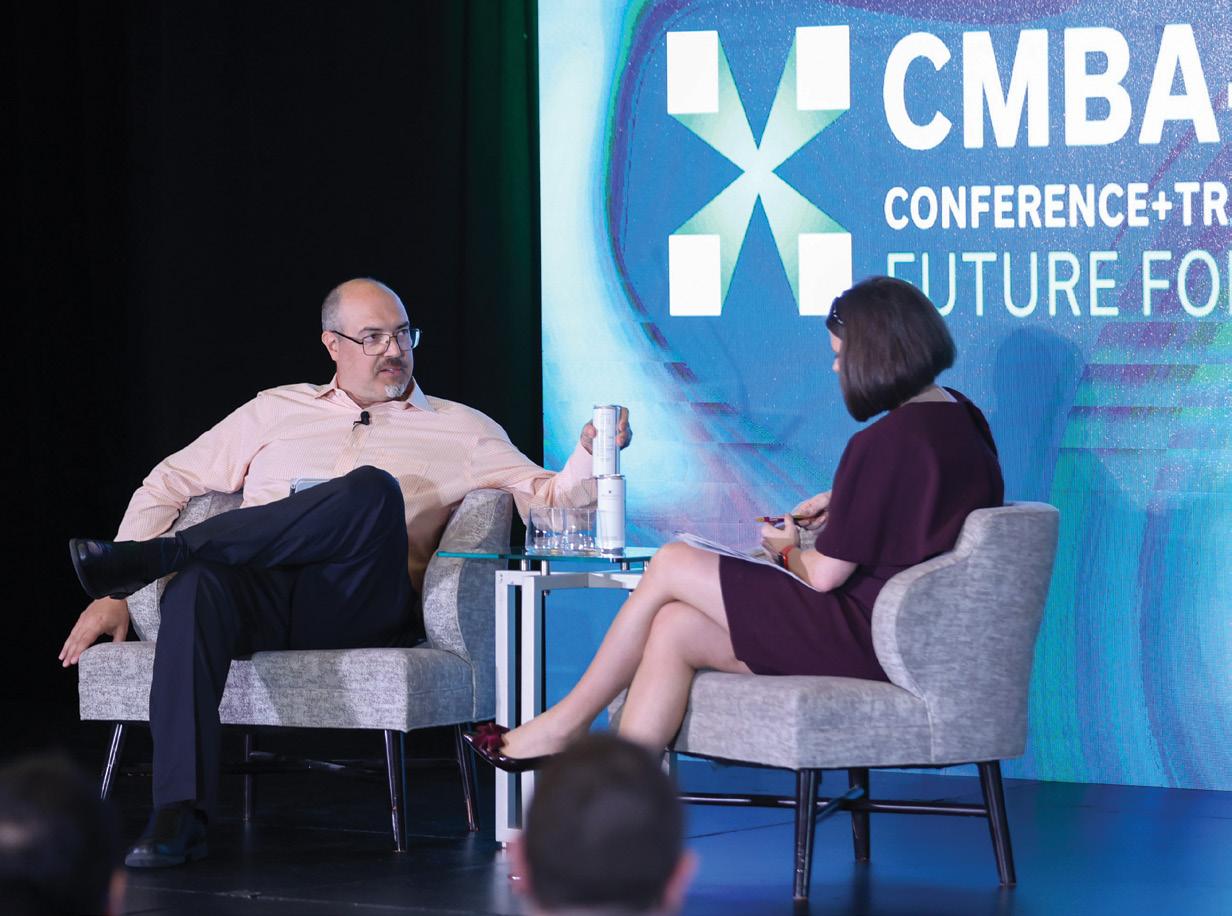
The Canadian Mortgage Brokers Association – British Columbia delivered another standout industry event with the 2026 ‘Future Forward’ CMBA-BC Conference & Trade Show, hosted April 13 and 14 at the prestigious JW Marriott Parq in Vancouver. Bringing together more than 500 mortgage professionals, partners and thought leaders, the event offered two days of insight, strategy and candid conversation about the forces reshaping the industry.
Held in an environment defined by rapid change, this year’s conference carried a clear and consistent message that this is not a ‘business as usual’ moment. Across sessions, panels and informal discussions, a common theme emerged: Borrower behaviour is evolving, expectations are shifting and the role of the mortgage professional is transforming alongside it. Those who adapt will find opportunity. Those who don’t risk being left behind.
Kicking off the event, emcee Susan HayesCulleton – known as ‘The Positive Economist’ – brought both energy and global perspective to the stage. Her insights framed many of the conversations that followed, highlighting major demographic and economic shifts already underway. Among them, the acceleration of intergenerational wealth transfer, with a growing percentage of first-time buyers relying on family support, and a rapidly aging population
that will reshape housing needs and financial planning in the years ahead.
This year’s opening keynote from digital marketing expert Alec Watson challenged attendees to rethink how they approach growth and branding. In a marketplace often focused on scale, his message was clear: authenticity is a competitive advantage. By staying true to their story and deeply understanding their audience, brokers can build stronger, more meaningful connections with clients. As Watson put it, “the story of a small brand is a superpower.”
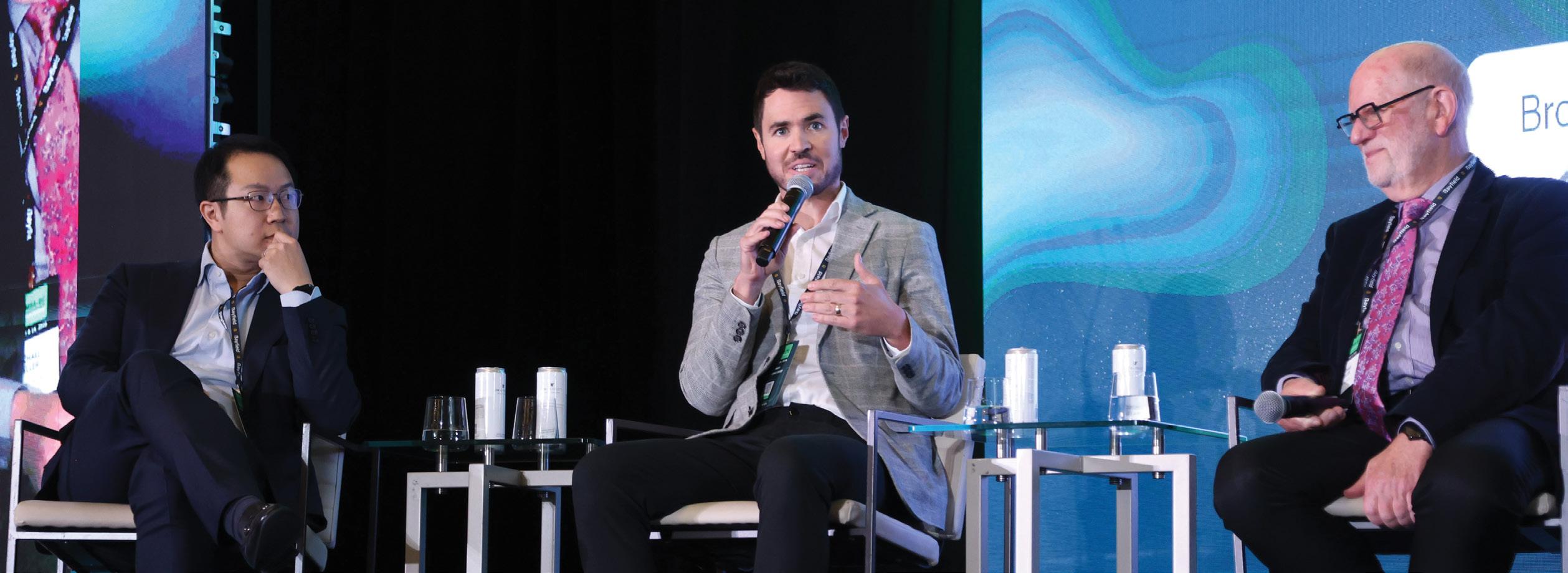
A standout housing panel featuring economist Bryan Yu, housing expert Michael Geller, Port Coquitlam Mayor Brad West and industry leader Marci Deane offered a candid and wide-ranging discussion on the realities facing Canada’s housing market. From youth unemployment and affordability challenges to infrastructure constraints and policy gaps, the conversation underscored both the complexity of the current environment and the urgency of addressing it.
In a fireside chat moderated by HayesCulleton, mortgage analyst Rob McLister provided a practical lens on today’s market dynamics. The discussion unpacked rate uncertainty, changing borrower behaviour and how brokers can better position themselves to guide clients through increasingly complex decisions.
On the business-building front, mortgage broker Renée Huse delivered a focused and highly actionable keynote on structuring for success. Her approach emphasized clarity, discipline and consistency, encouraging brokers to define who they are, build strong
From left to right: Top row: Keynote speaker Dr. Robyne Hanley-Dafoe on stage for the interactive incubator workshop; Pete Solymosi and Deb White, recipient of the MB Pioneer Award for Lifetime Achievement; and opening keynote speaker Alec Watson.
Second row: CMBA-BC secretary Jeff Puhl and Imran Thaver; Rob McLister's fireside chat with emcee Susan HayesCulleton.
Third row: Bryan Yu, Mayor Brad West and Michael Geller take the stage for this year's housing panel.
Bottom row: Rob Mark and Mark Ingram; Attendees hit the much-anticipated Trade Show, featuring more than 55 exhibitors.








From left to right: The CMBA-BC Board of Directors: Rebecca Casey (president), Kyle Williams (vice-president), Tricia McIntosh (treasurer), Jeff Puhl (secretary), Marci Deane (past president), Debora Seehuber, Nolan Smith, John Woods, Jeff Brown, Julie Sheremeto, Jessie Lavoie, Monica Parkin and Carla Giles (CEO); Susan HayesCulleton, event emcee.
teams, maintain a steady prospecting pipeline and commit to continuous improvement rather than constant reinvention.
Kicking off Day 2, economic insights took centre stage with Brendon Ogmundson, Chief Economist of the BC Real Estate Association,
who provided a frank assessment of current conditions. With rising concerns around job security and broader economic uncertainty, Ogmundson’s message reinforced the importance of staying informed, adaptable and grounded in data when advising clients.


Regulatory developments were also in focus, as Tolga Yalkin, CEO of provincial regulator BC Financial Services Authority (BCFSA), delivered an update on the implementation of the new Mortgage Services Act. Describing this as a “very significant transition,” Yalkin emphasized the role of the new framework in strengthening consumer protection and supporting a more resilient, trusted industry.
One of the most-anticipated sessions of the conference came in the form of an incubator workshop, led by Drs. Robyne Hanley-Dafoe and Greg Wells. Blending research with real-world application, the session explored the intersection of performance and well-being. With burnout continuing to impact a large portion of professionals, their message encouraged a shift in mindset – from traditional goal-setting to ‘feeling-setting’ – and a more intentional approach to how individuals show up in both their work and personal lives.
Beyond the sessions themselves, the CMBA-BC Conference was designed to bridge the gap between big-picture trends and day-to-day decision-making. Attendees were not only exposed
to macroeconomic insights and policy discussions but also equipped with practical tools and strategies they can immediately apply in their businesses.
Equally important was the opportunity for connection. In a relationship-driven industry, the ability to engage with peers, lenders and partners remains a critical advantage. From interactive formats like the incubator workshop to lighter, high-energy moments, such as a Dating Game-style session matching brokers and lenders, the event struck a balance between insight, engagement and community.
Indeed, this signature event served as both a reality check and a roadmap. It reinforced that success in today’s market is no longer defined solely by transactions, but by positioning – understanding broader trends, communicating clearly with clients, investing in personal and professional growth and building strong, lasting relationships.
As the industry continues to evolve, the message coming out of this year’s conference is clear: The future belongs to those who are prepared to move forward with it.
MB Pioneer Award for Lifetime Achievement
Deb White
Sponsored by MCAN Financial
Deb White (centre) with Nadine Wakelyn, Jane Wakelyn, Kelli Schneider, Graeme Merrick, Craig Barton, Pete Solymosi, Chris Murphy and Annette Perry.



MB Community Service Recognition
Christine Buemann
Awarded posthumously.
Chad Oyhenart (right), accepting the award on Christine’s behalf

MB Corporate Partner Recognition

MB Individual Partner
Sponsored by
Sponsored by BC Notaries Association
Inder Matharu (above), managing partner and director at Bayfield Mortgage Professionals

BY KOKER CHRISTENSEN and ISABELLE SAVOIE

Artificial intelligence (AI) is increasingly integrated into Canada’s financial services sector and is affecting operational processes, product delivery, risk management, and market dynamics.
Over the course of four workshops in 2025, the Financial Industry Forum on Artificial Intelligence (FIFAI) II convened by the Office of the Superintendent of Financial Institutions (OSFI) and the Global Risk Institute with participation from other regulators and industry stakeholders, examined the evolving implications of AI adoption for financial institutions, consumers, and the broader financial ecosystem. Published on March 23, 2026, the FIFAI II report (the "Report") introduces the AGILE framework (Awareness, Guardrails, Innovation, Learning, and Ecosystem Resiliency) as an organizing structure for managing AI related risks and capitalizing on AI-related opportunities in the financial services sector.
The Report reflects views and insights from individual FIFAI II speakers and participants, and should not be interpreted as guidance from regulatory authorities.
The Report identifies a number of risks associated with increased AI deployment in the financial sector.
Strategic challenges associated with AI adoption in financial institutions include variability in pace of adoption, fragmented AI approaches, and constraints related to resources and data quality. The Report further notes that financial institutions operate within a multi jurisdictional regulatory environment with limited AI specific guidance, which has contributed to uncertainty regarding the application of existing requirements to AI enabled activities.
Financial institutions are experiencing an increase in AI enabled threats, including social engineering, deepfakes, voice spoofing, synthetic identity fraud, and automated cyberattacks. Disinformation and misinformation campaigns could disseminate false or misleading claims about, for example, financial institutions’ solvency or regulatory compliance, and thereby undermine trust.
Consumer related risks associated with AI use exist in areas such as credit adjudication, underwriting, product recommendations, and investment services. As AI enabled systems increasingly
influence consumer outcomes, issues relating to transparency, explainability, accountability, and disclosure have become more prominent. Additional risks include the potential for biased or unfair outcomes arising from data limitations, increased exposure of consumers to AI enabled fraud, and challenges for consumers in identifying when AI systems are used. The Report highlights that these risks may have disproportionate effects on certain populations, including seniors, newcomers, low income individuals, and persons with limited digital access or literacy.
AI’s growing role in financial services is straining access to skilled talent. Expertise is concentrated in larger organizations, leaving smaller firms and oversight bodies more exposed. Meanwhile, lagging AI education and rapid technological change increase operational and consumer risks. Inadequate workforce upskilling and limited consumer understanding can reduce AI’s benefits and heighten exposure to fraud.
Financial institutions increasingly rely on external providers for data, models, cloud infrastructure, and AI enabled services, often through complex multi tier supply chains. Risks include limited visibility into third-party controls and practices, outsized dependence on a small group of external vendors, and limited contractual leverage.
These risks include the potential amplification of operational disruptions, correlated behaviour among AI driven trading models trained on similar data, and broader labour and macroeconomic effects linked to automation and business transformation.

The AGILE framework introduced in the Report is meant to help guide responsible AI adoption, innovation and resilience across Canada’s financial sector. As set forth below, the Report assigns implementation priorities with respect to each portion of the framework to navigate AI risks and leverage AI opportunities.
Stay ahead of AI-driven risks by understanding how technologies reshape the risk landscape through organizational enhancements such as AI oversight, board engagement, and expanded monitoring and stress testing scenarios.
Immediate priorities: Strengthen executive awareness by ensuring boards and senior leaders actively understand evolving AI risks and proactively prepare for emerging technologies like agentic AI through clear governance frameworks and adaptive controls.
Short/medium term: Expand stress testing and monitoring by incorporating AI-driven macroeconomic scenarios into enterprise risk frameworks and continuously tracking labour market and economic impacts to anticipate systemic vulnerabilities and inform strategies.
Make best practice regular practice with strong controls, data-integrity standards, human oversight for highimpact decisions, transparency and appropriate consumer outcomes, and rigorous third-party oversight.
Immediate priorities: Reinvigorate focus on the fundamentals by making best practice regular practice with strong governance and risk controls that work as intended and building muscle memory in areas such as
cyber hygiene and third-party due diligence.
Short/medium term: Drive evergreen governance and transparency by maintaining adaptable frameworks, enforcing strong data integrity standards, and delivering consumer-centric disclosures with explainable AI decisions and inclusion by design.
Adopt an AI growth mindset that treats AI as a driver of competitiveness that enhances consumer financial well-being and protection, supported by bold investments in talent, modern infrastructure and responsible innovation.
Immediate priorities: Enable bold, responsible AI-driven innovation by encouraging experimentation and scaled adoption of AI in customer service, market operations, internal processes and security focused uses of AI, supported by appropriate safeguards, sandboxes, and outcome-based supervision that allows new products, services, and business models to emerge.
Short/medium term: Accelerate AI-driven transformation by investing in tools and talent, modernizing legacy systems with standardized data and zero-trust security, and enhancing consumer financial well-being and protection through such things as personalized guidance and proactive fraud detection.
Build AI skills at every organizational level, including employees and management, through continuous training and collaborative initiatives, while also empowering consumers with AI literacy to help them protect themselves and make informed choices.
Immediate priorities: Establish financial industry AI literacy and upskilling initiatives through continuous learning systems, organizational AI training frameworks, and collaborative industry initiatives that accelerate talent development and consumer awareness.
Short/medium term: Advance sector-
wide AI capability by building deep talent pipelines through university partnerships, scaling AI training across the organization, and empowering consumers through transparency and accessible AI literacy so they can help protect themselves against threats, understand AI-driven decisions, and make confident, informed choices.
Fortify system-wide defences through improved third-party oversight, regulatory clarity, enhanced digital identity security, expanded real-time
threat sharing, and upgraded incidentresponse frameworks.
Immediate priorities: Pursue greater regulatory certainty on AI-related risks by beginning to clarify how existing rules apply to AI and aligning across agencies where possible on messaging, priorities and next steps.
Short/medium term: Strengthen information-sharing frameworks and joint intelligence efforts by developing clear legal and privacy frameworks for threat information sharing, standardizing formats, and encouraging participation from institutions of all sizes.
All information and opinions contained in this article are for general information purposes only and do not constitute legal or any other type of professional advice. The content of this publication is not intended to be a substitute for specific advice prepared on the basis of an understanding of specific facts. Any reliance on this information is at your own risk.
This article is republished with the permission of Fasken, a leading international law firm. The authors are based in the firm’s Toronto office. Koker Christensen is Partner, Co-leader, Financial Services and Isabelle Savoie is Associate, Financial Services. More: fasken.com







BY SAMANTHA ASHENHURST
Mortgage professionals from across Ontario gathered in Vaughan on April 22 and 23 for the 2026 CMBA Ontario Gala & Awards Night and Annual Conference & Trade Show – two days focused on connection, industry leadership and the future of mortgage brokering. The celebrations began on April 22 with the CMBA Ontario Gala & Awards Night, held in support of SickKids Foundation. Hosted by Canadian television personality Melissa Grelo, the evening brought together brokers, lenders, service providers and industry partners to recognize excellence across the mortgage sector.
Brokerage of the Year: Mortgage Architects –A Better Way
Outstanding Young Achiever: Julian Di Franco
Lender of the Year: EQ Bank
Service Provider of the Year: Canada Guaranty
Community Service Award: Alta West Capital
The Ed Karthaus Professional Integrity Award: Donna Thornton
Hall of Fame Inductee: W. Mark Squire
The momentum carried into the Annual Conference & Trade Show on April 23 at Vaughan’s beautiful Universal Eventspace venue. The fullday event welcomed mortgage professionals for a packed agenda of educational sessions, networking opportunities and conversations about the evolving mortgage landscape.
Attendees heard from industry-leading speakers and participated in timely discussions focused on market conditions, business growth and the challenges and opportunities facing mortgage professionals in today’s environment. One of the day’s featured sessions, ‘The First Year Test: What the New Government Got Right (and Wrong),’ brought together CTV News chief political correspondent Vassy Kapelos and Tanya Woods, head of government and regulatory affairs and policy counsel at Questrade Financial Group, for a candid discussion on the federal government’s first year in office.
The session examined key policy decisions, their economic impact and the implications for Canadian businesses and consumers moving forward.
Economic conditions and interest rates remained front and centre throughout the conference. In his economic update, Derek Burleton, VP and deputy chief economist at TD, delivered a detailed outlook
Opposite: There was lots of enthusiasm at this year's CMBA-Ontario Gala & Awards Night and Annual Conference & Trade Show held in Vaughan.
focused on inflation, employment trends, consumer confidence and the Bank of Canada’s path forward on rates. Attendees gained valuable insight into how broader economic forces are shaping borrower behaviour, housing demand and market activity across the country.
The changing needs of borrowers and the evolution of mortgage products were explored during the lender panel. Panelists Paula Oliveira of BMO, Pierre Martin of Home Trust, Paul Campbell of Magenta and Elena Robinson of First National discussed how lenders are adapting underwriting strategies, product offerings and broker partnerships in response to affordability pressures, shifting consumer expectations and increased demand for flexible financing solutions.
Business growth and long-term planning were another key focus. Speaker Doug Adlam, founder of Adlam Innovations, shared practical strategies for brokers looking to build long-term enterprise value within their businesses. The session explored succession planning, operational efficiency, branding, client retention and the systems brokers can implement today to position their businesses for future growth – or eventual sale.
The conference also featured an inspiring keynote presentation from Nav Bhatia, internationally known as the Toronto Raptors Superfan. In his address, Bhatia shared his personal journey immigrating to Canada, overcoming adversity and building a successful career. Through stories of perseverance, community involvement and his passion for basketball, Bhatia delivered a powerful message about leadership, inclusion and using success as a platform to create positive change.
Beyond the educational sessions, the trade show floor provided attendees with opportunities to reconnect with industry partners, discover new technologies and products, and strengthen relationships across the mortgage community.
Together, the Gala & Awards Night and the Annual Conference & Trade Show showcased the strength, resilience and professionalism of Ontario’s mortgage community. As the industry continues to adapt and innovate, CMBA Ontario’s flagship events once again created a space for mortgage professionals to celebrate success, exchange ideas and look ahead to the future with confidence.
From left to right: Top row: The changing needs of borrowers and the evolution of mortgage products were discussed by the lender panel (from left) CMBA Ontario director Chris Bargis, Paula Oliveira of BMO, Pierre Martin of Home Trust, Paul Campbell of Magenta and Elena Robinson of First National.
Second row (from left): The conference featured an inspiring keynote presentation from Nav Bhatia, internationally known as the Toronto Raptors Superfan; this group was ready to enjoy the Gala & Awards night.
Bottom row (from left): CTV News chief political correspondent Vassy Kapelos and Tanya Woods, head of government and regulatory affairs and policy counsel at Questrade Financial Group, discussed ‘The First Year Test: What the New Government Got Right (and Wrong);’ (centre and right) The Ontario mortgage broking community turned out in force to attend the Annual Conference & Trade Show.










BY KOKER CHRISTENSEN, CAITLIN SABETTI AND ISABELLE SAVOIE
On April 16, 2026, the Financial Transactions and Reports Analysis Centre of Canada (FINTRAC) published information on the new initiatives and updates it is implementing as a result of recent or upcoming legislative amendments to the Proceeds of Crime (Money Laundering) and Terrorist Financing Act (PCMLTFA) and the Proceeds of Crime (Money Laundering) and Terrorist Financing Administrative Monetary Penalties Regulations (AMP Regulations). The amendments to the PCMLTFA and the AMP Regulations were introduced in the Budget 2025 Implementation Act and the Strengthening Canada’s Immigration System and Borders Act, both of which received Royal Assent on March 26, 2026.
There will be changes to FINTRAC’s AMP framework in light of the amendments to the AMP Regulations, including changes to:
significantly increase the maximum amount of AMPs that may be imposed for prescribed violations, up to:
0 $40,000 in the case of a minor violation (up from $1,000);
0 $4,000,000 in the case of a serious violation (up from $100,000); and
0 $20,000,000 in the case of a very serious violation (up from $500,000);
introduce ability to pay as part of the criteria for determining an AMP amount;
introduce the use of compliance agreements in all cases where an AMP is imposed;
introduce compliance orders as a new enforcement tool;
designate the contravention of a compliance order as a new violation under the PCMLTFA; and
elevate certain compliance program violations from serious to very serious.
FINTRAC noted that it is currently updating its AMP policy and developing accompanying guidance that will outline the principles, processes, and criteria used to administer penalties.
The amendments to the PCMLTFA now require that reporting entities have a compliance program that meets the higher standard of being “reasonably designed, risk-based and effective” (in addition to the existing requirement to have an AML compliance program that is “intended to ensure their compliance” with the AML regime). Failure to meet this requirement is designated as a “very serious” violation.
The amendments also clarify requirements related to the prohibition of anonymous accounts and introduce a definition of anonymous client.
FINTRAC noted that it will be updating its guidance to outline its expectations for these requirements.
Coming into force in line with regulations to be developed and published at a later date, the amendments to the PCMLTFA will require businesses subject to the PCMLTFA (that are not already required to do so) to enroll with FINTRAC.
Other amendments effective March 26, 2026 make the Director and CEO of FINTRAC a member of the Financial Institutions Supervisory Committee and enable FINTRAC to (i) exchange supervisory information on federally regulated financial institutions with other members of the Financial Institutions Supervisory Committee and (ii) provide financial intelligence disclosures to the Commissioner of Canada Elections.
The amendments to the PCMLTFA now require that reporting entities have a compliance program that meets the higher standard of being “reasonably designed, riskbased and effective” (in addition to the existing requirement to have an AML compliance program that is “intended to ensure their compliance” with the AML regime).
Failure to meet this requirement is designated as a “very serious” violation.
The Budget 2025 Implementation Act enacts the Stablecoin Act, which establishes regulatory requirements for stablecoin issuers, and which will come into force on a day to be fixed by order of the Governor in Council. The coming into force of the Stablecoin Act will be dependent on the development and publication of associated regulations. Stablecoin issuers will be required to register with FINTRAC as money services businesses dealing in virtual currency. To that end, FINTRAC will update its existing guidance for money services businesses to account for stablecoin issuers.
FINTRAC has noted that it will continue to provide information to assist businesses subject to the PCMLTFA in complying with their expanded obligations resulting from these recent and upcoming amendments to the AML Regime.
Fasken’s Financial Services Group is actively monitoring regulatory developments in this area.
All information and opinions contained in this article are for general information purposes only and do not constitute legal or any other type of professional advice. The content of this publication is not intended to be a substitute for specific advice prepared on the basis of an understanding of specific facts. Any reliance on this information is at your own risk.
This article is republished with the permission of Fasken, a leading international law firm. The authors are all in the firm’s Toronto office. Koker Christensen is Partner, Co-leader, Financial Services; Caitlin Sabetti is Partner, Financial Services; Isabelle Savoie is Associate, Financial Services. More: fasken.com











BY DOANE GRANT THORNTON LLP
Canada is facing record levels of illicit funds moving through our economy. For more than a decade, illegal drug trafficking has remained the country’s top money laundering (ML) threat, followed by fraud, trade-based ML, and tax evasion – each generating an estimated $1 billion or more in criminal proceeds.
Our defenses are working harder than ever. Between 2024-2025, Canada’s anti-money laundering (AML) system produced 6,236 financial intelligence disclosures, the highest on record. In one case, FINTRAC intelligence supported charges against 10 individuals in Barrie, Ontario, tied to an international drug trafficking network spanning the Middle East, Manitoba, and British Columbia. It’s only one example among many.

Yet despite these gains, the broader reality is sobering: we’re losing ground.
For example, mortgage fraud continues to rise – including a $500 million scheme uncovered earlier this year involving falsified financial documents. FINTRAC also issued its two largest penalties ever against foreign virtual currency operators for complete noncompliance, and news headlines continue
ENTITIES
to highlight AML breakdowns at major institutions across the country.
The Proceeds of Crime and Terrorist Financing Act (PCMLTFA) applies to a wide range of sectors, including financial institutions, securities dealers, real estate participants, casinos, remittance and
currency exchange platforms and virtual currency dealers.
As a founding member of the Financial Action Task Force (FATF), Canada is currently under peer review – bringing heightened scrutiny at a time when illicit funds are at an all-time high and increasingly linked to violent crime in our communities.
Accountants
Acquirer services in relation to private automated banking machines
British Columbia notaries
Casinos
Agents of the Crown Financing or leasing entities Financial entities Money services businesses
Dealers in precious metals and precious stones
Factors Mortgage Life insurance Real estate Securities dealers Title insurers
Armoured cars
Cheque cashers
Canada’s approach can be viewed through a national adaptation of the three lines of defense (3LOD) framework.
First line: Regulated and unregulated businesses serving customers across all sectors and regions. The PCMLTFA sets detailed requirements here, and many entities are doing a lot to identify financial crime.
Second line: Regulators at the federal and provincial levels. As the national AML regulator, FINTRAC has pushed for more action at the first line – and more effective action – which has driven higher volumes of reporting into FINTRAC and more intelligence passed to law enforcement.
Third line: Law enforcement and the justice system – our last line of defense– are receiving more reports and better intelligence than ever. Forensic experts, including Doane Grant Thornton’s forensic team, led by Jennifer Fiddian-Green, are increasingly called upon to provide clarity in complex cases. Despite this, systemic pressure persists across all three lines.
We need our first line to start saying “No, thank you.” Not punitively, but prudently.
Canada’s AML regime doesn’t require businesses to refuse service except in sanctions related scenarios. The model is largely reactive: identify, monitor, report – and continue the relationship if you choose. This normalizes unexplained or economically irrational funds as part of routine business.
If we want better outcomes, the first line must change its first move. Saying
“no” at the outset reduces strain on regulators, law enforcement, and ultimately, the courts.
Yet compliance systems today often penalize inconsistency more than they reward prevention. Boards fear regulatory consequences more than criminal exposure. This must change.
Whistleblowing mechanisms – now more widely adopted – should also be integrated into AML efforts so that a “no” in one organization can help others validate and make informed decisions.
There are encouraging policy steps. Unexplained Wealth Orders (UWOs) – now adopted in British Columbia, Saskatchewan, Nova Scotia, and Manitoba and upheld in court – shift the burden of proof to alleged owners of suspicious assets. It’s a constructive beginning.
And yes, declining risky business may impact business growth in the short term. But growth powered by illicit funds weakens Canada and strengthens criminal networks.
In 2024–2025, the first line filed more than 65 million transaction reports. But our justice system cannot keep pace.
Trials must begin within 18-30 months, and with limited capacity, many fraud cases never make it to conviction. As of December 2025, only 10% of cases resulted in charges, and more than half of those were dismissed.
Illicit funds that never enter the economy don’t need to be investigated, prosecuted or forfeited. Prevention strengthens our communities and relieves pressure on every subsequent line of defense.
Saying “no” means declining to provide services when a person or organization
Real change will happen when business and board leaders draw a clear line: if you don’t know who the client is or where their money comes from – say no. This is not solely a banking issue; it applies to everyone.
cannot credibly explain the source of their funds. It means stepping back when serious questions or inconsistencies emerge about a prospective client or the money they are introducing into your business. In those moments, we need you – our business leaders – to have the confidence to simply say no.
This responsibility spans across all sectors of our economy – real estate, mortgages, vehicle and luxury goods sales, securities firms, wealth management, casinos, online gaming, and more. Across these sectors, declining a relationship is often not only appropriate; it’s necessary.
Casinos:
VIP players often trigger repeated suspicious cash related reports. Filing those reports is required, but not supporting our long-term community health. Businesses can – and should – require verified sources of funds before allowing play and if funds can’t be verified, then say “no”.
Buyers with legitimate sourced funds rarely use tens of thousands of dollars in cash for vehicles, land, art, or jewelry. When the behaviour or the economics of a transaction don’t make sense, discernment – not facilitation –is the right response.
Opaque land ownership:
Only British Columbia has a comprehensive landowner transparency registry. Other provinces still allow ownership structures that obscure beneficial owners, enabling unexplained money to enter the real estate market with little scrutiny.
No matter the sector, the central questions are the same: Does this transaction make sense? And is the source of funds clear? If not, the answer should be clear.
Canada’s wide network of service providers – across online gaming, mortgage lending, real estate, financial services, securities, and wealth management – creates countless entry points for illicit funds. Given our relatively small population, the scale of activity suggests a significant volume of tainted money is moving through the system.
The mortgage market illustrates the challenge. Public data from CMHC, Statistics Canada, and OSFI indicates there are roughly 6.93 million residential mortgages in Canada, serviced by banks and credit unions. Based on our work with industry stakeholders, this almost certainly undercounts the true total –especially as private lending has grown rapidly and only came under regulation in October 2024.
Canada has about 16.8 million households, with roughly 8.33 million owner occupied homes in the under 60 age group (the cohort most likely to carry a mortgage). That means, even using only publicly tracked data, Canada has nearly one mortgage for every owner-occupied household – before including unreported or less visible private mortgages.
At a macro level, we must ask: Does the sheer volume of private, hard to track lending make sense? If it does not, what does that suggest about the sources and flow of money within our economy?
A similar pattern appears in the securities sector. Canadian dealers are frequently targeted by international individuals and entities, or international sourced funds, seeking to move funds into and out of Canada with relative ease. While some firms apply rigorous due diligence, many don’t – making it
The world is becoming more complex and risky. Fraud and other predicate crimes are generating unprecedented levels of illicit funds. Our first line –companies across every sector –must strengthen the frontend defense.
difficult to establish the true origin or purpose of the funds being invested. Businesses must start recognizing the bigger picture: how realistic is it that an offshore client would legitimately need a Canadian domiciled investment account?
Real change will happen when business and board leaders draw a clear line: if you don’t know who the client is or where their money comes from – say no. This is not solely a banking issue; it applies to everyone.
Know who you do business with. Be confident in declining relationships that don’t feel right.
Make compliance meaningful. Ask whether your organization wants these funds associated with its name.
Support law enforcement. When called upon, cooperate fully – that case is amongst the few that can be pursued with limited resources.
Recognize that allowing unexplained money into the system weakens Canada.
Adopt a unified first line mindset. When one business says no, others should have the tools and confidence to do the same.
Acknowledge Canada’s historic open door posture. While it has benefits, it has also been exploited by bad actors. The first line must be vigilant.

The world is becoming more complex and risky. Fraud and other predicate crimes are generating unprecedented levels of illicit funds. Our first line –companies across every sector –must strengthen the front-end defense. Let’s be far-sighted in what we say yes to. And when something doesn’t make sense, let’s have the courage to say no.
Protect your organization from exposure to illicit finance. Our experienced Forensics professionals can help you strengthen your AML strategy and stay ahead of emerging threats.
This article is republished with the permission of Doane Grant Thornton LLP, one of Canada’s Best Workplaces™ and a leading Canadian accounting and advisory firm providing accounting, audit, tax and advisory services to private and public organizations. Doane Grant Thornton LLP is a Canadian member of Grant Thornton International Ltd, whose member and correspondent firms operate in over 130 countries worldwide. More: doanegrantthornton.ca





Grow Your Expertise: Access top industry courses and webinars
Expand Your Network: Connect with brokers and lenders nationwide
Advance Your Career: Gain tools and insights to stay ahead
Shape the Industry: Be a voice for mortgage professionals with CMBA National
Ready to thrive in the mortgage industry? Join us today!