Series editor: Diana V. Edelman, University of Oslo
Worlds of the Ancient Near East and Ancient Mediterranean brings alive the texts, archaeology and history of the cultures of the regions around the Mediterranean Sea and eastward to ancient Iran and Iraq, from the Neolithic through the Roman periods (ca 10,000 BCE–393 CE). Studies of one or more aspects of a single culture or of a subject across cultures in the regions outlined will form the foundation of this series, in which interdisciplinary approaches are encouraged. Studies can be based on texts, on material remains, or a combination of the two, where appropriate. In the case of a project that focuses on either the memory or the reception history of a place, person, myth, practice, or idea that arose or existed within the prescribed time, chapters that trace ongoing relevance to the present are welcome. The volumes are meant to be accessible to a wide audience interested in how the inhabitants of these parts of the world lived or how they understood their own pasts, presents, and futures, as well as how current scholars are understanding and recreating their pasts or their future aspirations.
Published titles
A History of Biblical Israel: The Fate of the Tribes and Kingdoms from Merenptah to Bar Kochba
Axel Knauf and Philippe Guillaume
Forthcoming titles
Burial Practices in Ancient Israel and the Neighboring Cultures (c. 1500–330 BCE)
Jürg Hutzli and Stefan Münger
Recovering Women’s Rituals in the Ancient Near East
Julye Bidmead
Leadership, Social Memory and Judean Discourse in the 5th–2nd Centuries BCE
Ehud Ben Zvi and Diana V. Edelman
Ancient Cookware from the Levant:
An Ethnoarchaeological Perspective
Gloria London
Published by Equinox Publishing Ltd.
UK: Office 415, The Workstation, 15 Paternoster Row, Sheffield, South Yorkshire S1 2BX
All rights reserved. No part of this publication may be reproduced or transmitted in any form or by any means, electronic or mechanical, including photocopying, recording or any information storage or retrieval system, without prior permission in writing from the publishers.
British Library Cataloguing-in-Publication Data
A catalogue record for this book is available from the British Library.
ISBN 978 1 78179 199 8 (hardback)
Library of Congress Cataloging-in-Publication Data
London, Gloria.
Ancient cookware from the Levant: An ethnoarchaeological perspective / Gloria London.
pages cm.—(Worlds of the ancient Near East and Mediterranean) Includes bibliographical references and index.
9. Ethnoarchaeology–Middle East. 10. Ethnoarchaeology--Cyprus. I. Title.
DS56.L66 2016
666’.309394--dc23
2015031530
Typeset by Queenston Publishing, Hamilton, Ontario, Canada
Printed and bound in Great Britain by Lightning Source Inc. (La Vergne, TN), and Lightning Source UK Ltd. (Milton Keynes)
Dedication
No one cooks better than my mother, Elaine London, who wanted to be an archaeologist. Two of her exceptional butter cookie and kugel recipes were passed down from her Aunt Ella’s friend, Goldie, who was recognized by three generations as an exceptional baker. A third recipe, for silver dollar pancakes, is a 1950s clipping from The Philadelphia Inquirer, still taped into a notebook.
In 1986, a young man came to Kornos in search of a cooking pot for his young Australian bride. He looked at the pots, but did not find what he wanted. After a lengthy discussion with the potters, gesticulating to describe the pot, he explained to me that he was looking for a pot he remembered from his youth. He said that he was “searching for the taste of his mother’s cooking.” He was adamant that with the right cooking pot and recipe his wife would cook food like his mother. He was convinced that the taste starts with a handmade clay cooking pot.
lIst of tables
Table 1. Numbers of potters and establishments based on Cyprus government reports for 1972 and 1982.
Table 2. Names for Cypriot pots and tools in the Troodos and Kornos traditions.
Table 3. The number of pieces in twelve firings at Kornos and Ayios Dimitrios.
Table 4. Terms for 21st century Gaza Gray Ware.
Table 5. Names of pots made in Zizia, 1987.
Table 6. Pots made annually for one household before 1914 near Ramallah.
Table 7. Names of handmade ceramic repertoire at Yaʿbad.
Table 8. Pots made in 20th century northern Jordan.
Table 9. Cookware types through the ages.
Cover PhotograPh
22
55
100
248
254
258
259
263
268
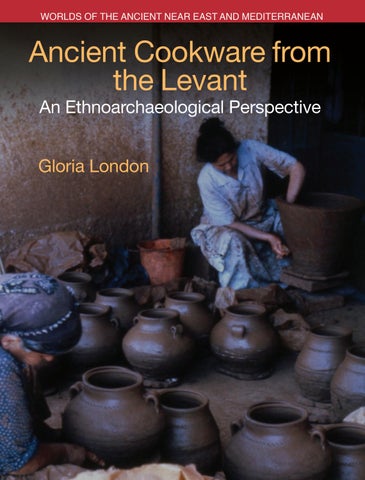
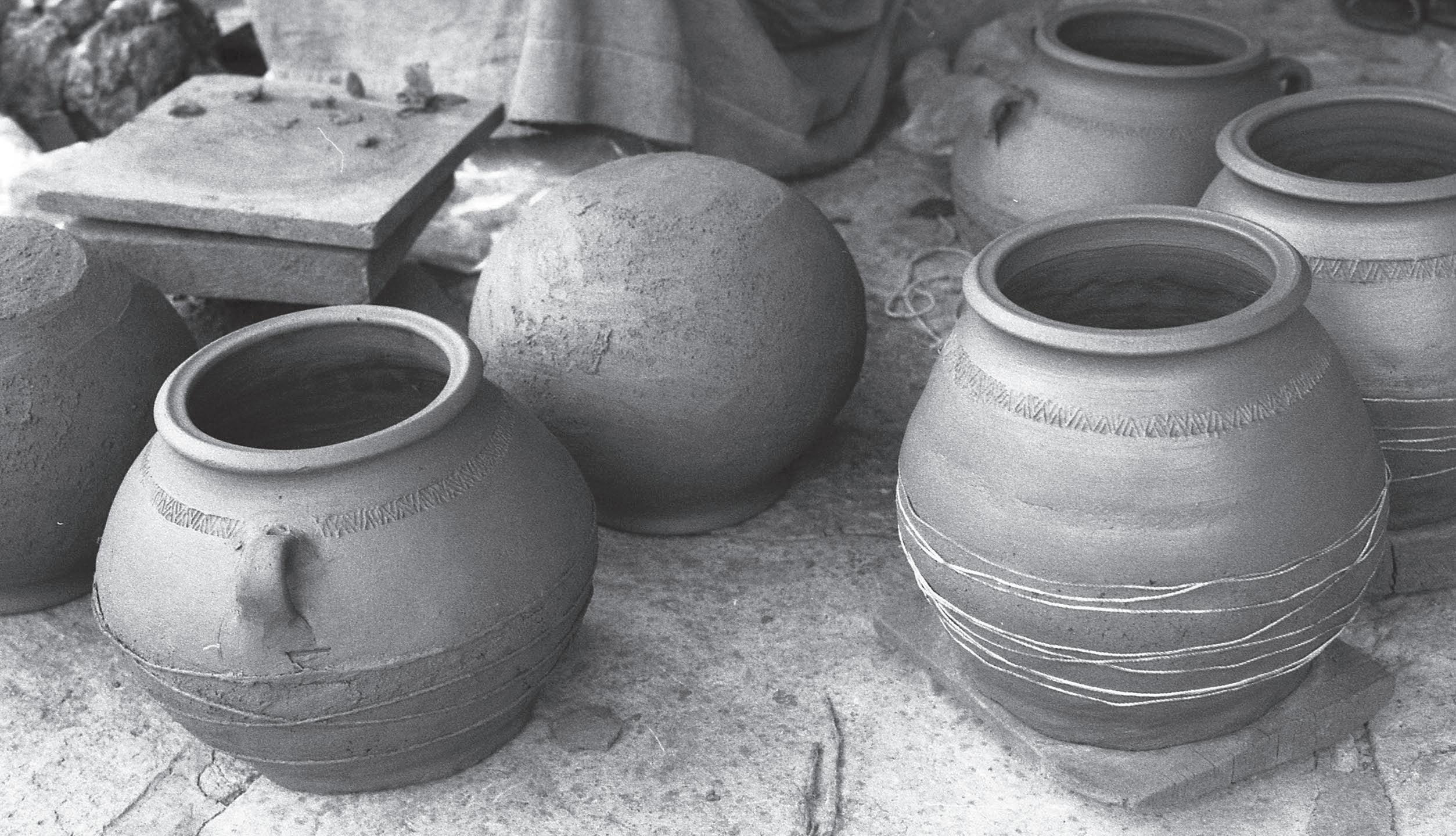
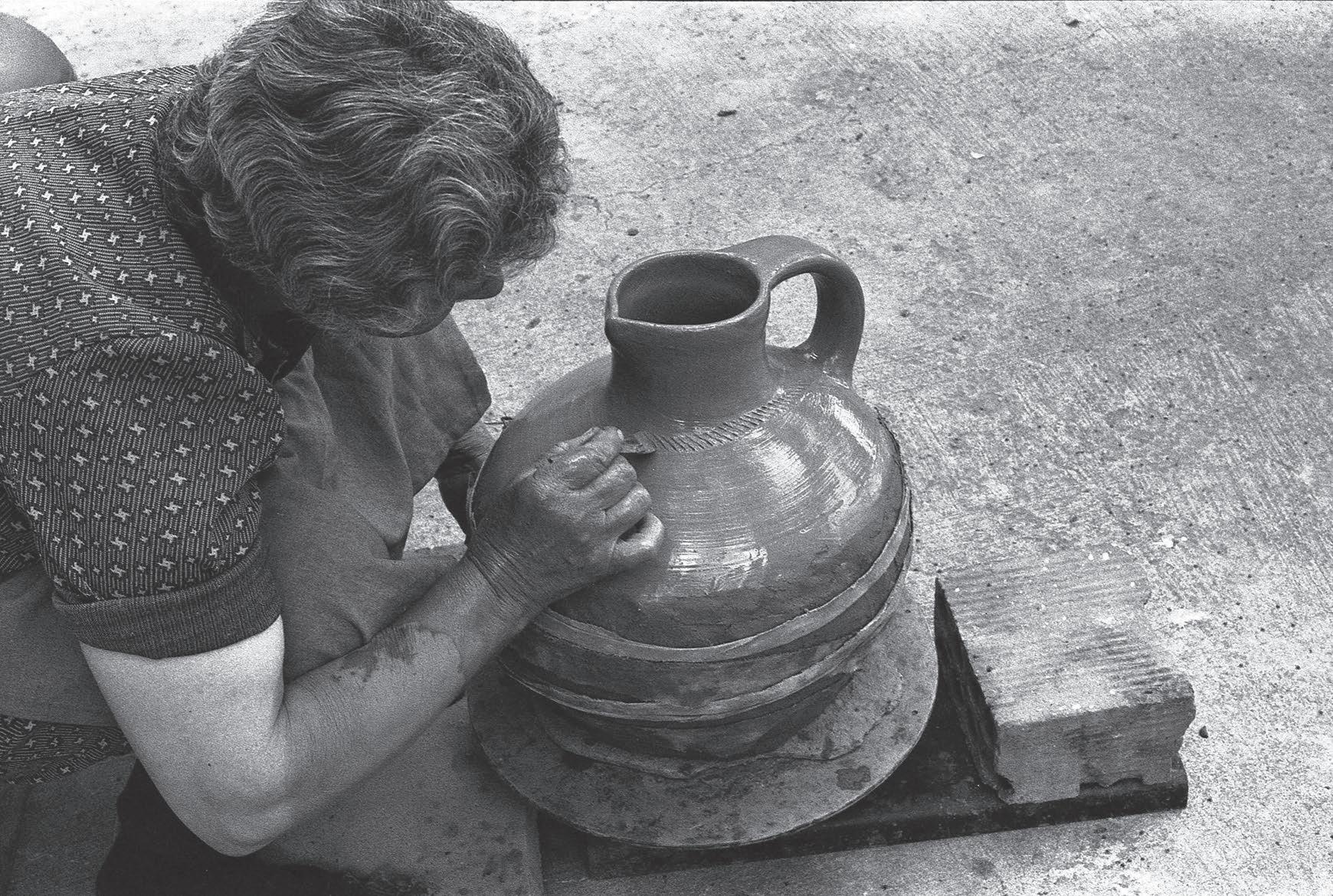
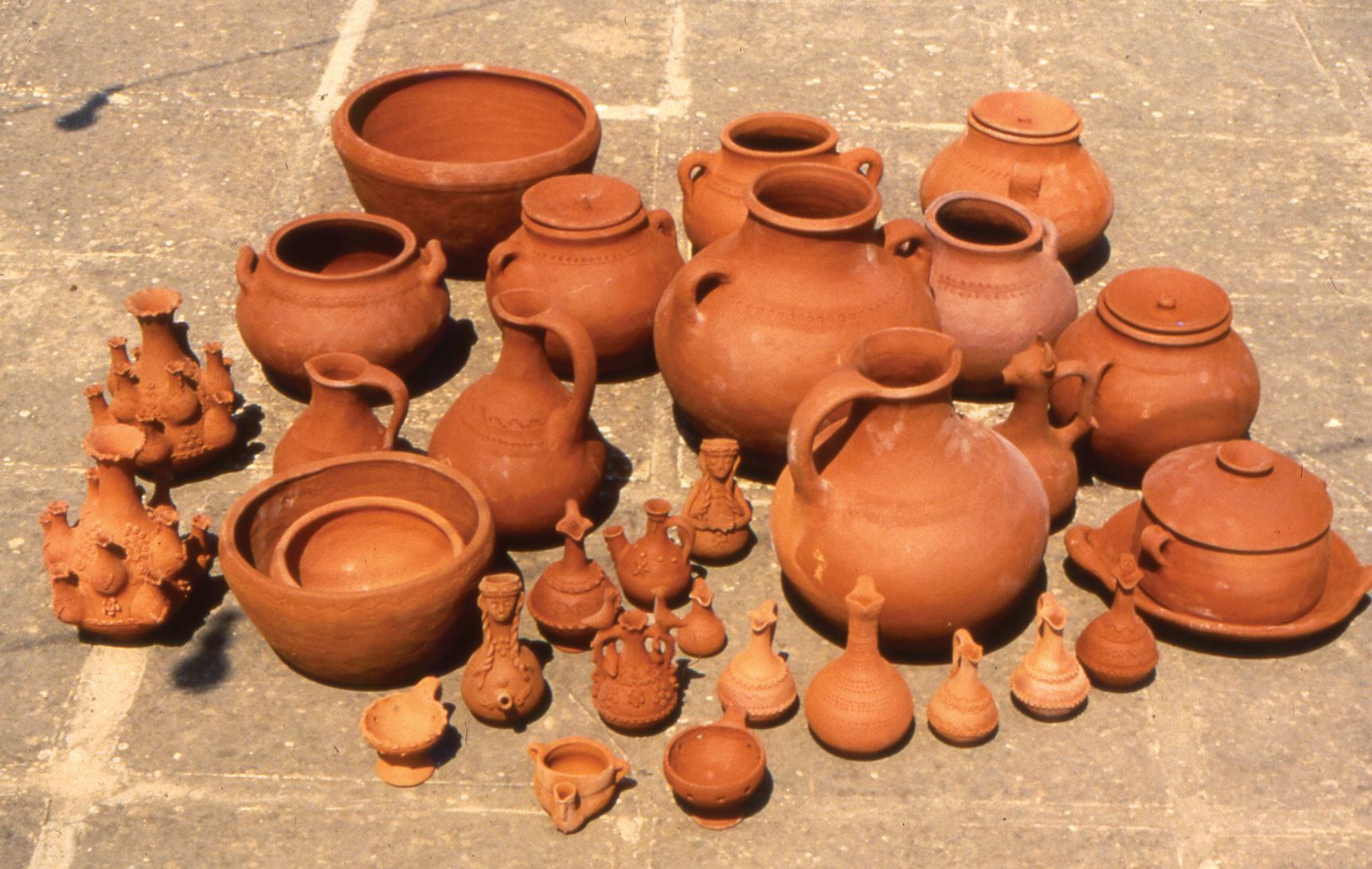
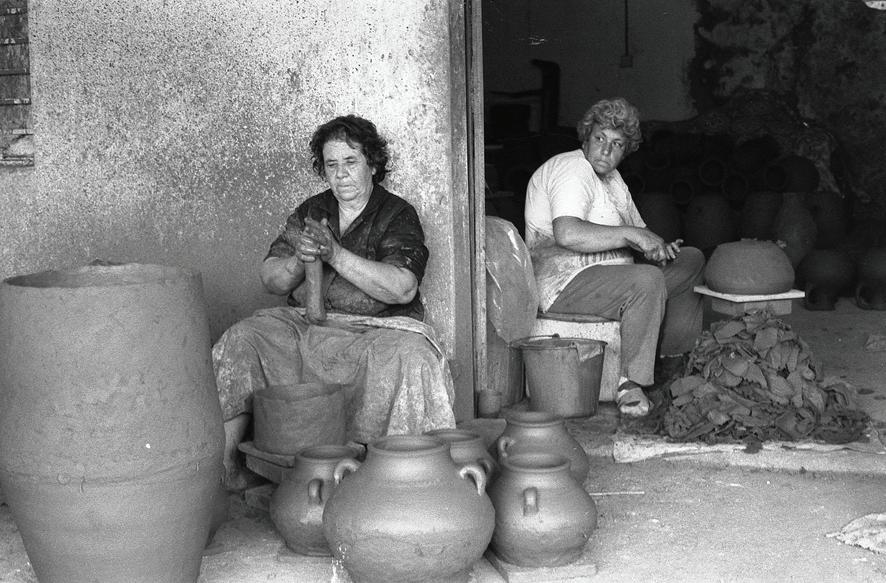
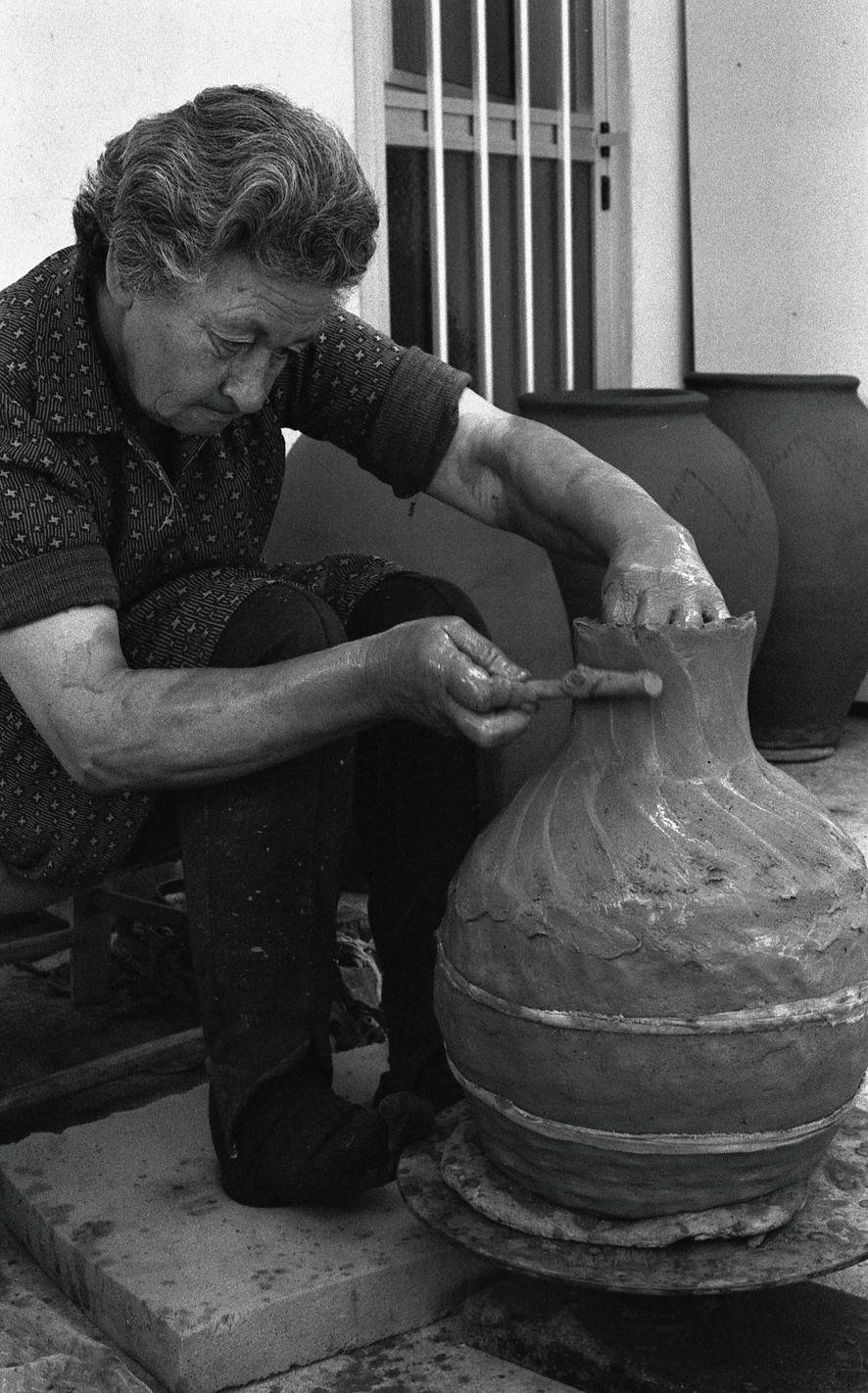
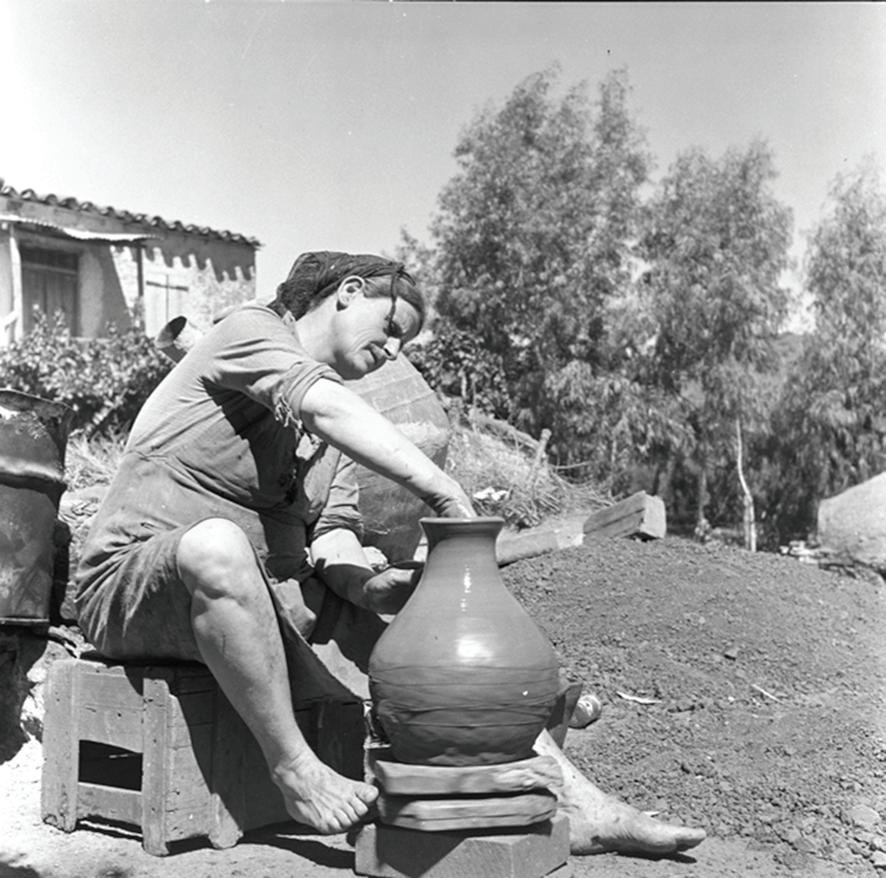
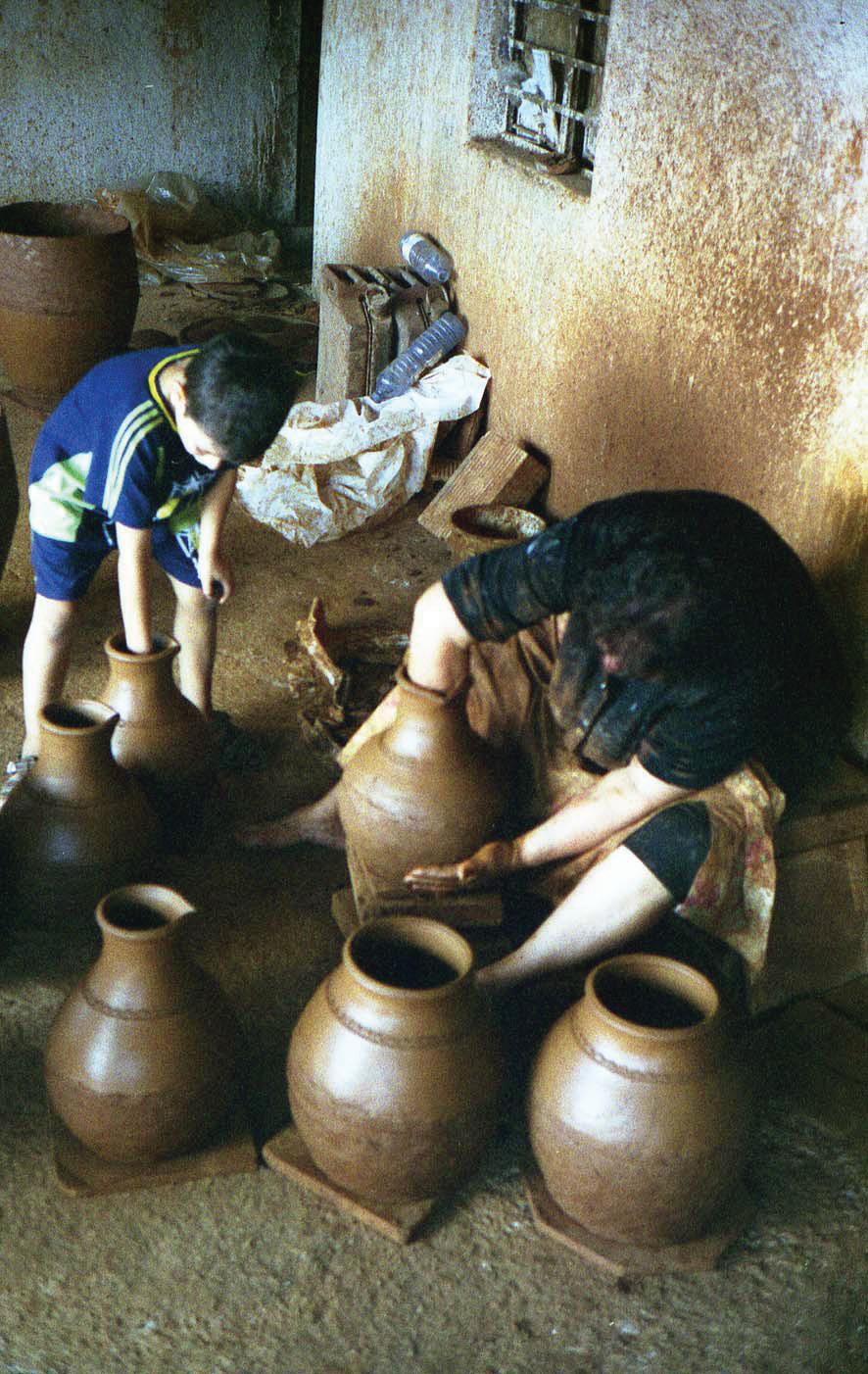
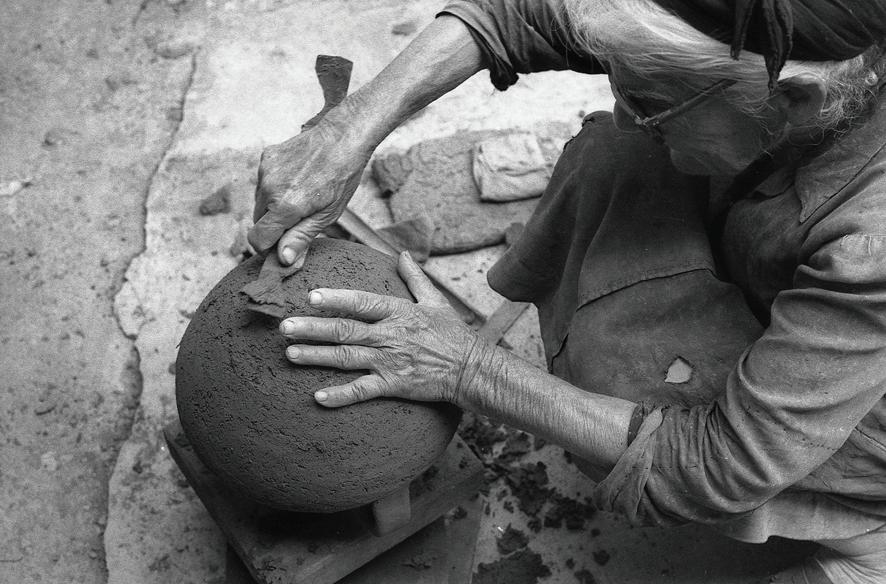
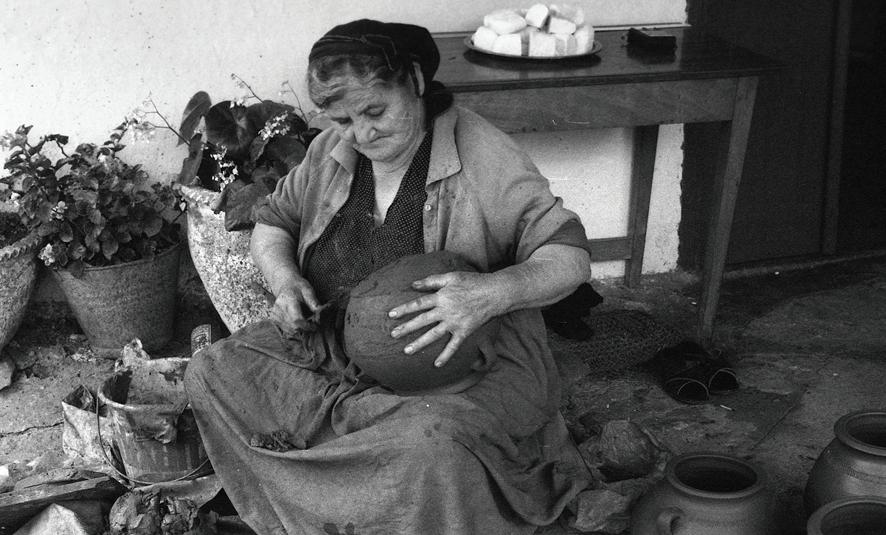
Two members of the Kornos Pottery Cooperative surrounded by pots in different stages of completion. One potter shapes a series of 12 deep cooking pots. Stage 1 pots on the far right have a decorated shoulder, finished rim, flat base, and lack handles. Rope is wrapped around their lower bodies to support the wet clay. After drying slightly, in Stage 2 the potter removes the rope to expand the body, and attach the handles. The rope is reattached before setting the pot aside to dry further. Not until Stage 3 is the base scraped into a round shape comparable to Ancient Cookware from the Levant. Seated next to clay-spattered wall, another potter wipes the lower body of an oven with a wet cloth before she will add more coils to increase the height. During the winter months all traces of pottery manufacture vanish except for the clay adhering to the walls. All of the equipment is stored away, at home, until spring. In winter the workspace converts to a storage area for furniture and vegetables, or a safe place to hatch baby chicks. 1986.
lIst
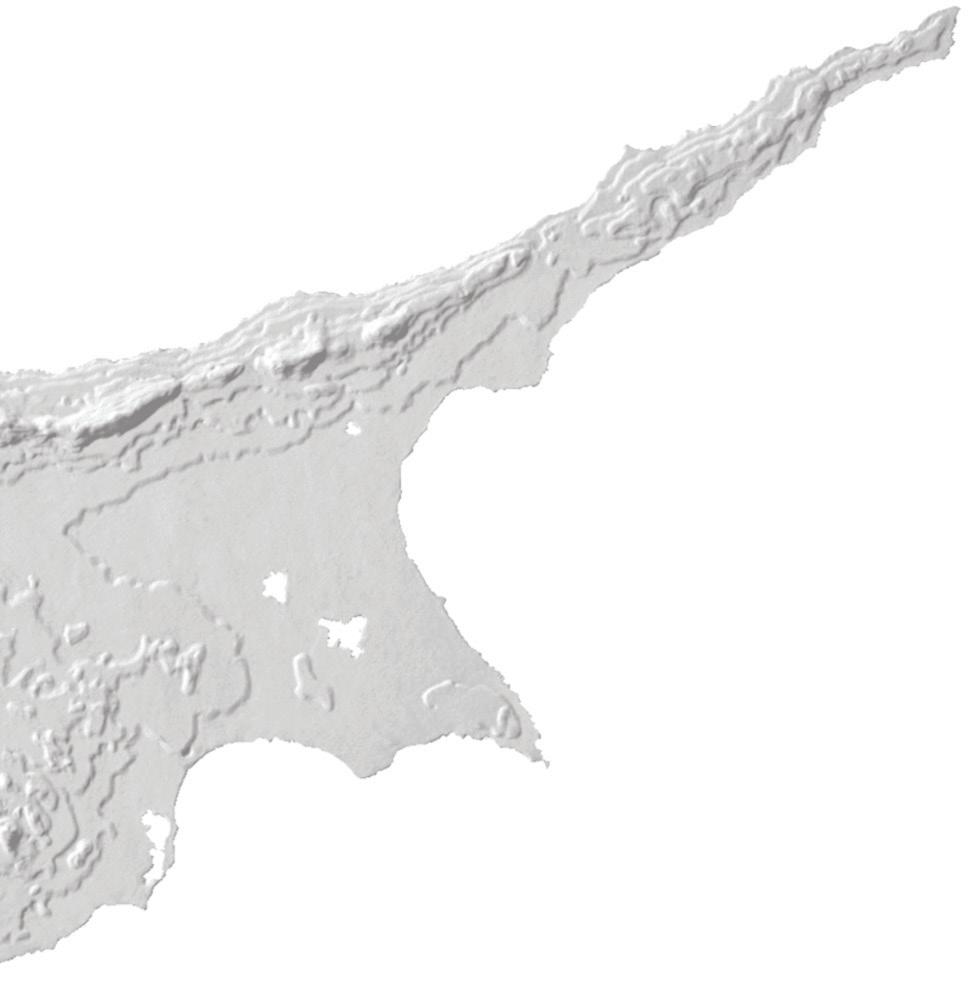
Figure 1.1 Map of the Levant and Cyprus.
Figure 1.2 Map of Cyprus.
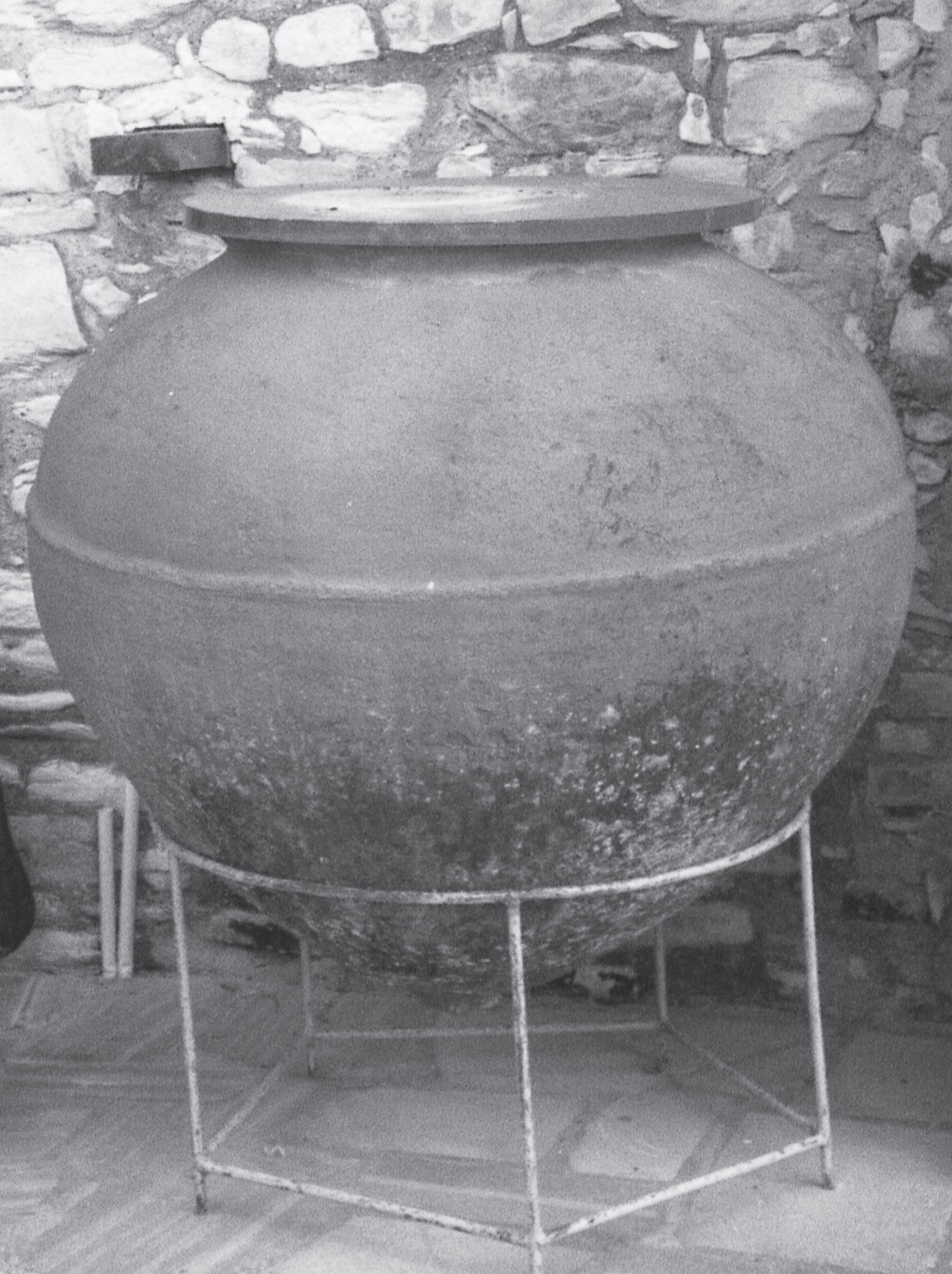
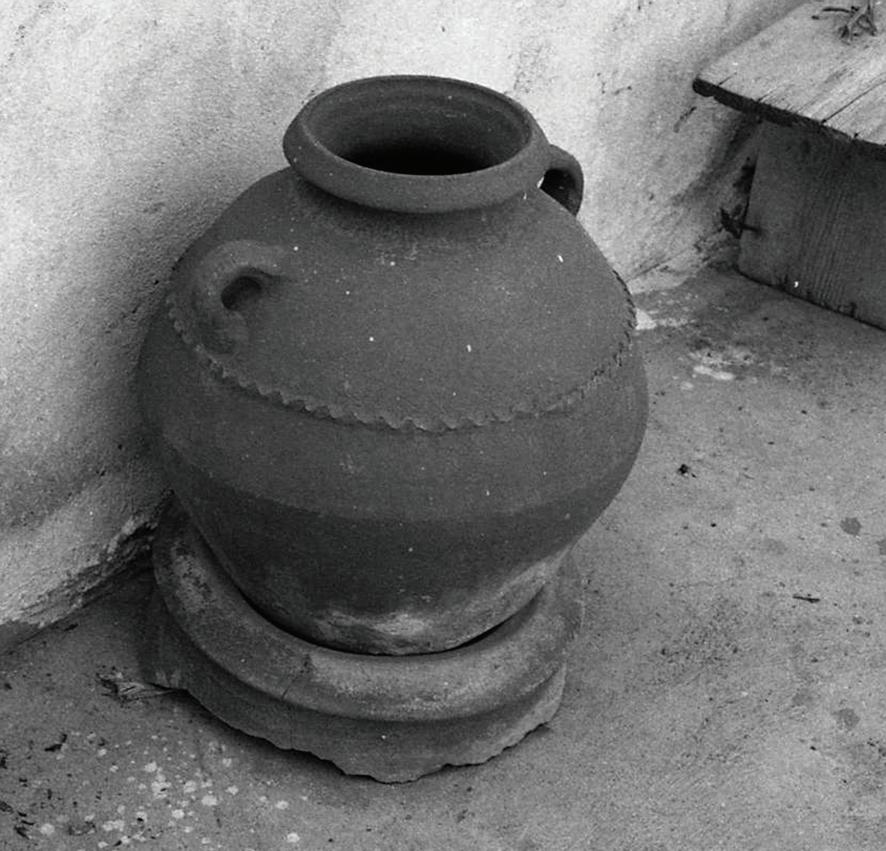
Figure 3.1 An old pithari for fermenting and storing wine.
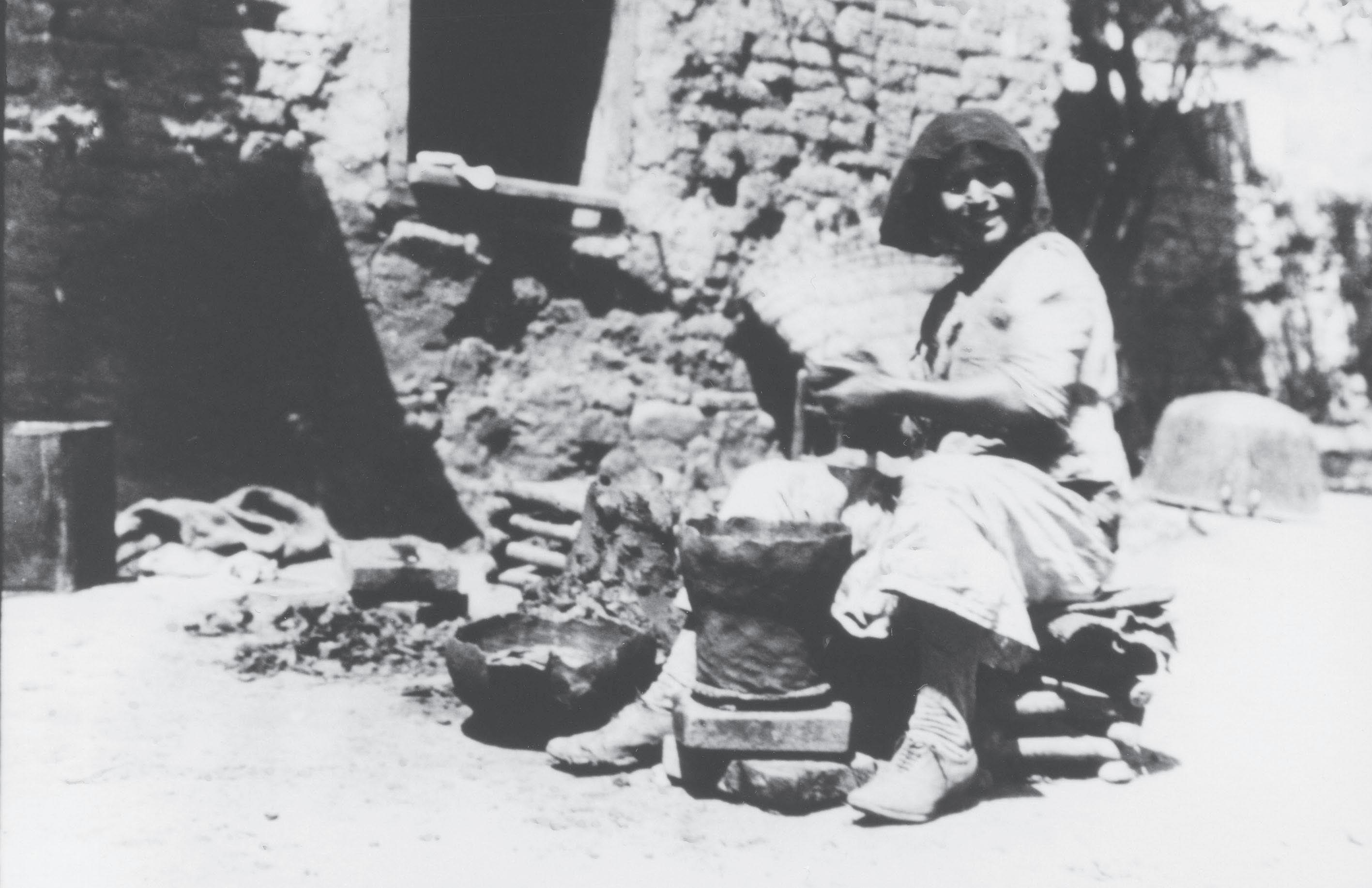
Figure 3.2 A potter in Kornos posing for a photograph, ca. 1930.
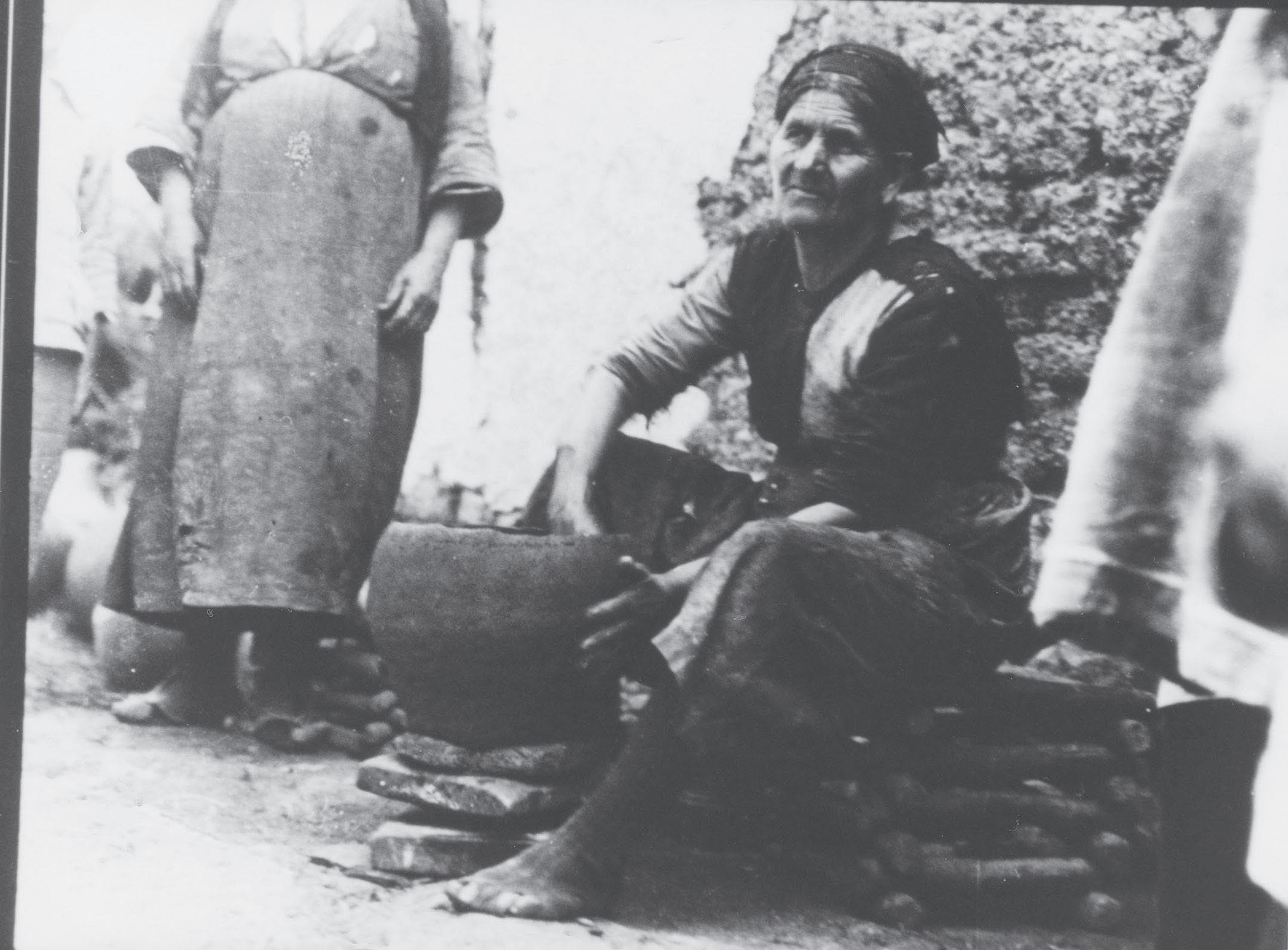
Figure 3.3 A barefoot 1930s Kornos potter working on Stage 1 of a pot that stands on a bat on top of the square turntable.
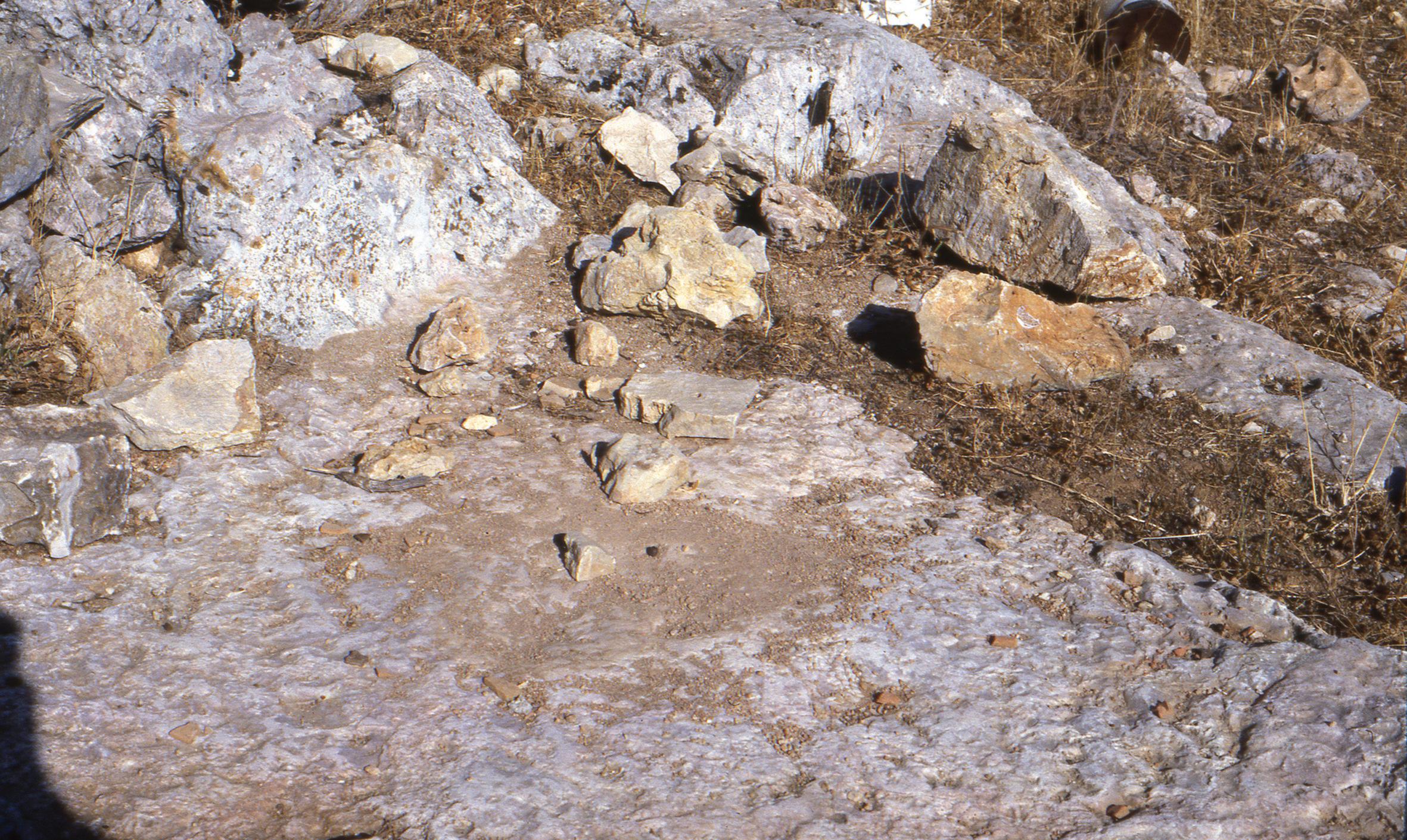
Figure 3.4 A flattened stone outcrop for crushing ancient sherds.
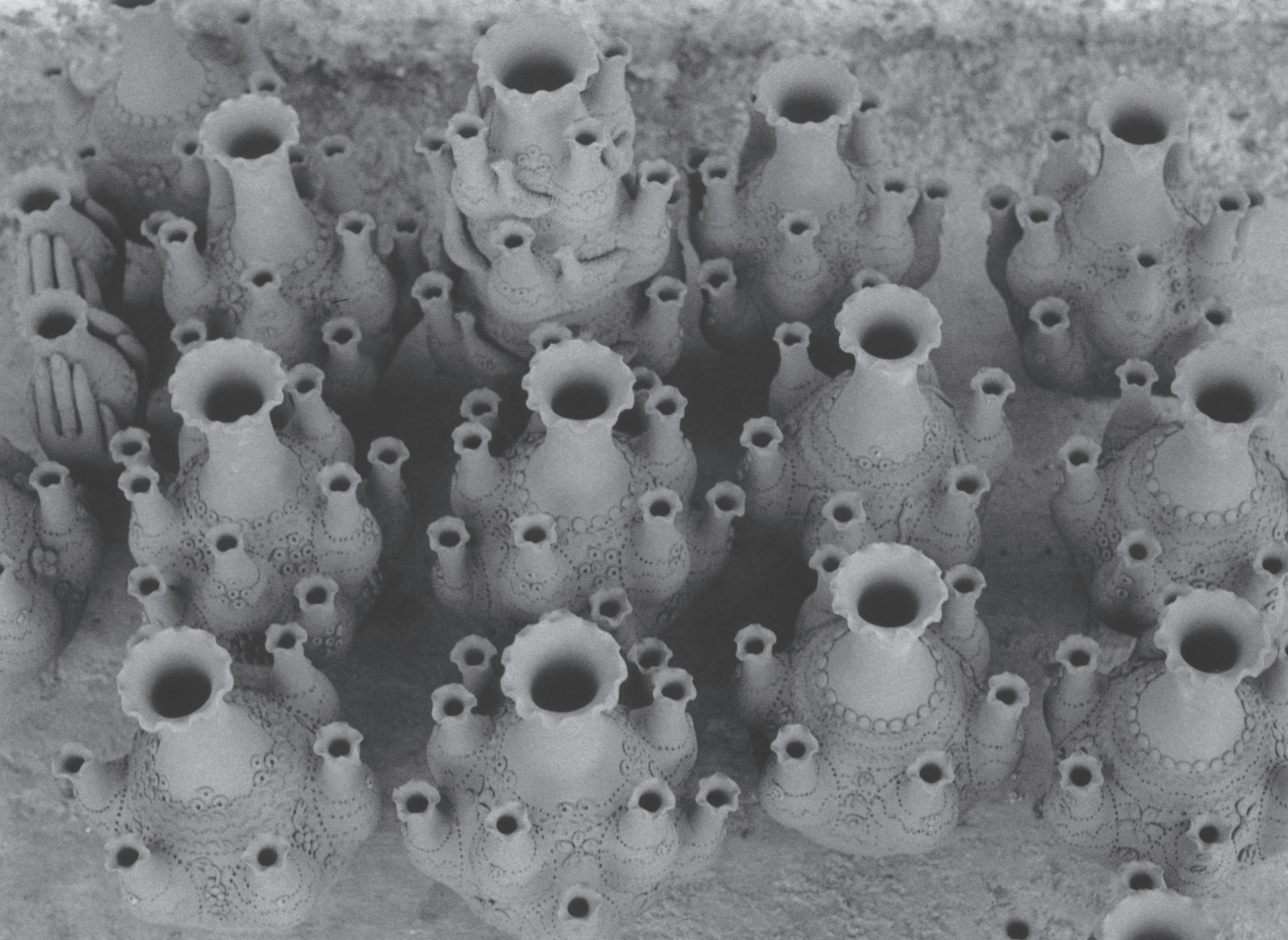
Figure 3.5 Decorative and composite Cypriot vases made for local use for over 100 years in Kornos.
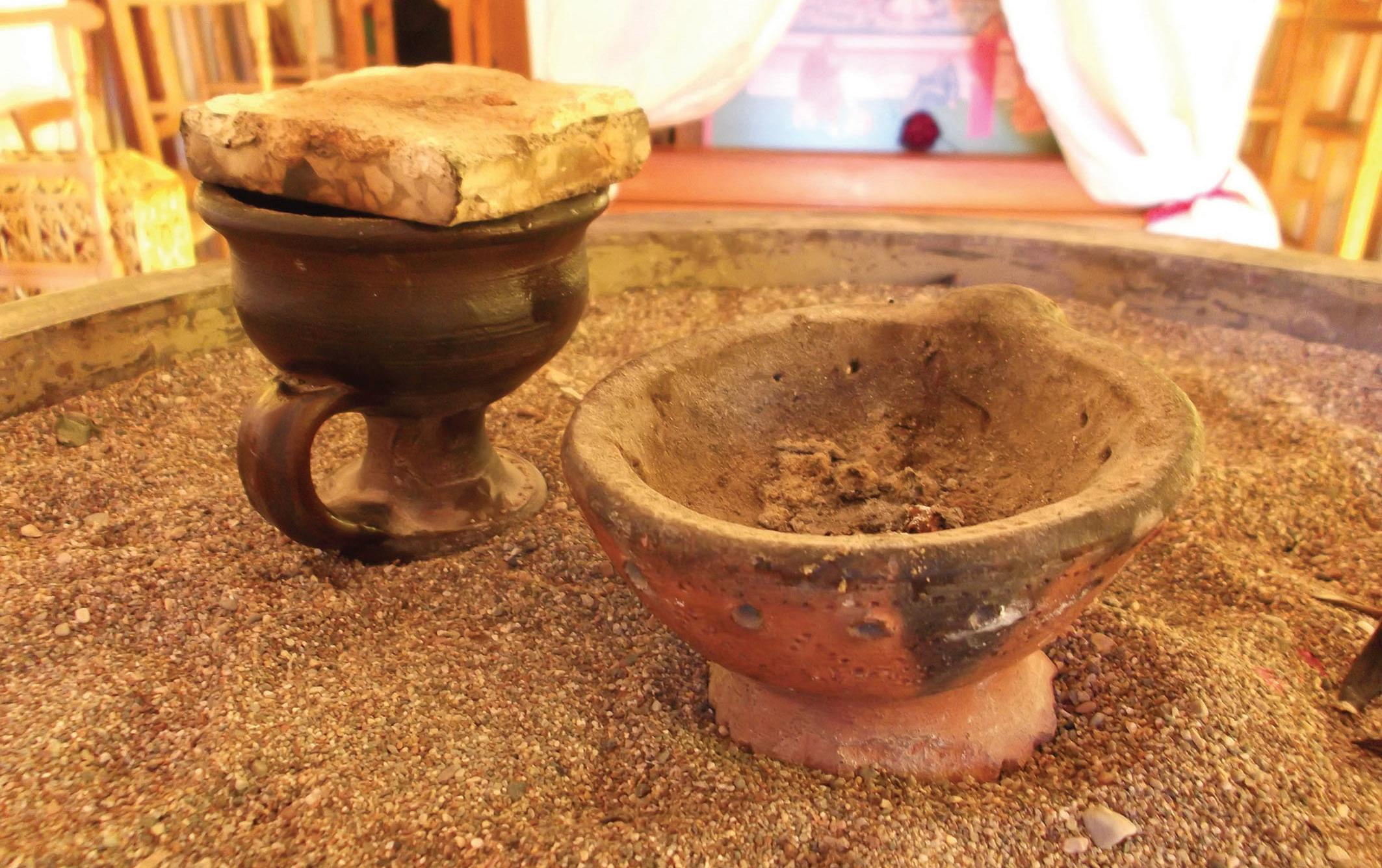
Figure 3.6 A wheel-thrown incense burner (left) made in Kofinou.
Figure 3.7 Rouletted and incised decorations in Kornos are applied before the handle is attached.
Figure 3.8 Troodos potters incise a pattern after positioning the handle.
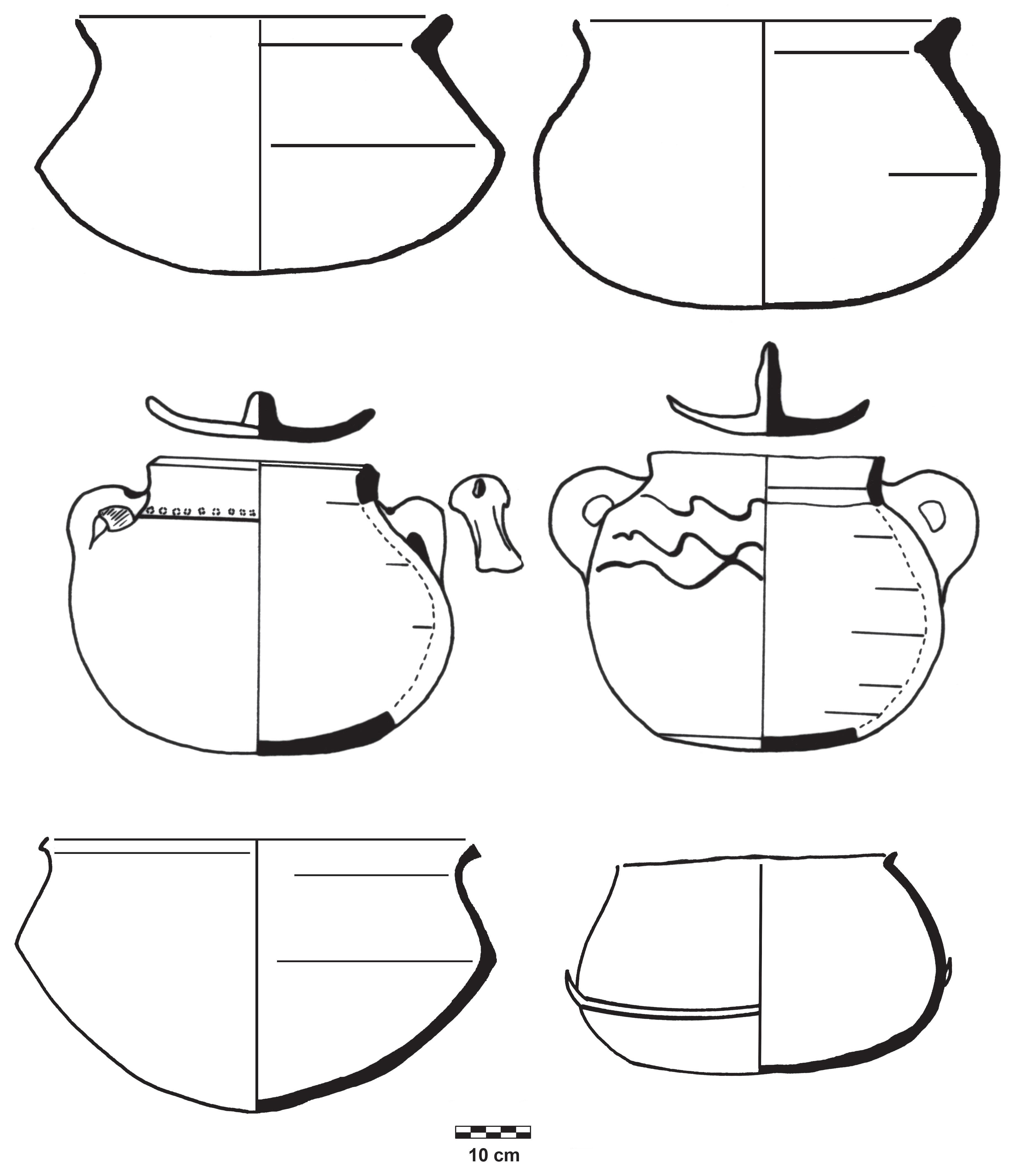
Figure 4.1 Comparison of traditional and ancient deep globular cooking pot shapes.
Figure 4.2 Kornos Coop kiln in March, before the 1986 pottery-making season began.
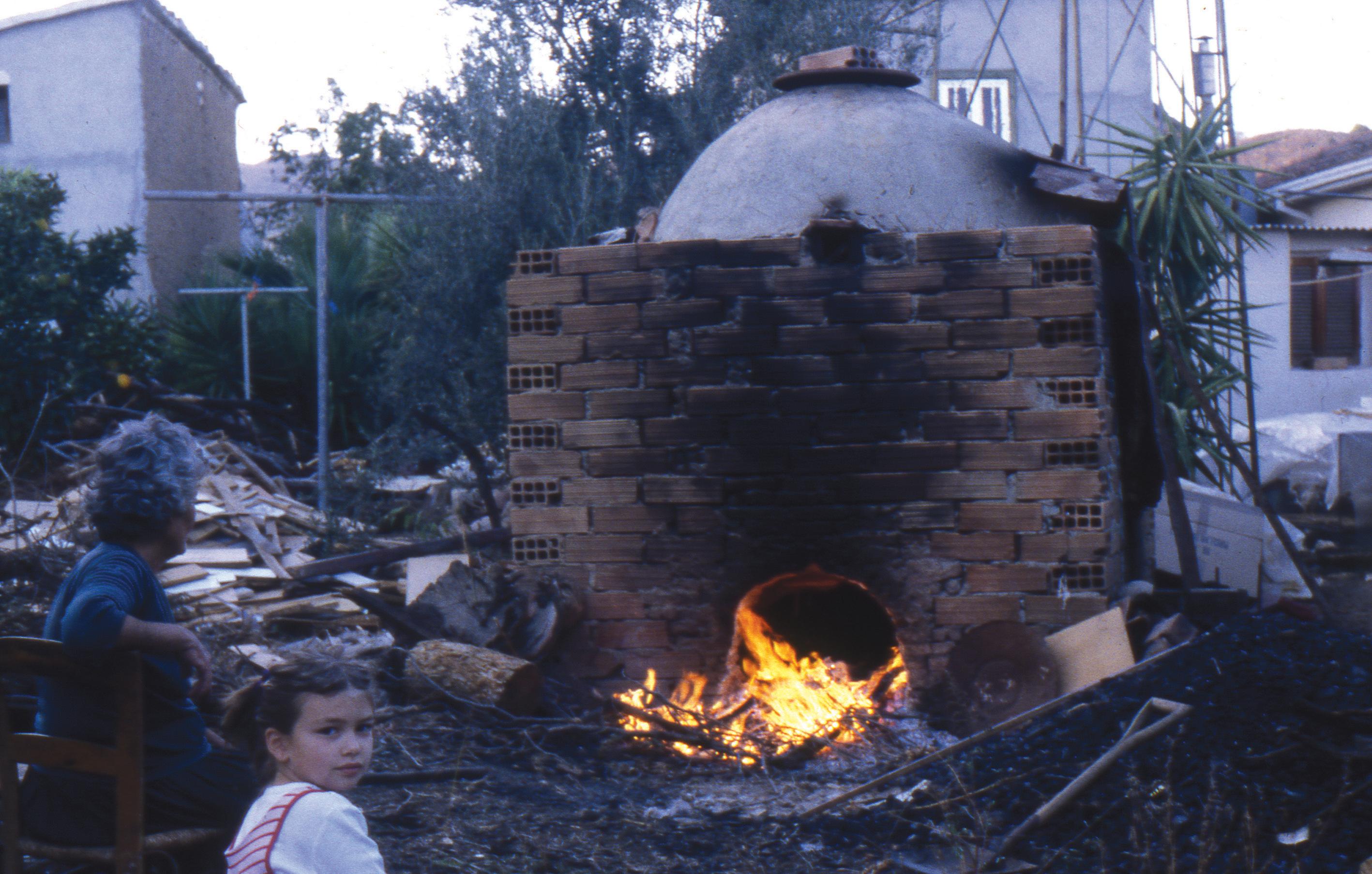
Figure 4.3 An oven begins as an old cracked pithari with a hole in the wall or as a fired jar with an added spout-like flue. 60
Figure 4.4 Traditional pots made in Cypriot villages.
Figure 4.5 Oven (a) and jar (b) from Ayios Dimitrios, and jar (c) from Kornos.
61
62
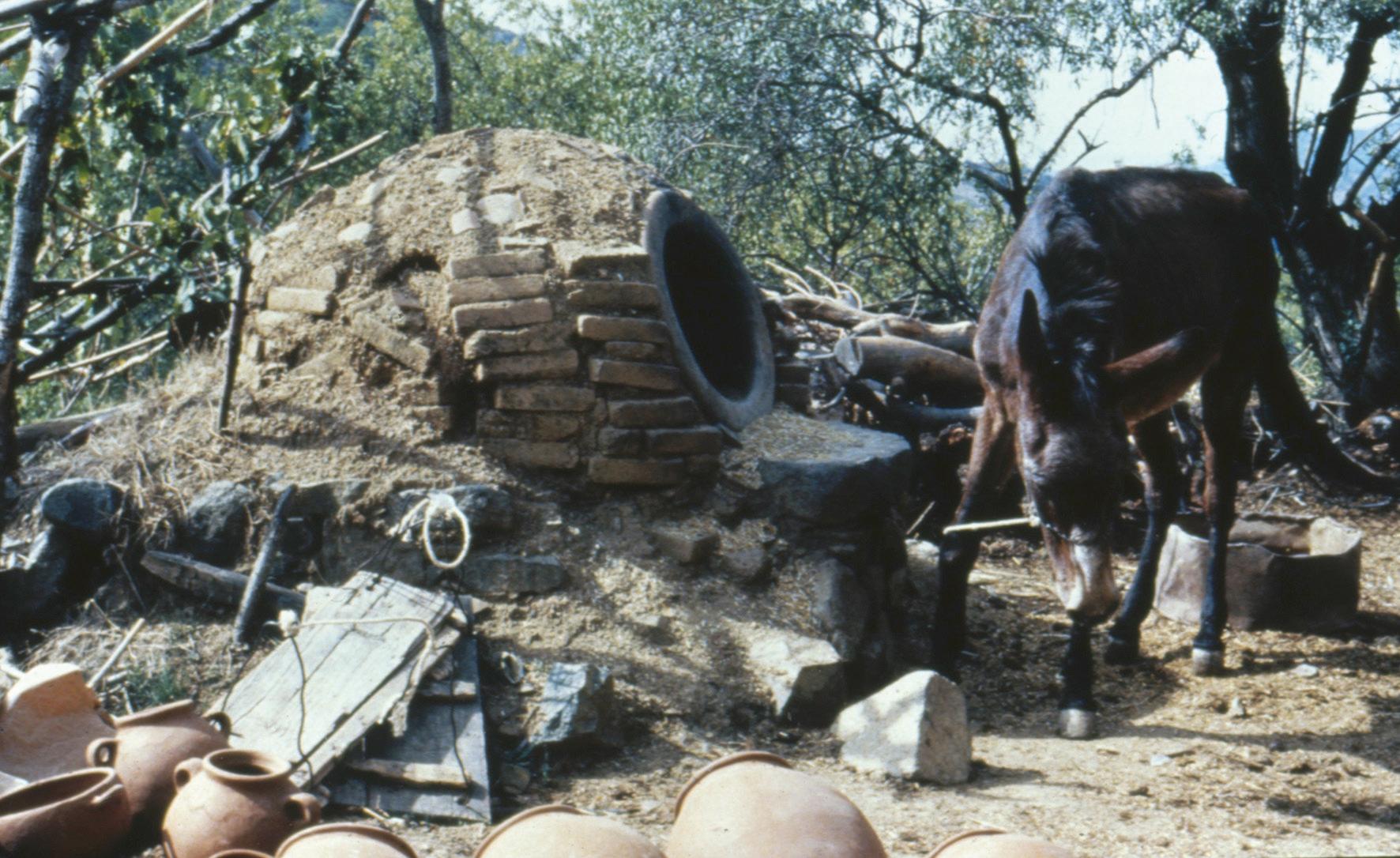
Figure 4.6 Goat-milking pots, cooking pots, and large jars stand on the left of a beehive-shaped kiln at Kornos. 63
Figure 4.7 An urban shop sells wheel-thrown Varosia flower pots and glazed or unglazed jugs and jars (left) as well as handmade jugs.
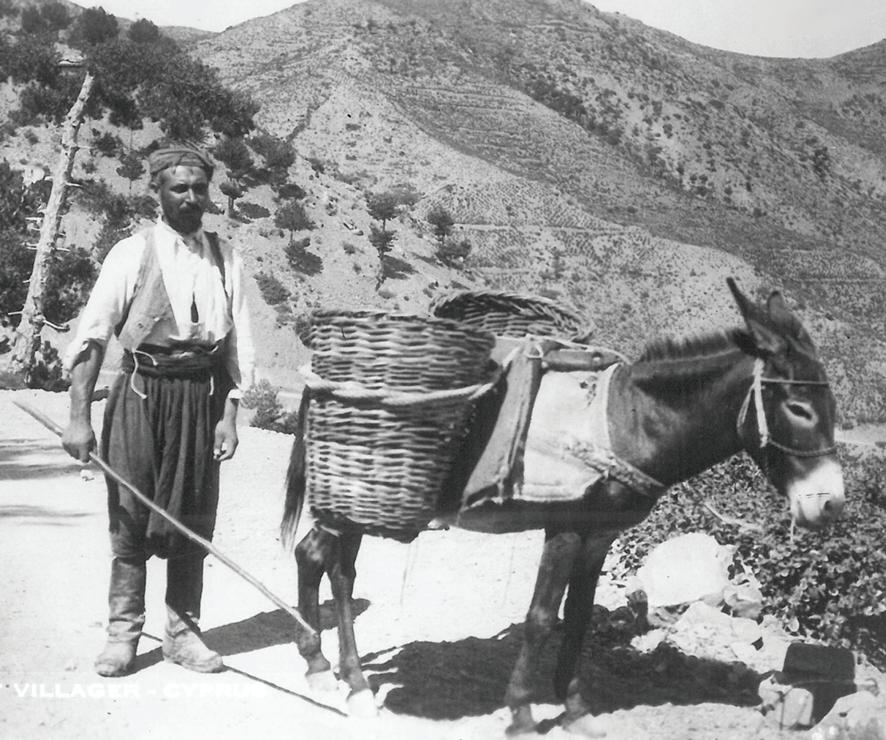
Figure 5.1 A man wearing traditional Cypriot clothes has a donkey with two baskets of the type used to transport clay.
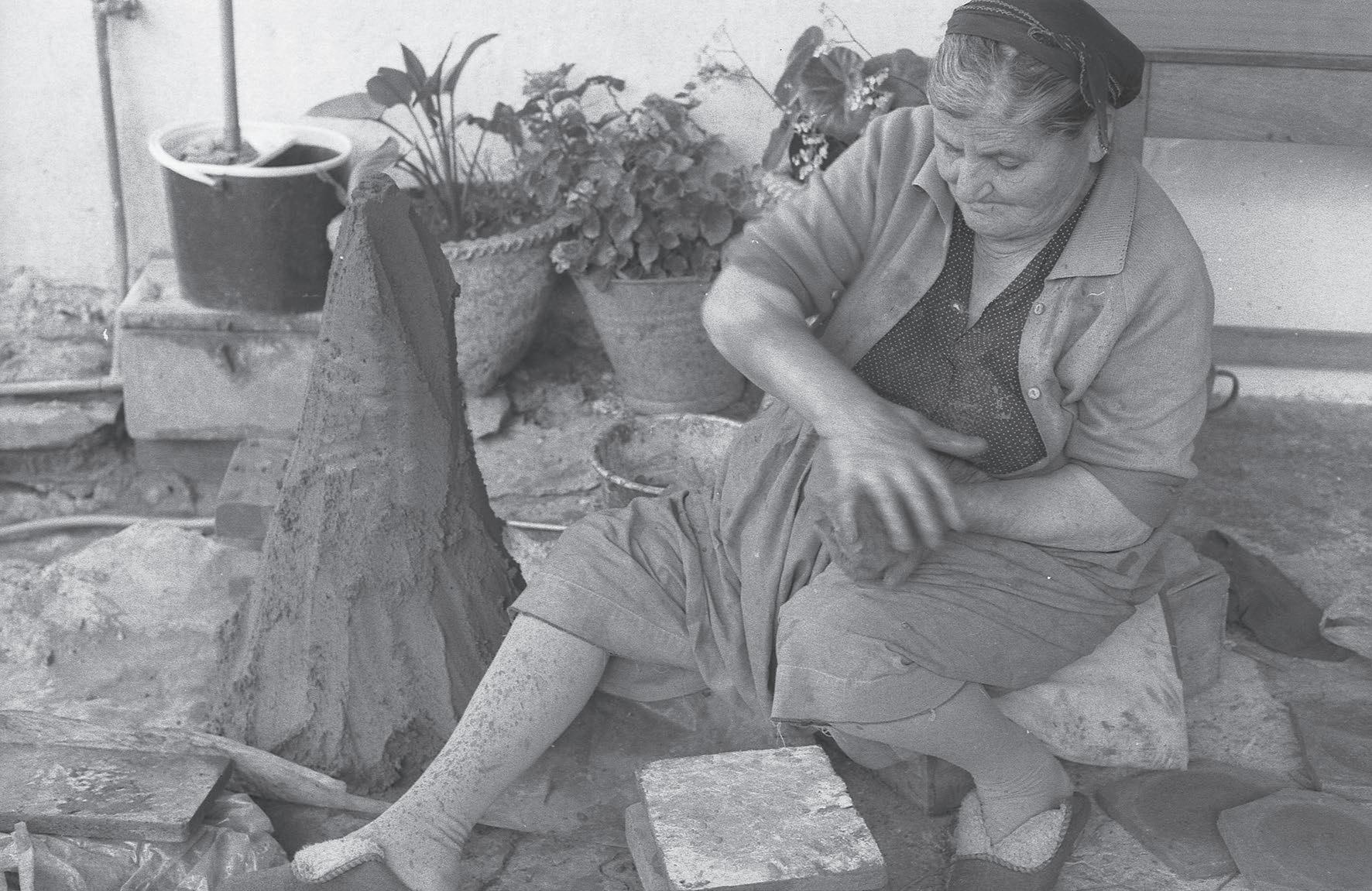
Figure 5.2 Mrs. Kyriacou Kyriacou pounds and manually shapes clay scraped from her pylos to create a cylindrical form.
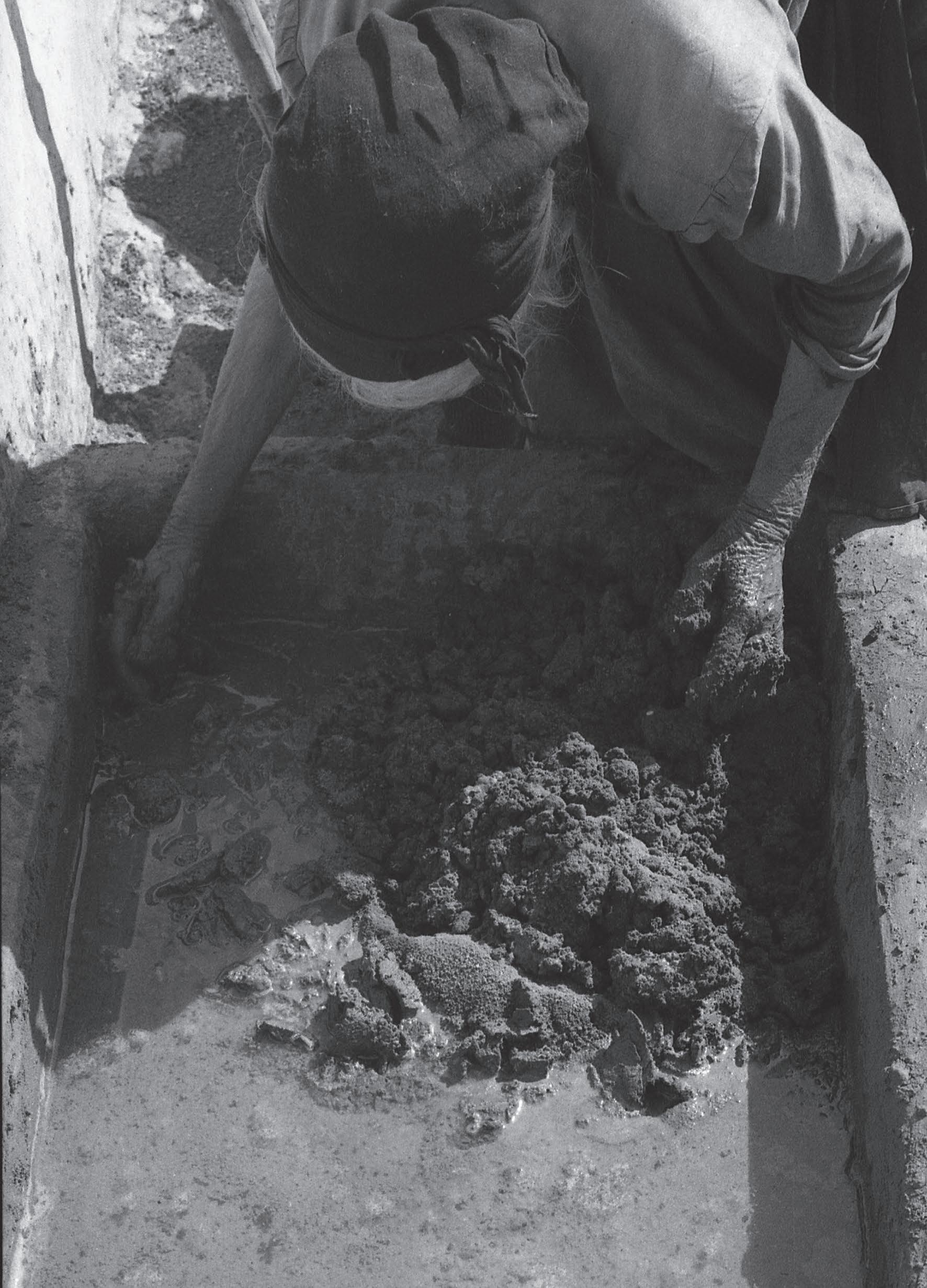
Figure 5.3 Private potter Maria Evagora bends over her rectangular skafi to mix water with clay.
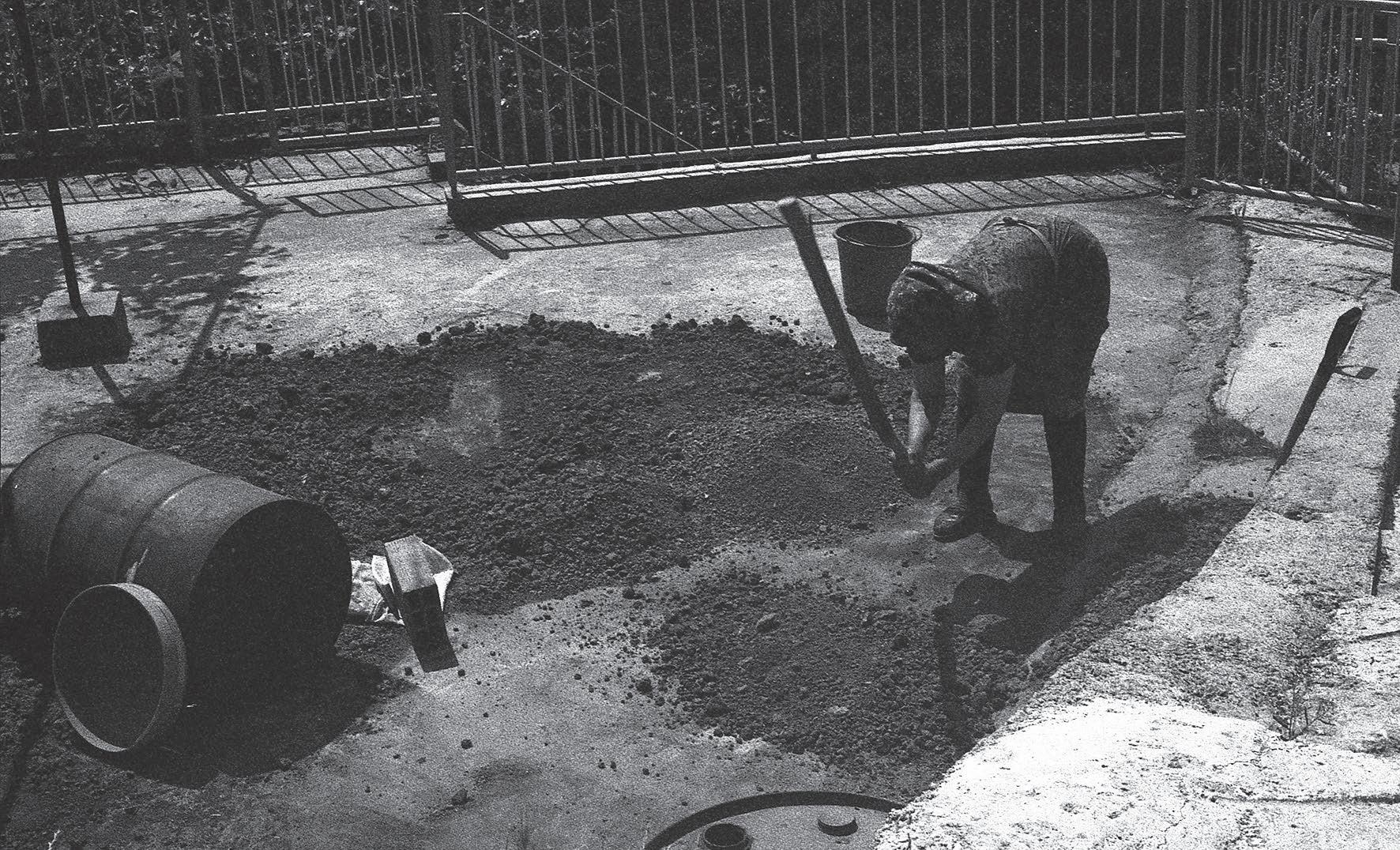
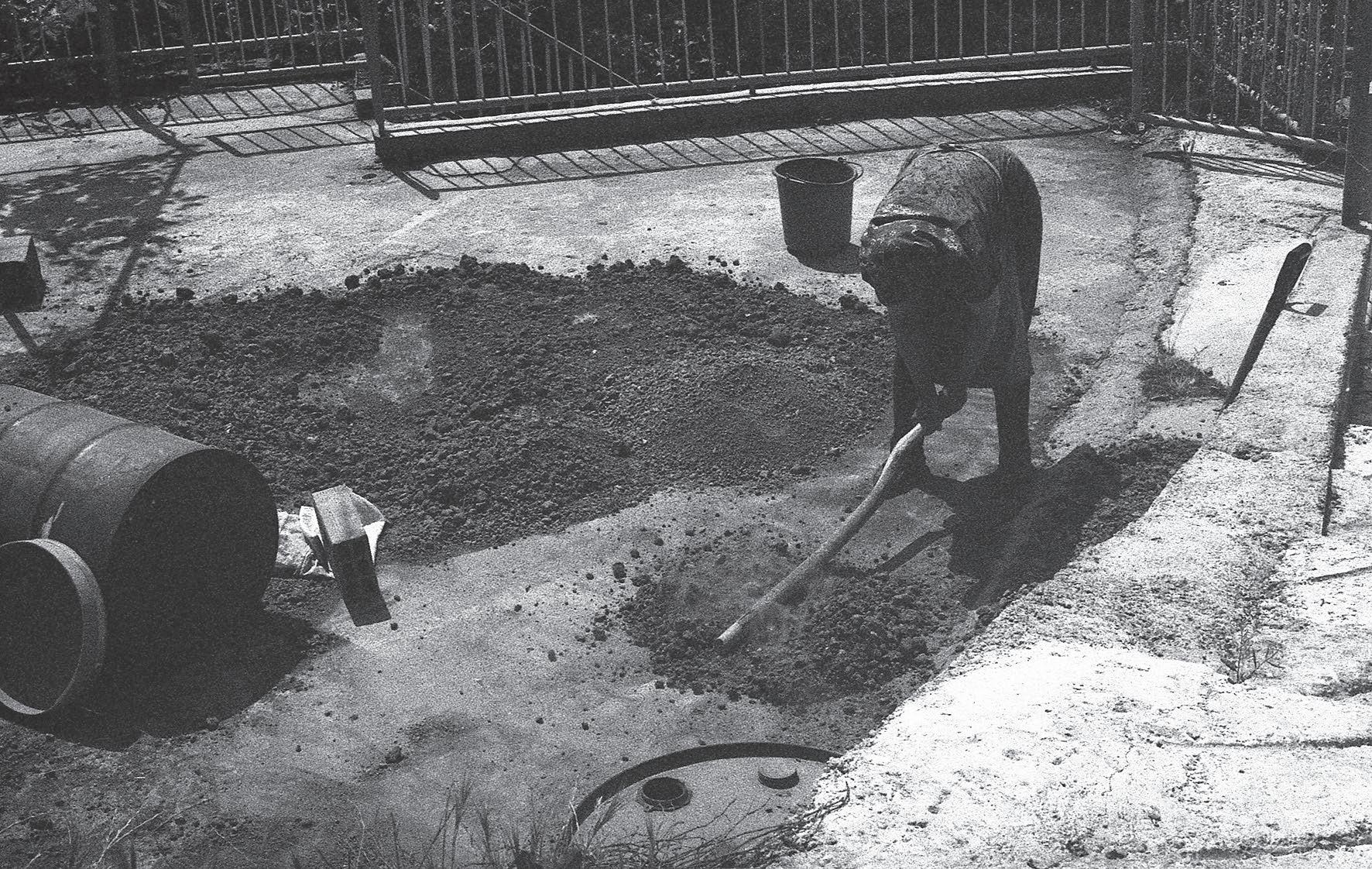
Figure 5.4 In Ayios Dimitrios people pound clay into powder with a bent tree branch.
Figure 5.5 For maximum effectiveness, after striking the ground, the clay pounder was lifted and spun over the head before crashing down on the clay again.
Figure 5.6 Rodou uses a long handled wood shovel to mix clay with water in her temporary skafi.
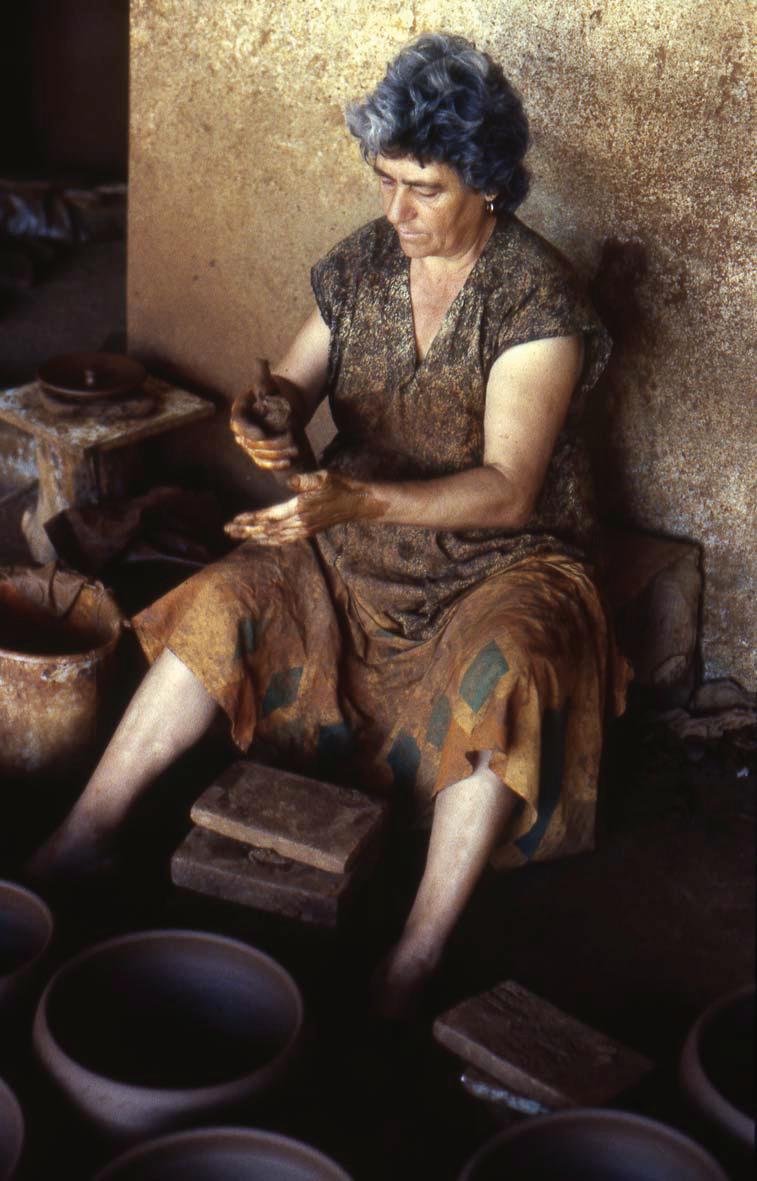
Figure 6.1 Suzanna kneads clay in her hands before shaping a pot on her square-headed turntable at the Kornos Pottery Cooperative workspace.
Figure 6.2 Short coil rolled in the air by Eleni.
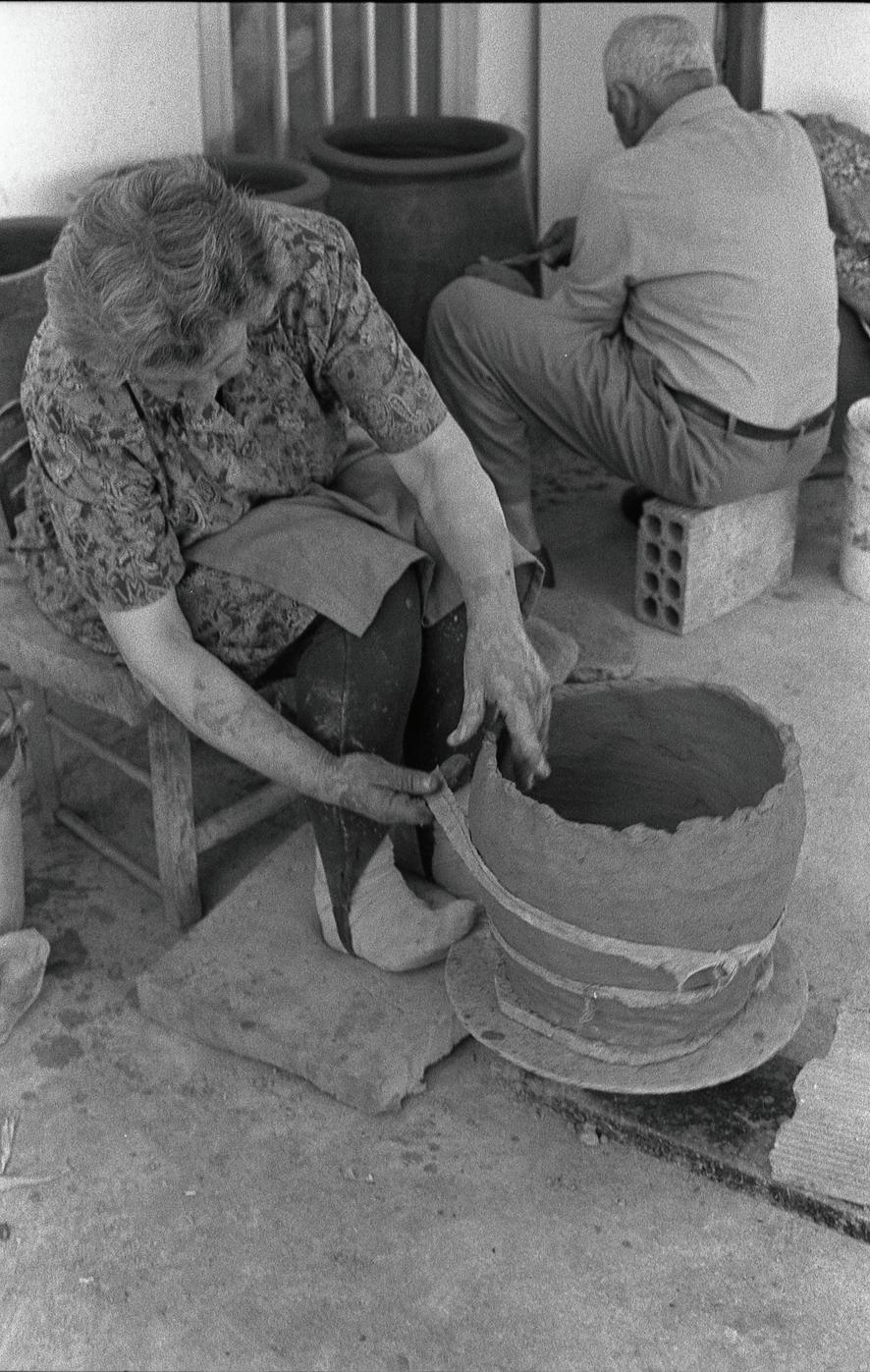
Figure 6.3 Left: Rodou rotates the turntable with her toes as she adjusts the strips of cloth that support the lower body of a jar. Right: Rodou uses a wooden tool to pull up and thin the neck of a jug while the lower body is wrapped with strips of cloth.
65
72
74
75
76
76
77
82
83
84
Ancient Cookware from the Levant: An Ethnoarchaeological Perspective
Figure 6.4 A Stage 1 jug in Kornos, ca. 1950.
Figure 6.5 Eleni inserts her arm into a jug to punch out and smooth clay of the interior base as her grandson plays.
Figure 6.6 Stage 3 for deep globular cooking pots.
Figure 6.7 Mrs. Kyriacou Kyriacou scrapes excess clay from the bottom of a cooking pot to create a round base.
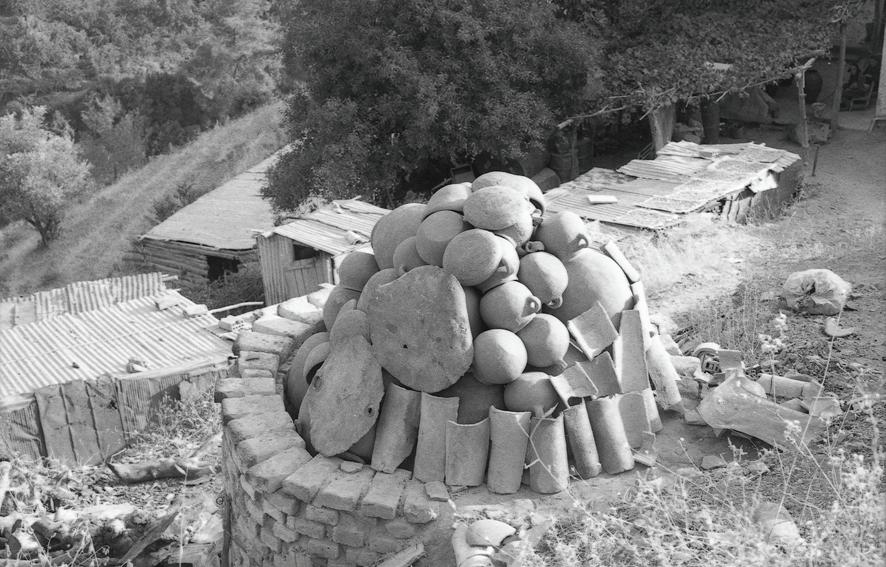
Figure 6.8 Cylindrical tiles line the top of Christinou’s kiln made of rectangular bricks.
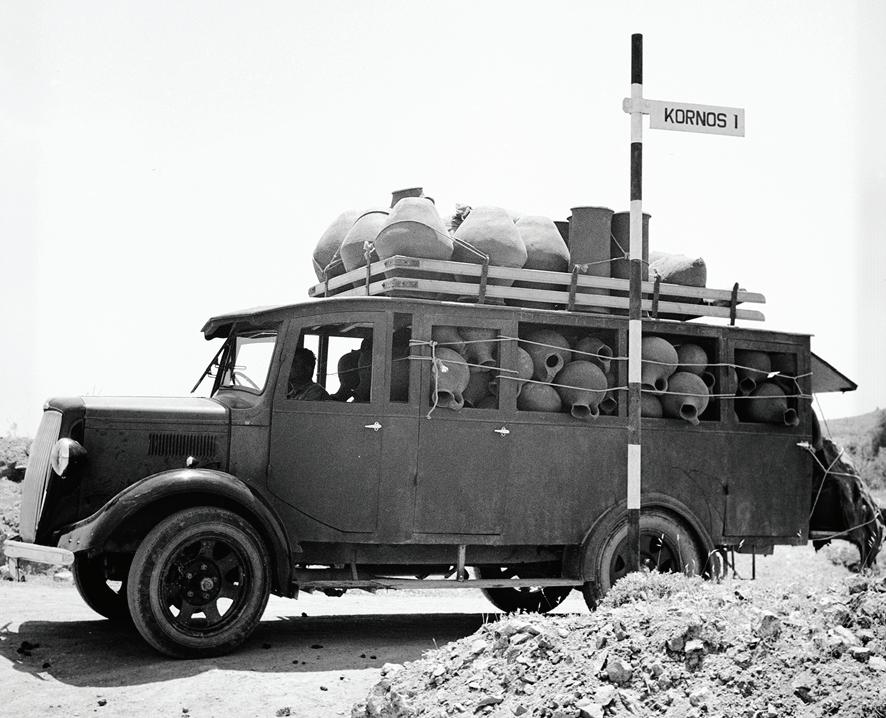
Figure 6.9 A 1950s bus piled with Kornos pottery for sale.
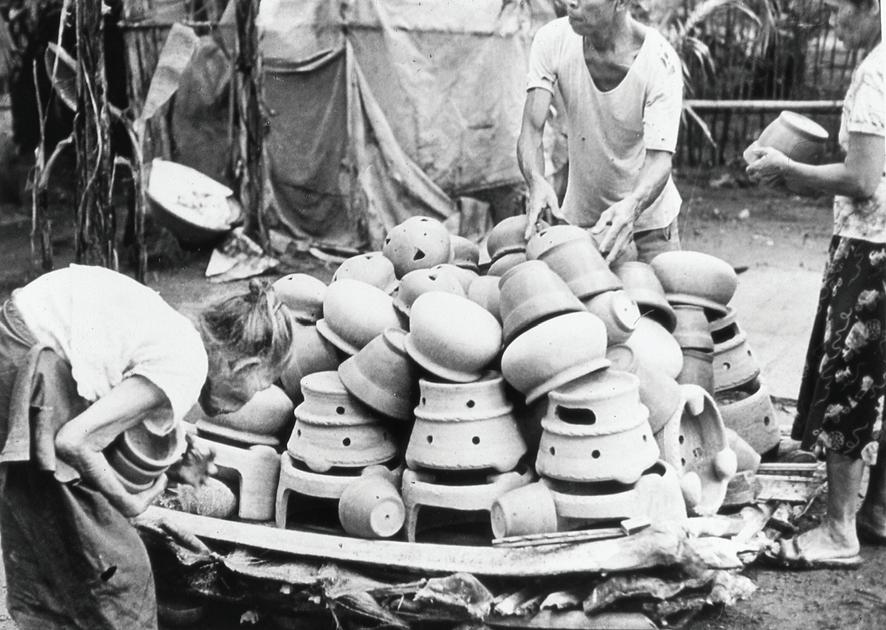
Figure 7.1 Pots piled on a platform made of palm fronds, in Paradijon, Gubat, the Philippines.
Figure 7.2 Kiln of Christinou and Andreas loaded with pots.
Figure 7.3 Square kiln with a permanent roof.
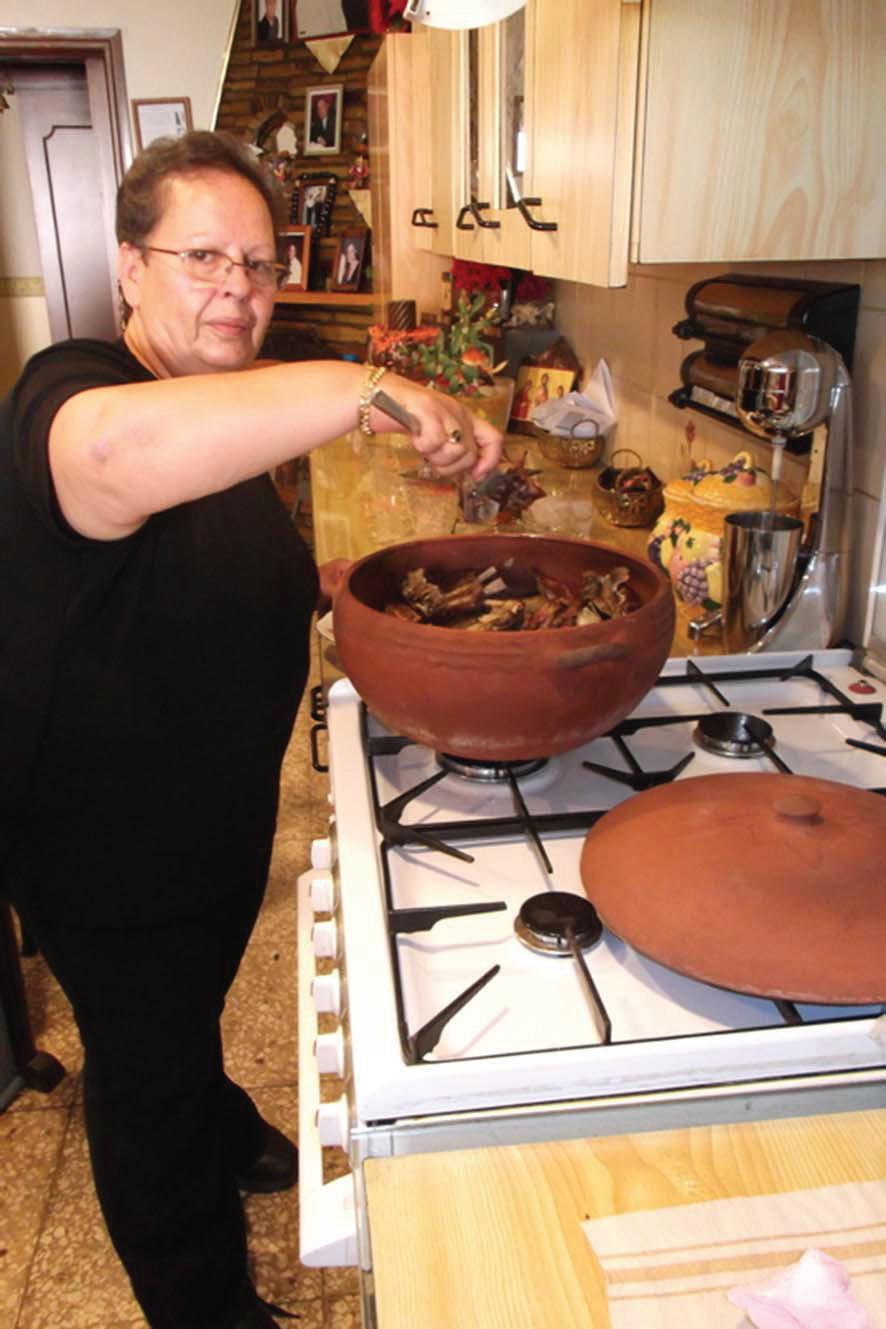
Figure 8.1 A ttavas meal baked in a ttavas in the oven by Mrs. Elli Michael.
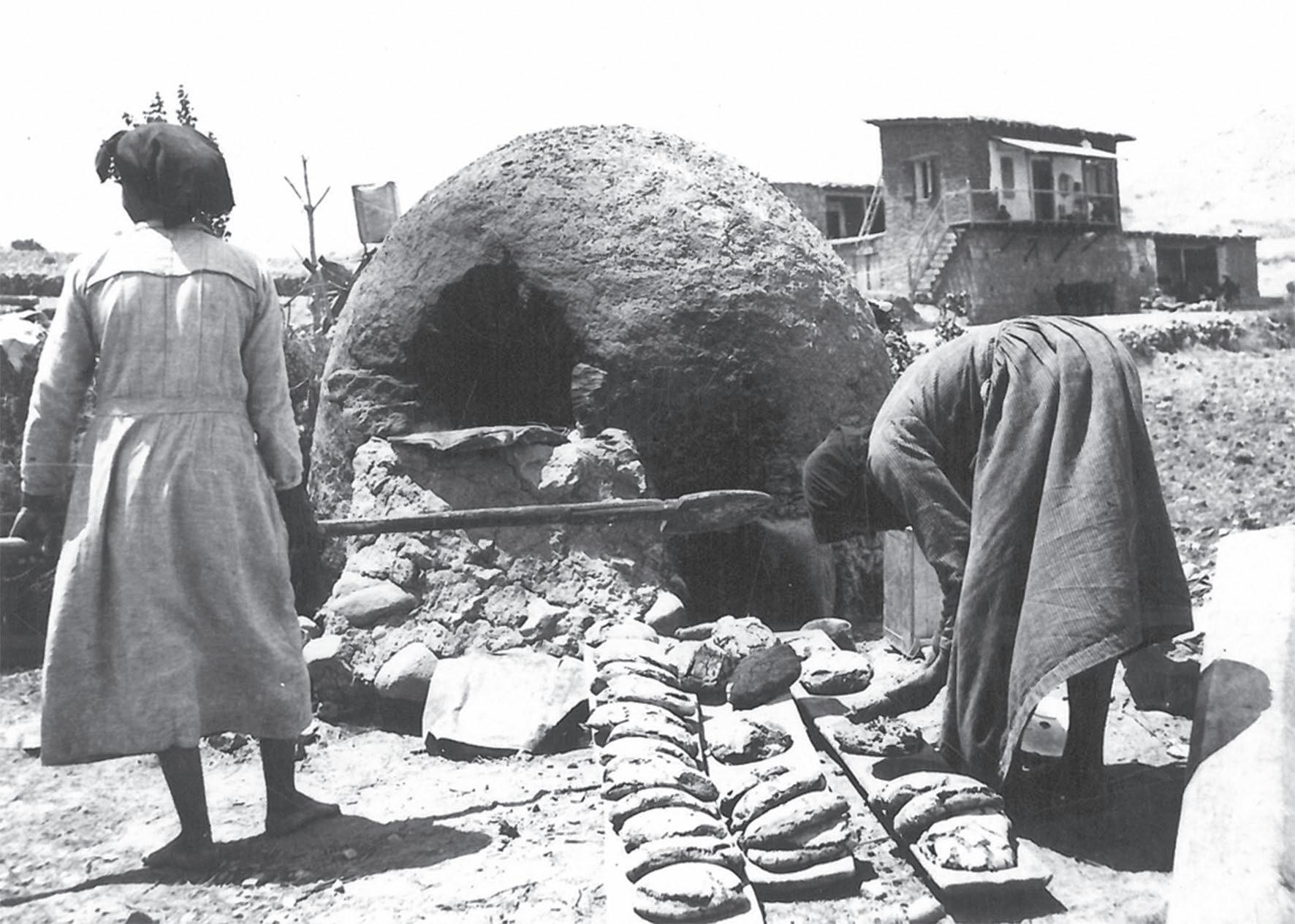
Figure 9.1 Two women work together to bake bread in an outdoor oven (fourni).
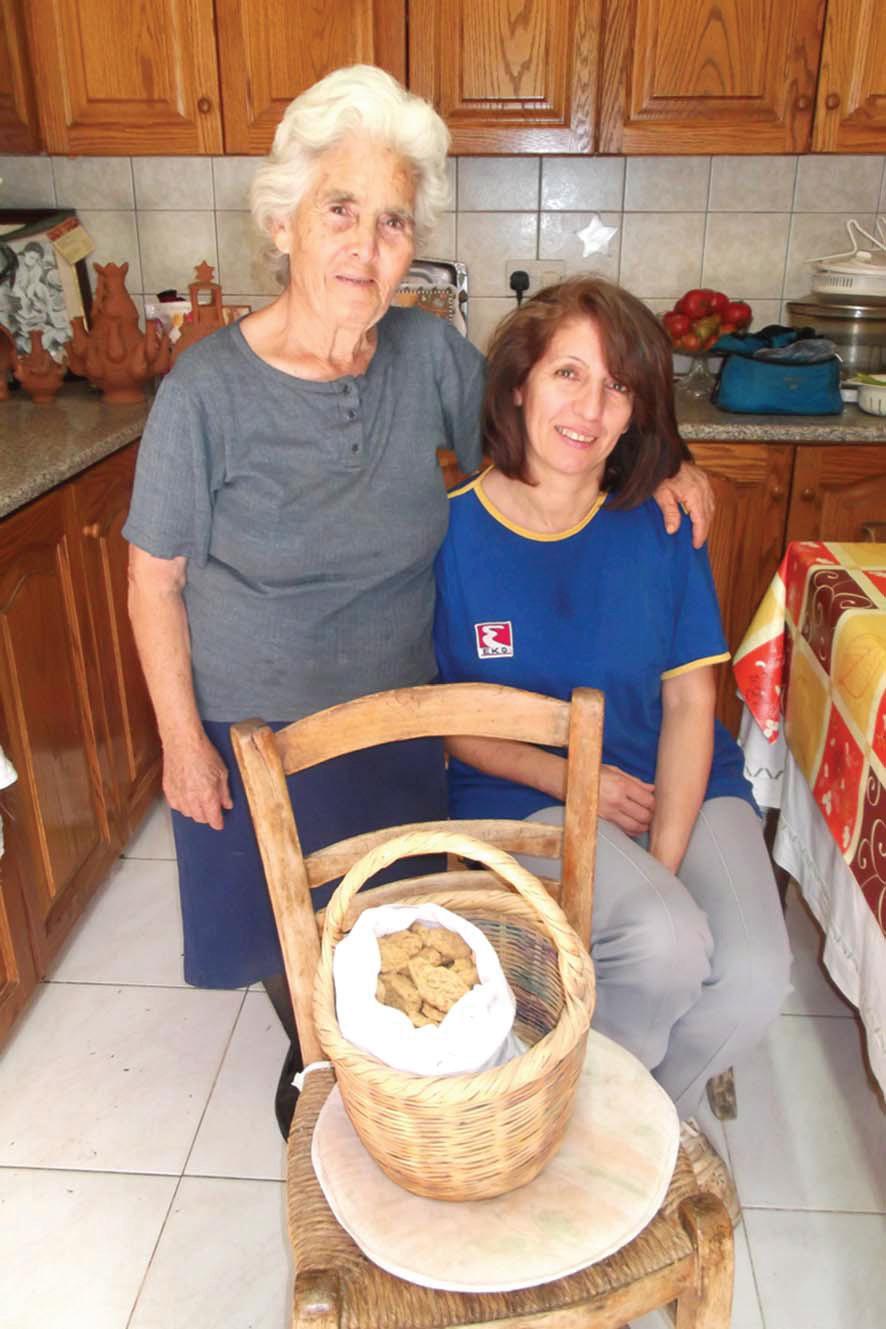
Figure 10.1 Kornos potter, Mrs. Anna Panayiotou, prepared 24 kilo of trachana in November 2013.
Figure 10.2 Traditional round-bottomed jar for making and preserving challoumi cheese.
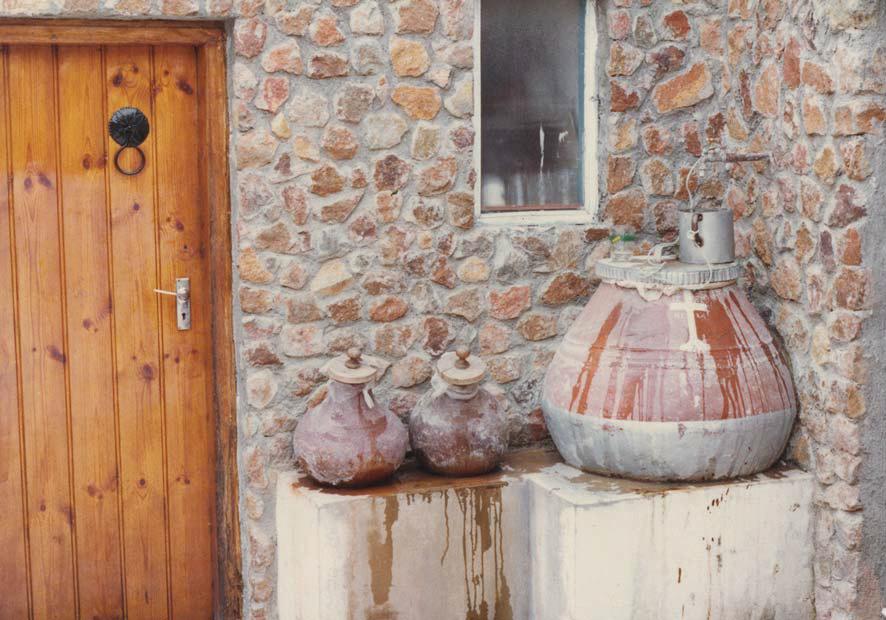
Figure 10.3 Two jugs and a large jar to store and cool water outside Stavrovouni Monastery.
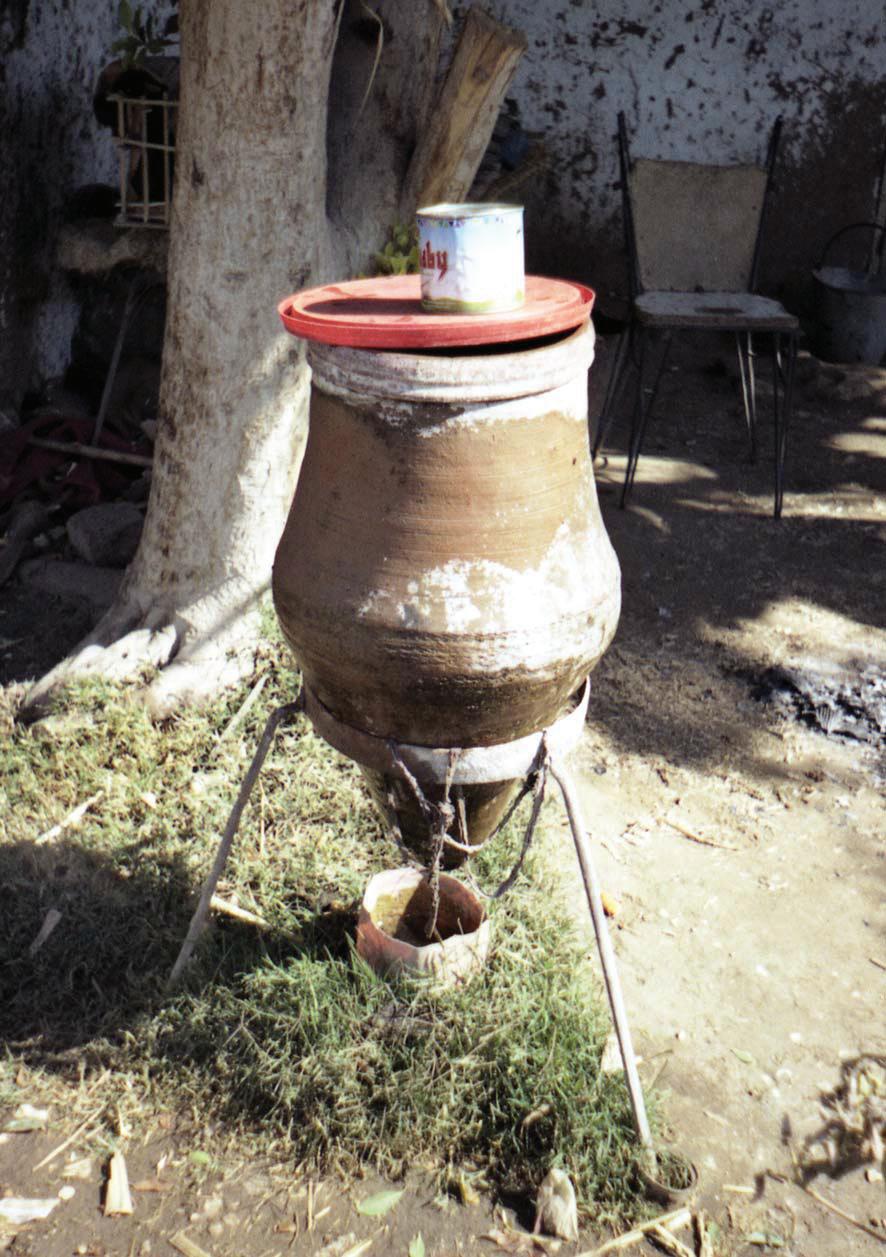
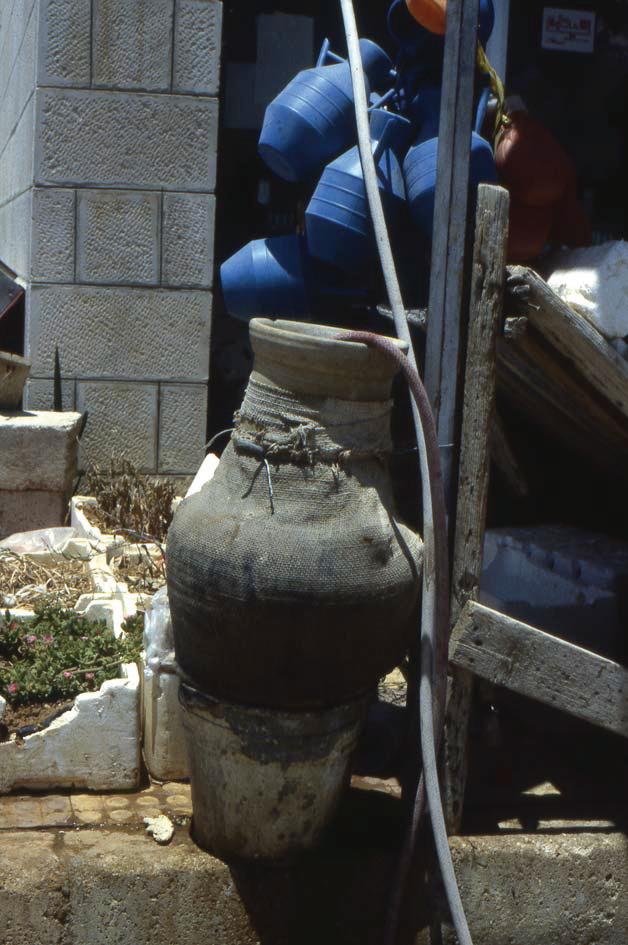
Figure 10.4 A roadside water jar in a metal stand close to a tree outside Luxor, Egypt.
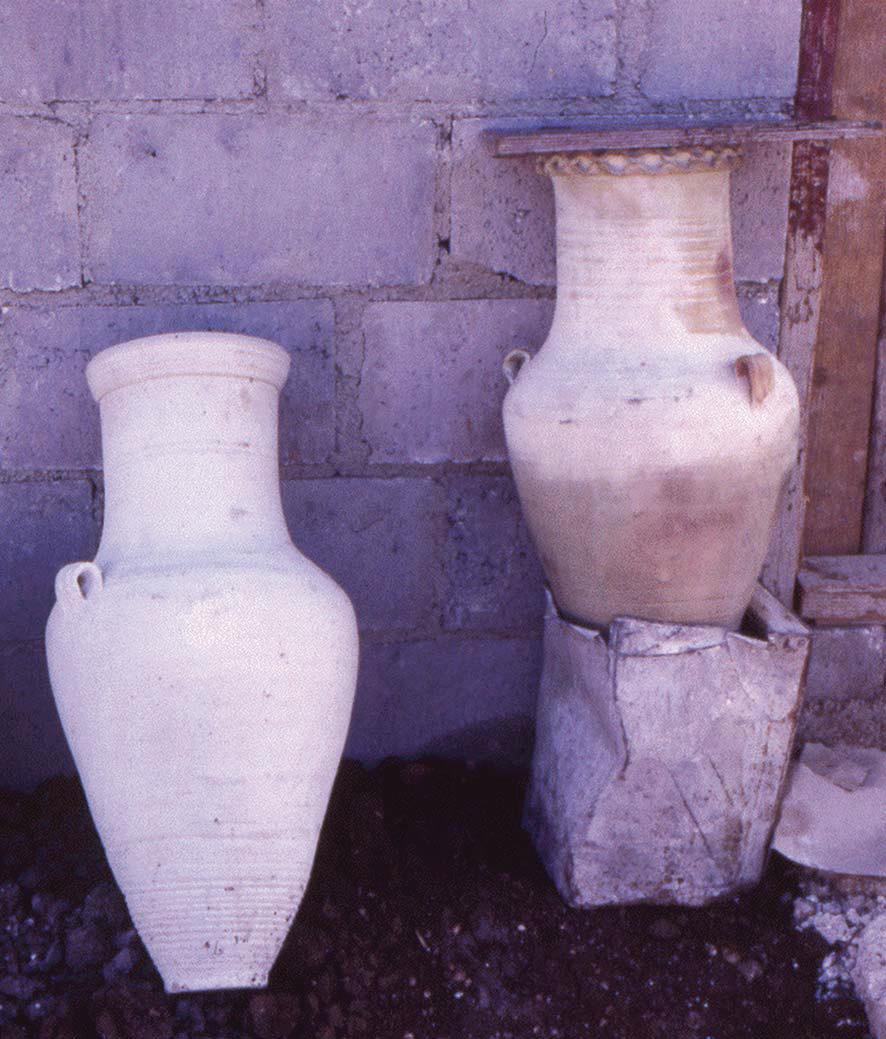
Figure 10.5 Large water jars made at Zizia and in use at a construction site in Jordan.
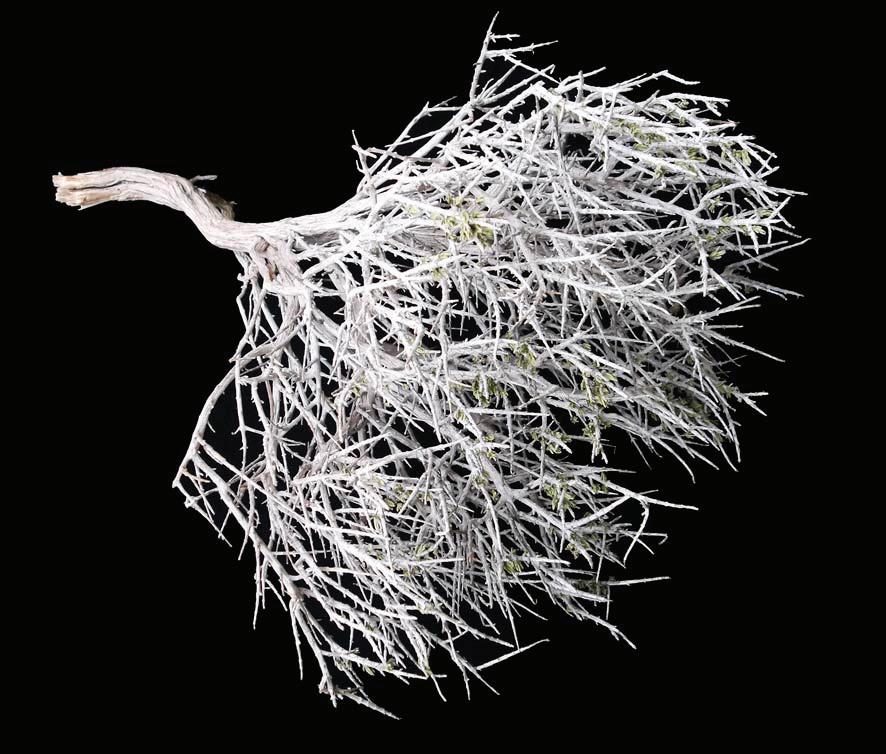
Figure 11.1 A dried branch of thyme (26 cm in length) with its short sharp spikes.
Figure 13.1 Paddle and anvil work, Paradijon, Gubat, the Philippines.
Figure 13.2 Wooden paddles binikal, heninag, and liminos to shape pots in Paradijon, the Philippines.
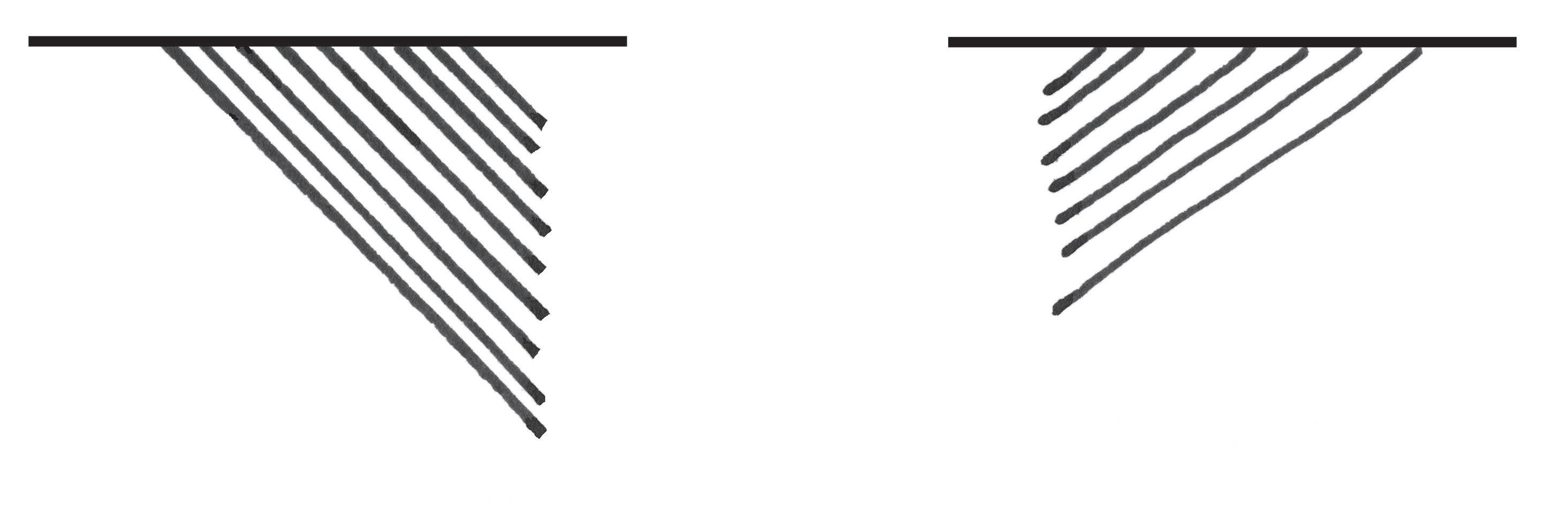
Figure 13.3 Lift-off marks point in opposite direction of rotation.
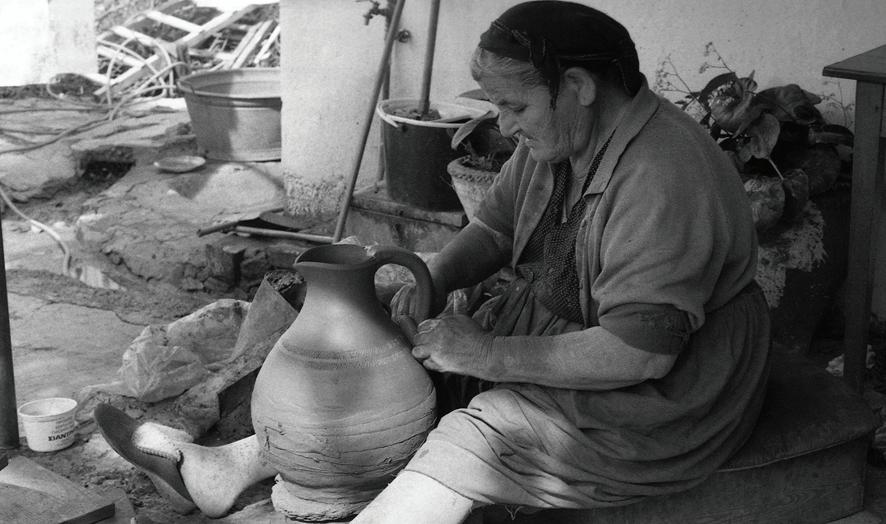
Figure 13.4 Mrs. Kyriakou adds a fillet to the lower jug handle attachment while working in her shaded courtyard.
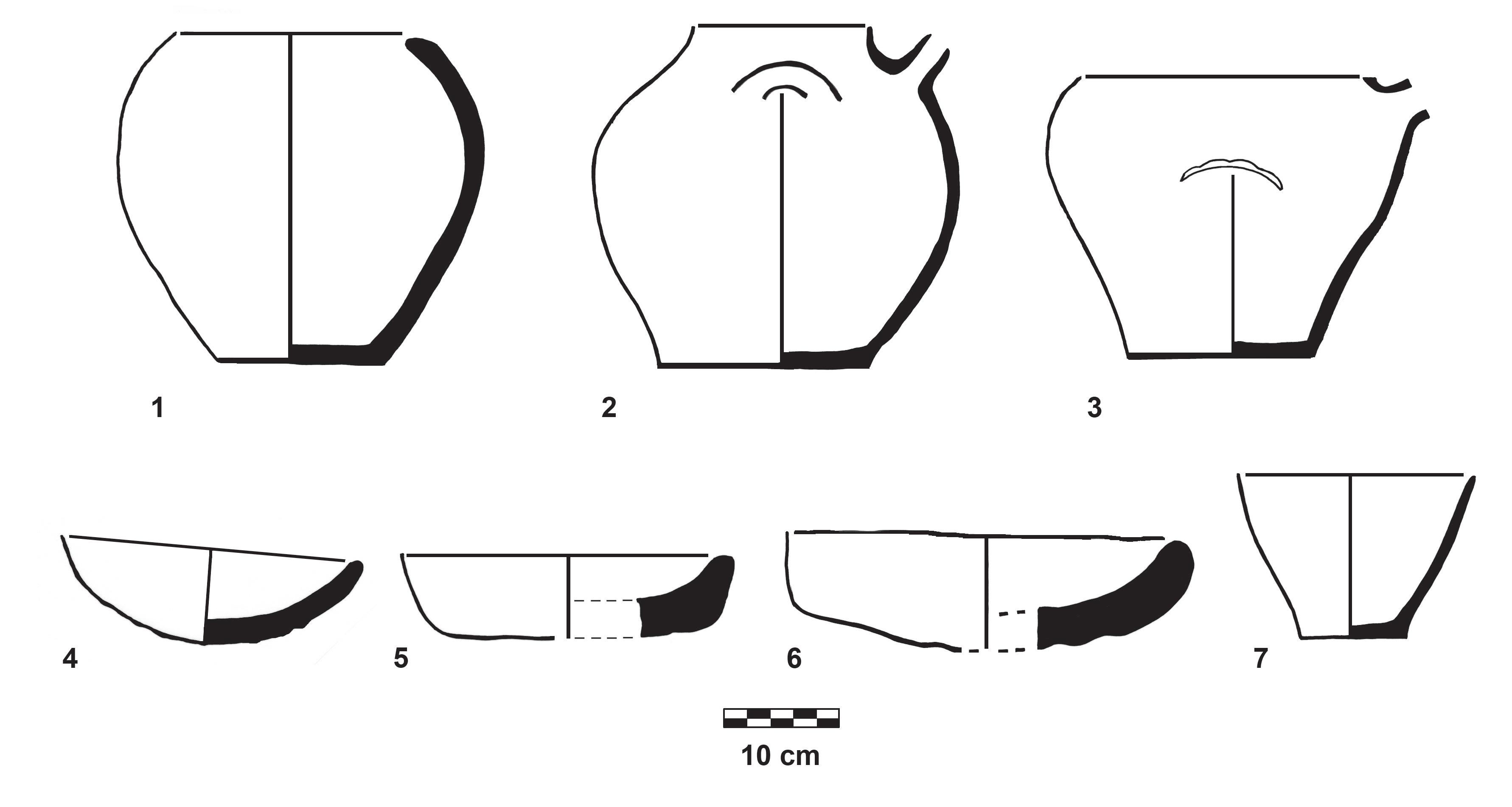
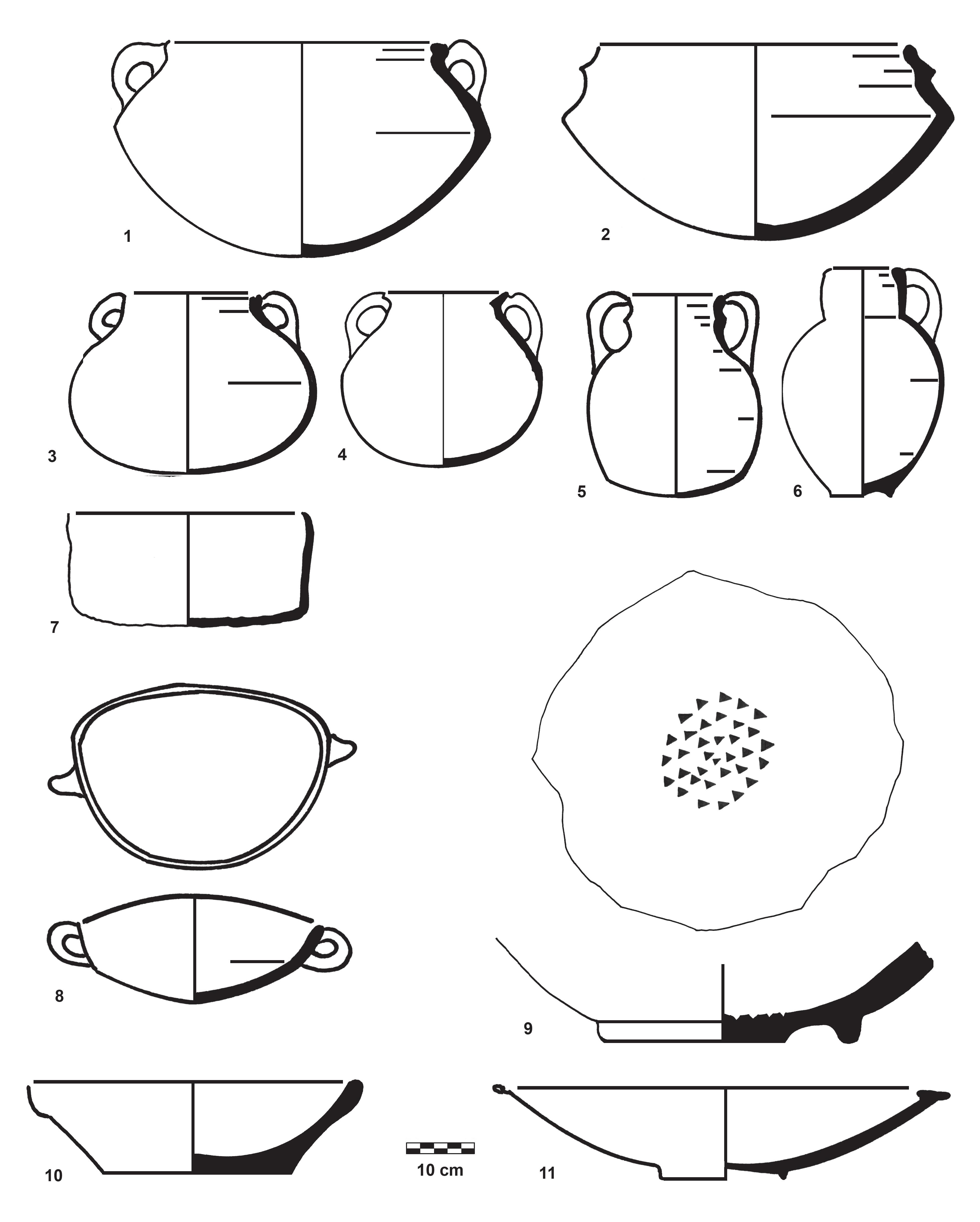
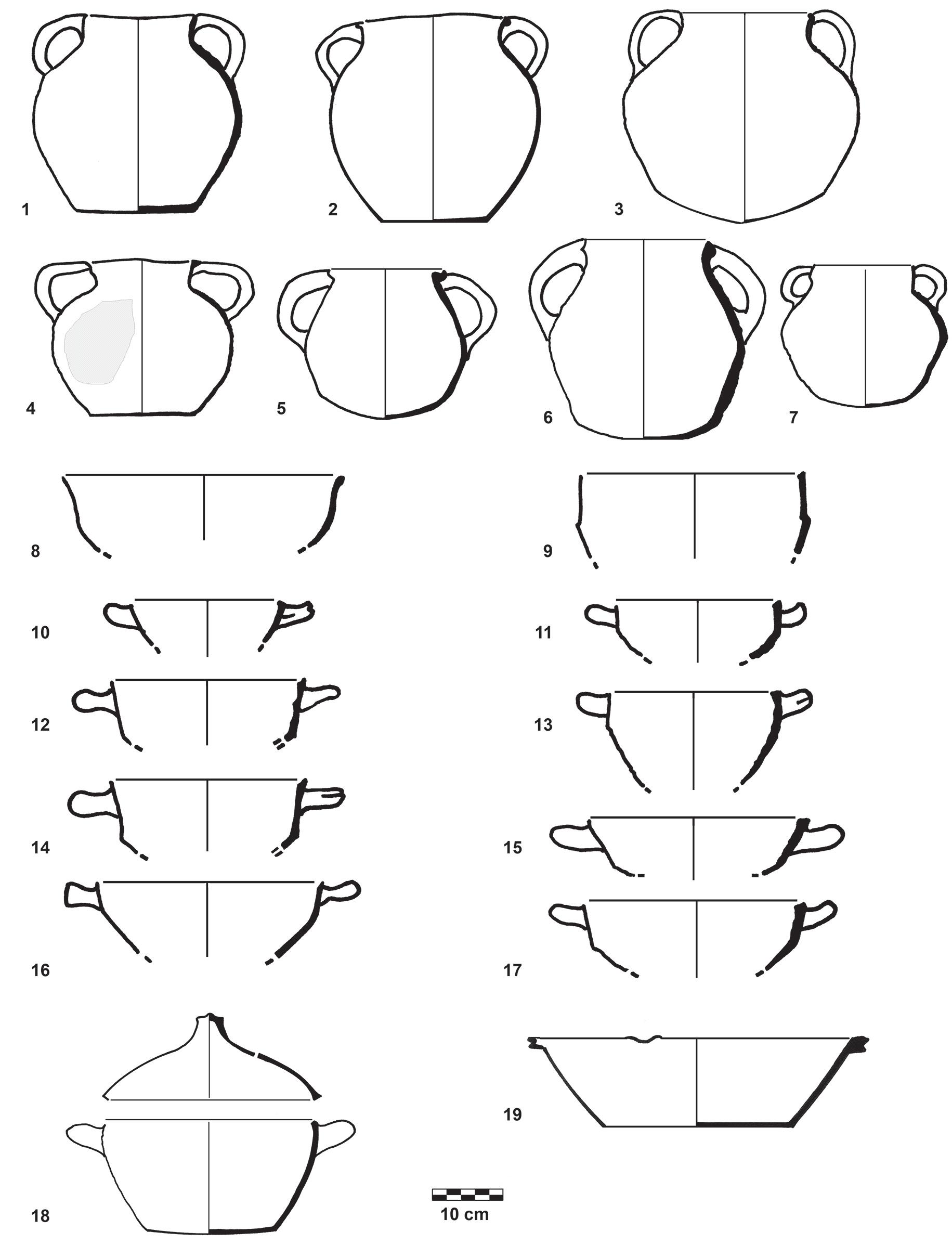
Figure 14.1 Chalcolithic Age cookware.
85
86
87
87
88
90
95
97
98
106
113
121
122
127
128
129
138
156
157
165
169
179
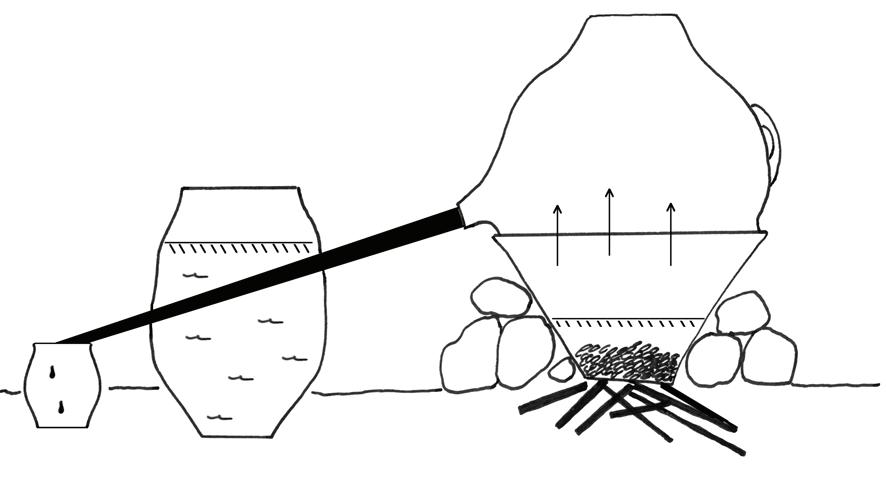
Figure 14.2 A traditional still, lampikos, in rural Cyprus. 180
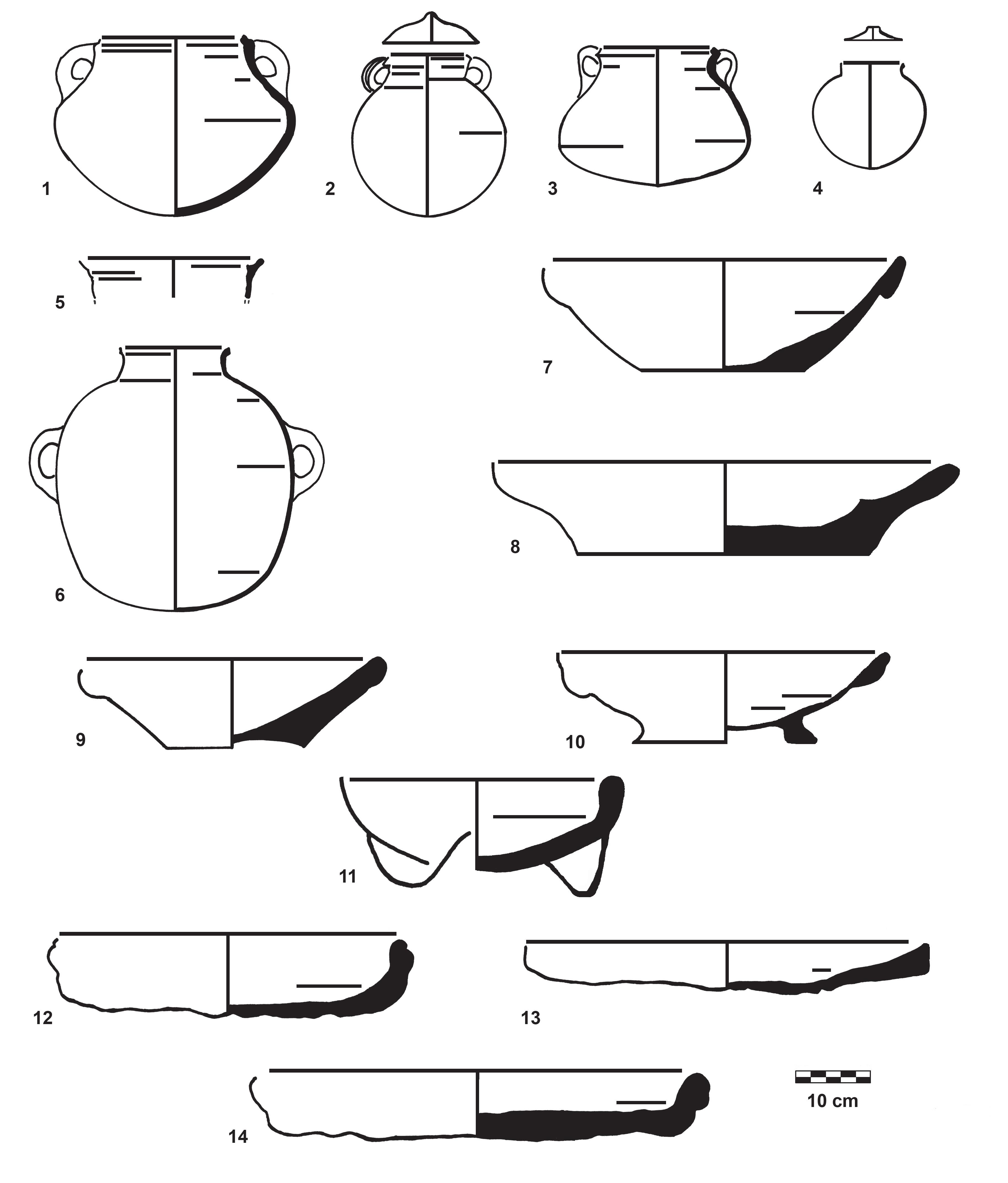
Figure 15.1 Early Bronze Age I cookware. 184
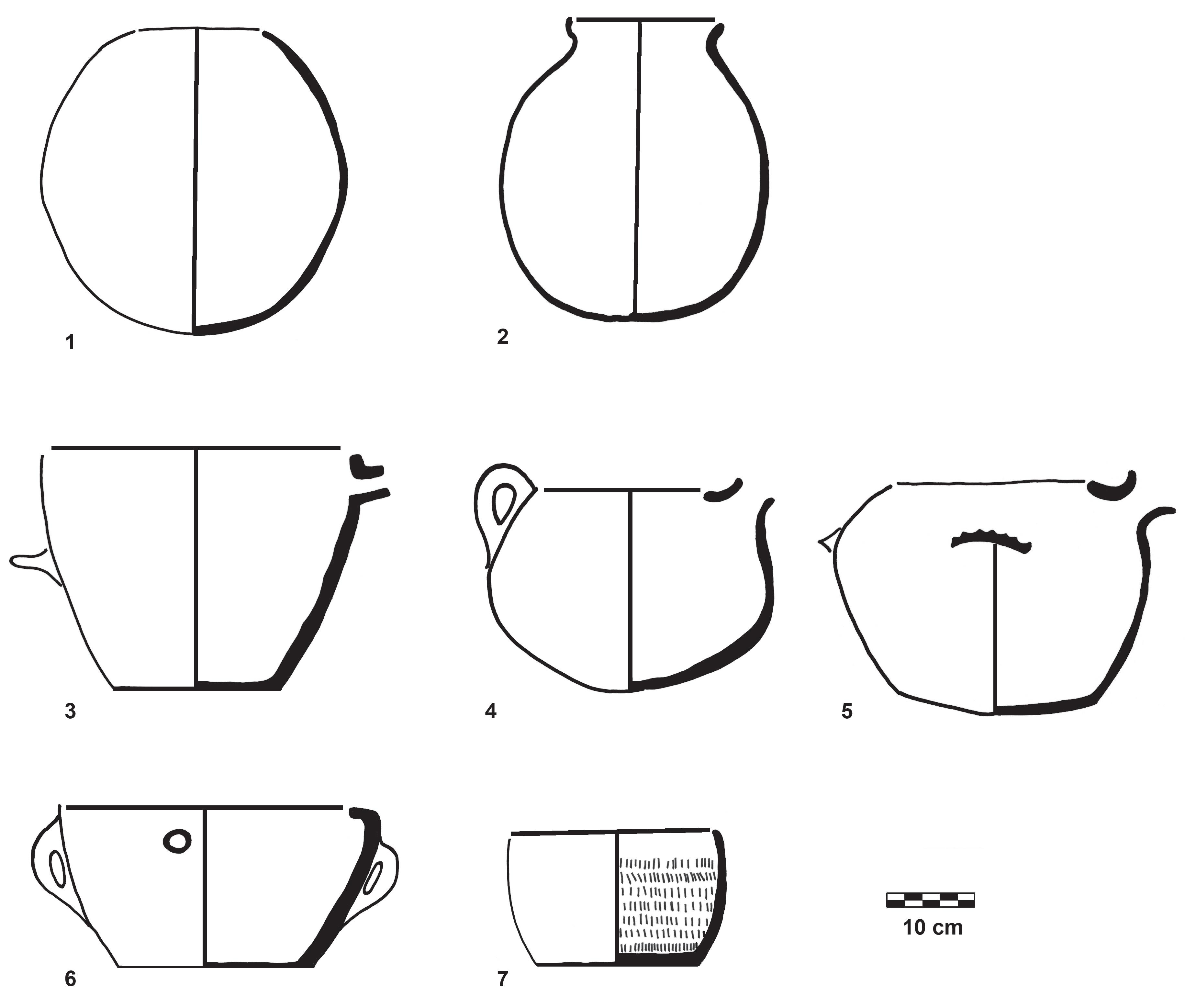
Figure 15.2 Early Bronze Age II–III cookware.
186
Figure 15.3 Early Bronze Age IV/Middle Bronze Age cookware. 190
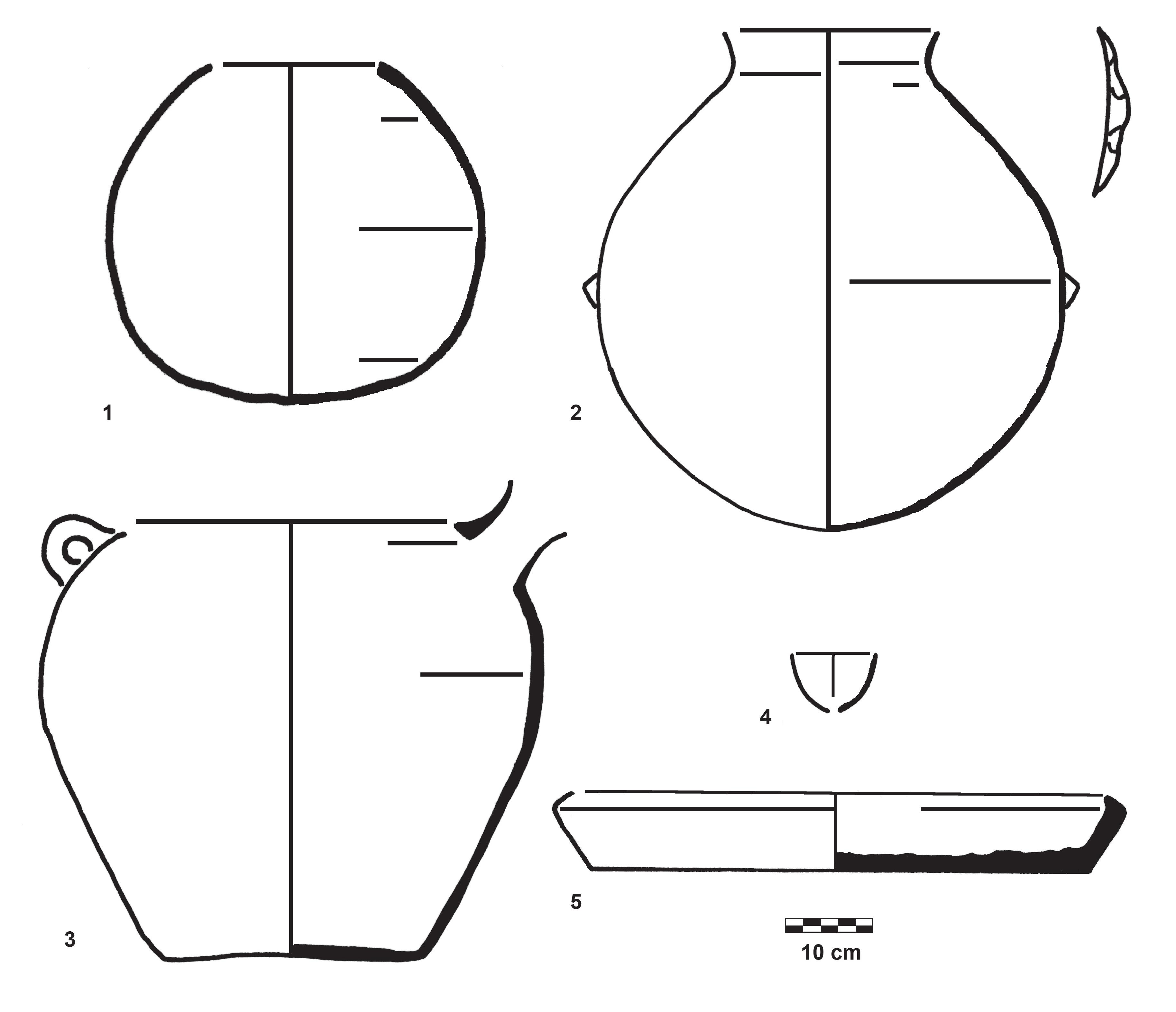
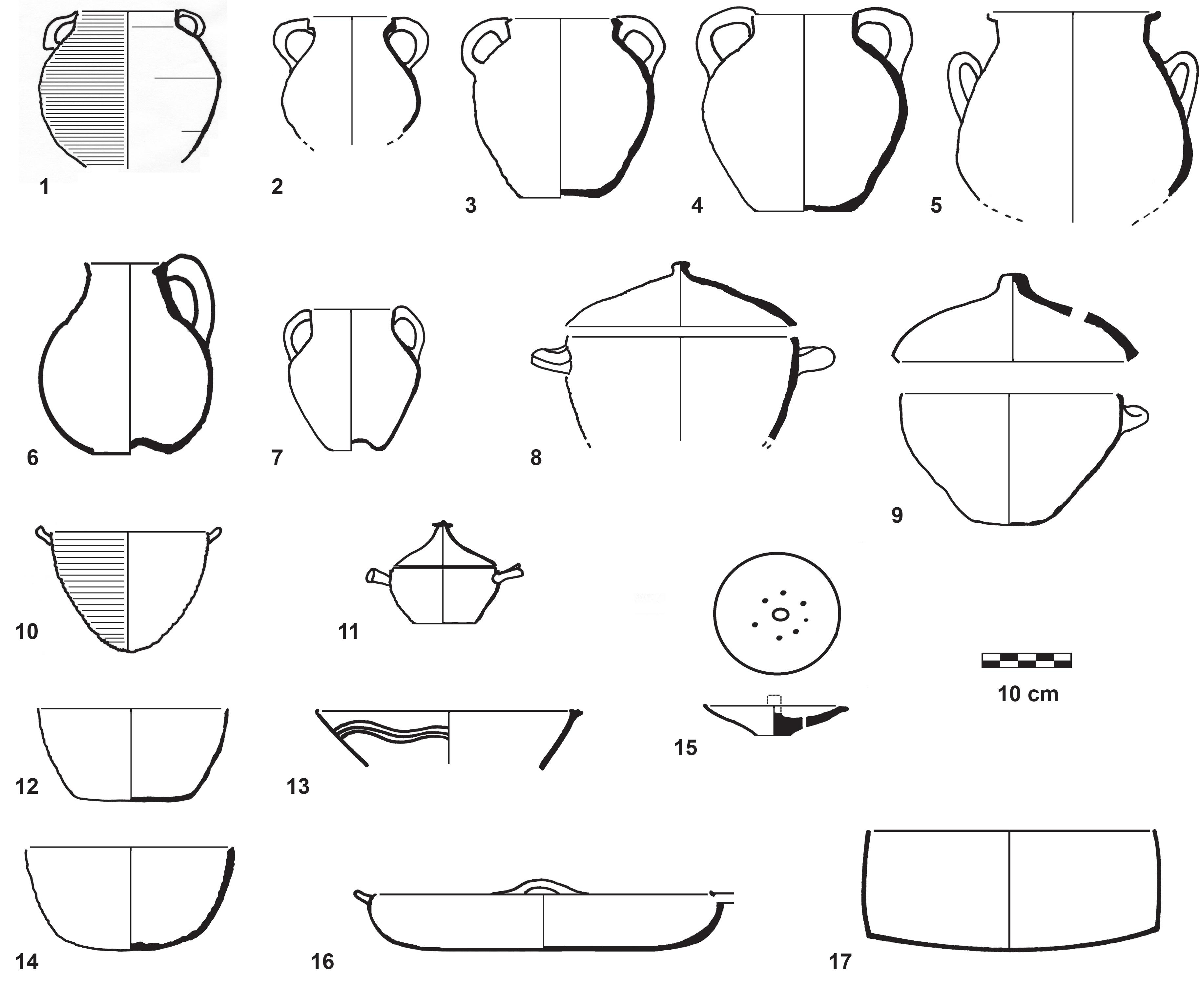
Figure 16.1 Middle Bronze Age II cookware. 196
Figure 16.2 Late Bronze Age cookware. 199
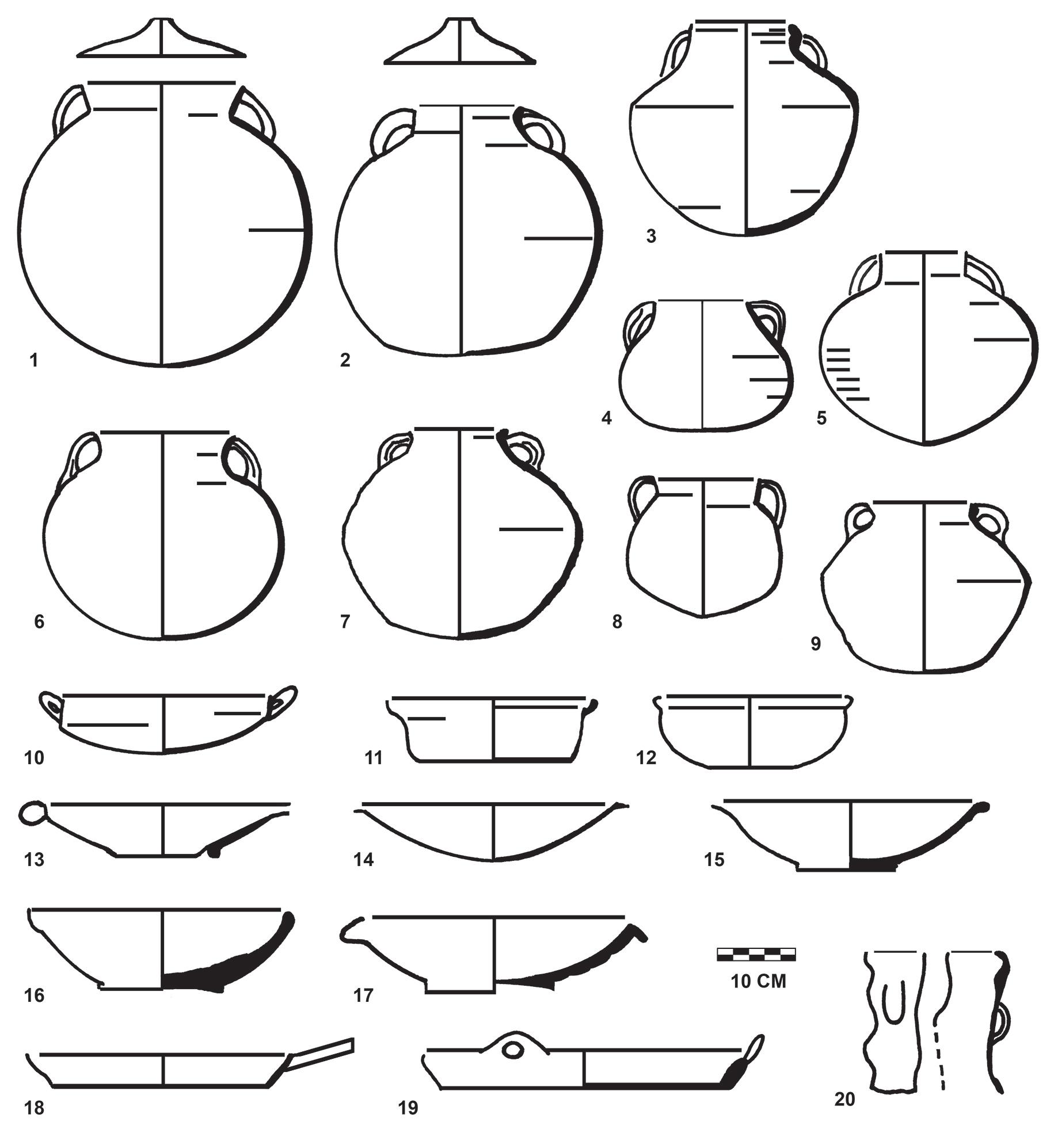
Figure 17.1 Iron Age I cookware. 204
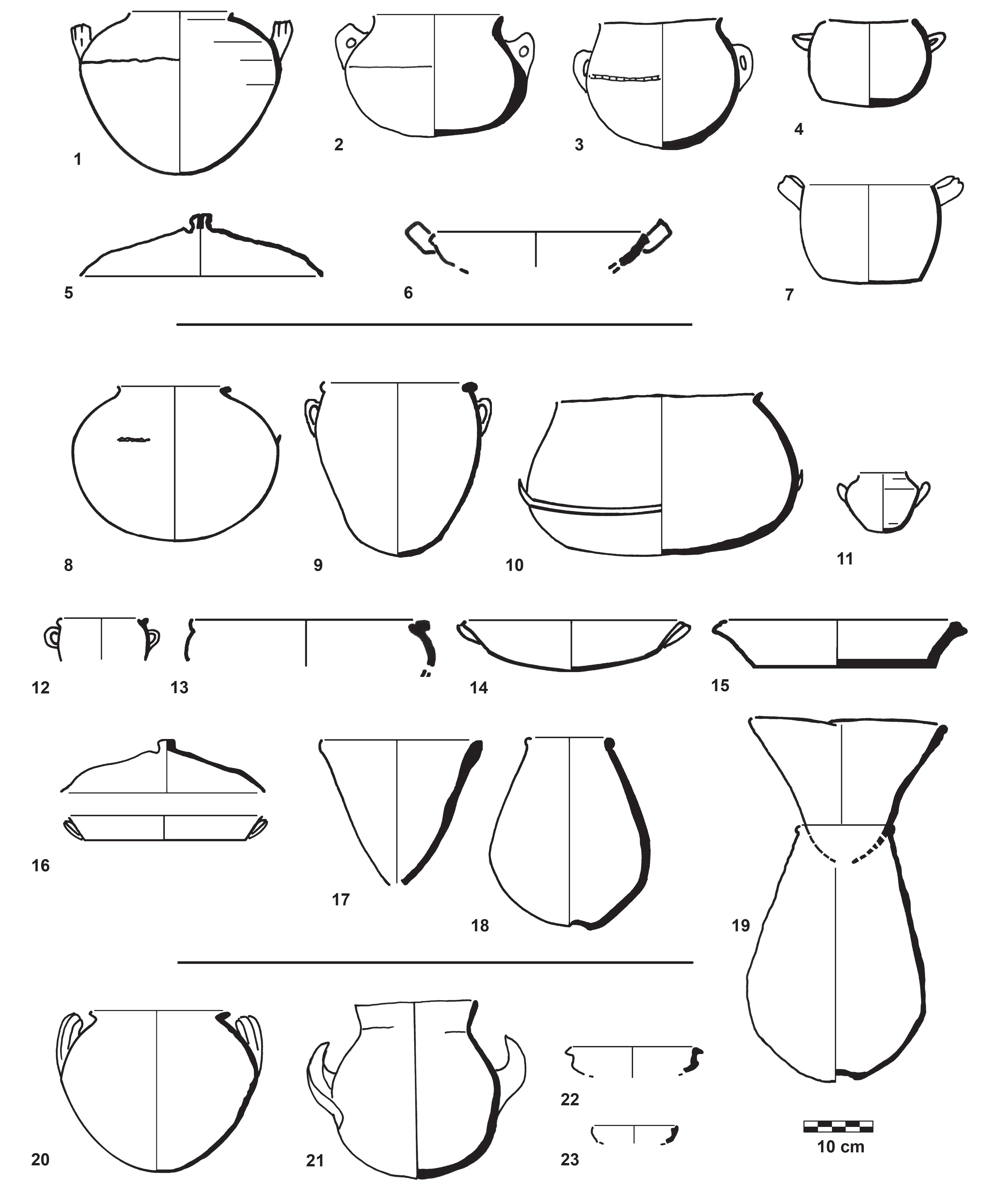
Figure 17.2 Iron Age II cookware. 208
Figure 17.3 Persian Era cookware. 210
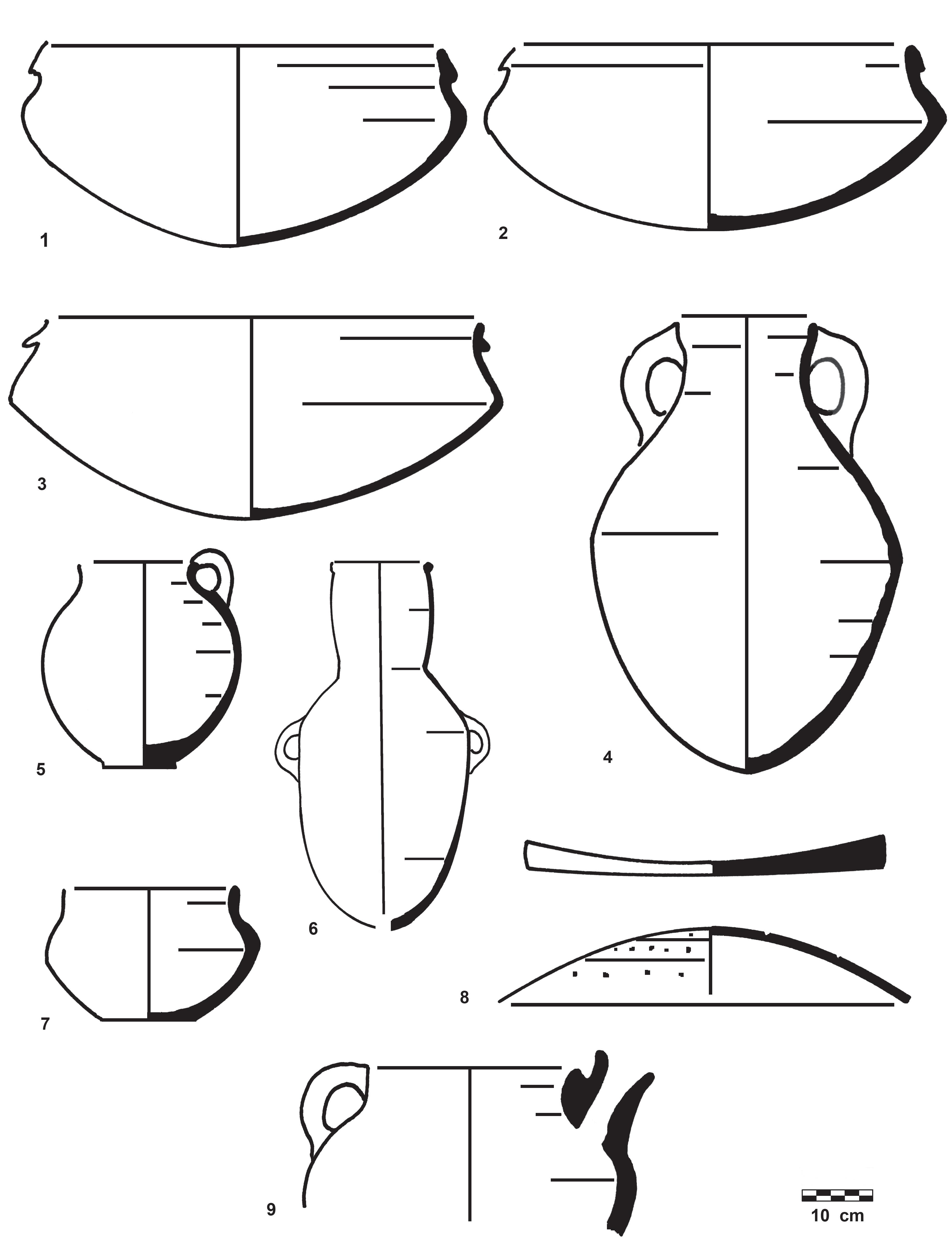
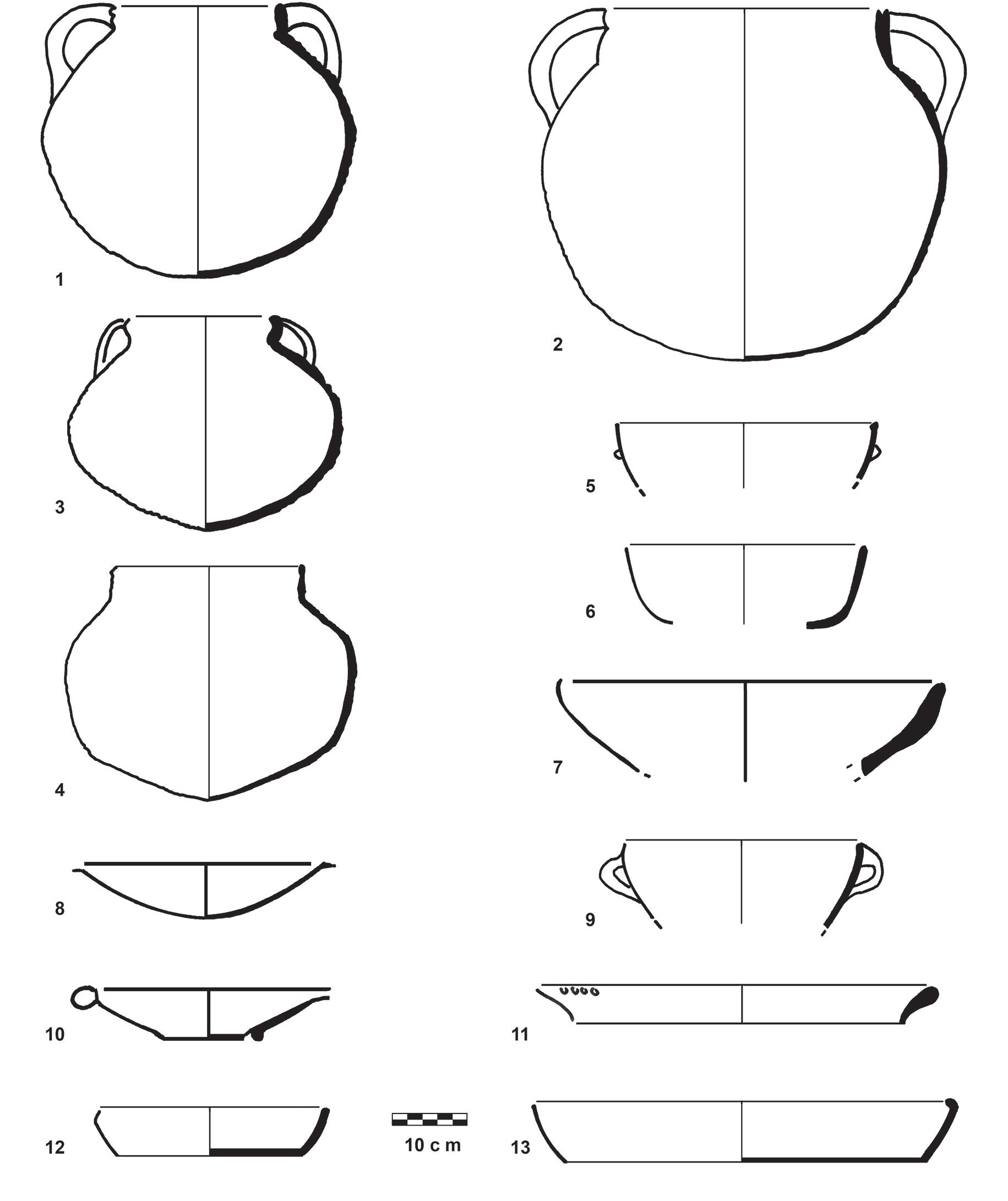
Figure 18.1 Hellenistic Era cookware.
Figure 18.2 Roman Era cookware.
Figure 18.3 Byzantine Era cookware.
218
223
227
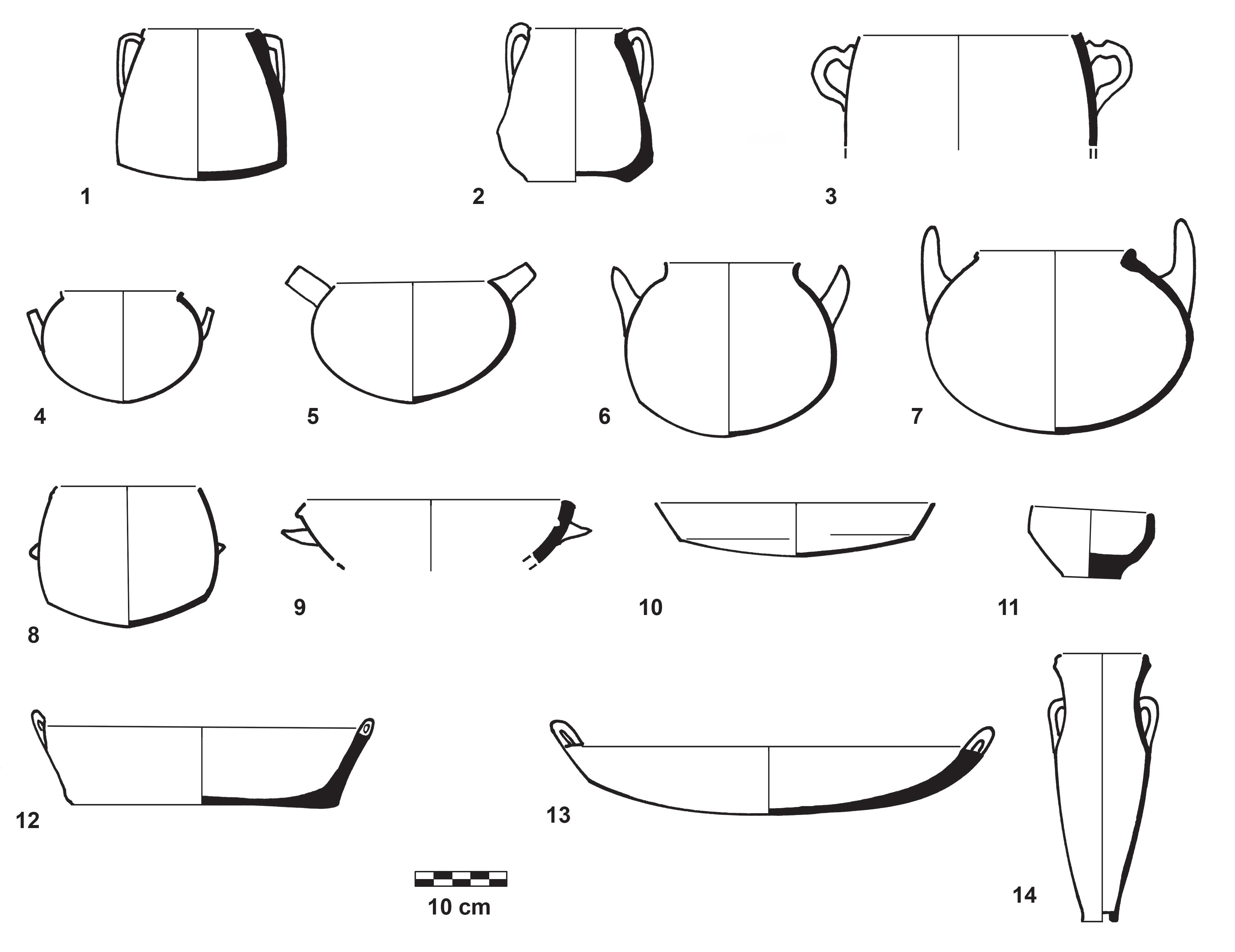
Figure 19.1 Early Islamic Era cookware.
Figure 19.2 Middle Islamic Era cookware.
Figure 19.3 Ottoman Era cookware.
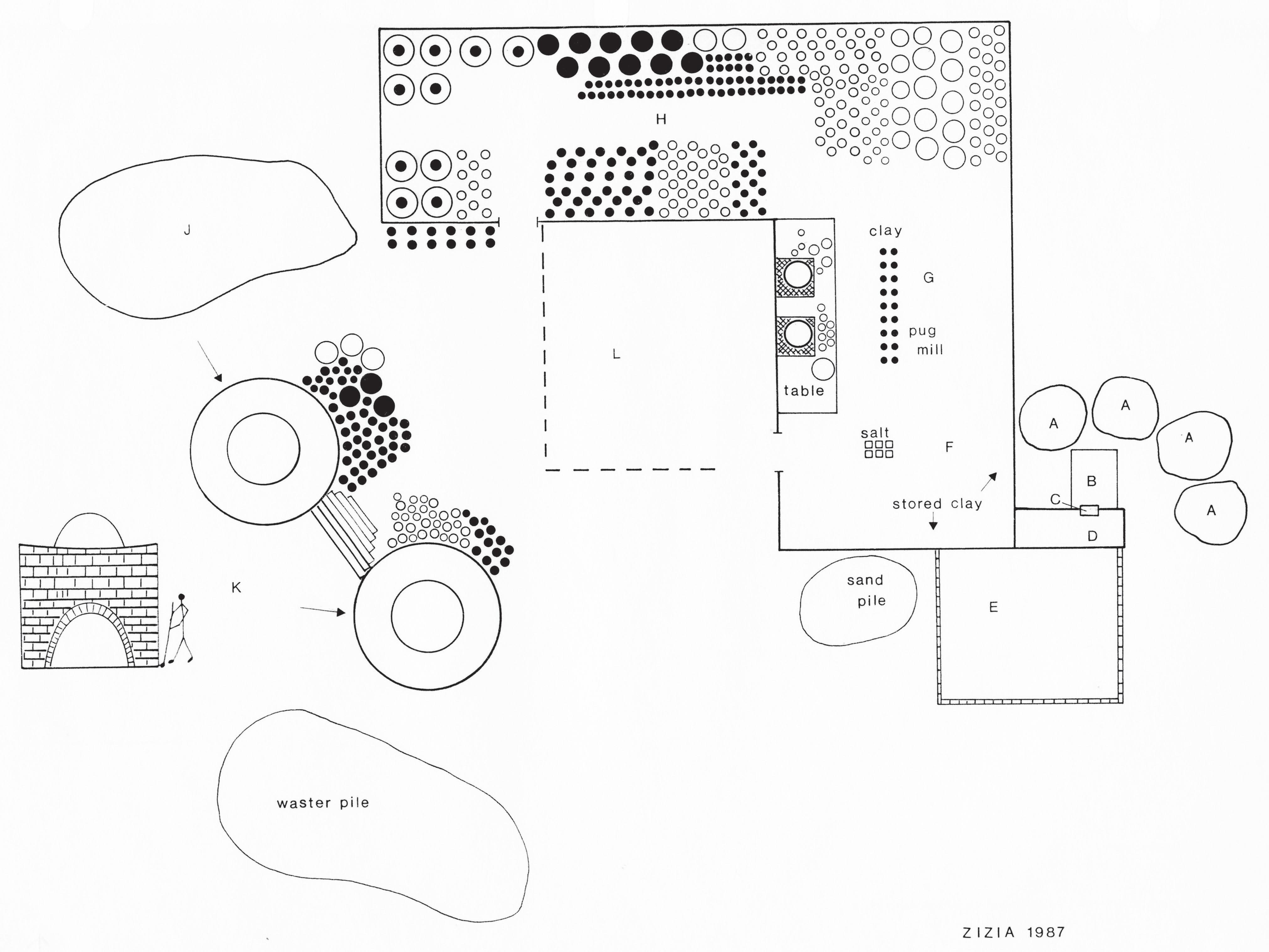
Figure 20.1 Pottery workshop at Zizia in 1987.
Figure 20.2 Zizia top-loading double kilns connected by stairs.
Figure 20.3 Outside a grocery store near Amman plastic abariq are for sale.
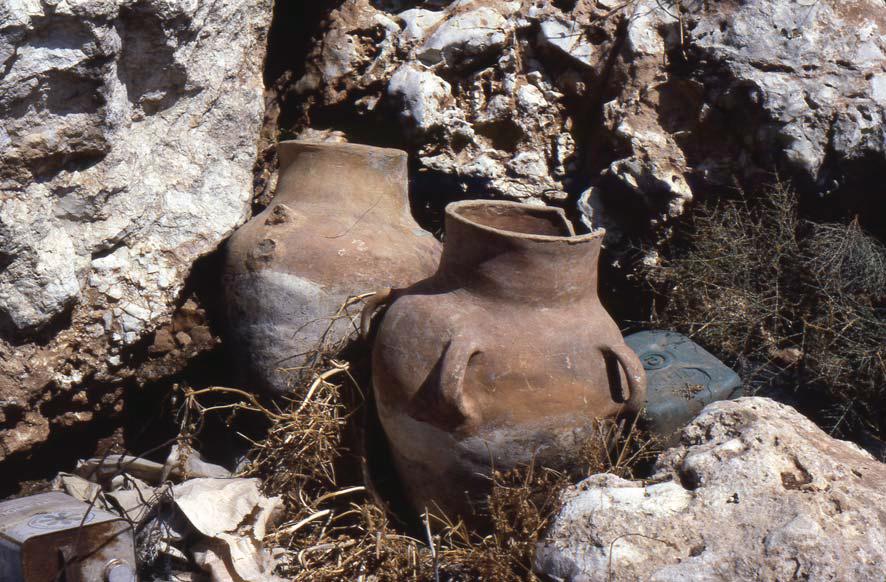
Figure 21.1 Broken jars with four handles in the courtyard of the Wadi Naḥlah potter.
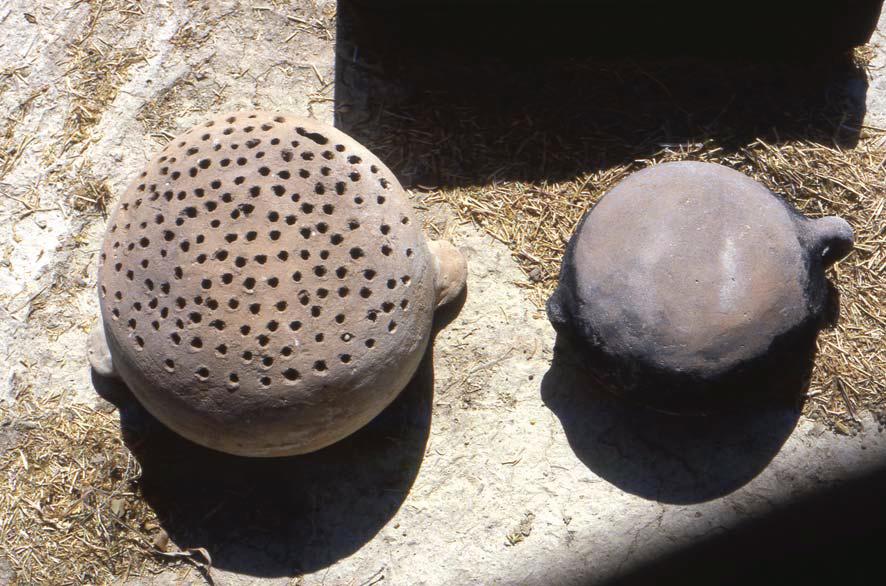
Figure 21.2 A colander and cooking pot stand upside-down on the rooftop where the potter cleans and sorts grain in Wadi Naḥlah.
Figure 21.3 A wooden box with ancient sherds, collected from the surrounding area, to be ground into grog by the Wadi Naḥlah potter.
230
234
242
251
252
253
260
260
261
Preface
Ancient ceramic technology is a study of how pottery was made and used. It requires the cooperation of many individuals—from those who made and used the pottery to those who excavate it. In Cyprus, Jordan, and the Philippines, traditional potters graciously allowed me to sit and watch as they did the arduous work of preparing clay, shaping pots, and firing. Surveys and excavations in Israel and Jordan made me curious to know how ancient pots had been shaped and how they had functioned.
My studies began at the Hebrew University in Jerusalem followed by degrees from Tel Aviv University. I was briefly at the University of Southampton, U.K., where I met fellow student and ethnographer Jennifer Boudillion. An award from the Netherlands government brought the opportunity to study ancient pottery technology with H. J. Franken and J. Kalsbeek at the University of Leiden. Potter Jan Kalsbeek emphasized the need to observe traditional potters and five years later, thanks to a Graduate Student Summer Grant from the University of Arizona in 1981, I was the first student to accompany W.A. Longacre to the Philippines for ethnoarchaeological research. His insightful and inspiring classes were my prelude to living among potters to observe all aspects of their work.
I was extremely fortunate to receive a Fulbright-Hays Award (1986) and a grant from the National Endowment for the Humanities (1999/2000), both under the auspices of the American Schools of Oriental Research (ASOR). They made possible my long-term field work among Cypriot potters. I gratefully acknowledge support from ASOR, especially its overseas institutions, the Cyprus American Archaeological Research Institute (CAARI), the American Center of Oriental Research (ACOR), and the Albright Institute for Archaeological Research (AIAR), which has been instrumental for my research.
In Cyprus the expertise of Stuart Swiny, then Director of the Cyprus American Archaeological Institute, assured the success of my project. Some years later as CAARI Director, Nancy Serwint was instrumental in my return to Cyprus for a year-long follow-up study in 1999/2000. Vathoulla Moustoukki, Executive Director of CAARI, provided unlimited assistance. She accompanied me to the Saturday Lefkosia fruit market in search of potters, although many people told us it was a useless endeavor because no one would be found who made pots by hand in 1986. The first person she approached was a potter.
After participating in surveys of the Sinai and many excavations in Israel, I joined the Madaba Plains Project at Tall al-ʿUmayri as the ceramic technologist thanks to Lawrence T. Geraty, Larry G. Herr, and Douglas R. Clark. In Jordan I observed traditional potters thanks to Joseph Greene and Pierre Bikai, then
Ancient Cookware from the Levant: An Ethnoarchaeological Perspective
Co-Director of the American Center for Archeological Research (ACOR). A grant from the Shelby White and Leon Levy Program for Archaeological Publications made it possible to conduct mineralogical and chemical analyses of ancient sherds from ʿUmayri and Hisban to study the history of pottery production in central Jordan.
Individuals who have answered my questions and read parts of the manuscript include: Nabil Ali, Roger Anderson, Sally Anderson, Eliot Braun, Louiza Constantinou, Anne Dehnisch, Marcel den Nijs, Jennie Ebeling, Kees Frankenburg, Smadar Gabrielli, Lilly Gershuny, Nigel Goring-Morris, Michael Fuller, Eleni Havadjia, Eleni Hasaki, Jenine Howard, Mustafa Izil, Kathy Kamp, Mary Larkum, Justin Lev-Tov, Elli and Loucas Michael, Ezra Marcus, Domna Michael, George Makrides, Mario Martin, Rodoulla and George Morphitis, Donald Mook, Stephen McPhillips, Beth Alpert Nakhai, Nava Panitz-Cohen, Pat Philippou, April Quint, Christina Savidou, Alison South, Maro Vaneses, Fanny Vito, John Whitaker, and Fred Winkowski. Ioannis Ionas was my interpreter initially in Kornos to convince the Village President, Mr. Costas Christou, that an unaccompanied American woman could live in a village. In the Philippines, W. A. Longacre and Mr. Domingo Enteria provided unlimited research assistance. I was fortunate that Anneliese Weiss and Willi Breitenfelder could translate century-old German publications. Judith Stylianou, Peter Allen, and Albert Glock kindly made available their photos related to the potters of Cyprus. Anna Moustoukki, an expert cook, shared her wide-ranging knowledge and is remembered for generously preparing meals and local delicacies for CAARI residents.
I am indebted to Larry Herr who read and commented on large parts of the manuscript. I am thankful for the help of Diana Edelman, Series Editor, who offered her encouragement, biblical expertise, and editorial assistance. Marcel den Nijs provided unlimited IT support, worked on the illustrations, and offered the theory behind the ability of clay pots to keep their contents cool through evaporation.
With pleasure I gratefully acknowledge the Cypriot potters of Kornos: Theodora Stavrou, Susanna Andrea, Anna Panyiotou, Theognosia Andreas, Eleni Alecou, Eleni Mageirou, Eleni Yeoryiou, Kyriakou Kyriakou, Eleni Yiangou, Maria Kyriacou, Maria Evagora, Maria Panayioutou, Anthoulla Anathansee; Paraskevou Hadjinicholas. Avgi Pitzili and Maroulla Georgiou of Kaminaria filled in the gaps on their village tradition. My thanks to former potters in Ayios Dimitrios: Lefkothea Ioannou, Agathoniki Michael, the sisters Andriana Stavrou, Galatia Constantinou, Elpiniki Ioannou, Rodothea Andreas, and the sisters: Theolozeni (Polyxeni) Neofytou Theodoutus, Maritsa (Neofytou) Charalambous, and Christina (Neofytou) Andreas.
My hosts in Kornos, Mr. and Mrs. Loucas Michael, made me part of their family and I remain in their debt. My hosts in Ayios Dimitrios, Lefkothea Ioannou and Anthoulla Frixou Yiangou and their families, have taught me a great deal. I extend my sincerest thanks and appreciation for the love and support of my mother, husband, and daughter, who all came with me to Cyprus.
IntroductIon
Most ancient clay cooking pots in the Levant are easily recognized by their shape, surface, and texture. For thousands of years they had deep globular bodies with round bases. Open and shallow shapes finally appeared in the mid-1st century BCE. Often covered with black soot, their unglazed surfaces are coarse and crumbly or brittle and rough. Although outwardly unappealing, these pots not only filled an indispensable need for preparing meals but also provided connections among the people who cooked the food, shared it, and passed those traditions to the next generation.
Cookware excavated at sites in the eastern Mediterranean coastal and interior Levant comes primarily from destruction debris, kitchen refuse, hearths, courtyards, and less often from burial sites. Although abundant, these cooking pots are often broken, incomplete, and friable as a result of repeated exposure to cooking fires. The pots are less frequently studied than the thin, small ceramic containers that held liquids, but for archaeologists, changes in cooking pot morphology offer important chronological information for dating entire assemblages of the past 12,000 years in the Levant, from Neolithic to recent times.
Nothing about the unappetizing, rough pots makes them easy to associate with the meals, either plain or festive, known from ancient writings or iconographic representations. Conversely, ancient Near Eastern texts mentioning meals often omit details about the appearance of the cooking pot, how food was cooked, or how it tasted.
To narrow the gap between excavated sherds and our concept of ancient meals, the perspective adopted here begins with how food was processed, preserved, cooked, stored, and transported in clay containers. Ceramic vessels were more than passive receptacles—they functioned in the processes of turning grain and fruit into alcoholic beverages and converting milk into yogurt, butter, and other products that can remain edible for months.
There is another aspect to these mundane objects. Unlike the sealed surfaces of glazed, metal, and modern materials, the unglazed walls of earthenware pots are absorbent and permeable. Smells and food residues become embedded in their porous walls, leaving memories of the foods placed in them. Cooking pots are quintessential “memory pots” that retain residues of everything cooked or stored in them. Just as the smells and tastes of favorite foods stay with us for a lifetime, memories in earthenware containers, especially undecorated, rough-textured pots, live for millennia.
Other than ceramics, archaeologists have few sources for learning about ancient foodways or how people behaved, felt, and thought about food. Ancient cooking practices and gastronomy—how food tasted— are barely known. A glimpse at the limited body of relevant ancient Near Eastern texts begins with over a hundred recipes, often intricate, known from Mesopotamian cuneiform culinary tablets (Bottéro 1985). Unfortunately, the ingredients have not been fully identified by epigraphers, and measurements are ambiguous. Instructions call for more varieties of porridge, bread, nuts, fruits, and a greater use of dairy products than are found in ancient Egyptian cuisine. Elaborate stews, recipes with many ingredients, and complicated sauces are the opposite of typically unadulterated Egyptian cooking. Flavor, aroma, and texture apparently were critical in Mesopotamia (Bober 1999: 34, 66, 71).
Biblical references to meals include many names for pots used for cooking meat or vegetarian meals described in general terms. Cooking pots are one of the few types of ceramic containers whose function was known at the time, and yet various terms for pots, such as dud and sir, are used for reasons the biblical text does not specify.
The slightly later Roman culinary style, based on 1st century CE recipes of Marcus Gavius Apicius, qualifies as “destruction cuisine,” which manipulates the original appearance and flavor of foods (Bober 1999: 149). Copies of medieval-era cookbooks, in Arabic, present imprecise measurements and vague, unstated, or confusing procedures and practices. For example, were herbs and fragrances mentioned at the end of a recipe intended to season the food or to be rubbed into the pot? A dish called muṭajjan incorporates the name of a copper pan (ṭajin), but recipes call for an iron or soapstone frying pan (miqla), not a copper one. Muṭajjan apparently refers to a meat or egg dish cooked in any pan and flavored with vinegar and a bitter-salty murri made from fermenting barley (Perry 2005: 20–21, 115).
In addition to epigraphic data, there are drawings of ancient feasting scenes that portray foods consumed on special occasions by the upper levels of society. The foods eaten by most people who lived in tents, farms, and villages were rarely depicted graphically or preserved archaeologically. The best available sources of information on how foods were processed and cooked come from excavated pottery and, if preserved, floral and faunal material found in pots, pits, hearths, dumps, or store rooms.
Clay is widely available in the Levant for anyone to dig, and once fired, it becomes almost indestructible. Consequently ceramic containers are overwhelmingly abundant at most excavations. Ceramics are always breakable, and cooking pots, in particular, have a shorter lifespan than most jugs, jars, or other clay containers. The majority of ceramics functioned in one way or another with edible products until they cracked and were replaced. In traditional societies, broken pots were reused for a wide variety of purposes unrelated to food for human consumption, such as to feed animals, to line hearths and paths, to reinforce pits, to cover and separate pots stacked in kilns, to hold and protect plants, to strengthen and add color to new constructions, to stabilize tables and chairs on uneven earthen floors, to carry charcoal, and to protect flames from wind in cemeteries, among other uses (London 1989c: 221). In antiquity sherds provided a writing surface for ostraca.
Unlike ceramics, remnants of food survive only through accidents or tragedies. Organic materials, plant or animal, decompose under normal circumstances unless intense fires result in carbonization. Desiccated vegetables and carbonized plants endure if sealed without access to oxygen. Animal bones and other remains of meat meals were normally moved down the food chain for pets and scavenging animals to devour. As a result, cookware is a prime artifact for learning about ancient cooking and foodstoring practices.
In order to study the connections between pots and daily life in antiquity, it is useful to investigate cookware and cooking practices in current traditional societies, where modern conveniences such as electricity are not widely used. Pots made from local clays and designed for use by the indigenous population demonstrate the advantage and versatility of clay containers worldwide. Ethnographers seldom
Introduction
study material culture, i.e. artifacts made by people. Ethnographic research tends to focus on issues related to food policy, nutrition, agricultural technology, who eats with whom, and other similar topics that ethnographers examine by interviewing informants.
In 1951, in order to study infant nutrition and feeding practices, Jennifer Bourdillon visited high-altitude Nepalese villages in the shadow of Mt. Everest. Her compelling account in Visit to the Sherpas records the long, slow journey by sea to India, a short flight to Kathmandu, a brief truck ride, and then a lengthy walk to remote villages. The detailed descriptions of dense forests, fragrant rhododendrons, colorful clothes, foods, and dark house interiors allow readers to feel and taste what she experienced. She noted wicker baskets used to carry almost anything, metal pots and wooden barrels taken to streams, kettles used to boil water, copper bowls placed in an altar, potatoes boiled in a black pot, and a kitchen lined with rows of pots and pans.
Bourdillon’s hosts regularly offered chang, the local brew, in a bowl that was passed around the group. Protocol required that one graciously decline the lumpy beverage repeatedly before accepting. The chang was once followed by a small china cup of a whiskey-like rackshi. Then as a special honor, the host offered tea made according to an old Tibetan recipe. It was brewed from coarse leaves, boiled three times, salted, shaken, and served with a slimy layer of sour yak butter floating on top. Her description of the buttered tea was vivid, but there was no description of the container in which it was served. Was it metal, porcelain, or wood? Did it have handles? Was it decorated or plain? Chipped, old, or new?
Sherpa men and women are renowned for carrying the heavy loads belonging to foreign mountain climbers. All household wares and foods are conveyed to and from villages, on their backs. Astoundingly, in 1952, each of the many cars in the city of Kathmandu had been hand-carried over the hills from India (Bourdillon 1956: 26). For isolated villages, non-local goods came from nearby towns. Bourdillon’s stunning descriptions of the natural high-altitude landscape, household contents, and local beverages contrast with an understandable disregard for ordinary serving dishes. Her visit was too brief to learn about drinking vessels. This is a question archaeologists ask about ancient cultures, but there is no one to interview. Instead we have excavated sherds from which we reconstruct the function of pots, and when, where, and how they were made.
Cookware claims our attention for learning how people obtained daily nourishment and how they treated food to guarantee their individual and communal survival. To investigate how ancient people cooked and ate, traditional people who still produce and use clay pots offer a valuable resource. This type of research, known as ceramic ethnoarchaeology, is designed to address issues encountered while analyzing the material culture of ancient civilizations.
In the 20th and early 21st centuries CE, societies minimally impacted by modern technology still preserve traditional methods for storing and preserving foods. This information is relevant for understanding ancient practices. People who use cookware that resembles ancient pots in form, fabrication, and function can provide information on how ceramic containers are made and used. For example, what are the names of cookware and how are they used? Why do cooking pots have rounded bases? How does one manage without refrigerators or flat-topped stoves? How are summer food surpluses preserved or transformed into long-lasting nutritious food? How are pots cleaned in areas of chronic water shortage and parasitic infestations? What are solutions to the white mineral encrustations that accumulate inside pots that held water?
One might ask if pottery was even necessary for cooking food. Stone, skins, and leaves make suitable cooking vessels. Coatings of salt, ash, clay, honey, oil, wine, and vinegar, or the processes of drying, smoking, and fermentation can preserve foods without clay pots. Many foods can be eaten raw, but cooking converts some unpalatable, toxic raw foods into better-tasting, comestible, more digestible nutrients for people of all ages.
Pottery-making is hard work. It was laborious to mine and prepare clay. Fuel collected to fire pottery could have been used for warmth or to cook food without clay pots. People might not have made pottery unless it offered specific benefits. Clay pots were not used merely to heat or hold food — they stored memories. Dairy foods, grains, and water lasted longer and/or tasted better when stored in clay pots. Clay jars functioned as automatic yogurt makers and as fermentation vats for wine and beer, while clay jugs were the traditional water coolers and purifiers.
The ancient material culture of the southern Levant uncovers details about the lives of ordinary people. In contrast, the palaces and grand tombs, as well as the texts of elite societies in adjacent lands, reveal living standards reserved for the privileged few. Eastern Mediterranean and Levantine traditional lifestyles still provide important data to learn about the day-to-day human experience related to ceramics and food in antiquity.
In the early 21st century, a dwindling number of Cypriot women fashioned cooking pots that resemble ancient shapes in form and probably function. Rural potters in the Levant are even fewer in number. Village women in north Jordan continue to bake flat breads in clay ovens they build themselves, as in previous generations (Lane and Ebeling 2013). Until recently, the conical tannur was still widely used in Syrian villages as an oven to bake bread and to cook meat (Mulder-Hymans 2014: 163, 170).
The material presented begins with a description of five data sources to learn about ancient cookware: excavations, ancient and medieval texts, government reports, early accounts of potters, and ethnoarchaeological studies. Excavated cookware provides details on the shapes and types of pots, whether they are deep globular or shallow, and early texts present names for pots and recipes. Government reports offer 20th-century census data on craftspeople. The writings of businessmen and travelers since the mid-16th century mention foodstuffs shipped in clay pots. Judicial rulings sometimes refer to foods transported in ceramic jars. Ethnoarchaeological studies in traditional eastern Mediterranean and Levantine societies give information on the making of earthenware pots and explain how they were used to process, preserve, cook, and store food. With this background, the final section focuses on the shape, style, and manufacture of cookware for the past 12,000 years and concludes with descriptions of recent potters in the southern Levant who continue to work with local materials to meet local needs. Certain ethnoarchaeological and archaeological examples appear in both the historical survey and in the earlier sections that deal with pottery technology in order to illustrate specific points. Despite changes in the shapes of clay pots over the millennia, the essential elements of how they were made, how they functioned, and how they were reused, are timeless.
The implications of ceramic ethnoarchaeological research address topics dealing with the use, names, and manufacture of cookware. Questions about the use of ancient cooking pots concern how were they treated before and after use, what foods they held, how long they lasted, and how were they cleaned. Clues to explain the various names for the pots mentioned in the Hebrew Bible arise from ethnographic and ethnoarchaeological studies carried out since the early 20th century, but questions remain. Issues related to production involve why they have round bottoms and minimal decoration, who made the cookware, how locations for the production of ancient pottery can be identified, why there are variations in the cookware, the possible trading of cookware, changing shapes over time, and why burnished surfaces reappear throughout history in the Levant.
Part I
traditional CeramiCs in the levant and CyPrus
The LevanTine Corridor and Cyprus:
The “Levantine Corridor” is the narrow strip of land between southern Turkey and the Red Sea where Asia, Africa, and Europe meet (Goren-Inbar and Speth 2004: 2). To the west is the Mediterranean island of Cyprus. Geologically, the Levant and Cyprus differ substantially, but both experience similar weather patterns and water shortages.
The Levant
The southern Levant, encompassing modern Lebanon, Israel, Palestine, and Jordan, comprises unparalleled biodiversity and exceptional natural features. The famous Jordan River flows through a deep Rift Valley, which is the northernmost extension of the Great Rift Valley of Africa. The river empties into the highly saline Dead Sea at roughly 400 m below sea level. With minimally 34% salinity, the inland sea, known in Hebrew as the Salt Sea and in Arabic as the Sea of Death, marks the deepest spot on earth.
Less water reaches the Jordan River and its final destination, the ever-shrinking Dead Sea, than a century ago. The major reason is that dams constructed on upper tributaries redirect the water for agricultural use. On the 26th of February, 1868, when the water level was high enough for ferry travel, observers recorded seeing a ferry stuck in mud and an overflowing Jordan River flooding the area (Our Work 1873: 224–28). Today there are no ferries, but hot springs and therapeutic waters in the Dead Sea area contribute to a unique landscape of flora and fauna, caves, and rock formations.
The Rift Valley, which runs from north to south, divides the southern Levant into eastern and western portions. To the west, narrow bands of highly varied topography are bounded by the Mediterranean Sea. To the east are mountains and a plateau that expands into semi-arid desert. This study focuses on sites excavated on land wedged between sea and sand in various terrain, from coastal, hilly, mountainous, semi-arid, to desert. These wide-ranging ecozones offer tropical to semi-arid conditions located on the western edge of southwestern Asia.
The region is geologically unstable, with sporadic major and many minor earthquakes and volcanic activity. Basalt flows in the Golan could be a mere 4000-years-old (Por 2004: 14). The movement of two tectonic plates in contact with each other created the Rift Valley. Forces exerted by plate tectonics continue slowly, and sometimes violently, to alter the landscape.
The southern Levant breaks into small geographic units primarily built of sedimentary rock formations. Five vertical bands divide the area into the Mediterranean coastal strip and interior plains, the western foothills and highlands, the Rift Valley, the highlands of Transjordan, and finally, the eastern and southern deserts. Each highly fragmented topographic region coincides with a specific climate, physical landscape, flora, and fauna. From north to south, the landscape changes from forested, high mountains capped with snow in winter to fertile plains, which eventually give way to the semi-arid south and eastern desert. The humid Mediterranean littoral contrasts with the drier air of higher altitudes and semi-arid eastern and southern areas. Annual precipitation drops dramatically from 1500 mm in the north to under 25 mm annually in the south.
The nearly straight, featureless, and geologically young Mediterranean coastline provides few natural harbors, unlike the differentiated littoral to the north with ample ancient seaports at Tyre and Sidon. Roughly 10,000 years ago the coast extended at least 500 m to the west. Submerged Neolithic artifacts, including water wells, imply a wider coastal strip than at present (Galili and Nir 1993). The coast varies in composition and width. The flat sandy coast, widest in the south, is fed by sand deposited by sea currents
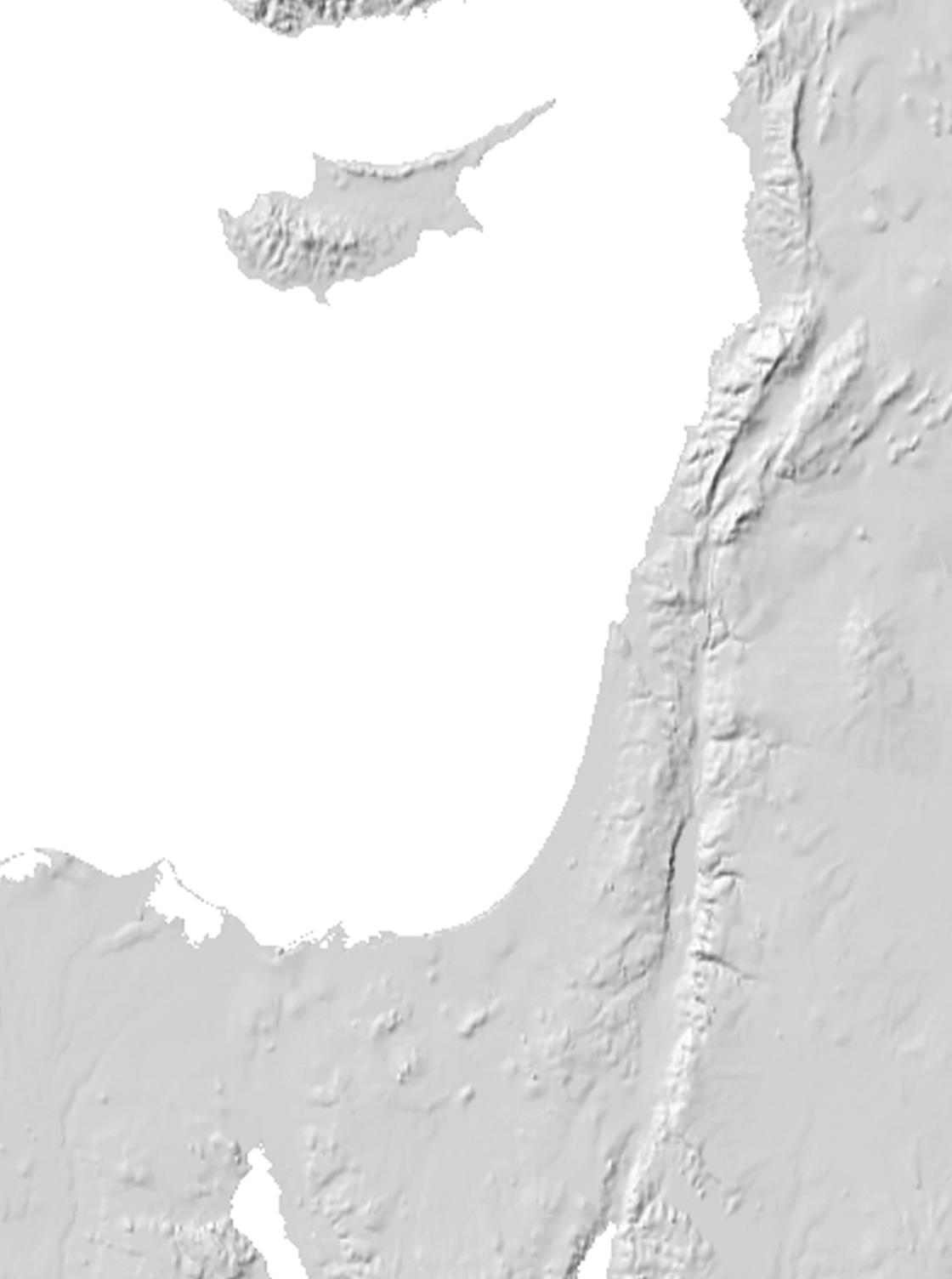
Figure 1.1 Map of the Levant and Cyprus.
Lefkosia
Damascus
Amman Jerusalem Beirut
Dead Sea Jordan River
Gulf of Eilat/Aqaba
Gulf of Suez
Sea of Galilee
Mediterranean Sea
Madaba Plains
Wadi Rumm
Negev Shephelah
The Levantine Corridor and Cyprus: Geographical Parameters
traveling from the Nile Delta. To the north are limestone and chalk cliffs rising above broad sandy beaches. Near Haifa the coastal strip nearly disappears, and conglomerate beach rock meets the shoreline.
A limited number of small perennial or seasonal rivers and streams dissect the northern and central fertile interior plains close to the coast. Arable plains and valleys separate the coastal strip from gentle foothills, known as the central Shephelah, and interior mountains. The fertile Jezreel Valley divides the mountainous Galilee from the gently rolling Hills of Samaria, which lead to the more southerly, rugged, yet fertile Judean Hills with stony outcrops and naturally terraced slopes. They comprise a north-south highland strip that is 20–25 km wide and 700–800 m in altitude, with occasional peaks reaching 1000 m in height.
Steep slopes rise on both sides of the Rift Valley. The average altitude of 600 m in the north climbs to 1000 m in the Central Jordanian Highlands and 1500 m in the southern region. In the north, mountains that run parallel to the Rift Valley include the Golan, Galilee, and northern highland of Jordan, beginning with the Yarmuk River. The highlands continue south through theʿAjlun Mountains and rolling Hills of Ammon, Gilead, and Moab. The southernmost and highest Edom Mountains are impressive sandstone formations that include the ancient site of Petra. The northern Rift Valley, or Ghor, receives ample rainfall to support agriculture, as do neighboring hills of the Central Jordanian Plateau. The southern Rift Valley, known as the Arava, extends 160 km to the eastern branch of the Red Sea, the Gulf of Aqaba/Eilat, and is hot and dry.
East of the highland plateau, the semi-arid Eastern Desert, or Badia, extends into Syria, Iraq, and Saudi Arabia. Wadi Mujib, a deep gorge that dissects the landscape from east to west, leads to the Dead Sea. Farther south, on both sides of the Rift Valley, the semi-arid Arava steppes and Nubian sandstone mountain peaks have deep canyons and dry wadi beds, such as the Wadi Rumm. To the west, the semi-arid Negev and Sinai Desert connect with the African continent.
Vegetation
Four narrow vegetational zones arranged in a tight space follow a roughly north to south and east to west spatial distribution. The Mediterranean zone includes the north, coastal, and inland plains and hills west of the Rift Valley, as well as the highlands of the Transjordanian Central Plateau. This is the wettest and most fertile area.
A narrow belt of Irano-Turanian vegetation survives along semi-arid margins of the northern Negev and envelops the Mediterranean zone, except in the north. It comprises small shrubs, bushes, and a few trees. Small shrubs and grasses of Saharo-Arabian vegetation characterize most of the semi-arid Negev, Judean Desert, Dead Sea area, Arava, Sinai, and eastern desert, especially in wadi beds (Orni and Efrat 1966: 33; al Eisawi 1985: 51).
Lastly, the Levant is the northernmost edge of Sudano-Deccanian tropical vegetation. With only 50–100 mm annual rain, plants endure in alluvial soils near the Dead Sea in pockets in the Rift Valley south of Dayr ʿAlla to the Red Sea. Sand dune shrubs or bushes blossom in the Arava and Wadi Rumm following rainstorms or even a few drops of rain (al Eisawi 1985: 51, 55–56). Vegetation in the Rift Valley exists in part due to the nearby highlands, which are drained by wadis carrying winter rainfall. Winter storms create considerable run-off from the high altitude, bare rock formations. Rain draining into the Arava replenishes the ground water. As a result, vegetation is richer than anticipated and the water table level is accessible in shallow wells (Raikes 1985: 96).
Climate and Rainfall
The Levant marks a boundary between two entirely different frontal systems that together regulate its climate: the Atlantic/Mediterranean frontal system and the Africa/West Asian monsoonal system. As a result, climatic conditions range from temperate to tropical. Precipitation is seasonal, decreasing greatly
from north to south and west to east. In the winter, rain normally falls from November to April and is heaviest between December and February. Summers offer long periods of sun. The hot and humid summers of the Mediterranean coastal strip and western lowlands are in dramatic contrast to the equally hot but dry interior and southern areas.
In winter, air originating along the humid coast creates clouds that produce rain as they climb up and over the inland foothills and hill country. The Judean Foothills, 100–400 m in altitude, receive 400–500 mm of precipitation annually in a transition zone ranging from west to east. More rain, 600–700 mm a year, falls on the Judean Mountains, where altitudes reach 1000 m. As air masses continue eastward, they reach the Judean Desert void of moisture and in the rain shadow of the north-south hills and mountains. Air arriving over the deep and dry Rift Valley produces only 50–100 mm of rainfall annually (Orni and Efrat 1966: 53, 85, 95).
Past the Rift Valley, despite the rain shadow of the Judean Hills, the Central Jordanian Highland belt benefits from the uplift of air after crossing the Rift Valley. The rising air accumulates moisture, which falls as winter rain or snow. The northern highlands of Gilead east of the Jordan River are comparable ecologically to the Judean Mountains but receive slightly less rainfall at 550 mm per year (Palmer 1998c: 2). The hills and plains of north Jordan generally receive 300–600 mm annually. Near ʿAjlun, around 1100 m above sea level, average precipitation is 543–599 mm, whereas at Irbid on the plains it drops to 455–481 mm (Palmer 1998a: 38). Unpredictability and variability of precipitation might result in a snow-covered Syrian Desert or summer rain drops in normally arid Beer Sheba. Desert sands from North Africa can dust the snow-covered Troodos Mountains in Cyprus, as in the winter of 1999–2000.
Normally mild, wet winters and hot, rainless summers are bracketed by two transitional seasons, spring and autumn, with erratic weather. Hot, dry winds, known as khamsin, sharav, or sirocco, bring dust storms and dry winds blowing from the south, southeast, or North Africa. On the one hand, these winds have the potential to cause severe agricultural damage. On the other hand, flash floods during the March–April or September–October transitional seasons can trigger wadi beds in the south and Sinai Desert to burst with plant life. Seeds retained in the soil for years will open spectacularly after a rainfall (Hobbs 1992: 45). The north and central regions receive ample rainfall in good years to support dry farming, i.e. without irrigation. Land to the south and east provides ground cover vegetation for animal grazing. Dew is critically important, especially in the warmer months. It is the main source of water in summer, other than artificial irrigation, to grow plants. In the Judean Hills, dew falls 100 to 180 nights (Orni and Efrat 1966: 121). On the Central Jordanian Plateau south of Amman, dew collects in large quantities nearly all summer long (Cole 1989: 41). Despite the minimal precipitation in the south, Negev Bedouin regularly cultivate crops that benefit from dew accumulation rather than rainfall. Two in every four years see a dramatic reduction in barley and harvest yields due to lack of rain. Instead of a bumper harvest with 120–150 kg, a mere 20–30 kg result under drought conditions (Abu-Rabia 2002: 206). Even in north Jordan, the traditional wheat harvest fails once every five years (Palmer 1998c: 2).
Ancient Climate
Shifts in the relative positions of the two frontal systems have caused some climatic fluctuations throughout the past 10,000 years. There were times of greater or lesser moisture and periodic droughts. Small-scale climatic oscillations affected local societies in the last 5000 years, but the general pattern has remained moderately stable. A wetter phase about 11,000 years ago during Neolithic times coincided with high Nile River sediment discharge. The last moist interval is dated to around 1200 BCE (Rosen 2007: 7–8, 101).
In an area with seasonal precipitation, few permanent water sources, and frequent droughts, fluctuations in precipitation were consequential. Compared with the past 10,000 years, marine and terrestrial data reveal that the Levant experiences dry and warm conditions today (Almogi-Labin et al. 2004). On the edge of the Mediterranean Sea and the Asian continent, bordering the Saharo-Arabian desert belt, the diverse ecosystem of the Levant was and is highly vulnerable.
Levantine Corridor and Cyprus: Geographical Parameters
Cyprus
Cyprus was a customary port of call for anyone traveling to the Levant from the West until the 20th century. The easternmost and third largest Mediterranean island lies 100 km (65 miles) west of Lebanon and 65 km (45 miles) south of Turkey. The island measures 9250 square km (3572 square miles), comparable to the state of Connecticut. The irregular coast, with many bays and harbors, facilitates coastal navigation and provides stunningly beautiful scenery. Two salt lakes and seasonally flowing rivers constitute the meager water resources.
The island comprises mountain ranges, foothills, plains, and the littoral. It is divided into three geomorphological zones: the central Mesaoria Plain separates the Kyrenia Penatdactylos Range in the north and the Troodos Massif in the southwest. From north to south, the geomorphological features include an 8-km-wide northern coastal strip backed by the Kyrenia Range, which runs parallel to the shoreline. Largely devoid of vegetation, the mountain range reaches 1080 m (3125 feet) above sea level and consists of limestone, chalks, shales, marble, lava flow, and lava sills. Southward is the Mesaoria Plain, a depression centrally located in Cyprus and the site of its capital, Lefkosia (Nicosia). Mesaoria, a former marshland, merges into the northern foothills of the Troodos Mountains, which consist of Troodos pillow lavas made of basic and ultrabasic lava.
Mount Olympus in the Troodos Massif soars to 1950 m (6406 feet) above sea level or twice the height of the Kyrenia Range. It accounts for nearly 30% of the total area of Cyprus (Bear 1963: 5, 12). The Troodos Igneous Complex or Ophiolite Complex consists of a rare occurrence of surface rocks that mimic the earth’s mantle. They comprise ancient ocean crust and the underlying upper mantle that formed some 90 million years ago under the ancient Tethys Sea. It was uplifted and exposed above sea level as a result of seafloor spreading followed by movement of the African plate.
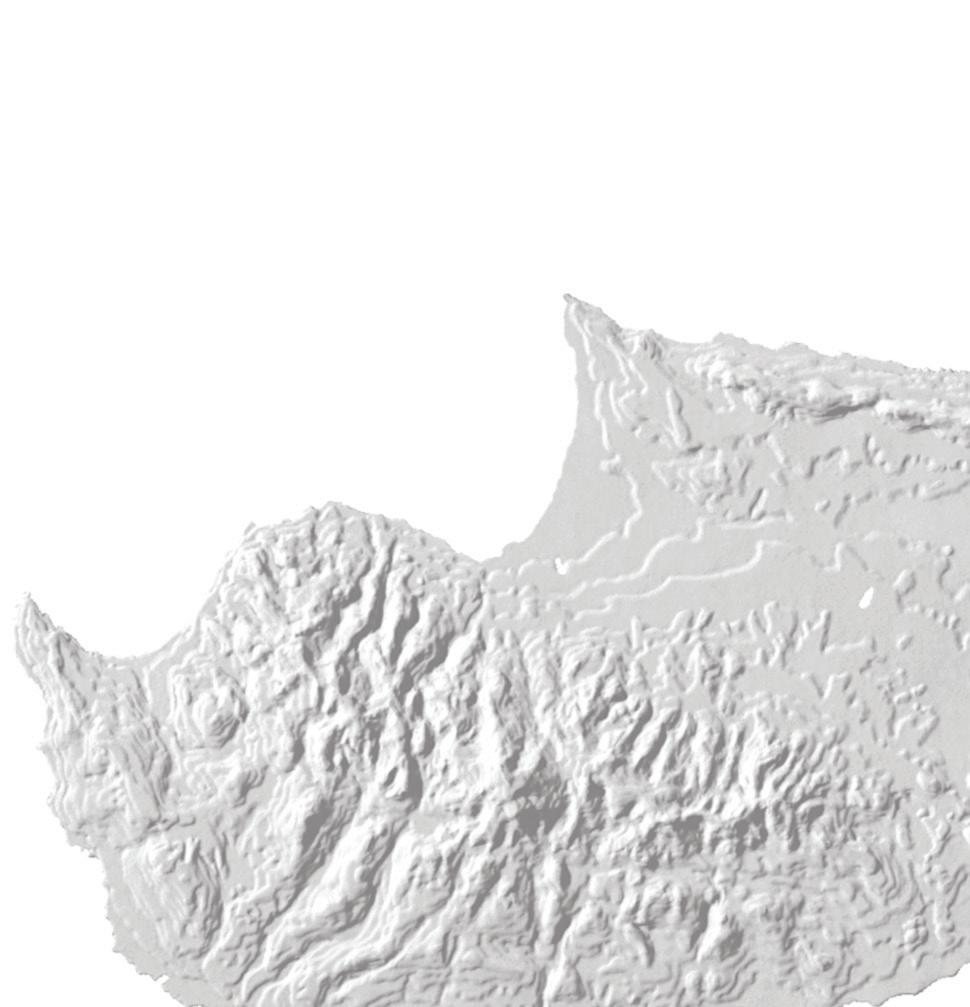
Figure 1.2 Map of Cyprus.
The sedimentary Kyrenia Mountains and igneous Troodos Massif provide abundant red and white clays. They are suitable for pottery, bricks, and industrial containers, such as crucibles and moulds to melt hot metals.
Vegetation
Approximately half of the land is suitable for agriculture, and the rest is forested, except for the sandy or rocky beaches. For at least a century, vineyards have been common on the steep Troodos Mountain. Crops raised at the turn of the 20th century include: wheat, barley, cotton, maize, millet, potatoes, hazelnut, walnut, olive, as well as mulberry, cherry, fig, apricot, apple, and other fruit trees. Many continue today. Cereals flourish in the central Mesaoria Plain, which is green in spring but yellow by June. Forests of Aleppo and Troodos pine, oak, cedar, cypress, juniper, and shrubs cover one-sixth of the island (Bellamy and Jukes-Brown 1905: 5).
Climate and Rainfall
Rain is limited to winter months as in the Levant. Precipitation falls as rain in the lowlands and snow in the mountains, normally between December and March. The humid coast and interior Mesaoria contrast with cool, dry air at higher altitudes in the foothills and mountains. Pine forests of the Troodos Mountains are snow-covered in winter at 1950 m in altitude.
The maximum and minimum mean temperatures in Lefkosia are 27 degrees centigrade (80 degrees Fahrenheit) and 10 degrees centigrade (50 degrees F). From mid-June to mid-September, the temperature can exceed 38 degrees centigrade (100 degrees F), with relatively high humidity in Lefkosia. The mountains and foothills experience freezing temperatures and snow in most years.
According to official records, 1986, the year of my initial ethnoarchaeological fieldwork in Cyprus, was the tenth consecutive with mean air temperatures above normal. July 1999 was relatively warm and dry, yet unstable conditions resulted in summer rain, isolated thundery showers, and hail in the central Mesaoria Plain and Troodos Mountains. The mean temperature was 1.5 degrees centigrade above normal, with the average precipitation well below normal (Weather: 1999).
Water rationing during the summers means that for certain hours several days a week, no water flows through the pipes. To compensate, many individual residences have storage tanks. The lack of water posed a problem to the entire population—and potters, in particular. Water shortages impacted their ability to work, because potters require water to mix with clay powder. If one potter prepared an especially large batch of clay, there might not be enough for others. This was a recurrent problem in 1999 and led to discussions between members of the Kornos Pottery Cooperative and engineers.
Summary
The eastern Mediterranean Levant and Cyprus comprise highly varied landscapes, vegetation, climate, precipitation, and unique geographic features in small areas. Limited seasonal precipitation, a minimum of permanent water resources, and frequent drought years have contributed to a fragile ecosystem. Diversity of topography and vegetation, from the lowlands to mountains and deserts, nevertheless have made this seemingly challenging region hospitable for human occupation.
Five Data Sources
Five types of sources provide different information when investigating ancient cooking pots in the Levant. The physical remains of ancient cookware and other artifacts excavated at archaeological sites are the starting point. A second source is ancient texts that occasionally refer to food cooked in pots. Official Ottoman, British, and Cypriot government reports provide recent written data and rare statistical information on pottery production. Additional written sources from the 16th to mid-19th centuries CE and later contain references to informal or spontaneous encounters and interviews with potters. And finally, there is data provided by long-term ethnoarchaeological studies of traditional potters from the late 20th century that specifically addresses questions about ancient foodways and excavated pottery. My research among potters who still make pottery using traditional technology focuses on how pots were made, used, and reused. Before examining each data source in detail, a brief description will explain the information each provides.
Archaeological Excavations: Ancient Sherds and Pots
Physical remains of ancient cooking pots, after a century of excavations, provide literally tons of broken pots, or sherds, as well as a smaller array of complete cooking pots. Intact whole jars, jugs, juglets, or bowls—when they were found—are usually excavated in tombs rather than in kitchens or other rooms of houses. Everyday cookware was rarely considered a suitable tomb offering in the ancient Levant, although there were exceptions. Those found either outside or within a tomb entryway were probably associated with post-burial ceremonies performed by the mourners. Such rituals occurred immediately following the interment, or at an interval afterward, but rarely included cookware. Jars, jugs, and bowls represent normal tomb deposits and would likely have been filled with foodstuffs for the deceased and/ or deities.
Excavated pottery from residential units and refuse debris are better sources of cooking pots than are tombs. Few pots are found complete, however; rim sherds, rather than the rest of the body, are often all that remain of discarded cooking pots. Most pots are in pieces that cannot be reconstructed. In rare cases, a sudden disaster preserved all parts of complete pots that broke in situ and remained there, but
Keywords: material culture; ancient texts; government reports; early visitors; ethnoarchaeology
those are the exceptions. Even if a building collapsed suddenly—for example due to an earthquake—and was quickly filled with debris, cooking pots were unlikely to survive intact.
Ancient Texts
Ancient texts written by people not directly involved with making or using cookware sometimes mention food and pottery. The texts, largely from neighboring lands, have sometimes yielded evidence of larger social issues rather than a kitchen inventory or information about what people ate or how they cooked food. Texts written in cuneiform, Egyptian hieroglyphs, Greek, Latin, Hebrew, and Arabic offer an array of references to food and cooking practices.
Official Government Reports
Government documents from the Ottoman era, the British Mandate period, and the current Cypriot Republic provide baseline statistics and locations of potters. Some worked with imported clays for wheelthrown tablewares and others used local materials to build pots by hand that resemble ancient cooking pots, jugs, and jars. The data collected primarily for tax purposes is likely an incomplete picture of the industry. The figures suggest the industry was smaller than other sources imply, as described below. Official written records were sparse and present only a partial picture of the traditional pottery industry since medieval times. Earlier texts, such as ancient clay tablets from Mesopotamia and references to foods and pots in the Hebrew Bible, offer more questions than answers.
Early Accounts of Traditional Potters
Cookware might not have survived intact for archaeologists to excavate in comparison with jars and bowls, but archaeologists and visitors to the Levant and Cyprus between the 16th through late 20th centuries mentioned traditional potters who worked without the aid of modern conveniences such as electricity. The brief comments rarely include information about mundane cookware or household contents but provide a historical perspective to the local ceramics industry.
Ceramic Ethnoarchaeological Studies
Research designed to learn about who made cooking pots and what they were called or how they were made, used, and reused is the subject of my ethnoarchaeological studies of traditional potters. Ethnoarchaeologists investigate all aspect of artifacts or behaviors in order to understand the material culture excavated at ancient sites better. Research is dedicated to learning about the human activities responsible for the variations found in ancient artifacts such as pottery. Ceramic ethnoarchaeological studies describe the manufacture, use, distribution, and discard of pottery.
My studies of traditional potters in Cyprus (London 1987–2002) and the Philippines (London 1991c) address how and why ancient cookware looks as it does, how it was used, and how it reflects the attitude and behaviors of people toward food. As explained below, the study of potters who use traditional technologies, i.e. without the aid of mechanized equipment, to shape cooking pots that look just like ancient cookware is one of the only means to learn about the organization of the ancient ceramics industry. For this reason, the emphasis presented in this volume is on data from ethnoarchaeological studies. Before describing traditional pottery manufacture, we examine the five data sources in detail and how each contributes to the study of ancient foodways. Excavations provide physical remains of pots and foods, ancient texts give them names, and medieval through modern reports tell us how to use the pots and who made them.
Archaeological Excavations: Ancient Sherds and Pots
Cooking pots, sherds, and foods, both vegetal and faunal, are found in excavations. Since fired pottery is as hard as stone, it is preserved in far greater quantity than organic materials, such as floral or faunal remains. Carbonized seeds and remnants of cooked, uneaten vegetal finds and animal bones provide physical evidence of past meals. None of these are found as frequently as sherds.
Pottery
More than any other artifact, broken pot sherds are found in excavations of all archaeological periods since Late Neolithic times. Once clay is shaped into a pot and fired over 600 degrees centigrade, it becomes rock hard and virtually indestructible. In contrast to its general durability, of the tens of thousands of broken pots found in excavations, cookware is the least likely to have survived. Used daily, the utilitarian cooking pot was subjected to heavy wear and repeated exposure to intense heat, a necessary but destructive force. As a result, even when the upper bodies of the pots survive, the bases are often missing. Daily cleaning involved trips to the water source, with the potential to fall on the ground accidentally as carriers walked on slippery surfaces. This was an especially hazardous journey if children carried out this chore, as often happened in traditional societies (Longacre 1981: 64). Ideally for archaeologists, cookware would be found near a hearth or oven, but often this is not the case. When not in use, the pots could have been kept in a storage area. Extra pots, especially new pots, may have been stored away from cooking hearths, in reserve for special occasions and guests (Longacre 1991: 125).
Subjected daily to high and sustained cooking temperatures, they were usually wet, non-stationary, and in frequent use. As a consequence, they broke quickly and were discarded at a faster rate than other pots. The constant replacement resulted in subtle, but at times pronounced changes in rim shape, stance, and thickness. As a consequence, the cooking pots provide some of the best chronological markers for buildings, tombs, and other deposits in which they are found (Amiran et al. 1969).
Replacement pots usually resembled the pots that broke. Modifications in different parts of a pot occurred at different rates. The rims, or uppermost part of a pot, changed faster than other parts of cookware. The body shape was less subject to change, given that it resulted from the highly stable manufacturing techniques in the Levant. Major changes in body form occurred only a few times over the millennia: at the end of the Iron Age (ca. 586 BCE), in the Classical era (332 BCE), and again in medieval times (850/900 CE) as described below. Most cookers from the Bronze Age onward had either deep globular or carinated bodies (with an angle separating lower and upper bodies). They had rounded bases, handles were rare, and recognizable lids were nonexistent until the Classical era. The manufacturing technique changed from coiling (with or without a mould) to wheel throwing at the end of the Iron Age. Wheel-thrown pots of the Classical era often had ribbed or corrugated surfaces and two handles. In medieval times, handmade coiled and wheel-thrown cookware coexisted. Although overall body proportions changed, deep globular forms, with or without handles, were the hallmark of cookware throughout the southern Levant for five millennia, if not longer.
Food
The contents of excavated pots or edibles found outside pots provide direct evidence of food and/or feed. Vegetal and animal bone remains are found at sites from Neolithic through recent time periods in the Levant. At Tall al-ʿUmayri, mounds of carbonized barley were found on the floors and in the bases of storage jars dating to the late 13th century BCE (Clark 2000: 78–79). The more than 100 jars, some still with seeds, grains, and vegetables, suggest long-term food storage for people and/or animals. In addition, at the same site a collection of 25,000 broken animal bone fragments with butchering and cut marks, along with vegetal remains and cooking pots were found near the large jars (Peters et al. 2002). The quantity and quality of the finds imply these are remnants of participatory feasting, possibly consumed with a beverage of barley beer (London 2011).
Residue Analysis
The analysis of food residue is a technique that tells us how excavated pots may have been used for food or other purposes. It is based on examination of microscopic food particles trapped in the porous pot walls. Analytical chemistry can identify organic compounds, including lipids, waxes, resins, wood pitch, proteins, and less soluble compounds, such as amino acids, small peptides, sugars, and starches
Cookware from the Levant: An Ethnoarchaeological
preserved in ceramics (Gregg and Slater 2010: 848). The “memories” of foods and other organic materials contained within the pot walls record ceramic usage, reuse, and post-depositional contamination or degradation of the organic residue over time.
Residue can be embedded in the walls or in an accumulation of a crust, film, or solid deposit on the surface of a pot. Whatever is contained within the walls of a pot is necessarily a combination of everything that the pot once held, plus any pre-use preparation of the walls, as well as reuses of the pot. For example, fungi can accumulate in the porous walls once the pot is no longer used. With everything lumped together in the porous wall, it is difficult to distinguish between primary, secondary, and reuse functions of the pot (Oudemans 2007). While the potential to learn about ancient diet, foodways, animal husbandry, and agricultural practices is great, the pottery might preserve multiple memories of its original use and reuses, all crushed together.
In an ethnoarchaeological study of traditional pottery in Rajasthan, Carol A. Kramer (1997: 42–43) observed different uses for pots that once held food. Malfunctioning milk churns were subsequently used to hold salt or were covered with animal skins to become drums. Sherds from cooking pots functioned as scoops, ladles, or paint palettes. Analysis of the residue in any sherd might not provide information about its original use in the kitchen, but rather, how the pots or sherds were reused in a stable, in a latrine, or as a foundation for a road, or anything else.
Summary
Archaeological material culture, i.e. pots and sherds of ancient cookware along with actual remains of food, provide physical evidence of containers used to cook vegetal and animal foods. Ancient cooking pots tend to be deep and globular in shape until the Classical era, when more shallow pans and casseroles were imported from Greek and Roman cultures. To learn what was cooked in the pots, carbonized foods and animal bones provide physical remains without providing metrics on the proportion of protein to grains or vegetables consumed. Residue analysis of food and everything else absorbed by the porous walls of coarse cookware tell us how pots were used, reused, or recycled.
Ancient Texts
Biblical and other ancient Near Eastern and Mediterranean texts provide a range of information and references to pots for cooking food. The earliest are the culinary texts written in cuneiform in the 2nd millennium BCE.
Cuneiform Texts
Nothing close to our idea of an ancient cookbook is available for the Levant, but what can be called “recipes,” written in cuneiform from ancient Iraq (Bottéro 1985; Limet 1987), hint at how food was prepared and served to elite segments of the population. The Yale Babylonian culinary tablets include ingredients, but there is no instruction about what type of pot to use, nor is there information on how the dish was heated. For example, for “ground flour” there was no stipulation on how much, how finely ground, or when to add it. We know what they ate, based on animal bones and carbonized seeds, but we do not know how it was prepared or tasted. In the absence of cooking instructions, Hagan Brunke (2011) has recently attempted to identify and quantify the components for foods consumed during the Ur III period (21st to 20th century BCE) in ancient Sumer.
Egyptian Hieroglyphics
Texts mention food, and sealed tombs preserve remnants of actual food, but we lack any description of cooking or gastronomy. There are pictorial representations of preparing wine, breads, and beer, but nothing resembling a recipe (Bober 1999: 29–39).
Biblical Hebrew Texts
Biblical accounts of both eating and home cooking—vegetarian lentil stews or meat meals—often lack specific references to the pots used for cooking or serving the food and are open to interpretation. Not only were the texts written by non-cooks for the official state records, the manufacture and use of pottery was rarely a concern of scribes. Pottery-making is dirty, heavy work, and ceramic pots were always inexpensive and replaceable. Cooking was probably often, but not always, the work of women as part of their daily activities, yet men probably wrote the texts. Biblical laws relating to kosher cooking and using clay pots may have been practical behaviors among anyone responsible for cooking (Chapter 11). The accounts were written by male scribes; nevertheless, they led to specific rules about separating clay containers for milk and meat. No longer easily understood, the underlying rationale of these passages is heavily debated (Sasson 2003; Cooper 2010).
In a study of Iron Age Judahite domestic cooking practices, Cynthia Shafer-Elliott (2013: 170) describes one of the few biblical texts that provides some details of food preparation in the story of Tamar. Amnon feigns illness as a ruse to have his half-sister Tamar cook food for him in his private quarters. In 2 Sam 13:5–10, three terms given for the food to be prepared by Tamar are translated as: bread/food, food, and cakes (i.e. heart shaped cakes/bread, or hearty dumplings). The latter were made of dough that was kneaded and then cooked. The verb used to describe their cooking translates to “boil or stew” and more generically to “cook” but is often translated in this instance as “bake.” Shafer-Elliott points out that dough need not be baked. According to v. 9 of the text, Tamar “took the pan and poured [it] out.” The particular Hebrew word translated as “pan or dish,” masret, appears just once in the Bible. If pouring involves boiling or stewing rather than baking, the pan in question could have been perforated or it could have been a bowl with a perforated bottom. She reasons that the food Tamar made was most likely dumplings made of dough boiled in water, similar to the preparation of matza balls or dumplings today and removed with a perforated utensil (Shafer-Elliott 2013: 171–72). Doughnuts, sweet or savory, fried in oil are another possibility.
A. M. Honeyman (1939) and J. L. Kelso (1948) collected words for some 30 ceramic containers mentioned in the Hebrew Bible. The actual different types of pots known from excavations are fewer in number than the terms listed for cookware by Kelso (1948: 12). To resolve the overabundance, he suggested that in antiquity, as today, certain pots had more than one name and more than one function. Alternatively, names for pots could have changed from their original meaning when the text was first written.
A recent example of name changes and lack of clarity in the late 20th century involves the qidrah. Today it designates both handmade and/or wheel-thrown cookware. In Gaza, a qidrah is a wheel-thrown cooking pot with a round bottom, lid, and two handles. In Jenin, a qidra refers to the handmade coil-built cooking pot with a horizontal handle. In addition, the handle itself is called qidra (Salem 1998/1999: 28). As a result, qidra could refer to the handle or two different types of pots—one made on a wheel from fine clay and highly fired or one made by hand from coarse clay and fired to a lower temperature.
Food dishes that have changed their ingredients and meaning over time in North America include soup, broth, gruel, porridge, and pottage. Each referred to a different hot liquid prepared in large quantities. About 400 years ago, broth was made by boiling meat, fowl, fish or the scraps and less desirable parts for invalids or as a base for sauces, while soups were clear broths with added herbs, onions, and perhaps carrots and turnips which were consumed with meat and toast. Today, those meanings are reversed. Gruel was broth thickened with cereal but sometimes made from milk instead of broth. Porridge was originally a gruel but by the 17th century meant hot cereal, much like oatmeal. Pottage, initially a stew of anything boiled together, transformed into the French potage, i.e. any type of soup, until the word disappeared from menus in the 19th century (Carson 1968: 57–62).
Biblical writers (and translators) were not experts on cooking activities performed by women in homes, courtyards, or more public settings. Biblical words for ceramic pots are ambiguous and tenuous.
They sometimes designate containers made of clay and/or metal, such as ʾ aggan, a large banquet bowl; baqbuq, a decanter; dud, a deep cooking pot; kos, a cup or bowl; ner, a lamp; sir, a wide mouthed cooking pot; parur, a cooking jug; and qallaḥat, a cooking pot, among others (Kelso 1948: 13–14).1
It is unlikely that pots were reserved for a single purpose. Wide-mouthed globular pots typical from the Bronze Age onward were probably “one pot wonders” suitable to prepare, cook, and “serve” food by allowing diners to eat directly from them.
Kli (pl. kelim) was generic for containers, including clay jars for wine, dried fruit, or oil (Jer 40:10). Kle heres (Lev 29:33) referred to all earthen pottery vessels. Heres was a broken piece of fired pottery, or a sherd (Isa 45:9). The name of Potsherd Gate (Jer 19:2) in Jerusalem might derive from sherds deliberately imbedded into the earth in order to minimize slippage on wet or steep ground.2
The generic term for any ceramic pot, sir (2 Kgs 4:38), was also specific to the cooking pot. The same holds for English, Greek, and the Filipino Bikol dialect. Cooking pots were probably made more often than any other type of pot. Sir, dud, and salahat are used collectively for containers to boil or stew meat (2 Chr 35:13). Salahat was also a dish or bowl for cooking and serving (2 Kgs 21:13; 2 Chr 35:13; Prov 19:24, 26:15). In traditional and modern societies, nothing prevents people from using a cooking dish to serve food.
To cook meat, four types of cookware were used, including the kiyyor, dud, qallaḥat, and parur (1 Sam 2:13–14). Each may have been reserved for specific types of food, but that information is barely preserved in the text. Dud is mentioned as a cooking pot used to boil or stew food (Job 41:20); it was made of metal or clay (1 Sam 2:14, 2; Chr 35:13). A parur was a cooking pot for manna (Num 11:8), for broth (Judg 6:19), or for meat (1 Sam 2:14). A qallaḥat was a cauldron or large meat cooker made of metal or clay (1 Sam 2:14). The ʾaggan was a krater or large bowl used to mix thick wine with water (Isa 22:24; Song 7:2-3) and as a basin for blood (Exod 24:6). It finds a modern counterpart in the name of a Gaza Gray Ware large bowl, ma ʾ gane (Mershen 1985: 77). In north Jordan it is used to mix water with crushed dry yogurt. It is also called laggan (Salem 2009: 33). The same term refers to a platter roughly 40 cm in diameter handmade by potters in north Jordan for bread preparation (Ali 2005a: 31). Baqbuq was a ceramic decanter, bottle, or elegant jug usually with a handle (Jer 19:1, 10). Gabiaʿ was a wine jug (Jer 35:5). Kad was a water jar or jug carried on the shoulder to the spring or well (Gen 24:14) or used for storing household flour (1 Kgs 17:12, 14, 16). A large, one-handled jug or cooking pot was better suited for hoisting to the shoulder than was a tall jar. A kos was a drinking cup or bowl, with or without a handle, for wine or other beverages (Jer 35:5).
A maḥabat may have been a heavy griddle or, perhaps, a baking tray for roasting, toasting, heating, and cooking, made of metal or clay (Lev 2:5, 7:9; Ezek 4:3). The misʾeret was possibly a bread-kneading bowl, in which dough would rise and then be baked (Exod 12:34; Deut 28:5, 17), comparable to Early Bronze Age bread moulds (see below). A mazrek was a metal or clay bowl for drinking wine (Amos 6:6). A nebel was a container made of clay, wood, or animal skin, used to store wine, summer fruits, and oil (Jer 48:11–12). A sherd broken from a nebel was used for hot coals and to scoop water (Isa 30:14).
Pak was a small, closed container, such as a juglet, used for precious fluids, oils, perfumes, and medicines (1 Sam 10:1, 2 Kgs 9:3). A salahit was a small ceramic bowl for salt (2 Kgs 2:20). In traditional Cypriot rural homes, a small clay pot with salt hung from the ceiling, to assure the salt remained dry and handy. A ṣappaḥat was a closed container, such as a flask, for water (1 Sam 26:11–12) or a small oil juglet (1 Kgs 17:12, 14, 16). Sepel described a bowl used to serve dairy products (Judg 5:25) or water (Judg 6:38).
1. Other translations of three of these Hebrew words have been proposed: dud = kettle, qallaḥat = cooking jug, and parur = cooking pot (Baadsgaard 2008: 25).
2. In Ayios Dimitrios, where pottery was made until June, 2000 sherds were intentionally packed into slippery slopes leading to chicken coops and terraced fields.
Greek Texts
Not until Athenaeus, a Greco-Roman living in Egypt around 200 CE, is there a discussion about preparing and eating food. The writings of Homer mention certain foods but offer nothing about how food was prepared, cooked, or tasted. There is no mention of fish or olive oil in his writing. Paintings on vases suggest that meat was first boiled to tenderize it and then roasted (Bober 1999: 78).
Latin Texts
The earliest Roman era cookbook, De recoquinaria, is attributed to Apicius, who lived in the 1st century CE in the days of Imperial Rome. It is likely a collection of recipes assembled in the 4th or 5th centuries that was based on his recipes or versions of them (Bober 1999: 152). The surviving Classical era cookbooks might present idealized recipes for which improvisation was common. The oldest printed European cookbook, the work of Platina, went out of print, whereas Apicius’ cookbook remained available (Vehling 1977: 8). Physicians and medieval monks interested in the healing properties of food, especially spices, compiled later copies of his work and provide more exact quantities for ingredients (Bober 1999: 152).
Arabic Texts
Fragments of the 13th century CE Kitab al-ṭabikh (The Book of Recipes) preserve medieval Arabic recipes. Numerous versions of cookbooks with similar Arabic titles, Kitab al-ṭabikha (The Book of Cookery) or Kitab al-ṭabbakha (The Book of the Female Cook) begin with recipes attributed to the 8th century CE, possibly originating in the Persian or Abbasid courts (Zaouali 2007: 6; for historiography of Arab cuisine, see Nasrallah 2012). Food writer C. Perry (2005) updated a translation by A. J. Arberry (1939), whose expertise was as a linguist rather than a chef. Under the new title, A Baghdad Cookery Book, the recipes tend to be named after the primary ingredient and include meat and vegetarian fare.3 The new edition changes and expands some ambiguous terms related to measurements, length of cooking, and handling foods and herbs (Perry 2005: 13–14).
Measurements given in terms of “fingers,” i.e. the width of a finger rather than the length, can refer to how small to cut vegetables or how deep to layer food in a pot. A dirham is a measurement for spices that equals three grams. Usually it is unclear if a dirham of each spice listed is wanted or if this is the quantity for all the spices collectively.
Lack of clarity or a shorthand method of describing cooking time is common. One term used to designate cooking time is open to interpretation. Arberry consistently translated sa ʿ a as “hour.” Perry (2005: 114) prefers the term “a while,” although for some recipes one hour seems appropriate. Translation issues for relatively recent medieval texts highlight the problems archaeologists face when translating older terms for cooking and pots in the Hebrew Bible. As already noted, while the recipe for muṭajjan incorporated the word for copper pan, tajin in the name of the dish, instructions called for the use of an iron or soapstone frying pan (miqla). A famous chicken recipe, judhab, roasted in an oven has the same name as a pudding baked in a dish underneath to catch any dripping.4 Most recipes fail to state that the pot goes into the oven, possibly because it was too obvious to mention (Perry 2005: 20–21).
Names of medieval pot types are not easily converted to English. Arberry translated dist or dast three different ways: copper bowl, dish, or basin (Perry 2005: 117). Recipes mentioned the utensils that filled the medieval cooking repertoire, such as the chopping board, mortar, pot for boiling, tray, and soapstone (steatite), iron, or tinned copper frying pan. Trays were for drying food. Instructions for recipes refer to pots for boiling versus frying pans. In general, the most preferred cooking pots were soapstone, followed
3. Arabic language cookbooks refer to vegetarian foods as “simulated” to look like meat and eaten by Christians during Lent and at other times by any one who was ill (Nasrallah 2012: 154).
4. Twentieth century casseroles refer both to an open clay or glass rectangular vessel and to the meal cooked in it—a combination of different vegetables and proteins.
Ancient Cookware from the Levant: An Ethnoarchaeological Perspective
by ceramic, and finally tinned metal. The least desirable was a copper pot with worn tinning. Iron frying pans are not part of the list but are mentioned in recipes. Spices were pounded (madquq) in a copper mortar or ground (masḥuq, maṭḥun) on top of a flat rock (Perry 2005: 19; 28–29).
Pots and pans were made of soapstone (steatite), as in 21st century Yemen (Perry 2005: 18). They were inexpensive alternatives to metal pots, ideal for stewing foods, but blackened with use. They were imported to the Levant from the 8th through 10th centuries CE (Vroom 2009: 247).
The recipe known as Al-ʿAnbariyya required meat to be cut into strips and then pounded in a mortar. Most was boiled (without reference to the type of pot) in a mix of water, sumac, salt, and crumbled bread, but a portion of unboiled meat was reserved for meatballs with the sumac mixture, without stating specifically how or when to cook them.
When it (the boiled meat and meatballs) is done and has absorbed its moisture, dry it on a tray. Sprinkle it with the spices coriander, cumin, pepper, mastic and cinnamon, all pounded fine, with a little dry mint and mix everything. Then melt fresh tail fat in a soapstone frying pan and throw away its cracklings. Take that meat and throw it in the frying pan to fry in the fat, and stir it continuously until it is done, lest it become dry and parched. Then garnish it with whole raw eggs and leave it until it becomes quiet on a gentle fire.
Sprinkle a little rose-water on it, wipe the sides of the pan with a clean cloth, and take it up. (Perry 2005: 54)
Summary
Ancient texts from neighboring cultures offer a glimpse of what people ate or aspired to eat without providing details on how to cook food or how it should taste. The wealth of Hebrew words in the Bible for pots tells us little about how pots were made, used, or what was cooked in them. Since names of foods could change dramatically in a few hundred years, how can we define recipes or cooking practices thousands of years old, given the wide range of choices?
Modern data SourceS:
GovernMent reportS, early viSitorS, and ethnoarchaeoloGy
Government Reports on Pottery Production in Palestine and Cyprus, 1596/7–1982
Government reports about potters in Cyprus are more numerous than in the Levant. Ottoman sources from the Levant are earlier than known reports from 20th century Cyprus.
Levant
Official Ottoman-era texts and tax records rarely mentioned clay pots in Palestine (Salem 2009: 24) or elsewhere. Before 1596/1597, Ottoman official documents, known as defters, do not list taxes obtained for pottery sales. The absence indicates it was either not a taxable item or it was taxed with other items (Salem 2009: 24, 29). Later defters mention potters in Gaza, a major pottery production center (Hütteroth and Abdulfattah 1977: 91). The reported tax share, to be a mere half a percent of the Gaza revenue, is comparable to the town of Ramle, where potters contributed less than one percent to the town’s taxable income. According to H. Salem (2009: 29), both numbers might underestimate the scope of the industry. If the figures do not convey the size of the industry, they convey the presence of potters at major centers of production.
Another set of documents, Islamic law court records dating from 1857–1861, refer to a thriving ceramics industry in Gaza and at least two pottery markets: Khan Suq al-Fukhar (the pottery market) or Suq al-Fuwakhiriyya (the market of the potters) and Mahalat al-Daraj (the neighborhood of the stairs) The 21st century industry still operates at the latter location (Salem 2009: 30).
Cyprus
An early 20th century government report mentions glazed and earthenware products made in villages (Kornos and Fini) and towns such as Lapithos on the northern coast. The report by the Director of Agriculture, P. Gennadius (1905: 13 and n. 6), also referred to an 1844 work by M. Fourcade, the French ambassador to Cyprus, that cited glazed pottery made in Lapithos half a century earlier.
Reports regularly issued in ten-year increments quantify the steady decline of potters. The “Colonial Office Report on Cyprus for the Year 1949” lists some 600 people employed in brick, tile, and earthenware industries when the total population was 480,000. At the time, over one-third of working people were
Keywords: Cottage industry censuses; 16th–20th century visitors; ethnographers; ethnoarchaeology
An
independent farmers. By 1966, only 98 people were classified as potters (Colonial Office Report on Cyprus for the Year 1949. 1950: 8–10).
Cypriot government surveys msde in 1966 and 1972 focused on cottage industries, i.e.: “activities undertaken at home and the items produced are offered for sale,” especially the work of housewives in their “spare time” (Census of Cottage Industry 1972. 1973: Preface). The survey included rural communities exclusively since it was too difficult to obtain this type of information in towns (Census of Cottage Industry 1972. 1973: 1). The goal was to learn how cottage industries contributed to the economy, including woodcarving, embroidery, cane baskets weaving, sewing clothes, knitting, pottery, and others. Woodcarving was the least common, with pottery manufacture at comparable levels. In 1972, 60.9% of the population, or 1793 individuals, embroidered, while only 1.4% of the people, 43 individuals, made pottery.
The 1972 survey of the southern population exclusively reported 38 pottery-producing households located in Kornos and Fini and one in Famagusta. Potters, described as part-time workers, were primarily housewives but included two farmers. They are listed as lacking equipment, in contrast to weavers with looms (Census of Cottage Industry 1972. 1973: 57). Rural potters work outside in household courtyards during the dry season. They store their portable equipment (turntables, sticks to beat clay, scrapers, and decorating tools) inside in winter. However, their permanent kilns were readily visible year round outside their houses. Apparently the inspectors did not recognize the stone and brick kilns as part of the potters’ equipment.
A decade later, the number of potteries was only 19, or almost less than half in 1972 (Census of Cottage Industry 1982. 1983). No reference to the Kornos Pottery Cooperative, established in 1955/1956, appears in the census reports from the 1960s–1980s. It operated in 1986 with approximately ten members who worked in the Coop workspace or at home in special cases. By 2013, it continued to function but with half as many members. The limitation of the work to summer months likely made it problematic for census officials to identify production locations or to count potters during the off-season. Had inspectors visited the villages during the winter, they would have found no potters at work.
Archaeological Implications
Ottoman tax records and government censuses were uneven for many reasons. Ceramics were inexpensive and largely escaped tax collectors or other government officials. Nevertheless, they were essential to households and local economies. If officials were unable to identify potters who worked in the privacy of their courtyards surrounded by high walls, how much more difficult is it for archaeologists to recognize ancient pottery making locations? Despite the presence of large, tall kilns to fire pottery, as an industry it remained almost incognito to Ottoman, British, and Cypriot government workers. The material correlates of potters, i.e. their tools and equipment, were largely perishable or reused broken sticks and strips of metal. They hardly resemble a proper tool kit. One might expect sherds and broken pots from unsuccessful kiln firings, but the low rate of loss (Chapter 7) denies archaeologists obvious evidence of potters in many instances.
in 14 home workshops; 2 in 2 workshops
Table 1. Numbers of potters and establishments based on Cyprus government reports for 1972 and 1982.
Among the few year-round remnants of activity in the Kornos Pottery Cooperative are the clay-spattered walls and floors that enclose the crowded workspace. As potters mound their fresh clay into conical piles, the wet clay flies around and becomes permanently attached to the lower walls, as seen on the cover photograph. Clay that reaches the floor is swept away a couple of times a year, but a little remains embedded in crevices and cracks.
The archaeological implication is that ancient potters who worked in their courtyards remain oblivious to excavators. Craft specialists in Cyprus, who sold their wares to local clientele, were not confined to the village edge or far from residential populations. Instead, their skillful work was carried out during the summer months in their own courtyards and resulted in few misfires. As shown below, once potters stopped working, the kiln was destroyed to reuse the bricks, stones, and space. Without a kiln, tools, or wasters, archaeologists too often lack the basics to identify ancient pottery production locations.
Summary
Ottoman, colonial, and Cypriot census data or tax records showed little concern for potters or their wares. They were systematically undercounted in the Levant and Cyprus, despite the essential need for clay containers and the large quantity of pottery produced, as in Gaza. The elimination of traditional pottery workspaces and equipment emphasizes the urgency to record the industry before it disappears. That is the goal of my long-term ethnoarchaeological study that began in 1986, with a nine-month follow-up in 1999/2000 in Kornos and Troodos Mountain villages, followed by brief visits periodically until 2014.
Early Accounts of Potters in Cyprus, 1550–1850 and Later Studies
More is known about traditional pottery production in Cyprus than in the Levant. The small island off the coast of Lebanon was a necessary stop for pre-20th century ships sailing the eastern Mediterranean. Even before archaeological excavations began to uncover the ancient history of Cyprus, the written accounts of visitors, businessmen, and scholars have alluded to local pottery production since the late 16th century. While interest in religious sites in the Levant might contribute to the lack of attention to traditional potters, Cyprus did not lack locations of great spiritual importance. Among the most famous places of religious and historical significance is Stavrovouni Monastery near Lefkosia. Built on a hill 800 m (2650 ft) above sea level, it towers over the countryside. It is where, according to tradition, the mother of Constantine the Great, St. Helena, built a church after visiting Jerusalem in the 4th century. The closest village is Kornos, where potters have worked for centuries.
Cyprus: Early
Written Accounts of Visitors—Mid-16th through Early 19th Centuries
Two decades before Ottoman rule, there are communications between merchants that discuss pickled birds and wine exports from Cyprus. The documents of a mid-16th century businessman, John Locke, provide the first reference to an indigenous pottery industry. In 1553 Locke visited Cyprus and mentioned foods sent in clay “jarres or pots” to Europe (Cobham [1908] 1969: 72).
Not long afterwards, a late 16th century professor of Civil and Canon Law at the University of Utrecht, Ioannes Cotovicus (Iohann van Kootwyck) was in Cyprus and the Levant from September 12, 1598–April 4, 1599. He refers to large jars for storing wine and small pots for bringing up in water wheels. He mentions the pitch lining in large jars that held wine, which had aged for 80 years or longer (Cobham [1908] 1969: 199). Cotovicus saw pots used in water mills, which he described as: “deep and wide wells from which, by means of large wheels driven by horses, they draw up in earthen vessels abundance of water for the use of their fields” (Cobham [1908] 1969: 199). Basil Stewart (1908: 98–99) described clay pots used for this same purpose some 350 years later.
Cotovicus also observed birds that Cypriots pickled for export as Locke described some fifty years earlier. The tiny birds which the Cypriots call Italian—they are not unlike the ortolans of Italy—are very common, and so plump, especially during the vintage when they feed on grape stones and mastic seed, that infinite
Ancient Cookware from the Levant: An
numbers of them are preserved in jars with vinegar and savoury herbs, and sent for sale to Venice, making a dainty dish greatly in request with princes and lords throughout Italy. (Cobham [1908] 1969: 200)
Another scholar, considered among the more accurate reporters of medieval Cyprus, was Professor of Theology at Perugia, Girolamo Dandini, S. J. In 1596 Pope Clement VIII sent Dandini to work with the Maronite community in Lebanon. He stopped in Cyprus and after sampling the local wine, he described the tar-like flavor as an acquired taste but “good for the digestion” (Cobham [1908] 1969: 183).
Seventeenth century reports are lacking, but by the mid-18th century there are texts that mention the export of wines. They note the poor taste of wine from Venice, which inspired the importation of wine from Cyprus according to Alexander Drummond. He visited Cyprus from March 6, 1745 to May 15, 1745 and again in April, 1750. Drummond served as British Consul to Aleppo. In an account of his travels, published in his letters to his brother in 1754, he estimated an annual production of 865,000 couzai, or 2,131,131 gallons of wine, equal to British Sterling 25,000. Since the value of wine increased with age, Drummond calculated that the overall income from wine was even higher (Cobham [1908] 1969: 271, 281).
Abbé Giovanni Mariti Filippo was sent to Cyprus expressly to learn the craft of wine-making in order to improve Italian wines. Mariti was a naturalist and priest born in Florence in 1736, where he died in 1806. Beginning in 1760, he spent seven years in Cyprus to record wine production—including the containers used for storage and transport. He noted the location of vineyards, planting, harvesting, fermentation, sales, and distribution in animal skins, clay jars, or wooden barrels. His publication, Viaggi per l’isola di Cipro, appeared in Florence in 1769 (Cobham [1909] 1971: v). It was translated into English and French. Another version in English appeared more recently (Nicolas 1984).
By the time Mariti arrived, Venetian rule of Cyprus (1489 until 1571) had long ended, but Europeans still resided in the coastal town of Larnaca, where he arrived on February 2, 1760 as an official of the Imperial Tuscan Consulate. He remained until October 6, 1767 and managed to provide the earliest and most detailed information on the production and use of jugs (guzas) and large wine jars (pitharia) (Figure 3.1). His texts are based on his own observations rather than the writings of others (Cobham [1909] 1971: vi).
Mariti explains that in August, grapes grown in the Troodos Mountains and foothills but not at lower elevations or along the coast are harvested in wicker or reed baskets, rather than clay pots. The grapes are moved to a prepared sloping floor where they are trampled and beaten with a flat shaped mallet. The crushed grapes went through a winepress once or twice. The resulting juice was poured into a ceramic container half buried in the ground at the lowest part of the slope. It was then transferred with ceramic pots to round-bottomed pitharia. The latter were partially buried in a cellar or on the ground floor of storerooms in foothills and mountain villages. If freestanding instead of embedded, low stone walls supported the pointed or conical bases of pitharia. They were closely packed together with little space around them. Mariti claimed that wine matured faster in buried pitharia and was stronger than wine stored in jars aboveground (Nicolas 1984: 45–55).
Wines for domestic and regional use were treated differently than exports to Europe. Table wines for local use or sent to neighboring countries, especially along the Levantine coast, fermented in pitharia close to where the grapes grew, in the mountain villages. To ameliorate the strong tar taste and smell, the wine was mixed with water. In contrast, wine destined for export to certain European countries left the village almost immediately. It was delivered to Larnaca straight from the village wine press. Merchants in towns kept it for a year in pitharia before moving it to wooden casks to mature in barrels fitted with iron hoops. In the barrels, placed on beams or low walls in ground level storerooms, the wine matured for a year, during which the tar aroma diminished. It was not buried. The wine required a maturation period of minimally one year but attained perfection after ten years according to Mariti (Nicolas 1984: 67, 80).
A pithari held “eighty guze or Levantine jars, equivalent to twenty casks and the small ones contain 50 guze or twelve and a half casks” (Nicolas 1984: 57–58). Mariti referred to and illustrated a jar known as
3.1 An old pithari for fermenting and storing wine. On the surface are applied and incised bands and snakes.
a guze as made in “Cyprus, Syria, and Palestine.” It was multi-functional. Women carried water from the spring in a guze. It had a globular body with two handles and a narrow rounded base. The Cypriot guza was also a liquid measure of “five Florentine flasks or bottles of wine” (Nicolas 1984: 78). Large and small jars were made to order in Corno and Lapithos according to Mariti (Nicolas 1984: 58).
Two hundred years later, pottery is still made in Kornos village and in Lapithos. The word guze survives in the word for jug, kouza (pl. kouzes) and as the vernacular word used to describe pottery.1 Lapithos was a well-known center for wheel-thrown glazed ceramics. The granddaughter of a former Lapithos potter currently makes pots by hand with a fast wheel in Kornos village.
Mariti portrayed the port city of Larnaca as “the most barren place in the whole kingdom but most convenient for trade because of the neighboring salt-flats beach which provides good anchorage, especially for ships arriving from Europe” (Nicolas 1984: 77). Wine for Europe was shipped in casks holding 70 guze or roughly 17 and a half barrels of liquid. To prepare for shipping, merchants would heat casks filled with wine, seal them closed and then “lashed one behind another, they are thrown into the sea and attached behind a boat where they are transferred to the ship which is to take them to Europe” (Nicolas 1984: 86). The choicest wines were shipped in glass containers with canvas-covered lids held in place by twine. The fragile bottles were made in Provence and covered with a locally made wicker basket to avoid breakage during the trip.
1. In the Talmud, the Aramaic word kouza refers to a “wine pitcher, jug” (Jastrow 1903: 618).
Figure
According to Mariti, Venetians were satisfied to drink inexpensive wine, not over 18 months old. Older Cypriot wines were exported to France, Holland, Tuscany, and Leghorn. There are discrepancies about the longevity of wine and the availability of old wine for purchase by foreigners. A Cypriot custom in the mountains was to bury a jar of wine at the birth of each child. Accordingly, the oldest wine, no more than 20 years, was reserved for guests or gifts at the marriage of the child (Cobham [1909] 1971: 115–16). However, merchants sometimes could purchase older wine from wealthy individuals who would bury multiple jars when a child was born, as noted in an 1803 publication by Luigi Mayer, an Austro-Italian painter, who travelled throughout the Mediterranean and visited Cyprus in February 1792 (Wallace and Orphanides 1998: 138; Severis 2000: 60).
Turpentine of two grades was another liquid exported in “jars containing 20 pounds each.” Villagers would collect higher quality turpentine on summer mornings when clear drops oozed from Pistacia terebinthus trees. The lower quality turpentine was gathered after it trickled down to the ground and became less clean. Both grades were exported and prized in Venice (Cobham [1909] 1971: 119).
Forty years after Mariti’s reference to potters at Kornos, the Spaniard Ali Bey, who visited Cyprus due to a chance storm in 1806, toured the island and described Kornos as a village of 30 houses “in the middle of a little valley full of olive and carab trees. The inhabitants are nearly all engaged in making earthen vessels” (Cobham [1908] 1969: 393). His report confirms pottery production at Kornos village for over 200 years but gives no specifics on pot types, their manufacture, appearance, or use. It is, however, fortunate that thanks to his hosts, he reached inland villages that few foreigners visited.
Someone who did refer to a specific type of ceramic container is Reverend Daniel Clarke, professor at Cambridge University, who visited Cyprus June 6–16, 1801. In his 1813 publication, “Travels in Various Countries of Europe, Asia, and Africa. Commencing January 1, 1801,” he mentions ceramic beehives. He described bees as kept “in cylinders made from the bark of trees. They build up a wall formed entirely of earthen cylinders, each about three feet in length placed, one above the other, horizontally, and closed at their extremities with mortar” (Wallace and Orphanides 1998: 129). The same clay cylinders are produced in Kornos 200 years later and remain part of the 2014 repertoire. To this day, honey made in Kornos and nearby locales is highly valued. The indisputable evidence of pottery manufacture for over 450 years began with reports of businessmen who exported a wide range of foods to Europe and the eastern Mediterranean and was followed by those interested in wine fermentation and the occasional visitor to the island.
First Accounts of Potters by Archaeologists and Others in the Late 19th Century
Early photographs of potters or women at the well with their water jugs appear in John Thomson’s twovolume publication, “Through Cyprus with the Camera in the Autumn of 1878” (Thomson reprint 1978). In common with previous visitors, Thomson noted the wine tasted like tar (Thomson reprint 1978: 31). In “Au Pays D’Aphrodite—Chypre,” Emile Deschampes (1898: 201, 203) produced an illustration of male and female potters entitled “Fabrique de Poteries.” He described the large wine jars (pitharia) made by Fini potters as containing 600–650 liters of wine. Potters still work in this Troodos Mountain village in the early 21st century. It was formerly home to male potters, known as pitharades. They made pitharia that created backgrounds for artists and photographers, such as Deschampes. Most wine jars stood in closed dark storerooms and not outside, as illustrations suggest. Pitharia for water storage were also embedded in open-air courtyards or in front of buildings (London 2000).
The first archaeologists to mention local pottery manufacture were Max Ohnefalsch-Richter (1891; 1893: 369) and his wife, Magda Ohnefalsch-Richter (1913: 119, 269–74). Magda H. Ohnefalsch-Richter (1913: 235) referred to potters in Fini, Kornos, Lapithos, and Varosia without mentioning traditional potters in Ayios Dimitrios or Kaminaria. In Studienblätter von Cypern, an album of photographs and paintings assembled by the Ohnefalsch-Richter’s in 1895, a photograph shows Fini potters sitting outside in front of a building as they rotate a turntable directly with a bare foot. The shape of the two-piece turntable
Figure 3.2 A potter in Kornos posing for a photograph, ca. 1930. Photograph from the Joan du Plat Taylor Archive courtesy of the Cyprus American Archaeological Research Institute.
and circular bark disc, on which each pot was built, has not changed a century later (London et al. 1989: 42). The caption, “Offenbar eine Ueberlieferung aus dem Alterthum” (“Obviously an ancient custom”) (Marangou and Malecos 1994: Photo 83A) implies a link between past and present pottery-making. Clay objects on display are: a goat-milking pot, narrow necked jugs or bottles, an incense burner, and figurines. The decorative figurines in 1895 pre-date the age of consumerism and tourists. They were all for local use, as was the goat-milking pot, which later Magda Ohnefalsch-Richter (1913: Plate 7.1) termed a “modern milk bowl.”
Early 20th Century Archaeologists and Traditional Technologies
Early 20th century depictions of daily life by Basil Stewart (1908: 98–100) include pots for vital traditional technologies. Water wheels were equipped with clay pots to bring up water with each rotation. Another artifact was the cylindrical ceramic beehive (tjyvertin), 76 cm long and 23 cm in diameter (30 inches by 9 inches), with clay lids.2 A small hole in each lid allowed bees to enter or leave. To extract honey, smoke forced into the hive caused bees to escape. Stewart recorded aspects of daily life and the use of ceramics but little about where or how potters worked.
Women archaeologists Joan du Plat Taylor and Olga Tufnell were among the most dedicated observers of Middle Eastern and Cypriot potters (Figures 3.2, 3.3). They described “Korno” village as the “one place in the island of Cyprus where red clay pottery is made by hand” (Taylor and Tufnell 1930: 119). They described women as making ordinary pots, smaller than pitharia, in their courtyards. Many of the 1930 practices, such as clay preparation, the turntable, and coil manufacture continue unchanged into the early 21st century, based on my research. For instance, the only substance mixed with clay was water. Coiled pots were built on turntables made of two pieces of stone. String or strips of cloth were tied around pots during the early stage of manufacture before they were scraped with a split bamboo tool. Afterwards they were decorated with a rouletted pattern. Beehive-shaped kilns 6–7 feet tall were built of mud and had a hole in the permanent rooftop (as in a 1961 drawing in Hampe and Winter 1962: 83). They
2. The Aramaic term for beehive kveret (Jastrow 1903: 617) is similar in sound to the Cypriot word, which locals describe as derived from Turkish.
Figure 3.3 A barefoot 1930s Kornos potter working on Stage 1 of a pot that stands on a bat on top of the square turntable. In 1986 no potters ever worked in direct sunlight. Photograph from the Joan du Plat Taylor Archive courtesy of the Cyprus American Archaeological Research Institute.
describe Kornos as isolated, yet the products “form the common ware of the country and are used by every housewife to carry water and store food” (Taylor and Tufnell 1930: 122).
Some sixty years later, I found few changes and minor differences with their account. The manufacturing technique in Kornos is identical, except for the decorations. Individual or combed incised patterns predominate rather than a rolled decoration made with a special rouletting tool. Kilns with permanent rooftops, no longer beehive in shape, are now square and built of stone. In 1930, the pots were said to be fired in the kiln for 24 hours and then left to cool for ten days (Taylor and Tufnell 1930: 119). In 1986 and 2000, a burning fire never lasted 24 hours. A small fire to heat the kiln and pots usually began around 7:00 AM or earlier. Wooden branches and large logs added gradually over the day increased the heat intensity until it became a roaring fire that was extinguished in the evening. Kilns were opened 24 hours after stacking or pots remained in kilns for as long as two weeks.
Another observer of local potters was Director of the Department of Antiquities of Cyprus, Porphyrios Dikaios. He alone among Cypriot archaeologists seems to have photographed urban and rural potteries in the 1940s at Mia Mila, Fini (London et al. 1989: 41), and elsewhere. Cypriot photographer Reno Wideson in Portrait of Cyprus (1958) illustrates artifacts in daily use, such as women carrying one-handled jugs on their shoulders as they walk through village streets. Jars (pitharia) vividly display fresh, shiny, black pitch linings to prevent seepage through porous walls.
The outbreak of World War II meant additional work for the potters. Alongside the normal repertoire, they made replacement artifacts large and small for objects formerly imported, such as tablewares and flat-bottomed cooking pots. These products accommodated the needs of the local population and foreign soldiers. Kornos potters trace certain shapes, such as flat-bottomed cookwares, to the war years and presence of British soldiers. Demand was great, jobs were few, and both male and female potters were actively engaged in the industry until the end of the war. Once jobs became available, men left the pottery industry for year-round factory work.
Lapithos potters, who made wheel-thrown glazed tablewares, jars, and a range of other shapes, experienced the same increase in their production during WW I and WW II. Ten to 12 workshops were in operation prior to and following WW II (Papademetriou 2005: 48–49).
Mid-late 20th Century Research
Cypriot archaeologist Angelikki Pieridou (1960) recorded male and female potters at Kornos, Fini, Ayios Dimitrios (Marathasa), Famagusta, and Lapithos prior to the 1974 political division of Cyprus. She described clay preparation, pottery manufacture, and listed vessel names in Greek. This important work complements the Pierides Foundation Museum collection of traditional artifacts of clay, cloth, shell, etc. and archaeological material.
After excavating a Byzantine pottery factory for cookware at Dhiorios, H. W. Catling compared its layout to kilns and workspaces in Kornos. The Byzantine potters’ living quarters were precariously adjacent to their kiln. While it might seem like an unlikely configuration, “an exactly similar relationship between house and kiln may be observed in similar small pottery factories operating in Cyprus right down to the present day” (Catling 1972: 50). The same holds 25 years later despite potential fire hazards (London et al. 1989: 61–63 Figures 82, 83). Potters built kilns on land they owned close to their houses and those of neighbors. This contradicts the idea that kilns were necessarily outside habitation areas in order to be close to raw materials and fuel, while keeping smoke far from houses.3
The team of German archaeologist Roland Hampe and potter Adam Winter provides an unprecedented and detailed assessment of Mediterranean urban and rural potters as part of a survey of Crete, Greece, Cyprus, Sicily, and South Italy (Hampe and Winter 1962; 1965). Their work marks a milestone in the study of traditional potters regionwide. They visited potters in six towns and six villages in Cyprus (Hampe and Winter 1962: 55–84) to interview and photograph potters. The result offers a succinct description of the industry mid-way through the 20th century in Kornos, Klirou, Fini, and Ayios Dimitrios.4
As part of the American excavation team at Idalion, not far from Kornos, Robert H. Johnston filmed Cypriot potters in 1971 and 1972 “to gather specific information from the present-day potters as to clay sources, method of manufacture, decorative techniques and firing procedures including the fuels used” (Johnston 1974b: 131). He saw resemblances to ancient pottery excavated in the Levant (Johnston 1974a). His was not an impromptu weekend project. Instead, it was one of several ethnoarchaeological studies designed in conjunction with the excavation fieldwork.5
Archaeologist Vronwy Hankey (1983) observed Cypriot potters as part of her investigation of ancient pots, potters, and the organization of the ancient industry. She based her archaeological conclusions on the traditional potters observed in different communities of the Middle East (Hankey 1968) and Cyprus (Hankey 1983). Jack Goodwin and Alexia Symonds (1980: 115) photographed traditional pottery and noted resemblances between incised patterns on pottery and embroidery motifs of textiles from Paphitiko and Lefkaritiko.
Cypriot archaeologist M. C. Loulloupis carried out salvage excavations prior to modern construction work at the Kornos school in the lower village. He notes a resemblance between clay used in the 6th century BCE Cypro-Archaic II Period tomb pots and the raw materials used by “the local potters at Kornos and nearby
3. Modern potters prefer kilns close to sleeping quarters, given that firing is a long event.
4. Multiple villages bear the same name, but pottery was made only in Ayios Dimitrios in the Troodos Mountain district known as Marathasa. In 1986, I found one additional production center in Kaminaria village, near Ayios Dimitrios.
5. Also part of the Idalion excavation team, P. Allen and J. Sallade (1978; Sallade and Braun 1982) carried out early ethnoarchaeological studies of agricultural practices. More recent research examines threshing boards and flint technology (see Whittaker 2000 for references).
Ancient Cookware from the Levant: An
villages” (Loulloupis 1967: 196, n.1).6 Pottery from two additional tombs of similar date, found during construction of a new house, resembles recent Kornos pottery in appearance and color (Flourentzos 1987: 147).
An unpublished manuscript by Knud Jensen, a Danish United Nations police/officer stationed in Cyprus in 1971, traces the work of itinerant male pitharades. It is one of the only references to specialists living outside Fini, which was home to the most renowned pitharades. 7 After working for weeks on a jar, they sometimes incised their names, village, date of manufacture, and the name of the owner who commissioned it. Jensen examined the social dimensions of pottery production by focusing on the work and distribution of jars made by specific pitharades. He noted similarities between the motifs impressed, stamped, and incised on century-old pitharia and Kornos pots.8
A book that highlights Cypriot crafts, Traditional Craftsmen of Cyprus (1982: 10–21), includes photographs of potters in Lapithos, Famagusta, Fini, and Kornos. R. E. Jones (1986) interviewed the two Fini sisters, who are potters, as part of his study of chemical and mineralogical analyses of ancient Greek and Cypriot pottery.
French archaeologist Marguerite Yon (1985) found similarities between traditional Cypriot roundedbottomed pottery and 2nd and 1st millennia BCE pots in her studies of ceramic technology from the economic and social perspective. British archaeologist Lucy Hemsley (n.d.; 1985; 1992), a Bronze Age specialist, interviewed male potters originally from the north coast of Cyprus. They throw pots on a wheel and use glazes. Once relocated to the south, they were unable to use their old techniques to prepare clays without soaking it for a year and a half to remove the salts (Hemsley 1985: 73). Assuming that potters today face similar problems to their ancient counterparts, she examines problems encountered by refugee potters working with new clay sources. The history of Lapithos potters and the stories of individual potters is told by Eleni Papademetriou (2005). The writings of Ioannis Ionas (1998; 2000) are designed to preserve the memory of urban and rural craftspeople.9
Since the mid-20th century, archaeologists recorded traditional ceramic technology, agricultural, and harvesting practices. Hampe and Winter’s survey of Mediterranean potters from Sicily to Cyprus created the foundation for all later research, including my own ethnoarchaeological study in Cyprus some 30 years later.
Twentieth century field work does not mention official reports about local industry. Three factors have always hindered observation of traditional potters in Cyprus and elsewhere: the limited number of potters, the seasonality of the work, and the location of workspaces. Pottery was made in a handful of village workshops according to the early reporters. Later government census data mention the same villages located in the interior or high in the Troodos Mountains (see below). In the 20th century, pots were produced in other foothills villages, but normally for not more than one generation.
Summary
Only those visitors and archaeologists who left the coastal towns and travelled to the center or mountainous regions, between April/May until October/November, might see potters if they entered the private domestic courtyards on weekdays. The accounts of businessmen and travelers document the export of edible delicacies and wine in clay containers for over 450 years and were among the first to mention
6. A nearby village may have been Klirou, where a husband and wife made pots. Their daughter currently works for the Cyprus Handicraft Service.
7. Thanks to his widow’s generosity, I was able to read and learn from the unpublished manuscript.
8. According to my interviews with villagers in various Troodos foothill communities, potters from villages other than Fini made the large vessels.
9. Ionas was my interpreter as I negotiated with the village Muktar for permission to observe Kornos potters. The publications of Ionas imply that men did most of the work although women have dominated the rural industry since the mid 1960s if not earlier.
locally made pottery. Ceramic pots were critical for food exports and wine fermentation since the16th century, if not much earlier. The Italian Mariti provides the first description of rural women potters who made coarse red wares and male pitharades largely responsible for pitharia. The concerted effort to improve Tuscan wines inspired Mariti’s study of viticulture and fortunately included information about the huge jars essential for fermenting grapes. He mentioned nothing about cooking pots or other clay artifacts except jugs. Not until late 19th century archaeologists visited Cypriot potters do we learn about the larger traditional ceramic repertoire, including cookware and other pots to process foods. Archaeologists who mentioned traditional potters usually did so as a result of excavating ancient kilns. Women scholars in particular gained entry to courtyards where rural potters worked.
Early Accounts of Potters in the Levant: Late 19th Century Visitors and Later Studies
Visitors to the Levant since the 12th century Crusader era came to the Holy Land in search of places associated with biblical tradition. The inevitable disputes over the location of events recorded in the Bible likely kept people occupied and distracted their attention from local crafts and industries. At the same time, visitors and businessmen alike mentioned potters in Cyprus.
First Accounts by Archaeologists and Ethnographers: Mid-19th through Early 20th Centuries
From the mid-19th throughout the early 20th century, archaeologists who carried out the earliest excavations in the Levant occasionally recorded potters. Conversations with local workers who were hired help for the excavations sometimes culminated in direct observations of daily life in villages near the ancient sites. When excavations were postponed due to bad weather or other reasons, archaeologists adopted an anthropological perspective in observing village activities. Their focus was mainly on the village settlement layout and the architecture. Excavations rarely uncover entire ancient building complexes. As a result, it is difficult to ascertain the overall town layout. In contrast to the limited exposure of ancient constructions, archaeologists saw the resemblance between the 19th century traditional architecture in the rural settlements, built of the same mudbrick and stone, as ancient structures (Seeden 1985: 289).
Between his excavations at Megiddo and Jericho, Gottlieb Schumacher (1914) reported on the numbers of permanent houses and transitory tents he encountered on his travels through the region. This demographic data is valuable for archaeologists concerned with the carrying capacity of the land in antiquity. The concern for architectural elements mimicked emphasis on large structural complexes as part of the Classical training of early field workers (Dever 1973b: 1*).
The pioneers of archaeological surveys and excavations a century and a half ago, who in the early days of field work were looking for ancient sites and the large events that took place in the region, rarely recorded mundane aspects of daily life. Yet they provided tantalizing hints of the role clay pots played in the society and the economy. For example, in their 1838 survey of Palestine, Edward Robinson and Eli Smith (Salem 2009: 25) mention products exported from Gaza to cities located on the hajj route, but there is no reference to the potters who worked in large workshops and factories located in the easily accessible Mediterranean port of Gaza city. In contrast, twenty years later, Charles Warren, an early excavator of Jerusalem for the Palestine Exploration Fund, mentioned five pottery production plants in the city employing primarily Muslim workers (Warren 1876: 513–19). Even earlier in the 19th century, Ulrich J. Seetzen referred to pottery and clay pipe-bowls as important industries in Jerusalem. He informs us that higher quality pipe-bowls came from Beirut and less desirable examples from Qastel, near the road to Ramle. B. Neumann’s 1877 writing also mentions utilitarian pottery made in Jerusalem (Ben-Arieh 1984: 41).
The 1850 publication, Beyrout et le Liban, by M. Henri Guys, French Consul in Beirut, includes letters referencing the silk trade and 120 pottery workshops in the city and primary suburbs. Unglazed water jugs, one of the better local products, were exported to other Middle Eastern communities. The jugs were made of a highly porous, absorbent fabric and were ideal for water storage. Fifty years later, in 1896, Vital
Levant: An
Cuinet wrote that only 12 commercial pottery workshops operated in Beirut. He commented briefly on wheel-thrown decorated pottery produced in Damascus, Hasbiyya, and Rashia al-Fukhar, but there is no information about the full repertoire (Milwright 2009: 39–40).
In late Ottoman times, John Wilson photographed scenes of daily life including male and female potters. Women in Beitunia, near Ramallah, appear to coil jars on a large mat positioned on the floor, working an open, uncovered area outside.10 Women in Sinjil, Beitunia, and Ramallah made red painted jars that have multiple handles. Women did all the work related to making pots, from clay mining to pot firing (Amiry and Tamari 1989: 19–21, 28–29, 44–45). The 1880s photographs and watercolor paintings by James Clark depict the handmade water jar (zir) in different settings inside and outside the house. In 1880 Wilson photographed wheel-thrown black Gaza water jars that Bedouin and villagers carried water in from the well. In recent times, Bedouin are known to use the same jar for milk (Salem 2009: 30).
Survey work carried out for the Palestine Exploration Fund in the late 19th century referred to potters at Jabaʿ village in central Palestine. One hundred years later, only one male potter made water jugs. A fellow potter stopped work in 1996 (Salem 1998/1999: 29–30).
An illustration published by William McClure Thompson in 1860 portrays a male potter working in Jaffa and depicts a wooden kick for wheel-thrown jars, which were thin-walled. “Water-jars are often broken by merely putting them down on the floor, and nothing is more common than for the servants coming back from the water fountain empty-handed, having all his jars smashed to atoms by some irregular behavior of his donkey” (Thompson 1860: 282–84). This is the only record of potters working in the city of Jaffa.
Large-scale potteries in Gaza were a topic investigated by G. Gatt (1885a and b), who decried the negligible compensation male potters earned in contrast to the earnings of middlemen, who sold the wares. He counted 14 workshops in 1860 and then 16 in 1885. Four potters were active in each workshop, suggesting 56–64 potters to produce 1000s of dark gray/black pots made for local use and export (Salem 2009: 30).
Gustav Dalman (1928–1935 [1971]; 1902), who was a pioneer in surveying rural life, crafts, and traditional technologies, focused on aspects of daily life, for example bread baking. He identified ethnographic examples of three ways to make bread that are mentioned in the Hebrew Bible: on a heated stone (Dalman 1935 [1971]: 34–38), on a baking tray (Dalman 1935 [1971]: 41–45), an in an oven (Dalman 1935 [1971]: 96–104). He (1902) drew comparisons between traditional and archaeological ceramics and grinding techniques. At the same time, Lydia Einsler (1914) recorded potters of Ramallah and Sinjil (Chapter 21). Hermann Guthe (1908: 24) recorded women potters from Arab villages selling pottery outside Jaffa Gate in Jerusalem, as seen in a 1898 photograph (Schiller 1983: 34).
As the first excavator of Tel Gezer, Robert A.S. Macalister considered ceramics to be “primarily valued... as illustrations of life, manners, and customs of the inhabitants: in other words, the anthropological significance of the discoveries be kept in the foreground” (Macalister 1912: II, 55). His interest in the social aspects of ancient life was a unique perspective among archaeologists. His apparent use of local ceramic jugs for drinking water led him to realize their short-term usefulness. To keep water fresh and sweet requires open, porous walls through which water can slowly evaporate and cool the jug. After two or three months the interior walls become clogged with mineral deposits. Macalister concluded that the same occurred in antiquity (Macalister 1912: 1912, II, 145, note) and this pioneered the discussion of how long pots remain functional. Not until 50 years later, Frederick R. Matson (1965: 204) reported a twomonth life span for water jugs before they “soured” and were no longer able to keep water cool and sweet.
10. Few traditional potters work outside in the open air like in Wilson’s representations. The clay and unfinished pots would be exposed to sun, wind, and rain outside. Normally, they work in enclosed or covered space to assure that pots dry slowly under controlled conditions.
Ceramic uselife remains a current topic in ethnoarchaeological studies (Tani 1994; Neupert and Longacre 1994; Nelson 1991; London 1989a: 44).
In contrast to brief observations of traditional craftspeople is the work of Hilma Granqvist. In the late 1920s she was among the first foreign women to experience and record the full range of rural life. With a degree in biblical studies, and after studying archaeology at the German Institute in Jerusalem, she conducted a long-term study of village life in Artas, near Jerusalem. Granqvist lived in the village for months. She photographed coil-made water jars, the traditional Gaza two-handled spouted water jug, a hearth, heater, braziers, and a stove made of clay. The stove accommodated clay and metal cookware (Seger 1981: 9, 40, 122, 125, 138). Granqvist documented the widespread distribution of wheel-thrown Gaza Ware in the hill country near Jerusalem. As described below, Gaza ware was highly prized further east, across the Jordan Valley, in Ajlun and northward. Despite their breakability, wheel-thrown pots were traded throughout the southern Levant in the past century.
Frederic W. Badè was an extraordinary archaeologist who intentionally recorded and photographed village potters living near his excavation at Tel en-Naṣbeh. He began work in 1926 with a unique anthropological approach to ancient pottery and ceramic technology. His goal to identify the work of individual potters (Badè 1934: 35) was decades ahead of its time. Sadly, due to his early death, few of his photographs of potters have been published.
Beginning in 1928, while excavating Beth Shemesh, Elisha Grant (1931: 34) observed Ramallah potters. Like Badè, Grant incorporated the ethnographic observations into understanding how ancient ceramics were made and used.
Tawfiq Canaan, by profession a local physician who made house calls, provides an unprecedented perspective on rural and urban life. Born in 1882, he recorded folklore, rural architecture, artifacts, lime kilns, pottery, and sherd reuse in the first two decades of the 20th century. His observations of pottery sherd reuse are invaluable. Canaan describes sherds intentionally buried under a layer of mortar made of lime and ash covering cistern walls. He portrays people crushing sherds so as to reuse them. “Fifteen years ago one could see people squatting on the ground in birket es-Sultan, Jerusalem and crushing pottery... This profitable industry has now lost its importance” (Canaan 1932: 245 n. 5). The reuse of sherds could explain why archaeologists find few discarded pots, especially of the Ottoman era, and possibly for earlier periods. Broken pots were not abandoned as worthless. They were recycled regularly in building projects. Sherds were crushed in 1989 (Figure 3.4). Everything was likely recycled in earlier times.11
At least two archaeologists involved with the joint British and Israeli excavation at Samaria/Sebastiya relied on their observations of traditional potters. To assess Iron Age pottery, Grace Crowfoot (1932; 1938; 1940; 1957) refers to how potters made, finished, and used clay pots in Sinjil, Kufr el-Labad, and Yaʿbad. A staff member of the expedition, Mrs. B. Murray mentions, in her private letters, visits between April and June 1933 with nearby potters in Kufr el-Labad, Irtah, and Jabaʿ (Salem 1998/1999: 25). Finally, E. L. Sukenik (1940) incorporated his observations of the potters and their names for pots into his study of clay objects mentioned in the Hebrew Bible.
Grace Crowfoot also observed people making baskets and weaving in the Levant, Cyprus, and Egypt. In the Levant, she identified early impressions of baskets preserved in the bases of pots excavated at Jericho, Ghassul, and Gaza. She compared the horizontal and the vertical two-beamed loom in Egypt, Greece, Palestine, Syria, and among Bedouin throughout the Near East (Crowfoot 1954: 419, 425).
Several archaeologists observed potters in both the Levant and Cyprus, such as Joan du Plat Taylor and Olga Tufnell (1930) as well as Vronwy Hankey (1968; 1983). Tufnell (Tufnell 1959/1961; Tufnell and Ward 1966: 170) compared the wares of traditional potters in Aden to ancient pottery excavated in the Levant.
11. Also in late 20th century Cypriot villages, people reuse every artifact rather than discard it, as observed in 1986 as part of my ethnoarchaeological study of traditional potters.
In her publications of the Lachish excavations, Tufnell offered few explicit references to the traditional potters. Nevertheless, their work influenced her perspective on ancient pottery and potters. She concluded that “men largely replaced women in the making of pottery” (Tufnell et al. 1953: 140) once the fast wheel was used. This comment may have originated in the division of labor Tufnell and others observed in traditional towns and villages throughout the region. It is an idea that remains current, despite knowledge about women professional craft specialists in societies worldwide (London 1987a).
Vronwy Hankey (1968) observed families of potters at Bet Shebab in Lebanon, where men use a kick wheel. Like Tufnell, Hankey observed female rural potters shaping handmade pots as in Cyprus, while men in towns threw pots on a wheel. The pioneer women archaeologists followed their male counterparts in projecting the same division into antiquity. It was accepted that pottery made by craft specialists who marketed pottery became the domain of male potters. However, more recent ethnoarchaeological studies provide evidence of women craft specialists selling pottery (London 1987a; 1989). There is no reason to assume that craft specialists who sold pots were always male.
Non-archaeologists who joined excavation teams proposed new perspectives on ancient ceramics. The study of Bronze and Iron Age pottery, excavated by W. F. Albright (1932; 1933) at Tell Beit Mirsim, is a milestone for ceramic analysis. The team of biblical scholar James L. Kelso and potter John P. Thorley (1943) presented the first thorough and widely accepted description of manufacturing techniques, organization of the ancient ceramics industry, and standardization of Iron Age pottery. Another non-archaeologist to study ancient wares and visit potters was chemist Frederick R. Matson (1943). His initial goal, as part of an American excavation team led by Robert J. Braidwood in Iraq, was to learn about ancient ceramic technology. He later examined pottery manufacture and chemical properties of clays, raw materials, and firings in Middle Eastern, Central Asian, and Mediterranean villages (Matson 1965; 1974; 1983).
Mid-late 20th Century Research
From the mid-19th century, visits by the earliest archaeologists and ethnographers in the Levant provide direct observations of traditional lifestyles, yet minimal attention was devoted to pottery. A handful of
Figure 3.4 A flattened stone outcrop for crushing ancient sherds. It was used in 1989, behind ʿAjlun castle in northern Jordan.
archaeologists and others interested in the human behaviors associated with pottery and how ancient pots were used deliberately began to observe potters without publishing the details. Multi-disciplinary field teams, including a police detective at Naṣbeh, a potter at Tell Beit Mirsim, and a chemist at Jarmo in Iraq and later Dura-Europas in Syria offered new approaches to ceramic analysis.
Until the late 20th century, pottery was primarily valued for the chronological information it provided. W. M. Flinders Petrie realized the value of studying plain as well as decorated pottery as chronological indicators. His excavation at Tel el-Hesi (Petrie 1890: 161, 163) developed a system to use pottery for relative chronology. Petrie understood that the shapes of plain, undecorated cooking pots, jugs, jars, etc. changed with time. Different pottery was associated with different time periods, as H. Schliemann (1878: 4) had realized for his excavation at Troy. At Hesi, Petrie was able to associate different types of pots with datable Egyptian scarabs. Pottery remains a key diagnostic tool for dating ceramics and the deposits in which they are found (Amiran et al. 1969). To learn about ceramic variations within specific archaeological periods requires investigation of potters, pottery, and the organization of an industry that was undeniably essential for daily life and the domestic economy. Locally made pottery was a large part of household assemblages well into the 19th and mid-20th centuries in Cyprus and the Levant.
The early accounts are far from complete but provide valuable evidence of male and female potters operating in villages or towns. Wheel-thrown and handmade technologies co-existed into the 20th century.
After the 1950s, archaeologists visited traditional potters for one of three purposes. They wanted to compare ancient pots and kilns with excavated finds or they simply needed to pass time when they could not excavate. Finally, there were those whose goal was to record and document an industry in decline. For example, Moshe Dothan (1971: 90–92, 118) visited potters, probably in or near Gaza, to learn about pottery production after excavating Iron Age and Hellenistic-era kilns at Tel Ashdod. Like many other archaeologists, he did not write specifically about traditional potters but realized the potential for learning about ancient pottery production.
In the 1960s Dutch archaeologist H. J. Franken, working with potter Jan Kalsbeek, reported on Jordan Valley potters at Kerami, not far from the excavation at Tall Dayr ʿAlla (Franken and Kalsbeek 1969: 94; 1975: 144–47) and at Zizia (Homès-Fredericq and Franken 1986: 244–48). Owen Rye and John Landgraf adopted the same approach for Palestinian male and female potters. Brigit Mershen (1985) and Nabil Ali (2005a and b) documented women potters in north Jordan and Hamed Salem (1986; 1998/1999; 2006; 2009) has studied Gaza potters, as described with recent pottery below (Chapters 20 and 21).
Archaeologists in Lebanon and Syria continued to observe village life during intervals between excavations. Helga Seeden (1985: 295) recorded house construction and collapse, interior clay furniture (grain silos), and household contents before the Syrian dam projects along the Euphrates River flooded the area. She identified Bedouin stone installations to process dairy foods (1985: 299, Plate 15) and recorded male and female potters making clay grain silos or cabinets. Members of her excavation at Busra, in southern Syria, carried out systematic studies of village lifestyle (Azar et al. 1985). Potter Mary Bresenham (1985) observed traditional water storage jars and bread moulds, which were made, dried, and fired in a household courtyard from May through September. At other times of the year, the same space served different purposes. The 40-year old potter crushed basalt and chopped up animal feed bags made of jute to add to the iron and calcium carbonate-rich red clay. These were mixed with approximately 40% water by volume. The brown-gray clay fired to a dull orange-red color. Formerly, the potter also made large grain silos of and low ovens placed in storage and baking rooms. Although still in use in the 1980s, both were declining in number.
A. S. Jamieson (1993/94) recorded a village potter 10 km from the north Syrian site of Tell Ahmar, on the upper Euphrates River, before construction of a major dam and subsequent flooding covered everything. A potter who identified herself as the last in the vicinity is the descendant of a mother and
An
grandmother who were potters of Kurdish origin, like most villagers. Although she trained two of her three daughters, they no longer live in the village or make pots. She coiled cooking pots and water jars as needed by neighbors or nearby villagers. She mined clay in a nearby agricultural field and added river sand and straw to it. Her large water jars, made without a turntable, stood in most homes.
Finally, there are very brief comments about a male potter in Ras Shamra who produced red and cream colored jugs. One clay body was suitable for all jugs, but different water sources were needed. For the red jugs he used well water, but for the lighter colored pots he substituted highly saline seawater (Kalsbeek 1991/1992).
Summary
In the mid-19th century visitors and scholars first wrote about local potters in the southern Levant. Archaeologists like Macalister and Badè brought a refreshingly human perspective to the people who made and used the thousands of sherds excavated at sites throughout the region. Dalman, Einsler, and Granqvist conducted ethnographic studies that touch on pottery and foods, while Canaan provided unique data on the reuse of sherds. Women in particular, such as Taylor, Tufnell, Hankey, Crowfoot, Seeden, Hemsley, Yon, and Bresenham, among others, observed potters in action.
Toward the end of the 20th century, ethnoarchaeological studies designed specifically to record all aspects of the traditional pottery industry were carried out independent of archaeological excavations. Instead of weekend visits, or accidental projects to fill in time between excavations, the long-term studies are wholly dedicated to recording potters before they are extinct. Potters today do not want their offspring to continue the dirty, backbreaking labor. The younger population has escaped by moving to towns and cities.
Long-term Ethnoarchaeology among Cypriot Village Potters
One imperative for ethnoarchaeological studies in the late 20th century is the rapid disappearance of lingering traditional industries. In their mid-century survey of rural and urban potters, Hampe and Winter (1962) counted four villages producing coiled pottery in southern Cyprus at Kornos, Klirou, Fini, and Ayios Dimitrios (Marathasa). Twenty-five years later, in 1986, potters still worked in all villages except Klirou, where the workshop ceased operations in 1980, with the potter’s death.12 By 1986, when I first visited Cyprus, two sisters in Fini made cooking pots and other traditional shapes but increasingly produced items for visitors. In particular, the son of one woman works with imported clay to wheel throw tourist items. The Fini potters are not included in my study, given their tourist-oriented production. During my eight-month field project beginning in April 1986, 25 potters, primarily women over 50 years old, worked seasonally in Kornos, Ayios Dimitrios, and Kaminaria. In my 1999/2000 follow-up study, there were eight potters. The count dropped in 2010 as older women stopped working, but younger women began making traditional pottery in Kornos with municipal encouragement and support. The last Ayios Dimitrios potter, Rodou (Rodothea), worked until 2000. The Kaminaria potter’s husband died in 2000 and with no family to mine or prepare clay for her, she ended her career as the last potter of Kaminaria.
Kornos
Village History 15th through mid-20th Centuries
Residents trace the history of Kornos to 1492, in the early days of Venetian rule (1489–1571) following the Frankish (Lusignan) control (1192–1489). According to local tradition taught in the Kornos elementary
12. The former Klirou potter married the sister of Mr. Hadjinicholas, who in 1986 was the Secretary of the Kornos Pottery Cooperative. She had traveled with her parents who made pots in Klirou during the summer. Once married, she settled in the village, and began to produce red pottery locally. A resident of Apliki, who normally bought pots made in Kornos, at times would buy Klirou pots, which were more expensive.
school, the village name derives from Venetian times and two natural stone pillars. They stand between Kornos and its nearest neighbor, the small village of Delikipos, close to the former site of Kornos village. The weathered columnar rock formation resembles a medieval Italian musical instrument, similar to a trumpet or double horn called a “kornos.” Venetian rulers in the 15th century named the rock formation, and the village, for this instrument. The Kornos and Delikipos villages were in existence between 1550 to 1881, if not earlier, and are mentioned in textual sources about rural communities (Grivaud 1998: 564).
Prior to its current location, the village had already moved twice. Formerly it stood further to the southwest, closer to Delikipos, a village of approximately 25 people in 2000. The first move, in the direction of the old main north-south road, was followed by a second relocation in 1570, which coincides with the arrival of Ottoman Turks (1571–1878). Kornos shifted away from the road and is nestled behind a hill in a slight depression, which runs some 2 km to the east. It is invisible from the Lefkosia–Larnaca road. The nearby village to the south is Kalavasos, and although closer to the sea, it is concealed from anyone who might approach from the Mediterranean.13
In 1986, with approximately 1000 residents, Kornos was a growing community 20 minutes south of the capital of Nicosia (Lefkosia) by car. In 2001 there were 1862 residents living in the village, which is centrally located inland not far from two coastal cities to the south, Larnaca and Limassol (Papageorgiou 2011: 18). Residents are within reach of the cities, where many work. The potters live and work in the lower, older part of town, which sits in a valley. In recent years, houses are built on slopes in the upper town, which will eventually expand back to the old road.
The violent geological history of the area is visible in numerous lava dykes formed by underwater volcanoes. The dykes are tube-like formations encased in a thin glassy crust (Dreghorn 1973: 16). Differential weathering of rocks may have resulted in formation of the pillars that give the village its name. Red clay is abundant in Kornos village and on the slopes below nearby Stavrovouni Monastery.
The observations of an early 19th century, a traveler who called himself Ali Bey, contain a reference to Kornos potters in 1814 (Cobham [1908] 1969: 391). His explanation of the village name does not refer to the readily visible standing stones. He described the area as: “The higher mountains are formed of roche cornee in every shade of color from apple-green to a blackish green; pieces of hornblend are found of great brightness and beauty.” Foreign dignitaries escorted and informed Ali Bey of rocks called Roca di Corno. He wrote, “If fortuitous, this identity of the vulgar and mineralogical name is certainly remarkable: or if otherwise, what mineralogist founded or named the village of Corno? I could learn nothing of the origin of the village, so it must be ancient ” (Cobham [1908] 1969: 393).
Recent History and Organization of the Pottery Industry 1972–2008
Some 250 years after Ali Bey’s visit, potters in the late 20th century continue to shape traditional jars, jugs, cookware, incense burners, and other pots from local clays. They sell the wares to a clientele in the adjacent lowland and foothill communities. Three types of cooking pots, plus a flat tray for baking pitta (or pita) bread, are still made in 2013 and resemble ancient cookware excavated in the Levant. Along with slight shifts in the village location, the precise clay source, a decline in the number of potters, and other changes, the overall industry has proved to be resilient. The method of clay preparation, the organization of the industry, and the distribution of fired ware differ from the mid-20th century, yet the pot shapes are the same. “Local” clays come from a more distant source, brought by a truck, rather than mined by hand in a field adjacent to the lower village where all potters lived. In 1986 and 2000, clay was brought from government lands near Stavrovouni Monastery, some 15 to 20 minutes from the village by truck. Another change involves the electrical grinding machines, which have largely superseded manual work in Kornos, but not in the Troodos.
13. Kaminaria and Ayios Dimitrios (Marathasa) also were intentionally established in locations to obscure them from the main roads.
Another change, for some potters, is the organization of pottery producers. Instead of working independently or in families until roughly 1955/1956, the Kornos Pottery Cooperative began as a joint venture incorporating most potters. Finally, rather then taking pots on donkeys or in wagons to sell at shops, restaurants, or regional church fairs (paniyiria), between 1986 and 2013, fired wares were transported by modern means of transportation. Trucks and cars owned by the potters, middlemen, or shopkeepers distributed the pottery in villages, towns, and cities.
The official Census of Cottage Industry 1972 counted no more than 18 potters, mentioned by name, in Kornos working at 16 establishments (1973: 96). A decade later, the Census of Cottage Industry 1982 (1983: 32) identified nine individuals, who worked in nine workshops. Most worked alone, but two workshops had two people. Since potters worked in their home until the establishment of the Cooperative, a two-person workshop could imply a mother and daughter, two sisters, or husband and wife working together. In former times, men and women made pottery and as a result, both the husband and wife could count as potters. Reference to the Kornos Cooperative does not appear in the government reports.
In 1986, ten women belonged to the Kornos Pottery Cooperative and three worked privately at home. They were active full-time in summer, between household chores and family responsibilities. The work provides a second family income or the only income in some instances.
The majority of Coop potters use its dedicated workspace, kiln, storeroom, clay preparing room, and sales office on the village edge near a stream and the older source of clay. One Coop member specializing in small juglets and composite pots worked at home. The oldest active potter in 1986, Mrs. Maria Evagora, worked in a shed opposite her house and kiln. Another, Mrs. Kyriakou Kyriakou, worked in her shaded courtyard and was assisted by her husband, who carried out the final smoothing work of pot surfaces, prepared the clay, and fired the pots. Her finished pieces dried under the bed, in the corners, and the kitchen area until ready for firing in her own courtyard. The third private potter, Mrs. Anna Panayiotou, worked under a grape arbor or in a room of her home and more recently, works in a separate work and display area.
Figure 3.5 Decorative and composite Cypriot vases made for local use for over 100 years in Kornos.
Private potters and Coop members made the same types of normal sized jugs, cooking pots, flower pots, and oven pots with few exceptions, based on my observations. Most women also made small incense burners. Only the largest ovens and jars or the smallest decorated juglets and complex composite vases were made by a limited sub-set of potters (Figure 3.5).
Decorative and Composite Cypriot Vases Made for Local Use for over 100 Years in Kornos
Mrs. Maria Kyriacou, the lone Coop member who worked in her home, made regular-sized pots but specialized in small jugs, vases, incense burners, feeding bottles, composite vases, figurines, and plaques in the lower level of her two-story home. She found it easier to protect the small pieces in the controlled environment of her workspace than in the larger Coop workspace. She fired pots, including cookware, in a kiln operated by her sister, Mrs. Anna Panayiotou, and in the Coop kiln. It was advantageous to fill large pots, made by other Coop members, with smaller pieces to maximize kiln space and fuel. It would take a long time for her to produce enough small pieces to fill a kiln, and her delicate pieces were protected when fired in jars, ovens, or flower pots. As a result, she fired pots in the Coop kiln or with her sister, depending on space and need. Both sisters made small decorated objects and large composite vases.14
Men formerly worked as potters until post-WW II, when most found better paying and steady work outside the village. By 1986, Mr. Kyriakou was the only husband actively working with his wife. The Secretary of the Kornos Pottery Cooperative, Mr. Hadjinicholas, would assist his wife and other Coop members with clay procurement, grinding, kiln firing, and sales. He did not make pottery, but once in 1986 he was observed making square bricks. Like most men in the village, he began to work with clay as a child. Women gradually stopped making pottery due to family responsibilities or physical ailments. Most prefer that their daughters not pursue the strenuous, backbreaking, dirty work. Retired potters join the women making Lefkaritika embroidery/lace work, which is named for Lefkara, a nearby foothills’ village. Women there specialize in fine needle work, although by the 21st century, much of the embroidery and lace work sold in Cyprus is imported from the Far East.
Transmission of the Craft
Despite decades of dwindling number of potters, younger women began to learn the craft in Kornos. They include the daughter, granddaughter, and niece of former potters. Three sisters, whose aunt was a potter, began to make pottery after their children started school. Their aunt formerly made pottery. One sister began in 2005, while the other two started as recently as 2008. Some continue in 2013 with the encouragement of the Kornos local council that partially finances the “experiment.” The younger women, called “learners” (mathitrias), work in the Coop workspace, where the experienced potters guide them. A senior private potter, Mrs. Panayiotou, briefly joined the Cooperative and helped the learners. Several of the women with children worked part-time, in the afternoon, after finishing household chores.15
By 2011, two of the experienced potters who taught the new generation of adults left the Coop to work in a restaurant setting, with a workspace and kiln. A year or so later, one potter left the Cultural Center for Cypriot Gastronomy, Wine, and Pottery, known as Archontiko Papadopoulou, and returned to work privately at home. Four younger potters in 2013 worked for the Coop along with one senior potter 80 years old. Another senior potter wanted to continue, but for health reasons, she was convinced by her family to stop work. In 2013, younger women at the Coop worked for two months and had two kiln firings in the summer. Their unfired pieces in the Coop storage space wait to be fired next year.16
14. It was weeks until I saw her bring pots to her sister’s kiln. Either family trumped the business relationship with the Coop, or there was no firing that needed small pots.
15. By 2013, the daughter and granddaughter of a former private potter had stopped working.
16. Apparently they have experience storing unfired pots over the winter months. They were covered and protected with a heavy cloth.
A fifth younger potter, formerly with the Coop, is Louiza Constantinou, the granddaughter of a Lapithos potter, who works in her own studio. She and two senior potters worked during the relatively dry month of November, 2013. The three senior working potters are 78, 79, and 80 years old.
Despite living full-time in the villages in 1986 and spending considerable time in 1999/2000 in Kornos, I did not witness transmission of the craft until 2008. Senior potters taught younger “learners” by demonstrating and talking about each step of the manufacturing process while the younger women made pots. It was hands-on learning. If a beginner considered a pot misshapen beyond repair, following verbal instructions on how to fix it, an experienced potter occasionally moved to the learner’s seat and always managed to save the pot. This is how traditional pottery manufacture is transmitted from one generation to the next when girls do not learn by observing their mother or a relative.
The longevity of pottery production, spanning over 250 years, survives despite factory-made goods imported to Cyprus from around the world. The goal of the Kornos Pottery Cooperative was to stabilize prices. Recent financial support from the Kornos local council extends the craft into the 21st century. In contrast, Troodos Mountain potters face extinction.
Troodos Mountain Villages
Far from major cities or towns, women potters worked in three villages in 1986 and 1999/2000: Ayios Dimitrios, Fini, and Kaminaria. Fini was the original Troodos center of pottery production. I spent a month in Ayios Dimitrios in 1986 and again in 2000 during the pottery-making season.
Ayios Dimitrios: Village History from the mid-19th through mid-20th Centuries
Early reference to a 15th century village or farms (Kokkinofta 1989: 6) is the first indication of a recent settlement. The location at 900 m altitude on a south facing steep slope was designed to avoid detection by Ottoman authorities. The road leading to Ayios Dimitrios (Marathasa) is hidden by overgrown dense pine forest vegetation. Below the village is a dramatic drop in altitude. Houses jut out from the steep slope and line the village road. After the 1821 revolution in Greece, a former resident of the nearby village of Treis Elies (“Three Olives”) established Ayios Dimitrios between 150–170 years ago. Two 19th century dates—found on the village church and on a ceramic jar—attest to its early history around 1848. A plaque dated to 1889 marks the dedication and completion of the church. The oldest pithari bears an inscription with the year 1848.
Across the valley, the earliest preserved birth date on a tombstone in the cemetery is 1873 and the earliest death is listed as 1953. Not all tombstones were marked or legible. Of the 21 stones listing years of birth and death for men and women, half of the deaths occurred between the ages of 71–80 (n=10). A quarter of people lived up to age 90 (n=5). Three people reached over the age of 90 (n=3) and another three died between 51–70 years old. No one buried was under 50 years of age. Jugs line one of the walls and are remnants of the offerings for currently unmarked tombs. Villagers preferred not to discuss the cemetery or death.
Pottery making began at Ayios Dimitrios late in the 19th century. With a chaperone, a local woman named Marietta learned to make pottery by traveling to Fini, the closest village to the east where an uncle lived. She was related to Ayios Dimitrios potter Lefkou, whose daughters live in coastal cities and do not make pottery.17 Among late 20th century potters, marriages still occur between residents of Ayios Dimitrios and Fini. Male potters from Fini married potters in Ayios Dimitrios in former times, according to informants.
Recent Organization of the Pottery Industry 1972–2008
In 1986 approximately 150 people lived in Ayios Dimitrios. By 2000 there were an estimated 90 residents, mostly older people whose married offspring live in Limassol, Larnaca, and Lefkosia. In 2002 most of the 17. I lived in the home of Lefkou during my 1986 fieldwork.
56 official residents were over the age of 60. During winter and summer weekdays, the village was almost silent. On weekends it filled with sounds of young people returning with grandchildren from the hot and humid lowland cities. Cypriots escape the summer interior and coastal heat by retreating to the cooler green pine forests and refreshing mountain air.
People retire from city jobs and return permanently to live in the invigorating air of the village, where they can grow fruits and vegetables. They bring modern conveniences and home improvements to enjoy fresh air, a slow pace of life, gardens, fresh vegetables to feed their grandchildren, and a relaxed environment. Residents cultivate grapes, vegetables, nuts, and fruit trees (cherries, apples, and pears) on nearby steep slopes and on land they own further away from the village. Potters, their family members, and other villagers sell fruits in the Lefkosia Municipal Saturday open market year-round. The fruit vendors were my entrée to the potters. Although pottery was no longer produced in 2013, fruit vendors were still part of the November 2013 market in the city.
I began my ethnoarchaeological study by visiting the Lefkosia market in search of fruit vendors from Ayios Dimitrios. With Vathoulla Moustoukki as interpreter, we found a woman who was a former potter, Andriana. She and two sisters, Rodou, and Elpiniki, who still made pots 1986, sold fruit in the Saturday market. Only Rodou continued producing pottery into the early 21st century. Her kiln stood adjacent to the road, making it easy to unload fired pots directly to a truck for delivery to customers.18
A second set of three sisters, Christinou, Theolizeni (Polyxeni), and Maritsa (Maricou) Neofytou, lived and worked in the lower western part of the village in 1986 but stopped work by 1999. Their kilns stood immediately adjacent to houses. Maritsa lost her kiln when the government built a road through her property. Christinou’s kiln still stands ready for use in 2014.
The Census of Cottage Industry 1972 (1973: 159) recorded the names of eight potters in Ayios Dimitrios. A decade later, there was no change—eight potters working in four establishments (Census of Cottage Industry 1982, 1983: 33). The eight could have been two sets of sisters (four and three in two families), plus another potter. Alternatively, husbands who prepared clay and helped with firing were counted as potters. In 1986, there were two sets of sisters (five women) and three husbands. The men infrequently made jars and ovens or performed the final smoothing work (London 1987a).
The husbands of all potters mined and pounded clay into powder but normally did not make pottery. Potters also beat the clay manually and mixed it with water. The husbands assisted with stacking and firing the four kilns. The two sisters, who shared a kiln, each prepared clay individually and worked in their own home. Men sold the finished products and had other jobs, including agricultural work. One owned a café below his home.
Over a fifteen-year period from 1986 to 2000, one by one, the women stopped work due to death or advanced age. Polyxeni was the first of the five to pass away. Her sisters Christinou and Maritsa (Maricou) moved to Larnaca and Lefkosia to be with their families. In the other family, the fruit seller’s sister, Elpiniki, stopped working, leaving their sister Rodou as the last potter, until her premature death in 2007. Her lungs became coated with clay powder she inhaled over the decades. She remembered the difficulty as a teenager of rotating the turntable with bare toes. A third sister stopped potting earlier. Their daughters, who live in coastal cities of Cyprus or in Greece, do not make pottery.
Kaminaria
Also in the western Troodos Mountains at 900 m in altitude, not far from Ayios Dimitrios, is Kaminaria village. Its location and name have changed over time. The local café gives the original name of the village as Opoli, a nearby community said to be several hundred years older than Kaminaria and Ayios Dimitrios. I. Ionas (2000: 25) cites the beginning of the village in the 16th century, based on Brunhilde Imhaus (1984: 403, 462) finding residents of “Caminaria” in Marathasa in 1549. Although residents are named and listed 18. The government recently rebuilt the kiln, altering slightly the original shape and position.
according to occupation, there is no mention of potters. In 1825 there were 29 residents and 107 by 1864. Population peaked at 608 in 1960, the year of the first census, and has seen declining numbers ever since. In 1982 the village population was 217. By the year 2000 local residents could still support a grocery store (Kokkinofta 1989: 26). In contrast, residents of Ayios Dimitrios shop in Limassol, Fini, and Prodromous.
Twenty to 25 potters were once active, according to informants. The official Census of Cottage Industry 1972 (1973: 97) listed five women working independently as potters. Ten years later, only three were recorded working in two establishments, i.e. households (Census of Cottage Industry 1982, 1983: 33). By 1986 the sole potter was Mrs. Pitzili, who worked until her husband passed away in 2000. He mined clay, fired, and sold the pots. Their daughter lives in the village but does make pottery.
Hampe and Winter did not report on Kaminaria potters, who were mentioned in the 1970s official survey of cottage industries but never visited by an archaeologist until 1986, when I went to meet the Pitzili family. Near their house and scattered throughout the village, adjacent to other houses built on steep slopes, there are many stone-built kilns (kaminia) for firing pots.19
The village was known for brick-making. Kaminaria translates as “kilns” referring not to pottery kilns but to those used to fire rectangular bricks for house construction or those used to burn resin and pitch.20 According to a local informant, the first brick-firing kiln dates to his army discharge after World War II. Kaminaria bricks were held in high esteem throughout the region. Production ceased around 1970. Unlike clay pots, rectangular red clay bricks were made in many villages. Pottery was never made in a large number of villages. Bricks and pots were not normally fired together, although under certain conditions, potters used brick firing kilns to fire pottery.21
Mrs. Pitzili made cookware and other pots that had highly distinct, incised decorations that differed from Ayios Dimitrios and Fini pottery. Her pots had specific patterns that covered cooking pot lids, unlike plainer lids made by other potters.
Other mid-20th century industries include basket-making, pottery, and sack-cloth weaving. Hard cane baskets, used to collect locally grown fruit, were needed to carry the produce to lowland communities (Christodoulou 1959: 104). The Census of Cottage Industry 1972 (1973: 80, 161) lists 27 people engaged in the manufacture of sacks, spinning and weaving textiles, knitting, straw and cane plaiting, cork, and woodwork as local crafts, along with pottery. Of the 27, five were designated as potters.
Fini
Fini village, east of Ayios Dimitrios, is known region-wide as a center of pottery production. The name possibly derives from a French feudal lord, Juan de Fignune, who is recorded as having a villa in 1362 (Santamas 1985: 54). Houses on both sides of a main road cling to the steep mountainside in the forest on the southern Troodos Massif slope. It was home to male itinerant potters, pitharades, who specialized in pitharia, wine jars and other stationary ceramics (London 1989b). A museum displaying rare artifacts associated with the ceramics industry is the work of Mr. Pilavakis.22 He comes from a long line of male itinerant potters who specialized in making the largest jar used for wine fermentation and storage.
19. Magda H. Ohnefalsch-Richter (1913: 235) mentioned potters active in Fini and perhaps never suspected that potters worked in nearby Kaminaria and Ayios Dimitrios.
20. According to Patir Dometios, October 2014.
21. A resident of nearby Treis Elies, Mr. A. Riris, made the bricks to encircle the doors of his stone-built house. After forming the bricks and piling them up, he built a kiln around them and fired the lot together. After the house was finished, he destroyed the kiln and planted a tree in its place. He also constructed kilns for potters in Ayios Dimitrios. Once a potter stopped working, her kiln was similarly destroyed (Chapter 7).
22. Mr. Pilavakis planned to write about his village. Always a cordial and impeccable host, he and local potters were disheartened by their casual treatment by archaeologists. As a result, it was not possible to observe Fini potters systematically. By 2012, one had stopped working and by 2014 the other had a new workshop.
Mr. Pilavakis made the last pitharia for an order around 1972. Due to their immense size and weight, it was common practice to set pitharia in place on the ground floor of future houses and then erect the walls and roof around and over the embedded containers. From the late 19th century, if not earlier, potters in Fini made the full repertoire of jugs, jars, goat-milking pots, small decorated pots, incense burners, cookware, decorated pottery, bottles, beehives, and ovens. Emile Deschampes (1898: 201) photographed male and female potters together.
The Census of Cottage Industry 1972 listed eight pottery establishments involving eleven people. One workshop had two workers and another had three (1973: 163). A decade later there were two establishments and only three potters (Census of Cottage Industry 1982, 1983: 33). In 2000, Fini was a village of some 800 people. Two sisters, Sofronia and Panayiota (Yiota), who were working in 1986 and 1999, produced the traditional repertoire.23 One also made small tourist-oriented objects for visitors who stop in the large village on their way between the coast and Troodos Mountain monasteries, ski slopes and forest. She made non-traditional small baskets, ashtrays, amphoriskoi, birds, vases, and candlesticks. To revitalize the industry, her son uses a kick wheel and makes entirely new painted tourist wares unknown in the traditional repertoire.
Organization of the 20th Century Ceramics Industry
The ceramics industry consists of different types of potters. There are two distinct handmade traditions used by resident potters in a small number of villages, one in the lowlands and the other in the Troodos. Itinerant pitharades residing in several foothills and Troodos villages primarily made large jars and basins in communities outside their home village. In addition, there was a small sub-set of Kornos part-time itinerant potters who traveled with their nuclear family in the summer.
Until the mid-20th century, certain Kornos potters would relocate in the summer. They circulated among several foothills villages to make the full repertoire of pottery. They traveled with their nuclear family to higher elevations, where they would find cooler summertime temperatures and demand for their work. They lived for several months or all summer in one village but chose another nearby village in the following summer. They used local clays for their pottery, which they fired in a kiln used for bricks. Inevitably, Kornos villagers married locals and established new workshops, as at Vikla, a village southeast of Kornos. Other villages include Sanidou and Klirou, where Hampe and Winter (1962: 79) recorded the brother of a Kornos potter.24
Finally, there are male potters, located near or in urban centers, who work with a fast wheel to throw pots and make replicas of handmade shapes, including cookware. The same potters throw a wide variety of non-traditional pots for local use and for tourists (Figure 3.6).
Regionalism among Traditional Potters in Cyprus
One can divide Cyprus into two pottery traditions: 1) Troodos Mountain (Fini, Ayios Dimitrios, and Kaminaria) and 2) lowland (Kornos and until recently Klirou) (London 1987c). Turntable heads in Troodos villages are round, while in Kornos and Klirou, they are square. Potters wrap strings and rope around unfinished pots in Kornos, whereas in the Troodos, all eight potters in Kaminaria, Fini, and Ayios Dimitrios use strips of cloth. Incised decoration differs for the two traditions.
Pottery manufacture and tool kits in Ayios Dimitrios and Kaminaria resemble Fini rather than Kornos. Based on the order of work, with handles before or after the decoration, one can differentiate between pots made in the mountain or lowland tradition. In Kornos and Klirou, the potters decorate their wares with geometric, floral, rouletted, incised, or combed patterns before placing the handle(s) (Figure 3.7). In the Troodos, incisions are individual, oblique, and vertical slashes or combed patterns applied after the
23. Ionas (2000: 24) mentions a single potter. The sisters work in town but not close to each other.
24. Information about Sanidou village supplied by K. Koffinofta, October 2014.
Figure 3.6 A wheel-thrown incense burner (left) made in Kofinou. It has a high foot. The incised handmade traditional example was made in Kornos. They stand on the manouali filled with sand in the small church on the hill in Kornos. The stone on the Kofinou piece is to prevent the potential spread of fire, 2014.
Figure 3.7 Rouletted and incised decorations in Kornos are applied before the handle is attached. The handle normally smudges and covers part of the incisions. On the right deep cooking pots have thick flat bases after Stage 1 of work. They were the first pots of the 1986 season and show the new white string that supports the lower body. The last work of Stage 1 involves decorating the shoulder and wrapping the lower body with string. In Stage 2 (left) after removing the strings, the lower body was punched into a rounder shape, handles were added, and the unfinished lower body was wrapped again with string. The rouletted decorative pattern likely resembles the “diaper” design Taylor and Tufnell (1930: 119) observed 90 years ago. Next to the turntable, in the center, stands an upside-down pot drying in Stage 3. The base has been scraped and rounded. In the final stage of work Mrs. Kyriacou Kyriacou or her husband will smooth the base. May 15, 1986.
Figure 3.8 Troodos potters incise a pattern after positioning the handle. It frames the decorative bands on a jug made in Ayios Dimitrios, June 2000.
handle is set in place (Figure 3.8). Kornos pots lack an alphabetic letter or an incised name that mark the work of individual Troodos potters. In 1986, if not from the establishment of the Kornos Pottery Cooperative, a handful of private potters would add their initials to the lower body or base.
Physical Remains After 250 Years of Village Pottery Production
Written evidence of pottery production in Kornos indicates the industry is at least 250 years old. The precise location of the village has shifted over the past three centuries. No systematic survey of Kornos has been undertaken, but there are no obvious traces of an industry that is centuries old.
In 1986, while there were roughly 15 active potters, the sole unused kiln belonged to the oldest potter, Maria Evagora. It stood in the courtyard of her home, not far from her rectangular trough for mixing clay with water (Figure 5.3). She fired pots in the Coop kiln and used their clay to make a small number of pots.
There are no piles of misfired pots, or wasters, except for a small accumulation of some ten identifiable pots used to close kiln doors during firing. In Kaminaria, unused kilns, possibly once used to fire bricks if not pottery, were prominent. In Ayios Dimitrios, the kilns belonging to active potters were clearly visible, but those of retired potters had been dismantled. Once a potter stopped working, eradication of all evidence of pottery workspaces was common practice. Idle kilns were disassembled to reuse the bricks, the stones, and the space. Kilns are dangerous, dark, dirty, multi-leveled constructions that never lose their noxious odors.
In 1986, misfired pots were rare. If a Kornos potter pulled a cracked or chipped pot from the kiln, a fellow potter offered to use it for some secondary purpose, such as protecting plants in the field, catching water from a dripping jug, etc. In previous times, misfired or damaged pots had many uses (London 1989c: 224). For example, they were sold to construction companies and provided filler in clay bricks or were used to build walls. Larger flat sherds are interspersed and add color to stone walls. As a result of
Ancient Cookware from the Levant: An Ethnoarchaeological Perspective
recycling rather than discarding artifacts, there are few visible remains of centuries of pottery production in Kornos or other villages. For itinerant potters, the only surviving evidence is pottery that sometimes bears their name and date (London et al. 1989: 14, fig. 9).
When the pottery-making season ends, potters store tools away from the courtyard work area. They repurpose the space to shelter animals and carry out wintertime activities. Kornos Coop members did not leave equipment in the workspace. They took it home. Private potters stored their tools away from where they made pots, in odd crevices between bricks of a door or in a storage space inside the house.
The gardens of potters have many more handmade flower pots than non-potters. The same holds for some new houses owned by their offspring. At other houses, flower pots made in factories are the norm.
Archaeological Implications
Regional Traditions
Until the 20th century, two concurrent pottery traditions—one in the mountains and the other in the lowlands—produced the same repertoire of jugs, jars, cookware, ovens, incense burners, decorated pots, and beehives. Nuances in clay, manufacture, proportions, and decoration differentiate them. Subtle differences are discernible in the precise decorative patterns and order of the work. In the Troodos tradition, potters apply the handles and then carefully place decoration between them. In the lowlands, handles are added after the decoration and erase part of it. This simple distinction differentiates the pots made in each tradition. It can be used to identify the origin of ancient pots.
Diversity of Ceramic Assemblages
In addition to coil-built cooking pots, in 1986 wheel-thrown replicas sold in Lefkosia were distinguished from handmade versions by their thinner walls, lack of incised patterns, and light red color, unlike Kornos wares of a deep terra cotta color. In 2000, in the workshop of a potter in Kofinou village I saw jugs, jars, incense burners, money boxes, and other shapes similar in color but not identical in form or surface treatment. For example, his wheel-thrown incense burners have a higher foot than any handmade examples (Figure 3.6).25
In the foothills region between lowland Kornos and the Troodos Mountains, villagers had access to pottery made in either tradition. They could buy or barter for pottery at annual church fairs, especially in early autumn when potters needed grains and beans for the winter months. Middlemen sold pots made by family members in foothills and coastal communities. The same diversity of sources can explain variation in ancient pottery excavated at a single site.
Seasonality of Pottery Production
As noted above, in identifying pottery production locations, if census and tax inspectors missed potters, there are three explanations: 1) The work is seasonal. 2) It coincides with agricultural activities. 3) Potters work in their homes and courtyards, which were multi-purpose spaces, used for other daily and seasonal activities. When not making pottery, all evidence of the work becomes invisible, except for the kiln, which could have been mistaken for a brick firing kiln. If government census workers searching for rural industry in the 20th century considered potters as lacking equipment, how much more difficult for archaeologists to identify ancient production locations? Unless kilns are preserved, the best chance for archaeologists to recognize pottery-making activities is if sites were destroyed in the height of summer, when potters were actively engaged in the work.
If ancient potters worked in their home courtyard, unless the buildings were destroyed in summer, there would be no evidence of ceramic work. In the absence of dedicated production areas away from the home, it is difficult to identify where potters work unless they are engaged in making pots. Courtyards served many purposes throughout the winter months, such as shelter for farm animals.
25. My thanks to Rodoulla and George Morphitis for helping me interview the Kofinou potter.
All evidence for Cyprus points to coarse ware production in a limited number of villages rather than potters in each or most villages and towns.
Transmission of the Craft Kornos provides an unusual opportunity to observe how women pass the craft from one generation to the next. When none of their own daughters chose to make pots, women over 70 years worked with nonrelatives. None of the mothers or aunts of the younger women were alive to teach them the craft. One or two of the younger women were the granddaughters of potters, but their mothers had not made pottery. The learning experience involved hands-on lessons as the learners watched and copied the experienced potters. One result was that the learners tended initially to copy the incised patterns used by their teachers rather than develop their own patterns or copy those of other women in their own family. Certainly the Kornos Cooperative workshop setting made it easy for the learners to watch experienced potters. But the learning was also evident in the workspaces of private potters. All of the Kornos potters willingly shared their knowledge to ensure the survival of the craft.
More recently, in Ayios Dimitrios, Iroulla, the daughter of Christinou, a former potter, has begun to make small pots from local clays mined with the help of Patir Dometios, who obtained permission from the government for this purpose. Andreas, the husband of Rodou, helped to locate suitable clay deposits and explained how to grind and prepare clay without using any modern equipment. There was a free flow of information from the women potters and their husbands in order to preserve a traditional rural industry, despite the availability of all modern conveniences.
Sherd Reuse and Invisible Pots
The reuse of sherds as filler in building bricks for construction work continued until the mid-20th century. One result is the dearth of sherds in all Cypriot villages where pottery was made. This same practice likely accounts for the low number of medieval and perhaps ancient settlements detected in archaeological surveys. Sherds were useful for building roads, filling empty space, paving slippery slopes, propping up young plants, feeding animals, carrying hot coals, and for other daily needs.
Heterogeneous Organization of the Traditional and Ancient Industry
Multiple categories of Cypriot craft specialists include: private potters, Coop members, pitharades, and seasonally itinerant potters who relocate with their families to foothills communities. To this list should be added those who wheel-throw recent copies that mimic traditional pots.
Diversity among craftspeople today likely resembles the situation in ancient state and pre-state societies. Within specific archaeological eras, pots that look alike may have been by made by men or women, using the same or similar techniques, working in their courtyards or in dedicated workspaces. Incised decoration on pots express village or community identity. A personal identity, or signature, is also recognizable in specific nuances of incised patterns and overall vessel proportions. Variation in decoration and vessel height-width ratios represent the work of contemporaneous ancient potters rather than chronological distinctions. One example showing differences in size and decoration as indicative of individual potters comes from late third millennium pottery excavated at Jebel Qaʾaqir and Jericho (London 1987b; 2014).
Itinerant Potters
Pots of the Kornos tradition were made in the village or in foothill villages. Semi-itinerant Kornos potters who traveled with their nuclear families worked with clay in nearby villages to shape the normal repertoire. They used different clay deposits to shape the same pots normally made of Kornos clay. As a consequence, one might find the most ordinary coarse ware jugs, jars, ovens, cookware, and other clay artifacts with identical, overall vessel proportions and decoration that were made from different clays. Similarity of shape or decoration does not always imply trade or exchange. At times potters move around
the countryside, from one geographic region to another. The same may have occurred in antiquity for Cyprus and the Levant. It is reasonable to assume that potters from the hot and sticky coastal plain of the Levant transplanted their nuclear family in the summer to the higher altitudes of the Judean Hills with their cool evening temperatures. In the autumn they may have relocated to the semi-arid areas of the south. For example, Iron Age I pots excavated at Tel Masos resemble ceramics from the coast and Shephelah. If made of local clays, the pots could have been the work of potters from those regions who were temporarily in residence.
Pottery in the foothill villages does not indicate group affiliation of the villagers with either the Troodos or Kornos tradition but merely where pottery was available when needed. In such instances, the ceramic repertoires at some distance from the suppliers will include a mix of wares and pottery traditions, regardless of political or social loyalties. Occasionally, pitharades are said to have carried clay (Christodoulou 1959: 103) to shape the largest stationary containers designed to last a century or more. Normally they relied on clay sources close to wherever they had a commission to work.
“Local” Clay Sources
Archaeologists use the term “local” to refer to pottery made in the vicinity of ancient sites. But how local was local? Kornos potters who moved with the village as it changed locations continued to work with “local” clays. The meaning of “local clay” has changed over the past 60 years from deposits adjacent to the village to clay 15–20 km away.
Summary
Craft specialists worked full-time seasonally during the dry months in a small number of villages: Kornos, Ayios Dimitrios, Kaminaria, and Fini. Some Kornos potters worked for one generation in a handful of villages, such as Klirou. They all sold their wares throughout the country. The traditional, multidimensional industry included private potters working in their courtyards, members of a Cooperative who worked in a space reserved for the industry, and itinerant potters. The latter were both pitharades and Kornos potters traveling with families. Despite proximity to the coastal towns and the capital city, Kornos potters continue to manufacture traditional pots and not tourist pieces even into the 21st century. In the Troodos Mountain communities, tourist items geared towards visitors who come to visit churches, for the refreshing cool summer air, or to enjoy the winter snow form a larger part of the recent production than in Kornos.
CeramiC ethnoarChaeology
Introduction
Ethnoarchaeological studies differ from the early reports of traditional potters written by visitors and archaeologists. Instead of a brief, casual encounter or a one-time visit, ethnoarchaeological research ideally involves long-term fieldwork designed to address specific questions about excavated artifacts. For example, we excavate broken pottery and would like to know where and how the pots were made and how they were used. Why are some pots decorated and others not? Why do decorations change and how frequently? Where is clay mined and prepared? What types of equipment do potters use? What accounts for the shapes and names of cookware? Who made and sold, bartered, or traded cooking pots? How long is cookware usable? How and where are broken vessels reused or discarded? The answers to these questions are relevant for understanding the organization of the ancient pottery industry as well as what people ate, how they cooked, and how frequently they needed new pots.
Studies of traditional potters, i.e. those who use local clays and work without modern conveniences, can assist in learning about the ancient ceramics industry, especially if certain conditions are met. The studies are best conducted in societies with a social organization and pottery tradition comparable to ancient communities. Compatibility includes which types of pots are made, how they are made, as well as the scale of production. A modern urban workshop that produces wheel-thrown decorative pots for tourists is not appropriate for investigating ancient handmade cookware. More suitable is an industry that includes traditional cookware, jugs, jars, and other utilitarian pots, which are handmade from local clay for and by the local population. Communities of traditional potters are scarce but not impossible to locate.
To find appropriate communities first requires a research design that defines the archaeological issues and questions. We can use quantitative analysis, randomized sampling strategies, and increasingly objective interview techniques instead of anecdotal accounts. Current understandings of human behavior contribute to improved methods to conduct interviews and obtain information from local experts.
Along with a well-defined research design, the renowned ethnoarchaeologist, W.A. Longacre stipulates the need for a rigorous sampling design. Rather than rely on casual observations or a small number of informants from a specific family, there is growing reliance on selecting a representative sample of pots
Keywords: ethnoarchaeology; W.A. Longacre; craft specialists; Paradijon, Gubat, The Philippines, quantitative data; sample selection; pot names; seasonal production; traditional repertoire
and potters. The sample ideally includes pots of different types, potters of all ages, and familial relationships—siblings, multiple generations, natives, and those born elsewhere. To involve a broad sample requires a long-term field commitment. Based on his experience, Longacre (1991: 6–7) suggests a minimum of one year. My 1981 research in the Filipino community of Gubat in southeast Luzon Island, The Philippines, proved that eight weeks was barely sufficient. Although most potters were women, two of the four male potters started to work close to the end of my two-month study period. Similarly, in Cyprus, some of the most skillful potters started to work over a month later than others in 1986.
In addition to a controlled sampling strategy, quantitative data is collected to support the observations (Longacre 1991: 7). For example, to describe kiln firing and the rate of loss due to mis-firing requires the observation of many firings. It requires counting pots afterwards to examine any damage. The rate of firing loss of 2% for Cypriot handmade pot is so low that it is hard to trust without quantitative data provided by observing over 40 firings (Chapter 7).
Ceramic ethnoarchaeological studies provide data with cross-cultural value. There are relatively few ways to make pots with traditional technology in use worldwide (Chapter 6). Ancient and contemporary traditional potters have much in common. Not only are the techniques comparable, some work with precisely the same clays as their ancient counterparts and produce similar types of utilitarian household pottery. Similarities between the archaeological and recent pots allow one to examine what might account for them. For example, why is there a preference for deep globular cooking pots with round bases for 7000 years, unlike modern flat-bottomed cookware? Does the manufacturing technique, the clay, the food, or the cooking method influence pot shape and surface finish? How are they made and why are so many pots in the southern Levant burnished? How long does cookware last? What food can be prepared in deep or shallow cookware? How does one prepare a pot before use and later clean it? Can potters and others identify the work of individual potters or village traditions? If so, archaeologists can learn to recognize evidence of different manufacturing techniques or individual potters and entire villages.
To create usable ceramic containers from local materials, potters several millennia ago overcame similar problems to those faced by traditional potters working today with the same clay. Neither had electric wheels to thrown pots or gas/electric kilns to fire pots made of store-bought clay. Instead, ancient and traditional potters throughout history relied on similar techniques for preparing clay and shaping, decorating, and firing pots. Traditional potters into the 20th century in Cyprus and the Levant resort to the same solutions as their ancient counterparts. Before presenting details of the Cypriot traditional potters who make cooking pots and other household pots, a brief look at the origin of ethnoarchaeology begins with research carried out in the American Southwest.
Earliest Ethnoarchaeology
Jesse Walter Fewkes (1900) is credited as the first to call himself an “ethno-archaeologist.” As an archaeologist working in Arizona, he extended ethnography back into the past. He asked Native Americans questions that arose from his study of late prehistoric pottery in the American Southwest. He saw similarities between ancient and traditional Hopi artifacts. Among his goals was to learn how ancient tools were made and used. He analyzed the decorative elements on Hopi and Zuni pots for their symbolic versus purely decorative function (Fewkes 1898: 14; 1907: 315; 1921: 77, 83), and he recorded Hopi Native American migration myths. Various clan members presented different migration myths that told the story of how they acquired their land. To assess the inconsistencies, he excavated sites associated with particular events portrayed in the stories. After investigating several sites and finding no remains associated with the stories, he was unable to confirm that fights and skirmishes portrayed in Hopi migration myths took place at those sites (Fewkes 1900).1
1. His results mirror the relationship between place names mentioned in the Hebrew Bible and the attempts of archaeologists to excavate sites thought to correspond with them.
More recent ethnoarchaeological research investigates any aspect of material culture—the artifacts people make and use—for use in archaeological interpretation. It starts not from oral histories, but usually from excavated artifacts about which archaeologists have questions that might be answered by observing and recording the work of extant communities. British archaeologist, O.G.S. Crawford, working in East Africa in 1953, was one of the first to call for ceramic ethnoarchaeological studies based on his research in East Africa (Longacre 1991a: 4).
Ethnoarchaeological research begins by formulating a research design geared to address specific questions pertinent for assessing archaeological ceramics. In the current study, the focus is on handmade or wheel-thrown coarse wares to process, preserve, and cook food.
Ceramic Ethnoarchaeology
Pottery is the single most abundant artifact at most post-Neolithic era Middle Eastern excavations. For over a century, it was an indispensible tool used to establish relative chronology for two reasons—it has rapid rates of breakage and replacement. These factors led to relatively swift stylistic and morphological changes through time. The modifications in shape and surface treatment not only providde information about the date of the pots but also the deposit in which they are found. Other sources of change and variability in pot shape and surface treatment are due to behavioral causes. For example, why after centuries of Bronze and Early Iron Age large open cooking pots did smaller, more closed pots become prominent after the 7th or 6th centuries BCE? Why did some cooking pots have incurved rims while others were straight, round, or everted rims? Why did it change? Why do pots have different incised decorations, paint, glaze, or no surface treatment at all?
Archaeologists recognize and describe, in great detail, the differences in cooking pot rims (width, stance, and shape), neck height, and handle shape, thickness, and placement. Excavation reports devote over half of their pages to defining pot shapes and sherd colors. Until recently, variation in ancient pots was routinely attributed to chronological or regional distinctions. Little attention was given to variation as the result of intentional choices made by potters within and between communities. Here the focus is on the factors that contribute to the shape, color, and use of cookware. It begins with considering the nature of the raw material and the choices potters made. Each choice influenced every subsequent decision about how thick to make the walls, if and how to treat the surface or apply handles, and how to dry and fire the wares. By observing traditional potters, one can determine the behavioral sources of variation in pot size, shape, and final appearance and thus learn why, in the same community of potters, some mouths are wider than others, some necks higher, or some handles shorter. One can investigate the similarities or differences in the work of a community or of family members, such as sisters or potters in different villages. Potters are thought of as conservative, but they are not robots.
We want to know why some pots are decorated and others are not. How are the decorations chosen? How long does a specific decorative style last? How often do clay sources change? In Cyprus, traditional cooking pots present regional differences between the lowland and Troodos Mountain regions. Nuances in the manufacturing technique and decoration enable one to differentiate the pots made in each region and each village. The same differences can help explain variations detected in ancient coil-built pottery. In the Levant, ancient cookware at times varied regionally north to south and east to west (Chapters 14 through 19).
Also under investigation are the material correlates of pottery production and the workspace. To make pottery, what tools are required, what are they made of, and by whom? Where are they stored when not in use? Traditional pottery-making in Cyprus is restricted to the drier times of the year, beginning in April or May and extending until October or November.
As a task limited to part of the year, the tools are stored away from the work area. They are not visible year-round, and the same was likely true at ancient sites. For this reason, 20th century government
An
census-takers might not have recorded all potters if field inspections were carried out in the winter off-season. As a seasonal activity, how much more difficult is it to recognize ancient pottery production locations? To learn the disposition of tools requires being present the moment they are packed up at the end of the season, which is usually an arbitrary date coinciding with autumn rainfall and colder weather. Once pottery manufacture ended, the workspace of private and Kornos Coop potters is repurposed. The goal is to present the material correlates of pottery-making in order to recognize ancient pottery production locations or explain why they are so elusive.
To obtain reliable information on how cooking pots are made requires observation of all aspects of their manufacture, beginning with clay mining to cooking with the final product. Instead of asking potters to list the pot types they make, the strategy adopted here was to observe the work of each potter for weeks, months, or years. To learn how many potters make cookware or if anyone specialized in this type of production requires patient, long-term observations.2
Ceramic Ethnoarchaeological Study of Craft Specialists in the Philippines
Prior to my ethnoarchaeological research in Cyprus, in 1981 I spent two months in the Filipino town of Gubat to record the work of potters who are craft specialists. The study built on research begun by W. A. Longacre (1974) in the Kalinga community of northern Luzon Island in 1973. His long-term fieldwork, sometimes for an 18-month period, involved domestic potters who made ceramics primarily for their own use and some for sale (Longacre 1974; 1981; 1985; 1991b). He later coordinated teams of students to work with potters to address broader issues in ceramic studies (Longacre and Skibo 1994).
My initial goal was to compare and contrast the work of Gubat craft specialists with domestic Kalinga potters. The investigation began by learning how they make pots and if they can identify the work of individual potters. Within the town of Gubat in southern Luzon Island, potters live and work outside their homes in the palm-shaded neighborhood of Paradijon, in the Bikol district of Sorsogon Province. Paradijon, nicknamed “Paradise,” is the only concentration of craft workers in the town of Gubat. The fishing community along the coast and Paradijon are the two poorest neighborhoods in Gubat.
Longacre visited the community in 1976. It was one of the 45 market-oriented, traditional pottery centers in the Philippines identified in 1968 by Daniel Scheans (1977). The potters produce a traditional repertoire, including round-bodied cooking pots, which resemble ancient cookware from the Levant (Figure 4.1).3 Their cookware, stoves, and jars were sold from their homes and in open markets or shops in adjacent towns. Flower pots were the sole hint of modernity in the repertoire. Although most potters were women, four or five men made pottery and they alone were observed making animal figurines, flower pots with relief decoration, and unusual shapes (London 1991c: 183–84). They used a mix of white and red clays like other potters, but some preferred white clay.
Potters worked full-time. Production decreased during the wet winter months. Of the 57 potters counted in 1981, a sample of 16 was selected based on age, experience, and familial ties. Young and older potters, ranging in age from 22 through 67, were included to determine if the pots of older or younger potters display a higher degree of standardization. The sample included three generations, a pair of sisters, a mother and daughter pair, and potters whose husband or children helped with the secondary finishing work. Interpreters helped survey some 60 people, but most of the time was devoted to watching, counting, and measuring the products while still unfired. After firing, while still hot, pots were packed in banana leaves for the predawn ride in cars or trucks to the regional market in Sorsogon.
2. Interviews were conducted with potters and other community members, but when possible, observations of the potters at work inform the majority of the study presented here.
3. The work was funded by a Graduate Research Award from the University of Arizona in 1981 and made possible by the generosity and assistance of W. A. Longacre, Domingo Enteria, and his fellow teachers at the Gubat National High School in Paradijon.
FIGURE 4.1 Comparison of traditional and ancient deep globular cooking pot shapes. Traditional Filipino (upper) and Cypriot (middle) cooking pots resemble ancient (lower) round-bottomed cookware from the Levant in form and manufacture.
Pots were coiled or made with a paddle and anvil. Potters worked on multiple pots at any given time. Work on each pot was divided into stages separated by drying intervals in an “interrupted technique” of manufacture. Spouses or school-aged sons and daughters sometimes finished pots in need of surface treatment, such as burnishing. Pots made by as many as five potters were sometimes fired together on a temporary platform of soft, perishable material (Chapter 7). Paradijon potters can identify the work of individual potters based on decorative elements, overall finish, and pot proportions (London 1991c: 192–203).
Following my Paradijon study, the goal was to compare and contrast the industry with another community of craft specialists. Cypriot traditional potters who make cookware, jugs, jars, incense burners, goat-milking pots, ovens, flower pots, and decorative pieces for local clientele exclusively provide an ideal community that attracted the attention of archaeologists Joan du Plat Taylor and Olga Tufnell (1930) nearly a century ago and more recently, R. Hampe and A. Winter (1962).
Ceramic Ethnoarchaeological Research in Cyprus
The briefest of written evidence of potters from the 16th century attests to the longevity of the current traditional industry of handmade wares. Pottery manufacture was a necessary household chore carried out in countless homes but confined to a limited number of villages. It went largely unrecorded, much like baking bread or washing clothes. Nothing suggests that pottery was made in every village during the Ottoman era or at any time in history. Traditional pottery-making was a seasonal household activity carried out in the summer, formerly by men and women, in between agricultural work. At present, there are professional potters who produce wheel-thrown tablewares in factories and rural female potters who continue to coil build cookware, jugs, jars, and other forms into the 21st century. The availability of ready-made goods, especially plastics, lessened the need for clay pots, yet they persist. Despite the breakability of ceramics, plastic or glass containers cannot replicate the taste of cool, sweet water stored in a clay jar or jug or the experience of eating meat cooked in a clay pot and baked in an outdoor clay oven. In contrast, in the late 20th century Levant, cooking pots and jars were made by a handful of older rural women but not by their daughters, who live in towns and cities. Yet, when they return to the village, they enjoy meals cooked in clay pots.
Tourist items made of imported clay are normally made by other potters. Most traditional pots are too heavy, large, and breakable to travel far, even by car. The traditional repertoire includes pots tourists cannot use, such as store jars, goat-milking pots, water jugs, ovens, heavy jugs, cooking pots, incense burners, and decorative pots. Incense burners and plaques, although small and compact, are heavy and too friable for export. Jars for exporting food were no longer part of the repertoire. Flower pots, as in Paradijon, are the single modern element of the repertoire and are in high demand for gardens in local towns and cities.
Despite the modernity of Cypriot society, I recorded traditional potters as part of my long-term study in 1986 (eight months) and 1999/2000 (ten months) in three villages. Except for the firing techniques, I found many similarities in the work of Cypriot and Filipina craft specialists who make traditional forms with traditional techniques. Most potters were women, although in Cyprus, men were formerly more involved with pottery manufacture than at present. Cypriot villagers use the coiling technique to build thick walled pots that lack glaze or elaborate surface decoration. Incised patterns decorate pot shoulders. Cooking pots have rounded, globular bodies with incised patterns or plain surfaces. The terra cotta red/brown ceramics sometimes have a darkened or discolored core. In Paradijon, potters use coils or the paddle and anvil technique for pots begun on a turntable, as in Cyprus. Comparable to the Cypriot incised patterns, Paradijon potters finish their stove rims with different patterns of thumb indentations, but cooking pots are burnished. In form and fabrication, many ancient cooking pots from the Levant resemble the Cypriot and Paradijon pots. They have coil-made, globular bodies and rounded bases with incised or plain surface treatment, thick walls, and fire to an earth color. The handmade cooking pots, water jars, and jugs for local use present a workshop setting comparable to that imagined for antiquity before the predominance of wheel-thrown cooking pots that began in the 7th or 6th century BCE. One result of long-term ethnoarchaeological study was evidence of regional differences in the form, decoration, and distribution of pottery. These findings have implications for ancient pots and potters (London 1989a; 2000).
Potters use similar techniques in the three Cypriot villages, but they have different names for the basic tools and the pots, including cookware (Table 2). Kornos village today is only one hour by car from the Troodos Mountain communities. In 1986, the bus ride from Kornos to the mountains took approximately three hours through steep, forested, and rugged terrain. Village-specific names include the turntable; it is troxos in Kornos but the older term gyristari in Ayios Dimitrios. The bent wooden stick to pound clay, koupani in Kornos, is matsola in the mountain villages. A long necked bottle is botis, in Kornos but also korypa in Ayios Dimitrios. A flat plate to bake or keep pitta warm is called gastra in the mountains and
Troodos Kornos
Botis/Korypa
Botis/kouzopoulla
Botoui Kouzi
Description
Long-neck vase or bottle
Small jug or bottle
Dana or dani unknown Basin
Decoratif/diakosmitiko Ellinaki
Fourni Fourno
Gastra Pittoplaka
Galefteri Galefteri
Decorated small pot
Jar-shaped oven with a flue
Shallow baking dish for pitta
Goat-milking pot
Glastra Glastra Modern flower pot
Gyristari Troxos Turntable
Kapnistiri Kapnistiri
Koumna Koumna
Koumnoua Koumna
Koumnoudi Korrelli
Koumnoudi tou kleftiko Korrelli
Kourellos Challoumokouza
Korypeda/Botis unknown
Koukoumas Koukoumas
Kouza Kouza
Kouzoua Kouzapoulla
Kouzoui and kouzoudi Ellinaki and karathaki
Mastoritsas Koutsantzines
Matsola Koupani
Merreha unknown
Pithari Pithari
Stamni Stamna
Stoupoma Stoupoma
Tasaki Tasaki
Tsouka/piniyada
Tsouka/piniyada
Incense burner
Jar without handles for dried food
Small jar
Deep cooking pot with lid
Pot to cook kleftico (meat)
Jar for challoumi cheese and other food
Spouted jug for rosewater
Money box
Jug with one handle
Small–medium jug
Small and smallest decorated or plain juglets
Master potters
Wooden stick to beat clay
Imitation rosewater sprinkler
Largest jar
Two-handled pot with pinched rim
Lid or closure for any type of pot
Ashtray
Flat-bottomed cooking pot and lid
Ttavas Ttavas Casserole made in four sizes
Tzyvertin Tzyvertin Beehive
Vatta unknown
Small decorated jug with a long spout
Table 2. Names for Cypriot pots and tools in the Troodos and Kornos traditions.
Levant: An
pittoplaka in Kornos. Koumnoudi tou kleftikou in Ayios Dimitrios, a small globular cooking pot with a lid, is kourelli or kourellos in the lowlands. According to Ionas (2000: 68), in an 1898 dictionary, gastra is linked to gastroplaka, “which denotes a flat surface of clay.” Gastra appears to be a condensed version of gastroplaka and probably is older than the equivalent term pittoplaka, which is not found in early dictionaries. If so, the remote mountain villages preserve older terms for essential household ceramics than does Kornos, a village not far from urban population centers. They also produced regular sized goat-milking pots longer than Kornos did. Different names for the most basic deep cooking pots, whose use is identical in all the villages, reveal variations in language for these essential household items. The same discrepancies apply for other domestic items, such as the most common bread mould made of wood (Chapter 9).
Given that handmade pottery is a dwindling craft, there are few possibilities to double-check the names of pots in different communities. Earlier researchers who collected and published local pot names in Cyprus and the Levant provide a valuable resource (Chapter 21). Inconsistencies among English speakers include the indiscriminate use of “pot” and “pan.” A pan is shallow and has a flat bottom for frying or braising vegetables, proteins, or grains. A pot is deeper and suitable for boiling, steaming, stewing, or simmering many of the same foods. Trays are for baking, roasting, and toasting foods.
Hebrew names of pots in the Bible are equally imprecise and problematic to translate. The text offers minimal information about how pots were used or what was cooked in them, thus complicating any interpretation or translation with few exceptions (Shafer-Elliott 2013: 143–72). One solution offered 75-years ago came from observations by Eleazar Sukenik (1940) after visiting a pottery workshop in Sebastiya, when he was part of the Samaria excavation team. He connected the biblical term sephel with the Arabic word for wash-basin, sifl, and examined its meaning in the Bible. More recently, Abu Hamdan (1989: 25) uses the same term for a large round jar for olive oil east of the Jordan Rift Valley (Chapter 21). Either there are regional differences in the use of the word or the meaning has changed over time, possibly more than once.
Ceramic Ethnoarchaeology in Cyprus—Methods and Goals
To learn about the ceramics industry in rural Cyprus required that I live full-time in the villages. I spent three months in Kornos and five weeks in Ayios Dimitrios in 1986. Full-time residence was the only strategy to learn where the clay was mined, how the pots were fired, who made which types of pots, why they look as they do, how many were made, who bought them, and how they were treated, used, reused, and recycled. The fieldwork overlapped with most of the 1986 pottery-making season but not the final weeks of work and shutdown. My follow-up study 15 years later involved visiting Kornos from August 1999 to April 2000 (overlapping with the off-season) and living in Ayios Dimitrios for a month in May and June. Short visits to the potters in 2001, 2008, and 2013 determined who was working and what types of pots they were making.
I collected quantitative data while watching what potters did throughout the day, week after week, in order to address questions related to the ancient pottery industry:
1. How often was clay procured, from where, and how was it processed?
2. How many different types of pots did a potter work on simultaneously?
3. How many people might work on individual pots?
4. How were pots decorated?
5. What were the different types of pots made by each potter?
6. How frequently did potters fire their kiln?
7. Were potters related to each other?
8. What was the loss rate?
9. What were individual pot dimensions?
10. How much time was required to make different types of pots?
11. Who bought the finished products and at what cost?
12. Which incised designs were used by each potter?
13. What number of pots was produced in a given week and month?
14. How were pots prepared prior to their first use?
15. Did potters have many pots in their homes and courtyards?
One advantage of living in the villages was that I could observe events that took place once per season, weekly, or every few months. I could watch kiln firings from start to finish. Pots stacked in the kiln, during the late afternoon, or more often before 7:00 AM, are ready for the day-long firing process, which lasts until evening. Once they fire to the desired color, potters intentionally extinguish the blaze and leave pots in the kiln all night. Early the next morning, while red hot, they are loaded onto trucks owned by shopkeepers. Private potters in Kornos and Ayios Dimitrios might keep pots in a kiln for days, weeks, or all winter long, until a vehicle was available to transport them. As a result, there were few, brief opportunities to examine and count pots before distributors carried away entire kiln-loads.
Residence in the villages allowed me to observe one-time events, for example the beginning and end of the seasonally work. Unused clay remained piled outside at the Kornos Coop and inside the homes of private potters. During the winter off-season, all tools were removed from the workspace of private potters and Coop members. The courtyards of private potters sheltered the family goat and other animals. The Kornos Coop covered area, where pots are piled to dry, became a storage space for potatoes, furniture, and a home for baby chicks. Kornos kilns became storage space for unused furniture and smaller items (Figure 4.2).
Sample Selection of Potters and Pots in Kornos and Ayios Dimitrios
In Paradijon, I was able to record the work of sisters, husbands and wives, as well as mothers and daughters (London 1991b), but I could not do the same in Cyprus, where only 25 potters worked in different villages. Data for some potters, with the best technique for making the full repertoire, are minimal because they began to work late in the season. Their late start reflects their responsibilities as grandmothers to prepare Easter delicacies for the entire family. This left little time to make pots in April, especially since Greek Orthodox Easter was late in 1986.
In Kornos my focus for detailed quantitative analysis was on cooking pots, jars, jugs, incense burners, decorated juglets (ellinaki or touristika), and vases. Flower pots and infrequently made miniature pots, moneyboxes (koukoumades), and pitta plates were of less interest. Incised patterns, made with a variety of reused pieces of wood, plastic, or bamboo stems, are the only decoration on vessel shoulders. My aim was to draw 5–10 fired cooking pots, jars, jugs, incense burners, decorated juglets, and vases for each potter. The plan failed for three reasons. Fired pots were sold hot from the kiln and rarely available to measure. Potters did not always make 5–10 pots of each type, especially the small decorative pieces. Finally, the repertoire of Ayios Dimitrios included few jugs, juglets, or incense burners. They made cooking pots and ovens, but not all potters allowed me access to their wares. No one had a collection of pots, waiting to be sold, which I could study.
In 1986, the Coop office had fewer than 30 pots ever on display and rarely cooking pots or jars. For private potters in all villages, storage space was at a premium. Rather than risk breakage during storage, they would keep pots secure in the kiln until sold and loaded on a truck. Fortunately, after observing me for a few weeks, Coop potters allowed me to handle and measure unfired pots. This was precarious work, given the fragility and weight of each piece. Private potters who stored pots at home found it less convenient for me to record their work. My data on the three Ayios Dimitrios potters is uneven, except for Rodothea Andreou, who granted me access to her pots.
Seasonality of Pottery Production
Rural potters usually start work after Greek Orthodox Easter, whose date can fall in March, April, or May. Exceptions can be made if the weather is sunny and if Easter is late. Pottery manufacture and my fieldwork in Kornos began in April 1986, where, despite rain, hail, and cool temperatures, potters started before the holiday, which occurred late that year. A handful of Kornos Coop potters, including the wife of the Coop Secretary, Mr. Hadjinicholas, believed there was time to complete a series of pots before the holiday. They used clay remaining from the 1985 season, but the weather did not cooperate and pots were slow to dry. Worriedly, they covered the unfinished pot with plastic sheeting for over a week and took time to prepare holiday foods for their entire family. Warmer temperatures might sometimes allow potters to start work earlier in the lowlands than in the mountains. However, in 2000, work started earlier in Ayios Dimitrios, before Easter, due to warm sunny days.
Potters limit their work to the summer for several reasons. It is easier to mine dry clay than heavy, wet clay. Pots dry faster if the air around them is dry. To fire pottery requires a dry kiln and a supply of dry wood fuel. Both the kiln and the fuel are normally outside and can become wet in any spring rain shower. If possible, everything for firing pottery—the clay, the kiln, and the fuel—should be dry.
Figure 4.2 Kornos Coop kiln in March, before the 1986 pottery-making season began. It has furniture, sacks of charcoal from the previous season, and large cans stored inside temporarily.
Pots Made in Kornos for the Past 85 Years: 1930, 1986, and 2013
The list of pots Taylor and Tufnell (1930: 119–120) recorded nearly a century ago mentions seven categories but no cookware. What they describe as a “two handled krater” might have been a cooking pot. Kraters, or large deep open-mouthed bowls with two handles, were not part of the 1986 or more recent repertoire. All pots described in 1930 are still made in 1986, along with several other types.
Types of Kornos pots in 1930
1. shallow flat-based and straight-sided “bowl” (likely the ttavas or vakana).
2. “spouted hemispherical bowl, with a hood on spouted side, two vertical handles and rim at back” (likely the galeftiri or goat-milking pot).
3. two handled “crater” (likely a kourelli or deep cooking pot).
4. round bottomed “jug” with a “diaper decoration round the shoulder” (likely a kouza).
5. small round-bottomed “amphora” with two small lug handles (likely a stamni).
6. large “pithos,” round base with rim, diaper or raised decoration round the shoulder, (but not as large as in previous times).
7. composite vases “of fantastic and multiple pots” (see Figure 3.5 above).
Bowls and kraters were not part of the late 20th century repertoire and may have been misidentified in 1930. The flat-based, open casserole (ttavas) was possibly misidentified as a bowl. The spouted and hooded “bowl” was a goat-milker (galefteri) according to the photograph in Figure 4 (Taylor and Tufnell 1930: 121). The “two-handled krater” could be the deep globular cooking pot (kourelli). Jugs (kouzes) with a triangular “diaper decoration” or triangular incised patterns made with a rouletting tool were still made by one of the oldest potters, Mrs. Kyriacou Kyriacou, who could have been a little girl when the archaeologists visited. By 1986, few potters used a rouletting tool or the same motif. Instead, individual lines, dots, combing, fine stippling, or stamped rosettes were more common. A potter’s father or husband would carve the rouletting tool, known as a troxoudi, from a piece of wood. In 1998, the brother of a potter who had recently begun to make pots made a new troxoudi for her by carving a pattern in a ring of oleander wood and setting it into a cane handle (London et al. 1989: fig. 73). Large jars were rarely made in 1986, except for special orders for hotels, which would use them for decoration. Composite vases were produced by a small number of private potters or others who worked at home.
One shape not in the 1930 list is the oven (fourni) used to bake breads and cook other foods. It looks like a jar with a flue, which resembles a spout close to the base. They are hard to identify by non-potters because ovens are normally placed on their side and covered with mud and bricks until they become virtually invisible. No one normally sees ovens in their pristine state (Figure 4.3).
Some 85 years later, cookware from 1986 to 2013 in Kornos included four different types, which were made of the same clay and fired together with other pots. The round-bottomed deep cooking pot kourelli (pl. kourellos) with a short neck, a narrowing mouth, two loop or horizontal handles on the shoulder, and a lid was made in larger numbers than any other cookware in 1986 and 2000. A slight demarcation on the globular pot body defines the base where it meets the lower body. On the shoulder is a row of incised combed, rosette, or rouletted decoration. Lids with a short knob-like handle are made separately and fit into the mouth. Meat, potatoes, and vegetables cook together in the deep pots placed inside a traditional fourni in the courtyard. The deep globular cooking pot bears a remarkable resemblance to a medieval era handmade cooking pot excavated at ʿAkko on the Levantine coast (Chapter 19 and see Stern 2012: 95; pl. 4.78).
Less common is the flat-bottomed cooker (piniada, tsouka, or sinin) with two ribbon handles, which are attached immediately below the rim. It is a more recent addition to the repertoire and still used by locals. The straight-walled pot is made in small to large sizes and has a convex lid with a knob handle. The pot
Figure 4.3 An oven begins as an old cracked pithari with a hole in the wall or as a fired jar with an added spoutlike flue. Ovens lay on their side encased with bricks, clay, stones, and mud. Wood is burned inside until the desired temperature is reached. The remaining wood is removed and bread or pots filled with food rest on bricks lining the oven floor. Ayios Dimitrios 1986.
was in great demand by foreign soldiers during WW II, who preferred it to round bottomed pots. Ionas (2000: 69–70) suggests it mimics the wheel-made tsoukali imported from the Aegean islands until the war led to the cessation of foreign-made goods. During WW II, village and urban potters experienced an increased demand for their products. According to my interviews with a male urban potter in Lefkosia, British authorities commandeered his father’s workshop and hired people to produce the regular repertoire, but in larger quantities. His father left the workshop he had started and began to work elsewhere in 1935. The dearth of imports increased the need for locally made cups, glasses, bowls, etc. By 1986, the son’s offspring were the third generation of potters to throw and cast pottery. They use local clay from Tseri village, while a daughter works with imported white clay.
The third type of cooking vessel is the shallow casserole (ttavas) with a flat base, an inturned rim, and no lid (Figure 4.4 upper left and two stacked together in lower left). They are made in four sizes (alpha–delta). The smallest are for individual servings and the largest are for serving a family. They greatly resemble medieval cooking bowls excavated in the Levant (Chapter 17). The same term, ttavas, also designates a recipe for beef or lamb stew cooked with onions, potatoes or rice, and cumin. The recipe is a specialty of the foothills region near Kornos. Each year, Kornos village holds a ttavas festival in September.
The fourth clay artifact associated with cooking is a plate-like circular slab for pitta (pittoplaka) (Figure 4.4 lower right under a flat-bottomed cooking pot). It is a multifunctional shape for baking the flat bread and keeping it warm when it is served on the hot plate. It has solid lug handle and at the opposite side is a round or triangular loop handle from which it hangs. It resembles Bronze and Iron Age artifacts excavated in the Levant (Figures 16.2, 9; 17.1, 8; 18.1, 19; 19.2, 14; 19.3, 10, 13).
Other than cookware, among the largest closed pots are the jars and the jugs designed to hold or store food and water. The squat jar (stamni) with two large handles from rim to shoulder is for carrying water
Figure 4.4 Traditional pots made in Cypriot villages: cooking pots with lids, pitta plate, casseroles, jugs, jars, juglets, composite vases, incense burners, and miniature goat-milking pots.
from the source to the home. A jug (kouza) with one handle and wide neck is also for carrying water. Another jug (kouzopoulla) with a thin neck is for drinking water. A wide-necked jar with two shoulder handles is for preserving challoumi cheese (challoumokouza). The medium to large sized jar (koumna) for storing food and the largest jar or pithos (pithari) are used ornamentally today. The oven (fourni) is made in four sizes and is still used in courtyards for outdoor cooking. Food can bake in clay or metal pots in the same oven used regularly for baking bread. A smaller drinking bottle (botis) is rarely made. Miniature goat-milking pots were made in 1986 and 2013. In recent years, Coop and private potters have made the regular sized versions as well as beehives (tzyvertia), likely for ornamental purposes to decorate the gardens of urban homes. Few potters between 1986 and 2013 produced the largest jars or the smallest composite vases and juglets (ellinakia or touristika), but they made special order items for example, large jars, bowls, figurines, and plaques for family and friends.4 Finally, scalloped or plain-rimmed flower pots accounted for 12% of the Kornos output in 1986.
Troodos Mountain Village Repertoires
Ayios Dimitrios
In 1986, Troodos potters were making the same pots as in Kornos, but the pots differ in name, overall proportion, decoration, and the frequency of manufacture. Deep globular pots (koumnoudi tou kleftikou) are squatter than in Kornos and have concave lids with elongated, irregular cylindrical handles ending in a point. Incised oblique slashes, coarse stippling, or wavy individual lines horizontal lines are added after handle application. Incised patterns are village-specific (London 1987c: 129; 1991b). The decorative patterns not only differ from Kornos, but the order of incising the decoration and adding the handles is reversed. In the Troodos, potters place the decoration carefully between two handles already in place (Figure 3.8). Even without measuring the overall vessel propositions or analyzing the clay, globular
4. Decorative juglets and composite vases were presented as wedding gifts among Cypriots.
Figure 4.5 Oven (left) and jar (center) from Ayios Dimitrios, and jar (right) from Kornos. Drawings by L. Aristidou.
cooking pots made in each village can be differentiated according to three features: the types of incised patterns, the order of their application, and the lid knobs.
The pitta plate (gastra) and the flower pot (glastra) were rarely made shapes. On occasion, potters made narrow necked jugs (korypa pl. korypes) without or without a handle, but no flat-bottomed cooking pots.
The deep cooking pot, koumnoudi tou kleftikou, or “jar for kleftiko,” is named for the favorite Cypriot meal, kleftiko, a lamb and potato stew slow cooked in a pot buried under ground in the embers of a fire. The name kleftiko refers to both the deep globular pots and the meal cooked in them. Kleftiko means “stolen,” as in kleptomaniac. The story of kleftiko memorializes a repeated theme of Cypriot history—injustices wrought by foreign rulers. In this instance, foreign landholders prevented locals from poaching sheep or goats. Despite the laws, hunters would snatch an animal, slaughter it, and cook it without a visible fire by placing it in a covered pot buried underground in a pit filled with the hot coals. The clay pot would slow bake all night until the next day when the poachers returned to dig up their dinner.5 Although kleftiko is the iconic national meal, there is no single name for the pot in which it cooks.
The jars (Figure 4.5) and the old-fashioned goat-milking pots were part of the mountain repertoire in 1986. Two or three older potters in Kornos made heavily decorated miniature or toy goat-milkers, but the regular size accounted for less than 1% of 1880 fired pots counted in 1986 (Figure 4.6). More recently, there was no need for jars or goat milking pots in urban or rural houses close to cities. Troodos potters accommodated the needs of a rural clientele. As a result, cooking pots and jars of different sizes formed the bulk of their production in 1986 and 2000. They made fewer jugs (botides or korypes), ovens (fournia), and incense burners (kapnistiria) than in Kornos. Decorated juglets (kouzoudia), vases, pitta plates (gastres), casseroles (ttavades), and plaques were not part of the 1986 repertoire, although decorative pieces and pitta plates made in previous years were displayed in the homes of potters and former potters. As a consequence of the different geographic setting and needs of rural communities, it was not always possible to sample the same pot types in each village.
5. Cypriot kleftiko is comparable to a Shanghai dish, known as “Beggars’ chicken,” a chicken “borrowed,” stuffed, wrapped in flavorful lotus leaves, and encased in a thick ball of mud to be baked in the fire or oven (Anderson 1988: 180).
Figure 4.6 Goat-milking pots, cooking pots, and large jars stand on the left of a beehive-shaped kiln at Kornos. Jugs are on the far right. Photograph from the 1960s courtesy of Judith Stylianou.
For adjacent communities without resident potters, the deep ceramic pot was one of the few portable clay containers. Troodos villagers of the 18th and 19th centuries cooked and served food in a ceramic or a wooden vaknes or vakana, which is a low open casserole-type pot that is no longer made. The clay version functioned as a communal pot for eating and cooking. Family members dipped their bread into the dish. As in 14th through 17th century Mediterranean communities, the family ate from a single bowl (Wright 1999: 169). Individual eating vessels did not exist. In one Ayios Dimitrios household, a ceramic vakana was the oldest surviving pot other than the large pithari.
Kaminaria
Cookware, jugs, jars, vases, and flower pots made by Mrs. Avgi Pitzili, the last potter in Kaminaria, were usually traveling with her husband, who sold them at roadside stands near churches in 1986. As a result, I could not measure or record them in detail. Her cooking pot lids are convex and highly decorated. They are unlike the concave form of plain, undecorated lids for Kornos and Ayios Dimitrios cookware. Kaminaria cooking pots hardly have a neck compared to those made in other villages. Incised patterns of stippled oblique and wavy incised lines applied after handle application cover a larger part of the vessel bodies than in the other villages.
Fini
The two sister potters had handmade cooking pots, jugs, juglets, and tourist pieces in their 1986 workspaces. An early photograph of Emile Deschampes (1898) shows Fini potters with a large jar, incense burners, jugs or bottles, and small decorated pieces. A large open container, dana or dani, was made in Fini in former times. Danes were used for distilling liquids among other purposes.6
6. Late 1st millennium BCE dowry lists from south Babylon list the “dannu”, which likely was a large clay vessel for liquids (Roth 1989/1999: 24). From the Babylonian Talmud (Yoma 28b), “dana’” is translated as “a cylindrical vessel, jar” (Jastrow 1903: 315).
Archaeological Implications
Pottery Production Locations
In Cyprus and the Philippines, only a small number of communities were home to craft specialists who sold pots regionally in nearby communities. The same held in antiquity. Not every village had resident potters. Despite the fragility of clay pots, traditional specialists working in their courtyards produce more than enough to sell, barter, or trade for much needed foodstuffs. Although rural settings or spaces outside habitation sites might seem to be the most logical places for ancient potteries, the ethnoarchaeological studies in Cyprus and elsewhere suggest otherwise. If we do not find workshops inside ancient sites, their absence could mean that sites were not destroyed in the summer when potters were active, or that pottery was obtained from rural sources, as in Roman times (Chapter 18).
Terminology for Ceramic Cooking Pots
In Cyprus, cookware used for the same purpose is known by different names in villages separated by altitude. Villagers speak the same language, practice the same religion, and align with the same national government. The names of shallow and deep cookware also designate the names of the food cooked in them, namely ttavas and kleftiko.
A similar situation of regional terms seems to exist for the 20th century ceramics in the Levant. Arabic names for pots, recorded since the early 20th century in the Jerusalem area, differ from names some 80 years later in north Jordan. Recent terminology differentiates between handmade versus wheel-thrown wares (Chapters 20 and 21), much as we use the terms china, porcelain, and earthenware. In Cyprus, however, the same word can refer to pots made of red or white clay and handmade or wheel-thrown.
In 1769 Mariti described a guze as a two-handled pot with a narrow neck and conical base used for carrying water or wine. An even earlier mention of couzai is that of Drummond in 1745 (Cobham [1908] 1969: 271, 281). In 20th century Cyprus, a handmade kouza to carry water usually has one handle and a pinched spout. It fires red or reddish brown and is rather porous, making it well-suited for water. But there are also wheel-thrown versions. Older 20th century wheel-thrown pots from Varosia, a suburb of Famagusta, are called kouza (Ionas 1998: 94). They have two handles and a pear-shaped body.7 The Varosia kouza looks very similar to the drawing Mariti published 250 years ago, showing continuity of the pot shape and the pot name (Figure 4.7).
Ionas differentiates between pre-1950 jugs with two handles and rounded bases, which were wheelmade in Varosia. They have the same names as handmade jugs. One has a wide, cylindrical neck (kouza) and another a narrow conical neck (korypa). In contrast, a post-1950 jug made in Varosia has a flat base and according to some potters, it was given a new name, kouza kofti. The older round-bottomed jug became kouza strontjili (round). However, not all potters agree on the designations and Ionas (1998: 62) points out that Angelikki Pieridou offered a different terminology.
In addition, post-1950 Varosia potters produced a wheel-thrown copy of the Kornos handmade jug (kouza) with a pinched rim to aid in pouring. It has a wider body than normal Varosia jugs and a grooved handle. Kornos jugs never have grooved handles, which is a hallmark of Varosia ware. The handle stretches from the neck to shoulder unlike Kornos handles, which are attached from rim to shoulder.
As a result, the clay pots associated with the term guze or kouza have changed several times over the past 300 years. It still refers to a closed pot used for liquids. The base is round or flat. The rim is pinched or plain. There are one or two handles. The pot is wheel made or handmade. It can be red or white in color. Changes in the precise meaning of kouza over the past three centuries, when clay containers were an essential part of every household, can help explain the difficulty in translating the many words for pots in the Hebrew Bible.
7. A vessel very similar in shape is called a koumna (Ionas 1998: 63, fig. 61 left).
Recent pot names for traditional ceramics in the Levant preserve certain biblical terms, but they do not refer to the same type of pot necessarily. Among Palestinian potters, a sephel in the mid-20th century was a wash-basin, but decades later in Transjordan, it refers to a large, round jar for olive oil. Changes in word meaning over a half-century have implications for connecting biblical terms with excavated material culture. If the same held for antiquity, it is little wonder that the terms for pots and pans mentioned in the Hebrew Bible are so numerous and varied. Biblical terms could combine vocabulary minimally from 1) several geographic regions (coastal, northern, southern, hill country, east and west of the Jordan valley); 2) local versus imported cookware; and 3) handmade versus wheel-thrown pots.
Finally, one term preserved by Troodos villagers, gastra, has a more recent counterpart (pittoplaka) in Kornos, which is located closer to towns, cities, and ports. Perhaps the substitution of the word gastroplaka with the Kornos word pittoplaka reflects greater contact with people coming from the Levant and further east.
Composition of Contemporaneous Repertories in Two Villages
A more archaizing repertoire in remote Ayios Dimitrios contrasts with the Kornos repertoire geared for urban dwellers. It demonstrates differences in assemblages of the same age and made in the same technique by women of comparable age and expertise. The mountain repertoire accommodates the needs of adjacent, farm-based villages. The goat-milking pots, jars, and amphorae are obsolescent shapes for people in towns and cities but still are used by villagers to process and preserve foods abundant in the summer months. Differences in the assemblages do not signal cultural, ethnic, religious, political, status or wealth distinctions. Instead, the economic base and geographic location of each pottery-producing center creates two very different but contemporaneous assemblages. As a consequence, ancient rural or
Figure 4.7 An urban shop sells wheel-thrown Varosia flower pots and glazed or unglazed jugs and jars (left) as well as handmade jugs (lower right). Glazed and unglazed pots served different purposes and were in production simultaneously for centuries. No date. Photograph courtesy of the Department of Antiquities, Cyprus.
remote locations can have pottery that looks decades older than pottery at sites closer to urban centers. The lag between town and rural lifestyles means that rural coarse wares can look 50 years older in farming communities than in towns. Old style pots in remote areas can remain in use long after they disappear from towns, regardless of political developments.
Changes in Ceramic Repertories at Times of Political Turmoil
Although archaeologists tend to equate major historical developments with changes in material culture, during World Wars I and II, Cypriot potters did not stop or limit production. Instead, they increased their output and range of shapes made. Potters make useful things regardless of social or political disruptions. The same occurred for Filipino potters in Paradijon, who were kept busy during WW II. Japanese soldiers controlled when pot firing took place in order to minimize fires that might attract attention. Stability within the highly practical industry that relies solely on traditional technology allowed work to continue and thrive. Perhaps the same occurred in antiquity. Old ceramics continue despite new political developments, as is demonstrated for historically documented transitions from the early, middle, and late medieval times.
Identification of Contemporaneous Wares Made in Different Locations
Differences in the decorative features, overall vessel proportions, and precise order of the work serve to differentiate pots made in the lowland and mountain traditions. If handles were set in place before the incised patterns, the pots come from a mountain village. If handles smudge the incised patterns, the pots come from a lowland village. Subtle nuances in surface treatment and handle application offer archaeologists the ability to distinguish pots made by different but contemporaneous ancient potters. The shapes of lowland and mountain pots vary in overall proportions and allow one to differentiate the work of each tradition. These same features should enable us to do the same for ancient pots. To test this idea requires a large enough sample of pots of the same type to measure and compare.
Who Works on Individual Pots Made by Craft Specialists?
Pots of craft specialists can be the work of more than one person: the professional potter and an unskilled assistant, as in Paradijon and Cyprus. The non-professional performs secondary finishing work on the surface only.
Manufacturing Techniques of Craft Specialists
In Paradijon, some potters use two different manufacturing techniques to make cooking pots. They can be either entirely coiled or worked with the paddle and anvil technique. At ancient sites in the Levant, there is evidence that handmade pots were produced simultaneously with wheel-thrown wares but likely by different sets of potters (Chapters 17–21). Two different manufacturing techniques can co-exist, especially if they result in pots used for different purposes or if wheel-thrown pots copy handmade versions.
Number of Household Pots and Reuse
Households in mountain communities without resident potters owned few ceramic containers. They reused everything, including broken pottery. As a consequence, the material available for archaeologists to find is meager.
Summary
The archaeologist working in the American Southwest, J. W. Fewkes, introduced the term “ethnoarchaeology” over a century ago. Recent studies focus on any aspect of material culture, including ceramics. W. A. Longacre developed a long-term project in the northern Philippines to investigate rural potters who largely make pottery for their families and friends but trade or sell some as well. Building on Longacre’s research among “household” potters, research among traditional craft specialists in the Philippines and in Cyprus involves potters who use local raw materials to shape a traditional repertoire for use by the local population rather than for the tourist market.
Ceramic
To record all aspects of pottery production, especially infrequent events, requires full-time residence in the villages. Pottery production is seasonal work limited to summer when dry clay, kilns, and fuel are available. Remote Troodos Mountain potters produced old-fashioned pots even after they were needed or used in lowland towns or cities. Nuances in the fabrication and decoration reflect different workshops and lifestyle rather than chronological differences. Although the Troodos and Kornos potters produce some of the same types of pots, they have village-specific decorative patterns and names for deep and shallow cookware as well as other ceramic containers.
Clay Deposits, traDitional Mining, anD
Clay preparation in Cyprus
No one in Kornos was still mining red clay manually in 1986. Instead, clay procurement involved a local building contractor who owned a backhoe and a truck. I accompanied him to excavate clay on his first trip in the 1986 and 2000 seasons. He repeated the trip several times each summer. In Ayios Dimitrios, more traditional techniques prevailed. The husband of each potter manually mined red and white clays several times a week. Clay was said to be “everyplace” on the surrounding steep slopes. On the other hand, the husband of the Kaminaria potter had problems locating white clay to mix with red clay. The complexity of the 20th century industry in Cyprus reflects the abundance of clays available: igneous and sedimentary, red and white firing, and fat or lean. The different clay types are amenable to the full range of thin-walled fine wares, thicker utilitarian forms, and bricks or tiles of all types—square, rectangular, or cylindrical. In contrast, throughout much of the Levant, sedimentary rocks predominate. The residual clays are often found transported far from where they originated and mixed with rocks and organic debris. These secondary clays, rich in non-plastics, are ideal for thick-walled pottery rather than fine wares. Secondary clays can be cleaned in order to make thin or decorated ceramics, but it takes some effort. It is far easier to use the clay for coil-building utilitarian pottery than to use it for fine wares. In Cyprus, after mining the raw material, traditional clay preparation involves several stages of work. First, it is exposed to dry in the sun in order to loosen and remove large stones before it is ground or pounded, then sieved and mixed with water.
Clay Deposits in Cyprus
Residual clay from igneous rocks is reddish brown in color and suitable for low fired pottery and bricks. Areas of clay derived from igneous rock are limited to Kornos, Fini, Galata, Kaliana, Evrykhou, Kalapanayiotis, and Platres. Kornos is in a geologic region known for pillow lava deposits, which were formed by the rapid cooling of basalt lavas under the sea million of years ago. Molten dolerite was injected into other rocks to form long narrow dykes, which appear as vertical pipes of igneous rock (Bear 1963: 142). Where exposed on the surface, they are dark and have a slightly rounded, pillow-like form (Dreghorn 1973: 16). Freshly mined clay near Kornos is a breccia composed of fragments of dolerite and diabase
Ancient Cookware from the Levant: An Ethnoarchaeological Perspective
(decomposed dolerite). The clay used by traditional potters for handmade wares contains 35% non-plastics, which makes it usable without adding anything except water (Weisman 1993/1994: 51–53).
White clays originating from sedimentary rocks are more widely dispersed throughout north and south Cyprus and have been identified at Ayios Georghios (near Kyrenia), Lapithos, Mia Milia, Asha, Anagastina, Marathovouno, and Ayia Phyla near Limassol. Modern Cypriot potters use Ayios Georghios and Lapithos clays to produce glazed plates, household dishes, and ornamental pottery. Clay quarries are located at Kellaki, Yerasa, Tseri, and Marousa (Bear 1963: 144).
Mining Clay for Handmade Pottery
Kornos
Potters acknowledge changes in the clay source over the past decades.1 Formerly, clay came from an open field on the northwestern edge of the village, called Venus (veins) or Kokkinouni (red hill). It is directly across the small stream that skirts the Kornos Coop. According to informants, before the 1970s, each potter or a family member, usually her husband, dug clay. An estimated 2/3 of the villagers, men and women residents, were said to be former potters. They worked in the courtyards of their homes, although the statistics available from official census data record a much lower number of potters.
Mining Clay: April 1986
Since the 1970s, a generous contractor with a backhoe, has excavated and transported clay for the Kornos Cooperative and some private potters, as a favor. His grandmother had previously made pots but not his mother. The 50.00 Cypriot pounds he received meant that he was available when his equipment was not busy elsewhere. In 1986 clay mining involved the driver and the Secretary of the Kornos Coop, the husband of a potter.
I arrived at a village café before 7:00 AM on April 17, 1986, which was the first time the contractor was available to mine clay that spring. Until then, a few potters worked with clay left from the 1985 season, which was dwindling. Clay came from the rolling slopes that lead to Stavrovouni Monastery, 15 km from Kornos. The area is under military jurisdiction and passes through the J and P Cement Factory. The Cooperative paid the government a fee for permission to enter and dig the red earth.
The Coop Secretary, Mr. Hadjinicholas, whose work with clay began as a child when his mother made pottery, decided where to dig for clay. He used two criteria—sound and texture—to select clay deposits visible on the surface. First, he inserted a knife into the earth in several places to listen for the sound of metal contact with rocks. Too much “noise” was a bad sign. Secondly, he was searching for slightly sticky clay. Dry clay contained large stones. The contractor crushed clay between his fingers, checking for a sticky quality. “Good” clay was identified in a matter of minutes. The backhoe scraped away the topsoil before excavating the underlayer of slightly pasty and desirable clay.
After filling the truck, it returned to Kornos in 10 minutes. The truck driver made four trips. He deposited three truckloads in front of the Coop, next to the kiln near the grinding room. Mr. Kyriakou, the husband of a private potter, accompanied the driver on the third return trip in order to select clay for his wife. He paid a fee of 20.00 Cypriot lira to the government. One truckload was enough for Mrs. Kyriacou for the entire season. It was unloaded in the street across from her house. Her courtyard entryway was too small for a truck to enter. Mr. Kyriacou used a wheelbarrow to transfer clay gradually to a shed behind their house, where it was stored in reused cement bags. But first, he spread the clay in the sun to dry and loosen the largest rocks, which he carried away in a plastic bucket. Before he managed to bring the clay inside, an unexpectedly heavy late rain fell in late April, and some clay washed down the street.
1. Also in Gubat, Filipino sons and husbands of potters mined clay from different fallowed rice fields over the years.
This may have been a common occurrence in the recent past, when clay was normally deposited directly on the pathways outside people’s homes.
The contractor would mine clay for the Coop two or three times again, depending on the number of working women. Unused Coop clay remains exposed to the elements all winter long. The Kornos Coop does not store untreated clay indoors, although covered space is available. When my fieldwork began, unseasonal rains in April and May, 1986 soaked the piles of clay and wood fuel. The kiln was unusable until it dried in late May.
Mining Clay: April 2000
Fifteen years later, I was present the first day clay was mined in the year 2000. The new Secretary of the Kornos Cooperative did not participate in the selection. The contractor confidently informed me that had done this many times and knew where to go and what to do. He also took clay to the private potters. He insisted the clay was dug from the same place for over a decade. Once outside the village, however, instead of turning left at the main road toward Stavrovouni Monastery as in 1986, he turned right and drove to a new location some 20 minutes away. He later agreed that the 1986 location was no longer available. Had I not lived in the village and been ready morning after morning, it would have been impossible to learn that the clay source had changed—once again. The same contractor mined clay for the sole remaining private potter, Mrs. Anna Panayiotou.
The raw materials of 1986 and 2000 look identical, but pots made in 2000 seem to be more porous than previously. Kornos potters were aware of the difference yet could not account for it.2
Ayios
Dimitrios
Clay procurement and treatment in Ayios Dimitrios preserves the traditional techniques. Red and white clays were found in close proximity but mined separately. Red clay alone was said by some to be “too strong” and could cause explosions in the kiln. To prevent mishaps, it was mixed with white clay. Red clay was used alone sometimes, as happened in nearby Kaminaria. Although reluctant to reveal precise sources, apparently each man had his preferred locations to mine clay. As in Kornos, clay deposits are called Venus, i.e. natural veins of clay.
Only one man was willing to reveal his source, which was above the main road into the village (London et al. 1989, figs. 35 and 39). Other men looked out to adjacent slopes surrounding the village to show where they mined clay. Andreas, the husband of Christinou, used a metal pick to loosen and scrape fistsized pieces of clay from an almost vertical slope. He collected the chunks in six burlap bags, which on that day were transported in a car thanks to a visit from his son-in-law. Normally, the clay came home on a donkey, but they cannot carry as much on a single trip.
Men would hitch two metal containers or large straw baskets on each side of a donkey to transport relatively small quantities of clay (Figure 5.1). In contrast to the truckloads of Kornos clay mined with a backhoe, men in Ayios Dimitrios collected smaller quantities. Either they made special trips to dig clay or did it in conjunction with their work in surrounding agricultural fields. According to several informants, men have always been the clay diggers, but both men and women prepare clay by pounding and sieving it before adding water.
Kaminaria
Mr. Pitzili would transport clay in a bus he normally used to drive children to school until his death in May, 2000.3 When he could find white clay in Ayios Dimitrios, he mixed it with local red clay, but if not,
2. To confirm the new leakage problem, I filled cooking pots made in 1986 and 2000 with water. After standing for several days, only the newer pots leaked. Nothing in the manufacturing technique had changed according to the potters and my observations.
3. On June 1, 2000, four days after the Ayios Dimitrios potter began to make pottery that year, a long procession
Figure 5.1 A man wearing traditional Cypriot clothes has a donkey with two baskets of the type used to transport clay. Photograph from the Joan du Plat Taylor Archive courtesy of the Cyprus American Archaeological Research Institute.
he used red clay alone. The pots made by Mrs. Pitzili fired bricky red and are characterized by Ayios Dimitrios potters as redder than the pots they make.
Clay Preparation
Kornos Cooperative Clay Preparation in 1986
Traditional clay preparation, before any electrical equipment came to the Coop, involved exposure to the sun, removal of large stones, trampling under foot, and mixing with water. The first Kornos Coop Secretary has coordinated the procedure since the 1950s. In prior times, villagers recall that as children, clay was deposited in the street in front of each home. The wheels of carts, cars, trucks, and buses would crush the clay as they drove down the street. Otherwise, family members, including children, would trample and crush it under foot or beat it with a wooden stick.
In 1986, after mining and carrying home raw clay (xoma) mixed with rocks, the first task was to expose it to the sun to dry slightly. Potters began by working the edge of the clay pile with a hoe to break down large clods. Throughout the work, they pulled out extraneous leaves, roots, and large stones. The next step varies according to the intended use of the clay for pottery or bricks.
of cars drove through the village. Two days earlier, an ambulance was summoned for Mr. Pitzili, whose wife was the last potter in Kaminaria.
Clay Deposits, Traditional Mining, and Clay Preparation in Cyprus
Clay for Bricks
Bricks are made in different shapes for different purposes. There are plitharia, which are sun-dried mudbricks, square bricks (keremidia) for use in ovens as a base for cooking pots, curved roof tiles (xoletres), and v-shaped (kavallos) bricks for the highest point of roof tops. Construction workers make rectangular bricks for building walls.
In 1986, Mr. Hadjinicholas once shaped square bricks in Kornos, with little success. After removing the largest stones, he sifted the coarse red clay through two metal screens, one sitting on top of the other. One had holes measuring one cm square and the other had three holes per two cm square. He then added water to the sieved clay to make a rough, sticky raw material. He doused a square wooden mould (30 x 30 cm) with water and placed it on the flat, shaded cement surface near the Coop office. He added five handfuls of clay to the mould and smoothed it before easily lifting and removing the wood. He smoothed the surface with extra water. He made six bricks in 12 minutes. As they dried in the afternoon, much to the disapproval of the potters, all had cracks, which were blamed on faulty preparation of the clay.
Clay for Pots Processed at the Kornos Cooperative, 1986
Considerably more care was required to prepare clay to make pottery in Kornos. First, it was spread out under the sun and large rocks and clods were manually removed. After an hour or so of sunlight exposure, potters shoveled clay into plastic buckets and carried it inside to a small room with an electric grinding machine. People often worked in pairs, a husband and wife or two potters (see London 1989a: fig. on p. 220). As clay moved down the ramp, one person extracted large stones and tossed them through a window strategically located behind the machine. The stones fell into a gulley that sometimes had water. In former times, the clay source was across the gulley. In 1986, Anthoulla, the youngest Coop member at the time, would sit behind the grinding machine and pick out large stones for all Coop potters. She also loaded and stoked the kiln for them.4 Her mother was a potter, but she did not start to make pots until 1998, when her youngest child was in school and no longer needed as much attention.
Clay powder produced by the grinding machine is collected in a basement room. The potter then carried up 10–12 buckets of powder to the grinding room, which also had a rectangular basin with a faucet. Water was poured on the powder clay and the two were manually mixed together without anything else added. It was difficult to measure the amount of water coming directly from a tap. According to the potters, approximately four buckets of clay needed one bucket of water to make a pliable sticky clay. Potters tried to remember to combine clay scraps, left over from their previous work, with the new batch of clay. But the grinding room was across the street from the covered workspace and potters often forgot about the leftovers wrapped in plastic next to their turntable. Private potters were less likely to forget since they worked close to where the clay was prepared.
After the arduous work of mixing clay with water, handfuls of the heavy, sticky material were lifted to a tray and dropped into an electric pug mill. It mixed and kneaded clay to eliminate trapped air. Some potters, especially those working without a partner, might eliminate this last procedure, arguing that the machine was in poor working order. It sometimes was clogged and not operational. The pug mill from Chelmsford, U. K. and the grinding machine were British imports. Work with the machines took 30 minutes. Two people could prepare clay in 80–90 minutes. A potter working alone took nearly three hours. Given the slow pace of the pug mill, two people worked best if one mixed clay with water and a second dropped it into the machine. After the clay fell from the machine onto plastic sheeting, it was lifted into a wheelbarrow and pushed to the covered work area across the street. The clay was wet, sticky, and full of small rock inclusions. Clay kneading took place immediately before it was shaped into a pot.
Each potter would create a conical mound (pylos) of clay approximately 40 cm at the base and 80–90 cm high next to her turntable (Figure 5.2). With bare hands, she sliced clay down repeatedly from the sides
4. Slightly before 2013 the Coop hired a man to do this heavy work for €250 monthly.
and slapped it on top. It was ready for immediate use or was wrapped in plastic or cloths until the next day or Monday morning. No time was allotted to age or sour the clay, i.e. allow bacteria to break down the clay to increase its plasticity.
Potters prepared clay once or twice weekly depending on the weather, household, family or agricultural responsibilities, and how quickly pots in progress were drying. At the beginning of the week and immediately after or during a kiln firing, they would prepare clay to begin many pots. As the week progressed, potters might make less clay as they concentrated on pots in progress. If air temperature and humidity prevented pots in progress from drying, potters did not wait for the sun. Instead, they prepared more clay to start new pots mid-week. After each firing, potters prepared clay several times a week to begin the next work cycle. Clay prepared on Fridays was covered with plastic since few women worked on Saturday, unless drying pots could not wait until Monday.5 By 2013, the Kornos Cooperative had hired a man to carry out all work related to clay preparation and firing.
Kornos Private Potter Clay Preparation in 1986
In 1985, Mr. Kyriacou bought an electric grinding machine but still used the old-fashioned tools to mix the clay powder with water in a rectangular trough (skafi) sunk into the courtyard floor. The skafi has been in use since 1950, if not earlier. He mixed clay and water first with a metal shovel and then a long-handled wooden paddle. His skafi was the rectangular depression in the courtyard. Others are above ground (Figure 5.3)
5. Between September 7 and October 19, 1999, I saw clay prepared 29 times. Four potters made clay six or seven times and one woman was observed to do so once only. She might have made more, but given that she specialized in intricate, small and composite decorative pots with many components, she needed less clay than others. From October 26 to November 9, 1999, each potter made one or two piles of clay close to the end of the season.
Figure 5.2 Mrs. Kyriacou Kyriacou pounds and manually shapes clay scraped from her pylos to create a cylindrical form. When she began work earlier in the day her pylos was much taller.
Ayios Dimitrios
Traditional clay preparation for pottery bears little resemblance to recent Kornos practices, except that water is added to the clay. Red and white clays dug separately from mountain slopes were mixed together in different proportions according to various potters. A retired potter used to mix three parts red with one part white clay. Two potters used red and white clays in equal amounts in 1986. Variations in the recipe might result from differences in the clay deposits or other reasons. Sometimes the two clays were found intermingled, as in Paradijon, where potters mixed red and white clays together unless they were found mixed (salado) in nature. To make water jugs, Rodou would use red clay alone, in order to create especially porous walls capable of sweating, filtering, and cooling the water.
In 1986 and 2000, potters or their husbands began clay manipulation by exposing it to the sun, extracting large stones, and in the absence of modern grinding equipment, they manually pounded each type of clay separately for 15 minutes using a bent wooden stick (koupani) (Figures 5.4 and 5.5).
The large clay clods removed while beating the raw clay were often hard clay solids rather than stones. After pounding clay into powder, it was sifted through a wooden sieve with a metal mesh (holes measure
Figure 5.3 Private potter Maria Evagora bends over her rectangular skafi to mix water with clay. She scraped it from pots in order to shape rounded bases. Kornos 1968.
Figure 5.4 In Ayios Dimitrios people pound clay into powder with a bent tree branch. It is called matsola or in Kornos, koupani. Both in August, 1986 and May, 2000 it was made from strong wood, preferably from the evergreen Golden Oak tree (Quercus alnifolia) native to Cyprus.
Figure 5.5 For maximum effectiveness, after striking the ground, the clay pounder was lifted and spun over the head before crashing down on the clay again. It produced a sound heard throughout the village that served as an early wakeup call.
4 mm) and in 20 minutes was ready for mixing with water. The powder was combined with water—nothing else—in a temporary wooden box (skafi) (Figure 5.6). Elpiniki’s skafi consisted of three pieces of wood arranged against a wall to form a temporary rectangular box. It was disassembled during the winter offseason. No skafi was used as a settling basin to slake or levigate clay to separate the large stones. Water was too scarce to clean the clay in this manner. As in Kornos, before mixing clay powder with water, older shavings of dry clay were slaked slowly in a container or on a plastic sheet with water. Potters constantly removed airborne leaves, dust, etc. that entered the clay.
Three and a half plastic buckets full of powder were mixed with the clay shavings before adding a little water (with a metal can rather than a ceramic container) from a large ceramic basin (dani) standing next to the skafi. Later, the potter dipped a wooden shovel into the dani to scoop up water and sprinkle it on the clay as needed. She lifted and turned the clay upside-down or moved it from one side of the skafi to another area some four or five times. In only 15 minutes, the finished clay was ready to be piled into a pylos, which was enough for a single day’s work making jars. To make a larger quantity of clay took longer. The clay rested briefly, covered with plastic sheeting, as the potter made cheese or tended crops. No one acknowledged an intentional waiting or souring period before using new clay. Kneading always
Figure 5.6 Rodou uses a long handled wood shovel to mix clay with water in her temporary skafi. The ceramic basin (dani) holds the water. Ayios Dimitrios May 29, 2000.
Ancient Cookware from the Levant: An Ethnoarchaeological Perspective
took place as the potter scraped the pylos from top to bottom as in Kornos and then reworked it in the air before making each pot.
Rodou explained that it was easier in the old days to trample clay underfoot than to mix it with a shovel. But that created dirty feet in a village with limited water. Sufficient water to irrigate agricultural plots in 1986 and 2000 was a constant challenge. Everyone conserved water despite its abundance in nearby springs from melting snows of the Troodos Mountains.6
To pound, sieve, and mix enough clay with water to create a pylos 90 cm high took one hour. One difficulty in measuring the time required for each element of pottery production was the constant interruption in the work to carry out other chores. Potters and their spouses juggled pottery production with tending the goat, the chickens, and seeing to agricultural fieldwork. At times, the demands of farm work took precedence.7
Archaeological Implications
Changes in Clay Sources
Within the past 50 years, the source for Kornos clay has changed at least three times. The clay is mined in different locations surrounding the village, each slightly farther away. The same likely occurred in antiquity.
Variation in Clay Bodies
For traditional Cypriot craft specialists, variation in the clay of recent contemporaneous handmade pots results from using different clay sources—one in Kornos and a second in Troodos. Within the past 50 years, potters making the Kornos repertoire while living full-time in Klirou, Vikla, or while visiting any foothills village in the summer months, contribute to variation in the clays used by individual potters. In addition to the two major sources of clay, there have been changes in the precise location for mining Kornos clay. In the Troodos, there seem to be different recipes for the ratio of white clay mixed with red clay. The Kaminaria and Ayios Dimitrios potters used a mix of the two clays but also worked with red clay alone.
The quantity of clay mined and prepared also differs for each village and could contribute to increased variation, especially for the Troodos potters, who mine smaller amounts of clay each time than in Kornos. Clay for the Coop members and for the private potters was mined at the same location in large batches. It sufficed for 10 Coop potters to work one month, if not longer, and was enough for an entire season for a private potter. As a result, the clay of private and Coop potters was identical, despite differences in volume, sales, and distribution of their finished products. It would be difficult to differentiate the work of Kornos private potters versus those involved in a workshop or factory setting based on compositional analysis alone. The same applies to ancient potters.
In Ayios Dimitrios, red and white clays were mixed together whenever possible, unless the goal was to make highly porous jugs. During one week, a potter made jars and cookware from a mix of red and white clays, but made jugs from red clay only. Sometimes she might make jugs from a mix of red and white clays, thereby resulting in variation in the work of a single potter in any given week.
6. Fresh mountain water is regularly trucked into Lefkosia for sale.
7. In 2000 Rodou prepared clay six times in 17 days. In a 27-day study period in 1986, she or her husband prepared clay nine times, including Thursdays or Fridays. From July 23 to August 17, 1986, the three sisters and/or their husbands prepared clay at least once and probably more often. Elpinki and her sister Rodou made small amounts on four and nine days. Except for Elpiniki, all others had two kiln firings during the same time period. It is possible that I missed days when clay was prepared, but only under special circumstances did potters make clay daily. Ionas (2000: 154) has suggested that it was the normal practice. In Kornos no potter ever prepared clay daily.
Mineralogically, Ayios Dimitrios products should be distinct from Kornos pots. The Kaminaria potter uses the same manufacturing technique as other Troodos potters but not always the same mix of red and white clays. Her clay bodies should also be distinct. The clay and the decorations on Kaminaria pots distinguish them from all other villages. Pots that bear her distinctive Kaminaria pattern, if made of red clay alone, might be compositionally distinct from her pots made of mixed red and white clays. As a result, pots made in the same technique, with the same decorations, by the same potter, in the same time period, have slightly different clay bodies. The difference in the quantity and type of clays mined could lead to greater variability in the raw materials of Troodos craft specialists than those in Kornos, but all are craft specialists. As a result, variation in the work of potters who regularly sell their wares is indicative of a complex organization of contemporaneous potters who work in different settings, either at home or in a workshop.
Regardless of the clay source, after removing the largest rocks, potters added nothing but water to make it suitable for coiling thick-walled pottery, often called coarse ware by archaeologists.
Organization of the Ceramics Industry
Despite differences in organizational arrangements, clay for Kornos private potters and Coop members came from the identical source. One archaeological implication is that mineralogical or chemical analyses of raw materials are not enough to understand the configuration of a ceramics industry. Nuances in the overall manufacturing techniques and surface treatments require consideration as well.
For antiquity it would be counterproductive to assume that all pottery was made in a household or workshop setting at any given time. Both can co-exist, even in the same village, as in Kornos today. A lack of homogeneity of the work of craft specialists could be attributed to some pottery being made by private potters versus workshop potters. For example, in 1999/2000 there was a trend toward Coop members applying the same pattern of incised decoration to pot shoulders whereas in 1986, each potter had her own particular simple incised pattern expediently rendered with any pointed object.
At various times in antiquity there were private potters working in their courtyards, others in workshop or factory settings, and itinerant potters. Cypriot itinerant potters usually limited their work to large containers made with slabs of local clay and decorated with motifs not found on smaller pots. If most pots from an ancient site were made of the same clay but had either rouletted or individually incised decorative patterns, one might infer that the patterns belonged to different potters who could work privately or in a workshop setting. Private potters were more likely to use the old-fashioned rouletting tool or a design that took an extra minute to execute. The lone Kaminaria potter covered her wares with incised patterns more than anyone else.
Who Are the Potters?
Pottery-making is hard and dirty work. Why would anyone choose to make pots? Making pottery may have been an occupation for people without other skills or opportunities. It was a profession amenable to the poorest people, especially women and widows. Despite the back-breaking labor, if women could obtain clay from a nearby source, they could produce a necessary commodity to barter or trade. Naturally occurring clay was free or could be bartered for finished pots, as in the Philippines. Filipino potters were among the poorest people in Paradijon, along with the fishermen. Neither group owned land and both worked as laborers or took what was free from the environment—fish or clay.8 Perhaps in antiquity, potters were among the poorer segment of the population and were relegated to the dirty work with clay and the smelly, dirty task of firing kilns.
8. Potters and not the men who dug the clay bartered it for finished pots. The potters and/or those who fired the pots gave one pot to the landowner for every ten pots made (London 1991c: 187).
Material Correlates of Pottery Production and Identification of Ancient Pottery Production Locations
Craft specialists in Cyprus who work in their courtyard or in a workshop setting have remarkably few permanent tools other than their kiln. Most tools, including the turntable, pressure tools, string, and cloth rags are made of perishable organic material that would not be preserved archaeologically.
Because I was able to live full-time in the villages before, during, and after the pottery-making season, I saw how spaces were used when pottery was not made. Many of the material correlates of the industry were present only during the dry season, even the larger, less portable items. For example, the equipment for mixing clay with water includes three types of mixing troughs. Some are permanent and above or below ground level, but others are temporary. In Kornos courtyards, the permanent sunken trough and raised rectangular containers contrast with the temporary, three-sided skafi built in Ayios Dimitrios courtyards. During the winter off-season, all evidence of the temporary skafi vanishes to make room for a goat. Instead of a permanent feature, one of the most important elements for mixing clay was a short-term construction. It is little wonder that archaeologists rarely encounter pottery-production sites before the Classical era.
All Cypriot craft specialists worked exclusively in their homes and courtyards before the Kornos Coop provided a sheltered workspace in the early 1950s. If ancient potters worked in domestic courtyard settings, the repurposing of space in winter meant removal of the already sparse pottery equipment. Seasonal use of courtyard space for pottery-making and animal-sheltering might deposit evidence of both activities. The remains of ancient animal droppings in a courtyard context need not imply the space housed animals exclusively year-round. When evidence of pottery-making fails to be present at excavated sites in the Levant, the site more likely was destroyed in rainy weather than in summer.
Lee Horne (1994: 177–81) has discussed seasonal architectural reuse and how archaeologists can identify it by carefully excavating floors. My off-season visits to the courtyards of private potters who have not worked for some years reveal virtually no evidence of the craft, except for the permanent skafi sunk into the courtyard floor at one house. Even kilns are regularly dismantled or repurposed (as an aviary) to reuse the materials and space. Clay-spattered walls have been whitewashed annually to cover any clay that might have splattered at floor level, while clay was mixed with water or while it was kneaded by hand.
The sole hint that a potter had lived in one Kornos house was the presence of two rows of decorative plants in many handmade ceramic containers, not all of which were flower pots. The homes of nonpotters have fewer flower pots, which tend to be factory made, even though potters produced handmade flower pots in the villages.
It is likely that from the Neolithic through Iron Age, pottery was made in courtyard settings, where nothing is preserved that might hint at the craft.
Summary
The traditional technique of clay preparation in all villages was identical until electrical equipment came to Kornos. Older practices for mining and preparing clay prevailed longer in the remote Troodos area than in the lowlands. The repertoire changed at a different pace depending on geographic region and proximity to urban centers. Potters or their spouses beat clay with a bent wooden stick and mixed it in the traditional skafi. Kornos potters worked with a single red firing clay. In Ayios Dimitrios and Kaminaria, potters ideally combine two clays to benefit from the properties inherent in each, unless they shaped porous-walled jugs. The Kaminaria potter used red clay alone if white was not available. At no time did potters add anything other than water to prepare clays suitable for coarse ware ceramics of all shapes and sizes. In the past 50 years, clay sources have changed three times in Kornos, the major supplier of handmade pots to lowland consumers. Pottery is made in a small number of rural communities, but during the winter, most evidence of its production vanishes as villagers repurpose their limited courtyard space to shelter animals.
Manufacturing technique for cypriot red clays
Village potters in the Troodos Mountains and the lowlands share a single manufacturing technique, but there are subtle regional differences. The work has changed little since the 1930s, if not earlier. The names for cooking pots and the tools to make them are specific to the mountain or the lowland tradition. All pottery is coil-built on a small lightweight turntable (troxos in Kornos or gyristari in the Troodos), which is rotated by hand or foot in either direction. J. du Plat Taylor and O. Tufnell (1930: 119) described a Kornos troxos made of stone, although since at least the 1970s, they have been made of wood (Johnston 1974b: 133). Potters use an “interrupted technique of manufacture” to shape pots, involving three stages of work separated by periods when the pots dry slightly (cover photo). All pieces initially have a flat base that is rounded in the final stage of work.
Stages of Manufacture
Stage 1
A potters start by placing three dabs of clay on the turntable head in order to secure a small piece of wood, tile (marmaro), or bark (fellos) known as a “bat” (Figure 6.1). Each pot is made on its own bat, which easily lifts off the turntable. The potter scrapes clay from the sides of her pylos and kneads it by hand before pounding it into a short solid cylinder she will center on a bat.
The potter opens the cylinder by making a hole with her thumb or knuckle. The opening is widened into a bowl-like form with a thick, flat base, which is left as a reservoir of clay during the first and second stages of work. With one hand inside and one outside the pot, the potter quickly thins the walls by pounding the clay between her bare hands. She will add one short coil (pindoma) after another before thinning them as she rotates the turntable slowly with pressure from her toes or fingers (Figure 6.2).
Extra clay or coils added around the base edge thicken it laterally. Additional coils increase the body to full height before the potter uses a “smocking technique” to pull the clay inward to narrow the opening of cooking pots and jugs. The final coil is shaped into a rim. Pressure applied to the clay pot causes the turntable to move slowly. Because the clay is worked in a very wet state, potters create an external support or belt (zoma) around the lower body (lecani) with twine (corta), yarn, or strips of cloth to hold the
Figure 6.1 Suzanna kneads clay in her hands before shaping a pot on her square-headed turntable at the Kornos Pottery Cooperative workspace. She is surrounded by a series of casseroles (ttavades). 1986.
clay up (Figure 6.3). Mulberry bark strips were used in former times in Ayios Dimitrios to prevent wet pots from collapsing. Later, potters remove the soft support material before shaping the base and lower body.
In Kornos, after smoothing the upper body and rim with a wet cloth (rouxo), potters take a minute to incise a pattern on the shoulder. Afterwards, the pots are set aside, still on their bat, to dry slightly on the ground. For a Kornos cooking pot, Stage 1 requires 8–11 minutes. The upper body and rim, but not the base, are completely finished for open and closed cooking pots, scalloped flowerpots, pinched or trefoil jugs, and juglets (Figure 6.4).
Ovens, jars, and flower pots are built to roughly half their height. An interruption, or drying interlude, that follows Stage 1 can last minutes, hours, days or even a week, depending on the weather. Potters shape 6, 10, or 12 pots of a single type in a modified assembly-line production, which will dry until the clay can withstand further manipulation. In July or August, by the time the potter finishes the last pot in a series, the first might be ready for Stage 2.
Stage 2
When the pots are ready and still fairly wet, Kornos potters unwind the strings and add clay to the lower exterior of cooking pots and jugs, before they punch out a wider rounded lower body in Stage 2 (lefteras) (Figure 6.5). They will set the loop handles (aftiyah) in place before restringing the lower body.
This step requires three to eight minutes per piece, followed by a longer drying period before the base is shaped. A subtle, but visible difference between the technique in the lowlands and mountains for cooking pots involves timing of the incised decoration. In Ayios Dimitrios and Kaminaria, the incisions are set in place after handle application, as part of Stage 2, but in Kornos the order of work is reversed. Handles do not interfere with the incised lines, which are carefully placed between the two handles.
For small decorated or plain juglets, pitta plates, and casseroles, Stage 2 involves rounding and smoothing the base. In Ayios Dimitrios, potters remove clay from the base with a piece of metal (sidero) or a thin wooden knife (ksylo macheri) as each pot is held upside-down in the hand or on the turntable. Juglets and feeding bottles have a small, symmetrical ring base made from a small coil added as the potter rotates the piece in her hand.
For large ovens, flower pots, and jars, in Stage 2 (lefteras) potters increase their height by adding more coils. Drying periods alternate with the addition of more coils. Potters will repeat Stage 2, i.e. add more coils, for large jars and ovens, which come in four sizes. Stage 2 can last six or seven minutes per oven to add coils and if repeated, 12–14 minutes.
Stage 3
For large jars and ovens, Stage three (tretis) involves the addition of more coils. The final coil is shaped into the rim (helee) and is twice as thick as vessel walls. For this reason, it cannot be completed until the walls are dry enough to support the additional weight. A hole is cut near the base and a spout-like shape is inserted to create a flue for ovens (Figure 4.5, left).
For cooking pots and jugs attention turns to the lower body and base. The rims have dried enough to support the full weight of the pot, which is positioned upside-down on the turntable. While rotating the turntable with one foot, the potter thins the lower walls and base by scraping away clay in a process known as “turning.” Or, the potter holds each pot in her lap while carefully removing excess clay from the lower body. She uses a curved thin strip of iron (sidero), which is nothing more than a strip of metal scrap. The potter scrapes a round shape from the reservoir of moist clay at the base, which is intention-
Figure 6.2 Short coil rolled in the air by Eleni. Anthoulla scrapes the base of a casserole in the covered space of the Kornos Coop drying room. 1999.
Figure 6.3 Left: Rodou rotates the turntable with her toes as she adjusts the strips of cloth that support the lower body of a jar. She will add more coils to increase the height of the jar. Her husband is smoothing pots in the background. Ayios Dimitrios, 2000. Right: Rodou uses a wooden tool to pull up and thin the neck of a jug while the lower body is wrapped with strips of cloth. The heal of her foot rests on a piece of foam. May, 2000.
ally left thick to prevent it from drying before it is time to create an overall, even thickness comparable to the rest of the pot. A slight carination or change in angle separates the base from the lower body. This final scraping work demands skill to avoid unintentional holes and requires 8–15 minutes per cooking pot, depending on how much conversation takes place. The first three stages of primary shaping work are always carried out entirely by the professional potter (Figures 6.6 and 6.7).
After carving the round base, potters or their husband will rub it, first with a round wooden oleander stick (malistiri), followed by a split cane tool (kalami). Lastly, they brush or slap it with a wet, clay-soaked rag to create a wet smoothed surface. Afterwards, pots dry upside-side until there are enough to fire.
To shape each deep cooking pot requires two or three periods of work, approximately 10 minutes each, followed by longer drying periods over the course of a day, days, or even weeks, if conditions are cool and damp. If the air is dry and hot, cooking pots can be started and finished over the course of a single day. In April/May, however, the same pot might take a week from start to finish. More time is spent waiting for the clay to dry during breaks in the work than on actual work for each pot.
Cooking Pot Lids
Lids for deep globular cooking pots require less than two minutes to manufacture from the time a bat is placed on the turntable head to the end of Stage 1. With the thumb, followed by a knuckle and fist, a hole is opened in a small cylinder of clay, centered on the turntable, to form a small bowl with a thick flat base. A knob is added to the middle. After smoothing with a wet cloth, it will dry until the underneath side is ready to be scraped round in a matter of few minutes.
Weekly Output of a Private Potter in Ayios Dimitrios
During the four weeks from May 29th to June 24th, 2000, Rodou in Ayios Dimitrios made nearly 90 pots: cookware, jars, ovens, incense burners, and a special order fruit bowl for her daughter. The large size of ovens and jars results in an overall low count. The large jars take longer to shape and dry than small or medium sized pots. In addition, time-sensitive work early in the summer, which included harvesting cherries, apricots, vegetables, and rose petals, left little time for pottery. The grape harvest would preempt her time in early autumn.
In the first week, Rodou made no pots Wednesday or Friday when she worked in the fields. She managed to complete 20 pieces. No new pots were begun on Sunday, when she probably finished pieces started earlier in the week. For the second week, she reported making pots only two days due to pressing agricultural work. There were 10 pots visible on Sunday. During the third week, June 12 to 18, she
Figure 6.4
A Stage 1 jug, ca. 1950. The potter kicks the square turntable with her foot as recorded in 1930s photographs to the present day. Photograph courtesy of the Press and Information Office—Republic of Cyprus.
devoted Friday to farm chores and four days to shaping 22 pots. There was no pottery work on Sunday. During the fourth week, she made 12 pots over three days and spent Monday and perhaps Friday in the fields. No pots were made on Sunday.1
Kornos potters have olive and carob trees in addition to other agricultural work, but not early summer fruits or grapes. The olive-harvesting months, September and October, are when Kornos potters had less time to make pottery.
Drying Stage
After pots are shaped, Coop members stack them to dry in the dark, cool room behind their covered workspace. Pieces dry slowly and have minimal cracking often limited to flat-based cooking pots with angular corners. Although dried upside-down in an oblique position to expose the flat bases to freely circulating air, a small number had interior cracks extending from the wall towards the center.
1. This may have been an unusual month for the potter. She planned to have only one kiln firing that summer, due to a recently diagnosed illness.
Figure 6.5 Eleni inserts her arm into a jug to punch out and smooth clay of the interior base as her grandson plays. After drying slightly, the next step for jugs with a pinched mouth and two cooking pots in the foreground will be to add handles. Kornos Coop, 2000.
Figure 6.7 Mrs. Kyriacou Kyriacou scrapes excess clay from the bottom of a cooking pot to create a round base. Others stand on the courtyard floor. They have her characteristic rouletted pattern used in Kornos since the 1930s. Anari cheese is drying on a table behind her. 1986.
Figure 6.6 Stage 3 for deep globular cooking pots. Potter Maria Evagora uses a strip of metal to round the bottom from a reservoir of clay shaped in Stage 1. Kornos 1986.
tiles line the top of Christinou’s kiln made of rectangular bricks. Pots are stacked upsidedown on the open roof, where they will fire under a covering of wood, bark, metal sheeting, and cylindrical roof tiles to contain the heat. Ayios Dimitrios, 1986.
The fissures were filled with drier clay scraped from the bases of Stage 3 pots. It was neither too wet nor dry, so it could adhere well to drying pots. Seriously cracked pots are dissolved in water in a skafi or sprinkled with water on a plastic sheet and added to the next batch of clay. Private potters dried pots in every nook and cranny of their bedrooms, living rooms, kitchens, and any sheltered space.
Firing Stage
Coop members have a square kiln opposite the office and workspace. Potters unable to fill a kiln will share it with one or more fellow potters. The Coop members who specialize in small pieces fire them with pots made by other potters because there are never enough small pieces for an entire kiln load. The decorated juglets, baby feeders, incense burners, composite vases, and plaques could easily be stacked inside someone else’s larger pots. Pieces made by as many as four potters might also be included to fire or refire. Each private potter in Kornos had a kiln close to her home. The sisters in Ayios Dimitrios shared kilns (Chapter 7).
Kiln Shapes
In the lowland villages of Kornos and Vikla, kilns were square, with permanent domed rooftops.2 The freestanding constructions built of rectangular stones consist of a large firing chamber, in which pots are stacked directly on an open grid-like floor above the separate firebox with fuel. The latter is made of four arches of brick and one of stone. In front of the Kornos Coop firebox, an enclosed rectangular depression is designed to contain the fire and fuel. The traditional kiln of private potter, Mrs. Panayiotou, was constructed of factory-made bricks.3 One of the oldest kilns in Kornos, owned by the private potter, Mrs. Kyriacou, was made of stone with a cement rooftop. Once the potter stopped working, her granddaughter converted the kiln into an aviary before it was destroyed entirely.
2. Pots were formerly made in Vikla village, and the kiln, surrounded by weeds, was just barely visible in 2000. The family of the Klirou potter destroyed his kiln after his passing, to make room for a new house.
3. Recently another even smaller version, built by the Cyprus Handicraft Service, stands next to a cooking oven.
Figure 6.8 Cylindrical
An undated photo of an older freestanding kiln with a permanent rooftop, said to be in Kornos, was roughly 2 m tall and had a round beehive shape (Demetriou 2001: 20). A round Kornos kiln (Figure 4.6) appears in a pre-1986 photograph.4
Repairs made in April of 1986 to the Coop kiln involved the grid floor in the firing chamber. It looked disheveled and completely unsuitable for use. A mason mixed mud with clay and straw to apply a new surface to the upper chamber floor, walls, and entryway. Later in May, before the first firing in 1986, the firebox arches were relined with clay and the roof was repaired with plaster. During the off-season, kiln interiors provided storage space for wooden chairs, sacks of charcoal, loose bricks, and a variety of miscellaneous objects (Figure 4.2). In 2013, potters blamed faulty kiln repair for problems with their pots. The cost of a new kiln was said to be 100.00 Cypriot lira ($180.00). A builder from Paphos would earn 10.00 Cypriot lira daily. In former times, the father of a potter built a kiln for his daughters.
In the Troodos, kilns were round, and according to informants, built exclusively of brick and/or stone. The Kaminaria potter mentioned that stone kilns take longer to heat. Troodos kilns that are used to fire regular pottery are top-loading. Pots enter via the open rooftop and are often placed upside-down, before they are covered with a temporary roof of fuel and metal sheeting (Figure 6.8).
R. Hampe and A. Winter (1962: 69, fig. 41) photographed square kilns with a side door to fire pitharia in Fini. They were too heavy to hoist into the top-loading kilns used for other pottery made in the Troodos. Smaller jars are seen placed above three pitharia, which were propped up by cylindrical roof tiles. In 1972 E. Papademetriou photographed a large kiln in Fini for firing pitharia. It, too, had a square body and an arched side entrance, comparable to kilns in the lowlands The same publication shows a small, top-loading kiln, about 1.30 m tall, for firing small, decorated pots. It was built next to a rock face, and pots were loaded via the roof (Demetriou 2001: 14, 30), as was customary in Ayios Dimitrios and Kaminaria.
Sales and Distribution
Potters formed the Kornos Pottery Cooperative initially to stabilize the price of their work. Prior to its establishment, when each potter worked in her courtyard, she would sell pots from home. As customers walked through the village, potters would undercut each other’s price, thereby undermining their profits. The Coop put an end to this losing practice by setting the prices and maintaining an office to receive calls from wholesalers or individuals.
A more recent change and major departure from past practices was the completion of a large, beautiful building constructed of stone and colorful sherds, where potters could work and store their wares. The building existed in 1986 but was not widely used to make pottery because it had too many windows and was too hot. It has steps and a normal door, through which the largest jars barely fit. In 2008 it was filled with hundreds of Coop pots. Until recently, it was common practice at the end of summer to sell everything for whatever the merchants would pay. In 1986, customers would come to Kornos, only to be told that no pots were available for sale. Now, pots held in storage are for purchase year-round, without a middleman to pay.
Troodos and Kornos potters would formerly sell their inventory at church fairs (paniyiria), where they bartered pots for much needed beans and other foods to survive the winter months. Livestock was also traded at seasonal fairs that traditionally took place at the same spot, at the same time of year, throughout Cyprus, regardless of foreign rule. Itinerant traders brought goods that coincided with the commercial needs of villagers. The events move from one region to the next region to reach a wide market. There was a time when Syrians would come to Famagusta each Palm Sunday to buy donkeys and oxen (Christodoulou 1959: 102). Traveling salesmen (kkirazides) who took Lapithos glazed pottery in carts to the Troodos region traded the wares for local products, especially wine (Papademetriou 2005: 27). Fruits
4. The “kiln” photographed by Taylor and Tufnell (1930, fig. 4) may have been a bread oven.
6.9 A 1950s bus piled with Kornos pottery for sale. Photograph found by Ruth Keshishian and courtesy of the Press and Information Office—Republic of Cyprus.
and vegetables from Troodos villages were in demand by lowland and coastal residents.
A brother or husband who owned or rented a truck would sell Ayios Dimitrios pots to customers in foothill villages and coastal towns lining the road to Limassol.5 In 2000 and still in 2014, traveling salesmen passed through Ayios Dimitrios selling a range of clothing, kitchen utensils, and dry goods. Other merchants sell dairy and meat products bimonthly. Salesmen, shopkeepers, and individuals go to Kornos once a year to buy one pot or the entire kiln load.
In former times, the fathers or husbands of potters would pile pots on donkeys or in wooden carts to sell them on commission in villages and towns. Taylor and Tufnell (1930: 122) describe pots “packed in grass, loaded on mule-carts, and driven to various markets, where the jugs find a ready sale at the absurd price of two piastres (not quite threepence) apiece and the large pithoi are sold at three shillings.” Prices in 1986 were still very low, but that has finally changed.
In the 1950s a bus driver from Kornos took pottery to sell at shops in Limassol, Lefkosia, Larnaca, and as far as Paphos. According to current Kornos residents who accompanied their fathers to sell pottery, cafés and restaurants were places to leave pots for sale. The father of one potter went to Ayios Theodhoros, a village south of Kornos, where he left the pots on commission in cafés. He returned weekly for payment. Another man went periodically to villages northwest of Lefkosia (Figure 6.9).
Archaeological Implications
Manufacturing Techniques of Ancient Cookware from the Levant
The interrupted technique of manufacture works for coarse red clays to make traditional cookware in Cyprus and ancient cooking pots in the Levant. Most pots in the Levant from the Neolithic period through the Iron Age were coil-built in a process that involved several interruptions in the work as pots dried. Instead of beginning with a flat base, most Bronze and Iron Age cookware began in a mould that gave 5. Potters and their husbands sold fresh fruit, but not pottery, in the Saturday Lefkosia market.
Figure
pots a round base and lower body before potters added coils to shape the upper body and rim. After drying slightly, the pot was lifted from the mould and the exterior rounded base was trimmed and smoothed as the pot rotated on a turntable or was held in the lap.
In the Classical era, cooking pots were thrown on a wheel. Initially, in Stage 1, the pots had thick flat bases and walls. Following a drying period, pots walls were thinned as potters removed clay in a manner that created the ribbing characteristic of Roman and especially Byzantine-era ceramics (Chapter 18). Pots were placed upside-down on the wheel so potters could open the flat base to create a rounded shape, much like traditional potters, but without the benefit of a wheel capable of momentum. Shortly before 1000 CE, handmade cookware again came into use and continued throughout the medieval period into recent times (Chapters 19 and 21).
Traditional and ancient potters were responsible for the primary shaping stages of work. In Cyprus, spouses can be involved with secondary work, such as smoothing and finishing the bases of pots, which leave no visible traces. Among the craft specialists in Paradijon, however, more than one person might work on pots, thereby introducing variation in patterns of indentations on stove rims or the burnish pattern on cooking pots. Husbands might finish pots made by their spouse or mothers might complete pots belonging to a daughter (London 1991c: 192–200). One implication is that burnish patterns rendered by non-professionals on ancient pots might present more variation than the overall vessel proportions of pots made by craft specialists.
Tools of Ancient Potters
Many traditional tools made of perishable organic materials (wood, bamboo, and cloth) would not survive archaeologically. Since the work is limited to summer, the material correlates of pottery manufacture are stored away in winter, leaving no evidence of the craft for six months annually.
Kiln Shapes, Loads, and Output
Cypriot craft specialists try always to fire a full kiln in order to maximize fuel; consequently, kilns often include the work of multiple potters. It is likely that the same occurred in antiquity.
The combined efforts of Cypriot potters and spouses working in their courtyards produce enough pots to sell outside the village. The low rate of loss contributes to their success and explains why such a small number of potters, today and in the past, could meet the needs of a relatively larger clientele. It is one reason why so few pottery workshops of pre-Classical times have been found.
The top-loading kilns in the Troodos villages differ in shape, size, and roof type from those in Kornos. As a result, very similar looking types of pots are fired in round or square kilns. Pots enter the kiln through a side door or an open roof. Kilns have permanent or temporary rooftops. As a consequence, there are two entirely different kiln designs in use at the same time, but in different parts of the country. The implication is that in antiquity, it is feasible that potters in different parts of the southern Levant fired similar looking pottery in kilns of more than one shape. In addition, in Cyprus there are kilns to fire bricks, kilns for wheel-thrown wares, and kilns for the largest jars.
Specialization
Although most potters could make most types of pots, the smallest juglets or largest ovens and jars were made by a small number of potters. They used practically the same technique suitable for regular cookware and jugs. The heavily decorated small pieces require space to store while in progress. The intricate work of scalloped plastic bands and complex incised patterns was not for everyone.
Seasonality of Production
Factors other than the weather restrict pottery production, which is limited to the dry summer months, a busy time for agriculture in the high-altitude Troodos villages. As a result, the output of Troodos
potters overall may have been smaller than Kornos potters, who could devote more time to the craft until early autumn, when their olive trees and grapes for making wine, grown in the lowlands, needed attention. Kornos potters had fewer agricultural responsibilities that took time away from making pottery. Troodos potters had fruit trees in early summer and grape vines in autumn to harvest, leaving them less time to make pottery. Residents of foothill villages report that of necessity, they would buy pots from Kornos or Troodos potters, although they might have a preference for products of one or the other production center.
One implication for archaeology is that customers might buy whatever was available at a particular time. If Troodos potters were busy with farming, and potters in the lowlands had pots ready for sale, people in the foothills likely had no choice but to buy Kornos pots. Ancient sites located between two production centers might rely on each at different times of the year, regardless of any political loyalties. Trade in pottery across political borders was vital because, without the means to convert summer dairy products and fruits into food for the winter, human survival was in jeopardy. Despite boundary lines described in ancient texts, clay pots to milk goats, make cheese or yogurt, or store dry foods were too essential to align according to political borders. The heterogeneity of pottery that archaeologists detect in assemblages at individual sites could reflect the need to buy or barter pots from multiple sources in order to prepare food for the winter.
Summary
To shape pottery with coils and turning requires an interrupted manufacturing technique with drying intervals to allow the clay to slightly harden before more work is carried out. The turntable is used preliminarily to shape a flat bottom. Coils were added and pulled up or thinned with a split cane tool. Each stage of work varied in time, but during the height of the pottery-making season, when the air is dry and hot, it is possible to start and finish pots in one day. Cypriot potters who coil build coarse wares from local clays provide an ideal model for the study of ancient potters who hand build ceramic containers.
TradiTional Firing Techniques For ceramics
Firing is the final and most dangerous part of pottery manufacture. Potters risk all their work—made over the course of weeks—in the firing. A mistake can mean the loss of an entire load and weeks or a month of work. There are many variables to control, such as clay shrinkage, fire temperature, firing time, and fuel. Each impacts the firing color and rate of loss. Pots stacked in traditional kilns are allowed to touch each without resulting in fire clouds or discolorations. However, no pieces come into contact with the solid kiln walls.
Clay shrinks twice, first when it dries and again when it fires. Pots can reabsorb moisture from the air until they are fired. Any water that cannot escape fast enough from pot walls creates steam, which can cause fractures during the drying and firing processes. Overall, even wall thickness prevents or reduces differential drying and heating rates for different parts of a pot, such as handles or the base.
Firing Color
Bright, light firing surfaces with darker colors deep within walls and handles testify to differential firing rates for individual pots. Ancient potters in the Levant exerted little effort to fire the walls a single color. Instead, the focus was on expending minimal fuel to create hard, durable containers. Pots described as “poorly” fired could have been judged “well” or “efficiently” fired by people determined not to waste valuable, limited fuel.
Another cause for dark centers, or “black-heart,” is poor drying procedures. Dark steely gray cores with sharp well-defined margins signal inadequate drying before pots were subjected to high kiln temperatures (Grimshaw 1971: 558). For ancient pottery in the southern Levant, the dark cores usually lack sharp edges. The dark color results from a generous amount of organic material added to the clay to make it more pliable when wet and more open when fired. A further reason to add extra organic material to the handles and other accessory pieces was to assure that they dry at a rate comparable to the thinner pot walls. Voids of burned out organic matter are often visible in the dark core but not necessarily in pot walls.
Temporary and Permanent Strategies to Fire Pottery
A built kiln is not required to fire ceramic containers. Open pits dug into the ground or an area above ground surrounded by stones and fuel are two alternatives used by traditional potters and in experimental research. A temperature of under 750 degrees centigrade, perhaps even as low as 600 degrees, is enough to create operational ceramic containers.
Pit and Bonfire Techniques
Experimental Research
Pit kilns can achieve the minimum 600–900 degrees centigrade required to fire pottery. They can sustain higher temperatures than an open fire, since heat is contained and confined to the pit (Rice 1987: 158). In an experimental open pit kiln (1.5 x 1 m and 0.5 m deep), temperatures reached 750 degrees centigrade and created neutral to reducing conditions as wood burned for over six hours (van As et al. 2005: 106).
In another experiment, A. S. Jamieson and A. Warfe (2005: 95) used 50 kg combined of donkey dung, palm matting, straw, and tamarisk and acacia branches to fire pots in Egypt. The fuels were arranged in layers, with twigs on top, within a shallow pit measuring 120 cm long, 95 cm in diameter, and 25 cm deep. They poured slow burning dung on top to smother the fire after one hour. The coals glowed and smoldered overnight. At 550–750 degrees centigrade, the heat was near the minimum, approximately 550 degrees, necessary to create serviceable pottery (Rice 1987: 156).
Ethnoarchaeological Observations
Traditional potters use dung to fuel pit kilns in the southern Levant. In north Syria, villagers fired cooking pots in pits lined with dried sheep and goat dung. The coiled cooking pots, together with smaller shapes stacked inside, were fired with dung fuel lit with a flammable liquid. What started as a fierce fire smoldered into the evening. The next morning, a thick layer of ash covered yellowish-green or light brown to buff pots (Jamieson 1993/1994).
Palestinian potters fire cooking pots piled together in pits with dried dung cakes (Matson 1983: 623), as do potters near ʿAjlun in north Jordan (Mershen 1985: 75–76). In June, 1989, drying dung cakes plastered on vertical natural rock outcrops in a Khirbat al-Ghubb household courtyard in the Wadi Naḥlah were for a pit firing in the courtyard later that summer (London and Sinclair 1991: 421). Pit firings and bonfires in Jordan persist into the 21st century (Ali 2005b: 123).
Handmade pottery was fired above ground at Busra in southern Syria until 1980. A bonfire and temporary kiln of basalt boulders was arranged on three sides of pots piled together with fuel, alongside a basalt wall. Potter Mary Bresenham (1985: 96) observed jars placed on their sides and covered with bread moulds and then with sun-dried cakes of animal dung mixed with chopped straw, dried grape branches, and anything else that burned. The fuels were layered between and around the ceramics. Petrol-drenched dung ignited the pile in minutes. Additional dung served as a blanket to localize the heat. Green leaves later placed on top created black smoke until the dung fully burned. The maximum firing temperature reached 600 degrees centigrade, which burned as a long, slow heat. The pile became a grayblack ashy dome, which was covered two hours later with corrugated metal sheeting and flattened jerry cans to trap the heat inside for three days.
The Busra potter soaked pomegranates in water to allow them to soften for later use to rub on fired pots. The purpose was to close the pores while coloring and hiding firing flaws and blotches that marred the surfaces. Even at the relatively low temperature, disintegration of calcium inclusions caused cracks, pits, and crumbing. The potter smeared wet cement inside and outside to fill the cracks (Bresenham 1985: 98).
Traditional Firing Techniques for Ceramics
Soft Raised Platforms of Organic Material
Filipina potters in Paradijon create a raised temporary platform composed of wood or palm fronds, which serves as fuel and as the firing apparatus. It stands for a few hours in the middle of the street, away from the houses. The organic material arranged in a solid grid pattern creates a raised firing structure. The larger shapes, with smaller pots stacked inside, nestle directly on the platform. Additional fuel covers the pile. Potters then light the fast-burning coconut husks placed underneath the platform to start the flame. One advantage of the soft platform firing is that it can be built anyplace and burns away more or less completely. A disadvantage, along with smoke, is the downward shifting of pots and the potential for pots to break as the fuel and the platform burn. The Paradijon pots have no handles or spouts that might break if pots slip while firing (Figure 7.1).
Women potters in an Anatolian Yörük village at Sorkun, north of Mihaliçik, produce shallow cooking pots for commercial sale. They dry on rooftops for at least 24 hours before 150 are stacked in a rectangular pile in layers of four or five. Wood fuel creates a perishable firing platform that is covered with the pottery and again covered with wood. On ground level, at a location outside the village, the pots are fired from dawn to dusk (Yakar 2000: 185). These cooking pots, in common with the ceramics fired on a soft platform that slowly sinks as the fuel burns away in Paradijon, have no accessory pieces that would break if slippage occurs.
Permanent Kiln Structures
Brick or stone-built kiln constructions can be freestanding, underground, or built against a slope. Traditional kiln shapes and sizes varied regionally in Cyprus: round or square, with permanent or temporary rooftops. Pots of all types fired together, including cookware.
Kiln Stacking
Kornos kilns accommodated nearly 400 unfired ( ) pots of all sizes and shapes. Even if the work of multiple potters was fired together, one person stacked them and paid for the fuel. Anyone who added a few
Figure 7.1 Pots piled on a platform made of palm fronds, in Paradijon, Gubat, the Philippines. June 1981.
pots paid the potter who contributed the bulk of pots. Pots entered via the side door and stand upright or upside-down. Large jars and ovens placed inside first are sometimes filled with smaller pieces to maximize all interior space. Sherds and fragments of bricks separate pots from kiln walls. To accommodate a large number of pots, some might extend outside the opening with a temporary door of corrugated metal sheeting propped against them.
In Ayios Dimitrios pots were piled on the grid-like chamber floor via the open rooftop. The largest stand upside down with more jars, ovens, and smaller pieces set on top. Some stood upright and filled with smaller pieces, such as incense burners. Most stood upside-down given the shortage of smaller pots. Closing the Kiln
Broken pots, factory-made cement blocks, bricks, and small pieces of metal sheeting create a temporary closure after stacking the lower two-thirds of the Kornos kilns. Potters save cracked pots in a pile in front of kilns in order to use them to close the side door. These piles are some of the only collections of large sherds or broken pots anywhere in the village. As the temporary door is constructed to close the kiln, smaller pots are constantly inserted to fill every possible space. The potter would climb up the cement roof to insert the final pots via the roof opening. Then she positions metal sheeting or a wash-basin to cover the small roof opening.
Periodically throughout the day, potters will peer into the two or four small openings, “kiln eyes,” built into the walls. They are provisionally closed with a brick held in place with wet clay or mud. During firing, the brick was pulled out to examine the clay color in order to determine the temperature and whether or not to add more fuel or stop the fire. Potters checked it often towards the end of the day.
In Ayios Dimitrios, the rounded pile of pots extends high above the top of the kiln (Figure 7.2). Men cover the mound with bark, wood, metal sheeting, and cylindrical roof tiles. Once closed, a handful of straw inserted at the top drew the fire upward from the firebox. After each firing, the temporary closure was dismantled. In winter it stood adjacent to the kiln side door and ready for the next firing. It was one of the only deposits of broken discarded pots in the entire village.
Fuel
The rectangular area in front of the Kornos Coop firebox is the staging area for unused and spent fuel. After an initially small drying fire heated the stacked pots and kiln, twigs, branches, small logs, and finally large pieces of wood (20 cm wide) fueled the fire (Figure 7.3). J. du Plat Taylor and O. Tufnell (1930: 119) recorded that the fire began with “light brushwood (called throumbia—lumpy stuff).” Each large piece of wood stood immediately outside the firebox mouth to dry fully and become warm before it was pushed into the kiln with a long stick. As soon as the pottery was thoroughly fired, the rectangular area is filled with coals pulled from the firebox.
Wood fuel of any type will suffice. The preference is for wood that yields a minimum of smoke.1 Firewood piled outside, adjacent to a Kornos Coop storage building and kiln, could dry in the sun or become wet from any unseasonal precipitation. One reason to limit manufacture to the dry months is the need for dry fuel and a dry kiln (Figure 7.3).
An advantage of built kilns is the presence of a firebox, where the burning hot fuel is separate from the chamber stacked with pots. Heat rises to the upper chamber via openings in a grid-like floor. People deliberately placed sherds and bricks between the kiln walls and pots to avoid contact and a potentially black color. No damage or discolored spots resulted from one pot resting against another in the 40 firings I observed in Kornos and Ayios Dimitrios. Differences in firing color suggest that heat was not always evenly distributed.
1. The early medieval Kitab al-ṭabikh culinary text mentions that smoke was preferably avoided and that olive wood was superior to fig trees to heat ovens (Perry 2005: 28).
7.2 Kiln of Christinou and Andreas loaded with pots. It is covered with wooden poles. They will burn away during the firing. All Troodos kilns to fire the regular ceramic repertoire had open rooftops and a firebox below the kiln chamber. They were self-supporting or stood against a naturally sloping rock formation to facilitate access to stack and unload pots through the roof.
Starting the Fire
To minimize sudden exposure to heat, potters start with a small flame that preheats the clay and drives out excess water in pots, fuels, and kiln walls (Rye 1976: 111–12). Cypriot rural potters usually take care to dry their pots thoroughly for days if not weeks. Others barely have time to dry overnight before the kiln firing. To guarantee that all moisture has evaporated, a tiny fire, little more than a flame, burns outside the firebox until the pots and kiln are completely dry. The private potters bring charcoal and olive leaves on a sherd. The leaves were previously blessed in church. They make the sign of the cross and ignite the leaves with a match. Less ceremoniously, the Coop secretary or a potter tosses a burning rag soaked with kerosene into the firebox. At least one private potter lights a candle in her home when firing her kiln. In Ayios Dimitrios fuel is piled under the firing chamber and above pots. Paper, toilet tissue, or cardboard starts a small flame outside the firebox to dry the pottery and kiln in the Troodos. Gradually, burning wood is pushed into the firebox, much to the enjoyment of children, who relished kiln firings. No Ayios Dimitrios potter began by ceremoniously burning olive leaves. Most fuel entered via the firebox. Wood and bark were added to the domed pile of pots throughout the day. Bark caught fire before the wooden poles. Pinecones and bark quickly created an intense heat and large flames. The entire roof was ablaze by late afternoon. Wood was readily available in surrounding forests. A pile of fuel for one kiln firing measured 90 x 60 x 60 cm.
Figure
Post-firing
In Kornos, once pots reached the desired color, extra wood was pulled from the firebox and doused with water. The fire still burned in the kiln, which remained hot to touch even early the next day. Roughly 24 hours after entering the kiln, Kornos pots, while still hot, were loaded directly onto waiting merchant’s trucks. By placing pots straight into the truck, potters minimized the risk of breakage or damage to fired wares. Pots fired in October or November by private potters might remain in the kiln until sold the next spring. They had no place to store their highly breakable pottery safely.
Fireboxes in Ayios Dimitrios lack a rectangular area in front to contain the fuel. Pots stay in kilns until piled into a truck for sale and distribution to nearby villages and towns along the south-western coast. The entire family, three generations in all, helps to unload kilns. Pots could remain in a kiln for up to two weeks, especially in the mountain villages. Potters unloaded the kiln only when a means to transport the pots became available.
Number of Firings
In 1986 I observed over 40 firings and was present to count pots unloaded 12 times. Beginning in May, firings took place at least once per week until autumn. It was challenging to count how many pots entered the kiln or how many, if any, were damaged in firing. Kiln stacking began early (5:00–7:00 AM) and was usually completed by 8:00 AM. Early morning and late afternoon were the preferred time for the arduous, risky task of handling fragile pots, the labor of weeks or more. Men, women, and children carried pots to the kiln. The number of pots per kiln load varied from 192–376 in Kornos and 75–180 in Ayios Dimitrios. The Troodos village kilns were smaller than those in Kornos. They held a small number of pots because the majority of the mountain repertoire comprised large jars, ovens, flower pots, and goat-milking pots. Fewer of these large shapes fit into a kiln than in Kornos. In addition, Kornos potters filled every space in the kiln with small juglets, incense burners, and other smaller items, all destined for local markets rather than tourists.
Figure 7.3 Square kiln with a permanent roof. It was recently built for a private potter and stands adjacent to her house. Kornos, 1999.
During a two-month period late in the season, September 9 to early November, 1999, I counted 13 firings in Kornos: two in September, three in October, and eight in November.2 Between October 22 and late November, there were nine firings, with another scheduled for December for two private potters.
Who Fired with Whom
Potters fired their pots together for two main reasons: 1) not every potter had her own kiln; 2) it was cost effective to fill kilns to maximize fuel. Potters often had a small number of pots to fire, given their numerous household chores, agricultural work, and family responsibilities. At the end of the season, people might not have a full load before cooler temperatures and rain arrived. They would fire their pots together with the work of others in order to save fuel and maximize kiln space. In addition, sometimes in Ayios Dimitrios, kiln owners would buy unfired pieces from potters who did have their own kiln. Both parties to the arrangement benefitted. The potters received money up front and avoided the risks associated with firing and transporting pots to sell them at church fairs. The buyer was able to fire a full kiln. Finally, another reason that anyone—a potter or non-potter—might add a single pot to a kiln load was simply to clean it (Chapter 11).
The length of firing time possibly varied between the 1986 and 1999/2000 fieldwork. In 1986, kilns burned for 9 ¾ to 14 hours. Potters started the fire as early as 6:30 AM. The latest firing time was recorded at 10:47 PM according to ten firings observed from start to finish. Kiln firing in 2000 seemed to last later into the evening but was not timed. Firing lasted longer in cooler weather.
Archaeological Implications
Material Correlates of Pottery Production Locations
Ancient pottery workshops are a rare archaeological find in the Levant. Experimental and ethnoarchaeological studies demonstrate why it is not easy to identity where professional potters, who sell thousands of pots annually, made or fired their wares. In Cyprus and the Philippines, craft specialists work in household courtyards, without the benefit of a separate workspace to produce and dry their pottery. Those who use temporary organic devices to fire their work leave little evidence of the livelihood that feeds their family. To identify potters in antiquity, the presence of a dedicated workspace or permanent kiln used by craft specialists is more than one can expect to find.
To fire ceramics does not require built kilns. Courtyard pits are hard to identify as self-contained kilns when empty of pots. Archaeologically they might appear as nothing more than a burned area below a courtyard surface. Temporary firing platforms made of soft perishable materials burn away entirely. This leaves no mess for the potter to clean and nothing for the archaeologist to excavate. The upper portions of kilns built of non-perishables (stone or brick) were often partially destroyed after each firing in order to remove the stacked pottery. Once a traditional potter gave up the craft, permanent kilns were regularly dismantled in Egypt (Nicholson and Patterson 1985), Cyprus (London 1989c: 225), and probably in antiquity as well. Unused kilns of brick or stone are smelly, dangerous constructions. The roof of a toploading kiln is regularly destroyed to remove the kiln load, leaving only the lower portion intact.
Potters repurpose their courtyards seasonally. Summer courtyard activity converts to animal shelters. The presence of dung need not imply that animals lived there year-round. Dung patties collected yearround were used to heat the bread oven, to heat the house, or to fire the pottery.
Who and What Fires Together
The work of multiple potters, family members or not, fire together in order to maximize the fuel and space in the kiln. Cookware made of the same clay as other pots all fire together in the same kiln, pit, or temporary kiln platforms made of organic materials. Cookware made of special clay bodies was more likely to have been fired separately, as in traditional villages in the Levant.
2. Other fires not observed possibly took place in October and September.
Table 3. The number of pieces in twelve firings at Kornos and Ayios Dimitrios. Of the 1880 pieces fired in Kornos over a one-month period, less than 2% were damaged. (* Kiln was only half full.) Damaged pots in Ayios Dimitrios were minimal. Some were repaired with a homemade glue of crushed sherds and water.
At times, cooking pots were fired in kilns with all other types of pots regardless of their manufacture. An early Iron Age kiln in Greece held handmade and wheel-made pots (Papadopoulos 1989: 27). Traditional potters in Cyprus, who make all types of pots from the same clay, fire everything together. In contrast, recent potters in the Levant make cookware from a special clay and fire it separately, as in Yaʿbad (Chapter 20).
Rate of Loss
Traditional craft specialists are highly successful at firing their pottery. Few pieces misfire in a temporary soft kiln or in permanent kilns. As a result, few sherds lay scattered in the pottery-producing villages, even in a village where pots have been made for over two and a half centuries. Wasters, which are misfired and broken pots, are rare, except for collections laying adjacent to kilns. Along with bricks and cement blocks, large sherds and pots were needed to close the firing chamber door or roof. Another location where a large concentration of small sherds, could be seen was on the steep slopes that led down to terraced fields and animal pens immediately behind a house in Ayios Dimitrios and another in Fini. The sherds were pressed into the earth and almost invisible. They helped pedestrians secure a footing on the slippery, earthen paths.
Sherd Reuse
Sherds are scarce in pottery-producing villages, not only because of the low rate of loss but also because sherds had commercial value in Cyprus. They were sold to construction companies. Some were ground into grog for making sun-dried bricks. Larger, thicker sherds were used as chink between the stones in houses. The red firing sherds added a touch of color and a decorative element to buildings. In the early 20th century, sherd-crushing was a thriving industry in Jerusalem (Canaan 1932). In excavations, we often find fills and intentional deposits of sherds that bolster walls, foundations, or other architectur-
ally weak spots. Other reuses for large sherds in rural Cyprus were to protect young plants in agricultural fields, to feed pets, and to keep wobbly tables and chairs level on the uneven earth-packed floors. In cemeteries they protect flames. In kilns they separate pots from the walls. In all villages, glue prepared from grog and water would seal superficial cracks in new pots.
The presence/absence of sherds and misfired pots are not essential prerequisites to identify potteryproducing locations. Skilled traditional potters have a low rate of loss. Sherds can be reused in household and industrial settings. People in traditional and in ancient societies knew how to reuse, recyle, and reduce their footprint better than in the 21st century.
Summary
Firing pots is the most risky stage of pottery manufacture. Traditional craft specialists who build pots by hand use a variety of kilns—soft temporary or hard permanent and pit or above-ground. They are highly successful. Pots that touch each other do not result in fire clouds. Smaller pieces can be stacked inside larger pots without resulting in fire clouds. Rate of loss is low for the Cypriot and Filipino potters observed in long-term fieldwork. Broken pots and sherds are scarce at production locations for many reasons, including sherd reuse and the overall low rate of misfires or wasters. The final firing color varies depending on placement in the kiln, temperature, and the length of firing. The work of a single potter or more than one often fires together in the same kiln for many reasons. If necessary, pots can be refired in a kiln to enhance their color or hardness without damage. Another reason to refire pots is to burn out foods absorbed by their porous walls. Given that pits and temporary firing platforms leave hardly any trace and given the dismantling of permanent kilns once a potter stops working, few will be available for archaeologists to excavate.
How to treat Clay Pots Prior to Use witH Food
Most modern cookware and food containers have smooth, closed surfaces that do not leak or absorb food residue. Plastics are the exception. They discolor and absorb food smells. For metal and ceramic containers, people traditionally would pre-treat or “season” them with oils and rubs before use with food. The seasoning did not “flavor” the pots but would enhance their performance. For example, metal woks function best if first washed with detergent, rinsed, dried over heat, and coated with peanut oil. After cooking over high heat for one minute, they are rinsed in hot water, and dried over heat. Repeating the process several times creates a hardened layer of oil that closes the surface pores. Subsequent cleaning with detergents can spoil the layer of oil (Gin and Castle 1975: 29).
In contrast to the nearly impervious modern glazed ceramics and porcelains, low-fired, unglazed traditional and ancient clay containers were relatively permeable. A high porosity creates advantages and disadvantages. On the positive side, the tiny holes distributed throughout the pot reduce the risk of thermal shock. If a crack develops, it can be blocked once it reaches a large pore (Rye 1976: 114). As a result, large pores are beneficial during the drying and firing phase of pottery manufacture. They can be beneficial during vessel use as well, especially for water jugs.
Porous walls are desirable for their ability to cool water by a process known as “sweating.” In liquid form, water is out of equilibrium at normal room temperature and atmospheric pressure. It wants to evaporate and become vapor. A great deal of energy is required for water to evaporate into a gas—over five times as much as is needed to bring it to a boil. When a clay pot is filled with water from a cool well or spring, the water begins to absorb energy from the environment. Instead of heating the water, the energy will cause it to evaporate and not become hot. This “sweating” process keeps water refreshingly cool. In contrast, water in a plastic bottle, exposed to the same environment, will heat up to the temperature of the surrounding environment because the heat cannot escape. The trapped energy then heats the water. Liquids in a clay pot avoid becoming warm because water can evaporate through the porous clay walls. Water cannot become cooler than the air around it, but cold water stays cooler much longer in a clay jug because of this efficient evaporation mechanism for carrying away heat.
Water is not the only liquid that can leak through clay pot walls. While the high porosity is a favorable feature for water jugs, it was a disadvantage for storing wine and oil. Some earthenware containers were
not guaranteed to retain their contents for more than a few minutes before they would begin to sweat. In the Troodos foothill village of Ficardo, near Klirou, villagers preferred Kornos water jugs because Klirou jugs “drank too much wine,” i.e. they allowed liquids to seep through porous walls. In the Levant, people similarly prefer to use an old jar, because newer jars can “swallow” or drink up to 1/5 of the wine poured into them (Feingersh and Eitam 1988: 72).
At Palekhouri, a foothill village without resident potters, people used to buy pots from traveling salesmen. Kornos pots were favored as more porous and able to cool water better than Klirou jugs. In nearby Apliki village, one resident would go to Klirou for pots needed urgently but preferred less permeable Kornos pottery. The contradictory comments acknowledge that some jugs and jars had a reputation as more porous than others. They tacitly recognize that Ayios Dimitrios jugs varied in porosity, depending if they were made of red clay alone or a mix of red and white clays. There may have been a preference for pots that originate in a village far away from home. Potters in Kornos and Ayios Dimitrios had a definite preference for their own wares.
Two other useful features of highly porous vessels in the Mediterranean and Middle East can be identified. The first is the ability to filter and clean water. Clay jugs and jars that sweat to keep their contents cool are simultaneously filtering out minerals, which results in a sweeter drinking water. The second is food memory. Yeast and bacteria embedded in permeable walls are beneficial for fermenting dairy and grain beverages. Before describing how this process aids food processing, preservation, and fermentation, a look at traditional measures to prevent food memories is followed by comparable ancient practices. There are a number of pre- and post-firing treatments employed to reduce porosity. They include the use of natural substances, both vegetal and animal. Some practices are specifically exclusive to cookware, jugs, or jars.
Pre-Firing Surface Treatments
Until the arrival of glazed pottery in the Levant during the 8th century CE, pre-firing surface treatments had little impact on sealing pot surfaces. A watery mix of clay, known as “slip,” was often applied to large areas or the entire surface of jugs, bowls, kraters, and other forms, but not cookware. The slips successfully cover most of the superficial imperfections without sealing the surface closed. Slips were often burnished, which is a rubbing or polishing process that aligns clay particles on the surface so that they reflect light and produce a sheen. By itself, burnish has minimal impact on porosity. In common with slips, the burnish enhances the surface appearance more than altering its texture or closing minute external pores.
Traditional Societies
In Nepal, Kathmandu potters burnish part of their repertoire, but not everything. They burnish milk pots, pickle pots, and jars for storing rice beer and liquor. The stated goal of burnishing was porosity reduction for specific pots only. Oil jars and large jars for making and storing lassi, a local beverage made of water and milk curd, were not burnished, because the oil and butterfat automatically seal the vessel pores (Birmingham 1975: 377).
The Busra potter in Syria rubbed her fired pots with soaked pomegranate hulls in order to close the surface pores. The fruit skins masked superficial cracks and other unappealing damage by creating a more uniformly red façade (Bresenham 1985: 98). Nothing suggests that the pomegranate rub was an effective surface sealant. As with slipping and burnishing, it simply improves the outer appearance.
Post-Firing Surface Treatments
Traditional coatings of hard substances or temporary linings of organic materials effectively reduce porosity and alter the firing color. According to residue analysis of organic remains embedded in clay pots, these same strategies may have an ancient origin.
Traditional Solutions for Leaky Pots
On May 16, 1986 I interviewed Mr. Paneas Yeorgiou Tofelou, born in Kornos in 1900. He began to work with clay at age five and retired in 1968 as the second Secretary of the Kornos Pottery Coop. He made the full repertoire and pitharia when both men and women worked as potters. He sold his wares from a cart he took to Paphos and along the northern coast. Around 1940, he paid a man from the northern part of Cyprus, possibly from Lapithos some 14 km west of Kyrenia, to teach him how to apply a brown glaze to Kornos pottery. In the town of Lapithos, mentioned by Mariti in his 1769 publication, potters specialized in glazed (aleifta) ceramics (Papademetriou 2005). It was hard work that required oven temperatures “twice” that used to fire pots. He glazed composite vases—a central vase with minipots attached around the body.1 Glazed pots in Kornos were made during the British era until 1952/1953, when the Coop was formed.
Cookware
For brand new fired cookware, a pre-treatment involving organic materials prior to cooking food is indispensable to avoid leakage. Pot owners, not pot makers, were responsible for carrying out preventative treatment to seal the walls of new pots. In Cyprus, cookware was filled with water and placed in the sun or in a hot oven. If a pot absorbs water, it lacks cracks and is ready for the next precautionary step. Women would fill a deep cooking pot or casserole with pig fat and keep it available for daily use while cooking. By the time a woman had used all the lard, the pores in the pots walls were filled with fat, making the pot ready for cooking food.2
A second method for preparing a casserole (ttavas) involves heating it empty in a hot oven while, or after, bread is baking. Then it is filled to the top with water and placed in the hot oven until cool and fully saturated. The water is emptied and then the interior is smeared with a mixture of egg white and sugar. A combination of ash and egg white is applied on the exterior and allowed to dry before the pot is ready for cooking food.
A third strategy recommends boiling potatoes in a new pot before cooking any other food. Potato starch will fill the pores and seal the walls closed. According to an elder resident of Ficardou village, and confirmed by others, the procedure strengthens the pots and prevents breakage. This is the method I used in an electric oven before baking food in a Kornos flat-bottomed pot. The fat, egg, and potato water each work from the inside out to seal porous clay walls.3
Similar advice published in The American Frugal Housewife, by Mrs. Lydia M. Child, appeared in the 19th century. “It is a good plan to put new earthen ware into cold water, and let it heat gradually, until it boils—then cool again. Brown earthenware, in particular, may be toughened in this way. A handful of rye, or wheat, bran, thrown in while it is boiling, will preserve the glazing, so that it will not be destroyed by acid or salt” (Child [1883] 2008: 11).
Potters in Guatemala coat pots with agua de masa, a starch-rich liquid that remains after soaking corn in limewater when making tortillas. Surfaces are then polished to a high sheen. In Papua, New Guinea, people first boil paw paw, yams, or ripe bananas before cooking other foods in new pots. Alternative
1. I have seen composite vases with a thin, even glaze that might be slightly darker than the fired clay. The vases were distributed as wedding gifts.
2. My thanks to Ionna and Christalla Ellina, who provided this information in 1986, which was later confirmed by A. Andreas and Elli Loucas in 2013.
3. Ionas (2000: 70 note 24) describes his unsuccessful attempt to cook in a flat-bottomed pot. It cracked when heated and “even worse, the wall became impregnated with oil, which turned rancid, rendering the pot useless.” As instructed by the potters, before cooking in my Kornos piniyada, I filled it with water to assure it had no cracks. After adding sliced potatoes to the water, beginning with a low temperature, it baked successfully in an electric oven. I have eaten lovely meals cooked in a ttavas baked in wood-burning or modern ovens.
pre-cooking treatments involve splashing pots with a mixture of sago flour and hot water, rubbing pots with banana or passion-vine leaves, or applying a milky tree resin normally for caulking boats (Rice 1987: 163–64).
West African potters boil locust tree pods in water to prepare a hot liquid to splash on hot pots in order to make them less permeable. Another practice carried out immediately after firing involves applying milk or resin to hot pots. The organic materials burn instantly and deposit a black, shiny residue full of milk fat on the surface to seal the porous walls. In Ethiopia, milk is poured into hot pots and then swirled around until the milk fat scalds and seals the interior surface. In Nigeria, Ibibo potters use avocado tree resin to give water pots the appearance of a glaze. Potters in Peru apply tree resins to waterproof pots used for liquids (Rice 1987: 163). In Jordan, yogurt is applied to a hot cooking pot (tashtoush) to reduce porosity. The coiled and/or mould-made dark gray pots are fired with wood in a bonfire above ground. The final stage of pouring yogurt into the hot pots, carried out by potters in six villages in north Jordan, is called ta’ashin. It is a process not used for water jars or platters (Ali 2005a: 29).
In the northern Philippines, a double treatment of permanent and temporary interior linings is customary. All Kalinga pot interiors have a solid resin coating. For cooking pots, the resin extends over the lip down to the exterior shoulder. Water jars have painted exteriors and resin-covered interiors. Before cooking each time, an additional temporary coating of husks and outer leaves of plants prevents food from leaking or sticking to the surface (Longacre 1981: 60–61; 1991b: 101).
Other Filipino craft specialists who make cooking pots, drinking bowls, jars, stoves, and other items use resin on specific pots rather than the entire repertoire. For example, while still hot from firing, food
Figure 8.1 A ttavas meal baked in a ttavas in the oven by Mrs. Elli Michael.
How to Treat Clay Pots Prior to Use with Food
storage jars, but not water jars, are lined with resin at Bigao Norte, in southeastern Luzon Island. Two other surface treatments used by the same potters include slip and Portland cement. All materials for surface treatments must be purchased at stores (Scheans 1977: 79–82).
Filipino potters in the town of Linek, in Mindanao, use the paddle and anvil technique to make a variety of clay pots. A cooking pot with a lid is for preparing rice, vegetable, meat, or fish. Tubs are used to wash rice and vegetables. Resin-coated jars, in two sizes, are for drinking water. There is a jar for storing water or salt, an open front jar for storing coffee, a covered baking pan for rice-cakes, a four-spouted coffee pot, a cooking pot with a notched decorated lip to cook fish, and a steamer pot consisting of two cooking pots placed on top of each other. For the latter, one pot is filled with water and the other has small holes in the base. Together, they function as steamers for glutinous rice, cassava, or camotes (sweet potatoes).
Other ceramics include a decorated tobacco pot, an ember holder for lighting cigars, and flower pots. Of all the pots used with edibles, water jars alone had a complete resin coating. A lump of resin, purchased at a shop, was held in the hand and rubbed against the hot wall immediately after firing. Cooking pots display only a strip of resin on their shoulder—if at all—to enhance their appearance. The resin application is said to be comparable to the use of lipstick (Scheans 1977: 73–77). Cypriot potters make the same comparison to explain why they decorate their pots with an incised pattern.
The ethnoarchaeological evidence demonstrates that people in traditional societies can control cooking pot porosity by using natural materials that provide temporary or permanent solutions. Food cooked in Cypriot deep globular pots generally has no more liquid than needed.
Jugs and Jars
In Cyprus, post-firing surface treatment for new jugs and jars was the responsibility of pot owners rather than of potters. A resident of Ficardou village recalled bringing new oil jugs directly to the oil press for lining with a sticky thick oil residue. Until the mid-20th century, people In Kornos took new jars straight from the kiln immediately to the glazer for lining with pitch (pissa). Occasionally the glazer worked as a potter as well. Acids in wine eroded the resin during the use life of the pitharia. For this reason, evidence of resin is not always present in wine jars, unless periodic relining was carried out regularly. Wine jar interiors have been covered with resin at least since the late 16th century in Cyprus (Cobham [1908] 1969: 199).
Giovanni Mariti recorded the multi-stage jar preparations for wine storage in the late 18th century. Pitch and turpentine were applied to hot jars straight from the kiln. A covering on top of the pitch was a combination of fine sand and ashes (alusiva) from burned vine cuttings. There were procedures to regularly re-line older jars already embedded in the ground. The first task was to heat the interior by inserting a flame into the jar and to melt down the old resin. The previous resin lining would liquefy and was manually removed before hot tar or pitch was poured inside and covered with the sand and ash mixture (Nicolas 1984: 53). In 1986, people in Kornos recalled a similar process involving a burning heat source lowered into a jar to warm its walls before a hot glaze or pitch (pissa) was poured into a jar. This was normally, but not always, the work of specialists rather than potters.
Mariti consulted the Roman agricultural treatise, De Re Rustic Book 12, Chapter 28, by L. Junii Moderati Columellae, who suggested that the jar preparation begin at least 40 days prior to the grape harvest. To recoat partially buried jars, it describes the process as it was repeated by Mariti in 1772 and by Kornos potters in 1986, of lowering a burning lamp inside to melt the old pitch. The liquefied older lining was removed from the base and scraped from the walls with a wooden rake and iron scraper before boiling hot pitch poured inside was spread with a clean rake and brush. Mariti considered that pointed bases on vessels of the late 18th century CE and ancient pitharia were necessary because they were easier than flat bases to set into the ground, to clean, and to repitch (Nicolas 1984: 57).
To conclude, traditional potters and their clients use different techniques to reduce the porosity of cookware and jars used for liquids. Ancient solutions to the same problems are not obvious, in part due to
the need to reapply certain natural, temporary coatings annually. Although resin and pitch require high firing temperatures to be heated before they can be applied, they disintegrate easily when in contact with certain acids found in many foods.
Ancient Solutions to Reduce Vessel Porosity
Cooking Pots
For ancient pottery, temporary and semi-permanent coatings of glaze, resin, and bitumen rarely survive. Glazes create a closed, smooth, easy-to-clean, and leak-proof surface that did not influence the taste of food. Early lead green and yellow glaze on pots known from 1st century BCE Tarsus resemble and perhaps imitate used copper pots with a surface patina (green) or a polish (yellow). Lead glaze later reached the Greco-Roman world. The technology for early lead-glazed wares differs from medieval-era glazes found on pottery in the Levant and elsewhere (Walton and Tite 2010).
Glazed tablewares become standard in Constantinople in the 7th and 8th centuries CE (Hayes 1997: 64) and in the Levant in the 8th century (Homès-Fredericq and Franken 1986: 240). Lead glazes contain fluxing agents like lead, borax, soda, salt, limestone, magnesia, or wood ash, which cause quartz silica to melt when fired. The melted or fused material creates an impervious surface. Soft glazes can melt at relatively low temperatures between 750 and 1000 degrees centigrade (Leach 1940 [1976]: 133–34, 136). Loe Jacobs (1984: 15–16) records successful firings at 800 degrees centigrade for transparent glazes on medieval ware in the Levant. Variations in the final color depended on the fire duration, kiln temperature, and amount of iron oxide (Fe2O3) present in the clay. Darker colors result from the transfer of iron oxide from clay to the glaze at temperatures exceeding 900 degrees centigrade.
Since the Neolithic era the use of resin and bitumen to line containers is known from examples in which the imprints of pistachio nuts were found. They hint at Neolithic-era baskets lined with bitumen (Helbaek 1966: 63). The same treatment might have been used for the earliest clay containers as well. Not until a millennium later, at a site south of the Dead Sea, is there evidence of an atypical, dark green-gray glaze on Byzantine-era cookware and other shapes. It did not cover pots entirely and was an accidental result of chemical reactions during the firing process (Chapter 18). More remarkably, it was lead-free, unlike typical Roman-Byzantine glazes (Freestone et al. 2001).
Jars
Yellowish deposits extracted from Neolithic jars excavated at Hajji Firuz are remnants of a former lining of resin from the terebinth tree (Pistacia atlantica Desf).4 Jars from Godin Tepe and Hajji Firuz were found to preserve tartaric acid, which in the Near East is consistent only with grapes and indicates that the jars held wine. To avoid leakage and to assure that it did not convert to vinegar, measures were taken to prevent oxygen from entering the jar through the mouth or the porous walls. Although oxygen is critical in the early stages, as yeasts in grape skins ferment and grow, continued exposure leads to excessive quantities of acetic acid bacteria and will result in wine turning into vinegar. As an antioxidant, resin provides three services. It guarantees that wine does not become vinegar, spoil, or seep through the walls of the ceramic container (McGovern 2003: 54–55, 64).
Since the Early Bronze Age, if not earlier, bitumen from the Dead Sea was collected for lining the inside or outside of jars excavated at Tel Dalit and Arad (Gophna 1996: 134). At Sabi Abyad in northern Syria, a Late Bronze Age large water storage jar with a bitumen interior lining had the cuneiform sign for water incised in the clay wall prior to firing. The jar possibly was for long-term water storage for purposes other than drinking (Duistermaat 2007: 254).
4. Half a ton of terebinth resin was found in 100 jars on the Uluburun shipwreck excavated off the coast of Turkey. Pistacia terebinthus resin was used in perfume, medicine, and cooking as well as for lining ceramics. Its importance as a trade item is known from Egyptian texts and the Linear B tablets (Haldane 1990: 57).
Resin was readily available from trees throughout the southern Levant. Immediately south of ʿUmayri, Aleppo pine trees growing on the Central Jordanian Plateau are plausible sources for resin, tannin, and pitch (Crawford 1986: 80) to coat ceramics, among other purposes. Physical evidence of resin-lined pots has not been identified at ʿUmayri. The repeated annual relining of pots was necessary, given that acids in the wine regularly destroy the coatings.
Two 13th century CE recipes explicitly call for the use of old jars that formerly held oil and whose walls were therefore impermeable. A recipe to age cheese instructs one to salt the cheese and place it on a wooden board in a well-ventilated spot in late March or April, drying it often with a cloth. After coating with salt repeatedly until the cheese is quite dry, sometime in the month of May, it was placed in a jar that once held oil. The instructions stipulate that the jar was to be cleaned merely by wiping out with a cloth and not to be washed with boiling water. The jar should be filled as tightly as possible with the cheese, the top layer of which was then to be moistened with oil. Next, the jar was to be sealed with clay to prevent contact with air. After 15 days, it was to be opened, the contents stirred, and the jar resealed. This process was repeated every ten days until the cheese was soft and had holes filled with oil, sometime in the autumn (Zaouali 2007: 138–39).
A recipe for fish murri (fermented sauce) also requires a jar previously used for oil. Ground fish powder mixed with oregano and sweet must, or grape wine if necessary, was poured into an old two-handled jar. Chopped quince and onion were added, until it was ready to decant into another old container that previously held oil. It was covered with oil and sealed with clay until ready for use. It was eaten with onions and possibly with fried fish or eggs and olives (Zaouali 2007: 139).
The records of Egyptian market inspectors from the medieval period note that clay vessels for a beverage known as aqsima were to be impregnated with a cooked mixture of a yeast dough, mint, lemon juice, water, and vinegar. The beverage was made of grains or other ingredients, but always sweetened (Lewicka 2011: 471). The mixture to coat the vessel walls contained flour to fill the porous walls and three cleaning agents—lemon, vinegar, and mint.
Ovens
Enclosed, outdoor baking ovens (fournia) in Cyprus often consist of a fully fired ceramic jar-like container with a flue, which is placed on its side and encased with bricks and mud. A large jar placed on its side served the same purpose, as long as a hole was made in the wall for smoke to escape. Before cooking food in a new oven, it was filled with wood and set on fire to test its capacity to retain heat. In the worst scenario, it might explode. Similar ovens shaped around a jar date to 5th century BCE deposits in Boeotia (Bober 1999: 93).
Archaeological Implications
Sources of Pottery and its Distribution
People acquire pots from different sources due to their special properties. They will seek cookware with low porosity, but more porous jars and jugs to process certain foods. For example, Hand Made Geometric Painted (HMGP) jugs are highly porous, able to sweat out their contents, and made ideal water jugs in medieval times (Chapter 19). They are found alongside wheel-thrown high-fired cooking pots, bowls, and other wares. They comment less on ethnicity or origin than functionality. Ancient people needed all types of jugs and therefore simultaneously supported potters who made wheel-thrown or handmade wares. The advent of glazed wheel-thrown pottery did not eliminate unglazed pots from production. The repertoires of each set of potters served different purposes.
Porosity Reduction and Residue Analysis
To reduce vessel porosity, there are both pre- and post-firing procedures. All treatments prior to firing pottery were performed by a potter or an assistant, but anything done afterwards to the pot became the responsibility of the pot owner. As a result, these techniques are more varied within any ancient society.
People in Cyprus would use lard, egg, or potato water to treat new cooking pots. Pots with pig fat embedded in their walls do not necessarily imply that meat was cooked in them but merely that lard was available.
The practice of pre-treating or seasoning pots with animal fats or oils might explain an inconsistency found in Mycenaean pottery when compared with Homeric texts. Olive oil residue has been positively identified in nearly all clay tripods and other Bronze Age cooking pots from Greece, yet like all cooking oils it goes unmentioned by Homer as part of the diet. Most often he writes about cooking meat in its own fat. Susan Sherratt (2004: 315) considers the lapse the result of olive oil being too ordinary or costly to mention. But the olive oil detected in pot walls may have been a pre-cooking treatment for cookware to reduce leakage. It was not directly consumed and, therefore, was not mentioned in texts. Rather than necessarily providing information about ancient diet, residue analyses sometimes identify plant or animal fats applied to minimize leaking and remain embedded in the porous walls or jars and pots.
In contrast to the longevity of oil residues, other surface treatments are less well preserved in porous pot walls. The corrosive activity of acids in wine caused once hardened interior resin linings to deteriorate. Jars remained in use to store wine only if they were relined.
Methods to limit vessel porosity, especially temporary strategies, might leave no trace. If pots were lined with organic material or saturated with vegetable oils, wax, or animal fats, microscopic remnants embedded in the porous walls reveal pre-cooking treatment rather than foods cooked or eaten. The ethnoarchaeological examples of pre-treating pot surfaces with organic foods provide a new perspective on the study of residue analyses based on trace elements of proteins, fats, yeast, lipids, and other substances embedded in pot walls. Trapped edibles include substances used as surface treatments as well as foods later cooked in the pots. Residual animal products in a wide range of pottery at a given site need not signify diets rich in dairy or meat products. Analysis of embedded residue indicates how women prepared pots prior to use as well as providing information about diet. Ethnoarchaeological studies record the application of animal fats prior to vessel usage in order to close porous walls (Birmingham 1985; Ali 2005a; Longacre1991b; Scheans 1977). Thus, not all trace elements of food residue represent diet.
In an experimental study to measure the absorption of vegetable residue into the walls of cookware, cabbage boiled in a clay pot allowed the waxy components to seal the porous walls (Charters et al. 1997). Wax discharged from the cabbage floated to the surface, where it accumulated near the rim. The result was preferential absorption close to the mouth, where the heat was least intense. With reheating, the embedded lipid concentration increased near the rim, but not elsewhere. The differential rate and areas of a pot prone to absorb foods imply that certain regions trap more food memories than others. While a boiling process carried wax to the upper parts of a pot near the rim, wine residue is concentrated on the lower body and in the base. Thus, not all ancient sherds carry the same food memories.
The terebinth tree and Aleppo pine are widely dispersed throughout the Levant. Their resin probably coated ancient pots that held wine, but it might not be detectable if, as was common, the acids in alcoholic beverages ate away all traces. Microscopic particles might remain embedded in the pot walls, but their absence cannot rule out that jars or vats once held wine or vinegar.
Summary
Low-fired clay cooking pots have porous walls that absorb minute food particles. To minimize food residue, ethnoarchaeological studies provide details of temporary and more permanent methods to season, pre-treat, or line pots to reduce porosity. The reapplication of organic linings was necessary each time cooking pots were used. Jars with solid linings, such as resin, bitumen, or tannin were retreated annually, due to the acids that caused deterioration of seemingly solid surface treatments. Traditional cookware and water containers were well-suited to meet the needs of villagers and townspeople. Other pots, especially water containers, were valued for their ability to sweat. Medieval-era recipes acknowledge the usefulness of old pots with walls saturated with oil for storing cheese and other foodstuffs.
Making Breads, roasting grains, and Cooking other Food
Ceramic, metal, or stone containers are not essential for cooking food or baking bread. Edibles can be wrapped in organic materials—baskets, leaves, or animal skins/membranes—and placed in or near a fire without clay pots. Nor were built ovens necessary. Food can cook above a fire, buried in coals above or underground, and with or without clay, metal, or stone containers.
To this day in the rural Levant, traditional unleavened, flat breads bake by slapping them against the inside walls of the tannur or placing them directly on hot stones (McQuitty 1984; Lane and Ebeling 2013; Ebeling 2014). Until the 1950s Maʿaza Bedouin tribesmen of Sinai baked bread on a large flat stone named a tabuuna (Hobbs 1992: 49–50), although tabun in Arabic translates as “oven.” The stone was set above three support stones surrounding a fire. After the stone became hot, it was flipped over and the dough poured on top. The stone was then flipped again so that the bread faced the fire. The entire “oven” was then buried in sand and left to heat for one hour.
In southeastern Anatolia, flat, unleavened breads bake on the inside of the ceramic tandir ovens, which sometimes are used to boil milk for making cheese and occasionally to roast vegetables (Parker 2011: 627). Bread and other foods bake in traditional outdoor ovens in Cyprus, but not simultaneously. Biblical texts refer to baking loaves inside a tannur oven (Lev 2:4), on a griddle, frying pan, or baking pan (Lev 2:5), in a pit oven or in a hearth (Lev 7:9), or directly on hot stones (1 Kgs 19:6) (Ebeling 2011: 50). Clay pots or bread moulds were superfluous. The two methods to bake bread mentioned in the Bible acknowledge a variety in the breads consumed in ancient towns, villages, and temporary settlements.
During the Early Islamic era, the practice was to serve various breads towards the end of the meal for a reason. The early medieval Abbasids (750–969 CE) of Baghdad began meals with fruits, followed by cold salty foods, then hot dishes (eaten without utensils), and finally, breads. The various shapes and textures made breads suitable to fold or tear and use to pick up the remaining bits of food or clean out the bowl (Zaouali 2007: 56–57).
Keywords: bread moulds; pittoplaka; bread ovens; grain roasting; underground cooking; hot stone cooking
Ancient Cookware from the Levant: An Ethnoarchaeological Perspective
Bread Baked in Ceramic Plates and Moulds
Shallow Plates to Bake Unleavened Bread
Traditional Societies
To shape, bake, and serve the flat, unleavened bread known as pitta, Cypriots use a pitta plate (pittoplaka in Kornos or gastra in Troodos villages). It is flat or slightly concave and looks like a small, circular baking tray with two handles: a triangular lug opposite a loop handle. The pittoplaka or gastra could hang flat against a wall thanks to the loop handle (London et al. 1989: 27, fig. 21).
Archaeological Finds
Late Bronze and Iron Age circular ceramic plates and trays, which were flat or slightly concave, may have been moulds for flat breads (Chapters 16 and 17). They were perfect for unleavened bread according to experiments by Monique Vilders. Incised patterns, usually described as decoration, were more functional than merely ornamental. The impressions and rough surfaces on the base prevented any dough from sticking. Examples from Megiddo, Ashdod, Jericho, and Saʿidiyah had one or two vertical or loop handles (Vilders 2005: 113, 115), possibly for hanging the pot on a wall.
Plain Conical Bread Moulds to Shape Leavened Breads
Traditional Societies
For leavened bread in Cyprus, dough is kneaded in a wooden vourna, which is a rectangular box with sloping walls. It sometimes doubles as a cradle for newborns. Circular yeast breads for daily meals in Cyprus acquire their shape by placing balls of dough to rise on a long, wooden plank with 10 or so depressions, one for each loaf. The wooden plank is known by various names, including votana, sanida (plank of wood), pinakoti, vouposanithon, skafi, and kouposanion. Women, working together or on their own, would bake as many as 10 to 12 round breads several times a week or in alternating weeks, according to informants (Figure 9.1).
Archaeological Finds
According to wall paintings in tombs, ancient Egyptian bread came in all shapes and sizes. The scenes also depict conical, bowl-like moulds stacked on tables. The unpretentious moulds were quickly made, were highly disposable, and sometimes were broken in order to extract the bread. Certain Egyptian baking moulds had lids for baking softer breads. Cumin and other seeds cover the tops of some. Oily seeds may have lined moulds to reduce the dough from sticking to the mould (Wilson 2001: 17).
Egyptian-style bread moulds dating to the Early Bronze Age I (ca. 3500–3100 BCE) have been excavated in the southern Levant at ʿEn Besor. They are crude, shallow baking bowls with thick walls and an unfinished or rough base. Two types of moulds, shallow and deep, come from the slightly later Naqada III culture dating to the end of the Old Kingdom Period (ca. 2649–2150 BCE) in Egypt. Excavator R. Gophna identified the shallow type at ʿEn Besor, Tel Halif, Tel Maahaz, and Tel Erani, where they were made locally according to petrographic analysis. They were not imported from an Egyptian source, although both the technique for making the moulds and baking the breads were of Egyptian origin (Gophna 1995: 74–75, 240).
Elaborate Moulds
Traditional Societies
Breads in rural communities in the Levant were baked in decorative clay moulds until the late 20th century. In north Jordan in the 1970s, a round bread mould, galib geras al-ʿid, used to make bread consumed at religious feasts, had incised geometric patterns (Mershen 1985: 78, fig. 12). In the village of Busra in Syria, ceramic and limestone bread moulds for festive events measure 15 cm high and 18 cm in diameter. The
Figure 9.1 Two women work together to bake bread in an outdoor oven (fourni). Bread is piled on a wooden plank that likely had circular depressions used to shape each loaf. Photograph from the Joan du Plat Taylor Archive courtesy of the Cyprus American Archaeological Research Institute.
clay versions, made in a concave mould, have thick walls. Incised linear patterns, which were carved with an iron nail in the leather hard clay, decorate the interior base and transfer to the dough. The limestone mould, made by a potter’s father, is an heirloom artifact in village households and serves as a model for the various incised designs (Bresenham 1985: 85, fig. 12).1
For religious holidays and family life-cycle events in Cyprus, wooden moulds had elaborate carved patterns that would transfer to the dough. Other breads for specific religious occasions were decorated by impressing them with carved wooden stamps (typaria). The same type of stamp is sometimes seen impressed on wine jars. On special occasions, dried gourds used for serving wine were decorated with circular breads, with holes in their centers that allowed them to fit over the gourd’s neck. Leavened breads and pitta were baked inside the same wood-burning ovens used for cooking food in clay pots (Το
Archaeological Finds
[To Ploumisto Psomi] 2012: 19–20).
Rare ancient ceramic moulds to shape individual dough figures of women have been excavated in Cyprus (King and Stager 2001: 66, illus. 23). Biblical texts that prohibit women from shaping dough into cakes for the Queen of Heaven (Jer 7: 17-18), especially in her image (Jer 44: 15-20), could be a reference to breads made with or without a mould (Ebeling and Homan 2008: 51–52).
1. Iron Age examples of breads, possibly shaped in ceramic baking bowls that were incised with reed impressions, are described in Chapter 17.
Grain Roasting
To maximize limited wood fuel and benefit from the hot embers of the daily cooking fire, people traditionally bake bread or roast grains at night. Parching, toasting, or roasting grains is the initial step used to process and preserve seeds and grains. Heating extends the “bin-life” of grains and reduces infestations of pest and rodents. Trays or a simple flat, heated stone lining a hearth suffice to heat grains in Anatolia. Another method involves mixing heated pieces of clay with barley in a metal bowl. The resulting grain was said to be sweet and flavorful (Atalay and Hastorf 2006: 299).2
Cooking with Hot Stones and Clay Lumps
Traditional Societies
In addition to toasting or roasting grains with heated ceramic chips, stones and pieces of clay can cook food with or without a clay pot. Hot stones and fired clay rings or balls can quickly heat water or food in a clay pot (van As et al. 2005: 107). Native Americans were known to replace stones as they cooled with hotter rocks from the fire (Booth 1971: 20).
Hot stones or ceramic balls will boil water in a watertight basket. This method was a practice of late 19th century French shepherds for boiling sheep’s milk. Amazonians would insert hot stones into animal skins to make mead (Toussaint-Samat 1999: 9–10, 90). At early Neolithic Çatal Huyuk in Anatolia, clay balls found in large quantities for a 500-year period might have served this same purpose (Thissen et al. 2010: 160).
In the Yucatán, Mexico, dozens of clay balls, 2.5–5 cm in diameter and fired to 480–700 degrees centigrade, were used to line cooking pits. A fire was built on top and after it died down, food was placed on the clay balls, then covered with leaves and soil to contain heat in the pit oven. The clay balls preserve traces of maize, beans, squash and arrowroot. Alternatively, the balls might have been inserted into a container to heat food directly (Simms 2013).
Texts
The biblical passage referring to loaves or cakes that could bake directly on flat hot stones (1 Kgs 19:6) “where an angel roasted a loaf on hot stones,” were likely flat breads or pancakes.3
Archaeological Finds
At Epipaleolithic Natufian (ca. 13,000–9800 BCE) sites, fire-cracked rocks and fragmented grease bones suggest the use of a stone boiling technology, possibly for heating grains and brewing beer. This procedure predates the widespread availability of ceramic containers (Hayden et al. 2012).
Organic Materials for Cooking Food without a Clay Pot
Traditional Societies
Organic materials suitable for cooking include leaves, woven grasses, animal skins, animal stomachs (for heating liquids), and other animal innards, such as guts, tripe, or other membranes. Animal skins provide indispensable containers to process and to cook foods in some circumstances. Animal innards are used among the Bedouin for cooking (Fernández-Armesto 2002: 16). Nomads of Central Asia put milk into sheep and goat bladders or stomachs to sour and turn into curds as a result of the heat and/or natural
2. White clay (xoma) cooked in grape juice sweetens the flavor of the juice when making moustari (Chapter 10). The term xoma is the same word used for local clay to make coiled pottery. The white clay mixed with grape juice is not used for making pottery.
3. In Jordan to this day, traditional bread bakes directly on hot stones in private homes and in commercial operations.
Making Breads, Roasting Grains, and Cooking Other Food
enzymes (Toussaint-Samat 1999: 114–15). In Turkmenistan, a type of haggis (garyn), comprising minced meat and fat stuffed into a sheep’s stomach, cooks buried in hot sand. It is then air-dried to preserve for later consumption (Goldstein 2006: 12).4
Native Americans, who were known to use this technique, would replace stones as they cooled with hotter rocks from the fire (Booth 1971: 20). After a few uses, the bottom burned, making them no longer suitable for cooking.
Breads and cakes wrapped in layers of leaves can cook in warm ashes. Earthen pit ovens, a hole filled with hot coals, can cook food wrapped in leaves by placing the package on the coals and filling the pit with earth and more coals to form a mound. Water poured on top could create steam to cook the food over a period of several hours (Booth 1971: 19–21).
Archaeological Finds
Containers or any artifacts made of organic materials rarely survive in the Levant, but Neolithic- era basketry (Banning 1998: 210) may have been lined with tar, clay, plaster, or animals skins to create watertight vessels. Asphalt or clay adhering to basket fragments were recovered from the Nahal Hemar cave southwest of the Dead Sea, which was the source of asphalt (Schick 1988: 32–33). At Beidha in south Jordan, flakes of a resinous tar with discernible imprints of pistachios imply it lined a basket form (Helbaek 1966: 63). Foods could have been heated in other baskets, animal skins, or membranes even before the widespread use of ceramic cookware.
Methods to Cook or Bake in Deep Cooking Pots in an Oven or below Ground
Textual Data
Medieval-era 13th century Arabic dishes that cooked overnight in an oven are termed harisa or tannuriyya from the word for tannur, a clay oven. The instructions for tannuriyya advise that five pounds of meat, washed and cut, are to be covered with water, with a little salt and a stick of cinnamon added. After it boils, the cook is to remove the surface scum, add dry coriander, two pounds of ground wheat, some dill, more salt, and then cover. It stays in the oven overnight. The recipe for sikbaj tannuri calls for cut meat, vegetables and spices, which bake in a pot “with its lid on, from the beginning of the night until morning” in a tannur (Perry 2005: 72–73, n. 2, 76). The combination of meat and spices slow-cooked overnight is reminiscent of Jewish East European cholent, which baked Friday night to be eaten on the Sabbath.
Traditional Societies
Foods baked underground or buried in a cooking fire include breads and proteins. In northern Pakistan, the Hunza place dough for a thick breakfast bread, phitti, into a closed metal container. It is buried in the hearth embers after the daily cooking finishes and is ready the next morning (Flowerday 2006: 41). The Egyptian national dish, ful, made of beans with herbs, garlic, and oil in a clay pot, traditionally is buried in the ashes of the daily fire and is ready for breakfast the next day (Wilson 2001: 25).
In Cyprus food that cooks in a pot buried underground is called kleftiko, which is also the name of the deep globular pot made in the Troodos region. Each traditional open or closed type of cookware is associated with a specific food. Kleftiko, a deep globular pot previously used for cooking meat surreptitiously in underground pits, now bakes in ovens that stand inside or outside the kitchen, at home or in restaurants. There is no single method. The meat normally goes directly into the deep globular pot with very little water and a lid. A more recent recipe calls for wrapping pieces of mutton or lamb and spices in tin foil before placing it in an earthenware dish in a preheated oven set to low heat for three hours. Tin foil or not, the recipe stipulates the use of a lidded ceramic container.
4. An ancient Mesopotamian text includes a reference to instructions for filling intestinal casings, possibly some of the earliest sausages (Bottéro 1985: 37).
Archaeological Finds
Several different types of cooking installations are found at archaeological sites. They served different purposes. Some were best suited either for baking breads—unleavened or leavened—or for cooking in pots over fire or in the embers. Public and communal ovens, to cook food and bake breads, were partially or completely closed to contain heat and flames. In contrast are hearths, which were open to the air. Certain Iron Age ovens made of bricks, clay, and rocks had permanent or temporary lids made of clay discs. The flat interior floor of the tabun often is lined with small stones or sherds on which the bread bakes. The biblical tannur was open at the top so that bread dough could be slapped against the interior walls to bake around a fire made inside the oven bottom. The tannur can be above or below ground, in a separate room or not (Baadsgaard 2008; Ebeling 2014). Closed ovens could bake bread or food in pots.
Earthen pit ovens can be made of circular arrangements of closely laid stones, some fire-cracked in a shallow pit. On top of the stones were layers of coals, cracked stone, green packing material, the food to be cooked, more packing material, and all of this was then covered with earth. Pit ovens make use of low quality fuel, such as dried leaves and branches, while preserving heat in a closed environment (Black and Thoms 2014: 205, 209).
Archaeological Implications
Cooking Installations
There are many ways to cook and heat food without a permanent heating apparatus or cooking pots. It is not easy for archaeologists to identify pits and organic materials used for cooking food. The embers of a cooking fire provide heat for grains to cook overnight. The coals in bread ovens can heat pots set directly on them but bread was not ordinarily cooked by direct contact with the heat source. The absence of heating devices in individual homes can result from the use of communal ovens or from a cooking procedure that does not involve the employment of installations dedicated to cooking food. Simple pits lined with clay stones make practical ovens and cooking devices.
The absence of baking or roasting trays does not negate the use of grains, especially for early sedentary communities. Heated flat stones, in or near hearths, were suitable to roast and toast grains or seeds. Underground cooking, with or without pots, would leave minimal traces archaeologically. Ethnoarchaeological examples of bread moulds from the Levant (Mershen 1985: 78; Bresenham 1985: 85) and Cyprus nicely complement Bronze and Iron Age plates and moulds for making bread. Black stains on old pittoplaka are the remains of oils used to coat the plate for baking pitta.
Names for Ancient Artifacts
The individual names for medieval-era recipes sometimes incorporate the method of cooking, i.e. in a tannur, which at times implies cooking overnight. The traditional Cypriot kleftiko implies a meat meal baked in a deep cooking pot with a lid inside an oven or originally underground. A ttavas implies a casserole cooked in an oven without a lid. Traditional names for pots relay details about what was cooked, where it was cooked, and how—with or without a lid. Certain biblical terms for pottery associated with food might embody similar information. Cooking in an oven, tannur, might generally imply slow baking, while cooking in a pan or on a rock involves quick foods. Another type of pot could imply cooking in a tannur on special occasions. The “frying pans” of Classical and medieval times could have been for baking bread. The large variety of words for cookware in the Bible corresponds to the array of cooking, boiling, baking, and frying techniques made possible by the assortment of ovens, hearths, and other heating devises.
Another explanation for the variety of pot names found in the biblical texts is regional variation. People in different parts of Cyprus refer to basic cookware and other mundane items found in all houses, used daily or several times a week by the woman of the house, by local terms. For example, the wooden
Making Breads, Roasting Grains, and Cooking Other Food
strip or mould used to shape ordinary bread in Cyprus has many names. One name, sanida, means wooden plank or strip used for various purposes. Additional terms for the wooden mould, votana, pinakoti, and others, assume it is made of wood without mentioning it. The lack of a single consistent word for the traditional wooden bread mould, once found in every household, has ramifications for the ancient terms used for cookware in the Bible. It is feasible that some names for pots mentioned in the text are regional terms, possibly used to cook regional specialties. Names might also provide information about the shape, size, fabric, or function of cookware. As in medieval texts, when food cooked in a tannur implies a pot with a lid, the same could hold for ancient meals cooked in a tannur.
Summary
Bread baking was highly varied, as evidenced by the different shapes, grains, and baking techniques for leavened or unleavened varieties. Traditional ceramic bread moulds, plain or simple, have ancient counterparts. Several cooking and baking techniques do not require pots or permanent ovens but rely on organic materials that will not be preserved. Roasting grain at night, after cooking the daily meal, was a sensible use of a dying fire in traditional societies and perhaps in antiquity. Jars could hold either wine or oil, but not both. Traditional plates to bake and serve pitta resemble their ancient counterparts. There was a close connection between pot shape and the foods cooked or processed in them. Traditional Cypriot pottery includes specific containers suitable for meat and a completely different set of pots for dairy foods.
Foods Processed, Preserved, distilled, or transPorted in ceramics
Traditional techniques of food processing often depend on the memories that live in the porous walls of clay pots. In Cyprus, old-fashioned methods to process and store milk, olives, oils, birds, salt, water, rosewater, and alcoholic beverages rely on properties inherent to clay pots. Iconographic sources of ancient Egypt depict ceramic containers used in the processing of alcoholic beverages. Data on traditional food preparation, ethnoarchaeological and experimental studies, combined with ancient texts and archaeological finds, reveal the utility of ceramics to process and preserve foodstuffs in pre-modern societies.
Dairy
Products: Yogurt, Soup, and Cheese
Without refrigeration to preserve milk and to avoid wasting excess milk during the milking season, people converted it to yogurt and cheeses. In addition, processed milk is more easily digested than raw milk (Fernandez-Armesto 2002: 71). Milk can sour on its own, with or without a bacterial starter and with or without added rennet.
Medieval Texts
Yogurt
Processed dairy products in the medieval era include terms that have been translated “dried curds,” “renneted yogurt,” “coagulated milk,” “sour yogurt,” “sour milk,” butter, and whey (Perry 2005: 124). Each required a different procedure, such as straining through fabric overnight or boiling. Although these processed dairy products last longer than milk, there are two methods to make them into other foods in order to extend their use further. One involves drying, either in the sun or with salt. The other technique transforms yogurt into different types of cheese. Kishk was a loaf made of dried yogurt mixed with crushed wheat, for which there were numerous recipes. A wheat and dairy product still made in north Jordan bears the same name. It was easily reconstituted with water to make a soup, or it was added to meat dishes. It traveled well and was among the provisions of Mamluk soldiers (Lewicka 2011: 229–30).
Cheese
To make long-lasting cheese, rennet or coagulating enzymes found in the stomachs of suckling lambs, calves, or goats was offered for sale by cheese-makers in medieval Cairo. Some Islamic scholars consid-
Ancient Cookware from the Levant: An Ethnoarchaeological Perspective
ered rennet and the product it yielded when added to milk, cheese, to be an impure food. Cheeses suitable for long-distance trade within the Mediterranean, Levant, and Egypt were either rubbed in salt or soaked in brine, olive oil, or salted whey. A list composed for literary purposes mentions some 30 cheeses but not the most common varieties. One of the medieval-era hisba manuals for market inspectors admonishes sellers in bazaars not to wash cheese in the washrooms of the baths. Washing was necessary to remove excess salt and other surface matter (Lewicka 2011: 230–37).
A medieval cheese known as halam differs from the more recent challoumi of Cyprus. In Egypt, it was an unfermented cheese made by evaporating milk, without rennet; it was flavored and stored in a salty solution of milk. One recipe calls for the cheese to be placed in a clay pot in alternating layers of peeled oranges, citrons, lemons, and fresh thyme and covered with boiled milk before being pressed and left to ripen (Lewicka 2011: 241). Another medieval recipe to age cheese involves the use of old clay containers whose walls were saturated with oil (Chapter 8).
Traditional Societies
Yogurt
In traditional societies, yogurt is a sour, fermented, and highly nutritious food made in animal skins or clay pots. In Central Asia it would traditionally be fermented in goatskins (Toussaint-Samat 1999: 114–15). Among mobile pastoralists in Iran, kidskins will carry butter, while skins of adults hold water and milk products (Barth 1961: 8).
Until the late 20th century, Cypriot villagers in the Troodos Mountain and foothill communities processed yogurt and cheese in ceramic jars made in Kaminaria or Ayios Dimitrios. First, the women would collect milk in a spouted and hooded goat-milking pot (galeftiri). After boiling, the milk was transferred to covered clay jars (koumnes) and surrounded by blankets to keep the contents warm. The jars prove to be the perfect yogurt-maker. Liquid separating from the dairy protein could leak out from the porous walls and leave a thickened, cultured, fermented food. It can be dried for long-term storage or eaten the next morning at breakfast. To prepare a product thick enough to cut with a knife, the yogurt was left longer in the jar.
The fermentation of milk protein was successful thanks to the lactic bacteria Lactobacillus bulgaricus and Streptococcus thermophilus that were embedded in the pot walls. These bacteria are not easily removed. Bacteria or “yogurt culture” live forever in clay pots. Jars with milk memories automatically convert milk into yogurt and will cause everything subsequently placed in the pot to sour. A bit of yogurt from the previous day can be added as “yogurt starter,” but the clay jar itself safeguards its yogurt memory. In contrast, modern factory-made yogurt in Cyprus is sold in plastic or ceramic containers. The latter have an interior lining of thin glaze to prevent leakage and like the plastic containers, are discarded after a single use.
Unpasteurized milk will ferment on its own. Traditionally this would happen the first time yogurt was made in the spring. In Jordan, milk formerly was fermented in a clay pot known as bitis in the north and as ga ʿaba in the south, but they have been replaced by plastic and metal. Bedouin prepare yogurt in animal skins. Afterwards the pots and skins are fully inoculated. New yogurt starter is not needed. Yogurt starter is necessary if the milk has been boiled, thereby destroying the bacteria (Palmer 2002).
Yogurt Instant Soup Mix Made from Bouillon
In August or early autumn, village women throughout the Mediterranean and Asia prepare sour bouillon cubes from a cooked mixture of goat milk and cracked wheat. The mixture resembles the 700-year-old Egyptian recipe for kishk. The old-fashioned way to make kishk in Jordan involved a two-handled narrow necked jar. Throughout the modern Middle East, kishk can refer to a variety of dishes that mix dairy with wheat, for example barley bread, gruel, or broth (Palmer 2002: 186). Nineteenth century visitors to northern Jordan encountered the traditional mix of dairy and grain more often than today. The bulghur
wheat is still mixed with yogurt, fermented for a day, shaped into balls, and sun dried. Yogurt, whey, defatted dehydrated yogurt, purified fermented butter, and cheese were stored in brine. Strained yogurt was stored in oil (Palmer 1998b: 160).
Women in rural Cyprus continue the tradition into the 21st century. They pour warm milk into a jar and allow it to ferment overnight. More milk is added for several days, as the jar stays outside exposed to the sun and cooler evening temperatures, until the mixture acquires the desired texture and taste. Added salt, lemon or unripe grapes, and bread give it the desired sour taste. After souring in the jar for several days, the milk is boiled. Coarsely ground cracked wheat (sitari) is slowly added for 20 minutes or so. Then women will hand shape the sticky combination into finger length portions, trachanas or tarhana, which will dry in the sun for several days. Or, they make a trachana loaf shape, to be sliced into rectangular pieces. When dry, it can be transferred into a cloth bag and hung from a roof rafter (Figure 10.1).
In the winter, the dried cubes are reconstituted with hot water to make an instant soup, trachana soupa. Mediterranean grocery stores sell the cubes, which store well in airtight containers. The soup can be eaten with diced challoumi cheese to lessen the sour taste (Albrecht 1994: 16–17; Nicolaou 2004: 23).
Figure 10.1 Kornos potter Mrs. Anna Panayiotou prepared 24 kilograms of trachana in November 2013. It dried in a burlap bag in a basket hanging from her living room roof. She stands with Louiza Constantinou, who learned to coil pottery from Mrs. Panayiotou.
Yogurt soup is a traditional, instant, nutritious meal that can be eaten anywhere without cooking. It is the “hasty pudding” any villager or pastoralist from the Balkans to ancient Persia could create by dropping a dry cube into hot water. The antiquity of sour bouillon cubes dates to the Roman food writer, Apicius, who referred to balls of wheat boiled in milk, to which water was added (Hill and Bryer 1995: 45–53). An even older predecessor might be an early Mesopotamian text referring to softened crushed grain in milk from the 2nd millennium BCE (Bottéro 1985: 43).
Cheese
The semi-hard, white sheep or goat cheese, challoumi or hellim, is traditionally stored in a clay pot with salted water without refrigeration. Once it ripened, it was placed in a two-handled challoumokouza or “cheese jug,” named for the cheese. Everyone associates the pot with a milk product (Figure 10.2).
To make the Cypriot cheese, goat and/or sheep’s milk was first boiled in a metal pot (xartzi). In former times, the dried stomach of a suckling kid was lowered into the milk attached to a string. It contained natural enzymes that caused spontaneous fermentation and changed the milk into curds.1 Since roughly 1960, the enzymes in factory-made rennet cause milk to coagulate into curds. After removing the xartzi from the heat, it was covered with a wooden plank (sanithi) and allowed to curdle for an hour. The curds are then broken by hand and scooped out with a sieve and allowed to drain to remove the whey. The 1. Nomads in southern Iran similarly used the extracts of a lamb to curdle milk (Barth 1961: 7). George Makrides, Ava Norris, and Pat Philippou provided details of making cheese with the stomach of a suckling animal in Cyprus. The stomach extract, called pythkia, which means “the thing that causes a liquid to set” (Andilios and Welz 2002: 5) was first washed, dried, and then stored in vinegar or wine. The pythkai was reused until another suckling animal was slaughtered. If a pig was slaughtered for Christmas, sometimes its stomach was used to make cheese.
Figure 10.2 Traditional round-bottomed jar for making and preserving challoumi. It stands in the reshaped rim of a large jar. Kornos 1986.
Foods Processed, Preserved, Distilled, or Transported in Ceramics
curds are shaped by hand into rectangular pieces and reheated until they float to the surface. After it is folded in half, salted and flavored with herbs, it goes into jars filled with a salted, minty whey. The jars are sealed closed but opened periodically for two weeks to remove a fatty froth that rises to the surface and was used in pastries. The cheese was ready after 40 days. When made with modern equipment, it can be eaten the day of manufacture (Andilios n.d.: 8–9; Andilios and Welz 2002: 3). It has a very high melting point and is unusual in that it can be softened by heat without melting or losing its shape.
In Cyprus, anari is a medium soft, crumbly cheese made by boiling the liquid whey that results after making challoumi. The whey is then boiled in the metal pot along with fresh milk.2 While it reheats, it is stirred constantly with throumbi, a branch of a plant, to avoid sticking or burning. The white cheese floats to the surface after the whey boils. It is eaten salted or sweetened, soft or dried (Andilios n.d.: 8). A cheese made in straw baskets is known as flaouna. Broken challoumi curd mixed with salt was pressed into straw baskets (dalari) and hung outside, in covered courtyards, until the liquid whey had drained. After boiling the cheese in the basket, it again was hung to dry for three to four days (Andilios n.d.: 9). Flaouna is also the term for an egg and cheese stuffed pastry, a traditional food eaten at Easter, which is now made in factories and available year-round.
Archaeological Sources
Residues of saturated and unsaturated fatty acids from animal products have been extracted from Neolithic (ca. 7300 calibrated BCE) pottery excavated throughout the Levant and Turkey. The remains are comparable to what can be found in traditional Turkish ceramic churns used exclusively for butter, cheese, and yogurt in the 1980s and 1990s (Gregg and Slater 2010: 842, 852). To distinguish among plant residues, such as olives, grains, lentils, and the fatty acids of dairy products or the presence of both plant and animal foods in a pot is challenging. Although there is no question that fatty acids from animal products are present in ancient ceramics, a potential problem concerns differentiating the edibles cooked in pots from the edibles applied to pot surfaces in order to reduce porosity. Rather than draw direct conclusions about the ancient diet or farming and herding practices, the implications of residue analysis depend on acknowledging pre-cooking surface treatments involving animal fats and dairy products.
Olives and Olive Oil
Textual Source
The 13th century Arabic cookbooks describe smoked or incensed olives made in a method comparable to current practices in Cyprus. Green or black olives were intentionally bruised, covered with salt, and turned daily until they were no longer bitter to taste. They were dried, smoked for a full day, and then mixed with pounded peeled garlic, coarsely ground walnuts, toasted sesame seeds, dry thyme, and sesame oil. The combination was poured into a glass bottle with a cover or into a “greased pottery jug for days” before becoming edible (Perry 2005: 90). Recipes to age cheese call for greasing pottery, or using old oil jars (Chapter 8). The old jars with grease-saturated walls prevented leakage of the brines preserving olives and cheeses.
Traditional Societies
Harvesting green olives begins in early autumn before they ripen into black olives by late autumn. In Cyprus, both can be preserved for long-term storage. Oil is made from ripe black olives only. Black salted olives, preserved in ceramic jars (koumnes) lined with pitch (pissa) until the late 20th century, are now processed in large glass jars, even in Kornos. The jars proved easier for grandmothers to roll across the floor as part of the curing process to mix the fruit with brine.
2. It does not melt because the fresh curd was heated before it was shaped and placed into brine (Lewicka 2011: 239 n. 534).
Traditional Cypriot oil jugs look exactly like water jugs but differ on the interior. Oil jugs were taken to the oil press to be lined with a gummy thick residue in order to prevent seepage. Until recently, special wheel-thrown, glazed table jugs (ladokouz), with a spout, held olive oil (Rizopoulou-Egoumenidou 2005: 8–11). Olive oil traditionally was stored in small ceramic jars (ladokoumnes) sealed with beeswax. Two centuries ago in Crete, olive oil was more in demand as an ingredient for soap than as edible oil for meals (Hamilakis 1999: 43).3
Experimental Archaeology
In 1999 my mother and daughter picked green olives (tsakkistes) growing outside the home we rented from Mr. and Mrs. Lambertidies in Lefkosia. We washed and dried the unripe, bitter tasting olives before my seven-year old daughter gently smashed each individually with a stone or can of tuna. She cut a “+” shape with a knife at one end to help the bitterness dissipate faster. We soaked the olives in water for several days, changing the water several times, before sealing them in a large glass bottle filled with water and salt brine. To gauge that the water mixture has enough coarse salt, one method is to insert an egg into the water. If it floats, there is adequate salt. We laid the bottle on its side in order to roll it periodically to mix the contents until the olives cured and were ready to eat after a few weeks. This task, carried out in many households, is traditionally allocated to older people as they supervise activities in the courtyard or home. Before eating, we washed off the salt and flavored the olives with herbs, especially coriander.
Archaeological Sources
Olive trees were domesticated in the Levant between 6000 to 8000 years ago according to genetic analysis of 1900 samples (Besnard et al. 2013). Olive pits are found at many Bronze and Iron Age excavation sites. A large quantity of Early Bronze Age charred olive pits from Saʿidiyah suggests their use as food, fuel (jift), and perhaps as oil (Cartwright 2002: 109). Presses for oil production are relatively common in post-Iron Age sites of the Levant.
Egyptian papyri from Ptolemaic times (4th century BCE) explicitly refer to oils extracted from olives and seeds. Once Greece gained control of Egypt in 332 BCE, if not earlier, the demand for olive oil imports from the Levant increased (Sandy 1989: 29). The limited quantity of local Egyptian olive oil production created a demand for seed oils (Wilson 2001: 49).
Olive oil from ancient Crete preserves evidence of two processing techniques, each using different quantities of water. A biochemical analysis shows that some olives were crushed into a pulp and placed into a spouted jar/vat filled with water. Oil rose to the top in the separating vat. In this method, water use is minimized but more significantly, the oil retains chlorophyll and water-soluble phenolic compounds important to preserving the oil (Riley 2002). In other extraction techniques, these important compounds will wash away.
Seed Oils
In addition to olives, a large variety of plants produce oils. They differ in when they ripen, how much water they require, what type of soils they need, how they are used, and how nutritious they are.
Textual and Archaeological Sources
Excavated seeds of plants capable of producing oil do not provide evidence that they were crushed for oil. Texts of the 4th–3rd century BCE from Egypt mention oils for cooking, processing and storing foods, medicine, embalming, perfume, and lighting lamps. Castor, flax, sesame, and safflower plants were among the more familiar sources (Sandy 1989: 5–6). During medieval times, texts refer to Cypriots cooking with sesame oil and using coarse grades of olive oil in lamps. One method to provide light and a
3. Y. Hamilakis (1999: 49) notes that there was never a static Mediterranean diet of specific foods. What people ate varied, depending on their coastal, inland, or mountainous location.
Foods Processed, Preserved, Distilled, or Transported in Ceramics
fragrant aroma was to peel an orange rind into a cup-like shape and set into a bowl or lamp. After filling it with oil, a wick was added (Weaver 2006: 24–25).
Castor Seeds
A grave from the Egyptian Predynastic period (ca. 5000 BCE) containing castor seeds hints at the use of thick castor oil. The highly poisonous seeds contain 35–50% oil. Once crushed, the toxins remain in the meal, resulting in edible oil that also burns very well. Assyrian texts from the 1st millennium BCE refer to castor oil in medicinal prescriptions. Classical-era authors such as Strabo, Herodotus, and Pliny describe the oil as good for lamps, medicine, and lotions. According to four papyri, it sold for a moderate price. The odor and purging effects made it less desirable for consumption. Marriage contracts of the Ptolemaic period required a husband to supply his wife with monthly quotas of oil. According to marriage contracts dating ca. 230 BCE, money, wheat or barley, and castor oil were the three monthly obligations required of husbands to their wives. Castor oil was combined with natron to make soap (Sandy 1989: 3, 32, 33, 37–39, 41, 53). Castor oil, mixed with linseed oil, flavors the national Egyptian dish of small brown horse beans, ful medames, made at home and sold as street food (Wilson 2001: 48).
Flax Oil
Flax that yields fibers used for weaving grows as a single stem, while flax used for producing oil has stalks with branches. Depictions of flax in ancient Egyptian tomb drawings suggest that both types were grown–for clothes and for linseed oil. Linseed oil and “gourd seed oil” are two oils rarely mentioned in ancient sources (Sandy 1989: 4). In the Levant, carbonized flax seeds appear first at Early Neolithic sites and are common at later sites. They were likely traded rather than turned into oil, given the strong odor of flaxseed oil after pressing (Kislev et al. 2009).
Sesame Oil
The sesame plant, which grows in soil unsuitable for other plants, has an even a higher yield than castor oil but requires watering and suffers during long droughts, according to classical-era texts (Sandy 1989: 71). The seeds ripen unevenly on each plant and burst out upon maturation. Current Egyptian farmers harvest the plant by cutting the entire stalk and waiting for the leaves to fall off in a week. The pods open in two weeks and farmers then shake or lightly beat them to release their seeds.
Sesame oil was the preferred choice to make high quality bread in Sumer in the late 3rd millennium BCE, in contrast to bread made of barley flour and water (Limet 1987: 133). In the Classical era, it was a substitute for olive oil in cooking and rarely used for lighting. It was suitable to make soap, paint, and medicine (Sandy 1989: 58–60). As already noted, it was used in medieval Cyprus (Weaver 2006: 24). Olive oil was used to light Palestinian homes. The Bedouin lacked olive oil and used butter (Canaan 1931: 16–22).
Safflower Oil
A wreath made of safflower flowers from an Egyptian 18th dynasty tomb dating to the late 2nd millennium BCE, does not confirm the use of safflower oil, but it was known in Ptolemaic Egypt. Safflower tolerates drought and semi-arid conditions. It was not a well-known plant in Greek or Roman texts. One of its uses was as an agent to curdle milk in order to make cheese (Sandy 1989: 86–87).
Fowl and Fish
Traditional Societies
Over four centuries ago, the Cypriot delicacy consisting of small pickled birds that were sold and transported—if not processed in clay jars—was mentioned in the 1599 writings of Ioannes Cotovicus (Iohann van Kootwyck). Some forty years earlier, John Locke, who visited Cyprus in 1553, wrote:
“ …a certaine small bird much like unto a Wagtaile in fethers and making, these are so extreme fat that you can perceive nothing els in all their bodies: ...They take great quantitie of them, and they use to pickle
Ancient Cookware from the Levant: An Ethnoarchaeological Perspective
them with vinegar and salt, and to put them in pots and send them to Venice and other places of Italy for present of great estimation. They say they send almost 1200 jarres or pots to Venice, besides those which are consumed in the Island, which are a great number.” (Cobham [1908] 1969: 72)
One hundred or so years later, Mariti described the removal of the heads and feet of birds before they were packed in vinegar with herbs. They remained edible for one year and were sent to England, Holland, France, and Ottoman-controlled areas as an 18th century export (Cobham [1909] 1971: 13–14).
Archaeological Sources
According to ancient sources, birds, ducks, and perhaps even fish were stored and transported in clay pots. Egyptian texts and drawings with small birds and ducks held in clay jars date from New Kingdom to Classical times (1550 BCE–100 CE). An 18th Dynasty (1543–1292 BCE) Theban tomb drawing shows large jars with plucked ducks preserved and stored in a briny or oily mixture. Banqueting scenes of the same era at Amarna display small birds, which apparently were eaten whole (Wilson 2001: 40, fig. 48).
Dried, salted, or smoked fish did not require ceramic containers. When fresh fish was sent inland, clay jars would have been invaluable for the purpose. The jars filled with cool water could have kept their contents chilled for several hours. Nehemiah 13:16–21, set in the 6th century BCE, referred to fish traders in Jerusalem (Edelman 2006), who may have brought shipments from the coast in clay pots (Chapter 17).
Processing and Storing Water
Traditional Communities
A scarce commodity during the dry summer months, water was carried into homes from wells or springs in one-handled jugs or cooking pots and then transferred to a large jar. Large jars positioned near house entrances were common in Cyprus and in the Levant. Adults in Kornos recall that as children, they made three and four trips to the water source daily and then carried the heavy jugs home.
Water in the eastern Mediterranean is hard and bitter. Most unglazed jugs can keep water cool but as a consequence, they have a short uselife. Jugs filled with water will absorb the liquid until slow evaporation from the porous walls simultaneously cools, cleans, and removes the bitter flavor. The evaporation cools the water and the sweeter taste results from filtering out the harsh minerals. As water migrates through the walls, it leaves the minerals trapped in the jug’s interior as a dense, white deposit that clogs the pores until the jug becomes unserviceable. R.A.S. Macalister (1912: II: 145. note) reported that jug walls clog after two or three months. F. R. Matson (1965: 204) found that jugs became useless after a couple of months to one or two years.4 A water jar (habiya) in north Jordan is said to last no more than two years (Ali 2005a: 30).
The large, wheel-thrown water jar (zir) made at Zizia in central Jordan is seen at construction sites in Amman. Rural Cypriot churches and public places provided locals with handmade clay jars as water coolers for anyone to use until a few decades ago. In 21st century Egypt, large, wheel-thrown ceramic water jars can be found on main roads; the same is the case in Jordanian towns (Figures 10.3–10.5). Sometimes a cup hangs from a rope attached to a handle. Mothers will dip the cup into a jar to give young children a drink as they walk by while shopping.
In medieval times, one way that people compensated for the hard water was to cook sour pomegranate juice to create a sweet syrup, grenade or sour verjus. Pomegranates harvested in late August or September can be stored in jars or bottles for year-round use in a method described by the Classical author Columella and still in use by villagers in Turkey (Haldane 1990: 58–59). In medieval times and perhaps earlier
4. Similarly, in Rajasthan, once pot walls became clogged they were no longer useful for filtering water but held dry foods or were recycled for personal hygiene. Water storage jars used in kitchens for months or years were repurposed to contain water for use in latrines (Kramer 1997: 42–43).
as well, Cypriots ate the highly acidic pomegranates on food, much as they consume lemon juice today. The hard water is apparently associated with health issues that can be ameliorated by consuming sour foods (Weaver 2006: 30).
Ancient residents of Cyprus and the Levant had the same option, although there is no evidence of using fruit to sweeten water. Ancient pomegranate seeds and skins have been found in early 3rd millennium BCE deposits at Arad (Hopf 1978: 74) and Jericho (Haldane 1990: 59). A whole cultivated pomegranate was excavated at Saʿidiyah in the Jordan Valley in an Early Bronze occupational level along with whole grapes and figs (Cartwright 2002: 106–07). At Hala Sultan Tekke in Cyprus, pomegranate seeds and skins date to around 1200 BCE and become common after the 7th century BCE (Haldane 1990: 59).
In medieval Cairo, water carriers used animal skins to bring water to the city, where it was stored in clay containers and flavored with chalk, vinegar, almonds, or pounded beans to purify and improve its taste. Flavored waters, scented with flowers like rose petals, were available from the Mamluk era onward (Lewicka 2011: 459-60). Water carried into Jerusalem in Late Ottoman times is discussed in Chapter 20.
Alcoholic Beverages: Wine, Eau de Vie, and Beer
Wine
Traditional societies
Wine storage jars, or pitharia in Cyprus, function as fermentation and storage vats for wine. After crushing the grapes under foot, they go into a pithari—preferably an old one. The memory stored in the jar walls, especially in the bottom, was worth money. For this reason, old jars were repaired and preserved. The 1769 writings of Mariti described a thick, heavy layer or deposit of red, yellow, and black lees, also known as dregs, which accumulated at the bottom of clay jars and wooden barrels. The lees contained
Figure 10.3 Two jugs and a large jar to store and cool water outside Stavrovouni Monastery in Cyprus. 1986.
Figure 10.4 A roadside water jar in a metal stand close to a tree, outside Luxor, Egypt. A container underneath collects dripping water A reused metal can on the plastic jar lid serves as a cup. 2000.
decayed yeast cells and small grape particles that form during fermentation and hasten the maturation of wine. Mariti considered the lees essential to assure the ideal maturation. The lees were regularly transferred to new containers. When delivered to merchants, wine was poured out until it ran cloudy with lees. The wine merchant would close the vat upon seeing the lees, in order to conserve them and some wine. The goal was to prevent the lees from drying out completely, because dried lees can harm the beverage (Nicolas 1984: 70–71).
Apparently, the Cypriot vintners knew that dregs at the bottom of jars would instigate fermentation and sold used jars sold for a higher price than new jars. Luigi Mayer wrote in 1803, possibly repeating Mariti’s earlier observations: “As the wine clarifies, it deposits at the bottom of the vessel a fat viscous matter, which the Cypriots call manna, and which, instead of being injurious to the quality of the liquor, contributes greatly towards bringing it to perfection: hence vessels that have been already used, and containing these lees, sell for four times the price of new ones” (Wallace and Orphanides 1998: 138).
Eau de Vie Spirit Water
Zivania, the Cypriot eau de vie, is a strong alcoholic beverage distilled from raw grapes. Since the late 18th century CE, after the grapes are pressed to create the must residue, people have extracted a potent “acquavite” for local use among the Christians, Europeans, and for sale in the eastern Mediterranean (Nicolas
1984: 61). Although Islamic laws prohibit imbibing alcoholic beverages, there are few restrictions on producing it if supervised by others (Zaouali 2007: 32).
Traditionally, zivania is processed in large ceramic jars and collected in smaller kouzes, clay jugs. After pressing, grapes are heated to create steam that moves through a tube to collect in a cooling jar (podoshi) half buried in the ground next to the wine press. There it converts to a clear liquid that is highly alcoholic. The containers and tubes to heat, distill, and collect the liquid were metal or ceramic (Egoumenidou and Floridou 1987: 8, 21; London et al. 1989: 34, fig. 32).
Beer
Any grain, including barley, wheat, or emmer, can be fermented into beer. Two techniques to make beer used ceramic pots: both processes began by moistening barley to cause it to germinate. In one method, the germinated barley was heated to create malt that could go into a clay pot with water and yeast. The other method involved grinding germinated seeds into flour and baking it into malted bread cakes, known as bappir in Sumerian. The crumbled malt breads went into a clay pot with water and yeast (Ebeling and Homan 2008: 52). Ideally, yeast was already part of the memory stored in pot walls and in the malted bread to start the fermentation process. Any ceramic or stone container in which beer was made became impregnated with yeast, which would cause other grains to ferment automatically. The lids on fermenting vessels alone would preserve enough yeast capable of fermenting all future brews (Hayden et al. 2012).
Figure 10.5 Large water jars made at Zizia and in use at a construction site in Jordan. The pointed bases were either buried in the ground (a) or supported by a tin jerry can (b). July, 1989.
Cookware from the Levant: An
Beer was ready to consume immediately after preparation. It presented a low alcohol drink, free of disease, which was easily produced in so many ways that it is hard to generalize (Crewe and Hill 2012: 207–8). Texts and Iconographic Sources
Mesopotamian texts refer to beer as sweet or bitter, ordinary and good (Damerov 2012). Beer appears in the most archaic lexical lists from Third Dynasty Ur along with water, bread, and soup (Limet 1987: 133). Late 3rd millennium BCE Sumerians at Ur drank dark, clear, and freshly brewed barley beer. Hammurabi’s 18th century BCE law code advised female beer brewers and tavern owners to price beer fairly and police their taverns (Nemet-Nejat 2002: 158). Customers brought fresh barley to a tavern and exchanged it for the brewed beverage (Ebeling and Homan 2008: 47).
Mesopotamian ceremonial drinking scenes and banquets on 3rd and 2nd millennia BCE wall plaques depict men and women drinking beer from long straws in a common vat in taverns (Nemet-Nejat 2002: 158). In Egypt, drawings from the 18th Dynasty (ca. 1350 BCE) show men using straws to strain beer held in a two-handled jar (Homan 2004: 93). Straw tips made of bone or metal were pierced with small holes and have been found in Middle Bronze, Late Bronze, and Iron Age deposits in the Levant (Ebeling and Homan 2008: 56). Solids in the beverage, such as barley husks and kernels, were avoided by using straws placed in jars or large, deep bowls. The apparatus used to brew beer is discussed in detail as part of a consideration of ceramic containers (Chapters 14–17). Iron Age beer jugs for drinking and/or separating solids from the beverage have side spouts with a sieve.
Old, Middle, and New Kingdom drawings in Egyptian tombs depict scenes of beer-brewing alongside breadmaking and baking. Egyptian texts refer to women baking bread and making beer at home. The Egyptian beer goddess Hathor had as her counterpart the most significant Mesopotamian female goddess, Inanna, later Ishtar, who was Queen of Heaven, earth, and among other things, alcohol. Accordingly, a goddess possibly was involved with beer production in biblical times. In the Levant, women drank beer, but there is no evidence they made it. Women were advised not to knead dough to make cakes for the Queen of Heaven (and alcohol) or offer cakes in the image of the goddess (Jer 7:17–18; 44:15–20). Israel’s male deity received about 16 liters weekly of an alcoholic beverage called shekar, which is thought to be barley beer (Num 28: 7–10) (Ebeling and Homan 2008: 49, 51, 55). It is a cognate of the term for beer in Akkadian, shikaru(m)/shikru(m) 5
Archaeological Sources
Ceramic containers from the Neolithic site of Godin Tepe in Iran provide evidence of barley beer. Grooves made on pot interiors collected calcium oxalate, known as “beerstone.” It is a bitter and poisonous mix of acid salt and ionic calcium that the porous walls extracted from the beverage. P. E. McGovern (2009: 67–68) found similar accumulations when he tested Egyptian beer bottles.
Ancient fermentation resulted in a slightly alcoholic beverage free of microbes. Beer was the family drink for all classes of Egyptian men, women, and children in ancient Egypt and was made by the woman of the household (Samuel 1999: 125). In contrast, plain water might have been contaminated with viruses, bacteria, and other microorganisms.
Added or natural yeast mixed with water and a grain (or grapes for wine) digests, metabolizes, and breaks down the sugars (carbohydrates) in fruit or grain, producing alcohol and carbon dioxide in the liquid. The alcohol kills bacteria and assorted microorganisms. Yeasts “eat” the sugars in the liquid and produces alcohol as they digest those sugars. This alcohol-producing process, fermentation, happens under anaerobic (no oxygen) conditions.
As a result of fermentation, barley beer was preferable and safer than water. It is the most nutritious way to consume barley, since fermentation maximizes the caloric value and protein (Ebeling and Homan 2008: 52–53). The low alcohol content of Mesopotamian beer, less than 1%, made it more similar to Slavic
5. Information offered on shekar by Diana Edelman is gratefully acknowledged.
Foods Processed, Preserved, Distilled, or Transported in Ceramics
kvass, made of black or regular rye bread, than to modern beer, which has over 4% alcohol (Damerov 2012: 17). Compared to red or white wine, beer has far more protein and vitamins, including folate, B 1, 2, and 6, and niacin. Beer has ten times more niacin and folate than wine and twice the caloric value (Grivetti 1996: 17–18). Egyptian fellahin made buzah, a drink with 6–8% alcohol, from wheat or millet that is partially boiled and partially baked into beer-bread (Forbes 1954: 281). Ancient Romans drank alcoholic beverages, especially wine, rather than water (Fleming 2001: 27). To avoid contaminated water and perhaps for the nutritional benefits, people throughout the Mediterranean region drank beer and other fermented beverages. Water has always determined where people lived and if they survived in the Eastern Mediterranean. Four water-related problems are: 1) limited seasonal rainfall; 2) poor drainage and swamps; 3) bacteria, and 4) waterborne insects. Winter rains that fall from November through March provide drinking water for the entire year. Poor drainage and the pooling of excess water periodically created swamps along the Levantine coast and inland at Lake Ḥula, in Cyprus, and in Egypt. Swamps caused by changes in drainage patterns of water flowing from the hills and mountains to the Mediterranean allowed potentially dangerous insects to thrive in humid conditions. The result was periodic bouts of malaria.
Abandoned cisterns along the coast provide evidence of variations in sea level and drainage patterns for the past 10,000 years. An underwater Pre-pottery Neolithic C site at Atlit-Yam, 10 km off the coast of Haifa, has one of the earliest wells known for the eastern Mediterranean. Atlit-Yam and other prehistoric sites off the Carmel coast are submerged in water 1–7 m deep and 10-200 m from the current shoreline. They attest to a rising sea level and fluctuations in the groundwater level. As the sea level rose, salt water infiltrated and ruined the coastal wells. After filling the bottom with large stones in an attempt to prevent salt water from entering, the well was converted into a refuse pit (Galili and Nir 1993: 265–66).
Poor drainage and swamps led to dirty water and pests. Early examples of flatworms that can cause anemia, kidney failure, and other life-threatening illness have been found in human bones from a small farming community at Tell Zeidan in Syria, dating to 6500–6000 BP (before present) (Anastasiou et al. 2014). Even earlier finds in Egypt date to 5200 BP (Kloos and David 2002). The limited supply of fresh water too often was undrinkable.
People living near the Nile River dealt with diseases transmitted through water. Schistosoma haematobia, caused by the parasitic worm together with their hosts, marine snails, flourish in fresh and standing water, including irrigation ditches. Schistosomiasis, also known as bilharzia, was identified in two 20th Dynasty mummies (ca. 1187–1064 BCE). Waterborne illnesses have been diagnosed in 200 skeletons from the 2nd and 1st millennia necropolis at Qubbet el-Hawa in the Aswan region, about 1000 km south of Cairo. People died from hunger, malnutrition, and a range of infectious diseases. In a tomb from the 12th Dynasty (1939–1760 BCE), reused during the later 18th, 22nd, and 27th Dynasties, evidence of severe gastrointestinal disorders “due to drinking the polluted waters of the Nile” (The Governors of Ancient Egypt, 2013).
As a consequence, almost any palatable fluid was better than contaminated water. The paucity of fresh water in addition to the potential illnesses emanating from stagnant swamps or dirty water possibly made barley beer a practical and healthful family beverage.
Ceramic pots for brewing, drinking, and serving beer are found at a limited number of Levantine sites and connected to an Egyptian presence. One example is ʿEn Besor in the Early Bronze Age (Gophna 1995). Egyptian soldiers garrisoned at Late Bronze Age sites along the coast and at Beth Sheʾan used locally made beer bottles and deep carinated bowls, also known as cooking bowls or bread moulds (Martin 2006: 145–47; 2009: 462, 448) (Chapter 16).6
6. To produce beer in the late 2nd millennium BCE, J. R. Ebeling and M. Homan (2008: 61) suggest the central room of a four-room house was an ideal location. One proposed location is Building B at Tall al-ʿUmayri outside Amman (London 2011). Many large jars and mounds of barley may have been part of the seasonal feasting celebrations.
Traditional Societies
Grape juice in Troodos Mountain villages is boiled and fashioned into sweets that vary in shape and flavor. In late September, grape juice (mousto or moustari) is boiled in a large metal pot (xartzi, which is a large container utilized to cook food for weddings). White clay (xoma) from the Paphos area is carefully added to the juice, causing foam to rise to the surface. It is skimmed off with a large spoon. The more clay, the more foam, and the cleaner and sweeter the moustari. Too much clay makes it overly sweet. After tasting to test the sweetness and letting it cool in the pot, it is transferred to clean pots twice to assure the juice is as uncontaminated as possible. At each transfer, “dirt” accumulates at the concave bottom of the metal pot.
Women boil the juice for hours in the xartzi until it has the consistency of honey and is called episma, which it eaten with soft white cheese (anari), cakes, breads, etc.7 As in 13th century Arabic cookbooks, food is transferred from pot to pot to assure the cleanliness and purity of the finished product to enhance its longevity through the long winter months.
Almonds or walnuts strung on long threads attached to a split tree branch shaped like a Y are dipped six times into hot moustarin, to which flour, vanilla, rosewater, and vasilikos were added. After each dipping, the candy is allowed to dry and harden slightly. Otherwise, the coating will become too heavy, drip down, and leave the nuts bare. The result is ppalouzes. Kkiofterka are rectangular or square pieces cut from ppalouzes and sun-dried. Soutzoukkos are a sausage-shaped sweet made from almonds and hot grape must jelly (Duteil-Loizidou 2012: 78).
Similar practices occurred in high altitude villages in the Levant. In years of high yields, fruit that could not be eaten or dried was processed into candy in the 1930s in the Lebanese village of Buarij. Toward the end of the harvest season, figs were split and dried for storing. Others were made into a paste by slow simmering outdoors in large pots fired by brush and dung. Grapes were dried as raisins. The remains of trampled grapes were boiled into a treacle-like spread for bread (Fuller 1931: 23), known as episma in Greek.
Medieval Era
A type of candy made from grapes during medieval times is the sticky mahes. Botryized grapes, i.e. grapes with a rare type of fungal infection called “noble rot,” were placed in a ceramic jar for months to achieve a jam-like product. The high concentration of sugar, acid, and alcohol was a delicacy eaten on bread or in pastries (Weaver 2006: 21).
Rosewater
The processing of fruit flowers into flavored liquids is a summer activity in Cyprus. Damascus rose bushes grown in the Troodos mountain areas produce pale pink petals that were boiled to produce steam in a bronze still (kazani). The steam dripped into a cooler ceramic container, where it condensed into fragrant edible rose water (rodostema) (Egoumenidou and Floridou 1987: 7). Orange blossoms were treated in a similar manner (Andilios n.d.: 21, 25). From Byzantine times, if not earlier, Cypriot villagers distilled rosewater from rose petals (Weaver 2006: 19).
Salt
Clay pots for storing and preparing salt in traditional and medieval societies helped keep it dry. Villagers in Cyprus would hang small clay pots with salt from their ceilings to keep it clean and dry.
7. My thanks to Rodoulla and her mother, Chloe Michaelidou, originally from Treis Elies in the Troodos Mountains, for explaining how to make episma from the grapes they harvest in the last week of September. The special white clay to make it is not used to shape pottery.
A medieval-era recipe to make spiced salt (milh mutayyab) required that large crystals of white salt be placed into a new clay jar, which was sealed closed and heated in a hot tandoor for a full day. After cooling, it was ready to grind. Toasted coriander, sesame, nigella, hemp seeds, poppy seeds, cumin, fennel (seeds), and asafoetida leaves were mixed with it (Perry 2005: 91).
Meat
To preserve raw or cooked meat without salt, the Roman writer Apicius suggested that in winter the meat should be covered with honey (raw or cooked) and suspended in a vessel, presumably made of clay. In summer, meat could stay fresh with this treatment for no more than a few days. Whether or not a clay pot was required is not stipulated. It would have been obvious to the reader. Alternative methods to preserve meat involve pickling with herbs (Vehling 1977: 48–49).
No traditional preparations of meat were observed in Cyprus. Slaughtered animals were eaten or occasionally frozen.
Processing Animal By-Products in Traditional Societies
Clay pots were used to process and store non-edible and edible animal parts. Eighteenth century Native American rendering economies produced high-grade tallow, which was made from trimmed animal fat and was palatable for humans. Lower quality tallow, cut from sinews and intestines, has applications for craft industries and for maintaining the supple quality of leathers. Animal long bones, broken to release the marrow for its high concentration of fat, would be boiled in water along with other bones for one or two hours to remove any impurities. As it simmered, grease that floated to the tops was skimmed off. Collagen rendered from the bones was made into glue and gelatins. Bone grease was a valuable source of dietary fats, energy, and possibly was used in lamps. According to the mid-18th century notes of a Jesuit missionary in the province of Sonora, animal fat was stored in animal bladders or clay pots (PavaoZuckerman 2011).
Archaeological Implications
Clay Pots to Process and Store Foods
Ceramic jars were more than food containers. They were ancient dairy food processors, filters, coolers, and ovens with virtual memories stored within their walls. Some memories were longer lasting than others. For example, acids in wine destroy the natural resin coating used to line large storage jars unless they are regularly relined. For this reason, linings are not likely to survive for millennia to allow archaeologists to identify the contents or function of ancient jars.
Making Hot Soup without Cooking
A nourishing dairy soup, reconstituted from dried cubes, provides a hot meal without cooking and without a cooking pot. Any bowl or jug was suitable for mixing boiling water with a dried cube of yogurt and crushed wheat. As discussed below with Iron Age pottery (Chapter 17), cooking jugs capable of withstanding heat may have been suitable for an ancient version of trachana soup consumed throughout the Mediterranean in the early 1st millennium BCE. Warm, protein-rich meals in antiquity did not require an oven.
Ceramic Uselife
The short uselife of cooking pots and water jugs makes them useful chronological markers, especially if overall, the vessel proportions and subtle nuances in color, surface treatment, and accessory pieces, like handles and spouts, are considered. Globular jugs identical in shape could have held either oil or water. Old water jugs with clogged pores were reused for any number of purposes. As a result, they will be found in all types of domestic, industrial, or funerary deposits. If residue analysis identifies oil in a jug, it could
have been first a water jug, then an oil jug with clogged pores, then a storage jar for olives or other foods, before it was placed in a tomb or a grave. The short uselife assured a demand for new jugs.
Water versus Barley Beer
Low alcohol barley beer was a reasonable alternative to limited and potentially unclean water sources. As L. Crewe and I. Hill have noted (2012: 224), there are so many ways to make beer in ceramics of various sizes that no single assemblage of artifacts will characterize all time periods or locales. Why did Egyptians find it necessary to introduce their own beer-making pots to the Levant at more than one time in history? Was the drink not widely consumed locally? The multi-purpose and seasonal use of domestic space in village households further complicates identifying where beer was made, who made it, or how beer kits were stored.
Summary
Efficient and inexpensive ceramic containers were necessary to process and preserve a wide variety of foods for long and short-term storage. The memory retained in porous clay walls of fermented foods, including dairy, wine, and beer made ancient pots ideal for making yogurt, soup, and other foods and beverages. The pot walls embedding the memory of yogurt made processing excess milk easy in the absence of refrigeration. Jugs and jars of all sizes functioned as refrigerators and filters for water. Oils, birds, and wine benefitted from processing and/or storage in clay pots. Repurposed jugs and jars can be found in any type of deposit once the pottery could no longer perform its original function. Beer, wine, sugar, sweets made from fruit, salt, meat, rosewater, fish, and animal by-products like fats were at one time or another processed, preserved, or stored in ceramic containers. Memories of foods trapped in the clay pots were critical in the fermentation and preservation of alcoholic beverages in particular. The cooling ability of clay pots may have made them containers to transport fresh fish from the coast to inland sites. Beer was a nutritious and relatively germ-free beverage consumed by the entire family.
How to Clean Clay Pots
In the southern Levant the scarcity of water would have made cleaning of pots, especially low-fired pots, a difficult and infrequent chore. Special effort was needed to eliminate food residue thoroughly from the interior of unglazed clay pots. Biblical verses, Roman-era cookbooks, medieval-era texts, and practices in traditional societies provide data on cleaning thick accumulations, or superficial and sub-surface deposits on pots. Certain kosher dietary laws in the Bible possibly result from difficulties in scouring porous ceramic containers.
Textual Sources
Hebrew Texts
Natural cleaning materials in the Bible include neter, which was likely a combination of natron (salt) and lye (borit) (Jer 2:22). Pots seem to have been cleaned, however, by rubbing the insides with sand and water (Ebeling 2010: 137). Hyssop, a member of the mint family, is acknowledged as effective for cleaning unhealthy skin (Lev 14). Its antibacterial properties have much in common with other natural herbs used in traditional societies for more mundane cleaning, such as thyme.
Latin Sources
The admonition to use a clean pot is the first instruction in numerous Roman-era recipes. A Latin text attributed to Apicius begins, “Take a clean earthenware saucepan to cook dried peas” (Bober 1999: 158). The reminder to use clean pots, repeated in many recipes, could possibly stem from disasters caused by using contaminated containers to cook fresh food. Soap for bathing was made of castor oil with natron (Sandy 1989: 53).
Arabic Cookbooks and Manuals
A 13th century CE story in Arabic conveys the importance and perhaps rarity of cooking with clean pots. On a visit to play chess with his friends, the Sultan’s chef was invited for dinner at the home of the player whose turn it was to provide a meal. The chef was asked to cook. He requested that the pot normally used “be well cleaned with clay.” A servant cleaned it but the chef smelled it and sent it back to be scrubbed
Ancient Cookware from the Levant: An Ethnoarchaeological Perspective
yet again. Lastly the chef requested that it be cleaned with celery.1 The servant prepared the dish as usual. It smelled entirely different than ever before, although the Sultan’s chef did not cook the meal. When asked to explain the difference, the chef replied: “For the dish to turn out as it should, the ingredients and the cooking pot must be clean” (Zaouali 2007: 3). Apparently, the servant normally used pots that were not thoroughly clean, which led to undesirable smells and tastes.
Arabic language recipes from throughout the Middle East are reminiscent of earlier Roman recipes that admonish cooks to use new clean pots. For example, to make custard (biraf), after milking the animals, warm milk is strained into a wide ceramic skillet. Whatever curdles and rises to the top is skimmed off the next morning and transferred to “another ceramic container that is new and clean” (Zaouali 2007: 110). To make fresh salted cheese (shiraz), milk curd is placed into a covered straw basket before it is shaken in a goat hair sieve to drain the whey. After adding salt and mixing with a spoon, the cheese is kept in “a new, well-dried ceramic pot” (Zaouali 2007: 113, 138).
Introductory material in the Kitab al-Tabikh cookbook implores cooks to: “wash the vessels and pots that have been used in cooking and beat them with brick dust, then with potash and pounded dry rose (petals). [He will perfume bowls with mastic and galangal, then scoop in them.] And he will wipe the pot, after washing it, with fresh citron [and orange] leaves” (Perry 2005: 29). The text calls for wiping with citrus leaves after washing the pots, ostensibly to perfume and sanitize the cookware.
Many recipes conclude with instructions to: “Take an earthentub, moisten it with water and dry it, and sprinkle rose-water on it. Then arrange fresh mint (in a layer) in it” (Perry 2005: 79). “Then sprinkle rose-water on the surface of the pot, wipe its sides with a clean cloth and leave it on the fire to grow quiet awhile, and take it up” (Perry 2005: 55). A. J. Arberry, a scholar of Arabic literature and original translator of the cookbook into English, understood that like the citron and orange leaves, the mint or rosewater were “rub[bed] into the pot” before patting it dry with cloths and returning it to the fire (Perry 2005: 20). To rub flavors into a pot made no sense to Perry, whose translation instructs one to use mint or herbs as seasonings that were “crumble[d] into the pot.” In fact, rubbing herbs and delicate flavors into the walls of clay pots is a highly plausible method to clean pots. Instead of seasoning the food, the aromatic plants may have been a necessary disinfectant. To this day, mint in modern soap, mouthwashes, and toothpaste serves as a cleansing and flavoring agent.
The concern about kitchen cleanliness revolved around the pots, cutlery, and even the water for washing and rinsing meat. Instructions advised against cutting vegetables with the same knife that sliced meat. Chipped, split, cracked, broken, or repaired cookware was unacceptable for use. The odors that resulted from cooking in unclean pots were undesirable and preventable. A Jewish physician in Andalusia, Abu Marwan ʿAbd al-Malik ibn Zuhr (d. 1162), attributed certain fevers to the food residues in cookware. His solution was extreme—to use clay pots one time only and then discard them! Even the glazed pots were serviceable no more than five times. Iron pans, if thoroughly cleaned and dried after each heating, had a longer uselife because they were for frying and not boiling food (Zaouali 2007: 49).2
Later medieval texts belong to market inspectors in Cairo who came under the jurisdiction of a state official responsible for city life in Egypt. He operated through assistants who used instruction books to guide the workings of some twenty professions related to food dealers, public ovens, butchers, bakers, cooks, and sellers of dairy foods, cooked lentils, small salted fish, and cooked broad beans. The texts inform how to clean food and beverage containers. For example, a sweet, foamy drink known as fuqqaʾ sold in the bazaars was dispensed from a jug made from a gourd. Market inspectors required that it be washed and cleaned with a coarse small brush made of fragrant wood. The jug was eventually discarded
1. Celery has been available in Egypt since the time of Tutankhamen (d. 1323 BCE). Homer mentioned celery in the Iliad and the Odyssey (Zohary and Hopf 2000: 202; Fragiska 2005).
2. In Cyprus in the 20th century CE, factory-made yogurt ceramic containers are discarded after one use.
when it began to smell. The alternative to cleaning unglazed pots was to replace them after a single use (Lewicka 2011: 429), which likely was never an option for most of the population.
To polish copper frying pans or clean and remove mineral deposits from water containers, the manuals record the use of sherds as abrasives. Together with potash, sherds could clean water containers (Milwright 2001: 78), presumably by soaking pots in wood ash and then scraping out the calcareous deposits that accumulate at the bottom. The word “potash” derives from the Dutch potaschen, plural of potasch. It was a mix of wood ash soaked in a pot of water and then left to evaporate (Chambers 1988: 824).
In medieval times, potash (ushnan) was in use throughout the Near East for washing the hands and mouth. Food sold in containers or jugs came with potash for cleaning the pots once the food had been consumed. From the mid-19th century to at least the 1940s, people eating at street restaurants in Cairo were offered a towel to wash their hands, mouth, and teeth, but the potash was replaced by green soap (Lewicka 2011: 353–56; 449).
Traditional Societies
While one might assume that for centuries it has been routine to use freshly washed pots, plates, and cutlery, cleaning was rarely a convenient task to perform. In Colonial America some four centuries ago, if water had to be collected at a distance, cutlery and wooden plates were wiped rather than washed daily. Soap was expensive. Jamestown officials were obliged to pass ordinances that prevented dishwashing near a town well or pump in order to maintain an uncontaminated water source (Booth 1971: 37).
In Cyprus, the traditional methods for periodic deep cleansing differ from the methods for daily cleaning of superficial food residue. Villagers cleaned pots and eliminated traces of embedded meat or dairy particles by baking them empty in an oven or by refiring them in a kiln. Potters in Kornos and Ayios Dimitrios recall that friends and neighbors asked them to refire pots. After women used a clay jar to ferment milk, the jar was refired and remained unused for 11 months. There is ample room in a kiln for dairy pots before they are stored away until the following year. Potters welcome the opportunity to help their neighbors, especially at the end of the season—around October or November—when they might not have enough pots to fill their kiln. Water jugs with mineral encrustations on their interior walls were also refired in kilns or ovens to deep clean them and remove the white mineral deposits.
Since kilns (kaminia) were restricted to a small number of villages and operated only during the dry season, residents of other villages would deep clean cookware in standard cooking or bread-baking ovens (fournia). After baking bread, the dirty pots were placed inside the hot oven, which was closed to preserve the heat for hours or overnight. Alternatively, pots were buried in the ground.3 Residents of mountain communities (1987–2000) recall using all methods to clean clay pots.
In contrast, daily cleaning involved a green technique using herbs, a method comparable to practices mentioned in medieval-era recipes. Men who milked goats daily cleaned the goat-milking pot in the field with a fresh branch (throumbi) of thyme swished in a little water. Like mint, the short (25–45 cm tall) herbaceous, perennial thyme shrub is a member of the mint family. It is native to the Mediterranean and Asia Minor and widely available in Cyprus. It grows easily in any patch of soil and rocky outcrop and functions as a natural Brillo pad (Figure 11.1).4
Thymus vulgaris, or French thyme, has narrow tiny grayish-green leaves 5 mm long and 2 mm wide. Thyme oil contains thymol, a white crystalline substance also known as carbolic acid, or phenol, which is similar to alcohol but more acidic. In dilute form thyme is as an aromatic disinfectant, antiseptic, and fungicide. Of Greek derivation, thyme is associated with words for courage, sacrifice, and fumiga-
3. Although there is no biblical passage authorizing the burial of cooking utensils to clean them, it is a practice retained in Jewish lore.
4. Hard cleaning bushes (mazzee) still sold at village fairs in 2014 were made from dried thyme branches.
Figure 11.1 A dried branch of thyme (26 cm in length) with its short sharp spikes. It was a natural brush for cleaning traditional ceramics. Thyme courtesy of Mustafa Izil.
tion (Rosengarten 1975: 410–12). Medieval texts recommend it for destroying intestinal parasites and preserving meat. Currently, it is an ingredient in anti-mildew solutions, in Listerine mouthwash, and in Vicks VapoRub. When people would swish a branch of fresh thyme in a pot of water, it was comparable to rinsing with Listerine.
While branches of thyme were convenient for daily cleaning, after the goat-milking season, the pots required a deeper cleaning. All ceramic containers used with dairy foods were seasonally refired in a kiln or baking oven to completely eradicate all milk protein in the walls. Alternatively, the pot was discarded near the pasture or elsewhere.
Finally, vinegar is suitable for cleaning clay pots and is used to this day.5 Before cooking meat, a mix of water and vinegar can sit in a clay pot overnight. Once emptied the next day, the pot is ready for baking. In Cyprus meat traditionally cooks slowly; in the process, the melting fat will refill the vessel pores to prevent leakage.
Kosher Dietary Laws
The predicament created by porous clay pots that absorb food residue cannot be minimized. Despite traditional methods to seal porous pottery, food remnants trapped in the clay walls had the potential to kill. At the very least, sour milk particles trapped in pot walls could curdle fresh milk and sour fresh meat. The health and welfare of ancient populations required cooking habits that lessened the risks of spoiled
5. Vinegar was likely an abundant by-product of failed wine. Vinegar of different grades was exported from Cyprus at least since the late 16th century (Cobham [1908] 1969: 200).
food. In particular, meals and feasts for large gatherings were potentially dangerous situations because food cooked in inappropriate pots could sicken many people.
The well-known kosher dietary laws that pertain to foods and cookware are part of a Jewish practice of how and what to eat. Kashrus or kashrut, from the Hebrew root kaf-shin-resh, means “fit, proper, or correct.” In the Hebrew Bible, certain foods are considered kosher and therefore edible, while others are not. The biblical dietary laws are presented alongside texts about feasts and sacrifices and can be understood as an effort to avoid food spoilage and to prevent health problems caused by ceramic pots.
Five words that reappear three times have been interpreted as implying that meat and milk products should not be mixed or cooked together (Exod 23:19; 34:26; Deut 14:21). “You may not seethe a kid in its mother’s milk” or lo’ tebasusuel gedi bahaleb ʾimmo in Hebrew. Most translations focus on milk and meat, foods that should not be cooked or eaten together. Jack Sasson (2003: 41, 50) suggests replacing the word interpreted as milk, haleb, with “fat,” based on the Greek Septuagint translation of the Pentateuch compiled around 300 BCE. Alan Cooper (2010) and others argue that female bodily fluids and gender ideology are involved. Alternatively, the laws represent one way to separate the Jewish community from “others.” Biblical scholars agree that the words are enigmatic and out of place in texts that refer more generally to feasts and sacrifices.
The text appears twice in Exodus (23:19 and 34:26), where it is an unlikely appendage to a list of seasonal celebrations and festival obligations. The third occurrence (Deut 14:21) follows a list of foods permissible or forbidden to eat. The word “eat” appears sixteen times. Eight times it is used for prohibited foods, five times for acceptable foods, and another three instances for more general eating (Deut 14:3–23). However, for the phrase in question the text breaks the pattern and the word “cook” replaces “eat.” The prohibition is against cooking rather than eating.
Can one cook an animal without eating it? In traditional societies throughout the Middle East and Cyprus, the answer is affirmative. As described in Chapter 10, until the 1960s the traditional Cypriot method to transform milk into long-life cheese involved cooking the stomach of a suckling kid in milk. In traditional societies cheese, yogurt, butter, and related products are produced seasonally, concurrent with the fall harvest. It is a time of crushing fruit into oil and wine, celebrating the harvest, and preparing for winter. The biblical text possibly discusses harvesting, festival offerings, and dairy processing together because they are carried out at the same time of year. Lactating goats and sheep provide an abundance of milk in late summer and autumn when their young are culled from the herd before winter arrives.
In the Bible all three occurrences of the phrase concern food preparation (cooking) rather than dietary restrictions (eating). The words are always associated with seasonal festival offerings, twice in Exodus and once in Deuteronomy, where the next verses (Deut 14:22–29) refer to offerings of grain, wine, oil, and the firstlings of the herd and the flock followed by passages referring to tithing and feeding the stranger, orphan, and widow. The young animals are intended as offerings along with the first grapes, olives, wine, and oil. The text would seem to disallow using the stomach of a lamb or kid to make cheese either because they are to be counted as part of the tithing and seasonal offerings or because cheese making was prohibited for the seven-day festival when offerings were made. If animals were rarely slaughtered, every stomach was valuable. In Cyprus after a stomach was removed, it was not used until it had dried. As stomachs dried they were stored carefully, away from insects and animals, so they would not spoil or ruin the fresh milk. Dried stomachs were reusable. Women in Cyprus would attach it to a string, while it was in the cheese jar, for easy removal.
The admonition against cooking an animal in its mother’s milk implies that in ancient Judah, cheese was normally made with enzymes naturally present in the stomachs of young animals. Factory-made rennet to replace the natural stomach enzymes became available only in the mid-20th century in Cyprus.
If the focus of the dietary restrictions shifts from the food to the pot, an alternative understanding for the text is that meat should not be cooked in pots previously used for dairy foods. Yogurt jars and goatmilking pots were unsuitable to use to prepare, cook, or store meat because of their shape and because of the potential health risks. People could become ill or die. Perhaps the idea behind the biblical text reflects basic, safe cooking practices and normal procedures for unglazed clay pots.
In Ayios Dimitrios, a Greek Orthodox woman in 1986 volunteered that meat must never be cooked in a pot used for a milk product. The dairy residue in the porous walls would sour and spoil the meat. In order to reuse a dairy pot for storing meat, she explained that the pot must be refired in a pottery kiln or cooking oven for 12 hours, i.e. overnight, to remove the dairy residue.6
Pots for processing dairy products were shaped for specific stages of the work: goat-milking pots, churns for butter, and jars to ferment fresh milk into yogurt and cheese. The shapes were inappropriate for heating vegetables or meat. Challoumi cheese was formerly made and preserved in a challoumokouza (kourellos in the Troodos). In Lapithos, potters made a wheel-thrown pot (vazos) with an ovoid body and flat base for storing (not making) challoumi and other foods. It is glazed on the interior and the upper exterior, down to the bottom of the handles (Papademetriou 2005: 27, 37–39). Ceramic containers made either by hand or wheel-thrown had specific purposes that had the effect of automatically differentiating between those used for dairy products and others used for baking meat.
People in the past could recognize yogurt jars just as we recognize a soup pot or an omelet pan. There is a clear separation of pots for milk and meat in traditional societies in the Levant. In fact, in traditional Cypriot cuisine, there is only one recipe that combines cheese with meat. The two proteins are not cooked together, but are bundled into a savory fried pastry called empaskes. They are an Easter (Pascha) specialty made with pre-cooked animal protein (chicken, lamb, or beef), which is added to the cheese filling and baked between two pieces of dough. The combination of dairy products and meat without specifically cooking them together in a clay pot is found in other cuisines as well.
In The Book of Recipes compiled from various parts of the Arab world in medieval times, meat is combined with yogurt, but the two are usually cooked separately. There are seven methods listed to prepare “fat meat” with yogurt. The meat is always cooked in water. One recipe for a type of stew, al-Madira, involves boiling pieces of fatty meat in water. When they are nearly done, vegetables and spices are added. All is removed from the pot before yogurt is added and momentarily boils. Everything goes back into the pot, which is covered and kept warmed until served. A recipe for labaniyya (from “laban,” which means milk, sour milk, or yogurt) calls for adding yogurt after pieces of cut-up meat have boiled in salted water and are almost cooked. Persian yogurt mixed with crushed garlic is mixed in at the last minute (Perry 2005: 41–44). No recipe calls for boiling meat in milk or yogurt.
Carol Palmer (2002) has observed the production of milk derivatives and has described differences in names and techniques used in north and south Jordan. She notes that the meaning of the word laban has changed over time. In the Quran it refers to milk, rather than the modern Arabic word hḍalib. Laban normally means yogurt, but in south Jordan laban is “defatted yogurt,” which is also known as imhayḍ. This milk derivative is used as a beverage or in mansaf, a meat meal often reserved for special occasions. Although it is considered the epitome of mixing milk with meat, the meat is first boiled in water. Traditionally it was the job of men to slaughter the animal and cook the meat. Once it cooked, the dairy is added. Women are responsible for the bread and laban that accompany it. Rather than cooking meat in a milk product, the latter is added to a pot or plate of cooked meat. The late addition of yogurt to the pot would not result in dairy protein filling the pot walls. As the meat cooked in water, it released fats that became embedded in the pot walls. The dairy additive did not sour the pot.
6. Kika in Ayios Dimitrios understood that I was interested in everything related to pottery and cooking. She spontaneously volunteered this information in early November, 1986.
How to Clean Clay Pots
Separate containers for milk and meat products were part of the regular culinary habits of probably all Mediterranean and Middle Eastern populations from Persia to Cyprus. Before the ready availability of metal or glazed pots and pans, and for the sake of not spoiling food, it was normal to have different pots for meat and for dairy foods regardless of religion, ethnicity, or cultural associations. There were different pots for cooking, preparing, or storing specific foods. While yeast or bacteria embedded in jars was desirable for fermenting cheese or beer, the yeast had a highly negative impact if fresh meat was cooked in the same pot.
The biblical laws concerning permissible and forbidden food differ from Rabbinic restrictions beginning in the 1st century C.E., which required a separation of meat and dairy. One can imagine that glazed pottery with a completely impervious surface would allow people to use a single pot for any type of food without danger of food residue being absorbed into porous walls. But glaze did not become available until the 8th century C.E. However, a new cookware imported from the Roman world might have instigated the Rabbinic laws. Pans known as “Pompeian” red wares had a thick red slip, which created a sealed, nearly Teflon-like coating (Chapter 18) and possibly initiated the use of a single pot for meat or dairy foods among people who were unfamiliar with their use. The result might have led to illness or death. As a consequence, the solution presented in Rabbinic literature was to interpret the biblical passage, “You may not seethe a goat in its mother’s milk,” as the need to avoid using the same clay pot to cook meat and dairy. A change in cookware fabric stemming from the introduction of an imported pan, might have led to a new interpretation of the biblical text based on a new material reality. Pans and shallow pots were entirely unknown prior to the Greek and Roman presence in the Levant. The original intention of the biblical text, to guarantee the practice of using a particular pot for either meat or dairy, subsequently may have acquired a different meaning to accommodate the new material culture.
The necessity to use clean and new pots, especially for community meals, is a theme repeated in texts spanning two millennia. In antiquity it was common knowledge among goat herders and cooks that certain pots were for meat and others were for dairy products. The biblical texts record information that was known to people who handled food regularly. The need to write about these mundane cleaning practices could imply that cooking responsibilities moved outside the home, where they were carried out by strangers or others who were uninformed about clay pots. Perhaps men, hired laborers, or inexperienced people began to cook meals to feed large numbers of people on a regular basis or for ceremonial purposes and special occasions in towns and cities.7 They may have been unfamiliar with the functions of specific types of pots. Feasts were potentially dangerous times if foods and pots were not handled appropriately. For this reason, a concern for cleanliness and cooking pots appears in biblical texts, especially in connection with community feasts. The Biblical, Roman, and medieval-era texts tacitly acknowledge the transmission of food-borne bacteria in clay pots.
Archaeological Implications
Cleaning Ancient Pots
Early societies in a region known for high summer temperatures found natural solutions to clean cookware. If they used sherds to scrape away mineral accumulations on pot interiors, one might find scratch marks. Occasionally, one finds interior bases that are extremely rough and almost eaten away, possibly as a result of a thorough cleaning with sherds. Alternatively, sherds were ground into powder for scrubbing dirty pots, perhaps in combination with a natural cleaning agent. Sinai Bedouin use desert sand to
7. This is typical in late 20th century rural Filipino society, as I observed in 1981 thanks to my host, Domingo Enteria. Hilma Granqvist recorded that wedding feasts were cooked by men who ate first and gave the rest to women in the 1930s Palestinian community of Artas outside Jerusalem. Men cook only for occasions involving large numbers of invited guests (Seger 1981: 95, 102).
clean pots in much the same way.8 When residue analysis identifies plant oils such as thyme or other members of the mint and the citrus families, they may have been used either to clean the pots or to season the food.
Pottery Discard and Reuse
Even if ancients or pre-20th century populations regularly discarded ceramics or other food containers after a single use or after a month or one year, the resulting pile of sherds would not necessarily be preserved. Ethnographic accounts by T. Canaan (1932) and my ethnoarchaeological studies show that sherds were reused in construction work to build stone walls, make bricks, and line roads, cisterns, or ovens. The recycling of sherds could have eliminated piles of discarded pottery, especially in the early modern era. Ancient people seem better able to reuse and eliminate unwanted artifacts than we do currently in the 21st century.
In antiquity, if people cleaned pottery by refiring it in kilns, archaeologists might find slightly older pot styles and shapes (re)fired together in a kiln with newer pot forms. The oldest pot could be an heirloom piece saved for special occasions. It would not accurately date the kiln load. We can expect to find a small number of older pots refired with brand new pieces and possibly the work of more than one potter. No damage occurs when refiring pots to the same temperature as when originally made.
Seasonality of Site Destruction and Husbanding Animals
The ceramic repertoire at a site depends in part on the time of year a site was destroyed. The processing of dairy products seasonally means that for six months every year, pots for milking, churning, fermenting, and other related functions are stored away. A Kornos potter recalled that her mother stored the goat-milking pot in the shed away from the house for half the year. The absence of dairy pots does not imply a diet lacking in milk or the type of agriculture and husbandry practiced. In the off-season, there will be little evidence of dairy processing equipment, including ceramics. When such artifacts are found in active use, they provide evidence of the time of year when the deposit was created. Sites without dairy processing pots imply that milk products were processed elsewhere or at another time of year. Ancient ceramic containers used to process dairy will likely be found if the sites were destroyed during the spring/summer or early autumn dry season. The lack of such equipment implies that most houses were damaged in winter, perhaps as a result of fires from heating devices.
Textual Evidence Related to Pot Usage and Uselife
Kosher dietary laws are consistent with my ethnoarchaeological observations in Cyprus that pots accommodate either dairy or meat products, but not both. Genuine Cypriot cooking separates dairy and meat products, in common with biblical texts. Until a mere 50 years ago, the best way to clean traditional pots was by refiring them in the intense heat of a kiln or in cooking oven fires. Special measures were likely required in antiquity to prevent food spoilage and health concerns caused by food trapped in porous walls. The kosher laws could represent a need to separate cooking pots used for dairy versus meat dishes. The biblical text against seething a kid in mother’s milk informs us that in antiquity, cheese normally was made by cooking the dried stomach of a suckling lamb in milk.
If people followed the advice of a medieval physician, they would have used a clay pot just once before discarding it, given the difficulties in cleaning porous wares. The ancients were aware of health hazards associated with unclean cookware and devised natural cleaners. All people in antiquity had separate pots to collect, process, cook, and store dairy and meat products.
8. On a Sinai archaeological survey in the 1970s with the Arava Expedition, we cleaned metal cooking pots efficiently with sand, requiring a minimal use of water.
How
Summary
Natural materials to clean clay pots in traditional societies use some of the same antibacterial ingredients sold to this day. Ethnoarchaeological research demonstrates that biblical and medieval texts can be understood to refer to safe practices for cooking and cleaning pots. People responsible for daily food preparation in antiquity and in traditional societies knew not to use dairy pots for meat, regardless of religion or ethnic origin. Texts from classical and medieval times encourage people to use clean pots. In this context, the kosher laws can be understood as advice for cooking for large groups of people at special occasions, when the usual precautions might have been overlooked, given the need to prepare food for so many. Ancient and traditional societies not only are able to reuse artifacts, they also knew how to reduce their footprint and eliminate unwanted artifacts better than our own society.
Part II
ancient Manufacturing techniques for cookware
Ancient clAy contAiners to Process, cook, And Preserve Food
Ancient Cookware, Bakeware, Kitchenware, Tablewares, Utilitarian Pots, Ovens, and Stoves
Cooking and baking foods are the final steps of a lengthy preparation process that often begins with soaking, milling, and grinding (Baadsgaard 2008: 25). Other foods require butchering, pounding, brewing, fermenting, roasting, toasting, and parching (Atalay and Hastorf 2006: 228–305). Six categories of ceramics, of various shapes and sizes, were used in one way or another with food in ancient households. Cookware and bakeware were primarily for heating, cooking, boiling, or baking but were suitable for all other stages of food preparation and consumption. Kitchenwares were primarily but not exclusively for processing, preparing, or storing edibles. Tablewares include bowls, plates, jugs, and serving vessels. Still other utilitarian vessels involved containers for the processing or long-term storage of dry and liquid foods. Even ovens, stationary or not, were made of clay pots enclosed in mud and brick.
Cookware: Deep Pots and Cooking Jugs
Most ancient cooking pots in the Levant are deep-bodied ceramic containers, often with a rounded bottom. They tend to be small to medium sized pots, some with handles and possibly lids. The one-handled cooking jug, an addition to the local repertoire ca. 1200 BCE, never replaced deep globular pots. Deep cooking pots are amenable to warm, stew, boil, steam, fry, simmer, or bake foods. Meat and vegetables on skewers or sticks can be roasted over a fire without a ceramic pot, but many foods require a pot or container of some sort.
Clay cooking pots in antiquity and in traditional societies were multi-purpose containers. Food was served directly from deep or shallow cooking pots. In antiquity, the dearth of bowls—large or small—and plates for individual servings suggests that people dipped bread into a communal pot or ate from a communal cooking pot.1
The bread itself served as a plate at times. For example, in the medieval era, “trenchers” made of bread four days old functioned as tableware. The slice of bread in lieu of a plate was then “eaten by the guest, a
1. Visser (1992: 82) commented on similar practices in Papua, New Guinea.
Keywords: cooking pots; trays; bread moulds; bowls; jugs; jars; vats; basins; ovens; stoves; ancient manufacturing techniques; cooking pot uselife
Ancient Cookware from the Levant: An Ethnoarchaeological Perspective
servant or the poor,” although in wealthier homes, trenchers were made of wood (Mead 1931: 67).2
Deep cooking pots also function as short-term storage containers and water carriers. Dry foods can be stored temporarily in cookware during food processing, cleaning, or mixing. Cooking pots function as temporary water carriers on a regular basis in communities where running water is not available. Among the Kalinga in the northern Philippines, after young girls clean cooking pots in a nearby stream, they fill each pot with water. They carry the pots home on their heads and empty the water into a large jar to replenish the household fresh water daily. Younger girls carry small pots until they can balance larger, full sized pots on their heads. The slippery, sherd-strewn path leading to the water source attests to accidental mishaps. It was the highest density of sherds in the village (Longacre 1981: 64). Given the need to regularly wash cooking pots at a water source, they made a logical water-carrying vessel.
Bakeware: Trays, Plates, Moulds, and Casseroles
Ancient flat baking trays are rare in the Levant. Moulds for bread are equally uncommon in contrast to Egypt. Open bakeware, such as casseroles or cooking bowls, were not part of Bronze and Iron Age kitchens. Flat baking plates and casseroles are a Classical-era addition, thanks to the importation of shallow, open pans and casseroles from Greece and Italy. Local versions followed. Centuries later, in the medieval period, deep pots for slow cooking once again predominated.
Baking trays are known from the 4th millennium BCE times onwards, but are not common. They might have been used to roast grains over a fire. Until the mid-20th century in Cyprus, the lower half or the side of a broken pot was a suitable substitute for toasting grains.3 The reuse of large sherds in this manner might result in fewer baking trays overall. Another factor contributing to a dearth of trays is their composition. From the earliest cooking pots to medieval times, bakeware was often made of coarser clay than other pots. It was rich in calcareous material and designed to withstand repeated contact with heat. But because of its constant exposure to heat, it disintegrated over time more easily than other pottery.
Kitchenware: Bowls, Jugs, Jars, Graters, and Colanders
Large and small pots for preparing, serving, or storing rather than cooking or baking foods belong to the category of kitchenware, which is a misnomer, given the lack of ancient kitchens. People cooked outside in courtyards, but the ceramic containers they used were kept in the house or outside. Bowls for preparing food, jugs for carrying water, and jars for short-term storage or food processing are the common shapes. Graters and small clay containers for special ingredients like salt are rare. Graters from the Iron Age and later are medium sized bowls or platters with intentional incisions or raised spikes of clay (London 1992a).
Kitchenware that is not subjected to heat has no need for a special clay body resistant to the high temperatures of a cooking fire. The clay can be coarser than for thinner tablewares, but is not necessarily so. In Cyprus, the same clay body is used for traditional cookware and all household pots.
Perforated steamers, colanders, or sieves are rarely found in excavations, although they are known ethnographically in Palestine and Jordan (Figure 21.3). Brigit Mershen (1985: 84 fig. 11) illustrates a sieve (tagtuga) sitting on the rim of a deep round-bottomed cooking pot (tastus) used together to cook maftul, a type of couscous. One of the rare Iron Age II–III (ca. 1000–586 BCE) jars with a base and body perforated with aligned holes was excavated at Tel Batash (Mazar and Panitz-Cohen 2001: 140) (Chapter 17).
C. Shafer-Elliott (2013: 171–72) identified a colander or bowl as most likely having been used in the preparation of boiled dough, as noted above (Chapter 2).
Despite the usefulness of colanders, they pose a problem to identify archaeologically, unless they are complete with a lower body intact. The upper bodies of cooking pots are often found without a lower half.
2. Thin flat breads functioned in place of utensils to pick up food in medieval times (Chapter 9).
3. My thanks to Vathoulla Moustouki for providing information about the reuse of large sherds to roast or toast food.
Ancient Clay Containers to Process, Cook, and Preserve Food
The holes may have weakened the bases and rendered them prone to break more easily than a solid base. As a result, it is feasible that sieves, colanders, or steamers were more common than excavated finds suggest.4
Tablewares: Bowls and Jugs
A separate set of bowls and jugs for eating and drinking was not known in all archaeological periods. Beautifully burnished or painted bowls, platters, and jugs in the Bronze and Iron Ages are thinner versions of plain pots, although some decorative pots were made of unique clay bodies. One example is “Chocolate-on-White” ware. Native clays accommodated thick-walled, coil-built pots ideal for cookware or transport and storage jars. For this reason, fine tablewares are a category of imported ceramics.
Utilitarian Clay Containers for Food Processing and Storage: Vats, Basins, and Jars
Larger, more utilitarian ceramic vats, basins, and jars play a role in the preparation, distillation, and preservation of fluids such as milk or rosewater, oil, and grains or fruits (Chapter 10). Unlike cookware, kitchenware, and tableware, large utilitarian jars and basins are not necessarily found where food was cooked or eaten in traditional or ancient societies. Instead, they stood permanently in storerooms or courtyards, ideally but not always where there was extra space to maneuver around them.
Stationary clay containers used to process or store food long-term or for shorter periods were permanent fixtures in a house and sometimes embedded in the ground. Before building a storeroom, Cypriots would commission new wine jars, which were set in place before constructing the walls of a storeroom or basement around them. They are too large to enter through a single doorway. Once in the storeroom they remain in use for over a century.
Ovens and Stoves
The final clay artifact associated with food is the oven—portable or permanently positioned in private courtyards or more public places.5 In Cyprus, traditional cooking ovens begin as ceramic containers with a flue. They are set on their side and surrounded by stones, bricks, and plaster mud to keep them in place and contain the heat. Not all ovens start as a pot that has been fired in a kiln. Some were built of unfired clay. Ancient ovens and stoves could easily accommodate cooking pots.
Small to medium sized ancient deep cooking pots were suitable for stews made of meat or vegetarian meals of lentils or chickpeas, but precisely how they were baked or boiled—inside an oven or not— remains unknown. A makeshift hearth, a permanent hearth, or a semi-permanent household or public tabun/tannur would work (Shafer-Elliott 2013: 156, 162–63).
The Shape of Ancient Cooking Pots: Why Round and Not Flat Bottoms
Cooking pots in the Levant typically have been deep and globular, with or without handles and with rounded bases over the past 5000 years. Thickened rim shapes varied. Pots with flat bases date primarily from the 4th century BCE and later, although there are two exceptions.6 Pots differed in size, manufacturing technique, and surface treatment. Surface embellishments, lids, and spouts were not common features on cookware.
Round versus Flat Bottoms
The question most asked about ancient deep globular cooking pots concerns the rounded base. Why not a flat base? Modern flat-top stoves require stable, flat-bottomed cookware, but in antiquity, traditional ovens and cooking areas could accommodate pots with rounded bases.
4. Alternatively, people made sieves from baskets, leather, or animal fibers, as suggested by L. Herr (pers. comm. 2015).
5. To maximize fuel, Cypriot villagers prepared bread at home and baked it in a communal oven once or several times weekly.
6. The Early Bronze Age IV/MBA I or MB IIA (ca. 2200–1900 BCE) flat-bottomed pots and the Iron Age (1000–586 BCE) “Negev Ware” are the two exceptions. Only the latter were for cooking or heating food.
There were minimally four ways to cook with round-bottomed pots: over a fire, in a stationary oven, on a portable stove, or buried in the ground with hot coals. With a cooking fire built in a hearth consisting of three stones arranged on the ground, pots could sit on top of the stones. This arrangement could be used in both permanent homes and tent encampments. In Cyprus, traditional round-bottomed pots sit on the floor of stationary ovens (fournia) or, more often, on a square-shaped brick placed on the floor. Portable clay stoves with open tops easily accommodate round or flat-bottomed pots. They stand on three knob-like extensions extending from the oven rim and above the fire. Knobs replace the three stones surrounding an open fire. Finally, pots with round bases can be buried in embers or in underground baking pits.
Traditional craft specialists in the Filipino community of Paradijon make four different stoves for rounded pots. Each type of coil-built stove is designed for use with a specific type fuel. Traditional stoves have a short life span of under six months, according to one potter. When water accidentally spills on hot ovens, it causes major cracking (London 1991c: 194).
Round Bases
While round bottoms are counterintuitive in modern Western society, for the rest of the world, flatbottomed pots pose a quandary to make and to use. Potters in Paradijon question why anyone would use pots with flat bottoms. Cypriot and Filipino traditional potters find them impractical because food becomes stuck in the angular corners. In addition, problems inherent in making flat bases contribute to their scarcity in traditional societies.
Flat Bases
The lack of flat-top stove tops in antiquity was not the only factor that discouraged flat bases. For anyone to shape a wide, flat bottom with an overall even thickness requires more technical skill than to make a round base. The wide base and the angular, thick corners are constant sources of problems during all stages of manufacture, from fabrication and drying to firing. Most problematic is the task of uniformly exposing a flat base to free circulating air to allow it to dry at the same rate as the rest of the pot. If a drying pot is placed upside-down on its rim, the inside does not dry. Yet, if it stands upright, the outer base is closed from circulating air needed for drying. One solution is to tilt pots after the walls are sufficiently dry and to rotate them onto different sides in a lengthy, drawn out drying process. Buckling and warping can occur if pots are left too long on one side. This happened with tall flat-bottomed jars dating to the late third millennium BCE in Israel and Jordan.
Another problem involves drying the thick, angular corners. Potters tend to add extra clay to assure good adhesion between the base and lower body; as a result, corners can measure three or four cm thicker than the wall or base. They retain water and are slow to dry. Differential drying rates in a pot are disastrous. As clay dries, it shrinks. If thick corners dry at a slower rate than the adjacent areas, the walls and base shrink away from each other, producing cracks.
Difficulties with flat bases do not end once the pot is made, dried, and fired. They are not ideal for conducting heat. Sharp angles and different thicknesses between walls and corners can result in a thermal gradient that causes cracking when exposed to the cooking fire. Thinner walls and round bases are better able to absorb thermal shock (Rye 1976: 114).
Solutions for Pots without Flat Bases
Traditional Societies
Stands made of wood, bamboo, or metal can hold individual or multiple round-bottomed pots (Demetriou 2001: 21, 32). Stands (statis) to store or stabilize pots are found inside and outside the house. In Cyprus, the stamnostatis is an open, rectangular stand for two-handled clay water jars (stamni) and jugs (Egoumenidou and Floridou 1987: 22). Stands made of clay shaped into a biconical form, which are open
Ancient Clay Containers to Process, Cook, and Preserve Food
at the top and bottom, can easily hold a round-bottomed jug and are known as kouzostatis (Ionas 2000: 95). Modern and traditional metal stands that hold water jars in Egypt and Cyprus often have a plate underneath them to collect whatever leaks out (see Figure 10.4). A porous, flat-bottomed water jar located inside the house would create a wet floor.
Asian woks provide current examples of high performance, round-bottomed cookers, casseroles, and pans. Early ceramic woks, in the form of miniatures found on a clay stove, were found in tombs that are some 2000-years old, dating to the Han dynasty. Woks demonstrate the efficacy of rounded cookware for a quick stir-fry, a slow soup, or a stew. They heat quickly, due to the high surface-to-liquid ratio and the smooth curves, which allow the warmth to rise rapidly and evenly along the walls. One advantage of the uniform distribution of heat is that food can cook quickly with a minimum of fuel while preserving vitamins (Anderson 1988: 185). These same positive features likely applied for ancient, round-bottomed cooking pots, deep or shallow.
Large, non-portable jars with round and pointy-bottomed bases were another solution instead of a flat base. They were partially buried in earthen floors. It was a common practice in Cypriot villages. Alternatively, low walls were built around the jars with round or piriform bases.
Ancient Solutions
Wooden stands to hold pots in antiquity have perished, along with other organic artifacts. Depictions of ancient metal stands from the Mediterranean world, show them holding large, metal containers. Conical clay stands are occasionally found in the Levant. Recycled upper bodies and the rims of large containers served as pot stands when positioned upside-down. The complete rim and shoulder of a collared rim storage jar excavated at Tall al-ʿUmayri, dating from the late second millennium BCE, shows atypical wear marks on the rim, as if it had experienced considerable friction. The shoulder edge was carefully chipped to create a rough but suitable pot stand. Large collared rim storage jars were also embedded in the floors of buildings at ʿUmayri (Herr and Clark 2009: 85).
How To Manufacture Rounded and Flat Bases with Traditional Technologies
Wall curvature and the angle of carination that separates the lower and upper body are indicative of the precise manufacturing technique, but the lower bodies and bases of cooking pots are largely absent. Unless they are made in a bowl-like mould, most rounded bases begin as flat forms. Wall curvature, the join of the lower and upper body, and the base offer more evidence of pot manufacture than the rim, which often is the only part of the pot to survive. Repeated exposure to heat causes bases and lower bodies to disintegrate over time.
Rounded Bases
The techniques suitable to make round bases include moulds, coils, paddle and anvil, turning, and throwing. It is impossible to shape a round base from a lump of clay attached to a horizontal turntable or wheel.
Mould Manufacture
Hard solid materials—a bowl-like shaping dish or soft pliable materials like baskets—made good moulds. Potters began by lining the entire interior with a circular disc of clay or coils of clay wrapped in a spiral formation up to the height of the mould. A sharp angle of carination at the shoulder/lower body juncture corresponds to the upper reach of the solid mould for cookers dating to the Early Bronze through the Iron Age II in the Levant. Coils applied above the mould form the upper body and rim. Few traces remain of coil joins because potters smoothed the clay to promote good adhesion between coils. Without access to the outer side of the pot, it was necessary to apply pressure to the inside and erase coil join lines. Pots might subsequently break along coil lines when discarded. Clay placed inside a mould shrinks as it dries and will detach easily. Hard moulds made of reused and recycled broken pottery, plaster, wood, or stone absorb water from the wet clay to accelerate manufacture and drying time (Kalsbeek 1991/1992:
49). Although mould manufacture is considered an early, less sophisticated manufacturing technique, it was a viable method to create round-bottomed pots for millennia in the Levant, well into medieval times.
Coil Manufacture
Coil-built pots that start with a thick reservoir of clay held in their flat base could be rounded in the final stage of manufacture, as is the custom in Cyprus and Paradijon. After the pot dries enough to stand on its rim, it is repositioned upside-down on the turntable or held in the lap as a potter scrapes off excess clay from the base in a process called “turning.” The initial thickness of the base assures that the clay remains wet after the rim has partially dried. If the base dries too much, it can be cut off and replaced with soft, malleable clay.
Paddle and Anvil Technique
Gubat potters in Paradijon coil or paddle pots, but the initial step always involves shaping a low, bowllike form with a thick flat base as clay rotates on a turntable. In the first stage of manufacture, the rim is completely finished but not the solid thick, flat base. When the rim has dried sufficiently, the potter holds the piece in her lap and uses a stone anvil and wooden paddle to create a round base from the reservoir of clay. She drops the stone into the pot to loosen the thick clay so that it will extend outwards. Then, with the anvil inside the pot, she strikes the exterior with the paddle to shape gradually a globular body with a rounded base. Several drying periods alternate with repeated paddling in an interrupted technique of manufacture (Figure 13.1).
Turning
A thick flat base consisting of a reservoir of wet clay can be scraped into a rounded form once the rim and upper body are dry enough to invert and withstand the weight of the pot. The interior base will be well smoothed and evenly finished since it is completely formed when the potter has easy access to reach it. The bases remain round unless a potter adds a ring base.
Wheel Throwing
Wheel-thrown pots start from a lump of clay squeezed between the fingers of both hands. The rim often acquires its final form during this first stage of manufacture, while the base remains a flat and thick reservoir of clay to be reworked after partial drying. When ready, the piece is placed upside-down on the wheel, where the potter can quickly rework it into a round shape. The speed of the rotating wheel creates a spiral and concentric stretch marks that are never seen on bases made in a mould or turned. If the potter accidentally removes too much clay or cuts a hole in the base, new clay can patch the mistake. Cooking pots were wheel-thrown in the Late Iron Age, the Classical era, and in the medieval period, although handmade versions were also available.
Flat Bases
Four methods to make a flat disc base all begin with a ball of clay or a coil. On a flat surface, a potter can roll out a circular slab from a ball or cylinder of clay. Or, a potter can hold clay in both hands in the air while rotating the shape and squeezing it thinner and wider into a disc. Evidence of the latter is an unwanted thickening and a slow-drying center point. The third technique begins by winding a coil into a spiral pattern on a flat surface before smoothing the joins to solidify and erase any fissures. Coiled flat bases lack a thicker central point, allowing them to be differentiated from flat bases that begin as a single lump of clay. Finally, one can shape a circular slab or flat plate on a turntable. Ideally, it would be one overall thickness.
Longevity of Traditional Cookware
Once fired and sold to customers, how long might cooking pots remain in use? To investigate this and other questions, as part of the Kalinga Ethnoarchaeological Project in 1973, W. A. Longacre returned
Ancient Clay Containers to Process, Cook, and Preserve Food
repeatedly for long-term study periods (Longacre 1974; 1981; 1985). Kalinga potters make utilitarian pots for use by their own household and community primarily. Pots made in a combined coil and paddle and anvil technique are traded and bartered between producer and customer or through an intermediary (Stark 1994: 176, 180).
A record of pots in each household, involving nearly 1000 pots, includes mainly rice cooking pots, vegetable/meat cooking pots, and water vessels. Three ceramic household inventories and census data collected in 1975–1976, 1980, and 1987–1988 allowed Longacre to calculate breakage, based on the number of pots present at each inventory. Longacre (1985: 343) originally calculated an average age of 4.65 years for rice cooking pots. After comparing inventories spanning a ten-year period and combining the results with a separate set of ceramic breakage data that was collected in 1987–1988 (Tani 1994: 53), the uselife was lowered to 2.2 years for regular-sized cooking pots (Tani and Longacre 1999: 306–07). An even shorter uselife of three to six months for regular sized cooking pots applied among Maya Indians, and seven to nine months for pots used daily, which were not subjected to fire, like water jars, bowls, and a large colander. In other parts of the world, regular-sized cooking pots were said to survive for one to two and a half years, but not longer (Nelson 1991: 174). As noted above, one medieval text calls for cookware to be discarded after a single use.
The short uselife of cooking pots reflects their daily use and repeated contact with heat. Additional factors that shorten their longevity are cleaning and accessibility to children and pets. Pets that wandered into a house often knocked cooking pots to the ground where they broke (Longacre 1981: 64).
The only pot with a possible shorter uselife than cookware in the Middle East is the water jug. After a matter of months, accumulations on interior walls render them unable to keep their contents cool through sweating (Chapter 8). In Ayios Dimitrios, villagers stated that jugs and the two-handled stamni could function for three or four years, but after the first year they no longer could keep their contents cool. Some people said jugs were replaced annually. Potters and non-potters suggest that refiring jugs in a kiln made them like new. Jugs unsuitable for cooling water were likely used for other purposes, for example to contain liquids or fluids that did not require the cooling ability of a new jug.
Archaeological Implications
Pot Shapes and Use
Ethnoarchaeological studies from around the world demonstrate that round-bottomed cookware are normal and can be made in several different manufacturing techniques. The easiest method involves a mould. This technology was so efficient that it persisted for millennia in the ancient Levant. Had water jars been flat-based, they would have leaked and wasted the precious liquid directly on to a wet floor. As a result, ancient flat-bottomed pots, unless lined with an impervious coating of resin, pitch, or bitumen, were likely used for storing dry foodstuffs like grains, seeds, and nuts. If ancient store jars with flat bases probably held dry foods rather than water, archaeologists can better calculate what the ancients stored in their larders and storage space.
Although ancient stands are rarely found archaeologically because organic materials decomposed and because metal rusted or was reused, they are know ethnographically and in ancient depictions of large pots. Ordinary jars, whole or broken, can function as a stand or ceramic stands can be more elaborate, as at Ḥorvat Qitmit, an Iron Age Shrine in the Negev (Beit-Arieh 1995: 28–42). Round-based pots attached to ropes could hang from ceilings or walls. The lack of flat-surfaced flooring was perfect for pots with round bases. Round-based pots were easier to shape, to dry, to fire, and to clean. They were ideal for hearths, in closed ovens, or in underground pits. The dearth of shallow bakeware to roast grains throughout antiquity results not only from their prolonged close contact with the heat source, but also from the reuse of large curved sherds for the same purpose.
Building Use
A category of traditional containers associated with food storage includes jars so large that they determined how buildings were constructed. Large jars were set in place before beginning construction of a room to house them. In antiquity, it is feasible that the same practice was normal. Ancient structures with double doors but no other unusual feature may have been storage spaces that once held large containers. The absence of regular doors suggests that large items, including ceramics, may have moved through open or large entrances.
Uselife of Cookware, Jugs, and Portable Stoves
The short uselife of cooking ware implies their rapid replacement. As a result, subsequent variations in precise rims shapes within a given archaeological time period would have occurred faster in cooking pots than any other clay pot, except jugs, water containers, and stoves. If portable stoves made of clay had an even shorter uselife, due to the unintentional contact of water with a hot stove, they, too, were discarded or reused away from habitation areas. The fact that more cooking pot sherds are not retrieved at ancient sites implies they were discarded off-site or buried with ceremonial meals as at Tall al-ʿUmayri where 35% of 456 sherds in a pit were cooking pot rims (London 2011: 21). In addition they simply disintegrated in post-depositional environments. Jugs that no longer functioned as water coolers could have re-purposed to store other liquids and fluids, such as oil, honey, or cheese in brine. Or, they may have been discarded in agricultural fields after the autumn harvest. The removal of earth from ancient sites to fill fields, especially those on terraced slopes, will include some sherds. Ancient jug sherds identified in fields could have come with tell debris or from jugs abandoned in the fields at the end of the harvest.
Summary
Clay pots, both large and small as well as open and closed, were suitable for the processing, preparing, cooking, storing, and serving of food. In Cyprus, ovens begin as fired pots that are placed on their side and encased in mud and brick. The same oven could bake breads or deep cooking pots filled with meat and/or vegetables. Cookware in particular was multifunctional and was used for many of the processing activities related to food.
Round bases were beneficial in traditional and ancient societies. Flat-bottomed ceramics are less desirable for multiple reasons. Bases round or flat can be manufactured in a number of ways. Bases often preserve evidence of how the pot was made, in contrast to well-smoothed rims and upper bodies. While people accustomed to flat stoves and flat-based pots are dubious about round-bottomed pots, stands made of wood, clay, reused pots, and metal easily accommodate traditional and ancient pots. With a short uselife of slightly over two years and the rapid replacement of cookware, archaeologists nevertheless can detect features characteristic of each time period. An analysis of overall vessel proportions and morphological features might lead to even further differentiation within each time period.
Ancient MAnufActuring techniques And clAy Bodies
Potters worldwide, past and present, shape containers employing a limited number of techniques without electric equipment: pinching, coils, slabs, paddle and anvil, moulds, turning, combinations of the latter three, throwing or casting. Most techniques, except slabs and pinching, which were reserved for the largest and smallest containers, were practicable for cooking pots. Casting accommodates thin wares rather than cooking pots.
Ancient Manufacturing Techniques
Pinch Pots
Small pots, no taller than a finger length, can be pinched from a ball of clay in a technique of manufacture that is often reserved for toys and votive bowls. Two pinch pots joined together can create a juglet or mini-flask. Miniature cooking pots were pinched, but not regular-sized versions. Pinch pots were recorded among the Neolithic pottery finds of Jericho, and miniature or small pots and toys have been found at numerous sites in occupational layers dating to the Bronze Age and the Iron Age. For example, a votive pot made in the pinching technique comes from Iron Age deposits at Beth Sheʾan (Panitz-Cohen 2009: 208).
Coils
Rolls of clay shaped in the air or rolled on a flat slab can be applied on top of each other to coil pots of all sizes and shapes, large or small and open or closed. Potters usually smoothed and thinned coil joins with their bare hands, with a stick, or between a stone anvil and wooden paddle. The joins are rarely visible on the surface. Afterwards, wiping the surface with a clay-soaked cloth or piece of leather will remove superficial evidence of manufacture with coils.
Coils can be short or long and applied horizontally or in a spiral fashion. For most vessels, including cooking pots, the technique requires interruptions in the work on each pot. After adding one or more coils, a break lasts from minutes to days, depending on the pot size, the potter’s schedule, and the weather. The coiling technique best accommodates “lean” clay, i.e. that containing abundant non-
Ancient Cookware from the Levant: An Ethnoarchaeological Perspective
plastics of all sizes, rather than fat slippery clay. Pots can be made entirely of coils added to a flat base, or coils can be added to a round base of pots that begin in a mould.
Coiled pottery began in Neolithic times (Amiran et al. 1969: 18). It persists to the present day in northern Jordan (London and Sinclair 1991: 421). Without a fast wheel to throw pots, coiling remains an efficient method to manufacture pots of all sizes, especially large jars and basins.
Slabs
Flat, square, rectangular, or uneven slabs of clay, roughly the size of one or two hands, are effective for making containers larger than cooking pots. Late 20th and early 21st century tawabin and bins are still fashioned from clay slabs in Jordan by men and women (McQuitty 1984; Lane and Ebeling 2013; Ebeling 2014). The tabun is made with four or five interruptions in the work, until it is the proper height. Slabs are an alternative to coils for building large, stationary containers like jars and basins.
Paddle and Anvil
Potters hold a stone or rounded large pebble anvil inside a pot while the other hand grasps a wooden paddle. The potter beats the clay thin between the two tools (Figure 13.1). As with coils, use of the paddle and anvil can be used in conjunction with other tools. In Paradijon, Gubat, a potter first centered several
Figure 13.1 Paddle and anvil work, Paradijon, Gubat, The Philippines. The hand inside the cooking pot holds a rounded stone anvil. In the other hand the potter has a wooden paddle. June, 1981.
Figure 13.2 Wooden paddles binkal, henag, and limnos, used to shape pots in Paradijon, the Philippines, 1981.
handfuls of clay on the turntable. She stretched it into a low, thick-based, open shape called bayangan. After it dried slightly, for one hour or overnight, the thick clay reservoir in the base was pounded (pok pok) between the anvil and paddle to create a deeper pot.
Potters created dozens of bayangan and covered them with plastic sheeting for several days if they lacked time for paddling immediately. Paddles vary in width and weight. Each is used for a specific stage of work. Unfinished pieces acquired the name of the paddle used: binikal, heninag, and liminos (Figure 13.2). The terms used in Paradijon, where people speak a dialect of Bikol and constitute a cultural linguistic group distinct from central Luzon, differ from nearby pottery producing communities.
Moulds, Shaping Dishes, and External Supports
At least three types of moulds, shaping dishes, or external supports differ, based on their composition. Firm examples can be made of dried gourds, reused pottery, plaster, wood, or stone. Pliable moulds are shaped from leather and finely woven baskets. Lastly, there are collapsible, soft organic materials that are suitable for shaping pots, like string, leaves, muscle tendons, cloth, and soft bark. They can be either covered with clay on the outside or lined with clay. They support the entire pot or the lower vessel only. Until the 1980s, potters at Busra in Syria made jars using moulds fashioned from either baskets covered with plastic sheeting or round shallow cooking pans covered with canvas. Instead of shaping jars with coils, the potter smeared slabs of clay on the outer side of the mould (Bresenham 1985: 92–93).
Potters can rotate hard moulds, much like a turntable, in order to access all parts of the pot. Evidence of mould manufacture is discernible in the final appearance of the surface, in the uneven wall thicknesses, and in overall vessel shape. The surface held within the shaping dish differs in appearance and texture from the upper part of the pot. As a result, the area of horizontal striations, which is limited to the rim, contrasts with the irregular smoothing lines on the lower body. Since the rim is often the only part of the pot to be preserved, one might assume that the regularity of rim striations constitutes evidence of wheelwork. Their absence on the lower body and the rounded base repudiates wheel manufacture. Instead, scratches and drag marks run in all directions on the lower body and indicate the use of a mould.
After the pot dries partially and separates from the mould it will usually—unless it is already too dry— be scraped and thinned while upside-down on the turntable or held in the lap. Afterwards, a clay-soaked
Ancient Cookware from the Levant: An
cloth dragged across the exterior creates a smooth surface. Fine lines made by the cloth might appear in a concentric arrangement, suggesting the pot was thrown on a wheel. However, irregularities in the base thickness will signal that it is not wheel made but simply rotated on a turntable during the final smoothing stage. Without the base and lower body, rims present incomplete or inconclusive evidence of the manufacturing technique.
Additional features of mould manufacture are the inevitable unevenness of the wall thickness, a thick center point, and the round base. If coils are added to make a pot higher, the juncture of clay in the mould with freestanding clay coils is commonly marked by a change in direction or carination for open and closed vessels. For example, the indentation below the exterior rim of Early Bronze Age III platters marks the height of a shaping dish. The point of carination for Late Bronze and Iron Age I carinated cooking pots coincides with the upper height of the shaping dish. Above the carination, the cooking pots were coil built. The overall manufacturing technique combined coils, moulds, as well as some rotation on a lightweight turntable that lacked momentum. Or, the pot spun around the round-bottomed mould as a potter manipulated the clay. Fine striations on the rim resemble wheel-made pottery because the mould itself could spin, in part thanks to the heavy, wet, clay pot (Franken and Kalsbeek 1969: 119).
One of the most practical ways to make a round base for open, shallow bowls or platters is in a mould. Platters of the Early Bronze Age II–III and the medieval era were made in moulds or shaping dishes (London 1988: 119), as were large, shallow bowls of the Iron II and Persian eras (Groot and Dik 2008: 103).
A simple hole in the ground can serve as a mould for coarse pots. For example, Early Bronze Age I bread moulds or baking dishes were possibly shaped in small hollows or pits dug into the ground (Gophna 1995: 73–75). A coarse clay was smeared around the hole in quick motions to create the thick-walled baking dishes (Figure 15.1, 4–6). As they were drying and shrank for easy removal from the pit, potters exerted no effort to smooth the rough exterior surfaces.
Another type of mould is made of soft organic materials like cloth, ropes, bark, or worn out basketry, which create the least substantial of all external supports for making pottery. There are two methods to use cloth: as strips or in larger pieces. Strips of any soft material can be used in conjunction with pots made with coils. When working with very wet clay, there is a risk that unfinished pots might collapse. To prevent this disaster, potters will wrap strips of organic material around the lower body of pots during the early stages of manufacture. Sometimes indentations of a rope or strings are preserved in the clay, but not necessarily. After the supports are removed, if the clay is trimmed, all evidence of the external support vanishes. On the other hand, the use of a rope support may have been the inspiration for moulded rope patterns that decorate the shoulders of large jars. The presence of rope marks on the upper bodies of jars implies that the base was the last part of the pot to be shaped as the upper body stood upside-down on a turntable.
Larger pieces of cloth were suitable for shaping small and medium sized pots. A bowl-like mould or shaping dish was first lined with a large piece of cloth. A layer of clay was placed on top and the cloth was then folded inward over the clay. To shape the pot, clay was squeezed and thinned between the cloth to heighten the wall. The cloth was folded outward after a drying period. Additional clay was again squeezed through another piece of cloth to create the upper body. Textile impressions will remain on the interior and exterior walls, as is the case for medieval jugs known as handmade with geometric painted (HMGP). A coil was added for a ring base. The simple manufacturing technique contrasts with the evenly distributed complex painted design (Franken and Kalsbeek 1975: 167–68).
Turning
“Turning” is a potter’s term to describe how pots are thinned. After forming a thick, flat-bottomed shape, which is allowed to dry slightly, it can be “turned” or thinned by scraping away excess clay. Two outcomes result. The wall is thinned and the base is rounded. Turning is usually limited to the lower body
Ancient Manufacturing Techniques and Clay Bodies
and base and is accomplished as a pot rotates on a turntable or as a potter holds it. The thinner upper body is dry enough to support its own weight standing upside-down on the turntable. The lower body is still wet and malleable, due to a thick reservoir of clay for the base. If the base becomes overly dry, it will be cut away and replaced with soft clay to shape a base.
Wheel-Throwing and Throwing from a Hump or Clay Cone
Pottery that is shaped or “thrown” on a wheel implies squeezing and thinning clay between two hands. Both hands touch the clay, because the kick wheel, powered by foot, is capable of speed and momentum. In the turning process, potters can rotate a lightweight turntable with one hand or foot while the other hand is in contact with the clay. At times, however, the weight of a heavy wet pot on a light turntable can create momentum. Under such conditions, the turntable behaves like a fast wheel and the concentric, horizontal striations from fingers or a cloth that squeeze the clay wall look similar to the marks characteristic of thrown pottery. However, the rims and walls of wheel-thrown pots display an overall even thickness, in contrast to turned pots. The primary advantage of wheel throwing is speed.
Late Iron Age and post-Iron Age cooking pots were wheel thrown in an interrupted technique of manufacture. The upper part of a pot was shaped with a thick reservoir of clay at the bottom. Following a brief drying period, the clay held in reserve was shaped into the lower body. Alternatively, potters might make the base first and end with the rim.
Pots of all sizes can be thrown on a wheel individually. For small shapes, a more efficient technique allows potters to throw multiple pots from a large “hump” or cone of clay. Rather than center one small clay lump after another, each small pot can be shaped from a large (50 cm tall) cone of clay that was positioned on the head of a kick wheel. As it turned, potters could shape one pot after another before cutting each off with a piece of string, wire, or with the bare hands. The signature string-cut bases were thick and clumsy unless reworked and thinned manually once they had dried slightly. It takes more time to center clay for each little pot than to shape it. Or if not, finger marks impressed in the clay reveal how the pot was made, as is true for two categories of Late Bronze Age pottery known as “beer bottles” and “flower pots” (Figure 16.2, 5–6). In the early 21st century at Jabaʿ village southwest of Jenin, the ibriq and sharbah made for tourists are thrown from a cone by a male potter (Salem 1998/1999: 31, figs. 2–5).
The characteristics of thrown pottery are overall even wall thickness, fine horizontal striations inside and outside the entire pot, and clay with few, if any, large inclusions. A shift from coiling or mould manufacture to wheel-throwing was more than a change in manufacturing technique. It required changes in the clay bodies and firing as well. Conceptually, potters broke with tradition and prepared clay and made and fired pots in a new manner.1 Clay had to be intentionally prepared in a method that was more cumbersome than creating clay suitable for coil work, which was ready for use after extracting the largest rocks, pounding it, and mixing the clay powder with water. The same clay requires cleaning before it can be used to throw pots on a wheel. Potters could invest in a clay-cleaning procedure if the society and
1. Over the years, well-intentioned people have tried to convince traditional craft specialists to adopt fast wheels to increase their production and sales. Concerned outsiders gave Cypriot potters two kick wheels, but the equipment languishes in the Kornos Coop storeroom. The adult son of a Fini potter throws pots, but his mother and aunt continued to coil pots. In the Philippines, potters in Paradijon received kick wheels from Japanese professional potters who spent time in the village demonstrating how to throw pots and prepare clay. Filipina potters consider it too laborious to clean clay by soaking it in water, over and over, to remove the larger impurities. In 1981, the community lacked running water other than a single roadside tap from which people carried water home for cooking, bathing, cleaning, and washing clothes. They preferred not to carry water for cleaning clay. They questioned the idea that anyone might wash clay in order to use it for throwing pots on a wheel. Despite the good intentions of the Japanese, Paradijon potters choose the paddle and anvil and the coil techniques. Both accommodate the local clays. Men simply mix white and red clays, which they first pound with a tall stick. As in Cyprus, Filipina potters refuse to alter their method of manufacture.
Ancient Cookware from the Levant: An Ethnoarchaeological Perspective
economy needed quickly made pots. Otherwise, potters adopted manufacturing techniques, i.e. coiling and turning, that best accommodated local clays and did not require extensive preparation. As a consequence, post-Iron Age wheel-thrown pottery never entirely replaced local coil traditions.
Male potters in Gaza use kick wheels to throw cooking pots. In Jordan, Egyptian migrant potters at Zizia village use kick wheels (Chapter 20) for jars, jugs, flowerpots, drums, lamps, and tourist items (Franken 1986: 248; London and Sinclair 1991: 421–25). A kick wheel in the current “Palestinian Pottery” workshop in Jerusalem came from Turkey thanks to the “Pro-Jerusalem Society.”2
Casting
Modern potters shape mass-produced ceramics by pouring liquid clay into plaster moulds. The latter replaced clay moulds used for casting in pre-industrial times (Leach 1976: 93). The result is thin-walled ceramics. Casting was never used to make cooking pots in antiquity or in recent times in the Levant.
Rim Shape and Manufacturing Technique
In contrast to the ageless rounded bodies and bases, the lips, rims, or mouths of cooking pots vary for each archaeological period. Rims were thin or thick, high or low, slanted or straight, rilled, grooved, flanged, rounded, squared, triangular, or pointed. The body shape and point of carination vary chronologically but less dramatically than rims.
Pot bases and lower bodies preserve more visual information on manufacturing technique than rims, which are the part of the pot most apt to survive. Rims outnumber bases at excavations for several reasons. They have a larger circumference than bases and each rim breaks into several sherds, but there is only one center point of a base. Rims are often thicker than the vessel walls and are not subject to the intense daily heating and thermal stress that pot bases experience. Thin cooking pot bases are the least likely part to survive. As a result, archaeological excavations produce cookware rims, with or without a handle or two, and perhaps part of the upper shoulder, but few bases or complete cooking pots.
Depending on the technique of manufacture, rims were usually fully finished during the initial stage of primary forming work, except for some wheel-thrown pots. Rims were always finalized before the rounded bases. The professional potter, rather than an assistant, shaped the rim, regardless if family members or others were responsible for other aspects of the work. Certain wheel-thrown ceramics might be the exception to this procedure. The base was the final element finished, but it is the first part of the pot to be shaped in a rough state. Unless pots were made mould-made, rounded bases were originally thick flat forms.
Pots Made in Moulds
After covering a mould with clay for a pot base, potters can add coils to create an upper body. The last coil becomes the rim. It might vary depending on the amount of clay in the final coil. While one hand rotates the rounded mould, the rim is manipulated, squeezed, and shaped with the other hand. The mould functions not only as a shaping dish but also as a mobile turntable. It rotates as a result of pressure exerted on the clay or mould. Paradoxically, the rim might preserve horizontal striations that normally are associated with a rotating turntable or wheel. Simple mould manufacture can produce rims that have the appearance of wheel rotation. The lack of horizontal striations on the lower body and rounded base contradicts wheel manufacture.
2. In 1918, Armenian craftsmen were considered the only professionals capable of restoring the original tiles at the Dome of the Rock, which had been in use since the time of Sultan Suleiman the Magnificent (1520–1566). They brought a technology that was a radical departure from the local wheel-thrown, unglazed, utilitarian ceramics made in Gaza and in rural settings (Olenik 1986).
Coiling and Paddle and Anvil Work
Traditional potters finalize rims on round-bottomed cooking pots during the first stage of manufacture in Cyprus and Paradijon and never rework them. The amount of clay in the final coil influences rim shape and thickness. Coil-built rims can show a more variation than wheel-thrown ceramics.
Wheel Thrown
Rims display an overall even thickness and regular horizontal striations, especially if the clay is wet. The concentric fine lines or later ribbing on Classical-era pots will extend over the surface of the pot.
How to Determine
Manufacture Technique from Pot Shape and Surface Features
One feature of well-made pots, according to traditional potters in Cyprus and the Philippines, is a wellsmoothed surface lacking evidence of the manufacturing technique. Fortunately for archaeologists, not all potters applied the same care in finishing pot surfaces, especially once the clay became too dry to smooth.
Pinch Pot Manufacture
Although not used for cookware, pinch pots tend to be open shapes that are thickest at the base, no taller than the longest finger, and of uneven overall thickness. The rim will be the thinnest part of a pinch pot.
Mould Manufacture
A sharply carinated or globular body, with a round base and walls of slightly uneven thickness, indicate mould manufacture. The center point of the base will be the thickest part of the wall, except for the rim.
Coil Manufacture
Potters normally erase evidence of coil manufacture by smoothing and reworking the joins as they thin the walls, but pots can preserve join marks or break along coil joins. Regularized indentations, where coils meet, and uneven wall thicknesses are characteristic. If they crack along coil joins, a convex or concave cross-section is sometimes discernible. Xeroradiography, or x-raying a pot, can reveal coil joins.
Turning
Differences in the surface texture and surface finish between the upper and lower bodies can indicate an initially thick lower body that was subsequently “turned” down into a thinner base. It was later trimmed to thin the lower body. Drag marks of inclusions pulled along the surface of the lower body imply turning.
Wheel Throwing
Pots thrown on a wheel have even and thin walls. Horizontal striations or ribbing can cover the body. Ribbing on cookware and jars of the Classical era was a means to quickly thin pots by removing excess clay. Sherds of wheel-thrown pots tend to break in sharp angular shapes.
Clay Bodies
Most ancient cookware is recognizable by feel and appearance. It is not a good feel. Terms to describe cookware include coarse, rough, friable, and crumbly. It was nothing close to Teflon. Clay for cooking pots, more than most other pots, was intentionally altered. Instead of simply grinding mined clay as found in nature, potters manipulated it by removing and/or adding materials to create clay “fabrics” or “clay bodies” suitable to their method of making pottery. Ceramic pots are made of fabrics consisting of clay minerals mixed with small rocks and organic materials. From an early date, potters learned that clay bodies with calcareous material were more heat tolerant than those without. They passed their clay recipe for cookware from one generation to the next for millennia. Calcareous material added to cookware in the Levant is similar to practices of traditional potters in North America (Steponaitis 1984: 113; Stimmel et al. 1984) and the Far East (Rye 1976: 120). After firing, clay pots became as hard as rock yet remained porous.
Inclusions, Temper, Non-Plastics, Filler, and Grits
The term clay body refers to the final combination of all raw materials in clay for making pots. A clay body has microscopic clay particles, macroscopic rocks, and fine to large organic materials all mixed together with water. Clay particles become plastic in water, but they are too soft for shaping into a pot. To make pottery, clay particles are combined with larger rocks, minerals, and organic materials, which archaeologists and potters call by many names, such as inclusions, temper, non-plastics, filler, or grits. The rocks and the organic materials support the minute clay particles, which bind the non-plastic rocks together. Individual clay minerals are too small to see, but a fresh break in a clay pot will reveal small rocks that are visible to the unaided eye. If examined under a binocular microscope, the rocks can be identified as quartz, limestone, basalt, and other types.
“Temper” describes materials that potters intentionally add to clay (Shepard 1976: 25), as well as all non-plastics in the clay body, even those native to clay, i.e. mined with it. The non-plastic temper provides an internal framework for the clay particles. The tempering materials limit firing shrinkage and promote an even drying rate, which in turn minimizes cracks and reduces strain. Around each inclusion there are tiny voids that open the clay and allow moisture to evaporate. The term “non-plastic” refers to the inability of rocks to shrink or behave like clay in contrast to the plastic nature of the clay.
Geologists, potters, and archaeologists use different terminology to describe clays. “Good” clay for one can be poor clay for another. Ancient potters chose clays suitable to their needs and manufacturing techniques. They created fabrication techniques to accommodate the clay rather than altering or manipulating clay. Clays can be used as found in nature. More often, as in Cyprus, potters clean raw clay by removing the largest rock fragments. Almost any type of rock, such as basalt, quartz, iron oxide, volcanic ash, etc. along with a variety of organic materials including dung, plant fibers, feathers, shell, straw, cattails, seeds etc. is suitable for non-plastics in pottery (Shepard 1976: 26). In the ethnographic record, potters who do not add anything to their clay are too numerous to list.3
Organic Inclusions
Roots and leaves occur naturally in clay and are mined with it from the earth. Other organics, such as seeds, plant fibers, feathers, roots, leaves, straw, and cattails, for example, were intentional additives (Shepard 1976: 26), as were chaff, goat hair, and dung. All were used to enhance the properties of the clay. They burn away as pots are fired but leave telltale pores or voids. In Jordan, the addition of goat hair to clay used for coiled pots continued until the late 20th century in (Khammash 1986: 70). This technique has been detected in Early Bronze Age pottery excavated in Jerusalem (Franken 2005: 19).
Organic inclusions offer several benefits that rocks do not. They work to “sour” the clay or break down the mineral components into a more pliable, supple raw material (Kelso and Thorley 1943: 93). Dung alone has gel-forming hydrated organic polymers that increase plasticity. Animal refuse is widely available in village communities and was used by potters (London 1981). In southern Arabia, potters used camel dung (Tufnell and Ward 1966: 30). Native American potters (Miller 1972: 95–96), including the Papago, (Fontana et al. 1962: 57) used cow dung, as was done also in Guatemala (Reina 1966: 54). Potters in different parts of the world will cover newly prepared clay with burlap bags or leaves to induce souring for days, weeks, months or as long as a year, until it stinks. Older potters discuss mature or soured clay much as connoisseurs discuss aged wine (Leach 1976: 47–48).
Large quantities of organics were an essential element, preferable to rocks, for thick walled pots and handles. In particular, oversized jars and basins of all archaeological periods display a myriad of voids. Potters chose to add extra organic materials to large heavy, thick-walled baking trays, vats, ovens, and large jars rather than extra rocks or mineral inclusions. Rocks would have negatively impacted the weight of these already large and heavy containers. According to analyses of pottery excavated at ʿUmayri and 3. Nor do Kalinga potters add anything to their clay (Longacre 1991b: 98).
Hisban, potters of the Iron Age, Classical period, and medieval era chose this same solution. Large ceramics from each time period, made of the same local clays, contained more voids of burned out organics than thinner pots of the same era (London and Shuster 2012: 720). A potentially harmful effect of the voids was increased permeability of the clay wall. At times, porosity and permeability were beneficial for pots designed to hold liquids and foods.
Another advantage for clay bodies with added organic inclusions is the increased ease of drying and firing. Shrinkage or expansion is less problematic than for clay bodies with solid, inflexible mineral inclusions. A further benefit involves painted pots. Paint never adheres well to non-absorbent rocks of any size, in contrast to clay bodies with organics or crushed pottery, known as “grog.”
Grog
Traditional and ancient potters crushed pottery into crumb-like pieces known as “grog” to use as inclusions in their clay. Among modern potters worldwide, it is a favorite inclusion and can constitute at least one third of the clay body (Leach 1976: 56). Grog often is made from sherds of previous ceramic vessels that had been produced using the same clay body. One of the many beneficial properties grog offers is its ability to adhere well to wet clay particles. It was ideal for cooking pots, since it had the same thermal parameters as the clay body. Because it was previously fired, it posed little or no risk when refired in the kiln. It did not shrink further. Neolithic and Early Bronze Age potters exploited the versatility of grog (Franken 1996/1997: 21), and it was preferred for painted pots from the Bronze Age through medieval times (London and Shuster 2009; 2012: 728–30).
Rural Jordanian potters in the early 21st century crush ancient sherds into grog (London and Sinclair 1991: 421; Ali 2005b: 121). Byzantine potters working in the 6th century CE ground their misfired and broken pots into fine grog for use in most fabrics made at the Jarash hippodrome (Kehrberg 2009: 509).
Calcite
Calcareous rock was added in large quantities to cookware in the ancient Levant (London and Shuster 2011; London et al. 2008). Large angular rhombs of calcite were the favorite for cookware in the 3rd millennium through at least half of the 1st millennium BCE. Sholmo Shoval et al. (1993) have examined in detail why calcite was more a desirable additive than limestone, another calcareous rock. Given that the southern Levant comprises largely sedimentary marine deposits of limestone, marls, and dolomite, small quantities of calcite and limestone are found in many ancient wares.
Pottery is not the best conductor of heat. As a pot is heated from below, the exterior becomes hotter than the inside. As the hotter surface expands faster than the interior vessel wall, tensile stress can cause cracks on the interior walls. Rougher textured cookware heats up faster than smoother exteriors, due to their larger surface area exposed to the flame (Eerkens 2003: 735).
Medieval-era cooking pots with calcite temper include Late Islamic wares from Hatara, a site outside Mosul in Iraq (Simpson 1997: 109–10). In the Levant, potters from antiquity and into the 21st century introduced calcite inclusions into cooking pots and sometimes other pots (Ali 2005b: 121–22; Crowfoot 1932: 186–87; Franken and Kalsbeek 1975: 163; Salem 1998/1999: 28).
Quantity of Non-Plastics
Ancient pots made in the Levant normally have 30–75% non-plastics, which are either added or native to the raw clay. A more common ratio is 40–60%, based on studies of pottery from Hisban and ʿUmayri dating from the Iron Age through the medieval period (London et al. 2007; London and Shuster 2012: 744–48) and Iron Age wares at Bethsaida (London and Shuster 1999: 182). Clay bodies with abundant rock inclusions are known as “lean clays.” They are preferable for coil work and foster good adhesion between coils and between handles and pot walls. Coils made of “fat clay,” with minimal inclusions, slip and slide against each other rather than sticking to each other.
Non-plastics: Added or Natural
Non-plastics can be present in clay when mined or can be intentionally added. Clay as found in nature is normally mixed with rocks, roots, leaves, and seeds. If mined vertically, rather than tracing a horizontal bed, there can be layers of small rocks and pebbles interwoven between clay deposits. Additional rocks and extraneous materials enter the clay when it is dug or when it stands outside, where it is open to airborne dust, sand, and leaves.
It is challenging to differentiate between added and natural inclusions native to the clay when mined. The size, shape, and texture of inclusions provide some assistance. Most inclusions, except grog and dung, can either be a prepared additive or a natural component of the clay. Intentionally added material can be identified if it is of uniform size, with sharp angular edges and fresh breaks, which imply recent crushing before it was added to clay. Uniformity of size or an upper size limit indicates that potters or their assistants took the extra step to sort an additive before mixing it with clay. A pot with a few large (4 mm) inclusions, where the rest measure 0.5-1.0 mm in size, indicates sifting and sorting has been done of the additives, even though an occasional larger piece has slipped through into the clay body. The importance of inclusion size is the constraint it places on pot thickness. Walls cannot be thinner than the largest inclusion. It is one of the first choices potters make, which influences every successive stage of work and the final outcome. Non-plastic size impacts the manufacturing technique and surface finish.
Although potters prefer to work with the clay they have, with the least manipulation as possible, at times potters or their assistants intentionally added non-plastics. Ethnographic reports of traditional potters show that people learn to work local clay in a manner that requires minimal manipulation—with one exception—cookware. Today and in antiquity, extra measures assure that cooking pot clay bodies have inclusions that can withstand heat. This is evident in the exclusivity of calcareous non-plastics in certain cookware. In addition, the size, shape, and structure of these particular inclusions demonstrate the efforts taken to create suitable raw materials for a cooking pot.
Petrographic analysis of Hisban sherds shows that, more than any other pot type, potters manipulated the clay when they produced cookware in the Iron Age and the medieval era. The predominance of a carefully sorted single type of non-plastic was intentional in samples with quartz (80%), grog (70%), limestone (80%), or calcite (92–98%) (London and Shuster 2012: 660, 732–36). Bowls, jugs, or jars did not exhibit such consistency of inclusion type and size. For a single non-plastic to dominate requires considerable effort. First, all other rocks were removed. The inclusion of choice was ground, sifted, and laboriously added. Inclusions should be equally dispersed throughout a clay body in order for it to dry, fire, and function well (Jacobs 1983: 6). The addition of a fine dry rock to wet slippery clay requires skill to assure an even distribution when mixed by hands, feet, or wooden shovels.
Unintentional Organic Inclusions
Clay stored outside year round is open to whatever the winds bring. Clay belonging to the Kornos Cooperative that remains at the end of the pottery-making season weathers all winter under the sun, wind, rain, hail, and snow. Airborne debris enters the clay as pelting precipitation breaks it apart and increases its plasticity.
Surface Finish, Handles, and Other Accessory Pieces
Surface treatments include final smoothing, painting, incising, burnishing, ribbing, and glazing. Since cooking pots become black with soot through use, what is the impetus to embellish the surface with incised patterns and or marks? Ethnoarchaeological studies examine why cookware might ever be decorated or have surface treatments. Material to seal porous pot walls was beneficial, but glaze in the Levant was not an option until the 8th century CE.
Figure 13.3 Lift-off marks point in opposite direction of rotation. Marks on the rim interior indicate a turntable or wheel moving clockwise (left) or counterclockwise (right).
Surface Smoothing
Potters can use their bare hands or fingers wrapped with a clay-soaked cloth to smooth pot surfaces. If pressed hard enough, the faint concentric or symmetric striations of a cloth might appear. The fine concentric circles do not indicate wheel-throwing. Instead, they can result from rotation on a slow moving turntable. Non-concentric fine striations that run in different directions on the lower body and base indicate it has been wiped with a piece of cloth or leather during the final stage of manufacture. After smoothing the rim and upper body, the potter lifts the clay-soaked cloth from the clay and leaves an oblique “lift off” mark, which marks the final contact point with the clay. The cloth leaves a trail or patch of oblique fine lines that point in the opposite direction of rotation (Figure 13.3).
Traditional potters in Cyprus and the Philippines consider the final interior and exterior surface appearance of pots an indicator of a potter’s expertise. A “good” potter devotes one or two minutes to ensure that no inclusions extrude or are visible on the surfaces. When I bought cooking pots and asked potters to determine who made selected pieces, they would carefully examine the interior by turning the pot to be visible it the light. It is not easy to see the inside surface of globular pots with narrow mouths. Smoothing is a step that people in a hurry could easily overlook.
Burnish
Medieval-era and recent handmade cookware in the Levant sometimes were burnished, which results from compacting the surface with a hard object. In earlier eras burnishing was a surface treatment usually reserved for jugs, juglets, plates, bowls, and platters. Among traditional potters around the world, a split bamboo cane, wooden stick, cloth, or piece of leather can gently smooth and compact a wet surface by pushing in the non-plastics or hiding them under a thin cover of clay, known as a slip. Potters can exert even more pressure on a pot surface that has slightly dried. The pressure causes alignment of the clay particles in one direction and results in a burnished look. The individual tool strokes often remain visible after the pot is fired, as slightly indented lines with or without sheen. Three conditions are necessary for sheen to result. The clay cannot be too wet or too dry when rubbed. The compaction needs to be sufficiently forceful, and finally, pots with burnished surfaces require a relatively low kiln temperature to assure a shiny surface. When fired in overly hot kilns, the sheen vanishes (Shepard 1976: 25, 190–92).
The purpose of burnishing was to enhance pot appearance rather than to close the pores. Since Neolithic times, it was a means to assure the adhesion of a slip, which is a thin layer of watery clay applied to vessel surfaces (Franken and Kalsbeek 1974: 183). Burnish strokes can cover pots partially or entirely in continuous or patterned arrangements. Like most other pre-fire surface treatments, burnishing alone had no impact on vessel porosity. Burnishing in conjunction with other treatments, as described below, can create a better, less permeable cooking pot.
Burnished surfaces reappear throughout history in the Levant but rarely on cookware. It had a dominant presence because all potters—from the Neolithic Period onward—used clays that best accommo-
Cookware from the Levant: An
dated coil manufacture. Coil work usually created thick walls and bases, which required thinning at a later stage. As the potter scraped away the unwanted clay, the tool invariably compacted the surface thereby aligning the clay particles. If the piece fired properly (at a relatively low temperature) the final effect was a shiny surface. Neolithic through Iron Age potters who worked with coils created pots with the potential for burnished surfaces. One exception was the Early Bronze Age IV coiled pottery, which was fired to temperatures high enough to destroy the sheen (Chapter 15). Burnishing temporarily disappeared once pots were made on the fast wheel in the Classical era. It reappeared in the Levant with the return of handmade cookware in medieval times.
Paint
Ancient cookware and most other pots made in the southern Levant rarely had painted surfaces. Paint did not adhere well to coarse clay bodies full of non-plastics, given that rocks are impermeable. Ancient potters throughout the millennia solved this problem for non-cookware by altering the surface or using grog inclusions. Two techniques to change the surface of jugs, bowls, etc. involve adding or removing a thin layer of clay. One method to alter the appearance and texture was to add a “slip” layer. In the other technique, potters would remove a whitish “scum” or bloom, which was an accumulation of minerals that migrated to the surface as pots dried. Once free of this salty layer, paint could adhere better to the surface.
Slip
Before painting a pot, potters often applied a light colored layer of fine clay, known as “slip.” Slips cover and conceal the entire pot surface with a monochrome background for red, black, or brown paint. Potters added pigments to slips to create paint. Unlike slip, paint is applied in a pattern or lines limited to the upper bodies or rim.
Paint adheres better to a slip than to a naked pot wall. The slip created a smooth, absorbent surface for the paint. To achieve maximum adhesion of the slip and paint, they are composed of the same raw material as the pot. Burnishing a slip, in the absence of paint, was a solution to prevent it from peeling.
Removing Surface Bloom or Scum
The saline quality of clay and water in the Levant contributes to the formation of a whitish/yellowish superficial layer on pot surfaces. A clay deposit, known as “scum” or “bloom,” forms when water in the pot walls migrates to the surface as the pot dries, before painting or firing. The water evaporates but the salts and other minerals it carries remain on the surface. The scum creates a barrier that prevents paint from adhering to the pot. It can be scraped in a process that simultaneously thins the vessel wall. If not removed, the scum will mask the paint or alter the color to a faded pale brown, which likely will peel off. The bodies of scraped pots, rather than the rims or bases, often show the markings of a tool as it inadvertently dragged inclusions across the clay.
Smudging
Carbon deposits that accumulate in the pores of ceramics cause “smudging” (Rice 1987: 158; Shepard 1976: 88–90). Black, smudged cookware made in the region of San Juan Bautista is sold locally in the far northern region of Luzon Island in the Philippines. In a controlled open bonfire, the pots fire to a shiny red color. Potters first apply a red slip, which they burnish or polish with a smooth seashell. Pottery from nearby communities fires the same red color. San Juan Bautista potters, however, are known for their special black cooking pots. After firing, while still hot, potters bury their pots beneath a layer of rice chaff to create a reducing, smoky atmosphere, resulting in the black smudged surface above the red shiny slip (Longacre et al. 2000).
The San Juan Bautista potters buy red clay powder to mix with water for the slip, although the color vanishes as a consequence of smudging. According to potters, the slip was applied for two reasons: the
Ancient Manufacturing Techniques and Clay Bodies
pots would not be as beautiful or shiny without red slip, and it had always been done in this way. Longacre commissioned smudged pots with and without a slip, then asked potters to differentiate between them. They could not. Apparently they invested time and money to slip and smudge pots because the black color differentiated them from other red cookware sold at local markets. Black pots looked and sounded better than others. Customers and people in the region attest to the beauty, strength, and lower failure rate of black cookware (Longacre et al. 2000: 277).
As one of the most influential and creative practitioners of ethnoarchaeology, Longacre devised experiments to learn why people preferred black pots and to assess the testimonials of customers and potters. He commissioned experienced potters to make six groups of pots, totaling 50 pieces. There were pots with and without slip, with red slip but either smudged or not, without red slip but either smudged or not, and no slip or smudging. All were filled with water, heated, and measured to determine how much water they absorb and how fast they reached 90 degrees Fahrenheit.
The results demonstrate no significant relationships between pot strength and the different surface treatments. Pots with red slip and smudging, however, reached 90 degrees Fahrenheit faster than pots with any other combination of surface treatment. The double treatment of slip and smudging also created the least permeable pots that retain liquids better than untreated pots. The combination of slip, polish, and smudging best reduced permeability and increased heating effectiveness.
Incised Surfaces
Patterns incised into wet surfaces are ideal for local clays, in contrast to slip and paint. Any type of narrow object could incise marks or a pattern of individual marks or continuous designs, such as combing or rouletting. The only potential disadvantage for continuous patterns, such as combing, occurred if the tool dragged large inclusions across the surface. A continuous pattern could be made with a rouletting tool, which impressed or pushed the clay inwards and did not drag inclusions around the pot.
Cypriot traditional potters decorated cooking pots, jugs, and juglets shoulders with incised patterns. Each potter in 1986 had her own distinct pattern (London 1998/1999; 2000).4 Each village had a style of incised patterns: rosettes, checkerboard, incisions, and combing in Kornos; straight or wavy combed patterns in Kaminaria; and individual wavy lines and combing in Ayios Dimitrios (London et al. 1989: 72).
Applied Plastic Moulding
The addition of extra clay to the surface in the form of bands, appliqué, decorative elements, or larger elements works better with lean clay rather than fat clay. Lean clay best facilitates good adhesion for applied bits of clay as well as coils. Applied decorations made of a fat clay were more likely to slip and slide over the surface and not stay in place. Rope moulding is a more common on large jars than cookware.
Handles and Other Accessory Pieces
Handles, spouts, knobs, feet, and oven pot rests provide information about a vessel’s function, firing technology, and clay type. All of these attachments present special problems during manufacturing (they can slip rather than stick) and firing (slippage in the kiln). To assure their survival, accessory pieces require firing conditions that minimize or avoid movement, i.e. permanent kiln structures rather than firing platforms made of perishable materials. Small pieces with handles, such as incense burners and juglets, were safest when stacked and fired inside a large pot.
Clay of Accessory Pieces
Handles and spouts were put in place after the body of cooking pots, jug, jars, and other forms dried sufficiently to support the extra weight of wet clay. Accessory pieces are more troublesome for fat clay that
4. Similarly, one can differentiate the work of Kalinga (Longacre 1981: 62) and Paradijon potters by the surface treatment, incised patterns, and other vessel features (London 1991c: 193).
has fewer inclusions than lean clay bodies. Two pieces of fatty clay tend to glide across each other rather than adhere. In contrast, for leaner clay, which has abundant inclusions, two pieces of clay will stick together without sliding. The clay used for accessory pieces was the same as used for the pot body, with one modification. In many archaeological periods, potters added extra non-plastics to accessory pieces in order to increase adhesion and minimize shrinkage during drying and firing.
An important requirement of the accessory element is the ability to dry as quickly as the pot. Handles usually were thicker than pot walls and added after a pot had begun to dry. The risk was that heavy, wet handles dried slower than the walls. Unless potters did something to compensate for the thick wet handles, they detached while drying. The incorporation of extra inclusions into the clay used for handles was the solution to hasten drying and limit shrinking. As clay dries and shrinks away from rocks and mineral filler, moisture could evaporate via spaces around each inclusion. Organic inclusions were especially useful because they burned away leaving voids through which water could evaporate during the firing stage. Organic material aerated the clay without adding weight to the fired handles. Open clay bodies with abundant inclusions were not poorly made. Instead, they were designed to enable thick accessory pieces to dry and fire without detaching. Handles usually fired incompletely, as evidenced by the darker core area in contrast to the surface color. The difference caused no consequences during the uselife of a pot. No one saw the core except when a pot broke.
Manufacture and the Shapes of Handles
Two other methods to prevent handles from detaching are almost opposite to one other. In the first instance, a potter will increase or modify the contact zone with the vessel body, while the other approach is to shape thinner handles.
Ledge handles dating to the 3rd millennium BCE (the Early Bronze Age) present the widest contact zone, other than some medieval-era handles on handmade cookware. Ledge handle width is also a determining factor in their precise shape and final appearance. For 67 examples from ʿUmayri, handle dimensions reveal a connection between handle thickness and the treatment of the edge. The four major edge types are: 1) plain or solid; 2) scalloped, wavy, or pushed up; 3) folded over or envelope; and 4) indented. Solid or plain handles tend to be the shortest, thickest (over 29 mm), and widest (over 39 mm). Some of the widest handles have a simple, lightly indented edge. In contrast, most of the thicker handles display minimal decorative treatment. Thinner ledge handles were easier to elaborate with folds or scallops without a risk of cracking and provide an embellished element to an otherwise plain jar. The thicker handles might adhere better to the wall, but they tend to be plain (London 1991a: 385–88).
For loop handles on large jars, another technique to increase the attachment zone and to strengthen attachment was the addition of a “fillet” of clay around the lower point of attachment (Figure 13.4). Smaller loop handles made from a short coil are common on the rim and neck of cooking pots in the 1st millennium Iron Age and later. For most archaeological periods, loop handles show a wide attachment point to minimize shrinkage and maximize contact. Due to good adhesion, they rarely break cleanly from the pot, in contrast to Classical-era handles. Loop handles were circular or irregularly oval in cross-section until Roman times, when thinner flat strap handles made a wide contact with the rim (Franken 1993/94: 49–50). Roman-era handles were cut from a large sheet of clay rolled out to 1 cm in thickness on a flat surface and then cut into long strips 4 cm wide. These strips were cut into segments measuring 10–12 cm in length. Each small strip was folded in half and luted to pots with a smear of wet clay serving as an adhesive. For smaller handles, potters threw a tube, cut it into slices, and cut each in half (Franken 1991: 81–82).
Iron Age II deep globular cooking pots of moderate size had two loop handles. Bronze and Iron Age cooking pots were often too large to carry by their handles. As cooking pots decreased in size, potters devised another method to secure handles to them in the Iron Age II and onwards; they shaped rims with one or more ridges. The clay of the handles was able to envelope the ridges to assure they stayed in place.
Figure 13.4 Mrs. Kyriakou adds a fillet to the lower jug handle attachment while working in her shaded courtyard. Large jugs and jars with thick handles often had fillets, but not the smaller handles on cookware. As all Kornos pots, the decoration, here made with a rouletting tool, was applied prior to the handle, which smudged the pattern.
In the Hellenistic and Roman periods, cookware handles were too small and perhaps too hot for even a single finger to fit through the loop. Byzantine-era broader handles were more functional, as are those on handmade medieval-era cookers. Large handles on medieval and more recent cookware allowed one to grasp a ceramic cooking pot without touching the hot walls (Figures19.2, 21; 19.3, 5–7). The handles cooled quickly due to their thin, flat form and the large distance separating them from the pot (Franken 1993/1994: 50).
Firing
Handles, spouts, and any decorative elements that protrude from pot walls have the potential to break off if slippage occurs during the firing stage of work. Most movement during firing takes place if pots are directly on a pile of fuel. As the fuel burns, the entire pile shifts downward to create a potentially dangerous environment for handles and other small embellishments. They risk breaking off as the fuel burns and pots edge downward or slightly sideways. Ideal firing conditions involve minimal movement of pots and fuel. Pots standing in a firing chamber separately from the fuel are less likely to shift than pots piled on a temporary organic firing platform.
Archaeological Implications
Manufacturing Techniques
It is often possible for ceramic technologists to determine how pots were made from observations of the surface features, vessel morphology, and wall thickness. They can feel the difference between handmade and wheel-thrown pottery. An examination of several macroscopic attributes allows archaeologists to make the same determinations. At times, potters remove all external clues of the manufacturing technique, which sophisticated equipment can often reveal. Coiling and the use of moulds to shape pots were not methods limited to the earliest millennia of pottery-making. They remained useful techniques for small, large, or round-bottomed thick walled pots until recent times.
Clay Bodies
A fresh break of an ancient, thick-walled cooking pot reveals the presence of abundant rocks and voids of burned out organic materials. While the latter was added, rocks were often native to the clay. Most traditional potters worldwide learn to work their local clay in a method that does not require elaborate cleaning or preparation. Most clay in the southern Levant can be thrown on a wheel once the inclusions are removed, but instead, local potters usually preferred to build pots by hand, with coils and/or in moulds. Clays in secondary deposition are full of natural inclusions. Intentional additives to clay bodies include organics, grog, ground calcite, and at times, other inclusions.
Accessory Pieces
The presence or absence of handles and spouts provides information about how pots were fired. Changes in the type of kiln used for firing or in the pyrotechnology can account for an avoidance of handles. For example, to fire large loop handles successfully in a permanent kiln, there had to be minimal danger they might break off. Loop handles will be less common on pots fired using temporary organic firing platforms that burn away as they fuel the fire. Vestigial handles that are reminders of larger handles might reflect changes in pyrotechnology more than a change in the overall manufacturing technique.
For smaller ceramics stacked inside larger pots in a kiln, the potential for slippage during firing is much reduced. Accessory pieces are not in danger. Thus, the presence of handles and spouts on Neolithic and Chalcolithic pottery tends to negate the use of a soft temporary kiln for firing. Early Bronze Age I spouted pots known as “teapots” were likely fired in a permanent kiln, as was Early Bronze Age II–III pottery. From the Middle Bronze Age onward, decorative elements, accessory pieces, and vessel shapes imply the use of a permanent kiln.
Surface Treatments and Dark Cores
The persistent reappearance of red slipped and burnished pottery in the Levant reflects its suitability for local clay bodies. It may have been even more prevalent than thought. Sheen is the most recognizable feature resulting from burnishing, yet if pots with this treatment are fired to overly high temperatures, no sheen is retained. In such instances, shallow, concave burnish strokes without sheen can sometimes be discerned. The low firing temperatures that were necessary to preserve burnish sheen were also necessary to prevent calcite and limestone inclusions from decomposing.
Potters who carefully fired pots to a relatively low temperature managed to accomplish four things simultaneously. They could maintain the sheen on burnished pots, prevent carbonates from breaking down, save on fuel, and fire burnished pots together with cookware without damage to either. The result was a mature ceramics industry producing perfectly usable pottery, which is unfortunately considered incompletely or poorly fired. Pots with thick gray cores, sheen, and a lack of lime spalls indicate a mastery of the properties of local clays. There was little incentive to change what worked until imported goods in the Classical era inspired new developments in pottery manufacture.
If the Khirbet Kerak technique involved smudging, like the San Juan Bautista ware, it was less permeable and heated faster than other ceramics. In both instances, the shiny surfaces distinguished them from other pots. The lustrous surface might also have been resistant to the accumulation of calcareous deposits. In the following era, Early Bronze IV pottery lacked burnish but was fired to temperatures high enough practically to sinter the clay and render it impervious.
Summary
There has always been a limited way to make traditional pottery: pinch pots, coils, slabs, paddle and anvil, moulds, turning, and wheel-throwing. Round and flat bases can be made using any of these techniques. Round bottoms often begin flat unless they are made with a mould. Rims are usually finished at an early stage in the work, while bases are completed as the final step. More rim sherds than bases are
Ancient Manufacturing Techniques and Clay Bodies
preserved archaeologically; unfortunately, they offer less information on overall pot manufacture than bases and lower bodies. Clay preparation can involve nothing more than pounding the clay and mixing it with water. At other times, it involved the removal and/or addition of material, known as inclusions, temper, non-plastics, filler, or grits. Most ancient fabrics have clay bodies comprising over 40% inclusions. To create fabrics with a single predominant non-plastic required intentional effort. Until Classical times, ancient potters in the Levant often used clay as it was found in nature after removing the largest rocks, but to make cooking pots, they preferred a coarse textured clay body with abundant, often calcareous inclusions.
Surface treatments varied for ancient and traditional cookware. In the Levant, plain and smooth exteriors predominated, until ribbed surfaces began in the Classical era. Smudging may have been intentional, especially during the Early Bronze Age III. Surface treatments and accessory pieces depend on the raw materials used, the manufacturing process, firing techniques, and cultural preferences. Changes in pyrotechnology alone can end a tradition of handles and spouts. Round bases present ample advantages over flat bases to manufacture, dry, fire, use, heat, and clean. The burnished surface of the earliest and latest pottery manufactured in the southern Levant attests to its suitability for local clays.
Part III
Cookware through the ages
IntroductIon
In kitchens today, pots and pans, large and small, are multifunctional. They are used for cooking a variety of foods. Few are limited to specific foods like omelet pans, cake pans, soup pots, bean pots, or other specialty forms. In contrast, far fewer shapes and sizes characterized ancient kitchens. In the southern Levant, large, round-bottomed globular pots predominated for millennia. Flat baking trays were infrequent in many time periods, perhaps as a result of repeated use and contact with the fire, which led to their deterioration. Alternatively, grains and seeds can be parched, toasted, and roasted on flat stones in the bottom of a cooking pit (Atalay and Hastorf 2006: 289–99) or on large sherds. Instead of clay trays, simple flat stones found associated with hearths could signal that grain-processing with heat or the baking of bread was being done, as suggested in 1 Kgs 19:6.
Cookware in the Neolithic Age, the Chalcolithic Age, and in much of the Bronze Age was indistinguishable in shape from other coil-built pots for storing foods or other commodities. Moulds used to shape leavened bread, as known from Egyptian cooking practices, have been excavated not far from the Sinai Desert at Early Bronze Age I sites in the Negev. They represent the first of repeated foreign influences on cooking practices in the Levant.
In the Middle Bronze Age, two new cookware shapes are globular cooking pots and a short-lived, flatbottomed cooker/oven. Open globular cooking pots continued with minor but important modifications throughout the Late Bronze Age, Iron Age I and II, as well as into subsequent times.
Tall cooking jugs with a handle were a new feature in Iron Age I contexts associated with Philistine material culture initially. Iron Age II globular cooking pots initiated a trend toward smaller cooking pots with increasingly narrow mouths thrown on a fast moving wheel. Persian-era, wheel-thrown cooking pots have even smaller mouths. Large bowls for mixing or grinding foods might be another foreign element incorporated into local kitchens.
Hellenistic-era potters introduced the first phase of globular pots with ribbed bodies, a feature that persisted for centuries. Shallow cooking pots, such as casseroles, bowl-like cookers, frying pans, and baking pans with lids represent an entirely new development that came with Greek and Italian influence. Cookware of the medieval era included globular pots, casseroles, baking trays, new pots for the sugar industry, glazed surfaces, and a return to handmade globular cookware.1
1. The accompanying drawings of pottery for each archaeological era present approximate examples of each pot type rather than actual pots. They provide an estimate of pot size and shape.
Neolithic aNd chalcolithic cookware
The Neolithic Period (9000–4300 BCE)
Before clay pots became common, during the Pre-Pottery Neolithic A and B (9000–7000 BCE), people had a diet largely based on the intensive collection of wild plants and hunting. Domesticated or husbanded sheep, goats, and cattle were protein sources along with dairy products, pulses, and beans.
A primary distinction between the earliest and later Neolithic deposits is the presence of clay pots. Unanticipated features of the earliest identified containers are that they are far from unattractive, heavy, or poorly made. Some of the “earliest” pottery demonstrates complete control of the craft, as at Jericho. A variety of large and small shapes, along with multiple methods of manufacture, represent a mature industry rather than initial beginnings (Franken 1971: 234).
In northern Syria, the first pottery dating to roughly 7000 BCE excavated at Tell Sabi Abyad and other Upper Mesopotamian prehistoric sites was fully developed. In the “Initial Pottery Neolithic,” deposits of burnished, painted, or slipped wares were better made and finished than the succeeding, coarsely made and plant-tempered undecorated pottery. The earliest pottery appears to have been low-fired without the use of kilns and possibly was limited in distribution, perhaps being reserved for special occasions (Nieuwenhuyse et al. 2010: 79–83).
At least three or four techniques of manufacture co-existed from the start at Jericho: slabs, coils, pinching, and rotating turntables. Building with slabs was a technique normally reserved for large containers (Vandiver 1987). The thin-walled, expertly painted wares at Jericho imply that the earlier stages of pottery development occurred elsewhere and came ready-made to the site.
If the earliest Neolithic potters made usable ceramics without firing them long enough or at temperatures high enough to withstand post-depositional environments, they would have disintegrated. As a result, it is difficult to identify the beginning stages of pottery production or to know exactly why people began to make clay containers.
At Yiftahʿel, a single sherd identified by the excavator, Eliot Braun (pers. comm. 2014), likely represents an early ceramic container. Pre-Pottery Neolithic B deposits at Kfar HaHoresh include 23 sherds fired not much higher than 500 degrees centigrade (Biton et al. 2014). Similar remains come from the central
Jordanian sites of ʿAin Ghazzal (Banning 1998) and nearby Wadi Shuʿaib, where low-fired ceramics present a sophisticated clay body ideally suited for cooking pots already in late Neolithic times. They were tempered with angular calcite, rounded quartz, and grog of variously sized fragments (al Saad et al. 1997: 621).
Early clay artifacts that survive included a range of large and small shapes. Rectangular bricks to build houses prove that clay was known as a malleable resource. Anthropomorphic and zoomorphic figurines were made of clay. Small, unfired clay “tokens” in various shapes represent an early form of recordkeeping at Near Eastern sites (Schmandt-Besserat 1986). Instead of clay, Pre-Pottery Neolithic bowls and platters were made of limestone mixed with quartz and organic material known as “white ware” (vaissalle blanche). Some platters were made using the coiling technique, but others were carved (Kafafi 1986: 52). Coils best accommodate working with clay rather than plaster. The use of limestone coils suggests the technique was transferred from clay to plaster work. The earliest coiled clay pots have not survived due to insufficient firing. Plaster containers did not require firing yet were hard enough to be preserved, as at Yiftahʿel (Braun 1997), Jericho, ʿAin Ghazzal, and sites in Lebanon and Syria (Kafafi 1986). There is no evidence of their use as cookware.
To make plaster involves techniques comparable to creating workable clay: the addition of water and organic materials before firing. Not every ancient plaster was identical in composition or manufacture. Crushed soft limestone or marl was mixed with water and sometimes heated. Heated limestone will crumble into lime powder, or a soft marly limestone can be manually crushed to create lime powder, which can be mixed with water for multiple uses. Organic material and/or clays were at times added. According to experimental work on raw material from ʿAin Ghazal (Griffin et al. 1998: 65), plaster resistant to water can be produced from marl heated to 500 degrees centigrade for four hours. At times limestone was heated to temperatures higher than required to fire ceramic containers.
Clay pots require firing to at least 600 degrees centigrade, or roughly 100 degrees higher than plaster. At lower temperatures, they were functional for a limited time before crumbling into piles of raw clay. Pre-pottery Neolithic B and C “sherds” at ʿAin Ghazzal might constitute early attempts at pottery-making (Banning 1998: 206).
Another similarity between clay and lime is that the finest particles rise to the surface of finished artifacts. For pottery, the result is a self “slip” layer made of the finest clay particles. When plaster was poured, a very fine plaster surface layer created a hard surface that could be painted. It was easier to clean than beaten earth. Poured plaster absorbs carbon dioxide from the air and undergoes a chemical transformation, resulting in a hard, synthetic limestone (Gourdin and Kingery 1975: 137).
What caused people to begin to make clay pots for cooking foods? Some foods, such as barley and lentils, are toxic if eaten raw. Heating makes them into edible and nutritious food sources for people of all ages.
The Chalcolithic Period (4300–3500 BCE)
For the long time period from the Neolithic period through the Early Bronze Age, despite the abundance of fine and coarse wares, cookware is not always easily differentiated from other pots. Instead, we label early ceramic containers by their shape instead of their function. Rather than being called cooking pots, they are designated as holemouth jars or globular jars (Mazar et al. 2000: 260), bowls, jugs, or spouted vats. (Figure 14.1)
Jars
Some jars with rims described as holemouths are considered early cooking pots, while pots of similar shape were used for other purposes (Amiran et al. 1969: 55). Large pots and jars had a relatively wide holemouth rim opening that spanned almost the entire diameter of the body. Each handmade rim tends to be unique (Braun 2000: 117; 2009). Furthermore, the rim shape varies around the entire diameter, which is either illustrative of household pot production or a coiling technique of manufacture that minimized rim uniformity.
or roasting trays (4, 5), spoon (6), and churn (8).
At Hujayrat al-Ghuzlan, a site with abundant evidence of copper-working near the Gulf of Aqaba, holemouth jars dating to the Late Chalcolithic or Early Bronze Age were found with ash adhering to their exterior, which implies their use as cookware (Kerner 2011: 164).
Churns
The unusual oblong shape of ceramic “churns” was associated with dairy products by Jacob Kaplan (1954: 97–100). It imitates goatskins. Churn fragments are abundant in the Beer Sheba region, Arad, and at sites in the lower Jordan Valley. Examples at Talailat Ghassul had a short neck and large loop handles (Scham 1998/1999: 87). Churns from northern sites like ʿEn Esur were plain or red slipped and burnished. Bur-
Figure 14.1 Chalcolithic Age cookware: holemouth jar (1), spouted vats (2–3, 7), bread
Ancient Cookware from the Levant: An Ethnoarchaeological Perspective
nished examples with a strap handle in the style of northern contemporaneous pottery appear at other sites with pottery in the Wadi Rabah tradition (Yannai et al. 2006: 71).
One or two loop handles allowed a churn to be hung. In traditional Bedouin society in Jordan in the late 20th century CE, goatskins hung from a tree were rocked back and forth to churn the milk into products better able to withstand the heat. Bands painted red or created in rope-like patterns might mimic strings used to hang churns in which butter was produced.
Ceramic churns might imply an increase in dairy farming and milk products. In antiquity, the churn represented an abundance of milk that needed to be processed to prevent it from spoiling quickly in the absence of refrigeration. This is especially true during summer, when Bedouin families live in tents as they move from field to field, following their herds. Ceramic churns remain in use in traditional communities in Turkey (Gregg and Slater 2010).
Spouted Vats and Early Distillation
Deep, open containers with short and wide side spouts immediately below the incurving rim may have been used in food preparation (Amiran et al. 1969: pls. 4: 9; 5: 6). Spouted vats found with olive pits and olive wood suggest early attempts to process olives to make them more palatable. Medium sized spouted containers were also suitable for the seasonal processing of oil in autumn, dairy products in summer, and beer in spring or whenever surplus or rotting grains were available.
Another possible use for spouted containers was as a distiller. They were for pressing grapes or rose petals as in Cyprus, where spouted vessels are placed upside-down over a pot to function together as a distiller (Figure 14.2).
Figure 14.2 A traditional still, lampikos, in rural Cyprus. It consists of an upside-down spouted pot, a tube (made of organic material), a vat (of clay or metal), a large jar with cool water, and a pot to collect the distilled liquid. Wood burns below a vat to heat the grape juice until it boils and evaporates into steam. It then flows through a tube positioned in the spout of the pot above it. As the vapor passes through a vat filled with cold water the cooling effect of the water causes it to condense into a liquid. The final product drips into a small pot. Cypriot eau de vie (zivania) and rosewater (rothostemma) are made in this manner.
Open containers with a spout on their rim and a knob handle used to tilt the pots come (Figure 14.1, 7) from Hujayrat al-Ghuzlan (Kerner 2011: 164–67; figs. 2: 11; 3: 8) and are reminiscent of Cypriot goatmilking pots. Comparable features are the wide-open mouth, low body, and the ability to pour from a spout or a slightly pinched rim. At Ghuzlan, bases are flat, and knobs along the lower wall would have helped lift a pot full of milk.
Spoons
Ceramic tubular spoons are known from the Chalcolithic period and Early Bronze Age but not from most succeeding time frames. At Ghuzlan they are a rare find normally associated with large bowls, including those with a spout. As elsewhere the spoons vary in shape (Kerner 2011: 166).
Trays
Two types of large (roughly 32–33 cm) round or oval ceramic artifacts excavated at Ghuzlan have been identified by Susanne Kerner (2011: 166–69) as possibly trays or plates used for baking bread. One type is a flat, thick oval form, sometimes with a low rim or edge. The other type resembles a shallow plate. The highly friable plates were fired to a low temperature. Thicker trays sometime preserve grooves made by dragging two or three fingers across the surface. For the thinner flat plates, the edges sometimes slant downwards. They were made from a wide variety of coarse clay bodies that fired red to black. They may have been used to toast or roast seeds and grains in pit ovens, as described above.
Summary
Round and even flat-bottomed jars with holemouth rims and soot on their bases were used for cooking. They likely were not the earliest cookware in the Levant. The first Neolithic examples have probably not survived. If early cooking pots were fabricated from clay bodies without calcite and low fired, they were unable to resist repeated thermal stress, and their likelihood to survive was in jeopardy. In contrast, baking trays were thick enough to survive, although they are highly fragmented and in poor condition. Spouted vessels were used to milk goats and to distill or process foodstuffs. Chalcolithic-era churns are clearly associated with processing dairy foods.
Early BronzE agE CookwarE
The Early Bronze Age (EBA) covers a millennium (ca. 3500–1900 BCE) of societal change, including the rise of cities and economic specialization. Throughout this long period, cookware remains a challenge to identify by shape or surface treatment. In all later times, beginning with the Middle Bronze Age, the shape and fabric of cooking pots are more easily separated from other types of pots. The coarseness of clay fabrics and especially the presence of soot provide some guidance for identifying EBA cookware. The final EBA IV phase is largely, although not entirely, known from tombs and cemeteries rather than domestic deposits. Since cooking pots were a mainstay of household assemblages and were uncommon in burials, little is known about EBA IV cookware.
Pottery traditions and surface treatments differed regionally. Jars and spouted vats for cooking or processing foods sometimes had “pattern-combed” surfaces, grain wash, or red, gray, or black slip with burnish. Occasionally, basins, graters, and scoops that likely were used with edibles are found (Figure 15.1).
The Early Bronze Age I (ca. 3500–3100 BCE)
Holemouth cookware found in conjunction with cooking hearths are part of the coil-built, local repertoire of jars, vats, and basins. In southern Israel, clay moulds for baking bread belong to an Egyptian tradition.
Jars
Jars with holemouth rims and blackened exterior surfaces are assumed to have been used as cookware, given that they were made of clay bodies later reserved exclusively for cooking pots. They were tempered with crushed, sharp-edged calcite, as at Iktanu (Prag 2000: 97). Thickened holemouth rims were ubiquitous throughout the EBA, and unless they are well stratified, it is difficult to differentiate them chronologically, despite subtle variations in shape (Zuckerman 2003b: 132; Braun 2013: 90–91, 98).
In her study of EBA I pottery at Arad, Ruth Amiran initially differentiated between holemouth jars according to the shape of their bases: flat or round. Flat-based jars were considered storage jars, while round-based jars were designated cooking vessels. Round bottoms could better distribute the heat and were easier to clean, since nothing gets stuck in angular corners. If a cooking pot came into contact with water, a heated flat base with angular edges was more likely to crack than a rounded base.
Keywords: Early Bronze Age; jars; bread moulds; basins; globular cooking pots; spouted kraters; graters; spoons; Khirbet Kerak Wares
(2–3), and bread moulds (4–7).
Soot on the interior could result from efforts to burn out unwanted food stored but not cooked in a flat-bottomed jar. The most efficient method to burn out food residue held in the walls of clay pots was to invert them over an open fire or place them in a hot oven or kiln.1 Interior burning can identify pots used for food. Pottery for other purposes likely also was cleaned by scorching, but it made the most sense to employ this technique to clean pots used to cook and/or store food.
A cooking pot fabric with a “soapy feel” characterized the few holemouth cooking pots excavated at Pella. The clay body contains small to large angular gray chert and a few white, flat, shell fragments (Lovell 2000: 60).
At Bab adh-Dhraʾ, the excavators identified cookware not by inclusions but by their blackened surfaces. The manufacturing techniques for pottery at this site differed between cookware and all other types of pots. Non-cookware shows evidence of coiling and shaving the surface, whereas cookware was coiled, without the extra surface-shaving (Schaub and Rast 2000: 77, 85.)
In the Negev, thick-rimmed holemouth cooking pots at Tel Dalit were slipped or had a grain wash surface treatment, i.e. brown, red, or yellow bands of paint criss-crossed to form a diamond pattern. Some had knobs, red or black slip, and rope mouldings or plastic bands below the rim (Gophna 1996: 89, 93).
Spouted Holemouth Jars
Spouted jars and kraters are widespread, as in late EBA I deposits at Arad and ʿEn Esur (Yannai et al. 2006: 88; figs. 4.54, 11; 4.60, 18–24), but their use is unclear. In the Jordan Valley, at Tall Abu al-Kharaz, late EBA I coil-made, spouted containers with flat bases are suitable for cooking according to the excavator, Peter Fischer (2000: fig. 12.4, 9). From Jericho, Ai, and many northern sites, including Megiddo, EBA closed pots with more narrow and elongated spouts well below the rim are known as “teapots.” They were likely used as drinking jugs.
Some of the medium-sized, spouted containers made of coarse clay (Figure 15.1, 3) could have functioned as pots for milking goats, given their resemblance to traditional Cypriot pots used in this manner. Milk entered through the wide opening and later was poured out from the spout. The rounded base pre-
1. As did people in traditional Cypriot rural households.
Figure 15.1 Early Bronze Age I cookware: holemouth jar (1), spouted jars
Early Bronze Age Cookware
vented the goat from accidentally kicking and spilling the contents of the pot.2
Baking Bowls or Bread Moulds
At ʿEn Besor, Egyptian-style, thick-walled baking bowls or bread moulds were found along with locally made late EBA I ceramics. Two contemporaneous baking mould types are known in Egypt, one shallow and one deep. Only the former was excavated at ʿEn Besor, Halif Terrace, Tell Maahaz, Tel Erani, northern Sinai (Gophna 1995: 75), Lod (van den Brink and Braun 2002), and Amatziya (Milevski et al. 2012: fig. 7.4).
For the shallow, heavy, baking bowls, the base and the rough surface suggests two possible methods of local fabrication: 1) by spreading clay in a wide, shallow hole in the ground; or 2) spreading clay into a portable mould, which was lined with coarse material. The rough material prevented the wet clay from adhering to moulds. After drying slightly, the bowl was removed and the upper body was slightly smoothed, but not the base. Graffiti marks, incised before firing, are found on some bread bowls and holemouth jars at ʿEn Besor. The bread bowls did not continue into EBA II (Gophna 1995: 73–75).
Basins
At ʿEn Besor, large, deep, open basins or bowls with thick walls, flat bases, and thickened rims that protruded outward may have used for brewing beer according to the excavator, Ram Gophna. Basins were made from local clay tempered with straw. A zigzag or diagonal pattern of indentations decorates some rims. One basin, 50 cm in diameter and 40 cm deep, which was sunk into the floor, was similar to basins at Egyptian sites dating to the 1st Dynasty and at Erani (Gophna 1995: 79).
Scoops
Several scoops or spoons were found in stratified contexts and in tombs. Some preserve evidence of red paint (Schaub and Rast 2000: 78–81).
The Early Bronze Age II (ca. 3100–2800 BCE)
Jars
Globular bodies with a simple folded and slightly everted rim in northern Israel had straight necks or a rim emerging from a slanted shoulder. Calcite temper in a light red or reddish-brown, non-metallic clay body characterized northern pots from Dan and Hazor (Greenberg 2000: fig. 11.3, 1). Round-bottomed cooking pots with holemouth rims were possibly made in a mould (Amiran et al. 1978: 48, n.5), although they may have begun with a flat base that was later scraped into a rounded shape like traditional Cypriot cookware. The absence of a carinated shoulder, which signifies the height of the mould, implies that they could have had a flat base initially. It is also possible that both techniques were operational in different parts of the Levant.
Holemouth globular jars excavated on the northern Lebanese coast at Fadous-Kfarabida were fabricated from a clay body specific to cookware. Intentionally added calcite grains, angular or rounded and 1–2 mm in size, dominated. Additional inclusions were quartz and grog. Voids of organic material were common, in contrast to other fabrics used for jugs, bowls, or larger pots. The calcite-rich fabric was reserved for blackened jars that the excavators think most likely had been used for cooking (Badreshany and Genz 2009: 57, 66, 70).
At Pella, the most common holemouth jars were made of a coarse fabric with calcite, quartz, and chert inclusions. Bowls, small jars, and small holemouth jars were made of a modified and cleaner version of the same clay body. Large jars had a thick, dark gray core. The same fabric with less coarse inclusions fired to a brown-buff color, without a darkened core. Differences in the firing reflect either two different firing techniques or the placement of pots in the kiln. Pots furthest from the heat, i.e. near the top of
2. Another type of traditional clay pot that resembles the ancient spouted jars is the lampikos. It has a longer spout and a knob-like handle on the opposite side (Figure 14.2). It was used as a distiller (London et al. 1989: fig. 33).
Ancient Cookware from the Levant: An Ethnoarchaeological Perspective
the kiln, were most likely to retain a darkened core. Evidently, potters were aware that it was impractical to fire the coarse clay of holemouth jars long enough to eliminate the darkened core zone. Potters successfully fired less coarse fabrics to temperatures high enough to prevent a darkened core zone. If holemouths were too close to the fire, large calcite inclusions would have caused the pot to fail, either while still in the kiln or afterwards. Carbonates like calcite and stone can disintegrate at any time after firing, especially when exposed to constant reheating and temperature changing.
Holemouth jars with thickened or “swollen” rims predominated at Pella, but they no longer had the “soapy” feel of Chalcolithic pots that resulted from a low firing temperature (Bourke 2000: 238, 248). In south central Sinai, Itzhaq Beit-Arieh (2003a) distinguished between globular holemouth cooking pots and barrel-shaped holemouth jars with a flatter base. Pre-fire marks were occasionally incised below the short and thick rim, above a thin body wall.
Spouted Kraters or Vats
Large, open, and deep kraters with two loop handles and a spout close to the rim have red slipped exteriors at, for example, Beth Sheʾan (Mazar et al. 2000: 259). They date to the end of the EBA II and characterized EBA III assemblages.
Figure 15.2 Early Bronze Age II–III cookware: jars (1–2), spouted vessels (3–6), and an incised indented grater bowl (7).
At Tel Qashish, two types predominated: one had in-turned ledge rims made in a metallic or redslipped light firing fabric that differed from the metallic combed ware, as found at Tel Dan. The other type made of non-metallic fabric had nearly straight walls, flattened or slightly square rims, and red slip (Zuckerman 2003b: 132). Those made of coarse clay with in-turned rims most resemble traditional Cypriot goat-milking pots.
Graters
Large, thick-walled bowls with in-turned rims and steep walls display regularized striations on the interior walls. They may have functioned as kitchen graters for vegetables or other foods (Greenberg and Porat 1996: 6). At Qashish, two varieties of “incised-indented bowls” include one with thin metallic walls and another with straight walls, flat base, and inverted rim. The latter was more common and often had red slipped exteriors and rims (Zuckerman 2003b: 131).
The Early Bronze Age III (ca. 2800–2200 BCE)
Globular or Ovoid Jars
Soot on the interior and exterior of small holemouth jars is evidence of their use as cookware, although the same pots were suitable for occasional storage purposes at Tall al-Handaquq South in Jordan. Some were found near hearths. Nearly 40% of the ceramics at the site were related to food preparation, including vats, basins, small jars, and bowls. Vats and basins were associated with olive oil production or storage (Chesson 2000: 367, 373, 375; fig. 20.3, 4–6).
Globular holemouth pots with round bases and exterior soot at Beth Sheʾan have rarely been found intact (Mazar et al. 2000: 260). Their repeated reheating during normal use makes it problematic to write their history as a form of cookware. Any that survive their uselife are subsequently subjected to natural elements, including temperature and humidity changes, which ultimately cause them to disintegrate.3
Large globular holemouth jars with rounded bases and soot on exterior walls constituted the prime cooking pot in northern Israel. Some have pre-fire short incised strokes around the rim or cut into the base. Globular jars continued into the late EBA III. Some had simple linear marks below the rim (Mazar et al. 2000: 258, fig. 14.2, 3, 4; 260, 267).
At Khirbat az-Zaraqon, near Irbid, globular or ovoid cooking pots with swollen holemouth rims or slightly everted, simple rims fired reddish brown. They resemble Beth Sheʾan pots. Some have pre-fire linear strokes incised below the rim. Interiors and exteriors were fire-blackened (Genz 2000: 281 fig. 15.1, 4, 5). Pre-fire marks incised in wet clay of globular holemouth cookers were common at Yarmut (Miroschedji 2000: 326) and Beth Yerah (Braun 2013).
Spouted Krater Vats
Side-spouted vats had either a red slip or a combed surface treatment and sometimes ledge handles (Mazar et al. 2000: 259). The combing was more than a decorative feature limited to the vessel’s shoulders. It involved closely placed, shallow horizontal and diagonal striations arranged in patterns over most of the body. Combing or incising may have been a procedure used either to thin walls or to promote better adhesion for the slip or limestone coating. Combed patterns included checkerboards with triangles or square combing running horizontally, vertically, and diagonally. Flat-based ovoid vats of EBA IIIA and B at Yarmut with pattern combing and two small wavy ledge handles were always covered with a
3. Experimental work in 1976 by J. Kalsbeek and G. London at the Department of Pottery Technology, Leiden University, involved adding differing quantities of limestone to clay and shaping it into briquettes. Although they fired intact, the briquettes have slowly decomposed over the past 40 years, even when not subjected to a cooking fire.
Ancient Cookware from the Levant: An Ethnoarchaeological Perspective
lime wash on the exterior and a plaster coating on the interior (Miroschdeji 2000: 324–26, fig. 18.4, 12).4 Similar superficial incisions were found on vats with a rounded upper body and ledge handles at Handaquq South in the Jordan Valley (Chesson 2000: 370) and V-shaped EBA III C vats at Yarmut (Miroschedji 2000: 334). From the northern site of Zaraqon, spouted vats with decorated rims had two opposing vertical loop handles (Genz 2000: 281). Red slipped or plain spouted vessels at ʿUmayri were part of a large assemblage of complete pots dated to EBA III (Harrison 2000: 351).
Short cylindrical spouts stood on or below holemouth rims. At Yarmut, vats came in three sizes: 25–35 cm, 40–50 cm, and over 60 cm in diameter (Miroschdeji 2000: 324). Rim diameters measure 14–74 cm, with the majority being 22–40 cm in diameter (Chesson 2000: 370). Claire Epstein (1993) and Douglas Esse (1991: 119–22) suggested that spouted vats were suitable for separating oil from water, based on similar combed pots found at a Syrian olive oil workshop. While M. S. Chesson (2000: 373) concurs that this type of pot would have been practical to employ in olive oil or wine production, Pierre de Miroschedji (2000: 326) concludes that their abundance across the southern Levant precludes their use in the olive industry. Instead, he suggests they were water containers. An alternative use might have involved brewing beer (Dayagi-Mendels 1999: 120). Egyptian wall paintings from the 5th Dynasty in the tomb of Ti, an Egyptian official at Saqqara, show the contents of spouted open vats poured into jars and then capped (Homan 2004: 95). Plaster interior coatings at Yarmut (Miroschdeji 2000: 324) and at Horvat ʿIllin Taḥtit (Braun and Milevski 1993) suggest a need to reduce seepage, which was typical of porous walls.
Quantitative analysis of Handaquq South ceramics reveals a decline in large platter bowls and decorated large serving pots but an increase in vats and basins. Chesson (2000: 375–76) concluded that less time was spent hosting and serving guests and more time was used for processing wine and olive oil during the final EBA. Alternatively, the opposite is feasible. If vats and basins were employed in beer production, an increased number could signal the celebration of many feasts or frequent occasions that called for the brewing and drinking of beer by site residents or periodic visitors.
A red-slipped and burnished spouted vessel at Khirbat Hamra Ifdan in the southern Arava at the east end of Wadi Fidan had a rounded upper body with incised marks and appliqué on the spout and vessel body. In contrast to holemouth jars, spouted bowls were less carefully made and had short spouts immediately below the rim (Adams 2000: 386–92).
Andirons
Ceramic horseshoe-shaped cooking stands, or hobs, with three knobs were made of the same clay most often used for cooking pots. The clay was used as found in nature, with no additional inclusions, in contrast to contemporaneous pottery made of more refined clays, as, for example, at Beit Yerah. At the latter site, one ceramic hob was found positioned in a round hearth. It had knobs in the form of a ram’s head (Iserlis et al. 2010: 250).
Khirbet Kerak Wares (KKW)
With highly polished red and black surfaces, this EBA III product was found alongside metallic wares, slipped, or painted pottery. They never comprised the entire assemblage at a site. Shapes include holemouth jars, platters, bowls, carinated kraters, jars, and decorated stands. Some forms are unique to KKW, but not the round-bottomed holemouth jars and platters used with food. If their highly polished surface was a product of smudging or the accumulation of carbon in the vessel pores, the pots were less permeable and better able to heat quickly than other clay bodies. Experimental work demonstrates that slipped,
4. White lime smeared on water jars in Aden was designed to reduce vessel porosity (Tufnell 1959/1961: 32). The same may have applied in antiquity for large containers holding liquids. The incised combing pattern on EBA III pots helped a limestone coating adhere to the surface, which in turn minimized any absorption of liquids or other material into the vessel wall. The additional layer of plaster lining the interior further reduced vessel porosity.
Bronze Age Cookware
polished, and smudged pots are less permeable and heat more quickly than pot surfaces treated in other ways (Longacre et al. 2000). KKW platters likely were ideal for baking and serving large flat breads, comparable to the traditional Cypriot pitta plates made to this day in Kornos. KKW cooking pots with rounded bases used fuel more efficiently than cookware with plain or slipped surfaces.
Summary
Jars with holemouth rims, often thickened on their interior or exterior, were the predominant type of clay containers during the entire Early Bronze Age. Their manufacture from heavily tempered clay full of inclusions and the voids of burned out organic material made them resilient for daily use. Soot-covered rims and bases imply that some were used as cookware.
The ceramic bread moulds suggest there was Egyptian influence in the southern Levant, since these three types of pottery used for making breads and beverages were essential to Egyptian foodways. The spouted jars and graters were likely involved in processing foods: oil, barley beer, dairy products and shredding vegetables. KKW with lustrous surfaces the result of smudging, made superior cookware and bakeware, which led to their appeal across a large part of the northern Levant. Clay scoops or spoons are a rare find. They were imminently reusable for so many purposes that most old scoops were likely recycled and used until they were no more than stubs. Globular cooking pots made their first definitive appearance and continued for millennia.
The Intermediate Bronze Age EBA IV/MBA I (ca. 2200–2000 BCE)
The end of the EBA coincided with a reduction in the urban settlements east and west of the Rift Valley. In the Middle Bronze Age (MBA), walled towns and cities again became dominant. The EBA IV was considered a retreat to non-urban lifestyles before returning to MBA urbanization. Pottery was considered less well formed, decorated, and of lower quality than EBA III burnished wares or thin-walled MBA II pots. EBA IV/MBA I coil-built pottery with wheel-worked necks has been understood to bridge the gap between two superior pottery traditions (Figure 15.3).
Archaeologists long held that the transition from EBA to MBA witnessed the introduction of a new manufacturing technique combining a coil-made body with a wheel-made neck and rim. The transitional nature of the 3rd–2nd millennia fostered the concept of a technology that looked back and forward simultaneously. It united coil-built EBA pots with Middle Bronze angular pottery described as wheelmade (Amiran 1960: 207; Amiran et al. 1969: 94; Lapp 1966: 12; Prag 1974: 77). The reconstruction was based in some measure on observations Olga Tufnell made of Lebanese potters in the village of Beit Chebab, where separately wheel-thrown vessel parts were joined together (Tufnell 1961; Tufnell and Ward 1966: 171; Hankey 1968).
Beit Chebab, however, has proved an incorrect model for understanding handmade, coil-built ceramics, because its wares were entirely wheel-thrown. EBA/MBA pottery was not. Beit Chebab ware was fabricated from clay suitable for throwing pots on a wheel. The flat-bottomed Bronze Age pots were made of clay with ample inclusions that accommodated coil manufacture and not wheel-throwing. If the EBA/ MBA jars had been made as two separate parts, rim/neck versus body/base, it would have been difficult to gauge the diameter of the wheel-made neck piece to make it fit snugly in place. The task was not worth the effort. The understanding that the combined technique of a coil-made body and wheel-made neck created the perfect merger of old and new ways to make pottery in the transitional EBA/MBA period has proven to be erroneous. Recent xeroradiography studies of microfabrics and surface treatments of contemporaneous wares from Tall Lailan in Syria have concluded that wheel-throwing was absent regionwide from the Levant (Courty and Roux 1995).
The tenacity of a reconstruction involving a technology that could bridge the EBA with the MBA withstood scrutiny for decades, largely because of the generally accepted understanding of the late 3rd
Figure 15.3 Early Bronze Age IV/Middle Bronze Age I: globular cookware (1–2), spouted jar (3), perforated cup (4), and hot plate/bread mould (5).
millennium BCE social milieu as an “Intermediate Bronze Age.” Yet not everyone concluded that two different techniques were combined to shape flat-bottomed pots. The eminent ceramic technologist, Frederick R. Matson, presented an alternate perspective. Based on pottery Paul Lapp (1966) excavated from the Mirzbânah cemetery, Matson did not find evidence for the separate fabrication of the body and neck. Instead, he observed, “The sharp angle between the neck and body suggests that the pots were rotated as the rim was finished and everted” (Lapp 1966: B 20 fig. 40, 11). Matson pointed to the same anomaly observed by others: the fine concentric lines visible on the rim and neck are absent from the body. He understood the striations on the rim and neck to have resulted from the use of rotation to finish the neck but not to shape the body. He attributed the fine lines to “an incipient tournette used while finishing the necks” (Lapp 1966: B 20 fig. 40, 11). This contradicts the long held idea that the thin walled rim/neck piece was wheel-shaped and later attached to the coiled body. A superfluous bit of clay dipping below the interior neck line was offered as evidence that the separately made neck was added later. Instead, it showed that clay of the rim coil had moved downward.
Potter Jan Kalsbeek and I studied the flat-based pottery excavated at Jericho and Qaʿaqir and confirmed their coil manufacture (London 1985; 2014). To explain the fine horizontal striations on the rim/neck piece and no other part of the pot, Kalsbeek approached the problem from the perspective of a potter
and reached the same conclusion as M.-A. Courty and V. Roux: the pots were entirely coil-built. Matson had concluded the same earlier.
Globular Round-Bottomed Cooking Pots
In Syria at Tell Nebi Mend, EBA IV globular deep earthenware forms have been classified as a cooking pot, brazier, or heater. The blackened, sooty interiors could result from: 1) holding hot coals to cook food or 2) heating to warm a room (Mathias 2000: 419). A third possibility to account for interior blackened pots would be burning the interior to clean and eliminate food residues trapped within the pot walls. Also at Mirzbânah, round-bottomed, low-fired cooking pots preserved interior or exterior soot (Lapp 1966: figs. 18, 19). Round-bottomed pots were a mainstay of northern assemblages.
A completely restored round cooking pot (Q 97 1024) in the Qaʿaqir collection differed from the flat-bottomed pots in virtually all aspects of form, fabrication, and non-plastics. It was mould-made. The rough, lower exterior contrasts with the smoothed upper area. Either the mould was rough and irregular or, before lining with clay, it was dusted with dry rocks or clay to reduce sticking. Further evidence of the use of a mould is the sudden appearance of smoothed clay above the point of carination. A break line marks precisely where the potter attached freestanding clay to the base. At the shoulder/neck join, a little clay moved down toward the interior cavity of the pot. This aspect of the flat and round-bottomed pots is identical.
The mould not only gave shape to the base but also functioned as a mobile work surface as one hand worked the clay and the other rotated it directly. A fatty substance or oil rubbed on its underside would facilitate spinning. Potters lined moulds with a coil in a spiral fashion to create the base in a technique completely different from the method used to shape flat bases from a single lump of clay. The spiraling coil started slightly off-center; the middle is discernible in the spiraling fracture pattern. The vessel interior is highly eroded. Angular black and orange inclusions are distinct from the inclusions in flat-bottomed pots. Petrographic analysis by Jonathan Glass identified basalt, confirming that the round-bottomed pot belonged to a manufacturing technique inconsistent with the Qaʿaqir flat-based jars. Rounded bases made of a spiraling coil fitted into in a mould differ conceptually from stretching a lump of clay into a mould.
In common with the Qaʿaqir pot, a round-bottomed cooking pot from ʿAin es-Samiyeh (Dever 1972) preserves a spiraled coil on the interior base. It most likely was coil-built in a mould. Linear traces of a smoothing tool running in all directions on the base exterior represent the final smoothing stage of manufacture. After finishing the rim, this last stage of reworking the outer base sealed the coil joins and repaired superficial dents or bumps in the surface.
Bread Moulds or Hot Plates
A shallow, platter-like bread mould 40 cm in diameter from Nebi Mend (Mathias 2000: 424–25, fig. 23.6, 113) was made of a coarse fabric and had an indented surface by design. The uneven top prevented dough from sticking.
Similar but smaller (ca. 20 cm diameter) ceramic discs at Bab adh-Dhraʾ , identified as possible hot plates or remnants of bases, preserve a low wall adhering poorly around the edge. In common with the discs K. Prag excavated at Iktanu, they were made of coarse clay (Rast and Schaub 2003: 427–28). As described by A. McQuitty (1984: 261), traditional flat bread dough can bake on metal sheets with a fire placed underneath. She suggests ceramic discs would have been suitable for this purpose before metal sheeting was introduced. Until recently, bread moulds made at Busra, Syria measured 18 cm in diameter (Bresenham 1985: 95), close in size to the discs from Bab adh-Dhra’.
Manufacturing Technique for EBA IV/MBI Flat-bottomed Ceramics
Bases for flat-bottomed pots at Jebel Qaʿaqir began as a ball of clay flattened into a disc. Potters then applied coils in a counterclockwise spiral, beginning immediately above or alongside the flat base. Each coil had a loose end. Where one coil ended, another was attached in a snake-like fashion, instead of indi-
vidual rings of clay. The well-preserved impressions of the left index finger form a regular pattern of three indentations on the lower and middle interiors of countless jars. Knuckle marks visible inside large jars reveal a single prevailing rotation direction throughout the primary forming work: counterclockwise. Near the shoulder, the limited space provided room for impressions of fingertips. The spiraling coils caused jars to become taller asymmetrically, as discerned in the faint yet repetitive oblique depressions on the interiors of some pots. Ledge handles that stand askew indicate the asymmetrical growth of the body. A short coil was applied to level and even the shoulder/neck juncture before a final coil was added to create the neck/rim.
Potters shaped and thinned the coil rim and neck by squeezing the clay with a cloth held between the first two fingers of one hand. The other hand applied pressure directly to the turntable, causing it to rotate it quickly. The well-formed, thin neck and rim have the appearance and evenness of a wheel-thrown piece. With one hand pushing the turntable, the potter achieved consistently rapid turning, thanks in part to the heavy wet pot. As clay was squeezed between the cloth, the finger pressure caused most of the clay of the final coil to move upward for the neck, but some moved downward, creating a slight protrusion at the interior neck/shoulder join. Some potters systematically smoothed away the interior neck/shoulder protrusion, whereas others were less particular or unable to reach it once the rim was shaped. Archaeologists have long mistaken the protrusion as evidence of the separate manufacture of the neck.
The horizontal concentric surface features that often have been described as evidence of wheelthrowing resulted from impressions, either bare fingers or a thin rag dipped in water and soaked with clay. Courty and Roux (1995: 18) do not consider the concentric striations to imply wheel-throwing but instead, the use of rotational movement on a device merely capable of rotating. For the Mirzbânah jars, Matson reached the identical conclusion. Rotation was critical to finish and thin the rim/neck but not the body. In contrast to the uniformly thin neck/rim, the irregular, uneven wall thickness resulted from a different use of the hands: either two on the clay or one on the turntable.
To form the body from spiraling coils, potters applied two hands on the coil to squeeze it between their knuckles as they pushed or rotated the pot. In contrast, to shape the rim, only one hand touched the clay. The other rotated the turntable directly. Pressure on the turntable enabled it to spin more quickly as the other hand thinned and squeezed clay to create the neck/rim. Some clay simultaneously slid downward, resulting in a slight protrusion on the interior shoulder/neck juncture.
Although the same turntable was used throughout construction, there was a critical difference in its performance. Initially, the turntable rotated slowly because the potter’s hands were on the clay. As large jars grew in height and weight, the heaviness of the wet clay allowed turntables to function more as a heavy wheel capable of speed and some momentum. To finish and smooth the surface, potters used a cloth or rag, which created fine concentric striations on the neck. Fine lines are limited to the neck, due to the acceleration of the turntable during the final stage of manufacture but not previously.
The turntable was lightweight and lacked momentum. It moved easily in both directions. Heavy wheels mechanically move with greater ease in one direction only, whereas lighter objects turn easily in both directions. Rim interiors preserve a wipe or “lift-off” mark (Figure 7.3), which was the final contact point between the clay and the cloth. The resulting trail points in the opposite direction of the rotation. For 21 pieces at Qaʿaqir, the lift-off marks indicate that the smoothing was done in both directions. The ease of rotating a turntable in two directions signals the use of a lightweight wheel. In addition, the overlap of the start and finish for wavy combed bands incised on tall jars illustrates that during the surface treatment, some pots were rotated clockwise and others counterclockwise.
Spouted Pots
Spouts are found on combed or painted open and closed decorated pots, designated “teapots” (Amiran et al. 1969: 81, pl. 22, 6–8; pl. 23, 1; pl. 24, 1–4, 9). Spouts varied in size, shape, and placement–thin and long
Early Bronze Age Cookware
below the rim or short and wide closer to the rim. Some of these spouted pots and associated cups/chalices may have been part of a drinking ritual that originated in Syria (Bunimovitz and Greenberg 2004: 26)
More utilitarian spouted globular pots, larger than the “teapots,” had short wide spouts directly on the rim or slightly below it. They likely functioned as goat-milking pots. Spouted pots excavated at Be’er Resisim, a site with the potential for year-round pastoral activities (Cohen and Dever 1980: 54–56), resemble traditional Cypriot goat-milking pots and imply animal herding at the remote Central Negev highlands site.
Perforated Cups or Funnels
Small hemispherical cups, with holes in the base, have been designated funnels or leben (yogurt) cups. With the aid of a string, cups holding fermenting agents could have been lowered into a container of milk (Dever 1973a: 53, n. 33; 1975: 30*).
Perforated cups have been excavated at the sites of Qaʿaqir, Lachish, Jericho, Khirbat al-Kirmil, ʿAin esSamiya, and in the Jordan Valley. At the cemetery site of Tiwal ash-Sharqi in the central Jordan Valley, traces of a white fibrous material separated one cup from an amphoriskos, as if a cloth was originally present, possibly to control the flow of a fermenting agent into the milk (Tubb 1990: 94). Until recently, textiles traditionally were used in Cyprus to process and sieve dairy products. Ancient funnels with a textile filter have been excavated at 7th century BCE Gibeon, and at Godin Tepe in late 4th millennium BCE jars with wine residue (Badler 1996: 51).
Summary
Coil or mould-made ceramics in the Intermediate Early Bronze Age IV/MBI period were not wheel-made but display thin walls. Globular cookware retained soot inside and outside. Spouted pots held some type of beverage or other food and could attest to goat-milking activities. Perforated cups may have been associated with processing dairy products. Round-bottomed pots at northern sites were manufactured in moulds, unlike flat-bottomed contemporaneous pots characteristic of southern sites.
Middle and late Bronze age Cookware
The Middle Bronze Age II A–C (2000–1550 BCE)
Fortified settlements and palaces with sophisticated architectural work contrast with Middle Bronze Age (MBA) small settlements and commercial ports. With the beginning of a new age of internationalism came an increasingly prosperous society that demanded finer, thinner, high-fired tablewares with angular shapes. Some have a metallic sound when struck. Potters or their assistants devoted effort to cleaning and preparing clays for the tablewares and decorative pieces.
There were two types of cookware that differed in manufacture, shape, and fabric: deep-bodies with rounded bases and straight-sided shapes with flat bases. Spouted pots or kraters remained in use (Figure 16.1). Although known at some MBA sites, special fabrics for cookware were not always found at sites (Uziel et al. 2009: 154). Evidence of foreign influence in cookware is minimal, despite trade with Egypt and various Mediterranean islands.
Closed Globular Cooking Pots
Dark brown, brown-gray, and reddish brown cookware covered with soot contrasts dramatically with finer MBA ceramics. The pots, likely made in a mould, have short necks below a variety of out-turned rims. The gentle carination of the lower body probably marks the height of the mould above which coils were added. A photograph of a cooking pot from Beth Sheʾan shows a horizontal break line below the rim, typical of coil work (see Maier 2007: 262 photo 4.31). Bases are rounded or slightly pointed.
In the central hill country and the Jordan Valley, short everted rims sometimes had a “casserole” rim, i.e. a lip to hold a lid. A thinning or profiled rim and thickened rolled-back folded rim are two other types at Beth Sheʾan. Rolled back rims are also known at Jericho but rarely south of Shechem in the hill country or south of the central Shephelah. Some pots had plastic moulding below the rim and on the body (Maier 2007: 261–62). A cooking pot with plastic decoration on the shoulder and base from Qashish is similar to other late MBA pots, and additional examples come from Late Bronze Age I Lachish and Megiddo. On the base is a circle divided into quarters with a raised herringbone pattern incised into the moulded bands of clay (Bonfil 2003: 284).
Cooking pots from Jerusalem are rich in well-pounded calcite (Franken 1996/1997: 21). For pots at Tel Batash, mineralogical analysis demonstrates that globular cookware was made of a fabric distinct from flat-bottomed pots. Rims on globular pots were rounded, squared, or rolled back, sometimes with a concavity of an interior gutter. Similar shapes are found at Aphek, Tell Beit Mirsim, and Beth Shemesh. Two Batash examples were uncharacteristically decorated. One had a band of dark red paint along the rim. Red slip appears to have covered the preserved upper body of the other (Panitz-Cohen 2006: 65).
In the central Jordanian plateau, rims were everted, bulbous, or folded, and some had an interior ledge for a lid. Parallels tend to come from the Jordan Valley, the central hills, and the Shephelah (Herr 1997: 232–33).
Figure 16.1 Middle Bronze Age II cookware: globular deep cooking pots (1–3), spouted pot (4), straight walled cookers/stove (5), bread mould (6), and baking tray (7).
Open Carinated Cooking Pots
Gently carinated bodies with round bases, the hallmark of the Late Bronze Age (LBA), appeared in small numbers in the late MBA. They lack the triangular rim of LBA pots but had an elongated, plain everted rim with a rounded or flat top. Some had an interior gutter, while others continued the “nail” rim, i.e. everted and thickened in shape. One or two handles can be present, but normally there were none. Mould-made from typical cooking pot fabric, a complete example from Batash had roughly a 4-liter capacity. Transition from globular rounded cooking pots to the carinated form was gradual at Batash, Gezer, and Qashish (Panitz-Cohen 2006: 65–68). Initially found alongside globular cooking pots, carinated shapes with square, nail, and gutter rims eventually replaced more closed pots (Bonfil 2003: 227).
Spouted Pots
Wide mouthed open pots with short spouts below the rim, sometimes irregularly burnished on their exteriors, have been identified as kraters (Amiran et al. 1969: Plate 29: 4, 8, 9). Features include ring bases or occasionally, three loop handles at the base. The handles made it easy to lift and empty the vessel. The spouted pots were suitable as part of a still as in previous eras or for brewing beer or for collecting milk.
Open Cookers/Bread Bakers/Stoves
“Open, rounded cooking pots” (e.g. Maier 2007: 258) with flat-bottoms may have functioned as cooking pots, stoves, or baking platforms. They have a flat base and thick, straight or slanting (inward or outward) walls below a plain or indented, piecrust rim. “Steam” holes below the rim did not always pierce through the walls. At Tel Ifshar on the Sharon coastal plain about 4 km inland, MBA IIA examples had slightly everted walls with a band applied below the rim and holes that pierced the upper body. A miniature example was also found (Marcus et al. 2008: 229–30, fig. 4). In central Jordan, flat-bottomed cookers were infrequent but those that are known resemble examples from Jericho (Herr 1997: fig. 4.7, 21). Instead of standing upright on their flat bases, when inverted on their “rims,” they were ideal for baking flat bread. A thin, flat circular piece of dough placed on “the base” would cook on one side before it was flipped to bake the other side. A fire was built under the stove/pot, which stood on the ground or was raised on rocks (Zelin 2000: 80–97). Holes immediately below the open side, or “rim,” served as vents supplying oxygen to the fire. The bread bakers had thick walls made of clay rich in organic and rock inclusions. The bumpy, rough surface was intentional—it prevented dough from sticking. In addition to use as stoves, at times the flat-bottomed shapes could have functioned as cooking pots. The large size of the flat or convex wide bottom made them best suited for baking flat bread. They functioned in urban or village settings and were suitable for a non-sedentary lifestyle or seasonal outdoor cooking. Distribution of the straight-sided bakers includes sites on both sides of the Jordan Valley, at campsites in the western Negev, and at walled and unwalled settlements.
These pots or bread bakers were one of the rare, flat-bottomed pots in the Levant. They never supplanted globular cooking pots. The clay typically was coarse, with abundant organic material. It differed substantially from pounded calcite in mould-made, deep-bodied, globular cooking pots. If used as an oven, it is possible that each had a relatively short uselife. The latter was typical of thick walled stoves in Paradijon. Potters I interviewed explained that the different types of clay stoves or ovens—each kind built to accommodate a different fuel: charcoal, wood, or sawdust—formed a major percentage of overall production due to their short uselife. Potters suggested they needed replacing every six months. Ovens broke as a result of accidental contact with cold water while they still were hot from cooking. The same problem could have made ancient stoves highly breakable and short-lived despite their thick walls and solid look.1
1. In the early 20th century CE, a potter in Ramallah made five or six ovens each year for her own use, suggesting they have a uselife of not more than couple of months (Chapter 21).
Baking Trays/Bread Moulds
Small bowl-like vessels used for cooking or baking are in addition to larger flat, circular baking trays. They were made of cookware fabric. Trays had low rims, some with incisions like one from Beth Sheʾ an, which is comparable to a contemporaneous 13th Dynasty Egyptian bread mould. It might reflect Egyptian derivation or influence (Maier 2007: 263).
Summary
Middle Bronze Age deep globular and carinated cookers with rounded bases began a tradition that continued for millennia. Handles were optional on the earlier examples. Spouted pots were possibly used for processing and/or collecting liquids. Straight walled, flat-bottomed stoves or ovens, crudely made with straight walls and uneven bases, are normally considered cooking pots but at times may have been inverted and used as a stove top or oven. Circular baking trays or bread moulds have incised patterns atypical of trays to roast grains.
The Late Bronze Age (ca. 1550–1200 BCE)
Urban settlements, increased trade with the Aegean, and a trend toward internationalism coincided with Egyptian aspirations to control the Levant. Egyptian influence is apparent in specialized pots for making beer. Round-bodied cookware remained a local tradition. Local potters produced well-made pottery from clay that was not as well prepared or cleaned as in the MBA II–III. Bowls, jugs, juglets, and jars were painted, but cookware was not. Cooking pots fired brownish red or darker and were tempered with large calcareous inclusions. Flat-bottomed mobile pots/stoves were no longer in production (Figure 16.2)
Late Bronze Age I (ca. 1550–1400 BCE)
Wide Shallow Pots with Carinated Bodies
Cooking pots shaped in round-bottomed moulds had coiled upper bodies. Potters added coils as pots rotated in a mould on turntables or simply spun in the mould. Horizontal striations on the upper body resulted from either means of rotation. Bases were slightly pointed in comparison to rounder bases in the MBA. Rims were everted, with sharp, rounded, or trimmed edges. Soot appears on exterior walls. Fabrics fired dark brownish-red or black. Most preserved cookware was of medium size. Pounded calcite crushed to a small size is found in the clay bodies of cookware from Jerusalem (Franken 1996/1997: 22).
At Batash, of 43 complete or restored examples, the average capacity was 5.5 liters, but most were 6–8 liters. Exceptionally large pots held ca. 32 liters. Cookware fabrics differed in texture and appearance from most other ceramics. Cookware was usually made of clay bodies heavily tempered with mineral and organic inclusions, but not always. A few distorted pots, deemed suitable for use, imply local manufacture for the majority of deep cooking pots (Panitz-Cohen 2006: 14, 68–69).
Mould-made carinated cooking pots began in the late MBA at Batash and Beth Sheʾan. LBA IA rims were a relic of the MBA. Initially, they were rounded and out-flaring, but by LBA IB and LBA II they became everted triangles, which became elongated, everted, or increasingly squat in LBA IIB (Mullins 2007: 422). Gutter or casserole rims, with a ledge for lids, began in the MBA II and continued into the early LBA II. At Lachish, Beth Sheʾan, and Qashish, extra coils with indented slashes strengthened the base on a few larger cookers (Amiran et al. 1969: 135).
Cooking Bowls
At Qashish, Hazor, and Yoqneʿam, LBA I bowls made of cookware fabric had two vertical loop handles attached from the simple rim to the straight walls above the point of carination. One excavated at Qashish had a slightly pinched spout (Bonfil 2003: 286).
Baking Trays
Low walled, flat trays made of cooking pot fabrics resemble shallow plates roughly 28 cm wide with a slightly raised edge or rim. At Ashdod and Lachish, some have impressed holes in the bottom. Deeper baking trays have been found at Megiddo and Hazor (Mullins 2007: 421). Interior soot suggests they were used upside-down. Alternatively, after use with food they were fired to remove any residue.
Late Bronze Age II (ca. 1400–1200 BCE)
An initially prosperous community, integrated into regional economies, allowed for trade of locally grown produce for Mediterranean imported painted pottery. Grains traveled in transport containers known as “Canaanite jars.” Toward the end of the 2nd millennium, manufacturing techniques for noncookware remained unchanged, yet the skillful habits of previous generations were abandoned. Pottery declined in virtually all aspects. Painted imported pots dwindled in quantity.
Figure 16.2 Late Bronze Age cookware: carinated cooking pots (1–4), “flower pot” (5), beer bottle (6), cooking bowl (7–8), and baking tray (9).
Local painted pottery also became increasingly scarce and problematic. Painted patterns in vibrant designs became blurred and hidden under surface salt deposits (Franken and London 1996). A faulty manufacturing technique and insufficient scraping resulted in a pale whitish salt deposit of “scum” or “bloom” on the surface. Salts that migrated to the surface as pots dried were no longer scraped away as walls were thinned. Instead, bases and walls were left thick. Thick bases had “s”-shaped superficial cracks due to improper drying. Cookware was spared these problems (Franken 1991: 79) by maintaining an independent trajectory, given that it was shaped in a mould.
Why potters were unable to overcome problems associated with salt accumulation is unknown. Lax technique or a less demanding clientele were not the issues. Soils, clays, and water could have been involved. It is feasible that late in the 2nd millennium BCE, a region-wide fluctuation in the precipitation pattern led to the lowering of the water table and soil salinization. Even if clay was not salty, brackish water mixed with it impacted the final result. Unless potters removed surface salt accumulations, they were forced to forfeit painted patterns on their wares. Elsewhere, potters were masters at controlling surface colors, as seen on the late 2nd millennium “Qaraya” or “Midianite” painted pottery with its crisp, clear painted patterns.
A growing variety of LBA pottery used for foods included deep globular pots, “beer bottles” and “flower pots,” griddles or baking trays, and scoops. The larger repertoire reflected foreign influence. For example, at the Tell Abu Hawam port site, the unusual variety of cooking pot shapes was attributed to people coming to the harbor from a wide geographic area (Artzy 2006: 55–57).
Open Globular and Carinated Cooking Pots
Globular cookware continued in the LBA I tradition. A slab of clay was pressed into a mould made of limestone, basketry, and old or broken reused ceramic bases and bowls. The potter could rotate the mould, as an improvised turntable, on the ground or on a turntable while adding coils to heighten the walls and shape the rim. Or they began with a flat base that was scraped into a round form.
Coils added to the clay base above the mould often created a point of carination or angle that formed the shoulder. Later, it could be smoothed to make the angle less marked. Two techniques to shape the rim involved coils. An added coil was flattened and folded to the exterior, thereby making the rim twice the wall thickness. The rim was then smoothed as the pot spun in the mould. As a result, fine horizontal striations could be produced even though a wheel or a turntable was never used. The mould itself turned, with or without a turntable. Once removed from the mould, a potter might thin the exterior rounded bottom manually, leaving telltale scraping marks that run in all directions.
The second type of rim was made by pressing the last coil upwards to create a rectangular flat top, which was then pressed downward to thicken it. Then it could be pushed out to a flaring rim (Vilders 1991/1992: 72–73). Thickened triangular and bent upward, flanged rims were typical at ʿUmayri (Herr 2002: 145). Some had a slight groove underneath. Rims stood upright or leaned slightly outward (Herr 1997: fig. 7.7, 11). An upright, rounded and almost pointed rim with a ridge on the exterior at Hisban resembled an example from ʿUmayri and pots from Tell Beit Mirsim and Lachish (Herr 1997: 236; fig. 7.7, 12).
The clay used to create cookware usually differed from that used to produce other pots. For example, calcite-rich cooking pots excavated at Dayr ʿAlla, if locally made, were not from the same clay source as most other LBA pottery recovered at the site (Franken 1992: 109).
“Beer Bottles” and “Flower Pots”
Two categories of Egyptian style pots—one open (“flower pots”) and one closed (“beer bottles”)—were associated with beer production. Although new additions to the local repertoire, they already were well known in Egypt and Nubia, where they are found in deposits earlier than in the Levant (Martin 2011: 52–53). Earlier spouted kraters or vats, possibly used for brewing beer, became a rare find. One example
Middle and Late Bronze Age Cookware
from Lachish is a two-handled krater with a wide spout immediately below the rim (Amiran et al. 1969: pl. 41, 1). A slightly later LB/Iron Age spouted krater with an unusual rim, which possibly was employed for processing olive oil, was found at ʿUmayri (Herr 2006: 68, fig. 17.8).
In the southern Levant, the first LBA IB “flower pots” were flat-based, V-shaped bowls, 18.5–23.5 cm in rim diameter and usually 13–17 cm high. Bases measured 9–12 cm in size and frequently had a center hole. At Tel el-Ajjul, W. M. Flinders Petrie found a deep example 26.5 cm tall. Finger marks around the base preserve evidence of lifting the pots from the wheel when finished and mark them as purely utilitarian containers lacking any embellishment or surface treatment. After quickly shaping each truncated conical pot, it was cut from the wheel with a string, thereby creating a hole in the base. Alternatively, before the clay dried completely, a hole was pierced in the base. The thick interior and exterior walls were heavily ribbed. An exceptional find by Petrie at the cemetery at Rifeh, in Egypt, demonstrates how “flower pots” were used. A pressed cake of barley mash and grain suggests that beer was squeezed through the hole (Martin 2006: 146–47; 2011: 47).
The second Egyptian-style vessel was a cylindrical jar, or “beer bottle,” which first appears in LBA IIB, slightly later than the “flower pots.” Examples at Beth Sheʾan have a tapering body, short neck, and straight or slanted plain rims. “Beer bottles” were made of coarse clay and exhibit the same crude, quick, wheel-made manufacture as “flower pots.” Both types usually preserve highly visible fingerprints on the irregular flat base, ribbed bodies, and both have a hole in the base. The beer brewing apparatus excavated at Beth Sheʾan was locally made from coarse clay full of voids from burned out organic material (Martin 2006: 145).
Toward the end of the LBA, beer bottles from Ashkelon with smaller bases than earlier examples at Tel Mor followed a trend toward decreasing base size in relation to vessel height, as in Egypt. Other southern sites with “beer bottles” were Tel Seraʿ in the northern Negev, Deir el-Balah, Tel Mor, Ashkelon, Tell elFarah (South), Tel Miqne, and Ashdod (Martin 2011: 53, 56).2
Baking Trays or Griddles
Low-domed or inverted platters measuring 4–6 cm high and 24–34 cm in diameter are known as baking trays or griddles. Some had two loop handles attached to the rim or vertical handles from rim to body. They were made like globular cooking pots, i.e. in moulds and from a clay body with intentionally added calcite and organic material. Concentric circles with grooves between incised lines were more than decorative. They prevented the dough from sticking. In an experimental study to test baking trays as viable bread bakers, Vilders (2005) concluded they work best for unleavened flat bread.
Scoops
Round-bottomed bowls with one slightly bent side gives them the appearance and function of scoops for dry foods. They are rare finds at a few sites but more numerous at Iron Age sites. Then, as in LBA II
2. Apparatus possibly used for beer at Dayr ʿAlla and ʿUmayri in LBA/Iron Age deposits might be additions to the other small clay and stone finds from Egypt. At Dayr ʿAlla, “industry” pots that fired pink or white were unlike most other ceramics. They had plain rims and intentionally “unfinished” bases, with finger marks from their removal from the wheel. They were made from a single lump of very wet clay and designed for use with some type of liquid (Franken and Kalsbeek 1969: 107, fig. 23, pl. 63). During the 2008 ʿUmayri excavations, a thick-walled rough base with a center hole, ribbed body, and finger marks was not identified in the field as a beer apparatus but was highly unusual for LBA/Iron Age pottery. The evidence from Dayr ʿAlla and ʿUmayri is tentative. The authority on Egyptian-inspired food vessels in the Levant, Mario Martin, does not consider them to be authentic beer equipment given the lack of broader Egyptian presence at either site (pers. comm. 2014). Nevertheless, it seems feasible that Egyptian-style pottery might be found at sites without a resident Egyptian population. Martin considers the Dayr ʿAlla example to be a medieval-era sugar mould given that the sugar industry flourished at nearby Tall Abu Gourdan. Yet H. J. Franken and J. Kalsbeek separated it from the sugar moulds.
Ancient Cookware from the Levant: An Ethnoarchaeological Perspective
and LBA/Iron Age, most come from administrative buildings at Beth Sheʾan, Megiddo, Lachish, and Seraʿ . They had two over-sized loop handles and were possibly employed to apportion grains or other foods (Gitin 1993). Iron Age scoops come from structures associated with food storage at Beth Sheʾan, Hazor, and Gezer. Persian-era examples have been found at a cultic site in the Upper Galilee (Berlin and Frankel 2012: 53).
Summary
Late Bronze Age society could not support potters who made thin vessel walls from carefully prepared clay. Cookware at coastal sites was highly varied and reflected increased international connections. For the first time, carinated cooking pots appeared alongside globular pots. Both types were made in a mould or started with a flat base. The lower body subsequently was scraped into a rounded form comparable to the traditional cooking pots of Cyprus.
Egyptian-style “flower pots” and “beer bottles” attest to foreign influence, presence, and impact on local foodways. Decorated baking trays and/or griddles also were made in moulds. The scoop, an intentionally asymmetrical bowl-like form, made its first appearance. Cookware was often made of clay designed to withstand heating. More than one cookware fabric has been identified at individual sites, which is a trend that expanded in subsequent periods. There is little doubt that despite its bulk, cookware was traded, either empty or filled with food.
Iron Age And PersIAn erA CookwAre
Despite major region-wide social upheavals in the late 2nd millennium, continuity accompanied a few changes in Iron Age I ceramics (Figure 17.1). The local tradition of open-mouthed cooking pots continued alongside the new, smaller “cooking jugs,” which are connected with the arrival of Philistine settlers. The jugs, along with painted wares and beer jugs, were initially limited to the southern coastal strip and inland adjacent areas of Philistia. Only there did cooking jugs ever supplant wide-mouthed cookers. The new ceramic beer jugs for straining solids from the beverage were entirely different from the earlier Egyptian-style bottles for brewing beer. Globular cooking pots began to decrease in size and habitually had two handles in the Iron Age II (ca. 1000 BCE). Evidence of trade in cookware is documented, based on mineralogical and chemical testing.
Iron Age I (ca. 1200–1000 BCE)
Wide Mouthed Shallow Cooking Pots
The shallow, wide, open carinated body continued the LBA tradition. It has a broad round base and a vertical short neck or triangular rim with or without a flange. LBA and Iron I pots had a general body proportion of 2:1, width to height (Dehnisch pers. comm. 2013). The carrying capacity of 6–8.45 liters was comparable to the size of LBA type cookware (Panitz-Cohen 2006: 69; 2009: 227).
The pots were made in bowl-like moulds, as in previous times. A large, flat, circular disc was made of clay or coils wound around the bowl and smoothed together. Coils were added above the mould and create a point of carination in the wall. Pots often broke at the point of carination, i.e. where coils joined the lower body. Some pots had a high point of carination extending laterally beyond the rim. The last coil was for the rim. Depending on the quantity of clay and the precise placement of the last coil, rim shape varied. If extra clay was present, rims could be longer than otherwise. Burnish strokes are sometimes visible. Soot is limited to the base and rim but absent from the shoulder area (Panitz-Cohen 2009: 229).
For Dayr ʿAlla cookware, H. J. Franken and J. Kalsbeek (1969: 119) described a long, slow process of change in the form, fabrics, and fabrication. LBA wide, shallow cookers lack any indication of wheel
Figure 17.1 Iron Age 1 cookware: shallow carinated cooking pots (1–3), cooking jug (4), beer jug (5), amphora (6), cooking bowl (7), tray (8), and spouted pot (9).
Age and Persian Era Cookware
turning in the hard, calcite-tempered ware that fired red or brown. Finger marks on their interior and upper outer body resulted from the “turning” carried out late during the process of thinning pot walls. After adding coils to the lower body sitting in a mould, the pots were rotated as the clay was reworked on the turntable to create a wall of overall even thickness. Pots fired reddish brown, but dark brown-black colors remained frequent in calcite cookers (Franken and Kalsbeek 1969: 124). At Batash, medium-large shallow pots without the typical triangular rim had inverted, pushed-out rims with concave interiors and two handles that extended from the rim to the point of carination. The type was a precursor to Iron Age II cooking pots (Mazar and Panitz-Cohen 2001: 81–83).
Although much attention is given to rim shape, primarily as evidence of chronological distinctions throughout ancient times, for ceramics in the north and south during the 12th and 11th century, “cooking pot rim types are not a very useful indicator of chronological or regional distinctions during this period” (Panitz-Cohen 2009: 228). Vertical rims with a triangular exterior were common throughout the region, as were over-hanging triangular rims, sometimes with a slightly upturned edge. Rims with concave interiors and an overhanging exterior triangular shape were found on pots with two handles (Panitz-Cohen 2006: 71–72). Differences in rim shapes characterized the work of different potters within and between time periods. The differences represent very short-term, temporal variations in pots made by successive generations within a family or community.
Closed Cookware and Pots to Process Dairy Products
Amphorae
In the late 12th century at northern sites such like Beth Sheʾan, cooking amphorae have a rounded base, narrow neck and rim (8 cm diameter), and two handles that extend from the rim to the shoulder/neck join. The tall (35 cm) oval-bodied pots are abundant at Tel Hadar in the late 11th or early 10th century (Panitz-Cohen 2009: 230). They were made from coarse cooking pot fabric, but the overall shape of the tall jars, unlike normal cooking pots, implies they had a function other than cooking food in an oven. Instead, they resemble a Cypriot challoumokouza (see Figure 10.2), a medium-sized jar with two handles for processing cheese or for making the dairy bouillon cube, trachana (Chapter 10). The Tel Hadar pots may have been used to ferment milk or process it into products that could last for months.
Cooking Jugs
A new jug (ca. 20 cm tall), found almost exclusively in the 12th century in Philistia and southern sites, differs in appearance, size, fabric, and use from traditional cooking pots. The jug had a globular to ovoid body with an everted rim, a short neck, and a rounded shoulder. It could hold 2–3 liters of liquid. At Beth Sheʾ an, these cooking jugs were systematically made of fabric similar to cookware (Panitz-Cohen 2009: 231).
Exterior soot marks limited to one side of the jugs led Ann Killebrew (1999: 106–7) to suggest they signal a new way of cooking. The elongated or circular soot marks, on one side only, indicate heating in Aegean-style built hearths, found at Philistine sites such as Miqne, Ashdod, Ashkelon, Qasile, and Safi. The hearths, rectangular or round in shape, differed from local ovens. Rectangular hearths were lined with sherds and set on a brick platform while rounded hearths were lined with pebbles set into the ground. The jugs likely were used for heating rather than cooking or boiling food. Similar small jugs with identical burns marks are known from Crete and mainland Greece (Ben-Shlomo et al. 2008: 235–37). In the Late Helladic Aegean culture on the Greek mainland and in Cyprus, cooking jugs originated earlier than in the Levant, in the late 13th or 12th centuries (Dothan and Zukerman 2004: 28–30).
The relatively small size and the method of heating cooking jugs could imply that they were intended to heat a dairy soup mix known today as trachana or kishk (Chapter 10). The soup required boiling water and heating rather than intense cooking in the jug.
Beer Apparatus
Beer Bottles
“Flower pots” were now replaced by Egyptian-style beer bottles (9–11 cm high) with a hole in the base at sites in the Negev, along the coast, and inland across the Jordan Valley: Seraʿ in the northern Negev and Deir el-Balah north of Gaza, Tel Mor, Ashkelon, Farah (south), Saʿidiyah, Miqne, and Ashdod. While earlier bottles had flat bases, later examples were occasionally rounded and pointy (Martin 2009: 448; 2011: 54–56).
Beer Strainer Jugs
An entirely new, narrow-necked jug introduced in Philistia for drinking rather than making beer had a short strainer spout, one handle, and painted decoration. The spout was a scoop-like extension on one side of the body opposite a flat strap handle stretching from the rim to the shoulder. To drink beer, one would drag the scoop through barley mash and allow the liquid to drain into the jug before discarding any mash collected in the scoop. One drank from the rim rather than the spout. The same jug was possibly used for drinking wine or a mix of wine, beer, and mead (Homan 2004: 92).
Baking Trays and Convex Platters
Shallow trays continue LBA styles in all parts of the southern Levant, as at Megiddo, Ashdod, ʿIzbet Ṣarṭah, Qasile, Aphek, Jerusalem, Saʿidiyah (Vilders 2005: 112), and Jezreel. Trays at Batash were made of the same clay as cooking pots (Panitz-Cohen 2006: 73). A tray from Aphek, with an indented circular pattern on the underside, is comparable to examples at ʿIzbet Ṣarṭah and Qasile (Gadot 2006: 30).
A convex platter with evidence of burning was found in a courtyard at Rosh Zayit. It has a plain underside with incised concentric circles and round notches on the exterior made prior to firing. The excavators, Zvi Gal and Yardenna Alexandre (2000: 67), suggest that the incisions allowed “even penetration of the heat.” Guy Stiebel (2011: 303 n. 107) associates the deep impressions made with a reed on the baking platters with the term for “dots” nikudim (1 Kgs 14:3). He suggests it refers to breads made on convex platters or bowls with the circular incisions. The soft dough would acquire the impressions in the clay comparable to the round bread moulds, galib geras al-ʿid, with geometric patterns known from north Jordan and Syria until recently (Chapter 9). As the name implies, they were used for festive occasions and religious feast days. Alternatively, the reed made marks assured that bread did not stick to the baking dish.
Bread Moulds
Egyptian-style moulds were rare at excavated domestic sites, possibly because the moulds may have been limited to bakery sites. Local bread baking procedures, without moulds, may have been the norm.
Cooking Bowls
If fabric and firing color suffice to identify cookware, Franken (2005: 48) identified cooking bowls at Jerusalem. They fired dark brown and had calcite inclusions, like the deep globular cooking pots. Deep, carinated cooking bowls were used in Egypt at the time. A possible cooking bowl comes from Beth Sheʾ an, where other Egyptian-style pottery was excavated (Martin 2009: 461–62). Two from Batash, described as a “krater-shaped” large cooking pots, lacked the typical triangular rims of cookware. Folded-over rims (30 cm wide) on pots with a prominent carination at the upper third of the body were made of different fabrics; only one was a traditional cooking pot fabric. Handles were absent. Panitz-Cohen (2006: 70) suggests that the similarity between cooking pots and kraters implies that both were suitable to cook, prepare, and serve food.
Spouted Pots
At Tel Batash a spouted krater with two handles, a short neck, and rounded body is unusual. It was found near a building wall among brick collapse together with a cooking pot, a bowl, and a reshaped sherd. It was made of a slightly porous sandy fabric. Nava Panitz-Cohen (2006: 14, 61, and pl. 73, 12) found somewhat comparable shapes excavated at Tell Beit Mirsim and Beth Shemesh. The shape looks similar to traditional Cypriot goat-milking pots with its handles and spout.
Summary
In the Iron Age I, carinated cooking pots were among the first with handles, a feature typical in succeeding centuries. Closed pots included two that possibly were used with dairy products: amphorae and cooking jugs. Beer strainer jugs were another new shape. Baking trays for unleavened bread were better attested than previously. Clay bodies normally reserved for cookware were suitable for cooking bowls and bread moulds.
Iron Age II-III (ca. 1000–586 BCE)
Communities with names like Phoenicians, Israelites, Judeans, Ammonites, Moabites, and Edomites populated the 10th century southern Levant. There is no clear division to start or end the Iron Age II. Pottery traditions of the late Iron Age I continued. Late Iron Age pottery types spill into the succeeding Persian era (Bennett and Blakely 1989: 205–6; Lugenbeal and Sauer 1972; Mazar and Panitz-Cohen 2001: 51; Groot 2009). At ʿUmayri, where stratified deposits present a long sequence, Late Iron Age II and Persian-era types are nearly indistinguishable (Herr 1991: 242).
Iron Age II ceramic craftsmanship surpassed that of the Iron I. Higher firing temperatures produced red, non-friable pots with thin pot walls. New smaller and deeper cooking pots accompanied the shift to wheel-throwing. At sites in Transjordan, a move away from calcite temper for cookware was in progress. With these changes, the use of moulds and slow wheels to shape large, relatively shallow cooking pots continued, as in previous centuries. Deep globular cooking pots throughout the southern Levant, display slight differences in rim shape, overall vessel proportions, and clay bodies. Innovative elements were globular cooking jugs, a flat-bottomed “cooker,” and scoops. Compositional analyses of the pottery demonstrate that cooking pots were an item of trade.
In the Iron Age II, smaller cooking pots fired brick red to very dark gray and produced a ringing sound when struck. They showed turning marks on their interior shoulders, rims, and bases. Still largely handmade, the major difference from earlier cookware was the firing rather than the fabrication technique. In place of calcite there was a blend of quartz, limestone, grog, flint, and hematite (Figure 17.2).
Wide Shallow Carinated Cooking Pots
In the northern Jordan Valley, wide shallow pots (23–30 cm diameter) with a variety of short “stepped” or ridged and thickened rims characterized late Iron I–Iron II A deposits (Mazar 2006: 341). Rim diameters of shallow cooking pots at Batash measured ca. 22.5–42 cm (Mazar and Panitz-Cohen 2001: 80–84), similar to the 183 pot rims measuring 28–40 cm at Ḥorbat Rosh Zayit (Gal and Alexandre 2000: 40). The base was made in the old-fashioned coil technique in a rounded mould. The round-bottomed mould enabled the potter to spin and rotate the pot. The weight of a mould with wet clay gave enough heft to create momentum characteristic of a fast wheel, but the concentric striations on rim and upper bodies do not indicate wheel throwing. The resultant fine striations mimic wheel throwing. Unevenness in wall thickness and irregularities on the base indicate the pots were not wheel-thrown.
Old-fashioned, shallow cooking pots were found in 8th century deposits at Batash along with narrowmouthed, deeper and more closed globular pots (Mazar and Panitz-Cohen 2001: 156–57).
Figure 17.2 Iron Age II cookware: carinated cooking pots (1–2); deep globular cooking pots (3–5), cooking jug (6), flat-bottomed cookware (7), scoop (8), grater (9), mortarium (10), and mansaf bowl (11).
Closed Deep Globular Cookware
Globular cooking pots, more closed and smaller particularly in the late Iron Age II, held only 3–7 liters (Ben-Shlomo et al. 2008: 238). This type of cookware was no longer made in a mould but made with the use of a turntable capable of momentum. Most 8th century Iron IIB cooking pots at Beth Sheʾan were smaller than those in use in the Iron IIA. The latter had thickened or pinched rims with a groove or step slanting inward, and two handles were typical. By the Iron IIB, globular deep bodies stood 13–20 cm high and had two loop handles from the rim to the shoulder (Mazar 2006: 344). Narrow-mouthed globular Iron Age II B/C cookers (9.5–13 cm rim diameter) with a simple everted, rounded rim, thin “metallic” walls, and two handles date to the late 7th to early 6th centuries in Judah (Amiran et al. 1969: 232). They held 1.6–5.8 liters. For example, at Batash, some deep cooking pots with narrow mouths (7–10.5 cm) had thin walls and a ridge below the rim that extended outwards instead of having a straight vertical shape. Others had a globular body bulging below the mid-body (Mazar and Panitz-Cohen 2001: 19–24, 85–87).
Flat-Bottomed Cookware/Ovens
Dark gray or black coarse Negev Ware is found in southern rural sites, especially in the Negev. A flatbottomed form, with walls slanting inward and a mouth slightly smaller than the base, was used either upside-down as an oven or as a pot to hold food. Some have simple, vertical strips of clay, which possibly functioned as handles. The uneven base has irregular depressions and occasional textile impressions. The pots were made on textiles, a practice that, as observed by H. Guthe, continued among women potters outside Jerusalem in the late 19th century (Sheffer 1976: 87).
Jugs or Decanters
According to inscriptions on the pots, 7th and early 6th century jugs and decanters held wine: “dark wine,” “libation wine,” “smoked wine,” or “black raisin wine” (Stern 2001: 213). Jugs for water, wine or beer differed from cooking jugs in shape, surface treatment (usually slipped or burnished), and fabric. Cooking jugs had plain surfaces. Beer jugs had a side spout and usually a handle.
Cooking Jugs
Late Iron II cooking jugs with a globular body, a high or slightly swollen neck, a ring base, and a loop handle could hold 2–3 liters, with some smaller (1.3 liters) or larger (7.8 liters). Cooking jugs excavated at Safi were made from three different clay bodies. One was the age-old tradition of calcite and limestone. Two others, made from brown soil and a calcareous-loess-type soil, were fabrics amenable for cooking jugs as well as non-cookware. If not exposed directly to high heat, a non-cookware fabric could have been suitable for heating food rather than boiling liquid foods at a slow, low, heat (Ben-Shlomo et al. 2008: 227–32, 237).
Jugs made of cooking fabric could have been used for food preparation or for cooking porridge, gruel, or liquid foodstuffs. They were too small to use to cook large pieces of meat and were unsuited to serve food or to eat from directly (Shafer-Elliott 2012: 83, 97, 101). However, another possible use would have involved pouring hot water into a dried “mix” of dairy, vegetables, or gruel, as is proposed for the earlier versions of cooking jugs. Whether made of cooking pot fabric or not, jugs were suitable for creating a hot meal without a regular cooking pot or oven.
As for the distribution and use of cooking jugs, in an analysis of two fortified urban sites and two rural Iron Age II settlements, C. Shafer-Elliott found fewer jugs at urban versus rural settlements. She concluded that the discrepancy signals that more meat was cooked and consumed in large open pots in towns than in villages or farmsteads. In rural sites, people “were more dependent upon their livestock for their secondary products, such as milk and wool, thus eating more vegetables and cereals and less meat” (Shafer-Elliott 2012: 111). However, the abundance of jugs and hybrids implies that they were used to process dairy foods in rural communities, close to where the herds were husbanded. Cheese, yogurt, and other milk products
Ancient Cookware from the Levant: An Ethnoarchaeological Perspective
wrapped in organic material, if anything, were later sold to townspeople. The jugs and other pots used to process milk into long-lasting edibles remained at rural settlements, where they were reused.
Beer Jugs
Some 9th and 8th century examples of burnished jugs have spouts, and one or two strainers have exaggerated spouts, as long or even longer than the jug height. As many as 50 small perforations created
Figure 17.3 Persian-era cookware: carinated, globular, and bag-shaped deep cooking pots with or without lids (1–4), casserole (5), pot to process milk (6), mortaria (7–10), mortar (11), and baking trays (12–14).
a strainer where the spout connected to the round-bodied pot. A second strainer in the open mouth apparently was intended to strain beer for a second time, before drinking from the splayed rim (DayagiMendels 1999: 124). One or two loop handles from the rim or a ridge on the thin neck, at right angles to the spout, allowed for easy pouring. In contrast, a jug found with a collection of bowls at Tall al-Himmah in the Jordan Valley had a spout with a single hole (Kafafi 2013: fig. 15, 52).1
Scoop Bowls
A round-bottomed bowl with gently curved walls and two large loop handles extending from the rim was probably used for scooping food. Less common forms had disc or ring bases. One side of these rare shapes was angled or slightly vertical. LBA II and Iron II B/C scoops are found primarily in public areas or storage spaces. As noted earlier, S. Gitin (1993) has associated scoops with governmental bureaucracies responsible for distributing or apportioning grains and other foodstuffs held in storage jars. At Batash, a frontier site and possible food allocation nexus on the border between Judah and Philistia, asymmetrical scoop bowls (21.5–25 cm rim diameter) excavated in Building 737 had a capacity of 1.6 liters (Mazar and Panitz-Cohen 2001: 50–51).
Graters
Bowls with deep, wedge-shaped indentations in their interior bottom were vegetable graters (London 1992). The triangular gouges on the interior base were functional and not decorative. There are two ways to create graters: by adding or extracting clay. It was easier to remove or indent drying clay to form sharp edges than to attach triangular clay pieces to the base. Raised clay could break off in the grating process. Most graters come from small rural sites (Zertal 1989: 78), where food was prepared daily.
Grinding Bowls and Mortaria
Large, thick-bottomed bowls with flat bases made their first appearance in 8th or 7th century Iron Age II assemblages but became most common in the Persian era (Mazar and Panitz-Cohen 2001: 51) (Figure 17.3). At Dayr ʿAlla the earliest examples are in 7th century contexts (Groot 2009: 425).
Mansaf Bowls
A large heavy mansaf bowl (39 cm rim diameter), probably for use at Iron Age feasts (Franken and Kalsbeek 1969: 157–60), continued to the end of the Iron Age at Dayr ʿAlla, The large shallow bowls were mouldmade from the local Damya clay formation, as was much pottery at the site (Groot 2007: 92, 100–01).
Break with Ceramic Tradition
Until the Iron Age II, cooking pots were reliably fabricated from calcite-tempered clay bodies (Beynon et al. 1996; Shoval et al. 1993; Franken and Kalsbeek 1974: 58; London et al. 1991: 436). Most Bronze and Iron Age cookware fired gray or black. The dark color resulted from a kiln-firing that was too brief or not sufficiently hot to oxidize and burn out the carbonaceous organic material. Had the pot been fired to a higher temperature, it would have become red/brown in most instances. Based on experience, potters knew that medium and large sized calcite grains could not withstand the intense heat of a fully oxidized kiln. As a result, they and their clients accepted dark colors and even gray or black darker core.
In Iron II, the shift to small pots accompanied a move toward quartz, grog, or ground calcite instead of large calcite temper at Hisban and ʿUmayri. Potters or their assistants would first eliminate the impurities native to the clay before adding intentionally prepared calcite, grog, quartz, or, less often, a blend of inclusions. Grog was an uncommon singular additive for any time period, especially for cookware. It required
1. Until the early 21st century, water jugs made in Jordan differed in shape to accommodate guest workers from several countries. For example, the Egyptians used jugs known as masri, which had neither handle nor spout. One drank directly from the rim. A “strainer” with one or more hole slowed the flow of water as the jug was tilted high over the head when drinking.
Ancient Cookware from the Levant: An Ethnoarchaeological Perspective
collecting, grinding, and shifting sherds. At other sites, such as Bethsaida, cooking pots had pulverized calcite and traces of basalt or chips from basaltic grinding stones used to crush calcite. Of all pot types, Late Iron Age II cooking pots alone displayed a predilection for a single, dominant inclusion. The angularity of the inclusions attest that they were ground before added to the clay body (London and Shuster 2012: 723–28).
This new type of cooking pot with the finely ground inclusions fired red with thin brown edges or dark orange with a brown core. They were no dark gray or black cores. Ground calcite or limestone inclusions could withstand high kiln temperatures that fully oxidized the clay into a red color. The red or orange pots have narrow mouths, two handles, and thickened rims, with one to three shallow ridges below. Some show an orientation of elongated voids and interior finger ridges, perhaps due to wheel rotation. Cooking pots heralded a new technology that required a single sized, pulverized quartz, nearly invisible to the naked eye.
The different clay bodies at Hisban and ʿUmayri signal diverse points of origin for cookware and/or experimentation with clay bodies. Instrumental neutron activation analysis of cooking pots divided them into three chemical groups, suggesting three distinct clay bodies, traditions, and origins (Glascock and Neff 2012). Similarly at Batash, later Iron II cookware showed a wide variety of clay bodies and vessel morphology. The new reddish/brown fabrics had a darker core that was red instead of the dark gray or black that had been common in cooking pots for millennia. Older fabrics and shapes did not vanish entirely. Petrographic analysis has demonstrated a wider source area and increased morphological difference for late 7th century cookware made nearby and in northern Philistia. A terra rossa clay accommodated Iron I and II cookware, the bulk of Iron I ceramics, and some Iron Age II pottery. It contained wadi gravel, crushed shells, organic material, quartz, calcite, and fired red throughout (Mazar and PanitzCohen 2001: 19–24, 87–88).
Macroscopic and petrographic analysis of sherds excavated at Jericho, Jerusalem, Tel el-Hesi, and Bethsaida demonstrate the general shift in the temper and firing color that H. J. Franken and J. Kalsbeek (1969: 128) originally observed at Dayr ʿAlla. Frank Koucky has documented the shift from carbonates to quartz temper for post-Iron Age cooking pots excavated at Hesi. They were made primarily with quartz inclusions instead of the chert and carbonate temper of earlier pots (Bennett and Blakely 1989: 205–6), but it was not necessarily a universal development.
Certain Hisban pots (PH 68 and 135) were on the early trajectory toward wheel-thrown pottery, but it was not a clean break. Cooking pot PH 135 combined the older tradition of calcite with the newer quartz temper that was ground but not powdered. The angular calcite (up to 1.0 mm), grog (0.1–0.5 mm), and limestone attest to their deliberate crushing. Below the rounded, inward-slanting rim is a strong ridge from which a handle extends to the upper body, as was common on other cooking pots.2 Finger marks in concentric circles on the interior of PH 135 hint at wheel rotation, as do aligned elongated voids.3 Comparable looking pots from Khalaifeh were made of heavily or lightly tempered, red-firing clay rather than calcareous clay (Pratico 1993: 103–09). At Busayra and Tawilan, quartz-rich, wheel-thrown cookers lacked calcite (Homès-Fredericq and Franken 1986: 169–70). At Dayr ʿAlla and Saʿidiyah, cooking pots with calcite no longer were dominant (Vilders 1991/1992: 79).
Alongside red-firing quartz cookware, calcite-tempered pots fired brown with thick gray cores. Pots in the older tradition were common at Hisban, Dayr ʿAlla (Franken and Kalsbeek 1969: 120–27), Jericho (Franken and Kalsbeek 1974: 58, 86–87), Jerusalem (Franken and Steiner 1990: 106), Bethsaida (London and Shuster 1999: 207–8), and northern sites.
2. Parallels are from Hisban Stratum 17, ʿUmayri, Khalaifah, Aroʿer, the Busayra Citadel, Qasr al-Bint, and Dayr ʿAlla. E. Lugenbeal and J. Sauer (1972: Nos. 291–303) presented similar red-firing rims (or with a light-colored core as PH 135).
3. Sample PH 68 had 55% powdered calcite under 0.1 mm tempering material.
It appears that the finely ground raw materials accompanied the shift from mould and coil manufacture to fast, heavy turntables to wheel throw pots. Prior to the Iron Age II, potters needed a consistent source of calcite cookware. Without it, they could not or did not make cooking pots. The manufacture of cookware in the Bronze Age might have been restricted to potters who had access to calcite. By eliminating calcite as the sole temper, all Iron Age II potters could make cookware. As a result, there is 1) greater variety in fabric and 2) increased diversity in precise rim and body morphology, as well as handle placement. The move to quartz temper allowed anyone who worked with a fast wheel to throw cooking pots (Franken and Kalsbeek 1975: 87).
The unusual predominant inclusions demonstrate a craft in transition and potters willing to take a risk. Experimentation might represent attempts by potters beginning to shape cookware in addition to their regular repertoire. The impetus behind changing their practices was to create the new red-firing pots, which were easily identified from the darker, old-fashioned cookers.
The Iron II “liberation” from calcite was not an abrupt transformation. Quartz, grog, and limestone, either as single inclusions or part of a blend, were in vogue, as was the use of calcite inclusions. There was, however, one common thread. Regardless of rock, mineral, or grog, the potters limited the upper size of the inclusions. It mattered less what type of rock or mineral they used, as long as it was finely ground to less than 1.0 mm.
Distribution, Movement, and Production Locations of Cooking Wares
Multiple clay bodies and methods of production co-existed at Qitmit, Yokneʾam, es-Safi, Qiri, Batash, Megiddo, Mevorakh, Beth Sheʾ an, ʿUmayri, Hisban, and Dayr ʿAlla.4 There was no single homogeneous clay body for cookware. At Batash, clays for cooking pots derived from three different regions. The same held for narrow mouthed, globular cookware at Hisban and ʿUmayri in the Iron II through the Persian era, based on INAA (Neff and Glascock 2012). INAA Group I pottery, which contained limestone temper, was comprised primarily of non-cookware (jugs, jars, and bowls) and a single cooking pot (PH 91). Cookers in INAA Groups 3 and 4 were produced from four different clay bodies, each with a single predominant inclusion: grog, calcite, limestone, or quartz. Petrographic analyses of 19 Iron/Persian era cookers similarly discriminated among four fabric types, with quartz, calcite, grog, or limestone as the prime ingredient (Wares 1cp, 4cp, 6cp, and 10cp). Cookers with similar rims had different predominant inclusions (London and Shuster 2012: 723–27).
At the Horvat Qitmit shrine in the Negev, over 80% of 63 rims of globular pots are thought to originate in the Nubian sandstone area of south Jordan. They have quartz temper. I. Beit-Arieh identified comparable forms at sites in Edom (Buseirah, Tawilan, and Khalaifah) and the eastern Negev (Aroʿer, Malhata, Masos, and Ira). Other cooking pots at the site were typical in Judah. Some have no neck and others have a high-ridged, almost straight neck (Beit-Arieh 2003b: 216, 254). People evidently carried cooking pots from multiple locations to Qitmit.
Summary
In the Iron Age II, deep globular or carinated pots remained a mainstay, despite a brief surge in cooking jugs during Iron Age I. Handmade and mould-made cookware persisted alongside wheel-thrown cooking pots. A hybrid form, with a neck and handle(s) like a jug but with a larger mouth, was part of a trend toward smaller cookware. Flat-bottomed stoves or cookers were new, as were scoops, graters, mansaf bowls, and grinding bowls. Experimentation with temper materials led to new cookware fabrics, firing, and fabrication, resulting in fully oxidized red pots without darkened cores. Differences in the assemblages of urban and rural settlements imply activities specific to the two types of sites: a non-agricultural life-style versus farm chores and associated processing of food. Different lifestyles led to disparate ceramic repertoires that are unrelated to chronological, ethnic, or religious distinctions.
4. Hisban (London and Shuster 2012: 657–62; Groot and Dik 2008: 107; Groot 2009: 177).
The Persian Period (539–332 BCE)
The region was divided into provinces that had differing relationships and varying degrees of autonomy with the Persian establishment from the mid-6th to 4th centuries. Syria, Phoenicia, Palestine, and Cyprus were linked together in a satrapy established by Cyrus the Great, called “Beyond the River,” a term that likely derived from the Assyrian administrative configuration (Stern 2001: 366–68). Political and economic organization impacted the types of clay containers people could access in the Levant. Close political ties encouraged sea trade in cookware and decorated fine wares, especially at coastal sites.
The sharp delineation between Iron Age and Persian pottery west of the Jordan Valley is absent in central Transjordan (Herr 1997: 245; 1999), where Persian Period pottery continued Iron II traditions alongside innovative fabrics, forms, and methods of manufacture. Deep, closed cooking pots with narrow necks and mortaria (large bowls) did not reach Transjordan.
Iron II/Persian period cookware at Hisban, as in the late Iron Age, had a single predominant inclusion of either limestone, quartz, grog, or calcite, which accounted for 70–98% of the additives in the clay body. No other type of vessel displayed such intentional consistency of inclusions (London and Shuster 2012: 669–75).
Lightly ribbed bodies were the beginning of a new element in the ceramic assemblage that would persist for centuries. Innovative pots at some sites included necked cooking pots, cooking jugs, casseroles, mortaria, and scoops. Wheel-thrown pottery predominated, but larger stationary containers were made with coils or slabs of clay.
Globular Open-Mouthed Cooking Pots
The carinated Canaanite open mouthed cooking pot, now with a smaller body, continued in small numbers. The general trend toward smaller, closed, wheel-thrown cooking pots never entirely replaced older forms. The wide-mouthed cooking pot served particular functions that assured its continuity, despite changes in vessel size or manufacturing techniques for other cookware.
Closed Mouth High-necked Globular or Bag-shaped Pots
Deep globular or bag-shaped bodies had a straight, relatively high neck, sometimes ridged, below a narrow mouth, with a convex to flat base. They had one or normally two short, opposing loop handles, rounded and somewhat raised, extending from the rim to the rounded shoulder. At Tel Dor, a less common type with a carinated body had a pointed convex base (Stern 1995: 55). At Hesi, quartz-tempered, bag-shaped cooking pots made of red sandy clay have flanged rims. A second type with an everted grooved rim and globular body was made from a thin, red, hard fabric with few inclusions (Bennett and Blakely 1989: 203, fig. 168).
At Tel Michal and Tel Dor, cookware with thinner walls was a later Persian-era feature, dating to 430–400 BCE (Singer-Avitz 1989a: 130, 139). Two tall-necked pots, more globular than most at Michal and made of a fabric that differed from much of the cookware, nevertheless resembled Persian-era cooking pots. Kilns at the site produced regular and miniature cookware and store jars. The miniatures could have been votives destined for a nearby sanctuary (Kapitaikin 2006: 29–30, 52).
Necked globular pots typical of western sites were rare but not unknown in the central Jordanian plateau. They had narrow mouths, thickened triangular or bulbous rims, and handles that rose above the rim height (Herr 1997: 244–45, fig. 3.18, 1).
Casseroles
Small open casseroles from coastal sites have everted rims with an interior ledge for a lid (Kapitaikin 2006: 29–30). They resemble larger forms that gained prominence in post-Persian deposits. Open-shaped cookware was absent at inland sites.
Amphorae
Small squat jars with two handles and short necks resemble traditional pots used to process dairy products. One from Hesi, measuring 25 cm tall, with a rounded base and rim aperture of 10 cm (Bennett and Blakely 1989: fig. 146, 7), is comparable to Cypriot jars that are suitable for making yogurt or cheese. Texts provide information about jars or other receptacles used to transport fish from the coast to Jerusalem in two “containers”: 1) maqartu or 2) lattu. Merchants originating in Tyre, who lived in Jerusalem with its Persian garrison and civilian population, sold fish and other items to local residents. The butchered or whole fish likely came from the Mediterranean Sea. The CAD considers the words as volume measurements: maqartu is equivalent to more than 20 lattu (Edelman 2006: 207–09). Diana Edelman has linked maqartu to the Aramaic word for “cooling.” In this context, a cooling clay jar filled with water was ideal for keeping its contents fresh. As water evaporated through the porous walls it created a clay jar that may have been the prototype for a “cold pack.”
Mortaria, Graters, Ceramic Grinding Bowls, and Mortars
The mortarium (pl. mortaria), known as a “Persian bowl,” was an imported, heavy, large open dish for mixing and/or grating. It had been part of the kitchen assemblage since the late Iron Age (Gitin 1989: 48; Mazar and Panitz-Cohen 2001: 51). At Hesi, Megiddo, and Bethel, they were excavated with pestles, making it likely the mortaria were used as grinding bowls. Mortaria measured 27 to 33 cm in diameter, 6 to 10 cm in height, and 1.5 to 2 cm in thickness. They show heavy abrasion. At Hesi, nearly complete bases 2 centimeters thick were ground and worn down to a few millimeters before they cracked in half (Blakely and Bennett 1989: 55, 196).
Contemporaneous Greek mortaria were mould-made, as were local versions. Potters would stretch a slab of clay over a convex mould and allow it to dry slightly before smoothing it. Some had a ring base. Examples at Hesi were made of a dense, impermeable, high-fired fabric. The bowls may have been government-issued vessels used for grinding, cooking, and eating during the late 6th and throughout the 5th centuries BCE. Their light weight and stackability made them amenable to transportation by sea (Blakely and Bennett 1989: 61, 198, 201).
Thickened rims were rounded, folded, or triangular above rounded or straight walls. Mortaria with flat and ring bases were found in the same deposits at Tel Michal. Those with flat bases were made of cleaner clay than ring-based versions and had thickened or flanged rims above either rippled or smooth bodies (Kapitaikin 2006: 23–27).
The heavy bowls were imported to southern Levantine coastal sites from the Dura Europas area, Lebanon, Cyprus, and elsewhere (Bennett and Blakely 1989: 198). At Mount Mitzpe Yammim in Upper Galilee, two mortaria were made from a local Hula Valley coarse ware and another was imported from Cilicia or Cyprus (Berlin and Frankel 2012: 74).
Mortars
The mortaria known at coastal and lowland sites did not reach Transjordan. In their place, a Late Iron II/ Persian shape known as a ceramic mortar or grinding bowl was used at ʿUmayri, Hisban and in the region of Amman. The bowls are smaller than mortaria and resemble basalt mortars. They have three stump-like legs below a carinated straight walled body. A comparable 4th century grinding bowl at Dayr ʿAlla had a vertical, thick upper body (Groot and Dik 2006: 91, fig. 6). Rims were rounded, squared, or grooved. The gray fabric, thick walls that were slipped or painted in dark colors, and overall form resemble stone mortars used for grinding but not heating or serving food (Herr 1997: 245; 2012: 147, fig. 2.36).
Baking Tray
A thick, very shallow, flat-bottomed tray with interior ridges that measured about 30 cm in diameter and fired red was excavated at Hesi (Bennett and Blakely 1989: 226–27).
Graters
Large heavy bowls, including mortaria, with cracks through the middle of the base imply the use of heavy pressure during grating (London 1992).
Scoops
Scoops known from earlier times were rare but not unknown in the Iron Age and later periods. Fragments of two scoops that were made of Galilean coarse ware were found at the Phoenician watchtower and temple site of Mitzpe Yammim (Berlin and Frankel 2012: 53).
Summary
In the Persian era, large shallow mortaria associated with food preparation joined the globular and bagshaped deep pots as part of the kitchen repertoire. They were traded over long distances via sea routes but did not reach inland sites. In Transjordan, grinding bowls resembling stone mortars were in use. A closed jar or amphora, possibly used to transport fresh fish, may have functioned as a “cooling” container brought from the coast. Scoops, trays, and graters were likely used in other periods but have not been preserved. At Hisban, the shift from calcite to quartz temper for cookware was completed by the Persian era. The same shift for jars, jugs, and other types of pottery followed. It would seem that potters who made cookware led the reform, which was followed by potters who made the rest of the ceramic repertoire.
ClassiCal Era CookwarE
The Hellenistic Era (332–63 BCE)
Early Hellenistic society and its material culture in the Levant were fragmented into westward looking coastal towns and large villages, the central hill country with Jerusalem and nearby villages, and the south. With the death of Alexander the Great in Babylon, in 301 BCE his generals divided the region. Ptolemy secured Egypt, Palestine, and south central Phoenicia. Seleucid took Asia, northern Syria, and northern Phoenicia. Ptolemy taxed perishable foods sent in ceramic containers and other items arriving via the Levantine coast to Egypt (Berlin 1997a: 4).
Major changes in cooking and foodways characterized the early 4th century Hellenistic era in the southern Levant. The millennia-old exclusive use of deep globular cooking pots finally ended (Figure 18.1). They remained in widespread usage, alongside two new shapes: open-mouthed casseroles and flat pans. Wide shallow casseroles were common in Greece in the 5th century BCE but arrived later in the Levant (Berlin 1993: 42). Also new to coastal Levant sites were baking pans that originated in the 3rd century BCE in Italy (Berlin 1997b: 104, n. 225). The smaller shallow Persian-era pots initially overlapped with larger Hellenistic pots, which arrived first at coastal sites.
Early Hellenistic cookware varied regionally but can be categorized either as red in color after firing or as black Brittle Ware, which became increasingly dominant for five centuries (Vokaer 2010: 117). The thin Brittle Wares known in Turkey, Syria, and Iraq may have been copies of metal pots and later steatite cookware (Vroom 2009: 238, 247). Coastal sites had a wider range of globular cookware than northern, interior, or southern sites, but Late Hellenistic assemblages display increased similarity between the northern and coastal regions. In the central hills, limited variety and quality prevailed, especially during Hasmonean times.
Deep Globular Pots
Early Hellenistic globular cooking pots continued the Persian tradition of slightly ribbed bodies and two vertical strap handles. Bodies were squatter than before and necks usually well differentiated. Superior
Keywords: Hellenistic era; Roman era; Byzantine era; globular pots; casseroles; baking trays; frying pans; baking pans; Pompeian red ware; mortaria; cooking pot prop; Brittle Ware; ribbing; cooking jug; glaze
firing resulted in a less fragile fabric than previously. In the north, irregular, bag-shaped bodies had two handles extending from the rim to the slanting shoulder. Along the coast, more symmetrical pots had narrow mouths with rounded, flattened, triangular, or concave rims (Guz-Silberstein 1995: 298–99). In the Central Hills, large and small deep globular cookers had rounded or more pointed bases, tall straight necks, simple rims, and twisted handles extending to rounded shoulders (Berlin 1997a: 44–45). In Judah, Samaria, and the Transjordan, pots with straight or slanting high-necks supported pointed, rounded, or everted rims above slightly convex necks (Gerber 2012: 190–98).
Figure 18.1 Hellenistic-era cookware: deep globular pots and lids (1–9), casseroles (10–15), mortaria (16–17), pan (18), baking tray (19), and cooking pot prop (20).
Squat globular bodies along the coast had a low neck and small flat loop handles that occasionally were ribbed. Other pots were neckless, with triangular rims. An infrequent find that possibly was an import had a more globular body, a short convex neck, and a rounded rim with a grove underneath. This pot was known in Egypt (Smithline 2013: 83, 85). The groove perhaps enabled the firm attachment of the long, thin strap handle, which measured 1–3 cm in width.
Cookware excavated at Tel Anafa and other sites was made from multiple fabrics.1 The earliest was thin, gritty gray or gray/brown hard clay with quartz temper; it was used only for necked or neckless cooking pots that had a variety of rim shapes during both the Early and Late Hellenistic periods. A sandy ware, dense, fine-grained, red/brown, also with quartz temper, was usual for Late Hellenistic casseroles and some deep globular pots. They were thin walled and fired without a darkened core. A bricky thick walled ware with a discolored core and smooth surface that was suitable for all kitchen and cookware continued into Roman times (Berlin 1997b: 15).
Late Hellenistic examples in the Central Hills had high necks that were slanting or cupped above bagshaped bodies and two handles. Others had short necks above a carinated shoulder and a second carination on the lower body (Hachlili 2005: 380). From the coastal area pots had a high point of carination above a differentiated, narrowing lower body with a slightly concave base. Northern pots with wide mouths and ribbed or partially ribbed bodies had concave necks for securing lids. Nabatean deep globular cookers were thin (2–4 mm), with body ribbing, wide mouths with grooved flanged rims, and handles. Short necks were straight or convex (cupped) to receive a lid. Tall, sometimes narrow necked pots had slightly ribbed bodies and two loop handles that could extend above the rim. The most common cooker had a splayed neck/wide mouth, handles, and slight body ribbing (Negev 1986: 94–97).
Cooking pots in Judah had a high splayed neck or wide mouth unlike anything in the north, where short, vertical necked pots predominated. The Hasmonean era in particular was a time of regional repertoires (Berlin 1997b: 23).
Shallow Cookware
Casseroles
Early Hellenistic casseroles with wide, open mouths and broad rims for a lid first appeared at coastal sites, with the arrival of Greek residents. They brought casseroles with thin, rounded walls and usually two handles that ran horizontally or vertically from the rim to the shoulder. Casseroles were a predominant type of cooking pot in Greece, often wider than tall. Smaller versions might lack handles. Carinated shapes with moderately everted walls, a flat rim, and an angular setting for a lid continued into Roman times (Guz-Silberstein 1995: 299–300).
Six different types of casseroles at Anafa present an impressive array made in various fabrics: Early Hellenistic local splatter ware, sandy cookware, and bricky cookware. The sandy dense fabric was used almost exclusively for thin-walled casseroles and some deep cooking pots that were made of fine-grained, reddish-brown clay with quartz temper and had a smooth feel. Later examples originated in multiple production locations in the Golan. Imported casseroles resemble pots excavated in Cyprus and Greece (Berlin 1997b: 12–22, 94–96).
1. The presence of cooking pots of different fabrics in contemporaneous deposits at individual sites is reminiscent of recent rural households located between two major pottery suppliers at Kornos and the Troodos. Villagers acquired most of their pots from one source, but if a salesman arrived with wares to sell, people bought them, regardless of where they were made. It was less a matter of preference than convenience. C. A. Kramer (1997: 176–78) found the same for villages in India. In the early 20th century, “kitchen utensils, tsoukkes aleiftes, with brown glazing on the inside” were brought by boat from Turkey to the north coast of Cyprus (Papademetriou 2005: 25). Similarly, it was normal for the Classical era to have multiple sources for cookware, as in earlier periods.
At ʿAkko, casseroles had vertical or oblique rims with carinated or round bodies. Sharply carinated bodies with a rim ridge for a lid and handles that extend from the rim to the body were the most common. A second type had a rounded body and handles from the body to the rim. The third had a rounded base, vertical or slightly angular walls above the carination, and no handles (Smithline 2013: 86–88).
Late Hellenistic casseroles with wide grooved rims had rounded, carinated, or straight walls. Coastal examples had a convex bottom and straighter walls than before. Those from northern sites had a sloping, ledge-like rim and flat disc base below a carinated lower body. Walls were straight and shallow, with a slight rounding where the body met the flat base. Two loop handles were normal, but handleless casseroles had straight walls and a low point of carination above a flat base. An inward sloping rim provided a shelf for receiving a lid.
Only in later Hellenistic times did open cookware eventually reach inland sites. In the central hills, the infrequent casseroles had shallow, carinated shapes (Hachlili 2005: 380). Nabatean casseroles made of red gritty clay had angular sides and handles (Negev 1986: 98).
Mortaria
The Persian-era shape with a high ring base continued (Guz-Silberstein 1995: 295), but rims and bases varied regionally and chronologically. In the north, Early Hellenistic mortaria had thick, flat disc bases and slightly rounded lower walls. Mortaria from the coast had a flat base, round body, and a flat rim that sometimes was indented with finger impressions. During the Late Hellenistic era, mortaria were found in a larger area and exhibited regional variations. There were disc and ring bases, wide flanged or ledge rims, rilled or plain, thick, rounded or gently sloping walls, and plain or finger-indented large flat ledge rims.
In the early 3rd century at ʿAkko and elsewhere, spouted mortaria with finger-impressed, thumbindented, or a pie-crust rim mimicked Aegean examples known as early as the 5th century. Spouted mortaria had flat bases with a groove on the bottom. Local versions were made of red bricky clay or a pink fabric, comparable to finds at Kition-Bamboula in Cyprus. Those at Dor fired pink-brown and had a smooth, yellow-olive slip (Guz-Silberstein 1995: 295).
Baking Dishes or Trays: Wheel-thrown and Handmade
From northern and coastal sites, Late Hellenistic thick, angular baking dishes had slanting walls above a wide flat base (Berlin 1997a: 46–47). At Dor, coarse ware, heavy, handmade baking trays with rough flat bases, steep everted thickened rims, and ring handles attached to the rim had blackened ashy interior surfaces, as if used to bake flat bread (Guz-Silberstein 1995: 300–1). Nabatean baking trays or pans 20–40 cm in diameter with soot on their flat bases inspired A. Negev (1986: 99) to conclude they were used to bake flat bread.
Baking
Pans
Shallow, circular, flat-bottomed pans originated and developed in Italy. The walls were too low to cook food in much liquid or broth. At Anafa, a collection of 24 imported pans of Pompeian red ware, along with metal nails, remain from the wooden cabinets in which they stood. The bright orange-red pans measured 32 cm in diameter and lacked handles. The rims had a narrow interior groove for lids, which were found made of Pompeian red ware and a local fabric. Pompeian red ware pans had a thick interior slip that minimized the ability of food to stick to the vessel walls. The pan was known as orlo bifido, due to the grooved, bifurcated rim that was able to hold a cover. Pompeian red ware vessels were found in Italy and Europe, especially at Pompeii, where one still held a flat cake of bread. Petrographic analyses indicate they were manufactured near the Bay of Naples (Berlin 1993: 35–39). Pompeian cooking pans are found at Beth Sheʾan (Johnson 2006: 532) and at other sites.
Cooking Bowls
A category of “cooking ware bowls” was defined at Anafa by cooking pot fabric and burned or sootstained bases. They were wider than tall and some had handles (Berlin 1997b: 112).
Lids
In addition to Pompeian red ware lids and local copies, another type at Anafa was the straight walled and plain rimmed “dish-lid,” which was made in all fabrics (Berlin 1997b: 115). Flat to shallow dome shapes were ribbed or smooth, with a plain, solid ring or disc base knobs (Smithline 2013: 89).2
Cooking Pot Props
At ʿAkko and Dor, wheel-thrown, coarse ware props to support cookware were narrow, bent cylinders with a flaring base and a convex, hollow disk rim. Opposite a strap handle that began under the rim was a vertical finger groove, made as a potter bent the upper region of the cylinder (Guz-Silberstein 1995: 300; Smithline 2013: 99). Some of these nozzle-like objects show evidence of burning or soot. At Dor they appeared in 3rd and especially 2nd century deposits, but not after 125 BCE. Bracha Guz-Silberstein suggested they were imported props for cooking pots, based on a scene on “Ionian” hydria depicting a mythological sacrifice to Dionysos. Slaughter, butchering, and a ritual procession included meat held over a deep pot propped up by cylindrical objects similar in form to the artifact in question. One prop at Dor was found with a brazier, which eventually replaced cooking props. In experiments, the props worked best when buried in sand (Guz-Silberstein 1995: 301–02).
Cookware in Hellenistic Tombs
A large quantity of deep, globular cooking pots and other household pots have been found in Late Hellenistic and Herodian funerary deposits at Jericho and Jerusalem. The pots could have been part of a ritual meal or the remainders of a group ceremony (Berlin 1997a: 33). For example, the “Jason’s Tomb” family grave in Jerusalem—which contained approximately 35 interred individuals from two or three generations (Rachmani 1967)—had 80 cooking pots covered with soot and as many as 50 bowls. An Aramaic inscription mentions Jason (Avigad 1967: 103). A Greek text refers to a feast, suggesting that the pots were reminders of commemorative meals (Hachlili 2005: 383).
Summary
Hellenistic-era cookware excavated at individual sites comprised a wide variety of clay fabrics. As a result of outside influence, shallow cookware, frying pans, baking pans, as well as casseroles, both imported and local, were now part of the repertoire. They were found throughout Israel and Jordan, especially during Late Hellenistic times. Imported Pompeian red ware baking pans were among the imported ceramics. Coastal sites had the largest variety of cookware. In the north, interior, and south, globular cookware prevailed. An increased similarity between northern and coastal cookware is discerned towards the end of the period. For deep globular cookers, red/brown or gray bodies with ribbing predominated. Mortaria varied in overall form and rim treatment. Handmade baking trays demonstrate the resilience of local traditional ceramics during the Classical era. Galilean cookware of different fabrics was found together at individual sites. Large assemblages of cooking pots in tombs imply funerary meals consumed by family and/or community members.
The Roman Period (63 BCE–330 CE)
A major development inspired by the importation of shallow clay pots and Italian cooking habits led to the “internationalization” of cookware (Pellegrino 2007: 155). Potters in the southern Levant, Syria,
2. A 13th century recipe for akariʿ calls for a bread dough or crust arranged on the rim of a pot to create a temporary lid for a meal of lamb, chickpeas, and rice cooked in water (Perry 2005: 75).
Cookware from the Levant: An
southern Turkey, and northwest Iraq imitated the imported casseroles while continuing to produce deep cooking pots made of Brittle Ware. The latter were red or black, often ribbed, mass-produced deep and shallow cookware made in workshops and factories in Lebanon, Cyprus, and the southern Levant. Despite similarities in the technology, Brittle Ware repertories throughout the region vary. Coarse wares from the Galilee or Golan traveled north to Lebanon in the Roman era, but especially in the Byzantine era, in the 6th and 7th centuries CE (Vokaer 2010: 117–18, 120). Workshops in the Upper Galilee include Kfar Ḥananya, Shikhim (Adan-Bayewitz 1993), and seven others in the Galilee, as well as six in central and northern Golan (Hartal et al. 2008: 150). In the south, Nabatean deep and shallow cookware made near Petra was thin and fine, as was the painted pottery that was created in response to imported, decorated wares found at more northerly sites (Figure 18.2).
Galilean cooking pots made in different production locations were thin, hard, and smooth, with a metallic ring. They fired brownish-red or gray. The quartz-tempered fabrics that were employed were used exclusively for cooking and kitchen pots and accounted for the majority of Roman-era cooking pots found throughout the Beth Sheʾan Valley and nearby areas (Berlin 1997b: 15).
Non-brittle fabrics for cookware continued in north Syria during the Hellenistic and Early Roman (63 BCE–70 CE) era. They were friable, thick walled, red-brown pots that were handmade with coils. Brittle Ware persisted until Mamluk times in northern Syria, when cooking pot interiors were covered with a yellow glaze (Vokaer 2010: 119, 121).
At Pella, Roman-era kitchenware had thin walls and was never made of a coarse clay body. Inclusions tended to be small in size and both quartz and limestone, in the absence of calcite. Occasionally basalt, chert, and organic material were used as temper. The “Galilean bowl” was a red-firing cooking pan without ribbing. At Pella it had quartz temper with some chert, but little or no limestone. The plagioclase feldspars, pyroxene, and sandstone point to the Golan region as the source (Smith and Day 1989: 99). Those made at Kfar Ḥananya had walls that were gently splaying, straight, hemispherical, or slightly carinated. Rims in a wide variety of shapes were thicker than the walls, and some vessels had mildly undulating or grooved interiors. The moderately deep bowls were used as tableware and for cooking. All types show evidence of charring. In the absence of limestone and calcite, cooking pots exhibit this same array of inclusions.
Potters made Brittle Ware cooking pots by first throwing the upper body and rim, after which the pot was dried slightly before the lower body was thrown closed as the pot stood upside-down on the wheel. With a pointed tool, the potter later ribbed the wall to thin it and then sliced through the upper body to create a securely fitting lid. It was fired together with the pot, as a whole unit (Homès-Fredericq and Franken 1986: 226–27).
Globular Deep Cookers
Open pots with a rounded base and shoulders and two handles running from the rim to the shoulder were made of different fabrics in the Galilee and Golan after the end of the 2nd century, when the area was divided between two Roman provinces. Until that time, pottery made at Kfar Ḥananya and other Galilee workshops was found in the Golan and in the Galilee. With the separation of the region into Provincia Palestinae and Provincia Phoenice, new pottery production locations were established in the Golan. The contemporaneous workshops produced some pots that were identical in form and others that were specific to each workshop. The Kfar Ḥananya potters specialized in cookware. Production at Banias workshops concentrated on tablewares and lamps from the mid-2nd until the 5th century CE. At Khirbat Ḥawarit, 4 km east of Banias, potters primarily produced yellowish-red cookware, some covered with a gray clay, and bowls. Another regional product of the same era is known as “Golan Ware.” It was a coarse fabric common at northern Golan sites that was used for large jars but not cookware. At a rural site located on the border between the two provinces, Butmiyeh, most pottery derived from Kfar Ḥananya, but some originated in Ḥawarit (Hartal 2008: 212*–20*). The border did not prevent trade in pottery.
Deep cooking pots made at Kfar Ḥananya were thin and had a metallic ring when struck. They preserve signs of charring below the shoulder and on the handle and rim edge. The wide, everted rim flange (1.5–2.0 cm) with a slight depression is found at sites dating to the mid-1st to mid-2nd century CE in the Galilee and in the Golan before division of the region. A contemporaneous but lightly ribbed, globular cooking pot has one inset groove that forms a ridge inside the rim above a low neck. It has a round base
and two loop handles from the rim to the shoulder. The rim and walls are distinctly thin. Some pots have a flattened rim with two grooves above a slightly flaring neck (Adan-Bayewitz 1993: 111–19, 124–27).
Somewhat later in date, in the early 2nd to mid-4th centuries CE, rims were flattened and necks became higher (ca. 2.0–2.2 cm). Thicker walled pots (ca. 4–5 mm), ribbed or not, with a plain rounded rim, short neck, and carination at the base/body juncture have two loop handles. They date to the 4th and early 5th centuries. Pots of the same date with a taller neck (2.5–3.75 cm), ribbed upper bodies, and a slightly in-turned rim have heavy, overly large handles that extend to the shoulder. David Adan-Bayewitz (1993: 128–34; 225) associates the deep globular pot with the kedera mentioned in Roman and early Byzantineera rabbinic literature.
Certain Ḥawarit high-necked (ca. 4 cm) cooking pots with a piriform body and plain or flattened rims measuring 10–16 cm in diameter have a single mark resembling the letter N or V or a series of the same marks in a squiggly collection incised on their neck. All Ḥarawit cookware fired to a hard, lightweight orange or orange-red, with a thin gray core and a metallic ring. Others that fired gray or black with a bluish core were found at the site in a large pile of discarded pottery (20 m long x 1.6 m high) and at other sites. In the sherd pile, just a single waster was identified among the broken pots. Although the excavators have concluded that the bluish core resulted from “over-fired vessels” (Hartal et al. 2008: 134), it is equally likely that they were underfired or intentionally fired in a reduction kiln atmosphere, as were Hellenistic-era sherds with a bluish core from Hisban. The refiring of a sherd with a blue core at 850 degrees centigrade for 30 minutes in an oxidizing atmosphere caused it to fire red. It was originally fired between 850 and 950 degrees centigrade, which produced a very hard clay body—a Hellenistic hard ware. The reluctance of potters to fire pots at a temperature over 850 degrees might have been due to the presence of limestone, which would have decomposed at a higher firing temperature (London and Shuster 2012: 721–22).
Thin-walled, regularly ribbed globular bodies with a vertical short or long neck were the most common type in Israel and Jordan, but not in southern Transjordan. Although the shape resembles Hellenistic-era cooking pots, the Roman-era fabric fired red. Vertical necked pots with bevelled rims were used in the early Roman era on both sides of the Rift Valley until approximately 132 CE (Gerber 2012: 242–43, 263).
At Judean sites in the 2nd and 3rd centuries CE, cookers had a short, slightly convex (cupped) neck on a globular body and two small loop handles running from the rim to the shoulder. Narrow ribbing on the thin, brittle, gritty brick red or red/brown clay was normal (Magness 1993: 216).
At the Roman army temporary siege camp established at Masada, local globular pots with a narrow, vertical, or slightly everted neck, triangular rim, and two ring handles were common. A few pots made of thin walled brittle clay might be Nabatean in origin (Magness 2009: 78).
Late Roman (200–300 CE) cooking pots have smaller ribbing beginning on the shoulder, not immediately below the neck. The final Late Roman handles have a deep groove that is absent on earlier Late Roman I and II pots (Gerber 2012: 277–78).
Casseroles
Wide mouthed, thin-walled, carinated casseroles had partially ribbed bodies with or without horizontal loop handles or one wishbone (i.e. a pan) (Magness 1993: 211). Known as “Galilee bowls," the open, shallow pots were not always ribbed. In-slanting rims to accommodate a partially ribbed lid with a knob handle were typical of Late Roman casseroles throughout Israel and Jordan. They continued, deeper in form and with larger handles, into the Byzantine and Early Islamic eras. Sliced-rim casseroles were made in workshops in Jordan, Lebanon, and Israel. There was a Brittle ware version at north Syrian sites (Vokaer 2012: 118).
Open cookware in the early 2nd to latter 4th century CE had a sharply carinated shoulder, a rounded base, and an out-turned, flanged rim that was horizontal or pushed up or down. Normally rim diameters measured 30 cm, but examples could reach 34–36 cm. The latter were quite large for household use. D.
Adan-Bayewitz links them with the lifsa or ilpas mentioned in rabbinic literature. They could hold 4.2 liters of sea sand when filled to the rim, in contrast to a large, deep globular cooking pot with a maximum capacity of 3.2 liters. Handles extended from the rim to the point of carination. Some examples preserve soot from heating over a fire (Adan-Bayewitz 1993: 119–24, 225). At Ḥawarit, carinated casseroles had two horizontal handles on or below the rims, which measured 13–22 cm in diameter. Lids sliced from the pot body were ribbed near the knob handle (Hartal 2008: 139–40).
Some of the Later Roman examples at Hisban have thumb-impressed ledge handles or small horizontal handles below the rim, which were functional or decorative. Late Roman casseroles found in Jarash and Jerusalem had convex walls, short everted rims, and a small ledge on the interior rim (Gerber 2012: 281–82, 312). Others had grooved rims, but all would have held a lid easily. At Hisban, shallow, straight walled casseroles with two small scalloped handles were made of a quartz-rich clay, as were many contemporaneous cooking pots (London and Shuster 2012: 265, 676).
Shallow casseroles with thumb-impressed or scalloped ledge handles at Petra and elsewhere in southern Jordan are found in Late Roman (late 2nd to 3rd centuries CE) deposits (Gerber 2012: 282). Late Roman casseroles with flaring or slightly incurving walls, slightly incurving rims, and scalloped or ledge handles vary in diameter and depth.
In the Roman garrison at Masada, an open, carinated pot or casserole resembled pots from the Tenth Legionary kiln works in Jerusalem and military cooking pots in Europe (Magness 2009: 78, n. 9).
Cooking Jugs
Jugs made of cookware fabric range from brick red globular bodies with narrow inward slanting necks to red or black firing vessels with tall, straight, thin necks. For the latter, the rims are folded and overhanging (Magness 1993: 244–45). They seem designed to catch any drips.
Early Roman small, thin-walled cooking jugs had a low slanting or convex neck and simple rim. They fired the usual red color of Early Roman wares. Comparable material was found in Judea, Samaria, and the Dead Sea area at Qumran and Jarash. Jugs with everted rims were later in the Hisban sequence. Others had a heavily profiled triangular rim and out-curved neck, as found in Jerusalem, Jericho, and Masada (Gerber 2012: 245, 262, 267).
Cooking jugs with tall narrow necks and thin handles from the Roman army garrison at Masada are similar to jugs from other Dead Sea and north Negev sites. The rim shapes and firing colors differed. Redbrown, straight-standing rims contrasted with orange brown, everted rims (Magness 2009: 78).
Jugs made of cooking ware fabric at Ḥawarit had straight or conical necks 8 cm high with ribbed bodies below. Some had a pinched spout. Nothing suggests they were for cooking food. “Bell bowls” and lamps fabricated from the same ware were not for cooking (Hartal 2008: 140–41).
Baking Pans
At Hisban, a wide mouthed, open pan with curving thick walls, sometimes with red paint or slip, is possibly reminiscent of the earlier orlo bifido used for cooking a quiche-like dish known from Roman cookery. They have a grooved rim, unlike local examples (Gerber 2012: 311).
Trade in Ceramic Cookware
The Kfar Ḥananya potteries specialized in deep globular and open shallow cookware but also made bowls, jugs, and a few large storage containers. In particular, the cookware was an item of trade. Examples are found mainly in the Galilee, but also in the Golan, which entailed crossing the Jordan River and Rift Valley. Residents at sites within 30 km were heavy users of Kfar Ḥananya cookware. The most distant site with cookware made at this workshop is Tel Shalem, some 90 km away. Outside the Golan, Kfar Ḥananya pottery has been identified along the coast at ʿAkko-Ptolemai, Caesarea, Mount Carmel, and inland at Pella, but not at Jarash, another center of Brittle Ware pottery production. The thin-walled and well
Ancient Cookware from the Levant: An Ethnoarchaeological Perspective
made Kfar Ḥananya products found at Tiberias imply that rural potters supplied markets and clients in nearby towns, like, for example, Tiberias and Sepphoris. Literary texts from the Roman era refer to three ways potters sold their wares. One source refers to a buyer and a potter setting the price of a pot at the potter’s workshop. Another mentions a potter carrying cooking pots on a pole to reach customers. A third refers to Kfar Ḥananya pottery sold by an itinerant potter or peddler, a rokhel (Adan-Bayewitz 1993: 212–19, 229–33).
The Byzantine Era (330–660 CE)
The perfect-fitting cooking pot lid was finally invented. The lids adhered well because they were thrown together with the casserole as a single shape, then cut or sliced by the potter while still on the wheel. First, potters would throw a closed dome shape. It was cut from the wheel, leaving a thick repository of clay. The pot was then inverted and repositioned on the wheel in a chuck or stand of some type. From the thick repository of clay, they threw another dome shape with a small knob handle. Using a needle or sharp, pointed object, an incision along the rim created a perfect fitting lid cut from the pot. The lid did not detach; it was fired with the pot as one piece that was easily separated before use. The owner would tap the lid free (Franken and Kalsbeek 1975: 91, fig. 10). Traces of the technology are typically preserved in a spiral pattern inside lids and bases of pots thrown closed while upside-down on the wheel (Franken 1986: 212; 1991: 83; 1993/1994: 52, fig. 3).
The exterior casserole body had characteristic ribbing, which provides evidence of a pointed tool used to thin vessel walls. The base stands flattish but slightly pointed in the center, where the spiral remains on the interior. Ken Dark (2001: 33) suggests that ribbing affords a better grip. Perhaps this is true, but not if the pot was hot.
Cooking pots without lids had a body ribbed above the base, a narrow neck, and a rounded rim with two handles (Figure 18.3). The 5th century, Byzantine-era Brittle Ware pots were partially ribbed. The handles became larger than in Roman times and moved lower on the pot. Instead of extending from the rim to the shoulder, they were placed on the neck and shoulder. In the 6th century, handles became even larger, cooking pot bodies were almost entirely ribbed, and jugs had elongated or globular bodies rather than piriform shape. Brittle Ware cooking pots continued into the Early and Middle Islamic era. Coarse wares from the Galilee or Golan had traveled north to Lebanon since Roman times, but trade peaked in the 6th and 7th centuries (Vokaer 2010: 116–18).
Glazed Pottery
A new, short-lived element was an unusual lead-free, dark green-gray glaze on pots, including cookware, that have been found south of the Dead Sea at Dayr ʿAin ʿAbata and the nearby sites of Humeima and Siyagha. Unlike a typical Byzantine glaze, the uneven, patchy, and rough glaze did not cover pots. Nor was it intentionally applied. Instead, it was a fortuitous product of specific kiln conditions. Mineralogical and electron microscope analysis has shown that alkalis from the fuel decomposed and reacted with the pot surface when kiln temperatures reached 1000 degree centigrade. Pots at the site without a “glaze” vitrified into a hard, less permeable wall (Freestone et al. 2010).
Globular Cooking Pots
Ribbed pots had triangular rims and rounded bases with a central cavity in the 3rd to 4th centuries CE. One type displayed necks that slanted inward slightly and two handles that rose above the rim. A second type had short necks, an interior groove that delineated the neck join and loop handles. It was made of thick-walled, orange-light red clay with abundant inclusions. Deep cooking pots made of a thin, brittle, gritty red/brown clay had large loop handles from the rim to the shoulder, narrow ribbing, and a short neck with a triangular or grooved rim (Magness 1993: 216–18).
In the Golan, neckless globular cooking pots with narrow ribbing on the body had short, everted, or thickened rims and large handles from the rim to the lower body. The local products were made of differ-
Figure 18.3 Byzantine-era cookware: globular and bag-shaped deep cooking pots (1–7), cooking bowl (8, 9), Galilean bowls, casseroles, and lidded tureen (10–18), and spouted mortarium (19).
Ancient Cookware from the Levant: An
ent fabrics in the mid-4th to early 5th centuries. Also from Golan workshops were pots that were virtually identical in size and shape to the Kfar Ḥananya globular pots with high necks, heavy loop handles, and upper body ribbing in the late 4th through 6th centuries and later (Adan-Bayewitz 1993: 159–64).
Cooking Jugs and Jugs with a Sieve
Ribbed cooking jugs had a straight or flaring neck and one handle that reached above the thickened or rounded rim. The short necks had an interior groove below the rim for a lid. Some had a rounded base with an omphalos or central cavity (Magness 1993: 218). Jugs, some with sieves in the bottom of the neck, were made of the same fabric as deep cookware (Adan-Baywitz 1993: 143; Hartal et al. 2008: 134).
Casseroles
Deep casseroles or tureens were used in addition to more shallow shapes with two pushed up handles. A ribbed, Late Byzantine casserole found with a “sliced” lid still attached near Nizzana in the western Negev resembled a lidded casserole tha was found in a shipwreck at Iskandil Burnu, off the coast of Turkey. On the same sunken ship were Gaza jars and bag-shaped store jars from the southern Levant (Wolff 1997). Casseroles of this type were made at workshops throughout the Levant (Vokaer 2012: 118). Late Byzantine examples at Hisban had round walls with an inward-slanting, flattened rim to hold the lid, with or without small horizontal handles (Gerber 2012: 466).
Frying Pans
From the early Byzantine times onwards, frying pans made of clay or metal consisted of a shallow bowl with a slightly curved base and one handle. Based on texts from outside the Levant, the pan was used to fry foods in olive oil, to parch drying foods, or to make something comparable to an omelet (Dark 2001: 33). Some pans were ribbed. Flat, horizontal, or inward curving rims were designed to hold a lid. Horizontal loop handles pinched upward, downward, or given a wavy shape were used in addition to wishbone handles, which had a hole for a single metal or wooden rod.
Lids
Shallow, bowl-like shapes with a high central knob made suitable lids (Magness 1993: 248).
Bread Stamp Mould
A clay bread stamp mould for a disk-shaped base (8.5 cm in diameter) and a round decorated knob handle (2.5 cm tall) was excavated at Ḥorbat Maʿon in the northwestern Negev. The top of the handle had an inscription that suggests it was used for marking soft bread buns before the dough was baked. The buns were distributed to people as a reminder of their visit to a church (Di Segni 2014). Bread stamps are found at other sites as well.
Summary
Red, often ribbed “Brittle Ware” was mass-produced in Roman and Byzantine-era workshops and factories in Lebanon, Cyprus, and the southern Levant. During Byzantine times, Italian influence introduced flat and shallow cookware, such as casseroles and frying pans. Thin-walled, hard, brownish-red or gray, smooth coarse cookware was made in multiple production locations in the Galilee or the Golan. Onehandled cooking jugs with various rims were made of cookware fabrics that varied regionally. Open, shallow baking and frying pans (with handles) never out-numbered deep cookware. An accidental glaze on cookware south of the Dead Sea was a fleeting occurrence.
Medieval era Cookware
The Early Islamic Era (660–980 CE)
With political control emanating from Damascus, capital of the Umayyad Caliphate (659/660–750 CE), a continuity of Classical ceramic traditions prevailed in the Levant for the 6th through 8th centuries. For example, stability in art and architecture is discernible in old Classical statues that were positioned on new Islamic-era buildings (Shboul and Walmsley 1998: 259–60). Large factories manufacturing wheelthrown Brittle wares created a regional uniformity (Franken 1971: 238) until 750. While pottery production locations of the Roman and Byzantine eras have been identified in rural settings, there was a shift to workshops situated in towns during the Umayyad era, at Aqaba, Jarash, and Beth Sheʾan, for example. At the latter two sites, industrial areas replaced already deteriorating civic institutions such as temples and theaters in the late 7th century, following earthquakes and a general slowdown in the economy. Workshops on the edge of towns reused abandoned civic buildings (Bar-Nathan and Atrash 2011: 179; Bar-Nathan and Najjar 2011: 191).
With the Abbasid Dynasty, the political center moved to Baghdad following natural disasters, including earthquakes that occurred between 746 and 749, wars against the Byzantine Empire, and internal strife. Reduced demand for factory goods, as well as wheel-thrown pottery, led to a resurgence of local handmade wares—plain and painted—towards the end of the Early Islamic era around 850/900 CE (Walmsley and Grey 2001: 153). Handmade pottery continued into Late Islamic times as well as more recent eras. At the same time, deep globular pots and shallow casseroles, some wheel-thrown and fully ribbed, held stable for centuries, until the early 16th century (Figure 19.1).
Deep Globular and Bag-Shaped Wheel-thrown Cooking Pots
A carryover from the Late Byzantine, deep globular pots were made of thin, brittle, gritty, and ribbed red/brown firing clay. Relatively large loop handles, extending from the rim to the shoulder, differentiate them from Roman cookware. In northern Syria, loop handles on deep, bag-shaped cookers and casseroles looked overly large for the pot dimensions (Vokaer 2010: 116). Thin, narrow ribbing from the short vertical neck to a somewhat pointy base characterized most carinated cooking pots at Tiberias and
Figure 19.1 Early Islamic era cookware: globular wheel-thrown cooking pots (1–5), cooking jug (6), amphora (7), deep and shallow casseroles with or without lids (8–14), baking dish, (15), frying pan (16), and soft stone cooking pot (17).
nearby sites (Stacey 2004: 123). White vertical lines were painted on the necks of cookware that was made of a coarse fabric at Beth Sheʾan and in kilns at Jarash, for example. Neckless globular cookware with a variety of thickened rims, some with an exterior flange and exterior shallow ribbing, was made of a finer fabric. It continued the Byzantine tradition, especially in the 6th through mid-7th centuries (Bar-Nathan 2011: 260–62).
At Jarash, some rims on ribbed cookware were folded three times in a technique normally used for glass dishes of the same time period. The many rim variations lack chronological distinctions and simply represent the many potters involved (Kehrberg 2009: 508). Cooking pots and casseroles produced at Jarash have been excavated at Pella and at Beth Sheʾan, where local pottery workshops produced household pots, toys, dolls, heaters, and pipes, but not cookware (Bar-Nathan and Najjar 2011: 201). In the northern Levant, the bag-shaped cooking pots eventually had elongated necks and handles that became less rounded with time.
Cooking Jugs
Round-bodied cooking jugs had one handle and a short neck. Some ribbed Brittle ware jugs had an omphalos base and a short straight or flared neck (Magness 1993: 218).
Amphorae
At the Jarash production location, two-handled jars or cooking pots were found together with export items like Jarash lamps and Jarash bowls. The lightweight amphorae were possibly used for packing and shipping dry foods such as herbs or “dried yoghurt” (Kehrberg 2009: 508). Cream-colored, narrow amphorae with heavy rilling were produced in large quantities in Aqaba at Ayla. They could have been designed to conserve and transport fish products (Melkawi et al. 1994: 463; Whitcomb 2001: 298).
Casseroles
Shallow casseroles and the newer deep rounded types, ribbed or not, usually had two slightly pushed-up horizontal loop handles. Eighth and 9th century examples with narrow ribbing were made of gritty, redbrown brittle clay (Magness 1993: 211; 214) and found at sites on both sides of the Rift Valley, including Ḥumayma in southern Jordan (ʿAmr and Schick 2001: 111). They were another Jarash product for cooking and serving food (Kehrberg 2009: 507–8).
Handles, when present, vary. In Transjordan, hemispherical, ribbed-rim casseroles had two twisted handles and string-cut, horizontal lug handles. Slightly later casseroles had two ledge handles (Walker 2012: 525, 535). Ribbed, round-bodied casseroles with two horizontal loop handles and cream-colored surfaces from a kiln in Aqaba had bevelled, “sliced” rims cut from the pot once it was fully shaped (Whitcomb 2001: 298; Melakawi et al. 1994) Wishbone or panhandles on 6th–7th century, round-bottomed casseroles have been found at sites throughout the region.
From mid-7th century sites in southern Jordan, light red, gritty, ovoid bodies had a flattish base and two large, sloppy handles that rose above the rim. Ribbing on the upper body was rough and uneven. Exterior bases had deep, spiral ribbing (ʿAmr and Schick 2001: 111).
New in the mid-8th century was a nearly square-shaped pot with vertical walls that mimicked soft stone containers. It had a wide-open mouth, a flat base, and two ledge handles positioned mid-way up the wall. The form was found in southern Iraq. It possibly originated in the Taurus region of Turkey (Vokaer 2010: 116). Somewhat similar in shape were deep, almost square casseroles that were slightly wider than tall, known from ʿAbata. Two horizontal loop handles began below the rim on the moderately incurving walls. Bases were mildly convex (Grey and Politis 2012: 182).
The interior “purplish brown,” red, or black glaze on casseroles was applied with a brush. Variations in the hues are not a result of different coloring agents added to the glaze but are a product of a transparent glaze covering the clay (Franken and Kalsbeek 1975: 89). The wide range of reported colors reflect the clay’s iron content, the firing temperature, and the length of kiln firing rather than a color that was intrinsic to the glaze (Jacobs 1984: 16).
In northern Syria, the earliest Islamic-era hemispherical casseroles with round bottoms had a concavity on their rims and rilling below (Vokaer 2010: 116). Imported small casseroles at Aqaba came from Ethiopia. The smooth, open shapes were made of brown Nile silt (Melkawi et al. 1994: 456). They represent another instance of trade in cookware.
Casserole Lids
Shallow, slightly carinated, or dome-shaped lids had a knob or loop handle. A depression where the potter attached the knob can remain visible. Surface treatments varied, such as complete or partial ribbing near the handle but not along the edge (Magness 1993: 215). Both were found at Tiberias (Stacey 2004: 125). Lids made in the south were sometimes painted or incised with wavy and horizontal combing. “Mahesh ware” casseroles with lids date to ca. 750 CE and were made in Aqaba. They fired sandy pink, cream-colored, and sometimes gray/green (Whitcomb 1989; Melakawi et al. 1994).
Knobs on lids made at Jarash had one or two steam-venting holes, depending on pot size. Finger marks in a reddish brown or light brown slip give the quickly made knobs an unfinished look. Clay pushed out
Ancient Cookware from the Levant: An Ethnoarchaeological Perspective
for steam holes dangled in place, as did displaced clay made when the lid was string-cut from the casserole body (Kehrberg 2009: 507–8).
Lead plugs filled the steam holes on two lids excavated at ʿAbata. One had an elongated loop handle attached to the knob and a steam hole in the lid. One plugged hole had a loop handle on the knob and a pinched trefoil spout that normally was found on jugs. The lid was entirely ribbed, unlike others, and initially had two holes: one in the knob, filled with lead, and a second in the lid (Grey and Politis 2012: 183). Holes in some lids are below the knob or can encircle it as at Yoqneʿam (Ben-Tor et al. 1979: fig. 6, 5).1
Sauce Pans and Frying Pans
Flat-bottomed saucepans and frying pans were suitable for cooking, serving, and eating straight from the pot (Walmsley 1982: 150).2 Frying pans with a long handle were made at Jarash (Kehrberg 2009: 507–8), among other places. Frying pans with two horizontal loop handles and a piecrust ledge handle opposite the spout were fabricated from thin, sandy, red-brown clay (Ben-Tor et al. 1979: 79). Unglazed red pans excavated at Jaffa had ribbing inside and out, a flat bottom, two horizontal loop handles that tilted upwards, and a sliced or bevelled rim. In contrast, brown-firing shallow pans had an interior glaze on nearly straight walls (Burke 2011: 203).
Basins
Handmade large coarse ware gray bowls and basins were possibly used for preparing yogurt or marinating meat (McNicoll et al. 1982: 150–51). Basins were found at the pottery production sites of Jarash and Beth Sheʾan. They were common along trade routes radiating out from the site and have been found at Khirbat al-Mafjar, Pella, Jarash, Tiberias, Capernaum, and Amman (Bar-Nathan 2011: 241).
Chlorite and Steatite Vessels
Open, straight-sided vessels with flat bottoms made of a soft stone, either chlorite or steatite, sometimes had handles, legs, or a spout. A heavy soot coating suggests use with food. They originated in the northwest Hijaz, came via Aqaba, and in the 8th through 10th centuries reached Tiberias. They were imitated by handmade clay versions. A clay copy excavated next to a tabun at Tiberias had “pronounced signs of burning” on the interior (Stacey 2004: 94, 101, 104).
Summary
Ceramic traditions introduced by the Classical world continued into the medieval era, despite dramatic political changes. Wheel-thrown globular, bag-shaped deep cookware and cooking jugs were glazed or not and ribbed partially, entirely, or not at all. Sauce pans, frying pans, and baking dishes may have been used for cooking and serving food. Open and closed cookware varied regionally. “Mahesh ware” casseroles and deep cooking pots were limited to the south. Brittle Wares were in widespread use. Jarash amphorae may have been shipping containers for dried foods. Although most pottery was wheel-thrown, there is evidence of large handmade containers and industrial artifacts. Handmade basins at times were glazed.
The Middle Islamic Era (980–1516 CE)
The Middle Islamic era began under the jurisdiction of Fatimid rulers based in Egypt. Their centurylong control ended with the first Crusade in July, 1099 and the establishment of the Latin Kingdom of Jerusalem, encompassing territory from north of Beirut to Gaza in the south and several kilometers inland, as well as the Jordan Valley. Important trading centers along the coast, as at ʿAkko, capital of
1. The shape resembles lids made in Cyprus at Kornos in the 20th and 21st centuries.
2. A reasonable suggestion, given that in the early 20th century, Troodos Mountain villagers used a single container made of wood or clay, known as a vakana, for cooking, serving, and eating in the absence of individual plates or bowls, as discussed earlier.
the Kingdom, served as the central port for goods moving eastward. A third division within the Middle Islamic era began in the mid-13th century with Mamluk control (1260–1516) and a return of power to Egypt (Stern 2013b: 139). The pottery changed over the 500 years (Figure 19.2).
The southern Levant during the12th through 15th centuries was not under a single jurisdiction. As a result, it is complicated to describe the pottery as Crusader, Ayyubid, or Mamluk types. In the 13th century, while the Crusader authority prevailed along the coast, Ayyubid and later Mamluk rule predominated further inland. Pots similar in appearance are found in many parts of the Levant, but in different frequency, with some more prevalent along the littoral strip than inland. Locally made ceramics continued, regardless of who held political power (Avissar and Stern 2005: 1).
Wheel-thrown and handmade cooking pots varied regionally and chronologically during the 500-year Middle Islamic period. Fatimid-era pottery continued the thin, wheel-thrown, thin-walled shapes. Pot handles became less wide and more pulled up with time. Crusader-era imported glazed pots, including cookware from Beirut, came as saleable ballast in ships sailing from ports around the Mediterranean. Deep cooking pots and flat-bottomed casseroles exported from the Levant reached Cyprus in the 12th and 13th centuries (Gabrieli 2009: 71). Importation of 13th century cookware and other pots from Cyprus and southern France ended with the arrival of Mamluks in 1250 CE (Stern 2009: 230). Sugar pots and syrup/molasses jars, used to process sugar cane cultivated in the Jordan Valley, were new additions to the local repertoire. Another new Crusader-era pot, which perhaps was made for Frankish pilgrims or by Frankish potters, was a plain, undecorated hemispherical bowl with a ledge rim. The largest collection of bowl sherds comes from the Hospitallers courtyard complex in ʿAkko, where pilgrims and residents possibly used them (Boaz 1998: 159). Compositional analyses and the recovery of misfired pieces indicate their production near ʿAkko (Waksman et al. 2008: 177). Cups that were mineralogically identical to the ʿAkko examples were excavated at Tiberias (Shapiro 2013: 210).
The ceramics industry was divided in terms of raw materials, origin, and manufacture. Wheel-thrown, glazed or not, thin walled globular cookers, bowls, jugs, and jars made by professional potters displayed well-sorted, quartz-rich clay. In the second half of the 13th century, new thick-walled, deep pots, cooking bowls, and frying pans made of a sandy clay appeared for a limited time until replaced by thinner cookware made of a light brown clay (Avissar and Stern 2005: 91). In contrast, handmade plain or painted pots had limestone or grog plus organic inclusions, creating coarser fabrics reserved for coils, moulds, or a slow-moving turntable.3 By the 14th–15th centuries, Mamluk-era handmade pots of all types constituted 23–44% of rural repertoires (Stern 2013a: 204) and represented the work of professional potters.
Rural and perhaps itinerant potters became more active in the Middle and Late Islamic eras. Their manufacturing technique broke from the long-standing tradition of local Roman-Byzantine pottery. Instead, it might have come from Africa, if Islamic soldiers brought families and a new way to make pots (Homès-Fredericq and Franken 1986: 241). The HMGP (handmade geometric painted) was not a debased type of wheelthrown manufacture. The technology to manufacture, paint, and fire pots came fully formed (Franken 2005: 201). Refiring tests reveal it was fired to no more than 700 degrees Centigrade. The low temperature assured that large calcite crystals did not decompose (Abu-Jaber and Saad 2000: 187). HMGP bowls, jugs, and jars display elaborate and well-executed geometric patterns in black, brown, purple, or red paint on a thick white slip. J. Johns (1998: 70–71) rejects the idea that women in each household made HMGP or that it was anything other than the product of specialized potters. The even distribution of ornate designs marks it as the work of specialists, possibly itinerant potters (Abu-Jaber and Saad 2000: 179).
3. Grog readily absorbed paint and was a favorite inclusion for LB, Iron Age, and medieval painted pottery (London and Shuster 2009; 2012: 728–30).
Figure 19.2 Middle Islamic cookware: Fatimid/Ayyubid era (upper two rows) wheel-thrown globular pot (1), handmade globular pots (2–4), lid with lead plug (5), and casserole (6–7); Crusader era wheel-thrown globular pot (8), and Beirut ware (9); handmade globular cooking pots (10–11), wheel-thrown baking dishes and cooking bowls (12–15), pan (16), sugar and molasses pots (17–19); and Mamluk era (bottom row) wheel-thrown globular (20) handmade deep cooking pots (21), and wheel made baking dish/cooking bowls (22–23).
Wheel-Thrown
Globular Pots
Small, dark red-brown globular cookers with a gently everted neck, thickened incurved rim, and carinated shoulder had flat loop handles from the rim to the shoulder. At northern and coastal sites, only the interior base was covered with a brownish glaze (Burke 2011: 206). Late Fatimid-era thin vessels continued into early Crusader times in the Levant and Cyprus (Stern 2009: 228).
Neckless globular pots of the 10th through 12th centuries had round bases and thicker holemouth rims than before (Arnon 2006: 152). Globular cooking pots can have small ledge handles at the point of maximum diameter, possibly to support the pot on a cooking stand. Frying pans have similar “ledge handles” (Avissar and Stern 2005: 91).
At Gharandal in southern Jordan, late 10th and 11th century pots with thin walls made of red-brown, sandy clay were partially glazed at times. They had an everted, flattened rim and two upwardly arching, thin strap handles. In shape, they were a precursor to later handmade forms (Walmsley and Grey 2001: 153). Those at Tiberias had two horizontal, thumb-indented ledge handles (Stacey 2004: 125).
Wheel-Thrown
Deep Cookware
Very deep pots with wide mouths, thick walls, and loop or strap handles that were pulled up, date to 1250 and originated along the Lebanese coast. The interior base and rim have glaze with splashes on the exterior. Rims are thicker than the walls and bases tend to be ovoid.
Crusader-era deep cooking pots, with plain and rounded or short and everted rims, were made from clay with a hard metallic quality and dark brown, glossy, interior glaze that might splash or dribble onto the exterior. Compositional analyses of 12th and 13th century deep cookware reveals that they came from the Beirut area, as did baking dishes or cooking bowls and frying pans (Shapiro 2013). The 12th century thin cooker, made of hard metallic red fabric with a dark glaze, and the 13th century version with a thick wall made of a coarser, sandy fabric, with orange glaze. Both had strap handles. Despite differences in glaze and other features, petrographic and elemental analyses reveal that the 12th and 13th century pots originated in the Beirut area. The imports reached sites south of Beirut, including ʿAkko and Caesarea, Yoqneʿam, and Tiberias (Waksman et al. 2008: 158, 163, 180). The globular pots were usually found with baking dishes made of the same fabric (Stern 2013a: 187, 203). This is another indisputable example of regional trade in cookware.
Neckless red cooking pots in the north were thin, with thick, everted gutter rims, two ledge handles, two vertical handles, and rounded bases. Some had a stripe painted on the shoulder (Boaz 1998: 159, 161–62; Stern 2013b: 143), as at Tiberias (Stacey 2004: 125). Later 13th century rims had what appears as a ginger or brown glaze, comparable to pots found in Cyprus and locally at Yoqneʿam and coastal sites (Arnon 2006: 152). When found in Cyprus, they are called “Levantine pots” (Gabrieli 2006: 6.19–21).
Black cookware at Khirbat Faris, near Karak in Jordan, was possibly a local product, according to petrographic analysis. In addition to elongated voids of burned out organic inclusions, it contained fragments of phosphatic rocks that were present near the site (Abu-Jaber and Saad 2000: 187).
At Abu Gordan, northeast of Dayr ʿAlla, wheel-thrown cookers preserve evidence of how they were made. First they were thrown with a thick, flat base. Throwing marks on the body, inside and outside, are absent from the base, implying that it was scraped into a rounded form at a later stage of manufacture. The base has a rough texture, in contrast to the ribbed body. When potters accidentally over-scraped the bottom, they created a hole. Evidence shows wet clay was smeared to repair the error (Franken and Kalsbeek 1975: 109).
In the north, Mamluk-era 14–15th century red, brown, or reddish-brown deep, neckless cookers show a trend toward thicker walls and even thicker rims. Some had an exterior flange, either folded to the outside or wide and flat. They were made of a coarse and sandy clay (Stern 2013a: 197). Pots have pulled up strap handles on the body and glaze that at times was limited to the interior base and splashes
Ancient Cookware from the Levant: An Ethnoarchaeological Perspective
elsewhere. A second cooking pot had a short, everted rim and was made of a darker and coarser fabric. The majority are known from Lebanon and central and northern Syria, where even earlier examples can be identified (Stern 2014: 83–84). These types have not been not excavated at ʿAkko or ʿAtlit, which were still under Crusader control until the late 13th century. Nor have they been found in the southernmost Levant (Avissar and Stern 2005: 92).
At Khirbet Dinʿila in the Mamluk era, deep, globular cookers had everted rims. So did those primarily in the 14th and 15th century sites in the Galilee and the Golan. Petrographic analysis demonstrates they were manufactured locally from a terra rossa raw material, with basaltic inclusions originating in the Ḥula Valley (Shapiro 2014).
North Syrian Mamluk holemouth pots represent a variety of red Brittle Ware, now with an interior yellow glaze. The pots had rounded shoulders above a high point of carination, wide horizontal loop handles, and a band of ribbing below the rim (Vokaer 2010: 121).
In addition to local, wheel-thrown cookware and Beirut bakeware, at ʿAkko a small number of wheel or handmade pieces came from several sources: 1) the Lebanese littoral, somewhere between Tyre and Tripoli; 2) southern France; 3) the western Mediterranean coast; and 4) possibly from southeastern Turkey. Isolated cooking bowls and cooking pots with a yellow or orange/yellow glaze, known as Type Uzège, originated in workshops in the south of France. They were very thin and nicely fired. They have been found at Marseilles and Provence, and there are written descriptions of the late 13th century workshop. A few pieces of a Gray Ware, made of the same clay as Uzège glazed cookware, have rouletted decoration on the neck and shoulder. Open, rectangular-shaped, and closed deeper pots, with or without glaze, came from somewhere along the west Mediterranean coast in the 13th century. Finally, from the late 13th century is a red-slipped, handmade, globular pot that possibly originated in southeastern Turkey, where similar looking pots are found along with the same types of Beirut cookware excavated at ʿAkko (Stern 2012a: 83–87, 95).
Handmade Deep Globular Pots
Instead of factory-made shapes that provide a degree of homogeneity, throughout the southern Levant, plain, painted, slipped, or burnished surfaces of handmade wares varied regionally. In southern Jordan, coarse “Early Plain Handmade” and painted wares of the 11th century, if not earlier, were lightweight, light-colored buff-brown with organic temper. In the 12th century, they were replaced by “Plain Handmade” pottery and HMGP (Walmsley and Grey 2001: figs. 9, 10).
Impressions on exterior bases of Early Plain Handmade globular cookware at Gharandal indicate they were handmade on mats. Rims were slightly everted and bottoms normally round or concave. Two or four vertical or horizontal loop handles sometime had a strip of indented clay at the mid-body or lower (Walmsley and Grey 2001: 153, 158, figs. 9, 10).
The later 12th century “Plain Handmade” pots at Gharandal had angular quartz, organic temper, and an orange or self-slip. Upwardly arching handles, tongue-like in various shapes and sizes, had grooves, holes, and flattened or plain surfaces. The slightly everted necks and simple rounded rims and bases, when preserved, were sometimes painted with free-style red motifs. Pots were larger than Early Plain Handmade Ware. The shape derived from wheel-thrown contemporaneous cookware (Walmsley and Grey 2001: 158).
Beginning in the 13th century, unglazed, pale brown cookers with abundant calcite and organics had a short neck and a pair of wide loop handles. These Early Mamluk cookers had a “thumb indentation” at the top of large loop handles, as at Fahl (Pella) in the Jordan Valley. Interior and exterior surfaces were slipped and burnished (McPhillips and Walmsley 2007: 131–32, 140). An unglazed cooking pot with intentionally crushed and sifted calcite, found at the Western Galilee site of Din’ila, differed from most contemporaneous cooking pots. It was fired at a higher temperature (Shapiro 2014). This find is a further indication of the movement of cookware.
In northern sites, handmade, red-slipped cookware had a low, out-turned or everted neck/rim and horizontal, pulled-up, pointed ear handles or a pulled-up strap handle with incised decorations around the edge. The clay was tempered heavily with organic material, fired buff or light brown, and was burnished inside and out (Avissar and Stern 2005: 94). Along the coast, red-burnished 13th and 14th century pots had holemouth rims, as at Tel Tanninim (Arnon 2006: 152). The pots from both sides of the Rift Valley were coil-made in a low, bowl-like mould, similar to Bronze Age techniques (Franken and Kalsbeek 1975: 164).
Limited to coastal sites such as ʿAkko and ʿAtlit, Cypriot handmade imports fashioned from coarse red-brown to brown wares came in two sizes, large and small. They were abundant at Lefkosia, Paphos, and Kouklia. The pots were globular with thin walls, had no neck, a thickened everted rim, and two wide strap handles running from the rim to the shoulder. They date to the 13th century in the Levant but started earlier and continued later in Cyprus. They seem to mirror reduced trade following the demise of the Latin Kingdom of Jerusalem. Given the profusion of local cookware, Cypriot pots possibly arrived in the Levant as a container carrying a moist food such as cheese or fruit. They subsequently were used for cooking. Glazed Cypriot pottery came to ʿAkko, but generally not cookware (Stern 2008: 463–64; 2013b: 146–47). At ʿAkko and Jaffa, Cypriot coil-made jugs with globular bodies, pinched rims, and one or two broad strap handles were possibly used for cooking. They were made of the same clay as cookware from Cyprus (Stern 2012a: 59). Until recently, in 2014, traditional Cypriot jugs with pinched mouths were made from the identical clay as cookware, but the jugs are used to cool water and not to heat food.
In addition to Cypriot imports, cooking pots and cooking bowls similar to those in southeastern Turkey have been excavated at ʿAkko. They had a red slip and date to the 12th and 13th centuries (Stern 2012a: 95).
Frying Pans
Open shallow pots called frying pans, cooking bowls, or baking dishes were often glazed on their interior and less frequently on the rim or parts of the exterior. Cooking bowls tended to be deep and without handles. At coastal Tanninim, 10th-century glazed frying pans with a handle had flat bases and a ginger-brown transparent lead glaze on the bottom and midway up the wall. In contrast, the interior glaze on Crusader and later pans reached the rim (Arnon 2006: 153).
Mamluk-era pans or baking dishes were more varied in form than those of the Crusader-era. At Dinʿila, pans had upright or flaring walls with a grooved, gutter rim and were made of a fine fabric and covered on the interior with a glaze that extended over the rim. This type was typical of the southwestern Levant in the late 13th and 14th century. Thicker-walled pans with an out-turned rim were fabricated from “a slightly greasy, light brown fabric and a thick, mostly glossy glaze, usually in a mustard-yellow shape. The glaze also contains brown specks” (Stern 2014: 80–83). These date to the 14th and 15th centuries.
From Jaffa, small shallow pans had flattish and slightly convex bases, gently flaring walls, simple rims, two triangular strap handles, and two triangular ledge handles halfway down the outer wall. Similar red firing pans found at Paphos in Cyprus and at Yoqneʿam were all likely imported from Lebanon, according to petrographic analysis (Burke 2011: 206). Beirut baking dishes of the Crusader Era were open, glazed pots made at different locations and found at coastal sites and inland at Tiberias (Stern 2013a: 187).
Cooking Bowls or Baking Dishes
Crusader-era Beirut baking dishes or cooking bowls in three sizes, small, medium, and large, had thickened or flattened rims, a wide flat or slightly rounded base, two horizontal handles, or occasionally three triangular ledge handles. The latter were likely useful to support the pots while the food was baking. They were shallow, although sometimes pot proportions placed them in between cooking pots and baking dishes (Stern 2012a: 42).
In Cyprus and at northern and coastal sites in the Levant, Mamluk-era small baking dishes or cooking bowls had flaring or incurving walls, a flat base, vestigial handles on the body, everted rims, and an inte-
Ancient Cookware from the Levant: An Ethnoarchaeological Perspective
rior yellow or light brown glaze up to and spilling over the rim. The glaze was “even and well-melted” (Avissar and Stern 2005: 97). They have been excavated at sites in northern Israel, Lebanon, and Cyprus. Smaller carinated bowls with flat or slightly concave bases and interior glaze dating to the 14th and 15th centuries were made of the same clay as the large cooking bowls (Avissar and Stern 2005: 97–98).
Handmade Cooking Bowls
Fire-blackened cooking bowls of the Mamluk and later periods had a flat base, thickened rim, and small, pushed-up ledge handles on the walls of carinated or incurving bodies. They were made of buff, orangebrown, or reddish-brown clay and were burnished on the interiors (Avissar and Stern 2005: 98).
Baking Trays
A fragmentary handmade roasting tray at Hisban was fabricated from clay with 90% calcite, the individual grains of which measured up to 1.0 cm in size. It was one of several cookware shapes reminiscent of Bronze and Iron Age traditions that required large calcite inclusions (London and Shuster 2012: 741, 748).
Scoops
A scoop covered with black glaze from the ʿAkko Hospitallers Compound resembles Bronze and Iron Age examples. ʿAkko served as a collection site for Frankish agricultural produce and likely distributed grains measured in scoops. Similar glazed wares come from the Beirut area (Stern 2012a: 44).
Jugs for Water or Other Purposes
Plain and painted jugs excavated at Hisban differ markedly in their clay content. Of all pot types, jugs displayed the most extreme values of high (>60%) or low clay (30%) content. Classical-era jugs and jars were the least porous and comprised up to 90% clay and a mere 10% voids or non-plastics (London and Shuster 2012: 744–48). Jugs with a high clay content likely held wine or more viscous liquids. In contrast, jugs with a low clay content created porous walls full of voids from burned out organics. Low clay ratios and abundant grog inclusions best accommodated “sweating” and the ability to keep water cool. HMGP jugs at Hisban were rich in grog and organic inclusions rather than the quartz temper that characterized other jugs (London and Shuster 2012: 699). At Faris, a high percentage of elongated voids resulting from burned out but intentionally added organic material as well as calcite crystals characterized HMGP jugs (AbuJaber and Saad 2000: 183). These mould-made jugs, found in large quantities at many sites in the Levant, were perfectly suited to keep water cool. They were a poor choice for holding other liquids. HMGP jugs likely had a short uselife as water containers. Once the minerals extracted from the calcareous water became trapped inside the jug and formed an unwanted “natural” sealant, jugs were discarded or repurposed. It was no more than six months before sediment clogged the walls and could no longer cool or sweeten the water. As a result, sherds from this type of jug were common in towns and villages. Regardless of where one lived, in cities, towns, or villages, HMPG water jugs were preferred and highly disposable.
Sugar Pots and Syrup/Molasses Jars
A thriving 11th-century sugar industry in the Jordan Valley during Frankish rule necessitated specialized ceramics. The sugar industry began in the 10th century (Stacey 2004: 99 for references) and became less prominent by Ottoman times (Avissar and Stern 2005: 86). It required two ceramic containers that worked in tandem. Wide-rimmed moulds fit on top of more narrow-rimmed jars with an omphalos base to enhance stability. To make sugar, after pressing sugar cane, it was boiled into a thick syrup that was poured into a conical “sugar pot” or sugar mould to solidify. Rims measured 28–36 cm in diameter. Each base had a small hole. Syrup or molasses that failed to solidify drained through the hole directly into a bag-shaped, elongated jar with a narrow mouth (LaGro 2009: 69).
Ideally, the congealed crystallized sugar loaf lifted from the sugar pot mould, but at Abu Sarbut (La Gro and Hass 1989/1990: 8) and elsewhere, moulds were often cracked to extract the sugar. The abundance of
broken pots, made on location to process sugar at the mills, suggests the ceramics were highly expendable (Franken and Kalsbeek 1975: 164). The same might apply for HMGP.
From the 12th through 15th centuries, moulds at Sarbut were approximately as tall as they were wide and held from 4–22 liters. Based on a study of 1119 sherds, the two primary sizes were 8–12 and about 16 liters (La Gro 2009: 69–75).
Moulds and molasses jars from different production locations varied in shape and manufacture. At Jordan Valley sites where sugar was not grown, there are sugar moulds from multiple sources. Sugar pots at Hisban originated at Sarbut and Gourdan (London and Shuster 2012: 743). They differed in size and shape from those found at Karak.
The industrial production involved multiple manufacturing techniques—coiling and wheel-throwing— and clay bodies for sugar moulds and molasses jars. Some moulds have a slightly flat base and a hole that was not always well-centered. An infrequent type of mould was wheel-thrown and had a much smaller hole (1 cm) in the base than the other moulds. It had a rough interior yet an overall even finish was preferable, given that it reduced friction when removing the dried sugar loaves (LaGro 2009: 82–84).
Mamluk-era sugar moulds had a slightly larger hole in the base than earlier pieces and had a slightly larger volume capacity. Ribbing on moulds was limited to the exterior. Some Molasses jars of the Crusader era were ribbed and some were not. Red or red-brown, Mamluk-era jars were normally ribbed. Earlier Crusader shapes found at ʿAkko and Tel Qasile often were ribbed inside and out (Avissar and Stern 2005: 86).
Cookware Fabric for Cups, Jars, and Jugs
At 10th- and 11th-century Tiberias, wheel-thrown ribbed cups were made of cookware fabric, as were bowls, jars, and a jug. They may have been used with food (Stacey 2004: 139).
Organization of the Ceramics Industry
Glazed, wheel-thrown wares and industrial ceramics for the sugar industry were made by potters who were craft specialists producing on a large scale. In villages and the more remote areas, small-scale, local craft specialists provided for rural needs instead of large factories or workshops of professional laborers (Homès-Fredericq and Franken 1986: 227). Handmade, calcite-tempered cookware was made by potters who likely never changed their practices in response to any single historical event. It was not necessarily the work of each housewife but rather was made by craft specialists. Instead of disappearing entirely, the tradition of handmade pottery persisted alongside glazed pottery. Inevitably, handmade cookware might not have survived as well as glazed wares, which were fired at much higher temperatures.4
Cairo Geniza documents provide the names of different types of potters and ceramics. The fakhkhar made industrial clay pipes for construction work. The qaddar made pots for export. The kuzi specialized in narrow-necked and spoutless water jugs. The ghadaʿiri made translucent dishes. A manual for market inspectors during the Mamluk-era century referred to people who sold earthenware and water pots versus clay merchants. The implication is that the author, Ibn al-Ukhuwah (d. 1329), discriminated between unglazed cooking pots and jugs versus glazed wares. Those who sold unglazed ceramics may have been the potters who made them. They were advised not to sell pots that broke and had been covered with plaster to make them look whole (Walker 2004: 39, 42).
4. During an earthquake felt in Cyprus in 2000, the coarse wares fared better than the high-fired, glazed tablewares. Handmade cooking pots and jugs simply rolled on their rounded bases. Kornos pots are not easy to break. When thrown on a hard surface, they remain intact. However, if cold water touches a hot pot, it cracks immediately. The durability of handmade pots contributes to their survival, regardless of the availability of wheel-thrown wares. The need for handmade large containers, built with coils or slabs of clay, likely kept the tradition alive, especially in rural communities, despite its apparent absence in urban medieval centers.
Medieval Arabic chronicles and administrative manuals employ ambiguous terms for ceramics, including vessels made of metal or clay. Some authors seem to use the terms for porcelain, Ṣini and khazaf (ordinary earthenware). Zubdiyah (plates or platters) were usually Ṣini. Costly foods like lamb were served in sūḥan khazafiyah or tablewares made of clay and possibly made of a finer, glazed ceramic but not Chinese porcelains. The zabadi (pl. zubdiyah) was used from the Fatimid through Mamluk era (Walker 2004: 39–40, 98).
Despite these different categories, medieval Arabic chronicles and administrative manuals present ambiguous terms for containers made either of metal or clay, as already discussed in Chapter 2. A further example are two term for cups, ṭasah and kūz. The latter, which was for daily use, came in different materials, shapes, and sizes. The former is a wide yet shallow drinking vessel that sometimes was used for special occasions as a magic bowl with medical incantations or instructions (Walker 2004: 101)
Mamluk Foodways
Differences between foods consumed by people of different economic or social circumstances are reflected in Mamluk-era texts, cookware, and kitchen settings surveyed by Amalia Levanoni (2005). Only the affluent had private kitchens at home or could afford metal pots and pans. Many people did not eat at home. Mamluks in service ate food cooked daily at the sultan’s citadel. Others ate with their masters. The civilian middle class cooked at home in kitchenettes, without fire or running water. People sent food to the market to be cooked at shops of the sharaʾihi (the butcher), at-ṭabbakh (the cook), or al-khabbaz (the baker). Bakers also baked dough prepared by women at home. Members of the lower class ate food sold in the market by ṭabbakhun, cooks. Food was served in the ceramic dishes in which the cooks had prepared it, but records indicate that the dishes were not washed after use. Nor were cooking pots regularly cleaned. Cracked pots made of stone and repaired with congealed blood were considered unsuitable for use. Food was also served or sold to take home in clay containers (Levanoni 2005: 207–08).
Kitchens, as a symbol of social status and material wealth, were affiliated with religious institutions like mosques and schools. The kitchens fed Muslim scholars and ascetics as well as the indigent. Market foods varied in quality. Bread was often made of spoiled flour or from pulses rather than grain flour. A sour milk soup sold by weight was augmented with rice flour. Spices were liberally used to mask the taste of the prepared foods. European pilgrims to Jerusalem were surprised to find that men rather than women prepared the food sold in markets (Levanoni 2005: 211).
The lack of ovens is reminiscent of a feudal ban on private ovens in medieval Cyprus. The Janissaries, an elite household infantry troop that served as bodyguards to the Ottoman Sultan until the first quarter of the 19th century, were excluded from the ban. The lack of ovens possibly led to the use of klibani, bowllike free-standing ovens used over fires (Gabrieli 2006: 6.28).
In the last quarter of the 20th century, interior spaces to prepare food were a part of new house constructions in Syria for villagers relocated from Busra in the Hawran region. Kitchens were a new type of specialized room not found in traditional houses. Initially, the villagers used them to store seeds and feed during winter. Food processing, preparation, cooking, and cleaning took place outside on rooftops or in courtyards, as did clothes-washing (Azar et al. 1985: 138).5
The Late Islamic/Early Modern Period: Ottoman Era (1516–1918 CE)
Written sources offer a historical framework for Ottoman-era pottery, but cooking pots were not part of the discussion. Texts mention workshops, as at Gaza, and the importation of pottery. According to
5. Late in the 20th century, Cypriot villagers traditionally cooked and washed clothes out-of-doors, even in high-altitude locations. In Jordan, the construction of a field school and living quarters for the Dayr ʿAlla excavations included raised, outdoor platforms with running water. The goal was to provide easy standing access for cleaning pots and pans. Instead of standing next to sinks, women squatted on top of the platforms (pers. comm. H. J. Franken 1979).
Jerusalemite court records, in the third quarter of the 16th century, large ceramic jars carried olive oil (Milwright 2009: 38; Abu Khalaf 2009: 20). Cookware is rare in heritage assemblages and excavations. The preserved material culture in ethnographic collections focuses on complete, decorative pots rather than deteriorating cookware (Stern 2009). Shallow Ottoman-era deposits were not protected under the Jordanian antiquities law until 2004 (Walker 2009: 37–38) and for that reason, subject to loss and destruction. Mamluk-era glazed pottery continued initially into Ottoman times but with a decline in quality and quantity by the 16th and 17th centuries. Handmade pots largely replaced the wheel-thrown cookware by the 18th century (Abu Khalaf 2009: 16, 20–21). Deep, globular cooking pots handmade or wheel-thrown, shallow bowls, pans, and casseroles dominated kitchen assemblages (Figure 19.3). Manufacturing techniques for handmade and wheel-thrown pots in the late Ottoman period are presented in the next section, along with 20th to early 21st century workshops.
Wheel-Thrown Gaza Gray Ware Deep Cookware
GGW deep cooking pots, the qidrah and tabakha, were sometimes glazed. They had a concavity in the rim to receive lids. The globular qidrah was widest at the bottom, with shallow ribbing reminiscent of the Classical tradition, a rounded base, and two long, loop or angular strap handles with a depression at the handle top. The tabakha was taller, with long loop handles. It was one of the few flat-bottomed pots in the history of local cookware (Salem 2009: 36).
Imported Glazed Wheel-thrown Cookware
Seventeenth to 19th century glazed ware was imported from the Mediterranean, southern Europe, Istanbul, and Syria. Green glazed bowls and cooking pots might have come from Turkey (Walker 2009: 45–47, 51). Orange-firing glazed cooking pots with a flat rim and thin strap handles (some with deep grooves) were 19th century imports that reached the Jerusalem area (Avissar 2009: 8, 12). The walls slanted inward to create a U-shaped form. Gray Gaza Wares (GGW) that were traded inland from the coast to Transjordan and throughout the southern Levant (Abu Khalaf 2009: 15; Mershen 1985: 76; Milwright 2009: 40) largely replaced the earlier Brittle Wares.
Deep Globular Cooking Pots
Handmade deep globular pots with straight or inward-sloping walls and thickened holemouth or everted rims were light brown, in contrast to the previous Mamluk red-burnished cookware of the late 18th century. Horizontal handles on the body rose in a steep angle or loop handles were pulled above the rim. Punctate wavy patterns on shoulders and handles decorated some holemouth pots (Abu Khalaf 2009: 18; Avissar 2009: 8–12).
In northern Syria, deep pots with everted rims that no longer were part of the Brittle Ware tradition had thick bodies made of calcite-rich clay. Voids of organic inclusions were prominent (Vokaer 2012: 120–21). The tradition of deliberately adding calcite to clay also prevailed for Late Islamic cookware excavated at Hatara Saghir in Iraq, north of Mosul (Simpson 1997: 109). The same practice continued among late 20th century Levantine potters, along with a shift to handmade, globular cooking pots.
Shallow Cookware
No sharp distinctions define shallow casseroles, cooking bowls, or pans. They were large and small, flat or round based, with or without handles, and burnished or not. Each was suitable for food preparation, cooking, and serving.
Casseroles
Burnished, hemispherical open containers with inverted rounded rims and two loop handles were made of clay with calcite that fired brown or gray (Abu Khalaf 2009: 18).
Figure 19.3 Ottoman-era cookware: wheel-made deep qidrah (1) and ṭabikha (2), imported glazed pot (3), handmade holemouth jars (4–8), wheel-made cooking bowls (9, 10), mortar (11), casseroles or pans (12–13), and a dairy jar (14).
Cooking Bowls and Pans
Pre-19th century cooking bowls, sometimes called pans, came with pulled-up, horizontal loop handles rising high above the rim. Late 19th-century, round-bottomed cooking bowls had solid ledge handles below the rim. They preserved a finger indentation on the interior wall (Avissar 2009: 8), probably the result of handle attachment. Small cooking bowls with mildly concave or rounded bases had burnished exteriors. Normally wider and less deep than cooking bowls, handmade pans had two loop handles that might extend high above the mouth. Round-based pans resemble woks. Flat-based pans had flaring walls (Abu Khalaf 2009: 18 and fig. 3.5, 1–2).
Trays
Less deep than pans, handmade trays or platters used for serving food had low curved walls (Abu Khalaf 2009: 19, fig. 9: 1–2) and differed from the baking trays of previous periods.
Cooking Pots/Basins
Late Ottoman/Mandate-era, thick-walled basins with flat bases and plastic indented decoration below the rim were likely used for food preparation and processing (Walker 2009: 52, fig. 5, 21).
Wheel-Thrown Mortars or Grinding Bowls
The GGW grinding bowl, kaʿada, had thick walls and a substantial flat disc base. Ribbing inside (and outside) simulated a grater for grinding garlic and tomato for salads, which were prepared and served in the
same bowl. The kaʿada has not been found outside the immediate region of Gaza. Smaller serving bowls, zibdiyya, and larger bowls, kashkola, had a wider distribution that extended to the Negev, Lod, Tiʿinnik, and the area of Birzeit (Salem 2009: 35). The 20th century ma ʿ gane was a large bowl (35 cm diameter and 12 cm high) used for grinding dry yogurt (gamid) and for serving food (Mershen 1985: 77, fig. 8).
Milk and Yogurt Wheel-Thrown Pots
GGW mahlibiah and tus were elongated jars used for liquids, including milk, yogurt, and water (Salem 2009: 124). They had two loop handles at the neck and were reminiscent of Cypriot containers for processing challoumi cheese (challoumokousa) as well as yogurt (Chapter 10).
Summary
The Middle Islamic-era ceramics industry was divided between wheel-thrown vessels, some of which were glazed, and handmade coarse wares, plain, painted, slipped, or burnished. Deep globular pots never lost their prominence. HMGP and sugar pots joined the repertoire. Regardless of Fatimid, Crusader, or Mamluk rulers, local ceramic traditions prevailed. Crusader-era imports and exports demonstrate that cooking pots were traded across long distances. Beirut cookware reached coastal and inland sites. Mamluk-era texts reveal that household kitchens were rare, perhaps as in antiquity.
During Ottoman times, emphasis moved further from glazed and imported wares to handmade pottery, especially for kitchenware and cookware, a trend that continued from Mamluk times. Handmade, deep globular and shallow pots, casseroles, pans, trays, cooking bowls, and other forms were local products. In addition to deep cooking pots and milk containers, GGW wheel-thrown mortars or grinding bowls were used for grating and serving food. Despite the efficiency of glazed cookware, handmade pottery never ceased completely but was always produced in rural locales, where people made what they needed. GGW continues into the 21st century and provides a recent example of fragile, breakable wares traded long distance across mountains and the deep Rift Valley.
Late OttOman/mandate and Recent WheeL-thROWn ceRamics
Modern factories and imported kitchenware have largely replaced clay pots, but wheel-thrown and handmade pots are still produced in town and village settings. In Jordanian, Palestinian, and Egyptian towns, wheel-thrown, plain ceramic water jars function as traditional drinking fountains at modern construction sites, on the side of the road, or on the sidewalk. Wheel-thrown Gaza ware in current production includes traditional shapes fired with more modern fuels than in the past. Painted, wheel-thrown pottery used by members of all religions in northern Israel and Jordan continued well into the 20th century. Despite modern amenities and wheel-thrown pottery, in the 20th and early 21st centuries, a small number of women potters in rural Jordan and Cyprus have continued to produce handmade pottery (Chapter 21). Studies by H. J. Franken and J. Kalsbeek (1969; 1975) demonstrate the co-existence of three sets of potters: women using coils; men using a kick wheel; and migrant Egyptian potters working with kick wheels. Much wheel-thrown pottery today is geared for tourists.
No reports mention 19th or 20th century indigenous potters who threw wares on a wheel east of the Rift Valley. Instead, wheel-thrown and glazed pottery came from Gaza, Rashia al-Fukhar, Europe, and elsewhere (Walker 2009: 54–55). The tradition of wheel-thrown pottery moved from Palestine to Transjordan in the first half of the 20th century (Salem 1986: 38–42). Later in the 20th century, migrant Egyptian potters began work in Jordan, as described below. Wheel-thrown pots include: large and small water jars, yogurt pots, milk pots, cooking pots, frying pans, flower pots, drums, small tourist pieces, and pots for special occasions, such as weddings. People in northern Jordan valued black pots known locally as Gaza ware. Large quantities were carried by camel and sold at the Allenby Bridge. After selling their agricultural produce to residents of East Bank communities, they bought pottery. Gaza Gray Ware (GGW) was especially valued in the northernmost villages of Transjordan, where local potters produced a small range of handmade ceramic jars, two types of ovens, and a bread mould.
Within the small area encompassing the southern Levant, the regional names for individual vessels and different types of local ceramics vary considerably. Handmade ceramics were not categorized under the same rubric as wheel-thrown pottery, known in Arabic as fuhkar. This term is reserved for “imported pottery with smooth surface and no or little porosity” (Mershen 1985: 79). However, wheel-thrown, painted
Cookware from the Levant: An Ethnoarchaeological Perspective
pottery produced at Rashia al-Fukhar was a local product designated as fukhar. A term mentioned for Ramallah handmade pottery, el-hischsch, was recorded early in the 20th century (Einsler 1914: 253).
Rural Settings
Rashia al-Fukhar
Traditional potters in Rashia al-Fukhar, a village on the western, wooded slopes of Mt. Hermon, have worked there at least since the late 19th century. They produce the only painted local ware in the southern Levant. The thin-walled pots made for daily use with various foods and water, fire orange/pink or white. Most cooking and serving pot interiors have a dark green or black glaze, as do pots for storing dried and preserved bulgur wheat, olives, grape syrup, and goat meat conserved in its own fat. Exteriors might have a splash of a glaze. Water containers are painted rather than glazed (Matson 1974; Zevulon 1978: 191, 194–97; Olenik 1983).
Family-run workshops include male potters who throw pots on a kick wheel. Women paint the finished products. In early summer, men mine clay for the entire season. It soaked in water on the village edge before being brought to each household, where young men would knead it by foot. Potters worked in an assembly-line production system involving the interrupted technique of manufacture. At any given time, many pots were in different stages of manufacture. After pots were shaped and dry, women painted a variety of red, pinkish white, and brown linear patterns of hatched lozenges, spiral, dots, herringbone designs, and lines (wavy, parallel, oblique, and horizontal). Painted patterns virtually cover the pot bodies, spouts, and handles.
The repertoire includes a jar (habiye) used to store oil, which came in four sizes holding 40–160 liters. Painted jars and jugs to carry, store, and serve water include the ibriq for drinking water. It has a narrow spout on the globular body and a handle opposite the spout, which extends from the long thin neck to a point on the body. It remains the only regional painted ibriq. Even without the paint, nuances of the shape differentiate it from the Gaza ibriq and all other water jugs. Like the Gaza ibriq, it has a handle and spout, but the body is not ribbed and is not black. The neck is longer and thinner than the Gaza version, and the spout is not connected to a handle. Finally, the rim has a squared edge.
Potters at Rashia also made elaborate moulds with special patterns for holiday breads, frying or baking pans, two types of churns, cooking bowls, and other large bowls to proof dough. Churns to process cream milk were rolled across the floor (Olenik 1983: 5–6), just as Cypriots roll glass jars to cure olives. The square kiln, built of brick and stone, had a permanent roof and arched side door to stack pots inside.1
The painted pottery is found in Late Ottoman-era deposits at Yoqneʿam, Nazareth, Kabri (Walker 2001: 54), and in northern Jordanian villages (Khammash 1986: 69). More recent 20th century residents of Christian, Jewish, and Moslem communities were Rashia customers. Potters sold to villages within a walking distance of 4–5 days. According to informants interviewed by Yael Olenik and Uzza Zevulon, donkeys and mules loaded with pots transported the ware between Aleppo and Tiberias. By 1983, only seven households were still in operation. Each made the full repertoire and was involved with all stages of the work during the summer (Olenik 1983: 2–3, 6). In 2014, only two potters remained active.
At different times in history, pottery was made on the western slopes of Mt. Hermon. It began in the Early Bronze Age and then, after a sizable gap in time, it was made at Khirbet el-Ḥawarit in the Hellenistic and Late Roman through Byzantine eras. Cooking pots, casseroles, and lids, were produced from the 3rd to mid-5th century CE. Locally available clay, nearby springs, and abundant oak and pistachio trees to fuel kilns made the area suitable for pottery production (Hartal et al. 2008: 133–34).
1. Kilns resemble those in Kornos, Cyprus.
Jabaʿ
Hamed Salem (1998/1999; 2009) recorded information about the one remaining, late 20th century potter at Jabaʿ, where a second had retired in 1996. The workshop, which is located on high ground at one edge of the village, has functioned for approximately 200 years, but nothing is known about its earliest history. The potter combines two clays to maximize the advantages of each, as do potters in Gaza and Hebron. Independently, the clays were unsuitable for wheel-throwing. No rocks or other materials are added to the red (samaka) and white (el-zamharee or howar) clays that are mixed in equal quantities. The two clays are mined on family-owned land located over 1.5–2.5 km from the village. Water jars and jugs fire red.
Donkeys or tractors bring the clay to the village, where it dries under the sun before soaking in a barrel or basin (joret es sool) filled with water. Clay preparation (et tasweel) requires soaking in outdoor settling basins measuring as large as 4x4x4 m. Clay processed three times annually is enough to make pottery year-round. After removing heavier rocks, the clay flows into the next basin, where it settles for three days. It is then carried closer to the workshop to sour for one week before it is piled into a corner of the workshop (Salem 1998/1999: 29–30).
Potters shape the water jar (jarra) by first producing the neck and allowing it to dry for a few hours, a stage of work known as tajlees. Clay is added to the base before setting it on a mould (kaleb). During a stage known as fateh, the wall height is increased. The pot is later returned to the wheel to close the base by pulling clay up with a metal scraper.
Each water jug (ibriq and sharbah) is made in three stages. Some surfaces have incised linear or incised rope decoration. Pots with flaws are usually painted. A large older kiln with room for 500 pieces differs from a newer kiln designed to fire smaller and fewer pots (Salem 1998/1999: 29–33). The Jabaʿ ibriq, in contrast to those from Gaza and Rashia, normally has incised decoration, unless paint was used to covers superficial damages.
Urban Settings
Hebron
Three generations of men from a single family throw pottery in the town of Hebron, where work continues into the 21st century. Grandsons prepare clay and unload the kiln for their fathers, who belong to the al-Fakhouri (“pottery makers”) family (Salem 2006: 56). Men throw small glazed or plain tourist-oriented ceramics.2
According to an unidentified 12th century visitor, Hebron clays were formerly thought to have medicinal powers. The idea of clay having magical and healing powers was a sentiment propounded in medieval medical texts from the Middle East. Native red earth was eaten by local people at Hebron and sold for export, for example, to Arabia “as an exceeding precious drug, because it is said to be true that of this earth Adam, the first man was made” (Anonymous Pilgrims 1894, 37 as cited in Milwright 2001: 74–75).
In northern Jordan, at Harta village 15 km north of Irbid, Netherly Batsell-Fuller (1986a: 314) found that ceramic jars from Hebron had been replaced by glass, plastics, or tin containers to store olives. Glass jars are the preferred choice for olive storage. At Khirbat Faris, glazed and other wheel-thrown pottery was possibly imported from Hebron (Abu-Jaber and Saad 2000: 187).
Nazareth and ʿAkko
Few details are available for two workshops established at Nazareth in 1928 near clay deposits and a water source. One workshop shifted to ʿAkko in 1937. The Nazareth potter, Hana Musmaul, who was followed by his son, no longer makes pottery. As many as four to six men were once employed. They used a kick wheel (tajlis). By 1984 they made spouted jars, mould-made lamps, and flower pots. Wood and the
2. The Al Salam Glass and Pottery Factory in Hebron has a page on Facebook.
Ancient Cookware from the Levant: An Ethnoarchaeological Perspective
remains of olive pressing provided the fuel for firing until 1989, when gas replaced the traditional fuel (Atrash and Bar Nathan 2011).
Gaza
In 1996, Hamed Salem (2009) interviewed 80-year old master potter Mustafa Aʿttallah, whose family of potters is mentioned in 1857 Shariʿ a court records. The predominantly black Gaza ware was made in addition to a gray ware, fakhar balad, which was limited to jars, cooking pots, and abariq. Gaza wares fired in a reduction atmosphere are dark in color but in other circumstances, they fire red. Shallow ribbing on the shoulder and upper body sometime extends to the entire body.
Clay is mined from caves, 20–30 m deep near the village of Jabalya, some three kilometers away close to the coast. It contains quartz and hematite, to which quartz sand and feldspar are added. The word jabalya is derived from an Aramaic word for clay, jebel, and was possibly the source of clay in previous eras. Mineralogically it is similar to clay used during the Ottoman era. Traditionally, it was prepared into two ways: by pounding with a stick or by dissolving in water. After crushing with a stick, large impurities were removed before adding water. The other technique, learned from potters in ʿAkko, involved slaking clay in water. The heaviest particles sink to the bottom and separate from the finer clay particles. The use of water is a technique found in Jabaʿ and in Zizia, 30 km south of Amman (see below). Prepared clay rests or ages for one month to two years. Afterwards, it goes through a machine that creates cylindrical forms 50 cm high and 10 cm in diameter. Clay preparation is summer work but can be done in winter when needed (Salem 2009: 32).
From each clay cylinder, the potter shapes a closed vessel, initially known as the tajlisah or kataʿt khit. An interrupted technique of manufacture, with drying periods after each stage of work, began with the opening stage (fatah). Small bowls are completed in Stage one. For the water pithos (zir) or large jar (jarra), in Stage 2, a coil (ataʿ a) is added and then there is another drying period. During Stage 3
al-hashi unfired pottery
asaliya 1) small (29 cm tall) water jar carried by young girls; 2) or a jar with a lid for baking food in a closed clay oven; 3) cooking pots with two handles
baqlula two handled jug with a wide mouth and flat base
ibriq (pl. abariq) jug, with a handle and spout, and the standard unit of measure referred to a rafaʿ a (pl. rafaʿat), which is approximately one liter of water
jarra large narrow necked jar (12 liters) suitable for either oil or water, but not both kwar krater
lajan (or laggan) deep bowl for making yogurt (laban) measures five rafaʿat
lajjan abu jarra deep large bowl
mahlibiah elongated jars for liquids, including milk and yogurt
mazhariyya vase
qarariz small jug
qidreh cooking pot with round bottomed with a lid and two handles
ṭabakha cooking pot slightly more narrow in shape with a flat base
ṭin ahmar red clay as dug from the earth in contrast to dosa (clay kneaded by foot or machine) or (al-laff)
tus elongated jar for liquids, including milk and yogurt
zibdya (pl. zabadi) small bowl
zir water pithos or large jar holding about 10 rafaʿat
Table 4. Terms for 21st century Gaza Gray Ware.
Late Ottoman/Mandate and Recent Wheel-Thrown Ceramics
(tarwisah) for the Gaza ibriq, the uppermost body, neck, and rim are shaped. Two handles (wadin) and a spout (baʿbuza) that is attached to one handle are added to the ibriq. Potters measure pot size by the width of their hands, as in Kornos.
Decoration (zakhrafa) includes paint (tila) and impressing (hafir). The latter, done with the fingertip while the pot is on the wheel, results in a ribbed surface that either covers the entire surface or is limited to the upper body. Sometimes pots with flaws are painted. The distributor, rather than the potter, can choose to paint flower pots and vases (mazhariyya) with modern paint after firing (Salem 2009: 33).
After drying for 7–10 days the pots are fired in a kiln (tannur) with a reduction atmosphere (tatwisa) for 5 to 12 hours. Pots (al-hashi) of all types stand upside-down in kilns, which are ideally packed to capacity, with an average of 1000 pieces, depending on pot size. Kilns can hold a load (hamil) of 1,000–1,800 rafaʿat. It is the equivalent of one week’s output. A two to three hour pre-firing (al-tahmiyya) stage heated with a small fire assures that pots and kiln are completely dry. Straw, wood, sawdust, and unwanted used clothing traditionally provide fuel. Rather than gather fuel themselves, potters barter it for pots. Gaza potters in the early 21st century mix crude oil and sawdust to fuel kilns to a high temperature. To fire pots the desired black color, potters feed organic materials into the kiln and allow only small openings (10–15 cm) at the top and bottom (Salem 2009: 33).
In 1984, a visit by Samia Graiev to Gaza potters found three factories in operation in the al-Fakhir residential neighborhood in the al-ʿDaraj area of the city. Men throw flower pots and decorative containers on a kick wheel (dulab), using clay or mud (wahil). Kilns fueled with sawdust mixed with machine oil are suitable to fire flower pots, large and small jars, decorative wares, and a special type of medium-sized jar used as a cooking pot, the asliyah, for baking a special dish in a closed oven made of clay. The pot has a round rim and two handles on the neck (Atrash and Bar Nathan 2011: 170–76). L. Einsler (1914) recorded the same term for medium sized jars 85 years ago in use near Ramallah. H. Salem (2009: 33, fig. 4, 4) illustrates and describes an asliyah as a small water jar usually given to young girls to carry. It is a deep, round-bottomed pot with a narrowing neck and two loop handles below the neck on the upper body. The Gaza potters Graiev encountered possibly made a different type of asliyah than those surveyed by Salem. Thus, the same word appears to refer to pots used to carry water or to bake food in an oven.
Gaza potters make about 25 different clay vessels. The same Gaza jars with narrow necks and bases are suitable for water and olive oil, but they could not be used for both. The preferred olive jars usually have a wider mouth (Salem 2009: 34).
Khan Yunis and Fallujah
Another center of pottery production is Khan Yunis, south of Gaza, but details are lacking. Some 30 km north of the city, at the village of Fallujah, refugees arrived from Iraq in the 14th century CE, possibly bringing with them with their pottery traditions, which then were mixed with local techniques. Jars were sold at the Wednesday market to Negev Bedouin and other people. All Gray Ware produced outside Gaza was considered of inferior quality and was not as successful (Salem 2009: 25).
Kerami
Wheel-thrown water jars made until 1971 at Kerami in the Jordan Valley, not far from Dayr ʿAlla, were fired practically year-round in kilns. The male potter would throw bases closed as the pot stood upsidedown on the wheel. Some pots had a ring base, while others bases were rounded, including those on pots used to hold water. Round-bottomed jars were propped in metal stands or buried in the ground (Franken 1971: 237).
Kilns dug into the ground had two chambers, one for fuel and another on top for stacking pottery. The kiln top rose slightly above ground. Surrounding it was an accumulation of all type of waste: misfired pots, car tires cut into pieces, old shoes, fruit pits and stones, discarded rags, animal bones, dried dung,
Ancient Cookware from the Levant: An Ethnoarchaeological Perspective
and plastics.3 After stacking pots through the open rooftop (as in Ayios Dimitrios), large sherds and earth were piled on top.
In the oxidizing kilns, the pots fired green, white, and red. The green were over-fired at 1100 degrees centigrade. Red pots came from the uppermost region in the kiln and were considered inferior in quality. White surfaces were the most desirable. Local red-firing clay often fired with a white scum deposit, which was considered attractive but did not appear on pots furthest from the heat source. Red pots sold for a lower price because the clientele knew they were not as hard as white-surfaced pots. Of the total, 9% vitrified but were still usable, 27% were well fired, and 64% were less well fired. Pots near the roof were smoky and covered with greasy black soot. Kilns were destroyed at the end of each season. Slag from dismantling old kilns was found on the surface (Franken and Kalsbeek 1969: 94–95).
Zizia
At a modest factory workshop 20 km south of Amman, outside Zizia village, itinerant migrant potters from Egypt have worked in Jordan since 1970, if not earlier. They come because there are “too many potters in Egypt” and not enough work. In 1984 there were three professional potters and three kilns in operation (Homès-Fredericq and Franken 1986: 244–48). After working for six months during the dry season, they return home to families in Egypt. Some return annually. The potters learned their trade beginning when they were 6 or 7 years old from their father and grandfathers in Egypt.
In 1987, three male potters worked with four male assistants. The smallest of the three kilns was not operational. During my 1989 visit with potter Marlene Sinclair (London and Sinclair 1991), two potters worked along with assistants. A visit in July 2008 found the workshop had grown to include larger drying and storage spaces, but the manufacturing technique was unchanged. There were three or four active potters, four or five workers, and one general manager (Figure 20.1).4
The location of the workshop shifted from the 1987 position, when villagers forced potters to move the smelly operation further from residential areas. Permanent double kilns, fueled by plastic water bottles, bags, and other burnable substances create volumes of odiferous black smoke (Figure 20.2). Most pottery left the workshop in a pick-up truck, but in 1989 the road was some distance from the workshop. By 2008, a paved road led to the small factory.
Young male assistants prepared clay by initially combining four ingredients: 20 buckets of red clay, 15 each of tan and gray clay, plus 15 buckets of a coarser gray material and water. Windblown straw entered the uncovered settling basins, which stood outside. Assistants in knee-deep water trampled clay in the tall vats. The clay moved from one tank to another as large particles fell to the bottom before it spills into an open rectangular settling area to dry. The settling area is lined with purple Nubian sand for two reasons. Sand prevents wet clay from sticking to the ground, and it becomes another inclusion to the clay. When ready, the clay lifts easily with the quartz incorporated into it. Assistants carry the malleable clay indoors, where they added the final ingredient. They pour bags of ordinary coarse salt (15 kilograms for a clay pile measuring 1 m x 1.2 m) over the clay pile and trample it by foot (London and Sinclair 1991: 424, figs. 22, 3–5). Salt contributed to the white surface of Zizia pots. Finally, as in Gaza, the mixture went through an electric pug mill to condense it and form short cylindrical columns, 15 cm in diameter by 45 cm high. The potters did not use a pug mill in Egypt. The machine quickly eliminates air pockets in the
3. Once potters in Hebron began to fuel pottery kilns with discarded rubber tires, they were obliged to move outside the city limits (Batsell-Fuller 1986b: 326).
4. Pierre Bikai, then Co-Director of the American Center for Oriental Research in Amman, kindly introduced me to Zizia potters and served as interpreter in 1987. My visits in 1987 and 1989 were a novelty for the potters, who graciously allowed us to observe. We spent one full day at the factory in 1989 recording the work. By 2008, the potters were well accustomed to visits by foreigners. M.-L. Siderof (2015) presents a recent assessment of Zizia (Jizza).
Figure 20.1 Pottery workshop at Zizia in 1987. Outside are four piles of clay (A) stand near the tank filled with water and clay (B) and the sieve (C), which empties into the slurry tank (D) and then into the rectangular enclosed area (E) where the clay spills out and dries on a bed of quartz sand. A pile of sand stands next to it. Potters work at throwing pots inside at two wheels permanently positioned next to the area for preparing clay. Clay is trampled under foot to incorporate salt (F) into it. Finished clay is stored in the corner before it goes through the pug mill (G) to create the individual cylinders (standing in two rows) of columns of clay. The rest of the building (H) holds pots (round symbols represent different types of containers) in different stages of manufacture. A pile of plastic trash (J) next to the kilns is fuel that enters via the side fireboxes (indicated by the arrows). Those closest to the circular kilns (K) separated by stairs are ready to be fired. In 1987, the newly enclosed area (L) was under construction. A pile of plastic trash. In front of the kiln stand fired and drying pots. A pile of wasters behind the kilns was sizable. A side view of a kiln shows the entrance of the firebox. Republished courtesy of the Andrews University Institute of Archaeology.
clay. In fifteen minutes, one worker shapes 65 columns. He stands them on plastic sheeting that has been sprinkled with quartz sand to prevent the clay from sticking. Each cylinder is ready for immediate use and covered with plastic to prevent drying. The same clay body is suitable to shape traditional pots, small tourists pieces, and large shapes for ornamental use in gardens.
The interrupted technique of manufacture requires interaction between potters seated permanently at their wooden kick wheels and the assistants, who bring or remove fresh clay or pots in various stages of finish from the wheels (London and Sinclair 1991: 424, fig. 22, 6). Jars are wheel-thrown in two sections. Potters throw the upper body, from mid-section up to the rim, leaving a thick reservoir of clay at the bot-
tom. An assistant carries the half-finished piece, which had been cut off the wheel with a string, to a shelf or the floor where it will dry slightly. The assistants regularly bring new cylinders to each potter. At least 10 and sometimes more than 20 cylinders are initially shaped into an upper body before the first is dry enough for the next stage of work. The helper repositions each cylinder upside-down on the wheel head. Once a potter shapes the lower body, an assistant again removes it, now for a longer drying period. Each potter has multiple unfinished pieces drying in various stages of work. Young assistants are constantly shifting unfinished pieces from the wheel to the floor. Potters shaped clay handles, but the laborers, who were not called “potters,” added them to the jars.
A day-long visit in 1987 with follow-up fieldwork in 1989 and 2008 found new covered storage spaces in an expanded, growing workshop. The two kilns fired together in 1987 and 2008 (London and Sinclair 1991: 422, fig. 22, 2, 425, fig. 22, 8). According to the potters, they fire for 12 hours beginning at 6:00 AM. Pots remain inside for another 12 hours, as in Cyprus, and are hot when removed from the kiln.
Shapes made by Egyptian potters in late June, 1987 were local and foreign in design. They offered both local and Egyptian names for the same shape. Five different types of jugs met the needs of local and guest workers. By 2008, the decline of foreign laborers meant a reduction in the number of jug types produced. The “Iraqi” jug, with scalloped decoration on the body, disappeared along with workers from Iraq. Jordanian jugs had a handle and spout. An “Egyptian” (Masri)-style jug (sharʿbah) with a plain, rounded rim and no handle or spout had a unique cone shaped cup at the mouth unlike others (London and Sinclair 1991: 425, fig. 22, 7). The migrant potters used it themselves. One drinks directly from the cupped rim. One or more holes in the narrowing of the neck control the water flow; like a sieve, they limit the flow of running water. It looks remarkably similar to a water container with a filter-neck to remove pollution carried home with river water from 11th century CE Fustat (Lewicka 2015: 79).
Figure 20.2 Zizia top-loading double kilns connected by stairs. Jars that do not fire white are refired or sold at a lower price. 1989.
Two trick or magic jugs were also made. Each of the jug types differed in shape, name, and accessories. The morphological features denote the place of origin of the user rather than the potter. A decade after the first visit, the jug with a handle and spout, and the Egyptian-style jug with one opening in the neck were still in manufacture, but no other types were seen. The former variation in jug type signifies a heterogamous population, open borders, economic prosperity, tolerance, and a desire to accommodate the needs of people who prefer to use material culture they remember from their place of origin.
The extra storage area in 2008 had shelves filled with small tourist items not found in previous visits, such as oversized replicas of ancient lamps, basket-handled bowls with flowers, and money banks. Warming stoves (hamam), drums, jars, and several jug types were still produced. Kiln technology remained unchanged. A decade ago, three firings occurred weekly according to the potters. Smaller pieces were stacked inside jars that were previously broken or semi-damaged, thereby allowing potters to maximize the space in the kiln. Small pots dried inside large jars and entered the kiln already inside the jars.5 The reuse of damaged large jars demonstrates some degree of loss. Some sherds were ground into grog, and 5. In Cyprus, the smaller pieces dried before they were placed inside larger pots already in the kiln.
Figure 20.3 Outside a grocery store near Amman plastic abariq are for sale. Water piped into a traditional wheelthrown jar made at Zizia is kept cool by the wet burlap that wraps around it. 1989.
argila water pipe base
ibriq jug
hamam warming stoves
Masri Egyptian style drinking jug or sharbah with a cone shaped mouth, sieve, but no handle or spout mazhariya flower pot
tabla drum
ṭin clay
ṭannur kiln
zariʿ a flower pot with a scalloped rim
zir jar
*Partial list of wheel-thrown products does not include purely tourist items.
Table 5. Names of pots and equipment in Zizia. 1987.
others were saved to close the kiln roof. Pots from Zizia and other factories are sold at stands along the major highways. They are used in homes, work sites, and shops (Figure 20.3).
Jerusalem
Written records from the 18th century refer to a pottery workshop and pottery market in Jerusalem in the street of the cotton merchants. Prices for pots are recorded, but not those for cookware (Milwright 2009: 38). The mid-19th century traveler, William Hepwoth Dixon, referred to “dealers in pottery and in fruit” selling their wares in the square outside the Bethlehem (Jaffa) Gate (Ben-Arieh 1984: 56). Where the pots were made remains unknown. Within the Old City walls of 1860, one could find metalworking, slaughterhouses, warehouses, cloth-dyers, leather processing, flour mills, tanneries, and innumerable craftspeople and shops selling foods and spices. Several soap factories processing olive oil, soda, lime, and salt had been in operation since 1806 (Ben-Arieh 1984: 38–41, 46).
At the close of the 19th century, the Cotton Market (Suq al-Katanin) was reconstructed in honor of the visit of Wilhelm II to Jerusalem. The street leading to the Temple Mount was leveled, paved, and whitewashed to permit carriages to move from the Damascus Gate to the Temple Mount. Deserted bathhouses and iron workshops in the Cotton Market were later cleaned and converted into pottery shops organized by the Pro-Jerusalem Society (Ben-Arieh 1984: 33–34). David Ohannessian, an Armenian from Kutahya in Turkey, established the glazed tile and pottery works in Jerusalem to repair tiles on the Dome of the Rock. To preserve traditional crafts, the Pro-Jerusalem Society relocated the potters to a workshop on the Via Dolorosa, where they make tiles and pottery for local and export markets. Two Armenian potters left Ohannessian’s workshop to establish the “Palestinian Pottery” on Nablus Road outside the Old City walls, where it remains in operation (Olenik 1986).
Foodways
A few references nominally mention ceramic pots in Jerusalem. According to Swiss physician T. Tobler, during the 1840s, milk was sold in jugs in Jerusalem. Cow milk was unavailable, but camel’s milk sufficed for cheese and sour-milk products. Butter was available in winter only. Sesame and olive oil was available year round (Ben-Arieh 1984: 45).
The German explorer Ulrich Seetzen counted 25 cafés and 25 bakeries in early 19th-century Jerusalem. A traveler’s account published in 1865 described food cooked in the streets of Jerusalem as follows:
On three or four broken stones, the cook lights a bunch of sticks, throws a few olives and lentils, a piece of fat, a handful of parched corn into a pan; and holding this pan over his embers, stirs and simmers these
Late Ottoman/Mandate and Recent Wheel-Thrown Ceramics
edibles into a mess, ... A twist of coarse bread, a mug of fresh water, and a pipe of Lebanon tobacco, make up the remainder of his meal. (Ben-Arieh 1984: 55)
Fruits and vegetables from nearby villages were sold in the markets; they included olives, figs, grapes, pistachios, and other nuts. Bedouin took cucumbers from the Jordan Valley and ʿEin Gedi to Jerusalem, while fruits and seeds went from Jericho to Jerusalem. Camels carried watermelons from the Nablus and Ramleh area. Water, always in short supply in Jerusalem, became critical in autumn. Villagers from Silwan and ʿEin Rogel/Bir Ayyub carried water to the city in animal skins (Ben-Arieh 1984: 43, 62–67). One summer a century ago, 120 donkeys, mules, and horses made four or five trips day and night, each with two or three goatskins (Gibson 2014: 387).
Archaeological Implications
Names for Pottery and Clay
Terms for pots vary depending on method of manufacture—handmade or wheel-thrown—and surface treatment, i.e. glazed or not. Multiple terms for wheel-thrown pottery made in Jordan in the late 20th century have resulted from the foreign origin of the potters who made them. They used the terms they knew at home, in Egypt, as well as local Jordanian names. The same could have occurred for terms mentioned in the Hebrew Bible. If potters came from other places, they might have referred to their products by foreign names, even if the authors of the biblical texts knew the same pots by local terms.
Identification of Regional Differences
Wheel-thrown jugs produced in Gaza, Rashia, and Jabaʿ display macroscopic features that easily differentiate them. Differences in firing color and surface treatment are the most obvious. Examples of a handmade, 20th-century ibriq differ not only in manufacture, but also in the location of the handle, the shape of the spout, and the plastic decoration (Mershen 1985: 84, Figure 7). Gaza gray or black jugs contrast with painted Rashia jugs and the incised linear or incised rope decoration of Jabaʿ jugs. The latter, if damaged, required paint to cover the flaws.
These same distinctions can help differentiate ancient jugs within specific archaeological periods. Visible features within a class of pots can signal different contemporaneous workshops rather than chronological divisions. Even if jugs prove not be chemically or mineralogically identical, body shape, accessory features, and surface treatment can reflect individual but co-existing workshops. Instead of signaling the “inventiveness” (Amiran et al. 1969: 106, Plate 33) of MBA II potters, jugs with funnel-shaped necks, flattish bases, horizontal painted patterns, and a handle from rim to shoulder may represent the products of a different workshop than that producing red slipped and/or burnished jugs with a handle from rim to shoulder. Yet another workshop produced painted jugs that display a handle extending from a neck ridge. Jugs with handles entirely on their shoulder represent another MBA IIA workshop and are in addition to imported jugs.
The placement of handles on LBA I jugs likely informs not only on how they were used but also who made them. Jugs with handles extending from the rim to the shoulder were likely made in a different workshop than those with a handle situated the shoulder. Bichrome painted jugs represent another workshop, as do those with red slip and burnish. Even without obvious superficial differences like paint, other macroscopic features allow one to identify products of different workshops. Overall vessel proportions are another important distinguishing feature. Similarities in clay bodies can reflect two workshops using the same basic raw materials, as has been proposed for workshops that produced the black and/or red-burnished bowls known as “Ammonite ware” in the Iron Age II (London and Shuster 2012: 688–94, 753). For cookware, it is more difficult to differentiate contemporaneous pots made in different workshops for several reasons. We rarely find all parts of the pot—the base, rim, and handles—and we cannot measure the overall vessel proportions. In addition, cookware usually has a plain surface without an
Ancient Cookware from the Levant: An Ethnoarchaeological Perspective
incised or painted pattern to provide additional clues to sort the work of each potter. Handles were not common on globular cooking pots until the smaller forms appeared in the Iron Age II.
Organization of the Ceramics Industry
Traditional potters include men and women, who work with different clays to shape different pots made in different technologies, including old-fashioned coils, moulds, and fast wheels. Heterogeneity of the ceramics industry likely characterized much of antiquity as well. There was a need for pots made in each technique. Handmade, unglazed pots were used to process foods and to cool water. Wheel-thrown glazed wares were necessary to store oils and other foods. Moulds are the easiest way to shape pots with rounded bases. Diversity in the ancient ceramics industry was necessary in order to meet the needs of daily life. If all glazed jugs and jars entirely replaced unglazed pots, how would people filter and cool water or make cheese before the invention of refrigeration and factory made rennet? In antiquity as in traditional societies to this day, there is room for glazed and unglazed pots made by male and female potters working with lean and fat clays by hand, with moulds, or on a wheel.
Variation in jug shape and accessories conform to national preferences. Egyptian, Jordanian, Iraqi, Gazan, and Rashian each can be differentiated by shape and surface treatment. In antiquity, multiple versions of a single pot type might also be attributed to culture-specific preferences, even for cookware. New cooking jugs found in late second millennium BCE deposits have been attributed to Philistine foodways. Shallow cooking pans came with Greek interest in the region.
Summary
Wheel-thrown pottery made in small workshops of family potters persisted into the 21st century for three reasons: low cost, functionality, and nostalgia. Pots made in Rashia al-Fukhar, Jabaʿ, Hebron, Gaza, Nazareth, Kerami, Zizia, and Jerusalem were relatively inexpensive because they were made from raw materials that were free for the taking. People profess a fondness for water stored in clay pots and foods cooked in clay pots. Clay jars and jugs keep water cool and filter bitter minerals. Jugs and jars were traditional refrigerators and water purifiers that operate without electricity or a generator. When they stop working, they were inexpensive to replace.
The shift of certain larger traditional jars from storerooms and kitchens into gardens or cemeteries and from functional to decorative pieces has preserved the traditional industry into the 21st century. In Jordan as in Cyprus, people can acquire the full range of modern appliances made in factories. Nevertheless, there is a place for old-fashioned clay pots that remind us of home, our youth, and family. No pots fill this need better than clay cookware and water jugs. When the older generation is asked why traditional pottery remains in demand, invariably people give two reasons: the food tastes better when made the old-fashioned way, and everyone wants children and grandchildren to experience food that tastes good.
Late OttOman/mandate and Recent Handmade ceRamics
With the end of Ottoman rule, Mandate administration by the British and French impacted many aspects of the social and cultural life of the Levant. Local ceramic traditions continued, especially in rural settings. The publications about early 20th-century rural potters can be compared with recent ethnoarchaeological studies.
Early Reports of Traditional Potters and Recent Ethnoarchaeological Studies
Ramallah Region
Lydia Einsler (1914) described handmade pottery (el-hischsch) created and sold in the region of Ramallah, 15 km north of Jerusalem. Her informants did not always derive from potters or her own observations. She recorded that local clay was prepared in wooden bowls measuring 23 cm in diameter. Potters added dung, chaff, and grog to the clay. The raw material rested or soured for five to six days before use. As in Cyprus in 2015, there was a difference in how the same clay was treated if used for pottery versus other artifacts. Coarse chaff was added to clay to make hen houses, ovens, small bowls, cooking ovens, and grain closets (chabije, pl. chawabi). In contrast, the finest chaff was reserved for clay bodies to shape water jugs. Ancient sherds were ground into grog with a grinding stone (dirdas) and sifted before mixed with the clay. Potters preferred not to use sherds from their own broken pots, which they reused to line or cover ovens.
As in Cyprus, potters started work after Easter which, according to L. Einsler, corresponded to the same period when grain was at the threshing floor. To fire pit kilns during July and August, fuels included old straw baskets, saddles, olive-pressing remains, and cow or goat dung. Girls and young women made patties from fresh manure and slapped it on exposed vertical rock surfaces to dry for later use.
L. Einsler collected quantitative data and a list of pots that provide a fascinating early glimpse of rural potters. Village women needed about 30 ceramic pieces annually, including 4 cooking pot lids and 5 to 6 “Backofen, tabun pl. tawabin” or baking ovens. For some reason, cooking pots used with the lids were not listed, unless the “Backofen” was meant to refer to deep cooking pots (Table 6).
Keywords: Ottoman era; Ramallah; Yaʿbad; Wadi Naḥlah; Arabic names of traditional handmade pots
2 large jars (hischschija pl. hischschasch or zir pl. zijat or kaʾadija)
3 medium jars (aslija pl. ʿasali),
5 “butter bowls” (zibdije pl. zabadi)
10 small jugs (maghatis)
4 cooking pot lids (“kochtopdeckel ghatat tundschara (pl. ghuti tanadschir)
5 or 6 baking ovens (tabun pl. tawabin)
Table 6. Ceramics made annually before 1914 for one household near Ramallah.
A story Einsler reported involved the death of a woman while mining clay in a tunnel near the town of al-Birah. Clay that was good (mitrabe) for pottery was sometimes mined at a distance far from the village. Women were said to jump up and down above the clay deposits to determine if previously used caves and tunnels were safe. In the early decades of the 20th century, women did most of the work related to rural pottery production: they mined clay, carried it home in baskets perched on their head, made pots, and collected fuel (1914: 249; 251). Other ceramics in the villages came from Gaza or Hebron.
Yaʿbad and Other Villages in the Jenin Region
Grace Crowfoot (1932) visited Kufr el-Labad, Yaʿbad, and Sinjil village potters in 1931 who produced bowls, cooking pots, and water jars with two handles. The pots had decorations of red geometric patterns painted on a yellowish or cream slip. Some 65 years later, Hamed Salem (1998/1999; 2009) reported on the two co-existing West Bank pottery traditions, including the women potters at Yaʿbad and the men who produce pots at Jabaʿ. The villages are some 10 km apart near Jenin.
In Yaʿbad, white clay (trabet fukhar=pottery soil) from nearby fields is exposed when digging foundations for a new house or when digging for a new well. The clay contains limestone and shells inclusions, but the iron component results in a red firing color. The landowner bartered clay for fired pots.1 The precise location of the clay has remained an undisclosed secret (Salem 1998/1999: 28).
G. Crowfoot (1932) recorded cooking pots, casseroles, braziers, frying pans, and bathing bowls comparable to the clay artifacts L. Einsler noted near Ramallah. Men would collect calcite (milah) from a source five kilometers away to add to cookware. The potters claimed that calcite helped pots withstand cooking fires. G. Crowfoot considered it a fluxing agent, because it decomposed at a fairly low temperature and formed a kind of cement to help waterproof the pot (1932: 180, 186–87). By the late 20th century, the Yaʿbad potter worked in her courtyard and made old-fashioned heavy and friable pots primarily for the local tourist market (Salem 1998/1999: 28).
Pots made in an interrupted technique of manufacture involved coil work followed by repeated drying episodes. Cooking pots required four stages. To begin, the potter gathered clay from her pile, shaped it into a ball, and attached it to a bat of cardboard or tin. In Stage 1 she opened the ball and created walls above a flat base. The walls were pulled up a few centimeters on all sides before the piece was set aside to dry slightly. In Stage 2 a coil was added and beaten between both hands to heighten the wall. The unfinished pot was now half of its final height. After another drying episode, the next coil was shaped into a neck and rim for Stage 3. Following more drying, often overnight, one or two handles could be added in Stage 4. The horizontal handle and the cooking pot each have the same name: qidra. A casserole, or the tabakha, 2 with vertical handles had a wider mouth than cooking pots, and a lid with a small handle. Lids are comparable to those on Cypriot deep cooking pots (see Figure 4.1 middle row).
1. The same occurred between the rice field owner and potters in Paradijon in the Philippines. The field owner received one of each five pots made.
2. Tabakha is similar to the term for casserole made in Cyprus, ttavas.
qidra cooking pot or its horizontal handle
samaka red soil to mix with clay for painting
tabakha casserole
trabet fukhar clay or “pottery soil”
wadia bathing bowl
Table 7. Names of handmade ceramic repertoire at Yaʿbad.
Before pots were set aside to thoroughly dry, a thin layer of clay slip mixed with red soil (samaka) was applied with a rag or piece of cloth. The red surface was then incised and burnished (tadleek) with a seashell (a ʿrakah). Pots needed four to seven days to dry completely in the summer. Each type was fired separately in a small pit dug into the ground. Frying pans, which are larger than cooking pots or casseroles, required longer firing, and braziers or ovens needed even more time. About 15 pots, arranged upside-down, were fired primarily with cow manure with some wood, charcoal, and the residue of olive pressing (Salem 1998/1999: 29–30), precisely as L. Einsler had recorded 85 years earlier.
El-Gib and Hebron
Little information is available for potters working in or near el-Gib. Their cooking pots were sold at 19th and early 20th-century markets near the Damascus Gate (Franken 2005: 66). In villages outside Hebron, a handful of women made pots for their private households and for market distribution. They divided the work. Some prepared clay and crushed inclusions while the master potter shaped the pots. Yet another was responsible for the decoration. All were involved in the firing of a small variety of pots. A similar division of labor at el-Gib among the network of “cooking pot makers,” known as qadarat, involved women who did all work other than firing. Their husbands fired the pots. A separate network of jar makers (hashashat), shaped jars (hesha).3 Given the need for a large amount of clay per jar, potters asked people to bring them clay and help crush sherds into grog for the clay body (Salem 2006: 56–60).
Wadi Naḥlah and North Transjordan
The ʿAjlun region in the northern hill country of Jordan was traditionally an area of retreat and refuge that has maintained a relatively stable population in recent centuries. Families from northern Palestine and Syria settled there to escape over-taxation and tribal blood feuds (Mershen 1992: 409). The remoteness might explain the persistence of traditional crafts of coil and mould-made pottery. In the 1960s, H. J. Franken (1986: 244) observed village women producing handmade pottery, but few were active by the end of the century. Villagers in ʿAjlun, Kufranja, Umm Qais, and other north Jordan communities formerly made pots with red painted zigzags and hatched patterns or plastic appliqué (Walker 2009: 54).
Early in July, 1989, interviews with a potter in Wadi Naḥlah near ʿAjlun Castle took place during the grain-threshing season. As a result, the potter and her daughter, who lives in Amman, helped to process newly harvested grains (London and Sinclair 1991).4 We were invited to return later in the summer when she might make pottery. A quick inventory of an open courtyard and three buildings counted five handmade ceramic pieces. Two large old jars stood squeezed between rocks in the open courtyard adjacent to the uppermost of three buildings (Figure 21.1). A large jar with a chipped rim had water for use inside the house. Outside, on the rooftop of the lowermost building, the potter was processing grain. She had two round-bottomed pots: a ceramic colander and a cooking pot (Figure 21.2).
3. Heshsa is similar in sound to the Arabic term recorded a century ago for handmade pottery (el-hischsch) a century ago in Ramallah.
4. My thanks to Joseph Greene, who helped to locate and interview the potter. Canadian potter Marlene Sinclair generously assisted with the interview as part of the Madaba Plains Project—ʿUmayri fieldwork.
Figure 21.2 A colander and cooking pot stand upside-down on the rooftop where the potter cleans and sorts grain in Wadi Naḥlah. July, 1989.
Figure 21.1 Broken jars with four handles in the courtyard of the Wadi Naḥlah potter. Not visible in the photo are dung cakes drying on the natural rock face surrounding the courtyard in July, 1989.
21.3 A wooden box with ancient sherds, collected from the surrounding area, to be ground into grog by the Wadi Naḥlah potter. July 1989.
The potter explained that she adds grog to her clay in a practice that L. Einsler (1914: 251) recorded 100 years ago at West Bank villages (Figure 21.3). Pots are fired with dung in pits dug into the courtyard in a method similar to other traditional potters in the southern Levant.
A more detailed study of rural potters in northern Jordan by Birgit Mershen (1985) provides manufacturing techniques, pot names, and reuses for old pottery. She noted that clay and tempering materials were ground with heavy stone tools. Old straw mats covered with ash or straw served as bats for coiled pots made in an interrupted technique of manufacture. Stones, wooden and metal spoons, or a piece of wood were used to smooth the coil joins. A straw basket or reused cooking pot could serve as a mould for cookware, tableware, and storage containers.
Mershen (1985: 76–77) found two styles of the water jar (habiya) that is known west of the Rift Valley as a zir. One had a flat base and was free-standing. A second type was permanently embedded into the wall of a building. In most villages, embedded jars had basalt non-plastics and were a local product made of clay derived from basalt bedrock. The jars had paint, burnish, incisions, and impressed or moulded decorative elements. Porcelain sherds or blue beads were inlaid into cement of the surface.5 The habiya water cooler and filter was the most predominant traditional clay pot encountered. Once the pores clogged with sediment after a year, it was regularly recycled to store oil or water for washing. Brides would receive a water jar as part of a their dowry (Abu Hamdan 1989: 23–24). As in Cypriot villages, it usually stood with a jug resting on its rim, although since 1985, the jug was more often made of plastic or metal than clay.
5. During a 1959 visit to Aden, O. Tufnell (1959/61: 32) observed the firing of a large jar (ziyar) whose lower portion had been coated with white lime to reduce the porosity. Potters in Bigao Norte brush a thin coat of Portland cement on handmade water jars they produce in southeastern Luzon Island. It coats the exterior, and occasionally, the interior surfaces. Other pots are plain, slipped, or have a coating of resin (Scheans 1977: 82).
Figure
There are regional styles of habiya. From the area of Jarash, they are red-firing and undecorated. In ʿAjlun, pots with a light buff color have red-painted geometric designs. From the Jordanian Hawran villages of northeastern Transjordan, thin bands of clay arranged in triangular patterns adorn the body. A rosette or tree-design pattern encircling the wide neck is known as a necklace (kladdah). Around the rim and handles are inlaid fragments of shell or high-fired ceramics.
The sieve-like, deep globular colander (misfayah), with holes in the bottom, is for steaming or straining foods. The mouths of the handmade spouted water jug (ibriq) with raised rounded plastic decoration on the body and the long-necked version (sharbah) normally are covered with a cloth. It is held in place by glass beads stitched around the edge, as in Cyprus.
The large round sifil that is used to store olive oil was also employed to transport oil, as was the hoeq, which had a long narrow neck and four handles. Another pot was the tabah, which was used for crushing grapes into wine (Abu Hamdan 1989: 25).
Further south, potters added grog inclusions to the clay body used to produce jars and jugs. They again professed a preference for grinding ancient sherds for grog rather than recent pottery or their own sherds. One potter who did reuse her own sherds first exposed them to winter rain. The ʿAjlun potter described above collected ancient sherds in a wooden box, which she exposed to the elements. Potters preferred to make grog from sherds that had a ringing sound (yuhashasu) when struck together, implying they had been fired originally to a high temperature and could withstand refiring (Mershen 1985: 79–80).
More recently, Nabil Ali (2005a, b) identified potters in north Jordanian households that engage in farming and animal husbandry. In addition to making pottery, people might own land, lease orchards, raise animals, or work as day laborers. During the summer months, the potters made no more than 15 pots, usually water jars and cooking pots. Some gathered all the clay they used for the entire summer in one outing, while others gathered clay as needed. Little clay from previous seasons was stored from one season to the next. They added grog inclusions to the clay. Crushed calcite was the preferred additive for cooking pots in all of the villages except Arjan. Potters worked individually and built their pots using coils and/or moulds in a courtyard near their permanent homes or outside temporary tent dwellings in seasonal camps.
The two firing techniques Ali (2005b: 123–25) recorded involve pits with dung or bonfires with wood. Oval firing pits, 30–40 cm deep and 100–140 cm wide, are surrounded by stones, which sometimes suffer heat cracks. Pits are dug near permanent dwellings and not far removed from the village living space. The second type of firing involves wood fuel burned in a bonfire. While awaiting the arrival of middlemen to sell the pottery to outside customers, potters would store as many as 15–20 fired wares in their living rooms or in a separate storage space. Potters use what they make, including pieces with minor cracks that can be repaired.
In the northern Jordanian village of Kufranjeh, potters fired their pots with dung. They add goat hair to the clay to minimize shrinkage problems. For example, when adding a wet handle to a drying pot, there is a risk that the two pieces of clay will shrink at different rates. As they dry and contract, there is a tendency for handles to break or shrink away from the pot (Khammash 1986: 69–70). Abu Hamdan (1989: 25–26) similarly reports that additives (hizariah) to the clay include grog, sand, goat hair, or crushed basalt.
Traditional Names for Pottery in the Levant
Traditional pot names recorded in northern Jordan differ from those west of the Jordan Valley and the wheel-thrown GGW. Work carried out at the turn of the 20th century (Einsler 1914; Dalman 1935 [1971]) and the recent studies enables a comparison of terminology. For example, in northern Jordan, the large coil-built water or storage jar, habiya, derives from hob’s, meaning “to hide” (Mershen 1985: 76–77). For southern Palestine, the chabije, pl. chawabi) designated the grain silo made of sun-dried clay in the Ramallah area a century ago (Einsler 1914: 253: Dalman 1935 [1971]: 189).
baksa jar 25–30 cm tall; two handles and rounded base; to milk goats and to store milk and butter
bugg jar 28–25 cm tall; two small vertical loop handles, flat base and narrow neck to store olives and olive oil
duggiya bowl under 20 cm in diameter and 10 cm high; container of duqqa, which is ground thyme mixed with sesame; duqqa means “to crush grind or pulverize”; a more closed version with two handles is used to take food to people working in the field
galib garas al-ʿid bread mould used for religious feasts that resembles a plate with incisions in geometric patterns. The ring base allows one to grasp it with ease; hole in the base is for attaching a string so that it can hang when not needed
habiya water jar, known in Palestine as a zir; 50–70 cm tall; two or four handles; flat base and four vertical handles at the point of widest diameter on the globular shoulder; with painted, burnished, incised, impressed, or moulded patterns
hoaq (or hoeg) with a long narrow neck and four handles for transporting oil
ibriq wheel-thrown or handmade spouted jug for water
maʿgane large bowl 35 cm in diameter and 12 cm high; to grind dry yogurt for mixing with water; also to serve food
mogada U-shaped baking/cooking device, sometimes portable, that differs from the circular tabun and the wagadiye
sharbah long-necked jug for drinking water
sifil large round jar with four handles to store olive oil
tabah for crushing grapes to make wine
tagtuga ceramic strainer to cook couscous (maftual); looks like a platter or deep bowl with two ledge handles and flat or normally rounded bases; verb taqtaqa means “to crack or rattle”
tastus or tos cooking pot, from 12–20 cm tall and 15–26 cm in diameter with two vertical or ledge handles, a lid, and normally a rounded bottoms used for cooking pulses and cereals, although a special meat dish can also be prepared in it
Table 8. Pots made in 20th-century northern Jordan.
In northern Jordan a cooking pot is called a tos; the same word was used in Jerusalem for a small bowl some 85 years ago (Dalman 1935 [1971]: Vol. 7, 216, 241). In as-Salt in central Jordan, it refers to a closed cooking pot, usually with two handles and a lid (Mershen 1985: 77). In Gaza, wheel-thrown elongated jars employed for liquid dairy products are called mahlibiah and tus (Salem 2009: 124).
The term tabakha designates a flat-bottomed, slightly narrow, wheel-thrown cooking pot from Gaza (Salem 2009: 34). In Yaʿbad (Salem 1998/1999: 28), the tabakha is a handmade casserole. In Jordan it refers to a type of meal.6 Consequently, the same name is applied to a meal or an open or closed cooker made by hand or on wheel either by a female potter or male potter. It is one of a number of words with multiple meanings.
The zibdije (pl. zabadi, translated as “butter bowls,” was a handmade pot produced near Ramallah in the early 20th century (Einsler 1914: 257). It has earlier precedents. According to some medieval Arabic authors, the zabadi (pl. zubdiyah) was a small wheel-thrown bowl used for rations or to measure or buy meat or sweets. However, it also could be made of wood. From the Fatimid through the Mamluk era,
6. N. Ali kindly confirmed that the Arabic term casserole refers to the pot or the meal (mixed vegetables with or without protein) cooked in it, as in the English language. The same applies in Cyprus for the word ttavas.
Ancient Cookware from the Levant: An Ethnoarchaeological
they were the market take-out containers for food and liquids (Walker 2004: 98, 100). Today, the term resembles the GGW wheel-thrown small bowls (zabadi). This and other terms with multiple meanings contradict the idea that all handmade and wheel-thrown pieces had distinctive names or that there were specific containers for solid foods and liquids. It also shows that within the span of 500 years, words can survive but meanings can change enough to make it difficult to know what type of pot is being described, how it was used, or how it was made.
The term qeder has been used to describe a casserole (Bar-Nathan 2011: 263). The GGW qidra refers to a wheel-thrown globular cooking pot with a slightly rounded base and two loop vertical handles (Salem 2009: 124). In Yaʿbad, the handmade qidra is a cooking pot or its horizontal handle (Salem 1998/1999: 28–29). In different communities, the same term refers to different wheel-thrown cookware, open or closed.
D. Adan-Bayewitz (1993: 35, 225) associates the kedera, mentioned in rabbinic literature and produced in the mid and latter 1st century CE, with a deep closed cooking pot made in Kfar Ḥananya in Roman-era Galilee. Leeks were prepared in it. The qaddar was a potter in medieval Egypt who made pots for export versus other potters, who produced a different repertoire of ceramics (Walker 2004: 39).7 In summary, the term designated different types of cooking pots—made on a wheel or by hand, decorated or not, for domestic use or for export, as well as a producer of pottery—showing multiple usages of the word.
C. Palmer (2002) has noted differences in the names of dairy products and the pots used to make them, in northern and southern Jordan. In the south ghabib refers to yogurt. In the north it is called laban raʾib. Laban in the south is defatted yogurt, which is known as shanina in the north. The clay pot, bitis, used to ferment milk in the north is a ga ʿaba in the south.
Separate Pots for Milk and Meat Products
Traditional pottery in Cyprus, Palestine, and Jordan includes jars specifically for dairy products. In addition to the zibdije butter bowl, a bakse was used to milk goats and to store milk and butter in northern Jordan. It is reminiscent of the Cypriot jar for challoumi cheese. GGW includes elongated jars for dairy, the mahlibiah and tus. It is highly likely that certain jugs and pots were designed solely for dairy foods ever since pottery was first made. It is also conceivable that biblical prohibitions about mixing meat and dairy were developed to avoid souring meat if it was placed in a milk pot. One and two-handled ancient jars, churns, and goat-milking pots used to process milk can be identified in the Levant by residue analysis.8
Archaeological Implications
Traditional and Biblical Names for Cookware
The disparity in the terms used for ceramic containers is remarkably large, varying from north to south, and east to west. The names of pots differ not only regionally but also chronologically. In traditional societies, terms often differ for pots depending on whether they were made by hand or thrown on a wheel.
When collecting pot names it is always important to ask someone who made or used the pot. In my ethnoarchaeological research, when non-potters or others who did not cook provide the names of pots, confusion prevails. If ancient scribes did not consult the people who made and used the pots, it would have been too easy to confuse the names of baking trays versus baking pans, casseroles versus baking dishes, or a deep globular pot versus a shallow pan. It is feasible that the terms for cookware that are mentioned in the Hebrew Bible vary according to how they looked (deep or shallow), how they were used (on, in, or
7. This is the same word in Hebrew.
8. Mary Larkum has conducted such tests on Iron Age material (pers. comm. 2013. L. Thissen et al. (2010) identified dairy residue in Late Neolithic pottery in northwestern Anatolia.
above a heat source), how they were made (by hand or thrown), how they were finished (glazed or not), who made them (men or women), where they were made (urban or rural, household or factory setting), and, if they had handles or not (pans had one, but not all cooking bowls or casseroles had handles).
The variety of Arabic words in the southern Levant over the past century for the most basic and essential clay artifacts, whose use is known, stems from several factors: regional names (due to natural geographical divisions), chronological changes, who made the artifact (male or female), manufacturing technique (handmade or wheel-thrown), origin (local or not), material (clay or metal), and surface treatment (glazed or not). A comparable situation is the multiple words for the same types of pots mentioned in the Hebrew Bible. If the current diversity of pot names is applicable to ancient times, ordinary pots and pans in the north would likely have had different names than in the south. Some biblical terms might refer to handmade versus wheel-thrown pots, regional terminology, or imported pots. It is possible to correlate the biblical names for pots with archaeological finds, as long as one considers the sources of diversity or origin, material, manufacture, and age.
An example in the United States in the past century of a pot that has almost disappeared is the bean pot. Wide-mouthed, with a lid above a short neck, pots to bake beans were limited in distribution to New England, especially the Boston area. They were made of a heavy, glazed ceramic or cast iron, which allowed for slow baking, overnight at times. Today, relatively few people bake beans, and the pots have become a collectors item. The implication for archaeologists is that the shapes, names, and uses of bakeware and cookware differ regionally as well as chronologically. As a result, some words mentioned in the Hebrew Bible might refer to pots used regionally or pots no longer in circulation, while other passages could refer to the new replacement pot. This accounts for the existence of more names than can be easily correlated with excavated pottery. The American term “pot,” for the containers we use today for cooking, is a misnomer. Our “pots and pans” are made of metal and not pottery.
Another example of regional differences are the clay containers in the Levant made by women to store grain. They are not used for cooking, differ regionally in their use, method of manufacture, surface treatment, and placement in the house. They also differ in name. They can be free-standing or not, built on a wooden frame or not, decorated or plain, made with hay or fine straw, and used for storing hay, grain, or flour. The tall grain storage bins vary from north to south. Most are taller than the height of a person. In the north, plain or decorated bins are made of mud that covers wooden frames. In the south, they were decorated and made of mud and straw without a wooden frame. It took 15 to 20 days to build one outside in summer on the roof or in the street. Some had a crown-like lid. There are openings at the top and bottom, which might be plastered closed with clay after the harvest and later opened when needed in winter (Khammash 1986: 79).
L. Einsler (1914: 257) recorded chabija (pl. chawabi) as the term used to describe clay grain cabinets made in Ramallah and nearby villages. Seven decades later, the same word describes a bin in a 1980s house in Ramallah. East of the Rift Valley, near Karak in the village of Hmūd, the main storage consists of a free-standing group of grain bins (sandug) made of mud mixed with hay without a wooden frame. In the same village, rawyah are large storage bins elevated on vaults that are to hold animal feed. Other bins for hay storage, which are filled from the outside, are called gutʾ a. Sandūg is also the term for the combined bins in Maʾin, on the Balqu plateau close to where it drops down to the Rift Valley north of the Dead Sea (Khammash 1986: 23–24, 44). Multiple terms for storage bins made of sun-dried clay vary, depending on their shape, location, contents, and village.
The wealth of regional terms for clay storage bins—the most common element of vernacular household furniture—parallels the assortment of names for traditional clay pots. In this sense, the abundance of names mirrors the names in the Bible for the most ordinary cookware. The bins have similar functions and were made of sun-dried clay, but the subtle differences in manufacture, use, appearance, and geo-
Ancient Cookware from the Levant: An Ethnoarchaeological Perspective
graphical distance result in many names. The same might be true for clay pots mentioned in the Bible. Individual terms for pots might reflect the technique of manufacture by hand or wheel, their surface finish (glazed or plain), their place of origin (local or imported), or their texture (containing added straw or not). They might also reflect accessory elements (used with or without a lid or with or without handles), a light or dark color, their firing in an oxidizing or reducing atmosphere, or who made them (men or women potters). While the ethnographic reports that the name of the bins can provide explanations about how each differs, we have yet to discriminate among the subtleties of ancient cookware mentioned the Hebrew Bible.
For example, to cook meat, the dud, sir, qallaḥat, and parur were suitable (1 Sam 2:13–14; 2 Chr 35:13). A dud made of metal or clay was used to boil or stew food (Job 41:20;1 Sam 2:14, 2 Chr 35:13). It could have been wheel-thrown and glazed, while the sir, also used to boil or stew meat, was wheel-thrown but not glazed. The qallaḥat was a cauldron or large pot used to cook meat (1 Sam 2:14), which possibly was limited geographically to the coast, hill country, or someplace else. The parur was employed for cooking manna (Num 11:8), for broth (Judg 6:19), or for meat (1 Sam 2:14). Maybe it was always handmade in village settings in the south. The names of pots in the Bible likely provide information about how they were used, who made them, and what they looked like. For the present, we know that some were used for meat. Based on ethnoarchaeological research, it was normal to separate pots used for processing dairy foods from pots used for boiling, stewing, baking, or baking meat.
Walker (2004: 40) describes the names for food containers in medieval Arabic texts as inclusive terms referring to vessels made of various types of metal or clay. Paulina Lewicka (2011: 193) makes a similar point in her assessment of the Arabic word ṭajin, which was made of tinned copper, soapstone, or red pottery. Ṭajin biram was a soapstone ṭajin, but one authority defines the ṭajin as “a round and wide pottery vessel for cooking fish, rice, meat, poultry, etc.” At times, medieval writers specified the type of ṭajin according to its material, but apparently the shape was more important than the material. The archaeological implication is that texts provide a general framework for the cook, who would use what was available. If soapstone versions were not obtainable, one used a clay pot.
In Cyprus, the names for ordinary pottery and household items differ regionally. At times the same word is used for similar but different things. For example, the troxos in Kornos refers to a wooden turntable used in conjunction with coil-made, coarse pottery. The same word refers in Lapithos to the bench with a kick wheel used for throwing pottery that would be glazed later (Papademetriou 2005: 106) and resembles the coarse, unglazed pottery. Small turntables, in the vocabulary of Lapithos potters, are called gyristari, the same word used by potters in Ayios Dimitrios for the round-headed turntables. Large glazed kourelli with a lid and flat base, as well as smaller versions (kourelloui) with a basket handle and flat base, were made in Lapithos and used to store oil and cheese (Papademetriou 2005: 39, 43, 106). In Kornos, kourelli refers to an unglazed handmade deep globular cooking pot with a rounded base.
Biblical texts mentioning cooking vessels tend to provide the name of a pot without stating if it was clay or metal or if it had a flat or round base. If some biblical terms refer exclusively to metal containers, it is little wonder that the text includes terms that cannot be matched with excavated ceramics shapes. At times, some members of society had access to metal pots and pans while others utilized ceramic containers. The same biblical terms can refer to handmade or wheel-thrown cookware made of metal or clay and used in several different ways to cook food.
Dairy or Meat Pots
Traditional pots in the Levant and Cyprus to this day are specifically designated for dairy products, for bread, or for meat. There were task-specific pot forms used for milking, churning, and making cheese or yogurt. Flat ceramic shapes were used for breads. The two pots associated with meat in Cyprus are the deep globular pot, kleftico or kourelli, and the casserole. The word kleftiko is also the name for the unique
Cypriot lamb dish. Despite its prominence as the national dish, there is not single name for the pot in which it cooks. In Kornos village, deep globular pots are called kourelli (pl. kourellos), but in Ayios Dimitrios, they are called koumnoudi tou kleftiko. Koumnoudi technically means a small koumna (pl. koumnes), which is a generic term for a jar used to store food. Koumnes never have lids and are larger and more ovoid in shape than round bodied cooking pots. If the same division is applicable to ancient pottery, there are several implications relevant to understanding terms for pots in the Bible. 1) Deep pots for meat mixed with vegetables, grains, or a small quantity of liquid had geographically specific names. 2) An entirely separate category of clay pots was suitable for the different stages of milk processing. 3) Clay pots for milk were never used for meat. Ancient cooking jugs and amphorae were likely used for processing, cooking, or storing dairy products and water. Beer apparatus is another distinct category of ceramic containers for fermenting food. Meat was never put into pots used for beer or milk.
Trade in Cookware and Pottery Production Locations
Although a deep valley and high mountains separate the southern Levant into an eastern and western region, GGW is highly valued east of the Jordan Rift Valley. Despite its breakability, GGW has been traded inland to the ʿAjlun hills of north Jordan. The same likely happened in antiquity. Petrographic analyses of ancient fine wares and utilitarian forms, including cookware, show that the latter was an item of trade. Nothing in the ethnographic record of the Levant for Cyprus suggests that pottery was made in every town or village. The small number of 19th-century village potters likely reflects the situation in earlier times. Potters who hand-build or throw pots on a wheel can produce sufficient quantities for their own and neighboring communities. Residents of northern and southern Transjordan regularly sought Gaza Ware. One older man recalled that pottery merchants used to come from the west on camels with pottery that was carried in bags (Khammash 1986: 79). Potters from Ramallah traveled to nearby villages to take orders for pots (Einsler 1914: 257).
Seasonality of Pottery Manufacture
Rural potters in Jordan and Cyprus made pots when they were not needed for time-sensitive seeding, weeding, harvesting, and food processing. Pottery-making, like farming, was seasonal work. It was another chore for village women, much like fermenting dairy products in summer or drying and pressing fruits in late summer and fall.
Summary
Handmade pottery has proved remarkably resilient. It has survived into the 21st century at a handful of villages in the Levant and Cyprus. The Arabic names for traditional cookware, other pots, and household artifacts made of clay vary considerably within the small region of the Levant. Greek names vary across the island of Cyprus. The variety and abundance of contemporaneous terms in two small areas, Cyprus and the Levant, mimics the large number of words for cookware mentioned in the Hebrew Bible. Variation in the ancient terminology likely results from many subtle distinctions concerning how and where pots were made and finished, by whom, and how they were used to heat meat or dairy foods. In addition, diachronic and regional preferences add to the profusion of names for cooking pots used daily and for special occasions when the family and community came together.
Ancient Cookware from the Levant: An Ethnoarchaeological Perspective
ImplIcatIons of EthnoarchaEologIcal studIEs for ancIEnt cookwarE
Contemporary traditional potters who use local clay to shape cookware for local clients provide a model for understanding ancient potters who used similar techniques to manufacture round-bottomed cookware. Likewise, ancient potters probably prepared, cooked, and stored foods in the same way that their traditional counterparts do today.
The longitudinal study of cookware in the Levant demonstrates developments, changes, and continuity, but what do they imply about society as a whole? Did the rise and fall of governments, political entities, or social institutions influence pottery? Were changes in the pottery fabric, form, finish, and firing indicative of social, religious, or political changes? The response is a resounding no. Instead, the manufacturing technique determined temper type and size, clay alteration, vessel shape, surface treatment, and firing. One set of potters never put another out of work.
The demise of relatively recent medieval political authorities was not associated with the cessation of any particular cookware. The same was likely true for many earlier time periods. Despite a tendency to compartmentalize ceramics and to see them to be indicative of political and social changes, functional, utilitarian pottery did not cease when a regime fell. To the contrary, potters continued in full strength. They not only produced what people were accustomed to using, but also, ethnoarchaeological studies show that in times of conflict, potters made new items to replace those no longer available, due to interruptions of trade and regional contacts.
Ethnoarchaeological studies provide data relevant for learning about past behaviors related to food processing, preservation, and cooking. Answers to questions archaeologists ask about ancient cookware are provided by multiple case studies of extant potters around the world. Questions concerning pot shape, use, porosity, leakage, cleaning, variation, surface treatment, trade in cookware, and use-life pertain to the pot itself. Other questions relate to the industry in general: Who made pots and were they “conservative”? Where did they work? Why have so few ancient workshops been identified? Did pottery shapes and styles change with new political rulers? And, can terms in the Hebrew Bible be associated with excavated cookware?
Keywords: ethnoarchaeology; production locations; variation in pottery; burnishing; names for cookware in Bible
Why do pots have round bottoms?
Traditional cooking pots worldwide normally have rounded bases. They are easier to manufacture and clean. They disperse heat more evenly and are less likely to break than flat-bottomed pots. There are no advantages to a flat base unless one has a flat topped stove. Angular corners can be thick, tend to crack, and are problematic to clean.
Why are cooking pot interior or exterior surfaces rarely treated?
Interior surfaces were treated, but for many reasons the temporary (organic material) or semi-permanent (resin) coatings have been corroded by acidic foods. In traditional societies, ceramic containers were resurfaced regularly, including large jars embedded in earthen floors. As a consequence, pots may have been less porous than we can determine today. Residue analysis can contribute to an understanding of how pots were pre-treated, used, and reused. Pre-use treatments with animal products remain to be differentiated from foods actually cooked in the pots.
How did people cope with porous pot walls?
Porous walls were advantageous for several reasons. Relatively high porosity helped cooking pots resist thermal shock every time they were reheated. Potters across the millennia exploited properties of ceramic containers that made them natural coolers, yogurt makers, and storage containers. To create wares to keep water (and other foods) cool, potters in the Iron Age II and Islamic era worked with clay bodies containing no more than 30% clay. Other jugs with 65–90% clay content likely held oil, wine, or other substances. At Hisban and ʿUmayri, the longitudinal study of 200 vessels suggests that the precise make-up of clay bodies constitutes deliberate choices made by potters and clients. HMGP jugs with 30% clay content made ideal water coolers that had the ability to sweat their contents to maintain a low temperature. Analysis of the clay body provides information not only on its possible derivation but also about how pots were used—for water or not.
It fell to pot owners to pre-treat, season, and seal clay pots before cooking with them. Otherwise, vessel porosity was a desirable feature of handmade clay pots. The fermentation of dairy, fruit, and grains in clay pots embedded with bacteria was a means to preserve foods. Clay pots were indispensable prior to refrigeration and pasteurization.
What accounts for variation in contemporaneous cookware shapes and clays?
Traditional potters who work in the courtyards of their homes use identical clays and make the same pots as members of an organized cooperative. Seasonally itinerant potters and pitharades specializing in large wine jars made cooking pots in villages they visited. At times non-potter members of the family help with secondary forming and finishing work. Differences within archaeological periods in vessel proportions, rim stance and shape, and final surface treatment likely reflect the work of different contemporaneous potters making ceramics at a single site or nearby. Wheel thrown versions of handmade deep and shallow cooking pots can be made of yet another clay body, but the overall shapes of the pots are similar. Clay sources can change several times during the lifetime of individual potters, as in Paradijon and Kornos.
Where were ancient pottery workshops located?
There are two issues here. Did potters work in rural versus urban centers? Where were workshops located within these settings? Potters work in both rural and urban settings. Ideally, they will be close to sources of clay and water. Sometimes they work within village centers, adjacent to residential buildings, where they fire their kilns. Other potters work on the outskirts of towns or villages. Itinerant potters worked wherever they found space in a village. Ideally it was close to a kiln that was normally used to fire bricks. A shift of industry from rural settlements to towns occurred in the medieval era.
Who made pots?
Minimally three levels of organization co-existed in Cyprus—private potters, Coop members, and itinerants (individual pitharades and families that relocated for part of the summer). In Palestine, families of potters worked in villages and towns. There was normally plenty of work for non-professional potters, i.e. children and spouses of potters. Men and women worked as potters and when necessary, were capable of performing all tasks, from mining clay to selling the finished product. When possible the work was shared between husbands and wives, fathers and daughters, or groups of women working together. Given that clay was free for the taking, pottery-making was an ideal occupation for the landless, widows, and orphans.
In Cyprus and in the Filipino community of Paradijon, rural potters handmade the full repertoire of cookware as well as tablewares. A subset of potters made the smallest decorated pots or the largest jars or basins. In Cyprus, the pitharades shaped regular sized pots for special requests only. They had the ability to shape the full repertoire of cookware and tablewares, but rarely did so. Few potters worked creatively to fashion small pieces for decorative purposes. If the same held for antiquity, it can account for the overall lack of unique artistic expression and perception of conservatism among potters.
Why do we find so few ancient pottery production locations and wasters?
All potters work seasonally during the dry summer months in order to avoid mining wet clay and firing wet kilns with damp wood. The locations of pottery production are easiest to identify at sites destroyed in the dry season or where wasters were saved rather than reused. In winter all tools are stored away from the main living space. Given that the tools are often little more than reused scraps of organic material (wood, wool, bamboo, and cloth) and metal, they are difficult to recognize as equipment used to make pottery. The bark bats and turntable made of organic material is not likely to survive archaeologically. Pots need not fire in permanent kilns. Once a potter ceases to work, even permanent kilns are dismantled so the stones, bricks, and the space can be reused.
Traditional potters produce remarkably few wasters. Broken pots and discarded containers that no longer function are used “as is” for secondary purposes or are crushed into grog for use in construction work. The recycling could account for a dearth of sherds in the Islamic era throughout the Levant, especially at locations far from pottery-producing centers. At rural sites, a lack of sherds need not imply a lack of settlement. Instead, it could represent a society in which everything was reused and recycled, far from where it was originally used, in distant fields surrounding settled areas. For example, a jug with a broken handle that no longer was able to cool its contents might have been discarded where it was used, in or on the way to agricultural fields. Despite the enormous accumulation of sherds excavated at ancient sites, the reuse of broken pottery for building purposes might cause us to underestimate the rate of replacement for cookware in particular.
What accounts for differences in household ceramic assemblages?
Pots used seasonally, such as goat-milking pots, butter churns, and cheese jars, are stored away from food preparation areas during winter. As a result, they will not necessarily be found with cooking pots in excavations. In Cyprus, goat-milking pots might be stored out-of-doors away from covered areas. Given the many ways to cook and heat food without cooking pots, the absence of permanent or individual heating devices in each home need not imply a lack of cooking.
The minimalistic nature of readily identifiable tools at pottery production locations was in part responsible for the inability of mid-20th century governmental surveys in Cyprus to count potters and workshops. A mere 60 years ago, potters living in the center of Kornos and other villages were said to lack equipment. Clay was not stored over the winter months. Had census takers visited in winter, nothing related to pottery manufacture would have been visible in courtyards, except possibly a kiln. If families of potters shared kilns, as they did in the late 20th century, there would have been few for anyone to find.
How was cookware used?
In Cyprus, food is not cooked in large quantities of water in clay pots. Meat and vegetables cook in their own juices. To make soup, boiling water is poured on dried yogurt bouillon cubes to disintegrate them. Deep, closed amphorae and jars may have been involved in the preparation of food for long-term, seasonal storage. Without modern conveniences, the need to preserve foods for winter implies that small to medium sized clay jars played a large role in food processing as well as storage. Traditional societies often have pots specific to certain foods, as was common in North America until the mid-20th century. Everyone knew that casseroles were a mix of foods cooked in the shallow dish. The big soup pot, the pie plate, cupcake tray, fondue pot, omelet pan, and other forms were specifically associated with sweet or savory foods. A special pot for cooking potatoes and another for boiling eggs was normal until recently in Holland. In traditional Cyprus, dairy jars were never used for meat. Cooking pots never held dairy foods.
Was cookware too mundane to be traded?
It has been suggested that cookware was not traded over long distances as commercial products and that it was “conservative in form since unlike fineware, they are less exposed to stylistic influences and the whims of fashion” (Bunimovitz and Yassur-Landau 1996: 91). Mineralogical studies demonstrate that cookware was traded from early in the Bronze Age until the recent exchange of Gaza Ware over the mountains and through the deep Rift Valley. Rather than stylistic whim, functionality was the prime consideration for cookware shape.
Recent compositional and morphological analyses contradict the idea that cooking pots were too heavy to be traded. Heavy mortaria have been moved around the eastern Mediterranean, likely by sea routes, as ballast brought by ships, at least since the Persian era. Imported pans and casseroles from the Aegean world changed how people in the Levant cooked. Large, deep, globular pots were no longer the solitary cookware—at least temporarily. Cookware made of soapstone arrived from Yemen at sites throughout the Levant, possibly as a less costly alternative for metal pots. Middle Islamic handmade cookware arrived from Cyprus. It possibly was imported because it held food. Otherwise, plenty of local cookware was readily available.
Was pottery manufacture a conservative craft?
The predominance of round-bottomed cookware from the Bronze Age through recent times proves that it was highly functional. Casseroles, frying pans, and other forms introduced in Classical times were always a small part of the repertoire, especially for families with the bare necessities. Experimentation with clay for Late Iron Age cooking pots suggests that potters changed from a reliance on large calcite inclusions to a wide variety of inclusions before settling on quartz. The subsequent return to calcitetempered cookware in medieval to recent times demonstrates its usefulness for handmade, coil-built pots in the Levant, as elsewhere in the world.
Levantine potters separated by millennia found precisely the same solutions for making cookware that could endure the repeated high temperatures of fires or ovens. The identical remedies proved satisfactory because for at least 6000 years, potters used the same local clays derived from local sedimentary rock formations.
A continuity of fabrics or manufacturing techniques does not imply a direct, uninterrupted transfer of clay recipes or other practices from one generation of potters to another. Instead, it represents local potters throughout the millennia who developed the same solutions to overcome problems inherent in the use of regional secondary clays. After a gradual shift to quartz temper beginning in the Late Iron II/ Persian period, potters avoided calcite and limestone in the Classical and Islamic periods when making wheel-thrown cooking pots. During Classical times, based on data from ʿUmayri and Hisban, quartz wares co-existed with traditional, calcareous fabrics.
Calcite temper remained a fixture of the pottery industry, despite its nonappearance or preservation at times. In the Late Iron II/Persian period, the change to quartz happened first for cooking pots (London and Shuster 2012: Figure 5.107). It was not an immediate change resulting from any single political, economic, social, or natural event; limestone and calcite remained in use. The same shift to quartz is seen at Jericho, Jerusalem, Dayr ʿAlla, Batash, and ʿUmayri. Pottery produced in the central Jordanian plateau embodied mainstream developments in ceramic technology, regardless of political boundaries. Does cookware change with new political control?
We assume historical changes lead to immediate changes in material culture. G. Lehmann (1998: 7) has questioned the assumption that new pottery shapes represent new people, governments, or anything other than economics, based on his study of Late Iron and Persian Age pottery from Syria and Lebanon. We have less concern for remnants of old ways as we search for breaks, inconsistencies, and anything new or different. In the southern Levant, quartz-rich clay bodies for cooking pots eventually dominated the production of handmade pots, although not entirely. Oversized containers, hand-built from coils and/or slabs of clay, preserved the older limestone tempering tradition. Cooking pots with calcite temper might have retreated quantitatively at times, but their reappearance suggests that they were too efficient to vanish permanently from rural Middle Eastern and Mediterranean communities. Until the 21st century, not even the availability of plastic could repress the handmade traditions, which have continued at least until 2016 in Cyprus (London 2000).
Changes in clay fabrics and rims in the later Iron Age should not be seen to result from an abrupt social change dictating a new ceramic order. Instead, they provide evidence of how potters were experimenting with new clay recipes. An explosion of 8th-century rim types noted by Geva (1992: 141) accompanied new shapes and fabrics, following the “liberation” from calcite recognized by H. J. Franken and J. Kalsbeek (1974: 58). The changing, regional, Late Iron Age political fortunes did not coincide with the end of older pottery traditions. Old and new traditions co-existed, changed, or modified, at a rate unrelated to the change in political control. This pattern was repeated at the juncture of all subsequent time periods.
Why did burnished pots come in and out of favor, beginning in the Neolithic through medieval times?
Burnish as a surface treatment is characteristic of handmade or mould-made pots at any point in history. It is symptomatic of pots originally made with thick walls, which were subsequently scraped in order to thin them. To create thin pots without the use of a fast throwers wheel, handmade thick walled ceramics produced on a turntable or in a mould had to be scraped. One result of scraping pots, which aligned the surface particles, was the appearance of burnish sheen. If fired in a relatively low temperature kiln, sheen can result. Burnishing did little to seal porous surfaces. Pots that were inadvertently fired to a low temperature can preserve slight depressions of the tool used to scrape the surface even if the sheen is lost. It is likely that burnish was more common than the excavated pots suggest. Potters had to exercise good control over the kiln firing in order to preserve a shiny surface.
Late Iron Age ceramic assemblages constituted a last, exuberant expression of the Bronze Age traditions of handmade cooking pots with calcite temper and burnished pottery made without the aid of a fast wheel. The shift to quartz temper and wheel-throwing was the stimulus for industry-wide change. The once-familiar burnished wares and large, open cookware that fired slowly gave way to red-firing, quartztempered, wheel-thrown cooking pots that became smaller, and smaller.
How can terms mentioned in the Hebrew Bible be understood?
Ethnoarchaeological studies demonstrate sources of variation in names for pots. Different regional names for the humble cooking pot and associated ceramic forms exist within the small area of Cyprus and the southern Levant, in spite of similarity in shape and a predetermined use for globular cookware. Texts, even recipes written as recently as the 13th century CE, present ambiguous information that
Ancient Cookware from the Levant: An Ethnoarchaeological Perspective
might describe foodways or might describe the treatment and use of cooking pots. Changes over time in terminology for multi-purpose pots, suitable for cooking and serving, compound the difficulties in connecting biblical terms with clay pots. Some foods and names of pots might incorporate how they were baked above or below ground—and in a deep or shallow pot. Some pots might characterize non-urban and/or non-residential settings. Traditional cooking practices demonstrate that not all bread was baked, leavened, or made from wheat flour. Multiple types of ovens afford different cooking or baking styles and use different types of fuels for individual or communal use. A tabun is normally a built oven, but among a Bedouin tribe, the tabuuna is little more than stones arranged to contain heat. Instead of translating a Biblical term consistently, a more inclusive interpretation that considers all the possibilities might be useful. The same word can refer to different pots through the ages.
On the other hand, the biblical term ʿ agan, referring to a large deep ceramic bowl (Isa 22:34, Song 7:23; Exod 24:6), finds parallels in the Gaza Gray Ware deep bowl called ma ʾ gane in north Jordan (Mershen 1985: 77; Ali 2005a: 31) or laggan in Gaza (Salem 2009: 36). It was used to mix water with wine in the Bible. Recently in north Jordan and Gaza, people would use it when combining water with dried yogurt or when making bread. The purpose of the pot has changed over time, but the shape and pot name consistently refer to a deep open container made of clay.
How long does cookware last?
The replacement rate for regular-sized cookware is quicker than almost any other ceramic container— under two years. Water jugs function well for not more than six months. They were often discarded in agricultural fields where they were used.
How did people clean ceramics despite the chronic water shortages in the region?
As in traditional societies, people found natural cleaning solutions, including herbs, refiring in ovens or kilns, and possibly vinegar derived from old wine. Blackened interior walls need not imply that coals were carried in pots. Instead, the pot needed a good cleaning and refiring to remove organic residue embedded in its walls. If sherds were used to scrape out mineral accumulations, as in medieval times, evidence of the technique might be preserved in parallel striations on vessel interiors and lower walls.
How many pottery-producing workshops functioned simultaneously?
In a handful of villages in Cyprus and Palestine, potters made enough coarse wares to supply the entire population, regardless of religion or ethnic identity. Kornos potters were known to distribute their wares to the northern and southern parts of the island. Troodos Mountain potters supplied high altitude, foothills, and coastal villages in all directions. A small number of craft specialists working seasonally can cater to a large population. It was never necessary to have a pottery-producing workshop in every village or town. Ethnoarchaeological research demonstrates that the identification of workshops of ancient craft specialists is hampered by the: 1) low rate of kiln loss among traditional potters; 2) high rate of productivity among specialists who work in courtyard or workshop settings; 3) perishable nature of the “tool kit” of reused artifacts; 4) seasonality of the craft limited to roughly six months; and 5) reuse of courtyard or work area in the off season. As a result, the only evidence of pottery workshops to survive in situ might be the clay accidentally spattered on the walls and floor.
Was clay for pottery and other artifacts treated differently?
In Cyprus and the Levant, rural potters use the same clay source to make pottery and various types of bricks by hand. The identical clay was suitable for food containers and thick clay bricks or tiles. Potters would remove large rocks from the clay before adding coarse chaff in order to shape bricks. Finer chaff might be mixed with clay for pottery, or the clay was used without any additives other than water. As a result, mineralogical or chemical analyses of traditional pottery and bricks are identical. The same can apply for ancient ceramics and bricks or tiles.
Implications
Conclusion
We started with clay from the earth, followed by the processing, shaping, finishing, and firing of pots before their distribution to consumers, who used them to process, preserve, store, and cook food. The perspective from pot-maker to pot-user shows modifications in all aspects of manufacture: fabric composition, manufacturing technique, vessel shape, surface treatment, and firing, over seven or eight millennia. New manufacturing techniques inspired and required new tempering materials and experimentation, yet old ways did not disappear quickly or vanish entirely—especially not for round-bottomed cookware.
Two resilient and practical traditions for handmade pottery that began in the Early Bronze Age, burnishing and calcite temper, eventually acquiesced to wheel-thrown pots and quartz fabrics in the Late Iron Age/Persian Period. Nevertheless, local, traditional limestone-rich fabrics remained part of the repertoire, especially for large vats and basins that were made with coils or slabs. From medieval times onward, potters resorted to the same Bronze Age practices because they provided practical solutions for local clays. All potters in the southern Levant, who built containers with coils, moulds, or slow-moving turntables, confronted the same challenges, regardless of the time period. Rather than a revival of earlier traditions or direct continuity, the persistence of calcite temper in cookware and burnished surfaces on other pots, represent indigenous potters responding to the intrinsic limitations of the local clays with the same ageless solutions.
Glossary
aftiyah loop handle in Kornos
aleifta glazed pottery with a coating of varnish made in Lapithos
aloifi glaze or varnish in Cyprus
argila water pipe base
asaliye small water jar carried by young girls
ʿaslije (pl. ʿasali) medium jar
bakes jar 25–30 cm tall, two handles and rounded base, used to milk goats and to store milk and butter
baqlula one or two-handled jug with a wide mouth and flat base
botis (pl. botides) long-necked bottle with or without a handle; without a handle also known as korypa in Ayios Dimitrios
bouksa milk pot for use with animals in north Jordan
bugg jar 28–35 cm tall, two small vertical loop handles, flat base, used to store olives and olive oil
challoumi Cyprus cheese, flavored with minty herbs
challoumokouza (pl. challoumokouzes)
cheese jar in Ayios Dimitrios
corta twine to wrap around pot before firing in Kornos
dana or dani (pl. danes)
multifunctional large basin in the shape of a the lower half of a pithari
duggiya bowl under 20 cm in diameter and 10 cm high; container of duqqa (ground thyme)
episma Cypriot sweet grape syrup
Ancient Cookware from the Levant: An Ethnoarchaeological Perspective
fellos flattened piece of tree bark bat used as a base on which a pot is made in Cyprus
fourni or fourno (pl. fournia)
cooking oven in Cyprus
galeftiri (pl. galeftiria) goat-milking pot in rural Cyprus
galib garas al-ʿid (or galib)
bread mould used for religious feasts
gastra open shallow dish to bake or keep pitta warm in Ayios Dimitrios
glastra (pl. glastres) modern flower pot in Ayios Dimitrios
gyristari turntable in Ayios Dimitrios
habiyah water jar in north Jordan, known in Palestine as a zir hamam warming stoves
hashashat network of jar makers in Hebron
helee pot rim in Kornos
hesha jars made in Hebron
hischsch handmade pottery in Ramallah
hischschije
(pl. hischschasch, or zir pl. zijat, or kaʾadije)
large jars
hizariah additives to clay (grog, goat hair, rocks, sand, etc.)
hoaq (or hoeg) jar with a long narrow neck and four handles for transporting oil
ibriq (pl. abariq) jug for water and ritual washing
jarra large narrow-necked jar (12 liters) suitable for either oil or water
kalami split cane tool to thin, smooth pots, and sometimes decorate pots with incised patterns in Cyprus
kamini (pl. kaminia) kiln to fire pottery in Cyprus
kapnistiri (pl. kapnisteria)
keramidi (pl. keramidia)
Cypriot incense burner made of metal, glass, or clay
square ceramic tile of fired clay in Cyprus
Kitab al-Tabikh medieval-era Arabic recipe book known as the Book of Dishes
kleftico
Cypriot national dish of meat baked in a clay pot in an oven or buried in the ground
klibani bowl-like free-standing ovens used over fires
korypa (korypes) a long-necked bottle without a handle in Ayios Dimitrios
koumna (pl. koumnes) jar for storing food products in Cyprus
koumnoudi
(pl. koumnoudia)
small jar or a small round-bodied cooking pot with a lid in Ayios Dimitrios
Glossary
koupani bent wooden stick to beat clay into powder, as in Troodos villages
kourellos (pl. kourelli)
deep round-bottomed cooking pot with a lid in Kornos; wheel-thrown storage jars with interior glaze made in Lapithos; jar with two shoulder handles in Ayios Dimitrios
kouz handmade jug for drinking water with out a spout in north Jordan
kouza (pl. kouzes) wheel-made or handmade round-bodied water jug with one handle in Cyprus
kouzopoulla (pl. kouzopoulles)
kouzoudia
narrow necked jug with one handle, with or without three stumps for legs
small decorated jugs made in Ayios Dimitrios for tourists
kuz cup made of any material and in different sizes and shapes in medieval Egypt kwar krater
lajan (or lagan) deep bowl
lajjan abu jarra deep large bowl
lampikos spouted open pot with a knob-like handle on the opposite side, to distill liquids such as rosewater in Cyprus
lecani lower body of a pot in Kornos
lefteras
Stage 2 of work on each pot made in Kornos
mahlibiah Gaza Gray Ware elongated jars for liquids, including milk and yogurt
ma ʿ gane large bowl 35 cm diameter and 12 cm high used for grinding or for preparing bread
malistiri wooden pressure tool to smooth clay during the final stage of manufacture
marmaro marble or tile bat on which pots are made in Cyprus
Masri Egyptian style drinking jug or ibriq with a cone-shaped mouth matsola bent wooden branch used to pound clay in Kornos
mazhariya flower pot
mazhariyya vase
mazzee hard jar brush made of dried thyme branches in Cyprus mogade U-shaped baking/cooking devise that differs from circular tabuns and the wagadiye
mogadeh portable oven in Jordan
mughtas (pl. maghatis) small jugs small jug for milk
muhtasib a state official in medieval times responsible for inspecting city life, including bazaar kitchens
panigyri (pl. panigyiria)
Greek Orthodox church fairs in Cyprus
pindoma short coil for make pots in Kornos
piniyada flat-bottomed cooking pot with a lid, also known as tsouka in Cyprus
Ancient Cookware from the Levant: An Ethnoarchaeological Perspective
pissa pitch for lining clay pots in Cyprus
pissomeno Cypriot jars covered with pitch pitharas (pl. pitharades) itinerant potter who specialized in large containers in Cyprus
pithari (pl. pitharia) huge wine jar, also used for other purposes, for bathing, storing dry foods, etc. pittoplaka shallow Kornos ceramic plate to bake or keep pitta (pita bread) warm plithari (pl. plitharia) sun-dried mud-brick in Cyprus
pylos conical pile of clay mixed with water and ready for making pottery in Cyprus
qadarat el-Gib network of “cooking pot makers” who were women who did all the work other than firing pottery
qarariz small jug
qidreh cooking pot with round bottomed with a lid and two handles
qidra cooking pot and the name its horizontal handle(s)
rafaʾ a (pl. rafaʾat) a standard unit of measure of approximately one liter of water
rouxo cloth rag, soaked with clay and water, for smoothing wet pot surfaces
sandug free-standing group of grain storage bins made of mud mixed with hay, without a wooden frame
sharbah long-necked jug without a spout for drinking water
sidero iron strip to scrape bases from flat to round during the last stage of making pots in Cyprus
sifil (or sfal) large handmade, round jar with four handles to store olive oil in north Jordan
skafi trough to mix clay powder and water; wooden bread board in Cyprus
stamni (pl. stamnia) jug or amphora with two loop handles from rim to shoulder for carrying water in Cyprus
taʾashin
pouring yogurt into handmade hot cooking pots after firing in north Jordan
tabah to squash grapes for wine
tabakha cooking pot slightly narrow in shape with a flat base made of Gaza Gray Ware
tabla ceramic drum
tabakha casserole
tabun (pl. tawabin) oven in Arabic
tagtuga ceramic strainer looks like a platter or deep bowl with two ledge handles to cook couscous
tahmir aging or souring of clay in north Jordan
tannur oven in Hebrew
tasah wide shallow drinking vessel or a magic bowl in medieval Egypt
tastus (or tashtoush) handmade cooking pot in north Jordan
Glossary
throumbia thyme branches used to clean goat-milking pots in Cyprus
tin unkneaded clay as dug from the earth in Hebrew and Arabic
tos cooking pot in north Jordan
touvlo (pl. touvla) Cypriot ceramic rectangular fired brick
trachana soup prepared from bouillon cube made of yogurt and ground wheat in Cyprus
tretis Stage 3 of work to make pots in Kornos
troxos turntable in Kornos
troxoudi rouletting tool made of a carved ring of oleander wood and set into a cane handle used to decorate pot shoulders in Kornos
tsouka flat-bottomed cooking pot with two strap handles and a lid made in Cyprus by hand or thrown on a wheel (also called piniyada)
tsoukkes aleiftes flat-bottomed cooking pots with an interior brown glaze imported from Turkey to Cyprus us the early 20th century
ttavas (pl. ttavades) handmade casserole made in four sizes (alpha–delta) in Cyprus
tus elongated Gaza Ware jar for liquids, including milk and yogurt
typari (pl. typaria) Cypriot wooden carved stamp used on bread or pithari prior to baking or firing tzyvertin (pl. tzyvertia) cylindrical beehive made of fired clay in Cyprus
vaknes or vakana clay or wooden bowl for food used in pre-1950s Cyprus
vasos (pl. vazoi) Lapithos wheel-made glazed jar for cheese
votana (also sanida (plank of wood), pinakoti, vouposanithon, skafi, and kouposanion), wooden plank for shaping round breads
vourna wooden trough for kneading dough in Cyprus; also called skafi
wadia bathing bowl
xoletres curved ceramic roof in Cyprus
xoma raw and/or prepared clay in Cyprus
zabadi (pl. zubidiyah) small bowls in Gaza Gray Ware
zabdiyah Medieval-era wheel-thrown plates or platters and traditionally handmade bowls in north Jordan
zariʾ a flowerpot with a scalloped rim
zibdije (pl. zabadi) handmade “butter bowls”
zir jar for water
zivania Cypriot eau de vie
zoma a “belt”-like strip of cloth used by all Cypriot rural potters to support the lower bodies of wet pots in the early stage of manufacture
BiBliography
Abu Hamdan, M. 1989. The Crafts of Jordan: An Introductory Guide. Amman: Al Kutba.
Abu-Jaber, N. and Z. al Saad. 2000. “Petrology of Middle Islamic Pottery from Khirbat Faris, Jordan.” Levant 32: 179–88.
Abu Khalaf, M. 2009. “The Ottoman Pottery of Palestine.” In Reflections of Empire: Archaeological and Ethnographic Studies on the Pottery of the Ottoman Levant, edited by B. J. Walker, 15–21. Annual of the American Schools of Oriental Research Vol. 64. Boston, MA: American Schools of Oriental Research.
Abu Rabia, A. 2002. “Negev Bedouin: Displacement, Forced Settlement and Conservation.” In Conservation and Mobile Indigenous Peoples: Displacement, Forced Settlement and Sustainable Development, edited by D. Chatty and M. Colchester, 202–11. Oxford: Berghahn Books.
Adams, R. B. 2000. “The Early Bronze Age III–IV Transition in southern Jordan: Evidence from Khirbet Hamra Ifdan.” In Ceramics and Change in the Early Bronze Age of the Southern Levant, edited by G. Philip and D. Baird, 379–401. Levantine Archaeology 2. Sheffield: Sheffield Academic Press.
Adan-Bayewitz, D. 1993. Common Pottery in Roman Galilee: A Study of Local Trade. Ramat Gan: Bar-Ilan University Press. Albrecht, M. 1994. Turkish Cypriot and Mediterranean Cookery. London: Havellia.
Albright, W. F. 1932. The Excavations of Tell Beit Mirsim, Vol. I The First Three Campaigns. Annual of the American Schools of Oriental Research 12. New Haven, CT: American Schools of Oriental Research.
. 1933. The Excavation of Tell Beit Mirsim Vol. I A. The Pottery of the First Three Campaigns. Annual of the American Schools of Oriental Research 13. New Haven, CT: American Schools of Oriental Research.
al Eisawi, D. M. 1985. “Vegetation of Jordan.” In Studies in the History and Archaeology of Jordan 2, 45–57. Amman: Department of Antiquities of Jordan.
Ali, N. 2005a. The Development of Pottery Technology from the Late Sixth to the Fifth Millennium B C in Jordan: Ethno–and Archaeological Studies: Abu Hamid as a Key Site. British Archaeological Reports, International Series 1422. Oxford: Archaeopress.
. 2005b. “The Relationship between Subsistence and Pottery Production Areas: An Ethnoarchaeological Study in Jordan.” Leiden Journal of Pottery Studies 21: 119–28.
Almogi-Labin, A., M. Bar-Matthews, and A. Ayalon. 2004. “Climate Variability in the Levant and Northeast Africa during the Late Quarternary Based on Marine and Land Records.” In Human Paleoecology in the Levantine Corridor, edited by N. Goren-Inbar and J. D. Speth, 117–34. Oxford: Oxbow Books.
al Saad, Z., N. Abu-Jaber, and S. Bataineh. 1997. “Provenance and Technology of Late Neolithic Pottery from Wadi Shuʿeib, Jordan.” In The Prehistory of Jordan II: Perspectives from 1997, edited by A. G. K. Gebel, A. Kafafi, and G. O. Rollefson, 615–24. Berlin: Ex Oriente.
Ancient Cookware from the Levant: An Ethnoarchaeological Perspective
Altrash, W. and R. Bar-Nathan. 2011. “Traditional Pottery Workshops: Nazareth and Gaza.” In Baysan: The Theater Pottery Workshop. Israel Antiquities Authority Reports 48, 163–77. Jerusalem: Israel Antiquities Authority. Amiran, R. 1960. “The Pottery of the Middle Bronze Age I in Palestine.” Israel Exploration Journal 10: 204–25. , P. Beck, and U. Zevulon. 1969. Ancient Pottery of the Holy Land. Jerusalem: Massada. , U. Paran, Y. Shiloh, R. Brown, Y. Tsafrir, and A. Ben-Tor. 1978. Early Arad I: The Chalcolithic Settlement and Early Bronze City. First-Fifth Seasons of Excavations, 1962–1966. Jerusalem: Israel Exploration Society.
ʿ
Amr, K. and R. Schick. 2001. The Pottery from Ḥumeima: The Closed Corpus from the Lower Church. In La Céramique Byzantine et Proto-Islamique en Syrie-Jordaine (IVe-VIIIe Siècles apr. J. C.), edited by E. Villeneuve and P. M. Watson, 107–27. Beirut: French Archaeological Institute for the Near East.
Amiry, S. and V. Tamari. 1989. The Palestinian Village Home. London: British Museum Publications.
Anastasiou, E., K. O. Lorentz, G. J. Stein, and P. D. Mitchell. 2014. “Prehistoric Schistosomiasis Parasite Found in the Middle East.” The Lancet Infectious Diseases 14(7): 533–656.
Anderson, E. N. 1988. The Food of China. New Haven, CT: Yale University Press.
Andilios, N. n.d. Food Traditions in Cyprus. Translated by E. Makis. Nicosia: Methexis Art Services. . and G. Welz. 2002. “Modern Methods for Producing the Traditional: The Case of Making Halloumi Cheese in Cyprus.” Paper presented at the 14th International Ethnological Food Research Conference, Basil, Switzerland.
Apostoiou, A., ed. 1972/1973. Searchlight on Cyprus Industry. Nicosia: S.C.I. Publications.
Arberry, A. J. 1939. “A Baghdad Cookery Book.” Islamic Culture 13: 21–37, 189–214.
Arnon, Y. D. 2006. “Pottery: The Late Periods.” In Tell Tanninim: Excavations at Krokodeilon Polis, 1996–1999, edited by R. R. Steiglitz, 149–154. American Schools of Oriental Research Archaeological Reports Series 10. Boston, MA: American Schools of Oriental Research.
Artzy, M. 2006. “The Carmel Coast during the Second Part of the Late Bronze Age: A Center for Eastern Mediterranean Transshipping.” Bulletin of the American Schools of Oriental Research 343: 45–64.
As, A. van, L. Jacobs, and L. Thissen. 2005. “Arguments for and against Stone Cooking in Early 6th millennium B.C. Southern Romania.” Leiden Journal of Pottery Studies 21: 103–10.
Atalay, S. and C. A. Hastorf. 2006. “Food, Meals, and Daily Activities: Food Habitus at Neolithic Çatalhöyük.” American Antiquity 71 (2): 283–319.
Avigad, N. 1967. “Aramaic Inscriptions in the Tomb of Jason.” Israel Exploration Journal 17: 101–11.
Avissar, M. 2009. “Ottoman Pottery Assemblages from Excavations in Israel.” In Reflections of Empire: Archaeological and Ethnographic Studies on the Pottery of the Ottoman Levant, edited by B. J. Walker, 7–21. Annual of the American Schools of Oriental Research 64. Boston, MA: American Schools of Oriental Research. . and E. J. Stern. 2005. Pottery of the Crusader, Ayyubid, and Mamluk Periods in Israel. Israel Antiquities Authority Reports 26. Jerusalem: Israel Antiquities Authority.
Azar, G., G. Chimienti, H. Haddad, and H. Seeden. 1985. “Busra: Housing in Transition.” Berytus 33: 103–42.
Baadsgaard, A. 2008. “A Taste of Women’s Sociality: Cooking as Cooperative Labor in Iron Age Syro-Palestine.” In The World of Women in the Ancient and Classical Near East, edited by B. A. Nakhai, 13–44. Newcastle Upon Tyne: Cambridge Scholars Publishing.
Badè, W. F. 1934. A Manual of Excavation in the Near East. Berkeley: University of California Press.
Badler, V. R. 1996. “The Archaeological Evidence for Winemaking, Distribution, and Consumption at Proto-Historic Godin Tepe, Iran.” In The Origins and Ancient History of Wine, edited by P. E. McGovern, S. J. Fleming, and C. P. Swann, 44–56. New York: Gordon & Breach.
Badreshany, K. and H. Genz. 2009. “Pottery Production on the Northern Lebanese Coast during the Early Bronze Age II–III: The Petrographic Analysis of the Ceramics from Tell Fadous-Kfarabida.” Bulletin of the American Schools of Oriental Research 355: 51–83.
Banning, E. B. 1998. “The Neolithic Period: Triumphs of Architecture, Agriculture and Art.” Journal of Near Eastern Archaeology 61(4): 188–237.
Barber, E. W. 1994. Women’s Work. The First 20,000 Years. New York: Norton.
Bar-Nathan, R. 2011. “The Pottery Corpus.” In Baysan: The Theater Pottery Workshop, 229–343. Israel Antiquities Authority Reports 48. Jerusalem: Israel Antiquities Authority.
, and W. Atrash. 2011. “The Theater Pottery Workshop: Location, Planning, and Production Processes.” In Baysan: The Theater Pottery Workshop, 179–90. Israel Antiquities Authority Reports 48. Jerusalem: Israel Antiquities Authority.
, and A. Najjar. 2011. “Urban Pottery Workshops in the Umayyad Period: Bet Sheʾan and Jerash.” In Baysan: The Theater Pottery Workshop, 191–202. Israel Antiquities Authority Reports 48. Jerusalem: Israel Antiquities Authority.
Barth, F. 1961. Nomads of South Persia. Boston, MA: Little, Brown & Co.
Batsell-Fuller, H. 1986a. “Analysis of the Ethnoarchaeological Studies.” In Abila Reports, 305–23. Privately printed. . 1986b. “Excavations at Abila: Glass Analysis.” In Abila Reports, 324–36. Privately printed.
Bear, L. M. 1963. The Mineral Resources and Mining Industry of Cyprus. Bulletin 1. Nicosia: Ministry of Commerce and Industry, Geological Survey Department.
Beit-Arieh, I. 2003a. Archaeology of Sinai: The Ophir Expedition. Tel Aviv: Tel Aviv University Press.
. 2003b. Horvat Qitmit: Edomite Shrine in the Biblical Negev. Tel Aviv: Tel Aviv University Press.
Bellamy, C. V. and A. J. Jukes-Brown. 1905. A Geological Map of Cyprus. A Key to the Geological Map of Cyprus. The Geology of Cyprus. London: Stanford.
Ben-Arieh, Y. 1984. Jerusalem in the 19th Century: The Old City. Jerusalem: Yad Izhak Ben Zvi Institute.
Bennett, W. J. and J. A. Blakely. 1989. Tell el-Hesi: the Persian Period (Stratum V). Winona Lake, IN: Eisenbrauns.
Ben-Shlomo, D., I. Shai, A. Zukerman, and A. M. Maeir. 2008. “Cooking Identities: Aegean-Style Cooking Jugs and Cultural Interaction in Iron Age Philistia and Neighboring Regions.” American Journal of Archaeology 112: 225–46.
Ben-Tor, A., Y. Portugali, and M. Avissar. 1979. The Second of Excavations at Tel Yoqneʿam, 1978: Preliminary Report ” Israel Exploration Journal 29: 65–83.
. 1983. “The Third and Fourth Seasons of Excavations at Tel Yoqneʿam, 1979 and 1981: Preliminary Report” Israel Exploration Journal 33: 30–54.
Berlin, A. M. 1993. “Italian Cooking Vessels and Cuisine from Tell Anafa.” Israel Exploration Journal 443: 35–44.
. 1997a. “Between Large Forces: Palestine in the Hellenistic Period.” Biblical Archaeologist 60(1): 2–51.
. 1997b. “The Plain Wares.” In Tell Anafa II, Part i The Hellenistic–Roman Pottery, edited by S. C. Herbert, ix–211. Journal of Roman Archaeology Supplementary Series No. 10 Part II, i. Ann Arbor: Kelsey Museum of the University of Michigan.
———, and R. Frankel. 2012. “The Sanctuary at Mitzpe Yammim: Phoenician Cult and Territory in the Upper Galilee during the Persian Period.” Bulletin of the American Schools of Oriental Research 366: 25–78.
Besnard, G., B. Khadai, M. Navascués, M. Fernández-Mazuecos, A. El Bakkali, and N. Arrigo. 2013. “The Complex History of the Olive Tree: From Late Quaternary Diversification of Mediterranean Lineages to Primary Domestication in the Northern Levant.” Published 6 February 2013 doi: 10.1098/rspb.2012.2833. Proceedings of the Royal Society Series B 280(1756): 20122833.
Birmingham, J. 1975. “Traditional Potters of the Kathmandu Valley: An Ethnoarchaeological Study.” Man 10(3): 370–86.
Biton, R., Y. Goren, and A. N. Goring-Morris. 2014. “Ceramics in the Levantine Pre-Pottery Neolithic B: Evidence from Kfar HaHoresh, Israel.” Journal of Archaeological Science 41: 740–48.
Black, S. L. and A. V. Thoms. 2014. “Hunter-Gatherer Earth Ovens in the Archaeological Record; Fundamental Concepts.” American Antiquity 79(2): 203–26.
Blakely, J. A. and W. J. Bennett, Jr. 1989. “Levantine Mortaria of the Persian Period.” In Analysis and Publication of Ceramics: The Computer Data-Base in Archaeology, edited by J. A. Blakely and W. J. Bennett, Jr., 45–65. British Archaeological Reports, International Series 551. Oxford: British Archaeological Reports.
Boas, A. J. 1998. “The Frankish Period: A Unique Medieval Society Emerges.” Biblical Archaeologist 61(3): 138–73.
Bober, P. B. 1999. Art, Culture, and Cuisine: Ancient and Medieval Gastronomy. Chicago, IL: University of Chicago Press. Bonfil, R. 2003. “Pottery Typology of the Middle Bronze Age II and the Late Bronze Age.” In Tel Qashish: A Village in the Jezreel Valley: Final Report of the Archaeological Excavations (1978-1987), 277–318. Qedem Reports 5. Jerusalem: Hebrew University and Israel Exploration Society.
Bottéro, J. 1985. “The Cuisine of Ancient Mesopotamia.” Biblical Archaeologist 48: 36–47.
Booth, S. A. 1971. Hung, Strung, and Potted: A History of Eating in Colonial America. New York: Clarkson N. Potter.
Cookware from the Levant: An
Bourke, S. J. 2000. “Pella in the Early Bronze Age.” In Ceramics and Change in the Early Bronze Age of the Southern Levant, edited by G. Philip and D. Baird, 233–53. Sheffield: Sheffield Academic Press.
Bourdillon, J. 1956. Visit to the Sherpas. London: Collins.
Braun, E. 1997. Yiftahʿel: Salvage and Rescue Excavations at a Prehistoric Village in Lower Galilee, Israel Israel Antiquities Authority Reports 2. Jerusalem: Israel Antiquities Authority.
. 2000. “Area G at Afridar, Palmahim Quarry 3 and the Earliest Pottery of Early Bronze Age I: Part of the ‘Missing Link’.” In Ceramics and Change in the Early Bronze Age of the Southern Levant, edited by G. Philip and D. Baird, 113–28. Levantine Archaeology 2. Sheffield: Sheffield Academic Press.
. 2009. “Social Development and Continuity in Early Bronze Age I of the Southern Levant: Reflections on Evidence for Different Modes of Ceramic Production.” In Techniques and People: Anthropological Perspectives on Technology in the Archaeology of the Proto-Historic and Early Historic Periods in the Southern Levant, edited by S. A. Rosen and V. Roux, 233–52. Mémories et travaux du Centre de Recherche Français à Jérusalem: Archéologie et Sciences de l’Antiquité et du Moyen Âge 9. Paris: De Brocard.
. 2013. Early Megiddo on the East Slope (The “Megiddo Stages”): A Report on the Early Occupation of the East Slope of Megiddo Results of the Oriental Institute’s Excavations, 1925–1933 Oriental Institute Publications 139. Chicago, IL: The Oriental Institute of the University of Chicago.
———, and I. Milevski. 1993. “Baja Khorvat ʿIllin: Una aldea del Bronce Antiguo cerda de Beth Shemesh.” Revista de arqueologia 142: 8–15.
Bresenham, M. F. 1985. “Descriptive and Experimental Study of Contemporary and Ancient Pottery Techniques at Busra.” Berytus 33: 89–101.
Brink, E. C. M. van den and E. Braun. 2002. “Wine Jars with Serekhs from Early Bronze Lod: Appellation Vallée du Nil Contrôlée, but for Whom?” In In Quest of Ancient Settlements and Landscapes: Archaeological Studies in Honor of Ram Gophna, edited by E. C. M. van den Brink and E. Yannai, 167–92. Tel Aviv: Ramot.
Brunke, H. 2011. Essen in Sumer—Metrologie, Herstellung und Terminologie nach Zeugnis der Ur III-zeitlichen Wirtschaftsurkunden Munich: Herbert Utz.
Bunimovitz, Sh. and R. Greenberg. 2004. “Revealed in Their Cups: Syrian Drinking Customs in Intermediate Bronze Age Canaan.” Bulletin of the American Schools of Oriental Research 334: 19–31.
Bunimovitz, S. and A. Yassur-Landau. 1996. “Philistine and Israelite Pottery: A Comparative Approach to the Question of Pots and People.” Tel Aviv 23(1): 88–101.
Burke, K. S. 2011. “Islamic and Crusader Pottery from Jaffa: A Collection of Whole and Reconstructed Vessels.” In The History and Archaeology of Jaffa, edited by M. Peilstöcker and A. A. Burke, 197–210. The Jaffa Cultural Heritage Project I. Jerusalem and Los Angeles: Cotsen Institute of Archaeology.
Buzaglo, E. and Y. Goren. 2006. “Petrographic Study of Selected Iron Age Sherds.” In Excavations at Tel Beth-Shean 1989–1996. Volume I: From the Late Bronze Age IIB to the Medieval Period, edited by A. Mazar, 385–91. Jerusalem: Israel Exploration Society and The Hebrew University of Jerusalem.
Canaan, T. 1931. “Light and Darkness in Palestine Folklore.” Journal of the Palestine Oriental Society 11: 15–36. . 1932. “The Palestinian Arab House: Its Architecture and Folklore.” Journal of the Palestine Oriental Society 12: 223–47.
Carson, J. 1968. Colonial Virginia Cookery. Williamsburg, VA: Colonial Williamsburg.
Cartwright, C. R. 2002. “Grape and Grain: Dietary Evidence from an Early Bronze Age Store at Tell es-Saʿidiyeh, Jordan.” Palestine Exploration Quarterly 134(2) 98–117.
Catling, H. W. 1972. “An Early Byzantine Pottery Factory at Dhiorios in Cyprus.” Levant 4: 1–82.
Census of Cottage Industry 1972. 1973. Industrial Statistics. Department of Statistics and Research, Ministry of Finance. Printing Office: Republic of Cyprus.
Census of Cottage Industry 1982. 1983. Industrial Statistics. Series VIII, Report No. 3. Department of Statistics and Research, Ministry of Finance. Printing Office: Republic of Cyprus. Chambers. 1988. Dictionary of Etymology. New York: H. W. Wilson Company
Charters, S., R. P. Evershed, A. Quye, P. W. Blinkhorn, and V. Reeves. 1997. “Simulation Experiments for Determining the Use of Ancient Pottery Vessels: The Behavior of Epicuticular Leaf Wax during Boilings of a Leafy Vegetable.” Journal of Archaeological Science 24: 1–7.
Chesson, M. S. 2000. “Ceramics and Daily Life in the EBA Household: Form, Function and Action in Residential Compounds at Tell el-Handaquq South, Jordan.” In Ceramics and Change in the Early Bronze Age of the Southern Levant, edited by G. Philip and D. Baird, 365–78. Levantine Archaeology 2. Sheffield: Sheffield Academic Press. Child, L. M. 2008. The American Frugal Housewife. 12th edition, enlarged and corrected by the author. Boston, MA: Carter, Hendee, & Co. 1833. Reprinted Bedford, MA: Applewood Books.
Christodoulou, D. 1959. The Evolution of The Rural Use Pattern in Cyprus. Bude, Cornwall: Geographical Publication. Clark, D. R. 2000. “Field B: The Western Defense System.” In Madaba Plains Project 4. The 1992 Season at Tall alʿUmayri and Subsequent Studies, edited by L. G. Herr, D. R. Clark, L. T. Geraty, R. W. Younker, and Ø. S. LaBianca, 59–94. Berrien Springs, MI: Andrews University Press.
Cobham, C. D. 1908. Excerpta Cypria: Materials for a History of Cyprus. Translated and transcribed by Claude Delaval Cobham. Cambridge: Cambridge University Press. 1969 reprint: New York: Krause Reprint Co. . 1909. Travels in the Island of Cyprus. Translated from the Italian of Giovanni Mariti by Claude Delaval Cobham. London: Zeno. 1971 Reprint.
Cohen, R. and W. G. Dever. 1980. “Preliminary Report of the Second Season of the ‘Central Negev Highlands Project’.” Bulletin of the American Schools of Oriental Research 236: 41–60. Cole, J. 1989. “Available Water Resources and Use in the el-ʾUmeiri Region.” In Madaba Plains Project 1: The 1984 Season at Tell elʿUmeri and Vicinity and Subsequent Studies, edited by L. T. Geraty, L. G. Herr, Ø. S. LaBianca, and R. W. Younker, 41–50. Berrien Springs, MI: Andrews University Press.
Colonial Office Report on Cyprus for the Year 1949. 1950.
Cooper, A. 2010. “Once Again, Seething a Kid in Its Mother’s Milk.” www.biblicallaw.net/2010/cooper.pdf
Courty, M.-A. and V. Roux. 1995. “Identification of Wheel Throwing on the Basis of Ceramic Surface Features and Microfabrics.” Journal of Archaeological Science 22: 17–50
Crawford, P. 1986 . “ Flora of Tell Hesban and Area, Jordan.” In Hesban 2. Environmental Foundations: Studies of Climatical, Geological, Hydrological, and Phytological Conditions in Hesban and Vicinity, edited by Ø. S. LaBianca and L. Lacelle, 77–98. Berrien Springs, MI: Andrews University Press.
Crewe, L. and I. Hill. 2012. “Finding Beer in the Archaeological Record: A Case Study from Kissonerga-Skalia on Bronze Age Cyprus.” Levant 44(2): 205–37.
Crowfoot, G. M. 1932. “Pots, Ancient and Modern.” Palestine Exploration Quarterly 64: 179–87.
. 1938. “Mat Impressions on Pot Bases.” Annals of Archaeology and Anthropology 25: 5–11.
. 1954. “Textiles, Basketry, and Mats.” In A History of Technology, edited by C. Singer, E. J. Holmyard, and A. R. Hall, 413–47. London: Oxford University Press.
. 1957. “Appendix II: Burnishing Pottery.” In Samaria-Sebaste III: The Objects from Samaria, edited by J. W. Crowfoot, G. M. Crowfoot, and K. M. Kenyon, 470–71. London: Palestine Exploration Fund.
Dalman, G. 1902. “Grinding in Ancient and Modern Palestine.” The Biblical World 19: 9–18.
. 1971. reprint. Arbeit und Sitte in Palästina Band VII, Das Haus, Hühnerzucht, Taubenzucht, Bienenzucht. Hidesheim, NY: Georg Olms.
Damati, E. 2011. “A Sugar Industry Site from the Fatimid to the Ottoman Periods at Tell Umm Al-Faraj, Western Galilee.” ʿAtiqot 65: 77*: 139–59. (Hebrew, English summary p. 77*).
Damerov, P. 2012. “Sumerian Beer: The Origins of Brewing Technology in Ancient Mesopotamia.” Cuneiform Digital Library Journal 2012: 2. http://www.cdli.ucla.edu/pubs/cdlj/2012/cdlj2012_002.html.
Dark, K. 2001. Byzantine Pottery. Charleston, SC: Tempus.
Dayagi-Mendels, M. 1999. Drink and Be Merry: Wine and Beer in Ancient Times. Jerusalem: The Israel Museum.
Demetriou, M. 2001. Traditional Pottery in Cyprus. Nicosia: Cyprus Ethnographic Museum, Society of Cypriot Studies. Deschampes, E. 1898. Au Pays D’Aphrodite. Chypre. Paris: Libraire Hachette.
Dever, W. G. 1972. “Middle Bronze I Cemeteries at Mirzbâneh and ʿAin-Samiya.” Israel Exploration Journal 22: 95–109.
. 1973a. “The EB IV-MBI Horizon in Transjordan and Southern Palestine.” Bulletin of the American Schools of Oriental Research 210: 37–63.
. 1973b. “Two Approaches to Archaeological Method—The Architectural and the Stratigraphical.” Eretz Israel 11: 1*–8*.
Ancient Cookware from the Levant: An Ethnoarchaeological Perspective
. 1975. “A Middle Bronze I Cemetery at Khirbet el-Kirmi.” Eretz Israel 12 (Glueck Volume): 13*–18*.
Di Segni, L. 2014. “A Bread Stamp From Horbat Maʿon.” ʿAtiqot 78: 31–36.
Dothan, M. 1971. Ashdod II-III, The Second and Third Seasons of Excavations, 1963, 1965–Soundings in 1967. ʿAtiqot 9–10. Jerusalem: Israel Antiquities Authority.
Dothan, T. and A. Zukerman. 2004. “A Preliminary Study of the Mycenaean IIIC:1 Pottery Assemblages from Tel Miqne-Ekron and Ashdod.” Bulletin of the American Schools of Oriental Research 333: 1–54.
Dreghorn, W. 1973. Guide to the Troodos Mountains. Nicosia: Public Information Office.
Duistermaat, K. 2007. “The Pots and Potters of Assyria.” Unpublished Ph.D thesis, University of Leiden.
Duteil-Loizidou, A. P. 2012. Elements of the Intangible Cultural Heritage of Cyprus. Nicosia: Cyprus Research Centre, Cyprus National Commission for UNESCO.
Ebeling, J. R. 2014. “Traditional Bread Baking in Northern Jordan, Part 2.” https:www.youtube.com/watch?v=TaVc a6KkMZQ&list=UUgJbzl2PdpnH227034n8f8w&index=1 . 2010. Women’s Lives in Biblical Times. Reprinted 2011. London: T & T International. , and M. Homan. 2008. “Baking and Brewing Beer in the Israelite Household: A Study of Women’s Cooking Technology.” In The World of Women in the Ancient and Classical Near East, edited by B. A. Nakhai, 45–62. Newcastle Upon Tyne: Cambridge Scholars Publishing.
Edelman, D. 2006. “Tyrian Trade in Yehud under Artaxerxes I: Real or Fictional? Independent or Crown Endorsed?” In Judah and the Judeans in the Persian Period, edited by O. Lipschits and M. Oeming, 207–46. Winona Lake, IN: Eisenbrauns.
Eerkens, J. W. 2003. “Residential Mobility and Pottery Use in the Western Great Basin.” Current Anthropology 44(5): 728–38.
Egoumenidou, F. and A. Floridou. 1987. Phikardou: A Traditional Village in Cyprus. Nicosia: Department of Antiquities. Einsler, L. 1914. “Das Töpferhandwerk beu Bauernfrauen von Ramallah und Umgegend.” Zeitschrift des deutschen Palästina-Vereins 37: 249–60.
Epstein, C. 1993. “Oil Production in the Golan Heights during the Chalcolithic Period.” Tel Aviv 20: 133–46.
Esse, D. 1991. Subsistence, Trade, and Social Change in Early Bronze Age Palestine. Studies in Ancient Oriental Civilization, 50. Chicago, IL: The Oriental Institute of the University of Chicago.
Feingersh, O. and D. Eitam. 1988. Land of Wine. Tel Aviv: Maʾariv Books. (Hebrew).
Fernández-Armesto, F. 2002. Near a Thousand Tables: A History of Food. New York: Simon & Shuster.
Fewkes, J. W. 1898. “The Feather Symbol in Ancient Hopi Designs.” American Anthropologist 12(1): 1–14.
. 1900. “Tusayan Migration Traditions.” Bureau of American Ethnology: Nineteenth Annual Report 19(2): 573–633. Washington, DC: Government Printing Office.
. 1907. “Excavations at Casa Grande, Arizona, in 1906-07.” Smithsonian Miscellaneous Collections, Quarterly Issue 50(3): 289–329.
. 1921. “Field-work on the Mesa Verda National Park.” Explorations and Field-work of the Smithsonian Institution in 1920. Smithsonian Miscellaneous Collections 72: 75–94.
Fischer, P. M. 2000. “The Early Bronze Age at Tell Abu al-Kharaz, Jordan Valley: A Study of Pottery Typology and Provenance, Radiocarbon Dates, and the Synchronization of Palestine and Egypt during Dynasty 0-2.” In Ceramics and Change in the Early Bronze Age of the Southern Levant, edited by G. Philip and D. Baird, 201–32. Levantine Archaeology 2. Sheffield: Sheffield Academic Press.
Fleming, S. J. 2001. “Savoring the Grape.” Archaeology 54(6): 26–27.
Flourentzos, P. 1987. “Two Tombs from the Late Cypro-Archaic Necropolis of Kornos.” Report of the Department of Antiquities of Cyprus 1987: 141–47.
Flowerday, J. 2006. “Cooking in Hunza.” Saudi Aramco World 57(3): 34–43.
Fontana, B. L., W. J. Robinson, C. W. Cormack, and E. E. Leavitt. 1962. Papago Indian Potters. Seattle: University of Washington Press.
Forbes, R. J. 1954. “Chemical, Culinary, and Cosmetic Arts.” In A History of Technology, edited by C. Singer, E. J. Holmyard, and A. R. Hall, 238–98. London: Oxford University Press.
Fourcade, M. 1844. “Rapport sur l’etat présent de l’ile de Chypre.” (Unpublished).
Fragiska, M. 2005. “Wild and Cultivated Vegetables, Herbs and Spices in Greek Antiquity (900 B.C. to 400 B.C.).”
Environmental Archaeology 10(1): 73–82.
Franken, H. J. 1969. Excavations at Tell Deir ʿAlla I. Leiden: E. J. Brill.
. 1971. “Analysis of Methods of Potmaking in Archaeology.” Harvard Theological Review 64: 227–55.
. 1986. “The Last Potters.” In Pottery and Potters—Past and Present: 7000 Years of Ceramic Art in Jordan, 244–48 Ausstellungskataloge der Universitat Tubingen 20. Tubingen: Attempto.
. 1991. “A History of Pottery-Making.” In Treasures from an Ancient Land: The Art of Jordan, edited by P. Bienkowski, 62–85. (1996 edition). Wolfeboro, NH: A. Sutton.
. 1992. Excavations at Tell Deir ʿAlla: The Late Bronze Age Sanctuary. Louvain: Peeters.
. 1993/1994. “Notes on the Typology of Pot Handles and Grips.” Newsletter of the Department of Pottery Technology 11/12: 47–53.
. 1996/1997. “The Study of Clays and Non-plastics in Pottery and the History of an Archaeological Site (Jerusalem).” Newsletter of the Department of Pottery Technology 14/15: 19–23.
. 2005. A History of Potters and Pottery in Ancient Jerusalem: Excavations by K. M. Kenyon in Jerusalem 1961–1967. London: Equinox Publishing.
. and J. Kalsbeek. 1974. In Search of the Jericho Potters: Ceramics from the Iron Age and from the Neolithicum. NorthHolland Ceramic Studies in Archaeology 1. Amsterdam: North Holland Publishing Co.
. 1975. Potters of a Medieval Village in the Jordan Valley: Excavations at Tell Deir ʿAlla, a Medieval Tell, Tell Abu Gourdan, Jordan. North-Holland Ceramic Studies in Archaeology 3. Amsterdam: North Holland Publishing Co. . and G. A. London. 1996. “Why Painted Pottery Disappeared at the End of the Second Millennium B.C.E.” Biblical Archaeologist 58: 214–22.
Freestone, I. C., K. D. Politis, and C. P. Stapleton. 2001. “The Byzantine Glazed Pottery from Deir ʿAin ʿAbata, Jordan.” In La Céramique Byzantine et Proto-Islamique en Syrie-Jordanie (IVe–VIIIe Siècles apr. J. C.), Actes du colloque tenu à Amman les 3, 4 et 5 décembre 1994, edited by E. Villeneuve and P. M. Watson, 197–205. Bibliothèque archéologique et historique 159. Beirut: French Archaeological Institute for the Near East.
Fuller, A. H. 1931. Buarij: Portrait of a Lebanese Muslim Village. Cambridge, MA: Harvard University Press.
Gabrieli, R. S. 2006. “Silent Witness: the Evidence of Domestic Wares of the 13th-19th Centuries in Paphos, Cyprus for Local Economy and Social Organization.” 2 Vols. Unpublished Ph.D. thesis, The University of Sydney. . 2009. “Stability and Change in Ottoman Coarse Wares in Cyprus.” In Reflections of Empire: Archaeological and Ethnographic Studies on the Pottery of the Ottoman Levant, edited by B. J. Walker, 67–77. Annual of the American Schools of Oriental Research 64. Boston, MA: American Schools of Oriental Research.
Gadot, Y. 2006. “Aphek in the Sharon and the Philistine Northern Frontier.” Bulletin of the American Schools of Oriental Research 341: 21–36.
Gal, Z. and Y. Alexandre. 2000. Horbat Rosh Zayit: An Iron Age Storage Fort and Village. Israel Antiquities Authority Reports 8. Jerusalem: Israel Antiquities Authority.
Galili, E. and Y. Nir. 1993. “The Submerged Pre-Pottery Neolithic Water Well of Atlit-Yam, Northern Israel, and its Palaeoenvironmental Implication.” The Holocene 3(3): 265–70.
Gatt, G. 1885a. “Industrielles aus Gaza.” Zeitschrift des deutschen Palästina-Vereins 8: 69–79. . 1885b. “Technische Ausdrucke der Toferei und Weberei in Gaza.” Zeitschrift des deutschen Palästina-Vereins 8: 179–81.
Gennadius, P. 1905. Cyprus—Mineral Substances Utilized in the Arts. Compiled from Mon. A. Gaudry’s “Geologie de l’Ile de Chypre” and from other sources. Nicosia: Government Printing Office.
Genz, H. 2000. “Grain wash Decoration in Early Bronze Age III? The Evidence from Khirbet ez-Zeraqon.” In Ceramics and Change in the Early Bronze Age of the Southern Levant, edited by G. Philip and D. Baird, 279–86. Levantine Archaeology 2. Sheffield: Sheffield Academic Press.
Gerber, Y. 2012. “Classical Period Pottery.” In Hesban 11 Ceramic Finds: Typological and Technological Studies of the Pottery Remains from Tell Hesban and Vicinity, edited by J. A. Sauer and L. G. Herr, 175–503. Berrien Springs, MI: Andrews University and Institute of Archaeology.
Geva, S. 1992. “The Typology of ‘Kitchen Ware’ in the Kingdom of Israel during the 8th Century B.C.E.” Eretz-Israel Biran Vol. 23: 120–42. Jerusalem: Israel Exploration Society (Hebrew).
Ancient Cookware from the Levant: An Ethnoarchaeological Perspective
Gibson, S. 2014. “Charles Warren’s Kidron Valley Tunnels. Bir Ayyub, and the Location of En Rogel.” In Exploring the Narrative: Jerusalem and Jordan in the Bronze and Iron Ages, edited by E. van der Steen, J. Boertien, and N. MulderHymans, 350–93. London: Bloomsbury.
Gin, M. and A. E. Castle. 1975. Regional Cooking of China. Second Printing 1976. San Francisco: 101 Productions. Gitin, S. 1989. “Tel Miqne-Ekron: A Type-Site for the Inner Coastal Plain in the Iron Age II Period.” In Recent Excavations in Israel: Studies in Iron Age Archaeology, edited by S. Gitin and W. G. Dever, 23–58. Annual of the American Schools of Oriental Research 49. Winona Lake, IN: Eisenbrauns.
. 1993. “Scoops: Corpus, Function and Typology.” In Studies in the Archaeology and History of Ancient Israel in Honour of Moshe Dothan, edited by M. Heitzer, A. Segal, and D. Kaufman, 99*–126*. Haifa: Haifa University Press.
Glascock, M. D. and H. Neff. 2012. “Instrumental Neutron Activation Analysis of Iron Age Pottery from Hisban.” In Hesban 11 Ceramic Finds: Typological and Technological Studies of the Pottery Remains from Tell Hesban and Vicinity, edited by J. A. Sauer and L. G. Herr, 767–73. Berrien Springs, MI: Andrews University and Institute of Archaeology.
Goldstein, D. 2006. “Turkmenistan on a Plate.” Saudi Aramco World 57(1): 10–19.
Goodwin, J. A. and A. Symonds. 1980. Inside Cyprus. Nicosia: Action Publications.
Gophna, R. 1995. Excavations at ʿEn Besor. Tel Aviv: Ramot. . 1996. Excavations at Tel Dalit. Tel Aviv: Ramot.
Goren-Inbar, N. and J. D. Speth. 2004. “Introduction.” In Human Paleoecology in the Levantine Corridor, edited by N. Goren-Inbar and J. D. Speth, 1–4. Oxford: Oxbow Books.
Gourdin, W. H. and W. D. Kingery. 1975. “The Beginnings of Pyrotechnology: Neolithic and Egyptian Lime Plaster.” Journal of Field Archaeology 2: 133–45.
Grant, E. 1931. Ain Shems Excavations (Palestine) 1928-1929-1930-1931 Part I. Biblical and Kindred Studies 3. Haverford, PA: Haverford College.
Greenberg, R. 2000. “Changes in Ceramic Production in Early Bronze Age II and III in Northern Israel, Based on the Pottery of Tel Hazor and Tel Dan.” In Ceramics and Change in the Early Bronze Age of the Southern Levant, edited by G. Philip and D. Baird, 183–99. Levantine Archaeology 2. Sheffield: Sheffield Academic Press. , and N. Porat. 1996. “A Third Millennium Levantine Pottery Production Center: Typology, Petrography, and Provenance of the Metallic Ware of Northern Israel and Adjacent Regions.” Bulletin of the American Schools of Oriental Research 301: 5–24
Gregg, M. W. and G. F. Slater. 2010. “A New Method for Extraction, Isolation and Transesterification of Free Fatty Acids from Archaeological Pottery.” Archaeometry 52(5): 833–54.
Grey, A. D. and K. D. Politis. 2012. “The Late Antique Period: The Pottery.” In Sanctuary of Lot at Deir ʿAin ʿAbata in Jordan Excavations 1988-2003, edited by K. D. Politis, 175–204. Amman: Jordan Distribution Agency.
Griffin, P. S., C. A. Grissom, and G. O. Rollefson. 1998. “Three Late Eighth Millennium Plastered Faces from ʿAin Ghazal, Jordan.” Paléorient 24(1): 59–70.
Grimshaw, R. W. 1971. The Chemistry and Physics of Clays and Allied Ceramic Materials. 4th ed. New York: John Wiley & Sons.
Grivaud, G. 1998. Meletai kai Ipomnimata, Volume 3: Villages Désertés à Chypre (Fin XIIe–XIXe siècle). Lefkosia: Archbishop Makarios III Foundation.
Grivetti, L. E. 1996. “Wine: The Food with Two Faces.” In The Origins and Ancient History of Wine, edited by P. E. McGovern, S. McGovern, J. Fleming, and S. H. Katz, 9–22. London: Routledge.
Groot, N. C. F. 2009. “The Early Persian Period at Tell Deir ʿAllā: A Ceramic Perspective.” In A Timeless Vale. Archaeological and Related Essays on the Jordan Valley in Honour of Gerrit van der Kooij on the Occasion of his Sixty-Fifth Birthday. Archaeological Studies Leiden University 19, edited by E. Kaptijn and L. P. Petit, 167–80. Leiden: Leiden University Press. . and J. Dik. 2006. “Persian Period Pottery in Transjordan: Towards a Characterisation of Ceramic Traditions of an Obscure Period.” Leiden Journal of Pottery Studies 22: 87–100. . 2008. “Deir ʿAlla phase VII: The Naissance of a Distinct Central Transjordanian Ceramic Tradition.” Leiden Journal of Pottery Studies 24: 95–114.
Groves, M. 1960. “Motu Pottery.” Journal of the Polynesian Society 69(1): 2–22.
Gur-Arieh, Shira, A. Maeir, and R. Shahack-Gross. 2011. “Soot Patterns On Cooking Vessels: A Short Note.” In On Cooking Pots, Drinking Cups, Loomweights and Ethnicity in Bronze Age Cyrus and Neighbouring Regions, edited by V. Karageorghis and O. Kouka, 349–55. Nicosia: A. G. Leventis Foundation.
Guthe, D. H. 1908. Palästina. Land und Leute 21. Leipzeg: Velhagen and Klasing.
Guz-Silberstein, B. 1995. “The Typology of Hellenistic Coarse Ware and Selected Loci of the Hellenistic and Roman Periods.” In Excavations at Dor, Final Report Volume I B: Areas A and C: The Finds, edited by E. Stern, 289–433. Qedem Reports 2. Jerusalem: Hebrew University and Israel Exploration Society.
Hachlili, R. 2005. Jewish Funerary Customs, Practices and Rites in the Second Temple Period. Supplements to the Journal for the Study of Judaism. Book 94. Leiden: Brill.
Haldane, C. W. 1990. “Shipwrecked Plant Remains.” Biblical Archaeologist 53(1): 55–60.
Hamilakis, Y. 1999. “Food Technologies/Technologies of the Body: The Social Context of Wine and Oil Production and Consumption in Bronze Age Crete.” World Archaeology 31(1): 38–54.
Hampe, R. and A. Winter. 1962. Bei Töpfern und Töpferinnen in Kreta, Messenien und Zypern. Mainz: Philipp von Zabern Verlag. 1976 Reprint.
. 1965. Bei Töpfern und Zieglern in Suditalien, Sizilien und Griechenland. Mainz: Philipp von Zabern Verlag. 1975 Reprint.
Hankey, V. 1968. “Pottery Making at Bet Shebab, Lebanon.” Palestine Exploration Quarterly 100: 27–32.
. 1983. “The Ceramic Tradition in Late Bronze Age Cyprus.” Report of the Department of Antiquities of Cyprus 1983: 168–71.
Hartal, M. 2008. “The Use of Pottery as a Tool for the Definition of Provincial Borders.” In In the Hill-Country and in the Shephelah, and in the Arabah (Joshua 12,8), edited by S. Bar, 211*–222*. Jerusalem: Ariel.
, N. Hudson, and A. M. Berlin. 2008. “Khirbat El-Ḥawarit: A Ceramic Workshop on the Mount Hermon Slopes.” ʿAtiqot 59: 131–55.
Harrison, T. P. 2000. “The Early Bronze II Ceramic Horizon for Highland Central Jordan.” In Ceramics and Change in the Early Bronze Age of the Southern Levant, edited by G. Philip and D. Baird, 347–54. Levantine Archaeology 2. Sheffield: Sheffield Academic Press.
Hayden, B., N. Canuel, and J. Shanse. 2012. “What Was Brewing in the Natufian? An Archaeological Assessment of Brewing Technology in the Epipaleolithic?” Journal of Archaeological Method and Theory 20(1): 102–150.
Hayes, J.W. 1997. Handbook of Mediterranean Roman Pottery. London: British Museum.
Helbaek, H. 1966. “Pre-pottery Neolithic Farming at Beidha: A Preliminary Report.” Palestine Exploration Quarterly 98: 61–66.
Hemsley, L. MacLurin. n.d. Techniques of Village Pottery Production. Privately printed.
. 1985. “Shape and Fabric in Cypriote Red Polished Pottery.” In Second International Conference of Cypriot Studies, 73–107. Nicosia: Society of Cypriot Studies.
. 1992. “Techniques of Pottery Production: MC Tombs at Kalavassos.” In Acta Cypria, edited by P. Åström, 260–64. Jonsered: P. Åström Förlag.
Herr, L. G. 1991. “Pottery Typology and Chronology.” Madaba Plains Project 2. The 1987 Season at Tell elʿUmeiri and Vicinity and Subsequent Studies, edited by L. G. Herr, L. T. Geraty, Ø. S. LaBianca, and R. W. Younker, 232–45. Berrien Springs: MI: Andrews University Press.
. 1997. “The Pottery.” In Madaba Plains Project 3. The 1989 Season at Tell elʿUmeiri and Subsequent Studies, edited by L. G. Herr, L. T. Geraty, Ø. S. LaBianca, and R. W. Younker, 228–49. Berrien Springs, MI: Andrews University Press.
. 1999. “The Ammonites in the Late Iron Age and Persian Period.” In Ancient Ammon, edited by B. Macdonald and R. W. Younker, 219–37. Leiden: Brill.
. 2002. “The Pottery.” In Madaba Plains Project 5 The 1994 Season at Tell el-ʿUmayri, edited by L. G. Herr, D. R. Clark, L. T. Geraty, R. W. Younker, and Ø. S. LaBianca, 135–55. Berrien Springs, MI: Andrews University Press.
. 2006. “An Early Iron Age I House with a Cultic Corner at Tall al-ʿUmayri, Jordan.” In Confronting the Past, edited by S. Gitin, J. E. Wright, and J. P. Dessel, 61–73. Winona Lake, IN: Eisenbrauns.
. 2012. “The Iron Age.” In Hesban 11. Ceramic Finds: Typological and Technological Studies of the Pottery Remains from Tell Hesban and Vicinity, edited by J. A. Sauer and L. G. Herr, 9–172. Berrien Springs, MI: Andrews University and the Institute of Archaeology.
Ancient Cookware from the Levant: An Ethnoarchaeological Perspective
. 2014. “The Typology of Iron Age Cooking pots at Tall al-ʿUmayri, Jordan.” In Exploring the Narrative: Jerusalem and Jordan in the Bronze and Iron Ages, edited by E. van der Steen, J. Boertien, and N. Mulder-Hymans, 108–14. London: Bloomsbury. . and D. R. Clark. 2009. From the Stone Age to the Middle Ages in Jordan: Digging up Tall al-ʿUmayri. Near Eastern Archaeology 72(2) 68–97.
Hill, S. and A. Bryer. 1995. Byzantine Porridge: Tracta, Trachanás, and Tarhana. In Food in Antiquity, edited by J. Wilkens, D. Harvey, and M. Dobsen, 45–54. Exeter: University of Exeter Press.
Hobbs, J. J. 1992. Bedouin Life in the Egyptian Wilderness. Austin: University of Texas Press. Homan, M. M. 2004. “Beer and Its Drinkers: An Ancient Near Eastern Love Story.” Eastern Archaeology 67(2): 84–95. Homès-Fredericq, D. and H. J. Franken, eds. 1986. Pottery and Potters-Past and Present. 7000 Years of Ceramic Art in Jordan. Ausstellungskataloge der Universitat Tubingen 20. Tubingen: Attempto.
Honeyman, A. M. 1939. “The Pottery Vessels of the Old Testament.” Palestine Exploration Quarterly 71: 76–90. Hopf, M. 1978. Plant Remains, Strata V-I. In Early Arad I, edited by R. Amiran, 64–82. Jerusalem: Israel Exploration Society.
Horne, L. 1994. Village Spaces: Settlement and Society in Northeastern Iran. Washington, DC: Smithsonian Institution. Hütteroth, W.-D. and K. Abdulfattah. 1977. Historical geography of Palestine, Transjordan and Southern Syria in the late 16th century. Erlangen: Frankische Geographische Gesellschaft & Palm and Enke.
Imhaus, B. 1984. “Un Document Démographique et Fiscal Vénitien Concernant le Casal du Marethasse (1549).” In Meletai kai Ypomimata (Studies and Memoranda), Volume 1, 375–520. Nicosia: Archbishop Makarios III Foundation.
Ionas, I. 1998. Pottery in the Cyprus Tradition. Nicosia: Cyprus Research Centre.
. 2000. Traditional Pottery and Potters in Cyprus. Aldershot, UK: Ashgate.
Iserlis, M, R. Greenberg, R. Badalyan, and Y. Goren. 2010. “Bet Yerah, Aparan III and Karnut I: Preliminary Observations on Kura-Araxes Homeland and Diaspora Ceramic Technologies.” Turkish Academy of Sciences Journal of Archaeology 13: 245–62.
Jacobs, L. 1983. “Notes about the Relation between Filler and Clay, and Filler and Shrinkage, Respectively.” Newsletter of the Department of Pottery Technology 1: 6–12.
. 1984. “The Relationship between Pottery Body, Firing Method and Colour of Glazed Cooking Pots Dug up at the Amman Citadel in Jordan.” Newsletter of the Department of Pottery Technology 2: 14–16.
Jamieson, A. S. 1993/1994. “Observations on a Village Potter from the Euphrates Valley.” Leiden Journal of Pottery Technology 11/12: 75–82.
. and A. Warfe. 2005. “Experimental Archaeology and Prehistoric Technology: an Exploration into Neolithic Pottery Production in the Dakleh Oasis, South Central Egypt.” Leiden Journal of Pottery Studies 21: 87–101.
Jastrow, M. 1903. Dictionary of the Targumim, the Talmud Babli and Yerushalmi, and the Midrashic Literature Vol. 1. New York: G. P. Putnams’s Sons.
Johns, J. 1998. “The Rise of Middle Islamic Hand-made Geometrically-painted Ware in Bilad al-Sham (11th-13th Centuries A.D.).” In Colloque international d’archéologie islamique, edited by R.-P. Gayraud, 65–92. Cairo: Institut Français d’Archéologie Orientale, Le Caire.
Johnson, B. L. 2006. “The Hellenistic to Early Islamic Period Pottery.” In Excavations at Tel Beth Shean 1989-1996. Volume I. From the Late Bronze Age IIB to the Medieval Period, edited by A. Mazar, 523–89. Jerusalem: Israel Exploration Society and Hebrew University.
Johnston, R. H. 1974a. “The Biblical Potter.” Biblical Archaeologist 37: 86–106.
. 1974b. “The Cypriot Potter.” In American Expedition to Idalion, Cyprus: First Preliminary Report. Seasons of 1971 and 1972, edited by L. Stager, A. Walker, and G. E. Wright, 131–39. Bulletin of the American Schools of Oriental Research Supplement 18. Cambridge, MA: ASOR.
Jones, R. E. 1986. Greek and Cypriote Pottery. Fitch Laboratory Occasional Papers I. Athens: The British School at Athens. Kafafi, Z. A. 1986. “White Objects from ʿAin Ghazal, Near Amman.” Bulletin of the American Schools of Oriental Research 261: 51–56.
. 2013. Iron Age II Pottery Vessels from Tall Al-Himmah in The Jordan Valley. In Studies in the History and Archaeology of Jordan 11, 817–31. Amman: Department of Antiquities of Jordan.
Bibliography
Kalsbeek, J. 1991/1992. “Medieval Pottery from the Levant, Entirely or Partly Made in Moulds.” Newsletter of the Department of Pottery Technology 9/10: 47–53.
Kapitaikin, L. A. 2006. “The Pottery from the IAA Excavation at Tel Mikhal (Tel Michal).” ʿAtiqot 52: 21–56.
Kaplan, J. 1954. “Two Chalcolithic Vessels from Palestine.” Palestine Exploration Quarterly 86: 97–100.
Kelso, J. L. 1948. The Ceramic Vocabulary of the Old Testament. Bulletin of the American Schools of Oriental Research Supplement 5/6: 1–48. The American Schools of Oriental Research. Stable URL: http://www.jstor.org/stable/20066597.
. 1962. “Pottery.” In The Interpreter’s Dictionary of the Bible: An Illustrated Encyclopedia, Vol. 3, edited by George Arthur Buttrick, 846–53. New York: Abingdon Press.
. and J. P. Thorley. 1943. “The Potter’s Technique at Tell Beit Mirsim, Particularly in Stratum A.” In The Excavation of Tell Beit Mirsim. Volume 3, The Iron Age, edited by W. F. Albright, 87–119. Annual of the American Schools of Oriental Research 21–22. New Haven, CT: American Schools of Oriental Research.
Kerhberg, I. 2009. “Byzantine Ceramic Production and Organizational Aspects of Sixth Century A.D. Pottery Workings at the Hippodrome of Jarash.” In Studies in the History and Archaeology of Jordan 10, 493–512. Amman: Department of Antiquities of Jordan.
Kerner, S. 2011. “The Late Chalcolithic–Early Bronze Age Transition in the Southern Levant.” In Daily Life, Materiality and Complexity in Early Urban Communities of the Southern Levant, edited by M. S. Chesson, 153–72. Winona Lake, IN: Eisenbrauns.
Khammash, A. 1986. Notes on Village Architecture in Jordan. Lafayette: University Art Museum, University of Southwestern Louisiana Press.
Killebrew, A. E. 1999. “Late Bronze and Iron I Cooking Pots in Canaan: A Typological, Technological, and Functional Study.” In Archaeology, History and Culture in Palestine and the Near East: Essays in Memory of Albert E. Glock, edited by T. Kapitan, 83–126. Atlanta: Scholars.
King, P. J. and L. E. Stager. 2001. Life in Biblical Israel. Louisville, KY: Westminster John Knox.
Kislev, M. E., O. Simchoni, Y. Melamed, and L. Maroz. 2009. “Food and Industrial Crops.” In Excavations at Tel BethShean 1989–1996. Volume III. The 13th-11th Century BCE Strata in Areas N and S, edited by N. Panitz-Cohen and A. Mazar, 764–71. Jerusalem: Israel Exploration Society and The Hebrew University of Jerusalem.
Kloos H. and R. David. 2002. “The Paleoepidemiology of Schistosomiasis in Ancient Egypt.” Human Ecology Review 9: 14–25.
Kokkinofta, K. 1989. Ayios Dimitrios Marathasa. Lefkosia. Privately printed. (Greek).
Kramer, C. A. 1997. Pottery in Rajasthan: Ethnoarchaeology in Two Indian Cities. Washington, DC: Smithsonian Institution. LaGro, H. E. 2009. “Ayyubid-Mamluk Sugar Pottery from Tell Abu Sarbut, Jordan.” Newsletter of the Department of Pottery Studies 25: 63–102.
———, and H. de Haas. 1989/1990. “Sugar Pots: A Preliminary Study of Technological Aspects of a Class of Medieval Industrial Pottery from Tell Abu Sarbut, Jordan.” Newsletter of the Department of Pottery Technology 7/8: 7–20. Lane, A. and J. Ebeling. 2013. Bread Culture in Jordan. Amanda Lane Productions. http://www.youtube.com/watch?v =SJvlrpEmORU&feature=youtu.be
Lapp, P. W. 1966. The Dhahr Mirzbâneh Tombs: Three Intermediate Bronze Age Cemeteries in Jordan. American Schools of Oriental Research Publications of the Jerusalem School. New Haven, CT: American Schools of Oriental Research.
Leach, B. 1976. A Potter’s Book. 15th impression. London: Faber & Faber.
Lebling, R. W. and D. Pepperdine. 2006. “Natural Remedies of Arabia.” Saudi Aramco World 57(5): 12–21.
Lehmann, G. 1998. “Trends in the Local Pottery Development of the Late Iron Age and Persian Period in Syria and Lebanon, ca. 700–300 B.C.” Bulletin of the American Schools of Oriental Research 311: 7–37.
Levanoni, A. 2005. “Food and Cooking During the Mamluk Era: Social and Political Implications.” Mamluk Studies Review 9(2): 201–22.
Lewicka, P. B. 2011. Food and Foodways of Medieval Cairenes. Leiden: Brill. . 2015. “Fustat: The Town, Its Inhabitants, Their Food.” In A Cosmopolitan City: Muslims, Christians, and Jews in Old Cairo, edited by T. Vorderstrasse and T. Treptow, 77–82. Oriental Institute Museum Publications 38. Chicago, IL: Oriental Institute of the University of Chicago.
Limet, H. 1987. “The Cuisine of Ancient Sumer.” Biblical Archaeologist 50(3): 132–47.
Ancient Cookware from the Levant: An Ethnoarchaeological Perspective
London, G. 1981. “Dung-tempered Clay.” Journal of Field Archaeology 8: 189–95.
. 1985. “Decoding Designs: The Late Third Millennium B.C. Pottery from Jebel Qaʿaqir.” Unpublished Ph.D. thesis, University of Arizona. Ann Arbor, MI: University Microfilms.
. 1987a. “Cypriote Potters: Past and Present.” Report of the Department of Antiquities of Cyprus 1987: 319–22.
. 1987b. “Identification of Individual Potters Past and Present.” In Bïjdragen tot de technologische studie van het aardwerk (Contributions to the study of pottery technology), 58–76. Gallo-Romeins Publication 34. Tongeren, Belgium: Gallo-Romeins Museum.
. 1987c. “Regionalism in Traditional Cypriote Ceramics.” In A Knapsack Full of Pottery. Archaeo-Ceramological Miscellanea Dedicated to H. J. Franken. Newsletter of Pottery Technology 5: 125–36.
. 1988. “The Organization of the Early Bronze II and III Ceramics Industry at Tell Yarmouth: A Preliminary Report.” In Yarmouth I, Rapport sur les trois premiéres campagnes de fouilles à Tel Yarmouth (Israël), 1980–1982, edited by P. de Miroschedji, et al., 117–24. Memoire 76. Paris: Editions Recherche sur les Civilisations.
. 1989a. “A Comparison of Two Contemporaneous Lifestyles of the Late Second Millennium B.C.” Bulletin of the American Schools of Oriental Research 273: 37–55.
. 1989b. “On Fig Leaves, Itinerant Potters, and Pottery Production Locations in Cyprus.” In Cross-craft and Cross-cultural Interactions in Ceramics, edited by P. E. McGovern and M. R. Notis, 65–80. Ceramics and Civilization IV, series ed. W. D. Kingery. Westerville, OH: American Ceramic Society.
. 1989c. “Past and Present: The Village Potters of Cyprus.” Biblical Archaeologist 52(4): 219–29.
. 1991a. “Aspects of the Early Bronze and Late Iron Age Ceramic Technology at Tell el-ʿUmeiri.” In Madaba Plains Project 2, edited L. G. Herr, L. T. Geraty, Ø. S. LaBianca, and R. W. Younker, 383–419. Berrien Springs, MI: Andrews University Press.
. 1991b. “Ethnoarchaeological Evidence of Variation in Cypriot Ceramics and Its Implications for the Taxonomy of Ancient Pottery.” In Cypriot Ceramics: Reading the Prehistoric Record, edited by J. Barlow, D. Bolger, and B. Kling, 221–35. Philadelphia, PA: University Museum.
. 1991c. “Standardization and Variation in the Work of Craft Specialists.” In Ceramic Ethnoarchaeology, edited by W. A. Longacre, 182–204. Tucson: University of Arizona Press.
. 1992a “Reply to A. Zertal’s “The Wedge-shaped Decorated Bowl and the Origin of the Samaritans.” Bulletin of the American Schools of Oriental Research 286: 89–90.
. 1992b. “Tells: City Center or Home?” Eretz Israel: Avraham Biran Volume 23: 71*–79*.
. 1998/1999. “Potters in Cyprus: Twelve Years Later.” Newsletter of Pottery Technology 16/17: 57–68.
. 2000. “Continuity and Change in Cypriot Pottery Production.” Journal of Near Eastern Archaeology 63(2): 102–10.
. 2002. “Women Potters and Craft Specialization in a Pre-Market Cypriot Economy.” In Engendering Aphrodite, edited by D. Bolger and N. Serwint, 265–80. Cyprus American Archaeological Research Institute Monograph 3. Boston, MA: American Schools of Oriental Research.
. 2011. “Late Second Millennium BC Feasting at an Ancient Ceremonial Centre in Jordan.” Levant 43: 17–39.
. 2014. “Appendix ID: Manufacturing Technique of Late Third Millennium BCE Flat-bottomed Pots.” In Excavations at the Early Bronze IV Sites of Jebel Qaʿaqir and Beʿer Resisim, edited by W. G. Dever, 253–77. Lake Winona, IN: Eisenbrauns.
––––––, and F. Dometios. 2015. “Heritage Collection of Traditional Pottery in Ayios Demetrios, Cyprus.” Journal of Eastern Mediterranean Archaeology & Heritage Studies 3(3): 207–33.
, F. Egoumenidou, and V. Karageorghis. 1989. Traditional Pottery in Cyprus. Mainz: Philipp von Zabern. , L. Jacobs, and R. D. Shuster. 2007. “Ceramic Technology of Selected Hellenistic and Iron Age Pottery Based on Re-Firing Experiments.” Leiden Journal of Pottery Studies 23: 77–87.
———, and J. Kalsbeek. 1978. “A Late Second Millennium B.C. Potting Puzzle.” Bulletin of the American Schools of Oriental Research 232: 48–56.
, H. Plint, and J. Smith. 1991. “Preliminary Petrographic Analysis of Pottery from Tell el-ʿUmeiri and Hinterland Sites, 1987.” In Madaba Plains Project 2. Edited by L. G. Herr, L. T. Geraty, Ø. S. LaBianca, and R. W. Younker, 429–39. Berrien Springs, MI: Andrews University Press.
———, and R. Shuster. 1999. “Bethsaida Iron Age Ceramics.” In Bethsaida Volume II, edited by R. Arav and R. Freund, 175–224. Kirksville, MS: Truman State University Press.
Bibliography
———, and R. Shuster. 2009. “Timeless Pottery Traditions and Organization of the Ceramics Industry in Ancient Jordan and Israel: A Case Study From Tall Hisban and Tel Jezreel.” Leiden Journal of Pottery Studies 25: 47–61.
———, and R. Shuster. 2011. “Calcite: A Hard Habit to Break.” In Daily Life, Materiality and Complexity in Early Urban Communities of the Southern Levant, edited by M. S. Chesson, 233–46. Winona Lake, IN: Eisenbrauns.
———, and R. Shuster. 2012. “Hesban Pottery: Ceramic Technology Based on Chemical, Mineralogical, and Morphological Analyses.” In Hesban 11 Ceramic Finds: A Typological and Technological Study of the Pottery Remains from Tell Hesban and Vicinity, edited by J. A. Sauer and L. G. Herr, 597–764. Berrien Springs, MI: Andrews University/Institute of Archaeology.
, J. Blair, and S. Kelly. 2008. “Comparisons of Compositional Analyses of Iron Age Ceramics from Two Sites in Jordan.” Leiden Journal of Pottery Studies 24: 115–31.
———, and M. Sinclair. 1991. “An Ethnoarchaeological Survey of Potters in Jordan.” In Madaba Plains Project 2 The 1987 Season at Tell elʿUmeiri and Vicinity and Subsequent Studies, edited by L. G. Herr, L. T. Geraty, Ø. S. LaBianca, and R. W. Younker, 420–28. Berrien Springs, MI: Andrews University Press.
Longacre, W. A. 1974. “Kalinga Pottery-Making: The Evolution of a Research Design.” In Frontiers ofAnthropology, edited by M. J. Leaf, 51–67. New York: D. Van Nostrand.
. 1981. “Kalinga Pottery: An Ethnoarchaeological Study.” In Pattern of the Past, edited by I. Hodder, G. Issac, and N. Hammond, 49–66. Cambridge: Cambridge University Press.
. 1985. “Pottery Use-Life Among the Kalinga, Northern Luzon, the Philippines.” In Decoding Prehistoric Ceramics, edited by B. A. Nelson, 334–46. Carbondale, IL: Southern Illinois University Press.
. 1991a. “Ceramic Ethnoarchaeology: An Introduction.” In Ceramic Ethnoarchaeology, edited by W. A. Longacre, 1–10. Tucson: University of Arizona Press.
. 1991b. “Sources of Ceramic Variability Among the Kalinga of Northern Luzon.” In Ceramic Ethnoarchaeology, edited by W. A. Longacre, 95–111. Tucson: University of Arizona Press.
———, and J. A. Skibo, eds. 1994. Kalinga Ethnoarchaeology: Expanding Archaeological Methods and Theory. Washington, DC: Smithsonian Institution.
, J. Xia, and T. Yang. 2000. “I Want to Buy a Black Pot.” Journal of Archaeological Method and Theory 7(4): 273–93. Loulloupis, M. C. 1967. “An Archaic Classical Tomb at Kornos.” Report of the Department of Antiquities of Cyprus 1967: 126–67.
Lovell, J. L. 2000. “Pella in Jordan in the Chalcolithic Period.” In Ceramics and Change in the Early Bronze Age of the Southern Levant, edited by G. Philip and D. Baird, 59–71. Levantine Archaeology 2. Sheffield: Sheffield Academic Press.
Lugenbeal, E. N. and J. A. Sauer. 1972. “Pottery from Hesban.” Andrews University Seminary Studies 10(1): 21–69. Macalister, R.A.S. 1912. The Excavation of Gezer, 1902–1905, and 1907–1909. 3 Volumes. London: Murray.
Maier, A. 2007. “The Middle Bronze Age Pottery.” In Excavations at Tel Beth-Shean 1989-1996. Vol. II. The Middle and Late Bronze Age Strata in Area R, edited by A. Mazar and R. A. Mullins, 242–389. Jerusalem: Israel Exploration Society.
Magness, J. 1993. Jerusalem Ceramic Chronology circa 200–800 CE Journal for the Study of the Old Testament/American Schools of Oriental Research Monograph Series 9. Sheffield: Journal for the Study of the Old Testament Press. . 2009. “The Pottery from the 1995 Excavations in Camp F at Masada.” Bulletin of the American Schools of Oriental Research 353: 75–107.
Marangou, A. G. and A. Malecos, eds. 1994. Studies in Cyprus. Reprint of 1895 Album of Max and Magda OhnefalschRichter. Studienblätter von Cypern. Nicosia: Cultural Centre Cyprus Popular Bank. Marcus, E., Y. Porath, and S. Paley. 2008. “The Early Middle Bronze Age IIa Phases at Tel Ifshar and Their External Relations.” Ågypten und Levante/Egypt and the Levant 18: 221–44.
Martin, M.A.S. 2006. “The Egyptianizing Pottery Assemblages from Area Q.” In Excavations at Tel Beth-Shean 19891996. Volume I. From the Late Bronze Age IIB to the Medieval Period, edited by A. Mazar, 140–57. Jerusalem: Israel Exploration Society and The Hebrew University of Jerusalem. . 2009. “The Egyptian Assemblage.” In Excavations at Tel Beth-Shean 1989-1996. Volume III. The 13th–11th Century BCE Strata in Areas N and S, edited by N. Panitz-Cohen and A. Mazar, 434–77. Jerusalem: Israel Exploration Society and The Hebrew University of Jerusalem.
Ancient Cookware from the Levant: An Ethnoarchaeological Perspective
. 2011. Egyptian-Type Pottery in the Late Bronze Age Southern Levant. Contributions to the Chronology of the Eastern Mediterranean 29. Vienna: Austrian Academy of Sciences Press.
Mathias, V. T. 2000. “The Early Bronze Age Pottery of Nebi Mend in its Regional Setting.” In Ceramics and Change in the Early Bronze Age of the Southern Levant, edited by G. Philip and D. Baird, 411–27. Levantine Archaeology 2. Sheffield: Sheffield Academic Press.
Matson, F. R. 1943. “Technological Notes on the Pottery.” In Excavations at Dura-Europas, Final Report IV. Part I, Fascicle 1, edited by M. I. Rostovtzeff, et al., 81–95. New Haven, CT: Yale University Press.
. 1965. “Ceramic Ecology: An Approach to the Study of the Early Cultures of the Near East.” In Ceramics and Man, edited by F. R. Matson, 202–17. Viking Fund Publications in Anthropology 41. New York: Wenner-Gren Foundation.
. 1974. “The Archaeological Present: Near Eastern Village Potters at Work.” American Journal of Archaeology 78: 345–47.
. 1983. “The Banahilk Potter.” In Prehistoric Archaeology along the Zagros Flanks, edited by L. S. Braidwood, R. J. Braidwood, B. Howe, C. A. Reed, and P. J. Watson, 615–28. The University of Chicago Oriental Institute Publications Volume 105. Chicago, IL: Oriental Institute.
Mazar, A. 2006. “The Iron Age II Pottery from Areas S and P.” In Excavations at Tel Beth Shean 1989–1996. Volume I. From the Late Bronze Age IIB to the Medieval Period, edited by A. Mazar, 313–84. Jerusalem: Israel Exploration Society and The Hebrew University.
. and N. Panitz-Cohen. 2001. Timnah (Tel Batash) II. Qedem 42. Jerusalem: Institute of Archaeology, The Hebrew University of Jerusalem.
, A. Zvi-Esudri, and A. Cohen-Weinberger. 2000. “The Early Bronze Age II-III at Tel Beth Shean: Preliminary Observations.” In Ceramics and Change in the Early Bronze Age of the Southern Levant, edited by G. Philip and D. Baird, 255–78. Levantine Archaeology 2. Sheffield: Sheffield Academic Press.
McGovern, P. E. 2003. Ancient Wine. Princeton, NJ: Princeton University.
. 2009. Uncorking the Past: The Quest for Wine, Beer, and Other Alcoholic Beverages. Berkeley: University of California Press.
McNicoll, A. W., R. H. Smith, and B. Hennessy. 1982. Pella in Jordan I. An Interim Report on the Joint University of Sydney and the College of Wooster Excavations at Pella 1979–1981. Canberra: Australian National Gallery. McPhillips, S. and A. Walmsley. 2007. “Fahl during the Early Mamluk Period: Archeological Perspectives.” Mamluk Studies Review 11(1): 119–56.
McQuitty, A. 1984. “An Ethnographic and Archaeological Study of Clay Ovens in Jordan.” Annual of the Department of Antiquities of Jordan 28: 259–67.
Mead, W. E. 1931. The English Medieval Feast. Boston, MA: Houghton Mifflin Co. Melkawi A., ʿAmr K., and D. S. Whitcomb. 1994. “The Excavation of Two Seventh Century Pottery Kilns at Aqaba.” Annual of the Department of Antiquities of Jordan 38: 447–68.
Mershen, B. 1985. “Recent Hand-made Pottery from North Jordan.” Berytus 33: 75–87.
. 1992. “Settlement History and Village Space in Late Ottoman Northern Jordan.” In Studies in the History and Archaeology of Jordan 4, 409–15. Amman: Department of Antiquities of Jordan.
Milevski, I., E. Braun, D. Varga, and Y. Yisrael. 2012. “A Newly-Discovered Early Bronze Age Settlement and Silo Complex at Amaziya, Israel.” Antiquity 86(331). http://www.antiquity.ac.uk/projgall/milevski331/ Miller, M. 1972. Indian Arts and Crafts. Los Angeles, CA: Nash. Milwright, M. 2001. “Prologues and Epilogues in Islamic Ceramics: Clays, Repairs and Secondary Use.” Medieval Ceramics 25: 72–83.
. 2009. “Written Sources and the Study of Pottery in Ottoman Bilad al-Sham.” Al-Rafidan 30: 37–52.
Miroschedji, P. de. 2000. “An Early Age III Pottery Sequence for Southern Israel.” In Ceramics and Change in the Early Bronze Age of the Southern Levant, edited by G. Philip and D. Baird, 315–45. Levantine Archaeology 2. Sheffield: Sheffield Academic Press.
Mulder-Hymans, N. 2014. “The Iron Age Bread Ovens in the Kitchen of Khirbat al-Mudayna, Jordan.” In Exploring the Narrative: Jerusalem and Jordan in the Bronze and Iron Ages, edited by E. van der Steen, J. Boertien, and N. MulderHymans, 159–70. London: Bloomsbury.
Mullins, R. A. 2007. “The Late Bronze Age Pottery.” In Excavations at Tel Beth-Shean 1989-1996. Volume II. The Middle and Late Bronze Age Strata in Area R, edited by A. Mazar and R. A. Mullins, 390–547. Jerusalem: Israel Exploration Society.
Nasrallah, N. 2012. “The Historiography of Arab Cuisine: Issues and Perspective.” In Writing Food History: A Global Perspective, edited by K. W. Clafin and P. Scholliers, 140–61. London: Berg.
Negev, A. 1986. The Late Hellenistic and Early Roman Pottery of Nabatean Oboda: Final Report. Qedem 22. Jerusalem: Institute of Archaeology, The Hebrew University.
Nelson, B. A. 1991. “Ceramic Frequency and Use-Life: A Highland Mayan Case in Cross-Cultural Perspective.” In Ceramic Ethnoarchaeology, edited by W. A. Longacre, 162–81. Tucson: University of Arizona.
Nemet-Nejat, K. R. 2002. Daily Life in Ancient Mesopotamia. Peabody, MA: Hendrickson Publishers.
Neupert, M. A. and W. A. Longacre. 1994. “Informant Accuracy in Pottery Use-Life Studies: A Kalinga Example.” In Kalinga Ethnoarchaeology: Expanding Archaeological Methods and Theory, edited by W. A. Longacre and J. A. Skibo, 71–82. Washington, DC: Smithsonian Institution.
Nicholson, P. and H. Patterson. 1985. “Pottery Making in Upper Egypt: An Ethnoarchaeological Study.” World Archaeology 17: 222–39.
Nicolaou, N. A. 2004. The Tasty Greek Recipes of Cyprus. London: The Tasty Greek Publications.
Nicolas, A. 1984. Wines of Cyprus: A Study by Giovanni Mariti [1772]. Translated from Italian by Gwyn Morris. Athens: Nicolas Books.
Nieuwenhuyse, O. P., P. M. M. G. Akkermans, and J. van der Plicht. 2010. “Not So Coarse, Nor Always Plain—The Earliest Pottery of Syria.” Antiquity 84: 71–85.
Ohnefalsch-Richter, Magda H. 1913. Griechische sitten und Gebräuche auf Cypern. Berlin: Dietrich Reimer. English version; Greek Customs and Mores in Cyprus.
Ohnefalsch-Richter, Max. 1891. “Parallelen in den Grebräuchen der alten und der jetzigen Bevölkerung von Cypern.” Verhandlungen der Berliner anthropologischen Gesellschafte 34–43.
. 1893. Kypros, The Bible and Homer. London: Asher.
Olenik, Y. 1983. Rashia of the Potters: A Catalogue of an Exhibition of Pottery of Rashia el-Fukhar. Tel Aviv: Haʾaretz Museum. (Hebrew).
. 1986. The Armenian Pottery of Jerusalem. Exhibition Catalogue. Tel Aviv: Haʾaretz Museum.
Orni, E. and E. Efrat. 1966. Geography of Israel. Second revised edition. Jerusalem: Israel Program for Scientific Translations.
Oudemans, F. M. 2007. “Applying Organic Residue Analysis in Ceramic Studies—A Functional Approach.” Leiden Journal of Pottery Studies 23: 5–20.
Our Work in Palestine being an Account of the Different Expeditions Sent to the Holy Land. 1873. Committee of the Palestine Exploration Fund, 224–28. New York: Scribner, Welford & Armstrong. Palmer, C. 1998a. “An Exploration of the Effects of Crop Rotation Regime on Modern Weed Floras.” Environmental Archaeology 2: 35–48.
. 1998b. “‘Following the Plow’: the Agricultural Environment of Northern Jordan.” Levant 30: 129–66.
. 1998c. “The Role of Fodder in the Farming System: A Case Study from Northern Jordan.” Environmental Archaeology 1: 1–10.
. 2002. “Milk and Cereals: Identifying Food and Food Identity among the Fallaḥin and Bedouin in Jordan.” Levant 34: 173–195.
Panitz-Cohen, N. 2006. “The Pottery of Strata XII–V.” In Timnah (Tel Batash) III: The Finds from the Second Millennium BCE. Qedem 45, edited by N. Panitz-Cohen and A. Mazar, 9–150. Monographs of the Institute of Archaeology. Jerusalem: Hebrew University of Jerusalem Press.
. 2009. “The Egyptian Assemblage.” In Excavations at Tel Beth-Shean 1989–1996. Volume III. The 13th–11th Century BCE Strata in Areas N and S, edited by N. Panitz-Cohen and A. Mazar, 195–433. Jerusalem: Israel Exploration Society and The Hebrew University of Jerusalem.
Papademetriou, E. 2005. Modern Glazed Pottery of Cyprus: Lapithos Ware. Nicosia: Tipis.
Papadopoulos, J. K. 1989. “An Early Iron Age Potter’s Kiln at Torone.” Mediterranean Archeology 2: 9–44.
Papageorgiou, C. 2011. Kornos: The Village of Red Clay. Lefkosia: Paletta. (Greek).
Ancient Cookware from the Levant: An Ethnoarchaeological Perspective
Parker, B. J. 2011. “Bread Ovens, Social Networks and Gendered Space: An Ethnoarchaeological Study of Tandir Ovens in Southeastern Anatolia.” American Antiquity 76(4): 603–27.
Pavao-Zuckerman, B. 2011. “Rendering Economies: Native American Labor and Secondary Animal Products in the Eighteenth Century Pimería Alta.” American Antiquity 76(1): 3–23.
Pellengrino, E. 2007. “Les Céramiques communes de Beyrouth au début de l’époque romaine.” Syria 84: 143–68.
Peridou, A. 1960. “Traditional Cypriote Pottery.” Kipriakai Spoudai 85–96. (Greek).
Perry, C. 2005. A Baghdad Cookery Book, Newly Translated The Book of Dishes (Kitab al-Tabikh) Muhammad b. al-Hasan b. Muhammad b. al-Karim, the Scribe of Baghdad. Totnes, UK: Prospect Books.
Peters, J., N. Pölath, and A. von den Driesch. 2002. “Early and Late Bronze Age Transitional Subsistence at Tall al-ʿUmayri.” In Madaba Plains Project 5. The 1994 Season at Tell elʿUmayri, edited by L. G. Herr, D. R. Clark, L. T. Geraty, R. W. Younker, and Ø. S. LaBianca, 305–47. Berrien Springs, MI: Andrews University Press.
Petrie, W.M.F. 1890. “Explorations in Palestine.” Palestine Exploration Fund Quarterly Statement July: 159–66.
Por, D. F. 2004. “The Levantine Waterway, Riparian Archaeology, Paleolimnology, and Conservation.” In Human Paleoecology in the Levantine Corridor, edited by N. Goren-Inbar and J. D. Speth, 5–20. Oxford: Oxbow Books.
Prag, K. 1974. “The Intermediate Early Bronze-Middle Bronze Age: An Interpretation of the Evidence from TransJordan, Syria and Lebanon.” Levant 6: 69–116.
. 2000. “Tell Iktanu, South Jordan Valley: Early Bronze Age I Ceramics.” In Ceramics and Change in the Early Bronze Age of the Southern Levant, edited by G. Philip and D. Baird, 91–99. Levantine Archaeology 2. Sheffield: Sheffield Academic Press.
Pratico, G. D. and R. A. DiVito. 1993. Nelson Glueck’s 1938–1940 Excavations at Tell el-Kheleifeh: A Reappraisal. American Schools of Oriental Research Archaeological Reports 3. Atlanta, GA: Scholars Press.
Rachmani, L. 1967. “Jason’s Tomb.” Israel Exploration Journal 17: 61–100.
Raikes, T. D. 1985. “The Character of Wadi Araba.” In Studies in the History and Archaeology of Jordan 2, 95–101. Amman: Department of Antiquities of Jordan.
Rast, W. E. and R. T. Schaub. 1979. “The Southeastern Dead Sea Plain Expedition: Interim Report of 1977 Expedition.” Annual of the American Schools of Oriental Research 46: 119–32. . 2003. Bab edh Dhraʾ : Excavations at the Town Site (1979-1981). Reports of the Expedition to the Dead Sea Plain, Jordan 2. Winona Lake, IN: Eisenbrauns.
Reina, R. E. 1966. The Law of the Saints: A Pokoman Pueblo and Its Community Culture. Indianapolis: Bobbs-Merrill.
Rice, P. M. 1987. Pottery Analysis: A Sourcebook Chicago, IL: University of Chicago Press.
Riley, F. R. 2002. “Olive Oil Production on Bronze Age Crete: Nutritional Properties, Processing Methods, and Storage Life of Minoan Olive Oil.” Oxford Journal of Archaeology 21(1): 63–75.
Rizopoulou-Egoumenidou, E. 2005. “The Olive Tree and Olive Oil in the Traditional Life of Cyprus.” Cyprus Today 43: 2–15.
Rosen, A. M. 2007. Civilizing Climate. Lanham, MD: AltaMira Press.
Rosengarten, F. 1975. The Book of Spices. Revised and abridged second edition. New York: Pyramid Books. Roth, M. T. 1989/1990. “The Material Composition of the Neo-Babylonian Dowry.” Archiv für Orientforschung 36/37: 1–55.
Rye, O. S. 1976. “Keeping Your Temper under Control: Materials and the Manufacture of Papuan Pottery.” Archaeology and Physical Anthropology in Oceania 11: 107–37.
Salem, H. 1986. “Ceramic Ethnoarchaeology: A Preliminary Study.” Unpublished M.A. thesis, University of Arizona. . 1998/1999. “Archaeological Use of the Traditional Pottery Technology among the Palestinian Potters.” Newsletter of the Department of Pottery Technology 16/17: 25–38.
. 2006. “Cultural Transmission and Change in Traditional Palestinian Pottery Production.” Leiden Journal of Pottery Studies 22: 51–63.
. 2009. “An Ethno-Archaeological Approach to Ottoman Pottery: The Case of ‘Gaza Grey Ware’.” In Reflections of Empire: Archaeological and Ethnographic Studies on the Pottery of the Ottoman Levant, 23–36. Annual of the American Schools of Oriental Research 64. Boston, MA: American Schools of Oriental Research.
Sallade, J. 1978. “Ethnographic Study of the Spatial Patterning of Village Field Systems. The Vasilikos Valley Project: Second Preliminary Report, 1977.” Journal of Field Archaeology 5: 189–90.
. and D. P. Braun. 1982. “Spatial Organization of Peasant Agricultural Subsistence Territories: Distance Factors and Crop Location.” In Ethnography by Archaeologists, edited by E. Tooker, 19–41. 1978 Proceedings of the American Ethnological Society. Washington, DC: The American Ethnological Society.
Samuel, D. 1999. “Bread Making and Social Interactions at the Amarna Workmen’s Village, Egypt.” World Archaeology 31(1): 121–44.
Sandy, D. B. 1989. The Production and Use of Vegetable Oils in Ptolemaic Egypt. Bulletin of the American Society of Papyrologists Supplements 6. Atlanta, GA: Scholars Press.
Santamas, M. 1985. “Villages in Cyprus: The Origins of Some Place Names.” Cyprus Yesterday and Today: 51–56.
Sasson, J. M. 2003. “Should Cheeseburgers Be Kosher?” Bible Review 19 (6): 40–51.
Schaefer J. and B. Falkner. 1986. “An Umayyad Potter’s Complex in the North Theatre, Jerash.” In Jerash Archaeological Project 1981–1983, Vol. I, edited by F. Zayadine, 411–60. Amman: Department of Antiquities of Jordan.
Scham, S. 1998/1999. “The Meaning of Recycling in a Changing World: Reused Pottery and Ceramic Production at Teleilat Ghassul, Jordan.” Newsletter of Pottery Technology Leiden University 16/17: 85–105.
Schaub, R. T. and W. E. Rast. 2000. “The Early Bronze Age I Stratified Ceramic Sequence from Bab-edh-Dhraʾ.” In Ceramics and Change in the Early Bronze Age of the Southern Levant, edited by G. Philip and D. Baird, 73–90. Levantine Archaeology 2. Sheffield: Sheffield Academic Press.
Scheans, D. J. 1977. Filipino Market Potteries. National Museum Monograph 3. Manila: National Museum of the Philippines.
Schick, T. 1988. “Nahal Hemar Cave: Cordage, Basketry and Fabrics.” In Nahal Hemar Cave, edited by O. Bar-Yosef and D. Alon, 31–43. ʿAtiqot 18. Jerusalem: Department of Antiquities and Museums.
Schiller, E., ed. 1983. The Heritage of the Holy Land. Illustrated Periodical of the Landscapes of the Holy Land. Second Edition. First published 1982. Jerusalem: Ariel Publishing House.
Schliemann, H. 1878. Mycenae: A Narrative of Researches and Discoveries at Mycenae and Tiryns. New York: Scribner, Armstrong.
Schmandt-Besserat, D. 1986. “An Ancient Token System: The Precursor to Numerals and Writing.” Archaeology 39(6): 32–39.
Schumacher, G. 1914. “Unsere Arbeiten im Ostjordanlande.” Zeitschrift des deutschen Palästina-Vereins 37: 260–66. Seeden, H. 1985. “Aspects of Prehistory in the Present World: Observations Gathered in Syrian Villages from 1980 to 1985.” World Archaeology 17(2): 289–303.
Seger, K., ed. 1981. Portrait of a Palestinian Village: The Photographs of Hilma Granqvist. Third World Centre for Research and Publishing. London: Third World Centre.
Severis, R. C. 2000. Travelling Artists in Cyprus 1700-1960. London: Philip Wilson.
Shafer-Elliott, C. 2013. Food in Ancient Judah: Domestic Cooking in the Time of the Hebrew Bible. BibleWorld. Sheffield: Equinox Publishing.
Shapiro, A. 2013. “Petrographic Examination of Medieval Pottery from Tiberias.” ʿAtiqot 76: 209–12. . 2014. “Petrographic Study of Selected Mamluk-Period Pottery from Khirbat Dinʿila.” ʿAtiqot 78: 105–12.
Shboul, A. and A. Walmsley. 1998. “Identity and Self-Image in Syria-Palestine in the Transition from Byzantine to Early Islamic Rule: Arab Christians and Muslems.” Mediterranean Archaeology 11: 225–87.
Sheffer, A. 1976. “Comparative Analysis of a ‘Negev Ware’ Textile Impression from Tel Masos ” Tel Aviv 3(2): 81–88. Shepard, A. O. 1956. Ceramics for the Archaeologist. Pub. 609. Washington, DC: Carnegie Institution of Washington. Reprint 1976.
Sherratt, S. 2004. “Feasting in Homeric Epic.” Hesperia 73: 301–37.
Shoval, S., M. Gaft, P. Beck, and Y. Kirsh. 1993. “Thermal Behavior of Limestone and Mono-crystalline Calcite Tempers during Firing and their Use in Ancient Vessels.” Journal of Thermal Analysis 40: 263–73.
Sideroff, M-L. 2015. “An Ethnoarchaeological Study of the Zizia Pottery Factory in Jizza, Jordan.” Ethnoarchaeology 7(2): 86–113.
Simms, S. 2013. “A Prehispanic Maya Pit Oven? Microanalysis of Fired Clay Balls from the Puuc region, Yucatán, Mexico.” Journal of Archaeological Science 40(2): 1144–57.
Simpson, St. J. 1997. “A Late Islamic Ceramic Group from Hatara Saghi. Mesopotamia 32: 87–129.
Singer-Avitz, L. 1989. “Local Pottery of the Persian Period (Strata XIV–XII).” In Excavations at Tel Michal, Israel, edited
Ancient Cookware from the Levant: An Ethnoarchaeological Perspective
by Z. Herzog, G. Rapp, and O. Negbi, 115–44. Tel Aviv University Institute of Archaeology Monograph Series No. 8. Minneapolis and Tel Aviv: University of Minnesota Press and Institute of Archaeology, Tel Aviv University.
Smith, R. H. and L. P. Day. 1989. Pella of the Decapolis 2: Final Report on the College of Wooster Excavations in Area IX, The Civic Complex, 1979–1985. Wooster, OH: The College of Wooster.
Smithline, H. 2013. “A Unique Hellenistic Assemblage from ʿAkko.” ʿAtiqot 76: 71–103.
Stacey D. 2004. Excavations at Tiberias, 1973–1974: The Early Islamic Periods. Israel Antiquities Authority Reports 21. Jerusalem: Israel Antiquities Authority.
Stark, M. T. 1994. “Pottery Exchange and the Regional System: A Dalupa Case Study.” In Kalinga Ethnoarchaeology: Expanding Archaeological Methods and Theory, edited by W. A. Longacre and J. A. Skibo, 169–97. Washington, DC: Smithsonian Institution.
Steponaitis, V. P. 1984. “Technological Studies of Prehistoric Pottery from Alabama: Physical Properties and Vessel Function.” In The Many Dimensions of Pottery, edited by S. E. van der Leeuw and A. C. Pritchard, 79–122. Amsterdam: University of Amsterdam Press.
Stern, E. 1995. “Local Pottery of the Persian Period.” In Excavations at Dor, Final Report Volume I B: Areas A and C: The Finds, edited by E. Stern, 51–92. Qedem Reports 2. Jerusalem: Israel Exploration Society and The Hebrew University.
. 2001. Archaeology of the Land of the Bible. Vol. II. New York: Doubleday.
Stern, E. J. 1999. “The Pottery of the Thirteenth-Fifteenth Centuries from Givʿat Yasaf (Tell er Ras).” ʿAtiqot 37: 125–36. (Hebrew).
. 2008. “Production and Export of 13th Century CE Cypriot Pottery: The Evidence from the Crusader Kingdom of Jerusalem.” Report of the Department of Antiquities of Cyprus 2008: 454–69.
. 2009. “Continuity and Change: A Survey of Medieval Ceramic Assemblages from Northern Israel.” Actas del VIII Congreso Internacional de Cerámica Medieval en el Mediterráneo: Ciudad Real-Almagro: 1: 225–34.
. 2012a. ʿAkko I: The 1991–1998 Excavations. The Crusader-Period Pottery. Part 1: Text and Part 2: Plates. Israel Antiquities Authority Reports 51/1 and 2. Jerusalem: Israel Antiquities Authority.
. 2012b. “MiʿIlya: Evidence of an Early Crusader Settlement.” ʿAtiqot 70: 63–76.
. 2013a. “Crusader, Ayyubid and Mamluk Period Remains from Tiberias.” ʿAtiqot 76: 183–208.
. 2013b. “The Fatimid, Crusader and Mamluk–Early Ottoman Ceramic Finds from the ʿAkko Marina: Some Insights into Medieval Maritime Activity.” ʿAtiqot 76: 139–68.
. 2014. “The Crusader, Mamluk and Early Ottoman-Period Pottery from Khirbat Danʿila: Typology, Chronology and Consumption Trends.” ʿAtiqot 78: 71–104.
Stewart, B. 1908. My Experiences of Cyprus. London: Routledge and Sons. Stiebel, G. D. 2011. “‘Meager Bread and Scant Water’—Food for Thought at Masada.” In Halakhah in Light of Epigraphy, edited by A.I. Baumgarten, H. Eshel, R. Katzoff, and S. Tzoref. Journal of Ancient Judaism 3: 283–303.
Stimmel, C., R. B. N. Heimann, and R. G. Hancock. 1982. “Indian Pottery from the Mississippi Valley: Coping with Bad Raw Materials.” In Archaeological Ceramics, edited by J. S. Olin and A. Franklin, 219–28. Washington, DC: Smithsonian Institution.
Sukenik, E. L. 1940. “Note on a Pottery Vessel of the Old Testament.” Palestine Exploration Quarterly 72: 59–60. Tani, M. 1994. “Why Should More Pots Break in Larger Households? Mechanisms Underlying Population Estimates from Ceramics.” In Kalinga Ethnoarchaeology: Expanding Archaeological Methods and Theory, edited by W. A. Longacre and J. A. Skibo, 51–70. Washington, DC: Smithsonian Institution. . and W. A. Longacre. 1999. “On Methods of Measuring Ceramic Uselife: A Revision of the Uselife Estimates of Cooking Vessels among the Kalinga, Philippines.” American Antiquity 64(2): 299–308.
Taylor, J. du Plat and O. Tufnell. 1930. “A Pottery Industry in Cyprus.” Ancient Egypt 4: 119–22.
“The governors of Ancient Egypt suffered from malnutrition and infectious diseases, dying before they were 30 years old” (March 6, 2013 posted). Accessed March 10, 2013. Retrieved from http://canal.ugr.es/health-science-and-technology/item/63452
Thissen, L., H. Özbal, A. T. Biyik, F. Gerritsen, and R. Özbal. 2010. “The Land of Milk? Approaching Dietary Preferences of Late Neolithic Communities in NW Anatolia.” Leiden Journal of Pottery Studies 26: 157–72.
Thomson, J. [1879]. Through Cyprus with the Camera in the Autumn of 1878. London: Sampson Low, Marston, Searle, and Rivington. 1978 reprint. Nicosia: Collectors Centre.
Bibliography
Thompson, W. M. 1860. The Land and the Book: Or, Biblical Illustrations Drawn from the Manners and Customs, the Scenes and Scenery, of the Holy Land. Vol. II. Harper & Bros.
“To Ploumisto Psomi—A Look Back on the History of Bread.” 2012. Cyprus Today 50(4): 18–23.
Toussaint-Samat, M. 1999. A History of Food. Translated by Anthea Bell. 1987 French original. Malden, MA: Blackwell Reference.
Traditional Craftsmen of Cyprus. 1982. Pancyprian Architectural Heritage Organization. Nicosia: Nicosia Municipality. Tubb, J. N. 1990. Excavations at The Early Bronze Age Cemetery of Tiwal ash-Sharqi. London: Trustees of the British Museum.
Tufnell, O. 1959/1961. “‘These were the Potters....’ Notes on the Craft in Southern Arabia.” In The Annual of Leeds University Oriental Society Volume II, edited by J. MacDonald, 26–36. Leiden: Brill. . M. A. Murray, and D. Diringer. 1953. Lachish III: (Tell ed-Duweir) The Iron Age. London: Oxford University Press.
. and W. A. Ward. 1966. “Relations between Byblos, Egypt, and Mesopotamia at the End of the Third Millennium B.C.” Syria 43: 165–240.
Uziel, J., D. Ben-Shlomo, I. Shai, and A. M. Maeir. 2009. “Middle Bronze Age II Pottery Production in the Western Shephelah: Comparing Methods From Tel Nagila, Tel es-Safi/Gath, and Tel Burna.” Leiden Journal of Pottery Studies 25: 141–62.
Vandiver, P. B. 1987. “Sequential Slab Construction: A Conservative Southwest Asiatic Ceramic Tradition.” Paléorient 13(2): 9–35.
Vehling, J. D. 1977. Apicus Cookery and Dining in Imperial Rome. Translated and edited by J. D. Vehling. New York: Dover.
Vilders, M. M. E. 1991/1992. “Some Technological Features of the Late Bronze and Iron Age Cooking Pots from Tell es-Saʿidiyeh ” Newsletter of the Department of Pottery Technology 9/10: 69–81. . 2005. “The Tell es-Saʿidiyeh Baking Tray.” Leiden Journal of Pottery Studies 21: 111–17.
Visser, M. 1992. The Rituals of Dinner. Second edition. Toronto: HarperPerennial. First edition, 1991 HarperCollins. Vokaer, A. 2010. “Cooking in a Perfect Pot: Shapes, Fabrics and Function of Cooking Ware in Late Antique Syria.” In LRCW3 Late Roman Coarse Wares, Cooking Wares and Amphorae in the Mediterranean: Archaeology and Archaeometry, Vol. I, edited by S. Menchelli, S. Santoro, M. Pasquinucci, and G. Guiducci, 115–29. Oxford: British Archaeological Reports, International Series 2185 (I). Oxford: Archaeopress.
Vroom, J. 2009. “Medieval Ceramics and the Archaeology of Consumption in Eastern Anatolia.” Archaeology of the Countryside in Medieval Anatolia, edited by T. Vorderstrasse and J. Roodenberg, 235–58. Publications de l’Institut historique-archéologique Néerlandais de Stamboul 113. Leiden: Nederlands Instituut voor het Nabije Oosten.
Waksman, S. Y., E. J. Stern, I. Segal, N. Porat, and J. Yellin. 2008. “Elemental and Petrographic Analyses of Local and Imported Ceramics from Crusader Acre.” ʿAtiqot 59: 139–90.
Walker, B. J. 2004. “Ceramic Evidence for Political Transformation in Early Mamluk Egypt.” Mamluk Studies Review 8(2): 1–114.
. 2009. “Identifying the Late Islamic Period Ceramically: Preliminary Observations on Ottoman Wares from Central and Northern Jordan.” In Reflections of Empire: Archaeological and Ethnographic Studies on the Pottery of the Ottoman Levant, edited by B. J. Walker, 37–65. Annual of the American Schools of Oriental Research 64. Boston, MA: American Schools of Oriental Research.
. 2012. “The Islamic Period.” In Hesban 11. Ceramic Finds: Typological and Technological Studies of the Pottery Remains from Tell Hesban and Vicinity, edited by J. A. Sauer and L. G. Herr, 507–93. Berrien Springs, MI: Andrews University and Institute of Archaeology.
Wallace, P. W. and A. G. Orphanides, eds. 1998. Sources for the History of Cyprus. Vol. 5 English Texts: Frankish and Turkish Periods. Albany: Greece and Cyprus Research Center.
Walmsley, A. G. 1982. “The Umayyad Pottery and its Antecedents.” In Pella in Jordan. Volume 1, edited by A. McNicholl, R. H. Smith, and J. B. Hennessey, 143–57. Canberra: Australian National Gallery.
. and A. D. Grey. 2001. “An Interim Report on the Pottery from Gharandal (Arindela). Jordan.” Levant 33: 139–64.
Walton, M. S. and M. S. Tite. 2010. “Production Technology of Roman Lead-Glazed Pottery and Its Continuance into Late Antiquity.” Archaeometry 52(5): 733–59.
Ancient Cookware from the Levant: An Ethnoarchaeological Perspective
Warren, C. W. 1876. Underground Jerusalem: An Account of Some of the Principal Difficulties Encountered in the Exploration and the Results Obtained. London: Bentley and Son.
Weather in July, 1999. Monthly Weather Report 1999, 5.10.10. Ministry of Agriculture, Natural Resources and Environment. Meteorological Service 1418. Nicosia.
Weaver, W. W. 2006. The Royal Garden of Pefkou: A Study of Fruit Consumption in Medieval Nicosia. Nicosia: Moufflon Publications.
Weisman, R. M. 1993/1994. “Petrographic Analysis of Pottery from Alambra.” In Uncharted Vessels: Studies of Red Polished and White Polished Painted Wares form Alambra Cyprus, edited by J. A. Barlow, 22–55. Hydra 11, Working Papers in Middle Bronze Age Studies. Uppsala: Uppsala University, Department of Archaeology and Ancient History.
Whitcomb, D. 1989. “Mahesh Ware: Evidence of Early Abbasid Occupation from Southern Jordan.” Annual of the Department of Antiquities of Jordan 33: 269–85.
. 2001. “Ceramic Production at Aqaba in the Early Islamic Period.” In La Céramique Byzantine et Proto-Islamique en Syrie-Jordaine (IVe–VIIIe Siècles apr. J. C.), edited by E. Villeneuve and P. M. Watson, 297–303. Beirut: Institut français d’archéologie du Proche-Orient.
Wideson, R. 1958. Portrait of Cyprus. The Hague: Deppo Holland.
Wilson, H. 2001. Egyptian Food and Drink. Buckinghamshire: Shire Publications.
Wolff, S. 1997. “‘Ironian’ Casseroles from Nizzana and Iskandil Burnu.” Israel Exploration Journal 47(1–2): 94–96. Wright, C. A. 1999. A Mediterranean Feast. New York: W. Morrow.
Yakar, J. 2000. Ethnoarchaeology of Anatolia: Rural Socio-Economy in the Bronze and Iron Ages. Institute of Archaeology 17. Tel Aviv: Tel Aviv University Press.
Yannai, E., D. Lazar-Shorer, and Z. Grosinger. 2006. “The Pottery Assemblages.” In ʿEn Esur (ʿEin Asawir ) I Excavations at a Protohistoric Site in the Coastal Plain of Israel, edited by E. Yannai, 63–178. Jerusalem: Israel Antiquities Authority.
Yon, M. 1985. “Ateliers et traditions céramiques.” In Chypre: La vie quotidienne de l’antiquité à nos jours. Actes du colloque Musée de l’Homme, 103–14. Paris: Centre National de la Recherche Scientifique.
Zaouali, L. 2007. Medieval Cuisine of the Islamic World: A Concise History with 174 Recipes. Translated by M. B. DeBevoise. Berkeley: University of California Press.
Zelin, A. 2000. “The Distribution, Function and Production of Hand Made Straight Sided Pots in the Middle Bronze Age from Sites in Israel.” Unpublished M.A. Thesis, Ben Gurion University. (Hebrew with English abstract, i–vi).
Zertal, A. 1989. “The Wedge-shaped Decorated Bowl and the Origin of the Samaritans.” Bulletin of the American Schools of Oriental Research 276: 77–84.
Zevulon, U. 1978. “The Pottery of Rashia el-Fukhar.” In Hermon and its Slopes, edited by S. Applebaum, et al., 190–97. Jerusalem: Section for Homeland Studies of the Kibbutz Movement. (Hebrew).
Zohary, D. and M. Hopf. 2000. Domestication of Plants in the Old World. Third edition. Oxford; Oxford University Press. Zuckerman, S. 2003a. “The Early Bronze Age I Pottery.” In Tel Qashish: A Village in the Jezreel Valley. Final Report of the Archaeological Excavations (1978-1987), edited by A. Ben-Tor, R. Bonfil, and S. Zuckerman, 35–56. Qedem Reports 5. Jerusalem: Hebrew University and Israel Exploration Society.
. 2003b. “The Early Bronze Age II–III Pottery.” In Tel Qashish: A Village in the Jezreel Valley Final Report of the Archaeological Excavations (1978-1987), edited by A. Ben-Tor, R. Bonfil, and S. Zuckerman, 130–60. Qedem Reports 5. Jerusalem: Hebrew University and Israel Exploration Society.
Index
References to illustrations, tables and notes are entered as, for example, 260, 55t, 18n.
pot names 55–6, 64–5, 116–17 pottery manufacture techniques 4, 12, 23–31 pottery production 21–3, 37–9, 40–8, 271 traditional potters’ repertoire 43, 53, 54, 59–63, 66 wine-making 24–5, 31, 127–8
d
dairy products 2, 17, 18, 35, 119–23, 133, 136, 137, 138–43, 179–80, 181, 243 Dalman, G. 32, 263 Damerov, P. 130, 131 dana/dani (storage container) 63 Dandini, Girolamo 24 Dark, K. 226, 228 dating, use of pottery in 1, 15, 35, 51 David, R. 131 Day, L. P. 222
Dayagi-Mendels, M. 188, 211 de Hass, H. see Hass, H. de Dead Sea 7, 9, 108 decorative techniques 27, 28, 43–5, 51, 53, 83, 164–7, 206, 219, 221, 224, 226–8, 249 deep cooking pots 18, 44, 56, 59, 61, 62, 105, 115, 116, 147–8, 149, 154, 258, 264, 267
Bronze Age 190, 191, 195–7 Classical era 217–19, 222–4, 226–8 Iron Age 208, 209 Islamic/medieval era 229–30, 232, 233, 234, 235–7, 241, 243 manufacturing techniques 84–5
Persian era 210, 214
Dehnisch, A. 203
Demetriou, M. 89 Deschamps, E. 26, 63 Dever, W. G. 31, 191, 193 Di Segni, L. 228 Dik, J. 158, 215 diseases 130–1 distillation 128–9, 180 Dixon, William Hepworth 254 Dothan, M. 35 Dothan, T. 205
Dreghorn, W. 37, 69 Drummond, Alexander 24, 64 drying 82, 83, 84, 86–8, 93, 258–9 dud (cooking pot) 2, 18, 266
Duistermaat, K. 108
Duteil-Loizidou, A. P. 132
e
eau de vie (zivania) 128–9
Ebeling, J. 4, 111, 113, 116, 129, 130, 131n, 135, 156 Edelman, D. 126, 215 Eerkens, J. W. 163 Egoumenidou, F. 129, 132