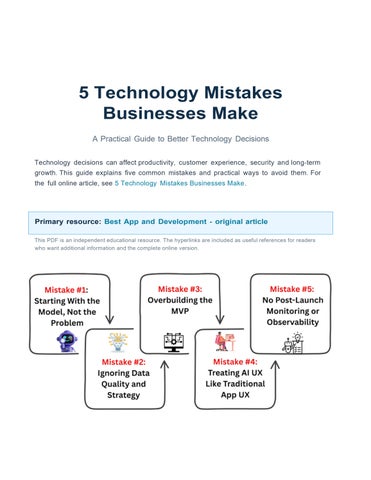
5 Technology Mistakes Businesses Make A Practical Guide to Better Technology Decisions Technology decisions can affect productivity, customer experience, security and long-term growth. This guide explains five common mistakes and practical ways to avoid them. For the full online article, see 5 Technology Mistakes Businesses Make.
Primary resource: Best App and Development - original article This PDF is an independent educational resource. The hyperlinks are included as useful references for readers who want additional information and the complete online version.
1. Choosing Technology Without Defining the Business Problem One of the most common technology mistakes is starting with a product, platform or programming technology instead of starting with the business problem. A company may decide that it needs a new application, website, automation system or software platform because a particular technology is popular. Popularity, however, does not automatically make a solution appropriate. Before selecting technology, define what the business needs to improve. Is the objective to reduce manual work, generate more leads, improve customer service, organize information, increase sales or give employees better tools? Clear objectives make technology decisions easier to evaluate. A business should document the current problem, desired outcome, people affected, available budget and expected return. This creates a practical foundation for comparing solutions. For a deeper discussion of technology mistakes businesses should avoid, readers can continue with the original technology article.
2. Underestimating Security and Data Protection Security should not be treated as a final step before launch. Modern businesses may handle customer information, employee records, account credentials, documents and payment-related data. Security requirements should be considered from the beginning. Businesses need to understand what information is collected, where it is stored, who can access it and how it is protected. Access permissions should match actual responsibilities, and sensitive credentials should be managed securely. Regular updates, backups, monitoring and employee security awareness are also important. A secure system requires both appropriate technical controls and sensible operational practices. The original technology article provides another useful reference for businesses reviewing their broader technology strategy.
3. Ignoring Scalability and Long-Term Maintenance A technology solution that works for a small operation may become difficult to maintain as the organization grows. This does not mean every project needs a complex architecture from day one. It means important growth scenarios should be considered. Businesses should ask what happens if customers increase, stored data grows, additional employees need access or new integrations are required. They should also identify who will maintain the system after initial development. Documentation, dependency updates, backups, hosting costs, licenses and support should all be considered. A solution that looks inexpensive initially can become expensive when it is difficult to maintain. A useful starting
point is the original technology article, which discusses these technology-planning issues in more detail.
4. Failing to Prioritize User Experience Technology is ultimately used by people. A technically sophisticated application can still fail if customers or employees find it confusing, slow or difficult to use. Businesses should identify primary users, understand their goals and map important tasks before development. Wireframes, prototypes, usability testing and feedback can reveal problems before major development effort is invested. Performance and accessibility are part of user experience too. Responsive layouts, readable content, clear navigation, keyboard support and useful form labels can make digital products more effective for a wider audience. For additional context, readers can visit the original technology article.
5. Treating Technology as a One-Time Project A website, application or business system is rarely finished permanently at launch. Technology requires monitoring, maintenance and improvement. After launch, businesses should review performance, errors, security, user behavior and business outcomes. Analytics and customer feedback can reveal problems that internal testing did not identify. Browsers, operating systems, third-party APls and software dependencies also change over time. A maintenance plan helps businesses respond before those changes become serious problems. The original technology article is a companion resource for readers who want to explore these technology mistakes further.
How to Make Better Technology Decisions Better technology decisions begin with better questions. What business problem are we solving? Who will use the solution? What information will it handle? What does success look like? How will the system be maintained? What happens as the business grows? Answering these questions helps connect technical investment with practical business outcomes.
Businesses can also compare their current approach with the recommendations in the 5 Technology Mistakes Businesses Make guide before starting a new technology project.
Conclusion Technology can become a powerful competitive advantage when it is selected and managed carefully. The biggest problems often come from unclear goals, insufficient security planning, short-term thinking, poor user experience and the assumption that a
project ends at launch. By defining the business problem first, protecting information, considering future growth, prioritizing users and planning continuous maintenance, businesses can make technology investments more reliable and sustainable. For the complete source article, visit Best App and Development.
Original article: https://bestappanddevelopment.blogspot.com/2026/08/5-technology-mistakes-businesses-make.html