!
Volume 13, number 1, 2020
E EE OM FR IT H
KE TA
Autism
and the Auditory Environment
INGRID FALAISE Using an Ordeal to Help Others
Parkinson's Disease
and Hearing Aids Marie-JosĂŠe Taillefer's Column
The Soundtrack
of Your Life
15 Years of Awareness Lobe Magazine is celebrating its 15th anniversary this year! That’s 15 years of educating and raising awareness. What an accomplishment! I am proud to be a contributor to this unique magazine, which lets us stay abreast of the latest hearing health news. As I often say, I find that, too often, we neglect to take care of our hearing, even though it’s such an important sense. Thanks to the talks I give throughout the province, I get to meet a lot of people and I see that mentalities are beginning to change. There is still work to be done, but people are more aware of the importance of taking care of their hearing. Lobe Magazine is certainly an important awareness tool. As I enter my third year of being ambassador of the Lobe clinics and of hearing health, one of my goals is to reach out to doctors to exchange with them about hearing health. This, in turn, will help them continue raise awareness among their patients and guide them to the appropriate resources. I’m sure you’ll love this edition, which marks the magazine’s 15th anniversary and features the magnificent Ingrid Falaise. Happy reading! Marie-Josée Taillefer Ambassador of Lobe clinics and of hearing health
2
LOBE.CA | © LOBE MAGAZINE 2020
TABLE OF CONTENTS 4
INGRID FALAISE
6
THE SOUNDTRACK OF YOUR LIFE
Marie-Josée Taillefer's Column
VOLUME 13, NUMBER 1, 2020
8
PROFESSION: PHARMACIST
Editor Joannie Langlois
9
FAST AS... SOUND!
10
AUTISM AND THE AUDITORY ENVIRONMENT
11
BEAT DEAFNESS
12
HEARING AIDS THAT MEET CHILDREN’S NEEDS
13
HEALTHY TRAVEL
14
PARKINSON’S DISEASE AND HEARING AIDS
15
CAN YOU HEAR AS WELL WITH ONLY ONE FUNCTIONAL EAR?
16
SUCCESSFUL FIRST DATES
17
THE ROLE OF THE AUDIOLOGIST
18
THE IMPORTANCE OF ACTING QUICKLY
19
USING TECHNOLOGY FOR PERSONAL SAFETY
21
A NOT-SO-GOLDEN RETIREMENT...
22
ARE SENIORS ALL VULNERABLE?
23
SCIENCE FAIR AT THE ÉCOLE ORALISTE DE QUÉBEC
24
MUSIC AND ITS VIRTUES
25
WHAT’S NEW IN THE LOBE CLINICS?
26
LOBE IN THE COMMUNITY
26
ADDRESSES OF THE LOBE CLINICS
Using an Ordeal to Help Others
Graphic designer Andrée-Anne Michel Printing house Imprimerie Solisco inc.
pour enfants malentendants ou sourds
Rights and responsibilities Any translation, reproduction or adaptation of texts, illustrations and photos in this work, for any reason whatsoever, in whole or in part, is strictly prohibited without written permission from the editor. The opinions expressed in articles published by Publications Lobe are the responsibility of the author. Legal deposit ISSN 1913-0287 Bibliothèque et Archives nationales du Québec, Montréal Library and Archives Canada, Ottawa Publications Lobe 725, boulevard Lebourgneuf, bur. 303 Québec (Québec) G2J 0C4 Tel.: 418 877-7222 Fax: 581 814-6260 Email: courrier@lobe.ca www.lobe.ca Printed in Canada All trademarks are the property of Lobe Santé auditive inc./Bulletin produced by Publications Lobe. The typographical recommendations for visually-impaired persons from Institut de réadaptation en déficience physique de Québec have been taken into consideration during the production of this magazine.
DID YOU KNOW? Here's a whole new reason to talk about the royal family. We learned that 93-year-old Queen Elizabeth II is now wearing hearing aids. Proof that everyone can have hearing loss!
LOBE.CA | © LOBE MAGAZINE 2020
3
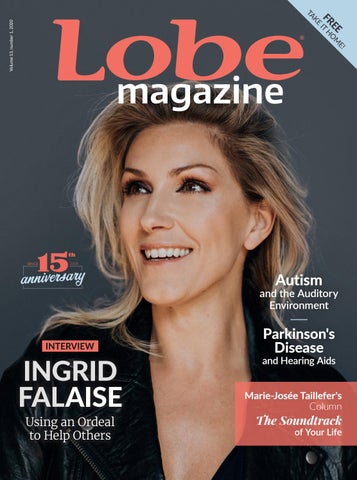
INGRID FALAISE Using an Ordeal to Help Others
Ingrid Falaise was terrorized by a man she calls M, who manipulated her and dragged her into the infernal cycle of domestic violence. Today, through her lectures, books and the television series that tells her story, she shines a light on a reality that affects a very large number of Quebecers. The amount of testimonies she receives every day is proof of this, and testifies to the need for a public figure to break this taboo. There are so many cases of domestic violence, both in Quebec and elsewhere. What do you think can be done to improve the situation? Getting out of it is the hardest part. As I say in my conferences, it starts with a love story, with seduction. The M’s study us, they charm us. They give us all the attention we’ve always wanted. It seems normal, but slowly, they start manipulating us. It’s so insidious that you don’t even realize they’re gradually breaking down your personality. But that’s the thing: it’s all founded on a love story. If it wasn’t, intimate partner violence wouldn’t be possible. What we can do is raise awareness among our young people: talk to them, give lectures, just to make them a little more aware. Maybe they’ll leave earlier, or maybe it’ll give them extra ammunition. I think that, basically, we need to teach our children respect. Respect for themselves and for others. If we start with that, work from the bottom up, maybe we’ll help some of them escape. There’s still a lot of prejudice surrounding survivors of domestic violence. It’s hard to understand when you haven’t experienced it. You wonder why the person doesn’t just leave. So we need to explain, like I do in my conferences, the mechanism behind it. And that’s the same mechanism for everyone. Pictures: Same Ravenelle, stylist: Karine Lamontagne, makeup: Anabelle Deschamps
4
LOBE.CA | © LOBE MAGAZINE 2020
INTERVIEW | INGRID FALAISE
After Le Monstre was published, you received a lot of Le Monstre has just been adapted for TV. What was it stories from people who went through the same thing. like to get back into the story, this time in pictures? Is it hard to become a kind of confidante and spokesI found it very hard. Seeing a girl who looks like me, my person for these people? family, the magnitude of the situation. I just wanted to hug myself, like all of Quebec wanted I get at least 15 stories a day, and to do. I collaborated on the content to I respond to everyone. After the Realizing I’m not make sure that every link was there, books and the series came out, there were waves of stories. Everyone alone took away the because if one is missing, it’s not intimate partner violence. When I saw the tells me their horror story and asks first episode, I cried every tear in my shame and guilt. for advice. I often refer them to SOS body. I watched it with my husband violence conjugale, a domestic vio... and I was very moved. lence hotline, or invite them to read my books. I’m not a therapist, but it makes them feel How did you coach the actors during shooting? good to confide in me. These people don’t have to justify I only met Rose-Marie Perreault once before shooting. themselves. I understand them very well. It’s definitely We ate sushi and talked for three hours! I told her about hard, but these people have also helped me feel better. the nuances in acting that were important to make sure it Realizing I’m not alone took away the shame and guilt. stayed true to what I experienced and what other women You also wrote a sequel to your book, Le Monstre: la are experiencing. She had already done an extraordinary suite. It talks about your life after leaving M. What was amount of research. As for Mehdi, he came to my house it like right after you made the decision to leave? and I showed him my photo albums. I kept everything. He was able to see M. He asked me a lot of questions, The first few years were very difficult. You want to get on and I answered them without holding anything back. with your life, but you have to learn how to live in society again. You’ve been under someone’s thumb and you don’t Is it harder to move on with the books, your talks and know how to live without that. And you’re left with all of the series? They always bring you back to that time in these defense mechanisms. My mother couldn’t touch your life. me anymore, because I was suddenly getting too much Actually, it helps me. It’s come full circle now. I broke the love. M made me think I didn’t deserve it. You need to learn to love yourself again. It takes a long time to rebuild. silence and I’ve talked about it so much that I’ve taken the evil out of it in every way possible. It’s set me free. It took me 16 years. I live every moment in gratitude, knowing that this period Finding your husband, Cédrik, was part of that rebuild- helped me to become the woman I am today. ing. You’re married, you have a baby. Was it hard to trust again? Ingrid, thank you very much for sharing with us and for your involvement with intimate partner violence survivors. That was the biggest step. For me, vulnerability meant danger. I used to leave him every other week. He’d come back and tell me he was here to stay. I had to meet a man Joannie Langlois who was emotionally intelligent enough to understand Editor where I came from. We’re so blessed to have found each other. We can see you together on Notre premier flip on Canal Vie. Can you tell us more about that? It’s a brilliant project! My boyfriend’s a general contractor. We bought this horrible house that we tore down and rebuilt into two turnkey condos. We only kept the outside. There were a lot of situations we weren’t expecting. On the show, they follow us through the entire renovation, and professionals comment on what we’re doing. Was it hard on your relationship? This wasn’t our first renovation together. I was working with my boyfriend’s company long before the flip. We work very well together. It’s not always easy and it’s a lot of work, but it’s going great. And the children are involved, too. They come to the site, help us demolish a bit, choose the flooring. It’s a family matter!
LOBE.CA | © LOBE MAGAZINE 2020
SOS violence conjugale
1 800 363-9010
5
The Soundtrack OF YOUR LIFE
Music is much more than the melody behind the lyrics to our favourite songs. It’s a kind of companion that follows us in the car, at work, in public places, sometimes even in the shower. It’s a friend that stays with us through the good times and the bad. Music comforts us, soothes us, makes us feel good.
COLUMN | MARIE-JOSÉE TAILLEFER
Of course, music is also at the heart of our favourite songs. The songs we dance to, the ones that speak to us, the ones that make us smile or even cry. Songs that take us back to a moment, songs that make us lose ourselves in our memories. There are the “guilty pleasure” songs that never fail to make us hum along, and the songs we wish we’d written. Without all of these songs, life simply wouldn’t be the same.
Precious Memories The reason I talk about music so passionately is that, as you can imagine, it’s an important part of my life. My father was a director for Jeunesse d’aujourd’hui, so he used to bring home the records that had just been released. I have to admit, René Simard’s were my favourite (laughs)! In a way, I fell in love with René because of music. Music brought us together. When I was very young, I asked to accompany my father on the set of Jeunesse d’aujourd’hui so I could listen to René sing. Later, music started taking up more space in my life. It became a real passion. Even today, when I hear the song L’oiseau, I feel a wave of emotions. This song, which I associate with our first meeting, will remain forever etched in my memory. I think I’ll always be touched by his sensitivity. I’m not the only one; over the years, so many people have written us to say that this song changed everything for them. Some have even said it saved their lives. That’s the power of music. LOBE.CA | © LOBE MAGAZINE 2020
The Chance to Hear Despite our love of music, our children’s deafness means that we keep things fairly quiet so that they can understand better. I would even say that they made us appreciate silence more. We’ve always tried to draw their attention to the visual parts of entertainment. Often, when it comes to raising awareness about the importance of hearing health, people are told to take care of their hearing so they can stay active and lead normal lives. But you also have to think about the little everyday pleasures. Things like listening to your favourite song in the car or plunging into a dark and suspenseful atmosphere during a movie are less accessible to people with hearing loss. Next time you listen to a song that makes you feel good, think of those who aren’t lucky enough to be able to hear it. Take a moment to ask yourself what your life would be like without music. That is one of the reasons why I encourage you to take care of your hearing. That said, keep listening to and enjoying your favourite music... just not too loud (laughs)! All my love, Marie-Josée Taillefer Ambassador of Lobe clinics and of hearing health
PATRICK SEGUIN / GROUPE TVA
What I like about music is that it manages to evoke a whole range of emotions, and those emotions can be completely different from one person to another. It can be both stimulating and soothing. Think of the music that plays during meditation sessions. It’s more than just an accessory—it’s a key part of the relaxation process. Even on the Titanic, the musicians kept playing as the ship sank so that people wouldn’t panic.
"Often, when it comes to raising awareness about the importance of hearing health, people are told to take care of their hearing so they can stay active and lead normal lives. But you also have to think about the little everyday pleasures."
7
Pharmacist Awareness Month
MARCH
Profession:
Pharmacist
DID YOU KNOW? Hearing screening days are offered in pharmacy. For more information, contact the nearest Lobe clinic.
Pharmacists specialize in medications and the appropriate ways for the general public to use them. Quebec’s pharmacists are recognized as front-line healthcare providers, and their role has changed a lot over the past few years. Bill 41, which came into force in June 2015, allows a pharmacist to prescribe a drug for conditions whose diagnosis and treatment are known, or when no diagnosis is required. The act also authorizes pharmacists to extend prescriptions written by a physician, adjust the dose of a prescription, prescribe and interpret laboratory tests for monitoring, substitute a drug when a supply is interrupted, and administer medications (like inhaled, subcutaneous or intramuscular medications) to show others how it’s done. The profession is expected to change even more in the coming months and years. New professional acts will make it easier to access certain healthcare services.
A Relationship Based on Trust Pharmacists are highly trusted, and Canadians see their pharmacists more than any other healthcare professionals. More than half of people with a health problem visit a pharmacist before seeing another healthcare professional. As members of a collaborative healthcare team, pharmacists play a major role in helping to find solutions to some of the problems facing our healthcare system: resolving the opioid crisis, improving mental healthcare, increasing vaccination rates, managing deprescription and polypharmacy, geriatric and dementia care, reducing the burden on primary and emergency care and more.
March is Pharmacist Awareness Month in Canada. Your pharmacist is a frontline healthcare professional, so don’t hesitate to reach out to them! Not only can they help you with your prescription and over-the-counter medications, they can also provide a host of valuable tips and tricks to help you with the little aches and pains of everyday life.
Martin Guilbert Associate Pharmacist Brunet G. C. R. and Brunet Lebourgneuf
Reference: - Ordre des pharmaciens du Québec. Le pharmacien. Online. opq.org/fr-CA/ grand-public/le-pharmacien/. Consulted on December 6, 2019.
8
LOBE.CA | © LOBE MAGAZINE 2020
Fast As... Sound! Sound needs to travel through the air to be heard, the same way light needs to travel through space to be seen. But have you ever wondered how fast sound travels? The speed of sound is about 340 meters per second. In comparison, light reaches 299,792,458 metres per second. That’s why, during a thunderstorm for example, light reaches us much faster than sound. That said, several factors can influence the speed of sound. The material the sound is travelling through makes a big difference. For example, sound travels 1,500 metres per second in water and a whopping 6,000 metres per second in steel. Temperature, pressure and humidity can also cause the speed of sound in the air to vary. The lower the compressibility and density of the liquid, gas or solid, the higher the speed of propagation of sound.
But What Is Sound? Sound is the result of tiny vibrations of air molecules. These vibrations propagate and create sound waves. The waves are then picked up by our ears, where a number of parts work together to pick up the sounds, amplify them and transmit them to the brain, which in turn allows us to understand them. While we can see light in space, sound cannot travel in a vacuum. Sound needs a substance to travel, whether it is solid, liquid or gas. Since molecules and particles don’t collide in space to create sound, space is silent.
LOBE.CA | © LOBE MAGAZINE 2020
Thanks to our ears, we can hear the sounds around us, whether they be loud or quiet. The physiology of the ears is complex and delicate—especially that of the ossicles in the ears, which are actually the three smallest bones in the entire human body.
Since hearing is essential for communication, it’s important to protect it, have it examined and help it with hearing aids if necessary so that you can enjoy hearing and understanding for a long time to come!
Estelle Lamonde Specialized educator practicing in Lévis
Reference: - Cochlea. Journey Into the World of Hearing. Online. www.cochlea.eu/en. Consulted on November 21, 2019.
9
Autism and the Auditory Environment Autism can be defined as “a detachment from external reality accompanied by withdrawal into oneself.” According to my nine-year-old son, it’s simply “being different.” We learned that he had Autism Spectrum Disorder (ASD) just before his fifth birthday. For him, emotions are hard to express. He has sensory issues and trouble understanding his environment. Loud or unexpected noises—such as fire alarms, storms, popping balloons or fireworks—cause a lot of stress. This is fairly common for people with autism; they tend to be sensitive to noise. Once the brain has processed the sound, the child reacts. They may stop listening and start babbling incoherently. Certain sounds can also trigger negative emotional outbursts.
Noisy Environments Are Stressful Our environment is full of noise pollution. Constantly being in a noisy environment irritates the senses. For people with ASD, crowds, shows and any place with a disruptive auditory environ-
ment can become oppressive. These environments cause a lot of stress, which can lead to outbursts of fear or anger. A simple trip to a shopping mall can be a nightmare. People with ASD are hypersensitive to sounds, and this can cause anxiety and panic. Generally, they wear earmuffs or cover their ears in situations like the ones above so that they can avoid receiving too much auditory information at once. This may seem unusual, but it’s a good way to stay calm, lower tension and control anxiety. Earmuffs can be a good tool for some children with special needs, but they shouldn’t be used too often because it can hinder the development of central auditory skills. Earmuffs are not the only solution, but they do help to reduce panic. However, they should not be overused. It is a good idea to see a professional to discuss this. The important thing is to reduce the negative reaction and stress caused by loud sounds. Auditory hypersensitivity is generally treated through desensitization and listening therapy.
There are also a number of different hearing protectors. If you have any questions, contact an audioprosthetist.
Laurence Beltrami Audioprosthetist practicing in Saint-Augustin-de-Desmaures
Reference: - LUCKER, J. R. and DOMAN, A. Neural Mechanisms Involved in Hypersensitive Hearing: Helping Children with ASD Who Are Overly Sensitive to Sounds. Hindawi. Autism Research and Treatment. Online. www.hindawi.com/journals/ aurt/2015/369035/. Consulted on November 29, 2019.
10
LOBE.CA | © LOBE MAGAZINE 2020
3– 4%
Beat Deafness
of the population is born beat deaf
What do you do when you hear a catchy song you like? Some stomp their feet, some clap their hands, some move to the beat. But did you know that these things are difficult, if not practically impossible, for some people? A few years ago, scientists discovered a condition called beat deafness.
People with this disorder can’t pick out a rhythm in a piece of music or move with the beat. Hearing acuity is usually unaffected, meaning that the person can hear very quiet sounds normally and understand speech well. The problem is more in the brain, in the part that processes rhythm. However, we haven’t been able to identify the exact cause of this condition.
Sound Processing in the Brain When a sound reaches the outer ear (pinna), it is directed to the auditory canal, then vibrates the eardrum and ossicles of the middle ear before reaching the inner ear. Sound picked up by the cilia in the inner ear is then directed to the auditory nerve and begins its journey to the brain, where auditory information is processed. The right hemisphere of the brain, specifically the right auditory cortex, allows us to distinguish the notes in a melody, while the left auditory cortex analyzes the rhythm. It’s the latter part that has an abnormality in people with beat deafness.
not determine whether the two were synchronized. What’s more, someone living with Parkinson’s disease or other brain lesions that affect the left auditory cortex may have symptoms of beat deafness, even though the condition is usually present from birth. The test used to determine whether a person has beat deafness is called the Battery for the Assessment of Auditory Sensorimotor and Timing Abilities (BAASTA). However, this test is only conducted in university neuroscience research programs. As a result, it isn’t easily accessible. Scientists are continuing to research beat deafness. Lou-Ann Leblanc Audioprosthetist practicing in Neufchâtel and Sainte-Anne-de-Beaupré
Varied Cases It is estimated that 3–4% of the population is born beat deaf. One of the first cases studied was tested in Montréal. The subject was able to keep a beat by clapping his hands when there was no sound source. The problem only arose when he was asked to do the same thing, but to the beat of some music. He had more trouble detecting changes in speed during the song, and it took him much longer to get used to them. This showed that he had trouble analyzing the music and using gestures to reproduce what he heard.
References: - BÉGEL, V. et al. “Lost in time” but still moving to the beat. 2017. Online. www.mcgill. ca/spl/files/spl/begel2016.pdf. Consulted on November 22, 2019. - DALLA BELLA, S. and SOWINSKI, J. Uncovering Beat Deafness: Detecting Rhythm Disorders with Synchronized Finger Tapping and Perceptual Timing Tasks. 2015. Online. www.ncbi.nlm.nih.gov/pmc/articles/PMC4401352/. Consulted on November 22, 2019. - MATHIAS, B. et al. Electrical Brain Responses to Beat Irregularities in Two Cases of Beat Deafness. 2016. Online. www.frontiersin.org/articles/10.3389/ fnins.2016.00040/full. Consulted on November 22, 2019.
Beat deafness is as varied as the people who have it. It can manifest in different ways. For example, one participant in the rhythm deafness study was perfectly able to follow the music by clapping her hands. However, if a metronome was turned on at the same time as the music, the participant could LOBE.CA | © LOBE MAGAZINE 2020
11
A manufacturer has recently introduced very highgain hearing aid technology as a last resort before cochlear implant. This technology equips behindthe-ear hearing aids with a number of options to help children’s speech development.
For Children of All Ages Children with severe to profound hearing loss need a lot of amplification to compensate. However, the line between “audible” and “uncomfortable” is thin. The new hearing aid technology mentioned above finds a balance between audibility and comfort, which helps children throughout the language development process. In fact, the technology adapts to children’s changing needs at each stage of development.
Hearing Aids That Meet Children’s Needs Some 1 in 1000 children are born with severe to profound (>70 dB) bilateral hearing loss. This figure doubles for 5-year-olds.
1 in 1000 children
Addressing hearing loss early in newborns (before the age of 6 months) improves language acquisition. Conversely, addressing it late (after the age of 12 months) delays language acquisition.
This new technology not only amplifies speech to increase audibility, it makes the speech clearer to create a seamless soundscape. It strikes a good balance between speech understanding, sound localization and listening comfort. The integrated feedback system also helps prevent acoustic feedback caused by changes in the ear’s anatomy as the child grows. While the hearing aids are larger, they can be used for children, babies and teenagers. They can be adjusted to fit even the smallest ears. An indicator light on the hearing aids can even allow parents or educators to quickly check that the devices are working properly. Talk to an audioprosthetist to learn more about this new technology. Reference: - CMAJ. 2014. 186 (14) 1048-1049 ; DOI.
are born with severe to profound (>70 dB) bilateral hearing loss.
In June 2012, the Government of Québec unveiled the Québec Newborn Hearing Screening Program, a program that brings together all stakeholders and aims to establish a rapid and structured treatment plan for infants.
Choosing Hearing Aids As part of the treatment plan, choosing the right hearing aids for the child’s needs is crucial for starting the rehabilitation process. New hearing aid technologies are now available for children with severe to profound hearing loss. An assessment by an audioprosthetist is required to determine which hearing aid suits the patient's needs.
12
LOBE.CA | © LOBE MAGAZINE 2020
Healthy Travel It’s all set! Your holiday in the sun is coming up! Your hotel is booked and your luggage is almost packed, but have you seen a medical professional yet?
You might not know it, but there’s a real risk of contracting certain illnesses while abroad. Many infections are transmitted through water, contaminated food and insect bites. That’s why it’s recommended that you consult a healthcare professional trained in travel medicine at least six weeks before you leave. They will be able to inform you of the risks of contracting certain diseases and give you health and safety advice. Many infections can be prevented through vaccination or preventive medication.
Bills for receiving medical care abroad can add up quickly. Remember to make a copy of your passport and give it to a friend or relative. This will save you a lot of trouble if your identification is lost or stolen. Finally, don’t hesitate to visit travel.gc.ca, the Government of Canada’s travel website, to find out everything you need to know about your destination! Have a good trip!
Don’t forget to think about everything
Isabelle Deschênes, nurse Réseau Infirmia Infirmia.com info@infirmia.com
Also, don’t forget to get travel health insurance, even if you don’t have any health problems.
Presented by:
Wednesday
May
6
2020
Théâtre Capitole For: DE QUÉBEC POUR ENFANTS SOURDS
A memorable evening under the honorary presidency of :
To take part in this event or make a donation : www.sourdine.qc.ca 418 263-5189, extension 236
Mr. André Labbé
sourdine@sourdine.qc.ca
Regional vice-président, RBC Royal Bank
In partnership with :
With the complicity of:
Media partners:
Follow us!
LOBE.CA | © LOBE MAGAZINE 2020
13
Parkinson’s Awareness Month
APRIL
Parkinson’s Disease and Hearing Aids Parkinson’s disease is the second most common neurodegenerative disease, after Alzheimer’s. Parkinson’s is caused by a progressive and irreversible degeneration of dopamine neurons (nerve cells) in certain areas of the brain. When this deterioration exceeds a certain threshold, estimated at 50–60%, people experience motor symptoms like stiffness, akinesia (difficulty moving), bradykinesia (slow movement), tremors at rest and postural instability. The disease is also characterized by non-motor symptoms, including cognitive impairment and hearing loss.
Possible Link to Hearing The link between Parkinson’s disease and hearing loss is due to the absence of dopamine, a hormone that can protect the cochlea from noise exposure, among other things. A lack of dopamine can therefore allow the cochlea to become damaged, resulting in hearing loss. In addition, a major study was conducted between 2000 and 2010 by researchers from the Taichung Tzu Chi General Hospital, China Medical University and Taiwan College of Health Sciences, involving more than 5,000 patients aged 65 and over. The study found that Parkinson’s disease was 1.77 times more likely to occur in a group of patients with hearing loss compared to a group without hearing loss.
Healthy Ears If you know someone with Parkinson’s disease, or if you have Parkinson’s disease, you can make an appointment for a complete hearing test. In fact, it is recommended that everyone aged 50 and older have their hearing assessed every two years as a preventive measure. Following the assessment, you will be advised on the next steps to take (if any) and referred to the professionals who will best meet your needs.
Rechargeable hearing aids
and charging stand. If hearing correction is needed, there are different solutions that can help people with Parkinson’s. For instance, rechargeable hearing aids may be suggested, as they require a lot less handling. With rechargeable hearing aids, the battery doesn’t need to be changed. Simply place the hearing aids in the charging stand and you’re done! Remote controls or smartphone apps also make hearing aids easier to use, as the volume or listening program can be adjusted from the device.
These are just a few examples of solutions that can help people with Parkinson’s disease correct their hearing. Do not hesitate to consult an audioprosthetist for more information. Dennis Jimenez Audioprosthetist practicing in Pointe-Claire, Vaudreuil-Dorion and Valleyfield
Reference: - LAI, S.-W., LIAO, K.-F., LIN, C.-L., LIN, C.-C., SUNG, F.-C. Hearing loss may be a non-motor feature of Parkinson's disease in older people in Taiwan. European Journal of Neurology 21 (5). 2014.
An assessment by an audioprosthetist is required to determine which hearing aid suits the patient's needs.
14
LOBE.CA | © LOBE MAGAZINE 2020
Can You Hear as Well With
Only One Functional Ear? Some people have hearing loss on one side only, caused by birth defects or complications during childhood or adulthood. This unilateral hearing loss can range from severe to profound. When the hearing loss is total, meaning that neurosensory stimulation isn’t possible, it’s called anacusis. This type of deafness is estimated to occur in between 3% and 9% of the population.1 Even if the other ear is healthy, a person with unilateral hearing loss cannot hear the same way as someone with two functional ears. They can’t determine the direction of sound and have trouble understanding speech in noisy environments. The brain needs the auditory information from both ears to determine where a sound is coming from. As for understanding speech in noise, the central auditory system acts as a filter when the auditory cortex is stimulated by both ears.
plete 360-degree hearing experience. Users can also connect a Bluetooth device (cell phone, TV listening system or handheld microphone) to their CROS or BICROS system without compromising its effectiveness. In fact, a study has shown that CROS systems with Bluetooth connectivity can significantly increase word recognition in complex listening environments.3 Talk to an audioprosthetist to learn more!
Recommended Technology If a person has unilateral hearing loss, hearing health professionals may suggest CROS * (Contralateral Routing of Signals) hearing aids.2 This system consists of a microphone placed on the non-hearing ear, linked wirelessly to a hearing aid on the other ear that acts as a receiver. The system picks up sound from the microphone and transmits it to the hearing ear. If the other ear also has hearing loss, the hearing aid will amplify the sounds as needed. This is known as a BICROS system*. One hearing aid manufacturer has introduced a wireless CROS system that uses a magnetic signal. This combination of two technologies allows people with unilateral hearing loss to have a com-
Charles-Edouard Basile Business Development Manager
References : 1.
ROSS, D. S., VISSER, S. N., HOLSTRUM, W. J., QIN, T. et KENNESON, A. Highly variable population-based prevalence rates of unilateral hearing loss after application of common case definitions. 2010. Ear Hear. (31), 126-133.
2.
Dillon, H. Hearing Aids – Second Edition. 2012. Boomerang Press.
3.
CALLAWAY, S. L. et AABY GADE, P. CROS. 2019. White Paper.
*CROS system : With CROS systems, a microphone is placed on the non-hearing ear. This microphone, which is linked to the hearing aid on the other ear, transmits sounds to the “better” ear. * BICROS system: With BICROS systems, a microphone is placed on the nonhearing ear. This microphone, which is linked to the hearing aid on the other ear, transmits sounds to the “better” ear. BICROS systems also provide amplification as needed so that the “better” ear can hear the sounds.
An assessment by an audioprosthetist is required to determine which hearing aid suits the patient's needs. LOBE.CA | © LOBE MAGAZINE 2020
15
Successful First Dates
Are you looking for a soulmate? It can be hard to reveal your hearing loss to a new love interest. And the dating scene itself is a tough one to navigate in the first place! That’s why planning a date well can go a long way. Here are some tips that will give you confidence for your next date.
Select the right place
Ask them to repeat
Make eye contact
Do you know of a cozy little restaurant in your neighbourhood? Somewhere quiet and romantic? That’s a great choice for a date! Make sure to reserve a table that’s away from the kitchen and the speakers so you can concentrate on what your companion is saying. Avoid bars and other noisy places where you may have trouble understanding.
Don’t pretend you heard what your companion said if you didn’t understand. Instead, ask them to repeat themselves to make sure you’re following the conversation. Otherwise, you could find yourself in an embarrassing situation: did your date just say, “I love you” Or “I love juice”?
It’s always a good idea to look a new love interest in the eye during a date, but eye contact is even more important if you have hearing loss. Among other things, it will allow you to read your partner’s lips. Encourage the other person to make eye contact when they talk so you can understand everything.
Janic Lauriault Audiologist Technical support
16
Don’t be ashamed of your hearing aids Would you judge a partner for wearing glasses? Probably not. Hearing aids should be treated the same way. Show off your hearing aids with pride. Your date may even see them as cool gadgets.
Be honest When is the best time to discuss your hearing loss with your new love interest? On the first date? After a few weeks of dating? It may be a hard decision, but it’s always best to mention it before your partner finds out on their own.
Wishing you w onderful meetin gs filled with grea t conversations !
An assessment by an audioprosthetist is required to determine which hearing aid suits the patient's needs.
LOBE.CA | © LOBE MAGAZINE 2020
The Role of the Audiologist Hearing is essential for properly capturing auditory information and sending it to the brain for analysis. It’s a sense that plays a key role in communication. However, sometimes hearing can be affected by things like noise exposure or the aging of the cells in the inner ear. That’s where an audiologist comes in. According to the Ordre des orthophonistes et audiologistes du Québec, “audiologists are professionals who prevent, evaluate and treat people with hearing (e.g. deafness and tinnitus) and vestibular (e.g. vertigo) disorders.” [translation]
What Do Audiologists Do? The audiologist takes the patient’s history to gather relevant information about their health, listening problems and needs. They also make sure to ask about work and leisure activities that are noisy or could affect hearing. Audiologists work with people of all ages. They play an important role; they evaluate patients’ ability to hear and decode sounds and speech. Their work is based on a relationship of trust. They take the time to build a meaningful relationship with their patients so that the patients feel comfortable throughout the assessment. Audiologists take the time to explain each step of the hearing assessment to reassure the patient. Visit the Lobe website to discover all the steps of the hearing assessment. Audiologists also guide them through the process, and teach them communication strategies. Once an audiologist has completed the hearing assessment, they explain the results. Finally, if necessary, they refer the patient to other professionals (audioprosthetists, ENT specialists, rehabilitation centre, etc.).
An Essential Role
Audiologists are professionals who prevent, evaluate and treat people with hearing and vestibular disorders.
Justine Valois Specialized educator practicing in Québec
Reference: - Ordre des orthophonistes et audiologistes du Québec. Online. www.ooaq.qc.ca. Consulted on November 22, 2019.
Hearing loss can affect many parts of a person’s everyday life. As a result, if it’s not detected early, hearing loss can lead to isolation, loss of self-esteem and struggles with social interactions. If you have a hearing problem, seeing an audiologist will improve your quality of life. After all, their job is to give you the tools you need to enjoy life without compromise!
LOBE.CA | © LOBE MAGAZINE 2020
17
The Importance of Acting Quickly Many people don’t fully realize that they have hearing loss until they no longer hear the phone ringing or an alarm going off. For others, it’s the people around them who first notice the signs of hearing loss: turning up the volume on the TV, asking people to repeat themselves or trouble following group conversations in noisy environments. Many people are told they have hearing loss after a full hearing assessment. Then comes the big decision: wait a little longer because the hearing loss isn’t causing many problems in everyday life, or wear the hearing aids recommended by the audioprosthetist. People who choose not to have their hearing assessed or not to wear hearing aids when recommended are turning their backs on a better quality of life. Waiting to correct hearing loss can have many consequences. Not only can it affect quality of life, it can also reduce cognitive stimulation. Losing a sense like hearing can also affect the way a person understands words. The consequences only worsen as time goes on, so it’s important to stimulate your hearing as soon as hearing loss is discovered. Hearing problems in everyday life can affect social gatherings, performances and even life at home. Hearing loss is also exhausting. Struggling to hear all day, and the listening effort it requires, causes a lot of stress and auditory fatigue. Hearing loss can even lead to social isolation.
How Hearing Aids Help There’s no excuse not to start wearing hearing aids as soon as hearing loss is detected and a professional recommends them. Once they become a part of your life, hearing aids do more than just turn up the volume. They are highly sophisticated devices that process sound in a way that promotes better speech understanding while reducing distracting ambient noise. In some cases, they can also help manage tinnitus. High-tech hearing aids are the best for noise reduction and speech processing. As you become more comfortable with your hearing loss and wearing your hearing aids, you are free to decide how you want to use them in your everyday life. Know that your audioprosthetist is always there to help you with your residual listening issues. Their goal is to keep improving your listening comfort. The vast
majority of people who wear hearing aids today are satisfied and report an improved quality of life. So why wait? Marianne Guertin Audioprosthetist practicing in Laval 440
References: - DEAL et al. Hearing Impairment and Cognitive Decline: A Pilot Study Conducted Within the Atherosclerosis Risk in Communities Neurocognitive Study. American Journal of Epidemiology. 2015. - KOCHKIN, S. MarkeTrak VII: Customer satisfaction with hearing instruments in the digital age. The Hearing Journal. Online. www.hear-it.org/fr/neufutilisateurs-d-appareils-auditifs-sur-dix-ameliorent-leur-qualite-de-vie. Consulted on December 11, 2019. - LAPLANTE-LÉVESQUE, A. Applying the Stages of Change to Audiologic Rehabilitation. The Hearing Journal. 68(6), p. 8-12. - The Baltimore Sun. Learning to live (and work) with hearing loss. Online. www.baltimoresun. com/opinion/op-ed/bs-ed-op-1108hearing-loss-20191107-kbuiddgofvf2dj3vxia3suqq2a-story.html?utm_source=dailyhootsuite&utm_medium=facebook&utm_ term=&utm_content=77ef6a4d-e949-41d3-986f0058f963a65a&utm_campaign=. Consulted on December 11, 2019.
“The vast majority of people who wear hearing aids today are satisfied and report an improved quality of life. So why wait?”
An assessment by an audioprosthetist is required to determine which hearing aid suits the patient's needs.
18
LOBE.CA | © LOBE MAGAZINE 2020
Using Technology for Personal Safety
Falls were responsible for 12,003 deaths in Quebec between 2000 and 2013. That’s an average of 857 deaths per year. People aged 65 and older made up 90.2% of those deaths.1 Did you know that hearing loss is associated with an increased risk of falling?2 That’s why a new hearing aid technology has been developed to detect falls. All the wearer has to do is enter emergency contact information into an Apple or Android app. If the hearing aids’ sensors detect a fall, they’ll automatically alert the contacts in the app. This feature acts as a safety net for the wearer, contributing to their well-being. It also encourages people to wear their hearing aids, which can be highly beneficial for certain medical conditions. For example, a study by the SENSE-Cog Project shows that wearing hearing aids may slow cognitive decline.3
Taking Care of Your Health What’s more, there is a growing body of research on hearing health, and it suggests that hearing loss is often associated with other medical conditions. In some cases, the hearing loss aggravates the disease, while in others, the disease can worsen hearing loss.
Did you know
that hearing loss is associated with an increased risk of falling? If you have one of these conditions, don’t hesitate to reach out to an audiologist for a full hearing examination. Addressing your hearing loss quickly comes with a number of benefits. After all, adopting a healthy lifestyle means taking care of your hearing health, too! Rizlane Bellamlih Territory Manager - Québec
References:
Here are just some health conditions that have been linked to hearing loss: 4 Cardiovascular diseases
1.
Institut national de santé publique. Chutes chez les aînés. Online. https://www. inspq.qc.ca/securite-prevention-de-la-violence-et-des-traumatismes/prevention-des-traumatismes-non-intentionnels/dossiers/chutes-chez-les-aines. Consulted on January 30, 2020.
2.
Harvey Abrams. Hearing Loss and Associated Comorbidities: What Do We Know? Online. https://www.hearingreview.com/hearing-loss/hearing-loss-prevention/risk-factors/hearing-loss-associated-comorbidities-know. Consulted on January 30, 2020.
3.
Piers Dawes, Asri Maharani, James Nazroo, Gindo Tampubolon and Neil Pendleton, on behalf of the SENSE-Cog WP1 group. Evidence that Hearing Aids Could Slow Cognitive Decline in Later Life. Online. https://www.hearingreview. com/hearing-loss/hearing-loss-prevention/risk-factors/evidence-hearingaids-slow-cognitive-decline-later-life. Consulted on January 30, 2020.
4.
Harvey Abrams. Hearing Loss and Associated Comorbidities: What Do We Know? Online. https://www.hearingreview.com/hearing-loss/hearing-loss-prevention/risk-factors/hearing-loss-associated-comorbidities-know. Consulted on January 30, 2020.
Diabetes Alzheimer’s disease Depression and anxiety Parkinson’s disease (for more information
about this, read the article on page 14)
- Viljanen A, Kaprio J, Pyykkö I, et al. Hearing as a predictor of falls and postural balance in older female twins. J Gerontol A Biol Sci Med Sci. 2009; 64(2):312-317. - The National Institutes of Health (NIH) | National Institute on Deafness and Other Communication Disorders (NIDC) | National Council on Aging (NCOA) | Kochkin, S.(n.d). The Impact of Treated Hearing Loss on Quality of Life.
An assessment by an audioprosthetist is required to determine which hearing aid suits the patient's needs. LOBE.CA | © LOBE MAGAZINE 2020
19
Forty speakers
Marie-Josée & Claudette Taillefer Friday | April 24 | 1:45 pm
Isabelle Huot France D’Amour Saturday | April 25 | 11:10 am Saturday | April 25 | 1:45 pm
Dr Éric Simard & Richard Abel Sunday | April 26 | 11:10 am
Guylaine Tanguay Sunday | April 26 | 1:45 pm
More than 200 booths Visit us and get a chance to win a week-long cruise for two to Îles de la Madeleine*
*Value of $ 3,000. Contest details and rules are available on site.
20
www.saloncarrefour50ansplus.com LOBE.CA | © LOBE MAGAZINE 2020
A Not-So-Golden Retirement...
There are several stubborn myths surrounding old age. One of them claims that the majority of seniors have substantial income and investments, guaranteeing them a stress-free retirement. However, the reality is very different. In fact, more than 35% of Quebecers live on an annual income of less than $20,000 after age 65. And while one might think that only a small fraction of seniors receive Guaranteed Income Supplement (GIS) benefits, the truth is that 38% of Quebecers aged 65 receive it in addition to the federal Old Age Security pension. The notion of a “golden retirement” is a bit of a misnomer, especially given the social context in which many seniors live—one marked by isolation, abuse, caregiver burnout and more. Of course, many seniors do have the financial means to support themselves through their golden years, and many more remain active, happy and surrounded by loved ones. But aging has never looked so different for different people, especially because of the increased life expectancy.
Fortunately, the FADOQ is There! Given this context, the Réseau FADOQ is more relevant than ever. Its wide range of leisure activities encourages active aging, and the 1,500 discounts and privileges it provides help members make ends meet more easily. In addition, many FADOQ programs are improving the everyday lives of those who built our society. For instance, FADOQ offers programs like Ateliers FADOQ.ca, Aîné-Avisé, Dans la peau d’un aîné workshops and the maindoeuvre50plus.com platform.
more than 35% of Quebecers live on an annual income of less than $20,000 after age 65.
The network—which is the largest seniors’ organization in not just Quebec, but all of Canada—also tirelessly defends the collective rights of seniors. Major gains have been made over the years, such as the end of grandparents’ requirements to pay child support, automatic enrolment in the GIS, and the abolition of ancillary health expenses. Another significant victory: the provincial government announced a $2.5 billion investment over five years in March 2019. This is an unprecedented investment in CHSLD, home care, family caregivers, experienced workers, and more. Sophie Gagnon Réseau FADOQ
To become a Réseau FADOQ member
fadoq.ca 1 800 828-3344
50 Years and Still Going Strong! In 2020, the Réseau FADOQ will be celebrating its 50th anniversary. It will finally be old enough to have its own FADOQ card! Thanks to its 535,000 members, it uses its unparalleled influence to carry out its main mission: improving the quality of life of today’s and tomorrow’s seniors. Its goal is to earn its place in the hearts of Quebec’s seniors for at least another 50 years!
Happy 50th anniversary to the Réseau FADOQ!
LOBE.CA | © LOBE MAGAZINE 2020
21
Are Seniors All Vulnerable? No, of course not. All people age, but not the same way. And aging is completely normal. That said, it can come with risk factors that may make some people more vulnerable.
These risk factors can be significant. They include reliance on others to help with everyday activities like feeding and bathing. In this case, it’s very important that the caregiver (whether they be a family member or a professional) be attentive and caring. A loss of autonomy, regardless of the cause, can lead to an inability to make choices for oneself. This must be addressed by important people in the senior’s life who can make choices in his best interests while still encouraging the senior to be involved in those decisions wherever possible. Social isolation—the lack of intergenerational or familial ties with descendants—could prevent people from receiving the help they need for the issues associated with dependency and loss of autonomy. In this case, an alternative social or community network can make a huge difference, as long as the isolated person is known to the healthcare system. Poverty can add to these factors and limit access to resources that are crucial for safety. The availability of measures that promote access to resources often depends on the policies put in place by the government.
What should we take away from this brief description? Protection is key to reducing vulnerability, if not preventing it from taking hold and leading to abuse, neglect and abandonment. On the one hand, these factors are individual; they are precautionary measures that we can put in place ourselves to avoid future risk factors like the ones listed above. On the other hand, they are directly related to a senior’s own environment. That environment must be sufficient, responsive, available and accessible. We are all part of that environment, and we will all need it sooner or later. We may as well work together to build it and preserve the dignity and integrity of people at every stage of their lives. Social involvement is essential. Martine Rodrigue Executive Director Association québécoise de défense des droits des personnes retraitées et préretraitées Lévis-Rive-Sud (AQDR)
OUR PARTNERS
Thank you! 22
To the writers who have spent time writing the articles published in this magazine, and who generously agreed to share their knowledge. LOBE.CA | © LOBE MAGAZINE 2020
Science Fair at the École oraliste de Québec pour enfants malentendants ou sourds At the École oraliste, we develop knowledge through creation. Science and technology are the perfect ways to engage students in meaningful, creative and exciting projects. They allow students to develop their ability to come up with explanations and make logical connections. What better way to have them engage with science than to have them create projects from scratch, developing their own questions in the process?
A World of Creation As part of the science and technology class, high school students set up their own science fair. This type of project covers a wide variety of scientific or technological themes. For example, students may choose to do a research project on ethical issues in fields like environmental science, politics, education and more. They can also design their own invention or scientific experiment based on their questions or hypotheses. Through these projects, they seek to understand and explain the world around them. Over the course of the project, they test their hypotheses by analyzing the results. They discover new ways of thinking and creating. This greatly helps students develop their scientific thinking. As they create their project, students are guided through a rigorous scientific process. They collect information, then popularize it so they can explain it at the science fair. This requires them to understand the texts they read or the videos they watch extremely well. Science popularization develops their ability to synthesize essential information, which is a crucial skill in science and technology.
One student chose to cover deafness, giving visitors a better understanding of this reality. Another student was interested in life on Mars. Will it be possible in the near future? The projects covered a number of other questions: How does a volcano form? What is the difference between a virus and a bacterium? Why do we grow old? One gamer did a project on virtual reality, bringing the experience to life through his VR game console. It was a treat for everyone, young and old alike! Another student got involved in a major project: understanding the importance of DNA in criminal investigations. A third student sought to demystify Alzheimer’s disease. Another worked on the issues surrounding the nuclear bomb, and yet another, who had chosen to study electricity, led an interesting activity on identifying conductive or insulating materials. Even the youngest visitors were able to participate. All of the feedback we received about the science fair was positive. Everyone was proud of this meaningful activity. This first edition was certainly not the last! Anne-Marie Martel Teacher at the École oraliste de Québec
A Meaningful Activity Last November, high school students held their first science fair. They welcomed many parents, school staff and students, bringing a lot of life to the high school. Each student created vibrant, enriching and interesting project that covered a subject they were passionate about. We were able to attend a wide variety of presentations, and they were all exceptional. It was a learning experience for everyone!
LOBE.CA | © LOBE MAGAZINE 2020
23
Music and
Its Virtues
The virtues of music are proven by facts, field observations and studies. These all justify the music’s potential power when it comes to cognitive function and memory. Music is even seen as a promising approach for caring for seniors with Alzheimer’s disease. The mystery lies in music’s ability to access residual memories—something that previously seemed unavailable to people with this type of dementia. This revelation is also associated with a decrease in behavioural disorders, to the point where it may be the only way of communicating with some patients. Music may help strengthen a cognitive reserve, and even delay the symptoms of Alzheimer’s disease.
It is a spectacular and powerful cognitive awakening. As one French neuropsychologist states, “practicing music benefits the parts of the brain involved in highlevel cognitive mechanisms such as attention and memory.” In other words, music can bring back things like memories and knowledge that the disease has buried very deep. Song can bring back these sweet memories of the past, which are often linked to moments or loved ones. And music doesn’t just soothe the soul. It can also reduce the need for medication in seniors with Alzheimer’s. It stimulates almost all areas of the brain, including those where memories are stored. Singing in choirs, for example, increases social activity and interactions in seniors, in addition to a multitude of other health benefits (Grouin, 2015). Using song to help people with Alzheimer’s is becoming more and more popular in retirement homes. Of course,
this requires finding the right songs for each person to make them feel their best. To conclude, let us borrow this quote from the Alzheimer’s Foundation of France: “You can’t think of everything, but unfortunately you can forget everything.” So, let’s think about music, which can help us avoid losing our memories. Matey Mandza, M.D., Ph. D., LL. M. Researcher (Drummondville CCEG) Vice-President of the Association québécoise de gérontologie (AQG)
DON’T STAY ALONE JOIN US! aqrp.ca
Why become an AQRP member? • Enjoy social and physical activities • Have access to conferences, training, web conferences, contests and blog • Benefit from a host of savings and advantages on insurance with La Capitale, as well as with many important partners (health, leisure, culture, travel, etc.) • Promote your rights and have access to a free telephone help service!
Watch for Lobe’s new offer for AQRP members, effective April 1, 2020.
24
1 800 653-2747 www.aqrp.ca
LOBE.CA | © LOBE MAGAZINE 2020
WHAT'S NEW IN THE LOBE CLINICS? NEW CLINICS
THE SAINT-AUGUSTIN LOBE CLINIC IS GROWING!
to come
Over the next few months, the Lobe Clinic in SaintAugustin-de-Desmaures will undergo a major expansion so it can better serve the surrounding area. The services offered at the clinic remain the same (ENT specialists, audiologists, audioprosthetists, specialized educators).
In 2020, four new areas in the province will be welcoming Lobe clinics: Villeray, Notre-Dame-de-Grâce, Donnacona and Mascouche. Keep an eye out for these new hearing health and communication clinics!
WE’RE HIRING! As the network of Lobe clinics is expanding, we are constantly looking for new hires to join our head office team or practice in our clinics.
SALON CARREFOUR 50 ANS+ From April 24 to 26, Lobe will take part in the Salon Carrefour 50 ans+ in Montreal, at the Palais des congrès. You will be able to meet with hearing health professionals and take a free* hearing screening test in a soundproof booth. On Friday, April 24 at 1:45 p.m., our ambassador, Marie-Josée Taillefer, will present the conference Une nouvelle étape de la vie with her mother Claudette Taillefer. In a funny and touching conference, the two women will discuss the importance of hearing well. Come join us!
Visit the Career section of the lobe.ca website or email rh@lobe.ca to consult our job offers and apply.
*Permanent offer. 18 and over.
FOLLOW US LIVE!
QUESTIONS? COMMENTS?
facebook.com/cliniqueslobe linkedin.com/cliniqueslobe youtube.com/user/votreLobeTV lobe.ca
WRITE TO US! Email us at courrier@lobe.ca
SUBSCRIBE TO THE LOBE MAGAZINE
£ Mr. £ Ms.
Fill out and cut the form and send it to the address below, with your payment if applicable. The cheque must be made to the order of “Publications Lobe”.
£
Lobe Magazine, Complexe Vision, 725, boulevard Lebourgneuf, suite 303 Québec (Québec) G2J 0C4
Name:
£ French version
£ English version
Subscription for general public £ One year (4 magazines): $10,00*
Organization / Association:
Address: Postal code:
£ Two years (8 magazines): $20,00*
City:
* To cover mailing costs
Province:
£ Free of charge subscription for
associations, schools, organizations, health professionals, etc.
Number of copies:
Phone #: Email address:
LOBE IN THE COMMUNITY Pointe-Claire Clinic
Open Houses at the Pointe-Claire and Châteauguay Clinics
Conferences by Marie-Josée Taillefer
The Lobe clinics in Pointe-Claire and Châteauguay held open houses on November 25 and 26. Among other things, attendees were able to discover the services offered at the Pointe-Claire clinic, which recently moved to the Brunswick Medical Centre. It was also an opportunity to attend the conference given by our ambassador, Marie-Josée Taillefer.
Marie-Josée Taillefer, ambassador of Lobe clinics and of hearing health, continues to tour Quebec with her conference, L’audition, une priorité. Visit lobe.ca to find out the dates of her next conferences.
ADDRESSES OF THE LOBE CLINICS CAPITALE-NATIONALE OPENING SPRING 2020
Donnacona 499, route 138, suite 200 Donnacona Qc G3M 0A9 1 866 411-LOBE (5623)
Pont-Rouge Above Familiprix drug store 69, rue du Collège, suite 203 Pont-Rouge Qc G3H 0J4 ENT specialists: 581 318-3505 Audiologists : 581 329-8476 Audioprosthetists: 581 329-840 NEW PREMISES
Québec • Beauport Clinique médicale de Giffard Before winter 2020
Les Promenades Beauport, door 3 3333, rue du Carrefour, suite 210 After winter 2020
Les Promenades Beauport, door 4 3333, rue du Carrefour, suite A222 Québec Qc G1C 5R9 Audiologists : 418 780-6270 Audioprosthetists: 418 780-3007
Québec • Charlesbourg La Cité Médicale de Charlesbourg 8500, boul. Henri-Bourassa, suite 250 Québec Qc G1G 5X1 ENT specialists: 418 780-3015 Audiologists : 418 780-6270 Audioprosthetists: 418 780-3007 Québec • Lebourgneuf Complexe Vision 725, boul. Lebourgneuf, suite 315 Québec Qc G2J 0C4 ENT specialists: 418 780-3015 Audiologists : 418 780-6270 Audioprosthetists: 418 780-3007
NEW CLINIC
Québec • Limoilou Complexe Santé Synase 1825, boul. Henri-Bourassa, suite 302 Québec Qc G1J 0H4 ENT specialists: 581 814-8901 Audiologists : 581 814-8900 Audioprosthetists: 581 814-8899 Speech-language pathologists: 581 814-8902 Free parking, coupon given at the exit
Québec • Neufchâtel Clinique médicale DuChatel 9465, boul. de l’Ormière, suite 102 Québec Qc G2B 3K7 Audiologists : 418 915-8919 Audioprosthetists: 418 843-5244 Québec • Saint-Sacrement Complexe La Cité Verte 1200, rue des Sœurs-du-Bon-Pasteur, Suite 310, Québec Qc G1S 0B1 ENT specialists: 581 318-2620 Audiologists : 581 742-3880 Audioprosthetists: 581 742-6050 Québec • Sainte-Foy Clinique médicale Saint-Louis 3165, chemin Saint-Louis, suite 420 Québec Qc G1W 4R4 ENT specialists: 418 781-1735 Audiologists : 418 781-1734 Audioprosthetists: 418 781-1733 Speech-language pathologists: 418 781-1734 Free parking, coupon given at the exit
Québec • Val-Bélair Polyclinique médicale Val-Bélair 1147, boul. Pie XI Nord, suite 205 Québec Qc G3K 2P8 Audiologists : 418 915-2117 Audioprosthetists: 418 915-2116
Saint-Augustin-de-Desmaures Complexe médical l’Hêtrière 3520, rue de l’Hêtrière, suite 103 Saint-Augustin-de-Desmaures Qc G3A 0B4 ENT specialists: 418 614-1665 Audiologists : 418 614-1662 Audioprosthetists: 418 614-1661 Sainte-Anne-de-Beaupré Complexe Santé Côte-de-Beaupré 9745, boul. Sainte-Anne, suite 303 Sainte-Anne-de-Beaupré Qc G0A 3C0 Audiologists : 581 540-3022 Audioprosthetists: 581 540-3021
CENTRE-DU-QUÉBEC
Drummondville 110, rue Saint-Jean, suite 300 Drummondville Qc J2B 7T1 ENT specialists: 819 857-4777 Audiologists : 819 857-4666 Audioprosthetists: 819 472-7676
CHAUDIÈRE-APPALACHES NEW CLINIC
Beauceville Coop santé Robert-Cliche 463-B, boulevard Renault Beauceville Qc G5X 1N5 Audiologists : 581 813-3015 Audioprosthetists: 581 813-3013 Disraeli 1244, avenue Champlain Disraeli Qc G0N 1E0 Audiologists : 581 714-3051 Audioprosthetists: 581 714-3050 Lac-Etchemin Résidence Belvédère du Lac 301, rue du Sanatorium, suite 121 Lac-Etchemin Qc G0R 1S0 Audiologists: Summer 2020 Audioprosthetists: 581 820-3220
Lévis Complexe Lévis 1 1655, boul. Alphonse-Desjardins Suite 210, Lévis Qc G6V 0B7 ENT specialists: 418 830-5622 Audiologists : 418 830-0987 Audioprosthetists: 418 830-5623 Lauzon • Lévis Complexe Santé Lévis-Lauzon 6750, boulevard Guillaume-Couture Suite 102, Lévis Qc G6V 9H4 Audiologists : 581 629-0414 Audioprosthetists: 581 629-0413 Saint-Romuald • Lévis Complexe Pôle Sud 1190 A, rue de Courchevel, suite 502 Lévis Qc G6W 0M5 ENT specialists: 418 903-8102 Audiologists : 418 903-8101 Audioprosthetists: 418 903-8100 Saint-Jean-Chrysostome • Lévis Complexe Santé Taniata 700, avenue Taniata, suite 104 Lévis Qc G6Z 2C2 Audiologists : 581 629-0409 Audioprosthetists: 581 629-0408 Saint-Georges 14640, boulevard Lacroix Saint-Georges Qc G5Y 7G8 ENT specialists: 418 228-7684 Audiologists : 418 228-7071 Audioprosthetists: 418 228-2970 Sainte-Marie 340, boulevard Vachon Sud Sainte-Marie Qc G6E 1X8 ENT specialists: 418 386-3643 Audiologists : 418 386-4426 Audioprosthetists: 418 387-7988
Thetford Mines Place 611 (Ameublement Carrier) 611, boul. Frontenac Est, suite 201 Thetford Mines Qc G6G 6Y7 ENT specialists: 418 755-0176 Audiologists : 418 755-0138 Audioprosthetists: 418 338-8777
ESTRIE
Lac-Mégantic 6246, rue Salaberry Lac-Mégantic Qc G6B 1H8 Audiologists : 819 583-4631 Audioprosthetists: 819 583-6633 Sherbrooke Ouest Complexe de la Santé 15, rue J.-A.-Bombardier, suite A200 Sherbrooke Qc J1L 0H8 ENT specialists: 819 780-9747 Audiologists : 819 780-9746 Audioprosthetists: 819 348-4334 Sherbrooke Est Complexe de la Santé 15, rue J.-A.-Bombardier, suite A200 Sherbrooke Qc J1L 0H8 ENT specialists: 819 780-9747 Audiologists : 819 780-9746 Audioprosthetists: 819 348-4334
LANAUDIÈRE NEW CLINIC
Notre-Dame-des-Prairies Centre professionnel des Prairies 449, route 131, suite 205 Notre-Dame-des-Prairies Qc J6E 0M1 Audiologists : 579 841-0051 Audioprosthetists: 579 841-0050
OPENING FALL 2020
Mascouche 1 866 411-LOBE (5623)
LAURENTIDES
NEW CLINIC
LAVAL Cité de l’Avenir 1575, boul. de l’Avenir, suite 120 Laval Qc H7S 2N5 Audiologists : 450 934-8362 Audioprosthetists: 450 934-2614
Laval • Chomedey 440 Carrefour Santé 440 4650, Desserte Sud Autoroute 440 Suite 370, Laval Qc H7T 2Z8 Audiologists : 450 687-6897 Audioprosthetists: 450 687-0255
MAURICIE
Shawinigan 3222, boulevard des Hêtres Shawinigan Qc G9N 3B6 Audioprosthetists: 819 539-8666 Trois-Rivières 1785, boul. du Carmel, suite 245 Trois-Rivières Qc G8Z 3R8 Audiologists : 819 415-2888 Audioprosthetists: 819 378-7477
GRAND NORD QUÉBÉCOIS Tél.: 819 378-7477
MONTÉRÉGIE
Châteauguay Complexe médical Châteauguay 288, boulevard d’Anjou, suite 210 Châteauguay Qc J6K 1C6 ENT specialists: 450 844-6868 Audiologists : 450 844-6858 Audioprosthetists: 450 844-6848 Longueuil 1215, ch. Du Tremblay, suite 165 Longueuil Qc J4N 1R4 ENT specialists: 450 448-4244 Audiologists : 450 448-8090 Audioprosthetists: 450 448-4544
Boisbriand Polyclinique 640 2000, cours Le Corbusier, suite 105 Boisbriand Qc J7G 3E8 Audiologists : 450 437-2442 Audioprosthetists: 450 437-4343
Saint-Hubert 4025, boul. Taschereau, suite 1200 Saint-Hubert Qc J4T 2G6 ENT specialists: 450 890-3788 Audiologists : 450 890-3784 Audioprosthetists: 450 890-3781
Mirabel Complexe Médical Cité Mirabel 11800, rue de Chaumont, suite 420 Mirabel Qc J7J 0T8 ENT specialists: 579 226-0216 Audiologists : 579 226-0215 Audioprosthetists: 579 226-0214
Saint-Hyacinthe Complexe médical M 1220, boul. Casavant Est, suite 104 Saint-Hyacinthe Qc J2S 0L6 Audiologists : 579 225-7265 Audioprosthetists: 579 225-7264
Saint-Jérôme Polyclinique Saint-Jérôme 200, rue Durand, suite 209 Saint-Jérôme Qc J7Z 7E2 ENT specialists: 450 565-9898 Audiologists : 450 592-0804 Audioprosthetists: 450 592-0801
Saint-Jean-sur-Richelieu • Secteur Saint-Gérard 600, boul. du Séminaire Nord Saint-Jean-sur-Richelieu Qc J3B 7B4 ENT specialists: 450 349-9898 Audiologists : 450 349-7904 Audioprosthetists: 450 349-4343
NEW CLINIC
Sainte-Agathe-des-Monts Résidence des Laurentides 107, rue Principale Est Sainte-Agathe-des-Monts Qc J8C 1J9 Audiologists : 873 228-0082 Audioprosthetists: 873 228-0081
NEW CLINIC
Saint-Jean-sur-Richelieu • Secteur Normandie 1055, boul. du Séminaire Nord Suite 202 Saint-Jean-sur-Richelieu Qc J3A 1R7 ENT specialists: 579 296-0054 Audiologists : 579 296-0053 Audioprosthetists: 579 296-0052 Valleyfield 1020, boul. Monseigneur-Langlois Suite 200 Salaberry-de-Valleyfield Qc J6S 0M2 Audiologists : 450 747-8651 Audioprosthetists: 450 747-8652 NEW CLINIC
Vaudreuil-Dorion Complexe Santé des Trois-Lacs 65, boulevard de la Cité-des-Jeunes Suite 220, Vaudreuil Qc J7V 8C1 Audiologists : 579 217-1236 Audioprosthetists: 579 217-1235
MONTRÉAL
Montréal • Angus Clinique médicale Angus 2815, rue Sherbrooke Est, suite 250 Montréal Qc H2K 1H2 Audiologists : 438 844-8134 Audioprosthetists: 438 844-8133 Montréal • Lachine 2000, rue Notre-Dame, suite 203 Montréal Qc H8S 2G4 ENT specialists: 514 492-1345 Audiologists : 514 492-1344 Audioprosthetists: 514 492-1343 OPENING WINTER 2020
Montréal • Notre-Dame-de-Grâce 5100, boul. de Maisonneuve Ouest Suite 603, Montréal Qc H4A 3T2 ENT specialists: 438 844-5542 Audiologists : 438 844-5543 Audioprosthetists: 438 844-5544 Montréal • Rosemont— La-Petite-Patrie Polyclinique Maisonneuve-Rosemont 5345, boul. de l’Assomption Suite RC-20, Montréal Qc H1T 4B3 ENT specialists: 438 384-3014 Audiologists : 438 384-3013 Audioprosthetists: 438 384-3012 Montréal • Saint-Laurent Complexe médical Saint-Laurent 1605, boul. Marcel-Laurin, suite 120 Saint-Laurent Qc H4R 0B7 ENT specialists: 514 788-7753 Audiologists : 514 788-7752 Audioprosthetists: 514 788-7751 Montréal • Saint-Léonard Les Terrasses Langelier 6383, rue Jean-Talon Est Saint-Léonard Qc H1S 3E7 Audiologists : 514 788-3738 Audioprosthetists: 514 798-0915
NEW ADDRESS
Pointe-Claire Brunswick Medical Centre 955, boulevard Saint-Jean, suite 102 Pointe-Claire Qc H9R 5K3 ENT specialists: 514 782-0481 Audiologists : 514 782-0489 Audioprosthetists: 514 782-0482
OUTAOUAIS Gatineau
NEW ADDRESS
Before winter 2020
500, boulevard de l’Hôpital, suite 205 Gatineau Qc J8V 2P5 After winter 2020
Complexe Santé 819 444, boulevard de l’Hôpital, suite 110 Gatineau Qc J8T 7X6 Audiologists : 819 205-7987 Audioprosthetists: 819 243-5258
Gatineau • Aylmer Carrefour Santé Aylmer 362, chemin d’Aylmer, suite 107 Gatineau Qc J9H 1A6 Audiologists : 819 557-3154 Audioprosthetists: 819 557-3153 Gatineau • Buckingham Coop Santé de la Basse-Lièvre 620, avenue de Buckingham Gatineau Qc J8L 2H5 Audioprosthetists: 819 243-5258 Gatineau • Hull Clinique Medigo 165, boul. Saint-Raymond, suite 213 Gatineau Qc J8Y 0A7 ENT specialists: 819 966-3280 Audiologists : 819 966-3281 Audioprosthetists: 819 966-3282 Saint-André-Avellin CLSC Petite-Nation 14, rue Saint-André Saint-André-Avellin Qc J0V 1W0 Audioprosthetists: 1 800 373-5844
HEARING HEALTH NURSES Tel.: 1 866 411-LOBE (5623)
HEAD OFFICE Complexe Vision 725, boul. Lebourgneuf, suite 303 Québec Qc G2J 0C4 Tel.: 418 877-7222 Audiology services offered in the clinics: 0-99 years, 3-99 years, 5-99 years Central Auditory Processing Disorder (CAPD) Vertigo
OPENING SUMMER 2020
Montréal • Villeray Carrefour Santé Villeray 8560, rue Saint-Hubert, suite 100 Montréal Qc H2P 1Z7 ENT specialists: 1 866 411-5623 Audiologists : 1 866 411-5623 Audioprosthetists: 1 866 411-5623
BOOK AN APPOINTMENT: 1 866 411-LOBE (5623)
Every moment deserves to be heard
Join us on social networks
Subscribe to our newsletter lobe.ca
Come and see us in a Lobe clinic!
Hearing health and communication clinics To find the nearest clinic: lobe.ca411-LOBE 1 866 (5623) | lobe.ca
ENT SPECIALISTS
HEARING HEALTH NURSES
AUDIOLOGISTS
SPECIALIZED EDUCATORS
AUDIOPROSTHETISTS
SPEECH-LANGUAGE PATHOLOGISTS
© Magazine Lobe 2015 Just one call. We listen. We care.TM