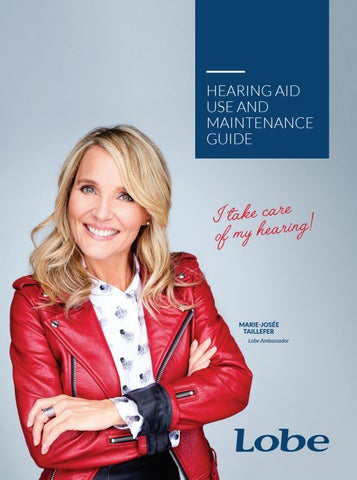
HEARING AID USE AND MAINTENANCE GUIDE
I takehceaarreing! of my
MARIE-JOSÉE TAILLEFER Lobe Ambassador
TABLE OF CONTENTS 4
Maintenance
6
Hearing aid maintenance products
8
Useful advice
11
Troubleshooting guide
14
Connectivity accessories
16
Assistive devices for television viewing
18
Assistive listening devices
20
Listening and communication strategies
22
Hearing health and communication professionals
CONGRATULATIONS! You have just taken an important step towards better hearing health. You will soon witness all the benefits that hearing aids can have on your quality of life and that of your loved ones. By taking care of your hearing, you have chosen yourself. You decided not to let hearing loss affect your daily life. Congratulations! Enjoy your new auditory environment! With all my love,
Lobe Ambassador
YOUR PERSONAL FILE Name: Date of purchase of your hearing aids: End of warranty on your hearing aids: End of warranty on your earmolds or shells: End of warranty on your connectivity accessories:
3
SETTING
Left ear (blue):
Right ear (red):
Battery type:
Your audioprosthetist: Your specialized educator: Address of the Lobe clinic: Telephone: Email: Š Lobe Guide 2019
lobe.ca
MAINTENANCE There are many different types of hearing aids, and just as many different ways of maintaining them. Be sure to follow the cleaning instructions provided by your audioprosthetist or specialized educator. STEPS TO CARRY OUT DAILY STEP 1
Before going to bed, spray solution onto a tissue and gently wipe the earmold, shell or dome (the portion that enters the ear) of your hearing aids, with the moistened tissue. You can also use cleaning towelettes or deep cleaner to clean your hearing aids.
STEP 2
4
Before going to bed, remove the batteries and place your hearing aids container. Be sure to keep the container closed at inside the all times, even when not in use. Avoid leaving it in a humid environment like a bathroom.
WRITE THE SCHEDULED REPLACEMENT DATE
WARNING! The tablet in the must be replaced when pale yellow (every 3 months).
STEP 3
Wax cleaner (wire pick)
To remove any buildup of earwax or dead skin on your hearing aids, use the wax cleaner (wire pick) or the cleaning tool.
Cleaning tool (black wire)
Be careful not to pierce the wax guard. The magnetic tip of the pick can be used to remove the battery. STEP 4
Brush: Use the brush to remove debris from earmolds, shells (ITE hearing aids), domes and shells (RITE hearing aids), or microphones.
Brush
WARNING! Never use the wax cleaner or the cleaning tool to clean hearing aid microphones.
lobe.ca
Š Lobe Guide 2019
WAX GUARD CHANGING FREQUENCY: Weekly
Monthly
Twice yearly
Every 3 months
WAX GUARD CHANGING STEP 1
Take a stick and screw the coloured end into the white opening of the hearing aid. Pull firmly to remove the wax guard to be replaced. STEP 2
180 °
Turn the stick 180°. STEP 3
Insert the new wax guard into the hearing aid opening, without screwing it in. STEP 4
Remove the stick from the hearing aid and discard it.
5
MAINTENANCE OF CUSTOM-FITTED EARMOLDS
Custom-fitted earmolds need a bit of maintenance to ensure proper hygiene. After all, an ear infection is the last thing you want! Clean earmolds after each use and before putting them in a storage container. CLEAN YOUR EARMOLDS
PUT ON YOUR EARMOLDS
lubricating gel for ears makes earmold insertion easy and painless.
To clean your customfitted earmolds, spray on a tissue and wipe earmolds gently to remove all earwax.
REPLACE YOUR EARMOLDS
Tip: Spray the product on a tissue, not directly on your earmolds to avoid clogging the filter (for filtered earmolds).
The lifespan of custom-fitted earmolds varies, especially in growing children whose auditory canal will change in size over time.
When your earmolds have reached the end of their lifespan, they will start sliding into the ear when you press on them.
RECOMMENDED CHANGE FREQUENCY OF CUSTOM-FITTED EARMOLDS FOR HEARING AIDS ACCORDING TO AGE
6 years of age and under
Every 4 months
Between 6 and 18 years of age
Every 6 months
19 years of age and over
Once a year
AVERAGE LIFESPAN OF CUSTOM-FITTED EARMOLDS
Children
1 year
Adults
2 years
WARNING! It is very important to use only cleaning products recommended by an audioprosthetist or a specialized educator, since other products may damage your earmolds. For example, alcohol will dry the material and cause cracks.
© Lobe Guide 2019
lobe.ca
HEARING AID MAINTENANCE PRODUCTS Upkeep is crucial! For reasons of both hygiene and performance, clean your hearing aids every day, preferably at bedtime. Be sure to use only products specifically designed for this purpose. Other cleaning products, such as solutions for eye glasses, may damage your hearing aids.
Daily Cleaner (60 ml - 120 ml) Cleans hearing aids and reduces the risk of ear canal infection while helping to keep repair costs down.
Daily Cleaning Towelettes Cleans hearing aids and reduces the risk of ear canal infection while helping keep repair costs down.
6
Deep Cleaner Cleans hearing aid earmolds.
Nightly Protector for Everyday Care Eliminates excess moisture, which can damage hearing aids and is the main cause of malfunction.
solution on a tissue and Spray gently wipe each hearing aid’s earmold, shell or dome. Can also be used to clean protective earwear (e.g. earplugs for musicians, swimmers, sleeping or noise). Discard any product remaining after one year of use. Tip: write the date when the product should be discarded on the label (discard on month/day/year).
towelette to wipe the Take a earmold, shell or dome of your hearing aids. Can also be used to clean protective earwear (e.g. earplugs for musicians, swimmers, sleeping or noise).
Light pressure is all that’s needed to wet the brush. Apply the cleaner to the earmold and brush lightly until the product has evaporated. You can use the product in the evening so it evaporates during the night. Discard any product remaining after one year of use. Tip: write the date when the product should be discarded on the label (discard on month/day/year).
Put a tablet under the container in the , making sure to remove the packaging and write the replacement date*. Open the hearing aid battery compartment door, remove the battery, place the hearing aid in the container and close the container.
*Note: The tablet in the should be changed when pale yellow (at least 4 times a year—every 3 months). Write the date when the product should be discarded on top of the tablet. The should always be closed, even when not in use. Avoid keeping it in a humid environment like a bathroom.
lobe.ca
© Lobe Guide 2019
Battery Tester Quickly indicates whether the battery is still good or needs replacing. Serves as the battery compartment.
Air Blower for Earmold Tubes and RITE Shells Eliminates moisture from earmold tubes.
Lubricating Gel Facilitates insertion of the hearing aid earmold, the ITE’s and RITE’s shell, and the custom-fitted earmold for musicians, swimmers, sleeping or noise.
tester. Insert the battery into Slide the battery over the gold-coloured part of the tester, keeping the “+” side up. : Battery OK : Battery needs changing
: Battery OK : Battery needs changing
Disconnect the earmolds from the hearing aids. Insert the air blower tip into the tube and squeeze until all moisture or condensation is gone. Using the air blower, dry the RITE’s shell vent and remove the dirt that’s stuck in the hollow part of the shell.
Apply a small amount of lubricating gel on the earmold or in-the-canal part of the shell, avoiding the receiver and microphone. Discard any product remaining after one year of use. Tip: write the date when the product should be discarded on the label (discard on month/day/year).
7
Soak a cotton swab and gently wipe the outer part of the external ear canal. Soothing Solution Relieves itching.
Warning! Never use this solution in case of a ruptured eardrum, an infection, or surgery in the ear. Consult an ENT specialist if in doubt. Discard any product remaining after one year of use. Tip: write the date when the product should be discarded on the label (discard on month/day/year).
TIP It is recommended you see your audioprosthetist twice a year (every 6 months). At the appointment, the audioprosthetist or specialized educator will perform a non-diagnostic otoscopy, and clean and check your hearing aids.
© Lobe Guide 2019
lobe.ca
USEFUL ADVICE BASIC GUIDELINES
To keep your hearing aids operating at their best for as long as possible, take these vital precautions: • Be sure to clean your hearing aids every evening, as wearing them may increase earwax production. • Clean your hearing aids using only products specifically designed for this purpose. • When cleaning your hearing aids, never use any liquid that has not been recommended by your audioprosthetist or specialized educator. For example, you should not use solvents, cleaning fluids, oil and even water.
8
• Never wear your hearing aids during an ultrasound or similar treatment. • Other types of electromagnetic rays—for example, those emitted by monitoring room equipment, alarms, radio equipment and cellphones—are too weak to damage hearing aids. However, they may cause noise or distortion. • There is no need to remove your hearing aids to go through an airport scanner.
• Do not store your batteries in the freezer.
• When travelling, take cleaning towelettes or cleaner (the 60-ml size is permitted through preboard security screening).
• Handle your hearing aids with care, preferably over a table or counter to avoid accidental breakage.
• Never try to repair your hearing aids yourself. Consult your audioprosthetist or specialized educator.
• At night, when your hearing aids are not in use, leave the battery compartment door open and store them in the .
• When you remove your hearing aids, store them in the case. Never wrap them in a tissue or put them directly into your pocket, since this can lead to loss, damage, or accidental disposal. • Never leave your hearing aids in the bathroom, since it’s a humid environment. • Never expose your hearing aids to excessive heat or high humidity. • Never let your hearing aids come into contact with solvents, sprays or perfumes. • Some types of electromagnetic waves (such as those emitted by certain imaging procedures) can damage hearing aids. Always remove them in these situations. lobe.ca
TIPS • Did you know it is recommended you wear your hearing aids for at least 4 to 6 hours per day starting the first day? It will help you readapt quickly to hearing everyday sounds again. • It is better to clean your hearing aids in the evening when removing them for the night, to avoid products coming into contact with your skin. • When you change the battery, stick the tab from the new battery onto your calendar. Battery life is about seven days.
© Lobe Guide 2019
USEFUL ADVICE ZINC-AIR BATTERIES
Zinc-air batteries offer a great ratio between battery life and cost. Battery life depends on the type of hearing aids, the model, the amplification degree required, and the quality of the battery. Rechargeable batteries are also available for some types of hearing aids. • Make sure to use the required battery for your hearing aids. • Since batteries are very small, we recommend that you always handle them over a table. • Hearing aids have a low battery signal. Just like smoke detectors, hearing aids send a signal to warn you when you need to change the battery. • In order for your battery to last as long as possible, open the battery compartment when you’re not wearing your hearing aids. You will then prevent them from consuming batteries unnecessarily. • The battery is correctly placed when the is on the same side as the of the battery compartment. If closing the battery compartment is difficult, it means that the battery is not well installed. The battery must always be placed in the battery compartment.
TIP
When you change the battery, take the sticker and put it on your calendar. This will help you remember when you last changed the battery and what is its average lifespan.
9
• As soon as you remove the sticker, the battery is activated when it comes into contact with oxygen. Even if you put the sticker back, the chemical reaction is engaged and won’t stop. Replacing the sticker won’t help you keep your battery longer. BATTERY CHANGE 1
2
Open the battery compartment and remove the old battery.
Remove the sticker on the new battery.
3
Insert the new battery in the battery compartment, making sure the side is facing up.
An assessment by an audioprosthetist is required to determine which hearing aid suits the patient’s needs.
© Lobe Guide 2019
lobe.ca
USEFUL ADVICE WARRANTY VS. INSURANCE
10
When you purchase hearing aids, they come with a warranty against circuitry defects, but no protection against loss, theft or accidental damage. The warranty typically includes two or more years of coverage against circuitry defects. This warranty doesn’t imply a warranty on the earmolds and shells. Since manufacturers’ warranties do not protect against loss or major damage, preventing such situations becomes vital in order to avoid distress or complications. Your hearing aids are invaluable and indispensable to your quality of life!
INSURANCE AGAINST LOSS OR DAMAGE
We recommend checking with your insurer to see if your hearing aids are automatically covered by your home insurance policy or if you need to take out special coverage. We suggest that you verify this when you first receive your hearing aids.
I ALREADY HAVE MY HEARING AIDS... No problem! It’s never too late to get insurance for your hearing aids.
REGARDLESS OF WHAT THEY COST, IT’S IMPORTANT TO ENSURE THAT YOUR HEARING AIDS ARE COVERED AGAINST LOSS, THEFT OR ACCIDENTAL DAMAGE BY YOUR HOME INSURANCE. ASK YOUR AUDIOPROSTHETIST OR SPECIALIZED EDUCATOR FOR A LETTER DESCRIBING THE CHARACTERISTICS OF YOUR HEARING AIDS, WHICH YOU CAN GIVE TO YOUR INSURER.
lobe.ca
© Lobe Guide 2019
TROUBLESHOOTING GUIDE HOW DO I KNOW IF THE HEARING AID WORKS?
1
Put the hearing aid in your hand.
PROBLEMS
NO SOUND
2
3
Close and open your fist many times and bring it close to your ear.
You should hear a whistling sound.
CAUSES
SOLUTIONS
The opening of the earplug or wax guard is blocked.
Clean the earplug opening or change the wax guard (see p. 4-5).
Dead battery.
Change battery (see p. 9).
Defective hearing aid.
Call us to make an appointment with an audioprosthetist or a specialized educator to check your hearing aids.
The opening of the receiver or wax guard is blocked.
Clean the receiver opening or change the wax guard (see p. 4-5).
Defective hearing aid.
Call us to make an appointment with an audioprosthetist or a specialized educator to check your hearing aids.
11
LOW SOUND
An assessment by an audioprosthetist is required to determine which hearing aid suits the patient’s needs.
© Lobe Guide 2019
lobe.ca
PROBLEMS
INTERMITTENT SOUND OR SIZZLING
12
CAUSES
SOLUTIONS
Moisture in the hearing aid, earmold tube or RITE’s shell.
Place the hearing aid in the container for a few hours or use the air blower to dry the earmold tube or shell. If that doesn’t solve the problem, call us at 1 866 411-5623 to make an appointment.
Microphone background noise.
Call us to make an appointment with an audioprosthetist or a specialized educator to check your hearing aid.
Defective hearing aid.
Call us to make an appointment with an audioprosthetist or a specialized educator to check your hearing aid.
Misplaced earmold or hearing aid.
Reinsert earmold or hearing aid.
Inappropriate adjustment.
Call us to make an appointment with an audioprosthetist or a specialized educator to check your earmold or hearing aid.
Allergies.
Call us to make an appointment with an audioprosthetist or a specialized educator to check your earmold or hearing aid.
Sensitive skin.
Use
Low battery (indicator is on).
Change battery (see p. 9).
Moisture on the circuit.
Place the hearing aid in the container for a few hours. If that doesn’t solve the problem, call us at 1 866 411-5623 to make an appointment.
Defective circuit.
Call us to make an appointment with an audioprosthetist or a specialized educator to check your hearing aid.
PAIN OR DISCOMFORT
HEARING AID IS BEEPING
lobe.ca
lubricating gel.
© Lobe Guide 2019
PROBLEMS
RESONANCE OR WHISTLING WHEN THE HEARING AID IS IN THE EAR
CAUSES
SOLUTIONS
Misplaced earmold or hearing aid.
Reinsert earmold or hearing aid.
Possible earwax buildup or other disorder in the ear.
Ask your audioprosthetist or your specialized educator to perform a non-diagnostic otoscopy to make sure there is no earwax buildup or other disorder in your ears.
Adjustment needs.
Call us to make an appointment with an audioprosthetist to check your hearing aid.
Earmold is too small.
Call us to make an appointment with an audioprosthetist or a specialized educator to check your hearing aid.
Volume is too high.
Lower the volume.
That depends on your hearing aid gain level.
Call us to make an appointment with an audioprosthetist or a specialized educator to check your hearing aid.
13 Poor quality batteries.
Make sure to use high quality batteries recommended by your audioprosthetist.
Misused batteries.
Make sure to open the battery compartment when you’re not wearing your hearing aids.
HIGH BATTERY CONSUMPTION
Never put batteries in the
MY VOICE IS DIFFERENT OR LOUD
© Lobe Guide 2019
It’s a matter of adaptation.
If it doesn’t stop, call us to make an appointment with an audioprosthetist to check your hearing aid.
Volume is too high.
Lower the volume.
lobe.ca
CONNECTIVITY ACCESSORIES THE DIGITAL REVOLUTION IS ALSO FOR HEARING!
Connectivity accessories incorporate technologies that let you receive sound from different sources— televisions, MP3 players, cellphones, conference speakers, and so on—directly in your hearing aids, just as if you were wearing headphones. Some devices are compatible with Apple products, and others with Android products.
Wireless transmitter for television
Mobile app
Remote microphone
Wireless transmitter for television
Remote microphone +
Remote control
Wireless transmitter for television
Transmitter for cellphone
Remote control
14
EVERY CONNECTIVITY ACCESSORY HAS ITS CHARACTERISTICS. YOUR AUDIOPROSTHETIST CAN HELP YOU CHOOSE THE ONES THAT BEST SUIT YOUR NEEDS.
lobe.ca
© Lobe Guide 2019
APP FOR SMARTPHONES What can I do with the app?
The app’s main screen lets you make adjustments to your hearing aids, making your smartphone a remote control. You can adjust the volume up and down, change the preset programs or turn off the microphone sound (silent mode). You can also modify the direction of your microphones for noisy environments like in the car or at a restaurant. You can also find other information, such as battery life. To learn more about the app, see the guide in your app settings. IPHONE
1
Install the app for your hearing aids from the App Store.
2
Go to Settings My device Accessibility Hearing aids.
3
To connect your hearing aids to your cellphone, open and close the battery compartment.
4
After 5–7 seconds, your name will appear. E.g. Sébastien’s hearing aids.
5
Tap your name to connect.
6
Pairing might take a few seconds for each hearing aid.
15
ANDROID
Install the app for your hearing aids from the Google Play Store. The procedure for pairing hearing aids with an Android cellphone varies from one phone model to another. Talk to your audioprosthetist if you need help in the process.
© Lobe Guide 2019
lobe.ca
TIP Next time you go to the movies, find out whether listening systems are available for hearingimpaired people.
16
ASSISTIVE DEVICES FOR TELEVISION VIEWING TV listening systems are designed to help you enjoy your favourite shows. These systems improve the signal-to-noise ratio by enabling binaural listening (hearing with both ears) and lessening the gap between the speech source and aural perception of the audio signal. Independent volume control lets you set the sound to the level that suits you best, without disturbing others in the room. These systems can also be directly connected to your stereo system or radio.
Receiver Transmitter SET 860
The Set 860 captures the sound of your TV with an extremely light stethoscope receiver. It comes with standard earmolds and with other conical earmolds designed for narrow ear canals.
TV listening systems are transmission systems with frequency modulation. They transmit audio signals from televisions, computers and other media through a transmitter that amplifies the sound and a receiver that picks up the amplified signal. Users wearing the receiver can move around the house without cutting the sound. The wireless system has a range of 30 metres, and waves can easily go through walls and ceilings. When the battery is fully charged, the device can operate 10 to 12 hours, depending on how it is used. Some models may be eligible for coverage by agencies like RAMQ, CNESST, Veterans Affairs or private insurers. For more information, consult an audioprosthetist or a specialized educator.
lobe.ca
Receiver Transmitter FLEX 5000 AND HD 2.10
The Flex 5000 has a receiver with an earphone jack for connecting to other audio accessories (e.g. headphones or earbuds). It is also equipped with a clip to attach to clothing. © Lobe Guide 2019
TELEVISION SYSTEM INSTRUCTIONS AND CONFIGURATION Receiver
Base (transmitter)
HD 2.10 headphone
8 2
1
5
7
is connected to the television or the terminal provided by your cable company. First, connect
9
the adaptor (yellow wire A) to a power outlet and to the yellow socket behind the base. Here are the different sound connections:
3
• Wire B (blue): must be plugged in a small AUDIO OUT input.
4 6
CONNECTION 1. The base (transmitter) must be close to the television. There are two wires: the adaptor (A) and audio cable (B, C and D). The audio cable
3
• Wire C (white and red): plug the white end
1
Power on button
Press any key to turn the receiver on.
2
Power off button
Press the button for two seconds to turn the receiver off.
3
Headphone input
Plug the headphones in here.
4
Battery charger
Place the receiver on the base to charge the battery.
5
Battery indicator light
When all three lights illuminate without blinking, the receiver battery is fully charged.
6
Green indicator light (receiver)
A green light illuminates when the receiver is on.
7
White or blue indicator light (transmitter)
An indicator light illuminates to indicate that the transmitter is broadcasting sound to the receiver.
Balance
If your hearing is not the same in both ears, press L (left) to adjust the sound in the left ear, or R (right) to adjust it in the right ear. To reset the balance sound, press both buttons (L and R) simultaneously for three seconds.
8
9
Listening profiles
© Lobe Guide 2019
By pressing this button, you can choose a listening profile that modifies the sounds you hear. Profile 1: the sound is softer. Profile 2: the sound is louder and clearer. Profile 3: the sound is clearer.
into the white input and the red end into the red input, in an AUDIO OUT input.
• Wire D (pink): plug the wire in the Digital AUDIO OUT (optical). The connection into the AUDIO OUT jack allows the people around us to adjust the TV volume at their convenience. 2. Then use the clip to place the receiver on your clothes. Plug the headphones and place them on your ears. Press the - or + button on the remote control to turn the system on. Finally, use the same buttons to adjust the volume. 3. When you’re done watching television, hold the receiver button (located on the side) for two seconds to turn it off. Then place the receiver on the base to recharge the battery.
WIRE A
WIRE B
WIRE C
WIRE D
lobe.ca
17
ASSISTIVE LISTENING DEVICES Assistive listening devices (ALDs) ease day-to-day living for people with hearing loss. The wide range of ALDs available is designed to address specific needs such as using the telephone, watching television, participating in conferences, and seeing shows. They can be covered by agencies like RAMQ, CNESST, Veterans Affairs, according to eligibility criteria.
AMPLIFIED PHONE
ADAPTED ALARM CLOCK
18
VISUAL AND TACTILE RECEIVERS
Has a vibrating pad that can be placed under a mattress or fitted sheet. When it is time to wake up, the pad vibrates.
The visual receiver flashes when the detector is triggered. There are smoke, doorbell and phone ringtone detectors. An image appears on the receiver indicating which detector is active. The tactile receiver works the same way, but instead of emitting a flashing light, it vibrates when a detector is triggered. For nighttime security, a vibrating pad connected to the receiver can be placed under the mattress to wake the person up.
SMOKE DETECTOR
Sends a signal to the visual or tactile receiver to indicate there is smoke in the room.
PHONE RINGTONE DETECTOR
Sends a signal to the visual or tactile receiver to indicate the phone is ringing.
DOORBELL DETECTOR
Sends a signal to the visual or tactile receiver to indicate there is someone at the door.
PERSONAL AMPLIFIER
lobe.ca
Enables better speech perception by increasing the volume and adjusting bass and high sounds.
Picks up a conversation partner’s speech when a person is not wearing hearing aids. It is simply a microphone connected to earphones. The volume can be adjusted to a comfortable level.
© Lobe Guide 2019
USING THE PHONE How your hearing aids process audio signals over the phone will depend on their listening settings and the location of their microphones. Here is a quick reference: MANUAL PHONE PROGRAM
1
Answer the phone and ask the caller to hold on for a moment.
2
Press the button or use the remote control to activate the phone program (if you have one).
3
Align the handset against your ear, next to the part of the hearing aid containing the telecoil or microphone, as shown by your audioprosthetist or specialized educator.
4
Once the call is over, press the button or use the remote control to return to the previous program.
AUTOMATIC PHONE PROGRAM
1
Answer the phone by placing the handset against your ear, next to the part of the hearing aid containing the telecoil or microphone, as demonstrated by your audioprosthetist or specialized educator. The hearing aid will automatically switch into phone mode.
2
Once the call is over, the hearing aid will automatically revert to the previous program.
NO TELEPHONE PROGRAM
Answer the phone, placing the handset against your ear, next to the part of the hearing aid containing the microphone, as shown by your audioprosthetist or specialized educator.
MAGNETS
TIP
Ask your audioprosthetist or specialized educator how to use magnets to increase the magnetic field.
If you hear whistling, the handset is too close to your hearing aid. Move it away slightly or get a listening pad.
© Lobe Guide 2019
lobe.ca
19
LISTENING AND COMMUNICATION STRATEGIES Hearing-impaired people and their friends and family frequently face communication problems. Listening and communication strategies can help improve comprehension. Hearing-impaired people and their conversation partners share the responsibility for using these strategies. 20 ADVICE FOR FRIENDS AND FAMILY
1
Make sure you’re in the same room as the hearing-impaired person when speaking.
2
Get the person’s attention before speaking (e.g. by calling their name, tapping their shoulder, etc.).
3
Stand near the person and face them to make lip-reading easier.
4 5
Speak slowly and clearly, but don’t overdo it. Do not shout.
6
If certain words are misunderstood, repeat using different words.
7
Turn off any background noise sources (TV, radio, dishwasher, music, etc.).
8
Make natural gestures and avoid covering your lips.
9
Indicate the topic of conversation and clearly signal a change in topic.
10 lobe.ca
ADVICE FOR HEARING-IMPAIRED PEOPLE
1 2
Wear your hearing aids. Let it be known that you have difficulty understanding.
3
Look at the person you are speaking to and watch their lips. Observe them as they speak.
4
Turn off any background noise sources (TV, radio, dishwasher, music, etc.).
5 6
Ensure that the face of the person you’re speaking to is well lit.
7
In a meeting, ask people to speak one at a time.
8 9
Ask about the topic of conversation.
Ask people to speak slowly. Ask questions.
Ask questions.
© Lobe Guide 2019
Other strategies might be helpful: • It’s important to tell your discussion partners about your hearing loss. They will then make sure you understand well. • Moving closer (one or two meters from discussion partner) reduces communication problems. Indeed, sound loses intensity when crossing obstacles in its path. • Talking face to face facilitates lip-reading and helps understanding emotions through facial expressions. • Your conversation partners should never speak with a hand in front of their face.
• Choosing the place where you sit may also facilitate communication. At the restaurant, ask to sit at a table close to a wall. Upholstered benches also absorb noise. If you are one-on-one, face each other. If you are with a group, make sure to see as many faces as possible, or sit near the people most likely to talk to you. • Prioritize private rooms in restaurants. • To improve your understanding or reduce your discussion partners’ impatience, avoid words like What? or Sorry? Instead, mention the part that you understood or ask to repeat using other words. You can ask for a sticker of the International Symbol for Deafness in a Lobe clinic.
• It’s important to pronounce well, without exaggerating, which may alter lip movement. • Yelling is not recommended since it alters pronunciation. The auditory system may also distort words, due to hyperacusis. Just raise your voice slightly.
• You can inform your municipality of your hearing loss, in order to facilitate communication, especially in case of an emergency.
• Speaking slowly makes it easier to follow lip movement and to understand speech. • Well-lit places help to see the face better. • The person talking to a hearing-impaired person should never stand against the light, back to a window for example, because it creates a shadow on the face. • Ambient noise is the enemy of communication, so it is essential to reduce it. For example, background music at a dinner party may affect the understanding of a hearing-impaired person. Turning the dishwasher or range hood off is another way to facilitate communication.
Read the guide Communication Strategies for Hearing-Impaired People, which is available in all Lobe clinics.
© Lobe Guide 2019
lobe.ca
21
HEARING HEALTH AND COMMUNICATION PROFESSIONALS The mission of the professionals practicing in the Lobe clinics is to make a difference in people’s lives. They do so through a multidisciplinary, patient-centred approach and by providing people with hearing, language and speech disorders with the necessary resources to improve their quality of life. 22 ENT (ear-nose-throat) specialist
Specialized educator
Treats illnesses of the head and neck (ears, nose and throat). The services of ENT specialists are reimbursed by RAMQ.
Working with an audioprosthetist, educates hearing-impaired patients on their hearing aids and offers hearing re-education. The services of specialized educators are free of charge.
Audiologist Fully evaluates hearing (hearing test) and central auditory processing disorder (CAPD). The services of audiologists are reimbursed in part by CNESST (with medical prescription), Veterans Affairs Canada, and most private insurance plans. All recommendations from health professionals are accepted.
Audioprosthetist Helps hearing-impaired patients select hearing aids and assistive listening devices, and makes required adjustments during fitting. The services of audioprosthetists can be reimbursed by RAMQ, CNESST, Veterans Affairs Canada, and most private insurance plans.
Hearing health nurse Participates in awareness activities, runs auditory screening tests, and gives presentations on hearing to workers and the general public. Handles all aspects of tailored hearing protection devices. The services of hearing health nurses are available for a fee.
Speech-language pathologist Assesses and treats disorders related to speech, spoken and written language, and swallowing. The services of speechlanguage pathologists are reimbursed by most private insurance plans.
Just one call. We listen. We care.TM
An assessment by an audioprosthetist is required to determine which hearing aid suits the patient’s needs. lobe.ca
© Lobe Guide 2019
80% OF PEOPLE WITH HEARING LOSS AREN’T DIAGNOSED OR TREATED* *Ordre des audioprothésistes du Québec
This statistic clearly shows the need to make people aware of the importance of maintaining good hearing health and point them toward a hearing health professional when they have questions about their hearing. These objectives gave rise to Lobe Magazine, a free informational publication that is distributed across Quebec, in English and in French. Lobe Magazine features articles by hearing health and communication professionals. Each article is
meant to inform people of the various issues tied to hearing, language and communication. Our ambassador, Marie-Josée Taillefer, also writes a column in each issue of the magazine. Lobe Magazine offers readers accurate, relevant information that will help them improve their lives and break the isolation caused by hearing loss.
Because in Lobe clinics, every moment deserves to be heard.
FOLLOW US!
QUESTIONS? COMMENTS?
WRITE TO US!
facebook.com/cliniqueslobe linkedin.com/cliniqueslobe youtube.com/user/votreLobeTV
Email us at courrier@lobe.ca
SUBSCRIBE TO THE LOBE MAGAZINE
£ Mr. £ Ms.
Fill out and cut the form and send it to the address below, with your payment if applicable. The cheque must be made to the order of “Publications Lobe”.
£ Organization / Association:
Lobe Magazine, Complexe Vision, 725, boulevard Lebourgneuf, suite 303 Québec (Québec) G2J 0C4
Name:
£ French version
£ English version
Subscription for general public £ One year (4 magazines): $10,00*
Address: Postal Code:
£ Two years (8 magazines): $20,00*
City:
* To cover mailing costs
Province:
£ Free of charge subscription for
associations, schools, organizations, health professionals, etc.
Phone #: Number of copies:
© Lobe Guide 2019
Email address:
lobe.ca
23
CONFERENCE TOUR
L’AUDITION, UNE PRIORITÉ By Marie-Josée Taillefer, Lobe Ambassador
Lobe Ambassador, Marie-Josée Taillefer, gives conferences about hearing health throughout Quebec. Visit lobe.ca to learn more about Marie-Josée’s visits in your area.
MARIE-JOSÉE TAILLEFER
Lobe Ambassador
Hearing health and communication clinics To find the nearest clinic: lobe.ca411-LOBE 1 866 lobe.ca
(5623) | lobe.ca
ENT SPECIALISTS
HEARING HEALTH NURSES
AUDIOLOGISTS
SPECIALIZED EDUCATORS
AUDIOPROSTHETISTS
SPEECH-LANGUAGE PATHOLOGISTS
© Magazine Lobe 2015 Just one call. We listen. We care.TM
© Lobe Guide 2019