
THE RAMBLING ROSE
Clifton High School Pupil Newspaper

Foreword
It is strange how loudly the world seems to speak these days. We tune our ears for poetry or birdsong, yet what reaches us instead is a constant thrum of claims, counterclaims, and headlines that shapeshift before we have even absorbed them. When I began writing this Foreword, the mornings had just begun to lighten, and the birdsong felt newly noticeable. It reminded me of something we all know but often forget: Truth has its own music … we simply have to want to hear it.
This issue of The Rambling Rose asks what it means to listen carefully in a world crowded with distortion. Our journalists examine political disinformation- not as an abstract worry, but as a force that seeps into conversations, reshapes opinions, and blurs the edges of shared reality. They explore how certainty can be manufactured, how doubt can be weaponised, and how fragile our sense of truth can become when noise overwhelms clarity.
Running alongside these inquiries is a second thread: The Environment. Here, too, the uncomfortable truth is that humans - not nature - now write the most dangerous chapters of our story. Several pieces confront that reality with honesty: shrinking ecosystems; plastics that outlive generations; temperatures rising enough to redraw coastlines. There is no melodrama in these pages, only precision and a refusal to pretend the consequences lie elsewhere. These are topics that matter to this generation.
What strikes me most is the tone. When our pupils write about difficult things, I see how despair gives way to determination. They question, challenge, and reimagine. They look for how trust might be rebuilt and how damage might be repaired. Their curiosity becomes a quiet form of activism. I feel relieved.
Amid these weightier pieces are also moments of joy - reflections on creativity, culture, language, and the small wonders that persist even now. (Who knew that vectors can be curly?!)
Noticing them is its own resistance.
Before I wind up, an enormous CONGRATULATIONS is owed to Sunny Wan and Matthew Tsang – our exiting co-editors. They have enjoyed healthy competition for most column-inches over many years; without a doubt this has fuelled wider participation from across the school for more articles and more journalists. Equally crucial has been the ruthless efficiency with which they have organised, edited and liaised between staff and pupils to bring the finished issues to our eyes. Huge thanks to both of you, Sunny and Matthew and very best of luck in your A level exams this year! Following in their stead come Amba Derrington and Jason Tsang as co-editors; and Ella Chnokar and Julia Schiszler as features editors. Wishing our new Fab 4 all the best in their new roles!
I hope you read slowly. Let these pieces unsettle you a little - and inspire you a lot. And if you hear birdsong as you finish, pause long enough to listen. It has been trying to tell us something all along.
Mrs Pippa Lyons-White Head of English
ART, FILM & CULTURE
Film Directing 1O1
How has Wes Anderson crafted originality?
Up until around three months ago, if you’d asked me who the film director Wes Anderson was, I would probably have said something along the lines of ‘Oh, I liked Fantastic Mr. Fox and his cinematography is really cool, but honestly I don’t know much about him.’ What prompted me to write this article was that two days ago, my friend went to a Wes Anderson exhibition, and I opened my text messages to find 40+ attachments of photos of Claymation and short clips of cameras and outfits and props behind glass. As of about three hours ago, I also finished watching ‘The Darjeeling Limited’ (2007) and as is the case with any good piece of film, I fell down a ‘postwatch information rabbit hole’ of YouTube videos and JSTOR articles analysing Wes Anderson’s directing techniques. All of which I will relay in this essay, through the following factors: his background, his camera techniques, his screenplay writing, his use of colour, Claymation and soundtrack, then evaluated through two case studies.

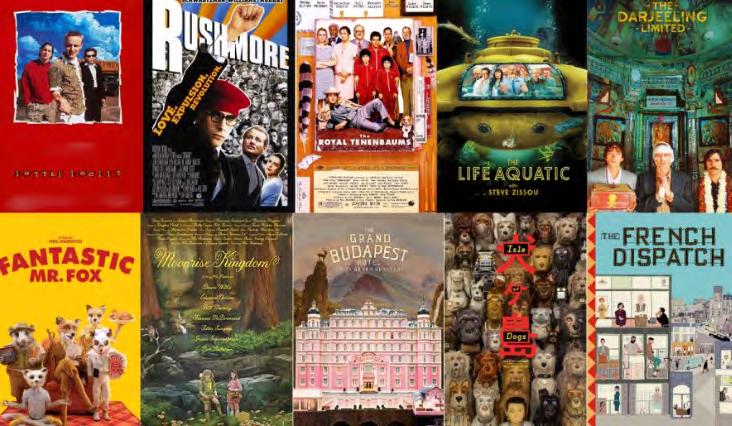
Background & Reputation:
Wesley Wales Anderson, Wes for short, is an American director born and raised in Houston, Texas. He began making films as a child. While attending the University of Texas at Austin and studying philosophy, Anderson roomed with the actor Owen Wilson, a frequent early collaborator. They worked together on Anderson’s directorial debut, Bottle Rocket.
That film, released in 1996, was a box office flop but a critical hit, establishing Anderson as a director to watch. In his next effort, ‘Rushmore’ (1997) the young auteur began sharpening his style. He also started his longstanding collaborations with Jason Schwartzman and Bill Murray, which continues to this day. Anderson has directed 12 films, most recently the 2024 release ‘The Wonderful Story of Henry Sugar and Three More’ (2024). His movies have received universally good reviews and high audience scores, though most have been undistinguished performers at the box office. Wes Anderson movies are known for stylistic elements, such as long takes, a stylized colour palette that recurs throughout, quirky costumes, and monochromatic set design.
Camera:
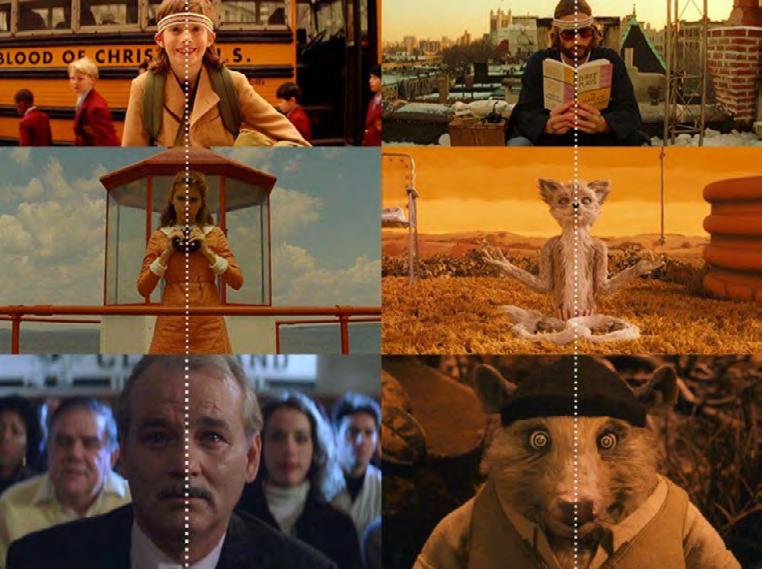
Arguably the most distinctive feature of Anderson’s work is the experimentation of composition (the arrangement of visual elements within a frame). His camera techniques can be summarised, as video-essayist Thomas Flight put, as ‘symmetry, arranged flatlays, slow-motion, landscape camera pans, and most significantly, planimetric composition’. Planimetric composition is the orientation of elements of a scene, especially the background, as flat plains relative to the camera; essentially the background is flat and the foreground comes forward. For example, during a fight scene in ‘The Darjeeling Limited’ (2007) the blue patterned wallpaper and brown wood was kept
CULTURE

Wes Anderson also orients characters along plains; Bordwell calls it ‘compass point editing’, in which the camera only faces in one direction, panning 90-degree increments. Furthermore, when doing panoramic shots or moving horizontally across a frame, Anderson keeps in shaky and imperfect shots, seen in ‘Moonrise Kingdom’ when the crew was moving the camera across a field; although it is in his budgets to get cameras that can achieve smooth pans, it is clear from this that he wants the audience to know there is a director behind the screen, proving his rejection of naturalism. Naturalism is the typical structure of filmmaking that tries to hide the camera work; comparing a scene shot in a hallway from Christopher Nolan’s ‘Inception’ (2010) with a similar scene in Anderson’s ‘The Grand Budapest Hotel’ (2014), the first one looks almost realistic in the way it is composed, whereas the latter has a more artistic quality, emphasised by the symmetry.

To understand why he does this, critic Claudia Pak waffles that ‘(the) eccentricity which marks his films often bifurcates audiences’, however I think that it is more important to see why other directors avoid these techniques, rather than try and summarise characters’ emotions in big words. Anderson says, ‘The emotion is what I’m trying to get at. The style is just how I get there’. It is, as Flight puts it, ‘because flat composition feels constructed. It feels self-conscious.’ What Anderson does is he makes the scene claustrophobic, which takes away from the storytelling to show the pure art of the shots. Look at the scene above again, for example; the scene feels almost intimidating. That use of cinematography and flat composition is what gives his films their ‘Wes-Anderson-esque-ness’.
Colour, soundtrack and screenplay:
Most film directors have a pretty good awareness of colour theory: bright colours for uplifting scenes, darker and weaker colours for tragic scenes, red for love, blue for sadness, the list goes on. Wes, however, prefers to complicate it. He, as video essayist channel ‘StudioBinder’ says, blurs the lines between joy and darkness.’ Wes Anderson is notoriously known for his use of vibrancy, clear in ‘The Grand Budapest Hotel’.
The DNA of colour (this is where it gets dull, no pun intended, so I will keep it brief) is HSB: hue, saturation and brightness.

Hue is a colour family and refers to the undertones of colour; Anderson uses primary hues, usually reds and yellows. Saturation refers to the intensity of colour, and he typically uses a very high saturation so that the primary colours really pop. Brightness means how light or dark a given colour is. Much like storybook characters, Wes Anderson’s are often connected to a single, for example in ‘The Grand Budapest Hotel’ Gustave is purple. ‘StudioBinder’ comments that ‘his worlds are bright and colourful, but that’s just a facade. What’s not obvious is the effect of combining these colours with Anderson’s dark subject matter.’ This colour bipolarity is seen in ‘The Royal Tenebaums’ when the bright film contrasts with the perspective of a suicidal character, essentially whiplashing the audience.
Another way that Anderson layers meaning is through music. In ‘The Darjeeling Limited’ I was pleasantly surprised when ‘Strangers’ by The Kinks came on; it is common in his movies to use ‘hidden gem’ songs, however, in that film he also worked with the Indian director and composer Satyajit Ray to honour the culture in which the movie is set. Typically, Anderson works primarily with Devo frontman Mark Mothersbaugh and French composer Mark Alexandre Desplat (the latter also composed ‘Little Women’ (2019), which is one of my personal favourite movies, and ‘The Shape of Water’ (2017)). Anderson uses scores in the background, like in ‘Fantastic Mr. Fox’ when he wants attention on the dialogue, then soundtracks in the foreground, like in ‘Bottle Rocket’ featuring ‘2000 Man’ by The Rolling Stones. The critic website ‘MUSICBED’ comments, ‘He accomplishes his seamless timing in three distinct ways: in the use of montage, slow motion and by always connecting a theme in his story directly to a song’, and although I agree, I would also say that his timing in music and visual cross-over is also clear from when he doesn’t use music. In a scene involving a student protest in ‘The French Dispatch’ (2021), there is a moment of silence to emphasise the tension, so his use of sounds further pushes visuals to the foreground. In ‘The Life Aquatic’ (2004) he also includes David Bowie songs, so it is therefore high on my watchlist.
Screenwriting is the script for characters in a story, alongside small side notes including delivery, diction and any accompanied action. A good screenplay (which is the entire document of dialogue) is often labelled as the makeor-break of a piece of film, as has been the source of much criticism of the Duffer Brothers final season of ‘Stranger Things’ (2025). What Wes Anderson does is he simplifies dialogue, focusing on telling stories visually, then he drops in nuggets of philosophy that can’t necessarily be conveyed through camera work; in ‘Fantastic Mr. Fox’ (2009), the famous quote ‘I don’t want to live in a hole anymore,’ stands out in this way.
Additionally, Anderson’s screenwriting process often mirrors the stories themselves, and I want to shine a spotlight on ‘The Darjeeling Limited’, which follows three brothers on a character-developing train ride across India, dealing with themes of brotherhood and grief. The script was crafted by himself and two other men actively travelling across India, by train. It is his direct involvement in the stories that Flight comments ‘It is this aspect of (the) director as a character that makes Wes’ films so appealing to anyone interested in filmmaking’.
‘The French Dispatch’ (2021):
‘The French Dispatch’ is a four-part film structured as articles in a French Press Paper. The narrative ties together to reveal the crafting behind the ‘articles’ and is essentially three stories within one. The overarching plot follows the death of the newspaper editor and the creation of the final issue, in which are the four stories and an obituary (epilogue revolving back to the editorial room). Straight-forward, right?
This use of an atypical narrative is also seen in: ‘The Royal Tenenbaums’, which is presented as a book, ‘Rushmore’ with curtain effects like a play, and ‘The Life Aquatic’ is critiqued as ‘a film within a film’, much like ‘The French Dispatch’. The mismatched structure spanning across the 1970s and 1980s, as well as including mixed media of an entirely black-and-white ‘article’, a mix of English and French with subtitles, and part of the last one being hand-drawn clearly shows Anderson’s ability to highlight the craft, the actual art of film-making, purposely drawing the audience’s attention to the film-making. I have not discovered any other movie that presents its narrative in this diverse of a variety of media.
‘Fantastic Mr. Fox’ (2009):
Wes Anderson adapted the Roald Dahl book ‘Fantastic Mr. Fox’ into a Claymation movie in 2009, and although it might be an obscure choice of media for a children's book, that is exactly what gives it its charm. Production began in 2004; however, it accelerated after 2007 when Revolution Studios took on the project.

No doubt the figurines and sets, all hand-crafted, are impressive and unique in the film industry, especially for 2009 (interestingly ‘Coraline’, another acclaimed Claymation film was released only eight months before). However, what stands out to me the most is the ‘director’s fingerprint’ on the project; this is a term that had been used to describe his work previously, insinuating that he gave movies his own style, however this displayed literally in the 2009 movie. To arrange stop-motion figures, touching them results in a disturbance of fur and fabric, creating a fuzzy effect. Anderson took inspiration from the 1939 movie ‘King Kong’, in which the monster has real fur and therefore has a ‘windswept’ effect. Anderson insisted on using real fur for his movie.
Now, another of his stop-motion movies is ‘Isle of Dogs’ (2018) and commenting on when I was nine years old watching it for the first time, to say that I hated it would be an understatement. I, for one, had no idea who Wes Anderson was, and two, I think I just remember being disgusted by the amount of trash (literal clay sets of trash bags and piles of rubbish) that Anderson chose for the aesthetics of the film. However, although I wouldn’t rewatch it (and it is okay to not like movies of a director that otherwise is admirable) it is a prime example of the timeconsuming media of a hand-crafted movie; it includes 950 shots and 8,000 elements (frames). Ian Failes, who worked on set, said ‘I think there were about 250 sets for this film. ‘Fantastic Mr. Fox’ had 75.’ This dedication to crafting a movie, especially with clay, is so creative in the film industry and deserved its nomination for Best Animated Picture that year at Academy Awards.
The message of the film is also beautiful, with Mr. Fox coming to the realisation that he was equal to those around him, and his relationships were more valuable than his pride. The film, although it is studded with moments of philosophical thinking and tragedy, ends in a montage dance scene of the animals, which I think, above all, is wholesome and uplifting. Some may say it is silly, but if anything, the ‘absurdity of it’ (as one critic reviewed on Letterboxd) is what makes it such a nostalgic and beautiful piece of cinema.
In conclusion, Wes Anderson is an inspiring director, whose work stands out amongst the recycled and Ai influenced (yes, I am referencing Adrien Brody’s win at the Oscars) cinema often made nowadays to avoid risk and the common failure and not-so-common backlash that he was met with following ‘The Life Aquatic’ amongst others of his movies, given that his style is so unique. Anderson has made a significant impact on filmmaking, and his style will become increasingly valuable in the up-and-coming age of Ai; many film schools and directing institutions now value creativity and originality as some of directors’ top qualities. London Film School defines their philosophy as ‘London Film School – a place to experiment, find your voice, and connect with the industry.’ and whilst this may come across as cliche, the word ‘experiment’ links directly to Anderson’s film making process and emphasises the importance of trying and failing and trying something different in order to film something unique and valuable.
“That’s the kind of movie that I like to make, where there is an invented reality and the audience is going to go someplace where hopefully they’ve never been before. The details, that’s what the world is made of.” Wes Anderson
K-Pop Culture
Have you been wondering lately: who are those people constantly popping up, singing and dancing on stage, and appearing in the news? Why are you seeing them everywhere on social media? Don’t worry, I’m going to explain this. What you are seeing now is part of the K-pop music industry. K-pop is becoming a huge phenomenon nowadays, with idols doing global tours and fandoms growing across the world. Groups like BTS, Blackpink and Stray Kids are breaking records on billboard charts. Many people are starting to take notice of its unique charm: the catchy tunes, the soothing lyrics, the powerful choreographies, and the godly visuals. I am a huge fan of the K-pop culture; therefore, I would love to share about the culture that I love and respect.
K-Pop
What is K-Pop?
Korean pop, shortened as K-pop, is a music genre which blends a wide range of styles like pop, R&B, hip-hop, electronic and rock music. The artists or groups are known as idols, offering incredible performances on stage – they sing, dance and rap which captures many fans’ hearts. The idols undergo rigorous training as trainees in all those aspects before debuting to meet the high expectations of society, some taking part in survival shows (which I will explain more below) to debut in groups or as soloists. K-pop songs are known for their catchy melodies, meaningful lyrics, detailed choreographies, and stunning music videos.
Historical Background:

I am going to tell you a bit about the history of K-pop. Earlier groups like SoBangCha (1987) were popular but the 1st generation of K-pop started with the debut of Seo Taiji and Boys, who debuted with the song “Nan Arayo” (‘I Know’) on April 11, 1992. They blended hip-hop, rap, rock and dance music together which was new in Korea. Seo Taiji and Boys defined the foundations of the mixed music styles and synchronised choreographies which we see in modern K-pop music today. The group sold 2.13 million copies of albums in 1993 and led to the birth of the K-pop industry. Entertainment companies that specialise in training K-pop artists were built through the success of this group – SM Entertainment in 1995, JYP Entertainment in 1997, and YG Entertainment in 1998. HYBE Entertainment was founded in 2005, but its success skyrocketed after the global achievements of later generations’ groups.

1st Generation – 1992 to 2002
Other than Seo Taiji and Boys, there were also a few key groups in this generation. One of them was H.O.T., standing for Highfive Of Teenagers. It was a boy group formed in 1996 by SM Entertainment. It consisted of five members: Moon Hee-joon, Jang Woo-hyuk, Tony Ahn, Kangta and Lee Jae-won. Their music surrounded social issues like bullying and had catchy pop tunes which resonated with a wide range of audiences. Their most famous song is “Candy” (1996), which helped the group win the Best New Artist award at the 11th Golden Disc Awards. They were pivotal in establishing the idol system in K-pop, creating dedicating fan clubs.
Another notable group is Sechs Kies, a boy group debuted in 1997. It
originally consisted of six members, but Kang Sung-hoon left the group in 2019 and Ko Ji-yong has been retired from the industry since their first disbandment in 2000. Now there are four active members: Eun Ji-won, Lee Jai-jin, Kim Jaeduck and Jang Su-won. They emerged as a rival of H.O.T.; their most famous song is “Couple” which led to them winning numerous awards like the 9th Seoul Music Awards Daesang (grand prize).
2nd Generation – 2003 to 2012


This period marked the transition of K-pop from a regional to global phenomenon. Groups like SNSD, 2NE1, BigBang and SHINee set the foundation for the K-pop wave that spread internationally, influencing future generations. Music videos and stage performances became more high quality, with more diverse concepts from retro to cute styles. Many groups also released Japanese and English versions of their songs. One of the most famous girl groups is SNSD, which stands for Girls’ Generation in Korean. They debuted in 2007. This girl group consists of eight members: Taeyeon, Sunny, Tiffany, Hyoyeon, Yu-ri, Soo-young, Yoona and Seohyun (they were originally a nine-member group, but Jessica left in 2014). Their most famous song is “Gee” which was released in 2009. It is often labelled the ‘K-pop national anthem’, and it achieved a nine-week consecutive win on Music Bank, creating a significant impact on the industry. This group is known to be so iconic because they became the blueprint of K-pop girl groups. They broke through during a boy group-dominated period. They were also one of the first K-pop acts to achieve significant success outside Korea, topping Japanese charts and even breaking into the US market.
One of the other very iconic groups during this generation is BigBang. This is a boy group consisting of three members: G-Dragon, Taeyang and Daesung (Seungri left in 2019 and T.O.P left in 2023). They debuted in 2006. Their most famous song is “BANG BANG BANG”, which was released in 2015. It quickly became a global party anthem, known for its thunderous beats and festival-like chorus. It achieved many successes like peaking atop the Billboard World Digital Song Sales chart and was awarded Asian Song of the Year at the Japan Golden Disc Award for two consecutive years. It is a staple song in the K-pop industry, and many later groups have covered this song. They are known to be the ‘Kings of K-pop' because they self-produced their music, acted as a trendsetter hip-hop style, and created a massive influence on the global expansion of the K-pop wave.
3rd Generation – 2012 to 2018/19


This period is considered the golden age of K-pop. It solidified K-pop as a global cultural phenomenon, influencing dance, fashion, and social media trends worldwide. It truly shaped the presence of the modern K-pop industry that we see now. Groups performed internationally and appeared in American TV shows. Artists started to use social media to contact with fans worldwide, making K-pop spread more globally. Many groups achieved record-breaking album sales and charttopping singles. One of the famous groups from this generation that most of you might have heard of is BTS, which means Bulletproof Boys in Korean (Bangtan Sonyeondan). They debuted in 2013 with the song “No More

Dream”. This group consists of seven members: RM, Jin, Suga, J-Hope, Jimin, V and Jungkook. Although they have many famous songs, the one considered the biggest hit is “Dynamite”, released in 2020. This song debuted at number one on the Billboard 100 chart. It was the first K-pop song to get nominated for a Grammy award; it received a nomination for Best Duo/Group Performance at the 63rd Annual Grammy Awards. BTS stays a dominant force in the K-pop industry since their songs have universal themes like self-love and youth struggles, and their stage presence is always powerful and unique.
Another incredibly famous group from this industry is Blackpink, a girl group that debuted in 2016 with the song “Boombayah”. This group consists of four members: Jisoo, Jennie, Rosé, and Lisa. Their most famous song is “How You Like That” which was released in 2020. It achieved over 1.17 billion streams – a first for K-pop girl groups – on Spotify, reaching nearly 1.8 billion views on YouTube and topping the Billboard K-pop Hot 100 chart. This makes it a significant anthem of Blackpink’s career and a massive impact on the K-pop industry. This group is so popular because of their catchy music, strong visuals, and strategic global marketing, making them also a dominant force of the K-pop industry.
4th Generation – 2019 to 2023

This period was a transformative phase of the K-pop industry. Music diversity grew as groups blended various genres like hip-hop, EDM, R&B and rock, allowing for a wider audience and changing the styles of the K-pop industry. Many idols in this generation also started taking part in the production of music themselves. Furthermore, 4th generation idols have used platforms like Weverse more often to engage with their fans, as well as sharing behindthe-scenes content to promote their music. Dance challenges were also introduced in 2020 by Zico allowing fans to interact as well. One of the famous boy groups in this generation is Stray Kids. You might have heard of them recently as they performed in the Tottenham Hotspur Stadium in their tour last year in July. This group consists of eight members: Bang Chan, Lee Know, Changbin, Hyunjin, Han, Felix, Seungmin and I.N (originally nine but Woojin left in 2019). They took part in a survival show called “Stray Kids” as trainees. Survival shows are known to be brutal and emotional, as participants might get eliminated and lose the chance to debut. However, all nine participants managed to reach the end and debuted in 2018 with the song “District 9”. All off their songs are iconic but their most famous song is “God’s Menu” which was released in 2020. This song surpassed 500 million views on YouTube. However, there are more recent songs which achieved record-breaking successes like “Chk Chk Boom”. They became so iconic because of the group’s strong ability to self-produce record-breaking songs, their diverse contents and genres, and the deep messages behind their music. Stray Kids’ global tours have also expanded their popularity across the world, becoming a leading force in the industry.

Another notable group from this industry is ITZY, reflecting the Korean word ‘ittji’ which means ‘to have’, as if the group embodies everything fans expect from them. This group consists of five members: Yeji, Lia, Ryujin, Chaeryeong and Yuna. They debuted in 2019 with the song “Dalla Dalla”. The song that is their biggest hit is
“WANNABE” which was released in 2020. It surpassed 500 million views on YouTube and their “Studio Choom” performance video got over 10 million views in a very short time. They are so popular because of their high-energy, ‘teen crush’ concept which focuses on themes like self-love, synchronised choreography, and having a confident image.
5th Generation – Ongoing
From
2023

This generation marks a new era focusing on digital-native and globally oriented groups, also having high-tech performances. One of the popular groups right now is CORTIS which debuted only last year with the song “What You Want”. This group consists of five members: Martin, James, Juhoon, Seonghyeon and Keonho. The most popular song of CORTIS is “GO!” which was released in August last year. This song quickly became trending with its catchy beats and sharp synths, with many people describing it as addicting and fun. It achieved 100 million streams on Spotify in four months and ranked on Billboard’s Global 200 for two consecutive weeks. CORTIS is so popular because of their incredible creativity: all the members take part in producing, choreography and even the videos. They also have a youthful and fun spirit which captivates many people.
Another popular group right now is BABYMONSTER which debuted in 2024. This group consists of seven members: Ruka, Pharita, Asa, Ahyeon, Rami, Rora and Chiquita. Their debut song “SHEESH” is actually their biggest hit, having surpassed 300 million streams on Spotify. This song also set records for the fastest debut song by a K-pop girl group to reach 100M views on YouTube. BABYMONSTER is so popular because they have set incredible achievements since their debut and perform really well. The members have very strong abilities in all aspects.

K-pop is still growing nowadays with more global tours and collaborations between Western artists. Idols are also becoming global ambassadors for fashion brands like Louis Vuitton and Dior. The music is spreading across the globe, becoming even more diverse with many passionate fans supporting them. I would definitely recommend you all to listen to one of the groups that I have mentioned above or even explore other K-pop solo artists or groups.
Why do we enjoy violent media? A
study into Tarantino movies
Despite only having created ten movies, director and writer Quentin Tarantino is known world-wide for his tense and violent movies. The most notable of these include “Pulp Fiction”, “Kill Bill” and “Inglorious Basterds”. According to him, “violence is a form of cinematic entertainment”, and it is hard to disagree with him given the success of his films. With “Pulp Fiction” scoring a whopping 92% on Rotten Tomatoes, it is clear that his films are enjoyable as well as meaningful.

But what makes such violent movies appealing? Looking into “Pulp Fiction”, most of the violence is conducted by gang members in Los Angeles. Therefore, it may be acceptable to say the violence is highlighting reality. If the violence only occurs within gang activity, audiences may be able to separate themselves from the on-screen characters due to this key difference. Arguably, this could lessen the impact of the gory bloodshed. With the “good guys” usually winning these interactions, it brings the audience closer to the main characters and therefore immerses them into the story more. However, not all Tarantino violence is justified by organised crime, such as that in “Inglorious Basterds”. A re-imagining of the Second World War that ends with the bloody and violent murder of Adolf Hitler, Tarantino’s characters are mainly soldiers or spies for various governments. Therefore, violence is not simply careless gang activity, it is a way to fight for a cause they, as well as most audience members, believe in. Due to the nature of this film essentially being a revenge story against the Nazis, most Western audiences would perhaps consider any level of violence justified against the Nazi regime. This may also soften the impact of the quite jarring levels of bloodshed and the disgusting nature of some of the injuries, as the audience would sympathise with the Allied soldiers. However, you could argue that violence is still violence, no matter who is on the receiving end, and there are certainly some scenes which may be perceived as excessive.
To fully understand the audience’s reactions to violence, we can split them into categories. Namely, the “Adrenaline Junkies”, the “White Knucklers” and the “Dark Copers”. The Adrenaline Junkies do what they say on the tin; chase adrenaline highs by being immersed in new and exciting situations. They get a rush from watching violence, and may even enjoy seeing other people suffer, and hence within the sub-group of sadists. They may want to watch Tarantino movies to get a thrill from the danger, which are very exciting to them. The next group are the White Knucklers. They too feel intense emotions when watching violent movies, but still strongly dislike the idea of violence. They watch the movies to gain skills in a survival situation, believing that a small amount of pain and fear can be healthy. They may learn from these movies and understand that while the violence and death is exciting, it is fundamentally bad and immoral to carry out this level of aggression. Then finally, we have the Dark Copers, a group of people who feel both of these influences from watching violent movies. They feel the emotions intensely and can still understand that there is a learning experience in watching movies like this. It is not pure enjoyment for pain in others, rather it serves a

reminder of what we as humans are capable of.
Therefore, it could also be said that the violence may not actually be the reason why Tarantino movies are so popular; rather the tense and gripping atmosphere created by this element of danger. They are definitely not the type of movie to watch when you want to feel comforted or calm! The point of these movies is to hook the audience, keep them on their toes, as well as deliver a deeper meaning to the inevitable violence of the world. Despite their graphic violence, Tarantino movies have been recognised world-wide for their morality and intricate storylines. It would also be unfair to say that some viewers do not appreciate these movies for these elements. Most viewers would be disgusted by the violence and simply appreciate the eye-catching colour grading and meaningful dialogue. However, given that violence surrounds each storyline, it is clear that Tarantino can find the perfect balance between death and hope, which is what I believe makes these stories so interesting.
So, in conclusion, the vast levels of violence in these movies are actually quite well-balanced. The morality as well as the gripping storylines play a part in their popularity. Additionally, the tense atmosphere in these movies is unmistakably created through violence, which would be hard to achieve using any other means. Whether you chase adrenaline highs or appreciate the storytelling, there is no denying that Tarantino movies are popular for a reason; violence weaved into intricate plot lines create the perfect action-film environment for all movie enthusiasts. Just make sure you have a pillow to hide behind!
ENGINEERING & TECHNOLOGY
How effective engineering can reduce the impact of earthquakes
Introduction
It is said that “earthquakes don’t kill people, buildings do”. While being a significant oversimplification, this statement echoes the fact that much of an earthquake’s death toll often originates from collapsing infrastructure rather than the natural hazards of the quake.
To mitigate deaths and economic damages caused by structural failures, engineers and disaster planners utilise a variety of techniques to make buildings, roads, and other civilian infrastructure projects more resistant to earthquakes. This is known as aseismic engineering, and has been developing and evolving for centuries.
This article covers a selection of these aseismic practices, including explanations for the physics behind them. These methods are used in different countries around the world, and differ in their cost and effectiveness. By taking a snapshot of a wide range of techniques, this article highlights the similarities and differences between aseismic methods and therefore the main mechanics behind mitigating earthquake damages.
How Earthquakes Work
Earthquakes happen on the boundaries between tectonic plates, which are constantly moving away, towards, or alongside one another. This movement can often be interrupted when rock formations within plates hook onto one another, preventing movement despite the encouragement of processes like convection. This will cause a buildup of pressure as more and more elastic energy is stored, desperately trying to break the plates free from being locked in place.
When the stress becomes too much and the rock formations preventing movement give way, massive amounts of stored energy are instantly released as kinetic energy. Radiating over a wide area underground as seismic waves, they eventually reach the surface to cause shaking.
Seismic waves are released in two main forms: primary and secondary waves. Primary waves are longitudinal, meaning their oscillations are parallel to the direction of their travel. As a result, seismic waves travelling towards the Earth’s surface will result in structures shaking up and down. Secondary waves are transverse and oscillate perpendicularly to the direction of energy propagation, such that shaking occurs horizontally.
However, the most destructive types of seismic waves are surface waves. When primary and secondary waves reach the epicentre (the point on the ground above where the energy originates), they become surface waves and radiate radially outwards. The oscillations that occur due to these waves are the most dramatic and can cause immense damage to infrastructure.
Waves are defined as a transfer of energy, and seismic waves are no exception. When waves strike infrastructure, kinetic energy is transferred through their foundation and into the structure itself. This can cause immense stress to building materials, especially if they are inflexible and inelastic. If sufficient strain is accumulated, cracks could form in materials like concrete, resulting in loss of structural integrity or even total collapse.
All of this can happen within seconds, preventing people from fleeing buildings in time. This is why so many
TECHNOLOGY
earthquake deaths can be attributed to collapsing structures.
Methods of Aseismic Engineering
Preventing Building Collapse
To protect infrastructures from the effects of earthquakes, engineers must take account of multiple factors influencing their sturdiness. For instance, a building’s strength is in part determined by its foundation. Reinforcing a base can help reduce the energy absorbed by the structure itself, or distribute the stress evenly such that it does not collapse due to pressure on one point.
Walls are another significant consideration for engineers: one of the most common ways that buildings fall to earthquakes is known as pancake collapse. This happens when a structure’s sides are put under immense stress by an earthquake’s movement, leading to walls buckling and a vertical collapse that flattens the building. As this crushes the space between levels, pancake collapse is extremely dangerous. It was among the main causes of death in the 2023 Türkiye-Syria earthquake which killed 60,000 people1, demonstrating the importance of good wall protection. Even if a building does not immediately collapse, earthquakes can compromise the structural integrity of weak walls, necessitating their demolition for future safety.
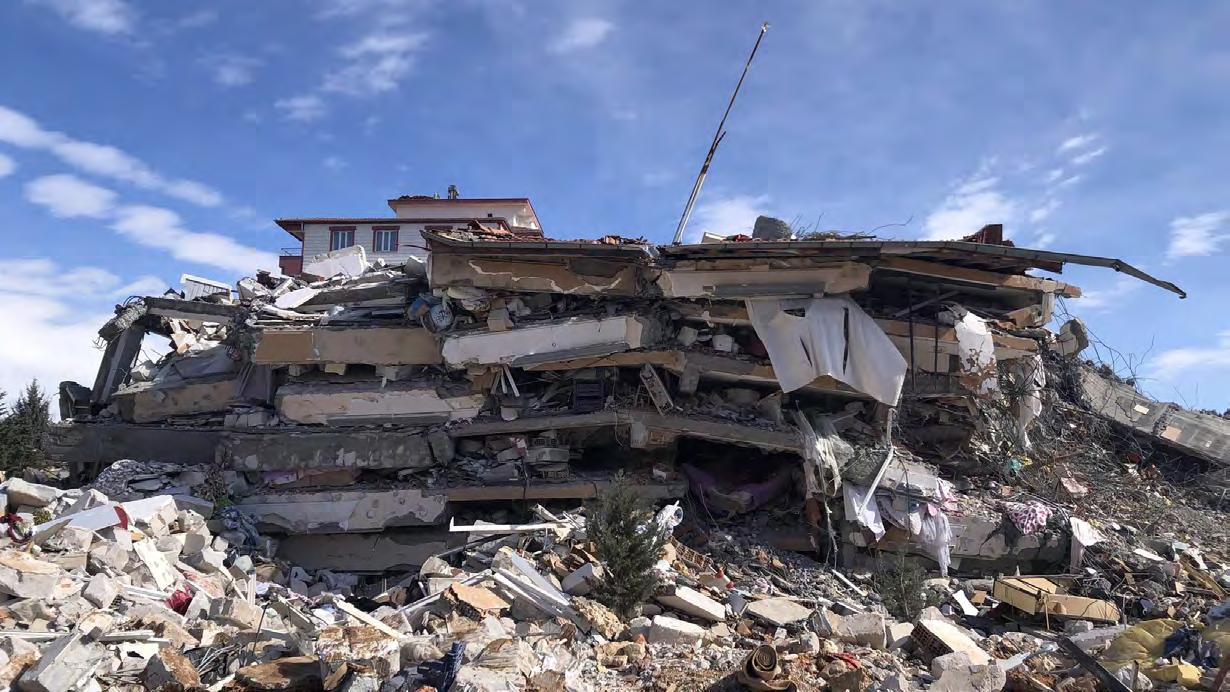
Preventing pancake collapse generally involves reinforcing walls through different bracing techniques. Buildings made exclusively of concrete or brick are not particularly resistant against earthquakes, and require robust support through additional rigid structures.2 Whether this is done through a wooden interior frame or a steel skeleton outside, bracing mitigates risk of damage by distributing energy across a larger area or keeping a building intact long enough for inhabitants to escape.
Countries that are constantly hit with earthquakes will naturally be more prepared for high magnitude events, especially if they are wealthy enough to invest in advanced engineering techniques. Taiwan sits on the Pacific Ring of Fire, and despite its small size, is hit with about 19,000 earthquakes each year.3 While most of these are undetectable, the occasional strong quake threatens to cause significant social and economic impacts due to the island’s high population density and GDP.
An example of pancake collapse: a multi storey building in Türkiye
Under Taiwanese law, all newly constructed buildings are subject to earthquake regulations, but those above 50 metres in height are held to extremely strict aseismic standards. The government enforces guidelines requiring strong foundations and designates the use of steel and reinforced concrete throughout a building for increased quake resistance.4 Taiwan’s stringent regulations were written in blood – its 1999 Jiji earthquake destroyed 50,000 households and damaged a further 50,000, killing 2,400 people and leaving over a hundred thousand homeless.
While aseismic measures are important for all buildings and infrastructure projects, they are especially crucial for skyscrapers due to their increased vulnerability in an earthquake. There is also an elevated risk of high casualties due to the number of people in skyscrapers.
The Taipei 101 is a marvel of engineering – opening in 2004, it was the tallest skyscraper in the world until 2009, and was the first building to measure over half a kilometre in height. Its impressive stature makes it highly susceptible to earthquakes and intense shaking, as its peak experiences much more swaying than a shorter building would.
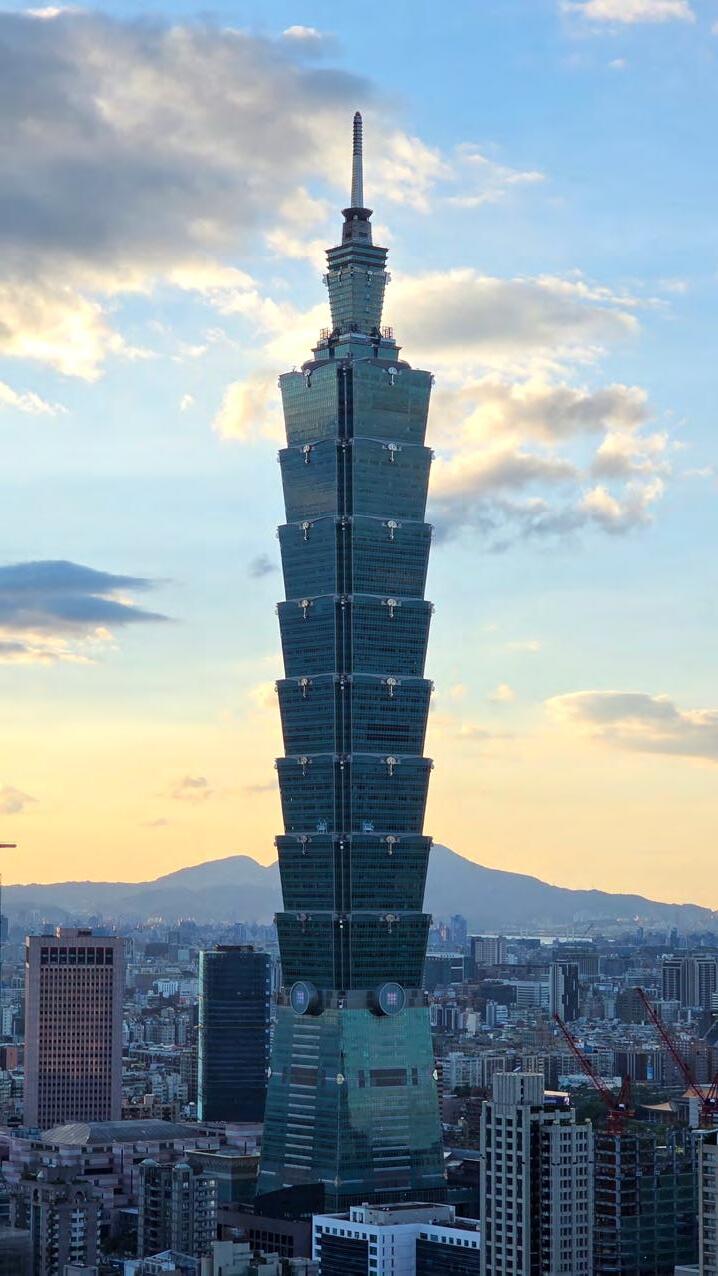
As with many skyscrapers (especially those in earthquake-prone areas), the Taipei 101 features a deep foundation and a strong external steel structure. Its exterior skeleton is also wrapped with horizontal belt trusses every eight floors to its apex; these include rigid cross bracing to resist typhoon winds and earthquake shaking.5 In addition, the building’s interior features eight ‘supercolumns’ – massive steel boxes filled with concrete and reinforced with rebar – stretching up to the 90th floor. These are connected to minor columns as well as the exterior belt trusses to ensure maximum stability.
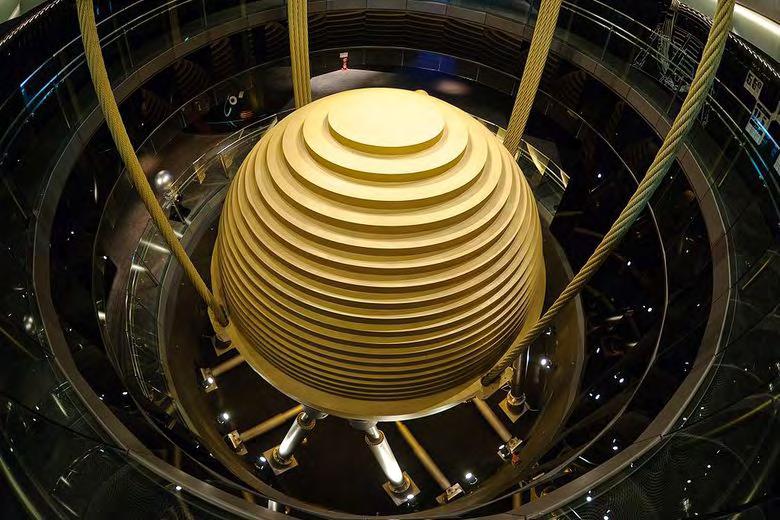
The crown jewel of the Taipei 101’s aseismic engineering is its 660-tonne tuned mass damper. This giant steel sphere is suspended from the 92nd floor, acting as a pendulum and moving in the opposite direction of the skyscraper’s sway. This counteracting motion helps absorb kinetic energy, with the large mass limiting the effect of storms or quakes through sheer heaviness.6 By minimising the structural displacement (that is, how far the skyscraper sways from its default position), this reduces any stretching on the building’s exoskeleton and inner columns, preventing snaps or breakages at these reinforcement structures.
These techniques are almost exclusive to highly developed countries due to how expensive they can be. Fortunately, poorer nations can adopt cheaper methods of earthquake protection – retrofitting old buildings with aseismic features is far more cost-effective than reconstructing a building from scratch. It has been found that demolition and rebuilding is three to five times the cost of simply retrofitting7: this is significant because cities in low-income countries often lack strong infrastructure and building regulations in the first place. The wide-scale adoption of cheap, installable aseismic techniques could therefore save tens of thousands of lives.
In 2015, Nepal was struck by an earthquake measuring 7.8 on the Moment Magnitude Scale. Both rural and urban areas were heavily impacted, with building collapses reported in the capital Kathmandu as well as across the countryside. Around 9,000 people were killed in total, with 2.8 million more being displaced.
Taipei 101, Taiwan
Taipei 101’s tuned mass damper, suspended between its 87th and 92nd floors
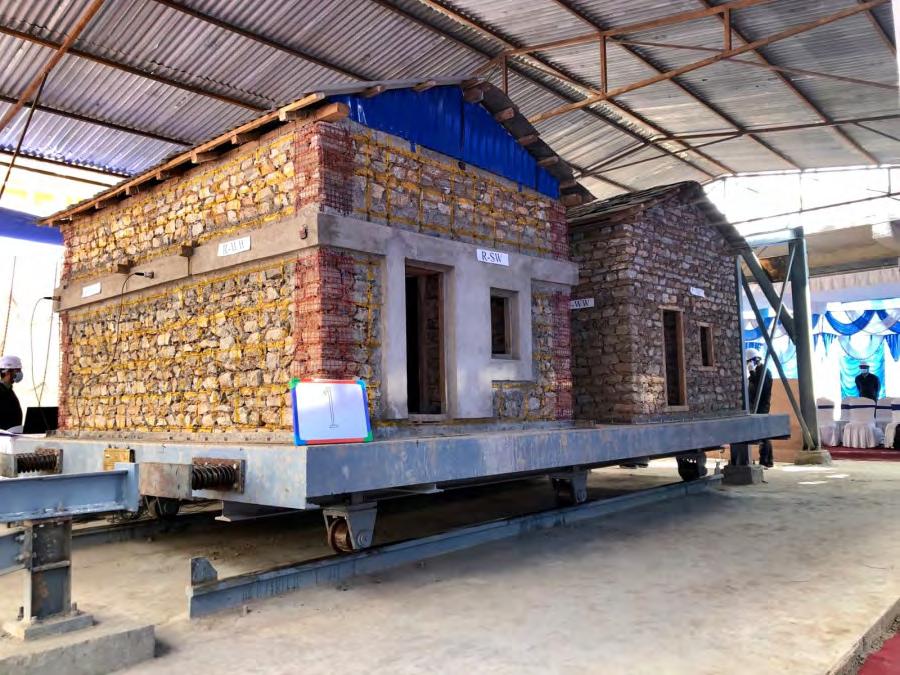
The United Nations Development Programme cited the main cause of Nepali building collapses not as the use of weak materials, but as poor construction and absence of aseismic practices.8 In collaboration with the UN and engineering institutes in India, Nepal has begun implementing aseismic techniques in new and existing buildings.
Containment reinforcement technology is a method that involves galvanised iron wire or weld wire mesh – this is wrapped around a building’s exterior and used to tie floors or roofs to walls. This is especially effective with the stone brick houses common in Nepal, as the reinforcement improves structural integrity by literally holding the building together in an earthquake. This does not require cement or steel, thus making it an affordable and accessible option for retrofitting houses in the Nepali countryside.
The effectiveness of these techniques can be tested using a shock table, where replica buildings are subject to heavy shaking. Unprotected structures are tested alongside different reinforcement strategies to determine which buildings survive best in an earthquake.
Protecting Road Infrastructure
So far, this article has been focusing on buildings due to the deadly consequences that could entail their collapse. However, road infrastructure is also necessary to consider – besides their everyday importance, they also facilitate rescue efforts by allowing personnel, resources, and vehicles to travel to sites of catastrophe.
Innovations in material engineering can help prevent cracks and faults from rendering roads unusable after an earthquake. Whereas conventional bitumen or concrete roads can suffer intense stress due to their inflexibility, new materials are increasingly being designed to withstand seismic waves. For example, polymers can be mixed into bitumen to produce a more elastic material that can distribute stress evenly and stretch according to seismic pressure, preventing cracking from taking place.9
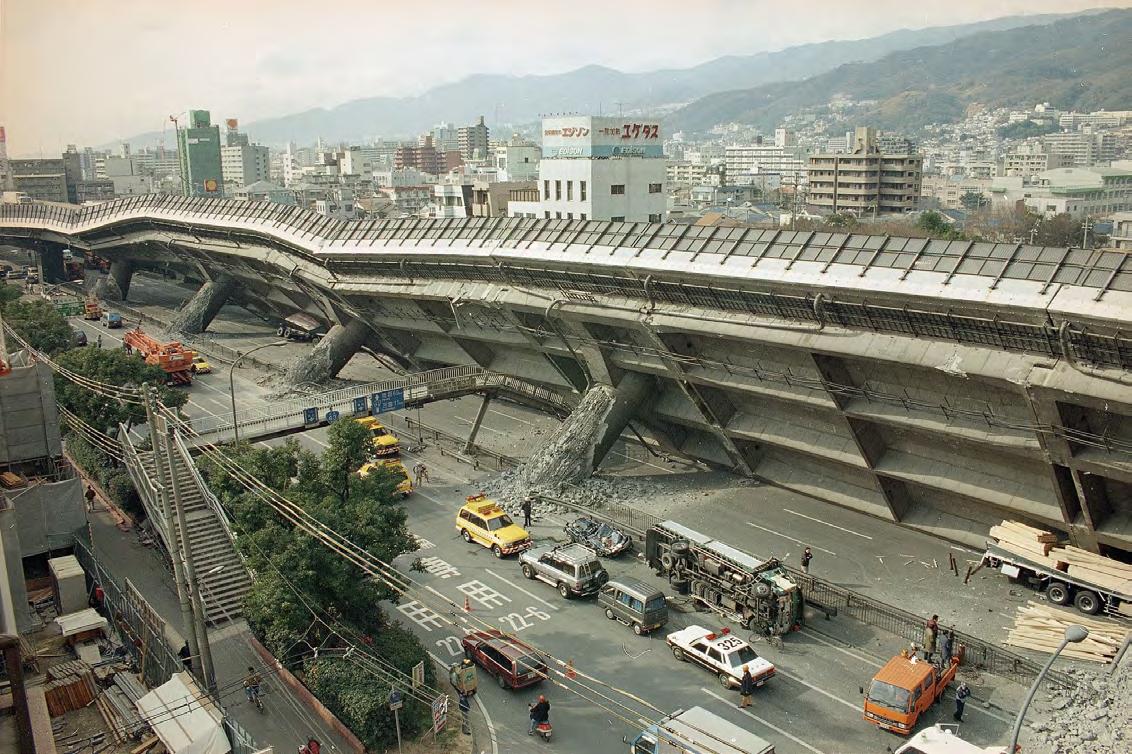
Bridges are also important aspects of infrastructure to protect: being built on stilts increases the susceptibility of total collapse if any one of its pillars fails. Their length is also a weakness, as there is a higher likelihood that a bridge could be pulled apart due to cracks or diverging faults in the ground below. When the Great Hanshin Earthquake struck Japan in 1995, some of the most striking images that emerged were of the fatal toppling of a major highway bridge.
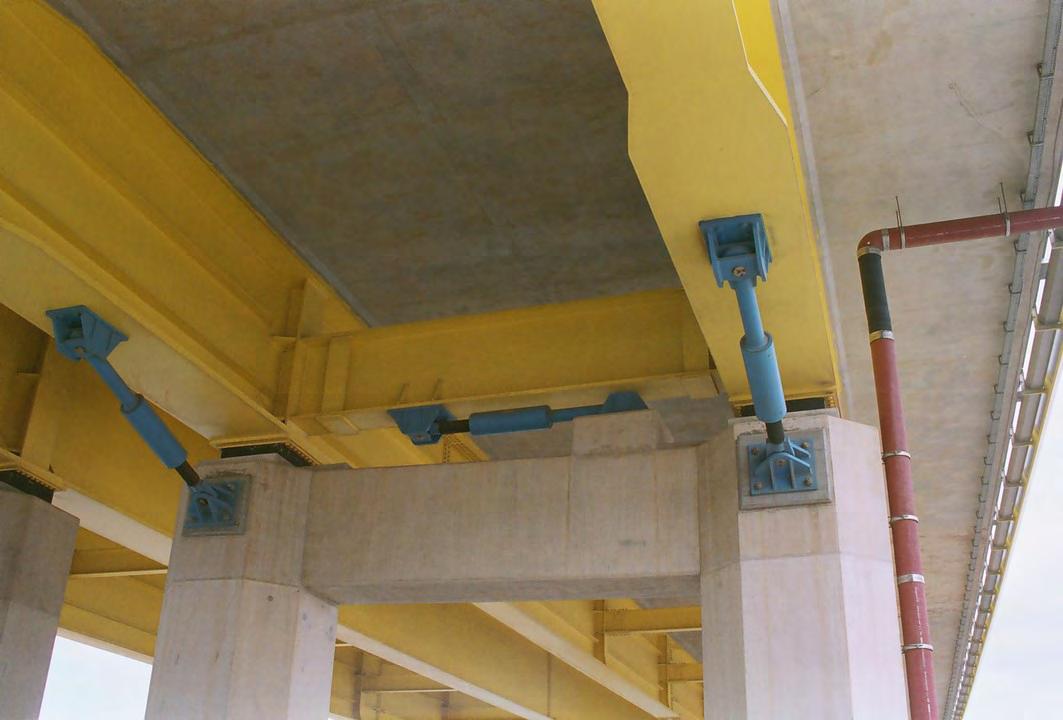
Newly constructed bridges can come with a plethora of aseismic techniques, in addition to the aforementioned improved road materials. Seismic dampers can be installed under each pillar, as well as between pillars and the road above – these devices
A shock table test in Nepal between a reinforced and an unreinforced house
The Kobe Osaka Highway in the aftermath of the 1995 Great Hanshin Earthquake
A set of seismic dampers under the Rio Antirrio Bridge, Greece
allow the bridge and road to experience slight bouncing during earthquakes, as opposed to shear stress from a completely inelastic structure. 10 Like the Taipei 101’s tuned mass damper, these operate on a principle of enabling some movement to help absorb kinetic energy, and can be greatly effective in preventing built-up stress from breaking apart concrete to collapse bridges.
When seismic damping is installed between a structure from its foundation and the ground, it is known as base isolation. There are several techniques to implement this, including those allowing for bouncing and those allowing for entire structures to roll across several axes. The latter is generally employed for buildings rather than bridges due to their comparatively small footprint – the Los Angeles Emergency Operations Centre is considered among the city’s safest buildings as it is built upon forty such isolators. 11 In either case, these methods work by keeping structures in the same ‘true’ position while the ground beneath moves and shakes. Base isolation systems are usually made of rubber and steel, ensuring they are flexible enough to absorb seismic energy while being as sturdy as a conventional foundation.
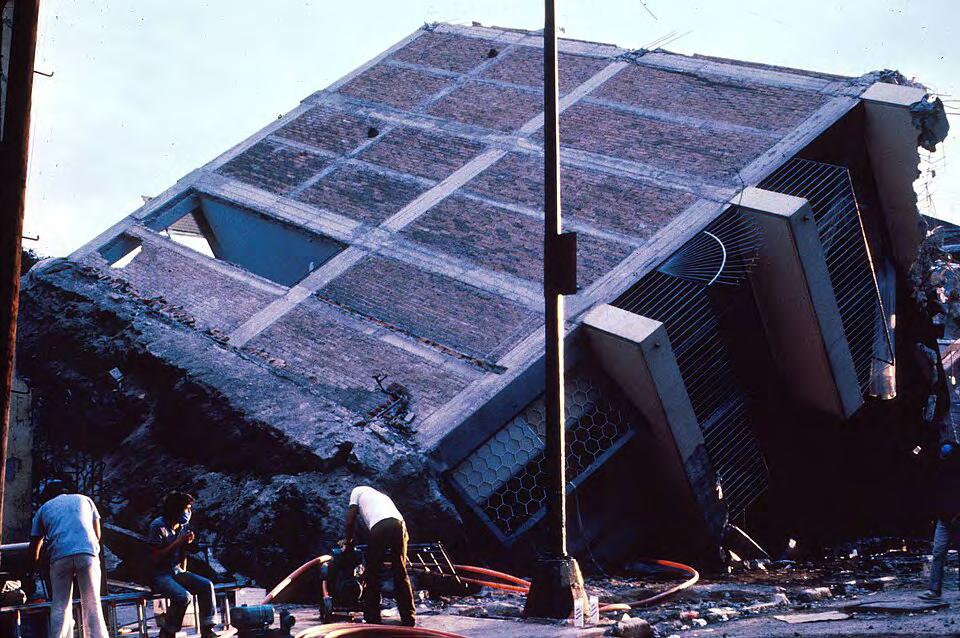
Mexico City is built on wet clay, making buildings susceptible to liquefaction
Due to the importance of road infrastructure, it is infeasible to tear down existing bridges to install new ones with aseismic features. Luckily, retrofitting is also effective in protecting bridges and can be implemented in a variety of ways. Column jacketing is a method in which pillars are wrapped with better materials for structural integrity, such as reinforced concrete, steel plates, or polymers. By distributing stress more evenly, bridges have less chance of forming cracks and collapsing. Retrofitting could also involve dissecting an existing bridge to install seismic dampers, but this is more costly and disruptive due to the time and equipment required for the process.
Mitigating Liquefaction
Besides tremors, another significant hazard of earthquakes is ground liquefaction, which predominantly affects coastal regions. When saturated, sandy soil is subject to intense shaking, and may temporarily act as a liquid, dragging buildings and vehicles into the ground then trapping them when it returns to a solid state. This can even happen to unreinforced concrete, destroying road infrastructure.
Substantial portions of San Francisco are built on reclaimed land, primarily using dirt, sand, and clay. These materials are loosely packed together, making them highly susceptible to water intake and liquefaction. 12 Civil engineers must therefore employ a number of techniques to lower the risk of buildings sinking into the ground in an earthquake.
Although most liquefaction mitigation techniques involve reinforcing the foundation of buildings and infrastructure, each method is specific to local geology. It is therefore important to conduct geological surveys to first determine which is the most appropriate to use.
For buildings where easily liquefied soil is found deep underground, the foundation is bolted down using vertical steel piles. 13 These are driven into the foundation, through the vulnerable soil, and into the bedrock below it – the steel piles allow the building to remain upright by connecting the reinforced concrete foundation with solid rock even when the soil between them becomes fluid.
Steel is a highly suitable material for reinforcement piles: despite being highly durable, it is also ductile and has a high tensile strength. This allows them to undergo heavy stress and intense stretching during an extreme earthquake, which San Francisco is susceptible to due to its proximity to the convergent San Andreas Fault.
However, this method is incongruous with places where the soil vulnerable to liquefaction is shallow. This is
because weak dirt being too close to the surface prevents a deep foundation from being laid, a prerequisite for using steel piles. In this case, engineers must reinforce the material of the foundation itself.
Reinforced concrete consists of steel bars or meshes filled with cement, and is far stronger against liquefaction than regular concrete due to its durable metallic bracing. Roads can feature a similar material known as a geogrid, where soil or concrete is reinforced by providing tensile strength and reducing pressure – which is necessary for liquefaction to occur.
The other main techniques to minimise liquefaction risk consist of soil improvement methods. 14 Ground compaction reduces the permeability of soil, limiting the amount of water that can seep in and weaken it. Underground drainage systems can also be installed where high-risk soil is not too deep. Whereas water would usually be absorbed into soil and remain there due to the impermeability of the bedrock below, subterranean drainage can transfer water away from areas vulnerable to saturation.
Defending from Tsunamis
15.5 metre
Strong structural integrity is not the only concern engineers must have. Some seismic hazards – including tsunamis – require external structures to be built in order to protect civilians and important infrastructure. The Tōhoku quake struck Japan in 2011 and was the second most powerful earthquake ever recorded, measuring a 9.1 on the Moment Magnitude Scale. Being a wealthy country on the Pacific Ring of Fire, Japan has strict earthquake regulations protecting its buildings: despite releasing 1.3 million times more energy than the 2015 Nepal quake, there were few building collapses and only 1,600 deaths attributed to the initial tremors. 15
Unfortunately, the Tōhoku quake occurred underwater, in addition to being quite shallow in the Earth’s crust. The ocean therefore received an immense amount of seismic energy, triggering a major tsunami which struck the Japanese east coast with disastrous effects. Waves hit most areas at around 10-20 metres in height, with the highest observed wave being upwards of 40 metres tall.16 Despite many towns and cities along the east coast having floodwalls, quite a few of these were overtopped as they were not tall enough to withstand the tsunami.
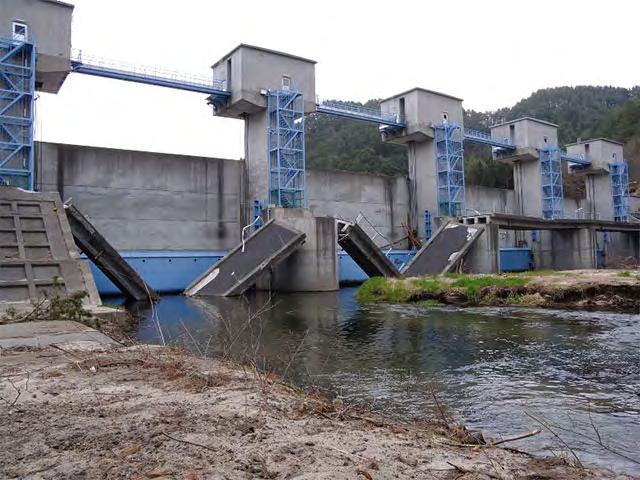
The effectiveness of a strong, tall floodwall was demonstrated in the village of Fudai. In the 1970s, a 15.5-metretall floodgate was built for the cost of £27 million. For a village of only four thousand residents, it was originally lambasted as a waste of funds – until the settlement was spared in the deadliest Japanese disaster since 1923. 17
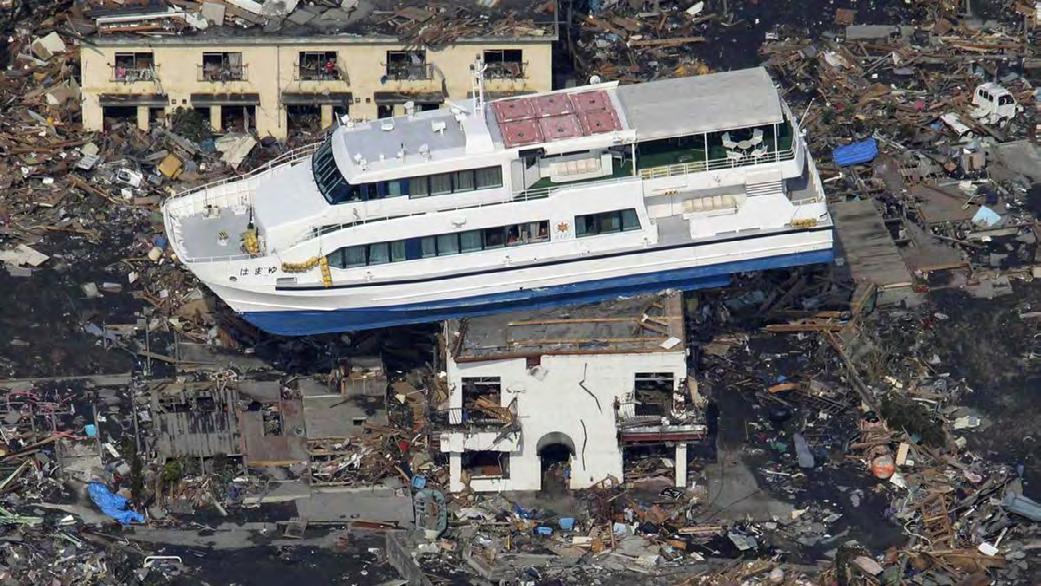
Most places weren’t as lucky. Photos of yachts found far inland and houses being carried to sea became symbolic of the destructive effects of the Tōhoku tsunami. Despite an evacuation warning giving twenty minutes for civilians to reach high ground, the tsunami killed over 18,000 people and resulted in an additional 2,500 missing victims.
The most infamous part of the tsunami, however, was the destruction inflicted on the Fukushima nuclear power plant. The facility had tsunami protection in the form of a 5.8-metre-tall sea wall, which proved extremely insufficient in blocking the massive tsunami waves. When the waves breached the sea wall and destroyed multiple cooling systems across the site, three nuclear reactors exploded to release 900 petabecquerels of radiation (a lot) over Japan and the Pacific Ocean. 18 Radioactive cleanup alone cost half of the Tōhoku earthquake’s $360 billion
The
high floodgate in Fudai, Japan, which protected residents from the 2011 tsunami
A large boat stranded almost half a kilometre inland following the Tōhoku tsunami
in total economic damages, making the quake the most expensive natural disaster in history.
In the aftermath of the disaster, Japan constructed 400km of sea wall across its east coast. Costing $12 billion, the wall stands 14 metres tall – even if they are overtopped by the strongest tsunamis, residents are granted additional time to evacuate. 19 Although criticised for being unsightly, they will hopefully be effective in preventing another tragedy of such a large scale.
Preserving water infrastructure
Beyond buildings and roads, an oft-overlooked aspect of civil engineering is water infrastructure. If insufficiently protected, earthquakes can cause huge damage to pipes and treatment facilities, which could lead to various harmful impacts. Not only can this cause disruptions in access to drinking water, but it can also release untreated wastewater into the surroundings to cause health and environmental issues.20
Like bridges, water pipes are vulnerable to breaking across faults due to their length. To prevent this from occurring, ductile materials such as iron are used so stress can be applied to the pipe without it fracturing. 21 These can further be wrapped in elastic materials such as polystyrene, which limit damage to pipes by absorbing seismic energy. Their compressibility also allows pipes themselves to stay in place even when the ground moves or faults.
To protect storage and treatment tanks, they can be retrofitted with flexible materials like rubber or fibreglass, as well as base isolation systems to limit the amount of energy transferred onto the tank 22. For additional robustness, backup tanks and treatment equipment should be available in case of hardware breakages or failures.
Having resilient water infrastructure ensures people displaced by earthquakes have reliable drinking sources and are not exposed to potentially contaminated wastewater. While damage to water facilities has less immediate effects than damage to roads and buildings, it can have huge impacts for victims and emergency responses in the aftermath of a quake. Disaster planners must therefore be vigilant in all facets of aseismic engineering, ensuring those who survive the initial earthquake do not succumb to the failure of poorly designed infrastructure.
Limitations
Unfortunately, some seismic impacts are almost impossible to mitigate. This is often the result of physical geography, as seen in the 2015 Nepal earthquake – the most devastating effects in this quake were observed high in the Himalayan mountains. As the tallest mountain range in the world, the Himalayas are capped with large glaciers, snow, and plenty of rocky debris. The 2015 quake’s intense shaking (classed as extreme on the Modified Mercalli Intensity scale) dislodged much of this, leading to catastrophic landslides and avalanches throughout Nepal.
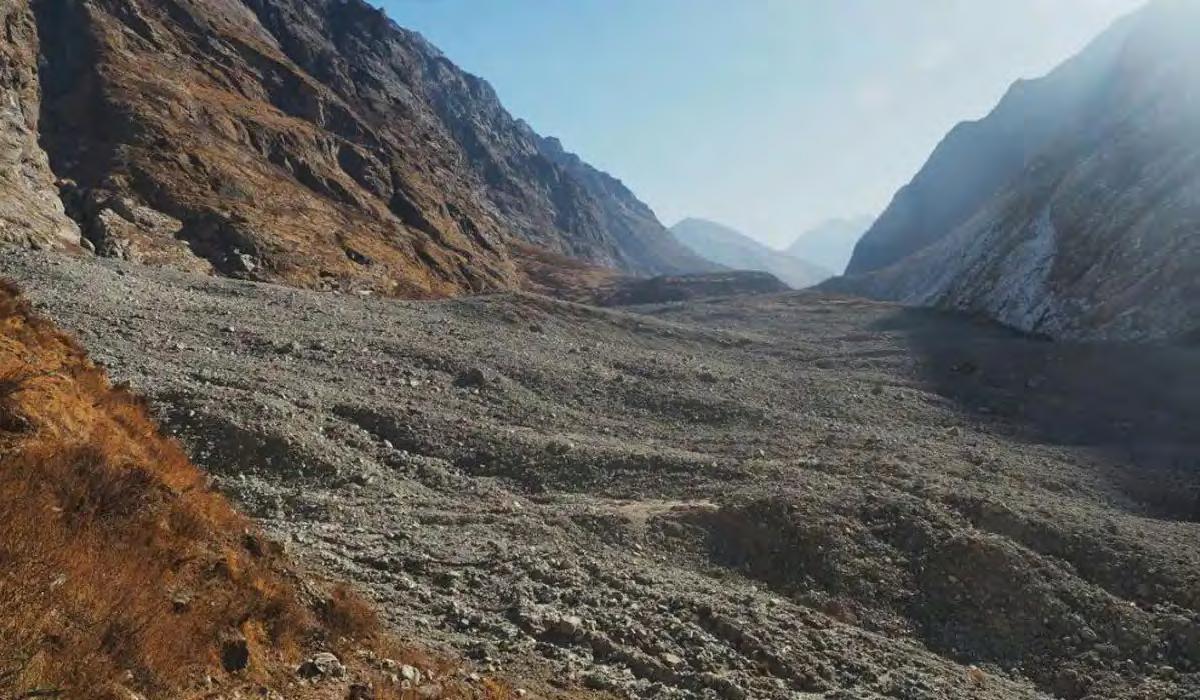
Langtang Valley after the 2015 earthquake; the village here was entirely buried
While most international media focused on rescuing tourists following an avalanche on Mount Everest, it was in various mountain valleys where the worst damage was recorded. Avalanches and mudslides were focused into these low areas between mountains, made worse by the fact that the winter had provided abnormally high amounts of snow.23 Valleys also typically have rivers running through them, making them home to many villages.
The most significant destruction occurred at the Langtang Valley near the epicentre of the quake: the avalanche that hit Langtang Village carried enough mud and debris to completely bury the settlement. In addition, avalanches can travel in excess of 100km/h, meaning buildings hit by flowing boulder debris stood little chance of survival. Langtang Village suffered over 300 deaths – a statistic that might have been impossible for engineers to mitigate.
The most effective way to lower the death toll in such areas is therefore land-use zoning. This involves the prohibition of construction in high-risk areas, and may include incentivising residents to move out of these hazardous zones. For obvious reasons, many locals may be opposed to leaving their homes, especially if they reside in a village that had been inhabited by their ancestors for generations.
Another downside of zoning is that high-risk areas may already have extensive development. Such is the case with cities with land reclamation, where it is valuable coastal areas that are most vulnerable to soil liquefaction. Both the Port of San Francisco and the city’s Marina District are constructed on reclaimed land – land-use zoning is unrealistic for these locations due to their high population or economic importance.
Political corruption remains as a roadblock to earthquake mitigation. No matter how strong a country’s building regulations are, there will still be tragedy if no agency tries to enforce them. In 2023, southern Türkiye and Syria suffered a devastating earthquake which killed 60,000 people. These deaths were chiefly caused by the collapse of many buildings across a highly populated region, in spite of Turkish structural regulations.
Many of these regulations were introduced in the wake of the 1999 İzmit earthquake, with £29 billion of taxes raised for the enforcement of such rules.24 Among these new regulations were building codes requiring strongly reinforced walls; the 1999 quake saw hundreds of buildings fall to fatal pancake collapses.
In spite of the amount of money spent on these regulations, they did not seem to be effective in preventing scores more deaths just twenty years later. Many of the buildings that collapsed in 2023 not only did so in a similar fashion, but were also newly constructed. The effectiveness of Türkiye’s regulations is extremely dubious, no less thanks to the current regime under President Erdoğan.
In 2018, the Turkish government granted ‘construction amnesties’ for new building projects, allowing developers to construct non-compliant buildings for a certain fee. These fees often cost less than installing safety features following regulations, incentivising more than three million unsafe buildings to be constructed across the country.25 It is reported that these amnesties were an attempt to win support for elections that took place the same year26.
After the 2023 quake, nearly 200 construction contractors and property owners were arrested for violations of building codes – but not before thousands died to negligent construction and non-existent policing.27 The tragedy that occurred in Türkiye is a stark reminder that proper aseismic regulations require strict enforcement, lest the lives of thousands of people are lost.
Conclusion
For earthquake-prone countries, aseismic engineering is a necessity to save lives. While techniques may differ by wealth and geography, most operate on similar principles of preventing infrastructure from absorbing excessive kinetic energy. This averts threats of extreme stress, which can lead to fractures, breakages, and building collapses.
As the world population continues growing, more people are living in high-risk areas susceptible to earthquakes, tsunamis, landslides, liquefaction, and other deadly hazards. In spite of this, many cities worldwide are still illprepared to face a major seismic event – time and time again, earthquakes strike heavily populated regions to the tune of tens of thousands of deaths.
Earthquake resistance is a battle that has been waged for thousands of years, and advancements in technology are only making strides in aseismic developments larger and more frequent. Governments and international organisations must spread awareness and implementation of effective hazard engineering, so that every person on this Earth can live in a safer tomorrow.
GEOPOLITICS
A tale of three Germanys: A four-year alternate history
Introduction
It didn’t take long after the Soviet capture of Berlin on 2nd May 1945 for Nazi Germany to surrender to the Allies, finally marking the end of the Second World War for most who lived in Europe1. With that, Germany entered ‘zero hour’: the start of a new chapter in German history that would see the former empire walk a long road to democracy and economic recovery.
The Allies were quick to step in and assist in Germany’s journey to reconstruction; they had been making preparations for it since 19432. From about June 1945, Germany was divided into four occupation zones – one each for the United States, the United Kingdom, France, and the Soviet Union (USSR)3. The purpose of these zones was to allow the victorious Allied nations to temporarily govern Germany until a new German government could be established, free from any traces of Nazi ideology and in command of a sufficiently robust economy.
Unfortunately, history did not turn out as smoothly as all had hoped. Out of the ashes of the Second World War, a new ideological war was brewing – the Cold War, which pitted the USSR against its former Western allies. Soon enough, the American, British, and French occupation zones merged to form West Germany in opposition to the Soviets, who promptly reorganised their own occupation zone into East Germany in response. These two sides of Germany were locked in ideological opposition, in a dichotomy many have described as a microcosm of the larger Cold War between the communist East and the capitalist West. But what if there was also a third power in play in Germany?
This article examines how different history could have been if the Republic of China (ROC) had also been given an occupation zone in Germany from 1945. It justifies the motives for which ROC leader Chiang Kai-Shek could have had for occupying Germany, explains what challenges could have arisen in this Chinese occupation zone, and argues that such a politically unique region could have only existed for a maximum of 4 years in this counterfactual ‘alternate history’ scenario.
As a side note, please note that this counterfactual is in no way meant to be reflective of my political beliefs or how I think historical events should have gone! This is merely (an attempt at) a fun exploration of real history and an application of this knowledge to create a neat ‘what if’ scenario (as well as some complementary propaganda art). This article makes use of actual historical facts to evaluate the validity of this scenario, and attempts to make it clear whenever real-world information is being presented (as opposed to fabricated content from the counterfactual). Nonetheless, apologies in advance if this piece inadvertently spreads any misinformation: if you’re ever in any doubt as to what’s real or not, please consult your nearest History teacher.

For reference, here is a timeline of relevant (real life) historical events from 1927 1949
1943: Agreements and aspirations
If this counterfactual is to fulfil the requirement that all differences from real history stem from just one point of divergence, such a point would likely lie during the 1943 Cairo Conference, where alternate-timeline Chiang Kai-Shek would first propose the allocation of a German occupation zone to the ROC. In real life, this was a meeting held between US President Franklin Roosevelt, British Prime Minister Winston Churchill, and the ROC’s National Chairman Chiang, chiefly to discuss the Allied campaign against Japan and the future of Asia after the Second World War4. Importantly, the conference also strengthened the ROC’s position as a major world power5. In fact, it was Roosevelt’s idea for the ROC to become one of the ‘Four Policemen’ of the world: a group of four nations consisting of the US, UK, USSR, and ROC that would be responsible for upholding postwar peace in their respective spheres of influence6.
When the time came (in real history) to discuss the division of Germany at the subsequent 1943 Tehran Conference, however, the possibility of a Chinese occupation zone was not considered, and arguably for good reason. To start, as an East Asian nation, the ROC was likely too far away from the European theatre to have been considered a relevant party (hence real-life Chiang’s exclusion from the conference, which was only attended by Roosevelt, Churchill, and Stalin7; note that French leader de Gaulle was also absent as France was only added as an occupying nation in 19458). Although it can be argued that the US was similarly geographically distant, it more than made up for this shortcoming through its ability to assist in postwar reconstruction, which was much greater than that of the ROC – the economic capacity of the US was far superior, boasting a GDP per capita of $16,000 in 1943 compared to the ROC’s $1,000 (in international dollars at 2011 prices)9. The main reason for this Chinese economic hardship can be attributed to the ROC’s costly embroilment in the Chinese Civil War since 1927, as well as a Japanese invasion since 193710 (more on this later).
Given these logistical and financial difficulties for the ROC, for what possible reason would alternate-timeline Chiang desire a Chinese occupation zone in this counterfactual? Examining real-world historical context, the best answer seems to be that Chiang could have sought Chinese prestige through increased involvement in international affairs, in this case assisting in the reconstruction of Germany. This is in line with real-life Chiang’s adherence to Chinese nationalist ideals, particularly the desire for overcoming the ‘century of humiliation’ – a period of time starting from approximately 1842 wherein China (then under the Qing dynasty) experienced numerous territorial losses and unjust treaties with foreign powers that undermined the nation’s international standing11.
There is evidence that Chiang paid considerable attention to reversing this national shame, such as with his public speeches calling for endurance against Japanese forces as a way of ‘avenging humiliation’12 and his negotiations with foreign nations to repeal the effects of the unequal treaties imposed on the ROC13. Subsequently, Chiang took care to project the image that the ROC had earned the respect and recognition of the international community. For example, following landmark Sino-American negotiations repealing unequal American extraterritorial rights in the ROC, Chiang publicly declared that the negotiations were ‘the most glorious page in our national revival’14, and that the ROC was now ‘an independent China on equal footing’15 with the US and UK. It is therefore not too implausible that, in pursuit of even greater international recognition, alternate-timeline Chiang would volunteer his nation to assist in the postwar reconstruction of Germany alongside the Western Allied powers, thus consolidating the ROC’s image as having risen above their national shame to become an equal of the West. What’s more, this would have set an impressive precedent for postwar Chinese involvement in international diplomacy, opening doors to a future of contribution to global affairs that would have massively boosted the ROC’s reputability.
In real history, the 1943 Cairo Conference was the last chance Chiang had to meet with his fellow Allies before the end of the Second World War, being absent from the subsequent Tehran Conference as aforementioned. If
this fact is unchanged for alternate-timeline Chiang, it would therefore have to be Cairo at which he put forth his proposal for the establishment of a Chinese occupation zone. It wouldn’t have been too out of line for him to do so: although the real-life conference mainly focused on Asian affairs, some discussions on the European war effort did occur (albeit chiefly between the US and UK)16. Moreover, the subsequent Tehran Conference — at which the issue of postwar German division was actually formally discussed — was scheduled to begin just two days after the Cairo Conference17. Thus, although alternate-timeline Chiang himself would probably remain absent from Tehran like in real history, his proposal would still be fresh in the minds of Roosevelt and Churchill, strengthening his bid in absentia when proposed to the third participant of Tehran — Stalin.
These three would likely react to Chiang’s suggestion with varying degrees of enthusiasm. As the architect of the Four Policemen, Roosevelt would probably warm up to this idea the most. In real history, he envisioned the ROC as a world power strong enough to keep European and Soviet expansion in Asia in check18; if this real-life vision of Roosevelt’s is translated to the counterfactual, it is believable that alternate-timeline Roosevelt would accept Chiang’s offer to help curb any potential renewed Nazi insurgencies by occupying Germany. Meanwhile, Churchill and Stalin would likely be more reluctant, fearing that the ROC’s economic weakness and political instability would hinder their ability to govern a German occupation zone on the other side of the world. These doubts reflect the real-life concerns they had about the ROC’s inclusion in the Four Policemen19. Ultimately, however, the two would likely be willing to concede to Chiang’s proposal to further decentralise Germany. Again, this is in line with their real-life policies: Stalin believed ‘Germany should at all costs be broken up so that she could not reunite’, and Churchill supported dividing Germany into five or six states (Roosevelt himself wanted to divide Germany into 107 principalities!) 20. Interestingly, the possibility of allocating an occupation zone to France was not yet considered (in real history) until the summer of 194521. This means that at the time of the real-life Cairo and Tehran Conferences, the plan was still very much to divide Germany between just the US, UK, and USSR – not quite achieving their respective leaders’ hopes to split the nation into more than three sectors. Thus, there would have been all the more reason for alternate-timeline Roosevelt, Churchill, and Stalin to permit the addition of a Chinese occupation zone.
1944-1945: States and sectors
As aforementioned, Chiang did not partake in any major post-Cairo conferences in real life, likely due to their primary focus on European matters. Assuming this remains the case for his alternate-timeline counterpart, he likely would have still negotiated key decisions about Germany in depth throughout 1944-1945 via his close diplomatic contacts with the Western Allies, such his American-assigned military advisor Joseph Stilwell 22 One such topic of debate would have been the location of the Chinese occupation zone.
<http://www.gnu.org/ copyleft/fdl.html>, via Wikimedia Commons)
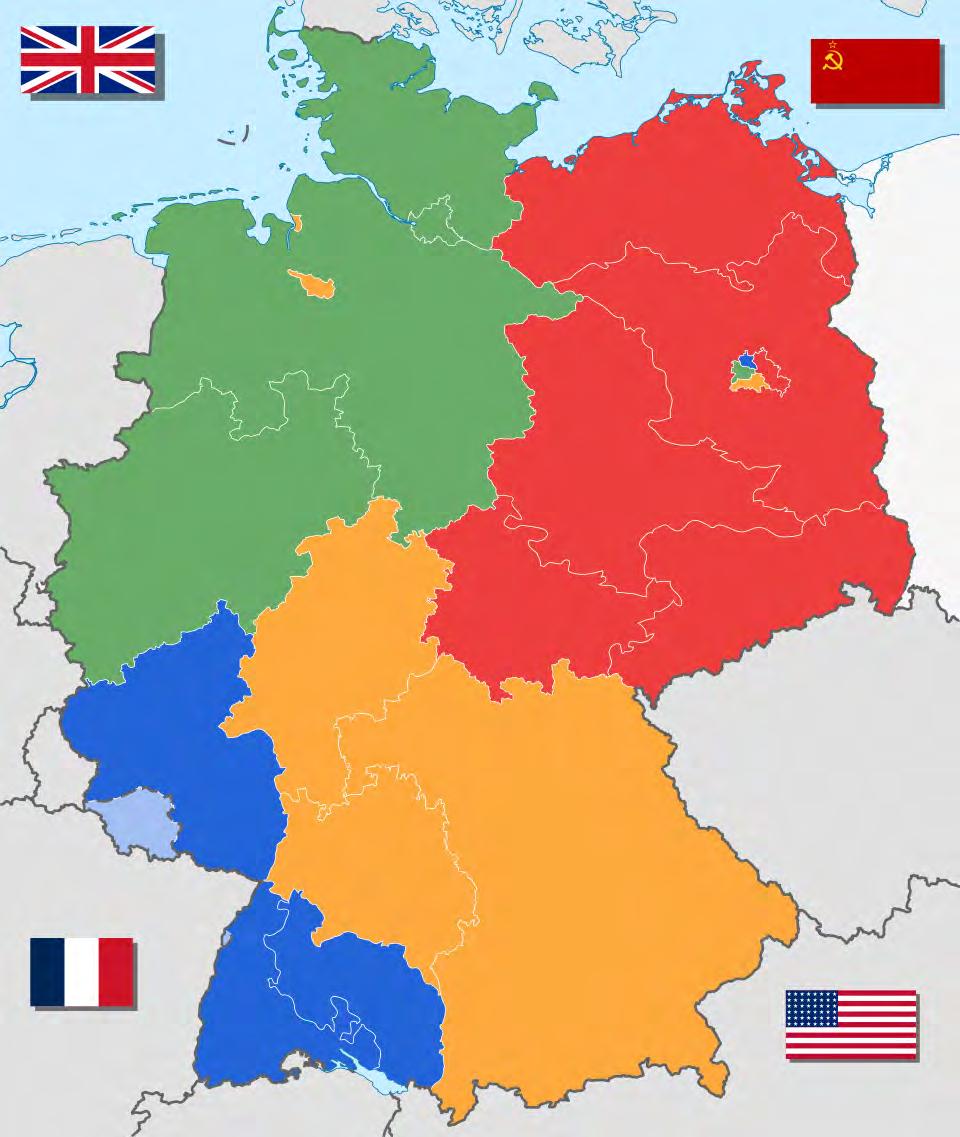
The real-life Allies’ redrawing of Germany’s internal borders divided the country up into 16 states; which were then distributed amongst the US, UK, France, and USSR to create four occupation zones23. There were justifications for how these states were allocated: the Soviet zone lay in Eastern Germany because Soviet troops had invaded Germany from the east24, the British zone lay in Northwest Germany because they had invaded from the northwest25, and the American zone initially consisted of all remaining territory in the southwest, until the late addition of the French zone saw the three westernmost states of the American zone reallocated to France so that their occupation zone would border France itself26. It would have been more difficult for the alternate-timeline Allies (and for me!) to come up with a justification for the location of the Chinese occupation zone – ROC troops did not partake in the invasion of Germany, and there were little historical ties between the two countries.
A map of the real life occupation zones of Germany. (credit: WikiNight2, GFDL
Nonetheless, there are some pieces of historical context that can be examined to pinpoint where this Chinese occupation zone could have been assigned to. The most likely candidate seems to be the state of Hamburg – the German city with the strongest cultural ties to China. In real life, this was the location of Germany’s only historical Chinatown27. Information on demographic statistics varies, but Hamburg seemed to have been home to several hundred28 to 2000 Chinese immigrants29 at its peak. This all came undone following the rise of the Nazis, whose racial policies forced many to flee the country. Their persecution of those who remained in Hamburg only heightened over time, resulting in the near-complete destruction of this Chinese community by 1944, save for a handful of survivors30. It therefore may have been appropriate for the alternate-timeline Allies to hand over the state of Hamburg to the ROC, so that the repatriation of displaced Chinese Germans back to Germany could be conducted by fellow Chinese people. This is not a perfect assumption; the Chinese diaspora in Hamburg was arguably too insignificant compared to the city’s overall population (1.4 million in 1946)31 to have much bearing on whether it would be allocated to the ROC. Nonetheless, this scenario is what the available evidence most clearly points towards, so it is what this article will work with.
However, giving just Hamburg to the ROC would make their occupation zone too small, so the Allies would likely allocate one more state to the Chinese. Most likely, this would have been a state that Hamburg bordered, of which there were two – Schleswig-Holstein to the north and Hanover to the south. However, allocating the ROC the latter would isolate the former with the rest of the northwestern British zone. Thus, the state of Schleswig-Holstein would be the only choice left to give the ROC. It had a population of 2.6 million in 194632, which adds to Hamburg’s 1.4 million to give the Chinese occupation zone a total population of 4.0 million people. This makes it the leastpopulated occupation zone of Germany, but would be fitting given the ROC’s economic and political instability, of which the real-life Western Allies were very much aware33. It is therefore unlikely that anyone would have expected the ROC to be capable of managing more than two German states thousands of miles away from Asia.
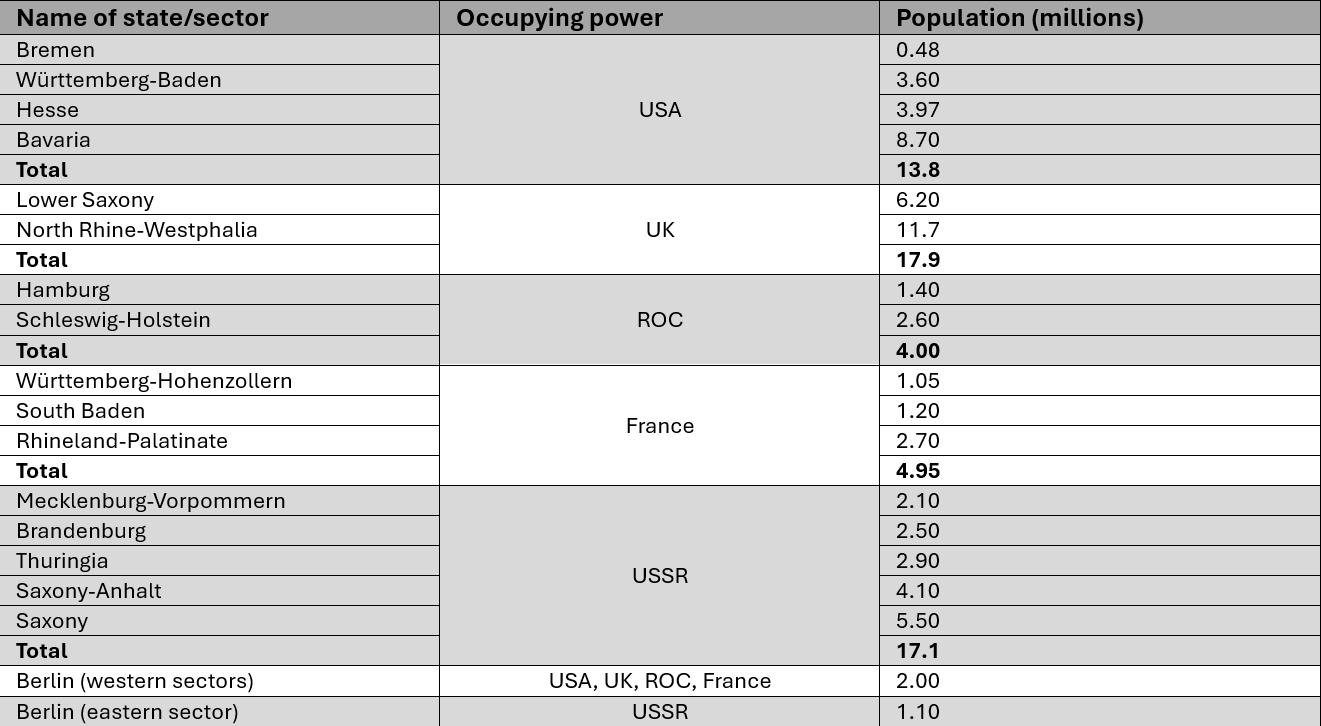
A table of the populations of each German occupation zone and their constituent states. Note that in real history, the ROC’s Schleswig Holstein and Hamburg were actually British occupied.
Nonetheless, the Allies still would have had one more territory to give the ROC: their sector of Berlin. In real history, this capital city’s boroughs were also divided amongst the Allies for the city’s symbolic significance — something the prestige-seeking alternate-timeline Chiang would not have wanted to miss out on. It is, however, also difficult to determine which of Berlin’s boroughs would be given to the Chinese. Real-life evidence shows there was also a relatively sizeable Chinese community in the Charlottenburg borough before the Nazis’ rise34, but like Hamburg, this diaspora’s small size would again have little impact on whether the borough would be assigned to the ROC (the proportion of Chinese minorities to overall population would have likely been even smaller here). In the absence of much useful evidence, we will assume that the neighbouring Wilmersdorf borough (British in real life) and Zehlendorf borough (American in real life) would be given to the ROC to balance out the sizes of the
Western Allies’ sectors; the Soviet sector would likely not be disturbed out of respect for real-life Stalin’s commitment to capturing Berlin from the east in the final days of the Second World War in Europe 35. In any case, the small size and therefore insignificance of each individual Berlin borough arguably means it is relatively unimportant (to the counterfactual) which borough is given to the Chinese; the fact that they do receive a sector of Berlin is sufficient.
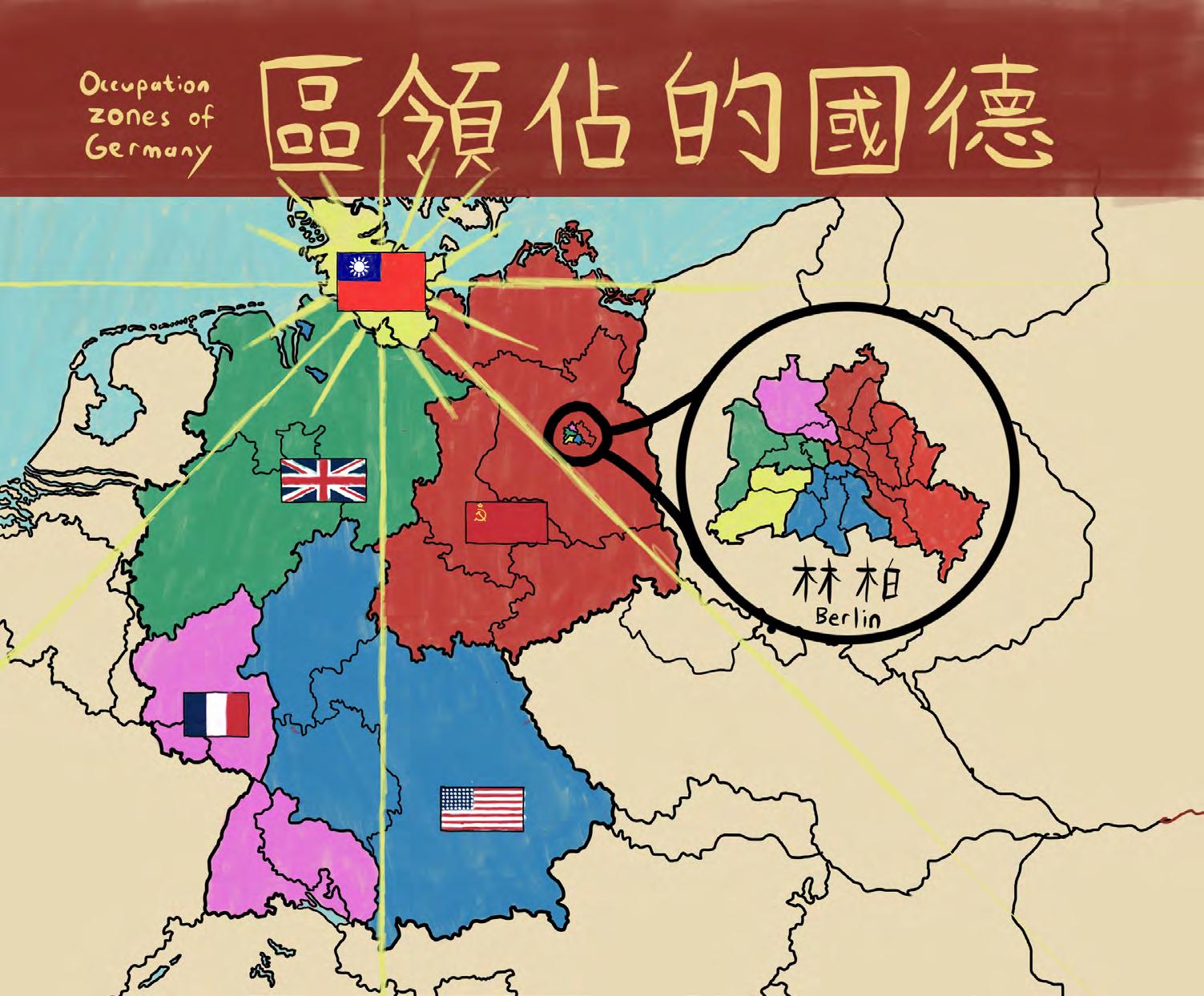
An alternate timeline map of the occupation zones of Germany, distributed by the Republic of China to publicise their prestigious involvement in international diplomacy. The large yellow states in the north form the Chinese occupation zone: Schleswig Holstein on the north, and Hamburg on the south. Located within the red Soviet zone is the divided Berlin; the ROC’s sector lay in the southwest.
1945-1946: Reconstruction and roadblocks
The ROC’s additional duties to govern their occupation zone would have begun from approximately June 1945, when the Allied Control Council for the administration of Germany was established in real history36. Undoubtedly, there would have been roadblocks in the process of governance. To start, from June to early September, the ROC had to juggle between governing their occupation zone in Europe and fighting the Japanese in Asia, who did not formally surrender until 2nd September37. The ROC had already been devastated by war at that point, having suffered 15 million deaths38 and $383 billion of property damage in 1937 prices39. Facilitating the postwar construction of both itself and its German occupation zone would have therefore been a Herculean task. To make matters worse, tensions between the ROC government (called the ‘Kuomintang’ or KMT) and the rivalling Chinese Communist Party (CCP) flared up once again immediately after Japan’s surrender, threatening to hold back the ROC’s postwar economic recovery.
However, alternate-timeline Chiang would have likely been confident that the KMT would soon defeat the CCP, thus enabling domestic economic recovery and an increased capacity to administer their German occupation zone. Evidence heavily suggests that in 1945, the real-life KMT clearly held the upper hand in the brewing conflict with the CCP – the former’s foreign recognition meant greater legal authority and the enjoyment of foreign aid40. Assured by this seemingly stable future, alternate-timeline Chiang would have likely ensured that his government made a substantial effort to do their part in governing postwar Germany, believing this temporary burden to be a worthy price to pay for a future of Chinese international prestige.
There would have been many aspects to the ROC’s new responsibilities, of which the most difficult would likely be the costly task of infrastructural reconstruction. As a valuable port city of the Nazi era, Hamburg was a natural target for Allied bombers, whose wartime bombing runs caused 8 billion Deutschmarks worth of damage to
Hamburg’s infrastructure41 (£681 million in 1952 prices42). In real history, the British were responsible for the reconstruction of this German state, investing £150 million into repairing residential buildings and £942 million into public buildings in Hamburg alone43. Realistically, no amount of alternate-timeline ROC’s best efforts would have been able to match the UK’s level of investment into postwar reconstruction; the ROC’s GDP per capita in 1945 was a mere 7.1% of the UK’s44. What’s more, the logistically complex nature of this reconstruction programme would have made it ripe for corruption amongst ROC officials, amongst whom bribery and extortion were notoriously commonplace in real life45. Thus, the rate of infrastructural recovery in the Chinese occupation zone would likely fall behind the other zones, ironically damaging the image of Chinese strength more than consolidating it. The first seeds of doubt would thus be planted in Chiang’s mind as to the viability of his vision of Chinese diplomatic eminence.
Another challenging element of the ROC’s governance of their occupation zone would have been providing aid to refugees there. In the state of Schleswig-Holstein, their problems arose in the opposite manner to Hamburg’s – Schleswig-Holstein’s strategic unimportance during the war meant it suffered less bombing than other regions of Germany, attracting an exodus of refugees to this northern state. This skyrocketed its population by 63% from 1939 to 194646, creating massive strains on food and housing. As with the problem of infrastructural reconstruction, the British were able to rely on their relative economic strength to mitigate these issues, even importing iron huts from their African colonies to act as temporary refugee camps47. The ROC had no such advantages, and would have again been stifled by corruption and financial constraint. Chiang’s dream would have thus taken another hit, growing his mental seeds of doubt.
Desperate for a victory, Chiang would have likely turned his sights on a possibly easier but more propagandistically beneficial goal: the implementation of the ‘four Ds’. This stood for demilitarisation, decentralisation, democratisation and denazification, and was a set of policies conceived at the 1945 Potsdam Conference that aimed to minimise the chances of future German aggression48. Of these four goals, the prestige-seeking Chiang would probably prioritise democratisation and denazification the most. As the leader of a selfproclaimed nationalist government, democratisation in Germany was ideologically congruent with the beliefs of Chiang and the KMT; the ROC-facilitated implementation of such democracy would have thus affirmed the ROC’s reputation as a champion of (relative) political freedom. Similarly, assisting with denazification would have aggrandised the ROC’s commitment to democracy. Examining real-world evidence of Chiang’s aggressive policies towards eradicating Japanese influence 49 and communist ideology50 (to the point of using dictatorial brutality himself), it is evident that he held the process of ideological cleansing in high regard. While alternatetimeline Chiang’s policy of denazification in Germany would likely have involved less state terror and political oppression, he would probably still place much emphasis on it and would have made sure to propagandise the ROC’s contributions to denazification.

1946-49: Abandonment and assimilation
For all of Chiang’s efforts in implementing the four Ds, they would likely still not be enough; the ROC’s failure to effectively rebuild their occupation zone and cater for its population would only become increasingly obvious as its Allies achieved greater
An alternate timeline ROC produced propaganda poster about denazification, depicting the Chinese White Sun incinerating the skull of a Wehrmacht soldier. Viewed from right to left, the Chinese text reads ‘Burn away the last scraps of the Third Reich’
success in their neighbouring zones. At this point, Chiang’s personal seeds of doubt about his project in Germany would certainly have bloomed into a source of great stress and a thorn in his side distracting from worsening domestic problems. By July 1946, the KMT’s Civil War with the communists had resumed in full force in real life51 While the KMT was initially successful in assaulting the communist forces, their repeated mismanagement of the war effort allowed the CCP to repel KMT offences with increasing efficacy. Therefore, alternate-timeline Chiang would likely divert more resources and administrative personnel away from Germany and towards the war at home, making the Chinese occupation zone fall further into neglect.
It was at this approximate time period that the real-life political landscape of Europe and the West began to shift as well. Mutual ideological suspicion was on the rise for both the USSR and their former Western Allies. Fearing that economic weakness in the western zones would risk the spread of communism, the British and American zones merged in 1947 to form the Bizone for collaborative governance, thus easing economic management 52 . France was initially hesitant to do the same, but eventually also merged to form the Trizone in an act of unity against the USSR.
It is tempting to argue that alternate-timeline Chiang would have been incredibly attracted to the prospect of following suit and creating a ‘Quadruzone’, thereby relieving himself of the great economic burden and source of embarrassment that the Chinese occupation zone had become. Leaving Germany would allow him to focus entirely on the domestic war effort. However, uniting with the West against the USSR would have certainly angered Stalin, with whom the CCP was ideologically allied. As fellow communist organisations, the Soviet Red Army had been willing to train and provide military equipment to the CCP forces (called the ‘People’s Liberation Army’, or PLA) from 1945-194653. A properly-armed PLA would have started to become a massive cause for concern for the KMT from early 1948, when the former began phasing out their guerrilla tactics in favour of conventional infantry and artillery warfare54. This meant that hypothetical Soviet military aid to the PLA would have been complementary to their new military strategy, spelling trouble for the KMT. Although there is little real-life evidence to suggest that Soviet aid to the PLA did continue beyond 1946, alternate-timeline Chiang would have known better than to not risk provoking the infamous capriciousness of Stalin. Hence, despite his economic struggles, Chiang would likely have held off on assimilating with the Trizone to prevent sparking Soviet ire, preferring to continue neglecting his occupation zone in Germany until he could turn the Civil War around.
Chiang’s fears of Stalinist aggression would be confirmed on 24 June 1948: the real-life beginning of the Sovietimposed Berlin Blockade on the Western sectors of Berlin (collectively known as West Berlin)55. With the city of Berlin lying entirely within the Soviet occupation zone, West Berlin was isolated from the united Trizone. Exploiting this fact, the USSR imposed a blockade on this half of the city, only offering to lift the blockade if the Western Allies removed their new Deutschmark currency from West Berlin. The Allies refused, instead conducting an 11-month airlift campaign to supply West Berliners through the Soviet blockade until Stalin finally relented and reopened borders on May 194956.
In the counterfactual, however, this situation would be complicated by the presence of the Chinese sector of Berlin. While it likely would not have merged into West Berlin, it is unlikely that Stalin would have spared it from his blockade, given how easily goods could have flowed from the Chinese sector to West Berlin otherwise. Thus, Chiang’s sector would also suffer complete disconnection from any land transport. In the face of complete starvation of an already-neglected Chinese Berlin, Chiang would have no other choice but to accept Western aid from the Berlin Airlift. However, the ROC would be unlikely to contribute to the airlift themselves, to avoid both unnecessary expenses and a provocation of Stalin’s anger.
By the time the blockade ended in May 1949, the KMT’s defeat in the Chinese Civil War would have looked all but certain. At this point, China’s commercial capital Shanghai had fallen into PLA hands, giving them the means to push the KMT southward and out of Mainland China57. Chiang’s war effort was in tatters, and any Soviet support of the CCP would not even make much of a difference anymore. At some point during the 11-month Berlin Blockade, Chiang would have likely dispatched a ROC official to make his wishes clear to the Western Allies: he no longer wished to keep the Chinese occupation zone; it would be better off in more capable hands. In real history, the Trizone was formally reorganised into West Germany two weeks after the lifting of the blockade58. This would have been a convenient way to transition the Chinese occupation zone into a part of a larger country, and transfer ownership of this zone to the collective leadership of the Western Allies. Despite the formal creation of a sovereign West German government in 1949, the real-life Allies would only fully give up administrative control over the country until 1955, as per the Bonn and Paris Agreements59. However, the ROC would not have the luxury of this
option, and alternate-timeline Chiang would likely choose to completely forfeit Chinese control over their former occupation zone. With that, Chiang’s grand vision for Chinese international prestige would come to an underwhelming end here, just four years after it began and boasting little to no political impact other than the unnecessary shame and impoverishment it brought the ROC and the inhabitants of their occupation zone.
By late September in real history, most of China had fallen under CCP control, forcing the KMT out of the mainland and onto the island of Taiwan60. There, real-life Chiang established a brutal dictatorship that politically repressed the Taiwanese locals and caused the deaths of 10,000-30,000, all in the name of consolidating an excessively authoritarian state61. Perhaps, however, alternate-timeline Chiang would have gone differently; perhaps, he would have learnt from his experiences of governing another foreign region, and more deeply appreciated the consequences of over-ambition and neglect. Just perhaps, in a strange twist of fate, the local Taiwanese of this counterfactual scenario would have had easier lives, for the price of the hardships of those who had once called the Chinese occupation zone home.
Concluding thoughts
We were eating dinner when incoming editor Jason and I first asked ourselves the question: ‘What if Germany was divided into more occupation zones?’ We briefly discussed the viability of the inclusion of the ROC and joked about the creation of an Israeli occupation zone, but did not dwell too long on the details of this counterfactual; our short attention spans saw us promptly move on to a more exciting scenario (‘what if US space agency NASA nationalised the Suez Canal instead of Egyptian President Nasser?’), and we forgot about the Germany scenario.
Fast forward a year later, struggling to find a topic for a new Rambling Rose article, I dug up our crude notes on the Chinese occupation zone counterfactual. After doing some basic research, I realised how interesting it would’ve been to intertwine the two very different postwar fates of Germany and the ROC, and wrote up some grand plans for what my article would include: an aesthetically unique blend of German and Chinese culture brought about by Chiang’s Chinese nationalist occupation policy, thrilling espionage plots involving CCP spies sent from the Soviet zone to the ROC zone during the height of the Korean War, and the poetic coinciding of Taiwan’s and Germany’s respective miraculous economic revivals in the late 1950s that would see the two rise together as titans of technological innovation.
As you may have been able to tell, none of these story elements that inspired me to write this article actually showed up in the counterfactual. It turned out that despite being a Chinese nationalist, Chiang Kai-Shek was also firmly anti-imperialist, and likely would not have attempted an imposition of Chinese culture on the Germans (who, unlike the Taiwanese, had no significant historical relations with the Chinese). In addition, I had grossly underestimated how shambolic the ROC’s economy was and misunderstood how the occupation zones of Germany actually worked. After realising how implausible it would have thus been for a hypothetical Chinese occupation zone to remain unassimilated with West Germany beyond 1949, I had no choice but to abandon the ideas of post-1949 Korean War-era espionage and collaborative Taiwan-Germany economic recovery. Much like how alternate-timeline Chiang would have felt about his Chinese occupation zone, I felt as though my project had grinded to an underwhelming halt due to a combination of unfortunate historical circumstances and poor planning.
Nonetheless, I carried on with the article, believing there was still fun in stall for me. And I was right! It was satisfying being able to come up with evidence-based justifications for the decisions made by characters in the counterfactual, the propaganda (especially the anti-Nazi poster) was a delight to produce, and I certainly learnt a lot about this era (mostly upturning misconceptions and oversimplifications I didn’t know I had). I hope you’ve also learnt something new from reading this article, and perhaps have kindled a newfound interest in alternate history!
LITERATURE
The Famous Five: can we find joybeyond the prejudice?
Enid Blyton’s Malory Towers, Famous Five, Daphne du Maurier’s Rebecca, and John Steinbeck’s Of Mice and Men, along with many other classics, are, per their status, still held dear today. But can literature transcend the boundaries of modern politics and standards?
This is no claim to the answers, but the debate of whether to simply burn (or censor) prejudiced, misguided, or harmful literature is as prevalent today as ever. General society not only has power but uses it; images of graffitied statues and protest signs spring to mind. The social protest novel which portrays discrimination purely to criticise it presents an intriguing grey area: to what extent can we push the limits in order to learn? When accessible online platforms give everyone a say and our humanity gives us moral obligation, how can we approach these complex issues?
While modern television shows (such as The Famous Five’s contemporary and scenic 2023-25 BBC adaptation) allow the essence of Blyton’s stories – boarding schools, coastal cottages and island adventures – to continue inspiring generations of young people, the books themselves have faded into the background beside the reputation of their author. The media rushed to name Blyton ‘not a very well-regarded writer’ as soon as suggestions for her commemorative coin were blocked. 1

However, there is something to be said for reading (literally and figuratively) further into this dilemma. If we only take the ‘good’, enjoyable bits and even change them to our liking, as TV adaptations nowadays tend to do, is that erasure of important historical context? Then again, classic stories adapted – in the most general sense – to be suitable for children today are incredibly valuable. They become art in their own right, material shaped to the standards of today, and still culminate imagination and create memories.
Arguably, there is not one solution, just as this is not an ‘either or’ situation. The beauty of today’s practically infinite virtual archives is the availability of unlimited information; it is easy to enjoy a TV show and then research its background and formulate individual opinions on its origins. With books, it is even more simple to read contemporary forewords and afterwords. This is a compromise many publishers and directors today turn to. Additionally, literature goes beyond the private and personal. Readership is, in many cases, worldwide and therefore encompasses every experience, every life lived. This means we must embody the entirety of humanity when we consider the impacts of written discrimination, not just our own familiar expression. Again, responsibility and power are bestowed on the shoulders of the author and the reader to think empathetically and ensure their influence is positive and respectful.
This is an invitation to muse on how we can reconcile our values today over the standards of yesterday. Even ‘normal’ ideas may well not stand the test of time, and stories, in their practical immortality within a culture, are fallible. Literature repeatedly offers us opportunities to look at social norms with a critical eye and to allow
BBC, The Famous Five. Opening Sequence, “George Sails to the Island,” Nicolas Winding Refn, ‘The Curse of Kirrin Island’, 2023.
ourselves to learn and grow as we distinguish the right from the subjective from the wrong.
Finally, this dilemma invites artists now and in the future to use the media of adaptations, et cetera, to provide modern commentary on issues that still lie buried deep in society today. And the beauty of literature, art and filmmaking (among very many other forms of creativity) is that through all the politics and morals, genuine joy and beauty are easy to create and share. This, arguably, is what literature is primarily about.
On this crucial note, it is important to remember that all hope is not lost. The modern day is by no means perfect, but despite the chaos – which all centuries have experienced in their own ways – joy, beauty, and hunger for progress remain. I have recently begun reading Caroline Lucas’ Another England, and her deeply insightful exploration of identity through literature has opened my eyes to the human qualities which shape all writing. Both contemporary and classical authors have fallen short here and there—but they have undoubtedly portrayed, quintessentially, the human experience. And where that human experience is passion for hope, for change, for a better future, we are reminded that we are not alone in wanting to improve the world. Humanity has been demanding positive change throughout history; we are just the most recent in a long line of revolutionaries.
Poems from the Rose Poetry Society
Through the cherrywood branches’ weaves, Bright citrus drops from the leaves. Buttery sunshine gleams on bugs’ wings, Waiting for the foliage that sprouts in the springs. The mighty waves collapse on the bay, The silky night sky completes the day. Lavender floods into my vision, My cheeks are rosy from my mission.
- Club collaboration, inspired by the range of colour in nature
Today we are stuck in a world of dread, People think that the future has been read. Though I have a dream of a future with peace, From this trap there is never release.
I can picture a rainbow in my curious mind, A way to fix the future humanity will find. Everyone grimaces as they see the dreaded news, To accept this horrid future, I will refuse.
I have a dream of a future of hope, With this world I really can’t cope. The image of love is set in my head, No longer is there sadness, anger, or dread.
- Luna, Year 8, inspired by dreams
Fields appear that are so green, It feels nothing like a pitch black dream. My blood red heart becomes bigger, Though, my colourful sight is now thinner.
My eyes widen once I see the brown leaves, Attached to ancient, dark, and large trees. My face is rosy, pink from the cold, This is how my life should be until I’m old.
I can feel the blue sky taking over, But there is still a dark green clover. Soon frothy white clouds come into sight, Though not enough to give me a fright. My multicoloured day has come to an end, Though a purple butterfly comes like a friend. I don’t want to leave the green grass, But I have to put it in the plain white past.
- Luna, Year 8, inspired by colours
MATHEMATICS
A (curly) passage to mathematics
Foreword
Mathematics is a confined subject in young education — we are told to explore beaten paths in a minuscule area of the vast dungeon of perplexing logical questions and models. This fits perfectly in the British educational model, where strict specifications exist for especially scientific subjects, and anything outside of it considered a taboo to even mention.
However, young minds are usually the more creative ones. What if the system encourages students to venture far beyond the specification, in search of topics and fields that they truly enjoy? To answer this question, I have decided to be the guinea pig and sacrifice my time for science, in an attempt to create a new mathematical concept.
Eh, not really.
This project spawned from a question on a Physics paper, asking students to draw a vector. A vector describes movement from one point to another in a straight line. Think of it as the shortest path from A to B on a blank sheet of paper. My friend and fellow editor Matthew, however, drew a curve. Jokingly, I created the term “curly vector” to help him get his marks back.
Despite its humble origins, it grew into an enormous project due to the multiple expansions Matthew and I came up with, and the extensive work required to prove that these expansions were mathematically acceptable. This article is a parody of the Maths textbook we use in A Level, outlining the basics of our new concept. To imitate the global trend in education to teach equations without proof and reasoning, save ink and not anger Marketing by submitting a 30-page article, this chapter only explores the basic equations and formulae. Linked here is the full document with (hopefully detailed enough) explanations, proofs and further definitions.
Any corrections to the document after this issue has been published can be found here.
WARNING
The coming pages contain MATHEMATICS, a topic considered traumatic amongst students and adults alike. Proceed with caution.
88. Curly Vectors
This chapter is for Unnecessary Level (U Level) students only.
In this chapter you will learn how to:
understand the three types of curly vectors and their graphical representations
find equations for the graphical representations of curly vectors
find the coordinates of important points in these graphical representations
calculate the resultant of two curly vectors of the same type
Before you start…
GCSE
A Level Mathematics Student Book 1
A Level Mathematics Student Book 2
A Level Mathematics Student Book 2
You should know how to write column vectors and what they mean.
You should know how to solve equations involving the modulus function.
You should understand what is meant by a set of parametric equations.
What is different about a vector that is curly?
1. Find the vector that translates the point (1,3) to the point (-4,7).
2. Solve |x−7|=16.
3. Find the Cartesian equation for the parametric equations: x=2t, y=t2
In the A Level course you have worked with vectors that are represented as straight lines in 2D space. In this chapter, you will learn about the product by an A Level student with too much time on their hands — curly vectors. There are three types of curly vectors: arc vectors, semi-ellipse vectors and parabolic vectors. This chapter will cover all three types of curly vectors, their graphical representations and the resultant of two curly vectors.
Section 1: Introduction to curly vectors and its components
A straight vector is represented in 2D space as a line segment. Hence, it could be used to describe motion or translations in a straight line. However, it is quite difficult to use straight vectors to describe motion that is in a curved path. This is when curly vectors come in handy. Below are examples of curly vectors.
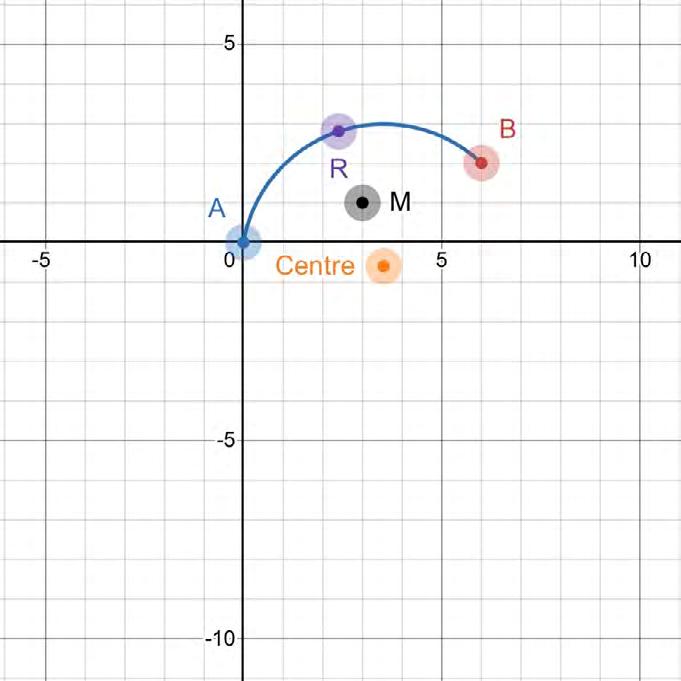
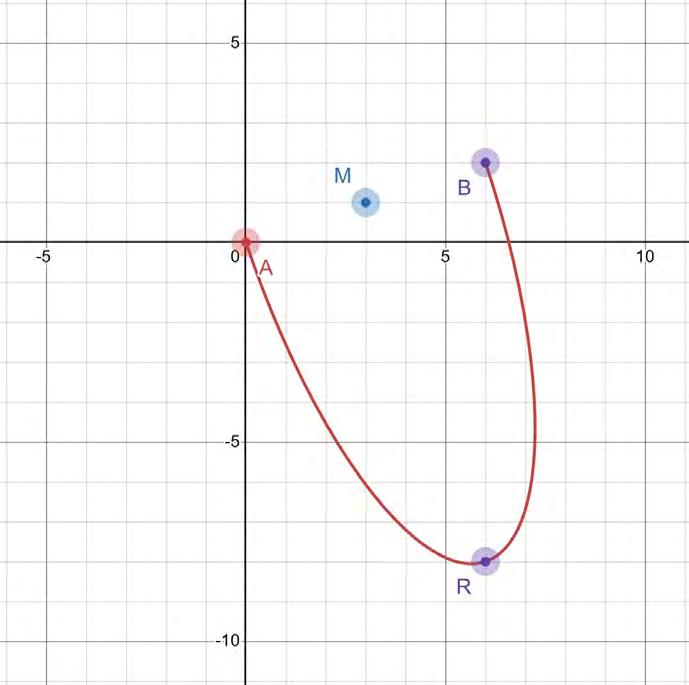
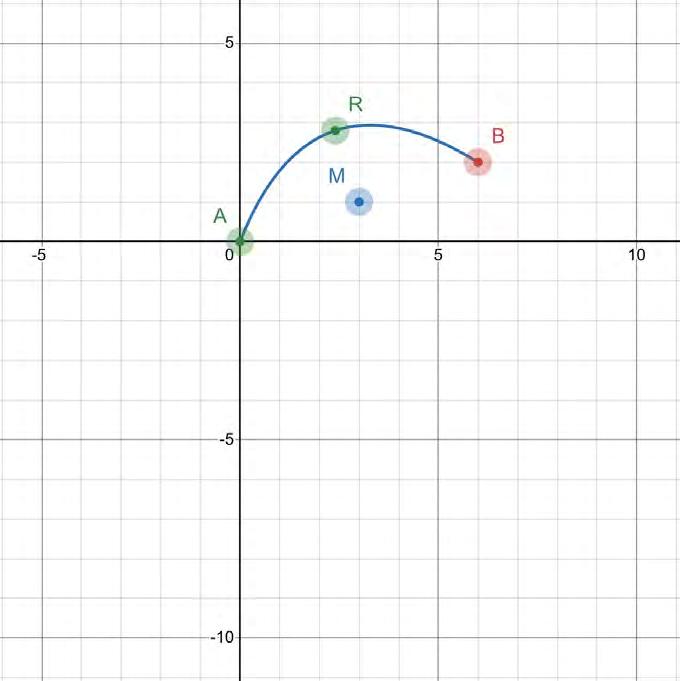
There are three important points in the graphical representation of a curly vector, which are the same across the three types. They are called “endpoint 1 (A)” (where the vector “starts”), “endpoint 2 (B)” (where the vector “ends”) and the “midpoint (R)”, which is defined as the point on the curly vector with the longest perpendicular distance to the straight vector with the same endpoints. We also often use the midpoint of the straight vector (M) in definitions.
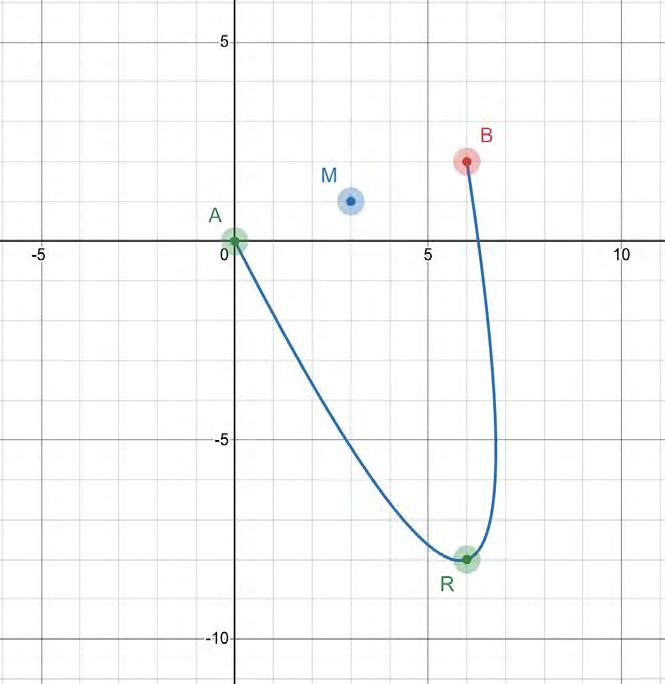
A straight vector has two components. In a column vector, the first component from the top tells you how many units the vector translates a point in the x-direction, and the second tells you how many units the vector translates a point in the y-direction. However, a curly vector has a third component, called the “curvature (c)”. The magnitude of the curvature tells you how “curly” the curly vector is, and the sign tells you whether the curly vector’s graphical representation goes “above” or “below” the corresponding straight vector. Below are graphical representations of vectors with the same x- and y-components but different curvatures:
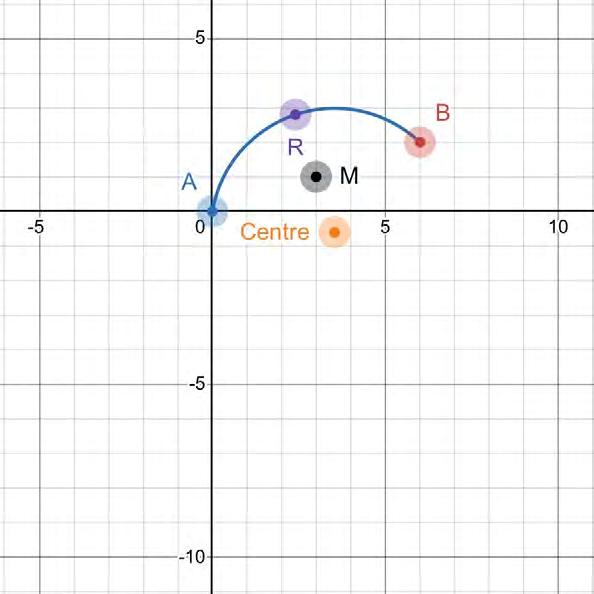
c= 0.3
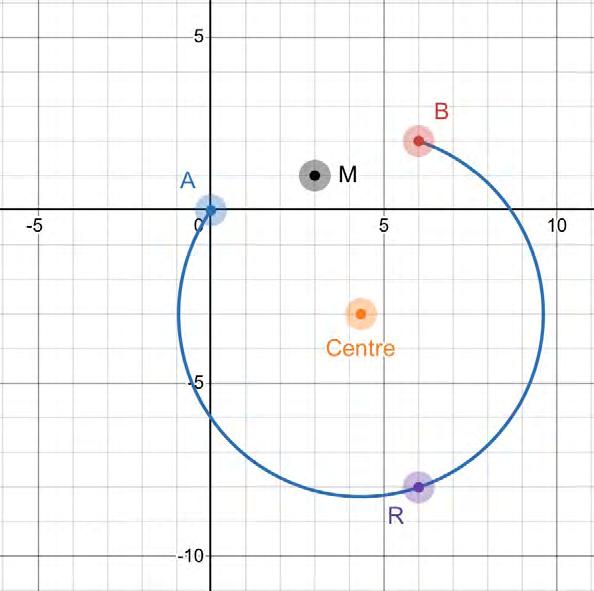
c=1.5
Equations outlining the definitions of components and the relationships between important points and these components are below. Note that no formulae are provided in a U Level exam.
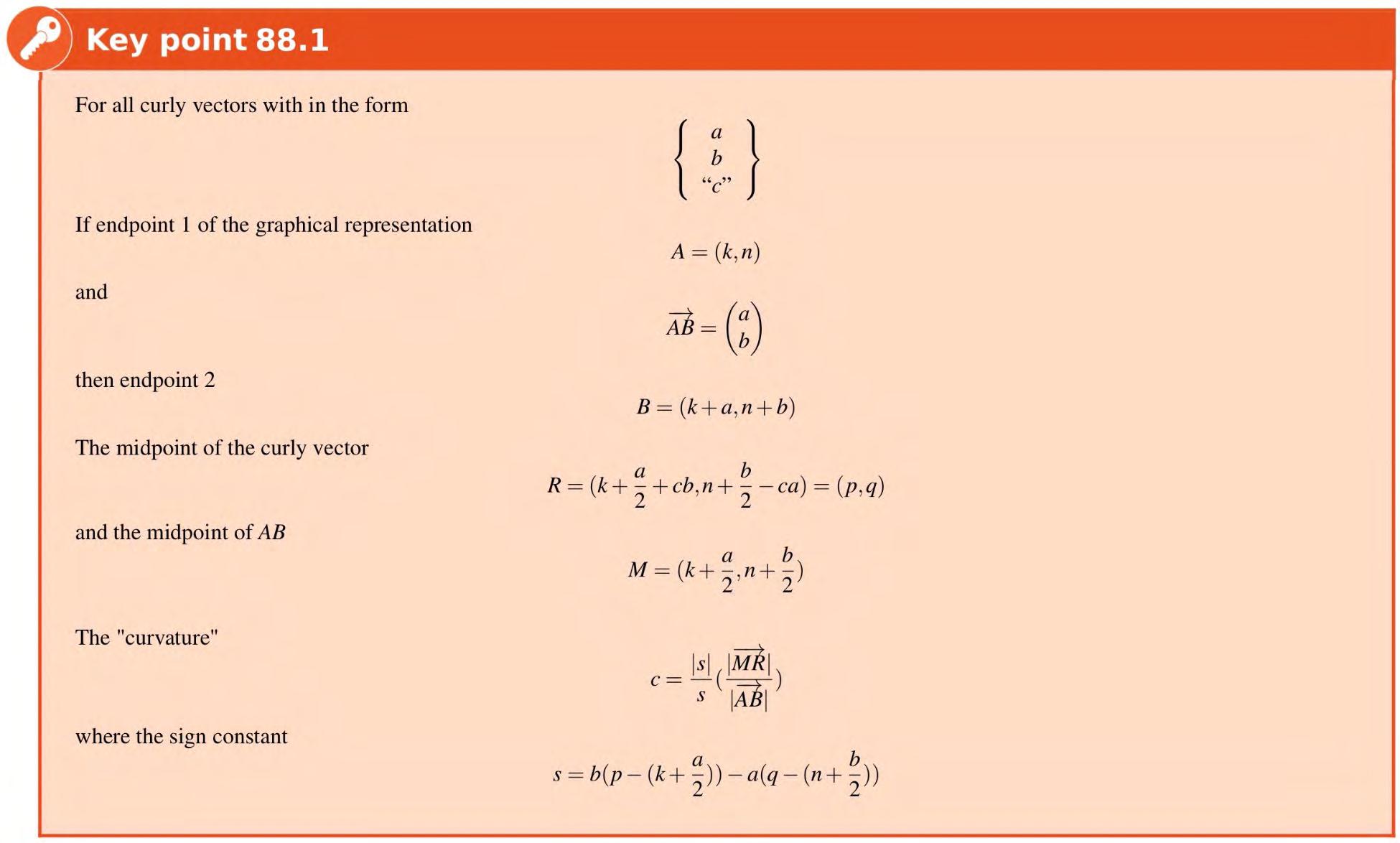
atan2 is a function used to find the angle between a line segment and the segment of horizontal from the same point, i.e. the argument of the corresponding complex number in an Argand diagram. The sign constant can be thought of as the dot product of


and one of the two vectors perpendicular to Hence the sign constant will be positive for one direction of and negative for the other.
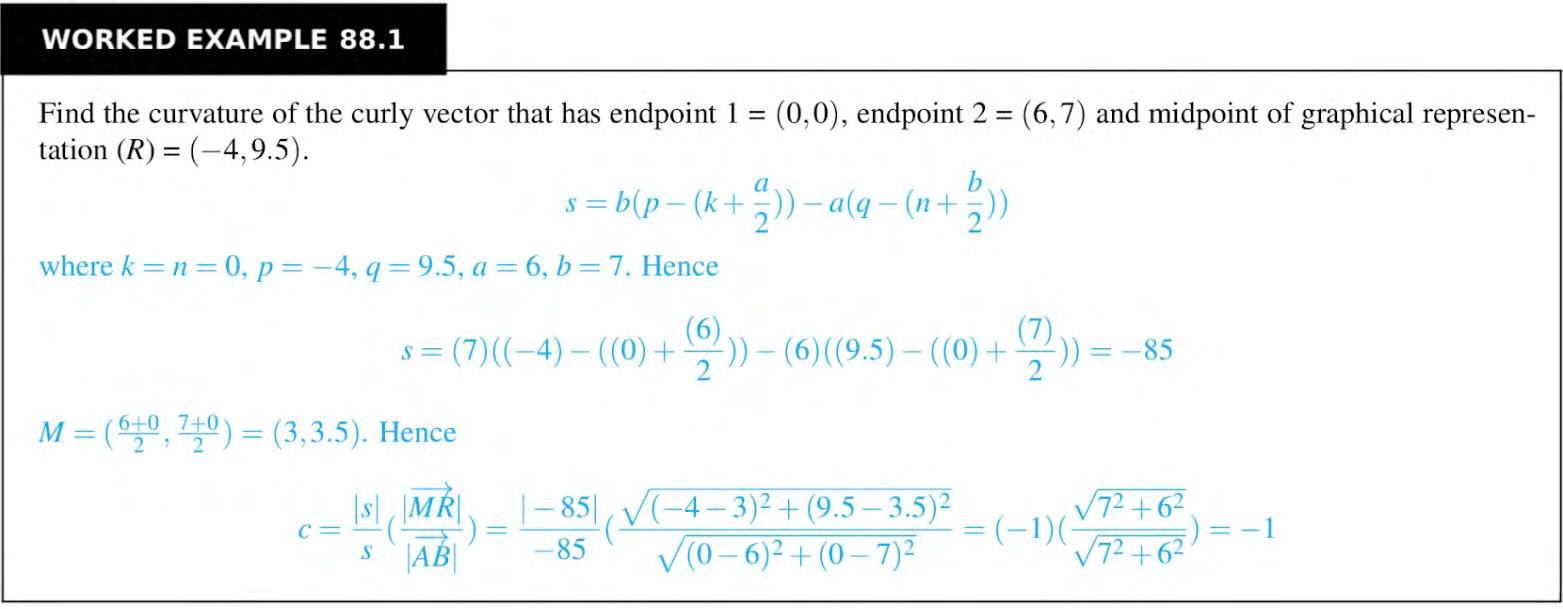
Section 2: Arc Vectors
In this section you will learn about arc vectors, the first of the three types of curly vectors. Arc vectors are represented graphically by an arc. Below are the equations outlining the graphical representation of an arc vector.
You can represent an arc with an arc vector, which could be more convenient in certain situations.
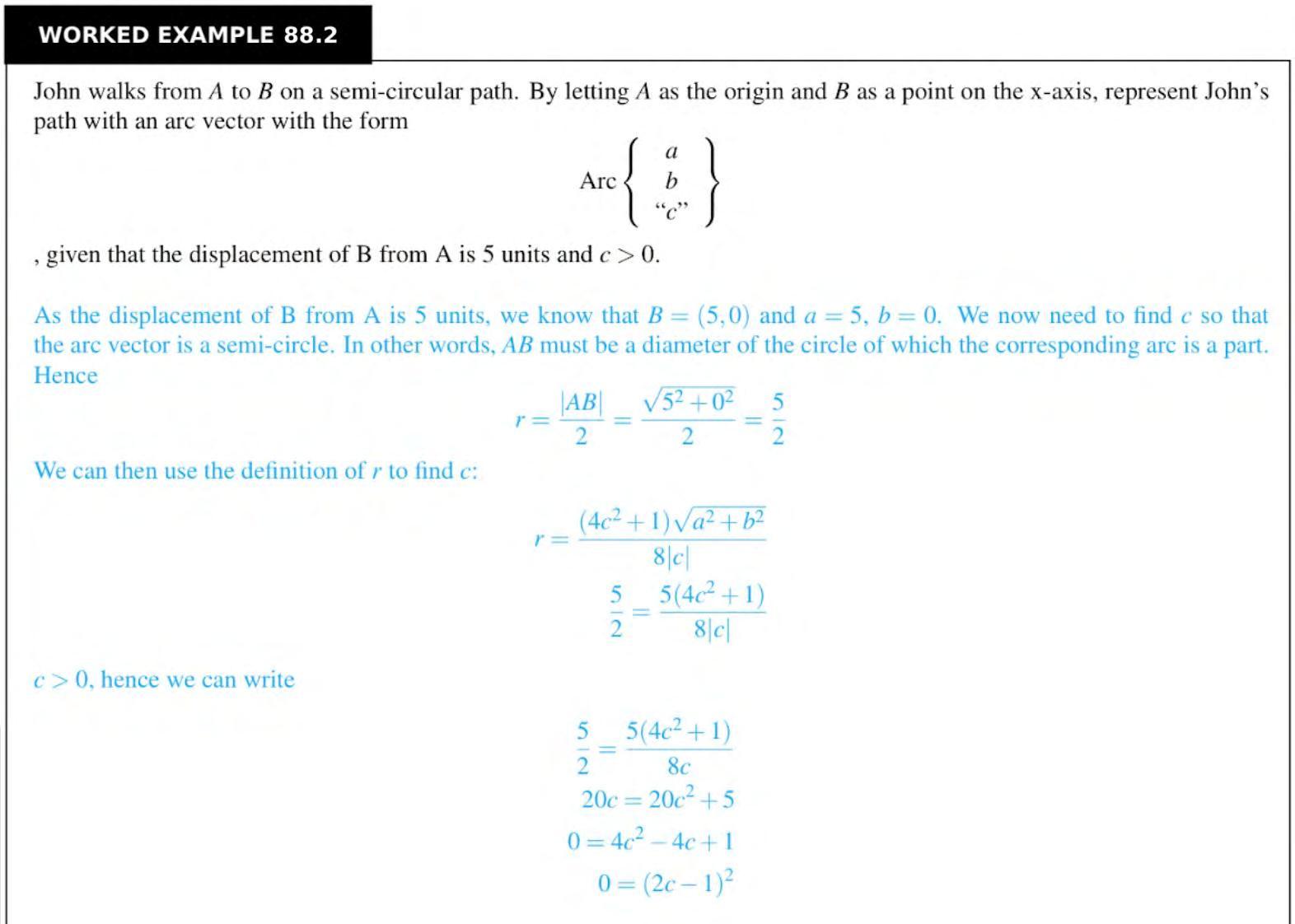
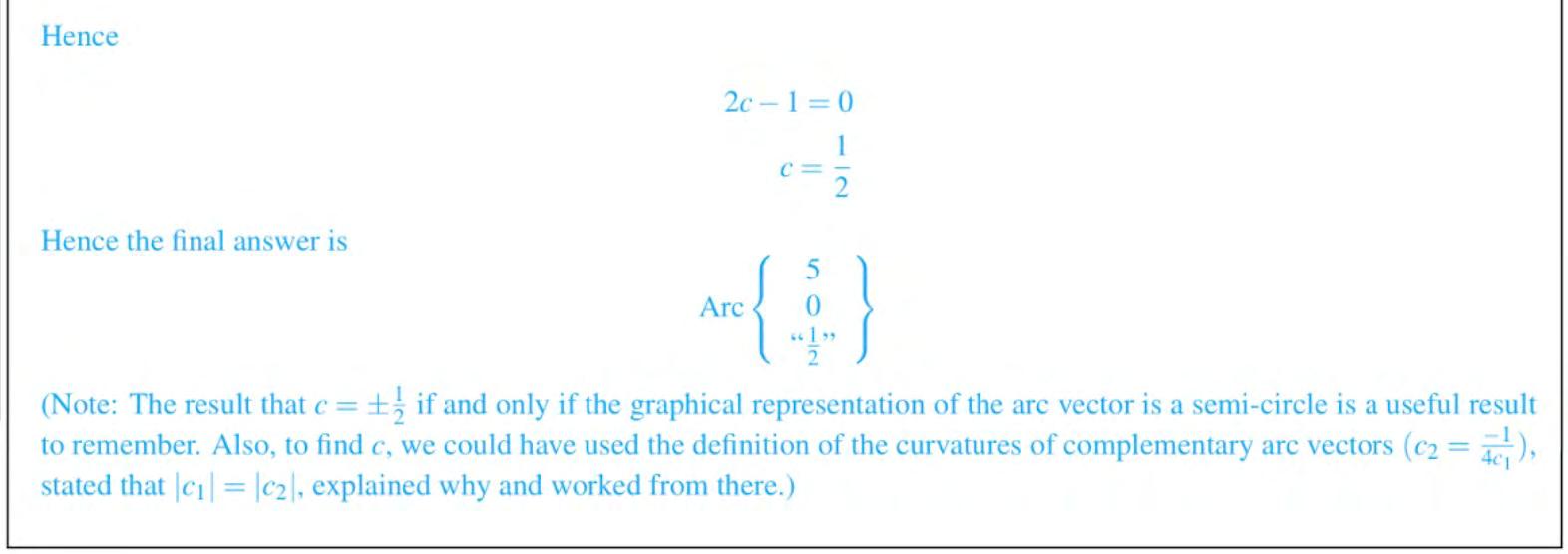
Section 3: Semi-ellipse vectors
Semi-ellipse vectors are the second type of curly vectors covered in the U Level specification, and are represented graphically by half of an ellipse. The shorthand used in notation is “Smell”. Below are the equations outlining the graphical representation of a semi-ellipse vector.


You will be expected to use previous or given knowledge on areas of circles and ellipses.
Section 4: Parabolic vectors
Parabolic vectors are the third type of curly vectors covered in the U Level specification. They are represented graphically by a section of a parabola, and the shorthand for them is “Par”.
(Examiner’s Note: At this point, you might begin to wonder why there are three types of curly vectors which look similar in 2D space anyways. Such reasons are explained in the Foreword of this chapter, which remembering and/or understanding is beyond even the Unnecessary Level specification and will not benefit your skills in any way. The author of this chapter sincerely advises you to forget the contents of the Foreword immediately to avoid useless information from cramming important space in your minds before exams.)
Once again, below are the equations outlining the graphical representation of a parabolic vector.
Section 5: Resultants of curly vectors
The resultant of two curly vectors is represented by the definition below. Notice that you add the x- and y-components and perform calculations similar to finding a weighted mean to find the resultant curvature. Summing two curly vectors of different types is not possible.
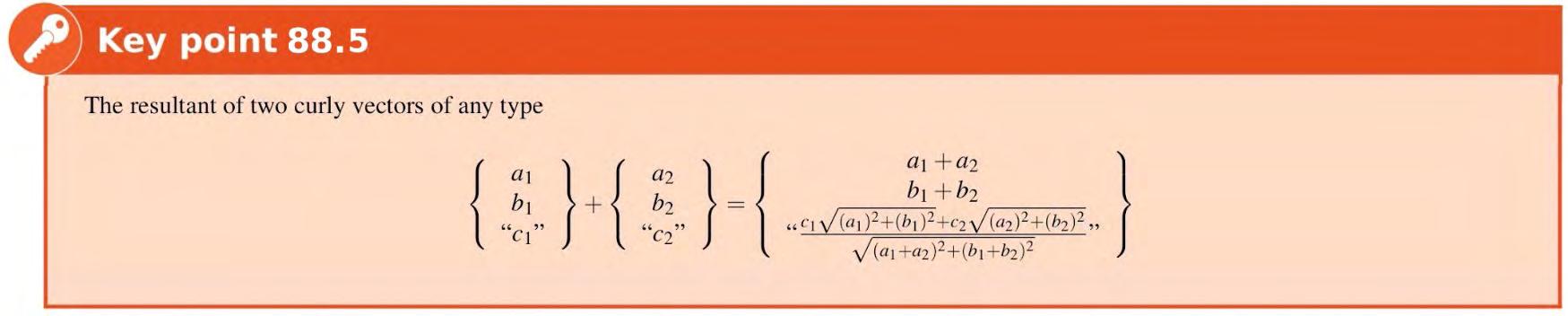
Notice that the path of one curly vector after the other is different from the path of the resultant.
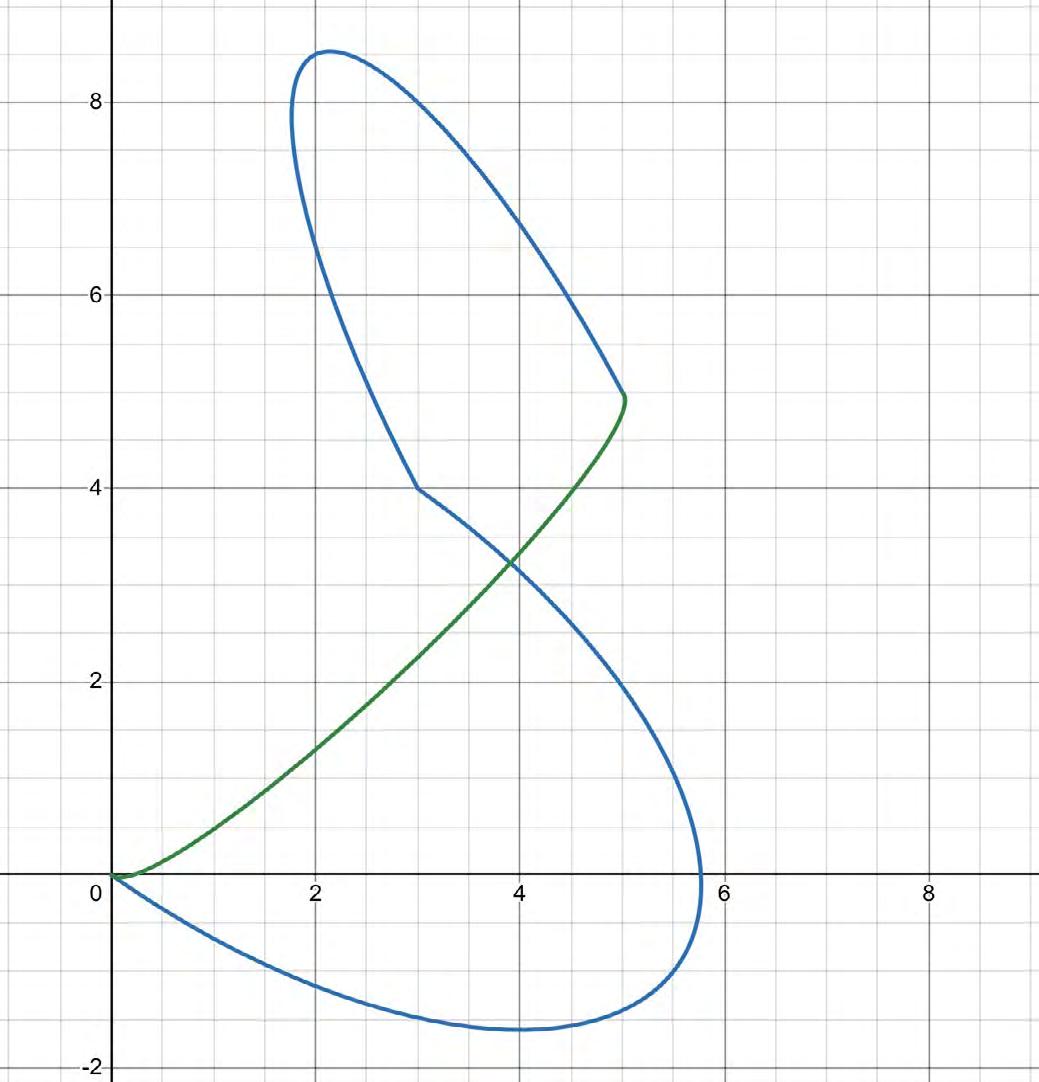
Graphical representation of two semi ellipse vectors with endpoint 2 of the first = endpoint 1 of the second, and the graphical representation of their resultant.
Expect questions involving knowledge from previous sections about different types of curly vectors and their graphical representations to incorporate calculations of resultant curly vectors as well.
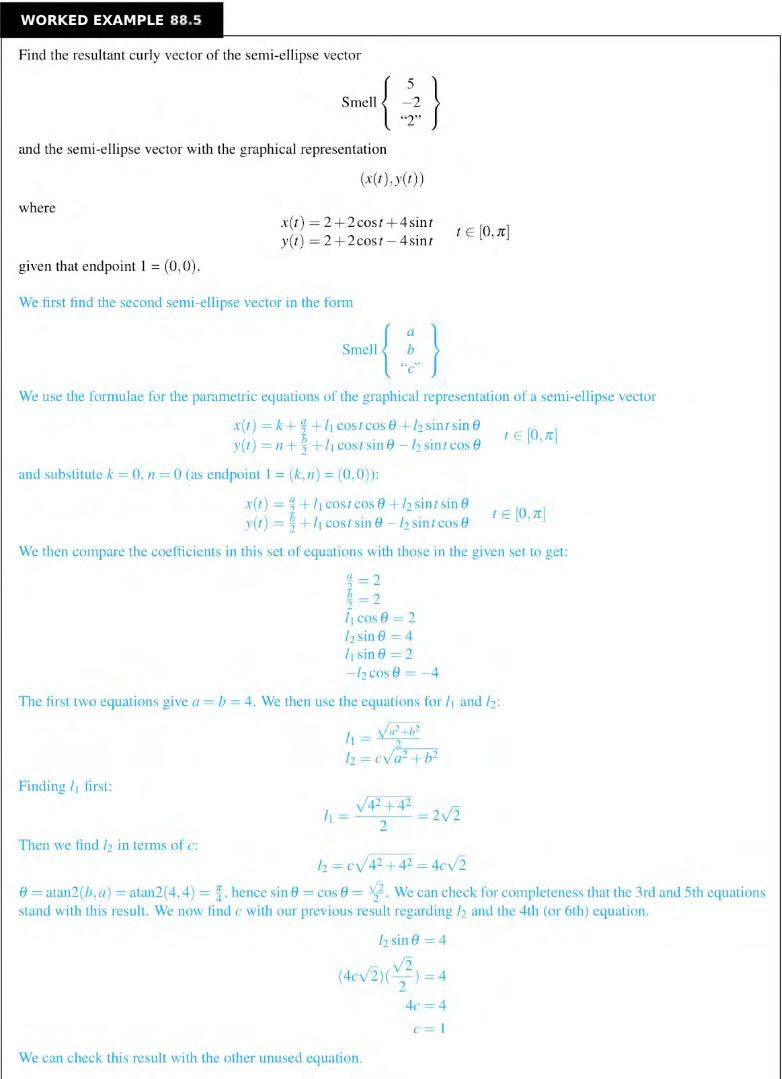
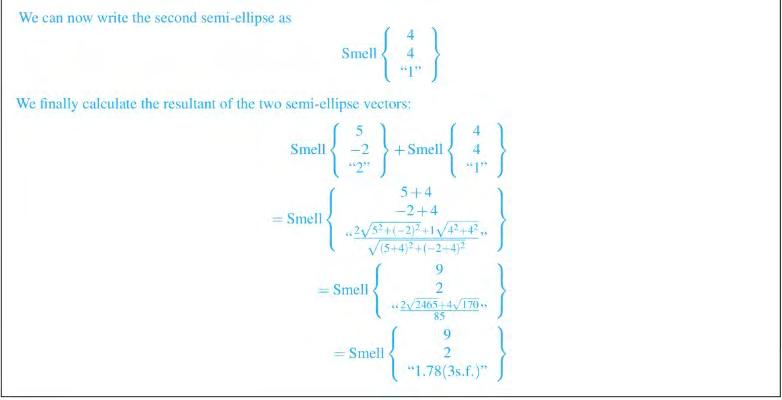
Mixed Practice
The worked solutions for the above can be found in Section 6 of this document.
PSYCHOLOGY
The effects of reading in teenagers and how it affects their lives later
How many teenagers do you see reading for pleasure? Do you see many choosing to read because they enjoy it, not just because the school wants them to? I don’t.
According to the National Literacy Trust, only 34.6% of teenagers read daily for enjoyment, which is a significant drop from previous years. Many teens would ask what the point of reading is, and why is it so important, as they would rather use social media for entertainment instead of written stories.
So why is it so important?
Reading has many benefits. It enhances critical thinking, focus and vocabulary, which is absolutely crucial for academic performance and achievements. If you read regularly, it can increase your attention span and concentration, as when you are reading, you focus on the story. When you read, it exposes you to diverse genres and authors, which gives you a deeper understanding of the world.
As I grew older, I found that when individuals go through adolescence, they tend to not completely be who they really are as they have not found themselves yet. Connecting with fictional characters helps readers explore their own identities. Each person's identities are made up of our personalities, experiences, values, goals, thoughts, and beliefs. They help us understand why we think, feel, and behave in certain ways. Reading fiction gives us an opportunity to experiment with different identities in safe, imagined environments.
So, in a way, fiction books provide individuals with an opportunity to explore different possibilities for themselves and reflect upon distinct parts of their identities. This is especially important during their teenage years, as this is where they start to discover, explore, and develop who they are.
If you read as a teenager regularly, how does it affect your adulthood?
Reading as a teenager lays a lifelong foundation for further learning and development, especially in communication skills. During adulthood, skills and knowledge gained from adolescent reading can significantly enhance your ability to learn new information, express yourself (both of these skills are absolutely crucial when looking for a job) and navigating complex situations, which you can apply to all jobs as there are bound to be some difficult situations during your career life requiring these valuable skills. Reading can also offer empathetic insights, emotional intelligence, and a sense of identity, which are very important for personal growth, social interactions, and stability. Enjoying reading as a teenager builds a deeper understanding of literature and a love for it and the world around you throughout adulthood.
A conclusion
To conclude, teenagers should be encouraged to read, as it contributes to setting them up for adulthood and continues to support them academically and socially throughout life.
SPACE & SCIENCE
Paws among the stars; The untold stories of space exploration
Throughout history, animals have played a vital role in not just space exploration but scientific development in general. Two of the most vital animals that have played a part throughout our history are Laika, the Soviet space dog and Felicetti. The use of animals within science has sparked the debate of whether animals and science should mix. Some argue that it is cruel and that enough research has been done over the many years in which animal testing has been normalised, but others argue that using traditional methods would be superior because of how helpful they have been in the past.
Firstly, to set the scene within the late 1950s, there was great rivalry between the Soviet Union and the US, deeply rooted in the debate whether communism or capitalism is better – an argument that had been on-going for a long time. This competitiveness spanned many areas of development of both nations - the Soviet Union wanted to show how its technological and scientific advancements were faster and stronger than those of the US. The way they thought would be best to capture this ideology was the ability to send a living organism into orbit.
During November 1957, Laika was found wandering the streets of Moscow. She was picked by the Soviets as they believed that coming from the streets, she would be the best candidate for enduring the hunger and colder temperatures she would ‘have’ to experience throughout her pre-planned mission, as opposed to purebred dogs. She performed exceptionally well within her rigorous training, which had to be short and rushed due to the political deadline, which had sparked one of the many debates surrounding sending her into space. The day before Laika was sent to space, one of the scientists who felt a stronger bond and a presumable sense of guilt for the way the are yet to treat her, Vladimir Yazdovsky, brought her home for a night to play with his children and to be treated to her last and only sense of kindness she would have ever experienced. Yazdovsky wrote, “I wanted to do something nice for her: she had so little time to live”.

Throughout history, animals have played a vital role in not just space exploration but scientific development in general. Two of the most vital animals that have played a part throughout our history are Laika, the Soviet space dog and Felicetti. The use of animals within science has sparked the debate of whether animals and science should mix. Some argue that it is cruel and that enough research has been done over the many years in which animal testing has been normalised, but others argue that using traditional methods would be superior because of how helpful they have been in the past.
Firstly, to set the scene within the late 1950’s, there was great rivalry between the Soviet Union and the US, deeply rooted in the debate whether communism or capitalism is better –an argument that had been on-going for a long time. This competitiveness spanned many
areas of development of both nations - the Soviet Union wanted to show how its technological and scientific advancements were faster and stronger than those of the US. The way they thought would be best to capture this ideology was the ability to send a living organism into orbit.
During November 1957, Laika was found wandering the streets of Moscow. She was picked by the Soviets as they believed that coming from the streets, she would be the best candidate for enduring the hunger and colder temperatures she would ‘have’ to experience throughout her pre-planned mission, as opposed to purebred dogs. She performed exceptionally well within her rigorous training, which had to be short and rushed due to the political deadline, which had sparked one of the many debates surrounding sending her into space. The day before Laika was sent to space, one of the scientists who felt a stronger bond and a presumable sense of guilt for the way the are yet to treat her, Vladimir Yazdovsky, brought her home for a night to play with his children and to be treated to her last and only sense of kindness she would have ever experienced. Yazdovsky wrote, “I wanted to do something nice for her: she had so little time to live”.

Unfortunately, the next day at some point within five to seven hours of her flight, Laika had passed due to overheating and stress. However, the Soviets claimed that she had lived for several days before they decided it was time to let her go and euthanised her instead. It took 45 years for the Soviets to finally admit that she was not euthanised and suffered the fate she did in space. In Moscow, there is a statue to the brave stray found outside an aero-military base as a monument to how grateful and significant of a soldier she was to the world of science.
Another one of the most significant animals to influence modern technology is a Parisian tuxedo cat called Felicetti, which was significantly less well known than Laika. She is currently the first and still stands to be the only cat that was ever sent on a mission with such impact and responsibility. Originally, she never even had a name but following her successful flight and safe parachute to the ground she was nicknamed Félix in reference to a popular cartoon at the time — Felix the Cat. Her name slowly morphed into the more feminine, French version of this — Felicetti.
Following recent discoveries at the time, the scientists wanted to go into further depth than just the question of “if I put an animal in space, will it survive?” – they wanted to work out more than that. They wanted to monitor animal brain function to try and compare it to humans and therefore advance in the ‘space race’ by following this with attempts to send humans to space. To aid with this research electrodes were placed into her skull to try and collect as much data as possible.
Her flight ended up being successful with more than enough data collected from her than was even needed. She came back to Earth by parachute and lived for another two months. However, the scientists just could not leave her alone and curiosity really did kill the cat because she was sadly euthanised for even further research, which ended up being completely useless as the surgery she endured came back with no reliable or comparable data.
Of course, this article would not be complete if I only included these two scientific heroes as there are so many others that have benefitted all our lives today. The record for the most animals ever sent to space at the same time was in April of 1998. The flight featured more than 2,000 animals and small organisms on the same space shuttle, called the Shuttle Columbia, including many kinds of animals like rats, mice, fish, and snails.
While it is difficult to know exactly how many animals went to space, we can still recognise the diverse range of animals that have visited. For example: 2 primates (both flights were unfortunately unsuccessful due to safety failures), many different apes and monkeys; the most famous being Ham the Chimpanzee, many amphibians, several types of rodents and the most unrecognised of them all; fruit flies! They were the most significant of everything that has ever been sent to space because they were the first species ever sent and proved the theory that organisms could successfully be sent to space.
As I have previously mentioned, sending animals to space and general animal testing has sparked a lot of debate for many years. On one hand, people may argue that animal testing is necessary for several reasons including medical advancements, biological similarities and legal/ethical reasons. According to Harvard Medical School’s research, all the medical advancements (in all areas) have relied on animal testing, for example, anaesthetics, which make many surgeries safe and possible, insulin for diabetes and inhalers for asthma. Biological similarities allow scientists to compare how diseases may affect humans, genetic similarities and the effect of drugs and treatments. It is also necessary in some places that animal testing is used to ensure human safety, for example, in the USA Food and Drug Administration (FDA) requires that drugs be tested on animals before they are given to humans.
However, on the other hand, there are many concerns about animal ethics, scientific limitations and availability of alternatives. To start, one of the major concerns people have with animal testing is the whole idea of inflicting pain and suffering on something that cannot express their thoughts and feelings in a “human” way. There is also the idea of scientific limitations and that while we can get comparable results with our animal testing and research for medicine, we are not the same species, so there is not always a guarantee of it being successful. Finally, especially with current technological advancements like AI, it is getting increasingly accessible to use other methods of retrieving data as opposed to direct animal testing as these can create technological, non-tactile models of exactly what they need.
In conclusion, the stories of Laika and Felicetti highlight both the extraordinary contributions animals have made to scientific progress and the deep ethical questions their use continues to raise. Without animals, many of the medical and technological advancements we rely on today—from life-saving medicines to human spaceflight— may not have been possible. Their missions helped scientists understand the effects of space travel on living organisms and paved the way for human exploration beyond Earth. However, their experiences also reveal the cost of such progress, reminding us that scientific achievement has often come at the expense of those unable to consent or defend themselves.
The debate over animal testing and the use of animals in space exploration is unlikely to end. While history shows that animal research has played a crucial role in advancing knowledge, modern developments in technology and alternative research methods challenge us to reconsider how necessary it remains. Ultimately, as science continues to evolve, so too should our ethical standards. The legacy of animals like Laika and Felicetti should not only be remembered for their contribution to discovery but also serve as a reminder that progress must be balanced with responsibility, compassion, and respect for all living beings.
Space colonisation – pros and cons
For many decades people have been obsessed with the idea of space travel and, in recent years, the idea of ‘moving planets’ has risen in discussion amongst pioneering companies in space exploration. This seemingly utopian future has been represented in media and television since 1865 and recent films, such as Avatar, have refuelled this dream. However, is it really possible and, if it is, should we really pursue it?
Pros:
It could save the human race from extinction
For the majority of people, self preservation and the continuation of the human race would be a priority. Vast amounts of money, which could be used to attempt to save the earth, is instead being used for research into space travel. Therefore, it seems logical that this technology is envisioned reach a point that it could save humanity when conditions on Earth become more extreme.
An artist’s idea of a future human settlement on Mars
It could be pioneered alongside conservation efforts on Earth
Although climate change is a major issue for survival on Earth, it is estimated that our planet will be habitable for at least another 150 million years, if not billions. Therefore, it seems practical that whilst space travel technology is improving, conservation efforts could also be happening on Earth. After all, if technology had, at that point, become advanced enough to make space colonisation a feasible option then it should also have improved enough to save the world and reverse climate change.
Cons:
It’s simply not possible yet
So far, we are yet to discover a planet with conditions similar enough to Earth to be habitable for humankind. Mars, which has long seemed like the most viable option for space living, would need terraforming to a degree that is simply not possible using modern day technology. It would first need to be warmed to the Earth’s current temperature, which will take about 100 years, and then made to produce oxygen, which would take 100,000 years or more. Additionally, Mars first needs to be thoroughly investigated for the existence of water, minerals and carbon dioxide on the planet before any of these steps can be put into action. The project would also require vast amount of funding, with Elon Musk saying that the SpaceX Mars colonisation project would need 1 million people who are paid $200,000 each to move to Mars.
Technological Advances
If technology has reached a point in the future where this is a feasible idea, then surely it would be possible to save the Earth with the level of technological advancement available then, and hence space colonisation would be entirely unnecessary. Additionally, if we abandon Earth and move to another planet without first solving the problems we have created here then what is stopping it from happening again? Humanity may continue to destroy planets and move on without a second thought in an endless cycle of suffering. It seems morally right to instead channel more funds into conservation efforts on Earth, rather than into space exploration projects where success is uncertain.
Colonisation is morally wrong
Over the course of history there have been countless instance of colonisation where a country is invaded, and their people lose all rights, identity and freedom. If this is obviously frowned upon on Earth now, there must not be arguments that justify it in space either. Chances are, there is some other form of life in the universe. There are no circumstances which justify colonising another planet if it means harming pre-existing native life or taking away from their standard of living. Whilst this point is slightly more theoretical, as there is currently no solid proof of other forms of life in the galaxy, it is still important to consider not only if we can accomplish living in space, but also whether we should if it means suffering and destruction for others.
The initial SpaceX plan on the colonisation of Mars

Cost
This is one of the most obvious and important issues. With the trillions of dollars going into space research projects this money could easily be used for a number of other ongoing issues, such as conservation efforts, education for those who can’t access it, research into climate change and many more. Whilst space research is important, Earth will still be habitable for millions of years and there are other issues that are facing us right now.
Overall
Space exploration is undoubtedly vital. However, it must be approached carefully and with caution. It should also not be ahead of conservation efforts here on Earth. Should these efforts fail, it would then be logical to boost research into space, however at the current point in time it seems better to prioritise fixing current issues whilst research into space exploration happens simultaneously.
A cartoon referencing future space exploration
SOCIETY & POLITICS
Human society is inevitably destructive to the natural environment
People going on long drives may have noticed they accrue fewer dead insects on the front grill of their car. What does this tell us about the world we live in?According to the Living Planet Report (WWF 2020), global wildlife populations have plummeted by 68% between 1970 and 2016, with one million species currently threatened by distinction. Human activity has significantly altered 75% of the Earth’s ice-free land and almost 90% of global wetlands have been lost since 1700. Deforestation and the conversion of wild spaces for agriculture and human food production have largely been blamed for this global decline in biodiversity (IPBES 2019). Woodwell coined the phrase ‘biotic impoverishment’ to describe the gradual erosion of Earth’s capacity to support life (Woodwell 1990), extending beyond the extinction of species to include habitat destruction, overexploitation of resources, environmental pollution, and the degradation of human health and social systems. Whilst the extent of this damage is undeniable, this essay seeks to challenge the assumption that environmental destruction is an inherent, unavoidable and ‘inevitable’ consequence of human existence.
All organisms change their environment as they live, grow and reproduce and organisms themselves have evolved over millennia through natural selection to environmental change. But in evolutionary terms, changes brought about by living things has been slow and incremental (Chu 2017). Early humans, like other primates, made their living by seeking food and shelter from their environment, gathering plant foods, and hunting easy-to-kill prey. They would experience threats from their environment including accidents, disease, predators and natural disasters but co-existed with surrounding ecosystems, with relatively limited ecological impact. This undermines the notion of the ‘inevitability’ of human society being destructive to the environment and suggests that destruction may be contextual rather than an inherent trait.
Rapid human population growth, particularly since the Industrial Revolution, alongside the expansion of global economies founded on technology and fossil fuels, has driven widespread ecological disruption, with human society now constituting the primary threat to the natural environment (Chu 2017). It is the view of some ecologists that human society misunderstands its relationship with the environment, viewing nature as something to be controlled, balanced against economic needs, or used as a source of materials and waste disposal (Chu 2017). Consequently, environmental problems are typically framed in narrow terms such as pollution, energy shortages, or species extinctions, with solutions focused largely on technological fixes. Even concerns about biodiversity loss focus on preventing extinction rather than understanding and reflecting on the deeper ecological changes that lead to them (OECD 2021). This perspective overlooks a fundamental issue: environmental impacts matter because of their effects on living systems, suggesting that destruction is not inevitable but shaped by the choices of human society.
Ecosystems and their organisms provide the biological foundation that supports human economies and wellbeing. Some experts argue that it is possible for humans to act as stewards for this foundation, not just destroyers. To achieve this, it is important to understand how our actions influence living systems, so that we can develop effective and responsible ways to manage the environment and ensure long-term survival. A meta- analysis found that conservation interventions such as protected areas, invasive species control, and habitat restoration can halt or reverse biodiversity loss when properly scaled up and resourced, supporting the idea that proactive stewardship can work (Langhammer 2024). Global, systemic changes in food production, energy generation, resource use, and ocean management are urgently required. Animal product consumption by humans is likely the leading cause of modern species extinctions (Machovina 2015), since it is not only the major driver of deforestation but also a principle driver of land degradation, pollution, climate change, overfishing, sedimentation of coastal areas, facilitation of invasions by alien species (Steinfeld 2006), and loss of wild carnivores and herbivores (Ripple 2014). Dietary shifts toward plant-based foods could reduce negative impacts on ecosystems whilst still meeting
nutritional needs.
It is unrealistic to consider that human society can be totally impact free on the environment. A key issue, however, is whether and how these impacts can be reversed or mitigated, rather than eliminated entirely. To keep temperature increases below 2 °C, and halt associated biodiversity losses, 140 nations have committed to the Paris Climate Change Accord to reduce anthropogenic greenhouse gas emissions by 90% (from 2010 levels) and reach carbon neutrality by 2100 (IPCC report 2014). Since renewable energies currently account for only 17% of global energy consumption (World Bank Group 2017), significant production increases must therefore occur to phase out fossil fuel use. Renewable energy systems still have ecosystem and biodiversity impacts because they require mining (e.g. for precious metals such as lithium), land use (e.g. spatial footprint for wind energy) and material extraction. When such resources occur in biodiverse regions and in countries without strong resource governance and where their economic systems prioritise economic growth and industrial production, such as Bolivia’s Salar de Uyuni salt pan, the world’s second-largest untapped lithium reserve, significant risks to species and ecosystems exist (Sonter 2020). In this scenario industries may overexploit natural resources as the environmental costs are borne by society rather than the producers (Stiglitz 2019). Cultural values may also shape how societies interact with the natural world. For example, consumerist cultures promote high levels of material consumption, whilst in contrast many indigenous cultures embed environmental responsibility within spiritual and social norms encouraging sustainable land and resource management (Berkes 2012). Conservation strategies must therefore identify and mitigate these impacts to ensure that renewable energy development does not simply substitute fossil-fuel driven climate threats with new ecological harm.
In summary, human societies inevitably modify the natural world, but whether these changes become destructive is shaped by economies that prioritise growth over sustainability, weak governance of natural resources and cultures that encourage excessive consumption. Unfortunately, without urgent change to existing systems, destruction of the natural environment currently seems inevitable.
References:
WWF (World Wildlife Fund). (2020) Living Planet Report 2020: Bending the curve of biodiversity loss. WWF, Gland, Switzerland. ISBN: 9782-940529-99-5. Available at: https://www.worldwildlife.org/publications/living-planet-report-2020. Accessed February 2nd 2026.
IPBES (Intergovernmental Science-Policy Platform on Biodiversity and Ecosystem Services). (2019) Summary for policymakers of the global assessment report on biodiversity and ecosystem services of the Intergovernmental Science-Policy Platform on Biodiversity and Ecosystem Services. Bonn, Germany: IPBES Secretariat. DOI: https://doi.org/10.5281/zenodo.3553458.
Chu EW, Karr JR. Environmental Impact: Concept, Consequences, Measurement. Reference Module in Life Sciences. 2017:B9780-12-809633-8.02380-3. doi: 10.1016/B978-0-12-809633-8.02380-3. Epub 2016 Oct 31. PMCID: PMC7157458.
OECD (2021). Biodiversity: Finance and the economic and business case for action. Paris. OECD Publishing. Woodwell G.M. Cambridge University Press; Cambridge, UK: 1990. The Earth in Transition: Patterns and Processes of Biotic Impoverishment. Langhammer, P.F., Bull, J.W., Bicknell, J.E., Oakley, J.L., Brown, M.H., Bruford, M.W., Butchart, S.H.M., Carr, J.A., Church, D., Cooney, R., Cutajar, S., Foden, W., Foster, M.N., Gascon, C., Geldmann, J., Genovesi, P., Hoffmann, M., Howard-McCombe, J., Lewis, T., et al. (2024) ‘The positive impact of conservation action’, Science, 384(6694), pp. 453–458. Machovina, B., Feeley, K.J. and Ripple, W.J. (2015) ‘Biodiversity conservation: The key is reducing meat consumption’, Science of The Total Environment, 536, pp. 419–431.
Steinfeld, H., Wassenaar, T. and Jutzi, S. (2006) ‘Livestock production systems in developing countries: status, drivers, trends’, Rev. Sci. Tech. Off. Int. Epiz, 25(2), pp. 505–516.
Ripple, W.J., Estes, J.A., Beschta, R.L., Wilmers, C.C., Ritchie, E.G., Hebblewhite, M., Berger, J., Elmhagen, B., Letnic, M., Nelson, M.P., Schmitz, O.J., Smith, D.W., Wallach, A.D. and Wirsing, A.J. (2014) ‘Status and ecological effects of the world’s largest carnivores’, Science, 343(6167).
IPCC. Summary for Policymakers—Contribution of Working Group III to the Fifth Assessment Report of the Intergovernmental Panel on Climate Change (Cambridge University Press, 2014).
World Bank Group. The Growing Role of Minerals and Metals for a Low Carbon Future. (International Bank for Reconstruction and Development/The World Bank, Washington, DC, 2017).
Sonter, L.J., Dade, M.C., Watson, J.E.M. et al. Renewable energy production will exacerbate mining threats to biodiversity. Nat Commun 11, 4174 (2020). https://doi.org/10.1038/s41467-020-17928-5.
Stiglitz, J.E. (2019). People, Power and Profits. London. Allen Lane.
Berkes, F. (2012) Saxred Ecology. 3rd Edn. New York: Routeledge.
Spotting the Fake:
A beginner’s guide to identifying disinformation
‘This ‘climate change’ is the greatest con job ever perpetrated on the world.’ ‘Democrats want unauthorised immigrants to cast illegal votes.’ ‘In Cuba they do not have Tylenol, and they have virtually no autism.’ If, even for a second, you believed any of these quotes from the current president of the United States, you are a victim of political disinformation.
The term ‘disinformation’ refers to false information designed to mislead people in society, and it is deliberately spread with the intent to confuse fact from fiction. In the past few years, there has been an abundance of it, which is increasingly apparent within the current US administration. However, the increase in disinformation is also clear worldwide, with 62% of online content being deemed as false, and a staggering 86% of all global citizens receiving some form of disinformation daily.
It’s important to preface that whilst Trump and his associates deserve scrutiny, which is our job as voters, this disinformation is not to be blamed on Republicans. People have trust in the President, but that also means they place trust in the disinformation being spread, resulting in more and more lies being told. Furthermore, many previous presidents, and most politicians, spread some form of disinformation too. However, Trump uses disinformation in a different aggressive way to specifically degrade opposition and to further divide the two parties of America. Disinformation has never been so apparent in our lifetimes as it is through Trump and the MAGA movement.
So, how does disinformation take place? In this article, I will break down separate political issues which receive the most disinformation currently in the US, and I hope to show you the consequences that political lies can bring.
One glaringly obvious case for this is disinformation about climate change, which is one of the main problems the human race faces today. From 2030 to 2050, climate change is expected to cause an additional 250,000 deaths per year. Seeing what is at stake, it’s increasingly devastating when the President of the United States repeatedly claims that it is a ‘hoax’. Instead of working towards a prevention for these deaths, and the undeniable suffering that goes along with them, we have more climate change skeptics than ever. On multiple occasions the president has said that global warming is a good thing because he will the have more ocean-front property to sell, which is deeply worrying considering he is already a multi-billionaire. Normal people would also question the fact that if ocean levels rise, and there is less coastal area, how would we be able to sell more property on the coast? But let’s face it, this is the least of our issues. Through disinformation, Trump is not only spreading lies about the reality of the world we live in but is demonising his opposition for his own benefit. He has made absurd claims from blaming the Democrats for purposefully causing the 2025 LA wildfires, which we know to be a direct cause of climate change, to suggesting that they intentionally withheld aid to Republican disaster victims during Hurricane Helene. Whilst his claims about climate change are preventing us from progressing towards a more sustainable future, his claims about the Democrats are destroying the trust between the two parties, creating the glaring divide we see today. Through this demonisation, the president reinforces this idea that Democrats and Republicans are two separate groups who divide the country, when in reality, they should be coming together. Half the country cannot solve issues like the climate crisis, so the next time you hear the words “Drill, baby, drill”, think beyond what the president has told you, because there are millions of highly qualified scientists and researchers who are betting against the billionaire businessman.
A topic which undoubtedly needs to be mentioned is the issue on immigration. Evident from a study done in Stanford University, it has been proven that immigrants, whether legal or illegal, are 60% less likely to be incarcerated for a crime than US born citizens. Immigration and unemployment also have an inverse relationship, meaning when immigration increases, unemployment decreases, proving to be highly beneficial for economies worldwide. However, Trump has repeated the words: “They are killing Americans en masse”, 235 times. Going back to political division, he has also claimed that Democrats want an open border, so that they can pressure “illegal aliens” into voting for them, which is also apparently why they won the 2020 elections against him. Here, he is not only demonising his political opponents, but other innocent people as well. This way, he can distract the
public from his own failures and place the blame on others. For example, he is placing the blame of fentanyl use in the US on immigrants, which gives him and his supporters an ‘excuse’ for the horrific ICE raids happening throughout America. His lies have caused a whole Party of people to refer to immigrants as ‘illegal aliens’ for simply seeking the American dream that they were promised. These lies create far more division than many others: political, since he is making blanket statements that Democrats want open borders; cultural, since he is demonising any person who is not white or doesn’t speak English; and social, since events such as the ICE raids have created a huge number of protests globally. This division creates an environment of blame rather than cooperation, which taints the people he personally does not agree with. The climate of disinformation has caused a whole party to overlook the fact that the president himself has 34 felony counts, but who also campaigned on getting rid of ‘criminals’. When you put it like that, it’s pretty ironic, huh?
In the last few months, disinformation on the grounds of healthcare has been spreading like wildfire; once again, it has strongly been accentuated by Trump’s administration. He and RFK Junior have repeatedly claimed that vaccines cause autism, which is as blatant as a lie gets considering that that cause of autism is currently unknown. Whilst it is being researched by scientists and healthcare professionals, there’s no evidence of one particular thing causing the learning disability. This has undoubtedly caused a rise in vaccine skepticism, with up to 30% of Americans saying that they don’t trust this form of healthcare. It's important to stress that this is not only dangerous for the people themselves, but to the whole of society as well. This is even further accentuated when RFK Junior encourages parents of newborn babies to not vaccinate their children. This can clearly result to the premature death of toddlers and young children with vaccines accounting for up to 40% of the decline of the infant mortality over the last 50 years. Following this, it’s also important to note that all of RFK Junior’s kids are vaccinated, so on some level, he doesn’t even believe the dangerous policies he is advocating for. These claims, backed up by false statistics are misleading people on topics which they deserve to have 100% of the information, because lack of information in this topic can be life-threatening. Therefore, with medical disinformation increasing rapidly, both our basic physical rights and human autonomy are being taken away. It is not the job of the president to give false opinions on topics he is not educated on, and we should collectively question why we are placing trust in a person who is, on purpose, misleading us on topics which could cause us mental and physical suffering.
So how does disinformation really change our lives? At a glance, it may seem irrelevant, but in the grand scheme of things, our vices are more detrimental than we realise. We are subjects of manipulation every time we see any kind of information, and for some politicians, that is all we are: a collection of votes. Hence, by dividing us further and further, by pushing people to the brink of extremism — whether to the right or the left, and by vilifying opposition using these ‘simple’ acts of disinformation, politically powerful figures like Trump can create a party who thinks as he does. Disinformation creates distrust not just between us and the government, but between us and our families and friends as well. So next time you hear the words ‘Drill, baby, drill’, or ‘vaccines cause autism’, if you believe in them, you are a human stepping stone for political gain. We are being manipulated.
Why are women’s perspectives essential within International Relations?
In this article, Ella explores the delicate balance between success in International Relations and gender equality. Ella is in Year 11 and this article showcases her opinions and self directed research. I hope you will agree with us that this is a politically astute and academically ambitious exploration for a 16 year old! (Mrs Lyons White)
Despite the relentless decades of women fighting for gender equality, it is shown that global politicians working within organisations such as the UN or NATO still refuse to acknowledge more feminist perspectives when it comes to global affairs. A 2017 survey called the “Euro Barometer” (commissioned by the European Commission to monitor social and political attitudes across EU member states) found that over 61% of EU citizens believed that “politics is dominated by men who do not have sufficient confidence in women.”1 This statement alone proves that the stereotypes which question the capabilities and intellectuality of women are still predominantly evident today. Our world has often been built around the idea of prioritising men’s needs over women's. Now, I am not saying that the entire construct that our society is built around is sexist and against women, but I do believe there are underlying themes which are evident and do display elements of sexism.
So where does this issue start?
Well, I would argue that these ideologies have been built up over the past couple of decades, due to the influence of propaganda and the historical normalisation of sexist ideas in society. However, if we were to focus on modernday society, I would address the social inequalities which are prevalent within International Relations (IR). Within IR, there are many ideologies that are quite popular and heavily followed by global politicians. The problem with some of these ideologies (from a social aspect) is that they not only seem to prioritise masculine perspectives over female perspectives, but that they also seem to prioritise state security over human security. V
Traditional IR theories emerged in a context where the field was dominated by men, meaning that the assumptions and priorities of these theories often reflect historically masculine-coded values. In protest against this, since the 1980s, the feminist perspective has emerged within global politics through pioneering leaders such as Judith Ann Tickner, who criticised one of the most popular IR theories: Realism. She argued that Realism, rooted in historically male - dominated institutions, often had the effect of sidelining women’s perspectives.
Before I continue this discussion, I must make some clarifications. When I say, “masculine or feminist perspectives,” I am not pitting men and women against each other; nor am I strictly saying, “men and women,” as men are of course allowed to hold feminist perspectives - and vice versa. I am also not trying to suggest that masculine views are all bad and based on pure violence. However, we must acknowledge the fact that traditional masculine approaches have historically meant dominant institutional norms, and that in turn has historically often meant more aggressive attitudes. Nor am I saying that Realism as a theory must be completely disregarded: there is a level of pragmatism, in our world today, in having strong financial stability and secured power. However, this necessity to have economic or military power in our current society begs the question: have we, as humans, prioritised materialistic rewards over compassion for others?
What is Realism?
Realism is one of the main theories followed in International Relations which suggests that states are like “individuals in a harsh world where only the strongest survive,” following a “survival of the fittest” mindset.2 This theory reveals the anarchic nature of IR where there is no world “leader” to support order, leading countries to compete and debate for power and resources. Realism focuses on state security (referring to the overall stability and safety of a nation-state, considering aspects such as law enforcement, military capabilities, intelligence services, and national defence)3 and military capabilities, intelligence services, and national defence)3 and military power. Due to there being gender biases, masculine-coded perspectives are often privileged in the international sphere, while feminine perspectives are simultaneously marginalised. Some of the main ideas of realism include:
• Competition is inevitable and only natural between states. This reflects a traditional masculine approach towards problem solving, ignoring the more collaborative and cooperative approaches that are available.
• Military and territorial strength is the only way in which power can be attained. IR focus on military power, reflecting masculine conceptions of strength and power and thus beginning to prioritise state security.
• The public sphere of interstate relations and dominance is the main focus of Realism. It prioritises the interactions and relationships between different countries, primarily focusing on political and diplomatic exchanges.
Many feminist scholars argue that Realism reflects values culturally associated with masculinity - not because men created it intentionally to exclude women, but because early IR institutions were overwhelmingly male and tended to prioritise military power, autonomy and competition. These qualities are at the foundation of Realism. As a part of society, I personally do not believe that these attributes benefit us nor even consider people as a priority. In my view, Realism overlooks several human aspects of security such as the protection of vulnerable populations, human rights, and social justice - all issues that truly matter to all of us.
The Feminist Critique
The feminist perspective tends to introduce other solutions to world affairs as it wants to ensure that feminist views are included more within the studies of International Relations. The perspective suggests the idea of human security being more regarded in global politics rather than state security, focusing on ensuring that society has access to basic needs such as food, shelter, healthcare, and freedom from violence - regardless of gender, ethnicity, or sexual orientation. Feminist views also bring awareness to much more emotionally taxing topics such as domestic violence, human trafficking, and gender-based violence. Frequently, these issues are not addressed within IR and receive much less attention because they do not fit the Realist state-centric framework that has been developed over the years. The feminist approach to International Relations also acknowledges that people across the world will inevitably have different lived experiences due to geographical differences or other differing individual characteristics. Consequently, there is a need to highlight how the decisions made within global politics can impact distinct groups of people in several ways. This is also referred to as “Intersectionality.”4 While Realism emphasises the importance of preventing conflicts between states (also known as absence of war or “negative peace”), the feminist perspective highlights the significance of ensuring that justice and equality are preserved and prioritised (“positive peace”) so that all individuals are able to thrive in an optimal society.
Despite these cooperative elements championed by the feminist perspective, women are notably excluded from decision-making processes, often due to the overwhelming fact that International Relations is a field dominated by men: because of this gender imbalance in several world organisations, it is inevitably harder to present these feminist views. According to a study by the US think-tank The Council on Foreign Relations, substantial inclusion of women in a peace negotiation makes the resulting agreement 64% less likely to fail and 35% more likely to last at least 15 years. Research from 2019 has also shown that women’s participation in the resolution of nuclear issues is beneficial, that it reduces the potential for risk-taking behaviour and increases the likelihood that negotiated agreements would hold.5 These statistics are most definitely positive outcomes as a direct result of the contributions from women. Yet, women only represent about a quarter of delegates to international nuclear talks, which simply is not a sufficient inclusion of women for there to be meaningful impact, nor to have true equality in the workplace. To address this under-representation, we must first investigate and understand why global politics predominately features men.
Why is Realism Socially Accepted?
These issues stem from the traditional views and stereotypes implemented within society throughout the past few decades. As much as society has improved in challenging these stereotypes and general views on the role of women (and men), there are still many legacy beliefs circulating in society that still influence the behaviours evident within International Relations. We still see sexist attitudes and women being considered as “inferior” -specifically during times of conflict. War propaganda during the first World War often presented women as figures of the home and reinforced the concept of the “traditional housewife” protected from the harsh reality of war and granting permission for her husband to go and fight as she would be in the house, raising the children
and maintaining the nuclear-family’s domestic status-quo. Meanwhile, in propaganda of the same time, men were depicted as more suitable and stronger to go and fight ‘for King and Country’. What society often seems to neglect is that women also faced immense amounts of hardship and manual labour in this time; while there is some evidence and propaganda that supports this, it was not the main idea presented of what women could contribute to the war. Gradually, women started to become symbols that needed to be “protected” rather than be the protectors themselves. Judith Ann Tickner called this the “protection racket” – the belief that men are natural protectors of not only women, but of any sort of issue; this is not the case at all. These stereotypes do not tell us anything meaningful about men or women individually, but they do shape the social expectations that influence political institutions.
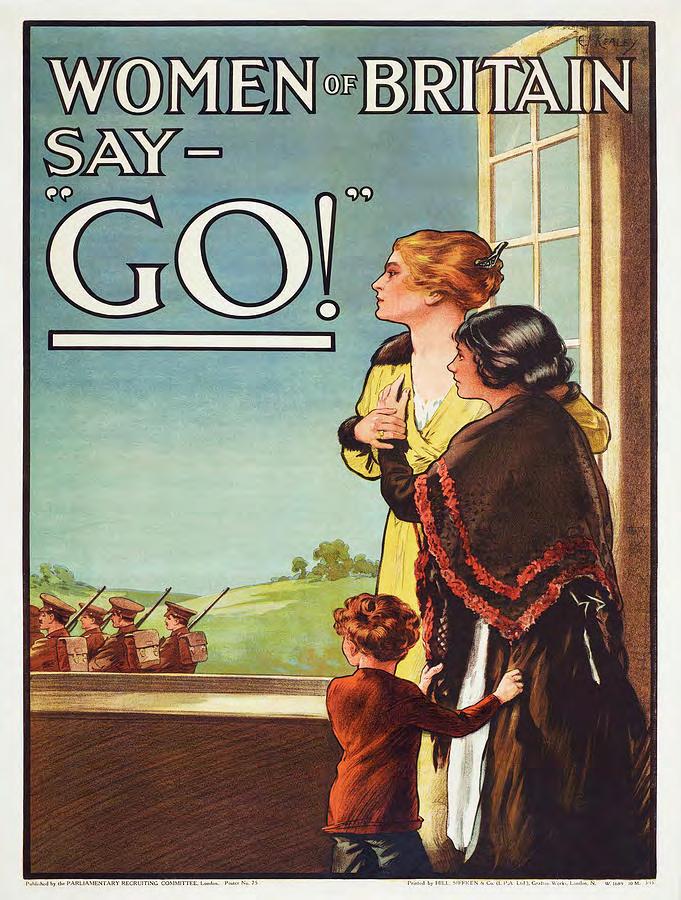
British first World War Propaganda poster
Fascist dictators such as Hitler promoted childbirth for women, further implying that a woman’s only role in life was to reproduce and give birth. He did this by introducing “Encouragement of Marriage”, a law which offered rewards to families who had many children as an incentive for childbirth. The Nazi regime gave married couples a state loan of 1000 Reichsmarks (around £1,216.18 today) which would be partially repaid every time the wife gave birth. Women who bore multiple children were awarded a medallion, the Cross of Honour of the German Mother: in bronze for four children; in silver for six; and in gold for having eight children.6 Fundamentally, these programmes and materialistic rewards were used by Hitler as incentives to convince German women to have many children. These actions further consolidated the idea that success for women was bearing children and taking care of the house and household.
I have tried to exemplify how International Relations may be dominated by men because of pre-existing stereotypes surrounding the capabilities of women, and to suggest that global politics is still stuck in its old traditional ways, operating under the assumption that men are more “natural actors” in the international sphere. We, as a society, seem more inclined to accept these old-fashioned beliefs (and the concept of Realism itself) because these stereotypes have been subtly embedded into social and political institutions over many decades.
Next steps?
In terms of improving the gender gap in International Relations, I believe that the theory of Realism can play a part. Its core values focus on state power, and economical and territorial leverage, rather than people; most importantly, in my opinion, Realism has a tendency to ignore women’s beneficial contributions to the world and therefore directs them into inferior roles within global politics. Despite my critiques, I am not saying that we must abandon all Realist insights: Realism does consider crucial factors – such as maintaining a strong economy or civilised relationships with other countries. My message is that we must be sure to also consider the feminist approach to global affairs: it would expand politicians’ insights and International Relations’ aims, namely to prioritise societal issues and include other diverse perspectives. Countries like Sweden have already presented the concept and implementation of a Feminist Foreign Policy 12 years ago in 2014. Following this, over 79 other countries announced similar plans to include women in their foreign policies. Despite this, only 33% of UN members have included an allocated budget to implement national action plans for “WPS” - the promotion of Women, Peace and Security within global affairs. A strikingly low proportion, this statistic showcases the lack
of willingness from UN states to formally include women in global issues and talks. Perhaps the best course of action here is to bring awareness of the flaws in IR and the gender gap to those working within world organisations. This could be through protests, social media, or other forms of communications. The goal must be that more attention is brought to the inclusion of women at every level of the functioning of society. There are other ideologies that could be followed too: Liberalism or Marxism, for example; and while these are considered more inclusive theories than Realism, feminists are still critical of how these approaches ignore the fact that women are exploited in these systems and can overlook the intersections of gender and class.
Considering all the challenges to realise improvements, I believe that the biggest challenge would be reconfiguring public perceptions on what “security” really means for us. We can start to shift our own perspective to follow the feminist mindset in global politics and question whether the “state security” that world organisations want to prioritise is truly suitable for us. Realism clearly states its intentions are to improve the reputation and financial aspects of a country; however, we do not see any indication of wanting to improve social life. The feminist perspective puts humanity first, ensuring that we can live just and tranquil lives. As a society, it is a necessity for us to realise the flaws within our working systems, and to demand change for improvements. So, I invite you to question the integrity of our global politics and to understand the necessity of women’s perspectives in International Relations.
Bibliography:
Feminist Critique of Realism in International Relations • PolSci Institute. (2023, November 14). Political Science Institute. https://polsci.institute/international-relations/feminist-critique-realism-international-relations/ Feminist Perspectives in International Relations • PolSci Institute. (2024, March 2). Political Science Institute. https://polsci.institute/international-relations-world-history/feminist-perspectives-in-international-relations/ Lazarou, E., Zamfir, I., Graphics, & Killmayer, L. (2021). BRIEFING EPRS European Parliamentary Research Service. https://www.europarl.europa.eu/RegData/etudes/BRIE/2021/689356/EPRS_BRI(2021)689356_EN.pdf state security Meaning Goong.com - New Generation Dictionary. (2025). Goong.com. https://goong.com/word/state-security-meaning/ Walsh, B., & Harrison, B. (2022). Cambridge IGCSE and O Level History 3rd Edition: Option B: The 20th century. Hodder Education.
ABOVE & BEYOND
Zach B, Year 12
The Code of the Samurai, translated by Thomas Cleary
Written in 1834 by Daidōji Yūzan, this book outlines the moral framework, or Bushidō, that guided Samurai conduct throughout the Edo period. Yūzan explores a wide range of situations in which a warrior’s character might be tested, from maintaining loyalty to their employer and upholding the honour of their family to navigating legal matters with dignity and restraint. At its core, the text emphasises frugality and disciplined living, rigorous martial training, and an unwavering commitment to personal and familial honour—principles expected to be upheld until death. Rather than presenting these ideas as abstract ideals, Yūzan frames them as practical expectations for daily life, shaping how a Samurai should think, act, and respond to adversity.
I found this book to be particularly useful in studying Politics. Many of the traditional virtues embedded in Bushidō continue to influence modern Japanese social norms and political culture, which in turn shape Japan’s behaviour on the global stage. Understanding these historical foundations added nuance to my view of contemporary geopolitics, helping me appreciate how cultural continuity can inform diplomatic decision-making, leadership styles, and societal expectations.
The book may also hold relevance for students of History at A Level or GCSE. It offers insight into Japan’s internal dynamics during the Edo period and provides context for understanding its transformation toward the Imperial Era. By engaging with Yūzan’s discussion around Samurai ethics, readers gain a better sense of how values, identity, and governance evolved during an extremely interesting period of Japanese history.
Nieva B, Year 12
Nieva's Above & Beyond Project
Over the Christmas holidays I visited a solo exhibition by artist Honoria Brown in the The Mount Without. The exhibition displayed Brown's collection titled Thirteen Nightmares, in which she has created pieced based on her lucid dreams and nightmares using oil paint. I found her artwork to have a surreal, Dalí-esque influence. The choice of the crypt as the destination for the installation had a significant effect on the whole exhibition and feel of the painting shown, the result being an eerie and immersive experience. I would highly recommend exploring Brown’s website even if you do not take Art at A Level. (The exhibition was closed on 1st February.)
Reggie's Above & Beyond Project
For my above and beyond I founded F1 club with a friend.
Founding a club in Sixth Form is one of those experiences that stays with you long after you leave school. When I set up the F1 Club, it started simply as a way to share something I’d always been passionate about, but it quickly became much more than that. Running a club gives you a sense of ownership and responsibility that you don’t often get from normal schoolwork. You’re the one organising sessions and keeping people engaged, and that teaches you a lot about leadership without it ever feeling like a chore.
What surprised me most was how rewarding it is to see other students enjoy something you’ve created and share a passion on. Watching younger pupils turn up each week, get involved and even start developing their own interest in the sport made the effort worth it. It also pushed me to improve my own knowledge and communication skills, as I wanted to present the club in the best way possible.
For younger pupils who will eventually need to do something independently for their Above and Beyond, starting a club is something I’d strongly recommend. It doesn’t have to be about a big or complicated topic; it just needs to be on something you genuinely care about. If you choose a subject you enjoy, the motivation comes automatically and the whole experience feels less like a requirement and more like an opportunity to show your passions and personality. You will end up building confidence, meeting new people and contributing something meaningful to the school community.
Esme F-S, Year 12
Esme's Above & Beyond Recommendation
I recently wrote an article for our student-led newspaper (The Rambling Rose) which is inspired by an A level Sociology trip to Shepton Mallet Prison in October 2025. Although the prison is no longer actively running, its history is still deeply embedded in its buildings and campus. I found it really interesting to take a deeper dive into the stories and events of its past.
My article specifically focused on the routines and challenges that the prisoners had to face during its time as an active prison, including punishments such as oakum picking, the crank, and even the death penalty, which was also known as the ‘Bloody Code’ at the time. Although I learned a lot from the in-person tour that we took of the prison, I decided to do further research on the official website, and was able to find out more about the various events that occurred throughout the prison’s lifespan before its official decommission in 2013, including the influence that these events may have had on the nature of the prison. I was also able to deepen my understanding of the experiences and lifestyles inmates were forced to lead.
I would personally recommend writing an article in contribution to the Rambling Rose as an AAB activity as it provides the perfect opportunity to have creative freedom with your writing. It personally helped me to develop my skills in research and writing, whilst also allowing me to look deeper into a topic that compliments my course.
The Immortal Life of Henrietta Lacks by Rebecca Skoot
‘The Immortal Life of Henrietta Lacks’ is a non-fiction book that tells the story of Henrietta Lacks. She was an African American woman born in Virginia in 1920. In 1951, she was diagnosed with cervical cancer, and underwent treatment at the John Hopkins Hospital, which was one of the only hospitals at the time that would treat black people. She was treated with radium, which was the standard treatment at the time, but that came with side effects such as pain and burns. At some point during the course of her treatment, a doctor took a biopsy of her cells and sent it to Dr George Gey’s lab, however this was done without Henrietta’s knowledge or consent. At that time, Gey was attempting to grow a cell line that would be able to grow indefinitely in culture, but all his previous attempts had been unsuccessful. However, when they isolated Henrietta Lacks’ cells and grew them in culture they found that her cells were able to grow indefinitely, and so they created the first immortal cell culture. Gey then distributed the cells to other scientists for use in their research, and this has led to many more scientific discoveries, for example it was used in the development of the COVID-19 vaccine and research into AIDS and leukemia. Henrietta Lacks died just nine months after her diagnosis at the age of 31, yet her family didn’t find out about the cells until 1973, 22 years after her death. Furthermore, genetically modified variants of her cells had become commercialised and were sold in batches for $10,000, yet her family received none of this money. I found this book extremely interesting, and I would recommend it to everyone, but especially those thinking of careers in healthcare, as this book taught me so much about medical ethics, as although the procedure was clearly unethical and should never have taken place without fully informed consent being obtained from Henrietta Lacks, her cells have enabled numerous medical discoveries to happen which have benefited millions of people. It also taught me about how black people were treated within healthcare settings in 1920s America, as before I had no idea about how little healthcare they could access, and has helped me to think and research more about how race affects access to healthcare.
Lee S, Year 12
Lee's Above & Beyond Recommendation
Taking part in a club - whether by leading one or simply joining - can be an excellent way to engage in your AAB. For example, every Wednesday I run a philosophy club during lunchtime, and it has become a valuable and challenging experience. Preparing for each session means researching new ideas, shaping them into something I can present clearly, and then guiding a discussion that often takes the topic in directions I hadn’t anticipated. I learn something fresh every week, and explaining it to others helps me consolidate that knowledge far more effectively than reading alone.
It has also given me a steady rhythm of extracurricular study. As someone who tends to procrastinate, having a weekly commitment forces me to stay on track. The research I do for the club often feeds directly into my AAB work, so the time I spend preparing serves multiple purposes.
Of course, leading a club isn’t the only option. Schools usually offer a wide range of societies, and joining one can be just as enriching. I’m also part of a Classics society where members present on aspects of ancient history that interest them. Recently, I explored Mesopotamian civilisation for a presentation, which later became a useful contribution to my AAB.
Ultimately, there is a club for almost every interest - and if there isn’t, you can always create one with a few friends. Whether you prefer to take an active role or simply listen and absorb, getting involved now builds skills and knowledge that will benefit you long-term.
Jason T, Year 12
Jason's Above & Beyond Recommendation
A book I would strongly recommend as AAB for Politics and Geography students is Divided: Why We’re Living in an Age of Walls by Tim Marshall. The book focuses on the rise of divisions in geopolitics, including physical border walls, nationwide digital censorship, and the rise of harsh immigration policies. Divided is split into eight chapters covering China, the US, Israel-Palestine, the Middle East, the Indian subcontinent, Africa, Europe, and the UK.
I found the chapter analysing China to be the most interesting. Marshall explains the history of imperial and Communist control in China, from the Great Wall separating the Mongol hordes, to forced relocations during the Cultural Revolution, and the digital Great Firewall that insulates the Chinese internet from outside information. He goes in depth about the increasing influence of the central government on the country’s peripheral provinces and ethnic minorities, with particular focus on enforced cultural assimilation and Uyghur Muslim ‘re-education camps’ in Xinjiang.
The chapter on Europe was also interesting. The author writes about the rise of far-right and nationalist parties in the continent after the 2015 migrant crisis. Despite the Schengen Agreement promising free movement across borders of the EU, fences and walls have been built to divide countries. Marshall also focuses on the threat of Russia to Europe, noting that the invasion of Crimea has led to increased border fortifications in Estonia and Latvia.
Overall, Tim Marshall’s Divided gives deep insight into the eight regions above. Part of why I like this book is its analysis of regions that are seldom covered in media, such as the Morocco-Western Sahara border conflict and disputes in India and Bangladesh. I highly recommend it for those studying politics and geography, especially those that are looking into studying international relations at university.
Aidan W, Year 12
Aidan's Above & Beyond Recommendation
As a Computer Science scholar myself, I recently took part in an event called “Unlock Cyber Careers Event” as my part of my AAB. It was such a meaningful event! Throughout the event, I managed to learn more about big cyber companies like CrowdStrike and BT Security. Meanwhile, listening to the professionals talking about their foresights in AI not only helped me learn about the development in AI and the incorporation of it into cyber industries, but also allowing me to understand the potential threats caused by this technology that is now widely used. My favourite part of the whole event was in the CrowdStrike section where they allowed the people in the room to work in teams to decide on solutions to cyber threats that they could potentially meet in their work. This interactive activity made me realise the importance of considering the consequences of the options before deciding and to identify the priority and importance of each step in solving problems as a team. I have learned so much about cybersecurity that is beyond my Computing A-level. I would definitely recommend other pupils who are also interested in Computing careers to take part in such events.
READERS' LETTERS
Do you have thoughts or opinions on the topics covered in this edition of The Rambling Rose? We invite you to share your views with us!
Submit your 'Readers' Letters' to marketing@cliftonhigh.co.uk.
Selected letters will be featured in our upcoming editions. We look forward to hearing from you and sparking engaging discussions within our School community!
GET INVOLVED
Showcase your creativity by writing for The Rambling Rose!
Are you an artist? A writer? Someone with an opinion? Do you have a unique perspective? Have you got a passion you would like to tell others about? Perhaps you just want to flex your writing skills in preparation for a project, your EPQ, or to add to your CV.
We want to feature your work!
To contribute your work to the next issue of the Rambling Rose, please add your name to the club on SOCS in the new term. Alternatively, you can contact Mrs Lyons-White at plyonswhite@cliftonhigh.co.uk.