Welcome to the second edition of the Clifton College Scholars Journal.
After launching this initiative of an annual scholarly publication last year, we present to you the 2025 volume, and what a bumper edition it is.
This year, under the stewardship of our talented pupil editorial team, submissions were sought from all our academic scholars in the Upper School (Years 9 - 13), with the best being selected for this year’s publication. What you will find is a wonderful variety of articles, essays, research projects, creative pieces, and, well,... just take a look and find out.
This impressive publication is a fitting reflection too of what has been a busy but successful year for all our scholars, to whom must go much thanks and congratulations.
I hope you are both challenged, informed, and entertained by what you will find inside.
Dr Bradley Wells Deputy Head Academic
Thanks to the members of the Pupil Editorial Team:
E Locmele Co-editor
J Greengrass Co-editor
L Laredo Co-editor
A Lucas Sub-editor
A Peto Sub -editor
L Adewumi Year 9 sub-editor
A Fowler Year 10 sub-editor
K Yao Year 11 sub-editor
H Dabbs Year 12 sub-editor
Spiritus Intus Alit
“The spirit nourishes within”
The Creative Mind
The Anatomy Of A Ski ..................................................................... F Brown (Year 12)
Foreign Accent Syndrome, A Stranger In Your Mouth G Chendrimada (Year 10)
Asylum .................................................................................. S Murray (Year 11)
Lost Without A Trace ..................................................................
How Sustainable Is The Eden Project? ........................................................... Z Yu (Year 9)
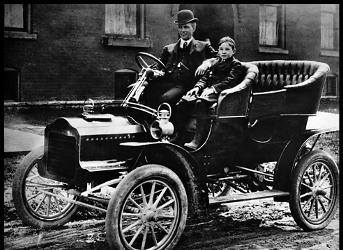
Are Electric Cars Really An Environmentally Friendly Solution? J Capps (Year 10)
How AI and Robotics Will Enhance The Future Of Space Exploration S Patel (Year 9)
Unpacking The Paradoxes: The Science And Speculation Of Time Travel .........................J Chan (Year 12)
The Physics Of Sound: Exploring The Intersection Of Waves And Music ....................... A Simsek (Year 10)
Lightning - Past, Present And Future
Wong (Year 10)
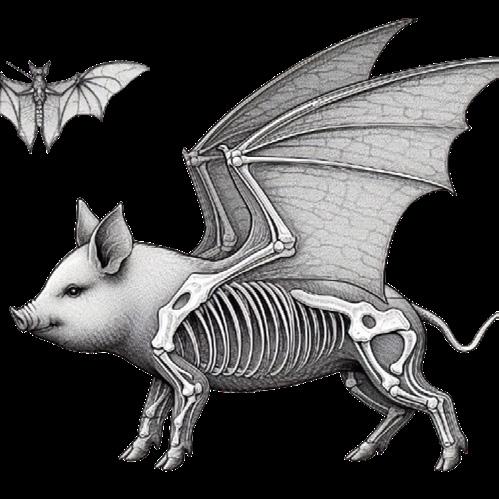
The Discovery Of Hydrogen: The Heavy Impact Of The Lightest Element ....................... A Fowler (Year 12) When Pigs Fly ................................................................... J Jeremie & M Yu (Year 10)
From Dawkins To Digital: The Evolution Of Memes ........................................... E Clear (Year 10)
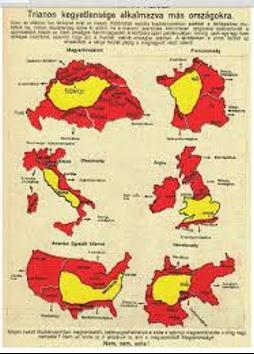
The Treaty Of Trianon And Its Lasting Impacts On Hungarians
Catchpole (Year 10)
An Enquiry Into The Uneven Distribution Of Wealth During The American Economic Boom Of The 1920s .................................................
Gulek (Year 11)
Assessing The Significance Of The First World War For America In 1918 To 1932 S Harber (Year 12)
A Feminist Review Of The Historical Context Of Female Presentation And Sexism In Film ..........................................................
Laredo (Year 12)
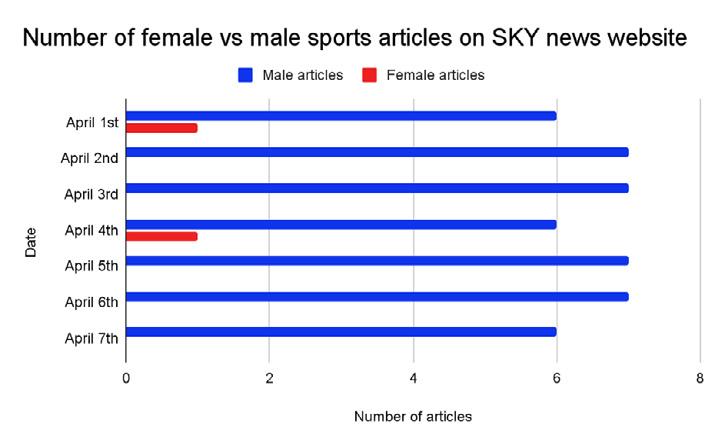
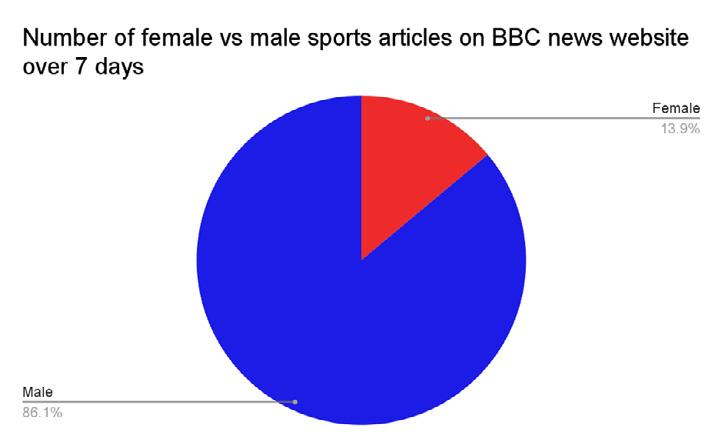
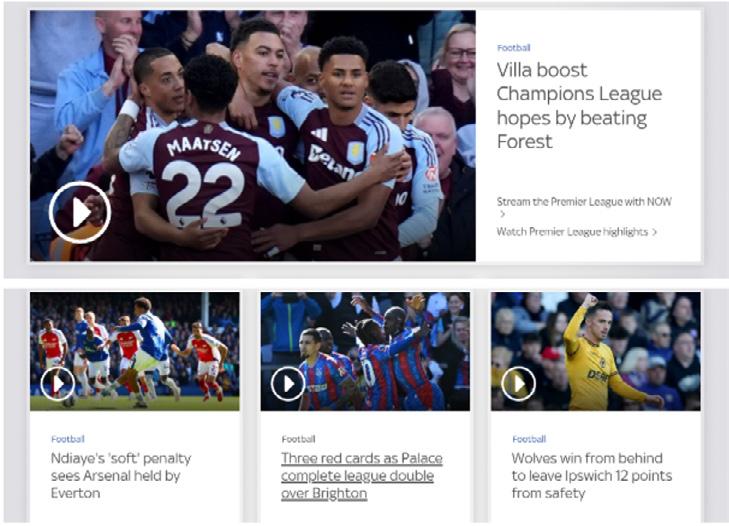
To What Extent Is Female Sport Featured In The UK News Media, And What Is The Impact Of This Level Of Representation? L Simpson (Year 9)
What Is The Value Of A Life Without Suffering? ............................................... H Dabbs (Year 12) Does Language Shape The Way We Think? ..................................................... S Pan (Year 10)
The Double-Edged Nature Of Fandom ..................................................... A Limage (Year 12)
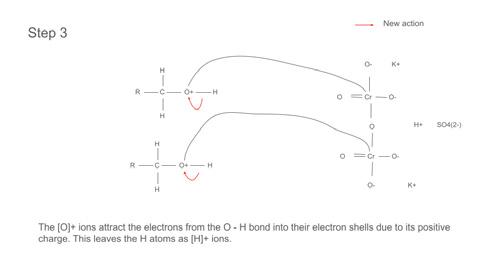
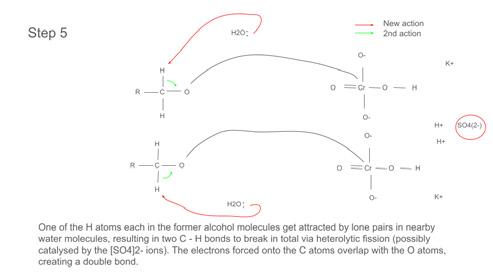
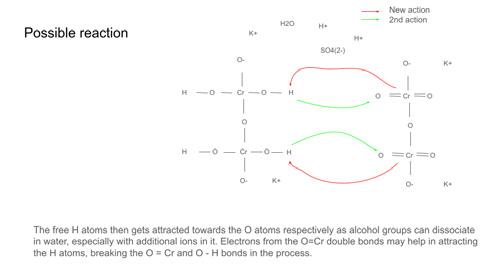
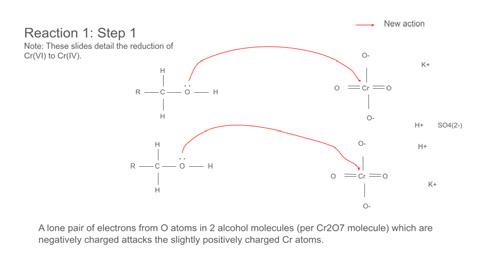
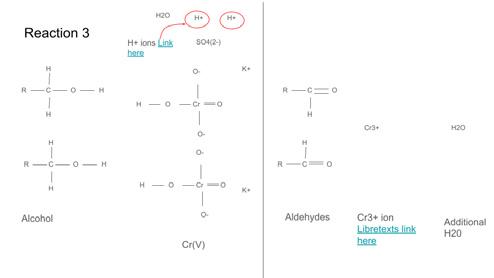
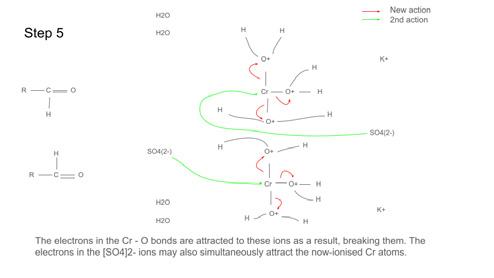
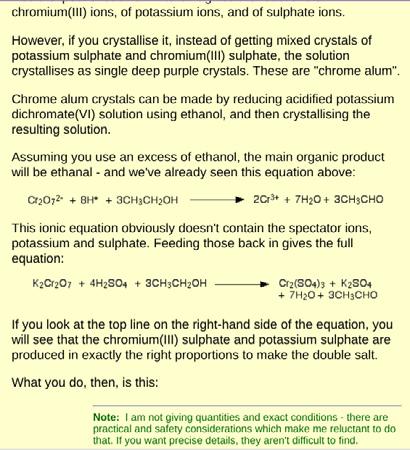
The Dichromate Project C Yuen (Year 11)
The Double-Edged Nature Of Fandom ..................................................... S Cheung (Year 13)
The Rhetorical Mind
Ace of Spades L Adewumi (Year 12)
A Critique Of Deontological Ethics ........................................................... J Grad (Year 12)
Cognitive Biases: The Hidden Forces That Shape Your Decisions ............................... G Carre (Year 10)
Beyond Speciesism: The Moral Case For Animal Rights ..................................... R Williams (Year 10)
Opposing The Motion: Police Funding Should Be Redirected To Social Services F Yonge (Year 10)
How Does Structure Enable Social Critique In To Kill A Mockingbird? ......................... L Whatley (Year 11)
“Thinking Physics”, Lewis Epstein & Paul Hewitt: A Review. .
J Sullivan (Year 10)
“Tuesdays With Morrie”, Mitch Albom: A Review R Dutton (Year 12)
“Conversations With Friends”, Sally Rooney: A Review E Locmele (Year 12)
To what extent will Artificial Intelligence supplant human involvement in the stock market in the near future? ..................................................... A Lahdiri (Year 13)
The Creative Mind
The Anatomy of a Ski F Brown (Year 12)
Your typical ski consists of five main layers, however this can vary for the type of ski, where certain features are more desirable. For example, skis built specifically for racing* may have more layers to ensure a stiffer ski that will hold better in the snow while racing* at high speeds.
The Layer labelled 1 in figure 1 is referred to as the topsheet. The topsheet is a decorative piece usually having designs drawn on for extra style while skiing. However despite being a flashy piece, it mainly acts as a sealant to protect the inner core and other layers from water entering. The topsheet can be constructed in 2 different ways, the terms ‘cap’ and ‘sandwich/sidewall’ both refer to types of construction the topsheet may take. Below figure 2 displays a sidewall construction on the left and a cap construction on the right.
On the left, you will notice there is extra material (highlighted in red) on the sides of the cross-section. This is the sidewall, which is made from dense materials with very high torsional rigidity* to resist bouncing off the snow, allowing for the edges to hold better in the snow . Due to the dense material of the sidewall, this makes the skis heavier and less prone to edge compression*, which is beneficial for racing* and carving*, where the skis will be crossing terrain at high velocity and being pressed hard into. This is the construction displayed in Figure 1, the sidewall is under label 4.
On the right, a cap construction is displayed. A cap construction is created by folding the topsheet all the way over the side of the ski, this is a very weight efficient way of sealing the core. Due to the reduced weight with no sidewall material in the ski, this construction is ideal for park/freestyle* skiing as well as ski touring*. When doing tricks midair, it is easy to knock the tips of the skis together. Having a smooth, light, seamless sidewall prevents the ski from breaking apart by reducing the momentum of collisions. For ski touring* a lighter ski will always be beneficial as reducing weight makes the experience much easier and more enjoyable. The topsheet can be made of many different materials, such as rubber, wood and plastic. Most commonly you will find plastic, I will assess the reasons for this in the materials section.
Figure
The Laminate Layers:
Labels 2 and 5 in figure 1 represent the laminate layers of the ski. The laminate layers are mediate layers in the ski and are typically made of fiberglass, but can also be found made from carbon fiber, Titanal* and sometimes a mix of two for top end skis. The laminate layers provide several functions, such as strength, durability, flexibility and damping. How the laminate layer is applied affects these attributes of the ski - adding more, or thicker layers will increase the durability and strength of the ski, allowing it to take more bending force before breaking or snapping. While less, or thinner layers allow for more flexibility.
The Core:
The core (Labelled 3 in figure 1) is the backbone of the ski, it is the most important factor when it comes to how the ski will act and feel while moving, having a huge impact on flexibility, strength and weight. Cores can come in a wide range of different types, each impacting the response and durability of the ski. The following 3 materials are the most commonly found in ski cores:
• Foam injected
→ Only for beginner skis, not very durable
• Wood
→ effective for all skis, the industry standard
• Composite
→ Mainly for specialist skis with one sole purpose, can be stiff or flexible
These are just a few examples of the many options there are for core materials in your ski. To outline, a stiffer core provides stability and power for high speeds and solid snow. A softer core gives the ski more flexibility and playfulness for softer snow as well as freestyle* skiing. The lighter the core is the more maneuverable it will be, making ski touring and freestyle* Skiing is easier.
The Base:
Label 6 in figure 1 points to the base of the ski, the part of the ski in contact with the snow. Since this is the part in contact with the snow, it needs to be low friction, or provide an effective medium to reduce friction. The most common material used for the base of all skisport equipment is UHMWPE*, commonly known in the industry as P-Tex. There are 2 main types of base that can be created using P-Tex, these are ‘Extruded’ and ‘Sintered’.
• Extruded UHMWPE/P-Tex
→ Cheaper, easy to repair, slower
• Sintered UHMWPE/P-Tex
→ Holds wax well, fast, high maintenance, expensive to repair
The Edges:
The edges, indicated by label 7 in Figure 1. The edges are the most engaged part of the ski during carving*. The edges reduce friction by creating an extremely small contact area between the ski and snow, due to this small contact area the high pressure causes the snow to melt under the edge, making the ski have even less friction by gliding along on water droplets instead of solid snow. (Stainless) Steel is a very standard choice for edge material, used right from basic entry-level skis all the way to top end skis.
My selection for anatomy:
Personally, I followed the industry standard for ski construction as it is the most researched and tested area, so I largely stuck to the depiction in Figure 1, however I changed one aspect. The sidewall construction will be a cap construction, this makes the ski lighter and easier to do tricks with, reduces costs and I believed it was easier to implement to a higher standard.
Image: Ski during construction
Foreign Accent syndrome, a stranger in your mouth G
Chendrimada (Year 10)
When she closed the curtains, ready for bed, she didn’t know she was shutting off a part of herself forever — her voice.
Morning came too soon, dragging her from sleep with the sound of her alarm, like a woodpecker hammering against a hollow tree at the break of dawn.
“Cállate, estoy intentando dormir (Be quiet, I am trying to sleep)” she groaned sluggishly.
“¿Qué? (What?)” Her eyes bolted open.
Astonished, she sat up, suddenly wide awake. What was she saying? And more importantly — how?
All her life she had lived in the same country, the same city, the same bleak, little house. She had never learned another language. And yet… the words had come easily, naturally, as if they had always been there, like they had always belonged to her.
Still dazed, she got dressed and walked over to the mirror. But the person staring back at her wasn’t the one that was speaking. Heart racing, she picked up her phone to call her friend.
“Bonjour, je ne peux plus m’exprimer en anglais (hello, i can’t speak in English anymore)”
Her eyes widened, “français?!?, comment? (French?!?, how?)”
Her friend thought she was joking but, over the next few weeks she traveled the world, from Tagalog to Turkish and Mandarin to Maltese. No one believed her, but how could she have learned all these languages?
The next thing she knew, she was in a hospital bed, surrounded by whispering psychologists and blinking machines. The medical team ran a head CT, followed by an MRI, EEGs, and a wave of neurological and cognitive tests. Stroke? Ruled out. Seizure? Unlikely. There was no clear trauma, nothing that explained the unfamiliarity in her voice..
The specialists were baffled. “It’s not aphasia.” two of them concurred behind a clipboard.
Days passed. The scans remained inconclusive, her speech the same. And then, a neurologist with tired eyes said it aloud: “Foreign Accent Syndrome”
It sounded more like a question than a diagnosis.
Imagine if tomorrow you went to bed with your own voice but woke up speaking someone else’s voice, that is the case for some people. Foreign accent syndrome is a sudden change to someone’s speech which causes them to speak a foreign accent even though they have never lived or been to that country. Although this may seem very strange it is real and is not just someone “faking it”. The causes have not been found but it can be linked to brain injuries, stroke and neurological disorders. The patient still has the same thoughts and voice however their voice will have a different tone or rhythm which often sounds like a foreign accent.
The syndrome is so rare that only 200 people in the world have ever been diagnosed with it. The chances that you will be struck by lightning, have a condition where you believe you are dead (cotard’s delusion) or win the lottery are far higher, this really puts how rare it is into perspective.
Neurologists and speech therapists have been stumped by the syndrome but the leading ideas that they have are:
• Stroke, this is when the blood flow to part of the brain is blocked or a vessel bursts. If this was to occur in the brain’s speech centre it could cause foreign accent syndrome.
• Brain tumour, a tumour growing on the brain can create pressure on certain parts of the brain meaning it can function differently. This could also be a cause of the syndrome if it was on the speech centre.
• Multiple sclerosis, this is a condition where the body attacks its own nerves. If the speech nerves were damaged it could cause a change in speech
• Psychogenic, when someone undergoes trauma, extreme stress or anxiety. Although this cannot be seen on scans like the others it is very real.
Areas involved in the neurogenic (caused by the nervous system) version of FAS include Broca’s area, motor cortex and the cerebellum.
Broca’s area is located in the left frontal lobe and controls speech production in forming words and sentences. Damage here can change the way the words are pronounced, affecting fluency of speech and rhythm.
The motor cortex is located on the top of the brain and controls movements of the lips, mouth, tongue and jaw. Damage here affects the physical control of the muscles involved in speech, hence changing the way the patient sounds.
Cerebellum is located at the back of the brain and controls coordination and balance. Damage here can cause trouble in coordination of speech making it difficult to understand or to sound foreign.
Linda Walker was diagnosed with foreign accent syndrome in 2006, having lived her whole life in Newcastle she now has a Jamaican accent. She was recovering from a stroke and her neurologists have said this is the main cause. She has described feelings of loss of identity, embarrassment, confusion and isolation.
This syndrome helps us to see how fragile and complex the human brain is in both the psychological and neurological aspects. Even the smallest change to our brain can cause us to be a different person. Scientists have used these cases to explore how speech can be so closely linked to identity because without our own voice who are we?
Asylum
Screaming panic. It sets in, uncontrollably, like an anchor ripping through the sea bed trying to wrestle free. Until now, I hadn’t realised the water threateningly swirling at our muddy ankles. Dreading the inevitable in this crowded, sinking dinghy, I stare at the ocean of hopeful eyes… It has to be me. I look at my wife, her eyes are flooding, fighting to stay afloat through the waves of tears. I squeeze her, knowing the gravity of this goodbye. As I slide over the edge, I glance towards the city I barely recognise now as ‘home’; all I can see are women and children caught in the crossfire of politics.
“Be safe.”
The shrill of my daughter’s distressed call pierces the cries from the boat: “Daddy!”
It echoes through my mind as I plunge feet first into the marine abyss. The silence is deafening. The water is cold. Ice cold. Numbing all of my senses, it pricks me with thousands of needles as it takes my breath- leaving me gasping for air. It doesn’t come. Instead darkness.
***
The sea tickled at the shore as the seaweed farmer ambled along the tranquil island beach. The distant calling gulls were her nearest companions. She waded into the shallows, toward the rows of seaweed she must gather to claim her wage. Spying a mound of seaweed made her hopeful for the day’s abundant collection. But then- was it just a log. As she approached closer, it looked less and less like a log.
“Jeremy!” she shrieked, frantically untangled the seaweed and dragged the body to shore.
“Do you think there’s hope for him?” panted the women, watching Jeremy perform a series of chest compressions. He didn’t answer; he was utterly immersed in saving this stranger’s life. She prayed. That was all she could do. Hearing a splutter, her eyes darted towards the man- water poured from his lungs like a tsunami meeting land.
***
“For my life, I cannot thank you enough, Sir,” leaning precariously on the tractor, I insisted over the constant whirring of the rotating cultivator, “I will forever be in debt.”
“Seventeen years it’s been and you feel like a son,” Jeremy replied, “you owe me nothing.”
It all happened so fast. The hard tug of fabric as my leg caught the cultivator sending terror through my body - I reached forward to stabilise myself but my fatigued strength was not enough. I crumbled. The blood melted away the hue of my clothes as the stain of red engulfed me. The agonising scream that pursed my
S Murray (Year 11)
lips captured Jeremy’s attention causing his face to lose life. Switching off the machine, he hoisted himself off the tractor and darted towards the sea of blood that was spreading too rapidly. Could this be my end?
***
Memories of her splashing in the shallows of the sea, dreaming of bringing us freedom from this constant backdrop of war. Her naivety haunts me.
“Daddy” she begins, “why are they trying to hurt us?”
“It goes beyond you and I, sweetheart-” she stands still, “but I can tell you one thing for certain, your future is bright.”
“I want to help people,” She concludes, looking up at me.
Her eyes are full of hope and I know she means it, “I have no doubt.”
***
“Son, just remember I will always have your back…” he pulled me out, “We have to take you to the hospital; you’ve lost too much blood.”
“You know you cannot,” I struggled, “I don’t exist in this country, I’d rather die than be sent back to mine.”
“But you exist to me, I’d rather lose you to the law than death.” I knew this was a battle lost.
***
I feel the early morning mist of anaesthesia lifting from my body, unaware of the miracle it had been concealing. The unfamiliar smell of hospital air highlights the taste of hunger I know so well, awakening memories of the home we fled so long ago. In between distant bleeps and muffled voices, the pain of my wounds bite into my consciousness, awakening my sense of feeling. The blurry outlines of the nurse solidifiy around those unforgettable eyes I used to know so well, last seen on a boat seventeen years ago.
“Daddy?”
Lost without a Trace A Tomkinson (Year 11)
Torment. Two years ago, the infamous family incident occurred. I was on a cruise in the Mediterranean with my family. It was ten o’clock in the morning and about 35 degrees Celsius - it usually reached about 40 at midday - but nonetheless, the heat shimmered off the deck, making the pool look like an oasis. As I ran across the hot deck, stupidly not wearing any shoes, I saw my mum standing to one side. Her face was drawn, and there was a sharpness in her eyes that made me uneasy. She started to wobble towards the side. What was she doing? Was she alright? I started running across the deck towards her screaming at her to get back.
She fell.
I take my seat in the front row with my family, watching as fifty or so people quietly enter the room. I turn to Dad, who is sitting to the left of me and ask, ‘What will happen to the box?’
My dad replies, ‘It will be buried just over there.’ as he points to a spot about 30 metres away in a patch of grass. I’m still in shock at what had happened, despite it being two years ago, but I suppose it doesn’t help that they can’t find the body. I begin to get nervous as my hands go cold and shivers run down my spine. I hear the music begin to play meaning that the service is about to begin.
Before the incident, my mum had been acting oddly. She struggled to get out of bed, had been drinking for most of the morning, and telling me how much she loved me every 10 minutes. Being only 6 at the time, I didn’t suspect a thing, I just thought that she loved me. Looking back on it now, I know I should’ve realised sooner, maybe I could have done something. I was just so excited to get in the pool.
My jaw dropped. The burning surface suddenly didn’t feel so hot, I began to shake as my spine tingled with fear. Out of nowhere, I saw my grandad run to the side and jump in - he was always very athletic, despite being in his late 50s. I peered over the side and saw my grandad holding my mum afloat, treading water. He was gasping for air as the boat pushed waves over his head. A life buoy was thrown down towards them, and grandad put my mum - who was now unconscious - on it. Suddenly, grandad disappeared under the ship. Seconds went by, and then minutes, but he didn’t reappear.
A man dressed in a black robe begins to walk down the middle of the chapel, towards the box. As he arrives, he starts talking, “Today we are here to celebrate the life of John Smith.” As I listen, I can’t help but think back to that day on the cruise ship, wishing that none of this had ever happened. I don’t like funerals. This is my first, but I don’t like it. Everyone is so sad. I’m struggling to sit still; the wooden bench is not comfortable at all, and I just want it all to be over. Time goes by slowly, but all of a sudden my wish comes true as two police officers enter slowly through the creaking main doors. My mum, who had been speaking, came to a stop.
As the chapel goes silent, one of the police officers asks, “Who is Amber Smith?”.
My mother’s face turns a bright shade of red as she timidly replies “I am.”
Walking towards her the police officer says, “I’m afraid that you are going to have to come with us, Mrs Smith. You are under arrest for the third-degree murder of John Smith.”
Everyone in the chapel lets out a gasp as my mum is handcuffed and led towards the exit. I turn to look at my dad with tears in my eyes, but he doesn’t move, doesn’t speak, doesn’t do anything to stop them from taking mum. As I thrash against my dad’s grip, my mind spinning, I ask myself: Why isn’t he stopping them? Why isn’t he doing anything? My chest tightens as another piece of my family is taken from me. I’ve already lost grandad, don’t take mum as well.
Rough Justice
If I could think, I would feel the spray of saliva from this barrister.
If I could think, I would see the frowning of the jury.
If I could think, I would hear the worried whispers of my defence. If I could think, I would smell the sweat of the crowd.
If I could think, I would taste the blood in my mouth.
But the only thought that suffocates my mind is prison. Prison, prison, prison. The screeching gate, the jangling of keys, the cold cells with the cruel cellmates. I used to trust the justice system. Like every child, I believed the bad guys got locked away and the good guys would go home to loving families. But then I grew up.
I get dunked back into reality.
‘Did you or did you not throw your own father off the cliff?’ the prosecution interrogates, his lips shooting accusations at me in a storm of saliva.
‘I didn’t!’ I swear, pleading.
‘Well I don’t buy that; I think you planned the walk with the full intention of…’
‘Emmaline, how would you like to walk with me?’
Distantly, I hear my defence make the point that my father suggested the walk. I feel as if I am underwater, in an icy sea, surrounded by sharks with no one to hear me scream.
But I am here. The threadbare dress which I was told to put on to ‘invoke sympathy’ sucks in the biting chill and I can feel the grooves of the stand beneath my fingers from others who have stood in this same spot and waited for the noose of their fate to be tightened. The jarring light pricks my eyes but it hurts less than looking around the crowd of people; some I know, some I don’t.
All think I am guilty.
I don’t blame them; I would think I’m guilty too.
It was a beautiful day and the sun peeked past the clouds. My father smiled, a rare treasure, and I realised I was wearing one of my own.
‘Well?’ all eyes turn expectantly to me.
My head snaps up and I try to push the bewilderment out of my eyes. My barrister clenches her jaw so hard I worry she will break a tooth.
Oh dear.
‘He wants to know if you knew about your father’s imminent plans to change his will before his demise,’ Christina - my main barrister - whispers under her breath to me.
‘I, no, I didn’t,’ I say unconvincingly.
‘I don’t believe that. I believe you learnt of his actions and threw him off the cliff in cold blood. Ladies and gentlemen the jury, do you believe in the coincidence that hours before her father, the deceased in this trial, would change his will to cut her out, suddenly ‘slipped and fell’?’. The prosecution- Edward is his
E Kenyon (Year 10)
name- stands so close I could touch his ridiculous wig.
I panted and looked back to see my father was struggling up the hill as well. I held back a small smile at the exasperated look on my father’s face.
Time drags its feet and I stand in the interrogation for what seems like days. Until finally an armistice is called for the night. My legs just hold me as I shuffle out, my feet like lead. I hang my head and war with the tears trying to break free.
‘Tomorrow is the final day, Emmaline. That is when you will make your parting speech.’ Christina recites while pacing her office.
I sit rigid on her sofa and nod numbly.
‘Come on Emmaline. Where is that fire you had at the start? The one that fought this injustice,’ Christina probes.
‘It doesn’t matter; they all think I’m guilty anyway,’ I mutter, resigning.
‘Change that. Because I will be damned before I let you rot in jail for a crime you didn’t commit.’
Minutes blur into hours as we pour over my speech. Around midnight, Christina is finally satisfied.
I do not sleep, but I wait, night sitting heavily on my chest. I wait for this to be over; for me to wake up from this nightmare. But I do not. And the dark blushes with dawn far too soon.
Minutes drip by slower than a glacier melting. I find myself wondering how I got here, what I did to deserve this. Because I don’t. Do I? I have never been: too mean,too moody or material and yet here I am; waiting for someone to write the rest of my life without consulting me.
It is finally my time to speak and for the first time in what feels like ages, I let my anger flood my veins. I stand up straight and tell them. I tell them my side of the story, which I have not been able to do once in this trial. Tears come of their own accord as I try to show them how much I loved my father.
When the masquerade is finally over, Christina smiles and I lean over to whisper, allowing my grieving mask to fall for a fraction of a second and murmur under my breath, ’We got away with that one didn’t we Chrissy.’
We got to the cliff summit and I looked down at the unforgiving rocks, sharpened like crucifixion stakes. My father kept droning on about why he had cut me out of his will. ‘Too spoiled’, ‘ Too ungrateful.’ Blah, blah, blah. A red mist settled in front of my eyes and molten lava scraped along my veins. My eyes tracked him as he looked out over the cliff with his back to me. A small smile crept up my face and I stalked over softly.
A light shove. The shock swirled with horror in his eyes. I smiled, full and proud.
Christina’s blood flees from her face. Realisation breaks into her eyes.
As clear and beautiful as christening bells I hear the ‘Not guilty.’ I smile, full and proud.
Like A Gun Lodged In Your Throat H
Swan (Year 10)
I watch Giuseppe walk down in front of me. I feel “another Carlo” step out of the original, leaving my body at the top of the stairs. Down they go, Giuseppe and “me” down, down down, until at the bottom, Carlo goes into autopilot, and fiddles with the cold, hard trigger of his iron.
* * *
Giuseppe finished counting the paper and pennies.
“Good haul today!” he called over to me.
“How much?”
“10Gs”
“C’mohn!” I exclaimed.
Our “waste management business” had been up and rolling the last few weeks. We could embezzle tax from IRS hubs here in Washington Heights, North Manhattan, or anywhere on the east coast.
We strolled into the golden glow, until we arrived at his house in East Harlem. I left him behind and regarded the twisting path that we’d taken to get to that point. My father never wanted me to become a man but the thought of working as a proud capo for the Gambinos always excited something inside me.
The next morning, I went to our station but Giuseppe wasn’t there. I wandered over to the phone but before I could pick up the line, the near silence was pierced by the shrill of someone on the other end. I picked up the speakerphone.
“Who’s this?”
“Lorrenzo,” came the baritone bellow from the Capo dei Capi for my Gambino’s,”I wanna speak with you about Giuseppe”
“What’s happened?”
“Just come for a sit down at the warehouse on Melrose and 160th at 9 tonight.”
“Ok, I’ll b…” Click.
The stifling blanket of cloud over the port choked out the light as I wandered over the dark menacing trench known as the Harlem River, and carried on toward the “court” of conviction. I hadn’t been across the river to the Bronx too much, especially not in that neighbourhood. As I was closing in on the warehouse, I could smell in the air that this was a shakedown for sure, either that, or they were taking him for a one way ride; If I was Giussepe, I’d have been scared merde-less,
Inside, the spotlight from the broken roof rested on a small round bar table around which were gathered some of the most powerful people in the Gambinos: Lorrenzo (of course), Joey Donofrio and Tommy Mangano, his underbosses, and in the middle of them, squeezed between Joey and Tommy’s thick, NFL shoulders, was Giuseppe looking small and alone in the sea of muscle and bone.
This was my first sitdown but I know (as does anyone that joins the mob) not to speak first, you’ve got to respect the boss.
A few moments of silence passed.
Then a few more…
“Do you know why you’re here?”
It had begun.
“Um… I…I don’t…”
Giuseppe couldn’t even formulate a sentence. What had he done?
“I’ll tell you what you did then,” A soft tone, “You know you should’ve asked me first, my daughter deserves more than the likes of you.”
Oh, this was bad.
“Ok I’m sorry Lorrenzo, I didn’t know she was your daughter.”
“You did and you know it.” He was getting angry. “You slept with her without asking me, I should whack you right now! You dirty son of a…”
“Ok ok,” butted Tommy. “I think we can end it here.”
As we filed out, Lorrenzo bumped into me:
“Carlo, if you wanna make your bones, you could always put his contract out. Trust me, you don’t wanna be on his side,” he muttered to me, under his breath.
I realised why I was there. I knew what Lorrenzo wanted me to do. A whirl of emotions raged inside me but deep down, I knew I needed to save my guts. At that moment, I remembered all those years, dreaming of becoming a capo. I could be one, all that stood in between me and Lorrenzo’s favour was my friendship with Giuseppe.
It was done.
It sensed the atrocity that I had committed, but I knew it would all be worth it when I spoke to Lorrenzo. He’d congratulate me and all the bad feelings would just disappear. I tried to focus on this mantra all the way to Lorrenzo’s doorstep. I rapped on the hard wood and heard some steps coming toward the door. I could see a dark shadowy figure through the frosted glass. The lock clicked and out swung the door.
The Inquiring Mind
How Sustainable is the Eden Project? Z Yu (Year 9)
The Eden Project, located in Cornwall, UK, opened to the public in 2001 with a mission rooted in sustainability. The organisation asserts that “sustainability underpins everything” it does (Eden Project, 2024). This essay evaluates the extent to which this claim is accurate by examining the environmental, economic, and social factors that influence the Project’s overall sustainability.
From an environmental perspective, the Eden Project demonstrates significant progress. According to its 2023 Annual Review, 500 trees were planted on-site, contributing to lower atmospheric CO₂ levels and enhanced biodiversity (Eden Project, 2023). In the same year, 3.5 tCO₂e were estimated to have been saved through the use of electric vehicle (EV) charging facilities, reducing transport-related emissions. Furthermore, the Project reports that 0% of its waste is sent to landfill (Eden Project, 2024), an important step towards reducing plastic pollution. However, while 59% of waste is recycled, this figure must be viewed in context — globally, only 9% of plastic waste is recycled (United Nations Development Programme, 2023). Thus, recycling efforts, though commendable, have inherent limitations. Looking forward, the development of an on-site geothermal energy plant (Eden Project, 2024) is a major step towards clean, renewable power generation and long-term energy security. Overall, the Eden Project appears to be delivering on its environmental ambitions.
Economic viability is another key dimension of sustainability. The Eden Project cost approximately £140 million to build, funded through National Lottery grants, regional development funds, and commercial loans (Eden Project, 2024). Since opening, it has generated around £2 billion for the regional economy, indicating a strong positive impact on Cornwall (Eden Project, 2024). Nevertheless, the Project faces financial pressures. In January 2025, 80 jobs were cut to “ensure the long-term stability of the organisation” (Ball and England, 2025). This followed wider economic challenges, including the Covid-19 pandemic, rising National Insurance contributions, and the cost of living crisis. Regional tourism in Cornwall also declined by 10% in 2024 (Cornwall DMC, 2023), which likely affected visitor numbers. Despite these challenges, the Eden Project remains economically viable at present, though its stability continues to depend on wider economic conditions.
Social sustainability is the third pillar of analysis. The Eden Project aims to “connect all people with the natural world and play their part in shaping the future” (Eden Project, 2020). Its educational outreach is extensive: in 2022–2023, it delivered 668 courses to individuals and groups, including 42 tailored to pre-school through A-level students (Eden Project, 2023).
The organisation also supports professional development programmes, such as those run in collaboration with the Florence Nightingale Foundation and NHS senior nurses and midwives, focusing on sustainability in healthcare. Additionally, the Eden Project’s “Big Jubilee Lunch 2022” initiative had significant social impact, with 11.7 million people nationwide reporting that it made them feel less lonely (Eden Project, 2023). These initiatives demonstrate the Project’s strong commitment to community engagement and social wellbeing.
In conclusion, the Eden Project stands as a largely sustainable venture, successfully integrating environmental regeneration, economic development, and community engagement since its opening in 2001. While it faces ongoing economic challenges linked to external conditions, its environmental and social contributions remain profound. The Eden Project thus serves as a valuable model for how environmental innovation, education, and sustainable tourism can coexist and thrive in the modern world.
Bibliography
Ball, E. and England, K. (2025). Cornwall’s Eden Project to slash jobs due to rising costs. BBC News, 28 Jan. Available at: https:// www.bbc.co.uk/news/articles/cvgenvl0jemo.
Cornwall DMC (2023). Recent trends in domestic tourism numbers in Cornwall. Cornwall DMC. Available at: https://cornwall-dmc. co.uk/news/recent-trends-in-domestic-tourism-numbers-incornwall/.
Eden Project (2020). Our mission: sustainability. Eden Project. Available at: https://www.edenproject.com/mission/sustainability.
Eden Project (2023). Annual Review 2022–23. Eden Project. Available at: https://www.edenproject.com/about-us/annual-andsustainability-reports/annual-review-2022-23.
Eden Project (2024). Our funding. Eden Project. Available at: https://www.edenproject.com/about-us/our-funding.
Eden Project (2024). Sustainability at Eden. Eden Project. Available at: https://www.edenproject.com/visit/planning-your-visit/ sustainability-at-eden.
United Nations Development Programme (2023). Why aren’t we recycling more plastic? UNDP. Available at: https://stories.undp. org/why-arent-we-recycling-more-plastic.
Are electric cars really an environmentally friendly solution? J Capps (Year 10)
Electric cars were invented being believed as an ‘environmentally friendly’ solution but are they really this perfect? And are they really that much more efficient?
The first electric car was created by a man named Robert Anderson in 1839 leading to the first modern electric car being released in 1991.
Over time the electric car is believed to have long term emission reductions especially if the energy used is renewable such as wind or solar but even when powered by fossil fuels are seen to be less carbon intensive. A positive impact is that they do not emit the pollutive gases such as carbon dioxide and nitrogen oxides which are major pollutants coming from the non-electric cars.
Electric cars run off a battery but like anything, this doesn’t last forever and at the end of their life the disposal is expensive to be recycled properly therefore leading to the improper disposal leading to major environmental damage from the heavy metals and chemicals of which they contain. With the increasing number of electric vehicles the concern for the disposal of batteries with no more use left.
The production of the batteries within electric cars can produce more carbon emissions in comparison to the manufacturing of traditional vehicles but although the initial impact of carbon is high it decreases over time during the operation of the car and on average will have a lower carbon footprint as long as it is charged by clean, renewable electricity.
Overall electric cars are indeed a more environmentally friendly option because we must understand they are not perfect and learn to take on board the challenges and find a long term solution for the disposal of batteries.
How AI and Robotics Will Enhance the Future of Space Exploration
How We Are Currently Using AI and Robotics in Space Exploration
S Patel
(Year 9)
Artificial Intelligence (AI) and robotics are already transforming the way humanity explores space. Astronomers use AI to analyse vast datasets, identifying patterns and changes within the space environment that would take humans years to detect. AI has also been applied to help scientists model and understand climate change on Earth, demonstrating its wide-ranging potential beyond astronomy.
NASA currently relies on AI-driven systems to guide its Spirit and Curiosity rovers safely across the treacherous Martian terrain. These rovers use sensors and onboard algorithms to detect obstacles, avoid hazards, and autonomously navigate toward research sites. Similarly, orbiters, landers, and rovers—three core types of robotic explorers—allow scientists to conduct research in environments that would be dangerous or impossible for humans to visit.
Increasingly, robots are being designed to assist astronauts directly, performing maintenance tasks, delivering supplies, or providing real-time AI-powered guidance. A familiar example of AI in space today is Starlink, a network of satellites that uses machine learning to optimise global internet connectivity while transmitting data from low Earth orbit.
The Future of Robotics and AI in Space
The future of space exploration lies in the synergy between robotics, Artificial Intelligence, and Machine Learning. Together, these technologies will enable spacecraft and robots to operate with greater autonomy, adaptability, and efficiency in unpredictable environments.
AI-powered robots will soon be able to handle more complex tasks with minimal human input—ranging from conducting experiments on Mars to constructing habitats on the Moon. This autonomy will be especially valuable for deep-space missions, where communication delays make real-time human control impractical. Robots will not only increase mission safety but also free astronauts to focus on strategic, creative, and research-oriented objectives.
However, challenges remain. AI systems require immense processing power, which is difficult to maintain in spacecraft with limited onboard energy. There are also cybersecurity risks—if an AI system were compromised, mission data could be lost or manipulated, endangering entire operations. Addressing these challenges will be crucial as humanity moves toward a more AI-driven era of space exploration.
How AI Is Helping Design the Spacecraft of the Future
AI is already revolutionising spacecraft design. By analysing vast quantities of data, AI algorithms can optimise designs for strength, cost, and fuel efficiency, leading to lighter and more durable spacecraft. Machine learning can also simulate how spacecraft will perform under different conditions, predicting potential points of failure and suggesting improvements.
In the future, AI-powered 3D printing and robotic assembly could enable spacecraft to be constructed or repaired directly in orbit. This would drastically reduce launch costs, allow for on-demand maintenance, and create opportunities to reinvest in other areas— such as sustainable space food, advanced propulsion systems, and satellite connectivity.
As human space missions and commercial ventures such as space tourism expand, onboard AI systems will become indispensable for managing complex logistics, maintaining spacecraft, and ensuring crew safety.
AI’s Role in Future Space Missions
A particularly exciting development is the rise of quantum-enabled AI systems, expected to become fully operational within this decade. These systems will dramatically improve the reliability of autonomous space missions by reducing failure rates and enabling spacecraft to make independent decisions in deep space.
For example, an AI-powered humanoid robot on a Mars mission could manage onboard inspections, allocate resources, and troubleshoot technical problems—tasks that currently require significant astronaut time and energy. Rather than replacing human astronauts, such robots will serve as intelligent companions, increasing mission efficiency and safety.
The Inquiring Mind
AI and the Future of Space Communication
AI is already revolutionising how we communicate in space. By streamlining data processing and optimising communication networks, AI ensures faster and more reliable transmission between spacecraft and Earth. Cognitive data networks—AI-driven communication systems—can adapt to changing conditions, reroute signals if connections are disrupted, and maintain stable links across vast distances.
This not only enhances mission safety but also allows real-time problem-solving. Data from faraway missions can be transmitted more clearly and quickly, ensuring that scientists can respond to unexpected challenges with greater speed and precision.
Conclusion
Humanity’s quest to explore the cosmos has always depended on innovation—and today, that innovation is powered by Artificial Intelligence and robotics. Using techniques such as imitation learning, data collection, and telerobotics, scientists are teaching robots to perform increasingly complex tasks. While AI still lacks the creativity and intuition of human problem-solving, many researchers believe that future breakthroughs in quantum computing and machine learning could change that within the next decade.
At the current pace of technological progress, AI may one day become a vital partner in mission control, generating insights and solutions beyond what even the most skilled human teams could imagine. The partnership between human curiosity and artificial intelligence could soon propel us further into the universe than ever before.
Bibliography
NASA: Mars Rover Missions Overview
SpaceX: Starlink Satellite Internet System
ESA: AI and Automation in Future Space Missions
GSK: Artificial Intelligence in Scientific Research
How does healthcare affect an economy?
A Lucas (Year 12)
In an ever changing world, healthcare and nutrition have become an obsession for many. From juice cleanses to basic vacancies, health and wellness can come in all shapes and sizes but can any of these have a wider impact than just on the individual?
To put things simply for the readers new to the world of economics: An improved healthcare system (both higher quantity and quality) will enable workers to receive better treatment (quality) and therefore can return to work more quickly (quantity). This, in turn, means less sick days are taken and therefore more output is produced. As improved healthcare helps to maximise output, this will help lead to increased economic growth likely to increase strength of an economy which can increase government tax revenue and living standards of citizens. This being considered, a healthier population leads to a more productive workforce. For instance, the World Bank estimates that improved health could add $12 trillion to global GDP by 2040, representing an 8% boost in economic output. This is the basis of a lot of arguments regarding economic growth and healthcare. Taking a real life example, according to the world bank, Kenya is considered a developing country. In Kenya, the country has a doctor-to-population ratio of about 1:16,000, far below the recommended ratio of 1:1,000. This shortage of doctors leads to overburdened healthcare professionals and potentially compromises the quality of care. This could lead to less workforce being able to be employed or more workers taking sick days. This helps us to understand that healthcare may hinder economic growth and therefore development. Contrastingly, you could argue that economic activity may hinder healthcare development. If a country is not very efficient and output is low GDP per capita is likely to be lower. In turn the government will make less revenue as less corporation tax is collected and little income tax is collected as workers are likely to be employed in primary sector jobs where pay is low due to unskilled nature of the workforce. This lack of government revenue entails that the government will have no way to invent improvements in healthcare as they are also likely already in national debt. Taking this into account, it is very difficult for a country to get out of this spiral without assistance from foreign investors or having huge budget deficits.
Enhancing Healthcare is not a cheap endeavour. Machines and training cost billions of pounds/dollars to instigate and some economists argue the opportunity cost is far too great and money could be spent on improving education or improving both geographical or occupational mobility for workers. However, a study done by Carnall Farrar, undertaken on behalf of the NHS Confederation, found that ‘Investments in healthcare not only improve health outcomes but also stimulate economic growth. For example, every £1 spent on the NHS in the UK is associated with a £4 return on investment’. This demonstrates to us that not only do you get improved healthcare and therefore work force you receive economic benefits directly from healthcare spending. This return would provide an incentive to invest to improve healthcare. As investment is a component of aggregate demand, if all other factors remain constant then this increase in AD will increase economic growth again, improving the strength and stability in a positive way for an economy.
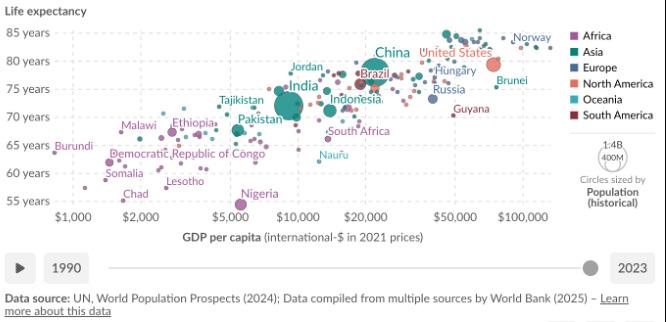
Whilst GDP per capita is not a measure for development of a country, it can be used to compare average income across countries displayed on the graph shown. Additionally life expectancy is likely dependent on the level of healthcare in a country. Looking at this graph, there is a strong correlation between GDP per capita and life expectancy. This indicates to us that GDP per capita is a strong contributor to life expectancy. Now whilst having a higher GDP per capita enables higher living standards as more goods can be purchased it also means increased government revenue from various tax regimes which can be invested into healthcare to further improve life expectancy. This correlation of life expectancy and GDPis likely due to the fact that without healthcare many people become ill and can’t work. Even in developed countries such as the UK long-term illness has led to 2.46 million working-aged adults being off work. If life expectancy is lower then there are physically less people able to work and therefore output is limited, reducing GDP per capita compared to countries with higher life expectancy. Partially in low income countries, it is vital to improve healthcare to not only increase living standards but improve the quality and quantity of labourforce by having healthier workers. Alongside this a multitude of employment opportunities arise when investing in healthcare- the World Bank reports that in low-income countries, each healthcare job creates an estimated 3.4 additional jobs across related industries, amplifying the economic impact .This amplifies to us the major impact the level of healthcare in a country has on the economy and how investing in healthcare can have a multitude of economic benefits as this type of infrastructure investment acts similarly to the multiplier effect.
Unpacking the Paradoxes: The Science and Speculation of Time Travel
J Chan (Year 12)
For kids, a common answer to “What superpower do you want?” is time travel. Imagine being able to time travel, that would instantly solve all of your problems by giving you as much time as you want. Hold on, infinite time? That seems a bit sketchy. For such a simple answer, scientists have actually studied it for a considerable amount of time, and while it seems straightforward in theory, It’s much more complicated in practice. In all seriousness, time travel probably isn’t possible, but with the right set ups… maybe it really could work.
Forwards vs Backwards
Traveling forwards in time is actually possible and is quite attainable even in today’s standards. In Albert Einstein’s special relativity, there is a phenomenon known as time dilation. It means that for two observers — one at rest and one that’s moving — time will pass slower for the moving observer compared to the one at rest, though it’s only noticeable at speeds close to the speed of light. This effect has actually been experimentally verified and even affects astronauts who go on high-speed missions. One of the most famous examples is NASA’s Twins Study, which involved identical twins Scott and Mark Kelly. For the experiment, Scott spent one year on the International Space Station while Mark stayed on Earth. Afterward, NASA found that Scott had aged slightly less than Mark due to measurable differences in their DNA strands, providing strong evidence that time dilation is a real effect.
So if you ever want to fast-forward to the future, just strap yourself up to a rocket and fly really, really fast.
On the other hand, backwards time travel is problematic. To understand why we have to go back to special relativity. As proved by NASA, when a person increases their speed closer to the speed of light, time for them slows down, but what about going faster than light? Well, that is a big no-no according to special relativity. Let’s say I’m travelling faster than light and I send out a signal to Earth. In my perspective the signal arrives after I sent it out, but to a moving observer on Earth, that signal could arrive even before I sent it. This breaks causality as the effect(receiving the signal) could come before the cause(sending the signal).
Thankfully, this entire scenario is void because of one simple equation:
In this equation when v > c, γ becomes ∞. Meaning it would take infinite energy for any mass to be travelling faster than light, which is not possible because the energy of the universe is finite.
How backwards time travel could work
Wormholes could, in theory, be used to get around the infinite energy problem.
Wormholes are hypothetical structures in spacetime that act like tunnels between two distant points in space. It is essentially a shortcut, bending space so that the two points are closer together than they really are. Suppose a wormhole has two ends: A and B. If B is moved at near light speed and then brought back to its original position, time dilation would cause B to experience less time than A. Now A and B are out of sync, so you could enter B and exit out of A at an earlier moment in time.
However, for a wormhole to remain stable and traversable, it would need exotic matter, a form of matter with negative energy density. Such material has never been proven to exist in usable amounts. On top of that, no wormhole has ever been observed, so even though they work in theory, it’s highly unlikely they exist in reality.
What if?
Let’s imagine far in the future, someone does build a working time machine capable of travelling backwards in time. What happens then?
Suppose a person goes back in time and decides to do whatever he wants, he could buy winning lottery tickets, try to win over his crush, he could even kill his grandfather when he was young because he really hates him. Uh-oh, looks like we just stumbled upon a time paradox.
Paradoxes
The situation above is known as the Grandfather Paradox, which describes the impossible act of a grandchild travelling back in time to kill his grandfather. If the grandfather dies before having children, then the grandchild could never have been born, which means he could never have gone back to commit the act in the first place.
Another famous one is the Bootstrap paradox, where an object or piece of information from the future becomes the thing that caused itself in the past. For example, imagine I travel back in time and give Shakespeare a copy of Romeo and Juliet. He then copies it and publishes it under his own. So who actually wrote it? It wasn’t me, and it wasn’t really Shakespeare either.
Theory on Multiverses
Most time paradoxes, like the Grandfather Paradox, only occur if you’re traveling back within the same universe. They disappear when you consider the Many-Worlds Theory.
First proposed by Hugh Everett III back in 1957, the Many-Worlds Theory suggests that multiple identical universes exist simultaneously. Instead of quantum events collapsing into a singular outcome, the universe splits into separate parallel universes each representing a different outcome.
In that case, wormholes could theoretically connect two different universes. If the two ends of a wormhole were also out of sync in time, then you could travel back in time in another universe. There would be no causality issues because you’d be changing the past of that universe, not your own.
Time travel in media
Repeating loops: Information is carried through time but not physical objects. Character must achieve a condition to break the loop
• Groundhog day
- Phil is trapped in a loop reliving the same day. He is only freed of the loop after he has grown as a person
• Happy Deathday
- Tree keeps reliving the day of her own murder until she finally solves the mystery of who the killer is
Singular timelines: Information and physical objects can be carried through time. Character’s actions are limited by the timeline
• Back to the Future
- When Marty goes to the past, he accidentally prevents his parents from ever meeting, causing himself to slowly fade out of existence
• Harry Potter and the Prisoner of Azkaban
- Harry is saved from the dementors by someone casting a Patronus. Later, when he travels back in time, he casts the Patronus himself to save his past self
Multiple timelines: Information and physical objects can move freely. Characters can change events without restrictions
• Deadpool VS Wolverine
- Shown in the sequence of Deadpool traveling through multiple universes to recruit a Wolverine
The Physics of Sound: Exploring
the Intersection of Waves and Music A Simsek (Year 10)
We experience music on a daily basis, listening to it on our airpods, in chapel most mornings, and many other ways. We see music as something that is both emotional and expressive, underneath all of the melodies and rhythms of music lies a world that is entirely built on Physics. Music is sound, vibrations moving through air that our brains turn into something meaningful. This project will explore how the science of sound shapes the way we hear and create music. From the nature of sound waves to why each instrument sounds the way it does, there are a vast array of topics that need to be explored in depth and detail.
The Nature of Sound Waves
Sound is simply vibration that travels through a mediummost times air- until it reaches our ears. These vibrations create pressure waves, known as longitudinal waves, where the particles of the medium move back and forth in the same direction as the wave is traveling. When an object, like a guitar string or vocal cord, vibrates, it pushes on the surrounding air molecules. These molecules then push on the ones next to them, and the pattern continues outward, carrying energy in the form of a sound wave.
Sound waves have several key properties that influence how we perceive them: frequency, wavelength, amplitude, and speed. Frequency, measured in hertz (Hz), tells us how many wave cycles occur per second and is directly related to pitch. Wavelength is the distance between two consecutive compressions or rarefactions in a wave. These two quantities are connected by the wave equation:
v=fλ
where v is the speed of sound, f is the frequency, and λ is the wavelength. This equation shows that for a constant speed, increasing the frequency results in a shorter wavelength. Amplitude, which measures the height of the wave, determines how loud the sound is—greater amplitudes mean, louder sounds. Lastly, the speed of sound depends on the medium: in air at 20°C, it travels at about 343 meters per second, but it’s even faster in water or solids due to tighter space between the molecules. The speed of sound in water is 1500m/s, approximately 4.3 times faster than in air. The densely packed molecules in water allow for a more efficient transfer of sound waves.
Harmonics and Timbre
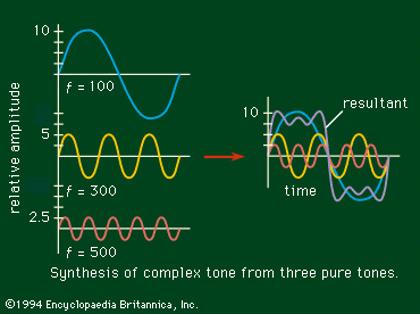
When two instruments play the same note, they often sound very different. The quality that determines how a saxophone and a guitar sound different when playing the same note is called the Timbre of the instrument, and this arises from the harmonics of the instrument, also known as overtones. When a note is played on an instrument, the note doesn’t have a single frequency ( called the fundamental frequency ), but a combination of the fundamental and several higher frequencies that occur at integer multiples of it. These multiples are called harmonics. For example, if the fundamental frequency is 100 Hz, the second harmonic is 200 Hz, the third is 300 Hz, and so on. The presence of these harmonics at different shapes the sound’s timbre and gives the colour to each individual instrument.
A photo showing the different pure tones/ fundamental frequencies in a more complex sound wave.
The study of harmonics can be understood through Fourier analysis, an extremely complicated method that breaks complex waveforms into simpler sine wave components. The simple version of this is that: Any repeating wave or periodic function can be broken down into a sum of simple sine and cosine waves.
Why different venues have different acoustics
Different venues have different acoustics due to variations in their size, shape, building materials, and interior design elements. Sound behaves differently depending on how it reflects off surfaces, is absorbed by materials, or is diffused throughout a space. For instance, a concert hall designed for orchestral music typically uses wood and other reflective surfaces to enhance resonance and clarity, while a recording studio uses absorbent materials like foam and fabric to minimize echoes and outside noise. The volume and geometry of a space also affect how long sound reverberates, which is known as reverberation- time which is a key factor in how clear or muddy a sound seems.
For example, a cathedral with hard stone walls and high ceilings creates long reverberation times, making music sound rich and full, whilst in contrast, a small recording studio is designed with absorbent panels and diffusers to create a controlled, “dry” sound, so that audio recordings capture only the intended source without unwanted echo or background noise. These acoustic differences exist because different venues are built
to serve different purposes. A concert hall is meant to enhance musical performance, so its acoustics are designed to amplify and enrich the sound naturally, allowing music to fill the space evenly and clearly. A recording studio, for example, is designed to capture sound with precision and clarity, without the influence of echoes or background noise. Even the audience matters, as people also absorb sound, so a full audience sounds completely different to an empty one. Acoustics are a vital part of music and are the reason why no two venues sound the same, and this further enhances the effect of the music you listen to at any certain venue.
Conclusion
Music and physics intersect in many ways, and in this short essay, I have shown three of the main ways that physics shapes certain core parts of music, such as acoustics, timbre and the overall nature of sound waves. There are a huge amount of other topics in which these two different disciplines collide, and all of them would not be able to fit on one scholar’s project piece. In the future, I wish to delve deeper into this question in different projects.
Lightning - Past, Present and Future A Wong (Year 10)
Lightning is one of many natural wonders, possibly the most dangerous one. It is responsible for over 20,000 deaths world wide, especially in tropical countries such as Singapore, Venezuela and Italy, up to 1.6 million strikes per year. The number of deaths caused by lightning has been dramatically reduced along with the invention of lightning rods by Prokop Divis, a Czech scientist in 1754. The inventor of the lightning rod was more widely known as Benjamin Franklin, An American polymath (a person who is known for a wide range of knowledge).
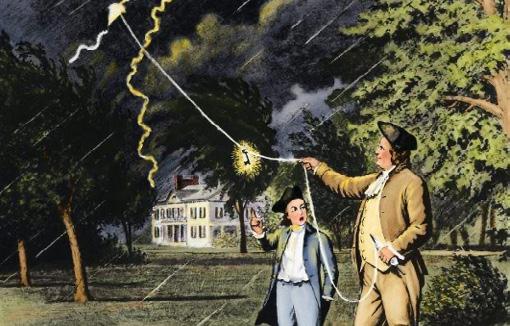
The history of the lightning dates back to the prehistoric eras where it was known as a mysterious force of nature, wrath of the Gods and other myths that surrounds the themes of punishments to the mortals from the beings above. These myths held the main focus around the world until early 1750, where Benjamin Franklin proved that lightning is a form of electricity. Back in those times, electricity was yet to be a main source of energy. Electricity was only discovered in 1745 where static electricity was stored in a leyden jar, an early form of static electrical store by Pieter van Musschenbroek in the Netherlands. The experiment that made Benjamin Franklin famous for the lightning rod was his kite experiment. This experiment involves him flying a kite during a thunderstorm in June 1752. He did the experiment by attaching a metal key near the top of the kite, flew the kite next to a storm and waited for lightning to strike. His kite was specially designed to be waterproof, and therefore less conductive. This is done by using a rope that is made out of 2 types of materials, hemp and silk. The hemp rope was connected to a leyden jar which collects the charge through the rope. On the other hand, the material of rope that Franklin was physically handling was made out of silk, which was water resistant and was kept dry under shelter. This meant that the resistance would be lower on the wet hemp rope in comparison to the silk rope, giving a lower resistance path of electrical flow down to earth, preventing a lethal electric shock. This experiment was deemed extremely dangerous by modern scientists as there is still a high risk of a fatal electrical shock due to a low difference in resistance between the 2 types of materials. Despite the risk, Franklin managed to prove lightning as a form of electricity and this experiment contributed to the early design of the lightning rod.
If this experiment is to be repeated in a modern world, which is strongly recommended against, the materials would vary to increase the difference of resistance to lower the risk of shocks. For example plastic to replace the silk and brass to replace the hemp. However, the repetition of this experiment is near impossible not only due to the safety regulations in different countries, but also the use of lightning rods meant that a kite would not be struck by lightning easily.
After the kite experiment, Franklin confirmed that lightning is a form of electricity that can be dissipated into ground. Within a year, he set up the first practical lightning rod in Pennsylvania, the lightning rod back then was essentially a pointy metal stick that is connected to the ground through metal wires. Over the next century, it became more and more widespread throughout the world in order to prevent damages from lightning. This technology became more standardised in the 1900s after its spread to the world by both the British and American to their colonies in the 1800s. This widespread invention caused the amount of deaths caused by lightning in tropical regions where lightning from thunderstorms are very common. In comparison between the number of deaths caused by lightning in the 1940 to the present, it had seen a drop from over 300 deaths with no chance of survival, to less than 50 deaths and less than 130 being injured.
Lightning was a frightening force of nature, and it still is. However, it also holds potential for future development if we manage to manipulate and harness its energy. In each strike of lightning, there is an average of 5 GJ (~1400 kWh), equivalent to the power supply that is needed to power an average UK home for around 4 months. However, these short yet incredible power supplies are ‘wasted’ as we fail to put it into use. Imagine a city powered by lightning from thunderstorms, able to sustain the use of its citizens for years due to the frequency of lightning strikes. This would mean that most other forms of power generation are needed only as a form of back up. Leading cities or even countries to energy surplus where the excess can be traded for future development. The biggest barrier to achieve this is the lack of storage capacity to hold a lightning strike. And here, I would like to point out some potential solutions and how an insight can be turned into reality.
Up to 2020, the highest capacity of electrical energy storage that is open to public use is the storage of the US national grid, the Moss Landing Energy Storage in California. It can hold up to 3000 kWh as of 2023. Theoretically able to the amount of energy in 2 lightning strikes. However, Most of the energy in lightning strikes is released as heat, making the process inefficient. Another issue is that it is impossible to predict lightning strikes and even harder to ensure that the lightning strikes the device that has the capability to store its energy. In theory, both problems can be solved but it would require a high number of specialised equipment,increasing the price. A way to solve the second problem is to connect the lightning rods into a network system that leads to a storage system that can hold this high amount of energy. This would lead to another issue that no electricity storage units have a high enough capacity to store energy from the whole storm as a typical storm holds up to 10,000 lightning strikes. This can be potentially solved by splitting the grid into smaller sections, each with a storage unit allowing energy to be stored. A smaller storage system only needs to be able to hold 1 lightning strike due to the low probability of being struck and the energy lost by other means. This ‘small’ storage system could allow people to store energy from lightning, extracting more energy for use.
The design of this unit needs to be smaller than power plants as Moss Landing power plant, with the capability of holding 2 lightning strikes takes up 1 km2, which is unreasonable for commercial use due to its size. In theory, this size can potentially be reduced into a size which is possible for commercial use which would be my project for the upcoming year.
What are the Ethical Considerations in the decision-making for Paediatric Orthopaedic Surgeries? C
Leung (Year 12)
The art of surgery is a delicate balance between the intrinsic technical precision of the knife in the hands of the surgeon, the innovation to transfer our knowledge of human anatomy from a textbook to pulsating flesh, and also the compassion of medical professionals dedicated to saving a life.
Paediatric orthopaedic surgery is arguably one of the most challenging subspecialties due to its complicated nature and the variety of cases. Each case differs despite patients suffering from the same musculoskeletal diseases due to their growth rate and age. Consequently, the timing of surgeries would have to be precise to prevent potential damages caused in the future.
An example would be the case of leg length discrepancy. A hemiepiphysiodesis typically involves the implementation of an eight plate in either the medial or lateral side of the bone of the longer limb. This lets the shorter limb catch up with the length of the longer leg and reach a point of equilibrium.1 It is advised by medical professionals that it “will be prudent to start treatment at a very young age when the deformities are not severe,” in case of worsening deformities later on in adolescence. There would also be considerations of the risk of infection and overcorrection if the plates were taken out after a prolonged time period which undermines all the efforts and progress put in previously.2
Another point that surgeons should consider is maximising the utility of surgery to adapt to the patient’s lifestyle. Some patients would be permanent sitters due to congenital diseases, while others may be community walkers. In hip dysplasia cases, the aim of surgery differs between the both. For sitters, the surgery focuses on relieving pain and shifts the focus onto soft tissue. Conversely, surgery for walkers would focus on bone joint functionality as patients would have to restore mobility and maintain balance alongside carrying out weight-bearing tasks.
One final consideration in the decision making for paediatric orthopaedic surgeries is taking consent. As children under the age of 18 are still considered minors, any surgery would require the consent of guardians. Despite the challenges of determining the best way to inform consent to children and debating with parents about what is in the best interest for the child. According to the article on orthopaedic surgery, one must remember that “an appropriate discussion has taken place and that all risks, alternatives, advantages, and disadvantages of the proposed treatment must be discussed.”3
According to a quote from a 2005 Journal of Bone and Surgery editorial, “Our patients and our Governments grant us certain privileges, but expect us to be guided by ethical principles.”4 The permission to operate ultimately depends on the willingness of the patient or their guardian. Hence a doctor could never force their way into a surgery even though it is for the wellbeing of the child.
In conclusion, as a surgeon working in a strict ethical setting, one must always bear in mind that each decision made should not be rushing to an immediate solution, but always plan for the best long-term interest of the patient. One should have a high moral discipline whilst carrying out operations at all times, as all human life is autonomous and sacred.
Bibliography:
Barritt AW, Clark L, Teoh V, Cohen AM, Gibb PA“Assessing the adequacy of procedure-specific consent forms in orthopaedic surgery against current methods of operative consent. Ann R Coll Surg Engl” (2010); 92(3):246–249
Bal BS, Choma TJ “What to disclose? Revisiting informed consent.” Clin Orthop Relat Res (2012); 470(5):1346–1356
Benson MK, Bourne R, Hanley E Jr, Harrison J, Jodoin A, Nicol R, van Wyk L, Weinstein S “Ethics in orthopaedic surgery”. J Bone Joint Surg (Br) (2005); 87(11):1449–1451
Boero S, Michelis MB, Riganti S. “Use of the eight-Plate for angular correction of knee deformities due to idiopathic and pathologic physis: initiating treatment according to aetiology.” J Child Orthop. (2011) 5(3):209-16
Chhina, H., Klassen, A.F., Kopec, J.A. et al. “What matters to children with lower limb deformities: an international qualitative study guiding the development of a new patient-reported outcome measure” J Patient Rep Outcomes 5, 30 (2021).
Epiphysiodesis Prediction and Technique. Paediatric Orthopaedic Society of North America (PONSA). [https://posna.org/last accessed: 9th September 2024]
Khan M, Dutta D, Mondal AS, Brahma K Rabha B, et al. “Review on Ethical Dilemmas in Pediatric Orthopaedic Care”. SSR Inst Int J Life Sci., (2024); 10(3): 5566-5573.
Lakhani A, Sharma E. “Coronavirus (Covid-19) – ITS implications in paediatric orthopaedic care.” J orthop., (2020); 21(21): 326-30.
Lauge-Pedersen H, Hägglund G. “Eight plates should not be used for treating leg length discrepancy.” J Child Orthop. (2013); 7(4):285-8.
Rostenberghe HV, Mohamad N, Nasir A, Taib F, Hazlan SNH, et al. ““AOR” Discharge in Paediatrics: An Ethical Conundrum.” Education Med J., (2023) ;15(1): 123-29.
1 Epiphysiodesis Prediction and Technique. Paediatric Orthopaedic Society of North America (PONSA). [https://posna.org/last accessed: 9th September 2024]
2 Boero S, Michelis MB, Riganti S. “Use of the eight-Plate for angular correction of knee deformities due to idiopathic and pathologic physis: initiating treatment according to aetiology.” J Child Orthop. (2011) 5(3):209-16
3 32. Bal BS, Choma TJ “What to disclose? Revisiting informed consent.” Clin Orthop Relat Res (2012); 470(5):1346–1356
4 Benson MK, Bourne R, Hanley E Jr, Harrison J, Jodoin A, Nicol R, van Wyk L, Weinstein S “Ethics in orthopaedic surgery”. J Bone Joint Surg (Br) (2005); 87(11):1449–1451
The discovery of Hydrogen: The heavy impact of the lightest element A
Fowler (Year 12)
Invisible to the human eye, tasteless and odourless: Hydrogen may seem unremarkable at first glance. Although it is the simplest and lightest element - with one electron orbiting one proton - it plays a crucial role in the universe. It fuels our sun and forms everything from water to DNA. Without Hydrogen, humanity and life as we know it, would be nothing.
Hydrogen was discovered in 1776 by Henry Cavendish[1] in an experiment which has become ubiquitous for GCSE and A-Level students. Zinc or Iron reacts with dilute Sulfuric acid producing bubbles. Cavendish collected the gas over water and analysed it. Paracelsus and Boyle had previously observed this reaction, but were unaware that the gas produced was an element[2]. Cavendish showed that the gas was less dense than other gases and that when burned, it formed water. Antoine Lavoisier named Hydrogen, from the Greek words hydro and genes, meaning water forming. The discovery that water was not an element corrected a major scientific misconception.
More than 130 years after Cavendish’s discovery of Hydrogen, another related discovery was unearthed: the existence of isotopes - initially associated with heavier elements, from radioactive decay. In 1910, Frederick Soddy observed that elements of different atomic masses possessed identical chemical properties[3][4]. Elements such as Thorium, Radium and Lead were found to have chemically identical forms of different masses. Lead from ores was shown to have a different atomic mass than lead from radioactive decay. Soddy remarked: “identical outsides but different insides” and was awarded the Nobel Prize for Chemistry in 1921. Frances William Aston later demonstrated that elements not associated with radioactivity also had isotopes. Using mass spectrometry, he identified Neon-20 and Neon-22[3]
Hydrogen has 3 main isotopes and is the only element whose isotopes have their own names rather than just numbers referring to their relative isotopic mass.
Hydrogen-2, Deuterium, abundance of 0.0145%, stable[5]
Hydrogen-3, Tritium, trace abundance, usually man-made[5]
Deuterium was discovered in 1931 by Harold Urey[6] via the distillation of liquid Hydrogen and this was followed by the discovery of Tritium in 1934[7]. Rutherford, Oliphant and Harteck bombarded Deuterium with high energy deuterium nuclei, making Tritium, which is radioactive (beta emitter) and has a half life of 12 years.
Hydrogen has a multitude of uses[1][2]. It is the most abundant element in the universe and we have managed to use it in everything from agriculture to welding to space travel - deepening our understanding of the solar system. Haber used Hydrogen and Nitrogen to produce Ammonia. Without this building block for fertiliser, 75% of the world could face food insecurity[8]. Deuterium, harvested from sea water (33g per cubic metre)[6], replaces Hydrogen-1 in solvents for1H NMR spectroscopy to ensure that the1H spectrum relates only to the sample. Tritium, man made by bombardment of Lithium-6 with neutrons, is a light source in watches and night sights on firearms when used in conjunction with phosphorescent material.
Future uses of Hydrogen could alter our world. Nuclear fusion of Hydrogen in the sun provides the energy to keep us, and all organisms on the earth, living in symbiotic harmony. The sun has a hot dense core with a temperature of approximately 15 million degrees celsius[9] and nuclear fusion of
Hydrogen takes place when 2 light nuclei are forced to fuse under these extreme conditions. When this occurs, the combined mass of the nuclei is less than the sum of their individual masses as the lost mass becomes energy according to Einstein’s well known equation E=mc2(which is so crucial that we were taught an E=mc2 dance to help us remember it in Year 5!). The sun’s energy radiates
through the vacuum of space, travelling approximately 150 million kilometres[10] to Earth, and is used by photosynthetic plants and the eyes of animals to enable us to see. How does this relate to our future? Nuclear fusion could enable us to form a viable artificial sun on earth. While current nuclear reactors utilise nuclear fission and Uranium fuel, we may be (sustainably) able to force Deuterium and Tritium to fuse under extreme conditions in order to produce Helium, a neutron and an incomprehensible quantity of energy. While this appears to be a perfect solution to a variety of humanity’s most pressing issues, it may be a double edged sword as we decide whether to use Hydrogen’s potential for clean and plentiful energy and self preservation or thermonuclear weapons to destroy ourselves.
Although Cavendish discovered Hydrogen, the story of the man himself highlights the crucial contributions of (likely) neurodivergent individuals to science. Cavendish displayed traits of autism[11]: socially stunted, obsessively enthusiastic and fixated by his work (now known as hyperfixation) and prodigiously gifted - also measuring the density of the earth and conducting electrical research. His anecdotal behaviours typify autism: running away from his door when visitors arrive, using non verbal communication with housekeepers, building a separate staircase to avoid people and communicating through a restricted circle of fellow scientists. Autism today is identified only through observations and questions about behaviour[12]- there is a need for research and discovery in this area, particularly as autism is comorbid with ADHD, dyspraxia, dyslexia, anxiety and more[13]. Research into identifying biological markers that can be physically measured is now being conducted[14]. Cavendish was forced to self design strategies and the lack of accommodation for his condition meant that he did not seek recognition for his work - much of it was only published after his death. Cavendish is one of many individuals in science whose stories help to challenge the stigma surrounding neurodivergence and his memory encourages us to create an inclusive, adjusted and accepting environment. Cavendish’s legacy still facilitates discovery and innovation today in the form of the Cavendish Laboratory at the University of Cambridge. The 9 Cavendish professors since 1871 include[15]: JJ Thompson, Rutherford and Clifton’s Brian Pippard - in whose honour we continue Pippard society.
1. https://www.britannica.com/science/hydrogen [accessed 24th Nov 2024]
2. https://www.rsc.org/periodic-table/element/1/ [accessed 24th Nov 2024]
3. https://www.britannica.com/science/isotope/The-discovery-of-isotopes [accessed 24th Nov 2024]
4. https://cen.acs.org/articles/91/i48/Celebrating-Isotope.html [accessed 24th Nov 2024]
5. https://en.wikipedia.org/wiki/Isotopes_of_hydrogen#:~:text=Hydrogen%20is%20the%20only%20element%20whose%20isotop es%20have,is%20deuterium%20and%203%20 H%20is%20tritium.%20 [accessed 24th Nov 2024]
6. https://www.iaea.org/newscenter/news/what-is-deuterium [accessed 24th Nov 2024]
7. https://www.britannica.com/science/tritium [accessed 24th Nov 2024]
8. https://www.fao.org/4/i0291e/i0291e00.htm [accessed 24th Nov 2024]
9. https://www.esa.int/ESA_Multimedia/Images/2019/10/Anatomy_of_our_Sun#:~:text=This%20is%20where%20the%20Sun%2 0generates%20its%20energy.,releasing%20 vast%20quantities%20of%20energy%20in%20the%20process. [accessed 24th Nov 2024]
10. https://scied.ucar.edu/learning-zone/earth-system/energy-from-sun [accessed 24th Nov 2024]
11. https://www.aspie-editorial.com/2011/01/22/paul-dirac-henry-cavendish-how-autism-leads-to-genius/ [accessed 24th Nov 2024]
12. https://www.cdc.gov/autism/hcp/diagnosis/index.html [accessed 24th Nov 2024]
14. https://medicine.yale.edu/news-article/yale-researcher-seeks-to-understand-the-biology-behind-autism-spectrum-disorder/ [accessed 24th Nov 2024]
15. https://www.phy.cam.ac.uk/history [accessed 24th Nov 2024]
When Pigs Fly
‘It’s a truth universally acknowledged’ … that when someone says ‘when pigs fly’, it is a sarcastic way to express that something is never going to happen. Just take a moment and have a deep thought, is the phrase really correct? Are the chances of pigs ever flying really zero? From prehistoric overlords to diversified present, a fleeting glimpse to the chaotic future. Standing on the shoulders of giants and blessèd with wings of curiosity, we are going on a captivating ‘trip’ to discuss the possibility of pigs flying in the future.
The first animal that developed flying ability:
According to archeologists, the first ever animal that can fly are the Pterosaurs, a group of creatures that lived with the dinosaurs. They evolved from land-base animals and first began to fly around 245 million years ago during the Early Triassic Period.
Pterosaurs stand out as one of the most successful evolutionary stories. With the ability to fly, they are uncontested above the ground, colonising all continents and evolving into various different shapes and sizes. They thrived for 150 millions years from Triassic to Cretaceous in comparison to human history of 4 millions. Nowadays, scientists have a much better understanding about them now because of the new fossil discoveries thanks to new technology. Based on fossils, scientists came up with some theories (educated guess) and little by little, started revealing this prehistoric ‘miracle’ .
Adaptation features of the pterosaurs:
• Wing membrane: patagium (Special skin membrane) stretched from long fourths finger to body and leg.
• Light pneumatized bone
• Strong forelimbs and shoulder girdle to support wing movement.
• High oxygen intake: Advanced air sac and unidirectional airflow. (Similar to birds)
• Pycnofibers (hair-like) for insulation
• Light diet
J Jeremie and M Yu (Year 10)
• … (More fascinating adaptation not included in the discussion topic)
• Summary: For pterosaurs, although they are extremely large flying predators compared to flying animals nowadays, light weight is still super important to them. Their other adaptations are straight forward as well since they need to have the ability to survive in mid-air in order to reign it.
Pterosaurs had some incredible adaptations. They are one of the strongest ‘supporters’ of evolution theory. By comparing bone size and structure chronologically, scientists find some clear traces of adaptation during pterosaurs’ 150 million years domination in air. They adapted to be able to use 50% less energy when flying, truly marvelous creatures!
If the timeline of pterosaurs can reveal any veracity, I believe it has to be: If you give any creatures in the right condition; the nature of evolution, the authentic magician can perform miracles.
What about mammals:
Pigs in their current state would not be able to fly without the help of other sources so what would we need to make a pig fly?
Well first of all we should look at how bats fly.
Bats are the only proper flying mammal and are the closest relative of the pig, as the two creatures are homologous meaning they both share a common ancestor. So if bats can fly, why can’t pigs?
Well the first and most obvious example are wings. It is quite reasonable to think that pigs would have similar wing structures to bats as birds are more prominent and plentiful; they are from completely different evolutionary trees whereas birds evolved from dinosaurs whilst pigs and bats from early mammals.
So as established flying pigs are likely similar to bats so what similarities would be necessary.
Firstly, bat wings are made up of a thin layer of skin stretched over the bone structure and muscles causing them to be lightweight and efficient. Bat’s wings are heavier in proportion to most bird wings meaning their long distance gliding skills are less efficient but allow more power, agility and manoeuvrability.
Another thing that would most likely need to change would be the pig bone density which is usually very dense as they are denser than human and bat bones. The pigs could otherwise develop hollow bones such as the ones found in birds although that would be unlikely as their bodyframe would not support hollow and therefore weaker bones which would fracture too easily.
Another aspect that would have to be considered would be the pig’s metabolism. Pigs Metabolisms are usually quite fast which causes them to gain weight fast but with the situation of flying the pig would most likely use the metabolism for flight which would require much energy.
Something else that would most likely need to change would be the muscle and body structure of pigs as they would need a more aerodynamic build that would support flight and more streamlined muscles that would be located in a more central position like those in bats. A flying pig would also need strong pectoralis muscles if they were to utilise bat wings effectively.
The final change would be the size of the pigs as at their current size it would be very difficult to fly with. They would need to be much smaller and have a thinner build to help with flight with a more muscle focused body. Underneath we have added a possible but not perfect image of what a flying pig might look like.
Our thought about the stage of evolution pigs will go through:
Setting: In the forest
Stage 1: Wild pigs might be strongly influenced by some imbalance in natural or human impact. Eg. Super strong land predictors. Therefore pigs were forced to be able to climb the trees, so they will have characteristics such as toes adapted for grasping the branch, stronger forearms.
Stage 2: Predictors learn from pigs and force pigs to have the ability to move quickly between trees via leaping.
Characteristics: Mildly stretched skin, body shape to reduce drag.
Stage 3:Gliding, pigs that can glide can benefit from easier to find
foods, quickly dodging the predator etc. So the pig population will gradually be more able to glide. Characteristics: Largely stretched skin, smaller bodies.
Stage 4: Fly. Gliding might be inefficient if sometimes the gap between trees is large, so pigs flying muscles developed to enable the wings flapping. Characteristics: Elongated forelimbs, muscles focusing more in flying, and changes in metabolic significantly for better flying.
Stage 5: Pigs now might specialise in different areas for different advantages. Must not remember that light bone structure and body weight/ metabolic rate can be optimised over time, so not specific characteristics for certain stages.
Overall, this is our brief theory on a very large time scale. Some adaptations might not be included.
Challenges of pigs:
• Very large time scale: bat is the only example of mammal evolved flying ability from scratch, and it took them more than 50 million years
• Bone structure: Pigs have very heavy bone structure that benefit them on land for thousands of years, it would be a massive leap for them to go from such structure to light weight, or even pneumatized bone.
• Considering the environmental impact for pigs to adapt, it is very likely that pigs as a species get out-competed and therefore extinct before any first stage of adaptation.
In conclusion it is not likely in the slightest for pigs to ever develop the ability to fly however it is not impossible. However there is a fundamental problem with the possibility of pigs ever flying that will finally be addressed and that it the fact that when if ever pigs start flying they are likely not to be pigs anymore and are more likely to be a species that evolved from pigs rather than actual pigs, this would be due to the fact that they would have changed much from their base forms to actually allow the ability of flights that they would have likely changed too much to be considered pigs and would most likely be a different species caused by a divergent evolution path, something to help this be understood would be dogs and wolves both creatures sharing one close common ancestor but both quite different and named differently.
Habib (2008): Focuses on quadrupedal launch mechanics. Unwin (2006): Explores skeletal adaptations and evolutionary trade-offs.
Kellner (2015): Discusses phylogeny, wingspan variation, and nesting.
Naish & Martill (2003): Details pycnofibers and sensory adaptations.
From Dawkins to Digital: The Evolution of Memes E Clear (Year 10)
When writing his 1976 book the Selfish gene Richard Dawkins esteemed evolutionary biologist and zoologist introduced a new word, a word he made up used to describe “the idea of a unit of cultural transmission.” such as a catchy tune or ideas or scientific theorems. He created the word from the Ancient Greek word “mimeme” meaning imitated thing and shortened it to “meme”. At this point in time telephones were as mobile as their cords would allow, Tim Bernes Lee had just graduated from Queen’s College Oxford and Steve Jobs was just another college drop out with a crazy dream. Dawkins didn’t know he had created a word which would define a generation and create a culture no one in 1976 could have foreseen.
Richard Dawkins used genes as an analogy for how memes spread. “Just as genes propagate themselves in the gene pool by leaping from body to body via sperm and eggs so memes propagate themselves in the meme pool by leaping from brain to brain” This idea links back to one he had been repeating throughout the book of gene’s replicating ability being the way it propagates itself throughout a gene pool the same can be said of memes as Dawkins puts it a “fertile meme” is a meme which is able to replicate itself through many different people’s minds. If a tune is catchy and you begin to hum along to it and someone else hears it and they pick it up as well that meme can be considered fertile and have a “high replication ability” as it is able to create another version of itself in someone else’s mind. in this way anything could be considered real. Even Dawkins famed atheist admitted that God exists even just as a meme able to permeate through the minds of billions of people throughout generations all across the world it’s spread facilitated by great art, music, and scripture.
Memes as we understand them today are vastly different and have taken on a meaning of their own. They have become a word most have come to associate with funny images or texts, short videos or sounds. There are millions of examples across the internet. Memes now have a cultural power which far surpasses the scope of a scientific definition. They evolve so much faster now with social media algorithms being the medium that they replicate in. If a meme is considered funny or inflammatory it replicates fast as it gets liked and shared across the internet boosting it in the algorithm.
Memes now have an amazing power of shaping people’s perceptions of others and politics. Throughout several campaigns across many countries meme’s have been used to reach a younger audience of young adults who are unlikely to engage with different parties or news sources and are unlikely to do their own research. It can risk misinformation being spread as people don’t fact check and fake news can be easily propagated through tiny bite sized chunks without the full context being given and due to the echo chamber nature of social media algorithms people are unlikely to see opinions and viewpoints different to those that they themselves hold. That isn’t to say meme’s can’t be used for a greater good for example during the #MeToo movement women in China used images of rice and bunnies (which when said aloud sound like “mi tu”) to get around censorship rules so they could share their own stories of sexual harassment and support each other.
To summarise, Memes have come a long way from a definition in a book about genetics. They have become a pillar of internet culture and will likely continue to be used as a tool for social good, political outreach or just as a way to send a joke to your friends.
The Treaty of Trianon and Its Lasting Impacts on Hungarians
Before the signing of the Treaty of Trianon, Hungary was a part of the Austro-Hungarian Empire, which was a dual monarchy under the Habsburgs. The creation of the dual monarchy arose in 1867 after the Austro-Prussian War a year prior with a growing pressure from the Hungarian people.
The Treaty of Trianon was signed on the 4th of June 1920, which aimed to punish the Hungarian portion of the Austro-Hungarian Empire for their contribution to the central powers in world war one. Hungary would lose roughly 71%: Slovakia would join the new Czechoslovak state, Burgenland was ceded to Austria, Transylvania would be ceded to Romania and much of the south was ceded to the newly formed Yugoslavia. It also limited the Hungarian army to just 35 thousand men. The picture to the right shows the extreme amounts of land lost.
Many Hungarians didn’t feel like they should be punished at all for their contributions to the first world war. They claimed that the one pulling the strings was the Austrian side, with many Hungarians very hesitant over starting the war over the death of the Austrian Duke. Whilst these claims would be quickly put down by the victorious powers, and specifically President Wilson, who were strong on all ethnicities to have self-determination. It would remain with the Hungarians as a point of anger over their heavy punishment post-war.
A Catchpole (Year 10)
The most devastating impact of Trianon was the loss of land, and therefore status, held by the Hungarians. The land loss occurred, mostly due to Hungarians only occupying 48% of Hungary. One major reason for this becoming an issue was the Hungarians split away from their home land. Transylvania, a region given to Romania, held a large 31.7% portion of Hungarians. This is specifically seen in Székely Land, which holds a majority of Hungarians. Other regions containing large Hungarian populations include: Upper Hungary (Slovakia) with 30.2%, Vojvodina given to Serbia with 28.1%, Carpathian Ruthenia with 30.6% and small minorities in Burgenland and Croatia. Hungary lost 72% of its territory and over 3 million ethnic Hungarians were cut off from their homeland. This would devastate the Hungarians, with such a loss of population, resources and industry. A famous image was published, showing the immense losses that Hungary had to endure and tried to make the allies feel guilty through comparison to their own land.
The Treaty would reshape the demographic, economic and political landscape across Central Europe. Demographics would change, due to large population exchanges. 350,000 Hungarians fled or were expelled to Hungary from neighbouring countries from the end of the war to 1924. 200,000 Germans were expelled from Hungary and there were large population exchanges between Hungary and Czechoslovakia. These would lead to an extremely different ethnic composition of Hungary, as now minorities only made up 7% of Hungary’s population. The economy was also massively negatively affected. A majority of Hungarian resources and industry was all located in Slovakia and Transylvania, which all gained sovereignty post-Trianon. This would ultimately lead to economic stagnation, with not enough goods to grow the economy, let alone pay for war damages. This led to poverty and unemployment, once again infuriating Hungarians with situations in some cases becoming dire. Politics in the region became much more tense, due to these ethnic clashes. Hungary, and therefore their people, would become trapped and isolated due to the creation of the Little Entente. This was between a majority of Hungary’s neighbours including Czechoslovakia, Romania and Yugoslavia. It had the specific purpose to protect each other from Hungary, in case of them attempting to regain their lost land.
However, despite there being multiple initial impacts of Trianon, the Treaty is still felt by many Hungarians in the modern day. Nowadays, Trianon has become a fierce living symbol of both loss and identity. With the humiliation that came from the Treaty, it became more to Hungarians than just a national tragedy. It was referred to in public discourse as a “trauma”, a “dictat” and an “open wound”. Daniel Bartha, from CEID, stated “Trianon is everywhere”, embedded in culture. Even today, maps of Greater Hungary can be seen everywhere. In 2022, Prime Minister Viktor Orbán provocatively wore a Greater Hungary scarf, including a small map, which led to backlash from the neighbouring nations of Romania and Ukraine. Since 2010, Hungary marks the 4th of June as the Day of National Cohesion, reinforcing memories through holding commemorations and flying flags at half-mast.
This national trauma also has led to the creation of myths. Dr Thomas Lorman, from UCL, explained the trauma of Trianon has become wrapped in mythmaking. The actual losses of both world wars and the interwar instability are overlooked. The idea that Trianon is still in effect is widespread, though technically, it was superseded by postWWII treaties. Nonetheless, the trauma remains prominent due to a cascade of overlapping historical events that went against the Hungarians. Hungary became demoted from a regional power to a much smaller, landlocked nation, Hungarian communities became fragmented through now being minorities in other states and the collapse of the Austro-Hungarian Empire, which had given Hungary international presence and relative autonomy. In that sense, Trianon served as a metaphor for a broader national decline. This metaphor continues to shape Hungary’s self-image. Trianon has also affected politics, through Fidesz’s memory politics. The Fidesz government, which currently leads Hungary, has strategically revived the memory of Trianon. This has been done to rally nationalist sentiment, specifically from outside Hungarians. They extended citizenship and voting-rights to over one million Hungarians abroad. Hungarian cultural and educational institutions were supported in neighbouring nations, once part of the Kingdom of Hungary. Trianon was embedded into Hungary’s constitutional language, which defines the nation as a cross-border cultural and ethnic community. Symbols are also central. The Trianon memorial in Budapest lists every location lost in 1920, ignoring whether significant Hungarians settled there or not. Cities such as Zagreb in Croatia were put with Hungarian majority villages. However the memory politics of the Fidesz’s government has caused some risk and tension between neighbouring countries. Prime Minister Orbán posted an image on Facebook in 2020, which showed greater Hungary, angering both Romania and Croatia. Recently Romania now has its own Trianon remembrance day in law, however this is deemed very provocative by many Hungarians.
The Treaty has also affected modern geopolitical tensions over minorities in Central Europe. Trianon has continued to shape Hungary’s foreign relations, particularly with countries which hold significant Hungarian minorities. Roughly 1.2 million ethnic Hungarians live in Széklerland in Romania, where they form a local majority. Hungary is calling for cultural autonomy here, but it’s opposed by Romania to uphold its unitary national model. Hungary hangs the flag of the region on the parliament building in Budapest, to show support for the large minority. In Slovakia, tensions over dual citizenship have softened in favour of broader Visegrád Four (Czechia, Slovakia, Hungary and Poland) cooperation. Language reforms in Ukraine in 2017 limited minority-language education, which includes Hungarians in Carpathian-Ruthenia. This soured relations between the two, however, dialogue has since resumed. Serbia, on the other hand, has been having good relations with Hungary over recent years. This has been bolstered by political alignment between Orbán and President Vučić, and a small, well-integrated Hungarian minority in Vojvodina. Despite rhetorical provocations, no serious politicians advocate for territorial claims. Maps of Greater Hungary make headlines, but the concerns today center on the decline of Hungarian minorities abroad. This demographic trend, driven by assimilation, emigration, and ageing, is generating more current anxiety than of Trianon itself.
In conclusion, Trianon is clearly still prominent in today’s politics, demographics and social impacts. It immediately altered Hungary’s borders, identity and regional influence. The immense losses left a deep scar on Hungarian identity, transforming a geopolitical agreement into a lasting symbol of trauma, injustice, and national decline. Over a century later, Trianon remains embedded in Hungary’s politics, culture, and foreign relations. While territorial reconquest is no longer a serious political aim, the memory of Trianon still drives concerns over the futures of Hungarian minorities in neighboring countries. Trianon serves as both a historical turning point and shows how past grievances can shape a nation today.
An Enquiry into the Uneven Distribution of Wealth
During the American Economic Boom of the 1920s L Gulek (Year 11)
Many Americans benefited greatly from the Economic Boom following the First World War. This boom was as a result of America’s ‘flying start’: the petrochemical industry, which Germany had dominated pre-war, was taken under American control, the distribution of American reparation loans tied many European countries’ economies to the dollar and, due to the Republican Government’s low tax policy, many Americans were able to utilise credit for purchases.
After a brief post-war recession, average unemployment never rose above 2.7%, inflation never rose above 1% and real wages of workers rose by up to 14%. There was huge economic growth (for example, production of industrial goods rose by 50% between 1922 and 1929, likely due to the rapid growth of the car industry, primarily under Ford), while fewer hours were being worked by employees
So, with this rapid post war economic growth, why was the boom’s prosperity not shared by everyone? Mass industrialisation following the war led to unemployment among many farmers as more efficient machinery (e.g. combine harvesters) replaced their jobs and as demand shifted to other goods and services so that, by 1928, 50% of farmers were living in poverty. Along with industrialisation, there were other factors contributing to the uneven distribution of wealth: declining American exports as Europe imported less food from the USA due to their own economic hardship and as retaliation to the USA’s excessive tariffs, for example the Fordney McCumber Act of 1922. There was also new competition, particularly from Canada, which led to overproduction and falling prices; in 1921 alone, most farm prices fell by 50%.
These hardships led to the mass migration of farmers to urban areas in the hope of better opportunities, only to be greeted with equally low wages; around 60% lived below the poverty line, earning approximately $2,000 annually. This worsened the distribution of wealth and income, leading to severe economic disparity between the wealthy and the poor. The Republicans’ policy of ‘rugged individualism’ only exacerbated this divide as government involvement in welfare was essentially non-existent.
Furthermore, new immigrants, miners, black sharecroppers and textile workers also faced immense financial hardship. Black Americans in particular, the majority of whom lived in the southern states, worked generally as either labourers or sharecroppers, were trapped in poverty. During the 1920s, 750,000 black farm workers lost their jobs, leading them to seek work in the cities. By the end of the decade, 25% of black people were living in northern American cities. Although they had greater opportunities there, they still faced discrimination. For example, 60% of black women in the northern city of Milwaukee worked as low-paid domestic servants in white households, while most car factories operated an all-white policy, leading to only small numbers of black people being hired.
Therefore, although the roaring 20s were a time of rapid economic growth, many Americans, particularly black Americans, remained below the poverty line and were not able to take part in the boom. Inevitably, the bust followed the boom, sparked by the Wall Street Crash of 1929 which led to the Great Depression and a global market downturn. In this instance the whole of America, the wealthy and the poor, collectively suffered the consequences of an economy built on weak foundations and unchecked rapid economic growth.
Assessing the Significance of the First World War
For America in 1918 to 1932
The First World War was extremely impactful on the USA as the economic advantage, loss of life and changing opinions resulting from the war clearly had major consequences both long and short-term. These impacts were very significant in the lives of all Americans despite not all of them being positive.
Prior to the war, African Americans faced discrimination and prejudice in all aspects of life especially in the South, where Jim Crow laws legalised segregation and resulted in white superiority with African Americans having very few rights. These people believed that showing patriotism by joining the war effort would cause them to be recognised as full citizens resulting in over 700,000 registering for military service by 1917 with 380,000 being recruited and serving. Following the war, these soldiers were desperate to replicate the sense of equality they obtained during the war, and believed their wartime sacrifice meant they deserved these rights. This was a significant factor in The Great Migration of black people from southern states where they had a history of slavery and segregation, to northern states with opportunity. The opportunity these northern states provided is shown through the Harlem Renaissance as with 200,000 black people migrating to Harlem, black culture and pride flourished especially in art and music showing the incredible significance of the war on lives of black people. These changing beliefs as a result of the war are also shown powerfully through the emergence of political groups such as NAACP, campaigning for equal rights and opportunities, and UNIA, campaigning for black power. All of these impacts show how the war was a very significant turning point as the NAACP reduced lynchings and treatment for African Americans began to slowly improve. However, the war is of less significance as the Civil Rights Movement did not occur for a further 40 years and during this time black people were still discriminated against and received much lower wages than their white counterparts. The Klu Klux Klan, a white supremacist group, also diminishes the significance of the war as it shows the threat to black Americans remained with many still living in fear.
Following the war the US government reverted to a policy of isolationism after it had been abandoned in 1917 when they entered the war. This approach was described by President Harding as a “return to normalcy” and was a direct reaction to the significant impacts of the war including the booming economy and huge loss of life. This policy of isolationism is shown by America’s refusal to join the League of Nations despite it being the creation of their previous president Woodrow Wilson. After the extremely significant loss of 112,000 soldiers in the war, America was afraid joining the league meant they would be forced to send soldiers to resolve conflict around the world, possibly causing even more casualties. America also believed that the imposition of economic sanctions on another country by the league could negatively impact its own rapidly growing economy. To protect their superior economy, America introduced many tariff acts, one of the most significant being the Fordney-McCumber Tariff Act 19221. These tariffs, along with America’s refusal to write off European war debts, were extremely significant in the deterioration of relations between America and the rest of the world. This isolation is also furthered by America’s changing attitudes towards immigration becoming
less accepting after the war.
S Harber (Year 12)
Before the war, America was very accepting towards immigration, priding itself on being a “melting pot” where individuals all blended together. This resulted in the vast majority of Americans being either immigrants or descendants of recent immigrants. The war resulted in very negative views towards immigrants and caused a closed door policy. The war was a very significant trigger for the Bolshevik revolution in Russia in 1917 which led to US citizens worrying about European immigrants bringing communist ideas with them. These worries were worsened by the formation of two communist parties in 1919 within America, and along with many violent strikes involving 400,000 workers and a series of bomb attacks from Anarchists, killing many and causing hysteria in the media especially after the Wall Street Bombing Incident, people became terrified of a revolution. This led to the Red Scare where people were terrified of communism and were desperate to remove it from America. This is shown by the arrest of 4000-6000 suspected communists and the deportation of 500 “aliens’’ despite not all being communists. The negative attitudes towards immigrants following the war can also be seen in the Sacco and Vanzetti case where 2 Italian immigrants were arrested and executed for robbery and murder despite significant lack of evidence. They clearly did not receive a fair trial, likely because they were immigrants, shown by them receiving a formal pardon in 1977. Overall, the war was extremely significant in changing opinions on immigration, shown by the 1921 Immigration Quota Act and the 1924 National Origins act significantly reducing the number of immigrants allowed into the country.
In America there was a strong belief by many that alcohol led to crime, poverty and ill health and that the prohibition of the sale, transportation and making of it would be extremely beneficial to society. The war had a significant impact on the influence of these beliefs as many large American brewers had German names and were of German descent. The groups arguing for prohibition used this to promote not drinking alcohol as anti-German and patriotic. By January 1920 the prohibition of making, selling or transporting alcohol in the USA was introduced as the 18th Amendment to the Constitution. On the other hand there were already movements campaigning for prohibition and the war was a minor cause showing its low significance.
One of the most significant impacts of the war was for women and their treatment by society. The war brought many prosperous opportunities for women in America, especially the opportunity to work in factories as these were critical roles that needed filling as many young men were off fighting. In 1918 almost one million women were in paid employment, giving them experience of skilled labour and a chance to prove they were a significant part of the economy with this number reaching 10 million by 19296. There was also a significant change in the employment of middle class women, reaching 25% by the end of the decade. This increase was because of the reduced expenditure necessary for employers as women were able to be paid less than men and as a result of mechanisation there was a reduced demand for physical strength. This shift
in employment contributes to the changing social restrictions placed on women and the new found freedom working women were experiencing. These changing restrictions on women are shown by them gaining the vote in 1920 showing an increase in political power and their impact on society. However, the changing life for women is of less significance as America in the 1920s was still a misogynistic society, and not all women benefited from societal changes. Many traditional roles for men and women remained and even for working women, there was still a pay gap showing the deep rooted prejudices of American society. Thousands of working class women did not experience any positive change as a result of the war and their lives became more difficult, especially the wives of farmers and workers in old industries living in poverty, who had to care for their family whilst also working to make money to survive. These differing roles in society for middle and working class women highlight another significant impact for America resulting from the war which was the economic boom.
The economic boom impacted hugely on all aspects of life for many Americans and the war was a significant cause. Throughout the war European countries poured money into the American economy for vital food, raw materials and munitions which were critical for the war. This influx of money into American industry and agriculture led to huge growth, contributing to the boom. The war also allowed the US to take over European markets. Whilst American business prospered, their European counterparts struggled as their resources were put into the war effort. Another impact of the war on the economy was technological advancements such as mechanisation. America was able to advance faster than any other nation, especially those fighting in Europe. America became the world leader in development and implementation of new technology within industry, such as in assembly lines. All of these impacts from the war were significant in the lives of investors and workers in new and prospering industries. Workers in prospering industries benefited from higher wages than those in old industries, due to mechanisation increasing output. For investors, from 1921 onwards, the boom meant American businesses were expanding and were very successful, encouraging investment. Throughout the 1920s as share price kept increasing, more people were incentivized to buy shares blowing their price out of proportion, hence making investors lots of money. Conversely, the impacts of the war on the economy had a huge negative significance for many groups: farmers in particular. In the 1920s, 30.2%3 of the population lived on farms and during the war their need to supply food to struggling European countries led to them becoming extremely efficient. However, as European demand fell after the war, this efficiency resulted in overproduction leading to the food market crashing, leaving millions of farmers poverty-stricken with many being evicted or having to sell their land. The significance of this extreme poverty is shown by 68% of 10,000 farmhouses not having running water. This overproduction problem was a significant contributing factor to The Great Depression as it led to a saturated market, resulting in a lack of spending plunging America into a recession. One group heavily impacted by this depression were war veterans.
1. Cambridge IGCSE and O Level, History, The 20th Century (2013)
2.Cambridge IGCSE and O Level, History, The 20th Century (2013)
At the end of the war, returning veterans felt they had been unfairly compensated by the government for their wartime efforts and sacrifices as those who had stayed at home had received significantly higher wages without the threat to their life. The government passed a bill, despite heavy opposition at the time, promising “adjusted compensation” for all these veterans, where they would receive $1.254 a day for service overseas in 1945. In 1932 veterans demanded this bonus early as a result of the extreme hardship they experienced due to the Great Depression, causing a bill to be proposed in Congress. To further their cause, thousands of veterans peacefully marched to Washington occupying streets and buildings for several weeks; however the bill was refused as the senate felt the government could not afford it at the time. In defiance, veterans refused to move out of Washington and rather than engage with them, President Hoover called in the army and appointed General MacArthur to handle the situation. This led to an aggressive response labelling protesters as criminals and communists whilst using tanks and tear gas to forcefully remove them, killing two people in the process. This response was extremely unpopular with US citizens and contributed to a huge swing in public opinion against the Republican party. The significance of this is shown by the landslide victory for the Democratic president Roosevelt in the presidential election the same year, where he received 88.9%5 of all votes and became the first Democratic president in 12 years.
In conclusion, the First World War was extremely significant, with both progressive and regressive impacts, shaping modern America. The most significant progressive impacts are on women and black Americans due to a massive shift in their treatment, as women gained the right to vote and the war can be seen as a pivotal moment significantly contributing to the civil rights movement in the 1960s. The economic impact cannot be overstated as, despite the Depression, the development in the 1920s significantly contributes to America becoming the strongest economy in the world today. Unfortunately, American regressive attitudes towards immigration following the war still remain today.
Bibliography:
T Fieh, The USA Between The Wars, 1919-1941 GCSE Textbook (1998)
Cambridge IGCSE and O Level, History, The 20th Century (2013) https://pubmed.ncbi.nlm.nih.gov/12314701/#:~:text=In%20 1920%2C%20when%20the%20farm,proportion%20had%20 fallen%20to%2015.3%25.
A Feminist Review of the Historical Context of Female Presentation and Sexism in Film
E Laredo (Year 12)
Laura Mulvey’s paper, ‘Visual Pleasure and Narrative in Cinema’ coined the term the ‘male gaze’. This refers to the portrayal of women for a male audience which Mulvey argues creates a distorted view that typically is curated to sexualise and objectify women. This is known as ‘scopophilia’1, a Freudian concept which Mulvey utilises, as psychoanalysis is used as the basis of her film theory. She argues that the audience, whether male or female, is forced to see women through the perspective of a heterosexual male with a belief in the patriarchal system, where men are presented as active and women as passive.
In particular, Mulvey focuses on three ‘looks’ present in Cinema: the way in which the film narrative (created by the scriptwriter) affects the characters’ relationship with each other so the audience identifies with the protagonist (male) as subject and the narrative revolves around him and sets the female as object; the way in which the camera and cinematography portray the characters interaction and relationship as a representation of reality; and the actual audience perception which is affected by the previous two.2 In the past, the visual representation of women has depended on their ‘to-be-looked-at-ness’.3 They were projected as sex objects for male satisfaction.
Mulvey’s essay was influential in feminist film theory and led to the concept of the female gaze which was explored in an article by Zaira Araujo.4 Araujo explains that the concept developed from an initial female version of the male gaze, where men were objectified by women, to more recent developments, most particularly Zoe Dirse in ‘Gender in Cinematography: Female Gaze (Eye) behind the Camera”5. Araujo highlights that Dirse tried to determine whether there was a unique and distinguishable difference in the aesthetic perception of the female gaze, especially when one focused on the technical aspects of filmmaking. She asserts that as filmmakers (writers, directors and cinematographers) became more aware of how film represented women, it began to influence the portrayal of women in film.
The last 50 years have seen enormous changes in women’s rights and the perception of women within society. Tea Trumbic quotes a statistic from a book published by the World Bank, “Women, Business and the Law”6 Eight areas of law were compared to see how the two genders were treated differently between 1970 and 2019. Even if one restricts the analysis to high income OECD7 countries, the change is dramatic. Women in 1970 had approximately 55% of the legal rights of men and by 2019 that had increased to 94.6%. Those changes have also been matched by changing attitudes to what is considered acceptable genderbased behaviour, exemplified by the #MeToo movement8. Whilst film may have a complex role to play in both informing and being informed by societal norms, it can’t operate in a vacuum and one would expect to see the portrayal of women change over the past 50 years.
1. Oxford Reference: A Dictionary of Media and Communication “Pleasure in looking; in Freudian psychoanalytic theory, an infantile instinct. In relation to the dominance of the male gaze in classical Hollywood cinema, Mulvey refers to scopophilia as the pleasure involved in looking at other people’s bodies as (particularly, erotic) objects without being seen either by those on screen or by other members of the audience. Mulvey argues that cinema viewing conditions facilitate both the voyeuristic process of the objectification of female characters and also the narcissistic process of identification with an ideal ego seen on the screen.”
2. Mulvey p.g. 810-813
3. Mulvey, p.g. 809
4. Araujo, Zaira, The Evolution of the Female Gaze: from Laura Mulvey to ‘Portrait of a Lady on Fire’, 2021
5. Dirse, Zoe, Gender in Cinematography: Female Gaze (Eye) behind the Camera, 2013, pp.15-29
6. Trumbic, Tea, How have women’s legal rights evolved over the last 50 years?, 2020
7. Organisation for Economic Co-operation and Development
8. A social movement funded by Tarana Burke in 2006 to support survivors of sexual violence, that went viral in 2017 as a number of actresses began to publicise how they had been sexually abused.
To what extent is female sport featured in the UK news media, and what is the impact of this level of representation? L Simpson (Year 9)
Background
In recent decades, female sport has made huge leaps forward towards gender equality. Female sport has experienced increased participation rates and the development of professionalism across a wide range of sports. As well as increased opportunities for women and girls at the grassroots level, women now have an opportunity to pursue a career in professional sport and earn a living from it. The first major breakthrough in equal pay for women was in the U.S. Open tennis grand slam in 1973, a move that was championed by one of the leading pioneers of female professional sport, Billy Jean King. It was thanks to King that female sport was first given this opportunity. Since the 1970s, many female sports have grown dramatically and are now attracting large fan bases and television audiences. From January 1st to April 30th 2024, nearly 21 million people watched televised women’s sports coverage in the UK (Statista Research Department, 2024).
The news media play an important role in the development of professional women’s sport by increasing exposure and awareness, creating role models and celebrating successful performances in sport. Women’s football has been particularly prosperous in recent years and has grown rapidly in popularity within the UK and around the world. The media provides us with statistics, data and news of performances, which allow us to follow the careers of female athletes.
However, despite such progress, there are still large gaps between male and female representation, and there is a long way to go to achieve gender equality in sport. A study in 2019 compared Lionel Messi, the highest-paid male athlete at the time, and Serena Williams, the highest-paid female athlete at the time. The study showed that Lionel Messi earned approximately 125% more than Serena Williams (Goal Five, 2025). These are both exceptionally talented athletes in their sports, yet the difference in their pay is vast. This figure proves equality has definitely not been reached.
As a female athlete, I am interested in all the factors that contribute towards the growth and development of female sport. For a while, I have noticed a lack of coverage of female sport within the news media, and I was interested to collate some accurate data on this and to understand what impact this has. I decided to carry out this research to see how close to equality the UK sports media really is.
Method of data collection
To gather data for my research, I decided to analyse the sports articles on two different online news platforms. I decided to use the BBC News and SKY News websites as these are two of the most popular online sources of news in the UK. An OFCOM survey published in 2024 said that, among news publishers, websites and apps, the BBC website is the most popular, followed by SKY (The Guardian, 10th September 2024). I thought that two sites would increase the validity of my findings and give a broader representation of all the UK sports news coverage. Every day for seven days, between 1st April 2025 and 7th April 2025, I logged onto both websites and took screenshots of all the articles displayed on the homepage of the sports news section. I then determined whether the content of each article was related to female sport or male sport, and then recorded the results in a spreadsheet. Please see Appendix A for some example screenshots of the news websites. Recording the data over the period of a week means we can be sure to give a fair representation of how many female stories UK news sites really write about.
The results
My findings showed that, out of the 48 sports articles published on the SKY News website, only two related to female sport. This was 4.2%.
On the BBC Sport news website, there were a total of 69 sports articles published during the seven days, and only 11 of these were related to female sports. This was only 13.9%.
In the interest of displaying these results in different ways and to help visualise the level of representation, the SKY results are shown in the bar graph below, and the BBC results are shown in a pie chart.
The results indicate quite strongly that there are a lot more male sports articles in the news media than female sports articles. Even though a lot of progress has been made in recent years and the status of female sport seems to have increased, my results indicate there is still a massive under-representation of female sport in the news media. The pie chart and bar chart help us to visualise just how underrepresented women’s sport is in the UK news media.
Historical context
In many cases, female professional sports are in the early stages of development compared to male sports. It was only in 1975 that women in the UK were first allowed to run a marathon, and the first Olympic Games to include the marathon for women were the Los Angeles Games in 1985. This was 88 years after men first had the opportunity to run the marathon at the first-ever modern Olympic Games in Athens in 1896. In the 1900 Paris Olympic Games, women could only compete in five events: tennis, sailing, croquet, equestrianism, and golf. This was the first modern game to include women. In the same games, men competed in 93 different events. The Paris 2024 Olympic Games were the first time there was the same number of events being held for men and women. Women’s sport has taken years to progress, especially in some sports such as cricket. Women could only start to secure professional cricket contracts in 2014, 51 years after men had first started receiving professional contracts. Women’s football and rugby also became professional much later than the men’s game. Men’s rugby union went professional in 1995, while women’s rugby only achieved full professionalism in 2019. In football, the men’s game became professional well before 1900, but the women’s game only became professional in 2018.
Role models and Icons
Without news media representation, nobody would ever know what sporting achievements were going on in the world; therefore, they are very influential in our perspective on world sport. Over the years, sports have experienced many role models and stars, with many talented athletes being recognised as trailblazers and some of the greatest their sport has ever seen. Whilst the news media has helped to create male sporting superstars for many generations, the concept of the female sporting icon is far newer. Despite considerable delays in the development of female sport, in more recent times, the news media have played their part in creating and celebrating female sporting icons such as tennis player Serena Williams and gymnast Simone Biles. However, a quick Google search for ‘most famous athletes’ will list names such as Michael Jordan (basketball), Lionel Messi (football), LeBron James (basketball), Tiger Woods (golf), Lewis Hamilton (Formula 1) and Serena Williams (tennis). Other notable athletes include Usain Bolt (athletics) and Roger Federer (tennis). Out of all these famous sports stars, only one of them is female. These athletes are all incredibly famous athletes with exceptional talent. They have all received extensive media coverage and so have achieved fame, with much of the population being able to name and recognise these famous stars. But why is only one out of them female? It is clear that the news media are hugely influential when it comes to raising the profile of individual athletes and the sports they compete in.
The Golden Triangle
In sport, there is something known as the golden triangle. The term refers to the mutual relationship between the media, sport and sponsorship. The relationship is beneficial for all involved because sponsorship brings money into the sport and allows it to grow in both size and popularity. Football is a good example of a sport that is heavily featured in the media and attracts large audiences and sponsorship deals. Crucially, media attention allows athletes to compete as professionals and to earn a living from their sports. With women’s sport being massively underrepresented on major news sites like the BBC and SKY, companies are less likely to sponsor women’s sport as there is less visibility for their brand and therefore less money to be made. Even in the case of women’s football, which has gained so much popularity in recent years, there is a considerable difference between television viewing figures. In 2022, almost 20 million Britons watched the men’s World Cup final on television (The Guardian, 2022), whereas the 2023 women’s World Cup final attracted 12 million UK viewers (BBC, 2023). This demonstrates there is currently less popularity around women’s sport, and this will inevitably lead to fewer sponsorship and advertising deals. A study by The Women’s Sport Trust in 2024 indicated that the biggest barriers to women’s sport sponsorship remain visibility-related.
Participation
Another important reason why women’s sport can benefit from increased visibility in the news media is to increase participation rates among women and girls. When girls see female role models participating in sport, they are inspired to take part themselves. We can demonstrate this by looking at how female sports have grown over the years. Many female sports have grown rapidly over the last decade after increased attention and recognition from the media. Participation rates in women’s football have risen by 56% in the last 4 years. In 1993, only 10,400 women were playing football in the UK. Now 2.63 million women are playing football, according to We Make Footballers. The recent rapid growth of women’s football shows what is possible for other female sports if the news media plays its part in promoting them and increasing their profile in society.
Attitudes
Among the public, there are still some negative views of women’s sport that are usually rooted in sexism and gender stereotypes. There can sometimes be a lack of understanding that female athletes lack testosterone, meaning they will never be able to be as strong or fast as the very fastest male athletes in some disciplines. Whilst people tend to have more positive attitudes towards women in some sports (such as tennis, athletics, swimming and gymnastics), there are still negative attitudes that exist towards women in other sports that are traditionally more male-oriented. Sports such as snooker, darts and Formula 1 are still very much male-dominated, and these sports are some of the most popular and frequently followed sports in the UK. Although women’s sport is now widely accepted and celebrated in society, women’s sport is still regarded by some people as ‘not as good’. Negative comparisons between male and female sports are displayed more frequently in relation to these traditionally male-dominated sports. The news media plays a key role in shaping people’s attitudes towards a wide variety of subjects, so it makes sense that the frequency and nature of female sports reporting could influence attitudes either positively or negatively. Sometimes, the underappreciation of athletes by broadcasting channels and sponsors leads to an underappreciation by the public.
Conclusion
Following this investigation, my conclusion is that the sports news media plays a vital role in the continuing development of female sport and that it should take its role extremely seriously. I believe the number of articles relating to female sport is far too low and that serious steps should be taken to improve this.
Because of this underrepresentation from the media, which we could see as the start of the chain that links it with sponsorship and sport, female sport is unable to fulfil its potential for growth and development. If the news media do not start to increase their reporting of female sports, then the inequality between male and female sports will continue to exist.
Underrepresentation in the media has a domino effect that impacts the whole of women’s sport from the elite level right down to the grassroots. With girls seeing fewer role models, they will feel less inspired. Whilst some people are under the impression that gender equality in sport is a possibility for the near future, this study shows that we are still very far away from equal news media representation.
To investigate this topic in even more depth, it would be enlightening to collate data on the representation of female sport on television and other sources of media outside of the news websites. This data would help to build an even more detailed picture of the current status of female sport in the media. Studies such as this would help to raise awareness of this imbalance and could perhaps inform strategies to counteract the current underrepresentation.
Appendix A - Example screenshots of sports news websites
What is the value of a life without suffering? H Dabbs (Year 12)
Whether a life without suffering holds inherent value has been a prevalent topic of philosophical discussion for centuries. To formulate an all-encompassing answer to this question, it is crucial to consider the varying cultural, historical and geographical perspectives on this matter. Arguably, Russian philosophy has provided some of the most captivating insights to this question due to its strong ties with Orthodox Christianity which allows for a theological perspective which implements a metaphysical dimension to this discussion and its poignant focus on the paradoxical concept of freedom and suffering being interlinked. Crucially, Russian philosophers view suffering as necessary for spiritual development, existential growth and humanity’s progression. Conversely, Western European philosophers, especially those aligned with existentialism, approach this question from a secular, individualistic standpoint. Through their atheistic framework, they view suffering as a natural phenomenon rather than a necessary one, placing a more pronounced emphasis on suffering’s role as a catalyst for developing morality rather than spirituality. However, certain Western European philosophers claim suffering is counterproductive to achieving a life of high value, in relation to their respective definitions of what that life constitutes. For instance, Ancient Greek philosopher Epicurus (341 BCE - 270 BCE) introduced the concept of ataraxia (Epicurus, 1994. The Principal Doctrines of Epicurus) which he deemed the ultimate goal of human life; a state of serene calmness free from suffering, which evidently displays the fact that for Epicurean philosophers suffering plays a substantial role in the stagnation of achieving a life of high value. This essay will examine how Russian philosophers respond to the question ‘What is the value of a life without suffering?’, focusing overtly on human life, compared to how Western European philosophers do so.
Russian philosophy provides an intriguing and multifaceted answer to this question. Through considering Orthodox Christian thought, which prioritises theosis (becoming one with God’s divine nature), it ultimately presents suffering as an essential aspect of the human condition which plays a redemptive and existential role. Within Fyodor Dostoevsky’s (an influential Christian existentialist) (1821-1881) last novel titled The Brothers Karamazov (1880), two protagonists grapple with suffering and are met with spiritual awakening, redemption and understanding. The third protagonist is consumed with psychological turmoil due to his inability to accept suffering as a natural phenomenon. Dostoevsky echoes a key Russian philosophical concept: that suffering, whilst inherently painful, is present to make or break an individual. Furthermore, he wrote “If there is no God, everything is permitted” (Dostoevsky, 1880, p. 346), contributing a metaphysical dimension through the view that without a divine legislatormorality becomes subjective and contingent on human inclination, ultimately rendering it arbitrary. Thus, Dostoevsky suggests that although suffering is an inevitable repercussion of human fallibility, it provides critical opportunities for spiritual redemption and maintaining objective morality. Thus a life obtains higher value when it contains suffering to some degree.
Likewise, Vladimir Solovyov (1853–1900) adopted a religious perspective, articulating that freedom is intrinsically linked to suffering, expressing that freedom - the ability to align one’s will to God’s divine plan - is a fundamental aspect of human nature, and that in consciously choosing to embrace freedom you simultaneously choose to suffer. Therefore he views suffering as integral to humanity, as it manifests divine unity while promoting the exercising of free will to transcend human limitations, pursue enhanced spirituality and self-improve.Moreover, his quote “the highest good is the divine love” (Solovyov, V. (1995). The Justification of the Good), accentuates the theological significance of suffering, drawing on divine unity. As a proponent of Orthodox Christian philosophy, his belief that suffering gives rise to divine love (which is ultimately the greatest good in his philosophy) insinuates that it is indispensable. Aligning with other Russian philosophers, he would state that suffering allows for a high value life - one in which divine love is realised (which can only be accessed through suffering) - in his philosophy.
In order to provide a more informed argument, it is vital to provide a viewpoint from a Russian philosopher who would view the subject matter through a lens of freedom and existential choice as opposed to a theological lens. Lev Shestov (1866–1938) effectively encapsulates this through explicitly rejecting the optimistic notion that a life without suffering would be of higher value. He asserts that suffering is indispensable for the development of human self-determination. Shestov introduced the concept that if suffering ceased to exist, the essence of human autonomy would be eroded, alongside existential choice. He consistently argued that without the adversity and tribulations that suffering provides humans would be devoid of the capacity to engage in individual transformation and self-development, implying that Sheshtov’s view is that a life without suffering would lack existential depth (which lies at the heart of his philosophy). His view is summarised in his quotation “Suffering ‘buys’ something (Shestov, L. (1997). In Job’s Balances: On the Sources of the Eternal Truths.), and this something possesses a certain value for all of us”, which further demonstrates that suffering shouldn’t be avoided as it induces the moral and existential clarity which is paramount for self-awareness and human judgement. Despite the fact that Shestov utilises a lens of freedom and existential choice, whilst Dostoevsky and Solovyov adopt a theological and metaphysical lens, they all concede that the value of a human life that includes suffering is of greater value than one which lacks suffering as it is a driving force for the cultivation of genuine autonomy, the exercise of human will and extensive understanding.
As opposed to the belief that suffering is instrumental in human self-betterment, developing apt morality and enhancing spirituality, Western European thinkers have often approached the concept of suffering from a more secular, individualistic, and rational perspective. Prominent philosophers from both regions openly acknowledge the inevitability of suffering. Yet, Western Philosophers focus more on the importance of personal autonomy and the fact that individuals are able to create meaning in their own lives in the face of suffering, rather than the Russian Philosophical view that suffer has innate predisposed advantages, as the individual should instead interpret what they should learn from suffering. Immanuel Kant (1724–1804), provided a contradicting view, drawing on reason and the moral law. Kantian ethics suggests that the value of life is not linked to eluding suffering, but to the ability to act in accordance with moral principles. In Critique of Pure Reason (1781), he claimed that human beings possess the ability to think logically and exercise moral reasoning, which facilitates them to transcend suffering through virtuous behavior. Kant’s reference that “Man cannot transcend his own limits of understanding, and yet he is capable of an idea of the infinite” (Kant, 1781, p. 122), reflects the fact he does not dismiss suffering, rather he implies that in order to achieve a life of high value, one must act morally despite external conditions, including suffering, ultimately insinuating that suffering is an opposing force to the highest good.
Friedrich Nietzsche (1844–1900) adopts a radical approach to suffering, rejecting traditional Christian views of suffering as a path to salvation, thus standing in stark contrast with Russian philosophers. Nietzsche’s famous declaration, “God is dead” (Nietzsche, 1882, p.108), represents his rejection of religious metaphysics in order to justify, particularly in relation to suffering. His text Thus Spoke Zarathustra engages in a critique of suffering when used as an oppressive and controlling force by religious and political institutions. The claim that suffering gives rise to spiritual redemption is refused by Nietzsche who advocates for the fact that it should not be passively accepted as it contributes to stagnation and the inability for individuals to exercise their autonomy and will. He highlights that becoming consumed by suffering eventually leads to nihilism and prevents individuals from pursuing growth and development, which opposes Russian philosophical views almost entirely. Perhaps in this regard, he is criticising how religion glorifies suffering and through the subscription to Russian philosophy authenticity and genuine perception is hindered. Ultimately, through his philosophical work Nietzsche alludes that a life without suffering is not inherently negative and has the potential to lead to self-actualisation and self-improvement (much like Russian philosophy states), however that the implications of suffering under a fallacious religious guise has the ability to provoke the suppression of autonomy and will, entrapping one within a cycle of resignation and passiveness.
Evidently, both philosophical arguments provide captivating viewpoints whilst adopting contrasting standpoints on the value of a life without suffering, fundamentally diverging on their attitudes towards suffering itself. Certain Russian philosophers view suffering as a transformative and necessary condition for spiritual growth, freedom, and self-actualisation. For them, a life without suffering would lack the essential challenges required for moral and existential development. On the other hand, other Western philosophers may suggest that if suffering was eliminated it would provide individuals with the enhanced ability to pursue happiness, stability and peace without the interference of pain and the negative consequences that suffering yields psychologically, thus having a life of higher value. Within a modern context - considering the fact that modern society recognises the importance of overcoming adversity - I would argue that suffering results in a higher valued life considering its implications such as moral fortitude, spiritual growth and a sense of meaning that are most applicable to the philosophies of Russian thinkers.
Does Language shape the way we think?
S Pan (Year 10)
There are estimated to be about 7,000 languages in the world. While they are a fundamental part of our lives and an essential tool for communication each language has its unique structure and vocabulary. This raises the question: Does language shape thought?
One of the most famous theories that centers around this problem is linguistic relativity or the Sapir-Whorf Hypothesis. Created by Edward Sapir and his student Benjamin Lee Whorf in the twentieth century the theory states that the language you speak influences your thought and perception of reality. Although not stated by Sapir and Whorf the modern hypothesis now distinguishes ‘strong’ and ‘weak’ versions of the theory based on how strongly it is believed to impact the perception of reality. The strong versions of the theories state that the language you speak determines how you perceive the world whereas the weaker versions simply suggest that it influences the perception to a certain extent.
A very well known study that Whorf did involved the Hopi language which is spoken by Native Americans in Southwest America . He discovered that it is very different from English, especially regarding the tenses and time. English grammar divides time into tenses for past, present and future. We believe that this is universal, but the Hopi language divides it differently and they have no past, present or future instead it is divided into manifested and unmanifested domains. The manifested domain is the physical universe consisting of the present, the immediate past, and the future. The unmanifested domains contain the remote past and future as well as the world of dreams and desires. In Hopi there is also no word for seconds, minutes, and weeks which Whorf thought meant as there were no words for it in their mother tongue they wouldn’t grasp the idea of time.
Now we know based on hard facts and common sense that there was no actual evidence to prove the theory. One main problem of linguistic relativity was that it claimed that if the word did not exist in a certain language our brains would be constructed of thinking those thoughts and understanding them. For example in German there is a word ‘Wanderlust’ meaning the urge to travel and see the world. Although there is no specific word for this in English it does not mean that an English speaker would not understand this idea due to the lack of words in English. This proves that although the theory might have truths to it, it is simply too broad to say that thought and language are linked in a certain way.
Although the Sapir-Whorf Hypothesis has been disregarded by many modern linguists. As there was no evidence new concepts and ideas have been formed on how our mother tongue shapes the way we view the world. New studies show that it does not define how a person sees the world, rather it focuses on how people think of specific aspects of the world. This means that it does not limit you of what you perceive but filters your perception as it focuses the attention of the speaker onto different points of the environment. For example in English when someone breaks the vase accidentally the language structure emphasises the person that has done the action by saying ‘He broke the vase’ whereas in Japanese the focus is on the action itself. For example ‘ The vase broke.’ showing how language can interfere with the perspective of something. In English the subject of who was doing is mentioned however in Japanese the action is more important and no direct blame is given to the subject. This leaves English speakers to clearly remember the person that has done the action, but Japanese speakers would remember the action not the person, showing that the two languages cast a perspective of the same situation.
In conclusion language does shape the way we think and plays a fundamental way in how we perceive the world. Studies such as the Hopi language, colour recognition and many others have shown that although the structure and vocabulary is different in many languages it does not mean that the person cannot think the thought contradicting the Sapir Whorf theory rather it lets a person understand the scenario differently which is clearly shown in the English- Japanese example.
The Double-Edged Nature of Fandom A Limage (Year 12)
Introduction
The term fandom refers to an online community or subculture dedicated to a particular piece of media such as a TV show, book, artist or sport, many of which develop their own customs, ideas and terminology. A good example of this could be the fanbase surrounding the K-pop group, BTS (also known as the Bangtan Boys), who call themselves the BTS army. However, fandoms have been around much longer than anyone might’ve expected, with fans of Sherlock Holmes in 1893 displaying similar characteristics to mourn the death of the beloved detective following the publication “The Final Problem” by Arthur Doyle by organizing events in Holmes’ name. Even then, it could be argued that the beginning of groups like this stretched long before that in the form of die-hard fans of sports teams in football and baseball.
Since then the popularity of these subcultures have only grown, with more new groups being produced all the time, though the question of whether these groups have had a positive impact is a little more complex. At their best, fandoms can foster extraordinary creativity, inclusion and activism, while at their worst, they can lead to irreparable damage to both the participants and the object of their attention. I wanted to write this article to address the stigma surrounding “fangirls” and “fanboys”, encourage people to engage more with their favourite things, but also want people against unhealthy misuse of this culture.
Fandom as an instrument for progress Community
First and foremost, the primary purpose of fandoms has always been to provide a community for those who feel strongly about a certain piece of media and allow them to share their thoughts and feelings with other like-minded people on the topic. In this sense, these groups have more than succeeded, possessing many different bases for connection and sharing both on and offline through events, group chats and websites. An excellent example of this can be found in the social media site, Tumblr.
This site, despite being nowhere near as popular or discussed as other social media like Tiktok and Twitter, has its place in the world as the home base for many if not most fandoms, with approximately 222.7 million visitors to the site in the last year and 12.8 million blogs published daily. In the time since its release in 2007, the app has developed its own culture very unique to any other online as a result of its very specific demographic and unique algorithm (which relies on each user’s interests and fandoms, rather than the popularity of the post).
Rather than having a clear division between famed influencers and accounts dedicated to following the former, Tumblr is more made of a variety of online friendship circles sharing similar interests and hobbies and calling each other “moots” (mutual followers). In these circles many different art forms or “fanworks” are shared varying from novel-length stories to fun drawings, all relating to the fandoms the users hold close to their heart. Many posts come in the layout of conversations as different blogs post their random thoughts about shows they care about or unique/niche inside jokes and have responses added onto their post. This phenomenon has led to the growth of a vast number
of terms and slang used by fandoms to express their feelings about different characters, celebrities and art forms as well as an unexpected calendar or holidays collectively celebrated by Tumblr users. Such things are so commonly used on the site, that many have created dictionaries or guides to help new additions to the app adjust and understand all the lingo used. I feel this site and its idiosyncrasies is a good reflection of the way fandoms themselves work and have grown.
Activism
Alternatively, there is also use to be found in some of the subsequent goals many fandoms have attained in their growth. The nature of fandoms that give voices to all its participants regardless of their contribution or identity and bind people together through shared ideals is what allows these subcultures to become tools for spreading awareness and fundraising. The Harry Potter fandom has exemplified this on a number of occasions since the publication of Harry Potter and the Sorcerer’s Stone in June 1997.
One of the earliest occurrences of activism in this circle that I had heard of was started by a pair of fans (Paul DeGeorge and Andrew Slack), who were inspired by the formation of Dumbledore’s Army in Harry Potter and the Half-Blood Prince and wanted to raise their own group of activists and teach them how to fight against injustice in the same way the students at Hogwarts had been taught to defend themselves against the Death Eaters through programs like their Wizard Activist School. Later on this organisation was renamed Fandom Forward to incorporate the many other fandoms that had become associated with the group and its goals. Since 2005, Fandom Forward has spoken to more or less 100,000 voters, successfully blocked an anti-immigrant law in Oregon and donated over 400,000 books to community centers, refugee camps, libraries, and various other places around the globe.
Unfortunately, fans of this franchise were later pushed to rectify some internal justice later in 2018, after some news came to light regarding the author of the book series itself. The controversy first started with J.K. Rowling’s support of a transphobic post on Twitter, but was quickly dismissed by her PR team and didn’t escalate until a year later when posted her own tweet attacking trans women. From there, the author’s view only became more and more evident in her social media activity, the representation in her books and her actions, harming countless fans who had once looked up to her and her work and could no longer support her. Thankfully, a number of actors from the original casting of the Harry Potter movies, including Emma Watson and Rupert Grint, have since made it clear that they don’t agree with Rowling’s views and fully support the transgender community. In response to this, a new fandom was born from the Harry Potter subculture, called the marauders fandom. This is a group that had existed long before the crisis initiated by Rowling’s views, but had only grown to its current capacity to combat the author’s actions and focuses on the generation of characters that existed before the Golden Trio. Characters such as Harry Potter’s father, James Potter, and his band of friends became a safe space for LGBTQIA+ fans of the original books as a result of how little was canonically known about them. The gaps in their stories allowed fans to fill them with their own ideas and identities, creating a
narrative that they could call their own and reflected the things they believed and the diversity they had wanted to see in the books. Fan merch was created and sold on second-hand sites like Etsy to avoid funding and supporting J.K. Rowling in any way. This smaller division has continued to work towards equality in other ways as well. As the Israeli-Palestine conflict has escalated and began to be acknowledged by more people, numerous creators of fan works pertaining to the marauders fandom have used their platforms and followings to give people access to ways to donate to people struggling in Gaza. Fan-artists have opened commissions dedicated to raising money to donate, as well as popular authors of fanfiction on websites like Archive of Our Own (AO3).
Furthermore, the efforts displayed by this group to support others isn’t a sentiment held solely by fans of the Harry Potter franchise. Many artists and influencers coming from fans of animes, movies and music have also gone through similar efforts, acting as voices for the people in Gaza as well as minorities, like Sarajamas on Tiktok who is well-known in a number of anime groups for their skits about the characters and how they interact, and has made a number of videos to utilize their large following in supporting people. The things I have discussed in this article only begin to touch on the impact fandoms have made on improving the lives of many and giving voices to the people that deserve them.
Representation
As an addition to the activism undergone by fandoms, these groups actively encourage discussion and embolden people to discuss their feelings about a variety of topics. This can often be admiring their favourite aspects of their chosen topics, but will also feature criticisms or failures of a piece of work, leading us to another advantage that online communities foster. By creating a space that makes people comfortable with speaking their mind, the floor is opened to addressing issues of representation in popular pieces of media and improving these issues through a variety of different methods.
For some people this might be promoting and advertising better representation, usually created by people from the same minority group. Not only is this kind of action beneficial to the recipients who can find out about this media and watch/read/ listen to something they feel included and seen by, but it also challenges stereotypes by bringing characters that contradict prejudices under the spotlight and provide support for the deserving artists that work hard on these works.
Alternatively, some people respond by trying to have the mistakes made in their favourite shows or books reverted. Through boycotting, petitions and contacting creators of different content may fans try to encourage better treatment of minorities, allowing people to continue to enjoy the original work without any unsavoury moments. These efforts aren’t always responded in full, but the presence of a community of people with a shared goal in mind can spur people on to keep trying at what they believe is fair, like the Voltron: Legendary Defenders fandom who for a long time fought for the recreation of their favourite show’s final season as a result of how poorly they thought it was handled.
As shown by the aforementioned Marauders fandom, fandoms have also been known to generate their own representation through the use of headcanons and fanon. This refers to ideas often associated with the original topic that have been completely constructed by fans for their own amusement or comfort, like Haruhi Fujioka (from Ouran High School Host Club) and Mulan (from Mulan) being viewed as trans or Oikawa (from Haikyuu) being a big fan of aliens.
The repercussions
Mental health
It’s also important to acknowledge that, like all things, online communities can also be harmful when misused. Fandoms and the media that come from it can be very captivating, encouraging people to dedicate themselves to finding every popular piece of fanwork associated with the community and engage in online discussions for hours. The disadvantage of access to endless and ever-growing art, stories and analysis is that it can often be hard to tear away from the online community and engage in real life commitments like school work and friends, causing people to fall behind, lose interest in their hobbies or even become isolated from their peers. It’s important to acknowledge that, whilst fandom can act as a form of connection, harbouring and promoting genuine bonds online, it should not act as a substitute for a healthy social life with people around you.
This sort of behaviour is particularly common in fandoms revolving around influencers and streamers who might post online in different time zones or address their audience on a regular basis, inadvertently promoting poor sleeping routines and parasocial relationships. All of this can start a chain reaction of events that will steadily and very seriously affect the mental health of the recipient negatively and, in some cases, lead to depression.
Moreover, this endless stream of content is often taken as a form of escapism and source of comfort for many who will turn to their online community during hard times or after a long day. People may start to attach themselves to different characters, rely on their favourite stories for emotional support and even imagine themselves existing in the context of these shows and books away from mundane everyday life. In some ways, this can be a helpful and reliable way to relieve stress, allowing people to be comforted by something impartial and take a step back to look at their own problems more objectively. However, it is all too often that people will substitute this for a stable support system and become too emotionally dependent on this kind of media, making them vulnerable to emotional decline in situations where a favourite show may get cancelled, a comfort character dies, or an adored idol does something disappointing. An unfortunately large scale occurrence of this kind of reaction took place in 2015 when One Direction announced that they would be taking a break, leaving many of their fans despairing. In response, many fans threatened to harm themselves if the band came to an end and the disturbing slogan “Cut4Zayn” grew increasingly popular online, especially in fandoms circles.
Issues with boundaries
On the other hand, the actions of fan communities can also have dire consequences for the recipients of internet attention, spanning from actors in popular TV shows, members of different bands, authors of beloved stories and many other creators. People often forget that whilst a lot of popular media is essentially fiction, there are a lot of real life people involved in the subject matter they dedicate themselves to and that their actions directly impact them. This can come in many forms, usually caused by well meaning passion for a certain topic, but more often than not ending with the violation of someone’s personal boundaries.
One facet of this can be invading the privacy of idols. As a result of adoration and support, people often become over eager to learn more than is strictly necessary about their favourite celebrities, spurred on by a large community of curious onlookers that can sometimes escalate things even further. New examples of this are unfortunately constantly occurring in the news, including Kit Connor (who plays Nick in the Netflix series, Heartstopper) who had been forced to come out after being accused of queerbaiting, famous singer, Chappell Roan, having to ask several times for respect and privacy from her fans after receiving perpetual harassment, and Kallmekris (Tiktok and Youtube influencer) moving house after stalker found her address, visited her and sent drones to her house.
Another impropriety that fandoms have been guilty of subjecting celebrities to is shipping real people. This can come in the form of writing stories about two figures in the media being romantically involved, drawing art of people together, or even analyzing their public actions and accusing them. Such actions are morally wrong and unfair to the people involved for various reasons including the fact that it’s an invasion of privacy to speculate about someone’s sexuality/dating life and the way people discuss the relationship between two people can negatively affect their relationship and make them uncomfortable.
Finally, I’d like to address the violence that can sometimes be generated in fandoms both towards creators and other fans. As a result of many fanworks and headcanons spread across the internet, people can become very impassioned and protective about their interpretations of things, leading people to lash out when they’re challenged on their ideals. Whilst some discourse can be amusing, playful and even productive at the best of times, these arguments will all too often escalate to a scale that becomes harmful, at times attacking writers for killing favourite characters or publishing an end to their stories that don’t satisfy the entire audience. This type of behaviour is particularly prevalent in the manga scene, where many artists and writers like Haruichi Furudate (creator of the sports anime, Haikyuu) and ONE (the artist behind One Piece) will hide their identity and face from the generally public for fear of receiving backlash for the decisions they make in their storytelling. It’s saddening to know that many creators aren’t given the full freedom they should to do what they want with their own work for fear of backlash. Still, the creator of Attack on Titan, Hajime Isayama, has received numerous death threats and even more hatred for the deaths of characters in his war manga and many others continue to be put under fire.
Conclusion
In summary, fandom culture is a poignant and beneficial part of the internet, which is constantly changing the lives and minds of many. Hopefully this article has encouraged you to immerse yourself more in the online communities you have access to. Fandom can lead to a myriad of fun and productive hobbies, a new circle of like-minded friends, access to important information you didn’t even know you could benefit from, and opportunities to engage in positive change and activism (however small that help may be, it will always be appreciated). Why wouldn’t you want to try?
Although, it’s important to recognise that most of the misconduct I’ve warned people against in this article doesn’t apply to all if not most fandoms. Most people who are wellversed in the etiquette media should be approached with, and such assumptions shouldn’t be generalised to all fandom participants. Nonetheless, these mistakes occur all too often and you need to ensure that you or anyone you know doesn’t find yourself contributing to the problem and end up harming yourself or others.
Bibliography
Cable, Simon. “One Direction Fans Threaten to Harm Themselves over Break-Up.” Mail Online, 25 Aug. 2015, www.dailymail.co.uk/ news/article-3209570/One-Direction-fans-threaten-harm-breakFans-boy-band-hysterical-news-split.html. Accessed 23 May 2025.
Death Wish Coffee Company. “The Harry Potter Alliance.” Youtube. com, 4 July 2019, youtu.be/FuQv9XjaeWQ?si=n5M62XDckggv5c-q. Accessed 20 May 2025.
Fandom Forward. “Donate Now | Move Fandom Forward by Fandom Forward.” Give Lively, 2022, secure.givelively.org/donate/ harry-potter-alliance/move-fandom-forward?emci=397c832162c8-eb11-a7ad-501ac57b8fa7&emdi=ea000000-0000-0000-0000000000000001&ceid=. Accessed 20 May 2025.
“We Are Fandom Forward (the Harry Potter Alliance’s New Name!).” Youtube.com, 8 June 2021, youtu.be/VrPKF3HBvo?si=IuiZn7EsLdwPhbWV. Accessed 20 May 2025.
Gelfand, Jadyn. “Wild, Wacky, and Wonderful: The Creation of Tumblr Culture.” The Harriton Banner, 8 June 2021, hhsbanner. com/opinion/2021/06/08/wild-wacky-and-wonderful-the-creationof-tumblr-culture/. Accessed 19 May 2025.
Kallmekris. “We Need to Talk.” Youtube.com, 26 Apr. 2023, youtu. be/iO5rYBVB56s?si=aB0Nxr0jIAdv_s5A. Accessed 23 May 2025.
Kreps, Daniel. “Chappell Roan Sets Boundary with Fans in Forceful Statement.” Rolling Stone, Rolling Stone, 24 Aug. 2024, www. rollingstone.com/music/music-news/chappell-roan-boundaryfans-statement-1235087528/. Accessed 23 May 2025.
Murphy, Chris. “Why ‘Heartstopper’ Star Kit Connor Was ‘Forced’ to Come out as Bisexual.” Vanity Fair, Nov. 2022, www.vanityfair.com/ hollywood/2022/11/why-heartstopper-star-kit-connor-was-forcedto-come-out-as-bisexual?srsltid=AfmBOopJldidAusQFbPznZyekLgs hoGuPVNGa8Vx329JQXFuOHDEvKVt. Accessed 23 May 2025.
Ruby, Daniel. “59+ Tumblr Statistics for 2023 (Demographics & Trends).” DemandSage, 10 May 2023, www.demandsage.com/ tumblr-statistics/. Accessed 19 May 2025.
Seagriff, Casey. “The Beginnings of Fandom Culture.” That Fangirl Life, 24 Feb. 2023, thatfangirllife.com/2023/02/the-beginnings-offandom-culture/. Accessed 18 May 2025.
The Dichromate Project C Yuen (Year 11)
It was November 2024, midway through the Michaelmas Term. I had the bright idea of asking my chemistry teacher, Mr Gardner, about what is the involvement of the potassium dichromate in the alcohol oxidation reactions. I had read an A-level chemistry textbook prior casually, and since he was teaching us about alcohols for GCSE chemistry the lesson prior, I thought it would be appropriate, as well as to satisfy my own curiosity.
Mr Gardner replied: “I don’t know. Out of all the students I have taught over the years, you’re the only one who has asked me that.” He then proceeded to search up an image posted on ResearchGate, containing a chemical diagram for the first component of the reaction as well as 2 further word equations detailing the rest from someone else’s inquiry. The problem is, I wanted a full, step-bystep explanation as to how the process worked, with most of the factors present in it. Even worse, the person who made the image used chromic acid, not potassium dichromate. When I told Mr Gardner about this, he said: “I think if you do more research on this, I’m sure Dr Greene [the headmaster] would be very impressed by it.”
I took his comment seriously.
Initial Stages
I began by searching up the internet with my Chromebook to see if other, more professional people have already approached this before. I found some sources which are tangentially linked towards the alcohol oxidation reactions, including 1 (from Chemguide) which shows that dichromate ions ([Cr2O7]2-)can dissolve in water, undergoing a chemical reaction with it to form chromate ions ([CrO4]2-).
After half an hour I found an online page, this time on Libretexts Chemistry, which has a more comprehensive diagram that is similar to the first reaction component found in the ResearchGate image, with it having the sub-title “mechanism” implying that it is a general one. Also similar to the ResearchGate image unfortunately, is that the Libretexts reaction uses chromium trioxide instead of
potassium dichromate; however it does also state sodium dichromate as another common oxidising agent. Another Libretexts page confirms that potassium dichromate is also an oxidising agent, and gave me a more complete ionic equation compared to the A-level half equation showing only alcohol oxidation.
I found no further useful information, so I decided to use everything I have researched to make my own theory.
Idea Development
I set myself a secondary goal of creating a presentation for my theory, so that other people viewing or reviewing it can understand my ideas slightly more easily. I used the ResearchGate 3-component reaction as my overall structure for my theory since that is the only piece of information I have that gives me a result of [Cr]3+ ions and aldehydes as products, whilst having the recurring 1st Cr(VI) to Cr(IV) component. I then directly applied the Libretexts reaction, using my limited A-level knowledge to deconstruct and add detail to the processes shown only as arrows in the page, with a dichromate ion context.
After displaying diagrams on Google Slides and writing explanatory captions for them, I was ready to move on to the 2nd component of the reaction. Some quick thinking and I was able to design a molecule that fitted the description Cr(V), which led to an easy step which seemed to make sense and explained how the 2nd component works.
Then disaster struck. I was thinking of a plausible reaction for the final 3rd component when I noticed I had made a mistake: the Cr - O - Cr link would cause problems with my theory since it is weaker than its Cr - OH and Cr = O counterparts. Therefore, I had to adapt everything with [CrO4]2- instead, which meant redoing every diagram and explanation I have already done, costing me hours of time correcting this singular error.
I had only a singular idea for the 3rd component before I prioritised rectifying my mistake, arising from how similar the Cr(VI) and Cr(V) molecules are. The problem is, afterwards I had to remove every oxygen ion and -OH group from the molecules, which I have no knowledge of this process could be carried out. I considered nucleophilic substitution; Mr Gardner took a look at my work indevelopment and thought protonation is more appropriate.
Thanks to his contribution, I was able to search up Libretexts again and found how the -OH group in an alcohol can be substituted with chlorine; somewhat similar to what I have now except with Cr(V) molecules and sulfate ions. Therefore, I used this Libretexts reaction to continue my existing idea, until I finally managed to produce a 3rd component that produced all the molecules in the ResearchGate reaction.
Review and Project Conclusion
I immediately sent my findings in the presentation to Mr Gardner, allowing him to directly correct my work if my theory had further issues that we didn’t find before. He found an error in the 1st component, where he thought I had gotten the order of electron interactions wrong; I agreed with him and corrected it afterwards. He also suggested that I might have gotten the products wrong in the 3rd component, suggesting an ion dipole environment. Given how Libretexts directly stated [Cr]3+ as a product, but didn’t have more evidence to support it, I had to find more evidence online. Eventually however, I came across a website from Chemguide, which not only had the same ionic equation as Libretexts but the full symbol equation, stating the [Cr]3+ product as chromium sulfate.
A search on A-level BBC Bitesize on the oxidation of alcohols confirms that the reaction was done in a solution; thus free [Cr]3+ ions can exist albeit with corresponding sulfate ions and in water. This was enough to convince him that my products were correct.
I finished up my presentation by using my own work to confirm it matched the Chemguide symbol equation. I acknowledged that I did not do any practical experimentation to further prove that I was correct, that my theory was limited to only alcohol oxidation to aldehydes, that I may have stated facts incorrectly or overlooked better alternatives, that I could have simply been a better researcher.
I then sent the finished presentation to Mr Gardner and Dr Greene.
Aftermath
I had never expected a huge reward after the project was complete, even as I daydreamed about presenting it to a crowd for 2 hours non-stop. The project ended without fanfare, just a comment by me to Mr Gardner saying that it was finished, and then suggestions for potential future projects.
Months passed until December 2024 when I was told by the Deputy Head Academic, Dr Turner, that I was given an effort grade 6 in Chemistry. I said emotionlessly “Ok. That’s nice.” I knew that the school was trying to congratulate me for the project, given the criteria for a grade 6 blatantly stating that the student must complete additional work outside of the curriculum. While being awarded an effort prize in front of the entire Chapel congregation is great, it had come at the cost of the Y11 Scholar’s Presentations, a more valued and infamous competition which my team underperformed significantly due to my formerly poor leadership and split concentration. Even as I scrambled to improve my social skills after this, nothing else came out of the project.
Sources used:
ResearchGate (exact source unknown)
Oxidation of Alcohols - Libretexts Chemistry, https://chem.libretexts.org/Bookshelves/Organic_Chemistry/Organic_Chemistry_ (Morsch_et_al.)/17%3A_Alcohols_and_Phenols/17.07%3A_Oxidation_of_Alcohols Chemistry of Chromium - Libretexts Chemistry https://chem.libretexts.org/Bookshelves/Inorganic_Chemistry/Supplemental_ Modules_and_Websites_(Inorganic_Chemistry)/Descriptive_Chemistry/Elements_Organized_by_Block/3_d-Block_Elements/ Group_06%3A_Transition_Metals/Chemistry_of_Chromium/Chemistry_of_Chromium
Mr Jay Gardner, for offering me a lot of support in progressing the project, as well as in giving the time to check + review everything I have worked on
Scholar’s Journal Credits:
Ben Sweetnam, your 2024 Scholar’s Journal submission inspired me to write my own experiences on a personal project
Dr Bradley Wells, for creating the Scholar’s Journal
Kathy Yao, to thank for considering my writing towards the final Scholar’s Journal
Reception of Beethoven’s Eroica Symphony:
An Extract from ‘To what extent does Beethoven’s Eroica Symphony carry a political message?’ S Chung (Year 13)
3.1.1 German reception of Eroica
Expectations were high at Eroica’s premiere on 7 April 1805 at the Theater an der Wien, Vienna. There were mixed initial reactions of Eroica in an open rehearsal held at Prince Lobkowitz’s palace1 previously in June 1804: some thought ‘it brought new heights’, and there was ‘more in it than Haydn or Mozart’, and some others disparaged the ‘piling up of colossal ideas’ in the work.2
An expectation from The Allgemeine Musikalische Zeitung: “This long composition, exceedingly difficult to perform, is actually a very broadly expanded, bold, and wild fantasia. It is not at all lacking in startling and beautiful passages in which the energetic and talented spirit of its creator must be recognized…’3
Beethoven expands the development section in the 1st movement significantly by including an unexpected fugato (bars 236-246) starting with violas and cellos countering each other, and then 3-part counterpoint with 2nd violins, and finally to 4-part counterpoint with 1st violins. After this, Beethoven further develops into a climax with bellowing syncopated dissonant sforzandos, causing metric and harmonic instability in bars 250-280. One would expect a dominant preparation yet he throws another 4 bars of heavy diminished 7th homophonic chords in bars 280-284 before he goes off in E minor introducing a whole new lyrical melody. Perhaps this is one of the reasons that exceeded the audience’s expectations.
Arguably, Beethoven created quite a bit of roar at the Wien premier. According to Der Freymüthige, there were three different sets of opinions. While some ‘special friends’ of Beethoven regarded it as a ‘masterpiece’, some others ‘utterly denied’ the work due to its ‘strange modulations and violent transitions’ and that ‘genius’ should be creating the ‘beautiful and sublime’. A third group of audiences did admit the ‘many beautiful qualities’ of Eroica but criticised that it was ‘completely disjointed’, ‘endless’ and ‘most difficult’. They wished that Beethoven could produce works that resembled his first two symphonies or his graceful Septet.
The German audiences were taken aback by Beethoven’s groundbreaking approach in this work. His first two symphonies were rather lightweight and followed the traditional sonata form, but Eroica opened up a whole new era of symphonic writing style. This was, at the time, the longest and most ambitious symphony ever written with a departure from traditional symphonic forms that were prevalent during that period. In the 1st Symphony the development section lasts for around 1.5 mins, that section in his 3rd is 3 times longer with 232 bars.
However, as time progressed, in 1807, there was some greatly positive feedback. In a review after a concert at Mannheim: ‘The 1st movement is impressive and full of power and sublimity . . . The funeral march is new and bears the character of noble melancholy. As long as it is, even in relation to the other movements, we are still glad to linger in the emotion it arouses . . . The Scherzo Menuetto is a piece full of lively, restless motion, against which the sustained tones of the three horns in the trio contrast exceptionally well . . . The finale has much value . . . however, it cannot very well escape from the charge of great bizarrerie.’ 4
Despite the “turbulence” Eroica created, it is interesting to note that none of them discussed the political implications behind the transformation of the dedication to Napoleon. Their reception to Eroica was therefore seemingly not political but more of its evolution from his predecessors.
3.1.2 French reception of Eroica
In France, there had always been a strong tradition of funeral marches, especially after the French Revolution. The purpose was not to mourn the death of the victims of the Revolution but rather to salute them and wish them for a glorious future. Examples of funeral marches include the Marche lugubre by François-Joseph Gossec (1790), Hymne funèbre sur la mort du Général Hoche by Luigi Cherubini.5 Beethoven followed suit. His 3rd movement of Sonata No. 12 in A ♭ major is Marcia funebre sulla morte d’un Eroe (written in 1801). This movement was played during the transfer of the remains of Marshal Jean Lannes, a friend of Napoleon, who was fatally wounded in the Aspern-Essling battle in 1808. Both funeral marches were not specified to anyone but paid tribute to a political hero. Talking about Funeral March, one cannot not think of Chopin’s Funeral March, written a couple of decades later in France, which was also associated with political movement.
1. “Rehearsals, Premiere and Reception of Beethoven’s Eroica Symphony.” n.d. https://www.popularbeethoven.com/rehearsals-premiere-and-reception-of-beethovens-eroica-symphony/ 2. Ibid.
3. Barbour, J. Murray. “Allgemeine Musikalische Zeitung: Prototype of Contemporary Musical Journalism.” Notes 5, no. 3 (1948): 325–37. https://doi.org/10.2307/890433.
4. “Rehearsals, Premiere and Reception of Beethoven’s Eroica Symphony.” n.d. https://www.popularbeethoven.com/rehearsals-premiere-and-reception-of-beethovens-eroica-symphony/ 5. F. Robert, ‘Beethoven en France’, Europe, 48 (1970), p. 119
Berlioz’s comment on funeral march:
“And when the tattered fragments of the mournful melody, alone, naked, shattered, erased, have collapsed, one after one…the wind instruments emit a cry, the last farewell of warriors to their comrade in arms.”
It is common understanding that tradition and culture is crucial to forming one’s schema which can affect one’s reception of a work. Because of the cultural familiarity with funeral marches, the French were particularly drawn to the 2nd movement of Eroica to the extent that it was sometimes performed separately in concerts and on special occasions. Even Berlioz compared the movement to the ‘farewell of warriors to their comrade in arms.’
In this sense, quite different from the Germans, the French audience’s reception to Eroica suggests a more political and cultural draw than structural and forms.
3.1.3 The artistic approach to Eroica
Hector Berlioz (1803-1869) was an admirer of Beethoven. He wrote articles commenting on all Beethoven symphonies and they were published in the Revue et Gazette musicale de Paris. Berlioz ignored references to Napoleon, which is interesting for a noted programmatic composer. Instead, he emphasised the lack of storyline and the absence of a specific imagery in Eroica. Berlioz called the story of Beethoven stripping out Napoleon’s name on the front page a ‘deception.’ His reason being that the symphony lacked a clear narration or programme.6 He also viewed Eroica in a more ‘poetic’ aspect, linking Marcia funebre to the funeral procession of young Pallas in Virgil’s Aeneid and the Scherzo (a ‘joke’ of the funereal kind) to Homer’s Iliad for the warriors of Iliad celebrating around the tombs of their chiefs.7 Thus, the extent to which Eroica carries a political message hugely depends on the reception and the perspective of the listener. In my view, it is fascinating that Berlioz would associate Eroica to religious myths and gods like Mozart did in Jupiter rather than linking it to reality. And here is an example from Berlioz’s comments on the Scherzo:
“The piece does indeed have the rhythm and tempo of a Scherzo, these are games, but read funeral games, constantly darkened by thoughts of grief, games of the kind that warriors of the Iliad celebrated around the tombs of their leaders.” 8
Another influential composer in the 19th-century on depicting the meaning of Eroica was Richard Wagner, who was famous for his operas. In 1852, he wrote a programme note on Eroica. Wagner’s immense admiration for Beethoven can be seen from his comparison of Beethoven to Shakespeare.
Wagner initially had a similar take on Eroica like Berliozdetaching the symphony from any connection to the French Revolution or its historical context, comparing Eroica to poetic philosophical idealism.9 However, Wagner sought to contextualise Eroica in a more informed way in the mid 1850s. He figured out the significance of Beethoven’s first political beliefs that led to the idea of the symphony and the alteration of the dedication. Taking into account the connection of music, politics and poetry, he came up with a theory. He stated that every movement embodies aspects of a dramatic portrayal of life: tragedy, serenity and love.10 Wagner’s new interpretation is justified by the change from dedicating the Eroica to Napoleon to celebrating “a Memory of a Great Man.” He referred to the ‘hero’ as ‘the whole, full-fledged man in whom are present all the purely human feelings - of love, of grief, of force - in their highest fill [sic] and force.’11
Both Berlioz and Wagner viewed Eroica as a major turning point in the evolution of symphonic music. Berlioz disregarded the political context entirely, while Wagner, despite being aware of the original dedication to Napoleon, aimed to diminish the political implications of Eroica.
The reception of a work varies from culture to culture, and we can only be certain if we consider all perspectives before coming up with a conclusion. The interpretation of Eroica has evolved over time and to this day, Beethoven’s true intentions remain unclear. I believe what truly matters is the music he left behind.
3.2 Conducting and Performing Eroica
According to Nicholas Cook, ‘the art of performance and listening fill in the interstices of notation, in those parts of music that the score cannot reach.’12 Contrasting approaches to, and interpretations of, the music can have a significant impact on the meaning of the piece. As the conductor’s reception of Eroica changes, so does the performance practice. It also makes a huge difference to the listeners, if the symphony is understood as carrying a political statement, or if it is identified with timeless grandeur.13
One of the most influential conductors is Arturo Toscanini (18671957). Toscanini’s recording with the NBC Symphony Orchestra in 194914 presented Eroica as a high intense drama. He screamed ‘Is-a not Napoleon! Is-a not ’Itler! Is-a not Mussolini! Is-a Allegro con brio!’ at the BBC Symphony Orchestra during a rehearsal in 1937.15 His disregard for political intentions in Eroica suggests his understanding is similar to Wagner’s approach. In addition, his slow tempo in Marcia Funebre (~65 BPM, compared to Beethoven’s tempo marking for the funeral march: quaver = 80) reflects Toscanni’s interpretation like the funeral march after Siegfried’s death in Wagner’s Twilight of the Gods.16
6. November, Nancy. 2020. The Cambridge Companion to the “Eroica” Symphony. New York Cambridge University Press. p. 206
7. H. Berlioz, A Critical Study of Beethoven’s Nine Symphonies, trans. E. Evans. (London:Reeves, n. d.), p. 61-63
8. Revue et Gazette musicale de Paris, 4 (1837), p. 1229
9. R. Wagner, ‘Beehoven’s “Heroic Symphony”, in Richard Wagner’s Prose Works, vol. 3: The Theater, trans. W. Ashton Ellis (New York, NY: Broude, 1966), pp.221-4
10. November, Nancy. 2020. The Cambridge Companion to the “Eroica” Symphony. New York Cambridge University Press.
11. November, Nancy. 2020. The Cambridge Companion to the “Eroica” Symphony. New York Cambridge University Press.
12. Cook, Nicholas. 2021. “Music: A Very Short Introduction.” In Oxford University Press eBooks. https://doi.org/10.1093/actrade/9780198726043.001.0001. Page 62
13. November, Nancy. 2020. The Cambridge Companion to the “Eroica” Symphony. New York Cambridge University Press. Page 196 14. BAxitorCH. 2015. “L. V. Beethoven - Symphony No. 3 ‘Eroica’ (a. Toscanini) [1949].” https://www.youtube.com/watch?v=0lqjl7bkDBE.
15. Osborne, Richard. 2021. “A Guide to the Best Recordings of Beethoven’s Symphony No 3, ‘Eroica.’” Gramophone. May 23, 2021. https://www.gramophone.co.uk/features/article/ a-guide-to-the-best-recordings-of-beethoven-s-symphony-no-3-eroica.
16. November, Nancy. 2020. The Cambridge Companion to the “Eroica” Symphony. New York Cambridge University Press. Page 196
The Inquiring Mind
Otto Klemperer (1885-1973) believed that Eroica was a self-portrait of Beethoven17, supported by the idea of the Heiligenstadt Testament. Referring to his 1959 recording with Philadelphia Orchestra18, overall he had a slower tempo for all four movements. Slower tempos add gravity and weight emphasising the symphony’s ‘heroic’ element, mirroring Beethoven’s courage, specifically shown in his hardships to overcome deafness. However, slower tempos risks losing the sense of triumph, exuberance essential in 3rd and 4th movements, which should be a stark contrast to the 2nd movement.
On the contrary, we have performances that had a political stance to it. A very recent performance by Adam Fischer in 2018 with the Danish Chamber Orchestra19 delivered Eroica with astonishing speed throughout the symphony, even the funeral march had a faster tempo than other recordings, such as Andrés Orozco-Estrada’s performance with Frankfurt Radio Symphony.20 Fischer’s interpretation justified Beethoven as a rebel who breaks out of convention and advocates political freedom.21
Highlighting the Marcia Funebre for performances carries political connotations. The funeral march was performed to commemorate the deaths of two US presidents D. Roosevelt in 1945 and J. F. Kennedy in 1963. The funeral procession of Kennedy was an impromptu concert by the Boston Symphony Orchestra.22 Singling out Marcia Funebre at the presidents’ processions aligned Roosevelt’s and Kennedy’s liberal views with Beethoven’s republican ideals, such as ‘fraternity’ and ‘freedom.’23 With its meaning shifted based on context, the funeral march in Eroica has become a symbol of public mourning.
Ultimately, the question of whether Eroica conveys a political message is as much a reflection of the listener’s perspective as it is of Beethoven’s intentions. The symphony’s reception has varied across different cultures - from Germans, French revolutionaries to different takes from conductors and composers. The extent to which Eroica carries a political message differs. It is not confined to one single interpretation, it invites audiences to explore the many possible meanings behind it.
17. ———. 2021b. “A Guide to the Best Recordings of Beethoven’s Symphony No 3, ‘Eroica.’” Gramophone. May 23, 2021. https://www.gramophone.co.uk/features/article/a-guide-tothe-best-recordings-of-beethoven-s-symphony-no-3-eroica.
18. 1Furtwangler. 2019. “Beethoven - Symphony No 3 ‘Eroica’ - Klemperer, PO (1959).” https://www.youtube.com/watch?v=6DvRFpJha2k.
19. Danmarks Underholdningsorkester. 2020. “Beethovens 3. Symfoni Med Danmarks Underholdningsorkester Og Ádám Fischer.” https://www.youtube.com/watch?v=O7aE0iAaEZo.
21. November, Nancy. 2020. The Cambridge Companion to the “Eroica” Symphony. New York Cambridge University Press. Page 215
22. Ibid. Page 233
23. “Address of John F. Kennedy Upon Accepting the Liberal Party Nomination for President, New York, New York, September 14, 1960.” n.d. John F. Kennedy Presidential Library and Museum. https://www.jfklibrary.org/archives/other-resources/john-f-kennedy-speeches/liberal-party-nomination-nyc-19600914#:~:text=It%20is%2C%20I%20 believe%2C%20this,experiences%20of%20his%20reason%20and.
The Rhetorical Mind
Ace of Spades by Faridah Àbíké-Íyímídé
I used to think the scariest villains wore masks. Ace of Spades taught me they often wear blazers.
There’s something electric about a book that grabs you and doesn’t let go—not because it’s an easy read, but because it dares to be loud, complex and unapologetically real. Faridah Àbíké-Íyímídé’s Ace of Spades did just that. I picked up Ace of Spades expecting high school drama, maybe a few secrets spilled via anonymous text, and a touch of mystery. What I got was so much more. By the end, I felt like someone had taken the school stories I grew up with—filled with cafeteria crushes and varsity jackets—and set them on fire. What emerged from the ashes wasn’t just a thriller. It was a mirror. It reflected fear, injustice, power, and resistance in a way I hadn’t experienced before in fiction, especially fiction about teenagers. Especially fiction about people who look like me.
I used to think important books were quiet. Subtle. The ones with prize stickers and layered metaphors. But Ace of Spades is important because it refuses to be quiet. It kicks the door open and says the hard part out loud. And that’s why it matters.
Faridah Àbíké-Íyímídé didn’t just write a story—she issued a warning, a challenge, and a revelation all at once. Ace of Spades reminded me that books can be fun and ferocious, personal, and political, dazzling and devastating. It’s a book I didn’t just read—I felt it, page by page.
Secrets, Systems, and the Sickness Beneath the Surface
On the surface, Niveus Academy is pristine. Elite. Polished. The kind of place people call “prestigious” in glossy brochures. But beneath that surface is rot. That’s one of the things that struck me most reading Ace of Spades—how convincingly it captures the duality of institutions that present themselves as perfect while hiding deep, systemic issues behind their marble walls. Niveus could be any elite school. It could even be mine.
As the story unfolds, we follow Chiamaka and Devon, the only two Black students in their year, as they’re targeted by an anonymous texter known as Aces. What begins as high school gossip quickly turns sinister, and it becomes clear that this isn’t just about rumours—it’s about control. About racism. About power.
The horror of Ace of Spades is not found in ghosts or monsters but in the everyday, institutional forms of discrimination. It creeps in quietly, through assumptions and silences, through the normalization of exclusion. I remember feeling a tight knot in my chest as I read about Chiamaka being constantly othered—even while she seemingly “had it all.” Head prefect, popular, high grades. But it didn’t matter. The system was never built for her. It just pretended to be.
That resonated with me deeply. Because sometimes, it feels like no matter how many badges we collect or boxes we tick, there’s still this unspoken question hovering: do you really belong here?
L Adewumi (Year 12)
Two Voices, One Truth
One of the most brilliant parts of Ace of Spades is how it gives us two narrators who are so different, yet so connected. Chiamaka, ambitious and sharp-edged, used to holding control. Devon, quiet and creative, just trying to stay invisible. Their stories unravel side by side, each revealing a different facet of what it means to navigate spaces that weren’t made for you.
I saw parts of myself in both of them.
With Devon, it was the instinct to stay out of the way. To keep your head down because standing out too much can be dangerous. That quiet fear of being “found out,” whether for who you are, what you believe, or who you love.
With Chiamaka, it was the burning desire to succeed. To prove something. Maybe everything. That you’re not just enough— you’re exceptional. And that being exceptional will protect you. Spoiler: it doesn’t.
There’s this scene where Chiamaka reflects on how exhausting it is to constantly monitor how she’s perceived. That hit me hard. Because even in environments that are “inclusive,” there’s often this unspoken pressure to be perfect. To never be too loud, too angry, too anything. To represent, without ever making others uncomfortable.
What Ace of Spades does so well is show that even though Chiamaka and Devon are both being attacked by the same enemy, they experience that attack differently—because of class, sexuality, personality, and the roles they’ve been forced to play. But in the end, their power comes from uniting. From realizing that silence and isolation are tools used against them, and solidarity is the answer.
A Thriller That Thrilled and Terrified Me
I stayed up late reading Ace of Spades, telling myself “just one more chapter.” But the deeper I went, the harder it was to stop. The tension is so well-paced that it builds like a slow, deliberate drumbeat in your chest. The mystery of who Aces is and why they’re targeting Chiamaka and Devon becomes more horrifying the closer you get to the truth.
There’s a specific moment—no spoilers, but it involves a locker— that made me stop reading, shut the book, and just sit with what I’d read. That’s when I realized this wasn’t just a mystery. It was a social commentary dressed as a thriller. And it was brilliant.
What terrified me wasn’t the suspense itself—it was how real the motivations behind the suspense felt. The idea that a system could be designed to uplift one group at the expense of another, that people could be indoctrinated into believing they were entitled to power, and that even teenagers could internalize and weaponize that mindset… it felt disturbingly plausible. Because it is plausible. It’s happening, in quieter ways, around us all the time.
Style and Structure
Let me just say—Àbíké-Íyímídé writes with style. The dual perspectives are distinct and engaging. Chiamaka’s voice crackles with intensity and bite; Devon’s with quiet reflection and emotional weight. The contrast makes the story richer and more layered.
I loved how music was woven into Devon’s narrative—how it became both an escape and a form of expression. It reminded me of how we all have things that tether us when the world feels unsteady. For Devon, it was beats and lyrics. For me, it’s books like this one.
The cultural references throughout the novel—songs, slang, social media—made it feel current without being forced. It didn’t try to “speak teen” in a cringey way. It was teen, in the best, most authentic sense.
Even the cover—dark, moody, bold—sets the tone. Everything about the book felt intentional, from the formatting of the anonymous messages to the way information was revealed. It was tightly plotted, but never at the expense of emotional depth.
The
Book That Stayed With Me
I’ve read a lot of books about school. I’ve read books about racism. I’ve read thrillers. But Ace of Spades is one of the first books I’ve read that put all those things together in a way that felt like it wasn’t just trying to entertain me—it was trying to empower me.
After I finished it, I kept thinking about the ways institutions maintain control. About how hard it is to speak up when you’re scared, and how much bravery it takes to refuse silence. I thought about how people like Devon and Chiamaka exist in real schools, real cities, real systems. I thought about how often they’re forced to bear the burden of making change.
But I also thought about resistance. About friendship. About power reclaimed. And that, in the end, is what Ace of Spades gives you—hope. Not the kind of hope that wraps things up neatly, but the kind that says: even in darkness, there’s strength in truth.
Why I’ll Never Forget This Book
Ace of Spades didn’t just tell a good story. It made me feel seen and unsettled, sometimes at the same time. It entertained me, but more than that, it spoke to me. And I think that’s what every great book should do.
It taught me that fiction doesn’t have to be escapist to be enjoyable. That you can write about injustice and still keep people on the edge of their seat. That sometimes, the most important stories are the ones that whisper the truth even as they scream suspense.
This book taught me how to read differently. How to look for the systems hiding behind smiles. How to find courage in characters who refuse to be erased. And how to write, maybe one day, with the same boldness.
So yes, I’ll remember the plot twists and the betrayal and the final reveal. But what I’ll carry with me is this: in a world that tries to make some voices louder than others, Ace of Spades hands the mic to those who’ve been silenced.
And it doesn’t just let them speak. It lets them shout.
The above review was the Winner of the 2025 Steadman Prize.
A Critique of Deontological Ethics J Grad (Year
12)
Of course, Kant’s moral system is not without flaws and imperfections, which means that it can, and indeed should, be subjected to some criticism. Analogously to Mill’s utilitarianism, the absolute consequentialism of which, when taken to its logical limits, led to the occurrence of decisions that, for the moral compass of the average person, would be absurd and utterly unacceptable, the opposing turn of the deontological perspective on this issue also leads to questionable outcomes. For instance, Kant states that there exists no situation in which it would be permissible to lie, because according to the categorical imperative, this would have to involve a willingness to live in a world in which lying is always permitted. Some people might agree with such an approach. Kant’s ethics is, in its own way, quite egalitarian, recognizing the absolute superiority of the imperative over the intentions of any individual. However, a certain contradiction within the philosophy of Kant becomes apparent here. Kant simultaneously assumes the necessity of sincere, altruistic intentions for an act to be considered moral, while at the same time rejecting all acts supported by noble motives if they do not meet the requirements of the categorical imperative. It is obvious that no one in their right mind would want to live in a world in which everyone always has moral permission to lie. However, most people would simultaneously agree that there are situations in which lying is acceptable, or even proper, as well as motivated by good intentions and in specific circumstances, which most people would agree universally warrant a lie. For instance, the well known example in which a mortal enemy of our friend knocks on our door and asks whether our friend is hiding in our house (they are), with a clear intention of killing them. Most people would surely agree that it would be good to live in a world in which people universally lie when confronted with such circumstances. Of course, for Kant this situation is too specific to warrant breaking the general prohibition of lying. This extreme formalism of Kantian ethics and the absolute approach to adhering to the rigid, stone-carved and yet overly general rules designated by the philosopher result in a system that strictly limits the scope of an individual’s moral judgment, replacing a nuanced approach to morality with a set of conditions to be met, which classify individual problems in a binary, black-and-white manner. In this respect, deontology can be called downright authoritarian.
Another criticism that can be directed at the “Metaphysics of Morals” is its complete reliance on the non-obvious assumption that it is possible to fundamentally separate actions arising from material, pragmatic motives aimed at self-benefit from those pure, spiritual, altruistic motives directed at entirely selfless action by the subject. The problem with accepting such an a priori assumption is twofold. Firstly, one must consider whether it is possible to distinguish one from the other, both as an impartial observer assessing another person’s actions, and as the person in question. Making a fully certain evaluation of the motives guiding another person would, in fact, require a supernatural ability to analyze the human psyche. In a classical structuralist view, every judgement of a person that we make occurs not in a rational analytical space allowing us to draw objective conclusions, but only through the prism of our mental image of that person, formed as a result of our relationship with them, past experiences, knowledge, prejudices, etc., further entering into contact with our own ego through the symbolic register of language, which is a deeply imperfect medium. Even when assessing our own actions, the mere acknowledgment of the existence of the unconscious mind negates the possibility of full certainty regarding our own intentions. Meaning that a clear judgement of someone’s intentions is filtered not only through the limited amount of information we can have regarding a person, but also tainted by our own prejudgements, and even if we manage to guess correctly what the object ‘thinks it thinks’, it might come from unrealised subconscious motives which pervert the truth. Secondly, and perhaps more importantly, Kant assumes that the difference between pure and impure motives exists at all. He assumes that, abstracting from our ability to distinguish them, we can realistically separate selfless motives from selfish ones as distinct mental constructs. Such an assumption would require recognizing the human mind as a purely rational machine, possessing full control over itself. Again, however, the work of the unconscious proves otherwise. The human mind is not rational, but rather torn by unconscious desires, passions, fears, and traumas.
Cognitive Biases: The Hidden Forces That Shape Your Decisions G
Carre (Year 10)
Imagine you are 90% sure you’re right. But what if your brain is lying to you? Studies show that even experts are wrong far more often than they’d like to admit. This is thanks to something called Cognitive Bias, invisible mental shortcuts that affect your brain and distort your reality. In this short piece we will discuss what they are, and how to outsmart them.
So what are they really? Cognitive Biases by definition are systematic errors in thinking that affect judgements. They exist because the mental shortcuts (heuristics) they implement were used for survival, but can now lead to irrational decisions. In 1974, Amos Tversky and Daniel Kahneman introduced heuristics and biases into science, showing how people rely on mental shortcuts, leading to predictable errors. A well known example of Cognitive Bias is Confirmation Bias, the favouring of information that confirms preexisting beliefs. A study by Charles Lord, Lee Ross, and Mark Lepper in 1979 had Stanford undergraduates with strong opinions either for or against capital punishment read two fake studies. One supported the deterrent effect of capital punishment, while the other opposed it (showing no deterrent effect). Both studies were deliberately designed to be equally flawed. Then the participants measured the *credibility* of each study. Interestingly, but not surprisingly, the pro-death participants rated the pro-deterrence study as “convincing and well designed”. They also dismissed the anti-deterrence study as “flawed and biased”. Similarly, the antideath participants did the exact opposite. The result was that both groups just became more polarized in their original beliefs. The study shows that people don’t judge evidence neutrally, but through pre-existing filters which align with their beliefs. This explains why facts alone rarely change minds (e.g. in politics or health debates). To overcome this, you can actively seek disconfirming evidence, use falsification instead of verification (trying to *disprove* hypothesis instead of trying to prove them), diversify your inputs of knowledge and learn intellectual humility.
Another example of a cognitive bias is the Dunning-Kruger effect. It is a cognitive bias where people with low ability in a particular area overestimate their competence, while experts often underestimate theirs. It arises because lacking skills also means lacking the self awareness to recognize those deficiencies. Kruger and Dunning (hence the name) underwent a study in 1999, where participants took tests on logic, grammar and even humour. Afterwards, the participants would estimate their performance percentile. The findings were that the bottom 25% performers believed they scored above average, estimating numbers from the 60-70th percentile. Contrastingly, top performers slightly underestimated their skills, due to assuming others were equally competent. In conclusion, Kruger and Dunning stated that the “Skills needed to produce correct answers are often the same skills needed to recognize correctness.” To overcome this cognitive bias, individuals can seek feedback, especially from experts, embrace intellectual humility, and keep striving to learn more. For organizations, they can use objective assessments to counter self-ratings, and train employees in metacognition (thinking about thinking).
So we have discussed how these two biases can be dangerous for individuals and organizations, but what about society? Cognitive bias is one of the main reasons misinformation can spread throughout media, mainly because of things like confirmation bias, and outrage algorithms (algorithms specifically designed to provoke the viewer). They also tie in to business and marketing, which shows how ads exploit anchoring, the bias that gives people the tendency to put more trust behind the former piece of information they hear, and then less in the latter. This gives business the ability to say that something is 50% off its original value, while the sale price is still much higher than it should be anyways. This is a bias that most people have likely fallen for. Another surprising one is the justice system. Examples of this include: when police latch on to a suspect, they will filter out contradictory evidence (confirmation bias). Juries will view evidence through the lens of the verdict they’ve already decided (hindsight bias), and judges, according to recent statistics, will actually give black defendants longer sentences for the same crimes (racial bias).
So how can we stop these biases infecting our society? Combating societal biases requires effort at personal, institutional, and even cultural levels. Some effective strategies to employ to stop the spread of bias would be: to teach critical thinking and media literacy skills in school to help people recognize the spread of misinformation, offer bias training in workplaces and public institutions, promote diversity in media, politics, education and leadership, enact and enforce anti-discrimination laws, collect disaggregated data to highlight disparities, and most importantly, reflect on your own biases and call out bias when you see it. To deal with personal biases, one can learn metacognition, reinforce intellectual humility, and encourage self awareness.
I hope you have learnt something from this, and begin to employ biassed opposing strategies to not only better your own life, but others as well.
Citations
Tversky, A., & Kahneman, D. (1974). Judgment under Uncertainty: Heuristics and Biases. Science, 185(4157), 1124–1131. http://www. jstor.org/stable/1738360
Lord, C. G., Ross, L., & Lepper, M. R. (1979). Biased assimilation and attitude polarization: The effects of prior theories on subsequently considered evidence. Journal of Personality and Social Psychology, 37(11), 2098–2109. https://psycnet.apa.org/record/1981-05421-001 Shah HS, Bohlen J. Implicit Bias. [Updated 2023 Mar 4]. In: StatPearls [Internet]. Treasure Island (FL): StatPearls Publishing; 2025 Jan-. Available from: https://www.ncbi.nlm.nih.gov/books/NBK589697/
Beyond Speciesism: The Moral Case for Animal Rights
R Williams (Year 10)
Consider these two words: racism and speciesism. Both being a form of discrimination; however one has become known to be a moral evil while the other is a fringe term that most don’t know the definition of. Why is that? While, most would agree that discrimination against any member of the homo-sapien genealogy is morally indefensible, in this case racism. The same can not be said when the act of discrimination is carried out against a non-human animal. This is the main problem when coming to terms with the debate of treating non-human animals well. It is not that one disagrees that animals have some need to be treated well but simply to what degree is the wellbeing of non-human animals the same as humans. This essay will therefore argue that it is absurd to think non-human animals have a drastically lower moral worth vis a vis humans and humans do have a moral responsibility to treat other animals well and just. Furthermore this essay will propose that the rights and interest that one entails onto a human have no reason to not reflect onto our animal counterparts apart from the simple fact of discrimination and holding the coveted homo sapien species above others.
The typical speciesist believes that non-human animals have less or no moral worth when compared to humans. However, how do they come to this conclusion? First, they assert that moral worth comes from the ability to reason and create moral ideologies. The next step is to state that reason and the ability to create moral ideologies is a special skill of homo sapiens as Aristotle said “no other creature except man can recall the past at will”. Forgetting or not the truth of this statement literally, one could assume Aristotle’s moral view on the subject; non-human animals can not recall past immoral actions or make moral decisions based on their knowledge. This crucial concept tries to transform an animal’s action from being a moral agency to simply a subject as in while they deserve moral consideration they do not actively make moral decisions. A speciesist also believes that while animals may make moral action they do not rationalize or process the action under a moral lens in turn they are not morally responsible. Let’s assume this argument is correct; what would that mean for the treatment of animals? Let’s imagine we have a human with a serious cognitive impairment (who was born with this impairment and lived their whole life with this impairment ). Now imagine that their cognitive ability to reason and deduce moral truths is that of any other non-human animal. From a speciesist view this would mean that they would have less or no moral worth when compared to a human without this disability and intern could be treated worse or even without regard to their pain or suffering as they have no ability to hold moral decisions. Furthermore when it comes to life or death situations one would surely pick the human without this disability as their moral worth is exponentially greater. Most would disagree with this line of thinking simply because it does not feel correct or right. However this is just simply bread and butter speciesism in which there is no logical reason to treat the disabled human any better than the corresponding non human animal. This then leads to 2 different conclusions; either the disabled human is some sort of lesser human which then allows humans to keep their coveted moral seat on the animal kingdom thrown or not all humans have the built in capacity to be moral and hold moral responsibility simply because they are human. Furthermore the first conclusion must be wrong as being moral is not a biological reason to be or not to be a member of the human species . Considering the second conclusion we see that humans do not have a special moral worth above other animals so when considering if other animals should be treated well we must also ask that question about humans and if the answer is yes then non-human animals also have a necessity to be treated well.
Another argument for treating non-human animals well is the fact that they have ingrained rights. If we assume non-human animals have some semblance of a consciousness forgoing whether or not they have a moral conscience we can assume that they can feel pain and suffering. For some this would warrant them to have rights far enough that they can avoid unnecessary suffering as it is immoral to treat a conscious being badly without cause. However some do not believe animals are conscious but are simply objects that can move and complete basic tasks that are ingrained into their psyche. If we assume non-human animals simply have ingrained functions that they then use to complete day to day life; what is separating that from humans. Furthermore at what point in the tree of evolution did we evolve away from ingrained functions to having the ability to reason and possess a consciousness. In addition, if we assume that it is possible to evolve and gain the ability to reason what is separating other closely related animals to also being evolved enough to contain a simple consciousness. This line of thinking proposes that it is not impossible for a nonhuman animal to possess consciousness. Forgoing some human rights, non-human animals should be warranted the right to a fair life and the right to avoid unnecessary suffering as their ability to feel their surroundings makes it immoral to treat them.
In conclusion, it is not as simple as stating “non-human animals must be treated well” but if we warrant other members of our own species rights and moral holding. It is irrational to withhold that same treatment from non-human animals and the only way to argue against this is by going down the path of blatant speciesism. Furthermore, any form of discrimination in the 21st century is deplorable and I now ask, why is it then okay to discriminate against non-human animals? In short, we must treat non-human animals with some semblance of respect and give them a fair life not because of their differences with humanity or out of pity but because of their comparable moral standings and ingrained rights.
Opposing the Motion: Police funding should
be redirected to social services F Yonge (Year 10)
I strongly oppose the redirection of police funding to social services. Today, I’ll discuss the impact on public safety, and give some real examples of the dangers this motion poses to our society.
The National Careers Service defines the job of a police officer as someone who: responds to incidents, investigates crimes and works closely with communities to keep them safe; they are the anchor of a stable society. Meanwhile, Childline defines social service jobs as ‘ensuring that young people are safe, looked after and aren’t suffering from abuse and neglect’. Obviously, this can also apply to adults in crisis as well.
Let me be clear right from the start, I am not against social services - they are an integral part of our society. However, I am against defunding the police force - another pillar of public safety - in order to boost social service’s funding.
My first point is that police services are essential for keeping the public safe. In moments of dire crisis - when someone goes missing, when someone fears their partner, or when a gun is pointed at someone’s head, people don’t need a welfare program. They need immediate protection, through a well-funded, well-trained police force. Social services are not equipped to handle these emergencies, they serve a different purpose to the police.
Social services are preventative in nature, supporting people over time, not life-or-death emergencies. In contrast, the police are reactive and immediate - they are specifically trained to deal with individuals in crisis. In situations where an individual is at risk of harming themselves or others, police officers can act quickly and accordingly to prevent further harm. Social workers, on the other hand, may not have the skills or resources to respond effectively to such high-risk situations. When the police intervene, they provide the necessary security and assistance to protect both the individual in crisis and the public. If their funding is reduced, so too is their ability to respond quickly and effectively, which would compromise public safety.
Defunding the police creates a dangerous gap in public safety, making communities less safe. While shifting funds to social services may seem appealing in theory, it leaves communities vulnerable in high-risk situations. Without trained police intervention, both the public and social workers—who are not equipped to handle violence—face increased danger.
Now, let me show you what happens when the police are underfunded. Cities have already tried reducing and redirecting the police budget, like Minneapolis. In the aftermath of George Floyd’s death, the city made the decision to significantly cut its police force— from 912 officers in 2019 to 585 in 2023. The results of that? New York Times journalist Ernesto Londono reported that crime rates soared. Gang violence increased, residents gave up public transportation as stations became places for people to openly smoke illegal drugs like fentanyl and car thefts increased (more than 4100 vehicles were stolen, double the number of the previous year). These aren’t just stats or figures, these are real life people experiencing real harm.
The real danger? Reducing, or redirecting, police funding harms the very people it claims to help. Lower-income areas neighbourhoods, who didn’t have access to private security, suffered the most from reduced police presence. Instead of protecting them, this policy left them more exposed to break ins and gang violence.
Therefore, I truly believe that redirecting funding from the police to social services would be detrimental to public safety, and this has already been proven by what happened in Minneapolis. Redirecting police funding is not a solution—it is a risk. And it is a risk that disproportionately hurts those already in need of support and safety. It wouldn’t benefit society to take away the necessary protective measures that police provide, especially in situations that require specialized training and immediate intervention.
How Does Structure Enable Social Critique in To Kill a Mockingbird?
In her novel ‘To Kill a Mockingbird’, Harper Lee utilises structural choices to expose and critique the learnt prejudice that was deeply ingrained within early 20th-century American society. By setting her novel in the 1930s Southern United States, but writing in the 1960s, when the Civil Rights Movement was at its peak, Harper Lee is able to foreground the progression made in the Black Rights movement over this time period as the intentional juxtaposition allows Harper Lee to both reflect on the events of the past, while also commenting on the slow, but ongoing, progression towards justice and equality. The central purpose of the novel is the idea that humanity can develop empathy through experience and with this can dismantle entrenched personal and public bias. This message is deployed through a coming-of-age, bildungsroman style, structure, as the novel’s young protagonist Jean Louise ‘Scout’ Finch matures and begins to comprehend the complex nature of justice, morality, and human behavior. Thus proving a person’s perspective and moral compass is molded by their environment and people are the product of their experiences, meaning prejudiced beliefs are taught and not innate.
Lee’s use of a dual narrative perspective to emphasise the importance of growth, learning, and the development of empathy is conveyed through both the retrospective narrative and the present tense narration of Jean Louise ‘Scout’ Finch. As Harper Lee used a younger version of herself, who grew up in Monroeville, as the mold for the character of ‘Scout’, she is able to highlight the real-life struggles she faced in her early childhood, such as not conforming to stereotypical ‘southern belle’ gender expectations, while also addressing the prejudices that she witnessed in her youth. This is mirrored by Scout’s stubbornness and strong will to always be dressed in her ‘overalls’ despite her aunt Alexandra and society’s stern disapproval. Later in the novel, when Scout has gained experience, she demonstrates emotional maturity as she reflects ‘if Auntie could be a lady at a time like this, so could I’, signalling her growing understanding of composure and moral strength. Through this, Lee illustrates Scout’s continuous growth in maturity as she realises there are things more important than being right and having your way. This development of maturity is also conveyed later in the novel, through Scout’s newly formed connection with Boo Radley. Depicted through the greeting ‘Hey, Boo,’, Lee reveals Scout has overcome her own prejudices that were brought by misconception and rumour. Scout’s growth exemplifies how everyone is capable of defying prejudices,
L Whatley (Year 11)
which is purposeful as it creates hope for those marginalised and ostracised by society in the 1930s, whether it be for their race, beliefs, or learning differences. In addition to this revelation, Scout’s understanding of Heck Tate’s claim that ‘Bob Ewell fell on his knife’ as being like ‘shootin’ a Mockingbird’ exhibits her evolution throughout the novel. Scout by realising how ‘Atticus is right … you never really know man until you step into his shoes and walk around them’ and that for her, now, ‘just standing on the Radley porch was enough’ to understand things from Boo’s perspective, emphasises her development of empathy.
Through her physical construction of the novel, Harper Lee intentionally places the trial of Tom Robinson at the heart of the novel, as it is central to her purposes of exposing the systemic injustice of the legal system in the United States of America. By using Tom Robinson’s trial to replicate the disgrace of the 1931 Scottsboro Boys trial, where nine African American teenage boys were falsely accused of raping two white women, she is unmasking and heavily criticising the racism that is also clearly embedded within the American legal system. Harper Lee echoes the Scottsboro boys trial in many ways during her novel, including the quotes from Atticus Finch claiming ‘in our courts, if it’s a white man’s word against a black man’s, the white man always wins’ and ‘Tom was a dead man the minute Mayella Ewell opened her mouth and screamed’. These statements mirror a quote from Clarence Norris, one of the Scottsboro Boys, who reflected on the brutal realities of racial injustice in the American South by saying, ‘I knew if a white woman accused a black man of rape, he was as good as dead.’ By demonstrating how ‘people have a way of carrying their resentments right into a jury box’, Lee establishes how far Maycomb and the rest of the country have to go to unlearn deep rooted prejudiced beliefs. The ‘guilty’ verdict in the novel, despite overwhelming evidence, comes as a shock to the children, especially Jem Finch, as he doesn’t ‘see how any jury could convict on what [they] heard’. Through her depiction of how Jem’s shoulders ‘jerked as if each ‘guilty’ was a separate stab’ Lee conveys the emotional toil of having a child’s untainted moral compass, reinforcing Atticus’ point that ‘so far nothing in [his] life has interfered with [his] reasoning process’. In addition to this, the ‘colored balcony’ where the children sit, is a reminder of the Jim Crow laws established in the 1870s that lasted until the mid 1960s, legalising racial segregation. This is Lee continuing her indictment of institutional racism, as she exposes the systemic nature of prejudice within both the legal system and societal norms. However, Miss Maudie’s
claim that Atticus Finch ‘can’t win’, ‘but he’s the only man in these parts who can keep a jury out so long in a case like that’ suggest that systemic injustice made the case unwinnable from the start, but also that societal change does not occur quickly but is accumulated over time through ‘baby steps’. From this perspective, prolonging the jury’s contemplation is indicative of a potential future for change and presents Maycomb ‘making a step’ in the right direction. By shining a light on this, Lee is planting seeds of optimism and hope that will grow and flourish over the 30 years between the setting of the novel and the writing through the progression in the Civil Rights movement, despite the tragic outcome of the case.
Through the novel’s conclusion and the prevalence of the ‘Mockingbird’ figure, Boo Radley, whose importance is underscored by the structural choice of the title, Harper Lee exemplifies how crucial the development of empathy is to the legal system by showing the evolution of the character Heck Tate. Through Lee’s presentation of Mr Tate’s integral decision to ‘let the dead bury the dead’, she illustrates the sheriff’s understanding of the situation as it not being ‘against the law for a citizen to do his utmost to prevent a crime from being committed’. By doing this, Heck Tate is protecting Boo because, if he didn’t, ‘that’s a sin’, which he’s ‘not about to have on [his] head’. He believes he would not be following his morals by putting Boo in the ‘limelight’ for ‘doing their town a great service’. In doing so, Lee offers the reader signs of hope for the future through the poetic justice of the mockingbird figure and defeat of the oppressor, Bob Ewell. Lee concludes her novel ‘To Kill a Mockingbird’ on a note of guarded optimism and hopefulness for the future, using poetic justice and symbolic resolution to reinforce the enduring power of empathy, integrity, and humility over hatred, prejudice, and injustice.
“Thinking Physics”, Lewis Epstein & Paul Hewitt: A
Review
“Thinking Physics” is a title alone that would turn away 99% of readers, endless boredom in the pages to come. Yet, as an aspiring STEM pupil I decided to read it. Unique, I believe, is the best way to describe the book. A non-fiction book containing anecdotes and humour is something I had never experienced before. Laid out with multiple choice questions and then going into such great detail and depth to explain the answer giving real life comparisons to make it so easy to understand that not only physicists can enjoy this book, anyone can ! Furthermore, you can read this book however you like, it could be back to front, middle to end back to the start, the opportunities to learn in your preferred way were endless.
I was welcomed with open arms into the world of kinematics where Epstein and Hewitt wrote passionately about speeds, measurements and distances. The pair explained why mechanics is the key part of physics as it was the easiest part, stating how heat and sound is now perceived through the mechanics lens. A relatively light chapter in terms of difficulty compared to others, yet as I progressed through the book, it was evident not everything was going to be as easy as areas under graphs and the well known equation speed equals distance over time.
When asked the question if a bullet was dropped and a bullet was fired from the same height at the same time which would hit the ground first or would there be a tie, I was baffled. The answer was so obvious, clearly the dropped bullet, it had to be. However, Epstein and Hewitt taught me otherwise, mentioning how gravity doesn’t just disappear for moving objects. A helpful way of thinking was to turn the velocity of the bullet into two components (vertical and horizontal) and how both bullets had the same starting vertical speed so they would both hit the ground at the same time. Inspired to now spread this newfound knowledge I thought I’d ask my dad the same thing, and of course he was wrong, so I explained to my dad where he went wrong telling him the answer was so easy.
Trusting physics in real life scenarios can be scary. Epstein mentions a great example of this, he recalls the time in one of his lectures where he was laying down with an anvil on top of him and a very excited student was ready with a hammer in hand to hit the anvil. Now, physics here says that the anvil should shield Epstein from most of the kinetic energy in the collision, and that little momentum will be shielded but this isn’t a problem as the anvil’s mass is so large that it wouldn’t hurt the professor. However, what actually happens is a different story. In the excitement of the moment the student misses and actually hits Epstein’s hand breaking it in numerous places, a lot more pain than what should’ve happened. It’s funny anecdotes like this that pop up across the book that make it so readable, letting the reader know there’s a personality and life behind all the information poured into the book. A shift from the deep and sometimes complex equations, theories and laws ensures that this book was really engaging.
J Sullivan (Year 10)
One of Epstein’s metaphors he uses to explain physics is with a highway. To explain the possible confusion and unexpected numbers in his table for life expectancy of people at different ages, he uses a person running across a motorway. The table illustrated that as you get older your life expectancy increases. For example, a 10 year old child is expected to live to 65, whereas a 25 year old adult is expected to live to 67 (these numbers clearly differ now, the book is 50 years old). Yet this does make sense, the further you travel across a road the higher chance you have to fully cross it, so he said that life is just “ running across a highway with an infinite number of lanes and in each lane there is heavier traffic.”
Having watched movies like Interstellar, I’ve never really understood how time and aging can be different at different places. Need I worry no more as this was explained in the chapter on relativity. When travelling at 0.87 times the speed of light for 2 hours for a trip around space, your watch would be 2 hours slower than one on earth. This idea alone is just so confusing. Yet, it was explained clearly, “A space traveler is also a time traveler,” showing how this book is suitable for all, not just keen physicists. It’s all about being in relation to something, a comparison between outer space and time on earth.
Current and electricity can be quite difficult to understand, but the way they described it made it all make sense. The idea they’re writing about is why the current and light produced by the bulbs drops when they’re added in series. Understanding this in terms of heat, protons and electrons can be very difficult, therefore they describe it as the human body. The heart is the battery, the wires as the arteries and lastly the bulbs as the organs. Clogged arteries create a very high resistance to blood flow (current), but the organs need blood. So, the heart pumps even harder under a higher pressure, just like voltage in a battery increases when resistance also increases. Similarly, the pair explain the Power equals Voltage multiplied by the current equation using a water wheel. How do we increase the power output of a water wheel ? Simple, by increasing the water flow going through the wheel (current) or increasing the height drop of the water as it goes through the wheel (voltage). These analogies and different ways of describing complicated physics makes it easy. Which is why I think this book really is for anyone and everyone.
Who is faster, a good swimmer or a bad runner ? Clearly the answer is a bad runner and you may think the answer is that water is less dense than air, which too is what I thought, yet again Epstein and Hewitt proved why I was wrong. It is to do with energy transfer and mass. The runner will put all of its momentum into the ground but the distances the earth moves and the runner moves are drastically different. Very little energy gets transferred to the ground as the earth barely moves due to its large mass so most of the energy is used in running and projecting forward. Whereas, a handful of water is extremely light compared to your body, so the majority of the energy gets transferred into the water, meaning you barely move. This was a clear example of a time in the book which reminded me to think deeper about the question in hand. Yes the answer is obvious and I was right but the explanation was something different.
Moving on to vibrations where Epstein writes about earthquakes and possible prevention of damage. At the time, research on prevention of damage and optimal building structure for earthquakes clearly wasn’t as developed as it is today. They write that the typical American house was a concrete slab as the foundation and then just the house plopped on top. What happens in the case of an earthquake is that the house will just slide off the foundations and CRASH, it breaks. This costs a lot of money to fix and more importantly could cost lives. They illustrate that this is due to inertia. The foundation is attached to the earth so moves with it, yet the house, not attached to anything will just fall off. To ensure that this doesn’t happen the pair suggest that one should invest in some trusty “holddown bolts” saving your family huge sums of money in repairs, and possibly serious injuries. This was something I found really interesting about the book. It was one of the numerous times that Epstein and Hewitt had addressed us, the readers directly. A property which is unique, especially for non fiction books. One of the many reasons I thoroughly enjoyed reading it.
In conclusion, I’d suggest this book to anyone and everyone. It was a really enjoyable experience, and tested my brain, altered my way of thinking and improved my skills to take a step back and think deeper as the answer may not be as obvious as I previously thought. It not only showed me why “Thinking Physics” is important but critical thinking in general and the ability to problem solve. A book about physics may come off as boring yet, this was really engaging. The content of the book varied, from anecdotes and humour to different analogies and directly addressing the reader. Often not wanting to put the book down, to search for more information and answers, I’d highly recommend it. And please, just don’t judge the book by its cover, or title.
“Tuesdays With Morrie”, Mitch Albom: A Review R Dutton (Year 12)
“Everyone knows they are going to die, but nobody believes it. If we did, we would do things differently.” - Morrie Schwartz
I first stumbled across Tuesdays with Morrie in my school library on the last day of Year Nine. Our last lesson of the day was ‘silent reading’; I reluctantly grabbed the first book from the nearest shelf, my only focus being the ticking clock counting down to summer on the library wall. I didn’t care to glance at the cover. I didn’t expect to enjoy this book. I didn’t expect to stay up all night reading it. I didn’t expect this book to alter my perspective on life for good.
It was the grounded, unflinching honesty of this book that first drew me in. The simple words on the page held a vulnerability that connected with me unlike anything else I had read. Human conversation tiptoes around truth. We favour comfort and conformity over true compassion, and after so much of this, unfiltered truth becomes refreshing. However, the deeper impact of this memoir lies in its timeless reflection on what truly fulfils someone in life - and its message to live in authenticity without fear or regret.
A memoir, Tuesdays with Morrie recounts the final lessons shared between Mitch Albom and his old college professor, Morrie Schwartz. As Morrie battles ALS, he offers his distinctive insight on love, purpose, and life’s intrinsic values. He opens his heart to Albom with admirable grace and honesty as he describes his eye-opening experience nearing the end of his life. Every Tuesday, they meet - each conversation shaped by a question Albom asks, in the hope of drawing from Morrie’s lived wisdom. These Tuesdays become a tradition that sees Morrie to the end of his life.
Albom’s prose blends intimate, conversational narrative with philosophical dialogue, establishing a tone that evokes a shared personal conversation rather than a traditional memoir. The vivid imagery of the “sun streaming through the windows” and the “surrounding of pillows, books, and warmth” transported me directly into that dining room where Morrie sat. But beyond the setting, it was Morrie’s vulnerability and quiet intimacy that truly made me feel as if I were sitting beside his chair, soaking his wisdom. Morrie’s story is a true inspiration.
“The truth is, once you learn how to die, you learn how to live.”Morrie Schwartz
This may seem paradoxical, but only by embracing the impermanence of life did Morrie learn to focus on what truly matters instead of the superficial. At its core, this is what the book is about: accepting death in order to live. This is the trait I admire most in Morrie - his stubborn and unwavering commitment to always seeing the good in everything. This irrefutable optimism is something that I think the world needs more of. Negativity gets us nowhere.
Even in the face of death, Morrie embraces love, compassion, and connection to those around him. Acting as a mirror, he encourages us to confront our own values and beliefs. I think everyone finds it difficult to ask themselves the questions Morrie reflects on: ‘Do I give enough time to the people I love? Am I living without fear or embarrassment? Do I prioritise what is truly important?’ Whilst these questions might force us to face uncomfortable truths, they are necessary in order to live without regret. At times, we lose ourselves in life’s chaos and forget the fundamentals: Simple acts of kindness, showing someone you care. In these moments of stillness, it is vital that we ask ourselves these questions, to ensure we are living fully and truthfully. That is why I think everyone should read this book at least once in their lives - it encourages us to confront life’s hardest questions with the same clarity that Morrie did.
“He had become a human hibiscus - wilted, translucent.” - Mitch Albom
This striking metaphor softens the harshness of Morrie’s illness, without denying its reality. I believe Albom’s gentle and tender descriptions, even during moments of Morrie’s decline, demonstrate the deep honor and reverence he holds for Morrie throughout the memoir. This is just a brief example of the delicacy, sensitivity, and compassion of Albom’s storytellingsomething I love about this book.
As the book progresses, the consistent references to Morrie’s health serve as a powerful wake-up call to the reader. Even though we’re told from the outset that Morrie is dying, we resist fully accepting it - much like we resist acknowledging our own mortality. Albom repeatedly reminds us of the fragility of Morrie’s life, therefore surrounding each of his words with additional depth, urgency and clarity.
Tuesdays with Morrie, as previously mentioned, explores the vitality of deeper personal connection and emotion - values that can be forgotten as social media dominates our attention and interaction. Morrie’s incisive criticism of modern society and its dominant cultural narratives elicits the idea that the growing influence of social media is damaging our ability to form genuine human connections. The parasocial relationships formed between followers and celebrities are, in Albom’s words, “silly” and “mindless”. It is important to remove ourselves from this culture. One that equates personal worth to material gain, professional status and physical appearance. Morrie’s message is clear: reject the trivial. Prioritise your passions, your loved ones, and your enjoyment.
“What are you chasing? And why?” - Morrie Schwartz
Morrie speaks of devoting yourself to something that gives you purpose and meaning, to use your time chasing after the right things. He reassures us that it’s okay to stop. To reflect. When I first read this, I thought of the hours I would waste everyday, scrolling through half-true stories from people I didn’t know. Wasn’t there something more fulfilling I could be doing? In a society driven by ambition, it is integral to reflect on what you are working for. For your enjoyment and personal satisfaction, or for money? Although these words come from a seventyeight-year-old man (someone whose life experience couldn’t be more different from mine), Morrie’s message resonated with me deeply. It reflected the pressure I felt with every decision I made regarding my future - a seemingly never-ending conflict between passion and practicality. His advice came at a crucial time in my life, one where every decision seemed to entail significant consequences. As I reread, his words feel even more resonant now.
“Forgive yourself before you die. Then forgive others.” - Morrie Schwartz
Whilst reflecting on Morrie’s principles, I cannot overlook his emphasis on forgiveness. Throughout his lessons, he urges the significance of forgiving, teaching us that resentment, anger, or guilt is a weight that is too heavy to carry at life’s end. This stems from his reminder that time is exhaustible, so we must act with sincerity and patience now. Forgive, accept, and extend kindness before it’s not too late.
This book is more than a simple narrative - it’s a profound life lesson. Morrie doesn’t just share his wisdom; he lives it. Through every word and gesture, he embodies the truths he teaches, offering love and strength to all those around him.
I believe Tuesdays with Morrie is a book that needs to be shared. It still is, undeniably, the first book I ever truly fell in love with. I am thankful to have found this book when I did, and even if these words can’t fully capture the depth of this story, I am grateful to be able to pass it on.
“Conversations with Friends”, Sally Rooney: A Review
I remember standing in the public library holding a copy of this book, hard-back and covered in protective plastic. It is one of those memories that is like a thread that has been knotted too tightly and can never be undone. These knots amalgamated and intertwined, and it is now a mesh stretched and hooked, holding all the literary weight of my current self. This book made me uncomfortable, it made me address parts of myself that were deprived yet fundamental.
Conversations with Friends feels surreal yet painfully true. It is frugally observant, minimally bounteous. Reading it felt like my own thoughts were splurged upon the page, a massacre in neat little lines. I thought “Yes, this is how it is. Everything.” This book feels alive like the way that I describe how trees whisper or how apples are crisp.
“Bobbi could be abrasive and unrestrained in a way that made people uncomfortable,” This is how I felt reading this book.
Frances is a bisexual 21 year old student living in Dublin, attending Trinity College with her best friend and ex-lover Bobbi. The plot follows Frances as she envelopes herself in an affair with Nick, a 32 year old married actor with depression. This is almost the entirety of the plot, and it is almost impossible to give spoilers; nothing really happens. It is completely driven by the ebbing desires and miscommunication that punctuates life and our relationships.
“I’m bettering myself, I thought. I’m going to become so smart that no one will understand me.”
I wasn’t sure whether I identified with Frances when I first read this book. Objectively her character irks me, yet it attracts me the way the colour yellow does. I deeply resonate with the way she interacts with the world, her intrinsic desire to accept herself despite not being able to. She is my own mirror, much like Bobbi is hers. Yes, she is self-centered and arrogant, looking only to others’ perception of her. She inverts the emotions of others as an attack on her character and most of her problems could be solved by having a conversation, ironically pointing to the reader that this is what she has to learn. However, there is something so human about being erratic and perplexingly annoying. Something so human about the mystery of being unlikable but magnetic. Her miscommunication is frustrating, but relatable. Her ego is inflated but again, relatable. Her insecurities, universal yet unique.
E Locmele (Year 12)
Rooney delves into the nature of what it means to be a person in the modern world, what is left out of the words we give to the air. She doesn’t use speech marks, making the reader absorb everything said and unsaid. It’s like an uninterrupted stream of bubbling thoughts simmering, just like in my mind; my thoughts are interchangeable with the conversations I have. It is all a river of being. Just being.
The quote below is how this book has influenced my perception of being alive. Something long and perpetual, like olive trees. I was and continue to be afraid of time evaporating, of not absorbing each moment and I feel guilty for not living as the movies have told me to live. This book has breathed another perspective into me; it is all happening anyway, stop panicking and start moving. Life will only ever be an inner world that is ever accumulating, slowly, perhaps through pain but also joy. Life is constantly building, never retracing. Rooney has simplified existence into a novel and I feel validated in a way I never knew possible, yet threatened animalistically.
This quote is towards the end of the novel where Frances distances herself from everyone, isolates herself, and creates a new identity for herself. You see her journey through the book as she becomes more socially aware of others emotions as not directly tied to her own self worth.
“Gradually the waiting began to feel less like waiting and more like this was simply what life was: the distracting tasks undertaken while the thing you are waiting for continues not to happen. I applied for jobs and turned up for seminars. Things went on.”
When Frances meets Nick, she is instantly attracted to him, and they begin a long affair that remains a secret until the end of the novel. Interestingly, Frances continues a sort of jealous friendship with his wife, Melissa, during this time. I think Rooney is portraying the innately selfish urges that guide us through life. As humans we have redeeming and good characteristics, yet it is the scandalous aspects that make morality a question mark rather than a definitive path or shelf upon which to base society. She tries to pretend that she is invincible, but she is not. When she believes she might be pregnant, she ponders how it connects both her and Nick. Ultimately we find out that Frances has endometriosis, something she keeps from Nick for a long time. The theme of pain litters the novel; it is portrayed as a form of escapism, release. Also as a tether to your human body. When Frances suffers, she confronts that internal pain and confusion, and she makes it bleed from her. The cathartic disposal of emotion to liberate the mind. Supposedly.
“Then I reached for the soft part of my left elbow and pinched it so tightly between my thumbnail and forefinger that I tore the skin open. That was it. It was over then. It was all going to be okay.”
Whether we use pain or anger to release mental anguish, it festers. Slowly, Frances declines spiritually, until she learns to reach inside of herself rather than trying to physically extract the part that hurts. When Frances goes into her fathers house, she sees bluebottle flies feasting on leftover takeaway boxes, a sink full of dishes and a patterned carpet worn brown. Her mind immediately fixates on the knife and desires its sharpness. There’s this sense of ennui and apathy towards her fathers disassociation from beauty and humanity, as though that is something murderous and beyond the limits of acceptability. We search for beauty in all we do, and when we are detained by the ugliness of our species, our first instinct is to recoil. In Frances this manifests in a desire to hurt herself, to stop the pain and disappointment reaching her mind.
This sense of wanting it all to be over reverberates within me, perhaps to just skip to a time in the future when I don’t need to worry about things so much. People tell me those things only get bigger, but this book tells me that life gets a little more bearable.
“At this point I felt a weird lack of self-recognition, and I realised I couldn’t visualise my own face or body at all. It was like someone had lifted the end of an invisible pencil and just gently erased my entire appearance.”
Rooney portrays the struggle of personality beautifully. Who am I? A question that has permeated throughout this book and time like fog. Frances has no idea who she is. Growing up she learned to echo her alcoholic father’s moods, and so she continues to warp her personality to suit those around her. Her relationships reflect what the other wants to see. Bobbi thinks she knows Frances, so does Nick and her mother. Yet they will never be able to grasp who she really is. Can we ever really know another? When we cannot know ourselves?
“I enjoyed playing this kind of character, the smiling girl who remembered things. Bobbi told me she thought I didn’t have a ‘real personality’, but she said she meant it as a compliment. Mostly I agreed with her assessment. At any time I felt I could do or say anything at all, and only afterwards think: oh, so that’s the kind of person I am.”
“It was a relationship, and also not a relationship. Each of our gestures felt spontaneous, and if from the outside we resembled a couple, that was an interesting coincidence for us. We developed a joke about it, which was meaningless to everyone including ourselves: what is a friend? we would say humorously. What is a conversation?”
The above explains the premise of the entire novel, and it leaves me feeling clean and hollow. We ascribe meaning to everything. Some things just happen, some things just are. They may be good or bad, but they exist. It does not matter how much we debate something’s existence or its validity: concepts, constructs and patterns are indescribably infinite and arguing their existence is an empty pursuit. The novel ends on a cliffhanger; will Nick and Melissa and Frances fit into each other’s lives? What will happen with the relationship with Bobbi? We will never know. Do we have to?
While I might value other books more for their message on humanity, this book has left an indelible trace upon my soul. At first I didn’t understand its message, it seemed like a book, whilst insightfully written, without a plot and steaming with confusing characters. It is not supposed to be easy to understand and it is not supposed to be easy to like Frances. We are detained by people who are flawed and infuriating, and through them made to see ourselves. I will never forgive Sally Rooney for explaining life to me in such an imperfect, beautiful novel, yet I love her dearly for it.
To what extent will Artificial Intelligence supplant human involvement in the stock market in the near future? A Lahdiri (Year 13)
Introduction
In the dynamic landscape of finance, the integration of Artificial Intelligence (AI) has emerged as a revolutionary force, reshaping the traditional paradigms of stock market trading. Within this transformative milieu, the role of AI in stock market investment has become a focal point of inquiry and speculation. As we stand at this crucial intersection of innovation and financial prudence, the exploration of the extent to which AI might supplant human involvement in stock market transactions represented to me a compelling and timely inquiry for this research project. My Extended Project Qualification (EPQ) endeavours to dissect the multifaceted dimensions of this evolving relationship, delving into the potential ramifications, ethical considerations, and the overarching implications for market participants. As I embark on this intellectual journey, I aim to discern not only AIs capabilities, but also its limitations and the consequential transformations it may herald for the future of stock market dynamics.
Stock Market and Human Psychology
Thus, commencing my odyssey of discovery, it is imperative to understand that the stock market is ‘a venue for publicly traded companies to sell shares of equity (stock) in their business to investors’[1]. As a consequence, it is crucial to recognise that the stock market operates under the economic principles of competitive capitalist free-markets - investors freely buy securities (stocks) from companies using capital, in hopes of making capital gains[1]. Therefore, by extension it is revealed with clarity that stock markets are subject to the English economist Alfred Marshall’s Partial Equilibrium Theory, being governed by the price mechanism and the controlling market forces of demand and supply[2]. Thus, it is understood that through the interactions between investors (consumers with effective demand) and companies (producers with effective supply), the market price for a particular stock will tend towards its natural (equilibrium) price over time[3], hence exhibiting the fundamental trend which is constant in all free financial markets as denoted by the famous Scottish economist Adam Smith in his 1776 book ‘On The Wealth of Nations’. However, there is one vital difference demonstrated in stock markets: securities (stocks), dissimilar to ‘normal’ goods and services are intangible - this pivotal idea essentially establishes that the market price is predominantly determined by consumers’ beliefs and speculations into whether a stock will herald a desired return on investment (ROI), as
securities have no palpable or intrinsic value. This consumerdriven nature, alongside the presence of enormous quantities of substitute securities (as investors are only concerned with profit prospects, the stock market is extremely competitive) mean the “demand curve for a security is (nearly) horizontal” - as predicted by “most of the common elaborations of the efficient markets hypothesis”[4]. Following on, this signifies that in the real world stocks have a nearly perfectly elastic price elasticity of demand (PED) - in addition, there are good reasons for this PED not being infinite, those being the paramount truth that securities have a finite number of substitutes, in conjunction with the fact that all economic assets (including stocks) abide by the universal concept of diminishing marginal utility (DMU), which illustrates that the “marginal utility [(satisfaction)] of the individual good [(security in this case)] declines in accordance with the indubitable law” as explained by John Kenneth Galbraith in his esteemed 1958 book, ‘The Affluent Society’[5]. Yet, this invaluable concept of the consumer dominated nature of the stock market has an even more significant implication to this enormous fragment of the field of finance as a whole - human behaviour and psychology are the chief driving forces which command the stock market.
The paramount significance of human psychology within the stock market were summarised excellently in the 1940s by Garfield Drew, a widely known market analyst, who wrote that “Stocks do not sell for what they are worth but for what people think they are worth”[6]. In order to grasp the intricate processes and biases of the human mind and its involvement in financial decision making, we need to change the lens through which we gaze from traditional to behavioural finance and economics. Crucially, behavioural finance “is the study of human behaviour and psychology which takes place while making financial decisions”[7], providing a vehicle which allows for the analysis of irrational and erratic behaviour - the main forces behind the unpredictable and volatile market shifts which characterise the modern day stock market. These shifting behaviours are often referred to as ‘animal spirits’ - a term coined by the British economist John Maynard Keynes in his 1936 book, titled: “The General Theory of Employment, Interest and Money”[8]. These ‘animal spirits’ are a vital domain of research when it comes to studying the multifaceted human behaviours which comprise a considerable sector of behavioural finance and economics, enabling the analysis of their consequential effects on various stock market trends.
1. Hayes, A. (2023, December 22). How Does the Stock Market Work?.
2. Marshall, A. (1920). Principles of Economics (8th ed.).
3. Smith, A. (1982). An Inquiry into the Nature and Causes of the Wealth of Nations: Books I-III (Penguin Classics ed.).
4. Shleifer, A. (1986). Do Demand Curves for Stocks Slope Down?.
5. Galbraith, J.K. (1998). The Affluent Society (40th anniversary ed.).
7. Jain, R.S. (2022). The Impact of Human Behaviour and Psychology on Stock Market.
8. Keynes, J.M. (1936). The General Theory of Employment, Interest and Money.
It has been found through meticulous research, that there are major behavioural factors which influence the trends observed in the stock market:
• Loss aversion – humans react more intensely to losses compared to gains[7]
• Availability bias – exclusively trading using older or commonly known information, utterly disregarding newer research[7]
• Anchoring – heavily relying on one or very few pieces of information whilst making decisions[7]
• Representativeness – investors excessively focus on past experiences rather than present events[7]
• Overconfidence – participants overestimate their investing skills, leading to disproportionate risk taking (although moderate confidence is required for successful investing)[7]
• The gambler’s fallacy – investing blindly, believing that because something has or hasn’t occurred before, it is extremely probable that it will materialise soon (which is often not the case)[7]
• The media effect – investors act rapidly and instinctively to recent news, articles or other forms of media, often without questioning validity or carefully examining possible outcomes[7].
As a result, these seven core psychological determinants can lead to various consequences when confronted with the impacts of aggregate human decision making and market psychology, leading to the breakdown of efficient markets. Additionally, these damaging and catastrophic collapses are due to the fact that herding behaviour, alongside other senseless tendencies and emotions such as panic selling, irrational exuberance, greed and fear can lead to asset price bubbles[9] - which are widely considered to be among the main instigators of devastating economic recessions[10]. Thus like a phoenix, the hope that the integration of Artificial Intelligence will improve the stability and cultivate greater investment returns within the stock market, rises from the ashes of these undeniable, yet unfortunate errors.
Artificial Intelligence
An apprehension of the meaning of Artificial Intelligence (AI) is imperative as a means of understanding its potential short-term and long-term influences on the stock market. ‘Intelligence’ is an abstract concept which cannot be accurately quantified, yet it is present to varying degrees within every living organism. Crucially, the Stanford Professor Christopher Manning fluently paints ‘intelligence’ as the “ability to learn and perform suitable techniques to solve problems and achieve goals” which, vitally, are “appropriate to the context in an uncertain, ever-varying world”[11], whereas renowned physicists Albert Einstein and Stephen Hawking took different approaches, believing that ‘intelligence’ is the “ability to adapt to change”. Contrastingly, the term ‘artificial’ is considerably more straightforward to define, considered to express an entity which is “made or constructed by human skill”[12]. Thus, ‘artificial intelligence’, which as Stanford Professor John McCarthy defined in 1955, is “the science and engineering of making intelligent machines”[11], which according to IBM, can “mimic human intelligence and human cognitive functions”[13] - in other words, it is “the automation of intelligent behaviour”[14]. That said, the ‘artificial intelligence’ which we have just defined is merely the umbrella term at the tip of the iceberg when it comes to comprehending the subtleties of this incredibly complex, new field of research and technology. As a result, I must plunge deeper into this metaphorical iceberg in order to attain an understanding of the different subsets of AI, which will serve as necessary building blocks if we are to precisely analyse the implications of the installation of AI into stock markets.
Many people consider the technical terms ‘artificial intelligence’, ‘machine learning’, ‘deep learning’ and ‘neural networks’ to mean the exact same thing - however, this is far from the truth as without exception, each of these phrases has its own intricate complexities and functions which must all be meticulously examined if we are to truly appreciate the enormous significance of this recent addition to the field of information technology (IT). The correct method to comprehend the disparities between these four jargons is to consider them “as a series of AI systems” ranging “from largest [(AI)] to smallest [(deep learning)]”, with “each [term] encompassing the next”, and where the most
9. Hayes, A. (2022, May 11). Market Psychology: What is it, Predictions, and FAQ.
10. Allen, F. & Gale, D. (2000). Bubbles and Crises.
11. Manning, C. (2020, September). Artificial Intelligence Definitions.
12. Oxford University Press (n.d.). artificial. In Oxford English Dictionary.
13. IBM Data and AI Team (2023, July 6). AI vs. Machine Learning vs. Deep Learning vs. Neural Networks: What’s the difference?.
14. Maas, M., De Spiegeleire, S. & Sweijs, T. (2017). Artificial Intelligence and the Future of Defense: Strategic Implications For Small- and Medium-Sized Force Providers.
advanced (mainly ‘deep learning’) algorithms are based on the fundamental technology and mechanism of ‘neural networks’[13] Therefore, with this new insight, it is revealed that further knowledge of the meaning of ‘machine learning’, ‘deep learning’ and ‘neural networks’ is of unparalleled importance if we are to confidently understand the mechanism of AI and its functions. Firstly, ‘machine learning’ is a subset of artificial intelligence and was defined in 1959 by American Computer Scientist Arthur Samuel as “the field of study that gives the computer the ability to learn without being explicitly programmed”[15]. Secondly, ‘deep (machine) learning’ is a subdivision of machine learning and, as classified by American Computer Scientist and MIT lecturer Lex Fridman in 2019, “is a way to extract useful patterns from data in an automated way”[16] - hence distinguishing it from ‘classic machine learning’ which “depends on human intervention”[13]. Finally, ‘neural networks’ are a subclass of machine learning and form the backbone of ‘deep learning’, which as explained in 2018 by Iranian-French Stanford Computer Science Lecturer Kian Katanforoosh, is a network containing a series of interconnected layers of independent (artificial) neurons[17], which IBM states: mimic how human “neurons in the brain signal one another”[13]. With this new, powerful wisdom in my ever-growing arsenal, I can now commence the discussion on the categories and future prospects for AI.
According to the experts at IBM, there are three main categories of AI: ‘Artificial Narrow Intelligence’ (ANI), ‘Artificial General Intelligence’ (AGI) and ‘Artificial Super Intelligence’ (ASI)[13]. The ‘strength’ of a particular class of AI is determined by its capacity to accomplish a desired task when compared to humans - the current major technologies which facilitate these capabilities are called ‘natural language processing’ (NLP) and ‘computer vision’ respectively[13]. So, by inference it is evident that the ‘weak’ AI (ANI) which is prominent today, is substandard in comparison to humans when completing assignments and poorly integrates human behavioural patterns[13]. On the other hand, the ‘strong’ classes of AI (AGI and ASI) which currently do not exist (however will become available in the future), are poised to effectively incorporate human psychology, being able to interpret emotion and solve previously impossible problems[13]. It is noteworthy that AGI “would perform on par” with humans, while ASI would “surpass a human’s intelligence and ability” (a term coined ‘superintelligence’)[13] - yet, for these programs to acquire and even exceed ‘true’ human intelligence, they are required to be “capable of experiencing consciousness”[18], or in other words: AI must be able to both ‘think’[19] freely and ‘feel’ human emotion. With this fundamental understanding, it can now be deduced that “AI systems work by ingesting large amounts of
labelled training data, analysing the data for correlations and patterns, and using these patterns to make predictions about future states”[20]. As a consequence, I now have the information to dissect the potential ramifications of the presence of new, innovative and intelligent machines in the diverse world of the stock market and unpredictable human psychology.
Comparing AI to Humans
The time has come to initiate the fundamental debate concerning the theoretical advantages and disadvantages of AI and human agents when applied to the stock market. Algorithmic trading has become extremely popular for many reasons, so it only makes sense to commence this battle through the investigation of the positives of machine-based trading. Firstly, it is undeniable that trading robots have unparalleled speed, being able to perform complex calculations, implement risk management techniques, process massive amounts of data (a feat which humans cannot compete with) and execute trades all with immense swiftness - this allows for the capitalisation of market opportunities which are only available for milliseconds[21] Additionally, this incredible celerity adjoined with perpetual, automated functioning enables algorithmic trading robots to respond almost instantaneously to changes in indicators[22] and market conditions[23], hence permitting them more opportunities at better prices[21] than those available to human traders. Alongside this impressive accuracy and efficiency, AI trading algorithms can be backtested over years of previously recorded stock market data in order to test their efficacy, therefore allowing the neural network to become more experienced before live trading (a weapon not available to humans), whilst also allowing for the removal of flaws in the program (it is also important to note that these constantly learning, automated mechanisms reduce the opportunity cost for the user as less time must be allocated to monitoring the program and the market) [21] - however, with our current technology, this process relies on a human programmer. Another advantage of the utilisation of neural networks in AI trading algorithms is the ability to continuously learn, adapt and improve over time, allowing these programs to refine their overall performance[21]. Moreover, automated traders can easily follow multiple different trading strategies at the same time (something which humans cannot achieve)[23], which in conjunction with impressive scalability, allows them to effectively manage large and diverse portfolios[24] Finally, the greatest advantage of AI over humans is undoubtedly its absence of emotions (greed and fear[21]), the prime drivers of irrational decisions in human traders[22]. It is evident that
16. Fridman, L. (2019, January 11). Deep Learning Basics: Introduction and Overview [Video].
18. Jajal, T. (2018, May 21). Distinguishing between Narrow AI, General AI and Super AI.
19. Turing, A.M. (1950). Computing Machinery and Intelligence.
20. Laskowski, N. (2023, November). What is Artificial Intelligence and How Does AI Work?.
21. Advantages of Algorithmic Trading (2019, June 7).
22. Corporate Finance Institute Team (n.d.). Automated Trading Systems - Overview, How They Work, Advantages.
23. Akhmetova, N. (2022, October 23). Artificial Intelligence in Finance: Benefits and pitfalls of AI-trading.
24. Costales, I.R. (2023, August 11). Benefits and risks of using AI in trading.
machine traders are not influenced by “emotions, fatigue, or biases when making investment decisions” - enabling them to analyse data completely objectively, follow predetermined strategies, and reduce the potentially catastrophic “impact of human error and impulsive decisions”[21]
Despite these irrefutable positives, there exist various negative characteristics of AI trading algorithms, some of which result in disastrous outcomes with calamitous market consequences - especially if high-frequency trading is utilised. Despite algorithmic trading having the benefit of rapid execution speeds, it relies heavily on extremely low latencies (delays) - thus, if the geographical location of the algorithm is distant from stock exchanges, then trade execution speeds are greatly reduced, resulting in missed opportunities and losses[25]. Similarly, AIbased trading programs are greatly reliant on there being no technical (software or hardware) issues - which would result in a massive disturbance to normal functioning, with resultant losses[25]. Furthermore, these trading robots can create many costs for the human user: the time devouring opportunity cost of understanding and interpreting their complex inner workings (the ‘black box problem’[26])[27]; the bureaucracy of strict regulation; and the capital costs of the initial purchase and daily operation of these algorithms[25]. Another crucial disadvantage is AI’s overreliance on quantitative variables - particularly mathematical formulae and historical statistics - which makes it immeasurably vulnerable to brisk, unforeseen changes in market conditions caused by ‘black swan events’ (unpredictable events with severe consequences[28]), resulting in enormous sustained damage to portfolios under the sole management of machines[25]. Moreover, we have previously concluded that human intuition is a major contributor to the movement of market prices, and we also know that one of the paramount characteristics of current AI is that it cannot experience emotion, bias (although this notion regarding bias isn’t completely true, as individual biases can be encoded by the programmer of the trading system[29]) or fatigue, which when looked at through a narrow perspective seems to be an unequivocal benefit - however, once analysed more meticulously it is clearly divulged that these trading robots are at a huge disadvantage to humans. This is principally due to the fact that if no human judgement is applied, they cannot gauge market sentiment whatsoever, delivering costly, unavoidable losses[25]. Yet, all these consequences pale in comparison to the biggest risk - the “amplification of systematic risk”[30]. This peril is introduced through algorithmic high-frequency trading (HFT) and the various means of market manipulation - such as ‘spoofing’ (“placing large volumes of fake orders for an asset”)[30] - which are associated with it. This threat is fundamentally due to these erratic algorithms intensifying market volatility and uncertainty, which can consequently lead to cataclysmic ‘flash crashes’ that
ripple through the entire financial system (due to the increased interconnectedness of modern markets)[30]. A prime example of this is the ‘Flash Crash’ of May 2010 where major US equities plunged by “5% to 6%” in mere minutes (such as the renowned Dow Jones Industrial Average which lost an unprecedented 1000 points on the intraday basis) - this shocking event caused by HFT algorithms spurred panic in traders all over the world, resulting in enormous losses of equity and hugely reduced confidence in stock market integrity[30], as well as algorithmic traders as a whole.
With the analysis of the strengths and weaknesses of AI behind me, I will commence my examination into the advantages and disadvantages of the more ‘traditional’ human traders, firstly evaluating their numerous strengths. One of the most vital instruments in the human tool box is undeniably humanity’s intrinsic freedom of thought. A key component of this concept is the immense creativity associated with the human mind, which has been implemented throughout the history of markets in order to view this diverse world through new and unique perspectives - offering a mechanism for the synthesis of innovative strategies, which when used correctly can nurture profitable and mature investment decisions[31]. Moving onward, another cog in the wheel of free thought is the notion of independent decision making, which principally conveys the fact that humans are not reliant on “pre-programmed algorithms or rules” when making financial decisions[31]. Yet crucially, this inherent independence gives rise to immense flexibility and adaptability when it comes to dynamic market conditions and investment strategies - thus, this allows them to better respond to altering circumstances in the stock market (through quickly switching strategies or perspectives), enabling them to benefit from new prospects and hence generate more profit[31]. Secondly, through the avenues of experience and education, humans can attain the powerful cognitive skills of critical thinking and judgement which serve as irreplaceable repositories of knowledge in order to assess market information and trends (and is especially prominent when this “data is conflicting or incomplete”)[31]. Additionally, human beings have broad insights into and knowledge of, the context surrounding the stock market - including factors such as “economic indicators, geopolitical developments, and industry trends” - which, in conjunction with the abovementioned cognitive skills, allow humans to account for various qualitative variables and hence make educated, rational investment decisions[31]. Penultimately, human traders can employ their emotional intelligence as a means of evaluating prevailing market sentiment which comprises the motivations, prospects and temperaments of market participants[31] - who are mainly humans. These emotional insights prove to be invaluable in the foresight of market price movements, therefore aiding humans as they strive to maximise potential profits[31]
25. Seth, S. (2023, December 14). Basics of Algorithmic Trading: Concepts and Examples.
26. Blouin, L. (2023, March 6). AI’s mysterious ‘black box’ problem, explained.
27. AI Trading – What is AI Trading & How It’s Used In Stock Trading (2023, December 4).
28. Raikar, S.P. (2023, December 21). black swan event.
29. Krishna, D., Albinson, N. & Chu, Y. (n.d.). Managing algorithmic risks | Safeguarding the use of complex algorithms and machine learning.
30. Picardo, E. (2022, January 1). 4 Big Risks of Algorithmic High-Frequency Trading.
31. Ma, V. (2023, May 18). AI versus Human Traders: Comparing Performance and Identifying Strengths and Weaknesses.
Ultimately, the single most awe-inspiring and mighty weapon in humanity’s arsenal is an integral component of the human psyche which encompasses many of these previously discussed strengths - intuition. Additionally, Erik Dane and Michael G. Pratt in 2007, defined intuition as “affectively charged judgments that arise through rapid, non-conscious, and holistic associations”[32] - this expresses the concept that if human intuition is critically engaged with, it can be utilised to produce effective decisions whilst under challenging environmental conditions such as “time pressure, high risk, complexity and imperfect information”[33] - a feat which is currently unavailable to any form of AI.
On the other hand, although there assuredly exist many strengths in the armour of human trading, equivalently to the case of AI, there also unfortunately reside some weak points in this otherwise perfect panoply. Firstly, despite the human brain being excellent at analysing qualitative information, it is undeniable that it is also much slower than machines when it comes to computing quantitative data[33] - in fact, figures suggest that humans are ~10 million times slower than computers at calculating basic operations whilst also being ~42 million times less precise[34]. This, alongside humans’ inability to multitask[35] (unlike computers), chiefly means that they are much worse at processing large amounts of data - as a result, if no technology is introduced as a calculation aid, it will be extremely challenging for humans to keep up with developing market situations, thus reducing their capacity to make informed, accurate decisions[33] (as heuristics will utilised instead of complete, in depth analysis). In a similar manner, countless human traders lack the expertise and advanced skills required to implement sophisticated investment strategies to their trading portfolios, thus this may limit them from accessing huge potential profits[33] (especially if trading is not their main profession). Next, it is of paramount significance to note that human traders tend to focus on short-term goals and successes rather than long-term objectives and prospects[33] - this is often attributed to losses in motivation and discipline as a result of fatigue which draws breath to varying extents within different people. Therefore it is evident that numerous consequences are born from the nature of these drawbacks - this is particularly through the biological process of humans becoming increasingly lethargic as time progresses, often leading to reduced productivity, mistakes and poor decisions which can result in missed opportunities for long-term growth, stability and returns[33]. Finally, the Achilles’ heel of human traders is unquestionably their negative emotions and biases[33]. In order to truly comprehend the magnitude of this issue, we must first view these problematic behaviours from a narrow perspective - through this lens we can learn that the impact of these harmful biases and emotions on unfortunate, illprepared individuals can result in clouded judgement, excessive risk taking and an overall loss of objectivity, which can all lead to incorrect decision making, missed opportunities or even significant loss[33]. However, the true peril is uncovered once we
broaden our perspective and analyse the aggregate outcomes of these individual consequences, the most frightening of which is the threat of asset price bubbles - the main culprits behind devastating and brutal economic depression. With that, the curtains have closed on our theoretical investigation on the comparison between AI and humans, however where one path ends another begins, and thus the time has arrived to supplement our theoretical knowledge with the real-world corollaries of the implementation of AI to the stock market.
Case Studies
Therefore, in order for us to draw reliable and accurate conclusions, we must also examine the verdicts of numerous real-world case studies - although it is imperative to understand that for these studies, I will mainly focus on their conclusions. Furthermore, I will firstly provide evidence in favour of algorithmic trading as opposed to human trading. So without further ado, our first piece of supporting documentation comes from AI ‘Quant’ Trading Strategy Researcher, Victor Ma, who compared the performance of an AI-based trading system known as ‘Candlelight’ to the world-famous investor Warren Buffet, the renowned S&P 500 index and various other acclaimed trading agents over the course of two years[36]. As demonstrated by Figure 1 (see in Appendix 3), the study found that after more than 100 sets of testing results, ‘Candlelight’ had completed an ‘impossible mission’ and had significantly outperformed the S&P 500 index, whilst also narrowly outperforming Warren Buffet’s Berkshire Hathaway at the end of the study[36]. This piece of research is excellent as it eloquently illustrates that AI can indeed beat top human aces when trading over long periods of time[36] - however, we must also remember that this study has not been peer reviewed yet, and thus all conclusions may have been caused by a ‘perfect storm’ of market conditions and should be taken with a pinch of salt. Secondly, this notion is reinforced by a published study from the University of Florida, which tested ChatGPT’s ability to analyse news headlines and predict market sentiment[37]. The investigation exercised 67 586 headlines completely related to 4 138 companies and found that ChatGPT actually “produced a return of more than 400% during a time period that saw the market average decline”[37], providing a testament to the capabilities of AI to accurately predict changes in aggregate human emotion. Penultimately, in a shocking discovery revealed in an article published by Barras et al. in 2010, the proportion of skilled human fund managers substantially decreased between 1996 and 2006[38] - this unprecedented information seems to be a heavy blow for human traders, as AI fund managers now have the opportunity to thrive. Moreover, this leads us to an examination on this comparison which was financed by the University of Macau which explores this field of research[39]. The investigation uses “mutual fund data from the CRSP Survivor-Bias-Free U.S. Mutual Fund Database from January 2009 to December 2019” and profoundly concludes
32. Dane, E. & Pratt, M.G. (2007). Exploring Intuition and its Role in Managerial Decision Making.
33. Vohra, S. & Fenton-O’Creevy, M. (2014). Intuition, expertise and emotion in the decision making of investment bank traders.
34. Luo, L. (2018, April 3). Why Is the Human Brain So Efficient?.
35. Atchley, P. (2010, December 21). You Can’t Multitask, So Stop Trying.
36. Ma, V. (2022, July 15). Two Years, 100+ Sets of Testing Results Confirm: Machines Can Beat Human Aces in Stock Market!.
37. Mulholland, P. (2023, May 23). AI Application ChatGPT Beats Stock Market, Study Says.
38. Barras, L., Scaillet, O. & Wermers R. (2010). False Discoveries in Mutual Fund Performance: Measuring Luck in Estimated Alphas.
39. Chen, R. & Ren, J. (2022). Do AI-powered mutual funds perform better?.
that AI-powered mutual funds easily outperform their humanmanaged counterparts, chiefly due to their reduced transaction costs and unrivalled stock picking skills[39]. Finally, arguably the greatest real-world proponent to algorithmic traders is one of the largest and most prominent investment banks on the planet - Goldman Sachs[40]. Goldman Sachs is one of the leading innovators in the banking industry and has undoubtedly taken countless strides to embrace automation - in fact, of the roughly 600 human traders who worked on the trading floor at the Goldman Sachs New York headquarters in 2000, only two human equity traders remained as of 2017[40]. This enormous decrease in human employment was principally due to AI-based automated trading programs taking over, yet this trend is not unique to Goldman Sachs, it is now starting to occur in other large Wall Street banks[40] - however, more importantly this raises the argument of whether these trends and studies are omens of a future financial revolution, where AI takes centre stage.
Despite this extremely compelling evidence, we cannot yet definitely assume that AI will supplant humans when trading in the stock market - hence, in order to gain a more holistic view of this debate, we must first also consider the arguments from the opposition to this proposal. Thus, to commence, it is imperative to note that the aforementioned trend presented in the case of Goldman Sachs is by no means completely true for all major banks, in fact, a survey from the massive and illustrious Morgan Stanley investment bank found that 82% of its experienced investors believe that “artificial intelligence will never replace human guidance”[41]. Although these predictions by Morgan Stanley are in complete juxtaposition to those of Goldman Sachs, the survey did also mention that 72% of these same investors “believe that AI is game changer”[41] within the field, acknowledging that it will have numerous positive impacts on financial industry efficiency - yet despite this, the benefits of AI will never outweigh that of humans. Succeedingly, an article published on NASDAQ’s website offers another contrasting perspective to the seemingly prevalent motif that AI is superior to humans when it comes to trading stocks - the study actually found that “human traders still have an edge over robots at the NYSE [(New York Stock Exchange)]”[42]. The investigation carried out was determined by two enormously important metrics: the frequency of price errors and the proportional spread - both of which are fundamental to the efficient execution of trades and thus greatly influence potential profits (it is also crucial to note that larger proportional spreads denote reduced liquidity, increasing the transaction costs when executing a trade)[42] In actual fact, the study found that when human intervention is removed from the equation and AI takes the spotlight, the frequency of price errors increased between 2% and 6%, while the proportional spread (of any particular stock) increased by
11%[42] - this essentially means that AI is inferior to humans when it comes to executing trades at effectual prices. Moreover, as mentioned by co-author Dominik Rösch, this examination highlights the idea that “algorithm[s] have difficulties replacing human beings in complex situations”[42]. Supportingly, it has become increasingly evident over time that AI trading algorithms must be backtested over years of previously recorded statistics in order to ensure that they will perform as expected when introduced to ‘real’ market conditions[43] - a failure to do so can lead to cataclysmic consequences for the stakeholders involved. Furthermore, one such event resulted from the notorious malfunction of Knight Capital’s (a leading financial services company holding 17% of the market share at the NYSE in 2012) trading algorithm, which caused it to erroneously purchase $7 billion dollars worth of 150 stocks within its first hour of trading - a fiasco which resulted in the firm suffering a $440 million loss[43], serving as a reminder of the dangers of solely AI traders. Ultimately, a study commissioned by the UK Government concluded that “in general, agents [(AI)] perform[ed] less well … than humans across the majority of conditions in our new experiments”[44]. These experiments implemented a specialised set-up on the ‘OpEx’ research platform used to accurately emulate ‘real’ financial market conditions, where the designed environment incorporated “a continuously open exchange, asynchronous order assignments distributed at a slow pace …, and the ability for traders to work multiple assignments in any sequence and at any time”[44] - yet the real power of this investigation was channelled through the application and subsequent comparison of two distinctly human and two solely AI groups of traders, whose technical ability was also taken into account (experience for humans and newer versions for AI)[44] Then, after extended and repeated examination, the research provided sufficient confirmation to extrapolate that “‘realism’ appears to favour humans”[44] as they outperformed their AI counterparts. However, the inquiry came to another, very alarming conclusion - intricate analysis of the results showed that market volatility increased as the proportion of AI traders rose, providing striking evidence that algorithmic trading may have caused the 2010 ‘Flash Crash’[44] and could indeed stimulate financial crises in the future. Furthermore, this conclusion is also supported by Gary Gensler (chair of the US Securities and Exchange Commission) who - while being a professor at MIT in 2020 - wrote an excellent paper illustrating how AI and its lack of sufficient regulation is likely to be a driving force behind future financial crises[45], possibly even within the next decade[46] Crucially, these critiques on the fusion of AI and the stock market raise another, equally important argument: are the beneficial prospects of AI worth its possible economy-shattering risks?
40. Byrnes, N. (2017, February 7). As Goldman Embraces Automation, Even the Masters of the Universe Are Threatened.
41. Morgan Stanley Wealth Management (2023, May 10). Morgan Stanley Wealth Management Pulse Survey Reveals Investors Bullish on Artificial Intelligence as Financial Advisor Tool.
42. Rearick, B. (2023, May 2). Human Stock Traders Still Have an Edge Over Robots at the NYSE: Study.
43. Hilliard, A. (2023, August 21). An Exploration of AI Harms: The Need for AI Risk Management.
44. De Luca, M., Szostek, C., Cartlidge, J. & Cliff, D. (2011). Studies of interactions between human traders and Algorithmic Trading Systems.
45. Gensler, G. & Bailey, L. (2020, November 13). Deep Learning and Financial Stability.
46. BBC News (2024, February 2). Could AI ‘trading bots’ transform the world of investing? | BBC News [Video].
Evaluation and Conclusion
Finally, we have reached the culmination of our odyssey of discovery. Armed with the wisdom which I have acquired, I stand poised to answer the labyrinthine question which ignited the spark of my curiosity. I believe that AI will not supplant human involvement in stock market interactions in the near future. Instead, I affirm that “Artificial intelligence in stock market investing is not about replacing humans; it’s about amplifying our capacity to analyse data, recognise patterns, and make informed decisions. The true power lies in the synergy between human intuition and machine intelligence” as explained by Cathy Bessant (Chief Operations and Technology officer at Bank of America). Yet, even in the face of a robust tapestry of supporting evidence fortifying my informed stance, researchers from the University of Cambridge found that much of the supporting positive academic evidence for implementation AI in the stock market was actually “cherry-pick[ed]” and is “not feasible in real world investment management practice”[47] - this, alongside an absence of sufficient peer-reviewed research, act as the main sources of error in my inquiry.
The evidence presented suggests that AI has the potential to significantly transform the investment landscape, automating tasks, enhancing analytical capabilities, and introducing efficiencies previously unseen. However, it is crucial to recognise that the realm of finance is not merely a numerical equation; it is deeply interwoven with human intuition, adaptability, and ethical considerations that AI, as of now, cannot fully encapsulate. As we stand at the crossroads of technological advancement and financial prudence, it becomes evident that the synergy between human expertise and AI capabilities is paramount. Rather than a complete supplanting of human involvement, the future of stock market investing is likely to witness a collaborative partnership, where AI augments human decision-making, providing tools for enhanced analysis and risk management. Furthermore, ethical considerations, accountability, and the potential for unintended consequences underscore the importance of responsible AI deployment in financial realms - while striking a delicate balance between harnessing the power of AI for efficiency and preserving the irreplaceable qualities of human judgement is imperative. In the ever-evolving landscape of finance, the future remains uncertain, marked by both the promises and challenges posed by AI integration. As we navigate this dynamic intersection, it is clear that embracing a future where human intuition and artificial intelligence converge can unlock unprecedented possibilities for innovation and sustainable growth in the stock
market. The journey ahead requires continuous vigilance, ethical stewardship, and a commitment to leveraging technology to serve the broader interests of society. In doing so, we ensure that the evolving narrative of AI in stock market investing becomes a testament to human ingenuity and adaptability rather than a tale of displacement.
Appendix 1 - Glossary
Algorithmic trading - “A process for executing orders utilising automated and pre-programmed trading instructions to account for variables such as price, timing, and volume”[48]. This process is carried out by automated trading systems known as AI traders, trading robots, machine traders and numerous other synonymous names.
Algorithm - “A procedure or set of rules used in calculation and problem-solving”[49]
Artificial neuron - “A mathematical function inspired by biological neurons in the human brain”[50]
Asset price bubble - An economic phenomena which occurs “when the market price of an asset exceeds its price determined by fundamental factors by a significant amount for a prolonged period”[51] .
Bias (cognitive) - “An irrational assumption or belief that affects the ability to make a decision based on facts and evidence.”[52].
Biological neuron - “The fundamental units of the brain and nervous system”[53].
Black box problem - The “inability for us to see how deep learning systems make their decisions”[26]
Capital gains - “The profit one earns on the sale of an asset like stocks, bonds or real estate”[54]
Competitive capitalism - “The organisation of the bulk of economic activity through private enterprise operating in a free market”[55]
Computer vision - “A field of artificial intelligence (AI) that uses machine learning and neural networks to teach computers and systems to derive meaningful information from digital images, videos and other visual inputs—and to make recommendations or take actions when they see defects or issues”[56].
47. Buczynski, W., Cuzzolin, F. & Sahakian, B. (2021). A review of machine learning experiments in equity investment decision-making: why most published research findings do not live up to their promise in real life.
48. Chen, J. (2022, January 31). Algorithmic Trading: Definition, How It Works, Pros & Cons.
49. Oxford University Press (n.d.). algorithm. In Oxford English Dictionary.
50. Rouse, M. (2023, July 27). What is an Artificial Neuron? - Definition from Techopedia.
51. Evanoff, D.D., Kaufman, G.G., Malliaris, A.G. (2012). Asset price bubbles: What are the causes, consequences, and public policy options?.
52. Hayes, A. (2021, September 27). Understanding Common Types of Bias in Investing.
53. Woodruff, A. (n.d.). What is a neuron?.
54. What is ‘Capital Gain/Loss’ (2024, March 2).
55. Friedman, M. (2020). Capitalism and Freedom (Enlarged ed.).
56. What is Computer Vision? | IBM (n.d.).
Diminishing marginal utility - “the phenomenon that each additional unit of gain leads to an ever-smaller increase in subjective value”[57]
Economic depression - “An extreme recession that lasts three or more years or which leads to a decline in real gross domestic product (GDP) of at least 10% in a given year”[58].
Economic indicator - “A metric used to assess, measure, and evaluate the overall state of health of the macroeconomy”[59]
Efficient market hypothesis - “a hypothesis that states that share prices reflect all available information and consistent alpha [(“an investment strategy’s ability to beat the market”[61])] generation is impossible”[62].
Equity trader - “Someone who participates in the buying and selling of company shares on the equity market”[63] (“the hub in which shares of companies are issued and traded”[64]).
Flash crash - “A financial event in which a rapid withdrawal of stock orders or sales leads to a sudden and drastic fall in prices, followed by recovery within a few minutes or hours, typically on the same day”[65].
Free market - “An economic system based on supply and demand, in which companies manage their own business, prices, profits, etc. without being controlled by government”[66]
Herding behaviour - “The tendency of investors or traders to follow the actions of their peers, rather than making independent decisions based on their own analysis and information”[67].
Heuristic - “A mental shortcut or rule of thumb that simplifies decision-making and problem-solving”[68].
High-frequency trading - “A trading method that uses powerful computer programs to transact a large number of orders in fractions of a second”, using “complex algorithms to analyse multiple markets and execute [these] orders based on market conditions”[69]
Imperfect information - A situation in which “buyers and/or sellers do not have all the information necessary to make an informed decision”[70]
Irrational exuberance - “Unfounded market optimism that lacks a real foundation of fundamental valuation, but instead rests on psychological factors”[71].
Labelled data - “Raw data that has been assigned labels to add context or meaning, which is used to train machine learning models in supervised learning”[72]
Liquidity - “The ease with which an asset, or security, can be converted into ready cash without affecting its market price”[73].
Market manipulation - “A situation where a person “artificially affects the supply or demand for a security”[74].
Market sentiment - “The current attitude of investors overall regarding a company, a sector, or the financial market as a whole”[75] .
Market volatility - “The frequency and magnitude of price movements”. “The bigger and more frequent the price swings, the more volatile the market is said to be”[76]
Mutual fund - “A group investment from multiple shareholders –used to invest in stocks, bonds and other assets”[77]
Natural language processing - A process which “combines computational linguistics – rule-based modelling of human language – with statistical and machine learning models to enable computers and digital devices to recognize, understand and generate text and speech”[78]
57. Hirt, E.R., Clarkson, J.J., Jia, L. (2016). Self-Regulation and Ego Control.
58. Liberto, D. (2024, February 4). Depression in the Economy: Definition and Example.
59. Corporate Finance Institute Team (n.d.). Economic Indicators - Definition, GDP, Other Indicators.
60. The Investopedia Team (2024, February 28). Recession: Definition, Causes, Examples and FAQs.
61. Chen, J. (2024, February 23). Alpha: What It Means in Investing, With Examples.
62. Downey, L. (2024, February 11). Efficient Market Hypothesis (EMH): Definition and Critique.
71. Hayes, A. (2022, April 8). Irrational Exuberance: Definition, Origin, Example.
72. Ali Awan, A. (2023, July). What is Labeled Data?.
73. Hayes, A. (2023, September 28). Understanding Liquidity and How to Measure It.
74. U.S. Securities and Exchange Commission (n.d.). Market Manipulation.
75. Smith, T. (2023, November 14). What Is Market Sentiment? Definition, Indicator Types, and Example.
76. Ashford, K. (2023, February 13). What Is Stock Market Volatility? – Forbes Advisor.
77. What are mutual funds? | Lloyds Bank (n.d.).
78. What is Natural Language Processing? | IBM (n.d.).
Near future - There are countless definitions of the near future, spanning a range of vastly different time periods. However, for this dissertation, I define the near future as being within the next ten years.
Opportunity cost - “The forgone benefit that would have been derived from an option other than the one that was chosen”[79]
Panic selling - “A widespread selloff of a stock, a sector, or an entire market due to fear, rumour, or overreaction rather than reasoned analysis”[80] .
Partial Equilibrium Theory - The explanation of the mechanism behind which demand and supply of a single market interact in order to enter a state of equilibrium (where demand and supply are exactly equal), which then determines the stable equilibrium price and quantity (which the market is said to tend to) for the particular market in question[2]
Price elasticity of demand - “The proportionate change in demand given a change in price”[81]
Proportional spread - “The ratio of a security’s bid [(“the lowest close in the month”)] and ask [(“the highest close in the month”)] price distance relative to the security’s price”[82]
Quantitative (or ‘Quant’) trading - “Using [mathematical and] quantitative methods and algorithms to execute strategies”[83].
Return on Investment - A “ratio that divides the net profit (or loss) from an investment by its cost”[84]. It “is a performance measure used to evaluate the efficiency or profitability of an investment or compare the efficiency of a number of different investments”[85]
Securities - “A fungible, negotiable financial instrument that holds some type of monetary value”[86]
Substitute goods - “Alternatively demanded goods that satisfy the same need or want”[87]
Systematic risk - A “risk inherent to the entire market”. In other words it is “a potential risk to the broader economy and entire financial system”[88]
Trading indicator - “Statistics used to measure current conditions as well as to forecast financial or economic trends”[89]
Transaction costs - “Any expense incurred when conducting an economic transaction”[90].
79. Fernando, J. (2023, October 31). Opportunity Cost: Definition, Calculation Formula, and Examples.
80. Ganti, A. (2022, September 21). Panic Selling: What It Means, How It Works.
81. Anderson, P.L., McLellan, R.D., Overton, J.P., Wolfram, G.L. (1997, November 13). Price Elasticity of Demand.
82. Fernando, J. (2022, October 15). Proportional Spread: What It is, How it Works, Example.
83. What is quantitative trading? (n.d.).
84. Birken, E.G. (2022, September 28). What Is Return On Investment (ROI)? – Forbes Advisor.
85. Fernando, J. (2023, December 22). Return on Investment (ROI): How to Calculate It and What It Means.
86. Kenton, W. (2023, December 20). What are Financial Securities? Examples, Types, Regulation, and Importance.
87. Ansari, S. (2023, December 14). Substitutes Economics.
88. Systematic Risk | Definition + Examples (2023, December 6).
89. The Investopedia Team (2022, April 21). What Is an Indicator? How It’s Used, Types, and Examples.
90. Transaction Costs | Aavenir (n.d.).
Appendix 2 - Bibliograph
Advantages of Algorithmic Trading (2019, June 7). New York City, NY: Shift Markets. Retrieved from https://www.nasdaq.com/ articles/advantages-algorithmic-trading-2019-06-07
AI Trading – What is AI Trading & How It’s Used In Stock Trading (2023, December 4). New York City, NY: Nasdaq. Retrieved from https://www.nasdaq.com/articles/ai-trading-what-is-ai-tradinghow-its-used-in-stock-trading
Akhmetova, N. (2022, October 23). Artificial Intelligence in Finance: Benefits and pitfalls of AI-trading. Ottawa, Canada: STEM Fellowship Journal. Retrieved from https://www.stemfellowship. org/artificial-intelligence-in-finance-benefits-and-pitfalls-of-aitrading/
Ali Awan, A. (2023, July). What is Labeled Data?. New York City, NY: DataCamp. Retrieved from https://www.datacamp.com/ blog/what-is-labeled-data
Allen, F. & Gale, D. (2000). Bubbles and Crises. The Economic Journal, 110(460), 236-255. Retrieved from https://www.jstor.org/ stable/2565656?read-now=1#page_scan_tab_contents
Anderson, P.L., McLellan, R.D., Overton, J.P., Wolfram, G.L. (1997, November 13). Price Elasticity of Demand. Cambridge, MA: Harvard University Press. Retrieved from https://scholar.harvard. edu/files/alada/files/price_elasticity_of_demand_handout.pdf
Ansari, S. (2023, December 14). Substitutes Economics. Economics Online. Retrieved from https://www.economicsonline.co.uk/ definitions/substitutes-economics.html/
Ashford, K. (2023, February 13). What Is Stock Market Volatility? – Forbes Advisor. Jersey City, NJ: Forbes. Retrieved from https:// www.forbes.com/advisor/investing/what-is-volatility/
Atchley, P. (2010, December 21). You Can’t Multitask, So Stop Trying. Boston, MA: Harvard Business Publishing. Retrieved from https://hbr.org/2010/12/you-cant-multi-task-so-stop-tr
Barras, L., Scaillet, O. & Wermers R. (2010). False Discoveries in Mutual Fund Performance: Measuring Luck in Estimated Alphas. The Journal Of Finance, 65(1), 179-216. Retrieved from https://onlinelibrary.wiley.com/doi/abs/10.1111/j.15406261.2009.01527.x
BBC News (2024, February 2). Could AI ‘trading bots’ transform the world of investing? | BBC News [Video]. Youtube. Retrieved from https://www.youtube.com/watch?v=qB9N3BDERog
Birken, E.G. (2022, September 28). What Is Return On Investment (ROI)? – Forbes Advisor. Jersey City, NJ: Forbes. Retrieved from https://www.forbes.com/advisor/investing/roi-return-oninvestment/
Blouin, L. (2023, March 6). AI’s mysterious ‘black box’ problem, explained. Dearborn, MI: University of Michigan-Dearborn. Retrieved from https://umdearborn.edu/news/ais-mysteriousblack-box-problem-explained
Buczynski, W., Cuzzolin, F. & Sahakian, B. (2021). A review of machine learning experiments in equity investment decision-making: why most published research findings do not live up to their promise in real life. International Journal of Data Science and Analytics, 11(3), 221-242. Retrieved from https://api. repository.cam.ac.uk/server/api/core/bitstreams/ecf7c9fa-8153481c-8e32-c5df246f57af/content
Byrnes, N. (2017, February 7). As Goldman Embraces Automation, Even the Masters of the Universe Are Threatened. Cambridge, MA: Elizabeth Bramson-Boudreau. Retrieved from https:// www.technologyreview.com/2017/02/07/154141/as-goldmanembraces-automation-even-the-masters-of-the-universe-arethreatened/
Cambridge University Press (n.d.). free market. In Cambridge Dictionary. Cambridge, United Kingdom: Cambridge University Press. Retrieved from https://dictionary.cambridge.org/ dictionary/english/free-market
Chen, J. (2022, January 31). Algorithmic Trading: Definition, How It Works, Pros & Cons. New York City, NY: Dotdash Meredith. Retrieved from https://www.investopedia.com/terms/a/ algorithmictrading.asp
Chen, J. (2023, December 17). What Is High-Frequency Trading (HFT)? How It Works and Example. New York City, NY: Dotdash Meredith. Retrieved from https://www.investopedia.com/ terms/h/high-frequency-trading.asp
Chen, J. (2024, February 23). Alpha: What It Means in Investing, With Examples. New York City, NY: Dotdash Meredith. Retrieved from https://www.investopedia.com/terms/a/alpha.asp
Chen, R. & Ren, J. (2022). Do AI-powered mutual funds perform better?. Finance Research Letters, 47(A), article number 102616. Retrieved from https://www.sciencedirect.com/science/article/ abs/pii/S1544612321005547
Corporate Finance Institute Team (n.d.). Automated Trading Systems - Overview, How They Work, Advantages. Vancouver, Canada: Corporate Finance Institute. Retrieved from https:// corporatefinanceinstitute.com/resources/equities/automatedtrading-systems/
Corporate Finance Institute Team (n.d.). Economic Indicators - Definition, GDP, Other Indicators. Vancouver, Canada: Corporate Finance Institute. Retrieved from https:// corporatefinanceinstitute.com/resources/economics/economicindicators/
Corporate Finance Institute Team (n.d.). Equity MarketOverview, History, Importance, Top Equity Exchanges. Vancouver, Canada: Corporate Finance Institute. Retrieved from https:// corporatefinanceinstitute.com/resources/equities/equitymarket/
Costales, I.R. (2023, August 11). Benefits and risks of using AI in trading. London, United Kingdom: City Index Group. Retrieved from https://www.cityindex.com/en-uk/news-and-analysis/ benefits-and-risks-of-ai/
Dane, E. & Pratt, M.G. (2007). Exploring Intuition and its Role in Managerial Decision Making. Academy Of Management Review, 32(1), 33-54. Retrieved from https://journals.aom.org/ doi/10.5465/amr.2007.23463682
De Luca, M., Szostek, C., Cartlidge, J. & Cliff, D. (2011). Studies of interactions between human traders and Algorithmic Trading Systems. London, United Kingdom: The National Archives. Retrieved from https://assets.publishing.service.gov.uk/media/5 a7c7b6ee5274a5255bcef4f/11-1232-dr13-studies-of-interactionsbetween-human-traders-and-algorithmic-trading-systems.pdf
Downey, L. (2024, February 11). Efficient Market Hypothesis (EMH): Definition and Critique. New York City, NY: Dotdash Meredith. Retrieved from https://www.investopedia.com/terms/e/ efficientmarkethypothesis.asp
Evanoff, D.D., Kaufman, G.G., Malliaris, A.G. (2012). Asset price bubbles: What are the causes, consequences, and public policy options?. Chicago Fed Letter, 304, 1. Retrieved from https:// www.chicagofed.org/publications/chicago-fed-letter/2012/ november-304
Fernando, J. (2022, October 15). Proportional Spread: What It is, How it Works, Example. New York City, NY: Dotdash Meredith. Retrieved from https://www.investopedia.com/terms/p/ proportional-spread.asp
Fernando, J. (2023, October 31). Opportunity Cost: Definition, Calculation Formula, and Examples. New York City, NY: Dotdash Meredith. Retrieved from https://www.investopedia.com/ terms/o/opportunitycost.asp
Fernando, J. (2023, December 22). Return on Investment (ROI): How to Calculate It and What It Means. New York City, NY: Dotdash Meredith. Retrieved from https://www.investopedia. com/terms/r/returnoninvestment.asp
Fridman, L. (2019, January 11). Deep Learning Basics: Introduction and Overview [Video]. Youtube. Retrieved from https://www.youtube.com/watch?v=O5xeyoRL95U
Friedman, M. (2020). Capitalism and Freedom (Enlarged ed.). Chicago, IL: University of Chicago Press
Frimodig, B. (2023, October 24). Heuristics: Definition, Examples, And How They Work. London, United Kingdom: Simply Psychology. Retrieved from https://www.simplypsychology.org/ what-is-a-heuristic.html
Galbraith, J.K. (1998). The Affluent Society (40th anniversary ed.). Boston, MA: Houghton Mifflin Harcourt
Ganti, A. (2022, September 21). Panic Selling: What It Means, How It Works. New York City, NY: Dotdash Meredith. Retrieved from https://www.investopedia.com/terms/p/panicselling.asp
Gensler, G. & Bailey, L. (2020, November 13). Deep Learning and Financial Stability. Amsterdam, Netherlands: Elsevier. Retrieved from https://papers.ssrn.com/sol3/papers.cfm?abstract_ id=3723132
Hayes, A. (2021, September 27). Understanding Common Types of Bias in Investing. New York City, NY: Dotdash Meredith. Retrieved from https://www.investopedia.com/terms/b/bias.asp
Hayes, A. (2022, April 8). Irrational Exuberance: Definition, Origin, Example. New York City, NY: Dotdash Meredith. Retrieved from https://www.investopedia.com/terms/i/irrationalexuberance.asp
Hayes, A. (2022, May 11). Market Psychology: What is it, Predictions, and FAQ. New York City, NY: Dotdash Meredith. Retrieved from https://www.investopedia.com/terms/m/ marketpsychology.asp
Hayes, A. (2023, September 28). Understanding Liquidity and How to Measure It. New York City, NY: Dotdash Meredith. Retrieved from https://www.investopedia.com/terms/l/liquidity.asp
Hayes, A. (2023, December 22). How Does the Stock Market Work?. New York City, NY: Dotdash Meredith. Retrieved from https:// www.investopedia.com/articles/investing/082614/how-stockmarket-works.asp
Hilliard, A. (2023, August 21). An Exploration of AI Harms: The Need for AI Risk Management. London, United Kingdom: Holistic AI. Retrieved from https://www.holisticai.com/blog/explorationof-ai-harms
Hirt, E.R., Clarkson, J.J., Jia, L. (2016). Self-Regulation and Ego Control. Amsterdam, Netherlands: Elsevier
IBM Data and AI Team (2023, July 6). AI vs. Machine Learning vs. Deep Learning vs. Neural Networks: What’s the difference?. Armonk, NY: IBM. Retrieved from https://www.ibm.com/blog/aivs-machine-learning-vs-deep-learning-vs-neural-networks/
The Investopedia Team (2022, April 21). What Is an Indicator? How It’s Used, Types, and Examples. New York City, NY: Dotdash Meredith. Retrieved from https://www.investopedia.com/ terms/i/indicator.asp
The Investopedia Team (2024, February 28). Recession: Definition, Causes, Examples and FAQs. New York City, NY: Dotdash Meredith. Retrieved from https://www.investopedia.com/terms/r/ recession.asp
Jain, R.S. (2022). The Impact of Human Behaviour and Psychology on Stock Market. International Journal Of Research Publication And Reviews, 3(6), 1429-1432. Retrieved from https://ijrpr.com/ uploads/V3ISSUE6/IJRPR4875.pdf
Jajal, T. (2018, May 21). Distinguishing between Narrow AI, General AI and Super AI. San Francisco, CA: Medium. Retrieved from https://medium.com/mapping-out-2050/distinguishingbetween-narrow-ai-general-ai-and-super-ai-a4bc44172e22
Kenton, W. (2023, December 20). What are Financial Securities? Examples, Types, Regulation, and Importance. New York City, NY: Dotdash Meredith. Retrieved from https://www.investopedia. com/terms/s/security.asp
Keynes, J.M. (1936). The General Theory of Employment, Interest and Money. London, United Kingdom: Palgrave Macmillan
Krishna, D., Albinson, N. & Chu, Y. (n.d.). Managing algorithmic risks | Safeguarding the use of complex algorithms and machine learning. London, United Kingdom: Deloitte. Retrieved from https://www2.deloitte.com/content/dam/Deloitte/us/ Documents/risk/us-risk-algorithmic-machine-learning-riskmanagement.pdf
Laskowski, N. (2023, November). What is Artificial Intelligence and How Does AI Work?. Newton, MA: TechTarget. Retrieved from https://www.techtarget.com/searchenterpriseai/definition/AIArtificial-Intelligence
Liberto, D. (2024, February 4). Depression in the Economy: Definition and Example. New York City, NY: Dotdash Meredith. Retrieved from https://www.investopedia.com/terms/d/ depression.asp
Loo, A. (n.d.). Equity Trader - Definition, Analysis, Difference, Risks. Vancouver, Canada: Corporate Finance Institute. Retrieved from https://corporatefinanceinstitute.com/resources/career/ equity-trader/
Luo, L. (2018, April 3). Why Is the Human Brain So Efficient?. New York City, NY: Nautilus | Science Connected. Retrieved from https://nautil.us/why-is-the-human-brain-so-efficient-237042/
Ma, V. (2022, July 15). Two Years, 100+ Sets of Testing Results Confirm: Machines Can Beat Human Aces in Stock Market!. Sunnyvale, CA: LinkedIn. Retrieved from https://www.linkedin. com/pulse/confirmed-machines-can-beat-human-aces-stockmarket-victor-j-ma
Ma, V. (2023, May 18). AI versus Human Traders: Comparing Performance and Identifying Strengths and Weaknesses. Sunnyvale, CA: LinkedIn. Retrieved from https://www.linkedin. com/pulse/ai-versus-human-traders-comparing-performanceidentifying-victor-ma
Maas, M., De Spiegeleire, S. & Sweijs, T. (2017). Artificial Intelligence and the Future of Defense: Strategic Implications For Small- and Medium-Sized Force Providers. The Hague, Netherlands: The Hague Centre for Strategic Studies
Manning, C. (2020, September). Artificial Intelligence Definitions. Stanford, CA: Stanford University. Retrieved from https://hai. stanford.edu/sites/default/files/2020-09/AI-Definitions-HAI.pdf
Marshall, A. (1920). Principles of Economics (8th ed.). London, United Kingdom: Macmillan
Morgan Stanley Wealth Management (2023, May 10). Morgan Stanley Wealth Management Pulse Survey Reveals Investors Bullish on Artificial Intelligence as Financial Advisor Tool. San Francisco, CA: Business Wire. Retrieved from https://www. businesswire.com/news/home/20230510005751/en/MorganStanley-Wealth-Management-Pulse-Survey-Reveals-InvestorsBullish-on-Artificial-Intelligence-as-Financial-Advisor-Tool
Mulholland, P. (2023, May 23). AI Application ChatGPT Beats Stock Market, Study Says. New York City, NY: Chief Investment Officer Magazine. Retrieved from https://www.ai-cio.com/news/ ai-application-chatgpt-beats-stock-market-study-says/
Oxford University Press (n.d.). algorithm. In Oxford English Dictionary. Oxford, United Kingdom: Oxford University Press. Retrieved from https://www.oed.com/search/ dictionary/?scope=Entries&q=Algorithm
Oxford University Press (n.d.). artificial. In Oxford English Dictionary. Oxford, United Kingdom: Oxford University Press. Retrieved from https://www.oed.com/search/ dictionary/?scope=Entries&q=Artificial
Picardo, E. (2022, January 1). 4 Big Risks of Algorithmic HighFrequency Trading. New York City, NY: Dotdash Meredith. Retrieved from https://www.investopedia.com/articles/ markets/012716/four-big-risks-algorithmic-highfrequencytrading.asp
Pring, M.J. (1993). Investment Psychology Explained. Hoboken, NJ: John Wiley & Sons
Raikar, S.P. (2023, December 21). black swan event. Chicago, IL: Encyclopædia Britannica. Retrieved from https://www. britannica.com/topic/black-swan-event
Rearick, B. (2023, May 2). Human Stock Traders Still Have an Edge Over Robots at the NYSE: Study. Dorado, PR: Money. Retrieved from https://www.nasdaq.com/articles/human-stock-tradersstill-have-an-edge-over-robots-at-the-nyse:-study
Rouse, M. (2023, July 27). What is an Artificial Neuron? - Definition from Techopedia. Edmonton, Canada: Techopedia. Retrieved from https://www.techopedia.com/definition/33265/artificialneuron
Saravanakumar, N. (n.d.). Flash Crash - Meaning, Causes, Chart, Examples (2010, 2022). Mumbai, India: WallStreetMojo. Retrieved from https://www.wallstreetmojo.com/flash-crash/
Seth, S. (2023, December 14). Basics of Algorithmic Trading: Concepts and Examples. New York City, NY: Dotdash Meredith. Retrieved from https://www.investopedia.com/articles/activetrading/101014/basics-algorithmic-trading-concepts-andexamples.asp
Shleifer, A. (1986). Do Demand Curves for Stocks Slope Down?. The Journal Of Finance, 41(3), 579-590. Retrieved from https:// scholar.harvard.edu/files/shleifer/files/demandcurves.pdf
Smith, A. (1982). An Inquiry into the Nature and Causes of the Wealth of Nations: Books I-III (Penguin Classics ed.). London, United Kingdom: Penguin Classics
Smith, T. (2023, November 14). What Is Market Sentiment? Definition, Indicator Types, and Example. New York City, NY: Dotdash Meredith. Retrieved from https://www.investopedia. com/terms/m/marketsentiment.asp
Stanford Online (2020, April 17). Lecture 11 - Introduction to Neural Networks | Stanford CS229: Machine Learning (Autumn 2018) [Video]. Youtube. Retrieved from https://www.youtube. com/watch?v=MfIjxPh6Pys
Systematic Risk | Definition + Examples (2023, December 6). Newton, MA: Wall Street Prep. Retrieved from https://www. wallstreetprep.com/knowledge/systematic-risk/
Tamplin, T. (2023, July 4). Herding Behavior | Definition, Causes, and Strategies to Mitigate. Colorado Springs, CO: Finance Strategists. Retrieved from https://www.financestrategists. com/wealth-management/investment-management/herdingbehavior/
Turing, A.M. (1950). Computing Machinery and Intelligence. Mind, 59, 433-460. Retrieved from https://www.cs.ox.ac.uk/activities/ ieg/e-library/sources/t_article.pdf
U.S. Securities and Exchange Commission (n.d.). Market Manipulation. Washington D.C., MD: U.S. Securities and Exchange Commission. Retrieved from https://www.investor. gov/introduction-investing/investing-basics/glossary/marketmanipulation
Vohra, S. & Fenton-O’Creevy, M. (2014). Intuition, expertise and emotion in the decision making of investment bank traders. In M., Sinclair (Ed.). Handbook of Research Methods on Intuition (pp. 88-98). Cheltenham, United Kingdom: Edward Elgar Publishing
What are mutual funds? | Lloyds Bank (n.d.). London, United Kingdom: Lloyds Bank. Retrieved from https://www.lloydsbank. com/wealth-management/what-are-mutual-funds.html
What is ‘Capital Gain/Loss’ (2024, March 2). New Delhi, India: Bennett, Coleman. Retrieved from https://economictimes. indiatimes.com/definition/capital-gainloss
What is Computer Vision? | IBM (n.d.). Armonk, NY: IBM. Retrieved from https://www.ibm.com/topics/computer-vision
What is Natural Language Processing? | IBM (n.d.). Armonk, NY: IBM. Retrieved from https://www.ibm.com/topics/naturallanguage-processing
What is quantitative trading? (n.d.). Amsterdam, Netherlands: IMC Trading. Retrieved from https://careers.imc.com/eu/en/ blogarticle/what-is-quantitative-trading Woodruff, A. (n.d.). What is a neuron?. Brisbane, Australia: The University of Queensland. Retrieved from https://qbi.uq.edu.au/ brain/brain-anatomy/what-neuron
Appendix 3 - Figure 1
Figure 1
Ma, V. (2022, July 15). Two Years, 100+ Sets of Testing Results Confirm: Machines Can Beat Human Aces in Stock Market!. Sunnyvale, CA: LinkedIn Corporation. Retrieved from https://www.linkedin.com/pulse/confirmed-machines-can-beathuman-aces-stock-market-victor-j-ma