THE LEADING PUBLICATION FOR THE HOSPITALITY SECTOR & LICENSED TRADE
www.CLHNews.co.uk
RETURN TO PROFIT! Let us help guide you to putting your Restaurant, Hotel or Pub business BACK into Profit. We work "hands-on" with you and your Team, in your business, to make that happen.
Maximise your Profit Margins Minimise your Operating Costs Resolve any Operational Issues To find out how David Hunter can use his 30 plus years of experience in the Hospitality sector to help you INCREASE THE PROFIT from YOUR business, call NOW for an informal chat on:
07831 407984 or
01628 487613
The Bowden Group
Page 2
Editor's Viewpoint
Pages 20-25
Festive Ordering
Pages 26-27
Hospitality Technology
Pages 28-30
Bar & Cellar Equipment
Page 30
Products and Services
Page 31
Outdoor Leisure
Pages 32-34
Kitchen Equipment & Fit Out
Pages 34-37
Design and Refit
Pages 38-39
Property and Professional
CLHNews ISSUE 270
AUG/SEP 2026
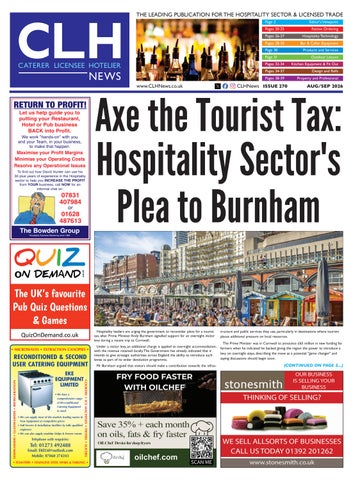
Axe the Tourist Tax: Hospitality Sector's Plea to Burnham
Hospitality Business Mentoring since 1989
Hospitality leaders are urging the government to reconsider plans for a tourist tax, after Prime Minister Andy Burnham signalled support for an overnight visitor levy during a recent trip to Cornwall.
• MICROWAVES • EXTRACTION CANOPIES •
EKE EQUIPMENT LIMITED • We have a comprehensive range of Re-conditioned Catering Equipment in stock • We can supply most of the markets leading names in New Equipment at competitive prices • Full Service & Installation facilities by fully qualified engineers • We can also supply modular fridge & freezer rooms
Telephone with enquiries:
Tel: 01273 492488
Email: EKELtd@outlook.com Mobile: 07860 274243
COOKERS • ICE MACHINES • FRYERS • SLICERS
DISHWASHERS • GLASSWASHERS • REFRIGERATION
RECONDITIONED & SECOND USER CATERING EQUIPMENT
• TOASTERS • STAINLESS STEEL SINKS & TABLING •
tructure and public services they use, particularly in destinations where tourism places additional pressure on local resources.
Under a visitor levy, an additional charge is applied to overnight accommodation, with the revenue retained locally. The Government has already indicated that it intends to give strategic authorities across England the ability to introduce such levies as part of its wider devolution programme.
The Prime Minister was in Cornwall to announce £65 million in new funding for farmers when he indicated he backed giving the region the power to introduce a levy on overnight stays, describing the move as a potential "game changer" and saying discussions should begin soon.
Mr Burnham argued that visitors should make a contribution towards the infras-
(CONTINUED ON PAGE 3...)
2
CLH News
AUG/SEP 2026
Editor's Viewpoint "A WEEK IS A LONG TIME IN POLITICS" One of my favourite quotes was from former Prime Minister Harold Wilson, who famously quipped that "a week is a long time in politics."
EDITOR
Peter Adams
Between this issue and our last, we've witnessed some genuine political upheaval: a new Prime Minister and a new Chancellor.
I'll be brutally honest — the previous PM and Chancellor were not in the least bit popular within our sector, and it was, in my humble opinion, time for a change. It's far too early to judge how that change will play out, but so far there are cautious signs for optimism. That said, I cannot make my opposition to the "tourist tax" any clearer.
RBC Publishing Ltd 3 Carlton Mount 2 Cranborne Road Bournemouth Dorset BH2 5BR
TELEPHONE:
01202 552333
A tax on leisure is a tax too far. As our lead story shows, operators aren't buying the line that "other EU cities have it."
EMAIL:
Yes, they do — but they also enjoy lower hospitality VAT, lower duty, and, as I understand it, lower employment costs to go with it.
WEBSITE: www.CLHNews.co.uk
sales@catererlicensee.com
Comparing the tax on its own, without the rest of the picture, doesn't wash.
@CLHNews
On a more positive note, the new PM Andy Burnham has announced a 20% cut to business rates for pubs, social clubs and live music venues in England, expected to save a typical pub around £1,100 next year.
CLHNews
EDITOR
It's a targeted move designed to support the high street and protect community venues from closing — and a welcome one.
SALES EXECUTIVES
Add to that the news that all pubs in England are to be given fresh protection against being converted into housing or offices, under planning reforms unveiled by Housing Secretary Angela Rayner.
Peter Adams David Bartlett Guy Stephenson
PRODUCTION & DESIGN
Both announcements are genuinely good news for the sector.
Matthew Noades
The trouble is, hospitality is a large and wide-ranging industry, and both of these policies leave out restaurants, cafés, hotels and independent bars.
PRODUCTION & WEB ADMIN
While the targeted relief will save qualifying community pubs a useful £1,100 a year, the wider hospitality sector is right to point out that the exclusion overlooks the severe pressure facing high streets more broadly. The Caterer, Licensee & Hotelier News Group is published by RBC Publishing Ltd, 3 Carlton Mount, 2 Cranborne Road, Bournemouth, Dorset BH2 5BR. Contributions are welcome for consideration, however, no responsibility will be accepted for loss or damage. Views expressed within this publication are not necessarily those of the publisher or the editorial team. Whilst every care is taken when compiling this publication to ensure accuracy, the publisher will assume no responsibility for any effects, errors or omissions therefrom. All rights reserved, reproduction is forbidden unless written permission is obtained. All material is assumed copyright free unless otherwise advised.
PUBLISHED BY
I know Rome wasn't built in a day, but I do hope this gap is addressed, and soon. I would encourage all readers to sign up for our weekly digital editions at www.catererlicensee.com/sign-up I can always be contacted at edit@catererlicensee.com
Charlene Fox Published by
AUG/SEP 2026
CLH News
3
Axe the Tourist Tax: Hospitality Sector's Plea to Burnham (CONTINUED FROM FRONT COVER) Mr Burnham said: “I am prepared to look at an overnight visitor levy for Cornwall. People in the tourism industry might say ‘woah, hang on, what will that mean for us?’ but it’s something that tourists from Britain are paying all over Europe this summer, so actually it could be something of a game changer for Cornwall.
would make the tax burden on domestic holidays per holidaymaker higher than the burden on holidays abroad.
European destinations, where accommodation and tourism businesses can operate under different VAT and taxation regimes.
HOLIDAY BONUS
EU COMPARISONS
UKHospitality has proposed an alternative model, dubbed a “holiday bonus”, under which central government revenues would be devolved to local authorities according to the number of visitors they attract rather than allowing authorities to impose an additional charge on overnight stays.
Mike Warren, chief executive of Harbour Hotels, which operates three hotels in Cornwall, is similarly opposed to the introduction of a visitor tax and said it would impact competition. He said: “We disagree entirely with the proponents of it, who frequently refer to European countries and cities who do have a form of visitor tax.”
Such a scheme, UKHospitality said would incentivise tourism, support hospitality and drive economic growth, rather than a holiday tax costing 33,000 jobs, reducing national GDP by £2.2 billion and increasing the cost of a family of four going on holiday by £100.
He too questioned comparisons between the UK and European destinations that already operate tourism levies, arguing that businesses in many European markets face lower levels of VAT, excise duties and employment-related costs.
Allen Simpson, Chief Executive of UKHospitality, said: “As we warned would be the case, proposed holiday tax powers for Mayors are being swiftly expanded to every strategic authority in England.
Warren said the Government should instead concentrate on improving the wider trading environment for hospitality, including business rates and employment regulation.
However, hospitality operators and trade bodies have warned that adding another charge to accommodation risks making UK holidays less competitive at a time when the sector is already facing high taxation and rising operating costs.
“It’s clear the Government is now intending to implement a nationwide holiday tax, making family holidays more expensive during a costof-living crisis.
“SCARE PEOPLE AWAY”
The Taxpayers Alliance said that the UK already ranks 113th out of 119 countries for tourism price competitiveness in the World Economic Forum’s 2024 Travel and Tourism Development Index, with industry groups pointing to high VAT rates, the abolition of VAT free shopping, rising aviation taxes and visa costs as factors making the UK a comparatively expensive destination for visitors.
“The solution is simple. Treat hospitality the same as every other sector. Instead of devolving taxation powers, devolve central government revenues to local authorities through a holiday bonus instead.
“I don’t think people resent the idea of a few extra pounds on a hotel or Airbnb bill because you’re using the services. It’s not fair, actually, to pay for all of the services and infrastructure from council tax – that’s a burden that residents can’t carry on their own. “Cornwall wouldn’t have to do it, but it’s just there as a possibility and I’m keen to not just give that power to mayors if there are parts of the coastal and rural economy that want those powers early and are prepared to move early for a devolution deal.”
LESS COMPETITIVE
A report entitled “The Tax on Holidays” commissioned by the Taxpayers Alliance reveals: • British holidaymakers paid an estimated £4.8 billion in taxes on holidays in 2024. • In 2024, taxes added an estimated £55 to the cost of an overseas holiday and £53 to the cost of a domestic overnight holiday. • APD raised an estimated £1.2 billion from overseas holiday flights taken by UK residents in 2024. • VAT on purchases made before travelling abroad generated an estimated £1.7 billion in 2024, making it the largest single source of holiday tax revenue identified in this note. • Taxes embedded in domestic overnight holiday spending raised an estimated £1.7 billion in 2024, including VAT on accommodation, food, shopping and entertainment, as well as fuel duty and VAT on travel. • A family of four taking a holiday to Florida could face over £300 in holidayrelated taxes, including APD, VAT on pre-holiday purchases and IPT. • A family of four taking a week-long self-catering holiday in Cornwall could face over £300 in taxes through VAT and fuel duties, rising to over £370 if a £2.50 per person per night visitor levy were introduced. • A potential nationwide flat rate £2.50 overnight visitor levy could increase the tax burden on domestic holidays by almost £270 million a year and
“I am pro-devolution, but I am not in favour of an extra tax that will cost 33,000 jobs.
“Rewarding local authorities with fixed revenue per visitor night, for example, incentivises tourism and drives economic growth, rather than costing jobs, deterring visitors and making family holidays more expensive. “The cost of lost VAT and increased benefits through reduced economic activity and employment will in many areas outweigh the revenues raised by a tax. A holiday bonus is the right kind of devolution – more revenue and control for local communities, without the lost jobs caused by a holiday tax.”
Patrick Langmaid, who runs Mother Ivey's Holiday Park near Padstow, said: "We will scare people away from holidaying in Cornwall based on price, cost, and the lack of welcome you get when there is a tax." He said it would lead to visitors spending less on eating out and visiting attractions because they would have had to spend more on accommodation. "The danger is we break that link of people coming on holiday and once it's broken it'll be very difficult to restore." "It will be a tragedy for Cornwall," he added.
DIFFERENT MODELS The debate comes as visitor levies are already being introduced or operated under different models elsewhere in the UK.
OPERATOR CONCERNS
Manchester has a £1-per-room-per-night charge administered through its Accommodation Business Improvement District, with revenues used to support events, marketing and initiatives designed to increase tourism.
The hospitality sectors’s concerns have also been echoed by businesses operating in Cornwall.
Edinburgh, meanwhile, has introduced a levy based on 5% of the original accommodation booking price, capped at five nights.
Veryan Palmer, hotel director at The Headland in Newquay, said the economics of a rural and highly seasonal destination were fundamentally different from those of major cities.
Supporters argue that such schemes can enable destinations to generate additional funding from visitors and reinvest it in tourism infrastructure and local services.
She said: “Cornwall is a rural region, not a major city. We have a very seasonal economy and in winter rates drop and the majority of businesses trade at a loss. It seems absurd to consider adding an additional charge. If businesses thought they could charge an extra 5%, they would already be doing so.”
WIDER DEBATE
Palmer also raised concerns about Cornwall’s ability to compete with
WE DO THE CHEFSWEAR, SO YOU CAN DO THE WORK
FIND OUT MORE cleanservices.co.uk/clh
Looking for professional, compliant chefs’ uniforms and workwear laundry services you can rely on? Look no further.
The Government’s plans remain part of the wider debate over English devolution. An All-Party Parliamentary Group inquiry published in July warned that significant safeguards would be necessary if visitor levy powers are introduced, with the potential effects on tourism, jobs and local economies among the issues examined.
4
CLH News
AUG/SEP 2026
How the Employment Rights Act 2025 Will Transform the Hospitality Sector By Ethan Diver, Solicitor at Taylor Walton Solicitors (www.taylorwalton.co.uk) The Employment Rights Act (ERA) 2025 represents one of the most significant changes to employment law in a generation. The reforms which are designed to improve employee rights, job security and working conditions, will be particularly significant for hospitality businesses, where shiftbased staffing models rely on flexibility. This poses a number of challenges for employers in the sector, including higher employment costs, more onerous administrative requirements and less operational flexibility. The changes are being introduced in phases, with several changes having taken effect in early 2026 and further changes scheduled for late 2026 and 2027.
STATUTORY SICK PAY (SSP) The new right Since 6 April 2026, SSP has been payable from the first day of sickness absence, replacing the previous three-day “waiting period”. The lowerearnings threshold has also been removed, meaning that lower-paid workers can now qualify for SSP.
IMPLICATIONS FOR THE HOSPITALITY SECTOR This is particularly relevant to the hospitality sector, where workers frequently work variable shifts and are paid close to National Minimum Wage. The change in law means that more workers will become entitled to SSP more frequently, in addition to the cost of arranging cover for absent workers where required.
ACTION POINTS FOR EMPLOYERS • Review sickness and absence policies and ensure that managers are aware
of absence reporting and record keeping requirements. • Ensure that payroll systems are using the latest SSP eligibility thresholds. • Review workplace budgets to account for higher SSP costs.
response to short-term business demands. The new obligations mean that employers will be unable to operate so flexibly, or it will be more expensive for them to do so.
STATUTORY PATERNITY LEAVE The new right
Action points for employers
Since 6 April 2026, employees have been entitled to two weeks’ paternity leave from the first day of employment, replacing the previous requirement of 26 weeks’ service before becoming eligible. However, notably, employees will still require 26 weeks’ service to be eligible for statutory paternity pay, as under the previous law.
Implications for the hospitality sector This change means that more employees will become entitled to paternity leave. This may create additional pressures on rotas and workplace planning, particularly in hospitability environments where staff are likely to work variable shifts and hours.
Action points for employers • Update family leave policies to reflect the new law and, in particular, encourage employees to give as much notice as possible when taking paternity leave. • Ensure that managers understand these policies and there is a clear process for receiving and recording family leave requests.
GUARANTEED HOURS FOR LOW-HOURS AND ZERO HOURS WORKERS The new right The ERA 2025 introduces a new right for workers to be offered guaranteed working hours based on the hours that they regularly work over a previous reference period. The duration of this reference period is subject to regulations but expected to be 12 weeks. The Act will also introduce new rights to reasonable notice of a shift and compensation where a shift is cancelled or curtailed at short notice. Again, the applicable notice requirements are subject to regulations expected soon. These changes are scheduled to take effect in 2027, although a precise date has not been provided.
Implications for the hospitality sector Zero hours arrangements have traditionally afforded hospitality businesses significant flexibility to increase or reduce staffing requirements in
• Audit existing zero hours arrangements and consider whether zero hours contracts remain commercially viable for the business. • Advance rota planning will become particularly important. Managers with rota responsibilities should be trained on the new rights and made aware of the risks of amending rotas at short notice. • Account for additional costs for having to offer guaranteed hours and compensate workers for late shift cancellations.
UNFAIR DISMISSAL The new right From 1 January 2027, employees will only require six months’ continuous service to bring an unfair dismissal claim, compared to the current two years’ service requirement. The maximum cap on compensatory awards will also be removed.
Implications for the hospitality sector This will have major implications for all employers. Until now, it has been commonplace for employers to apply six-month (or longer) probationary periods and follow relaxed dismissal procedures before employees obtain two years’ service. Under the new law, employers will have much less time to decide whether to retain a new starter before they acquire unfair dismissal protection, and the consequences of an unfair dismissal could be more expensive.
ACTION POINTS FOR EMPLOYERS • Review and reduce probationary periods to less than six months. • Review recruitment and probation procedures to ensure detailed and accurate performance records are kept throughout the probationary period. • Ensure that managers are adequately trained on dismissal procedures. Whilst these reforms are undoubtedly significant for the hospitality sector, businesses which review their workforce models, contracts and procedures now will be better positioned to deal with the changes as they continue to be implemented.
Lunch is the Biggest Growth Opportunity as Britain's Eating Habits Shift The British eating day is consolidating around its centre, according to new consumer research, with lunch becoming the fastest-growing meal occasion as breakfast and late-night eating fall into decline.
Among 18-24-year-olds, breakfast skipping rises to 30%, highlighting a significant generational shift away from the traditional three-meal structure.
The latest Emerging Trends report from consumer intelligence business, Vypr, found that while dinner remains the cornerstone of the British weekday, lunch is experiencing the strongest growth of any meal. Nearly one in five consumers (19%) say they eat lunch more often than they did a year ago, compared with 14% who report eating dinner more frequently.
The research suggests the UK's eating day is effectively being compressed, with consumers eating later in the morning, earlier in the evening and reducing food occasions at both ends of the day.
The trend is particularly pronounced among younger adults, with 33% of 25-34-year-olds and 30% of 18-24-year-olds saying they now eat lunch more often than a year ago. This is the key demographic responsible for much of the UK's out-of-home food spending. Despite the changing patterns, dinner remains Britain's most important meal. Almost three-quarters (74%) of adults eat dinner on a typical weekday, while 62% identify it as their most important meal. However, the report suggests the real commercial opportunity lies elsewhere. While the dinner occasion is not slowing down, consumer eating habits are increasingly concentrating around the middle of the day. This is creating new opportunities for restaurants, cafés, pubs and QSR operators to strengthen their lunchtime offering and to stay competitive against meal deal buyers. By contrast, breakfast is losing momentum. Almost a quarter (24%) of consumers say they now eat breakfast less often than a year ago, while 17% report eating a smaller breakfast and 13% say they have started skipping it altogether.
This changing behaviour is already influencing the market. In recent months, major QSR operators including Greggs, Pizza Hut and Pret A Manger have independently converged on lunchtime meal deals priced at around the £5 mark, signalling a shared commercial belief that lunchtime is becoming the day's most competitive occasion. The research also found that Britain's eating habits are becoming more structured than commonly assumed. Nearly four in ten adults (39%) eat two proper meals on a weekday, while 37% eat three, suggesting consumers are replacing traditional meal occasions with fewer, more intentional eating moments supplemented by planned snacks. Joel Dixon, hospitality lead at Vypr, said: “For years, breakfast has been a core growth occasion, but consumers are now telling us a different story. Britain's eating day is shifting towards the middle. The lunchtime offering is focussed on menu, price and promotion with meal deals helping to increase trade. “Breakfast offerings need to be more innovative and on trend to capture the audiences and operators able to do this will drive incremental sales. Healthier options, such as high protein, high fibre, and added functionality including collagen and matcha will all appeal.”
Robert's Dorset - Reliable Stock, Fast Delivery, Great-Tasting Products Have you struggled for stock over the past 6-9 months, whether it’s for a warming machine, pots for you shelves or jars for self-serve, so many companies can't supply you because they have little or no stock as they don't make anything, At Robert's Dorset we make our crackling 6 days a week, in multiple flavours. Why are we different, the best way is to read our reviews on Amazon, TIKTOK, our Website or to pop into any of the 600+ stores, farm shops, petrol stations we supply and ask them. Every flavour is allergen free, yes that includes gluten free and we are 100% Keto but we also produce a high-quality peanut in10 flavours.
Due to current demand you are looking at 7 days from orders placed. If you need stock don't delay, it's simple, email or call, we will get back to you the same day, with a price list and account form. Contact us via phone 01202 875280 email: trade@robertsdorset.com or go to our retail website: www.robertsdorset.com/trade-enquiries/ and complete trade application form. See the advert on the facing page for further information.
AUG/SEP 2026
CLH News
5
World Cup and Summer Heat Drives Strong Trading for UK Pubs and Bars The latter stages of the FIFA World Cup and prolonged hot weather combined to deliver one of the strongest trading months of 2026 for the UK On Trade, according to the latest Market Watch from The Oxford Partnership and Vianet’s BevMetrics. Total draught volumes increased by 3.9% compared with July 2025, while average Rate of Sale rose by 5.2%, marking a significant improvement on the softer volume performance recorded during the first half of the year. The growth was achieved despite the number of operating venues falling from 100,436 to 98,795 over the past year. The remaining venues were considerably busier, with average occupancy increasing by 3.3 percentage points to 65.91%. Consumers also stayed for longer, with average dwell time rising by 12 minutes year on year to 154 minutes. Average spend per head reached
£26.91, up 3.4%, with food spend increasing by 4.7% and drink spend rising by 2.4%. Alison Jordan, CEO of The Oxford Partnership, said: “July showed what the On Trade can achieve when major occasions and favourable weather come together. The World Cup gave consumers repeated reasons to visit pubs and bars, while the prolonged hot weather extended the opportunity across beer gardens, terraces and more spontaneous social occasions. What is particularly encouraging is that this translated into tangible commercial growth. Venues did not simply attract more people or keep them for longer; they converted that engagement into higher draught volumes, stronger Rate of Sale and increased spend. With fewer venues operating than a year ago, this reinforces the importance of compelling occasions and helping operators maximise the entire visit across both food and drink.”
Growth was widespread geographically. London led the market, with draught volumes up 8.2% compared with July 2025, followed by suburban locations at 4.6% and rural areas at 3.9%. City locations recorded growth of 1.1%. July has also improved the year-to-date outlook. Total draught volume is now just 0.4% behind last year, while Rate of Sale has moved into positive territory at 0.8%. Longer-term category trends are also showing signs of improvement. Total category Rate of Sale has edged into growth at 0.1% on a Moving Annual Total basis, led by Stout at 7.3%, World Lager at 4.9% and Cider at 3.9%. However, performance remains selective, with Core Lager and Premium 4% Lager both down 4.4%, Ale falling by 3.7% and Craft declining by 1.3%.
CAMRA Champions Pub Saving Campaigners Nominations are now open for CAMRA’s Pub Saving Award, which recognises and celebrates the efforts of groups who have who have come together to campaign for their local pub, saving it from demolition or conversion to another use. The Pub Saving Award is more important than ever following the threeyear anniversary of the unlawful demolition of the iconic wonky pub, the Crooked House in Himley, South Staffordshire. The competition thrusts pub-saving campaigns into the national spotlight, inspiring others to investigate community ownership for their own local. CAMRA is fully supportive of this model and is keen to assist communities interested in going down this road. Pub Saving Award Coordinator, Paul Ainsworth, said: “The return of the Pub Saving Award coincides with the grim third-year anniversary of the tragic fire and complete demolition of the Crooked House, which shocked the nation. It is bitterly disappointing that we are still waiting for justice. “The Crooked House saga unveiled a wider scandal of potentially unlawful pub conversions and demoli-
tions across the UK, and we continue to demand tighter, stronger planning policies and a requirement in law to rebuild pubs brick-by-brick. “Instead of recognising their essential contributions to local economies and the wellbeing benefits pubs provide, the UK Government has the audacity to try and water down planning protections in England, which would make it easier for greedy developers to convert pubs into houses, shops or takeaways – or to demolish them entirely. “The industry needs meaningful support, including better planning protections in each nation of the UK, or we risk losing thousands more pubs. “When a local closes its doors, it is incredibly difficult to open them again, which is why these community champions and selfless volunteers, who dedicate years to save much-loved pubs, deserve to be applauded.” Nominations close 12 November 2026. The nomination form and eligibility criteria is on the CAMRA’s website here.
6
CLH News
AUG/SEP 2026
How To Prepare For Tipping Reforms By Rebecca Hughes, Associate in the employment team at Birketts LLP (www.birketts.co.uk) Consultation should be genuine, considered and conducted in good faith, with sufficient time allowed, but the process is advisory rather than binding. Employers are not required to follow every suggestion made by workers, provided they can demonstrate that they have complied with the requirements of fairness and transparency. Consultation requires workers to be informed, given a proper opportunity to express views, and have those views genuinely considered before the policy is finalised or reviewed. It does not give workers a veto over the employer’s preferred approach. The current draft Code leaves the employer responsible for the final policy, although that decision may later be challenged in the employment tribunal if it is unfair, non-transparent, discriminatory or procedurally defective.
From late 2026 (now delayed from October 2026 and the exact date yet to be confirmed), reforms introduced under the Employment Rights Act 2025 will make it mandatory for employers to consult with workers when developing or revising their written tipping policies. In June, the Government published a draft revised Code of Practice to reflect these statutory changes. Following criticism from unions, however, the draft Code was unexpectedly withdrawn in July prior to gaining Parliamentary approval. The Government has now stated that it will be conducting a further consultation on the draft Code prior to the reforms taking effect “by the end of 2026”. At this stage, it is not clear what further revisions will be made to the draft Code. The reforms introduce new procedural requirements on employers in the hospitality sector to demonstrate that tipping arrangements have been developed through an open and transparent process. Workers should have a meaningful opportunity to influence how tips are distributed. Employers will therefore be expected to seek workers’ views, keep records of consultation and review tipping arrangements periodically – once every three years as a minimum. Consultation must be carried out with trade union or workers’ representatives, or directly with the workers if there are no such representatives.
A FAIR AND TRANSPARENT TIPPING POLICY The current draft revised Code does not require equal shares for all workers, but it does require a clear, objective and justifiable allocation method. Relevant factors to consider may include role, hours worked, basic pay, seniority, length of service, performance and customer intention, but the employer must also consider the overall fairness of the scheme. The draft Code also makes clear that employers should be careful not to disadvantage less visible groups, such as back-of-house staff, and must avoid direct or indirect discrimination. Tipping policies should be simple to understand, and employers should be able to explain, in plain English, why the chosen allocation model is fair for their particular business.
WHAT DOES ‘CONSULTATION’ MEAN? Unite criticised the Government’s approach on the basis that the draft revised Code only required ‘consultation’ rather than giving workers full control over the allocation of tips. To what extent this will be strengthened remains to be seen.
While Unite’s criticism of the draft Code is perhaps understandable – given the Government’s pre-election commitment to ensure “workers decide how tips are allocated” – it does not mean that employers would have free rein to decide their own tipping policy. Employers must consult properly, publish an anonymised summary of views expressed, maintain a written policy, keep tipping records and ensure the scheme is fair. Employment tribunals must take the Code into account where relevant.
GIVING LOW-PAID AND PRECARIOUS WORKERS A VOICE The Government’s consultation response recognised that some workers may lack the confidence, time or knowledge of employment rights to pursue formal processes, particularly where they are employed temporarily. It also recorded worker concerns about lack of written policies, unfair allocation and employers retaining tips – even though retention of qualifying tips by employers is already prohibited. The current draft Code expressly warns that a simple majority vote should not be treated as the default or preferred consultation mechanism, particularly where it could disadvantage minority groups or less visible workers. The consultation response gives the example of larger front-of-house groups potentially outvoting smaller back-of-house teams, which could produce a result that feels democratic on the face of it but is not necessarily fair. Adopting a more structured consultation process will mean ensuring all groups are heard, not just the most vocal or numerous. The process should be conducted using representatives where appropriate, providing clear written information and allowing enough time for responses. Employers should be prepared to explain why particular suggestions have or have not been adopted. This is also consistent with the Government’s stated aim of preserving flexibility while improving worker voice.
WHAT SHOULD EMPLOYERS IN THE HOSPITALITY SECTOR DO NOW? The revised Code is now expected to come into effect by the end of 2026, after further consultation and subject to Parliamentary approval and commencement regulations. Employers should be ready to update their policy once the final version is confirmed. The Government has also said it will continue working with stakeholders and will provide additional non-statutory guidance. These reforms represent an evolution of existing tipping law but will not change the current enforcement mechanisms or penalties. Employers are likely to retain some flexibility over how tips are distributed, but there will be a stronger focus on consultation and transparency. For employers, early preparation will help ensure that tipping arrangements remain compliant and are less likely to be challenged when the new rules take effect.
UK Brewery Closure Rate Slows But Industry ‘Struggles Not Over Yet’ Say Leading Independent Brewing Trade Body The rate of brewery closures has slowed in the first half of 2026 compared to 2025 according to the SIBA UK Brewery Tracker, published today.
its market access review, which is considering ways to improve access to pubs for small independent breweries in support of greater consumer choice.
For the first six months of 2026, net closures have averaged less than one brewery a week compared to nearly three week in 2025.
“Consumer demand for indie beer remains really strong, but getting beers on the bar is tougher than ever with brewers on average not able to access 62% of the pubs in their local market. Independent beer offers quality, variety, and a range of styles and flavours simply – but bars are dominated by a handful of mega brands.” Andy Slee added.
Taking into account all brewery openings and closures in the UK the net brewery closure rate from January to June 2026 was -16, compared to a total loss of -137 breweries in 2025. “The figures released today are a sign that brewery closure numbers may be beginning to stabilise following a number of particularly tough years – but for most breweries the struggles are not behind them. Brewing businesses which have managed to weather the storm are seeing strong demand for independent beer, but profitability is still a concern with lack of access to pubs, high taxation and high production costs hitting brewers.” Andy Slee, SIBA Chief Executive. Last year saw record closures across the UK as breweries struggled with rising costs and lingering Covid debt. In support of independent breweries SIBA have called for an increase in Draught Relief – a lower rate of duty for draught beer mainly sold in pubs – and for the Government to prioritise an announcement of
The SIBA UK Brewery Tracker figures paint a mixed picture across the UK, with four of the nine regions seeing an overall growth in brewery numbers. The North West, South East and Wales had the strongest performance, each seeing the net number rise by +3, followed by the South West which had a more modest +1 growth. Fairing worse in the first six months of 2026 were Scotland (-9), the North East (-8), Midlands (-4), Northern Ireland (-4), and finally the East of England (-1). “It is encouraging to see four areas of UK growing their number of breweries in the first half of 2026 – let’s hope this is the sign of things to come” said Andy Slee, SIBA Chief Executive.
Eat My Logo
branding images, printed directly into fondant icing. Customers can buy the finished product or just the fondant toppers to add to their own decorations.
Based in Chorley, Lancashire the team at Eat My Logo Limited strive to make brands tasty. Every week they send tens of thousands of branded food items to business around the UK to help them promote their brand in a fun and tasty way.
A growing confectionary range offers a choice of traditional sweets, packed in small eco friendly bags that are branded with your own brand or logo. You can also choose from tubs, jars and tubes.
With a wide range of products that include cakes and biscuits, confectionary and chocolate, there is plenty to choose from to meet the needs of your business. Eat My Logo bake their own cake and biscuit ranges, many of which are decorated with high quality edible
Their chocolatiers create delicious, branded chocolate bars and chocolate boxes using high quality couverture chocolate. These unique chocolate products are ideal hotel room favours, whether branded with an edible logo or a small pack of truffles.
With low minimum order quantities and competitive prices, they can offer a great range of products to add that extra special touch to your hospitality offering. For 25% OFF YOUR FIRST ORDER, please register your details via the QR code. www.eatmylogo.co.uk emlsales@eatmylogo.co.uk 01772 472 580 See the advert on page 2 for details.
AUG/SEP 2026
CLH News
7
Inflation and Rising Energy Costs Squeeze Hospitality Businesses and Consumers UK Consumer Prices Index inflation jumped to 2.9% in July up from 2.6% the previous month. The rise was driven by a 13% increase in Ofgem’s energy price cap, placing intense cost pressures on the hospitality sector and squeezing consumer disposable income. Gas prices soared at the sharpest pace in almost four years, the Office for National Statistics (ONS) said, as energy costs surged after US-Israel war with Iran began, which has restricted global oil supplies. July’s reading is the highest since March but some price growth slowed. Food inflation, at 1.3%, is at its lowest rate for close to five years. NTIA CEO Michael Kill CEO said: “These inflation figures will be deeply concerning for businesses across the night time economy, particularly when energy costs have been a significant contributor to the increase. For hospitality and night time economy businesses, this creates pressure from both directions. Operators
continue to face substantial costs across energy, employment and business rates, while rising household bills further squeeze the disposable income that drives consumer spending. We must also recognise what sits behind the headline figure. The impact of energy costs on inflation reinforces the urgent need to create greater stability and affordability for both businesses and households. Government has made economic growth a central priority, but growth cannot be achieved without addressing the cumulative pressures facing businesses on the ground. Ahead of the Autumn Budget, we need a coordinated approach to energy costs, business rates and the wider cost of doing business, alongside measures that protect consumer confidence and disposable income. The night time economy is a vital part of the UK’s economic and cultural infrastructure. Businesses need the stability and confidence to invest, employ people and grow.”
Hospitality Insolvencies Ease – But Challenges Remain The number of hospitality businesses entering insolvency eased slightly in the first half of 2026, yet remained historically high, reflecting challenging trading conditions for the industry. Some 1,602 accommodation and food service companies, including hotels, restaurants and pubs, closed in the six months to June 2026, down 6.1% from 1,706 for the first half of 2025, according to government data. Q2, however, saw a 10.2% increase over Q1, with 840 companies in trouble. Offering little cheer, the number of monthly hospitality insolvencies has remained consistently over 260 so far this year. The Buchler Phillips Hospitality Index of insolvencies, which has tracked monthly figures since January 2014, rose from 180.6 in March to 199.0 in June. It peaked in August 2023 at 273.4 with a spike in the sector’s business closures. There were several high profile casualties in Q2. MeatLiquor entered administration and was sold in a prepack to a vehicle backed by Nabil Mankarious in early June. Leon’s restructuring carried through Q2 and it
formally emerged from administration and a Company Voluntary Arrangement VA in May having closed 28 of its 71 locations, leaving a much smaller estate. Revolution Bars continued closure activity, while Restaurant 104, Richard Wilkins’s Michelin-listed Notting Hill restaurant, shut at the end of April after seven years. Jo Milner, Managing Director of the leading turnaround and restructuring firm, said: “There may be some easing in the headline insolvency figures, but there is precious little breathing space for hospitality businesses. Margins remain wafer-thin, consumers are still watching what they spend and higher employment and operating costs continue to bite. Hospitality remains near the top of the insolvency league table, and for many otherwise viable businesses there simply isn’t much left in reserve when something goes wrong.” Pressure intensified from 1 April, when the National Living Wage rose 4.1% to £12.71 an hour and the rate for 18- to 20-year-olds jumped 8.5% to £10.85. UKHospitality estimates the wage increases alone will add £1.4bn to the sector’s annual costs. Businesses are also contending with the 2026 business rates revaluation and a new rates regime, alongside continuing pressure from energy and other operating costs.
8
CLH News
AUG/SEP 2026
Hospitality Has Mistaken Loyalty For Discounting By Andrew Harrison-Chinn, business leader at digital platform Dragonpass (www.dragonpass.com) Hospitality has spent years treating loyalty as something that can be engineered through points, discounts and repeatpurchase incentives. Those mechanics can influence behaviour, but they are often asked to achieve something more difficult: creating a genuine preference for one venue over another.
DISCOUNTING HAS A PLACE, BUT IT CANNOT CARRY THE RELATIONSHIP The temptation to compete on price is understandable, particularly while consumers remain cautious about discretionary spending. Offers can fill quieter periods, encourage trial and give people a reason to visit sooner than they otherwise might. But problems arise when the incentive becomes the principal reason to return. A customer who appears every Tuesday because the bill is 20% cheaper may be demonstrating price sensitivity rather than loyalty. Remove the discount and there may be very little relationship left. Hospitality is particularly well placed to do this because the same customer can use a venue in very different ways. Someone may want speed during a weekday lunch, ease when eating with children and a sense of occasion when celebrating a birthday. Understanding those contexts creates far more scope for relevant value than treating every visit as another transaction to be rewarded in the same way.
LOYALTY BEGINS BEFORE THE REWARD One of the clearest lessons from banking, travel and other mature loyalty sectors is that customers do not experience businesses in the way those businesses are organised internally. An operator may think separately about reservations, CRM, payments, customer service and rewards, but the customer experiences all of those functions as one relationship. A generous loyalty mechanic therefore has limited value if the surrounding experience is unnecessarily difficult. Complicated booking journeys, irrelevant communications, poor complaint handling or cumbersome redemption can quickly undermine whatever goodwill the reward itself was supposed to create.
As consumers scrutinise discretionary spending more closely, Dragonpass research found that 56% of UK consumers are worried about the cost of living, while 48% are more likely to consider switching away from a long-term provider and half believe existing loyalty schemes feel outdated. The same study found that 69% are more likely to stay loyal to brands that reduce stress or friction in their lives. Although those findings stretch beyond hospitality, the underlying lesson is highly relevant to the sector and people are not simply looking to be rewarded for spending, they are increasingly sensitive to whether a business makes the experience feel easier and worth repeating. This is where hospitality has an opportunity to think more broadly about value. A customer who can amend a booking easily, feels recognised when they return or receives information that is genuinely relevant to the way they use a venue may have been given something more valuable than another generic discount. Convenience and recognition do not traditionally sit under the heading of loyalty, but in practice they are often what makes returning feel preferable to starting again somewhere else. Seen in those terms, loyalty is less a promotional layer and more a consequence of how the business is run.
FREQUENCY IS NOT THE SAME AS ATTACHMENT Hospitality should also be careful about treating repeat custom as proof of loyalty. Someone may visit the same pub because their colleagues always meet there, use the same café because it is next to the station or return to a restaurant because it is convenient for their family. Those visits are commercially valuable, but they do not necessarily indicate a strong relationship with the brand. The Dragonpass Comfort Index finding that 69% of consumers favour brands that reduce stress and friction is useful here because it points towards a much simpler definition of modern loyalty. Customers are more likely to return when a business understands what they value, removes unnecessary difficulty and gives them a reason to feel recognised without making the relationship feel transactional. Hospitality operators do not necessarily need more elaborate loyalty propositions. They need a clearer understanding of what makes customers choose them again when they are under no obligation to do so, and that answer will usually sit somewhere between the quality of the experience, the ease of returning and the relevance of the value offered.
Khan Urges Westminster To Scrap ‘Outdated’ Licensing Rules In Fresh Nightlife Row The Mayor of London has called on Westminster City Council to abandon a raft of proposed licensing restrictions, intensifying a dispute over the future of nightlife in the capital’s West End.
submitted in the West End’s cumulative impact area during 2023-24, of which just 16 were approved — evidence, he argues, that the current restrictions are already having a chilling effect on investment.
Sir Sadiq Khan has written to the Conservative-run council demanding it drop plans that would tighten controls on pubs, bars and clubs across Soho and the wider West End, arguing the approach runs counter to efforts to grow London’s night-time economy.
Sir Sadiq accused the council of allowing licensing decisions to be shaped disproportionately by a small number of vocal residents and councillors, at the expense of the broader economic and cultural benefits nightlife brings to London. He warned that Westminster’s approach, if adopted, would work against efforts backed by UK Hospitality, the Night Time Industries Association and the Music Venue Trust to establish London as a world-leading destination for nightlife.
The intervention follows a row that broke out last week over Westminster’s proposal to restrict so-called “vertical drinking” venues — premises where customers are expected to stand rather than sit for the duration of their visit. Under the draft policy, the council said it held concerns about restaurants and bars in the West End operating in this way throughout an evening.
Manchester held up as a model
The plans would also give preferential treatment to hospitality operators that close by 10pm. Councillors have proposed that newly licensed pubs stop serving at 10pm, while new nightclubs would be required to close by 11.30pm on weekdays and midnight at weekends. Soho and the wider West End would be designated a “cumulative impact zone” under the proposals, meaning new licences for pubs, bars and clubs would only be granted in exceptional circumstances. Separate special policy areas are also proposed for Mayfair and Victoria, aimed at curbing noise and other disturbances linked to nightlife. Sir Sadiq wants Westminster to lift its “core hours” restrictions and drop the cumulative impact policy entirely, arguing the council should instead set out a vision for the economic growth it wants to encourage rather than focusing on activity it wishes to limit. In his letter to the council, the Mayor stressed the scale of the sector’s contribution to the capital, noting that London’s nightlife supports more than 600,000 jobs and adds upwards of £21 billion to the UK economy annually. He argued that a “confusing and outdated” licensing system has long undervalued the sector, treating it as expendable rather than as a vital part of the city’s identity. To support his case, the Mayor cited Home Office figures showing that only 41 licence applications were
The Mayor pointed to Manchester as an example of a more permissive approach, noting that the city has no core hours policy and no cumulative impact policy, instead pursuing a clear strategy for growth tailored to different neighbourhoods. He argued this reflects the intent of the Licensing Act 2003, under which licences should generally be granted to operators who can demonstrate sound management and compliance with licensing objectives. Under the English Devolution and Community Empowerment Act 2026, Westminster is now required to consult City Hall on its licensing strategy. The requirement stems from new powers granted to the Mayor earlier this year enabling him to intervene in licensing decisions, which are due to take effect this autumn. Responding to the Mayor’s intervention, Councillor Tim Barnes, Westminster’s deputy leader and cabinet member for growth and planning, rejected the criticism and pointed instead to wider economic pressures facing operators. Cllr Barnes said licensing was not the primary concern raised by pub and bar owners, pointing instead to rising costs imposed by central Government, along with mounting bills and staffing expenses. He also cited reduced policing and gaps in late-night public transport as factors affecting consumer confidence and the ability of venues to trade safely into the night — issues he said fall within the Mayor’s own remit. He suggested that if the Mayor were genuinely focused on supporting the pub sector, he would prioritise addressing these underlying challenges rather than pursuing an expansion of licensing powers.
Logicall Wireless Solutions - Temperature Monitoring Manual temperature checks are costly, time-consuming, and prone to error. Staff need to take readings regularly, log them accurately, and spot potential issues before they escalate. But what happens if a fridge or freezer breaks down overnight? You won’t know until the next day—and by then, you’ve already lost stock and a day’s trade. That’s thousands in potential losses, all because manual checks can’t catch problems in real time. Automated temperature monitoring is the obvious solution. Smart sensors continuously track your fridges and freezers, alerting you instantly if temperatures rise or equipment fails. You stay audit-ready, paperless, and confident that your stock—and your customers—are safe. The cost? From just £40 per month, a small investment that can save thousands. One
breakdown avoided can more than pay for a year of monitoring by preventing wasted stock and lost sales. Make the switch to digital monitoring today—and unlock the full benefits of Logicall’s ecosystem. Beyond temperature, our solution includes energy monitoring, leak detection, digital HACCP checks, and much more. Protect your business, save time, cut costs, and simplify compliance—all with a single, smart system. 01672 569374 info@logicall.co www.logicallmonitoring.co.uk
AUG/SEP 2026
CLH News
9
Pubs Set To Gain Extra Planning Protection From Conversion All pubs in England are to be given fresh protection against being converted into housing or offices, under planning reforms due to be unveiled by Housing Secretary Angela Rayner this week. The changes form part of a revised National Planning Policy Framework, which ministers say is intended to further streamline the planning system in support of the government’s target of delivering 1.5 million new homes over the course of this Parliament. Ministers had originally been consulting on protections that would apply only to the last remaining pub in a given area, shielding it from being lost to residential or commercial redevelopment. However, hospitality groups warned that such a narrow approach risked leaving thousands of other viable pubs exposed to closure and conversion. In response, the government has confirmed the protection will now extend to any pub facing the prospect of change of use, not just those classed as the sole surviving pub in their community. Rising closures behind the move The reform comes amid continued concern over the pace of pub closures across England. Figures from the Campaign for Real Ale (CAMRA) show that 794 pubs have shut their doors so far this year, with 82 of those either demolished or converted to alternative uses. Operators across the pub and restaurant sector have pointed to a combination of pressures behind the closures, including higher employer
National Insurance contributions, the increase in the minimum wage, elevated food costs, and the ongoing burden of business rates. Under the strengthened framework, developers seeking to convert or demolish a pub will need to demonstrate that there is no realistic prospect of the site continuing to operate as a pub. This is expected to include evidence that the property has been actively marketed for sale as a going concern for a minimum of 12 months.
needs to apply broadly, giving communities the ability to fight to save a valued local pub even where other pubs remain nearby, rather than only in cases where a closure would leave an area without any pub at all. Michael Kill, CEO of the Night Time Industries Association said: “We welcome the Government’s move to strengthen protections for 30,000 pubs. These businesses are vital cultural and community assets and absolutely deserve to be protected.
Local authorities will also be required to weigh up the wider social value of a pub when assessing planning applications, including its role as a community gathering space, before granting permission for it to be lost.
“But pubs do not exist in isolation. They are part of a much broader hospitality and night time economy ecosystem of around 90,000 businesses.
Announcing the change, Rayner said pubs hold a distinctive place in national life, describing them as spaces where communities mark both celebration and loss, and said it was wrong that inadequate safeguards had allowed so many to close without a proper challenge.
“That leaves approximately 60,000 businesses, including nightclubs, grassroots music venues, bars, restaurants and other night time economy operators, asking a very simple question: what about us?
She said the new rules would force developers to demonstrate that every avenue to keep a pub open had been explored before demolition could even be considered, adding that the drive to build new homes should not come “at the cost of the pubs we love.” The move follows sustained campaigning from CAMRA, which had previously cautioned that restricting protection to only the last pub standing in an area could put “thousands of viable pubs across England” at risk. The campaign group has argued that meaningful planning protection
“These businesses face many of the same pressures and, understandably, increasingly feel unheard and set aside by Government policy. “Nightclubs alone have seen a 36% contraction in the market. This is not because people have suddenly stopped wanting to go out, dance, socialise or experience live music. The cost of day to day living has fundamentally impacted people’s ability to afford those experiences. “Protecting 30,000 pubs is absolutely the right thing to do. But Government must now recognise and protect the other 60,000 businesses that make up this vital economic and cultural ecosystem.”
Foodservice Inflation Rises Continue as Drought Concerns Mount Food and drink prices in hospitality rose by 0.2% month-on-month in July, the latest Foodservice Price Index from NIQ and Prestige Purchasing reveals.
strawberries, raspberries, blackberries, blueberries, plums and early-season apples. Good domestic supply helped to lower fruit prices monthon-month, providing welcome relief for buyers.
in the Black Sea, operators cannot afford to be complacent. The transition from summer to autumn will be a critical period for supply availability, making proactive, data-led procurement absolutely essential.”
While the pace of monthly price increases slowed from 1.8% in June, inflationary pressures remain firmly embedded in foodservice supply chains.
International grain markets strengthened during July. Wheat prices rose sharply amid concerns over disruption to Black Sea exports and weather-related challenges in several major growing regions, leading to renewed inflationary pressure for bread and cereal products. Vegetable oil markets also moved higher after high biodiesel demand and ongoing geopolitical uncertainty affecting global supply chains.
July’s figures show that while overall foodservice inflation is currently modest, climate-related disruption is fuelling market volatility. As the sector approaches the latter part of 2026, weather conditions are likely to play a critical role in determining the direction of future food and beverage costs.
Growing concerns over the impact of prolonged heatwaves are creating uncertainty for buyers in key food categories including vegetables, where hot and dry weather has impacted UK crops. Broccoli, cauliflowers, potatoes, onions, carrots and parsnips have all experienced varying levels of moisture stress, creating uncertainty around future yields and availability. While current pricing remains relatively stable, the industry is closely monitoring supply conditions heading into the autumn. July brought more positive developments in the fruit category, where favourable growing conditions supported strong availability of British
Meat markets internationally weakened for the first time this year. Softer poultry, pork and beef prices helped to ease overall inflation in the meat category of the Foodservice Price Index, although strong global demand and limited supplies pushed lamb prices to record levels. Shaun Allen, chief executive of Prestige Purchasing, said: “July’s marginal 0.2% increase feels like the calm before a potential storm. With UK drought conditions actively threatening domestic vegetable yields, and global grain markets reacting to renewed geopolitical stress
Reuben Pullan, senior insight consultant at NIQ, added: “Broadly flat prices in July disguise significant volatility in the foodservice supply chain, and buyers face a very uncertain autumn and winter. “While high temperatures can work to the advantage of many hospitality businesses in sales terms, extreme climate issues are likely to have seismic impacts on their operations in the years to come. Mitigating inflation is an urgent priority for venues seeking to retain guests and protect margins.”
10
CLH News
AUG/SEP 2026
Why Proactivity Is The Secret Ingredient To Five-Star Food Hygiene Inspections Food hygiene inspections can be intimidating, but they also offer an opportunity to ask questions and improve practices. Pauline Munro, a partner at Gateley Legal (https://gateleyplc.com/gateley-legal/), explains what to expect from an inspection, and why proactive, continuous engagement with your local authority can help maintain a five-star approach to food hygiene. For businesses that have yet to welcome an environmental health officer to their premises, it can be tempting to imagine the inevitable inspection as a kind of ‘Kitchen Nightmares’ scenario. A hot-tempered official conducts an expletive-ridden search of pantries and walk-in freezers, whilst your staff look on with a mixture of horror and embarrassment. Food hygiene inspections are not there to catch you out or shut your business down, however. They exist to ensure that your business is doing at least the minimum to maintain good standards of hygiene and keep customers safe.
AN INSPECTOR CALLS, UNEXPECTEDLY Food hygiene inspections are rarely, if ever, pre-arranged with the business that will be inspected. Under section 32 of the Food Safety Act 1990 (‘the 1990 Act’), as well as regulation 16 of the Food Safety and Hygiene (England) Regulations 2013 (‘the Regulations’), officers have wide-ranging powers to enter premises “at all reasonable hours”, inspect those premises, and seize and detain anything that could provide evidence of a breach. This means that, once an officer arrives, businesses must allow that person to enter and provide any information, documents, or samples they need to complete their inspection. It is also an offence to intentionally obstruct an officer, fail to give assistance, or deliberately provide false or misleading information.
TICKING THE BOXES A checklist provided by the Food Standards Agency (FSA) provides a useful guide on what the officer will review during the inspection, such as equipment, hand-washing facilities, cleaning products, and evidence of a Hazard Analysis and Critical Control Point (HACCP) plan. Even if the officer catches you on a busy day, it is good practice for the manager to remain with the officer throughout the inspection, making notes of what they say, and taking photos of what they see. The manager
can also ask and answer questions, and provide further information or documentation where required. The officer should communicate with you throughout the inspection, highlighting any areas that need improvement, offering advice, and discussing any serious breaches that may require a legal notice, such as a Hygiene Improvement Notice or a Remedial Notice. The most serious cases will result in a Hygiene Emergency Prohibition Notice being served, which will require the premises to be closed whilst the hygiene issues which have been identified during the visit are addressed.
RECEIVING YOUR RESULTS Following the inspection, you will receive a letter confirming any improvements you must make, and by when. It will be your responsibility to notify the officer that these improvements have been made, and to provide evidence of this. You may also receive a Food Hygiene Rating, which marks your standard of hygiene from 0 (‘urgent improvement required’) to 5 (‘hygiene standard very good’). You should take this rating seriously, as an increasing number of consumers use them to decide where to purchase and consume food. Many food delivery services will also require a business to have a rating of at least 3 before they will partner with them. If you disagree with your rating, the contents of the letter, or any legal notices that you receive, you may be able to appeal against them using the process outlined, either in the officer’s letter, or on the notice itself.
BE PROACTIVE A poor rating or a Hygiene Improvement Notice should not be catalysts for change, however. All food business operators have a responsibility to adhere to food safety laws and regulations, manage the risks, and ensure that any food they serve to customers is safe to eat. This is an ongoing and constant duty requiring robust and documented systems that are regularly audited for compliance. The consequences of poor food safety and hygiene practices can be more serious than a 0 out of 5. In 2025, for example, a restaurant owner in the West Midlands received substantial fines after 29 customers were hospitalised with severe food poisoning linked to a unique strain of Salmonella. The year before, an outbreak of Shiga toxin-producing E.coli 0145 (STEC) linked to salad leaves was responsible for two deaths, as well as more than 90 hospitalisations. Proactively managing food hygiene from the top-down is one of the best ways to prevent harm to consumers and ensure that a business remains inspection ready. This includes ensuring that all training is updated in line with the latest guidance, confirming that staff are completing and recording hygiene checks properly, conducting your own inspections and audits, carrying out refresher training, and periodically supervising staff. You do not need to wait for an inspection to ask questions, raise concerns, or make improvements. Regularly liaising with your local authority, as well as a food safety specialist, will help you to maintain an excellent standard of hygiene, and, most importantly, ensure that your food is safe for customers to eat.
Community Right to Buy Could Be ‘Gamechanger’ for Saving Welsh Pubs The Welsh Government will bring forward legislation to establish a “Community Right to Buy” as part of the first phase of its legislative programme. Under the proposed scheme, community groups would be able to identify and register properties or assets considered particularly important to their local area. If an owner later decided to sell, the community would then have the opportunity to make the first offer before the property went to other buyers. First Minister Rhun ap Iorwerth set out the plans in a statement to the Senedd yesterday. He also confirmed that this initial legislative phase would include a bill aimed at giving greater protections to tenants in the private rental sector. In addition, the government plans to introduce “rural proofing” legislation, which would require policymakers to take into account the specific needs and circumstances of rural communities when developing policy. The First Minister told the Senedd: “The value my government places on fairness has motivated us to take action to strengthen the rights of tenants in the private rented sector. This will lay the groundwork for more substantial changes that will improve housing affordability, make rent fairer and limit no fault evictions. “We are also developing proposals to legislate for the Right to Adequate Housing, because nobody should be forced to suffer the anxiety and unacceptable stigma which so often comes with having nowhere to call home. “We want to protect and enhance Wales’s unique sense of community. Our nation is a rich tapestry of
urban and rural, north and south, young and old. We will proceed with the development of a community right-to-buy scheme and provide the legislative basis to enable eligible community groups to nominate and register valuable community assets and be given the right of first refusal when the owners decide to sell. “This is a far-reaching and ambitious programme that reflects our core values as a government, for the benefit of all the communities of Wales.” Chris Charters, Director of CAMRA Wales, said: “Today’s announcement of a Community Right to Buy could be a gamechanger for people who want to save and take over the running of their local. “Pubs are more than just businesses – they play a crucial role in building and maintaining cohesive communities. Where they are under threat of closure, conversion or demolition, it is right that people are given first refusal to buy it, so they have a fighting chance to save their local as a community-owned pub. “At the moment this is really difficult for communities in Wales to save their pub and take it on as a community business because pub protection laws are the weakest anywhere in the UK. “As well as a right to buy the pub as a community asset, CAMRA wants to see the Welsh Government offer funding for community groups to take over their local. Ministers should also change the law so planning permission is always required to convert a pub in Wales being converted into a restaurant, shop or takeaway, or demolished to make way for housing. This will help to stop greedy developers depriving a community of their pub against the wishes of local people.”
Seasonal Snacking: Why Pub Operators Should Refresh Their Bar Snack Offer Throughout the Year For many pub operators, bar snacks are often viewed as a dependable but relatively small revenue stream. However, changing consumer habits suggest they deserve far more strategic attention. ‘’Our Pork Snack range gives our customers seasonal flexibility, Pork Crunch in the beer garden with a cold pint makes sense. Traditional Pork Scratchings seem to gain popularity as the nights draw in’’, so says Alex Morrisey, marketing director at Snack brands.
In fact 50% of snack purchases did not plan to purchase a snack before entering the pub according to research by KP snack partners. ‘’My advice would be to use baskets on the bar for your Pork Scratchings and other snacks, and even advertise drink and snack combinations for an attractive price, it’s a simple thing but can have a big impact’’.
Well considered snack offerings represent a practical opportunity to increase dwell time, improve spend per head and enhance the overall drinking experience. Industry data suggests that 40% of snack purchasers consume three or more drinks.
As consumer habits continue to evolve, seasonal snacks offer pubs a simple yet effective way to enhance the customer experience, encourage impulse purchases and increase spend per visit.
Stocking brilliant snacks isn’t automatically going to lead to good sales, even the best snack range can underperform if customers cannot easily see it.
You can view Snack Brands full range by visiting www.snackbrands.co.uk and get in touch to sign up as a retail customer for exclusive prices.
‘’I go in so many venues where snack offerings are unclear’’, says Alex.
See the advert on the facing page for details.
AUG/SEP 2026
CLH News
11
Pubs and Staycations Boost Confidence in UK Economy Card spending grew by 2.0 per cent year-on-year in July, following a 1.9 per cent increase in June, but remained below the latest CPIH inflation rate of 2.8 per cent. Essential spending grew 2.9 per cent and non-essential spending increased 1.6 per cent, with England’s run at the World Cup, the July heatwave and recovering consumer confidence all contributing to the uplift. Confidence in the strength of the UK economy reached 30 per cent in July – representing a 21 month-high and a six-percentage point improvement on June. Confidence in the European economy also climbed six points to 35 per cent – the highest level recorded since Barclays started tracking this measure in 2015. Consumers reported feeling more confident in both their job security and ability to spend on non-essential items, at 47 per cent and 53 respectively (up from 46 per cent and 51 per cent). Confidence in household finances stabilised at 64 per cent, with the majority feeling able to manage their money without significant stress, and to make good financial decisions in uncertain times (both 57 per cent). England’s World Cup run contributed to the volume of pub transactions growing 10.0 per cent in July, with the value of spending up 7.4 per cent, its highest level since December 2023 (7.9 per cent). Meanwhile the overall hospitality & leisure category grew 2.2 per cent, with cinemas enjoying a 2.6 per cent boost, following the release of Toy Story 5 and The Odyssey. Travel spending declined for the fifth consecutive month, down -0.3 per cent. Airlines contracted -6.0 per
cent, but travel agents saw a 2.5 per cent uplift. Meanwhile hotels, resorts and accommodation grew 2.6 per cent, suggesting holidaymakers are still prioritising staycations over trips abroad amid ongoing travel uncertainty, while making the most of higher UK temperatures. Retail spending grew 2.1 per cent, building on June’s 1.9 per cent uplift. The sunny weather also boosted electronic stores (1.3 per cent), garden centres (4.0 per cent) and on clothing (2.0 per cent). This comes as one in five (20 per cent) UK adults said they bought light and cool summer clothes in response to the heatwave, while one in four (25 per cent) avoided cooking and exercising outdoors (26 per cent) as a result. UK adults chose 24.6°C as their ideal summer temperature, 13.1°C lower than 2026’s record high, but one in eight (12 per cent) selected 30°C+. This drops further when considering different activities, with Brits claiming 22°C is their maximum for a comfortable night’s sleep and 23.7°C for exercising outdoors. Rohan Kumar, Head of Spend Insights at Barclays, said: “Card spending strengthened further in July, reaching its highest level for 12 months, with both essential and non-essential spend remaining in growth. Multiple factors played a part, with UK staycations, continued warm weather and England’s World Cup run lifting spending on travel, hospitality, everyday essentials and seasonal retail categories.”
M&A Deals in the UK Food and Drink Sector Jump 18% Year-on-Year The number of M&A deals in the UK food and drink sector has jumped 18 per cent to 78 year-on-year, up from 67 the previous year, as buyers targeted fast-growing brands in health & wellness and the premium food sector, shows new research from multinational law firm Pinsent Masons.
Recent deals that reflect consumer demand for functional food and drinks include the sale of Huel to Danone, where Pinsent Masons acted for Huel. Huel is a pioneer in the fast-growing meal replacements market associated with the UK’s growing gym and fitness culture.
Disclosed deal values also rose 25 per cent to £5.5bn, up from £4.4bn the previous year. Private equity firms backed 16 deals or 20 per cent of transactions (26), compared with 18 deals or 27 per cent the previous year.
Tom Leman, Head of Retail and Consumer at Pinsent Masons says: “Recent transactions show that buyers are prioritising existing scale and resilience. Whether through significant deals that consolidate global platforms, or targeted acquisitions that extend into adjacent categories, activity is increasingly trending toward building portfolios that can absorb volatility and respond quickly as consumer preferences shift.”
Food groups and private equity firms are racing to acquire brands linked to the booming functional food and drinks market, targeting fast-growing categories including high protein food and drinks, gut health products and other wellness-focused foods. The functional food market is estimated to be growing at 8% per annum, faster than that of the overall packaged food market. Younger consumers are playing a major role in driving that growth. According to research around twothirds of Gen Z and Millennials purchased functional nutrition products in the last year. Products linked to energy, gut health, immunity, weight loss, muscle support are seen as the most sought after products in the functional food market. Another area of longer-term growth has been “clean label” products ie those that are free of additives, preservatives or can be described as “natural”.
Available in Big Value 1Kilo Bag
Among the largest deals was Carlsberg Group’s £4.1bn acquisition of Britvic, as major consumer goods groups use M&A to broaden their portfolios and respond faster to changing consumer habits, such as reduced alcohol consumption amongst a younger demographic. The deal also reflects a wider trend towards category convergence, with major groups using acquisitions to move into adjacent areas and reduce their reliance on slower-growth categories. Tom continued, “Large groups are increasingly using M&A to blur traditional category lines, bringing food, beverage, snacking and wellness propositions together into portfolios that can flex in response to consumer demand. Acquiring established brands with loyal customer bases allows buyers to pivot faster as consumer preferences shift.”
12
CLH News
AUG/SEP 2026
Hospitality Sector Faces Selective Consumer Spending Despite Strong Summer Conditions Pubs and bars experienced an unexpected decline in July, while casual dining, fine dining and hotels proved more resilient amid increasingly selective consumer spending.
Heathrow and continued international visitor demand. The annual picture was more subdued, however, with revenue 0.46% below June 2025, although labour hours were also down 2.96%.
Favourable summer trading conditions failed to deliver broad-based growth across the UK hospitality sector in July, with consumer spending becoming increasingly fragmented despite warm weather, peak tourism, school holidays and major sporting and cultural events.
Outside London, annual revenue growth of 3.91% highlighted the continuing importance of domestic tourism and regional leisure travel.
PRODUCTIVITY GAINS RAISE WORKFORCE QUESTIONS
The latest hospitality index from Morre Kingston Smith (MKS) from show a marked divergence between hospitality subsectors. Casual dining recorded its strongest performance of the summer, hotels continued to benefit from leisure and business travel, and fine dining remained comparatively resilient. Pubs and bars, however, produced one of the month’s most unexpected results, with revenue falling despite a combination of conditions that would traditionally be expected to support strong trading. The figures suggest consumers continue to spend on hospitality, but are becoming more selective about where and when they spend, with experience-led occasions, tourism, family outings and destination dining proving important sources of demand.
Alongside the varying sales performances, productivity continues to be a major theme across hospitality. Operators are generating revenue with relatively tightly controlled labour deployment, helping businesses manage margins in the face of rising employment costs. The result came despite warm weather, longer evenings, tourism activity, a busy summer events calendar and the FIFA World Cup – all factors that would traditionally be expected to generate increased pub footfall.
However, sustained productivity improvements also raise questions about employee wellbeing and workforce sustainability.
The figures suggest that changing leisure habits may be affecting the ability of pubs to convert major events and favourable weather into sustained sales growth.
At the same time, more routine discretionary spending appears to remain under pressure as households balance leisure expenditure against continuing living-cost pressures.
Lean staffing models can place additional pressure on employees to maintain service standards, potentially increasing workload intensity, fatigue and burnout risks while reducing opportunities for coaching and development.
While individual World Cup fixtures may have generated strong trading spikes, these did not translate into broader monthly growth across the sector.
CASUAL DINING BENEFITS FROM SUMMER ACTIVITY
Managers are consequently facing an increasingly complex balancing act between controlling costs, maintaining compliance, supporting employee wellbeing and delivering the customer experience expected by guests.
Central London provided an exception, with revenue rising 7.35% month on month, supported by international visitors, events and concentrated tourist activity.
With higher labour costs, employment reform, Day One rights and changing workforce expectations adding to operational pressures, workforce planning and employee experience are likely to remain increasingly important management priorities.
Casual dining recorded a 3.25% increase in revenue during July, while labour hours rose by 1.94%. Warmer weather, Wimbledon, BST Hyde Park events and the beginning of the school summer holidays helped generate additional footfall, supporting family outings, tourism and destination dining. West London was particularly strong, recording an 8.14% month-onmonth increase in revenue. July also coincided with the Government’s temporary reduction in VAT from 20% to 5% on qualifying children’s meals. While it remains too early to determine the precise effect of the measure, the reduction may have provided an additional incentive for family dining during the school holidays. Despite the positive monthly performance, the longer-term picture remains challenging. Revenue was 11.15% lower than in July 2025, while labour hours fell by 7.96%, highlighting the continuing pressure on the sector.
The World Cup’s North American hosting format may also have limited its impact on UK pubs. A number of fixtures were played late in the evening or during the early hours of the morning for UK audiences, placing some matches outside traditional pub trading hours. Combined with increasingly fragmented consumer spending across holidays, festivals, concerts and other experiences, this may help explain why the tournament failed to generate the uplift that operators might traditionally have expected. Despite the weak monthly result, the annual comparison remained marginally positive, with pub and bar revenue up 0.70% and labour hours increasing 0.16%.
HOTELS MAINTAIN STRONG MOMENTUM Hotels continued to produce some of the strongest results across the hospitality sector.
PUBS AND BARS FAIL TO CAPITALISE ON FAVOURABLE CONDITIONS
Hotel data for June – reported one month behind the restaurant figures because of an industry reporting lag – showed revenue increasing 13.53% compared with May, while labour hours rose by 4.13%.
The performance of pubs and bars emerged as one of the key stories of July.
Performance was supported by leisure travel, corporate demand and domestic tourism.
Revenue declined by 0.77% during the month, while labour hours increased by 1.65%.
West London recorded particularly strong growth, with revenue increasing 19.55% month on month, helped by its proximity to
CONSUMER BEHAVIOUR BECOMING INCREASINGLY SELECTIVE The July figures indicate that favourable external conditions alone can no longer be relied upon to deliver widespread hospitality growth. Warm weather, the World Cup, peak tourism and the school holidays might historically have been expected to produce a broad uplift across the sector. Instead, performance varied significantly according to market segment, location and customer proposition. Consumers are still spending, but appear to be prioritising experiences, occasions and perceived value. For hospitality businesses, understanding where demand is moving and aligning staffing, service delivery and customer experience accordingly is therefore becoming increasingly important. The strongest operators are likely to be those able to combine productivity improvements with investment in workforce resilience, management capability and a clear understanding of changing customer behaviour. For pubs, restaurants, bars and hotels, the challenge will be to capture that demand while maintaining productivity without compromising employee wellbeing, service quality or the customer experience.
“VAT’S THE PROBLEM”: Hospitality Operator Puts Its Message On Every Staff Shirt A hospitality operator has taken its support for a lower VAT rate off the picket line and onto the shop floor — literally stitching the message into its staff uniforms. Greedy Gordon’s has unveiled new workwear carrying the slogan “VAT’S THE PROBLEM” across the back, in a move the business says is not a marketing gimmick but a statement of survival. The operator says every member of staff will now wear the message daily, arguing that hospitality needs a permanent 10% VAT rate to remain viable. In a social media post announcing the uniform, the business framed the issue in stark terms, asking whether it would still be trading this time next year, and describing the campaign as being about protecting jobs, supporting British farmers, fishermen and suppliers, and keeping independent pubs and restaurants serving their communities. Greedy Gordon’s said it was proud to stand alongside the British Institute of Innkeeping (BII) and Punch Pubs & Co, among thousands of other hospitality businesses, in calling for the change, and urged others in the trade and the public to add their name to the campaign petition.
into line with a 10% rate for the sector. Sector research conducted by UKHospitality, the BBPA, the BII and Hospitality Ulster has pointed to mounting financial strain across the trade, with a majority of operators surveyed citing VAT, food and drink inflation, and rising staffing costs — driven by increases to the National Minimum Wage and employer National Insurance Contributions — as the biggest challenges they currently face. Some surveys conducted as part of the campaign have suggested that as many as one in six hospitality businesses believe they are at risk of closure within the next year. What sets Greedy Gordon’s approach apart is its decision to make the campaign visible to every customer, every day, through its front-of-house teams — rather than confining it to social media posts or trade press coverage. By putting the slogan on staff uniforms, the operator is betting that direct, repeated visibility to the public will help keep pressure on government where petitions and open letters alone may not.
The move comes as the #VATsTheProblem campaign, spearheaded by chef Tom Kerridge and backed by trade bodies including UKHospitality, the British Beer and Pub Association, the BII, CODE Hospitality and Hospitality Ulster, continues to gather momentum, with the petition recently passing 300,000 signatures.
Operators considering similar action may find it a low-cost way to engage customers directly in the debate, turning everyday service interactions into moments of visibility for a cause that campaigners argue affects the whole hospitality supply chain, from producers and suppliers through to the businesses and staff who serve customers on the high street.
The campaign argues that the UK’s 20% VAT rate for hospitality is among the highest in Europe, well above rates of 10% in France, Spain and Italy, and 7% in Germany, and is calling on government to bring the UK
Hospitality operators wishing to add their support to the campaign can sign the petition via VAT’S The Problem campaign page at www.vatstheproblem.co.uk
AUG/SEP 2026
Zero Hours Contract Reforms Could Cost Businesses £3bn Business groups have issued a stark warning over the Government's planned shake-up of zero hours contracts, after its own impact assessment put the potential cost to employers at up to £3 billion.
cost of employment continues to restrict job opportunities, particularly for young people. This is on top of hospitality being disproportionately hit by business rates and our high rate of VAT,” she said.
The Federation of Small Businesses (FSB) said the figures should ring alarm bells across Whitehall, cautioning that the reforms risk pushing up unemployment and shutting off routes into work for jobseekers — particularly those trying to get a foothold in the labour market for the first time.
Nicholls argued that hospitality’s role as one of the country’s largest employers of young people, parttime workers and non-graduates meant the sector should be supported rather than burdened with further costs.
Ministers are currently consulting on how far-reaching the changes should be, including whether the new rules should apply to anyone working up to 48 hours a week. However, the Government's stated preference is for a lower threshold of between eight and 20 hours. The reforms are being framed by ministers as a way of giving millions of workers more certainty over their hours and pay, with trade unions backing a ban on exploitative practices UKHospitality Chair, Kate Nicholls, said the timing of the reforms could not be worse for a sector already struggling under the weight of rising employment costs. “The eyewatering cost of these reforms comes at the worst possible time for hospitality businesses, arriving on the heels of more than £5 billion in additional employment costs in the past two years,” Nicholls said. She noted that more than 100,000 hospitality jobs have already been lost, with high employment costs continuing to limit opportunities for people entering the workforce, particularly younger workers. “More than 100,000 jobs have already been lost in hospitality as a result and the extraordinarily high
“The Government should be incentivising employment in hospitality, as a sector that employs the most young people, most part-time workers and the most non-graduates,” she said. She warned that the proposed reforms would add further costs to businesses that outweigh any benefit to employees. “Instead, these reforms add yet more cost, at a scale that far outweighs the cost benefits for employees,” Nicholls said. Nicholls called for closer collaboration between the Government and the hospitality sector to address the rising cost of employment. “It’s critical the Government works with sectors like hospitality to reduce the cost of employing people and incentivise employment, rather than increasing costs and risking further lost job opportunities,” she concluded. Tina McKenzie, interim National Chair of the FSB, said the Government risked repeating past mistakes if it continued with what she described as a “chaotic approach” to employment reform. “The new Government risks the same old soaring unemployment if it carries on the same old chaotic approach to employment reform,” she said.
Cider Sales Flourish, But Wine and Spirits Struggle as Temperatures Soar Average sales in managed venues in the week to Saturday 1 August dropped by 2.1% from the same week in 2025, and by 0.9% in the next seven days to Saturday 8 August. It follows a 1.6% dip over the last full week in July. While pubs and bars usually fill up during warm weather, recent heatwaves have been too much for some people to venture out. The modest drops in sales may also reflect reduced footfall after a period of sustained growth during the football World Cup. The Tracker, powered by CGA intelligence, reveals a much better fortnight for cider than any other major category. Cider sales rose year-on-year by 5.2% and 6.9% over the two weeks to 1 and 8 August, as drinkers sought cold refreshment in the hot weather. Some of these sales came at the expense of other segments including beer, where sales fell by 3.2% and 2.0%. Hardest hit of all were the spirits and wine categories, which both recorded double-digit declines over the fortnight. Wine sales (down 10.9% and 10.5%) struggled as many consumers chose drink-led rather than food-led occasions in the heat.
Spirits (down 16.0% and 14.5%) recorded their toughest fortnight for some time as drinkers turned to longer serves. While the latest two-week trading period was negative, the Daily Drinks Tracker showed there were bursts of growth when the weather was conducive to drinking out. They included Tuesday 28 July, when sales jumped 11.7% year-onyear; and Monday 3 August, when Scotland’s Bank Holiday contributed to a 14.6% increase. Rachel Weller, NIQ’s commercial lead, UK & Ireland, said: “After a successful World Cup for pubs, bars and suppliers, it’s not surprising to see a hangover in sales in late July and early August. Some of the football fans who spent freely during England’s long run through the tournament are now retrenching their spending. Meanwhile the dry and hot weather has been something of a double-edged sword for the On-Premise, bringing many consumers out on comfortably warm days, but keeping others away when the temperatures get too much. With another heatwave now here and signs of increased staycations this year, operators and suppliers will be hoping to secure holiday spending over the second half of August.”
CLH News
13
14
CLH News
AUG/SEP 2026
Government Enables Use of Digital Proof of Age for the Sale and Supply of Alcohol - Here's What The Changes Mean Julian Howison, CEO of TOTUM (www.totum.com) comments on the modernisation of ID and what this means for venues and consumers. The Home Office has released a written statement confirming it will update the Licensing Act 2003 Mandatory Licensing Conditions Order to permit certified Digital Verification Services (DVS) as valid proof of age for alcohol sales in England and Wales, which is expected to come into force in Autumn 2026.
sumer habits and modern technology. Those who prefer to prove their age using physical documents can still do so.” Commenting on the development, Julian Howison, CEO of TOTUM, who offer ID and age verification products and services, says: “Earlier this year, research conducted across 2,000 respondents in our database across students, apprentices and professionals found that only a third carry ID with them daily (31%) despite being ID’d weekly on items (30%), presenting the real inconvenience traditional ID formats have.
Announcing the measures, Sarah Jones, The Minister of State for Policing and Crime says: “Members of the public who are fortunate enough to look younger than their age, but are always having to carry their passport or driving licence to prove they are 18 or over to buy a pint in a pub, will soon no longer have this dilemma. In future, digital ID will be a quick and secure way to prove age without revealing any additional personal details to bar staff, and will mean that passports can be left safely at home by those who choose this option. “I am therefore laying a statutory instrument to deliver on our commitment to update the Licensing Act 2003 (Mandatory Licensing Conditions) Order 2010 (“the Order”) made under the Licensing Act 2003 (LA03). This change will permit the use of certified and registered Digital Verification Services (DVS) for the sale and supply of alcohol in England and Wales, where certain conditions are met.”
“This step to modernise ID is a significant movement for hospitality venues, retailers and consumers and will allow venues to conduct entitlement and age verification checks more quickly and securely, helping to improve security and experience. “For consumers, this shift removes the need to carry and hand over physical documents and instead utilise certified DVS to make buying agerestricted goods safer, faster and more convenient. She continues: “Currently, the Order requires physical documents bearing a photograph, date of birth and security features to verify age. However, with the increasing adoption of secure digital technologies, the Government recognises the need to align legislation with today’s con-
“While privacy and security has been at the forefront of consumers' minds, the development of digital age verification will help to protect consumers' privacy further by only disclosing essential age verification information.”
Independent Brewers Call For Deposit Scheme To Be Delayed Representatives of the UK’s independent breweries have called for the implementation of a major recycling scheme to be delayed for at least a year after a shocking lack of details leave them unprepared.
Producer Responsibility (EPR) scheme. This could result in small breweries being doubled taxed in Wales. The Scottish DRS collapsed in 2023 when it tried to implement a scheme with a different scope and timetable than the rest of the UK.
Deposit Return Schemes (DRS) are scheduled to be introduced in October 2027 in only 13 months’ time. However, producers, especially small producers, need 18-24 months from when meaningful decisions are made to successfully implement the scheme.
“It feels like déjà vu on the Deposit Return Schemes, where a lack of clarity and different rules across the UK doomed the scheme in Scotland before it could even launch,” said Andy Slee, Chief Executive of the Society of Independent Brewers and Associates (SIBA). “We want to see a DRS that works for all producers and consumers and the simplest way to do that would be to have the same scope and the same rules across the UK.”
In a letter to ministers, the Society of Independent Brewers and Associates (SIBA) which represents around 700 small independent breweries, said that we now face a “Scottish style meltdown of DRS” because of Wales’s failure to appoint an administrator or provide guidance on how their separate glass scheme would operate. The new DRS is supposed to be organised by a Deposit Management Organisation (DMO) but the Welsh Government has failed to make a decision after previously rejecting the one application it received. They also plan to include glass while the rest of the UK is focusing on cans and plastic bottles. However, no clarity has been provided on how the glass scheme will work and interact with the separate Extended
“We’ve been trying to get clarity on how the DRS is going to actually operate but the Welsh Government has been dragging its feet on the appointment of an administrator and hasn’t clarified how glass in the scheme would possibly work”, said Malcolm Herbert from Core of the Poodle Brewery. “The only way forward is to pause it for at least a year to give all four nations the extra time it needs to sort out the chaotic rules. If it doesn’t then 90 Welsh breweries will be negatively impacted, won’t be able to compete across the UK and beer consumers will lose out.”
The Duke of York, Southwark Reopens Following Refurbishment Shepherd Neame’s traditional London pub, The Duke of York in Southwark, has firmly secured its place as a local landmark for loyal customers after reopening following a major refurbishment.
joining the Wellmans at one of their other Shepherd Neame pubs, the Grade II listed Cheshire Cheese, which was also refurbished at the beginning of last year.
The historic pub in Borough Road is now being run for Britain’s oldest brewer by experienced licensees Darren and Janet Wellman, who already run four other Shepherd Neame pubs in and around the capital.
They also run the Faversham-based brewer’s Spanish Galleon in Greenwich, The Princess of Prussia in Whitechapel and The White Swan in Aldgate.
Since taking it on in February the pair have overseen a full refurbishment of the historic building, which dates back to around 1800, carrying out a sympathetic restoration which emphasises the character and traditional features of the building.
Lorenzo said: “I have been in the business a long time, and it has been fantastic to come and work here, I am loving it. The Wellmans refurbish their pubs with classic décor that you don’t really find in a lot of pubs any more. They like to have that same, classic feel throughout, and it gives the pub a beautiful character.”
It has now reopened to customers with General Manager Lorenzo Nicoletti at the helm, who aims to bring the community together, and welcome loyal locals and new customers.
Image credit: Shepherd Neame
Pub manager Lorenzo had worked in hospitality for a decade before
“The great thing about being at The Duke of York is that you get to meet lots of locals. It’s a very lively area. We want to build a little community – we want to make sure everyone is welcome here.”
Delamere Launches 97ml Oat Drink For Hospitality Industry Delamere has announced the launch of a new 97ml oat drink following the success of its semi-skimmed milk mini bottles in the hospitality and foodservice industries. Designed for hospitality settings, such as hotel room trays, breakfast buffets and on-board catering, the bottles can be used to add to hot drinks or pour over cereal. The oat drink has been developed to offer a plant-based alternative to cows’ milk, enabling accommodation and foodservice providers to cater to different dietary requirements and evolving consumer preferences. The ambient product has a shelf life of up to six months and once opened, it can be treated as fresh milk and stored in the fridge.
menting responsible waste management practices. Available now, the new oat drink can be purchased directly through Brakes and via wholesalers nationwide. Dan Yates, national account manager at Delamere, said: “Our mini milk bottles are already a trusted choice in hotels and hospitality settings, so the creation of a plant-based oat drink in the same format felt like the natural next step when adding to the range. “Sustainable, premium and convenient, we’re confident that it will soon be a staple part of the guest experience.”
Each bottle contains 3-4 servings and can be re-closed and stored by guests, eliminating the single-use plastic associated with milk pots and sticks and saving time on repeat deliveries of fresh milk to rooms.
Located in Knutsford, Cheshire, Delamere has been producing award-winning dairy products for more than 40 years. It supplies an extensive range of speciality goat and cows’ milk based products to retail, wholesale and independent customers across the UK and in over 20 markets around the world.
The premium glass bottles, capped with an aluminium lid, are fully recyclable, supporting outlets in imple-
For sales enquiries or more information please contact dan@delameredairy.co.uk
16
CLH News
AUG/SEP 2026
Burnham Signals Fresh Business Rates Relief for Hospitality Ahead of Budget Prime Minister Andy Burnham has indicated the Government is prepared to go further on business rates support for pubs, clubs and other high street venues, with fresh measures expected at the Budget on 28 October. Speaking on BBC Radio 5 Live’s Wake Up to Money programme, Mr Burnham said ministers were looking at business rates “more broadly” for high street businesses, building on the 20% rates relief for pubs, clubs and live music venues that was among the first policies announced when he took office earlier this month. “We are going to bring forward the VAT cuts on electricity, we are bringing forward the business rate cuts for pubs, we’re going to look at business rates more broadly for high street businesses in the budget, so there’s plenty more that we can do,” he told the programme. Pressed on what further help struggling operators could expect, the Prime Minister acknowledged that costs remain a significant burden for the sector but stopped short of setting out firm commitments ahead of the fiscal statement. “I wouldn’t want to promise the earth and say all can be solved, because I think people can see I’m facing a difficult financial outlook and I won’t bring forward things that I can’t fully fund,” he said. Mr Burnham pointed to the steps already taken since becoming Prime Minister as evidence of intent, citing the removal of VAT on domestic electricity bills and the rates cut for pubs as early signals of direction. “We’ve made a move on pubs and business rates. I’m signalling going further on business rates,” he said.
“There are things that we can do, and we’ll do everything that is possible for us to do. But I think everyone knows that I’m in a position with limited room for manoeuvre.” Asked whether the previous government’s increase to employer national insurance contributions, introduced under Sir Keir Starmer and then-chancellor Rachel Reeves, had made trading conditions harder, Mr Burnham accepted that it had added to pressure already being felt across the sector alongside rising energy costs. “Of course it added pressure, the cost of energy is adding pressure,” he said. “Businesses, I understand what they’re saying and what they’re feeling, and my job is to not just hear that but then respond to it and see what we can do.” The rates cut for pubs, social clubs and live music venues was unveiled in July, when Mr Burnham described it as a “first step” for the industry, with the reduction due to take effect from April. Speaking from a pub in Essex at the time, he said operators “need to know that the cavalry is coming”. Reaction across hospitality was mixed. While many welcomed the announcement as a sign of intent, others – including hoteliers and restaurateurs – questioned why the relief had been targeted at pubs, clubs and music venues rather than extended across the wider sector. UK Hospitality chief executive Allen Simpson described the July announcement as “a good start” but said more action was needed. “Neither hotels nor restaurants have had the help they need,” he said. “We’ve got to see a proper solution for the most overtaxed sector in the economy at this year’s Budget.”
At-Home Sales Flatten as Consumers Head Out in Heatwaves Britain’s top restaurant groups recorded fractional growth of 0.3% in delivery and takeaway sales in July, according to the latest NIQ Hospitality at Home Tracker.
stronger growth on a total basis. Adding in delivery or takeaway sales from new restaurants, or ones where deliveries have been added in the last year, groups’ sales rose by 9.3% year-on-year.
It is the Tracker’s lowest figure since February, and the first sub-inflation growth since April. Sales were softened by successive heatwaves in many parts of Britain in July, which led many consumers to step out of home to enjoy the sunshine.
July’s increase means at-home orders now account for nearly a fifth of all sales. Combined deliveries and takeaways generated 19.8% of spending with restaurants in July 2026, compared to 14.4% two years ago.
Continuing a long-term pattern, restaurants’ deliveries were substantially stronger than pick-up orders. Delivery sales rose by 4.0% from July 2025, having been partly boosted by demand from consumers watching games in the men’s football World Cup at home. However, revenue from takeaway and click-and-collect orders slipped by 8.1% year-on-year. Growth in these channels has now been negative for 16 months in a row. While combined like-for-like at-home sales are flat, the Tracker, powered by CGA intelligence, shows much
Karl Chessell, Director – Hospitality Operators and Food, EMEA at NIQ, said: “Strong topline growth in deliveries suggests positive trends for restaurants’ at-home sales. However, with takeaways sharply down, it’s clear that much of July’s extra revenue was generated by a combination of new delivery offers, higher menu prices and a short-term boost from the World Cup. Overall sector sales in 2026 have been flat at best, so there are also concerns that deliveries and takeaways are cannibalising restaurants’ more profitable eat-in trading. Real-terms growth in all these channels is likely to remain extremely difficult for the rest of the year.”
LittlePod's Next Chapter: Wellbeing and Happiness Take Centre Stage The team at LittlePod have spent the last 16 years focusing on the importance of vanilla to the environment. Having established a thriving forest orchard in Indonesia, where the LittlePod farmers’ pioneering polyculture system is bearing fruit in more ways than one, the natural ingredients company’s emphasis has switched from planet to people. Introducing Wellbeing and Happiness with LittlePod! “It’s time for the next chapter in the LittlePod story,” said Janet Sawyer MBE BEM, LittlePod’s managing director and founder. “In 2025, I wrote my second book – Real Vanilla, Nature’s Unsung Hero – and with our forest orchard in Bali having proved so successful, we are excited to be focusing our efforts elsewhere this year.
tives – all with wellbeing and happiness at their heart. “The team will be working on recipe development with Master Chef Peter Gorton, launching a LittlePod podcast, and, perhaps most excitingly, embracing our sporting side with a top-secret project that is in the pipeline here. “I can’t say anything further about this last one, but all will be revealed in due course. Please do be sure to keep following LittlePod to find out more!” Winners of the King’s Award for Enterprise (Sustainable Development), LittlePod’s longrunning Campaign for Real Vanilla continues to go from strength to strength both at home and abroad.
“LittlePod continues to care for the environment – of course – and the team will still work closely with our farmers to protect, preserve and regenerate the rainforest.
Having long exported their responsibly-sourced ingredients to countries all over the world, further international expansion in planned for 2026, with the appointment of the company’s first European Sales Manager, Jakub Miniewski.
“But closer to home, we are set to embark on a number of exciting projects and initia-
See page 11 or littlepod.co.uk / sales@littlepod.co.uk / 01395 232022
Extra Security with CardsSafe CardsSafe is a cost-effective technology designed to securely retain customer credit, debit and ID cards while customers run tabs. With CardsSafe, caterers, pubs, bars and restaurants can securely retain bank cards, deterring dine and dash and allowing staff to upsell while keeping tabs. As a result of improving security, managers can maximise profit, increase spending, and reduce losses. It’s a fact that hospitality and leisure customers want their bank cards kept secure when they run a tab. Leaving a bank card in a till or folder is irresponsible and not good practice. Ensuring that customers’ credit or debit cards are professionally handled while they enjoy a meal and drink should be a top priority at every venue. CardsSafe is practical and easy to use, requiring minimal training and installation. The wireless CardsSafe units, which hold up to ten
cards, can be conveniently placed behind the bar and work alongside existing POS. The units provide extra security for venues offering alfresco dining, setting the company apart from the competition. Debbie, Director of The Deers Hut in Hampshire, explains, "The CardsSafe system is great for servicing customers who enjoy our outside areas". CardsSafe Ltd.'s technology has been a trusted part of customer service for numerous restaurants, hotels, bars and golf courses for over twenty years. The system provides an added layer of security for both the venue and the customer. The bar tab-keeping units signify to customers that the venue prioritises their card security, a testament to the long-standing success of CardsSafe technology. For more information, visit www.cardssafe.com or call 0845 500 1040. See the advert on the Hospitality Technology feature on page 26.
18
CLH News
AUG/SEP 2026
Resilient Buyer Demand Drives Strong Transactional Momentum in the Pub & Restaurant Property Market In 2026 Specialist business property adviser Christie & Co has reported strong transactional momentum across the pub and restaurant property market in the first half of 2026, demonstrating the resilience of buyer demand despite persistent headwinds facing hospitality operators. As pub and restaurant owners continue to navigate significant cost pressures, staffing challenges and wider economic uncertainty, activity levels across the market have remained robust, driven by a combination of resilient trading performance, motivated buyers and an ongoing appetite for quality hospitality assets. In the first six months of 2026, Christie & Co was instructed to sell over 330 properties, completed 797 viewings, and agreed 153 deals. Compared with the same period in 2025, viewing activity increased by 7.3%, while agreed deals rose by 57.7%. The increase in agreed transactions has also translated into stronger completion values. Average freehold completion prices increased by over £127,000, while average leasehold completion prices rose by almost £40,000 compared with H1 2025. Buyer demand has remained strongest for well-presented, operational businesses that can demonstrate sus-
tainable profitability and offer opportunities for future growth. Independent operators continue to play a significant role in the market, while experienced multi-site operators and corporate buyers remain active where opportunities align with their strategic objectives. Demand for quality freehold opportunities has continued to support values, with buyers recognising the long-term appeal of hospitality assets in strong trading locations. Meanwhile, leasehold opportunities remain attractive for operators seeking lower entry costs and expansion opportunities. Stephen Owens, Managing Director – Pubs & Restaurants at Christie & Co, said, “Given the backdrop of ongoing economic pressures, these figures are encouraging. The fact that we have seen both viewing activity and agreed deals increase so significantly demonstrates the strength of underlying demand for quality pub and restaurant businesses. “Operators who have adapted well to changing consumer behaviours, maintained strong operational performance, and can clearly demonstrate profitability continue to attract substantial interest from buyers. The uplift in completion values also reflects the confidence that many purchasers still have in the long-term prospects of the sector. “As we move through the second half of the year, we expect demand to remain strongest for businesses that are well-positioned, realistically priced and able to offer clear growth potential.” Christie & Co’s Pubs & Restaurants Market Review 2026 will be launching in October 2026, providing further analysis on the pub and restaurant property markets.
Marston’s Pubs Raise Over £152,000 for Prostate Cancer UK More than £152,000 has been raised by over 1,000 Marston’s pubs for Prostate Cancer UK during England’s World Cup campaign, after pub teams across the country rallied guests and local communities around a cause that affects 1 in 8 men in their lifetime.
cancer often has no symptoms, making awareness and risk-checking especially important. The money raised will support the charity’s work to fund research, provide support and help more men understand their risk, with the highest fundraising pubs throughout the campaign being the Navigation at Stoke Bruerne, the Penny Hedge in Whitby, Seven Woods in Warrington and the Longshore in Shoreham-by-Sea.
The campaign encouraged men to ‘Know The Score’ on prostate cancer by using the familiar setting of the local pub to start conversations that can often feel difficult elsewhere. Beer mats, pub team prompts and subtle in-pub signage pointed guests towards Prostate Cancer UK’s online risk checker, which takes 30 seconds to complete.
Neil Campbell, Chief Operating Officer at Marston’s, said: “Our pub teams have backed this campaign with real heart, and I’m incredibly proud of what they and our guests have achieved together. Raising £152,563 for Prostate Cancer UK is a brilliant result, but what matters just as much is the conversation it has helped to start in communities across the country.
It comes as the latest data shows 56,000 men are diagnosed with prostate cancer in England each year, with more than 1 in 5 told their disease has spread and cannot be cured. Early-stage prostate
Beer and Pub Campaigners Call On Competition and Markets Authority to Investigate the UK Beer Market A new report, published by CAMRA, shows how independent brewers are being excluded from bars across the UK, and sets out the case for the Competition and Markets Authority action. ‘Beer in the UK’ is the authoritative consumer view on how the UK beer scene actually works, or doesn’t work, for beer drinkers and independent brewers. The report lays bare the stark state of British brewing – that it is dominated by four tional conglomerates with little affinity with our brewing heritage, or what beer drinkers want.
interna-
Other headlines from the report include: • Seven of the top ten selling ‘craft beers’ in the UK are made by just four global brewing conglomerates. • Many of the UK’s favourite ‘continental’ and ‘import’ lagers are brewed in the UK. • Data from the Society of Independent Brewers and Associates (SIBA) shows that the demand for independent beer is 280% higher than the share that they have of the pub market. Ash Corbett-Collins, CAMRA Chairman said: “Ordinary drinkers are being short changed when it comes to choice and quality at the bar. Our report proves how the global players are exploiting the status quo to squeeze out independent brewers, to the detriment of ordinary publicans and beer drinkers. “The Government needs to step up, start taking the issue seriously, and take action that matches up to their statements about supporting pubs and the communities they serve.
“Andy Burnham recently said that ‘People need to be able to look forward to a night out’. The best way he can deliver on that is by ordering a proper market investigation to sort this mess out and deliver a fair deal for publicans and drinkers, and the independent brewers that they want to support. “If this report makes you as angry as it makes me, that’s good. CAMRA is fighting for changes to the status quo, and I hope you’ll join us and get involved.” Tim Webb, Report Editor, said: “The fact that a narrow clique of multinational corporations dominates the UK brewing industry is a national embarrassment. They only make beers that suit their production facilities, ignoring the types that beer lovers want to drink. They do not know how to reverse beer’s downward spiral, make little profit, and brew nothing worth exporting. They cannot grow the UK economy. “The way that better, independent, brewers are excluded from the on-trade beer market is scandalous. Brewing is a business that competition authorities need to investigate, take apart, and reassemble, so the UK can return to playing a leading role in the world of beer.”
We Invented the Wipe in Every KFC Meal. Now We’re Reinventing Table Sanitising PDI has transformed everyday hygiene for generations. We invented the original “hint of lemon” hand wipe, fondly remembered as part of the KFC dining experience. Today, that same spirit of innovation is being applied to one of hospitality’s most familiar routines: sanitising tables. Despite advances in cleaning technology, many businesses still rely on a spray bottle and reusable cloth. This method depends on staff applying enough product, covering the full surface and allowing the correct contact time. During a busy service, inconsistency can easily creep in. Reused cloths may also transfer bacteria, viruses and allergens between surfaces if not replaced or disinfected correctly. Healthcare environments have long recognised these limitations. Ready-to-use, pre-saturated wipes deliver a measured amount of solution directly to the surface, without mixing, dilution or separate equipment. Using a fresh wipe for each task also helps reduce the risk of cross-contamination. The same principle makes sense in hospitality, where tables are sanitised frequently, quickly and by different
team members. Wipes can simplify training, standardise practice across shifts and locations, and make effective sanitising easier. This approach is supported by Food Standards Agency guidance, which recommends using disposable cloths, including wipes, wherever possible and discarding them after each task. It warns that dirty cloths can spread bacteria and allergens very easily. Sani Professional® Protect 360° sanitising wipes bring this established infectionprevention principle to hospitality. Plastic-free, dermatologically tested and foodsafe, they combine consistency and convenience with more responsible material choices. By supporting faster table turnaround, Protect 360° helps teams focus on customers, service and the moments that matter most. The wipe changed the dining experience once. Now it is ready to reinvent table sanitising. Request your FREE Protect 360° samples by emailing samples@sanipro-intl.com.
22
CLH News
AUG/SEP 2026
Festive Ordering
The 12 Christmas Days Hospitality Can't Afford to Lose Christmas is undoubtedly one of the most lucrative seasons for the hospitality sector, as friends, families and colleagues head to restaurants, pubs and hotels to enjoy the festive season. According to an NIQ RSM Hospitality Business Tracker managed hospitality groups achieved 2.9% like-for-like growth in December 2025. To capitalise on this major revenue generation opportunity, many hospitality operators will encourage group bookings and pre-orders from guests to streamline operations. However, the process of managing this for many operators is fraught with manual, administrative friction. This erodes productivity, customer service and revenue. Christmas doesn't create new operational problems for hospitality operators. It exposes the ones they already have. Patrick Clover, Founder and CEO of Stampede, explains how fixing this process reduces the chaos often experienced in the run up to peak season. With benefits experienced across front of house (FOH), back of house and by customers.
THE PROBLEM WITH THE CURRENT CUSTOMER JOURNEY Take a restaurant booking for a party of 15 in August. The party organiser calls the venue to discuss dates, menus and deposits. The restaurant then sends back a menu in either PDF or spreadsheet format. On the surface this approach seems sensible. However, there are hidden costs to this approach. Weeks of back and forth over both phone and email follow. Last minute changes to orders, dietary restrictions, accessibility
arrangements and special requests are all dealt with in an email chain and spreadsheets. There is often no reliable way to tell which version of the spreadsheet is the correct one, or whether a manager’s note or if the guest’s note should take precedence. Now consider this scenario over the Christmas holidays. A manager in charge of eight sites could potentially have hundreds of live group booking threads in their inbox. It’s not just administrative confusion that this method can cause. There are knock on effects to having a manual approach to group bookings. When numbers firm up late, the kitchen orders produce, ingredients and so on based on estimates rather than facts, resulting in either food waste, or a shortfall on a busy night. Manual handling of allergens or dietary restrictions information could result in risks that no operator wants to take on either. Relying on one manager’s email inbox is a bottleneck. It delays replies, costing a venue lucrative bookings: because that party booked with the venue that wrote back. On the day of the booking there are also additional manual steps that require FOH staff to arrive early and key in orders, notes and allergens by hand. That’s a lot of moving parts all prone to errors and mistakes.
IMPROVING PRODUCTIVITY WITH GUEST ENGAGEMENT Venues can introduce organisational clarity, accuracy and productivity enhancements into their businesses with an all-in-one guest engagement platform. From there they can manage pre-bookings and payments from guests within one system. With this kind of system, our busy eight-site manager now has one place to view all enquiries, and the deposit and details associated with each one. Another benefit of this kind of approach is that each guest picks their own meal from a shared link and adds their own dietary requirements, access needs and special requests. This is then saved straight to the parent booking as they go, so the manager watches the numbers come through in real time instead of chasing them. Additionally, because the PoS is part of the same platform the pre-orders are already on the tab before the evening staff arrive. Nobody needs to come in an hour early to key in 15 covers by hand, and then again for the three other parties booked that night. This means that there are fewer chances for mistakes
to be made. What the kitchen orders and produces is what the guests submitted. That's hours back per site every week in December, spent with the guests instead of the screen.
THE TIME WON BACK Anecdotally, this approach could give restaurants, pubs and bars around 2-3 hours back per day. This equates to around 8-12 business days across a daily, packed-out venue throughout December. Aside from potential time back, storing event information in one platform – accessible by laptops, tablets and smartphones – shows everyone the same necessary information to serve guests efficiently. FOH teams can prepare tables in advance and seat guests promptly. Teams spend less time checking orders and have more visibility of guest information, including dietary requirements (e.g. allergens). They can plan for wheelchair access and highchairs/booster seats. Having this information in advance enables management teams to plan resourcing better too, during a season when restaurants rely on more temporary staff. Further, access to this information in advance allows the kitchen to order stock more accurately for the day ahead, minimising food waste. And, on the day, kitchens can manage their food orders and production more efficiently too, based on event requirements and what is actually taking place in the venue that day.
CONCLUSION Every Christmas event/booking and pre-order likely generates administration long before it generates revenue. And, in the run up to, and during Christmas, operators are often short on time and spend valuable resources on managing bookings, instead of improving processes that give them time back to dedicate to welcoming and serving guests well. In a time when the hospitality industry is under increasing pressure, it is vital for restaurants, pubs and bars to establish how they can improve productivity and operations for maximum revenue and profits to be achieved. After all, Christmas revenue is inevitable – but the question is, how much of that revenue are restaurants willing to give way to underperforming processes?
Bidfood Serves Up Its Biggest Festive Deals Programme In A Decade To Help Customers Plan Ahead For Christmas Bidfood is helping customers get ahead of the festive rush with the launch of its biggest Christmas deals programme in ten years, offering more than 400 seasonal deals to support menu planning, cost control and festive trading.
By encouraging earlier planning and pre-ordering, the campaign helps customers secure key festive products, manage costs more confidently and reduce the last-minute pressure that can come with the Christmas rush.
At the heart of the campaign is an expanded Christmas pre-order range, which has grown from 100 to 150 products, giving operators even more choice when planning their festive menus.
Katie Sillars, Head of Commercial Growth Initiatives at Bidfood said:
Customers who pre-order selected seasonal favourites can also benefit from a further 10% discount against standard Christmas deal prices. Building on the success of Bidfood’s 2025 Christmas pre-order, which saved customers just under £230,000 in total, this year’s 2026 pre-order offer is set to be bigger and better than ever. From festive favourites to value-led seasonal lines, the programme has been designed to give operators the tools to plan earlier, build appealing Christmas menus and make confident purchasing decisions during one of the busiest trading periods of the year.
“Christmas is a huge opportunity for our customers, but we know it can also be one of the most demanding times of the year. That’s why we’ve built a campaign that makes festive planning easier, more flexible and more cost-conscious. “With more than 400 festive deals and a bigger pre-order range than ever before, customers have more choice, more value and more ways to get ahead before the season gets into full swing. “It’s all about helping operators feel prepared, protect their margins and deliver festive menus their customers will love.” Find out more by visiting https://view.bidfood.co.uk/christmas/bidfood-christmas-deals-2026/
Christmas 2026: Creating Memorable Hospitality Spaces Through Festive Venue Dressing As the festive season approaches, hospitality venues are once again preparing to welcome guests looking to celebrate. While exceptional food and service remain essential, the atmosphere of a venue often plays an equally important role in creating memorable experiences and encouraging repeat visits. Thoughtful venue dressing helps transform familiar spaces into warm, inviting environments that capture the magic of Christmas. Whether it's a cosy country pub, fine dining restaurant or luxury hotel, festive decor provides an opportunity to reinforce a business's identity while encouraging customers to spend more time enjoying the ambience. A well-dressed venue doesn't have to rely on extravagant displays. Carefully selected Christmas trees, complemented by coordinated garlands and wreaths, can establish a festive focal point from the moment guests arrive. Extending decorative elements throughout bars, dining areas, reception spaces and entrances creates a consistent look that feels considered rather than overwhelming. Lighting also has a significant influence on the guest experience. Warm fairy lights, illuminated displays and candlelight can soften dining spaces, add depth to decor and create an atmosphere that suits every occasion. Combining lighting with decorative candles and elegant table accessories helps elevate festive dining without requiring a complete redesign of the venue.
This year's festive styling continues to embrace distinctive colour palettes that allow operators to tailor their decor to suit their brand. Jewelled Bliss celebrates deep burgundy, luxurious gold and elegant warm greens, creating a rich, layered aesthetic that feels opulent and welcoming. Silver Frost offers a fresh, contemporary alternative, pairing whites with silvers and soft greys to evoke the beauty of a winter landscape. For venues seeking timeless sophistication, Noel Navy combines navy tones with metallic accents to deliver a modern interpretation of traditional Christmas styling. Whichever palette businesses choose, consistency is key. Carrying colours and materials across trees, wreaths, table decorations, candles and lighting creates a cohesive visual journey that enhances the overall guest experience. Planning ahead is equally important. Ordering decorations early allows venues to secure stock, schedule installations and ensure everything is ready before the festive rush begins. It also provides time to refresh tired displays or introduce new decorative elements to keep returning guests engaged. Ultimately, successful festive venue dressing is about creating an atmosphere that complements the occasion. By combining coordinated decorations, ambient lighting and thoughtfully chosen seasonal colourways, hospitality businesses can create inviting spaces that encourage celebration and strengthen customer loyalty. For festive decorations from one supplier, contact Alliance Online via hello@allianceonline.co.uk to view their full catalogue of Christmas options, or visit our website and shop online.
Getting Ready for the Christmas Season Ben Cotts, Key Account Manager at Lanchester Wines, looks at the wine trends set to shape the festive trading period and explains why no- and low-alcohol drinks deserve just as much attention as traditional favourites. Sorry to drop the C word while it's still warm and sunny, but now is the time to start planning for Christmas. For pubs, bars, hotels and restaurants, the festive season can make a significant difference to annual turnover, and getting the drinks offer right is a key part of maximising the opportunity. As the weather (eventually) turns colder, consumers naturally gravitate towards richer, warmer styles of wine. Classic varietals such as Shiraz and Malbec will continue to drive sales, but we're seeing customers become more specific in what they're looking for. Rather than simply ordering a Shiraz, they're increasingly interested in provenance and regional identity, whether that's a Barossa Shiraz, a Rioja Reserva or a Valpolicella Ripasso. Italian reds, in particular, are proving popular as we head into the winter months. They
Premiumisation also remains resilient. While value is still important, consumers
offer the ripe fruit and generosity consumers are looking for while bringing something
continue to trade up for wines that feel authentic and offer a sense of discovery. We're
a little different to the table. A Primitivo di Manduria, for example, delivers the weight
seeing growing interest in DOCG sparkling wines such as Prosecco Superiore,
and richness of a full-bodied Shiraz but with a softer, more approachable style and a
Portuguese regional varieties including Touriga Nacional, and Spanish wines with a
distinctly Italian character.
strong regional story. For operators, smart buying remains essential, balancing quality and character with the need to protect margins in a challenging cost environment. No Christmas drinks offer is complete without giving proper consideration to the no- and lowalcohol category. For many groups, one guest is driving and often influencing where the group stays, dines and celebrates. Looking after nondrinkers is no longer a bolt-on consideration; it's an important part of the overall customer experience. Venues should offer the same sense of occasion, choice and quality that they provide to wine and cocktail drinkers rather than relying on a limited selection of soft drinks. The nonalcoholic category has evolved significantly in recent years and consumers now expect credible alternatives. A quality alcohol-free sparkling wine is particularly important during the festive season when celebrations are at their peak. Products such as Champagne producer Famille Moutard's M 0% offer the complexity and ceremonial feel associated with traditional sparkling wine, while Tommy Bacco 0% provides a fresh, aromatic alternative inspired by generations of Italian winemaking. The key is to make nonalcoholic options feel like a considered choice rather than a compromise. Ultimately, Christmas is about creating memorable experiences. Whether that's through a premium bottle of wine with a festive meal or a sophisticated alcohol-free alternative, operators who offer quality, choice and a sense of occasion will be best placed to make the most of the season.
01207 52 1234 sales@lanchesterwines.co.uk www.lanchesterwines.co.uk
CLH News
26
AUG/SEP 2026
Hospitality Technology
Good Hospitality Depends on Good Communication In hospitality, good communication is something customers rarely notice – environment. until it goes wrong. There is nothing for the customer to configure. No app to download, QR Whether it is a restaurant, hotel, food hall or busy catering operation, code to scan or mobile number to provide. The system isn't dependent on communication between staff can directly affect the customer experience. the guest having a smartphone, sufficient battery charge, Wi-Fi or mobile Delayed food, customers waiting unnecessarily or staff searching for colreception. They are handed a pager and it does its job. leagues can quickly turn an otherwise good experience into a disappointing The same principle applies behind the scenes. one. Communication between the kitchen and front of house can make a conTechnology has provided hospitality operators with countless ways to siderable difference to service. Waiting staff repeatedly returning to the pass improve communication. Apps, smartphones, Wi-Fi and sophisticated EPOS to see whether an order is ready wastes time. Calling across a restaurant systems all have their place. But sometimes the most effective solution is creates unnecessary noise, while food left waiting can affect temperature, also one of the simplest. presentation and ultimately the customer's experience. Dedicated paging is a good example. The new LRS SP6 waiter and staff pager has been developed with preciseFor more than three decades, Long Range Systems (LRS) has specialised in ly this environment in mind. on-site paging technology. Its systems can be found across hospitality and Used with an LRS transmitter in the kitchen or at the pass, the system other service industries, and for many operators the LRS name has become allows staff to call the appropriate waiter when an order is ready. Until that an industry standard for guest and staff paging. moment, waiting staff can remain on the restaurant floor doing what they In a busy hospitality environment, equipment needs to be reliable, straight- do best – looking after customers. forward to use and capable of surviving the realities of everyday service. The SP6 represents the latest generation of LRS staff paging technology. It For customers, the LRS CS6 guest pager provides a simple solution to an incorporates a rechargeable lithium-ion battery, vibration alerts and four equally simple problem: nobody enjoys standing around waiting. LCD indicators that can convey different messages. Its internal design has also been substantially simplified compared with the previous SP4, reducing Instead of asking guests to remain close to reception, a collection point or the number of components and potential points of failure. restaurant entrance, the CS6 gives them freedom to move away. When their table, order or service is ready, bright flashing LEDs and vibration attract That emphasis on reliability matters. their attention without adding another source of noise to an already busy Hospitality businesses inevitably consider cost, but the cheapest equip-
ment isn't necessarily the least expensive over its working life. Range, battery performance, durability, UK radio compliance, technical support and expected service life are all worth considering when choosing a professional paging system. A system that fails during a busy Saturday evening is unlikely to feel like a bargain. This is perhaps why dedicated paging has survived while so much hospitality technology has changed around it. It doesn't attempt to replace personal service; instead, it helps staff deliver it. The CS6 gives waiting customers greater freedom. The SP6 helps kitchen and front-of-house teams communicate without unnecessary journeys or disruption. Both address everyday operational problems that can make a substantial difference to service. Hospitality will continue to embrace new technology, as it should. But progress doesn't always mean another app, screen or subscription. After more than 30 years developing paging solutions, Long Range Systems continues to demonstrate why its equipment has become an industry standard: good communication doesn't need to be complicated. It simply needs to work. See the advert on the facing page for further information.
Efficiency at the Heart of Hospitality: Why 3R EPOS is the Operator’s Choice In an industry where margins are under constant pressure and guest expectations are higher than ever, the right operational foundation isn't just a luxury - it’s a lifeline. For modern hospitality operators, the goal is simple: reduce administrative friction to focus entirely on the guest experience. Built on over 60 years of combined industry experience, 3R EPOS offers a bespoke approach to point-of-sale and payment processing. Powered by CES Touch, a market-leading software designed specifically for the daily realities of the hospitality floor. 3R EPOS provides systems that arrive ready to go, pre-configured to minimise setup time and allow businesses to hit the ground running from day one. Beyond processing transactions, CES Touch provides a comprehensive management suite. Real-time stock conINNOVATIVE LABELLING SOLUTIONS INNOVATIVE LABELLING SOLUTIONS
FOOD SAFETY
FOOD SAFETY LABELLING IS CHANGING — IS YOUR KITCHEN READY?IS CHANGING — FOOD SAFETY LABELLING ISFood YOUR KITCHEN READY? labelling may seem like a small task. But when it is repeated hundreds or thousands of times, the time, inconsistency and FOOD SAFETY
potential for human error can quickly add up. PREPsafe believes there is a smarter way. Food labelling may seem like a small task. But when it is repeated hundreds or thousands of times, the time, inconsistency and potential for human error can quickly add up. PREPsafe believes there is a smarter way. Write the product. Write the date. Write the Check theproduct. time. Write the Apply thedate. label. Check the time. Repeat. Apply the label. When this happens thousands of times a Repeat. month, how much time is your kitchen When this happenson thousands ofand times a actually spending labelling — how much room is time thereisfor human error? month, how much your kitchen actually spending on labelling — and how much room is there for human error?
From product selection to printed label in seconds with PREPsafe From product selection to printed label in seconds with PREPsafe
WHAT IF FOOD LABELLING COULD BE SIMPLER? WHAT IF FOOD LABELLING COULD BE SIMPLER?
Using the PREPsafe app and connected printer, kitchen teams create clear, consistent food safety labels in seconds — replacing a repetitive handwritten process with a Using the PREPsafe app and connected printer, kitchen teams create clear, consistent simple digital solution. But PREPsafe isn’t stopping at digital labelling. The label itself is food safety labels in seconds — replacing a repetitive handwritten process with a getting smarter. simple digital solution. But PREPsafe isn’t stopping at digital labelling. The label itself is getting smarter.
NEW
NEW
NEW
NEW
Removable. Waterproof. With a temperature indicator. Removable. Waterproof. Tough, waterproof material designed to withstand water without With a temperature indicator.
Removing old labels from reusable containers. Removing old labels from If you’ve ever scrubbed adhesive residue from a container, you’ll reusable containers.
ripping or tearing — with an indicator built into the label. A simple visual for busy teams, designed without adding another piecewithout of Tough,check waterproof material to withstand water equipment. ripping or tearing — with an indicator built into the label. A simple visual check for busy teams, without adding another piece of equipment. TURNS GREEN BELOW 5°C TURNS GREEN BELOW 5°C
understand why this matters. Dissolvable Labels are designed to dissolve exposed to water, simplifying thea process when If you’vewhen ever scrubbed adhesive residue from container, you’ll containers washed and reused. understandare why this matters. Dissolvable Labels are designed to dissolve when exposed to water, simplifying the process when containers washed andITreused. LABEL IT.are WASH IT. LET DISSOLVE. LABEL IT. WASH IT. LET IT DISSOLVE.
THREE INNOVATIONS. ONE OBJECTIVE.
NO SUBSCRIPTION FEES.
Make food safety easier for the people who actually work in the kitchen. PREPsafe is THREE INNOVATIONS. ONE OBJECTIVE. designed for restaurants, cafés, hotels, catering businesses and franchise operators — and Make food safety easier for the people actually in the kitchen. PREPsafe is for multi-site groups, standardising thewho process helpswork create consistency between locations designed forstaff restaurants, and simplify training.cafés, hotels, catering businesses and franchise operators — and for multi-site groups, standardising the process helps create consistency between locations and simplify staff training.
Customers simply purchase the labels NO SUBSCRIPTION FEES. they use — with no ongoing Customers simply purchase labels subscription for the labellingthe system. they use — with no ongoing subscription for the labelling system.
SO, WHY ARE WE STILL DOING IT THE HARD WAY? See what PREPsafe can do for your kitchen. Explore the system, discover the new label range or arrange a demonstration.
www.prepsafe.com
WEBSITE
GOOGLE PLAY
APP STORE
PREPsafe UK Ltd PREPsafe UKFloor, Ltd 1000 Great West Road, Brentford, TW8 9DW The Millie, 1st
020 3960 8787 · 07777 420001 020 3960 uksales@prepsafe.com 8787 · 07777 420001
The Millie 1st Floor 1000 Great West Road Brentford TW8 9DW
uksales@prepsafe com
trol and detailed financial reporting allow managers to move away from guesswork, offering the clarity needed to identify high-margin items and minimise waste. Integrated loyalty features and modules for tableside ordering further empower businesses to cultivate a database of regulars while driving operational efficiency. In today’s economic climate, transaction costs are a critical consideration. By offering competitive merchant rates and a variety of hardware - from fixed terminals to portable units for tableside service - the focus remains on speed and security. What truly sets 3R EPOS apart is their commitment to partnership. With UKbased support, free on-site installation, and a rapid hardware replacement guarantee, they ensure that the "open" sign stays in the window. In a trade where downtime equals lost revenue, having a reliable, human-centric support network paired with the robust capabilities of CES Touch is the ultimate competitive advantage for any venue, from boutique hotels to bustling restaurants. To discover a solution tailored to your venue, visit www.3repos.com or call 01992 574 650.
28
CLH News
AUG/SEP 2026
Bar and Cellar Equipment
Joining Forces to Provide Unparalleled On-Premise Draft Profitability and Control i-Keg and Clear Brew are proud to announce an exciting new partnership bringing together two industry specialists to accelerate the rollout of the i-Keg FlowBridge beer management platform across the UK hospitality sector. Following the early success of FlowBridge, and overwhelmingly positive feedback from venues already using the system, this collaboration marks a significant step forward in delivering smarter, data-driven beer management at scale. Clear Brew has been a trusted name in professional beer line cleaning since 2006, delivering a fully managed, labour-inclusive service to venues across the UK. Their experienced technicians help operators maintain consistently high beer quality while reducing waste, cutting costs, and protecting profitability. By combining Clear Brew’s nationwide service expertise with i-Keg’s innovative FlowBridge technology, this partnership creates a powerful, end-to-end solution for operators. Through this collaboration, FlowBridge will now be introduced to over 4,000 venues, covering more than 50,000 beer lines a major milestone in transforming how operators monitor performance, maintain quality, and maximise profitability behind the bar. FlowBridge provides real-time insight into beer flow, line performance, and temperature control, alongside
Adams - The Bottled Gas Specialist Adams Gas are specialist bottled gas distributors and suppliers based in Kent. We have been distributing bottled gas throughout the UK via our large stockist network, for over 25 years. We offer a local delivery service for bottled gas in Kent, East Sussex and South London. Adams Gas can offer a cost-effective beer and cellar gas solutions for all small, medium and large businesses looking for a better bottled beer, pub and cellar gas services. With our own cylinders filled at our own filling depot, you can count on us as gas suppliers to offer the right service, at the right price, when you need it. We can also offer this product on a re-seller basis to breweries, beer wholesalers and shipping companies throughout the UK. We also Supply:
Cellar Handling and Cask Racking Solutions EASYRACK is a leading supplier of high-quality cellar handling equipment and cask racking solutions designed to improve efficiency and safety in your brewery, pub, or beverage storage facility. We provide a wide range of products, from keg handling and cask racking solutions to drop mats and more.
Cellar Handling and Cask Racking Solutions We understand the unique challenges of cask racking and cellar management. That’s why we offer durable and reliable equipment to optimize your operations, including:
powerful reporting tools and revenue indicators via the Brew OverWatch portal. When paired with Clear Brew’s professional beer line cleaning service, operators gain complete visibility and control from line hygiene to sales performance. “This partnership is about more than scaling a product, it’s about raising the bar for the entire industry. By combining real-time data with on-the-ground expertise, we’re giving operators the tools they need to improve quality, reduce waste, and drive profitability in a way that simply hasn’t been possible before.” – Greg Whitehorne, i-Keg Ltd. “We’ve spent nearly two decades helping venues maintain beer quality through professional line cleaning. Partnering with i-Keg allows us to go even further pairing our service with live performance data to give customers complete confidence in every pint they serve.” – Stephen Trezona, Clear Brew Ltd. This is more than just growth—it’s about raising standards across the industry, improving quality, and helping venues make better, more informed decisions every day. The future of smarter beer management Visit www.i-keg.com • Food Grade Co2 gas cylinders for Coca-Cola Frozen, Fanta Frozen, Tango Ice Blast, and Slushy Jack’s frozen drinks machines • CO2 for Glass Frosting. Food grade liquid Co2 for instantly cooling glasses Simply attach your machine to our cylinder for fast effective delivery of food grade Co2 strait into your glass! Adams Gas have been proud bottled gas suppliers to the UK for over two decades. We endeavour to provide our customers with premium quality gas to best suit their requirements. You can discuss your queries with us by phone on 01843 220 596 or free phone 0800 195 4445. Alternatively, you can send an email to sales@adamsgas.co.uk or simply fill out and submit our online contact form and a member of our team will be in touch as soon as possible. We look forward to hearing from you. • Cask racking systems: Maximise your cellar space and ensure safe storage of your casks with our robust racking solutions. • Freestanding Autotilts: Insure full usage of barrel contents so nothing is wasted! • Keg handling equipment: Effortlessly move and manage your kegs. • Drop mats: Protect your valuable stock and minimise noise with our range of durable drop mats. See the advert on this page or visit www.easy-rack.co.uk for further details.
The Bottled Gas Specialist www.adamsgas.co.uk
From click to delivery, we've got you covered Adams Gas offers cost-effective Cellar Gas solutions for all small, medium and large businesses looking for a better bottled beer, pub and cellar gas service. Our own cylinders are filled at our own filling depot, providing the right service, at the right price, when you need it.
PAY A ONE OFF REFUNDABLE BOTTLE DEPOSIT AND SIMPLY PAY FOR GAS AS YOU GO.
sales@adamsgas.co.uk | 01843 220 596 | 0800 195 4445
FlowBridge gives you visibility across the final mile, from keg, through the dispense system, to the glass. FlowBridge has been designed to give venues serving draught and cask ales complete visibility across every site and every pint served. Delivering real-time data on cellar conditions, dispense performance and line condition directly to management teams, FlowBridge enables operators to identify issues quickly and take action before they impact beer quality, increase waste or affect the customer experience. From cellar to glass, FlowBridge gives you the visibility to manage your draught operation. Easy reconciliation from pour to till Match you pour revenue to your actual till revenue Out-of-Hours Alerts Know when beer is being poured outside permitted trading or serving times. Pour Performance Identify abnormal pours and potential dispense issues before they become costly problems. Temperature Monitoring Monitor cellar and dispense temperatures to help protect beer quality and reduce waste. Line-Cleaning Visibility Record cleaning activity and provide management with visibility of when cleaning has been completed. Equipment Alerts Know when cellar or dispense equipment requires attention.
DON'T JUST MANAGE YOUR BEER. MANAGE THE DATA BEHIND IT. FlowBridge turns your draught system into a connected, measurable operation. Whether you operate one venue or hundreds, FlowBridge provides the information needed to identify problems
Remote Management
earlier, reduce unnecessary waste and
Access your draught operation remotely
understand what's really happening
through the Brew Overwatch portal.
between the keg and the customer's glass.
BETTER VISIBILITY | BETTER CONTROL | BETTER BEER | BETTER BUSINESS Improve beer quality | Reduce beer waste | Increase keg yield Protect your brand | Improve your customer's experience www.flowbridgetech.co.uk Draught Technology. Connected. Measurable. Managed.
Powered by Brew Overwatch™
30
CLH News
AUG/SEP 2026
Bar and Cellar Equipment Protecting Pints Protects Profits Beer Quality Experts Avani Solutions shares why a quality pint is as much a commercial opportunity as it is a firstrate customer experience. For pubs, hotels, restaurants and licensed venues, delivering a consistently excellent pint is about much more than customer satisfaction. The way beer quality is managed behind the bar can have a direct impact on waste, yield and profitability. Professional beer line cleaning and bar hygiene play an important role. Traditional approaches result in unnecessary beer loss during cleaning, while inconsistent procedures affect dispense quality and increase wastage. As a proven specialist beer quality partner, Avani can help operators introduce a more controlled approach, maintain high standards – consistently, while reducing the amount of valuable product going down the drain. For operators facing continued pressure on margins, the benefits of having Avani work alongside, can be significant. Reducing waste means getting more saleable pints from every keg, improving yields and helping lower the cost of dispense. At the same time, well-maintained lines and clean dispense equipment support better beer quality, giving customers the fresh and flavourful pint they expect when drinking out. However, equipment and cleaning processes are only part of the picture. The people behind the bar are critical to maintaining standards day after day. That is why our service is supported by practical training, helping teams understand everything from correct glass care and dispense practices to bar hygiene and the importance of maintaining beer quality. Training also gives employees the confidence to identify potential quality issues early, helping prevent
avoidable waste and ensuring standards remain consistent between professional service visits. We offer entry level training with our award-nominated WasteWatchers!® workshop. For bar supervisors, operations or cellar managers our Beerista™ course is much more in depth it looks at the causes of dispense faults, and the issues causing a less than perfect pint. For licensees, hoteliers and hospitality operators, beer quality is not only a customer experience priority but a commercial opportunity. By combining professional hygiene from cellar to bar and dispense, waste-reduction expertise and staff training, operators can protect the quality of every pint while improving operational efficiency. In a market where every pint – and every pound – matters, better beer management can make a measurable difference to the bottom line. We’re here to show you just how much, by protecting your profits pint by pint. Call us on 01638 563237 or email info@avanisolutions.co.uk
Products and Services
CLEAN Do The Workwear, So You Can Do The Work CLEAN Linen & Workwear are one of the UK's most trusted laundry companies. They supply tailored workwear solutions provided by real people. Their comprehensive laundry network means they can service customers throughout England and Wales, providing chefswear, workwear and linen rental services. Whether you operate from a single-site hotel, pub or restaurant or have multiple locations, CLEAN can tailor a workwear rental solution to suit your business requirements. They offer various uniform options to support the entire kitchen brigade, from Executive Chefs to Kitchen Porters. With their workwear rental service, you can say goodbye to the hassle of purchasing, storing, and maintaining chef and kitchen uniforms. Instead, enjoy the convenience of a hassle-free rental system that provides freshly laundered garments whenever your team need them. By renting with CLEAN, you can avoid upfront purchase costs, spread the payments over your contract, and ensure quality and
care with every wash. Delivery is free, and there are no hidden charges; contracts even include repairs. Each item of clothing can be branded and tailored to the wearer with logos and embroidery. Their managed service prevents issues compiling when supplying your team with work clothes; a convenient locker valet service helps distribute and store uniforms, and they tackle minor repairs early to extend the service life of a uniform. Ultimately, this avoids costly replacements wherever possible as it reduces uniform losses, and uniforms only need replacing when a repair is not safe or cost-effective. With CLEAN's workwear rental and laundry service, business owners can focus on what matters most — running their business — while CLEAN takes care of the rest. To find out more: www.cleanservices.co.uk or see the advert on page 3.
Sharpening Innovation from Sweden Fry Food Faster with OilChef
In a professional kitchen, sharpness isn’t a luxury — it’s a necessity. From the first prep of the day to the final plating at night, chefs count on their knives to deliver precision. That’s where the Tormek T-2 Pro Kitchen Knife Sharpener comes in — a sharpening solution trusted by culinary professionals around the world.
Backed by over 50 years of sharpening expertise, and developed for the intensity of the commercial kitchen, the Tormek T-2 Pro Kitchen Knife Sharpener gives chefs full control over their edge. The machine is gentle on knives — it sharpens, not shortens. Thanks to the slow-rotating diamond grinding wheel and high-precision guide, it only removes minimal steel, preserving the life of your knives while delivering exceptional sharpness. What sets the Tormek T-2 Pro Kitchen Knife Sharpener apart is its blend of simplicity and professional-grade results. No guesswork. No overheating.
Just consistent, razor-sharp edges — time after time. With its lownoise operation and compact design, it integrates seamlessly into even the busiest culinary spaces — and is also suitable for sharpening other blades commonly used in food preparation.
The Tormek T-2 Pro Kitchen Knife Sharpener is designed to handle a wide range of kitchen knives — from large chef’s knives to small paring blades — and can also be used to sharpen other common kitchen blades, including mandoline blades and S-blades. No matter the task, a properly sharpened knife is essential for efficiency and control. The Tormek T-2 doesn’t just sharpen knives — it elevates the entire kitchen workflow. See the advert on page 9 or tormek.com | Phone: +46 581-147 90 | Email: info@tormek.se
OiLChef is a true industry disruptor, shaking up the oil and fat industry to the benefit of the food service industry, food processing and food manufacturing industry and their clients!
Your customers will enjoy a better flavor profile as the food quality is enhanced because the product remains lighter in colour, crispier, less oily and this increases the hold time of all foods.
The award winning OiLChef device is simply self-installed inside your fryer and only takes 3 seconds to insert and only needs replacing every 3 years. This device can increase the life of your oils and fats by as much as three-fold. The technology works at a molecular level to keep the cooking fluid thinner, allowing more efficient heat transfer and acts as a preservative, slowing down the ageing process.
Virtually maintenance free, with no breakable parts, OiLChef is a must have for your deep-frying operation.
This enables operators to fry food faster at a lower temperature and save money on energy. Many pubs, hotels, fat food chains and takeaways enjoy these significant savings across the UK and as the one of the most famous golf clubs in the world say ”seeing is believing – and we are believing!”
With a money back guarantee and 3-year warranty, contact OiLChef today and try for yourself and take advantage of free telephone support, and a variety of payment options to suit all budgets. Visit www.oilchef.com or see the advert on the front page for details.
AUG/SEP 2026
CLH News
31
Outdoor Spaces Making Outdoor Space Work Harder for Hospitality Businesses In today’s hospitality market, every square metre counts. Outdoor areas are no longer seasonal add-ons; they are valuable revenue-generating spaces that can significantly increase capacity, customer satisfaction, and profitability when designed correctly. Global Canopies specialise in the design, supply, and installation of premium outdoor dining cover solutions for hotels, restaurants, pubs, cafés and leisure venues across the UK. Our expertise helps hospitality businesses transform underused terraces, patios, beer gardens, and courtyards into attractive, weather-protected spaces that can be enjoyed throughout the year. We offer a range of solutions tailored to each venue. Our giant commercial parasols provide flexible shade and weather protection, with integrated heating and LED lighting enabling comfortable daytime and evening use. For larger spaces, retractable roof structures create truly versatile environments, allowing guests to enjoy alfresco dining in fine weather while providing shelter at the touch of a button when conditions change. Louvre roof sys-
tems offer another sophisticated solution, with adjustable aluminium blades that regulate sunlight, ventilation, and rainfall protection, creating a comfortable outdoor environment whatever the season. The result is an outdoor space that works all year round. Guests can enjoy open-air dining and drinks during warm summer months, while remaining protected from wind, rain, and cooler temperatures during autumn and winter. By extending the usability of outdoor areas, hospitality operators can increase covers, host more events, reduce seasonality, and generate additional revenue from spaces that might otherwise sit empty for much of the year. Whether you are planning a new outdoor dining destination or upgrading an existing space, Global Canopies can help you maximise its potential. Call: 0330 133 9115 Email: hello@global-canopies.com / francis@global-canopies.com www.global-canopies.com
Save Now On Outdoor Furniture Made Printed Pub Banners: The Secret Weapon for Successful Pub Promotion For Year-Round Enjoyment All the outdoor contract grade furniture we supply at Trent Furniture is designed for allyear-round use if it’s cared for appropriately. Right now, we have fantastic offers across our range. Aluminium is an excellent choice if you’re looking for a sturdy and stable solution. Our water-resistant Alma Aluminium Table currently has 15% off, and whether you choose a square or a round tabletop, you can be assured the ‘post forming’ technique used in its manufacture prevents water getting into the core of the top and causing warping. Both pair perfectly with the Monaco Aluminium Stacking Chair which has a 10% discount
and also comes in durable wood effect or synthetic wicker in a choice of colours. Made from strong yet lightweight stackable steel, the Venice range is another excellent choice for tough but chic outdoor furniture. Simply designed in goes-with-anything grey, it has a matching side chair and armchair, all currently with 10% off. Easy to store when not in use, all this furniture has the added benefit of looking just as good indoors in a wide range of venues including clubs, bars and cafés. To order or find out more about our offers on outdoor furniture please visit www.trentfurniture.co.uk or call 0116 286 4911
First impressions matter, especially in the hospitality industry. Before a customer samples your food, orders a drink or experiences your atmosphere, they'll often make a decision based on what they see from the street. That's where professionally printed pub banners come into their own, transforming blank walls, fences and railings into powerful advertising space that works around the clock. From traditional village pubs to bustling city bars, printed banners remain one of the most affordable and effective ways to promote events, increase footfall and boost sales. Whether it's live music, quiz nights, seasonal menus, televised sporting events or beer garden promotions, a bold, professionally printed banner can stop people in their tracks and encourage them to walk through the door. Unlike digital advertising that disappears after a few seconds, a printed banner keeps working day and night.
unpredictable British weather while maintaining exceptional print quality.
Positioned outside your venue, it reaches local residents, passing traffic and visitors without ongoing advertising costs. It's simple, effective marketing that continues to deliver results long after it's been installed. Quality is everything when it comes to outdoor signage. A faded or poorly produced banner can send the wrong message, while vibrant colours, sharp graphics and durable materials help create a professional image that reflects the quality of your business. That's why thousands of pubs, clubs and hospitality venues trust HFE Signs to produce banners that are built to withstand the
Printed pub banners are incredibly versatile. Summer BBQs, Christmas parties, Sunday lunches, charity fundraisers, comedy nights, cocktail evenings and live entertainment can all be promoted with professionally designed banners that capture attention from a distance. Better still, banners are easy to replace as your promotions change throughout the year, ensuring your venue always looks fresh and inviting. As competition continues to grow within the hospitality industry, making your venue stand out has never been more important. Professionally printed pub banners offer exceptional value for money, immediate visibility and long-lasting durability, making them one of the smartest marketing investments any pub can make. Check out HFE Signs and special offers here: www.hfe-signs.co.uk
Make Your Outdoor Space Work Harder Transform unused outdoor areas into attractive, revenue-generating spaces all year round. Premium outdoor solutions for hotels, restaurants, pubs, cafés and leisure venues.
Commercial Parasols Shade, heating and LED lighting
Retractable Roofs Flexible shelter at the touch of a button
Louvre Roofs Adjustable protection from sun and rain
Why invest in outdoor space? 3 Increase seating and revenue 3 Extend your trading season 3 Create spaces for dining, drinks and events 3 Make patios, terraces and beer gardens work harder 0330 133 9115 | hello@global-canopies.com
www.global-canopies.com
32
CLH News
AUG/SEP 2026
Kitchen Equipment and Fit Out
How Much Time Is Your Team Spending on Hand Polishing Cutlery and Glassware? Ask almost any restaurant, hotel or pub operator what keeps them awake at night and there's a good chance labour costs will be near the top of the list. Finding good staff is difficult enough. Making the best use of the team you already have is often an even bigger challenge. One area that rarely gets much attention is the wash-up area. At the end of service, it's common to see members of staff standing polishing cutlery or glassware by hand. It's something the hospitality industry has done for years, so most businesses simply accept it as part of the job. But when you stop and think about it, how much time is actually being spent on polishing? If a member of staff spends just one hour per day polishing cutlery and glasses, that's 365 hours over the course of a year. For many businesses, the figure is much higher. Of course, presentation matters. Guests notice dirty glasses, watermarks and poorly presented cutlery. Nobody wants to compromise on standards. The challenge is finding a way to maintain those standards without tying up valuable staff time. This is one of the reasons professional polishing systems have become
increasingly popular across the hospitality industry.
can polish a glass in as little as five seconds.
Instead of spending time polishing by hand, staff can focus on jobs that add value to the business and improve the customer experience.
Many customers choose our all-inclusive rental option, which includes servicing, maintenance, training and support. Others prefer outright purchase. The important thing is that businesses can choose the option that works best for them.
At The Cutlery Polisher Company, we work with everyone from independent restaurants and pubs to large hotel groups, contract caterers and event venues. Despite their differences, they all tend to tell us the same thing after installing a polisher: "We wish we'd done it sooner." The reason is rarely just about the labour saving.
It's about knowing that every knife, fork, wine glass and champagne flute is presented to the same standard every time. Our range includes Nicem cutlery polishers capable of processing 20007000 pieces per hour, along with the Cuttlers GP360 Glass Polisher, which
This Warwick based company offers nationwide coverage for all your commercial catering needs: free site surveys, quotations and designs (CAD), quality bespoke and standard fabrications, specialist knowledge of catering ventilation systems including input air, odour reduction (carbon filtration and ESP) and sound attenuation. Affiliated members of Constructionline and CHAS, Caterquip Ventilation have a strong hold in the marketplace often advising industry professionals on ventilation systems to a DW172 specification & BSEN:6173. They have strong relationships with all leading kitchen equipment suppliers, and they offer a kitchen design service to help you build your ideal kitchen.
The management team at Fridge Seals Direct have over 30 years of experience in the refrigeration industry and have each spent many of those
How much time is your team spending hand polishing every week? And what could they be doing instead?
It's about taking pressure off the team during busy periods.
Caterquip Ventilation Ltd is proud to be celebrating their 25th Anniversary this year.
Fridge Seals Direct proud to be UK's no1 supplier of replacement fridge and freezer seals. We fabricate for a wide variety of commercial fridge & freezers.
The question is simple.
It's about consistency.
Caterquip - Specialists in Ventilation Systems
Fridge Seals Direct
The hospitality industry will always be about people. Technology isn't there to replace them. It's there to help them work more efficiently and spend more time where they make the biggest difference: looking after guests.
To arrange a FREE On-Site Trial, contact The Cutlery Polisher Company on 01474 873 892 or info@thecutlerypolisher.co.uk or visit www.thecutlerypolisher.co.uk. See the advert on the back cover for further information.
Projects undertaken have included Olympic Villages, Basildon Hospital, The Mitre Hotel at Hampton Court, The Truck Stop at Anglesey, The Lodge at Old Hunstanton, Colleges, Schools, Hotels, Restaurants and Public Houses. They ensure their systems are compliant with the current guidelines whilst maintaining an efficient and dynamic facility. With extensive knowledge of manufacturing and installing ventilation systems, they can help you design the best kitchen within the space available. Call: 01926 887167, visit: www.caterquipventilation.co.uk, email: info@caterquipventilation.co.uk
years installing gaskets and hardware for a range of styles, brands and sizes of fridges. From restaurant kitchens to food warehouses - we have experience in dealing with fridge & freezers of all sizes and scales. To learn more about fridge seals, be sure to explore our range of extensive guides on how to replace a refrigerator door seals. Otherwise, find your specific guides in how to identify, measure, install or maintain your fridge or freezer door seal. Our reputation in the industry along with our commitment to providing a
high-quality gasket without having to buy from the factory allows us to have competitive pricing and fast turnaround time. Try us out, order your door gaskets from us and discover a better way to do business. We are here to help you. www.fridgesealsdirect.co.uk
• Be ready for your inspections • Damaged fridge seals are unhygienic • Make your fridge more energy efficient with a good seal on your fridge • We provide custom seals for cold rooms, discontinued models, and units with no identification information • Next-day delivery service • Discounted prices on large orders
WhatsApp, phone, and email support
07936807320 sales@fridgesealsdirect.co.uk
fridgesealsdirect.co.uk
AUG/SEP 2026
Kitchen Equipment and Fit Out
CLH News
33
commercial heavy-duty product. Induction for prime cooking is still relatively fresh to be accepted into the general commercial kitchen environment, however the By David Chesshire, National Accounts Manager, Blue Seal (www.blue-seal.co.uk) big energy savings and high efficiency far outweighs the cost of changing the cookware and initial higher cost Blue Seal Ltd are very mindful of the future equipment requirements for efficiency, carbon footprint and sus- outlay for the product. This cost will no doubt reduce and become more competitive as the trend & demand tainability, with this ever-changing food industry and the cost of gas and electric usage. for induction manufacture inevitably increases. We currently produce a new range of free-standing & bench models of heavy-duty induction hobs with two Induction equipment also avoids the additional very or four zones. Each hob has the versatility of 3.5KW or 5Kw round zone generators for focussed power or costly legislation requirement involved with gas canopy 5kw power full area zones to accept multiple pans across the cooking area. The induction technology is extraction/make up air and interlock systems. incredibly responsive, with hardened 6mm thick glass cooking surfaces. When you compare the efficiency of using induction Blue Seal R&D are conscious of the ever-increasing demand for induction product, and we have now over gas, the induction is at approx. 90% efficient comlaunched our new induction- convection ranges, and wok induction hobs. pared to approx. 45% efficiency for gas. This is achieved by the magnetic fields heating up the entire surface of the cookware with virtually all of the energy transferred Many commercial chefs are trained at college with gas appliances and do love the instant heat & control of into the pan. Where gas disperses the heat, licking around the sides of the cookware more so, losing energy gas. However, they are slowly breaking this habitual comfort and being convinced to make the change, once into the ambient air around the pan. they experience using Induction, the fantastic responsiveness, instant heat direct to the pan & superb controllability, speaks for itself. Using induction massively reduces heat transfer into the air flow, lowers the overall temperature in the kitchen promoting a more comfortable working environment, as well as the practicality of a simple wipe down The induction technology lends itself to a myriad of concepts, especially QSR restaurants where they need of the glass cooking area at the end of a shift, which is very appealing to an operator. The appliances are much quick heat up on demand, which is also remarkably simple for the operator to use and maintain. safer to use, reducing injury potential as well as being very simple to service & maintain. The feature benefits of induction far outweigh the initial out lay, which is currently still relatively high for
Focus On Blue Seals New Induction Technology
Temporary Kitchen & Equipment Hire Making Sure Commercial Kitchens have Proper Ventilation Mobile Kitchens Ltd specialises in the hire of temporary catering facilities and foodservice equipment. Ideal for events or to provide temporary catering facilities during your kitchen refurbishment, our versatile units and equipment offer an efficient and economical solution to the caterers’ needs. Production Kitchens, Preparation Kitchens, Warewashing Units, Dry Store Units, Cold Rooms and Restaurant Units are available as individual units in their own right or they can be linked together on site to form a complete complex. Alternatively, we can offer modular, open-plan facilities, usually for larger, longer-term hires. We offer a free design service, and project management from concept through to delivery and installation on site, plus full technical support throughout the hire period. The standard specification of our Medium
Production Kitchen unit includes a six burner oven range, salamander grill, twin basket fryer, undercounter fridge, undercounter freezer, hot cupboard, double bowl sink unit with integral hand wash basin, storage racking, plus ample power points to plug in Microwaves, Food Processors, Toasters etc. Internal equipment can be interchanged, and clients can effectively specify their preferred layout. We have many tried and tested design layouts and would be pleased to put forward our recommendations for your project. So, if you’re planning a refurbishment or need to cater for an event then why not give us a call and we’ll be happy to provide advice and put forward a competitive proposal. For further information or to arrange a site visit, email: sales@mk-hire.co.uk or call us on 0345 812 0800, or visit our website: www.mk-hire.co.uk See the advert on page 2.
Air Vent Technology offers three ranges of high temperature fans designed for installation into commercial kitchens. The “QBK,” the “QMFHT,” and the “STR/MOS” They can handle operating temperatures between 80ºC and 180ºC with performances from 0.10 m³/sec to 7.45 m³/sec, single and three-phase. For maximum durability, the motors are out of airstream, preventing overheating, reducing exposure to dirt and grease, and minimising maintenance and cleaning. All have acoustic linings to reduce noise breakout.
The "QBK" range comprises six fans and five sizes, single and three-phase. They have energy efficient, direct drive fans with backward curved centrifugal impellers. "QBK" units have flexible airflow configurations - straight through or 90º bends. Cases are of robust extruded aluminium frame in double skinned galvanised steel with a plastisol coated finish. All are fitted with energy saving controls. Attenuators, cowls, flexible duct connectors and weatherproof kits are available. The "QBK" range will operate in temperatures of up to 120ºC with performances from
0.10m3/sec to 2.97m3/sec.
The “QMF-HT” range comprises nine sizes - single and three phase, four and six pole motors. They are continuous running in temperatures up to 180ºC with performances from 0.10 m³/sec to 3.40 m³/sec and are for ducted or direct installation. They easy to install horizontally or vertically, inside or out. The “STR/MOS”are continuous running in temperatures of up to 80ºC and can be installed internally and externally. There are two sizes, each with two motor ratings giving a performance of between 2.00 m³/sec to 7.45 m³/sec. The “STR/MOS” are versatile with seven spigot options which can be set at installation. Air Vent Technology can design custom ventilation systems using these high-temperature fans to ensure optimal performance for any situation. Tel: +44(0)1264 356415 Email: enquiries@airventtechnology.co.uk Web: www.airventtechnology.co.uk
34
CLH News
AUG/SEP 2026
Kitchen Equipment and Fit Out Saniflo Launches New Range Of Grease Traps For Hospitality Sector From portable and mobile applications through to large-scale commercial and hospitality installations, Saniflo now offers a comprehensive and updated range of grease traps and separators designed to remove fats, oils and grease (FOG) from wastewater before they enter the drainage system. The Water Industry Act 1991, Section 11, makes it an offence to discharge anything into a public sewer that could obstruct flow or damage the sewer system and FOG is specifically recognised as a major cause of blockages and fatbergs. Using a grease trap or separator eliminates FOG solidification in pipework - helping to prevent blockages, reduce costly maintenance, eliminate unpleasant odours and reduce environmental pollution. Installation of a correctly specified grease trap enables commercials businesses to be fully compliant with the regulations. Saniflo has a range of solutions for every catering scenario.
SANIGREASE T24 A compact, lightweight grease trap designed for temporary or mobile applications where space is limited. Weighing just 4kgs, it is manufactured from durable polyethylene and can be installed under a sink and
intended for daily emptying. It features a total volume of 24 litres and sludge trap volume of 8 litres and is ideal for: • Food trucks and mobile catering units • Pop-up kitchens • Temporary catering facilities • Mobile dishwashing stations • Small commercial food preparation areas
SANIGREASE T SERIES A hygienic stainless-steel grease trap range designed for installation beneath restaurant and commercial kitchen sinks. With 4 units in the range that are denominated according to covers served, the T40, for example, is designed for up to 40 covers and has 39 litres capacity, whilst the largest T100 serves up to 100 covers and has a 82 litre capacity. The corrosion resistant units are mounted on feet for easy cleaning and are suitable for permanent kitchen installations. With fast maintenance access for quick servicing, the T Series is suitable for: • Restaurants
• Cafés • Commercial kitchens • Hospitality venues • Catering operations with under-sink installation requirements
SANIGREASE S SERIES A larger-capacity grease separator range designed specifically for busy commercial kitchens requiring higher grease-handling capabilities. The range consists of five nominal sizes, the NS2 to the NS15 with sludge trap volumes from 200-1500 litres, separator volumes from 450 – 1800 Litres and total volumes from 650 – 3300 litres. Manufactured from rotationally moulded recyclable polyethylene for above ground installation, the width of the unit ensures it can easily fit through standard internal door sizes for ease of access and quick installation. The S Series is available in various capacities for: • Large restaurants • Hotel kitchens • Commercial catering facilities • Schools and universities • Care homes • Food production and preparation facilities
SANIGREASE SU SERIES An underground grease separator system for larger commercial applications, the Sanigrease SU range comprises 5 models - SU 1, SU 1.5, SU 2, SU 3 and SU 4, with volumes from 340 litres to 1500 litres. Each robust rotomoulded recyclable polyethylene tank features an integrated sludge trap and reinforced pedestrian-rated access cover, as well as optional alarm monitoring. Ideal for discreet installation, the SU Series is perfect for: • Large restaurants • Hotels • Food manufacturing facilities • Commercial developments • New-build hospitality projects • Sites requiring underground grease management solutions For more information or for flow rate calculations for your hospitality premises, the technical team at Saniflo is available to answer any questions during working hours. Visit www.sfasaniflo.co.uk for further information.
Williams Launches New Coldroom Embodied Carbon Calculator Williams has launched a new Coldroom Embodied Carbon Calculator, the first of its kind in the UK commercial refrigeration industry. It provides quick and easy access to verified embodied carbon figures for bespoke coldroom configurations.
nets and counters, blast chillers, chef drawers, bottle coolers and Amber cabinets, with additional product families currently being developed. The results show Williams’ embodied carbon figures to be among the lowest in the industry, highlighting its position as a leader in sustainable refrigeration.
The Williams Coldroom Embodied Carbon Calculator enables users to generate verified embodied carbon figures for bespoke coldroom configurations using CIBSE verified component data.
The new Coldroom Embodied Carbon Calculator builds on this commitment to transparency. Every component used within the calculator has a CIBSE verified embodied carbon value, allowing the overall figure for each bespoke coldroom configuration to be generated from verified data.
Developed by Williams' engineering and IT teams, the online tool means designers, consultants and operators can configure a coldroom by selecting the number of compartments, dimensions and door and floor specifications. The calculator then generates an embodied carbon figure, supporting carbon reporting and informed purchasing decisions.
As part of the company’s ongoing sustainability efforts, Williams’ UK delivery fleet is carbon neutral, with all Scope 1,2 and 3 emissions measured and offset to recognised certification standards. The Coldroom Embodied Carbon Calculator is now available on the Williams Refrigeration website at tinyurl.com/coldroomcarboncalculator.
As the leading foodservice refrigeration manufacturer, Williams recognises the growing demand for transparent sustainability information. The company was among the first manufacturers in the sector to publish embodied carbon figures, calculated using the CIBSE TM65 methodology, following feedback from business partners and end users seeking reliable, independently verified carbon data.
Williams Refrigeration offers a comprehensive range of commercial refrigeration including gastronorm cabinets and counters, specialist bakery equipment, coldrooms, multidecks and blast chillers.
CIBSE certified embodied carbon figures are already available across Williams' core ranges, including Jade cabi-
To learn more about Williams extensive product range visit www.williams-refrigeration.co.uk
Design and Refit
Choosing The Right Lift Solution For Hospitality Venues For many businesses, manual handling remains a daily challenge. Carrying goods between floors increases the risk of workplace injuries and places strain on the back, neck and shoulders. Installing a dumbwaiter or goods lift can help reduce reliance on manual handling and create a safer and more efficient working environment. Understanding the difference between dumbwaiters and goods lifts Although both dumbwaiters and goods lifts are designed to transport items between floors, they serve different purposes and are suited to different environments. A dumbwaiter is a compact service lift designed to move smaller items quickly and efficiently, with a common load capacity of 50 to 100kg. They are commonly used in restaurants and hotels to transport prepared meals, crockery, drinks and other lightweight goods. By reducing the need for staff to carry trays or supplies up and down stairs, dumbwaiters can improve service efficiency while reducing physical strain.
Goods lifts are designed for heavier and bulkier loads. With much higher load capacities, ranging from 300 – 500kg for platform goods lifts and up to 2000kg for heavy-duty goods lifts, which can also accommodate up to two people, goods lifts provide a practical solution for venues with more demanding operational requirements. For example, moving stock deliveries, laundry trolleys and cleaning equipment.
SUPPORTING SAFER MANUAL HANDLING PRACTICES The best lift solution depends on the type of goods being moved and the layout of the building. A restaurant over multiple floors can benefit from a dumbwaiter, while a hotel may require a goods lift to support housekeeping operations and deliveries. Stannah provides a practical guide to help hospitality businesses identify manual handling risks and improve workplace safety. The guide includes advice on recognising hazards and improving lifting techniques. It also features a downloadable manual handling risk assessment template and a ready-made business case, helping employers demonstrate the value of investing in safer lifting solutions. Download the free manual handling guide at www.stannahlifts.co.uk/knowledge-hub/guides/manual-handling
MST Auctioneers Ltd MST AUCTIONEERS Ltd specialise in handling & auctioning a wide variety of goods. We act for Insolvency Practitioners, Receivers, Bailiffs and Solicitors as well as large PLCs.
We are members of The National Association of Auctioneers and Valuers (NAVA). For the past 25 years, we've provided a unique disposal service tailored to suit, liquidators, banks, receivers as well as private and corporate vendors. We carry out probate valuations and conduct complete house and commercial clearances. We have the largest Auction venue in the South of England. Our regular monthly Auctions occupy 45,000 sq.ft. of undercover space, selling over 2500 lots from 3 rostrums over two days. We also hold regular Auctions ”On Site” and "On Line" Visit www.mstauctioneers.co.uk for further information.
36
CLH News
AUG/SEP 2026
Design and Refit Warm Up Your Venue With Cosy Furniture For The Season Here at Trent Furniture, we offer a vast range of relaxed and comfortable seating for drinks, dining and everything in between. Whether you choose classic brown faux leather or warming Autumn or Cappuccino checks, the Portobello Tub Chair will soon become your venue’s go-to place to relax in a cosy corner. Alternatively, opt for the Brown Faux Leather Bordeaux Tub Chair, which comes in a choice of light or dark oak legs, with 10% off for a limited time. On colder evenings, cus-
tomers will also make a beeline for the Ohio Sofa, which is available as a two or threeseater and pairs perfectly with the Ohio Armchair to create a soft and welcoming space with a saving of 10%. Our comfortable and hardwearing upholstered dining chairs are a great way to create a warm and pleasant environment in your dining area. Again with 10% off, the bestselling Sorrento Chair is available in six shades of faux leather and five chic upholstery options, while the Abbruzzo Chair is offered in rich brown leather with light or dark oak legs and the highly popular Cappuccino and Autumn checks. Fill in our contact form or give us a call on 0116 286 4911.
The Perfect Night’s Sleep for Your Guests At HotelContractBeds, we’ve been supplying the hospitality industry with premium contract beds and mattresses for over 40 years. Whether you're running a boutique B&B, a busy hotel chain, or student accommodation, we offer a bespoke service that ensures you get the perfect beds to suit your needs.
✓ FREE UK Delivery – Reliable weekly deliveries for your convenience ✓ Competitive Prices – Exceptional quality without the premium price tag Our zip & link beds offer ultimate fl exibility, allowing rooms to convert from twin to double in minutes—perfect for hotels As specialist UK manufacturcatering to varied guest needs. ers, we take pride in delivering high-quality, durable, From luxury hotel mattresses to budget-friendly and comfortable beds that meet strict UK & EU fi options, we cater to all types of commercial accomre safety regulations (BS 7177:2008 – Crib 5), ensur- modation. ing your guests sleep safely and soundly. Join thousands of satisfi ed customers across the Why Choose HotelContractBeds? UK who trust HotelContractBeds for unmatched quality, comfort, and service. ✓ Premium Quality Beds & Mattresses – Zip & Link,
Please mention the Caterer, Licensee & Hotelier News when replying to advertising
Divan, Bed Bases & More… ✓ No Minimum Order Value – Whether you need one bed or a whole hotel’s worth
Ready to upgrade your guest experience? Visit HotelContractBeds.co.uk today or call us (01234 834693) to discuss your requirements!
AUG/SEP 2026
CLH News
Design and Refit Noisy Pubs and Restaurants Risk Losing Gen Z Customers, Research Finds New research by Oscar Acoustics has found that two-thirds (66%) of UK adults would use an acoustic comfort rating when deciding where to eat and drink.
in live venues. Three Hackney venues, Paper Dress Vintage, SJQ and Vortex Jazz Club, underwent acoustic treatment as part of a partnership with Sownd Affects, supported by Arts Council England.
The survey of 2,000 UK adults suggests noise may be a hidden factor behind Alice Passey, Owner of falling alcohol sales among SJQ, commented: "The younger drinkers. Support transformation is amazfor an acoustic rating, simiing. My staff previously lar to a food hygiene experienced difficulty in ROVI, Ottolenghi - Oscar Elite acoustic plaster. Adam Luszniak photography score, is highest among focusing and mental 25-34-year-olds (76%) and fatigue after a busy, noisy 18-24-year-olds (71%), compared with 59% of over-55s. shift. They can now easily hear and communicate with customers.” Poor acoustics don't just affect atmosphere. In hospitality venues, excess noise has been linked to faster staff Poor acoustic environments are estimated to cost UK turnover, more front-of-house errors and shorter dwell businesses over £40 billion a year through lost productimes, all of which hit revenue directly. tivity, staff turnover and customer dissatisfaction. Ben Hancock, Managing Director of Oscar Acoustics, said: "Consumers are already making acoustic judgements. They just haven’t had a formal framework to express them before. Venues that invest in acoustic quality now will have a clear advantage as that changes." Oscar Acoustics has already proven the model works
Mayfair Furniture Mayfair Furniture will be celebrating 12 years this year of providing the UK’s fastest and affordable commercial furniture. Supplying all kinds of establishments from high end hotel chains to small local takeaways. We keep in stock a huge variety of items ready for immediate dispatch, and can fulfil a wide range of bespoke orders. We deliver to all areas of the UK, Ireland & Europe. We are not just a supplier; we understand that from time to time hospitality and leisure establish-
Oscar Acoustics has partnered with Sownd Affects to launch Sownd Certification, the first independent framework assessing real-world acoustic performance and end-user comfort in venues. Operators wanting to find out more can visit www.oscar-acoustics.com/sownd-certification/ ments like to give themselves a fresh new look. That's why not only do we supply contract furniture, but when it's time for your establishment to go through a refurbishment we also offer a complete clearance service. We'll organise everything from a suitable time and date, professional clearance staff to remove contract furniture whether fitted or unfitted. Along with our sister company Caterfair who provides commercial catering equipment for your kitchens we are the ideal people to speak to when you are looking to refurbish. 01733 310115 sales@mayfairfurniture.co.uk www.mayfairfurniture.co.uk
Please mention the Caterer, Licensee & Hotelier News when replying to advertising
37
38
CLH News
AUG/SEP 2026
Property and Professional New Customer Service Survey Shows Gulf Between Hospitality Business Belief and Customer Experience A new report by Moneypenny, the leading customer conversations company, shows that across every form of contact, hospitality companies scored themselves significantly higher for customer service than customers do.
evening support between 5 pm and 9 pm. The survey also showed that out-of-hours availability makes customers more likely to feel reassured (35%), complete an enquiry or purchase (27%) and choose or stick with a business (25%).
How different business communication channels meet customer expectations: Channel
UK consumers
UK hospitality Gap decision-makers
Social media
34%
72%
+38pp
Web form
38%
70%
+32pp
Messaging apps
52%
81%
+29pp
AI receptionist
25%
45%
+20pp
Chatbots
27%
46%
+19pp
66%
85%
+19pp
Phone
70%
87%
+17pp
Live chat
56%
68%
+12pp
The research was conducted among 200 hospitality businesses and 5000 consumers to understand the gap between business and customer perceptions.
THE ONE-SHOT ECONOMY The survey showed that 70% of consumers say they're likely to choose the business that responds first. It also showed that 73% of hospitality businesses believe a customer will try a company again if
Unfortunately, most hospitality businesses surveyed cite staffing and cost as the reason they can't extend cover, as the top barriers to offering out-of-hours support were:
they don’t receive a response to an enquiry, yet only 23% of consumers say they would keep trying, while around 1 in 5 or more would stop trying or go elsewhere.
SPEED OF RESPONSE, PROFESSIONALISM, AND HUMAN REASSURANCE BEAT PERSONALISATION When asked what matters most on first contact, both hospitality businesses and consumers rated clarity, speed of response and professionalism as important, but there was a big perception gap in the importance of personalisation, with 85% of hospitality businesses rating it as important, compared with only 68% of consumers saying this.
AFTER-HOURS ADVANTAGE The survey showed that 40% of consumers say support between 9 am and 5 pm would best meet their needs, while 26% would prefer early
• Staffing or resourcing: 42% • Cost or affordability: 41% • Technology limitations: 20% • Customer demand doesn’t justify it: 21% The report also highlights a broader experience challenge, with 1 in 10 consumers unable to recall a single memorable customer service experience, reinforcing how difficult it has become for brands to stand out. Jesper With-Fogstrup, Group Chief Executive Officer for Moneypenny, commented: “We spoke to a broad cross-section of hospitality businesses, from hotels to guesthouses and pubs, and what’s striking is how consistent these perception gaps are across the board. These aren’t isolated issues; they span the full spectrum of hospitality businesses, regardless of size or specialty. Many businesses believe they’re delivering a high standard of service, yet guests are telling a different story. In today’s ondemand world, where guests are driven by speed and convenience, responsiveness and real-time communication are no longer a ‘nice to have’ - they are fundamental to winning trust, securing bookings and driving growth. Those that fail to respond quickly risk losing clients before the conversation has even begun.” For more information visit www.moneypenny.co.uk
Rising Compliance Risk: What the New Visa Rules Mean for Hospitality By Sunny Sandhu, Senior Immigration Associate, A Y & J Solicitors (www.ayjsolicitors.com) World Cup screenings, warmweather weekends and peak holiday demand have brought a welcome increase in trade for pubs, restaurants and hotels. Venues are extending opening hours, adding extra shifts and adjusting rotas to cope with demand. For most operators, the immediate priority is simple: keep the tills ringing while the trade is there to be taken. However, the same staffing and payroll changes that help a hospitality business manage a busy summer can also expose gaps between what sponsored workers are being paid and what the business told the Home Office it would pay them. Since 8 April 2026, those gaps have become more difficult to overlook.
WHY PAYROLL COMPLIANCE HAS CHANGED The Skilled Worker salary rules changed on 8 April 2026. Under the updated requirements, the salary paid to a sponsored worker in each pay period must meet the applicable going rate for every hour worked during that period. The Home Office can also compare the salary recorded on a worker’s Certificate of Sponsorship with payroll information held by HM Revenue and Customs. These checks may take place without an employee making a complaint and without the business first receiving a physical compliance visit. This does not mean that one unusual payslip will automatically result in a sponsor licence being revoked. The rules allow salaries to be assessed over short rolling periods. For workers paid monthly, for example, the amount paid over any three-month period must equal at least one quarter of the required annual salary. However, operators can no longer assume that meeting an annual salary figure will be sufficient if the worker’s hourly rate, hours worked or pay during individual periods does not meet the relevant requirements.
THAT DISTINCTION MATTERS IN HOSPITALITY. A sponsored employee may be contracted for one working pattern but work substantially longer hours during a busy month. A salaried manager may cover additional late shifts. Payroll may record those hours incorrectly or fail to distinguish between guaranteed salary and variable pay-
ments.
which a problem can be identified.
The business may still believe that the worker earns the correct annual salary. The Home Office may see a pay period in which the salary does not match the hours worked or the information recorded on the Certificate of Sponsorship.
The Home Office can use HMRC payroll information to check whether a sponsored worker is receiving the salary recorded on their Certificate of Sponsorship. A discrepancy may therefore come to light without the business receiving advance warning or a visit.
WHY HOSPITALITY BUSINESSES ARE PARTICULARLY EXPOSED
Enforcement has also intensified. Home Office figures show that 3,100 Skilled Worker sponsor licences were revoked during 2025, the highest annual total recorded. A further 1,545 were revoked during the first three months of 2026.
Hospitality businesses rarely operate with perfectly consistent working patterns. Demand changes with the weather, sporting events, school holidays, conferences and local events. During a busy period, operators may: • extend opening hours; • add overtime to existing rotas; • move managers between locations; • change an employee’s responsibilities; • use agency or casual workers at short notice; or • rely more heavily on tips, bonuses, service charges and shift payments. Each decision may make commercial sense. However, some changes can affect sponsor compliance if they are not properly recorded, reported or reflected in payroll. Overtime and variable payments require particular attention. Sponsored salary calculations generally rely on guaranteed basic gross pay and certain guaranteed payments treated in the same way as basic pay. Overtime, bonuses, shift allowances and payments that depend on fluctuating hours will not normally correct a shortfall in the required sponsored salary. Recent compliance reviews carried out by A Y & J Solicitors, an SRAregulated and Legal 500-ranked UK immigration law firm advising businesses on sponsor licences and Skilled Worker compliance, suggest that problems often arise not because an employer has deliberately underpaid a worker, but because payroll practices, working hours and sponsorship records have gradually stopped matching. Yash Dubal, Director of A Y & J Solicitors, said: “The greatest risk for hospitality operators is often the gap between what was originally recorded and what is happening in practice. A worker’s hours, duties or pay arrangements may change gradually during busy periods, but the sponsorship record remains the same. By the time the difference is identified, the business may already be responding to Home Office scrutiny.”
A sponsor licence can be suspended or revoked for several reasons, including: • underpaying sponsored workers; • failing to report relevant employment changes; • maintaining incomplete personnel records; • employing someone without the correct permission; or • sponsoring a role that is not genuine. Illegal working creates a separate risk. Employers can face civil penalties of up to £60,000 for each illegal worker.
WHY EXISTING SPONSORED WORKERS ARE BECOMING HARDER TO REPLACE The recruitment options available to hospitality businesses have narrowed substantially. Home Office statistics show that Skilled Worker visa grants to main applicants in food preparation and hospitality trades fell by 82% to 939 in the year ending March 2026. The number had previously reached 11,542 in the year ending June 2024. Since 22 July 2025, a role must normally be skilled to graduate level to qualify for the Skilled Worker route, unless the occupation appears on an approved shortage list or a transitional provision applies. Many hospitality occupations, including chefs and catering and bar managers, are classified below graduate level. Existing workers sponsored before 22 July 2025 may be able to continue under transitional provisions, provided they have maintained continuous Skilled Worker permission and satisfy the remaining requirements. For an operator, this means that losing a sponsor licence has consequences beyond the financial cost of responding to an investigation.
ENFORCEMENT IS NO LONGER LIMITED TO A SITE VISIT
Sponsored employees may have their immigration permission shortened and may eventually have to stop working for the business. At the same time, the employer may no longer be able to recruit overseas replacements for the same roles.
Sponsor compliance was once commonly associated with a Home Office officer arriving at the premises and asking to inspect personnel files.
The sponsored employees already working within a hospitality business may therefore be considerably more difficult to replace than when they were originally recruited.
Site visits remain possible, but they are no longer the only way in
(CONTINUED ON FOLLOWING PAGE...)
AUG/SEP 2026
CLH News
39
Property and Professional (Continued from previous page)
ing on different responsibilities or covering a substantially different working pattern.
mal report, a change of employment application or a wider compliance review.
FIVE CHECKS OPERATORS SHOULD COMPLETE THIS SUMMER
Some changes can be accommodated within the existing sponsorship. Others must be reported or may require a new Certificate of Sponsorship and visa application.
The experience of A Y & J Solicitors in reviewing sponsor records indicates that early intervention is usually less disruptive than responding after a suspension notice has been issued. Once the Home Office has raised concerns, the business may have limited time to explain the discrepancy and provide supporting evidence.
1. Compare payroll against every Certificate of Sponsorship
Salary reductions, changes to a worker’s normal work location and other specified changes generally need to be reported through the Sponsor Management System within ten working days.
Review each sponsored worker’s gross basic pay, contracted hours, actual hours and pay frequency. For monthly paid workers, examine every rolling three-month period rather than relying only on the annual total. Check that the worker meets both the applicable annual salary requirement and the required going rate for the hours worked.
4. Check right to work records and agency arrangements
Do not assume that the salary written into the employment contract proves compliance if the payslips and working records show something different.
Where agency workers are used, the employing agency will normally be responsible for conducting the statutory right to work check. However, hospitality businesses should not simply assume that the correct process has been followed.
2. Separate guaranteed salary from variable payments Check how overtime, bonuses, service charges, shift allowances and other additions are recorded on the payslip. A worker’s total earnings may appear sufficient while their qualifying sponsored salary remains too low. Payroll teams should understand which payments count towards the immigration salary requirement and which do not.
Operators must retain compliant right to work evidence for the people they employ and sponsor.
Contracts should clearly allocate responsibility, and the operator should obtain appropriate written confirmation from the supplying agency.
A BUSY SEASON SHOULD NOT BECOME A COMPLIANCE PROBLEM Revenue, rotas, payroll and sponsor compliance can no longer be treated as separate areas of the business. The staffing decisions made during the busiest weeks of the year may be the same decisions the Home Office later examines through HMRC payroll data. The businesses that finish the summer with both strong trading results and an intact sponsor licence will be those that recognise this connection early. For operators employing sponsored workers, the question is no longer simply whether the annual salary appears correct. It is whether every payslip, hour worked, employment change and Sponsor Management System report tells the same story.
5. Investigate gaps before the Home Office does
3. Review changes to hours, duties and locations
If payroll records, working hours, job descriptions or Sponsor Management System reports do not match, identify the reason before making retrospective changes.
Busy periods often result in managers working at another branch, tak-
Some issues can be corrected or explained. Others may require a for-
>>>>>>>>> This article is a general guide and does not constitute legal advice. Immigration rules and Home Office guidance may change. Advice should be obtained based on the specific circumstances of the business and its workers.
What the New NPPF Means for Pubs Across the UK
By Paul Wakefield, partner in the legal planning team at law firm, Shakespeare Martineau (www.shma.co.uk)
The new National Planning Policy Framework (NPPF) has been released, coming into force with immediate effect, with implications for pubs and the wider UK hospitality sector. The changes include increased protections for pubs from being turned into housing or offices under planning law. While the reforms make these conversions more difficult, they’re unlikely to be the silver bullet for the intense pressures that the sector has faced in recent years; changes to business rates, staffing expenses and post-pandemic societal shifts. However, the protections do signal a clear government focus in protecting the future of the hospitality sector, by balancing housebuilding progress with the retention of community facilities. Policy HC6 in the updated NPPF introduces this focus on protecting facilities such as pubs, shops and essential services. Before planning permission is granted for a change of use of an existing pub, it must be proven as no longer commercially viable, with evidence that efforts to market the property as a pub have been unsuccessful for at least 12 months. Alternatively, the facility may be redeveloped if it will be replaced with equivalent or improved provision in a similar location. It’s also possible that, if there is enough alternative provision of the same service locally, the pub may be redeveloped as it would not significantly impact public access to community facilities. It’s important for the sector to know that the new NPPF doesn’t make it impossible to redevelop a pub. For owners who are facing significant financial pressure and looking for alternative options, there is a clear established process that needs to be followed first before planning permission for redevelopment can happen. It also provides increased protections to ensure adequate efforts are made to sustain the pub, before proceeding to closure and alternative uses.
However, the new NPPF goes as far as it can by influencing how easy it is for a pub to be converted for alternative uses, protecting these facilities as a result. Looking at the NPPF more broadly, changes to the planning system to hopefully fast-track more homes could have significant benefits for the hospitality sector. The government’s balanced focus on housing delivery and retention of community facilities is a positive signal for the sector’s future. Increased housing boosts local populations, and is likely to create more demand for community facilities like pubs. For businesses that may have been on the borderline of commercial viability, this could be the determining factor that saves them from permanent closure. Housing delivery and community facilities shouldn’t be seen as competing priorities, and the new NPPF recognises that they go hand-in-hand when redeveloping areas. The revised NPPF provides a stronger safety net for the sector through clearer tests for viability and alternative routes before closure, whilst continuing to ensure that facilities are protected from the impact of new, neighbouring developments. However, whether this will directly translate into reduced pub closures is yet to be seen and will depend on factors beyond planning policy itself, such as how the government will continue to balance housing progress with the protection of hospitality businesses through its wider political agenda.
THE WEST COUNTRY SPECIALISTS
The new NPPF continues its recognition of the agent of change principle, in which established businesses, such as pubs, are protected from new, neighbouring developments. In these cases, the responsibility lies with the developer to mitigate impact and ensure existing community facilities won’t face restrictions due to issues such as noise complaints. This demonstrates the government’s focus on increasing protections for existing hospitality businesses, even as communities change and develop. However, it’s no secret that the sector has faced mounting pressure in recent years from both policy changes and societal shifts. The impact of the pandemic lingers, as remote and hybrid working patterns have become the new normal, meaning many pubs are struggling with reduced footfall. Alongside this, changes to business rates, employer National Insurance Contributions and operating costs have all meant pub owners are struggling to keep their doors open. The planning system cannot address these wider pressures.
EXMOOR NATIONAL PARK
NR DARTMOUTH, DEVON
TAUNTON, SOMERSET
Stunning Free Of Tie Village Inn
Waterside Wine & Tapas Bar
Popular Town Centre Bistro
Lovely Bar & Restaurant Areas 116+
Easy To Run With Low Overheads
2 Bedroom Apartment
10 Quality Ensuite Letting Rooms
Unique Business With Potential
Strong Turnover & Profits
3 Bed Owners and a 1 Bed Cottage
Cosy 20 Covers & Bar Servery
Trading Just 5 Evenings A Week
Outbuildings & Car Park 20+
Stunning Panoramic Views
LH £40,000
Why Use a Specialist Hospitality Consultant? Answer: because we can help your business to succeed. With over 30 years of industry experience in the Hospitality sector, The Bowden Group’s Managing Consultant David Hunter will work with you to address the following elements: Profitability, Operational Strategy, Staff Management, Marketing and The Future of your business. Our experts will analyse your entire operation and also its key operating figures if they are available. We then help you to identify strategies to manage costs and overheads associated with the core Profitability of running a Hospitality business. The largest overhead, even higher than Cost of Sales, is the Labour cost, so, with detailed analysis of your wages and being able to understand ‘’the way
your business actually works’’ we can ensure that you are maximising the labour usage in your business.
4877
LH £49,950
4878
Bar & Dining Areas For 60+
LH £60,000
2190
DARTMOUTH, DEVON
EXETER & EAST DEVON
SOUTH DEVON VILLAGE
Unique Creperie & Wine Bar/Cafe
Coffee Roasting Business & Outlets
Unique Holiday Let & Owner’s Home Successful & Profitable Business
Easy To Run With Low Overheads
Profitable Multi-Site Business
Profitable Business With Potential
Fully Fitted & Equipped
11 Ensuite Guest Bedrooms
Full Handover & Training Available
Outstanding Investment Opportunity
Renowned & Popular Business
Cosy 14 Covers, Servery & Kitchen
LH £45,000
2183
Tremendous Potential For Growth
LH £250,000
2195
Separate 2 Bed Owner’s Home
FH £825,000
6024
Budgeting, Forecasting, Menu Management, Stock Controls, Purchasing, and controlling Variable Costs are just a few of the other areas that David Hunter, your Restaurant Consultant, will work on with you, and improve with you. Managing people brings with it a whole set of new skills that are now needed more than ever. From ‘’Managing the Managers’’ through to Service and Kitchen staff, your team needs careful and skilful Management, Motivation, guidance and Development. If your business is actually struggling, or if you just feel that it could be doing some things better, give David Hunter a quick call on 07831 407984 to arrange a ‘’Free of Charge’’ initial consultation (please quote CLH Offer), when David will discuss with you what could be achieved if you ask us to work with you.
EXETER CITY CENTRE
DORSET VILLAGE
DORSET VILLAGE
Profitable Fish & Chip Shop
Detached Thatched Country Pub
Village Inn With 6 Letting Rooms
Close To College & University
3 Bed Owner’s Accommodation
Bar & Dining Areas 70, Gardens 100+
Fully Fitted & Equipped
2 Bar Areas, Restaurant, Skittle Alley
4/5 Bedroom Owner’s Accommodation
Easy Hours, Favourable Overheads
Impressive Gardens, Car Park
Stunning Sought After Dorset Village
Genuine Potential
Quintessential Country Freehouse
High Turnover Award Winning Business
FH £300,000
FH £625,000
LH £99,950
2193
THINKING OF SELLING? CALL FOR A FREE VALUATION
4880
4866
01392 201262 www.stonesmith.co.uk