

![]()


EDITOR Peter Adams
The conflict involving Iran is, first and foremost, a human tragedy of immense proportions. The loss of life, the displacement of families, and the profound regional instability it has unleashed are consequences that dwarf any commercial consideration.
As a trade publication, it would be wrong of us not to acknowledge that before we turn to the impact closer to home. But turn to it we must — because for the UK's hospitality, pub and licensed on-trade sector, the ripple effects are arriving fast, and they are arriving on top of wounds that have never properly healed.
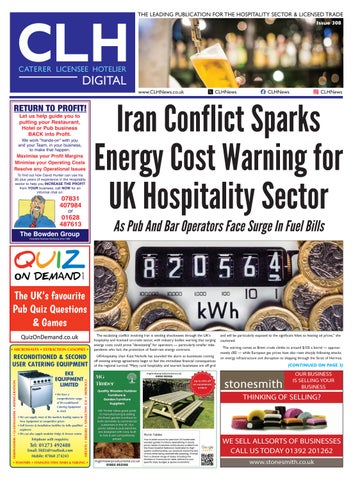
Brent crude climbing to around $103 a barrel. European gas prices spiking. Disruption to shipping through the Strait of Hormuz. These are not abstract market movements — they translate directly into higher brewing costs, higher distribution costs, higher heating bills and higher refrigeration bills for every pub, bar, hotel and restaurant in the country.
As insolvency expert Molly Monks rightly noted in these pages, the drinks trade faces a compounding effect — cost pressures hitting at every single stage of the chain, from the brewery floor to the bar top. For larger groups with the muscle to negotiate fixed-rate contracts or absorb shocks across multiple sites, there is at least some buffer. For the independent operator — already working, as Monks put it, with "very little room for error" — there is none.
This, then, is the latest front in what can only be described as a perfect storm for our sector.
Government-imposed tax burdens have steadily drained the lifeblood from an industry that employs hundreds of thousands and sits at the very heart of British social life. A contracting economy has kept footfall stubbornly flat. And now, energy costs that were already crippling are set to climb further still, driven by a conflict thousands of miles away that our operators had absolutely no part in and possess absolutely no power to influence. Against this backdrop, the intervention of Energy Secretary Ed Miliband this week was, frankly, staggering. A government-backed energy saving tool — launched on 17 March — advised pub operators to switch off their beer fridges and ovens overnight.
I will be honest with you: I struggled to believe it when I read it.
Not merely because it is commercially absurd — any operator will tell you that bringing warm stock back to temperature from scratch consumes considerably more energy than simply maintaining a steady chill — but because it speaks to a breathtaking ignorance of how a licensed premises actually functions. The reaction from the industry, from pub landlords, from commentators and from the wider public was one of scorn and derision, and it was entirely deserved.
Jeremy Clarkson was not wrong. This was not sensible. That the man responsible for our national energy policy apparently needs to be told that you cannot switch off a pub fridge overnight without ruining the beer is, to my mind, a testament to just how badly we are being governed. It would be funny if the consequences for real businesses and real livelihoods were not so serious.
And then there is Greene King. Founded in 1799. Over two centuries of British brewing heritage. Forty thousand employees. Beloved brands — Hungry Horse, Chef & Brewer, Flaming Grill — and historic breweries at Westgate and Belhaven. Greene King has announced plans to dispose of 150 sites and transition a further 150 into leased, tenanted or franchised operation, with around 300 sites in total identified for a change of direction.
If ever there was a single story that encapsulates the difficulties the sector is facing this, is it. This is not a struggling fringe operator cutting its losses — this is one of the titans of British pub culture being forced into a fundamental restructuring of its estate.
The pub industry has warned loudly that it has been "shafted" by a tax grab that piles pressure upon pressure.
Chancellor Rachel Reeves' £100 million rescue package — offering pubs in England 15% off their business rates, worth approximately £1,600 for the average local — was dismissed by industry leaders as too little, too late.
And who can blame them? Set against the combined weight of soaring employment costs and the National Insurance raid that has left operators fighting for survival, £1,600 is not a lifeline. It is a sticking plaster.
There is, let it be said, one sliver of light in an otherwise very dark picture. The World Travel & Tourism Council's president and CEO Gloria Guevara has offered a note of cautious optimism, pointing to the council's analysis of previous crises, which suggests that security-related incidents can see tourism demand recover in as little as two months when governments and industry act swiftly and decisively.
We want to believe that. We genuinely do. But from where we stand today — watching energy costs climb, footfall stagnate, tax burdens grind operators into the ground, and one of our greatest brewing institutions announce the reshaping of its estate — two months feels a very long way down the line indeed.
Visit our website at www.catererlicensee.com to sign up for our twice weekly enewsletter.
I can always be contacted at edit@catererlicensee.com
The Caterer, Licensee & Hotelier News Group is published by RBC Publishing Ltd, 3 Carlton Mount, 2 Cranborne Road, Bournemouth, Dorset, BH2 5BR. Contributions
tion, however, no responsibility will be accepted for loss or damage. Views expressed within this publication are not necessarily those of the publisher or the editorial team. Whilst every care
when compiling this publication to ensure accuracy, the publisher will assume no responsibility for any effects, errors or omissions therefrom. All rights reserved, reproduction
ten permission is obtained. All material is assumed copyright free unless otherwise advised.

At The Commercial Oven Store, we take great pride in being your go-to destination for all your commercial oven needs.
We understand that when it comes to running a successful business, having the right equipment is crucial. That’s why we have dedicated ourselves to providing top-notch products, coupled with expert advice, to help you make informed decisions and achieve your goals.
As a supplier of commercial ovens, we have established strong partnerships with leading manufacturers in the industry. By working closely with these renowned brands, we ensure that our customers have access to a wide range of high-quality ovens that meet the diverse needs of various businesses.
Whether you’re in the food service, hospitality, or catering industry, we have the perfect oven to suit your requirements.


unless


(CONTINUED FROM FRONT COVER)
PINT PRICES UNDER PRESSURE
The drinks trade faces particular vulnerability, according to Molly Monks, insolvency expert at Parker Walsh. "Beer businesses are particularly vulnerable when oil and gas prices rise because the impact is felt at several different points in the chain," she told CLH News.
Unlike many other sectors, the brewing and pub industry faces a compounding effect, with cost pressures materialising at every stage from production through to point of sale. "The first pressure points are typically at the production and distribution stages, where brewers face higher energy costs for brewing, refrigeration and storage, alongside increased fuel costs for transport," Monks explained.
LIMITED OPTIONS
Those increases then flow downstream to licensed premises, which are themselves heavy consumers of energy for heating, lighting and refrigeration. With margins already under pressure across the sector, Monks warns that operators will have limited options. "It does not take long for those pressures to translate into higher prices at the bar," she said.
Smaller independent operators are expected to bear the greatest burden. Unlike larger pub companies and brewery groups, which can negotiate favourable supply terms or absorb costs across multiple sites, smaller venues have far less room for manoeuvre. "Many pubs and hospitality venues are already working with very little room for error," said Monks. "If fuel and energy prices remain elevated, operators may have little choice but to absorb some of the costs, increase prices or reduce what they stock."
As energy concerns within the sector rise Energy Secretary Ed Miliband found himself at the centre of a furious backlash this week after a government-backed energy-saving tool, launched on 17 March, suggested pubs switch off their beer fridges and ovens overnight to reduce costs.
The advice was swiftly condemned across the industry and beyond, with critics branding it a "war on the British pint" and pub landlords describing the guidance as "downright dismissive" and "clueless." Operators were quick to point out that turning off refrigeration overnight not only ruins beer quality but is, in practical

terms, counterproductive — re-chilling warm stock from scratch consumes significantly more energy than maintaining a steady cold temperature.
Broadcaster and pub owner Jeremy Clarkson added his voice to the chorus of condemnation, dismissing the suggestion as "not sensible," while social media erupted with ridicule directed at the Energy Secretary, with many questioning whether "Red Ed" had any grasp of the realities facing licensed premises.
The controversy was further inflamed by accusations of hypocrisy, with some commentators noting the apparent irony of a minister urging businesses to turn off their heating while reportedly running a gas boiler at home. For an industry that has already cut energy consumption to the bone through years of financial pressure, the episode was seen not merely as poor advice, but as emblematic of a government dangerously out of touch with the day-to-day challenges of running a pub.
The conflict is also registering significant damage on international travel flows, with consequences for hotels, airports and the wider visitor economy. The World Travel & Tourism Council (WTTC) estimates the disruption is already costing the Middle East travel sector at least US$600 million per day in lost international visitor spending.
Major regional aviation hubs — including Dubai, Abu Dhabi, Doha and Bahrain — which together normally process around 526,000 passengers daily, have experienced closures and operational disruption, with knock-on effects for global connectivity. The Middle East accounts for 5% of global international arrivals and 14% of global transit traffic, meaning any sustained disruption has far-reaching implications for airlines, hotels, car hire companies and cruise operators worldwide.
WTTC president and CEO Gloria Guevara said the council's analysis of previous crises offered grounds for cautious optimism, noting that security-related incidents can see tourism demand recover in as little as two months when governments and industry act swiftly. "Clear communication, strong coordination between the public and private sectors, and measures that reinforce safety and stability are critical to rebuilding trust with travellers," she said.


By Russell Howe, Group VP

The UK Employment Rights Act has dominated headlines, with much of the public debate focusing on zero hours contracts and changes to statutory sick pay. But tucked away in the legislation is a lesser-known clause with outsized consequences for frontline-heavy, shift work industries like hospitality, where fluctuating hours are commonplace.
Under the Act, businesses must now give workers “reasonable notice” when shifts are changed or cancelled. If they fail to do so, they will be required to compensate the affected employees. For hospitality operators already battling rising labour costs, tight margins, and ongoing recruitment challenges, providing frontline managers with real-time workforce visibility and more accurate labour planning has never been more critical.
For many shift workers, particularly in hospitality, last minute changes have long been part of working life. Rotas are often adjusted at short notice and shifts cancelled close to start times, and workers have long been expected to take that uncertainty in stride.
This kind of flexibility has helped businesses respond to fluctuating demand. Over time, however, it has also meant that many employers have grown used to giving their people very little notice when schedules need to change.
We know shift workers are central to day-to-day operations and hospitality customer service as frontline brand ambassadors—and now the way their schedules are managed is under much closer scrutiny. Unfortunately, many UK organisations are not equipped to efficiently comply with the law or easily provide audit reports if their scheduling practices come into questions.
UKG and YouGov surveyed 2,000 workers in January – February this year, which showed how fragmented shift communication still is. One-third of shift workers receive updates via WhatsApp, text or email, while a further 26% still rely on physical noticeboards or verbal messages. This patchwork of channels makes it hard for staff to keep track of the latest rota, and even harder for employers to maintain consistency across teams and locations to match labour demand or give employees easy self-scheduling and shift swapping options.
Additionally, with 64% of shift workers receiving updates through tools that provide no clear audit trail, many hospitality businesses lack dependable records of when changes were issued or acknowledged. As legal expec-
tations around notice increase, this absence of verifiable evidence leaves employers exposed to compliance risks and uncertainty when disputes arise.
Legal requirements set the parameters, but employee expectations often reveal a more nuanced understanding of what is acceptable within the industry. While “reasonable notice” is currently undefined by the law, what is clear is the gap between employee expectations and current scheduling practices. In the same survey, 1 in 3 shift workers say they one week’s notice of changes is considered reasonable, with a further 27% preferring two weeks or more as employees push for more visible scheduling timelines.
With restaurants and hotels already facing annual staff turnover rates of 70 and 80% according to reports, and poor retention estimated to cost the hospitality sector £272 million each year, a lack of advance notice and giving employees the shifts they want also makes it harder to keep the staff they have. Against this backdrop, employers cannot afford to overlook employee preferences.
Clearer notice requirements will offer employers a chance to rethink how shifts are managed day to day. Hospitality brands that use transparent technology for shift needs and scheduling can see fluctuating demand in real-time and reallocate staff to areas that have a surge in demand, or even schedule their people to work across multiple locations. That starts with moving away from paper rotas, group chats and last-minute messages towards something that connects time, attendance, scheduling, absence, skills and certification, and employee preference data in real time.
When schedules, attendance and vacation data sit in one compliant digital platform, workers have a better sense of what their week looks like, and managers have clearer oversight when shift changes are required before they miss the “reasonable notice” cutoff. With only 23% of shift workers reporting that they are compensated for last-minute shift cancellations, this will be a major change for the employers of the other 77%.
As workers’ rights reforms create new requirements around advance notice, hospitality operators will need to rethink how they organise and record shift changes. Systems built around text, email, verbal or sign-posted notice are difficult to defend when missing notice periods carry costs and legal consequences.
Technology, like an AI-led workforce operating platform, has a role to play in helping organisations comply with changing regulations and, more importantly, run operations more efficiently and provide a better employee experience. Workforce management tools make it easier for managers to plan further ahead, whether for busier periods or to align staffing with demand, or maintain clear records of rota updates. They also bring more consistency to day-to-day operations, replacing ad hoc processes with clearer workflows that give both managers and employees a better view of what’s coming.
Moving workforce data from manual, fragmented reconciliation to transparent real-time intelligence via technology-supported systems will help businesses meet today’s requirements – and stay prepared for whatever compliance changes come next.
A new Pubwatch scheme has been established in Ashbourne, Derbyshire, as licensed premises across the town join forces to address concerns over violent and anti-social behaviour in the nighttime economy.
Ashbourne, a historic market town set within the Derbyshire Dales, is home to a diverse range of licensed outlets — from traditional alehouses that have served the local community for generations to contemporary bars attracting a broader clientele. The launch of the scheme reflects a growing commitment among operators to maintain safe and welcoming environments for customers and staff alike.
To date, 13 venues have signed up to the initiative, with Kerry Edwards — licensee of both The Horns and Ye Olde Vaults in the town centre — appointed as the scheme’s founding coordinator. Edwards will play a central role in facilitating communication between member venues and key partners including Derbyshire Constabulary and the local authority.

The scheme was formally launched at a well-attended start-up meeting held at the Ashbourne ExServicemen’s Club in November 2025. National Pubwatch regional representative Mark Worthington addressed attendees, offering practical advice and guidance on establishing an effective and sustainable scheme.
Danish
The initiative has secured meaningful backing from both Derbyshire Police and the local council — support that Pubwatch advocates consider essential to the success of any community-based licensing scheme. Speaking following the meeting, Worthington noted the strength of engagement from those present, describing the turnout and discussions as an encouraging sign for the scheme’s longevity.
Pubwatch schemes operate as voluntary, self-regulatory initiatives in which licensed premises share information about individuals who have been involved in incidents of violence or disorder. Member venues have the ability to issue bans that apply across all participating premises, creating a collective deterrent that extends beyond what any single operator could achieve independently.
With the licensed trade continuing to face challenges around public safety and the broader perception of town centres after dark, the Ashbourne scheme represents a proactive step by local operators to take ownership of their trading environment — and to demonstrate that responsible retailing remains a priority within the community.
Mark Worthington, National Pubwatch Regional Representative: “There was some very positive engagement at the initial meeting, which bodes well for the future.”

our dining experience from lunch through to dinner. Continued UK expansion is central to our growth strategy, and we look forward to building a new team and becoming part of the Leeds community. This will mark our second north of England opening, following Manchester next month.”
Charles Newman, Asset Management Director at Town Centre Securities PLC, owners of the Vicar Lane scheme comments: “The arrival of Sticks'n'Sushi will further elevate the premium retail and leisure brands represented at Vicar Lane and across the wider area. Sticks’n’Sushi’s international reputation and high-quality offer align with our long-term strategy of curating a best-in-class asset that enhances the appeal of the area as a key city centre destination.”
A major youth employment drive backed by £1 billion will help create 200,000 jobs for young people, alongside the biggest transformation of apprenticeships in a decade.
It comes as apprenticeships starts amongst young people are down 40 percent in the last decade and almost one million young people are not earning or learning – a rise of 248,000 between 2021-2024.
Announced in a speech by Work and Pensions Secretary Pat McFadden at Waltham Forest College, a “New Deal” for young people includes: A new Youth Jobs Grant, through which businesses will receive £3,000 for every young person they hire aged 18-24 who has been on UC and looking for work for six months.
This is expected to support 60,000 young people over three years. Expansion of the Jobs Guarantee to a wider age range, from 18-21 to 18-24, to create more than 35,000 extra subsidised jobs. This brings the total to be supported through the scheme to over 90,000 in the next three years. An Apprenticeship Incentive of £2,000 for each new employee aged 16-24 taken on by an SME.

As part of wider reforms, this will drive progress to our target of creating 50,000 more apprenticeships. Further reforms to the Growth and Skills Levy to prioritise young apprentices, secure value for money and give school and college leavers more opportunities than ever to build careers in cutting edge industries.
It is the latest step in the Government’s commitment to ensuring every young person aged 16-24 has the opportunity to earn or learn. These changes are backed by an additional £1bn, taking the total investment into the Youth Guarantee and the additional investment in the Growth and Skills Levy to £2.5 billion over the next three years.
This will support almost one million young people and help deliver up to 500,000 opportunities to earn and learn.
Prime Minister Sir Keir Starmer said: Backing young people is one of the most important investments we can make in this country’s future.
“We are determined to tackle the rise in youth unemployment by expanding practical routes into work, boosting apprenticeships, and giving employers the clarity they need.
“These reforms underpin our ambition to create an economy that works for everyone, closing the skills gap and supporting more young people into meaningful employment.”
Foundation apprenticeships, supported with an incentive for employers, will also expand into hospitality and retail from April 2026, building on foundation apprenticeships launched in engineering, manufacturing and digi-

tal. These entry-level opportunities will support young people aged 16 to 21 as they take the first step on the career ladder and move from education into lasting employment.
The reforms are backed by Michelin Star celebrity chef Tom Kerridge, who has provided dozens of apprenticeships at his pubs.
Alongside this, the Growth and Skills Levy will be changed to reprioritise investment where it is needed most, to ensure that young people can access the jobs essential to our economy’s growth as well as ensure apprenticeships remain fit for purpose and prioritise value for money.
This means apprenticeship standards that do not meet the country’s skills priorities or take resources away from opportunities for young people and could be better delivered through on the job training will be defunded.
Michelin Star chef Tom Kerridge said: “I welcome this announcement which will provide amazing opportunities to young people looking to get into this industry and others, to learn a trade and earn along the way.
“I’ve trained apprentices in my restaurants, and I know what a great start it gives them in their careers, and these incentives will give our industry a great boost. I’m pleased Pat McFadden has made this a priority.”
Kate Nicholls, Chair of UKHospitality, said: “Hospitality is the sector best placed to help people back into work, and these are important measures that remove barriers for businesses employing more people.
“The Government’s £3,000 Youth Jobs Grant is modelled on proposals UKHospitality submitted and I’m pleased that this has been taken forward. Acting as the equivalent to an employer NICs holiday for businesses employing young people, the grant helps to address a major cost challenge for hospitality businesses.
“Including hospitality in foundation apprenticeships delivers on another of UKHospitality’s key asks and means there are now several supported pathways into work where employers are financially supported to reduce their costs.
“With employment costs rapidly increasing, engaging with the Government to introduce these incentives has been one of our priorities and can support businesses to help reduce the cost of employment.
“With some management apprenticeships streamlined, it’s positive that our calls to retain sector-specific standards across catering and hospitality have been acted upon and those apprenticeships saved.
“These announcements show the benefit of working closely with business groups to design measures and policies that are practical, cost-saving and work for businesses. It’s crucial this approach continues and that the Government ensures that people of all ages have routes to learn and develop skills in hospitality.”

By Jamie Blackmore, Lecturer at Glion Institute of Higher Education London
(www.glion.edu/locations/london)

Periods of market volatility often trigger calls for transformation in hotel commercial strategy. Yet in reality, the most effective response to unpredictable demand patterns is rarely reinvention. Instead, it is a disciplined return to the fundamentals of revenue management – executed with clarity, consistency and strategic intent.
At present, one of the most critical areas requiring renewed focus is segmentation clarity. Without a precise understanding of customer behaviour by segment and source market, including booking windows and price sensitivity, pricing decisions inevitably become reactive rather than strategic. When hotels lack this clarity, revenue strategies become driven by short-term signals rather than meaningful demand insight, which ultimately weakens rate positioning and long-term performance.
Equally important is a more dynamic approach to pace and booking window analysis. The traditional cadence of weekly pick-up reviews is no longer sufficient in an environment where forward visibility can change rapidly. Demand signals, short-term inflection points and shifts in booking behaviour now require continuous monitoring, particularly as geopolitical disruption and uneven recovery across global markets continue to influence travel patterns.
Inventory discipline also remains essential. Rate integrity should be protected through data-led conviction rather than optimism. Too often, hotels adopt long-lead pricing that exceeds realistic market positioning, only to discount aggressively closer to arrival in order to stimulate demand. This pattern not only erodes credibility with customers but also destabilises average daily rate (ADR) performance over time. Long-lead pricing must therefore remain market-appropriate and aligned with the property’s positioning.
Technology, of course, plays a critical role in enabling these decisions. Automation is now indispensable within modern revenue management practice. However, its value lies in informing strategy rather than replacing human judgement. Revenue management systems excel at identifying patterns and optimising within defined parameters, but they cannot interpret broader commercial intent. Strategic repositioning, brand evolution, competitive dynamics and the implications of geopolitical disruption remain fundamentally human decisions. The role of leadership is therefore to establish clear strategic direction and allow automation to operate within those boundaries. Artificial intelligence adds value when it enhances real-time demand interpretation and accelerates decision-making, but indiscriminate adoption risks introducing unnecessary complexity. The most effective approach combines computational efficiency with commercial insight.
Distribution strategy represents another area where discipline is often lacking. Channel mix directly influences net ADR and margin, yet many hotels continue to manage distribution tactically rather than strategically.
Channel presence should reflect the segments and source markets a hotel intends to attract. Simply increasing distribution exposure does not automatically improve profitability and may instead introduce additional acquisition cost and operational complexity.
Higher-cost intermediaries can play a valuable role during softer demand periods, supporting occupancy when needed. However, without careful management they can also displace lower-cost direct demand and compress margins. Promotional activity must therefore be evaluated on true incrementality rather than volume alone. One persistent weakness across the industry remains inconsistent long-lead pricing, where delayed market positioning followed by short-lead discounting conditions customers to wait before booking and ultimately weakens rate integrity.
At the same time, revenue management must increasingly operate as an integrated commercial function rather than a standalone discipline. As guest expectations evolve, collaboration between revenue management, marketing and operations becomes central to driving total revenue performance.
Marketing activity, for instance, should align with forecasted need periods and demand compression rather than follow rigid campaign calendars. When promotional activity is disconnected from demand signals, it risks undermining pricing strategy rather than supporting it.
Operational alignment is equally important. Decisions around arrival patterns, length-of-stay controls and upsell initiatives influence both profitability and the guest experience. Beyond rooms revenue, there is considerable untapped opportunity in coordinated food and beverage packaging, event space utilisation, ancillary pricing and structured pre-arrival upsell strategies. Hotels that align pricing, marketing and operational planning around total revenue optimisation consistently outperform those operating in functional silos.
Looking ahead over the next 12 to 24 months, the real differentiator between high-performing hotels and the rest will not necessarily be technology. Most properties now operate broadly similar commercial platforms, and in many cases technological complexity has increased without delivering proportional strategic benefit.
What will matter more is commercial clarity. High-performing hotels will demonstrate disciplined thinking, a deep understanding of their audiences and the confidence to make decisions grounded in core principles.
This includes adopting a longer-lead perspective on pricing strategy. Rather than reacting to short-term fluctuations, leading hotels will position rates earlier and make measured adjustments as demand evolves. Performance evaluation will also broaden beyond Revenue Per Available Room to include acquisition cost, contribution and margin by segment and channel. Greater value will be created by integrating insights from existing systems – including PMS, RMS, CRM and digital analytics – rather than continuously layering new tools onto already complex technology stacks.
Ultimately, the competitive advantage in uncertain markets will not come from chasing every new system or trend. It will come from composure, consistency and strategic conviction. In an environment defined by uncertainty, the hotels that return to the fundamentals – and execute them with discipline – will be the ones best positioned to outperform.
In a new first for Liverpool’s wine scene, Manifest Restaurant and Bar has been added to the prestigious Coravin Guide, the global guide to wine-by-the-glass menus, recognising restaurants and bars with exceptional sommeliers and drinks offerings.
Championing local produce with their ingredient-led cooking from Chef and co-owner Paul Durand, Manifest has become well-known for its relaxed take on fine dining, carefully curated soundtrack, and outstanding wine programme with food pairings and a weekly Coravin list from the cellar.
Their wine selection was created with food in mind, shining a spotlight on small scale producers, sustainability and craft production, with sections named after some of the team’s favourite songs from their playlist, giving a clue to their content: sparkling, draught wine, punks and heroes. Interesting and unusual natural wines are celebrated –with one section devoted entirely to emerging winemakers – alongside more traditional wines. With over 15 years of experience in hospitality and wine, Manifest’s sommelier Karen Ford qualified through The Court of Master Sommeliers (CMS) and honed her craft at L’Enclume before joining Manifest in 2024. Her background in restaurant management and retail provided her with deep industry knowledge,

fuelling her passion to help guests discover the wines they will enjoy the most.
Speaking of their addition to the guide, Karen Ford, Sommelier at Manifest, said: “It’s wonderful to see our efforts recognised in such a respected guide – we had fun putting our list together and wanted to create something exciting that felt accessible to everyone. The ‘punks’ of our list are more off-the-beaten track producers who completely blew us away, and the ‘heroes’ are classic, better-known and loved producers that have stood the test of time.”
Manifest has built up a reputation for supporting and paving the way for women in wine, with Co-owner Charlotte Jones advocating for gender equity and safety in the wine industry, hosting several Curious Vines networking events for hospitality and wine professionals in Liverpool.
Charlotte Jones, Co-owner of Manifest added: “We’re thrilled to be included in the Coravin Guide. It’s a great recognition of our team’s hard work and passion for wine, but it also feels like a nod to how much incredible growth Liverpool’s wine scene has had in recent years. There’s so much talent here shaping a welcoming and exciting wine culture, and we’re proud to be part of it.”
Two innovations relevant now for the hard-pressed trade are heat recovery, which saves energy and cuts running costs, and Meiko’s new leasing offer, which makes its most energy-efficient machines more affordable.
Meiko’s latest M-iClean U undercounter machine, for example, now operates with a total connected load of under 5kW at 400V. This is a 21% energy saving compared to the previous generation.
The new leasing offer provides Meiko dishwashing from £7 per day, with a preinstallation survey and lifetime training support. There is also optional planned maintenance and breakdown support, plus installation, water treatment, tabling, etc., making it a choice that can ensure the best reliability, cost-effectiveness, and staff protection.
All of Meiko's added-value services, such as training support throughout the dishwasher's working lifetime, are included in its new leasing offer, MEIKO SMARTPAY.

Our training covers the safe use of the machine as you would expect, but also energy-saving and ergonomic use of equipment, ultimately saving the operator money.
Undercounter glasswashers and hood-type dishwashers are the most popular pieces of equipment. Lifetime training support is particularly useful where staff are often changing or where chains are short of managers for training. Meiko’s expertise in ergonomic design and efficient use will also save operators money. Ask for details.
For sites washing utensils, boxes, and perhaps bakery trays, plus glassware, crockery, and cutlery, the new UPster XD (extra deep) undercounter dishwasher handles glassware, serving dishes, trays,
The week to Saturday 7 March saw average sales in managed venues slip 6.4% behind the same week in 2025. Over the seven days before that, to Saturday 28 February, sales dropped 1.5% year-on-year.
Following strong Christmas trading, On-Premise sales have been more challenging in early 2026, with growth in only two of the first nine weeks of the year. Footfall has been held down by sustained periods of rain in many parts of the country, alongside hesitant spending.
Sales were down year-on-year on each of the first seven days of March. Conditions were particularly difficult at the weekend despite the benefits of Six Nations rugby fixtures, with rain pushing down comparatives to -7.9% and -12.1% on Friday and Saturday (6 and 7 March).
Long Alcoholic Drinks (LADs) have generally performed slightly better than

other categories so far this year. Beer sales were down year-on-year by 1.2% and 4.8% in the weeks to 28 February and 7 March respectively, while cider dropped 1.4% and 8.2%.
Soft drinks (down 1.1% and 9.8%) and wine (down 3.5% and 7.4%) were both negative as well. Spirits (down 9.8% and 12.1%) experienced the most challenging conditions of all.
Rachel Weller, NIQ’s commercial lead, UK & Ireland, said: “The wet and grey weather of early 2026 has made it hard for pubs, bars and restaurants to tempt people out of home, and it’s clear that many consumers continue to keep a very close eye on their spending. Operators and suppliers will now be hoping that the two big occasions of Mother’s Day and St Patrick’s Day can revive some spending, especially if the sun finally shines on them.”
Felix Project is launching its annual restaurant campaign and this year celebrity chef Bettina Campolucci- Bordi is joining the call asking for London restaurants to sign up.
Restaurants Feed London is the food redistribution charity’s annual campaign that asks restaurants across the capital to take part and raise money by adding an optional £1 donation to their diner’s bill. Bettina has been supporting The Felix Project for a number of years and says: “I have visited a Felix depot and seen first-hand the quality and quantity of food being rescued and sent to organisations helping to those experiencing food insecurity. I also love to eat out and am fortunate that I can. So, if in doing so, and then crucially adding that small amount, can then help people who are struggling then it’s a win win. That is why I would encourage as many restaurants as possible to sign up and will be speaking to chefs I know all about it.”

The campaign is open for registration now. It then kicks off on World Hunger Day on 28th May and runs for 9 weeks over the summer. Signing up is free and easy! With electronic till systems, participating restaurants add a £1 donation button for Felix, and at the end of July, they will collect the funds and make their donation.
In 2025, 67 restaurants took part including Gymkhana, Kitty Fisher’s, Spring and all five London Local &
sites. The campaign raised enough to provide 189,000 meals, but this year wants to do even more.
Emma Burns, Senior Corporate Partnership Manager at The Felix Project adds: “We know so many people are experiencing financial hardship. Our research found in London, 4 in 10 working families have struggled to buy enough food for their children in the last year and almost 1 in 3 have had to access a food support service, such as a food bank, to help them put food on the table. The Felix Project is doing all it can to help but we need more funds and so we hope this year Restaurants Feed London will be bigger and better.”
The money raised will help the charity rescue high quality surplus food, that would otherwise have gone to waste, and distribute it to around 1,200 community organisations, such as food banks, homeless shelters and primary schools across the capital.
Local & Wild by The Gladwins have already signed up for this year’s campaign, Richard Gladwin Managing Director said: “Our partnership with The Felix Project through Restaurants Feed London reflects what we believe in as a group. Reducing food waste has long been part of how we operate, and we’re committed to continuing that work across all our restaurants. It’s not just about what happens in our kitchens, but about supporting and educating our staff, guests and community around food waste and food hunger. By working together and constantly looking for better solutions, we can play our part in creating lasting change.”


Hospitality managers juggle a lot, from staffing and guest experience to supplier relationships, budgets and daily performance metrics. As resources grow tighter, the challenge deepens.
It’s little wonder the hospitality industry has the highest turnover rate. And that’s before taking into account the high levels of burnout hospital managers experience, due to long working hours (69%), stress (68%) and understaffing (64%).
Reducing burnout must be a focus for hospitality organisations wishing to hold on to the captain of their ship. The answer to this lies in providing these essential team members with access to data in a quick, reliable and actionable way. It is time for businesses to consider how their managers can gain clearer visibility that promotes faster, smarter decision-making, argues Christian Mouysset, CEO and Founder of Tenzo.
Every week, managers spend several hours completing reports. Unsurprising, but also unsustainable.
Many hospitality businesses still rely on multiple systems for different things. Reservations sit on one platform. Staff rotas in another. Reviews somewhere else. These systems operate independently and rarely communicate, leaving general managers (GMs) to piece together reports and spreadsheets just to verify that revenue and costs align.
Additionally, as the data comes from multiple touchpoints and departments, managers find themselves drowning in data. Having to dig through everything to try to uncover meaningful insights can quickly become overwhelming. After all, not all data is useful for day-to-day decision-making, and identifying something significant from a sea of data takes up valuable time that could be spent elsewhere. FROM GUESSWORK TO REAL-TIME
The challenge is not a lack of data but rather understanding how to make the best use of it. This can easily be resolved by consolidating all data into a single, real-time view. By having everything in one place, managers gain a complete view of performance within minutes rather than hours. It also helps with cutting through the
By Christian Mouysset, CEO and Founder of Tenzo
noise so operators can focus on metrics that directly impact efficiency, profitability and guest satisfaction. Unified technology solutions can support managers further by highlighting the most important performance indicators, including average spend per guest, labour-to-revenue ratios and guest satisfaction scores. Additionally, time wasted is not the only issue with manual reporting. These traditional methods also increase the risk of errors and delayed decision-making. Automation solves these problems. By providing visual reports, managers can spot trends at a glance, such as unusually high labour costs compared to revenue. This enables proactive, data-driven decision-making as the right metrics are available in real time, rather than at the end of the week or month when the opportunity to act has already been lost.
Data silos are one issue hospitality businesses face. Another big obstacle is team silos. Managers, head chefs and front-of-house staff each have their own priorities, systems and data. GMs sit at the helm of the ship, yet without information sharing from the deck, keel or stern, issues may go unnoticed, and decisions may be made without the full picture.
Improving visibility across teams is therefore essential. By having all teams feed their data into a unified solution and scheduling regular check-ins each day and ahead of peak service, insights can be shared, alongside the responsibility for success. This not only reduces some of the burden but can also foster trust and transparency throughout the entire team. This can lead to reduced inefficiency and improved guest experience, too.
Guest feedback is another important metric to include in the unified view. After all, repeated feedback can be a strong indicator of where the team is doing well or where improvements need to be made. Once shared with the team, this feedback turns into a powerful operational tool that identifies inefficiencies, optimises processes and can even enhance service standards.
The success of a restaurant, bar or pub is highly dependent on the GM. For those wishing to continue to thrive in today’s difficult climate and hold on to the captain of the ship, these individuals must be provided with the ability to save time and react in real-time.
Improving data visibility is about more than just reporting. It gives managers the ability to run smoother operations, create staff rotas effectively and deliver consistently excellent service. This real-time insight allows managers to move from reacting to challenges to anticipating them.
The benefit of this is not limited to job satisfaction. It will also help ensure that continued growth isn’t overwhelming, but rather something that can be anticipated, planned and managed successfully.
St Austell Brewery has announced a £25,000 donation to A Band of Brothers (ABOB) Cornwall, a charity transforming the lives of young men through mentorship and long term community support.
Founded nationally in 2006 and active in Cornwall for over a decade, ABOB works specifically with men aged 18-25 who are facing significant challenges, often including trauma, addiction, offending, or social isolation. Its Cornwall branches in Penzance, Falmouth and St Austell, run entirely by trained male volunteers, deliver a powerful 12 week mentoring journey culminating in a ‘homecoming’ graduation ceremony that celebrates each young man’s progress.
Young men – often referred to the organisation by the judicial system to prevent them from ending up in prison – are supported by one-to-one mentors through their journey.
Not only is St Austell Brewery helping to fund the vital group, but some of its staff are also training to become mentors.

Piers Thompson, Head of External Affairs for St Austell Brewery presented the donation cheque from St Austell Brewery’s Charitable Trust to the group last month.
Piers said: “A Band of Brothers is doing extraordinary, life changing work with young men across Cornwall, and we’re proud to support a programme making such a tangible difference in our communities. Our donation will help ABOB train more local mentors, expand the 12 week mentoring scheme, and provide ongoing community support for young men in Cornwall.”
Mentor and local businessman Sam Galsworthy first discovered ABOB around five years ago through the Cornwall Community Foundation. After attending a graduation ceremony, he says he was “so moved” by what he witnessed that he knew he had to be involved.
Later, as High Sheriff of Cornwall, Sam made ABOB his chosen charity after a moment he describes as “a lightning strike.” While with the Devon & Cornwall Police forensics team in the emergency call room, he
experienced a deeply affecting time.
Sam said: “Whilst working with Devon and Cornwall Police one evening, a hotline went off: a death – a young male, no suspicious circumstances. Half an hour later, another, the same again. Then another. Four calls in three hours. All young men and all from Cornwall. That moment crystallised for me just how urgent the situation was.”
Recognising the crisis facing young men in the county, he joined ABOB as a mentor. He described the experience as transformative. “The most profound thing happens when you mentor, you get just as much back as the young men. At the passing-out ceremonies, the bravery of these young men – sharing their stories, often for the first time – is extraordinary.”
Four years ago, James was in a dark place. Drinking heavily, struggling with drugs, and not coping with the pressures of fatherhood, he said his life was “basically going downhill.”
He was introduced to ABOB through the Wild Young Parents Project. After completing the rites of passage weekend and 12 weeks of mentoring, James turned his life around, eventually starting his own business. He has since referred four young men to the charity and even mentored two others.
“It’s a place for men to find community, role models, to learn and grow. It helped me accept parts of myself I never could before.”
One of the men James encouraged to join the programme was his colleague Seb. Seb, 20, was struggling with alcohol when he started working for James. Seeing the signs he once recognised in himself, James encouraged Seb to connect with ABOB.
“Taking that step was huge,” Seb said. I’d struggled with drinking for a while. But I’ve just graduated the homecoming and I’m proud of myself. I dropped out of school and college – I never had that end of year certificate. Seeing all those people there to support me was eye opening.”
Pub operator Greene King has unveiled a sweeping strategic review of its estate, with plans to dispose of 150 sites and transition a further 150 into leased, tenanted or franchised operation as part of a long-term programme to sharpen profitability and drive sustainable growth.
Greene King, which operates approximately 2,500 pubs, restaurants and hotels across the United Kingdom, announced the restructure on 18 March 2026 following a comprehensive evaluation of its entire portfolio.
The Suffolk-based brewer and operator said the exercise was designed to concentrate investment into its highest-performing venues while repositioning underperforming assets into alternative operating models better suited to maximising their potential.
Around 300 sites in total have been identified for a change of direction.

Roughly half of these venues will be converted to leased, tenanted or franchise operation within the company’s Pub Partners division which already oversees more than 1,000 partnership pubs across England, Scotland and Wales.
The remaining 150 sites have been earmarked for potential disposal over the medium term, with proceeds
The British Institute of Innkeeping (BII) has announced their QuarterFinalists for this year’s Licensee of the Year Award (LOYA).
The Licensee of the Year Award is widely regarded as the most rigorous and hard-fought award for individual licensee operators in the UK.
Since the launch in January this year, those working in the licensed trade were encouraged to enter to showcase their businesses, sharing how they have continued to diversify and develop their businesses to become more sustainable and thrive.
With 800 licensees nominated by colleagues, customers and friends, the exceptionally high standard of entries this year made selecting the QuarterFinalists a challenging task for the judges, with those chosen from the 800 entrants progressing based on the strength of their applications.
earmarked for reinvestment into Greene King’s core estate.
To manage the transition, the company said it would establish a dedicated new business unit to house the 300 affected sites, allowing them to be operated on what the group described as a simplified model focused on financial returns while the longer-term direction of each venue is determined.
A small number of sites have also been identified for closure, representing around two per cent of the managed estate— a level the company characterised as consistent with its normal annual activity.
Nick Mackenzie, CEO of Greene King, said: “We are confident that our new pub estate strategy will set us up to deliver sustainable profitable growth for the long-term as consumer habits continue to evolve and the operating environment remains dynamic.
“The realignment of our estate – which leverages our strategically important Pub Partners business –enables us to play to the strengths of our brands, capitalise on our investment in digital and loyalty, invest effectively in our core portfolio and most importantly continue to deliver exceptional experiences for our customers.”

The next steps involve each Quarter-Finalist receiving a visit from a mystery diner or drinker, alongside
online audits conducted by the BII team to assess the pub’s social media presence and website.
Steve Alton, BII CEO commented: “Our Licensee of the Year Award is the most prestigious & hard-fought award, showing the excellence in our sector. We are delighted to have had so many entries in 2026, despite the challenges that our sector has faced over the last few years, showing, as ever, the resilience and commitment of our licensees.
“The best of luck to everyone involved this year and I look forward to meeting our finalists in June for their final judging day.”
The BII will announce their Semi-Finalists in April, who will then receive a visit and interview at their premises with Head Judges, Amanda Hemming and Ashley McCarthy to help decide on the final six! All six finalists will be presented with a trophy at the BII Summer Event on 16th June, where the winner of Licensee of the Year 2026 will ultimately be crowned.

By Katherine Pavling, Head of Product at Virtual College
(https://www.virtual-college.co.uk/)

The purpose of a food hygiene inspection is of course to ensure that a food business is preparing, handling, and storing food safely so it does not pose a risk to public health.
A recent survey by Virtual College has highlighted that 40% of people avoid venues with a food hygiene rating of 3 or less and 19% choose where to eat based on food hygiene ratings more than the menu.
The Food Hygiene Rating Scheme (FHRS) is one of the most common signs in restaurant, takeaway and café windows and is one of the best ways a customer can judge the cleanliness and quality of the establishment.
Katherine Pavling, Head of Product at Virtual College, explains, “A hygiene inspection involves individuals arriving, typically unannounced, on the site of a food vendor to check the cleanliness of premises and equipment, how food is handled and cooked, whether it is stored at safe temperatures, and if measures are in place to prevent contamination. The aim is for the inspectors to see how the business operates under normal, everyday conditions rather than a prepared set of conditions, to assure it is safe for public health.
“Inspections aren’t solely about monitoring cleanliness of the site, it also includes checks on staff hygiene, training, and the business’s food safety system, often based on HACCP principles, to make sure risks are properly identified and controlled.”
A food safety system based on HACCP principles (Hazard Analysis and Critical Control Points) is a legal
requirement for businesses in England that helps to identify potential hazards in food handling and putting controls in place to prevent those risks.
Katherine says, “In practice, this means things like setting rules for cooking temperatures, keeping food stored correctly, cleaning regularly, training staff, and keeping records to prove everything is being done properly. During a hygiene inspection, the inspector will look at these procedures and records and check that staff are following them in practice and ensuring hazards are properly identified, monitored, and controlled to keep food safe.”
Importantly, businesses are able to act if they feel a rating does not accurately reflect their standards. Katherine says, “There’s a right to challenge or appeal the outcome of an inspection, as well as the opportunity to request a re-inspection once improvements have been made. This ensures the system remains fair, while still holding businesses accountable to the compliance measures designed to protect public health.”
“While the law doesn’t require a specific training qualification, it does require that all food handlers are adequately trained or supervised, which means they need to understand safe food handling, hygiene practices, and allergen awareness relevant to their role.
“Most businesses support this through recognised courses, such as Achieving a Five Star Food Hygiene Rating training by Virtual College, which provides practical guidance on how inspections are scored, how to meet hygiene standards, and how to achieve top ratings.
“The most important is that businesses have a clear and effective food safety management system in place, and that staff are properly trained appropriately to follow it in practice.”
Find out more about Virtual College’s food hygiene course here: https://www.virtual-college.co.uk/courses/5star-food-hygiene-rating-training
First Mile, the UK’s leading recycling and waste management provider, today celebrates the hospitality & catering and entertainment sectors' highest-performing recycling businesses as part of its annual Recycling Standard campaign.
In the past year, First Mile worked with more than 30,000 businesses across the UK, welcoming 8,000 new customers, collecting 207,540 tonnes of waste and recycling 94,128 tonnes. Hospitality continues to be one of the most dynamic sectors within its network, with hotels, restaurants, pubs, cafés and entertainment venues increasing the number of separated waste streams and driving higher recycling rates in response to evolving regulation and customer expectations.
The top three hospitality & catering and events businesses by recycling tonnage are ATG Entertainment Limited, which recycled 3,468 tonnes; Gail’s Bakery, which recycled 2,279 tonnes; and Caffè Nero (Nero Holdings Ltd), which recycled 1,079 tonnes. Together, these organisations represent the highest-volume hospitality recyclers in the First Mile network, demonstrating the scale of impact that consistent, data-driven recycling can deliver across theatres, hotels, cafés and bakery estates nationwide.
From managing high footfall in theatre venues to handling significant volumes of food waste and coffee grounds in busy city centre locations, these businesses face unique operational challenges. The performance of this year’s top three reflects sustained investment in back-of-house processes, staff engagement and the expansion of specialist services including food waste, glass, coffee cups and cooking oil recycling.
For more than a decade, First Mile’s Recycling Standard has provided a transparent and evidence-led framework for measuring recycling performance. Grounded in verified data collected throughout the year and benchmarked across tens of thousands of UK businesses, the Standard enables hospitality operators to compare performance, identify opportunities for improvement and gain recognition for measurable progress. In 2026, the campaign evolves

into an enhanced recognition scheme, positioning itself as a key annual moment for UK recycling and setting clear, sector-specific benchmarks.
Within the scheme, accreditation levels are awarded based on verified recycling rates and the number of services used. Goldaccredited customers achieve an 80 per cent or higher recycling rate alongside four or more services, or three or more services where one of these is food recycling.
One of these services must be general waste, which is required to be zero to landfill. Silver accreditation recognises businesses achieving a recycling rate of 50 per cent or above with at least two services. Zero to Landfill status is awarded to customers with recycling rates of up to 49 per cent whose general waste is diverted from landfill.
Gold-performing hospitality businesses typically operate streamlined waste systems across multiple sites, implement clear front-ofhouse and back-of-house separation, and introduce initiatives to influence both staff and customer behaviour. They also comply with the government’s Simpler Recycling regulations, which came into
effect in April 2025, requiring mixed recycling and food waste collections alongside residual waste.
Speaking of its achievement, Mishal Shuja, Head of Procurement at ATG, said: “We’re incredibly proud to be recognised as one of First Mile’s top recyclers this year. This achievement reflects several years of focused collaboration, operational discipline, and a genuine cultural shift across our venues. Improving our recycling performance supports our wider ISO14001 commitments and motivates our teams who see the positive impact of their efforts every day. The Recycling Standard helps us drive consistency and continually raise the bar, and we’re delighted to see that hard work translated into meaningful results.”
Sofia Rodriguez, Head of Sustainability at Gail’s Bakery, added: “We’re delighted to be recognised as one of First Mile’s top recyclers. The Recycling Standard has helped us strengthen our waste management practices, improve recycling rates across our bakeries, and give our teams greater visibility of the impact they’re making every day. It plays an important role in supporting our wider ESG commitments and reinforcing our ambition to operate responsibly as we grow. We’re proud of the progress so far and remain committed to continuously improving.”
Talking about the scheme, Bruce Bratley, First Mile founder and CEO, said: “Hospitality businesses operate in fast-paced, high-pressure environments, yet the leaders in this sector show that recycling can be embedded into day-to-day operations at scale. Our Recycling Standard is built on real operational data, giving businesses a clear picture of performance and a credible way to demonstrate progress. It is fantastic to see operators like ATG Entertainment Limited, Gail’s Bakery and Caffè Nero setting the benchmark for the sector.”
The Recycling Standard’s position as an industry benchmark follows a period of strong external recognition for First Mile, including being named Independent Operator of the Year at the National Recycling Awards 2025 for the second-year running, and B2B Business of the Year at the Growing Business Awards 2025.
Star Pubs has launched an online course – AI for Publicans. The company has also gifted the material to the BII membership along with access to its social media training website, the Star Social Collective.
Star Pubs employed external social media experts to produce the £45,000 training package.
AI for Publicans demystifies AI marketing and teaches everything from how to write social media posts in seconds to which free or low-cost AI tools are best. It comes with an AI-powered content calendar tool to address what many publicans cite as two of their biggest social media challenges – what to post and finding time to plan it.
The Star Social Collective is a one-stop shop for publicans and pub staff of all skill levels wanting social media training. Created specially for pubs, it incorporates 115 bite-sized videos – equating to 11 hours of content – covering all channels with topics spanning influencer marketing to managing Trip Advisor reviews. The training can be completed on any device – including mobile phones, making it perfect for staff to undertake in quiet moments. A search bar facility and AI chatbot take users straight to the training they need.
Says
Tracy Bickerdike,

Star Pubs’ head of training: “AI has emerged as a new hot topic at our licensee forums
Independent family brewer and pub company Shepherd Neame is delighted to announced it has reopened a vibrant, new sports bar at Chatham’s Maritime Marina.
The venue, formerly known as Pier Five Bar and Kitchen, has been transformed into a high-energy, immersive space which is dedicated to live sport, social gaming and bold food and drink.
Customers can expect multiple large screens showing a wide range of sport, interactive darts, retro gaming consoles in booths, and a lively programme of DJs and live bands throughout the week.
The space itself has been brought to life by renowned London graffiti artist James Titchner, whose striking tags and murals create a bold and unique backdrop, complemented by a bespoke resin bar top celebrating iconic sporting moments and memorabilia.
The lively revamp is matched with an equally exciting new food offer which includes indulgent dirty burgers, mucky fries and spice bags, alongside wings, pizzas, lighter bites and a kids’ menu. Behind the bespoke bar, there’s an extensive range of beers, from well-known favourites to regional craft brews, with the site’s very own Sin Bin Dockside Lager taking centre stage, as well as a great selection of cocktails.
Ed Cornwell, Shepherd Neame’s Head of Hotel Operations and Retail Innovation, said: “We’re very excited
over the last year. Publicans are very busy and grappling with high overheads, so they’re keen to learn how AI can streamline their back-office operations and help them work smarter. AI is daunting for many small businesses – the trick is to start experimenting with it. This training is designed to support licensees in adopting AI. Pubs that embrace it early will have a huge competitive advantage. Social media marketing is a natural place to start. AI will turn out great content quickly and with less effort, as AI assistants handle routine tasks, freeing up publicans to focus on other areas.
“A pub’s online presence is now the first port of call for the majority of people when deciding where to go out; it’s essential to business success. We’re therefore pleased to be sharing our training resources with the industry at large as part of our commitment to keeping the great British local relevant and attractive to consumers. Both AI and social media are developing extremely rapidly; all the training material we’re donating has been fully reviewed to ensure it’s up to the minute.”
Comments Molly Davis, Head of Communications, BII: “Today’s publicans need to leverage all the tools available to them to support the growth and diversification of their businesses. Star Pubs sharing the Star Social Collective – a really valuable resource for the modern world of marketing – with all of our members, is a brilliant example of the collaboration that makes our industry so unique.”
to announce the opening of Sin Bin, a fresh, new venture for Shepherd Neame that isn’t just a sports bar –it’s an all sports bar and will be popular with fans of football, rugby, boxing, motor racing, women’s sports and more – if it’s sport, we’ll be showing it!
“We’ve also got three retro games consols in our dining booths, so you can brush up on your Mario Karting and GoldenEye skills. There will also be Sunday night quizzes, bottomless brunches on Saturdays and exciting offers on food and drinks. We look forward to welcoming you down to Chatham’s Maritime Marina for the full experience.”
The new team is led by General Manager Rachel Webb, who has moved from Shepherd Neame’s riverside pub, The Boathouse in Yalding, alongside Head Chef Dan Archer and Deputy Manager Sophie Myers.


JD Wetherspoon chairman Tim Martin is urging the licensed-on trade to rally behind two straightforward tax reform proposals — VAT parity with supermarkets and a reduced business rates multiplier — arguing that simplicity, not complexity, is the key to meaningful relief for pubs.
The debate around business rates reform in the pub sector is gaining fresh momentum, with JD Wetherspoon joining calls for the industry to unite behind a clear and deliverable set of tax objectives rather than pursuing more complex structural overhauls.
Wetherspoon chairman Tim Martin, writing on behalf of the company, has outlined a position that echoes longstanding calls from other major operators — including Fuller’s, St Austell and Shepherd Neame — who previously backed Jacques Borel’s campaign for VAT near-parity between pubs and supermarkets. Although that initiative did not achieve its goals in the UK, it succeeded in several other countries and continues to serve as a reference point for reform advocates.

The current business rates system assesses pubs on the basis of a hypothetical tenant’s fair maintainable trade, to which a multiplier is applied. That multiplier currently stands at 43 pence in the pound. A number of operators — including Greene King — have campaigned for a reduction to 28 pence, representing a cut of 15 pence.
Wetherspoon supports this direction of travel, highlighting the significant advantage of such a reform: it is easy to understand, straightforward to implement, and would deliver a tangible, immediate cash benefit to pub operators. There is broad consensus across the sector — and reportedly within government — that pubs are currently overtaxed relative to their retail competitors.
Greene King attracted attention last summer when it launched its own campaign proposing that business rates for pubs be assessed on profit rather than trade. Wetherspoon has expressed understanding of the motivation behind this approach — acknowledging the steep decline in pub profitability over recent decades — but has raised questions about the practicality of the methodology.
Moving to a profit-based model would represent a fundamental departure from the established principle of business rates as a property tax — one based on the value and use of the premises rather than on the financial circumstances of the occupant. It would also require the displacement of existing valuation expertise with accountancybased analysis, bringing additional cost and complexity. As Wetherspoon notes, a profits-based tax already exists in the form of corporation tax; introducing a second levy on the same basis risks adding bureaucratic layers without guaranteed benefit.
There are also concerns that an entirely new rating system — however well-intentioned — would bring uncertainty, lengthy implementation timelines, and no firm guarantee that the resulting tax burden on pubs would be lower than it is today.
Wetherspoon’s preferred approach is to focus industry advocacy on two clear, achievable goals: first, VAT equality between pubs and supermarkets; and second, a reduction of the business rates multiplier from 43 pence to 28 pence in the pound.
The company is urging the wider trade to coalesce around this agenda, arguing that a united, simple message will carry far greater weight with policymakers than competing or complex proposals. The emphasis, in Wetherspoon’s view, is on clarity and speed of delivery — reforms that can be understood, communicated and implemented without significant delay or risk.
Two Michelin-acclaimed restaurants on Skye have raised over £11,829 to help support the island’s local primary schools in the last year.
Thanks to the generosity of its guests, The Three Chimneys and The Three Chimneys at Talisker have now donated £5,914.95 to both Dunvegan Primary School and Carbost Primary School. These latest donations are part of The Three Chimney’s ongoing commitment to annual fundraising and giving back to the local community on Skye, including charities, schools, local growers, crofters, producers and craftspeople.
Every year, The Three Chimneys’ team vote to select a local community group or charity to support with funds raised through voluntary guest donations.

This year, their chosen community partners are Dunvegan Primary and Carbost Primary near The Three Chimneys at Talisker on the shores of Loch Harport. Kieran Walker, general manager of The Three Chimneys, said: “Thanks to the generous donations of our guests, we’re committed to providing ongoing fundraising support to local charities and community groups on the island, including Dunvegan and Carbost primary schools.
“These funds were raised through small guest donations across both of our restaurants throughout 2025, and we’re incredibly grateful to everyone who contributed.”
Kieran added: “Supporting the local community is something that means a great deal to us. Over the past year, this has included welcoming local school children into The Three Chimneys restaurant for our charity school lunch, where the kitchen and dining room became a classroom for the day, and donating all funds raised to the local shinty club.
“A huge thank you to our guests and our team for helping make initiatives like this possible. It’s always special to give something back to the community that supports us all year round.”
Following the success of its pilot initiative during 2025, The Three Chimneys is also continuing its long-standing partnership with Dunvegan Primary School to offer even more youngsters the chance to hone their cooking skills and learn more about the best local produce from Skye.
Once again, The Three Chimneys’ kitchen will be opened up as a classroom for the day in 2026, as part of the latest programme of educational activities for local children, which is being led by head chef Paul Green and his team.
A brand-new food and drink festival, which is a celebration of Welsh produce and drinks, will be held at DEPOT, Cardiff from July 9th to 11th.
The three-day festival, organised in collaboration with the Welsh Government Drinks Cluster, Society of Independent Brewers and Associates (SIBA) and DEPOT, will bring together some of Wales’ top food and drink producers under one roof. It will showcase home-grown wine, spirits, cider and beer, alongside a selection of Welsh food and entertainment.
One highlight of the event is Indie Beer Wales, where festival-goers will have the opportunity to sample some of Wales’ best brews, meet their passionate producers, and discover the depth of quality and innovation emerging from the Welsh drinks industry. This celebration of Welsh brewing takes place on the Thursday.
The Thursday will also feature a dedicated trade session, giving pubs, bars, retailers and hospitality professionals the opportunity to

and spirits. The trade-focused part of the festival will also showcase the strength of Welsh brewing, encouraging new partnerships while celebrating the creativity and craftsmanship of Wales’ independent brewers.
Sara Webber, Regional Director of SIBA, said of the festival: “The Great Welsh Drinks Festival is about celebrating the incredible range and quality of drinks being produced across Wales today.”
“Wales is the only region in the UK that has a growing brewing industry – albeit very small growth, but we should be doing all we can to celebrate this achievement and support our independent brewers and drinks producers. From beer and cider to wine and spirits, Wales is producing some exceptional products, and this festival will give people the chance to discover them all in one place.”
The festival will feature a lively programme of entertainment, including local bands and DJs, creating a relaxed summer atmosphere celebrating Welsh culture, music and flavour.

As the number of UK pubs continues to fall, new research suggests that for every £1 spent on a pint in 2026, UK wet-led pubs could be making just 3p in profit – down from 5p last year and 7p the year before.
To understand where money spent at the pub actually goes, money.co.uk business current account experts analysed cost data from the British Beer and Pub Association (BBPA), modelling how key operating expenses have changed year-on-year.
While consumers have seen the average draught pint rise(1) over the past two years, the profit from each pint appears to have dropped by more than half over the same period, according to the research. Rising costs – including wholesale prices, wages, business rates, and beer duty – are steadily eating into margins in 2026. Beer duty has increased by 3.66% this year adding roughly £35 a week to costs, while wages are expected to cost around £229 more.

Wholesale food and drink costs are estimated to account for 41% of revenue, while wages make up around 31%, the two largest costs overall.
After utilities (4%), business rates (3%) – a tax paid on the pub building itself – and other operating costs are accounted for, just 6% in gross profit could remain, equal to 6p from every pound, before rent is deducted.
After rent, which industry guidance on pub budgets from the BBPA states can cost around 50% of gross profit, the typical wet-led pub could be left with just 3p in profit from every pound spent at your local.
For pubs charging an average of £5.17(2) for a pint of lager, that would equate to around 16p profit per pint. These persistent cost pressures could make the much-discussed £10 pint(3) an increasingly realistic possibility in the UK’s more expensive areas.
This comes as pub numbers across the UK continue to fall(4), and landlords face a balancing act: attempt to absorb rising costs and erode already-thin margins, or continue to pass them on to customers and risk losing trade.
Jake Pemberton, landlord of The Gladstone in Nottingham, says: “Increases in beer prices often don’t cover the rise in everything else that pubs have to deal with. Many small, independent pubs simply can not survive with business rates, energy bills, minimum wage, VAT, taxes etc. It all adds up and I don’t think all customers take that into account when we change our prices.
“Higher beer prices keep people at home and it’s significantly affecting British pub culture. Communities are suffering, as pubs & pub goers often come hand in hand with community spirit. At the same time, we’re losing traditional pubs as wet led pubs are dying, with more becoming food focused and family oriented.
“This year, our prices can’t increase at the same rate. Three of my real ale products needed a 15p rise to keep the same gross profit, however I’m aware pubs have a ceiling to what they can charge and I feel like I’m getting closer to that ceiling, so could only add 10p. This means on those products I’m losing gross profit this year.”
Joe Phelan, money.co.uk business current accounts expert, says: “It’s easy to assume that rising pint prices mean pubs are making more money, but the reality is very different. Our data shows margins are shrinking, with only a few pennies left from every pound spent once costs, including rising beer duty, are covered.
Without support, we risk losing not just businesses, but a cornerstone of British culture.
“With margins under such pressure, careful financial management is becoming more important than ever. Using a business current account with integrated reporting tools can help landlords keep track of costs, monitor cashflow, and make informed decisions to protect profits and keep their doors open.”
Stonegate Group’s Social Pub and Kitchen has launched a major menu refresh across its 62 venues, introducing smash burgers, new weekly offers and healthier food options as the brand evolves its food and drink offering in line with changing consumer trends.
Supporting the rollout, Stonegate Group has invested £50,000 in new kitchen equipment across the estate, enabling chefs to introduce smash burgers to menus throughout the brand’s pubs and further enhance food quality and speed of service.
Arguably the burger of the 2020s, smash burgers have skyrocketed in popularity in recent years, becoming a viral sensation across TikTok and Instagram Reels. Their striking appearance makes them ideal for social media, while their juicy flavour and crumbly texture deliver the rich, indulgent taste guests are seeking.

The new equipment allows chefs to achieve the perfect ‘Maillard reaction’ – the chemical reaction between amino acids and reducing sugars that occurs when food is cooked at high temperatures – creating the signature deep flavour and caramelised crust that smash burgers are known for.
To support the rollout, Stonegate has also invested in training its teams across all Social Pub and Kitchen sites to ensure staff are fully equipped to use the new equipment and consistently deliver the new menu
items.
Paul Fitzpatrick, Head of Food Development at Social Pub and Kitchen, said: “We are constantly reviewing and evolving our menus to ensure we’re keeping pace with the latest trends shaping the hospitality sector and meeting the expectations of our guests.
“Smash burgers have become one of the defining food trends of recent years, driven by both social media and consumer demand for bold, flavour-led dishes. By investing in new kitchen equipment and training our teams across the estate, we’re giving our chefs the tools and skills they need to consistently deliver high-quality dishes while continuing to innovate across the menu.”
Stephen Cooper, Head of Marketing at Social Pub and Kitchen, added: “In such a competitive market, it’s vital that we continue to innovate across our food and drink offering while delivering great value and memorable experiences for our guests.
“Our latest menu refresh reflects that approach, combining on-trend dishes like smash burgers with new drinks options, refreshed bottomless brunch packages and experience-led weekly offers. We are always looking at how we can evolve our menus, drinks range and promotional calendar to ensure Social Pub and Kitchen remains an exciting and relevant destination for our guests.”
In a competitive hospitality market, pubs and hotels can’t afford to be subtle. If you serve food, people need to know it immediately – and according to HFE Signs, one of the UK’s leading hospitality signage suppliers, food banners remain one of the most powerful ways to turn passing trade into real revenue.
“Food banners are one of the highest-impact products we sell to pubs and hotels,” says a spokesperson from HFE Signs. “They answer the customer’s question before they even ask it: Do they serve food here?”
From “Breakfast Served Here” banners catching early-morning footfall, to “Food Available All Day” messages aimed at lunchtime trade, and “Sunday Roasts” banners driving weekend covers, clear outdoor signage works where decisions are actually made – outside the venue.
Unlike menus hidden indoors or promotions lost online, food banners are bold, visible and constant. Positioned on railings, fences, walls or frontage areas, they promote food offers all day, every day.

“Our customers tell us the same thing time and again,” explains HFE Signs. “Once the banner goes up, people start coming in specifically asking for food they didn’t realise was available.” Speed is crucial in hospitality marketing. Menus change, seasons shift and opportunities come and go quickly. HFE Signs offers next-day delivery on many food banner products, allowing pubs and hotels to react fast –whether launching a new breakfast offer, promoting a midweek food deal or capitalising on Sunday trade.
“We know pubs and hotels can’t wait weeks for signage,” says HFE Signs. “That’s why fast turnaround is built into what we do.”
But speed alone isn’t enough. Outdoor food banners need to look professional and last. Poor-quality signage creates poor expectations, especially when promoting food. HFE Signs produces banners using durable materials and high-quality print, ensuring colours stay vibrant, text stays sharp and the banner continues to represent the standard of food inside.
Design is another area where operators often struggle. Not every pub or hotel has the time or expertise to create effective artwork, which is why HFE Signs includes a free simple design service with every order.
“We make it easy,” says the team. “Our designers create clear, bold food banners that work in real-world conditions – not cluttered designs that don’t read from the pavement.”
Food banners are also one of the most cost-effective marketing tools available. With a one-off cost and ongoing visibility, they deliver long-term exposure without ongoing advertising spend – making them ideal for boosting food sales without stretching budgets.
With over 30 years’ experience, thousands of five-star Trustpilot reviews, and a reputation for reliability, HFE Signs has become a trusted supplier for pubs and hotels across the UK.
“Our goal is simple,” concludes HFE Signs. “Help hospitality businesses get noticed, get customers through the door, and sell more food.”
In a market where visibility directly impacts revenue, food banners don’t just advertise food – they sell it. And when they’re done properly, they work harder than almost anything else outside the door. Order your banners today for delivery tomorrow! www.hfe-signs.co.uk

Europe’s independent brewers are showing their determination this year despite four in ten saying survival is their main priority.
A new report published today shows that in the face of international turmoil, energy prices are the top challenge for independent brewers with half expecting either no growth or a decline in turnover. Yet behind these sobering figures lies a sector determined to adapt, invest and defend Europe’s authentic beer culture.
These findings are detailed in a new, first-of-its-kind report by the Independent Brewers of Europe (IBE), a cross-border alliance founded in 2024 to represent and protect independent brewing across the continent. Bringing together national associations from Europe, with continued expansion underway, IBE advocates for fair market conditions, transparency and the long-term viability of small and medium-sized independent breweries in a sector increasingly dominated by global corporations.

The report covering more than 3,000 independent breweries, provides a detailed snapshot of the pressures and opportunities shaping the sector across 12 European countries. It shows them grappling with energy price volatility, taxation pressures and intensifying competition from multinational companies that control a significant share of the beer market.
Most independent breweries remain small businesses: 60% report annual turnover of less than €500,000. Despite their size, their local footprint is considerable. More than a quarter (28%) of beer is sold directly to consumers through taprooms, bars, shops and pubs, while 75% of breweries actively support local causes, underlining their economic and social role within communities.
The report also highlights a generational shift in drinking habits. Younger adults are consuming beer less fre-
quently than older generations, and a higher proportion choose not to drink alcohol at all. However, the data suggests that when younger consumers do choose beer, they are more focused on quality, authenticity and local production. In other words, they may be drinking less overall but drinking better.
To navigate current headwinds, many independent brewers are diversifying. Some 43% now produce additional products, most commonly soft drinks and sodas, while non-alcoholic beer is gaining importance as consumer interest in noand low-alcohol options
grows. Across Europe, beer styles vary widely, but pale ales, India Pale Ales and pale lagers remain the most commonly produced categories among independent breweries.
“Independent breweries represent an authentic and deeply rooted beer culture that needs defending,” said Barry Watts, Chairman of IBE & SIBA Head of Policy and Public Affairs (UK). “Sadly, too many independent brewers are having to focus mainly on survival and with current international events, energy price shocks are their top issue. Yet despite this they are determined to do things better, to improve their businesses and continue to make innovative beer styles enjoyed by drinkers across the continent.”
Yet the report also highlights cautious optimism. More than a third (37%) of brewers plan to prioritise improving beer quality this year, and 35% intend to invest in new brewing equipment clear signals that many are looking beyond immediate challenges.
“Independent breweries play a vital role in their local economies and communities,” said Kilian Kittl, IBE CoChair & Manager of Private Brauereien Bayern (GER). “The challenges are real, but so are the opportunities. With the right framework conditions, independent brewers can continue to innovate, invest and thrive.”
Winchester chef Luke Emmess, Fuller’s Head Chef at The Wykeham Arms, has powered into the finals week of MasterChef: The Professionals, following a remarkable run of performances that saw him praised for delivering “next level cookery” by the judges.
In the latest stage of the competition, the final five chefs travelled to the prestigious The Glenturret Lalique Restaurant, where they were put through their paces by renowned chef Mark Donald. Known for his exacting standards, Mark challenged the chefs to recreate one of his intricate lunch dishes. Luke was tasked with the technically demanding lobster toddy, a dish celebrating elements of the whisky-making process. Featuring lobster consommé, a crispy lobster sandwich, and lobster tail with turnip variations and a spiced sauce, the dish pushed Luke to demonstrate precision, creativity, and control under pressure.
Mark commented that it was a difficult dish, but praised Luke for rising to the challenge and delivering under intense scrutiny.

In the next challenge, chefs were asked to create a dish that held personal meaning. Inspired by his wife Catrina’s love of goat’s cheese, Luke delivered a visually stunning and highly original plate: Goat’s cheese mousse encased in honey truffle jelly, with a tartlet of honey cake and truffle honey, finished with a golden beetroot sorbet.
Judge Monica Galetti described the dish as, “A beautiful looking plate of food… just ooffff! It blows you away.” Matt Tebbutt praised the boldness of the dish, particularly the sorbet, calling it “really out there” and “really brave.”
But it was Marcus Wareing who delivered the standout verdict, “When we talk about next level cookery, this is it. I can’t speak highly enough about this dish. I think I could be sitting in a top two or three Michelin-star restaurant in Europe — that’s how good this dish is.” Luke, visibly delighted, said, “I was not expecting such high-level compliments.”
At the end of the round, Marcus described the overall standard as some of the best cooking he had seen in the competition, with Luke also being named Monica’s Chef of the Day.
Luke now progresses to finals week, where the remaining chefs will cook for a room of culinary giants at the prestigious Chef’s Table, before battling it out for a place in the final three. Reflecting on his journey so far, Luke said “It’s an overwhelming feeling to be through to the finals.”
From bold flavour combinations to refined technical execution, Luke’s journey through the competition has been defined by a relentless pursuit of perfection and with the final now in sight, the Winchester chef continues to raise the bar.
Doors open next month from 13-15 April at the NEC Birmingham. Businesses across hospitality, grocery, specialist retail and forecourt will gather for The UK Food & Drink Shows - three days packed with innovation, inspiration and networking. With 1,200+ exhibitors, five stages and thousands of products to explore, here’s why you should attend:
1. FOUR SHOWS. THREE DAYS. ONE FREE TICKET

This year's event comprises four shows that each target a sector of the food and drink industry: Food & Drink Expo, Farm Shop & Deli Show, National Convenience Show and Forecourt Show.
Register free today and your ticket will provide access to all four shows.
2. MEET THE BRANDS DRIVING THE SECTOR FORWARD
Exhibitors include Belvoir Farm, Borough Broth Company, Britvic, Catering Equipment Ltd., KANGABOX, Midshire’s Catering Equipment Ltd, Meadowvale Foods and MONO Equipment. A wave of new exhibitors such as Cadence, ClonaPure, Fever-Tree, Holy Soft Drinks, Itsu and LitFood will also be at the show. View the exhibitor list here.
3. DISCOVER EXCITING PRODUCTS AND NEW LAUNCHES
Caterers can explore cutting edge equipment, ingredients and technology, plus products recently launched within the last year. Innovations include the Coated Cheese from Carisma by The FoodFellas, Cock and Bull Chilli Non Carne, KTC Rapeseed Oil and SMEG Professional’s SPH525.
4. INSPIRATIONAL SPEAKERS AND SESSIONS
Once again, The UK Food & Drink Shows will feature a packed programme of insightful panels including:
• Changing tastes, changing costs: How hospitality menus have evolved: Exploring the key factors driving changes in menu composition and cost.
• Social media trends to watch
• The female leaders shaping hospitality
• Protecting hospitality: What needs to happen
5. NEW SPOTLIGHTS AND COMPETITIONS FOR 2026
New areas include the Coffee Shop & Café Spotlight, the Future Foods area celebrating clean-label and sustainable innovation, and the debut Taste the Future competition, where visitors can sample and score 40 trailblazing products worth £5,000 in prizes.
To find out more and register for free tickets visit www.foodanddrinkexpo.co.uk
Pub giant warns of further pressure on margins as NI hikes and energy costs take their toll JD Wetherspoon has reported a significant fall in operating profit for the first half of its 2025/26 financial year, as mounting labour costs and tax obligations weighed heavily on the business.
For the 26-week period ending 25 January 2026, the company’s like-for-like operating profit fell to £52.9m, down from £64.8m recorded in the equivalent period a year earlier — a decline of roughly 18%.
Chairman Tim Martin pointed squarely at increases in National Insurance Contributions and minimum wage rates as primary culprits, estimating the combined impact at around £60m in additional annualised costs. A further £7m per year in higher energy expenditure compounded the pressure.
Writing in the group’s interim results statement, Martin argued that successive governments have loaded the hospitality sector with a growing array of charges — among them levies on non-domestic electricity, climaterelated taxes, and packaging obligations — that have collectively kept pub profitability below pre-Covid benchmarks.
He warned that such cost burdens would feed through to wider consumer price inflation, though he stressed that Wetherspoon would continue to resist passing on increases wherever possible.
Despite the profit squeeze, Martin highlighted that the group’s like-for-like sales performance had remained ahead of the broader sector. Across the full half-year, comparable sales rose 4.8%, and while the pace eased in the seven weeks to 15 March 2026 — slowing to 2.6% — this still compared favourably against an industry backdrop that turned negative.
Data from the CGA RSM Hospitality Business Tracker for February 2026 showed sector-wide like-for-like sales in decline at -0.2%, while Wetherspoon’s own comparable sales for the same month came in at +3.2%.
Total group revenue for the half reached £1,087.8m, up from £1,029.5m in H1 of the prior year — a rise of approximately 5.7%.
PROFIT WARNING CONCERNS REMAIN
Martin cautioned that the combination of consumer financial strain and elevated operating costs could result in full-year profits coming in marginally below analysts’ current expectations, though he confirmed the forecast for year-end net debt remained unchanged.
The results follow a profit warning the company issued ahead of this reporting period, in which management flagged that costs had come in higher than anticipated.

Martin used the results to renew his appeal for the licensed trade to mobilise around campaigns for VAT reductions and lower business rates multipliers. He expressed frustration at what he described as a lack of enthusiasm from within the pub sector itself, suggesting that too many industry voices had been either indifferent or actively resistant to lobbying for fiscal parity with supermarkets.
Drawing on research attributed to Morgan Stanley suggesting that pubs have shed around half of their beer trade since the turn of the millennium — including roughly 15% since the pandemic — Martin delivered a pointed warning to those in the industry who have failed to champion the cause, suggesting the consequences could prove irreversible for the sector.
During the first half, Wetherspoon opened six new managed pubs while disposing of or closing a further six, generating net cash proceeds of approximately £3.3m. At the close of the period, the estate comprised 794 managed trading outlets.
The company has indicated it expects to open around 15 managed pubs before the end of the current financial year.
On the franchised side, eight new sites opened during H1, bringing the total franchise estate to 16 pubs. Wetherspoon anticipates adding a further 15 to 20 franchised outlets over the remainder of the year, with early trading described as encouraging.
Isabelle Shepherd, hospitality expert and Partner at HaysMac, said: “With the government failing to take a more strategic approach to the hospitality sector, it’s no surprise that an atmosphere of uncertainty has been cultured in the wake of consistent cost increases. This uncertainty has started to hit even the biggest names, with financial pressure now affecting some of the industry’s major players.
“Brewdog, Greene King and now Wetherspoons have all recently reported considerable downturns in fortune, and with these businesses struggling against the oncoming tide, it’s hard to see how this situation can be sustainable in the long run.
“The lack of clarity in government messaging and an endless series of U-turns has only compounded worries and muddied the waters. The entire hospitality sector faces the same issues as pubs, and unless greater support is provided, the salvo of business rates, increased inflation, reduced consumer spending, and increased employment costs will continue to prove too much to bear for many venues. And this is before even considering the threat of an impending energy crisis for these businesses too.
“A summer of sport and good weather might provide a temporary reprieve, but in any case, the current financial framework for hospitality does not seem built to last.”

Occupancy and room rates of UK hotels rose in January, but there’s uncertainty ahead for the industry amid ongoing tensions in the Middle East, according to RSM UK.
The data, which is compiled and produced by Hotstats and analysed by RSM UK, shows occupancy of UK hotels rose from 62.8% to 63.5% in January year-on-year, but was flat in London at 66.7%.
Average daily rates (ADR) of occupied rooms in UK were up slightly from £122.24 to £124.48 in January year-on-year and increased from £172.62 to £177.91 in London. Revenue per available room (RevPAR) was also up from £76.72 to £79.03 in the UK and from £115.37 to £118.65 in London.
Gross operating profits were flat in both the UK at 18.8% and London at 23.9% in January.
Chris Tate, partner and head of hotels at RSM UK, said: “Consumer demand for hotels and travel managed to hold up in January during a seasonally slow month. However, the positive news is that despite having to shoulder significant cost increases last year, hoteliers have been able to manage these headwinds, with operating profits remaining in line with the previous year.
“As we enter Spring and the warmer weather makes an appearance, the hope is that demand will start to gain momentum. But with consumer confidence taking a knock in February, plus ongoing geopolitical uncertainty, nervousness might stick and the hotel sector could suffer a hit in demand due to disrupted international travel. That said, while some individuals may press pause on their travel plans, we could see more overseas
tourists opting for a UK holiday or a boost in staycations from domestic travellers.
“Hotels have already worked hard to absorb rising employment costs, but preparing for further external shocks will be essential. As significant energy users, the sector is particularly exposed to any increases in oil and gas prices, which could drive utility costs higher. In an environment of continued market volatility, strengthening operational resilience now will help ensure hoteliers remain well positioned for long-term stability.”
Thomas Pugh, chief economist at RSM UK, added: “The outlook for the hotel sector is now arguably less rosy. Hotels are still one of the most energy intensive service industries, even though the sector has improved energy efficiency by about a third compared to its pre-Covid average. That means hotels will be hit harder than other industries by rising energy costs.
“At the same time, rising energy prices will place a squeeze on consumers’ disposable income, which will eventually weigh on experience-led spending. Firms may also look to curtail business travel if energy prices rise higher, which would represent a further hit to demand.
“Of course, everything depends on how long energy prices stay high for. Consumers are more likely to smooth through a temporary price shock by reducing saving rates, which are currently high. If there is a swift resolution to the crisis, the hit to the sector and economy should be limited. But the risks are clearly to the downside and the hotel industry is more exposed than others.”
One of Scotland’s leading hospitality groups has put the UK’s best meat and potato pie on the menu at three of its Edinburgh venues after winning gold at the British Pie Awards 2026.
Edinburgh-based Signature Group is the only hospitality firm in Scotland to have won the top accolade for its four-layer ‘Outlander Pie’, which includes haggis mixed with a rich HP gravy, neep purée, smoked swede skirlie, buttery mash, smoked butter and toasted oats.
To bring everything together, the ‘Outlander Pie’ pastry case is topped with cracked black pepper and Blackthorn Salt from Ayrshire, which adds a little bite and enhances all the flavours inside.
The British Pie Awards were held in the UK’s pie capital, Melton Mowbray, earlier this month. More than 1,000 pies entered the competition this year, but Signature’s ‘Outlander Pie’ was crowned the UK champion in the ‘meat and potato’ category. Signature also took home highly commended for its steak and ale pie.

A panel of the UK’s top pie aficionados judged each pie for pastry quality and bake, filling, taste and flavour to decide which were worthy of the ultimate prize in each category.
Signature’s Food Development team is freshly baking over 400 gold award-winning Outlander Pies ready to reach all three selected Edinburgh venues from Friday 20th March.
Emma Clark-Szabo, Group Food Development Manager for Signature created the award-winning ‘Outlander Pie’. Emma has over 22 years’ experience as a chef. She said:
“It’s a real honour to have done Scotland proud by taking home the top prize for the UK’s ultimate meat and potato pie.
“We wanted to take a classic Scottish dish and turn it into something really special — what isn’t better when it’s encased in pastry?
“This four-layer showstopper is brimming with traditional Scottish flavours, but we’ve enhanced the recipe to make it richer, tastier, more indulgent and refined.
“It was important to me that each bite had the right balance, so the eating experience is consistent and enjoyable.”


Pro Auction has announced a highly anticipated live and online auction featuring the complete contents of the historic Selsdon Park Hotel. Located within a 200-acre estate just 30 minutes from Central London, the comprehensive sale will include an extensive array of furniture, fixtures, and fittings (FF&E) from the property’s expansive public spaces and all 181 guest bedrooms.
The hotel’s interiors were completely revamped when London-based interior design studio A-nrd completed their first hotel project with the opening of Birch Selsdon in the spring of 2023. A standout feature of the design was A-nrd's collaboration with award-winning furniture designer and environmentalist Sebastian Cox, who led the rewilding of the estate’s grounds. Together, they designed several bespoke furniture pieces crafted entirely from timber cut directly from the estate’s own land.
Throughout the hotel, A-nrd’s trademark highly crafted designs are showcased alongside unique pieces commissioned from local makers and artists, all inspired by the estate's rich heritage.
However, the venue only traded between the spring and November of 2023 before closing its doors. As a result, the auction presents a remarkably rare opportunity to acquire high-quality, contemporary furnishings that have barely been touched.
"This sale offers an exceptionally rare opportunity," noted Simon Rose, lead auctioneer at Pro Auction. "Given the property's incredibly short operational window, the inventory is in near-immaculate condition. Buyers are essentially
acquiring contemporary furnishings at a fraction of their original procurement cost."
With the sheer volume, excellent condition, and bespoke provenance of the lots available, significant interest is expected from across the hospitality industry, boutique hoteliers, property developers, and private buyers
• 181 Guest Bedrooms & Suites: Featuring bespoke bedside tables co-designed by A-nrd and Sebastian Cox (crafted from estate timber), alongside custom beds, bespoke cabinetry, lighting, soft furnishings and case goods.
• Public Spaces, Co-Working & Lounges: Distinctive reception desks featuring a timber shakes finish, and Cox's coworking sharing tables. This section also includes bespoke lighting, textiles, furniture, sculptures, and artwork commissioned from local creators including Michael Ruh Studio, the Yarn Collective, Olly Fathers, Chelsea Vivash, Weronika Marianna, and Laurie Maun.
• Dining Spaces: Sweeping booth seating cladded in rough sawn estate timber for the All-Day Dining room, alongside commercial-grade fixtures and beautifully crafted restaurant furniture.
EVENT DETAILS
• Auction Date: 15th April
• Format: Live on-site bidding and global online webcast.
• On-Site Preview: A viewing event will be held on-site preceding the sale, allowing prospective buyers to inspect the immaculate condition of the lots firsthand the day prior to sale.
A full catalogue of the lots and registration details for online bidding will be made available via https://tinyurl.com/SelsdonSale


The Harris in Preston, Lancashire, has significantly improved operational efficiency and staff safety with the recent installation of a Stannah dumbwaiter.
Faced with the frequent challenge of moving heavy and fragile items between floors, The Harris Café needed an efficient solution that would provide a dedicated internal access route, removing the need to manoeuvre goods through public areas.
First opened to the public in 1893, the Grade I listed building has stood as a cultural landmark in Preston for over 125 years, hosting world-class exhibitions and collections that have inspired generations.
The Harris has recently undergone a £19 million redevelopment designed to restore, reimagine and revitalise The Harris for the 21st century, creating a more welcoming and accessible environment while preserving its rich heritage.
The transformational Harris Your Place project has been possible thanks to the generous support of its funders and partners, including The National Lottery Heritage Fund, Preston City Council, the UK Government’s Towns Fund, Arts Council England and Lancashire County Council, alongside contributions from trusts, foundations and individual donors.

The refurbishment project included repairing the building to restore its architectural appeal while upgrading its infrastructure for modern use. This involved refurbishing 18 galleries, a new café with the installation of a Stannah Microlift dumbwaiter, plus visitor shop and event venue, as well as improving accessibility and enhancing visitor experiences.
Accessibility has been central to the design, with new circulation routes and inclusive features ensuring that every visitor feels welcome and represented.
Preston City Council has led the project in collaboration with Conlon Construction Ltd, who oversaw the major structural works, and HUB Build, responsible for the interior fit-out. Buttress Architects served as lead architects for the restoration, while Ralph Appelbaum Associates developed the overall design strategy and visitor experience.

Direct Access provided accessibility consultancy to ensure inclusive design across all spaces, with Ridge and Partners LLP and Focus Consultants supporting the project’s delivery and quality assurance. Stannah Lifts managed the installation and provides ongoing maintenance of the dumbwaiter.
Stannah Lifts recommended a floor-level loading Microlift as the most effective solution for The Harris Café. Unlike traditional dumbwaiters that load at waist height, the floor-level Microlift allows items to be transferred directly on and off the lift using small trolleys, roll cages or pallets. The floor loading design significantly reduces the need for strenuous lifting and drastically lowers the risk of back injuries and other manual handling-related accidents. Its impact is being appreciated by staff.
The Microlift dumbwaiter features a galvanised steel supporting frame that can be erected quickly with minimal on-site building work and does not require a

load-bearing shaft. With a 100 kg capacity, the Microlift 100B model provides fast and reliable transport of goods between floors, offering a costeffective way to mitigate manual handling risks while improving operational efficiency.
To complement the surrounding environment, the Microlift car and landing entrances are finished in a durable grey baked-enamel coating, delivering both functionality and a clean professional appearance.
The installation of the Stannah Microlift has delivered significant improvements in providing safe loading, transporting goods to the first and second floors of galleries and exhibitions.
By providing a dedicated internal route for transporting heavy and fragile items between floors, the dumbwaiter has made it easier for staff to manoeuvre goods, reducing manual handling risks and improving safety.
Fitted with a modern VVVF (Variable Voltage Variable Frequency) drive system, the Microlift delivers improved energy efficiency without compromising performance or lifting power. This advanced drive technology ensures smoother operation, reduced power consumption and lower long-term running costs.

As a result, the Microlift now facilitates reliable and controlled movement of goods between floors while offering a quieter, more efficient and energy-efficient solution for the client’s daily operations.
Timothy Joel, Assistant Director, Head of Culture for Preston City Council, shares: “The installation of the new floor-loading Microlift dumbwaiter from Stannah Lifts has greatly improved café operations and ensures safer handling of bulky items. It’s safer for our staff, streamlines workflows, and allows us to focus on further improving operational efficiency.”
With the redevelopment complete and operational logistics improved, The Harris is now better equipped to manage high visitor numbers and support its growing programme of exhibitions and events. As a result, the refurbished building is expected to attract an additional 100,000 visitors each year, building on its existing annual footfall of 350,000.
Community pub group Admiral Taverns has once again ranked top national Pub Owning Company in the Tenant Licensee Index (TLI) in 2025, the leading sentiment tracker for the UK leased and tenanted pub sector.
Admiral Taverns has set the benchmark, achieving an overall rating of 7.5, which was above the average of 7.1, demonstrating best-inclass relationships, a thriving culture and strong support for licensees.
The survey, conducted by research consultancy KAM insight, featured responses from over 1,000 licensees across the UK from all pub companies.

Questions were asked across a broad range of criteria including overall business support, Business Development Manager (BDM) relationships, marketing and digital support, operational systems, community involvement and how likely publicans would be to recommend their pub company to others.
The 2025 Index was conducted against a backdrop of challenging headwinds across the sector, which was reflected in the overall optimism rating. Despite this challenging landscape, Admiral Taverns continues to perform strongly across key areas including trustworthiness, care for licensee wellbeing, overall culture and BDM quality.
In recent years, Admiral Taverns has grown its footprint in the sector, with acquisitions from Fullers, Marstons, and most recently 21 pubs from RedCat pub company in November 2025.
HIGHLIGHTS FROM THE SURVEY INCLUDE:
• Outstanding BDM relationships: Overall quality of BDM scored 8.0, with frequency of communication (8.0), understanding of the business (7.7), understanding of local competition (7.4) and understanding the customer base (8.0) all ahead of the TLI national PubCo. average.
• Culture: The overall culture rating for Admiral Taverns scored 7.4 was the highest amongst all surveyed companies with trustworthiness (7.6), innovation (6.9) and care for licensee wellbeing (7.1) all above the TLI national PubCo. average.
• Business support: Admiral Taverns scored strongly across all areas of business support, which highlights a commitment to hands on support for licensees. Recruitment support (6.9), licensing support (7.6), procurement and support for utilities (7.3) and market and consumer insight support (7.1) all scored above the TLI national PubCo. average.
• Product support: Overall rating for the range of drinks supplied scored 7.8, ranking at the top of the surveyed companies and above the TLI national PubCo. average.
• Community support: Admiral scored consistently highly across areas of community support, including giving charity donations and fundraising (7.6), sponsorship of local teams and clubs (7.3), hosting of groups and clubs in the pub (7.3) and events that engage the community (7.6).
Chris Jowsey, CEO of Admiral Taverns, said: “Pubs continue to serve as vital community cornerstones for towns and villages across the UK, and in a tricky trading environment they continue to show resilience time and time again. Here at Admiral Taverns, we are passionate about supporting licensees to run their pubs to the highest standards, which serve as key social hubs to meet, socialise and connect in.
“I am extremely proud of the entire team for the consistency with which they’ve continued to deliver great results and in particular I want to pay tribute to our BDMs who are the backbone of support for our licensees. I’m delighted their efforts have been recognised and their commitment to provide licensees with exceptional support is paying off. I would also like to extend my thanks to our incredible licensees, for their hard work, dedication and genuine passion for their communities which makes them a testament to both their establishments, and the pub industry as a whole.”
Winners in the SIBA Business Awards 2026 have today (March 19) been revealed, highlighting the UK’s very best brewing businesses, pubs and retailers of independent beer – in what was a glittering night for the independent beer industry.
Fyne Ales Farm Brewery in the Scottish highlands beat competition from across the UK to take home the evening’s top award –being named Brewery Business of the Year 2026, after also winning the UK’s Best Independent Brewery Taproom and being Highly Commended in the Collaboration category for their partnership with the Co-Op.
Accepting the award with his brewing team was Fyne Ales Managing Director Jamie Delap; “Just so delighted to win, these days you’ve got to brew fantastic beer, but you’ve also got to tell great stories. So to be recognised that my team are getting it so right I really appreciate – you’ve got to find really good people, let them do their thing and you’ve got trust your team – which we absolutely do at Fyne Ales.” Said Jamie.

Presenting the awards was Sunday Times columnist and beer author Pete Brown, who commented “With a massive 5 nominations, and multiple wins, this year’s Brewery Business of the Year Fyne Ales were a clear
standout to the judging panel who were hugely impressed with this unique brewing business across the board. With some of the best beers currently being produced in the UK, in a broad range of styles, a destination taproom and a business which continues to go from strength to strength this years winner was a unanimous choice with the judging panel.”
Another big winner on the night was Howe Beer Project, who were named the UK’s “Best new independent brewery” for their impressive impact since launching last year; “Opening in June 2025 Howe Beer Project have quickly established a community-driven and financially sustainable microbrewery and gathering space, producing top quality beers in an atmosphere that connects people with each other and with the brewing experience. At a time when too many shared spaces are closing Howe have created something to be treasured by their local community.” Pete Brown, Awards presenter.
The SIBA Business Awards 2026 took place at the BeerX trade show in Liverpool. A full list of winners can be seen here
Brother UK’s trusted labelling solutions have long helped restaurants, hotels, and caterers take control of stock rotation — delivering consistency, compliance, and cost-savings through intuitive technology that’s quick to learn and makes a measurable impact.
At the heart of this is Brother’s TD-2D range of professional label printers — compact, versatile, and designed to fit seamlessly into busy kitchen environments. Ideal for everything from crowded prep benches to mobile trolleys. Optional battery packs and carry handles for added flexibility, and selected models support linerless label printing, helping to reduce waste and eliminate non-recyclable backing paper. Built for realworld conditions, the TD-2D range performs reliably even when used with wet hands.
Combined with Brother’s partnerships with leading food independent software vendors (ISVs), the solution automates expiry tracking, reduces food waste, and eliminates handwritten errors — all while saving valuable time and improving consistency during peak service periods.

In fast-paced hospitality settings with short shelf lives and shifting teams, reliable labelling is essential. Stock rotation solutions help maintain food safety, quality, and compliance, while other labelling solutions — including ingredient and allergen labelling for food pre-packed for direct sale (PPDS) — ensure allergens and ingredients are clearly identified, helping operators meet legal labelling obligations such as Natasha’s Law and protect cus-
tomers with allergies.
Simon Brennan, senior business manager for Specialist Print Solutions at Brother UK, said: “Kitchen teams work fast, under pressure and can’t afford mistakes – especially when it comes to food safety. That’s where our labelling solution comes in.
“By replacing handwritten day-dot stickers with a Brother TD-2D device, kitchens can print clear, consistent labels in seconds. It’s a faster, safer way to manage stock rotation, reduce food waste, and stay compliant with Food Standards Agency guidelines — ensuring food safety and quality even when shifts change or service peaks.
“And because our devices are compact, portable and support linerless printing, they’re built for real kitchen conditions – reducing clutter, cutting waste and keeping staff moving. It’s labelling that chefs can trust, helping them focus


Shepherd Neame, the Faversham-based brewer and pub operator widely recognised as Britain’s oldest brewery, has delivered a resilient set of interim results for the 26 weeks ended 27 December 2025, with its managed pub estate — particularly its London portfolio — powering performance even as the group’s brewing volumes continued to soften.
Group revenue for the period came in at £84.7m, marginally behind the £85.0m recorded in the equivalent half of 2025, with gains across the pub estate offset by a 4.7% decline in the Brewing and Brands division. Statutory profit before tax rose 2.7% to £4.4m, while underlying profit before tax held steady at £4.2m. Underlying EBITDA edged up 0.8% to £13.1m.
The standout story of the half was the company’s London managed houses. Retail like-for-like sales inside the M25 jumped 11.2% — building on an already impressive 9.0% rise in the same period last year — significantly outperforming the 1.4% uplift seen at sites outside the capital. Over the critical
Christmas trading period, covering the five weeks to 3 January 2026, overall retail like-for-like sales rose 8.1%.
The strength was broad-based across the managed estate, with like-for-like drink sales up 5.6% and food up 4.3%. The division reported revenue of £42.3m, broadly flat year-on-year, but divisional underlying operating profit grew 5.8% to £5.8m — a meaningful improvement in margin efficiency.
The one area of softness within retail was accommodation. Total occupancy fell to 70.2% from 74.6% a year earlier, with revenue per available room slipping to £91 from £94, reflecting some easing in post-pandemic
travel demand at the group’s pub-hotel properties.
The tenanted and leased pub estate also delivered solid progress, with divisional revenue up 4.8% to £19.0m and like-for-like licensee income rising 3.1%. Divisional underlying operating profit came in at £6.4m, marginally behind the prior year’s £6.6m, though the revenue growth signals continued operator confidence and buoyant consumer demand at grassroots level across Kent and the South East.
The Brewing and Brands division continued to face structural headwinds, with total beer volumes declining 6.6% and own-brand volumes falling 11.6% — a trend that has weighed on the sector more broadly as competition from imported lagers, craft independents and no-low alternatives intensifies.
Higher logistics costs compounded the picture, with divisional revenue falling to £22.7m from £23.8m and underlying operating profit contracting to £0.3m from £0.6m in H1 2025.
Capital expenditure of £6.2m during the period included two significant London projects: a major refurbishment of The White Horse and Bower in Westminster, and The Hoop and Grapes in Farringdon — both designed to further cement Shepherd Neame’s position as a premium operator in the capital’s highly competitive managed house market.
Current trading to mid-March continues to track the first-half momentum. In the 37 weeks to 14 March 2026, retail like-for-like sales are ahead 4.4%, with total beer volumes down 6.7% and own-label volumes off 11.3%. Tenanted like-for-like income for the 35 weeks to 28 February is up 3.0%, consistent with the pace seen in the reported half.
Jonathan Neame, Chief Executive, Shepherd Neame said: “Demand has remained resilient, with a further exceptional performance from our London pubs, and a good trading performance in our tenanted estate. Our strong pub trading and some easing of cost pressures gives us cause for optimism going forward, but some caution is naturally warranted given the situation in the Middle East.”
Popular community pub, the Blue Bell on Albert Street in Amble, will officially reopen on the 20th of March following an impressive, combined investment of £260,000 from licensee Charlotte Seed and Admiral Taverns.
This refurbishment has breathed a new lease of life into the Blue Bell and transformed many of its existing spaces, including the lounge and guest rooms. The overall look and feel of the pub has been elevated whilst still retaining its original charm and character. This will ultimately enable the licensee to further cement it as the go-to community hub for local residents.
Internally, the pub has undergone a complete refurbishment of the lounge area, function room and guest rooms. The pub boasts a new lounge area, complete with new flooring and a refurbished bar area, as well as a restored function room. Both areas have a fresh, new feel and are well equipped to host a variety of events and gatherings.
In addition to these spaces, significant renovations have taken place in the pub’s guest rooms, with every room now offering an ensuite. These updates will enhance the Blue Bell’s atmosphere and offer guests an even more comfortable stay, catering to all taste.

Passionate licensee, Charlotte Seed, brings a wealth of knowledge and expertise to the pub having worked in the industry for two decades. Charlotte also has a deep connection to the Blue Bell having worked in the pub for nine years before taking over as the licensee. Going forward she is committed to creating a
vibrant local hub that brings people together and supports all aspects of community life.
Charlotte Seed, licensee at the Blue Bell, commented: “This refurbishment project has delivered fantastic results for the Blue Bell. I’m excited to welcome back our regular customers and look forward to new customers coming through our doors in the weeks and months ahead. The people and community are what makes this pub a truly special place and I am glad to be able to offer them an even better experience.
“I would like to thank my family, friends and the local community for their continued support. I would also like to thank the team at Admiral Taverns for their ongoing guidance throughout this process. I look forward to what the future holds for this truly special community pub!”
Samantha Banks Business Development Manager at Admiral Taverns, added: “Charlotte is a real success story with the Blue Bell. Having worked here for nine years and now taking on the pub there is nothing she doesn’t know about the local community. Her wealth of industry experience and passion for the wider Amble area will stand her in great stead and we are excited to see all her exciting plans for the future.
On behalf of myself and everyone at Admiral Taverns, I want to take this opportunity to wish Charlotte and the entire team at the Blue Bell the best of luck in the future”

The first Source Roadshow brought together Somerset’s food, drink, retail, and hospitality sectors for a one-day trade event at the Bath & West Showground on Wednesday 25th February. This new event attracted over 140 exhibitors and trade buyers representing hundreds of hospitality, catering, and retail businesses. Feedback highlighted the quality of conversations, buyer engagement, and strong demand for a Somerset food and drink trade show.
“The event was well organised, and the venue worked well. It was great to see such a strong range of suppliers exhibiting, and we came away with some good leads, which was very positive.” Lee Savage, Sales Manager.
Maintenance Services Ltd. 95% of visitors said they would be back next year, with 93% finding new suppliers, and 53% placing orders at, or shortly after, the show. “Great atmosphere, lots of variety – and no
pressure.
I found more information and contacts than I expected, and it was great to try products before purchasing.” Rachel Scott, Ewe Tree.
“There was a good range of stands, and I’d recommend it to anyone looking to network and find a wider range of suppliers.” Selena RidleyJones, Wessex Mead Works.
Looking ahead “Exhibitors told us they had a busy, productive day with engaged buyers – which is exactly what we wanted in year one.
This first event gives us a solid foundation to build on.” Mike Anderson, MD of the show’s organiser, Hale Events.
The next Source Roadshow will take place on Wednesday 24th February 2027.

Dismal weather and cautious spending stunted managed hospitality groups’ growth in February, the latest NIQ RSM Hospitality Business Tracker reveals.
The Tracker—produced by NIQ, powered by CGA intelligence, in association with RSM—indicates a 0.2% fall in like-for-like sales compared to February 2025. It extends a flat 2026 for hospitality after a 0.1% drop in January.
Venues’ trading in February was held down by dull and wet weather in many parts of Britain, with Met Office figures showing England received 42% more rainfall than the long-term average for the month. Some consumers were also kept at home by concerns about their disposable incomes amid rising prices and economic uncertainty. These negatives outweighed modest boosts in February from Valentine’s Day and the Six Nations rugby tournament.

The NIQ RSM Hospitality Business Tracker shows pub groups outperformed restaurants for the 15th successive month. They grew like-for-like sales by 1.0%, which also marks a 13th positive month in a row for this channel—though it has risen above 4% only twice.
Restaurants found it harder to stimulate consumer spending in February, with sales dropping 1.1% year-onyear. Among other channels, bars experienced another difficult month as trading falling by 4.1%. Comparisons fell even further behind in the on-the-go segment, as sales slipped by 5.0%.
While like-for-like sales dipped overall, new openings helped managed groups to haul growth roughly in line
with the country’s headline rate of inflation in February. On a total sales basis—including at venues launched by hospitality groups in the last 12 months—growth rose to 2.9%. However, with inflation running higher over that period in key cost areas like food, drink and labour, profit growth remains difficult.
Meanwhile the Tracker’s regional breakdown of sales indicates an almost identical month in London and beyond. Like-for-like sales were down by 0.1% within the M25, and by 0.3% further afield.
Karl Chessell, director – hospitality operators and food, EMEA at NIQ, said: “Flat like-for-likes and modest total growth driven by new openings have been the twin trends for hospitality for many months now. February’s figures were more of the same, and they are another reminder of how much venues rely on the weather for footfall. March brings important trading opportunities including Mother’s Day, St Patrick’s Day and the start of Easter holidays, and operators will be hoping for long-overdue sunshine to bring people out of their homes to eat and drink.”
Saxon Moseley, head of leisure and hospitality at RSM UK, said: “Real term growth eluded operators in February as the sector continued to struggle with poor weather and muted consumer confidence, extending a subdued start to 2026. Against this backdrop, geopolitical tensions in the Middle East present a real threat to the hospitality industry. 2022’s energy crisis tells us that consumer confidence can freefall quickly and be slow to recover. If the situation continues, we could see input costs increase across food, logistics and utilities, presenting potential headwinds of higher costs and a further slowdown in demand later this year.”
Bristol’s hoteliers hope 2026 continues in the way it has started as Easter approaches, which traditionally marks the start of the holiday season.
The Bristol Hoteliers Association (BHA) says special events and popular sports fixtures helped ensure the first quarter of the year was ‘fairly strong’.
BHA Chair Adam Flint said: “While we’ve seen occupancy grow, ADR has been fairly flat, but the weekends were boosted, thanks to people being drawn to the city by attractions such as the Bristol Light Festival.
“Weekends in general seemed to see increased visits, and business in the first quarter was further boosted by sporting events such as the Six Nations rugby, Cheltenham Festival and the Women’s football league cup final which took place at Ashton Gate.

“While there is a little uncertainty at present around tour groups and visitors from overseas, because of the war in Iran, with some hotels reporting a few group cancellations, overall, there is optimism outside of
Small businesses spend billions of pounds and millions of hours on red tape - but regulators and the Government rarely design rules with them in mind, research by the Federation of Small Businesses (FSB) shows. FSB’s new report, Playing by the Rules: How to reduce the cost and time small businesses spend on regulatory compliance, sets out the frustrations and costs that small businesses and self-employed people have to contend with as they try to navigate the thicket of regulation that surrounds their business.
The research indicates that the annual cost of compliance for the small and medium-sized business community is a staggering £36 billion, while the time spent grappling with compliance issues uses up 379 million hours.
These vast amounts represent countless lost opportunities for growth, as well as a week-in week-out regulatory toll that makes just continuing to trade more difficult than it needs to be for many small firms.
The report finds strong evidence that regulators and the Government could and should be doing more to help small businesses and selfemployed people find the answers and the guidance that they need.
Two in five small businesses (41%) disagree that the guidance provided by regulators is easy to understand, with a similar proportion (40%) disagreeing that guidance is easy to locate.
Only one in seven small firms (14%) agrees that they get a quick response from regulators when they need help, while two fifths (41%) disagree; likewise, just one in 10 (10%) say it is easy to resolve complaints or concerns, with two fifths (40%) disagreeing.
The confusion and stress that this causes is a hidden cost of doing business, but one that should not be underestimated, as it causes immense harm to the small business and self-employed community’s ability to innovate and expand.
the Middle East crisis.”
June will see Bristol’s Seat Unique Stadium (formerly known as the County Ground), host six matches of the ICC Women’s T20 World Cup, which will help boost hospitality businesses.
The Bristol International Balloon Fiesta and Bristol Harbour Festival put the city on the world map every year while the M Shed will be hosting a ‘Cracking Exhibition’ to celebrate 50 years of Aardman Animation, which I’m sure will attract visitors from far and wide.
Adam added: “One thing’s for sure, with everything that Bristol and the surrounding area has to offer, one day is nowhere near enough time to soak up the city and that, of course, is where we come in.
“It has been a very difficult few years for the hospitality industry, and we’re under no misapprehension that there are not still plenty of challenges ahead of us, but the general feeling is that 2026 has plenty of potential to be a good year for our businesses.”
The Government has set a target of reducing the regulatory burden by 25 per cent over the course of this Parliament. Achieving this target could save around £9 billion in financial cost and return 95 million hours to small businesses to invest in their operations and futures.
A smaller regulatory load could also help even the odds for small businesses looking to compete with their larger peers, whose greater inhouse compliance resources allow them to stay a step ahead of their would-be competitors.
Meanwhile, the pernicious growth of regulation in some industries is gradually forcing many smaller players to retreat from the market, reducing consumer choice and driving up costs.
To tame regulation and make compliance far less of a headache for small firms and self-employed people, FSB recommends the following, among other proposals:
• HMRC and Companies House should have all of their activities included within scope of the 25 per cent regulatory burden reduction target. Currently tax administration – a major source of administrative cost – is not included in the target.
• The Regulatory Policy Committee, an independent body that scrutinises regulations, should have its role strengthened, including by requiring regulators to submit an impact assessment to it prior to bringing in any new regulations.
• Small business guidance, and examples of real-life situations, should be available from all regulators.
• For areas where there are lots of overlapping regulators and different sets of rules, the Government should bring relevant regulators together to carry out theme-based reviews of existing rules, to get to the 25 per cent reduction target.
Tina McKenzie, FSB’s Policy Chair, said: “Regulation is a loaded word
when it comes to small businesses. We all recognise that rules are needed to ensure that businesses of all sizes have a fair chance to compete, and to protect customers.
“But our research strongly indicates that the pendulum may have swung too far in the opposite direction, loading small firms and selfemployed people down with swathes of red tape and preventing them from innovating and growing.
“If the enormous sums and time spent on compliance – £36 billion and 379 million hours across the small business and self-employed community – could be cut by the 25 per cent target the Government has set itself, small firms would benefit enormously. Think of all the time and money that could be invested in new products or processes, or expansion, rather than being used up trying to work out how an obscure or confusing rule applies to a particular small firm’s situation.
“Past Governments have made all the right noises about simplifying and easing regulation, but their efforts have fallen short of what’s needed.
“A joined-up approach from the Government would be highly helpful, if perhaps easier said than done. Regulators themselves also have a huge part to play, and their commitment to helping small firms with compliance needs to be more than lip service.
“The Regulatory Policy Committee is a vital source of independent scrutiny, and its role in examining proposed regulations and assessing their impact on businesses and growth should be strengthened, to ensure that new requirements are fit for purpose, and not over-burdensome.
“If the Government and regulators get it right, millions of hours and billions of pounds will be returned to the small business community to invest in growth and innovation, and helping to get our economy out of the doldrums.”
Offering your customers the best possible customer service is key to building trust and relationships. It will also increase profits, encourage repeat visits, and offer positive peer recommendations.
The good news is that CardsSafe can help. The system wirelessly and securely holds customers' bank cards while they run a tab. As a result, staff can spend more time with customers, upsell and build valuable relationships. Customers will also feel more relaxed knowing that their cards are safe. As a result, the technology not only protects against credit card fraud but also eliminates dine-and-dash and allows checking the validity of bank cards.
The CardsSafe system has revolutionised how hospitality businesses manage their customers' payment obligations. Wireless technology can be safely tucked away behind the bar, POS, or service station. The units are easy to install, and the system does not collect data, so it never breaches GDPR. CardsSafe helps pubs, bars, restaurants, golf clubs, and sports centres avoid losses and increase profits. From

3R is a leading provider of Electronic Point of Sale (EPOS) solutions, offering both integrated countertop and wireless payment solutions, as well as Mobile Top-Up services. With competitive rates and durable, secure hardware, 3R’s signature EPOS software, CES Touch, is a game-changer for businesses seeking to optimize their day-to-day operations and streamline their financial reporting.
Another essential feature of CES Touch is its full Stock control functionality, which enables businesses to manage their inventory effectively. This feature ensures that businesses can maintain optimal stock levels, avoid overstocking or understocking, and keep track of their stock movements accurately.
In addition to these features, CES Touch offers intensive operator management and in-depth financial reporting, which is vital for businesses seeking to manage their staff and financial performance effectively. With full cloud business analytics, CES Touch also provides businesses with real-time insights into their sales, inventory, and customer

behaviour, enabling them to make data-driven decisions to optimize their operations.
CES Touch also links directly to a wide range of Symbol Groups, including Londis, Booker, Premier, Budgens, Shop Local, Best-one, and NISA, allowing businesses to take advantage of automated promotions and price changes. This feature is particularly useful for businesses looking to offer competitive pricing and promotions while maintaining profitability.
At the heart of 3R’s offering is their commitment to excellent customer service, providing 24/7 support, 365 days a year. Whether you’re a small business owner or a large retailer, 3R’s EPOS solutions and CES Touch software are sure to provide you with the tools you need to succeed.
See the advert below for details or visit www.3rtelecom.co.uk


We are Clear Brew Ltd, and we are the nation’s leading professionals in beer line cleaning and have been since 2006.
For twenty years Clear Brew has provided a fully managed, regular, dedicated beer line cleaning service to over 3000 licensed premises up and down the UK. We do this by working alongside venues and the hospitality sector to advise, educate and facilitate cleaning procedures for the lines that carry beer from barrels in the cellar to the pulling apparatus at the bar.
We pride ourselves on our commitment to good service and ensuring we save our venues and establishments money, waste and time. Our service also makes certain that every pint you pull for your patrons is the most crisp, clear and perfectly balanced it can be to keep your customers coming back.
To book your first no obligation FREE clean, simply head to our website or give us a call and one of our friendly teams will get you booked in!
Barton Reed & Co is the leading supplier of quality furniture to hotels, restaurants, public houses and leisure facilities in the South West. We can supply beautiful leather sofas, stylish high bar stools, comfy tub seats, elegant restaurant tables and chairs, and relaxing beds.
From laid back, seaside charm to cutting-edge design our extensive product range will suit your style and give your business the look that you want to achieve. We have a huge choice of colours, fabrics and finishes and all our furniture comes with a two-year warranty.
Barton Reed & Co is a family-run business and we have been involved in the furniture industry since 1945. Over the years we have forged strong relationships with our suppliers to give you the best furniture available with a service that goes above and beyond our customers’ expectations.
Seven reasons why you should choose Barton Reed & Co to supply your contract furniture:
• Wide range of styles

• Easy ordering and re-ordering
• Single point of contact
• Short lead times
• Direct delivery
• After sales service
• Two-year warranty on every item
Get in touch to discuss your furniture requirements or to order our new brochure – we’re here to help.
Call us on 01409 271189, visit www.bartonreed.co.uk or email info@bartonreed.co.uk

Head to our website: www.clearbrew.co.uk
Call us: 0800 7810 577
Send us an email: enquiries@clearbrew.co.uk
Sir Woofchester’s has the UK’s largest and most specialised product range for dog-friendly hospitality businesses, including several personalised products.
For your BAR OR RESTAURANT
Our Dog Menu features a range of Treat Pots, Dinner Bowls, Dog Drinks and Snacks, displayed with eyecatching point of sale
For your BEDROOMS & ACCOMMODATION
Choose between:
-“All day breakfast” snack bar: a delicious innovative treat for dogs on-the-go!
-“Sleepy Bones” treat pot: relaxing bedtime dog treats.
-“Dog Welcome Pack” PERSONALISED: an nicely presented pack containing poo bags, a ball toy and a pot of Sleepy Bones. (Note: the container also serves as a temporary waterbowl!)
YOUR COMPLETE SOLUTION
Water bowls, waste bags, accessories, top tips & everything else you need to be more dog-friendly.
To ensure the highest quality products, we hold a DEFRA registration, a GB Pet Food Manufacturers registration and much of our range is BRC or SALSA certified.
We look forward to working with you.
David & the Sir Woofchester’s team DOGFRIENDLY BENEFITS
You may also wish to consider the following benefits of working with Sir Woofchester’s, to help elevate your wider business:
• Increased average customer spend
• Increase repeat visits
• Enhances staff engagement & enjoyment
• Link to other initiatives –charityfundraisers, online competitions
• Great social media content & word of mouth marketing

• Contributes towards improved reviews
• Fully compliant with legislation etc WHY DOG-FRIENDLY?
The number of UK dog owners has increased by over 25% since 2020
Many of these are new ‘first time dog owners’ (including pre-family millennials)
Dog owners like to treat their canine like one of the familywhen they visit your establishment
The dogfriendly trend in hotels & tourism etc has been increasing for over a decade!
The pandemic has seen a behaviour change, with more dog owners choosing the UK for their short breaks or annual holidays
The cost of boarding kennels & pet-sitting has risen, so your customers now increasingly want to bring their dog with them!
We see ever-increasing dog-friendly requirements with accommodation providers, food & beverage outlets, as well as tourist attractions.
For more information please visit www.sirwoofchesters.com

The team at LittlePod have spent the last 16 years focusing on the importance of vanilla to the environment.
Having established a thriving forest orchard in Indonesia, where the LittlePod farmers’ pioneering polyculture system is bearing fruit in more ways than one, the natural ingredients company’s emphasis is set to switch from planet to people in 2026.
For the New Year, a new theme: Introducing Wellbeing and Happiness with LittlePod!
“It’s time for the next chapter in the LittlePod story,” said Janet Sawyer MBE BEM, LittlePod’s managing director and founder. “In 2025, I wrote my second book – Real Vanilla, Nature’s Unsung Hero – and with our forest orchard in Bali having proved so successful, we are excited to be focusing our efforts elsewhere this year.
“LittlePod continues to care for the environment – of course – and the team will still work closely with our farmers to protect, preserve and regenerate the rainforest.
“But closer to home, we are set to embark on a number of exciting projects and initia-

tives – all with wellbeing and happiness at their heart.
“The team will be working on recipe development with Master Chef Peter Gorton, launching a LittlePod podcast, and, perhaps most excitingly, embracing our sporting side with a top-secret project that is in the pipeline here.
“I can’t say anything further about this last one, but all will be revealed in due course. Please do be sure to keep following LittlePod to find out more!”
Winners of the King’s Award for Enterprise (Sustainable Development), LittlePod’s longrunning Campaign for Real Vanilla continues to go from strength to strength both at home and abroad.
Having long exported their responsibly-sourced ingredients to countries all over the world, further international expansion in planned for 2026, with the appointment of the company’s first European Sales Manager, Jakub Miniewski.
littlepod.co.uk / sales@littlepod.co.uk / 01395 232022
Fresh produce supplier, Bidfresh, has released its latest ‘Growing Greener’ sustainability report, unveiling a refreshed sustainability framework and a new mission and vision that will guide the business towards a more responsible and resilient future.
As sustainability expectations continue to rise across the industry, and 16% of consumers think that suppliers are responsible for ensuring eating out of home is sustainable, Bidfresh has provided its customers, teams and partners with clear, evidence-based insight into how it’s addressing environmental and social challenges across the supply chain.
Taking a more proactive approach, ‘Growing Greener’ showcases progress across Bidfresh’s three specialist brands, Direct Seafoods (fish and seafood), Campbell Brothers (meat and poultry) and R Noone & Sons (fresh produce), and its new vision: Caring for people, committed to responsible sourcing and delivering the best in foodservice.
Bidfresh is also developing its own Environmental, Social, Governance (ESG) strategy and has taken an important step with the introduction of its first ‘Plan on a Page’, providing a clear and structured foundation to embed its ESG priorities across the business.
Through this framework, Bidfresh aims to reduce its environmental impact, support resilient UK farming

and fishing communities, uphold ethical governance, and include transparent and traceable sourcing across all operations, setting a clear path to 2030 and beyond.
KEY HIGHLIGHTS INCLUDE:
• The introduction of an ‘Inclusion at Work’ and ‘Workplace Behaviour’ standard
• Retaining the ASC and MSC Chain of Custody certification for all the seafood trading sites
• Achieving a ‘Bronze’ medal by the EcoVadis sustainability assessment platform.
Valeria Potsinok, Sustainability Manager at Bidfresh, said: “Now in the second year of reporting, I’m so proud of the progress we’ve made, from advancing responsible sourcing and animal welfare to reducing waste and strengthening community initiatives across our regional sites. ‘Growing Greener’ will enable closer collaboration with our customers, helping them make informed menu and supplier decisions, while supporting their own ESG reporting.

“This year’s report also sheds light on our expanded training on Health & Safety and Diversity, Equality, Inclusion & Belonging, and our new route planning to reduce last-mile emissions.
“Yet, we know this journey is ongoing, and there is much more to do. Guided by our new vision: caring for people, committed to responsible sourcing and delivering the best in foodservice, we remain focused on building a fairer, more responsible and sustainable future for our people, customers, partners and the planet.”
Click here to read the latest ‘Growing Greener’ report: viewer.ipaper.io/bidcorp/bidfresh/growing-greener-bidfresh-sustainability-report-2025/?page=1
In the heat of a professional kitchen, oil does a lot of heavy lifting. From deep-frying to dressings, it’s the invisible backbone of flavour, texture, and consistency. But not all oils are created equal — and many chefs are now quietly making a change that’s transforming both their food and their bottom line.
High Oleic Sunflower Oil (HOSO) is emerging as the smarter choice for busy kitchens. Its unique composition means it stays liquid at room temperature — so it’s easy to work with, whether you’re portioning for prep or blending for sauces. It’s also naturally high in monounsaturated fats, supporting a healthier approach to frying and cooking without compromising on flavour.

Where HOSO truly shines, however, is in efficiency and longevity. Thanks to its exceptional resistance to oxidation, it can withstand high temperatures and
prolonged use without breaking down. The result? Less frequent oil changes, consistent food quality, and measurable savings on kitchen costs — all while reducing waste.
Sustainability-minded caterers are also taking note. Sourced from crops grown with lower environmental impact and processed without the need for tropical cultivation, HOSO offers a cleaner, more responsible alternative for modern operations that value traceability and stewardship.
For professional kitchens striving for better performance, better food, and better value — it’s time to think high oleic.
To learn more or find your nearest distributor, contact FlavOil today. Visit https://flavoil.co.uk/


Long before food trends had hashtags and The Bear was a binge watch, we were cooking up a storm in the frozen meat and snacks marketplace. We supplied kitchens that cared about consistency rather than gimmicks, and flavour more than fuss. We worked effortlessly behind the scenes to meet real-world needs across a variety of environments.
From pub grills slick with Saturday-night punters, to hotel banquets that cha-cha-cha’d like Strictly. From airline trays rattling at 30,000 feet to school kitchens feeding hungry young minds.
We were there, getting it done, wearing the apron. Quietly. Reliably. Doing the unglam work that keeps foodservice moving.
Yes, chefs loved us. And guests devoured us. Decades on, they still do.
Sausages that brown evenly and bite clean. Meatballs that stay together, not fall apart in disappointment halfway through service. Burgers that go lip-dancing in deliciously juicy restaurants. Good honest food sorted, no matter who’s on shift, how many orders are piling up, or how loudly the
fryer is screaming. Even when it’s boiling point, and the clock is leaning over the chef’s shoulder, great meals are made.
We began as a family butcher in Salford in 1957. Those origins still live in everything we make. In the snap of a sausage, the way seasoning settles, the way products hold when it matters most.
But let’s not get misty-eyed here. Our craft keeps moving on. Modern techniques. Modern styles, new lines. A dedicated innovation centre that constantly serves up something special.
Our products aren’t designed for mood boards. They’re designed for hands. For heat. For repetition. For the way food is portioned, reheated, plated and served when time is tight and standards don’t bend.
Put bluntly, we make products that make chefs look good.
These are foods that understand the rhythm of a kitchen: the rush, the shortcuts, times where there’s no margin for error. Flavour and function on a plate. Consistent portions. Predictable performance. Crowdpleasers that doesn’t need rescuing at the pass. From pub chains to hotel breakfasts to grab-and-go offers that have to work every single time.
For a long time, we were happy to stay out of the spotlight and let the food speak for itself. It still does. But times are a-changing. Ambition sharpens. And we’ve spent long enough hiding our light under a table.
Today, we step forward and claim the recognition our products deserve. Let the world know who we are.
Glendale Foods is a leading supplier of snacks, processed meat and protein products, both cooked and raw, including sausages, burgers, meatballs and dumplings, alongside a growing range of food-to-go options. Actually, there’s nothing we don’t do.
We use state-of-the-art manufacturing and packaging lines, an advanced innovation centre, and global logistics capability, to support everything from large-scale programmes to highly bespoke, specialist operations. In

2024, we joined the Shallan Group, marking a new chapter of our growth.
By blending our heritage with innovation, we have continuing to evolve, responding to trends such as on-the-go eating and high-protein, plantforward products, as well as embracing sustainable practices. We help businesses deliver flavour, consistency and reliability in a fast-moving, ever-changing market.
Yes, chef, we’re the ones who make the core of your dishes rock-solid. So, you’re free to focus on creativity, presentation and the finishing touches that make a menu unmistakably yours.
We’re Glendale Foods.
A chef’s kiss, indeed.
See the advert on the facing page or visit www.glendalefoods.com


In the fast moving world of Out of Home (OOH) dining, the real magic doesn’t begin at the pass — it begins long before, at the prep station. This is where chefs wrestle with the pressures that define modern service: relentless speed, unwavering consistency, and rising costs. And while flavour remains the soul of any dish, today’s kitchens need ingredients that don’t just taste good — they need ingredients that work.
Enter Heler Foods, a producer that has quietly reshaped how cheese supports professional kitchens.
Heler’s reputation for quality is well established, but its real point of difference lies in a simple but transformative idea: format matters. Blocks, slices, grated, flavoured, portion controlled — each format is engineered not just for taste, but for the realities of contemporary service. The goal isn’t novelty; it’s practicality. It’s giving chefs cheese that saves time, cuts waste and behaves predictably on the plate. Because in busy kitchens, even seconds have value. The ability to open, portion and use cheese without extra handling affects everything from labour flow to
throughput. Pre grated formats accelerate service. Portion controlled cuts protect margins. Flavoured cheeses unlock menu upgrades without adding complexity.
And perhaps the biggest win? One cheese that can do the work of many.
Depth, richness, premium cues — all delivered through a single, versatile ingredient. That means leaner inventories, faster menu tweaks and more creativity with less effort, whether the dish is a pizza, pastry, burger, loaded fries or nacho topper or a sharing board.
Ultimately, Heler’s approach reflects a simple truth: cheese may be a familiar favourite, but in the right format, it becomes a strategic advantage. In a sector where time and money are always under pressure, Heler Foods’ gives operators something invaluable — an ingredient they can trust to perform, service after service.
Contact Heler Foods to see how Formatted Cheese can help change your game.
Visit www.helerfoods.com or email richard@eatlean.com


Around 90% of consumers check online reviews before choosing a restaurant, and they’re increasingly candid about what disappoints them. Cleanliness is one of the fastest ways to trigger negative feedback, especially when expectations aren’t met.
A quick scan of TripAdvisor highlights comments like:
“Our table looked clean, although sticky.”
It’s a small detail, but one that carries weight. Sticky tables instantly signal poor hygiene to guests, even in venues that otherwise appear spotless.
In many cases, the issue isn’t whether tables are being cleaned, but how.
Commonly used sanitising sprays containing quaternary ammonium compounds (quats) can leave behind an invisible residue. Over time, this builds up, particularly when damp cloths are reused across tables or when heat and
humidity come into play. The result is a surface that looks clean, but feels anything but.
For operators, the risk is reputational. Guests may say nothing in the moment, yet share their experience online, influencing future bookings and loyalty.
Reducing residue starts with better surface hygiene practices: cleaning before sanitising, using residue-free products designed for food-contact surfaces, avoiding dilution errors, and allowing surfaces to fully air dry.
When nearly every guest is checking reviews, perceived cleanliness matters just as much as compliance.

At Sani Professional®, we’ve developed Protect 360° biodegradable sanitising wipes to solve this challenge sustainably. Their plant-based active formula cleans effectively and dries residue-free, helping hospitality teams deliver a spotless, guest-ready finish every time.
Request your FREE Protect 360° samples by writing an email to
samples@sanipro-intl.com
As pressure grows across the hygiene and facilities sectors to reduce plastic waste and improve sustainability, packaging innovation is becoming a key focus. Responding to this need, Hadron Group has developed a ground-breaking alternative to traditional rigid buckets - the EcoSmart™ flexible pouch system.
EcoSmart replaces the bulky plastic containers typically used for wet wipes with a durable, flexible pouch incorporating a side-mounted dispenser valve. The result is a solution that uses up to 60% less plasticwhile maintaining product integrity and usability.
Beyond its clear environmental advantages, EcoSmart delivers measurable commercial benefits. The reduced weight and size of the pouches lead to lower transport and storage costs, reduced waste disposal fees, and greater product density per metre of shelf space - particularly
valuable in retail and distribution environments.
Available in two sizes - a standard version to replace 3–5 litre buckets and a larger handled version to replace 10 litre formats - EcoSmart is ideal for use across food processing, dairy, beverage, and industrial hygiene applications.
Manufactured in the UK, the pouch can be branded for own-label clients or supplied as part of Hadron Group’s own brand range.
With EcoSmart, Hadron Group is demonstrating how intelligent design and sustainability can go hand in hand, helping businesses move towards a cleaner, greener future.
For more information, visit www.ecosmart-packaging.co.uk

With spring just around the corner, hospitality providers preparing to get their operations into ship-shape for the start of the new season are being warned not to overlook one critical safety priority - Legionella prevention. Cases of Legionnaires’ disease - a potentially fatal lung infection caused by inhaling water droplets containing Legionella bacteria - have reached record levels, with 604 cases reported in England and Wales in 2023, up from 488 in 2017.1
Legionella thrives in stagnant water, as common in unused or little-used water systems. Hospitality providers, particularly smaller hotels, short-term lets, caravans and campsites, remain at particular risk due to the scope for intermittent use between seasons.
With this, Hydrohawk, from the UK’s leading authority in rapid Legionella
testing technology, is urging the sector to pay due diligence to Legionella risk when preparing for the spring-kick-off.
“With spring firmly on the horizon, many hospitality providers will be focused on getting operations ready,” said Greg Rankin, CEO of Hydrohawk. “The importance of a robust approach to water safety cannot be underestimated as part of this. Legionella can build up quickly in stagnant systems - even during colder months. Taking action now, to include flushing systems, checking temperatures and using rapid Legionella testing, can help to ensure that water systems are safe and any problems are addressed before the rush.”
Under UK health and safety law, all property owners and duty holders are responsible for identifying and controlling the risk of exposure to

Legionella, including hoteliers, leisure operators and other hospitality providers.
Along with regular maintenance, frequent flushing, and risk assessments, Hydrohawk asserts there is also a clear case to incorporate regular rapid Legionella testing – which can detect Legionella in just 25 minutes – as part of any water safety regime.
“Legionella rates are rising globally and in the UK, making this a risk hospitality can no longer afford to overlook,” Rankin added. “Rapid testing as part of new-season preparations gives operators peace of mind, safeguarding both guests and reputation. After all, no one wants a Legionella outbreak as we enter the all-important summer run-up.”
For further information, visit https://hydrosense-legionella.com


In hospitality, first impressions matter - but so does safety. From boutique hotels to bustling outdoor dining spaces, lighting plays a pivotal role in shaping a bright experience without compromising compliance. With Lumena Lights, you don’t have to sacrifice aesthetics for safety; instead, the two should work seamlessly together, bridging the gap between decorative appeal and functional performance.
Decorative lighting is where ambience begins. Lumena’s Cosmic range, including solar festoon lights with effects such as flame or meteor shower and string lighting, is designed to transform outdoor and transitional spaces into warm, inviting environments. Soft, welcoming illumination encourages guests to stay - why end at teatime? This helps prolong evenings for alfresco dining, events and social spaces. Well-lit, visually engaging


areas naturally attract footfall, creating places people regularly visit. Late nights are always more fun with Lumena.
For safety-led illumination, step lighting such as our Monolite offers a sleek, solid brass design that complements premium materials such as stone, timber and concrete. Discreet yet powerful, Monolite expertly focuses illumination where needed without glare, enhancing visibility on stairways and level changes while maintaining a refined aesthetic — ideal for hospitality settings where form and function must coexist.
Solar bollards and path lighting, such as the Halopost, complete the picture, providing longlasting illumination with no running costs. Its modern silhouette and generous light spread suit contemporary and traditional hotel landscapes
alike, ensuring a safe access route for guests. Lumena offers comprehensive solutions, including solar lighting (bollards, wall & sign lights, festoons & string lights, floodlighting and path lighting). Additionally, mains and 12V solutions such as step lights, architectural luminaires and low-level guidance lighting. Whether upgrading your space in time for peak season or planning a new installation, Lumena helps create safe, compliant and beautifully lit environments, a true home away from home.
Don’t sit in the dark. Shine above the rest with Lumena.
For further information or queries, please contact sales@lumenalights.com or call us on 01327 871161

Firestorm Heaters is a proudly British, father-and-son business founded by Steve and Zac Morris in Herefordshire. Born from a passion for engineering and sustainable heat, Firestorm has spent five years redefining outdoor warmth through precision design and British manufacturing.
Unlike traditional patio heaters, Firestorm models run on cleanburning British wood pellets, delivering an impressive 14kW heat output without smoke or mess and at roughly 1/3 the cost of bottled gas. Modern aesthetics combine with practical innovation, resulting in heaters that are efficient, reliable, and built to last.
The Phoenix is designed for domestic use, while the Flamenco sets a new benchmark for commercial outdoor heating. Matching the Phoenix’s output, the Flamenco offers up to four hours of continuous runtime without refuelling, making it ideal for restaurants, bars, and event spaces. Simple operation, full guarding, and lockable castors ensure safety, ease of use, and flexibility.
Hand-assembled from robust

www.firestormheaters.co.uk
Phone: 01432 667 567
Email: info@firestormheaters.co.uk
Whether you’re providing all-year round outdoor seating at a café or turning your outdoor space into an al fresco dining area during the warmer months, your outdoor seating needs to be practical and versatile as well as stylish and able to accommodate your customers in comfort. Here at Trent Furniture, we have a great choice of tables and chairs designed to tick all these boxes and more.
Made from weather-resistant black rattan, the Plaza Chair is a strong yet light customer favourite, that’s so easy to stack and store when not in use. Alternatively, you can choose between a chic grey or black finish for the Nantes Stacking Chair. Perfect for using indoors now or outside in the summer, it’s made of lightweight polypropylene which can be stacked up to eight high. Or if you’re looking for warmer hues,

the Bolero Side Chair is a perfect alternative in a rich on-trend brown. Pair it with the Bolero Armchair to create the perfect outside dining set-up.
Given the vagaries of the British weather, your outdoor tables need to be as easy to clear away as your chairs, and ideally also work well in your indoor space at busy times in the colder months. Comfortably seating up to four, the Plaza Table features a strong hardened top and is easily stackable when the rain starts or at quieter times. Alternatively, the Bolero Table is the perfect partner to the Bolero chairs and is effortlessly stackable up to five high.

To find out more about Trent Furniture’s great range of versatile outdoor furniture including the latest special offers available, please call 0116 286 4911 or email us at sales@trentfurniture.co.uk


New Jade models are precisely adjustable between -22°C and +8°C
Williams is the UK foodservice market’s first refrigeration manufacturer to develop and launch multi-temperature counters and cabinets. The Jade MultiTemp range offers caterers a single solution to meet nearly all the specific temperature requirements of different food types, from chill to freeze, from +8°C to - 22°C.
For any chef wanting to keep food in top condition, the correct temperature is essential. Until now, for the best quality storage they would need to invest in a dedicated unit for each food type. For example, for meat it would be -2°C to +2°C, for ice cream -10°C to -21°C, for cheese +5°C to +8°C, and so on….
The Jade MultiTemp counters and cabinets offer caterers a fully flexible alternative. For example, when menus change, such as for seasonal specials, they can be adjusted to the specific temperature requirements of the different food types being stored. An additional benefit is that should a fridge or freezer (cabinet or coldroom) break down, they can be used as temporary replacements.
The MultiTemp units can be adjusted very quickly, simply by scrolling through the temperatures on the control panel. So whatever the food being stored, the MultiTemp can store it perfectly and precisely – to within 0.1°C accuracy – guaranteeing the best quality, throughout its adjustable temperature range of -22°C to +8°C.
There are five Jade MultiTemp models: a two and a three door counter; a one and a two door cabinet; and a one door cabinet featuring two independently controlled half door sections. All are built to the same high specifications as the popular Jade range, including stainless steel construction throughout and natural refrigerant, and have identical dimensions and footprints.
Alongside the standard doors, the new Jade MultiTemp counters can be specified with a bank of two drawers. In
addition there is the option of ‘reverse units’, with the refrigeration on the right hand side of the doors, rather than the standard left hand side. This flexibility is very useful when it comes to planning, designing and installing in kitchens.
All Jade MultiTemps are WiFi enabled and come with a connectivity module allowing users to connect to either their own system or to a dedicated Williams connectivity platform (terms and conditions apply). Connectivity allows for remote monitoring and temperature adjusting, HACCP logging and trend analysis of individual units. If WiFi is not available, the MultiTemp’s module can also be hard-wired into a client’s system.

Connectivity on this level is a major quality of life upgrade for the kitchen brigade, as they no longer have the chore of manually recording temperatures in all their fridge and freezers, two or more times per day.
“The Jade MultiTemps offer total flexibility,” says Malcolm Harling, sales and marketing director of Williams. “These counters and cabinets are industry-first innovations, giving chefs the ideal storage conditions for all their food types, helping them to create excellence.”
Williams has already calculated embodied carbon figures for all the Jade MultiTemp models. The figures are CIBSE-certified and were calculated using the TM65 methodology. “Embodied carbon figures are not only increasingly important to our customers, they are also integral to our ongoing commitment to sustainability and transparency,” says Harling.
The Jade MultiTemps have list prices starting from £5,225 for the single door cabinet (model VJ1SA).
Williams Refrigeration offers a comprehensive range of commercial refrigeration including gastronorm cabinets and counters, specialist bakery equipment, coldrooms, multidecks and blast chillers.
To learn more about Williams extensive product range visit www.williams-refrigeration.co.uk.
At Kitchen Clearance UK, we specialise in supplying top-quality refurbished and Bgrade commercial catering equipment from some of the industry’s most trusted brands, including Rational, Lincat, Merrychef, Maidaid, Falcon, Foster, Blue Seal, and many more.
We carefully source only the best pre-owned commercial catering equipment, ensuring that each piece is fully refurbished to a high standard and rigorously tested by our expert engineers. All equipment can be viewed if required to see it working and see the quality of the item.
We also supply B-grade catering equipment — items that may have minor cosmetic imperfections or have been used for demonstrations. All B grade items come boxed and complete with all accessories where required, offering a cost-effective solution for high-performance kitchen equipment.
We pride ourselves in excellent customer service, making sure any initial issues are quickly resolved.


Please quote CLH266 for 10%
As a green business, we are dedicated to reducing waste in the catering industry by giving high-quality equipment a second life. Before disposing of any catering equipment, reach out to us, it’s not only better for your finances but also for the environment.
Located on the borders of Lincolnshire, Leicestershire, Rutland, Northamptonshire, Cambridgeshire.
Tel: 07790 612911
Email: kitchenclearanceuk@gmail.com www.kitchenclearanceuk.co.uk
See the advert on page 2. PLEASE QUOTE CLH266 FOR 10% DISCOUNT


Blue Seal Ltd are very mindful of the future equipment requirements for efficiency, carbon footprint and sustainability, with this ever-changing food industry and the cost of gas and electric usage.
We currently produce a new range of free-standing & bench models of heavyduty induction hobs with two or four zones. Each hob has the versatility of 3.5KW or 5Kw round zone generators for focussed power or 5kw power full area zones to accept multiple pans across the cooking area. The induction technology is incredibly responsive, with hardened 6mm thick glass cooking surfaces.
Blue Seal R&D are conscious of the ever-increasing demand for induction product, and we have now launched our new induction-convection ranges, and wok induction hobs.
Many commercial chefs are trained at college with gas appliances and do love the instant heat & control of gas. However, they are slowly breaking this habitual comfort and being convinced to make the change, once they experience using Induction, the fantastic responsiveness, instant heat direct to the pan
Air Vent Technology offers three ranges of high temperature fans designed for installation into commercial kitchens.

The “QBK,” the “QMF-HT,” and the “STR/MOS” can handle operating temperatures between 80ºC and 180ºC with performances from 0.10 m³/sec to 7.45 m³/sec, single and three-phase. For maximum durability, the motors are out of airstream, preventing overheating, reducing exposure to dirt and grease, and minimising maintenance and cleaning. All have acoustic linings to reduce noise breakout.
The "QBK" range comprises six fans and five sizes, single and three-phase. They have energy efficient, direct drive fans with backward curved centrifugal impellers. "QBK" units have flexible airflow configurations - straight through or 90º. Cases are of robust extruded aluminium frame in double skinned galvanised steel with a plastisol coated finish. All are fitted with energy saving controls. Attenuators, cowls, flexible duct connectors and weatherproof kits are available. The "QBK" range will operate in tempera-
tures of up to 120ºC with performances from 0.10m3/sec to 2.97m3/sec.
The “QMF-HT” range comprises nine sizes - single and three phase, four and six pole motors. They are continuous running in temperatures up to 180ºC with performances from 0.10 m³/sec to 3.40 m³/sec and are for ducted or direct installation. They are easy to install horizontally or vertically, inside or out.
The “STR/MOS” are continuous running in temperatures of up to 80ºC and can be installed internally and externally. There are two sizes, each with two motor ratings giving performances of between 2.00 m³/sec to 7.45 m³/sec. The “STR/MOS” are versatile with seven spigot options which can be set at installation.
Air Vent Technology can design custom ventilation systems using these high-temperature fans to ensure optimal performance for any situation.
Tel: +44(0)1264 356415
Email: sales@airventtechnology.co.uk
Web: www.airventtechnology.co.uk

& superb controllability, speaks for itself.
The induction technology lends itself to a myriad of concepts, especially QSR restaurants where they need quick heat up on demand, which is also remarkably simple for the operator to use and maintain.
The feature benefits of induction far outweigh the initial out lay, which is currently still relatively high for commercial heavy-duty product. Induction for prime cooking is still relatively fresh to be accepted into the general commercial kitchen environment, however the big energy savings and high efficiency far outweighs the cost of changing the cookware and initial higher cost outlay for the product. This cost will no doubt reduce and become more competitive as the trend & demand for induction manufacture inevitably increases. Induction equipment also avoids the additional very costly legislation requirement involved with gas canopy extraction/make up air and interlock systems.
When you compare the efficiency of using induction over gas, the induction is at approx. 90% efficient compared to approx. 45% efficiency for gas. This is achieved by the magnetic fields heating up the entire surface of the cookware with virtually all of the energy transferred into the pan. Where gas disperses the heat, licking around the sides of the cookware more so, losing energy into the ambient air around the pan.
Using induction massively reduces heat transfer into the air flow, lowers the overall temperature in the kitchen promoting a more comfortable working environment, as well as the practicality of a simple wipe down of the glass cooking area at the end of a shift, which is very appealing to an operator. The appliances are much safer to use, reducing injury potential as well as being very simple to service & maintain.
www.blue-seal.co.uk
Mobile Kitchens Ltd specialises in the hire of temporary catering facilities and foodservice equipment.
Ideal for events or to provide temporary catering facilities during your kitchen refurbishment, our versatile units and equipment offer an efficient and economical solution to the caterers’ needs.

Production Kitchens, Preparation Kitchens, Warewashing Units, Dry Store Units, Cold Rooms and Restaurant Units are available as individual units in their own right or they can be linked together on site to form a complete complex.
Alternatively, we can offer modular, open-plan facilities, usually for larger, longer-term hires.
We offer a free design service, and project management from concept through to delivery and installation on site, plus full technical support throughout the hire period.
The standard specification of our Medium
and clients can effectively specify their
We have many tried and tested design layouts and would be pleased to put forward our recommendations for your project.
So, if you’re planning a refurbishment or need to cater for an event then why not give us a call and we’ll be happy to provide advice and put forward a competitive proposal.
For further information or to arrange a site visit, email: sales@mk-hire.co.uk or call us on 0345 812 0800, or visit our website: www.mk-hire.co.uk

kitchens to food warehouses - we have experience in dealing with fridge & freezers of all sizes and scales. To learn more about fridge seals, be sure to explore our range of extensive guides on how to replace a refrigerator door seals. Otherwise, find your specific guides in how to identify, measure, install or maintain your fridge or freezer door seal.

Our reputation in the industry along with our commitment to providing a high-quality gasket without having to buy from the factory allows us to have competitive pricing and fast turnaround time. Try us out, order your door gaskets from us and discover a better way to do business. We are here to help you. www.fridgesealsdirect.co.uk
Caterquip Ventilation Ltd is proud to be celebrating their 25th Anniversary this year. This Warwick based company offers nationwide coverage for all your commercial catering needs: free site surveys, quotations and designs (CAD), quality bespoke and standard fabrications, specialist knowledge of catering ventilation systems including input air, odour reduction (carbon filtration and ESP) and sound attenuation. Affiliated members of Constructionline and CHAS, Caterquip Ventilation have a strong hold in the marketplace often advising industry professionals on ventilation systems to a DW172 specification & BSEN:6173.
They have strong relationships with all leading kitchen equipment suppliers, and they offer a kitchen design service to help you build your ideal kitchen.

With extensive knowledge of manufacturing and installing ventilation systems, they can help you design the best kitchen within the space available. Call: 01926 887167, visit: www.caterquipventilation.co.uk, email: info@caterquipventilation.co.uk

At TheCommercialOvenStore.com, we know that the heart of any professional kitchen is a reliable, high-performance oven. That's why we offer an extensive range of ovens from the world’s leading brands – including Blue Seal, Lincat, Unox, Rational, and Merrychef.
Whether you’re running a bustling restaurant, a cozy café, or a fast-paced catering business, you’ll find the ideal solution with us. Our selection includes powerful gas and electric ranges, versatile combi ovens, high-efficiency speed ovens, and durable convection ovens, alldesigned to keep your kitchen operating at peak performance. Explore cutting-edge features, energyefficient designs, and trusted engineering – all in one place. From compact units for smaller kitchens to heavy-duty systems for large-
scale operations, we make it easy to find the right fit for your needs and budget.


Expert advice, competitive prices, and trusted brands – all at TheCommercialOvenStore.com
Get the equipment you can rely on, and take your kitchen to the next level. T 0207 965 7502
sales@thecommercialovenstore.com See the advert on page 2 for special offers.


• Be ready for your inspections
• Damaged fridge seals are unhygienic
• Make your fridge more energy efficient with a good seal on your fridge
• We provide custom seals for cold rooms, discontinued models, and units with no identification information
• Next-day delivery service
• Discounted prices on large
Capricorn Contract Furnishings are now firmly established as one of the countrys largest stockist and supplier of quality contract furnishings to cafes, bars , restaurants , pubs, clubs and hotels.
Capricorn are based in a large showroom and distribution warehouse on the outskirts of Exeter in Devon. From within the distribution area we are able to offer a next day delivery service on thousands of products including tables , chairs , stools and lounge furniture.
Customers are encouraged to visit our large showroom to


view an extensive range of furniture ideally suited for the leisure market. Here you can relax and let Capricorn help and advise you with your requirements. Opening hours for the showroom are appointment only
We are able to offer a full polishing and upholstery service so many items can be custom made to the customers requirements .
For more information or a Capricorn Contract Furnishings catalogue and price list contact Brian Pengelly on 07767 387 962 or visit www.ccf-ltd.uk
At HotelContractBeds, we’ve been supplying the hospitality industry with premium contract beds and mattresses for over 40 years. Whether you're running a boutique B&B, a busy hotel chain, or student accommodation, we offer a bespoke service that ensures you get the perfect beds to suit your needs.

As specialist UK manufacturers, we take pride in delivering high-quality, durable, and comfortable beds that meet strict UK & EU fi re safety regulations (BS 7177:2008 – Crib 5), ensuring your guests sleep safely and soundly. Why Choose HotelContractBeds?
✓ Premium Quality Beds & Mattresses – Zip & Link, Divan, Bed Bases & More…
✓ No Minimum Order Value – Whether you need one bed or a whole hotel’s worth
✓ FREE UK Delivery – Reliable weekly deliveries for your convenience
✓ Competitive Prices – Exceptional quality without the premium price tag
Our zip & link beds offer ultimate fl exibility, allowing rooms to convert from twin to double in minutes—perfect for hotels catering to varied guest needs. From luxury hotel mattresses to budget-friendly options, we cater to all types of commercial accommodation.
Join thousands of satisfi ed customers across the UK who trust HotelContractBeds for unmatched quality, comfort, and service.
Ready to upgrade your guest experience? Visit HotelContractBeds.co.uk today or call us (01234 834693) to discuss your requirements!


These days many hospitality spaces have to work hard all day long from morning coffees, to light lunches, to dinner,
night drinks. Here at Trent Furniture, we offer a great choice of table ranges in different sizes and shapes to cater for all your customers’ needs.

As well as being available as a square, rectangular and round table, our bestselling Shaker Table is also available as a coffee table and a poseur table. Add to that a great choice of size options, including a choice of four sizes for the standard height Rectangular Shaker Table, and you’ve got the ability to create a seamless theme from your smallest square coffee table through to your largest dining table. Choose from dark oak, light oak or walnut to fit in with your décor scheme.
For a modern look, the Pyramid Table is also a fantastic choice. Available as a square or rectangular coffee table and dining table in a great choice of
sizes, or as a square, round or rectangular poseur table, this range is also designed to create a cohesive style statement across your entire venue. Available in a chic black tabletop finish as well as dark oak, light oak or walnut, you can choose from solid, veneer or melamine tabletops. Bases are available in reflective chrome or matt black.
The Olympic Table is another popular option in a great choice of sizes and shapes. Right now, it has some great savings of between 20% and 50% across the range.
To find out more about how we can help you find the perfect furniture for your venue, please give us a call on 0116 286 4911 or email us at sales@trentfurniture.co.uk.

Have you recently taken over premises, just fancy a change or need to replace your tired old fixed seating and fixtures? At Drakes, we can help you realise your dreams with our bespoke furniture design service. Every week we build new tailor-made furniture up and down the UK, working with owners to come up with design concepts for fixed seating, booths and even bars and fixtures. We can take ideas from you, or your interior designer, or we can design something ourselves, all done efficiently, with professional quality and on time within budget.

Our service provides a unique opportunity to make your establishment stand out from others and add additional comfort for your customers.
We have been providing bars, pubs, restaurants, cafes, clubs, and hotels with high-quality furniture and fixtures for decades. We employ over 15 joiners, upholsterers, polishers and designers who are capable of installing fixed seating and bespoke joinery, new bars and full refurbishments, or simply making stools for the front of the bar, or providing quality tables that last. Our dedicated team are either time-served officially trained craftsmen or externally based professionals.
Got you interested? We are available for a chat on
you prefer, email us at sales@askdrake.com, and of course please visit our website www.askdrake.com
MST AUCTIONEERS Ltd specialise in handling & auctioning a wide variety of goods.
We act for Insolvency Practitioners, Receivers, Bailiffs and Solicitors as well as large PLCs.
We are members of The National Association of Auctioneers


and Valuers (NAVA).
For the past 25 years, we've provided a unique disposal service tailored to suit, liquidators, banks, receivers as well as private and corporate vendors. We carry out probate valuations and conduct complete house and commercial clearances.

We have the largest Auction venue in the South of England. Our regular monthly Auctions occupy 45,000 sq.ft. of undercover space, selling over 2500 lots from 3 rostrums over two days.
We also hold regular Auctions ”On Site” and "On Line" Visit www.mstauctioneers.co.uk for further information.

Adan's Hive Ltd specialises in transforming client visions into extraordinary spaces across diverse industries. Whether designing bars, restaurants, retail stores, or boutique venues, the company handles every detail from concept to completion—creating bespoke environments that are as visually compelling as they are practical. They have extensive experience shop-fitting and designing projects all across central London, from Regent Street, Soho and Covent Garden, all while remaining competitive so your business can benefit from their expertise at a budget that suits you.

With design expertise spanning multiple sectors, Adan's Hive believes that every project starts with truly listening to the client. "Your vision, our style—let's make your new place stand out" isn't just a tagline; it's the foundation of their approach. The team digs deep into each client's ideas, vibe, and specific needs, crafting custom designs that marry aesthetic appeal with operational efficiency.
Projects typically feature a blend of traditional elements and modern, minimalistic flair—incorporating rich textures, bold lighting, and curated
Mayfair Furniture will be celebrating 12 years this year of providing the UK’s fastest and affordable commercial furniture. Supplying all kinds of establishments from high end hotel chains to small local takeaways.
We keep in stock a huge variety of items ready for immediate dispatch, and can fulfil a wide range of bespoke orders. We deliver to all areas of the UK, Ireland & Europe.
We are not just a supplier; we understand that from time to time hospitality and leisure establishments like to give themselves a fresh new look. That's why not only do we supply contract fur-
materials to create signature atmospheres.
Adan's Hive offers comprehensive turnkey services, managing everything from initial consultation to design, construction, and fitting. Their capabilities extend beyond aesthetics to include commercial kitchen canopies, air systems, air handling units (including A/C), cold rooms, freezer systems, and fire alarm and security installations.
With a reputation for smooth, reliable project execution, Adan's Hive consistently delivers spaces on time and within budget—working with clients across various budget ranges without sacrificing quality. The result? Spaces designed with customer flow, ambience, and operational efficiency in mind—creating environments that are more than just venues; they're experiences.
To see more of Adan's Hive Ltd's full-service commercial
niture, but when it's time for your establishment to go through a refurbishment we also offer a complete clearance service. We'll organise everything from a suitable time and date, professional clearance staff to remove contract furniture whether fitted or unfitted. Along with our sister company Caterfair who provides commercial catering equipment for your kitchens we are the ideal people to speak to when you are looking to refurbish.
01733 310115

sales@mayfairfurniture.co.uk www.mayfairfurniture.co.uk


Sunfly is undoubtedly the best-known name in Karaoke, having been formed in 1991. However, technology has come a long way since the 90s.
Sunfly now have over 20000 HD Karaoke videos designed specifically for large screens. All songs have been digitally remastered for consistent audio quality. There are specially curated playlists and international content on all systems.
Sunfly now have a large range of online and offline systems. The most popular in the pub and restaurant
market is the Sunfly Showcase Touchscreen System which features an intuitive interface and robust touchscreen designed for frequent use. Available for sale and on lease for just £100 + VAT per month for two years (then £25 per month).
We also have tablet-based systems such as the EVOBOX Club which is available for only £60 + VAT subscription per month, minimum one year.
In addition, we have partnered with SingPods who have a fantastic range of professional systems as well as their famous self-contained pods.
If you have an under-performing function room, you may be surprised to hear how easy and affordable it is to convert part or all of the room to a Private Karaoke room.
Candles — or the lack of them
— are one of the first things customers notice when they sit down. In fact, 82% of customers surveyed say they prefer a candle on the table, and it’s often one of the very first details that shapes how a room feels.
Unfortunately, they also notice when things aren’t quite right. Wax spills on tables and linens. Dirty candle holders and shades. Half-burnt candles, flames not lit, or candles going out halfway through service. What should feel effortless quickly becomes another small frustration — for staff and guests alike.
That’s where Clearcraft Oil Candles make a difference.

There are no drips or spills, no dirty shades, no halfburnt mess, and no customers playing with wax. Just beautiful, clean, steady candlelight that looks intentional from the moment doors open until the last table leaves.
It means candles that look the same at 11pm as they did at 5pm, a simple system that fits easily into your
SOPs, and staff who actually light them — without constant checking or replacing. The result is a consistent, considered ambience that quietly supports the dining experience rather than distracting from it.
If you’d like to try one, simply email sales@clearcraftltd.co.uk with the word “Sample”, along with your business name and address. We’ll send you one of our most popular designs, completely free and with no obligation.
Put it on a table during service — you’ll quickly know whether oil is right for your restaurant. If it earns its place, we can help you choose the perfect design (if the one we send isn’t already).
Clearcraft Limited sales@clearcraftltd.co.uk
www.clearcraft-catering.co.uk
Tel: 01279 731621
See the advert on page 5.
Olivier Blanc has officially taken the helm as Director at Net Zero Foods, overseeing the growth and management of the multi-award-winning ROBOT Kombucha brand.
As the principal taste expert from day one, Olivier brings a wealth of experience, shaped by a lifetime immersed in gastronomy.
The son of world-class Masterchef Raymond Blanc and raised in a family of culinary excellence, Olivier is uniquely positioned to lead ROBOT Kombucha into its next chapter.
Olivier explains: “I grew up with gastronomy my whole life. My mother was a Cordon Bleu chef, and my father, Raymond Blanc, has owned the 2 x Michelin Star Le Manoir aux Quat’Saisons for 40 years.”

all wellbeing, often called the body’s ‘second brain,’and ROBOT Kombucha was created with this in mind.
Many cheap kombuchas on the market fall short on taste or contain too few gut-friendly bacterial strains to make a difference.
“ROBOT Kombucha is an ultra-premium, hand-made, multi-strain blend ~ which means that it has more of the good stuff to support overall gut health, and it also tastes sublime”
ROBOT was designed to be superior in both health and flavor, delivering a drink that supports your gut while tasting exceptional.
Olivier explains: “I love the taste of Coca-Cola, but with 35 grams of sugar per 330ml can, we wanted a healthier alternative.”
Customers can then book online and enjoy 2 or 3 hour timed sessions; bookings are managed with intuitive room management software. Contact us for a free consultancy or for a full build quote. ROI possible within 3 months.
All systems are fully licensed and legal, sales are reported to PRS every quarter. We also provide great 24/7 IT support.
Visit the website today @ sunflysolutions.com to view all our other products such as the Satellite Laptop, Wireless Microphones systems as well as apps and bespoke packages.
See the advert on page 9 for details.
Based in Chorley, Lancashire the team at Eat My Logo Limited strive to make brands tasty. Every week they send tens of thousands of branded food items to business around the UK to help them promote their brand in a fun and tasty way. With a wide range of products that include cakes and biscuits, confectionary and chocolate, there is plenty to choose from to meet the needs of your business.

CLEAN Linen & Workwear are one of the UK's most trusted laundry companies. They supply tailored workwear solutions provided by real people. Their comprehensive laundry network means they can service customers throughout England and Wales, providing chefswear, workwear and linen rental services. Whether you operate from a single-site hotel, pub or restaurant or have multiple locations, CLEAN can tailor a workwear rental solution to suit your business requirements. They offer various uniform options to support the entire kitchen brigade, from Executive Chefs to Kitchen Porters.

Eat My Logo bake their own cake and biscuit ranges, many of which are decorated with high quality edible branding images, printed directly into fondant icing. Customers can buy the finished product or just the fondant toppers to add to their own decorations. Their chocolatiers create delicious, branded chocolate bars and chocolate boxes using high quality couverture chocolate. These unique chocolate products are ideal hotel room favours, whether branded with an edible logo or a small pack of truffles.
A growing confectionary range offers a choice of traditional sweets, packed in small eco friendly bags that are branded with your own brand or logo. You can also choose from tubs, jars and tubes. With low minimum order quantities and competitive prices, they can offer a great range of products to add that extra special touch to your hospitality offering.
For 25% OFF YOUR FIRST ORDER, please register your details via the QR code.
www.eatmylogo.co.uk
emlsales@eatmylogo.co.uk
01772 472 580
See the advert on page 11 for details.

over your contract, and ensure quality and care with every wash. Delivery is free, and there are no hidden charges; contracts even include repairs. Each item of clothing can be branded and tailored to the wearer with logos and embroidery. Their managed service prevents issues compiling when supplying your team with work clothes; a convenient locker valet service helps distribute and store uniforms, and they tackle minor repairs early to extend the service life of a uniform. Ultimately, this avoids costly replacements wherever possible as it reduces uniform losses, and uniforms only need replacing when a repair is not safe or costeffective.
“Developing a healthy Coke alternative that supports gut health, addresses diabetes, respects the environment, and tastes better than the real thing was a huge challenge ~ but we have definitely achieved it.” Explains Oli.
“You only need to look at the countless awards we have won to know that ROBOT represents the worlds number one challenger brand”
ROBOT Kombucha is a pioneering beverage in the growing kombucha market which addresses the damage caused to the gut microbiome, at the same time, acknowledging that pesticides, ultra-processed foods, microplastics and chemicals have a profound effect on our health, where fermented foods and drink, can really help to restore the healthy gut bacteria.
ROBOT is Fermented using 13 live prebiotic strains ~ far more than most Kombuchas and flavored with 14 organic botanicals, it is sweetened only with a teaspoon of organic honey, which acts as a prebiotic and antifungal - which means that it doesn’t raise blood sugar levels.
Multiple studies show gut health is essential to over-
“ROBOT has just 4.9 grams of complex organic honey as the sweetener - (90% less) which is entirely different than refined white sugar, and we feel we’ve really created The World’s Healthiest Cola.”
Innovation remains central to the brand, combining AI-assisted formulation with Olivier’s culinary expertise.
ROBOT is the world’s first microbiome-focused cola, and the team is expanding with new organic flavors and gut-healthy shots.
Discussions are underway with major retailers, including Holland & Barrett, to bring ROBOT to a wider audience.
With Olivier driving the brand, ROBOT is set to become a leader in health, taste, and sustainability, cementing its place as the world’s healthiest and most delicious cola alternative.”
Visit https://robotkombucha.com for further information or to order.
See the advert on page 17.
With their workwear rental service, you can say goodbye to the hassle of purchasing, storing, and maintaining chef and kitchen uniforms. Instead, enjoy the convenience of a hassle-free rental system that provides freshly laundered garments whenever your team need them. By renting with CLEAN, you can avoid upfront purchase costs, spread the payments
With CLEAN's workwear rental and laundry service, business owners can focus on what matters most — running their business — while CLEAN takes care of the rest.
To find out more: www.cleanservices.co.uk or see the advert on page 3.
For 33 years, Aluline has solved the hygiene and compliance challenges that “automatic” boxes promise—but rarely deliver. We design, manufacture, install, and maintain stainlesssteel grease traps and biological dosing systems (no enzymes, no gimmicks) that keep commercial kitchens flowing, odour-free, and fully compliant across the UK. Every site is different. That’s why our engineers size and configure each trap to your actual volumes and fixtures, then pair it with biological dosing—naturally occurring bacteria that digest fats, oils, and grease (FOG) at source without pushing grease downstream. The result is less scraping, fewer callouts, and stable effluent quality that satisfies landlords, water companies, and environmental teams.

under-sink separators to heavy-duty, in-ground interceptors for high-throughput sites. And with UK-wide maintenance plans, alarm options, and clear service records, we help operators prove compliance and avoid costly disruption.
If
Because we build what we install, our units are robust, serviceable, and built to last—from compact

Reviving an empty or underloved pub, hotel or restaurant can be one of the most rewarding projects in hospitality. These buildings hold layers of history and local memory, yet many have fallen into disrepair through changing tastes, high running costs or simple neglect. For a determined operator or developer, the challenge is not just fixing roofs and refreshing interiors but navigating the planning system.
That process can feel opaque from the outside. Yet planning is not designed to block progress – it exists to manage change and, when handled well, can unlock the commercial and cultural potential of a building. The local authority, and in particular its conservation and heritage officers, should be seen as partners rather than obstacles.
One of the biggest mistakes is waiting until designs are finished to approach the council. Most planning teams offer a pre-application service where you can present your vision and get an early steer. This is especially valuable for listed or historic properties, where the heritage officer can highlight red lines and opportunities before you commit to detailed plans or budgets.
Bringing a professional team – usually an architect experienced in heritage work and a planning consultant – demonstrates that you understand the sensitivities and intend to follow due process. It also builds credibility when you later submit formal applications.
By Simon Barry, Director of Boyer (an LRG company) - www.boyerplanning.co.uk
Heritage officers respond well to owners who understand the building’s significance. Read the Historic England list entry or your local conservation area appraisal to see which features matter most. Preparing a heritage impact statement that shows how you will retain and reveal original fabric – beams, fireplaces, cellars – can go a long way to building trust.
Planning is a technical as well as aesthetic process. If you need to make significant alterations – for example, new kitchen extraction routes, disabled access ramps or structural reinforcement – provide surveys and reports to justify why they are essential. Explaining the commercial logic (such as creating bedrooms to secure long-term viability) helps officers see that your scheme will safeguard the building’s future.
Hospitality venues must evolve to survive, but heritage value need not be sacrificed. Officers often prefer reversible alterations such as lightweight partitions or clearly distinguishable new elements that can be removed in future. Honest, high-quality modern insertions are usually better received than pastiche copies of old details.
Materials matter too. Natural finishes, sympathetic joinery and sensitive lighting can transform guest experience without undermining history. The goal is to adapt, not erase.
Once an application is lodged, stay responsive. Provide extra drawings or clarifications quickly and be willing to adjust plans where feedback is reasonable. Consulting neighbours and local groups early can also reduce the risk of objections – a well-briefed community often welcomes the prospect of a beloved venue coming back to life.
Many councils are under pressure. Conservation and archaeological specialists in local government have declined by over a third since 2006. Some authorities now share a single heritage officer across several districts or rely on external consultants. This can mean slower responses and heavier caseloads – but it also means clear, well-prepared submissions stand out and help officers progress your project more quickly. Recognising these constraints and providing complete, professional information from the outset is one of the best ways to keep a scheme moving.
Perhaps the most important mindset shift is to see planning as shared stewardship. Local authorities want these buildings safe, active and contributing to their communities. Heritage officers are rarely trying to preserve a static past; rather, they aim to ensure historic assets continue to serve a purpose.
Position your project as a way to secure the building’s future, not simply to exploit it commercially. When officers understand that your scheme will invest in maintenance, create jobs and offer long-term use, they are far more likely to support pragmatic, creative solutions.
Working effectively with the local authority is not about luck; it is about preparation, respect and collaboration. Start early, know your building, provide evidence, respect its character and maintain open dialogue.
Handled well, the planning process is not a hurdle but a gateway. It can enable bold new hospitality concepts to flourish within historic walls, protect treasured local landmarks and give tired pubs, hotels and restaurants a successful second life.

With over 30 years of industry experience in the Hospitality sector, The Bowden Group’s Managing Consultant David Hunter will work with you to address the following elements:
Profitability, Operational Strategy, Staff Management, Marketing and The Future of your business.
Our experts will analyse your entire operation and also its key operating figures if they are available. We then help you to identify strategies to manage costs and overheads associated with the core Profitability of running a Hospitality business.
The largest overhead, even higher than Cost of Sales, is the Labour cost, so, with detailed analysis of your wages and being able to understand ‘’the way
your business actually works’’ we can ensure that you are maximising the labour usage in your business.
.
Budgeting, Forecasting, Menu Management, Stock Controls, Purchasing, and controlling Variable Costs are just a few of the other areas that David Hunter, your Restaurant Consultant, will work on with you, and improve with you.
Managing people brings with it a whole set of new skills that are now needed more than ever. From
‘’Managing the Managers’’ through to Service and Kitchen staff, your team needs careful and skilful Management, Motivation, guidance and Development.
If your business is actually struggling, or if you just feel that it could be doing some things better, give David Hunter a quick call on 07831 407984 to arrange a ‘’Free of Charge’’ initial consultation (please quote CLH Offer), when David will discuss with you what could be achieved if you ask us to work with you.
For over three decades, Stonesmith has


