

![]()


EDITOR
Peter Adams
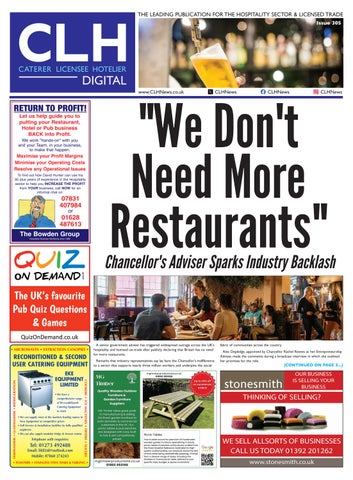
When a government adviser suggests that we may not need any more restaurants, which has been described as “ill-advised” it really does raise both concern and anger!
The recent comments attributed to Ms Depledge –and the ensuing backlash have understandably struck a nerve across the hospitality and licensed on-trade sector.
Of course, any individual is entitled to champion the sector they represent.
Advocacy is part of public life. But why on earth make a dismissive comment about not needing any more restaurants? And from someone advising government, no less. Hospitality in the UK has always been built on entrepreneurialism.
It thrives on it. Ours is a sector fuelled by ambition, graft and no small amount of courage. Chefs and operators cut their teeth in kitchens and bars up and down the country – and often across the world – honing their craft, absorbing influences, and returning to open businesses that enrich our towns and cities with global cuisines and fresh ideas.
Some go on to create restaurants that earn international acclaim. Others build muchloved neighbourhood establishments that become the backbone of local communities.
Here in Bournemouth, we are blessed with an extraordinarily diverse and vibrant restaurant scene. Independent operators sit alongside established brands, offering everything from authentic regional cuisines to cutting-edge contemporary dining.
It is not government advisers who decide which of these businesses succeed. It is customers. Market forces dictate who thrives and who falls by the wayside – as they always have. That is the essence of enterprise.
To her credit, Ms Depledge has apologised. That is welcome. But the episode highlights a deeper issue: a worrying disconnect between policymakers and a sector that contributes billions to the economy, employs millions nationwide, and plays a defining
role in Britain’s social and cultural fabric.
This disconnect is further illustrated by the latest HMRC figures (see page 5) showing alcohol tax revenues falling by £285 million despite duty increases.
It will come as absolutely no surprise to many operators. When you increase the tax burden on products and services, you suppress demand.
Suppressed demand leads to lower volumes. Lower volumes can – and often do –mean lower overall revenue.
Economists such as Thomas Sowell and the late Milton Friedman have long argued that ever-higher taxation does not automatically equate to ever-higher receipts.
Hospitality has been living that reality for years. With VAT on hospitality higher than almost all comparable European destinations, and with mounting cost pressures across energy, labour and supply chains, the idea that the sector can simply absorb further fiscal burdens defies commercial logic.
The proposed introduction of tourist taxes in parts of England risks compounding the problem. As Kate Nicholls, Chair of UKHospitality, rightly stated: “This is the wrong policy at the worst possible time.” Accommodation providers are already battling enormous cost increases and fragile consumer confidence. Layering additional charges onto family holidays, business travel and inbound tourism risks making England less competitive internationally at precisely the moment we should be encouraging growth, investment and job creation”
Hospitality does not ask for special treatment. It asks for understanding. It asks for a level playing field. And above all, it asks not to be talked down by those who appear to underestimate its value.
Restaurants, pubs, bars and hotels are not surplus to requirement. They are incubators of talent, engines of local economies and ambassadors of British creativity.
The UK’s hospitality success story has always been written by entrepreneurs willing to take risks, invest their savings and work punishing hours to bring their vision to life.
We need more of that spirit, not less. And we certainly don’t need anyone in government suggesting otherwise.
Visit our website at www.catererlicensee.com to sign up for our twice weekly enewsletter.
I can always be contacted at edit@catererlicensee.com
The Caterer, Licensee & Hotelier News Group is published by RBC Publishing Ltd, 3 Carlton Mount, 2 Cranborne Road, Bournemouth, Dorset, BH2
tion, however, no responsibility will be accepted for loss or damage. Views expressed within this publication are not necessarily those
when compiling this publication to ensure accuracy, the publisher will assume no responsibility for any effects, errors or omissions
ten permission is obtained.

At The Commercial Oven Store, we take great pride in being your go-to destination for all your commercial oven needs.
We understand that when it comes to running a successful business, having the right equipment is crucial. That’s why we have dedicated ourselves to providing top-notch products, coupled with expert advice, to help you make informed decisions and achieve your goals.
As a supplier of commercial ovens, we have established strong partnerships with leading manufacturers in the industry. By working closely with these renowned brands, we ensure that our customers have access to a wide range of high-quality ovens that meet the diverse needs of various businesses.
Whether you’re in the food service, hospitality, or catering industry, we have the perfect oven to suit your requirements.


Ms Depledge — whose career has been rooted in the property technology sector, having founded home-extension specialist Resi UK and lettings platform Good Lord — indicated that hospitality fell entirely outside the scope of her focus, stating that government support should be directed towards start-ups and scale-ups rather than small and medium-sized businesses.
She claimed that while the small business community plays a significant role in the economy, it had "played the same size role for the last 50 years" — a characterisation that drew immediate and fierce condemnation from trade bodies and operators who consider SMEs the backbone of the British hospitality industry.
The fallout was however swift, with Michelin-starred chef Michel Roux Jr taking to social media to voice his frustration, publicly questioning the calibre of those advising the government on enterprise matters saying the perspective was “not very clever”.
His intervention was followed rapidly by Sacha Lord, chair of the Night Time Industries Association, who said Ms Depledge's comments were 'disgusting'.
“The industry has been wondering why we are just being ignored - she has answered that question. They are not interested in us.
'I completely push back on it. I am pretty sure most people want to see the survival of the British high street, and that is where I was hoping Labour would try to help maintain and support.
'When they increased national insurance for employers, it took us completely by surprise.
'We are the UK's fifth biggest sector and third largest employer. When you look at SMEs we are the biggest employer in the private sector.
'It is alarming that she has this opinion.'
Lord pointed directly to the recent increase in employer National Insurance contributions as a measure that had blindsided operators across the country with little warning, and characterised the government's approach to business rates reform as, in his words, a stealth tax
by another name.
He also underlined the economic significance of the sector, noting that SMEs — the very businesses Depledge appeared to discount — represent the single largest share of private sector employment in the UK.
“THINK TWICE”
Licensee and industry campaigner Andy Lennox in who spearheaded a campaign to ban Labour MPs from pubs, also weighed urging Ms Depledge to “think twice before using such unwise words”.
He said: “People who don’t understand hospitality should not be advising the Government on hospitality, and people who think we are not an industry should think twice before they write us off.
“What would she do if she weren’t able to go to a hospitality venue?”
JW Lees brewery owner William Lees-Jones was particularly forthright, writing: "Think she needs to get out more and talk to some people who run real businesses — not just tech bros and sisters. Business Property Relief changes will actually raise less tax and make the UK uncompetitive. I can't tell you how many people I keep coming across who are moving to Dubai and domiciling their new businesses there."
2.6
The strength of feeling reflects just how precarious a position the sector currently finds itself in. UK hospitality accounts for approximately seven per cent of total national employment, supporting around 2.6 million workers — a figure broadly comparable to the retail sector. According to the Office for National Statistics, both industries have reported contracting workforces as businesses attempt to absorb the spiralling cost of wage-related tax obligations introduced by the current administration.
ONS data paints a stark picture. Restaurant numbers declined by 1.3 per cent between 2024 and 2025, leaving fewer than 89,700 establishments trading across the country. Industry bodies have continued to lobby the Treasury for a more level playing field on fiscal support — with particular frustration directed at the structure of the Chancellor's emergency business rates relief package, which extended a 15 per cent discount and a two-year rates freeze to pubs, while explicitly excluding restaurants and hotels. Operators have struggled to reconcile this distinction with any coherent industrial rationale.
UNFAIR EXCLUSION

The rates relief itself was the product of a hard-fought campaign led by publicans and MPs, which ultimately pressured the Chancellor into acting. Yet the exclusion of restaurants and hotels from equivalent protection has left a significant portion of the sector exposed at precisely the moment it can least afford it.
• 2.6 million workers employed — approx. 7% of total UK employment (ONS)
• Fewer than 89,700 restaurants trading in the UK as of 2025 — a 1.3% decline year-on-year
SMEs represent the largest share of private sector employment in the UK
• Employer NI hike introduced April 2025: secondary threshold cut to £5,000; rate raised to 15%
• Business rates relief: 15% discount for pubs from 2026, with two-year freeze — restaurants excluded
Following the widespread outcry, Depledge issued a statement acknowledging the impact of her words. She said: "I recognise that some of the remarks reported from this interview have caused concern, particularly among those working in hospitality. That was not my intention, and I'm sorry for the upset caused."
Ms Depledge added that she had started working in hospitality at the age of 13, in roles ranging from waitressing to kitchen work to bar service, and expressed respect for the sector and those who work within it. She clarified that her focus as Entrepreneurship Adviser was on creating and scaling high-growth businesses across the whole of the UK, in order to generate what she described as better-paid and more secure jobs for the future.
The controversy comes against a backdrop of sustained financial pressure on the UK's hospitality industry. The April 2025 increase in employer National Insurance contributions — which saw the secondary threshold lowered to £5,000 per employee per year and the employer rate raised from 13.8 per cent to 15 per cent — has placed a significant additional burden on labour-intensive businesses in the sector. For a typical pub or restaurant with 20 members of staff, industry bodies estimate the combined NI and National Minimum Wage increases have added tens of thousands of pounds to annual operating costs.


By Matthew Adams-Nel, Managing Director of Hospitality at ClearCourse

Independent hospitality businesses face a lot of uncertainty going into 2026. The U-turn on how business rates are calculated for pubs, alongside new support packages, was a small win for a section of the industry. However, targeted support also needs to be rolled out to restaurants and hotels for the sector to not just survive but thrive.
That’s not to say, though, that there aren’t existing opportunities to be successful. In fact, now more than ever, hospitality businesses need to make sure they’re pulling the growth levers that are within their control to win customer loyalty and stand out from the rest.
The quickest way these businesses can enhance operational success is with integrated management systems that can help them respond to consumer trends, navigate curveballs and protect their bottom line.
This might be with embedded payment solutions that improves service accuracy and speed or flexible management systems that can help leaders jump on consumer trends as they happen and deliver great experiences.
Here are just three ways hospitality businesses - namely hotels and restaurants - can take matters into their own hands to ensure long-term success.
Beyond policy changes, consumer trends have a huge impact on the bottom line for hospitality businesses. Trends like ‘Dry January’, for example, can drive demand for more low-to-no beverages at pubs and restaurants, while key moments like Valentine’s Day give hospitality businesses a boost.
With nearly half of customers saying they won’t return to a business after just one bad experience, independent restaurateurs and hoteliers can’t afford to make mistakes or underdeliver when demand changes. This is where technology can support, helping businesses stay agile, maintain a smooth service and deliver a hyperpersonalised experience for customers.
Forecasting platforms and centralised data analytics, for example, help business owners take stock and pivot quickly when a new trend emerges. This unified data can help leaders make sure they have enough staff when demand peaks, or ensure they are well stocked in trending beverages to keep customers happy and coming back for more. Joined up booking systems also make last minute changes easy to manage compared to a paper-based or disconnected system. Having digital systems that speak to one another is critical to avoid booking errors and frustrating guests.
Automating these processes not only reduces friction and improves accuracy for both staff and customers, it helps businesses capitalise on new opportunities and stay competitive.
PAYMENT SOLUTIONS
Payment systems make a huge difference to customer experiences and business efficiency. It can be a point of frustration for customers and businesses if there are multiple systems to switch between, resulting in clunky consumer experiences and manual reconciliation processes that don’t match up.
Having an embedded payment system ensures everything is done in one place, connecting reporting across all sites (whether that’s room service, or the hotel bar or restaurant) to give leaders a more comprehensive oversight of money flowing in and out of the business.
Beyond financial admin, embedded payment solutions also help make it easier for customers to pay the way they want. During COVID times a push for quick unintegrated order and pay systems has left a legacy of disjointed data and poor experience. Now, we’re seeing businesses adopt a hybrid approach, powered by integrated technology, where customers have the choice to order and pay on their phones or pay on a card machine with a server.
Having embedded, secure payment systems is essential to meeting changing customer expectations, improving the back end of the business so teams can focus on delivering the best experience possible for guests.
Nurturing customer relationships and delivering personalised experiences is essential to getting a business through tough times. In an increasingly digital world, these experiences don’t just start and end when a guest is in your establishment - it extends to before they arrive and when they get home, with digital marketing that confirms reservations and thanks them for their patronage.
To stay ahead of the competition, customers look for that extra layer of care to make their experience that much more special. This is something small businesses do well inherently, building a strong, community-centric customer base and delivering hyper-personalised experiences in person. This can be translated into digital experiences, with gifting options and CRM tools.
In the UK, 75% of consumers prefer businesses that reward their loyalty, and having a smart CRM system means you can track repeat visits and use this data to prompt personalised communications. A great personal touch can be using this tool to monitor when customers have kept their reservation despite wider disruptions - like bad weather or train strikes - and using this data to trigger personalised communications such as thankyou emails, loyalty points, and exclusive discounts to make customers feel appreciated and keep them coming back.
Hospitality SMEs are experiencing unprecedented times when it comes to the uncertain business environment. However, that’s not to say there aren’t opportunities for success and growth.
By adopting the right, integrated technology solutions, hospitality businesses can overcome age old challenges that paper-based or disjointed systems are no longer fit to handle. By making use of specialist software that supports them, hospitality businesses can take control, unlock productivity gains, use data to uncover new ways to deliver great customer experiences and stay one step ahead of the competition.
Members of Parliament and British Cider Makers gathered this month (11 February 2026) for an evening reception at the Houses of Parliament, celebrating our nation’s great tradition of cider making.
As a sector, UK Cidermaking contributes £2.7 billion to the economy and supports more than 65,000 jobs. Over 15,000 acres of British land is cultivated specifically for cider production, playing a vital role in biodiversity, landscape management, and ensuring long-term environmental stewardship.
Hosted by Sarah Dyke MP, Member of Parliament for Glastonbury and Somerton, the event also provided an important moment to reflect on the significant challenges currently facing the industry.
Martin Thatcher, Chair of the National Association of Cider Makers and Managing Director of Thatchers Cider used the occasion to urge political leaders to listen to British cider makers and support a sustainable future for the sector.

He said: “Cider makers are not just producers; we are farmers and hospitality workers too. Our annual wassail held last month- a cherished tradition where communities come together to bless the orchards for a prosperous harvest – reminded us of the importance of caring for today’s resources to ensure tomorrow’s prosperity.
“The administrative burden created by new taxes and policies including EPR, DRS, changes to inheritance tax, business rates, national insurance rises and on-going duty rises, are all placing significant pressure on our industry. These challenges extend to our supply chain, affecting our suppliers and customers.
“With the Government’s ambition for economic growth, our goals are aligned. We ask policymakers to listen to the cider industry, understand its needs and take meaningful action. By working together, we can create the right conditions for long term success.”
Sarah Dyke MP, Member of Parliament for Glastonbury and Somerton, said: “Cider is a proud part of our heritage in Somerset and across the UK. Events like this, when the industry can come together to honour the dedication and craftsmanship of British cider makers are such wonderful occasions. I’m delighted to raise a glass in Parliament to recognise their vital contribution to our rural communities and economy.”
Mark Hopper, Public Affairs Director of the National Association of Cider Makers commented: “The cider industry plays a crucial role in the UK economy. Over 98% of apple cider consumed in Britain is made here, supporting national supply chains and local jobs. That’s why it’s so important to bring MPs together to recognise the significance of British cider and its place both in the domestic economy and the global market. We’re delighted that so many parliamentarians joined us to show their support for the industry.”
Provisional government data has revealed a significant shortfall in alcohol duty receipts for the current financial year, raising fresh questions about the relationship between taxation levels and overall revenue generation across the UK’s drinks industry.
HM Revenue & Customs figures show that total Alcohol Duty receipts for the 2025-26 financial year to date stand at £7.01 billion — a fall of £285 million, or 4%, compared with the equivalent period in the previous year.
The decline is broad-based, cutting across the majority of major drink categories and coming despite successive duty upratings in recent years, a trend that will concern operators and producers across the licensed on trade.

Wine and other fermented products have returned £2.58 billion so far this financial year, representing a year-on-year reduction of £100 million, or 4%. Spirits receipts have fared worse, generating £2.15 billion — down £156 million, or 7%, making it the single largest cash decline of any category. Beer has contributed £2.09 billion, some £59 million or 3% below the comparable period last year.
The one outlier is cider, which has recorded receipts of £175 million — up £30 million, or 21% year on year. HMRC notes, however, that cider has historically accounted for approximately 2.5% of total annual Alcohol Duty revenue, limiting the wider impact of that growth on overall figures.
The steepest proportional and cash decline falls on spirits, where a 7% reduction in receipts follows a period of considerable structural change to the duty framework. The government’s overhaul of Alcohol Duty, which came into force on 1 August 2023, introduced a system under which duty is calculated per litre of pure alcohol. Spirits are liable for duty on products above 1.2% ABV, with the charge typically falling due when product leaves bonded warehouse.
Despite subsequent uprating’s to duty rates since that reform was implemented, revenue from spirits has nonetheless declined by £156 million in the current financial year to date — a result that is likely to intensify

industry debate around the effectiveness of repeated duty increases as a revenue-raising mechanism.
Looking at the most recent three-month window, provisional receipts for August to October 2025 totalled £3.12 billion, marginally ahead of the same period last year by £17 million, or 1%.
Within that period, wine and other fermented products rose by £33 million, or approximately 3%, to reach £1.18 billion. Cider continued its upward trajectory, climbing £19 million or 33% to £75 million. Spirits, however, slipped £19 million or 2% to £995 million, while beer fell £15 million or 2% to £869 million.
Following chancellor Rachel Reeve’s November budget and tax hike Wine and Spirit Trade Association (WSTA) warned that the Government’s “typically disappointing and shortsighted decision” to increase alcohol duty by RPI will perpetuate the economy’s “doom loop”.
Miles Beale, Chief Executive of the Wine and Spirit Trade Association, said: “This Budget has been dubbed a death by a thousand cuts, and for wine and spirit businesses those cuts run deep. Our members are still reeling from the tax hikes introduced in February, and the additional burden of the costly new glass tax, known as EPR. Coupled with rises in National Insurance, increases to the minimum wage and business rates, it is no surprise that wine and spirit producers – along with our beleaguered hospitality sector – feel under sustained attack.
“The Government’s typically disappointing and shortsighted decision to raise alcohol duty yet again will only prolong the doom loop. Despite the OBR at last acknowledging higher prices lead to a decline in receipts, the Government fails to recognise that its own policy is driving up those prices. Amazingly, the Treasury continues to press ahead with its ill-founded plan to pile further duty increases on alcohol.
“Prices will rise once more for consumers, British businesses will suffer, and Treasury receipts will continue to fall – forecast to be £700 million lower than last year and £1.1 billion lower than was forecast in March.”

Jonathan Cooper, Director and Founder

The pressures facing hospitality operators in 2026 are unlike anything the sector has seen in years. According to UKHospitality, more than 2,000 hospitality businesses could shut their doors this year, with around six venues a day at risk as business rate increases bite and operating costs continue their steady climb.
Restaurants, pubs and hotels all feature heavily in these projections, with 963 restaurants, 574 hotels and 540 pubs forecast to close without meaningful intervention.
And while the government announced a 15% discount on business rates for pubs and music venues in January, many hotels and other operators still stand outside the safety net – despite facing substantial financial strain. It is no surprise that more businesses are now struggling to maintain cash flow, falling behind on payments or carrying HMRC debts.
In this challenging business environment, acting quickly is vital to ensure the sound financial future of a business. Knowing the health of a business, whether strong or not, is crucial at all times so directors can make informed decisions.
Below are the early signs no operator can afford to ignore, and the practical actions that can prevent temporary pressure becoming terminal.
KEY WARNING SIGNS
Payroll delays are one of the clearest indicators that cash flow is deteriorating. Most businesses manage wage costs carefully, so when salaries start slipping, it signals that routine outgoings can no longer be covered reliably.
Late salary payment doesn’t just dent staff morale; it can lead to high turnover, reputational damage and operational instability at the very moment you need a steady team.
2. Falling Behind on VAT, PAYE or Other Tax Bills
With costs rising across the board, tax liabilities are one of the easiest areas to fall behind on. But this is also one of the most dangerous.
Once arrears form, they escalate quickly through penalties and interest. HMRC is far more supportive when businesses come forward early – long before repeated missed payments trigger enforcement.
If you’re delaying tax payments to cover suppliers or wages, it’s a clear sign the business is already under significant strain.
3. Suppliers Tightening Credit Terms
Suppliers tend to be the first to detect changes in payment patterns. When credit terms shorten, or when suppliers suddenly insist on upfront payment, it’s a sign your business is being viewed as a risk.
This creates a domino effect: tighter terms put further pressure on cash flow, leading to more shortfalls elsewhere. Many directors tell us this is the moment they realise their liquidity challenges are no longer temporary.
4. Constant Cashflow Firefighting
If every week involves moving money around, delaying payments, juggling invoices or relying on short term fixes, this signals the business is in reactive mode. A healthy operation gives leaders the space to plan, market, improve service and manage staff – not merely survive from one
payment cycle to the next.
Firefighting is not just exhausting, but unsustainable.
5. Using Personal Funds to Patch Business Holes
Many directors dig into personal savings or credit facilities to navigate a tricky period. Doing this once isn’t unusual but doing it repeatedly is a strong sign the business model isn’t coping.
Personal injections mask the true financial picture and place the director’s own financial security at risk. It’s one of the most emotionally charged conversations we have with business owners – but also one of the most essential.
With closures looming across the sector – driven by rate increases that could see the average hotel pay £28,900 more next year and £205,200 over three years – directors cannot afford to wait until pressure becomes unbearable.
Recognising financial warning signs early gives directors room to act accordingly for their business. These actions can be practical steps like engaging with creditors, restructuring business operations or seeking confidential, impartial guidance.
EARLY ACTIONS PROTECT BUSINESSES
With forecasts pointing to thousands of potential closures if cost pressures continue unchecked, the operators who survive will be the ones who recognise trouble early and act decisively.
The hospitality sector has always been resilient. But resilience does not mean absorbing every blow alone – support is always available. If any of the red flags above feel uncomfortably familiar, don’t wait for things to get worse. The earlier the intervention, the greater the chance of recovery, stability and long term viability.
International hospitality real estate group PPHE Hotel Group has posted record full-year revenues of £466.4 million for 2025, a 5.3% increase on the prior year, as the company completes its largest-ever multi-year investment programme.
The London-listed group, which develops, owns and operates hotels and resorts across the UK and Europe, saw like-for-like total revenue grow by 3.7% to £456.9 million, with occupancy rising 60 basis points to 75.1% and RevPAR improving 2.6% to £123.4.
EBITDA for the year reached £138.2 million, up 1.3% on 2024, though margins edged back slightly to 29.6% from 30.8%, with the group citing higher national insurance costs in the UK and the natural drag of newly opened hotels finding their feet in new markets.
The UK portfolio delivered a solid performance, with room revenue and RevPAR growth driven primarily by occupancy gains and stable average room rates. Trading in the Netherlands and Germany was more subdued, with pressure on both occupancy and rate, while the Croatian properties — hotels, self-catering apartments and campsites — performed strongly through the peak summer months, recording healthy average room rate growth.

A significant milestone in 2025 was the opening of art’otel Rome Piazza Sallustio in March, the group’s first Italian property and the culmination of its multi-year capital investment programme. The phased opening of
art’otel London Hoxton also continued to progress, with the 25thfloor French Mediterranean restaurant Solaya and the hotel’s suites launching in Q4. The property’s 5,000 sqm of premium office space is currently being marketed.
Co-Chief Executive Greg Hegarty described 2025 as “another year of financial and strategic progress,” adding that the results had been achieved “against a volatile macroeconomic environment and strong prior year comparatives.”
On the development front, PPHE acquired a site near the City of London in September for £17.5 million, earmarked for the group’s first select-service London hotel, expected to operate under the Radisson RED lifestyle brand when it opens in 2029.
The group also acquired the freehold of Park Plaza London Park Royal and an adjacent development site for £10 million.
A strategic review announced in November 2025 remains ongoing, with the company saying it will update the market in due course.
Looking ahead, the board said it expects to grow both revenue and EBITDA in 2026, supported by the growing contribution from recently opened properties. Analyst consensus forecasts for the year point to revenues of between £473 million and £489 million, and EBITDA of £147 million to £148 million.
Two innovations relevant now for the hard-pressed trade are heat recovery, which saves energy and cuts running costs, and Meiko’s new leasing offer, which makes its most energy-efficient machines more affordable.
Meiko’s latest M-iClean U undercounter machine, for example, now operates with a total connected load of under 5kW at 400V. This is a 21% energy saving compared to the previous generation.
The new leasing offer provides Meiko dishwashing from £7 per day, with a preinstallation survey and lifetime training support. There is also optional planned maintenance and breakdown support, plus installation, water treatment, tabling, etc., making it a choice that can ensure the best reliability, cost-effectiveness, and staff protection.
All of Meiko's added-value services, such as training support throughout the dishwasher's working lifetime, are included in its new leasing offer, MEIKO SMARTPAY.

Our training covers the safe use of the machine as you would expect, but also energy-saving and ergonomic use of equipment, ultimately saving the operator money.
Undercounter glasswashers and hood-type dishwashers are the most popular pieces of equipment. Lifetime training support is particularly useful where staff are often changing or where chains are short of managers for training. Meiko’s expertise in ergonomic design and efficient use will also save operators money. Ask for details.
For sites washing utensils, boxes, and perhaps bakery trays, plus glassware, crockery, and cutlery, the new UPster XD (extra deep) undercounter dishwasher handles glassware, serving dishes, trays,
The third weekend of the Guinness Six Nations delivered a major boost to the UK on trade, with pubs selling an estimated 12.7 million pints of draught beer and cider and generating an average of £2,002 in income per outlet, according to new data from The Oxford Partnership.
Analysis of more than 8,500 pubs across the UK shows average rate of sale increased by 2.3% compared to the same weekend in 2025, while total footfall rose by 9.9%. The uplift was driven not only by more consumers visiting pubs, but also by customers staying longer, with average dwell time increasing by five minutes year on year.
On average, pubs sold 387 pints across the Saturday and Sunday, with bars and local pubs delivering the strongest performance. Bars achieved the highest rate of sale at 204 pints per day, while locals also saw steady growth, highlighting the continued importance of community pubs during major sporting occasions.
Category performance revealed a notable shift in consumer preference. Stout was the standout performer, with rate of sale increasing by 7.9% year on year and share rising to 18.1% of total draught volume. Lager remained the largest category overall, accounting for 51.9% of volume, but its share declined slightly compared to last year.
Sport continued to play a critical role in driving engagement and spend. Pubs showing live sport benefited
from dwell times that were on average 20 minutes longer than venues without live coverage, reinforcing the commercial importance of live sport to pub operators.
The data also showed particularly strong performance on the Sunday, with footfall increasing by 22.7% compared to the equivalent day last year, demonstrating the growing importance of the full match weekend.
Alison Jordan, CEO of The Oxford Partnership, said: “The Six Nations continues to be one of the most powerful drivers of performance in the UK on trade. What stands out this year is not just the increase in footfall, but the improvement in dwell time, which is critical for driving spend and overall profitability.
“We are also seeing clear shifts in consumer behaviour, with stout gaining share and community pubs and bars performing especially strongly. These insights underline the importance of live sport in bringing consumers into pubs and creating meaningful commercial impact for operators.”
Overall, the third weekend of the Six Nations demonstrates the continued resilience and importance of live sporting occasions for the UK pub sector. Increased footfall, longer visits and strong category performance combined to deliver meaningful revenue gains for operators, highlighting how major sporting events remain essential in driving both volume and value across the on trade.
Beer Street (4.0%), an amber bitter with rye by London Brewing has won CAMRA’s Champion Winter Beer of Britain award, announced at Liverpool Beer Festival today (Thursday 19 February).
After a year of local and regional blind judging heats, the Campaign’s winter winners have been crowned. The category winners now go forward to the final judging in May at CAMRA’s Cambridge Beer Festival where they’ll battle it out to take the crown of Supreme Champion 2026.
Cairngorm’s session stout, Black Gold (4.4%), took home silver, and Green Jack’s Baltic Trader Export Stout (10.5%) won bronze.
Judges were blown away by the winner, with judging panel coordinator Christine Cryne describing Beer Street (4.0%) as: “A sparking golden amber bitter, with spicy rye and a roasty nose, sweet biscuit on the flavour, where the spicy rye notes

increase and linger in the dry and slightly bitter finish.
Very easy drinking.”
The judging and announcement took place at Liverpool Beer Festival, in the Lutyens Crypt at Liverpool Metropolitan Cathedral, just ten minutes’ walk from Liverpool Lime Street station. Competition beers are available at the festival while stocks last. CAMRA’s Awards Director, Shelly Bentley, said: “Our Champion Beer of Britain competition is the only truly independent beer contest in the UK. Brewers can’t simply enter their beers into it; they have to be nominated by beer lovers or expert tasting panels.
“London Brewing are incredibly deserving winners of the winter crown, and everyone taking home a category win or top three placement should be proud that their beers have been declared the cream of the crop by expert judges.”

By Colin Johnson, partner at MHA

The UK government’s proposed watering down of the planned business rates rise for pubs follows a turbulent period for hospitality taxation, one that highlights both the complexity of the rating system, and the political pressures that come from reform.
Since the COVID-19 pandemic, the business rates system has been in a state of flux for hospitality businesses. Temporary measures such as the transitional relief and Retail, Hospitality and Leisure (RHL) relief were introduced during the pandemic to support struggling restaurants, pubs and similar venues. The transitional relief eased the immediate impact of ratable value changes from periodic revaluations, spreading the increase over several years. Alongside this came the broader RHL relief, originally a 75% reduction, and now a 40% reduction in 2025-26, subject to a £110,000 cash cap per business. This was designed to soften bills for retail and hospitality businesses.
While the new 15% targeted relief offers pubs some welcome stability, the broader hospitality picture remains challenging, particularly for restaurants, hotels and mixed-use venues, which continue to face steep business rates pressures despite operating under similar economic constraints.
Recent government and industry analysis shows that although pubs benefit from a bespoke rate reduction, other hospitality segments face significantly higher increases. UKHospitality’s post-Budget analysis highlights that the average hotel will see its business rates bill rise by £28,900 next year, reaching an extra £111,300 by 2028/29, a cumulative increase of £205,200 over three years. This divergence has amplified concerns about fairness across the sector, especially as many restaurants and hotels are still adapting to rising wage, energy and borrowing costs.
Similarly, while restaurants fall within the wider Retail, Hospitality & Leisure (RHL) framework, many will not benefit from the pub-specific relief. These businesses instead rely on the new permanent RHL multipliers from April 2026, set 5p below national rates, replacing the temporary 40% relief and reducing some uncertainty but not fully mitigating the cost burden for many operators.
In contrast, the government estimates that eligible pubs will save an average of £1,650 each under the new 15% relief applied from April 2026, with bills then frozen in real terms for a further two years. Around threequarters of pubs will see their rates either fall or stay the same, offering stability that is not universally extended to the rest of hospitality.
The contrast between these outcomes underscores the sector’s growing frustration. Trade bodies have warned that hotels, restaurants and multi-use venues, many of which share the same pressures as pubs, remain exposed to sharp cost escalations without equivalent targeted support. As a result, lobbying across the wider hospitality industry is expected to intensify throughout 2026 as operators seek a more equitable approach before the changes fully take effect.
The business rates landscape has moved significantly with the 2026 revaluation of ratable values. These valuations determine how much a property is judged to be worth for tax purposes, and for many
hospitality properties (especially pubs in urban locations), they have climbed steeply. Combined with ending transitional relief for hospitality, and the transition towards permanently lower RHL multipliers, many hospitality businesses were facing sharp increases in their bills. This ‘cliff-edge’ situation prompted widespread concern across the sector based around future viability.
As the planned increases became clearer, significant levels of lobbying emerged from the sector. Pubs and hospitality bodies warned of closures and job losses, with many smaller operators assessing the impact as severe. Across political and industry forums, the UK government was criticised for not fully appreciating the economic and community value of pubs and hospitality.
In response, the government announced concessions targeted at pubs and live music venues. Under the new support package, eligible pubs will receive a 15% business rates relief on their bills for 2026-27, on top of the existing support announced during the Budget of 2025. Their bills remain frozen in real terms for a further two years. Approximately 75% of pubs are expected to see bills stay the same or fall in 2026-27 versus 202526, and the government claims the sector as a whole will pay circa 8% less in business rates by 2029 than under the previous trajectory.
However, the relief is narrowly defined and open to interpretation. The criteria for what constitute a pub is specific: the property must be open to the public, permit free entry aside from occasional entertainment, allow drinks to be purchased at a bar, and not require food to be consumed. Explicit exclusions include restaurants, cafes, nightclubs, hotels, guesthouses, and other venues. Where eligibility is unclear, local authorities are tasked with making the determination, which means there could be local variations in the way the definition is applied.
The narrow definition raises deeper issues because many hospitality businesses have diversified in recent years, blurring traditional lines between pubs, restaurants, cafes, and bars. Under financial pressures, establishments often combine food, drinks, events, and other services, making it harder to draw a clear distinction. There is a long-standing history of challenges in business rates, with ratepayers and authorities frequently disputing whether a property fits a particular category, and the new targeted relief risks adding further confusion about who qualifies, and who does not. Businesses that have added food or entertainment to drive revenue may find themselves excluded, even if their operating model remains close to that of a traditional pub.
There is also the question of fairness across the hospitality sector. While targeted support recognises the cultural importance of pubs, it leaves other parts of the sector, such as restaurants, hotels, cafes, and some leisure venues, still facing significant cost pressures. With rising energy costs, workforce shortages, and subdued consumer demand affecting the entire industry, singling out one segment for relief can feel arbitrary and unfair, especially when many hospitality businesses face similar threat profiles. This has led to claims that the government does not fully understand the economic value they deliver and leaves them bracing for increased bills without relief.
For businesses falling outside the new pub definition, the recent concessions may feel insufficient. Restaurants, bars, and mixed v enues that do not fit the criteria could be left without targeted relief, even as they face similar cost and business pressures.
For these businesses, lobbying trade bodies, local members of Parliament, as well as the formation of sector alliances will remain an important strategy. We anticipate an increase in concern amongst, and pressure from, these venues for reconsideration before the changes fully take effect in April 2026.
Drake & Morgan, the 16-strong bar and restaurant group, has raised a milestone £500,000 for its longstanding charity partner, Maggie’s, helping provide vital support for people with cancer and their families in the UK.
Since 2019, Drake & Morgan has proudly built a long-standing partnership with Maggie’s, embedding charitable giving into the heart of its culture and commercial activity. Through dedicated hero dishes, donating £1 from every plate alongside estate-wide fundraising initiatives and the collective generosity of guests and teams, the restaurant and bar group has raised over £500,000.
Over that time, this remarkable sum has helped Maggie’s provide free practical and emotional support to people with cancer at centres across the UK, enabling:
• More than 8,000 people to receive financial support from Maggie’s benefits advisors

• Allowing a key centre to stay open for over 30 weeks, so anyone who needs Maggie’s can ‘just come in’
• 25,000 people with a cancer diagnosis to access expert help with a cancer support specialist
Adam Feder, Head of Corporate Partnerships at Maggie’s, comments:
“We are incredibly grateful to Drake & Morgan for their unwavering support over the past six years, and their amazing contribution of £500,000.
Maggie’s has over 30 years of experience providing free cancer support and information in centres across the UK, and the funds raised have helped us offer this vital care to the thousands of people who visit our centres every year.”
Jillian MacLean, CEO of Drake & Morgan, comments: “To have raised over half a million pounds for Maggie’s is a wonderful achievement for the whole team at D&M. I’m immensely proud and would like to extend our thanks to our lovely customers for their kind donations and support.”
Businesses from across the grocery, hospitality, specialist retail and manufacturing sectors are coming together at The UK Food & Drink Shows. Taking place at the NEC Birmingham from 13-15 April, visitors can expect three days of innovation, inspiration and networking.
Food & Drink Expo is the destination for forging connections and gaining insights into the future of food, attracting key foodservice buyers, caterers as well as decision makers from hospitality, retail and wholesale grocery operations. Exhibitors include Handtmann Ltd, Meadowvale Foods Ltd, Midshires Catering Equipment Ltd, MONO Equipment, RawPac, SMEG Professional, VendNation UK and Worldpay – and many more!

This year's event comprises four shows that each target a sector of the food and drink industry. Alongside Food & Drink Expo visitors can gain free access to Farm Shop & Deli Show, National Convenience Show and Forecourt Show.
WHAT’S NEW FOR 2026?
The event continues to evolve to reflect the UK's vibrant and fast-moving food and drink industry with new
attractions for 2026 including:
• Spotlight on Coffee Shop & Café: As the food-to-go market continues to boom, this dedicated space at Farm Shop & Deli Show will highlight the latest trends and products shaping the sector.
• Spotlight on Future Foods: Part of Food & Drink Expo, this area will celebrate the brands and innovators redefining what good food means by showcasing wellness-driven, clean-label and sustainable products that deliver on taste and convenience.
Competitions are always a big part of the UK Food & Drink Shows line-up, and the 2026 event brings the debut of the Taste the Future contest. Visitors will have the chance to sample and score 40 trailblazing products, with participating brands in the running to win £5,000 worth of prizes.
New analysis of ONS Annual Survey of Hours and Earnings (ASHE) data by the Living Wage Foundation reveals that areas where low pay is most prevalent are seeing things get worse, despite slow improvements at the national level.
The research further revealed that one in two hospitality jobs in the UK are paid below the Real Living Wage of £13.45 per hour.
72% of the 25 local authorities with the highest rates of below real Living Wage pay in the UK saw increases in low paid work between 2024 and 2025, compared to rises in only 33% of all local areas.
Rising low pay in most of the worst affected areas also contrasts with the national picture, where the rate of low pay across the UK overall fell from 15.7%, or 4.6 million jobs, to 14.6 %, or 4.4 million jobs.
The findings highlight a widening gap between the areas worst hit by in-work poverty and the rest of the UK, indicating that progress in tackling low pay is unevenly distributed.

The local authorities with the highest rates of low pay are clustered in certain regions: 11 are in London, five in the West Midlands, and four in the East of England.
The three local authorities with the highest rates of low pay are all in London: Redbridge (34.5%), Barking and Dagenham (31.2%) and Haringey (29.7%).
The three local authorities with the biggest annual increases in rates of low pay were all part of the 25 that already had the highest levels of in-work poverty: Merthyr Tydfil in Wales (13.3 percentage points), Merton in London (9.9 percentage points) and Lichfield in the West Midlands (7.7 percentage points).
In total, 326,000 workers are paid below the real Living Wage in the 25 local authorities with the highest rates of low pay, or nearly 7.5 % of the total number of low paid workers in the UK. That is despite only 4 per cent of all jobs being located in these areas, meaning they have nearly twice their share of low-paid jobs.
New research by Cardiff Business School and the Living Wage Foundation found that if just half of the UK’s 4.4 million low paid workers saw their pay rise to the real Living Wage, the increase in wages, productivity and spending would deliver £1.6 billion back into the UK economy.
The real Living Wage is the only UK wage rate independently calculated based on the cost of living and is currently £13.45 across the UK and £14.80 in London to reflect higher living costs in the Capital. It is different to the government’s legal minimum (National Living Wage) of £12.21.
Workers paid below than the real Living Wage are unable to afford a decent standard of living, with many forced to skip meals regularly, use foodbanks and leave the heating off in winter.
Despite millions of workers on low pay, there is a growing movement of over 16,000 accredited Living Wage Employers in the UK who deliver pay rises in line with the cost of living to nearly half a million employees on the real Living Wage each year.
Together they have put £4.7bn back into the pockets of low paid workers since the campaign began 25 years ago.
Katherine Chapman, Director of Living Wage Foundation, said:
“Today’s findings show that despite low pay falling across the country, the areas already worst affected by in-work poverty are slipping even further behind. Hundreds of thousands of workers in these areas, as well as millions more across the UK, are still struggling to live with dignity as their pay is too low to cover basic living costs.
“The real Living Wage is the solution. After years of high prices, it’s more important than ever that more employers join the 16,000 committed to doing the right thing by paying their workers in line with the cost of living. It’s good for workers, businesses and the economy.”
The Foundation is urging employers, particularly in sectors such as hospitality where low pay remains endemic, to take immediate action by committing to the independently calculated Real Living Wage. Campaigners argue that targeted support in the hardest-hit local authorities is essential to prevent further entrenchment of in-work poverty and widening regional inequality. Without decisive intervention, they warn, communities already facing the steepest challenges risk being left even further behind national progress.
With more than 16,000 accredited employers already demonstrating that paying the Real Living Wage is both viable and beneficial, advocates say momentum is building for change. As policymakers consider how to boost productivity and living standards, the evidence suggests that lifting wages in the areas most affected could deliver meaningful returns not only for workers and their families, but for local economies and the UK as a whole.

New Government plans could force hospitality businesses to formally consult staff on how tips are shared
By Hannah Strawbridge, Employment Solicitor and Executive Director, Inspire

When the statutory Code of Practice on fair and transparent distribution of tips came into force, many hospitality operators breathed a sigh of relief. Policies were updated. Troncs were reviewed. Payroll systems were adjusted. Managers were briefed.
And now, here we are again.
The Government’s newly launched consultation proposes strengthening the existing tipping framework by requiring employers to formally consult workers when creating or reviewing tipping policies. Framed as a transparency measure, it signals something much broader: a clear shift towards worker voice in reward structures.
For busy pubs, restaurants and hotels, this is not just a technical tweak. It is a process obligation with legal risk attached.
So why revisit tipping rules so soon?
The original reforms were designed to ensure that 100% of tips and service charges go to workers, with fair and transparent allocation. In practice, however, I’ve seen two recurring problems in my work with hospitality clients at Inspire Legal Group:
1. Policies that look compliant on paper but are poorly understood by staff.
2. Distribution models that evolve informally over time, without documentation.
The consultation suggests that Government concerns are less about outright non-compliance and more about opacity and lack of worker involvement. In other words, it is not enough to distribute tips fairly; employers may soon have to demonstrate that workers had a genuine opportunity to shape how that fairness is defined. That is a significant cultural shift.
Mandatory worker consultation – what does “meaningful” look like?
If this proposal proceeds, employers will not simply be required to inform staff of tipping arrangements. They will need to consult them.
As employment lawyers, we know consultation is a word with legal weight. Whether in redundancy or TUPE scenarios, consultation must be genuine, undertaken at a formative stage, and capable of influencing the outcome.
In a tipping context, meaningful consultation is likely to require:
- Sharing the proposed allocation model in advance.
- Explaining the rationale behind it.
- Giving staff adequate time to comment.
- Considering alternatives raised.
- Documenting responses and decisions
In a recent matter I advised on, a restaurant group changed its tronc allocation formula after recruiting more senior front-of-house staff. The change was commercially sensible. The problem? It was announced via WhatsApp and implemented the following week. Predictably, junior staff alleged favouritism and indirect discrimination.
No tribunal claim ultimately materialised, but the management time and reputational damage were significant. Under a strengthened consultation duty, that approach would be high risk.
TRIBUNAL EXPOSURE AND LEGAL RISK
Failure to comply with tipping legislation already exposes employers to employment tribunal claims. A strengthened consultation requirement increases that exposure in several ways:
• Claims for failure to comply with statutory obligations.
• Unlawful deduction from wages arguments if distribution is challenged.
• Discrimination risks where allocation disproportionately impacts certain groups.
• Whistleblowing claims where workers raise concerns about fairness. Hospitality is fast-moving. Managers are operationally focused. But tribunals look at process. If there is no paper trail evidencing consultation, no meeting notes, and no written responses to staff feedback, employers will struggle to defend themselves.
From a risk perspective, this is less about the percentage split and more about governance.
PREPARING NOW: PRACTICAL STEPS BEFORE APRIL
Even though the consultation is ongoing, sensible operators should act
Legal Group
(www.inspirelegalgroup.co.uk)
now. In my day-to-day practice, I encourage clients to treat upcoming legislative shifts as an opportunity to stress-test systems rather than scramble at the last minute.
Key steps include:
Policy review: - Is there a written tipping policy? - Does it clearly explain how tips and service charges are allocated? - Does it cover troncs, card tips and cash separately? - Is it accessible to staff?
Build consultation into your annual cycle Rather than viewing consultation as a one-off burden, consider embedding a structured review annually or bi-annually. Invite staff representatives or hold team meetings. Circulate proposals in writing. Keep minutes.
Train managers: - Many legal risks arise because line managers treat tipping discussions as informal team matters. They need to understand that allocation decisions have legal status. A short briefing on how to handle feedback and avoid off-the-cuff promises can prevent future disputes.
Record-keeping Maintain: - Copies of policies (with version dates). - Consultation communications. - Meeting notes. - Written summaries of decisions and reasoning.
If challenged, this documentation will be invaluable.
What this consultation really reflects is a broader move towa transparency and worker voice in reward practices. We are seeing this in pay gap reporting, flexible working reforms, and the strengthening of day-one rights.
Hospitality has always relied heavily on discretionary income through tips. Historically, allocation models were often driven by custom and management discretion. That era is fading.
Today’s workforce expects visibility and fairness. Younger workers in particular are more willing to challenge perceived inequities. Social media amplifies complaints rapidly. What might once have been a quiet grumble in the staff room can now become a reputational issue overnight.
For employers, the message is clear: transparency is not optional, and process matters as much as outcome.
The consultation may feel like regulatory fatigue so soon after the statutory code. But those businesses that embrace structured consultation, clear communication and robust documentation will not only reduce legal risk – they will strengthen trust internally.
In a sector where retention is critical and margins are tight, that trust may be worth far more than the tips themselves.
Following news that a Kent pub landlord was offering free cab service to regulars the pub has this weekend been forced to abandon the charity taxi service that raised hundreds of pounds for a motor neurone disease charity, after council licensing officers ruled it fell foul of private hire vehicle regulations.
Paul Hartfield, who runs the Shepherd Neame pub The Flying Horse in Smarden, had been offering customers lifts home in his own black cab since November, with passengers invited to make voluntary donations to the Motor Neurone Disease (MND) Association. The initiative raised more than £700, with around 100 patrons having used the service over several months.
Mr Hartfield launched the scheme after one of his regular customers was diagnosed with MND, and structured it so that anyone booking a table at the 18th-century village pub could indicate whether they needed a lift home at the end of their evening.

Photo: Shepherd Neame
Ashford Borough Council intervened following local media coverage of the initiative, with licensing officers determining that the vehicle constituted a private hire vehicle under existing legislation. Despite the fact that Hartfield received
no personal financial benefit from the arrangement, officers indicated that the potential for “commercial benefit” was sufficient to bring the service within the scope of licensing requirements.
Speaking following the ruling, Mr Hartfield expressed frustration at the outcome. “It’s mean-spirited,” he said, adding that the broader trading environment was already placing significant pressure on the licensed trade.
He cited rising business rates and escalating operating costs as further burdens bearing down on pub operators across the country.
The pub owner described the service as little different from one friend driving another home, and said he was uncertain how to proceed in the wake of the council’s intervention.
The decision has drawn sharp criticism from locals. Regular customer Paul Upton, 55, called the ruling completely disproportionate, arguing that Hartfield had funded the initiative entirely from his own pocket — purchasing the vehicle, covering fuel costs and arranging his own insurance — all in service of a charitable cause.
The Night Time Industries Association (NTIA) will host The Hon. John Graham MLC, Minister for Music and the Night Time Economy in New South Wales, Australia, for a landmark programme of engagements across the UK and Scotland, reinforcing the growing international call for a dedicated Night Time Economy (NTE) portfolio within central government.
The forthcoming visit will see Minister Graham meet with Mayors, senior policymakers and officials in London, Manchester, Birmingham and Glasgow, alongside dedicated engagements at Westminster and Holyrood. Discussions will focus on the strategic importance of embedding the night-time economy within central government through formal ministerial leadership.
The visit comes at a pivotal moment for the sector, as global momentum accelerates following the inaugural Global Night Time Economy Ministers’ Meeting in Australia, where Minister Graham and ACT Minister Tara Cheyne issued a clear call for jurisdictions worldwide to
appoint dedicated Night Time Economy Ministers.
New South Wales has emerged as an international case study for how a ministerial model can unlock reform, strengthen cross-departmental coordination and deliver measurable economic and cultural outcomes. The adoption of a formal Night-Time Economy portfolio has enabled structured collaboration across licensing, planning, transport, policing, health, tourism, treasury and the arts, ensuring long-term stability and legislative backing.
Through this programme of meetings across UK territories, the NTIA aims to facilitate dialogue on how similar frameworks could strengthen policy coordination, protect reform through parliamentary scrutiny and provide the industry with a stronger, more resilient footing within government.
Michael Kill, CEO of the NTIA and Vice President of the International Nightlife Association, said: “We are proud to be hosting Minister Graham as part of this important international exchange. The NSW model demonstrates what can be achieved when the night-time economy is recognised as core economic and cultural infrastructure within central government.
This visit provides an opportunity for senior leaders across the UK
and Scotland to engage directly with a working example of Ministerial leadership in action.”
John Graham, New South Wales (Australia) Minister for Music and the Night-time Economy: “In Sydney we learnt our lessons the hard way, but our crisis spurred a complete policy rethink that is now delivering a more vibrant, diverse and safer city after dark.
“In our experience ministerial representation has been crucial to driving the funding, legislative reform and agency coordination required to turn our city around. We have so much to learn from each other as we strive to make our cities the best they can be, which is why I’m excited to be in the UK to share experiences.”
As calls grow within the UK, including from senior political leaders advocating for a dedicated Minister for the Night-Time Economy, this visit represents a significant step in strengthening international collaboration and advancing the case for structured, long-term government leadership of the sector.
The global message is clear: to maximise the potential of cities after dark, the night-time economy must have a clear mandate, strategic oversight and representation at the highest levels of government.
Restaurant groups across the country have seen a strong growth in delivery sales in the first month of 2026, according to the latest NIQ Hospitality at Home Tracker.
The Tracker, powered by CGA intelligence, reveals like-for-like delivery sales in January were 7.4% ahead of the same month in 2025. This is a sharp increase from growth of 4.1% in December, and the Tracker’s joint second highest figure since the start of 2025. Deliveries were boosted in January by widespread and persistent rain, which led many people to stay inside rather than eat out.
Restaurants’ at-home sales have also been boosted by rollouts of new delivery offers. Total delivery sales in January – including from restaurants opened in the last 12 months, or ones where deliveries have been introduced for the first time – were 13.9% ahead of the same month in 2025.

However, revenue from takeaways and click-and-collect orders dropped 9.1% on a like-for-like basis in January, as some consumers tightened their spending after Christmas and others switched to the convenience of deliveries. Takeaway sales have now fallen year-on-year for 10 successive months.
With deliveries and takeaways combined, the NIQ Hospitality at Home Tracker indicates that restaurant groups’ like-for-like at-home sales in January were 2.7% ahead of January 2025. This is fractionally below the UK’s 3.0% rate of inflation, as set by the Consumer Prices Index. Total sales were 11.8% ahead. The growth of at-home sales means deliveries accounted for 13.8 pence per pound spent at restaurants in January. Takeaways and click-and-collect orders generated 5.0 pence.
Karl Chessell, director – hospitality operators and food, EMEA at NIQ, said: “The bright start to 2026 for delivery sales is a contrast to eat-in trends and a welcome source of growth for restaurant operators.
“With nearly one pound in every seven spent with restaurants now going on deliveries, this is clearly now a valuable and mature channel.
“However, it’s not a risk-free increment to sales, and restaurants need to stay alert to protecting both the profitability and quality of their delivery offers. With consumers still cautious with their spending, operators will have to keep working hard to sustain at-home demand in 2026.”

warns global recruitment and smarter workforce planning will define hospitality success as staffing shortages persist

UK hospitality businesses are heading into 2026 facing a perfect storm of rising costs, talent shortages, and shifting immigration rules, warns workforce management provider Quinyx (www.quinyx.com).
And, as the sector battles to fill thousands of vacancies, many operators are looking beyond borders to secure the skills they need. However, with visa restrictions tightening and wage bills soaring, the challenge isn’t just finding peopleit’s managing them effectively.
“Hospitality has always relied on a diverse, global workforce,” says Ned Gammell, VP of Sales and hospitality expert at Quinyx. “But the landscape has changed dramatically.
Employers are under pressure from every angle - higher wages, stricter visa requirements, and unpredictable demand. Success now depends on how quickly businesses can adapt their workforce strategies.”
Hospitality remains one of the UK’s largest employers, contributing over £93 billion annually to the economy, yet the sector grapples with an estimated 84,000 unfilled positions[1].
Gammell explains: “Historically, more than 20% of the workforce came from overseas, but new immigration reforms have raised barriers. For instance, over 180 hospitality roles have been removed from visa eligibility. Plus, sponsorship costs for employers have surged, whilst at the same time, wage pressures are mounting. 2026
looks set to be hugely challenging for these people-centre businesses.”
From April 2026, the National Living Wage will rise to £12.71/hour, adding an estimated £1.4 billion in extra costs for hospitality businesses annually. Combined with frozen tax thresholds and higher NI contributions, operators are facing unprecedented financial strain.
Quinyx’s own State of the Frontline Workforce research highlights the human side of this challenge: 65% of hospitality staff experience job-related stress, and nearly half (49%) said their job has had a negative impact on their physical or mental health. According to the global research, UK workers increasingly value flexible scheduling and better tech tools—areas where hospitality businesses can make a real difference.
“This isn’t just about filling gaps,” Gammell adds. “It’s about creating an environment where people want to stay. When you’re managing teams from multiple countries, with different languages and visa conditions, complexity skyrockets. That’s where technology becomes a game-changer.”
Looking ahead, Quinyx predicts that 2026 could be a tipping point for UK hospitality. “Unless businesses embrace smarter workforce planning and retention strategies, we risk a black hole where demand outstrips available labour,” he warns.
“Overseas recruitment will decline sharply due to higher visa salary thresholds and reduced eligible roles. At the same time, reliance on flexible, tech-enabled scheduling will surge as operators seek to maximise productivity from smaller teams. Those who fail to adapt could see service levels and profitability collapse, while businesses leveraging AI-driven workforce management will maintain resilience.”
Gammell concludes: “When scheduling runs smoothly, managers have more time to focus on what really matters—motivating their teams and delivering exceptional customer experiences. The businesses that win in this new era will be those that combine global talent with smart, tech-driven workforce planning.”
With just two weeks to go until the 2026 Toque d’Or National Heats, Nestlé Professional has unveiled the shortlist of students set to compete in the next round of its prestigious hospitality competition.
Taking place at The Grand Cookery School in York from 9–12 March, the Heats will bring together 48 of the UK’s most promising back-of-house (BOH) and front-of-house (FOH) college students for four days of intense challenges.
Chef Kate Austen will lead the expert panel of BOH judges. Known for her creative flair and refined approach to contemporary European cuisine, most notably from her time in Scandinavia, Kate will inspire the 24 young chefs competing. Meanwhile, seasoned hospitality professional Andy Downton will head up the FOH judging panel, using more than two decades of Michelin-level hospitality expertise to guide and mentor the budding restaurateurs.
Sharing her excitement about the standard of this year’s competition and the importance of nurturing young talent, Kate said: “I’m absolutely delighted to be judging this year’s Toque d’Or. It’s such a prestigious competition for young people in hospitality and I’m really looking forward to seeing the passion, creativity and dedication the competitors bring. Supporting emerging talent is incredibly important and I’m honoured to be part of Toque d’Or 2026.”
Andy added: “I am extremely proud, honoured, and grateful to be heading up the FOH judging panel for Toque d’Or 2026. My role is always to support, guide, and advise the next generation of hospitality professionals, helping them shape their future careers and achieve their goals. Toque d’Or gives me the platform to elevate that support even further.
“I am looking for our competitors to showcase their hospitality skills to the very highest standards. However, I will also be looking for leadership, communi-

cation, passion, consistency, humility, and above all, the ability to remain cool, calm, and collected under pressure.
“I look forward to meeting all of the competitors and wish them every success, let the competition commence.”
Joining both of them on the panel will be last year’s FOH winner Katie Blundell and BOH finalist Olivia Cartlidge. Other panelists include Nestlé Professional development chef Paul Hawkins, channel manager for branded desserts ingredients James Candy, coffee training specialist Jo Walsh and coffee trainer Emilia Flajszer, as well as Country Style Food’s senior development chef Chris Brown.
Almost 400 students from 43 colleges across the UK registered for this year’s competition, showcasing their creativity and passion for hospitality in a highly competitive entry process.
Lorenzo Viganò, Managing Director, Nestlé Professional UK&I, said: “It’s a real privilege to support the next generation of hospitality talent through Toque d’Or. The creativity and dedication of the students is remarkable – not only are they experimenting with new flavours and techniques, but they’re also celebrating cultural diversity and pushing the boundaries of innovation – all incredibly relevant themes in today’s hospitality industry.
“Nurturing young talent is at the heart of everything we do here at Nestlé Professional. We’re committed to supporting the next generation by helping them gain the skills, confidence, and awareness they need to succeed in our vibrant and dynamic industry. I’m excited in my new role to see how their journeys unfold over the course of the competition, which promises to be another thrilling showcase of talent, creativity, and innovation.”
Stannah Lifts Distribution & Service (LD&S), a leader in the UK lift sector, has launched a new commercial website that makes it easier for construction professionals to find the right lift solution.
Developed around the needs of architects, contractors and consultants, the site features a simplified structure, improved navigation, clearer product pages and more consistent data, making it easier to access technical information and identify the right lift solutions for different building types.
Replacing a website that served the industry for nearly a decade, the new platform responds to the growing need for accurate, accessible product data in building design and construction, which is essential for demonstrating compliance with building regulations.
Key improvements include:
• Easy to navigate view of the complete Stannah product range in one place

• Enhanced on-page product specifications that make comparing lift types, configurations and aesthetic options quicker and more intuitive
• Sleek, unified product pages packed with consistent, project-ready information to support confident decision-making
• Faster access to product technical documentation and gated resources that help architects, contractors and consultants specify with certainty
This updated approach ensures faster, more confident decision-making, whether customers are researching products, comparing specifications or downloading documentation.
Archie Hungwe, CEO of Stannah Lifts Distribution & Service, said: “Our new website gives the construction sector clearer technical information, simplifies specification and helps project teams quickly find the right lift solution. As construction demands evolve and our product offering have become more complex, we’re committed to supporting contractors, architects and consultants with the tools and resources they need to deliver high-quality, compliant lift installations.”
Built on a more flexible and scalable digital architecture, the website now allows Stannah to introduce new products and technical content more easily as the business expands its portfolio.
To explore the new website and Stannah’s lift solutions, visit: www.stannahlifts.co.uk

École Ducasse, named the World’s Best Culinary Training Institution for three consecutive years, has unveiled the key trends it expects to shape 2026. True to the philosophy of its founder, multi-starred chef Alain Ducasse, the institution observes a profound evolution in culinary practices, driven by a pursuit of balance, naturalness and meaning.
Three major dynamics are emerging: reduced-sugar desserts, plant-based cuisine and the “garden-to-plate” approach.
Long associated with intense indulgence, pastry in 2026 continues its evolution towards creations that are less sweet, more subtle and focused on the intrinsic flavour of ingredients.
In 2026, reduced-sugar desserts are not about restriction, but about balance. Chefs are refining their mastery of sugar, playing with bitterness, acidity and texture to reveal the aromatic complexity of fruits, grains and chocolate. This approach responds to a dual objective: preserving consumer health while enhancing the tasting experience. Fruit, in particular, is becoming central to this philosophy, valued both for its nutritional qualities and for its aromatic and visual richness. In this respect, chefs such as Cédric Grolet, an alumnus of the École Nationale Supérieure de Pâtisserie (École Ducasse), have placed fruit at the heart of their creative expression, across taste, design and presentation.
At École Ducasse, this development is fully integrated into the teaching of pastry arts, where technical mastery is combined with deep reflection on nutritional composition, seasonality and precision of flavour. At the École Nationale Supérieure de Pâtisserie (ENSP), the world’s largest campus dedicated to pastry arts, professional training programmes such as “Yule logs and gluten-free end-of-year treats, without added sugar or with a low Glycaemic Index” reflect this commitment to combining health and pleasure. The programme “Small Cakes, New Trends” also emphasises lightness, flavour balance and a contemporary approach to dessert.

These modules reflect a strong conviction: tomorrow’s pastry excellence must be as nutritionally conscious as it is impeccable in taste.
Plant-based cuisine is firmly establishing itself as a cornerstone of contemporary gastronomy. In 2026, it is no longer simply an alternative: it is a fully recognised field of culinary expression.
Far from being limited to ingredient selection, this approach relies on specific techniques such as fermentation, gentle cooking methods, plant-based extractions, the preparation of concentrated juices and broths, and the roasting of seeds and grains. Chefs are developing highly precise methods to elevate plant ingredients, refine textures and deepen aromatic intensity. This evolution reflects growing awareness of environmental and
societal challenges, while also representing a remarkable creative opportunity. École Ducasse supports this transformation by placing plant-based cuisine at the core of its programmes, preparing future talent to design innovative, responsible and economically viable menus. At the Paris Campus, continuing professional training programmes such as “Plant-Based Cuisine” (May and November 2026) provide in-depth work on seasonal vegetables, grains and legumes, while the programme
“Cooking the Living: A Free and Inclusive Plant-Based Cuisine” (April 2026) explores a committed, sustainable and life-respecting culinary approach.
“Plant-based cuisine is not an alternative; it is a field of expression in its own right,” explained Julian Mercier, Executive Chef at École Ducasse Paris Campus. “It requires just as much technical skill, precision and creativity as traditional cuisine. Training chefs to elevate plant ingredients gives them the tools to shape a contemporary gastronomy that is responsible and deeply aligned with its time.”
FROM GARDEN TO PLATE: RECONNECTING GASTRONOMY WITH NATURE
The third major trend for 2026 lies in a more integrated approach to production, from garden to plate.
The use of edible plants, fresh aromatic herbs, flowers, microgreens and locally grown produce is becoming a defining marker of culinary identity. Chefs are developing kitchen gardens, working closely with producers and rediscovering forgotten varieties to enrich their flavour palette.
This philosophy, closely aligned with Alain Ducasse’s vision, is rooted in respect for the living world, seasonality and traceability. It embodies a conscious gastronomy in which technique serves nature, not the other way around.
Julian commented: “The trends emerging for 2026 are not simple fashions; they reflect a deeper transformation of our profession, towards a gastronomy that is more conscious, more creative and more closely aligned with societal and environmental expectations. At École Ducasse, we place these developments at the heart of our teaching to train chefs who are capable of innovating, adapting and inspiring.”
École Ducasse runs three schools in France – Paris Studio, Paris Campus and ENSP – as well as international schools and studios in the Philippines, India, Thailand and the United Arab Emirates.
All are united by a desire to share a passion for gastronomy, the broad portfolio of programmes aims to meet all training needs: from short programmes for experts or food enthusiasts to intensive two to ninemonth programmes for career changers, to three-year undergraduate programmes and bachelor’s degree in culinary and pastry arts.
Through these 2026 trends, the school reaffirms its mission: to transmit excellence in savoir-faire while preparing professionals to shape a gastronomy that is more responsible, more plant-forward and more balanced.
Community pub group Admiral Taverns has reported a significant uplift in profitability for the 53 weeks ended 1 June 2025, with underlying profit from operations rising 19% to £45.6m, as the group delivered on its strategic ambitions through targeted acquisitions and substantial estate investment.
The group, which is owned by real estate private equity firm Proprium Capital Partners, grew its estate to 1,365 pubs during the period, underpinned by £31.5m of pub investment across both its Leased & Tenanted and Operator Managed portfolios.
Group turnover climbed to £210.4m from £194.5m the previous year, with gross profit reaching £122.0m. Underlying EBITDA rose to £68.9m from £60.8m, while the group returned to profit after tax, posting a £2.0m gain against a loss of £4.7m in 2024.
The year also marked the group’s first acquisitions since its Hawthorn deal in 2021, with 37 pubs purchased from Fuller’s in July 2024 to bolster its presence in London and the South East, followed by 18 community pubs acquired from Marston’s in September 2024. A further 21 pubs from RedCat Hospitality were acquired post year end in November 2025, signalling continued momentum into the new financial year.

Admiral’s Operator Managed division, Proper Pubs, expanded to 222 sites as the group maintained its
focus on wet-led community locals run by entrepreneurial licensees. The group’s estate net book value increased to £748.7m, up from £613.2m in 2024.
Chief executive Chris Jowsey said the results demonstrated the resilience of the business in a difficult trading environment. “Despite challenging wider macro-economic circumstances, we were pleased to deliver the first two acquisitions since our Hawthorn acquisition in 2021, with a further 55 sites added to our portfolio,” he said.
Jowsey also highlighted the strength of Admiral’s licensee relationships, pointing to industry survey results showing that eight in ten licensees would recommend the group to fellow publicans. “Our licensee-centric model is vital to the success of the business,” he added.
On the regulatory front, Jowsey welcomed the Government’s announcement of a revised business rates regime for the pub sector, describing it as a positive step while calling for longer-term reform. “We remain hopeful that this is the first step in a longer-term permanent overhaul of the unfair business rates system,” he said.
Looking ahead, Admiral said current trading is ahead of expectations and that the group remains well positioned to continue delivering profitable growth and strategic progress through 2026.

CPRWrap Europe has announced Project Rosie, a nationwide initiative to make CPR training accessible across the UK hospitality industry, equipping employees to be CPR-competent, confident and ready to act.
Project Rosie is a true industry-wide campaign, supported by the British Institute of Innkeeping (BII), The British Beer and Pub Association (BBPA) and UKHospitality (UKH) across the entire hospitality industry, a sector that employs 3.5 million across the UK. In the United Kingdom, there are approximately 115,000 out-of-hospital cardiac arrests reported to ambulance services each year, but emergency services attempt resuscitation in around 43,000 of these cases (about four in 10).
Survival to hospital discharge after out-of-hospital cardiac arrest is less than 10%, meaning that the large majority of people affected do not survive. Immediate bystander CPR can more than double a cardiac arrest victim’s chance of survival, but too few people feel confident to act. A recent Ipsos survey of 2,252 UK adults (aged 16–75) found that just 13% say they are very confident in giving CPR to someone they do not know.

When asked how confident they would feel performing CPR using CPRWrap™, the proportion saying they would feel “very confident” increased to 20%. Overall confidence (those saying they were either ‘somewhat’ or ‘very confident’) increased from 43% to 67% in the same research.
“Project Rosie” includes: A focus on building CPR competence and confidence, giving hospitality staff the knowledge to respond to a cardiac arrest Accessible CPR training for hospitality outlet and supplier employees at all levels Distribution of CPRWrap™ kits, providing a practical tool to support confidence in an emer-
gency Engagement with all participants to become advocates for CPR competency and confidence to their customers and communities, extending the initiative’s life-saving impact.
Cost is £10 per CPRWrap which includes access to training and gives suppliers, venues and outlets a valuable CPR aid to add to their first aid kits.
“Project Rosie represents a unique opportunity to empower the UK’s hospitality industry to save lives,” said Naomi Fielding, Commercial Director, CPRWrap Europe. “Immediate CPR can make the difference between life and death, and by making training widely accessible, we are equipping everyday people to become confident in emergency situations.”
Allen Simpson, Chief Executive of UKHospitality, added: “Hospitality is built on care, people and community, and with that comes a responsibility to keep one another safe. “UKHospitality is proud to support an industry-wide commitment to improve CPR competence and confidence, helping our people feel prepared to act in an emergency. “This campaign reflects the very best of our sector – working together to create safer workplaces, stronger communities and a more resilient future for hospitality.”
Emma McClarkin, CEO of the British Beer and Pub Association, said: “We’re proud to support a fantastic initiative that will give more people crucial knowledge and confidence to respond to cardiac emergencies.”
Steve Alton, CEO of the British Institute of Innkeeping (BII) added: “Pubs are at the heart of their communities and are often the first place people turn to when help is needed.
This programme ensures that the brilliant people serving those communities are ready to step in during a cardiac emergency.
National Pubwatch has honoured JD Wetherspoon founder and chairman Sir Tim Martin with an Award of Merit in recognition of his long-time support for Pubwatch schemes and his commitment to improving the safety of customers and staff in the licensed trade.
The Award of Merit recognises individuals who have made a significant contribution to the success of Pubwatch and the safety of the late-night economy.
National Pubwatch is a voluntary organisation, which supports over 800 Pubwatch schemes across the UK, and works to promote safe, secure and social drinking environments in all licensed premises throughout the UK.
Sir Tim accepted the award at the National Pubwatch annual conference in Liverpool.

He has been a strong supporter of National Pubwatch and local Pubwatches for nearly 30 years and has said they are the best initiative to raise standards and combat bad behaviour. One of the most notable examples of Sir Tim’s support was his intervention to provide legal backing for the Buckingham and Haverhill Pubwatch schemes when they faced Judicial Review challenges. The landmark rulings in 2008 and 2010 upheld the long established Common Law right of licensees to meet, share information and reach collective decisions to exclude problem individuals.
JD Wetherspoon has also provided sponsorship for National Pubwatch and has funded several specific initiatives, including two UK wide research projects carried out in 2012 and 2025. In addition, the company
sponsors the annual National Pubwatch Award, presented at the House of Lords.
JD Wetherspoon founder and chairman Sir Tim Martin said: “I am proud to be honoured by National Pubwatch.
“Wetherspoon has more than 500 pubs signed up to Pubwatch and our managers play an important part in their success.
“National Pubwatch is a vitally important organisation within the pub sector.
I thank all those involved for this honour.”
National Pubwatch chair Steve Baker OBE said: “Tim Martin has been a strong supporter of National Pubwatch and local Pubwatches for over 30 years. His dedication to the sector and support for National Pubwatch and schemes across the country have directly contributed to making the night-time economy a safer place.
“The National Pubwatch committee were unanimous in wanting to recognise his great contribution to the industry and to Pubwatches nationwide.”
A National Pubwatch Bravery & Meritorious Conduct Award was also handed out on the day to John Hughes, Chair of Liverpool Pubwatch. While Malcolm Eidmans Awards, which recognise the outstanding contribution made by a police officer or member of police staff in supporting Pubwatch, were given to Matthew Stonier, a sergeant with Cheshire Police and Dave Clarke an Inspector with Durham Police.
In a competitive hospitality market, pubs and hotels can’t afford to be subtle. If you serve food, people need to know it immediately – and according to HFE Signs, one of the UK’s leading hospitality signage suppliers, food banners remain one of the most powerful ways to turn passing trade into real revenue.
“Food banners are one of the highest-impact products we sell to pubs and hotels,” says a spokesperson from HFE Signs. “They answer the customer’s question before they even ask it: Do they serve food here?”
From “Breakfast Served Here” banners catching early-morning footfall, to “Food Available All Day” messages aimed at lunchtime trade, and “Sunday Roasts” banners driving weekend covers, clear outdoor signage works where decisions are actually made – outside the venue.
Unlike menus hidden indoors or promotions lost online, food banners are bold, visible and constant. Positioned on railings, fences, walls or frontage areas, they promote food offers all day, every day.

“Our customers tell us the same thing time and again,” explains HFE Signs. “Once the banner goes up, people start coming in specifically asking for food they didn’t realise was available.” Speed is crucial in hospitality marketing. Menus change, seasons shift and opportunities come and go quickly. HFE Signs offers next-day delivery on many food banner products, allowing pubs and hotels to react fast –whether launching a new breakfast offer, promoting a midweek food deal or capitalising on Sunday trade.
“We know pubs and hotels can’t wait weeks for signage,” says HFE Signs. “That’s why fast turnaround is built into what we do.”
But speed alone isn’t enough. Outdoor food banners need to look professional and last. Poor-quality signage creates poor expectations, especially when promoting food. HFE Signs produces banners using durable materials and high-quality print, ensuring colours stay vibrant, text stays sharp and the banner continues to represent the standard of food inside.
Design is another area where operators often struggle. Not every pub or hotel has the time or expertise to create effective artwork, which is why HFE Signs includes a free simple design service with every order.
“We make it easy,” says the team. “Our designers create clear, bold food banners that work in real-world conditions – not cluttered designs that don’t read from the pavement.”
Food banners are also one of the most cost-effective marketing tools available. With a one-off cost and ongoing visibility, they deliver long-term exposure without ongoing advertising spend – making them ideal for boosting food sales without stretching budgets.
With over 30 years’ experience, thousands of five-star Trustpilot reviews, and a reputation for reliability, HFE Signs has become a trusted supplier for pubs and hotels across the UK.
“Our goal is simple,” concludes HFE Signs. “Help hospitality businesses get noticed, get customers through the door, and sell more food.”
In a market where visibility directly impacts revenue, food banners don’t just advertise food – they sell it. And when they’re done properly, they work harder than almost anything else outside the door. Order your
The Federation of Small Businesses (FSB) Wales has written to Welsh Government Cabinet Secretary for Finance, Mark Drakeford MS, warning that the Welsh Government Budget 2026/27 will deliver a severe blow to the hospitality and leisure sector that is already struggling to thrive.
FSB’s Small Business Index figures show confidence at a dismal minus -58 points. For the first time the number of small firms expecting to downsize, close or sell in the next 12-moths (30%) now exceeds those planning to grow (18%). The domestic economy is the top concern for 68% of businesses, followed by tax burdens that stands a 45%.
While FSB Wales welcomes the new retail multiplier that will ease pressure on shops, the decision to exclude hospitality and leisure is very concerning. FSB Wales’ analysis shows a typical small retailer will face an 18% rise in business rates, yet a hospitality or leisure business with the same rateable value will see a 40% increase by the end of the transitional period. For medium sized properties in these sectors, their bills could jump by as much as 70% once the transitional relief ends.
The recent announcement of a 15% relief for pubs, music venues and restaurants alongside transitional relief
will slow the increase in bills for this next budget year. However, by the end of the three-year transition period many businesses will revert to a significant rise in bills.
In addition, 6,500 properties will be placed into business rates for the first time because the Small Business Rate Relief threshold remains frozen.
Joshua Miles, Head of FSB Wales, said: “Hospitality and leisure businesses are the lifeblood of our towns and city centres right across Wales, yet they are being hit with far steeper rates increases than retail. Many are already operating on wafer thin margins and these rises risk closures, job losses and empty properties in town and city centres across Wales.
We call on the Welsh Government to include hospitality and leisure in the new retail multiplier to support these vital sectors and to raise the Small Business Rate Relief threshold to £12,000, to match England.”
FSB Wales is asking the Cabinet Secretary to act quickly to prevent further damage to the Welsh economy and protect the businesses that bring life to high streets across Wales and the many community benefits they create.
Live music venue Katie O’Brien’s is set to bring a taste of Ireland’s famous warm welcome to Barnsley. The venue will open in the unit previously occupied by TGI Fridays which closed its doors in Autumn 2024.
Katie O’Brien’s Irish Tavern is a family-owned business, named after the owners and two brothers’ grandmother. Opening its doors at The Glass Works, the tavern will offer a warm, welcoming space where everyone feels at home. With a strong focus on live music and community, Katie O’Brien’s will showcase talent from across Ireland alongside emerging musicians from Barnsley’s thriving local scene. At the bar, guests can expect perfectly poured pints of Murphy’s and Guinness, alongside a rotating selection of Irish craft beers and a carefully curated range of small-batch Irish whiskeys.
Gordon Codona, Owner of Katie O’Brien’s, said: “We look forward to bringing the authentic Irish spirit of Katie’s to Barnsley.” The bar will be a welcome addition to The Glass Works leisure and


hospitality offering, providing a venue for both regular live music and big screen sports events including the Six Nations, Champions League and Premier League.
Cllr Robin Franklin, Cabinet Spokesperson for Regeneration and Culture at Barnsley Council, said: “Barnsley town centre has a fantastic mix of bars, places to eat and outstanding independent retailers, and Katie O’Brien’s is a great addition to The Glass Works.
“For the past seven years in a row, Barnsley town centre has been awarded Purple Flag status recognising its commitment to creating a dynamic, secure, and vibrant evening and night-time economy.
“Barnsley offers something for everyone and I’m sure Katie O’Briens will prove to be a vibrant venue for visitors to enjoy.”
Now the thirty-third tenant of The Glass Works, Katie O’Brien’s joins a vibrant mix of retail, leisure, hospitality, and health organisations, further cementing Barnsley town centre as the ultimate destination for living, working, and experiencing.

The latest insights from Lumina Intelligence Eating and Drinking Out Panel (EDOP) show that UK consumers entered the festive period with greater financial caution, reshaping when, where and how they chose to eat and drink out.
Despite the traditional Christmas uplift, overall eating out penetration slipped to 58.9%, down 1 percentage point year on year, as consumers became more selective with discretionary spend. Visit frequency and spend per occasion edged up, indicating that consumers were managing their budgets carefully by spreading their spending across different channels and dayparts, but keeping overall costs in check by opting for strong value for money choices most of the time, before the occasional or one-time splurge.
Quick Service Restaurants (QSR) emerged as the standout winners, growing +1.5ppts YoY, as consumers actively traded down towards formats offering reliability, affordability and consistency. Retail eating out also benefitted, gaining +0.8ppts, while all other channels lost share—most notably coffee shops.

McDonald’s alone gained +0.6ppts in brand occasions, underlining the strength of trusted, value-driven brands as consumers prioritised financial control ahead of December’s heavier festive outlays.
The data highlights a growing polarisation in eating out behaviour. Lunch and dinner occasions both increased in share (+0.9ppts and +0.4ppts respectively), driven primarily by higher-income consumers who continued to prioritise socialising and dine-in experiences.
Operators that extended opening hours beyond 6pm captured disproportionate gains, with certain brands outperforming competitors that closed earlier and missed the post-work, night-time demand spike.
Linda Haden, Insight Lead at Lumina Intelligence, commented: “This Christmas was less about indulgence and more about intention.
Consumers didn’t stop eating out, but they became far more selective, trading down with purpose, choosing brands they trust, and concentrating spend on fewer, more meaningful occasions. The winners were those that aligned clearly with value, convenience and the realities of tighter household budgets.”
Hospitality operator The Breakfast Group has announced a new partnership with immersive tropical brand Laki Kane, which will officially launch in central London with a takeover of Burlock Bar on Oxford Street.
The collaboration marks a strategic relaunch for Laki Kane, bringing the cult-favourite rum-focused concept to the West End while further strengthening The Breakfast Group’s portfolio with a distinctive experiential hospitality offering in one of London’s highestfootfall destinations.
The new site will be overseen by Georgi Radev, former creative manager of the Mahiki bars. The Oxford Street bar will have a 3am

license, a dance floor and a more club-focused approach.
Founded in 1991 by Eric Yu and Connie O’Donovan, The Breakfast Group operates a collection of award-winning cocktail bars and hospitality venues across the UK, recognised for delivering creative, experience-led concepts.
Laki Kane’s Oxford Street launch introduces its signature immersive programming, including its popular Spirit of Tiki Brunch, rum tasting experiences, rum-making workshops, and cocktail masterclasses inspired by founder Georgi Radev’s book Let’s Get Tropical. Laki Kane Oxford Street will be open from late March 2026.
James Watt, the entrepreneur who built BrewDog into one of Britain’s most recognisable craft beer brands, is understood to be mounting a bid to retake control of the business, committing £10 million of his personal fortune to a potential acquisition.
Sources familiar with the situation indicate that Watt is working to assemble a consortium of outside investors with the aim of acquiring BrewDog’s bar estate, brand portfolio and brewing operations as a single package. It is understood that an initial round of indicative bids was submitted early last week as advisers pressed ahead with efforts to secure a swift transaction for the embattled brewer.
Watt, who departed BrewDog in 2024 following 17 years as its driving force, is reported to have attracted private equity support for a proposal that would encompass a portion of the pub estate alongside the company’s production facility in Ellon, Scotland.

Under terms currently being discussed, retail investors — who collectively hold around a fifth of the business — may retain a stake in any restructured entity, with Watt understood to be seeking to hold approximately half the company and his financial backers the remainder. Those close to the process have cautioned, however, that no transaction is guaranteed.
The bid comes at a critical juncture for BrewDog. The Aberdeenshire-headquartered brewer, best known for its Punk IPA and Hazy Jane brands, recorded a pre-tax loss of £37 million in 2024 — its fifth consecutive year in the red. In July of that year, the company closed ten UK bars, including its Aberdeen flagship site, as it sought to reduce its operational footprint.
Job cuts followed in the autumn, with chief executive James Taylor informing staff that it had become necessary to restructure headcount in response to what he described as a “tough and fast-changing market.”
BrewDog’s appointment of restructuring specialists AlixPartners to manage a formal sale process was confirmed last week, signalling the seriousness of the company’s financial position. While several international brewing groups are thought to have expressed interest in the brewery and brand assets, the future of the bars business is considered less straightforward to resolve.
BrewDog was founded in 2007 by Watt and Martin Dickie, who also departed the company last year citing personal reasons. Both men remain significant shareholders. US private equity firm TSG Consumer Partners holds a 21% stake, having invested £213 million in the business in April 2017.
The prospect of Watt reasserting control will be closely watched across the licensed on-trade, given BrewDog’s outsized influence on the UK craft beer sector over the past two decades. Whether the cofounder can secure the backing and terms needed to complete a deal remains to be seen.
Nick Stockley, parter at Mayo Wynne Baxter, said: “This appears to be an attempt to prevent BrewDog from going into formal administration.
If BrewDog does go into administration, then Mr Watt will lose any control that he has regarding the company’s future.
BrewDog’s brands and products would be sold off to the highest bidder, which would likely be either one or some of the other brewers.
In “buying the company”, the presumption is that Mr Watt will be buying all its shares.
In doing that, Mr Watt can provide some return to shareholders, whereas if BrewDog goes into administration the shareholders will lose all their investment.
There is no obligation on Mr Watt to use his own funds to bail out his business, but the alternative option will result in both unpaid creditors, job losses and shareholder investment lost.
Therefore, even if this is a temporary stay of execution, Mr Watt is trying to act as a white knight to his own business.
Mr Watt’s proposal also offers BrewDog the chance to continue its general restructure. However, the medium and long term future of BrewDog remains at risk.”

The Harris in Preston, Lancashire, has significantly improved operational efficiency and staff safety with the recent installation of a Stannah dumbwaiter.
Faced with the frequent challenge of moving heavy and fragile items between floors, The Harris Café needed an efficient solution that would provide a dedicated internal access route, removing the need to manoeuvre goods through public areas.
First opened to the public in 1893, the Grade I listed building has stood as a cultural landmark in Preston for over 125 years, hosting world-class exhibitions and collections that have inspired generations.
The Harris has recently undergone a £19 million redevelopment designed to restore, reimagine and revitalise The Harris for the 21st century, creating a more welcoming and accessible environment while preserving its rich heritage.
The transformational Harris Your Place project has been possible thanks to the generous support of its funders and partners, including The National Lottery Heritage Fund, Preston City Council, the UK Government’s Towns Fund, Arts Council England and Lancashire County Council, alongside contributions from trusts, foundations and individual donors.

The refurbishment project included repairing the building to restore its architectural appeal while upgrading its infrastructure for modern use. This involved refurbishing 18 galleries, a new café with the installation of a Stannah Microlift dumbwaiter, plus visitor shop and event venue, as well as improving accessibility and enhancing visitor experiences.
Accessibility has been central to the design, with new circulation routes and inclusive features ensuring that every visitor feels welcome and represented.
Preston City Council has led the project in collaboration with Conlon Construction Ltd, who oversaw the major structural works, and HUB Build, responsible for the interior fit-out. Buttress Architects served as lead architects for the restoration, while Ralph Appelbaum Associates developed the overall design strategy and visitor experience.

Direct Access provided accessibility consultancy to ensure inclusive design across all spaces, with Ridge and Partners LLP and Focus Consultants supporting the project’s delivery and quality assurance. Stannah Lifts managed the installation and provides ongoing maintenance of the dumbwaiter.
Stannah Lifts recommended a floor-level loading Microlift as the most effective solution for The Harris Café. Unlike traditional dumbwaiters that load at waist height, the floor-level Microlift allows items to be transferred directly on and off the lift using small trolleys, roll cages or pallets. The floor loading design significantly reduces the need for strenuous lifting and drastically lowers the risk of back injuries and other manual handling-related accidents. Its impact is being appreciated by staff.
The Microlift dumbwaiter features a galvanised steel supporting frame that can be erected quickly with minimal on-site building work and does not require a

load-bearing shaft. With a 100 kg capacity, the Microlift 100B model provides fast and reliable transport of goods between floors, offering a costeffective way to mitigate manual handling risks while improving operational efficiency.
To complement the surrounding environment, the Microlift car and landing entrances are finished in a durable grey baked-enamel coating, delivering both functionality and a clean professional appearance.
The installation of the Stannah Microlift has delivered significant improvements in providing safe loading, transporting goods to the first and second floors of galleries and exhibitions.
By providing a dedicated internal route for transporting heavy and fragile items between floors, the dumbwaiter has made it easier for staff to manoeuvre goods, reducing manual handling risks and improving safety.
Fitted with a modern VVVF (Variable Voltage Variable Frequency) drive system, the Microlift delivers improved energy efficiency without compromising performance or lifting power. This advanced drive technology ensures smoother operation, reduced power consumption and lower long-term running costs.

As a result, the Microlift now facilitates reliable and controlled movement of goods between floors while offering a quieter, more efficient and energy-efficient solution for the client’s daily operations.
Timothy Joel, Assistant Director, Head of Culture for Preston City Council, shares: “The installation of the new floor-loading Microlift dumbwaiter from Stannah Lifts has greatly improved café operations and ensures safer handling of bulky items. It’s safer for our staff, streamlines workflows, and allows us to focus on further improving operational efficiency.”
With the redevelopment complete and operational logistics improved, The Harris is now better equipped to manage high visitor numbers and support its growing programme of exhibitions and events. As a result, the refurbished building is expected to attract an additional 100,000 visitors each year, building on its existing annual footfall of 350,000.
Beer drinkers and pub campaigners in Cornwall are calling for a Cornish pasty style protection for iconic local beers to prevent beers marketed as Cornish being brewed elsewhere in the UK.
It comes after the news that Molson Coors ais set to shut its Sharp’s Brewery in Rock, Cornwall, along with its UK national customer contact centre in Cardiff, with both closures expected to be completed before the end of 2026 and will move all production, including Cornish favourite Doom Bar, elsewhere.
The proposals, currently subject to a formal consultation process, place approximately 200 positions at risk across the two sites, with around 50 of those at the Cornish brewery responsible for producing some of Britain’s best-known cask and craft ale brands.
CAMRA Cornwall have issued a stern warning to the global brewing giant, telling them that any attempts to market Doom Bar, and Sharp’s award-winning beer range, made outside the Duchy as a ‘Cornish’ product will be met with a robust and vocal campaign in response.

CAMRA fears that the brewing giant could follow in the footsteps of Carlsberg, who market Wainwrights as a ‘Lake District Original’ despite brewing it over 100 miles away in Wolverhampton.
Vince Curtis, CAMRA Cornwall Vice Chairman, said: “Although we were expecting this eventually, it doesn’t make the announcement any less devastating. Whether it’s the team that have lost their jobs, or Cornish locals losing more of our proud brewing heritage, this is just another blow during a tough time for brewers and publicans across the Duchy.
“Our message to Molson Coors is clear. If you’re shuttering the brewery, you can’t keep claiming that Doom Bar is a Cornish beer. It’s misleading for consumers and insulting to Cornwall’s brewing legacy. Molson Coors have chosen to sever ties with brewing in the South West, and shouldn’t try to suggest otherwise.
“We also want the Government to change the law to stop misleading practices from global brewing companies implying a beer is Cornish if it is brewed miles away. That’s already the case with our pasties; it should be the same for our beers too.”
Sharp’s, which is home to Doom Bar, Atlantic Pale Ale and Offshore Pilsner, has been part of the Molson Coors portfolio since the American-Canadian brewing giant acquired it in 2011 for an undisclosed sum.
Since then, the company says it has ploughed more than £20 million into the Rock site, funding capacity expansion, equipment upgrades and product innovation. Despite that sustained investment, the brewer has concluded the facility is no longer viable within its wider UK production network.
In a statement, Molson Coors UK and Ireland managing director Simon Kerry said the proposed closure had not been taken lightly.
“It has been a significant part of our UK business for 15 years, with an exceptional and committed team,” he said, adding that every alternative had been explored before reaching the decision. The company stressed it remains committed to the Sharp’s brand family and is actively exploring third-party and partnership production arrangements to keep the beers in market.
The closure of the Cardiff contact centre reflects a broader shift in how on-trade customers are now placing orders. With the company reporting that close to nine in ten orders from pubs and bars are now made through its digital channels, the business has determined that telephone-based customer service can be consolidated into its UK and Ireland headquarters in Burton upon Trent, Staffordshire — a move it says will generate meaningful operational efficiencies.
Kerry framed the wider restructure as a necessary step to position the business for longer-term growth. “By making difficult choices now, we can unlock greater opportunities to invest in our business, our people and our brands,” he said.
Wales’s next government must put the country’s 200,000 small businesses at the heart of its strategy in order to protect jobs, communities and the Welsh economy, the Federation of Small Businesses (FSB) has warned.
It comes as the UK’s largest small business group launches its Senedd election manifesto ahead of the hotly-contested May elections, which will decide who runs Wales for the next five years.
The manifesto sets out how tackling rising costs, regulatory burdens, skills shortages and the decline of the high street could unlock Wales’s small business potential.
FSB Wales is now calling on all parties to make the 20262031 Senedd term the Small Business Term, as new research reveals that 65 per cent of Welsh business owners say passion, not profit, is their main motivation for running a business.
THE MANIFESTO IS BUILT AROUND FIVE PILLARS:

• Putting Small Businesses at the Heart of Government: Introducing a new Economic Development (Wales) Bill as well as a fresh economic strategy, and creating a dedicated agency to make sure SMEs are considered in every government decision.
• Reducing the Cost of Doing Business – Reforming business rates, mandating a 30-day payment term on public contracts, cutting red tape by 25 per cent, and better digital support for SMEs.
• Revitalising High Streets and Communities – Creating a business rates multiplier for retail, hospitality and
leisure, more funding for town centres, taking action on antisocial behaviour and creating a Planning Act to revive high streets.
• Real World Productivity – Bigger infrastructure investment, better access to finance, creating a Minister for Digitalisation and establishing a new Net Zero Business Wales scheme to increase efficiency and sustainability.
Successful People – Building a start-up strategy, increasing apprenticeship funding, creating a leadership development and creating an employment incentive to address skills mismatches and build resilient workforces.
John Hurst, Chair of FSB Wales, said: “This is a manifesto for small business by small business. We must put small business at the very heart of the next Welsh Government, rejuvenate our high streets, enable businesses to thrive, reduce costs and support the wider workforce.
“From an innovative Economic Development Bill for small business growth to targeted rates relief and making sure businesses can get the skills they need, our proposals will empower SMEs to overcome barriers and thrive.
“As we approach the 2026 Senedd election, we urge all political parties to adopt these measures to unlock Wales’s entrepreneurial potential for resilient communities and a prosperous future.
“Our members across Wales have created this manifesto and it is a direct reflection of their current situation and challenges and also highlights what is needed for them to continue to support the communities in which they operate, and the wider Welsh economy.”
Brother UK’s trusted labelling solutions have long helped restaurants, hotels, and caterers take control of stock rotation — delivering consistency, compliance, and cost-savings through intuitive technology that’s quick to learn and makes a measurable impact.
At the heart of this is Brother’s TD-2D range of professional label printers — compact, versatile, and designed to fit seamlessly into busy kitchen environments. Ideal for everything from crowded prep benches to mobile trolleys. Optional battery packs and carry handles for added flexibility, and selected models support linerless label printing, helping to reduce waste and eliminate non-recyclable backing paper. Built for real-world conditions, the TD-2D range performs reliably even when used with wet hands.
Combined with Brother’s partnerships with leading food independent software vendors (ISVs), the solution automates expiry tracking, reduces food waste, and eliminates handwritten errors — all while saving valuable time and improving consistency during peak service periods.

In fast-paced hospitality settings with short shelf lives and shifting teams, reliable labelling is essential. Stock rotation solutions help maintain food safety, quality, and compliance, while other labelling solutions — including ingredient and allergen labelling for food pre-packed for direct sale (PPDS) — ensure allergens and ingredients
are clearly identified, helping operators meet legal labelling obligations such as Natasha’s Law and protect customers with allergies.
Simon Brennan, senior business manager for Specialist Print Solutions at Brother UK, said: “Kitchen teams work fast, under pressure and can’t afford mistakes – especially when it comes to food safety. That’s where our labelling solution comes in.
“By replacing handwritten day-dot stickers with a Brother TD-2D device, kitchens can print clear, consistent labels in seconds. It’s a faster, safer way to manage stock rotation, reduce food waste, and stay compliant with Food Standards Agency guidelines — ensuring food safety and quality even when shifts change or service peaks.
“And because our devices are compact, portable and support linerless printing, they’re built for real kitchen conditions – reducing clutter, cutting waste and keeping staff moving. It’s labelling that chefs can trust, helping them focus on food, not faults.”


Customer service is the backbone of the hospitality industry. A single interaction can turn a casual visitor into a loyal advocate or a disgruntled customer into a negative review. In today's competitive landscape, delivering exceptional customer service is no longer a luxury but a necessity.
Hospitality should be based on exceeding customer expectations. The more the operator impresses, the better its reputation. Offering comprehensive training and the latest technology and products to make their jobs run more smoothly can improve customer service.
UK hospitality businesses lose millions annually due to poor customer service. While getting everything right is not always possible, there are ways to improve how customers see your business.
Leveraging technology will help manage guest information and interactions more efficiently. CardsSafe Ltd.'s technology has been a part of customer service at numerous restaurants, hotels, bars, and golf courses for over 25 years. The system protects businesses by deterring dine and dash and securely protects customers' bank and ID cards while they run a tab. The bar tab-keeping units signal to customers that the venue cares about their card security.
If a customer wishes to run a tab and their bank card is slotted in the wallet or stuffed into a till, things don't look good for the business. The brand's impression is diminished, resulting in less loyalty and, ultimately, a
reluctance for that customer to return. One of CardsSafe's longeststanding customers, the leading global hospitality brand Hilton Hotels, has used their system since 2005. They say, "All our customers are pleased that we look after their cards more securely with CardsSafe." CardsSafe's tab systems are in multiple hotels nationwide.
So, the choice is yours. To exceed customer expectations, ensure your technology benefits your business and reap the benefits of reputation and loyalty. For more information, please visit www.cardssafe.com Or

3R is a leading provider of Electronic Point of Sale (EPOS) solutions, offering both integrated countertop and wireless payment solutions, as well as Mobile Top-Up services. With competitive rates and durable, secure hardware, 3R’s signature EPOS software, CES Touch, is a game-changer for businesses seeking to optimize their day-to-day operations and streamline their financial reporting.
Another essential feature of CES Touch is its full Stock control functionality, which enables businesses to manage their inventory effectively. This feature ensures that businesses can maintain optimal stock levels, avoid overstocking or understocking, and keep track of their stock movements accurately.
In addition to these features, CES Touch offers intensive operator management and in-depth financial reporting, which is vital for businesses seeking to manage their staff and financial performance effectively. With full cloud business analytics, CES Touch also provides businesses with real-time insights into their sales, inventory, and customer

behaviour, enabling them to make data-driven decisions to optimize their operations.
CES Touch also links directly to a wide range of Symbol Groups, including Londis, Booker, Premier, Budgens, Shop Local, Best-one, and NISA, allowing businesses to take advantage of automated promotions and price changes. This feature is particularly useful for businesses looking to offer competitive pricing and promotions while maintaining profitability.
At the heart of 3R’s offering is their commitment to excellent customer service, providing 24/7 support, 365 days a year. Whether you’re a small business owner or a large retailer, 3R’s EPOS solutions and CES Touch software are sure to provide you with the tools you need to succeed.
See the advert below for details or visit www.3rtelecom.co.uk

Cornwall’s hospitality season might peak in the sunshine months, but the smart money gets ready long before the summer crowds arrive. This March, the region’s most influential operators will once again gather in Wadebridge for Expowest Cornwall 2026 - a two-day showcase of the ideas, flavours, and innovations set to define the year ahead.

Taking place on Tuesday 3rd and Wednesday 4th March at the Royal Cornwall Events Centre, the show remains the essential annual meeting point for anyone working in food, drink, leisure, and hospitality across the South West. Whether you’re refining menus, upgrading rooms, rethinking your drinks range, or simply looking for a new spark of inspiration, Expowest provides a unique opportunity to explore what’s next - in person.
Over 150 exhibitors will fill the halls this year, bringing everything from fresh produce and artisan foods to tech solutions, equipment, beverages, and operational must haves. It’s a genuine “try before you buy” environment—ideal for chefs, buyers, F&B managers, and business owners who rely on firsthand experience before making decisions that shape their season. And the visitors aren’t just browsing. They’re buying. Many exhibitors bring exclusive show only deals - discounts, delivery offers, added-value packages, and on stand promotions - making Expowest Cornwall one of the most cost-effective dates in the calendar for
stocking up or switching suppliers.
A taste of 2026—before anyone else.If your business depends on staying ahead of consumer trends, this is where you’ll find them. From emerging drinks categories and plant-forward eating to sustainable packaging, local sourcing, and tech that improves service and efficiency, the show is a concentrated look at what will influence the region’s hospitality landscape in the year ahead.
Beyond the products, Expowest Cornwall is a social occasion - an annual chance to reconnect with colleagues, meet new suppliers, and share ideas with other operators facing the same challenges and opportunities. The atmosphere is informal, energetic, and geared entirely towards helping businesses thrive. With free parking, easy access, and clear signage from all main routes, attending couldn’t be simpler.
Whether you run a pub, hotel, restaurant, café, deli, farm shop, holiday park, tourist attraction, catering business or retail operation, the show offers something tailored to your world.
For full show details and to register for free entry, visit expowestcornwall.co.uk or call the Ticket Hotline on 01934 733456. Follow the latest updates on Facebook and Instagram (both @expowestcornwall).
Get ready for 2026 the right way - with the contacts, products, and insights that matter.


engineers
Alongside
Installation
Sir Woofchester’s has the UK’s largest and most specialised product range for dog-friendly hospitality businesses, including several personalised products.
For your BAR OR RESTAURANT
Our Dog Menu features a range of Treat Pots, Dinner Bowls, Dog Drinks and Snacks, displayed with eyecatching point of sale
For your BEDROOMS & ACCOMMODATION
Choose between:
-“All day breakfast” snack bar: a delicious innovative treat for dogs on-the-go!
-“Sleepy Bones” treat pot: relaxing bedtime dog treats.
-“Dog Welcome Pack” PERSONALISED: an nicely presented pack containing poo bags, a ball toy and a pot of Sleepy Bones. (Note: the container also serves as a temporary waterbowl!)
YOUR COMPLETE SOLUTION
Water bowls, waste bags, accessories, top tips & everything else you need to be more dog-friendly.
To ensure the highest quality products, we hold a DEFRA registration, a GB Pet Food Manufacturers registration and much of our range is BRC or SALSA certified.
We look forward to working with you.
David & the Sir Woofchester’s team
DOGFRIENDLY BENEFITS
You may also wish to consider the following benefits of working with Sir Woofchester’s, to help elevate your wider business:
• Increased average customer spend
• Increase repeat visits
• Enhances staff engagement & enjoyment
• Link to other initiatives –charityfundraisers, online competitions
• Great social media content & word of mouth marketing
• Contributes towards improved reviews

• Fully compliant with legislation etc
WHY DOG-FRIENDLY?
The number of UK dog owners has increased by over 25% since 2020
Many of these are new ‘first time dog owners’ (including pre-family millennials)
Dog owners like to treat their canine like one of the familywhen they visit your establishment
The dogfriendly trend in hotels & tourism etc has been increasing for over a decade!
The pandemic has seen a behaviour change, with more dog owners choosing the UK for their short breaks or annual holidays
The cost of boarding kennels & pet-sitting has risen, so your customers now increasingly want to bring their dog with them!
We see ever-increasing dog-friendly requirements with accommodation providers, food & beverage outlets, as well as tourist attractions.
For more information please visit www.sirwoofchesters.com
See Sir Woofchester on Stand E37

See us on Stand F27
The Label Group Ltd supplies labelling guns, thermal label printers and labels to retail, industrial and manufacturing sectors.
As an independent business, we offer unbiased advice backed by more than 30 years of experience in this field. The labelling gun sector can be confusing. Products go by various names

SHOW
We can't make it to the show this year, but just because we can't attend doesn't mean you cant get a great trade show deal!!
Quote 'MARCHMOOR26' on your phone order, its as easy as that
OFFER ONLY VALID FOR MARCH 2026
Our Independent coffee company based near Dartmoor specialises in commercial coffee machines, coffee beans, brewing equipment and machine repairs throughout the South West and the UK.
With over 25 years' experience in the beverage vending industry.


We understand that choosing a new coffee machines can be difficultbean to cup - group machine - instant machine, what is right for you?.

That is where our dedicated team can offer help & advice. with our knowledge gained by our time in the industry we can guide you to finding the right solution for your business. Call us now on 01409 231166 or visit www.moorcoffee.co.uk we offer a range of purchase options on both new and refurbished equipment. Machine accessories can be added to create a complete business model and once you have chosen your machine we will deliver, install and train you and your staff.
After-sales support is taken seriously so we provide you with a comprehensive back-up service with regular customer contact, a range of point-of-sale material and a fully equipped service department. www.moorcoffee.co.uk 01409 231166

For

From laid back, seaside charm to cutting-edge design our extensive product range will suit your style and give your business the look that you want to achieve. We have a huge choice of colours, fabrics and finishes and all our furniture comes with a two-year warranty.
& Co is a
ships with our suppliers to
the best furniture available with a service that goes above and beyond our customers’ expectations.
Seven reasons why you should choose Barton Reed
Dole (formerly Total Produce) is the world’s largest and most accomplished fresh produce provider, with an extensive network of foodservice depots throughout the UK, reaching from Cornwall to Edinburgh.
Dole sources and distributes an extensive range of fresh produce across all

Co to supply your contract furniture: • Wide range of styles • Easy ordering and re-ordering • Single point of contact • Short lead times • Direct delivery • After sales service • Two-year warranty on every


Alternatively see us on Stand H31 at Expowest Cornwall.
major categories including fruits, vegetables and salad - extending from the more familiar to the truly exotic. Dole also supply an extensive range of dry goods, fine foods, frozen and dairy.
Serving the retail, wholesale and food service sector, Dole UK is a complete fresh produce solution provider, offering a comprehensive menu of services to our customers, ranging from simple service provision to an independent grocer to complete category management for major multiples.
A strong, vibrant and accomplished business, Dole Foodservice Cornwall is part of the worldwide Dole group. Please visit us on Stand F28.

Suppliers of unbeatable
dairy, chilled, fine foods & frozen products throughout Devon & Cornwall
Over 3000 products kept in stock
All available for next day delivery Order until Midnight for next day delivery 01208 77911
bodminsales@dole.co.uk

The team at LittlePod have spent the last 16 years focusing on the importance of vanilla to the environment.
Having established a thriving forest orchard in Indonesia, where the LittlePod farmers’ pioneering polyculture system is bearing fruit in more ways than one, the natural ingredients company’s emphasis is set to switch from planet to people in 2026.
For the New Year, a new theme: Introducing Wellbeing and Happiness with LittlePod!
“It’s time for the next chapter in the LittlePod story,” said Janet Sawyer MBE BEM, LittlePod’s managing director and founder. “In 2025, I wrote my second book – Real Vanilla, Nature’s Unsung Hero – and with our forest orchard in Bali having proved so successful, we are excited to be focusing our efforts elsewhere this year.
“LittlePod continues to care for the environment – of course – and the team will still work closely with our farmers to protect, preserve and regenerate the rainforest.
“But closer to home, we are set to embark on a number of exciting projects and initia-

tives – all with wellbeing and happiness at their heart.
“The team will be working on recipe development with Master Chef Peter Gorton, launching a LittlePod podcast, and, perhaps most excitingly, embracing our sporting side with a top-secret project that is in the pipeline here.
“I can’t say anything further about this last one, but all will be revealed in due course. Please do be sure to keep following LittlePod to find out more!”
Winners of the King’s Award for Enterprise (Sustainable Development), LittlePod’s longrunning Campaign for Real Vanilla continues to go from strength to strength both at home and abroad.
Having long exported their responsibly-sourced ingredients to countries all over the world, further international expansion in planned for 2026, with the appointment of the company’s first European Sales Manager, Jakub Miniewski.
littlepod.co.uk / sales@littlepod.co.uk / 01395 232022
Fresh produce supplier, Bidfresh, has released its latest ‘Growing Greener’ sustainability report, unveiling a refreshed sustainability framework and a new mission and vision that will guide the business towards a more responsible and resilient future.
As sustainability expectations continue to rise across the industry, and 16% of consumers think that suppliers are responsible for ensuring eating out of home is sustainable, Bidfresh has provided its customers, teams and partners with clear, evidence-based insight into how it’s addressing environmental and social challenges across the supply chain.
Taking a more proactive approach, ‘Growing Greener’ showcases progress across Bidfresh’s three specialist brands, Direct Seafoods (fish and seafood), Campbell Brothers (meat and poultry) and R Noone & Sons (fresh produce), and its new vision: Caring for people, committed to responsible sourcing and delivering the best in foodservice.
Bidfresh is also developing its own Environmental, Social, Governance (ESG) strategy and has taken an important step with the introduction of its first ‘Plan on a Page’, providing a clear and structured foundation to embed its ESG priorities across the business.
Through this framework, Bidfresh aims to reduce its environmental impact, support resilient UK farming

and fishing communities, uphold ethical governance, and include transparent and traceable sourcing across all operations, setting a clear path to 2030 and beyond.
KEY HIGHLIGHTS INCLUDE:
• The introduction of an ‘Inclusion at Work’ and ‘Workplace Behaviour’ standard
• Retaining the ASC and MSC Chain of Custody certification for all the seafood trading sites
• Achieving a ‘Bronze’ medal by the EcoVadis sustainability assessment platform.
Valeria Potsinok, Sustainability Manager at Bidfresh, said: “Now in the second year of reporting, I’m so proud of the progress we’ve made, from advancing responsible sourcing and animal welfare to reducing waste and strengthening community initiatives across our regional sites. ‘Growing Greener’ will enable closer collaboration with our customers, helping them make informed menu and supplier decisions, while supporting their own ESG reporting.

“This year’s report also sheds light on our expanded training on Health & Safety and Diversity, Equality, Inclusion & Belonging, and our new route planning to reduce last-mile emissions.
“Yet, we know this journey is ongoing, and there is much more to do. Guided by our new vision: caring for people, committed to responsible sourcing and delivering the best in foodservice, we remain focused on building a fairer, more responsible and sustainable future for our people, customers, partners and the planet.”
Click here to read the latest ‘Growing Greener’ report: viewer.ipaper.io/bidcorp/bidfresh/growing-greener-bidfresh-sustainability-report-2025/?page=1
In the heat of a professional kitchen, oil does a lot of heavy lifting. From deep-frying to dressings, it’s the invisible backbone of flavour, texture, and consistency. But not all oils are created equal — and many chefs are now quietly making a change that’s transforming both their food and their bottom line.
High Oleic Sunflower Oil (HOSO) is emerging as the smarter choice for busy kitchens. Its unique composition means it stays liquid at room temperature — so it’s easy to work with, whether you’re portioning for prep or blending for sauces. It’s also naturally high in monounsaturated fats, supporting a healthier approach to frying and cooking without compromising on flavour.

Where HOSO truly shines, however, is in efficiency and longevity. Thanks to its exceptional resistance to oxidation, it can withstand high temperatures and
prolonged use without breaking down. The result? Less frequent oil changes, consistent food quality, and measurable savings on kitchen costs — all while reducing waste.
Sustainability-minded caterers are also taking note. Sourced from crops grown with lower environmental impact and processed without the need for tropical cultivation, HOSO offers a cleaner, more responsible alternative for modern operations that value traceability and stewardship.
For professional kitchens striving for better performance, better food, and better value — it’s time to think high oleic.
To learn more or find your nearest distributor, contact FlavOil today. Visit https://flavoil.co.uk/


Long before food trends had hashtags and The Bear was a binge watch, we were cooking up a storm in the frozen meat and snacks marketplace. We supplied kitchens that cared about consistency rather than gimmicks, and flavour more than fuss. We worked effortlessly behind the scenes to meet real-world needs across a variety of environments.
From pub grills slick with Saturday-night punters, to hotel banquets that cha-cha-cha’d like Strictly. From airline trays rattling at 30,000 feet to school kitchens feeding hungry young minds.
We were there, getting it done, wearing the apron. Quietly. Reliably. Doing the unglam work that keeps foodservice moving.
Yes, chefs loved us. And guests devoured us. Decades on, they still do.
Sausages that brown evenly and bite clean. Meatballs that stay together, not fall apart in disappointment halfway through service. Burgers that go lip-dancing in deliciously juicy restaurants. Good honest food sorted, no matter who’s on shift, how many orders are piling up, or how loudly the
fryer is screaming. Even when it’s boiling point, and the clock is leaning over the chef’s shoulder, great meals are made.
We began as a family butcher in Salford in 1957. Those origins still live in everything we make. In the snap of a sausage, the way seasoning settles, the way products hold when it matters most.
But let’s not get misty-eyed here. Our craft keeps moving on. Modern techniques. Modern styles, new lines. A dedicated innovation centre that constantly serves up something special.
Our products aren’t designed for mood boards. They’re designed for hands. For heat. For repetition. For the way food is portioned, reheated, plated and served when time is tight and standards don’t bend.
Put bluntly, we make products that make chefs look good.
These are foods that understand the rhythm of a kitchen: the rush, the shortcuts, times where there’s no margin for error. Flavour and function on a plate. Consistent portions. Predictable performance. Crowdpleasers that doesn’t need rescuing at the pass. From pub chains to hotel breakfasts to grab-and-go offers that have to work every single time.
For a long time, we were happy to stay out of the spotlight and let the food speak for itself. It still does. But times are a-changing. Ambition sharpens. And we’ve spent long enough hiding our light under a table.
Today, we step forward and claim the recognition our products deserve. Let the world know who we are.
Glendale Foods is a leading supplier of snacks, processed meat and protein products, both cooked and raw, including sausages, burgers, meatballs and dumplings, alongside a growing range of food-to-go options. Actually, there’s nothing we don’t do.
We use state-of-the-art manufacturing and packaging lines, an advanced innovation centre, and global logistics capability, to support everything from large-scale programmes to highly bespoke, specialist operations. In

2024, we joined the Shallan Group, marking a new chapter of our growth.
By blending our heritage with innovation, we have continuing to evolve, responding to trends such as on-the-go eating and high-protein, plantforward products, as well as embracing sustainable practices. We help businesses deliver flavour, consistency and reliability in a fast-moving, ever-changing market.
Yes, chef, we’re the ones who make the core of your dishes rock-solid. So, you’re free to focus on creativity, presentation and the finishing touches that make a menu unmistakably yours.
We’re Glendale Foods.
A chef’s kiss, indeed.
See the advert on the facing page or visit www.glendalefoods.com


In the fast moving world of Out of Home (OOH) dining, the real magic doesn’t begin at the pass — it begins long before, at the prep station. This is where chefs wrestle with the pressures that define modern service: relentless speed, unwavering consistency, and rising costs. And while flavour remains the soul of any dish, today’s kitchens need ingredients that don’t just taste good — they need ingredients that work.
Enter Heler Foods, a producer that has quietly reshaped how cheese supports professional kitchens.
Heler’s reputation for quality is well established, but its real point of difference lies in a simple but transformative idea: format matters. Blocks, slices, grated, flavoured, portion controlled — each format is engineered not just for taste, but for the realities of contemporary service. The goal isn’t novelty; it’s practicality. It’s giving chefs cheese that saves time, cuts waste and behaves predictably on the plate. Because in busy kitchens, even seconds have value. The ability to open, portion and use cheese without extra handling affects everything from labour flow to
throughput. Pre grated formats accelerate service. Portion controlled cuts protect margins. Flavoured cheeses unlock menu upgrades without adding complexity.
And perhaps the biggest win? One cheese that can do the work of many.
Depth, richness, premium cues — all delivered through a single, versatile ingredient. That means leaner inventories, faster menu tweaks and more creativity with less effort, whether the dish is a pizza, pastry, burger, loaded fries or nacho topper or a sharing board.
Ultimately, Heler’s approach reflects a simple truth: cheese may be a familiar favourite, but in the right format, it becomes a strategic advantage. In a sector where time and money are always under pressure, Heler Foods’ gives operators something invaluable — an ingredient they can trust to perform, service after service.
Contact Heler Foods to see how Formatted Cheese can help change your game.
Visit www.helerfoods.com or email richard@eatlean.com


Around 90% of consumers check online reviews before choosing a restaurant, and they’re increasingly candid about what disappoints them. Cleanliness is one of the fastest ways to trigger negative feedback, especially when expectations aren’t met.
A quick scan of TripAdvisor highlights comments like:
“Our table looked clean, although sticky.”
It’s a small detail, but one that carries weight. Sticky tables instantly signal poor hygiene to guests, even in venues that otherwise appear spotless.
In many cases, the issue isn’t whether tables are being cleaned, but how.
Commonly used sanitising sprays containing quaternary ammonium compounds (quats) can leave behind an invisible residue. Over time, this builds up, particularly when damp cloths are reused across tables or when heat and
humidity come into play. The result is a surface that looks clean, but feels anything but.
For operators, the risk is reputational. Guests may say nothing in the moment, yet share their experience online, influencing future bookings and loyalty.
Reducing residue starts with better surface hygiene practices: cleaning before sanitising, using residue-free products designed for food-contact surfaces, avoiding dilution errors, and allowing surfaces to fully air dry.
When nearly every guest is checking reviews, perceived cleanliness matters just as much as compliance.

At Sani Professional®, we’ve developed Protect 360° biodegradable sanitising wipes to solve this challenge sustainably. Their plant-based active formula cleans effectively and dries residue-free, helping hospitality teams deliver a spotless, guest-ready finish every time.
Request your FREE Protect 360° samples by writing an email to
samples@sanipro-intl.com
As pressure grows across the hygiene and facilities sectors to reduce plastic waste and improve sustainability, packaging innovation is becoming a key focus. Responding to this need, Hadron Group has developed a ground-breaking alternative to traditional rigid buckets - the EcoSmart™ flexible pouch system.
EcoSmart replaces the bulky plastic containers typically used for wet wipes with a durable, flexible pouch incorporating a side-mounted dispenser valve. The result is a solution that uses up to 60% less plasticwhile maintaining product integrity and usability.
Beyond its clear environmental advantages, EcoSmart delivers measurable commercial benefits. The reduced weight and size of the pouches lead to lower transport and storage costs, reduced waste disposal fees, and greater product density per metre of shelf space - particularly
valuable in retail and distribution environments.
Available in two sizes - a standard version to replace 3–5 litre buckets and a larger handled version to replace 10 litre formats - EcoSmart is ideal for use across food processing, dairy, beverage, and industrial hygiene applications.
Manufactured in the UK, the pouch can be branded for own-label clients or supplied as part of Hadron Group’s own brand range.
With EcoSmart, Hadron Group is demonstrating how intelligent design and sustainability can go hand in hand, helping businesses move towards a cleaner, greener future.
For more information, visit www.ecosmart-packaging.co.uk

With spring just around the corner, hospitality providers preparing to get their operations into ship-shape for the start of the new season are being warned not to overlook one critical safety priority - Legionella prevention. Cases of Legionnaires’ disease - a potentially fatal lung infection caused by inhaling water droplets containing Legionella bacteria - have reached record levels, with 604 cases reported in England and Wales in 2023, up from 488 in 2017.1
Legionella thrives in stagnant water, as common in unused or little-used water systems. Hospitality providers, particularly smaller hotels, short-term lets, caravans and campsites, remain at particular risk due to the scope for intermittent use between seasons.
With this, Hydrohawk, from the UK’s leading authority in rapid Legionella
testing technology, is urging the sector to pay due diligence to Legionella risk when preparing for the spring-kick-off.
“With spring firmly on the horizon, many hospitality providers will be focused on getting operations ready,” said Greg Rankin, CEO of Hydrohawk. “The importance of a robust approach to water safety cannot be underestimated as part of this. Legionella can build up quickly in stagnant systems - even during colder months. Taking action now, to include flushing systems, checking temperatures and using rapid Legionella testing, can help to ensure that water systems are safe and any problems are addressed before the rush.”
Under UK health and safety law, all property owners and duty holders are responsible for identifying and controlling the risk of exposure to

Legionella, including hoteliers, leisure operators and other hospitality providers.
Along with regular maintenance, frequent flushing, and risk assessments, Hydrohawk asserts there is also a clear case to incorporate regular rapid Legionella testing – which can detect Legionella in just 25 minutes – as part of any water safety regime.
“Legionella rates are rising globally and in the UK, making this a risk hospitality can no longer afford to overlook,” Rankin added. “Rapid testing as part of new-season preparations gives operators peace of mind, safeguarding both guests and reputation. After all, no one wants a Legionella outbreak as we enter the all-important summer run-up.”
For further information, visit https://hydrosense-legionella.com


In hospitality, first impressions matter - but so does safety. From boutique hotels to bustling outdoor dining spaces, lighting plays a pivotal role in shaping a bright experience without compromising compliance. With Lumena Lights, you don’t have to sacrifice aesthetics for safety; instead, the two should work seamlessly together, bridging the gap between decorative appeal and functional performance.
Decorative lighting is where ambience begins. Lumena’s Cosmic range, including solar festoon lights with effects such as flame or meteor shower and string lighting, is designed to transform outdoor and transitional spaces into warm, inviting environments. Soft, welcoming illumination encourages guests to stay - why end at teatime? This helps prolong evenings for alfresco dining, events and social spaces. Well-lit, visually engaging


areas naturally attract footfall, creating places people regularly visit. Late nights are always more fun with Lumena.
For safety-led illumination, step lighting such as our Monolite offers a sleek, solid brass design that complements premium materials such as stone, timber and concrete. Discreet yet powerful, Monolite expertly focuses illumination where needed without glare, enhancing visibility on stairways and level changes while maintaining a refined aesthetic — ideal for hospitality settings where form and function must coexist.
Solar bollards and path lighting, such as the Halopost, complete the picture, providing longlasting illumination with no running costs. Its modern silhouette and generous light spread suit contemporary and traditional hotel landscapes
alike, ensuring a safe access route for guests. Lumena offers comprehensive solutions, including solar lighting (bollards, wall & sign lights, festoons & string lights, floodlighting and path lighting). Additionally, mains and 12V solutions such as step lights, architectural luminaires and low-level guidance lighting. Whether upgrading your space in time for peak season or planning a new installation, Lumena helps create safe, compliant and beautifully lit environments, a true home away from home.
Don’t sit in the dark. Shine above the rest with Lumena.
For further information or queries, please contact sales@lumenalights.com or call us on 01327 871161

Firestorm Heaters is a proudly British, father-and-son business founded by Steve and Zac Morris in Herefordshire. Born from a passion for engineering and sustainable heat, Firestorm has spent five years redefining outdoor warmth through precision design and British manufacturing.
Unlike traditional patio heaters, Firestorm models run on cleanburning British wood pellets, delivering an impressive 14kW heat output without smoke or mess and at roughly 1/3 the cost of bottled gas. Modern aesthetics combine with practical innovation, resulting in heaters that are efficient, reliable, and built to last.
The Phoenix is designed for domestic use, while the Flamenco sets a new benchmark for commercial outdoor heating. Matching the Phoenix’s output, the Flamenco offers up to four hours of continuous runtime without refuelling, making it ideal for restaurants, bars, and event spaces. Simple operation, full guarding, and lockable castors ensure safety, ease of use, and flexibility.
Hand-assembled from robust

www.firestormheaters.co.uk
Phone: 01432 667 567
Email: info@firestormheaters.co.uk
Whether you’re providing all-year round outdoor seating at a café or turning your outdoor space into an al fresco dining area during the warmer months, your outdoor seating needs to be practical and versatile as well as stylish and able to accommodate your customers in comfort. Here at Trent Furniture, we have a great choice of tables and chairs designed to tick all these boxes and more.
Made from weather-resistant black rattan, the Plaza Chair is a strong yet light customer favourite, that’s so easy to stack and store when not in use. Alternatively, you can choose between a chic grey or black finish for the Nantes Stacking Chair. Perfect for using indoors now or outside in the summer, it’s made of lightweight polypropylene which can be stacked up to eight high. Or if you’re looking for warmer hues,

the Bolero Side Chair is a perfect alternative in a rich on-trend brown. Pair it with the Bolero Armchair to create the perfect outside dining set-up.
Given the vagaries of the British weather, your outdoor tables need to be as easy to clear away as your chairs, and ideally also work well in your indoor space at busy times in the colder months. Comfortably seating up to four, the Plaza Table features a strong hardened top and is easily stackable when the rain starts or at quieter times. Alternatively, the Bolero Table is the perfect partner to the Bolero chairs and is effortlessly stackable up to five high.

To find out more about Trent Furniture’s great range of versatile outdoor furniture including the latest special offers available, please call 0116 286 4911 or email us at sales@trentfurniture.co.uk


New Jade models are precisely adjustable between -22°C and +8°C
Williams is the UK foodservice market’s first refrigeration manufacturer to develop and launch multi-temperature counters and cabinets. The Jade MultiTemp range offers caterers a single solution to meet nearly all the specific temperature requirements of different food types, from chill to freeze, from +8°C to - 22°C.
For any chef wanting to keep food in top condition, the correct temperature is essential. Until now, for the best quality storage they would need to invest in a dedicated unit for each food type. For example, for meat it would be -2°C to +2°C, for ice cream -10°C to -21°C, for cheese +5°C to +8°C, and so on….
The Jade MultiTemp counters and cabinets offer caterers a fully flexible alternative. For example, when menus change, such as for seasonal specials, they can be adjusted to the specific temperature requirements of the different food types being stored. An additional benefit is that should a fridge or freezer (cabinet or coldroom) break down, they can be used as temporary replacements.
The MultiTemp units can be adjusted very quickly, simply by scrolling through the temperatures on the control panel. So whatever the food being stored, the MultiTemp can store it perfectly and precisely – to within 0.1°C accuracy – guaranteeing the best quality, throughout its adjustable temperature range of -22°C to +8°C.
There are five Jade MultiTemp models: a two and a three door counter; a one and a two door cabinet; and a one door cabinet featuring two independently controlled half door sections. All are built to the same high specifications as the popular Jade range, including stainless steel construction throughout and natural refrigerant, and have identical dimensions and footprints.
Alongside the standard doors, the new Jade MultiTemp counters can be specified with a bank of two drawers. In
addition there is the option of ‘reverse units’, with the refrigeration on the right hand side of the doors, rather than the standard left hand side. This flexibility is very useful when it comes to planning, designing and installing in kitchens.
All Jade MultiTemps are WiFi enabled and come with a connectivity module allowing users to connect to either their own system or to a dedicated Williams connectivity platform (terms and conditions apply). Connectivity allows for remote monitoring and temperature adjusting, HACCP logging and trend analysis of individual units. If WiFi is not available, the MultiTemp’s module can also be hard-wired into a client’s system.

Connectivity on this level is a major quality of life upgrade for the kitchen brigade, as they no longer have the chore of manually recording temperatures in all their fridge and freezers, two or more times per day.
“The Jade MultiTemps offer total flexibility,” says Malcolm Harling, sales and marketing director of Williams. “These counters and cabinets are industry-first innovations, giving chefs the ideal storage conditions for all their food types, helping them to create excellence.”
Williams has already calculated embodied carbon figures for all the Jade MultiTemp models. The figures are CIBSE-certified and were calculated using the TM65 methodology. “Embodied carbon figures are not only increasingly important to our customers, they are also integral to our ongoing commitment to sustainability and transparency,” says Harling.
The Jade MultiTemps have list prices starting from £5,225 for the single door cabinet (model VJ1SA).
Williams Refrigeration offers a comprehensive range of commercial refrigeration including gastronorm cabinets and counters, specialist bakery equipment, coldrooms, multidecks and blast chillers.
To learn more about Williams extensive product range visit www.williams-refrigeration.co.uk.
At Kitchen Clearance UK, we specialise in supplying top-quality refurbished and Bgrade commercial catering equipment from some of the industry’s most trusted brands, including Rational, Lincat, Merrychef, Maidaid, Falcon, Foster, Blue Seal, and many more.
We carefully source only the best pre-owned commercial catering equipment, ensuring that each piece is fully refurbished to a high standard and rigorously tested by our expert engineers. All equipment can be viewed if required to see it working and see the quality of the item.
We also supply B-grade catering equipment — items that may have minor cosmetic imperfections or have been used for demonstrations. All B grade items come boxed and complete with all accessories where required, offering a cost-effective solution for high-performance kitchen equipment.
We pride ourselves in excellent customer service, making sure any initial issues are quickly resolved.


Please quote CLH266 for 10%
As a green business, we are dedicated to reducing waste in the catering industry by giving high-quality equipment a second life. Before disposing of any catering equipment, reach out to us, it’s not only better for your finances but also for the environment.
Located on the borders of Lincolnshire, Leicestershire, Rutland, Northamptonshire, Cambridgeshire.
Tel: 07790 612911
Email: kitchenclearanceuk@gmail.com www.kitchenclearanceuk.co.uk
See the advert on page 2. PLEASE QUOTE CLH266 FOR 10% DISCOUNT


Blue Seal Ltd are very mindful of the future equipment requirements for efficiency, carbon footprint and sustainability, with this ever-changing food industry and the cost of gas and electric usage.
We currently produce a new range of free-standing & bench models of heavyduty induction hobs with two or four zones. Each hob has the versatility of 3.5KW or 5Kw round zone generators for focussed power or 5kw power full area zones to accept multiple pans across the cooking area. The induction technology is incredibly responsive, with hardened 6mm thick glass cooking surfaces.
Blue Seal R&D are conscious of the ever-increasing demand for induction product, and we have now launched our new induction-convection ranges, and wok induction hobs.
Many commercial chefs are trained at college with gas appliances and do love the instant heat & control of gas. However, they are slowly breaking this habitual comfort and being convinced to make the change, once they experience using Induction, the fantastic responsiveness, instant heat direct to the pan
Air Vent Technology offers three ranges of high temperature fans designed for installation into commercial kitchens.

The “QBK,” the “QMF-HT,” and the “STR/MOS” can handle operating temperatures between 80ºC and 180ºC with performances from 0.10 m³/sec to 7.45 m³/sec, single and three-phase. For maximum durability, the motors are out of airstream, preventing overheating, reducing exposure to dirt and grease, and minimising maintenance and cleaning. All have acoustic linings to reduce noise breakout.
The "QBK" range comprises six fans and five sizes, single and three-phase. They have energy efficient, direct drive fans with backward curved centrifugal impellers. "QBK" units have flexible airflow configurations - straight through or 90º. Cases are of robust extruded aluminium frame in double skinned galvanised steel with a plastisol coated finish. All are fitted with energy saving controls. Attenuators, cowls, flexible duct connectors and weatherproof kits are available. The "QBK" range will operate in tempera-
tures of up to 120ºC with performances from 0.10m3/sec to 2.97m3/sec.
The “QMF-HT” range comprises nine sizes - single and three phase, four and six pole motors. They are continuous running in temperatures up to 180ºC with performances from 0.10 m³/sec to 3.40 m³/sec and are for ducted or direct installation. They are easy to install horizontally or vertically, inside or out.
The “STR/MOS” are continuous running in temperatures of up to 80ºC and can be installed internally and externally. There are two sizes, each with two motor ratings giving performances of between 2.00 m³/sec to 7.45 m³/sec. The “STR/MOS” are versatile with seven spigot options which can be set at installation.
Air Vent Technology can design custom ventilation systems using these high-temperature fans to ensure optimal performance for any situation.
Tel: +44(0)1264 356415
Email: sales@airventtechnology.co.uk
Web: www.airventtechnology.co.uk

& superb controllability, speaks for itself.
The induction technology lends itself to a myriad of concepts, especially QSR restaurants where they need quick heat up on demand, which is also remarkably simple for the operator to use and maintain.
The feature benefits of induction far outweigh the initial out lay, which is currently still relatively high for commercial heavy-duty product. Induction for prime cooking is still relatively fresh to be accepted into the general commercial kitchen environment, however the big energy savings and high efficiency far outweighs the cost of changing the cookware and initial higher cost outlay for the product. This cost will no doubt reduce and become more competitive as the trend & demand for induction manufacture inevitably increases. Induction equipment also avoids the additional very costly legislation requirement involved with gas canopy extraction/make up air and interlock systems.
When you compare the efficiency of using induction over gas, the induction is at approx. 90% efficient compared to approx. 45% efficiency for gas. This is achieved by the magnetic fields heating up the entire surface of the cookware with virtually all of the energy transferred into the pan. Where gas disperses the heat, licking around the sides of the cookware more so, losing energy into the ambient air around the pan.
Using induction massively reduces heat transfer into the air flow, lowers the overall temperature in the kitchen promoting a more comfortable working environment, as well as the practicality of a simple wipe down of the glass cooking area at the end of a shift, which is very appealing to an operator. The appliances are much safer to use, reducing injury potential as well as being very simple to service & maintain.
www.blue-seal.co.uk
Mobile Kitchens Ltd specialises in the hire of temporary catering facilities and foodservice equipment.
Ideal for events or to provide temporary catering facilities during your kitchen refurbishment, our versatile units and equipment offer an efficient and economical solution to the caterers’ needs.

Production Kitchens, Preparation Kitchens, Warewashing Units, Dry Store Units, Cold Rooms and Restaurant Units are available as individual units in their own right or they can be linked together on site to form a complete complex.
Alternatively, we can offer modular, open-plan facilities, usually for larger, longer-term hires.
We offer a free design service, and project management from concept through to delivery and installation on site, plus full technical support throughout the hire period.
The standard specification of our Medium
and clients can effectively specify their
We have many tried and tested design layouts and would be pleased to put forward our recommendations for your project.
So, if you’re planning a refurbishment or need to cater for an event then why not give us a call and we’ll be happy to provide advice and put forward a competitive proposal.
For further information or to arrange a site visit, email: sales@mk-hire.co.uk or call us on 0345 812 0800, or visit our website: www.mk-hire.co.uk

kitchens to food warehouses - we have experience in dealing with fridge & freezers of all sizes and scales. To learn more about fridge seals, be sure to explore our range of extensive guides on how to replace a refrigerator door seals. Otherwise, find your specific guides in how to identify, measure, install or maintain your fridge or freezer door seal.

Our reputation in the industry along with our commitment to providing a high-quality gasket without having to buy from the factory allows us to have competitive pricing and fast turnaround time. Try us out, order your door gaskets from us and discover a better way to do business. We are here to help you. www.fridgesealsdirect.co.uk
Caterquip Ventilation Ltd is proud to be celebrating their 25th Anniversary this year. This Warwick based company offers nationwide coverage for all your commercial catering needs: free site surveys, quotations and designs (CAD), quality bespoke and standard fabrications, specialist knowledge of catering ventilation systems including input air, odour reduction (carbon filtration and ESP) and sound attenuation. Affiliated members of Constructionline and CHAS, Caterquip Ventilation have a strong hold in the marketplace often advising industry professionals on ventilation systems to a DW172 specification & BSEN:6173.
They have strong relationships with all leading kitchen equipment suppliers, and they offer a kitchen design service to help you build your ideal kitchen.

With extensive knowledge of manufacturing and installing ventilation systems, they can help you design the best kitchen within the space available. Call: 01926 887167, visit: www.caterquipventilation.co.uk, email: info@caterquipventilation.co.uk

At TheCommercialOvenStore.com, we know that the heart of any professional kitchen is a reliable, high-performance oven. That's why we offer an extensive range of ovens from the world’s leading brands – including Blue Seal, Lincat, Unox, Rational, and Merrychef.
Whether you’re running a bustling restaurant, a cozy café, or a fast-paced catering business, you’ll find the ideal solution with us. Our selection includes powerful gas and electric ranges, versatile combi ovens, high-efficiency speed ovens, and durable convection ovens, alldesigned to keep your kitchen operating at peak performance. Explore cutting-edge features, energyefficient designs, and trusted engineering – all in one place. From compact units for smaller kitchens to heavy-duty systems for large-
scale operations, we make it easy to find the right fit for your needs and budget.


Expert advice, competitive prices, and trusted brands – all at TheCommercialOvenStore.com
Get the equipment you can rely on, and take your kitchen to the next level. T 0207 965 7502
sales@thecommercialovenstore.com See the advert on page 2 for special offers.


• Be ready for your inspections
• Damaged fridge seals are unhygienic
• Make your fridge more energy efficient with a good seal on your fridge
• We provide custom seals for cold rooms, discontinued models, and units with no identification information
• Next-day delivery service
• Discounted prices on large
Capricorn Contract Furnishings are now firmly established as one of the countrys largest stockist and supplier of quality contract furnishings to cafes, bars , restaurants , pubs, clubs and hotels.
Capricorn are based in a large showroom and distribution warehouse on the outskirts of Exeter in Devon. From within the distribution area we are able to offer a next day delivery service on thousands of products including tables , chairs , stools and lounge furniture.
Customers are encouraged to visit our large showroom to


view an extensive range of furniture ideally suited for the leisure market. Here you can relax and let Capricorn help and advise you with your requirements. Opening hours for the showroom are appointment only
We are able to offer a full polishing and upholstery service so many items can be custom made to the customers requirements .
For more information or a Capricorn Contract Furnishings catalogue and price list contact Brian Pengelly on 07767 387 962 or visit www.ccf-ltd.uk
At HotelContractBeds, we’ve been supplying the hospitality industry with premium contract beds and mattresses for over 40 years. Whether you're running a boutique B&B, a busy hotel chain, or student accommodation, we offer a bespoke service that ensures you get the perfect beds to suit your needs.

As specialist UK manufacturers, we take pride in delivering high-quality, durable, and comfortable beds that meet strict UK & EU fi re safety regulations (BS 7177:2008 – Crib 5), ensuring your guests sleep safely and soundly. Why Choose HotelContractBeds?
✓ Premium Quality Beds & Mattresses – Zip & Link, Divan, Bed Bases & More…
✓ No Minimum Order Value – Whether you need one bed or a whole hotel’s worth
✓ FREE UK Delivery – Reliable weekly deliveries for your convenience
✓ Competitive Prices – Exceptional quality without the premium price tag
Our zip & link beds offer ultimate fl exibility, allowing rooms to convert from twin to double in minutes—perfect for hotels catering to varied guest needs. From luxury hotel mattresses to budget-friendly options, we cater to all types of commercial accommodation.
Join thousands of satisfi ed customers across the UK who trust HotelContractBeds for unmatched quality, comfort, and service.
Ready to upgrade your guest experience? Visit HotelContractBeds.co.uk today or call us (01234 834693) to discuss your requirements!


These days many hospitality spaces have to work hard all day long from morning coffees, to light lunches, to dinner,
drinks. Here at Trent Furniture, we offer a great choice of table ranges in different sizes and shapes to cater for all your customers’ needs.

As well as being available as a square, rectangular and round table, our bestselling Shaker Table is also available as a coffee table and a poseur table. Add to that a great choice of size options, including a choice of four sizes for the standard height Rectangular Shaker Table, and you’ve got the ability to create a seamless theme from your smallest square coffee table through to your largest dining table. Choose from dark oak, light oak or walnut to fit in with your décor scheme.
For a modern look, the Pyramid Table is also a fantastic choice. Available as a square or rectangular coffee table and dining table in a great choice of
sizes, or as a square, round or rectangular poseur table, this range is also designed to create a cohesive style statement across your entire venue. Available in a chic black tabletop finish as well as dark oak, light oak or walnut, you can choose from solid, veneer or melamine tabletops. Bases are available in reflective chrome or matt black.
The Olympic Table is another popular option in a great choice of sizes and shapes. Right now, it has some great savings of between 20% and 50% across the range.
To find out more about how we can help you find the perfect furniture for your venue, please give us a call on 0116 286 4911 or email us at sales@trentfurniture.co.uk.

Have you recently taken over premises, just fancy a change or need to replace your tired old fixed seating and fixtures? At Drakes, we can help you realise your dreams with our bespoke furniture design service. Every week we build new tailor-made furniture up and down the UK, working with owners to come up with design concepts for fixed seating, booths and even bars and fixtures. We can take ideas from you, or your interior designer, or we can design something ourselves, all done efficiently, with professional quality and on time within budget.

Our service provides a unique opportunity to make your establishment stand out from others and add additional comfort for your customers.
We have been providing bars, pubs, restaurants, cafes, clubs, and hotels with high-quality furniture and fixtures for decades. We employ over 15 joiners, upholsterers, polishers and designers who are capable of installing fixed seating and bespoke joinery, new bars and full refurbishments, or simply making stools for the front of the bar, or providing quality tables that last. Our dedicated team are either time-served officially trained craftsmen or externally based professionals.
Got you interested? We are available for a chat on
you prefer, email us at sales@askdrake.com, and of course please visit our website www.askdrake.com
MST AUCTIONEERS Ltd specialise in handling & auctioning a wide variety of goods.
We act for Insolvency Practitioners, Receivers, Bailiffs and Solicitors as well as large PLCs.
We are members of The National Association of Auctioneers


and Valuers (NAVA).
For the past 25 years, we've provided a unique disposal service tailored to suit, liquidators, banks, receivers as well as private and corporate vendors. We carry out probate valuations and conduct complete house and commercial clearances.

We have the largest Auction venue in the South of England. Our regular monthly Auctions occupy 45,000 sq.ft. of undercover space, selling over 2500 lots from 3 rostrums over two days.
We also hold regular Auctions ”On Site” and "On Line" Visit www.mstauctioneers.co.uk for further information.

Adan's Hive Ltd specialises in transforming client visions into extraordinary spaces across diverse industries. Whether designing bars, restaurants, retail stores, or boutique venues, the company handles every detail from concept to completion—creating bespoke environments that are as visually compelling as they are practical. They have extensive experience shop-fitting and designing projects all across central London, from Regent Street, Soho and Covent Garden, all while remaining competitive so your business can benefit from their expertise at a budget that suits you.

With design expertise spanning multiple sectors, Adan's Hive believes that every project starts with truly listening to the client. "Your vision, our style—let's make your new place stand out" isn't just a tagline; it's the foundation of their approach. The team digs deep into each client's ideas, vibe, and specific needs, crafting custom designs that marry aesthetic appeal with operational efficiency.
Projects typically feature a blend of traditional elements and modern, minimalistic flair—incorporating rich textures, bold lighting, and curated
Mayfair Furniture will be celebrating 12 years this year of providing the UK’s fastest and affordable commercial furniture. Supplying all kinds of establishments from high end hotel chains to small local takeaways.
We keep in stock a huge variety of items ready for immediate dispatch, and can fulfil a wide range of bespoke orders. We deliver to all areas of the UK, Ireland & Europe.
We are not just a supplier; we understand that from time to time hospitality and leisure establishments like to give themselves a fresh new look. That's why not only do we supply contract fur-
materials to create signature atmospheres.
Adan's Hive offers comprehensive turnkey services, managing everything from initial consultation to design, construction, and fitting. Their capabilities extend beyond aesthetics to include commercial kitchen canopies, air systems, air handling units (including A/C), cold rooms, freezer systems, and fire alarm and security installations.
With a reputation for smooth, reliable project execution, Adan's Hive consistently delivers spaces on time and within budget—working with clients across various budget ranges without sacrificing quality. The result? Spaces designed with customer flow, ambience, and operational efficiency in mind—creating environments that are more than just venues; they're experiences.
To see more of Adan's Hive Ltd's full-service commercial
niture, but when it's time for your establishment to go through a refurbishment we also offer a complete clearance service. We'll organise everything from a suitable time and date, professional clearance staff to remove contract furniture whether fitted or unfitted. Along with our sister company Caterfair who provides commercial catering equipment for your kitchens we are the ideal people to speak to when you are looking to refurbish.
01733 310115

sales@mayfairfurniture.co.uk www.mayfairfurniture.co.uk


Sunfly is undoubtedly the best-known name in Karaoke, having been formed in 1991. However, technology has come a long way since the 90s.
Sunfly now have over 20000 HD Karaoke videos designed specifically for large screens. All songs have been digitally remastered for consistent audio quality. There are specially curated playlists and international content on all systems.
Sunfly now have a large range of online and offline systems. The most popular in the pub and restaurant
market is the Sunfly Showcase Touchscreen System which features an intuitive interface and robust touchscreen designed for frequent use. Available for sale and on lease for just £100 + VAT per month for two years (then £25 per month).
We also have tablet-based systems such as the EVOBOX Club which is available for only £60 + VAT subscription per month, minimum one year.
In addition, we have partnered with SingPods who have a fantastic range of professional systems as well as their famous self-contained pods.
If you have an under-performing function room, you may be surprised to hear how easy and affordable it is to convert part or all of the room to a Private Karaoke room.
Candles — or the lack of them
— are one of the first things customers notice when they sit down. In fact, 82% of customers surveyed say they prefer a candle on the table, and it’s often one of the very first details that shapes how a room feels.
Unfortunately, they also notice when things aren’t quite right. Wax spills on tables and linens. Dirty candle holders and shades. Half-burnt candles, flames not lit, or candles going out halfway through service. What should feel effortless quickly becomes another small frustration — for staff and guests alike.
That’s where Clearcraft Oil Candles make a difference.

There are no drips or spills, no dirty shades, no halfburnt mess, and no customers playing with wax. Just beautiful, clean, steady candlelight that looks intentional from the moment doors open until the last table leaves.
It means candles that look the same at 11pm as they did at 5pm, a simple system that fits easily into your
SOPs, and staff who actually light them — without constant checking or replacing. The result is a consistent, considered ambience that quietly supports the dining experience rather than distracting from it.
If you’d like to try one, simply email sales@clearcraftltd.co.uk with the word “Sample”, along with your business name and address. We’ll send you one of our most popular designs, completely free and with no obligation.
Put it on a table during service — you’ll quickly know whether oil is right for your restaurant. If it earns its place, we can help you choose the perfect design (if the one we send isn’t already).
Clearcraft Limited sales@clearcraftltd.co.uk
www.clearcraft-catering.co.uk
Tel: 01279 731621
See the advert on page 5.
Olivier Blanc has officially taken the helm as Director at Net Zero Foods, overseeing the growth and management of the multi-award-winning ROBOT Kombucha brand.
As the principal taste expert from day one, Olivier brings a wealth of experience, shaped by a lifetime immersed in gastronomy.
The son of world-class Masterchef Raymond Blanc and raised in a family of culinary excellence, Olivier is uniquely positioned to lead ROBOT Kombucha into its next chapter.
Olivier explains: “I grew up with gastronomy my whole life. My mother was a Cordon Bleu chef, and my father, Raymond Blanc, has owned the 2 x Michelin Star Le Manoir aux Quat’Saisons for 40 years.”

all wellbeing, often called the body’s ‘second brain,’and ROBOT Kombucha was created with this in mind.
Many cheap kombuchas on the market fall short on taste or contain too few gut-friendly bacterial strains to make a difference.
“ROBOT Kombucha is an ultra-premium, hand-made, multi-strain blend ~ which means that it has more of the good stuff to support overall gut health, and it also tastes sublime”
ROBOT was designed to be superior in both health and flavor, delivering a drink that supports your gut while tasting exceptional.
Olivier explains: “I love the taste of Coca-Cola, but with 35 grams of sugar per 330ml can, we wanted a healthier alternative.”
Customers can then book online and enjoy 2 or 3 hour timed sessions; bookings are managed with intuitive room management software. Contact us for a free consultancy or for a full build quote. ROI possible within 3 months.
All systems are fully licensed and legal, sales are reported to PRS every quarter. We also provide great 24/7 IT support.
Visit the website today @ sunflysolutions.com to view all our other products such as the Satellite Laptop, Wireless Microphones systems as well as apps and bespoke packages.
See the advert on page 9 for details.
Based in Chorley, Lancashire the team at Eat My Logo Limited strive to make brands tasty. Every week they send tens of thousands of branded food items to business around the UK to help them promote their brand in a fun and tasty way. With a wide range of products that include cakes and biscuits, confectionary and chocolate, there is plenty to choose from to meet the needs of your business.

CLEAN Linen & Workwear are one of the UK's most trusted laundry companies. They supply tailored workwear solutions provided by real people. Their comprehensive laundry network means they can service customers throughout England and Wales, providing chefswear, workwear and linen rental services. Whether you operate from a single-site hotel, pub or restaurant or have multiple locations, CLEAN can tailor a workwear rental solution to suit your business requirements. They offer various uniform options to support the entire kitchen brigade, from Executive Chefs to Kitchen Porters.

Eat My Logo bake their own cake and biscuit ranges, many of which are decorated with high quality edible branding images, printed directly into fondant icing. Customers can buy the finished product or just the fondant toppers to add to their own decorations. Their chocolatiers create delicious, branded chocolate bars and chocolate boxes using high quality couverture chocolate. These unique chocolate products are ideal hotel room favours, whether branded with an edible logo or a small pack of truffles.
A growing confectionary range offers a choice of traditional sweets, packed in small eco friendly bags that are branded with your own brand or logo. You can also choose from tubs, jars and tubes. With low minimum order quantities and competitive prices, they can offer a great range of products to add that extra special touch to your hospitality offering.
For 25% OFF YOUR FIRST ORDER, please register your details via the QR code.
www.eatmylogo.co.uk
emlsales@eatmylogo.co.uk
01772 472 580
See the advert on page 11 for details.

over your contract, and ensure quality and care with every wash. Delivery is free, and there are no hidden charges; contracts even include repairs. Each item of clothing can be branded and tailored to the wearer with logos and embroidery. Their managed service prevents issues compiling when supplying your team with work clothes; a convenient locker valet service helps distribute and store uniforms, and they tackle minor repairs early to extend the service life of a uniform. Ultimately, this avoids costly replacements wherever possible as it reduces uniform losses, and uniforms only need replacing when a repair is not safe or costeffective.
“Developing a healthy Coke alternative that supports gut health, addresses diabetes, respects the environment, and tastes better than the real thing was a huge challenge ~ but we have definitely achieved it.” Explains Oli.
“You only need to look at the countless awards we have won to know that ROBOT represents the worlds number one challenger brand”
ROBOT Kombucha is a pioneering beverage in the growing kombucha market which addresses the damage caused to the gut microbiome, at the same time, acknowledging that pesticides, ultra-processed foods, microplastics and chemicals have a profound effect on our health, where fermented foods and drink, can really help to restore the healthy gut bacteria.
ROBOT is Fermented using 13 live prebiotic strains ~ far more than most Kombuchas and flavored with 14 organic botanicals, it is sweetened only with a teaspoon of organic honey, which acts as a prebiotic and antifungal - which means that it doesn’t raise blood sugar levels.
Multiple studies show gut health is essential to over-
“ROBOT has just 4.9 grams of complex organic honey as the sweetener - (90% less) which is entirely different than refined white sugar, and we feel we’ve really created The World’s Healthiest Cola.”
Innovation remains central to the brand, combining AI-assisted formulation with Olivier’s culinary expertise.
ROBOT is the world’s first microbiome-focused cola, and the team is expanding with new organic flavors and gut-healthy shots.
Discussions are underway with major retailers, including Holland & Barrett, to bring ROBOT to a wider audience.
With Olivier driving the brand, ROBOT is set to become a leader in health, taste, and sustainability, cementing its place as the world’s healthiest and most delicious cola alternative.”
Visit https://robotkombucha.com for further information or to order.
See the advert on page 17.
With their workwear rental service, you can say goodbye to the hassle of purchasing, storing, and maintaining chef and kitchen uniforms. Instead, enjoy the convenience of a hassle-free rental system that provides freshly laundered garments whenever your team need them. By renting with CLEAN, you can avoid upfront purchase costs, spread the payments
With CLEAN's workwear rental and laundry service, business owners can focus on what matters most — running their business — while CLEAN takes care of the rest.
To find out more: www.cleanservices.co.uk or see the advert on page 3.
For 33 years, Aluline has solved the hygiene and compliance challenges that “automatic” boxes promise—but rarely deliver. We design, manufacture, install, and maintain stainlesssteel grease traps and biological dosing systems (no enzymes, no gimmicks) that keep commercial kitchens flowing, odour-free, and fully compliant across the UK. Every site is different. That’s why our engineers size and configure each trap to your actual volumes and fixtures, then pair it with biological dosing—naturally occurring bacteria that digest fats, oils, and grease (FOG) at source without pushing grease downstream. The result is less scraping, fewer callouts, and stable effluent quality that satisfies landlords, water companies, and environmental teams.

under-sink separators to heavy-duty, in-ground interceptors for high-throughput sites. And with UK-wide maintenance plans, alarm options, and clear service records, we help operators prove compliance and avoid costly disruption.
If
Because we build what we install, our units are robust, serviceable, and built to last—from compact

Reviving an empty or underloved pub, hotel or restaurant can be one of the most rewarding projects in hospitality. These buildings hold layers of history and local memory, yet many have fallen into disrepair through changing tastes, high running costs or simple neglect. For a determined operator or developer, the challenge is not just fixing roofs and refreshing interiors but navigating the planning system.
That process can feel opaque from the outside. Yet planning is not designed to block progress – it exists to manage change and, when handled well, can unlock the commercial and cultural potential of a building. The local authority, and in particular its conservation and heritage officers, should be seen as partners rather than obstacles.
One of the biggest mistakes is waiting until designs are finished to approach the council. Most planning teams offer a pre-application service where you can present your vision and get an early steer. This is especially valuable for listed or historic properties, where the heritage officer can highlight red lines and opportunities before you commit to detailed plans or budgets.
Bringing a professional team – usually an architect experienced in heritage work and a planning consultant – demonstrates that you understand the sensitivities and intend to follow due process. It also builds credibility when you later submit formal applications.
By Simon Barry, Director of Boyer (an LRG company) - www.boyerplanning.co.uk
Heritage officers respond well to owners who understand the building’s significance. Read the Historic England list entry or your local conservation area appraisal to see which features matter most. Preparing a heritage impact statement that shows how you will retain and reveal original fabric – beams, fireplaces, cellars – can go a long way to building trust.
Planning is a technical as well as aesthetic process. If you need to make significant alterations – for example, new kitchen extraction routes, disabled access ramps or structural reinforcement – provide surveys and reports to justify why they are essential. Explaining the commercial logic (such as creating bedrooms to secure long-term viability) helps officers see that your scheme will safeguard the building’s future.
Hospitality venues must evolve to survive, but heritage value need not be sacrificed. Officers often prefer reversible alterations such as lightweight partitions or clearly distinguishable new elements that can be removed in future. Honest, high-quality modern insertions are usually better received than pastiche copies of old details.
Materials matter too. Natural finishes, sympathetic joinery and sensitive lighting can transform guest experience without undermining history. The goal is to adapt, not erase.
Once an application is lodged, stay responsive. Provide extra drawings or clarifications quickly and be willing to adjust plans where feedback is reasonable. Consulting neighbours and local groups early can also reduce the risk of objections – a well-briefed community often welcomes the prospect of a beloved venue coming back to life.
Many councils are under pressure. Conservation and archaeological specialists in local government have declined by over a third since 2006. Some authorities now share a single heritage officer across several districts or rely on external consultants. This can mean slower responses and heavier caseloads – but it also means clear, well-prepared submissions stand out and help officers progress your project more quickly. Recognising these constraints and providing complete, professional information from the outset is one of the best ways to keep a scheme moving.
Perhaps the most important mindset shift is to see planning as shared stewardship. Local authorities want these buildings safe, active and contributing to their communities. Heritage officers are rarely trying to preserve a static past; rather, they aim to ensure historic assets continue to serve a purpose.
Position your project as a way to secure the building’s future, not simply to exploit it commercially. When officers understand that your scheme will invest in maintenance, create jobs and offer long-term use, they are far more likely to support pragmatic, creative solutions.
Working effectively with the local authority is not about luck; it is about preparation, respect and collaboration. Start early, know your building, provide evidence, respect its character and maintain open dialogue.
Handled well, the planning process is not a hurdle but a gateway. It can enable bold new hospitality concepts to flourish within historic walls, protect treasured local landmarks and give tired pubs, hotels and restaurants a successful second life.

With over 30 years of industry experience in the Hospitality sector, The Bowden Group’s Managing Consultant David Hunter will work with you to address the following elements:
Profitability, Operational Strategy, Staff Management, Marketing and The Future of your business.
Our experts will analyse your entire operation and also its key operating figures if they are available. We then help you to identify strategies to manage costs and overheads associated with the core Profitability of running a Hospitality business.
The largest overhead, even higher than Cost of Sales, is the Labour cost, so, with detailed analysis of your wages and being able to understand ‘’the way
your business actually works’’ we can ensure that you are maximising the labour usage in your business.
.
Budgeting, Forecasting, Menu Management, Stock Controls, Purchasing, and controlling Variable Costs are just a few of the other areas that David Hunter, your Restaurant Consultant, will work on with you, and improve with you.
Managing people brings with it a whole set of new skills that are now needed more than ever. From
‘’Managing the Managers’’ through to Service and Kitchen staff, your team needs careful and skilful Management, Motivation, guidance and Development.
If your business is actually struggling, or if you just feel that it could be doing some things better, give David Hunter a quick call on 07831 407984 to arrange a ‘’Free of Charge’’ initial consultation (please quote CLH Offer), when David will discuss with you what could be achieved if you ask us to work with you.
For over three decades, Stonesmith has


