T R A N S F O R M I N G
L I V E S
|
I M P A C T I N G
T H E
C O M M U N I T Y
WASHKEWICZ
C L E V E L A N D
S T A T E
M AG A Z I N E
U N I V E R S I T Y
COLLEGE OF ENGINEERING 2025–2026 ISSUE
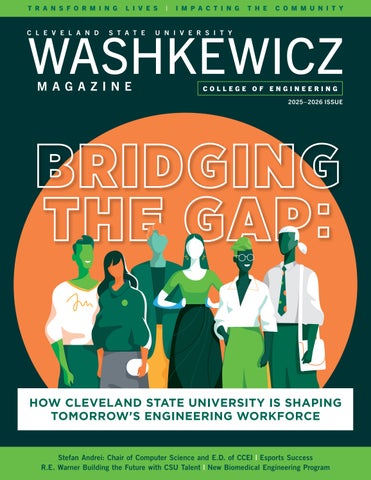
BRIDGING THE GAP : HOW CLEVELAND STATE UNIVERSITY IS SHAPING TOMORROW'S ENGINEERING WORKFORCE
Stefan Andrei: Chair of Computer Science and E.D. of CCEI | Esports Success R.E. Warner Building the Future with CSU Talent | New Biomedical Engineering Program
ONE new research center
1
(Center for Innovation in Advanced Functional Materials)
3
TWO new industry-facing initiatives (TransDigm Laboratory and Project Delivery Institute)
THIRD multi-year NSF-funded summer rehabilitation (REU) program FOUR additional doctoral students in each of the Ph.D. programs with Cleveland Clinic Over $5 MILLION in research expenditures over 3 years
3
3
4
2
3
3
5
3
6
3
7
3
8
3
9
3
SIX academic departments together offering almost 200 graduate contracts annually SEVENTH NSF CAREER award to faculty in Washkewicz College of Engineering EIGHT Faculty with over $1,700,000 in research funding NINE different federal and state agencies funding programs in engineering
13 + 23 + 33 + 43 + 53 + 63 + 73 + 83 + 93 =
2025
Message from the
DEAN
DEAR WASHKEWICZ COLLEGE COMMUNITY, We are living in an exciting time of tremendous momentum. As Cleveland rises, so does Cleveland State University, and the Washkewicz College of Engineering stands at the heart of this transformation. The future of Cleveland depends on CSU, and the future of CSU depends on Cleveland — a partnership that defines everything we do. This year's magazine captures the innovation and community impact that drive our mission forward. Our new undergraduate degree program in biomedical engineering embodies this vision, cultivating the next generation of engineers who will collaborate with the Cleveland Clinic, one of the world's top three clinical operations, to address tomorrow's healthcare challenges. Through our partnership in the Cleveland Innovation District, our students aren't just learning engineering, they're building the biomedical companies that will define Northeast Ohio's future. The workforce development stories you'll read about reflect our deep commitment to regional needs. From microcredentials that document specific skill sets to our expanded co-op program, which connects students directly with industry, we're creating pathways that bridge academia and the real world. Our construction management program launched faster than any new program I've seen, with 25 students in year one alone — proof that when we listen to community needs and respond with innovation, students follow. Our integrated majors program continues to break down traditional barriers. Students like Giuliana Ciccarelli-Aloisi, featured in our computer science + graphic design program, represent the interdisciplinary thinking that modern employers seek. Today, students like Giuliana graduate with the combined capabilities that meet growing demand.
As we honor the legacy of retiring faculty and staff like Joanie Hundt and welcome new leaders like Dr. Stefan Andrei as Computer Science Chair, we're building on a century-old foundation while embracing the future. Founded in 1923 as a co-op school in partnership with industry, we're returning to those roots — and taking them even further in our next century. The research innovations, student success stories and industry partnerships featured in these pages demonstrate what happens when engineering education focuses on real-world impact. Whether it's our national forging competition champions, our growing research portfolio or the philanthropic support that makes it all possible, every element connects back to our core mission: developing the talent Northeast Ohio needs. Together, we're not just educating engineers — we're building the workforce that will power Cleveland's continued rise. The momentum is unmistakable, the innovation is accelerating and the community impact grows stronger every day. Thank you for being part of this journey. Sincerely,
RICHARD T. SCHOEPHOERSTER, PH.D. Dean, Washkewicz College of Engineering
You'll also read about the remarkable achievements of our students and faculty. From Chloe Amoroso, who transitioned from art to mechanical engineering and became our Spring 2025 University Valedictorian, to Dr. Navid Goudarzi's $550,000 NSF CAREER Award, these stories showcase the caliber of talent that defines our college family.
Dean's Letter | 2025–2026 ISSUE 1
Table of
CONTENTS
20 COVER STORY
WASHKEWICZ MAGAZINE
2025–2026 ISSUE
LAURA BLOOMBERG, PH.D. President Cleveland State University
KRISTIN BROKA, M.S. Contributing Editor University Marketing
RICHARD T. SCHOEPHOERSTER, PH.D. Dean Washkewicz College of Engineering
JIM LIGHTCAP Art Director University Marketing
GEORGE CHATZIMAVROUDIS, PH.D. Associate Dean and Editor-in-Chief Washkewicz College of Engineering
CONTRIBUTING DESIGNERS Emma Cook Sofia Dembek Jackie Flanik
MELISSA LUCIANO Administrative Operations Manager and Contributor Washkewicz College of Engineering HEATHER SCHLOSSER Managing Editor University Marketing
PHOTOGRAPHY Damien Campbell Jason Miller JULIE JONES Freelance Writer
2 WASHKEWICZ COLLEGE OF ENGINEERING | Cleveland State University
CAMPUS LOCATION Cleveland State University Washkewicz Hall, Room 305 2300 Chester Ave. Cleveland, Ohio 44115-2214 216-687-2555 engineering.csuohio.edu
WASHKEWICZ SOCIAL MEDIA @csuwashkewicz washkewiczcollege @washkewicz-collegeof-engineering @WashkewiczCollege ofEngineering @WashkewiczCollege
WASHKEWICZ Magazine is published annually by the Washkewicz College of Engineering and Cleveland State University Marketing. Sustainably designed and printed to reflect CSU's commitment to environmental stewardship. ©2025 CSU UMC 250200 Review our Statement of Commitment at csuohio.edu/united.
04
FEATURES 4
Stefan andrei Chair of Computer Science and Executive Director of CCEI
18 Esports Success Esports team has found a home in the college of engineering
18
20 Bridging the Gap How Cleveland State is shaping tomorrow's engineering workforce
30 R.E. Warner Building the future with homegrown Cleveland State engineering talent
32 New Biomedical Engineering program CSU welcomed its first cohort of undergraduate students in fall 2024
30
SECTIONS 4
FACULTY
11 STUDENTS 20 WORKFORCE
32
28 ALUMNI 32 COLLEGE NEWS 52 DONATIONS
Table of Contents | 2025–2026 ISSUE 3
C S U A P P O I NT S
STEFAN ANDREI AS CHAIR OF THE DEPARTMENT OF COMPUTER SCIENCE AND EXECUTIVE DIRECTOR OF THE CENTER OF COMPUTING EDUCATION AND INSTRUCTION
Cleveland State University is pleased to announce Stefan Andrei, Ph.D., as the new chair of the Department of Computer Science and the executive director of the CSU Center for Computing Education and Instruction (CCEI). Andrei is an internationally recognized expert in computer science education, a prolific researcher and an experienced administrator and leader. Drawn by Innovation and Community Impact When asked what drew him to CSU, Andrei was enthusiastic about the institution's trajectory. "What drew me to Cleveland State University and this dual role was the energy around innovation and community engagement," he explained. "I believe this is a place that's clearly on the move, yet grounded, but also focused on creating real impact for students and the community." Andrei sees real value in the University's collaborative approach. "Our faculty is involved in partnership with organizations that allow students to participate in research and internships," he noted. "For me, it felt like the right place to put my energy and make a contribution. I believe the Cleveland area and Ohio in general offer great opportunities for our students to succeed."
4 WASHKEWICZ COLLEGE OF ENGINEERING | Cleveland State University
Distinguished Academic Background Andrei joins CSU after serving as professor and chair of the Department of Computer Systems Engineering Technology at the Oregon Institute of Technology. Before his role there, he served as professor and chair at Lamar University. Reflecting on his proudest achievements, Andrei highlighted the breakthrough research that marked his academic journey. "During my Ph.D., I developed a parallel technique that improved the way compilers generate code," he shared. Later, during his postdoctoral work, "I was able to solve an open problem from 1979 known as incremental counting SAT" while working with the Singapore-MIT Alliance, where he had advisors from both the National University of Singapore and MIT.
Andrei's research has undergone significant evolution over time. "Over the past decade, I expanded my research to current areas such as 3D printing, cybersecurity, weather system installation, data collection, analysis and designing zero net energy houses powered by renewable solar resources," he explained. However, his greatest source of pride remains his students: "What I'm most proud of is seeing my students succeed. And that energy and enthusiasm keep me feeling young."
Community and Excellence Combined What excites Andrei most about joining CSU: "A unique opportunity to work with a diverse and talented group of people." He looks forward to shaping the University’s future by collaborating with students, faculty and administrators to build strong partnerships with industry leaders, healthcare professionals and other community partners.
Vision for Computer Science Excellence As department chair, Andrei has ambitious plans for expanding access to computer science education. "My vision for the Department of Computer Science is to create an environment where students are fully prepared to lead in the technologies of tomorrow," he stated. "This includes offering courses in emerging fields such as quantum computing, artificial intelligence and cybersecurity to ensure students are not just keeping pace with change but driving it." Andrei emphasized the importance of industry connections, noting his intention to help connect classroom learning to real-world challenges to give students a head start in their careers. He's particularly focused on establishing permanent internship programs, explaining that while the department currently offers internships, he wants to implement structured programs already designed by the Dean's Office for other engineering departments.
I believe in nurturing a strong sense of community, supporting students' academic journeys while also encouraging social growth, leadership and collaboration.
Quantum Computing and AI Leadership
– Dr. Stefan Andrei
CSU's quantum computing initiatives particularly excite Andrei. He noted, "CSU introduced its first quantum computing course in fall 2022 and is planning to add additional courses in quantum machine learning, quantum computing for life science and quantum information science, along with a new certificate program." The potential applications are staggering. Andrei shared an inspiring example: "I read an article the other day that [quantum computing] was used to help researchers develop a new vaccine in a matter of days rather than a year or more. As for COVID, remember, it took one year. So, by using quantum machine learning during trial and test, these innovations can be created in days rather than years." Stefan Andrei
Academic Foundation and Future Impact Andrei holds a Ph.D. in Computer Science from Hamburg University and was a postdoctoral research fellow in the Singapore-MIT Alliance at the National University of Singapore. His extensive publications include more than 80 peer-reviewed conference papers and over 35 peerreviewed journal articles, along with nine co-authored books. He has secured 22 research grants totaling more than $3.5 million and serves as editor-in-chief of the ACET Journal of Computer Education and Research. "Together we can continue to empower our students not only to succeed, but also to become innovators who shape the future of technology in our society," Andrei concluded, embodying the forward-thinking vision he brings to Cleveland State University. As executive director of CCEI and department chair, Andrei will lead initiatives that continue CSU's momentum in computer science education while expanding opportunities for students throughout Northeast Ohio and beyond.
Faculty | 2025–2026 ISSUE 5
Building Tomorrow's Cities: NSF CAREER Award Will Transform Urban Life The M3TFluiD Lab generates the data and models that guide resilient city design and healthier communities.
Dr. Navid Goudarzi
Picture walking through downtown Cleveland on a sweltering summer day. The concrete sidewalks radiate heat, tall buildings create wind tunnels that whip around corners, and some streets feel degrees hotter than others just blocks away. These aren’t random happenings. They’re the result of complex urban microclimates that affect comfort, energy use and even public health.
6 WASHKEWICZ COLLEGE OF ENGINEERING | Cleveland State University
Dr. Navid Goudarzi, assistant professor in Cleveland State University’s Department of Mechanical Engineering, wants to study these invisible weather systems in depth. The National Science Foundation is giving him the prestigious Faculty Early Career Development (CAREER) Award — a five-year, $550,000 grant — to support his research and education in this area. Goudarzi is the head of the M3TFluiD Lab (Multiscale Multiphysics Modeling and Data-Driven Analysis of Thermofluids) and the co-director of CSU’s new Center for Integrated Modeling for Energy, Resiliency, and Sustainability (IERS).
Urban wind intelligence for safe Beyond Visual Line of Sight (BVLOS) navigation: Urban Wind Intelligence fuses ground, satellite, onboard and meteorological data with modeling, simulation, Verification, Validation and Uncertainty Quantification (VVUQ) to produce city-scale wind fields, enabling proactive wind-hazard mitigation and reliable BVLOS navigation in smart, resilient cities.
The Challenge: Climate Conditions are Dynamic Cities function like large, unintentional climate systems. Tall buildings channel wind into concentrated gusts, while paved surfaces such as asphalt absorb solar radiation during the day and release it at night, producing urban heat islands that can be 5−10 degrees warmer than nearby rural areas. Between structures, airflow can stagnate, creating pockets that trap both heat and pollutants. These localized interactions make urban microclimates highly variable and difficult to predict. “My background spans energy systems, ranging from offshore wind to fossil fuel plants,” Goudarzi explains. “Over time, I realized my interest was not in isolated components, but in how entire systems interact. This research takes a ‘systemof-systems’ view, treating buildings, streets and climate conditions not as isolated parts but as interconnected elements that shape urban microclimates. Cities are the ultimate ‘system of systems,’ and exploring how their form and function shape these microclimates became a natural extension of my work.”
He describes urban microclimates this way: “They are essentially pocket climates. On one block, you may experience a cooling breeze, while just a few blocks away, the air can be stagnant and significantly warmer. These variations influence comfort for many but can also pose serious health risks, especially during extreme heat events.” Traditional models struggle to capture these dynamics. “They often provide averages across an entire region, sometimes miles wide,” Goudarzi explains. “Yet conditions on a single street corner at 3 p.m. can be very different from those regional averages. To design healthier and safer cities, we need models that resolve microclimates with fine detail in both space and time.” The novelty lies in analyzing how factors such as urban morphology, inflow boundary conditions and climate parameters interact synergistically, rather than studying them in isolation.
Faculty | 2025–2026 ISSUE 7
The Innovation: Digital Twins for Entire Cities Goudarzi’s vision is to enable the development of detailed digital replicas of urban areas, known as “digital twins,” capable of predicting microclimates in real-time. “A digital twin is essentially a living model of a city inside a computer,” he explains. “It allows us to ask ‘what if’ questions: What if a new high-rise is built? What if 100 trees are planted along the lakefront? How would those changes affect wind flow, heat distribution or pollution patterns? That’s the power of digital twins.” His team focuses on producing the trustworthy, high-resolution data and validated models that digital twins systems require. This involves high-fidelity computer simulations, building energy and information modeling, and machine learning, coupled with rigorous verification, validation and uncertainty quantification (VVUQ). The goal is to generate scalable solutions that extend from single building analyses to neighborhood-scale assessments, supported by continuous validation with real-world measurements. “We’re not just modeling weather,” Goudarzi emphasizes. “We’re modeling how the built environment and the atmosphere interact to shape the air we breathe and the temperatures we experience. In the second phase of this research, we expect to collaborate more actively with partners to integrate these foundations into city-scale digital twin platforms.”
From Lab to Street: Real Applications
“
It’s about designing cities that move smarter and use energy more efficiently, connecting technology in the sky with comfort and health on the ground. Ultimately, the goal is to make urban environments healthier, safer, and more resilient. — Dr. Navid Goudarzi
”
The potential applications of this work extend far beyond academic research. Urban planners could design neighborhoods that naturally reduce heat stress in summer. Public health officials and emergency responders could identify areas most at risk during heat waves or air pollution episodes. Renewable energy systems could be integrated more effectively at the building and neighborhood scale. Even advanced air mobility systems could operate more safely by accounting for pedestrian-level wind and turbulence around high-rises. “This isn’t just theoretical,” Goudarzi emphasizes. “It’s about designing cities that move smarter and use energy more efficiently, connecting technology in the sky with comfort and health on the ground. Ultimately, the goal is to make urban environments healthier, safer and more resilient.”
Teaching, Training and Collaboration The NSF CAREER Award is the foundation’s most prestigious recognition for early-career faculty, supporting those who demonstrate exceptional potential as both researchers and educators. For Goudarzi, it affirms an interdisciplinary vision that bridges mechanical engineering, data science, urban planning and environmental science. “The hardest part is learning to speak a common language across fields: engineers, data scientists, physicians and urban planners,” he reflects. “It takes time to align perspectives but when we do, the solutions we create are far more powerful.”
8 WASHKEWICZ COLLEGE OF ENGINEERING | Cleveland State University
Smart sensing units deployed for monitoring wind, temperature, and air quality variations in urban neighborhoods.
Multiscale Urban Synergy for Smart and Healthy Cities: An integrated framework that synergizes Computational Fluid Dynamics (CFD), Building Energy Modeling (BEM), Building Information Modeling (BIM) and Machine Learning (ML) with meteorological and urban morphology data. This multiscale approach supports the design of high-performance buildings and enhances city ventilation, providing actionable insights for smart city planning and urban air quality management.
Bringing Students into the Future
The Road Ahead
The CAREER Award also supports Goudarzi’s role as an educator. “I want students to see technology in action,” he says. “In my classes, they use drones and thermal cameras to compare high-performance buildings with traditional ones. They learn not just the equations, but how the built environment affects real people in real communities.”
Over the next five years, Goudarzi’s team will focus on developing, simulating and validating the data and models that city-scale digital twins depend on, testing them across diverse urban environments and weather conditions. “As we move forward, we’ll lay the foundation, establishing the models, applying verification and validation, and expanding our local data collection,” he explains. “It’s about designing cities that move smarter and use energy more efficiently, connecting technology in the sky with comfort and health on the ground. Ultimately, the goal is to make urban environments healthier, safer, and more resilient.”
His research comes at a pivotal time. Urban areas house more than half of the world’s population and account for nearly 70 percent of global carbon emissions. As temperatures rise and extreme weather events occur more frequently, cities must evolve to become more resilient, not only to adapt to the changing climate but also to help mitigate it. Improved microclimate modeling can provide practical guidance, from identifying the most effective locations for new tree canopies to designing building facades that minimize heat retention and improve air circulation.
As cities continue to expand and climate pressures intensify, research like Goudarzi’s will be essential to shaping environments that are not only livable but thriving. In an era where technology increasingly informs urban planning and design, producing the validated data and predictive models that underpin digital twins represents a critical step toward smarter, more sustainable cities.
Faculty | 2025–2026 ISSUE 9
Af ter 41 Years, Dr. Stephen Duffy Steps Back — Leaving CSU Engineering Stronger Dr. Stephen F. Duffy, who spent more than four decades as a professor and occasionally as chair of the Department of Civil and Environmental Engineering at Cleveland State University, is retiring. It's the end of an era for a program he has served faithfully, and for the many hundreds of students who passed through his classroom.
of Defense. The Mars project particularly stands out in his mind — analyzing a ceramic shell to protect an instrument package during the Mars reentry. "Intense, fascinating, unforgettable," he says of that work. These weren't papers written in isolation; they were practical, high-stakes problems that required rigor and creativity in equal measure.
Duffy came to CSU in 1985 from NASA Lewis Research Center (now NASA Glenn), already steeped in materials engineering and research. He had earned his degrees from the University of Akron, and had spent years solving real-world as well as high-tech problems — designing armor, focusing on safety in transportation work zones and pioneering analytical methods that pushed materials to their design limits. That engineering mindset, grounded in both theory and practice, impacted everything he did at CSU.
On campus, Duffy didn't just teach and research. He recognized what the department needed in order to grow and, over the years he helped in building as well as rebuilding a program with a proud past and a bright future. The Work Zone Safety Transportation Center became a nationally recognized program under his leadership, and he helped secure one of the largest federal earmarks in CSU's history to support it. He listened to industry and recognized that construction management was a career brimming with job opportunities for students. So, he helped start the undergraduate construction management program — another pathway for students into the design and construction of the built environment.
"The students," he says simply, when asked what kept him at CSU all these years. "I've had wonderful relationships with them — undergraduates, graduate students, doctoral students — who I would stand up against anybody in the country." It's not empty nostalgia. Former students now running engineering firms across Northeast Ohio still call or stop by. They remember him. His research career reads like a tour through some of the most interesting work in the field of engineering. Mars lander aeroshells. Small modular and pebble bed nuclear reactors at the Department of Energy. Fuel cells and stationary gas turbines for localized power generation. Gun barrel design and ceramic armor for the Department
10 WASHKEWICZ COLLEGE OF ENGINEERING | Cleveland State University
At 70-something, Duffy is ready to step back. More time with his wife, three daughters and seven grandchildren. Maybe some consulting work through the engineering firm he co-founded with two former graduate students back in the early 1990s — but no pressure, no obligations. What he leaves behind are multiple generations of engineers (both parent and child) who learned to think critically, work carefully and build things that matter. That's the kind of legacy that doesn't fade.
From Artist to Astronaut: Spring 2025 Valedictorian
Chloe Amoroso's Journey at CSU
When Chloe Amoroso walked into her first mechanical engineering class at Cleveland State University in 2022, she found herself in unfamiliar territory. The former arts major from Bowling Green State University was entering a field where she saw "just one other woman in a sea of men." Three years later, Amoroso stood as CSU's Spring 2025 Valedictorian for the Washkewicz College of Engineering, with a perfect 4.0 GPA, the University's triple jump record and a coveted internship at NASA Glenn Research Center. Her shift from art student to aspiring astronaut represents a remarkable journey at CSU, one that’s nothing less than inspiring, if not enviable.
Her First Step Was a Leap of Faith
Finding Her Community
Amoroso's path to engineering began during the COVID-19 pandemic. During a period of self-reflection, she made a radical decision to entirely switch disciplines. "I missed the grit and critical thinking that came with solving problems and complex math equations," she says.
What began as a solo mission quickly became something more meaningful. CSU's engineering faculty provided the welcoming support system Amoroso needed to thrive.
That longing for challenge led her to mechanical engineering, and ultimately to a clear goal: to become a mission specialist. "I needed to shoot for a goal so challenging and wild that even if I failed, I could look back with no regrets and know I gave it everything."
Within her first semester, professors recommended her for a position as an Engineering Peer Teacher (EPT) for Dynamics — one of the curriculum's most challenging courses. Determined to excel, she spent days designing interactive activities and engaging lessons. Her efforts paid off when she was awarded EPT of the Semester, with the professor noting he had never seen higher grades in the course.
Her sense of purpose brought her to CSU. "I was born and raised here. It's full of opportunity and home to the people I care about most," Amoroso says. It didn't hurt that NASA Glenn Research Center was just around the corner. When she transferred to CSU to pursue mechanical engineering, she believed she was right where she was meant to be.
Students | 2025–2026 ISSUE 11
Research Breakthrough Under the mentorship of Dr. Maryam Younessi Sinaki, Amoroso began analyzing the Strayton Cycle — a thermodynamic engine designed to power zero-emission, high-efficiency aircraft, originally conceived at NASA Glenn Research Center. Despite not yet having taken the necessary advanced courses, she dove in immediately, collaborating with senior design teams and roaming the halls seeking guidance from physics and engineering faculty. Her dedication led to presenting findings at the American Astronautical Society's Glenn Space Technology Symposium and winning first prize for undergraduate research at CSU's Research Day. The work caught the attention of NASA engineers, who invited her to present at NASA Glenn Research Center.
Leadership Beyond the Lab Amoroso's impact at CSU extends far beyond research. As copresident of Sisters in STEM, she helped build the organization into an outreach powerhouse focused on inspiring young women to explore STEM careers. "We showed ourselves we can make a difference in other people's lives through education and outreach," Amoroso says. "That was once a responsibility I left to others. Now, my perspective has changed." She also founded Interstellar Inquiries, an organization dedicated to exploring astronomy and quantum physics, and serves as treasurer for CSU's NFPA Fluid Power Vehicle Challenge chapter. This past April, she competed as the rider of the team's hydraulic bike in the sprint competition. Perhaps most remarkably, Amoroso has maintained her athletic pursuits while excelling academically. After missing the competitive track environment from her high school and Bowling Green days, she walked onto CSU's track and field team as a triple jumper. She now holds the Cleveland State University school record in triple jump — an achievement that reflects her approach to every challenge she undertakes.
Overcoming Setbacks Amoroso's journey hasn't been without obstacles. When she submitted her first technical paper to the American Society of Mechanical Engineers conference, the initial reviews were devastating. Friends and family encouraged her to move on, but Younessi refused to let her give up. "She urged me to review every comment, revise and resubmit — even if failure was still a possibility," Amoroso recalls. "Looking back, I wish I hadn't let the fear of failure shake my confidence. But in that moment of doubt, I was lucky to have a mentor who believed in me when I didn't believe in myself." The revised paper was accepted for conference publication, reinforcing a lesson about persistence that has defined her approach to challenges. Amoroso navigated common student challenges like heavy course loads, financial pressures and the search for meaningful direction. Her solution was strategic: she secured on-campus employment to help with expenses and streamlined her schedule. "Finding a path for after college was not easy," she notes. "But networking at events and expressing my concerns to trusted mentors helped me make informed decisions."
12 WASHKEWICZ COLLEGE OF ENGINEERING | Cleveland State University
Chloe Amoroso was a CSU Track and Field team member
Chloe Amoroso, as a NASA Glenn Research Center Summer 2025 Intern
"My time at Cleveland State University has been filled with life-changing experiences that have shaped me into the engineer, leader and dreamer I am today," said Amoroso. "CSU's students and faculty have propelled me farther than I could ever have imagined — I'm deeply grateful for all the opportunities I have been given, and I owe so much of my growth to this University."
The CSU Difference Faculty across campus have taken notice of Amoroso's unique combination of academic excellence, leadership and versatility. Amoroso credits much of her growth to two CSU mentors: Dr. Maryam Younessi Sinaki and Dr. Brian Davis. "Dr. Younessi introduced me to Sisters in STEM and helped me publish my first conference paper. Dr. Davis helped me believe in myself as a researcher and a leader." Throughout her CSU experience, Amoroso found balance in the friendships she built — especially those forged through late-night study sessions and shared deadlines. "We had a healthy balance of competition and genuine support," she recalls. That support helped keep her motivated through even the most challenging semesters.
Looking Ahead During the summer of 2025, Amoroso began her internship at NASA Glenn Research Center's Engine Research Department, working to advance aerospace technology. She plans to continue her education at CSU through the 4+1 accelerated master's program and to continue on for a Ph.D. Her ultimate goal remains unchanged from that moment of COVID-era reflection: becoming a NASA astronaut. Her aspirations are as stellar as they are grounded: she hopes to one day earn a full-time role at NASA Glenn Research Center, gain years of professional experience and eventually apply to the astronaut candidacy program. For Amoroso, being named University Valedictorian is more than a title; it's a reflection of her commitment to excellence, to service and to going after the "wild goals" that shape who we become. "It shows me that I truly channeled all my efforts toward being the best student I could be at the time," she says. "No regrets. No excuses. Just all effort." Amoroso's journey from uncertain art student to confident engineer represents more than personal transformation. It embodies CSU's mission of providing opportunities for students to discover and pursue their potential, regardless of their starting point. "I am committed to turning my lifelong dreams into reality — and inspiring others to pursue their own, no matter how wild they are, or the obstacles they face," she says.
Chloe Amoroso competing in NFPA Fluid Power Vehicle Challenge with CSU (top) with Dr. Brian Davis at the 2024 Engineering Research Day Awards (bottom)
"I am committed to turning my lifelong dreams into reality — and inspiring others to pursue their own, no matter how wild they are, or the obstacles they face" Students | 2025–2026 ISSUE 13
Fall 2024 Valedictorian
CAMERON FLACK Turns Childhood Gaming Passion Into Career Success Cameron Flack's path to becoming one of Cleveland State University's Fall 2024 valedictorians began with a simple fascination in middle school. "I started using a game engine called GameMaker Studio," Flack recalls. "It was like visual blocks that you put together to program rather than actually write lines of code. I thought it was awesome." That early spark ignited a passion that would carry him through high school experimentation with Unity and C#, ultimately leading to his decision of pursuing computer science at CSU. What started as a hobby building games evolved into a comprehensive understanding of programming that now drives his professional career at Progressive Insurance.
Building Skills Through Hands-On Experience
Academic Excellence and Research Innovation
Flack's academic journey at CSU was marked by strategic choices that maximized his learning opportunities. He deliberately looked for industry experience through internships, recognizing that "learning in the classroom through theory is important, but actually applying those skills is where you take things to the next level."
Maintaining a 3.82 GPA while gaining extensive industry experience required careful balance and dedication. Flack's academic achievements include multiple President's Awards and Dean's List recognitions, alongside coursework in Mobile Development and Foundations of Computing, complemented by a mathematics minor with Linear Algebra as a standout challenge.
He secured his first professional programming experience at Lubrizol when he attended a CSU career fair. This was followed by internships at The Mortgage Collaborative (TMC) and Progressive Insurance, each building on the previous experience. "I had a few internships in my last two semesters, and even though I did have to delay my graduation by a semester, it was definitely worth it to me," Flack explains. Through these experiences, Flack discovered his specialty in mobile development. "I think it's a really cool industry that's always growing because the mobile market's always getting bigger," he notes. "Even the biggest gaming platform is mobile, because nearly everybody has played a mobile game in some form."
14 WASHKEWICZ COLLEGE OF ENGINEERING | Cleveland State University
His participation in the Choose Ohio First program provided opportunities for research and presentation. One notable project involved developing bot detection methods similar to CAPTCHA systems. "We built one of those, and the results were pretty cool. I was working at Drug Mart at the time, and I got all my coworkers to help train the knowledge base," Flack recalls. This project represented his first serious computer science presentation and demonstrated his ability to apply theoretical concepts to practical problems.
"I WOU LD LOVE TO BE TH E CR EA TI VE DI RECTOR OF A GA M E CO M PA NY." – Cameron Flack
Professional Growth and Future Vision Now working full-time at Progressive Insurance developing Android applications, Flack has achieved one of his college goals: working on customer-facing applications. "I worked on a feature that went live last week, and I get to see all the customers' interactions with it to ensure it is working properly," he says with satisfaction. "Insights like this are my favorite part about development. I get to see how my work has an impact on users." His current role allows him to utilize Java and Kotlin, languages he mastered at CSU, creating a seamless transition from academic learning to professional application development. While he enjoys development, Flack envisions potential growth into data analysis roles or service management responsibilities, always seeking new challenges and opportunities to expand his skill set.
Balancing Passion Projects With Professional Demands Despite his demanding professional schedule, Flack continues pursuing his original passion for game development. He's currently working on a strategy game that incorporates database functionality to manage complex game states. "I want to build a database into the game, maybe organize the game state to represent a city or something," he explains. This aspiration reflects his desire to blend technical expertise with creative vision, much like Todd Howard of Bethesda Game Studios.
Embracing Technological Change As artificial intelligence transforms the software development landscape, Flack maintains a balanced perspective. "It's definitely interesting because of how good AI has become at writing code," he acknowledges, "but I think it's like a tool, like a calculator. We didn't stop doing math when calculators came around." His view of AI as a productivity enhancer rather than a replacement reflects the adaptability that has characterized his entire journey. Cameron Flack's story exemplifies how passion, strategic thinking and dedication to continuous learning can transform childhood interests into professional excellence. His success at CSU, marked by valedictorian honors and seamless transition to industry leadership, demonstrates the value of combining academic rigor with practical experience. As he continues to build mobile applications by day and craft games by night, Flack embodies the innovative spirit that drives the technology industry forward. Students | 2025–2026 ISSUE 15
Engineering Excellence Recognized: Generous Gift Establishes New Award at Cleveland State University Dr. Michael Adams (left) and Chad Slater (right)
Cleveland State University's Washkewicz College of Engineering has received a generous gift from Robert and Laurel Weinberg to establish the Robert and Laurel Weinberg Award, recognizing student leadership and collaboration within the Engineering Technology programs. The inaugural award was presented to senior engineering technology student Chad Slater, celebrating both academic achievement and the spirit of teamwork that drives engineering success.
The award honors the Weinbergs' commitment to engineering education and the value of hands-on learning. Bob Weinberg, a 1977 CSU mechanical engineering technology graduate, exemplifies how the program's practical approach can transform uncertain students into successful entrepreneurs. Weinberg's path began during the Vietnam War era, when he discovered CSU's newly established engineering technology program — a practical engineering approach that emphasized application.
16 WASHKEWICZ COLLEGE OF ENGINEERING | Cleveland State University
"The thrust of the program was not that engineers derive every equation from first principles to use what has already been well documented," Weinberg explained. "The objective was: What can I do to apply engineering principles for solutions to problems, processes and designs? How can I make progress and make a product happen?" This philosophy served Weinberg well throughout his career. After graduating, he co-founded a manufacturing company that grew from three partners to nearly 800 employees at its peak. The company specialized in safety controls for high-efficiency furnaces, contributing to energy conservation efforts that reduced consumer costs while maintaining product quality — a testament to the real-world impact of engineering. Dr. Michael Adams, Chair of CSU’s Department of Engineering Technology, met with Weinberg, who was an inspector volunteer at a robotics competition where Adams was seeking safety glasses to observe the event. Their conversation revealed their shared connection to the engineering technology program and sparked discussions about how to support current students.
Washkewicz College of Engineering Annual Awards Reception 2024
Adams explained that the program consistently required resources to support students in completing their capstone projects including equipment and supplies, and that a dedicated funding source would be invaluable for these efforts.
Slater, the first recipient, exemplifies these qualities. Selected by faculty for his leadership with fellow students in the program, Slater represents the collaborative spirit and personal drive that make engineering education most effective. His recognition reflects the same chemistry between faculty and students that Weinberg experienced decades ago.
The Robert and Laurel Weinberg Award emerged from this conversation, representing the Weinbergs' generous commitment to supporting engineering education. The award has a broader mission than just funding capstone projects. It recognizes students who demonstrate exceptional leadership in helping their peers succeed — a quality Weinberg values from his own educational experience with collaborative study partners and motivational CSU instructors.
Slater, the first recipient, exemplifies these qualities. Selected by faculty for his leadership with fellow students in the program, Slater represents the collaborative spirit and personal drive that make engineering education most effective. His recognition reflects the same chemistry between faculty and students that Weinberg experienced decades ago. The connection between CSU and community colleges demonstrates the value of the 2+2 pathways and co-op program structure. Students can complete foundational coursework and their associate degree at community colleges before transferring to complete their engineering technology degrees, making education more accessible for working students who attend evening classes as Weinberg did.
Robert and Laurel Weinberg
"Most of the students, like their instructors, were already out working in industry and supporting families. What made the difference for these students was the engaged instructors who brought real-life current examples into the training, which motivated students," Weinberg noted about the evening program instructors.
The Robert and Laurel Weinberg Award is an endowed fund, meaning it will help students like Slater today and continue to support students for generations to come. Through careful investment management, the award will provide ongoing recognition for student leaders who embody the collaborative spirit essential to engineering success. Weinberg's emphasis on communication and perseverance as essential qualities reflects lessons learned from managing a 40-person engineering staff. "Engineering requires communication and needs to be crystal clear, spelled out and complete," he emphasized, crediting his Cleveland State professors with instilling these standards. As CSU's engineering technology program continues to evolve, the Robert and Laurel Weinberg Award ensures that future students will be recognized not just for individual achievement but for their ability to lift others and contribute to the collaborative learning environment that produces successful engineers. The award represents more than recognition — it's an investment in the kind of engineering leadership that transforms both individual careers and entire communities.
Students | 2025–2026 ISSUE 17
PJ Farrell (left) and Junior Ramos (right)
Four years ago, CSU took a chance on varsity Esports, aiming to explore new opportunities for student engagement and development. Today, over 150 students are part of the program. Some play on varsity teams, others at the club level. And CSU is making noise nationally. The Valorant team sits in the top 30. Rocket League is ranked 33 rd . Smash Ultimate? 13 th in the country. Walk into the Esports lab on any given afternoon, and you'll find it packed. Controllers clicking, teammates calling out plays, friendships forming over shared screens. But the wins and rankings only tell part of the story. What's really happening goes beyond the games. For a lot of students, Esports is a way to find their footing, to build confidence, take on leadership roles and figure out who they want to be. Among these students is Junior Ramos, Esports Club coordinator, with a passion for understanding how things work and an assistant coach of the lab.
From Taking Things Apart to Putting It All Together Ramos, a senior studying electrical engineering, has always been the kind of person who needs to know how things work. As a kid, that meant taking apart his gaming consoles. "I'd open them up just to see what was inside," he says. "I wanted to understand it." That curiosity stuck with him and eventually pointed him toward engineering.
18 WASHKEWICZ COLLEGE OF ENGINEERING | Cleveland State University
Last summer, he interned at Nidec Industrial Solutions, where he assisted with designing, installing and troubleshooting new drive and control panel systems to replace outdated equipment on a large crane in Halifax, Canada. He learned to read schematics, troubleshoot system issues and work alongside seasoned professionals. This winter, he's heading back as a test technician. His goal? To work as an electronics technician for the FBI. He's already toured the Cleveland field office and received advice from a friend who's in the bureau. For Ramos, it's not just a career path. It's the career path.
Finding His People Through Gaming With a full schedule (engineering classes, internships, career prep), you may think Ramos wouldn't have time for much else. But he made time for gaming and, more importantly, for the people who came with it. Ramos admits to being introverted, but Esports has helped him come out of his shell. "Esports gave me a reason to talk to people, to travel, to actually get out there." What started as casual play turned into something bigger. Now he runs CSU's Esports club, where he handles scheduling, coordinates matches and makes sure everyone gets a chance to compete. Coach PJ Farrell, director of Esports at CSU, has watched Ramos grow into the role. "He doesn't just show up and play. He's helped build the whole thing," Farrell says. "He recruits, he organizes, he makes sure people feel like they belong. That's real leadership."
And it's spilling over into other parts of his life. In his senior design class, Ramos has stepped up to lead his project team, just as he leads his gaming squad. "Esports taught me I could do this," he says. "Before, I wouldn't have thought of myself as a leader. Now I know I can bring people together and actually get stuff done."
Prioritizing Academics Over Gaming Coach Farrell is clear about priorities. Students receive regular grade checks, and tutoring is available. Academic achievements get celebrated just as loudly as tournament wins. "Graduating comes first," he says. "Esports is second. I want them to be good players, sure. But I want them to leave here ready for real life even more." It's working. A lot of the Esports players are engineering majors juggling labs, projects and internships on top of practice and competition. They prove that you don't have to pick just one thing; with dedication, you can do it all.
What Comes Next? The Esports program at CSU continues to grow. They're partnering with high schools through Esports Ohio, and the future looks bright. For Ramos, it's been a journey. From pulling apart game consoles to running a student club. From keeping to himself to leading. From dreaming about the FBI to being just months away from graduation. "Before Esports, I'd go to class and go home," he says. "Now I'm part of something. It's about more than just playing games. It's about learning how to lead, how to connect with people, how to get ready for whatever's next." At CSU, Esports is competitive. But what really matters is what happens off-screen: the confidence students gain, the skills they build, the people they become. That's the real win.
"Before Esports, I'd go to class and go home," he says. "Now I'm part of something. It's about more than just playing games. It's about learning how to lead, how to connect with people, how to get ready for whatever's next"
Coach PJ Farell, and Esports athlete
— Junior Ramos
Students | 2025–2026 ISSUE 19
BRIDGING THE GAP : HOW CLEVELAND STATE UNIVERSITY IS SHAPING TOMORROW'S ENGINEERING WORKFORCE In an era defined by rapid technological change, global competition and shifting industry demands, universities are crucial incubators for the engineering workforce of tomorrow. Cleveland State has responded with several initiatives designed to ensure that students not only acquire knowledge, but also build the personal and professional skills employers urgently need: Co-op, Earn & Learn, Integrated Majors, Senior Design, and Microcredentials.
20 WASHKEWICZ COLLEGE OF ENGINEERING | Cleveland State University
The urgency for workforce development cannot be overstated. According to the U.S. Bureau of Labor Statistics, approximately 186,500 job openings per year are projected in architecture and engineering occupations from 2024−2034. Meanwhile, a report by the American Society of Mechanical Engineers (ASME) anticipates that demand for engineers is set to increase substantially in the coming years, estimating that by 2032, there will be around 1.86 million employed engineers across sectors. For CSU, this is both a challenge and an opportunity. Through its suite of programs, the University is positioning itself as a leader in bridging the gap between what students learn on campus and what industry demands. These programs collectively help ensure students gain paid, relevant work experience, interdisciplinary fluency and targeted credentials. As Cleveland State shapes its engineering workforce development strategy, the outcomes are not just academic. They carry implications for regional economic growth, for access to high-skill jobs and for the U.S. maintaining its competitiveness in the global economy.
A Century-Old Vision, Renewed for Today The Washkewicz College of Engineering isn't new to the workforce development game. Founded over a century ago as a co-op school, it was built from day one on the principle that education and industry must work hand-in-hand. Now, under the leadership of Dean Richard Schoephoerster, that founding vision is being renewed and expanded for the challenges of the 21st century. "I have a saying that the future of Cleveland is dependent on CSU and vice versa," says Dean Schoephoerster. "This is an exciting time because CSU and Cleveland are on the rise together."
Dean Richard Schoephoerster
That philosophy has translated into a focused strategy: connecting with the community, understanding regional workforce needs and making sure graduates are ready to meet them. Schoephoerster points to concerning trends: the demographic cliff of fewer 18-yearolds, declining college enrollment nationally and simultaneously increasing workforce demand in areas like electrical engineering, construction management and emerging technologies. "That's really our focus: understanding community needs, seeing what we can do to help and making sure that we're supporting the workforce." Schoephoerster believes the solution lies in making CSU students known and valued by industry long before graduation through coops, internships, industry-sponsored projects and the new ELITE program. "We want our students to be very well known by the community by the time they graduate — because they're training the students with us."
Workforce | 2025–2026 ISSUE 21
"My role is to help students get career-ready through experience in industry before they graduate," Elosh explains. "And then become more successful, hopefully landing a full-time job." The traditional co-op model allows students to alternate between full-time work and full-time coursework, typically beginning after their sophomore year. But it offers benefits far beyond the paycheck. "I tell them, while you have a short-term commitment of a semester, find out things that you like and don't like, before you commit to a full-time job," Elosh says. "You may like something in the classroom and then you're doing it every day for 40 hours a week and decide maybe that's not what you want to do."
The Fenn Co-op Program: More Than Work Experience At the heart of CSU's workforce development approach is the Fenn Cooperative (co-op) Education program with roots stretching back to the college's founding as Fenn College 100 years ago. The program changed along the years, and it was established in its current form by Dr. George Chatzimavroudis, associate dean of the college. “We had to start from scratch back in 2010. Probably my first initiative as associate dean back then was to establish a co-op program that would be more academic in nature,” says Chatzimavroudis.
Elosh, herself a former co-op student and engineer, understands the power of seeing theory applied in practice. "I struggled in the classroom with the theory," she admits. "Seeing the real hands-on application of what I was learning in the classroom helped me tremendously."
“How adaptable are you? How are you being a leader? How are you working on a team, working on a cross-functional team with different disciplines? Those skill sets are just as valuable.”
— Erin Elosh
The program was designed so that students would spend multiple semesters with companies during their studies. To make the experience more closely connected to the curriculum, each co-op student has a faculty mentor who is in direct contact with the student and their technical supervisor at the company. The co-op semester starts with the development of the goals that the student will work to accomplish and ends with a technical report reviewed by the company and graded by the faculty mentor. The college initially hired consultants to help start a network of companies and organizations where co-op students would be placed. The success of the effort allowed for the hiring of permanent positions. The key for success according to Chatzimavroudis was the help that the co-op office received from the departments of the college. “The chairs and faculty embraced the program and helped us expand the industrial network, at the same time urging the students to follow the co-op pathway.” Erin Elosh, senior manager of the program, has witnessed firsthand how alternating semesters of work and study transform students.
22 WASHKEWICZ COLLEGE OF ENGINEERING | Cleveland State University
Top image: Student on the job of a co-op Bottom: Erin Elosh inside of the Fenn Co-op Fair at Wolstein Center
ELITE: When Working Isn't Optional While co-op offers students the choice to gain experience, CSU's ELITE program (Earn, Learn, Integrate, Train and Employ) recognizes a different reality: many students must work while attending school. Rather than seeing this as an obstacle, ELITE transforms it into an advantage. Amanda Gist, ELITE program manager, explains its mission: "This program is an 'and' program instead of an 'or' program. It's for the students who come to either work or study at the University and say, ‘I can either go to school or work. I can either get my degree or take care of my family.’ We don't want that. We want 'I can take care of my family and get a degree. I can work and go to school.'" Beyond technical skills, co-op experiences cultivate what employers consistently identify as critical gaps: soft skills: "The professional communication, acting professional, dressing professional, time management skills," Elosh notes. "How adaptable are you? How are you being a leader? How are you working on a team, working on a cross-functional team with different disciplines? Those skill sets are just as valuable." The program has worked closely with organizations, including the Cooperative and Experiential Learning (CEED) Division of the American Society for Engineering Education (ASEE) and the Ohio Cooperative Education Association (OCEA), and it has evolved as one of the signature programs of the college and University, receiving accreditation not long after its establishment. The program's reputation speaks for itself. Elosh has never had to make a cold call to recruit employers. Companies come to CSU, drawn by the quality of its students. "Our students are keeping our reputation in the industry community on a high level," she says proudly.
Top and Bottom images: Student-company interaction at Fenn Co-op Fair at Wolstein Center
ELITE provides the missing link for students who previously struggled to balance employment with coursework. The program carefully matches students with companies, then provides wraparound support by meeting with students one to two times per month, offering workshops on time management and conflict resolution, and serving as an intermediary when challenges arise. "We want to make sure that they're successful," Gist emphasizes. "We deeply understand there are differing views on how to handle issues that arise in the workplace." The program offers multiple pathways: a freshman apprenticeship track (six to eight years), sophomore entry (three years), junior year intensive training, and a current employee pathway for those already working who want to complete their degrees. Companies benefit from developing talent aligned with their specific needs, while students gain financial stability and relevant experience simultaneously. Perhaps most importantly, ELITE addresses a critical retention issue. "Some students drop out because they go into the workforce and realize that is more important to them than getting the degree," Gist explains. "But that decision is wrapped in many factors, including that they may be failing their classes because of a focus on work." By providing structure and support, ELITE helps students see the long-term value of completing their degrees while meeting immediate financial needs.
Amanda Gist speaking with a student in her office
Workforce | 2024–2025 ISSUE 23
“I really enjoy all of the opportunities that open up from having two different kinds of degrees — one very analytical versus creative.”
— Giuliana Ciccarelli-Aloisi
Breaking Down Silos: Integrated Degrees
The problems we need to solve in today's workplace don't always respect disciplinary boundaries. Recognizing this, CSU has pioneered integrated degree programs that combine engineering/computer science with other fields. CSU is the only college or university in the region offering this type of degree pathway, where students earn one degree that combines two interdisciplinary majors or focus areas.
In the past year, Dr. Chatzimavroudis has overseen the development by the faculty of several integrated degree programs. The new majors include integrations of Computer Science with Design, Electrical Engineering, English, Math, Music, and Physics, as well as an integrated degree between Electrical Engineering and Mechanical Engineering. Two new integrated degrees, Engineering Physics and Technical Sales, were recently approved by the Ohio Department of Higher Education, and more degree programs are in the final stages of approval. “In addition to the benefits that these new programs will bring to the economic development of the region, they will help attract new students and retain those who were thinking of leaving because perhaps they didn’t find what they were looking for in their traditional majors,” says Chatzimavroudis. “This degree integration shows students new avenues for their careers, combining areas and interests which could not be seen as linked before.” Although students have already declared most of these new majors, one of the most popular has been the Computer Science + Design degree program.
24 WASHKEWICZ COLLEGE OF ENGINEERING | Cleveland State University
“In addition to the benefits that these new programs will bring to the economic development of the region, they will help attract new students and retain those who were thinking of leaving because perhaps they didn’t find what they were looking for in their traditional majors.” — Dr. George Chatzimavroudis
Garrett Butchko chose this integrated degree after finding traditional computer science too theoretical at his previous university. At CSU, he discovered a program offering "both the creative and the logical side of everything intertwined." The dual focus has proven energizing. "Last year, I only took computer science classes, and I felt drained every day," he says. "But doing different disciplines over the course of the day, I'm more refreshed. I can actually work better." Butchko has already developed two apps: one which helps people experiencing homelessness find shelters and resources in real-time. He recently secured a remote internship with a nonprofit developing interfaces for remote learning platforms. The career implications are significant. As Haberman notes, both fields are becoming increasingly selective. "I'm seeing more people adding on a minor in computer science if they were doing design or vice versa," she says. Having both skill sets bridges a gap for employers. CSU supports these students through practical career preparation. Haberman has had her resume reviewed and can attend both general and engineering-focused career fairs. "There's a lot there for you to take advantage of," she says.
“I hadn't seen anything that had that dual focus before.” — Brianna Haberman
For these students, the integrated major represents more than career preparation — it's about creating work that matters. As Butchko puts it, his dream is to design technology "so beautiful" it becomes "a piece of art, really." It's this marriage of technical excellence and human-centered creativity that makes these integrated programs essential.
For Brianna Haberman, this integrated degree offered something she'd been searching for but never found. After two years in music education and then general education, she realized she "needed more creativity to be a part of what I was doing." When the integrated degrees appeared, she was immediately sold. "I hadn't seen anything that had that dual focus before." Now in her first year in the program, Haberman describes the experience as intellectually stimulating. "You get to exercise two different parts of your brain," she explains. "You're doing really heavy problem-solving in the computer science coursework — everyone has the same goal, one problem to solve. With design, it's also collaborative but in a completely different way. It's much more of an expressive focus." Giuliana Ciccarelli-Aloisi appreciates how the Computer Science + Design integrated degree opens doors. "I really enjoy all of the opportunities that open up from having two different kinds of degrees — one very analytical versus creative," she says. She envisions a future where hybrid roles become standard: "Maybe they don't need to be on separate sides of the office. Maybe they need to go closer so that you can collaborate."
“Doing different disciplines over the course of the day, I'm more refreshed. I can actually work better.” — Garrett Butchko
Workforce | 2025–2026 ISSUE 25
Senior Design: The Ultimate Capstone If co-op provides ongoing industry experience and integrated majors break down disciplinary walls, Senior Design brings everything together in a culminating two-semester project. Under the direction of Dr. Michael Adams, Chair of the Department of Engineering Technology and Senior Design Program Director, the capstone experience has evolved into something far more than an academic exercise. "The goal is for the students to be able to utilize their collective learned curriculum, but to stretch them a bit beyond that," Adams explains. "It's working on their inventiveness and their ability to do external research and bring in other materials to bear on solving an engineering or computer science problem, which is preparing them for their career." Students work in teams on projects that fall into four categories: externally sponsored by industry partners, national challenges (like Formula SAE or the Forging Industry Association competition), faculty-led research extensions, and student-generated ideas. Regardless of category, all projects emphasize not just technical execution but also the soft skills industry demands.
Dr. Michael Adams
"We're working on soft skill development like communications and teamwork," Adams notes. The program includes team meetings, regular reporting, presentations and a final poster competition judged by approximately 45 external industry professionals. A recent addition requires students to develop a business case for their projects, a response to judge feedback that students needed to be able to articulate who their customer was or why their solution mattered commercially.
The results speak volumes. CSU teams have won first place in national competitions for five consecutive years, competing against and defeating schools with more resources. A recent Forging Industry Association win came over competitor institutions having multi-million dollar forging centers. CSU students succeeded by doing something elegantly simple: they surveyed blacksmiths to find out what features they actually wanted in a hammer. "That extra dimension of soft skills," Adams reflects, "that's something they're only going to be able to learn while they're out there." Photos to the right: Various students presenting their projects at the Spring 2025 Senior Design Symposium 26 WASHKEWICZ COLLEGE OF ENGINEERING | Cleveland State University
Microcredentials: Targeted Skills for Rapid Deployment
W
hile degrees remain the gold standard in education, the pace of technological change demands more nimble credentialing. CSU's microcredential program offers a forward-thinking solution.
"More and more people who are looking for jobs, particularly with government agencies (the Department of Defense, the State of Ohio, etc.), are seeing that job postings are moving away from degree and experience and moving to what skill sets you have," Dean Schoephoerster explains. "Our graduates need to be able to market that skill set, and the best way to do that is to say, 'I have a microcredential for that skill'." Dr. Nancy Pratt, executive director of the Division of Continuing and Extended Education who manages the microcredential program at CSU, has established rigorous standards for the program. Each must align with further educational pathways, have direct industry alignment with a development partner, be developed or validated by CSU faculty, include experiential learning, feature competency-based assessment and map to specific career pathways. "By requiring the industry partner to develop the microcredentials with us they're helping develop a credential they know they will hire," Pratt explains.
Current offerings include quantum computing, semiconductors, smart manufacturing, electronics, and two microgrid programs. A health disparities credential developed with MetroHealth serves professionals across the healthcare sector. The inaugural Microgrid Systems cohort launched in October, addressing critical workforce needs in renewable energy infrastructure. Pratt's vision extends beyond workforce training. “We are shifting to a model where microcredentials form the pathway to a degree, rather than sitting outside of it." The college is already implementing this vision in a new construction management master's program structured entirely as stackable microcredentials. The approach here has gained national attention. Pratt regularly consults with other universities seeking to replicate CSU's quality framework.
A Workforce Development Ecosystem
W
hat emerges from CSU's approach is not a single program but an integrated ecosystem. Students might start with co-op experiences that help them discover their interests, pursue an integrated major that gives them interdisciplinary fluency, work through the ELITE program to support themselves financially, complete a Senior Design project that demonstrates workforce readiness, and earn microcredentials that document specific competencies, all before receiving their diploma.
The impact extends beyond individual student success. By keeping talent local (approximately 80% of graduates remain in the region), CSU directly fuels Cleveland's economic growth. By partnering closely with industry on curriculum and projects, the college ensures its programs stay relevant to actual workforce needs. And by pioneering models like integrated majors and quality microcredentials, CSU is helping shape the future of engineering education nationally. "Cleveland State is leading in so many ways, and the college of engineering is front and center to it," reflects Pratt.
As the demand for engineers continues to grow Dr. Nancy Pratt and the nature of engineering work continues to evolve, Cleveland State's comprehensive approach to workforce development offers a model worth watching. By refusing to see education and employment as separate realms, by breaking down artificial barriers between disciplines, and by maintaining its century-old commitment to partnership with industry, CSU is doing more than preparing students for careers — it's actively shaping what those careers will look like.
“Cleveland State is leading in so many ways, and the college of engineering is front and center to it.” — Dr. Nancy Pratt
Workforce | 2025–2026 ISSUE 27
Building Legacies: Alumnus Tony DiGeronimo Transforms CSU Construction Education
Tony DiGeronimo
When the Washkewicz College of Engineering set out to launch a new Construction Management program, the vision was ambitious: a program that not only prepares students for the demands of the construction industry but also serves as a model of collaboration between academia and the professional community. Making that vision a reality required an advocate who could bridge those worlds — someone who understood both the academic environment and the real-world needs of the construction industry. That advocate was Tony DiGeronimo. This year’s Distinguished Alumni Award recipient, Tony DiGeronimo, brings a distinctive perspective as a leading advocate for CSU’s Construction Management program, which welcomed its first cohort in fall 2025. As the first member of his Italian family of seven siblings to attend college, he began his academic journey at a community college before earning a degree in Civil Engineering Technology at Cleveland State. His experiences as a first-generation college student have significantly influenced his vision for expanding educational pathways in the construction field, much like his father Sam’s own journey from Italy to establishing a respected Cleveland construction company.
28 WASHKEWICZ COLLEGE OF ENGINEERING | Cleveland State University
Currently, DiGeronimo leads several successful enterprises, including firms focused on asbestos remediation and commercial construction. His companies have been recognized as top commercial contractors in Northeast Ohio by Crain’s Cleveland Business, cementing his reputation within the regional construction community. Leveraging his considerable industry experience, DiGeronimo played a pivotal role in forging key partnerships between CSU and prominent industry stakeholders, most notably The Construction Employers Association, which ensured the program’s successful launch.
DiGeronimo’s contributions extended well beyond networking. He collaborated closely with Dean Richard Schoephoerster, Civil and Environmental Engineering Chair Stephen Duffy, Construction Management Program Director Salwa Beheiry, and other vital partners, such as Meredith Wintering, former Director of Advancement of CSU’s Washkewicz College of Engineering, George Palko, President of Great Lakes Construction, and Tim Linville, CEO of Construction Employers Association, to help design a curriculum that addresses genuine market needs. His volunteer efforts were instrumental in keeping the program fully housed at CSU, rather than shifting to outside partners, ensuring the University could maintain a comprehensive, independent curriculum. Dean Schoephoerster has noted that DiGeronimo’s dedication and leadership have been exceptional, emphasizing his commitment to linking students with the practical realities of the industry and his relentless efforts to achieve those connections.
connections that foster professional growth and innovation within Cleveland. For tradespeople seeking career advancement, the program offers a pathway to leadership roles through a deeper understanding of the business aspects of construction. Faculty leaders widely acknowledge DiGeronimo as an indispensable partner in establishing the program’s foundation. As Beheiry stated, the initiative could not have succeeded without his involvement, as he consistently ensured the program aligned with evolving industry needs and secured the necessary support. Colleagues frequently describe DiGeronimo as a unifying presence, adept at bringing together contractors, employers, faculty and students around shared objectives. His work at CSU reflects the collaborative spirit and commitment to service that have characterized his professional career.
For DiGeronimo, the Distinguished Alumni The curriculum is designed to provide Award represents more than personal students with exposure to multiple facets of The program specifically recognition — it addresses a critical gap the construction industry, building connections signifies the creation identified by DiGeronimo: that foster professional growth and innovation of opportunities for the necessity for skilled within Cleveland. future generations tradespeople to advance of construction their careers by developing professionals. The program’s launch stands as a business and financial expertise. While CSU previously testament to both his individual achievements and offered construction-related coursework, that original his enduring commitment to fostering partnerships program was discontinued. As industry needs evolved and between Cleveland State University and many demand increased, DiGeronimo recognized the opportunity contributing firms in the construction industry. to create a more comprehensive program, one that would nurture innovation by preparing graduates with both technical and managerial acumen. DiGeronimo’s vision for the program extends beyond traditional academic boundaries. The curriculum is designed to provide students with exposure to multiple facets of the construction industry, building
With the establishment of the Construction Management program, DiGeronimo’s legacy at Cleveland State is poised to benefit students and the regional industry for years to come, enabling future leaders to follow a path similar to his own — from first-generation college student to industry innovator.
Alumni | 2025–2026 ISSUE 29
R.E. WARNER IS BUILDING WITH HOMEGROWN CLEVE ENGINEERING TALENT Theodore Beltavski's journey from Cleveland State University student to CEO of R.E. Warner & Associates reads like a blueprint for engineering success — one he's now helping other CSU graduates replicate. Nearly 50 years after first walking onto CSU's campus in 1978, Beltavski has transformed his firm's approach to talent acquisition by turning to the source that launched his own career. "I've been teaching as an adjunct professor at CSU since around 1992 or '93," Beltavski explains. "What started as giving presentations and mentoring senior design projects evolved into teaching two classes a semester for the past 10−15 years. It wasn't just about giving back — it became our most effective recruiting strategy." The numbers speak volumes. Today, over 30 engineers from Cleveland State work at R.E. Warner, representing approximately 15% of the firm's engineering staff. This isn't coincidental — it's the result of a deliberate strategy that has helped the company grow from a boutique-sized firm to over 200 employees.
From Classroom to Corner Office Beltavski's own trajectory illustrates the potential he sees in CSU graduates. After earning his civil engineering degree in 1982 and a master's in structural foundation engineering in 1986, he spent his early career at Cleveland Electric Illuminating Company. A five-month business assignment there unexpectedly stretched to seven years, awakening his interest in the business side of engineering. That experience led him to R.E. Warner in 2001, where he started as structural department manager before ascending to CEO and chairman of the board. "Because of my CSU background and what I did with my master's degree, it put me in a position to come to a professional services firm like this," Beltavski reflects. His dual expertise in technical engineering and business development became the foundation for his leadership philosophy.
30 WASHKEWICZ COLLEGE OF ENGINEERING | Cleveland State University
The Communication Imperative What sets successful engineers apart in today's collaborative environment? According to Beltavski, it's not just technical prowess — it's communication skills. "I am very focused on their ability to present themselves," he emphasizes. "In our business, we have to constantly be talking with clients, project managers and equipment dealers. We have a joke: how do you know an extroverted engineer? They're the ones looking at your shoes when they talk to you instead of their own." This focus on communication drives much of Beltavski's teaching and mentoring. He advocates for courses in "Effective Engineering Presentations" and warns students that they'll face situations in the field where crews are waiting and money is being lost while they make critical decisions. "You have to learn how to communicate and not take undue liability and risk," he explains. "If you don't have a good communicator, they just tend to fold, and the next thing you know, your company is in bad shape."
THE FUTURE ELAND STATE
Mentorship That Matters R.E. Warner's commitment to developing talent extends beyond recruitment. The firm's Mentorship Matters program pairs new employees with experienced staff members for everything from finding the coffee pot to understanding complex project requirements. This summer, the company hosted 17 interns — over half from CSU — who presented their experiences to the Theodore Beltavski executive team before returning to school. The consistent feedback? Appreciation for the open, communicative culture and meaningful "Our head of structural, project involvement from day one. "They all said when they started, they were intimidated," Beltavski notes. "But they had people to help them get through, and they went back to school really feeling like they had grown."
Engineering the Future
our project manager's master's degree, our chief operating officer and our vice president of quality — they're all CSU graduates."
Advice for Future Engineers For current CSU students preparing for engineering careers, Beltavski emphasizes discipline and resilience. "Engineering is usually project-driven, so other people's jobs depend on what you do," he explains. "Be specific with commitments — don't just say 'I'll get back to you.' Say 'I'll have this answer by Friday at noon.'"
The success of this approach is evident —Theodore Beltavski Most importantly, he advises students in R.E. Warner's current projects, not to expect perfection. "You've got including a groundbreaking sustainable a lot of students who have been high achievers, and it can steel mill in California. The project, designed and managed become emotionally overwhelming when they see what it primarily by Cleveland State engineers, represents the really takes. Take it one day at a time, use your mentors future of clean manufacturing with solar panels, advanced and don't be too hard on yourself." emission controls and a range of forward-thinking environmental compliance features. As R.E. Warner continues its growth trajectory — with plans to exceed 300 employees in the coming years — the firm's "Our head of structural, our project manager's master's investment in Cleveland State talent represents more than degree, our chief operating officer and our vice president just smart recruiting. It's a testament to the power of of quality — they're all CSU graduates," Beltavski proudly local partnerships, mentorship and the enduring value states. "We're heavy CSU on that project, and it's going to of homegrown engineering excellence. be world-renowned when it's all done."
Alumni | 2025–2026 ISSUE 31
New
BIOMEDICAL ENGINEERING PROGRAM When Cleveland State University welcomed its first cohort of undergraduate biomedical engineering students in fall 2024, the moment represented more than curricular expansion — it marked a strategic transformation positioning Northeast Ohio as a national leader in healthcare innovation. "This program embodies CSU's DNA as Cleveland's university," explains Dr. Richard Schoephoerster, dean of the Washkewicz College of Engineering. "Cleveland's future depends on CSU's success, and CSU's future depends on Cleveland's prosperity. Our biomedical engineering program creates a powerful interconnection between workforce development and our region's growing healthcare technology ecosystem, anchored by our partnership with the Cleveland Clinic."
Filling a Critical Educational Gap For over a decade, CSU offered graduate biomedical engineering degrees while undergraduate students seeking bachelor's programs looked elsewhere — until 2024 changed everything. "Student demand for biomedical engineering has been overwhelming," notes Dr. Nolan Holland, Chair of the Department of Chemical and Biomedical Engineering. "We serve two distinct populations: pre-medical and pre-dental students seeking rigorous engineering foundations, and career-focused students targeting medical devices, clinical technology and biomedical research. Our Cleveland Clinic partnership provides unmatched clinical exposure that transforms theoretical learning into real-world application."
32 WASHKEWICZ COLLEGE OF ENGINEERING | Cleveland State University
Dr. Nolan Holland
LeftLeft to Right: to Right: Dr.Hannah HannahCebull Cebull,, Shaheed Bankole, Dr. Nolan Holland, Joshua Lining and Sarah Fergus
The curriculum demands intellectual agility. Students navigate many different subjects on any given day. For example, a student may be in a biofluids/biotransport class in the morning, then attend a coding class, followed by a cell and tissue biology class. All of this coursework seamlessly integrates engineering principles, coding of physiological systems and exploration of the life sciences in a comprehensive manner. "Biomedical engineering requires constant mental recalibration," observes senior Joshua Lining. "You're simultaneously processing anatomical structures, coding algorithms and physics principles. It demands exceptional organization and adaptability — but that's exactly what makes it exciting."
Pioneer Voices:
THE INAUGURAL CLASS SPEAKS CSU's first three biomedical engineering seniors — Shaheed Bankole, Sarah Fergus and Joshua Lining — will make history as the program's inaugural graduates. All three are pursuing the accelerated 4+1 pathway, continuing directly into master's studies. Bankole, a Cleveland School of Science and Medicine high school graduate, found his perfect intersection. "I've always been passionate about building and creating, but my early medical exposure sparked deep healthcare interests. Biomedical engineering allows me to merge innovation with patient care — designing solutions that directly improve lives."
Bankole has gained diverse industry experience at Lincoln Electric while exploring cutting-edge medical technology design applications. "The intellectual demands are intense," Bankole acknowledges. "You need to master mathematics, biology and engineering simultaneously. But with proper preparation and genuine passion, the rewards are extraordinary." Fergus transferred from The Ohio State University, drawn by CSU's intimate academic environment. "[At CSU], small classes foster genuine professor relationships and handson learning opportunities. That personalized attention has opened research collaborations, co-ops and internships that may not have been possible in a large program." This summer, Fergus conducted poultry safety research in Dr. Chandra Kothapalli's laboratory through a USDA research grant — work that could influence national food safety protocols. Lining has already contributed to computational modeling for mRNA vaccine research and completed a transformative internship at Lumitex, a local medical device innovator. Lining conducted research under the guidance of Dr. Sebastian Rodriguez, an assistant professor in the Department of Physics at CSU.
College News | 2025–2026 ISSUE 33
Strategic Partnerships Drive Excellence CSU’s partnership with the Cleveland Clinic offers students exposure to one of the nation’s most distinguished healthcare organizations. Students experience comprehensive facility tours, specialized upper-level electives taught by Cleveland Clinic researchers and immersive internships within active clinical environments. "Observing clinicians utilizing technology in real-time — and witnessing direct patient impacts — provides irreplaceable educational value," Holland emphasizes. "Students transition from theoretical device understanding to practical application awareness, recognizing how design decisions directly influence patient outcomes and healthcare delivery." Dean Schoephoerster positions this integration within the broader Cleveland Innovation District — a state-sponsored initiative projected to generate 20,000 healthcare technology jobs over the next decade. "We're cultivating entrepreneurial mindsets through integrated academic pathways," he explains. "This program, along with new dual majors we have in planning, will prepare graduates not just to join existing companies, but to launch revolutionary startups that could transform healthcare delivery."
The Biomedical Discovery Complex:
Research Revolution
If the undergraduate program serves as CSU's academic engine, the planned Biomedical Discovery Complex represents its research accelerator. This state-of-the-art facility, designed for Fenn Hall's fourth floor, will house interdisciplinary research spanning engineering, data science and medical applications.
"As our research ambitions expand, we need infrastructure that matches our vision," Holland explains. "Fenn Hall renovations will provide cutting-edge facilities, collaborative equipment designed for cross-disciplinary projects and expansion capacity to accommodate growing enrollment and faculty recruitment." Schoephoerster envisions the Discovery Complex as Northeast Ohio's Innovation District cornerstone. "Every successful biomedical hub — from Boston's Route 128 to Minneapolis's medical device corridor to San Francisco's biotech ecosystem — depends on robust research infrastructure. Our Discovery Complex will generate intellectual property, incubate startups and provide undergraduates with authentic research experiences typically reserved for graduate students."
BIOMEDICAL ENGINEERING
Inaugural Class
Shaheed Bankole
Sarah Fergus
34 WASHKEWICZ COLLEGE OF ENGINEERING | Cleveland State University
Joshua Lining
PROGRAM SNAPSHOT Biomedical engineering demands resilience and determination. But for students with a genuine drive to succeed, this program offers unprecedented opportunities to create meaningful impact in healthcare and human wellbeing. —Shaheed Bankole, Biomedical Engineering Senior
Momentum Building:
The Road Ahead
The program's inaugural year enrolled 22 freshmen (who are now sophomores) alongside smaller cohorts of internal and external transfer students who make up the current junior and senior classes. Faculty expansion is planned to support growing demand as Cleveland's healthcare sector continues its remarkable growth trajectory. "Career possibilities in biomedical engineering span from clinical engineering and bioinformatics to medical device innovation and regulatory affairs," Lining reflects. "Success requires maintaining curiosity while identifying your specialized niche early. This program provides that essential foundation while keeping all doors open." Fergus encourages prospective students: "Don't let the complexity intimidate you. If you're genuinely passionate about engineering excellence and improving human lives, CSU provides comprehensive resources to support your success." Bankole captures the program's essence: "Biomedical engineering demands resilience and determination. But for students with a genuine drive to succeed, this program offers unprecedented opportunities to create meaningful impact in healthcare and human wellbeing."
Don't let the complexity intimidate you. If you're genuinely passionate about engineering excellence and improving human lives, CSU provides comprehensive resources to support your success. —Sarah Fergus, Biomedical Engineering Senior
LAUNCHED FALL 2024 CSU's inaugural undergraduate biomedical engineering program Current Enrollment:
43 STUDENTS
with most in the freshman and sophomore classes STRATEGIC PARTNERSHIPS: Cleveland Clinic faculty collaboration, research integration and internship placements Graduate Pathways:
MASTER OF SCIENCE IN BIOMEDICAL ENGINEERING with thesis, design project or coursework-only tracks; accelerated 4+1 option available; Ph.D. in Applied Biomedical Engineering Future Infrastructure: BIOMEDICAL DISCOVERY COMPLEX IN FENN HALL — advanced interdisciplinary research laboratories Regional Impact: Aligned with the Cleveland Innovation District's
20,000
PROJECTED HEALTHCARE TECHNOLOGY JOBS
College News | 2025–2026 35
Inside Cleveland State's Senior Design Program
T
From Textbooks to Tools he Wolstein Center transforms every spring. CSU engineering students all go through the same twoWhat's normally a venue for commencement semester Senior Design sequence. They work in teams, often ceremonies, basketball games and concerts on projects that come from and are sponsored by actual companies and organizations. becomes something else Faculty supervisors and company entirely. It becomes mentors guide them, but the a showcase of student Communication students do the heavy lifting — defining problems, researching ingenuity, where hundreds of and teamwork — solutions, building prototypes and Cleveland State engineering ultimately presenting their findings those are the and computer science to industry judges. skills industry students present the projects Of course, the technical side matters. they've spent an entire partners keep However, Adams and his colleagues academic year developing. have discovered that employers telling us
"
It's Senior Design, the Washkewicz College of Engineering's capstone project, and for students, it's the moment when everything clicks.
"
they need. — Dr. Michael Adams
"This is our finishing line," says Dr. Michael Adams, who is the Senior Design Program Director and also chairs the Department of Engineering Technology. "Students round off the edges here. They learn what it's actually like to function as part of a team in a real work environment."
also care about the other aspects: Can you communicate clearly? Do you work well with others? Can you manage a budget and meet a deadline?
"We listen to that feedback every year and adjust accordingly." That responsiveness has paid off. Nearly half of the projects each year are sponsored by outside companies, which means students are dealing with real constraints, real budgets and real expectations.
This Year's SYMPOSIUM
The 2024–25 Senior Design Symposium brought together more than 300 students and 45 industry judges. Eighty-five projects covered everything from biomedical devices to civil infrastructure, with many teams blending mechanical, electrical and software expertise.
36 WASHKEWICZ COLLEGE OF ENGINEERING | Cleveland State University
Three projects stood out in the poster competition at the Senior Design Symposium (see next page for details)
2025 Senior Design Symposium Winners Title: Hydro-Ram Generator Student Team Member(s): Logan Doenges, Bob Kowell, Evelyn Landis Senior Design Instructor: Zhiqiang Gao
st
1 Hydro-Ram Generator
Faculty Advisor: Ana Stankovic Department: Electrical and Computer Engineering
First Place went to the Hydro-Ram Generator, a self-powered water flow system designed to generate energy in remote locations.
Left to Right: Dean Richard Schoephoerster, Bob Kowell, Evelyn Landis, Logan Doenges
Title: Mental Health Resource Aggregator Student Team Member(s): Eli Ameshie, Caden Chambers, Lilou DeRivera, Aidan Eicholz
nd
2
Mental Health Resource Aggregator
Second Place was the Mental Health Resource Aggregator, a computer science project that uses AI to make mental health resources more accessible.
Left to Right: Dean Richard Schoephoerster, Caden Chambers, Eli Ameshie, Aidan Eicholz, LiLou DeRivera
Title: Stroll and Stow Student Team Member(s): Evan Nelson, Spencer Starr, Timothy Wenzel
rd
3
Senior Design Instructor: Sanchita Mal-Sarkar Faculty Advisor: Yongjian Fu Department: Computer Science
STroll and stow
Senior Design Instructor: William Atherton Department: Engineering Technology
Third Place went to Stroll and Stow, a clever stroller design focused on making life easier for parents and caregivers.
Left to Right: Dean Richard Schoephoerster, Timothy Wenzel, Evan Nelson, Spencer Starr
What's notable? All three winning teams came up with their own ideas. None were industry-sponsored. Adams credits the Weston Ideation Lab, which helps students develop business plans alongside their technical designs, for encouraging that entrepreneurial thinking. "The quality is remarkable," Adams says. "Take off the CSU logo, and you'd think these projects came from a top-50 program."
Honorable Mentions Project Name: Automated Test Fixture
Project Name: Orchard Flow
Student Team Member(s): Kayla Freed, Michael Guzan, Matthew Oravecz
Student Team Member(s): Ali Aboumerhi, Joshua Merchbaker, Jackson Nester
Senior Design Instructor: Bogdan Kozul
Project Name: Blue Hydrogen Production Student Team Member(s): Troy Orwin
Department: Mechanical Engineering
Senior Design Instructor: William Atherton
Senior Design Instructor: Chelsea Monty-Bromer
Sponsor: Parker Hannifin — Hose Products Division, Ron Moner
Department: Engineering Technology
Department: Chemical and Biomedical Engineering
College News | 2025–2026 ISSUE 37
BEATING THE
BigC Names leveland State's engineering students have also been making noise nationally. For the second year running, a CSU team won the Grand Prize in the Forging Industry Association's National Forging Competition, beating out higher-ranked and better-funded institutions.
The winning project this year? A redesigned blacksmithing hammer. The catch: CSU doesn't have a forging program. The students did what good engineers do — they figured it out. They surveyed professional blacksmiths nationwide to understand what users actually needed. That combination of listening, learning and technical execution impressed the judges. "Our students had never been exposed to forging in the curriculum," Dr. Michael Adams, Chair of the Department of Engineering Technology and Director of the Senior Design program, explains. "But they listened to the customer and made it work. That adaptability is what sets them apart. "The students visited Rose Iron Works to perform their forging, and Akron Steel Treating to conduct the heat treatment of their forged hammer. The wining student team (Robert Duheric, second from left; Joshua Bailey, third from left; and Adam Clark, second from right) with Bud Kinney (first from left)
CSU Alumnus Bud Kinney
An Alumnus Who Gets It Behind that forging win was Bud Kinney, a CSU alum and retired VP of Innovation and Development at IMT Corporation. Kinney serves on the Mechanical Engineering Industrial Advisory Board and has been mentoring and sponsoring Senior Design teams for years. His support — both financial and practical — helped the forging team turn their concept into reality. "Bud's enthusiasm is contagious," Adams says. "He's got deep connections in the forging industry and genuinely cares about these students. His support didn't just help them win. It opened doors for future partnerships and funding in forging technology." That victory has already led to broader conversations about expanding CSU's work in advanced manufacturing and materials science. "There's something there," Adams notes. "It showed us what our students can do, and now we're thinking about how to build on that." 38 WASHKEWICZ COLLEGE OF ENGINEERING | Cleveland State University
Staying Local, Making Impact Senior Design does more than prepare students for their first job. It creates a pipeline of talent that stays in the region. Adams points out that 80% of CSU engineering graduates remain in Northeast Ohio after graduation. Many end up working for the same companies that sponsored their projects or judged at the symposium. "We're not just part of the community," Adams says. "Our alumni are the community." As the next group of students prepares for their turn at Senior Design, the mission stays the same: push them, support them and give them room to innovate. "This program isn't about designing a widget," Adams reflects. "It's about creating capable, creative people who can solve real problems. That's what we do, year after year."
ONE FAMILY'S FAMILY'S GIFT GIFT ONE REIGNITES CSU'S CSU'S REIGNITES FORMULA SAE: SAE: FORMULA A PROVING GROUND FOR TOMORROW'S ENGINEERS
Mike Sturdevant
When the Formula SAE team at Cleveland State dissolved years ago, it seemed like the end of an era. The obstacles were real: the program required $20,000 to $50,000 annually, and maintaining funding momentum proved challenging. But sometimes, a personal tragedy combined with genuine passion can reignite what was lost and transform a program in ways no one anticipated. Mike Sturdevant, a Cleveland State alumnus and accomplished engineer, made that possible. After losing his son Mark to brain cancer in January 2024, Mike and his wife, Amy, established the Mark Sturdevant '19 Endowed Scholarship, dedicated to racers pursuing engineering degrees. Mark, who graduated from
CSU in 2019 with a Mechanical Engineering degree, was both a talented motorcycle racer and a believer in the symbiotic relationship between racing and engineering — a philosophy his father shared. "Racing made me a better engineer, and engineering made me a better
racer," Sturdevant explained in a recent interview. It was this conviction that drove him to not only endow a scholarship but also to personally fund the resurrection of CSU's Formula SAE program, believing it could cultivate the next generation of competitive engineers.
College News | 2025–2026 ISSUE 39
One Family's Gift Reignites Cleveland State's Formula SAE (continued) A Fresh Start Why Formula SAE? Formula SAE competitions challenge undergraduate engineering students to design, build and race open-wheel vehicles against teams from universities worldwide providing an intensive education in real-world engineering. Teams must manage electrical systems, mechanical design, safety regulations, structural integrity and project budgeting simultaneously. For many participants, it becomes a launchpad for careers in the automotive and motorsports industries. "Formula SAE is the way to get into the motorsports industry," Sturdevant noted, pointing to success stories of participants who've gone on to work for major manufacturers and racing teams. Companies from Parker Hannifin to NASA actively recruit Formula SAE participants because they arrive with something invaluable: hands-on experience in teamwork, specifications-based design and problem-solving under pressure. That credential opens doors across every industry.
When Sturdevant promoted the Mark Sturdevant '19 Endowed Scholarship, he discovered interest and enthusiasm for reviving Formula SAE. With the dean and mechanical engineering chair on board, Sturdevant committed to funding the team's first year, subject to two conditions: students must form a cohesive team actively engaged in the work, and they must begin learning to raise their own funds. The team chose to build an electric vehicle, expanding the project's scope to include electrical engineers and computer science specialists alongside mechanical engineers. Currently numbering 22 members organized into specialized sub-teams — chassis, suspension, brakes, electrical and more — the group has already secured multiple in-kind sponsors and demonstrated impressive organizational maturity for a first-year program. "I've been very impressed with how well they've put together a team that has divided up the duties," Sturdevant said. "They're holding each other accountable."
The Road Ahead In June 2026, Cleveland State's Formula Vikes Racing will compete against international competition. The journey from design to competition is grueling: the regulations alone span hundreds of pages, and approximately half of all teams fail technical inspection due to safety issues — particularly with high-voltage systems that demand rigorous compliance. Sturdevant's five-year vision is ambitious: this year, simply compete. Next year, become self-funded and pass technical inspection. Within five years, compete to win. To achieve this, he emphasizes that the team needs business and marketing professionals alongside engineers. For the students, Formula SAE offers something far more valuable than a trophy. It provides a direct pathway to careers where their skills will be in demand, and proof that they can tackle complex challenges as part of a team. In reviving this program through his son's memory, Sturdevant has given Cleveland State students something Mark himself understood: the intersection of racing and engineering creates extraordinary engineers.
To support the Mark Sturdevant '19 Endowed Scholarship or learn more about Formula Vikes Racing, visit vikingsformula.com.
40 WASHKEWICZ COLLEGE OF ENGINEERING | Cleveland State University
Recruitment Initiatives Student Enrollment Increase! As a result of the extensive academic outreach from our college to high schools of the region, the fall 2025 new freshmen enrollment is 5.3% higher than that of fall 2024. Our engagement with partner middle and high schools is unique within CSU and among engineering programs in Ohio.
High School Visits In an effort to enhance engineering outreach, the Fenn Academy visited advanced physics, chemistry and engineering classes at 35 high schools, career centers and community colleges during the 2024−25 academic year with an engaging presentation designed to raise awareness of engineering and computer science majors and careers. These presentations to many thousands of highly achieving, qualified students also build strong relationships with many math and science teachers in our region and are the primary driver of campus visits and new applicants to CSU.
Daily College Visits
W.C. Vance speaks to students at the Avon Lake High School
The college’s Manager of Student Programs and Assistant Director of Fenn Academy W.C. Vance and his staff offer daily lab tours and College of Engineering overviews in late mornings and afternoon, at the conclusion of the admissions campus tours. Over 400 families formally visited the college during our weekday individual appointments before the beginning of this academic year. Additionally, Fenn Academy staff support all Admissions Campus Visit Events including, but not limited to, summer, fall and spring Campus Visit Days, and Transfer Visit Events, which bring hundreds of prospective students through our laboratory facilities.
Engineer for a Day
Marketing Efforts
In partnership with the Cleveland Engineering Society and the Fenn Co-Op Program, the Fenn Academy coordinated an Engineer for a Day job shadowing program for 10−12 graders on February 21. This event enabled students to meet local engineers from over 20 host companies and to experience various engineering fields first-hand. All program participants were required to take a tour of the Washkewicz College of Engineering prior to the shadow experience.
A new recruitment publication, IP targeting campaigns, new college videos and web enhancements were among other strategies in the last academic year to build interest in our college. These campaigns across all media platforms were grant-funded and will continue for the duration of the 2025−2026 academic year.
Hosting High School and Community Groups to the College of Engineering and CSU Campus Twelve high school community groups visited the college during in the 2024−25 academic year to spend a half day within the college to see first-hand demonstrations of engineering and computer science majors. Most groups also participated in a CSU Campus Tour and ate lunch on campus in Viking Marketplace. Nine summer camp groups visited the college’s labs as part of their camp experience.
For more information about the Fenn Academy, please visit engineering.csuohio.edu/fennacademy College News | 2025–2026 ISSUE 41
Recruitment Initiatives (continued) Hyland STEM Program In partnership with Hyland, we have been delivering the very successful Hyland STEM Initiative over the past four years. Together, we reached 400 K–12 students across Northeast Ohio, introducing them to hands-on, real-world STEM experiences. The feedback is overwhelmingly positive — students have expressed their enthusiasm not only through thank-you messages but also by seeking out volunteer internship opportunities. While the primary goal is to inspire students to explore careers in engineering and computer science, we realize that inspiration alone is not enough. Academic preparation, particularly in mathematics, plays a critical role in determining success in STEM fields and in college coursework. The Hyland STEM Initiative was designed to address key challenges to graduation by providing meaningful STEMcentered educational opportunities and a sense of possibility for high school students interested in STEM careers. One of the most significant barriers — mathematics — was tackled through the use of problembased learning (PBL) in weeklong on-campus summer camps and the annual Bridging Engineering Science and Technology in Medicine (BEST Medicine).
designing earthquake-resistant structures, experimenting with fluidized beds, designing cardiac stents based on elementary geometry, and electronic circuitry with lighting that decays over time. Over the past four summers, BEST Medicine has engaged 316 students from multiple schools across Northeast Ohio. In 2024 and 2025, almost half of these students came from the Akron School District, reflecting strong regional interest and outreach. The program’s impact also extends beyond K−12 students, providing valuable professional development for graduate students at Cleveland State University. For each event, approximately 30 graduate students serve as judges or volunteers, gaining experience in mentoring and community engagement.
For the past four summers, Hyland summer camps have served high school sophomores and juniors from across Northeast Ohio. From 2022– 2025, 78 students participated in these camps, including 30 girls, representing 48 different cities, from Vermilion in the west, to Cuyahoga Falls in the south and Mentor in the east. Each day highlighted a different application of math: computer science, biomedical engineering, mechanical engineering, civil engineering and chemical engineering. Each year we offered slightly different learning modules featuring topics such as programmable logic controllers (in the CSU Rockwell Lab),
Top (left to right): Dr. Josiah Owusu-Danquah, Yashika Pandey, William Duman Bottom (left to right): Kendra Corl (from St. Peter’s Middle School) and CSU’s Grace Curtician (BEST Medicine event co-chair)
In addition to engaging students, the BEST Medicine event provides valuable learning opportunities for teachers across the region. While their students participate in hands-on STEM activities, attending teachers have the chance to join professional development workshops designed to enhance their own knowledge. Each year, we host two workshops that attract approximately 15 educators each, covering a range of timely and impactful topics — from artificial intelligence to entrepreneurship. The program would not be where it is today without the dedication of the many faculty members who contribute their time and expertise to both the summer camps and the BEST Medicine event each April (the next one will be on April 25, 2026), along with the enthusiastic involvement of dozens of graduate students, whose participation has enriched the experience for all involved in the Hyland program. Most importantly, Hyland’s generous funding has made it possible to create a truly distinctive and effective STEM initiative at CSU.
For more information about BEST Medicine, please visit engineering.csuohio.edu/bestmedicine 42 WASHKEWICZ COLLEGE OF ENGINEERING | Cleveland State University
The Heart of csu Engineering Joanne Hundt's 38-Year Legacy
Joanne Hundt
When Joanne Hundt first walked into Cleveland State University's Advanced Manufacturing Center in October 1986, she found herself in a cavernous space with just one machine on the floor. The facility was practically empty, a blank canvas for what would become one of the University's most innovative programs — and the backdrop for a career that would span nearly four decades.
Where It Began
Hundt's journey to CSU began with her sister spotting a job advertisement in the newspaper. Working at Ferro Corporation at the time, Hundt was encouraged to apply for this new opportunity at the University. Several months later, she received the call that would change her life — and the lives of thousands of students she would eventually touch. The Advanced Manufacturing Center was a groundbreaking joint venture between the State of Ohio and Cleveland State, designed to bring students and faculty together to solve real-world manufacturing problems for local businesses. Students worked on
everything from building machines for Mr. Coffee to developing equipment for Malley's Candy, gaining handson experience that would prove invaluable in their careers. "At one point, we had over 70 students working with the faculty and staff," Hundt explains. "What was great for the students was that they were able to learn through their first job, and they got paid. They would start in the machine shop and learn everything, whether it was a drill press or a CNC machine." As the administrative coordinator, Hundt became the linchpin that held the operation together. She hired students, processed their timesheets, verified GPAs and managed scholarships. But her role extended far beyond administrative tasks — she became a mentor, advocate and for many students, a second mother. When the Advanced Manufacturing Center was dissolved in the early 2000s, CSU ensured Hundt's talents weren't lost. She transitioned to the Engineering Dean's office, where she would spend the remainder of her career working directly with several engineering deans and supporting countless faculty and students.
Pictured left to right: Erin Elosh, Audrey Wiggins and Joanne Hundt College News | 2025–2026 ISSUE 43
"My thing was, if a student came down the hall, and even if I was really busy, you take the time, because you just don't know what somebody's going through" — Joanne Hundt
A Lasting Leg acy Her responsibilities were vast and varied: managing electronic access systems for the Engineering buildings, electronically scheduling engineering classrooms, coordinating graduations, overseeing the Order of the Engineer ceremonies, and serving as a MagnusMart Maven—a subject matter expert for the University's purchasing system. She processed faculty contracts, managed events and somehow found time to genuinely connect with the people who crossed her path. "My thing was, if a student came down the hall, and even if I was really busy, you take the time, because you just don't know what somebody's going through," Hundt reflects. One story particularly illustrates this philosophy. When Valedictorian Chloe Amorosa first visited Hundt's office, her eyes lit up upon seeing a sealed LEGO set featuring "Women in Space" on a shelf. Hundt was so touched by the student's reaction that before retirement, she wrapped it up and gave it to Amorosa — a gesture that brought both women to tears and exemplified the personal connections that defined Hundt's career. "That's what I loved about working at CSU," she says, emotion evident in her voice. "Some students I just connected with like that. It's like you're being a mom to them. So, when they graduate, you know you're all happy for them, but then a piece of you leaves." Hundt's dedication was recognized through numerous awards, including the 2024 Outstanding Link Coordinator Award from the Order of the Engineer National Organization and the 2023 Most Outstanding Staff Award for the College of Engineering. She retired with over 1,850 hours of sick time — a testament to her commitment to showing up every day. When CSU offered a voluntary separation package in 2024, Hundt saw it as a sign. After 38 years of service, working under seven University presidents and 11 engineering deans, she decided it was time for her next adventure.
44 WASHKEWICZ COLLEGE OF ENGINEERING | Cleveland State University
Hundt receiving the 2023 Most Outstanding Staff Award from Dean Schoephoerster
Now in retirement, Hundt and her husband are embracing their freedom. They're camping, traveling to places like Myrtle Beach and Niagara Falls, and planning a trip to the Indianapolis 500 — her husband's dream destination. They tend to their flower and vegetable gardens, help their adult children with projects and maintain their commitment to staying active. "We're learning, we're trying to figure it all out," she admits about retirement life. "Some days it's good, and some days it's like, 'Oh, it's 7 o'clock, I slept too late' — but then I remember I don't have to be at work." While she may volunteer at an animal shelter or library in the future, Hundt's legacy at CSU is already cemented. She was more than an administrator — she was the person who literally and figuratively opened doors for students, ensuring they had access to the education and opportunities that would shape their futures. "I've worked with great people," she says simply. "Really dedicated, caring people who want to see the students succeed." Through nearly four decades of service, Hundt proved that the most lasting impact often comes not from grand gestures, but from the daily choice to support the people around you.
Looking Back Over the past year, several faculty and staff retired, after long careers in the college. We wholeheartedly thank them for their dedication and service and wish them the best in the next chapters of their lives! Thank you Dr. Susan Carver, Dr. Pong Chu, Dr. Nilufer Dural, Dr. Asuquo Ebiana, Ms. Joanie Hundt, Dr. Yung-Tse Hung, Ms. JinLing (Jenny) Jia, Dr. Richard Rarick, Ms. Carol Terrell, Ms. Diane Tupa, and Ms. Audrey M. Wiggins!
Susan Carver, Ph.D. Assistant Dean
Dr. Susan Carver dedicated more than a decade to Cleveland State University, serving as program director of Operation STEM in the Department of Mathematics and Statistics before becoming assistant dean in the Washkewicz College of Engineering. During her tenure, she launched OpSTEM, the STEM Peer Teacher program and the Washkewicz Peer Teacher program while strengthening academic advising for engineering students and leading CSU's Staff Association. "I truly treasured my 12 years at CSU," she reflects.
Audrey M. Wiggins Communications Coordinator
Audrey Wiggins joined Cleveland State University in 2007, holding positions in the Jack, Joseph & Morton Mandel Honors College, Greater Cleveland Educational Development Center, and School of Social Work before joining the Washkewicz College of Engineering as administrative secretary and ultimately communications coordinator, collaborating across departments and with University Marketing. Beyond core responsibilities, Wiggins served as secretary, vice president and president of the Black Faculty and Staff Organization, Chair of the Dean's Diversity Council, Chair of the Centennial Celebration Committee, and Giving Day ambassador. She contributed to major events, including Week of Welcome, Annual Homecoming and Open House.
Since retiring, Carver has embraced her new chapter through volunteering, teaching fourth graders in the Cleveland Metropolitan School District to swim and helping organize the 100 th Anniversary Celebration of Cleveland Heights High School, her alma mater. She particularly enjoys time with her nearby grandchildren, Mila (3) and Logan (6). Looking ahead to 2026, Carver plans to travel to the ABC Islands, Cuba, Spain, and Cabo, oversee house renovations, and reconnect with lifelong friends and family. "I can hardly keep up," she says. "Life is grand!"
Wiggins built a student assistant communications team, served as Editor-inChief of Washkewicz Magazine, and led the college website redesign. Her contributions earned multiple accolades, including the WCE Dean's Award and Young Alumni Golden Apple Award. She is the founder and Chief Brand Strategist of Altogether Marketing LLC, hosts the weekly podcast Tech Diva Biz Talks, and enjoys singing, piano and caring for her houseplant collection, including African Violets that can be found across campus. She is excited about an upcoming 2026 trip to Ghana, West Africa.
College News | 2025–2026 ISSUE 45
LookingNew Forward Faculty and Staff Hannah Cebull, Ph.D.
Ehsan Nabiyouni, Ph.D.
Dr. Hannah Cebull joins Cleveland State University from Emory University School of Medicine, where she collaborated with cardiothoracic surgeons on patient-specific imaging projects supporting aortic disease treatment planning. She earned her Ph.D. in Biomedical Engineering from Purdue University, specializing in cardiovascular biomechanics and medical imaging, and her B.S. in Biomedical Engineering from the University of Akron.
Inspired by his professor parents, Dr. Ehsan Nabiyouni built his academic career focused on practical experience and advanced research. After earning his undergraduate degree in Mechanical Engineering from Iran University of Science and Technology, he worked as an HVAC engineer before transitioning to solid mechanics and composite materials at a leading composites company, gaining extensive experience with CFRP, GFRP and advanced reinforcing materials.
Passionate about undergraduate education, Cebull is excited to help develop CSU's new Biomedical Engineering undergraduate program. She aims to help students build a strong foundation in biomedical engineering principles, while encouraging curiosity, problem-solving and investigation of real-world applications — all to prepare for successful careers in industry, medicine or research.
Nabiyouni earned both his M.S. and Ph.D. in Mechanical Engineering from the University of Toledo, where his doctoral research focused on folded-core sandwich structures demonstrating superior performance under various loading conditions. Following graduation, he served as an Assistant Professor at the University of Toledo before joining Cleveland State University as a Visiting Assistant Professor and is now an Assistant College Lecturer.
Assistant College Lecturer, Department of Chemical and Biomedical Engineering
While focused on teaching, Cebull maintains interests in cardiovascular imaging and global health, hoping to create undergraduate research opportunities. Outside academia, she enjoys mountain and road biking with her husband, running with her dog, quilting, and exploring Cleveland's ice cream and coffee scene.
Branimir Stankovic Assistant College Lecturer, Department of Engineering Technology
Branimir Stankovic brings over four decades of academic, research and industry experience to the Department of Engineering Technology. He holds a B.S. in Electrical Engineering from the University of Belgrade, Serbia, and an M.S. in Electrical Engineering from the University of Wisconsin — Madison. At CSU, he teaches courses from Fundamentals of Electronics and Digital Systems to Robotics, while designing specialized classes such as Fundamentals of Surface Mount Technology and Sensors and Instruments for Measuring Common Physical Quantities.
46 WASHKEWICZ COLLEGE OF ENGINEERING | Cleveland State University
Assistant College Lecturer, Department of Mechanical Engineering
An avid soccer enthusiast and devoted traveler, Nabiyouni has visited 38 countries and roughly 250 cities. His most memorable experiences include witnessing Iguazu Falls, flying over Victoria Falls, crossing the Arctic Circle to see the Northern Lights, and African safaris spotting lions, rhinos and other Big Five animals.
Before academia, Stankovic held senior technical and management roles in the medical device industry, leading projects for major institutions including the Cleveland Clinic, Case Western Reserve University and Boston University. His expertise spans implantable medical devices, high-precision measurement systems, advanced electronics assembly, PCB and microelectronics manufacturing, ISO 13485 compliance and cleanroom production. Beyond engineering, Stankovic explores philosophical debates on free will, viewing it as a bridge between neuroscience, ethics and personal responsibility. A musician at heart, he plays guitar, accordion and piano, often drawing connections between musical creativity and engineering innovation. He and his wife, also a university professor, raised two daughters and continue to value scholarship and family as life's cornerstones.
Amanda Gist
Melissa Luciano
Amanda Gist grew up in Colorado among the Rocky Mountains and earned her undergraduate degree at Fort Lewis College. She began her career teaching before pursuing a master's in Organizational Communication at the University of Montana. Her educational experience spans curriculum development, program management, and training educators and students in workforce readiness.
Maryland native Melissa Luciano recently relocated to Cleveland from New Orleans. She earned her bachelor's degree from Ursinus College and spent much of her career at the National Institutes of Health in roles including Office Manager, Program Specialist and Administrative Officer. She also served as Executive Assistant to the General Counsel at a healthcare startup, gaining experience in policy, budget, procurement, HR and event management.
Program Manager, Earn and Learn (ELITE)
Gist later applied her expertise to the museum field as program manager at both the Children's Museum of Indianapolis and the Art Museum of Indianapolis. Seeking proximity to family while continuing professional growth, she joined Cleveland State University's ELITE program. Outside work, Gist explores Cleveland's museums with her two sons, ages 9 and 11. Her family enjoys summers outdoors, exploring Ohio's natural spaces with their Belgian Malinois puppy.
Courtney Nudell
Assistant Dean for Recruitment and Retention
Courtney Nudell brings over 20 years of higher education experience in student services, recruitment, program development and academic support. At Cleveland State University, she has served as Admissions Counselor, CSUteach Student Services Coordinator, and CEHS Recruitment and Retention Coordinator before joining the Washkewicz College of Engineering to lead strategic initiatives promoting student success and community engagement. Throughout her CSU tenure, Nudell has championed integrating academic, social and financial resources to provide comprehensive student support. She has built collaborative, sustainable models that help students confidently navigate their collegiate journey. Originally from Central New York, Nudell earned her B.A. from Le Moyne College and her Master of Education from CSU. She volunteers with College Now Greater Cleveland, chairs fundraising events, and enjoys hiking, yoga and exploring Cleveland with her husband and two sons.
Administrative Operations Manager
As Administrative Operations Manager for the Washkewicz College of Engineering, Luciano streamlines administrative processes for team and community efficiency. She supports Dean Schoephoerster and the Office of the Dean while coordinating college-wide events including the Order of the Engineer, the WCE Lecture Series and Visiting Committee events. Outside work, Luciano enjoys exploring Cleveland's restaurant scene, cooking, traveling to warm destinations, and spending time with her husband and border collie.
Ayla Sweeney
Senior Director of Development
Cleveland native Ayla Sweeney is a proud Allegheny College graduate with an MBA from Case Western Reserve University. She began her development career at East Stroudsburg University before spending a decade at Case Western Reserve in Annual Fund roles and as Director of Parent Giving. As Senior Director of Development for the Washkewicz College of Engineering, Sweeney leads fundraising efforts supporting student success, faculty research and strategic initiatives. Known for her collaborative spirit, she builds meaningful relationships with alumni, donors and campus partners. Passionate about higher education and philanthropy's transformative power, Sweeney is excited to advance Cleveland State University's and the Washkewicz College of Engineering's mission, particularly connecting with alumni whose innovations and leadership continue shaping the region.
College News | 2025–2026 ISSUE 47
CSU Giving Day Advances Student Success Through the Susan D. Carver Scholarship On February 27, 2025, Cleveland State University held its annual CSU Giving Day — a 24-hour campaign that unites alumni, friends, faculty, staff and supporters in a shared mission: investing in student success. A featured fund this year was the Susan D. Carver Finish Line Endowed Scholarship, created to help engineering students facing financial hardship complete their degrees.
Named in honor of Dr. Susan D. Carver, former Assistant Dean of the Washkewicz College of Engineering, the scholarship reflects her enduring commitment to student achievement. During her tenure, Carver took special pride in helping all students, especially those who were burdened by unexpected financial challenges. Upon her retirement in December 2024, she established the Finish Line scholarship to ensure that support continues for generations to come. The total amount contributed was $50,830. As an endowed scholarship, the principal remains intact while investment earnings generate annual awards for students year after year. By contributing to this endowed fund, donors honor Carver’s legacy and help ensure that financial obstacles never prevent promising students from crossing the finish line and entering the engineering, data or computer science profession. Every gift — large or small — brings that goal closer to reality.
48 WASHKEWICZ COLLEGE OF ENGINEERING | Cleveland State University
Recently funded external research grants to the Washkewicz College of Engineering Dr. Emmanuel Kidando Receives Multiple Grants for Roadway Asset Management Dr. Emmanuel Kidando, an associate professor in the Department of Civil and Environmental Engineering, has been awarded two research grants totaling more than $279,000 to advance highway safety and artificial intelligence applications in roadway asset management. The first project, funded by the Iowa Department of Transportation, titled “Safety Impacts of Parent-Taught Driver Education,” will evaluate the effectiveness of Iowa’s ParentTaught Driver Education (PDE) program compared to traditional, instructor-led driver training. The research will analyze traffic safety data, including crash severity and citations, provided by the Iowa DOT and conduct surveys of randomly selected PDE participants. Through quantitative and qualitative analyses, the team will assess perceived benefits, usage patterns and potential limitations of the PDE approach. Since its introduction
Dr. Prabaha Sikder Awarded new NIH R01 Grant to Advance Regenerative Rehabilitation for Traumatic Muscle Injuries Dr. Prabaha Sikder, an assistant professor in the Department of Mechanical Engineering, has received $3.06 million in funding over five years from the National Institutes of Health via the R01 mechanism. The research aims to revolutionize treatment strategies for Volumetric Muscle Loss (VML), a devastating condition resulting from traumatic injuries that cause irreversible loss of skeletal muscle. Soldiers suffer from VML due to blasts and gunshots, and civilians can suffer from VML due to high-impact vehicle accidents or other traumatic incidents. The project seeks to develop an intelligent regenerative biorobot, a 3D bioprinted, piezoelectric and cellladen construct capable of autonomously generating bioelectrical cues from limb motion to promote muscle regeneration.
in 2021, PDE has reshaped driver education in Iowa by allowing parents to teach teen drivers. While the program offers flexibility and cost savings, questions remain about its impact on novice driver safety. This study aims to provide evidence-based insights to guide policymakers and families in evaluating PDE’s role in improving roadway safety outcomes. The second project, “Artificial Intelligence (AI) Frameworks for Detecting Roadway Features Along Arterial Roadways from Planimetric Satellite Imagery Data,” is funded by the Ohio Department of Transportation (ODOT). This research will develop an AI-driven framework to automatically extract roadway geometric features, such as pedestrian crosswalks and turn lanes, from aerial imagery. Kidando is collaborating with Drs. Josiah S. Owusu-Danquah, Mehdi Rahmati and Hongkai Yu on the project. The framework will enhance ODOT’s data collection efficiency by minimizing the need for manual, fieldbased assessments, reducing safety risks, and enabling faster, large-scale data acquisition. By automating roadway feature detection, the system will support ODOT’s strategic goals in infrastructure management, operational resilience and safety improvement across the state’s transportation network.
By integrating a neuromuscular rehabilitation training paradigm with this biorobotic construct, the proposed therapy is designed to restore innervated and functional muscle tissue and significantly accelerate recovery. This work represents a pioneering convergence of bioengineering, robotics and regenerative medicine, positioning Sikder’s lab at the forefront of translational musculoskeletal research. The project holds strong potential to establish a clinically translatable regenerative rehabilitation therapy to restore muscle functionality and improve quality of life for patients suffering from traumatic muscle loss.
College News | 2025–2026 ISSUE 49
Recently funded external research grants
The POWER Foundation Awards Dr. Yong Tao and CSU Grant for Developing Advanced Distributed Energy Management Systems Curriculum for Industries Dr. Yong Tao, Betty L. Gordon Endowed Chair and professor in the Department of Mechanical Engineering, has received $420,000 for a project jointly conducted by Cleveland State University, the University of Novi Sad and the University of Idaho, in close collaboration with POWER Engineers, member of WSP, a global engineering and professional service company, aiming to develop and deliver a 16-week course to equip utility engineers, operators and graduate-level students with the
NSF Awards Grant to Dr. Shaowei Yang for Developing 2D Materials for Rare Earth Elements Extraction and Biomedical Applications Dr. Shaowei Yang, an assistant professor in the Department of Chemical and Biomedical Engineering, has received $199,973 from the National Science Foundation to engineer amino acidanchored 2D silicoaluminophosphates and aluminosilicates for advanced adsorption and biomedical applications. Amino acids are essential building blocks of life, serving as the primary constituents of proteins and peptides. When amino acids are anchored on two-dimensional (2D) materials, they offer exciting opportunities to achieve high surface accessibility, tunable surface functionalities and enhanced performance for various engineering and biomedical applications. This research aims to develop a series of 2D materials with various types of amino acids anchored on the surface to approach excellent rare earth elements adsorption
50 WASHKEWICZ COLLEGE OF ENGINEERING | Cleveland State University
practical skills and systems-level understanding required for the grid of the future. Instrumental to the project, Dr. Luka Strezoski, visiting associate professor, and Dr. Ken Loparo, professor emeritus of Case Western Reserve University, initiated the only program of this kind in the country, including modules on smart grid fundamentals, system integration, advanced distribution management systems (ADMS) core applications, state estimation and grid flexibility driven by distributed energy resource management systems (DERMS). It features industry-led lectures, hands-on lab sessions and direct exposure to operational tools used by North American utilities. As energy delivery becomes more complex, ADMS can help utilities manage increasing energy demands, integrate renewable energy sources to the grid, maintain grid stability and resiliency, regulation and compliance, and ensure customer satisfaction and safety.
properties by peptide-based bioadsorbents but only with a tiny fraction of their cost. Systematic experiments will be conducted to understand how the 2D materials chemistry can be tuned and how the materials physiochemical properties will affect their capability for extraction of rare earth elements from brine sources, which are important for securing the supply of the critical minerals for various applications. On the biomedical side, the project will investigate the degradability of amino acid-anchored 2D materials in biofluids and their potential to support cell proliferation when integrated into 3D-printed scaffolds through collaboration with Dr. Liqun Ning in the Mechanical Engineering Department. The research will contribute to new materials development, the elucidation of their structure-property relationships and highlighting their practical potentials.
to the Washkewicz College of Engineering Dr. Hongkai Yu received grant from Brookhaven National Dr. Hongkai Yu, an associate professor of the Department of Electrical and Computer Engineering, has received $154,931 from the Brookhaven National Laboratory to perform research in deep learning and computer vision for upgraded science and engineering at NSLS-II. This is a collaborative research project between Cleveland State University and Brookhaven National Laboratory and will enhance the experimental operation safety in Brookhaven National Laboratory. The synchrotron light source, a cutting-edge large-scale user facility, requires autonomous synchrotron beamline operations, a crucial technique that should enable experiments to be conducted automatically, reliably and safely with minimum
human intervention. However, current state-of-the-art synchrotron beamlines still heavily rely on human safety oversight. To bridge the gap between automated and autonomous operation, a computer vision-based system is designed, integrating deep learning and multi-view cameras for real-time collision detection. The system utilizes equipment segmentation, tracking and geometric analysis to assess potential collisions with transfer learning that enhances robustness. In addition, an interactive annotation module has been developed to improve the adaptability to new object classes. Experiments on a real beamline dataset demonstrate high accuracy, real-time performance and strong potential for autonomous synchrotron beamline operations.
Rehabilitation Engineering One of Cleveland State University’s “hidden gems” is our collective success in attracting very competitive awards from the National Science Foundation (NSF) in the field of rehabilitation engineering. Over the past 10 years, faculty across different colleges have collaborated on projects ranging from cyber-enabled exercise machines to functional-electrical-stimulation neuroprostheses for individuals with spinal cord injuries. What is remarkable is that within the state of Ohio, over this time period, NSF funding for rehabilitation engineering at Cleveland State University exceeds that received by all other institutions combined! Within the Washkewicz College of Engineering, there are two active grants that attract students from around the country. At the doctoral level, the NSF awarded a $2,000,000 grant to CSU to create a national research training (NRT) program for graduate students that leverages expertise from the College of Health, the Levin College of Public Affairs and Education, College of Arts and Sciences and the Washkewicz College of Engineering. This is truly a transdisciplinary effort that results in diverse faculty and doctoral
Two doctoral students on the NSF-funded NRT program, Skye Carlson (left) and Erin Clark (center) giving an overview of their spinal-cord injury research to attendees of the fall 2025 summit that was held at Cleveland State University.
students engaging with a community of individuals with various forms of disability. This fall we welcomed speakers from the Cleveland Veterans Administration, Cleveland Clinic, NASA Glenn Research Center as well as collaborators from Clemson University, Rochester Institute of Technology and the University of Wisconsin (Madison), all with the purpose of addressing the needs of individuals with mobility or other impairments. The second NSF award focuses on summer internships for undergraduate students who wish to spend 11 weeks in Cleveland, once again with
the purpose of conducting research related to overcoming disabilities. This is the third award to CSU on this topic — reflecting the success of the “research experience for undergraduate students” (REU) initiative. In fact, two of the former REU students (one from Indiana and one from North Carolina) are now in CSU’s NRT program. For additional information: NRT initiative: engineering.csuohio.edu/nrt REU program: engineering.csuohio.edu/recsu
College News | 2025–2026 ISSUE 51
Thank You
We extend our heartfelt gratitude to the 401 donors,
who contributed $3,520,304 in gifts and pledges during Fiscal Year 2025 (July 1, 2024–June 30, 2025). This reflects a 19% increase in the number of donors and a 50% increase in the giving compared to the previous year. Donors who contributed $500 or more are listed below: $1,000,000+
$10,000–$24,999
$2,500–$4,999
Mr. Richard J. Saccany
TransDigm Group Inc.
Chia Fan Foundation
ABEDA Group
Tien-Li Chia, Ph.D.
Mr. Jack S. Aten
Dr. Richard T. Schoephoerster
Ms. Marianne Carmella Corrao
B Dynasty LLC
Mr. Robert P. Campanella*
DiGeronimo Companies
Mary Jo Chionchio
Fenn Educational Fund at the Cleveland Foundation
DiGeronimo Family Foundation
Entrepreneurial Engagement Ohio
Mr. Robert J. DiGeronimo
Mr. Michael S. Galgoczy
Mr. James D. Heckelman
Mr. Ward and Debi Kinney
Mr. Gary E. Kader
Brandon Lamoncha
JobsOhio
Kokosing Construction Company, Inc.
Robert Y. and Anna B. Simek Endowment
Nexus Engineering Group LLC
Mrs. Lois E. McFarland
Rockwell Automation, Inc.
Northeastern University
Mr. and Mrs. George and Linda Palko
Mr. John William Struble, III and Ms. Amy Struble
Mr. Ronald C. Pasadyn
Mr. and Mrs. Gordon P. Wetzel
Mr. and Mrs. Michael L. Sturdevant
$1,000–$2,499
Dr. Stephen F. Duffy
The Ruhlin Co.
American Society of Civil Engineers
Ms. Carolina Garrido
Arizona State University
Mr. Charles I. Jeon
$500,000–$999,999
$100,000–$499,999 Mr. Edward R. Addicott*
Parker Hannifin POWER Foundation The Cleveland Foundation The Sherwin-Williams Company Inc.
$50,000–$99,999 Mr. W. Nicholas Howley Lubrizol Process Technology
$5,000–$9,999 Chagrin Valley Engineering, Ltd.
Ms. Cheri Banks
Cleveland Clinic Foundation
Mr. and Mrs. Ronald A. Bender, P.E.
EMBA Machinery
The Robert R. and Gay C. Cull Family Foundation
Greater Cleveland Roofing Contractors Association
$25,000–$49,999
Independence Construction
Higley Construction
Mr. Ronald C. Cull Great Lakes Construction Company Inc. Mr. George C. Hadden Dr. John H. Hemann
Mr. Thomas Edward Bell
Independence Excavating Inc.
Dr. Susan D. Carver
Integrated Mill Systems
Jeffrey Janata
Mr. Daniel John Lee
Mr. Charles J. Mintz and Dr. Patricia J. Mintz
Mr. Joseph V. Masters
Mr. Joseph L. LaMantia Mr. John and Peggy Manring
Mr. John W. Robertson, Jr.
Regency Construction Services, Inc.
McNees Wallace & Nurick LLC
Mr. and Mrs. Neil Frank Rothman
Safran Electrical & Power
Mr. Brian E. Meluch
Amanda J. Szwed
Steel Founders Society of America
Mr. Thomas A. Morgan
Mr. Stanley F. Szwed
TPC Wire & Cable Corp.
Mr. Timothy G. O'Callahan
The Columbus Foundation
Turner Construction Company Foundation
Mr. Christopher J. Pestak
Voss
Mr. William C. Rowles
Mr. and Mrs. Robert L. Weinberg
* Deceased
52 WASHKEWICZ COLLEGE OF ENGINEERING | Cleveland State University
Dr. Nolan Holland Mr. and Mrs. Frank D. Jankowski
Mr. and Mrs. Ganesh Rajagopalan
Mrs. Marilyn P. Schroeder Mr. Vivek Shivananda Jack Standen Mr. and Mrs. John E. Trendell Mr. Robert J. Vagi Mr. Ray F. Zucker, Jr. and Ms. Diane E. Zucker Mr. Terrence V. Zuk
$500-$999 Mr. Robert A. Bauer Mr. Michael J. Butchock Yi Dong
Jeffrey Owen Herzog Mr. Richard J. Jeschelnig Tom Large Mr. Edward J. Lewandowski Mr. and Mrs. John N. Lightfoot Mr. and Mrs. Richard Lorentz Mr. and Mrs. Robert J. and Carla Maas Ms. Stephanie Melnyk Grace A Rostetter Dr. Robert F. Savinell Sheryl Kingsberg Fund Mr. Thomas M. Sopko Mr. Frank A. Stanonik Mr. Norman David Thomas Marlyce Yoder Mr. Nicholas Joseph Yoke Mr. Todd Mathew Zelenka
S AV E T H E D AT E F O R G I V I N G D AY 2 0 2 6 !
CSU's 13th annual Giving Day event will take place on Thursday, February 26, 2026!!! On that day, CSU alumni, friends, students, faculty and staff will come together for a virtual celebration of Cleveland State’s campus community. Join us as we support the programs, colleges, groundbreaking research and Division I athletics teams that make up CSU’s urban footprint. All gifts, of any size, make a difference in the lives of CSU students! Also, since over 80% of CSU graduates remain in the area, a gift to CSU is ultimately an investment in Cleveland! So make your gift to the areas at CSU that you care about the most and help us spread the word! www.csugivingday.com
2.26.26 SCAN TO GIVE EARLY
WASHKEWICZ COLLEGE OF ENGINEERING 2121 Euclid Ave., WH 305 Cleveland, Ohio 44115-2214 CHANGE SERVICE REQUESTED
NON-PROFIT ORG. U.S. POSTAGE PAID CLEVELAND, OH PERMIT #500