
MSHP Newsletter 2024-2025 Academic Year

Page 1


CLEMSON UNIVERSITY

GRADUATE PROGRAM IN HISTORIC PRESERVATION
EDENTON NORTH CAROLINA

ST. JOHN’S REFORMED EPISCOPAL CHURCH

APT CONFERENCE MONTRÉAL

VOLUME 15 2024-2025 ACADEMIC YEAR

THE LOWCOUNTRY PRESERVATIONIST

EDITORS

Samantha Threlkeld

Jackson Dent

Alexandra Ullman

Thompson Teasdale

COVER PHOTO

Hamzah Jule

GRAPHIC DESIGNER

Samantha Threlkeld

CONTRIBUTING PHOTOGRAPHERS

Hamzah Jule

Samantha Threlkeld

CONTRIBUTING WRITERS

Jackson Dent

Alexandra Ullman

Thompson Teasdale

COVER PHOTOS

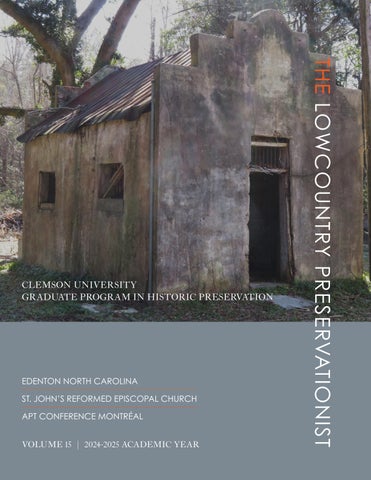
Front: Lincolnville Old Jail, by Hamzah Jule

Back: Hayes Plantation Dairy, by Samantha Threlkeld

CONTACT US

Clemson Design Center - Charleston

701 East Bay Street, Suite 202 Charleston, SC 29403

Email: preservation@clemson.edu

Phone: 843.937.9596

Facebook & Instagram: @clemsonhistprescharleston

INTERIM DIRECTOR, BRADFORD WATSON

Bradford Watson is the Director of the Clemson Architecture Center, Interim Director of Historic Preservation and Director of Resilient Urban Design located in Charleston. He is an Associate Professor and a licensed architect in Montana and South Carolina. Bradford’s teaching and scholarship examine issues of extraction, both resource and experience, to design for a mutualistic inhabitation with the environment. He spent ten years as a professor in the School of Architecture at Montana State University. Prior to that he was a Project Director Designer with Westlake Reed Leskosky (now DLR Group) working with non-profit organizations in the cultural and performing arts. Bradford holds a BARCH from Penn State and a MARCH from the Cranbrook Academy of Art. He coordinates Clemson’s IPAL program, is a NCARB Architecture Licensing Advisor and serves on the South Carolina Architectural Foundation board to promote public awareness of the power of architecture, planning, and design.

MEET THE FACULTY

FULL-TIME

DR. LAUREL BARTLETT

DR. LAUREL BARTLETT

Dr. Bartlett has joined the program as a Research Assistant Professor. In this role, she will continue to teach the courses for which she is known, direct the Historic Preservation Minor program, and work on externally funded research projects.

Dr. Laurel Bartlett received her PhD in Planning, Design, and the Built Environment from Clemson University, with a concentration in Historic Preservation. Her research focused on the use and visitor impact at Thomas Jefferson‘s Monticello. She holds a Master of Science in Historic Preservation from Clemson University and a B.A. in political political science from Geneseo State University. Her research agenda f focuses on visitor impact at historic sites and southeastern vernacular architecture.

Prior to this role, she served as a lecturer in American Architecture for the Clemson University Graduate Program in Historic Preservation, specializing in architectural history, preservation theory, and Section 106 consultation. Dr. Bartlett is professionally trained as an architectural historian and has formally worked in private practice as a Principal Investigator in the cultural resource management field.

Alumni Chloe Hanisian and Hannah St. Onge with Dr. Laurel Bartlett at Mt. Vernon
Lorena Garrod and Jackson Dent with Professor Ordia and Lincolnville, SC Historian, Dr. Pernessa Seele

MEET THE FACULTY

FRANK ORDIA

Lit Frank Ordia joined the program in 2024 as an Assistant Professor of Historic Preservation. In this role he teaches the History and Theory of Historic Preservation class, Preservation Studio, and a second-year Special Topics in Historic Preservation elective course. As a tenure track faculty member he will also pursue a research agenda that contributes to the field of historic preservation through his research interests of preservation planning, economic development, and preservation.

Ordia earned his Master of Science in Historic Preservation from the the University of Texas at Austin and a B.A. in History from Baylor University. He was a lecturer at the University of Nebraska in Lincoln. Ordia’s professional experience includes planning and preservation consultancy in Austin, Texas, where he managed historic tax credit applications, National Register nominations, and redevelopment projects. He also held a role at an oil and gas development firm, handling private equity investments and drilling projects. His research focuses on tax incentives, real estate development, and urban design.

FALL 2024–SPRING 2025 LECTURERS

DR. CARTER L. HUDGINS (DIRECTOR EMERITI)

RICHARD “MOBY” MARKS III

FRANCES FORD

CRAIG M. BENNETT, JR.

BRIAN TURNER

CHRISTINA BUTLER

AMELIA SPADE

ELIZABETH RYAN

AMANDA BROWN

DR. LUKE PECORARO

DR. MYRSINI MAMOLI

FACULTY SPOTLIGHT

PART-TIME

FRANCES FORD

Clemson MSHP is honored to have Frances Henderson Ford guiding students in materials conservation. She is a well-trained preservationist, holding a B.A. in Historic Preservation from the College of Charleston and an Master of Science in Historic Preservation from the University of Pennsylvania, where she concentrated on architectural conservation with a focus on paint and ornamental plaster analysis.

Frances currently serves as lecturer and laboratory manager in conservation for the Clemson Master of Science in Historic Preservation, teaching the program’s core technical sequence–HP 8100 Conservation Lab, HP 8110 Advanced Architectural Conservation, and HP 8190 Investigation, Documentation and Conservation. She is known among students for her ability to translate complex material science into practical, field-ready skills.

Alongside her academic role, Frances maintains an active private practice and collaborates with Richard Marks Restoration, providing conservation analysis and treatment for historic buildings and interiors throughout Charleston. Her specialized work in cemetery and stone conservation has earned widespread recognition, and Charleston Magazine has featured several of her projects, including the conservation of an 1843 Gothic Revival mausoleum at Kahal Kadosh Beth Elohim, where she stabilized structural cracks and removed damaging deposits, as well as her paint analysis at the French Huguenot Church, which identified the building’s historic rosy-pink exterior and informed its current restoration color.

An engaged scholar, Frances has presented at conferences across the East Coast and internationally, including the 2nd Historic Mortars Conference in Prague and the 4th Historic Mortars Conference in Greece. She has also presented at numerous Association for Preservation Technology (APT), American Institute of Conservation (AIC), and National Center for Preservation Technology and Training cemetery summits. In 2022, Frances presented paint analysis research on the ceiling of Ochre Court’s former orchestra room at Salve Regina University’s historic preservation conference. Designed by Richard Morris Hunt in 1892, the Newport, Rhode Island Gilded Age mansion is now owned by Salve Regina University.

Frances is currently conducting survey and conservation work at the Johnston Cemetery at Hayes Plantation in Edenton, North Carolina and will present this research at the Edenton Historical Commission symposium in March 2026. She also plans to accompany the Advanced Conservation class to present their recently completed project on the Whitfield Hotel in Kershaw, South Carolina, at the AIC conference in Montreal in April 2026. Through her teaching, research, and conservation practice, Ford plays a vital role in preserving the built heritage of Charleston while mentoring the preservation professionals of the future.

FACULTY SPOTLIGHT

Top: Class of 2026 students with Professor Frances Ford in the lab

Bottom: Advanced Conservation class at the Whitfield Hotel in Kershaw, SC (L to R) (back) Thompson Teasdale, Florence Steele, Sam Threlkeld, Jess Stech, Mark Dorman (Kershaw Mayor), Lorena Garrod, Deeda Coffey (Hotel Owner), Frances Ford (front) Lissa D. Felzer (Historian), Hamzah Jule

SAVANNAH, GEORGIA

The MSHP classes of 2025 and 2026 embarked on a daylong exploration of Savannah, Georgia, immersing themselves in the city’s rich history. Professor Laurel Bartlett led a walking tour of the city’s historic district before students split into groups: one toured the Owens-Thomas House Museum, an 1819 residence designed by William Jay, notable for its English Regency architecture and preserved urban slavery quarters, while the other visited the Tomochichi Federal Building and U.S. Courthouse to observe ongoing renovation work, guided by representatives from Double Hung, LLC, a window restoration company, and the General Services Administration (GSA). The day concluded with a visit to Re:Purpose Savannah, a nonprofit that salvages and repurposes historic building materials for sustainable use. Clemson MSHP gratefully acknowledges the Savannah partners who made these enriching experiences possible.

Top L: Students going to tour the Tomochichi Federal Building

Top R: MSHP students in front of the Mercer-Williams House in Savannah

Bottom L: Class of 2025 & Class of 2026 in Savannah

Bottom R: Students visit Re:Purpose Savannah

First-year students in HP8100 Conservation Lab took a field trip led by Professors Frances Ford and Richard “Moby” Marks to historic sites north of Charleston along U.S. Highway 17. Stops included Hampton Plantation, a 1730 former rice plantation visited by George Washington in 1791; the Peachtree Ruins, remnants of a house that once belonged to the Lynch family but was destroyed by fire in 1840; St. James–Santee Episcopal Church, one of South Carolina’s oldest surviving brick churches; and the Village Museum in McClellanville. The winter outing was made especially engaging by Professor Marks’s onbus narration, which drew on his extensive knowledge of Lowcountry history to illuminate the significance of each site.

Top: St. James-Santee Episcopal Church

Bottom L: Hampton Plantation

Bottom R: Students at St. James Santee Brick Church

HAMPTON PLANTATION & McCLELLANVILLE

EDENTON, NORTH CAROLINA

During the first week of April 2025, firstyear students had an amazing opportunity to travel to Edenton, NC. The trip was possible due to the efforts of Professor Frances Ford and the Richard Hampton Jenrette Foundation. Accompanied by Professors Richard “Moby” Marks and Frances Ford the group made a stop in New Bern, NC to see Tryon Palace and tour a private residence. Then it was off to Edenton where students spent a few days exploring the town, mingling with fellow preservationists, and touring old buildings.

Upon arrival, the students toured the Penelope Barker House and the Roanoke River Lighthouse. Subsequent days included tours of Hayes Plantation, the Cupola House, the Lane House, and the old Chowan County Courthouse, amongst others. Students were introduced to a number of important preservationists during their tour of the historic Cupola House in downtown Edenton. The interiors of the house were sold to the Brooklyn Museum in 1918 but are finally being returned and students not only got to see the interior panels, mantels, doors, etc. but also had the unique chance to witness parts of the Cupola House without paneling as they were being prepared for the installation of the original interior. Andrew Ownbey and Wade Rogers were heading up this project and showed students all sorts of interesting findings. The group was also introduced to Robert Leath, an important figure in making the trip happen and the Executive Director

of the Edenton Historical Commission. Students attended a lecture by noted paint analyst Susan Buck who presented on her paint discoveries within the Cupola House. Students also had the chance to see her in action investigating paint samples at the Cupola House.

Dawson Tyler, Founder of Down East Preservation welcomed students to his shop and office in downtown Edenton. From there students traveled to Kadesh Church to tour the inside as it is being restored. Then they were invited to watch with the public as a new bell tower was lifted onto the top of the church with a crane. This represented the first time that Kadesh Church had a spire since the mid-1900s.

The group toured Hayes Plantation and met Amelia Jensen who is doing paint analysis there. They got to see the unique octagonal library, outbuildings, and the family cemetery. Lane House, a home dated to 1718-1719 through dendrochronology, was also toured. Students then spent a night mingling with preservationists at Beverly Hall, the home of Samuel “Sambo” Dixon, a defense lawyer and preservationist.

Top L: The Cupola House

Top Middle: Students inside the Cupola House

Top R: Hayes Plantation

Bottom L: Spring 2025 Conservation Science class (L to R) (back) Tad Darrah, Jackson Dent, Hamzah Jule, Thompson Teasdale, Zenic Rice, Professor Mody Marks, Lorena Garrod, (front) Professor Frances Ford, Jess Stech, Florence Steele, Belle Ziethen, Alex Ullman, Sam Threlkeld, Summer Henry

Bottom R: St. Paul’s Episcopal Church

Towards the end of the trip students toured the old Chowan County Courthouse and had the opportunity to crawl up into the cupola at the top. The private residence of Wade Rogers, which was under restoration, was also toured, as was the James Iredell House. Overall, the trip was a lovely opportunity to see major preservation projects, meet high-profile preservationists and make connections, and explore one of North Carolina’s oldest towns. This trip would not have been possible without Professor Frances Ford and the Richard Hampton Jenrette Foundation, including Kevin Cherry and Weston Ewart of the Foundation, who added their own knowledge throughout the trip. We are deeply grateful for this opportunity and thank those that helped make it happen.

IDC – ST. JOHN’S REFORMED EPISCOPAL

First-year graduate students in Clemson University’s Master of Science in Historic Preservation program spent the fall 2024 semester studying St. John’s Reformed Episcopal Church at 91 Anson Street as part of their Investigation, Documentation, and Conservation course. Over four months, the class examined the church’s condition, recorded its architectural features, and analyzed its historic finishes to better understand the building and support its long-term preservation.

Students began by documenting the church through detailed measured drawings and photographs following HABS standards, using field measurements and AutoCAD to produce accurate architectural drawings. They then began assessing the condition of major components such as the windows, doors, roof, plaster, and mechanical systems, compiling their findings into a structural conditions report with recommended preservation measures.

The conservation portion of the project focused on paint analysis. By collecting and studying microscopic samples, students reconstructed a chronology of finishes that reflects changes in the church across different periods of ownership. To complement the interior study, the class also recorded the site and surrounding landscape using Total Station mapping, GIS, and historic maps.

This work reflects many hours spent on-site and represents a significant introduction to preservation practice for the program’s first-year students. The class extends its appreciation to the St. John’s congregation, Dr. Patrice Capers, and the IDC faculty and teaching assistants for their support throughout the project.

Middle L: Students look at paint sample with DermLite

Middle Center: Students taking measurements for drawings

Middle R: Pen drawing of St. John’s by Carson Cone

Bottom Center: Fall 2024 IDC class

Bottom R: Interior of St. John’s

Top L: St. John’s floor plan drawing

Top R: Paint sample photomicrograph

Below: St. John’s Reformed Episcopal Church

PRESERVATION STUDIO

Preservation Studio is a six-credit, handson course taken by first-year students during the spring semester. The studio immerses students in professional preservation practice through real-world projects in Charleston and the surrounding Lowcountry, emphasizing field-based documentation including HABS-standard measured drawings, collaborative research, materials analysis, and community engagement. Students apply design theory and preservation strategies to historic buildings, cultural landscapes, and urban contexts, producing professional-quality reports, preservation plans, and design proposals for actual sites and stakeholders. In Spring 2025, students completed four intensive project modules that collectively introduced core preservation methods while engaging directly with historic and places

The first module, led by Professor Amalia Leifeste, focused on a conditions assessment and historical documentation of the Lincolnville Jail in Lincolnville, South Carolina. Founded during the Reconstruction era by African American ministers and community leaders, Lincolnville is one of the earliest selfgoverned African American towns in the region. Built circa 1900, the jail is among the town’s oldest surviving structures. Students conducted on-site investigations incorporating laser scanning and field documentation, culminating in a formal conditions assessment and historical report presented to the Town of Lincolnville –providing both a meaningful educational experience and a tangible resource for the community.

The second module, led by Professor Frank Ordia, was conducted in collaboration with Weston & Sampson and the City of Charleston’s Gullah Geechee Heritage Preservation Project, an initiative dedicated to documenting and preserving historic Gullah Geechee settlement communities throughout the Charleston region. Students worked in teams to prepare Area Character Appraisals (ACAs) for Hamlin Beach in Mount Pleasant, Lincolnville, and Red Top, incorporating archival research, field surveys, and GIS-based mapping to analyze settlement patterns, land use, and spatial relationships. An ACA is a comprehensive planning document that documents a community’s history,

Spring 2025 Preservation Studio class at the Lincolnville Old Jail

LINCOLNVILLE OLD JAIL FOLLY BEACH DESIGN GUIDELINES AREA CHARACTER APPRAISALS INFILL PROJECT

architectural and landscape character, existing conditions, and development pressures, while offering recommendations to support long-term preservation. Students presented their findings directly to community members, reinforcing the importance of public engagement in preservation practice. The studio extends special thanks to Dr. Pernessa Seele of the Lincolnville Preservation and Historical Society, Dr. Melodie Dover of the Red Top Improvement Association, and the Hamlin Beach Community Association for their guidance and collaboration.

The third module, also led by Professor Ordia, centered on the development of design guidelines for Folly Beach, South Carolina. Design guidelines are planning tools that provide recommendations, rather than regulatory requirements, for new construction and alterations, helping communities maintain architectural character while allowing flexibility. Folly Beach, known for its eclectic architecture, currently lacks formal design controls, making it an ideal site for students to examine how architectural character, materials, scale, and cultural identity can be preserved without imposing uniformity. This project challenged students to articulate preservation values while balancing creativity and sensitivity to place.

The final module, led by Professor Leifeste, is a long-standing tradition within the program: an architectural infill design project for a vacant lot on King Street in Charleston. Throughout the semester, students also participated in “Tea Time,” a recurring theoretical discussion that encourages critical engagement with architecture, including how site, form, massing, and scale shape the built environment. Drawing on these discussions, students developed a complete architectural proposal–from program development to construction drawings and physical models produced using the studio’s laser cutter. The semester concluded with formal presentations before a panel of community members and program alumni, offering students valuable professional feedback.

Together, these projects equipped students with both technical and conceptual skills, preparing them to become critically engaged and technologically proficient preservationists. By requiring the production of professionalquality documentation, analysis, and design work, Preservation Studio reinforces the role of research, collaboration, and applied design as some of the most effective tools for preserving historic places and landscapes.

Zenic Rice working with Hamlin Beach partners for the ACA project

PRESERVATION ENGINEERING

Top: Students investigate crawlspace of St. Mark’s Episcopal Church

Bottom: Students visit 58 George Street adaptive re-use project

Second-year MSHP students in the Class of 2025 spent the spring semester deepening their understanding of how historic buildings work structurally through HP 8280: Case Studies in Engineering, taught by preservation engineer Craig Bennett. Bennett is principal of Bennett Preservation Engineering, a Charleston-based firm with a national portfolio that includes work at Drayton Hall and structural stabilization planning for Cape Hatteras and Cape Lookout lighthouses for the National Park Service.

The course introduces students to the fundamentals of structural engineering as they relate to historic buildings, with an emphasis on load paths, structural behavior, and the long-term performance of traditional materials. Classroom instruction is paired with extensive fieldwork, giving students the opportunity to examine real-world engineering challenges and understand how conditions are evaluated and recommendations developed.

Site visits included the Cathedral of St. Luke and St. Paul, mid-century masonry buildings on MUSC’s campus, beach cottages on Sullivan’s Island, College of Charleston fraternity and sorority houses, and the Robert Mills Fireproof Building. The semester culminated in a final project in which students completed a structural assessment of a specific building, developing clear, well-supported recommendations grounded in observed conditions and engineering principles.

HISTORIC INTERIORS

Second-year students had the opportunity to take the Historic American Interiors elective class with professor Elizabeth G. Ryan, a decorative arts appraiser in the area. The course surveys the American domestic interior which includes forms, materials, and finishes from the seventeenth to twentieth centuries with emphasis on the social, cultural, economic, and technological factors that influenced them. Class tours included the Gibbes Museum of Art, the Heyward-Washington House, and the Charleston Museum where students studied the respective textile, furniture, and decorative arts collections of the institutions.

For their final projects, each student researched and reported on a chosen artifact from the Heyward-Washington House’s collection. The Heyward-Washington House is a Georgian style structure built in 1772 for Thomas-Heyward Jr., a signer of the Declaration of Independence. Students explored the underrepresented people and stories associated with their chosen artifact, revealing another layer to the rich history of the home’s domestic interior.

Chad Stewart, Curator of History for The Charleston Museum, accompanied MSHP students on many tours throughout the semester. We are proud to announce that he will be teaching our Historic American Interiors class this Spring 2026 semester!

Top: Students visit the Charleston Museum

Bottom: Students visit the Heward Washington House

HISTORIC STRUCTURES REPORT

This spring, the graduate Historic Preservation program is offering the Historic Structures Report (HSR) elective course to second-year students. An HSR is a critical tool for documenting a building’s history and current condition. Students will employ preservation methods such as laser scanning, measured drawing, paint analysis, and landscape documentation to create a comprehensive report.

Through the course, students gain hands-on experience in preparing an HSR, while the client benefits from a semester-long, in-depth study of their site. In addition to documenting the building, the students provide recommendations to guide the renovation and preservation process, helping ensure that interventions respect the building’s historic character.

This year’s project focuses on Cantey Place in Summerton, SC–a largely intact 1840s Greek Revival house that has been unoccupied for several years and was recently purchased for restoration. The resulting HSR and renovation recommendations will assist the client in applying for a Stabilization Grant from the South Carolina Department of Archives and History.

Cantey Place

SCHOLARSHIP SPOTLIGHT

Claire Jackson (Class of 2025) was selected as a Preservation Action Bruce MacDougal Advocacy Scholar and recently traveled to Washington, D.C. to participate in National Historic Preservation Advocacy Week.

Through the Bruce MacDougal Advocacy Scholars Program, emerging preservation professionals gain the knowledge, skills, and networks needed to champion historic preservation through effective federal advocacy. As part of the program, Claire participated in policy briefings, advocacy trainings, and congressional visits, meeting with South Carolina’s state representatives to advocate for preservation policy and federal funding.

Claire was part of the South Carolina lobby group, where she met with congressional staffers from across the state to advocate for the reauthorization of the Historic Preservation Fund, which supports preservation initiatives in the Lowcountry and nationwide. The experience also provided opportunities to connect with preservation advocates from across the country and gain firsthand insight into how preservation policy is shaped at the national level.

Congratulations, Claire!

Top: Claire in DC

Bottom: Claire with congressional staffers

APT CONFERENCE, MONTRÉAL, CANADA

In November 2024, MSHP professors, students, and alumni attended the Association for Preservation Technology’s (APT) conference in Montreal, Canada. This year’s theme was building bridges, allowing international engineers, scholars, architects, students, and professionals to make valuable connections and share ideas. Among the MSHP attendees was secondyear student Nolly Swan who became involved with APT through her summer internship with Building Conservation Associates, a consulting firm specializing in the preservation design, assessment, and documentation of heritage sites internationally. Her supervisor, Kevin Wohlgemuth, was also the president of ATP’s Washington D.C. chapter at the time. Swan was encouraged to apply for ATP’s Equity Scholars Program which aims to uplift students, apprentices, and young professionals with diverse backgrounds and perspectives, an initiative that aids in the expansion of the preservation field as a whole.

Swan was one of three candidates recognized as a 2024 Equity Scholar and the only American to receive this honor. She was able to attend the conference’s Student Recognition Luncheon, presentations, and workshops held at the conference. Swan says the conference opened her eyes to how essential preservationists are in the climate crisis and addressing issues of sustainability when it comes to adaptive reuse.

Swan and her fellow classmates also presented their project for the VR Cultural Heritage class where they digitally reconstructed a Roman temple at Antiochia ad Cragum in Turkey. 2024 alum Sarah Gaston attended the ATP conference as well and was recognized as a Student Scholar. She presented her thesis research on residual chloride exposure on the Charleston Battery’s nineteenth century masonry buildings.

Catherine Claire Jackson

CLASS OF 2025 THESES

Quantifying the Transformation of the Built Environment as a Result of Cooper River Bridge Construction in Charleston, South Carolina

Jocelyn Patterson

Sacred Grounds: A Risk Assessment Framework Developed for Historic African American Cemeteries Threatened by Sea Level Rise in Georgetown, SC

Shawnya Peterson

After Midnight: Analyzing Legacy Business Programs’ Potential to Capture Patron Perspectives Through a Case Study of Four Charleston, SC Nightlife Spaces

Jessica Lynn Ridder

Preserving Historic Houses: An Analysis Of Cleaning Methods for the Removal of Fire Extinguisher Discharge on Historic Finished Plaster

Nolly C. Swan

A Comparative Analysis of Cultural Preservation Focused Land-Use Regulations within the Gullah Geechee Cultural Heritage Corridor of South Carolina

Hannah Truman

A Qualitative Analysis of Graffiti Inscriptions at Ecclesiastical Sites in the South Carolina Lowcountry

Congratulations, Class of 2025!

CLASS OF 2026 INTERNSHIPS

Thomas Darrah

Saint-Gaudens National Historic Park Cornish, New Hampshire

Jackson Dent

Historic Charleston Foundation Charleston, SC

Lorena Garrod

Drayton Hall and Simeon Warren Charleston, SC

National Center for Preservation Technology and Training Remote

Summer Henry

Liberatos Architects Charleston, SC

Hamzah Jule

Edenton Historical Commission Edenton, NC

Zenic Rice

Richard Hampton Jenrette Foundation/Richard Marks Restoration Charleston, SC

Jessica Stech

City of Charleston’s Board of Architectural Review Charleston, SC

Florence Steele

Drayton Hall (Jenrette Fellow) Charleston, SC

Thompson Teasdale

Maine Preservation and Restoration Resources Maine

Samantha Threlkeld

Drayton Hall (Charles Scott Riley Collections Fellow) Charleston, SC

Alexandra Ullman

Charleston Library Society Charleston, SC

Victorian Society Summer School United Kingdom

Top L: Samantha Threlkeld with alumna Kelly Ciociola testing paint consolidants in Drayton Hall

Top L: Thompson Teasdale routing out a sill

Middle L: Jackson Dent conducting a plaster crack study in the Aiken-Rhett House

Middle R: Jackson Dent and Jess Stech during a B.A.R. site visit over the summer

Bottom: Zenic Rice removing paint from historic plasterwork

https://www.clemson.edu/caac/academics/architecture/programs/historic-preservation/mshp.html

Follow us on Instagram & Facebook: @clemsonhistprescharleston

Turn static files into dynamic content formats.

Create a flipbook