Global
Supply Chain Management

On-Again, Off-Again Tariffs Cause Significant Uncertainty and Disruption in Global Supply Chains
Broad-based, shifting tariffs on U.S. trade partners have led to significant supply chain disruptions and substantial business uncertainty. Businesses of all sizes and across most industries are unsure what the future might hold as U.S. trade policy continues to evolve. The resulting cost increases have been mostly absorbed by U.S. firms or passed down to U.S. consumers. The administration has acknowledged this with the recent rollback of food tariffs with the stated goal of lowering prices. Less visible is the frenzy of appeals for exemptions, a process that imposes significant costs on small- and mid-sized firms that lack sufficient resources to jump through bureaucratic and political hoops. Most worrisome is the prospect of supply chain chaos as many firms are forced to constantly monitor official guidance and adjust their supply chains to mitigate risks.
This volatility has made it difficult for businesses to plan, invest and maintain stable operations, leading to higher costs. Furthermore, the uncertain business climate has prompted many firms to put the brakes on hiring as they tighten their belts to absorb the costs of tariffs and anxiously await a lasting trade deal.
In summary:
• Tariffs add complexity and costs in managing procurement and logistics of imported materials and components, which in turn raises operational costs for U.S. manufacturers, often passed on to consumers as higher prices.
• The policy uncertainty resulting in frequent changes and announcements regarding tariff rates has prevented many businesses from having the stability required to reconfigure their supply chains and make long-term investments.
• The unpredictable tariff rates have led some importers to stockpile goods to avoid potential future price hikes, creating additional volatility in the upstream supply networks, leading to bottlenecks and cost increases.
Permanent rollback of tariffs on a wide range of items would remove a major source of instability. This would allow firms to shift their focus from the scramble to constantly reconfigure their supply chains, renegotiate with their suppliers and lobby for tariff exemptions to maintaining stable operations, leading to lower costs and sustained economic growth.

Our Global Supply Chain Management program covers critical topics to help today’s professionals successfully navigate multifaceted challenges. In this issue of Linkages, you will read about our faculty’s latest achievements and research, including: a new faculty member whose research centers around optimization under uncertainty in supply chain transportation problems, (p. 2-3); research that combines advanced AI and logistics design to shape the future of truck and drone delivery systems (p. 4); research into Small and Medium Enterprises (SMEs) and their manufacturing and operational capability building dynamic to address supply chain misalignment and improve productivity (p. 5); as well as an interview with Reh School of Business Interim Dean Stephen Standifird on the attributes that distinguish and differentiate a Clarkson education.
We hope you enjoy this issue and welcome your feedback (mahmoodi@clarkson.edu).
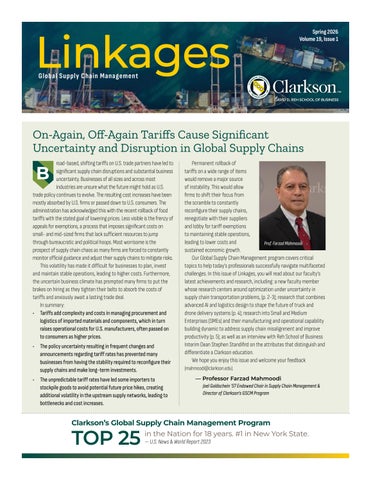
— Professor Farzad Mahmoodi Joel Goldschein ’57 Endowed Chair in Supply Chain Management & Director of Clarkson’s GSCM Program
Clarkson’s Global Supply Chain Management Program
in the Nation for 18 years. #1 in New York State.
Finding Solutions to Complex Supply Chain Challenges
Assistant Professor Nima Raad applies his expertise in industrial engineering and quantitative methods to find solutions to supply chain problems and to surmount barriers to the implementation of new technologies.
Assistant Professor of Engineering & Management Nima Golghamat Raad’s research centers on optimization under uncertainty in supply chain problems.
“I primarily work on supply chain transportation problems, including network design, location selection and scheduling,” he says. “Currently, I am directing much of my research to challenges related to the adoption of newer supply chain transportation technologies, like air taxis, robotaxis and drones.”
For example, Prof. Raad is investigating the feasibility of deploying new transportation technology like air taxis into urban areas such as New York City.
Part of the research focuses on infrastructure challenges, including the placement of “vertiports” – specialized facilities located on the tops of buildings that allow take-off and landing of aircraft. “The vertiports can be used as stations for air taxis to move people to important locations such as hospitals or airports without getting stuck in traffic,” he says.
“Some barriers to air taxis and vertiport placement are technological. We need improved sensors, cameras, batteries, noise cancellation devices and autopilot functions. Other barriers are political and regulatory, including safety and security standards, and rules and restrictions regarding air traffic in urban environments.”
This is the kind of multifaceted optimization and logistics problem that interests Prof. Raad, who first came to the United States in in 2021 to pursue a PhD in Industrial and Systems Engineering at the University of MissouriColumbia School of Engineering.
“I had already studied industrial engineering at two universities in Iran, both of which are well known internationally: Isfahan University of Technology,

where I received my bachelor of science, and Amirkabir University of Technology, where I received a master of science degree,” he says. “But I was eager to learn and demonstrate my talents in a global world and pursue my research interests in supply chain analytics and optimization.”
As a doctoral candidate, he received funding from his department through his work as a Teaching Assistant in courses such as Probability & Statistics for Engineering and Quality Control for Lean Enterprises. He was also sponsored by the Alaska Department of Transportation & Public Facilities, where he worked on a port expansion project in Anchorage. His graduate research focused on the strategic location of drone battery charging stations for package delivery in both urban and rural areas.
To date, his research has been published in Transportation Engineering Journal, Transportation Research Part E, and Computers and Industrial Engineering


Prof. Raad joined the Reh School of Business at Clarkson last fall. It is the first time he has worked outside an engineering department — a change he welcomes. “I really like working in a business school environment,” he says. “The Reh School is very congenial, and there are great faculty, especially in Supply Chain Management and Operations Management. The students here are hardworking and inquisitive. Industrial engineering focuses on quantitative methods and using data science techniques to find the best solutions to supply chain problems. So, our business students develop strong quantitative as well as qualitative skills, which gives them a bigger toolbox to use to solve problems.”
“The Reh School also has strong connections to the Coulter School of Engineeringand Applied Sciences and other schools and departments, so it is easy to work across disciplines here and collaborate with faculty across the campus.”
Recently, Prof. Raad has been collaborating with his colleague Alison Coates, a rural healthcare specialist, on a project to adopt drone delivery of time-sensitive medical supplies like medications or blood samples in rural areas like St. Lawrence County.
“Rural areas have scarce populations over large geographic areas and so present unique challenges to healthcare delivery,” he says. “While it might be easier and more efficient to deliver medicine by drone rather than send people to the emergency room, there are challenges that must be overcome in order to implement the technology.”
These challenges include operating according to state and local regulations pertaining to drones, working within tight budgets, minimizing noise and attracting sustained support from the local community.
Prof. Raad brings his research into the classroom. “I try to involve my undergraduate students in research
The Reh School also has strong connections to the Coulter School of Engineering & Applied Sciences and other schools and departments, so it is easy to work across disciplines here and collaborate with faculty across the campus. “ ”
and give them experience writing technical and scientific reports. I also encourage them to present their projects at internal and external conferences. Undergraduate research is missing at many other institutions, but it is very helpful for students – even those going into industry. They develop presentation and communication skills and gain experience and confidence by honing and presenting their ideas to others.”
Prof. Raad is also working with two MBA students on a project related to data center location optimization for AI and Edge Computing.
“Data centers are often placed in rural areas because of the availability of cheap land, but the greater the distance from data centers to end users, the higher the costs and the longer the time delay – what is known as Response Latency. In order to optimize the system, the data center cannot be too isolated. Decisions on siting are therefore very important.”
He and his research team are working to determine whether it is feasible to place a quantum computer data center in the North Country. “On the plus side, we have access to land and clean energies like hydroelectric power, plentiful water, and a colder climate to help rid the data centers of waste heat.”
But on the other hand, data centers consume a huge amount of water that gets heated to a very high temperature and is then discharged into local streams, rivers, and lakes, which can kill fish and other marine life and adversely affect water quality over a large area.
Undaunted, Prof. Raad observes that “The complex problems that I work on require decision-making based on quantifiable and multifaceted data points. But this is what makes them exciting to work on.”
Faculty Research, News and Awards

Associate Professor Shafique Ahmad Chaudhry co-authored a paper, “Multi-City Calibration of Low-Cost PM Sensors Using Machine Learning,” which has been accepted for publication in IEEE Access
Prof. Chaudhry also recently presented two papers at international conferences.
Last fall, he presented “Behavioral Biometrics for Automatic Detection of User Familiarity in Virtual Reality,” at the 17th IEEE International Conference on Quality of Multimedia Experience (QoMEX’25) in Madrid, Spain. The paper’s findings highlight the potential for adaptive VR systems that automatically adjust difficulty, guidance, or interface layouts based on a user’s experience level. For organizations deploying VR for training, simulation, and operational workflows, Chaudhry’s work provides a powerful tool for improving user performance, reducing onboarding time, and enhancing overall learning effectiveness.
He also presented “Knowledge-Based Behavioral Biometrics for Secure Authentication in Virtual Reality,” at the 27th IEEE International Symposium on Multimedia held in December in Naples, Italy.
The paper featured his pioneering research on a new authentication framework designed to make Virtual Reality systems more secure and more practical for real-world use. His study presents the first VR authentication method that integrates PIN entry with behavioral biometrics captured from both controllers and hand-tracking inputs, allowing the system to learn how users naturally move when entering passcodes.
The findings demonstrate a secure, userfriendly, and cross-device solution that can be deployed across diverse VR platforms. For business and supply chain environments increasingly relying on VR for training, simulations, and remote
operations, this research establishes a strong foundation for dependable access control without disrupting workflow or user experience.

Professor Santosh Mahapatra coauthored an article “Balancing Practicality and Aspiration: A Comparative Analysis of Sustainable Holistic Planning System Toolkit Designs” in Landscape and Urban Planning

Professor Farzad Mahmoodi, Joel Goldschein ’57 Endowed Chair in Supply Chain Management, authored an article: “Unpredictable Tariff Rates Have Caused Significant Uncertainty and Disruption in Global Supply Chains,” to be published in SupplyChainBrain’s Annual Resource Guide. He also co-authored “The Three-Body Problem of Organizational Resilience: Reconstructing the Systemic Resilience of Global Supply Chains,” published in Tsinghua Business Review
Professor Mahmoodi was the recipient of the Clarkson Distinction in Faculty Mentoring in Research Scholarship Award in May 2025.
John Milne, Neil ‘64 and Karen Bonke Associate Professor in Engineering Management, coauthored the 2025 article “An Ontology for Semiconductor Supply Chain Planning,” in IEEE Transactions on Semiconductor Manufacturing

Prof. Milne also appeared on the Canadian Broadcasting Corporation’s national television segment “Go Public,” in a program titled “Air Canada had no idea these passengers were on its flights and cancelled their tickets home.” The story also appeared on radio and in print online.
He serves as a board member of the INFORMS Section on Practice. In 2025, he received the Commendable Service Award, presented by Phalanx, Clarkson University’s highest honorary society, in recognition of individuals who have demonstrated extraordinary support to the University.

Assistant Professor Nima Golghamat Raad co-authored two articles in 2025: “From Voices to Value: Leveraging Online Reviews to Benchmark Airline Efficiency with GenAI-Assisted Text Analytics and DEA,” in the Journal of the Operational Research Society; and “Hybrid and Distributionally Robust Optimization Approaches for Hospital Blood Bank Inventory Management Under Demand Uncertainty,” in the Journal of the Operational Research Society
In 2024, Prof. Raad co-authored three articles: “Hybrid Regret-Based p-Robust and Distributionally Robust Optimization Models for Electric Vehicle Charging Station Network Design,” in Computers & Industrial Engineering; “A Hybrid Robust SBM-DEA, Multiple Regression, and MCDM-GIS Model for Airport Site Selection: Case study of Sistan and Baluchestan Province, Iran,” in Transportation Engineering; and “A Hybrid Scenario-Based
Fuzzy Stochastic Model for Closed-Loop Dry Port Network Design with Multiple Robustness Measures,” in Transportation Research Part E: Logistics and Transportation Review
Assistant Professor Michael Sacks has coauthored the article “Minimum Resale Price Maintenance Can Reduce Prices,” which has been submitted for peer review publication.
Theories suggesting that minimum resale price maintenance (RPM) are pro-competitive typically rely on inducing costly investments by downstream firms that are valued by consumers. The researchers present a model in which minimum RPM can be implemented by an upstream monopolist with many downstream retailers that benefit consumers independent of the provision of complementary services or inventory effects. Minimum RPM disrupts

coordination by downstream firms that sustain the monopoly price, leading to lower retail prices and higher retail quantities. Counterintuitively, therefore, a binding minimum resale price can reduce retail prices, which increases consumer surplus and aggregate producer surplus throughout the supply chain.
Professor Dennis Yu coauthored four recent articles: “Deep Reinforcement Learning for the Drone-Assisted Truck Delivery Route Optimization in a Time-Dependent Network with Time Windows,”

in Computers & Industrial Engineering, 2026; “Multi-Objective Optimization for Time-Dependent Vehicle Routing Problem with Drones,” in Expert Systems with Applications, 2025; “Time-Dependent Shortest Path Optimization in Urban Multimodal Transportation Networks with Integrated Timetables,” in Vehicles, 2025; and “Transportation and Carbon Emissions Costs Minimization for Time Dependent Vehicle Routing Problem with Drones,” in Computers & Operations Research, 2025
Graduate Degree Study Options in Supply Chain
The Reh School of Business offers both in person and online options for Global Supply Chain Management study:
MBA, Global Supply Chain Management (NEW!)
Fulltime, on campus program, 35 total credits
9 Month, 1.5- or 2-year study options
Focused coursework for depth of study
Online MBA with Certificate in Supply Chain Management
Complete the program in less than two years while you work
Start three times per year, flexible course loads, individualized planning 100% online
Ask about automatic admission options, all programs offer scholarship options!
Josh LaFave Director of Graduate Business Programs
jlafave@clarkson.edu / 315-268-7799 / clarkson.edu/business


Two Research Projects Receive Funding Support from the Reh School of Business’ Global Supply Chain Management Program
AI-Driven Logistics: Optimizing Urban Delivery with TruckDrone Collaboration
Reh School Professor Dennis Yu is collaborating on a project titled “Time-Dependent Multi-Trip Truck-Drone Routing Optimization via Deep Reinforcement Learning,” which aims to revolutionize last-mile delivery, the most complex and costly part of urban logistics.
Traditional truck-based systems often face challenges with traffic congestion and meeting timesensitive customer demands, while the potential of drone delivery has remained largely untapped due to coordination and operational difficulties. To address these challenge, Prof. Yu and his colleagues propose a multi-trip, truck-drone collaborative model in which each truck carries a drone to deliver goods to various locations. Trucks handle larger shipments and serve as mobile drone bases, while drones provide quick, flexible service to customers who are difficult or timeconsuming to reach by road.
By allowing multiple delivery trips per vehicle and integrating drone operations, the model promises to improve delivery efficiency and resource utilization.
“What makes this project unique is its AI-driven optimization system based on deep reinforcement learning (DRL), a rapidly expanding area of artificial
As e-commerce expands and cities struggle with traffic congestion, urban logistics face increasing pressure to deliver goods faster, more affordably and sustainably. A new research project addresses these issues through an innovative combination of artificial intelligence and hybrid delivery methods that use both trucks and drones.
“
What makes this project unique is its AI-driven optimization system based on deep reinforcement learning (DRL), a rapidly expanding area of artificial intelligence that enables machines to learn how to make optimal decisions through interaction with their environment.
”

intelligence that enables machines to learn how to make optimal decisions through interaction with their environment,” says Prof. Yu.
The study will conduct extensive computational experiments across various problem sizes, alongside a real-world case study using data from a diverse fleet of delivery vehicles. The anticipated outcomes include significant reductions in transportation costs, improved delivery efficiency, and valuable insights into how AI can revolutionize urban logistics operations.
The project is the latest step in a larger, ongoing research investigation conducted by Prof. Yu and his colleagues. Their article, “Deep Reinforcement Learning for Drone-Assisted Truck Delivery Route Optimization in a Time-Dependent Network with Time Windows,” was recently published in Computers & Industrial Engineering.
“By combining advanced artificial intelligence with practical logistics design, our research aims to shape the future of intelligent, sustainable, and flexible last-mile delivery systems, setting a new standard for how trucks and drones collaborate to move goods through our cities,” says Prof. Yu.


Understanding the Manufacturing and Operational Capability Building Dynamic at Small and Medium Enterprises
According to Reh School of Business Professor Santosh Mahapatra, this is largely due to challenges SMEs face in both supply and demand sides, which can lead to supply chain misalignment. “On the supply side, those challenges include limited access to capital, market and human resources, and on the demand side, this includes pressure from customers to excel simultaneously across multiple performance dimensions. These include cost, quality, delivery and flexibility performance, which are often prioritized differently by different customers.”
The result, he says, is that SMEs experience much smaller profit margins compared to the large exchange partners in the upstream and downstream supply chains.
Prof. Mahapatra is working on research to better understand SMEs and their manufacturing and operational capability building dynamic to address this supply chain misalignment and improve productivity. “Improving operational productivity and nimbleness for faster, better and lower-cost products and services are of paramount significance for the success of SMEs,” he says.
The research relies on two theoretical perspectives in the area of manufacturing and supply chain strategy (Cumulative Capability Building Model and Capability Configuration Theory) and utilizes information
Small and Medium Enterprises (SMEs) account for more than 90% of all businesses and 40-50% of all employment in both developed and developing countries. Yet, in a study by McKinsey & Company consulting group, SMEs were shown to operate at one-half to one-third of the productivity of the large companies.
Improving operational productivity
and nimbleness for faster, better and lower-cost products and services are of paramount significance for the success of SMEs.

“ ”collected from the managers of SMEs located in the USA and Western Europe, to empirically examine SMEs’ operational capability building experience.
This includes examining how the core operational capabilities of quality, flexibility, and delivery speed are interrelated; how customer-focused information management capability relates to those core operational capabilities; and what the effects of these capabilities, individually and collectively, are on the cost and overall performance of SMEs.
The preliminary analysis of survey data has been completed. Key insights based on the survey data to date suggest that quality and delivery capabilities serve as the key foundations for competitiveness. “Both capabilities effectively contribute to competitive advantage when they are developed based on inputs from customers,” says Prof. Mahapatra.
“A counter-intuitive insight from the analysis has been that while customers value flexibility capability and quality capability is foundational to the development of flexibility, its contribution to the competitive advantage of SMEs does not seem to be that strong. These issues are being investigated at a deeper level in the on-going interviews with SME managers.”
STEM-aligned Business Programs and Experiential Learning in a Culture of Innovation
How
the Reh School of Business Develops Successful Leaders for Changing Times.
In order for schools to be successful in higher education today, they have to do something different; they must add value that other schools and their programs are not adding,” says Stephen Standifird, Interim Dean of the Reh School of Business.
“Clarkson’s STEM-aligned business programs and the emphasis on experiential learning and innovation are the differentiators that make a Reh School of Business education stand out in a highly competitive market.”
Dr. Stephen Standifird was appointed interim dean at Clarkson last July, bringing with him decades of higher education leadership experience. A former business professor, he spent his early years in the classroom before moving into administrative roles, serving as Associate Dean and Dean at multiple universities, before taking the helm of Bradley University as president from 2020-2024. All this experience gives him a rare perspective on the opportunities and challenges of higher education today, as well as a clear understanding of what students need to be successful in their careers and in the world.
“Clarkson is fundamentally a STEM school and its business programs, like Global Supply Chain Management, Engineering & Management and Business Analytics, at their core emphasize that STEM mindset: quantitative thinking, an appreciation of complexity, and technical skills.”
These are also the skills he says, that today’s students are looking for. “Research has shown that students are interested in STEM programs because they understand that they need skills that will be relevant into the future, and which will help them add value to an organization right out of the gate.”
“Our business students graduate with quantitative skills and, equally important, have firsthand experience using these skills through the University’s emphasis on experiential learning.”
At Clarkson all students must complete an internship, capstone project, co-op, or research experience. For business students, internships and co-ops give them experience to apply the skills they are learning in an actual business environment. Reh School of Business students must also complete a global experience requirement. This takes the form of a semester abroad or a short-term, faculty-led international trip to visit overseas businesses and encounter different cultures.
“These experiences are incredibly valuable,” says Dean Standifird. “You’d be hard pressed to find anything these days that isn’t affected by globalization. Consider Supply Chain, it becomes very global very fast. You must be able to understand the global marketplace and pivot quickly when you are thinking about how to create and sustain a supply chain.”
Introducing students to the complexity of business creation and management starts in the first year and is a hallmark of a Clarkson Reh
Clarkson’s STEM-aligned business programs and the emphasis on experiential learning and innovation are the differentiators that make a Reh School of Business education stand out in a highly competitive market. “ ”

School education. Through hands-on coursework and the University’s Innovation Ecosystem, Reh School students have access to numerous opportunities to create products and services and develop start-ups.
Through these experiences, students develop skills, confidence and an appreciation for what goes into starting and operating a successful business. Any mistakes along the way are part of the learning process.
“The culture of innovation and size of Clarkson emphasize collaboration and working across disciplines, which mimics the real world,” says Dean Standifird. “In your professional life, you have to learn to work with people, many of whom bring different expertise, backgrounds and experiences to the project.”
The skills students acquire through a Reh School education – quantitative, entrepreneurial and collaborative — are also the skills that today’s industry-leading companies want.
“Clarkson’s strong partnerships with industry and dedicated alumni who are leaders in their fields further ensure that our education is always relevant and industry-ready.”
“This is why Clarkson business students experience a strong ROI from their education.”